EP0076404B1 - Verfahren zur Gewinnung von Gallium - Google Patents
Verfahren zur Gewinnung von Gallium Download PDFInfo
- Publication number
- EP0076404B1 EP0076404B1 EP82108568A EP82108568A EP0076404B1 EP 0076404 B1 EP0076404 B1 EP 0076404B1 EP 82108568 A EP82108568 A EP 82108568A EP 82108568 A EP82108568 A EP 82108568A EP 0076404 B1 EP0076404 B1 EP 0076404B1
- Authority
- EP
- European Patent Office
- Prior art keywords
- gallium
- resin
- groups
- chelate
- group
- Prior art date
- Legal status (The legal status is an assumption and is not a legal conclusion. Google has not performed a legal analysis and makes no representation as to the accuracy of the status listed.)
- Expired
Links
Classifications
-
- C—CHEMISTRY; METALLURGY
- C01—INORGANIC CHEMISTRY
- C01G—COMPOUNDS CONTAINING METALS NOT COVERED BY SUBCLASSES C01D OR C01F
- C01G15/00—Compounds of gallium, indium or thallium
- C01G15/003—Preparation involving a liquid-liquid extraction, an adsorption or an ion-exchange
-
- C—CHEMISTRY; METALLURGY
- C22—METALLURGY; FERROUS OR NON-FERROUS ALLOYS; TREATMENT OF ALLOYS OR NON-FERROUS METALS
- C22B—PRODUCTION AND REFINING OF METALS; PRETREATMENT OF RAW MATERIALS
- C22B3/00—Extraction of metal compounds from ores or concentrates by wet processes
- C22B3/20—Treatment or purification of solutions, e.g. obtained by leaching
- C22B3/42—Treatment or purification of solutions, e.g. obtained by leaching by ion-exchange extraction
-
- C—CHEMISTRY; METALLURGY
- C22—METALLURGY; FERROUS OR NON-FERROUS ALLOYS; TREATMENT OF ALLOYS OR NON-FERROUS METALS
- C22B—PRODUCTION AND REFINING OF METALS; PRETREATMENT OF RAW MATERIALS
- C22B58/00—Obtaining gallium or indium
-
- Y—GENERAL TAGGING OF NEW TECHNOLOGICAL DEVELOPMENTS; GENERAL TAGGING OF CROSS-SECTIONAL TECHNOLOGIES SPANNING OVER SEVERAL SECTIONS OF THE IPC; TECHNICAL SUBJECTS COVERED BY FORMER USPC CROSS-REFERENCE ART COLLECTIONS [XRACs] AND DIGESTS
- Y02—TECHNOLOGIES OR APPLICATIONS FOR MITIGATION OR ADAPTATION AGAINST CLIMATE CHANGE
- Y02P—CLIMATE CHANGE MITIGATION TECHNOLOGIES IN THE PRODUCTION OR PROCESSING OF GOODS
- Y02P10/00—Technologies related to metal processing
- Y02P10/20—Recycling
Definitions
- This invention relates to a process for recovery of gallium from solutions containing gallium. More particularly, it relates to a process for recovery of gallium contained in solutions by adsorption with special chelate resins.
- Gallium is commercially produced from the Bayer solution obtained during the production of alumina, namely, an aqueous sodium aluminate solution.
- the Bayer solution is a very useful raw material because it contains about 10-500 mg/I of gallium.
- there are two methods for recovering gallium from aqueous sodium aluminate solutions namely, one method which comprises electrolyzing the solution using a mercury cathode to convert gallium in the solution into an amalgam, hydrolyzing this amalgam with a caustic alkali and then electrolyzing the resultant aqueous alkali gallate solution and another method which comprises blowing carbon dioxide into an aqueous sodium aluminate solution to precipitate mainly alumina contained in the aqueous sodium aluminate solution, blowing carbon dioxide into the solution in which the ratio of the gallium content to alumina content has been thus increased to coprecipitate alumina and gallium, dissolving the coprecipitate in a caustic alkali and then electrolyzing the resultant
- the former method has the defect that a large amount of mercury is lost at the amalgamation because it is dissolved in the aqueous sodium aluminate solution and the latter method also has the defect that use of carbon dioxide results in loss of caustic alkali in the aqueous sodium aluminate solution due to carbonation.
- these methods are industrially not satisfactory.
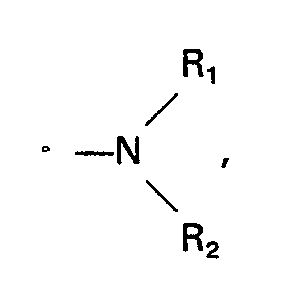
- EP-A-0 054 461 which forms part of the state of the art within the meaning of Art 54(3) EPC discloses a method for recoverying gallium from acid solutions by means of ion exchange resins having the formulae
- R, and R 2 represent hydrogen or an organic group (generally an alkyl group, alkylene group, phenyl group), especially an alkyl group of 1-20 carbon atoms or hydrogen]
- polyethylenepolyamino group is especially preferred.
- the chelate resins having metal salts of said functional groups are those having metal salts of said functional groups (A) and/or functional groups (B) or metal salts formed by the chelate bond between said functional groups (A) and (B), and these chelate resins have no special limitation if the bonding power for formation of these salts is smaller than the bonding power between said functional groups (A) and (B) and gallium.
- the metals of said metal salts are alkali metals and alkaline earth metals such as sodium, potassium, calcium, magnesium, etc.
- Such chelate resins are those having amidoxime group obtained by reacting polymers of vinyl cyanide monomers such as acrylonitrile, a-chloroacrylonitrile, vinylidene cyanide, methacrylonitrile, etc. or copolymers of the vinyl cyanide monomers and other ethylenically unsaturated monomers copolymerizable therewith with hydroxylamine or derivatives of hydroxylamine; those which are obtained by homo polymerizing vinyl cyanide derivatives obtained by reacting vinyl cyanide monomers such as acrylonitrile, a-chloroacrylonitrile, vinylidene cyanide, methacrylonitrile, etc.
- nitrile compounds having amino or imino group such as aminoacetonitrile, aminomalononitrile, diaminomaleonitrile, dicyanodiamide, iminodiacetonitrile, 1-amino-2-cyanoetahne, 4-aminobenzonitrile, 1-amino-3-cyanopropane, etc.
- hydroxylamine or hydroxylamine derivatives those which are obtained by reacting the reaction product of said nitrile compounds having amino or imino group and hydroxylamine or hydroxylamine derivatives with said resins having amine reactive group; those which are obtained by reacting halogenated resins such as halogenated styrene-divinylbenzene copolymer, phenol resin, etc. which have sulfonic acid group, carboxylic acid group, phosphoric acid group, dithiocarboxylic acid group, alkylamino group, etc.
- halogenated resins such as halogenated styrene-divinylbenzene copolymer, phenol resin, etc. which have sulfonic acid group, carboxylic acid group, phosphoric acid group, dithiocarboxylic acid group, alkylamino group, etc.
- nitrile compounds having amino or imino group and hydroxylamine or hydroxylamine derivative; those which are obtained by condensation reaction of a compound having at least one amidoxime group in molecule such as benzamidoxime, benzylamino-N-methanediamidodioxime, benzylamino-N-ethanediamidodioxime, (2-benzimidazolylthio)-acetamidoxime, (2-benzimidazolylthio)ethylamidoxime, (2-benzimidazolylthio)propylamidoxime, 1,2-benzisoxazole-3-acetamidoxime, 5-fluoro-1,2-benzisoxazole-3-acetamidoxime, phenylsulfinyl-acetami- doxime, (3-chlorophenylsulfinyl)-acetamidoxime, etc., a mixture of these compounds or a mixture of these compounds with aniline, res
- gallium-containing solutions allowed to contact with said chelate resins in practice of the method of this invention are ordinarily strongly basic gallium-containing solutions, but other gallium-containing solutions may, of course, be used.
- Especially preferred solutions to be treated according to this invention are gallium-containing aqueous sodium aluminate solutions (composition: Ga 0.01-0.5 g/l, AI 2 0 3 50-120 g/I and Na 2 0 100-200 g/I) obtained during the production of alumina by the Bayer process.
- the contact of said chelate resins with solutions containing gallium according to this invention may be carried out under suitably chosen conditions: There is especially no limitation in the contacting process. Generally, the contacting is carried out by, for example, dipping the chelate resin into a gallium-containing solution or passing a gallium-containing solution through a column packed with the chelate resin. From the point of treating operations, the latter is preferred.
- the amount of the chelate resin used for practice of this invention has no special limitation and varies depending on concentration of gallium in the gallium-containing solution to be treated, kinds of the chelate resins used, etc., but may be determined by optionally conducting preliminary experiments. Generally, the amount of the chelate resin may be suitably chosen.
- the contacting temperature of the chelate resin with the gallium-containing solution has no special limitation, but usually is 10-100 0 C.
- Contacting time has also no special limitation and usually contacting of at least several seconds is sufficient.
- the separation of gallium from the chelate resin which has adsorbed and collected gallium according to this invention may be effected by elution with hydrochloric acid, sulfuric acid, nitric acid, phosphoric acid, sodium sulfide, iminodiacetic acid, ethylenediaminetetracetic acid, etc. or by heating the resin.
- gallium metal can be recovered as gallium metal by known methods, e.g., by preparing sodium gallates therefrom and electrolyzing it.
- the gallium adsorbing ability of the chelate resin is remarkably high as compared with the known gallium chelating agents and the gallium equilibrium concentration can be decreased. Furthermore, the adsorbent of this invention is a resin and so gallium can be recovered by a simple operation. Thus, the industrial value of this invention is high.
- the chelate resins of this invention have markedly superior selective adsorbability for gallium compared to known chelating agents.
- a further advantage of the chelate resins of this invention is that they are suitable for recovery of gallium especially from solutions obtained during the Bayer process because they have alkali resistance.
- Vinylsulfonamidemethanediamidedioxime resin obtained by chlorinating vinylsulfonic acid-divinylbenzene copolymer resin in the presence of carbon tetrachloride solvent and sulfur, then reacting the chlorination product with aminomalonitrile and thereafter reacting the reaction product with hydroxylamine.
- Vinylcarboxylic acid amideacetamidoximedivinylbenzene copolymer resin obtained by halogenating acrylic acid-divinylbenzene copolymer resin with phosgene in the presence of N,N-dimethylformamide solvent and then reacting the product with aminoacetamidoxime.
- Vinylamidoxime-divinylbenzene copolymer resin obtained by reacting acrylonitrile-divinylbenzene copolymer with hydroxylamine.
- Vinyldiamidodioxime-divinylbenzene-acrylic acid copolymer resin obtained by reacting a copolymer of vinylidene cyanide, divinylbenzene and methyl acrylate with hydroxylamine.
- Vinylamidoxime-acrylic acid copolymer resin obtained by copolymerizing a reaction product of acrylonitrile and hydroxylamine with ethyl acrylate and thereafter hydrolyzing the resultant copolymer.
- a resin obtained by chlorinating strongly basic ion exchange resin having trimethylamino group [Duolite@ A-161 (manufactured by Diamond Shamrock Corporation)] in the presence of 1,2 - dichloro - 1,2 - difluoroethane solvent, then reacting this resin with iminodiacetonitrile and moreover reacting the reaction product with hydroxylamine.
- a resin obtained by chlorinating styrene divinylbenzene resin having sulfonic acid groups [Duolite@ C-26 (manufactured by Diamond Shamrock Corporation)] with phosgene in the presence of N,N-dimethylformamide solvent and furthermore reacting this resin with aminoacetamidoxime.
- a resin having amidoxime Na salt groups obtained by reacting acrylonitrile-tetraethyleneglycol dimethacrylate (1:0.2 in molar ratio) resin with hydroxylamine in the presence of toluene solvent and alkalitreating the obtained resin with aqueous sodium hydroxide solution.
- Example 2 In the same manner as in Example 1, 100 cc of same aqueous sodium aluminate solution as used in Example 1 was passed through each of the above enumerated chelate resins over a period of 2 hours. The effluent was subjected to analysis on Ga and AI to obtain the results as shown in Table 2.
- a resin having aNOH groups, ⁇ NHOH groups, ⁇ N groups and ⁇ OH groups obtained by reacting 5-fluoro-1,2-benzisoxazole-3-acetohydroxamoxime, phenol and formalin.
- a resin having three NOH groups per unit resin obtained by reacting benzyldioxime, benzaldoxime and formalin.
- Example 2 100 cc of same aqueous sodium aluminate solution as used in Example 1 was passed through each of the above enumerated chelate resins over a period of 2 hours and analysis was effected on Ga and AI in the effluents t6 obtain the results as shown in Table 5.
- Example 31 adsorption of gallium was effected using polyacrylonitrile fibers used for synthesis of chelate resin 1 in Example 1, strongly basic ion exchange resin Duolite® A-161 (manufactured by Diamond Shamrock Corporation) and dithiocarbamic acid type chelate resin Sumichelate@ Q-10 (manufactured by Sumitomo Chemical Company, Ltd.). The results are shown in Table 6.
- Example 2 To 100 cc of the same aqueous sodium aluminate solution as used in Example 1 was added a Ga extractant comprising 10 g of KELEX@ 100 (having the structural formula: and manufactured by Ashland Chemical Company), 10 g of n-decanol and 80 g of kerosine and the mixture was shaken foc 1 hour. Thereafter, this was separated into aqueous layer and oil layer and concentrations of Ga and AI which remained in the aqueous layer were analyzed. The results are shown in Table 6.
- KELEX@ 100 having the structural formula: and manufactured by Ashland Chemical Company
- the chelate resins used in this invention can selectively adsorb and remove Ga ions from strongly basic aqueous solutions such as aqueous sodium aluminate solutions obtained during the production of alumina by Bayer process and even from such solutions containing coexisting ions in a large amount. Furthermore, they show no deterioration of chelating ability even after repeated use and thus are superior to the conventional chelating agents.
Landscapes
- Chemical & Material Sciences (AREA)
- Engineering & Computer Science (AREA)
- Organic Chemistry (AREA)
- Mechanical Engineering (AREA)
- Manufacturing & Machinery (AREA)
- Materials Engineering (AREA)
- Metallurgy (AREA)
- Geology (AREA)
- Geochemistry & Mineralogy (AREA)
- General Life Sciences & Earth Sciences (AREA)
- Life Sciences & Earth Sciences (AREA)
- Environmental & Geological Engineering (AREA)
- Inorganic Chemistry (AREA)
- Treatment Of Water By Ion Exchange (AREA)
Claims (7)

Applications Claiming Priority (4)
| Application Number | Priority Date | Filing Date | Title |
|---|---|---|---|
| JP14722981A JPS5849620A (ja) | 1981-09-17 | 1981-09-17 | ガリウムの回収法 |
| JP147229/81 | 1981-09-17 | ||
| JP14844481A JPS5852450A (ja) | 1981-09-19 | 1981-09-19 | ガリウムの回収方法 |
| JP148444/81 | 1981-09-19 |
Publications (2)
| Publication Number | Publication Date |
|---|---|
| EP0076404A1 EP0076404A1 (de) | 1983-04-13 |
| EP0076404B1 true EP0076404B1 (de) | 1986-01-29 |
Family
ID=26477838
Family Applications (1)
| Application Number | Title | Priority Date | Filing Date |
|---|---|---|---|
| EP82108568A Expired EP0076404B1 (de) | 1981-09-17 | 1982-09-16 | Verfahren zur Gewinnung von Gallium |
Country Status (8)
| Country | Link |
|---|---|
| US (1) | US4468374A (de) |
| EP (1) | EP0076404B1 (de) |
| AU (1) | AU560201B2 (de) |
| BR (1) | BR8205452A (de) |
| CA (1) | CA1194699A (de) |
| DD (1) | DD203749A5 (de) |
| DE (1) | DE3268840D1 (de) |
| HU (1) | HU191479B (de) |
Families Citing this family (15)
| Publication number | Priority date | Publication date | Assignee | Title |
|---|---|---|---|---|
| JPS6142335A (ja) * | 1984-08-03 | 1986-02-28 | Sumitomo Chem Co Ltd | キレ−ト化剤に吸着した金属の溶離方法 |
| EP0204217B1 (de) * | 1985-05-28 | 1989-09-13 | Sumitomo Chemical Company, Limited | Rückgewinnung von Metallen die an Ionenaustauscher gebunden sind |
| JPS61286220A (ja) * | 1985-06-10 | 1986-12-16 | Sumitomo Chem Co Ltd | 吸着剤によるガリウム成分の回収方法 |
| ES2004072A6 (es) * | 1986-01-23 | 1988-12-01 | France Mokta Comp | Procedimiento para la separacion de molibdeno por via resina |
| FR2603034B1 (fr) * | 1986-08-22 | 1990-10-05 | Penarroya Miniere Metall | Procede de recuperation du gallium contenu dans une solution d'aluminate de sodium |
| FR2605646B1 (fr) * | 1986-10-24 | 1989-04-21 | Pechiney Aluminium | Extraction du gallium des liqueurs bayer a l'aide d'une resine adsorbante impregnee |
| ES2032892T3 (es) * | 1987-04-03 | 1993-03-01 | Sumitomo Chemical Company, Limited | Procedimiento para recuperar galio mediante una resina quelante. |
| FR2616157A1 (fr) * | 1987-06-02 | 1988-12-09 | Pechiney Aluminium | Procede d'extraction et de purification du gallium des liqueurs bayer |
| US4855114A (en) * | 1988-09-30 | 1989-08-08 | Sherex Chemical Company, Inc. | Dioxime kinetic enhancer for solvent extraction of gallium from basic aqueous solutions thereof |
| DE4014015A1 (de) * | 1990-04-27 | 1991-11-14 | Schering Ag | Verfahren zur herstellung von chelatisierenden ionenaustaucherharzen und deren verwendung zur extraktion von metallen |
| US6077486A (en) * | 1999-03-25 | 2000-06-20 | Cytec Technology Corp. | Process for purifying alumina by mixing a Bayer process stream containing sodium aluminate with amidoxime polymer to reduce the level of iron |
| CN101864525A (zh) * | 2010-04-27 | 2010-10-20 | 中国神华能源股份有限公司 | 一种由粉煤灰提取镓的方法 |
| CN109776744B (zh) * | 2019-01-12 | 2021-08-03 | 广西大学 | 一种吸附镓的偕胺肟-二氧化硅树脂的制备方法 |
| CN110106372B (zh) * | 2019-06-05 | 2021-01-05 | 中国科学院过程工程研究所 | 一种结晶法富集粉煤灰碱法提铝过程含镓淋洗液中镓离子的方法 |
| CN118543260A (zh) * | 2024-05-16 | 2024-08-27 | 东华大学 | 一种改性聚丙烯腈微纤维油水分离材料及其制备方法 |
Family Cites Families (11)
| Publication number | Priority date | Publication date | Assignee | Title |
|---|---|---|---|---|
| GB991614A (en) * | 1960-08-27 | 1965-05-12 | Asahi Chemical Ind | Process for recovering gallium in the purification of crude alumina |
| CH546280A (fr) * | 1971-10-06 | 1974-02-28 | Alusuisse | Procede de separation de gallium. |
| DE2239591A1 (de) * | 1972-08-11 | 1974-02-28 | Bayer Ag | Verfahren zur extraktion von zink, cadmium und/oder indium aus metallsalzloesungen |
| US3971843A (en) * | 1974-07-12 | 1976-07-27 | Rhone-Poulenc Industries | Process for liquid/liquid extraction of gallium |
| FR2365641A2 (fr) * | 1976-09-27 | 1978-04-21 | Rhone Poulenc Ind | Procede de recuperation du gallium de solutions tres basiques par extraction liquide/liquide |
| JPS53103998A (en) * | 1977-02-23 | 1978-09-09 | Agency Of Ind Science & Technol | Separating and concentrating method of gallium contained in stannic chloride |
| US4169130A (en) * | 1977-07-13 | 1979-09-25 | Rhone-Poulenc Industries | Liquid/liquid extraction of gallium values from highly basic aqueous solutions thereof |
| DE2735771A1 (de) * | 1977-08-09 | 1979-02-22 | Riedel De Haen Ag | Ionenaustauscher auf basis von polyaminen, verfahren zu ihrer herstellung und ihre anwendung |
| FR2411894A1 (fr) * | 1977-12-15 | 1979-07-13 | Rhone Poulenc Ind | Procede d'extraction du gallium |
| DE3011393A1 (de) * | 1980-03-25 | 1981-10-01 | Riedel-De Haen Ag, 3016 Seelze | Chelatbildender ionenaustauscher auf basis eines organischen polymers und verfahren zu seiner herstellung |
| FR2495601A1 (fr) * | 1980-12-05 | 1982-06-11 | Rhone Poulenc Ind | Procede de purification de solutions de gallium |
-
1982
- 1982-09-07 AU AU88067/82A patent/AU560201B2/en not_active Ceased
- 1982-09-10 US US06/416,692 patent/US4468374A/en not_active Expired - Lifetime
- 1982-09-15 CA CA000411518A patent/CA1194699A/en not_active Expired
- 1982-09-16 BR BR8205452A patent/BR8205452A/pt not_active IP Right Cessation
- 1982-09-16 DE DE8282108568T patent/DE3268840D1/de not_active Expired
- 1982-09-16 HU HU822949A patent/HU191479B/hu not_active IP Right Cessation
- 1982-09-16 EP EP82108568A patent/EP0076404B1/de not_active Expired
- 1982-09-17 DD DD82243341A patent/DD203749A5/de not_active IP Right Cessation
Non-Patent Citations (1)
| Title |
|---|
| CHEMIE-INGENIEUR-TECHNIK, Vol. 47, No. 14, 1975, Weinheim E. BLASIUS et al. "Abhängigkeit der Ionenaustauscher-Eigenschaften von der chemischen Struktur" pages 594 to 601 * |
Also Published As
| Publication number | Publication date |
|---|---|
| AU8806782A (en) | 1983-03-24 |
| BR8205452A (pt) | 1983-08-23 |
| DD203749A5 (de) | 1983-11-02 |
| CA1194699A (en) | 1985-10-08 |
| US4468374A (en) | 1984-08-28 |
| AU560201B2 (en) | 1987-04-02 |
| EP0076404A1 (de) | 1983-04-13 |
| HU191479B (en) | 1987-02-27 |
| DE3268840D1 (en) | 1986-03-13 |
Similar Documents
| Publication | Publication Date | Title |
|---|---|---|
| EP0076404B1 (de) | Verfahren zur Gewinnung von Gallium | |
| Hatch et al. | Acid retardation. Simple physical method for separation of strong acids from their salts | |
| EP0285055B1 (de) | Verfahren zur Rückgewinnung von Gallium durch Chelatharz | |
| US4758413A (en) | Reactive resins useful for precious metal recovery | |
| SU1170959A3 (ru) | Способ извлечени галли из алюминатных растворов | |
| US4092399A (en) | Recovery of uranium from carbonate leach solutions | |
| EP0171704B1 (de) | Verfahren zum Eluieren eines auf einem chelatbildenden Reagenz adsorbierten Metalls | |
| JPS621325B2 (de) | ||
| AU605473B2 (en) | Process for the separation of molybdenum by a resin route | |
| CA1308261C (en) | Recovery of gallium | |
| CA1070504A (en) | Method for removing arsenic from copper electrolytic solutions or the like | |
| US4525332A (en) | Recovery of germanium from aqueous solutions | |
| US4451375A (en) | Iodine adsorption via picolylamine ion exchange resins | |
| JPS60260423A (ja) | ゲルマニウムの回収方法 | |
| JPS62176914A (ja) | 希有金属の回収方法 | |
| JPH0549729B2 (de) | ||
| JPS5896831A (ja) | ガリウムの回収法 | |
| US3067004A (en) | Method for separating thorium and yttrium values | |
| JPH0339013B2 (de) | ||
| SU1479465A1 (ru) | Способ получени комплексообразующего ионита | |
| JPS62228436A (ja) | コバルトの分離回収方法 | |
| JPH01141816A (ja) | 重金属の回収方法 | |
| JPH0518890B2 (de) | ||
| JPS61270345A (ja) | 水中のインジウム又は及びガリウムの濃縮方法 | |
| JPS59169932A (ja) | ガリウムの捕集方法 |
Legal Events
| Date | Code | Title | Description |
|---|---|---|---|
| PUAI | Public reference made under article 153(3) epc to a published international application that has entered the european phase |
Free format text: ORIGINAL CODE: 0009012 |
|
| AK | Designated contracting states |
Designated state(s): CH DE FR GB IT LI |
|
| 17P | Request for examination filed |
Effective date: 19830825 |
|
| GRAA | (expected) grant |
Free format text: ORIGINAL CODE: 0009210 |
|
| ITF | It: translation for a ep patent filed | ||
| AK | Designated contracting states |
Designated state(s): CH DE FR GB IT LI |
|
| REF | Corresponds to: |
Ref document number: 3268840 Country of ref document: DE Date of ref document: 19860313 |
|
| ET | Fr: translation filed | ||
| PLBE | No opposition filed within time limit |
Free format text: ORIGINAL CODE: 0009261 |
|
| STAA | Information on the status of an ep patent application or granted ep patent |
Free format text: STATUS: NO OPPOSITION FILED WITHIN TIME LIMIT |
|
| 26N | No opposition filed | ||
| ITTA | It: last paid annual fee | ||
| PGFP | Annual fee paid to national office [announced via postgrant information from national office to epo] |
Ref country code: GB Payment date: 19940906 Year of fee payment: 13 |
|
| PGFP | Annual fee paid to national office [announced via postgrant information from national office to epo] |
Ref country code: DE Payment date: 19940908 Year of fee payment: 13 |
|
| PGFP | Annual fee paid to national office [announced via postgrant information from national office to epo] |
Ref country code: FR Payment date: 19940909 Year of fee payment: 13 |
|
| PGFP | Annual fee paid to national office [announced via postgrant information from national office to epo] |
Ref country code: CH Payment date: 19940914 Year of fee payment: 13 |
|
| PG25 | Lapsed in a contracting state [announced via postgrant information from national office to epo] |
Ref country code: GB Effective date: 19950916 |
|
| PG25 | Lapsed in a contracting state [announced via postgrant information from national office to epo] |
Ref country code: LI Effective date: 19950930 Ref country code: CH Effective date: 19950930 |
|
| GBPC | Gb: european patent ceased through non-payment of renewal fee |
Effective date: 19950916 |
|
| REG | Reference to a national code |
Ref country code: CH Ref legal event code: PL |
|
| PG25 | Lapsed in a contracting state [announced via postgrant information from national office to epo] |
Ref country code: FR Effective date: 19960531 |
|
| PG25 | Lapsed in a contracting state [announced via postgrant information from national office to epo] |
Ref country code: DE Effective date: 19960601 |
|
| REG | Reference to a national code |
Ref country code: FR Ref legal event code: ST |