EP0049815A2 - Verfahren zur Herstellung von Mikropulvern aus Celluloseether - Google Patents
Verfahren zur Herstellung von Mikropulvern aus Celluloseether Download PDFInfo
- Publication number
- EP0049815A2 EP0049815A2 EP81107753A EP81107753A EP0049815A2 EP 0049815 A2 EP0049815 A2 EP 0049815A2 EP 81107753 A EP81107753 A EP 81107753A EP 81107753 A EP81107753 A EP 81107753A EP 0049815 A2 EP0049815 A2 EP 0049815A2
- Authority
- EP
- European Patent Office
- Prior art keywords
- cellulose
- mill
- grinding
- cellulose ethers
- process according
- Prior art date
- Legal status (The legal status is an assumption and is not a legal conclusion. Google has not performed a legal analysis and makes no representation as to the accuracy of the status listed.)
- Granted
Links
- 229920003086 cellulose ether Polymers 0.000 title claims abstract description 33
- 238000004519 manufacturing process Methods 0.000 title abstract description 10
- 229920002678 cellulose Polymers 0.000 claims abstract description 33
- 239000001913 cellulose Substances 0.000 claims abstract description 27
- 238000000034 method Methods 0.000 claims abstract description 24
- 238000000227 grinding Methods 0.000 claims abstract description 20
- 238000009826 distribution Methods 0.000 claims abstract description 18
- 239000000463 material Substances 0.000 claims abstract description 15
- 235000010980 cellulose Nutrition 0.000 claims description 31
- 230000008569 process Effects 0.000 claims description 18
- 239000008188 pellet Substances 0.000 claims description 8
- 239000002245 particle Substances 0.000 claims description 7
- 238000001035 drying Methods 0.000 claims description 5
- 241000218657 Picea Species 0.000 claims description 3
- 240000000731 Fagus sylvatica Species 0.000 claims description 2
- 235000010099 Fagus sylvatica Nutrition 0.000 claims description 2
- 239000000654 additive Substances 0.000 claims description 2
- 230000000996 additive effect Effects 0.000 claims description 2
- 125000000217 alkyl group Chemical group 0.000 claims description 2
- 125000004181 carboxyalkyl group Chemical group 0.000 claims description 2
- 239000004570 mortar (masonry) Substances 0.000 claims description 2
- 239000000203 mixture Substances 0.000 claims 1
- 238000002360 preparation method Methods 0.000 claims 1
- 239000000843 powder Substances 0.000 abstract description 15
- 239000000835 fiber Substances 0.000 abstract description 6
- 238000007596 consolidation process Methods 0.000 abstract description 3
- 238000005549 size reduction Methods 0.000 abstract description 2
- 239000000047 product Substances 0.000 description 26
- XLYOFNOQVPJJNP-UHFFFAOYSA-N water Substances O XLYOFNOQVPJJNP-UHFFFAOYSA-N 0.000 description 11
- 238000007711 solidification Methods 0.000 description 6
- 230000008023 solidification Effects 0.000 description 6
- 230000015556 catabolic process Effects 0.000 description 5
- 238000006731 degradation reaction Methods 0.000 description 5
- 229920002521 macromolecule Polymers 0.000 description 5
- 239000007787 solid Substances 0.000 description 5
- -1 gravel Substances 0.000 description 4
- 208000001840 Dandruff Diseases 0.000 description 3
- 230000009467 reduction Effects 0.000 description 3
- 239000007864 aqueous solution Substances 0.000 description 2
- 230000008901 benefit Effects 0.000 description 2
- 239000007795 chemical reaction product Substances 0.000 description 2
- 150000001875 compounds Chemical class 0.000 description 2
- 230000006835 compression Effects 0.000 description 2
- 238000007906 compression Methods 0.000 description 2
- 238000010276 construction Methods 0.000 description 2
- 238000004880 explosion Methods 0.000 description 2
- 239000008187 granular material Substances 0.000 description 2
- 239000004033 plastic Substances 0.000 description 2
- 229920003023 plastic Polymers 0.000 description 2
- 238000006116 polymerization reaction Methods 0.000 description 2
- 238000001228 spectrum Methods 0.000 description 2
- 239000007858 starting material Substances 0.000 description 2
- 229920000742 Cotton Polymers 0.000 description 1
- 229920001479 Hydroxyethyl methyl cellulose Polymers 0.000 description 1
- 229920013820 alkyl cellulose Polymers 0.000 description 1
- 239000000969 carrier Substances 0.000 description 1
- 239000004568 cement Substances 0.000 description 1
- 230000008859 change Effects 0.000 description 1
- 238000004140 cleaning Methods 0.000 description 1
- 238000005056 compaction Methods 0.000 description 1
- 230000000052 comparative effect Effects 0.000 description 1
- 238000001816 cooling Methods 0.000 description 1
- 238000005520 cutting process Methods 0.000 description 1
- 230000003247 decreasing effect Effects 0.000 description 1
- 230000001419 dependent effect Effects 0.000 description 1
- 230000000694 effects Effects 0.000 description 1
- 238000001125 extrusion Methods 0.000 description 1
- 239000002657 fibrous material Substances 0.000 description 1
- 239000000945 filler Substances 0.000 description 1
- 239000007789 gas Substances 0.000 description 1
- 230000006872 improvement Effects 0.000 description 1
- 239000011261 inert gas Substances 0.000 description 1
- 238000000465 moulding Methods 0.000 description 1
- 239000011505 plaster Substances 0.000 description 1
- 230000000717 retained effect Effects 0.000 description 1
- 238000012216 screening Methods 0.000 description 1
- 238000007873 sieving Methods 0.000 description 1
- 239000000243 solution Substances 0.000 description 1
- 230000000007 visual effect Effects 0.000 description 1
Classifications
-
- C—CHEMISTRY; METALLURGY
- C08—ORGANIC MACROMOLECULAR COMPOUNDS; THEIR PREPARATION OR CHEMICAL WORKING-UP; COMPOSITIONS BASED THEREON
- C08J—WORKING-UP; GENERAL PROCESSES OF COMPOUNDING; AFTER-TREATMENT NOT COVERED BY SUBCLASSES C08B, C08C, C08F, C08G or C08H
- C08J3/00—Processes of treating or compounding macromolecular substances
- C08J3/12—Powdering or granulating
-
- C—CHEMISTRY; METALLURGY
- C08—ORGANIC MACROMOLECULAR COMPOUNDS; THEIR PREPARATION OR CHEMICAL WORKING-UP; COMPOSITIONS BASED THEREON
- C08J—WORKING-UP; GENERAL PROCESSES OF COMPOUNDING; AFTER-TREATMENT NOT COVERED BY SUBCLASSES C08B, C08C, C08F, C08G or C08H
- C08J2301/00—Characterised by the use of cellulose, modified cellulose or cellulose derivatives
Definitions
- the present invention relates to a process for the production of micropowders from cellulose ether or cellulose, by means of which fine and very fine powders, which are not accessible by the previous processes, can be obtained in a simple manner.
- Coarse shredding can be done in a granulator. This usually results in a woolly product, i.e. a long-fiber product with a low bulk density.
- Another method is used to produce a cellulose ether fleece by friction in rollers. The result is a rolled nonwoven that is broken and crushed in impact crushers or pin mills.
- the disadvantage of this method is that, on the one hand, a considerable proportion of long-fiber material is always retained, which has to be sieved and recirculated, and on the other hand only relatively coarse-grained powders are accessible.
- the object of the present invention was therefore to find a process for producing micropowders from cellulose ethers and cellulose which does not have the disadvantages inherent in the known processes.
- an object of the present invention was to find a comminution process which, with only minimal degradation of the cellulose macromolecules, leads to extremely fine powders which also have good free-flowing properties.
- the task of producing water-soluble cellulose ethers was to produce those micropowders that deliver highly viscous solutions.
- embrittlement solidification
- the destructuring brought about here in the consolidation stage should be so extensive that both a woolly or wadded fiber structure is eliminated and a tough, partially plastic material becomes brittle.
- the extent of embrittlement (hardening) can usually be tracked by the increase in bulk density.
- the embrittlement must have reached a certain level in order to achieve the desired small grain size in the grinding stage.
- compression and embrittlement can be carried out with simultaneous destructuring in a pellet press or, if appropriate, in a briquetting device. "For economic reasons, this is usually based on non-compressed material, although compressed material can also be processed.
- the pellets can be roughly broken and then dried or fed directly to the fine grinding.
- the advantage of this solidification process is the extremely low degradation of the macromolecules, values from 2 to 25% including the subsequent grinding stage being common.
- the destructuring can be carried out particularly well in a vibratory mill.
- a ball mill is also suitable in a similar way.
- the cellulose or cellulose ether solidifies in these mills.
- the operating conditions of the mills are chosen so that particularly intensive consolidation occurs. This mode of operation only compresses and does not grind. A slight crushing cannot be ruled out during compaction.
- the hardening (embrittlement) of the material is associated with a clearly recognizable change in shape.
- the material can be produced in the form of flakes, for example.
- the cellulose or cellulose ethers are fed to the embrittlement stage in undensified or compressed form.
- the bulk densities of the uncompressed, mostly long-fiber feed materials are between 30 and 280 g / l, preferably 75 and 160 g / l.
- the compressed cellulose ethers have bulk densities between 280 and 480 g / l, preferably 320 and 370 g / l, and are obtained in the embrittlement stage in the form of granules or pellets.
- the bulk weights in the feed to the first stage of the process correspond to those previously given, while the water content differs.
- two work areas are possible with regard to the water content.
- the reduction in viscosity is comparatively low due to the fact that the mill only passes once and due to the low grinding effect. Furthermore, a coolable mill is used according to the invention to reduce the degradation.
- the cooling should be such that a product temperature of 85 ° C., preferably 55 ° C., is not exceeded at the outlet. In this way, the viscosity reduction for highly viscous cellulose ethers ( ⁇ > 30,000 mPa ⁇ s) is not more than 40% depending on the driving style and bulk density.
- embrittled products can then be converted into micropowder using a jet mill. Due to the visual effect of these mills, sieving is unnecessary, since the oversize fraction is usually less than 1%.
- Mechanical mills such as baffle plate or pin mills, can also be used for the production of fine powders, the oversize component in numerous products being below 10%, so that screening is unnecessary here too or remains limited to some product types.
- jet mills are not suitable for unsolidified or even only compacted products because these materials remain woolly and the degree of comminution is low. Jet mills are also well suited for producing such fine dusts, which pose a particular risk of explosion, from a safety point of view, since they contain no moving parts and therefore there is no ignition source in the system.
- the grain size distribution of the products crushed in a jet mill is narrower than that of mechanical mills. Because of the greater homogeneity, products with considerably better application properties result. For a given mill size, the average grain size can be set via the solids throughput. In this way, fine dusts with a particle size distribution of 90% ⁇ 100 ⁇ can be easily produced at high cellulose or cellulose ether throughputs, while with a corresponding reduction in throughput, micropowder with proportions of 98% ⁇ 80 ⁇ and also 98% ⁇ 63 p can be obtained. With this mill, even finer micropowder can be produced with the corresponding solid throughput.
- the degradation of the macromolecules in jet mills is negligibly small, that is to say it cannot usually be measured and is almost 10% in almost all cases.
- the drying during grinding must be taken into account by appropriate water contents before grinding. By adding preheated air or gases, mill drying is possible so that a separate drying stage can be omitted. Under the specified conditions result in celluloses or cellulose ethers with final water contents of about 0.5 to 12%, preferably 3 to 6%.
- the bulk densities of the products are heavily dependent on the grain size distribution, the product type and the viscosity of the cellulose ethers or the average degree of polymerization of the celluloses.
- micropowder can be produced from celluloses or cellulose ethers which have only low degradation rates or viscosity viscosities have cracks. Fine and micropowders in the viscosity range from approximately 10 to 40,000 to 50,000 mPa.s can therefore be produced by this process.
- micropowders according to the invention succeeds when using the various types of cellulose, such as linters, spruce and beech cellulose, and when using all known cellulose ethers, such as various alkyl and alkyl hydroxyalkyl and carboxyalkyl celluloses.
- the powders produced according to the invention have a wide range of uses, for example in the construction industry and in the home improvement sector, as an additive to plasters, mortar, gravel, cement and plaster. Fine cellulose powders are used as fillers for molding compounds and plastics and as carriers in pharmacy.
- the ground cellulose ethers are preferably added to the plastering compounds in the construction industry to bind the water. Due to the production of the plasters in machines today, highly effective products have to dissolve extremely quickly. The dissolving speed increases as the grain size distribution is shifted towards finer powders. Therefore, fine powders and micropowders with a narrow grain distribution spectrum are increasingly in demand for this application. With the addition of micropowders to machine plasters, the current water retention capacity is improved in such a way that, compared to the products on the market, the additional quantities can be reduced by 20 to 50% without loss of quality.
- the solidified pellets were ground on the one hand in a jet mill and on the other hand in a baffle plate mill.
- the average degree of polymerization (DP) of the cellulose decreased by a total of 26% during these operations.
- Table 2 below gives an overview of the results according to the examples above with regard to the degree of grinding achieved, only one pass taking place in each stage.
Landscapes
- Chemical & Material Sciences (AREA)
- Health & Medical Sciences (AREA)
- Chemical Kinetics & Catalysis (AREA)
- Medicinal Chemistry (AREA)
- Polymers & Plastics (AREA)
- Organic Chemistry (AREA)
- Polysaccharides And Polysaccharide Derivatives (AREA)
- Processes Of Treating Macromolecular Substances (AREA)
- Disintegrating Or Milling (AREA)
Abstract
Description
- Die vorliegende Erfindung betrifft ein Verfahren zur Herstellung von Mikropulvern aus Celluloseether beziehungsweise Cellulose, durch das auf einfache Weise feine und feinste Pulver, die nach den bisherigen Verfahren nicht zugänglich sind, erhalten werden können.
- Es sind zahlreiche Verfahren zur Zerkleinerung und Mahlung der verschiedenen Cellulosesorten und Celluloseethern bekannt. Eine Grobzerkleinerung kann in einer Schneidmühle erfolgen. Dabei fällt normalerweise ein wolliges, das heißt ein langfaseriges Produkt mit niedrigem Schüttgewicht an. Nach einem anderen Verfahren erzeugt man ein Vlies aus Celluloseethern durch Friktionieren in Walzen. Es entsteht ein Walzvlies, das gebrochen und in Prallzerspannern-oder Stiftmühlen zerkleinert wird. Der Nachteil dieses Verfahrens besteht darin, daß einerseits stets ein erheblicher Anteil an langfasrigem Gut erhalten bleibt, der abgesiebt und rezirkuliert werden muß und daß andererseits nur relativ grobkörnige Pulver zugänglich sind.
- Ferner sind Verfahren bekannt, in welchen die bei der Produktion von Celluloseethern anfallenden feuchten Reaktionsprodukte unter weiterem Wasserzusatz verknetet, grob zerkleinert und anschließend in Hammermühlen gemahlen werden. Die Trocknung des feuchten Produktes erfolgt erst im Anschluß daran. Jedoch sind nach diesem Verfahren praktisch nur Granulate zu erhalten, die nach weiterer Mahlung wieder eine mehr oder weniger ausgeprägt langfasrige Struktur aufweisen.
- Es ist ferner bekannt, Celluloseether in Kugel- oder Schwingmühlen zu vermahlen. Für die Herstellung von Celluloseether-Feinpulvern mit Teilchengrößen von etwa 90 % kleiner als 100 p sind allerdings sowohl bei Kugelals auch bei Schwingmühlen zahlreiche Mühlendurchgänge unter Rezirkulation des Siebüberschlages notwendig. Da bei jedem Mühlendurchgang ein Abbau der Makromoleküle stattfindet, erfüllen die Produkte nicht mehr die Anforderung,hochviskose wäßrige Lösungen zu bilden. Bei dem bei feinen Pulvern erforderlichen mehrmaligen Mühlendurchgängen kann der Verlust an Viskosität etwa 70 bis 75 % der Ausgangsviskosität betragen.
- Schließlich sind diese Produkte wegen der unterschiedlichen Anzahl an Mühlendurchgängen sehr inhomogen bezüglich der Kettenlängenverteilung der Makromoleküle.
- Aufgabe der vorliegenden Erfindung war es daher, ein Verfahren zur Herstellung von Mikropulvern aus Celluloseethern und Cellulose zu finden, das die den bekannten Verfahren anhaftenden Nachteile nicht hat. Insbesondere war ein Ziel der vorliegenden Erfindung, ein Zerkleinerungsverfahren zu finden, das bei nur minimalem Abbau der Cellulosemakromoleküle zu äußerst feinen Pulvern führt, die auch eine gute Rieselfähigkeit aufweisen. Mit diesem Ziel war die Aufgabe verbunden bei wasserlöslichen Celluloseethern solche Mikropulver herzustellen, die hochviskose Lösungen liefern.
- Erfindungsgemäß wird diese Aufgabe dadurch gelöst, daß man
- a) Celluloseether beziehungsweise Cellulose, die eine feinfaserige beziehungsweise wattige beziehungsweise wollige Struktur aufweisen, in eine versprödete, -verfestigte Form überführt und anschließend
- b) das so vorbehandelte Material einer Mahlung unterzieht, wobei es eine Korngrößenverteilung von mindestens 98 % unter 100 p erreicht.
- Die Versprödung (Verfestigung) erfolgt zweckmäßig in einer Schwing- oder Kugelmühle oder aber in einer Pelletpresse. Die hier bewirkte Destrukturierung in der Verfestigungsstufe soll so weitreichend sein, daß sowohl eine wollige beziehungsweise wattige Faserstruktur beseitigt wird als auch eine Versprödung eines zähen, teilweise plastischen Stoffes erfolgt. Das Ausmaß der Versprödung (Verfestigung) läßt sich meist an der Zunahme des Schüttgewichtes verfolgen.
- Die Versprödung muß ein bestimmtes Maß erreicht haben, um in der Mahlstufe die gewünschte geringe Korngröße zu erreichen. Am einfachsten prüft man die Voraussetzungen, indem man unter Standardbedingungen in einer Laborstrahlmühle bei einem Luftdurchsatz von 150 Nm3/h und einem Feststoffdurchsatz von 5 kg/h bei einer charakteristischen Größe von 1 foot (=30,5 cm) mahlt. Haben bei einmaligem Durchgang 98 % des Produktes eine Korngröße kleiner als 100µ, war die Versprödung ausreichend.
- Erfindungsgemäß läßt sich eine Verdichtung und Versprödung unter gleichzeitiger Destrukturierung in einer Pelletpresse oder gegebenenfalls in einer Brikettiereinrichtung vornehmen." Hierbei geht man aus wirtschaftlichen Gründen meist von unverdichtetem Material aus, obwohl sich auch verdichtetes verarbeiten läßt.
- Die Pellets können grob gebrochen und anschließend getrocknet beziehungsweise direkt der Feinmahlung zugeführt werden. Erfindungsgemäß liegt der Vorteil dieses Verfestigungsverfahrens im äußerst geringen Abbau der Makromoleküle, wobei Werte von 2 bis 25 % einschließlich der nachfolgenden Mahlstufe üblich sind.
- Die Destrukturierung kann besonders gut in einer Schwingmühle durchgeführt werden. Auch eine Kugelmühle ist in ähnlicher Weise geeignet. In diesen Mühlen tritt eine Verfestigung der Cellulose beziehungsweise der Celluloseether ein. Die Betriebsbedingungen der Mühlen werden so gewählt, daß eine besonders intensive Verfestigung auftritt. Bei dieser Fahrweise wird nur verdichtet und nicht gemahlen. Eine geringfügige Zerkleinerung ist allerdings bei der Verdichtung nicht auszuschließen. Die Verfestigung (Versprödung) des Materials ist mit deutlich erkennbarer Formänderung verbunden. So kann bei einer Verfestigung in einer Schwingmühle das Material beispielsweise in Form von Schuppen anfallen.
- Die Cellulose beziehungsweise Celluloseether werden der Versprödungsstufe in unverdichteter beziehungsweise verdichteter Form zugeführt. Die Schüttgewichte der unverdichteten, meist langfaserigen Einsatzmaterialien liegen zwischen 30 und 280 g/l, vorzugsweise 75 und 160 g/l. Die verdichteten Celluloseether dagegen weisen Schüttgewichte zwischen 280 und 480 g/l, vorzugsweise 320 und 370 g/l, auf und fallen in Granulat- beziehungsweise Pelletform in der Versprödungsstufe an.
- Die Schüttgewichte im Zulauf zur ersten Verfahrensstufe entsprechen den vorher angegebenen, während sich der Wassergehalt unterscheidet. Erfindungsgemäß sind zwei Arbeitsbereiche bezüglich des Wassergehaltes möglich. Zum einen geht man vom feuchten Reaktionsprodukt mit Restfeuchten von 20 bis 80 % Wasser, vorzugsweise 40 bis 60 % Wasser, aus und zum anderen wird ein getrocknetes Produkt mit Restfeuchten von 5 bis 25 %, vorzugsweise 12 bis 20 % Wasser, eingesetzt. Diese Bereiche überschneiden sich zwar, jedoch ist dies von den spezifischen Eigenschaften der verschiedenen Ausgangsmaterialien abhängig und vom Maschinentyp, der zur Versprödung eingesetzt wird. Während für die Schwing- und Kugelmühle vorzugsweise 12 bis 20 % Wasser gearbeitet wird, stehen bei Einsatz einer Pelletpresse beide Arbeitsbereiche offen
- Der Viskostitätsabbau ist wegen des nur einmaligen Mühlendurchganges und infolge des geringen Mahleffektes vergleichsweise niedrig. Weiterhin wird zur Reduzierung des Abbaus erfindungsgemäß eine kühlbare Mühle eingesetzt.Die Kühlung sollte so beschaffen sein, daß eine Produkttemperatur von 85° C, vorzugsweise 55° C, am Auslauf nicht überschritten wird. Auf diese Art beträgt der Viskositätsabbau bei hochviskosen Celluloseethern (η>30 000 mPa·s) je nach Fahrweise und Schüttgewicht nicht mehr als 40 %.
- Die versprödeten Produkte können anschließend erfindungsgemäß mit Hilfe einer Strahlmühle in Mikropulver überführt werden. Auf Grund der Sichtwirkung dieser Mühlen ist ein Absieben überflüssig, da der Überkornanteil meist weniger als 1 % beträgt. Für die Herstellung feiner Pulver können auch mechanische Mühlen, wie Prallteller- oder Stiftmühlen, eingesetzt werden, wobei der Überkornanteil bei zahlreichen Produkten unter 10 % liegt, so daß auch hier eine Absiebung unnötig ist beziehungsweise auf einige Produkttypen beschränkt bleibt.
- Überraschenderweise hat sich gezeigt, daß in diesem Mühlentyp die verfestigten Produkte leicht in Mikropulver überführt werden können. Dagegen sind Strahlmühlen nicht für unverfestigte und auch nicht für nur verdichtete Produkte geeignet, da diese Materialien wollig bleiben und der Zerkleinerungsgrad gering ist. Auch sind Strahlmühlen zum Herstellen solcher feinen Stäube, von denen eine besondere Explosionsgefahr ausgeht, aus sicherheitstechnischer Sicht gut geeignet, da sie keine bewegten Teile enthalten und daher keine Zündquelle im System vorhanden ist.
- Die Korngrößenverteilung der in einer Strahlmühle zerkleinerten Produkte ist enger als die von mechanischen Mühlen. Wegen der größeren Homogenität resultieren Produkte mit erheblich besseren anwendungstechnischen Eigenschaften. Die mittlere Korngröße kann bei vorgegebener Mühlengröße über den Feststoffdurchsatz eingestellt werden. Es lassen sich so problemlos bei hohen Cellulosebeziehungsweise Celluloseetherdurchsätzen feine Stäube mit Korngrößenverteilung von 90 % < 100µ herstellen, während bei entsprechender Reduzierung des Durchsatzes Mikropulver mit Anteilen von 98 % < 80µ und auch 98 % < 63 p erhalten werden können. Mit dieser Mühle sind bei entsprechendem Feststoffdurchsatz sogar noch feinere Mikropulver produzierbar. Von besonderem Vorteil ist die Tatsache, daß in Strahlmühlen der Abbau der Makromoleküle vernachlässigbar klein ist, das heißt er läßt sich meßtechnisch meist nicht erfassen und liegt in fast allen Fällen mter 10 %.
- Die Trocknung beim Mahlen ist durch entsprechende Wassergehalte vor der Mahlung zu berücksichtigen. Durch Zusatz von vorgewärmter Luft beziehungsweise Gasen ist eine Mahltrocknung möglich, so daß eine separate Trockenstufe entfallen kann. Unter den angegebenen Bedingungen resultieren Cellulosen beziehungsweise Celluloseether mit Endwassergehalten von etwa 0,5 bis 12 %, vorzugsweise 3 bis 6 %.
- bie Schüttgewichte der Produkte sind stark von der Korngrößenverteilung, vom Produkttyp und von der Viskosität der Celluloseether beziehungsweise Vom durchschnittlichen Polymerisationsgrad der Cellulosen abhängig.
- Im allgemeinen haben unverdichtete und hochviskose Produkte mit hohem Feinkornanteil niedrigere Schüttgewichte als verdichtete, niedrigviskose und gröbere Celluloseether. Zwischen diesen beiden extremen Fällen, wobei einerseits Werte von 2ÖÖ bis 300 g/l und andererseits Werte von 420 bis 480 g/l typisch sind, liegt das gesamte Spektrum der Kombinationen.
- Der Einsatz einer Strahlmühle wird erst unterhalb einer bestimmten Korngrößenverteilung wirtschaftlich. Diese Grenze ist produktabhangig und nicht scharf zu definieren. Wirtschaftlichkeit kann bereits bei der Herstellung von feinen Stäuben (90% <100 µ) gegeben sein.
- Bei der Herstellung von weniger freinen Stäuben ist aus wirtschaftlichen Gründen der Einsatz von mechanischen Mühlen, wie Stift oder Pralltellermühlen vorzuziehen. Bei diesen Pulvern ist die Explosionsgefahr auch deutlich geringer und sollte durch Verwendung von Inertgasen ausgeschlossen werden. Die versprödeten Cellulosen beziehungsweise Celluloseether können auf einfache Weise in mechanischen Mühlen, häufig genügt ein einmaliger Mühlendurchgang., in Pulver (90 %<200 µ) und feine Pulver (90 % < 100 µ) überführt werden.
- Gemäß der Erfindung lassen sich Mikropulver aus Cellulosen beziehungsweise Celluloseethern herstellen, die nur geringe Abbauraten beziehungsweise Viskositätsverluste aufweisen. Daher sind nach diesem Verfahren Fein-und Mikropulver im Viskositätsbereich von circa 10 bis 40 000 bis 50 000 mPa.s herstellbar.
- Nach den bisherigen Erfahrungen gelingt die erfindungsgemäße Herstellung von Mikropulvern bei Einsatz der verschiedenen Cellulosearten, wie Linters, Fichten- und Buchencellulose sowie bei Einsatz aller bekannten Celluloseether, wie verschiedene Alkyl- und Alkylhydroxyalkyl- sowie Carboxyalkyl-Cellulosen.
- Die erfindungsgemäß hergestellten Pulver finden vielseitige Anwendung beispielsweise in der Bauindustrie und auf dem Heimwerkersektor,als Zusatz zu Putzmassen, Mörtel, Kies, Zement und Gips. Feine Cellulosepulver werden als Füllstoffe für Preßmassen und Kunststoffe sowie als Trägerstoffe in der Pharmazie eingesetzt.
- Vorzugsweise werden die gemahlenen Celluloseether in der Bauindustrie zur Bindung des Wassers den Putzmassen zugesetzt. Bedingt durch die heutige Herstellung der Putzmassen in Maschinen müssen sich hochwirksame Produkte extrem schnell lösen. Die Lösegeschwindigkeit nimmt in dem Maße zu, wie die Korngrößenverteilung zu feineren Pulvern hin verschoben wird. Daher sind für diesen Anwendungszweck in zunehmendem Maße feine Pulver und Mikropulver mit engem Kornverteilungsspektrum gefragt. Bei Zusatz von Mikropulvern zu Maschinenputzen wird das momentane Wasserrückhaltevermögen derart verbessert, daß, verglichen mit den marktgängigen Produkten, die Zusatzmengen ohne Qualitätseinbußen um 20 bis 50 % reduziert werden können.
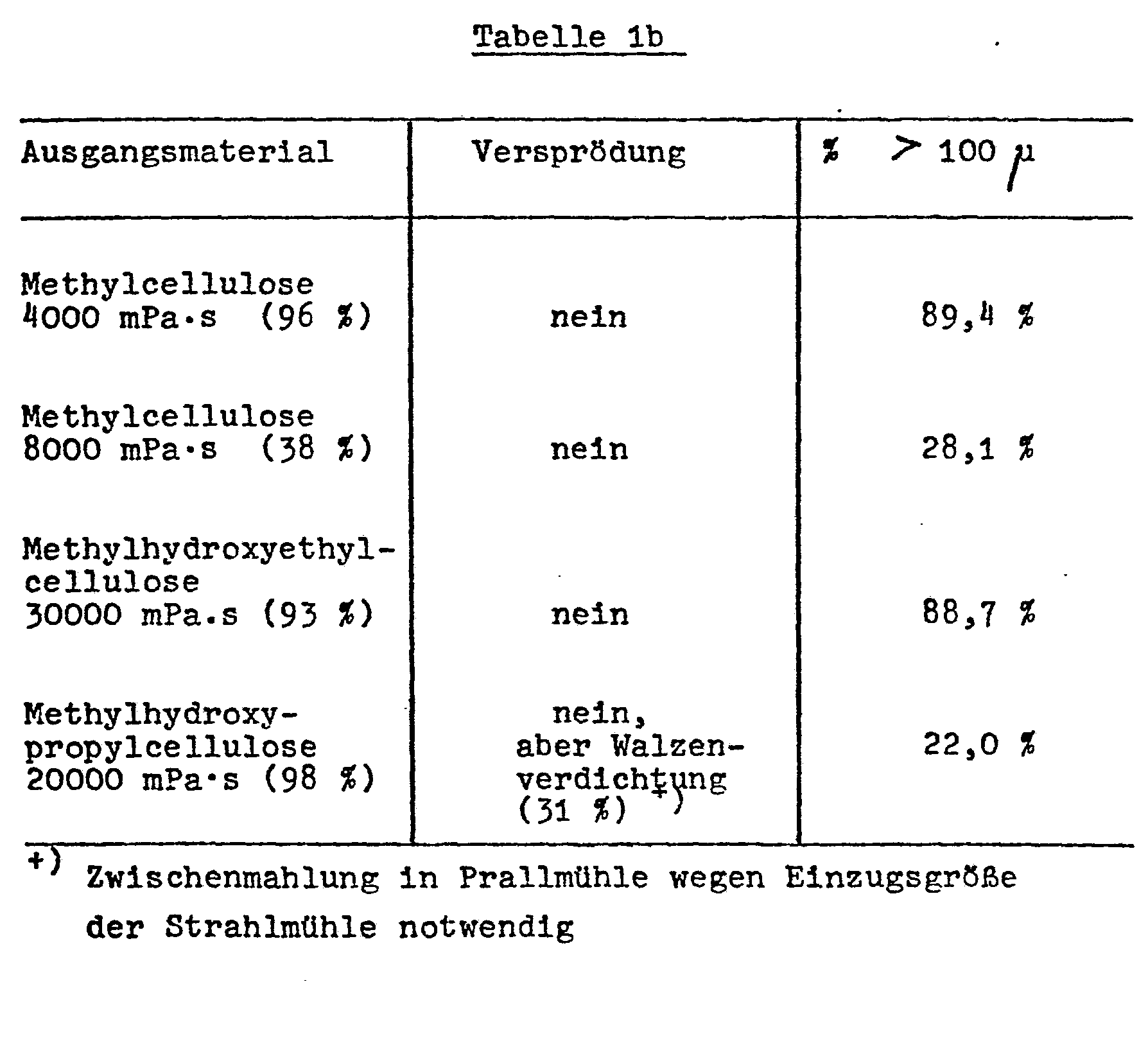
- Die Testung, ob in der Versprödungsstufe bzw. Verfestigungsstufe ein ausreichender Grad dieser Vorbehandlung erreicht war, wurde in einer Laborstrahlmühle der Firma Fluid-Energy "Jet-o-mizer" durchgeführt. Sie hatte als Charakteristikum einen Luftdurchsatz von 150 Nm3/h sowie einen Feststoffdurchsatz von 5 kg/h und eine Größe von 1 foot. Es wurde festgelegt, daß unter diesen Standardbedingungen bei einmaligem Mühlendurchgang 98 Gew.% des eingeführten Materials kleiner als 100 µ sein soll. Wird diese Bedingung erreicht, liegt eine hinreichende Verfestigung bzw. Versprödung vor. Die Korngrößenverteilung wurde dabei in einem standardisierten Luftstrahlsieb während 3 Minuten bestimmt.
- In den nachfolgenden Tabellen la und 1 b (Vergleichsversuche) ist in Abhängigkeit vom eingesetzten Material und Versprödung bzw. technisch üblichen Verdichtung (Vergleich) die Korngröße wiedergegeben.

- Es erfolgte keine erfindungsgemäße Versprödung, sondern ein Extrudieren der von der Reinigungsstufe noch Wasser enthaltenden Alkylcellulosen, Zerschneiden der Stränge, Trocknen sowie Zerkleinern in einer Hammermühle. Dabei konnte in keinem Fall eine Versprödung erreicht werden. Es sind angegeben in Abhängigkeit vom Ausgangsmaterial die gefundenen Korngrößen unter den Standardbedingungen.
-
- 12,6 kg wollige Methylhydroxypropylcellulose mit einem Schüttgewicht von 160 g/1 wurden pro Stunde in einer gekühlten Schwingmühle verfestigt. Das Produkt fiel schup- penförmig mit einem Schüttgewicht von 350 g/l und einer Temperatur von 450 C an. Die Viskosität des Cellulose.- ethers ist durch die Verfestigung von 48 000 auf 34 000 mPa·s gesunken. Eine nennenswerte Zerkleinerung -des Materials konnte nicht beobachtet werden. Die Feinmahlung der verfestigten Methylhydroxypropylcellulose erfolgte in einer Strahlmühle bei einem Feststoffdurch- satz von 5 kg/h und einer Luftmenge von ca. 150 Nm3/h. Die folgende Korngrößenverteilung des gut rieselfähigen Produktes wurde gemessen:

- 40 kg/h einer Methylhydroxyethylcellulose mit einem Schüttgewicht von circa 200 g/1 und einer Feuchte von 9 % wurden in einer Presse pelletisiert. Die hierbei geringfügige Färbung des Produktes verschwindet aber während der Mahlung vollständig.
- Die verfestigten Pellets wurden einerseits in einer Strahlmühle und andererseits in einer Pralltellermühle gemahlen.
- Die Versuchsergebnisse (Ausgangsviskosität 23 000 mPa·s) gehen aus der folgenden Aufstellung hervor, wobei die Resultate aus der Pralltellermühle in Klammern gesetzt wurden:
- Korngrößenverteilung: 66 % (52 %) > 32 µ 12 % > 50 µ 1,3 % > 63 µ - (8 %) > 125 µ (2,5 %) > 200 µ
- Endviskosität: 19 000 (21 000) mPa·s
- Schüttgewicht: 250 ( 330) g/l
- Ähnliche Resultate werden erhalten, wenn man ein Produkt mit 48 % Feuchte pelletiert, anschließend bis auf 8 % trocknet und nachfolgend der Mahlung mit einer Pralltellermühle unterzieht. Allerdings stieg das Schüttgewicht des Feinpulvers auf 370 g/1 an.
- 16 kg/h einer Methylhydroxypropylcellulose mit einem Schüttgewicht von 150 g/1 wurden in der gekühlten Schwingmühle versprödet. Nach dieser Verfestigung betrug das Schüttgewicht 430 g/l. Das Produkt mit einer Ausgangsviskosität von 42 mPa·s wurde sowohl in der Strahlmühle als auch in der Stiftmühle (Werte in Klammern) gemahlen:
- Korngrößenverteilung: 61 % (82 %) > 32 µ 17 % (66 %) > 50 µ 4,5 % (52 %) 7 63 µ 1,1 % >100 µ ( 9 %) > 125 µ
- Endviskosität: 39 (40) mPa.s
- Schüttgewicht: 380 ( 420) g/l
- 10 kg wollige Linters (Baumwollcellulose) mit einem Feuchtigkeitsgehalt von 4 % und einem Schüttgewicht von 108 g/1 wurden pro Stunde in einer gekühlten Schwingmühle verfestigt. Hierbei stieg das Schüttgewicht auf 320 g/1 an. Die Kornverteilung blieb mit 83 % > 125 µ. praktisch konstant. Nach der Mahlung in der Strahlmühle mit circa 7 kg/h wurde die folgende Korngrößenverteilung gemessen:

- Der durchschnittliche Polymerisationsgrad (DP) der Cellulose nahm bei diesen Operationen insgesamt um 26 % ab.
- 40 kg/h langfasrige Fichtencellulose (DP-Wert circa 1050) mit einem Schüttgewicht von 80 g/l wurden in einer Presse pelletisiert. Nach der Mahlung in einer Pralltellermühle konnte nach einmaligem Durchgang die folgende Korngrößenverteilung aufgenommen werden:

- In der nachfolgenden Tabelle 2 sind die Ergebnisse gemäß den vorstehenden Beispielen hinsichtlich des erzielten Mahlgrades in einer Übersicht wiedergegeben, wobei in jeder Stufe nur ein Durchgang erfolgte.

Claims (9)
Priority Applications (1)
| Application Number | Priority Date | Filing Date | Title |
|---|---|---|---|
| AT81107753T ATE15679T1 (de) | 1980-10-08 | 1981-09-30 | Verfahren zur herstellung von mikropulvern aus celluloseether oder cellulose. |
Applications Claiming Priority (2)
| Application Number | Priority Date | Filing Date | Title |
|---|---|---|---|
| DE19803038001 DE3038001A1 (de) | 1980-10-08 | 1980-10-08 | Verfahren zur herstellung von mikropulvern aus celluloseether oder cellulose |
| DE3038001 | 1980-10-08 |
Publications (4)
| Publication Number | Publication Date |
|---|---|
| EP0049815A2 true EP0049815A2 (de) | 1982-04-21 |
| EP0049815A3 EP0049815A3 (en) | 1982-04-28 |
| EP0049815B1 EP0049815B1 (de) | 1985-09-18 |
| EP0049815B2 EP0049815B2 (de) | 1991-04-10 |
Family
ID=6113917
Family Applications (1)
| Application Number | Title | Priority Date | Filing Date |
|---|---|---|---|
| EP81107753A Expired - Lifetime EP0049815B2 (de) | 1980-10-08 | 1981-09-30 | Verfahren zur Herstellung von Mikropulvern aus Celluloseether |
Country Status (5)
| Country | Link |
|---|---|
| US (1) | US4415124A (de) |
| EP (1) | EP0049815B2 (de) |
| JP (1) | JPS5792001A (de) |
| AT (1) | ATE15679T1 (de) |
| DE (2) | DE3038001A1 (de) |
Cited By (12)
| Publication number | Priority date | Publication date | Assignee | Title |
|---|---|---|---|---|
| EP0384046A1 (de) * | 1986-05-01 | 1990-08-29 | The Dow Chemical Company | Zerkleinerungsverfahren von hochvikosem Celluloseäthern |
| US4979681A (en) * | 1988-11-25 | 1990-12-25 | Hoechst Aktiengesellschaft | Process for grinding and simultaneous drying of moist cellulose ether products |
| EP0676416A3 (de) * | 1994-04-11 | 1995-11-02 | Hoechst Aktiengesellschaft | Verfahren zum Sieben von Celluloseethern |
| EP0835881A3 (de) * | 1996-10-14 | 1998-05-20 | Wolff Walsrode Ag | Verfahren zur Herstellung von Methylcellulose-Pulvern mit spezieller Sieblinie |
| US5921479A (en) * | 1996-10-10 | 1999-07-13 | Clariant Gmbh | Process and apparatus for simultaneously grinding and drying material to be ground containing moist cellulose ether |
| DE10012010A1 (de) * | 2000-03-11 | 2001-09-20 | Axiva Gmbh | Verfahren zur Erhöhung der Effektivität der Zerkleinerung von Schüttgütern durch Oxitation |
| EP1136458A2 (de) | 2000-03-18 | 2001-09-26 | Wolff Walsrode AG | Verwendung von Polysacchariden oder Polysaccharidderivaten, die nach Vergelung und Heiss-Dampf-Mahltrocknung mittels Gas- oder Wasserdampftrocknung hergestellt wurden, in Baustoffgemischen |
| WO2005105900A1 (de) * | 2004-04-28 | 2005-11-10 | Se Tylose Gmbh & Co. Kg | Verfahren und vorrichtung zum mahlen von cellulose |
| KR100788534B1 (ko) * | 2000-02-28 | 2007-12-24 | 볼프발스로데에이지 | 스팀을 함유하는 과열된 가스 혼합물을 사용하여 미립상수용성 셀룰로즈 유도체를 제조하는 방법 |
| WO2008067930A1 (en) * | 2006-12-05 | 2008-06-12 | Dow Wolff Cellulosics Gmbh | Cellulose ethers for solids formulations |
| US8189048B2 (en) | 2005-04-18 | 2012-05-29 | Pips Technology Limited | Vehicle speed monitoring system |
| WO2015113548A1 (de) * | 2014-02-03 | 2015-08-06 | Möbius Heinzhorst | Herstellung einer für derivatisierungsreaktionen geeigneten alkalicellulose |
Families Citing this family (30)
| Publication number | Priority date | Publication date | Assignee | Title |
|---|---|---|---|---|
| JPH02235901A (ja) * | 1986-05-01 | 1990-09-18 | Dow Chem Co:The | 高分子量,高粘度セルロースエーテルの粒度を低下させる方法 |
| JPH04348130A (ja) * | 1991-05-24 | 1992-12-03 | Nisshinbo Ind Inc | セルロース微粉末及びその製造方法 |
| JPH0999251A (ja) * | 1995-10-04 | 1997-04-15 | Idemitsu Petrochem Co Ltd | 有機系粉末の製造方法および有機系粉末 |
| EP0954536B2 (de) | 1997-01-21 | 2009-01-07 | Dow Wolff Cellulosics GmbH | Verfahren zur herstellung von feinteiligen polysaccharidderivaten |
| JP3718341B2 (ja) * | 1998-05-12 | 2005-11-24 | 信越化学工業株式会社 | 低置換度ヒドロキシプロピルセルロースとその製造方法 |
| DE19837764C1 (de) * | 1998-08-20 | 2000-03-16 | Lohmann Therapie Syst Lts | Verfahren zum Herstellen von klebenden Stanzlingen aus einer endlosen Bahn und nach dem Verfahren hergestellter Stanzling |
| US6872820B2 (en) * | 1998-12-23 | 2005-03-29 | Wolff Walsrode Ag | Finely divided polysaccharide derivatives |
| US6602994B1 (en) * | 1999-02-10 | 2003-08-05 | Hercules Incorporated | Derivatized microfibrillar polysaccharide |
| JP2001009316A (ja) | 1999-06-29 | 2001-01-16 | Shin Etsu Chem Co Ltd | パルプの粉末化方法及びセルロースエーテルの製造方法 |
| US6680069B1 (en) * | 1999-11-09 | 2004-01-20 | Shin-Etsu Chemical Co., Ltd. | Low-substituted hydroxypropyl cellulose and process for manufacturing the same |
| JP3552160B2 (ja) | 2000-01-14 | 2004-08-11 | 信越化学工業株式会社 | 低置換度ヒドロキシプロピルセルロース粒子の形成方法 |
| DE10009409A1 (de) | 2000-02-28 | 2001-08-30 | Wolff Walsrode Ag | Verfahren zur Herstellung von pulverförmigen wasserlöslichen Cellulosederivaten |
| DE10041311A1 (de) * | 2000-08-23 | 2002-03-07 | Clariant Gmbh | Verfahren zur Modifizierung von Celluseethern |
| JP3595765B2 (ja) * | 2000-09-27 | 2004-12-02 | 信越化学工業株式会社 | 低置換度ヒドロキシプロピルセルロースを含む乾式直打用基剤 |
| JP4581320B2 (ja) * | 2002-09-27 | 2010-11-17 | 日本製紙株式会社 | 粉末状セルロースおよびその製造法 |
| KR100525252B1 (ko) * | 2003-12-16 | 2005-10-31 | 삼성정밀화학 주식회사 | 미세화된 셀룰로오스에테르의 제조방법 |
| JP2005198574A (ja) * | 2004-01-16 | 2005-07-28 | Nippon Paper Chemicals Co Ltd | 食品用分散安定剤 |
| DE102005004893B4 (de) * | 2005-02-03 | 2011-02-10 | Dow Global Technologies Inc., Midland | Verfahren zur Formgebung von Celluloseethern |
| CN101175793B (zh) * | 2005-05-12 | 2012-10-17 | 阿克佐诺贝尔股份有限公司 | 研磨纤维素醚的方法 |
| FI120625B (fi) * | 2005-08-17 | 2009-12-31 | Valtion Teknillinen | Tärkkelyspohjainen kuituratojen täyteaine- ja päällystyspigmenttikoostumus ja menetelmä sen valmistamiseksi |
| JP4478125B2 (ja) * | 2006-06-26 | 2010-06-09 | 信越化学工業株式会社 | セルロースエーテルの製造方法 |
| CN101605816B (zh) * | 2007-02-16 | 2011-11-09 | 花王株式会社 | 非晶纤维素的制造方法 |
| AT505905B1 (de) * | 2007-09-21 | 2009-05-15 | Chemiefaser Lenzing Ag | Cellulosepulver und verfahren zu seiner herstellung |
| US8062428B2 (en) * | 2007-11-06 | 2011-11-22 | University Of Central Florida Research Foundation, Inc. | Solid acid catalyzed hydrolysis of cellulosic materials |
| US8871739B2 (en) | 2008-11-05 | 2014-10-28 | University Of Central Florida Research Foundation, Inc. | Solid acid catalyzed hydrolysis of cellulosic materials |
| EP2488571B1 (de) * | 2009-10-14 | 2019-03-27 | Dow Global Technologies LLC | Verfahren zum trockenmahlen eines polysaccharidderivates |
| MX343509B (es) | 2011-04-06 | 2016-11-08 | Dow Global Technologies Llc | Proceso para producir derivados de celulosa de alta densidad aparente y buena fluidez. |
| JP6163339B2 (ja) * | 2012-05-16 | 2017-07-12 | 花王株式会社 | セルロースエーテルの製造方法 |
| KR102519850B1 (ko) * | 2016-10-07 | 2023-04-10 | 신에쓰 가가꾸 고교 가부시끼가이샤 | 히드록시알킬 알킬 셀룰로오스 및 그의 제조 방법, 및 고형 제제 |
| SE547070C2 (en) | 2021-01-20 | 2025-04-15 | Soedra Skogsaegarna Ekonomisk Foerening | Method for producing powdered cellulose |
Family Cites Families (7)
| Publication number | Priority date | Publication date | Assignee | Title |
|---|---|---|---|---|
| DE1411892A1 (de) * | 1962-12-07 | 1968-10-24 | Miltenberger Industrlewerk P & | Verfahren zur Herstellung feinpulveriger Zellulose |
| DE1454824A1 (de) * | 1965-06-15 | 1969-07-17 | Kalle Ag | Verfahren zur Herstellung von Granulaten oder Pulvern aus faserigen trockenen Celluloseaethern |
| FR1581954A (de) * | 1967-12-18 | 1969-09-19 | ||
| US4076935A (en) * | 1974-12-13 | 1978-02-28 | Hoechst Aktiengesellschaft | Grinding method for cellulose |
| DE2556821C3 (de) * | 1975-12-17 | 1980-07-24 | Hoechst Ag, 6000 Frankfurt | Verfahren zur Feinmahlung von Cellulose oder deren Derivaten mit Äthergruppen |
| JPS547313A (en) * | 1977-06-20 | 1979-01-20 | Nec Corp | Tape driving system |
| JPS6017336B2 (ja) * | 1978-06-08 | 1985-05-02 | ダイセル化学工業株式会社 | 顆粒状水溶性セルロ−ズ誘導体の製造方法 |
-
1980
- 1980-10-08 DE DE19803038001 patent/DE3038001A1/de not_active Withdrawn
-
1981
- 1981-09-30 AT AT81107753T patent/ATE15679T1/de active
- 1981-09-30 EP EP81107753A patent/EP0049815B2/de not_active Expired - Lifetime
- 1981-09-30 DE DE8181107753T patent/DE3172349D1/de not_active Expired
- 1981-10-07 US US06/309,379 patent/US4415124A/en not_active Expired - Fee Related
- 1981-10-07 JP JP56158903A patent/JPS5792001A/ja active Granted
Cited By (14)
| Publication number | Priority date | Publication date | Assignee | Title |
|---|---|---|---|---|
| EP0384046A1 (de) * | 1986-05-01 | 1990-08-29 | The Dow Chemical Company | Zerkleinerungsverfahren von hochvikosem Celluloseäthern |
| US4979681A (en) * | 1988-11-25 | 1990-12-25 | Hoechst Aktiengesellschaft | Process for grinding and simultaneous drying of moist cellulose ether products |
| EP0676416A3 (de) * | 1994-04-11 | 1995-11-02 | Hoechst Aktiengesellschaft | Verfahren zum Sieben von Celluloseethern |
| US5589589A (en) * | 1994-04-11 | 1996-12-31 | Hoechst Ag | Process for screening cellulose ethers |
| US5921479A (en) * | 1996-10-10 | 1999-07-13 | Clariant Gmbh | Process and apparatus for simultaneously grinding and drying material to be ground containing moist cellulose ether |
| EP0835881A3 (de) * | 1996-10-14 | 1998-05-20 | Wolff Walsrode Ag | Verfahren zur Herstellung von Methylcellulose-Pulvern mit spezieller Sieblinie |
| KR100788534B1 (ko) * | 2000-02-28 | 2007-12-24 | 볼프발스로데에이지 | 스팀을 함유하는 과열된 가스 혼합물을 사용하여 미립상수용성 셀룰로즈 유도체를 제조하는 방법 |
| DE10012010A1 (de) * | 2000-03-11 | 2001-09-20 | Axiva Gmbh | Verfahren zur Erhöhung der Effektivität der Zerkleinerung von Schüttgütern durch Oxitation |
| EP1136458A2 (de) | 2000-03-18 | 2001-09-26 | Wolff Walsrode AG | Verwendung von Polysacchariden oder Polysaccharidderivaten, die nach Vergelung und Heiss-Dampf-Mahltrocknung mittels Gas- oder Wasserdampftrocknung hergestellt wurden, in Baustoffgemischen |
| WO2005105900A1 (de) * | 2004-04-28 | 2005-11-10 | Se Tylose Gmbh & Co. Kg | Verfahren und vorrichtung zum mahlen von cellulose |
| US7578458B2 (en) | 2004-04-28 | 2009-08-25 | Se Tylose Gmbh & Co., Kg | Method and device for grinding cellulose |
| US8189048B2 (en) | 2005-04-18 | 2012-05-29 | Pips Technology Limited | Vehicle speed monitoring system |
| WO2008067930A1 (en) * | 2006-12-05 | 2008-06-12 | Dow Wolff Cellulosics Gmbh | Cellulose ethers for solids formulations |
| WO2015113548A1 (de) * | 2014-02-03 | 2015-08-06 | Möbius Heinzhorst | Herstellung einer für derivatisierungsreaktionen geeigneten alkalicellulose |
Also Published As
| Publication number | Publication date |
|---|---|
| EP0049815A3 (en) | 1982-04-28 |
| DE3038001A1 (de) | 1982-05-06 |
| EP0049815B1 (de) | 1985-09-18 |
| EP0049815B2 (de) | 1991-04-10 |
| US4415124A (en) | 1983-11-15 |
| DE3172349D1 (en) | 1985-10-24 |
| JPH0348010B2 (de) | 1991-07-23 |
| ATE15679T1 (de) | 1985-10-15 |
| JPS5792001A (en) | 1982-06-08 |
Similar Documents
| Publication | Publication Date | Title |
|---|---|---|
| EP0049815B1 (de) | Verfahren zur Herstellung von Mikropulvern aus Celluloseether | |
| DE69413419T2 (de) | Verfahren zur behandlung eines talkumpuders bei dem einbringen in eine kunststoffmasse | |
| DE60129451T2 (de) | Herstellung einer briquette als material zur stahlherstellung | |
| EP2794111B1 (de) | Verfahren zur aufarbeitung von glasfaserabfall | |
| EP4169689B1 (de) | Verfahren zur herstellung eines partikulären rezyklats aus quarzkomposit | |
| DE2410789C2 (de) | Verfahren zum Kaltmahlen von Cellulosederivaten | |
| DE69011180T2 (de) | Verfahren zur Herstellung eines Verbundmaterials, enthaltend thermoplastische Polymere und Rückstände der Herstellung von Kunststofflaminaten, und die so erhaltenen Verbundmaterialien. | |
| DE2365184A1 (de) | Kautschuke | |
| DE3509330A1 (de) | Verfahren zur herstellung einer kohlesuspension | |
| DE69312604T2 (de) | Verfahren zur Herstellung von Dipeptid-Körnchen | |
| EP0835881B2 (de) | Verfahren zur Herstellung von Methylcellulose-Pulvern mit spezieller Sieblinie | |
| EP0299077A1 (de) | Verfahren zur herstellung von kautschukpulver auf der basis von natürlichem oder synthetischem kautschuk | |
| EP2175975B1 (de) | Verfahren zur herstellung eines rieselfähigen und lagerstabilen feststoffes enthaltend im wesentlichen alpha-alanin-n,n-diessigsäure und/oder ein oder mehrere derivate der alpha-alanin-n,n-diessigsäure | |
| CH619973A5 (en) | Process for fine grinding of cellulose and/or ether derivatives thereof | |
| DE3103338C2 (de) | ||
| DE102006057188A1 (de) | Celluloseether für Feststoffformulierungen | |
| DE2556821C3 (de) | Verfahren zur Feinmahlung von Cellulose oder deren Derivaten mit Äthergruppen | |
| DE102007051115B3 (de) | Verfahren zur Herstellung rieselfähiger Additive und nach diesem Verfahren hergestellte Additive | |
| DE482748C (de) | Verfahren zum Aufschliessen von Erzen, insbesondere konglomeratischen Roherzen oder deren Zwischenprodukte, durch Zertruemmerung in der Masse | |
| DE102005004893B4 (de) | Verfahren zur Formgebung von Celluloseethern | |
| DE976984C (de) | Verfahren zur Herstellung von streufaehigen, wasserloeslichen Alginaten mit hoher Loesungsgeschwindigkeit | |
| DE2458998C2 (de) | Verfahren zur Feinmahlung von Cellulose oder deren Derivaten mit Äthergruppen | |
| DE1432576C (de) | Verfahren zur Herstellung von Rauch tabak | |
| DE1404985C (de) | Verfahren zur Herstellung eines Poly tetrafluorathylen Preßpulvers | |
| DE10260625A1 (de) | Verfahren zur Herstellung rieselfähiger Granulate aus feinsten unplastischen anorganischen Pulvern |
Legal Events
| Date | Code | Title | Description |
|---|---|---|---|
| PUAI | Public reference made under article 153(3) epc to a published international application that has entered the european phase |
Free format text: ORIGINAL CODE: 0009012 |
|
| PUAL | Search report despatched |
Free format text: ORIGINAL CODE: 0009013 |
|
| AK | Designated contracting states |
Designated state(s): AT BE CH DE FR GB IT LU NL SE |
|
| AK | Designated contracting states |
Designated state(s): AT BE CH DE FR GB IT LU NL SE |
|
| 17P | Request for examination filed |
Effective date: 19820729 |
|
| GRAA | (expected) grant |
Free format text: ORIGINAL CODE: 0009210 |
|
| AK | Designated contracting states |
Designated state(s): AT BE CH DE FR GB IT LI LU NL SE |
|
| PG25 | Lapsed in a contracting state [announced via postgrant information from national office to epo] |
Ref country code: IT Free format text: LAPSE BECAUSE OF FAILURE TO SUBMIT A TRANSLATION OF THE DESCRIPTION OR TO PAY THE FEE WITHIN THE PRESCRIBED TIME-LIMIT;WARNING: LAPSES OF ITALIAN PATENTS WITH EFFECTIVE DATE BEFORE 2007 MAY HAVE OCCURRED AT ANY TIME BEFORE 2007. THE CORRECT EFFECTIVE DATE MAY BE DIFFERENT FROM THE ONE RECORDED. Effective date: 19850918 |
|
| REF | Corresponds to: |
Ref document number: 15679 Country of ref document: AT Date of ref document: 19851015 Kind code of ref document: T |
|
| REF | Corresponds to: |
Ref document number: 3172349 Country of ref document: DE Date of ref document: 19851024 |
|
| ET | Fr: translation filed | ||
| PLBI | Opposition filed |
Free format text: ORIGINAL CODE: 0009260 |
|
| 26 | Opposition filed |
Opponent name: HOECHST AKTIENGESELLSCHAFT,FRANKFURT(MAIN) Effective date: 19860616 |
|
| NLR1 | Nl: opposition has been filed with the epo |
Opponent name: HOECHST AKTIENGESELLSCHAFT |
|
| PLAB | Opposition data, opponent's data or that of the opponent's representative modified |
Free format text: ORIGINAL CODE: 0009299OPPO |
|
| R26 | Opposition filed (corrected) |
Opponent name: HOECHST AKTIENGESELLSCHAFT ZENTRALE PATENTABTEILUN Effective date: 19860616 |
|
| PUAH | Patent maintained in amended form |
Free format text: ORIGINAL CODE: 0009272 |
|
| STAA | Information on the status of an ep patent application or granted ep patent |
Free format text: STATUS: PATENT MAINTAINED AS AMENDED |
|
| 27A | Patent maintained in amended form |
Effective date: 19910410 |
|
| AK | Designated contracting states |
Kind code of ref document: B2 Designated state(s): AT BE CH DE FR GB IT LI LU NL SE |
|
| REG | Reference to a national code |
Ref country code: CH Ref legal event code: AEN |
|
| ET3 | Fr: translation filed ** decision concerning opposition | ||
| NLR2 | Nl: decision of opposition | ||
| NLR3 | Nl: receipt of modified translations in the netherlands language after an opposition procedure | ||
| ITTA | It: last paid annual fee | ||
| EPTA | Lu: last paid annual fee | ||
| EAL | Se: european patent in force in sweden |
Ref document number: 81107753.6 |
|
| PGFP | Annual fee paid to national office [announced via postgrant information from national office to epo] |
Ref country code: LU Payment date: 19950901 Year of fee payment: 15 |
|
| PGFP | Annual fee paid to national office [announced via postgrant information from national office to epo] |
Ref country code: GB Payment date: 19950911 Year of fee payment: 15 |
|
| PGFP | Annual fee paid to national office [announced via postgrant information from national office to epo] |
Ref country code: FR Payment date: 19950918 Year of fee payment: 15 |
|
| PGFP | Annual fee paid to national office [announced via postgrant information from national office to epo] |
Ref country code: CH Payment date: 19950920 Year of fee payment: 15 |
|
| PGFP | Annual fee paid to national office [announced via postgrant information from national office to epo] |
Ref country code: AT Payment date: 19950921 Year of fee payment: 15 |
|
| PGFP | Annual fee paid to national office [announced via postgrant information from national office to epo] |
Ref country code: SE Payment date: 19950922 Year of fee payment: 15 Ref country code: NL Payment date: 19950922 Year of fee payment: 15 |
|
| PGFP | Annual fee paid to national office [announced via postgrant information from national office to epo] |
Ref country code: BE Payment date: 19951009 Year of fee payment: 15 |
|
| PGFP | Annual fee paid to national office [announced via postgrant information from national office to epo] |
Ref country code: DE Payment date: 19951020 Year of fee payment: 15 |
|
| PG25 | Lapsed in a contracting state [announced via postgrant information from national office to epo] |
Ref country code: LU Free format text: LAPSE BECAUSE OF NON-PAYMENT OF DUE FEES Effective date: 19960930 Ref country code: LI Effective date: 19960930 Ref country code: GB Effective date: 19960930 Ref country code: FR Effective date: 19960930 Ref country code: CH Effective date: 19960930 Ref country code: BE Effective date: 19960930 Ref country code: AT Effective date: 19960930 |
|
| PG25 | Lapsed in a contracting state [announced via postgrant information from national office to epo] |
Ref country code: SE Effective date: 19961001 |
|
| BERE | Be: lapsed |
Owner name: HENKEL K.G.A.A. Effective date: 19960930 |
|
| PG25 | Lapsed in a contracting state [announced via postgrant information from national office to epo] |
Ref country code: NL Effective date: 19970401 |
|
| REG | Reference to a national code |
Ref country code: CH Ref legal event code: PL |
|
| GBPC | Gb: european patent ceased through non-payment of renewal fee |
Effective date: 19960930 |
|
| NLV4 | Nl: lapsed or anulled due to non-payment of the annual fee |
Effective date: 19970401 |
|
| PG25 | Lapsed in a contracting state [announced via postgrant information from national office to epo] |
Ref country code: DE Effective date: 19970603 |
|
| EUG | Se: european patent has lapsed |
Ref document number: 81107753.6 |
|
| REG | Reference to a national code |
Ref country code: FR Ref legal event code: ST |
|
| REG | Reference to a national code |
Ref country code: FR Ref legal event code: ST |