EP0024711B2 - Wässrige Tensidkonzentrate und Verfahren zur Verbesserung des Fliessverhaltens schwer beweglicher wässriger Tensidkonzentrate - Google Patents
Wässrige Tensidkonzentrate und Verfahren zur Verbesserung des Fliessverhaltens schwer beweglicher wässriger Tensidkonzentrate Download PDFInfo
- Publication number
- EP0024711B2 EP0024711B2 EP80105017A EP80105017A EP0024711B2 EP 0024711 B2 EP0024711 B2 EP 0024711B2 EP 80105017 A EP80105017 A EP 80105017A EP 80105017 A EP80105017 A EP 80105017A EP 0024711 B2 EP0024711 B2 EP 0024711B2
- Authority
- EP
- European Patent Office
- Prior art keywords
- alkyl
- weight
- aqueous surfactant
- water
- concentrates
- Prior art date
- Legal status (The legal status is an assumption and is not a legal conclusion. Google has not performed a legal analysis and makes no representation as to the accuracy of the status listed.)
- Expired
Links
- 239000012141 concentrate Substances 0.000 title claims abstract description 58
- 238000000034 method Methods 0.000 title claims abstract description 11
- -1 ether glycol sulfates Chemical class 0.000 claims abstract description 103
- RTZKZFJDLAIYFH-UHFFFAOYSA-N ether Substances CCOCC RTZKZFJDLAIYFH-UHFFFAOYSA-N 0.000 claims abstract description 81
- 150000003839 salts Chemical class 0.000 claims abstract description 48
- 229920000151 polyglycol Polymers 0.000 claims abstract description 30
- 239000010695 polyglycol Substances 0.000 claims abstract description 30
- LYCAIKOWRPUZTN-UHFFFAOYSA-N ethylene glycol Natural products OCCO LYCAIKOWRPUZTN-UHFFFAOYSA-N 0.000 claims abstract description 29
- VFNGKCDDZUSWLR-UHFFFAOYSA-N disulfuric acid Chemical class OS(=O)(=O)OS(O)(=O)=O VFNGKCDDZUSWLR-UHFFFAOYSA-N 0.000 claims abstract description 27
- 229920001281 polyalkylene Polymers 0.000 claims abstract description 23
- WGCNASOHLSPBMP-UHFFFAOYSA-N hydroxyacetaldehyde Natural products OCC=O WGCNASOHLSPBMP-UHFFFAOYSA-N 0.000 claims abstract description 17
- 125000000217 alkyl group Chemical group 0.000 claims abstract description 15
- 125000002877 alkyl aryl group Chemical group 0.000 claims abstract description 13
- 150000008051 alkyl sulfates Chemical class 0.000 claims abstract description 9
- 150000001875 compounds Chemical class 0.000 claims abstract description 9
- 239000004094 surface-active agent Substances 0.000 claims description 83
- 239000007864 aqueous solution Substances 0.000 claims description 14
- 239000000243 solution Substances 0.000 claims description 10
- 150000003467 sulfuric acid derivatives Chemical class 0.000 claims description 10
- 239000004743 Polypropylene Substances 0.000 claims description 7
- 150000008055 alkyl aryl sulfonates Chemical class 0.000 claims description 7
- 229920001155 polypropylene Polymers 0.000 claims description 7
- 239000004698 Polyethylene Substances 0.000 claims description 6
- 229920000573 polyethylene Polymers 0.000 claims description 6
- 229910052783 alkali metal Inorganic materials 0.000 claims description 5
- QGZKDVFQNNGYKY-UHFFFAOYSA-O Ammonium Chemical compound [NH4+] QGZKDVFQNNGYKY-UHFFFAOYSA-O 0.000 claims description 4
- 229910052784 alkaline earth metal Inorganic materials 0.000 claims description 4
- 230000015572 biosynthetic process Effects 0.000 claims description 4
- 229920001515 polyalkylene glycol Polymers 0.000 claims description 4
- 150000001342 alkaline earth metals Chemical class 0.000 claims 2
- QAOWNCQODCNURD-UHFFFAOYSA-L Sulfate Chemical compound [O-]S([O-])(=O)=O QAOWNCQODCNURD-UHFFFAOYSA-L 0.000 abstract description 15
- VFNGKCDDZUSWLR-UHFFFAOYSA-L disulfate(2-) Chemical compound [O-]S(=O)(=O)OS([O-])(=O)=O VFNGKCDDZUSWLR-UHFFFAOYSA-L 0.000 abstract description 14
- 239000000203 mixture Substances 0.000 abstract description 9
- 125000002947 alkylene group Chemical group 0.000 abstract description 4
- BDHFUVZGWQCTTF-UHFFFAOYSA-M sulfonate Chemical compound [O-]S(=O)=O BDHFUVZGWQCTTF-UHFFFAOYSA-M 0.000 abstract 2
- 125000000129 anionic group Chemical group 0.000 abstract 1
- 229920001223 polyethylene glycol Polymers 0.000 description 18
- 125000004432 carbon atom Chemical group C* 0.000 description 17
- FAPWRFPIFSIZLT-UHFFFAOYSA-M Sodium chloride Chemical compound [Na+].[Cl-] FAPWRFPIFSIZLT-UHFFFAOYSA-M 0.000 description 12
- 239000002202 Polyethylene glycol Substances 0.000 description 11
- ULUAUXLGCMPNKK-UHFFFAOYSA-N Sulfobutanedioic acid Chemical class OC(=O)CC(C(O)=O)S(O)(=O)=O ULUAUXLGCMPNKK-UHFFFAOYSA-N 0.000 description 10
- 150000001298 alcohols Chemical class 0.000 description 9
- 229920001451 polypropylene glycol Polymers 0.000 description 9
- XLYOFNOQVPJJNP-UHFFFAOYSA-N water Substances O XLYOFNOQVPJJNP-UHFFFAOYSA-N 0.000 description 9
- 229920006395 saturated elastomer Polymers 0.000 description 8
- 239000013543 active substance Substances 0.000 description 7
- 150000001768 cations Chemical class 0.000 description 7
- 239000003599 detergent Substances 0.000 description 7
- 150000005690 diesters Chemical class 0.000 description 6
- 230000000694 effects Effects 0.000 description 6
- 239000011734 sodium Substances 0.000 description 6
- 239000011780 sodium chloride Substances 0.000 description 6
- 230000019635 sulfation Effects 0.000 description 6
- 238000005670 sulfation reaction Methods 0.000 description 6
- LFQSCWFLJHTTHZ-UHFFFAOYSA-N Ethanol Chemical compound CCO LFQSCWFLJHTTHZ-UHFFFAOYSA-N 0.000 description 5
- QAOWNCQODCNURD-UHFFFAOYSA-N Sulfuric acid Chemical compound OS(O)(=O)=O QAOWNCQODCNURD-UHFFFAOYSA-N 0.000 description 5
- XTHPWXDJESJLNJ-UHFFFAOYSA-N chlorosulfonic acid Substances OS(Cl)(=O)=O XTHPWXDJESJLNJ-UHFFFAOYSA-N 0.000 description 5
- 239000003995 emulsifying agent Substances 0.000 description 5
- 238000002474 experimental method Methods 0.000 description 5
- 238000004519 manufacturing process Methods 0.000 description 5
- 230000008719 thickening Effects 0.000 description 5
- KEQGZUUPPQEDPF-UHFFFAOYSA-N 1,3-dichloro-5,5-dimethylimidazolidine-2,4-dione Chemical compound CC1(C)N(Cl)C(=O)N(Cl)C1=O KEQGZUUPPQEDPF-UHFFFAOYSA-N 0.000 description 4
- POAOYUHQDCAZBD-UHFFFAOYSA-N 2-butoxyethanol Chemical compound CCCCOCCO POAOYUHQDCAZBD-UHFFFAOYSA-N 0.000 description 4
- 230000001476 alcoholic effect Effects 0.000 description 4
- 150000001412 amines Chemical class 0.000 description 4
- 238000010790 dilution Methods 0.000 description 4
- 239000012895 dilution Substances 0.000 description 4
- 150000002191 fatty alcohols Chemical class 0.000 description 4
- 238000002360 preparation method Methods 0.000 description 4
- RPACBEVZENYWOL-XFULWGLBSA-M sodium;(2r)-2-[6-(4-chlorophenoxy)hexyl]oxirane-2-carboxylate Chemical compound [Na+].C=1C=C(Cl)C=CC=1OCCCCCC[C@]1(C(=O)[O-])CO1 RPACBEVZENYWOL-XFULWGLBSA-M 0.000 description 4
- 239000000126 substance Substances 0.000 description 4
- WVDDGKGOMKODPV-UHFFFAOYSA-N Benzyl alcohol Chemical compound OCC1=CC=CC=C1 WVDDGKGOMKODPV-UHFFFAOYSA-N 0.000 description 3
- OKTJSMMVPCPJKN-UHFFFAOYSA-N Carbon Chemical group [C] OKTJSMMVPCPJKN-UHFFFAOYSA-N 0.000 description 3
- VGGSQFUCUMXWEO-UHFFFAOYSA-N Ethene Chemical compound C=C VGGSQFUCUMXWEO-UHFFFAOYSA-N 0.000 description 3
- IAYPIBMASNFSPL-UHFFFAOYSA-N Ethylene oxide Chemical compound C1CO1 IAYPIBMASNFSPL-UHFFFAOYSA-N 0.000 description 3
- IGFHQQFPSIBGKE-UHFFFAOYSA-N Nonylphenol Natural products CCCCCCCCCC1=CC=C(O)C=C1 IGFHQQFPSIBGKE-UHFFFAOYSA-N 0.000 description 3
- 239000004721 Polyphenylene oxide Substances 0.000 description 3
- HEMHJVSKTPXQMS-UHFFFAOYSA-M Sodium hydroxide Chemical compound [OH-].[Na+] HEMHJVSKTPXQMS-UHFFFAOYSA-M 0.000 description 3
- 239000003945 anionic surfactant Substances 0.000 description 3
- 230000007423 decrease Effects 0.000 description 3
- 150000002334 glycols Chemical class 0.000 description 3
- 238000011065 in-situ storage Methods 0.000 description 3
- 230000007935 neutral effect Effects 0.000 description 3
- SNQQPOLDUKLAAF-UHFFFAOYSA-N nonylphenol Chemical compound CCCCCCCCCC1=CC=CC=C1O SNQQPOLDUKLAAF-UHFFFAOYSA-N 0.000 description 3
- 229920000570 polyether Polymers 0.000 description 3
- 159000000000 sodium salts Chemical class 0.000 description 3
- KDYFGRWQOYBRFD-UHFFFAOYSA-N succinic acid Chemical compound OC(=O)CCC(O)=O KDYFGRWQOYBRFD-UHFFFAOYSA-N 0.000 description 3
- JBVOQKNLGSOPNZ-UHFFFAOYSA-N 2-propan-2-ylbenzenesulfonic acid Chemical compound CC(C)C1=CC=CC=C1S(O)(=O)=O JBVOQKNLGSOPNZ-UHFFFAOYSA-N 0.000 description 2
- QXNVGIXVLWOKEQ-UHFFFAOYSA-N Disodium Chemical compound [Na][Na] QXNVGIXVLWOKEQ-UHFFFAOYSA-N 0.000 description 2
- 239000005977 Ethylene Substances 0.000 description 2
- KFZMGEQAYNKOFK-UHFFFAOYSA-N Isopropanol Chemical compound CC(C)O KFZMGEQAYNKOFK-UHFFFAOYSA-N 0.000 description 2
- 239000004435 Oxo alcohol Substances 0.000 description 2
- 229920001030 Polyethylene Glycol 4000 Polymers 0.000 description 2
- DNIAPMSPPWPWGF-UHFFFAOYSA-N Propylene glycol Chemical compound CC(O)CO DNIAPMSPPWPWGF-UHFFFAOYSA-N 0.000 description 2
- GOOHAUXETOMSMM-UHFFFAOYSA-N Propylene oxide Chemical compound CC1CO1 GOOHAUXETOMSMM-UHFFFAOYSA-N 0.000 description 2
- PMZURENOXWZQFD-UHFFFAOYSA-L Sodium Sulfate Chemical compound [Na+].[Na+].[O-]S([O-])(=O)=O PMZURENOXWZQFD-UHFFFAOYSA-L 0.000 description 2
- 239000003513 alkali Substances 0.000 description 2
- 150000001340 alkali metals Chemical class 0.000 description 2
- 125000003545 alkoxy group Chemical group 0.000 description 2
- 150000003863 ammonium salts Chemical class 0.000 description 2
- 239000003795 chemical substances by application Substances 0.000 description 2
- 229940071118 cumenesulfonate Drugs 0.000 description 2
- 239000006185 dispersion Substances 0.000 description 2
- 150000002170 ethers Chemical class 0.000 description 2
- 239000007788 liquid Substances 0.000 description 2
- 239000000463 material Substances 0.000 description 2
- 125000004957 naphthylene group Chemical group 0.000 description 2
- 125000000843 phenylene group Chemical group C1(=C(C=CC=C1)*)* 0.000 description 2
- 229940057838 polyethylene glycol 4000 Drugs 0.000 description 2
- 229920000642 polymer Polymers 0.000 description 2
- 238000006116 polymerization reaction Methods 0.000 description 2
- 239000002453 shampoo Substances 0.000 description 2
- 229910052938 sodium sulfate Inorganic materials 0.000 description 2
- 235000011152 sodium sulphate Nutrition 0.000 description 2
- 230000001180 sulfating effect Effects 0.000 description 2
- 238000005406 washing Methods 0.000 description 2
- CYEJMVLDXAUOPN-UHFFFAOYSA-N 2-dodecylphenol Chemical compound CCCCCCCCCCCCC1=CC=CC=C1O CYEJMVLDXAUOPN-UHFFFAOYSA-N 0.000 description 1
- LSNNMFCWUKXFEE-UHFFFAOYSA-M Bisulfite Chemical compound OS([O-])=O LSNNMFCWUKXFEE-UHFFFAOYSA-M 0.000 description 1
- 244000060011 Cocos nucifera Species 0.000 description 1
- DGAQECJNVWCQMB-PUAWFVPOSA-M Ilexoside XXIX Chemical compound C[C@@H]1CC[C@@]2(CC[C@@]3(C(=CC[C@H]4[C@]3(CC[C@@H]5[C@@]4(CC[C@@H](C5(C)C)OS(=O)(=O)[O-])C)C)[C@@H]2[C@]1(C)O)C)C(=O)O[C@H]6[C@@H]([C@H]([C@@H]([C@H](O6)CO)O)O)O.[Na+] DGAQECJNVWCQMB-PUAWFVPOSA-M 0.000 description 1
- 229920003171 Poly (ethylene oxide) Polymers 0.000 description 1
- KEAYESYHFKHZAL-UHFFFAOYSA-N Sodium Chemical compound [Na] KEAYESYHFKHZAL-UHFFFAOYSA-N 0.000 description 1
- CIUQDSCDWFSTQR-UHFFFAOYSA-N [C]1=CC=CC=C1 Chemical compound [C]1=CC=CC=C1 CIUQDSCDWFSTQR-UHFFFAOYSA-N 0.000 description 1
- 125000003158 alcohol group Chemical group 0.000 description 1
- 150000004996 alkyl benzenes Chemical class 0.000 description 1
- 239000002585 base Substances 0.000 description 1
- 229910052799 carbon Inorganic materials 0.000 description 1
- BVKZGUZCCUSVTD-UHFFFAOYSA-N carbonic acid Chemical class OC(O)=O BVKZGUZCCUSVTD-UHFFFAOYSA-N 0.000 description 1
- 150000001734 carboxylic acid salts Chemical class 0.000 description 1
- 239000012459 cleaning agent Substances 0.000 description 1
- 239000003240 coconut oil Substances 0.000 description 1
- 235000019864 coconut oil Nutrition 0.000 description 1
- 230000000052 comparative effect Effects 0.000 description 1
- 238000007796 conventional method Methods 0.000 description 1
- YRIUSKIDOIARQF-UHFFFAOYSA-N dodecyl benzenesulfonate Chemical compound CCCCCCCCCCCCOS(=O)(=O)C1=CC=CC=C1 YRIUSKIDOIARQF-UHFFFAOYSA-N 0.000 description 1
- 230000001804 emulsifying effect Effects 0.000 description 1
- 239000003925 fat Substances 0.000 description 1
- 235000019197 fats Nutrition 0.000 description 1
- 239000000835 fiber Substances 0.000 description 1
- 239000012530 fluid Substances 0.000 description 1
- 239000006260 foam Substances 0.000 description 1
- 159000000011 group IA salts Chemical class 0.000 description 1
- 125000002887 hydroxy group Chemical group [H]O* 0.000 description 1
- 230000001771 impaired effect Effects 0.000 description 1
- 159000000003 magnesium salts Chemical class 0.000 description 1
- 229910052751 metal Inorganic materials 0.000 description 1
- 239000002184 metal Substances 0.000 description 1
- 229930014626 natural product Natural products 0.000 description 1
- 238000006386 neutralization reaction Methods 0.000 description 1
- 230000003472 neutralizing effect Effects 0.000 description 1
- 239000003960 organic solvent Substances 0.000 description 1
- 239000003346 palm kernel oil Substances 0.000 description 1
- 235000019865 palm kernel oil Nutrition 0.000 description 1
- NFBAXHOPROOJAW-UHFFFAOYSA-N phenindione Chemical group O=C1C2=CC=CC=C2C(=O)C1C1=CC=CC=C1 NFBAXHOPROOJAW-UHFFFAOYSA-N 0.000 description 1
- 238000006068 polycondensation reaction Methods 0.000 description 1
- 239000002994 raw material Substances 0.000 description 1
- 230000001105 regulatory effect Effects 0.000 description 1
- 238000004062 sedimentation Methods 0.000 description 1
- 239000000344 soap Substances 0.000 description 1
- 229910052708 sodium Inorganic materials 0.000 description 1
- 239000001509 sodium citrate Substances 0.000 description 1
- NLJMYIDDQXHKNR-UHFFFAOYSA-K sodium citrate Chemical compound O.O.[Na+].[Na+].[Na+].[O-]C(=O)CC(O)(CC([O-])=O)C([O-])=O NLJMYIDDQXHKNR-UHFFFAOYSA-K 0.000 description 1
- 238000003860 storage Methods 0.000 description 1
- 239000001384 succinic acid Substances 0.000 description 1
- 150000003900 succinic acid esters Chemical class 0.000 description 1
- 125000000542 sulfonic acid group Chemical group 0.000 description 1
- 150000003460 sulfonic acids Chemical class 0.000 description 1
- 238000003786 synthesis reaction Methods 0.000 description 1
- 229920002994 synthetic fiber Polymers 0.000 description 1
- JSPLKZUTYZBBKA-UHFFFAOYSA-N trioxidane Chemical compound OOO JSPLKZUTYZBBKA-UHFFFAOYSA-N 0.000 description 1
Classifications
-
- C—CHEMISTRY; METALLURGY
- C11—ANIMAL OR VEGETABLE OILS, FATS, FATTY SUBSTANCES OR WAXES; FATTY ACIDS THEREFROM; DETERGENTS; CANDLES
- C11D—DETERGENT COMPOSITIONS; USE OF SINGLE SUBSTANCES AS DETERGENTS; SOAP OR SOAP-MAKING; RESIN SOAPS; RECOVERY OF GLYCEROL
- C11D3/00—Other compounding ingredients of detergent compositions covered in group C11D1/00
- C11D3/16—Organic compounds
- C11D3/37—Polymers
- C11D3/3703—Macromolecular compounds obtained otherwise than by reactions only involving carbon-to-carbon unsaturated bonds
- C11D3/3707—Polyethers, e.g. polyalkyleneoxides
-
- C—CHEMISTRY; METALLURGY
- C11—ANIMAL OR VEGETABLE OILS, FATS, FATTY SUBSTANCES OR WAXES; FATTY ACIDS THEREFROM; DETERGENTS; CANDLES
- C11D—DETERGENT COMPOSITIONS; USE OF SINGLE SUBSTANCES AS DETERGENTS; SOAP OR SOAP-MAKING; RESIN SOAPS; RECOVERY OF GLYCEROL
- C11D1/00—Detergent compositions based essentially on surface-active compounds; Use of these compounds as a detergent
- C11D1/02—Anionic compounds
- C11D1/12—Sulfonic acids or sulfuric acid esters; Salts thereof
- C11D1/123—Sulfonic acids or sulfuric acid esters; Salts thereof derived from carboxylic acids, e.g. sulfosuccinates
-
- C—CHEMISTRY; METALLURGY
- C11—ANIMAL OR VEGETABLE OILS, FATS, FATTY SUBSTANCES OR WAXES; FATTY ACIDS THEREFROM; DETERGENTS; CANDLES
- C11D—DETERGENT COMPOSITIONS; USE OF SINGLE SUBSTANCES AS DETERGENTS; SOAP OR SOAP-MAKING; RESIN SOAPS; RECOVERY OF GLYCEROL
- C11D1/00—Detergent compositions based essentially on surface-active compounds; Use of these compounds as a detergent
- C11D1/02—Anionic compounds
- C11D1/12—Sulfonic acids or sulfuric acid esters; Salts thereof
- C11D1/14—Sulfonic acids or sulfuric acid esters; Salts thereof derived from aliphatic hydrocarbons or mono-alcohols
- C11D1/146—Sulfuric acid esters
-
- C—CHEMISTRY; METALLURGY
- C11—ANIMAL OR VEGETABLE OILS, FATS, FATTY SUBSTANCES OR WAXES; FATTY ACIDS THEREFROM; DETERGENTS; CANDLES
- C11D—DETERGENT COMPOSITIONS; USE OF SINGLE SUBSTANCES AS DETERGENTS; SOAP OR SOAP-MAKING; RESIN SOAPS; RECOVERY OF GLYCEROL
- C11D1/00—Detergent compositions based essentially on surface-active compounds; Use of these compounds as a detergent
- C11D1/02—Anionic compounds
- C11D1/12—Sulfonic acids or sulfuric acid esters; Salts thereof
- C11D1/22—Sulfonic acids or sulfuric acid esters; Salts thereof derived from aromatic compounds
-
- C—CHEMISTRY; METALLURGY
- C11—ANIMAL OR VEGETABLE OILS, FATS, FATTY SUBSTANCES OR WAXES; FATTY ACIDS THEREFROM; DETERGENTS; CANDLES
- C11D—DETERGENT COMPOSITIONS; USE OF SINGLE SUBSTANCES AS DETERGENTS; SOAP OR SOAP-MAKING; RESIN SOAPS; RECOVERY OF GLYCEROL
- C11D1/00—Detergent compositions based essentially on surface-active compounds; Use of these compounds as a detergent
- C11D1/02—Anionic compounds
- C11D1/12—Sulfonic acids or sulfuric acid esters; Salts thereof
- C11D1/29—Sulfates of polyoxyalkylene ethers
-
- C—CHEMISTRY; METALLURGY
- C11—ANIMAL OR VEGETABLE OILS, FATS, FATTY SUBSTANCES OR WAXES; FATTY ACIDS THEREFROM; DETERGENTS; CANDLES
- C11D—DETERGENT COMPOSITIONS; USE OF SINGLE SUBSTANCES AS DETERGENTS; SOAP OR SOAP-MAKING; RESIN SOAPS; RECOVERY OF GLYCEROL
- C11D17/00—Detergent materials or soaps characterised by their shape or physical properties
- C11D17/0008—Detergent materials or soaps characterised by their shape or physical properties aqueous liquid non soap compositions
- C11D17/003—Colloidal solutions, e.g. gels; Thixotropic solutions or pastes
-
- Y—GENERAL TAGGING OF NEW TECHNOLOGICAL DEVELOPMENTS; GENERAL TAGGING OF CROSS-SECTIONAL TECHNOLOGIES SPANNING OVER SEVERAL SECTIONS OF THE IPC; TECHNICAL SUBJECTS COVERED BY FORMER USPC CROSS-REFERENCE ART COLLECTIONS [XRACs] AND DIGESTS
- Y10—TECHNICAL SUBJECTS COVERED BY FORMER USPC
- Y10S—TECHNICAL SUBJECTS COVERED BY FORMER USPC CROSS-REFERENCE ART COLLECTIONS [XRACs] AND DIGESTS
- Y10S516/00—Colloid systems and wetting agents; subcombinations thereof; processes of
- Y10S516/01—Wetting, emulsifying, dispersing, or stabilizing agents
- Y10S516/03—Organic sulfoxy compound containing
-
- Y—GENERAL TAGGING OF NEW TECHNOLOGICAL DEVELOPMENTS; GENERAL TAGGING OF CROSS-SECTIONAL TECHNOLOGIES SPANNING OVER SEVERAL SECTIONS OF THE IPC; TECHNICAL SUBJECTS COVERED BY FORMER USPC CROSS-REFERENCE ART COLLECTIONS [XRACs] AND DIGESTS
- Y10—TECHNICAL SUBJECTS COVERED BY FORMER USPC
- Y10S—TECHNICAL SUBJECTS COVERED BY FORMER USPC CROSS-REFERENCE ART COLLECTIONS [XRACs] AND DIGESTS
- Y10S516/00—Colloid systems and wetting agents; subcombinations thereof; processes of
- Y10S516/01—Wetting, emulsifying, dispersing, or stabilizing agents
- Y10S516/03—Organic sulfoxy compound containing
- Y10S516/05—Organic amine, amide, or n-base containing
-
- Y—GENERAL TAGGING OF NEW TECHNOLOGICAL DEVELOPMENTS; GENERAL TAGGING OF CROSS-SECTIONAL TECHNOLOGIES SPANNING OVER SEVERAL SECTIONS OF THE IPC; TECHNICAL SUBJECTS COVERED BY FORMER USPC CROSS-REFERENCE ART COLLECTIONS [XRACs] AND DIGESTS
- Y10—TECHNICAL SUBJECTS COVERED BY FORMER USPC
- Y10S—TECHNICAL SUBJECTS COVERED BY FORMER USPC CROSS-REFERENCE ART COLLECTIONS [XRACs] AND DIGESTS
- Y10S526/00—Synthetic resins or natural rubbers -- part of the class 520 series
- Y10S526/911—Emulsifying agents
Definitions
- Alkyl ether sulfates are in particular sulfates of alkoxylated non-aromatic alcohols having 8 to 24 carbon atoms, in particular 8 to 18 carbon atoms.
- Alcohols of this type can be obtained from raw materials of natural origin, for example coconut or palm kernel oil, or are available as synthetic materials, e.g. B. in the form of the known Ziegler or oxo alcohols.
- non-aromatic alcohols with saturated or unsaturated, optionally also branched alkyl radicals of the type mentioned are first alkoxylated to produce detergents with lower alkylene oxides, in particular with ethylene oxide and / or with propylene oxide, then sulfated and then converted into the corresponding water-soluble salts.
- Detergents of this type are used for many purposes, for example in liquid cleaning agents, foam baths and shampoos.
- Aqueous solutions with a comparatively low content of alkyl ether sulfate - for example with a content of about 10% by weight of detergent (WAS) - show the special property of this class of detergents that can be thickened again by adding neutral salts such as NaCl or Na 2 S0 4 . In practice, this ability of the class of detergents concerned here is often used.
- Anionic surfactants also play a dominant role as emulsifiers for the technical production of polymer dispersions.
- alkyl sulfates, alkyl ether sulfates and alkyl benzene sulfonates, alkylaryl polyglycol ether sulfates and sulfosuccinates of natural and synthetic alcohol polyglycol ethers or alkylphenol ethoxylates are mainly used today.
- Emulsifiers of the type concerned are usually available in the form of dilute aqueous solutions. Highly concentrated mixtures can only be produced by adding up to 20% lower alcohols such as ethanol or isopropanol.
- lower alcohols such as ethanol or isopropanol.
- organic solvents for example the alcohols mentioned, is not always desirable in polymer dispersions for technical reasons, and because of their flammability they are associated with a considerable safety risk both in the preparation of the emulsifiers and during transport, storage and use . It is also known that even slight shifts in the water / alcohol ratio in such concentrates can lead to undesirable signs of sedimentation.
- DE-A 2251 405 describes the use of certain carboxylic acid salts.
- the salts of hydroxycarboxylic acids e.g. Sodium citrate, recommended.
- aromatic sulfonic acids and their salts are suitable for the same purpose.
- DE-A 2 326 006 sulfonic acids or sulfates or the corresponding water-soluble salts with saturated or unsaturated aliphatic hydrocarbon radicals with 1 to 6 carbon atoms can be used as viscosity regulators.
- all of these suggestions are limited to the group of linear alkyl polyglycol ether sulfates and their use as detergent surfactants.
- Japanese Patent Application Laid-Open Sho-50-116 383 describes a process for the preparation of surfactants with low viscosity, in which sulfuric acid semiesters of higher molecular weight alcohols or of ethoxylates of higher molecular weight alcohols during or after the neutralization of polyethylene glycols with an average molecular weight of 300 to 6000 in an amount of 0.1 to 25 wt .-%, based on the active substance of the sulfuric acid semiesters, is added.
- Japanese Patent Application Laid-Open Sho-53-111173 (Derwent Unit 79211 A / 44) describes anhydrous fiber preparation agents, that of a) 15-65% by weight polypropylene glycol mono- or disulfate with alkali metal or alkanolammonium cation, b) 30-70% by weight water-soluble anionic surfactant of the sulfonic acid or sulfuric acid ester type and c) 3-15% by weight alkali metal - or alkanolamine soap exist.
- the polypropylene glycols on which component b) is based have an average degree of polymerization of 20 to 90.
- the object of the invention is to provide aqueous surfactant concentrates of the type described, which can be pumped even in high concentrations and, when diluted with water, show no undesirable increase in the viscosity or thickening of the gel state.
- the invention seeks to provide alcohol-free aqueous surfactant concentrates of alkyl ether sulfates, alkyl aryl ether sulfates, alkyl aryl sulfonates and sulfosuccinates of alkyl and alkyl aryl polyglycol ether alcohols, as well as fatty alcohols, which can be pumped even in high concentrations, and when diluted with water shows no undesirable increase in the viscosity or thickening of the gel state and without the addition of metal salts, e.g.
- colloidal gel phases are suitable as detergent surfactants, for shampoo production, for emulsifying natural fats or as polymerization emulsifiers.
- the formation of colloidal gel phases in particular should be counteracted. Nevertheless, it should be possible to effectively thicken alkyl ether sulfates in the diluted state at low concentrations of WAS by adding neutral salts such as sodium chloride or sodium sulfate.
- the technical solution to this problem is based on the finding that water-soluble salts of mono- and / or disulfates of lower polyalkylene ether glycols - in particular of polyethylene glycol and / or of polypropylene glycol (here in particular of 1,2-polypropylene glycol) - effective viscosity regulators for aqueous surfactant concentrates here are affected. In particular, it was found that the effect of these viscosity regulators increases with the increase in the molecular weight of the underlying polyether glycol.
- the invention accordingly relates to aqueous surfactant concentrates containing at least 20% by weight of water-soluble salts of one or more surfactants from the group consisting of alkyl sulfates, alkylarylsulfonates and alkylsulfosuccinates and minor amounts of water-soluble salts of sulfates of lower polyalkylene glycols, characterized in that they contain 0.1 up to 10% by weight, based on the aqueous surfactant concentrate, contain water-soluble salts of mono- and / or disulfates of a lower polyalkylene ether glycol, the molecular weight of which is at least 600, as a viscosity regulator.
- aqueous surfactant concentrates containing at least 20 wt .-% of water-soluble salts of one or more surfactants from the group of alkyl polyglycol ether sulfates, Alkylarylpolyglykolethersulfate, Alkylpolyglykolethersulfosuccinate and Alkylarylpolyglykolethersulfosuccinate and minor amounts of water-soluble SaEzen of sulfates of lower polyalkylene ether glycols, characterized in that it 2 up to 10% by weight, based on the aqueous surfactant concentrate, contain water-soluble salts of mono- and / or disulfates of a lower polyalkylene ether glycol, the molecular weight of which is at least 1500, as a viscosity regulator.
- the surfactants are preferably present in amounts of at least about 25% by weight, in particular at least about 30% by weight, e.g. B. in amounts of 50 to 80 wt .-% - based on aqueous surfactant concentrate - before.
- Lower polyalkylene ether glycols of the type concerned here are derived from straight-chain or branched glycols having a maximum of up to 5 carbon atoms.
- the corresponding polyethylene ether glycols and / or polypropylene ether glycols are of particular importance - the polyether glycols derived from 1,2-propylene glycol being particularly important in the case of the last-mentioned compounds.
- This information applies to the water-soluble salts of the mono- and / or disulfates of the lower polyalkylene ether glycols used as viscosity regulators according to the invention.
- the invention further relates to a process for improving the flow behavior of surfactant concentrates which are difficult to move, containing one or more surfactants from the group consisting of alkyl sulfates, alkyl aryl sulfonates and alkyl sulfosuccinates by adding small amounts of a viscosity regulator, in which 0.1 to 10% by weight is used as the viscosity regulator on aqueous surfactant concentrate - water-soluble salts of mono- and / or disulfates of a lower polyalkylene ether glycol, the molecular weight of which is at least 600, preferably at least 1000, is added.
- a viscosity regulator in which 0.1 to 10% by weight is used as the viscosity regulator on aqueous surfactant concentrate - water-soluble salts of mono- and / or disulfates of a lower polyalkylene ether glycol, the molecular weight of which is at least 600, preferably at least 1000, is added.
- the invention further relates to a process for improving the flow behavior of surfactant concentrates which are difficult to move, comprising one or more surfactants from the group consisting of alkylpolyglycol ether sulfates, alkylarylpolyglycol ether sulfates, alkylpolyglycol ether sulfosuccinates and alkylarylpolyglycol ether sulfosuccinates by adding small amounts of a viscosity regulator% - to which, based on aqueous surfactant concentrate - water-soluble salts of mono- and / or disulfates of a lower polyalkylene ether glycol, the molecular weight of which is at least 1500, is added.
- the sulfates and here in particular the disulfates of lower polyalkylene ether glycols, in particular of polyethylene oxide and / or of 1,2-polypropylene oxide, have proven to be particularly effective viscosity regulators for highly concentrated aqueous surfactant concentrates of the type concerned by the present invention.
- the viscosity-reducing effect or the thickening state of the gel of these regulators decreases with increasing molecular weight or increasing degree of polycondensation of the alkylene glycol.
- the molecular weight of the base material for the viscosity regulator is preferably at least about 1000. Molecular weights of up to 6000 or even more can be considered.
- Disulphates of polyalkylene glycols of the stated type with molecular weights in the range from 1500 to 4000 are particularly preferred.
- the disulfates used according to the invention as viscosity regulators thus generally derive from polyether glycols which differ from the polyalkylene glycols, as they can be caused by the slight traces of water in the alkoxylation of alcoholic components.
- the teaching of the invention also allows the viscosity regulators to be used in a predeterminable manner in terms of type and quantity, so that predeterminable targeted effects with regard to reducing the gel state are possible.
- the viscosity regulators used according to the invention are themselves effective washing-active substances (WAS). An undesirable load with inactive components is avoided.
- the surfactant mixtures according to the invention are not only pumpable as such in a highly concentrated form; when diluted with water, there is no increase in the gel state, but rather the desired dilution effect.
- alkyl ether sulfates that after the surfactant content has been reduced to values of, for example, approximately 10 to 25% by weight, the addition of neutral salts effectively thickened the liquid aqueous solutions, which are now easily mobile.
- any water-soluble salts of the viscosity regulators used according to the invention can be used.
- Alkaline salts, soluble alkaline earth metal salts, for example corresponding magnesium salts, the ammonium salts and / or salts with organic amines are particularly suitable for practical use.
- Suitable amine salts are, for example, alkylolamine salts.
- the sodium salts are of particular importance.
- the most important salt for practical use is the sodium salt of the disulfate of polyethylene ether glycols and / or 1,2-polypropylene ether glycols with the specified minimum molecular weights.
- the statements made here regarding the salt-forming cations of the viscosity regulators can have corresponding validity for the salt-forming cations present in the surfactants.
- the viscosity regulators are present in the concentrates of the alkyl sulfates, alkylarylsulfonates and alkylsulfosuccinates in amounts of 0.1 to 10% by weight.
- the viscosity regulators are present in amounts of 2 to 10% by weight. Amounts of 2 to 5% by weight can be particularly preferred.
- the amount of the viscosity regulator is determined by the desired lowering of the gel point and / or by the thickening effect of the respective surfactant.
- the special structure of the surfactant can be significant. If surfactants of the type mentioned are present which contain polyalkoxy radicals, the extent of the polyalkoxylation of the underlying alcohol can be significant. Low alkoxylated alcohols can usually be effectively influenced even in high concentrations with 2 to 5 wt.
- the viscosity regulator can be added to the aqueous surfactant concentrate as a preformed compound or as a preformed compound mixture.
- the viscosity regulator is expediently used as a concentrated aqueous solution (WAS content, for example 50 to 90% by weight) and mixed with the aqueous solution of the respective surfactant.
- WAS content for example 50 to 90% by weight
- the viscosity regulator by sulfating the lower polyalkylene ether glycols in situ in the presence of the surfactant-forming basic components.
- the sulfation can thus take place, for example, in the presence of an alkyl polyglycol ether alcohol or an alkylaryl polyglycol ether alcohol.
- the sulfation of both the alcoholic surfactant-forming component and the preformed lower polyalkylene ether glycols are expediently combined.
- the desired mixing ratios of the surfactant-forming alcoholic components and of the polyaclylene ether glycols forming the viscosity regulator are simply set here and this mixture of substances is then subjected to the sulfation known per se. Finally, the sulfates formed are converted into the desired water-soluble salt. The same cation is set in the surfactant and in the viscosity regulator.
- alkyl ether sulfates are sulfates of alkoxylated C 8 -C 24 alcohols, preferably such deri vate with a carbon chain of 8 to 18 carbon atoms.
- Non-aromatic alcohols with carbon chains of 10 to 16 links can be particularly preferred.
- the carbon chain can be straight-chain and / or branched and saturated and / or unsaturated.
- alcohols of the type mentioned are accessible both from natural products and by synthesis.
- the alcohols are alkoxylated with lower alkylene oxides.
- the low alkoxylated derivatives up to 10 or 12, preferably 1 to 4, in particular 2 to 3, alkoxy groups are added to the alcohol radical.
- the highly alkoxylated derivatives polyalkoxy radicals with a number of members over 10 or 12, for example up to 100, in particular 20 to 80, are provided.
- the most important alkoxylating agents are ethylene oxide and / or 1,2-propylene oxide.
- Suitable salts are therefore in particular the alkali metal salts, soluble alkaline earth metal salts, ammonium salts and salts with organic amines.
- the most important salt in practice is the sodium salt of alkyl ether sulfate.
- the compounds preferably correspond to the general formula
- the S0 3M group can also be interchanged within the succinic acid ester.
- this alkyl radical preferably contains at least 8 carbon atoms, radicals with 10 to 18 carbon atoms can be particularly preferred.
- the sulfonic acid residue in succinic acid may also be interchanged in surfactants of this type.
- the aqueous surfactant concentrates according to the invention can also contain other surface-active agents.
- nonionic WAS for example alkylphenol polyglycol ethers, are suitable.
- Na-C12 / 14-2 sulfate is liquefied with 3% by weight or 6% by weight of the viscosity regulator and after dilution with water to a content of 10% by weight WAS is examined for its thickenability with sodium chloride.
- WAS a content of 10% by weight
- Tables a) and b) show that even small amounts of the viscosity regulators according to the invention have a liquefying effect on highly concentrated fatty alcohol ether sulfates. When moving to lower concentrations d. H. when diluted, the viscosity is not increased abruptly, but a decrease occurs.
- the aqueous solution of a Na-C12 / 14-fatty alcohol-50-EO-sulfate with an active substance hold of 25% by weight has a gel point of + 12 ° C.
- disodium polyethylene glycol disulfates based on polyethylene glycols with molecular weights 1550, 3000 and 4000 are used.
- the gel point of the starting solution is reduced to the values shown in Table 5.
- An adduct of 50 moles of ethylene oxide with one mole of C12 / 14 fatty alcohol is sulfated with chlorosulfonic acid alone and in the blends with polyethylene glycol given in Table 6 under customary conditions. 1.05 moles of chlorosulfonic acid are used per mole of hydroxyl groups (calculated according to the OH number). After neutralizing with sodium hydroxide solution and setting an active substance concentration of 25% by weight, the gel points listed in Table 6 are found.
- the Höppler viscosity at 25 ° C of a 30% C 12 / C 15 oxo alcohol sulfate Na salt (abbreviated here with OAS) is approx. 8500 mPa.s.
- OAS oxo alcohol sulfate Na salt
- the viscosity-breaking influence of PEG disulfates on such aqueous alkyl sulfate concentrates is determined.
- the following blends are made by OAS and the Höppler viscosity is measured.
- ABS 50% n-dodecylbenzenesulfonate
- ABS 50% n-dodecylbenzenesulfonate
- the Brookfield viscosity spindle 6, 20 rpm, 25 ° C
- the viscosity-breaking influence of polyethylene glycols and PEG disulfates on such aqueous ABS concentrates is determined.
- the following mixes of ABS are produced and the Höppler viscosity is measured.
- the di-Na-sulfosuccinic acid semi-ester of octylphenol + 11 EO forms a non-pourable, immobile gel at 30% AS in aqueous solution, which only becomes fluid at 33 ° C (gel point).
- the Höppler viscosity of the gel at 25 ° C is naturally not measurably high.
- the gel point can be lowered to -2 ° C, the Höppler viscosity at 25 ° C is measurable and is only 80-100 mPa. s.
- 10% PEG 4000 disulfate, NA salt as a 33% aqueous solution, the gel point can be lowered even further and is then at ⁇ -10 ° C.
Landscapes
- Chemical & Material Sciences (AREA)
- Life Sciences & Earth Sciences (AREA)
- Engineering & Computer Science (AREA)
- Chemical Kinetics & Catalysis (AREA)
- Oil, Petroleum & Natural Gas (AREA)
- Wood Science & Technology (AREA)
- Organic Chemistry (AREA)
- Dispersion Chemistry (AREA)
- Detergent Compositions (AREA)
Description
- Die Herstellung pumpbarer hochkonzentrierter Alkylethersulfate stellt bekanntlich nach wie vor ein schwer lösbares Problem dar. Alkylethersulfate sind dabei insbesondere Sulfate von alkoxylierten nichtaromatischen Alkoholen mit 8 bis 24 C-Atomen, insbesondere 8 bis 18 C-Atomen. Alkohole dieser Art lassen sich aus Ausgangsmaterialien natürlichen Ursprungs, beispielsweise Kokosnuss- oder Palmkernöl gewinnen oder stehen als synthetisches Material z. B. in Form der bekannten Ziegler- oder Oxo-Alkohole zur Verfügung. Die nicht-aromatischen Alkohole mit gesättigten oder ungesättigten, gegebenenfalls auch verzweigten Alkylresten der genannten Art werden zur Herstellung von Detergentien zunächst mit niederen Alkylenoxyden, insbesondere mit Ethylenoxyd und/oder mit Propylenoxyd, alkoxyliert, anschliessend sulfatiert und dann in die entsprechenden wasserlöslichen Salze umgewandelt.
- Detergentien dieser Art finden vielseitige Anwendung beispielsweise in flüssigen Reinigungsmitteln, Schaumbädern und Haarwaschmitteln. Wässrige Lösungen mit einem vergleichsweise geringen Gehalt an Alkylethersulfat - beispielsweise mit einem Gehalt an etwa 10 Gew.-% waschaktiver Substanz (WAS) - zeigen die besondere Eigenschaft dieser Detergentienstoffklasse durch Zusatz von Neutralsalzen wie NaCI oder Na2S04 wieder verdickt werden zu können. In der Praxis wird von dieser Fähigkeit der hier betroffenen Klasse von Detergentien häufig Gebrauch gemacht.
- Eine weitere Besonderheit im rheologischen Verhalten entsprechender Tensidkonzentrate bringt jedoch für die Praxis schwerwiegende Schwierigkeiten mit sich. Hochkonzentrierte wässrige Tensidkonzentrate mit einem WAS-Gehalt von beispielsweise 50 Gew.-% oder mehr weisen die Konsistenz eines dicken Geles bzw. einer entsprechenden Paste auf und sind nicht pumpbar. Versucht man dieses Gel mit Wasser zu verdünnen, so sinkt nicht etwa erwartungsgemäss der Dickungszustand, er steigt vielmehr zunächst an. Verständlicherweise entstehen hieraus für den Verarbeiter des Materials beträchtliche Probleme.
- Auch für die technische Herstellung von Polymerdispersionen spielen Anionentenside als Emulgatoren eine bei weitem dominierende Rolle. Neben Alkylsulfaten, Alkylethersulfaten und Alkylbenzolsulfonaten kommen heute hauptsächlich Alkylarylpolyglykolethersulfate und Sulfosuccinate natürlicher und synthetischer Alkoholpolyglykolether oder Alkylphenolethoxylate zum Einsatz.
- Die Herstellung solcher Emulgatoren ist bekannt sowie in der Fachliteratur und insbesondere auch in Patentschriften ausführlich beschrieben. In diesem Zusammenhang wird auf K. Lindner: Tenside, Textilhilfsmittel, Waschrohstoffe, Stuttgart, 1964 sowie auf DE-C 834245, BE-A 680629, US-A 1 970 578, FR-A 1 079 974, US-A 2 758 977, US-PS 2 416 254, US-PS 2489026 und US-PS 2 510 008 verwiesen.
- Emulgatoren der betroffenen Art werden im Handel meist in Form verdünnter wässriger Lösungen angeboten. Hochkonzentrierte Gemische sind nur unter Zugabe von bis zu 20% niederer Alkohole wie Ethanol oder Isopropanol herstellbar. Die Anwesenheit organischer Lösungsmittel, beispielsweise die genannten Alkohole, ist jedoch in Polymerdispersionen aus anwendungstechnischen Gründen nicht immer erwünscht, ausserdem sind sie wegen ihrer leichten Entflammbarkeit sowohl bei der Herstellung der Emulgatoren als auch während des Transports, der Lagerung und des Einsatzes mit einem erheblichen Sicherheitsrisiko verbunden. Bekannt ist ausserdem, dass bereits leichte Verschiebungen im Verhältnis Wasser/Alkohol in solchen Konzentraten zu unerwünschten Sedimentationserscheinungen führen können.
- Die bekannte Erscheinung, dass bei der Verdünnung nicht alkoholhaltiger wässriger Tensidkonzentrate häufig der Zustand eines nicht mehr pumpbaren dicken Gels durchlaufen wird, führt in der betrieblichen Praxis zu erheblichen Schwierigkeiten. Beispielsweise ist es häufig nicht einfach, einmal gebildete Gelklumpen wieder in Lösung zu bringen. Die Ventile von Zulaufsgefässen können damit verstopft werden und Konzentrationsschwankungen bei der Dosierung sind nicht auszuschliessen. Schliesslich ist aus den genannten Gründen die Verdünnung solcher wässriger Tensidpasten ein sehr zeitraubender Arbeitsgang.
- Es bestehen verschiedene Vorschläge zur Bewältigung dieser Schwierigkeiten. So beschreibt die DE-A 2251 405 den Einsatz bestimmter Carbonsäuresalze. Insbesondere werden die Salze von Hydroxycarbonsäuren, z.B. Natriumcitrat, empfohlen. Nach der DE-OS 2305554 sind für den gleichen Zweck aromatische Sulfonsäuren und deren Salze geeignet. Der DE-A 2 326 006 zufolge kann man Sulfonsäuren oder Sulfate bzw. die entsprechenden wasserlöslichen Salze mit gesättigten oder ungesättigten aliphatischen Kohlenwasserstoffresten mit 1 bis 6 Kohlenstoffatomen als Viskositätsregulatoren verwenden. Alle diese Vorschläge beschränken sich jedoch auf die Gruppe der linearen Alkylpolyglykolethersulfate und deren Einsatz als Waschmitteltenside.
- Die offengelegte japanische Patentanmeldung Sho-50-116 383 beschreibt ein Verfahren zur Herstellung grenzflächenaktiver Substanzen mit niederer Viskosität, bei dem man Schwefelsäurehalbestern von höhermolekularen Alkoholen oder von Ethoxylaten höhermolekularer Alkohole während oder nach der Neutralisation Polyethylenglykole eines mittleren Molekulargewichts von 300 bis 6000 in einer Menge von 0,1 bis 25 Gew.-%, bezogen auf die Aktivsubstanz der Schwefelsäurehalbester, zusetzt.
- Die offengelegte japanische Patentanmeldung Sho-53-111173 (Derwent-Referat 79211 A/44) beschreibt wasserfreie Faserpräparationsmittel, die aus a) 15-65 Gew.-% Polypropylenglykolmono- oder -disulfat mit Alkalimetall- oder Alkanolammoniumkation, b) 30-70 Gew.-% wasserlöslichem anionischem Tensid vom Sulfonsäure-oder Schwefelsäureestertyp und c) 3-15 Gew.-% Alkalimetall- oder Alkanolaminseife bestehen. Die der Komponente b) zugrundeliegenden Polypropylenglykole weisen einen durchschnittlichen Polymerisationsgrad von 20 bis 90 auf.
- Aufgabe der Erfindung ist die Schaffung von wässrigen Tensidkonzentraten der geschilderten Art, die auch in hohen Konzentrationen pumpbar sind und beim Verdünnen mit Wasser kein unerwünschtes Ansteigen der Viskosität bzw. Eindikken des Gelzustandes zeigen. Insbesondere will die Erfindung alkoholfreie wässrige Tensidkonzentrate von Alkylethersulfaten, Alkylarylethersulfaten, Alkylarylsulfonaten sowie von Sulfosuccinaten von Alkyl- und Alkylarylpolyglykoletheralkoholen sowie Fettalkoholen zur Verfügung stellen, die auch in hohen Konzentrationen pumpbar sind, beim Verdünnen mit Wasser kein unerwünschtes Ansteigen der Viskosität bzw. Eindikken des Gelzustandes zeigen und ohne Zusatz von Metallsalzen, z.B. als Waschmitteltenside, für die Shampooherstellung, zur Emulgierung von Naturfetten oder als Polymerisationsemulgatoren geeignet sind. Gemäss der Erfindung soll insbesondere der Bildung kolloidaler Gelphasen entgegengewirktwerden. Gleichwohl sollenAlkylethersulfate im verdünnten Zustand bei niedrigen Konzentrationen an WAS durch Zusatz von Neutralsalzen wie Natriumchlorid oder Natriumsulfat wirkungsvoll eingedickt werden können.
- Die technische Lösung dieser Aufgabe geht von der Feststellung aus, dass wasserlösliche Salze von Mono- und/oder Disulfaten niederer Polyalkylenetherglykole - insbesondere des Polyethylenglykols und/oder des Polypropylenglykols (hier insbesondere des 1,2-Polypropylenglykols) - wirkungsvolle Viskositätsregler für wässrige Tensidkonzentrate der hier betroffenen Art sind. Es wurde dabei insbesondere die Feststellung gemacht, dass die Wirkung dieser Viskositätsregler mit dem Ansteigen des Molekulargewichts des zugrunde liegenden Polyetherglykols zunimmt.
- Gegenstand der Erfindung sind dementsprechend wässrige Tensidkonzentrate, enthaltend wenigstens 20 Gew.-% an wasserlöslichen Salzen von einem oder mehreren Tensiden aus der Gruppe Alkylsulfate, Alkylarylsulfonate und Alkylsulfosuccinate und untergeordnete Mengen an wasserlöslichen Salzen von Sulfaten niederer Polyalkylenglykole, dadurch gekennzeichnet, dass sie 0,1 bis 10 Gew.-% - bezogen auf wässriges Tensidkonzentrat - wasserlösliche Salze von Mono- und/oder Disulfaten eines niederen Polyalkylenetherglykols, dessen Molekulargewicht wenigstens 600 beträgt, als Viskositätsregler enthalten.
- Weiterhin sind Gegenstand der Erfindung wässrige Tensidkonzentrate, enthaltend wenigstens 20 Gew.-% an wasserlöslichen Salzen von einem oder mehreren Tensiden aus der Gruppe Alkylpolyglykolethersulfate, Alkylarylpolyglykolethersulfate, Alkylpolyglykolethersulfosuccinate und Alkylarylpolyglykolethersulfosuccinate und untergeordnete Mengen an wasserlöslichen SaEzen von Sulfaten niederer Polyalkylenetherglykole, dadurch gekennzeichnet, dass sie 2 bis 10 Gew.-% - bezogen auf wässriges Tensidkonzentrat - wasserlösliche Salze von Mono- und/oder Disulfaten eines niederen Polyalkylenetherglykols, dessen Molekulargewicht wenigstens 1500 beträgt, als Viskositätsregler enthalten.
- Die Tenside liegen vorzugsweise in Mengen von wenigstens etwa 25 Gew.-%, insbesondere wenigstens etwa 30 Gew.-%, z. B. in Mengen von 50 bis 80 Gew.-%- bezogen auf wässriges Tensidkonzentrat - vor.
- Niedere Polyalkylenetherglykole der hier betroffenen Art leiten sich von geradkettigen oder verzweigten Glykolen mit maximal bis zu 5 Kohlenstoffatomen ab. Besondere Bedeutung besitzen die entsprechenden Polyethylenetherglykole und/oder Polypropylenetherglykole - wobei im Fall der zuletzt genannten Verbindungen wieder die sich vom 1,2-Propylenglykol ableitenden Polyetherglykole besondere Bedeutung besitzen. Diese Angaben sind gültig für die erfindungsgemäss als Viskositätsregler eingesetzten wasserlöslichen Salze der Mono- und/oder Disulfate der niederen Polyalkylenetherglykole.
- Die Erfindung betrifft weiterhin ein Verfahren zur Verbesserung des Fliessverhaltens schwer beweglicher Tensidkonzentrate, enthaltend ein oder mehrere Tenside aus der Gruppe Alkylsulfate, Alkylarylsulfonate und Alkylsulfosuccinate durch Zusatz geringer Mengen eines Viskositätsreglers, bei dem man als Viskositätsregler 0,1 bis 10 Gew.-% - bezogen auf wässriges Tensidkonzentrat - wasserlösliche Salze von Mono- und/ oder Disulfaten eines niederen Polyalkylenetherglykols, dessen Molekulargewicht wenigstens 600, vorzugsweise wenigstens 1000 beträgt, zusetzt.
- Ein weiterer Gegenstand der Erfindung ist ein Verfahren zur Verbesserung des Fliessverhaltens schwer beweglicher Tensidkonzentrate, enthaltend ein oder mehrere Tenside aus der Gruppe Alkylpolyglykolethersulfate, Alkylarylpolyglykolethersulfate, Alkylpolyglykolethersulfosuccinate und Alkylarylpolyglykolethersulfosuccinate durch Zusatz geringer Mengen eines Viskositätsreglers, bei dem man als Viskositätsregler2 bis 10 Gew.-% - bezogen auf wässriges Tensidkonzentrat - wasserlösliche Salze von Mono- und/oder Disulfaten eines niederen Polyalkylenetherglykols, dessen Molekulargewicht wenigstens 1500 beträgt, zusetzt.
- Die Sulfate und hier insbesondere die Disulfate von niederen Polyalkylenetherglykolen, und zwar insbesondere des Polyethylenoxids und/oder des 1,2-Polypropylenoxids, haben sich als besonders wirkungsvolle Viskositätsregler für hochkonzentrierte wässrige Tensidkonzentrate der durch die vorliegende Erfindung betroffenen Art erwiesen. Die viskositätssenkende bzw. den Dickungszustand des Gels mindernde Wirkung dieser Regler nimmt mit steigendem Molekulargewicht bzw. steigendem Polykondensationsgrad des Alkylenglykols zu. Bevorzugt beträgt das Molekulargewicht des Basismaterials für den Viskositätsregler mindestens etwa 1000. Es können dabei Molekulargewichte bis zu 6000 oder auch darüber in Betracht kommen. Besonders bevorzugt sind Disulfate von Polyalkylenglykolen der angegebenen Art mit Molekulargewichten in dem Bereich von 1500 bis 4000.
- Die erfindungsgemäss als Viskositätsregler eingesetzten Disulfate stammen damit in der Regel von Polyetherglykolen ab, die sich von den Polyalkylenglykolen unterscheiden, wie sie - bewirkt durch geringe Wasserspuren - bei der Oxalkylierung von alkoholischen Komponenten entstehen können. Durch die Lehre der Erfindung lassen sich zudem die Viskositätsregler in vorher bestimmbarer Weise nach Art und Menge einsetzen, so dass vorausbestimmbare gezielte Wirkungen bezüglich der Minderung des Gelzustandes möglich sind. Die erfindungsgemäss eingesetzten Viskositätsregler sind selber wirkungsvolle waschaktive Substanzen (WAS). Eine unerwünschte Belastung mit inaktiven Komponenten wird vermieden. Die erfindungsgemässen Tensidgemische sind nicht nur auch in hochkonzentrierter Form als solche pumpbar, beim Verdünnen mit Wasser tritt keine Steigerung des Gelzustandes, sondern die erwünschte Verdünnungswirkung ein.
- Für Alkylethersulfate gilt, dass nach Absenkung des Tensidgehaltes auf Werte von beispielsweise ca. 10 bis 25 Gew.-% durch Zusatz von Neutralsalzen die jetzt an sich leicht beweglichen flüssigen wässrigen Lösungen sich wirkungsvoll wieder eindicken lassen.
- Beliebige wasserlösliche Salze der erfindungsgemäss eingesetzten Viskositätsregler sind verwendbar. Für die praktische Anwendung kommen insbesondere Alkalisalze, lösliche Erdalkalisalze, beispielsweise entsprechende Magnesiumsalze, die Ammoniumsalze und/oder Salze mit organischen Aminen in Betracht. Geeignete Aminsalze sind beispielsweise Alkylolaminsalze. Besondere Bedeutung kommt den Natriumsalzen zu. Das für die praktische Anwendung wichtigste Salz ist das Natriumsalz des Disulfats von Polyethylenetherglykolen und/oder 1,2-Polypropylenetherglykolen mit den jeweils angegebenen Mindestmolekulargewichten. Die hier zu den salzbildenden Kationen der Viskositätsregler gemachten Aussagen können entsprechende Gültigkeit für die in den Tensiden vorliegenden salzbildenden Kationen haben.
- Die Viskositätsregler liegen in den Konzentraten der Alkylsulfate, Alkylarylsulfonate und Alkylsulfosuccinate in Mengen von 0,1 bis 10 Gew.-% vor. In den Konzentraten der Alkylpolyglykolethersulfate, Alkylarylpolyglykolethersulfate, Alkylpolyglykolethersulfosuccioate und Alkylarylpolyglykolethersulfosuccinate liegen die Viskositätsregler in Mengen von 2 bis 10 Gew.-% vor. Besonders bevorzugt können Mengen von 2 bis 5 Gew.-%sein.
- Diese Zahlenangaben beziehen sich dabei jeweils auf das wässrige Tensidkonzentrat. Im einzelnen wird die Menge des Viskositätsreglers durch die erwünschte Senkung des Gelpunktes und/oder durch die Dickungswirkung des jeweiligen Tensides bestimmt. Zum letzten Gesichtspunkt kann die besondere Struktur des Tensides bedeutungsvoll sein. Liegen Tenside der genannten Art vor, die Polyalkoxyreste enthalten, so kann das Ausmass der Polyalkoxylierung des zugrundeliegenden Alkohols bedeutungsvoll sein. So lassen sich niedrig alkoxylierte Alkohole auch in hohen Konzentrationen gewöhnlich mit 2 bis 5 Gew.-% des Viskositätsreglers wirkungsvoll beeinflussen, während zusammen mit hochpolyalkoxylierten Alkoholen (Polymerisationsgrad des Polyalkoxyrestes oberhalb 10 bis beispielsweise 100) etwas grössere Mengen des Viskositätsreglers erforderlich sein können.
- Der Viskositätsregler kann im Rahmen der Erfindung als vorgebildete Verbindung bzw. als vorgebildetes Verbindungsgemisch dem wässrigen Tensidkonzentrat zugesetzt werden. Zweckmässigerweise wird dabei der Viskositätsregler als konzentrierte wässrige Lösung (Gehalt an WAS zum Beispiel 50 bis 90 Gew.%) eingesetzt und mit der wässrigen Lösung des jeweiligen Tensids vermischt.
- In einer besonderen Ausführungsform ist es jedoch in bestimmten, unter die Erfindung fallenden Fällen auch möglich, den Viskositätsregler durch Sulfatierung der niederen Polyalkylenetherglykole in situ in Gegenwart der tensidbildenden Grundkomponenten herzustellen. Die Sulfatierung kann also beispielsweise in Gegenwart eines Alkylpolyglykoletheralkohols oder eines AIkylarylpolyglykoletheralkohols erfolgen. Zweckmässigerweise werden in dieser Ausführungsform die Sulfatierung sowohl der alkoholischen tensidbildenden Komponente als auch der vorgebildeten niederen Polyalkylenetherglykole miteinander verbunden. Hier werden also einfach die gewünschten Mischungsverhältnisse des bzw. der tensidbildenden alkoholischen Komponenten und der den Viskositätsregler bildenden Polyaklylenetherglykole eingestellt und anschliessend dieses Stoffgemisch der an sich bekannten Sulfatierung unterworfen. Schliesslich werden die gebildeten Sulfate in das gewünschte wasserlösliche Salz umgewandelt. Hierbei wird das gleiche Kation im Tensid und im Viskositätsregler eingestellt.
- Zur bestimmten chemischen Natur der im Rahmen der Erfindung zu verwendenden Tensidkomponenten wird auf die Angaben des genannten Standes der Technik verwiesen. In den genannten Stoffklassen werden dabei erfindungsgemäss bevorzugt Vertreter der folgenden Art eingesetzt:
- Zur bestimmten chemischen Natur der Alkylethersulfate wird auf die Angabe des genannten Standes der Technik verwiesen. Grundsätzlich handelt es sich um Sulfate von alkoxylierten C8-C24-Alkoholen, vorzugsweise um solche Derivate mit einer Kohlenstoffkette von 8 bis 18 C-Atomen. Besonders bevorzugt können nichtaromatische Alkohole mit Kohlenstoffketten von 10 bis 16 Gliedern sein. Die Kohlenstoffkette kann geradkettig und/oder verzweigt und gesättigt und/oder ungesättigt sein. Alkohole der genannten Art sind, wie eingangs angegeben, sowohl aus Naturprodukten als auf dem Syntheseweg zugänglich.
- Die Alkohole sind in einer ersten Stufe mit niederen Alkylenoxyden alkoxyliert. Hierbei kann zwischen den zwei grossen Gruppen der niedrig alkoxylierten und der hoch alkoxylierten Derivate unterschieden werden. Bei den niedrig alkoxylierten Derivaten sind bis zu 10 oder 12, vorzugsweise 1 bis 4, insbesondere 2 bis 3 Alkoxygruppen an den Alkoholrest addiert. Bei den hoch alkoxylierten Derivaten sind Polyalkoxyreste einer Gliederzahl über 10 bzw. 12, beispielsweise bis 100, insbesondere 20 bis 80 vorgesehen. Die wichtigsten Alkoxylierungsmittel sind Ethylenoxyd und/oder 1,2-Propylenoxyd.
- Als Gruppe geeigneter wasserlöslicher Salze der sulfatierten polyalkoxylierten Verbindungen eignet sich die zuvor im Zusammenhang mit dem Viskositätsregler genannte Gruppe von Kationen. Geeignete Salze sind insbesondere also die Alkalisalze, lösliche Erdalkalisalze, Ammoniumsalze und Salze mit organischen Aminen. Das für die Praxis wichtigste Salz ist das Natriumsalz des AIkylethersulfats.
- Die bevorzugten Tenside dieser Klasse können durch die allgemeine Formel

- R = Alkylrest, der geradkettig oder verzweigt und dabei gesättigt oder ungesättigt sein kann. Bevorzugt sind hier Alkylreste mit 4 bis 16 C-Atomen, insbesondere mit 6 bis 14 C-Atomen. Besondere Bedeutung kann Alkylresten mit 8 bis 12 C-Atomen zukommen.
- m = 1 oder 2, wobei in der Regel 1 bevorzugt ist.
- Ar = Phenylenrest oder Naphthylenrest. Bevorzugt ist hier der Phenylenrest.
- A = niederer Alkylenrest, der geradkettig und/ oder verzweigt sein kann. Die bevorzugten niederen Alkylenreste sind Ethylen und/oder Porpylen-(1,2).
- n = 1 bis 100. Auch hier kann zwischen den zwei grossen Gruppen der niedrig-alkoxylierten und der hoch-alkoxylierten Derivate unterschieden werden. Bei den niedrig-alkoxylierten Derivaten sind bis zu 12, insbesondere 2 bis 10 Alkoxygruppen an den Alkoholrest addiert. Bei den hoch-alkoxylierten Derivaten sind Polyalkoxyreste einer Gliederzahl über 12 beispielsweise bis 100, insbesondere 20 bis 50, vorgesehen.
- M = Kation eines löslichen Salzes, insbesondere Alkali, wasserlösliches Erdalkali, Ammonium oder organische Amine. Das besonders bevorzugte Kation ist Natrium.
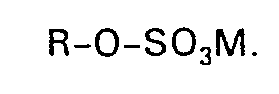
- Die Verbindungen entsprechen bevorzugt der allgemeinen Formel
-
-
- R-O- = einen Rest eines nicht-aromatischen Alkohols, der geradkettig oder verzweigt und dabei gesättigt oder ungesättigt sein kann und in der Regel 8 bis 24 Kohlenstoffatome, vorzugsweise 10 bis 18 Kohlenstoffatome aufweist.
- M = Bedeutung wie bei II.
- Tenside dieser Klasse entsprechen der Formel
-

- In dieser Formel bedeuten:
- R = Alkylrest, der geradkettig oder verzweigt und dabei gesättigt oder ungesättigt sein kann. Vorzugsweise besitzt dieser Alkylrest 4 bis 16, insbesondere 6 bis 14 Kohlenstoffatome. Besondere Bedeutung kann Alkylresten mit 8 bis 12 Kohlenstoffatomen zukommen.
- Ar = Phenylen oder Naphthylen, bevorzugt ist der Phenylrest.
- M = Bedeutung wie bei II.
- Tenside dieser Klasse entsprechen der allgemeinen Formel
-

- Dabei kann die S03M-Gruppe auch innerhalb des Bernsteinsäureesters stellungsvertauscht sein.
- Die Bedeutung der Elemente dieser formelmässigen Darstellung ist im einzelnen:
- R = Rest eines nicht-aromatischen Alkohols, der geradkettig oder verzweigt und dabei gesättigt oder ungesättigt sein kann und vorzugsweise 4 bis 24 C-Atome aufweist.
- Im Falle der Monoester enthält dieser Alkylrest bevorzugt mindestens 8 C-Atome, besonders bevorzugt können Reste mit 10 bis 18 Kohlenstoffatomen sein.
- A = niederer Alkylenrest, der geradkettig und/ oder verzweigt sein kann. Die bevorzugten Alkylenreste sind Ethylen und/oder Propylen-1, 2.
- n = Auch hier gilt, dass zwischen den zwei Klassen der niedrigalkoxylierten und der hochalkoxylierten Derivate unterschieden werden kann. Für die niedrigalkoxylierten Derivate ist n vorzugsweise 1 bis 12, insbesondere 2 bis 10. Für die hoch alkoxylierten Derivate hat n einen Wert > 12 bis insbesondere 100, vorzugsweise 29 bis 50.
- Z = -OM oder -[0-A]"-0-R. In diesem zuletzt genannten Fall liegen die Diester der Sulfobernsteinsäure vor.
- M = Bedeutung wie bei II.
- Die Verbindungen dieser Klasse entsprechen der allgemeinen Formel
-

- Auch in Tensiden dieser Art kann der Sulfosäurerest in der Bernsteinsäure stellungsvertauscht vorliegen.
- Für die Symbole dieser formelmässigen Darstellung gilt im einzelnen das folgende:
- R = Bedeutung wie bei II
- m = Bedeutung wie bei II
- Ar = Bedeutung wie bei II
- A = Bedeutung wie bei 11
- n = Bedeutung wie bei II
- Z = -OM oder -[O-A]n-O-Ar-Rm. Im letzten Fall liegt wieder der Diester der Sulfobernsteinsäure vor.
- M = Bedeutung wie bei II.
- Tenside dieser Klasse entsprechen der allgemeinen Formel
-

- Auch hier kann die Stellung des Restes S03M im Bernsteinsäurerest vertauscht sein.
- Zur Bedeutung der Symbole dieser allgemeinen Formel gilt:
- R = Rest eines nicht-aromatischen Alkohols, der geradkettig oder verzweigt und dabei gesättigt oder ungesättigt sein kann und vorzugsweise 4 bis 24 C-Atome und insbesondere 8 bis 18 C-Atome aufweist.
- Z = -OM oder -OR (Diester der Sulfobernsteinsäure)
- M = Bedeutung wie bei II.
- Neben diesen anionischen Tensiden können die erfindungsgemässen wässrigen Tensidkonzentrate auch andere oberflächenaktive Mittel enthalten. Geeignet sind beispielsweise nichtionische WAS, beispielsweise Alkylphenolpolyglykolether.
- Aus der Herstellung der Alkyl- und Alkylarylethersulfate sowie der beschriebenen Sulfosuccinate und/oder der erfindungsgemäss eingesetzten Viskositätsregler liegen üblicherweise Mengen an anorganischen Salzen wie Natriumchlorid und/oder Natriumsulfat in den wässrigen Konzentraten der Erfindung vor, siehe auch hierzu die Angaben des Standes der Technik.
- In einer Reihe von Vergleichsversuchen werden die viskositätsregelnden Eigenschaften von Polyethylenglykoldisulfat und 1,2-Polypropylenglykoldisulfat auf wässrige 70%ige Alkylethersulfat-Konzentrate bestimmt. Dabei wird die Abhängigkeit der viskositätsregelnden Wirkung von den verschiedenartigsten Parametern ermittelt.
- Die in diesem Beispiel eingesetzten Produkte weisen die folgenden Kennzahlen auf:
- 1. Na-C 12/14-Fettalkohol-2-EO-Sulfat, (abgekürzt C12/14-2-Sulfat),
- 70 Gew.-% Waschaktivsubstanz
- (ethanollösliche Anteile),
- 0,4 Gew.-% NaCI,
- 0,9 Gew.-% Na2S04
- 2. Na-C 12/14-Fettalkohol-3-EO-Sulfat, (abgekürzt C12/14-3-Sulfat)
- 70 Gew.-% Waschaktivsubstanz
- (ethanollösliche Anteile)
- 0,4 Gew.-% NaCI
- 0,9 Gew.-% Na2S04
- 3. Polyethylenglykoldisulfate auf Basis von Polyethylenglykolen der Molgewichte 600, 1550, 2000 und 3000, erhalten durch direkte Sulfatierung mit Chlorsulfonsäure und vorliegend als circa 70 gewichtsprozentige wässrige Lösung.
- 4. Polypropylenglykoldisulfate auf Basis von Polypropylendiglykolen der Molgewichte 620, 1020, 2020, hergestellt ebenfalls nach herkömmlicher Methode durch Direktsulfatierung der entsprechenden Polypropylenglykole und vorliegend als circa 70 gewichtsprozentige Lösungen in Wasser.
- a) In einer ersten Versuchsreihe wird die Abhängigkeit der Viskosität (bestimmt nach Höppler am Kugelfallviskosimeter bei 20°C) vom Molgewicht des eingesetzten Polyethylenglykoldisulfates ermittelt. In der folgenden Tabelle 1 und in den weiteren Tabellen dieses Beispiels sind dabei die Zahlenwerte für die Viskosität in mPa.s angegeben.
- Als Tensid wird in der Ausgangslösung Na-C12/14-Fettalkohol-2-EO-Sulfat eingesetzt.

- b) In einer nächsten Versuchsreihe wird die Abhängigkeit der Viskosität von der Art des zugrundeliegenden Alkylethersulfats bei Verwendung von Polypropylenglykoldisulfat (Molgewicht 1550) bestimmt.
- c) In einer weiteren Versuchsreihe wird die Abhängigkeit der Viskosität von der Art des Polyglykols bzw. der entsprechenden wasserlöslichen Sulfatsalze bestimmt. Eingesetztes Tensid: Na-C12/14-Fettalkohol-2-EO-Sulfat Polyglykoldisulfat-Anteil: 2,8% WAS: 65%

- d) In einer abschliessenden Versuchsreihe wird die Wiederverdickbarkeit der durch Wasserzusatz verflüssigten Alkylethersulfatlösungen bestimmt.

- Na-C12/14-2-Sulfat wird mit 3 Gew.-% bzw. 6 Gew.-% des Viskositätsreglers verflüssigt und nach dem Verdünnen mit Wasser auf einen Gehalt an 10 Gew.-% WAS auf seine Wiederverdickbarkeit mit Kochsalz untersucht. In der folgenden tabellarischen Zusammenstellung sind die erfindungsgemäss erhaltenen Ergebnisse mit entsprechenden Lösungen verglichen, die als Viskositätsregler Butylglykolsulfat oder Cumolsulfonat enthalten.

- Die Tabellen zu a) und b) zeigen, dass bereits geringe Mengen der erfindungsgemässen Viskositätsregler verflüssigend auf hochkonzentrierte Fettalkoholethersulfate wirken. Beim Übergang zu geringeren Konzentrationen d. h. beim Verdünnen wird die Viskosität nicht sprungartig erhöht, sondern es tritt eine Erniedrigung auf.
- Gegenüber kurzkettigen Alkylethersulfaten (Butylglykolsulfat) wird die Wiederverdickbarkeit der verdünnten Tensidlösungen weniger beeinträchtigt. Im verstärkten Masse gilt dies für den Vergleich mit Cumolsulfonat.
- Die wässrige Lösung eines Na-C12/14-Fettalkohol-50-EO-sulfats mit einem Aktivsubstanzgehalt von 25 Gew.-% hat einen Gelpunkt von + 12°C. Zur Erniedrigung des Gelpunktes werden Dinatriumpolyethylenglykoldisulfate auf Basis von Polyethylenglykolen der Molgewichte 1550, 3000 und 4000 eingesetzt. Durch Zusatz von jeweils 1,2 Gewichtsteilen Dinatriumpolyethylenglykoldisulfat auf 100 Gewichtsteile Fettalkohol-EO-sulfat wird der Gelpunkt der Ausgangslösung auf die in der Tabelle 5 wiedergegebenen Werte erniedrigt.
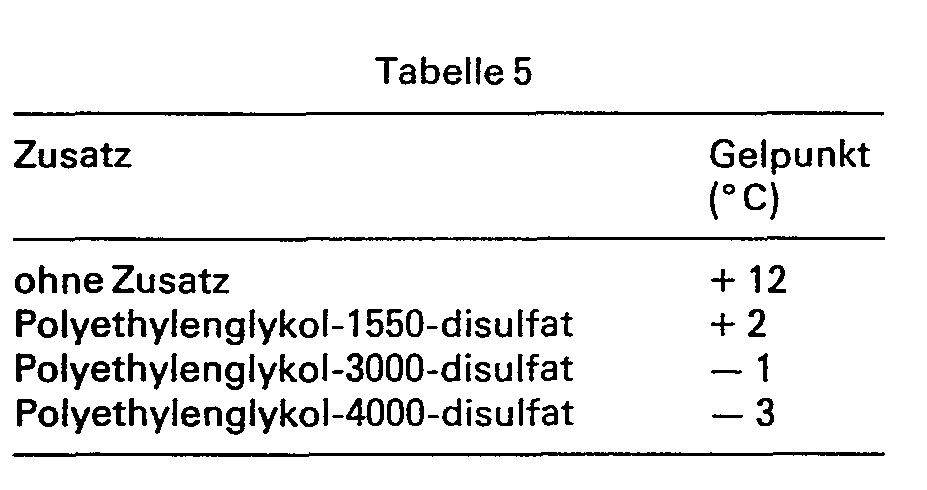
- Diese Versuchsreihe zeigt, dass bereits der geringe Zusatz von 1,2 Gew.-%, bezogen auf Fettalkohol-EO-sulfat eine Gelpunktserniedrigung in der Grössenordnung von 10°C bewirkt.
- Ein Anlagerungsprodukt von 50 Mol Ethylenoxid an ein Mol C12/14-Fettalkohol wird allein und in den in der Tabelle 6 angegebenen Abmischungen mit Polyethylenglykol unter üblichen Bedingungen mit Chlorsulfonsäure sulfatiert. Dabei werden 1,05 Mol Chlorsulfonsäure pro Mol Hydroxylgruppen (berechnet nach der OH-Zahl) eingesetzt. Nach dem Neutralisieren mit Natronlauge und Einstellen einer Aktivsubstanzkonzentration von 25 Gew.-% werden die in der Tabelle 6 verzeichneten Gelpunkte gefunden.

- In diesem Beispiel wird der viskositätsregelnde Einfluss von Polyethylenglykoldisulfat auf alkoholfreie, wässrige 70%ige Alkylarylethersulfat-Konzentrate bestimmt.
- Gemessen wurden die Viskositäten nach Höppler bei 50 °C von
- A Nonylphenol + 4 EO-Sulfat, NH4+-Salz hergestellt nach US-PS 2 758 977
- B Mischungen dieses Produktes mit
- 1) handelsübliche Polyethylenglykolen (PEG) der mittleren Molgewichte 600, 1550, 3000 und 4000.
- 2) Polyethylenglykolmono/disulfaten auf Basis von Polyethylenglykolen der Molgewichte 600, 1550, 3000 und 4000 erhalten durch direkte Sulfatierung mit Chlorsulfonsäure und vorliegend als ca. 35 gewichtsprozentige wässrige Lösungen.
- 3) Polyethylenglykol-4000-mono/disulfat, in situ hergestellt durch Sulfatierung eines Gemisches von Nonylphenol + 4 EO und Polyethylenglykol 4000.
- Die Ergebnisse sind in der Tabelle 7 zusammengefasst.


- In diesem Beispiel wird der Einsatz von Polyglykolen bzw. Polyglykoldisulfaten zur Senkung des Gelpunktes eines hochethoxylierten Alkylphenolethersulfats erläutert. Die wässrige Lösung eines Dodecylphenol + 40 EO-sulfat, Na-Salz, mit einem Aktivsubstanzgehalt von 30 Gew.-% hat einen Gelpunkt von +12,5°C. Zur Erniedrigung des Gelpunktes werden eingesetzt:
- a) Polyethylenglykole (PEG) des mittleren Molgewichtes 4000
- b) Polyethylenglykolmono/disulfate auf Basis eines Polyethylenglykols eines mittleren Molgewichts von 4000

- Die Viskosität nach Höppler bei 25°C eines 30%igen C12/C15-Oxoalkoholsulfat-Na-Salzes (hier mit OAS abgekürzt) beträgt ca. 8500 mPa.s. In diesem Beispiel wird der viskositätsbrechende Einfluss von PEG-disulfaten auf solche wässrigen Alkylsulfat-Konzentrate bestimmt. Dazu werden die folgenden Abmischungen von OAS hergestellt und die Höppler-Viskosität gemessen.

- 50%iges n-Dodecylbenzolsulfonat (hier mit ABS bezeichnet) bildet bei Zimmertemperatur eine hochviskose, zähe, unbewegliche Paste, deren Höppler-Viskosität nicht messbar ist. Die Brookfield-Viskosität (Spindel 6, 20 UpM, 25°C) beträgt 23000 mPa.s. In diesem Beispiel wird der viskositätsbrechende Einfluss von Polyethylenglykolen und von PEG-disulfaten auf solche wässrige ABS-Konzentrate bestimmt. Dazu werden die folgenden Abmischungen von ABS hergestellt und die Höppler-Viskosität gemessen.
-

- In diesem Beispiel wird der Einsatz von Polyglykoldisulfaten zur Senkung des Gelpunktes von Sulfobernsteinsäurehalbester erläutert.
- Der Di-Na-Sulfobernsteinsäurehalbester von Octylphenol + 11 EO bildet bereits bei 30% AS in wässriger Lösung ein nicht giessbares, unbewegliches Gel, das erst bei 33°C (Gelpunkt) fliessfähig wird. Die Höppler-Viskosität des Gels bei 25°C ist naturgemäss nicht messbar hoch. Bereits durch Zusatz von 5% PEG 4000-disulfat, Na-Salz, als 33%ige wässrige Lösung kann der Gelpunkt auf -2°C gesenkt werden, die Höppler-Viskosität bei 25°C ist messbar und beträgt nur 80-100 mPa.s. Durch Zusatz von 10% PEG 4000- disulfat, NA-Salz, als 33%ige wässrige Lösung kann der Gelpunkt noch weiter gesenkt werden und liegt dann bei <-10°C.
Claims (20)
Priority Applications (1)
| Application Number | Priority Date | Filing Date | Title |
|---|---|---|---|
| AT80105017T ATE5778T1 (de) | 1979-09-01 | 1980-08-23 | Waessrige tensidkonzentrate und verfahren zur verbesserung des fliessverhaltens schwer beweglicher waessriger tensidkonzentrate. |
Applications Claiming Priority (4)
| Application Number | Priority Date | Filing Date | Title |
|---|---|---|---|
| DE2935428 | 1979-09-01 | ||
| DE19792935428 DE2935428A1 (de) | 1979-09-01 | 1979-09-01 | Waessrige tensidkonzentrate und verfahren zur verbesserung des fliessverhaltens schwer beweglicher waessriger tensidkonzentrate |
| DE3002993 | 1980-01-29 | ||
| DE19803002993 DE3002993A1 (de) | 1980-01-29 | 1980-01-29 | Waessrige tensidkonzentrate und verfahren zur verbesserung des fliessverhaltens schwerbeweglicher waessriger tensidkonzentrate |
Publications (3)
| Publication Number | Publication Date |
|---|---|
| EP0024711A1 EP0024711A1 (de) | 1981-03-11 |
| EP0024711B1 EP0024711B1 (de) | 1984-01-04 |
| EP0024711B2 true EP0024711B2 (de) | 1989-02-08 |
Family
ID=25780820
Family Applications (1)
| Application Number | Title | Priority Date | Filing Date |
|---|---|---|---|
| EP80105017A Expired EP0024711B2 (de) | 1979-09-01 | 1980-08-23 | Wässrige Tensidkonzentrate und Verfahren zur Verbesserung des Fliessverhaltens schwer beweglicher wässriger Tensidkonzentrate |
Country Status (4)
| Country | Link |
|---|---|
| US (2) | US4384978A (de) |
| EP (1) | EP0024711B2 (de) |
| CA (1) | CA1152850A (de) |
| DE (1) | DE3066054D1 (de) |
Families Citing this family (35)
| Publication number | Priority date | Publication date | Assignee | Title |
|---|---|---|---|---|
| DE3066054D1 (en) * | 1979-09-01 | 1984-02-09 | Henkel Kgaa | Watery tenside concentrates and process for the improvement of the flowing property of difficultly movable watery tenside concentrates |
| DE3265500D1 (en) * | 1981-02-19 | 1985-09-26 | Ici Plc | Surface active compositions |
| DE3151679A1 (de) * | 1981-12-28 | 1983-07-07 | Henkel KGaA, 4000 Düsseldorf | "verwendung von viskositaetsreglern fuer tensidkonzentrate" |
| DE3240403A1 (de) * | 1982-11-02 | 1984-05-03 | Henkel KGaA, 4000 Düsseldorf | Verwendung von niedermolekularen organischen verbindungen als viskositaetsregler fuer hochviskose technische tensid-konzentrate |
| DE3305430A1 (de) * | 1983-02-17 | 1984-08-23 | Henkel KGaA, 4000 Düsseldorf | Verwendung von alkoholen und deren derivaten als viskositaetsregler fuer hochviskose technische tensid-konzentrate |
| GB8404120D0 (en) * | 1984-02-16 | 1984-03-21 | Unilever Plc | Liquid detergent compositions |
| DE3447859A1 (de) * | 1984-12-31 | 1986-07-10 | Henkel KGaA, 4000 Düsseldorf | Verwendung von alkansulfonaten als viskositaetsregler fuer hochviskose aniontensid-konzentrate |
| US4904359A (en) * | 1985-10-31 | 1990-02-27 | The Procter & Gamble Company | Liquid detergent composition containing polymeric surfactant |
| AU589225B2 (en) | 1985-10-31 | 1989-10-05 | Procter & Gamble Company, The | Liquid detergent composition |
| US4765926A (en) * | 1986-03-18 | 1988-08-23 | Vista Chemical Company | Surfactant compositions and method therefor |
| DE3622438A1 (de) * | 1986-07-04 | 1988-01-07 | Henkel Kgaa | Kosmetischer waschrohstoff |
| DE3630533A1 (de) * | 1986-09-08 | 1988-03-10 | Henkel Kgaa | Neue tensidgemische und ihre verwendung |
| US4758374A (en) * | 1987-03-17 | 1988-07-19 | Conoco Inc. | Soluble oil concentrate and emulsifier system used therein |
| GB8718217D0 (en) * | 1987-07-31 | 1987-09-09 | Unilever Plc | Liquid detergent compositions |
| GB8821763D0 (en) * | 1988-09-16 | 1988-10-19 | Unilever Plc | Liquid detergents |
| GB2223611A (en) * | 1988-10-07 | 1990-04-11 | Nigel Anthony Collier | Electronic bark suppressor |
| DE3918252A1 (de) * | 1989-06-05 | 1990-12-13 | Henkel Kgaa | Fettalkylsulfate und fettalkyl-polyalkylenglycolethersulfate, verfahren zu ihrer herstellung und ihre verwendung |
| KR910004791A (ko) * | 1989-08-31 | 1991-03-29 | 오노 알버어스 | 액체 계면 활성 조성물 및 그의 제조방법 |
| GB8924478D0 (en) * | 1989-10-31 | 1989-12-20 | Unilever Plc | Detergent compositions |
| DE4019172A1 (de) * | 1990-06-15 | 1991-12-19 | Henkel Kgaa | Verwendung von salzen der sulfonierungsprodukte ungesaettigter fettsaeuren als viskositaetsminderer |
| DE4024657A1 (de) * | 1990-08-03 | 1992-02-06 | Henkel Kgaa | Verfahren zur trocknung und granulierung waessriger pasten waschaktiver wirkstoffgemische |
| DE4032910A1 (de) * | 1990-10-17 | 1992-04-23 | Henkel Kgaa | Verfahren zur herstellung von alkylsulfatpasten mit verbesserten fliesseigenschaften |
| DE4032909A1 (de) * | 1990-10-17 | 1992-04-23 | Henkel Kgaa | Verfahren zur herstellung von alkylsulfatpasten mit verbesserter fliessfaehigkeit |
| DE4109250A1 (de) * | 1991-03-21 | 1992-09-24 | Henkel Kgaa | Verfahren zur herstellung von hochkonzentrierten fettalkoholsulfat-pasten |
| US5538672A (en) * | 1991-08-03 | 1996-07-23 | Henkel Kommanditgesellschaft Auf Aktien | Free-flowing water-containing alkyl sulfate pastes |
| EP0560001B1 (de) * | 1992-03-10 | 1999-05-19 | The Procter & Gamble Company | Hochaktive Tensidpasten |
| US5529722A (en) * | 1992-03-10 | 1996-06-25 | The Procter & Gamble Company | High active detergent pastes |
| EP0618000B1 (de) * | 1992-08-06 | 1996-03-20 | Air Products And Chemicals, Inc. | Wasserlösliche Netzmittelgemische |
| DE4325923A1 (de) * | 1993-08-02 | 1995-02-09 | Henkel Kgaa | Sulfobernsteinsäurediester enthaltende flüssige Formulierungen |
| WO1996025482A1 (en) * | 1995-02-13 | 1996-08-22 | The Procter & Gamble Company | Process for producing detergent agglomerates in which particle size is controlled |
| US5574005A (en) * | 1995-03-07 | 1996-11-12 | The Procter & Gamble Company | Process for producing detergent agglomerates from high active surfactant pastes having non-linear viscoelastic properties |
| CN101310005A (zh) * | 2005-11-15 | 2008-11-19 | 宝洁公司 | 包含天然源的烷基或羟烷基硫酸盐或磺酸盐表面活性剂以及中链支化的氧化胺表面活性剂的液体衣物洗涤剂组合物 |
| DE102011015046A1 (de) * | 2011-03-24 | 2012-09-27 | Sasol Germany Gmbh | Hochkonzentrierte fließfähige Salze von Alkylpolyalkoxysulfaten |
| WO2014072840A1 (en) | 2012-11-12 | 2014-05-15 | Galaxy Surfactants Ltd. | Flowable, high active, aqueous fatty alkyl sulfates |
| CN113717008B (zh) * | 2021-08-13 | 2022-10-14 | 四川鸿康科技股份有限公司 | 一种磷酸一铵防结块剂及其应用 |
Family Cites Families (11)
| Publication number | Priority date | Publication date | Assignee | Title |
|---|---|---|---|---|
| US1970578A (en) * | 1930-11-29 | 1934-08-21 | Ig Farbenindustrie Ag | Assistants for the textile and related industries |
| US2758977A (en) * | 1951-05-25 | 1956-08-14 | Gen Aniline & Film Corp | Detergent composition and method of producing same |
| US2940936A (en) * | 1953-04-07 | 1960-06-14 | Monsanto Chemicals | Preparing sulfonated products from sulfur trioxide |
| BE790362A (fr) * | 1971-10-20 | 1973-02-15 | Albright & Wilson | Composants de detergents |
| BE795095A (fr) * | 1972-02-07 | 1973-05-29 | Albright & Wilson | Concentrat aqueux pouvant etre utilise comme composant detergent |
| GB1437089A (en) | 1972-05-26 | 1976-05-26 | Albright & Wilson | Detergent concentrates |
| FR2268069B1 (de) * | 1974-04-19 | 1977-10-14 | Procter & Gamble Europ | |
| US3957671A (en) * | 1974-11-13 | 1976-05-18 | The Procter & Gamble Company | Acid mix compositions containing benzoic acid |
| DE2501982C2 (de) * | 1975-01-18 | 1987-05-14 | Bayer Ag, 5090 Leverkusen | Konzentrierte wäßrige Einstellungen von Mischungen aus Alkylsulfonaten und Polyglykoläthern |
| DE2703998C3 (de) * | 1977-02-01 | 1981-10-01 | Henkel KGaA, 4000 Düsseldorf | Flüssiges Waschmittelkonzentrat mit geringem Schaumvermögen |
| DE3066054D1 (en) * | 1979-09-01 | 1984-02-09 | Henkel Kgaa | Watery tenside concentrates and process for the improvement of the flowing property of difficultly movable watery tenside concentrates |
-
1980
- 1980-08-23 DE DE8080105017T patent/DE3066054D1/de not_active Expired
- 1980-08-23 EP EP80105017A patent/EP0024711B2/de not_active Expired
- 1980-08-26 US US06/181,639 patent/US4384978A/en not_active Expired - Lifetime
- 1980-08-28 CA CA000359228A patent/CA1152850A/en not_active Expired
-
1983
- 1983-02-24 US US06/469,214 patent/US4476037A/en not_active Expired - Lifetime
Also Published As
| Publication number | Publication date |
|---|---|
| DE3066054D1 (en) | 1984-02-09 |
| US4384978A (en) | 1983-05-24 |
| EP0024711B1 (de) | 1984-01-04 |
| CA1152850A (en) | 1983-08-30 |
| US4476037A (en) | 1984-10-09 |
| EP0024711A1 (de) | 1981-03-11 |
Similar Documents
| Publication | Publication Date | Title |
|---|---|---|
| EP0024711B2 (de) | Wässrige Tensidkonzentrate und Verfahren zur Verbesserung des Fliessverhaltens schwer beweglicher wässriger Tensidkonzentrate | |
| EP0084154B1 (de) | Verwendung von Viskositätsreglern für Tensidkonzentrate | |
| EP0116905A2 (de) | Verwendung von Alkoholderivaten als Viskositätsregler für hochviskose technische Tensid-Konzentrate | |
| CH671026A5 (de) | ||
| DE3918252A1 (de) | Fettalkylsulfate und fettalkyl-polyalkylenglycolethersulfate, verfahren zu ihrer herstellung und ihre verwendung | |
| DE1249434B (de) | Waschmittel | |
| DE2110030A1 (de) | Flüssigwaschmittel | |
| WO2015117840A1 (de) | WÄßRIGE TENSID-ZUSAMMENSETZUNGEN | |
| WO1995021905A1 (de) | Reinigungsmittel für harte oberflächen | |
| EP0608285B2 (de) | Viskose wässrige tensidzubereitungen | |
| DE2632953A1 (de) | Reinigungsmittelgemisch, enthaltend ein alkylaethersulfat-detergens | |
| EP0574448A1 (de) | Flüssige reinigungsmittel mit einem gehalt an sulfoölsauren disalzen | |
| EP0532549A1 (de) | Flüssiges, fliess- und pumpfähiges tensidkonzentrat | |
| EP2655586A1 (de) | Zusammensetzungen enthaltend sekundäres paraffinsulfonat und alkoholalkoxylat | |
| DE3724500A1 (de) | Alkylsulfat-ethersulfat-gemische und deren verwendung | |
| WO2000071665A1 (de) | Saures wässriges mehrphasiges reinigungsmittel | |
| DE2935428A1 (de) | Waessrige tensidkonzentrate und verfahren zur verbesserung des fliessverhaltens schwer beweglicher waessriger tensidkonzentrate | |
| EP0103696B1 (de) | Wässrige Tensidkonzentrate und Verfahren zur Verbesserung des Fliessverhaltens schwerbeweglicher wässriger Tensidkonzentrate | |
| DE2305554B2 (de) | Komponenten für wäßrige Detergent-Konzentrate | |
| DE2819455A1 (de) | Fluessiges waschmittel und verfahren zu seiner herstellung | |
| DE2853136A1 (de) | Waessriges, oberflaechenaktives mittel | |
| DE3002993A1 (de) | Waessrige tensidkonzentrate und verfahren zur verbesserung des fliessverhaltens schwerbeweglicher waessriger tensidkonzentrate | |
| DE2817626C2 (de) | ||
| DE2438136A1 (de) | Reinigungsmittelmischung | |
| EP0975719B1 (de) | Verfahren zur herstellung von niedrigviskosen wässerigen alkyl(ether)sulfatpasten |
Legal Events
| Date | Code | Title | Description |
|---|---|---|---|
| PUAI | Public reference made under article 153(3) epc to a published international application that has entered the european phase |
Free format text: ORIGINAL CODE: 0009012 |
|
| AK | Designated contracting states |
Designated state(s): AT BE CH DE FR GB IT NL SE |
|
| 17P | Request for examination filed |
Effective date: 19810727 |
|
| ITF | It: translation for a ep patent filed | ||
| GRAA | (expected) grant |
Free format text: ORIGINAL CODE: 0009210 |
|
| AK | Designated contracting states |
Designated state(s): AT BE CH DE FR GB IT LI NL SE |
|
| REF | Corresponds to: |
Ref document number: 5778 Country of ref document: AT Date of ref document: 19840115 Kind code of ref document: T |
|
| REF | Corresponds to: |
Ref document number: 3066054 Country of ref document: DE Date of ref document: 19840209 |
|
| ET | Fr: translation filed | ||
| PLBI | Opposition filed |
Free format text: ORIGINAL CODE: 0009260 |
|
| PLBI | Opposition filed |
Free format text: ORIGINAL CODE: 0009260 |
|
| 26 | Opposition filed |
Opponent name: CHEMISCHE WERKE HUELS AG Effective date: 19840918 |
|
| 26 | Opposition filed |
Opponent name: HOECHST AKTIENGESELLSCHAFT, FRANKFURT Effective date: 19841003 |
|
| PLAB | Opposition data, opponent's data or that of the opponent's representative modified |
Free format text: ORIGINAL CODE: 0009299OPPO |
|
| PLAB | Opposition data, opponent's data or that of the opponent's representative modified |
Free format text: ORIGINAL CODE: 0009299OPPO |
|
| R26 | Opposition filed (corrected) |
Opponent name: HUELS AKTIENGESELLSCHAFT * 841003 HOECHST AKTIENGE Effective date: 19840918 |
|
| R26 | Opposition filed (corrected) |
Opponent name: HUELS AKTIENGESELLSCHAFT * 841003 HOECHST AKTIENGE Effective date: 19840918 |
|
| NLXE | Nl: other communications concerning ep-patents (part 3 heading xe) |
Free format text: SHOULD BE MODIFIED INTO:HUELS AKTIENGESELLSCHAFT |
|
| PUAH | Patent maintained in amended form |
Free format text: ORIGINAL CODE: 0009272 |
|
| STAA | Information on the status of an ep patent application or granted ep patent |
Free format text: STATUS: PATENT MAINTAINED AS AMENDED |
|
| 27A | Patent maintained in amended form |
Effective date: 19890208 |
|
| AK | Designated contracting states |
Kind code of ref document: B2 Designated state(s): AT BE CH DE FR GB IT NL SE |
|
| ET3 | Fr: translation filed ** decision concerning opposition | ||
| NLR2 | Nl: decision of opposition | ||
| ITF | It: translation for a ep patent filed | ||
| NLR3 | Nl: receipt of modified translations in the netherlands language after an opposition procedure | ||
| ITTA | It: last paid annual fee | ||
| PGFP | Annual fee paid to national office [announced via postgrant information from national office to epo] |
Ref country code: CH Payment date: 19940718 Year of fee payment: 15 |
|
| PGFP | Annual fee paid to national office [announced via postgrant information from national office to epo] |
Ref country code: AT Payment date: 19940727 Year of fee payment: 15 |
|
| EAL | Se: european patent in force in sweden |
Ref document number: 80105017.0 |
|
| PGFP | Annual fee paid to national office [announced via postgrant information from national office to epo] |
Ref country code: SE Payment date: 19950816 Year of fee payment: 16 |
|
| PG25 | Lapsed in a contracting state [announced via postgrant information from national office to epo] |
Ref country code: AT Effective date: 19950823 |
|
| PG25 | Lapsed in a contracting state [announced via postgrant information from national office to epo] |
Ref country code: LI Effective date: 19950831 Ref country code: CH Effective date: 19950831 |
|
| REG | Reference to a national code |
Ref country code: CH Ref legal event code: PL |
|
| PG25 | Lapsed in a contracting state [announced via postgrant information from national office to epo] |
Ref country code: SE Effective date: 19960824 |
|
| EUG | Se: european patent has lapsed |
Ref document number: 80105017.0 |
|
| PGFP | Annual fee paid to national office [announced via postgrant information from national office to epo] |
Ref country code: FR Payment date: 19970811 Year of fee payment: 18 |
|
| PG25 | Lapsed in a contracting state [announced via postgrant information from national office to epo] |
Ref country code: FR Free format text: LAPSE BECAUSE OF NON-PAYMENT OF DUE FEES Effective date: 19990430 |
|
| REG | Reference to a national code |
Ref country code: FR Ref legal event code: ST |
|
| PGFP | Annual fee paid to national office [announced via postgrant information from national office to epo] |
Ref country code: GB Payment date: 19990818 Year of fee payment: 20 |
|
| PGFP | Annual fee paid to national office [announced via postgrant information from national office to epo] |
Ref country code: DE Payment date: 19990823 Year of fee payment: 20 |
|
| PGFP | Annual fee paid to national office [announced via postgrant information from national office to epo] |
Ref country code: NL Payment date: 19990830 Year of fee payment: 20 |
|
| PGFP | Annual fee paid to national office [announced via postgrant information from national office to epo] |
Ref country code: BE Payment date: 19991013 Year of fee payment: 20 |
|
| BE20 | Be: patent expired |
Free format text: 20000823 *HENKEL K.G.A.A. |
|
| PG25 | Lapsed in a contracting state [announced via postgrant information from national office to epo] |
Ref country code: GB Free format text: LAPSE BECAUSE OF EXPIRATION OF PROTECTION Effective date: 20000822 |
|
| PG25 | Lapsed in a contracting state [announced via postgrant information from national office to epo] |
Ref country code: NL Free format text: LAPSE BECAUSE OF EXPIRATION OF PROTECTION Effective date: 20000823 |
|
| REG | Reference to a national code |
Ref country code: GB Ref legal event code: PE20 Effective date: 20000822 |
|
| NLV7 | Nl: ceased due to reaching the maximum lifetime of a patent |
Effective date: 20000823 |