EP0021005B1 - Wässrige Härtefixierbäder zur Verarbeitung photographischer Materialien, deren Herstellung und Verwendung, wässrige Härtefixierbadkonzentrate, pulverförmige und tablettierte Härtefixierer und deren Verwendung, und wässriges Konzentrat - Google Patents
Wässrige Härtefixierbäder zur Verarbeitung photographischer Materialien, deren Herstellung und Verwendung, wässrige Härtefixierbadkonzentrate, pulverförmige und tablettierte Härtefixierer und deren Verwendung, und wässriges Konzentrat Download PDFInfo
- Publication number
- EP0021005B1 EP0021005B1 EP80102693A EP80102693A EP0021005B1 EP 0021005 B1 EP0021005 B1 EP 0021005B1 EP 80102693 A EP80102693 A EP 80102693A EP 80102693 A EP80102693 A EP 80102693A EP 0021005 B1 EP0021005 B1 EP 0021005B1
- Authority
- EP
- European Patent Office
- Prior art keywords
- formate
- fixing bath
- hardener
- salt
- fixer
- Prior art date
- Legal status (The legal status is an assumption and is not a legal conclusion. Google has not performed a legal analysis and makes no representation as to the accuracy of the status listed.)
- Expired
Links
- 239000012141 concentrate Substances 0.000 title claims description 35
- 239000000463 material Substances 0.000 title claims description 13
- 238000002360 preparation method Methods 0.000 title claims description 8
- 239000000843 powder Substances 0.000 title description 4
- -1 alkali metal formate Chemical class 0.000 claims description 37
- QTBSBXVTEAMEQO-UHFFFAOYSA-N Acetic acid Chemical class CC(O)=O QTBSBXVTEAMEQO-UHFFFAOYSA-N 0.000 claims description 36
- 229910052783 alkali metal Inorganic materials 0.000 claims description 26
- 150000003839 salts Chemical class 0.000 claims description 25
- 239000000126 substance Substances 0.000 claims description 22
- 239000004848 polyfunctional curative Substances 0.000 claims description 20
- 229910052782 aluminium Inorganic materials 0.000 claims description 18
- LSNNMFCWUKXFEE-UHFFFAOYSA-N Sulfurous acid Chemical class OS(O)=O LSNNMFCWUKXFEE-UHFFFAOYSA-N 0.000 claims description 14
- KGBXLFKZBHKPEV-UHFFFAOYSA-N boric acid Chemical compound OB(O)O KGBXLFKZBHKPEV-UHFFFAOYSA-N 0.000 claims description 12
- 239000004327 boric acid Substances 0.000 claims description 12
- 150000001340 alkali metals Chemical class 0.000 claims description 10
- BDAGIHXWWSANSR-UHFFFAOYSA-M Formate Chemical compound [O-]C=O BDAGIHXWWSANSR-UHFFFAOYSA-M 0.000 claims description 9
- 229910052784 alkaline earth metal Inorganic materials 0.000 claims description 9
- VZTDIZULWFCMLS-UHFFFAOYSA-N ammonium formate Chemical compound [NH4+].[O-]C=O VZTDIZULWFCMLS-UHFFFAOYSA-N 0.000 claims description 9
- 239000003795 chemical substances by application Substances 0.000 claims description 9
- 238000000034 method Methods 0.000 claims description 9
- 238000002156 mixing Methods 0.000 claims description 9
- 230000008961 swelling Effects 0.000 claims description 9
- XLYOFNOQVPJJNP-UHFFFAOYSA-N water Substances O XLYOFNOQVPJJNP-UHFFFAOYSA-N 0.000 claims description 8
- MJWPFSQVORELDX-UHFFFAOYSA-K aluminium formate Chemical compound [Al+3].[O-]C=O.[O-]C=O.[O-]C=O MJWPFSQVORELDX-UHFFFAOYSA-K 0.000 claims description 7
- 150000003863 ammonium salts Chemical class 0.000 claims description 6
- XYXNTHIYBIDHGM-UHFFFAOYSA-N ammonium thiosulfate Chemical compound [NH4+].[NH4+].[O-]S([O-])(=O)=S XYXNTHIYBIDHGM-UHFFFAOYSA-N 0.000 claims description 6
- 230000001105 regulatory effect Effects 0.000 claims description 5
- YNAVUWVOSKDBBP-UHFFFAOYSA-N Morpholine Chemical compound C1COCCN1 YNAVUWVOSKDBBP-UHFFFAOYSA-N 0.000 claims description 4
- VSCWAEJMTAWNJL-UHFFFAOYSA-K aluminium trichloride Chemical compound Cl[Al](Cl)Cl VSCWAEJMTAWNJL-UHFFFAOYSA-K 0.000 claims description 4
- 239000011230 binding agent Substances 0.000 claims description 4
- 239000004280 Sodium formate Substances 0.000 claims description 3
- HLBBKKJFGFRGMU-UHFFFAOYSA-M sodium formate Chemical group [Na+].[O-]C=O HLBBKKJFGFRGMU-UHFFFAOYSA-M 0.000 claims description 3
- 235000019254 sodium formate Nutrition 0.000 claims description 3
- GSEJCLTVZPLZKY-UHFFFAOYSA-N Triethanolamine Chemical compound OCCN(CCO)CCO GSEJCLTVZPLZKY-UHFFFAOYSA-N 0.000 claims description 2
- 239000000470 constituent Substances 0.000 claims description 2
- 238000010790 dilution Methods 0.000 claims description 2
- 239000012895 dilution Substances 0.000 claims description 2
- 229910000329 aluminium sulfate Inorganic materials 0.000 claims 9
- 159000000013 aluminium salts Chemical class 0.000 claims 8
- 239000004411 aluminium Substances 0.000 claims 4
- 239000003513 alkali Substances 0.000 claims 2
- JLDSOYXADOWAKB-UHFFFAOYSA-N aluminium nitrate Chemical compound [Al+3].[O-][N+]([O-])=O.[O-][N+]([O-])=O.[O-][N+]([O-])=O JLDSOYXADOWAKB-UHFFFAOYSA-N 0.000 claims 2
- 150000001875 compounds Chemical class 0.000 claims 2
- WBZKQQHYRPRKNJ-UHFFFAOYSA-L disulfite Chemical compound [O-]S(=O)S([O-])(=O)=O WBZKQQHYRPRKNJ-UHFFFAOYSA-L 0.000 claims 2
- 229940037003 alum Drugs 0.000 claims 1
- DIZPMCHEQGEION-UHFFFAOYSA-H aluminium sulfate (anhydrous) Chemical group [Al+3].[Al+3].[O-]S([O-])(=O)=O.[O-]S([O-])(=O)=O.[O-]S([O-])(=O)=O DIZPMCHEQGEION-UHFFFAOYSA-H 0.000 claims 1
- 235000011128 aluminium sulphate Nutrition 0.000 claims 1
- REDXJYDRNCIFBQ-UHFFFAOYSA-N aluminium(3+) Chemical compound [Al+3] REDXJYDRNCIFBQ-UHFFFAOYSA-N 0.000 claims 1
- 238000007865 diluting Methods 0.000 claims 1
- AZDRQVAHHNSJOQ-UHFFFAOYSA-N alumane Chemical class [AlH3] AZDRQVAHHNSJOQ-UHFFFAOYSA-N 0.000 description 15
- XAGFODPZIPBFFR-UHFFFAOYSA-N aluminium Chemical compound [Al] XAGFODPZIPBFFR-UHFFFAOYSA-N 0.000 description 9
- PPBRXRYQALVLMV-UHFFFAOYSA-N Styrene Chemical compound C=CC1=CC=CC=C1 PPBRXRYQALVLMV-UHFFFAOYSA-N 0.000 description 6
- 229920001577 copolymer Polymers 0.000 description 6
- 150000001342 alkaline earth metals Chemical class 0.000 description 5
- 239000008139 complexing agent Substances 0.000 description 5
- 239000000203 mixture Substances 0.000 description 5
- HEMHJVSKTPXQMS-UHFFFAOYSA-M sodium hydroxide Inorganic materials [OH-].[Na+] HEMHJVSKTPXQMS-UHFFFAOYSA-M 0.000 description 5
- NLHHRLWOUZZQLW-UHFFFAOYSA-N Acrylonitrile Chemical compound C=CC#N NLHHRLWOUZZQLW-UHFFFAOYSA-N 0.000 description 4
- NINIDFKCEFEMDL-UHFFFAOYSA-N Sulfur Chemical compound [S] NINIDFKCEFEMDL-UHFFFAOYSA-N 0.000 description 4
- 230000002378 acidificating effect Effects 0.000 description 4
- GEHJYWRUCIMESM-UHFFFAOYSA-L sodium sulfite Chemical compound [Na+].[Na+].[O-]S([O-])=O GEHJYWRUCIMESM-UHFFFAOYSA-L 0.000 description 4
- KWYUFKZDYYNOTN-UHFFFAOYSA-M Potassium hydroxide Chemical compound [OH-].[K+] KWYUFKZDYYNOTN-UHFFFAOYSA-M 0.000 description 3
- 239000000872 buffer Substances 0.000 description 3
- 238000004519 manufacturing process Methods 0.000 description 3
- 235000010339 sodium tetraborate Nutrition 0.000 description 3
- 239000000243 solution Substances 0.000 description 3
- 229920002134 Carboxymethyl cellulose Polymers 0.000 description 2
- DGAQECJNVWCQMB-PUAWFVPOSA-M Ilexoside XXIX Chemical compound C[C@@H]1CC[C@@]2(CC[C@@]3(C(=CC[C@H]4[C@]3(CC[C@@H]5[C@@]4(CC[C@@H](C5(C)C)OS(=O)(=O)[O-])C)C)[C@@H]2[C@]1(C)O)C)C(=O)O[C@H]6[C@@H]([C@H]([C@@H]([C@H](O6)CO)O)O)O.[Na+] DGAQECJNVWCQMB-PUAWFVPOSA-M 0.000 description 2
- XEEYBQQBJWHFJM-UHFFFAOYSA-N Iron Chemical compound [Fe] XEEYBQQBJWHFJM-UHFFFAOYSA-N 0.000 description 2
- CERQOIWHTDAKMF-UHFFFAOYSA-N Methacrylic acid Chemical compound CC(=C)C(O)=O CERQOIWHTDAKMF-UHFFFAOYSA-N 0.000 description 2
- QAOWNCQODCNURD-UHFFFAOYSA-N Sulfuric acid Chemical class OS(O)(=O)=O QAOWNCQODCNURD-UHFFFAOYSA-N 0.000 description 2
- 239000002253 acid Substances 0.000 description 2
- 150000001252 acrylic acid derivatives Chemical class 0.000 description 2
- 150000001412 amines Chemical class 0.000 description 2
- 239000007864 aqueous solution Substances 0.000 description 2
- 229910021538 borax Inorganic materials 0.000 description 2
- 239000001768 carboxy methyl cellulose Substances 0.000 description 2
- 235000010948 carboxy methyl cellulose Nutrition 0.000 description 2
- 239000008112 carboxymethyl-cellulose Substances 0.000 description 2
- 238000006243 chemical reaction Methods 0.000 description 2
- KRKNYBCHXYNGOX-UHFFFAOYSA-N citric acid Substances OC(=O)CC(O)(C(O)=O)CC(O)=O KRKNYBCHXYNGOX-UHFFFAOYSA-N 0.000 description 2
- 230000000694 effects Effects 0.000 description 2
- 230000008030 elimination Effects 0.000 description 2
- 238000003379 elimination reaction Methods 0.000 description 2
- 229920003063 hydroxymethyl cellulose Polymers 0.000 description 2
- 229940031574 hydroxymethyl cellulose Drugs 0.000 description 2
- JVTAAEKCZFNVCJ-UHFFFAOYSA-N lactic acid Chemical compound CC(O)C(O)=O JVTAAEKCZFNVCJ-UHFFFAOYSA-N 0.000 description 2
- BDAGIHXWWSANSR-UHFFFAOYSA-N methanoic acid Natural products OC=O BDAGIHXWWSANSR-UHFFFAOYSA-N 0.000 description 2
- 229920000609 methyl cellulose Polymers 0.000 description 2
- 239000001923 methylcellulose Substances 0.000 description 2
- 235000010981 methylcellulose Nutrition 0.000 description 2
- 229920002401 polyacrylamide Polymers 0.000 description 2
- 229920002451 polyvinyl alcohol Polymers 0.000 description 2
- 229920000036 polyvinylpyrrolidone Polymers 0.000 description 2
- 235000010265 sodium sulphite Nutrition 0.000 description 2
- 238000003756 stirring Methods 0.000 description 2
- 239000011593 sulfur Substances 0.000 description 2
- 229910052717 sulfur Inorganic materials 0.000 description 2
- BJEPYKJPYRNKOW-REOHCLBHSA-N (S)-malic acid Chemical compound OC(=O)[C@@H](O)CC(O)=O BJEPYKJPYRNKOW-REOHCLBHSA-N 0.000 description 1
- SMZOUWXMTYCWNB-UHFFFAOYSA-N 2-(2-methoxy-5-methylphenyl)ethanamine Chemical compound COC1=CC=C(C)C=C1CCN SMZOUWXMTYCWNB-UHFFFAOYSA-N 0.000 description 1
- OSWFIVFLDKOXQC-UHFFFAOYSA-N 4-(3-methoxyphenyl)aniline Chemical class COC1=CC=CC(C=2C=CC(N)=CC=2)=C1 OSWFIVFLDKOXQC-UHFFFAOYSA-N 0.000 description 1
- PXRKCOCTEMYUEG-UHFFFAOYSA-N 5-aminoisoindole-1,3-dione Chemical compound NC1=CC=C2C(=O)NC(=O)C2=C1 PXRKCOCTEMYUEG-UHFFFAOYSA-N 0.000 description 1
- 241000416162 Astragalus gummifer Species 0.000 description 1
- BTBUEUYNUDRHOZ-UHFFFAOYSA-N Borate Chemical compound [O-]B([O-])[O-] BTBUEUYNUDRHOZ-UHFFFAOYSA-N 0.000 description 1
- VYZAMTAEIAYCRO-UHFFFAOYSA-N Chromium Chemical compound [Cr] VYZAMTAEIAYCRO-UHFFFAOYSA-N 0.000 description 1
- 239000001856 Ethyl cellulose Substances 0.000 description 1
- 108010010803 Gelatin Proteins 0.000 description 1
- 229920000663 Hydroxyethyl cellulose Polymers 0.000 description 1
- 239000004354 Hydroxyethyl cellulose Substances 0.000 description 1
- 229910002566 KAl(SO4)2·12H2O Inorganic materials 0.000 description 1
- 229910002651 NO3 Inorganic materials 0.000 description 1
- NHNBFGGVMKEFGY-UHFFFAOYSA-N Nitrate Chemical compound [O-][N+]([O-])=O NHNBFGGVMKEFGY-UHFFFAOYSA-N 0.000 description 1
- 229920003171 Poly (ethylene oxide) Polymers 0.000 description 1
- 239000004372 Polyvinyl alcohol Substances 0.000 description 1
- VMHLLURERBWHNL-UHFFFAOYSA-M Sodium acetate Chemical compound [Na+].CC([O-])=O VMHLLURERBWHNL-UHFFFAOYSA-M 0.000 description 1
- QAOWNCQODCNURD-UHFFFAOYSA-L Sulfate Chemical compound [O-]S([O-])(=O)=O QAOWNCQODCNURD-UHFFFAOYSA-L 0.000 description 1
- DKGAVHZHDRPRBM-UHFFFAOYSA-N Tert-Butanol Chemical compound CC(C)(C)O DKGAVHZHDRPRBM-UHFFFAOYSA-N 0.000 description 1
- 229920001615 Tragacanth Polymers 0.000 description 1
- ZXRRHFSTAFVGOC-UHFFFAOYSA-N [AlH3].[K] Chemical compound [AlH3].[K] ZXRRHFSTAFVGOC-UHFFFAOYSA-N 0.000 description 1
- 238000010521 absorption reaction Methods 0.000 description 1
- 239000008351 acetate buffer Substances 0.000 description 1
- 239000000654 additive Substances 0.000 description 1
- 229920000615 alginic acid Polymers 0.000 description 1
- 235000010443 alginic acid Nutrition 0.000 description 1
- 150000008044 alkali metal hydroxides Chemical class 0.000 description 1
- 150000001447 alkali salts Chemical class 0.000 description 1
- BJEPYKJPYRNKOW-UHFFFAOYSA-N alpha-hydroxysuccinic acid Natural products OC(=O)C(O)CC(O)=O BJEPYKJPYRNKOW-UHFFFAOYSA-N 0.000 description 1
- 230000015572 biosynthetic process Effects 0.000 description 1
- BTANRVKWQNVYAZ-UHFFFAOYSA-N butan-2-ol Chemical compound CCC(C)O BTANRVKWQNVYAZ-UHFFFAOYSA-N 0.000 description 1
- 125000004432 carbon atom Chemical group C* 0.000 description 1
- 229920003064 carboxyethyl cellulose Polymers 0.000 description 1
- 229940105329 carboxymethylcellulose Drugs 0.000 description 1
- 229920002678 cellulose Polymers 0.000 description 1
- 239000001913 cellulose Substances 0.000 description 1
- 229920003086 cellulose ether Polymers 0.000 description 1
- 238000001311 chemical methods and process Methods 0.000 description 1
- 239000003153 chemical reaction reagent Substances 0.000 description 1
- 229910052804 chromium Inorganic materials 0.000 description 1
- 239000011651 chromium Substances 0.000 description 1
- 239000000084 colloidal system Substances 0.000 description 1
- 230000008021 deposition Effects 0.000 description 1
- 238000010494 dissociation reaction Methods 0.000 description 1
- 230000005593 dissociations Effects 0.000 description 1
- 238000004090 dissolution Methods 0.000 description 1
- 229920001249 ethyl cellulose Polymers 0.000 description 1
- 235000019325 ethyl cellulose Nutrition 0.000 description 1
- 230000029142 excretion Effects 0.000 description 1
- 235000019253 formic acid Nutrition 0.000 description 1
- 150000004675 formic acid derivatives Chemical class 0.000 description 1
- 229920000159 gelatin Polymers 0.000 description 1
- 239000008273 gelatin Substances 0.000 description 1
- 235000019322 gelatine Nutrition 0.000 description 1
- 235000011852 gelatine desserts Nutrition 0.000 description 1
- 239000000416 hydrocolloid Substances 0.000 description 1
- 125000002887 hydroxy group Chemical group [H]O* 0.000 description 1
- 235000019447 hydroxyethyl cellulose Nutrition 0.000 description 1
- 229940071826 hydroxyethyl cellulose Drugs 0.000 description 1
- NBZBKCUXIYYUSX-UHFFFAOYSA-N iminodiacetic acid Chemical compound OC(=O)CNCC(O)=O NBZBKCUXIYYUSX-UHFFFAOYSA-N 0.000 description 1
- 230000001771 impaired effect Effects 0.000 description 1
- 229910052742 iron Inorganic materials 0.000 description 1
- 230000002427 irreversible effect Effects 0.000 description 1
- 239000004310 lactic acid Substances 0.000 description 1
- 235000014655 lactic acid Nutrition 0.000 description 1
- 239000007788 liquid Substances 0.000 description 1
- 239000001630 malic acid Substances 0.000 description 1
- 235000011090 malic acid Nutrition 0.000 description 1
- 229910052751 metal Inorganic materials 0.000 description 1
- 239000002184 metal Substances 0.000 description 1
- 150000002739 metals Chemical class 0.000 description 1
- 229920005615 natural polymer Polymers 0.000 description 1
- 235000011837 pasties Nutrition 0.000 description 1
- 230000035515 penetration Effects 0.000 description 1
- 229920001467 poly(styrenesulfonates) Polymers 0.000 description 1
- 229920001282 polysaccharide Polymers 0.000 description 1
- 239000005017 polysaccharide Substances 0.000 description 1
- 239000001267 polyvinylpyrrolidone Substances 0.000 description 1
- 235000013855 polyvinylpyrrolidone Nutrition 0.000 description 1
- 238000003672 processing method Methods 0.000 description 1
- 150000003152 propanolamines Chemical class 0.000 description 1
- 150000003254 radicals Chemical class 0.000 description 1
- 230000000717 retained effect Effects 0.000 description 1
- 239000012266 salt solution Substances 0.000 description 1
- 239000011734 sodium Substances 0.000 description 1
- 229910052708 sodium Inorganic materials 0.000 description 1
- 239000001632 sodium acetate Substances 0.000 description 1
- 235000017281 sodium acetate Nutrition 0.000 description 1
- HRZFUMHJMZEROT-UHFFFAOYSA-L sodium disulfite Chemical compound [Na+].[Na+].[O-]S(=O)S([O-])(=O)=O HRZFUMHJMZEROT-UHFFFAOYSA-L 0.000 description 1
- 239000004328 sodium tetraborate Substances 0.000 description 1
- DHCDFWKWKRSZHF-UHFFFAOYSA-N sulfurothioic S-acid Chemical class OS(O)(=O)=S DHCDFWKWKRSZHF-UHFFFAOYSA-N 0.000 description 1
- 229920001059 synthetic polymer Polymers 0.000 description 1
- 239000000196 tragacanth Substances 0.000 description 1
- 235000010487 tragacanth Nutrition 0.000 description 1
- 229940116362 tragacanth Drugs 0.000 description 1
- BSVBQGMMJUBVOD-UHFFFAOYSA-N trisodium borate Chemical compound [Na+].[Na+].[Na+].[O-]B([O-])[O-] BSVBQGMMJUBVOD-UHFFFAOYSA-N 0.000 description 1
- 229910052845 zircon Inorganic materials 0.000 description 1
- 150000003754 zirconium Chemical class 0.000 description 1
- GFQYVLUOOAAOGM-UHFFFAOYSA-N zirconium(iv) silicate Chemical compound [Zr+4].[O-][Si]([O-])([O-])[O-] GFQYVLUOOAAOGM-UHFFFAOYSA-N 0.000 description 1
Classifications
-
- G—PHYSICS
- G03—PHOTOGRAPHY; CINEMATOGRAPHY; ANALOGOUS TECHNIQUES USING WAVES OTHER THAN OPTICAL WAVES; ELECTROGRAPHY; HOLOGRAPHY
- G03C—PHOTOSENSITIVE MATERIALS FOR PHOTOGRAPHIC PURPOSES; PHOTOGRAPHIC PROCESSES, e.g. CINE, X-RAY, COLOUR, STEREO-PHOTOGRAPHIC PROCESSES; AUXILIARY PROCESSES IN PHOTOGRAPHY
- G03C5/00—Photographic processes or agents therefor; Regeneration of such processing agents
- G03C5/26—Processes using silver-salt-containing photosensitive materials or agents therefor
- G03C5/38—Fixing; Developing-fixing; Hardening-fixing
- G03C5/386—Hardening-fixing
Definitions
- the present invention relates to new aqueous hardness fixing baths for the processing of imagewise exposed and developed photographic materials.
- Exposed photographic materials are subjected to wet processing through various baths during processing.
- the photographic layers the binder of which consists predominantly of gelatin or other colloidal substances, are strongly swollen. In this state, they are soft and can be damaged by slight mechanical stress or detached from the wearer. Machines for processing photographic materials must therefore be designed with particular care so that damage to the layers is avoided if possible.
- a basic measure to protect the photographic layers primarily aims to reduce the swelling capacity.
- hardening substances are added to the processing baths, in particular the fixing bath, which crosslink the layered colloids and thereby reduce their swelling capacity.
- the hardening agents generally known in photography can be used for this.
- the salts of trivalent and tetravalent metals such as iron, chromium, aluminum or zircon, have been known as such for a long time.
- the salts of aluminum are particularly suitable as hardening additives because of their colorlessness and easy accessibility.
- Hardening fixing baths with the addition of aluminum salts are e.g. B. from German Offenlegungsschrift 2 205 369, from US Pat. Nos. 2,378,247 and 4,046,570 or from Research Disclosure 16768 (March 1978).
- water-soluble aluminum salts as well as zirconium salts are used for hardness fixing baths, and the American patent specification 2,378,247 describes the production of hardness fixing baths from concentrates.
- hardness fixing baths can easily be stabilized to such an extent that they also remain at pH values above 4 during. are stable for a long time.
- a major disadvantage is that they all bind the aluminum more or less strongly and can only release a small proportion of aluminum ions corresponding to the respective dissociation constant of the complex. Since complex-bound aluminum is not effective for the hardening reaction, all complexing agents reduce the hardening effect of the aluminum-containing fixing baths or reduce the speed of the hardening reaction to an unacceptable extent.
- the object of the present invention is to provide new hardness fixing baths for processing photographic materials which on the one hand have excellent stability and on the other hand are not impaired in their hardening action.
- the present invention therefore relates to a new aqueous hardness fixing bath for the processing of imagewise exposed and developed photographic materials, particularly suitable for processing at temperatures above 30 ° C., characterized by a content of 0.015 to 0.1 mol / l of a water-soluble aluminum salt and 0.05 to 0.4 mol / 1 of an alkali metal, alkaline earth metal or ammonium formate, the molar ratio of formate (HCOO e ) to aluminum ions (Al3 ⁇ ) (4 to 2): 1.
- the amount of aluminum salt is particularly in the range of 0.05 to 0.06 mol / l, while the preferred amount of formate is 0.15 to 0.2 mol / 1.
- the invention further relates to hardener concentrates for producing the aqueous, ready-to-use hardness fixing baths, processes for producing these hardness fixing baths and the use of these baths for processing photographically exposed and developed photographic materials.
- the preferred formate is sodium formate, while as the water-soluble aluminum salt, for example aluminum chloride, sulfate or nitrate, the water-soluble aluminum alkali metal double salts of sulfuric acid known as alums, such as, for. B. KAl (SO 4 ) 2 ⁇ 12 H 2 O.
- alums such as, for. B. KAl (SO 4 ) 2 ⁇ 12 H 2 O.
- aluminum formate Ullmann, Encyclopedia of Industrial Chemistry, 3rd edition, 1953, volume 3, page 448) can also be used directly in the hardness fixing baths.
- the aqueous hardness fixing bath can also contain 0.015 to 0.1 mol / l of aluminum formate.
- the hardness fixing bath contains, as further conventional constituents, an alkali metal or ammonium thiosulfate (for example 0.3 to 2 mol / l), alkali metal or ammonium salts of sulfurous acid, in particular sodium sulfite, alkali metal metabisulfites (pyrosulfites), in particular sodium metabisulfite (Na 2 S 2 O 5 ), and as buffer substances and pH-regulating substances acetic acid and / or boric acid and their salts, such as sodium acetate or sodium borate (borax), alkali metal hydroxides, such as sodium and / or potassium hydroxide, amines, especially alkanolamines with 2 to 4 carbon atoms per alkanol radical or heterocyclic amines such as mono-, di- or triethanolamines, the propanolamines and isopropanolamines, the amines of the primary, secondary or tertiary butanol and morpholine.
- buffer substances and “pH regulating substances” should be avoided. “PH regulating substances” are also to be understood as “buffer substances”.
- the pH of the hardness fixing bath according to the invention is generally in the range from 3.8 to 5.0.
- the hardener concentrates for the production of the ready-to-use aqueous hardness fixing baths can be aqueous (pourable), pasty or powdery or can also be in the form of tablets.
- the aqueous hardness fixing bath concentrates are e.g. characterized in that it contains a water-soluble aluminum salt and an alkali metal, alkaline earth metal or ammonium formate, the molar ratio of formate to aluminum ions (4 to 2): 1, as pH-regulating substances and salts of boric acid or acetic acid and / or contain an alkanolamine and optionally a salt of the sulphurous acid, and the pH of the concentrate is between 3.5 and 4.5.
- the concentrates can also contain aluminum formate.
- the percentages with which the swelling agents are introduced into the tablet can vary depending on the type of swelling capacity of the agent in question and are used in such amounts that they at least double the volume of the tablet from the hardness-fixing reagents.
- the hardness fixing baths according to the invention are used in particular in the processing of graphic photo materials, furthermore of X-ray and microfilms. Processing is usually carried out at temperatures above 30 ° C., for example in the range from 30 to 90 ° C., preferably from 30 to 50 ° C, preferably so-called automatic development machines are used.
- the advantage of the hardness fixing baths according to the invention is particularly evident when a hardener, e.g. must be added in the form of a concentrated aqueous solution of an aluminum salt.
- Concentrated aluminum salt solutions are very acidic.
- When mixing with the fixing bath it becomes strongly acidic, even in the presence of pH regulating substances, at least in the immediate vicinity of the mixing parts.
- the result is an irreversible elimination of elemental sulfur.
- the usual measures against sulfur formation are to use a high-speed stirrer for the mixing process and to carry out the mixing as slowly as possible. In practice, these measures cannot always be carried out with the necessary care; either no high-speed mixing devices are available or the fixing solution is delivered in a prepack, which can be connected directly to the processing machine.
- a hardener concentrate that meets the specified conditions is e.g. B. characterized in that it is 0.6 to 1.3 mol / l of a water-soluble aluminum salt, 2.2 to 4.4 mol / 1 of an alkaline earth metal, alkali metal or ammonium formate, the molar ratio of formate to aluminum ions (4th to 2): 1, furthermore contains salt of boric acid or acetic acid and / or an alkanolamine and optionally a salt of sulphurous acid as pH-regulating substances, the amount of the pH-regulating substance being such that the pH of the aqueous Concentrate solution is between 3.5 and 4.5.
- Examples 1 to 11 relate to ready-to-use hardness fixing baths
- Examples 12 to 17 concentrates for the production of usable hardness fixing baths.
- the pH of this solution is adjusted to 4.10 if necessary by adding a little sodium hydroxide or acetic acid.
- a clear hardener concentrate is obtained which can be stored for months without the elimination of basic aluminum salts.
- 50 ml of the hardener concentrate are added to 950 ml of a normal fixer containing sodium or ammonium thiosulphate and sodium sulphite as well as borate and / or acetate buffer and distributed by shaking or stirring. There is no sulfur excretion; the finished hardness fixer can be stored unchanged for months.
- the hardener concentrates of Examples 13 to 15 show properties comparable to those of the concentrate of Example 12.
- the resulting hardness fixing bath has a pH of 3.9.
- a graphic high contrast film is exposed and then developed and fixed in an automatic continuous processing machine at 40 ° C.
- Hardness fixing bath according to example 1 Hardness fixing bath according to example 1
- the layers of the material are undamaged; the material has no wrinkled grain.
Landscapes
- Physics & Mathematics (AREA)
- General Physics & Mathematics (AREA)
- Silver Salt Photography Or Processing Solution Therefor (AREA)
Description
- Die vorliegende Erfindung betrifft neue wässrige Härtefixierbäder für die Verarbeitung bildmässig belichteter und entwickelter photographischer Materialien.
- Belichtete photographische Materialien werden bei der Verarbeitung einer Nassbehandlung durch verschiedene Bäder ausgesetzt. Die photographischen Schichten, deren Bindemittel zum überwiegenden Teil aus Gelatine oder auch aus anderen kolloiden Stoffen besteht, werden dabei stark aufgequollen. Sie sind in diesem Zustand weich und können schon durch geringfügige mechanische Beanspruchung beschädigt oder vom Träger abgelöst werden. Maschinen für die Verarbeitung photographischer Materialien müssen deshalb besonders sorgfältig konstruiert werden, damit eine Beschädigung der Schichten nach Möglichkeit vermieden wird.
- Die Verhältnisse werden weiterhin noch dadurch erschwert, dass die verschiedenen aufeinanderfolgenden Bäder oft einen stark veränderlichen pH-Wert aufweisen, wodurch die Schichten innerhalb kurzer Zeiträume wechselnder Quellung unterworfen werden. Die Gefahr einer mechanischen Beschädigung und Ablösung der Schichten wird dadurch besonders gross. Noch schwieriger werden die Verhältnisse bei den sogenannten Schnellverarbeitungsverfahren, bei denen die Behandlungsbäder auf eine erhöhte Temperatur gebracht werden, um damit die chemischen Vorgänge und das Eindringen der Behandlungsflüssigkeiten in die Schichten zu beschleunigen. Derartige Schnellverarbeitungen bei erhöhter Temperatur können ohne spezielle Massnahmen gar nicht durchgeführt werden.
- Eine grundsätzliche Massnahme zum Schutz der photographischen Schichten bezweckt in erster Linie eine Verminderung des Quellvermögens. Zu diesem Zweck werden den Verarbeitungsbädern, insbesondere dem Fixierbad, härtende Substanzen zugesetzt, welche die Schichtkolloide vernetzten und dadurch ihr Quellvermögen vermindern. Es können hiefür grundsätzlich die in der Photographie allgemein bekannten Härtungsmittel eingesetzt werden. Da jedoch der Härtungsvorgang in Anbetracht der kurzen Behandlungszeit sehr schnell erfolgen muss, ist man darauf angewiesen, Härtungsmittel zu verwenden, die praktisch momentan wirken. Als solche sind insbesondere die Salze drei- und vierwertiger Metalle, wie Eisen, Chrom, Aluminium oder Zirkon, seit längerer Zeit bekannt. Die Salze des Aluminiums sind wegen ihrer Farblosigkeit und leichten Zugänglichkeit als härtende Zusätze besonders geeignet.
- Härtende Fixierbäder mit einem Zusatz von Aluminiumsalzen sind z. B. aus der deutschen Offenlegungsschrift 2 205 369, aus den amerikanischen Patentschriften 2 378 247 und 4 046 570 oder aus der Research Disclosure 16768 (März 1978) bekanntgeworden. Gemäss der amerikanischen Patentschrift 2 327 004 werden für Härtefixierbäder wasserlösliche Aluminium- neben Zirkoniumsalzen verwendet, und die amerikanische Patentschrift 2 378 247 beschreibt die Herstellung von Härtefixierbädern aus Konzentraten.
- Eine Schwierigkeit bei der Verwendung von Aluminiumsalzen besteht darin, dass diese nur In sauer wässriger Lösung beständig sind und schon bei pH-Werten, die wenig über 4,0 liegen, unlösliche basische Salze abscheiden. Anderseits sind aber photographische Fixierbäder, die als wesentlichen Bestandteil Salze der Thioschwefelsäure enthalten, unter sauren Bedingungen unbeständig und neigen zur Abscheidung von elementarem Schwefel. Man hat diese Schwierigkeit bisher dadurch umgangen, dass man dem Härtefixierbad Komplexierungsmittel für das Aluminium zusetzte. Die Abscheidung basischer Aluminiumsalze bei pH-Werten über 4 kann dadurch vermieden werden. Als Komplexierungsmittel für das Aluminium dient z. B. Borsäure, wie dies in der deutschen Offenlegungsschrift 2 205 369 oder in der amerikanischen Patentschrift 2 327 004 vorgeschlagen wurde. In der englischen Patentschrift 816679 werden organische Oxysäuren, wie Citronen-, Äpfel- oder Milchsäure, als Komplexierungsmittel vorgeschlagen.
- Als organische Komplexbildner für aluminiumhaltige Härtefixierbäder eignen sich gemäss der Research Disclosure 16768 (März 1978) auch Iminodiessigsäure oder z. B. 2-Oxypropylen-1,3-di- aminotetraessigsäure. Die Verwendung von 1-Hydroxy-alkylidendiphosphonsäure wird für den gleichen Zweck in der amerikanischen Patentschrift 4 046 570 vorgeschlagen.
- Mit diesen in der Literatur beschriebenen Komplexbildnern lassen sich Härtefixierbäder ohne weiteres soweit stabilisieren, dass sie auch bei pH-Werten über 4 während. längerer Zeit beständig sind. Ein wesentlicher Nachteil besteht jedoch darin, dass sie alle das Aluminium mehr oder weniger stark binden und jeweils nur einen geringen der jeweiligen Dissoziationskonstante des Komplexes entsprechenden Anteil an Aluminiumionen freisetzen können. Da komplex gebundenes Aluminium für die Härtereaktion nicht wirksam ist, vermindern alle Komplexierungsmittel die härtende Wirkung der aluminiumhaltigen Fixierbäder oder setzen die Geschwindigkeit der Härtungsreaktion in unzulässigem Masse herab.
- Die Aufgabe der vorliegenden Erfindung ist es, neue Härtefixierbäder zur Verarbeitung photographischer Materialien bereitzustellen, die einerseits über eine ausgezeichnete Stabilität verfügen und anderseits in ihrer Härterwirkung nicht beeinträchtigt sind.
- Es wurde nun gefunden, dass aluminiumhaltige Härtefixierbäder durch Zusatz von Alkali-, Erdalkali- oder Ammoniumsalzen der Ameisensäure auf einfache und wirksame Weise derart stabilisiert werden können, dass auch bei pH-Werten von über 4,0 keine wasserunlöslichen basischen Aluminiumsalze ausgefällt werden, wobei gleichzeitig die Wirksamkeit des Aluminiums als Härtungsmittel praktisch voll erhalten bleibt.
- Gegenstand der vorliegenden Erfindung ist daher ein neues wässriges Härtefixierbad für die Verarbeitung bildmässig belichteter und entwikkelter photographischer Materialien, insbesondere geeignet für die Verarbeitung bei Temperaturen von über 30°C, gekennzeichnet durch einen Gehalt von 0,015 bis 0,1 Mol/I eines wasserlöslichen Aluminiumsalzes und 0,05 bis 0,4 Mol/1 eines Alkalimetall-, Erdalkalimetall- oder Ammoniumformiats, wobei das Molverhältnis Formiat (HCOOe) zu Aluminiumionen (Al3⊕) (4 bis 2):1 beträgt.
- Die Menge des Aluminiumsalzes liegt insbesondere im Bereich von 0,05 bis 0,06 Mol/l, während die bevorzugte Formiatmenge 0,15 bis 0,2 Mol/1 beträgt.
- Gegenstand der Erfindung sind ferner Härterkonzentrate zur Herstellung der wässrigen, gebrauchsfertigen Härtefixierbäder, Verfahren zur Herstellung dieser Härtefixierbäder sowie die Verwendung dieser Bäder zur Verarbeitung von bildmässig belichteten und entwickelten photographischen Materialien.
- Bevorzugtes Formiat ist Natriumformiat, während als wasserlösliches Aluminiumsalz, z.B. Aluminiumchlorid,-sulfat oder-nitrat, ferner die in Wasser leicht löslichen, unter dem Namen Alaune bekannten Aluminium-Alkalimetalldoppelsalze der Schwefelsäure, wie z. B. KAl(SO4)2 · 12 H2O, in Frage kommen. Anstelle der Mischung aus einem Alkali-, Erdalkali- oder Ammoniumformiat und einem wasserlöslichen Aluminiumsalz der angegebenen Art kann man auch direkt Aluminiumformiat (Ullmann, Enzyklopädie der technischen Chemie, 3. Auflage, 1953, Band 3, Seite 448) in den Härtefixierbädern verwenden.
- Anstelle des Gemisches aus den beiden Salzen kann das wässrige Härtefixierbad auch 0,015 bis 0,1 Mol/I Aluminiumformiat enthalten.
- Als weitere übliche Bestandteile enthält das Härtefixierbad ein Alkalimetall- oder Ammoniumthiosulfat (z.B. 0,3 bis 2 Mol/I), Alkalimetall- oder Ammoniumsalze der schwefligen Säure, insbesondere Natriumsulfit, Alkalimetallmetabisulfite (-pyrosulfite), insbesondere Natriummetabisulfit (Na2S2O5), und als Puffersubstanzen und den pH-Wert regulierende Substanzen Essigsäure und/ oder Borsäure sowie deren Salze, wie z.B. Natriumacetat oder Natriumborat (Borax), Alkalihydroxyde, wie z.B. Natrium- und/oder Kaliumhydroxyd, Amine, insbesondere Alkanolamine mit 2 bis 4 Kohlenstoffatomen je Alkanolrest oder heterocyclische Amine wie z.B. Mono-, Di- oder Triäthanolamine, die Propanolamine und Isopropanolamine, die Amine des primären, sekundären oder tertiären Butanols sowie Morpholin.
- Im folgenden soll auf die Unterscheidung zwischen «Puffersubstanzen» und «pH-Wert regulierenden Substanzen» verzichtet werden. Unter «pH-Wert regulierenden Substanzen» sind auch «Puffersubstanzen» zu verstehen.
- Der pH-Wert des erfindungsgemässen Härtefixierbades liegt in der Regel im Bereich von 3,8 bis 5,0.
- Die Härterkonzentrate zur Herstellung der gebrauchsfertigen wässrigen Härtefixierbäder können wässrig (giessbar), pastenförmig oder pulverförmig sein oder auch als Tabletten vorliegen.
- So sind die wässrigen Härtefixierbadkonzentrate z.B. dadurch gekennzeichnet, dass sie ein wasserlösliches Aluminiumsalz und ein Alkalimetall-, Erdalkalimetall- oder Ammoniumformiat, wobei das Molverhältnis von Formiat zu Aluminiumionen (4 bis 2):1 beträgt, ferner als pH-Wert regulierende Substanzen und Salze der Borsäure oder Essigsäure und/oder ein Alkanolamin und gegebenenfalls ein Salz der schwefligen Säure enthalten, und der pH-Wert des Konzentrats zwischen 3,5 und 4,5 liegt.
- Anstelle des Gemisches aus den Aluminiumsalzen und den Formiaten können die Konzentrate auch Aluminiumformiat enthalten.
- Aus den Konzentraten erhält man durch Verdünnen mit Wasser (im Verhältnis 1:10 bis 1:30, vorzugsweise 1:20) gebrauchsfertige Härtefixierbäder. Die Zusammensetzung der pulverförmigen und tablettierten Härtefixierer entspricht derjenigen der wässrigen Konzentrate (Wasser ausgenommen). Die tablettierten Zubereitungen enthalten ferner in der Regel noch inerte Bindemittel sowie Quellmittel, die die Auflösung der Tablette in Wasser beschleunigen. Geeignete Quellmittel sind vorzugsweise natürliche und/oder synthetische Polymere (Hydrokolloide), die durch Wasseraufnahme bis auf das 10- bis 1000fache ihres Originalvolumens quellen, wie z. B.
- (vernetzte) Copolymere der Acryl- und Methacrylsäure und ihrer Alkalimetallsalze;
- (vernetzte) Polyacrylamide;
- sulfonierte Polystyrole;
- Polyäthylenoxide;
- Celluloseäther (Carboxyäthylcellulose, Methylcellulose, Hydroxycellulose, Hydroxymethylcellulose, Carboxymethylcellulose, Hydroxyäthylcellulose, Carboxymethyloxyäthylcellulose);
- Polyvinylpyrrolidon und Copolymere mit Styrol oder Acrylnitril und Acrylaten, die gegebenenfalls vernetzt sein können;
- Polysaccharidcarboxylate;
- Polyvinylalkohol und Copolymere mit Styrol oder Acrylnitril und Acrylaten;
- Alkallmetallalginate;
- Tragantgummi.
- Die prozentualen Anteile, mit denen die Quellmittel in die Tablette eingebracht werden, können je nach der Art des Quellvermögens des betreffenden Mittels schwanken und werden in solchen Mengen eingesetzt, dass sie das Volumen der Tablette aus den Härtefixierreagenzien mindestens verdoppeln.
- Verwendet werden die erfindungsgemässen Härtefixierbäder insbesondere bei der Verarbeitung von graphischen Photomaterialien, ferner von Röntgen- und Mikrofilmen. Die Verarbeitung erfolgt in der Regel bei Temperaturen über 30°C, z.B. im Bereich von 30 bis 90°C, vorzugsweise von 30 bis 50 °C, wobei vorzugsweise sogenannte automatische Entwicklungsmaschinen verwendet werden.
- Der Vorteil der erfindungsgemässen Härtefixierbäder zeigt sich besonders dann, wenn zu einem normalen photographischen Fixierbad nachträglich ein Härter, z.B. in Form einer konzentrierten wässrigen Lösung eines Aluminiumsalzes zugefügt werden muss. Konzentrierte Aluminiumsalzlösungen sind stark sauer. Beim Mischen mit dem Fixierbad wird dieses selbst bei Anwesenheit von pH-Wert regulierenden Substanzen, zumindest in der unmittelbaren Umgebung der Mischteile stark sauer. Die Folge ist eine irreversible Ausscheidung von elementarem Schwefel. Die üblichen Massnahmen gegen die Schwefelbildung bestehen darin, für den Mischvorgang einen hochtourigen Rührer einzusetzen und die Vermischung möglichst langsam vorzunehmen. In der Praxis können diese Massnahmen nicht immer mit der erforderlichen Sorgfalt ausgeführt werden; entweder stehen keine hochtourigen Mischapparate zur Verfügung oder die Fixierlösung wird in einer Fertigpackung angeliefert, welche direkt an die Verarbeitungsmaschine angeschlossen werden kann.
- Ein Härterkonzentrat, welches die angegebenen Bedingungen erfüllt, ist z. B. dadurch gekennzeichnet, dass es 0,6 bis 1,3 Mol/I eines wasserlöslichen Aluminiumsalzes, 2,2 bis 4,4 Mol/1 eines Erdalkalimetall-, Alkalimetall- oder Ammoniumformiats, wobei das Molverhältnis von Formiat-zu Atuminiumionen (4 bis 2):1 beträgt, ferner als pHregulierende Substanzen Salz der Borsäure oder Essigsäure und/oder ein Alkanolamin und gegebenenfalls ein Salz der schwefligen Säure enthält, wobei die Menge der pH-Wert regulierenden Substanz so bemessen ist, dass der pH-Wert der wässrigen Konzentratlösung zwischen 3,5 und 4,5 liegt.
- In den nachfolgenden Beispielen beziehen sich Teile und Prozente auf das Gewicht, sofern nicht anders angegeben.
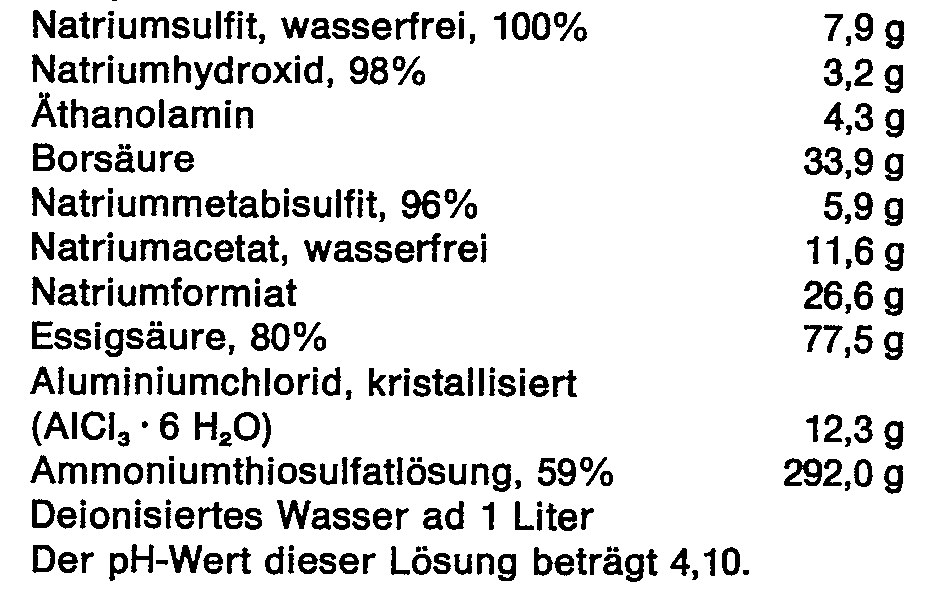
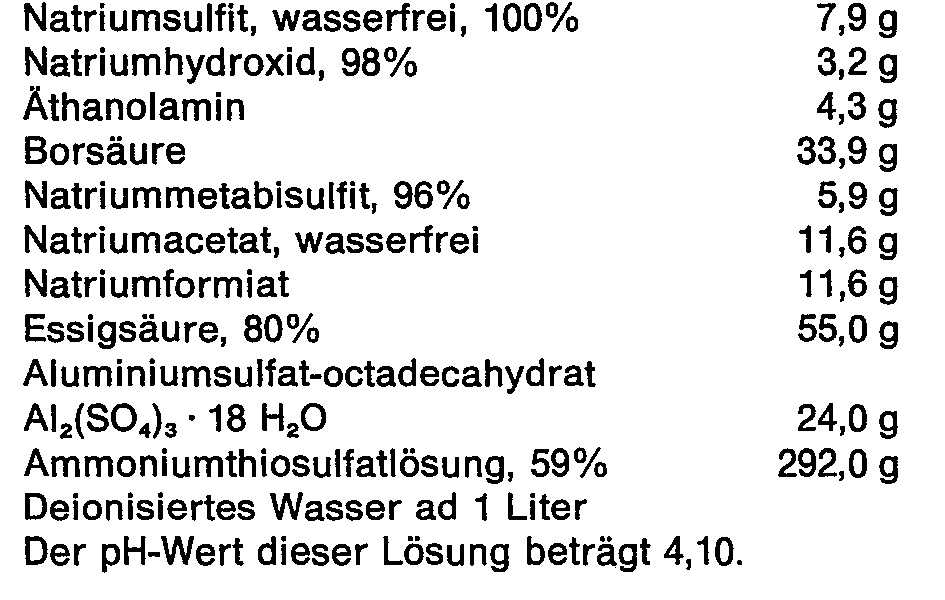
- Die Beispiele 1 bis 11 betreffen gebrauchsfertige Härtefixierbäder, die Beispiele 12 bis 17 Konzentrate zur Herstellung gebrauchsfähiger Härtefixierbäder.
-

- Der pH-Wert dieser Lösung wird, falls nötig durch Zusatz von etwas Natriumhydroxid oder Essigsäure auf 4,10 eingestellt.
-

-

-

-
-


-

-

-
-


-

-

- Man erhält ein klares Härterkonzentrat, das monatelang ohne Ausscheidung von basischen Aluminiumsalzen unverändert lagerfähig ist. Zur Zubereitung eines gebrauchsfertigen Härtefixierbades werden 50 ml des Härterkonzentrates zu 950 ml eines normalen Natrium- oder Ammoniumthiosulfat und Natriumsulfit sowie Borat- und/oder Acetatpuffer enthaltenden Fixierbades zugefügt und durch Schütteln oder Rühren verteilt. Es erfolgt keine Ausscheidung von Schwefel; das fertige Härtefixierbad ist monatelang unverändert lagerfähig.
-

-

-

- Die Härterkonzentrate der Beispiele 13 bis 15 zeigen vergleichbar gute Eigenschaften wie das Konzentrat des Beispiels 12.
- 23,7 g Kaliumaluminiumsuifat-dodecahydrat, (KAl(SO4)2 · 12 H2O) und 10,2 g Natriumformiat werden untereinander vermischt. Man erhält ein stabiles Pulver. Dies Pulver wird zu einem Fixierbad der folgenden Zusammensetzung gegeben und unter Rühren darin aufgelöst:

- Das resultierende Härtefixierbad weist einen pH-Wert von 3,9 auf.
- Ein graphischer Hochkontrastfilm wird belichtet und dann in einer automatischen Durchlaufentwicklungsmaschine bei 40°C entwickelt und fixiert.
- Die folgenden Verarbeitungsbäder werden verwendet:
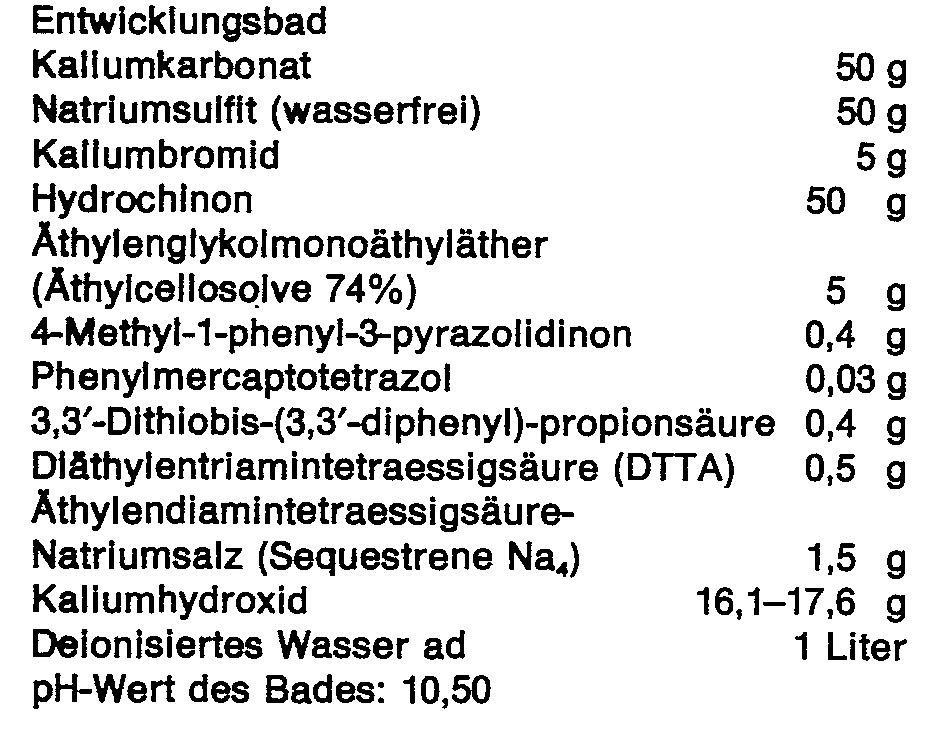

gemäss Beispiel 1 - Nach dieser Verarbeitung sind die Schichten des Materials unbeschädigt; das Material weist kein Runzelkorn auf.
- Ebenfalls gute Ergebnisse erhält man, wenn man anstelle des Härtefixierbads gemäss Beispiel 1 die Härtefixierbäder der Beispiele 2 bis 11 oder Härtefixierbäder verwendet, die aus den Konzentraten der Beispiele 12 bis 16 hergestellt sind.
Claims (21)
Priority Applications (1)
| Application Number | Priority Date | Filing Date | Title |
|---|---|---|---|
| AT80102693T ATE2636T1 (de) | 1979-05-16 | 1980-05-14 | Waessrige haertefixierbaeder zur verarbeitung photographischer materialien, deren herstellung und verwendung, waessrige haertefixierbadkonzentrate, pulverfoermige und tablettierte haertefixierer und deren verwendung, und waessriges konzentrat. |
Applications Claiming Priority (4)
| Application Number | Priority Date | Filing Date | Title |
|---|---|---|---|
| CH455479 | 1979-05-16 | ||
| CH4554/79 | 1979-05-16 | ||
| CH5953/79 | 1979-06-26 | ||
| CH595379 | 1979-06-26 |
Publications (2)
| Publication Number | Publication Date |
|---|---|
| EP0021005A1 EP0021005A1 (de) | 1981-01-07 |
| EP0021005B1 true EP0021005B1 (de) | 1983-02-23 |
Family
ID=25695744
Family Applications (1)
| Application Number | Title | Priority Date | Filing Date |
|---|---|---|---|
| EP80102693A Expired EP0021005B1 (de) | 1979-05-16 | 1980-05-14 | Wässrige Härtefixierbäder zur Verarbeitung photographischer Materialien, deren Herstellung und Verwendung, wässrige Härtefixierbadkonzentrate, pulverförmige und tablettierte Härtefixierer und deren Verwendung, und wässriges Konzentrat |
Country Status (4)
| Country | Link |
|---|---|
| EP (1) | EP0021005B1 (de) |
| AU (1) | AU5841980A (de) |
| CA (1) | CA1155700A (de) |
| DE (1) | DE3062115D1 (de) |
Family Cites Families (4)
| Publication number | Priority date | Publication date | Assignee | Title |
|---|---|---|---|---|
| US2174494A (en) * | 1939-03-30 | 1939-09-26 | American Cyanamid Co | Photographic fixing agent |
| US2321347A (en) * | 1939-11-30 | 1943-06-08 | Photographic fixing bath | |
| US2378247A (en) * | 1942-02-27 | 1945-06-12 | Eastman Kodak Co | Concentrated liquid hardeners and process for preparing |
| GB1520114A (en) * | 1975-06-13 | 1978-08-16 | Agfa Gevaert | Hardening fixer for use in the processing of photographic elements |
-
1980
- 1980-05-09 CA CA000351592A patent/CA1155700A/en not_active Expired
- 1980-05-14 DE DE8080102693T patent/DE3062115D1/de not_active Expired
- 1980-05-14 EP EP80102693A patent/EP0021005B1/de not_active Expired
- 1980-05-15 AU AU58419/80A patent/AU5841980A/en not_active Abandoned
Also Published As
| Publication number | Publication date |
|---|---|
| CA1155700A (en) | 1983-10-25 |
| DE3062115D1 (en) | 1983-03-31 |
| EP0021005A1 (de) | 1981-01-07 |
| AU5841980A (en) | 1980-11-20 |
Similar Documents
| Publication | Publication Date | Title |
|---|---|---|
| DE2541519A1 (de) | Tablette aus chemischen verbindungen fuer die behandlung von lichtempfindlichem material fuer photographische zwecke | |
| DE1169290B (de) | Verfahren zur Herstellung von photographischen Silberhalogenidemulsionen mit extrem enger Korngroessenverteilung und geschichtetem Kornaufbau | |
| DE1261397B (de) | Photographisches Verfahren zur Herstellung positiver Bilder | |
| DE69221412T2 (de) | Photographische Entwicklerzusammensetzung | |
| DE1547819C3 (de) | Verfahren zur Herstellung von Dispersionen von schwarzem kolloidalem Silber | |
| DE2214921A1 (de) | Entwicklungsmasse zur Anwendung bei photographischen Materialien auf dem graphischen Fachgebiet | |
| DE954309C (de) | Lichtempfindliche Mischung fuer die Herstellung von Diazotypiematerialien | |
| DE2203634A1 (de) | Farbphotographische Behandlungsmassen | |
| DE1171736B (de) | Verfahren zur Herstellung photographischer Emulsionen | |
| DE1161136B (de) | Photographisches Material | |
| DE2222832A1 (de) | Verfahren zur Herstellung von fotografischen Bildern | |
| EP0021005A1 (de) | Wässrige Härtefixierbäder zur Verarbeitung photographischer Materialien, deren Herstellung und Verwendung, wässrige Härtefixierbadkonzentrate, pulverförmige und tablettierte Härtefixierer und deren Verwendung, und wässriges Konzentrat | |
| DE2040801B2 (de) | Fixierentwickler- oder Aktivatorlösung für das Silbersalzdiffusionsverfahren, bei welchen keine Bildung von gefärbtem Schlamm auftritt | |
| DE2261478A1 (de) | Photographischer entwickler zur herstellung von bildern mit hohem kontrast | |
| DE3205897A1 (de) | Verfahren zur herstellung einer lichtempfindlichen kupfer(i)halogenidemulsion | |
| DE1253049B (de) | Waessriger Schwarz-Weiss-Entwickler fuer die photographische Umkehrverarbeitung farbphotographischer Materialien | |
| DE68921465T2 (de) | Verarbeitungsflüssigkeit zur Anwendung in der Silberhalogenidphotographie. | |
| DE1259200B (de) | Silberhalogeniddiffusionsverfahren mit entwicklerfreier alkalischer Behandlungsloesung | |
| DE1242095B (de) | Photographisches, ein Metallsalz eines Entwicklers enthaltendes Aufzeichnungsmaterial | |
| DE2344074A1 (de) | Photographische entwicklerzusammensetzung | |
| DE19738120A1 (de) | Entwicklerzusammensetzung für photografische Silberhalogenidemulsionen, die einen Entwickler vom Ascorbinsäuretyp und einen Beschleuniger enthält | |
| DE69515713T2 (de) | Feste Entwicklungszusammensetzung in Tablettenform für lichtempfindliche photographische Silberhalogenidmaterialien und deren Verwendung | |
| DE69908014T2 (de) | Satz für fotografisches Farbenentwicklungsbad | |
| DE896294C (de) | Verfahren zur Herstellung photographischer Registrierungen und lichtempfindliches Material zur Ausfuehrung des Verfahrens | |
| DE1081760B (de) | Diazotypiematerial und Verfahren zu seiner Herstellung |
Legal Events
| Date | Code | Title | Description |
|---|---|---|---|
| PUAI | Public reference made under article 153(3) epc to a published international application that has entered the european phase |
Free format text: ORIGINAL CODE: 0009012 |
|
| 17P | Request for examination filed |
Effective date: 19800514 |
|
| AK | Designated contracting states |
Designated state(s): AT BE CH DE FR GB IT NL SE |
|
| ITF | It: translation for a ep patent filed | ||
| GRAA | (expected) grant |
Free format text: ORIGINAL CODE: 0009210 |
|
| AK | Designated contracting states |
Designated state(s): AT BE CH DE FR GB IT LI NL SE |
|
| REF | Corresponds to: |
Ref document number: 2636 Country of ref document: AT Date of ref document: 19830315 Kind code of ref document: T |
|
| ET | Fr: translation filed | ||
| PGFP | Annual fee paid to national office [announced via postgrant information from national office to epo] |
Ref country code: SE Payment date: 19830331 Year of fee payment: 4 Ref country code: CH Payment date: 19830331 Year of fee payment: 4 |
|
| REF | Corresponds to: |
Ref document number: 3062115 Country of ref document: DE Date of ref document: 19830331 |
|
| PGFP | Annual fee paid to national office [announced via postgrant information from national office to epo] |
Ref country code: DE Payment date: 19830406 Year of fee payment: 4 |
|
| REG | Reference to a national code |
Ref country code: GB Ref legal event code: 746 |
|
| PGFP | Annual fee paid to national office [announced via postgrant information from national office to epo] |
Ref country code: FR Payment date: 19830422 Year of fee payment: 4 |
|
| PGFP | Annual fee paid to national office [announced via postgrant information from national office to epo] |
Ref country code: AT Payment date: 19830426 Year of fee payment: 4 |
|
| PGFP | Annual fee paid to national office [announced via postgrant information from national office to epo] |
Ref country code: NL Payment date: 19830531 Year of fee payment: 4 |
|
| PGFP | Annual fee paid to national office [announced via postgrant information from national office to epo] |
Ref country code: BE Payment date: 19830630 Year of fee payment: 4 |
|
| PG25 | Lapsed in a contracting state [announced via postgrant information from national office to epo] |
Ref country code: AT Effective date: 19840514 |
|
| PG25 | Lapsed in a contracting state [announced via postgrant information from national office to epo] |
Ref country code: SE Effective date: 19840515 |
|
| PG25 | Lapsed in a contracting state [announced via postgrant information from national office to epo] |
Ref country code: LI Effective date: 19840531 Ref country code: CH Effective date: 19840531 Ref country code: BE Effective date: 19840531 |
|
| BERE | Be: lapsed |
Owner name: CIBA-GEIGY A.G: Effective date: 19840514 |
|
| PG25 | Lapsed in a contracting state [announced via postgrant information from national office to epo] |
Ref country code: NL Effective date: 19841201 |
|
| GBPC | Gb: european patent ceased through non-payment of renewal fee | ||
| NLV4 | Nl: lapsed or anulled due to non-payment of the annual fee | ||
| PG25 | Lapsed in a contracting state [announced via postgrant information from national office to epo] |
Ref country code: FR Free format text: LAPSE BECAUSE OF NON-PAYMENT OF DUE FEES Effective date: 19850131 |
|
| REG | Reference to a national code |
Ref country code: CH Ref legal event code: PL |
|
| PG25 | Lapsed in a contracting state [announced via postgrant information from national office to epo] |
Ref country code: DE Effective date: 19850201 |
|
| REG | Reference to a national code |
Ref country code: FR Ref legal event code: ST |
|
| PG25 | Lapsed in a contracting state [announced via postgrant information from national office to epo] |
Ref country code: GB Effective date: 19881118 |
|
| EUG | Se: european patent has lapsed |
Ref document number: 80102693.1 Effective date: 19850417 |
|
| PLBE | No opposition filed within time limit |
Free format text: ORIGINAL CODE: 0009261 |
|
| STAA | Information on the status of an ep patent application or granted ep patent |
Free format text: STATUS: NO OPPOSITION FILED WITHIN TIME LIMIT |