EP0019218A2 - Influenzavirus-Vaccine, Verfahren zu ihrer Herstellung und Verfahren zur Vermehrung von Influenzaviren - Google Patents
Influenzavirus-Vaccine, Verfahren zu ihrer Herstellung und Verfahren zur Vermehrung von Influenzaviren Download PDFInfo
- Publication number
- EP0019218A2 EP0019218A2 EP80102525A EP80102525A EP0019218A2 EP 0019218 A2 EP0019218 A2 EP 0019218A2 EP 80102525 A EP80102525 A EP 80102525A EP 80102525 A EP80102525 A EP 80102525A EP 0019218 A2 EP0019218 A2 EP 0019218A2
- Authority
- EP
- European Patent Office
- Prior art keywords
- virus
- influenza
- cells
- influenza virus
- viruses
- Prior art date
- Legal status (The legal status is an assumption and is not a legal conclusion. Google has not performed a legal analysis and makes no representation as to the accuracy of the status listed.)
- Granted
Links
- 241000712461 unidentified influenza virus Species 0.000 title claims abstract description 55
- 238000000034 method Methods 0.000 title claims abstract description 48
- 229960005486 vaccine Drugs 0.000 title claims abstract description 44
- 230000008569 process Effects 0.000 title claims abstract description 5
- 238000004519 manufacturing process Methods 0.000 title claims description 27
- 230000001902 propagating effect Effects 0.000 title description 2
- 241000700605 Viruses Species 0.000 claims abstract description 78
- 239000007788 liquid Substances 0.000 claims abstract description 30
- 238000004113 cell culture Methods 0.000 claims abstract description 27
- 229960003971 influenza vaccine Drugs 0.000 claims abstract description 9
- 102000002322 Egg Proteins Human genes 0.000 claims abstract description 6
- 108010000912 Egg Proteins Proteins 0.000 claims abstract description 6
- 238000011534 incubation Methods 0.000 claims abstract description 5
- 210000004027 cell Anatomy 0.000 claims description 65
- 108090000631 Trypsin Proteins 0.000 claims description 24
- 102000004142 Trypsin Human genes 0.000 claims description 24
- 239000012588 trypsin Substances 0.000 claims description 23
- 229960001322 trypsin Drugs 0.000 claims description 22
- 102000035195 Peptidases Human genes 0.000 claims description 19
- 108091005804 Peptidases Proteins 0.000 claims description 19
- 206010022000 influenza Diseases 0.000 claims description 15
- 241000283073 Equus caballus Species 0.000 claims description 13
- 239000004365 Protease Substances 0.000 claims description 12
- 238000002360 preparation method Methods 0.000 claims description 9
- 208000015181 infectious disease Diseases 0.000 claims description 8
- 210000003292 kidney cell Anatomy 0.000 claims description 8
- 239000002245 particle Substances 0.000 claims description 8
- 239000006143 cell culture medium Substances 0.000 claims description 4
- 102000005367 Carboxypeptidases Human genes 0.000 claims description 2
- 108010006303 Carboxypeptidases Proteins 0.000 claims description 2
- 108090000317 Chymotrypsin Proteins 0.000 claims description 2
- 229940124873 Influenza virus vaccine Drugs 0.000 claims description 2
- 108010019160 Pancreatin Proteins 0.000 claims description 2
- 108090000526 Papain Proteins 0.000 claims description 2
- 108090000284 Pepsin A Proteins 0.000 claims description 2
- 102000057297 Pepsin A Human genes 0.000 claims description 2
- 108010059712 Pronase Proteins 0.000 claims description 2
- 229960002376 chymotrypsin Drugs 0.000 claims description 2
- 239000003937 drug carrier Substances 0.000 claims description 2
- 229940055695 pancreatin Drugs 0.000 claims description 2
- 229940055729 papain Drugs 0.000 claims description 2
- 235000019834 papain Nutrition 0.000 claims description 2
- 229940111202 pepsin Drugs 0.000 claims description 2
- 235000013601 eggs Nutrition 0.000 abstract description 14
- 241000287828 Gallus gallus Species 0.000 abstract description 8
- 102000004190 Enzymes Human genes 0.000 abstract description 7
- 108090000790 Enzymes Proteins 0.000 abstract description 7
- 102000004169 proteins and genes Human genes 0.000 abstract description 5
- 108090000623 proteins and genes Proteins 0.000 abstract description 5
- 230000003301 hydrolyzing effect Effects 0.000 abstract description 4
- 238000011031 large-scale manufacturing process Methods 0.000 abstract description 4
- 239000002609 medium Substances 0.000 description 22
- 210000001519 tissue Anatomy 0.000 description 12
- 239000001963 growth medium Substances 0.000 description 11
- 238000002955 isolation Methods 0.000 description 11
- 241000282472 Canis lupus familiaris Species 0.000 description 10
- 241000283086 Equidae Species 0.000 description 10
- 235000019419 proteases Nutrition 0.000 description 9
- 238000002255 vaccination Methods 0.000 description 9
- 230000000120 cytopathologic effect Effects 0.000 description 8
- 241001465754 Metazoa Species 0.000 description 7
- 235000015097 nutrients Nutrition 0.000 description 7
- 239000002671 adjuvant Substances 0.000 description 6
- 229940088598 enzyme Drugs 0.000 description 6
- 238000012545 processing Methods 0.000 description 6
- 239000002356 single layer Substances 0.000 description 6
- 239000000725 suspension Substances 0.000 description 6
- 108091003079 Bovine Serum Albumin Proteins 0.000 description 5
- 241000282412 Homo Species 0.000 description 5
- 239000003242 anti bacterial agent Substances 0.000 description 5
- 229940088710 antibiotic agent Drugs 0.000 description 5
- 208000037265 diseases, disorders, signs and symptoms Diseases 0.000 description 5
- 239000012530 fluid Substances 0.000 description 5
- 239000000463 material Substances 0.000 description 5
- 238000012360 testing method Methods 0.000 description 5
- WQZGKKKJIJFFOK-GASJEMHNSA-N Glucose Natural products OC[C@H]1OC(O)[C@H](O)[C@@H](O)[C@@H]1O WQZGKKKJIJFFOK-GASJEMHNSA-N 0.000 description 4
- WQZGKKKJIJFFOK-VFUOTHLCSA-N beta-D-glucose Chemical compound OC[C@H]1O[C@@H](O)[C@H](O)[C@@H](O)[C@@H]1O WQZGKKKJIJFFOK-VFUOTHLCSA-N 0.000 description 4
- 230000015572 biosynthetic process Effects 0.000 description 4
- 239000008121 dextrose Substances 0.000 description 4
- 201000010099 disease Diseases 0.000 description 4
- 235000018102 proteins Nutrition 0.000 description 4
- 208000024891 symptom Diseases 0.000 description 4
- 241000271566 Aves Species 0.000 description 3
- 239000012594 Earle’s Balanced Salt Solution Substances 0.000 description 3
- WSFSSNUMVMOOMR-UHFFFAOYSA-N Formaldehyde Chemical compound O=C WSFSSNUMVMOOMR-UHFFFAOYSA-N 0.000 description 3
- 241000712431 Influenza A virus Species 0.000 description 3
- ZDXPYRJPNDTMRX-VKHMYHEASA-N L-glutamine Chemical compound OC(=O)[C@@H](N)CCC(N)=O ZDXPYRJPNDTMRX-VKHMYHEASA-N 0.000 description 3
- 229930182816 L-glutamine Natural products 0.000 description 3
- 241000282887 Suidae Species 0.000 description 3
- 238000009395 breeding Methods 0.000 description 3
- 230000001488 breeding effect Effects 0.000 description 3
- 230000000694 effects Effects 0.000 description 3
- 239000003797 essential amino acid Substances 0.000 description 3
- 235000020776 essential amino acid Nutrition 0.000 description 3
- 239000012894 fetal calf serum Substances 0.000 description 3
- 230000012447 hatching Effects 0.000 description 3
- 239000012499 inoculation medium Substances 0.000 description 3
- 210000003734 kidney Anatomy 0.000 description 3
- 230000007246 mechanism Effects 0.000 description 3
- 239000007758 minimum essential medium Substances 0.000 description 3
- 239000000243 solution Substances 0.000 description 3
- 235000013343 vitamin Nutrition 0.000 description 3
- 239000011782 vitamin Substances 0.000 description 3
- 229940088594 vitamin Drugs 0.000 description 3
- 229930003231 vitamin Natural products 0.000 description 3
- NIXOWILDQLNWCW-UHFFFAOYSA-N Acrylic acid Chemical compound OC(=O)C=C NIXOWILDQLNWCW-UHFFFAOYSA-N 0.000 description 2
- 229920001817 Agar Polymers 0.000 description 2
- BVKZGUZCCUSVTD-UHFFFAOYSA-M Bicarbonate Chemical compound OC([O-])=O BVKZGUZCCUSVTD-UHFFFAOYSA-M 0.000 description 2
- IAZDPXIOMUYVGZ-UHFFFAOYSA-N Dimethylsulphoxide Chemical compound CS(C)=O IAZDPXIOMUYVGZ-UHFFFAOYSA-N 0.000 description 2
- 241000831652 Salinivibrio sharmensis Species 0.000 description 2
- 229920002125 Sokalan® Polymers 0.000 description 2
- 239000008272 agar Substances 0.000 description 2
- 239000003708 ampul Substances 0.000 description 2
- 239000007900 aqueous suspension Substances 0.000 description 2
- 210000004369 blood Anatomy 0.000 description 2
- 239000008280 blood Substances 0.000 description 2
- 239000006285 cell suspension Substances 0.000 description 2
- 210000000991 chicken egg Anatomy 0.000 description 2
- 210000000349 chromosome Anatomy 0.000 description 2
- 239000003085 diluting agent Substances 0.000 description 2
- 230000007717 exclusion Effects 0.000 description 2
- 238000000605 extraction Methods 0.000 description 2
- 239000012091 fetal bovine serum Substances 0.000 description 2
- 230000035931 haemagglutination Effects 0.000 description 2
- 238000002649 immunization Methods 0.000 description 2
- 230000003053 immunization Effects 0.000 description 2
- 230000002779 inactivation Effects 0.000 description 2
- 208000037798 influenza B Diseases 0.000 description 2
- 230000005764 inhibitory process Effects 0.000 description 2
- 238000011081 inoculation Methods 0.000 description 2
- 239000002054 inoculum Substances 0.000 description 2
- 239000006194 liquid suspension Substances 0.000 description 2
- 238000004264 monolayer culture Methods 0.000 description 2
- 230000002829 reductive effect Effects 0.000 description 2
- 239000007787 solid Substances 0.000 description 2
- UCSJYZPVAKXKNQ-HZYVHMACSA-N streptomycin Chemical compound CN[C@H]1[C@H](O)[C@@H](O)[C@H](CO)O[C@H]1O[C@@H]1[C@](C=O)(O)[C@H](C)O[C@H]1O[C@@H]1[C@@H](NC(N)=N)[C@H](O)[C@@H](NC(N)=N)[C@H](O)[C@H]1O UCSJYZPVAKXKNQ-HZYVHMACSA-N 0.000 description 2
- 238000004114 suspension culture Methods 0.000 description 2
- 239000003104 tissue culture media Substances 0.000 description 2
- 230000003612 virological effect Effects 0.000 description 2
- 206010067484 Adverse reaction Diseases 0.000 description 1
- GUBGYTABKSRVRQ-XLOQQCSPSA-N Alpha-Lactose Chemical compound O[C@@H]1[C@@H](O)[C@@H](O)[C@@H](CO)O[C@H]1O[C@@H]1[C@@H](CO)O[C@H](O)[C@H](O)[C@H]1O GUBGYTABKSRVRQ-XLOQQCSPSA-N 0.000 description 1
- 241000894006 Bacteria Species 0.000 description 1
- 241000712083 Canine morbillivirus Species 0.000 description 1
- 241000282465 Canis Species 0.000 description 1
- 208000015220 Febrile disease Diseases 0.000 description 1
- 241000233866 Fungi Species 0.000 description 1
- 206010061218 Inflammation Diseases 0.000 description 1
- GUBGYTABKSRVRQ-QKKXKWKRSA-N Lactose Natural products OC[C@H]1O[C@@H](O[C@H]2[C@H](O)[C@@H](O)C(O)O[C@@H]2CO)[C@H](O)[C@@H](O)[C@H]1O GUBGYTABKSRVRQ-QKKXKWKRSA-N 0.000 description 1
- 102000014171 Milk Proteins Human genes 0.000 description 1
- 108010011756 Milk Proteins Proteins 0.000 description 1
- 241000204031 Mycoplasma Species 0.000 description 1
- 241001494479 Pecora Species 0.000 description 1
- 229930182555 Penicillin Natural products 0.000 description 1
- JGSARLDLIJGVTE-MBNYWOFBSA-N Penicillin G Chemical compound N([C@H]1[C@H]2SC([C@@H](N2C1=O)C(O)=O)(C)C)C(=O)CC1=CC=CC=C1 JGSARLDLIJGVTE-MBNYWOFBSA-N 0.000 description 1
- 241000711798 Rabies lyssavirus Species 0.000 description 1
- 241000606651 Rickettsiales Species 0.000 description 1
- CZMRCDWAGMRECN-UGDNZRGBSA-N Sucrose Chemical compound O[C@H]1[C@H](O)[C@@H](CO)O[C@@]1(CO)O[C@@H]1[C@H](O)[C@@H](O)[C@H](O)[C@@H](CO)O1 CZMRCDWAGMRECN-UGDNZRGBSA-N 0.000 description 1
- 229930006000 Sucrose Natural products 0.000 description 1
- 230000004913 activation Effects 0.000 description 1
- 230000002411 adverse Effects 0.000 description 1
- 230000006838 adverse reaction Effects 0.000 description 1
- 239000000443 aerosol Substances 0.000 description 1
- -1 alum Chemical compound 0.000 description 1
- 229940037003 alum Drugs 0.000 description 1
- WNROFYMDJYEPJX-UHFFFAOYSA-K aluminium hydroxide Chemical compound [OH-].[OH-].[OH-].[Al+3] WNROFYMDJYEPJX-UHFFFAOYSA-K 0.000 description 1
- ILRRQNADMUWWFW-UHFFFAOYSA-K aluminium phosphate Chemical compound O1[Al]2OP1(=O)O2 ILRRQNADMUWWFW-UHFFFAOYSA-K 0.000 description 1
- 210000004102 animal cell Anatomy 0.000 description 1
- 239000000427 antigen Substances 0.000 description 1
- 102000036639 antigens Human genes 0.000 description 1
- 108091007433 antigens Proteins 0.000 description 1
- 238000003556 assay Methods 0.000 description 1
- 230000002238 attenuated effect Effects 0.000 description 1
- 229940031567 attenuated vaccine Drugs 0.000 description 1
- 235000015278 beef Nutrition 0.000 description 1
- 244000309466 calf Species 0.000 description 1
- 229940041514 candida albicans extract Drugs 0.000 description 1
- 239000013553 cell monolayer Substances 0.000 description 1
- 238000005119 centrifugation Methods 0.000 description 1
- 239000003795 chemical substances by application Substances 0.000 description 1
- 235000019365 chlortetracycline Nutrition 0.000 description 1
- 238000007796 conventional method Methods 0.000 description 1
- 239000013256 coordination polymer Substances 0.000 description 1
- 238000002405 diagnostic procedure Methods 0.000 description 1
- 238000010790 dilution Methods 0.000 description 1
- 239000012895 dilution Substances 0.000 description 1
- 238000009826 distribution Methods 0.000 description 1
- 238000002474 experimental method Methods 0.000 description 1
- 230000001605 fetal effect Effects 0.000 description 1
- 238000009472 formulation Methods 0.000 description 1
- 239000012595 freezing medium Substances 0.000 description 1
- 208000006454 hepatitis Diseases 0.000 description 1
- 231100000283 hepatitis Toxicity 0.000 description 1
- 230000028993 immune response Effects 0.000 description 1
- 230000036039 immunity Effects 0.000 description 1
- 238000010166 immunofluorescence Methods 0.000 description 1
- 238000000338 in vitro Methods 0.000 description 1
- 229940031551 inactivated vaccine Drugs 0.000 description 1
- 208000005562 infectious bovine rhinotracheitis Diseases 0.000 description 1
- 230000002458 infectious effect Effects 0.000 description 1
- 230000001524 infective effect Effects 0.000 description 1
- 230000036512 infertility Effects 0.000 description 1
- 230000004054 inflammatory process Effects 0.000 description 1
- 208000037797 influenza A Diseases 0.000 description 1
- 239000004615 ingredient Substances 0.000 description 1
- 238000007918 intramuscular administration Methods 0.000 description 1
- 230000002147 killing effect Effects 0.000 description 1
- 239000008101 lactose Substances 0.000 description 1
- 239000003550 marker Substances 0.000 description 1
- 235000021239 milk protein Nutrition 0.000 description 1
- 238000002156 mixing Methods 0.000 description 1
- 239000000203 mixture Substances 0.000 description 1
- 210000004400 mucous membrane Anatomy 0.000 description 1
- 231100000252 nontoxic Toxicity 0.000 description 1
- 230000003000 nontoxic effect Effects 0.000 description 1
- 230000001717 pathogenic effect Effects 0.000 description 1
- 229940049954 penicillin Drugs 0.000 description 1
- 230000007505 plaque formation Effects 0.000 description 1
- 230000035755 proliferation Effects 0.000 description 1
- 230000001681 protective effect Effects 0.000 description 1
- 239000003531 protein hydrolysate Substances 0.000 description 1
- 229940024999 proteolytic enzymes for treatment of wounds and ulcers Drugs 0.000 description 1
- 230000005180 public health Effects 0.000 description 1
- 238000000746 purification Methods 0.000 description 1
- 230000000241 respiratory effect Effects 0.000 description 1
- 210000002966 serum Anatomy 0.000 description 1
- 239000007921 spray Substances 0.000 description 1
- 239000003381 stabilizer Substances 0.000 description 1
- 238000003860 storage Methods 0.000 description 1
- 229960005322 streptomycin Drugs 0.000 description 1
- 239000000126 substance Substances 0.000 description 1
- 239000005720 sucrose Substances 0.000 description 1
- 230000009885 systemic effect Effects 0.000 description 1
- 231100000331 toxic Toxicity 0.000 description 1
- 230000002588 toxic effect Effects 0.000 description 1
- 239000003440 toxic substance Substances 0.000 description 1
- 230000035899 viability Effects 0.000 description 1
- 230000005727 virus proliferation Effects 0.000 description 1
- XLYOFNOQVPJJNP-UHFFFAOYSA-N water Substances O XLYOFNOQVPJJNP-UHFFFAOYSA-N 0.000 description 1
- 230000003313 weakening effect Effects 0.000 description 1
- 239000012138 yeast extract Substances 0.000 description 1
Images
Classifications
-
- A—HUMAN NECESSITIES
- A61—MEDICAL OR VETERINARY SCIENCE; HYGIENE
- A61K—PREPARATIONS FOR MEDICAL, DENTAL OR TOILETRY PURPOSES
- A61K39/00—Medicinal preparations containing antigens or antibodies
- A61K39/12—Viral antigens
- A61K39/145—Orthomyxoviridae, e.g. influenza virus
-
- A—HUMAN NECESSITIES
- A61—MEDICAL OR VETERINARY SCIENCE; HYGIENE
- A61K—PREPARATIONS FOR MEDICAL, DENTAL OR TOILETRY PURPOSES
- A61K39/00—Medicinal preparations containing antigens or antibodies
- A61K39/12—Viral antigens
-
- C—CHEMISTRY; METALLURGY
- C12—BIOCHEMISTRY; BEER; SPIRITS; WINE; VINEGAR; MICROBIOLOGY; ENZYMOLOGY; MUTATION OR GENETIC ENGINEERING
- C12N—MICROORGANISMS OR ENZYMES; COMPOSITIONS THEREOF; PROPAGATING, PRESERVING, OR MAINTAINING MICROORGANISMS; MUTATION OR GENETIC ENGINEERING; CULTURE MEDIA
- C12N7/00—Viruses; Bacteriophages; Compositions thereof; Preparation or purification thereof
-
- A—HUMAN NECESSITIES
- A61—MEDICAL OR VETERINARY SCIENCE; HYGIENE
- A61K—PREPARATIONS FOR MEDICAL, DENTAL OR TOILETRY PURPOSES
- A61K39/00—Medicinal preparations containing antigens or antibodies
- A61K2039/51—Medicinal preparations containing antigens or antibodies comprising whole cells, viruses or DNA/RNA
- A61K2039/525—Virus
- A61K2039/5252—Virus inactivated (killed)
-
- A—HUMAN NECESSITIES
- A61—MEDICAL OR VETERINARY SCIENCE; HYGIENE
- A61K—PREPARATIONS FOR MEDICAL, DENTAL OR TOILETRY PURPOSES
- A61K39/00—Medicinal preparations containing antigens or antibodies
- A61K2039/51—Medicinal preparations containing antigens or antibodies comprising whole cells, viruses or DNA/RNA
- A61K2039/525—Virus
- A61K2039/5254—Virus avirulent or attenuated
-
- A—HUMAN NECESSITIES
- A61—MEDICAL OR VETERINARY SCIENCE; HYGIENE
- A61K—PREPARATIONS FOR MEDICAL, DENTAL OR TOILETRY PURPOSES
- A61K39/00—Medicinal preparations containing antigens or antibodies
- A61K2039/54—Medicinal preparations containing antigens or antibodies characterised by the route of administration
- A61K2039/541—Mucosal route
- A61K2039/543—Mucosal route intranasal
-
- A—HUMAN NECESSITIES
- A61—MEDICAL OR VETERINARY SCIENCE; HYGIENE
- A61K—PREPARATIONS FOR MEDICAL, DENTAL OR TOILETRY PURPOSES
- A61K39/00—Medicinal preparations containing antigens or antibodies
- A61K2039/555—Medicinal preparations containing antigens or antibodies characterised by a specific combination antigen/adjuvant
- A61K2039/55511—Organic adjuvants
- A61K2039/55555—Liposomes; Vesicles, e.g. nanoparticles; Spheres, e.g. nanospheres; Polymers
-
- C—CHEMISTRY; METALLURGY
- C12—BIOCHEMISTRY; BEER; SPIRITS; WINE; VINEGAR; MICROBIOLOGY; ENZYMOLOGY; MUTATION OR GENETIC ENGINEERING
- C12N—MICROORGANISMS OR ENZYMES; COMPOSITIONS THEREOF; PROPAGATING, PRESERVING, OR MAINTAINING MICROORGANISMS; MUTATION OR GENETIC ENGINEERING; CULTURE MEDIA
- C12N2760/00—MICROORGANISMS OR ENZYMES; COMPOSITIONS THEREOF; PROPAGATING, PRESERVING, OR MAINTAINING MICROORGANISMS; MUTATION OR GENETIC ENGINEERING; CULTURE MEDIA ssRNA viruses negative-sense
- C12N2760/00011—Details
- C12N2760/16011—Orthomyxoviridae
- C12N2760/16111—Influenzavirus A, i.e. influenza A virus
- C12N2760/16134—Use of virus or viral component as vaccine, e.g. live-attenuated or inactivated virus, VLP, viral protein
-
- C—CHEMISTRY; METALLURGY
- C12—BIOCHEMISTRY; BEER; SPIRITS; WINE; VINEGAR; MICROBIOLOGY; ENZYMOLOGY; MUTATION OR GENETIC ENGINEERING
- C12N—MICROORGANISMS OR ENZYMES; COMPOSITIONS THEREOF; PROPAGATING, PRESERVING, OR MAINTAINING MICROORGANISMS; MUTATION OR GENETIC ENGINEERING; CULTURE MEDIA
- C12N2760/00—MICROORGANISMS OR ENZYMES; COMPOSITIONS THEREOF; PROPAGATING, PRESERVING, OR MAINTAINING MICROORGANISMS; MUTATION OR GENETIC ENGINEERING; CULTURE MEDIA ssRNA viruses negative-sense
- C12N2760/00011—Details
- C12N2760/16011—Orthomyxoviridae
- C12N2760/16211—Influenzavirus B, i.e. influenza B virus
- C12N2760/16234—Use of virus or viral component as vaccine, e.g. live-attenuated or inactivated virus, VLP, viral protein
Definitions
- the invention relates to a new influenza virus vaccine, process for its preparation, process for the multiplication of influenza viruses and cell culture inoculated with influenza viruses.
- Influenza vaccines have been used for the vaccination of humans since the early 1940s and for the vaccination of horses since the late 1960s. All currently used influenza vaccines are produced by breeding the vaccine virus strains in the incubated chicken egg. The virus strains obtained in this way are then used for the production of live virus vaccines or further processed for the production of killed virus vaccines.
- influenza viruses only grow to a very limited extent in cell cultures.
- the growth is referred to as a "one-step growth cycle", ie only the originally infected cells reproduce viruses. This phenomenon is described, for example, by Davis et al in MICROBIOLOGY, Harper and Row Publishers, Chapter 44, pp. 1138-1139 (1968). Since the viruses of the originally infected cells are unable to infect successive numbers of cells in the same cell culture, the yields obtained are far too low to be useful for the production of virus vaccines. Liquid cell cultures were therefore used for the large-scale production of influenza virus vaccines not used.
- Incubated chicken eggs are used to make viruses with titers that are high enough to make vaccines.
- viruses raised on the hatching egg usually require concentration and, in the case of human vaccines, some form of purification to reduce toxic reactions as a result of undesirable egg protein.
- the use of eggs for vaccine manufacture is time consuming, labor intensive and requires relatively high material costs, and the yield from an egg is usually only sufficient to produce vaccines for about 1 to 1.5 doses. The production of millions of cans therefore requires the inoculation and extraction of millions of hatching eggs.
- proteolytic enzymes can also be used in liquid cell cultures in order to facilitate the infection of successive generations of cells in the same cell culture.
- an influenza virus yield which is 1000 to 10,000 times greater than that of cultures not treated with protease .
- This enables the methods of cultivation in liquid cell cultures for the large-scale production of influenza vaccines to be used, thereby avoiding the disadvantages associated with the use of incubated chicken eggs. Details of the culture medium, methods of virus propagation and vaccine production and methods of use are described below.
- the influenza virus propagation medium according to the invention comprises a cell culture which is infectable with an influenza virus, an influenza virus and a protein hydrolyzing enzyme which is present in an amount sufficient to switch off the one-step growth cycle of the virus.
- the virus propagation method according to the invention comprises the steps of inoculating or infecting a liquid influenza virus cell culture with the influenza viruses, incubating the inoculate in the presence of a protein hydrolyzing enzyme under conditions sufficient to ensure maximum virus growth (or a maximum cytopathic effect) , and the extraction of the virus.
- the infection of the cells with the virus can be done before or after the formation of the monolayer of the cells or simply by infecting a liquid suspension of the cells respectively.
- the vaccine production method according to the invention comprises the subsequent step of killing the harvested virus or weakening it by a further passage in the cell culture for vaccine use.
- the trypsin protease is used in conjunction with a dog kidney cell line to replicate any of a variety of different types of influenza viruses.
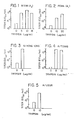
- Figures 1 to 5 are bar graphs illustrating the increases in titer that were achieved when said virus strains were incubated in a liquid cell culture in the presence of various amounts of a typical protease, trypsin. The results are given as geometric mean titers. Specific embodiments of the invention are described below.
- influenza vaccine viruses In the methods for influenza virus breeding and vaccine production according to the invention, the use of influenza vaccine viruses is provided.
- the term "influenza virus” used here encompasses all viruses that are capable of causing a febrile disease in animals (including humans), which is characterized by respiratory symptoms, inflammation of the mucous membranes and often systemic attacks.
- the medium and methods according to the invention are particularly advantageous for the production of a wide variety of influenza viruses, including the strains which affect humans, horses, pigs and birds. Examples of the production of typical influenza A and B viruses will be described later.
- the vaccines according to the invention include all preparations from killed, live, weakened or live fully virulent influenza viruses that can be administered to create or artificially increase immunity to any influenza disease.
- the vaccine is in the form of an aqueous suspension of the virus particles in ready-to-use form.
- CLDK Cutter Laboratories Dog Kidney
- the CLDK cell strain has been approved by the United States Department of Agriculture for use in the manufacture of veterinary vaccines and is derived from the Madin Darby dog kidney cell strain (ATCC No. CCL 34) and the dog kidneys described in U.S. Patent 3,616,203. Cell strain similar. The following is a brief history and description of the particular source tissue used for the cell strain in the examples, although of course the methods described herein are believed to be suitable for all cell cultures useful for influenza viruses.
- the original strain of CLDK was bred from the kidney of an apparently normal beagle dog obtained from the University of California at Davis by Cutter Laboratories, Inc., Berkeley, California (USA) and continued as a permanent culture.
- the strain was on 0.5% milk protein hydrolyzate and 0.2% yeast Extract kept in Earle's balanced salt solution plus 5% calf, sheep or horse serum and antibiotics and cultivated according to the methods of JS Younger (Proc. of Exp. Biol. and Med., V 85, 202).
- a frozen ampoule from the 142nd passage of this cell strain was then placed in a 75 cm 2 (250 ml) falcon flask in a tissue culture medium which was made from Earle's balanced salt solution as an essential minimum medium (Earle's balanced salt solution Minimum Essential Medium (MEM) ) and 10% fetal bovine serum.
- the cells were grown in the same manner and medium to produce the frozen master cell material in passage 148.
- An ampoule of the master cell material was thawed and further cultivated in series 20 times, bottle cultures of the 168th passage being obtained. These cells were then frozen.
- Freezing medium Essential minimum medium (Eagle) in Earle's BSS with reduced bicarbonate (1.65 g / l) 80%; fetal beef rum 10%; Dimethyl sulfoxide 10%. Viability: About 75% (dye exclusion).
- Culture medium Minimum essential medium (Eagle) in Earle's BSS with reduced bicarbonate (1.65 g / l) 90%; fetal bovine serum 2-10%; Antibiotics: penicillin and streptomycin 100 U or / ml.
- Sterility tests Free of mycoplasma, bacteria and fungi Species: Confirmed as a dog by immunofluorescence test.
- Virus susceptibility susceptible to influenza viruses, rabies virus, infectious bovine rhinotracheitis, infectious dog hepatitis, canine distemper virus and possibly other viruses.
- Proteins hydrolyzing enzymes which are intended to be suitable for the purposes of the invention include known proteases, e.g. As trypsin, chymotrypsin, pepsin, pancreatin, papain, pronase, carboxypeptidase and the like. Trypsin is a particularly preferred enzyme.
- proteases e.g. As trypsin, chymotrypsin, pepsin, pancreatin, papain, pronase, carboxypeptidase and the like. Trypsin is a particularly preferred enzyme.
- the exact mechanism or mechanisms by which a protease such as trypsin increases influenza virus infectivity have not yet been fully elucidated. A possible mechanism is suggested in the above-mentioned article by Klenk et al.
- the amount of active protease required to increase sequential infectivity should at least be sufficient to eliminate the limits of the one-step growth cycle, but in the case of confluent monolayer cultures, should not be so great as to detach confluent cells from the surfaces of the tissue culture vessel (ie the inner surface of a roller bottle).
- influenza virus multiplication method described here involves the three general steps of infecting a portion of the cells of a liquid cell culture with the influenza virus, incubating the cells in the presence of a proteolytic enzyme under conditions sufficient to provide maximum cytopathic (CP ) To ensure effect, and the isolation of viruses from the culture.
- Vaccine production comprises the subsequent step of modifying the isolated virus according to known methods for producing a live vaccine with virulent or weakened viruses or a vaccine with killed (inactive) viruses.
- the vaccine can be in a dry form for mixing with a diluent or in a liquid, ready-to-use form.
- suitable adjuvants can be included to increase immunization ability.
- the protease can be added to an aqueous suspension of the cell culture or before or after the formation of a confluent monolayer culture.
- Method B Infection of the liquid cell suspension before the monolayer formation
- the equine influenza virus A2 known as the Miami strain, was originally developed by a horse at the university Miami isolated. This virus was obtained from the Medical School of the University of Pennsylvania, where it was passed over incubated chicken eggs in 6 passages. The 7th passage was carried out at Lederle Laboratories and received from them. The trunk was passed over further passages in incubated chicken eggs and used in passages 11 to 16.
- the currently preferred method of propagating strain A2 in the tissue culture is carried out as follows: A young, confluent monolayer of CLDK cells is inoculated. The cells are placed in roller bottles using Hank's Minimum Essential. Medium (MEMH), which contains the following ingredients: The cells are usually confluent after 72 hours.
- MEMH Hank's Minimum Essential. Medium
- the inoculation medium contains the A2 virus diluted to an "Egg Infective Dose 50 (EID 50 )" titer of approximately 10 3.0 / ml in MEMH, which is supplemented with the following components:
- EID 50 Egg Infective Dose 50
- the inoculation medium which corresponds to 14% of the final volume, is added to each roller bottle and the containers are incubated for 72 hours at 34 to 35 ° C.
- the remaining medium containing 12 / ⁇ g / ml sterile trypsin solution (Sigma 1:25 °) (0.1 g / 100 ml) is added given to each roller bottle.
- the tubes are incubated again at 34 to 35 ° C until the maximum cytopathic effect is observed (48 to 72 hours). At this point the liquids are isolated.
- the roller bottles are shaken vigorously to remove any adhering cells and the cells and virus fluids are transferred to a sterile, batch-wise container for further processing.
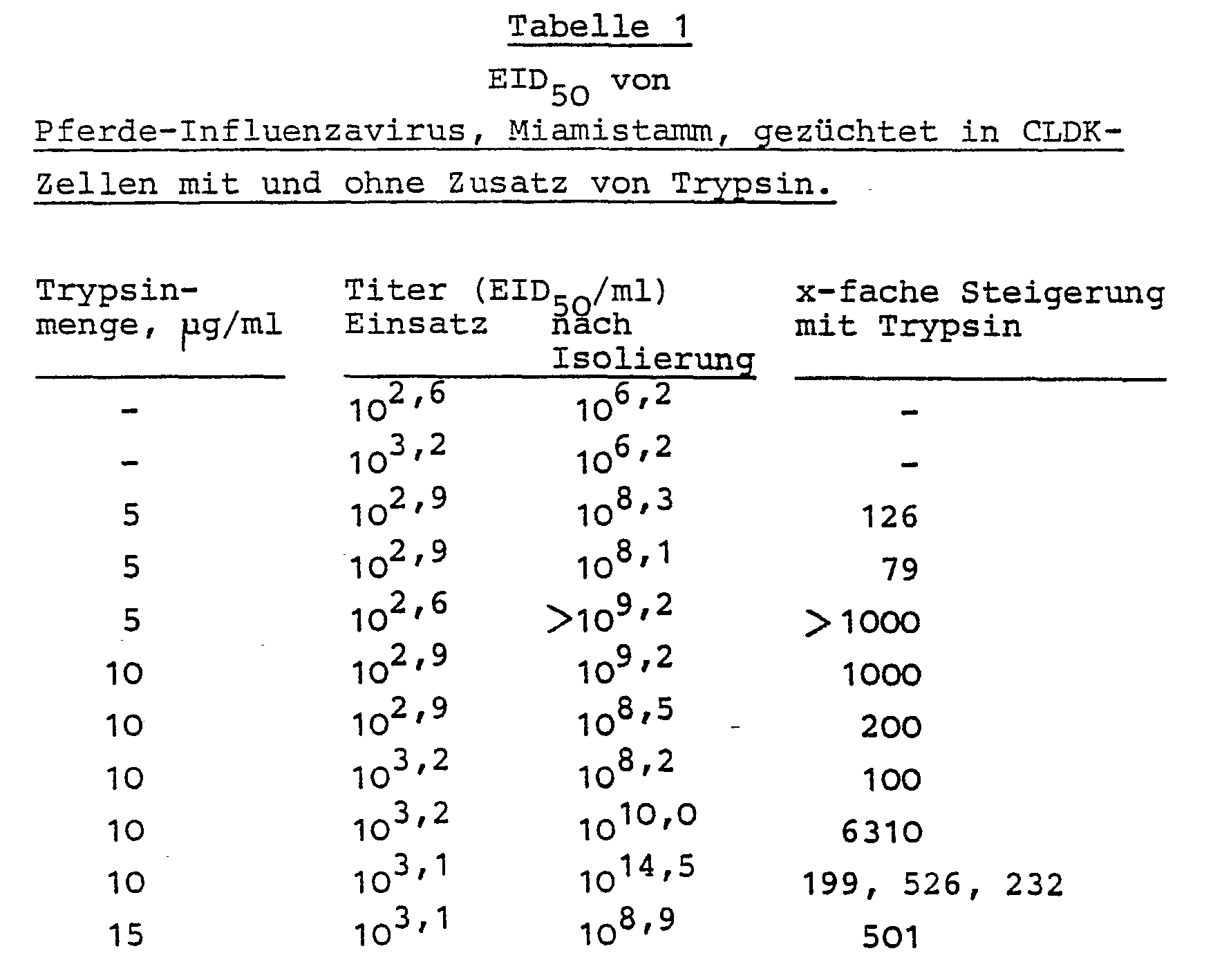
- the EID 50 titers of the influenza virus A2 grown according to this method after isolation are listed in Table 1. Reference is also made to FIG. 1. A comparison is made with the A2 virus grown according to the same method, but without the addition of trypsin. The addition of trypsin to the culture medium resulted in a geometric increase of 3.2 log or 1711 times as many viruses particles / ml during the production of the Miami strain.
- a sample of the virulent type of equine influenza virus A1 was obtained from the Medical School of the University of Pennsylvania.
- the strain designated Pennsylvania (A1) was isolated from a horse and passed through six passages in the incubated chicken egg. The trunk was passed over further passages in the hatching egg and is used for passages 12 to 17 for tissue culture production.
- a suspension of CLDK cells is infected before the formation of the monolayer.
- the CLDK cells at a concentration of approximately 10 5.5 / ml, Pennsylvania strain of the virus at an EID 50 titer of 10 3.0 / ml to 10 '/ ml and Hank's Minimum Essential Medium (MEMH) by the substances listed below are added, are incubated at 25 ° C while being mixed on a magnetic stirrer in a closed sterile Erlenmeyer flask.
- the pH is maintained at 6.7-6.8 with 1N-HCl during the incubation period of 2 to 3 hours.
- aliquots of each are 0 1 ml of the cell-virus-suspension in roller bottles optionally containing 1 1 of the supplemented in the above manner MEMH medium containing 5% fetal calf serum containing.
- the roller bottles are incubated at 34 ° to 35 ° C until the monolayer is confluent (approximately 48 to 72 hours), then 20 ml of a sterile trypsin solution of 1 mg / ml (Sigma 1: 250) are added to each roller bottle. Ollflaschen the R are incubated again at 34 ° to 35 ° C, until the maximum cytopathic effect is observed (3 to 5 days).
- Virus fluids are isolated by shaking each roller bottle vigorously to remove adhered cells and transferring the cells and fluids to a sterile container for further processing.
- the EID 50 titers of the influenza virus A1 grown using this method are listed in Table 2. Reference is also made to FIG. 2. A comparison is made with the virus A1 grown according to the same method without trypsin.
- a strain of the human influenza virus designated B / Hong Kong / 5/72 (BX-1), was obtained from The Center for Disease Control in Atlanta, Georgia. This strain was passed in a passage over incubated chicken eggs and frozen at -70 ° C as a working vaccine virus.
- the following method is preferred for the propagation of the strain B / Hong Kong / 5/72 in the tissue culture: A young confluent monolayer of CLDK cells similar to those in Example 1 is infected. The cells are grown in the manner described in Example 1. The nutrient medium is removed from the cells and discarded. The cells are then infected with the virus, which has been diluted in the inoculation medium mentioned in Example 1 to an EID 50 titer of approximately 10 3.0-5.0 / ml. The inoculum consists of a volume that corresponds to 33.3% of the final isolated volume.
- Tubes are incubated at 34-35 ° C for 40 to 48 hours, after which the remaining medium (66.7%) containing 12 ⁇ g / ml trypsin solution (0.1 g / 100 ml) is added to each tube. Incubation at 34 ° -35 ° C continues until the maximum cytopathic effect is observed (48 to 72 hours), after which the virus fluids are isolated. Isolation is accomplished by shaking each vial vigorously to remove the cells and transferring cells and liquids to a sterile vial for further processing.
- the EID 50 titer of the influenza B / Hong Kong / 5/72 influenza virus grown by this method after isolation are shown in Table 3 below. Reference is also made to FIG. 3. A comparison is made with this according to the same method, but without the addition of trypsin-grown virus.
- trypsin to the culture medium gives a geometric mean increase of 3.1 log or 1412 times as many virus particles during the production of strain B / Hong Kong.
- a strain of the human influenza virus designated A / Texas / 1/77, was obtained from The Center for Disease Control in Atlanta, Georgia. This strain was passed in a passage over incubated chicken eggs and frozen at -70 ° C as a working vaccine virus.
- Example 3 For the propagation of the strain A / Texas / 1/77 in the tissue culture, the method described overall in Example 3 is preferred.
- EIDS 50 titers of the human influenza virus strain A / Texas / 1/77 grown and isolated by this method are listed in Table 4. Reference is also made to FIG. 4. A comparison is made with these using the same method, but without the addition of trypsin-grown strain.
- trypsin added to the culture medium resulted in a geometric mean increase of 4.1 log or 12590 times as many virus particles / ml during the production of the A / Texas strain.
- a strain of the human influenza virus designated A / USSR / 90/77, was obtained from The Center for Disease Control in Atlanta, Georgia. This strain was passed with a passage over incubated chicken eggs and frozen at -70 ° C as a working vaccine virus.
- Example 3 For the propagation of the strain A / USSR / 90/77 in the tissue culture, the method described overall in Example 3 is preferred.
- EID 50 titers of the human influenza strain A / USSR / 90/77 cultured and isolated using this method are listed in Table 5. Reference is also made to FIG. 5. A comparison is made with this using the same method, but without the addition of trypsin-grown strain.
- trypsin to the culture medium resulted in a geometric mean increase of 2.4 log or 251 times as many virus particles / during the production of the A / USSRml strain.
- the attenuation of the virus from the liquids isolated according to Example 1 is carried out chemically or by standard series passages including final dilution passage methods, in which a sufficient number of passages are used in a susceptible cell culture until the virus has been rendered non-pathogenic without loss of the immunization ability .
- a vaccine made in this manner triggers an immune response in animals susceptible to the disease without producing significant clinical symptoms typically associated with the virulent agent.
- the propagation can take place in the same tissues as used in the previous passage or in different tissues.
- the method is similar to that described in Examples 1 and 2, however, the isolated, virus-loaded Liquids are further processed by inactivation with 0.1% formaldehyde (range 0.05 to 0.2%) and the treated material is incubated for 10 to 14 days at 4 ° C. Testing of the final inactivated virus preparation showed that it was free of live virus.
- Known adjuvants such as aluminum hydroxide, alum, aluminum phosphate, Freund's adjuvant, or the adjuvants described in U.S. Patents 3,790,665 and 3,919,411 may be added.
- the preferred adjuvant in these publications and in the vaccines according to the invention is an acrylic acid polymer which is crosslinked with a polyallylsaccharide (Carbopol 934 P) similar to that described in the aforementioned patents.
- Example 8 Inactivated Virus Vaccine, Production and Use.
- a horse vaccine dose of 1.0 ml consists of 0.45 ml of the Pennsylvania (Al) strain, 0.45 ml of the Miami (A2) strain and 0.10 ml of the crosslinked acrylic acid polymer (Carbopol 934 P) as adjuvant. Equal parts of the inactivated vaccine strains obtained according to Example 7 were mixed and 1 ml aliquots were administered intramuscularly to 19 horses. No clinical illness or symptoms of influenza were found in the horses after vaccination. The antibody titers against both horse influenza A1 and horse influenza A2 were determined on the blood sera of all animals after 2, 4 and 8 weeks after vaccination.
- titers are compared with the titers prior to vaccination using the standard hemagglutination inhibition test (Diagnostic Procedures for Viral and Rickettsial Infections, 4th Edition, Lennette and Schmidt, pp. 665-666 (1969), American Public Health Association, New York, NY 10019, compared (Table 6).
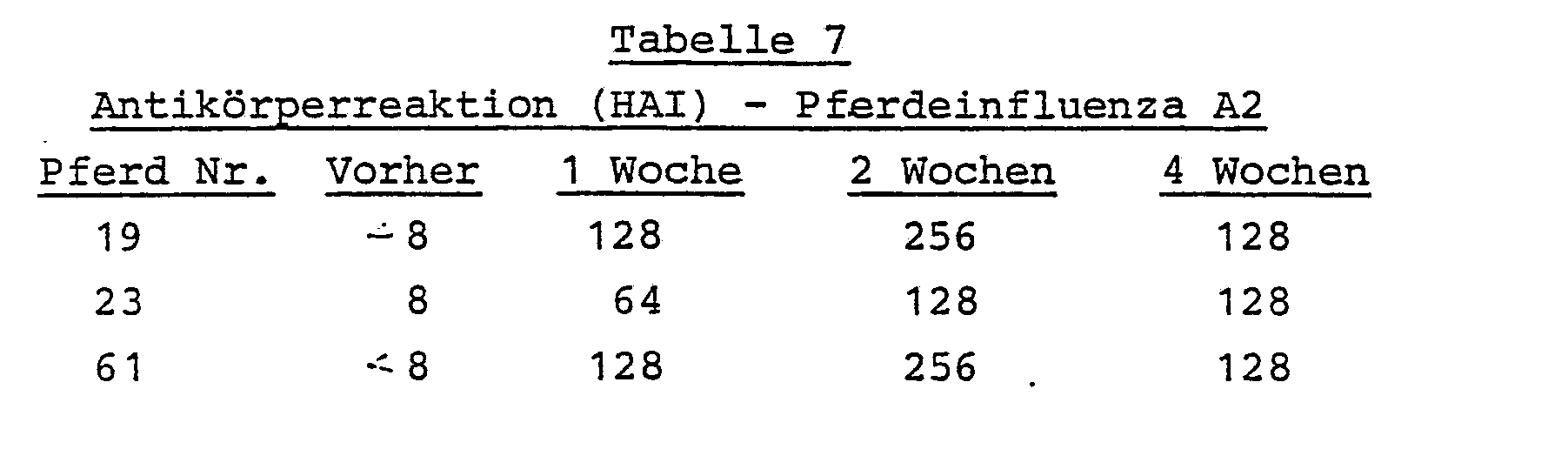
- Example 6 Three horses received 5 ml of the live vaccine produced according to Example 6 intranasally based on the weakened horse influenza A2 vaccine strain. No clinical illness or symptoms of influenza were found in the horses after vaccination.
- the antibody titer against vaccine strain was determined on blood sera of all animals 1, 2 and 4 weeks after vaccination and compared with the titer before vaccination using the standard hemagglutination inhibition test (HAI). Again, the antibody titers found were higher than required for protection.
- HAI hemagglutination inhibition test
- the invention is directed both to a new culture system for influenza viruses and to the use of the medium for the production of a new influenza vaccine.
- susceptible cells, influenza viruses, a nutrient medium and a proteolytic enzyme are used, however, in contrast to the known system (e.g. the system according to Tobita et al), this culture system does not require the use of agar, which divides the system into one brings semi-solid state. The exclusion of agar thus enables the large-scale production of viruses in the usual known manner and leads to the production of viral liquids with sufficiently high titers for the production of vaccines.
- the influenza vaccine preparation itself contains effective amounts of one or more strains of given influenza virus particles and a pharmaceutically acceptable carrier.
- the entire preparation which is preferably in aqueous form, is essentially free of reactive proteins, for example egg protein.
- the term "essentially free of egg protein" as used herein means that the only possible source of egg protein in the vaccine preparations is the vaccine virus, which is 7-1 : 100,000 diluted.
- the vaccines are administered to animals in a variety of ways including intramuscularly, intravenously, subcutaneously, intratracheally, intranasally or by aerosol spray and are intended for advantageous use in a wide variety of animals including humans, horses, pigs and birds.
- the vaccines prepared according to the invention can be diluted with water to adjust their effectiveness. Stabilizers such as sucrose, dextrose, lactose or other non-toxic substances can also be added to them.
- the virus preparations can be freeze-dried for storage purposes or for later formulation into attenuated vaccines, or they can be chemically inactivated for the production of dead virus vaccines.
Landscapes
- Life Sciences & Earth Sciences (AREA)
- Health & Medical Sciences (AREA)
- Chemical & Material Sciences (AREA)
- Virology (AREA)
- Microbiology (AREA)
- Immunology (AREA)
- Medicinal Chemistry (AREA)
- General Health & Medical Sciences (AREA)
- Epidemiology (AREA)
- Organic Chemistry (AREA)
- Genetics & Genomics (AREA)
- Veterinary Medicine (AREA)
- Wood Science & Technology (AREA)
- Zoology (AREA)
- Public Health (AREA)
- Animal Behavior & Ethology (AREA)
- Bioinformatics & Cheminformatics (AREA)
- Engineering & Computer Science (AREA)
- Pharmacology & Pharmacy (AREA)
- Mycology (AREA)
- Pulmonology (AREA)
- Biotechnology (AREA)
- General Engineering & Computer Science (AREA)
- Biochemistry (AREA)
- Biomedical Technology (AREA)
- Medicines Containing Antibodies Or Antigens For Use As Internal Diagnostic Agents (AREA)
- Micro-Organisms Or Cultivation Processes Thereof (AREA)
- Apparatus Associated With Microorganisms And Enzymes (AREA)
Abstract
Description
- Die Erfindung betrifft eine neue Influenzavirus-Vaccine, Verfahren zu ihrer Herstellung, Verfahren zur Vermehrung von Influenzaviren sowie mit Influenzaviren beimpfte Zellkultur.
- Influenzavaccine sind seit den frühen Vierzigerjahren für die Impfung von Menschen und seit den späten Sechzigerjahren für die Impfung von Pferden in Gebrauch. Alle zur Zeit verwendeten Influenzavaccine werden durch Züchten der Vaccinevirusstämme im bebrüteten Hühnerei hergestellt. Die hierbei erhaltenen Virusstämme werden dann zur Herstellung von Virus-Lebendvaccinen verwendet oder zur Herstellung von abgetöteten Virusvaccinen weiterverarbeitet.
- Es ist Virologen allgemein bekannt, daß Influenzaviren in Zellkulturen nur in sehr begrenztem Maße wachsen. Das Wachstum wird als "einstufiger Wachstumszyklus" bezeichnet, d.h. nur die ursprünglich infizierten Zellen pflanzen Viren fort. Diese Erscheinung wird beispielsweise von Davis et al in MICROBIOLOGY, Harper and Row Publishers, Kapitel 44, S. 1138-1139 (1968) beschrieben. Da die Viren der ursprünglich infizierten Zellen aufeinanderfolgende Zahlen von Zellen in der gleichen Zellkultur nicht zu infizieren vermögen, sind die erhaltenen Ausbeuten bei weitem zu niedrig, um für die Herstellung von Virusvaccinen brauchbar zu sein. Flüssige Zellkulturen wurden daher für die Großherstellung von Influenzavirus-Vaccinen nicht verwendet.
- Bebrütete Hühnereier werden zur Herstellung von Viren mit Titern verwendet, die für die Herstellung von Impfstoffen genügend hoch sind. Leider erfordern auf dem Brutei gezüchtete Viren gewöhnlich eine Konzentrierung und im Falle von menschlichen Vaccinen außerdem in irgendeiner Form eine Reinigung, um toxische Reaktionen als Folge des unerwünschten Eiereiweißes zu reduzieren. Die Verwendung von Eiern für die Impfstoffherstellung ist zeitraubend, arbeitsintensiv und erfordert verhältnismäßig hohe Materialkosten,.und die Ausbeute aus einem Ei genügt gewöhnlich nur, um Vaccine für etwa 1 bis 1,5 Dosen herzustellen. Die Herstellung von Millionen Dosen erfordert somit die Beimpfung und Gewinnung von Millionen Bruteiern.
- Vor kurzem wurde festgestellt, daß die verschiedensten Influenza-A-Viren einschließlich der bei Menschen, Pferden, Schweinen und Vögeln vorkommenden Stämme produktiv in einer festliegenden Linie von Hundenierenzellen unter einem Auflagemedium ("overlay medium"), das Trypsin enthält, wachsen und ohne Rücksicht auf ihre Passagenvorgeschichte wohldefinierte Plaques bilden; siehe die Arbeit von K. Tobita et al "Plaque Assay and Primary Isolation of Influenza A Viruses in an Established Line of Canine Kidney Cells (MDCK) in the presence of Trypsin", Med. Microbiol. Immunol. 162 (1975) 9-14. Ferner wird auf die Veröffentlichung von Hans-Dieter Klenk et al "Activation of Influenza A Viruses by Trypsin Treatment" in Virology 68 (1975) 426-439 verwiesen. Es ist zu bemerken, daß bei den vorstehend genannten Berichten die Wirkungen von Trypsin auf die Influenzavirus-Vermehrung in halbfesten Kulturen bei Plaquebildungsbestimmungen und -isolierungsmethoden beobachtet wurden, bei denen es sich in keinem Fall um flüssige Zellkulturen oder die großtechnische oder kommerzielle Vermehrung von Influenzaviren für die Impfstoffherstellung handelte. Der hier gebrauchte Ausdruck "flüssige Zellkultur" bezeichnet die Züchtung von Zellen in vitro und die Vermehrung von Viren in einem chemisch definierten flüssigen Medium.
- Es wurde nun überraschenderweise gefunden, daß proteolytische Enzyme ebenfalls in flüssigen Zellkulturen verwendet werden können, um die Infizierung aufeinanderfolgender Generationen von Zellen in der gleichen Zellkultur zu erleichtern. Dadurch, daß in dieser Weise die Begrenzungen des "einstufigen Wachstumszyklus" der bisherigen Methoden der Kultivierung in flüssigen Zellkulturen überwunden wurden, ist es möglich, eine Influenzavirus-Ausbeute zu erzielen, die 1000- bis 10.000 fach größer ist als bei nicht mit Protease behandelten Kulturen. Dies ermöglicht die Anwendung der Methoden der Kultivierung in flüssigen Zellkulturen für die Großherstellung von Influenza-Impfstoffen, wodurch die mit der Verwendung von bebrüteten Hühnereiern verbundenen Nachteile vermieden werden. Einzelheiten des Kulturmediums, der Methoden der Virusvermehrung und der Vaccineherstellung sowie Gebrauchsmethoden werden nachstehend beschrieben.
- Das Influenzavirus-Vermehrungsmedium gemäß der Erfindung umfaßt eine Zellkultur, die mit einem Influenzavirus infizierbar ist, ein Influenzavirus und ein proteinhydrolysierendes Enzym, das in einer genügenden Menge vorliegt, um den einstufigen Wachstumszyklus des Virus auszuschalten. Das Virusvermehrungsverfahren gemäß der Erfindung umfaßt die Stufen der Beimpfung oder Infizierung einer flüssigen Influenzavirus-Zellkultur mit den Influenza-Viren, der Inkubation des Inoculats in Gegenwart eines proteinhydrolysierenden Enzyms unter Bedingungen, die genügen, um maximales Viruswachstum (oder einen maximalen zytopathischen Effekt) zu gewährleisten, und der Gewinnung des Virus. Die Infizierung der Zellen mit dem Virus kann vor oder nach der Bildung der Monoschicht der Zellen oder auch einfach durch Infizierung einer flüssigen Suspension der Zellen erfolgen. Das Vaccineherstellungsverfahren gemäß der Erfindung umfasst die anschließende Stufe des Abtötens des geernteten Virus oder des Abschwächens durch eine weitere Passage in der Zellkultur für den Vaccinegebrauch. Bei besonders bevorzugten Ausführungsformen wird die Protease Trypsin in Verbindung mit einem Hundenierenzelllinie zur Vermehrung aller beliebigen verschiedenen Typen von Influenza-Viren verwendet.
- Die Erfindung wird nachstehend unter Bezugnahme auf die Abbildungen weiter erläutert.
- Fig. 1 bis Fig. 5 sind Balkendiagramme, die die Steigerungen des Titers veranschaulichen, die erreicht wurden, wenn die genannten Virusstämme in einer flüssigen Zellkultur in Gegenwart verschiedener Mengen einer typischen Protease, des Trypsins, inkubiert wurden. Die Ergebnisse sind als geometrische mittlere Titer angegeben. Nachstehend werden spezielle Ausführungsformen der Erfindung beschrieben.
- Bei den erfindungsgemäßen Verfahren zur Influenzaviruszüchtung und Impfstoffherstellung ist die Verwendung von Influenza-Vaccineviren vorgesehen. Der hier gebrauchte Ausdruck "Influenzavirus" umfasst alle.Viren, die in der Lage sind, bei Tieren (einschließlich des Menschen) einen febrilen Krankheitszustand hervorzurufen, der durch respiratorische Symptome, Schleimhautentzündung und häufig systemischen Befall gekennzeichnet ist. Das Medium und die Verfahren gemäß der Erfindung sind besonders vorteilhaft für die Erzeugung der verschiedensten Influenza- Viren einschließlich der Stämme, die Mensch, Pferd, Schwein und Vögel befallen. Beispiele der Herstellung typischer Influenza-Viren des Typs A und B werden später beschrieben.
- Die Impfstoffe gemäß der Erfindung umfassen alle Präparate von abgetöteten, lebenden abgeschwächten oder lebenden voll virulenten Influenza-Viren, die verabreicht werden können, um Immunität gegen jede Influenza-Erkrankung zu erzeugen oder künstlich zu steigern. Bei bevorzugten Ausführungsformen liegt die Vaccine als wäßrige Suspension der Viruspartikel in gebrauchsfertiger Form vor.
- Für die Zellkulturen, die als geeignet für die Durchführung des Verfahrens gemäß der Erfindung vorgesehen sind, kommen alle tierischen Zellstämme oder -linien infrage, die durch einen oder mehrere gegebene Influenza-Virusstämme infizierbar sind und die Vermehrung dieser Virusstämme ermöglichen. Zwar ist eine Anzahl solcher Zellen bekannt und wird als geeignet für die hier beschriebenen Verfahren gehalten, jedoch wurden von der Anmelderin besonders gute Ergebnisse mit einem ganz bestimmten Zellstamm erhalten, der als Cutter Laboratories Dog Kidney (CLDK)-Zellstamm (Hundenieren-Zellstamm der Cutter Laboratories) bekannt ist. Der CLDK-Zellstamm ist vom Landwirtschaftsministerium - der U.S.A. für die Verwendung zur Herstellung von Veterinär-Vaccinen genehmigt worden und ist dem Madin Darby-Hundenieren-Zellstamm (ATCC Nr. CCL 34) und den in der US-PS 3 616 203 beschriebenen Hundenieren-Zellstamm ähnlich. Nachstehend folgen eine kurze Geschichte und eine Beschreibung des für den Zellstamm in den Beispielen verwendeten speziellen Ursprungs-Gewebematerials, obwohl natürlich die hier beschriebenen Methoden als geeignet -für alle für Influenza-Viren brauchbaren Zellkulturen gehalten werden.
- Der Ursprungsstamm von CLDK wurde von der Niere eines offensichtlich normalen Beagle-Hundes, der von der Universität California in Davis erhalten worden war, durch die Cutter Laboratories, Inc., Berkeley, California (U.S.A.), herangezüchtet und als Permanentkultur weitergeführt. Der Stamm wurde auf 0,5% Milcheiweißhydrolysat und 0,2% Hefeextrakt in Earle's ausgewogener Salzlösung plus 5% Kalbs-, Schafs- oder Pferdeserum und Antibiotika gehalten und nach den Methoden von J.S. Younger (Proc. of Exp. Biol. and Med., V 85, 202) kultiviert.
- Eine eingefrorene Ampulle der 142. Passage dieses Zellstamms wurde anschließend in einem 75 cm2 (250 ml)-Falcon- kolben in ein Gewebekulturmedium gegeben, das aus Earle's ausgewogener Salzlösung als essentielles Minimum-Medium (Earle's balanced salt solution Minimum Essential Medium (MEM)) und 10% fötalem Rinderserum bestand. Die Zellen wurden in der gleichen Weise und im gleichen Medium weitergezüchtet, um das eingefrorene Masterzellmaterial in der Passage 148 herzustellen.
- Eine Ampulle des Masterzellmaterials wurde aufgetaut und reihenmäßig 20mal weiterkultiviert, wobei Flaschenkulturen der 168. Passage erhalten wurden. Diese Zellen wurden dann eingefroren.
- Nummer der Seriensubkulturen vom Ursprungsgewebe: 148 Gefriermedium: Essentielles Mindestmedium (Eagle) in Earle's BSS mit reduziertem Bicarbonat (1,65 g/l) 80%; fötales Rindersrum 10%; Dimethylsulfoxid 10%. Lebensfähigkeit: Ungefähr 75% (Farbstoffausschluß). Kulturmedium: Essentielles Mindestmedium (minimum essential medium) (Eagle) in Earle's BSS mit reduziertem Bicarbonat (1,65 g/l) 90%; fötales Rinderserum 2-10%; Antibiotika: Penicillin und Streptomycin 100 E. oder /ml.
- Wachstumsmerkmale der aufgetauten Zellen: Ein Inoculum von 3 x 10⁶ lebensfähigen Zellen/ml, kultiviert im vorstehend genannten Kulturmedium bei 37°C in einem geschlossenen System, vermehrt sich in 5 Tagen ungefähr 6- bis 8fach. Morphologie: epithelialartig.
Karyologie: Chromosomenfrequenzverteilung 100 Zellen: - 2N = 72.
- Sterilitätstests: Frei von Mykoplasma, Bakterien und Pilzen Spezies: Durch Immunofluoreszenztest als Hund bestätigt. Virus-Anfälligkeit: Empfänglich für Influenza-Viren, Rabies-Virus, infektiöse Rinder-Rhinotracheitis, infektiöse Hundehäpatitis, Hundestaupe-Virus und möglicherweise andere Viren.
- Zu den Proteine hydrolysierenden Enzymen (proteolytisches Enzym oder Protease), die als geeignet für die Zwecke der Erfindung vorgesehen sind, gehören bekannte Proteasen, z. B. Trypsin, Chymotrypsin, Pepsin, Pancreatin, Papain, Pronase, Carboxypeptidase u.dgl., wobei Trypsin ein besonders bevorzugtes Enzym ist. Der genaue Mechanismus bzw. die genauen Mechanismen, nach denen eine Protease wie Trypsin die Influenzavirus-Infektiosität steigert, sind noch nicht völlig geklärt. Ein möglicher Mechanismus wird in dem vorstehend genannten Artikel von Klenk et al vorgeschlagen.
- Wie nachstehend beschrieben, sollte die Menge der aktiven Protease, die erforderlich ist, um die aufeinanderfolgende Infektuosität zu steigern, wenigstens genügen, um die Begrenzungen des einstufigen Wachstumszyklus auszuschalten, aber im Falle von konfluierenden Monoschichtkulturen nicht so hoch sein, daß Ablösung von konfluierenden Zellen von den Oberflächen des Gewebekulturgefäßes (d.h. der Innenfläche einer Rollflasche) verursacht wird. Im Falle des bei den in den folgenden Beispielen beschriebenen Versuchen verwendeten speziellen Enzyms wird eine Menge des Enzyms im Bereich von etwa 4 bis 25 ug/ml des flüssigen Gewebekulturmediums, insbesondere eine Menge von etwa 10 ug/ml, bevorzugt.
- Das hier beschriebene Verfahren zur Vermehrung von Influenza-Viren umfasst die drei allgemeinen Stufen der Infizierung eines Teis der Zellen einer flüssigen Zellkultur mit dem Influenza-Virus, der Inkubation der Zellen in Gegenwart eines proteolytischen Enzyms unter Bedingungen, die genügen, um maximalen zytopathischen (CP) Effekt zu gewährleisten, und der Isolierung der Viren von der Kultur. Die Impfstoffherstellung umfasst die anschließende Stufe der Modifizierung des isolierten Virus nach bekannten Methoden zur Herstellung einer Lebendvaccine mit virulenten oder abgeschwächten Viren oder einer Vaccine mit abgetöteten (inaktiven) Viren. Die Vaccine kann in trockener Form für die Vermischung mit einem Verdünnungsmittel oder in flüssiger, gebrauchsfertiger Form vorliegen. Wie nachstehand beschrieben, können geeignete Adjuvantien zur Steigerung der Immunisierungsfähigkeit einbezogen werden.
- Die Protease kann einer wässrigen Suspension der Zellkultur oder vor oder nach der Bilding einer konfluenten Monoschichtkultur zugesetzt werden. Einige der verschiedenen Vermehrungsmethoden werden nachstehend als Beispiel beschrieben.
-
- 1. Die Zellen werden bis zur Konfluenz in Kulturgefäßen wie Rollflaschen, Povitsky-Kolben oder Roux-Flaschen unter Verwendung bekannter Zellkulturmedien gezüchtet.
- 2. Vor der Infizierung wird das Nährmedium aus den Monoschichten der Zellen entfernt.
- 3. Das Arbeits-Impfmaterial des Influenza-Virus wird im Züchtungsmedium verdünnt, das zusätzliche Vitamine, nicht-essentielle Aminosäuren, L-Glutamin, Dextrose und Antibiotika enthält, wobei der pH-Wert auf 6,6 bis 6,8 eingestellt wird.
- 4. Eine Menge des das Virus enthaltenden Verdünnungsmittels wird zur Zellmonoschicht in Mengen von 10% bis 100% des endgültigen, für die Isolierung vorgesehenen Volumens gegeben.
- 5. Die infizierten Monoschichten werden 1 bis 72 Stunden bei 34° bis 37°C inkubiert.
- 6. Protease wird allein oder in Kombination mit dem Viruszüchtungsmedium in einer Konzentration zugesetzt, die das Wachstum in vielfachen Zyklen fördert, ohne Loslösung von Zellen hervorzurufen.Bei Trypsin liegt diese optimale Konzentration zwischen etwa 8 und 15 pg/ml.
- 7. Die Viruszüchtungsbehälter werden erneut bei 34° bis 37°C inkubiert, bis maximale zytopathische Effekte beobachtet werden. Zu diesem Zeitpunkt werden die Virusflüssigkeiten isoliert.
- 8. Zur Isolierung werden die Behälter kräftig geschüttelt, um die Zellen zu entfernen, und die Flüssigkeiten und Zellen in einen sterilen Behälter zur weiteren Verarbeitung überführt.
-
- 1. Die Zellen werden aus den Kultivierungsbehältern nach üblichen Verfahren entfernt.
- 2. Die Zellen werden durch Zentrifugation eingeengt und dann in einer Menge frischen Nährmediums, das zusätzliche Vitamine, nicht-essentielle Aminosäuren, L-Glutamin, Dextrose und Antbiotika enthält, erneut suspendiert.
- 3. Dieser konzentrierten.Zellsuspension wird dann Influenza- virus zugesetzt.
- 4. Die Zell-Virus-Suspension wird in einem sterilen geschlossenen Gefäß (z.B. einem Erlenmeyerkolben mit Schraubkappe) inkubiert (250 bis 37oC), während sie auf einem Magnetrührer oder einer rotierenden Schüttelvorrichtung 10 Minuten bis 4 Stunden gemischt wird.
- 5. Aliquote Teile der Zell-Virus-Suspension werden in Züchtungsbehälter (Rollflaschen, Roux-Flaschen, Povitsky-Kolben) gegeben, wobei das volle Volumen der Medien die in B-2 genannten Bestandteile plus 5% fötales Kalbsserum enthält.
- 6. Die Kultivierungsbehälter werden bei 34° bis 37°C inkubiert, bis konfluente Monoschichten sich gebildet haben (ungefähr 2 bis 4 Tage).
- 7. Nachdem sich Monoschichten gebildet haben, wird Protease in einer Konzentration zugesetzt, die Wachstum in vielen Zyklen fördert, ohne daß Zellen abgelöst werden. Bei Trypsin liegt diese optimale Konzentration zwischen 10 und 25 µg/ml.
- 8. Die Kultivierungsbehälter werden bei 34° bis 37°C inkubiert, bis maximale zytopathische Effekte beobachtet werden. Das Virus wird dann isoliert.
- 9. Zur Isolierung werden die Behälter kräftig geschüttelt, um die Zellen zu entfernen, und die Zellen und Flüssigkeiten in einen sterilen Behälter zur weiteren Verarbeitung überführt.
-
- 1. An die Suspensionskultur angepasste Zellen werden bis zur optimalen Zahl im Nährmedium in Behältern für die Suspensionskultur gezüchtet.
- 2. Die Zellen werden zentrifugiert und in einer Menge frischen Nährmediums, das zusätzliche Vitamine, nicht-essentielle Aminosäure, L-Glutamin, Dextrose und Antibiotika enthält, erneut suspendiert.
- 3. Influenzavirus wird dann zugesetzt und das Kulturmedium bei 340 bis 37°C 10 Minuten bis zu einigen Stunden inkubiert.
- 4. Fötales Kalbsserum kann zugesetzt werden, und die Kultursuspension wird 1 bis 72 Stunden bei 34° bis 37°C weiter inkubiert.
- 5. Protease wird in einer Konzentration zugesetzt, die Züchtung in vielen Zyklen ermöglicht, ohne daß eine nachteilige Wirkung auf die Zellen ausgeübt wird. Bei Trypsin liegt die optimale Konzentration zwischen 4 und 25 µg/ml.
- 6. Die Inkubation bei 34° bis 370C wird fortgesetzt, bis maximale zytopathische Effekte beobachtet werden. Zu diesem Zeitpunkt werden die Flüssigkeiten isoliert.
- 7. Zur Isolierung werden die Flüssigkeiten in einen sterilen Behälter zur weiteren Verarbeitung überführt.
- Nachstehend folgen spezielle Beispiele der Anwendung der Methoden gemäß der Erfindung und der Nährmedien für die Vermehrung ausgewählter Stämme von Influenzaviren. Falls nicht anders angegeben, wurden übliche bekannte Gewebekulturverfahren angewendet. Da die Verfahren der Herstellung und Vorbereitung sowohl der Zellen als auch des Mediums bekannt sind, werden sie hier nicht ausführlich beschrieben.
- Das Pferde-Influenzavirus A2, als Miami-Stamm bezeichnet, wurde ursprünglich von einem Pferd an der Universität Miami isoliert. Dieses Virus wurde von der Medical School der Universität Pennsylvania bezogen, wo es in 6 Passagen über bebrütete Hühnereier geführt wurde. Die 7. Passage wurde bei Lederle Laboratories durchgeführt und von diesen erhalten. Der Stamm wurde über weitere Passagen in bebrüteten Hühnereiern geführt und in den Passagen 11 bis 16 verwendet. Das zur Zeit bevorzugte Verfahren zur Vermehrung des Stamms A2 in der Gewebekultur wird wie folgt durchgeführt: Eine junge, konfluente Monoschicht von CLDK-Zellen wird beimpft. Die Zellen werden in Rollflaschen eingesetzt, wobei Hank's essentielles Mindestmedium (Minimum Essential. Medium) (MEMH), das die folgenden Bestandteile enthält, verwendet wird:


- Die EID50 Titer des nach diesem Verfahren gezüchteten Influenzavirus A2 nach der Isolierung sind in Tabelle 1 genannt. Ferner wird auf Fig. 1 verwiesen. Ein Vergleich wird mit dem nach dem gleichen Verfahren, jedoch ohne Zusatz von Trypsin gezüchteten A2-Virus vorgenommen.
- Eine Probe des virulenten Typs des Pferde-Influenzavirus A1 wurde von der Medical School der Universität Pennsylvania bezogen. Der als Pennsylvania (A1) bezeichnete Stamm wurde von einem Pferd isoliert und über sechs Passagen im bebrüteten Hühnerei geführt. Der Stamm wurde über weitere Passagen im Brutei geführt und wird bei den Passagen 12 bis 17 für die Gewebekulturproduktion verwendet.
- Für die Vermehrung des Stamms A1 in der Gewebekultur wird die folgende Methode bevorzugt: Eine Suspension von CLDK-Zellen wird vor der Bildung der Monoschicht infiziert. Die CLDK-Zellen in einer Konzentration von etwa 105,5/ml, Pennsylvania-Stamm des Virus bei einem EID50-Titer von 103,0/ml bis 10 ' /ml und Hank's Minimum Essential Medium (MEMH), das durch die nachstehend genannten Stoffe ergänzt ist, werden bei 25°C inkubiert, während sie auf einem Magnetrührer in einem geschlossenen sterilen Erlenmeyerkolben gemischt werden. Der pH-Wert wird während der Inkubationszeit von 2 bis 3 Stunden mit 1N-HCl bei 6,7-6,8 gehalten.
-

- Nach dieser Züchtung in Suspension werden aliquote Teile von je 10 ml der Zell-Virus-Suspension in Rollflaschen gegeben, die 1 1 des in der vorstehend genannten Weise ergänzten MEMH-Mediums, das 5% fötales Kalbsserum enthält, enthalten. Die Rollflaschen werden bei 34° bis 35°C inkubiert, bis die Monoschicht konfluent ist (ungefähr 48 bis 72 Stunden), - worauf 20 ml einer sterilen Trypsinlösung von 1 mg/ml (Sigma 1:250) in jede Rollflasche gegeben werden. Die Rollflaschen werden erneut bei 34° bis 35°C inkubiert, bis der maximale zytopathische Effekt beobachtet wird (3 bis 5 Tage). Die Virusflüssigkeiten werden isoliert, indem jede Rollflasche zur Entfernung der haften gebliebenen Zellen kräftig geschüttelt wird und die Zellen und Flüssigkeiten zur weiteren Verarbeitung in ein steriles Gefäß überführt werden.
- Die EID50-Titer des nach diesem Verfahren gezüchteten Influenzavirus A1 sind in Tabelle 2 genannt. Ferner wird auf Fig. 2 verwiesen. Ein Vergleich wird mit dem nach dem gleichen Verfahren ohne Trypsin gezüchteten Virus A1 vorgenommen.

- mittleren Die Zugabe von Trypsin zum Kulturmedium ergab einen/ geometrischen Anstieg von 2,3 log oder 187mal so viele Viruspartikel/ml während der Produktion des Pennsylvania-Stamms.
- Ein Stamm des menschlichen Influenzavirus mit der Bezeichnung B/Hongkong/5/72 (BX-1) wurde vom The Center for Disease Control in Atlanta, Georgia, bezogen. Dieser Stamm wurde in einer Passage über bebrütete Hühnereier geführt und bei -70°C als Arbeitsimpfvirus eingefroren.
- Für die Vermehrung des Stamms B/Hongkong/5/72 in der Gewebekultur wird die folgende Methode bevorzugt: Eine junge konfluente Monoschicht von CLDK-Zellen ähnlich denen in Beispiel 1 wird infiziert. Die Zellen werden auf die in Beispiel 1 beschriebene Weise gezüchtet. Das Nährmedium wird von den Zellen entfernt und verworfen. Die Zellen werden dann mit dem Virus infiziert, das in dem in Beispiel 1 genannten Impfmedium auf einen EID50-Titer von etwa 103,0-5,0/ml verdünnt worden ist. Das Inoculum besteht aus einem Volumen, das 33,3% des endgültigen isolierten Volumens entspricht. Gefäße werden 40 bis 48 Stunden bei 34° bis 35°C inkubiert, worauf das restliche Medium (66,7%), das 12 ug/ml Trypsinlösung (0,1 g/ 100 ml) enthält, jedem Gefäß zugesetzt wird. Die Inkubation bei 34°-35°C wird fortgesetzt, bis der maximale zytopathische Effekt beobachtet wird (48 bis 72 Stunden), worauf die Virusflüssigkeiten isoliert werden. Die Isolierung erfolgt durch kräftiges Schütteln jedes Gefäßes zur Entfernung der Zellen und Überführung von Zellen und Flüssigkeiten in ein steriles Gefäß zur Weiterverarbeitung.
- Die EID50-Titer des nach diesem Verfahren gezüchteten Influenzavirus B/Hong Kong/5/72 nach der Isolierung sind nachstehend in Tabelle 3 genannt. Ferner wird auf Fig. 3 verwiesen. Ein Vergleich wird mit diesem nach dem gleichen Verfahren, jedoch ohne Zusatz von Trypsin gezüchteten Virus vorgenommen.

- Die Zugabe von Trypsin zum Kulturmedium ergibt einen geometrischen mittleren Anstieg von 3,1 log oder 1412mal so viele Viruspartikel während der Produktion des Stamms B/Hong Kong.
- Ein Stamm des menschlichen Influenzavirus mit der Bezeichnung A/Texas/1/77 wurde von The Center for Disease Control in Atlanta, Georgia, bezogen. Dieser Stamm wurde in einer Passage über bebrütete Hühnereier geführt und bei -70°C als Arbeitsimpfvirus eingefroren.
- Für die Vermehrung des Stamms A/Texas/1/77 in der Gewebekultur wird das insgesamt in Beispiel 3 beschriebene Verfahren bevorzugt.
- Die EIDS50-Titer des nach diesem Verfahren gezüchteten und isolierten menschlichen Influenzavirus-Stamms A/Texas/1/77 sind in Tabelle 4 genannt. Ferner wird auf Fig. 4 verwiesen. Ein Vergleich wird mit diesen nach dem gleichen Verfahren, jedoch ohne Zusatz von Trypsin gezüchteten Stamm vorgenommen.

- Die Zugabe von Trypsin zum Kulturmedium ergab einen geometrischen mittleren Anstieg von 4,1 log oder 12590mal so viele Viruspartikel/ml während der Produktion des A/Texas-Stamms.
- Ein Stamm des menschlichen Influenzavirus mit der Bezeichnung A/USSR/90/77 wurde vom The Center for Disease Control in Atlanta, Georgia, bezogen. Dieser Stamm wurde mit einer Passage über bebrütete Hühnereier geführt und bei -70°C als Arbeitsimpfvirus eingefroren.
- Für die Vermehrung des Stamms A/USSR/90/77 in der Gewebekultur wird das insgesamt in Beispiel 3 beschriebene Verfahren bevorzugt.
- Die EID 50-Titer des nach diesem Verfahren gezüchteten und isolierten menschlichen Influenza-Stamms A/USSR/90/77 sind in Tabelle 5 genannt. Ferner wird auf Fig. 5 verwiesen. Ein Vergleich wird mit diesem nach dem gleichen Verfahren, jedoch ohne Zusatz von Trypsin gezüchteten Stamms vorgenommen.

- Die Zugabe von Trypsin zum Kulturmedium ergab einen geometrischen mittleren Anstieg von 2,4 log oder 251mal so viele Viruspartikel/ während der Produktion des A/USSRml Stamms.
- Die Abschwächung des Virus aus den gemäß Beispiel 1 isolierten Flüssigkeiten erfolgt chemisch oder.durch Standard-Reihenpassagen einschließlich abschließender Verdünnungspassagenmethoden, bei denen eine genügende Anzahl von Passagen in einer empfänglichen Zellkultur angewendet wird, bis das Virus ohne Verlust der Immunisierungsfähigkeit nicht-pathogen gemacht worden ist. Ein in dieser Weise hergestellter Impfstoff löst bei Tieren, die für die Krankheit anfällig sind, eine Immunreaktion aus, ohne die klinischen Symptome, die normalerweise auf das virulente Mittel zurückzuführen sind, in wesentlichem Ausmaß hervorzubringen. Die Vermehrung kann in den gleichen Geweben, wie sie bei der vorhergehenden Passage verwendet wurden, oder in verschiedenen Geweben erfolgen.
- Die Methode ist ähnlich wie die in den Beispielen 1 und 2 beschriebenen, jedoch werden die isolierten, virusbeladenen Flüssigkeiten durch Inaktivierung mit 0,1%igem Formaldehyd (Bereich 0,05 bis 0,2%) weiterverarbeitet, und das behandelte Material wird 10 bis 14 Tage bei 4°C inkubiert. Die Testung des endgültigen inaktivierten Viruspräparats zeigte, daß es frei von lebendem Virus war. Bekannte Adjuvantien, z.B. Aluminiumhydroxid, Alaun, Aluminiumphosphat, Freund' Adjuvans oder die in den US-PSen 3 790 665 und 3 919 411 beschriebenen Adjuvantien können zugesetzt werden. Das bevorzugte Adjuvans bei diesen Veröffentlichungen und in den Impfstoffen gemäß der Erfindung ist ein Acrylsäurepolymerisat, das mit einem Polyallylsaccharid (Carbopol 934 P) ähnlich dem in den vorstehend genannten Patentschriften beschriebenen vernetzt ist.
- Eine Pferdeimpfstoffdosis von 1,0 ml besteht aus 0,45 ml des Stamms Pennsylvania (Al), 0,45 ml des Stamms Miami (A2) und 0,10 ml des vernetzten Acrylsäurepolymerisats (Carbopol 934 P) als Adjuvans. Gleiche Teile der gemäß Beispiel 7 erhaltenen inaktivierten Vaccinestämme wurden gemischt, und aliquote Teile von 1 ml wurden 19 Pferden intramuskulär verabreicht. Keine klinische Krankheit oder Symptome von Influenza wurden bei den Pferden nach der Impfung festgestellt. Die Antikörper-Titer sowohl gegen Pferde-Influenza A1 als auch Pferde-Influenza A2 wurden an den Blutseren aller Tiere nach 2, 4 und 8 Wochen nach der Impfung ermittelt. Diese Titer werden mit den Titern vor der Impfung mit Hilfe des Standard-Hämagglutinationshemmungstests (Diagnostic Procedures for Viral and Rickettsial Infections, 4.Auflage, Lennette und Schmidt, S. 665-666 (1969), American Public Health Association, New York, N.Y. 10019, verglichen (Tabelle 6).

- Wie die Werte in Tabelle 6 zeigen, bildeten sich Antikörper gegen beide Virus-Antigene in Pferden, die geimpft wurden. Diese geimpften Tiere würden immun gegen Pferde-influenza sein, da Antikörpertiter über 1:20 für A2 und 1:60 für A1 vom National Veterinary Services Laboratories des U.S.A.-Landwirtschaftsministeriums als schützende Titer akzeptiert sind.
- Klinische Versuche an 420 Pferden verschiedener Rassen und verschiedenen Alters ergaben, daß der Impfstoff sicher ist und nach intramuskulärer Impfung keine ungünstigen Reaktionen hervorruft.
- Drei Pferde erhielten intranasal 5 ml der gemäß Beispiel 6 hergestellten Lebendvaccine auf Basis des abgeschwächten Pferde-Influenza-A2-Vaccinestamms. Keine klinische Krankheit oder Symptome von Influenza wurden bei den Pferden nach der Impfung festgestellt. Die Antikörpertiter gegen Vaccinestamm wurden an Blutseren aller Tiere 1, 2 und 4 Wochen nach der Impfung ermittelt und mit dem Titer vor der Impfung mit Hilfe des Standard-Hämagglutinationshemmungstests (HAI) verglichen.
- Es ist zu bemerken, daß die Erfindung sowohl auf ein neues Kultursystem für Influenzaviren als auch die Verwendung des Mediums zur Herstellung eines neuen Influenza-Impfstoffs gerichtet ist. Für das erfindungsgemäß verwendete flüssige Zellkultursystem werden anfällige Zellen, Influenzaviren, ein Nährmedium und ein proteolytisches Enzym verwendet, jedoch erfordert dieses Kultursystem im Gegensatz zu den bekannten System (z.B. das System gemäß Tobita et al) nicht die Verwendung von Agar, das das System in einen halbfesten Zustand bringt. Der Ausschluß von Agar ermöglicht somit die Großerzeugung von Viren in üblicher bekannter Weise und führt zur Erzeugung von viralen Flüssigkeiten mit genügend hohen Titern für die Herstellung von Impfstoffen.
- Das Influenza-Impfstoffpräparat selbst enthält wirksame Mengen eines oder mehrerer Stämme von gegebenen Influenza-Viruspartikeln und einen pharmazeutisch unbedenklichen Träger. Das gesamte Präparat, das vorzugsweise in wäßriger Form vorliegt, ist im wesentlichen frei von reaktionsfähigen Proteinen, z.B. Eiereiweiß. Der hier gebrauchte Ausdruck "im wesentlichen frei von Eiereiwiß" bedeutet, daß die einzige mögliche Quelle von Eiereiweiß in den Impfstoffpräparaten das Impfvirus ist das 71: 100.000 verdünnt ist.
- Die Impfstoffe werden Tieren auf verschiedenen Wegen einschließlich intramuskulär, intravenös, subkutan, intratracheal, intranasal oder durch Aerosolspray verabreicht und sind für die vorteilhafte Verwendung bei den verschiedensten Tieren einschließlich Mensch, Pferd, Schwein und Vögel vorgesehen.
- Die gemäß der Erfindung hergestellten Impfstoffe können zur Einstellung ihrer Wirksamkeit mit Wasser verdünnt werden. Ferner können ihnen Stabilisatoren wie Saccharose, Dextrose, Lactose oder andere ungiftige Stoffe zugesetzt werden. Die Viruspräparate können durch Gefriertrocknung für Lagerzwecke oder für die spätere Formulierung zu abgeschwächten Vaccinen getrocknet werden, oder sie können für die Herstellung von Virus-Tot-Impfstoffen chemisch inaktiviert werden.

Claims (10)
Priority Applications (1)
| Application Number | Priority Date | Filing Date | Title |
|---|---|---|---|
| AT80102525T ATE16454T1 (de) | 1979-05-15 | 1980-05-08 | Influenzavirus-vaccine, verfahren zu ihrer herstellung und verfahren zur vermehrung von influenzaviren. |
Applications Claiming Priority (2)
| Application Number | Priority Date | Filing Date | Title |
|---|---|---|---|
| US3923679A | 1979-05-15 | 1979-05-15 | |
| US39236 | 2001-12-31 |
Publications (4)
| Publication Number | Publication Date |
|---|---|
| EP0019218A2 true EP0019218A2 (de) | 1980-11-26 |
| EP0019218A3 EP0019218A3 (en) | 1981-03-25 |
| EP0019218B1 EP0019218B1 (de) | 1985-11-13 |
| EP0019218B2 EP0019218B2 (de) | 1995-03-01 |
Family
ID=21904398
Family Applications (1)
| Application Number | Title | Priority Date | Filing Date |
|---|---|---|---|
| EP80102525A Expired - Lifetime EP0019218B2 (de) | 1979-05-15 | 1980-05-08 | Influenzavirus-Vaccine, Verfahren zu ihrer Herstellung und Verfahren zur Vermehrung von Influenzaviren |
Country Status (13)
| Country | Link |
|---|---|
| EP (1) | EP0019218B2 (de) |
| JP (1) | JPS55153723A (de) |
| AR (1) | AR220838A1 (de) |
| AT (1) | ATE16454T1 (de) |
| AU (1) | AU535804B2 (de) |
| CA (1) | CA1122527A (de) |
| DE (1) | DE3071225D1 (de) |
| DK (1) | DK154749C (de) |
| ES (1) | ES491517A0 (de) |
| IL (1) | IL60063A0 (de) |
| NO (1) | NO801443L (de) |
| RO (1) | RO79525B (de) |
| YU (1) | YU41923B (de) |
Cited By (8)
| Publication number | Priority date | Publication date | Assignee | Title |
|---|---|---|---|---|
| WO1996015231A3 (en) * | 1994-11-10 | 1996-08-01 | Immuno Ag | Method for producing biologicals in protein-free culture |
| US5698433A (en) * | 1994-11-10 | 1997-12-16 | Immuno Ag | Method for producing influenza virus and vaccine |
| US5753489A (en) * | 1994-11-10 | 1998-05-19 | Immuno Ag | Method for producing viruses and vaccines in serum-free culture |
| US6146873A (en) * | 1994-11-10 | 2000-11-14 | Baxter Aktiengesellschaft | Production of orthomyxoviruses in monkey kidney cells using protein-free media |
| EP0808361A4 (de) * | 1994-11-16 | 2001-07-18 | St Jude Childrens Res Hospital | Neuer replikationsprozess |
| US6455298B1 (en) | 1996-04-01 | 2002-09-24 | Chiron Behring Gmbh & Co. | Animal cells and processes for the replication of influenza viruses |
| WO2003050275A3 (en) * | 2001-12-10 | 2004-02-19 | Baxter Healthcare Sa | Method of isolation and purification of trypsin from pronase and use thereof |
| US10329536B2 (en) | 2001-09-12 | 2019-06-25 | Seqirus UK Limited | Methods for producing an active constituent of a pharmaceutical or a diagnostic agent in an MDCK cell suspension culture |
Families Citing this family (6)
| Publication number | Priority date | Publication date | Assignee | Title |
|---|---|---|---|---|
| DE19612967A1 (de) * | 1996-04-01 | 1997-10-02 | Behringwerke Ag | Verfahren zur Vermehrung von Influenzaviren in Zellkultur, sowie die durch das Verfahren erhältlichen Influenzaviren |
| AU2005314563B2 (en) | 2004-11-03 | 2011-06-30 | Seqirus UK Limited | Influenza vaccination |
| EP2022849A4 (de) * | 2006-05-11 | 2010-10-06 | Chemo Sero Therapeut Res Inst | Verfahren zur proliferation von influenzavirus |
| US8506966B2 (en) | 2008-02-22 | 2013-08-13 | Novartis Ag | Adjuvanted influenza vaccines for pediatric use |
| TW201012930A (en) * | 2008-06-16 | 2010-04-01 | Intervet Int Bv | Method of replicating viruses in suspension |
| EA023662B1 (ru) | 2009-02-10 | 2016-06-30 | Новартис Аг | Вакцины против гриппа со сниженным количеством сквалена |
Family Cites Families (1)
| Publication number | Priority date | Publication date | Assignee | Title |
|---|---|---|---|---|
| FR2262962B1 (de) * | 1974-03-05 | 1977-11-04 | Science Union & Cie |
-
1980
- 1980-04-22 CA CA350,366A patent/CA1122527A/en not_active Expired
- 1980-04-30 AR AR280860A patent/AR220838A1/es active
- 1980-05-08 DE DE8080102525T patent/DE3071225D1/de not_active Expired
- 1980-05-08 EP EP80102525A patent/EP0019218B2/de not_active Expired - Lifetime
- 1980-05-08 AT AT80102525T patent/ATE16454T1/de not_active IP Right Cessation
- 1980-05-09 AU AU58244/80A patent/AU535804B2/en not_active Expired
- 1980-05-13 RO RO101109A patent/RO79525B/ro unknown
- 1980-05-13 YU YU1265/80A patent/YU41923B/xx unknown
- 1980-05-13 JP JP6235780A patent/JPS55153723A/ja active Granted
- 1980-05-13 IL IL60063A patent/IL60063A0/xx unknown
- 1980-05-14 NO NO801443A patent/NO801443L/no unknown
- 1980-05-14 ES ES491517A patent/ES491517A0/es active Granted
- 1980-05-14 DK DK212580A patent/DK154749C/da not_active IP Right Cessation
Cited By (12)
| Publication number | Priority date | Publication date | Assignee | Title |
|---|---|---|---|---|
| WO1996015231A3 (en) * | 1994-11-10 | 1996-08-01 | Immuno Ag | Method for producing biologicals in protein-free culture |
| US5698433A (en) * | 1994-11-10 | 1997-12-16 | Immuno Ag | Method for producing influenza virus and vaccine |
| US5753489A (en) * | 1994-11-10 | 1998-05-19 | Immuno Ag | Method for producing viruses and vaccines in serum-free culture |
| US6146873A (en) * | 1994-11-10 | 2000-11-14 | Baxter Aktiengesellschaft | Production of orthomyxoviruses in monkey kidney cells using protein-free media |
| EP2290053A1 (de) * | 1994-11-10 | 2011-03-02 | Baxter Healthcare S.A. | Verfahren zur Herstellung von Influenzaviren in protein-freiem Zellkulturmedium |
| EP0808361A4 (de) * | 1994-11-16 | 2001-07-18 | St Jude Childrens Res Hospital | Neuer replikationsprozess |
| US6455298B1 (en) | 1996-04-01 | 2002-09-24 | Chiron Behring Gmbh & Co. | Animal cells and processes for the replication of influenza viruses |
| US6656720B2 (en) | 1996-04-01 | 2003-12-02 | Chiron Behring Gmbh & Co. | Animal cells and processes for the replication of influenza viruses |
| US10329536B2 (en) | 2001-09-12 | 2019-06-25 | Seqirus UK Limited | Methods for producing an active constituent of a pharmaceutical or a diagnostic agent in an MDCK cell suspension culture |
| WO2003050275A3 (en) * | 2001-12-10 | 2004-02-19 | Baxter Healthcare Sa | Method of isolation and purification of trypsin from pronase and use thereof |
| US7223595B2 (en) | 2001-12-10 | 2007-05-29 | Baxter Healthcare S.A. | Use of purified Streptomyces griseus trypsin for production of a biomass of cells and viral propagation |
| US8389261B2 (en) | 2001-12-10 | 2013-03-05 | Baxter Healthcare S.A. | Method of isolation and purification of trypsin from pronase protease and use thereof |
Also Published As
| Publication number | Publication date |
|---|---|
| AU535804B2 (en) | 1984-04-05 |
| NO801443L (no) | 1980-11-17 |
| DK154749C (da) | 1989-05-16 |
| ES8104405A1 (es) | 1981-04-01 |
| DE3071225D1 (en) | 1985-12-19 |
| AU5824480A (en) | 1980-11-20 |
| EP0019218A3 (en) | 1981-03-25 |
| ES491517A0 (es) | 1981-04-01 |
| RO79525A (ro) | 1984-07-17 |
| EP0019218B2 (de) | 1995-03-01 |
| JPH0124769B2 (de) | 1989-05-15 |
| CA1122527A (en) | 1982-04-27 |
| RO79525B (ro) | 1984-09-30 |
| ATE16454T1 (de) | 1985-11-15 |
| YU126580A (en) | 1983-12-31 |
| EP0019218B1 (de) | 1985-11-13 |
| YU41923B (en) | 1988-02-29 |
| IL60063A0 (en) | 1980-07-31 |
| DK154749B (da) | 1988-12-19 |
| DK212580A (da) | 1980-11-16 |
| AR220838A1 (es) | 1980-11-28 |
| JPS55153723A (en) | 1980-11-29 |
Similar Documents
| Publication | Publication Date | Title |
|---|---|---|
| US4500513A (en) | Influenza vaccine production in liquid cell culture | |
| DE19612966B4 (de) | MDCK-Zellen und Verfahren zur Vermehrung von Influenzaviren | |
| DE10144906B4 (de) | Verfahren zur großtechnischen Herstellung von Impfstoffen | |
| DE69732407T3 (de) | Verfahren für die Replikation von Influenza in Zellkultur und die bei diesem Verfahren hergestellten Influenza-Viren | |
| EP1427817B1 (de) | Vermehrung von viren in zellkultur | |
| DE60012042T2 (de) | Entepneumovirus und entsprechendes impfstoff | |
| EP0019218B1 (de) | Influenzavirus-Vaccine, Verfahren zu ihrer Herstellung und Verfahren zur Vermehrung von Influenzaviren | |
| DE2463143C2 (de) | Polyvalente Rindervirus-Lebendimpfstoffe | |
| USRE33164E (en) | Influenza vaccine production in liquid cell culture | |
| HU181993B (en) | Process for producing weakened stock of virus of peritonitis | |
| DE1198489B (de) | Verfahren zur Herstellung eines Impfstoffes gegen Panleucopenie | |
| DE69103130T2 (de) | Zellfreies Marekskrankheitvirus-Vakzin. | |
| CH616959A5 (de) | ||
| EP0312839B1 (de) | Verfahren zur Herstellung von Paramunitätsinducern | |
| DE2058645C2 (de) | Verfahren zur Herstellung eines stark abgeschwächten Newcastle-Disease-Virus-Lebendimpfstoffs | |
| DE68927380T2 (de) | Impfstoff | |
| US4255520A (en) | Process for the preparation of a rabies vaccine and vaccine obtained by this process | |
| US4515777A (en) | Vaccines | |
| US3629396A (en) | Avian encephalomyelitis vaccine | |
| DE19655440B4 (de) | Verfahren zur Herstellung eines Influenzaimpfstoffs | |
| DE3413960A1 (de) | Verfahren zur gewinnung von zellkulturen | |
| KR830002615B1 (ko) | 세포배양액내에서 인플루엔자 왁진의 제조방법 | |
| US3415926A (en) | Equine encephalomyelitis vaccine | |
| DE967241C (de) | Verfahren zum Trennen von lebendem Virus von virusfremden Eiweissstoffen | |
| DE1021128B (de) | Verfahren zur Herstellung eines Impfstoffes gegen die Rhinotracheitis der Rinder |
Legal Events
| Date | Code | Title | Description |
|---|---|---|---|
| PUAI | Public reference made under article 153(3) epc to a published international application that has entered the european phase |
Free format text: ORIGINAL CODE: 0009012 |
|
| 17P | Request for examination filed | ||
| AK | Designated contracting states |
Designated state(s): AT BE CH DE FR GB IT NL SE |
|
| PUAL | Search report despatched |
Free format text: ORIGINAL CODE: 0009013 |
|
| AK | Designated contracting states |
Designated state(s): AT BE CH DE FR GB IT NL SE |
|
| RAP1 | Party data changed (applicant data changed or rights of an application transferred) |
Owner name: MILES LABORATORIES, INC. |
|
| ITF | It: translation for a ep patent filed | ||
| GRAA | (expected) grant |
Free format text: ORIGINAL CODE: 0009210 |
|
| AK | Designated contracting states |
Designated state(s): AT BE CH DE FR GB IT LI NL SE |
|
| REF | Corresponds to: |
Ref document number: 16454 Country of ref document: AT Date of ref document: 19851115 Kind code of ref document: T |
|
| ET | Fr: translation filed | ||
| REF | Corresponds to: |
Ref document number: 3071225 Country of ref document: DE Date of ref document: 19851219 |
|
| PLBI | Opposition filed |
Free format text: ORIGINAL CODE: 0009260 |
|
| 26 | Opposition filed |
Opponent name: BEHRINGWERKE AKTIENGESELLSCHAFT Effective date: 19860714 |
|
| NLR1 | Nl: opposition has been filed with the epo |
Opponent name: BEHRINGWERKE AKTIENGESELLSCHAFT |
|
| RAP2 | Party data changed (patent owner data changed or rights of a patent transferred) |
Owner name: MILES INC. |
|
| REG | Reference to a national code |
Ref country code: GB Ref legal event code: 732 |
|
| REG | Reference to a national code |
Ref country code: CH Ref legal event code: PFA Free format text: MILES INC. |
|
| REG | Reference to a national code |
Ref country code: CH Ref legal event code: PUE Owner name: MOBAY CORPORATION |
|
| ITPR | It: changes in ownership of a european patent |
Owner name: CESSIONE;MILES INC. |
|
| ITPR | It: changes in ownership of a european patent |
Owner name: CESSIONE;MOBAY CORPORATION |
|
| REG | Reference to a national code |
Ref country code: FR Ref legal event code: TP |
|
| RAP2 | Party data changed (patent owner data changed or rights of a patent transferred) |
Owner name: MOBAY CORPORATION |
|
| NLS | Nl: assignments of ep-patents |
Owner name: MOBAY CORPORATION TE PITTSBURGH, PENNSYLVANIE, VER |
|
| BECA | Be: change of holder's address |
Free format text: 880615 *MOBAY CORP.:MOBAY ROAD, PITTSBURGH PENNSYLVANIA 15205-9741 |
|
| BECH | Be: change of holder |
Free format text: 880615 *MOBAY CORP. |
|
| BECN | Be: change of holder's name |
Effective date: 19880617 |
|
| ITTA | It: last paid annual fee | ||
| PLAB | Opposition data, opponent's data or that of the opponent's representative modified |
Free format text: ORIGINAL CODE: 0009299OPPO |
|
| R26 | Opposition filed (corrected) |
Opponent name: BEHRINGWERKE AKTIENGESELLSCHAFT Effective date: 19860714 |
|
| PUAH | Patent maintained in amended form |
Free format text: ORIGINAL CODE: 0009272 |
|
| STAA | Information on the status of an ep patent application or granted ep patent |
Free format text: STATUS: PATENT MAINTAINED AS AMENDED |
|
| EAL | Se: european patent in force in sweden |
Ref document number: 80102525.5 |
|
| 27A | Patent maintained in amended form |
Effective date: 19950301 |
|
| AK | Designated contracting states |
Kind code of ref document: B2 Designated state(s): AT BE CH DE FR GB IT LI NL SE |
|
| REG | Reference to a national code |
Ref country code: CH Ref legal event code: AEN |
|
| NLR2 | Nl: decision of opposition | ||
| ITF | It: translation for a ep patent filed | ||
| ET3 | Fr: translation filed ** decision concerning opposition | ||
| NLR3 | Nl: receipt of modified translations in the netherlands language after an opposition procedure | ||
| APAC | Appeal dossier modified |
Free format text: ORIGINAL CODE: EPIDOS NOAPO |
|
| APAC | Appeal dossier modified |
Free format text: ORIGINAL CODE: EPIDOS NOAPO |
|
| PGFP | Annual fee paid to national office [announced via postgrant information from national office to epo] |
Ref country code: GB Payment date: 19990421 Year of fee payment: 20 Ref country code: FR Payment date: 19990421 Year of fee payment: 20 Ref country code: AT Payment date: 19990421 Year of fee payment: 20 |
|
| PGFP | Annual fee paid to national office [announced via postgrant information from national office to epo] |
Ref country code: SE Payment date: 19990422 Year of fee payment: 20 Ref country code: DE Payment date: 19990422 Year of fee payment: 20 |
|
| PGFP | Annual fee paid to national office [announced via postgrant information from national office to epo] |
Ref country code: CH Payment date: 19990423 Year of fee payment: 20 |
|
| PGFP | Annual fee paid to national office [announced via postgrant information from national office to epo] |
Ref country code: NL Payment date: 19990427 Year of fee payment: 20 |
|
| PGFP | Annual fee paid to national office [announced via postgrant information from national office to epo] |
Ref country code: BE Payment date: 19990505 Year of fee payment: 20 |
|
| APAC | Appeal dossier modified |
Free format text: ORIGINAL CODE: EPIDOS NOAPO |
|
| BE20 | Be: patent expired |
Free format text: 20000508 *MOBAY CORP. |
|
| PG25 | Lapsed in a contracting state [announced via postgrant information from national office to epo] |
Ref country code: LI Free format text: LAPSE BECAUSE OF EXPIRATION OF PROTECTION Effective date: 20000507 Ref country code: GB Free format text: LAPSE BECAUSE OF EXPIRATION OF PROTECTION Effective date: 20000507 Ref country code: CH Free format text: LAPSE BECAUSE OF EXPIRATION OF PROTECTION Effective date: 20000507 |
|
| PG25 | Lapsed in a contracting state [announced via postgrant information from national office to epo] |
Ref country code: NL Free format text: LAPSE BECAUSE OF EXPIRATION OF PROTECTION Effective date: 20000508 Ref country code: AT Free format text: LAPSE BECAUSE OF EXPIRATION OF PROTECTION Effective date: 20000508 |
|
| PG25 | Lapsed in a contracting state [announced via postgrant information from national office to epo] |
Ref country code: SE Free format text: THE PATENT HAS BEEN ANNULLED BY A DECISION OF A NATIONAL AUTHORITY Effective date: 20000530 |
|
| REG | Reference to a national code |
Ref country code: GB Ref legal event code: PE20 Effective date: 20000507 |
|
| REG | Reference to a national code |
Ref country code: CH Ref legal event code: PL |
|
| NLV7 | Nl: ceased due to reaching the maximum lifetime of a patent |
Effective date: 20000508 |
|
| EUG | Se: european patent has lapsed |
Ref document number: 80102525.5 |
|
| APAH | Appeal reference modified |
Free format text: ORIGINAL CODE: EPIDOSCREFNO |