EP0010604A1 - Tireuse à mouvement continu - Google Patents
Tireuse à mouvement continu Download PDFInfo
- Publication number
- EP0010604A1 EP0010604A1 EP19790103481 EP79103481A EP0010604A1 EP 0010604 A1 EP0010604 A1 EP 0010604A1 EP 19790103481 EP19790103481 EP 19790103481 EP 79103481 A EP79103481 A EP 79103481A EP 0010604 A1 EP0010604 A1 EP 0010604A1
- Authority
- EP
- European Patent Office
- Prior art keywords
- roller
- original
- rollers
- spring
- cranks
- Prior art date
- Legal status (The legal status is an assumption and is not a legal conclusion. Google has not performed a legal analysis and makes no representation as to the accuracy of the status listed.)
- Granted
Links
- 230000008878 coupling Effects 0.000 claims abstract description 16
- 238000010168 coupling process Methods 0.000 claims abstract description 16
- 238000005859 coupling reaction Methods 0.000 claims abstract description 16
- 230000007246 mechanism Effects 0.000 claims abstract description 7
- 230000001154 acute effect Effects 0.000 claims abstract description 3
- 238000003825 pressing Methods 0.000 claims description 20
- 230000005540 biological transmission Effects 0.000 claims description 9
- 230000000694 effects Effects 0.000 claims description 5
- 230000009471 action Effects 0.000 abstract description 2
- 239000000123 paper Substances 0.000 description 17
- 239000004020 conductor Substances 0.000 description 6
- 238000000605 extraction Methods 0.000 description 6
- 238000010586 diagram Methods 0.000 description 5
- 238000006073 displacement reaction Methods 0.000 description 4
- 238000003384 imaging method Methods 0.000 description 3
- 238000000034 method Methods 0.000 description 3
- 230000008569 process Effects 0.000 description 3
- 239000011111 cardboard Substances 0.000 description 2
- 238000004519 manufacturing process Methods 0.000 description 2
- 230000009467 reduction Effects 0.000 description 2
- OKTJSMMVPCPJKN-UHFFFAOYSA-N Carbon Chemical compound [C] OKTJSMMVPCPJKN-UHFFFAOYSA-N 0.000 description 1
- 230000008901 benefit Effects 0.000 description 1
- 229910052799 carbon Inorganic materials 0.000 description 1
- 230000008859 change Effects 0.000 description 1
- 238000006243 chemical reaction Methods 0.000 description 1
- 230000006835 compression Effects 0.000 description 1
- 238000007906 compression Methods 0.000 description 1
- 238000005286 illumination Methods 0.000 description 1
- 238000012423 maintenance Methods 0.000 description 1
- 230000007257 malfunction Effects 0.000 description 1
- 239000011087 paperboard Substances 0.000 description 1
- 238000004904 shortening Methods 0.000 description 1
- 239000000725 suspension Substances 0.000 description 1
Images


Classifications
-
- G—PHYSICS
- G03—PHOTOGRAPHY; CINEMATOGRAPHY; ANALOGOUS TECHNIQUES USING WAVES OTHER THAN OPTICAL WAVES; ELECTROGRAPHY; HOLOGRAPHY
- G03B—APPARATUS OR ARRANGEMENTS FOR TAKING PHOTOGRAPHS OR FOR PROJECTING OR VIEWING THEM; APPARATUS OR ARRANGEMENTS EMPLOYING ANALOGOUS TECHNIQUES USING WAVES OTHER THAN OPTICAL WAVES; ACCESSORIES THEREFOR
- G03B27/00—Photographic printing apparatus
- G03B27/32—Projection printing apparatus, e.g. enlarger, copying camera
- G03B27/52—Details
- G03B27/62—Holders for the original
- G03B27/6207—Holders for the original in copying cameras
- G03B27/625—Apparatus which relate to the handling of originals, e.g. presence detectors, inverters
Definitions
- the invention relates to a continuous copying machine in which the original conveyed by pairs of transport rollers via a strip-shaped exposure window is imaged on a recording medium moved during the exposure at the transport speed corresponding to the original, with a pair of feed rollers arranged in front of the exposure window and a pair of pull-out rollers arranged after the exposure window for the Template, wherein the pairs of transport rollers are each formed by a device-fixed and a movably mounted 'in the working position under spring or weight effect of the device-mounted roller.
- the aim of the invention is to provide a device of this type which can transport and display templates of different thicknesses without problems.
- Such a run-in impact on the second pair of rollers generally disrupts the imaging process that is already in progress at the time and leads to a blurred or blurred image in places.
- the axes of the movable rollers of the respective pair of rollers each form the coupling joints of a four-bar mechanism with the template transport plane, approximately parallel coupling member, the cranks of the four-bar mechanism are inclined at an acute angle against the direction of the template, and one engages the feed roller essentially parallel to the Cranks associated with this roller apply a pressing force for the feed roller.
- at least one spring acts on the feed roller, the spring characteristic of which has a sufficiently steep profile to produce a difference in the spring force of the order of magnitude of the normal roller pressure force due to the difference in spring travel caused by the running in of a thin or thick template under the feed roller .
- the pressing force acting on the pull-out rollers depends on the thickness of the originals gripped by the four-articulated linkage with the feed rollers, because of the increase in the rollers caused by the running-in of a thicker original pressure on the feed roller communicates itself via the coupling member of the four-bar mechanism to the pressure device of the pull-out rollers and there leads to a corresponding reduction or even complete abolition of the roller pressure.
- the spring forces and paths on the feed and on the extraction roller and the angle of inclination of the cranks assigned to these rollers with respect to the direction of entry of the template it can be achieved that both thin, e.g. B.
- Another advantage of the arrangement according to the invention is that the reduced pressure force of the pull-out rollers is returned to its normal value at the moment in which the rear edge of the original has passed the feed rollers. This makes it possible to reduce the contact pressure of the pull-out rollers in the case of thick, stiff originals, which can also be pushed by the feed rollers alone over the exposure field, or even to have these rollers lift off completely and the full conveying effect or an increased contact pressure of the To have pull-out rollers reinserted exactly at the moment when the rear edge of the template is released by the feed rollers.
- the run-in impact on the feed roller can also be completely avoided even in the case of thicker originals if, according to a further advantageous feature of the invention, the spring acting on the feed rollers can be tensioned by means of an actuating magnet. It is then possible to close the feed rollers under these rollers only after the first original edge has been introduced or run in.
- the springs acting on the feed roller could act directly on the roller axis, which in this case would have to be mounted displaceably parallel to the crank assigned to it.
- the cranks of the feed roller are arranged on pivot levers running essentially perpendicular to these cranks, on which the springs supplying the pressing force for the feed roller act, and return springs acting on the cranks or on the pivot levers acting against the roller pressure direction are provided, which the rollers after switching off the actuating magnet in a simple and reliable manner.
- a stop limiting the swiveling movement of the swivel levers assigned to the feed rollers is expediently provided.
- the gear links serving for roller adjustment form five-link gears with two coupling links and two driven cranks mounted on the frame.
- an axis connecting the cranks assigned to the intake roller serves as a pressure spring for the intake roller, in the center of which is attached a pivoting lever which can be pivoted by means of an actuating magnet.
- any stiff springs can be switched into the power chain of the pressure device for the feed roller with simple means.
- the axis of rotation of the pivot lever arranged in the middle between the cranks assigned to the feed roller can also be mounted approximately in the plane of these cranks.
- the electromagnet exciting the pressure spring of the feed roller can be controlled as a function of the copying cycle of the device.
- a paper sensor located between the feed rollers and a paper stop lying behind the feed rollers in the direction of transport of the originals controls the electromagnet that excites the pressure spring and possibly also the copying cycle of the device, and on the pivotable carrier of the feed roller is a paper stop that can be pivoted into the transport path of the template stored, which rests under spring force or weight with a stop located between the bearing point and the stop edge of the paper stop against a piece of the original transport path lying next to the original.
- the template only needs to be pushed between the somewhat open feed rollers and placed against the stop pivoted into the transport path in order to start the closing of the feed rollers and the start of the copying cycle via the paper sensor arranged in front of this stop .
- the paper stop mounted on the swiveling carrier of the feed roller automatically removes itself from the original transport path in a particularly simple manner when the feed roller is closed.
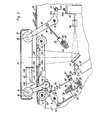
- the device-fixed axes 2 and 3 of a feed roller 4 and a pull-out roller 5 for a template 6 to be imaged are stored in a device frame 1.
- pivot levers 8 are mounted, which carry an axis 9.
- a four-link mechanism formed by cranks 10, a coupling member 11 and cranks 12 is articulated on the axis 9.
- the cranks 12 of this four-bar transmission are mounted on a fixed axis 13.
- the coupling joints of the transmission are formed by axes 14 and 15, of which the axis 14 forms the bearing axis for the second feed roller 16 and the axis 15 forms the bearing axis for the second extraction roller 17 of the roller pairs 4, 16 and 5, 17.
- the coupling member 11 is designed as a largely closed housing with a cover plate 11 a for the pivotable rollers 16 and 17.
- a tension spring 19 engages with a relatively steep spring characteristic.
- the other end of the tension spring 19 is suspended on a pin 20 of a pivot lever 21.
- the pivot lever 21 is mounted on an axis 22 which is fastened to a slide 24 which is displaceable in a guide part 23.
- the carriage 24 is pressed against an adjusting screw 26 by means of a compression spring 25. As a result, the position of the axis 22 can be adjusted in the pulling direction of the spring 19.
- the pivot lever 21 carries yet another suspension pin 27 which is connected to the armature 29 of an electromagnet 30 by means of a pull rod 28.
- the tie rod 29 has a collar 29 a, which together with the upper edge 30 a of the magnet 30 forms a fixed stop for the tie rod 29.
- a pin 31 is attached, on which a tension spring 32 is suspended.
- the other The end of the tension spring 32 is fastened to a device-fixed seat 33.
- the tension spring 32 pulls the pivot lever 8 against a device-fixed stop pin 34 until the spring 19 is tensioned by means of the magnet 29, 30.
- the pivot lever 8 is pulled down until the roller 16 bears against the upper part 35 of the device or the template 6, which is designed as a guideway for the template 6.
- the spring 19 By appropriate adjustment of the adjusting screw 26 or by moving the pivot point 22 in the direction of arrow A - B it can be achieved that the spring 19 generates the normal pressing force for the roller 16 at the moment in which this roller does not cover the surface with a template 6 touches the original transport path 35.
- the setting of the pressing force takes place by shortening or lengthening the power chain between the magnets 29, 30 and the pivot lever 8 due to the relative displacement of the pins 20 and 27 in the pulling direction of the spring caused by the pivot point 22 being displaced.
- the characteristic of the spring 19 is designed so that after the entry of a thick template under the feed roller 16 and the resulting lifting of this roller, the force of the spring increases to the extent that it is for the reduction of the pressing force described in more detail below Roller 17 is required.
- the pressing force for the delivery roller 17 is generated in that a spring 37 is hooked onto a pin 36 of the crank 12, the other end of which is hooked onto a bent tab 39 a of a tab 39 which is longitudinally displaceable in a guide 38.
- a set screw 41 is screwed through a bent-up tab 38 a of the guide 38 and 39 b of the tab 39 or a nut 40 abutting the tab 39 b, by means of which the spring 37 can be tensioned. In this way, it is possible to regulate the output voltage of the pressure spring 37.
- a pull rod 43 is attached to a pin 42 of an arm 12 a of the crank 12, which connects this pin to the tie rod 44 of a magnet 45.
- a collar 44 a of the tie rod 44 together with the upper edge of the magnet 45 forms a fixed stop for the tie rod 44.
- an imaging lens 46 is provided, which images an exposure window 35a formed in the upper part 35 of the device in a known manner on the moving recording medium.
- the cover plate 35 is inserted to guide the template 6, a transparent support plate 48.
- the rollers 4 and 5 which are fixed to the device, are driven by means of rollers 51 and 52 placed over line rollers 49 and 50 at a speed proportional to the speed of the surface of the recording medium, taking into account the imaging scale.
- the copying process is initiated by means of a copy switch 53 which is connected to a central control unit 55 by means of a line 54. Another conductor 56 connects the copy switch 53 to a conductor 57 of a power line 57, 58.
- the central control unit 55 is connected by means of further lines 59 and 60 to a microswitch 61, the sensor 62 of which protrudes into the path of the original 6.
- the stop edge 63 a of a paper stop 63 mounted on the axis 14 also projects into this transport path.
- the paper stop 63 has a stop nose 63 b, which rests on the device upper part 35 at a location next to the original transport path.
- the stop edge 63 a moves upwards at the moment in which the feed roller 16 lowers with its axis 14 downwards.
- the stop 63 a is thus with the lowering of the roller 16 or with the closing of the feed rollers couple 4, 16 removed automatically from the path of template 6.
- the paper stop 63 a is also removed from the path of the template 6 when the coupling member 11 is raised to such an extent that both pairs of rollers 4, 16 and 5, 17 are open.
- the central control unit 55 is designed in such a way that it makes the device ready for copying by pressing the button 53. If a template 6 is now inserted under the roller 16 in the direction of the paper stop 63 a, the microswitch 61, 62 is actuated, as a result of which the central control unit 55 initiates the copying cycle of the device and also the magnet 29, 30 via a line 64 Closing the feed roller pair 4, 16 controls. Another line 65 connects the magnet 30 to the mains conductor 58, whereby the circuit of the magnet is closed.
- both the button 66 and the holding magnet 70 are connected to the mains conductor 58 via lines 71 and 72.
- Another network conductor 73 connects the central control unit 55 to this network conductor.
- a line 69 connecting the relay 70 to the control unit 55 represents the holding circuit of this relay, which is opened when the copy switch 53 is actuated again.
- the central control unit 55 also contains circuit elements which cause the rollers 16 and 17 to deviate from the original are pivoted if, after the end of a normal copy cycle given by the length of the copy paper used, part of the original is still above the paper sensor 62. If one now pushes the original 6 against the transport direction C by the width of the exposure window 35a with the roller pairs 4, 16 and 5, 17 open and then again presses the copy key 53, the next exposure begins exactly at the point at which the previous one Illumination has ended. You get a sheet-by-piece, complete image of the endless original.
- a perforated transport wheel 74 is also provided, the axis 78 of which is mounted on a pivotable arm 75 and engages with its teeth 74a in the generally perforated edge of the endless templates.
- the transport wheel 74 is rotated via a drive wheel 76 and a pinch 77 by a motor, not shown, also controlled by the central control unit 55, in the case of the automatic opening of the transport roller by a length corresponding to the exposure window 35a, as soon as the transport rollers in the previously described were opened by the central control unit 55 or by the paper sensor 62.
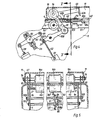
- Figure 3 shows the open position of the original transport rollers.
- the magnet 29, 30 is de-energized and the spring 19 is thus relaxed.
- the tie rod 44 of the magnet 45 is tightened up to its stop.
- the cranks 12 are pivoted clockwise to such an extent that, in addition to the roller 15, the roller 16 is also pivoted away from its counter roller via the coupling member 11.
- the stop arranged on the coupling member 79 lifts the paper stop 63 a from the original transport surface 35, so that, for. B. an endless to be copied location, as detailed in the German patent application P from the same day, can be freely moved over the exposure window 35 a.
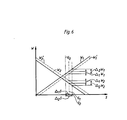
- FIG. 6 shows the relationship between the pressing force W 1 of the pull-in rollers and the pressing force W 2 of the pull-out rollers as a function of the spring travel S in the form of a diagram. It can be seen from this that in the vicinity of the basic position G O , indicated by a dash-dotted line, in which both rollers of the original transport plane 35 rest without an intermediate layer of an original to be transported, both roller pressing forces W 1 and W 2 have approximately the same size.
- the output variable of the forces W 1 and W 2 can still be adjusted by adjusting the adjusting screws 26 and 41 (FIG. 1), such as, for. 8. represented by the dashed lines W 1 'and W2', change.
- the pressure forces W 1 and W 2 shift accordingly by the amounts ⁇ 2 W 1 and ⁇ 2 W 2 .
- the pressure force W 2 of the pull-out roller is approaching zero and could, like 6 is readily apparent from the diagram in accordance with FIG. 6, can also readily assume negative values. That is, from a certain original thickness, the pull-out roller 17 lifts off the original transport surface 35 and only reaches its equilibrium of forces again in a position in which it is at a certain distance from this surface. By appropriate choice of the crank angle and the output spring forces, it can easily be set up that this distance corresponds approximately to the thickness of the template located under the feed roller, so that this template runs in practically without a run-in impact under the feed roller.
- the diagram according to FIG. 6 corresponds to the case in which both cranks 10 and 12 are arranged at 45 °. In principle, the same conditions result for other crank angles.
- the reduced by the amounts .DELTA.W two pressing force W 2 then but not wücde more are on the starting line W 2nd
- FIG. 2 shows the conditions for springs 19 and 37 acting on the cranks 10 and 12, respectively.
- the spring forces could also be replaced in whole or in part by weight forces, whereby in the case of the pull-out roller 15 these spring or weight forces could act on the roller axis 17 in addition to in a direction perpendicular to the crank 12 in a direction perpendicular to the original transport plane 35.
- the swivel lever 8 on which the crank 10 for the feed roller 16 is articulated, is connected by means of a pull rod 82 to a pin 81 arranged on a swivel lever 80.
- the adjusting screw 26 acts on the axis 83 of the pivot lever 80.
- the swivel lever is fastened in this case by means of bushings 108 a and 108 b and adjusting screws 84 and 85 approximately in the middle of the axes 107 and 109 which extend essentially over the entire roller arrangement.
- the pivoting movement transmitted from the pull rod 82 to the pivoting lever 108 can therefore only propagate onto the cranks 10 using these long, resilient axes 107 and 109.
- the two axes 107 and 109 which are twisted with respect to one another by means of the swivel lever 108 form a pressure spring of arbitrarily steep characteristics for the feed roller 16, which in this case is divided into a plurality of transport rollers 16 a to 16 c lined up on an axis.
Landscapes
- Physics & Mathematics (AREA)
- General Physics & Mathematics (AREA)
- Delivering By Means Of Belts And Rollers (AREA)
- Holders For Sensitive Materials And Originals (AREA)
- Exposure Or Original Feeding In Electrophotography (AREA)
- Optical Systems Of Projection Type Copiers (AREA)
- Registering Or Overturning Sheets (AREA)
Applications Claiming Priority (2)
| Application Number | Priority Date | Filing Date | Title |
|---|---|---|---|
| DE2843522 | 1978-10-05 | ||
| DE19782843522 DE2843522C2 (de) | 1978-10-05 | 1978-10-05 | Vorlagenandruckvorrichtung für den Bildfensterbereich eines Durchlaufkopiergerätes |
Publications (2)
| Publication Number | Publication Date |
|---|---|
| EP0010604A1 true EP0010604A1 (fr) | 1980-05-14 |
| EP0010604B1 EP0010604B1 (fr) | 1982-11-03 |
Family
ID=6051519
Family Applications (1)
| Application Number | Title | Priority Date | Filing Date |
|---|---|---|---|
| EP19790103481 Expired EP0010604B1 (fr) | 1978-10-05 | 1979-09-17 | Tireuse à mouvement continu |
Country Status (3)
| Country | Link |
|---|---|
| EP (1) | EP0010604B1 (fr) |
| JP (1) | JPS5550259A (fr) |
| DE (1) | DE2843522C2 (fr) |
Cited By (1)
| Publication number | Priority date | Publication date | Assignee | Title |
|---|---|---|---|---|
| EP0050508A3 (fr) * | 1980-10-20 | 1983-05-11 | Ing. C. Olivetti & C., S.p.A. | Dispositif d'acheminement de documents dans une machine à photocopier |
Families Citing this family (4)
| Publication number | Priority date | Publication date | Assignee | Title |
|---|---|---|---|---|
| JPS5680543U (fr) * | 1979-11-27 | 1981-06-30 | ||
| JPS57124840U (fr) * | 1981-01-27 | 1982-08-04 | ||
| JPH0789639B2 (ja) * | 1985-12-06 | 1995-09-27 | 富士写真フイルム株式会社 | 光ビーム走査装置 |
| JP2002090906A (ja) * | 2000-09-14 | 2002-03-27 | Noritsu Koki Co Ltd | 感光材料の平面性維持部材およびそれを備えた写真焼付装置 |
Citations (6)
| Publication number | Priority date | Publication date | Assignee | Title |
|---|---|---|---|---|
| DE1522161B (de) * | Lumoprint Zindler Kg, 2000 Hamburg | Kopiervorri chtung | ||
| CH442987A (de) * | 1966-10-12 | 1967-08-31 | Wissenschaftliches Forschungsi | Kopiergerät mit Durchlaufbelichtung |
| DE1947877A1 (de) * | 1968-09-23 | 1970-04-23 | Intercontinental Photocopy Cor | Kopiergeraet mit Buchkopiervorsatz |
| DE1797416A1 (de) * | 1968-09-26 | 1971-11-11 | Lumoprint Zindler Kg | Kopiervorrichtung |
| US3689141A (en) * | 1970-05-19 | 1972-09-05 | Addressograph Multigraph | Electrostatic exposure time control |
| US3909128A (en) * | 1973-08-31 | 1975-09-30 | Xerox Corp | Control logic for changing a multi-mode copier/duplicator from one mode to another |
-
1978
- 1978-10-05 DE DE19782843522 patent/DE2843522C2/de not_active Expired
-
1979
- 1979-09-17 EP EP19790103481 patent/EP0010604B1/fr not_active Expired
- 1979-10-03 JP JP12692179A patent/JPS5550259A/ja active Granted
Patent Citations (6)
| Publication number | Priority date | Publication date | Assignee | Title |
|---|---|---|---|---|
| DE1522161B (de) * | Lumoprint Zindler Kg, 2000 Hamburg | Kopiervorri chtung | ||
| CH442987A (de) * | 1966-10-12 | 1967-08-31 | Wissenschaftliches Forschungsi | Kopiergerät mit Durchlaufbelichtung |
| DE1947877A1 (de) * | 1968-09-23 | 1970-04-23 | Intercontinental Photocopy Cor | Kopiergeraet mit Buchkopiervorsatz |
| DE1797416A1 (de) * | 1968-09-26 | 1971-11-11 | Lumoprint Zindler Kg | Kopiervorrichtung |
| US3689141A (en) * | 1970-05-19 | 1972-09-05 | Addressograph Multigraph | Electrostatic exposure time control |
| US3909128A (en) * | 1973-08-31 | 1975-09-30 | Xerox Corp | Control logic for changing a multi-mode copier/duplicator from one mode to another |
Cited By (1)
| Publication number | Priority date | Publication date | Assignee | Title |
|---|---|---|---|---|
| EP0050508A3 (fr) * | 1980-10-20 | 1983-05-11 | Ing. C. Olivetti & C., S.p.A. | Dispositif d'acheminement de documents dans une machine à photocopier |
Also Published As
| Publication number | Publication date |
|---|---|
| JPS5550259A (en) | 1980-04-11 |
| EP0010604B1 (fr) | 1982-11-03 |
| DE2843522C2 (de) | 1980-07-31 |
| JPS5635868B2 (fr) | 1981-08-20 |
| DE2843522B1 (de) | 1979-11-15 |
Similar Documents
| Publication | Publication Date | Title |
|---|---|---|
| DE69119303T2 (de) | Blattzufuhrvorrichtung | |
| DE3018853C2 (de) | Fixiervorrichtung für Tonerbilder | |
| DE2539406C2 (de) | Blattfördervorrichtung, insbesondere für ein Kopiergerät | |
| DE3439132C2 (fr) | ||
| DE69307840T2 (de) | Auslage für Bogendruckmaschine | |
| DE68904810T2 (de) | Elektrophotographisches druckgeraet. | |
| DE2857464C2 (de) | Zuführvorrichtung für bahnförmiges, in einer Kassette aufgerolltes Aufzeichnungsmaterial in einem Kopier- oder Vervielfältigungsgerät | |
| DE1597397C3 (de) | Verfahren und Vorrichtung zum Vorlagenwechsel bei einem Kopiergerät | |
| DE2647638A1 (de) | Handhabungsvorrichtung fuer vorlagen | |
| DE2546463B2 (de) | Blattzufuhrvorrichtung fuer eine kopiermaschine | |
| DE2456892C2 (de) | Vorrichtung zum Einführen und Entnehmen von blattförmigem Material bei Mikrofilmlesegeräten | |
| DE19821758A1 (de) | Bilderzeugungsvorrichtung, die freigebbare Blattförderbahnen aufweist, und Verfahren für diese Vorrichtung | |
| DE2506857C3 (de) | VerschluUeinrichtung für die Kopiertisch-Abdeckung eines Kopiergerätes | |
| DE3212652A1 (de) | Blatteinzugsvorrichtung fuer ein kopiergeraet o.dgl. | |
| EP0010604B1 (fr) | Tireuse à mouvement continu | |
| DE69308901T2 (de) | Kopiereinrichtung mit zusätzlicher Papierzuführung | |
| DE2164220C2 (de) | Projektionskopiergerät mit einem Buchvorlagenschlitten und einer Vorschubeinrichtung für Blattvorlagen | |
| DE1761692A1 (de) | Vorrichtung zum Verschliessen von Kartons usw.mittels Klebebaender | |
| DE3872708T2 (de) | Blatttrennungsapparat. | |
| DE2724182A1 (de) | Blatthandhabungsvorrichtung | |
| DE2653024B2 (de) | Antriebssteuereinrichtung für den Vor- und Rücklauf des Belichtungswagens eines Kopiergeräts | |
| DE1561121A1 (de) | Blattzufuehrungsvorrichtung | |
| EP0083025A1 (fr) | Dispositif pour isoler des feuilles | |
| DE69216192T2 (de) | Doppelseitiger Drucker | |
| DE2607774B2 (de) | Vorrichtung zum steuerbaren Halten von Vorlagen an einer bewegten Auflagefläche eines Fotokopiergeräts |
Legal Events
| Date | Code | Title | Description |
|---|---|---|---|
| PUAI | Public reference made under article 153(3) epc to a published international application that has entered the european phase |
Free format text: ORIGINAL CODE: 0009012 |
|
| AK | Designated contracting states |
Designated state(s): BE CH FR GB IT NL |
|
| 17P | Request for examination filed | ||
| ITF | It: translation for a ep patent filed | ||
| GRAA | (expected) grant |
Free format text: ORIGINAL CODE: 0009210 |
|
| AK | Designated contracting states |
Designated state(s): BE CH FR GB IT NL |
|
| ET | Fr: translation filed | ||
| PGFP | Annual fee paid to national office [announced via postgrant information from national office to epo] |
Ref country code: NL Payment date: 19830707 Year of fee payment: 5 |
|
| PGFP | Annual fee paid to national office [announced via postgrant information from national office to epo] |
Ref country code: BE Payment date: 19830831 Year of fee payment: 5 |
|
| PG25 | Lapsed in a contracting state [announced via postgrant information from national office to epo] |
Ref country code: CH Effective date: 19830930 |
|
| GBPC | Gb: european patent ceased through non-payment of renewal fee | ||
| PG25 | Lapsed in a contracting state [announced via postgrant information from national office to epo] |
Ref country code: FR Free format text: LAPSE BECAUSE OF NON-PAYMENT OF DUE FEES Effective date: 19840530 |
|
| REG | Reference to a national code |
Ref country code: CH Ref legal event code: PL |
|
| REG | Reference to a national code |
Ref country code: FR Ref legal event code: ST |
|
| PG25 | Lapsed in a contracting state [announced via postgrant information from national office to epo] |
Ref country code: BE Effective date: 19840930 |
|
| BERE | Be: lapsed |
Owner name: AGFA-GEVAERT A.G. Effective date: 19840917 |
|
| PG25 | Lapsed in a contracting state [announced via postgrant information from national office to epo] |
Ref country code: NL Effective date: 19850401 |
|
| NLV4 | Nl: lapsed or anulled due to non-payment of the annual fee | ||
| PG25 | Lapsed in a contracting state [announced via postgrant information from national office to epo] |
Ref country code: GB Effective date: 19881118 |
|
| PLBE | No opposition filed within time limit |
Free format text: ORIGINAL CODE: 0009261 |
|
| STAA | Information on the status of an ep patent application or granted ep patent |
Free format text: STATUS: NO OPPOSITION FILED WITHIN TIME LIMIT |