EP0010294B1 - Neue 1-(2-Halogenäthyl)-1-nitrosoharnstoffe und deren Herstellung - Google Patents
Neue 1-(2-Halogenäthyl)-1-nitrosoharnstoffe und deren Herstellung Download PDFInfo
- Publication number
- EP0010294B1 EP0010294B1 EP79104000A EP79104000A EP0010294B1 EP 0010294 B1 EP0010294 B1 EP 0010294B1 EP 79104000 A EP79104000 A EP 79104000A EP 79104000 A EP79104000 A EP 79104000A EP 0010294 B1 EP0010294 B1 EP 0010294B1
- Authority
- EP
- European Patent Office
- Prior art keywords
- group
- hal
- compound
- chloroethyl
- coor
- Prior art date
- Legal status (The legal status is an assumption and is not a legal conclusion. Google has not performed a legal analysis and makes no representation as to the accuracy of the status listed.)
- Expired
Links
Classifications
-
- C—CHEMISTRY; METALLURGY
- C07—ORGANIC CHEMISTRY
- C07D—HETEROCYCLIC COMPOUNDS
- C07D295/00—Heterocyclic compounds containing polymethylene-imine rings with at least five ring members, 3-azabicyclo [3.2.2] nonane, piperazine, morpholine or thiomorpholine rings, having only hydrogen atoms directly attached to the ring carbon atoms
- C07D295/22—Heterocyclic compounds containing polymethylene-imine rings with at least five ring members, 3-azabicyclo [3.2.2] nonane, piperazine, morpholine or thiomorpholine rings, having only hydrogen atoms directly attached to the ring carbon atoms with hetero atoms directly attached to ring nitrogen atoms
- C07D295/28—Nitrogen atoms
- C07D295/32—Nitrogen atoms acylated with carboxylic or carbonic acids, or their nitrogen or sulfur analogues
-
- A—HUMAN NECESSITIES
- A61—MEDICAL OR VETERINARY SCIENCE; HYGIENE
- A61P—SPECIFIC THERAPEUTIC ACTIVITY OF CHEMICAL COMPOUNDS OR MEDICINAL PREPARATIONS
- A61P35/00—Antineoplastic agents
Definitions
- 3-position substituted 1- (2-chloroethyl) -3-nitrosoureas with anti-tumor effects are known, e.g. from Chemical Abstracts 82, (1975), 43263y, where ring systems bonded to the nitrosourea component via methylene groups, e.g. Pyridine and pyrimidine, and their action against leukemia L1210 are described.
- methylene groups e.g. Pyridine and pyrimidine
- the L1210 mouse leukemia is comparatively easy to influence, since the treatments with the compounds to be tested are usually given on the first or second day after intraperitoneal application of the leukemia cells.
- a much harder tumor model is e.g. also the rat leukemia test L5222, where mostly very late, namely on the 8th day, after the inoculation of the tumor, the substance to be tested is applied, i.e. at a time when it can be assumed that the brain or the meninges of leukemia cells are populated.
- heterocyclic ring-substituted compounds shown here are prepared using cyclic N-amino compounds (hydrazines), such as N-aminopiperidine, N-aminomorpholine, N-amino-2,6-dimethylmorpholine.
- hydrophilines such as N-aminopiperidine, N-aminomorpholine, N-amino-2,6-dimethylmorpholine.
- R, and R 2 may be part of a saturated or unsaturated ring system, in particular a 6-membered ring system, which may also contain further heteroatoms, in particular oxygen or nitrogen.
- the ring can additionally be substituted with short-chain alkyl groups or up to 3 groups OH, COOH, COOR, where R is an alkyl group with 1 to 6 carbon atoms, with CONH, and the chloroethyl nitrosoureido group.
- Hal means chlorine or fluorine.
- R, and R 2 can also mean H, and straight-chain or branched-chain alkyl (to C s ), which also has up to 3 OH groups of one or more (up to 3) ⁇ OSO 2 CH 3 , COOH, COOR groups , where R has the meaning given above or CONH, or halogen may be substituted.
- hydrazine derivatives i.e. acyclic N-amino compounds
- hydrazine derivatives namely 1-dialkyl-4-nitroso-4- (2-chloroethyl) semicarbazides, which also have an interesting group of chemotherapeutic agents represent anti-tumor effects.
- the spectroscopic data confirm the uniformity and structure of the connection.
- the IR spectrum (KBr compact) shows the typical bands at 3240 cm -1 (NH), 1710 cm -1 (CO), 1525 cm -1 (CNH) and 1480 cm -1 (NO).
- Characteristic fragments in the mass spectrum are in the upper mass range at m / e 204 (M-NO) + with the peak ratio of 3: 1 to the isotope peak typical for monochloro compounds at m / e 206, at m / e 126 (M-Cl (CH 2 ) 2 N 2 OH * and at m / e 99 (M ⁇ CON 2 O (CH 2 ) 2 Cl)
- M-NO isotope peak typical for monochloro compounds at m / e 206, at m / e 126 (M-Cl (CH 2 ) 2 N 2 OH * and at m / e 99 (M ⁇ CON 2 O (CH 2 ) 2 Cl)
- the substance gives the typical color reaction to N-nitroso compounds (G. Eisenbrand, R. Preussmann, drug research. 20, 1513 (1970)).
- Pale yellow crystals are obtained from n-pentane / dichloromethane and, after recrystallization from ethyl formate / n-pentane, are uniform by thin layer chromatography (silica gel foils, mobile phase analogous to Example 1).
- Spectroscopic data confirm the uniformity and structure of the connection.
- the IR spectrum shows bands typical of the nitrosoureas at 3205 cm -1 (NH), 1710 cm -1 (CO), 1525 cm -1 (CNH) and 1480 cm -1 (NO).
- Characteristic fragments in the mass spectrum are at m / e 206 (M-NO) + , with the peak ratio of 3: 1 to the isotope peak typical of monochloro compounds at m / e 208, at m / e 128 (M ⁇ Cl ⁇ ( CH 2 ) 2 N 2 OH) + and at m / e 101 (M ⁇ CON 2 O (CH 2 ) 2 Cl) +.
- the substance gives the typical color reaction to N-nitroso compounds.
- the IR spectrum (KBr compact) shows the typical nitrosourea bands (NH, CO, CNH, NO).
- the substance gives the typical color reaction to N-nitroso compounds.
- the nuclear magnetic resonance spectrum (D 6 -acetone) confirms the uniformity and structure of the compound.
- the NH signal appears at 8.9 ppm
- the upfield triplet at b 3.60 ppm.
- the substance gives the typical color reaction to N-nitroso compounds.
Landscapes
- Organic Chemistry (AREA)
- Chemical & Material Sciences (AREA)
- Health & Medical Sciences (AREA)
- Life Sciences & Earth Sciences (AREA)
- General Health & Medical Sciences (AREA)
- Nuclear Medicine, Radiotherapy & Molecular Imaging (AREA)
- General Chemical & Material Sciences (AREA)
- Pharmacology & Pharmacy (AREA)
- Chemical Kinetics & Catalysis (AREA)
- Animal Behavior & Ethology (AREA)
- Medicinal Chemistry (AREA)
- Public Health (AREA)
- Veterinary Medicine (AREA)
- Pharmaceuticals Containing Other Organic And Inorganic Compounds (AREA)
- Heterocyclic Carbon Compounds Containing A Hetero Ring Having Nitrogen And Oxygen As The Only Ring Hetero Atoms (AREA)
- Hydrogenated Pyridines (AREA)
- Acyclic And Carbocyclic Compounds In Medicinal Compositions (AREA)
- Organic Low-Molecular-Weight Compounds And Preparation Thereof (AREA)
Description
- Die Synthese von unsymmetrisch 1,3-disubstituierten Nitrosoharnstoffen durch Umsetzung von N-Nitroso-N-alkylcarbamoylazid mit einem Diamin, Aminoalkohol oder Aminosäurederivat ist aus der DE-PS 26 23 420 bekannt.
- In 3-Stellung substituierte 1-(2-Chloräthyl)-3-nitrosoharnstoffe mit tumorhemmender Wirkung sind bekannt, z.B. aus Chemical Abstracts 82, (1975), 43263y, wo über Methylengruppen an die Nitrosoharnstoffkomponente gebundene Ringsysteme, z.B. Pyridin und Pyrimidin, und deren Wirkung gegen Leukämie L1210 beschrieben werden. Im Test am schwierig zu beeinflussenden Yoshida Sarkom, welches in der Colonwand von Ratten implantiert wurde und ein menschlichen Colontumoren vergleichbares Tumormodell darstellt, erwiesen sich diese Verbindungen jedoch als sehr wenig wirksam. Dabei ist zu berücksichtigen, daß die Mäuseleukämie L1210 vergleichweise leicht zu beeinflussen ist, da meist schon am ersten oder zweiten Tag nach intraperitonealer Applikation der Leuk- ämiezellen die Behandlungen mit den zu testenden Verbindungen erfolgen. Ein wesentlich härteres Tumormodell stellt demgegenüber z.B. auch der Rattenleukämietest L5222 dar, wo meist sehr spät, nämlich am 8. Tage, nach der Inokulation des Tumors, die zu testende Substanz appliziert wird, also zu einem Zeitpunkt, wo davon auszugehen ist, daß schon das Gehirn bzw. die Meningen von Leukämiezellen besiedelt sind.
- Es hat sich nun gezeigt, daß durch heterocyclische Ringe oder Alkylreste substituierte Analoga des klinisch etablierten Chemotherapeutikums CCNU (1-(2-Chloräthyl)-1-nitroso-3-(cyclohexyl)-harnstoff) erhalten werden können, die ebenfalls tumorhemmende Wirkung besitzen. Man kann also ausgehend von N-(2-Halogenäthyl)-N-nitrosocarbamoylazid, das ebenfalls in der DE-PS 26 23 420 gezeigt ist, zu einer weiteren Gruppe interessanter Chemotherapeutika gelangen. Bezüglich der Herstellung des Halogenäthyl-N-nitrosocarbamoylazids sei auf die genannte DE-PS verwiesen.
- Die Herstellung der hier gezeigten heterocyclischen ringsubstituierten Verbindungen erfolgt mit cyclischen N-Aminoverbindungen (Hydrazinen), wie N-Aminopiperidin, N-Aminomorpholin, N-Amino-2,6-dimethylmorpholin.
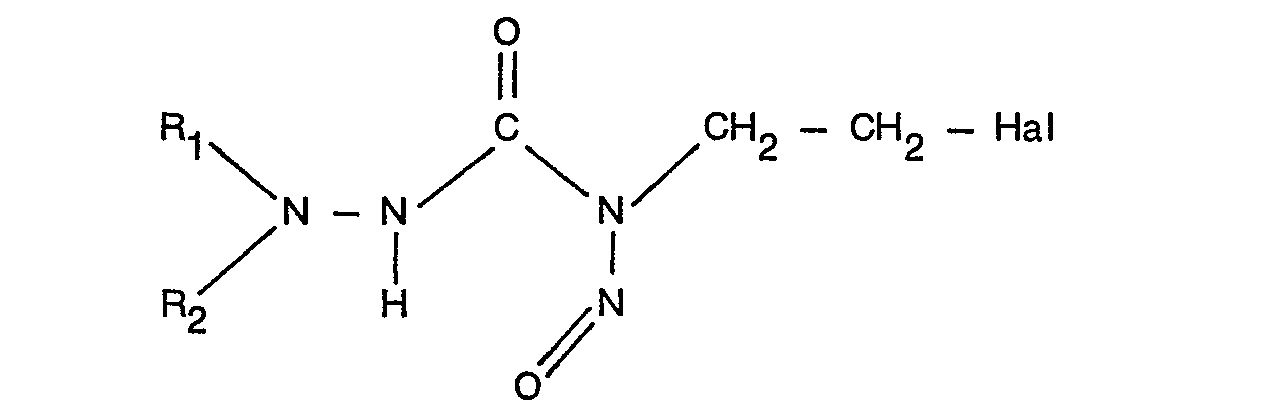
- Die neuen Verbindungen entsprechen der allgemeinen Formel:

- Der Ring kann zusätzlich mit kurzkettigen Alkylgruppen oder bis zu 3 Gruppen OH, COOH, COOR, wobei R eine Alkylgruppe mit 1 bis 6 Kohlenstoffatomen bedeutet, mit CONH, sowie der Chloräthylnitrosoureidogruppe substituiert sein. Der Ausdruck Hal bedeutet Chlor oder Fluor.
- R, und R2 können außerdem H, sowie gerad- oder verzweigtkettiges Alkyl (bis Cs) bedeuten, das außerdem mit bis zu 3 OH-Gruppen einer oder mehreren (bis zu 3) ―OSO2CH3, COOH, COOR-Gruppen, wobei R die oben angegebene Bedeutung besitzt oder CONH, oder Halogen substituiert sein kann.
- In diesem Fall geht man von Hydrazinderivaten aus, also acyclischen N-Aminoverbindungen und erhält nicht heterocyclisch ringsubstituierte Verbindungen sondern Hydrazinderivate, nämlich 1-Dialkyl-4-nitroso-4-(2-chloräthyl)-semicarbazide, die ebenfalls eine interessante Gruppe von Chemotherapeutika mit tumorhemmender Wirkung darstellen.
- Die folgenden Beispiele erläutern die Erfindung.
- 1-(2-Chloräthyl)-1-nitrosoo-3-(1-piperidino)harnstoff Zu einer Lösung von 0,1 Mol N-(2-Chloräthyl)-N-nitrosocarbamoylazid in 75 ml Dichlormethan wird bei -5°C unter Rühren innerhalb 2 h eine Lösung von 0,2 Mol N-Aminopiperidin in 20 ml eines Gemisches von 4 Volumteilen Dichlormethan und 1 Volumteil n-Pentan hinzugetropft. Nach der Zugabe wird eine Stunde nachgerührt; es fällt ein weißlich-gelber Niederschlag aus. Anschließend wird mit gleichem Volumen 0,1 n H2S01 ausgeschüttelt. Die organische Phase wird über Na2SO4 getrocknet und am Rotationsverdampfer eingeengt. Aus Äthylformiat/n-Pentan werden beim Stehen im Tiefkühlfach gelbe Kristalle erhalten, die nach Umkristallisieren aus dem gleichem Lösungsmittelgemisch dünnschichtchromatographisch einheitlich sind. (Kieselgelfolien, Laufmittel n-Pentan/Diäthyläther/Dichlormethan 5:2:2.)
- Ausbeute: 21%; Fp.: 88-89°C;

- Die spektroskopischen Daten betätigen Einheitlichkeit und Struktur der Verbindung. So zeigt das IR-Spektrum (KBr-Preßling) die typischen Banden bei 3240 cm-1 (NH), 1710 cm-1 (CO), 1525 cm-1 (CNH) und 1480 cm-1 (NO). Im NMR-Spektrum (D6-Aceton) erscheint das NH-Signal bei δ = 8,9 ppm (breit, D2O-austauschbar), das typische downfield-Triplett des nitrosierten Chloräthylureidostrukturelementes liegt bei 8 = 4,17 ppm (CH2―NNO) da upfield-Triplett bei 8 = 3,60 ppm (CI-CH2). Charakteristische Fragmente im Massenspektrum (70 ev) liegen im oberen Massenbereich bei m/e 204 (M-NO)+ mit dem für Monochlorverbindungen typischen Peakverhältnis von 3:1 zum Isotopenpeak bei m/e 206, bei m/e 126 (M-Cl(CH2)2N2OH* und bei m/e 99 (M―CON2O(CH2)2Cl). Die Substanz gibt die typische Farbreaktion auf N-Nitrosoverbindungen (G. Eisenbrand, R. Preußmann, Arzneimittelforsch. 20, 1513 (1970)).
- Tierversuchsergebnisse zeigen eine sehr gute Wirksamkeit bei der Rattenleukämie L 5222.
- 1-(2-Chloräthyl)-1-nitroso-3-(4-morpholino)-harnstoff
- Zu einer Lösung von 0,1 Mol N-(2-Chloräthyl)-N-nitrosocarbamoylazid in 75 ml Dichlormethan wird bei -5°C unter Rühren innerhalb 2 h eine Lösung von 0,2 Mol N-Aminomorpholin in 20 ml eines Gemisches von 4 Volumteilen Dichlormethan und 1 Volumanteil n-Pentan hinzugetropft. Die weitere Aufarbeitung erfolgt analog Beispiel 1. Aus n-Pentan/Dichlormethan werden schwachgelbe Kristalle erhalten, die nach Umkristallisieren aus Äthyiformiat/n-Pentan dünnschichtchromatographisch einheitlich sind (Kieselgel-Folien, Laufmittel analog Beispiel 1).
- Ausbeute: 40%; Fp.: 77-78°C;

- Spektroskopische Daten bestätigen Einheitlichkeit und Struktur der Verbindung. Das IR-Spektrum zeigt für die Nitrosoharnstoffe typische Banden bei 3205 cm-1 (NH), 1710 cm-1 (CO), 1525 cm-1 (CNH) und 1480 cm-1 (NO). Im NMR-Spektrum (D6-Aceton) liegt das NH-Signal bei 8 = 9,1 ppm (breit, D20-austauschbar), das downfield-Triplett des nitrosierten Chloräthylstrukturelements liegt bei δ = 4,17 ppm (CH2―NNO), das upfield-Triplett, teilweise überlappend mit den Signalen der CHz-Gruppen in Stellung 2 und 4 des Morpholinringes, liegt bei 8 = 3,60 ppm (CI-CHz). Charakteristische Fragmente im Massenspektrum (70 ev) liegen bei m/e 206 (M-NO)+, mit dem für MonochlorVerbindungen typischen Peakverhältnis von 3:1 zum Isotopenpeak bei m/e 208, bei m/e 128 (M―Cl―(CH2)2N2OH)+ und bei m/e 101 (M―CON2O(CH2)2Cl)+. Die Substanz gibt die typische Farbreaktion auf N-Nitrosoverbindungen.
- Tierversuchsergebnisse zeigen sehr gute Wirksamkeit bei der Pattenleukämie L 5222. Die Verbindung ist im Gegensatz zur klinisch etablierten Substanz CCNO sehr gut wasserlöslich. Sie ist zur Zeit in Erprobung am in das Colon implantierten Yoshida Sarkom der Ratte und zeigt dort bessere therapeutische Wirksamkeit als die klinisch bei Colontumoren eingesetzte Verbindung Methyl-CCNU.
- 1-(2-Chloräthyl)-1-nitroso-3-(4-(2,6-dimethyl-morpholino))-harnstoff
- Zu einer Lösung von 0,02 Mol N-(2-Chloräthyl)-N-nitrosocarbamoylazid in 15 ml Dichlormethan wird bei -5°C unter Rühren innerhalb 2 h 0,04 Mol 4-Amino-2,6-dimethylmorpholin in 20 ml Dichlormethan hinzugetropft. Nach weiterem einstündigem Rühren wird weiteraufgearbeitet wie in Beispiel 1. Aus Dichlormethan/n-Pentan werden schwach-gelbe Kristalle erhalten, die nach Umkristallisation dünnschichtchromatographisch einheitlich sind.
- Ausbeute: 45% d.M.; Fp: 102-104°C
- Spektroskopische Daten bestätigen Einheitlichkeit und Struktur der Verbindung.
- Das IR-Spektrum (KBr-Preßling) zeigt die typischen Nitrosoharnstoffbanden (NH, CO, CNH, NO). Im NMR-Spektrum (D6-Aceton) erscheint das NH-Signal bei δ = 9 ppm, das typische downfield Triplett des nitrosierten Chloräthylnitrosoureidostrukturelements liegt bei 8 = 4,17 (CH2―NNO), das upfield Triplett, teilweise überlagert von den Ring-CH-Signalen in Stellung 2 und 6, liegt bei b = 3,60 ppm. Das Signal der Methylgruppen in Stellung 2 und 6 des Morpholinringes erscheint bei δ = 1,15 ppm. Die Substanz gibt die typische Farbreaktion auf N-Nitrosoverbindungen.
- 1-(2-Chloräthyl)-1-nitroso-3-dimethylaminoharnstoff
- In einer Lösung von 0,05 Mol N - (2 - Chloräthyl) - N - nitrosocarbamoylazid in 15 ml Isopropanol/Tetrachlorkohlenstoff wird bei -10°C unter Rühren 0,1 Mol Dimethylhydrazin in 10 ml Isopropanol so langsam zugetropft, daß der pH-Wert nicht über 7,5 ansteigt (3 h Reaktionszeit). Nach weiterem einstündigem Rühren wird mit verdünnter Schwefelsäure angesäuert und mit Äthylformiat ausgeschüttelt. Die organische Phase wird über Na2SO4 getrocknet und eingeengt. Das Rohprodukt wurde durch Säulenchromatographie an einer Silicagel-Fertigsäule (Laufmittel Äther(Äthanol 98:2) gereinigt. Nach Abziehen des Lösungsmittels blieb ein öliger Rückstand der dünnschichtchromatographisch einheitlich war.
- Ausbeute: 20%
- Das Kernresonanzspektrum (D6-Aceton) bestätigt Einheitlichkeit und Struktur der Verbindung. Das NH-Signal erscheint bei 8,9 ppm, das downfield Triplett des nitrosierten Chloräthylnitrosoureidostrukturelementes liegt bei 8 = 4,17 (CH2NNO), das upfield Triplett bei b = 3,60 ppm. Das Signal der Methylgruppen erscheint bei 8 = 2,75 ppm. Die Substanz gibt die typische Farbreaktion auf N-Nitrosoverbindungen.
Claims (4)
Priority Applications (1)
| Application Number | Priority Date | Filing Date | Title |
|---|---|---|---|
| AT79104000T ATE1063T1 (de) | 1978-10-19 | 1979-10-16 | Neue 1-(2-halogenaethyl)-1-nitrosoharnstoffe und deren herstellung. |
Applications Claiming Priority (2)
| Application Number | Priority Date | Filing Date | Title |
|---|---|---|---|
| DE2845574 | 1978-10-19 | ||
| DE19782845574 DE2845574A1 (de) | 1978-10-19 | 1978-10-19 | Durch heterocyclische ringe oder alkylreste substituierte analoga von ccnu und verfahren zu deren herstellung |
Publications (2)
| Publication Number | Publication Date |
|---|---|
| EP0010294A1 EP0010294A1 (de) | 1980-04-30 |
| EP0010294B1 true EP0010294B1 (de) | 1982-05-19 |
Family
ID=6052599
Family Applications (1)
| Application Number | Title | Priority Date | Filing Date |
|---|---|---|---|
| EP79104000A Expired EP0010294B1 (de) | 1978-10-19 | 1979-10-16 | Neue 1-(2-Halogenäthyl)-1-nitrosoharnstoffe und deren Herstellung |
Country Status (6)
| Country | Link |
|---|---|
| US (1) | US4377687A (de) |
| EP (1) | EP0010294B1 (de) |
| JP (1) | JPS5557552A (de) |
| AT (1) | ATE1063T1 (de) |
| CA (1) | CA1138869A (de) |
| DE (1) | DE2845574A1 (de) |
Families Citing this family (12)
| Publication number | Priority date | Publication date | Assignee | Title |
|---|---|---|---|---|
| US20040072889A1 (en) * | 1997-04-21 | 2004-04-15 | Pharmacia Corporation | Method of using a COX-2 inhibitor and an alkylating-type antineoplastic agent as a combination therapy in the treatment of neoplasia |
| CA2357977A1 (en) * | 1998-12-29 | 2000-07-06 | Donald R. Kahn | Method for prevention or treatment of acute allograft rejection and a pharmaceutical composition therefor |
| EP2256106B1 (de) | 2003-07-22 | 2015-05-06 | Astex Therapeutics Limited | 3,4-disubstituierte 1H-Pyrazol-Verbindungen und deren Verwendung als Cyclin-abhängige Kinase (CDK) und Glycogen Synthase Kinase-3 (GSK-3) Modulatoren |
| EP1845973B1 (de) | 2005-01-21 | 2015-08-12 | Astex Therapeutics Limited | Pharmazeutische verbindungen |
| RU2436575C2 (ru) * | 2005-01-21 | 2011-12-20 | Астекс Терапьютикс Лимитед | Соединения для использования в фармацевтике |
| AR054425A1 (es) | 2005-01-21 | 2007-06-27 | Astex Therapeutics Ltd | Sales de adicion de piperidin 4-il- amida de acido 4-(2,6-dicloro-benzoilamino) 1h-pirazol-3-carboxilico. |
| US8404718B2 (en) | 2005-01-21 | 2013-03-26 | Astex Therapeutics Limited | Combinations of pyrazole kinase inhibitors |
| US8916552B2 (en) | 2006-10-12 | 2014-12-23 | Astex Therapeutics Limited | Pharmaceutical combinations |
| US8883790B2 (en) | 2006-10-12 | 2014-11-11 | Astex Therapeutics Limited | Pharmaceutical combinations |
| DK2750683T4 (da) | 2011-10-03 | 2021-04-12 | Croda Int Plc | Nanopartikler, fremgangsmåde til fremstilling og anvendelse deraf som bærer for amfipatiske eller hydrofobe molekyler inden for medicin, herunder cancerbehandling, og i fødevarerelaterede forbindelser |
| WO2014163558A1 (en) | 2013-04-01 | 2014-10-09 | Moreinx Ab | Nanoparticles, composed of sterol and saponin from quillaja saponaria molina process for preparation and use thereof as carrier for amphipatic of hydrphobic molecules in fields of medicine including cancer treatment and food related compounds |
| EP3669890A1 (de) | 2018-12-18 | 2020-06-24 | Croda International PLC | Filamentöse nanopartikel mit impfstoffadjuvanswirkung |
Family Cites Families (3)
| Publication number | Priority date | Publication date | Assignee | Title |
|---|---|---|---|---|
| CA979446A (en) * | 1971-06-28 | 1975-12-09 | Yoshihiko Oka | Nitrosourea derivatives |
| DE2623420C2 (de) | 1976-05-25 | 1978-07-06 | Stiftung Deutsches Krebsforschungszentrum, 6900 Heidelberg | Verfahren zur Herstellung unsymmetrisch 13-disubstituierter Nitrosoharnstoffe |
| DE2659862C3 (de) * | 1976-05-25 | 1979-09-20 | Stiftung Deutsches Krebsforschungszentrum, 6900 Heidelberg | N-(2-Chloräthyl)-N-nitrosocarbamoylazid und Verfahren zu dessen Herstellung |
-
1978
- 1978-10-19 DE DE19782845574 patent/DE2845574A1/de not_active Withdrawn
-
1979
- 1979-10-16 EP EP79104000A patent/EP0010294B1/de not_active Expired
- 1979-10-16 AT AT79104000T patent/ATE1063T1/de not_active IP Right Cessation
- 1979-10-17 JP JP13469879A patent/JPS5557552A/ja active Pending
- 1979-10-18 CA CA000337942A patent/CA1138869A/en not_active Expired
-
1981
- 1981-04-22 US US06/256,558 patent/US4377687A/en not_active Expired - Fee Related
Also Published As
| Publication number | Publication date |
|---|---|
| DE2845574A1 (de) | 1980-04-24 |
| ATE1063T1 (de) | 1982-06-15 |
| EP0010294A1 (de) | 1980-04-30 |
| CA1138869A (en) | 1983-01-04 |
| US4377687A (en) | 1983-03-22 |
| JPS5557552A (en) | 1980-04-28 |
Similar Documents
| Publication | Publication Date | Title |
|---|---|---|
| DE2433105C2 (de) | ||
| EP0001654B1 (de) | Imidazolyläthyl-oxyalkoxy-Derivate und ihre Thio-Analoge, pharmazeutische Zubereitungen mit diesen Stoffen und Verfahren zu ihrer Herstellung | |
| EP0010294A1 (de) | Neue 1-(2-Halogenäthyl)-1-nitrosoharnstoffe und deren Herstellung | |
| DE69626682T2 (de) | Verfahren zur herstellung von guanidinderivaten, zwischenprodukte dafür und ihre herstellung | |
| EP0005231A2 (de) | Isochinolinderivate, Verfahren zu ihrer Herstellung und diese enthaltende pharmazeutische Zubereitungen | |
| DE2166657A1 (de) | Neue triazolbenzodiazepinderivate und verfahren zu ihrer herstellung | |
| EP0534904A1 (de) | Imidazolylmethyl-Pyridine | |
| DE1593728A1 (de) | Verfahren zur Herstellung von substituierten Amidinen | |
| DD228259A5 (de) | Verfahren zur herstellung von 7-acylamino-9a-methoxymitosanen | |
| DE2245560A1 (de) | Verfahren zur herstellung von 4alkoxycarbonyl-2-thiazolinen | |
| CH622518A5 (en) | Process for the preparation of novel ergoline compounds | |
| EP0414216A2 (de) | Zyklische Pyridin-2,4-und-2,5-dicarbonsäurediamide, Verfahren zu deren Herstellung sowie deren Verwendung | |
| DE1695695C3 (de) | Verfahren zur Herstellung von 2-Aminofuro eckige Klammer auf 2,3-d eckige Klammer zu thiazolen | |
| EP0043024A1 (de) | Verfahren zur Herstellung von 5-Aminoisoxazolen | |
| DE3024304C2 (de) | ||
| DE1545759C3 (de) | Vincaleukoblastin-derivate und ein Verfahren zu ihrer Herstellung | |
| EP0583561B1 (de) | Verfahren zur Herstellung von 1-unsubstituierten 3-Aminopyrrolen | |
| AT266120B (de) | Verfahren zur Herstellung von neuen Diazahydrindan- und Pyridopyrimidinderivaten und ihren Salzen | |
| AT264724B (de) | Verfahren zur Herstellung von neuen desacetylierten mehrkernigen Indolen | |
| DE1670607C3 (de) | l-(Xanthen-9-carbonyD-4- (ß- [piperazine yl] äthyl ) -piperazine | |
| AT400146B (de) | Verfahren zur herstellung von 1-(2-((5- | |
| AT278786B (de) | Verfahren zur herstellung von neuen pyridinmalonaten und von deren saeureadditionssalzen | |
| DE1643506C (de) | N hoch 1 Acylphenyl hydrazine, ihre Salze Verfahren zu ihrer Herstellung und diese Verbindungen enthaltende Arznei mittel Ausscheidung aus 1620441 | |
| AT383595B (de) | Verfahren zur herstellung von neuen 4-nitro-1,2- hydrocarbyl-pyrazolidinen | |
| AT379806B (de) | Verfahren zur herstellung einer neuen thiadiazolverbindung |
Legal Events
| Date | Code | Title | Description |
|---|---|---|---|
| PUAI | Public reference made under article 153(3) epc to a published international application that has entered the european phase |
Free format text: ORIGINAL CODE: 0009012 |
|
| AK | Designated contracting states |
Designated state(s): AT BE CH FR GB IT LU NL SE |
|
| 17P | Request for examination filed | ||
| ITF | It: translation for a ep patent filed | ||
| GRAA | (expected) grant |
Free format text: ORIGINAL CODE: 0009210 |
|
| AK | Designated contracting states |
Designated state(s): AT BE CH FR GB IT LU NL SE |
|
| REF | Corresponds to: |
Ref document number: 1063 Country of ref document: AT Date of ref document: 19820615 Kind code of ref document: T |
|
| PG25 | Lapsed in a contracting state [announced via postgrant information from national office to epo] |
Ref country code: LU Free format text: LAPSE BECAUSE OF NON-PAYMENT OF DUE FEES Effective date: 19821031 |
|
| PGFP | Annual fee paid to national office [announced via postgrant information from national office to epo] |
Ref country code: AT Payment date: 19831010 Year of fee payment: 5 |
|
| PGFP | Annual fee paid to national office [announced via postgrant information from national office to epo] |
Ref country code: FR Payment date: 19831024 Year of fee payment: 5 |
|
| PGFP | Annual fee paid to national office [announced via postgrant information from national office to epo] |
Ref country code: SE Payment date: 19831031 Year of fee payment: 5 Ref country code: NL Payment date: 19831031 Year of fee payment: 5 Ref country code: LU Payment date: 19831031 Year of fee payment: 5 |
|
| PGFP | Annual fee paid to national office [announced via postgrant information from national office to epo] |
Ref country code: CH Payment date: 19831117 Year of fee payment: 5 |
|
| PGFP | Annual fee paid to national office [announced via postgrant information from national office to epo] |
Ref country code: BE Payment date: 19831130 Year of fee payment: 5 |
|
| PG25 | Lapsed in a contracting state [announced via postgrant information from national office to epo] |
Ref country code: AT Effective date: 19841016 |
|
| PG25 | Lapsed in a contracting state [announced via postgrant information from national office to epo] |
Ref country code: SE Effective date: 19841017 |
|
| PG25 | Lapsed in a contracting state [announced via postgrant information from national office to epo] |
Ref country code: CH Effective date: 19841031 Ref country code: BE Effective date: 19841031 |
|
| BERE | Be: lapsed |
Owner name: STIFTUNG DEUTSCHES KREBSFORSCHUNGSZENTRUM Effective date: 19841016 |
|
| PG25 | Lapsed in a contracting state [announced via postgrant information from national office to epo] |
Ref country code: NL Effective date: 19850501 |
|
| GBPC | Gb: european patent ceased through non-payment of renewal fee | ||
| NLV4 | Nl: lapsed or anulled due to non-payment of the annual fee | ||
| PG25 | Lapsed in a contracting state [announced via postgrant information from national office to epo] |
Ref country code: FR Free format text: LAPSE BECAUSE OF NON-PAYMENT OF DUE FEES Effective date: 19850628 |
|
| REG | Reference to a national code |
Ref country code: CH Ref legal event code: PL |
|
| REG | Reference to a national code |
Ref country code: FR Ref legal event code: ST |
|
| PG25 | Lapsed in a contracting state [announced via postgrant information from national office to epo] |
Ref country code: GB Effective date: 19881118 |
|
| EUG | Se: european patent has lapsed |
Ref document number: 79104000.9 Effective date: 19851007 |
|
| PLBE | No opposition filed within time limit |
Free format text: ORIGINAL CODE: 0009261 |
|
| STAA | Information on the status of an ep patent application or granted ep patent |
Free format text: STATUS: NO OPPOSITION FILED WITHIN TIME LIMIT |