EP0010143B1 - Oxim-Derivate zum Schutz von Pflanzenkulturen - Google Patents
Oxim-Derivate zum Schutz von Pflanzenkulturen Download PDFInfo
- Publication number
- EP0010143B1 EP0010143B1 EP79103176A EP79103176A EP0010143B1 EP 0010143 B1 EP0010143 B1 EP 0010143B1 EP 79103176 A EP79103176 A EP 79103176A EP 79103176 A EP79103176 A EP 79103176A EP 0010143 B1 EP0010143 B1 EP 0010143B1
- Authority
- EP
- European Patent Office
- Prior art keywords
- formula
- phenyl
- compound
- composition according
- antidote
- Prior art date
- Legal status (The legal status is an assumption and is not a legal conclusion. Google has not performed a legal analysis and makes no representation as to the accuracy of the status listed.)
- Expired
Links
- 0 COc(cc1)ccc1C(*)=NO* Chemical compound COc(cc1)ccc1C(*)=NO* 0.000 description 3
- KIOSDUKQLLSNDD-NLPPPLHBSA-N CC(C)NC(/N=C(/C)\N=C\C)=N Chemical compound CC(C)NC(/N=C(/C)\N=C\C)=N KIOSDUKQLLSNDD-NLPPPLHBSA-N 0.000 description 1
- VUUCRZLPROFVTG-LURJTMIESA-N CC[C@H](C)Nc1nc(C)nc(C)n1 Chemical compound CC[C@H](C)Nc1nc(C)nc(C)n1 VUUCRZLPROFVTG-LURJTMIESA-N 0.000 description 1
Classifications
-
- A—HUMAN NECESSITIES
- A01—AGRICULTURE; FORESTRY; ANIMAL HUSBANDRY; HUNTING; TRAPPING; FISHING
- A01N—PRESERVATION OF BODIES OF HUMANS OR ANIMALS OR PLANTS OR PARTS THEREOF; BIOCIDES, e.g. AS DISINFECTANTS, AS PESTICIDES OR AS HERBICIDES; PEST REPELLANTS OR ATTRACTANTS; PLANT GROWTH REGULATORS
- A01N55/00—Biocides, pest repellants or attractants, or plant growth regulators, containing organic compounds containing elements other than carbon, hydrogen, halogen, oxygen, nitrogen and sulfur
- A01N55/02—Biocides, pest repellants or attractants, or plant growth regulators, containing organic compounds containing elements other than carbon, hydrogen, halogen, oxygen, nitrogen and sulfur containing metal atoms
- A01N55/04—Tin
-
- A—HUMAN NECESSITIES
- A01—AGRICULTURE; FORESTRY; ANIMAL HUSBANDRY; HUNTING; TRAPPING; FISHING
- A01N—PRESERVATION OF BODIES OF HUMANS OR ANIMALS OR PLANTS OR PARTS THEREOF; BIOCIDES, e.g. AS DISINFECTANTS, AS PESTICIDES OR AS HERBICIDES; PEST REPELLANTS OR ATTRACTANTS; PLANT GROWTH REGULATORS
- A01N25/00—Biocides, pest repellants or attractants, or plant growth regulators, characterised by their forms, or by their non-active ingredients or by their methods of application, e.g. seed treatment or sequential application; Substances for reducing the noxious effect of the active ingredients to organisms other than pests
- A01N25/32—Ingredients for reducing the noxious effect of the active substances to organisms other than pests, e.g. toxicity reducing compositions, self-destructing compositions
-
- C—CHEMISTRY; METALLURGY
- C07—ORGANIC CHEMISTRY
- C07F—ACYCLIC, CARBOCYCLIC OR HETEROCYCLIC COMPOUNDS CONTAINING ELEMENTS OTHER THAN CARBON, HYDROGEN, HALOGEN, OXYGEN, NITROGEN, SULFUR, SELENIUM OR TELLURIUM
- C07F7/00—Compounds containing elements of Groups 4 or 14 of the Periodic Table
- C07F7/22—Tin compounds
- C07F7/2224—Compounds having one or more tin-oxygen linkages
Definitions
- Lower alkyl alone or as part of another substituent means C 1 -C 4 alkyl. Examples are methyl, ethyl, propyl, isopropyl, butyl, isobutyl, sec. Butyl and tert-butyl.
- the compounds of formula I can be prepared by using a compound of formula (II) with the desired tin halide of the formula (III) is implemented, wherein Ar, R 8 , Rg, R 10 , X, m and n have the meanings given under formula (I), Me stands for hydrogen or a cation, preferably the cation of an alkali or alkaline earth metal and Hal halogen, preferably chlorine or bromine (cf. Organic Reactions 1953, vol. 7, pages 343 and 373; Journal & Prakt. Chemie 66, p. 353; Liebigs Ann. 250, 165)
- solvents for obtaining the compounds of the formula (I) are suitable as solvents for obtaining the compounds of the formula (I).
- solvents for example, hydrocarbons, but especially polar solvents such as acetonitrile, dioxane, Cellosolve @ (2-ethoxyethanol), dimethylformamide, but also ketones such as methyl ethyl ketone, acetone, etc., solvents containing hydroxyl groups are excluded.
- the temperatures are in the range from -10 ° C to approx. 150 ° C, preferably between 20 ° and 120 ° C.
- Me in the formula (II) represents hydrogen
- the process is carried out in the presence of a base.
- bases are inorganic bases such as the oxides, hydroxides, hydrides, carbonates and hydrogen carbonates of alkali and alkaline earth metals as well as e.g. tert.
- Amines such as triethylamine, triethylenediamine, piperidine, pyridine, etc.
- the method also forms part of the invention.
- Suitable carriers and additives can be solid or liquid and correspond to the substances commonly used in formulation technology, e.g. natural or regenerated mineral substances, solvents, dispersants, wetting agents, adhesives, thickeners, binders or fertilizers.
- the active substance content in commercially available agents is between 0.1 and 90%.
- Oximes of the formula (I) are outstandingly suitable for protecting crop plants such as rice, maize, cereals (millet, wheat, rye, barley, oats) from attack by herbicides from a wide range of substance classes, provided that these do not act or are not sufficiently selective, i.e. in addition to the weeds to be controlled also more or less damage the crop.
- antidotes or antidotes which are capable of specifically antagonizing the damaging effect of a herbicide on the crop, i.e. to protect the crop without noticeably influencing the herbicidal action on the weeds to be controlled.
- an antidote also called safener
- GB-PS 1'227'557 describes the treatment of seeds and sprouts of wheat and sorghum with certain oxamic acid esters and amides before the attack by N-methoxymethyl-2 ', 6'-diethylchloroacetanilide (alachlor).
- oximes of the formula (I) have the property of preventing crop plants from attacking herbicides from a wide variety of substance classes, including 1,3,5-triazines, 1,2,4-triazinones, phenylurea derivatives, carbamates, thiolcarbamates, phenoxyacetic acid esters, phenoxypropionic acid esters, haloacetanilides, Halophenoxyacetic acid esters, substituted phenoxyphenoxyacetic acid esters and propionic acid esters, substituted pyridinoxyphenoxy acetic acid esters and propionic acid esters, benzoic acid derivatives, etc., provided that these are not or insufficiently tolerant of culture.
- an antidote or antidote of the formula (I) can be used for the pretreatment of the seed of the crop (dressing of the seed or the cuttings) or can be added to the soil before or after the seed, or on its own or together with the herbicide be applied before or after emergence of the plants.
- the treatment of the plant or the seed with the antidote can therefore in principle be carried out independently of the time of application of the phytotoxic chemical. However, it can also be carried out simultaneously (tank mixing).
- the application rates of the antidote in relation to the herbicide largely depend on the type of application. If a field treatment is carried out, the amounts of antidotes of the formula (I) to phytotoxic chemicals are 1: 100 to 5: 1, preferably 1:20 to 1: 1. With seed dressing and similar targeted protective measures, however, much smaller amounts of antidotes are compared to e.g. quantities of herbicide used later per hectare of cultivated area (e.g. approx. 1: 3000 to 1: 1000). As a rule, protective measures such as seed dressing with an antidote of the formula (I) and possible subsequent field treatment with agricultural chemicals are only loosely connected. Pretreated seeds and plants can later come into contact with various chemicals in agriculture, horticulture and forestry.
- the invention therefore also relates to crop protection agents which contain these oxime ethers of the formula I together with herbicides, and agents which contain these oxime ethers of the formula as the only active component.
- Plant protection products containing an antidote of formula 1 can be manufactured, marketed or used without the simultaneous presence of the herbicide (or another aggressive agricultural chemical) to be attenuated.
- An important application is seed dressing, which is carried out at a point in time that is completely independent of the use of the herbicide.
- Another area of application is the treatment of a soil in which remains of a herbicide from the last cultivation season are present, which could damage the proposed new plant culture.
- the antidote property is a substance property which is independent of the crop plant and of the herbicide which can be selectively weakened in action, which is inherent in a preparation of the formula I, but only becomes visible when the three components of the antidote herbicide plant interact. Similar to a pesticidal chemical, the pesticidal effect of which first becomes visible when a pest is present, the detection of the safener effect also requires the presence of the other two components involved, namely the herbicide and the crop. This differentiates a formulated safener agent from a synergistic two- or three-component mixture in which all active ingredient components are present at the same time and all aim in the same direction.
- all plants which produce crops in any form are considered as crop plants.
- These plants include, for example, all cereals, maize, rice, precious millet, soy, beans, peas, potatoes, vegetables, cotton, sugar beets, sugar cane, peanuts, tobacco, H o p-fen, but then also ornamental plants, fruit trees and bananas, Cocoa and natural rubber plants.
- an antidote can be used wherever a crop is to be protected against the phytotoxicity of a chemical.
- the invention relates to a method for protecting crop plants from herbicides by using an oxime derivative of the formula (I) which acts as an antidote, optionally before or after application of the herbicide or else simultaneously with the herbicide.
- Organotin oxime derivatives with a different structure are known from US Pat. Nos. 3,275,659; 3,282,672, 3,419,662; 3,210,245 and Japanese applications 67/23256, 67/24573, 67/26296 and 69/31222. An effect as an antidote or antidote is not described.
- agents containing an oxime derivative and a herbicide the following are particularly worth mentioning: and and and and and and and
- the temperatures are in degrees Celsius, the pressure in millibars. Percentages and parts relate to the weight.
- Dusts The following substances are used to produce a) 5% and b) 2% dust:
- the active ingredients are mixed and ground with the carriers and can be dusted in this form for use.
- Granules The following substances are used to produce 5% granules:
- the active substance is mixed with epichlorohydrin and dissolved with 6 parts of acetone, then polyethylene glycol and cetyl polyglycol ether are added. The solution thus obtained is sprayed onto kaolin, and the acetone is then evaporated off in vacuo.
- Wettable powder The following constituents are used to prepare a) 70%, b) 40%, c) and d) 25%, 3) 10% wettable powder:
- the active ingredients are intimately mixed with the additives in suitable mixers and ground on appropriate mills and rollers. This gives wettable powder of excellent wettability and suspension, which can be diluted with water to form suspensions of the desired concentration and can be used in particular for seed dressing and immersion treatment of parts of plants.
- Such concentrates can be diluted with water to produce emulsions of the desired use concentration, which are particularly suitable for the treatment of parts of plants.
- Small flower pots (above 0 6 cm) are filled with garden soil into which the plant culture is sown, covered and lightly pressed. Then the substance to be tested as an antidote is sprayed on as a dilute solution (obtained from a wettable powder) in an amount corresponding to 4 kg of AS / ha. Immediately afterwards, the herbicide is sprayed on in a corresponding manner. After standing for 18 days at approx. 20-23 ° C and 60-70% relative humidity, evaluation is carried out on a linear scale from 1 to 9, where 1 means total plant damage and 9 unimpaired health status. Plants without antidote protection serve as controls.
- Plastic pots (8 x 8 cm, 10 cm high) become marshy up to 2 cm below the edge with soil in them filled wet state.
- the substance to be tested as an antidote is sprayed onto the surface in dilute solution and in an amount which corresponds to 4 kg As / ha.
- Rice plants of the "IR-8" variety are transplanted into the pots prepared in this way in the 1 1/2 to 2-leaf stage. The next day the water level is raised to about 1.5 cm. 4 days after transplantation, the equivalent of 0.75 kg of AS / ha of 2-ethylamino-4- (1,2-dimethyl-n-propylamino) -6-methylthio-s-triazine in granular form are added to the water.
- the temperature during the test is 26 to 28 ° C, the relative humidity 60 to 80%.
- 20 days after herbicide treatment is evaluated on a linear scale from 1 to 9, where 1 means total plant damage and 9 unimpaired health status. Plants without antidote protection serve as controls.
- a Hewitt nutrient solution is prepared that contains the amount of herbicide specified below and 10 ppm of the antidote to be tested.
- the temperature is 20 to 23 ° C with a relative humidity of 60 to 70%.
- the evaluation is carried out on a linear scale from 1 to 9, 1 total crop damage and 9 unimpaired health status.
- Rice seeds of the IR 8 variety are soaked for 48 hours with solutions of the test substances of 10, 100 or 1000 ppm. The seeds are then left to dry for about 2 hours until they no longer stick. Rectangular plastic pots (8 x 8 cm, 10 cm high) are filled with sandy clay up to 2 cm below the edge. 4 g of seeds are sown per pot and only very weakly covered (about the diameter of the seed). The earth is kept in a moist (not swampy) state. Then the herbicide N- (1-methyl-2-methoxyethyl) -N-chloroacetyl-2-ethyl-6-methylaniline is applied in dilute solution and in an amount equivalent to 1.5 kg AS / ha. 7 and 18 days after transplanting, evaluation is carried out on a linear scale from 1 to 9, where 1 means total plant damage and 9 unimpaired health status.
- Rice plants of the IR 8 variety are grown in soil up to the 1 1 / 2-2 leaf stage and then washed out volatilely. The plants are then immersed in clusters with the roots for 45 minutes in a dish with solutions of the test substance of 10, 100 or 1000 ppm. Then they are transplanted in containers 47 cm long, 29 cm wide and 24 cm high) in sandy loam. The floor surface is coated with water 1 1/2 to 2 cm high.
- the herbicide N-n-propoxyethyl-N-chloroacetyl-2,6-diethylaniline in dilute solution is pipetted directly into the water in an amount equivalent to 1.5 kg AS / ha. 7 and 18 days after transplanting, evaluation is carried out on a linear scale from 1 to 9, where 1 means total plant damage and 9 unimpaired health status.
Landscapes
- Life Sciences & Earth Sciences (AREA)
- General Health & Medical Sciences (AREA)
- Health & Medical Sciences (AREA)
- Dentistry (AREA)
- Zoology (AREA)
- Plant Pathology (AREA)
- Organic Chemistry (AREA)
- Engineering & Computer Science (AREA)
- Agronomy & Crop Science (AREA)
- Wood Science & Technology (AREA)
- Pest Control & Pesticides (AREA)
- Environmental Sciences (AREA)
- Chemical & Material Sciences (AREA)
- Toxicology (AREA)
- Agricultural Chemicals And Associated Chemicals (AREA)
- Organic Low-Molecular-Weight Compounds And Preparation Thereof (AREA)
- Plural Heterocyclic Compounds (AREA)
- Thiazole And Isothizaole Compounds (AREA)
Description
- Die vorliegende Erfindung betrifft Mittel zum Schutz von Pflanzenkulturen, die als aktive Komponenten Oxim-Derivate der Formel I

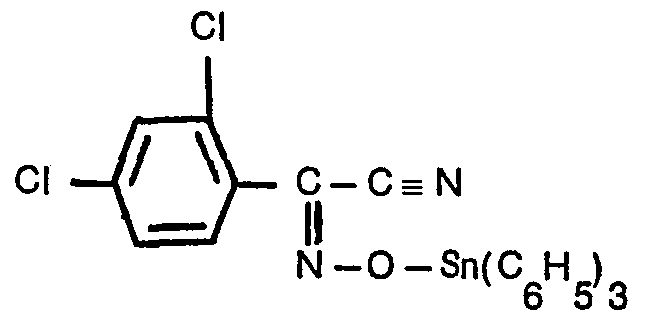
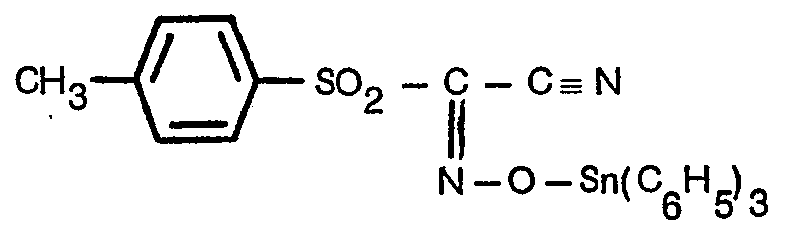
worin n = 0, 1 oder 2 und m = 0 oder 1 ist, X Cyano oder einen Carbonsäureniederalkylester bedeutet, Ar für Phenyl, durch 1 bis 4 Niederalkylgruppen, 1 bis 4 Niederalkoxygruppen oder 1 bis 4 Halogenatome substituiertes Phenyl, Naphthyl oder, wenn m = 0 ist, auch für Aminocarbonyl (-CONH2) steht und R8, Rg und R10 gleich sind und Cl-C4-Alkyl, Benzyl oder Phenyl bedeuten, mit der Massgabe, dass, wenn Ar für Phenyl steht, X Cyano und i) n = 2 und m = 1 sind und R8, Rg und R10 n-Butyl bedeuten oder ii) n und m = 0 sind und R8, Rg und R10 Phenyl bedeuten. - Niederalkyl allein oder als Teil eines anderen Substituenten bedeutet C1-C4 Alkyl. Beispiele sind Methyl, Aethyl, Propyl, Isopropyl, Butyl, Isobutyl, sec. Butyl und tert.Butyl.
- Die Verbindungen der Formel I können hergestellt werden, indem man eine Verbindung der Formel (II)


- Als Lösungsmittel zur Gewinnung der Verbindungen der Formel (I) eignen sich prinzipiell alle Vertreter, die sich unter den Bedingungen der Reaktion indifferent verhalten. Beispielsweise Kohlenwasserstoffe, vor allem aber polare Lösungsmittel wie Acetonitril, Dioxan, Cellosolve@ (2-Aethoxyäthanol), Dimethylformamid, aber auch Ketone wie Methyläthylketon, Aceton usw.. Hydroxylgruppenhaltige Lösungsmittel sind ausgeschlossen.
- Die Temperaturen liegen im Bereich von -10° C bis ca. 150° C, bevorzugt zwischen 20° und 120°C.
- In den Fällen, wo in der Formel (II) Me für Wasserstoff steht, wird das Verfahren in Gegenwart einer Base durchgeführt. Beispiele solcher Basen sind anorganische Basen wie die Oxide, Hydroxide, Hydride, Carbonate und Hydrogencarbonate von Alkali und Erdalkalimetallen sowie z.B. tert. Amine wie Triäthylamin, Triäthylendiamin, Piperidin, Pyridin usw.
- Das Verfahren bildet auch einen Teil der Erfindung.
- Die Verbindungen der Formel (I) können für sich allein oder zusammen mit geeigneten Trägern und/oder anderen Zuschlagstoffen verwendet werden. Geeignete Träger und Zuschalgstoffe können fest oder flüssig sein und entsprechen den in der Formulierungstechnik üblichen Stoffen wie z.B. natürlichen oder regenerierten mineralischen Stoffen, Lösungs-, Dispergier-, Netz-, Haft-, Verdickungs-, Binde- oder Düngemitteln.
- Der Gehalt an Wirkstoff in handelsfähigen Mitteln liegt zwischen 0,1 bis 90%.
- Zur Applikation können die Verbindungen der Formel (I) in den folgenden Aufarbeitungsformen vorliegen (wobei die Gewichts-Prozentangaben in Klammern vorteilhafte Mengen an Wirkstoff darstellen):
- Feste Aufarbeitungsformen: Stäubemittel und Streumittel (bis zu 10%) Granulate, Umhüllungsgranulate, Imprägnierungsgranulate und Homogengranulate, Pellets (Körner) (1 bis 80%);
- Flüssige Aufarbeitungsformen:
- a) in Wasser dispergierbare Wirkstoffkonzentrate:
- Spritzpulver (wettable powders) und Pasten (25-90% in der Handelspackung, 0,01 bis 15% in gebrauchsfertiger Lösung);
- Emulsions- und Lösungskonzentrate (10 bis 50%; 0,01 bis 15% in gebrauchsfertiger Lösung);
- b) Lösungen (0,1 bis 20%; Aerosole.
- Solche Mittel gehören ebenfalls zur Erfindung.
- Oxime der Formel (I) eignen sich hervorragend, Kulturpflanzen wie Reis, Mais, Getreidearten (Kulturhirse, Weizen, Roggen, Gerste, Hafer), vor dem Angriff von Herbiziden verschiedenster Stoffklassen zu schützen, sofern diese nicht oder nicht genügend selektiv wirken, also neben den zu bekämpfenden Unkräutern auch die Kulturpflazen mehr oder weniger schädigen.
- Als Gegenmittel oder Antidote sind schon verschiedene Stoffe vorgeschlagen worden, welche befähigt sind, die schädigende Wirkung eines Herbizides auf die Kulturpflanze spezifisch zu antagonisieren, d.h. die Kulturpflanze zu schützen, ohne dabei die Herbizidwirkung auf die zu bekämpfenden Unkräuter merklich zu beeinflussen. Dabei kann ein solches Gegenmittel, auch Safener genannt, je nach seinen Eigenschaften zur Vorbehandlung des Saatgutes der Kulturpflanze (Beizung des Samens oder der Stecklinge) oder vor der Saat in die Saatfurchen oder als Tankmischung für sich allein oder zusammen mit dem Herbizid vor oder nach dem Auflaufen der Pflanzen verwendet werden. Vorauflauf-Behandlung schliesst sowohl die Behandlung der Anbaufläche vor der Aussaat (ppi = "pre plant incorporation") aus auch die Behandlung der angesäten, aber noch nicht bewachsenen Anbauflächen ein.
- So beschreibt die GB-PS 1'227'557 die Behandlung von Samen bzw. Sprösslingen von Weizen und Sorghum mit gewissen Oxamsäureestern und Amiden vor dem Angriff durch N-Methoxymethyl-2',6'-diäthyl-chloracetanilid (Alachlor).
- Andere Literaturstellen (DE-DS 1'952'910, DE-OS 2'245'471, FR-PS 2'021'611 ) schlagen Gegenmittel zur Behandlung von Getreide, Maisund Reis-Samen zum Schutz gegen den Angriff herbizider Thiolcarbamate vor. In der DE-PS 1'576'676 und der US-PS 3'131'509 werden Hydroxyamino-acetanilide und Hydantoine für den Schutz von Getreidesamen gegenüber Carbamaten wie IPC (N-Phenyl-isopropylcarbamat), CIPC (N-3-Chlorphenyl-isopropylcarbamat) etc. vorgeschlagen. In der weiteren Entwicklung haben sich alle diese Präparate jedoch als ungenügend er wiesen.
- Ueberraschenderweise besitzen Oxime der Formel (I) die Eigenschaft, Kulturpflanzen vor dem Angriff von Herbiziden der verschiedensten Stoffklassen, darunter 1,3,5-Triazinen, 1,2,4-Triazinonen, Phenylharnstoffderivaten, Carbamaten, Thiolcarbamaten, Phenoxyessigsäureestern, Phenoxypropionsäureestern, Halogenacetaniliden, Halogenphenoxyessigsäureestern, substituierten Phenoxyphenoxyessigsäureestern und -propionsäureestern, substituierten Pyridinoxyphenoxy-essigsäureestern und -propionsäureestern, Benzoesäurederivaten usw. zu schützen, sofern diese nicht oder ungenügend kulturentolerant sind.
- Ein solches Gegenmittel oder Antidote der Formel (I) kann je nach Anwendungszweck zur vorbehandlung des Saatgutes der Kulturpflanze (Beizung des Samens oder der Stecklinge) eingesetzt oder vor oder nach der Saat in den Erdboden gegeben werden oder aber für sich allein oder zusammen mit dem Herbizid vor oder nach dem Auflaufen der Pflanzen appliziert werden. Die Behandlung der Pflanze oder des Saatgutes mit dem Antidote kann daher grundsätzlich unabhängig vom Zeitpunkt der Applikation der phytotoxischen Chemikalie erfolgen. Sie kann jedoch auch gleichzeitig durchgeführt werden (Tankmischung). Vorauflauf-Behandlung schliesst sowohl die Behandlung der Anbaufläche vor der Aussaat (ppi = "pre plant incorporation") als auch die Behandlung der angesäten, aber noch nicht bewachsenen Anbauflächen ein.
- Die Aufwandmengen des Antidotes im Verhältnis zum Herbizid richten sich weitgehend nach der Anwendungsart. Sofern eine Feldbehandlung vorgenommen wird, verhalten sich die Mengen von Antidote der Formel (I) zu phytotoxischer Chemikalie wie 1:100 bis 5:1, bevorzugt 1:20 bis 1:1. Bei Samenbeizung und änhlichen gezielten Schutzmassnahmen werden jedoch weit geringere Mengen Antidote im Vergleich mit den z.B. später pro Hektar Anbaufläche verwendeten Herbizidmengen benötigt (z.B. ca. 1:3000 bis 1:1000). In der Regel stehen protektive Massnahmen wie Samenbeizung mit einem Antidote der Formel (I) und mögliche spätere Feldbehandlung mit Agrarchemikalien nur in losem Zusammenhang. Vorbehandeltes Saat- und Pflanzengut kann später in Landwirtschaft, Gartenbau und Forstwirtschaft mit unterschiedlichen Chemikalien in Berührung kommen.
- Die Erfindung bezieht sich daher auch auf kulturpflanzenprotektive Mittel, welche diese Oximäther der Formel I zusammen mit Herbiziden enthalten, sowie Mittel, welche diese Oximäther der Formel als einzige Aktivkomponente enthalten. Pflanzenschutzmittel, die ein Gegenmittel der Formel 1 (auch Antidote oder Safener genannt) enthalten, können ohne gleichzeitige Anwesenheit des abzuschwächenden Herbizids (oder einer anderen aggressiven Agrarchemikalie) hergestellt, in den Handel gebracht oder verwendet werden. Eine wichtige Anwendungsmöglichkeit ist die Saatbeizung, die zu einem von der Anwendung des Herbizids ganz unabhängigen Zeitpunkt vorgenommen wird. Ein anderes Einsatzgebiet ist die Behandlung eines Bodens, in dem noch Reste eines Herbizids der letzten Anbausaison vorhanden sind, das die vorgesehene neue Pflanzenkultur schädigen könnte.
- Die Antidote-Eigenschaft ist eine von der Kulturpflanze und von dem in der Wirkung selektiv abzuschwächenden Herbizid unabhängige Stoffeigenschaft, die einem Präparat der Formel I inhärent ist, jedoch erst beim Zusammenwirken der 3 Komponenten Antidote-Herbizid-Pflanze sichtbar zu Tage tritt. Aehnlich einer pestizid wirkenden Chemikalie, deren Pestizid-Wirkung erste bei Anwesenheit eines Schädlings sichtbar wird, erfordert auch der Nachweis der Safener-Wirkung die Anwesenheit der an der Wirkung beteiligten anderen beiden Komponenten, nämlich des Herbizids und der Kulturpflanze. Dies unterscheidet ein formuliertes Safener-Mittel von einem synergistisch wirkenden Zwei- oder Dreikomponentengemisch, bei dem gleichzeitig alle Wirkstoffkomponenten vorliegen und sämtlich in die gleiche Wirkungsrichtung zielen. Als Kulturpflanzen seien im Rahmen vorliegender Erfindung alle Pflanzen, die in irgendeiner Form Ertragsstoffe produzieren (Samen, Wurzeln, Stengel, Knollen, Blätter, Blüten, Inhaltsstoffe wie Oele, Zucker, Stärke, Eiweiss etc.) und zu diesem Zweck angebaut und gehegt werden. Zu diesen Pflanzen gehören beispielsweise sämtliche Getreidearten, Mais, Reis, Edelhirse, Soja, Bohnen, Erbsen, Kartoffeln, Gemüse, Baumwolle, Zuckerrüben, Zuckerrohr, Erdnüsse, Tabak, Hop-fen, dann jedoch auch Zierpflanzen, Obstbäume sowie Bananen-, Kakao- und NaturkautschukGewächse. Diese Aufzählung stellt keine Limitierung dar. Grundsätzlich lässt sich ein Antidote überall dort einsetzen, wo eine Kulturpflanze vor der Phytotoxizität einer Chemikalie geschützt werden soll.
- Die Erfindung bezieht sich auf ein Verfahren zum Schutz von Kulturpflanzen vor Herbiziden, indem ein als Antidote wirkendes Oximderivat der Formel (I) wahlweise vor oder nach Applikation des Herbizids oder auch gleichzeitig mit dem Herbizid angewendet wird.
- Organozinnoxim-Derivate mit andersartiger Struktur sind aus den US-Patenten 3,275,659; 3,282,672, 3,419,662; 3,210,245 und den japanischen Anmeldungen 67/23256, 67/24573, 67/26296 und 69/31222 bekannt. Eine Wirkung als Gegenmittel oder Antidot wird darin nicht beschrieben.
- Die Verbindungen der Formel I bilden ebenfalls einen Gegenstand der Erfindung.
- Bevorzugt sind Oxim-Derivate der Formel I, in denen X Cyano bedeutet, Ar für durch 1 bis 4 Niederalkylgruppen, 1 bis 4 Niederalkoxygruppen oder 1 bis 4 Halogenatome substituiertes Phenyl oder, wenn m = 0 ist, auch für Aminocarbonyl steht und R8, R9 und R10 gleich sind und n-Butyl oder Phenyl bedeuten.
- Besonders interessante Einzelverbindungen sind:


- Die bevorzugten Verbindungsgruppen und Einzelverbindungen, Mittel, die sie enthalten, sowie ihre Verwendung zum Schutz von Kulturpflanzen aggressiven Agrarchemikalien bilden auch einen Teil der Erfindung.
- Von den Mitteln, welche ein Oxim-Derivat und ein Herbizid enthalten, sind insbesondere die folgenden erwähnenswert:


- Die nachfolgenden Beispiele dienen zur näheren Erläuterung der Erfindung ohne dieselbe einzuschränken. Die Temperaturen sind in Celsiusgraden, die Druckangaben in Millibar angegeben. Prozente und Teile beziehen sich auf das Gewicht.
- Herstellung von

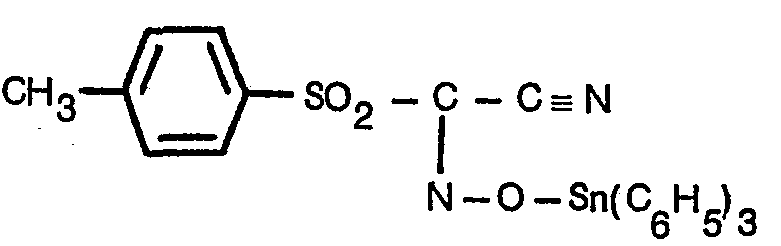
- Herstellung von

- Herstellung von


- Stäubemittel; Zur Herstellung eines a) 5%igen und b) 2%igen Stäubemittels werden die folgenden Stoffe verwendet:

- Die Wirkstoffe werden mit den Trägerstoffen vermischt und vermahlen und können in dieser Form zur Anwendung verstäubt werden.
- Granulat: Zur Herstellung eines 5%igen Granulates werden die folgenden Stoffe verwendet:

- Die Aktivsubstanz wird mit Epichlorhydrin vermischt und mit 6 Teilen Aceton gelöst, hierauf wird Polyäthylenglykol und Cetylpolyglykoläther zugesetzt. Die so erhaltene Lösung wird auf Kaolin aufgesprüht, und anschliessend wird das Aceton im Vakuum verdampft.
- Spritzpulver. Zur Herstellung eines a) 70 %igen b) 40 %igen, c) und d) 25 %igen, 3) 10 %igen Spritzpulvers werden folgende Bestandteile verwendet:
-


- Die Wirkstoffe werden in geeigneten Mischern mit den Zuschlagstoffen innig vermischt und auf entsprechenden Mühlen und Walzen vermahlen. Man erhält Spritzpulver von vorzüglicher Benetzbarkeit und Schwebefähigkeit, die sich mit Wasser zu Suspensionen der gewünschten Konzentration verdünnen und insbesondere zur Saatbeize und Tauchbehandlung von Pflanzenteilen verwenden lassen.
- Zur Herstellung eines 25 %igen emulgierbaren Konzentrates werden folgende Stoffe verwendet:

- Aus solchen Konzentraten können durch Verdünnen mit Wasser Emulsionen der gewünschten Anwendungskonzentration hergestellt werden, die besonders zur Behandlung von Pflanzenteilen geeignet sind.
- Kleine Blumentöpfe (oberer 0 6 cm) werden mit Gartenerde gefüllt, in die die Pflanzenkultur eingesät, bedeckt und leicht festgedrückt wird. Dann wird die als Antidote zu prüfende Substanz als (aus einem Spritzpulver erhaltene) verdünnte Lösung in einer Menge aufgesprüht, die 4 kg AS/ha entspricht. Unmittelbar danach wird in entsprechender Weise das Herbizid aufgesprüht. Nach 18 Tagen Stehen bei ca. 20-23°C und 60-70 % relativer Luftfeuchtigkeit wird nach einer linearen Skala von 1 bis 9 ausgewertet, wobei 1 totale Pflanzenschädigung und 9 unbeeinträchtigter Gesundheitszustand bedeuten. Als Kontrolle dienen Pflanzen ohne Antidote-Schutz.
- Es wurden verwendet:
- 1) 1,5 kg AS/ha a-[4-(p-Trifluormethylphenoxy)-phenoxy]-propionsäure-n-butoxyäthylester in Mais der Sorte "Orla 264".
- 2) 1,5 kg AS/ha Metolachlor = N-(1-Methyl-2-methoxyäthyl)-N-chloracetyl-2-äthyl-6-methylanilin in Sorghum-Hirse der Sorte "Funk G-522".
- 3) 2,0 kg AS/ha Prometryn = 2,4-bis(Isopropylamino)-6-methylthio-s-triazin in Soja
- 4) 2,0 kg AS/ha 4-Aethylamino-6-tert.butylamino-2-chlor-s-triazin in Weizen der Sorte "Famese".
- 5) 4,0 kg AS/ha Prometryn = 2,4-bis(lsopropylamino)-6-methylthio-s-triazin in Sorghum-Hirse der Sorte "Funk G-522".
- 6) 2,0 kg AS/ha α-[4.-(p Trifluormethylphenoxy)-phenoxy]-propionsäure-ri-butoxyäthylester in Gerste der Sorte "Mazurka".
- Mit den Verbindungen der Formel I erhält man folgendes Resultat:

- Plastiktöpfe (8 x 8 cm, 10 cm Höhe) werden bis 2 cm unter den Rand mit Erde im sumpfignassen Zustand gefüllt. Die als Antidote zu prüfende Substanz wird in verdünnter Lösung und in einer Menge auf die Oberfläche gesprüht, die 4 kg As/ha entspricht. Reispflanzen der Sorte "IR-8" werden im 1 1/2- bis 2-Blattstadium in die so vorbereiteten Töpfe verpflanzt. Am nächsten Tag wird der Wasserstand auf ca. 1,5 cm erhöht. 4 Tage nach Verpflanzung werden umgerechnet 0,75 kg AS/ha von 2-Aethylamino-4-(1,2-dimethyl-n-propylamino)-6-methylthio-s-triazin in Granulatform ins Wasser gegeben. Die Temperatur beträgt während der Versuchsdauer 26 bis 28°C, die relative Luftfeuchtigkeit 60 bis 80 %. 20 Tage nach Herbizidbehandlung wird nach einer linearen Skala von 1 bis 9 ausgewertet, wobei 1 totale Pflanzenschädigung und 9 unbeeinträchtigter Gesundheitszustand bedeuten. Als Kontrolle dienen Pflanzen ohne Antidote-Schutz.
- Mit den Verbindungen der Formel I wurden folgende Resultate erzielt.

- Es wird eine Hewitt-Nährlösung hergestellt, die die nachstehend angegebene Menge Herbizid sowie 10 ppm des zu prüfenden Antidotes enthält.
- Man verwendet Kultursamen, der in der angegebenen Prüfkonzentration von dem eingesetzten Herbizid erwartungsgemäss geschädigt werden sollte und sät ihn in gekörntes Zonolith@ (= expandiertes Vermikulit), das sich in einem an der Unterseite durchlöcherten Plastik-Blumentopf (oberer φ 6 cm) befindet. Dieser wird in einen zweiten durchsichtigen Plastik-Blumentopf (oberer 7 cm) gestellt, in dem sich ca. 50 ml der mit Herbizid und Antidote vorbereiteten Nährlösung befinden, die nunmehr kapillar im Füllmaterial des kleineren Topfes aufsteigt und Samen und keimende Pflanze benetzt. Täglich wird der Flüssigkeitsverlust mit reiner Hewitt-Nährlösung auf 50 ml ergänzt. 3 Wochen nach Testbeginn wird nach einer linearen Skala von 1 bis 9 ausgewertet, wobei 1 totale Pflanzenschädigung und 9 unbeeinträchtigter Gesundheitszustand bedeuten. Die parallel angewandte Kontroll-Lösung enthält keinen Antidote-Zusatz.
- Man verwendet:
- 1) 4 ppm Prometryn = 2,4-bis (lsopropylamino)-6-methylthio-s-triazin in Sorghum-Hirse der Sorte "Funk G-522".
- 2) 4 ppm 4-Aethylamino-6-tert.butylamino-2-chlor-s-triazin in Weizen der Sorte "Farnese".
- 3) 4 ppm a-[4-(p-Trifluormethylphenoxy)-phenoxy]-propionsäure-n-butoxy-äthylester in Gerste der Sorte "Mazurka".
- 4) 5 ppm Metolachlor = N-(1-Methyl-2-methoxy-äthyl)-N-chloracetyl-2-äthyl-6-methylanilin in Sorghum-Hirse der Sorte "Funk G-522".
- 5) 1 ppm 2-Methoxy-4,6-bis-(5-methoxy-propylamino)-s-triazin in Zuckerrüben der Sorte "Kleinwanzleben".
- Mit den Verbindungen der Formel (I) erhält man folgendes Resultat:

- Man füllt kleine Plastik-Blumentöpfe (oberer O 5 cm), die an der Unterseite durchlöchert sind, mit gekörntem Zonolith@ und sät den Kultursamen ein. Dann wird der Topf in einen zweiten durchsichtigen Plastik-Blumentopf (oberer φ 7 cm) gestellt. In dem sich 50 ml Wasser befinden, das kapillar aufsteigt und den Samen benetzt. Ab 5. Tag wird der fäüfende Wasserve ü mit Hewitt-Nahrlösung ausgeglichen. Ab 15. Tag, wenn sich die Kulturpflanze im 1 1/2- bis 2-Blattstadium befindet, wird in die wieder auf 50 ml ergänzte Nährlösung 10 ppm des zu prüfenden Antidotes + die unten angegebene Menge Herbizid zugegeben. Ab 16. Tag wird der Flüssigkeitsverlust wieder durch reine Hewitt-Nährlösung ausgeglichen. Während der gesamten Testdauer beträgt die Temperatur 20 bis 23°C bei einer relativen Luftfeuchtigkeit von 60 bis 70 %. 3 Wochen nach Zugabe des Herbizids und des Antidotes erfolgt die Auswertung nach einer linearen Skala von 1 bis 9, wobei 1 totate Pflanzenschädigung und 9 unbeeinträchtigter Gesundheitszustand bedeuten.
-
- 1) 15 ppm a-[4-(3,5-Dichlorpyridyl-2-oxy)-phenoxy]-propionsäure-propargylthioloester in Weizen der Sorte "Zenith".
- 2) 4 ppm 4-Aethylamino-6-tert.butylamino-2-chlor-s-triazin in Weizen Sorte "Zenith".
- 3) 2 ppm a-[4-(p-Trifluormethylphenoxy)-phenoxy]-propionsäure-n-butoxyäthylester in Mais der Sorte "Orla".
- 4) 8 ppm α-[4-(p-Trifluormethylphenoxy)-phenoxy)-propionsäuce-n-butoxyäthylester in Sorghum-Hirse der Sorte "Funk G-522".
- 5) 4 ppm Prometryn = 2,4-bis(Isopropylaminol-6-methylthio-s-triazin in Sorghum-Hirse der Sorte "Funk G-522".
- 6) 8 ppm α-[4-(3,5-Dichlorpyridyl-2-oxy)-phenoxy)-propionsäuremethylester in Weizen der Sorte "Zenith".
- Verbindungen der Formel (i) erzielen bei diesen Versuchen gute Antidot-Wirkung. Als Beispiele seien die folgenden Ergebnisse genannt:

- Reissamen der Sorte IR 8 werden während 48 Stunden mit Lösungen der Testsubstanzen von 10, 100 oder 1000 ppm getränkt. Anschliessend werden die Samen etwa 2 Stunden trocknen gelassen, bis sie nicht mehr kleben. Rechteckige Plastiktöpfe (8 x 8 cm, 10 cm Höhe) werden bis 2 cm unter den Rand mit sandigem Lehm gefüllt. 4 g Samen werden pro Topf gesät und nur ganz schwach gedeckt (etwa Durchmesser des Samenkorns). Die Erde wird in einem feuchten (nicht sumpfigen) Zustand gehalten. Dann wird das Herbizid N-(1-Methyl-2-methoxyäthyl)-N-chloracetyl-2-äthyl-6-methylanilin in verdünnter Lösung und in einer Menge appliziert, die umgerechnet 1,5 kg AS/ha entspricht. 7 und 18 Tage nach dem Verpflanzen wird nach einer linearen Skala von 1 bis 9 ausgewertet, wobei 1 totale Pflanzenschädigung und 9 unbeeinträchtigter Gesundheitszustand bedeuten.
- Verbindungen der Formel (I) zeigen in diesem Versuch gute Antidote-Wirkung. Als Beispiele seien die folgenden Resultate genannt (alle bei 100 ppm).

- Reispflanzen der Sorte IR 8 werden bis zum 1 1/2-2 Blattstadium in Erde herangezogen und dann flüchtig ausgewaschen. Die Pflanzen werden dann büschelweise nur mit den Wurzeln während 45 Minuten in eine Schale mit Lösungen der Testsubstanz von 10, 100 oder 1000 ppm getaucht. Anschliessend werden sie in Container 47 cm lang, 29 cm breit und 24 cm hoch) in sandigen Lehm verpflanzt. Die Bodenoberfläche wird mit Wasser von 1 1/2 bis 2 cm Höhe beschichtet. Einen Tag nach dem Verpflanzen wird das Herbizid N-n-Propoxyäthyl-N-chloracetyl-2,6-diäthylanilin in verdünnter Lösung direkt ins Wasser in einer Menge pipettiert, die umgerechnet 1,5 kg AS/ha entspricht. 7 und 18 Tage nach dem Verpflanzen wird nach einer linearen Skala von 1 bis 9 ausgewertet, wobei 1 totale Pflanzenschädigung und 9 unbeeinträchtigter Gesundheitszustand bedeuten.
- Verbindungen der Formel (1) zeigen in diesem Versuch gute Antidote-Wirkung. Als Beispiele seien die folgenden Resultate genannt (bei 10 ppm).

Claims (21)







Priority Applications (1)
| Application Number | Priority Date | Filing Date | Title |
|---|---|---|---|
| AT79103176T ATE4765T1 (de) | 1978-08-31 | 1979-08-28 | Oxim-derivate zum schutz von pflanzenkulturen. |
Applications Claiming Priority (2)
| Application Number | Priority Date | Filing Date | Title |
|---|---|---|---|
| CH9200/78 | 1978-08-31 | ||
| CH920078 | 1978-08-31 |
Publications (3)
| Publication Number | Publication Date |
|---|---|
| EP0010143A2 EP0010143A2 (de) | 1980-04-30 |
| EP0010143A3 EP0010143A3 (en) | 1980-08-06 |
| EP0010143B1 true EP0010143B1 (de) | 1983-09-28 |
Family
ID=4349426
Family Applications (1)
| Application Number | Title | Priority Date | Filing Date |
|---|---|---|---|
| EP79103176A Expired EP0010143B1 (de) | 1978-08-31 | 1979-08-28 | Oxim-Derivate zum Schutz von Pflanzenkulturen |
Country Status (11)
| Country | Link |
|---|---|
| US (3) | US4294772A (de) |
| EP (1) | EP0010143B1 (de) |
| JP (1) | JPS5535091A (de) |
| AT (1) | ATE4765T1 (de) |
| AU (1) | AU533355B2 (de) |
| CS (1) | CS221517B2 (de) |
| DD (1) | DD145997A5 (de) |
| DE (1) | DE2966223D1 (de) |
| IE (1) | IE48630B1 (de) |
| IL (1) | IL58151A (de) |
| ZA (1) | ZA794595B (de) |
Families Citing this family (14)
| Publication number | Priority date | Publication date | Assignee | Title |
|---|---|---|---|---|
| US4294772A (en) * | 1978-08-31 | 1981-10-13 | Ciba-Geigy Corporation | Oxime derivatives for protecting plant crops |
| US4347372A (en) * | 1978-09-01 | 1982-08-31 | Ciba-Geigy Corporation | Benzoxazolyl-glyoxylonitrile-2-oxime ether derivatives |
| DE3000076A1 (de) * | 1980-01-03 | 1981-09-03 | Hoechst Ag, 6000 Frankfurt | Wachstumsfoerdernde und pflanzenschuetzende mittel |
| US4400204A (en) * | 1981-03-16 | 1983-08-23 | Stauffer Chemical Company | Substituted benzyloxy chloroethoxy ethane herbicide antidotes |
| US4489007A (en) * | 1981-03-16 | 1984-12-18 | Stauffer Chemical Company | Substituted benzyloxy chloroethoxy ethane herbicide antidotes |
| US4802912A (en) * | 1981-08-10 | 1989-02-07 | Stauffer Chemical Co. | Herbicide antidotes |
| US4441916A (en) * | 1981-10-19 | 1984-04-10 | Stauffer Chemical Company | Haloalkyloxime herbicidal antidotes |
| US4400527A (en) * | 1981-12-17 | 1983-08-23 | Allied Corporation | Producing oximinosilanes, oximinogermanes and oximinostannanes |
| JPS58116450A (ja) * | 1981-12-29 | 1983-07-11 | Nippon Soda Co Ltd | 5−フエニルシクロヘキセノン誘導体、その製造方法及び選択的除草剤 |
| EP0144283A1 (de) * | 1983-10-04 | 1985-06-12 | Ciba-Geigy Ag | Herbizides Mittel |
| US4584317A (en) * | 1984-09-11 | 1986-04-22 | Chevron Research Company | Pesticidal tin amidoximes |
| US4565812A (en) * | 1984-11-30 | 1986-01-21 | Chevron Research Company | Fungicidal tin salts of thienyl and furyl hydroxamic acids, compositions, and method of use therefor |
| JPH01101860A (ja) * | 1987-10-16 | 1989-04-19 | Kinjirushi Wasabi Kk | 辛味成分の除去された食品素材の製造方法 |
| JPH0755133B2 (ja) * | 1988-11-17 | 1995-06-14 | 長谷川香料株式会社 | 香辛料エキスの製造方法 |
Family Cites Families (13)
| Publication number | Priority date | Publication date | Assignee | Title |
|---|---|---|---|---|
| BE598730A (de) * | 1960-01-01 | |||
| BE605263A (de) * | 1960-06-22 | 1900-01-01 | ||
| US3275659A (en) * | 1961-04-28 | 1966-09-27 | Monsanto Co | Triorganotin oximes and their preparation |
| US3131509A (en) * | 1961-05-08 | 1964-05-05 | Spencer Chem Co | Compositions and methods for reducing herbicidal injury |
| US3282672A (en) * | 1962-04-09 | 1966-11-01 | Monsanto Co | Method for preventing plant growth |
| US3419662A (en) * | 1962-04-09 | 1968-12-31 | Monsanto Co | Method of inhibiting the growth of bacteria and fungi with triorganotin oximes |
| US4021224A (en) * | 1971-12-09 | 1977-05-03 | Stauffer Chemical Company | Herbicide compositions |
| US4020106A (en) * | 1972-03-21 | 1977-04-26 | Imperial Chemical Industries Limited | Metal extraction process |
| US4168965A (en) * | 1972-06-06 | 1979-09-25 | Ciba-Geigy Corporation | 2,6-Diethyl-n-(2'-N-propoxyethyl)-chloroacetanilide for selectively combating weeds |
| US3937730A (en) * | 1972-06-06 | 1976-02-10 | Ciba-Geigy Corporation | Plant growth regulating agent |
| CH624552A5 (de) * | 1975-09-04 | 1981-08-14 | Ciba Geigy Ag | |
| DE2633452A1 (de) * | 1976-07-24 | 1978-01-26 | Basf Ag | Triorganozinnverbindungen von hydroxydiazeniumoxiden |
| US4294772A (en) * | 1978-08-31 | 1981-10-13 | Ciba-Geigy Corporation | Oxime derivatives for protecting plant crops |
-
1979
- 1979-08-20 US US06/068,262 patent/US4294772A/en not_active Expired - Lifetime
- 1979-08-28 AT AT79103176T patent/ATE4765T1/de not_active IP Right Cessation
- 1979-08-28 EP EP79103176A patent/EP0010143B1/de not_active Expired
- 1979-08-28 DE DE7979103176T patent/DE2966223D1/de not_active Expired
- 1979-08-29 CS CS795884A patent/CS221517B2/cs unknown
- 1979-08-30 IL IL58151A patent/IL58151A/xx unknown
- 1979-08-30 AU AU50433/79A patent/AU533355B2/en not_active Ceased
- 1979-08-30 ZA ZA00794595A patent/ZA794595B/xx unknown
- 1979-08-30 DD DD79215280A patent/DD145997A5/de unknown
- 1979-08-30 IE IE1654/79A patent/IE48630B1/en unknown
- 1979-08-31 JP JP11161879A patent/JPS5535091A/ja active Granted
-
1982
- 1982-09-30 US US06/431,459 patent/US4478756A/en not_active Expired - Fee Related
-
1983
- 1983-04-06 US US06/482,389 patent/US4500347A/en not_active Expired - Fee Related
Also Published As
| Publication number | Publication date |
|---|---|
| AU533355B2 (en) | 1983-11-17 |
| DE2966223D1 (en) | 1983-11-03 |
| CS221517B2 (en) | 1983-04-29 |
| US4500347A (en) | 1985-02-19 |
| IL58151A0 (en) | 1979-12-30 |
| ZA794595B (en) | 1980-09-24 |
| US4478756A (en) | 1984-10-23 |
| EP0010143A3 (en) | 1980-08-06 |
| US4294772A (en) | 1981-10-13 |
| JPS5535091A (en) | 1980-03-11 |
| AU5043379A (en) | 1980-03-06 |
| DD145997A5 (de) | 1981-01-21 |
| IL58151A (en) | 1984-05-31 |
| ATE4765T1 (de) | 1983-10-15 |
| IE791654L (en) | 1980-02-29 |
| EP0010143A2 (de) | 1980-04-30 |
| IE48630B1 (en) | 1985-04-03 |
| JPS6256878B2 (de) | 1987-11-27 |
Similar Documents
| Publication | Publication Date | Title |
|---|---|---|
| DE2808317C2 (de) | ||
| EP0012158B1 (de) | Oximderivate und ihre Anwendung zum Schutz von Pflanzenkulturen | |
| EP0055693B1 (de) | Verwendung von Phenylpyrimidinen als Gegenmittel zum Schützen von Kulturpflanzen vor durch Herbizide verursachte phytotoxische Schäden | |
| EP0010770B1 (de) | In 2-Stellung substituierte 4-Pyridyl-harnstoffe bzw. -thioharnstoffe, Verfahren zu deren Herstellung sowie diese enthaltende Pflanzenwachstumsregulatoren | |
| EP0011047B1 (de) | Oxim-Derivate zum Schutz von Pflanzenkulturen | |
| EP0010143B1 (de) | Oxim-Derivate zum Schutz von Pflanzenkulturen | |
| CH647513A5 (de) | Triazol-derivate, deren herstellung und verwendung. | |
| EP0010588B1 (de) | Schwefelhaltige Oxim-Verbindungen und ihre Verwendung zum Schutz von Kulturpflanzen | |
| DE2837204A1 (de) | Oxim-carbamate und -carbonate zum schuetzen von pflanzenkulturen | |
| CH637268A5 (de) | Mittel zum schutz von pflanzenkulturen. | |
| DE3234624C2 (de) | ||
| EP0010058B1 (de) | Verfahren und Mittel zum Schutz von Pflanzenkulturen vor der phytotoxischen Wirkung starker Herbizide; Oximätherderivate | |
| DE2637886C2 (de) | ||
| DE1567131A1 (de) | Herbizide Komposition und Verfahren zu ihrer Anwendung | |
| DE2112643C3 (de) | Formamidin-Derivate und sie enthaltende Mittel | |
| DE3300056C2 (de) | 3-Nitrobenzolsulfonanilid-Derivate und diese enthaltende fungizide Mittel | |
| DE2833767C2 (de) | ||
| DE2362333C3 (de) | Thionophosphorsäureesteramide, Verfahren zu deren Herstellung und Verwendung derselben | |
| EP0013542B1 (de) | Alpha-Phenoxy-propionsäure-gamma-butyrolactonester und -thioester mit herbizider Wirkung, deren Herstellung,sie als Wirkstoffe enthaltende Mittel und deren Verwendung | |
| DE2916611C2 (de) | ||
| DE4011781A1 (de) | Herbizides mittel | |
| EP0023539B1 (de) | 3-(N-1,3,4-Thiadiazolyl-2)-amino-alkyl-acrylsäurealkylester, Verfahren zu ihrer Herstellung und ihre Verwendung als Pflanzenbakterizide | |
| DE1939010C3 (de) | Aryloxymonothioessigsäureester und ihre Verwendung als herbicide Mittel | |
| DD145991A5 (de) | Landwirtschaftlich verwendbare zusammensetzung | |
| DD145362A5 (de) | Verfahren zum schutz von kulturpflanzen |
Legal Events
| Date | Code | Title | Description |
|---|---|---|---|
| PUAI | Public reference made under article 153(3) epc to a published international application that has entered the european phase |
Free format text: ORIGINAL CODE: 0009012 |
|
| 17P | Request for examination filed | ||
| AK | Designated contracting states |
Designated state(s): AT BE CH DE FR GB IT NL |
|
| PUAL | Search report despatched |
Free format text: ORIGINAL CODE: 0009013 |
|
| AK | Designated contracting states |
Designated state(s): AT BE CH DE FR GB IT NL |
|
| ITF | It: translation for a ep patent filed | ||
| GRAA | (expected) grant |
Free format text: ORIGINAL CODE: 0009210 |
|
| AK | Designated contracting states |
Designated state(s): AT BE CH DE FR GB IT NL |
|
| REF | Corresponds to: |
Ref document number: 4765 Country of ref document: AT Date of ref document: 19831015 Kind code of ref document: T |
|
| REF | Corresponds to: |
Ref document number: 2966223 Country of ref document: DE Date of ref document: 19831103 |
|
| ET | Fr: translation filed | ||
| PGFP | Annual fee paid to national office [announced via postgrant information from national office to epo] |
Ref country code: FR Payment date: 19840629 Year of fee payment: 6 |
|
| PGFP | Annual fee paid to national office [announced via postgrant information from national office to epo] |
Ref country code: DE Payment date: 19840710 Year of fee payment: 6 |
|
| PLBE | No opposition filed within time limit |
Free format text: ORIGINAL CODE: 0009261 |
|
| STAA | Information on the status of an ep patent application or granted ep patent |
Free format text: STATUS: NO OPPOSITION FILED WITHIN TIME LIMIT |
|
| PGFP | Annual fee paid to national office [announced via postgrant information from national office to epo] |
Ref country code: BE Payment date: 19840930 Year of fee payment: 6 |
|
| 26N | No opposition filed | ||
| PGFP | Annual fee paid to national office [announced via postgrant information from national office to epo] |
Ref country code: CH Payment date: 19841011 Year of fee payment: 6 |
|
| PGFP | Annual fee paid to national office [announced via postgrant information from national office to epo] |
Ref country code: AT Payment date: 19860724 Year of fee payment: 8 |
|
| PGFP | Annual fee paid to national office [announced via postgrant information from national office to epo] |
Ref country code: NL Payment date: 19870831 Year of fee payment: 9 |
|
| PG25 | Lapsed in a contracting state [announced via postgrant information from national office to epo] |
Ref country code: GB Free format text: LAPSE BECAUSE OF NON-PAYMENT OF DUE FEES Effective date: 19880828 Ref country code: AT Effective date: 19880828 |
|
| PG25 | Lapsed in a contracting state [announced via postgrant information from national office to epo] |
Ref country code: CH Effective date: 19880831 Ref country code: BE Effective date: 19880831 |
|
| BERE | Be: lapsed |
Owner name: CIBA-GEIGY A.G. Effective date: 19880831 |
|
| PG25 | Lapsed in a contracting state [announced via postgrant information from national office to epo] |
Ref country code: NL Effective date: 19890301 |
|
| NLV4 | Nl: lapsed or anulled due to non-payment of the annual fee | ||
| PG25 | Lapsed in a contracting state [announced via postgrant information from national office to epo] |
Ref country code: FR Free format text: LAPSE BECAUSE OF NON-PAYMENT OF DUE FEES Effective date: 19890428 |
|
| REG | Reference to a national code |
Ref country code: CH Ref legal event code: PL |
|
| PG25 | Lapsed in a contracting state [announced via postgrant information from national office to epo] |
Ref country code: DE Effective date: 19890503 |
|
| GBPC | Gb: european patent ceased through non-payment of renewal fee | ||
| REG | Reference to a national code |
Ref country code: FR Ref legal event code: ST |