EP0010588B1 - Schwefelhaltige Oxim-Verbindungen und ihre Verwendung zum Schutz von Kulturpflanzen - Google Patents
Schwefelhaltige Oxim-Verbindungen und ihre Verwendung zum Schutz von Kulturpflanzen Download PDFInfo
- Publication number
- EP0010588B1 EP0010588B1 EP79103164A EP79103164A EP0010588B1 EP 0010588 B1 EP0010588 B1 EP 0010588B1 EP 79103164 A EP79103164 A EP 79103164A EP 79103164 A EP79103164 A EP 79103164A EP 0010588 B1 EP0010588 B1 EP 0010588B1
- Authority
- EP
- European Patent Office
- Prior art keywords
- formula
- group
- compound
- antidote
- alkyl
- Prior art date
- Legal status (The legal status is an assumption and is not a legal conclusion. Google has not performed a legal analysis and makes no representation as to the accuracy of the status listed.)
- Expired
Links
- -1 oxime compounds Chemical class 0.000 title claims abstract description 53
- NINIDFKCEFEMDL-UHFFFAOYSA-N Sulfur Chemical compound [S] NINIDFKCEFEMDL-UHFFFAOYSA-N 0.000 title abstract description 6
- 239000011593 sulfur Substances 0.000 title abstract description 6
- 229910052717 sulfur Inorganic materials 0.000 title abstract description 6
- 150000001875 compounds Chemical class 0.000 claims abstract description 45
- 239000004009 herbicide Substances 0.000 claims abstract description 44
- 230000000885 phytotoxic effect Effects 0.000 claims abstract description 8
- 239000000729 antidote Substances 0.000 claims description 47
- 230000002363 herbicidal effect Effects 0.000 claims description 33
- 239000000203 mixture Substances 0.000 claims description 21
- 150000002923 oximes Chemical class 0.000 claims description 14
- 229910052739 hydrogen Inorganic materials 0.000 claims description 8
- 239000001257 hydrogen Substances 0.000 claims description 8
- 229910052736 halogen Inorganic materials 0.000 claims description 7
- 150000002367 halogens Chemical class 0.000 claims description 7
- 125000006656 (C2-C4) alkenyl group Chemical group 0.000 claims description 6
- 125000003236 benzoyl group Chemical group [H]C1=C([H])C([H])=C(C([H])=C1[H])C(*)=O 0.000 claims description 6
- 125000002496 methyl group Chemical group [H]C([H])([H])* 0.000 claims description 5
- 125000001424 substituent group Chemical group 0.000 claims description 5
- ZAMOUSCENKQFHK-UHFFFAOYSA-N Chlorine atom Chemical compound [Cl] ZAMOUSCENKQFHK-UHFFFAOYSA-N 0.000 claims description 4
- 229910052801 chlorine Inorganic materials 0.000 claims description 4
- 239000000460 chlorine Substances 0.000 claims description 4
- 125000001495 ethyl group Chemical group [H]C([H])([H])C([H])([H])* 0.000 claims description 4
- DLFVBJFMPXGRIB-UHFFFAOYSA-N Acetamide Chemical group CC(N)=O DLFVBJFMPXGRIB-UHFFFAOYSA-N 0.000 claims description 3
- 230000003042 antagnostic effect Effects 0.000 claims description 3
- 125000003917 carbamoyl group Chemical group [H]N([H])C(*)=O 0.000 claims description 3
- 125000001309 chloro group Chemical group Cl* 0.000 claims description 3
- 230000000694 effects Effects 0.000 claims description 3
- 125000000956 methoxy group Chemical group [H]C([H])([H])O* 0.000 claims description 3
- 125000004435 hydrogen atom Chemical group [H]* 0.000 claims 5
- 125000004178 (C1-C4) alkyl group Chemical group 0.000 claims 4
- 125000000229 (C1-C4)alkoxy group Chemical group 0.000 claims 2
- 238000000034 method Methods 0.000 abstract description 8
- 239000003905 agrochemical Substances 0.000 abstract 1
- 241000196324 Embryophyta Species 0.000 description 29
- 239000000243 solution Substances 0.000 description 24
- AAEVYOVXGOFMJO-UHFFFAOYSA-N prometryn Chemical compound CSC1=NC(NC(C)C)=NC(NC(C)C)=N1 AAEVYOVXGOFMJO-UHFFFAOYSA-N 0.000 description 20
- 244000062793 Sorghum vulgare Species 0.000 description 15
- 239000000126 substance Substances 0.000 description 14
- WEVYAHXRMPXWCK-UHFFFAOYSA-N Acetonitrile Chemical compound CC#N WEVYAHXRMPXWCK-UHFFFAOYSA-N 0.000 description 12
- 239000004480 active ingredient Substances 0.000 description 11
- XLYOFNOQVPJJNP-UHFFFAOYSA-N water Substances O XLYOFNOQVPJJNP-UHFFFAOYSA-N 0.000 description 11
- 244000098338 Triticum aestivum Species 0.000 description 10
- 240000008042 Zea mays Species 0.000 description 9
- 229940075522 antidotes Drugs 0.000 description 9
- 235000015097 nutrients Nutrition 0.000 description 9
- 229920003023 plastic Polymers 0.000 description 9
- 238000012360 testing method Methods 0.000 description 9
- RTZKZFJDLAIYFH-UHFFFAOYSA-N Diethyl ether Chemical compound CCOCC RTZKZFJDLAIYFH-UHFFFAOYSA-N 0.000 description 8
- 240000007594 Oryza sativa Species 0.000 description 8
- WVQBLGZPHOPPFO-UHFFFAOYSA-N 2-chloro-N-(2-ethyl-6-methylphenyl)-N-(1-methoxypropan-2-yl)acetamide Chemical compound CCC1=CC=CC(C)=C1N(C(C)COC)C(=O)CCl WVQBLGZPHOPPFO-UHFFFAOYSA-N 0.000 description 7
- 0 CC(C=*)=NOC Chemical compound CC(C=*)=NOC 0.000 description 7
- 240000005979 Hordeum vulgare Species 0.000 description 7
- 244000038559 crop plants Species 0.000 description 7
- 239000008187 granular material Substances 0.000 description 7
- ZMXDDKWLCZADIW-UHFFFAOYSA-N N,N-Dimethylformamide Chemical compound CN(C)C=O ZMXDDKWLCZADIW-UHFFFAOYSA-N 0.000 description 6
- 235000007164 Oryza sativa Nutrition 0.000 description 6
- 235000021307 Triticum Nutrition 0.000 description 6
- 235000002017 Zea mays subsp mays Nutrition 0.000 description 6
- 239000002253 acid Substances 0.000 description 6
- 235000013339 cereals Nutrition 0.000 description 6
- 238000006243 chemical reaction Methods 0.000 description 6
- 239000000463 material Substances 0.000 description 6
- 239000004033 plastic Substances 0.000 description 6
- 239000000047 product Substances 0.000 description 6
- 235000009566 rice Nutrition 0.000 description 6
- 239000005995 Aluminium silicate Substances 0.000 description 5
- 235000012211 aluminium silicate Nutrition 0.000 description 5
- 150000002148 esters Chemical class 0.000 description 5
- 238000011156 evaluation Methods 0.000 description 5
- NLYAJNPCOHFWQQ-UHFFFAOYSA-N kaolin Chemical compound O.O.O=[Al]O[Si](=O)O[Si](=O)O[Al]=O NLYAJNPCOHFWQQ-UHFFFAOYSA-N 0.000 description 5
- 230000008654 plant damage Effects 0.000 description 5
- 239000000843 powder Substances 0.000 description 5
- 238000002360 preparation method Methods 0.000 description 5
- 239000002689 soil Substances 0.000 description 5
- CSCPPACGZOOCGX-UHFFFAOYSA-N Acetone Chemical compound CC(C)=O CSCPPACGZOOCGX-UHFFFAOYSA-N 0.000 description 4
- 235000007340 Hordeum vulgare Nutrition 0.000 description 4
- 150000004657 carbamic acid derivatives Chemical class 0.000 description 4
- 239000003795 chemical substances by application Substances 0.000 description 4
- 238000005520 cutting process Methods 0.000 description 4
- 230000003862 health status Effects 0.000 description 4
- 150000003151 propanoic acid esters Chemical class 0.000 description 4
- 239000000725 suspension Substances 0.000 description 4
- ZWEHNKRNPOVVGH-UHFFFAOYSA-N 2-Butanone Chemical compound CCC(C)=O ZWEHNKRNPOVVGH-UHFFFAOYSA-N 0.000 description 3
- SATRCRFAGAEWFV-UHFFFAOYSA-N 2-butoxyethyl 2-[4-[4-(trifluoromethyl)phenoxy]phenoxy]propanoate Chemical compound C1=CC(OC(C)C(=O)OCCOCCCC)=CC=C1OC1=CC=C(C(F)(F)F)C=C1 SATRCRFAGAEWFV-UHFFFAOYSA-N 0.000 description 3
- YMWUJEATGCHHMB-UHFFFAOYSA-N Dichloromethane Chemical compound ClCCl YMWUJEATGCHHMB-UHFFFAOYSA-N 0.000 description 3
- BRLQWZUYTZBJKN-UHFFFAOYSA-N Epichlorohydrin Chemical compound ClCC1CO1 BRLQWZUYTZBJKN-UHFFFAOYSA-N 0.000 description 3
- 235000010469 Glycine max Nutrition 0.000 description 3
- OKKJLVBELUTLKV-UHFFFAOYSA-N Methanol Chemical compound OC OKKJLVBELUTLKV-UHFFFAOYSA-N 0.000 description 3
- SJRJJKPEHAURKC-UHFFFAOYSA-N N-Methylmorpholine Chemical compound CN1CCOCC1 SJRJJKPEHAURKC-UHFFFAOYSA-N 0.000 description 3
- ZMANZCXQSJIPKH-UHFFFAOYSA-N Triethylamine Chemical compound CCN(CC)CC ZMANZCXQSJIPKH-UHFFFAOYSA-N 0.000 description 3
- 235000005824 Zea mays ssp. parviglumis Nutrition 0.000 description 3
- 235000016383 Zea mays subsp huehuetenangensis Nutrition 0.000 description 3
- 239000013543 active substance Substances 0.000 description 3
- 239000000654 additive Substances 0.000 description 3
- RQVYBGPQFYCBGX-UHFFFAOYSA-N ametryn Chemical compound CCNC1=NC(NC(C)C)=NC(SC)=N1 RQVYBGPQFYCBGX-UHFFFAOYSA-N 0.000 description 3
- 239000011230 binding agent Substances 0.000 description 3
- 239000000969 carrier Substances 0.000 description 3
- 239000012141 concentrate Substances 0.000 description 3
- 235000005822 corn Nutrition 0.000 description 3
- 238000011049 filling Methods 0.000 description 3
- 239000012530 fluid Substances 0.000 description 3
- 239000012948 isocyanate Substances 0.000 description 3
- 150000002513 isocyanates Chemical class 0.000 description 3
- 235000009973 maize Nutrition 0.000 description 3
- HAMGRBXTJNITHG-UHFFFAOYSA-N methyl isocyanate Chemical compound CN=C=O HAMGRBXTJNITHG-UHFFFAOYSA-N 0.000 description 3
- 231100000208 phytotoxic Toxicity 0.000 description 3
- 229920000151 polyglycol Polymers 0.000 description 3
- 239000010695 polyglycol Substances 0.000 description 3
- 150000003839 salts Chemical class 0.000 description 3
- 239000011734 sodium Substances 0.000 description 3
- 239000007787 solid Substances 0.000 description 3
- 238000002054 transplantation Methods 0.000 description 3
- IMNIMPAHZVJRPE-UHFFFAOYSA-N triethylenediamine Chemical compound C1CN2CCN1CC2 IMNIMPAHZVJRPE-UHFFFAOYSA-N 0.000 description 3
- LUBJCRLGQSPQNN-UHFFFAOYSA-N 1-Phenylurea Chemical class NC(=O)NC1=CC=CC=C1 LUBJCRLGQSPQNN-UHFFFAOYSA-N 0.000 description 2
- NNZVKALEGZPYKL-UHFFFAOYSA-N 1-isocyanato-2-methylpropane Chemical compound CC(C)CN=C=O NNZVKALEGZPYKL-UHFFFAOYSA-N 0.000 description 2
- OQURWGJAWSLGQG-UHFFFAOYSA-N 1-isocyanatopropane Chemical compound CCCN=C=O OQURWGJAWSLGQG-UHFFFAOYSA-N 0.000 description 2
- PAMIQIKDUOTOBW-UHFFFAOYSA-N 1-methylpiperidine Chemical compound CN1CCCCC1 PAMIQIKDUOTOBW-UHFFFAOYSA-N 0.000 description 2
- BWRPEDIXOHZKFD-UHFFFAOYSA-N 2,2-diphenoxyacetic acid Chemical class C=1C=CC=CC=1OC(C(=O)O)OC1=CC=CC=C1 BWRPEDIXOHZKFD-UHFFFAOYSA-N 0.000 description 2
- MGOLNIXAPIAKFM-UHFFFAOYSA-N 2-isocyanato-2-methylpropane Chemical compound CC(C)(C)N=C=O MGOLNIXAPIAKFM-UHFFFAOYSA-N 0.000 description 2
- GSLTVFIVJMCNBH-UHFFFAOYSA-N 2-isocyanatopropane Chemical compound CC(C)N=C=O GSLTVFIVJMCNBH-UHFFFAOYSA-N 0.000 description 2
- VMENXJMORNIOLR-UHFFFAOYSA-N 2-phenoxy-2-pyridin-2-yloxyacetic acid Chemical class C=1C=CC=NC=1OC(C(=O)O)OC1=CC=CC=C1 VMENXJMORNIOLR-UHFFFAOYSA-N 0.000 description 2
- 241000219310 Beta vulgaris subsp. vulgaris Species 0.000 description 2
- HEDRZPFGACZZDS-UHFFFAOYSA-N Chloroform Chemical compound ClC(Cl)Cl HEDRZPFGACZZDS-UHFFFAOYSA-N 0.000 description 2
- 229920000742 Cotton Polymers 0.000 description 2
- IKYICRRUVNIHPP-UHFFFAOYSA-N Dimethametryn Chemical compound CCNC1=NC(NC(C)C(C)C)=NC(SC)=N1 IKYICRRUVNIHPP-UHFFFAOYSA-N 0.000 description 2
- 244000068988 Glycine max Species 0.000 description 2
- 241000219146 Gossypium Species 0.000 description 2
- 238000005684 Liebig rearrangement reaction Methods 0.000 description 2
- CTQNGGLPUBDAKN-UHFFFAOYSA-N O-Xylene Chemical compound CC1=CC=CC=C1C CTQNGGLPUBDAKN-UHFFFAOYSA-N 0.000 description 2
- 239000002202 Polyethylene glycol Substances 0.000 description 2
- 240000000111 Saccharum officinarum Species 0.000 description 2
- 235000007201 Saccharum officinarum Nutrition 0.000 description 2
- VYPSYNLAJGMNEJ-UHFFFAOYSA-N Silicium dioxide Chemical compound O=[Si]=O VYPSYNLAJGMNEJ-UHFFFAOYSA-N 0.000 description 2
- 235000021536 Sugar beet Nutrition 0.000 description 2
- XCSGPAVHZFQHGE-UHFFFAOYSA-N alachlor Chemical compound CCC1=CC=CC(CC)=C1N(COC)C(=O)CCl XCSGPAVHZFQHGE-UHFFFAOYSA-N 0.000 description 2
- 229910052783 alkali metal Inorganic materials 0.000 description 2
- 150000001408 amides Chemical class 0.000 description 2
- 150000003863 ammonium salts Chemical class 0.000 description 2
- 150000001558 benzoic acid derivatives Chemical class 0.000 description 2
- 125000000484 butyl group Chemical group [H]C([*])([H])C([H])([H])C([H])([H])C([H])([H])[H] 0.000 description 2
- 238000009833 condensation Methods 0.000 description 2
- 230000005494 condensation Effects 0.000 description 2
- XBDQKXXYIPTUBI-UHFFFAOYSA-N dimethylselenoniopropionate Natural products CCC(O)=O XBDQKXXYIPTUBI-UHFFFAOYSA-N 0.000 description 2
- 235000013399 edible fruits Nutrition 0.000 description 2
- 239000004495 emulsifiable concentrate Substances 0.000 description 2
- 239000000839 emulsion Substances 0.000 description 2
- 230000000855 fungicidal effect Effects 0.000 description 2
- 230000036541 health Effects 0.000 description 2
- 150000002431 hydrogen Chemical class 0.000 description 2
- 239000004615 ingredient Substances 0.000 description 2
- 125000001449 isopropyl group Chemical group [H]C([H])([H])C([H])(*)C([H])([H])[H] 0.000 description 2
- 239000007788 liquid Substances 0.000 description 2
- 235000019713 millet Nutrition 0.000 description 2
- 238000002156 mixing Methods 0.000 description 2
- GRRYSIXDUIAUGY-UHFFFAOYSA-N n-methylcarbamoyl chloride Chemical compound CNC(Cl)=O GRRYSIXDUIAUGY-UHFFFAOYSA-N 0.000 description 2
- 125000005646 oximino group Chemical group 0.000 description 2
- 125000000913 palmityl group Chemical group [H]C([*])([H])C([H])([H])C([H])([H])C([H])([H])C([H])([H])C([H])([H])C([H])([H])C([H])([H])C([H])([H])C([H])([H])C([H])([H])C([H])([H])C([H])([H])C([H])([H])C([H])([H])C([H])([H])[H] 0.000 description 2
- 239000008188 pellet Substances 0.000 description 2
- 230000000361 pesticidal effect Effects 0.000 description 2
- 229920001223 polyethylene glycol Polymers 0.000 description 2
- 238000012545 processing Methods 0.000 description 2
- 230000001681 protective effect Effects 0.000 description 2
- 239000002904 solvent Substances 0.000 description 2
- 238000009331 sowing Methods 0.000 description 2
- 239000007921 spray Substances 0.000 description 2
- 239000000454 talc Substances 0.000 description 2
- 229910052623 talc Inorganic materials 0.000 description 2
- FZXISNSWEXTPMF-UHFFFAOYSA-N terbutylazine Chemical compound CCNC1=NC(Cl)=NC(NC(C)(C)C)=N1 FZXISNSWEXTPMF-UHFFFAOYSA-N 0.000 description 2
- JYEUMXHLPRZUAT-UHFFFAOYSA-N 1,2,3-triazine Chemical compound C1=CN=NN=C1 JYEUMXHLPRZUAT-UHFFFAOYSA-N 0.000 description 1
- 150000000182 1,3,5-triazines Chemical class 0.000 description 1
- RYHBNJHYFVUHQT-UHFFFAOYSA-N 1,4-Dioxane Chemical compound C1COCCO1 RYHBNJHYFVUHQT-UHFFFAOYSA-N 0.000 description 1
- UJAGCSOVKFUSSB-UHFFFAOYSA-N 2-(4-bromophenyl)sulfonyl-2-hydroxyiminoacetonitrile;sodium Chemical compound [Na].ON=C(C#N)S(=O)(=O)C1=CC=C(Br)C=C1 UJAGCSOVKFUSSB-UHFFFAOYSA-N 0.000 description 1
- AEAAMPVOWHELBA-UHFFFAOYSA-N 2-(benzenesulfonyl)-2-oxoacetonitrile oxide Chemical compound [O-][N+]#CC(=O)S(=O)(=O)C1=CC=CC=C1 AEAAMPVOWHELBA-UHFFFAOYSA-N 0.000 description 1
- SXERGJJQSKIUIC-UHFFFAOYSA-N 2-Phenoxypropionic acid Chemical class OC(=O)C(C)OC1=CC=CC=C1 SXERGJJQSKIUIC-UHFFFAOYSA-N 0.000 description 1
- VDXZENCIZLHNET-UHFFFAOYSA-N 2-amino-2-hydroxy-n-phenylacetamide Chemical compound NC(O)C(=O)NC1=CC=CC=C1 VDXZENCIZLHNET-UHFFFAOYSA-N 0.000 description 1
- ZNQVEEAIQZEUHB-UHFFFAOYSA-N 2-ethoxyethanol Chemical compound CCOCCO ZNQVEEAIQZEUHB-UHFFFAOYSA-N 0.000 description 1
- 125000002941 2-furyl group Chemical group O1C([*])=C([H])C([H])=C1[H] 0.000 description 1
- DRSUYPDLWGTIFL-UHFFFAOYSA-N 2-hydroxyimino-2-(4-methylphenyl)sulfonylacetonitrile Chemical compound CC1=CC=C(S(=O)(=O)C(=NO)C#N)C=C1 DRSUYPDLWGTIFL-UHFFFAOYSA-N 0.000 description 1
- OZFCSZXHMKDHBF-UHFFFAOYSA-N 2-hydroxyimino-2-(4-methylphenyl)sulfonylacetonitrile;sodium Chemical compound [Na].CC1=CC=C(S(=O)(=O)C(=NO)C#N)C=C1 OZFCSZXHMKDHBF-UHFFFAOYSA-N 0.000 description 1
- DUUSMHZSZWMNCB-UHFFFAOYSA-N 2-isocyanatobutane Chemical compound CCC(C)N=C=O DUUSMHZSZWMNCB-UHFFFAOYSA-N 0.000 description 1
- HFBHPHBIBAUDNE-UHFFFAOYSA-N 2h-1,2,4-triazin-3-one Chemical class O=C1N=CC=NN1 HFBHPHBIBAUDNE-UHFFFAOYSA-N 0.000 description 1
- ZCYVEMRRCGMTRW-UHFFFAOYSA-N 7553-56-2 Chemical compound [I] ZCYVEMRRCGMTRW-UHFFFAOYSA-N 0.000 description 1
- QTBSBXVTEAMEQO-UHFFFAOYSA-N Acetic acid Chemical compound CC(O)=O QTBSBXVTEAMEQO-UHFFFAOYSA-N 0.000 description 1
- 244000105624 Arachis hypogaea Species 0.000 description 1
- 235000007319 Avena orientalis Nutrition 0.000 description 1
- 244000075850 Avena orientalis Species 0.000 description 1
- WKBOTKDWSSQWDR-UHFFFAOYSA-N Bromine atom Chemical compound [Br] WKBOTKDWSSQWDR-UHFFFAOYSA-N 0.000 description 1
- 102100028637 CLOCK-interacting pacemaker Human genes 0.000 description 1
- PXGOKWXKJXAPGV-UHFFFAOYSA-N Fluorine Chemical compound FF PXGOKWXKJXAPGV-UHFFFAOYSA-N 0.000 description 1
- 244000043261 Hevea brasiliensis Species 0.000 description 1
- 101000766839 Homo sapiens CLOCK-interacting pacemaker Proteins 0.000 description 1
- 244000025221 Humulus lupulus Species 0.000 description 1
- 235000008694 Humulus lupulus Nutrition 0.000 description 1
- UFHFLCQGNIYNRP-UHFFFAOYSA-N Hydrogen Chemical compound [H][H] UFHFLCQGNIYNRP-UHFFFAOYSA-N 0.000 description 1
- DGAQECJNVWCQMB-PUAWFVPOSA-M Ilexoside XXIX Chemical compound C[C@@H]1CC[C@@]2(CC[C@@]3(C(=CC[C@H]4[C@]3(CC[C@@H]5[C@@]4(CC[C@@H](C5(C)C)OS(=O)(=O)[O-])C)C)[C@@H]2[C@]1(C)O)C)C(=O)O[C@H]6[C@@H]([C@H]([C@@H]([C@H](O6)CO)O)O)O.[Na+] DGAQECJNVWCQMB-PUAWFVPOSA-M 0.000 description 1
- 240000005561 Musa balbisiana Species 0.000 description 1
- 235000018290 Musa x paradisiaca Nutrition 0.000 description 1
- JLTDJTHDQAWBAV-UHFFFAOYSA-N N,N-dimethylaniline Chemical compound CN(C)C1=CC=CC=C1 JLTDJTHDQAWBAV-UHFFFAOYSA-N 0.000 description 1
- 244000061176 Nicotiana tabacum Species 0.000 description 1
- 235000002637 Nicotiana tabacum Nutrition 0.000 description 1
- 244000046052 Phaseolus vulgaris Species 0.000 description 1
- 235000010627 Phaseolus vulgaris Nutrition 0.000 description 1
- 231100000674 Phytotoxicity Toxicity 0.000 description 1
- 240000004713 Pisum sativum Species 0.000 description 1
- 235000010582 Pisum sativum Nutrition 0.000 description 1
- 235000007238 Secale cereale Nutrition 0.000 description 1
- 244000082988 Secale cereale Species 0.000 description 1
- FKNQFGJONOIPTF-UHFFFAOYSA-N Sodium cation Chemical compound [Na+] FKNQFGJONOIPTF-UHFFFAOYSA-N 0.000 description 1
- 241000862632 Soja Species 0.000 description 1
- 244000061456 Solanum tuberosum Species 0.000 description 1
- 235000002595 Solanum tuberosum Nutrition 0.000 description 1
- 235000011684 Sorghum saccharatum Nutrition 0.000 description 1
- 229920002472 Starch Polymers 0.000 description 1
- 244000299461 Theobroma cacao Species 0.000 description 1
- 235000009470 Theobroma cacao Nutrition 0.000 description 1
- 240000005371 Urochloa ramosa Species 0.000 description 1
- 241000607479 Yersinia pestis Species 0.000 description 1
- 150000007960 acetonitrile Chemical class 0.000 description 1
- 239000000853 adhesive Substances 0.000 description 1
- 230000001070 adhesive effect Effects 0.000 description 1
- 239000000443 aerosol Substances 0.000 description 1
- 125000003342 alkenyl group Chemical group 0.000 description 1
- 150000008055 alkyl aryl sulfonates Chemical class 0.000 description 1
- 125000000217 alkyl group Chemical group 0.000 description 1
- BHELZAPQIKSEDF-UHFFFAOYSA-N allyl bromide Chemical compound BrCC=C BHELZAPQIKSEDF-UHFFFAOYSA-N 0.000 description 1
- 150000001412 amines Chemical class 0.000 description 1
- 230000002238 attenuated effect Effects 0.000 description 1
- 239000002585 base Substances 0.000 description 1
- 238000013142 basic testing Methods 0.000 description 1
- PASDCCFISLVPSO-UHFFFAOYSA-N benzoyl chloride Chemical compound ClC(=O)C1=CC=CC=C1 PASDCCFISLVPSO-UHFFFAOYSA-N 0.000 description 1
- 230000015572 biosynthetic process Effects 0.000 description 1
- GDTBXPJZTBHREO-UHFFFAOYSA-N bromine Substances BrBr GDTBXPJZTBHREO-UHFFFAOYSA-N 0.000 description 1
- 229910052794 bromium Inorganic materials 0.000 description 1
- 150000001714 carbamic acid halides Chemical class 0.000 description 1
- 125000006297 carbonyl amino group Chemical group [H]N([*:2])C([*:1])=O 0.000 description 1
- 150000001244 carboxylic acid anhydrides Chemical class 0.000 description 1
- 235000019993 champagne Nutrition 0.000 description 1
- 239000007795 chemical reaction product Substances 0.000 description 1
- CWJSHJJYOPWUGX-UHFFFAOYSA-N chlorpropham Chemical compound CC(C)OC(=O)NC1=CC=CC(Cl)=C1 CWJSHJJYOPWUGX-UHFFFAOYSA-N 0.000 description 1
- 239000004927 clay Substances 0.000 description 1
- 239000003245 coal Substances 0.000 description 1
- 239000011248 coating agent Substances 0.000 description 1
- 238000000576 coating method Methods 0.000 description 1
- 239000013078 crystal Substances 0.000 description 1
- 230000000254 damaging effect Effects 0.000 description 1
- 238000001514 detection method Methods 0.000 description 1
- 238000011161 development Methods 0.000 description 1
- 230000018109 developmental process Effects 0.000 description 1
- 239000012973 diazabicyclooctane Substances 0.000 description 1
- 239000012895 dilution Substances 0.000 description 1
- 238000010790 dilution Methods 0.000 description 1
- 239000002270 dispersing agent Substances 0.000 description 1
- 238000006266 etherification reaction Methods 0.000 description 1
- WUDNUHPRLBTKOJ-UHFFFAOYSA-N ethyl isocyanate Chemical compound CCN=C=O WUDNUHPRLBTKOJ-UHFFFAOYSA-N 0.000 description 1
- 238000002474 experimental method Methods 0.000 description 1
- 150000002191 fatty alcohols Chemical class 0.000 description 1
- 239000003337 fertilizer Substances 0.000 description 1
- 229910052731 fluorine Inorganic materials 0.000 description 1
- 239000011737 fluorine Substances 0.000 description 1
- 238000009472 formulation Methods 0.000 description 1
- 239000000417 fungicide Substances 0.000 description 1
- 230000035784 germination Effects 0.000 description 1
- 230000036449 good health Effects 0.000 description 1
- 238000003898 horticulture Methods 0.000 description 1
- 150000001469 hydantoins Chemical class 0.000 description 1
- 229930195733 hydrocarbon Natural products 0.000 description 1
- 150000002430 hydrocarbons Chemical class 0.000 description 1
- 239000005457 ice water Substances 0.000 description 1
- 238000007654 immersion Methods 0.000 description 1
- 238000005470 impregnation Methods 0.000 description 1
- 238000010348 incorporation Methods 0.000 description 1
- 229910052500 inorganic mineral Inorganic materials 0.000 description 1
- 229910052740 iodine Inorganic materials 0.000 description 1
- 239000011630 iodine Substances 0.000 description 1
- PGLTVOMIXTUURA-UHFFFAOYSA-N iodoacetamide Chemical compound NC(=O)CI PGLTVOMIXTUURA-UHFFFAOYSA-N 0.000 description 1
- 125000000959 isobutyl group Chemical group [H]C([H])([H])C([H])(C([H])([H])[H])C([H])([H])* 0.000 description 1
- 150000002576 ketones Chemical class 0.000 description 1
- 239000000155 melt Substances 0.000 description 1
- 238000002844 melting Methods 0.000 description 1
- 230000008018 melting Effects 0.000 description 1
- 239000011707 mineral Substances 0.000 description 1
- 125000004108 n-butyl group Chemical group [H]C([H])([H])C([H])([H])C([H])([H])C([H])([H])* 0.000 description 1
- HNHVTXYLRVGMHD-UHFFFAOYSA-N n-butyl isocyanate Chemical compound CCCCN=C=O HNHVTXYLRVGMHD-UHFFFAOYSA-N 0.000 description 1
- SQDFHQJTAWCFIB-UHFFFAOYSA-N n-methylidenehydroxylamine Chemical compound ON=C SQDFHQJTAWCFIB-UHFFFAOYSA-N 0.000 description 1
- 125000004123 n-propyl group Chemical group [H]C([H])([H])C([H])([H])C([H])([H])* 0.000 description 1
- 229920003052 natural elastomer Polymers 0.000 description 1
- 229920001194 natural rubber Polymers 0.000 description 1
- 238000010899 nucleation Methods 0.000 description 1
- 239000003921 oil Substances 0.000 description 1
- 235000019198 oils Nutrition 0.000 description 1
- 238000006053 organic reaction Methods 0.000 description 1
- SOWBFZRMHSNYGE-UHFFFAOYSA-N oxamic acid Chemical class NC(=O)C(O)=O SOWBFZRMHSNYGE-UHFFFAOYSA-N 0.000 description 1
- 238000004806 packaging method and process Methods 0.000 description 1
- 235000020232 peanut Nutrition 0.000 description 1
- 125000000951 phenoxy group Chemical group [H]C1=C([H])C([H])=C(O*)C([H])=C1[H] 0.000 description 1
- LCPDWSOZIOUXRV-UHFFFAOYSA-N phenoxyacetic acid Chemical class OC(=O)COC1=CC=CC=C1 LCPDWSOZIOUXRV-UHFFFAOYSA-N 0.000 description 1
- 125000001997 phenyl group Chemical group [H]C1=C([H])C([H])=C(*)C([H])=C1[H] 0.000 description 1
- 125000003170 phenylsulfonyl group Chemical group C1(=CC=CC=C1)S(=O)(=O)* 0.000 description 1
- 239000004476 plant protection product Substances 0.000 description 1
- 239000002798 polar solvent Substances 0.000 description 1
- 235000012015 potatoes Nutrition 0.000 description 1
- 230000001376 precipitating effect Effects 0.000 description 1
- 235000019260 propionic acid Nutrition 0.000 description 1
- 235000018102 proteins Nutrition 0.000 description 1
- 102000004169 proteins and genes Human genes 0.000 description 1
- 108090000623 proteins and genes Proteins 0.000 description 1
- IUVKMZGDUIUOCP-BTNSXGMBSA-N quinbolone Chemical compound O([C@H]1CC[C@H]2[C@H]3[C@@H]([C@]4(C=CC(=O)C=C4CC3)C)CC[C@@]21C)C1=CCCC1 IUVKMZGDUIUOCP-BTNSXGMBSA-N 0.000 description 1
- 239000012429 reaction media Substances 0.000 description 1
- 239000011541 reaction mixture Substances 0.000 description 1
- 239000000377 silicon dioxide Substances 0.000 description 1
- 229910052708 sodium Inorganic materials 0.000 description 1
- 159000000000 sodium salts Chemical class 0.000 description 1
- RPACBEVZENYWOL-XFULWGLBSA-M sodium;(2r)-2-[6-(4-chlorophenoxy)hexyl]oxirane-2-carboxylate Chemical compound [Na+].C=1C=C(Cl)C=CC=1OCCCCCC[C@]1(C(=O)[O-])CO1 RPACBEVZENYWOL-XFULWGLBSA-M 0.000 description 1
- 235000019698 starch Nutrition 0.000 description 1
- 239000008107 starch Substances 0.000 description 1
- 239000007858 starting material Substances 0.000 description 1
- 238000006467 substitution reaction Methods 0.000 description 1
- 235000000346 sugar Nutrition 0.000 description 1
- 230000002195 synergetic effect Effects 0.000 description 1
- 239000002562 thickening agent Substances 0.000 description 1
- 150000003558 thiocarbamic acid derivatives Chemical class 0.000 description 1
- 150000003918 triazines Chemical class 0.000 description 1
- 235000015112 vegetable and seed oil Nutrition 0.000 description 1
- 239000008158 vegetable oil Substances 0.000 description 1
- 235000013311 vegetables Nutrition 0.000 description 1
- 239000010455 vermiculite Substances 0.000 description 1
- 229910052902 vermiculite Inorganic materials 0.000 description 1
- 235000019354 vermiculite Nutrition 0.000 description 1
- 230000003313 weakening effect Effects 0.000 description 1
- 239000004563 wettable powder Substances 0.000 description 1
- 239000000080 wetting agent Substances 0.000 description 1
- 239000008096 xylene Substances 0.000 description 1
Classifications
-
- C—CHEMISTRY; METALLURGY
- C07—ORGANIC CHEMISTRY
- C07D—HETEROCYCLIC COMPOUNDS
- C07D307/00—Heterocyclic compounds containing five-membered rings having one oxygen atom as the only ring hetero atom
- C07D307/02—Heterocyclic compounds containing five-membered rings having one oxygen atom as the only ring hetero atom not condensed with other rings
- C07D307/34—Heterocyclic compounds containing five-membered rings having one oxygen atom as the only ring hetero atom not condensed with other rings having two or three double bonds between ring members or between ring members and non-ring members
- C07D307/56—Heterocyclic compounds containing five-membered rings having one oxygen atom as the only ring hetero atom not condensed with other rings having two or three double bonds between ring members or between ring members and non-ring members with hetero atoms or with carbon atoms having three bonds to hetero atoms with at the most one bond to halogen, e.g. ester or nitrile radicals, directly attached to ring carbon atoms
- C07D307/68—Carbon atoms having three bonds to hetero atoms with at the most one bond to halogen
-
- A—HUMAN NECESSITIES
- A01—AGRICULTURE; FORESTRY; ANIMAL HUSBANDRY; HUNTING; TRAPPING; FISHING
- A01N—PRESERVATION OF BODIES OF HUMANS OR ANIMALS OR PLANTS OR PARTS THEREOF; BIOCIDES, e.g. AS DISINFECTANTS, AS PESTICIDES OR AS HERBICIDES; PEST REPELLANTS OR ATTRACTANTS; PLANT GROWTH REGULATORS
- A01N25/00—Biocides, pest repellants or attractants, or plant growth regulators, characterised by their forms, or by their non-active ingredients or by their methods of application, e.g. seed treatment or sequential application; Substances for reducing the noxious effect of the active ingredients to organisms other than pests
- A01N25/32—Ingredients for reducing the noxious effect of the active substances to organisms other than pests, e.g. toxicity reducing compositions, self-destructing compositions
-
- C—CHEMISTRY; METALLURGY
- C07—ORGANIC CHEMISTRY
- C07C—ACYCLIC OR CARBOCYCLIC COMPOUNDS
- C07C327/00—Thiocarboxylic acids
- C07C327/60—Thiocarboxylic acids having sulfur atoms of thiocarboxyl groups further doubly-bound to oxygen atoms
-
- C—CHEMISTRY; METALLURGY
- C07—ORGANIC CHEMISTRY
- C07D—HETEROCYCLIC COMPOUNDS
- C07D333/00—Heterocyclic compounds containing five-membered rings having one sulfur atom as the only ring hetero atom
- C07D333/02—Heterocyclic compounds containing five-membered rings having one sulfur atom as the only ring hetero atom not condensed with other rings
- C07D333/04—Heterocyclic compounds containing five-membered rings having one sulfur atom as the only ring hetero atom not condensed with other rings not substituted on the ring sulphur atom
- C07D333/26—Heterocyclic compounds containing five-membered rings having one sulfur atom as the only ring hetero atom not condensed with other rings not substituted on the ring sulphur atom with hetero atoms or with carbon atoms having three bonds to hetero atoms with at the most one bond to halogen, e.g. ester or nitrile radicals, directly attached to ring carbon atoms
- C07D333/38—Carbon atoms having three bonds to hetero atoms with at the most one bond to halogen, e.g. ester or nitrile radicals
Definitions
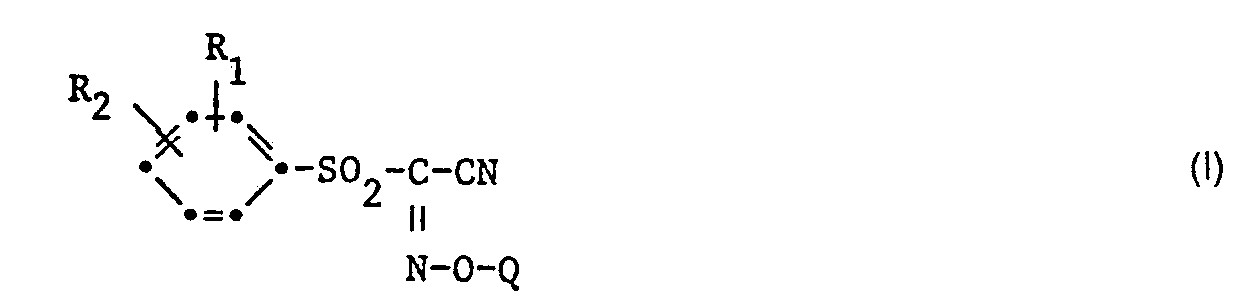
- the present invention relates to sulfur-containing oxime compounds which correspond to the formula I and agents which contain such oxime compounds as active compounds, furthermore the use of such oxime compounds for protecting crop plants from the phytotoxic action of aggressive herbicides, and propagation material of crop plants which has been treated with such oxime compounds.
- the active ingredients that can be used for this purpose correspond to the following general formula wherein R 1 and R 2 independently of one another are hydrogen, halogen or C 1 -C 4 alkyl and Q is the acetamide group, a C 1 -C 4 alkoxycarbonyl group, a C 2 -C 4 alkenyl group, an N- (C 1 - C 4 alkyl) carbamoyl group, a benzoyl group which is optionally mono- to trisubstituted by identical or different substituents from the group halogen, C j -C 4 alkyl and C l -C 4 alkoxy, or a 2-furoyl group represents.
- halogen means fluorine, chlorine, bromine or iodine.
- C l -C 4 alkyl by itself or as part of a substituent is methyl, ethyl, n-propyl, isopropyl, n-butyl, isobutyl, sec. Butyl or tert. Butyl.
- the new compounds of formula I are oxime ethers, oxime esters, oxime carbamates and oxime carbonates.
- DE-OS 2 119700 discloses 2-imino-2-sulfonyl-acetamide derivatives with fungicidal activity
- DE-AS 1 141 487 describes fungicidal agents which act as active substances ⁇ - (phenylsulfonyl) - ⁇ - ( contain oxyimino) acetonitrile derivatives in which the oxyimino group is substituted by a sodium cation or by a methyl or isopropyl group.
- the oximes of the formula are ideal, crops such. B. millet, rice, corn, cereals (wheat, rye, barley, oats), cotton, sugar beet, sugar cane and soybeans before the attack of plant-aggressive herbicides of various substance classes, such as. B. triazines, phenylurea derivatives, carbamates, thiol carbamates, haloacetanilides, halophenoxyacetic acid esters, subst. Phenoxyphenoxyacetic acid esters and propionic acid esters, subst.
- the invention relates both to compositions which contain these oxime ethers of the formula I together with herbicides and to compositions which contain these oxime ethers of the formula 1 as the only active component.
- Plant protection products containing an antidote of the formula I can be produced, marketed or used without the simultaneous presence of the herbicide to be attenuated.
- seed dressing which is carried out at a point in time that is completely independent of the use of the herbicide.
- Another area of application is the treatment of a soil in which remains of a herbicide from the last cultivation season are present, which could damage the proposed new plant culture.
- the antidote property is a substance property which is independent of the crop and of the herbicide which can be selectively weakened in action, which is inherent in a preparation of the formula 1, but only becomes apparent when the three components of the antidote herbicide plant interact. Similar to a pesticidal chemical whose pesticidal effect is only visible when a pest is present, the detection of the safener effect also requires the presence of the other two components involved, namely the herbicide and the crop. This distinguishes a formulated safener fundamentally from a synergistic two- or three-component mixture in which all active ingredient components are present at the same time and all aim in the same direction of action.
- antidotes or antidotes which are capable of specifically antagonizing the damaging effect of a herbicide on the crop, i.e. H. to protect the crop without noticeably influencing the herbicidal action on the weeds to be controlled.
- an antidote can be used for pretreating the seed of the crop (dressing the seed or cuttings) or before sowing in the seed furrows or as a tank mix on its own or together with the herbicide before or after emergence of the plants .
- GB-PS 1'277'557 describes the treatment of seeds or sprouts of wheat and sorghum with certain oxamic acid esters and amides before the attack by N-methoxymethyl-2 ', 6'-diethylchloroacetanilide (alachlor).
- Other references (DE-OS1'952910, DE-OS 2'245'471, FR-PS 2'021'611) suggest antidotes for the treatment of cereals, corn and rice seeds for protection against the attack of herbicidal thiocarbamates.
- oximes of the formula have the property of protecting crop plants from attack by aggressive herbicides of the most varied classes of substances, including 1,3,5-triazines, 1,2,4-triazinones, phenylurea derivatives, carbamates, thiolcarbamates, phenoxyacetic acid esters, phenoxypropionic acid esters, haloacetanilides, halophenoxyacetic acid esters , subst. Phenoxyphenoxyacetic acid esters and propionic acid esters, subst. Pyridinoxyphenoxy-acetic acid esters and propionic acid esters and benzoic acid derivatives, provided that these are not or insufficiently tolerant of culture.
- an antidote or antidote of the formula 1 can be used for the pretreatment of the seed of the crop (dressing of the seed or the cuttings), or it can be added to the soil before or after the seed, or on its own or together with the herbicide before or after the plants have emerged.
- the treatment of the plant or the seed with the antidote can therefore in principle be carried out independently of the time of application of the phytotoxic herbicide. However, it can also be carried out simultaneously (tank mixing).
- the application rates of the antidote in relation to the herbicide largely depend on the type of application. If a field treatment is carried out, the amounts of antidotes of the formula for phytotoxic herbicide are like 1: 100 to 1: 5, preferably 1: 20 to 1: 1. In the case of seed dressing and similar targeted protective measures, however, much smaller amounts of antidotes become compared with the z. B. later required per hectare of acreage of herbicide used (z. B. about 1: 3,000 to 1: 1,000). As a rule, protective measures such as seed dressing with an antidote of the formula I and possible subsequent field treatment with herbicides are only loosely connected. Pretreated seeds and plants can later come into contact with various herbicides in agriculture, horticulture and forestry.
- crop plants are all plants which produce crops in any form (e.g. seeds, roots, stems, bulbs, leaves, flowers, ingredients such as oil, sugar, starch and protein) and are grown and cared for for this purpose .
- These plants include, for example, all types of grain, corn, rice, millet, soybeans, beans, peas, potatoes, vegetables, cotton, sugar beet, sugar cane, peanuts, tobacco, hops, but then also ornamental plants, fruit trees and banana, cocoa and natural rubber - plants.
- an antidote can be used wherever a crop is to be protected against the phytotoxicity of a herbicide.
- the invention also relates to a method for protecting crop plants from aggressive (phytotoxic) herbicides, in that an oxime derivative of the formula I which acts as an antidote is optionally used before or after application of the herbicide or else simultaneously with the herbicide.
- the invention further relates to the propagation material of such crops which has been treated with an oxime derivative of the formula I.
- the term “propagation material” means all generative parts of plants that can be used to multiply the crop. These include seeds (seeds in the narrower sense), roots, fruits, tubers, rhizomes, stem parts, branches (cuttings) and other parts of plants. However, this also includes germinated plants and young plants that are to be transplanted after germination or emergence. Such young plants can be specifically protected against further transplantation by a complete or partial immersion treatment.
- oxime ethers oxime esters, oxime carbamates or oxime carbonates are available.
- the formation of the optionally substituted oxime esters of the formula I as indicated in the claims is also advantageously carried out with the oxime salts.
- the free oximes can also be esterified in the presence of acid-binding agents with suitable acylating agents, as the following scheme shows.
- the reactive carboxylic acid halides and the carboxylic acid anhydrides can advantageously be used to prepare these esters.
- oxime salts are reacted with halocarbonic acid esters.
- the free oximes can also be reacted with halocarbonic acid esters in the presence of acid-binding agents (see the following reaction scheme, which is intended to explain this reaction):
- the starting materials necessary for the preparation of the compounds of the formula namely the oximes or their salts, are known.
- the unsubstituted or nucleus-substituted oximes or their sodium salts are formed by reacting the arylsulfonacetonitriles and their core substitution products with alkyl nitriles Na ethylate.
- oxime nitriles are the following readily available starting products:
- solvents for obtaining the compounds of the formula I.
- hydrocarbons but especially polar solvents such as acetonitrile, dioxane, cellosolve, DMF, but also ketones such as methyl ethyl ketone etc.
- the temperatures are in the range from - 20 ° to approx. 150 °, preferably between 20 ° and 60 °.
- Bases such as tert. Amines (triethylamine, triethylenediamine, N-methylpiperidine, N-methylmorpholine, dimethylaniline) can be used.
- a suspension of anhydrous Na 2 CO 3 or anhydrous K 2 CO 3 in an anhydrous reaction medium is sufficient.
- Oximes are in two stereoisomeric forms, the syn. and anti-form, before. All of the end products mentioned correspond to the formula and can be pure or as mixtures in both forms. In the context of the present description, both stereoisomeric forms are to be understood as such and as mixtures in any mutual mixing ratio.
- One of the preferred subgroups of antidotes or safeners are compounds of the formula wherein R 1 is hydrogen, chlorine, methyl or ethyl and R 2 is hydrogen and Q ⁇ CH 2 CONH 2 , ⁇ COOCH 3 , a C 2 -C 4 alkenyl group, an N-methylcarbamoyl group, a benzoyl group, which is represented by two chlorine atoms and one Methoxy group is substituted, or represents a 2-furoyl group.
- Small flower pots (upper ⁇ cm) are filled with garden soil into which the plant culture is sown, covered and lightly pressed. Then the substance to be tested as an antidote is sprayed on as a dilute solution (obtained from a wettable powder) in an amount corresponding to 4 kg of AS / ha. Immediately afterwards, the herbicide is sprayed on in a corresponding manner. After standing for 18 days at approx. 20-23 ° C and 60-70% relative humidity, evaluation is carried out on a linear scale from 1 to 9, where 1 means total damage to the plants and 9 undamaged health. Plants without antidote protection serve as controls.
- a Hewitt nutrient solution is prepared that contains an additional 10 ppm of the antidote to be tested.
- Rice seeds of the «IR-8» variety are sown in inert filling material (granular zonolite), which is located in a perforated plastic flower pot on the underside (upper 0 6 cm). This is placed in a second transparent plastic flower pot (upper ⁇ 7 cm), in which there are approx. 50 ml of the prepared nutrient solution, which now rises capillary in the filling material of the smaller pot and wets the seeds and germinating plant. The loss of fluid is supplemented daily with pure Hewit nutrient solution to 50 ml. After 15 days, the rice plants in the 2 to 21/2 leaf stage are transplanted into rectangular plastic pots (8 x 8 cm, 10 cm high) which are filled with 500 ml of marshy soil.
- inert filling material granular zonolite
- Compound No. 2 causes the following significant weakening of the phytotoxic effects of the triazine herbicide.
- An Ilewitt nutrient solution is prepared which contains the amount of herbicide specified below and 10 ppm of the antidote to be tested.
- Rice seeds of the IR 8 variety are soaked for 48 hours with solutions of the test substances of 10 or 100 ppm. The seeds are then left to dry for about 2 hours until they no longer stick. Rectangular plastic pots (8 x 8 cm, 10 cm high) are filled with sandy clay up to 2 cm below the edge. 4 g of seeds are sown per pot and only very weakly covered (about the diameter of the seed). The earth is kept in a moist (not swampy) state. Then the herbicide N- (1-methyl-2-methoxyethyl) -N-chloroacetyl-2-ethyl-6-methylaniline is applied in dilute solution and in an amount equivalent to 1.5 kg ai / ha. 7 and 18 days after transplanting, evaluation is carried out on a linear scale from 1 to 9, where 1 means total plant damage and 9 unimpaired health status.
- the evaluation is carried out on a linear scale from 1 to 9, where 1 means total plant damage and 9 unimpaired health status.
- Compound No. 5 has the following antidote activity in these experiments.
- Plastic pots (8 x 8 cm, 10 cm high) are filled up to 2 cm below the edge with soil in a swampy, wet state.
- the substance to be tested as an antidote is sprayed onto the surface in dilute solution and in an amount which corresponds to 4 kg of AS / ha.
- Rice plants of the “IR-8” variety are transplanted into the pots prepared in this way in the 11/2 to 2-leaf stage. The next day the water level will rise to about 1.5 cm increased. 4 days after transplantation, the equivalent of 0.75 kg of AS / ha of 2-ethylamino-4- (1,2-dimethyl-n-propylamino) -6-methylthio-s-triazine in granular form are added to the water.
- the temperature during the test is 26-28 ° C, the relative humidity 60-80%.
- 20 days after herbicide treatment is evaluated on a linear scale from 1 to 9, where 1 means total plant damage and 9 unimpaired health status. Plants without antidote protection serve as controls.
- the compounds of the formula can be used alone or together with the herbicides to be antagonized and together with suitable carriers and / or other additives.
- suitable carriers and additives can be solid or liquid and correspond to the substances commonly used in formulation technology, e.g. B. natural or regenerated mineral substances, solvents, dispersants, wetting agents, adhesives, thickeners, binders or fertilizers.
- the active substance content in commercially available agents is between 0.01 and 90%.
- the active substance is mixed with epichlorohydrin and dissolved with 6 parts of acetone, then polyethylene glycol and cetyl polyglycol ether are added.
- the solution thus obtained is sprayed onto kaolin, and the acetone is then evaporated off in vacuo.
- Such microgranules can advantageously be incorporated into seed furrows.
- the active ingredients are intimately mixed with the additives in suitable mixers and ground on appropriate mills and rollers. This gives wettable powders of excellent wettability and suspension which can be diluted with water to form suspensions of the desired concentration and can be used in particular for seed dressing and dip treatment of cuttings.
- Such concentrates can be used to produce emulsions of any desired concentration by dilution with water, which are particularly suitable for seed dressing and dip treatment of young plants.
Landscapes
- Organic Chemistry (AREA)
- Chemical & Material Sciences (AREA)
- Life Sciences & Earth Sciences (AREA)
- Health & Medical Sciences (AREA)
- General Health & Medical Sciences (AREA)
- Zoology (AREA)
- Pest Control & Pesticides (AREA)
- Engineering & Computer Science (AREA)
- Dentistry (AREA)
- Wood Science & Technology (AREA)
- Plant Pathology (AREA)
- Environmental Sciences (AREA)
- Toxicology (AREA)
- Agronomy & Crop Science (AREA)
- Agricultural Chemicals And Associated Chemicals (AREA)
- Organic Low-Molecular-Weight Compounds And Preparation Thereof (AREA)
- Nitrogen And Oxygen Or Sulfur-Condensed Heterocyclic Ring Systems (AREA)
- Furan Compounds (AREA)
- Heterocyclic Compounds Containing Sulfur Atoms (AREA)
- Pharmaceuticals Containing Other Organic And Inorganic Compounds (AREA)
Description
- Die vorliegende Erfindung betrifft schwefelhaltige Oxim-Verbindungen, welche der Formel I entsprechen, sowie Mittel, welche solche Oxim-Verbindungen als Wirkstoffe enthalten, ferner die Anwendung solcher Oxim-Verbindungen zum Schutz von Kulturpflanzen vor der phytotoxischen Wirkung von aggressiven Herbiziden, und Vermehrungsgut von Kulturpflanzen, welches mit solchen Oxim-Verbindungen behandelt worden ist.
- Die für diesen Zweck einsetzbaren Wirkstoffe entsprechen der folgenden Allgemeinformel

- In der Formel I ist unter Halogen Fluor, Chlor, Brom oder Jod zu verstehen.
- Der Ausdruck Cl-C4-Alkyl allein oder als Teil eines Substituenten steht für Methyl, Aethyl, n-Propyl, Isopropyl, n-Butyl, Isobutyl, sec. Butyl oder tert. Butyl.
- Die neuen Verbindungen der Formel I stellen Oximäther, Oximester, Oximcarbamate und Oximcarbonate dar.
- Schwefelhaltige Oxim-Verbindungen mit fungizider Wirkung sind bereits beschrieben worden. In der DE-OS 2 119700 werden 2-Imino-2-sulfonyl-acetamid-Derivate mit fungizider Wirkung offenbart, und in der DE-AS 1 141 487 sind fungizide Mittel beschrieben, welche als Aktivsubstanzen α-(Phenylsulfonyl)-α-(oxyimino)-acetonitril-Derivate enthalten, in denen die Oxyiminogruppe durch ein Natriumkation oder durch eine Methyl- oder Isopropylgruppe substituiert ist.
- Die Oxime der Formel eignen sich hervorragend, Kulturpflanzen wie z. B. Kulturhirse, Reis, Mais, Getreidearten (Weizen, Roggen, Gerste, Hafer), Baumwolle, Zuckerrüben, Zuckerrohr und Soja vor dem Angriff von pflanzenagressiven Herbiziden verschiedenster Stoffklassen, wie z. B. Triazinen, Phenylharnstoffderivaten, Carbamaten, Thiolcarbamaten, Halogenacetaniliden, Halogenphenoxyessigsäureestern, subst. Phenoxyphenoxyessigsäureestern und -propionsäureester, subst. Pyridinoxyphenoxy-essigsäureestern und -propionsäureestern sowie Benzoesäurederivaten zu schützen, sofern diese nicht oder nicht genügend selektiv wirken, also neben den zu bekämpfenden Unkräutern auch die Kulturpflanzen schädigen. Die Erfindung betrifft sowohl Mittel, welche diese Oximäther der Formel I zusammen mit Herbiziden enthalten, als auch Mittel, welche diese Oximäther der Formel 1 als einzige Aktivkomponente enthalten. Pflanzenschutzmittel, die ein Gegenmittel der Formel I (auch Antidote oder Safener genannt) enthalten, können ohne gleichzeitige Anwesenheit des abzuschwächenden Herbizids hergestellt, in den Handel gebracht oder verwendet werden. Eine wichtige Anwendungsmöglichkeit ist die Saatbeizung, die zu einem von der Anwendung des Herbizids ganz unabhängigen Zeitpunkt vorgenommen wird. Ein anderes Einsatzgebiet ist die Behandlung eines Bodens, in dem noch Reste eines Herbizids der letzten Anbausaison vorhanden sind, das die vorgesehene neuen Pflanzenkultur schädigen könnte.
- Die Antidote-Eigenschaft ist eine von der Kulturpflanze und von dem in der Wirkung selektiv abzuschwächenden Herbizid unabhängige Stoffeigenschaft, die einem Präparat der Formel 1 inhärent ist, jedoch erst beim Zusammenwirken der drei Komponenten Antidote-Herbizid Pflanze sichtbar zu Tage tritt. -Aehnlich einer pestizid wirkenden Chemikalie, deren Pestizid-Wirkung erst bei Anwesenheit eines Schädlings sichtbar wird, erfordert auch der Nachweis der Safener-Wirkung die Anwesenheit der an der Wirkung beteiligten anderen beiden Komponenten, nämlich des Herbizids und der Kulturpflanze. Dies unterscheidet ein formuliertes Safener-Mittel grundsätzlich von einem synergistisch wirkenden Zwei-oder Dreikomponentengemisch, bei dem gleichzeitig alle Wirkstoffkomponenten vorliegen und sämtlich in die gleiche Wirkungsrichtung zielen.
- Als Gegenmittel oder Antidote sind schon verschiedene Stoffe vorgeschlagen worden, welche befähigt sind, die schädigende Wirkung eines Herbizids auf die Kulturpflanze spezifisch zu antagonisieren, d. h. die Kulturpflanze zu schützen, ohne dabei die Herbizidwirkung auf die zu bekämpfenden Unkräuter merklich zu beeinflussen. Dabei kann ein solches Gegenmittel je nach seinen Eigenschaften zur Vorbehandlung des Saatgutes der Kulturpflanze (Beizung des Samens oder der Stecklinge) oder vor der Saat in die Saatfurchen oder als Tankmischung für sich allein oder zusammen mit dem Herbizid vor oder nach dem Auflaufen der Pflanzen verwendet werden.
- So schreibt die GB-PS 1'277'557 die Behandlung von Samen bzw. Sprösslingen von Weizen und Sorghum mit gewissen Oxamsäureestern und Amiden vor dem Angriff durch N-Methoxymethyl-2',6'- diäthyl-chloracetanilid (Alachlor). Andere Literaturstellen (DE-OS1'952910, DE-OS 2'245'471, FR-PS 2'021'611) schlagen Gegenmittel zur Behandlung von Getreide, Mais- und Reis-Samen zum Schutz gegen den Angriff herbizider Thiocarbamate vor. In der DE-OS 1'567'075 und der US-PS 3'131'509 werden Hydroxy-amino-acetanilide und Hydantoine für den Schutz von Getreidesamen gegenüber Carbamaten wie z. B. IPC, CIPC vorgeschlagen. In der weiteren Entwicklung haben sich alle diese Präparate jedoch als ungenügend erwiesen.
- Ueberraschenderweise besitzen Oxime der Formel die Eigenschaft, Kulturpflanzen vor dem Angriff pflanzenaggressiver Herbizide der verschiedensten Stoffklassen zu schützen, darunter 1,3,5-Triazinen, 1,2,4-Triazinonen, Phenylharnstoffderivaten, Carbamaten, Thiolcarbamaten, Phenoxyessigsäureestern, Phenoxypropionsäureestern, Halogenacetaniliden, Halogenphenoxyessigsäureestern, subst. Phenoxyphenoxyessigsäureestern und -propionsäureestern, subst. Pyridinoxyphenoxy-essigsäureestern und -propionsäureestern und Benzoesäurederivaten, sofern diese nicht oder ungenügend kulturentolerant sind.
- Ein solches Gegenmittel oder Antidote der Formel 1 kann je nach Anwendungszweck zur Vorbehandlung des Saatgutes der Kulturpflanze (Beizung des Samens oder der Stecklinge) eingesetzt oder vor oder nach der Saat in den Erdboden gegeben werden oder aber für sich allein oder zusammen mit dem Herbizid vor oder nach dem Auflaufen der Pflanzen appliziert werden. Die Behandlung der Pflanze oder des Saatguts mit dem Antidote kann daher grundsätzlich unabhängig vom Zeitpunkt der Applikation des phytotoxischen Herbizids erfolgen. Sie kann jedoch auch gleichzeitig durchgeführt werden (Tankmischung). Vorauflauf-Behandlung schliesst sowohl die Behandlung der Anbaufläche vor der Aussaat (ppi = « pre plant incorporation ») als auch die Behandlung der angesäten, aber noch nicht bewachsenen Anbauflächen ein.
- Die Aufwandmengen des Antidotes im Verhältnis zum Herbizid richten sich weitgehend nach der Anwendungsart. Sofern eine Feldbehandlung vorgenommen wird, verhalten sich die Mengen von Antidote der Formel zu phytotoxischem Herbizid wie 1 : 100 bis 1 : 5, bevorzugt 1 : 20 bis 1 : 1. Bei Samenbeizung und ähnlichen gezielten Schutzmassnahmen werden jedoch weit geringere Mengen Antidote im Vergleich mit den z. B. später pro Hektar Anbaufläche verwendeten Herbizidmengen benötigt (z. B. ca. 1 : 3 000 bis 1 : 1 000). In der Regel stehen protektive Massnahmen wie Samenbeizung mit einem Antidote der Formel I und mögliche spätere Feldbehandlung mit Herbiziden nur in losem Zusammenhang. Vorbehandeltes Saat- und Pflanzengut kann später in Landwirtschaft, Gartenbau und Forstwirtschaft mit unterschiedlichen Herbiziden in Berührung kommen.
- Kulturpflanzen seien im Rahmen vorliegender Erfindung alle Pflanzen, die in irgendeiner Form Ertragsstoffe produzieren (z. B. Samen, Wurzeln, Stengel, Knollen, Blätter, Blüten, Inhaltsstoffe wie Oele, Zucker, Stärke und Eiweiss) und zu diesem Zweck angebaut und gehegt werden. Zu diesen Pflanzen gehören beispielsweise sämtliche Getreidearten, Mais, Reis, Edelhirse, Soja, Bohnen, Erbsen, Kartoffeln, Gemüse, Baumwolle, Zuckerrüben, Zuckerrohr, Erdnüsse, Tabak, Hopfen, dann jedoch auch Zierpflanzen, Obstbäume sowie Bananen-, Kakao- und Naturkautschuk-Gewächse. Diese Aufzählung stellt keine Limitierung dar. Grundsätzlich lässt sich ein Antidote überall dort einsetzen, wo eine Kulturpflanze vor der Phytotoxizität eines Herbizids geschützt werden soll.
- Die Erfindung bezieht sich auch auf ein Verfahren zum Schutz von Kulturpflanzen vor aggressiven (phytotoxischen) Herbiziden, indem ein als Antidote wirkendes Oximderivat der Formel I wahlweise vor oder nach Applikation des Herbizids oder auch gleichzeitig mit dem Herbizid angewendet wird.
- Die Erfindung bezieht sich ferner auf das Vermehrungsgut solcher Kulturpflanzen, das protektiv mit einem Oximderivat der Formel I behandelt wurde. Unter dem Begriff « Vermehrungsgut sind alle generativen Pflanzenteile zu verstehen, die zur Vermehrung der Kulturpflanze eingesetzt werden können. Dazu zählen Samenkörner (Saatgut im engeren Sinne), Wurzeln, Früchte, Knollen, Rhizome, Stengelteile, Zweige (Stecklinge) und andere Pflanzenteile. Es zählen aber auch angekeimte Pflanzen und Jungpflanzen dazu, die nach der Ankeimung oder dem Auflaufen weiterverpflanzt werden sollen. Solche Jungpflanzen lassen sich durch eine vollständige oder partielle Tauchbehandlung vor dem Weiterverpflanzen gezielt schützen.
- Verbindungen der Formel I lassen sich nach mehreren Verfahren aus den freien Oximen herstellen, die nachstehend schematisch wiedergegeben sind :
- Die Herstellung der Verbindungen der Formel 1 erfolgt nach an sich bekannten Verfahren ; siehe z. B. J. f. prakt. Chemie 66 S. 353 ; Liebigs Ann. 25g 165.
- Durch Kondensation von substituierten Oximino-Verbindungen bzw. ihrer Salze, besonders ihrer Alkalisalze oder Ammoniumsalze mit reaktionsfähigen Partnern entstehen die Verbindungen der Formel 1 (Organic Reaktions 1953, Band 7, Seite 343 und 373).
- Je nach der Bedeutung des Substituenten Q in der Formel I eutstehen Oximäther, Oximester, Oximcarbamate oder Oximcarbonate.
- Die Kondensation der substituierten Oximino-Verbindungen mit reaktionsfähigen Alkyl- oder Alkenyl-Derivaten erfolgt bei der Verätherung zweckmässig in Form ihrer Salze, besonders ihrer Alkalimetallsalze oder Ammoniumsalze wie im folgenden ausgewählten Beispiel dargestellt wird :

- Die Bildung der wie in den Ansprüchen angegeben gegebenenfalls substituierten Oximester der Formel I erfolgt zweckmässig ebenfalls mit den Oximsalzen. Es können jedoch auch die freien Oxime in Gegenwart säurebindender Mittel mit geeigneten Acylierungsmitteln verestert werden, wie das folgende Schema zeigt.

- Zur Herstellung dieser Ester können mit Vorteil die reaktionsfähigen Carbonsäurehalogenide wie auch die Carbonsäureanhydride verwendet werden.
- Die Herstellung der Oxim-carbamate der Formel I erfolgt zweckmässig durch Umsetzen der freien Oxime mit Isocyanaten oder der Oximsalze mit Halogenkohlensäure-mono-C1-C4-Alkyl-substituierten Amiden, wie an den untenstehend ausgewählten Beispielen dargestellt werden soll :

- Zur Herstellung der Carbamate eignen sich die Carbaminsäurehalogenide, ganz besonders aber die Isocyanate. Als Isocyanate seien z. B. genannt :
- Methylisocyanat
- Aethylisocyanat
- iso-Propylisocyanat
- t-Butylisocyanat
- n-Propylisocyanat
- sec. Butylisocyanat
- iso-Butylisocyanat
- Ein geeignetes Carbamoylhalogenid ist beispielsweise das Methylcarbamoylchlorid.
- Zur Herstellung von Oximcarbonaten der Formel I werden Oximsalze mit Halogenkohlensäureestern umgesetzt. Man kann ebenfalls die freien Oxime in Gegenwart säurebindender Mittel mit Halogenkohlensäureestern umsetzen, (siehe das folgende Reaktionsschema, welches diese Umsetzung erläutern soll) :

- Weitere allgemeine Reaktionsmöglichkeiten welche zu Verbindungen der Formel I führen, sind zum Beispiel die Umsetzung von Oximkohlensäurehalogeniden mit C1-C4-Alkyl-Aminen oder, C1-C4-Alkoholen, wobei entweder Oximcarbamate oder Oximcarbonate gebildet werden. Auch solche Reaktionen sollen durch die folgenden Beispiele formelmässig veranschaulicht werden.

- Oximcarbamat der Formel I (R =C1-C4-Alkyl)

- ; Oximcarbonat der Formel (R = C1-C4-Alkyl)
- Die zur Herstellung der Verbindungen der Formel notwendigen Ausgangsmaterialien, nämlich die Oxime bzw. deren Salze sind bekannt. (Arch. Pharm. 246631) Durch Umsetzung der Arylsulfonacetonitrile wie deren Kernsubstitutionsprodukte mit Alkylnitrilen Na-äthylat entstehen die unsubstituierten bzw. kernsubstituierten Oxime bzw. deren Natriumsalze.
- Unter den bevorzugten Oximnitrilen befinden sich die folgenden leicht zugänglichen Ausgangsprodukte :


- Als Lösungsmittel zur Gewinnung der Verbindungen der Formel I eignen sich prinzipiell alle Vertreter, die sich unter den Bedingungen der Reaktion indifferent erhalten. Beispielsweise Kohlenwasserstoffe, vor allem aber polare Lösungsmittel wie Acetonitril, Dioxan, Cellosolve, DMF, aber auch Ketone wie Methyläthylketon usw.
- Die Temperaturen liegen im Bereich von - 20° bis ca. 150°, bevorzugt zwischen 20° und 60°.
- Als halogenwasserstoffabspaltende Mittel können Basen wie tert. Amine (Triäthylamin, Triäthylendiamin, N-Methylpiperidin, N-Methylmorpholin, Dimethylanilin) eingesetzt werden.
- In einigen Fällen genügt eine Suspendierung von wasserfreier Na2C03 oder wasserfreier K2C03 in wasserfreiem Reaktionsmedium.
- Oxime liegen in zwei stereoisomeren Formen, der syn. und anti-Form, vor. Alle genannten Endprodukte entsprechen der Formel und können in beiden Formen rein oder als Gemische vorliegen. Im Rahmen der vorliegenden Beschreibung sind demgemäss beide stereoisomere Formen für sich und als Gemische in beliebigem gegenseitigen Mischungsverhältnis zu verstehen.
- Eine der bevorzugten Untergruppen von Antidoten oder Safenern sind Verbindungen der Formel

- Als wichtige Einzelverbindungen im Rahmen der vorgenannten Stoffgruppe von Antidoten sind die weiter unten in der Tabelle genannten Verbindungen Nr. 3, 4, 5, 8, 11, 13 und 14.
- Die nachfolgenden Beispiele erläutern die Herstellung der Verbindungen der Formel I. Anschliessend befindet sich eine Tabelle von in analoger Weise zu diesen Beispielen hergestellten Verbindungen. Die Temperaturen sind in Celsiusgraden gegeben, Prozentangaben beziehen sich auf das Gewicht.
- 1/10 Mol 4-Bromphenylsulfonylglyoxylonitriloxim-natrium wird fein gemahlen und in wenig trockenem Aether suspendiert und mit der berechneten Menge frisch destilliertem Benzoylchlorid versetzt und längere Zeit auf dem Wasserbad erhitzt. Die ausgeschiedene Masse wird aus Chloroform umkristallisiert, wobei man das bei 170-172° schmelzende Produkt der Formel

- 10 g 4-Methylphenylsulfonyl-glyoxylonitriloxim-natrium wird fein gemahlen und in 50 ml Acetonitril suspendiert. Nach Zugabe von 24,2 g Allylbromid wird 2 Stunden auf 50-60° Badtemperatur gehalten. Danach wird eingedampft und der halbfeste Rückstand mit Wasser verrührt, wobei das Produkt als beige gefärbtes Kristallisat ausfällt. Ausbeute 9,7 g (91,5% Ausbeute) Smp. 34-36°. Das Produkt entspricht der Formel

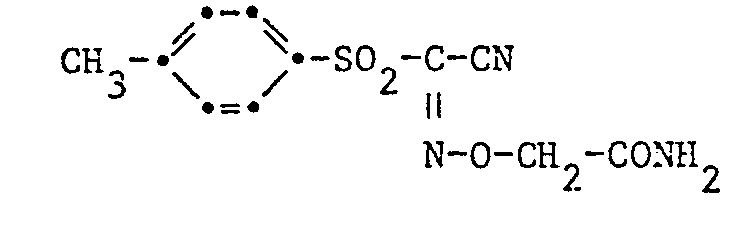
- 0,04 Mol Na-Salz des 4-Methylphenylsulfonylglyoxylonitril-oxim werden fein gemahlen und in 50 ml Acetonitril suspendiert. Dazu werden 0,04 Mol Jodacetamid zugegeben und 2 Stunden auf 50-60° gehalten und dann bei dieser Temperatur eingedampft. Der Rückstand wurde mit Methylenchlorid versetzt, dann filtriert mit Tiorkohle behandelt und eingedampft. Smp. 115-122°. Aus Methanol/H20 umkristallisert. Smp. 130-132° und entspricht der Formel

- 10 g Phenylsulfonylglyoxylonitril-oxid (0,05 Mol) werden in 100 cc Acetonitril gelöst, mit einer Spatelspitze DABCO versetzt und 10,8 g Methylisocyanat (0,2 Mol) zugegeben. Es wird eine leichte Temperaturzunahme von 23° auf 27° beobachtet. Es wurde 5 Stunden ein 50-60° gehalten, worauf eine feine Suspension entstand. Das Reaktionsgemisch wurde in ca. 500 ml Eiswasser gerührt und das fein kristallin ausgefallene Produkt abgenutscht und mit Wasser gewaschen. Es schmilzt bei 120-123° und entspricht durch Verfahren und Analyse der Formel

-

- In analoger Weise zu diesen Beispielen wurden die in der folgenden Tabelle aufgeführten Verbindungen erhalten.


- Die für Kulturpflanzen gegen starke Herbizide antagonistische Wirkung wurde durch folgende Versuche nachgeprüft :
- Kleine Blumentöpfe (oberer φ cm) werden mit Gartenerde gefüllt, in die die Pflanzenkultur eingesät, bedeckt und leicht festgedrückt wird. Dann wird die als Antidote zu prüfende Substanz als (aus einem Spritzpulver erhaltene) verdünnte Lösung in einer Menge aufgesprüht, die 4 kg AS/ha entspricht. Unmittelbar danach wird in entsprechender Weise das Herbizid aufgesprüht. Nach 18 Tagen Stehen bei ca. 20-23 °C und 60-70 % relativer Luftfeuchtigkeit wird nach einer linearen Skala von 1 bis 9 ausgewertet, wobei 1 totale Pflanzenschädigung und 9 unbeeinträchtigter Gesundheitszustand bedeuten. Als Kontrolle dienen Pflanzen ohne Antidote-Schutz.
- Es wurden verwendet:
- 1) 1,5 kg AS/ha a-[4-(p-Trifluormethylphenoxy)-phenoxy]-propionsäure-n-butoxyäthylester in Mais der Sorte « Orla 264 ».
- 2) 1,5 kg AS/ha Metolachlor = N-(1-Methyl-2-methoxyäthyl)-N-chloracetyl-2-äthyl-6-methylanilin in Sorghum-Hirse der Sorte « Funk G-522".
- 3) 2,0 kg AS/ha Prometryn = 2,4-bis(Isopropylamino)-6-methylthio-s-triazin in Soja.
- 4) 2,0 kg AS/ha 4-Aethylamino-6-tert.butylamino-2-chlor-s-triazin in Weizen der Sorte « Farnese".
- 5) 4,0 kg AS/ha Prometryn = 2,4-bis(Isopropylamino)-6-methylthio-s-triazin in Sorghum-Hirse der Sorte « Funk G-522 ».
- 6) 2,0 kg AS/ha α-[4-(p-Trifluormethylphenoxy)-phenoxy]-propionsäure-n-butoxyäthylester in Gerste der Sorte « Mazurka ».
- Mit den Verbindungen der Formel I erhält man folgendes Resultat :

- Es wird eine Hewitt-Nährlösung hergestellt, die zusätzlich 10 ppm des zu prüfenden Antidotes enthält.
- Reissamen der Sorte « IR-8 » wird in inertes Füllmaterial (gekörntes Zonolith) gesät, das sich in einem an der Unterseite durchlöcherten Plastik-Blumentopf (oberer 0 6 cm) befindet. Dieser wird in einen zweiten durchsichtigen Plastik-Blumentopf (oberer φ 7 cm) gestellt, in dem sich ca. 50 ml der vorbereiteten Nährlösung befinden, die nunmehr kapillar im Füllmaterial des kleineren Topfes aufsteigt und Samen und keimende Pflanze benetzt. Täglich wird der Flüssigkeitsverlust mit reiner Hewit-Nährlösung auf 50 ml ergänzt. Nach 15 Tagen werden die Reispflanzen im 2- bis 21/2-Blattstadium in rechteckige Plastiktöpfe (8 x 8 cm, 10 cm Höhe) verpflanzt, die mit 500 ml sumpfignasser Erde gefüllt sind. Am nächsten Tag wird der Wasserstand darin auf 1-2 cm über Boden-Niveau erhöht. 4 Tage nach Verpflanzung gibt man das Herbizid 2-Aethylamino-4-(1,2-dimethyl-n-propylamino)-6-methylthio-s-triazin in Granulatform und in einer Menge zu, die umgerechnet 0,75 kg AS/ha beträgt. 3 Wochen nach Herbizidzugabe wird nach einer linearen Skala von 1 bis 9 ausgewertet, wobei 1 totale Pflanzenschädigung und 9 unbeeinträchtigter Gesundsheitszustand bedeuten. Die parallel angewandte Kontroll-Lösung enthält keinen Antidote-Zusatz.
- Die Verbindung Nr. 2 bewirkt die folgende deutliche Abschwächung der phytotoxischen Wirkungen des Triazin-Herbizides.


- Es wird eine Ilewitt-Nährlösung hergestellt, die die nachstehend angegebene Menge Herbizid sowie 10 ppm des zu prüfenden Antidotes enthält.
- Man verwendet Kultursamen, der in der angegebenen Prüfkonzentration von dem eingesetzten Herbizid erwartungsgemäss geschädigt werden sollte und sät ihn in gekörntes Zonolith (= expandiertes Vermikulit), das sich in einem an der Unterseite durchlöcherten Plastik-Blumentopf (oberer φ 6 cm) befindet. Dieser wird in einen zweiten durchsichtigen Plastik-Blumentopf (oberer φ 7 cm) gestellt, in dem sich ca. 50 ml der mit Herbizid und Antidote vorbereiteten Nährlösung befinden, die nunmehr kapillar im Füllmaterial des kleineren Topfes aufsteigt und Samen und keimende Pflanze benetzt. Täglich wird der Flüssigkeitsverlust mit reiner Hewitt-Nährlösung auf 50 ml ergänzt. 3 Wochen nach Testbeginn wird nach einer linearen Skala von 1 bis 9 ausgewertet, wobei 1 totale Pflanzenschädigung und 9 unbeeinträchtiger Gesundheitszustand bedeuten. Die parallel angewandte Kontroll-Lösung enthält keinen Antidote-Zusatz.
- Man verwendet:
- 1) 4 ppm Prometryn = 2,4-bis(Isopropylamino)-6-methylthio-s-triazin in Sorghum-Hirse der Sorte « Funk G-522 ».
- 2) 4 ppm 4-Aethylamino-6-tert.butylamino-2-chlor-s-triazin in Weizen der Sorte « Farnese ».
- 3) 4 ppm a-[4-(p-Trifluormethylphenoxy)-phenoxy]-propionsäure-n-butoxyäthylester in Gerste der Sorte « Mazurka ".
- 4) 5 ppm Metolachlor = N-(1-Methyl-2-methoxy-äthyl)-N-chloracetyl-2-äthyl-6-methylanilin in Sor- ghum-Hirse der Sorte « Funk G-522 ».
- Mit den Verbindungen der Formel 1 erhält man folgendes Resultat :

- Reissamen der Sorte IR 8 werden während 48 Stunden mit Lösungen der Testsubstanzen von 10 oder 100 ppm getränkt. Anschliessend werden die Samen etwa 2 Stunden trocknen gelassen, bis sie nicht mehr kleben. Rechteckige Plastiktöpfe (8 x 8 cm, 10 cm Höhe) werden bis 2 cm unter den Rand mit sandigem Lehm gefüllt. 4 g Samen werden pro Topf gesät und nur ganz schwach gedeckt (etwa Durchmesser des Samenkorns). Die Erde wird in einem feuchten (nicht sumpfigen) Zustand gehalten. Dann wird das Herbizid N-(1-Methyl-2-methoxyäthyl)-N-chloracetyl-2-äthyl-6-methylanilin in verdünnter Lösung und in einer Menge appliziert, die umgerechnet 1,5 kg AS/ha entspricht. 7 und 18 Tage nach dem Verpflanzen wird nach einer linearen Skala von 1 bis 9 ausgewertet, wobei 1 totale Pflanzenschädigung und 9 unbeeinträchtigter Gesundheitszustand bedeuten.
- Wie aus der folgenden Tabelle ersichtlich, vermochten Verbindungen der Formel I in diesem Test die Reiskeimlinge vor der phytotoxischen Wirkung des verwendeten Herbizides zu schützen.

- Man füllt kleine Plastik-Blumentöpfe (oberer 0 6 cm), die an der Unterseite durchlöchert sind, mit gekörntem Zonolith und sät den Kultursamen ein. Dann wir der Topf in einen zweiten durchsichtigen Plastik-Blumentopf (oberer 0 7 cm) gestellt, in dem sich 50 ml Wasser befinden, das kapillar aufsteigt und den Samen benetzt. Ab 5. Tag wird der laufende Wasserverlust mit Hewitt-Nährlösung ausgeglichen. Ab 15. Tag, wenn sich die Kulturpflanze im 11/2- bis 2-Blattstadium befindet, wird in die wieder auf 50 ml ergänzte Nährlösung
- 10 ppm des zu prüfenden Antidotes + die unten angegebene Menge Herbizid
- 3 Wochen nach Zugabe des Herbizids und des Antidotes erfolgt die Auswertung nach einer linearen Skala von 1 bis 9, wobei 1 totale Pflanzenschädigung und 9 unbeeinträchtigter Gesundheitszustand bedeuten.
- Testvarianten :
- 1) 8 ppm a[4-(3,5-Dichlorpyridyl-2-oxy)-phenoxy]-propionsäure-propargylthioloester in Weizen der Sorte « Zenith •.
- 2) 4 ppm 4-Aethylamino-6-tert.butylamino-2-chlor-s-triazin in Weizen der Sorte « Zenith ».
- 3) 2 ppm α-[4-(p-Trifluormethylphenoxy)-phenoxy]-propionsäure-n-butoxyäthylester in Mais der Sorte « Orla ».
- 4) 8 ppm a-[4-(p-Trifluormethylphenoxy)-phenoxy]-propionsäure-n-butoxyäthylester in Sorghum-Hirse der Sorte « Funk G-522 ».
- 5) 4 ppm Prometryn = 2,4-bis(Isopropylamino)-6-methylthio-s-triazin in Sorghum-Hirse der Sorte « Funk G-522 •.
- Verbindung Nr. 5 erzielt bei diesen Versuchen folgende Antidote-Wirkung.

- Allgemeine Methodik :
- Kleine Blumentöpfe (oberer φ 6 cm) werden mit sandiger Lehmerde gefüllt, in die die Kulturpflanze eingesät wird. Nach dem Bedecken des Samens sprüht man die als Antidote zu prüfende Substanz in verdünnter Lösung und in einer Menge auf die Oberfläche, die umgerechnet 4 kg AS/ha beträgt. Man hält bei 20-23 °C und 60-70 % relativer Luftfeuchtigkeit. Wenn die Pflanzen nach 10 Tagen das 2- bis 3-Blattstadium erreicht haben, werden sie, wie nachfolgend angegeben, mit der entsprechenden Menge Herbizid behandelt. 14 Tage nach Herbizid-Applikation wird nach einer linearen Skala von 1 bis 9 ausgewertet, wobei 1 totale Pflanzenschädigung und 9 unbeeinträchtigter Gesundheitszustand bedeuten. Als Kontrolle dienen Pflanzen ohne Antidote-Schutz.
- Man verwendet:
- 1) 4,0 kg AS/ha Ametryn = 2-Aethylamino-4-isopropylamino-6-methylthio-s-triazin in Mais der Sorte « Orla 264 » .
- 2) 1,0 kg AS/ha Prometryn = 2,4-bis(Isopropylamino)-6-methylthio-s-triazin in Sorghum-Hirse der Sorte « Funk G-522 »,
- 3) 0,25 kg AS/ha α-[4-(p-Trifiuormethylphenoxy)-phenoxy]-propionsäure-n-butoxyäthylester in Gerste der Sorte « Mazurka ».

- Plastiktöpfe (8 x 8 cm, 10 cm Höhe) werden bis 2 cm unter den Rand mit Erde im sumpfig-nassen Zustand gefüllt. Die als Antidote zu prüfende Substanz wird in verdünnter Lösung und in einer Menge auf die Oberfläche gesprüht, die 4 kg AS/ha entspricht. Reispflanzen der Sorte « IR-8 » werden im 11/2- bis 2-Blattstadium in die so vorbereiteten Töpfe verpflanzt. Am nächsten Tag wird der Wasserstand auf ca. 1,5 cm erhöht. 4 Tage nach Verpflanzung werden umgerechnet 0,75 kg AS/ha von 2-Aethylamino-4-(1,2-dimethyl-n-propylamino)-6-methylthio-s-triazin in Granulatform ins Wasser gegeben. Die Temperatur beträgt während der Versuchsdauer 26-28 °C, die relative Luftfeuchtigkeit 60-80 %. 20 Tage nach Herbizidbehandlung wird nach einer linearen Skala von 1 bis 9 ausgewertet, wobei 1 totale Pflanzenschädigung und 9 unbeeinträchtigter Gesundheitszustand bedeuten. Als Kontrolle dienen Pflanzen ohne Antidote-Schutz.
- Mit den Verbindungen der Formel I wurden folgende Resultate erzielt.

- Die Verbindungen der Formel können für sich allein oder zusammen mit den zu antagonisierenden Herbiziden sowie zusammen mit geeigneten Trägern und/oder anderen Zuschlagstoffen verwendet werden. Geeignete Träger und Zuschlagstoffe können fest oder flüssig sein und entsprechen den in der Formulierungstechnik üblichen Stoffen wie z. B. natürlichen oder regenerierten mineralischen Stoffen, Lösungs-, Dispergier-, Netz-, Haft-, Verdickungs-, Binde- oder Düngemitteln.
- Der Gehalt an Wirkstoff in handelsfähigen Mitteln liegt zwischen 0,01 bis 90 %.
- Zur Applikation können die Verbindungen der Formel I in den folgenden Aufarbeitungsformen vorliegen (wobei die Gewichts-Prozentangaben in Klammern vorteilhafte Mengen an Wirkstoff darstellen) :
- Feste Aufarbeitungsformen : Stäubemittel und Streumittel (bis zu 10 %) Granulate, Umhüllungsgranulate, Imprägnierungsgranulate, Pellets (Körner) (1 bis 80 %) ;
- Flüssige Aufarbeitungsformen :
- a) in Wasser dispergierbare Wirkstoffkonzentrate : Spritzpulver (wettable powders) und Pasten (25-90 % in der Handelspackung, 0,01 bis 15 % in gebrauchsfertiger Lösung) Emulsions- und Lösungskonzentrate (10 bis 50 % ; 0,01 bis 15 % in gebrauchsfertiger Lösung) ;
- b) Lösungen (0,1 bis 20 %), z. B. für Beize ; Aerosole.
- Die Wirkstoffe der Formel I vorliegender Erfindung können beispielsweise wie folgt formuliert werden :
- Stäubemittel : Zur Herstellung eines a) 5 %igen und b) 2 %igen Stäubemittels werden die folgenden Stoffe verwendet :
- a) 5 Teile Wirkstoff
- 95 Teile Talkum ;
- b) 2 Teile Wirkstoff
- 1 Teil hochdisperse Kieselsäure,
- 97 Teile Talkum ;
- a) 5 Teile Wirkstoff
- Die Wirkstoffe werden mit den Trägerstoffen vermischt und vermahlen und können in dieser Form zur Anwendung verstäubt werden.
- Granulat : Zur Herstellung eines 5 %igen Granulates werden die folgenden Stoffe verwendet:
- 5 Teile Wirkstoff
- 0,25 Teile Epichlorhydrin,
- 0,25 Teile Cetylpolyglykoläther,
- 3,50 Teile Polyäthylenglykol
- 91 Teile Kaolin (Korngrösse 0,3-0,8 mm).
- Die Aktivsubstanz wird mit Epichlorhydrin vermischt und mit 6 Teilen Aceton gelöst, hierauf wird Polyäthylenglykol und Cetylpolyglykoläther zugesetzt. Die so erhaltene Lösung wird auf Kaolin aufgesprüht, und anschliessend wird das Aceton im Vakuum verdampft. Ein derartiges Mikrogranulat lässt sich vorteilhaft in Saatfurchen einarbeiten.
- Spritzpulver : Zur Herstellung eines 70 %igen Spritzpulvers werden folgende Bestandteile verwendet :
- 70 Teile Wirkstoff
- 5 Teile Natriumdibutylnaphtylsulfonat,
- 3 Teile Naphthalinsulfonsäuren-Phenolsulfonsäuren-Formaldehyd-Kondensat 3:2:1,
- 10 Teile Kaolin,
- 12 Teile Champagne-Kreide ;
- Die Wirkstoffe werden in geeigneten Mischern mit den Zuschlagstoffen innig vermischt und auf entsprechenden Mühlen und Walzen vermahlen. Man erhält Spritzpulver von vorzüglicher Benetzbarkeit und Schwebefähigkeit, die sich mit Wasser zu Suspensionen der gewünschten Konzentration verdünnen und insbesondere zur Saatbeizung und Tauchbehandlung von Stecklingen verwenden lassen.
- Emulgierbare Konzentrate : Zur Herstellung eines 25 %igen emulgierbaren Konzentrates werden folgende Stoffe verwendet :
- 25 Teile Wirkstoff
- 2,5 Teile epoxydiertes Pflanzenöl,
- 10 Teile eines Alkylarylsulfonat/Fettalkoholpolyglykoläther-Gemisches,
- 5 Teile Dimethylformamid,
- 57,5 Teile Xylol.
- Aus solchen Konzentraten können durch Verdünnen mit Wasser Emulsionen jeder gewünschten Konzentration hergestellt werden, die besonders zur Saatbeizung und Tauchbehandlung von Jungpflanzen geeignet sind.
zugegeben. Ab 16. Tag wird der Flüssigkeitsverlust wieder durch reine Hewitt-Nährlösung ausgeglichen. Während der gesamten Testdauer beträgt die Temperatur 20-23 °C bei einer relativen Luftfeuchtigkeit von 60-70 %.
Claims (23)


Priority Applications (1)
| Application Number | Priority Date | Filing Date | Title |
|---|---|---|---|
| AT79103164T ATE12063T1 (de) | 1978-08-28 | 1979-08-27 | Schwefelhaltige oxim-verbindungen und ihre verwendung zum schutz von kulturpflanzen. |
Applications Claiming Priority (2)
| Application Number | Priority Date | Filing Date | Title |
|---|---|---|---|
| CH908178 | 1978-08-28 | ||
| CH9081/78 | 1978-08-28 |
Publications (3)
| Publication Number | Publication Date |
|---|---|
| EP0010588A2 EP0010588A2 (de) | 1980-05-14 |
| EP0010588A3 EP0010588A3 (en) | 1980-10-01 |
| EP0010588B1 true EP0010588B1 (de) | 1985-03-13 |
Family
ID=4348139
Family Applications (1)
| Application Number | Title | Priority Date | Filing Date |
|---|---|---|---|
| EP79103164A Expired EP0010588B1 (de) | 1978-08-28 | 1979-08-27 | Schwefelhaltige Oxim-Verbindungen und ihre Verwendung zum Schutz von Kulturpflanzen |
Country Status (13)
| Country | Link |
|---|---|
| US (6) | US4278613A (de) |
| EP (1) | EP0010588B1 (de) |
| JP (1) | JPS5589258A (de) |
| AT (1) | ATE12063T1 (de) |
| AU (1) | AU533787B2 (de) |
| CA (1) | CA1161452A (de) |
| CS (1) | CS210697B2 (de) |
| DD (1) | DD146142A5 (de) |
| DE (1) | DE2967406D1 (de) |
| HU (1) | HU184615B (de) |
| IE (1) | IE49869B1 (de) |
| IL (1) | IL58114A (de) |
| ZA (1) | ZA794518B (de) |
Families Citing this family (14)
| Publication number | Priority date | Publication date | Assignee | Title |
|---|---|---|---|---|
| US4497648A (en) * | 1978-09-01 | 1985-02-05 | Ciba-Geigy Corporation | Oxime derivatives for protecting plant crops |
| US4347372A (en) * | 1978-09-01 | 1982-08-31 | Ciba-Geigy Corporation | Benzoxazolyl-glyoxylonitrile-2-oxime ether derivatives |
| US4954164A (en) * | 1982-02-27 | 1990-09-04 | Nissan Chemical Industries, Ltd. | Pyrazolesulfonylurea derivatives, preparation thereof, herbicide containing said derivative as active ingredient and herbicidal method by use thereof |
| DE3520943A1 (de) * | 1985-06-12 | 1986-12-18 | Bayer Ag, 5090 Leverkusen | Benzaldoxim-carbamat-derivate |
| DE3708320A1 (de) * | 1987-03-14 | 1988-09-22 | Bayer Ag | Benzaldoxim-derivate |
| DE3712632A1 (de) * | 1987-04-14 | 1988-10-27 | Bayer Ag | (alpha)-methylsulfonyl-benzaldoxim-carbamate |
| JPH01209513A (ja) * | 1988-02-17 | 1989-08-23 | Rinnai Corp | 制御装置の作動補助装置 |
| US5201933A (en) * | 1988-08-01 | 1993-04-13 | Monsanto Company | Safening herbicidal benzoic acid derivatives |
| WO1991016299A1 (en) * | 1989-04-25 | 1991-10-31 | E.I. Du Pont De Nemours And Company | Fungicidal oxime carbamates |
| IL94170A0 (en) * | 1989-04-25 | 1991-01-31 | Du Pont | Oxime carbamates and their use as fungicides |
| AU8432291A (en) * | 1990-08-16 | 1992-03-17 | E.I. Du Pont De Nemours And Company | Fungicidal sulfoneoxime esters |
| US7582075B2 (en) * | 2006-08-24 | 2009-09-01 | The Procter & Gamble Company | Disposable absorbent article products with improved stages of development identification |
| US7572249B2 (en) * | 2006-12-01 | 2009-08-11 | The Procter & Gamble Company | Merchandise display systems for baby care articles |
| JP5955339B2 (ja) * | 2011-01-28 | 2016-07-20 | ビーエーエスエフ ソシエタス・ヨーロピアBasf Se | 熱硬化剤としてオキシムスルホネートを含む重合性組成物 |
Family Cites Families (5)
| Publication number | Priority date | Publication date | Assignee | Title |
|---|---|---|---|---|
| DE1141487B (de) | 1960-04-23 | 1962-12-20 | Merck Ag E | Fungizides Mittel |
| US3131509A (en) * | 1961-05-08 | 1964-05-05 | Spencer Chem Co | Compositions and methods for reducing herbicidal injury |
| US3483246A (en) * | 1966-12-05 | 1969-12-09 | Mobil Oil Corp | Aromatic glyoxynitrile oximino carbanates |
| US3819700A (en) * | 1970-04-23 | 1974-06-25 | R Bellina | 2-(hydrocarbylthio)-2-(hydroxyimino)-acetamide s-oxides and derivatives |
| CH624552A5 (de) * | 1975-09-04 | 1981-08-14 | Ciba Geigy Ag |
-
1979
- 1979-08-20 US US06/068,123 patent/US4278613A/en not_active Expired - Lifetime
- 1979-08-24 CA CA000334431A patent/CA1161452A/en not_active Expired
- 1979-08-27 IL IL58114A patent/IL58114A/xx unknown
- 1979-08-27 AU AU50308/79A patent/AU533787B2/en not_active Ceased
- 1979-08-27 DD DD215204A patent/DD146142A5/de unknown
- 1979-08-27 DE DE7979103164T patent/DE2967406D1/de not_active Expired
- 1979-08-27 ZA ZA00794518A patent/ZA794518B/xx unknown
- 1979-08-27 AT AT79103164T patent/ATE12063T1/de not_active IP Right Cessation
- 1979-08-27 HU HU79CI1956A patent/HU184615B/hu not_active IP Right Cessation
- 1979-08-27 EP EP79103164A patent/EP0010588B1/de not_active Expired
- 1979-08-27 IE IE1633/79A patent/IE49869B1/en unknown
- 1979-08-28 CS CS795844A patent/CS210697B2/cs unknown
- 1979-08-28 JP JP10962679A patent/JPS5589258A/ja active Granted
-
1981
- 1981-05-04 US US06/260,648 patent/US4449999A/en not_active Expired - Fee Related
- 1981-05-04 US US06/260,534 patent/US4394152A/en not_active Expired - Lifetime
- 1981-05-04 US US06/260,539 patent/US4382893A/en not_active Expired - Lifetime
- 1981-05-04 US US06/260,537 patent/US4425151A/en not_active Expired - Fee Related
- 1981-05-04 US US06/260,536 patent/US4451279A/en not_active Expired - Fee Related
Also Published As
| Publication number | Publication date |
|---|---|
| IE791633L (en) | 1980-02-28 |
| IL58114A0 (en) | 1979-12-30 |
| JPS5589258A (en) | 1980-07-05 |
| IE49869B1 (en) | 1986-01-08 |
| US4451279A (en) | 1984-05-29 |
| ZA794518B (en) | 1980-09-24 |
| US4278613A (en) | 1981-07-14 |
| US4382893A (en) | 1983-05-10 |
| US4449999A (en) | 1984-05-22 |
| JPS6252743B2 (de) | 1987-11-06 |
| DD146142A5 (de) | 1981-01-28 |
| EP0010588A2 (de) | 1980-05-14 |
| US4425151A (en) | 1984-01-10 |
| AU5030879A (en) | 1980-03-06 |
| ATE12063T1 (de) | 1985-03-15 |
| DE2967406D1 (en) | 1985-04-18 |
| HU184615B (en) | 1984-09-28 |
| CS210697B2 (en) | 1982-01-29 |
| EP0010588A3 (en) | 1980-10-01 |
| AU533787B2 (en) | 1983-12-08 |
| CA1161452A (en) | 1984-01-31 |
| US4394152A (en) | 1983-07-19 |
| IL58114A (en) | 1984-12-31 |
Similar Documents
| Publication | Publication Date | Title |
|---|---|---|
| EP0012158B1 (de) | Oximderivate und ihre Anwendung zum Schutz von Pflanzenkulturen | |
| DE2808317C2 (de) | ||
| DE2639405A1 (de) | Neuer oximaether, verfahren zu dessen herstellung und seine verwendung als gegenmittel fuer kulturpflanzen schaedigende herbizide | |
| DE2350547A1 (de) | Neue substituierte oxazolidine und thiazolidine | |
| EP0004931A2 (de) | Verwendung von Furan- und Thiophenderivaten zur Regulierung des Pflanzenwachstums | |
| EP0011047B1 (de) | Oxim-Derivate zum Schutz von Pflanzenkulturen | |
| EP0010143B1 (de) | Oxim-Derivate zum Schutz von Pflanzenkulturen | |
| EP0010588A2 (de) | Schwefelhaltige Oxim-Verbindungen und ihre Verwendung zum Schutz von Kulturpflanzen | |
| DE2837204A1 (de) | Oxim-carbamate und -carbonate zum schuetzen von pflanzenkulturen | |
| CH637268A5 (de) | Mittel zum schutz von pflanzenkulturen. | |
| EP0010058B1 (de) | Verfahren und Mittel zum Schutz von Pflanzenkulturen vor der phytotoxischen Wirkung starker Herbizide; Oximätherderivate | |
| DE2421195C2 (de) | Thiazolidinverbindungen sowie dieselben enthaltendes Herbizid-Antidot | |
| DD149889A5 (de) | Verfahren zur verringerung der schaedigung von kulturpflanzen | |
| EP0086746A1 (de) | Phenylamino-oxo-essigsäure und deren Ester als Herbizid-Gegenmittel zum Schutz von Kulturpflanzen | |
| DE3300056C2 (de) | 3-Nitrobenzolsulfonanilid-Derivate und diese enthaltende fungizide Mittel | |
| EP0000474B1 (de) | Substituierte 3-(2'-Nitro-phenoxy)-alpha-phenoxy-alkancarbonsäure und ihre Derivate, deren Herstellung und Verwendung als Herbizide | |
| DE4011781A1 (de) | Herbizides mittel | |
| DE2826531C2 (de) | ||
| DD145991A5 (de) | Landwirtschaftlich verwendbare zusammensetzung | |
| CH635083A5 (de) | 1-alkylcarbonyl-3-(3,5-dihalogenphenyl)-imidazolidin-2,4-dione mit verzweigter alkylgruppe im alkylcarbonylrest. | |
| EP0293817A1 (de) | Cyclohexenonverbindungen, ein Verfahren zu ihrer Herstellung sowie ihre Verwendung als Herbizide oder das Pflanzenwachstum regulierende Mittel | |
| EP0106949A2 (de) | 3,7-Dichlor-8-chinolinderivate, Verfahren zu ihrer Herstellung und ihre Verwendung zur Bekämpfung unerwünschten Pflanzenwuchses | |
| DD145362A5 (de) | Verfahren zum schutz von kulturpflanzen | |
| EP0230260A2 (de) | Cyclohexenonderivate, Verfahren zu ihrer Herstellung und ihre Verwendung als herbizide und das Pflanzenwachstum regulierende Mittel | |
| CH654835A5 (de) | 1,2,4-thiadiazol-derivate und diese verbindungen enthaltendes fungizides mittel. |
Legal Events
| Date | Code | Title | Description |
|---|---|---|---|
| PUAI | Public reference made under article 153(3) epc to a published international application that has entered the european phase |
Free format text: ORIGINAL CODE: 0009012 |
|
| 17P | Request for examination filed | ||
| AK | Designated contracting states |
Designated state(s): AT BE CH DE FR GB IT NL |
|
| PUAL | Search report despatched |
Free format text: ORIGINAL CODE: 0009013 |
|
| AK | Designated contracting states |
Designated state(s): AT BE CH DE FR GB IT NL |
|
| ITF | It: translation for a ep patent filed | ||
| GRAA | (expected) grant |
Free format text: ORIGINAL CODE: 0009210 |
|
| AK | Designated contracting states |
Designated state(s): AT BE CH DE FR GB IT NL |
|
| REF | Corresponds to: |
Ref document number: 12063 Country of ref document: AT Date of ref document: 19850315 Kind code of ref document: T |
|
| REF | Corresponds to: |
Ref document number: 2967406 Country of ref document: DE Date of ref document: 19850418 |
|
| ET | Fr: translation filed | ||
| PLBE | No opposition filed within time limit |
Free format text: ORIGINAL CODE: 0009261 |
|
| STAA | Information on the status of an ep patent application or granted ep patent |
Free format text: STATUS: NO OPPOSITION FILED WITHIN TIME LIMIT |
|
| 26N | No opposition filed | ||
| PGFP | Annual fee paid to national office [announced via postgrant information from national office to epo] |
Ref country code: FR Payment date: 19900620 Year of fee payment: 12 |
|
| PGFP | Annual fee paid to national office [announced via postgrant information from national office to epo] |
Ref country code: DE Payment date: 19900625 Year of fee payment: 12 |
|
| PGFP | Annual fee paid to national office [announced via postgrant information from national office to epo] |
Ref country code: AT Payment date: 19900717 Year of fee payment: 12 |
|
| PGFP | Annual fee paid to national office [announced via postgrant information from national office to epo] |
Ref country code: GB Payment date: 19900719 Year of fee payment: 12 |
|
| PGFP | Annual fee paid to national office [announced via postgrant information from national office to epo] |
Ref country code: BE Payment date: 19900822 Year of fee payment: 12 |
|
| ITTA | It: last paid annual fee | ||
| PGFP | Annual fee paid to national office [announced via postgrant information from national office to epo] |
Ref country code: NL Payment date: 19900831 Year of fee payment: 12 |
|
| PGFP | Annual fee paid to national office [announced via postgrant information from national office to epo] |
Ref country code: CH Payment date: 19900925 Year of fee payment: 12 |
|
| PG25 | Lapsed in a contracting state [announced via postgrant information from national office to epo] |
Ref country code: GB Effective date: 19910827 Ref country code: AT Effective date: 19910827 |
|
| PG25 | Lapsed in a contracting state [announced via postgrant information from national office to epo] |
Ref country code: CH Effective date: 19910831 Ref country code: BE Effective date: 19910831 |
|
| BERE | Be: lapsed |
Owner name: CIBA-GEIGY A.G. Effective date: 19910831 |
|
| PG25 | Lapsed in a contracting state [announced via postgrant information from national office to epo] |
Ref country code: NL Effective date: 19920301 |
|
| NLV4 | Nl: lapsed or anulled due to non-payment of the annual fee | ||
| GBPC | Gb: european patent ceased through non-payment of renewal fee | ||
| PG25 | Lapsed in a contracting state [announced via postgrant information from national office to epo] |
Ref country code: FR Effective date: 19920430 |
|
| REG | Reference to a national code |
Ref country code: CH Ref legal event code: PL |
|
| PG25 | Lapsed in a contracting state [announced via postgrant information from national office to epo] |
Ref country code: DE Effective date: 19920501 |
|
| REG | Reference to a national code |
Ref country code: FR Ref legal event code: ST |