EP0004334B1 - Carbaminsäureester, Schädlingsbekämpfungsmittel, die diese Ester als Wirkstoffe enthalten, Verfahren zur Herstellung dieser Ester sowie deren Verwendung zur Bekämpfung von Schädlingen - Google Patents
Carbaminsäureester, Schädlingsbekämpfungsmittel, die diese Ester als Wirkstoffe enthalten, Verfahren zur Herstellung dieser Ester sowie deren Verwendung zur Bekämpfung von Schädlingen Download PDFInfo
- Publication number
- EP0004334B1 EP0004334B1 EP79100749A EP79100749A EP0004334B1 EP 0004334 B1 EP0004334 B1 EP 0004334B1 EP 79100749 A EP79100749 A EP 79100749A EP 79100749 A EP79100749 A EP 79100749A EP 0004334 B1 EP0004334 B1 EP 0004334B1
- Authority
- EP
- European Patent Office
- Prior art keywords
- ethyl ester
- phenoxy
- acid ethyl
- signifies
- formula
- Prior art date
- Legal status (The legal status is an assumption and is not a legal conclusion. Google has not performed a legal analysis and makes no representation as to the accuracy of the status listed.)
- Expired
Links
- 0 **C(NCC*c(cc1)ccc1Sc1ccccc1)=O Chemical compound **C(NCC*c(cc1)ccc1Sc1ccccc1)=O 0.000 description 1
Classifications
-
- A—HUMAN NECESSITIES
- A01—AGRICULTURE; FORESTRY; ANIMAL HUSBANDRY; HUNTING; TRAPPING; FISHING
- A01N—PRESERVATION OF BODIES OF HUMANS OR ANIMALS OR PLANTS OR PARTS THEREOF; BIOCIDES, e.g. AS DISINFECTANTS, AS PESTICIDES OR AS HERBICIDES; PEST REPELLANTS OR ATTRACTANTS; PLANT GROWTH REGULATORS
- A01N47/00—Biocides, pest repellants or attractants, or plant growth regulators containing organic compounds containing a carbon atom not being member of a ring and having no bond to a carbon or hydrogen atom, e.g. derivatives of carbonic acid
- A01N47/08—Biocides, pest repellants or attractants, or plant growth regulators containing organic compounds containing a carbon atom not being member of a ring and having no bond to a carbon or hydrogen atom, e.g. derivatives of carbonic acid the carbon atom having one or more single bonds to nitrogen atoms
- A01N47/10—Carbamic acid derivatives, i.e. containing the group —O—CO—N<; Thio analogues thereof
- A01N47/12—Carbamic acid derivatives, i.e. containing the group —O—CO—N<; Thio analogues thereof containing a —O—CO—N< group, or a thio analogue thereof, neither directly attached to a ring nor the nitrogen atom being a member of a heterocyclic ring
Definitions
- alkyl radicals with 1-6 carbon atoms examples include methyl, ethyl, propyl, isopropyl, butyl, isobutyl, sec-butyl, tert-butyl, pentyl, isopentyl, hexyl, isohexyl and the like.
- an amine of formula IV is reacted with a compound of formula V in an inert organic solvent, such as acetone, preferably in the presence of a base, such as an alkali metal carbonate, preferably potassium carbonate.
- a base such as an alkali metal carbonate, preferably potassium carbonate.
- the reflux temperature of the reaction mixture is preferably used as the reaction temperature. In general, the reaction is complete after about a day.
- the reaction mixture is then filtered off from any undissolved salts, the filtrate is evaporated in vacuo and the residue is recrystallized.
- a compound of formula VI is oxidized to the corresponding sulfonyl compound.
- Organic peracids are particularly suitable as oxidizing agents for this purpose, especially m-chloroperbenzoic acid.
- the oxidation is carried out in portions in an inert organic solvent, in particular in methylene chloride, in a temperature range between 0 ° and room temperature. So that oxidation of the sulfide sulfur to the sulfonyl derivative is guaranteed, at least 2 moles of peracid are used per mole of thioether.
- the pesticides according to the invention intervene in the hormonal system of the animal organism.
- insects for example, the conversion to the imago, the storage of viable eggs and the development of laid normal eggs are disturbed. The generation sequence is interrupted and the animals are killed indirectly.
- the pesticides are practically non-toxic to vertebrates. The toxicity is over 1000 mg / kg body weight. The new pesticides are also easily broken down. The risk of accumulation is therefore excluded. Accordingly, they can be safely used to control pests in animals, plants and supplies and in water.
- the pesticides according to the invention are suitable for controlling invertebrates, preferably arthropods and nematodes, in particular insects of the Diptera, Lepidotera, Homoptera, Hymenoptera, Coleoptera, Orthoptera, Heteroptera, Psocoptera, Thysanoptera, Neuroptera and Blattida orders; from Arachnida of the order Acarina; of nematodes of the order Tylenchida.
- the activity against mosquitoes and homopterans represents a preferred aspect of the present invention. Examples of such insects are:
- the pesticides according to the invention can be used in the form of concentrates, granules or together with carriers as sprays, aerosols or powders.
- carriers for certain purposes it can be advantageous to use emulsions, suspensions or solutions together with emulsifiers or wetting agents.
- carrier materials come e.g. in question: chalk, talc, bentonite, kaolin, diatomaceous earth, silica, fuller's earth, lime, gypsum, powders and flours from organic waste products, polymers, e.g. Polyvinyl chloride, polyethylene, polyacrylate, polystyrene and copolymers etc.
- the corresponding formulations can also contain additives, such as e.g.
- the pesticides of the present invention can be formulated by the methods described in e.g. in Farm Chemicals, volume 128, page 52 and following.
- the pesticides according to the invention can also contain other additives, such as emulsifiers or masking agents.
- the pesticides according to the invention can be in the form of concentrates which are suitable for storage and transport. Such concentrates can e.g. Contain 40-90% of active ingredients of the formula. Granules usually contain 1% to 5% active ingredient and are preferably used in mosquito control. These concentrates can be diluted with the same or different carrier materials to concentrations that are suitable for practical use. In the ready-to-use agent - as it is sprayed - e.g. Active substance concentrations of 0.01-0.5%, preferably 0.1%, are present. However, the active substance concentration can also be smaller or larger.
- the pesticides according to the invention can be used against the pests by the customary methods, such as by contact or by ingestion.
- the compounds of the formula I are also suitable as additives to the feed for silkworms and can be used in silkworm breeding to improve the quality of the silk thread.
- the following examples serve to further illustrate the invention.
- the temperatures are given in degrees Celsius (° C).
- Diborane prepared from 69 g of sodium borohydride and 487 ml of boron trifluoride etherate, is introduced into a solution of 45 g of [p- (p-chlorophenoxy) phenoxy] acetonitrile in 850 ml of absolute tetrahydrofuran with ice cooling, and the reaction mixture is stirred at room temperature overnight.
- the reaction mixture is carefully acidified with 690 ml of 2N hydrochloric acid and largely concentrated in vacuo on a rotary evaporator. The residue is suspended in 300 ml of water; covered with 900 ml of toluene and made alkaline again with 2 N sodium hydroxide solution.
- Test insect Aedes aegypti, yellow fever mosquito.
- Test method 0.2 ml of acetone solution are mixed with 20 ml of tap water. 10 larvae are set in the last larval stage per plot and incubated at 25 ° and 60% relative humidity until the adults hatch in the control plots. Untreated and acetone-treated plots serve as controls. Test duration: 7 days. The effect is expressed as a percentage reduction in the number of normal adults compared to the control plots.
- Test insect Aedes aegypti, yellow fever mosquito.
- Test method 0.2 ml acetone active ingredient solution are mixed in a tablet tube with 20 ml tap water. The treated water is incubated for 7 days under UV light and then 10 larvae in the last larval stage are set up per plot. The test is further incubated at 25 ° and 60% relative humidity until the adults hatch in the control plots. Untreated and acetone-treated plots serve as controls. Test duration: 7 days under UV + 7 days. The effect is expressed as a percentage reduction in the number of normal adults compared to the control plots.
- Test insect Culex pipiens, common mosquito.
- Test method 1 ml acetone active ingredient solution is mixed with 100 ml tap water. 10 larvae are set in the last larval stage per plot and incubated at 25 ° and 60% relative humidity until the adults hatch in the control plots. Untreated and acetone-treated plots serve as controls. Test duration: 7 days. The effect is expressed as a percentage reduction in the number of normal adults compared to the control plots.
- Test method 10 larvae in the last larval stage are placed in a Petri dish, the bottom of which was previously treated with acetonic active ingredient solution in a defined dose. The larvae are fed with artificial nutrient medium and incubated at 25 ° and 60% relative humidity until the adults hatch in the control plots. Untreated and acetone-treated petri dishes serve as controls. Test duration: 15-20 days. The effect is expressed as a percentage reduction in the number of normal adults compared to the control plots.
- Test method 20 g wheat are treated with acetone active ingredient solution in a defined dose. 20 adult grain beetles are placed on each plot and incubated at 29 ° and 60% relative humidity. After 10 days the parental generation is removed and the wheat is further incubated under the same conditions until the branch generation hatches. Untreated and acetone-treated plots serve as controls. Test duration: approx. 50 days. The effect is expressed as a percentage reduction in the number of branches (number of beetles) compared to the control plots.
- Test insect Ephestia kuehniella, flour moth.
- Test method 10 g of flour are treated in a large tablet tube with acetone active ingredient solution in a defined dose. 10 larvae are set in the last larval stage per plot and incubated at 25 ° and 60% relative humidity until the adults hatch in the control plots. Untreated and acetone-treated plots serve as controls. Test duration: 4-5 weeks. The effect is expressed as a percentage reduction in the number of normal adults compared to the control plots.
- Test insect Rhizopertha dominica, Common Capuchin.
- Test method 20 g wheat are treated with acetone solution in a defined dose. 20 adult beetles are placed on each plot and incubated for 60 days at 25 ° and 60% relative humidity. Untreated and acetone-treated plots serve as controls. Test duration: 60 days. The effect is expressed as a percentage reduction in the number of branches (number of beetles) compared to the control plots.
- Test insect Blattella germanica, German cockroach.
- Test method filter paper roundels are treated with acetone active ingredient solution in a defined dose. "Tunnels" are formed from the treated rondelles and placed in a plastic cup. 10 larvae are set up in the early, last larval stage of each plot, fed with dog food and water and incubated at 25 ° and 60% relative humidity until the adults hatch in the control plots. Untreated filter paper roundels treated with acetone serve as controls. Test duration: 3 weeks. The effect is expressed as a percentage reduction in the number of normal adults compared to the control plots.
- Test insect Leptinotarsa decemlineata, Colorado beetle.
- Test method 1 ml acetone active ingredient solution is mixed with 50 cm 3 earth. 10 larvae are set in the last larval stage per plot and fed with potato herb. The test is incubated at 25 ° and 60% relative humidity until the adults hatch in the control plots. Untreated and acetone-treated plots serve as controls. Test duration: 14-20 days. The effect is expressed as a percentage reduction in the number of normal adults compared to the control plots.
- the active ingredient is dissolved in the N-methyl-2-pyrrolidone, after which the other additives are added, dissolved and put on the mark with the aromatic solvent.
- the present product is placed in water, spontaneously producing an emulsion (O / W) that is stable for hours.
- the (solid) active ingredient is homogeneously mixed with the other formulation components in a suitable device.
- the resulting powder is now finely ground in a suitable grinding unit (e.g. pencil, hammer, ball, air jet mill etc.) to a particle size necessary for optimal biological effectiveness and then mixed again.
- a suitable grinding unit e.g. pencil, hammer, ball, air jet mill etc.
- the present spray powder is spontaneously wetted by water and results in ready-to-use, ready-to-use spray liquors.
- the pumice stone granulate is placed in a suitable mixer and an aqueous solution of Na 4-EDTA is sprayed on with constant stirring.
- the mixture is dried at 110 ° C and then the active ingredient, dissolved in a suitable solvent (such as methylene chloride), on the sprayed dry mixture.
- a suitable solvent such as methylene chloride
- the solvent is evaporated by heating and a good pourable granulate is formed, which can be applied to the ground or into the water by hand, with suitable granule spreaders or even from an airplane.
- the porous structure of the pumice stone causes a desired slow release of the active ingredient over a long period of time.
Landscapes
- Life Sciences & Earth Sciences (AREA)
- Agronomy & Crop Science (AREA)
- Pest Control & Pesticides (AREA)
- Plant Pathology (AREA)
- Health & Medical Sciences (AREA)
- Engineering & Computer Science (AREA)
- Dentistry (AREA)
- General Health & Medical Sciences (AREA)
- Wood Science & Technology (AREA)
- Zoology (AREA)
- Environmental Sciences (AREA)
- Organic Low-Molecular-Weight Compounds And Preparation Thereof (AREA)
- Agricultural Chemicals And Associated Chemicals (AREA)
Description
- Die Erfindung betrifft Carbaminsäurederivate der allgemeinen Formel

und insbesonders Schädlingsbekämpfungsmittel, welche diese Verbindungen der Formel I sowie inertes Trägermaterial enthalten. - Auch die deutsche Offenlegungsschrift 2 637 395 vom 24. 2. 77 offenbart Carbamate, nämlich Phenoxyphenoxyalkylcarbamate, die sich als Wirkstoffe von Schädlingsbekämpfungsmitteln eignen. Die erfindungsgemässen Verbindungen I unterscheiden sich von den bekannten also dadurch, dass die durch Phenoxy substituierte Phenoxyalkylgruppe an das Stickstoffatom und nicht, wie im bekannten Fall, an die Carbonyloxygruppe gebunden ist.
- Die Verbindungen der Formel 1 können dadurch hergestellt werden, dass man
- a) ein Phenol der Formel

- worin R1 und X die oben angegebene Bedeutung besitzen und W ein Sauerstoffatom oder ein Schwefelatom bedeutet,
mit einem Halogenid der Formel
- worin Y und R2 die oben angegebene Bedeutung besitzen und R3 Chlor, Brom oder Jod bedeutet, umsetzt, oder
- worin R1 und X die oben angegebene Bedeutung besitzen und W ein Sauerstoffatom oder ein Schwefelatom bedeutet,
- b) eine Verbindung der Formel

- worin R1, X und Z die oben angegebene Bedeutung besitzen mit einer Verbindung der Formel

- worin Y, R2 und R3 die oben angegebene Bedeutung besitzen, umsetzt oder
- worin R1, X und Z die oben angegebene Bedeutung besitzen mit einer Verbindung der Formel
- c) eine Verbindung der Formel

- Beispiele für geeignete Alkylreste mit 1-6 Kohlenstoffatomen sind Methyl, Aethyl, Propyl, Isopropyl, Butyl, Isobutyl, sek.-Butyl, tert.-Butyl, Pentyl, Isopentyl, Hexyl, Isohexyl und dergleichen.
- Gemäss Verfahrensvariante a) erfolgt die Umsetzung eines Phenols der Formel II mit Halogeniden der Formel 111 in einem inerten organischen Lösungsmittel, vorzugsweise Dimethylformamid, Dioxan, Hexamethylphosphorsäuretriamid, Tetrahydrofuran, Dimethoxyäthan oder in einer Kombination zweier oder mehrerer dieser Lösungsmittel. Zweckmässigerweise wird das entsprechende Phenol eingesetzt und zwar in Gegenwart eines Alkalimetalls, eines entsprechenden Hydrides oder Amides oder eines Alkalimetallhydroxydes oder Alkalimetallcarbonates, vorzugsweise Kaliumcarbonat. Hierbei bildet sich aus dem Phenol das entsprechende Phenolat. Bevorzugte Alkalimetalle sind Natrium und Kalium. Der Reaktionstemperatur kommt keine entscheidende Bedeutung zu. Sie kann zweckmässigerweise zwischen -20° und der Siedetemperatur des Reaktionsgemisches liegen. Eine bevorzugte Reaktionstemperatur liegt zwischen Raumtemperatur und 100°C, besonders bevorzugt zwischen 80 und 100°C. Für den Fall, dass R3 in Formel III Brom oder Jod bedeutet liegen die Reaktionstemperaturen vorzugsweise etwas tiefer, besonders bevorzugt bei Raumtemperatur.
- Gemäss Verfahrensvariante b) erfolgt die Umsetzung eines Amins der Formel IV mit einer Verbindung der Formel V in einem inerten organischen Lösungsmittel, wie beispielsweise Aceton, vorzugsweise in Gegenwart einer Base, wie ein Alkalimetallcarbonat, vorzugsweise Kaliumcarbonat. Als Reaktionstemperatur dient vorzugsweise die Rückflusstemperatur des Reaktionsgemisches. Im allgemeinen ist die Reaktion nach ungefähr einem Tag vollständig abgelaufen. Danach filtriert man das Reaktionsgemisch von gegebenenfalls vorhandenen ungelösten Salzen ab, dampft das Filtrat im Vakuum ein und kristallisiert den Rückstand um.
- Gemäss Verfahrensvariante c) wird eine Verbindung der Formel VI zur entsprechenden Sulfonylverbindung oxydiert. Als Oxydationsmittel sind organische Persäuren hierzu besonders geeignet, vornehmlich die m-Chlorperbenzoesäure, Die Oxydation wird verteilhaft in einem inerten organischen Lösungsmittel, insbesondere in Methylenchlorid in einem zwischen 0° und der Raumtemperatur liegenden Temperaturbereich durchgeführt. Damit eine Oxydation des Sulfidschwefels zum Sulfonyl-Derivat sicher gewährleistet ist, verwendet man mindestens 2 Mol Persäure auf 1 Mol Thioäther.
- Bevorzugte Verfahrensendprodukte sind Verbindungen der Formel I worin Z ein Sauerstoffatom oder ein Schwefelatom bedeutet und insbesondere solche, worin R, Wasserstoff, Z ein Sauerstoffatom, X ein Sauerstoffatom, eine Methylengruppe oder eine Carbonylgruppe, Y ein Sauerstoffatom und R2 Aethyl oder Isopropyl bedeuten.
- Besonders bevorzugte Verbindungen sind:
- 2-[p-(p-Chlorbenzoyl)phenoxy]äthylcarbaminsäureäthylester,
- 2-(p-Benzoylphenoxy)äthylcarbaminsäureäthylester,
- 2-[p-(p-Chlorbenzyl)phenoxy]äthylcarbaminsäureäthylester,
- 2-[p-(o-Chlorbenzoyl)phenoxy]äthylcarbaminsäureäthylester,
- 2-/p-[(p-Chlorphenyl)thio]phenoxy/äthylcarbaminsäureäthylester,
- 2-/p-[(p-Chlorphenyl)sulfonyl]phenoxy/äthylcarbaminsäureäthylester,
- 2-[p-(p-Toluoyl)phenoxy]äthylcarbaminsäureäthylester,
- 2-[p-(p-Tolyloxy)phenoxyläthylcarbaminsäureäthylester,
- 2-[p-(m-Toluoyl)phenoxy]äthylcarbaminsäureäthylester,
- 2-[p-(o-Toluoyl)phenoxy]äthylcarbaminsäureäthylester,
- 2-[p-(p-Hydroxybenzoyl)phenoxy]äthylcarbaminsäureäthylester,
- 2-(p-Benzylphenoxy)äthylcarbaminsäureäthylester,
- 2-(p-Benzoylphenoxy)äthylthiocarbaminsäure-S-äthylester,
- 2-[p-(Phenylsulfonyl)phenoxy]äthylcarbaminsäureäthylester,
- 2-[p-(Phenylthio)phenoxy]äthylcarbarninsäureäthylester,
- 2-(p-Phenoxyphenoxy)äthylthiocarbaminsäure-S-äthylester,
- 2-[p-(Phenylthio)phenoxy]äthylthiocarbaminsäure-S-äthylester;
- 2-[p-(p-Chlorphenoxy)phenoxy]äthylcarbaminsäureäthylester,
- 2-[p-(p-Chlorphenoxy)phenoxy]äthylcarbaminsäureisopropylester,
- 2-(p-Phenoxyphenoxy)äthylcarbaminsäureäthylester,
- 2-[p-(m-Tolyloxy)phenoxy]äthylcarbaminsäureäthylester,
- 2-[p-(p-tert.-Butylphenoxy)phenoxy]äthylcarbaminsäureäthylester,
- Die Erfindung betrifft ferner Schädlingsbekämpfungsmittel, welche eine oder mehrere Verbindungen der Formel I und inertes Trägermaterial enthalten, sowie deren Verwendung zur Schädlingsbekämpfung.
- Im Gegensatz zu den meisten bisher bekannten Schädlingsbekämpfungsmitteln, die als Kontakt-und Frassgifte die Tiere töten, lähmen oder vertreiben, greifen die erfindungsgemässen Schädlingsbekämpfungsmittel in das hormonale System des tierischen Organismus ein. Bei Insekten wird beispielsweise die Umwandlung zur Imago, die Ablage von entwicklungsfähigen Eiern und die Entwicklung von abgelegten normalen Eiern gestört. Die Generationsfolge wird unterbrochen und die Tiere werden indirekt getötet. Für Wirbeltiere sind die Schädlingsbekämpfungsmittel praktisch ungiftig. Die Toxizität liegt bei über 1000 mg/kg Körpergewicht. Die neuen Schädlingsbekämpfungsmittel werden überdies leicht abgebaut. Die Gefahr einer Kumulation ist deshalb ausgeschlossen. Sie können demgemäss unbedenklich zur Bekämpfung von Schädlingen bei Tieren, Pflanzen und Vorräten und im Wasser eingesetzt werden.
- Die erfindungsgemässen Schädlingsbekämpfungsmittel eignen sich zur Bekämpfung von wirbellosen Tieren, vorzugsweise von Arthropoden und Nematoden, besonders von Insekten der Ordnungen Diptera, Lepidotera, Homoptera, Hymenoptera, Coleoptera, Orthoptera, Heteroptera, Psocoptera, Thysanoptera, Neuroptera, Blattida; von Arachnida der Ordnung Acarina; von Nematoden der Ordnung Tylenchida. Die Wirkung gegen Mücken und Homopteren stellt einen bevorzugten Aspekt der vorliegenden Erfindung dar. Beispiele für derartige Insekten sind:


- Wie in den nachstehenden Beispielen näher ausgeführt wird, genügt bereits eine Dosierung von 10-4--10-1 g/cm2 oder weniger, d.h. Spritzbrühenkonzentration von 10%-0,1 % und weniger, um den gewünschten Effekt zu erzielen.
- Die erfindungsgemässen Schädlingsbekämpfungsmittel können in Form von Konzentraten, Granulaten oder zusammen mit Trägern als Sprays, Aerosole oder Pulver Verwendung finden. Für gewisse Zwecke kann es vorteilhaft sein, Emulsionen, Suspensionen oder Lösungen zusammen mit Emulgier- oder Netzmitteln zu verwenden. Als Trägerstoffe kommen z.B. in Frage: Kreide, Talk, Bentonit, Kaolin, Diatomeenerde, Kieselerde, Fullererde, Kalk, Gips, Pulver und Mehle aus organischen Abfallprodukten, Polymere, wie z.B. Polyvinylchlorid, Polyäthylen, Polyacrylat, Polystyrol und Mischpolymerisate etc. Die entsprechenden Formulierungen können auch Additive enthalten, wie z.B. Antioxydantien, UV-Absorber und andere Stabilisatoren, sowie Riech- und Lockstoffe etc. Es können auch Formulierungen in Frage kommen, die den Wirkstoff in dosierten Mengen freigeben, wie z.B. Mikrokapseln, umhüllte Granulate, Lösungen in polymeren Stoffen etc. Alle diese Beispiele beschränken die Erfindung nicht, sondern dienen nur als Richtlinien.
- Im allgemeinen kann man die Schädlingsbekämpfungsmittel der vorliegenden Erfindung nach den Verfahren formulieren, wie sie z.B. in Farm Chemicals, Band 128, Seite 52 und folgende beschrieben sind. Die erfindungsgemässen Schädlingsbekämpfungsmittel können auch noch andere Zusätze, wie Emulgatoren oder maskierende Agenzien enthalten.
- Die erfindungsgemässen Schädlingsbekämpfungsmittel können in Form von Konzentraten vorliegen, die sich für die Lagerung und den Transport eignen. Solche Konzentrate können z.B. 40-90% von Wirkstoffen der Formel enthalten. Granulate enthalten üblicherweise 1 % bis 5% Wirkstoff und werden bevorzugt in der Moskito-Bekämpfung eingesetzt. Diese Konzentrate können mit gleichen oder verschiedenen Trägermaterialien bis zu Konzentrationen verdünnt werden, die sich für den praktischen Gebrauch eignen. Im gebrauchsfertigen Mittel - wie es versprüht wird - können z.B. Wirkstoffkonzentrationen von 0.01-0,5%, bevorzugt 0,1%, vorliegen. Die Wirkstoffkonzentration kann jedoch auch kleiner oder grösser sein.
- Die erfindungsgemässen Schädlingsbekämpfungsmittel können nach den üblichen Methoden gegen die Schädlinge eingesetzt werden, wie z.B. mittels Kontakt oder durch Einnahme mit der Nahrung. Die Verbindungen der Formel I eignen sich auch als Zusätze zum Futter für Seidenraupen und lassen sich in der Seidenraupenzucht zur Verbesserung der Qualität des Seidenfadens verwenden. Die nachstehenden Beispiele dienen der weiteren Veranschaulichung der Erfindung. Die Temperaturen sind in Grad Celsius (°C) angegeben.
- 10 g p-Hydroxybenzophenon werden in 100 ml Dimethylformamid gelöst. Man gibt 8,3 g 2-Chloräthylcarbaminsäureäthylester und 13,8 g Kaliumcarbonat hinzu und erwärmt das Reaktionsgemisch unter Rühren während 3 Stunden auf 100°. Dann giesst man das'Reaktionsgemisch auf Eiswasser, filtriert die erhaltenen Kristalle ab und wäscht diese mit Wasser. Die kristalline Substanz wird im Vakuumtrockenschrank bei 40° getrocknet. Man kristallisiert einmal aus Aether um und erhält 12,5 g (80%) 2-(p-Benzoylphenoxy)-äthylcarbaminsäureäthylester, Fp. 84-86°.
- In Analogie zu Beispiel 1 erhält man aus:
- p-(p-Hydroxybenzoyl)phenol und 2-Chloräthylcarbaminsäureäthylester den 2-[p-(p-Hydroxybenzoyl)phenoxy]äthylcarbaminsäureäthylester, Fp. 114―115° (aus Aether);
- p-Benzylphenol und 2-Chloräthylcarbaminsäureäthylester den 2-(p-Benzylphenoxy)äthyl- carbaminsäureäthylester, Fp. 61-63° (aus Aether);
- p-(Phenylthio)phenol und 2-Chloräthylcarbaminsäureäthylester den 2-[p-(p-Phenylthio)phenoxy]-äthylcarbaminsäureäthylester, Fp. <20°.
- 5,5 g 2-(p-Benzoylphenoxy)äthylamin und 13 g Chlorameisensäureäthylester werden in 200 ml Aceton gelöst. Man gibt 19,3 g Kaliumcarbonat hinzu und heizt unter Rühren unter Rückfluss während 30 Stunden. Man filtert anschliessend ab, wäscht die Kristalle mit Aceton und dampft das Filtrat im Vakuum ein. Den Rückstand nimmt man in Essigester auf, wäscht die organische Phase mit Wasser, trocknet über Natriumsulfat und dampft im Vakuum ein. Der Rückstand wird in Aether gelöst und durch Zugabe von Cyclohexan zur Kristallisation gebracht. Man erhält 3,8 g (61 %) 2-(p-Benzoylphenoxy)-äthylcarbaminsäureäthylester, Fp. 84-86°.
- In Analogie zu Beispiel 2 erhält man aus:
- 2-[p-(p-Chlorbenzoyl)phenoxy]äthylamin und Chlorameisensäureäthylester den 2-[p-(p-Chlorbenzoyl)phenoxy]äthylcarbaminsäureäthylester, Fp. 136-137° (aus Essigsäureäthylester/Äether);
- 2-[p-(p-Chlorbenzyl)phenoxy]äthylamin und Chlorameisensäureäthylester den 2-[p-(p-Chlorbenzyl)phenoxy]äthylcarbaminsäureäthylester, Fp. 81-82° (aus Aether/Cyclohexan);
- 2-[p-(o-Chlorbenzoyl)phenoxy]äthylamin und Chlorameisensäureäthylester den 2-[p-(o-Chlorbenzoyl)phenoxy]äthylcarbaminsäureäthylester, Fp. 82-83° (aus Aether/Cyclohexan);
- 2-/p-[(p-Chlorphenyl)thio]phenoxy/äthylamin und Chlorameisensäureäthylester den 2-/p-[(p-Chlorphenyl)thio]phenoxy/äthylcarbaminsäureäthylester, Fp. 71-72° (aus Aether/Petroläther tiefsiedend);
- 2-[p-(p-Toluoyl)phenoxy]äthylamin und Chlorameisensäureäthylester den 2-[p-(p-Toluoyl)-phenoxy]äthylcarbaminsäureäthylester, Fp. 85-87° (aus Aether);
- 2-[p-(p-Tolyloxy)phenoxy]äthylamin und den Chlorameisensäureäthylester den 2-[p-(p-Tolyloxy)-phenoxy]äthylcarbaminsäureäthylester, Fp. 78-79° (aus Aether);
- 2-[p-(m-Toluoyl)phenoxy]äthyfamin und Chlorameisensäureäthylester den 2-[p-(m-Toluoyl)-phenoxy]äthylcarbaminsäureäthylester, Fp. 84-86° (aus Aether/Petroläther tiefsiedend);
- 2-[p-(o-Toluoyl)phenoxy]äthylamin und Chlorameisensäureäthylester den 2-[p-(o-Toluoyl)phenoxy]äthylcarbaminsäureäthylester, Fp. 72-73° (aus Aether/Petroläther tiefsiedend).
- 3,5 g 2-/p-[(p-Chlorphenyl)thio]phenoxy/äthylcarbaminsäureäthylester werden in 43 ml Chloroform gelöst. Unter Rühren gibt man innert 15 Minuten 4,3 g m-Chlorperbenzoesäure portionenweise hinzu. Nach beendeter Zugabe rührt man weitere 2 Stunden bei Zimmertemperatur und filtriert die Kristalle ab. Das Filtrat wäscht man mit 2 N Natronlauge, trocknet die organische Phase über Natriumsulfat und dampft im Vakuum ein. Den Rückstand kristallisiert man aus Aether um. Man erhält 3,6 g (94%) 2-/p-[(p-Chlorphenyl)sulfonyl]phenoxy/äthylcarbaminsäureäthylester. Fp. 120-121 °.
- 4 g 2-[(p-Phenoxy)phenoxy]äthylamin und 11,2 g of Chlorthioameisensäure-S-äthylester werden in 150 ml Aceton gelöst. Man gibt 14,5 g Kaliumcarbonat hinzu und erhitzt das Reaktionsgemisch während 6 Stunden unter Rückfluss. Das Reaktionsgemisch filtriert man ab, wäscht den Rückstand mit Aceton und dampft das Filtrat im Vakuum ein. Den kristallinen Rückstand schlämmt man in Cyclohexan auf und filtriert ab. Man erhält 2,5 g (53%) 2-[(p-Phenoxy)phenoxy]äthylthiocarbaminsäure-S-äthylester. Fp. 56-58°.
- 4,7 g 2-[p-(Phenylthio)phenoxy]äthylcarbaminsäureäthylester, werden in 47 ml Chloroform gelöst. Unter Rühren gibt man portionsweise 6,4 g m-Chlorperbenzoesäure zu. Die Reaktionstemperatur steigt nicht über 40°. Nach beendeter Zugabe rührt man weitere 2-Stunden bei Zimmertemperatur, filtriert die Kristalle ab und wäscht diese mit Chloroform. Das Filtrat wäscht man dreimal mit 2 N Natronlauge, einmal mit Wasser, trocknet über Natriumsulfat und dampft die organische Phase im Vakuum ein. Den Rückstand kristallisiert man aus Aceton. Man erhält 2,8 g (50%) 2-[p-(Phenylsulfonyl)phenoxy]äthylcarbaminsäureäthylester. Fp. 100-101 °.
- 6,4 g 2-(p-Benzoylphenoxy)äthylamin und 17,2 g Chlorthioameisensäure-S-äthylester werden in 230 ml Aceton gelöst. Man gibt 22,2 g Kaliumcarbonat zu und erhitzt unter Rückfluss während 6 Stunden. Nach dem Abkühlen auf Zimmertemperatur filtriert man ab, wäscht den Rückstand mit Aceton und dampft das Filtrat im Vakuum ein. Den Rückstand schlämmt man in heissem Aether auf und filtriert. Der Rückstand wird mit Aether gewaschen und das Filtrat im Vakuum eingedampft. Der Rückstand wird aus Aether umkristallisiert. Umkristallisation der Mutterlauge liefert nochmals 1 g des Produktes. Man erhält 2-(p-Benzoylphenoxy)äthylthiocarbaminsäure-S-äthylester. Fp. 90-920.
- 7 g 2-[p-(Phenylthio)phenoxy]äthylamin und 18,6 g Chlorthioameisensäure-S-äthylester werden in 250 ml Aceton gelöst. Man gibt 24 g Kaliumcarbonat hinzu und erhitzt unter Rückfluss während 6 Stunden. Anschliessend filtriert man ab, wäscht den Rückstand mit Aceton und dampft das Filtrat im Vakuum ein. Die erhaltenen 13 g Rückstand werden über die 10-fache Menge Kieselgel mit Aether/Cyclohexan (7:3) filtriert. Die ersten Fraktionen ergeben 10,2 g, die aus Aether/Petroläther tiefsiedend umkristallisiert werden. Man erhält 6,3 g (76%) 2-[p-(Phenylthio)phenoxy]äthylthiocarbaminsäure-S-äthylester, Fp. 77-79°.
- 18,4 g Kaliumcarbonat werden zusammen mit 8,0 g 2-[p-(p-Chlorphenoxy)phenoxy]äthylamin- hydrochlorid und 16,0 g Chlorameisensäureäthylester in 210 ml Aceton unter Rühren 7 Stunden lang zum Rückfluss erhitzt. Ungelöstes Salz wird abgesaugt und mit Aceton gut gewaschen. Das Filtrat wird im Vakuum eingedampft. Der verbleibende kristalline Rückstand wird in Essigester gelöst, mit Wasser und gesättigter Natriumchloridlösung gewaschen, über Magnesiumsulfat getrocknet und wieder eingeengt. Der Rückstand wird aus Diisopropyläther umkristallisiert. Man erhält 7,3 g (81,5%) 2-[p-(p-Chlorphenoxy)phenoxy]äthylcarbaminsäureäthylester. Fp. 99-1000.
- Das Ausgangsmaterial kann wie folgt hergestellt werden:
- 10,88 g einer 50%igen Natriumhydrid-Suspension in Mineralöl werden mit 230 ml absolutem Dimethylformamid verdünnt und innerhalb 30 Minuten mit einer Lösung von 50 g p-(p-Chlorphenoxy)-phenol in 230 ml absolutem Dimethylformamid versetzt, wobei die Temperatur schwach ansteigt. Nachdem das Gemisch noch 30 Minuten bei Raumtemperatur gerührt wurde, wird unter Kühlung im Wasserbad die Lösung von 18,8 g Chloracetonitril in 200 ml absolutem Dimethylformamid zugetropft. Aschliessend wird das Reaktionsgemisch über Nacht bei 50° gerührt. Zur Aufarbeitung wird das abgekühlte Reaktionsgemisch mit 1 Liter Wasser verdünnt, dann fünfmal mit je 200 ml Essigester extrahiert, die organischen Phasen zweimal mit 100 ml 2 N Natriumcarbonatlösung und einmal mit 100 ml gesättigter Natriumchloridlösung gewaschen, über Magnesiumsulfat getrocknet und eingedampft. Das so erhaltene rohe Reaktionsprodukt (80 g dunkles Oel) wird durch Chromatographie an Kieselgel gereinigt. Laufmittel: Toluol. Man erhält 45 g [p-(p-Chlorphenoxy)phenoxy]acetonitril (76%) als farbloses Oel.
- In eine Lösung von 45 g [p-(p-Chlorphenoxy)phenoxy]acetonitril in 850 ml absolutem Tetrahydrofuran wird unter Eiskühlung Diboran, hergestellt aus 69 g Natriumborhydrid und 487 ml Bortrifluorid-Aetherat, eingeleitet und das Reaktionsgemisch über Nacht bei Raumtemperatur gerührt. Zur Aufarbeitung wird das Reaktionsgemisch vorsichtig mit 690 ml 2 N Salzsäure angesäuert, am Rotationsverdampfer im Vakuum weitgehend eingeengt. Der Rückstand wird in 300 ml Wasser suspendiert; mit 900 ml Toluol überschichtet und mit 2 N Natronlauge wieder alkalisch gestellt. Die organische Phase wird abgetrennt, die wässrige Phase noch zweimal mit Toluol extrahiert. Die vereinigten Toluolphasen werden mit gesättigter Natriumchloridlösung neutral gewaschen, über Magnesiumsulfat getrocknet und im Vakuum eingedampft. Der ölige Rückstand wird in Aethanol aufgenommen, mit Salzsäure in Aether angesäuert, das ausfallende 2-[p-(p-Chlorphenoxy)phenoxy]-äthylamin-hydrochlorid wird aus Alkohol/Aether umkristallisiert. Ausbeute: 36,5 g (70%), farbloses kristallines Produkt. Fp. 217-220°.
- In Analogie zum vorstehenden Beispiel erhält man aus 2-[p-(p-Chlorphenoxy)phenoxy]äthylamin- hydrochlorid und Chlorameisensäureisopropylester den 2-[p-(p-Chlorphenoxy)phenoxy]äthylcarbamin- säureisopropylester. Fp. 88-890 (aus Diisopropyläther).
- 9,3 g p-(p-Phenoxy)phenol, 15,1 g 2-(Chloräthyl)carbaminsäureäthylester und 27,6 g Kaliumcarbonat werden in 150 ml Dimethylformamid 5 Stunden lang bei 110° gerührt. Das Reaktionsgemisch wird in 300 ml Eiswasser aufgenommen und dreimal mit je 200 ml Aether extrahiert. Die organische Phase wird zweimal mit je 100 ml 2 N Natronlauge und zweimal mit je 100 ml gesättigter Kochsalzlösung gewaschen, über Magnesiumsulfat getrocknet und im Vakuum eingedampft. Der Rückstand wird aus Petroläther umkristallisiert. Man erhält 11,6 g (77%) 2-(p-Phenoxyphenoxy) äthylcarbaminsäureäthylester. Fp. 53-54°
- In Analogie zum vorstehenden beispiel erhält man aus
- p-(m-Toyloxy)phenol und (2-Chloräthyl)carbaminsäureäthylester den 2-[p-(m-Tolyloxy)phenoxy]-äthyl/carbaminsäureäthylester (83%), N5°: 1,5532
- 4-[4-(1,1-Dimethyläthyl)phenoxy]phenol und (2-Chloräthyl)carbaminsäureäthylester den 2-[p-(p-tert.-Butylphenoxy)phenoxy]äthyl/carbaminsäureäthylester (60%), gelbes Oel; n5°: 1,5436.
- In den nachstehenden Beispielen bezeichnen die Buchstaben A bis Q die folgenden Verbindungen:
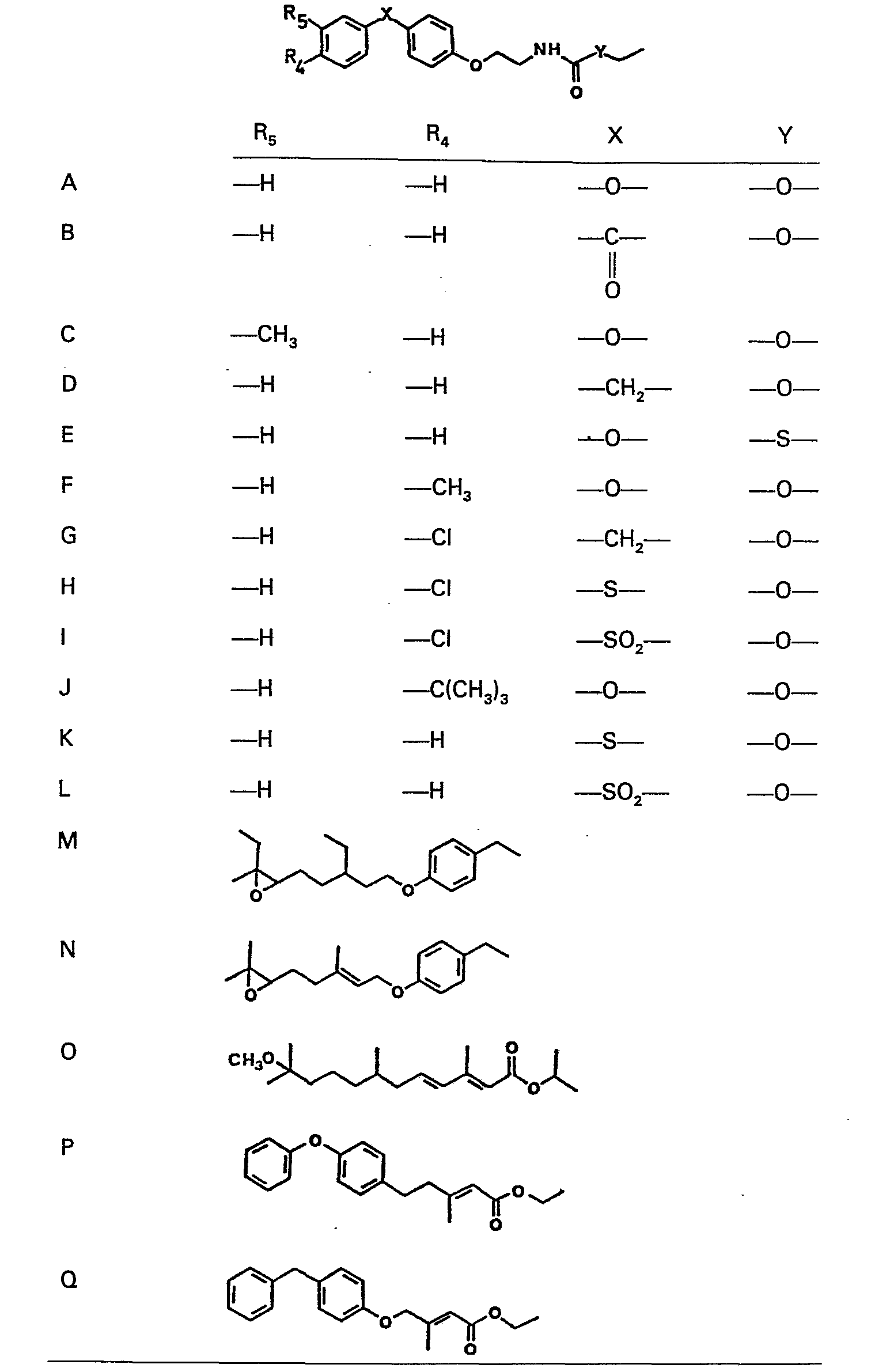
- Testinsekt: Aedes aegypti, Gelbfiebermücke.
- Testmethode: 0,2 ml acetonische Wirkstofflösung werden mit 20 ml Leitungswasser gemischt. Pro Parzelle werden 10 Larven im letzten Larvenstadium angesetzt und bei 25° und 60% relativer Feuchtigkeit inkubiert bis zum Schlüpfen der Adulten in den Kontrollparzellen. Unbehandelte und mit Aceton behandelte Parzellen dienen als Kontrollen. Testdauer: 7 Tage. Die Wirkung wird ausgedrückt als prozentuale Reduktion der Zahl normaler Adulter im Vergleich zu den Kontrollparzellen.
-

- Testinsekt: Aedes aegypti, Gelbfiebermücke.
- Testmethode: 0,2 ml acetonische Wirkstofflösung werden in einem Tablettenröhrchen mit 20 ml Leitungswasser gemischt. Das behandelte Wasser wird 7 Tage unter UV-Light inkubiert und anschliessend werden pro Parzelle 10 Larven im letzten Larvenstadium angesetzt. Der Test wird bei 25° und 60% relativer Feuchtigkeit weiter inkubiert bis zum Schlüpfen der Adulten in den Kontrollparzellen. Unbehandelte und mit Aceton behandelte Parzellen dienen als Kontrollen. Testdauer: 7 Tage unter UV + 7 Tage. Die Wirkung wird ausgedrückt als prozentuale Reduktion der Zahl normaler Adulter im Vergleich zu den Kontrollparzellen.
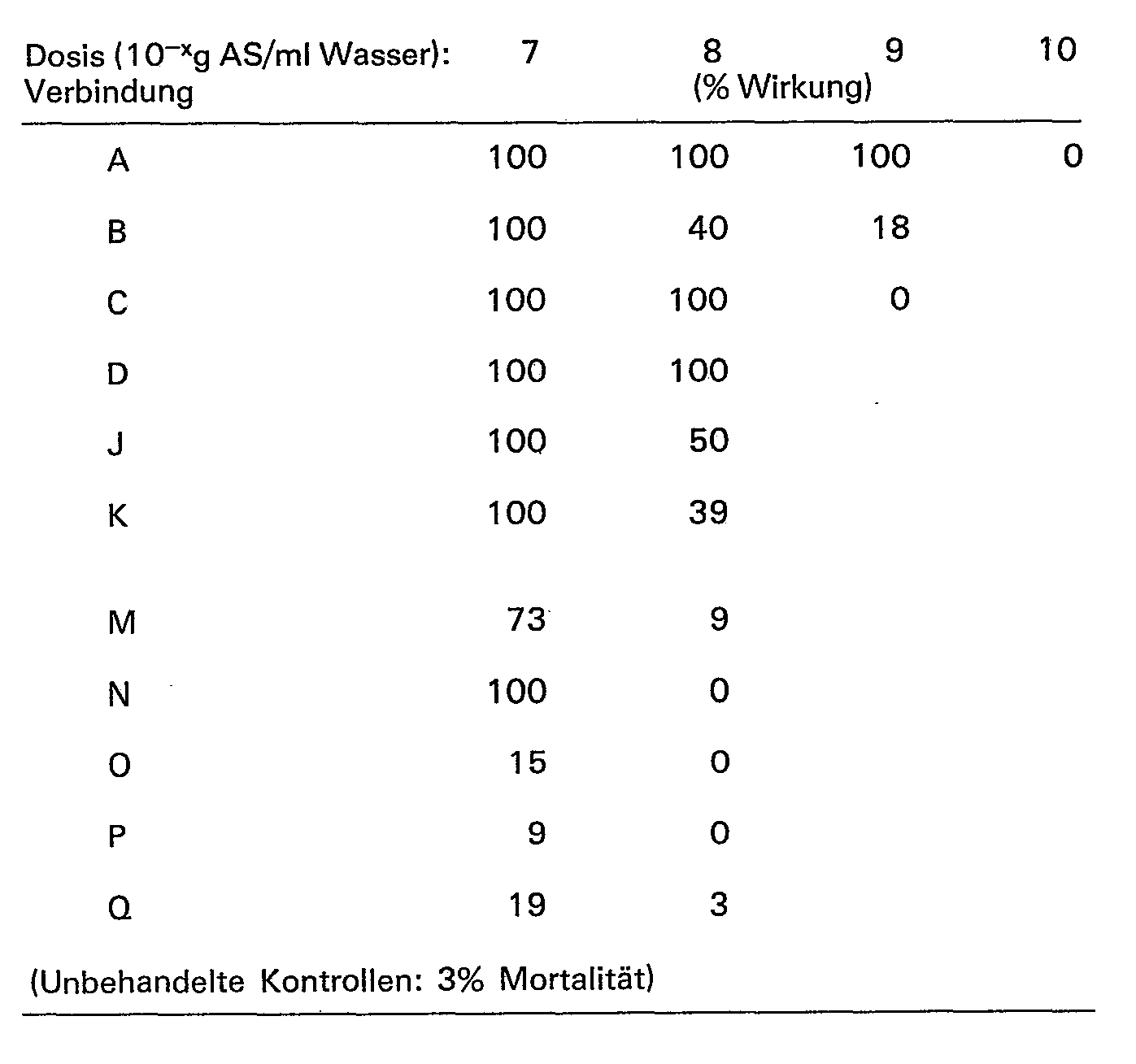
- Testinsekt: Culex pipiens, Gemeine Stechmücke.
- Testmethode: 1 ml acetonische Wirkstofflösung werden mit 100 ml Leitungswasser gemischt. Pro Parzelle werden 10 Larven im letzten Larvenstadium angesetzt und bei 25° und 60% relativer Feuchtigkeit inkubiert bis zum Schlüpfen der Adulten in den Kontrollparzellen. Unbehandelte und mit Aceton behandelte Parzellen dienen als Kontrollen. Testdauer: 7 Tage. Die Wirkung wird ausgedrückt als prozentuale Reduktion der Zahl normaler Adulter im Vergleich zu den Kontrollparzellen.
-

- Testinsekt: Adoxophyes reticulana (= A. orana), Apfelschalenwickler.
- Testmethode: 10 Larven im letzten Larvenstadium werden in eine Petrischale angesetzt, deren Boden vorher mit acetonisher Wirkstofflösung in einer definierten Dosis behandelt wurde. Die Larven werden mit künstlichem Nährmedium gefüttert und bei 25° und 60% relativer Feuchtigkeit inkubiert bis zum Schlüpfen der Adulten in den Kontrollparzellen. Unbehandelte und mit Aceton behandelte Petrischalen dienen als Kontrollen. Testdauer: 15-20 Tage. Die Wirkung wird ausgedrückt als prozentuale Reduktion der Zahl normaler Adulter im Vergleich zu den Kontrollparzellen.
-

- Testmethode: 20 g Weizen werden mit acetonischer Wirkstofflösung in einer defihierten Dosis behandelt. Pro Parzelle werden 20 adulte Kornkäfer angesetzt und bei 29° und 60% relativer Feuchtigkeit inkubiert. Nach 10 Tagen wird die Parentalgeneration entfernt und der Weizen wird unter den gleichen Bedingungen weiter inkubiert bis zum Schlüpfen der Filialgeneration. Unbehandelte und mit Aceton behandelte Parzellen dienen als Kontrollen. Testdauer: ca. 50 Tage. Die Wirkung wird ausgedrückt als prozentuale Reduktion der Filialgeneration (Zahl der Käfer) im Vergleich zu den Kontrollparzellen.

- Testinsekt: Ephestia kuehniella, Mehlmotte.
- Testmethode: 10 g Mehl werden in einem grossen Tablettenröhrchen mit acetonischer Wirkstofflösung in einer definierten Dosis behandelt. Pro Parzelle werden 10 Larven im letzten Larvenstadium angesetzt und bei 25° und 60% relativer Feuchtigkeit inkubiert bis zum Schlüpfen der Adulten in den Kontrollparzellen. Unbehandelte und mit Aceton behandelte Parzellen dienen als Kontrollen. Testdauer: 4-5 Wochen. Die Wirkung wird ausgedrückt als prozentuale Reduktion der Zahl normaler Adulter im Vergleich zu den Kontrollparzellen.

- Testinsekt: Rhizopertha dominica, Getriedekapuziner.
- Testmethode: 20 g Weizen werden mit acetonischer Lösung in einer definierten Dosis behandelt. Pro Parzelle werden 20 adulte Käfer angesetzt und für 60 Tage bei 25° und 60% relativer Feuchtigkeit inkubiert. Unbehandelte und mit Aceton behandelte Parzellen dienen als Kontrollen. Testdauer: 60 Tage. Die Wirkung wird ausgedrückt als prozentuale Reduktion der Filialgeneration (Zahl der Käfer) im Vergleich zu den Kontrollparzellen.
-

- Testinsekt: Blattella germanica, deutsche Hausschabe.
- Testmethode: Filterpapierrondellen werden mit acetonischer Wirkstofflösung in einer definierten Dosis behandelt. Aus den behandelten Rondellen werden "Tunnels" geformt und in einen Plastikbecher gegeben. Pro Parzelle werden 10 Larven im frühen letzten Larvenstadium angesetzt, mit Hundefutter und Wasser gefüttert und bei 25° und 60% relativer Feuchtigkeit inkubiert bis zum Schlüpfen der Adulten in den Kontrollparzellen. Unbehandelte und mit Aceton behandelte Filterpapierrondellen dienen als Kontrollen. Testdauer: 3 Wochen. Die Wirkung wird ausgedrückt als prozentuale Reduktion der Zahl normaler Adulter im Vergleich zu den Kontrollparzellen.

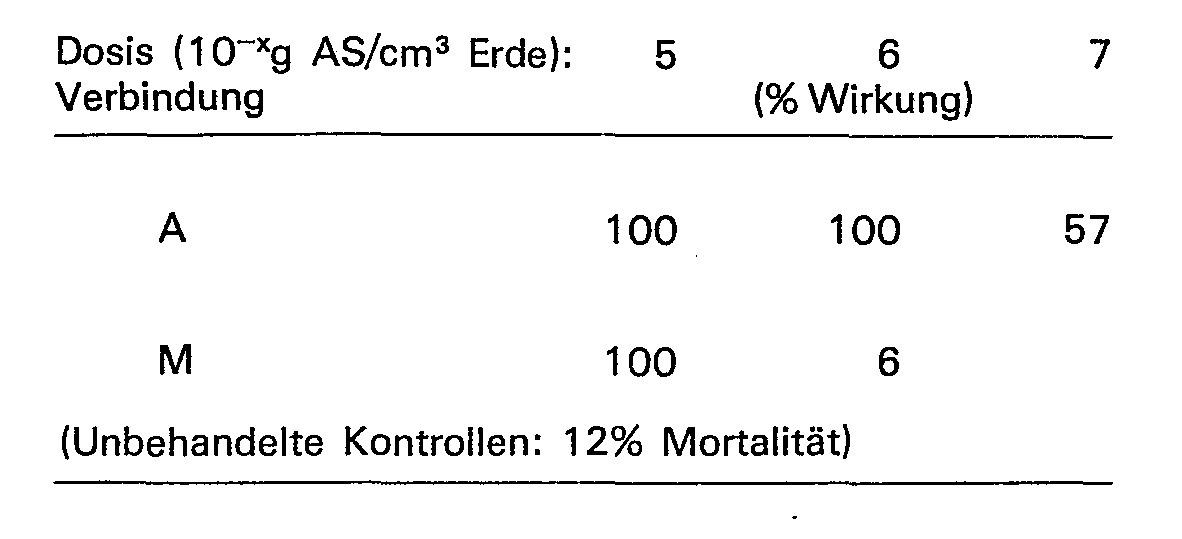
- Testinsekt: Leptinotarsa decemlineata, Kartoffelkäfer.
- Testmethode: 1 ml acetonische Wirkstofflösung werden mit 50 cm3 Erde gemischt. Pro Parzelle werden 10 Larven im letzten Larvenstadium angesetzt und mit Kartoffelkraut gefüttert. Der Test wird inkubiert bei 25° und 60% relativer Feuchtigkeit bis zum Schlüpfen der Adulten in den Kontrollparzellen. Unbehandelte und mit Aceton behandelte Parzellen dienen als Kontrollen. Testdauer: 14-20 Tage. Die Wirkung wird ausgedrückt als prozentuale Reduktion der Zahl normaler Adulter im Vergleich zu den Kontrollparzellen.
-
-

- Der Wirkstoff wird im N-Methyl-2-pyrrolidon gelöst, hernach die übrigen Zuschlagsstoffe zugesetzt, gelöst und mit dem aromatischen Lösungsmitel zur Marke gestellt. Das vorliegende Produkt wird zur Herstellung der gebrauchsfertigen Spritzbrühe in Wasser gegeben, wobei spontan eine für Stunden stabile Emulsion (O/W) entsteht.
-

- Der (feste) Wirkstoff wird mit den übrigen Formulierungskomponenten in einer geeigneten Vorrichtung homogen vermischt. Das entstandene Pulver wird nun in einem geeigneten Mahlaggregat (z.B. Stiften-, Hammer-, Kugel-, Luftstrahlmühle etc.) auf eine für eine optimale biologische Wirksamkeit notwendige Teilchengrösse feingemahlen und hernach nochmals gemischt. Das vorliegende Spritzpulver wird durch Wasser spontan benetzt und ergibt gut schwebefähige, gebrauchsfertige Spritzbrühen.
-

- In einem geeigneten Mischwerk wird das Bimssteingranulat vorgelegt und unter stetigem Rühren eine wässrige Lösung des Na 4-EDTA aufgesprüht. Die Mischung wird bei 110°C getrocknet und hernach der Wirkstoff, gelöst in einem geeigneten Lösungsmittel (wie z.B. Methylenchlorid), auf das trockene Gemisch aufgesprüht. Das Lösungsmittel wird durch Erwärmung verdampft und es entsteht ein gut schüttbares Granulat, welches von Hand, mit geeigneten Granulatstreuren oder sogar vom Flugzeug aus auf den Boden oder in das Wasser ausgebracht werden kann. Die poröse Struktur des Bimssteines bewirkt in vielen Fällen eine erwünschte verlangsamte Abgabe des Wirkstoffes über längere Zeit.
worin R1, Y und R2 die oben angegebene Bedeutung besitzen und T ein Sauerstoffatom oder eine Methylengruppe bedeutet, mit einer Persäure behandelt.
Claims (15)


mit einem Halogenid der Formel


Applications Claiming Priority (2)
| Application Number | Priority Date | Filing Date | Title |
|---|---|---|---|
| CH2929/78 | 1978-03-17 | ||
| CH292978 | 1978-03-17 |
Publications (2)
| Publication Number | Publication Date |
|---|---|
| EP0004334A1 EP0004334A1 (de) | 1979-10-03 |
| EP0004334B1 true EP0004334B1 (de) | 1981-10-21 |
Family
ID=4244799
Family Applications (1)
| Application Number | Title | Priority Date | Filing Date |
|---|---|---|---|
| EP79100749A Expired EP0004334B1 (de) | 1978-03-17 | 1979-03-13 | Carbaminsäureester, Schädlingsbekämpfungsmittel, die diese Ester als Wirkstoffe enthalten, Verfahren zur Herstellung dieser Ester sowie deren Verwendung zur Bekämpfung von Schädlingen |
Country Status (18)
| Country | Link |
|---|---|
| US (1) | US4215139A (de) |
| EP (1) | EP0004334B1 (de) |
| JP (1) | JPS54151929A (de) |
| AR (1) | AR225412A1 (de) |
| AT (1) | AT364672B (de) |
| AU (1) | AU520577B2 (de) |
| CA (1) | CA1137506A (de) |
| DE (1) | DE2961049D1 (de) |
| DK (1) | DK153941C (de) |
| ES (2) | ES478687A1 (de) |
| GR (1) | GR72821B (de) |
| IE (1) | IE48322B1 (de) |
| IL (1) | IL56853A (de) |
| MC (1) | MC1256A1 (de) |
| NL (1) | NL971031I1 (de) |
| NZ (1) | NZ189885A (de) |
| PT (1) | PT69368A (de) |
| ZA (1) | ZA791109B (de) |
Families Citing this family (32)
| Publication number | Priority date | Publication date | Assignee | Title |
|---|---|---|---|---|
| US4323707A (en) * | 1975-10-28 | 1982-04-06 | Eli Lilly And Company | Antifertility compounds |
| DE3020784A1 (de) * | 1980-05-31 | 1981-12-10 | Basf Ag, 6700 Ludwigshafen | Aralkylanilinderivate und herbizide, die diese verbindungen enthalten |
| NL8104076A (nl) * | 1980-09-23 | 1982-04-16 | Hoffmann La Roche | Carbaminezuurderivaten. |
| US4486449A (en) * | 1981-07-31 | 1984-12-04 | Sumitomo Chemical Company, Limited | Thiocarbamate compounds, and their use |
| EP0113831A3 (de) * | 1982-12-17 | 1984-11-07 | F. HOFFMANN-LA ROCHE & CO. Aktiengesellschaft | Carbaminsäureester, Verfahren zu deren Herstellung und deren Verwendung |
| US4554290A (en) * | 1983-06-17 | 1985-11-19 | Ciba-Geigy Corporation | Oxamic acid derivatives |
| JPS6056947A (ja) * | 1983-09-07 | 1985-04-02 | Sumitomo Chem Co Ltd | カ−バメ−ト誘導体およびそれを有効成分として含有する有害生物防除剤 |
| US5037991A (en) * | 1984-07-18 | 1991-08-06 | Sandoz Ltd. | Novel substituted aromatic compounds |
| DE3628082A1 (de) * | 1986-08-19 | 1988-03-03 | Basf Ag | Carboxamide, verfahren zu ihrer herstellung und ihre verwendung zur bekaempfung von schaedlingen |
| DE3711268A1 (de) * | 1987-04-03 | 1988-10-13 | Basf Ag | Cyclopropancarboxamide |
| US4919935A (en) * | 1987-09-30 | 1990-04-24 | R. Maag Ag | Insecticidal compositions |
| DE3841433A1 (de) * | 1988-12-09 | 1990-06-21 | Basf Ag | Speziell substituierte cyclopropancarboxamide, verfahren zu ihrer herstellung und ihre verwendung zur bekaempfung von schaedlingen |
| EP0390740A1 (de) * | 1989-03-30 | 1990-10-03 | Ciba-Geigy Ag | Schädlingsbekämpfung |
| EP0390741A1 (de) * | 1989-03-30 | 1990-10-03 | Ciba-Geigy Ag | Schädlingsbekämpfung |
| US5192803A (en) * | 1989-04-14 | 1993-03-09 | Ciba-Geigy Corporation | Sulfenylated carbamic esters and their use in pesticides |
| EP0395578A3 (de) * | 1989-04-24 | 1991-01-02 | Ciba-Geigy Ag | Acylierte Carbaminsäureester |
| EP0395582A3 (de) * | 1989-04-27 | 1991-01-09 | Ciba-Geigy Ag | Bisacyläthylamine |
| EP0404720B1 (de) * | 1989-06-21 | 1996-02-28 | Ciba-Geigy Ag | Pestizides Mittel |
| US5346920A (en) * | 1990-06-06 | 1994-09-13 | Sumitomo Chemical Company, Limited | Carbamic acid derivatives, and their production and use |
| ZA913759B (en) * | 1990-06-06 | 1992-02-26 | Sumitomo Chemical Co | Carbamic acid derivatives and their production and use |
| CH680827A5 (de) * | 1991-03-14 | 1992-11-30 | Ciba Geigy Ag | |
| EP0736252A3 (de) * | 1995-04-05 | 1997-05-02 | Ciba Geigy Ag | Synergistische Zusammensetzungen mit Diafanthiuron |
| IT1303670B1 (it) | 1998-06-26 | 2001-02-23 | Barbara Giordana | Integratore dietetico per artropodi |
| DE19953775A1 (de) | 1999-11-09 | 2001-05-10 | Bayer Ag | Wirkstoffkombinationen mit insektiziden und akariziden Eigenschaften |
| DE10015310A1 (de) * | 2000-03-28 | 2001-10-04 | Bayer Ag | Wirkstoffkombinationen mit insektiziden und akariziden Eigenschaften |
| DE10042736A1 (de) | 2000-08-31 | 2002-03-14 | Bayer Ag | Wirkstoffkombinationen mit insektiziden und akariziden Eigenschaften |
| DE10043610A1 (de) * | 2000-09-05 | 2002-03-14 | Bayer Ag | Wirkstoffkombinationen mit insektiziden und akariziden Eigenschaften |
| WO2007072041A1 (en) * | 2005-12-23 | 2007-06-28 | Astex Therapeutics Limited | Therapeutic compounds |
| DE102007045957A1 (de) | 2007-09-26 | 2009-04-09 | Bayer Cropscience Ag | Wirkstoffkombinationen mit insektiziden und akarziden Eigenschaften |
| DE102007045955A1 (de) | 2007-09-26 | 2009-04-09 | Bayer Cropscience Ag | Wirkstoffkombinationen mit insektiziden und akariziden Eigenschaften |
| MX2011009372A (es) | 2009-03-25 | 2011-09-27 | Bayer Cropscience Ag | Combinaciones de principios activos con propiedades insecticidas y acaricidas. |
| MX2011009916A (es) | 2009-03-25 | 2011-10-06 | Bayer Cropscience Ag | Combinaciones de principios activos con propiedades insecticidas y acaricidas. |
Family Cites Families (10)
| Publication number | Priority date | Publication date | Assignee | Title |
|---|---|---|---|---|
| GB971700A (en) * | 1961-02-02 | 1964-09-30 | Boots Pure Drug Co Ltd | Anti-Inflammatory Agents |
| US3600437A (en) * | 1969-05-28 | 1971-08-17 | Lilly Co Eli | Substituted phenylalkanoic acids and derivatives thereof |
| US3649679A (en) * | 1968-08-15 | 1972-03-14 | Lilly Co Eli | Substituted phenylalkanoic acid derivatives ii |
| US3801624A (en) * | 1970-12-09 | 1974-04-02 | Aldrich Chem Co Inc | Di-substituted beta-phenethylcarbamic acid esters |
| SE377113B (de) * | 1971-05-15 | 1975-06-23 | Ciba Geigy Ag | |
| USB787097I5 (de) * | 1971-06-04 | |||
| US4017536A (en) * | 1973-11-09 | 1977-04-12 | Ciba-Geigy Corporation | Ether and thioether containing thiolesters |
| IL45994A (en) * | 1973-11-09 | 1977-11-30 | Ciba Geigy Ag | HISTORY OF THE PANOXYTHYBOTENIC ACID OR OF THE PENYLTHYBOTENIC ACID, THE PREPARATION AND MIXTURES OF INSECTICIDES CONTAINING THEM |
| NL187206C (nl) * | 1975-08-22 | 1991-07-01 | Ciba Geigy | Werkwijze ter bereiding van voor bestrijding van schadelijke organismen geschikte carbaminezuuralkylesters en werkwijze ter bereiding van preparaten, die dergelijke esters bevatten. |
| NL7608789A (nl) * | 1975-08-22 | 1977-02-24 | Ciba Geigy | Werkwijze voor het bereiden van nieuwe thionocarbaminezuuresters. |
-
1979
- 1979-02-02 CA CA000320769A patent/CA1137506A/en not_active Expired
- 1979-03-06 US US06/018,026 patent/US4215139A/en not_active Expired - Lifetime
- 1979-03-09 ZA ZA791109A patent/ZA791109B/xx unknown
- 1979-03-12 IL IL56853A patent/IL56853A/xx unknown
- 1979-03-12 MC MC791369A patent/MC1256A1/fr unknown
- 1979-03-12 NZ NZ189885A patent/NZ189885A/xx unknown
- 1979-03-13 AU AU45033/79A patent/AU520577B2/en not_active Expired
- 1979-03-13 EP EP79100749A patent/EP0004334B1/de not_active Expired
- 1979-03-13 DE DE7979100749T patent/DE2961049D1/de not_active Expired
- 1979-03-15 AR AR275824A patent/AR225412A1/es active
- 1979-03-15 GR GR58611A patent/GR72821B/el unknown
- 1979-03-16 AT AT0200079A patent/AT364672B/de active
- 1979-03-16 ES ES478687A patent/ES478687A1/es not_active Expired
- 1979-03-16 JP JP3097579A patent/JPS54151929A/ja active Granted
- 1979-03-16 PT PT69368A patent/PT69368A/pt unknown
- 1979-03-16 DK DK111179A patent/DK153941C/da not_active IP Right Cessation
- 1979-08-08 IE IE622/79A patent/IE48322B1/en not_active IP Right Cessation
- 1979-09-01 ES ES484102A patent/ES484102A1/es not_active Expired
-
1997
- 1997-08-08 NL NL971031C patent/NL971031I1/nl unknown
Also Published As
| Publication number | Publication date |
|---|---|
| JPS6320815B2 (de) | 1988-04-30 |
| AR225412A1 (es) | 1982-03-31 |
| PT69368A (en) | 1979-04-01 |
| ES484102A1 (es) | 1980-09-01 |
| AT364672B (de) | 1981-11-10 |
| DK111179A (da) | 1979-09-18 |
| EP0004334A1 (de) | 1979-10-03 |
| CA1137506A (en) | 1982-12-14 |
| AU520577B2 (en) | 1982-02-11 |
| IL56853A0 (en) | 1979-05-31 |
| AU4503379A (en) | 1979-09-20 |
| ZA791109B (en) | 1980-03-26 |
| ATA200079A (de) | 1981-04-15 |
| JPS54151929A (en) | 1979-11-29 |
| GR72821B (de) | 1983-12-06 |
| IE48322B1 (en) | 1984-12-12 |
| US4215139A (en) | 1980-07-29 |
| DK153941C (da) | 1989-01-30 |
| ES478687A1 (es) | 1979-12-16 |
| IL56853A (en) | 1982-09-30 |
| IE790622L (en) | 1979-09-17 |
| NL971031I1 (nl) | 1997-10-01 |
| DE2961049D1 (en) | 1981-12-24 |
| DK153941B (da) | 1988-09-26 |
| MC1256A1 (fr) | 1980-01-14 |
| NZ189885A (en) | 1982-05-25 |
Similar Documents
| Publication | Publication Date | Title |
|---|---|---|
| EP0004334A1 (de) | Carbaminsäureester, Schädlingsbekämpfungsmittel, die diese Ester als Wirkstoffe enthalten, Verfahren zur Herstellung dieser Ester sowie deren Verwendung zur Bekämpfung von Schädlingen | |
| EP0306696A1 (de) | Substituierte Guanidine | |
| CH644371A5 (de) | In 2- und 4-stellung disubstituierte 5-thiazolcarbonsaeuren und deren funktionelle derivate. | |
| DE3136428C2 (de) | ||
| JPH0645574B2 (ja) | 新規芳香族化合物 | |
| DE2059872A1 (de) | Thioharnstoffe,Verfahren zu ihrer Herstellung und ihre Verwendung zur Schaedlingsbekaempfung | |
| DE2812622C2 (de) | (2,3-Dihydro-2,2-dimethyl-benzofuran-7-yl-oxy-N-methyl-carbamoyl)-(N'-alkyl-carbamoyl)-sulfide, Verfahren zu deren Herstellung und diese Verbindungen enthaltende insektizide Mittel | |
| EP0072475B1 (de) | Carbaminsäureester, Verfahren zu deren Herstellung, Schädlingsbekämpfungsmittel, die diese Verbindungen als Wirkstoffe enthalten, sowie Verwendung solcher Verbindungen und Mittel zur Bekämpfung von Schädlingen | |
| EP0175649A2 (de) | Substituierte Carbodiimide | |
| EP0276196B1 (de) | Substituierte Dioxolanderivate | |
| CH637386A5 (de) | Benzoxazol- und benzothiazolderivate. | |
| EP0055213B1 (de) | Phenylharnstoffe | |
| DE2405510C2 (de) | &alpha;-Halogen-acetanilide und diese Verbindungen enthaltende herbizide Zusammensetzungen | |
| DE3046672A1 (de) | Acylharnstoffe, insektizide mittel enthaltend diese verbindungen sowie verfahren zu ihrer herstellung | |
| EP0008565A1 (de) | Bis-(phenoxy-alkyl-2-imidazolin)-1,1'-sulfide, Verfahren zu ihrer Herstellung, Mittel welche diese Sulfide als aktive Komponente enthalten und deren Verwendung zur Bekämpfung von Schädlingen | |
| DE3236522A1 (de) | Halogenpropargylformamide | |
| EP0144895A2 (de) | Thiolan-2,4-dion-3-carboxamide | |
| DE2054064A1 (de) | Acetylenv erbindungen | |
| EP0223141A1 (de) | Neue Benzimidate | |
| DE3882562T2 (de) | Benzoylharnstoffderivate, ihre Herstellung und Verwendung. | |
| DE2512940C2 (de) | N-Benzoyl-N-halogenphenyl-2-aminopropionsäure-ester, Verfahren zu deren Herstellung und deren Verwendung | |
| DE3414881A1 (de) | Allophanat-derivate | |
| DE3832656A1 (de) | Substituierte carbamate | |
| DE1962408A1 (de) | Schaedlingsbekaempfungsmittel | |
| CH608692A5 (en) | Pesticide comprising an N,N'-dicarbamic acid sulphide derivative as active ingredient |
Legal Events
| Date | Code | Title | Description |
|---|---|---|---|
| PUAI | Public reference made under article 153(3) epc to a published international application that has entered the european phase |
Free format text: ORIGINAL CODE: 0009012 |
|
| AK | Designated contracting states |
Designated state(s): BE CH DE FR GB IT LU NL |
|
| 17P | Request for examination filed | ||
| ITF | It: translation for a ep patent filed | ||
| GRAA | (expected) grant |
Free format text: ORIGINAL CODE: 0009210 |
|
| AK | Designated contracting states |
Designated state(s): BE CH DE FR GB IT LU NL |
|
| REF | Corresponds to: |
Ref document number: 2961049 Country of ref document: DE Date of ref document: 19811224 |
|
| ITPR | It: changes in ownership of a european patent |
Owner name: CESSIONE;F. HOFFMANN - LA ROCHE AG |
|
| NLS | Nl: assignments of ep-patents |
Owner name: F. HOFFMANN-LA ROCHE AG TE BAZEL, ZWITSERLAND. |
|
| REG | Reference to a national code |
Ref country code: FR Ref legal event code: TP |
|
| REG | Reference to a national code |
Ref country code: CH Ref legal event code: PUE Owner name: F. HOFFMANN-LA ROCHE AG |
|
| REG | Reference to a national code |
Ref country code: GB Ref legal event code: 732 |
|
| REG | Reference to a national code |
Ref country code: CH Ref legal event code: PUE Owner name: CIBA-GEIGY AG |
|
| ITTA | It: last paid annual fee | ||
| ITPR | It: changes in ownership of a european patent |
Owner name: CESSIONE;CIBA - GEIGY AG |
|
| NLS | Nl: assignments of ep-patents |
Owner name: CIBA-GEIGY A.G. TE BAZEL, ZWITSERLAND. |
|
| REG | Reference to a national code |
Ref country code: FR Ref legal event code: TP |
|
| REG | Reference to a national code |
Ref country code: GB Ref legal event code: 732 |
|
| EPTA | Lu: last paid annual fee | ||
| REG | Reference to a national code |
Ref country code: CH Ref legal event code: PFA Free format text: CIBA-GEIGY AG TRANSFER- NOVARTIS AG |
|
| REG | Reference to a national code |
Ref country code: GB Ref legal event code: 732E |
|
| NLS | Nl: assignments of ep-patents |
Owner name: NOVARTIS AG |
|
| REG | Reference to a national code |
Ref country code: NL Ref legal event code: AC1 Free format text: NLAC1 971031, 970808 |
|
| REG | Reference to a national code |
Ref country code: FR Ref legal event code: TP |
|
| PGFP | Annual fee paid to national office [announced via postgrant information from national office to epo] |
Ref country code: FR Payment date: 19980122 Year of fee payment: 20 |
|
| PGFP | Annual fee paid to national office [announced via postgrant information from national office to epo] |
Ref country code: BE Payment date: 19980126 Year of fee payment: 20 |
|
| PGFP | Annual fee paid to national office [announced via postgrant information from national office to epo] |
Ref country code: NL Payment date: 19980127 Year of fee payment: 20 |
|
| PGFP | Annual fee paid to national office [announced via postgrant information from national office to epo] |
Ref country code: DE Payment date: 19980214 Year of fee payment: 20 |
|
| PGFP | Annual fee paid to national office [announced via postgrant information from national office to epo] |
Ref country code: GB Payment date: 19980225 Year of fee payment: 20 |
|
| PGFP | Annual fee paid to national office [announced via postgrant information from national office to epo] |
Ref country code: LU Payment date: 19980309 Year of fee payment: 20 |
|
| PGFP | Annual fee paid to national office [announced via postgrant information from national office to epo] |
Ref country code: CH Payment date: 19980326 Year of fee payment: 20 |
|
| REG | Reference to a national code |
Ref country code: NL Ref legal event code: BC1 Free format text: NLBC1 971031 |
|
| BE20 | Be: patent expired |
Free format text: 19990313 *NOVARTIS A.G. |
|
| PG25 | Lapsed in a contracting state [announced via postgrant information from national office to epo] |
Ref country code: GB Free format text: LAPSE BECAUSE OF EXPIRATION OF PROTECTION Effective date: 19990312 Ref country code: CH Free format text: LAPSE BECAUSE OF EXPIRATION OF PROTECTION Effective date: 19990312 |
|
| PG25 | Lapsed in a contracting state [announced via postgrant information from national office to epo] |
Ref country code: NL Free format text: LAPSE BECAUSE OF EXPIRATION OF PROTECTION Effective date: 19990313 Ref country code: LU Free format text: LAPSE BECAUSE OF EXPIRATION OF PROTECTION Effective date: 19990313 |
|
| REG | Reference to a national code |
Ref country code: GB Ref legal event code: PE20 Effective date: 19990312 |
|
| REG | Reference to a national code |
Ref country code: CH Ref legal event code: PL |
|
| NLV7 | Nl: ceased due to reaching the maximum lifetime of a patent |
Effective date: 19990313 |
|
| CCHV | Be: grant of a complementary protection certificate for herbicides |
Free format text: 097C0091, EXPIRES: 19991116 |
|
| PLBE | No opposition filed within time limit |
Free format text: ORIGINAL CODE: 0009261 |
|
| STAA | Information on the status of an ep patent application or granted ep patent |
Free format text: STATUS: NO OPPOSITION FILED WITHIN TIME LIMIT |