EP0001786A1 - Kristallines Polyamid, seine Verwendung und Diamine - Google Patents
Kristallines Polyamid, seine Verwendung und Diamine Download PDFInfo
- Publication number
- EP0001786A1 EP0001786A1 EP78101179A EP78101179A EP0001786A1 EP 0001786 A1 EP0001786 A1 EP 0001786A1 EP 78101179 A EP78101179 A EP 78101179A EP 78101179 A EP78101179 A EP 78101179A EP 0001786 A1 EP0001786 A1 EP 0001786A1
- Authority
- EP
- European Patent Office
- Prior art keywords
- formula
- diamine
- mixture
- atoms
- amide
- Prior art date
- Legal status (The legal status is an assumption and is not a legal conclusion. Google has not performed a legal analysis and makes no representation as to the accuracy of the status listed.)
- Granted
Links
- 150000004985 diamines Chemical class 0.000 title claims abstract description 33
- 229920006039 crystalline polyamide Polymers 0.000 title description 5
- KKEYFWRCBNTPAC-UHFFFAOYSA-N Terephthalic acid Chemical compound OC(=O)C1=CC=C(C(O)=O)C=C1 KKEYFWRCBNTPAC-UHFFFAOYSA-N 0.000 claims abstract description 42
- 239000004952 Polyamide Substances 0.000 claims abstract description 38
- 229920002647 polyamide Polymers 0.000 claims abstract description 38
- 239000000203 mixture Substances 0.000 claims abstract description 37
- 238000004519 manufacturing process Methods 0.000 claims abstract description 9
- 150000003951 lactams Chemical class 0.000 claims abstract description 8
- 239000011541 reaction mixture Substances 0.000 claims abstract description 8
- KXDHJXZQYSOELW-UHFFFAOYSA-N Carbamic acid Chemical class NC(O)=O KXDHJXZQYSOELW-UHFFFAOYSA-N 0.000 claims abstract description 7
- 239000000835 fiber Substances 0.000 claims abstract description 4
- 229920006114 semi-crystalline semi-aromatic polyamide Polymers 0.000 claims abstract description 3
- 125000004432 carbon atom Chemical group C* 0.000 claims description 37
- 239000000155 melt Substances 0.000 claims description 17
- 125000000217 alkyl group Chemical group 0.000 claims description 16
- 125000001495 ethyl group Chemical group [H]C([H])([H])C([H])([H])* 0.000 claims description 11
- OFOBLEOULBTSOW-UHFFFAOYSA-N Malonic acid Chemical compound OC(=O)CC(O)=O OFOBLEOULBTSOW-UHFFFAOYSA-N 0.000 claims description 7
- 125000002947 alkylene group Chemical group 0.000 claims description 7
- MZNQLXRKWSZAJE-UHFFFAOYSA-N 3,14-diethylhexadecane-4,13-diamine Chemical compound CCC(CC)C(N)CCCCCCCCC(N)C(CC)CC MZNQLXRKWSZAJE-UHFFFAOYSA-N 0.000 claims description 6
- 238000006243 chemical reaction Methods 0.000 claims description 6
- 125000002496 methyl group Chemical group [H]C([H])([H])* 0.000 claims description 6
- 125000000753 cycloalkyl group Chemical group 0.000 claims description 4
- 125000000113 cyclohexyl group Chemical group [H]C1([H])C([H])([H])C([H])([H])C([H])(*)C([H])([H])C1([H])[H] 0.000 claims description 3
- 125000001511 cyclopentyl group Chemical group [H]C1([H])C([H])([H])C([H])([H])C([H])(*)C1([H])[H] 0.000 claims description 3
- 125000002915 carbonyl group Chemical group [*:2]C([*:1])=O 0.000 claims description 2
- 125000000524 functional group Chemical group 0.000 claims description 2
- 238000000465 moulding Methods 0.000 claims description 2
- 125000004108 n-butyl group Chemical group [H]C([H])([H])C([H])([H])C([H])([H])C([H])([H])* 0.000 claims 1
- 125000001436 propyl group Chemical group [H]C([*])([H])C([H])([H])C([H])([H])[H] 0.000 claims 1
- 150000003504 terephthalic acids Chemical class 0.000 claims 1
- 150000001991 dicarboxylic acids Chemical class 0.000 abstract description 5
- 230000015572 biosynthetic process Effects 0.000 abstract description 4
- 239000000126 substance Substances 0.000 abstract description 2
- 230000000717 retained effect Effects 0.000 abstract 1
- 150000003839 salts Chemical class 0.000 description 37
- IJGRMHOSHXDMSA-UHFFFAOYSA-N Atomic nitrogen Chemical compound N#N IJGRMHOSHXDMSA-UHFFFAOYSA-N 0.000 description 32
- LFQSCWFLJHTTHZ-UHFFFAOYSA-N Ethanol Chemical compound CCO LFQSCWFLJHTTHZ-UHFFFAOYSA-N 0.000 description 25
- XLYOFNOQVPJJNP-UHFFFAOYSA-N water Substances O XLYOFNOQVPJJNP-UHFFFAOYSA-N 0.000 description 17
- 229910052757 nitrogen Inorganic materials 0.000 description 16
- -1 2,5-dimethylhexamethylene Chemical group 0.000 description 14
- 238000000034 method Methods 0.000 description 11
- 239000007788 liquid Substances 0.000 description 10
- 239000002904 solvent Substances 0.000 description 10
- 239000003054 catalyst Substances 0.000 description 9
- 239000000243 solution Substances 0.000 description 9
- 239000012230 colorless oil Substances 0.000 description 7
- 238000009833 condensation Methods 0.000 description 7
- 230000005494 condensation Effects 0.000 description 7
- 238000010992 reflux Methods 0.000 description 7
- DCJGSRDEMTWORD-UHFFFAOYSA-N 3,12-di(propan-2-yl)-1,2-diazacyclododeca-1,5,9-triene Chemical compound CC(C)C1CC=CCCC=CCC(C(C)C)N=N1 DCJGSRDEMTWORD-UHFFFAOYSA-N 0.000 description 6
- 238000001816 cooling Methods 0.000 description 6
- QQVIHTHCMHWDBS-UHFFFAOYSA-N isophthalic acid Chemical compound OC(=O)C1=CC=CC(C(O)=O)=C1 QQVIHTHCMHWDBS-UHFFFAOYSA-N 0.000 description 6
- RLSSMJSEOOYNOY-UHFFFAOYSA-N m-cresol Chemical compound CC1=CC=CC(O)=C1 RLSSMJSEOOYNOY-UHFFFAOYSA-N 0.000 description 6
- 238000002844 melting Methods 0.000 description 6
- 230000008018 melting Effects 0.000 description 6
- 238000006068 polycondensation reaction Methods 0.000 description 6
- 238000010521 absorption reaction Methods 0.000 description 5
- WNLRTRBMVRJNCN-UHFFFAOYSA-N adipic acid Chemical compound OC(=O)CCCCC(O)=O WNLRTRBMVRJNCN-UHFFFAOYSA-N 0.000 description 4
- 125000005263 alkylenediamine group Chemical group 0.000 description 4
- 238000004821 distillation Methods 0.000 description 4
- 238000001035 drying Methods 0.000 description 4
- 150000002148 esters Chemical class 0.000 description 4
- TTZVHRJRFBJCRU-UHFFFAOYSA-N 1,10-dicyclohexyldecane-1,10-diamine Chemical compound C1CCCCC1C(N)CCCCCCCCC(N)C1CCCCC1 TTZVHRJRFBJCRU-UHFFFAOYSA-N 0.000 description 3
- FZUWIRGHKCUMTH-UHFFFAOYSA-N 2,13-dimethyltetradecane-3,12-diamine Chemical compound CC(C)C(N)CCCCCCCCC(N)C(C)C FZUWIRGHKCUMTH-UHFFFAOYSA-N 0.000 description 3
- CPYIHCJGWGMBAV-UHFFFAOYSA-N 3,14-dimethylhexadecane-4,13-diamine Chemical compound CCC(C)C(N)CCCCCCCCC(N)C(C)CC CPYIHCJGWGMBAV-UHFFFAOYSA-N 0.000 description 3
- UFHFLCQGNIYNRP-UHFFFAOYSA-N Hydrogen Chemical compound [H][H] UFHFLCQGNIYNRP-UHFFFAOYSA-N 0.000 description 3
- OKKJLVBELUTLKV-UHFFFAOYSA-N Methanol Chemical compound OC OKKJLVBELUTLKV-UHFFFAOYSA-N 0.000 description 3
- ISWSIDIOOBJBQZ-UHFFFAOYSA-N Phenol Chemical compound OC1=CC=CC=C1 ISWSIDIOOBJBQZ-UHFFFAOYSA-N 0.000 description 3
- 239000000654 additive Substances 0.000 description 3
- 238000011097 chromatography purification Methods 0.000 description 3
- 239000001257 hydrogen Substances 0.000 description 3
- 229910052739 hydrogen Inorganic materials 0.000 description 3
- 230000007062 hydrolysis Effects 0.000 description 3
- 238000006460 hydrolysis reaction Methods 0.000 description 3
- 239000011261 inert gas Substances 0.000 description 3
- 239000000047 product Substances 0.000 description 3
- 150000003254 radicals Chemical class 0.000 description 3
- 239000007790 solid phase Substances 0.000 description 3
- 238000003756 stirring Methods 0.000 description 3
- SXIFNAOBIAIYJO-SXVCMZJPSA-N (1E,3E,7E)-cyclododeca-1,3,7-triene Chemical compound C/1=C\CCCC\C=C\C=C\CC\1 SXIFNAOBIAIYJO-SXVCMZJPSA-N 0.000 description 2
- ITXCDTITYTYAFD-UHFFFAOYSA-N 1,10-dicyclopentyldecane-1,10-diamine Chemical compound C1CCCC1C(N)CCCCCCCCC(N)C1CCCC1 ITXCDTITYTYAFD-UHFFFAOYSA-N 0.000 description 2
- JWAGOKOJCIHYQM-UHFFFAOYSA-N 1,2-diazacyclododeca-1,5,9-triene Chemical class C1CC=CCCN=NCCC=C1 JWAGOKOJCIHYQM-UHFFFAOYSA-N 0.000 description 2
- AZCPJRSLLFDOJD-UHFFFAOYSA-N 1,2-diazacyclododecane Chemical class C1CCCCCNNCCCC1 AZCPJRSLLFDOJD-UHFFFAOYSA-N 0.000 description 2
- 0 C*C(C*C*)NC(C)O Chemical compound C*C(C*C*)NC(C)O 0.000 description 2
- DKGAVHZHDRPRBM-UHFFFAOYSA-N Tert-Butanol Chemical compound CC(C)(C)O DKGAVHZHDRPRBM-UHFFFAOYSA-N 0.000 description 2
- 230000000996 additive effect Effects 0.000 description 2
- 235000011037 adipic acid Nutrition 0.000 description 2
- 239000001361 adipic acid Substances 0.000 description 2
- 125000001931 aliphatic group Chemical group 0.000 description 2
- 125000006267 biphenyl group Chemical group 0.000 description 2
- 229910052799 carbon Inorganic materials 0.000 description 2
- 238000002425 crystallisation Methods 0.000 description 2
- 230000008025 crystallization Effects 0.000 description 2
- HPGJOUYGWKFYQW-UHFFFAOYSA-N diphenyl benzene-1,4-dicarboxylate Chemical compound C=1C=C(C(=O)OC=2C=CC=CC=2)C=CC=1C(=O)OC1=CC=CC=C1 HPGJOUYGWKFYQW-UHFFFAOYSA-N 0.000 description 2
- QFTYSVGGYOXFRQ-UHFFFAOYSA-N dodecane-1,12-diamine Chemical compound NCCCCCCCCCCCCN QFTYSVGGYOXFRQ-UHFFFAOYSA-N 0.000 description 2
- JBKVHLHDHHXQEQ-UHFFFAOYSA-N epsilon-caprolactam Chemical compound O=C1CCCCCN1 JBKVHLHDHHXQEQ-UHFFFAOYSA-N 0.000 description 2
- 238000001914 filtration Methods 0.000 description 2
- 229920006017 homo-polyamide Polymers 0.000 description 2
- 125000004123 n-propyl group Chemical group [H]C([H])([H])C([H])([H])C([H])([H])* 0.000 description 2
- 239000003960 organic solvent Substances 0.000 description 2
- 239000000843 powder Substances 0.000 description 2
- 239000002244 precipitate Substances 0.000 description 2
- 238000002360 preparation method Methods 0.000 description 2
- BDERNNFJNOPAEC-UHFFFAOYSA-N propan-1-ol Chemical compound CCCO BDERNNFJNOPAEC-UHFFFAOYSA-N 0.000 description 2
- CXMXRPHRNRROMY-UHFFFAOYSA-N sebacic acid Chemical compound OC(=O)CCCCCCCCC(O)=O CXMXRPHRNRROMY-UHFFFAOYSA-N 0.000 description 2
- 238000003860 storage Methods 0.000 description 2
- 150000003503 terephthalic acid derivatives Chemical class 0.000 description 2
- 125000005838 1,3-cyclopentylene group Chemical group [H]C1([H])C([H])([H])C([H])([*:2])C([H])([H])C1([H])[*:1] 0.000 description 1
- 125000001989 1,3-phenylene group Chemical group [H]C1=C([H])C([*:1])=C([H])C([*:2])=C1[H] 0.000 description 1
- 125000004955 1,4-cyclohexylene group Chemical group [H]C1([H])C([H])([H])C([H])([*:1])C([H])([H])C([H])([H])C1([H])[*:2] 0.000 description 1
- GUOSQNAUYHMCRU-UHFFFAOYSA-N 11-Aminoundecanoic acid Chemical compound NCCCCCCCCCCC(O)=O GUOSQNAUYHMCRU-UHFFFAOYSA-N 0.000 description 1
- DILISPNYIVRDBP-UHFFFAOYSA-N 2-[3-[2-(2-hydroxypropylamino)pyrimidin-4-yl]-2-naphthalen-2-ylimidazol-4-yl]acetonitrile Chemical compound OC(CNC1=NC=CC(=N1)N1C(=NC=C1CC#N)C1=CC2=CC=CC=C2C=C1)C DILISPNYIVRDBP-UHFFFAOYSA-N 0.000 description 1
- VSLHGMWEUIGYLD-UHFFFAOYSA-N 3,12-di(octan-4-yl)-1,2-diazacyclododeca-1,5,9-triene Chemical compound CCCCC(CCC)C1CC=CCCC=CCC(C(CCC)CCCC)N=N1 VSLHGMWEUIGYLD-UHFFFAOYSA-N 0.000 description 1
- JRXUHHXOMBBVHY-UHFFFAOYSA-N 3,12-di(pentan-3-yl)-1,2-diazacyclododecane Chemical compound CCC(CC)C1CCCCCCCCC(C(CC)CC)NN1 JRXUHHXOMBBVHY-UHFFFAOYSA-N 0.000 description 1
- RFGDOQAMXMKEQV-UHFFFAOYSA-N 3-ethyloctadecane Chemical compound CCCCCCCCCCCCCCCC(CC)CC RFGDOQAMXMKEQV-UHFFFAOYSA-N 0.000 description 1
- CVICCJFKJKBSRT-UHFFFAOYSA-N 4,13-diethylhexadecane-3,14-diamine Chemical compound CCC(N)C(CC)CCCCCCCCC(CC)C(N)CC CVICCJFKJKBSRT-UHFFFAOYSA-N 0.000 description 1
- 238000012696 Interfacial polycondensation Methods 0.000 description 1
- 238000000023 Kugelrohr distillation Methods 0.000 description 1
- LRHPLDYGYMQRHN-UHFFFAOYSA-N N-Butanol Chemical class CCCCO LRHPLDYGYMQRHN-UHFFFAOYSA-N 0.000 description 1
- AMQJEAYHLZJPGS-UHFFFAOYSA-N N-Pentanol Chemical class CCCCCO AMQJEAYHLZJPGS-UHFFFAOYSA-N 0.000 description 1
- YXEQGMRBDFLKPD-UHFFFAOYSA-N NC(CCCCCCCCCC1CCCC1)(C1CCCC1)N Chemical compound NC(CCCCCCCCCC1CCCC1)(C1CCCC1)N YXEQGMRBDFLKPD-UHFFFAOYSA-N 0.000 description 1
- 239000002253 acid Substances 0.000 description 1
- 150000001298 alcohols Chemical class 0.000 description 1
- VOZYXUHNEBULJT-UHFFFAOYSA-N aluminum oxygen(2-) rhodium(3+) Chemical compound [O--].[O--].[O--].[Al+3].[Rh+3] VOZYXUHNEBULJT-UHFFFAOYSA-N 0.000 description 1
- 125000003118 aryl group Chemical group 0.000 description 1
- 238000009835 boiling Methods 0.000 description 1
- 125000000484 butyl group Chemical group [H]C([*])([H])C([H])([H])C([H])([H])C([H])([H])[H] 0.000 description 1
- 238000004587 chromatography analysis Methods 0.000 description 1
- HPXRVTGHNJAIIH-UHFFFAOYSA-N cyclohexanol Chemical compound OC1CCCCC1 HPXRVTGHNJAIIH-UHFFFAOYSA-N 0.000 description 1
- XCIXKGXIYUWCLL-UHFFFAOYSA-N cyclopentanol Chemical compound OC1CCCC1 XCIXKGXIYUWCLL-UHFFFAOYSA-N 0.000 description 1
- USIUVYZYUHIAEV-UHFFFAOYSA-N diphenyl ether Natural products C=1C=CC=CC=1OC1=CC=CC=C1 USIUVYZYUHIAEV-UHFFFAOYSA-N 0.000 description 1
- 230000008030 elimination Effects 0.000 description 1
- 238000003379 elimination reaction Methods 0.000 description 1
- 230000007717 exclusion Effects 0.000 description 1
- 239000000706 filtrate Substances 0.000 description 1
- 230000004927 fusion Effects 0.000 description 1
- 230000009477 glass transition Effects 0.000 description 1
- ZSIAUFGUXNUGDI-UHFFFAOYSA-N hexan-1-ol Chemical class CCCCCCO ZSIAUFGUXNUGDI-UHFFFAOYSA-N 0.000 description 1
- 238000005984 hydrogenation reaction Methods 0.000 description 1
- 238000001746 injection moulding Methods 0.000 description 1
- 125000001449 isopropyl group Chemical group [H]C([H])([H])C([H])(*)C([H])([H])[H] 0.000 description 1
- 238000005259 measurement Methods 0.000 description 1
- OETHQSJEHLVLGH-UHFFFAOYSA-N metformin hydrochloride Chemical compound Cl.CN(C)C(=N)N=C(N)N OETHQSJEHLVLGH-UHFFFAOYSA-N 0.000 description 1
- 239000012778 molding material Substances 0.000 description 1
- 125000002950 monocyclic group Chemical group 0.000 description 1
- 125000003136 n-heptyl group Chemical group [H]C([H])([H])C([H])([H])C([H])([H])C([H])([H])C([H])([H])C([H])([H])C([H])([H])* 0.000 description 1
- 125000001280 n-hexyl group Chemical group C(CCCCC)* 0.000 description 1
- 125000000740 n-pentyl group Chemical group [H]C([H])([H])C([H])([H])C([H])([H])C([H])([H])C([H])([H])* 0.000 description 1
- 238000006386 neutralization reaction Methods 0.000 description 1
- YCWSUKQGVSGXJO-NTUHNPAUSA-N nifuroxazide Chemical group C1=CC(O)=CC=C1C(=O)N\N=C\C1=CC=C([N+]([O-])=O)O1 YCWSUKQGVSGXJO-NTUHNPAUSA-N 0.000 description 1
- 229940038384 octadecane Drugs 0.000 description 1
- 125000003367 polycyclic group Chemical group 0.000 description 1
- 238000000746 purification Methods 0.000 description 1
- 239000011833 salt mixture Substances 0.000 description 1
- 125000002914 sec-butyl group Chemical group [H]C([H])([H])C([H])([H])C([H])(*)C([H])([H])[H] 0.000 description 1
- 239000002002 slurry Substances 0.000 description 1
- 239000000725 suspension Substances 0.000 description 1
- 229920001169 thermoplastic Polymers 0.000 description 1
- 239000004416 thermosoftening plastic Substances 0.000 description 1
Classifications
-
- C—CHEMISTRY; METALLURGY
- C08—ORGANIC MACROMOLECULAR COMPOUNDS; THEIR PREPARATION OR CHEMICAL WORKING-UP; COMPOSITIONS BASED THEREON
- C08G—MACROMOLECULAR COMPOUNDS OBTAINED OTHERWISE THAN BY REACTIONS ONLY INVOLVING UNSATURATED CARBON-TO-CARBON BONDS
- C08G69/00—Macromolecular compounds obtained by reactions forming a carboxylic amide link in the main chain of the macromolecule
- C08G69/02—Polyamides derived from amino-carboxylic acids or from polyamines and polycarboxylic acids
- C08G69/36—Polyamides derived from amino-carboxylic acids or from polyamines and polycarboxylic acids derived from amino acids, polyamines and polycarboxylic acids
-
- C—CHEMISTRY; METALLURGY
- C08—ORGANIC MACROMOLECULAR COMPOUNDS; THEIR PREPARATION OR CHEMICAL WORKING-UP; COMPOSITIONS BASED THEREON
- C08G—MACROMOLECULAR COMPOUNDS OBTAINED OTHERWISE THAN BY REACTIONS ONLY INVOLVING UNSATURATED CARBON-TO-CARBON BONDS
- C08G69/00—Macromolecular compounds obtained by reactions forming a carboxylic amide link in the main chain of the macromolecule
- C08G69/02—Polyamides derived from amino-carboxylic acids or from polyamines and polycarboxylic acids
- C08G69/26—Polyamides derived from amino-carboxylic acids or from polyamines and polycarboxylic acids derived from polyamines and polycarboxylic acids
Definitions
- the present invention relates to new crystalline polyamides, processes for their preparation and their use for the production of moldings.
- US Pat. No. 2,752,328 describes linear fiber-forming polyamides composed of terephthalic acid and alkylenediamines with 6 to 8 C atoms in the chain, which can be substituted in positions 2 to 5 by one or two methyl groups, the diaring altogether not more than 9 C atoms.
- Preferred diamines are e.g. 2,5-dimethylhexamethylene diamine, 2- or 3-methylhexamethylene diamine and 4-methyloctamethylene diamine.
- polyamides made from aliphatic or aromatic dicarboxylic acids and bulky diamines are always transparent, ie amorphous; see. for example US Pat. Nos. 2,864,807, 3,150,117 and 3,352,831, Belgian patent specification 677,650 and German laid-open specification 1,720,513.
- This last-mentioned German published specification describes generically cook-resistant transparent polyamides composed of aromatic dicarboxylic acids and optionally alkyl-substituted alkylenediamines with up to 10 C atoms in the chain, which are substituted on at least one of the two terminal C atoms by an alkyl group with 1-4 C atoms .
- the concrete disclosure is limited to transparent polyamides made from aromatic dicarboxylic acids and alkylenediamines of the aforementioned type with a maximum of 7 carbon atoms in the chain.
- the object of the invention was therefore to provide new crystalline polyamides with high heat resistance, with lower water absorption, improved resistance to hydrolysis and increased dimensional stability under the influence of moisture, which are suitable for the production of injection molding materials and particularly also for the production of filaments and fibers. It has now been found that, surprisingly, new crystalline polyamides can be produced from aromatic dicarboxylic acids and alkylenediamines with bulky side chains.
- Alkyl groups represented by R and R 2 can be straight-chain or branched, but are preferably straight-chain. Examples of alkyl groups by definition are: the methyl, ethyl, n-propyl, isopropyl, n - butyl, sec-butyl, n-pentyl, n-hexyl, n-heptyl and n- Octyl group.
- R 1 and R 2 form a cycloalkyl ring together with the bonding carbon atom, it is preferably cyclopentyl or cyclohexyl.
- Z 2 represents an aliphatic radical, it is in particular straight-chain alkylene with 2-12 C atoms and preferably straight-chain alkylene with 4-10 C atoms.
- Alkylene groups Z 3 preferably have 2-10 C atoms.
- Carbocyclic-aromatic radicals represented by Z 2 can be unsubstituted or substituted, for example by alkyl groups having 1-4 C atoms. These are, for example, monocyclic, condensed polycyclic or uncondensed bicyclic aromatic radicals, in which case the aromatic nuclei can also be connected to one another via a bridge member, such as -0- or -S0 2 -.
- Z 2 represents in particular a 4,4'-biphenylene, 4,4'-diphenyl ether or 4,4'-diphenyl sulfone radical, the 2,4-, 3,6- or 2,7-naphthylene group and especially the 1, 3-phenylene group and very preferably the 1-4-phenylene group.
- a cycloaliphatic radical represents, for example, the 1,3-cyclopentylene, the 1,3- or 1,4-cyclohexylene or the 4,4'-dicyclohexylmethane group, while the araliphatic radicals Z3 are especially the 1,4 and 1,3-xylylene groups.
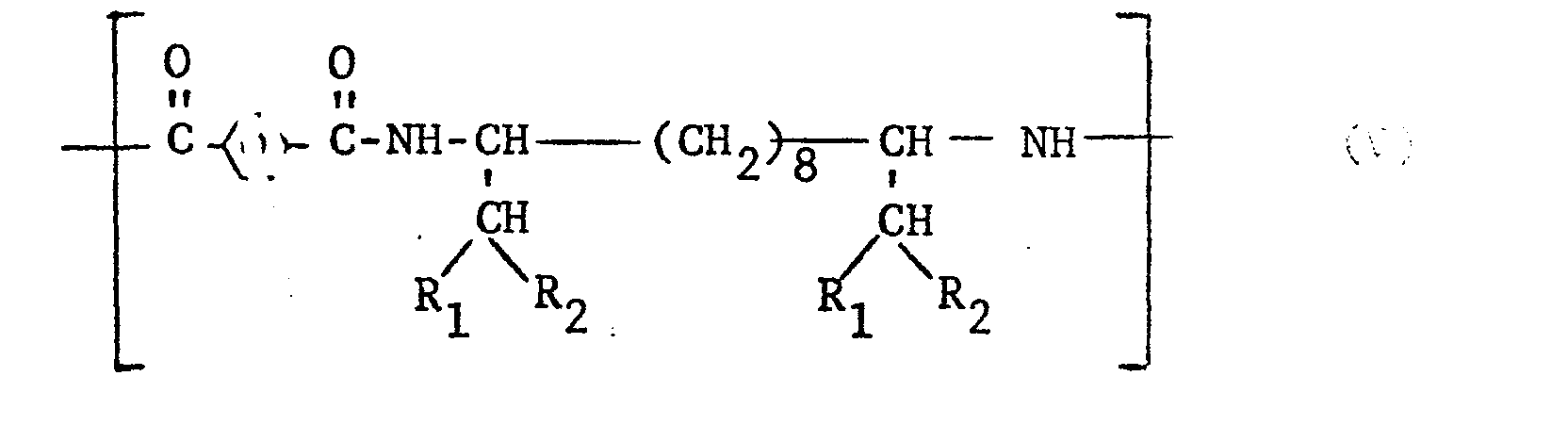
- Preferred polyamides according to the invention are those which are obtained by reacting 100% by weight of a mixture of essentially stoichiometric amounts of terephthalic acid or a tide-forming derivative thereof and a diamine of the formula: ie polyamides which consist exclusively of recurring structural elements of the formula V. exist in which R 1 and R 2 have the meaning given under formula I.
- Homopolyamides of the aforementioned are particularly preferred.
- C atom represent cyclopentyl or cyclohexyl, and especially those, wor.
- R 1 is methyl or ethyl and R 2 is ethyl, n-propyl or butyl.
- Another special preferred form of the invention are such homopolyamides d; The aforementioned type, wherein R 1 is methyl and R 2 is ethyl o.1 but R 1 is ethyl and R 2 is ethyl.
- reaction mixtures are used in the production of mixed polyamides, up to 5% by weight of one nocarboxylic acid of the formula II or a corresponding lactam or up to 30% by weight of a mixture of a dicarboxylic acid of the formula III (or an amide-forming derivative) and a diamine of the formula IV, these percentages are to be regarded as limit values. It must always be ensured that the resulting polyamides still have partial crystallinity. Depending on the type of addition to the starting substances of the base polyamide, the maximum possible amounts can be very different.
- the addition of the other polyamide-forming additives can be much larger (namely up to 30% by weight) than in cases , where 6,15-diamino-5,16-diethylicosane or 5,14-diamino-4,15-dimethyloctadecane is used as diamine of formula I.
- the size of the percentage of the additive also depends on the additive itself. Much more can be tolerated on mixtures of diamines of the formula IV with adipic acid and in particular with isophthalic acid than on caprolactam.
- the corresponding dihalides especially the dichlorides, furthermore dinitriles, dialkyl and diaryl esters, in particular dialkyl esters each having 1-4 C atoms in the alkyl moieties and can be used as the amide-forming derivatives of terephthalic acid or of the dicarboxylic acids of the formula III Diphenyl esters can be used.
- reaction components according to the definition can be implemented by methods known per se.
- reaction components e.g. Aminocarboxylic acids of the formula II or corresponding lactams, mixtures of terephthalic acid and diamine of the formula I and optionally mixtures of dicarboxylic acids of the formula III and diamines of the formula IV, in particular salts of terephthalic acid and diamines of the formula I and optionally salts of dicarboxylic acids of the formula III and diamines of the formula IV, pre-condensed under pressure at temperatures between about 220 and 300 ° C in the melt, expediently under an inert gas such as nitrogen.
- an inert gas such as nitrogen.
- the salts to be used for the precondensation are expediently prepared individually from essentially stoichiometric amounts of terephthalic acid and diamine of the formula I and, if appropriate, dicarboxylic acids of the formula III and diamines of the formula IV in suitable inert organic solvents.
- Suitable inert organic solvents are e.g. cycloaliphatic alcohols, such as cyclopentanol and cyclohexanol, and especially aliphatic alcohols with up to 6 carbon atoms, such as methanol, ethanol, n-propanol, butanols, pentanols and hexanols, and mixtures of such solvents with water.
- cycloaliphatic alcohols such as cyclopentanol and cyclohexanol
- aliphatic alcohols with up to 6 carbon atoms such as methanol, ethanol, n-propanol, butanols, pentanols and hexanols, and mixtures of such solvents with water.
- the precondensate can then either at temperatures between about 220 and 300 ° C at atmospheric pressure and appropriately also in an inert gas atmosphere up to
- Formation of the polyamides according to the invention are further condensed, at the end of the polycondensation, if appropriate, vacuum is applied to degas the polyamide, or the polycondensation of the precondensate is carried out, optionally together with an aminocarboxylic acid of the formula II or a corresponding lactam, in a solid phase at temperatures up to about 20 ° C below the crystallite melting point.
- the polycondensation in the solid phase is expediently carried out in a vacuum or in an inert gas atmosphere.
- Polyamides according to the invention can also be prepared by melt polycondensation of diamines of the formula I with essentially stoichiometric amounts of an activated ester of terephthalic acid and optionally a diamine of the formula IV with an activated ester of a dicarboxylic acid of the formula III.
- the corresponding diphenyl esters are particularly suitable as activated esters.
- the reaction temperatures are generally between about 220 and 320 ° C.
- the polyamides according to the invention can optionally also be prepared in a manner known per se by solvent or interfacial polycondensation.
- Diamines of the formula I in which R 1 is alkyl with 2-4 C atoms and R 2 alkyl with 1-8 C atoms are new. These new diamines, like the rest of the diamines of the formula I, can be prepared in a particularly advantageous manner by appropriately substituted 1,2-diaza-1,5,9-cyclododecatrienes or in the 3,12-position 1,2-diazacyclododecanes in the presence of an inert. African solvent catalytically hydrogenated.
- the polyamides according to the invention are partially crystalline and are distinguished above all by a low water absorption, high resistance to hydrolysis and / or Dimensional stability under the influence of moisture good thermal stability combined with improved mechanical and in particular electrical properties.
- the polyamides according to the invention can according to known methods to molded bodies of various types: are. They are particularly suitable for: Production of filaments and fibers from the melt
- the reduced viscosity of the polyamide obtained is 1.37 dl / g.
- the polyamide shows a melting peak with a maximum at 305 ° C and a melting heat of 15.3 cal / g.
- a sample of the molten polyamide is quenched with water and then reheated in the differential calorimeter.
- a thread drawn from the melt and stretched by hand shows a sharp melting point of 224-225 ° C under the polarizing microscope. Further properties are summarized in Table 1.
- the salt is first prepared by reacting 16.61 g of terephthalic acid and 28.45 g of 4,13-diamino-3,14-dimethylhexadecane in a mixture of 200 ml of water and 400 ml of ethanol. Yield: 42.5 g (94% of theory).
- the mixture melts to a colorless liquid and polycondensed with elimination of water to a low molecular weight precondensate.
- the solidified opaque mass is melted again in an open polycondensation tube under nitrogen at 270 ° C. and polycondensed at this temperature for 8 hours with the exclusion of air, the water of reaction being continuously removed with the nitrogen passed through the melt.
- the salt formed begins to precipitate out. After cooling to room temperature, the mixture is filtered and the salt is dried in vacuo at 80 ° C.
- the resulting clear solution is gradually cooled to -5 ° C, whereby the salt precipitates.
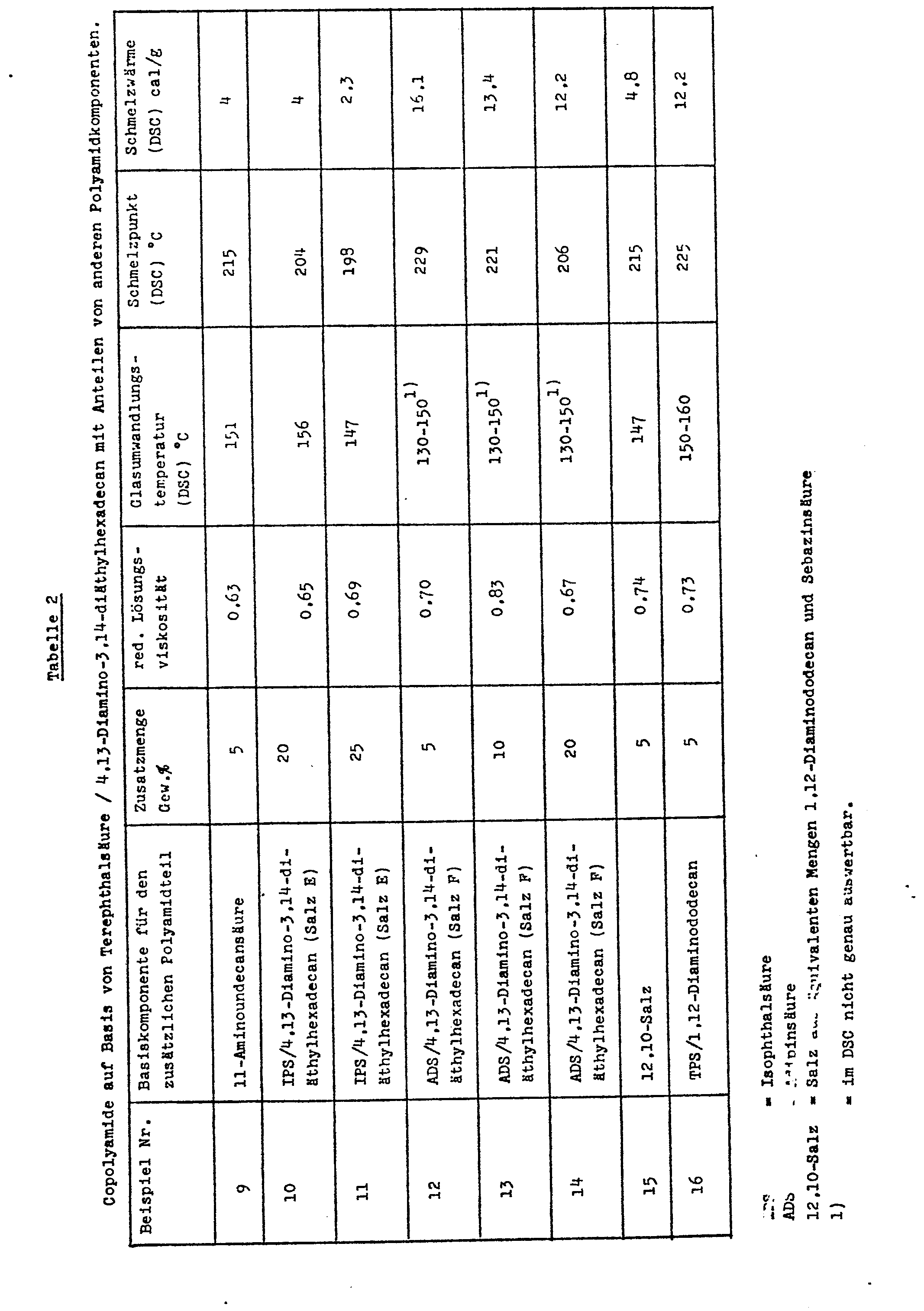
- Example 9 0.404 g of 1,12-diaminododecane, 0.407 g of sebacic acid and 15.46 g of salt (D) from Example 9 are weighed into a bomb tube and polycondensed as described in Example 9.
- the properties of the copolyamide are listed in Table 2.
- the diamines used in Examples 1-8 can be prepared as follows:
- the filtrate is concentrated on a rotary evaporator and the product is purified by distillation.
- the main fraction obtained is 238 g (94% of theory) of 3,12-diamino-2,13-dimethyltetra-decane as a colorless oil [bp. 106-109 ° C / 0.01 Torr; ; IR (liquid) ao bands at 3355, 3278, 1613 cm -1 ].
- the 1,2-diaza-1,5,9-cyclododecatrienes or 1,2-diazacyclododecanes used as starting products can be prepared by the methods described in German Offenlegungsschriften 2,330,097 and 2,549,403.
Landscapes
- Chemical & Material Sciences (AREA)
- Health & Medical Sciences (AREA)
- Chemical Kinetics & Catalysis (AREA)
- Medicinal Chemistry (AREA)
- Polymers & Plastics (AREA)
- Organic Chemistry (AREA)
- Life Sciences & Earth Sciences (AREA)
- Proteomics, Peptides & Aminoacids (AREA)
- Polyamides (AREA)
- Organic Low-Molecular-Weight Compounds And Preparation Thereof (AREA)
Abstract
Description
- Die vorliegende Erfindung betrifft neue kristalline Polyamide, Verfahren zu deren Herstellung sowie derer Verwendung zur Herstellung von Formkörpern.
- In der US Patentschrift 2.752.328 sind lineare faserbildende Polyamide aus Terephthalsäure und Alkylendiaminen mit 6 bis 8 C-Atomen in der Kette, die in den Stellungen 2 bis 5 durch eine oder zwei Methylgruppen substituiert sein können, beschrieben, wobei das Diaring insgesamt höchstens 9 C-Atome aufweist. Bevorzugte Diamine sind z.B. 2,5-Dimethylhexamethylendiamin, 2-oder 3-Methylhexamethylendiamin und 4-Methyloctamethylendiamin. Diese vorbekannten kristallinen Polyamide lassen aber hinsichtlich der Wasseraufnahme, der Hydro lysebeständigkeit und/oder der Dimensionsstabilität unter Feuchtigkeitseinwirkung zu wünschen Ubrig.
- Ferner ist bekannt, dass Polyamide aus aliphatischen oder aromatischen Dicarbonsäuren und sperrigen Diamine stets transparent, d.h. amorph sind; vgl. z.B. die US Patentschriften 2.864.807, 3.150.117 und 3.352.831, die belgische Patentschrift 677.650 und die deutsche Offenlegungsschrift 1.720.513. Diese letztgenannte deutsche Offenlegungsschrift beschreibt zwar generisch kochbeständige transparente Polyamide aus aromatischen Dicarbonsäuren und gegebenenfalls alkylsubstituierten Alkylendiaminen mit bis zu 10 C-Atomen in der Kette, die an mindestens einem der beiden endständigen C-Atome durch eine Alkylgruppe mit 1-4 C-Atomen substituiert sind. Die konkrete Offenbarung beschränkt sich jedoch auf transparente Polyamide aus aromatischen Dicarbonsäuren und Alkylendiaminen der vorerwähnten Art mit höchstens 7 C-Atomen in der Kette.
- Aufgabe der Erfindung war daher die Bereitstellung von neuen kristallinen Polyamiden mit hoher Wärmeformbeständigkeit, mit geringerer Wasseraufnahme, verbesserter Hydrolysebeständigkeit und erhöhter Dimensionsstabilität unter Feuchtigkeitseinwirkung, die sich zur Herstellung von Spritzgussmaterialien und besonders auch zur Herstellung von Filamenten und Fasern eignen. Es wurde nun gefunden, dass sich überraschenderweise aus aromatischen Dicarbonsäuren und Alkylendiaminen mit sperrigen Seitenketten neue kristalline Polyamide herstellen lassen.
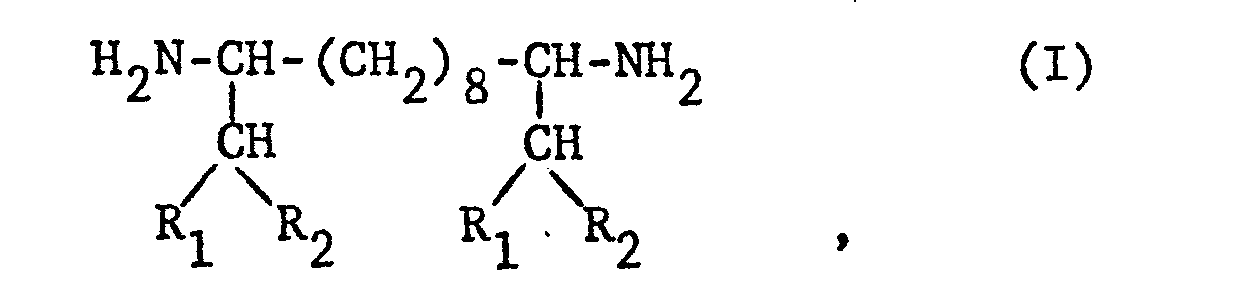
- Gegenstand der Erfindung sind daher neue teilkristalline Polyamide, die dadurch erhalten werden können, dass man im wesentlichen stöchiometrische Mengen von Terephthalsäure oder einem amidbildenden Derivat davon und einem Diamin der Formel I

- R2 Alkyl mit 1-8 C-Atomen oder
- R1 und R2 zusammen mit dem Bindungs-C-Atom je Cycloalkyl mit 4-6 C-Atomen bedeuten, zur Reaktion bringt,
- wobei das Reaktionsgemisch gegebenenfalls bis zu 5 Gew (bezogen auf das Gesamtgemisch) einer Aminocarbonsäure der Formel II
-


- in der Z2 einen aliphatischen Rest mit mindestens ? C-Atomen oder einen carbocyclisch-aromatischen Rest, in dem die Carbonylgruppen an verschiedene, nicht benachbarte Ring-C-Atome gebunden sind, darstellt, oder einen amidbildenden Derivates davon mit einem Diamin der Formel IV

- in der Z 3

- 2-12 C-Atomen oder einen cycloaliphatischen oder arali phatischen Rest bedeutet, enthält und
- wobei sich die definitionsgemässen Gewichtsprozente bey amidbildenden Derivaten der Terephthalsäure und der Dicarbonsäure der Formel III auf gleiche funktionelle Gruppen beziehen.
- Durch R und R2 dargestellte Alkylgruppen können geradkettig oder verzweigt sein, sind aber bevorzugt geradkettig. Als Beispiele definitionsgemässer Alkylgruppen seien erwähnt : die Methyl-, Aethyl-, n-Propyl-, Isopropyl-, n--Butyl-, sek-Butyl-, n-Pentyl-, n-Hexyl-, n-Heptyl-und n-Octylgruppe.
- Bilden R1 und R2 zusammen mit dem Bindungs-C-Atom einen Cycloalkylring, so handelt es sich vorzugsweise um Cyclopentyl oder Cyclohexyl.
- Stellt Z2 einen aliphatischen Rest dar, so handelt es sich insbesondere um geradkettiges Alkylen mit 2-12 C-Atomen und bevorzugt um geradkettiges Alkylen mit 4-10 C-Atomen. Alkylengruppen Z3 weisen bevorzugt 2-10 C-Atome auf.
- Durch Z2 dargestellte carbocyclisch-aromatische Reste können unsubstituiert oder substituiert sein, beispielsweise durch Alkylgruppen mit 1-4 C-Atomen. Dabei handelt es sich beispielsweise um monocyclische, um kondensierte polycyclische oder um unkondensierte bicyclische aromatische Reste, wobei bei letzteren die Aromatenkerne auch über ein Brückenglied, wie -0- oder -S02-, miteinander - verbunden sein können. Z2 stellt insbesondere einen 4,4'-Biphenylen-, 4,4'-Diphenyläther- oder 4,4'-Diphenylsulfonrest, die 2,4-, 3,6- oder 2,7-Naphthylengruppe und vor allem die 1,3-Phenylengruppe und ganz bevorzugt die 1-4-Phenylengruppe dar.
- 23 in der Bedeutung eines cycloaliphatischen Restes stellt z.B. die 1,3-Cyclopentylen-, die 1,3- oder 1,4-Cyclohexylen- oder die 4,4'-Dicyclohexylmethangruppe dar, während als araliphatische Reste Z3 vor allem die 1,4 und 1,3-xylylengruppe in Betracht kommt.
- Bevorzugt sind erfindungsgemässe Polyamide, die durch Umsetzung von 100 Gewichtsprozent eines Gemisches aus im wesentl .chen stöchiometrischen Mengen Terephtahalsäu oder einem tmidbildenden Derivat davon und einem Diamin der Formel : erhalten werden, d.h. Polyamide, die ausschliesslich aus wiederkehrenden Strukturelementen der Formel V
- Besonders bevorzugt ind Homopolyamide der vorerwähnter. Art, worin R1 und R2 mabhängig voneinander Alkyl mit 1-4 C-Atomen oder R1 und R2 je zusammen mit dem Bindung. C-Atom Cyclopentyl oder Cyclohexyl darstellen, und ganz besonders solche, wor. R1 Methyl oder Aethyl und R2 Aethyl, n-Propyl oder -Butyl bedeuten.
- Eine weitere besondere vorzugsform der Erfindung stellen solche Homopolyamide d; vorerwähnten Art dar, worin R1 Methyl und R2 Aethyl o.1 aber R1 Aethyl und R2 Aethyl bedeuten.
- Werden bei der Herstellingvon Mischpolyamiden Reaktion nischungen verwendet,bis zu 5 Gew.-% einer
 nocarbonsäure der Formel II oder eines entsprechenden Lactams oder bis zu 30 Gew.-% eines Gemisches einer Dicarbonsäure der Formel III (oder eines amidbildenden Derivates) und eines Diamins der Formel IV enthalten, so sind diese Prozentangaben als Grenzwerte zu betrachten. Es muss stets darauf geachtet werden, dass die resultierenden Polyamide noch Teilkristallinität aufweisen. Je nach Art des Zusatzes zu den Ausgangssubstanzen des Grundpolyamids können die maximal möglichen Mengen nämlich sehr unterschiedlich sein. Handelt es sich beispielsweise bei dem Diamin der Formel I um 4,13-Di- amino-3,14-diäthylhexadecan, so kann der Zusatz der übrigen polyamidbildenden Zusätze viel grösser (nämlich bis zu 30 Gew.-%) sein, als in Fällen, wo als Diamin der Formel I 6,15-Diamino-5,16-diäthyleicosan oder 5,14-Diamino-4,15-dimethyloctadecan eingesetzt wird.
- Die Grösse des Prozentsatzes des Zusatzes hängt aber auch von dem Zusatz selbst ab. So kann viel mehr an Mischungen von Diaminen der Formel IV mit Adipinsäure und insbesondere mit Isophthalsäure vertragen werden als an Caprolactam.
- Bei der Herstellung der erfindungsgemässen Polyamide können als amidbildende Derivate der Terephthalsäure oder der Dicarbonsäuren der Formel III beispielsweise die entsprechenden Dihalogenide, vor allem die Dichloride, ferner Dinitrile, Dialkyl- und Diarylester, besonders Dialkylester mit je 1-4 C-Atomen in den Alkylteilen und Diphenylester verwendet werden.
- Die Umsetzung der definitionsgemässen Reaktionskomponenten kann nach an sich bekannten Methoden vorgenommen werden.
- Bevorzugt ist die Herstellung nach dem Schmelzpolykondensationsverfahren in mehreren Stufen. Dabei werden die definitionsgemässen Reaktionskomponenten, z.B. Aminocarbonsäuren der Formel II oder entsprechende Läctame, Gemische aus Terephthalsäure und Diamin der Formel I und gegebenenfalls Gemische aus Dicarbonsäuren der Formel III und Diaminen der Formel.IV, insbesondere Salze aus Terephthalsäure und Diaminen der Formel I und gegebenenfalls Salze aus Dicarbonsäuren der Formel III und Diaminen der Formel IV, unter Druck bei Temperaturen zwischen etwa 220 und 300°C in der Schmelze, zweckmässig unter Inertgas, wie Stickstoff, vorkondensiert. Die für die Vorkondensation einzusetzenden Salze werden zweckmässig einzeln aus im wesentlichen stöchiometrischen Mengen Terephthalsäure und Diamin der Formel I und gegebenenfalls Dicarbonsäuren der Formel III und Diaminen der Formel IV in geeigneten inerten organischen Lösungsmitteln hergestellt.
- Als inerte organische Lösungsmittel eignen sich dabei z.B. cycloaliphatische Alkohole, wie Cyclopentanol und Cyclohexanol, und vor allem aliphatische Alkohole mit bis zu 6 C-Atomen, wie Methanol, Aethanol, n-Propanol, Butanole, Pentanole und Hexanole, sowie Gemische derartiger Lösungsmittel mit Wasser.
- Das Vorkondensat kann anschliessend entweder bei Temperaturen zwischen etwa 220 und 300°C bei Normaldruck und zweckmässig ebenfalls in Inertgasatmosphäre bis zur
- Bildung der erfindungsgemässen Polyamide weiterkondensiert werden, wobei man am Ende der Polykondensation gegebenenfalls zum Entgasen des Polyamids Vakuum anlegt, oder aber man fUhrt die Polykondensation des Vorkondensats, gegebenenfalls zusammen mit einer Aminocarbonsäure der Formel II oder einem entsprechenden Lactam, in fester Phase bei Temperaturen bis etwa 20°C unter dem Kristallitschmelzpunkt durch. Die Polykondensation in fester Phase wird zweckmässig im Vakuum oder in Inertgasatmosphäre vorgenommen.
- Erfindungsgemässe Polyamide können auch durch Schmelzpolykondensation von Diaminen der Formel I mit im wesentlichen stöchiometrischen Mengen eines aktivierten Esters der Terephthalsäure sowie gegebenenfalls eines Diamins der Formel IV mit einem aktivierten Ester einer Dicarbonsäure der Formel III hergestellt werden. Als aktivierte Ester eignen sich besonders die entsprechenden Diphenylester. Die Reaktionstemperaturen liegen dabei im allgemeinen zwischen etwa 220 und 320oC. Schliesslich können die erfindungsgemässen Polyamide gegebenenfalls auch in an sich bekannter Weise durch Lösungsmittel- oder Grenzflächenpolykondensation hergestellt werden.
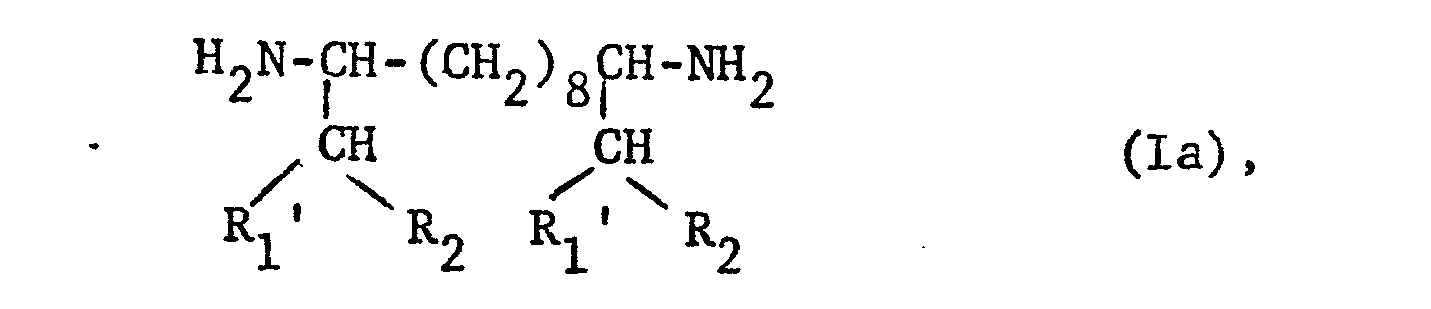
- Die erfindungsgemäss zu verwendenden Ausgangsprodukte der Formel II, III und IV sind bekannt. Diamine der Formel I, worin R1 Alkyl mit 2-4 C-Atomen und R2 Alkyl mit 1-8 C-Atomen darstellen, sind neu. Diese neuen Diamine, wie auch die restlichen Diamine der Formel I können auf besonders vorteilhafte Weise dadurch hergestellt werden, dass man in 3,12-Stellung entsprechend substituierte 1,2-Diaza-1,5,9-cyclododecatriene oder 1,2-Diazacyclododecane in Gegenwart eines inerten.nischen Lösungsmittels katalytisch hydriert.

- Die erfindungsgemässen Polyamide sind teilkristallin und zeichnen sich vor allem durch eine geringe Wasser aufnahme, hohe Hydrolysebeständigkeit und/oderDimensionsstabilität unter Feuchtigkeitseinwirkung gute Wärmeformstabilität verbunden mit verbesserten mechanischen und insbesondere elektrischen Eigenschaf aus.
- Die erfindungsgemässen Polyamide können nach anbekannten Methoden zu Formkörpern verschiedensten verarbeitet: werden. Sie eignen sich ganz besonder zu: Herstellung von Filamenten und Fasern aus der Schmelze

- 74,9 g Terephthalsäure werden zusammen mit 800 ml Wasser und 2000 ml Aethanol in einem Kolben, der mit Rührer, Rückflusskühler und Tropftrichter versehen ist, vorgelegt und auf 50°C erwärmt. Unter Rühren lässt man aus dem Tropftrichter 116,6 g 3,12-Diamino-2,13-dimethyl- tetradecan zufliessen und spült mit 1500 ml Aethanol nach. Beim Erwärmen des Reaktionsgemisches auf 80°C tritt lösung ein. Anschliessend wird das Reaktionsgemisch auf°C abgekühlt, wobei das gebildete Salz ausfällt. Das Salz wird abfiltriert und bei 90°C im Vakuum getrocknet. Ausbeute: 162,5 g (85% d.Th.).

- 15 g dieses Salzes werden unter Stickstoff in ein Bombenrohr eingeschmolzen und auf 280°C erhitzt. Das Salz schmilzt zunächst zu einer farblosen Flüssigkeit, die nach ca. einer Stunde zu einer opaken Masse erstarrt. Nach 2 Stunden wird die Vorkondensation abgebrochen, und das Vorkondensat wird aus dem Bombenrohr entnommen. Reduzierte Viskosität des Vorkondensats, gemessen an einer 0,5%igen Lösung in m-Kresol bei 25°C = 0,56. Das Vorkondensat wird pulverisiert und in einem Kölbchen unter einem Druck von 0,1 Torr während 12 Stunden bei 2806C in fester Phase polykondensiert. Die reduzierte Viskosität der erhaltenen Polyamids, gemessen als 0,5%ige Lösung in m-Kresol bei 25°C, beträgt 1,37 dl/g. Im Differentialcalorimeter zeigt das Polyamid einen Schmelzpeak mit Maximum bei 305°C und einer Schmelzwärme von 15,3 cal/g. Eine Probe des geschmolzenen Polyamids wird mit Wasser abgeschreckt und dann erneut im Differentialcalorimeter aufgeheizt. Dabei ergeben sich folgende Mess-Warte: Glasumwandlungstemperatur 148°C; Maximum des Kristallisationspeaks 210°C mit einer Kristallisationswärme von 10,1 cal/g; Maxima des Doppelschmelzpeaks bei 286°C und 308°C mit einer Schmelzwärme von 9,1 cal/g Das weisse Polyamidpulver wird in einer hydraulischen Presse bei 330°C zu ca. 0,5 mm dicken Plättchen verpresst; Wasseraufnahme nach 7 Tagen Lagern bei 20-25°C und 65% relativer Luftfeuchtigkeit : 1,0 Gew.%; Wasseraufnahme nach 7 Tagen Lagern in Wasser : 1,7 Gew.%.
- In einem Reaktionsgefäss, das mit Rührer, Tropftrichter und RUckfl.usskUhler versehen ist, werden 11,7% g Terephtalsäure in einem Gemisch von 250 ml Aethanol und 90 ml Wasser auf RUckflusstemperatur erwärmt. Dann tropft man innerhalb von 10 Minuten aus dem Tropftrichter 24,0 g 1,10-Diamino-1,10-dicyclohexyldecan zu. Das Reaktionsgemisch wird während 48 Stunden unter Rückfluss gerührt, dann auf 20-25°C abgekühlt, worauf man das entstandene Salz abfiltriert. Nach dem Trocknen im Vakuum erhält man 34,8 g Salz (98% d.Th.).
- 15 g dieses Salzes werden wie im Beispiel 1 beschrieben polykondensiert. Die anschliessende Verarbeitung des erhaltenen Polyamids erfolgt bei einer Pressentemperatur von 350°C. Die Eigenschaften des Polyamids sind in der Tabelle 1 zusammengefasst.
- 5,15 g Terephtalsäurediphenylester und 5,05 g 1,10-Di- amino-1,10-dicyclopentyldecan werden in einem Konden" sationsrohr mit einer Vorrichtung zum Einleiten von Stickstoff bei 210°C aufgeschmolzen. Während Stickstoff über die Schmelze geleitet wird, erhöht man die Temperatur im Verlaufe von 5 Stunden auf 280°C. Während dieser Zeit destilliert ein Teil des abgespaltenen Phenols ab, und die Schmelze erstarrt allmählich zu einer opaken Masse. Nun wird abgekühlt, und der Inhalt des Kondensationsrohres wird pulverisiert. Das noch phenolhaltige Pulver wird in einen Kolben gefüllt und während 9 Stunden unter einem Druck von 0,03 Torr einer Temperatur von 280°C ausgesetzt. Die thermoplastische Verformung des erhaltenen Polyamids zu dünnen Plättchen wird bei einer Temperatur von 350°C vorgenommen. Die Eigenschaften des Polyamids sind in der Tabelle 1 zusammengefasst.
- 10,0 g 4,13-Diamino-3,14-diäthylhexadecan und 10,06 g Terephthalsäurediphenylester werden in einem Kondensationsrohr unter Stickstoff bei 220°C aufgeschmolzen und während 4 Stunden bei dieser Temperatur belassen. Unter Durchleiten von Stickstoff durch die Schmelze wird anschliessend die Temperatur im Verlaufe von 2 Stunden auf 270°C gesteigert, wobei die Hauptmenge des abgespaltenen Phenols abdestilliert. Nach 30 Minuten evakuiert man vorsichtig auf 14 Torr, nach weiteren 90 Minuten schliesslich auf 0,1 Torr. Unter diesen Bedingungen wird noch während 30 Minuten weiterkondensiert. Beim Abkühlen der Schmelze erstarrt sie zu einer weissenopaken Masse. Ein aus der Schmelze gezogener und von Hand verstreckter Faden zeigt unter einem beheizbaren Polarisationsmikroskop einen scharfen Kristallitschmelzpunkt von 235-236°C. Weitere Eigenschaften des Polyamids sind in der Tabelle 1 angegeben.
- In einem 1-Liter Erlenmeyerkolben, der mit RUhrer, Tropftrichter und RUckflusskUhler ausgestattet ist, werden 16,61 g Terephthalsäure in einem Gemisch von 300 ml Wasser und 450 ml Aethanol unter Rühren auf 80°C erwärmt. Aus dem Tropftrichter werden 36,86 g 6,15-Diamino-5,16-diäthyleicosan zugetropft. Das erhal- tene Gemisch wird nun unter RUckfluss während ca. 5 Stunden gekocht. Anschliessend wird auf 5°C abgekühlt, und das gebildete Salz wird abfiltriert. Den Rückstand trocknet man bei 90°C im Vakuum. Die Ausbeute beträgt 51,2 g (95,8% d.Th.).
- 15 g dieses Salzes werden unter Stickstoff in ein Bombenrohr eingeschmolzen und auf 270°C erhitzt. Nach 3 Stunden wird abgekühlt, das erstarrte Vorkondensat wird entnommen und in ein Kondensationsrohr mit einer Vorrichtung zum Einleiten von Stickstoff übergeführt. Unter Stickstoff wird das Vorkondensat bei 270°C aufgeschmolzen und 10 Stunden unter Durchleiten von Stickstoff auf dieser Temperatur gehalten. Beim Abkühlen erstarrt die Schmelze zu einer weissen opaken Masse. Die reduzierte Lösungsviskosität des erhaltenen Polyamids, gemessen als 0,5%ige Lösung in m-Kresol bei 25°C, beträgt 0,75 dl/g.
- Ein aus der Schmelze gezogener und von Hand verstreckter Faden zeigt unter dem Polarisationsmikroskop einen scharfen Schmelzpunkt von 224-225°C. Weitere Eigenschaften sind in der Tabelle 1 zusammengefasst.
- Auf die im Beispiel 2 beschriebene Weise werden 13,98 g Terephthalsäure und 26,3 g 5,14-Diamino-4,15-dimethyl- octadecan in einem Gemisch von 340 ml Aethanol und 100 ml Wasser zur Reaktion gebracht. Nach 8 Stunden ist die Salzbildung beendet. Das Salz wird abfiltriert und bei 100°C im Vakuum getrocknet. Ausbeute: 38,3 g Salz (95% d.Th.).
- 10 g dieses Salzes werden unter Stickstoff in ein Bombenrohr eingeschmolzen und 3 Stunden lang auf 270°C erhitzt. Nach dem Abkühlen auf 20-25°C wird die erstarrte Schmelze aus dem Bombenrohr entnommen und in ein Kondensationsrohr Übergeführt. Unter andauerndem Einleiten von Stickstoff wird das Vorkondensat darin aufgeschmolzen und während 8 Stunden bei einer Temperatur von 270°C in der Schmelze polykondensiert.
- Beim Erkalten erstarrt die Schmelze zu einer opaken Masse. Die Eigenschaften des erhaltenen Polyamids sind in der Tabelle 1 zusammengefasst.
- Wie in Beispiel 1 beschrieben wird zunächst das Salz durch Reaktion von 16,61 g Terephthalsäure und 28,45 g 4,13-Diamino-3,14-dimethylhexadecan in einem Gemisch von 200 ml Wasser und 400 ml Aethanol hergestellt. Ausbeute: 42,5 g (94% d.Th.).
- 10 g dieses Salzes werden in einem Bombenrohr unter Stickstoff 3 Stunden auf 280°C erhitzt.
- Nach AbkUhlen wird das Vorkondensat aus dem Bombenrohr entnommen und in einem Kondensationsrohr unter andauerndem Durchleiten von N2 6 Stunden bei 280°C in der Schmelze polykondensiert. Die Eigenschaften des Polyamids sind in der Tabelle 1 zusammengefasst.
- Auf die in Beispiel 2 beschriebene Weise werden.16,61 g Terephthalsäure mit 39,67 g 6,15-Diamino-5,16-di-n-propyleicosan in einem Gemisch von 400 ml Aethanol und 100 ml Wasser zur Reaktion gebracht. Nach 6 Stunden ist die Salzbildung beendet. Ausbeute nach Abfiltrieren und Trocknen: 48,8 g (87% d.T.).
- 10 g dieses Salzes werden unter den in Beispiel 6 beschriebenen Bedingungen zu einem Polyamid polykondensiert. Die Eigenschaften des erhaltenen Polyamids sind in der Tabelle 1 zusammengefasst.
- Zu einer Aufschlämmung von 38,70 g Terephthalsäure in einem Gemisch von 750 ml Aethanol und 250 ml Wasser gibt man aus einem Tropftrichter 72,98 g 4,13-Diamino-3,14- diäthylhexadecan unter Rühren und Rückflusskochen.
- Nach 8 Stunden lässt man erkalten und filtriert das gebildete Salz ab. Nach Trocknen bei 90°C im Vakuum erhält man 107,4 g Salz (D) (96% der Theorie).
- 9,5 g dieses Salzes werden mit 0,5 g 11-Aminoundecansäure vermischt und unter Stickstoff in ein Bombenrohr eingeschmolzen und 3 Stunden lang in einem Salzbad von
- 270°C eingetaucht, wobei das Gemisch zu einer farblosen Flüssigkeit schmilzt und unter Wasserabspaltung zu einem niedermolekularen Vorkondensat polykondensiert. Nach Abkühlen wird die erstarrte opake Masse in einem offenen Polykondensationsrohr unter Stickstoff bei 270°C wieder aufgeschmolzen und bei dieser Temperatur 8 Stunden lang unter Luftausschluss polykondensiert, wobei das Reaktionswasser laufend mit den durch die Schmelze geleiteten Stickstoff entfernt wird.
- Die Eigenschaften des Copolyamids sind in Tabelle 2 zusammengefasst.
- 22,87 g 3,14-Diamino-4,13-diäthylhexadecan werden in 300 ml Aethanol auf 50°C aufgeheizt.
- Zu dieser Lösung gibt man in einer Portion 12,13 g Isophthalsäure. Nach kurzer Zeit löst sich die Isophthalsäure vollständig auf, während die Lösung durch die Neutralisationswärme den Siedepunkt erreicht.
- Nach wenigen Minuten beginnt das gebildete Salz auszufallen. Nach Abkühlen auf Raumtemperatur wird filtriert und das Salz im Vakuum bei 80°C getrocknet.
- Man erhält 32,2 g Salz (E) (92% d.Th.)
- 2 g dieses Salzes (E) werden mit 8 g Salz (D) aus Beispiel 9 vermischt und unter den dort angegebenen Bedingungen zu einem Copolyamid polykondensiert.
- Gleichermassen wird mit einer Mischung aus 2,5 g Salz (E) aus der voranstehenden Beschreibung und 7,5 g Salz (D) aus Beispiel 9 verfahren.
- Die Eigenschaften der beiden Copolyamide sind in Tabelle 2 zusammengestellt.
- 14,61 g Adipinsäure werden in 100 ml Aethanol auf 50°C erwärmt und mit einer Lösung von 31,32 g 4,13-Diamino-3,14-diäthylhexadecan in 80 ml Aethanol versetzt.
- Die dabei entstehende klare Lösung wird nach und nach auf -5°C abgekühlt, wobei das Salz ausfällt.
- Nach Abfiltrieren und Trocknen erhält man 31,4 g Salz (F) (68% d.Th.).
- Verschiedene Salzmischungen aus dem hier beschriebenen Salz (F) und Salz (D) aus Beispiel 9 werden unter den in Beispiel 9 beschriebenen Bedingungen polykondensiert.
- 0,404 g 1,12-Diaminododecan, 0,407 g Sebazinsäure und 15,46 g Salz (D) aus Beispiel 9 werden in ein Bombenrohr eingewogen und wie in Beispiel 9 beschrieben polykondensiert.
- Eigenschaften des Copolyamids siehe Tabelle 2.
- In gleicher Weise werden 0,303 g 1,12-Diaminododecan und 0,249 g Terephthalsäure mit 10,04 g Salz (D) aus Beispiel 9 vermischt und in der dort beschriebenen Art und Weise polykondensiert.
- Die Eigenschaften des Copolyamids sind in Tabelle 2 aufgeführt.

- 250 g (1 Mol) 3,12-Diisopropyl-1,2-diaza-1,5,9-cyclodo- decatrien (Diastereomerengemisch) werden in einem RUhrautoklaven in 1000 ml t-Butanol gelöst. Nach der Zugabe von 25 g eines Rhodium-Aluminiumoxid-Katalysators (5 Gew.% Rh) wird Wasserstoff bis zu einem Druck von 130 - 150 bar aufgepresst, worauf man bis zur Beendigung der Wasserstoffaufnahme bei 150 - 180°C hydriert. Nach dem Erkalten wird der Überschüssige Wasserstoff abgeblasen, die Suspension wird aus dem Autoklaven herausgesaugt, und der Katalysator wird Über ein wenig "Hyflo" (Filterhilfsmittel) abgenutscht. Das Filtrat wird am Rotationsverdampfer eingeengt, und das Produkt wird durch Destillation gereinigt. Man erhält als Hauptfraktion 238 g (94% d.Th.) 3,12-Diamino-2,13-dimethyltetra- decan als farbloses Oel [Kp. 106-109°C/0,01 Torr;; IR (flussig) u.a. Banden bei 3355, 3278, 1613 cm-1 ].

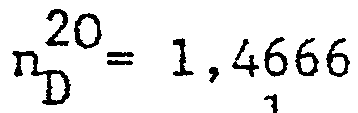
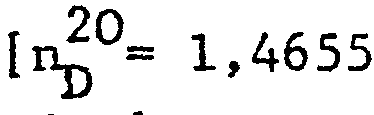
- Verwendet man wie unter a) angegeben bei sonst gleicher Arbeitsweise anstelle von 250 g (1 Mol) 3,12-Diisopropyl-1,2-diaza-1,5,9-cyclododecatrien 61 g (0,2 Mol) 3,12-Di-(2-pentyl)-l,2-diaza-l,5,9-cyclododecatrien (Diastereomerengemisch) und entsprechend verkleinerte Mengen an Katalysator und Lösungsmittel, so erhält man als Hauptfraktion 48,4 g (77% d.Th.) 5,14-Diamino-4,15-dimethyloctadecan als farbloses Oel [Kp. 155-159°C/0,03 Torr; nD 20= 1,4632; IR (flUssig) u.a. Banden bei 3246, 1613 cm-1].
- Verwendet man wie unter a) angegeben bei sonst gleicher Arbeitsweise anstelle von 250 g (1 Mol) 3,12-Diisopropyl- l,2-diaza-l,5,9-cyclododecatrien 49 g (0,159 Mol) 3,12-Di-(3-pentyl)-l,2-diazacyclododecan und entsprechend verkleinerte Mengen an Katalysator und Lösungsmittel, so erhält man nach chromatographischer Reinigung und Destillation 26,8 g (54% d.Th.) 4,13-Diamino-3,14- diäthylhexadecan als farbloses Oel [Kp. 141-143°C/0,004 Torr;; IR (flüssig) u.a. Banden bei 3378, 3278, 1613 cm-1 ].
- Verwendet man wie unter a) angegeben bei sonst gleicher Arbeitsweise anstelle von 250 g (1 Mol) 3,12-Diisopropyl-1,2-diaza-1,5,9-cyclododecatrien 200 g (0,666 Mol) rohes 3,12-Dicyciopentyl-1,2-diaza-1,5,9-cyclododecatrien (Diastereomerengemisch) und entsprechend verkleinerte Mengen an Katalysator und Lösungsmittel, so erhält man nach chromatographischer Reinigung und Destillation 39,2 g (19% d.Th.) 1,10-Diamino-1,10-dicyclopentyldecan als farbloses Oel [Kp. 174-178°C/0,002 Torr;IR (flüssig) u.a. Banden bei 3355, 3278, 1613 cm-1].

- Verwendet man wie unter a) angegeben bei sonst gleicher Arbeitsweise anstelle von 250 g (1 Mol) 3,12-Diisopropyl-1,2-diaza-1,5,9-cyclododecatrien 328,5 g (1 Mol) 3,12-Dicyclohexyl-1,2-diaza-1,5,9-cyclododecatrien (Diastereomerengemisch) und entsprechende Mengen an Katalysator und Lösungsmittel, so erhält man als Hauptfraktion 304 g (90% d.Th.) 1,10-Diamino-1,10-dicyclohexyldecan als farb- loses Oel [Kp. 190-193°C/0,05 Torr;; IR (flUssig) u.a. Banden bei 3355, 3278, 1613 cm-1).

- Verwendet man wie unter a) angegeben bei sonst gleicher Arbeitsweise anstelle von 250 g (1 Mol) 3,12-Diisopropyl-1,2-diaza-1,5,9-cyclododecatrien 74,8 g (0,2 Mol) 3,12-Di-(3-heptyl)-1,2-diazacyclododecan (Diastereomerengemisch) und entsprechend verkleinerte Mengen an Katalysator und Lösungsmittel, so erhält man nach chromatographischer Reinigung und Destillation 29,9 g (40% d.Th.) 6,15-Diami- no-5,16-diäthyleicosan als farbloses Oel [Kp. 170°C/ 0,01 Torr;; IR (flüssig) u.a. Banden bei 3278, 1613 cm-1].

- Die Herstellung der als Ausgangsprodukte verwendeten 1,2-Diaza-1,5,9-cyclododecatriene bzw. 1,2-Diazacyclododecane kann nach den in den deutschen Offenlegungsschriften 2.330.097 und 2.549.403 beschriebenen Methoden vorgenommen werden.
- Verwendet man wie unter a) angegeben bei sonst gleicher Arbeitsweise anstelle von 250 g (1 Mol) 3,12-Diisopropyl-1,2-diaza-1,5,9-cyclododecatrien 87,3 g (0,31 Mol) 3,12-Di-(2-butyl)-1,2-diaza-1,5,9-cyclododecatrien (Diastereomerengemisch) und entsprechend verkleinerte Mengen an Katalysator und Lösungsmittel, so erhält man als Hauptfraktion 74,7 g (85% d.Th.) 4,13-Diamino-3,14-dimethyl- hexadecan als farbloses Oel [Kp. 143-5°C/0,05 Torr;; IR (flüssig) u.a. Banden bei 3330, 1626 cm-1].

- Verwendet man wie unter a) angegeben bei sonst gleicher Arbeitsweise anstelle von 250 g (1 Mol) 3,12-Diisopxopyl-1,2-diaza-1,5,9-cyclododecatrien 35,9 g (0,09 Mol) vohes 3,12-Di-(4-octyl)-1,2-diaza-1,5,9-cyclododecatrienund entsprechend verkleinerte Mengen an Katalysator urr Lösungsmittel, so erhält man nach chromatographisch.- Reinigung und Kugelrohrdestillation 8,8 g (24% d.Th.) 6,15-Diamino-5,16-dipropyleicosan als farbloses 0r; IR (flüssig) u.a. Banden bei 3380, 7300, 16231.
Claims (8)



Applications Claiming Priority (2)
| Application Number | Priority Date | Filing Date | Title |
|---|---|---|---|
| CH13146/77 | 1977-10-28 | ||
| CH1314677 | 1977-10-28 |
Publications (2)
| Publication Number | Publication Date |
|---|---|
| EP0001786A1 true EP0001786A1 (de) | 1979-05-16 |
| EP0001786B1 EP0001786B1 (de) | 1983-01-05 |
Family
ID=4389728
Family Applications (1)
| Application Number | Title | Priority Date | Filing Date |
|---|---|---|---|
| EP78101179A Expired EP0001786B1 (de) | 1977-10-28 | 1978-10-19 | Kristallines Polyamid, seine Verwendung und Diamine |
Country Status (5)
| Country | Link |
|---|---|
| US (2) | US4225701A (de) |
| EP (1) | EP0001786B1 (de) |
| JP (2) | JPS5471189A (de) |
| CA (1) | CA1120190A (de) |
| DE (1) | DE2862146D1 (de) |
Cited By (2)
| Publication number | Priority date | Publication date | Assignee | Title |
|---|---|---|---|---|
| EP0011600A1 (de) * | 1978-10-18 | 1980-05-28 | Ciba-Geigy Ag | Transparente Copolyamide und deren Verwendung zur Herstellung von Formkörpern |
| EP0169807A3 (en) * | 1984-07-24 | 1987-07-22 | Ciba-Geigy Ag | Polyamide, process for its fabrication and its use |
Families Citing this family (4)
| Publication number | Priority date | Publication date | Assignee | Title |
|---|---|---|---|---|
| DE502005001078D1 (de) * | 2005-11-18 | 2007-08-30 | Ems Chemie Ag | Verstärkte Polyamidformmassen |
| DE502005001079D1 (de) * | 2005-11-18 | 2007-08-30 | Ems Chemie Ag | Verstärkte Polyamidformmassen |
| FR2954773B1 (fr) * | 2009-12-24 | 2013-01-04 | Arkema France | Polyamide semi-aromatique, son procede de preparation, composition comprenant un tel polyamide et leurs utilisations |
| KR102869134B1 (ko) * | 2019-09-13 | 2025-10-14 | 오카무라 세이유 가부시키가이샤 | 디아민 화합물 및 이의 제조 방법 |
Citations (4)
| Publication number | Priority date | Publication date | Assignee | Title |
|---|---|---|---|---|
| CH388624A (de) * | 1959-10-29 | 1965-02-28 | Grace W R & Co | Verfahren zur Herstellung von Polyamiden |
| US3563959A (en) * | 1966-06-25 | 1971-02-16 | Dynamit Nobel Ag | Process for the production of transparent polyamides which are resistant to boiling |
| DE2312218A1 (de) * | 1972-03-13 | 1973-09-27 | Phillips Petroleum Co | Polyamide aus terephthalsaeure und 5-methyl-1,9-nonandiamin |
| DE2549403A1 (de) * | 1974-11-07 | 1976-05-13 | Ciba Geigy Ag | Haertbare gemische |
Family Cites Families (9)
| Publication number | Priority date | Publication date | Assignee | Title |
|---|---|---|---|---|
| FR867384A (fr) * | 1939-10-05 | 1941-10-20 | Du Pont | Procédé de fabrication de polyamides |
| NL264738A (de) * | 1959-10-29 | |||
| DE1173248B (de) * | 1961-12-06 | 1964-07-02 | Hibernia Chemi Ges Mit Beschra | Verfahren zur Herstellung von Polyamiden |
| DE1645410A1 (de) | 1965-03-20 | 1970-12-03 | Veba Chemie Ag | Verfahren zur Herstellung von transparenten Polyamiden |
| GB1129275A (en) | 1966-03-09 | 1968-10-02 | Scholven Chemie Ag | Process for the production of polyamides |
| GB1251520A (de) | 1968-11-04 | 1971-10-27 | ||
| GB1251320A (de) * | 1970-07-09 | 1971-10-27 | ||
| US3839295A (en) * | 1972-03-13 | 1974-10-01 | Phillips Petroleum Co | Production of polyamides from aqueous slurry of 5-methyl-1,9-nonanediamine and terephthalic acid |
| CH570389A5 (de) * | 1972-06-16 | 1975-12-15 | Ciba Geigy Ag |
-
1978
- 1978-10-19 EP EP78101179A patent/EP0001786B1/de not_active Expired
- 1978-10-19 DE DE7878101179T patent/DE2862146D1/de not_active Expired
- 1978-10-26 US US05/954,811 patent/US4225701A/en not_active Expired - Lifetime
- 1978-10-28 JP JP13310078A patent/JPS5471189A/ja active Granted
- 1978-10-30 CA CA000314685A patent/CA1120190A/en not_active Expired
-
1980
- 1980-02-04 US US06/118,133 patent/US4275239A/en not_active Expired - Lifetime
-
1986
- 1986-08-04 JP JP61183286A patent/JPS6242954A/ja active Pending
Patent Citations (4)
| Publication number | Priority date | Publication date | Assignee | Title |
|---|---|---|---|---|
| CH388624A (de) * | 1959-10-29 | 1965-02-28 | Grace W R & Co | Verfahren zur Herstellung von Polyamiden |
| US3563959A (en) * | 1966-06-25 | 1971-02-16 | Dynamit Nobel Ag | Process for the production of transparent polyamides which are resistant to boiling |
| DE2312218A1 (de) * | 1972-03-13 | 1973-09-27 | Phillips Petroleum Co | Polyamide aus terephthalsaeure und 5-methyl-1,9-nonandiamin |
| DE2549403A1 (de) * | 1974-11-07 | 1976-05-13 | Ciba Geigy Ag | Haertbare gemische |
Cited By (2)
| Publication number | Priority date | Publication date | Assignee | Title |
|---|---|---|---|---|
| EP0011600A1 (de) * | 1978-10-18 | 1980-05-28 | Ciba-Geigy Ag | Transparente Copolyamide und deren Verwendung zur Herstellung von Formkörpern |
| EP0169807A3 (en) * | 1984-07-24 | 1987-07-22 | Ciba-Geigy Ag | Polyamide, process for its fabrication and its use |
Also Published As
| Publication number | Publication date |
|---|---|
| DE2862146D1 (en) | 1983-02-10 |
| JPS6242954A (ja) | 1987-02-24 |
| US4225701A (en) | 1980-09-30 |
| EP0001786B1 (de) | 1983-01-05 |
| CA1120190A (en) | 1982-03-16 |
| US4275239A (en) | 1981-06-23 |
| JPS627929B2 (de) | 1987-02-19 |
| JPS5471189A (en) | 1979-06-07 |
Similar Documents
| Publication | Publication Date | Title |
|---|---|---|
| DE3600015C2 (de) | ||
| DE69209036T2 (de) | Verfahren zur Herstellung von Copolyamiden | |
| DE2837687A1 (de) | Verfahren zur herstellung von zur fertigung von erzeugnissen durch giessen, extrudieren oder verspinnen verwendbaren polyaether-ester-amid-ketten | |
| EP0027852A1 (de) | Transparente Copolyamide und deren Verwendung zur Herstellung transparenter schlagzäher Formkörper | |
| DE3917017C2 (de) | ||
| DE4023969A1 (de) | Neue copolyamide, verfahren zu ihrer herstellung und ihre verwendung | |
| EP0001786B1 (de) | Kristallines Polyamid, seine Verwendung und Diamine | |
| EP0288893B1 (de) | Alpha-Amino-Epsilon-Caprolactam-modifizierte Polyamide aus Dicarbonsäuren/Diaminen | |
| DE2846514C2 (de) | ||
| EP0050742A1 (de) | Transparente kochwasser- und sterilisationsbeständige Polyamide | |
| DE2846459C2 (de) | ||
| EP0001968A1 (de) | Verfahren zur Herstellung von Polyamiden aus Isophthalsäure und Hexamethylendiamin | |
| DE1520924A1 (de) | Verfahren zur Herstellung von Polyamiden | |
| DE2846501C2 (de) | ||
| DE2156723A1 (de) | Transparente polyamide und verfahren zu ihrer herstellung | |
| EP0011600B1 (de) | Transparente Copolyamide und deren Verwendung zur Herstellung von Formkörpern | |
| EP0010522B1 (de) | Transparente Copolyamide, Verfahren zu deren Herstellung und deren Verwendung zur Herstellung von Formkörpern | |
| DE2058414A1 (de) | Hochmolekulare lineare Copolyamide mit Oxamidgruppen | |
| EP0069067B1 (de) | Transparente Polyamide, Verfahren zu deren Herstellung und deren Verwendung zur Herstellung von Formkörpern | |
| EP0042820A2 (de) | Transparente Copolyamide und deren Verwendung zur Herstellung von Formkörpern | |
| DE2145260A1 (de) | Transparente polyamide | |
| DE2846481C2 (de) | ||
| EP0169807B1 (de) | Polyamide, Verfahren zu deren Herstellung und deren Verwendung | |
| EP0069064B1 (de) | Neue Diamine und deren Herstellung | |
| DE1900719A1 (de) | Polyamide aus Diamino-1,5-dimethyl-2,2-pentan,sowie Verfahren zu ihrer Herstellung |
Legal Events
| Date | Code | Title | Description |
|---|---|---|---|
| PUAI | Public reference made under article 153(3) epc to a published international application that has entered the european phase |
Free format text: ORIGINAL CODE: 0009012 |
|
| AK | Designated contracting states |
Designated state(s): CH DE FR GB NL |
|
| 17P | Request for examination filed | ||
| GRAA | (expected) grant |
Free format text: ORIGINAL CODE: 0009210 |
|
| AK | Designated contracting states |
Designated state(s): CH DE FR GB NL |
|
| REF | Corresponds to: |
Ref document number: 2862146 Country of ref document: DE Date of ref document: 19830210 |
|
| ET | Fr: translation filed | ||
| PGFP | Annual fee paid to national office [announced via postgrant information from national office to epo] |
Ref country code: GB Payment date: 19910802 Year of fee payment: 14 |
|
| PGFP | Annual fee paid to national office [announced via postgrant information from national office to epo] |
Ref country code: FR Payment date: 19910823 Year of fee payment: 14 |
|
| PGFP | Annual fee paid to national office [announced via postgrant information from national office to epo] |
Ref country code: DE Payment date: 19910909 Year of fee payment: 14 |
|
| PGFP | Annual fee paid to national office [announced via postgrant information from national office to epo] |
Ref country code: NL Payment date: 19911031 Year of fee payment: 14 |
|
| PGFP | Annual fee paid to national office [announced via postgrant information from national office to epo] |
Ref country code: CH Payment date: 19911126 Year of fee payment: 14 |
|
| PG25 | Lapsed in a contracting state [announced via postgrant information from national office to epo] |
Ref country code: GB Effective date: 19921019 |
|
| PG25 | Lapsed in a contracting state [announced via postgrant information from national office to epo] |
Ref country code: CH Effective date: 19921031 |
|
| PG25 | Lapsed in a contracting state [announced via postgrant information from national office to epo] |
Ref country code: NL Effective date: 19930501 |
|
| GBPC | Gb: european patent ceased through non-payment of renewal fee |
Effective date: 19921019 |
|
| NLV4 | Nl: lapsed or anulled due to non-payment of the annual fee | ||
| PG25 | Lapsed in a contracting state [announced via postgrant information from national office to epo] |
Ref country code: FR Effective date: 19930630 |
|
| REG | Reference to a national code |
Ref country code: CH Ref legal event code: PL |
|
| PG25 | Lapsed in a contracting state [announced via postgrant information from national office to epo] |
Ref country code: DE Effective date: 19930701 |
|
| REG | Reference to a national code |
Ref country code: FR Ref legal event code: ST |
|
| PLBE | No opposition filed within time limit |
Free format text: ORIGINAL CODE: 0009261 |
|
| STAA | Information on the status of an ep patent application or granted ep patent |
Free format text: STATUS: NO OPPOSITION FILED WITHIN TIME LIMIT |