WO2025079494A1 - モリブデンを含む材料 - Google Patents
モリブデンを含む材料 Download PDFInfo
- Publication number
- WO2025079494A1 WO2025079494A1 PCT/JP2024/035428 JP2024035428W WO2025079494A1 WO 2025079494 A1 WO2025079494 A1 WO 2025079494A1 JP 2024035428 W JP2024035428 W JP 2024035428W WO 2025079494 A1 WO2025079494 A1 WO 2025079494A1
- Authority
- WO
- WIPO (PCT)
- Prior art keywords
- molybdenum
- content
- less
- grain
- intragranular
- Prior art date
- Legal status (The legal status is an assumption and is not a legal conclusion. Google has not performed a legal analysis and makes no representation as to the accuracy of the status listed.)
- Pending
Links
Images
Classifications
-
- C—CHEMISTRY; METALLURGY
- C22—METALLURGY; FERROUS OR NON-FERROUS ALLOYS; TREATMENT OF ALLOYS OR NON-FERROUS METALS
- C22C—ALLOYS
- C22C27/00—Alloys based on rhenium or a refractory metal not mentioned in groups C22C14/00 or C22C16/00
- C22C27/04—Alloys based on tungsten or molybdenum
-
- B—PERFORMING OPERATIONS; TRANSPORTING
- B22—CASTING; POWDER METALLURGY
- B22F—WORKING METALLIC POWDER; MANUFACTURE OF ARTICLES FROM METALLIC POWDER; MAKING METALLIC POWDER; APPARATUS OR DEVICES SPECIALLY ADAPTED FOR METALLIC POWDER
- B22F1/00—Metallic powder; Treatment of metallic powder, e.g. to facilitate working or to improve properties
-
- C—CHEMISTRY; METALLURGY
- C22—METALLURGY; FERROUS OR NON-FERROUS ALLOYS; TREATMENT OF ALLOYS OR NON-FERROUS METALS
- C22C—ALLOYS
- C22C1/00—Making non-ferrous alloys
- C22C1/04—Making non-ferrous alloys by powder metallurgy
-
- C—CHEMISTRY; METALLURGY
- C22—METALLURGY; FERROUS OR NON-FERROUS ALLOYS; TREATMENT OF ALLOYS OR NON-FERROUS METALS
- C22F—CHANGING THE PHYSICAL STRUCTURE OF NON-FERROUS METALS AND NON-FERROUS ALLOYS
- C22F1/00—Changing the physical structure of non-ferrous metals or alloys by heat treatment or by hot or cold working
-
- C—CHEMISTRY; METALLURGY
- C22—METALLURGY; FERROUS OR NON-FERROUS ALLOYS; TREATMENT OF ALLOYS OR NON-FERROUS METALS
- C22F—CHANGING THE PHYSICAL STRUCTURE OF NON-FERROUS METALS AND NON-FERROUS ALLOYS
- C22F1/00—Changing the physical structure of non-ferrous metals or alloys by heat treatment or by hot or cold working
- C22F1/16—Changing the physical structure of non-ferrous metals or alloys by heat treatment or by hot or cold working of other metals or alloys based thereon
- C22F1/18—High-melting or refractory metals or alloys based thereon
-
- C—CHEMISTRY; METALLURGY
- C23—COATING METALLIC MATERIAL; COATING MATERIAL WITH METALLIC MATERIAL; CHEMICAL SURFACE TREATMENT; DIFFUSION TREATMENT OF METALLIC MATERIAL; COATING BY VACUUM EVAPORATION, BY SPUTTERING, BY ION IMPLANTATION OR BY CHEMICAL VAPOUR DEPOSITION, IN GENERAL; INHIBITING CORROSION OF METALLIC MATERIAL OR INCRUSTATION IN GENERAL
- C23C—COATING METALLIC MATERIAL; COATING MATERIAL WITH METALLIC MATERIAL; SURFACE TREATMENT OF METALLIC MATERIAL BY DIFFUSION INTO THE SURFACE, BY CHEMICAL CONVERSION OR SUBSTITUTION; COATING BY VACUUM EVAPORATION, BY SPUTTERING, BY ION IMPLANTATION OR BY CHEMICAL VAPOUR DEPOSITION, IN GENERAL
- C23C14/00—Coating by vacuum evaporation, by sputtering or by ion implantation of the coating forming material
- C23C14/06—Coating by vacuum evaporation, by sputtering or by ion implantation of the coating forming material characterised by the coating material
- C23C14/14—Metallic material, boron or silicon
-
- C—CHEMISTRY; METALLURGY
- C23—COATING METALLIC MATERIAL; COATING MATERIAL WITH METALLIC MATERIAL; CHEMICAL SURFACE TREATMENT; DIFFUSION TREATMENT OF METALLIC MATERIAL; COATING BY VACUUM EVAPORATION, BY SPUTTERING, BY ION IMPLANTATION OR BY CHEMICAL VAPOUR DEPOSITION, IN GENERAL; INHIBITING CORROSION OF METALLIC MATERIAL OR INCRUSTATION IN GENERAL
- C23C—COATING METALLIC MATERIAL; COATING MATERIAL WITH METALLIC MATERIAL; SURFACE TREATMENT OF METALLIC MATERIAL BY DIFFUSION INTO THE SURFACE, BY CHEMICAL CONVERSION OR SUBSTITUTION; COATING BY VACUUM EVAPORATION, BY SPUTTERING, BY ION IMPLANTATION OR BY CHEMICAL VAPOUR DEPOSITION, IN GENERAL
- C23C14/00—Coating by vacuum evaporation, by sputtering or by ion implantation of the coating forming material
- C23C14/22—Coating by vacuum evaporation, by sputtering or by ion implantation of the coating forming material characterised by the process of coating
- C23C14/34—Sputtering
Definitions
- molybdenum plates have been disclosed, for example, in JP 2002-69628 A (Patent Document 1), WO 2019-176962 A (Patent Document 2), JP 2005-133198 A (Patent Document 3), JP 2015-221937 A (Patent Document 4), JP 2-24901 B (Patent Document 5), and JP 2012-201930 A (Patent Document 6).
- JP 2002-69628 A International Publication No. 2019-176962 JP 2005-133198 A JP 2015-221937 A Special Publication No. 2-24901 JP 2012-201930 A
- the molybdenum-containing material of the present disclosure has a crystal grain size of 25 ⁇ m or more, a density of 10.15 g/ cm3 or more, a molybdenum content of 99.95 mass% or more, and a ratio of intragranular tungsten content/grain boundary tungsten content (intragranular W/grain boundary W) of 0.8 or less.
- FIG. 1 is a photograph showing an example of the structure of primary recrystallized grains in a material containing molybdenum.
- FIG. 2 is a photograph showing an example of the structure of secondary recrystallized grains in a material containing molybdenum.
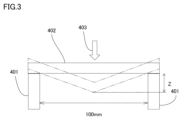
- FIG. 3 is a diagram of an apparatus for measuring susceptibility to deformation at high temperatures.
- Patent Document 2 discloses that particles can be reduced by making the molybdenum-containing material content 99.999% or more, the relative density 98% or more, the average particle size 45 ⁇ m or less, and the radiation dose 0.03 cph/cm2 or less .
- Patent document 3 discloses that particles can be reduced by making the molybdenum content 99.99% or more and the relative density 98% or more. Manufactured using HIP.
- Patent Document 4 discloses that by increasing the aspect ratio of the crystal structure of a molybdenum-containing material to 3 or more, the sputtering rate can be adjusted and a long-life target can be obtained.
- Patent document 5 discloses that the average grain size of the molybdenum-containing material is in the range of 15 to 150 mm, and the crystal grains in the thickness direction are at least 1/5 of the plate thickness.
- Patent Document 6 discloses that there is a region in which the peak intensities of (110) and (220) in X-ray diffraction measurements are less than the (211) peak intensity at a depth of 1/5 of the thickness from the surface of a molybdenum-containing material.
- the present disclosure relates to a material containing molybdenum in which the amount of grain boundary impurities, crystal grain size, density, and molybdenum content are controlled. It has been found that the effects can be obtained by setting the following characteristic values within the specified ranges. ⁇ Crystal Grain Size> The crystal grain size is 25 ⁇ m or more and less than 1 mm.
- a preferred range is 45 ⁇ m or more and less than 1 mm as the primary recrystallized grain size.
- a preferred range is a secondary recrystallized grain size of 1 mm or more.
- a more preferable range is a secondary recrystallized grain size of 10 mm or more. Within this range, the W and K in the grains are reduced, and the number of particles generated can be further reduced.
- the mass ratio of intragranular potassium content to grain boundary potassium content is 0.7 or less.
- the grain interior W/grain boundary W is preferably 0.7 or less. More preferably, in the case of secondary recrystallization, intragranular K/grain boundary K is 0.6 or less.
- the density is 10.15 g/cm 3 (relative density 99.5%) or more.
- a preferred range is 10.18 g/cm 3 (relative density 99.8%) or more. Within this range, voids in the target have little effect on film formation. ⁇ Molybdenum content> The molybdenum content is at least 99.95 mass %.
- a preferred range is 99.999% by weight or more. Within this range, particles due to impurities can be reduced.
- ⁇ Tungsten content> The tungsten content is preferably 200 ppm or less, and more preferably 90 ppm or less. Within this range, W segregated at the grain boundaries does not adversely affect particle generation.
- ⁇ Potassium content> The potassium content is preferably 20 ppm or less, and more preferably 10 ppm or less. Within this range, potassium segregated at the grain boundaries does not adversely affect particle generation.
- the number of particles generated in a thin film formed using a sputtering target manufactured according to the present disclosure is, for example, 35 particles/ mm2 or less.
- the thin film sheet resistance (thickness 300 nm) of a thin film formed using a sputtering target produced in accordance with this disclosure is 1.5 ⁇ / ⁇ or less.
- the following properties are exhibited: Number of particles generated: 15 particles/ mm2 or less.
- Thin film sheet resistance (thickness 300 nm): 1.2 ⁇ / ⁇ or less.
- the number of generated particles by limiting the number of particles of 20 nm to 1 ⁇ m to 35 or less, a thin film of a quality suitable for a reflective mask blank can be obtained.
- a molybdenum sputtering target is manufactured based on the steps of: step 1: molybdenum raw material powder, step 2: CIP, step 3: sintering, step 4: hot rolling, step 5: heat treatment, step 6: cutting, step 7: cutting and polishing, and step 8: bonding.
- Step 1 Molybdenum Raw Powder
- the molybdenum powder used as the raw material had a molybdenum content of 99.95% by mass or more and a particle size of 1 to 10 ⁇ m as measured by the FSSS method.
- the molybdenum content in the sputtered thin film will decrease and impurity-induced defects will occur.
- the Fsss particle size is smaller than 1 ⁇ m, the risk of the powder igniting increases, and if it exceeds 10 ⁇ m, sintering in powder metallurgy becomes difficult.
- a molybdenum powder with excellent sinterability for example, a powder containing molybdenum with an average particle size measured by the Fsss method of 0.1 ⁇ m to 10 ⁇ m, a molybdenum content of 99.99 mass% or more, and a compressive deformation strength of 100 MPa to 200 MPa.
- Step 2 CIP
- the molybdenum powder is filled into a rubber container and pressurized by a cold isostatic press (CIP).
- the CIP pressure is 1 to 3 ton/cm 2 , preferably 2.0 ton/cm 2 .
- Step 3 Sintering The pressed body obtained above is sintered in a hydrogen atmosphere at a sintering temperature of 1600° C. to 2300° C., preferably 1800° C., for 3 to 20 hours to obtain a molybdenum sintered body having a density of approximately 9.7 g/cm 3 .
- molybdenum powder that does not have good sintering properties If molybdenum powder that does not have good sintering properties is used, the slight segregation of W and K to the grain boundaries due to grain boundary migration is unlikely to occur during the sintering stage. However, even when using molybdenum powder that does not have good sintering properties, it is possible to obtain the same effect as when molybdenum powder with good sintering properties is used by adjusting the length of the sintering time. This effect appears as the sintering process progresses, and sintering conditions can be adjusted not only by time, but also by the amount of hydrogen and temperature.
- Step 4 Hot rolling The molybdenum sintered body obtained above was inserted into a hydrogen heating furnace at 1100 to 1400°C, and then hot rolling was performed. When the material cooled down, it was repeatedly heated as needed, and rolling was repeated until the desired thickness was reached. After hot rolling, the density reached 10.15 to 10.22 g/ cm3 , and a molybdenum plate with a fibrous structure stretched in the rolling direction was obtained.
- Step 5 Heat Treatment The molybdenum plate obtained above is heat treated for 0.5 to 10 hours at a temperature of 950° C. or higher. Recrystallization occurs by the heat treatment, and a molybdenum plate with an equiaxed grain structure is obtained.
- Fig. 1 is a photograph showing an example of the structure of primary recrystallized grains in a material containing molybdenum.
- Fig. 2 is a photograph showing an example of the structure of secondary recrystallized grains in a material containing molybdenum.
- ⁇ Primary recrystallization> As shown in Figure 1, the primary recrystallization temperature of molybdenum sheet varies slightly depending on the manufacturing conditions, but is generally around 950°C to 1700°C.
- the fibrous structure elongated by hot rolling grows into equiaxed grains with crystal grain sizes of several tens to several hundreds of ⁇ m (several mm depending on the manufacturing conditions and temperature).
- Secondary recrystallization is a phenomenon in which one of adjacent primary recrystallized grains grows by absorbing the other. When heated at a certain temperature or higher (e.g., 1800°C or 2000°C) for a long time (e.g., 5 hours or 10 hours), grain growth progresses rapidly and the grains grow into giant crystals of 10 mm or more.
- secondary recrystallization occurs in a short time when heat treatment is performed at a high temperature such as 2000°C or higher, but in consideration of energy costs, the standard is whether the grain size becomes 1 mm or more at 1800°C x 5 hours, which is easy to carry out industrially.
- Step 6 Cutting The recrystallized molybdenum plate obtained above is hollowed out into a disk using a water jet to obtain a molybdenum disk. At this time, abrasive grains may be used to increase the cutting efficiency. If the target shape is square, it is cut into a square plate.
- Step 7 Cutting and polishing
- the surface of the molybdenum disk is cut to a specified thickness by cutting, the oxide film on the surface is removed to increase flatness, and the outer periphery is also cut to a specified size. After that, the surface is polished using, for example, a GC grindstone to a finish of Ra 1.6 ⁇ m or less.
- Step 8 Bonding A backing plate (made of Cu or the like) and a bonding material (made of In or the like) that are compatible with the sputtering device are prepared, and the molybdenum disk and the backing plate are heated on a hot plate and bonded together with the bonding material. By performing this bonding, a molybdenum sputtering target is obtained.
- Molybdenum plates were prepared from various molybdenum raw material powders and heat-treated at 1300°C for 1 hour, and their crystal grain sizes were evaluated.
- Powder W content is the tungsten content in the powder containing molybdenum.
- Powder K content is the potassium content in the powder containing molybdenum.
- Powder raw material group 5 is a powder containing molybdenum, filed on the same day as the present application, which has an average particle size measured by the Fsss method of 0.1 ⁇ m or more and 10 ⁇ m or less, a molybdenum content of 99.99 mass% or more, and a compressive deformation strength of 100 MPa or more and 200 MPa or less.
- Fsss particle size is the average particle size measured by the Fsss method.
- Steps 1 to 8 were carried out on the above molybdenum raw material powder to obtain a molybdenum target with a diameter of 4 inches (4 x 2.54 cm). The details are shown in Tables 2 to 5.
- step 5 In order to carry out the heat treatment process (step 5) under two conditions, identical plates were made from steps 1 to 4, which were hot-rolled, and then cut to obtain two disks of the same quality. Each disk was subjected to heat treatment under either the first heat treatment conditions or the second heat treatment conditions.
- First heat treatment conditions Sample Nos. 101 to 117, 201 to 212
- Second heat treatment conditions Sample Nos. 118 to 136, 213 to 222
- Step 1 Molybdenum Raw Powder Powder containing molybdenum was prepared having an Fsss average particle size of 4 to 5 ⁇ m.
- Step 3 Sintering
- the sintering temperature was 1800° C.
- the sintering time was adjusted to 3, 6, 10, 15, or 20 hours in a hydrogen atmosphere to obtain sintered bodies with thicknesses T of 10 to 40 mm.
- the thickness of the sintered body here affects the density after hot rolling.
- Step 4 Hot Rolling The molybdenum sintered body was heated at 1300° C. and rolled until the thickness T became 7 mm.
- Step 5 Heat treatment In order to recrystallize the obtained rolled material, heat treatment was performed under two conditions.
- the first heat treatment condition was a heat treatment at a temperature of 1300°C for 1 hour, aiming at primary recrystallization of molybdenum.
- the first heat treatment was not performed on the samples subjected to the second condition.
- the second heat treatment was a heat treatment at a temperature of 1800°C for 5 hours, with the aim of investigating whether secondary recrystallization was caused.
- Step 6 Cutting The plate material after the primary or secondary recrystallization was cut by a water jet into a disk having a diameter ⁇ of 4 inches.
- Step 7 Cutting and Polishing Both sides of the disk with a thickness T of 7 mm produced in step 6 were finished by cutting to a thickness T of about 5.5 mm.
- the flatness was set to 0.2 mm or less, and the surface roughness was set to about Ra 1.0 ⁇ m.
- Step 8 Bonding The molybdenum disk as the material containing molybdenum finished in step 7 was bonded to a copper backing plate using indium as a bonding material, thereby obtaining a sputtering target.
- ⁇ Evaluation method> ⁇ Molybdenum content/impurity content> Molybdenum content (mass%) was calculated as 100% minus 14 elements: Al, Ca, Cr, Cu, Fe, Mg, Mn, Ni, Pb, Si, Sn, Na, K, and W. Tungsten (W) is considered an impurity.
- Na, K Content is measured by atomic absorption spectrometry (contrAA300, manufactured by Analytik Jena).
- ICP-AES ICP atomic emission spectroscopy
- the oxygen content is measured as a reference value by an infrared absorption method (ON836 manufactured by LECO Corporation). ⁇ Density> The density is measured by underwater gravimetry (Archimedes method). After the heat treatment in step 5, the plate material is cut into any size of 10 g or more. The weight in air, the weight in water, and the temperature of the water are measured. The density is calculated using the following formula. This is a method specified in JIS Z 8807.
- Density ⁇ weight in air/(weight in air-weight in water) ⁇ x (density of water-density of air) + density of air. Furthermore, the relative density is expressed by the following formula, assuming that the theoretical density of molybdenum is 10.22 g/ cm3 .
- Relative density [%] (density / 10.22) x 100 ⁇ Crystal grain size (less than 1 mm)> The grain size is measured using the intercept method specified in JIS G 0551 (2020).
- observation surface is the surface that corresponds to the sputtering surface.
- this is the ND surface (rolled surface).
- the crystal grain size was calculated using the following formula.
- Intragranular impurity content when the crystal grain size is less than 1 mm The plate produced in step 7 is crushed into small pieces at cryogenic temperatures. This breaks down the grain boundaries. The grain boundaries are then preferentially corroded by acid etching. As a result, intragranular samples are obtained. These are collected, re-dissolved, and analyzed by ICP to determine the tungsten and potassium content, which is the intragranular impurity content.
- ten samples of 1x20x20mm are prepared.
- the samples cooled with liquid nitrogen are crushed in a mortar. This is to expose the grain boundaries.
- the samples are sieved through a 150 ⁇ m mesh.
- the acid is prepared by mixing hydrochloric acid (12.0 mol/ dm3 ) and nitric acid (13.8 mol/ dm3 ) in a volume ratio of 1:3 and diluting the mixture with pure water to twice the volume.
- the term "mixed acid” in this specification refers to this acid.
- the crushed and sieved grains (those that fall under the 150 ⁇ m mesh) are placed in the mixed acid and dissolved for 8 minutes. The grain boundaries of the remaining samples have been removed, and these are used as samples for intragranular impurity analysis.
- the sample is further dissolved in the mixed acid, and the solution is analyzed by ICP.
- Grain boundary impurity content The plate is crushed into small pieces at extremely low temperatures, which breaks down the grain boundaries. The grain boundaries are then preferentially corroded by acid etching. The solution containing the grain boundary components is then analyzed by ICP to determine the tungsten and potassium content, which is taken as the grain boundary impurity content.
- ten samples measuring 1 x 20 x 20 mm are prepared.
- the samples are cooled with liquid nitrogen and crushed in a mortar. This is to expose the grain boundaries.
- the samples are sieved through a 150 ⁇ m mesh.
- a mixed acid containing hydrochloric acid, nitric acid, and water is used as the acid.
- the sieved grains (those that fall below the 150 ⁇ m mesh) are placed in the mixed acid and dissolved for 15 minutes to prepare a solution for grain boundary impurity analysis.
- the solution is then analyzed by ICP.
- Grain boundary impurity content A sample is created by cutting the plate to a size of 2x2x2mm or more so that one grain boundary is included. The size should be 2x2x2mm or more to match the size of the crystal grains. A total of 1g or more of samples is created. For example, if the size of one sample is 2x2x2mm, 13 samples are created. A total of 1g or more of samples is dissolved in acid. A mixed acid containing hydrochloric acid, nitric acid, and water is used as the acid. The solution is analyzed by ICP. ⁇ Sputtering film formation test> A magnetron sputtering device of SRV-4320 manufactured by Shinko Seiki Co., Ltd.
- a Si substrate was placed facing the molybdenum target, and a molybdenum thin film was formed thereon to a thickness of 300 nm.
- the chamber was evacuated to 5 ⁇ 10 ⁇ 4 Pa or less. Then, argon gas was flowed at 25 sccm, and the output was set to 500 W.
- a target size of ⁇ 4 inch x T5 mm was used.
- ⁇ Number of particles generated> The number of particles on the formed molybdenum thin film was measured using a laser microscope OPTELICS HYBRID+ manufactured by Lasertec Corp. Surface irregularities were measured in an area of 1 mm x 1 mm, and irregularities with heights of 20 nm to 1 ⁇ m were defined as particles and the number of particles was counted.
- ⁇ Thin film sheet resistance> The film resistance was measured using a RT-70V model manufactured by Napson Co., Ltd. The sheet resistance was measured by contacting a measurement probe with the formed 300 nm molybdenum thin film.
- total refers to the mass content of tungsten in the entire material containing molybdenum.
- Intragranular refers to the mass content of tungsten within crystal grains.
- Grain boundary refers to the mass content of tungsten at the crystal grain boundaries.
- Intragranular W / “Grain boundary W” refers to the W ratio.
- total is the mass content of potassium in the entire material containing molybdenum.
- Intragranular is the mass content of potassium within crystal grains.
- Gram boundary is the mass content of potassium at the crystal grain boundaries.
- Intragranular K / “Grain boundary K” is the K ratio.
- Sample numbers 101 to 117 show good results, with particle counts of 34 or less and thin film sheet resistances of 1.5 ⁇ or less. In contrast, sample numbers 201 to 212 show an increase in particle counts and thin film resistance.
- Sample numbers 118 to 136 show good results, with particle counts of 29 or less and thin film sheet resistances of 1.5 ⁇ or less. In contrast, sample numbers 213 to 222 show an increase in particle counts and thin film resistance.
- the secondary recrystallization and the susceptibility to deformation at high temperatures due to secondary recrystallization were evaluated.
- the "secondary recrystallization" in Table 5 is based on whether a crystal grain size of 1 mm or more is obtained at 1800°C for 5 hours, which is easy to carry out industrially, as described above.
- samples with thickness T of 1 mm, width B of 20 mm, and length L of 120 mm were produced for sample numbers 118 to 212.
- FIG. 3 is a diagram of an apparatus for measuring the ease of deformation at high temperatures.
- the distance between two supports 401 was set to 100 mm.
- a sample 402 was placed on the supports.
- a state in which a force of 150 g was applied to the center of the sample in the direction indicated by the arrow 403 was continued for 10 hours at a temperature of 1800° C.
- Samples with a deformation amount Z of less than 1 mm were marked as “A” in the “High-temperature deformation 1800° C. x 10 h” column in Table 5, and samples with a deformation amount Z of 1 mm or more were marked as “B”. It can be seen that the deformation amount becomes smaller when secondary recrystallization occurs.
- HP hot pressing
- a method commonly used to manufacture molybdenum targets HP was carried out under conditions of 1600°C x 40MPa x 3h, which are common conditions for molybdenum HP, to obtain a molybdenum sintered body.
- the obtained sintered body was processed into a molybdenum target through steps 5 to 8 in the same way as the rolled material, and a film was formed by sputtering.
- the heat treatment temperature in step 5 was 1300°C x 1h, which is the first heat treatment condition.
- the number of particles generated increases when the density is 10.15 g/ cm3 or less. Also, even though the same raw material powder as the rolled material is used, the HP product generated more particles than the rolled material.
- Appendix 3 The molybdenum-containing material according to claim 1 or 2, wherein the ratio of intragranular potassium content to intergranular potassium content, i.e., intragranular K/intergranular K, is 0.7 or less.
- Additional Note 4 The molybdenum-containing material according to claim 3, wherein the value of intragranular K/grain boundary K is 0.6 or less. 5.
Landscapes
- Chemical & Material Sciences (AREA)
- Engineering & Computer Science (AREA)
- Materials Engineering (AREA)
- Mechanical Engineering (AREA)
- Metallurgy (AREA)
- Organic Chemistry (AREA)
- Chemical Kinetics & Catalysis (AREA)
- Physics & Mathematics (AREA)
- Thermal Sciences (AREA)
- Crystallography & Structural Chemistry (AREA)
- Powder Metallurgy (AREA)
Priority Applications (3)
| Application Number | Priority Date | Filing Date | Title |
|---|---|---|---|
| JP2025512101A JPWO2025079494A1 (https=) | 2023-10-12 | 2024-10-03 | |
| KR1020257011799A KR20250065695A (ko) | 2023-10-12 | 2024-10-03 | 몰리브덴 함유 재료 |
| CN202480004504.2A CN120167015A (zh) | 2023-10-12 | 2024-10-03 | 含钼的材料 |
Applications Claiming Priority (2)
| Application Number | Priority Date | Filing Date | Title |
|---|---|---|---|
| JP2023-176718 | 2023-10-12 | ||
| JP2023176718 | 2023-10-12 |
Publications (1)
| Publication Number | Publication Date |
|---|---|
| WO2025079494A1 true WO2025079494A1 (ja) | 2025-04-17 |
Family
ID=95395329
Family Applications (1)
| Application Number | Title | Priority Date | Filing Date |
|---|---|---|---|
| PCT/JP2024/035428 Pending WO2025079494A1 (ja) | 2023-10-12 | 2024-10-03 | モリブデンを含む材料 |
Country Status (4)
| Country | Link |
|---|---|
| JP (1) | JPWO2025079494A1 (https=) |
| KR (1) | KR20250065695A (https=) |
| CN (1) | CN120167015A (https=) |
| WO (1) | WO2025079494A1 (https=) |
Citations (3)
| Publication number | Priority date | Publication date | Assignee | Title |
|---|---|---|---|---|
| JP2008511757A (ja) * | 2004-08-31 | 2008-04-17 | ハー ツェー シュタルク インコーポレイテッド | モリブデンスパッタリングターゲット |
| JP2020535318A (ja) * | 2017-09-29 | 2020-12-03 | プランゼー エスエー | モリブデン焼結部品 |
| WO2023063204A1 (ja) * | 2021-10-13 | 2023-04-20 | 株式会社アライドマテリアル | モリブデンを含む粉末 |
Family Cites Families (6)
| Publication number | Priority date | Publication date | Assignee | Title |
|---|---|---|---|---|
| JPH0224901A (ja) | 1988-07-12 | 1990-01-26 | Stanley Electric Co Ltd | 自動車用照明灯 |
| JP4566367B2 (ja) | 2000-09-04 | 2010-10-20 | 日鉱金属株式会社 | パーティクル発生の少ないスパッタリングターゲット |
| JP4475398B2 (ja) | 2003-09-16 | 2010-06-09 | 日本新金属株式会社 | パーティクル発生のきわめて少ない高純度金属Mo薄膜の形成を可能とするスパッタリング用高純度高密度金属Mo焼結ターゲットの製造方法 |
| JP5160660B2 (ja) | 2011-03-25 | 2013-03-13 | 株式会社アライドマテリアル | モリブデン材 |
| JP6602550B2 (ja) | 2014-04-28 | 2019-11-06 | 株式会社アライドマテリアル | スパッタリングターゲット用材料 |
| JP7043132B2 (ja) | 2018-03-30 | 2022-03-29 | 株式会社吉野工業所 | 毛染め用具 |
-
2024
- 2024-10-03 KR KR1020257011799A patent/KR20250065695A/ko active Pending
- 2024-10-03 CN CN202480004504.2A patent/CN120167015A/zh active Pending
- 2024-10-03 JP JP2025512101A patent/JPWO2025079494A1/ja active Pending
- 2024-10-03 WO PCT/JP2024/035428 patent/WO2025079494A1/ja active Pending
Patent Citations (3)
| Publication number | Priority date | Publication date | Assignee | Title |
|---|---|---|---|---|
| JP2008511757A (ja) * | 2004-08-31 | 2008-04-17 | ハー ツェー シュタルク インコーポレイテッド | モリブデンスパッタリングターゲット |
| JP2020535318A (ja) * | 2017-09-29 | 2020-12-03 | プランゼー エスエー | モリブデン焼結部品 |
| WO2023063204A1 (ja) * | 2021-10-13 | 2023-04-20 | 株式会社アライドマテリアル | モリブデンを含む粉末 |
Also Published As
| Publication number | Publication date |
|---|---|
| KR20250065695A (ko) | 2025-05-13 |
| CN120167015A (zh) | 2025-06-17 |
| JPWO2025079494A1 (https=) | 2025-04-17 |
Similar Documents
| Publication | Publication Date | Title |
|---|---|---|
| CN109778126B (zh) | 一种高致密超细晶大尺寸钼靶材的制备方法 | |
| KR101201577B1 (ko) | 향상된 조직 균일성을 가진 내화 금속판 | |
| WO2009107763A1 (ja) | 金属系スパッタリングターゲット材 | |
| WO2021177470A1 (ja) | 純銅板 | |
| JP7269407B2 (ja) | タングステンシリサイドターゲット部材及びその製造方法、並びにタングステンシリサイド膜の製造方法 | |
| WO2021177461A1 (ja) | 純銅板、銅/セラミックス接合体、絶縁回路基板 | |
| JP7701511B2 (ja) | タングステンスパッタリングターゲット | |
| CN103459631B (zh) | 钼材料 | |
| WO2013038668A1 (ja) | Mo-Wターゲット及びその製造方法 | |
| JP6521206B1 (ja) | ダイヤモンド多結晶体、ダイヤモンド多結晶体を備える工具及びダイヤモンド多結晶体の製造方法 | |
| WO2018173450A1 (ja) | タングステンシリサイドターゲット及びその製造方法 | |
| JP5951599B2 (ja) | 高純度Niスパッタリングターゲットおよびその製造方法 | |
| JP7108606B2 (ja) | スパッタリングターゲット | |
| JP6602550B2 (ja) | スパッタリングターゲット用材料 | |
| WO2025079494A1 (ja) | モリブデンを含む材料 | |
| KR20230017181A (ko) | 금속-Si 계 분말, 그 제조 방법, 그리고 금속-Si 계 소결체, 스퍼터링 타깃 및 금속-Si 계 박막의 제조 방법 | |
| US12173398B2 (en) | Cr—Si sintered body, sputtering target, and method for producing thin film | |
| JPH10110265A (ja) | 金属シリサイドタ−ゲット材 | |
| EP4570943A1 (en) | Molybdenum sputtering target, method for producing same, and method for producing sputtering film using molybdenum sputtering target | |
| EP4241901A1 (en) | Chromium sintered body, method for producing chromium sintered body, sputtering target, and method for producing substrate with chromium film | |
| JP7072664B2 (ja) | スパッタリングターゲット及びスパッタリングターゲットの製造方法 | |
| TW200940447A (en) | Sintered silicon wafer | |
| TW202319555A (zh) | 濺鍍靶材、其製造方法、及經使用濺鍍靶材的濺鍍膜的製造方法 | |
| JP2000053468A (ja) | ZnS−SiO2系焼結体およびその製造方法 |
Legal Events
| Date | Code | Title | Description |
|---|---|---|---|
| ENP | Entry into the national phase |
Ref document number: 2025512101 Country of ref document: JP Kind code of ref document: A |
|
| WWE | Wipo information: entry into national phase |
Ref document number: 2025512101 Country of ref document: JP |
|
| ENP | Entry into the national phase |
Ref document number: 20257011799 Country of ref document: KR Kind code of ref document: A |
|
| WWE | Wipo information: entry into national phase |
Ref document number: 1020257011799 Country of ref document: KR |
|
| WWE | Wipo information: entry into national phase |
Ref document number: 202480004504.2 Country of ref document: CN |
|
| WWE | Wipo information: entry into national phase |
Ref document number: 11202501805P Country of ref document: SG |
|
| WWP | Wipo information: published in national office |
Ref document number: 11202501805P Country of ref document: SG |
|
| WWP | Wipo information: published in national office |
Ref document number: 202480004504.2 Country of ref document: CN |
|
| 121 | Ep: the epo has been informed by wipo that ep was designated in this application |
Ref document number: 24877092 Country of ref document: EP Kind code of ref document: A1 |