WO2025013639A1 - 架橋性ポリエステル組成物の製造方法 - Google Patents
架橋性ポリエステル組成物の製造方法 Download PDFInfo
- Publication number
- WO2025013639A1 WO2025013639A1 PCT/JP2024/023273 JP2024023273W WO2025013639A1 WO 2025013639 A1 WO2025013639 A1 WO 2025013639A1 JP 2024023273 W JP2024023273 W JP 2024023273W WO 2025013639 A1 WO2025013639 A1 WO 2025013639A1
- Authority
- WO
- WIPO (PCT)
- Prior art keywords
- polyester composition
- crosslinkable
- crosslinkable polyester
- producing
- kneading
- Prior art date
- Legal status (The legal status is an assumption and is not a legal conclusion. Google has not performed a legal analysis and makes no representation as to the accuracy of the status listed.)
- Pending
Links
Images



Classifications
-
- C—CHEMISTRY; METALLURGY
- C08—ORGANIC MACROMOLECULAR COMPOUNDS; THEIR PREPARATION OR CHEMICAL WORKING-UP; COMPOSITIONS BASED THEREON
- C08G—MACROMOLECULAR COMPOUNDS OBTAINED OTHERWISE THAN BY REACTIONS ONLY INVOLVING UNSATURATED CARBON-TO-CARBON BONDS
- C08G63/00—Macromolecular compounds obtained by reactions forming a carboxylic ester link in the main chain of the macromolecule
- C08G63/91—Polymers modified by chemical after-treatment
-
- C—CHEMISTRY; METALLURGY
- C08—ORGANIC MACROMOLECULAR COMPOUNDS; THEIR PREPARATION OR CHEMICAL WORKING-UP; COMPOSITIONS BASED THEREON
- C08J—WORKING-UP; GENERAL PROCESSES OF COMPOUNDING; AFTER-TREATMENT NOT COVERED BY SUBCLASSES C08B, C08C, C08F, C08G or C08H
- C08J5/00—Manufacture of articles or shaped materials containing macromolecular substances
- C08J5/18—Manufacture of films or sheets
Definitions
- the present invention relates to a method for producing a crosslinkable polyester composition, a method for producing a crosslinkable polyester composition, and a molded article containing the crosslinkable polyester composition.
- Polyesters are polycondensates synthesized by dehydration condensation of polycarboxylic acids and polyalcohols, and examples include polymers produced from terephthalic acid or its ester-forming derivatives and ethylene glycol. Polyesters are versatile and highly practical, and are ideally used as materials for films, sheets, fibers, bottles, and the like. Due to their excellent mechanical properties, weather resistance, and chemical resistance, polyesters are expected to be used in a variety of applications in the future, including electrical insulation, solar cells, and industrial parts such as tire cords.
- Such polyesters are also used as cross-linked polyesters by cross-linking polyesters with a cross-linking agent.
- Conventional cross-linked polyesters could not be reshaped because the polyesters were cross-linked by covalent bonds.
- cross-linked polyesters that are cross-linked by bond-exchange type dynamic covalent bonds are further heated, a bond exchange reaction occurs, making it possible to reshape the polyesters.
- Non-Patent Document 1 describes the use of a twin-screw extruder to heat, melt, and knead polyethylene terephthalate (PET), diglycidyl ether of bisphenol A, and 2,2-bis(hydroxymethyl)-2,2',2''-nitrilotriethanol (BIS-TRIS) at 240-270°C to produce pellets, and the resulting pellets are post-cured at 205°C for 10 hours under vacuum.
- PET polyethylene terephthalate
- BIOS-TRIS 2,2-bis(hydroxymethyl)-2,2',2''-nitrilotriethanol
- Non-Patent Document 2 describes the use of a twin-screw extruder to heat, melt, and knead polybutylene terephthalate (PBT), diglycidyl ether of bisphenol A, and zinc acetylacetonate hydrate at 270°C to produce pellets, and the resulting molten material is injected into a test piece-shaped mold at 200°C and held there.
- PBT polybutylene terephthalate
- Non-Patent Document 3 disclose a method for producing a bond exchange resin film with a gel fraction of approximately 100% by mixing a mixture of an amorphous polyester resin, 4,4'-methylenebis(N,N-diglycidylaniline), and 1,8-diazabicyclo[5.4.0]-7-undecene in the presence of THF, casting and vacuum drying to remove the THF, and then heating the solid at 200°C for 24 hours.
- Non-Patent Document 1 and the polybutylene terephthalate described in Non-Patent Document 2 are both crystalline, so the temperatures become high when they are heated, melted, and kneaded using a twin-screw extruder, and they are already crosslinked at the time they are extruded from the twin-screw extruder. This results in poor fluidity of the extrudate and poor processability.
- Non-Patent Document 3 a mixture containing an amorphous polyester resin is mixed in the presence of THF, so a large amount of solvent is required. In addition, after the preparation of the mixture, it takes about 24 hours to remove THF and dry it, so there is room for improvement before it can be adopted as an industrial production method.
- the present invention has been made in light of the above-mentioned circumstances, and its object is to provide a method for producing a crosslinkable polyester composition that can easily provide a polyester that may have bond-exchange type dynamic covalent bonds in the future in a state of good processability. Another object of the present invention is to provide a cured product (crosslinked polyester composition) having bond-exchange type dynamic covalent bonds from the crosslinkable polyester composition with good processability. Another object of the present invention is to provide a method for producing the cured product (crosslinked polyester composition) from the crosslinkable polyester composition with good processability. Another object of the present invention is to provide a molded product containing the crosslinkable polyester composition with good processability.
- the present invention is as follows.
- a method for producing a crosslinkable polyester composition comprising a step of kneading a multifunctional epoxy compound having a plurality of epoxy groups and an ester exchange catalyst with a heat-molten copolymer polyester.
- the method for producing the crosslinkable polyester composition according to [1] further comprising a step of forming the mixture into a predetermined shape after the kneading.
- a molded article comprising a crosslinkable polyester composition which comprises a copolymerized polyester, a polyfunctional epoxy compound having a plurality of epoxy groups, and an ester exchange catalyst, the crosslinkable polyester composition having a gel fraction of less than 30% and being in the form of a rod, thread, granule, or flake.
- a molded article comprising a crosslinkable polyester composition, which comprises a copolymer polyester, a polyfunctional epoxy compound having a plurality of epoxy groups, and an ester exchange catalyst, and which is in the form of a sheet or film having a gel fraction of less than 30% and a thickness of 20 ⁇ m or more.
- a molded article comprising the crosslinkable polyester composition according to [13] or [14], which has a gel fraction of 30% or more after heating at a temperature of 120° C. to 250° C. for 3 hours.
- the kneaded product can have a bond exchange type dynamic covalent bond in the future. Moreover, since this kneaded product is kept in a non-crosslinked state (i.e., a state having crosslinkability) while being heated and kneaded, it can have good processability. If a crosslinkable polyester composition is produced by such a method, it can be subsequently heated to introduce a bond exchange type dynamic covalent bond, so that a crosslinked polyester having a bond exchange type dynamic covalent bond can be easily provided. When a crosslinkable polyester is crosslinked by a bond exchange type dynamic covalent bond, a bond exchange reaction occurs by further heating even after crosslinking, making it possible to reshape and process it.
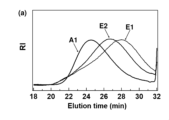
- FIG. 1A shows GPC chromatograms obtained by measuring the crosslinkable polyester compositions 1 and 2 obtained in Examples 1 and 2, and the copolymer polyester A1.
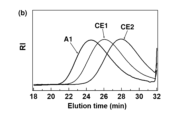
- FIG. 1B shows GPC chromatograms obtained by measuring the comparative crosslinkable polyester compositions 1 and 2 obtained in Comparative Examples 1 and 2, and the copolymer polyester A1.
- FIG. 1C shows GPC chromatograms obtained by measuring the comparative crosslinkable polyester composition 3 obtained in Comparative Example 3 and the copolymer polyester A1.
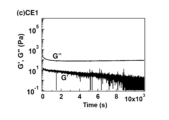
- FIG. 2A shows the isothermal time-resolved viscoelasticity spectrum measured for the crosslinkable polyester composition 1 obtained in Example 1.
- FIG. 2B shows the isothermal time-resolved viscoelasticity spectrum measured for the crosslinkable polyester composition 2 obtained in Example 2.
- FIG. 1A shows GPC chromatograms obtained by measuring the crosslinkable polyester compositions 1 and 2 obtained in Examples 1 and 2, and the copolymer polyester A1.
- FIG. 1B shows GPC chromatograms obtained by measuring the comparative crosslink
- FIG. 2C shows the isothermal time-resolved viscoelasticity spectrum measured for the comparative crosslinkable polyester composition 1 obtained in Comparative Example 1.
- FIG. 2D shows the isothermal time-resolved viscoelasticity spectrum measured for the comparative crosslinkable polyester composition 3 obtained in Comparative Example 3.
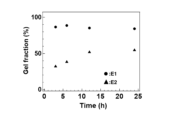
- FIG. 3 is a graph showing the relationship between the heating time and the gel fraction calculated for the samples obtained by heating the crosslinkable polyester compositions 1 and 2.
- FIG. 4 shows the stress relaxation spectrum measured for a sample obtained by heating the crosslinkable polyester composition 1.
- FIG. 5A is a photograph showing the state before heating when a remolding test was carried out using a test piece cut out from a sample obtained by heating crosslinkable polyester composition 1 at 180° C. for 3 hours.
- FIG. 5B is a photograph showing the state after heating when a remolding test was carried out using a test piece cut out from a sample obtained by heating the crosslinkable polyester composition 1 at 180° C. for 3 hours.
- the method for producing a crosslinkable polyester composition according to an embodiment of the present invention is characterized by including a step of kneading a copolymer polyester in a heated and molten state with a multifunctional epoxy compound having multiple epoxy groups and an ester exchange catalyst.
- a crosslinkable polyester composition refers to a composition containing a polyester before crosslinking, which has crosslinkability and in which crosslinking occurs via an epoxy ring-opening reaction or a bond exchange reaction upon heating.
- a crosslinkable polyester composition in which polyesters are crosslinked by heating is called a crosslinked polyester composition.
- the copolymer polyester used in the embodiment of the present invention may be an aliphatic polyester, an aromatic polyester, or a combination of an aliphatic polyester and an aromatic polyester.
- the copolymer polyester can be prepared, for example, by polycondensing an acid component, an alcohol component, and a dicarboxylic acid containing a nucleophilic reactive group (such as a thiol group) and then reacting the nucleophilic reactive group of the dicarboxylic acid with an unsaturated carboxylic acid, or by polycondensing an acid component, an alcohol component, and an unsaturated polycarboxylic acid or an anhydride thereof and then reacting the unsaturated group of the unsaturated polycarboxylic acid with a carboxylic acid having a nucleophilic reactive group.
- a nucleophilic reactive group such as a thiol group
- a dicarboxylic acid for example, preferably 60 molar parts or more, more preferably 80 molar parts or more of dicarboxylic acid per 100 molar parts of the acid component.
- dicarboxylic acid for example, aromatic dicarboxylic acids such as phthalic acid, isophthalic acid, terephthalic acid, 2,6-naphthalenedicarboxylic acid, etc.; aliphatic dicarboxylic acids such as succinic acid, glutaric acid, adipic acid, pimelic acid, suberic acid, azelaic acid, sebacic acid, dodecanedicarboxylic acid, dimer acid, etc.; alicyclic dicarboxylic acids such as 1,4-cyclohexanedicarboxylic acid, tetrahydrophthalic acid, hexahydroisophthalic acid, 1,2-cyclohexenedicarboxylic acid, etc.; unsaturated group-containing dicarboxylic acids such as fumaric acid, maleic acid, and terpene-maleic acid adducts; etc.
- aromatic dicarboxylic acids such as phthalic acid, isophthalic acid, terephthal
- the dicarboxylic acid one type from these may be used, or two or more types may be used.
- the acid component it is preferable to use at least one type selected from the group consisting of aromatic dicarboxylic acids and aliphatic dicarboxylic acids.
- the acid component for example, tricarboxylic acids and tetracarboxylic acids such as trimellitic acid, pyromellitic acid, and 3,3',4,4'-benzophenonetetracarboxylic acid may be used. It is preferable that the tricarboxylic acid and tetracarboxylic acid are subjected to the polycondensation reaction as acid anhydrides.
- alcohol components include aliphatic glycols such as ethylene glycol, 1,2-propylene glycol, 1,3-propanediol, 2-methyl-1,3-propanediol, 2,2-dimethyl-1,3-propanediol, 1,2-butanediol, 1,3-butanediol, 1,4-butanediol, 1,3-pentanediol, 1,4-pentanediol, 1,5-pentanediol, 3-methyl-1,5-pentanediol, 2,4-diethyl-1,5-pentanediol, 1,6-hexanediol, 3-methyl-1,6-hexanediol, 4-methyl-1,7-heptanediol, 2-methyl-1,8-octanediol, 4-methyl-1,8-octanediol, 4-propyl-1,8-oc
- the copolymer polyester preferably contains a first unit made of, for example, ethylene terephthalate or butylene terephthalate, and further contains at least one component selected from the following group as an acid component and/or an alcohol component: Acid components: terephthalic acid, isophthalic acid, sebacic acid Alcohol components: ethylene glycol, 2,2-dimethyl-1,3-propanediol, 1,4-butanediol
- an aliphatic ⁇ , ⁇ -unsaturated monocarboxylic acid having about 3 to 10 carbon atoms such as acrylic acid, methacrylic acid, crotonic acid, isocrotonic acid, etc., may be used.
- unsaturated polycarboxylic acid for example, aliphatic ⁇ , ⁇ -unsaturated dicarboxylic acids having about 4 to 10 carbon atoms, such as maleic acid and fumaric acid, may be used.
- carboxylic acid having a nucleophilic reactive group that reacts with the unsaturated group of an unsaturated polycarboxylic acid for example, an aliphatic monocarboxylic acid having a thiol group and a carbon number of about 2 to 10, such as thioglycolic acid or mercaptopropionic acid, may be used.
- the number average molecular weight (Mn) of the copolymer polyester is preferably, for example, 6,000 to 50,000.
- the number average molecular weight (Mn) of the copolymer polyester is 6,000 or more, which can improve heat resistance.
- the number average molecular weight (Mn) is more preferably 6,500 or more, and even more preferably 7,000 or more.
- the number average molecular weight (Mn) is preferably 50,000 or less, more preferably 40,000 or less, even more preferably 28,000 or less, and particularly preferably 25,000 or less. That is, the number average molecular weight (Mn) of the copolymer polyester is, for example, more preferably 6,500 to 40,000, even more preferably 7,000 to 28,000, and particularly preferably 7,000 to 25,000.
- the acid value of the copolymer polyester is, for example, preferably 0.1 to 5 mgKOH/g, more preferably 0.3 to 3 mgKOH/g, and even more preferably 0.5 to 2.0 mgKOH/g.
- the glass transition point (Tg) of the copolymer polyester is preferably, for example, -15 to 130°C.
- the glass transition point (Tg) of the copolymer polyester is 130°C or less, the fluidity of the crosslinkable polyester composition is good. Therefore, it becomes easier to lower the heating temperature when kneading the copolymer polyester with a multifunctional epoxy compound having multiple epoxy groups and an ester exchange catalyst, and although the polyester is prone to crosslinking, the crosslinking can be suppressed, and the fluidity of the kneaded product can be easily increased.
- the glass transition point (Tg) of the copolymer polyester is more preferably 100°C or less, and even more preferably 80°C or less.
- the glass transition point (Tg) of the copolymer polyester is, for example, preferably -15°C or more, more preferably 1°C or more, and even more preferably 3°C or more. That is, the glass transition point (Tg) of the copolymer polyester is more preferably 1 to 100°C, and even more preferably 3 to 80°C.
- the multifunctional epoxy compound having a plurality of epoxy groups used in the embodiment of the present invention refers to an epoxy compound containing two or more epoxy groups in the molecule.
- the number of functional groups (epoxy groups) contained in the multifunctional epoxy compound may be three or more, or may be four or more, and more preferably is four or more.
- the upper limit of the number of epoxy groups is not particularly limited, but may be, for example, six or less, or five or less. That is, the number of functional groups (epoxy groups) contained in the multifunctional epoxy compound is preferably two to six, more preferably three to five, and even more preferably four to five.
- polyfunctional epoxy compounds examples include bisphenol A diglycidyl ether (hereinafter sometimes referred to as DGEBA) and 4,4'-methylenebis(N,N-diglycidylaniline).
- DGEBA bisphenol A diglycidyl ether
- 4,4'-methylenebis(N,N-diglycidylaniline) is a tetrafunctional epoxy compound that contains four epoxy groups in the molecule.
- One or more of these polyfunctional epoxy compounds may be used.
- the transesterification catalyst used in the embodiment of the present invention may be a basic catalyst, an acid catalyst, or an inorganic salt catalyst (Lewis acid catalyst).
- the basic catalyst include 1,8-Diazabicyclo[5.4.0]-7-undecene (hereinafter, sometimes referred to as DBU), 1,5,7-Triazabicyclo[4.4.0]dec-5-ene (hereinafter, sometimes referred to as TBD), and 1-Methylimidazole.
- the acid catalyst include p-Toluenesulfonic Acid.
- the inorganic salt catalyst for example, zinc acetate, tin(II) 2-ethylhexanoate, etc. may be used.
- the transesterification catalyst one kind of these may be used, or two or more kinds of them may be used.
- the amount of transesterification catalyst is preferably 20 parts by mass or less, more preferably 10 parts by mass or less, and even more preferably 8 parts by mass or less, per 100 parts by mass of copolymerized polyester.
- the lower limit of the amount of transesterification catalyst is, for example, preferably 1 part by mass or more, more preferably 2 parts by mass or more, and even more preferably 3 parts by mass or more, per 100 parts by mass of copolymerized polyester.
- the total amount refers to the total amount.
- the amount of transesterification catalyst is preferably 1 part by mass to 20 parts by mass, more preferably 2 parts by mass to 10 parts by mass, and even more preferably 3 parts by mass to 8 parts by mass, per 100 parts by mass of copolymerized polyester.
- the transesterification catalyst is preferably a catalyst that does not contain a hydroxyl group.
- a catalyst that does not contain a hydroxyl group alcoholysis is less likely to occur, and the gel fraction of the crosslinked polyester composition can be increased.
- the kneading is carried out in a heated and molten state of the copolymerized polyester.
- a multifunctional epoxy compound having multiple epoxy groups and an ester exchange catalyst By kneading the heated and molten copolymerized polyester with a multifunctional epoxy compound having multiple epoxy groups and an ester exchange catalyst, the carboxyl groups contained in the copolymerized polyester react with the epoxy groups contained in the multifunctional epoxy compound to obtain a crosslinkable polyester composition. If decomposition of the polyester occurs during kneading, the carboxyl groups and hydroxyl groups generated at both ends of the decomposed chain react with the epoxy groups to increase the molecular weight.
- the obtained crosslinkable polyester composition is a composition containing a crosslinkable polyester that may have bond exchange type dynamic covalent bonds in the future, and has good processability.
- the kneading is preferably carried out at a temperature of, for example, the glass transition temperature (Tg) of the copolymer polyester + 120°C or less. By kneading within this temperature range, crosslinking of the copolymer polyester during kneading can be prevented. It is more preferable to carry out the kneading at a temperature of the glass transition temperature (Tg) of the copolymer polyester + 120°C or less and at a temperature of 250°C or less.
- Tg glass transition temperature
- the kneading time is not particularly limited, but for example, 2 minutes or more is preferable. Kneading for 2 minutes or more allows for uniform kneading.
- the kneading time is more preferably 3 minutes or more.
- the upper limit of the kneading time is, for example, preferably 1 hour or less.
- the kneading time is more preferably 30 minutes or less, and even more preferably 15 minutes or less. In other words, the kneading time is preferably 2 minutes to 1 hour, more preferably 3 minutes to 30 minutes, and even more preferably 3 minutes to 15 minutes.
- the kneading is preferably carried out in an inert gas atmosphere.
- nitrogen gas may be used as the inert gas.
- the kneading is preferably carried out in a solvent-free state.
- a solvent-free state it is not necessary to remove the solvent from the crosslinkable polyester composition obtained by kneading (i.e., there is no need to dry the crosslinkable polyester composition), so the crosslinkable polyester composition can be produced in a short time, making industrial production possible.
- the number average molecular weight (Mn) of the crosslinkable polyester composition obtained by kneading is preferably, for example, 6000 to 50000.
- the number average molecular weight (Mn) of the crosslinkable polyester composition is 6000 or more, the heat resistance can be improved.
- the number average molecular weight (Mn) is more preferably 6500 or more, and even more preferably 7000 or more.
- the number average molecular weight (Mn) of the crosslinkable polyester composition becomes too large, the viscosity becomes high and it becomes difficult to flow, making it difficult to knead.
- the number average molecular weight (Mn) is preferably 50000 or less, more preferably 40000 or less, even more preferably 28000 or less, and particularly preferably 25000 or less.
- the number average molecular weight (Mn) of the crosslinkable polyester composition is more preferably 6500 to 40000, even more preferably 7000 to 28000, and particularly preferably 7000 to 25000.
- the molecular weight distribution of the crosslinkable polyester composition is, for example, preferably from 1.5 to 3.
- the molecular weight distribution can be calculated from the weight average molecular weight (Mw) and the number average molecular weight (Mn) by the following formula.
- Mw/Mn weight average molecular weight
- the molecular weight distribution of the crosslinkable polyester composition is more preferably 1.8 or more. However, if the molecular weight distribution of the crosslinkable polyester composition becomes too large, the variation in chain length increases, and the strength of the crosslinkable polyester composition becomes more likely to vary.
- the molecular weight distribution of the crosslinkable polyester composition is more preferably 2.8 or less. In other words, the molecular weight distribution of the crosslinkable polyester composition is more preferably 1.8 to 2.8.
- the method for producing a crosslinkable polyester composition according to an embodiment of the present invention may further include a step of forming the mixture into a predetermined shape, such as a film, sheet, granules, flakes, rods, or threads, after kneading.
- an extrusion molding machine for kneading, and more preferably a twin-screw kneading extruder.
- a twin-screw kneading extruder it is preferable to extrude a molded article containing the crosslinkable polyester composition in the form of granules, flakes, rods, threads, sheets or films from the twin-screw kneading extruder.
- a molded article containing the crosslinkable polyester composition in the form of a sheet or film may be used, for example, as an adhesive sheet or adhesive film.
- a molded article containing the crosslinkable polyester composition in the form of a sheet or film is sandwiched between substrates (adherends) to be adhered and heated, causing a bond exchange reaction to occur, and the substrates can be adhered to each other.
- the material of the substrate is not particularly limited, and may be, for example, wood, glass, resin, metal, or a composite material thereof.
- the form of the substrate is not particularly limited, and may be, for example, a film, sheet, foil, or plate.
- the substrate may be, for example, a resin film, a metal foil, or a metal plate.
- the resin film may be, for example, a polyimide film, a polyester film, or a PET film.
- the metal foil may be, for example, a copper foil, a silver foil, or a gold foil.
- the metal plate may be, for example, an aluminum plate, a stainless steel plate, a steel plate, or an iron plate.
- the molded article containing the crosslinkable polyester composition may be used as an adhesive between the same or different substrates described above, for example, between resin films, between metal foils, or between a resin film and a metal foil.
- a molded article containing a crosslinkable polyester composition according to another embodiment of the present invention contains a copolymerized polyester, a polyfunctional epoxy compound having multiple epoxy groups, and an ester exchange catalyst, and is characterized by having a gel fraction of less than 30% and being rod-shaped, thread-shaped, granular, or flake-shaped.
- the molded article containing the crosslinkable polyester composition has a gel fraction of less than 30%, which provides excellent processability.
- the molded article containing the crosslinkable polyester composition according to another embodiment of the present invention is characterized in that it contains a copolymerized polyester, a polyfunctional epoxy compound having multiple epoxy groups, and an ester exchange catalyst, has a gel fraction of less than 30%, and is in the form of a sheet or film with a thickness of 20 ⁇ m or more.
- the molded article containing the crosslinkable polyester composition has a gel fraction of less than 30%, which results in excellent processability.
- the thickness of the molded article containing the crosslinkable polyester composition may be 20 ⁇ m to 3 mm, 0.1 mm to 2 mm, or 0.5 mm to 1.5 mm.
- the molded article containing the crosslinkable polyester composition and in the form of a sheet or film may be used, for example, as an adhesive sheet or adhesive film.
- an adhesive sheet or adhesive film By sandwiching a sheet or film-shaped molded article containing the crosslinkable polyester composition between substrates (adherends) to be adhered and heating it, crosslinking occurs via an epoxy ring-opening reaction or a bond exchange reaction, and the substrates can be adhered to each other.
- the substrate may be one of those described above.
- the gel fraction of a molded article containing a crosslinkable polyester composition is preferably 30% or more by heating at a temperature of 120°C to 250°C for 3 hours, more preferably 40% or more by heating at a temperature of 120°C to 250°C for 6 hours, and even more preferably 50% or more by heating at a temperature of 120°C to 250°C for 12 hours.
- a molded article containing the crosslinkable polyester composition according to an embodiment of the present invention has good processability, and by heating the molded article containing this crosslinkable polyester composition for 3 hours at a temperature exceeding the kneading temperature during the production of the crosslinkable polyester composition, specifically at a temperature of 120°C (particularly above 120°C) to 250°C, a cured product (crosslinked polyester composition) with a gel fraction of 30% or more can be obtained.
- the polyesters contained in the crosslinkable polyester composition are crosslinked to each other by an epoxy ring-opening reaction or a bond-exchange type dynamic covalent bond, and a cured product (crosslinked polyester composition) is obtained.
- a bond exchange reaction occurs, making it possible to reshape and process it.
- the crosslinked polyester composition according to the embodiment of the present invention is a cured product of the crosslinkable polyester composition described above, and can be produced by heating and crosslinking the crosslinkable polyester composition. That is, the method for producing a crosslinked polyester composition includes a step of kneading a multifunctional epoxy compound having multiple epoxy groups and an ester exchange catalyst with a copolymer polyester in a heated and molten state, and a step of heating and crosslinking the crosslinkable polyester composition obtained through the above step.
- the crosslinked polyester composition When producing the crosslinked polyester composition, it is preferable to heat the crosslinked polyester composition at a temperature higher than the kneading temperature during production of the crosslinked polyester composition, specifically, it is preferable to heat at a temperature of 120°C to 250°C.
- the heating temperature is more preferably 130°C or higher, even more preferably 140°C or higher, and more preferably 240°C or lower, even more preferably 230°C or lower. That is, the heating temperature is more preferably 130°C to 240°C, even more preferably 140°C to 230°C.
- the heating time is not necessarily determined as long as it is a time that allows crosslinking to proceed sufficiently, but is, for example, about 10 minutes to about 10 hours, and may be shorter or longer than this.
- the heating time may be 1 hour or more, or may be 1 hour to 10 hours.
- the cross-linked polyester composition has remoldability, and after being deformed into a given shape, it undergoes a bond exchange reaction when heated in the deformed state, and is remolded, retaining the given shape even after cooling.
- the heating temperature may be, for example, 120°C to 250°C, 130°C to 240°C, or 140°C to 230°C.
- the cross-linked polyester composition has good moldability and extrusion moldability, and may be used, for example, as a molding material.
- the cross-linked polyester composition may be used, for example, as a material for 3D printers or a material for a mesh structure.
- the mesh structure is a structure in which linear bodies made of the cross-linked polyester composition are fused at their intersections to form a mesh.
- the shape of the linear bodies is not particularly limited, and the interior of the linear bodies may be either solid or hollow, and the cross-sectional shape of the linear bodies may be either circular or irregular.
- the crosslinked polyester composition may be used, for example, as an adhesive sheet or adhesive film.
- the crosslinked polyester composition is sandwiched between substrates (bonded members) to be bonded and heated to cause an epoxy ring-opening reaction or a bond exchange reaction, thereby bonding the substrates together.
- the substrates may be any of those described above.
- a crosslinkable polyester composition was produced by kneading a multifunctional epoxy compound having multiple epoxy groups and an ester exchange catalyst into a copolymer polyester in a heated and molten state.
- copolymer polyester used was copolymer polyester A1 or copolymer polyester A2 manufactured by Toyobo Co., Ltd., which had been thoroughly dried in advance.
- Copolymer polyester A1 and copolymer polyester A2 were prepared according to the following procedure.
- Copolymer polyester A1 and copolymer polyester A2 are linear amorphous polyesters that do not have crosslinkable functional groups in their side chains.
- the glass transition temperature (Tg) was determined by measuring the heat flow rate at a temperature change rate of 10° C./min in a range of ⁇ 50° C. to 200° C. under a N 2 gas atmosphere using a DSC7020 (manufactured by Hitachi HighTech).
- the number average molecular weight (Mn) of each of the copolymer polyesters A1 and A2 was measured by the following procedure.
- NMF dimethylformamide
- the copolymerized polyester was dissolved in dimethylformamide (DMF) to a concentration of about 0.5% by mass, and filtered through a polytetrafluoroethylene membrane filter with a pore size of 0.5 ⁇ m to prepare a measurement sample.
- the number average molecular weight (Mn) was measured by gel permeation chromatography using DMF containing LiBr (0.05% by mass) as the mobile phase and a differential refractometer as a detector. The flow rate was 0.5 mL/min, and the column temperature was 40° C.
- the columns used were KF-803, KF-804L, and KF-805L manufactured by Showa Denko. Monodisperse polymethyl methacrylate was used as the standard substance (molecular weight standard). Low molecular weight compounds (oligomers, etc.) with a number average molecular weight (Mn) of less than 1000 were not counted and were omitted.
- the number average molecular weight (Mn) of copolymer polyester A1 was 27,267 and the weight average molecular weight (Mw) was 50,559, and the number average molecular weight (Mn) of copolymer polyester A2 was 23,604 and the weight average molecular weight (Mw) was 44,018.
- 4,4'-methylenebis(N,N-diglycidylaniline) or bisphenol A diglycidyl ether were used as polyfunctional epoxy compounds with multiple epoxy groups.
- 4,4'-methylenebis(N,N-diglycidylaniline) is a tetrafunctional epoxy compound with four epoxy groups.
- Bisphenol A diglycidyl ether (DGEBA) is a difunctional epoxy compound with two epoxy groups.
- the transesterification catalysts used were 1,8-Diazabicyclo[5.4.0]-7-undecene (DBU), 1,5,7-Triazabicyclo[4.4.0]dec-5-ene (TBD), or zinc acetate.
- DBU 1,8-Diazabicyclo[5.4.0]-7-undecene
- TBD 1,5,7-Triazabicyclo[4.4.0]dec-5-ene
- zinc acetate zinc acetate.
- 1,8-Diazabicyclo[5.4.0]-7-undecene, 1,5,7-Triazabicyclo[4.4.0]dec-5-ene, and zinc acetate are all catalysts that do not contain hydroxyl groups.
- Example 1 100 parts of copolymer polyester A1 was heated and melted, and kneaded with 10 parts of 4,4'-methylenebis(N,N-diglycidylaniline) and 2.5 parts of DBU to produce a crosslinkable polyester composition. Kneading was performed in a solvent-free state using a twin-screw kneader [Haake (trademark) MiniLab] manufactured by Thermo Fisher Scientific. Kneading conditions were a temperature of 120°C, a rotation speed of 50 rpm, and 5 minutes in a nitrogen gas atmosphere. The obtained crosslinkable polyester composition is hereinafter referred to as crosslinkable polyester composition 1.
- Example 2 A crosslinkable polyester composition was produced under the same conditions as in Example 1, except that the amount of 4,4'-methylenebis(N,N-diglycidylaniline) was changed to 20 parts in Example 1.
- the obtained crosslinkable polyester composition is hereinafter referred to as crosslinkable polyester composition 2.
- Comparative Example 1 A crosslinkable polyester composition was produced under the same conditions as in Example 1, except that 4,4'-methylenebis(N,N-diglycidylaniline) was not used. The resulting crosslinkable polyester composition is hereinafter referred to as comparative crosslinkable polyester composition 1.
- Comparative Example 2 A crosslinkable polyester composition was produced under the same conditions as in Example 1, except that 4,4'-methylenebis(N,N-diglycidylaniline) was not used and the amount of DBU was changed to 5 parts.
- the obtained crosslinkable polyester composition is hereinafter referred to as comparative crosslinkable polyester composition 2.
- Comparative Example 3 A crosslinkable polyester composition was produced under the same conditions as in Example 1, except that DBU was not used. The resulting crosslinkable polyester composition is hereinafter referred to as comparative crosslinkable polyester composition 3.
- Example 3 A crosslinkable polyester composition was produced under the same conditions as in Example 1, except that 100 parts of the copolymer polyester A2 was used instead of 100 parts of the copolymer polyester A1 in Example 1.
- the obtained crosslinkable polyester composition is hereinafter referred to as crosslinkable polyester composition 3.
- Example 4 A crosslinkable polyester composition was produced under the same conditions as in Example 1, except that 2.5 parts of zinc acetate was used instead of 2.5 parts of DBU in Example 1. The obtained crosslinkable polyester composition is hereinafter referred to as crosslinkable polyester composition 4.
- Comparative Example 4 A crosslinkable polyester composition was produced under the same conditions as in Example 1, except that 100 parts of polybutylene terephthalate (PBT) was used instead of 100 parts of copolymer polyester A1 in Example 1, and the kneading temperature was changed to 270° C. Polybutylene terephthalate is a crystalline polyester. The obtained crosslinkable polyester composition is hereinafter referred to as comparative crosslinkable polyester composition 4.
- Comparative Example 5 A crosslinkable polyester composition was produced under the same conditions as in Example 1, except that 100 parts of polybutylene terephthalate (PBT) was used instead of 100 parts of copolymer polyester A1, 1 part of DGEBA was used instead of 10 parts of 4,4'-methylenebis(N,N-diglycidylaniline), and the kneading temperature was changed to 270°C.
- PBT polybutylene terephthalate
- DGEBA 4'-methylenebis(N,N-diglycidylaniline)
- the obtained crosslinkable polyester composition is hereinafter referred to as comparative crosslinkable polyester composition 5.
- Example 5 A crosslinkable polyester composition was produced under the same conditions as in Example 1, except that 10 parts of DGEBA was used instead of 10 parts of 4,4'-methylenebis(N,N-diglycidylaniline) in Example 1.
- the obtained crosslinkable polyester composition is hereinafter referred to as crosslinkable polyester composition 5.
- compositions (parts) of the crosslinkable polyester compositions 1 to 5 obtained in Examples 1 to 5 and the comparative crosslinkable polyester compositions 1 to 5 obtained in Comparative Examples 1 to 5 are shown in Table 2 below.
- the GPC chromatograms of the crosslinkable polyester composition and the comparative crosslinkable polyester composition were measured using the following procedure to determine the number average molecular weight (Mn) and molecular weight distribution (Mw/Mn).
- the GPC chromatogram of the crosslinkable polyester composition was measured using size exclusion chromatography.
- the crosslinkable polyester composition was dissolved in dimethylformamide so that the concentration was about 0.2% by mass, and used as a measurement sample.
- the GPC chromatogram was measured using dimethylformamide containing 0.05% by mass of lithium bromide as the mobile phase, Shimadzu Corporation's RID-20A as the detector, and Shimadzu Corporation's LC-20AD as the pump system, and the number average molecular weight (Mn) and weight average molecular weight (Mw) were obtained.
- the flow rate was 1.0 mL/min, and the column temperature was 40°C.
- the columns used were K-803, K-804, and K-805 manufactured by Shodex.
- Polymethyl methacrylate was used as the standard substance (molecular weight standard).
- Mw/Mn The molecular weight distribution (Mw/Mn) was calculated based on the number average molecular weight (Mn) and weight average molecular weight (Mw). The results are shown in Table 2 above. In Table 2, "-" indicates that the GPC chromatogram was not measured.
- GPC chromatograms measured for crosslinkable polyester compositions 1 and 2 are shown in Figure 1A.
- Curve E1 shown in Figure 1A shows the results for crosslinkable polyester composition 1, and curve E2 shows the results for crosslinkable polyester composition 2.
- GPC chromatograms measured for comparative crosslinkable polyester compositions 1 and 2 are shown in Figure 1B.
- Curve CE1 shown in Figure 1B shows the results for comparative crosslinkable polyester composition 1, and curve CE2 shows the results for comparative crosslinkable polyester composition 2.
- GPC chromatograms measured for comparative crosslinkable polyester composition 3 are shown in Figure 1C.
- Curve CE3 shown in Figure 1C shows the results for comparative crosslinkable polyester composition 3.
- Figures 1A to 1C also show GPC chromatograms measured for copolymer polyester A1.
- Curve A1 shown in Figures 1A to 1C shows the results for copolymer polyester A1.
- the horizontal axis shows elution time (min)
- the vertical axis shows differential refractive
- Example 1 and Example 2 shown in FIG. 1A show that the crosslinkable polyester compositions 1 and 2 have a longer elution time than the copolymer polyester A1, and that the molecular weight is reduced.
- the elution curves of the crosslinkable polyester compositions 1 and 2 appear on the shorter side than the copolymer polyester A1, and therefore it is understood that a component with a slightly increased molecular weight was also generated by kneading. This result shows that a 4,4'-methylenebis(N,N-diglycidylaniline) component that reacts with the decomposed polyester is present.
- crosslinkable polyester compositions 3 and 4 were sandwiched between Teflon (registered trademark) sheets and pressed in a heat press at 180°C and 2 MPa for 2 minutes to form a sheet.
- Teflon registered trademark
- Two aluminum pieces were prepared as substrates, and crosslinkable polyester compositions 3 and 4 were sandwiched between the two aluminum pieces, pressed in a heat press at 180°C and 2 MPa for 5 minutes, and then heated in an oven at 180°C for 3 hours to obtain test piece a.
- PET films Two polyethylene terephthalate films (PET films) were prepared as substrates, and crosslinkable polyester compositions 3 and 4 were sandwiched between the two PET films, pressed in a heat press at 180°C and 2 MPa for 5 minutes, and then heated in an oven at 180°C for 3 hours to obtain test piece b. The heated test pieces a and b were allowed to cool to room temperature, and then touched with the hand to evaluate whether the substrate was adhered.
- crosslinkable polyester composition 3 As a result of the evaluation, when crosslinkable polyester composition 3 was used, adhesion was achieved to both the aluminum piece and the PET film. When crosslinkable polyester composition 4 was used, adhesion was achieved to both the aluminum piece and the PET film.
- the crosslinkable polyester composition or the comparative crosslinkable polyester composition was heated at 180°C for 3 hours, and an isothermal time-resolved viscoelasticity measurement was performed.
- the measurement device used was MCR102 manufactured by Anton Paar.
- the jig used was an aluminum disposable jig with a diameter of 8 mm.
- the shape of the test piece was 8 mm in diameter and about 0.5 mm in thickness.
- the measurement was performed in a nitrogen gas atmosphere.
- the progress of the crosslinking reaction during heating can be tracked based on the storage modulus (G') and loss modulus (G").
- G' storage modulus
- G" loss modulus
- the hydroxyl groups and carboxylic acid groups produced by the decomposition react with 4,4'-methylenebis(N,N-diglycidylaniline), causing an epoxy ring-opening reaction, and further, a bond exchange reaction occurs between the hydroxyl groups produced by the epoxy ring-opening reaction and the chains of the copolymer polyester A1, which is thought to cause the network to grow.
- the hydroxyl groups and carboxylic acid groups produced by the decomposition react with 4,4'-methylenebis(N,N-diglycidylaniline), causing an epoxy ring-opening reaction, and further, a bond exchange reaction occurs between the hydroxyl groups produced by the epoxy ring-opening reaction and the chains of copolymer polyester A1, which is thought to cause the network to grow.
- the amount of 4,4'-methylenebis(N,N-diglycidylaniline) that is added affects the crosslink density of the crosslinked polyester composition. It is believed that the crosslink density increases when the amount of 4,4'-methylenebis(N,N-diglycidylaniline) added is 10 parts.
- Comparative crosslinkable polyester composition 1 is an example that does not contain a multifunctional epoxy compound having multiple epoxy groups, and this shows that the polyester is slowly decomposed during heating due to the action of DBU.
- Comparative crosslinkable polyester composition 3 is an example that does not contain an ester exchange catalyst, and it was found that the molecular weight of the polyester increased slowly during heating due to the reaction between copolymer polyester A1 and 4,4'-methylenebis(N,N-diglycidylaniline).
- crosslinkable polyester composition or the comparative crosslinkable polyester composition was heated, and the gel fraction of the resulting sample (crosslinked polyester composition) was measured.
- crosslinkable polyester compositions 3 to 5 and comparative crosslinkable polyester compositions 4 and 5 were heated at 180°C, and the gel fraction of the resulting samples (crosslinked polyester compositions) was calculated. The heating time was 3 hours, 6 hours, or 12 hours.
- samples were prepared under the same conditions as above, except that hexafluoroisopropanol (HFIP) was used instead of tetrahydrofuran as the solvent in which the heated samples were immersed, and the gel fraction was calculated.
- HFIP hexafluoroisopropanol
- the calculated gel fractions are shown in Table 2.
- Table 2 the results of measuring the gel fraction of the crosslinkable polyester composition itself before heating are also shown in the column for heating time 0 hours.
- the weight of DBU was excluded from the initial weight (m i ) because DBU is an effluent component.
- crosslinked polyester composition 1 was obtained by heating crosslinkable polyester composition 1 at 180°C for 3 hours, which showed a high gel fraction of 85 to 90%. However, even if the heating time was extended beyond 3 hours, the gel fraction of the obtained crosslinked polyester composition 1 did not change significantly.
- Crosslinked polyester composition 2 was obtained by heating crosslinkable polyester composition 2 at 180°C for 3 hours, which showed that crosslinking had a gel fraction of approximately 30%. The gel fraction of crosslinked polyester composition 2 remained at approximately 30%, indicating that crosslinking proceeded more slowly than in Example 1. This result is consistent with the results of the viscoelasticity measurement described above.
- the gel fraction of crosslinkable polyester composition 2 increased by extending the heating time, the gel fraction of crosslinked polyester composition 2 remained at approximately 55% even after heating for 24 hours. From these results, it was found that the amount of 4,4'-methylenebis(N,N-diglycidylaniline) is an important factor in the progress of crosslinking in the crosslinkable polyester composition, affects the gel fraction of the crosslinked polyester composition, and that the gel fraction of the crosslinked polyester composition increases when the amount of 4,4'-methylenebis(N,N-diglycidylaniline) is 10 parts.
- crosslinkable polyester composition samples (crosslinked polyester compositions) were prepared under the same conditions as above, except that the heating temperature was 120°C, 140°C, or 160°C instead of 180°C, and the heating time was 3 hours, and the gel fraction was measured.
- the measured gel fractions are shown in Table 3.
- the crosslinkable polyester composition 1 obtained in Example 1 was heated at 180°C for 3 hours to give a crosslinked polyester composition with a gel fraction of 85 to 90%, whereas lowering the heating temperature reduced the gel fraction of the crosslinked polyester composition.
- crosslinkable polyester composition 1 was heated to crosslink it, and the bond exchange properties of the resulting sample (crosslinked polyester composition) were evaluated.
- the bond exchange properties were evaluated based on the results of the stress relaxation measurement and the remolding test.
- Stress relaxation measurement For the stress relaxation measurement, an MCR102 manufactured by Anton Paar was used as a measuring device. An 8 mm diameter disposable aluminum jig was used as a jig. A test piece was prepared using a sample (crosslinked polyester composition) obtained by heating the crosslinkable polyester composition 1 at 180°C for 3 hours. The shape of the test piece was 8 mm in diameter and about 0.5 mm in thickness. The measurement temperature was 170°C, 180°C, 190°C, or 200°C. The measurement was performed in a nitrogen gas atmosphere. The measured stress relaxation spectrum is shown in FIG. 4. In FIG. 4, the horizontal axis indicates time (seconds), and the vertical axis indicates stress ( ⁇ / ⁇ 0 ) normalized by the initial stress ( ⁇ 0 ). The curves shown in FIG. 4 show the results of measurements at 190°C, 180°C, 170°C, and 160°C, from the left.
Landscapes
- Chemical & Material Sciences (AREA)
- Organic Chemistry (AREA)
- Health & Medical Sciences (AREA)
- Chemical Kinetics & Catalysis (AREA)
- Medicinal Chemistry (AREA)
- Polymers & Plastics (AREA)
- Manufacturing & Machinery (AREA)
- Engineering & Computer Science (AREA)
- Materials Engineering (AREA)
- General Chemical & Material Sciences (AREA)
- Polyesters Or Polycarbonates (AREA)
- Compositions Of Macromolecular Compounds (AREA)
- Processes Of Treating Macromolecular Substances (AREA)
Priority Applications (3)
| Application Number | Priority Date | Filing Date | Title |
|---|---|---|---|
| KR1020267001777A KR20260036281A (ko) | 2023-07-13 | 2024-06-27 | 가교성 폴리에스테르 조성물의 제조 방법 |
| JP2024556489A JP7708407B2 (ja) | 2023-07-13 | 2024-06-27 | 架橋性ポリエステル組成物の製造方法 |
| CN202480046245.XA CN121487982A (zh) | 2023-07-13 | 2024-06-27 | 交联性聚酯组合物的制造方法 |
Applications Claiming Priority (2)
| Application Number | Priority Date | Filing Date | Title |
|---|---|---|---|
| JP2023115347 | 2023-07-13 | ||
| JP2023-115347 | 2023-07-13 |
Publications (1)
| Publication Number | Publication Date |
|---|---|
| WO2025013639A1 true WO2025013639A1 (ja) | 2025-01-16 |
Family
ID=94215376
Family Applications (1)
| Application Number | Title | Priority Date | Filing Date |
|---|---|---|---|
| PCT/JP2024/023273 Pending WO2025013639A1 (ja) | 2023-07-13 | 2024-06-27 | 架橋性ポリエステル組成物の製造方法 |
Country Status (5)
| Country | Link |
|---|---|
| JP (1) | JP7708407B2 (https=) |
| KR (1) | KR20260036281A (https=) |
| CN (1) | CN121487982A (https=) |
| TW (1) | TW202509117A (https=) |
| WO (1) | WO2025013639A1 (https=) |
Cited By (1)
| Publication number | Priority date | Publication date | Assignee | Title |
|---|---|---|---|---|
| WO2025182483A1 (ja) * | 2024-02-29 | 2025-09-04 | 東洋紡株式会社 | 樹脂組成物、接着性フィルム、積層体、プリント配線板 |
Citations (9)
| Publication number | Priority date | Publication date | Assignee | Title |
|---|---|---|---|---|
| JPS57137344A (en) * | 1981-01-12 | 1982-08-24 | Goodyear Tire & Rubber | Quick hardening method of copolyester resin and epoxide compound and hardening composition |
| WO2020045439A1 (ja) * | 2018-08-27 | 2020-03-05 | 国立大学法人名古屋工業大学 | 自己接着性、再成型性、傷修復性を示すソフトな架橋ポリエステル樹脂・フィルム及びその製造方法 |
| JP2021178890A (ja) * | 2020-05-11 | 2021-11-18 | 国立大学法人 名古屋工業大学 | 無色・高透明且つ形状記憶更新が可能な形状記憶架橋ポリエステル樹脂およびその製造方法 |
| WO2022080469A1 (ja) * | 2020-10-16 | 2022-04-21 | 東洋紡株式会社 | 架橋芳香族ポリエステル樹脂組成物およびその製造方法 |
| WO2022080470A1 (ja) * | 2020-10-16 | 2022-04-21 | 東洋紡株式会社 | 架橋ポリエステル樹脂 |
| WO2022239439A1 (ja) * | 2021-05-10 | 2022-11-17 | 国立大学法人 名古屋工業大学 | アミノ基含有ポリエステル樹脂、およびアミノ基含有架橋ポリエステル樹脂 |
| WO2023017734A1 (ja) * | 2021-08-12 | 2023-02-16 | 国立大学法人 名古屋工業大学 | 架橋ポリエステル樹脂 |
| WO2023063386A1 (ja) * | 2021-10-14 | 2023-04-20 | 東洋紡株式会社 | 架橋ポリエステル樹脂、接着剤組成物および接着シート |
| JP2023115347A (ja) | 2019-03-12 | 2023-08-18 | 株式会社オービック | スクラップ処理装置、スクラップ処理方法、及びスクラップ処理プログラム |
Family Cites Families (5)
| Publication number | Priority date | Publication date | Assignee | Title |
|---|---|---|---|---|
| JPH0749468B2 (ja) * | 1988-03-24 | 1995-05-31 | ポリプラスチックス株式会社 | 改良ポリエステル樹脂の製造法 |
| JP3537893B2 (ja) * | 1994-11-25 | 2004-06-14 | 帝人株式会社 | 金属板貼合せ成形加工用ポリエステルフイルム |
| JP4244067B2 (ja) | 2005-12-19 | 2009-03-25 | 東洋紡績株式会社 | 熱可塑性ポリエステルエラストマー、熱可塑性ポリエステルエラストマー組成物、及び熱可塑性ポリエステルエラストマーの製造方法 |
| JP5194577B2 (ja) | 2007-06-18 | 2013-05-08 | 東洋紡株式会社 | 熱可塑性ポリエステルエラストマー |
| JP2009166407A (ja) | 2008-01-18 | 2009-07-30 | Toray Ind Inc | 内装用表皮材 |
-
2024
- 2024-06-27 KR KR1020267001777A patent/KR20260036281A/ko active Pending
- 2024-06-27 JP JP2024556489A patent/JP7708407B2/ja active Active
- 2024-06-27 WO PCT/JP2024/023273 patent/WO2025013639A1/ja active Pending
- 2024-06-27 CN CN202480046245.XA patent/CN121487982A/zh active Pending
- 2024-07-09 TW TW113125626A patent/TW202509117A/zh unknown
Patent Citations (9)
| Publication number | Priority date | Publication date | Assignee | Title |
|---|---|---|---|---|
| JPS57137344A (en) * | 1981-01-12 | 1982-08-24 | Goodyear Tire & Rubber | Quick hardening method of copolyester resin and epoxide compound and hardening composition |
| WO2020045439A1 (ja) * | 2018-08-27 | 2020-03-05 | 国立大学法人名古屋工業大学 | 自己接着性、再成型性、傷修復性を示すソフトな架橋ポリエステル樹脂・フィルム及びその製造方法 |
| JP2023115347A (ja) | 2019-03-12 | 2023-08-18 | 株式会社オービック | スクラップ処理装置、スクラップ処理方法、及びスクラップ処理プログラム |
| JP2021178890A (ja) * | 2020-05-11 | 2021-11-18 | 国立大学法人 名古屋工業大学 | 無色・高透明且つ形状記憶更新が可能な形状記憶架橋ポリエステル樹脂およびその製造方法 |
| WO2022080469A1 (ja) * | 2020-10-16 | 2022-04-21 | 東洋紡株式会社 | 架橋芳香族ポリエステル樹脂組成物およびその製造方法 |
| WO2022080470A1 (ja) * | 2020-10-16 | 2022-04-21 | 東洋紡株式会社 | 架橋ポリエステル樹脂 |
| WO2022239439A1 (ja) * | 2021-05-10 | 2022-11-17 | 国立大学法人 名古屋工業大学 | アミノ基含有ポリエステル樹脂、およびアミノ基含有架橋ポリエステル樹脂 |
| WO2023017734A1 (ja) * | 2021-08-12 | 2023-02-16 | 国立大学法人 名古屋工業大学 | 架橋ポリエステル樹脂 |
| WO2023063386A1 (ja) * | 2021-10-14 | 2023-04-20 | 東洋紡株式会社 | 架橋ポリエステル樹脂、接着剤組成物および接着シート |
Non-Patent Citations (2)
| Title |
|---|
| JIANFAN QIU ET AL., MACROMOLECULES, vol. 54, no. 4, 2021, pages 1838 - 1849 |
| MIKIHIRO HAYASHI ET AL., JOURNAL OF MATERIALS CHEMISTRY A, vol. 34, no. 10, 2022, pages 17406 - 17414 |
Cited By (1)
| Publication number | Priority date | Publication date | Assignee | Title |
|---|---|---|---|---|
| WO2025182483A1 (ja) * | 2024-02-29 | 2025-09-04 | 東洋紡株式会社 | 樹脂組成物、接着性フィルム、積層体、プリント配線板 |
Also Published As
| Publication number | Publication date |
|---|---|
| TW202509117A (zh) | 2025-03-01 |
| KR20260036281A (ko) | 2026-03-16 |
| JPWO2025013639A1 (https=) | 2025-01-16 |
| JP7708407B2 (ja) | 2025-07-15 |
| CN121487982A (zh) | 2026-02-06 |
Similar Documents
| Publication | Publication Date | Title |
|---|---|---|
| JP7613544B2 (ja) | 自己接着性、再成型性、傷修復性を示すソフトな架橋ポリエステル樹脂・フィルム | |
| KR102363485B1 (ko) | 삼차원 조형용 가용성 재료 | |
| CN103030766B (zh) | 二氧化碳基聚(碳酸酯-醚)型聚氨酯及其制备方法 | |
| CN116348520B (zh) | 交联聚酯树脂 | |
| JP5717520B2 (ja) | ポリエステル系樹脂組成物及び樹脂成形体 | |
| CN103102473B (zh) | 一种低熔点、透明pet共聚酯及其制备方法和应用 | |
| JP7825231B2 (ja) | アミノ基含有ポリエステル樹脂、およびアミノ基含有架橋ポリエステル樹脂 | |
| JP7708407B2 (ja) | 架橋性ポリエステル組成物の製造方法 | |
| CN116390966B (zh) | 交联芳香族聚酯树脂组合物及其制造方法 | |
| CN1556832A (zh) | 热收缩性聚酯系薄膜 | |
| EP3337843B1 (en) | Polyester compositions | |
| KR102690704B1 (ko) | 접착강도가 우수하고 융점조절이 가능한 생분해성 폴리에스테르 중합체 및 이를 포함하는 핫멜트 접착제 | |
| JP2018039918A (ja) | ポリエステル樹脂組成物およびそれからなるフィルム | |
| CN106279649B (zh) | 一种用于pbat的交联剂及其制备方法 | |
| TWI829988B (zh) | 生物可分解聚酯及其製備方法 | |
| JPH11166109A (ja) | ポリエステル樹脂組成物及びそれを用いた高粘度ポリエチレンテレフタレート樹脂の製造方法 | |
| JPH0245646B2 (https=) | ||
| JPH01256562A (ja) | 低温結晶性に優れたガラス繊維強化ポリエステル樹脂組成物 | |
| JPH09227660A (ja) | 規則的網目構造を有する生分解性ポリエスエル、およびそれを用いた成形体の製造法 | |
| JPH01256561A (ja) | 結晶性に優れたガラス繊維強化ポリエステル樹脂組成物 |
Legal Events
| Date | Code | Title | Description |
|---|---|---|---|
| WWE | Wipo information: entry into national phase |
Ref document number: 2024556489 Country of ref document: JP |
|
| 121 | Ep: the epo has been informed by wipo that ep was designated in this application |
Ref document number: 24839532 Country of ref document: EP Kind code of ref document: A1 |
|
| WWE | Wipo information: entry into national phase |
Ref document number: 2024839532 Country of ref document: EP |
|
| NENP | Non-entry into the national phase |
Ref country code: DE |