WO2025004740A1 - 液晶組成物、光吸収異方性膜、積層体、画像表示装置及び重合体 - Google Patents
液晶組成物、光吸収異方性膜、積層体、画像表示装置及び重合体 Download PDFInfo
- Publication number
- WO2025004740A1 WO2025004740A1 PCT/JP2024/020692 JP2024020692W WO2025004740A1 WO 2025004740 A1 WO2025004740 A1 WO 2025004740A1 JP 2024020692 W JP2024020692 W JP 2024020692W WO 2025004740 A1 WO2025004740 A1 WO 2025004740A1
- Authority
- WO
- WIPO (PCT)
- Prior art keywords
- group
- liquid crystal
- formula
- substituent
- hydrogen atom
- Prior art date
- Legal status (The legal status is an assumption and is not a legal conclusion. Google has not performed a legal analysis and makes no representation as to the accuracy of the status listed.)
- Ceased
Links
Images
Classifications
-
- B—PERFORMING OPERATIONS; TRANSPORTING
- B32—LAYERED PRODUCTS
- B32B—LAYERED PRODUCTS, i.e. PRODUCTS BUILT-UP OF STRATA OF FLAT OR NON-FLAT, e.g. CELLULAR OR HONEYCOMB, FORM
- B32B7/00—Layered products characterised by the relation between layers; Layered products characterised by the relative orientation of features between layers, or by the relative values of a measurable parameter between layers, i.e. products comprising layers having different physical, chemical or physicochemical properties; Layered products characterised by the interconnection of layers
- B32B7/02—Physical, chemical or physicochemical properties
- B32B7/023—Optical properties
-
- C—CHEMISTRY; METALLURGY
- C08—ORGANIC MACROMOLECULAR COMPOUNDS; THEIR PREPARATION OR CHEMICAL WORKING-UP; COMPOSITIONS BASED THEREON
- C08F—MACROMOLECULAR COMPOUNDS OBTAINED BY REACTIONS ONLY INVOLVING CARBON-TO-CARBON UNSATURATED BONDS
- C08F20/00—Homopolymers and copolymers of compounds having one or more unsaturated aliphatic radicals, each having only one carbon-to-carbon double bond, and only one being terminated by only one carboxyl radical or a salt, anhydride, ester, amide, imide or nitrile thereof
- C08F20/02—Monocarboxylic acids having less than ten carbon atoms, Derivatives thereof
- C08F20/10—Esters
-
- C—CHEMISTRY; METALLURGY
- C08—ORGANIC MACROMOLECULAR COMPOUNDS; THEIR PREPARATION OR CHEMICAL WORKING-UP; COMPOSITIONS BASED THEREON
- C08F—MACROMOLECULAR COMPOUNDS OBTAINED BY REACTIONS ONLY INVOLVING CARBON-TO-CARBON UNSATURATED BONDS
- C08F20/00—Homopolymers and copolymers of compounds having one or more unsaturated aliphatic radicals, each having only one carbon-to-carbon double bond, and only one being terminated by only one carboxyl radical or a salt, anhydride, ester, amide, imide or nitrile thereof
- C08F20/02—Monocarboxylic acids having less than ten carbon atoms, Derivatives thereof
- C08F20/52—Amides or imides
- C08F20/54—Amides, e.g. N,N-dimethylacrylamide or N-isopropylacrylamide
-
- C—CHEMISTRY; METALLURGY
- C08—ORGANIC MACROMOLECULAR COMPOUNDS; THEIR PREPARATION OR CHEMICAL WORKING-UP; COMPOSITIONS BASED THEREON
- C08L—COMPOSITIONS OF MACROMOLECULAR COMPOUNDS
- C08L33/00—Compositions of homopolymers or copolymers of compounds having one or more unsaturated aliphatic radicals, each having only one carbon-to-carbon double bond, and only one being terminated by only one carboxyl radical, or of salts, anhydrides, esters, amides, imides or nitriles thereof; Compositions of derivatives of such polymers
- C08L33/04—Homopolymers or copolymers of esters
- C08L33/14—Homopolymers or copolymers of esters of esters containing halogen, nitrogen, sulfur, or oxygen atoms in addition to the carboxy oxygen
-
- G—PHYSICS
- G02—OPTICS
- G02B—OPTICAL ELEMENTS, SYSTEMS OR APPARATUS
- G02B5/00—Optical elements other than lenses
- G02B5/30—Polarising elements
-
- H—ELECTRICITY
- H10—SEMICONDUCTOR DEVICES; ELECTRIC SOLID-STATE DEVICES NOT OTHERWISE PROVIDED FOR
- H10K—ORGANIC ELECTRIC SOLID-STATE DEVICES
- H10K50/00—Organic light-emitting devices
- H10K50/80—Constructional details
- H10K50/86—Arrangements for improving contrast, e.g. preventing reflection of ambient light
-
- H—ELECTRICITY
- H10—SEMICONDUCTOR DEVICES; ELECTRIC SOLID-STATE DEVICES NOT OTHERWISE PROVIDED FOR
- H10K—ORGANIC ELECTRIC SOLID-STATE DEVICES
- H10K59/00—Integrated devices, or assemblies of multiple devices, comprising at least one organic light-emitting element covered by group H10K50/00
- H10K59/10—OLED displays
Definitions
- the present invention relates to a liquid crystal composition, a light absorbing anisotropic film, a laminate, an image display device, and a polymer.
- Optical films such as optical compensation sheets and retardation films are used in a variety of display devices to eliminate image coloration and control viewing angles.
- Patent Document 1 describes a composition for forming a retardation layer contained in a retardation film as "a cured product of a retardation layer-forming composition that contains a liquid crystal compound, a surfactant, and a solvent, and the surfactant is a polyether-modified silicone having a repeating unit represented by the following general formula (I)" (Claim 1 of Patent Document 1).
- a light-absorption anisotropic film containing a liquid crystal compound and a dichroic substance As an optical film used in a display device, a light-absorption anisotropic film containing a liquid crystal compound and a dichroic substance is known.
- the present inventors have investigated a liquid crystal composition containing a polyether-modified silicone, a liquid crystal compound, and a dichroic substance as described in Patent Document 1, and have found that repelling occurs during the formation of an optically absorptive anisotropic film, and that orientation defects occur in the optically absorptive anisotropic film that is formed.
- the present invention aims to provide a liquid crystal composition, an optically absorptive anisotropic film, a laminate, an image display device, and a polymer that can form an optically absorptive anisotropic film in which repelling is suppressed during formation of the film and the occurrence of alignment defects is suppressed.
- a liquid crystal composition comprising a liquid crystal compound, a dichroic substance, and a polymer having a repeating unit A including a structure represented by formula (A) described below.
- R A1 and R A2 each independently represent a hydrogen atom or an alkyl group.
- R A3 represents a hydrogen atom, a halogen atom, or a substituent.
- X represents a substituent containing one or more structures represented by formula (a) described below.
- * indicates the bond position.
- R a1 , R a2 and R a3 each independently represent an alkyl group, an alkenyl group, an aryl group or an alkylenearyl group, each of which may have a substituent.
- R B4 and R B5 each independently represent a hydrogen atom or an organic group having 1 to 15 carbon atoms.
- R D1 , R D2 and R D3 each independently represent a hydrogen atom, a halogen atom, a cyano group, an alkyl group, an alkenyl group, or an aryl group.
- L D1 represents a single bond, —COO— or —CO—.
- SpD1 represents a divalent hydrocarbon group having 1 to 20 carbon atoms, provided that, among the -CH2- groups constituting a part of the hydrocarbon group, one or two or more non-adjacent -CH2- groups may each independently be substituted with -O-, -S-, -NH- or -N(Q)-, and Q represents a substituent.
- L D2 and L D3 each independently represent a single bond or a divalent linking group.
- CyD represents a divalent linking group containing a mesogenic group.
- D represents a hydrogen-bonding group composed of a hydrogen atom and a nonmetallic atom of Groups 14 to 16. However, the nonmetallic atom may have a substituent.
- n represents an integer of 1 to 3.
- L D2 When n is 2 or 3, a plurality of L D2 may be the same or different, and a plurality of Cy D may be the same or different.
- L D3 represents a single bond, and D represents -COOH, -NHCOR 2 or -CONHR 3.
- R2 and R3 each independently represent an alkyl group or an alkenyl group having 1 to 10 carbon atoms, provided that, among the -CH2- groups constituting a part of the alkyl group and the alkenyl group, one or two or more non-adjacent -CH2- groups may be substituted with -O-.
- the aryl group in R B1 , R B2 and R B3 includes an aryl group having 6 to 30 carbon atoms (preferably 6 to 20 carbon atoms, more preferably 6 to 12 carbon atoms), specifically, a phenyl group, a 2,6-diethylphenyl group, a 3,5-ditrifluoromethylphenyl group, a styryl group, a naphthyl group, and a biphenyl group.
- R B1 , R B2 and R B3 are preferably a hydrogen atom or an alkyl group, more preferably a hydrogen atom or a methyl group, and further preferably a hydrogen atom.
- R B4 and R B5 each independently represent a hydrogen atom or a substituent. When R B4 and R B5 are substituents, R B4 and R B5 may be linked to form a ring.
- the sum of the molecular weight of R B4 and the molecular weight of R B5 is preferably 200 or less, more preferably 100 or less, and even more preferably 70 or less.
- the details of the reason for this are not clear, but it is roughly presumed as follows. That is, if the sum of the molecular weights is 100 or less, there is no steric hindrance of the substituents, and the specific copolymer does not inhibit the alignment of the liquid crystal compound and the dichroic material, and as a result, the degree of order of the liquid crystal is increased, and the degree of alignment of the light absorption anisotropic film is superior.
- the lower limit of the total molecular weight of R B4 and R B5 is preferably 2 or more.
- the substituents represented by R and R are preferably organic groups, more preferably organic groups having 1 to 15 carbon atoms, even more preferably organic groups having 1 to 12 carbon atoms, and particularly preferably organic groups having 1 to 8 carbon atoms, in terms of obtaining better effects of the present invention.
- Examples of the organic group include linear, branched or cyclic alkyl groups, aromatic hydrocarbon groups and heterocyclic groups.
- the alkyl group preferably has 1 to 15 carbon atoms, more preferably 1 to 12 carbon atoms, and even more preferably 1 to 8 carbon atoms.
- a hydrogen atom of the alkyl group may be substituted by a halogen atom, a cyano group , an aryl group , a nitro group , -OZH1 , -C(O) ZH1 , -C(O) OZH1 , -OC(O) ZH1 , -OC ( O ) OZH1 , -NZH1ZH2, -NZH1C ( O) ZH2 , -NZH1C(O) OZH2 , -C(O)NZH1ZH2, -OC ( O )NZH1ZH2 , -NZH1C(O) NZH2OZH3, -SZH1 , -C(S) ZH1 , -C(O ) SZH1 or -SC(O ) ZH1 .
- Z H1 , Z H2 and Z H3 each independently represent a hydrogen atom, a halogen atom, an alkyl group having 1 to 10 carbon atoms, a cyano group or a nitro group.
- groups with which the hydrogen atom of the alkyl group may be substituted -OH, -COOH or an aryl group (a phenyl group is preferred) is preferred in terms of better effects of the present invention.
- the hydrogen atoms of the aromatic hydrocarbon group and the hydrogen atoms of the heterocyclic group are selected from the group consisting of halogen atoms, cyano groups, alkyl groups having 1 to 10 carbon atoms, cyano groups, nitro groups, -OZ H1 , -C(O)Z H1 , -C(O)OZ H1 , -OC(O)Z H1 , -OC(O)OZ H1 , -NZ H1 Z H2 , -NZ H1 C(O)Z H2 , -NZ H1 C(O)OZ H2 , -C(O)NZ H1 Z H2 , -OC(O)NZ H1 Z H2 , -NZ H1 C(O)NZ H2 OZ H3 , -SZ H1 , -C(S)Z H1 , -C(O)SZ H1 , -SC(O)Z H1 ,
- Z H1 , Z H2 and Z H3 each independently represent a hydrogen atom, a halogen atom, an alkyl group having 1 to 10 carbon atoms, a cyano group or a nitro group.
- a hydrogen atom atom, a halogen atom, an alkyl group having 1 to 10 carbon atoms, a cyano group or a nitro group.
- -OH and -B(OH) 2 are preferred in terms of achieving better effects of the present invention.
- R B4 and R B5 are preferably each independently a hydrogen atom or an organic group having 1 to 15 carbon atoms. Suitable embodiments of the organic group are as described above. In view of obtaining superior effects of the present invention, it is preferable that at least one of R B4 and R B5 is a substituent, and it is more preferable that at least one of them is an organic group having 1 to 15 carbon atoms.
- the ring formed by combining R B4 and R B5 is a heterocycle containing the nitrogen atom in formula (B), and may further contain a heteroatom such as an oxygen atom, a sulfur atom or a nitrogen atom in the ring.
- the ring formed by R B4 and R B5 being linked together is preferably a 4- to 8-membered ring, more preferably a 5- to 7-membered ring, and even more preferably a 5- or 6-membered ring, in terms of better effects of the present invention.
- the number of carbon atoms constituting the ring formed by combining R B4 and R B5 is preferably 3 to 7, and more preferably 3 to 6, in terms of obtaining better effects of the present invention.
- the ring formed by linking R and R may or may not have aromaticity; however, in terms of better effects of the present invention, it is preferable that the ring does not have aromaticity.
- Specific examples of the ring formed by combining R B4 and R B5 include the following groups.
- repeating unit B is not limited to the following structure.
- the content of the repeating unit B is preferably 2 to 75 mass%, more preferably 3 to 70 mass%, and even more preferably 5 to 65 mass%, based on the total repeating units (100 mass%) contained in the specific polymer.
- the content of the repeating unit B is within the above range, the effect of the present invention is more excellent, and the degree of orientation of the optically absorptive anisotropic film is more excellent.
- the specific polymer may contain one type of repeating unit B alone or two or more types of repeating units B. When two or more types of repeating units B are contained, the content of the repeating units B means the total content of the repeating units B.
- the repeating unit D is a repeating unit represented by the following formula (D).
- the repeating unit D has a predetermined spacer (Sp D1 in formula (B) described later) and a linking group having a predetermined ring structure (Cy D in formula (B) described later), which is believed to improve the viscosity of the liquid crystal composition and further suppress repelling.
- the repeating unit D since the repeating unit D has a specific hydrogen-bonding group (D in formula (B) described later), it forms a polymer through hydrogen bonding and serves as an air-interface layer with high flatness suitable for aligning a liquid crystal compound and a dichroic substance, and it is considered that the degree of orientation of the optically absorptive anisotropic film formed is further improved.
- SpD1 represents a divalent hydrocarbon group having 1 to 20 carbon atoms.
- the divalent hydrocarbon group may be linear or branched.
- Examples of the divalent hydrocarbon group having 1 to 20 carbon atoms in Sp D1 include a divalent aliphatic hydrocarbon group having 1 to 20 carbon atoms, a divalent alicyclic hydrocarbon group having 3 to 20 carbon atoms, a divalent aromatic hydrocarbon group having 6 to 20 carbon atoms, and a divalent aromatic heterocyclic group having 6 to 20 carbon atoms.
- a divalent aliphatic hydrocarbon group having 1 to 20 carbon atoms is preferable.
- the divalent aliphatic hydrocarbon group having 1 to 20 carbon atoms is preferably an alkylene group having 1 to 15 carbon atoms, more preferably an alkylene group having 1 to 8 carbon atoms, and specific examples of suitable groups include a methylene group, an ethylene group, a propylene group, a butylene group, a pentylene group, a hexylene group, a methylhexylene group, and a heptylene group.
- one or two or more non-adjacent -CH 2 - may each be independently substituted with -O-, -S-, -NH- or -N(Q)-, where Q represents a substituent, and examples of the substituent W include the above-mentioned substituent W, and among these, an alkyl group, an alkoxy group or a halogen atom is preferable.
- L D2 and L D3 each independently represent a single bond or a divalent linking group.
- the divalent linking group in L D2 and L D3 include -C(O)O-, -O-, -S-, -C(O)NR L1 -, -SO 2 -, and -NR L1 R L2 -.
- R L1 and R L2 each independently represent a hydrogen atom or an alkyl group having 1 to 6 carbon atoms which may have a substituent.
- the substituent that the alkyl group having 1 to 6 carbon atoms may have include the substituent W described above, and among them, an alkyl group, an alkoxy group, or a halogen atom is preferable.
- CyD represents a divalent linking group containing a mesogenic group.
- the mesogenic group is a group that represents the main skeleton of the liquid crystal molecule that contributes to the formation of liquid crystal.
- the liquid crystal molecule exhibits liquid crystallinity, which is an intermediate state (mesophase) between a crystalline state and an isotropic liquid state.
- the mesogenic group preferably contains 1 to 10 cyclic structures, and more preferably contains 1 to 7.
- Specific examples of the cyclic structures include aromatic hydrocarbon groups, heterocyclic groups, and alicyclic groups.
- the divalent linking group containing a mesogen group in Cy D is preferably a divalent mesogen group.
- the divalent mesogen group include a divalent aromatic hydrocarbon group, a divalent heterocyclic group, and a divalent alicyclic group.
- Specific examples of the divalent aromatic hydrocarbon group include a phenylene group, a naphthylene group, a fluorene-diyl group, an anthracene-diyl group, and a tetracene-diyl group.
- the divalent heterocyclic group may be either aromatic or non-aromatic, but from the viewpoint of further improving the degree of orientation, it is preferably a divalent aromatic heterocyclic group.
- Examples of the atoms other than carbon constituting the divalent aromatic heterocyclic group include a nitrogen atom, a sulfur atom, and an oxygen atom.
- these atoms may be the same or different.
- divalent aromatic heterocyclic groups include, for example, a pyridylene group (pyridine-diyl group), a pyridazine-diyl group, an imidazole-diyl group, a thienylene group (thiophene-diyl group), a quinolylene group (quinoline-diyl group), an isoquinolylene group (isoquinoline-diyl group), an oxazole-diyl group, a thiazole-diyl group, an oxadiazole-diyl group, a benzothiazole-diyl group, a benzothiadiazole-diyl group, a phthalimido-diyl group, a thienothiazole-diyl group, a thiazolothiazole-diyl group, a thienothiophene-diyl group, and a
- divalent alicyclic group examples include a cyclopentylene group and a cyclohexylene group, and the carbon atom may be substituted with -O-, -Si( CH3 ) 2- , -N( ZM )- ( ZM represents a hydrogen atom, an alkyl group having 1 to 4 carbon atoms, a cycloalkyl group, an aryl group, a cyano group, or a halogen atom), -C(O)-, -S-, -C(S)-, -S(O)-, -SO2- , or a group consisting of a combination of two or more of these groups.
- Cy D is a divalent linking group represented by any one of the following formulae (Cy D -1) to (Cy D -15).
- * represents the bonding position with L D2 or L D3
- the carbon atom constituting the ring structure in the following formulae may be substituted with a heteroatom or may have a substituent.
- the substituent that the carbon atom constituting the ring structure may have include the above-mentioned substituent W, and among these, an alkyl group, an alkoxy group, or a halogen atom is preferable.
- divalent linking group represented by any one of the above formulas (Cy D -1) to (Cy D -15) include a 1,4-phenylene group, a 1,4-cyclohexylene group, a 1,4-cyclohexenyl group, a tetrahydropyran-2,5-diyl group, a 1,4-piperazine group, a 1,4-piperidine group, a 1,3-dioxane-2,5-diyl group, a tetrahydrothiopyran-2,5-diyl group, a 1,4-bicyclo(2,2,2)octylene group, a decahydronaphthalene-2,6-diyl group, a pyridine-2,5-diyl group, a pyrimidine-2,5-diyl group, a pyr ...
- alkyl group examples include arylazine-2,5-diyl group, 1,2,3,4-tetrahydronaphthalene-2,6-diyl group, 2,6-naphthylene group, phenanthrene-2,7-diyl group, 9,10-dihydrophenanthrene-2,7-diyl group, 1,2,3,4,4a,9,10a-octahydrophenanthrene-2,7-diyl group, 9-fluorenone-2,7-diyl, fluorene-2,7-diyl group, thienothiophene-3,6-diyl group, carbazole-3,6-diyl group, and carbazole-2,7-diyl group.
- Cy D in the above formula (B) is preferably a divalent linking group represented by any one of the above formulae (Cy D -1), (Cy D -4), (Cy D -7), (Cy D -10) and (Cy D -13), and more preferably a divalent linking group represented by any one of the above formulae (Cy D -7) and (Cy D -13).
- D represents a hydrogen-bonding group composed of a hydrogen atom and a nonmetallic atom of Groups 14 to 16 (periodic table), provided that the nonmetallic atom may have a substituent.
- the non-metallic atoms of Groups 14 to 16 include oxygen atoms, sulfur atoms, nitrogen atoms, and carbon atoms.
- examples of the substituent that a non-metallic atom may have include a halogen atom, an alkyl group, an alkoxy group, an alkyl-substituted alkoxy group, a cyclic alkyl group, an aryl group (e.g., a phenyl group, a naphthyl group, etc.), a cyano group, an amino group, a nitro group, an alkylcarbonyl group, a sulfo group, and a hydroxyl group.
- a halogen atom an alkyl group, an alkoxy group, an alkyl-substituted alkoxy group, a cyclic alkyl group, an aryl group (e.g., a phenyl group, a naphthyl group, etc.), a cyano group, an amino group, a nitro group, an alkylcarbonyl group, a sulfo group, and a hydroxyl
- Such hydrogen bond-forming groups include, for example, hydrogen bond donor groups and hydrogen bond acceptor groups.
- the hydrogen bond donor group include an amino group, an amide group, a urea group, a urethane group, a sulfonylamino group, a sulfo group, a phospho group, a hydroxy group, a mercapto group, a carboxy group, a methylene group substituted with an electron-withdrawing group, and a methine group substituted with an electron-withdrawing group.
- the carboxy group and the amide group are preferable.
- the hydrogen bond accepting group include a heteroatom having an unshared electron pair on a heterocycle, a hydroxy group, an aldehyde, a ketone, a carboxy group, a carboxylic acid ester, a carboxylic acid amide, a lactone, a lactam, a sulfonic acid amide, a sulfo group, a phospho group, a phosphoric acid amide, a urethane, a urea, an ether structure (particularly a polymer structure having an oxygen atom contained in a polyether structure), an aliphatic amine, and an aromatic amine.
- the carboxy group and the amide group are preferable.
- n represents an integer of 1 to 3.
- n 2 or 3
- multiple L D2 may be the same or different
- multiple Cy D may be the same or different.
- n in the above formula (D) is preferably 1 or 2 because the haze of the optically absorptive anisotropic film is less observable (the haze is better), and more preferably 2 because repelling is more suppressed when the optically absorptive anisotropic film is formed.
- the repeating unit D is a repeating unit in which L D3 in the above formula (D) represents a single bond and D represents -COOH, -NHCOR 2 or -CONHR 3 .
- R2 and R3 each independently represent an alkyl group or alkenyl group having 1 to 10 carbon atoms.
- the alkyl group and alkenyl group may be linear or branched.
- one or two or more non-adjacent -CH2- groups may be substituted with -O-.
- the repeating unit D is preferably a repeating unit in which L D3 in the above formula (D) represents a single bond and D represents -NHCOR 4 , because this makes it more difficult to observe haze in the optically absorptive anisotropic film.
- R4 represents an alkyl group or alkenyl group having 1 to 3 carbon atoms.
- the alkyl group and alkenyl group may be linear or branched. However, among the -CH2- groups constituting a part of the alkyl group and alkenyl group, one or two or more non-adjacent -CH2- groups may be substituted with -O-.
- Examples of the monomer that forms the repeating unit D include the monomer represented by the following formula.
- Me represents a methyl group
- Ac represents an acetyl group.
- the content of the repeating unit D is preferably 5 to 85 mass%, more preferably 10 to 75 mass%, and even more preferably 20 to 70 mass%, based on the total repeating units (100 mass%) contained in the specific polymer.
- the content of the repeating unit D is within the above range, the effect of the present invention is more excellent, and the degree of orientation of the optically absorptive anisotropic film is more excellent.
- the specific polymer may contain one type of repeating unit D alone or two or more types of repeating units D. When two or more types of repeating units D are contained, the content of the repeating units D means the total content of the repeating units D.
- the specific polymer may have a repeating unit X represented by the formula X.
- R X1 , R X2 and R X3 each independently represent a hydrogen atom, an alkyl group, an alkenyl group, or an aryl group. Specific examples and preferred embodiments of the alkyl group, alkenyl group and aryl group in R X1 , R X2 and R X3 are the same as the alkyl group, alkenyl group and aryl group in R B1 , R B2 and R B3 in formula (B).
- R X1 , R X2 and R X3 are preferably a hydrogen atom or an alkyl group, more preferably a hydrogen atom or a methyl group, and further preferably a hydrogen atom.
- L X1 represents a single bond or —CO—, and preferably —CO—.
- L X2 represents a divalent aliphatic hydrocarbon group having 1 to 20 carbon atoms.
- the aliphatic hydrocarbon group may be linear or branched.
- an alkylene group having 1 to 15 carbon atoms is preferable, and an alkylene group having 1 to 8 carbon atoms is more preferable.
- Specific suitable examples thereof include a methylene group, an ethylene group, a propylene group, a butylene group, a pentylene group, a hexylene group, a methylhexylene group, and a heptylene group.
- the -CH 2 - constituting a part of the hydrocarbon group in L X2 one or more -CH 2 - may each independently be substituted with -O-, -C(O)O- or a phenylene group.
- L Y1 represents a single bond or —CO—, and —CO— is preferable.
- L Y2 represents a divalent aliphatic hydrocarbon group having 1 to 20 carbon atoms.
- the aliphatic hydrocarbon group may be linear or branched.
- an alkylene group having 1 to 15 carbon atoms is preferable, and an alkylene group having 1 to 8 carbon atoms is more preferable.
- Specific suitable examples thereof include a methylene group, an ethylene group, a propylene group, a butylene group, a pentylene group, a hexylene group, a methylhexylene group, and a heptylene group.
- Q 1 Y represents a crosslinkable group represented by the above formulae (P1) to (P30), and preferred embodiments are the same.
- the content of the repeating unit Y is preferably 3 to 75 mass%, more preferably 5 to 70 mass%, and even more preferably 10 to 60 mass%, based on the total repeating units (100 mass%) contained in the specific polymer.
- the content of the repeating unit X is within the above range, the effect of the present invention is more excellent, and the degree of orientation of the optically absorptive anisotropic film is more excellent.
- the repeating unit Y may be contained in the specific polymer in one type alone or in two or more types. When two or more types of repeating unit Y are contained, the content of the repeating unit Y means the total content of the repeating unit Y.
- the specific polymer may have a repeating unit Z represented by the formula Z.
- R Z1 , R Z2 and R Z3 each independently represent a hydrogen atom, an alkyl group, an alkenyl group or an aryl group.
- Specific examples and preferred embodiments of the alkyl group, alkenyl group and aryl group in R Z1 , R Z2 and R Z3 are the same as the alkyl group, alkenyl group and aryl group in R B1 , R B2 and R B3 in formula (B).
- R Z1 , R Z2 and R Z3 are preferably a hydrogen atom or an alkyl group, more preferably a hydrogen atom or a methyl group, and further preferably a hydrogen atom.
- L Z1 represents a single bond or —CO—, and —CO— is preferable.
- L Z2 represents a single bond or a divalent aliphatic hydrocarbon group having 1 to 20 carbon atoms.
- the aliphatic hydrocarbon group may be linear or branched. However, L Z1 and L Z2 cannot be single bonds at the same time.
- the divalent aliphatic hydrocarbon group having 1 to 20 carbon atoms an alkylene group having 1 to 15 carbon atoms is preferable, and an alkylene group having 1 to 8 carbon atoms is more preferable. Specific suitable examples thereof include a methylene group, an ethylene group, a propylene group, a butylene group, a pentylene group, a hexylene group, a methylhexylene group, and a heptylene group.
- the -CH 2 - constituting a part of the hydrocarbon group in L Z2 one or more -CH 2 - may each independently be substituted with -O-.
- repeating unit Z is not limited to the following structure.
- the content of the repeating unit Z is preferably 0.05 to 60 mass%, more preferably 0.05 to 30 mass%, further preferably 0.05 to 10 mass%, and particularly preferably 0.05 to 5 mass%, based on the total repeating units (100 mass%) contained in the specific polymer.
- the content of the repeating unit Z is within the above range, the effect of the present invention is more excellent, and the degree of orientation of the optically absorptive anisotropic film is more excellent.
- the specific polymer may contain one type of repeating unit Z alone or two or more types of repeating units Z. When two or more types of repeating units Z are contained, the content of the repeating units Z refers to the total content of the repeating units Z.
- the content of the specific polymer is preferably 0.01 to 10% by mass, more preferably 0.02 to 5% by mass, and even more preferably 0.2 to 1.5% by mass, based on the total solid content by mass of the liquid crystal composition.
- the content of the specific polymer is preferably 0.01 to 10 parts by mass, more preferably 0.02 to 5 parts by mass, and even more preferably 0.2 to 1.5 parts by mass, relative to 100 parts by mass of the total amount of the liquid crystal compound and the dichroic substance in the liquid crystal composition.
- the effect of the present invention is more excellent, and the degree of orientation of the light absorption anisotropic film is more excellent.
- the mass ratio of the content of the specific polymer to the content of the dichroic substance is preferably from 0.0007 to 0.6, more preferably from 0.0012 to 0.3, and even more preferably from 0.008 to 0.15.
- the mass ratio is within the above range, the degree of orientation of the optically absorptive anisotropic film is superior, which is presumably due to the improved compatibility between the specific polymer and the dichroic material.
- the weight average molecular weight (Mw) of the specific polymer is preferably from 2,000 to 1,000,000, more preferably from 3,000 to 200,000, and even more preferably from 5,000 to 80,000, in terms of obtaining better effects of the present invention.
- the weight average molecular weight of the specific polymer can be measured by the method described in the Examples section below.
- the liquid crystal composition of the present invention may contain components (hereinafter also referred to as "other components") other than the above-mentioned liquid crystal compound, dichroic substance and specific polymer.
- other components include an interface improver, an alignment agent, a polymerization initiator, and a solvent.
- the liquid crystal composition of the present invention may contain a surfactant.
- a surfactant By containing a surfactant, it is expected that the smoothness of the coating surface is improved, the degree of alignment is further improved, and repelling and unevenness are suppressed, thereby further improving the in-plane uniformity.
- a fluorine (meth)acrylate polymer as described in, for example, paragraphs [0018] to [0043] of JP-A-2007-272185 can be used.
- the surfactant a compound other than these may also be used.
- the surfactant one type may be used alone, or two or more types may be used in combination.
- the content of the surfactant is preferably from 0.01 to 10% by mass, more preferably from 0.02 to 5% by mass, based on the total solid content by mass of the liquid crystal composition.
- the liquid crystal composition of the present invention may contain an alignment agent.
- the alignment agent include a boronic acid compound and an onium salt.
- the boronic acid compound functions as a horizontal alignment agent or a vertical alignment agent.
- the onium salt functions as a vertical alignment agent.
- the alignment agent may be used alone or in combination of two or more kinds.
- boronic acid compound a compound represented by formula (30) is preferred.
- R 1 and R 2 each independently represent a hydrogen atom, a substituted or unsubstituted aliphatic hydrocarbon group, a substituted or unsubstituted aryl group, or a substituted or unsubstituted heterocyclic group.
- R3 represents a substituent containing a (meth)acrylic group.
- Specific examples of the boronic acid compound include the boronic acid compounds represented by general formula (I) described in paragraphs 0023 to 0032 of JP-A-2008-225281. As the boronic acid compound, the compounds exemplified below are also preferred.
- onium salts include the onium salts described in paragraphs 0052 to 0058 of JP-A-2012-208397, the onium salts described in paragraphs 0024 to 0055 of JP-A-2008-026730, and the onium salts described in JP-A-2002-37777.
- the content of the alignment agent is preferably 0.01 to 30 mass %, more preferably 0.1 to 10 mass %, based on the total solid mass of the liquid crystal composition.
- the liquid crystal composition of the present invention may contain a polymerization initiator.
- the polymerization initiator is not particularly limited, but is preferably a compound having photosensitivity, that is, a photopolymerization initiator.
- a photopolymerization initiator various compounds can be used without any particular limitation. Examples of the photopolymerization initiator include ⁇ -carbonyl compounds (see U.S. Pat. Nos. 2,367,661 and 2,367,670), acyloin ethers (see U.S. Pat. No. 2,448,828), ⁇ -hydrocarbon-substituted aromatic acyloin compounds (see U.S. Pat. No.
- a photopolymerization initiator commercially available products can be used, such as Irgacure 184, Irgacure 907, Irgacure 369, Irgacure 651, Irgacure 819, Irgacure OXE-01, and Irgacure OXE-02 manufactured by BASF.
- the polymerization initiator may be used alone or in combination of two or more kinds.
- the content of the polymerization initiator is preferably 0.01 to 30 mass %, more preferably 0.1 to 15 mass %, based on the total solid mass of the liquid crystal composition.
- the liquid crystal composition of the present invention preferably contains a solvent from the viewpoint of workability and the like.
- the solvent include ketones (e.g., acetone, 2-butanone, methyl isobutyl ketone, cyclopentanone, and cyclohexanone), ethers (e.g., dioxane, tetrahydrofuran, tetrahydropyran, dioxolane, tetrahydrofurfuryl alcohol, and cyclopentyl methyl ether), aliphatic hydrocarbons (e.g., hexane), alicyclic hydrocarbons (e.g., cyclohexane), aromatic hydrocarbons (e.g., benzene, toluene, xylene, and trimethylbenzene), halogenated carbons (e.g., dichloromethane, trichloromethane (chloroform), dichloroethane, dichlor
- the solvent examples include organic solvents such as ethyl acetate, ethyl acetate, butyl acetate, diethyl carbonate, etc., esters (e.g., methyl acetate, ethyl acetate, butyl acetate, diethyl carbonate, etc.), alcohols (e.g., ethanol, isopropanol, butanol, and cyclohexanol), cellosolves (e.g., methyl cellosolve, ethyl cellosolve, and 1,2-dimethoxyethane, etc.), cellosolve acetates, sulfoxides (e.g., dimethyl sulfoxide, etc.), amides (e.g., dimethylformamide, dimethylacetamide, N-methylpyrrolidone, N-ethylpyrrolidone, 1,3-dimethyl-2-imidazolidinone, etc.), and heterocyclic compounds
- the content of the solvent is preferably 70 to 99% by mass, more preferably 83 to 97% by mass, and even more preferably 85 to 95% by mass, based on the total mass of the liquid crystal composition.
- the optically absorptive anisotropic film of the present invention is an optically absorptive anisotropic film (optically absorptive anisotropic layer) formed using the above-mentioned liquid crystal composition of the present invention.
- the method for producing the optically absorptive anisotropic film of the present invention is not particularly limited, but because the degree of orientation of the obtained optically absorptive anisotropic film is higher, a method comprising, in this order, a step of applying the above-mentioned liquid crystal composition onto an alignment film to form a coating film (hereinafter also referred to as the "coating film forming step") and a step of orienting the liquid crystal component contained in the coating film (hereinafter also referred to as the "orientation step”) is preferred (hereinafter also referred to as the present manufacturing method).
- the liquid crystal component includes not only the above-mentioned liquid crystal compounds but also dichroic substances having liquid crystal properties. Each step will be described below.
- the coating film forming step is a step of coating the above-mentioned liquid crystal composition on the alignment film to form a coating film.
- a liquid crystal composition containing the above-mentioned solvent or by using a liquid crystal composition that has been made into a liquid such as a molten liquid by heating or the like, it becomes easy to apply the liquid crystal composition onto the alignment film.
- the method for applying the liquid crystal composition include known methods such as roll coating, gravure printing, spin coating, wire bar coating, extrusion coating, direct gravure coating, reverse gravure coating, die coating, spraying, and ink jet methods.
- the alignment film can be provided by such means as rubbing an organic compound (preferably a polymer) on the film surface, oblique deposition of an inorganic compound, formation of a layer having microgrooves, or accumulation of an organic compound (e.g., ⁇ -tricosanoic acid, dioctadecylmethylammonium chloride, methyl stearate, etc.) by the Langmuir-Blodgett method (LB film).
- LB film Langmuir-Blodgett method
- an alignment film formed by a rubbing treatment is preferred from the viewpoint of ease of control of the pretilt angle of the alignment film, and a photo-alignment film formed by irradiation with light is also preferred from the viewpoint of uniformity of alignment.
- the thickness of the alignment film is preferably 0.01 to 10 ⁇ m, and more preferably 0.01 to 1 ⁇ m.
- Preferred examples include aromatic ester compounds described in JP-A-2002-265541 and JP-A-2002-317013, maleimide and/or alkenyl-substituted nadimide compounds having a photo-orientable unit described in Japanese Patent Nos. 4205195 and 4205198, and photo-crosslinkable polyimides, polyamides, or esters described in JP-A-2003-520878, JP-A-2004-529220, or Japanese Patent No. 4162850. More preferred are azo compounds, photo-crosslinkable polyimides, polyamides, or esters.
- Light sources used for light irradiation include commonly used light sources, such as lamps such as tungsten lamps, halogen lamps, xenon lamps, xenon flash lamps, mercury lamps, mercury xenon lamps, and carbon arc lamps, various lasers [e.g., semiconductor lasers, helium-neon lasers, argon ion lasers, helium-cadmium lasers, and YAG (yttrium aluminum garnet) lasers], light-emitting diodes, and cathode ray tubes.
- lamps such as tungsten lamps, halogen lamps, xenon lamps, xenon flash lamps, mercury lamps, mercury xenon lamps, and carbon arc lamps
- various lasers e.g., semiconductor lasers, helium-neon lasers, argon ion lasers, helium-cadmium lasers, and YAG (yttrium aluminum garnet) lasers
- light-emitting diodes e.g.,
- Means for obtaining linearly polarized light include a method using a polarizing plate (e.g., an iodine polarizing plate, a dichroic material polarizing plate, and a wire grid polarizing plate), a method using a prism-based element (e.g., a Glan-Thompson prism) or a reflective polarizer that utilizes the Brewster angle, or a method using light emitted from a polarized laser light source. Also, a filter or a wavelength conversion element may be used to selectively irradiate only light of the required wavelength.
- a polarizing plate e.g., an iodine polarizing plate, a dichroic material polarizing plate, and a wire grid polarizing plate
- a prism-based element e.g., a Glan-Thompson prism
- a reflective polarizer that utilizes the Brewster angle
- a filter or a wavelength conversion element may be used
- the alignment step is a step of aligning the dichroic material contained in the coating film. This results in the optically absorptive anisotropic film of the present invention.
- the orientation step may include a drying treatment. By the drying treatment, components such as a solvent can be removed from the coating film.
- the drying treatment may be performed by leaving the coating film at room temperature for a predetermined time (for example, natural drying), or may be performed by heating and/or blowing air.
- the dichroic substance contained in the liquid crystal composition may be aligned by the above-mentioned coating film forming step or drying treatment.
- the coating film may be dried to remove the solvent from the coating film, whereby the dichroic substance contained in the coating film may be aligned, thereby obtaining the optically absorptive anisotropic film of the present invention.
- the alignment step preferably includes a heat treatment, which allows the dichroic material contained in the coating film to be more oriented, thereby increasing the degree of orientation of the resulting optically absorptive anisotropic film.
- the heat treatment is preferably performed at 10 to 250° C., more preferably at 25 to 190° C.
- the heating time is preferably 1 to 300 seconds, more preferably 1 to 60 seconds.
- the orientation step may include a cooling treatment carried out after the heating treatment.
- the cooling treatment is a treatment for cooling the coated film after heating to about room temperature (20 to 25°C). This further fixes the orientation of the dichroic material contained in the coated film, and the degree of orientation of the obtained optically absorptive anisotropic film is increased.
- the cooling means is not particularly limited and can be carried out by a known method.
- the present production method may include a step of curing the optically absorptive anisotropic film (hereinafter also referred to as a "curing step") after the above-mentioned alignment step.
- the curing step is carried out, for example, by heating and/or light irradiation (exposure), and among these, the curing step is preferably carried out by light irradiation.
- the light source used for curing may be various light sources such as infrared light, visible light, or ultraviolet light, but ultraviolet light is preferred.
- ultraviolet light may be irradiated while heating during curing, or ultraviolet light may be irradiated through a filter that transmits only specific wavelengths.
- the exposure may be carried out under a nitrogen atmosphere.
- the curing of the optically absorptive anisotropic film proceeds by radical polymerization, it is preferable to carry out the exposure under a nitrogen atmosphere, since this reduces the inhibition of polymerization caused by oxygen.
- the liquid crystal compound and the dichroic substance contained in the optically absorptive anisotropic film of the present invention are fixed in their alignment state.
- One embodiment of the optically absorptive anisotropic film of the present invention is an embodiment in which the angle ⁇ between the transmittance central axis of the optically absorptive anisotropic film and the normal direction to the surface of the optically absorptive anisotropic film (hereinafter also abbreviated as "transmittance central axis angle ⁇ ”) is more than 45° and not more than 90°, more preferably 75° or more and 90° or less, and even more preferably 80° or more and 90° or less.
- a laminate having a light absorptive anisotropic film (polarizer) having a transmittance central axis angle ⁇ of more than 45° and not more than 90° and a ⁇ /4 plate (described later) is suitably used as a circular polarizing plate.
- polarizer light absorptive anisotropic film
- optically absorptive anisotropic film of the present invention include an embodiment in which the transmittance central axis angle ⁇ is 0° or more and 45° or less, more preferably 0° or more and 35° or less, and even more preferably 0° or more and less than 35°.
- the central axis of transmittance means the direction that shows the highest transmittance when the transmittance is measured by changing the inclination angle (polar angle) and inclination direction (azimuth angle) relative to the normal direction of the optically absorptive anisotropic film surface.
- the Mueller matrix at a wavelength of 550 nm is measured using AxoScan OPMF-1 (manufactured by Optoscience).
- the azimuth angle at which the transmittance central axis is tilted is first found, and then, within a plane including the normal direction of the optically absorptive anisotropic film along that azimuth angle (a plane including the transmittance central axis and perpendicular to the film surface), the polar angle, which is the angle with respect to the normal direction of the optically absorptive anisotropic film surface, is changed from -70 to 70° in 1° increments, and the Mueller matrix at a wavelength of 550 nm is measured, and the transmittance of the optically absorptive anisotropic film is derived.
- the central axis of transmittance means the direction of the absorption axis (the long axis direction of the molecule) of the dichroic material contained in the optically absorptive anisotropic film.
- the transmittance central axis angle ⁇ can be set to a desired value, for example, by adjusting the type and content of the alignment agent.
- the laminate of the present invention has an optically absorptive anisotropic film, and the optically absorptive anisotropic film may be disposed on a substrate.
- an alignment film may be disposed between the substrate and the optically absorptive anisotropic film.
- the substrate is preferably a transparent support.
- the transparent support means a support having a visible light transmittance of 60% or more, preferably 80% or more, and more preferably 90% or more.
- the transparent support is not particularly limited, and any known transparent resin film, transparent resin plate, transparent resin sheet, etc. may be used.
- transparent resin films examples include cellulose acylate films (e.g., cellulose triacetate film (refractive index 1.48), cellulose diacetate film, cellulose acetate butyrate film, and cellulose acetate propionate film), polyethylene terephthalate films, polyethersulfone films, polyacrylic resin films, polyurethane resin films, polyester films, polycarbonate films, polysulfone films, polyether films, polymethylpentene films, polyether ketone films, and (meth)acrylonitrile films.
- cellulose acylate films e.g., cellulose triacetate film (refractive index 1.48), cellulose diacetate film, cellulose acetate butyrate film, and cellulose acetate propionate film
- polyethylene terephthalate films polyethersulfone films
- polyacrylic resin films polyurethane resin films
- polyester films polycarbonate films
- polysulfone films polyether films
- polymethylpentene films polyether ketone films
- a cellulose acylate film which has high transparency, low optical birefringence, and is easy to produce, and is generally used as a protective film for a polarizing plate, is preferred, and a cellulose triacetate film is more preferred.
- the thickness of the substrate is usually 20 to 100 ⁇ m. In the present invention, it is particularly preferable that the substrate is a cellulose ester film and that the thickness thereof is 20 to 70 ⁇ m.
- optically absorptive anisotropic film of the present invention is as described above, and therefore the description thereof will be omitted.
- the alignment film (alignment layer) is as described above, and therefore the description thereof will be omitted.
- One of the preferred embodiments of the laminate of the present invention includes an optically absorptive anisotropic film (particularly, an optically absorptive anisotropic film having a transmittance central axis angle ⁇ of more than 45° and not more than 90°) and a ⁇ /4 plate.
- Such a laminate optical film is preferably used as a circularly polarizing plate.
- the ⁇ /4 plate is a plate having a ⁇ /4 function, specifically, a plate having a function of converting linearly polarized light of a certain wavelength into circularly polarized light (or circularly polarized light into linearly polarized light).
- specific examples of the ⁇ /4 plate having a single layer structure include a stretched polymer film and a retardation film having a light absorbing anisotropic film having ⁇ /4 function provided on a support
- specific examples of the ⁇ /4 plate having a multilayer structure include a broadband ⁇ /4 plate formed by laminating a ⁇ /4 plate and a ⁇ /2 plate.
- the ⁇ /4 plate and the optically absorptive anisotropic film may be provided in contact with each other, or another layer may be provided between the ⁇ /4 plate and the optically absorptive anisotropic film.
- Such layers include an adhesive layer or a bonding layer for ensuring adhesion, and a barrier layer.
- Another preferred embodiment of the laminate of the present invention includes an optically absorptive anisotropic film (particularly an optically absorptive anisotropic film having a transmittance central axis angle ⁇ of 0° or more and 45° or less) and a polarizer having an in-plane absorption axis.
- Such a laminate optical film
- the polarizer is preferably disposed on the opposite side of the optically absorptive anisotropic film to the substrate.
- the polarizer may be disposed in contact with the surface of the optically absorptive anisotropic film, or may be disposed on the surface of the optically absorptive anisotropic film via another layer (for example, a known adhesive layer or pressure-sensitive adhesive layer).
- the polarizer is not particularly limited as long as it has an absorption axis in the plane and has a function of converting light into a specific linearly polarized light, and a conventionally known polarizer can be used.
- a conventionally known polarizer can be used as the polarizer.
- an iodine-based polarizer, a dye-based polarizer using a dichroic dye, a polyene-based polarizer, etc. are used.
- the iodine-based polarizer and the dye-based polarizer include a coating type polarizer and a stretching type polarizer, and either of them can be used.
- polarizer a polarizer in which a dichroic organic dye is oriented by utilizing the orientation of a liquid crystal compound is preferred, and as a stretched polarizer, a polarizer produced by adsorbing iodine or a dichroic dye to polyvinyl alcohol and stretching it is preferred.
- optically absorptive anisotropic film examples include an optically absorptive anisotropic film containing a dichroic dye compound that is horizontally aligned (in a direction intersecting the thickness direction of the optically absorptive anisotropic film) and does not contain a liquid crystal compound as described in JP 2010-152351 A, and an optically absorptive anisotropic film containing a liquid crystal compound and a horizontally aligned dichroic dye compound as described in WO 2017/154907 A.
- the laminate of the present invention preferably has a barrier layer in addition to the optically absorptive anisotropic film.
- the barrier layer is also called a gas barrier layer (oxygen barrier layer), and has the function of protecting the polarizing element of the present invention from gases such as oxygen in the atmosphere, moisture, or compounds contained in adjacent layers.
- the laminate of the present invention preferably has a barrier layer having an oxygen permeability coefficient of 200 cc/ m2 day atm or less adjacent to the optically absorptive anisotropic film, and more preferably has a barrier layer having an oxygen permeability coefficient of 50 cc/ m2 day atm or less, for the reason of further improving durability.
- the barrier layer does not need to be provided.
- the oxygen permeability coefficient is an index representing the amount of oxygen passing through a membrane per unit time and unit area, and in the present invention, a value measured with an oxygen concentration device (e.g., Model 3600 manufactured byhack Ultra Analytical Co., Ltd.) in an environment of 25°C and 50% relative humidity (RH) is used.
- the organic compounds contained in the barrier layer include polymerizable compounds with high hydrogen bonding properties and compounds with many polymerizable groups per molecular weight, due to their high oxygen blocking function.
- Examples of compounds with many polymerizable groups per molecular weight include pentaerythritol tetra(meth)acrylate and dipentaerythritol hexa(meth)acrylate.
- polymerizable compounds with high hydrogen bonding properties include epoxy compounds, specifically compounds represented by the following formula, of which 3',4'-epoxycyclohexylmethyl-3,4-epoxycyclohexanecarboxylate represented by CEL2021P below is preferred.
- the laminate of the present invention may or may not have a pressure-sensitive adhesive layer.
- the adhesive that constitutes the adhesive layer includes a pressure sensitive adhesive and an adhesive.
- adhesives include rubber-based adhesives, acrylic-based adhesives, silicone-based adhesives, urethane-based adhesives, vinyl alkyl ether-based adhesives, polyvinyl alcohol-based adhesives, polyvinylpyrrolidone-based adhesives, polyacrylamide-based adhesives, and cellulose-based adhesives, with acrylic-based adhesives (pressure-sensitive adhesives) being preferred.
- the adhesive include polyvinyl alcohol adhesive (water glue), solvent-based adhesive, emulsion-based adhesive, solventless adhesive, active energy ray curable adhesive, and heat curable adhesive.
- the active energy ray curable adhesive include electron beam curable adhesive, ultraviolet ray curable adhesive, and visible light curable adhesive, and ultraviolet ray curable adhesive is preferred.
- the thickness of the adhesive layer is not particularly limited, but from the viewpoint of thinning, it is preferably 25 ⁇ m or less, more preferably 15 ⁇ m or less, and even more preferably 5 ⁇ m or less. There is no particular lower limit, and it is often 0.1 ⁇ m or more.
- the pressure-sensitive adhesive layer with a function of improving the durability of the barrier layer, thereby eliminating the barrier layer and configuring the optically absorptive anisotropic layer and the pressure-sensitive adhesive layer adjacent to each other.
- a configuration in which an alignment layer/optically absorptive anisotropic layer/pressure-sensitive adhesive layer/retardation layer are arranged adjacent to each other may be mentioned.
- the adhesive layer is preferably, for example, an adhesive containing polyvinyl alcohol as a main component, a UV (ultraviolet) adhesive with low oxygen permeability, or a pressure-sensitive adhesive having a hydrophilic group-containing polymer.
- the image display device of the present invention may include a reflective linear polarizer.
- the reflective linear polarizer exhibits the effect of reflecting a part of the light emitted from the image display panel and causing the light to travel back and forth inside the optical system. From the viewpoint of suppressing stray light and ghosts, the reflective linear polarizer preferably has a high degree of polarization.
- As the reflective linear polarizer a film obtained by stretching a dielectric multilayer film, a wire grid polarizer, etc., as described in JP 2011-053705 A, etc., can be used.
- a reflective polarizer product name: APF, IQPE
- WGF wire grid polarizer manufactured by Asahi Kasei Corporation, etc.
- the display device (image display device) of the present invention comprises the above-mentioned light absorption anisotropic film (preferably the above-mentioned laminate) and a display element.
- the optically absorptive anisotropic film and the liquid crystal cell may be laminated via a known adhesive layer or pressure-sensitive adhesive layer.
- the display element used in the display device of the present invention is not particularly limited, and examples thereof include a liquid crystal cell, an organic electroluminescence (hereinafter abbreviated as "EL") display panel, and a plasma display panel. Among these, a liquid crystal cell or an organic EL display panel is preferable.
- the display device of the present invention is preferably a liquid crystal display device using a liquid crystal cell as a display element, or an organic EL display device using an organic EL display panel as a display element.
- Some image display devices are thin and can be molded into a curved surface.
- the optically absorptive anisotropic film used in the present invention is thin and easily bendable, and therefore can be suitably applied to image display devices having a curved display surface.
- Some image display devices have a pixel density of more than 250 ppi, making it possible to display images with high resolution.
- the optically absorptive anisotropic film used in the present invention can be suitably applied to such high resolution image display devices without causing moire.
- a preferred embodiment of a liquid crystal display device which is one example of the display device of the present invention, includes the above-mentioned viewing angle control film and a liquid crystal cell.
- the viewing angle control film is disposed on the front polarizing plate or the rear polarizing plate, which makes it possible to control the viewing angle by blocking light in the vertical or horizontal directions.
- a viewing angle control film may be disposed on both the front-side polarizing plate and the rear-side polarizing plate. With such a configuration, it is possible to control the viewing angle so that light is blocked in all directions and only light is transmitted in the front direction.
- a plurality of viewing angle control films may be laminated via a retardation layer.
- the transmission performance and the light blocking performance can be controlled.
- a polarizer By controlling the retardation value and the optical axis direction, the transmission performance and the light blocking performance can be controlled.
- a polarizer By arranging a polarizer, a viewing angle control film, a ⁇ /2 wavelength plate (the axis angle is an angle shifted by 45° with respect to the orientation direction of the polarizer), and a viewing angle control film, it is possible to control the viewing angle so that light is blocked in all directions and only the front direction is transmitted.
- a positive A plate, a negative A plate, a positive C plate, a negative C plate, a B plate, an O plate, etc. can be used.
- the thickness of the retardation layer is preferably thin as long as it does not impair the optical properties, mechanical properties, and manufacturability, specifically, 1 to 150 ⁇ m is preferable, 1 to 70 ⁇ m is more preferable, and 1 to 30 ⁇ m is even more preferable.
- the liquid crystal cell constituting the liquid crystal display device will be described in detail below.
- the liquid crystal cell used in the liquid crystal display device is preferably in a VA (Vertical Alignment) mode, an OCB (Opticaly Compensated Bend) mode, an IPS (In-Plane-Switching) mode, or a TN (Twisted Nematic) mode, but is not limited thereto.
- VA Vertical Alignment
- OCB Opticaly Compensated Bend
- IPS In-Plane-Switching
- TN Transmission Nematic
- rod-shaped liquid crystal molecules are aligned substantially horizontally when no voltage is applied, and further aligned in a twisted manner at an angle of 60 to 120°.
- TN mode liquid crystal cells are most commonly used as color TFT liquid crystal display devices, and are described in many publications.
- VA mode liquid crystal cell In a VA mode liquid crystal cell, rod-shaped liquid crystal molecules are aligned substantially vertically when no voltage is applied.
- the VA mode liquid crystal cells include (1) a narrow-sense VA mode liquid crystal cell (described in JP-A-2-176625) in which rod-shaped liquid crystal molecules are aligned substantially vertically when no voltage is applied and substantially horizontally when voltage is applied, (2) a VA mode (MVA mode) liquid crystal cell in which the VA mode is multi-domained to widen the viewing angle (described in SID97, Digest of tech.
- liquid crystal compounds In IPS mode liquid crystal cells, the liquid crystal compounds are aligned substantially parallel to the substrate, and the liquid crystal molecules respond in a planar manner when an electric field parallel to the substrate surface is applied. That is, when no electric field is applied, the liquid crystal compounds are aligned in-plane.
- the display In IPS mode, when no electric field is applied, the display is black, and the absorption axes of the pair of upper and lower polarizing plates are perpendicular to each other.
- a preferred embodiment of the organic EL display device which is one example of the display device of the present invention, includes, from the viewing side, the above-mentioned circular polarizing plate and an organic EL display panel in this order.
- the substrate, the optically absorptive anisotropic film, and the ⁇ /4 plate are arranged in this order from the viewing side.
- An organic EL display panel is a display panel configured using organic EL elements in which an organic light-emitting layer (organic electroluminescence layer) is sandwiched between electrodes (cathode and anode).
- the configuration is not particularly limited, and a known configuration may be adopted.
- a first aspect of a virtual reality display device which is an example of a display device of the present invention, is a virtual reality display device having, in this order, an image display panel, a first absorbing linear polarizer (light absorbing anisotropic layer), a first retardation layer, a second retardation layer, a reflective linear polarizer, a third retardation, a half mirror, and a second absorbing linear polarizer (light absorbing anisotropic film).
- a second aspect is a virtual reality display device having, in this order, an image display panel, a first absorbing linear polarizer, a first retardation layer, a half mirror, a reflective circular polarizer, a second retardation layer, and a second absorbing linear polarizer.
- a third aspect is a virtual reality display device having, in this order, an image display panel, a first absorbing linear polarizer, a first retardation layer, a half mirror, a second retardation layer, a reflective linear polarizer, and a second absorbing linear polarizer. Furthermore, it is also preferable that a fourth retardation layer be provided on the viewing side of the second absorptive linear polarizer.
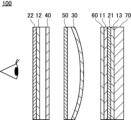
- the virtual reality display device of the present invention can use a curved substrate having a lens shape as a base material (for example, a member between the second retardation layer 12 and the half mirror 40 in FIG. 1).
- the optically absorptive anisotropic layer or laminate of the present invention can be used by processing it into a three-dimensional curved surface.
- Fig. 1 is a side view showing an embodiment of a virtual reality display device according to the present invention.
- 1 includes, from the viewing side, a second absorbing linear polarizer 22, a second retardation layer 12, a half mirror 40, an anti-reflection layer 50, a reflective circular polarizer 30, a positive C plate 60, a first retardation layer 11, a first absorbing linear polarizer 21, a third retardation layer 13, and an image display panel 70, which are arranged in this order.
- the present invention also relates to the following specific polymers.
- the specific polymer of the present invention is a polymer having a repeating unit A-1 represented by formula (A-1), and at least one repeating unit selected from a repeating unit B represented by formula (B) and a repeating unit D represented by formula (D).
- the repeating unit A-1, the repeating unit B and the repeating unit D are all as explained in the specific polymer contained in the liquid crystal composition of the present invention described above, and therefore explanations thereof will be omitted.
- Copolymer B1 was synthesized according to the following procedure.
- methyl ethyl ketone (MEK) was placed in a reaction vessel and heated under a nitrogen gas flow until the internal temperature reached 80° C.
- a methyl ethyl ketone (1.0 g) solution of 0.10 g of 2,2'-azobis(2-methylpropionate)dimethyl was added and stirred at 80° C. for 5 hours to obtain a methyl ethyl ketone solution of copolymer B1.
- the copolymer B1 thus obtained was analyzed by gel permeation chromatography (GPC) and found to have a weight average molecular weight (Mw) of 18,000 (polystyrene equivalent).
- the weight average molecular weight (Mw) was calculated in terms of polystyrene by gel permeation chromatography (EcoSEC HLC-8320GPC (manufactured by Tosoh Corporation) using tetrahydrofuran as an eluent at a flow rate of 0.35 mL/min and a temperature of 40° C.; the columns used were TSKgel SuperHZM-H, TSKgel SuperHZ4000, and TSKgel SuperHZ200 (manufactured by Tosoh Corporation)).
- the Mw of each copolymer described below was measured in the same manner as for copolymer B1.
- Copolymers B2 to B5 and B'3 represented by the formulas described below were obtained in the same manner as in Synthesis Example 1, except that the monomers and composition ratios used in Synthesis Example 1 were changed to monomers and composition ratios that form the repeating units of the copolymer.
- Copolymer B6 was synthesized according to the following procedure.
- MsCl methanesulfonyl chloride
- THF tetrahydrofuran
- DIPEA diisopropylethylamine
- Copolymers B7 to B11 and B'2 represented by the formulas described below were obtained in the same manner as in Synthesis Example 7, except that the monomers and composition ratios used in Synthesis Example 6 were changed to the monomers and composition ratios that form the repeating units of the copolymer.
- Copolymer B12 was synthesized by the following procedure.
- Copolymers B13 and B14 were obtained in the same manner as in Synthesis Example 7, except that the monomers and composition ratios used in Synthesis Example 7 were changed to the monomers and composition ratios forming the repeating units of each copolymer.
- copolymers B1 to B14 and B'2 to B'3 are shown below.
- the numerical value attached to each repeating unit indicates the content (mass%) of each repeating unit relative to the total repeating units (100 mass%) contained in the copolymer.
- TMS represents a trimethylsilyl group
- nBu represents a normal butyl group.
- Example 1-1 [Preparation of Cellulose Acylate Film 1] ⁇ Preparation of cellulose acylate dope for core layer> The following composition was charged into a mixing tank and stirred to dissolve each component, thereby preparing a cellulose acetate solution to be used as a cellulose acylate dope for the core layer.
- the film was further dried by conveying it between rolls of a heat treatment device to prepare an optical film having a thickness of 40 ⁇ m, which was used as Cellulose Acylate Film 1 (Support 1).
- the in-plane retardation of the obtained Cellulose Acylate Film 1 was 0 nm.
- the coating solution PA1 for forming an alignment layer was continuously applied onto the cellulose acylate film 1 using a wire bar.
- the support on which the coating film was formed was dried with hot air at 140° C. for 120 seconds, and then the coating film was irradiated with polarized ultraviolet light (10 mJ/cm 2 , using an ultra-high pressure mercury lamp) to form a photoalignment layer PA1, thereby obtaining a TAC film with a photoalignment layer.
- the thickness of the photoalignment layer PA1 was 0.5 ⁇ m.
- both the polymer liquid crystal compound P1 and the low molecular weight liquid crystal compound L1 are rod-shaped liquid crystal compounds.
- Examples 1-2 to 1-13, Comparative Examples 1-1 to 1-3 Each of the laminates of Examples 1-2 to 1-13 and Comparative Examples 1-1 to 1-3 was obtained in the same manner as in Example 1-1, except that the composition of the liquid crystal composition 1-1 was changed to the composition shown in Table 1 below.
- Examples 1-14 and 1-15 Each of the laminates of Examples 1-14 and 1-15 was obtained in the same manner as in Example 1-1, except that the composition of the liquid crystal composition 1-1 was changed to the composition shown in Table 1 below.
- each repeating unit indicates the content (mass%) of each repeating unit relative to the total repeating units contained in each polymer.
- the high molecular liquid crystal compounds P2 and P3 and the low molecular liquid crystal compounds L2 and L3 are all rod-shaped liquid crystal compounds.
- Low molecular weight liquid crystal compound L3 is a mixture of the following rod-shaped liquid crystal compounds.
- the numbers in the formula below represent mass %, and R represents a group bonded via an oxygen atom.
- Polymer B'1 Polyether modified silicone (Evonik Tego Chemie, product name "FLOW 425")
- Orientation degree: S ((Az0/Ay0)-1)/((Az0/Ay0)+2)
- Az0 represents the absorbance of the optically absorptive anisotropic film for polarized light in the absorption axis direction
- Ay0 represents the absorbance of the optically absorptive anisotropic film for polarized light in the transmission axis direction.
- Orientation degree is 0.95 or more
- B Orientation degree is 0.88 or more and less than 0.95
- C Orientation degree is less than 0.88 Note that, since none of the layer structures other than the optically absorptive anisotropic film in the laminate has absorption in the range of 400 to 700 nm, the orientation degree calculated above can be interpreted as the value of the optically absorptive anisotropic film in the laminate.
- mass ratio to dichroic material means the mass ratio of the copolymer content to the dichroic material content in the liquid crystal composition (copolymer content/dichroic material content).
- Example 1-1 to 1-15 As shown in Table 1, it was shown that by using a liquid crystal composition containing a specific polymer, it is possible to form an optically absorptive anisotropic film in which repelling is suppressed during formation of the film and the occurrence of orientation defects is suppressed. Comparison of Examples 1-1 and 1-2 with Example 1-5 shows that when a specific polymer having a repeating unit B is used, orientation defects (haze) can be further suppressed, and an optically absorptive anisotropic film with excellent orientation can be formed.
- Comparison of Examples 1-6 and 1-7 with Example 1-5 shows that when a specific polymer having a repeating unit D is used, repelling and orientation defects (haze) can be further suppressed, and an optically absorptive anisotropic film having an excellent degree of orientation can be formed.
- Comparison between Examples 1-8 and 1-9 shows that when the sum of the molecular weights of the groups corresponding to R B4 and R B5 in the repeating unit B is 100 or less, orientation defects (haze) can be further suppressed, and an optically absorptive anisotropic film with excellent orientation can be formed.
- Example 1-8 and Example 1-11 shows that when the content of the repeating unit D is 20% by mass or more based on the total mass of the specific polymer, cissing can be further suppressed.
- Comparison between Example 1-8 and Example 1-12 shows that when a polymer liquid crystal compound is used, the orientation defect (haze) can be further suppressed, and an optically absorptive anisotropic film with an excellent degree of orientation can be formed.
- Example 2-1 [Formation of Alignment Film 2] On a cellulose acylate film (TAC substrate having a thickness of 40 ⁇ m: TG40, manufactured by Fujifilm Corporation), the following composition for forming an alignment film 1 was continuously applied with a wire bar. The cellulose acylate film on which the coating film was formed was dried with hot air at 140° C. for 120 seconds to form an alignment film 2, thereby obtaining a TAC film with an alignment film. The thickness of the alignment film 2 was 0.5 ⁇ m.
- ⁇ (Orientation film forming composition 2) ⁇ ⁇ 100.00 parts by mass of polymer PA2 (see below) ⁇ 8.25 parts by mass of acid generator PAG-1 (see below) ⁇ 0.6 parts by mass of stabilizer DIPEA (see below) ⁇ 250.36 parts by mass of methyl ethyl ketone ⁇ 1001.42 parts by mass of butyl acetate
- the transmittance central axis angle ⁇ was measured using the method described above using the laminate 2-1 thus produced, and was found to be 0°. Note that, since none of the layer configurations other than the optically absorbing anisotropic film 2-1 in the laminate 2-1 have any absorption anisotropy, the transmittance central axis angle ⁇ calculated above can be interpreted as the value for the optically absorbing anisotropic film 2-1 in the laminate 2-1.
- Comparative Example 2-1 A laminate of Comparative Example 2-1 was obtained in the same manner as in Example 2-1, except that the copolymer B13 used in the liquid crystal composition 2-1 was changed to the above-mentioned copolymer B'1.
- Example 2-1 The laminates of Example 2-1 and Comparative Example 2-1 were used to evaluate the haze and cissing described above. The results are shown in Table 2.
- Example 2-1 As shown in Table 2, it was shown that by using a liquid crystal composition containing a specific polymer, it is possible to form an optically absorptive anisotropic film in which repelling during formation of the film is suppressed and the occurrence of orientation defects is suppressed (Example 2-1). In contrast, when a liquid crystal composition not containing the specific polymer was used, repelling could not be sufficiently suppressed during the formation of the optically absorptive anisotropic film, and alignment defects in the obtained optically absorptive anisotropic film could not be sufficiently suppressed (Comparative Example 2-1).
- Display devices 1 and 2 were produced by the method described below using the laminate 1-14 produced in Example 1-14, and it was confirmed that the laminate of the present invention functions sufficiently as an optically absorptive anisotropic film.
- a coating solution E1 for forming a photo-alignment film having the following composition was continuously applied with a wire bar onto the above-mentioned cellulose acylate film 1.
- the cellulose acylate film 1 on which the coating film was formed was dried with hot air at 140° C. for 120 seconds, and then the coating film was irradiated with polarized ultraviolet light (10 mJ/cm 2 , using an ultra-high pressure mercury lamp) to form a photo-alignment film E1 with a thickness of 0.2 ⁇ m, thereby obtaining a TAC film with a photo-alignment film.
- Coating liquid E1 for forming photo-alignment film ⁇ 100.00 parts by weight of the polymer PA3 described below; 5.00 parts by weight of the thermal cationic polymerization initiator PAG-1 described above; 0.005 parts by weight of the acid generator CPI-110TF described below; 16.50 parts by weight of isopropyl alcohol; and 1072 parts by weight of butyl acetate. .00 parts by mass Methyl ethyl ketone 268.00 parts by mass ---------------------------------------------------------------------------------------------------------------------------------------------------------------------------------------------------------------------------------------------------------------------------------------------------------------------------------------------------------------------------------------------------------------
- Polymer PA3 (In the following formula, the numerical value for each repeating unit indicates the content (mass%) of each repeating unit relative to the total repeating units. Weight average molecular weight: 45,000)
- the composition F1 having the following composition was applied onto the photo-alignment film E1 using a bar coater.
- the coating film formed on the photo-alignment film E1 was heated to 120°C with hot air, and then cooled to 60°C.
- the coating film was then irradiated with 100mJ/ cm2 ultraviolet light at a wavelength of 365nm using a high-pressure mercury lamp under a nitrogen atmosphere, and then irradiated with 500mJ/ cm2 ultraviolet light while heating to 120°C, thereby fixing the alignment of the liquid crystal compound, and a retardation layer film 1 having a positive A plate F1 was produced.
- the positive A plate F1 had a thickness of 2.5 ⁇ m and an Re(550) of 144 nm.
- the positive A plate satisfied the relationship Re(450) ⁇ Re(550) ⁇ Re(650).
- Re(450)/Re(550) was 0.82.
- the positive A plate corresponds to a so-called ⁇ /4 plate.
- Polymerizable liquid crystal compound LA-1 (tBu represents a tertiary butyl group)
- Polymerizable liquid crystal compound LA-4 (Me represents a methyl group)
- Leveling agent T-1 (In the following formula, the numerical value for each repeating unit indicates the content (mass%) of each repeating unit relative to the total repeating units; weight average molecular weight: 25,000)
- the above-mentioned Cellulose Acylate Film 1 was used as the temporary support.
- the cellulose acylate film 1 was passed through a dielectric heating roll at a temperature of 60°C to raise the surface temperature of the film to 40°C, and then an alkaline solution having the composition shown below was applied to one side of the film in an amount of 14 ml/ m2 using a bar coater, heated to 110°C, and transported under a steam-type far-infrared heater manufactured by Noritake Co., Limited for 10 seconds.
- 3 ml/ m2 of pure water was applied onto the film using the same bar coater.
- the film was transported to a drying zone at 70° C. for 10 seconds and dried, thereby preparing an alkaline saponified cellulose acylate film 1.
- the coating solution G1 for forming an alignment film having the following composition was continuously applied onto the above-mentioned alkaline saponification-treated cellulose acylate film 1 using a #8 wire bar.
- the resulting film was dried with hot air at 60°C for 60 seconds and then with hot air at 100°C for 120 seconds to form an alignment film G1.
- a coating solution H1 for forming a positive C plate having the following composition was applied onto an alignment film G1, and the resulting coating film was aged at 60° C. for 60 seconds.
- the coating film was then irradiated with ultraviolet light at 1000 mJ/cm 2 using an air-cooled metal halide lamp (manufactured by Eye Graphics Co., Ltd.) at 70 mW/cm 2 under air to fix the alignment state, thereby vertically aligning the liquid crystal compound, and a retardation layer film 2 having a positive C plate H1 with a thickness of 0.5 ⁇ m was produced.
- the Rth(550) of the obtained positive C plate was ⁇ 60 nm.
- Compound B03 (In the following formula, the numerical value for each repeating unit indicates the content (mass%) of each repeating unit relative to the total repeating units; weight average molecular weight: 15,000)
- the positive C plate side of the obtained retardation layer film 2 was attached to the liquid crystal surface exposed by peeling off the alignment film with an adhesive, and the support and the alignment layer were peeled off.
- a circular polarizing plate 1 consisting of a light absorption anisotropic film/adhesive layer/positive A plate/adhesive layer/positive C plate was prepared.
- Adhesive 1 20 parts by mass of methylolmelamine was dissolved in pure water at a temperature of 30° C. relative to 100 parts by mass of a polyvinyl alcohol resin containing an acetoacetyl group (average degree of polymerization: 1,200, degree of saponification: 98.5 mol %, degree of acetoacetylation: 5 mol %) to prepare an aqueous solution having a solid content of 3.7% by mass.
- the obtained polyester carbonate resin (pellets) was vacuum dried at 80°C for 5 hours, and then a long resin film with a thickness of 130 ⁇ m was produced using a film-making device equipped with a single-screw extruder (manufactured by Toshiba Machine Co., Ltd., cylinder setting temperature: 250°C), a T-die (width 200 mm, setting temperature: 250°C), a chill roll (setting temperature: 120-130°C) and a winder.
- the obtained long resin film was stretched while adjusting to obtain a predetermined phase difference, and a phase difference film 3 with a thickness of 48 ⁇ m was obtained.
- the stretching conditions were a stretching temperature of 143°C in the width direction and a stretching ratio of 2.8 times.
- the obtained phase difference film 3 had a Re(550) of 141 nm, a Re(450)/Re(550) of 0.86, and an Nz coefficient of 1.12.
- the above phase difference film 3 corresponds to a so-called ⁇ /4
- the laminate (optical film) of the present invention has sufficient performance as an optical compensation film.
Landscapes
- Chemical & Material Sciences (AREA)
- Physics & Mathematics (AREA)
- Health & Medical Sciences (AREA)
- Chemical Kinetics & Catalysis (AREA)
- Medicinal Chemistry (AREA)
- Polymers & Plastics (AREA)
- Organic Chemistry (AREA)
- Optics & Photonics (AREA)
- General Physics & Mathematics (AREA)
- Addition Polymer Or Copolymer, Post-Treatments, Or Chemical Modifications (AREA)
Priority Applications (2)
| Application Number | Priority Date | Filing Date | Title |
|---|---|---|---|
| JP2025529581A JPWO2025004740A1 (https=) | 2023-06-28 | 2024-06-06 | |
| CN202480043323.0A CN121420221A (zh) | 2023-06-28 | 2024-06-06 | 液晶组合物、光吸收各向异性膜、层叠体、图像显示装置及聚合物 |
Applications Claiming Priority (4)
| Application Number | Priority Date | Filing Date | Title |
|---|---|---|---|
| JP2023106087 | 2023-06-28 | ||
| JP2023-106087 | 2023-06-28 | ||
| JP2023-165673 | 2023-09-27 | ||
| JP2023165673 | 2023-09-27 |
Publications (1)
| Publication Number | Publication Date |
|---|---|
| WO2025004740A1 true WO2025004740A1 (ja) | 2025-01-02 |
Family
ID=93938320
Family Applications (1)
| Application Number | Title | Priority Date | Filing Date |
|---|---|---|---|
| PCT/JP2024/020692 Ceased WO2025004740A1 (ja) | 2023-06-28 | 2024-06-06 | 液晶組成物、光吸収異方性膜、積層体、画像表示装置及び重合体 |
Country Status (3)
| Country | Link |
|---|---|
| JP (1) | JPWO2025004740A1 (https=) |
| CN (1) | CN121420221A (https=) |
| WO (1) | WO2025004740A1 (https=) |
Citations (7)
| Publication number | Priority date | Publication date | Assignee | Title |
|---|---|---|---|---|
| JPH11148080A (ja) * | 1997-11-18 | 1999-06-02 | Dainippon Ink & Chem Inc | 重合性液晶組成物及び該組成物からなる光学異方体 |
| WO2017146180A1 (ja) * | 2016-02-25 | 2017-08-31 | 富士フイルム株式会社 | 反射防止フィルム、及び反射防止フィルムの製造方法 |
| WO2018003653A1 (ja) * | 2016-06-27 | 2018-01-04 | Dic株式会社 | 重合性液晶組成物、それを用いた光学異方体及び液晶表示素子 |
| WO2020218104A1 (ja) * | 2019-04-26 | 2020-10-29 | 住友化学株式会社 | 液晶硬化膜形成用組成物及びその用途 |
| WO2021153510A1 (ja) * | 2020-01-27 | 2021-08-05 | 富士フイルム株式会社 | 液晶組成物、光吸収異方性膜、積層体および画像表示装置 |
| WO2022071410A1 (ja) * | 2020-09-29 | 2022-04-07 | 富士フイルム株式会社 | 光学積層体、偏光板および画像表示装置 |
| WO2023054164A1 (ja) * | 2021-09-29 | 2023-04-06 | 富士フイルム株式会社 | 液晶組成物、液晶硬化層、光学フィルム、偏光板および画像表示装置 |
-
2024
- 2024-06-06 JP JP2025529581A patent/JPWO2025004740A1/ja active Pending
- 2024-06-06 CN CN202480043323.0A patent/CN121420221A/zh active Pending
- 2024-06-06 WO PCT/JP2024/020692 patent/WO2025004740A1/ja not_active Ceased
Patent Citations (7)
| Publication number | Priority date | Publication date | Assignee | Title |
|---|---|---|---|---|
| JPH11148080A (ja) * | 1997-11-18 | 1999-06-02 | Dainippon Ink & Chem Inc | 重合性液晶組成物及び該組成物からなる光学異方体 |
| WO2017146180A1 (ja) * | 2016-02-25 | 2017-08-31 | 富士フイルム株式会社 | 反射防止フィルム、及び反射防止フィルムの製造方法 |
| WO2018003653A1 (ja) * | 2016-06-27 | 2018-01-04 | Dic株式会社 | 重合性液晶組成物、それを用いた光学異方体及び液晶表示素子 |
| WO2020218104A1 (ja) * | 2019-04-26 | 2020-10-29 | 住友化学株式会社 | 液晶硬化膜形成用組成物及びその用途 |
| WO2021153510A1 (ja) * | 2020-01-27 | 2021-08-05 | 富士フイルム株式会社 | 液晶組成物、光吸収異方性膜、積層体および画像表示装置 |
| WO2022071410A1 (ja) * | 2020-09-29 | 2022-04-07 | 富士フイルム株式会社 | 光学積層体、偏光板および画像表示装置 |
| WO2023054164A1 (ja) * | 2021-09-29 | 2023-04-06 | 富士フイルム株式会社 | 液晶組成物、液晶硬化層、光学フィルム、偏光板および画像表示装置 |
Also Published As
| Publication number | Publication date |
|---|---|
| CN121420221A (zh) | 2026-01-27 |
| JPWO2025004740A1 (https=) | 2025-01-02 |
Similar Documents
| Publication | Publication Date | Title |
|---|---|---|
| JP7559008B2 (ja) | 光学積層体の製造方法、光学積層体および画像表示装置 | |
| JP7602597B2 (ja) | 光吸収異方性膜、積層体、積層体の製造方法および画像表示装置 | |
| KR102242224B1 (ko) | 편광 소자, 원편광판 및 화상 표시 장치 | |
| WO2018124198A1 (ja) | 液晶性組成物、高分子液晶化合物、光吸収異方性膜、積層体および画像表示装置 | |
| WO2018186503A1 (ja) | 異方性光吸収膜および積層体 | |
| JP7457739B2 (ja) | 偏光素子、円偏光板および画像表示装置 | |
| WO2019225468A1 (ja) | 偏光子および画像表示装置 | |
| JP7699153B2 (ja) | 光吸収異方性フィルム、視角制御システムおよび画像表示装置 | |
| WO2021153510A1 (ja) | 液晶組成物、光吸収異方性膜、積層体および画像表示装置 | |
| JP7553552B2 (ja) | 視角制御システムおよび画像表示装置 | |
| JP6976336B2 (ja) | 液晶組成物、光吸収異方性膜、積層体および画像表示装置 | |
| JP7481425B2 (ja) | 光学積層体および表示装置 | |
| WO2025192139A1 (ja) | 液晶組成物、光吸収異方性膜、積層体および表示装置 | |
| JP7352644B2 (ja) | 光学積層体、有機el表示装置及び折りたたみ式デバイス | |
| JP7108051B2 (ja) | 液晶組成物、高分子液晶性化合物の製造方法、光吸収異方性膜、積層体および画像表示装置 | |
| WO2025004740A1 (ja) | 液晶組成物、光吸収異方性膜、積層体、画像表示装置及び重合体 | |
| WO2022202470A1 (ja) | 光吸収異方性膜、積層体及び画像表示装置 | |
| JP7169352B2 (ja) | 偏光子、および、画像表示装置 | |
| JP7454695B2 (ja) | 光配向膜用組成物、光配向膜および光学積層体 | |
| JP7696911B2 (ja) | 積層体および画像表示装置 | |
| JP7848024B2 (ja) | 液晶組成物、光吸収異方性層、積層体および画像表示装置 | |
| WO2020121992A1 (ja) | 液晶組成物、光吸収異方性膜、積層体および画像表示装置 | |
| JP7453354B2 (ja) | 光配向膜、積層体、画像表示装置およびアゾ化合物 | |
| WO2025143020A1 (ja) | 液晶組成物、光吸収異方性膜、積層体及び画像表示装置 | |
| WO2026004556A1 (ja) | 液晶組成物、液晶化合物、光吸収異方性膜、積層体および表示装置 |
Legal Events
| Date | Code | Title | Description |
|---|---|---|---|
| 121 | Ep: the epo has been informed by wipo that ep was designated in this application |
Ref document number: 24831610 Country of ref document: EP Kind code of ref document: A1 |
|
| ENP | Entry into the national phase |
Ref document number: 2025529581 Country of ref document: JP Kind code of ref document: A |
|
| WWE | Wipo information: entry into national phase |
Ref document number: 2025529581 Country of ref document: JP |
|
| NENP | Non-entry into the national phase |
Ref country code: DE |