WO2024228396A1 - オリゴヌクレオチド合成用の高脂溶性ヌクレオチドビルディングブロックおよびこれを用いたオリゴヌクレオチドの合成 - Google Patents
オリゴヌクレオチド合成用の高脂溶性ヌクレオチドビルディングブロックおよびこれを用いたオリゴヌクレオチドの合成 Download PDFInfo
- Publication number
- WO2024228396A1 WO2024228396A1 PCT/JP2024/016835 JP2024016835W WO2024228396A1 WO 2024228396 A1 WO2024228396 A1 WO 2024228396A1 JP 2024016835 W JP2024016835 W JP 2024016835W WO 2024228396 A1 WO2024228396 A1 WO 2024228396A1
- Authority
- WO
- WIPO (PCT)
- Prior art keywords
- oligonucleotide
- highly lipophilic
- building block
- tbdps
- mmtr
- Prior art date
- Legal status (The legal status is an assumption and is not a legal conclusion. Google has not performed a legal analysis and makes no representation as to the accuracy of the status listed.)
- Ceased
Links
Images




Classifications
-
- C—CHEMISTRY; METALLURGY
- C07—ORGANIC CHEMISTRY
- C07H—SUGARS; DERIVATIVES THEREOF; NUCLEOSIDES; NUCLEOTIDES; NUCLEIC ACIDS
- C07H19/00—Compounds containing a hetero ring sharing one ring hetero atom with a saccharide radical; Nucleosides; Mononucleotides; Anhydro-derivatives thereof
- C07H19/02—Compounds containing a hetero ring sharing one ring hetero atom with a saccharide radical; Nucleosides; Mononucleotides; Anhydro-derivatives thereof sharing nitrogen
- C07H19/04—Heterocyclic radicals containing only nitrogen atoms as ring hetero atom
- C07H19/06—Pyrimidine radicals
- C07H19/10—Pyrimidine radicals with the saccharide radical esterified by phosphoric or polyphosphoric acids
-
- C—CHEMISTRY; METALLURGY
- C07—ORGANIC CHEMISTRY
- C07H—SUGARS; DERIVATIVES THEREOF; NUCLEOSIDES; NUCLEOTIDES; NUCLEIC ACIDS
- C07H1/00—Processes for the preparation of sugar derivatives
-
- C—CHEMISTRY; METALLURGY
- C07—ORGANIC CHEMISTRY
- C07H—SUGARS; DERIVATIVES THEREOF; NUCLEOSIDES; NUCLEOTIDES; NUCLEIC ACIDS
- C07H19/00—Compounds containing a hetero ring sharing one ring hetero atom with a saccharide radical; Nucleosides; Mononucleotides; Anhydro-derivatives thereof
- C07H19/02—Compounds containing a hetero ring sharing one ring hetero atom with a saccharide radical; Nucleosides; Mononucleotides; Anhydro-derivatives thereof sharing nitrogen
- C07H19/04—Heterocyclic radicals containing only nitrogen atoms as ring hetero atom
- C07H19/06—Pyrimidine radicals
-
- C—CHEMISTRY; METALLURGY
- C07—ORGANIC CHEMISTRY
- C07H—SUGARS; DERIVATIVES THEREOF; NUCLEOSIDES; NUCLEOTIDES; NUCLEIC ACIDS
- C07H19/00—Compounds containing a hetero ring sharing one ring hetero atom with a saccharide radical; Nucleosides; Mononucleotides; Anhydro-derivatives thereof
- C07H19/02—Compounds containing a hetero ring sharing one ring hetero atom with a saccharide radical; Nucleosides; Mononucleotides; Anhydro-derivatives thereof sharing nitrogen
- C07H19/04—Heterocyclic radicals containing only nitrogen atoms as ring hetero atom
- C07H19/16—Purine radicals
-
- C—CHEMISTRY; METALLURGY
- C07—ORGANIC CHEMISTRY
- C07H—SUGARS; DERIVATIVES THEREOF; NUCLEOSIDES; NUCLEOTIDES; NUCLEIC ACIDS
- C07H19/00—Compounds containing a hetero ring sharing one ring hetero atom with a saccharide radical; Nucleosides; Mononucleotides; Anhydro-derivatives thereof
- C07H19/02—Compounds containing a hetero ring sharing one ring hetero atom with a saccharide radical; Nucleosides; Mononucleotides; Anhydro-derivatives thereof sharing nitrogen
- C07H19/04—Heterocyclic radicals containing only nitrogen atoms as ring hetero atom
- C07H19/16—Purine radicals
- C07H19/20—Purine radicals with the saccharide radical esterified by phosphoric or polyphosphoric acids
-
- C—CHEMISTRY; METALLURGY
- C07—ORGANIC CHEMISTRY
- C07H—SUGARS; DERIVATIVES THEREOF; NUCLEOSIDES; NUCLEOTIDES; NUCLEIC ACIDS
- C07H21/00—Compounds containing two or more mononucleotide units having separate phosphate or polyphosphate groups linked by saccharide radicals of nucleoside groups, e.g. nucleic acids
-
- C—CHEMISTRY; METALLURGY
- C07—ORGANIC CHEMISTRY
- C07H—SUGARS; DERIVATIVES THEREOF; NUCLEOSIDES; NUCLEOTIDES; NUCLEIC ACIDS
- C07H21/00—Compounds containing two or more mononucleotide units having separate phosphate or polyphosphate groups linked by saccharide radicals of nucleoside groups, e.g. nucleic acids
- C07H21/04—Compounds containing two or more mononucleotide units having separate phosphate or polyphosphate groups linked by saccharide radicals of nucleoside groups, e.g. nucleic acids with deoxyribosyl as saccharide radical
Definitions
- the present invention relates to highly lipophilic nucleotide building blocks for oligonucleotide synthesis and the synthesis of oligonucleotides using the same.
- nucleic acid drugs that use natural or modified oligonucleotides as their base structure. Chemical synthesis methods are widely used to obtain nucleic acid drugs designed to achieve the desired effect.
- a liquid phase synthesis method is known as one of the chemical synthesis methods used for synthesizing relatively short oligonucleotides, in which all reactions are carried out in a liquid phase.
- fluorous tags fluorocarbon-philic substituents
- Patent Document 2 Patent Document 2
- nucleic acid active pharmaceutical ingredients at GMP (Good Manufacturing Practice) grade and steadily supply them as pharmaceuticals, it is necessary to be able to synthesize oligonucleotides on a kilogram scale with high purity.
- purification processes using column chromatography, etc. are often cumbersome, so it is not easy to synthesize large quantities of long-chain oligonucleotides exceeding 50 mers.
- liquid phase synthesis method that can use a general-purpose reactor is advantageous. Even in liquid phase synthesis methods that use such reactors, many steps are required to obtain the desired product, for example, when synthesizing an amount of oligonucleotide exceeding 100 g per batch.
- liquid-phase batch synthesis includes a chain extension step, a deprotection step, a step for removing excess reagents and by-products produced by the reaction, a purification step, a desalting step, etc.
- Large-scale synthesis requires reaction equipment and purification equipment suited to each step and its scale. Multi-stage synthesis produces impurities such as unreacted reagents and reaction by-products, and purification by column chromatography or the like is required to remove these, so process improvements and cost reductions are required to mass-produce oligonucleotides.
- the present invention has been made in consideration of these circumstances, and aims to provide a highly lipophilic nucleotide building block for oligonucleotide synthesis, which allows oligonucleotides to be synthesized on a large scale and purified more easily, and a method for synthesizing protected oligonucleotides using the same.
- the highly lipophilic nucleotide building block for oligonucleotide synthesis of the present invention and the method for synthesizing oligonucleotides using the same employ the following means.
- the first aspect of the present invention provides a highly lipophilic monomer building block for oligonucleotide synthesis having a structure according to the following formula (I) or (II):
- B is a natural or unnatural base
- R 1 is at least one of Tr, MMTr, DMTr, TMTr, TBDPS, TBS, Fmoc, benzoyl, isobutyryl, dmf, and Ac, provided that in formula (II), when OR 2 and Y are both OMMTr, ODMTr, or OTMTr, R 1 may not have a protecting group
- R2 is any one of Tr, MMTr, DMTr, TMTr, TBDPS, TBS, Fmoc, and 1-pyrenylmethyl
- R 3 is CH 3 , CH 2 CH 3 , CH(CH 3 ) 2 , or NR 3 2 form a ring and are -N(CH 2 CH 2 ) 2 , -N(CH 2 CH 2 ) 2 O
- B R may be independently selected from A DMTr , A TMTr , A Ac , C DMTr , C TMTr , C Ac , G MMTr , G Tr , G ibu/TBDPS , G dmf , U Tr , U TBDPS , T MMTr , and T TBDPS .
- a second aspect of the present invention provides a highly lipophilic nucleotide building block for oligonucleotide synthesis having a structure according to formula (III) or (VI) below:
- B is a natural or unnatural base
- R 1 is at least one of Tr, MMTr, DMTr, TMTr, TBDPS, TBS, Fmoc, benzoyl, isobutyryl, dmf, and Ac, provided that in formulas (III) and (VI), when OR 2 and Y are both OMMTr, ODMTr, or OTMTr, R 1 may not have a protecting group
- R2 is any one of Tr, MMTr, DMTr, TMTr, TBDPS, TBS, Fmoc, and 1-pyrenylmethyl
- R 3 is CH 3 , CH 2 CH 3 , CH(CH 3 ) 2 , or NR 3 2 form a ring and are -N(CH 2 CH 2 ) 2 , -N(CH 2 CH 2 ) 2 O
- B R may be independently selected from A DMTr , A TMTr , A Ac , A, C DMTr , C TMTr , C Ac , C, G DMTr , G Tr , G ibu/TBDPS , G dmf , G, U Tr , U TBDPS , U, T MMTr , T TBDPS , and T.
- R 1 may be protected with MMTr, DMTr, or TMTr.
- n may be an integer from 0 to 10.
- a third aspect of the present invention is a method for synthesizing an oligonucleotide using a highly lipophilic nucleotide monomer block according to the first aspect or a highly lipophilic nucleotide building block according to the second aspect, comprising: (a) a chain elongation step of condensing an amidite portion of the highly lipophilic nucleotide monomer block represented by the above formula (I) or (II) or the highly lipophilic nucleotide monomer block represented by the above formula (III) or (VI) with a hydroxyl group of a protected nucleoside or a protected nucleotide; (b) a step of deprotecting the protecting group of the hydroxyl group at one end of the chain elongation product obtained in the chain elongation step, The chain elongation step and the deprotection step are carried out at least once or repeated a predetermined number of times to obtain a protected oligonucleotide of a desired length
- the number of nucleosides contained in the protected oligonucleotide may be in the range of 10 to 150.
- the highly lipophilic protecting groups present at at least two positions in the protected oligonucleotide obtained after the deprotection step (c) may be Tr, MMTr, DMTr, TMTr, Fmoc, or TBDPS protecting groups.
- the chain elongation step (a), the deprotection step (b), and the deprotection step (c) may be carried out in a liquid phase.
- oligonucleotides can be synthesized on a large scale and purified more easily.
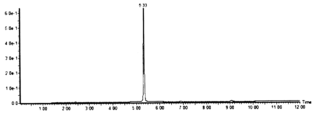
- FIG. 2 is a partially enlarged HPLC chart of oligonucleotide N-mer and (N ⁇ 1)-mer synthesized and purified by a conventional method.
- FIG. 2A shows HPLC charts of a 21-mer having the sequence set forth in SEQ ID NO:1 before and after purification
- FIG. 2B shows an HPLC chart of a 5'-bistritylated crude product.
- FIG. 2A shows HPLC charts of the 21-mer having the sequence set forth in SEQ ID NO:1 before and after purification
- FIG. 2B shows the HPLC chart after purification of the detritylated product.
- FIG. 3A shows HPLC charts of a 21-mer having the sequence set forth in SEQ ID NO:4 before and after purification
- FIG. 3B shows an HPLC chart of a 5'-bistritylated crude product.
- FIG. 3A shows HPLC charts of the 21-mer having the sequence set forth in SEQ ID NO:4 before and after purification
- FIG. 3B shows an HPLC chart of the product after purification after detritylation.
- nucleotide building block refers to a nucleotide unit that is a dimer or greater of a nucleotide, has a phosphoramidite structure at the 3'- or 5'-terminus, and serves as a synthetic block for forming a longer nucleotide chain by condensation reaction with a nucleoside, nucleotide, etc. that does not have a 5'- or 3'-hydroxyl group protected.
- nucleotide monomer block is a nucleotide unit that contains one nucleoside, has a phosphoramidite structure at the 3'- or 5'-terminus, and serves as a synthetic block for forming a long chain of nucleotides by condensation reaction with a nucleoside or nucleotide with an unprotected 5'- or 3'-hydroxyl group.
- the highly lipophilic nucleotide monomer block in this embodiment has a structure described in formula (I) or (II) below.
- B is a natural or unnatural base
- R 1 which is a protecting group for the nucleoside base, is any one of Tr, MMTr, DMTr, TMTr, TBDPS, TBS, Fmoc, benzoyl, isobutyryl, dmf, and Ac.
- R 1 may not have a protecting group.
- R 2 which is a protecting group for the 5',3'-hydroxyl group, is any one of Tr, MMTr, DMTr, TMTr, TBDPS, TBS, Fmoc, and 1-pyrenylmethyl.
- R 3 of the phosphoramidite moiety is CH 3 , CH 2 CH 3 , CH(CH 3 ) 2 , or, when NR 3 2 form a ring, is -N(CH 2 CH 2 ) 2 , -N(CH 2 CH 2 ) 2 O.
- R 4 the protecting group of the phosphate moiety, is independently any one of CH 2 CH 2 CN, CH 2 CH ⁇ CH 2 , CH 2 (CF 2 ) 6 CF 3 and CH 2 (CF 2 ) 4 CF 3.
- X bonded to the 4' carbon of the ribose or 2'-deoxyribose ring of the nucleoside is H or forms an X-Y bond with Y.
- Y bonded to the 2' carbon of the furanose ring of the nucleoside is F, OCH 3 , OMOE, OTBDMS and OR 2 or forms an X-Y bond, where X-Y is CH 2 O, CH 2 CH 2 O, CH 2 NH, CH 2 NR' and CH 2 N-N ⁇ NH 2 .
- R' is independently H, an alkyl, a carbamate, an amide group, or a substituted silyl.
- B R may be independently selected from A DMTr , A TMTr , A Ac , C DMTr , C TMTr , C Ac , G DMTr , G Tr , G MMTr/TBDPS , G dmf , U Tr , U TBDPS , U, T MMTr , T TBDPS , and T. That is, the protecting group of the nucleic acid base portion of the nucleoside is selected from Tr, MMTr, DMTr, TMTr, TBDPS, dmf, and Ac.
- the Tr, MMTr, DMTr, TMTr, Fmoc, and TBDPS groups themselves are highly lipophilic, and therefore the protected nucleosides having these as protecting groups are also highly lipophilic.
- the nucleic acid base portion does not need to have a protecting group, or it is possible to use a protecting group such as dmf or Ac that has a lower lipophilicity than the above trityl-based protecting group.
- the lipophilicity required for oligonucleotide synthesis in this embodiment can be obtained by having either MMTr, DMTr, or TMTr as a protecting group for both the 2'-hydroxyl group and the 3'-hydroxyl group.
- MMTr, DMTr, and TMTr protecting groups are commonly used in the chemical synthesis of nucleotides, and therefore their deprotection methods are well known. Therefore, by appropriately combining the protecting group of the terminal hydroxyl group in the nucleotide monomer block, the protecting group of the nucleic acid base moiety, and the protecting group of the phosphate moiety, and deprotecting them in the appropriate order, it is possible to purify the oligonucleotide with high purity without increasing the number of steps in the synthesis of the oligonucleotide. The deprotection and purification steps will be described later.
- the highly lipophilic nucleotide building block for oligonucleotide synthesis has a structure as shown in formula (III) or (VI) below.
- B is a natural or unnatural base, and its protecting group R1 is either Tr, MMTr, DMTr, TMTr, TBDPS, TBS, Fmoc, dmf, Ac or no protecting group.
- R 1 , R 2 and R 4 may be any one of Tr, MMTr, DMTr, TMTr, Fmoc, and TBDPS.
- R 1 when at least two of R 1 , R 2 , R 4 and Y are any of Tr, MMTr, DMTr, TMTr, Fmoc and TBDPS, R 1 does not necessarily have to have a protecting group.
- R2 which is a protecting group for the 5',3'-hydroxyl groups, is any one of Tr, MMTr , DMTr, TMTr, TBDPS, TBS, Fmoc, and 1-pyrenylmethyl .
- R3 in the phosphoramidite moiety is CH3 , CH2CH3 , or CH( CH3 ) 2 , or NR32 forms a ring and is -N(CH2CH2)2 or -N ( CH2CH2 ) 2O .
- X attached to the 4' carbon of ribose or 2'-deoxyribose is H or forms an X-Y bond with Y.
- n is an integer from 0 to 46, preferably from 0 to 10, more preferably from 0 to 5, and even more preferably from 0 to 3.
- the nucleoside base in this embodiment may be a natural base such as an adenyl group, a guanyl group, a cytosinyl group, a thyminyl group, or a uracil group, or a modified base such as a 5-methylcytosinyl group, a 5-fluorouracil group, a 7-methylguanyl group, or a 7-deazaadenyl group.
- the term "unnatural base” includes bases having reactive functional groups such as an amino group, a carbonyl group, a hydroxyl group, or a thiol group. A highly lipid-soluble protecting group is introduced into the reactive functional groups as necessary.
- a chain elongation step is performed in which the amidite portion of the highly lipophilic nucleotide monomer block represented by the above formula (I) or (II), or the highly lipophilic nucleotide monomer block represented by the above formula (III) or (VI), is condensed with the hydroxyl group of the nucleoside protector or nucleotide protector.
- a deprotection step is performed for the protecting group of the hydroxyl group at one end of the chain elongator obtained in the above chain elongation step.
- the phosphoramidite portion of the highly lipid-soluble monomer building block or highly lipid-soluble nucleotide building block is activated with an activator, and a condensation reaction is carried out with the hydroxyl group of the nucleoside protector or nucleotide protector.
- activators include, but are not limited to, 1H-tetrazole derivatives such as 1H-tetrazole and S-ethylthiotetrazole, imidazole derivatives such as dicyanoimidazole and dichloroimidazole, and salts of sulfonic acid and azoles or tertiary amines.
- the reaction is carried out in a dried solvent such as dichloromethane, acetonitrile, tetrahydrofuran, DMF, or toluene.
- the chain elongation product obtained in the chain elongation step is subjected to oxidation or sulfurization of the phosphorous acid moiety as necessary, and then subjected to the next deprotection step (b).
- the number of nucleosides contained in the highly lipophilic nucleotide building blocks represented by the structures described in formulas (III) and (VI) is 4 to 48.
- a condensation reaction also called a chain extension reaction
- the amidite portion of the building block of this embodiment and the unprotected hydroxyl group of the protected nucleoside or protected nucleotide, which is the condensation partner, can be performed once to instantly extend the length of the product oligonucleotide chain by at least 4 bases and up to 48 bases.
- the oligonucleotide synthesis method using the highly lipophilic nucleotide building blocks of this embodiment it is possible to make the number of nucleosides contained in the oligonucleotide range from 10 to 150 by simply repeating (a) the chain elongation step and (b) the deprotection step a number of times less than the number of nucleosides contained in the target oligonucleotide.
- the chain extension step and the deprotection step are performed at least once, or are repeated a predetermined number of times, to obtain a protected oligonucleotide of the desired length, followed by (c) a step of deprotecting the phosphate protecting group, the protecting group of the nucleic acid base, and the protecting group of the hydroxyl group at the 3'- or 5'-end of the protected oligonucleotide to synthesize a protected oligonucleotide having highly lipophilic protecting groups at at least two positions, (d) a step of separating the protected oligonucleotide having highly lipophilic protecting groups at at least two positions, and (e) a step of deprotecting and purifying the separated protected oligonucleotide.
- the nucleotide building block or nucleotide monomer block of this embodiment has a highly lipid-soluble protecting group at the 5'-end and two locations in the nucleic acid base portion when the backbone is a 2'-deoxyribonucleoside, and at the 5'-end, 2'-hydroxyl group, and at least two locations in the nucleic acid base portion when the backbone is a ribonucleoside.
- step (c) In the oligonucleotide synthesis method using the nucleotide building blocks or nucleotide monomer blocks according to this embodiment, in step (c), other protecting groups are removed so that these highly lipophilic protecting groups remain in at least two locations.
- the highly lipophilic protecting groups at at least two positions in the protected oligonucleotide obtained after the deprotection step (c) may be Tr, MMTr, DMTr, TMTr, Fmoc or TBDPS protecting groups.
- the highly lipophilic nucleotide building block of this embodiment is designed to contain the number of highly lipophilic protecting groups necessary to be easily separated in the separation step (d).
- various building blocks can be combined and used for synthesis.
- the desired oligonucleotide can be obtained by removing the remaining protecting groups from the protected oligonucleotide obtained in the separation step (d) and purifying it.
- conditions commonly used for the remaining protecting groups can be applied.
- trityl-based protecting groups such as MMTr and DMTr remain
- deprotection is performed using an aqueous trifluoroacetic acid solution.
- N-mer oligonucleotides are synthesized using widely used phosphoramidites, (N-1)-mers are generated as by-products. Because the (N-1)-mers have almost the same physical properties as the desired N-mers, it is extremely difficult to remove the (N-1)-mers in the final separation and purification step, as shown in Figure 1.
- the highly lipophilic nucleotide monomer block according to this embodiment has at least two highly lipophilic protecting groups. Therefore, in the synthesis of oligonucleotides, for example, after chain elongation is carried out using commercially available phosphoramidites, the highly lipophilic nucleotide monomer block is used in the final chain elongation step.
- the protected N-mer oligonucleotide containing the highly lipophilic nucleotide monomer according to this embodiment at the 5' or 3' end has high lipophilicity, i.e., high hydrophobicity, compared to the (N-1)mer that remains without chain elongation.
- the distance between the peak of the N-mer containing the highly lipophilic nucleotide monomer and the peak of the (N-1)mer to be separated can be increased during separation. Therefore, even with a simple separation step, short-chain by-products can be easily removed, and the purity of the final target product can be increased.
- the advantage of being able to utilize the difference in hydrophobicity between the peak of the target N-mer and the peak of the by-product to be separated as described above can also be obtained when using the highly lipophilic nucleotide building block of this embodiment. Since the highly lipophilic nucleotide building block contains 2 to 46 nucleosides, by adjusting the positions and number of multiple highly lipophilic protecting groups that are left, separation and subsequent deprotection processing can be performed efficiently based on the length of the target oligonucleotide.
- highly lipophilic and “highly lipophilic” refer to the property of having a high affinity with organic solvents (e.g., hydrophobic solvents such as aliphatic hydrocarbon solvents) and a low affinity with water.
- organic solvents e.g., hydrophobic solvents such as aliphatic hydrocarbon solvents
- an oligonucleotide having two or more protecting groups with 10 or more carbon atoms locally introduced therein is referred to as an oligonucleotide having a "highly lipophilic" protecting group.
- the chain elongation step (a), the deprotection step (b), and the deprotection step (c) may be carried out in a liquid phase.
- this is also referred to as a liquid phase synthesis method.
- synthesis can be carried out on a large scale (100 g or more) compared to the solid phase synthesis method in which a coupling reaction is carried out on a solid phase resin. Therefore, oligonucleotides can be synthesized at a lower cost.
- the chain extension step (a), the deprotection step (b), and the deprotection step (c) can all be carried out in a liquid phase.
- the separation step (d) can also be carried out using simple equipment such as hydrophobic chromatography using C4, C, 6, or C8 silica gel, reverse phase chromatography using reverse phase silica gel such as C18, or a combination of hydrophobic chromatography using hydrophilic interactions and solid extraction, solid-liquid separation, aqueous layer-organic layer separation, and gel filtration.
- the method for synthesizing oligonucleotides using highly lipophilic nucleotide building blocks according to this embodiment can be carried out continuously in a closed system by a liquid phase flow system from the chain extension reaction of the raw material through the oxidation or sulfurization reaction and deprotection reaction to the separation and purification step.
- a liquid phase flow system from the chain extension reaction of the raw material through the oxidation or sulfurization reaction and deprotection reaction to the separation and purification step.
- the synthesis of a nucleoside having multiple highly lipophilic protecting groups is carried out in the same manner as described in the method for synthesizing a nucleotide monomer block.
- the method for using this to prepare a building block can be carried out in the same manner as the method for synthesizing a blockmir described in WO 2019/212061 and WO 2020/235658.
- the nucleotide monomer block and nucleotide building block of this embodiment can be introduced with highly lipophilic protecting groups using commercially available reagents for protecting groups.
- the solubility of the intermediate in oligonucleotide synthesis can be adjusted by adjusting the number of highly lipophilic protecting groups introduced.
- the highly lipophilic protecting group can be introduced into the nucleoside base portion or into the protecting group of the 5'-, 3'-end, or 2'-hydroxyl group of the nucleoside, depending on the length and sequence of the monomer or oligonucleotide to be synthesized.
- the number of steps required to synthesize the same N-mer oligonucleotide can be reduced compared to the commonly used liquid phase synthesis method in which extension is performed one base at a time. Therefore, the yield of oligonucleotides of the desired length can be improved.
- a method for synthesizing a nucleotide monomer block according to an embodiment of the present invention will be described below as an example.
- the hydroxyl group of thymidine is acetylated with acetic anhydride to synthesize 3',5'-diacetylthymidine, and then the process of converting the base site to MMTr was investigated.
- the acetyl group was deprotected by hydrolysis using potassium carbonate, and the hydroxyl group at the 5' position was converted to MMTr using MMTrCl. It was confirmed that both steps proceeded in good yield, and the desired bis-MMTr form of thymidine could be synthesized on a 100 g scale. Details of the reaction conditions are described in the Examples.
- N3,5'-bisMMTr-thymidine (11.8 g, 15 mmol) was placed in a 100 mL one-necked eggplant flask, dichloromethane (75 mL) and 2-cyanoethyl bis(N,N'-diisopropyl) phosphoramidite (5.71 mL, 18 mmol) were added, and the mixture was stirred at room temperature for 15 minutes.
- 1H-tetrazole 210 mg, 3 mmol was added and the mixture was stirred at room temperature for 15 minutes, after which 1H-tetrazole (525 mg, 7.5 mmol) was added and the mixture was stirred at room temperature for 60 minutes.
- N4,5'-bisDMTr-2'-deoxyadenosine (12.8 g, 15 mmol) was placed in a 100 mL one-necked eggplant flask, dichloromethane (75 mL) and 2-cyanoethyl bis(N,N'-diisopropyl) phosphoramidite (5.71 mL, 18 mmol) were added, and the mixture was stirred at room temperature for 15 minutes.
- 1H-tetrazole 210 mg, 3 mmol
- 1H-tetrazole 525 mg, 7.5 mmol was added and the mixture was stirred at room temperature for 30 minutes.
- N4,5'-bisDMTr-2'-deoxycytidine (12.5 g, 15 mmol) was placed in a 100 mL one-necked eggplant flask, dichloromethane (75 mL) and 2-cyanoethyl bis(N,N'-diisopropyl) phosphoramidite (5.71 mL, 18 mmol) were added, and the mixture was stirred at room temperature for 15 minutes.
- 1H-tetrazole 210 mg, 3 mmol
- 1H-tetrazole 525 mg, 7.5 mmol was added and the mixture was stirred at room temperature for 30 minutes.
- N2,5'-bisMMTr-2'-deoxyguanosine (13.1 g, 15 mmol) was placed in a 100 mL round-neck flask, dichloromethane (75 mL) and 2-cyanoethyl bis(N,N'-diisopropyl) phosphoramidite (5.71 mL, 18 mmol) were added, and the mixture was stirred at room temperature for 15 minutes.
- 1H-tetrazole 210 mg, 3 mmol
- 1H-tetrazole 525 mg, 7.5 mmol was added and the mixture was stirred at room temperature for 360 minutes.
- Figures 1A and 1B show the HPLC charts of the 21-mer having the sequence set forth in SEQ ID NO:1 before and after purification.
- Figure 1A shows the HPLC chart of the 5'-bistritylated crude product
- Figure 1B shows the HPLC chart of the product after detritylation and purification. From the obtained HPLC chart, it was confirmed that the purity of the desired 21-mer oligonucleotide having the sequence set forth in SEQ ID NO:1 was 99% or more.
- Figures 2A and 2B show the HPLC charts of the 21-mer having the sequence of SEQ ID NO:4 before and after purification.
- Figure 2A shows the HPLC chart of the 5'-bistritylated crude product
- Figure 2B shows the HPLC chart of the product after detritylation and purification. From the obtained HPLC chart, it was confirmed that the purity of the desired 21-mer oligonucleotide having the sequence of SEQ ID NO:4 was 99% or more.
- 5'O-TBDMS-N2,2',3'-TisMMTr-guanosine (12.7 g, 10 mmol) was mixed with 0.1 M TBAF in THF (1.1 eq.) and stirred at room temperature for 1 hour.
- the reaction solution was added dropwise to pure water (1.0 L), and the precipitate was diluted with dichloromethane, washed with aqueous sodium bicarbonate, water, and saturated saline, and dried over sodium sulfate to obtain N2,2',3'-TisMMTr-guanosine.
- N2,2',3'-trisMMTr-guanosine (10.1 g, 10 mmol) was placed in a 100 mL one-necked eggplant flask, dichloromethane (75 mL) and 2-cyanoethyl bis(N,N'-diisopropyl) phosphoramidite (5.71 mL, 18 mmol) were added, and the mixture was stirred at room temperature for 15 minutes.
- 1H-tetrazole 210 mg, 3 mmol
- 1H-tetrazole 525 mg, 7.5 mmol was further added and the mixture was stirred at room temperature for 360 minutes.
Landscapes
- Chemical & Material Sciences (AREA)
- Organic Chemistry (AREA)
- Health & Medical Sciences (AREA)
- Life Sciences & Earth Sciences (AREA)
- Biochemistry (AREA)
- Molecular Biology (AREA)
- Engineering & Computer Science (AREA)
- Biotechnology (AREA)
- General Health & Medical Sciences (AREA)
- Genetics & Genomics (AREA)
- Saccharide Compounds (AREA)
Priority Applications (4)
| Application Number | Priority Date | Filing Date | Title |
|---|---|---|---|
| EP24800127.3A EP4707286A1 (en) | 2023-05-01 | 2024-05-01 | Highly lipid-soluble nucleotide building block for oligonucleotide synthesis, and synthesis of oligonucleotides using same |
| KR1020257040241A KR20260003278A (ko) | 2023-05-01 | 2024-05-01 | 올리고뉴클레오타이드 합성용 고지용성 뉴클레오타이드 빌딩 블록 및 이를 이용한 올리고뉴클레오타이드의 합성 |
| CN202480045211.9A CN121464145A (zh) | 2023-05-01 | 2024-05-01 | 寡核苷酸合成用的高脂溶性核苷酸砌块及使用其的寡核苷酸的合成 |
| JP2025518161A JPWO2024228396A1 (https=) | 2023-05-01 | 2024-05-01 |
Applications Claiming Priority (2)
| Application Number | Priority Date | Filing Date | Title |
|---|---|---|---|
| US202363499274P | 2023-05-01 | 2023-05-01 | |
| US63/499,274 | 2023-05-01 |
Publications (1)
| Publication Number | Publication Date |
|---|---|
| WO2024228396A1 true WO2024228396A1 (ja) | 2024-11-07 |
Family
ID=93332921
Family Applications (1)
| Application Number | Title | Priority Date | Filing Date |
|---|---|---|---|
| PCT/JP2024/016835 Ceased WO2024228396A1 (ja) | 2023-05-01 | 2024-05-01 | オリゴヌクレオチド合成用の高脂溶性ヌクレオチドビルディングブロックおよびこれを用いたオリゴヌクレオチドの合成 |
Country Status (5)
| Country | Link |
|---|---|
| EP (1) | EP4707286A1 (https=) |
| JP (1) | JPWO2024228396A1 (https=) |
| KR (1) | KR20260003278A (https=) |
| CN (1) | CN121464145A (https=) |
| WO (1) | WO2024228396A1 (https=) |
Citations (9)
| Publication number | Priority date | Publication date | Assignee | Title |
|---|---|---|---|---|
| WO1996037503A1 (en) * | 1995-05-26 | 1996-11-28 | Genta Incorporated | Compositions and methods for the synthesis of organophosphorus derivatives |
| US5891684A (en) * | 1992-10-15 | 1999-04-06 | Ribozyme Pharmaceuticals, Inc. | Base-modified enzymatic nucleic acid |
| US20040033973A1 (en) * | 2002-08-16 | 2004-02-19 | Muthiah Manoharan | Compounds and oligomeric compounds comprising novel nucleobases |
| WO2005070859A1 (ja) | 2004-01-27 | 2005-08-04 | Takeshi Wada | フルオラス担体およびそれを用いたオリゴヌクレオチド誘導体の製造方法 |
| WO2013122236A1 (ja) * | 2012-02-17 | 2013-08-22 | 味の素株式会社 | 塩基部保護オリゴヌクレオチド |
| WO2017086397A1 (ja) | 2015-11-17 | 2017-05-26 | 日産化学工業株式会社 | オリゴヌクレオチドの製造方法 |
| JP2018109050A (ja) * | 2010-04-12 | 2018-07-12 | ソマロジック・インコーポレーテッド | 5位修飾ピリミジンとその使用 |
| WO2019212061A1 (ja) | 2018-05-02 | 2019-11-07 | 株式会社四国核酸化学 | オリゴヌクレオチド合成用セグメントおよびその製造方法、ならびにそれを用いたオリゴヌクレオチドの合成方法 |
| WO2020235658A1 (ja) | 2019-05-21 | 2020-11-26 | 株式会社四国核酸化学 | オリゴヌクレオチド合成に用いるマルチフルオラスブロックマーおよびこれを用いたオリゴヌクレオチド合成方法 |
-
2024
- 2024-05-01 WO PCT/JP2024/016835 patent/WO2024228396A1/ja not_active Ceased
- 2024-05-01 JP JP2025518161A patent/JPWO2024228396A1/ja active Pending
- 2024-05-01 CN CN202480045211.9A patent/CN121464145A/zh active Pending
- 2024-05-01 KR KR1020257040241A patent/KR20260003278A/ko active Pending
- 2024-05-01 EP EP24800127.3A patent/EP4707286A1/en active Pending
Patent Citations (9)
| Publication number | Priority date | Publication date | Assignee | Title |
|---|---|---|---|---|
| US5891684A (en) * | 1992-10-15 | 1999-04-06 | Ribozyme Pharmaceuticals, Inc. | Base-modified enzymatic nucleic acid |
| WO1996037503A1 (en) * | 1995-05-26 | 1996-11-28 | Genta Incorporated | Compositions and methods for the synthesis of organophosphorus derivatives |
| US20040033973A1 (en) * | 2002-08-16 | 2004-02-19 | Muthiah Manoharan | Compounds and oligomeric compounds comprising novel nucleobases |
| WO2005070859A1 (ja) | 2004-01-27 | 2005-08-04 | Takeshi Wada | フルオラス担体およびそれを用いたオリゴヌクレオチド誘導体の製造方法 |
| JP2018109050A (ja) * | 2010-04-12 | 2018-07-12 | ソマロジック・インコーポレーテッド | 5位修飾ピリミジンとその使用 |
| WO2013122236A1 (ja) * | 2012-02-17 | 2013-08-22 | 味の素株式会社 | 塩基部保護オリゴヌクレオチド |
| WO2017086397A1 (ja) | 2015-11-17 | 2017-05-26 | 日産化学工業株式会社 | オリゴヌクレオチドの製造方法 |
| WO2019212061A1 (ja) | 2018-05-02 | 2019-11-07 | 株式会社四国核酸化学 | オリゴヌクレオチド合成用セグメントおよびその製造方法、ならびにそれを用いたオリゴヌクレオチドの合成方法 |
| WO2020235658A1 (ja) | 2019-05-21 | 2020-11-26 | 株式会社四国核酸化学 | オリゴヌクレオチド合成に用いるマルチフルオラスブロックマーおよびこれを用いたオリゴヌクレオチド合成方法 |
Non-Patent Citations (1)
| Title |
|---|
| SANG, K.K. YOKOYAMA, S. TAKAKU, H. BYUNG, J.M.: "Oligoribonucleotides containing 8-oxo-7,8-dihydroguanosine and 8-oxo-7,8-dihydro-2'-o-methylguanosine: synthesis and base pairing properties", BIOORGANIC & MEDICINAL CHEMISTRY LETTERS, ELSEVIER, AMSTERDAM NL, vol. 8, no. 8, 21 April 1998 (1998-04-21), Amsterdam NL , pages 939 - 944, XP004136995, ISSN: 0960-894X, DOI: 10.1016/S0960-894X(98)00150-4 * |
Also Published As
| Publication number | Publication date |
|---|---|
| KR20260003278A (ko) | 2026-01-06 |
| EP4707286A1 (en) | 2026-03-11 |
| JPWO2024228396A1 (https=) | 2024-11-07 |
| CN121464145A (zh) | 2026-02-03 |
Similar Documents
| Publication | Publication Date | Title |
|---|---|---|
| JP7803520B2 (ja) | オリゴヌクレオチド合成用セグメントおよびその製造方法、ならびにそれを用いたオリゴヌクレオチドの合成方法 | |
| JP7554279B2 (ja) | 3’-o-アミノ-2’-デオキシリボヌクレオシド-5’-三リン酸を調製する方法 | |
| US12264174B2 (en) | Process for preparing imetelstat | |
| KR20030032924A (ko) | 포스포로티오에이트 트리에스테르의 제조 방법 | |
| US11214590B2 (en) | Photoresponsive nucleotide analog capable of photocrosslinking in visible light region | |
| CN100484949C (zh) | 用于rna寡核苷酸合成中的核苷亚磷酰胺及其合成方法 | |
| JP7475056B2 (ja) | 光応答性ヌクレオチドアナログの製造方法 | |
| WO2024228396A1 (ja) | オリゴヌクレオチド合成用の高脂溶性ヌクレオチドビルディングブロックおよびこれを用いたオリゴヌクレオチドの合成 | |
| JPH06135988A (ja) | ヌクレオシド誘導体 | |
| CN117980285A (zh) | 纯化二氯乙酸的制造方法 | |
| EP1253154B1 (en) | Method for purifying 5'-protected 2'-deoxypurine nucleosides | |
| WO2021080021A1 (ja) | オリゴヌクレオチドを製造する方法 | |
| KR20160145828A (ko) | 열 불안정성 모이어티를 포함하는 화합물 조성물 및 방법 | |
| KR102934598B1 (ko) | 신규한 몰포리노 올리고뉴클레오티드 유도체 | |
| JPWO2024228396A5 (https=) | ||
| JP2025116757A (ja) | チミン選択的光応答性ヌクレオチドアナログ | |
| WO2026071145A1 (ja) | 核酸オリゴマーの製造方法 | |
| WO2004048376A1 (ja) | 二環性ナフチリジンヌクレオシド | |
| Yagodkin et al. | Universal linker phosphoramidite | |
| US20190315794A1 (en) | Compositions and Methods for Reverse Automated Nucleic Acid Synthesis | |
| HK40031465A (en) | Improved process for preparing imetelstat | |
| HK40031465B (en) | Improved process for preparing imetelstat | |
| JPH06135989A (ja) | ヌクレオシド誘導体 | |
| HK40026576A (en) | Improved process for preparing imetelstat |
Legal Events
| Date | Code | Title | Description |
|---|---|---|---|
| 121 | Ep: the epo has been informed by wipo that ep was designated in this application |
Ref document number: 24800127 Country of ref document: EP Kind code of ref document: A1 |
|
| ENP | Entry into the national phase |
Ref document number: 2025518161 Country of ref document: JP Kind code of ref document: A |
|
| WWE | Wipo information: entry into national phase |
Ref document number: 2025518161 Country of ref document: JP |
|
| WWE | Wipo information: entry into national phase |
Ref document number: 2024800127 Country of ref document: EP Ref document number: 202547117941 Country of ref document: IN |
|
| ENP | Entry into the national phase |
Ref document number: 1020257040241 Country of ref document: KR Free format text: ST27 STATUS EVENT CODE: A-0-1-A10-A15-NAP-PA0105 (AS PROVIDED BY THE NATIONAL OFFICE) |
|
| WWE | Wipo information: entry into national phase |
Ref document number: 1020257040241 Country of ref document: KR |
|
| NENP | Non-entry into the national phase |
Ref country code: DE |
|
| ENP | Entry into the national phase |
Ref document number: 2024800127 Country of ref document: EP Effective date: 20251127 |
|
| ENP | Entry into the national phase |
Ref document number: 2024800127 Country of ref document: EP Effective date: 20251127 |
|
| WWP | Wipo information: published in national office |
Ref document number: 202547117941 Country of ref document: IN |
|
| ENP | Entry into the national phase |
Ref document number: 2024800127 Country of ref document: EP Effective date: 20251127 |
|
| ENP | Entry into the national phase |
Ref document number: 2024800127 Country of ref document: EP Effective date: 20251127 |
|
| ENP | Entry into the national phase |
Ref document number: 2024800127 Country of ref document: EP Effective date: 20251127 |
|
| WWP | Wipo information: published in national office |
Ref document number: 1020257040241 Country of ref document: KR |
|
| ENP | Entry into the national phase |
Ref document number: 2024800127 Country of ref document: EP Effective date: 20251127 |
|
| ENP | Entry into the national phase |
Ref document number: 2024800127 Country of ref document: EP Effective date: 20251127 |
|
| ENP | Entry into the national phase |
Ref document number: 2024800127 Country of ref document: EP Effective date: 20251127 |
|
| ENP | Entry into the national phase |
Ref document number: 2024800127 Country of ref document: EP Effective date: 20251127 |
|
| WWP | Wipo information: published in national office |
Ref document number: 2024800127 Country of ref document: EP |