WO2024224918A1 - 線状肉様食品及びそれを用いた肉様食品並びにそれらの製造方法 - Google Patents
線状肉様食品及びそれを用いた肉様食品並びにそれらの製造方法 Download PDFInfo
- Publication number
- WO2024224918A1 WO2024224918A1 PCT/JP2024/012106 JP2024012106W WO2024224918A1 WO 2024224918 A1 WO2024224918 A1 WO 2024224918A1 JP 2024012106 W JP2024012106 W JP 2024012106W WO 2024224918 A1 WO2024224918 A1 WO 2024224918A1
- Authority
- WO
- WIPO (PCT)
- Prior art keywords
- meat
- food
- linear
- raw material
- present
- Prior art date
- Legal status (The legal status is an assumption and is not a legal conclusion. Google has not performed a legal analysis and makes no representation as to the accuracy of the status listed.)
- Ceased
Links
Images
Classifications
-
- A—HUMAN NECESSITIES
- A23—FOODS OR FOODSTUFFS; TREATMENT THEREOF, NOT COVERED BY OTHER CLASSES
- A23J—PROTEIN COMPOSITIONS FOR FOODSTUFFS; WORKING-UP PROTEINS FOR FOODSTUFFS; PHOSPHATIDE COMPOSITIONS FOR FOODSTUFFS
- A23J3/00—Working-up of proteins for foodstuffs
-
- A—HUMAN NECESSITIES
- A23—FOODS OR FOODSTUFFS; TREATMENT THEREOF, NOT COVERED BY OTHER CLASSES
- A23J—PROTEIN COMPOSITIONS FOR FOODSTUFFS; WORKING-UP PROTEINS FOR FOODSTUFFS; PHOSPHATIDE COMPOSITIONS FOR FOODSTUFFS
- A23J3/00—Working-up of proteins for foodstuffs
- A23J3/14—Vegetable proteins
-
- A—HUMAN NECESSITIES
- A23—FOODS OR FOODSTUFFS; TREATMENT THEREOF, NOT COVERED BY OTHER CLASSES
- A23J—PROTEIN COMPOSITIONS FOR FOODSTUFFS; WORKING-UP PROTEINS FOR FOODSTUFFS; PHOSPHATIDE COMPOSITIONS FOR FOODSTUFFS
- A23J3/00—Working-up of proteins for foodstuffs
- A23J3/14—Vegetable proteins
- A23J3/16—Vegetable proteins from soybean
-
- A—HUMAN NECESSITIES
- A23—FOODS OR FOODSTUFFS; TREATMENT THEREOF, NOT COVERED BY OTHER CLASSES
- A23J—PROTEIN COMPOSITIONS FOR FOODSTUFFS; WORKING-UP PROTEINS FOR FOODSTUFFS; PHOSPHATIDE COMPOSITIONS FOR FOODSTUFFS
- A23J3/00—Working-up of proteins for foodstuffs
- A23J3/14—Vegetable proteins
- A23J3/18—Vegetable proteins from wheat
-
- A—HUMAN NECESSITIES
- A23—FOODS OR FOODSTUFFS; TREATMENT THEREOF, NOT COVERED BY OTHER CLASSES
- A23J—PROTEIN COMPOSITIONS FOR FOODSTUFFS; WORKING-UP PROTEINS FOR FOODSTUFFS; PHOSPHATIDE COMPOSITIONS FOR FOODSTUFFS
- A23J3/00—Working-up of proteins for foodstuffs
- A23J3/22—Working-up of proteins for foodstuffs by texturising
- A23J3/26—Working-up of proteins for foodstuffs by texturising using extrusion or expansion
-
- A—HUMAN NECESSITIES
- A23—FOODS OR FOODSTUFFS; TREATMENT THEREOF, NOT COVERED BY OTHER CLASSES
- A23L—FOODS, FOODSTUFFS OR NON-ALCOHOLIC BEVERAGES, NOT OTHERWISE PROVIDED FOR; PREPARATION OR TREATMENT THEREOF
- A23L13/00—Meat products; Meat meal; Preparation or treatment thereof
Definitions
- the present invention relates to a meat-like food product that contains vegetable protein and is useful as a meat substitute.
- Patent Document 1 describes a molded food that solves this problem, which contains 100 parts by weight of a non-puffed extruded product of vegetable protein and 0.05 to 20 parts by weight of a binder such as transglutaminase.
- the non-puffed extruded product is obtained by extruding a raw material containing vegetable protein using a known extruder, and the molded food is produced by mixing the non-puffed extruded product thus obtained with a binder and molding it into a desired shape.
- Patent Document 1 does not specifically mention the shape of the non-puffed extruded product, but describes that it is preferable to adjust the length of the largest part (long side) of the non-puffed extruded product to a predetermined length in order to make it easier to mix with the binder ([0022] of Patent Document 1).
- Patent Document 2 describes a beef/pork-like food having vegetable protein, a moisturizing gel, and a coating.
- the beef/pork-like food is obtained by using an extruder to prepare structured vegetable protein, compounding the vegetable protein with a moisturizing gel, and then forming a coating that covers them.
- the coating is formed by successively immersing the vegetable protein compounded with the moisturizing gel in an aqueous solution containing metal ions, and an aqueous solution in which carbohydrates such as sodium alginate or pectin are dissolved.
- the beef/pork-like food is said to have the same texture and juiciness as natural beef or pork.
- the objective of the present invention is to provide a meat-like food product that uses vegetable protein but has a texture similar to that of livestock meat.
- the present invention relates to a linear meat-like food product which contains vegetable protein, has a moisture content of 40% by mass or more, and is 0.1 to 2.5 mm in thickness.
- the present invention also relates to a method for producing a linear meat-like food product of the present invention, which uses an extruder that extrudes a raw material containing the vegetable protein as an extrudate, and a cooling die that is arranged downstream of the extruder in the extrusion direction, has a flow path therein through which the extrudate moves, and cools the extrudate as it moves through the flow path, and a loosening section is arranged at the downstream end of the flow path of the cooling die in the direction of movement of the extrudate, the loosening section occupies at least a portion of a cross section in a direction perpendicular to the movement direction of the flow path, and has a plurality of through holes that penetrate the loosening section in the movement direction, and the extrudate is loosened by passing through the plurality of through holes.
- the present invention is a meat-like food comprising the densely integrated product of the linear meat-like food of the present invention described above.
- the present invention also relates to a method for producing a meat-like food as described above in the present invention, which includes an integration step of densely packing and integrating raw materials including the linear meat-like food, and in the integration step, the raw materials are vacuum-packaged.
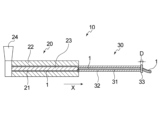
- FIG. 1 is a cross-sectional view that typically shows a cross section along the extrusion direction of one embodiment of a production apparatus that can be used to carry out the method for producing a linear meat-like food product of the present invention.
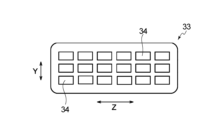
- FIG. 2 is a schematic diagram of a cross section perpendicular to the extrusion direction of the refining unit of the manufacturing apparatus shown in FIG.
- the linear meat-like food of the present invention contains vegetable protein.
- vegetable protein refers to protein obtained from a plant.
- Sources of vegetable protein include, for example, legumes (soybeans, red beans, etc.), grains (wheat, barley, rice, corn, buckwheat, etc.), tubers (potatoes, etc.), nuts and seeds (peanuts, almonds, etc.), and algae.
- the vegetable protein may be treated with enzymes or the like.
- one type of vegetable protein may be used alone or two or more types may be used in combination.
- Suitable vegetable proteins for the present invention include legume proteins derived from legumes and cereal proteins derived from cereals (flours).
- legume proteins include soybean proteins (e.g., defatted soybean flour, concentrated soybean proteins, isolated soybean proteins, extracted soybean proteins), pea proteins, fava bean proteins, chickpea proteins, and mung bean proteins.
- cereal proteins include wheat proteins such as gluten, rice proteins, oat proteins, rapeseed proteins, and potato proteins.
- the content of vegetable protein in the linear meat-like food of the present invention is not particularly limited, but from the viewpoint of more reliably achieving the objective of providing a meat-like food useful as a meat substitute, it is preferably 20% by mass or more, more preferably 60% by mass or more, relative to the total mass of the linear meat-like food, and may be 100% by mass, i.e., the linear meat-like food of the present invention may contain only vegetable protein.
- the linear meat-like food of the present invention may contain other ingredients other than vegetable protein to the extent that it does not inhibit the expression of the desired effect of the present invention (a meat-like food having a texture similar to that of livestock meat can be provided while using vegetable protein).
- examples of the other ingredients include animal protein, starches, polysaccharides, dietary fiber, edible oils and fats, seasonings, colorants, flavorings, and emulsifiers, and these can be used alone or in combination of two or more.
- animal protein as used herein refers to protein obtained from animals. Examples of sources of animal protein include livestock meat, poultry, seafood, insects, eggs, and milk. The animal protein may be treated with enzymes or the like.
- the linear meat-like food of the present invention may contain a binder, which will be described later, as the other ingredient.
- the content of components other than vegetable protein in the linear meat-like food of the present invention is preferably 50% by mass or less, more preferably 30% by mass or less, based on the total mass of the linear meat-like food.
- the moisture content of the linear meat-like food of the present invention must be 40% by mass or more. If the moisture content of the linear meat-like food is less than 40% by mass, the texture will be too hard, and the desired effects of the present invention may not be achieved.
- the "moisture content” referred to here is a value measured according to the bone dry method (a method in which the measurement target is heated to a product temperature of 130°C and the change in weight before and after heating is measured). From the viewpoint of ensuring the desired effects of the present invention, the moisture content of the linear meat-like food of the present invention is preferably 40 to 95% by mass, more preferably 50 to 80% by mass. If the moisture content of the linear meat-like food is too high, the texture may be too soft.
- the moisture content of the linear meat-like food can be adjusted by adjusting the amount of water added to the vegetable protein-containing raw material during the production of the linear meat-like food.
- the linear meat-like food of the present invention has a linear shape that is long in one direction, and the thickness of the linear meat-like food must be 0.1 to 2.5 mm.
- the "thickness” referred to here refers to the maximum across length in the direction perpendicular to the longitudinal direction of the linear meat-like food (hereinafter also referred to as the "width direction").
- the width direction refers to the maximum across length in the direction perpendicular to the longitudinal direction of the linear meat-like food.
- the cross-sectional shape of the linear meat-like food in the width direction is a circle
- the diameter of the circle is the thickness of the linear meat-like food.
- the length of the diagonal of the rectangle is the thickness of the linear meat-like food.
- the thickness of the linear meat-like food of the present invention is preferably 0.2 to 2 mm, more preferably 0.3 to 1 mm.
- the cross-sectional shape along the width direction of the linear meat-like food of the present invention is not particularly limited, and may be, for example, a circle, an ellipse, a triangle, a rectangle, a pentagon or more polygon.
- the minimum diameter length of the linear meat-like food is preferably 0.1 to 2.5 mm, more preferably 0.3 to 1 mm, from the viewpoint of more reliably achieving the specified effects of the present invention.
- the linear meat-like food of the present invention is typically obtained by extruding a raw material containing vegetable protein. That is, the linear meat-like food of the present invention may be obtained by extruding a raw material containing vegetable protein.
- the linear meat-like food of the present invention can be produced using a known extruder in accordance with a conventional method.
- the extruder may be a single-screw or twin-screw extruder, and may be equipped with a cooling die for cooling the extrudate.
- Figure 1 shows a manufacturing apparatus 10, which is one embodiment of a manufacturing apparatus that can be used to implement the method for manufacturing a linear meat-like food product of the present invention.
- the manufacturing apparatus 10 has an extruder 20 that extrudes a raw material containing vegetable protein as an extrudate 1, and a cooling die 30 that is positioned downstream of the extruder 20 in the extrusion direction X, has an internal flow path 31 through which the extrudate 1 moves, and cools the extrudate 1 moving through the flow path 31.
- the extruder 20 is basically configured in the same manner as a known extruder, and includes a hollow cylindrical cylinder 22 having a flow path 21 for the raw material therein, a screw 23 disposed in the flow path 21 and driven to rotate by a driving source such as a motor, and a feeder 24 for supplying the raw material to the flow path 21.
- the flow path 21 extends in the same direction as the extrusion direction X of the cylinder 22 over the entire length of the cylinder 22.
- the extruder 20 may have a heating means (not shown) such as a heater around the cylinder 22, and may be capable of heating the extrudate 1 in the flow path 21.
- the extruder 20 may also be capable of introducing steam into the flow path 21.
- the extruder 20 may be a single-screw extruder having one screw 23, or a twin-screw extruder having two screws 23.
- the cooling die 30 has a hollow cylindrical cylinder 32 having a flow path 31 therein.
- the flow path 31 extends in the same direction as the extrusion direction X over the entire length of the cylinder 32.
- the flow path 21 of the extruder 20 and the flow path 31 of the cooling die 30 are connected, and the extrudate 1 in the flow path 21 is pushed by the screw 23 and flows into the flow path 31.
- the movement direction of the extrudate 1 in the flow path 31 is the same as the extrusion direction X.
- the extrudate 1 is cooled while moving through the flow path 31.
- the cooling method of the extrudate 1 in the cooling die 30 is not particularly limited, and may be, for example, forced cooling using a cooling means, or natural cooling by simply moving the extrudate 1 in the movement direction X through the flow path 31 without using a cooling means.
- the cooling die 30 may have a refrigerant flow path such as a water jacket arranged around the cylinder 32 as the cooling means.
- a refining section 33 is disposed at a downstream end of the flow passage 31 of the cooling die 30 in the moving direction (extrusion direction X) of the extrudate 1.
- the refining section 33 occupies at least a part of the cross section of the flow passage 31 in a direction perpendicular to the extrusion direction X, and in this embodiment, as shown in Fig. 1, is flat and occupies the entire cross section of the flow passage 31 in a direction perpendicular to the extrusion direction X.
- the loosening section 33 has a plurality of through holes 34 penetrating the loosening section 33 in the extrusion direction X.
- the loosening section 33 has a direction Y perpendicular to the extrusion direction X and a direction Z perpendicular to both directions X and Y, and a plurality of through holes 34 are intermittently arranged in each of the directions Y and Z.
- the plurality of through holes 34 have the same shape and size, and form a quadrangular shape (rectangular shape) in a plan view as shown in FIG. 2.
- the arrangement pattern of the through holes 34 in the loosening section 34 (the shape and size of the through holes 34 in a plan view, the arrangement position, the interval between two adjacent through holes 34, 34, and the arrangement number per unit area) is not limited to the form shown in FIG. 2, and can be appropriately set within a range that does not hinder the manifestation of the predetermined effect of the present invention.
- the extrudate 1 in the flow path 31 is pushed by the screw 23 into the loosening section 33, where it is loosened by passing through multiple through holes 34. That is, the extrudate 1, which is a mass having a shape corresponding to the internal shape of the flow path 31, is pushed toward the loosening section 33 by the screw 23 and extruded linearly from each of the multiple through holes 34.
- Each of the multiple linear extrudates 1 that have passed through the through holes 34 of the loosening section 33 in this way is the linear meat-like food of the present invention.
- the linear meat-like food of the present invention which is formed by extruding a raw material containing vegetable protein, contains an oriented fibrous tissue, and the constituent fibers of the fibrous tissue are oriented in the extrusion direction during extrusion.
- the dimensions of the through holes 34 in the plan view of the loosening section 33 as shown in FIG. 2 are closely related to the thickness of the linear meat-like food produced by passing through the loosening section 33, and typically the shape and dimensions of the through holes 34 in the plan view are directly reflected in the shape and dimensions of the linear meat-like food. For this reason, it is preferable that the shape and dimensions of the through holes 34 in the plan view substantially match the shape and dimensions in a cross-sectional view along the width direction of the linear meat-like food to be produced.
- the maximum width length of the through holes 34 in the plan view is also 0.1 to 2.5 mm.
- the reeling section 33 may be a porous structure having through holes 34 drilled in a plate-like member as shown in FIG. 2, or may be a net-like structure having wires processed into a net-like shape by plain weaving or the like.
- the material of the refining portion 33 is not particularly limited, and may be, for example, a metal such as iron, copper, titanium, or stainless steel, or may be ceramic or resin.
- the thickness D of the loosened portion 33 (see FIG. 1), i.e., the length of the loosened portion 33 in the extrusion direction X, is preferably 0.1 to 10 mm, more preferably 1 to 5 mm, from the viewpoint of the balance between the strength and extrudability of the loosened portion 33.
- the extrudate 1 shown in FIG. 2 is typically a mixture of a raw material containing vegetable protein and water.
- the amount of water added to the raw material is preferably 50 to 350 parts by mass, more preferably 100 to 250 parts by mass, per 100 parts by mass of the raw material (raw materials other than water), from the viewpoint of ensuring that the moisture content of the linear meat-like food product is 40% by mass or more as described above and more reliably achieving the specified effects of the present invention.
- the heating temperature during extrusion of the raw material containing vegetable protein is not particularly limited, but from the viewpoint of more reliably achieving the desired effects of the present invention, it is preferable to adjust the product temperature of the raw material at the downstream end in the extrusion direction of the extruder used for extrusion to preferably 100 to 200°C, more preferably 120 to 180°C.
- the product temperature is the product temperature of the extrudate 1 located at the downstream end in the extrusion direction X of the flow path 21 of the extruder 20 (the product temperature of the extrudate 1 immediately before flowing into the flow path 31 of the cooling die 30).
- the extrusion pressure during extrusion of the raw material containing vegetable protein is not particularly limited, but from the viewpoint of more reliably achieving the desired effects of the present invention, it is preferable to adjust the extrusion pressure at the downstream end in the extrusion direction of the extruder used for extrusion to preferably 0.5 to 10.0 MPa, more preferably 1.0 to 5.0 MPa.
- the extrusion pressure is the extrusion pressure at the downstream end in the extrusion direction X of the flow path 21 of the extruder 20 (near the connection with the cooling die 30).
- the cooling temperature of the extrudate 1 by the cooling die 30 is not particularly limited, but from the viewpoint of preventing the extrudate from expanding, it is preferable to adjust the product temperature of the extrudate 1 immediately after it is extruded from the cooling die 30, i.e., the linear meat-like food immediately after production, to preferably 20 to 90°C, more preferably 40 to 70°C. Also, from the viewpoint of efficiently and reliably achieving such a cooling temperature, the length of the flow path 31 of the cooling die 30 is preferably 300 to 2000 mm, more preferably 50 to 1500 mm.
- the linear meat-like food of the present invention may be subjected to a heat treatment such as retort sterilization for the purpose of sterilization, etc. Furthermore, the linear meat-like food of the present invention can be stored in a refrigerator or freezer. A linear meat-like food of the present invention that has been frozen is usually thawed before use. The linear meat-like food of the present invention can be eaten as it is without cooking, or can be eaten after cooking such as baking, frying, steaming, etc. The linear meat-like food of the present invention can also be used in various processed foods.
- the linear meat-like food of the present invention as a raw material for processed foods that do not contain livestock meat such as beef, pork, or chicken, the processed foods can be given a texture similar to that of livestock meat, and the processed foods can become meat-like foods that can be used as substitute meat.
- the linear meat-like food of the present invention can also be incorporated into processed foods that contain livestock meat.
- the meat-like food of the present invention includes the densely integrated product of the linear meat-like food of the present invention described above, and typically consists of the densely integrated product.
- the densely integrated product may contain other ingredients other than vegetable protein, including a binder described below.
- the densely integrated product is a mass of linear meat-like foods of the present invention that are tightly adhered to each other, and is typically a mass of multiple linear meat-like foods that are tightly adhered to each other, but it may also be a mass in which a single linear meat-like food is folded and tightly integrated.
- the meat-like food of the present invention includes a form in which the linear meat-like food particles constituting the densely integrated product are randomly attached to each other and the longitudinal direction of the linear meat-like food particles is not uniform (hereinafter also referred to as the "first form"), and a form in which the linear meat-like food particles constituting the densely integrated product are uniform in the longitudinal direction (hereinafter also referred to as the "second form”), and can be appropriately selected depending on the use of the meat-like food, etc. From the viewpoint of making the texture of the meat-like food (fibrous texture, loose texture, etc.) closer to that of livestock meat, the meat-like food of the second form is preferred.
- the linear meat-like food constituting the densely integrated product may or may not maintain its linear shape.
- the appearance of the densely integrated product may resemble a normal noodle block, which is a block of noodle strings.
- the appearance of the densely integrated product may resemble a normal block of minced meat made from livestock meat.
- the first type of meat-like food product can be obtained, for example, by stirring a linear meat-like food product or a product to which other ingredients such as a binder, which will be described later, have been added.
- the degree to which the linear meat-like food product maintains its linear shape can be adjusted by the degree of such stirring.
- the above-mentioned "longitudinal direction being aligned” means that the angle between the longitudinal directions of any two linear meat-like foods constituting the meat-like food (including two linear meat-like foods consisting of one part and the other part of a folded linear meat-like food; the same applies hereinafter unless otherwise specified) is 45 degrees or less.
- the constituent fibers of the fibrous tissue contained in the linear meat-like food are oriented substantially in one direction (the longitudinal direction of the linear meat-like food), making it possible to more reliably impart to the meat-like food a texture (fibrous texture, loose texture, etc.) similar to that of livestock meat.
- the second type of meat-like food can be obtained, for example, by aligning the longitudinal directions of linear meat-like foods when densely packing and integrating them (making the angle between the longitudinal directions of any two linear meat-like foods 45 degrees or less).
- the linear meat-like food constituting the meat-like food of the present invention may be one type or two or more types.
- the linear meat-like foods being compared have the same composition and thickness, they are of the same kind, and when the compositions or thicknesses are different, they are of different kinds.
- a preferred example of the meat-like food of the present invention includes one or more linear meat-like foods selected from the following 1) to 3) (hereinafter, also referred to as "meat-like food A").
- Meat-like food A is particularly useful as a substitute for chicken breast meat.
- a linear meat-like food having a thickness of 0.10 to 0.50 mm, preferably 0.15 to 0.45 mm, and more preferably 0.20 to 0.40 mm (hereinafter also referred to as "thin linear meat-like food”). 2) A linear meat-like food having a thickness of 0.51 to 0.74 mm, preferably 0.45 to 0.70 mm, and more preferably 0.50 to 0.65 mm (hereinafter also referred to as “medium-linear meat-like food”).
- a linear meat-like food having a thickness of 0.75 to 1.00 mm, preferably 0.80 to 0.95 mm, and more preferably 0.70 to 0.90 mm (hereinafter also referred to as "thick linear meat-like food”).
- An example of the meat-like food A includes two types of linear meat-like foods, a thick-line meat-like food and a medium-line meat-like food.
- the proportion of the thick-line meat-like food in the linear meat-like food is preferably 5 to 95% by mass, more preferably 10 to 90% by mass, and the remaining linear meat-like food is the medium-line meat-like food.
- Another example of the meat-like food A is one that contains two types of linear meat-like food: a thick linear meat-like food and a thin linear meat-like food.
- the proportion of the thick linear meat-like food in the linear meat-like food is preferably 5 to 95% by mass, more preferably 10 to 90% by mass, and the remaining linear meat-like food is thin linear meat-like food.
- meat-like food A includes three types of linear meat-like food: thick-line meat-like food, medium-line meat-like food, and thin-line meat-like food.
- the proportion of thick-line meat-like food in the linear meat-like food is preferably 10 to 90% by mass, more preferably 20 to 80% by mass
- the proportion of medium-line meat-like food in the linear meat-like food is preferably 10 to 90% by mass, more preferably 20 to 80% by mass
- the remaining linear meat-like food is thin-line meat-like food.
- the meat-like food of the present invention may contain a binder that binds the linear meat-like foods together. This increases the degree of integration between the linear meat-like foods that make up the meat-like food, further improving the processing suitability of the meat-like food.
- binders include vegetable proteins, starch, thickening polysaccharides, egg white powder, whole egg powder, milk protein, gelatin, agar, methylcellulose, hydroxypropylmethylcellulose, and transglutaminase, and one of these binders can be used alone or two or more can be used in combination.
- vegetable proteins include isolated soy protein, concentrated soy protein, soy milk powder, defatted soy flour, fat-containing soy flour, and wheat protein (gluten).
- starches examples include unprocessed starches such as potato starch, corn starch, tapioca starch, sago starch, and wheat starch; and processed starches obtained by subjecting unprocessed starches to one or more of the following treatments: oil processing, etherification, esterification, acetylation, cross-linking, and oxidation.
- thickening polysaccharides examples include xanthan gum, guar gum, locust bean gum, carrageenan, and alginic acid.
- transglutaminase a type of enzyme, is particularly preferred.
- the content of the binder in the meat-like food of the present invention is preferably 0.5 to 50 parts by mass, more preferably 1 to 30 parts by mass, per 100 parts by mass of vegetable protein in the meat-like food.
- the meat-like food of the present invention may contain other ingredients in addition to the linear meat-like food and binder, to the extent that it does not inhibit the expression of the desired effect of the present invention (having a texture similar to that of livestock meat, despite using vegetable protein).
- the other ingredients include starches, polysaccharides, dietary fiber, edible oils and fats, seasonings, colorants, fragrances, and emulsifiers, and one of these may be used alone or two or more may be used in combination.
- the content of the other ingredients in the meat-like food of the present invention is preferably 10% by mass or less, more preferably 5% by mass or less, based on the total mass of the meat-like food.
- the meat-like food of the present invention may have a coating that covers the densely integrated material.
- the presence of the coating coupled with the effect of improving shape retention by the linear meat-like food of the present invention, further improves the shape retention of the meat-like food, making the meat-like food more suitable for processing.
- the presence of the coating suppresses the loss of moisture during cooking of the meat-like food, increasing the juiciness of the meat-like food and increasing the hardness of the meat-like food, making the texture of the meat-like food closer to the texture of livestock meat.
- the coating contains a coating material as a main component.
- the content of the coating material in the coating is usually 0.5 mass % or more based on the total mass of the coating, and may be 100 mass %, i.e., the entire coating may be the coating material.
- the coating material include carbohydrates such as sodium alginate, potassium alginate, calcium alginate, agar, and konjac; metal ions such as sodium ions, calcium ions, magnesium ions, and aluminum ions; thickening polysaccharides such as carrageenan ( ⁇ type, ⁇ type, and ⁇ type), gellan gum, pectin, and xanthan gum; vegetable proteins; and starches. These can be used alone or in combination of two or more.
- the metal ions have the function of coagulating the carbohydrates when they come into contact with them, thereby promoting the formation of a coating.
- the vegetable proteins, starches, and thickening polysaccharides can be those that can be used as the binding materials.
- the thickness of the coating is preferably 1 to 3000 ⁇ m, and more preferably 1 to 1000 ⁇ m.
- the method for forming the coating is not particularly limited, and the coating can be formed using a conventionally known method for forming a coating on food. The technology described in Patent Document 2 can be appropriately applied to the coating.
- the method for producing a meat-like food product of the present invention includes a process for consolidating and integrating raw materials containing linear meat-like foods.
- the "raw materials containing linear meat-like foods” may contain only linear meat-like foods, or may contain linear meat-like foods and other ingredients (e.g., binders).
- the integration step can be carried out by consolidating the raw material including the linear meat-like food and forming it into a desired shape as necessary.
- the consolidation of the raw material can be carried out, for example, by a method of assembling a plurality of linear meat-like food so that they come into contact with each other, or by a method of folding one linear meat-like food one or more times.
- the compression molding is a method of stirring the raw material containing the linear meat-like food. Stirring of such raw material can typically be performed by hand or using a tool such as a stirrer, by stirring the entire raw material containing the linear meat-like food.
- Another example of the compression molding is a method of compressing the raw material containing the linear meat-like food using a known compression means such as a press.
- the compression molding may be performed in an environment of normal pressure (1 atm) or in a reduced pressure environment (including vacuum).
- a specific example of the latter is a method of vacuum packaging a raw material containing a linear meat-like food.
- the raw material to be vacuum packaged may be a raw material containing a linear meat-like food that has been compression molded by stirring or compressing with a press, i.e., already densely integrated.
- Vacuum packaging can be performed according to a conventional method, and typically, it can be performed by placing the raw material containing a linear meat-like food inside a packaging container, sucking the air inside the packaging container to degas it, creating a vacuum inside the packaging container, and sealing the packaging container.
- the entire raw material is moderately compressed by the packaging container, so that the raw material becomes densely integrated, and if the raw material is already densely integrated by stirring, the degree of density integration is increased.
- a raw material containing a linear meat-like food is vacuum packaged, it is possible to obtain a meat-like food with excellent shape retention even if the raw material does not contain a binder.
- the degree of vacuum in the vacuum packaging is preferably 50 to 100%, more preferably 80 to 98%, when the absolute vacuum is 100% and the atmospheric pressure is 0%.
- the packaging container may be made of any material having gas barrier properties that can be used for vacuum packaging, and examples of the packaging container include bag-shaped containers made of synthetic resin.
- the ingredients to be placed inside the packaging container may be packed into a mold corresponding to the desired shape, and the mold may be placed inside the packaging container to create a vacuum inside the container.
- the binder is attached to the surface of the linear meat-like food, and then the linear meat-like food is densely integrated.
- the binder attached to the surface of the linear meat-like food is a powder at room temperature and normal pressure (ambient temperature 20° C., 1 atm) from the viewpoint of handleability, etc.
- a process can be adopted in which a powdered binder is sprinkled on the surface of a linear meat-like food, and then the linear meat-like food is compressed and molded by stirring and/or compressing with a press.
- a process when producing the second type of meat-like food product, a process can be adopted in which a plurality of linear meat-like foods or a single folded linear meat-like food product are arranged so that their longitudinal directions are aligned (the angle between the longitudinal directions of any two linear meat-like foods is 45 degrees or less), and then a powdered binder is sprinkled on the surface of the aligned and arranged linear meat-like foods.
- a series of operations consisting of aligning the linear meat-like foods and then sprinkling the binder may be repeated multiple times.
- the raw material containing the linear meat-like food may be heat-treated as necessary.
- the raw material contains an enzyme (transglutaminase, etc.), a thickening polysaccharide (xanthan gum, etc.), a protein (soybean protein, etc.), or a starch (various processed starches, etc.) as a binder, it is preferable to carry out the heat treatment.
- the enzyme as a binder is inactivated, the thickening polysaccharide as a binder becomes more viscous, the protein as a binder is heat-coagulated, and the starch as a binder is gelatinized, and as a result, the shape retention and texture of the finally obtained meat-like food can be further improved.
- the timing of carrying out the heat treatment is not particularly limited.
- the raw material containing the linear meat-like food is heat-treated after the raw material is densely integrated by compression molding, etc., but the raw material may be heat-treated before the raw material is densely integrated, or may be heat-treated while the raw material is being densely integrated.
- the conditions of the heat treatment are not particularly limited and may be appropriately adjusted depending on the type of binder used.
- the heating temperature product temperature of the raw material including the linear meat-like food
- the heating time time for maintaining the product temperature
- a step of forming the coating is carried out after the integration step.
- the method for producing a meat-like food of the present invention may have a coating formation step after the integration step.
- An example of the coating process includes a process of immersing the densely integrated product of the linear meat-like food obtained in the integration process in a liquid containing the coating material (coating material liquid), and then drying it as necessary.
- the immersion process of the densely integrated product in the coating material liquid may be carried out multiple times.
- the process includes a process of immersing the densely integrated product in a liquid containing the carbohydrate (coating material) and a liquid containing the metal ion (coating material) in that order, or in the reverse order.
- Another example of the coating formation process includes a process in which a powder of one or more coating materials selected from vegetable protein, starch, and thickening polysaccharides is adhered to the surface of the densely integrated material, the densely integrated material is then immersed in water, and then the densely integrated material is heat-treated.
- the amount of the coating material used in the coating formation step is preferably 0.1 to 10 parts by mass, and more preferably 0.1 to 5 parts by mass, based on 100 parts by mass of the dense integrated body.
- Loosening section a 20 mesh, wire diameter 0.25 mm, mesh opening 0.78 mm
- Loosening section b 30 mesh, wire diameter 0.18 mm, mesh size 0.60 mm
- Loosening section c 40 mesh, wire diameter 0.15 mm, mesh size 0.42 mm
- a meat-like food was produced as a substitute for chicken breast meat using the linear meat-like foods A to F.
- a meat-like food was produced by densely integrating raw materials containing at least one of the linear meat-like foods A to F using one of the following integration methods A to G.
- integration method B is a method for obtaining a meat-like food of the second type, and the other methods are methods for obtaining a meat-like food of the first type.
- Integration method A After the raw materials including the linear meat-like food (including a binder if one is used; the same applies below) are all mixed by hand, the mixed material is packed into a mold, and the mold is placed in a sealable bag with a zipper and heat-treated, and then left at room temperature for 30 minutes and allowed to cool naturally.
- - Integration method B A series of operations consisting of arranging linear meat-like foods and then spreading a binder is repeated multiple times.
- a plurality of linear meat-like foods are laid out on the bottom of a mold so that their longitudinal directions are aligned, and then the binder is uniformly spread over the entire upper surface of the aligned linear meat-like foods (first operation), and then, on the binder-spread surface of the linear meat-like foods, another plurality of linear meat-like foods are aligned so that their longitudinal directions are aligned, and then the binder is uniformly spread over the entire upper surface of the other plurality of linear meat-like foods (second operation).
- the mold is placed in a sealable bag with a zipper and heat-treated, and then left at room temperature for 30 minutes to cool naturally.
- Integration method C The raw material containing the linear meat-like food is packed into a mold, and the raw material is compressed in its thickness direction at a pressure of 0.3 MPa for 5 seconds using a press machine ("MS1-100" manufactured by Riken Seiki Co., Ltd.). Integration method D: Same as integration method C, except that the pressure applied by the press was 0.1 MPa and the compression time was 1 second.
- Integration method E After the raw materials including the linear meat-like food are all mixed by hand, the mixture is packed into a mold, the mold is placed in a sealable bag with a zipper, and vacuum-packed at a vacuum degree of 90% using a vacuum packaging machine ("Z3000" manufactured by Fujimac Co., Ltd.) After that, the vacuum-packed product is heat-treated and then left at room temperature for 30 minutes to cool naturally. Integration method F: Same as integration method E, except that the degree of vacuum was 95%. Integration method G: Same as integration method E, except that the degree of vacuum was 98%.
- a plastic tray with an open top and a bottom was used as the mold used in the integration method.
- This tray had an elliptical shape with a short axis length of 7 cm and a long axis length of 10 cm when viewed from above, and a depth of 2 cm.
- the binders used in the production of the linear meat-like foods A to F and the details of the heat treatment carried out in the integration step are as follows. All of the binders used were in powder form at room temperature and normal pressure (ambient temperature 20°C, 1 atm).
- Binder A Transglutaminase (heating temperature in heat treatment: 95° C., heating time: 5 minutes)
- Binder B Xanthan gum (heating temperature in heat treatment: 95° C., heating time: 5 minutes)
- Binder C Guar gum (heating temperature in heat treatment: 95° C., heating time: 5 minutes)
- Binder D soy protein (heating temperature 95°C, heating time 5 minutes)
- Binder E Wheat protein (heating temperature 95°C, heating time 5 minutes)
- Binder F Etherified tapioca starch (heating temperature in heat treatment: 95° C., heating time: 5 minutes)
- Binder G Wheat starch (heating temperature 95°C, heating time 5 minutes)
- Binder H a mixture of transglutaminase, wheat protein, and wheat starch at a ratio of 1:5:5 (heating temperature of 95° C., heating time of 5 minutes)
- Example 22 to 26 A meat-like food was produced in the same manner as in Example 21, except that after integrating the raw materials including the linear meat-like food, the densely integrated product of the linear meat-like food obtained in the integration step was subjected to a coating step to form a coating on the entire surface of the densely integrated product. In the coating step, the following coating method A or B was adopted. The thickness of the coating in the produced meat-like food was 1000 to 2000 ⁇ m.
- Coating method B After the powder of any one of the coating materials C to E described below is applied to the entire surface of the workpiece (the dense integrated body), the workpiece is immersed in water, and then the workpiece is heat-treated in an oven. Regardless of which of the coating materials C to E is used, the heating temperature in the heat treatment is 160°C and the heating time is 5 minutes.
- Coating material C vegetable protein ("Nutralys F85M” manufactured by Rocket Japan Co., Ltd.)
- Coating material D Starch (cornstarch, "Seiun 500" manufactured by Oji Cornstarch Co., Ltd.)
- Coating material E Starch (cornstarch, "Batter Lite T” manufactured by Oji Cornstarch Co., Ltd.)
- the meat-like foods to be evaluated were cooked by 10 expert panelists, who evaluated the shape retention of the meat-like foods according to the following evaluation criteria.
- the meat-like foods were cooked (fried) by the following procedure. That is, the meat-like foods and seasoning liquid were placed in a bag-shaped container having gas barrier properties, and the meat-like foods were left to stand for 30 minutes while being entirely immersed in the seasoning liquid. The meat-like foods were then taken out, and excess seasoning liquid was removed. Flour and batter were applied to the surface of the meat-like foods, and the foods were fried in oil at a temperature of 180° C. for 1.5 minutes to produce deep-fried meat-like foods.
- the linear meat-like food of the present invention has high shape retention and excellent processing suitability, making it suitable as a raw material for meat-like foods as meat substitutes. Because the meat-like food of the present invention uses the linear meat-like food of the present invention as a raw material, it contains vegetable protein, but has a texture (specifically, hardness, fibrous texture, etc.) similar to the texture of livestock meat such as beef, pork, and chicken.
Landscapes
- Life Sciences & Earth Sciences (AREA)
- Chemical & Material Sciences (AREA)
- Health & Medical Sciences (AREA)
- Nutrition Science (AREA)
- Engineering & Computer Science (AREA)
- Food Science & Technology (AREA)
- Polymers & Plastics (AREA)
- Biochemistry (AREA)
- Meat, Egg Or Seafood Products (AREA)
Priority Applications (1)
| Application Number | Priority Date | Filing Date | Title |
|---|---|---|---|
| JP2024537108A JPWO2024224918A1 (https=) | 2023-04-27 | 2024-03-26 |
Applications Claiming Priority (2)
| Application Number | Priority Date | Filing Date | Title |
|---|---|---|---|
| JP2023073695 | 2023-04-27 | ||
| JP2023-073695 | 2023-04-27 |
Publications (1)
| Publication Number | Publication Date |
|---|---|
| WO2024224918A1 true WO2024224918A1 (ja) | 2024-10-31 |
Family
ID=93256057
Family Applications (1)
| Application Number | Title | Priority Date | Filing Date |
|---|---|---|---|
| PCT/JP2024/012106 Ceased WO2024224918A1 (ja) | 2023-04-27 | 2024-03-26 | 線状肉様食品及びそれを用いた肉様食品並びにそれらの製造方法 |
Country Status (2)
| Country | Link |
|---|---|
| JP (1) | JPWO2024224918A1 (https=) |
| WO (1) | WO2024224918A1 (https=) |
Cited By (2)
| Publication number | Priority date | Publication date | Assignee | Title |
|---|---|---|---|---|
| WO2025182737A1 (ja) * | 2024-02-27 | 2025-09-04 | 株式会社日清製粉グループ本社 | 肉様食品及びその製造方法 |
| WO2026070516A1 (ja) * | 2024-09-24 | 2026-04-02 | 株式会社日清製粉グループ本社 | 成形肉様食品及びその製造方法 |
Citations (8)
| Publication number | Priority date | Publication date | Assignee | Title |
|---|---|---|---|---|
| JPS5799159A (en) * | 1980-12-05 | 1982-06-19 | Kanebo Shokuhin Kk | Production of food product of fibrous bundle |
| JPS61166365A (ja) * | 1985-01-18 | 1986-07-28 | Norin Suisansyo Shokuhin Sogo Kenkyusho | 肉様柔軟植物性蛋白素材の製造方法 |
| JPS61212268A (ja) * | 1985-03-18 | 1986-09-20 | Mitsubishi Heavy Ind Ltd | 押出機用ダイ |
| JPS62201547A (ja) * | 1986-02-28 | 1987-09-05 | Tech Res Assoc Extru Cook Food Ind | 蛋白食品の製造方法 |
| JP2010200627A (ja) * | 2009-02-27 | 2010-09-16 | House Foods Corp | 擬似肉食品およびその製造方法 |
| JP2011072264A (ja) * | 2009-09-30 | 2011-04-14 | House Foods Corp | 擬似肉食品およびその製造方法 |
| WO2012127694A1 (ja) * | 2011-03-23 | 2012-09-27 | ハウス食品株式会社 | 擬似肉食品およびその製造方法 |
| JP2022032495A (ja) * | 2020-08-12 | 2022-02-25 | イビデン株式会社 | 牛・豚肉様食品 |
-
2024
- 2024-03-26 WO PCT/JP2024/012106 patent/WO2024224918A1/ja not_active Ceased
- 2024-03-26 JP JP2024537108A patent/JPWO2024224918A1/ja active Pending
Patent Citations (8)
| Publication number | Priority date | Publication date | Assignee | Title |
|---|---|---|---|---|
| JPS5799159A (en) * | 1980-12-05 | 1982-06-19 | Kanebo Shokuhin Kk | Production of food product of fibrous bundle |
| JPS61166365A (ja) * | 1985-01-18 | 1986-07-28 | Norin Suisansyo Shokuhin Sogo Kenkyusho | 肉様柔軟植物性蛋白素材の製造方法 |
| JPS61212268A (ja) * | 1985-03-18 | 1986-09-20 | Mitsubishi Heavy Ind Ltd | 押出機用ダイ |
| JPS62201547A (ja) * | 1986-02-28 | 1987-09-05 | Tech Res Assoc Extru Cook Food Ind | 蛋白食品の製造方法 |
| JP2010200627A (ja) * | 2009-02-27 | 2010-09-16 | House Foods Corp | 擬似肉食品およびその製造方法 |
| JP2011072264A (ja) * | 2009-09-30 | 2011-04-14 | House Foods Corp | 擬似肉食品およびその製造方法 |
| WO2012127694A1 (ja) * | 2011-03-23 | 2012-09-27 | ハウス食品株式会社 | 擬似肉食品およびその製造方法 |
| JP2022032495A (ja) * | 2020-08-12 | 2022-02-25 | イビデン株式会社 | 牛・豚肉様食品 |
Non-Patent Citations (2)
| Title |
|---|
| ISOBE, SEIICHIROU ET AL.: "High Moisture Extrusion with Twin Screw Extruder", NIPPON SHOKUHIN KOGYO GAKKAISHI, vol. 34, no. 7, 1987, pages 456 - 461, XP093201911, DOI: 10.3136/nskkk1962.34.7_456 * |
| SAIO, KYOKO: "Expansion and Texturization Mechanisms of Soybean Protein, Relating to the Microstructures", NIPPON SHOKUHIN KOGYO GAKKAISHI, vol. 34, no. 6, 1987, pages 407 - 416, XP093201918, DOI: 10.3136/nskkk1962.34.6_407 * |
Cited By (2)
| Publication number | Priority date | Publication date | Assignee | Title |
|---|---|---|---|---|
| WO2025182737A1 (ja) * | 2024-02-27 | 2025-09-04 | 株式会社日清製粉グループ本社 | 肉様食品及びその製造方法 |
| WO2026070516A1 (ja) * | 2024-09-24 | 2026-04-02 | 株式会社日清製粉グループ本社 | 成形肉様食品及びその製造方法 |
Also Published As
| Publication number | Publication date |
|---|---|
| JPWO2024224918A1 (https=) | 2024-10-31 |
Similar Documents
| Publication | Publication Date | Title |
|---|---|---|
| US5437885A (en) | Method of making a non-porous vegetable protein fiber product | |
| JP5566053B2 (ja) | 食品組成物 | |
| WO2024224918A1 (ja) | 線状肉様食品及びそれを用いた肉様食品並びにそれらの製造方法 | |
| JP7824872B2 (ja) | 植物性たん白含有食品 | |
| WO2012127694A1 (ja) | 擬似肉食品およびその製造方法 | |
| JP6521258B2 (ja) | 海老肉代替物及びその製造法 | |
| JP7672987B2 (ja) | 成形食品の加工用組成物 | |
| JP2020150892A (ja) | 肉様食品 | |
| JP6881689B2 (ja) | 膨化蛋白素材の製造法 | |
| JP2009512444A (ja) | パフスナック製品及びその製造方法 | |
| JP2023515879A5 (https=) | ||
| JPH0866157A (ja) | 組織状蛋白食品素材 | |
| CN115003167A (zh) | 面条类的制作方法 | |
| JP7798021B2 (ja) | 着香された組織状蛋白素材の製造法 | |
| JP7580931B2 (ja) | 肉類代替食品用組成物の製造方法及び肉類代替食品の製造方法 | |
| JP4840134B2 (ja) | 肉様加工食品の製造法 | |
| JP2001327253A (ja) | 組織状蛋白の製造法 | |
| JP2023002914A (ja) | 植物性蛋白を含んでなる肉類代替食品 | |
| WO2026070516A1 (ja) | 成形肉様食品及びその製造方法 | |
| JPS6112254A (ja) | 加工食品の製造法 | |
| JP7408257B2 (ja) | 肉様食品用組成物、肉様食品及びその製造方法並びに肉様食品の品質改良方法 | |
| WO2020196714A1 (ja) | 植物ベースの繊維性肉代替食品及びその製造法 | |
| JP7759737B2 (ja) | 畜肉様食品 | |
| JP2000308472A (ja) | 魚卵塊食品およびその製造方法 | |
| WO2026053699A1 (ja) | 組織化植物性タンパク質、イミテーション食品、およびイミテーション食品への食感付与方法 |
Legal Events
| Date | Code | Title | Description |
|---|---|---|---|
| WWE | Wipo information: entry into national phase |
Ref document number: 2024537108 Country of ref document: JP |
|
| 121 | Ep: the epo has been informed by wipo that ep was designated in this application |
Ref document number: 24796676 Country of ref document: EP Kind code of ref document: A1 |
|
| WWE | Wipo information: entry into national phase |
Ref document number: 2501004532 Country of ref document: TH |
|
| NENP | Non-entry into the national phase |
Ref country code: DE |