WO2024147356A1 - 無溶媒系有機無機ハイブリッド樹脂組成物及び硬化膜 - Google Patents
無溶媒系有機無機ハイブリッド樹脂組成物及び硬化膜 Download PDFInfo
- Publication number
- WO2024147356A1 WO2024147356A1 PCT/JP2024/000072 JP2024000072W WO2024147356A1 WO 2024147356 A1 WO2024147356 A1 WO 2024147356A1 JP 2024000072 W JP2024000072 W JP 2024000072W WO 2024147356 A1 WO2024147356 A1 WO 2024147356A1
- Authority
- WO
- WIPO (PCT)
- Prior art keywords
- ppm
- silica particles
- resin composition
- organic
- inorganic hybrid
- Prior art date
- Legal status (The legal status is an assumption and is not a legal conclusion. Google has not performed a legal analysis and makes no representation as to the accuracy of the status listed.)
- Ceased
Links
Classifications
-
- C—CHEMISTRY; METALLURGY
- C08—ORGANIC MACROMOLECULAR COMPOUNDS; THEIR PREPARATION OR CHEMICAL WORKING-UP; COMPOSITIONS BASED THEREON
- C08L—COMPOSITIONS OF MACROMOLECULAR COMPOUNDS
- C08L63/00—Compositions of epoxy resins; Compositions of derivatives of epoxy resins
-
- C—CHEMISTRY; METALLURGY
- C08—ORGANIC MACROMOLECULAR COMPOUNDS; THEIR PREPARATION OR CHEMICAL WORKING-UP; COMPOSITIONS BASED THEREON
- C08J—WORKING-UP; GENERAL PROCESSES OF COMPOUNDING; AFTER-TREATMENT NOT COVERED BY SUBCLASSES C08B, C08C, C08F, C08G or C08H
- C08J5/00—Manufacture of articles or shaped materials containing macromolecular substances
- C08J5/18—Manufacture of films or sheets
-
- C—CHEMISTRY; METALLURGY
- C01—INORGANIC CHEMISTRY
- C01B—NON-METALLIC ELEMENTS; COMPOUNDS THEREOF; METALLOIDS OR COMPOUNDS THEREOF NOT COVERED BY SUBCLASS C01C
- C01B33/00—Silicon; Compounds thereof
- C01B33/113—Silicon oxides; Hydrates thereof
- C01B33/12—Silica; Hydrates thereof, e.g. lepidoic silicic acid
- C01B33/18—Preparation of finely divided silica neither in sol nor in gel form; After-treatment thereof
-
- C—CHEMISTRY; METALLURGY
- C08—ORGANIC MACROMOLECULAR COMPOUNDS; THEIR PREPARATION OR CHEMICAL WORKING-UP; COMPOSITIONS BASED THEREON
- C08G—MACROMOLECULAR COMPOUNDS OBTAINED OTHERWISE THAN BY REACTIONS ONLY INVOLVING UNSATURATED CARBON-TO-CARBON BONDS
- C08G59/00—Polycondensates containing more than one epoxy group per molecule; Macromolecules obtained by polymerising compounds containing more than one epoxy group per molecule using curing agents or catalysts which react with the epoxy groups
- C08G59/18—Macromolecules obtained by polymerising compounds containing more than one epoxy group per molecule using curing agents or catalysts which react with the epoxy groups ; e.g. general methods of curing
-
- C—CHEMISTRY; METALLURGY
- C08—ORGANIC MACROMOLECULAR COMPOUNDS; THEIR PREPARATION OR CHEMICAL WORKING-UP; COMPOSITIONS BASED THEREON
- C08G—MACROMOLECULAR COMPOUNDS OBTAINED OTHERWISE THAN BY REACTIONS ONLY INVOLVING UNSATURATED CARBON-TO-CARBON BONDS
- C08G59/00—Polycondensates containing more than one epoxy group per molecule; Macromolecules obtained by polymerising compounds containing more than one epoxy group per molecule using curing agents or catalysts which react with the epoxy groups
- C08G59/18—Macromolecules obtained by polymerising compounds containing more than one epoxy group per molecule using curing agents or catalysts which react with the epoxy groups ; e.g. general methods of curing
- C08G59/20—Macromolecules obtained by polymerising compounds containing more than one epoxy group per molecule using curing agents or catalysts which react with the epoxy groups ; e.g. general methods of curing characterised by the epoxy compounds used
- C08G59/22—Di-epoxy compounds
- C08G59/24—Di-epoxy compounds carbocyclic
-
- C—CHEMISTRY; METALLURGY
- C08—ORGANIC MACROMOLECULAR COMPOUNDS; THEIR PREPARATION OR CHEMICAL WORKING-UP; COMPOSITIONS BASED THEREON
- C08G—MACROMOLECULAR COMPOUNDS OBTAINED OTHERWISE THAN BY REACTIONS ONLY INVOLVING UNSATURATED CARBON-TO-CARBON BONDS
- C08G59/00—Polycondensates containing more than one epoxy group per molecule; Macromolecules obtained by polymerising compounds containing more than one epoxy group per molecule using curing agents or catalysts which react with the epoxy groups
- C08G59/18—Macromolecules obtained by polymerising compounds containing more than one epoxy group per molecule using curing agents or catalysts which react with the epoxy groups ; e.g. general methods of curing
- C08G59/40—Macromolecules obtained by polymerising compounds containing more than one epoxy group per molecule using curing agents or catalysts which react with the epoxy groups ; e.g. general methods of curing characterised by the curing agents used
- C08G59/42—Polycarboxylic acids; Anhydrides, halides or low molecular weight esters thereof
-
- C—CHEMISTRY; METALLURGY
- C08—ORGANIC MACROMOLECULAR COMPOUNDS; THEIR PREPARATION OR CHEMICAL WORKING-UP; COMPOSITIONS BASED THEREON
- C08G—MACROMOLECULAR COMPOUNDS OBTAINED OTHERWISE THAN BY REACTIONS ONLY INVOLVING UNSATURATED CARBON-TO-CARBON BONDS
- C08G59/00—Polycondensates containing more than one epoxy group per molecule; Macromolecules obtained by polymerising compounds containing more than one epoxy group per molecule using curing agents or catalysts which react with the epoxy groups
- C08G59/18—Macromolecules obtained by polymerising compounds containing more than one epoxy group per molecule using curing agents or catalysts which react with the epoxy groups ; e.g. general methods of curing
- C08G59/40—Macromolecules obtained by polymerising compounds containing more than one epoxy group per molecule using curing agents or catalysts which react with the epoxy groups ; e.g. general methods of curing characterised by the curing agents used
- C08G59/50—Amines
-
- C—CHEMISTRY; METALLURGY
- C08—ORGANIC MACROMOLECULAR COMPOUNDS; THEIR PREPARATION OR CHEMICAL WORKING-UP; COMPOSITIONS BASED THEREON
- C08K—Use of inorganic or non-macromolecular organic substances as compounding ingredients
- C08K3/00—Use of inorganic substances as compounding ingredients
- C08K3/34—Silicon-containing compounds
- C08K3/36—Silica
-
- C—CHEMISTRY; METALLURGY
- C08—ORGANIC MACROMOLECULAR COMPOUNDS; THEIR PREPARATION OR CHEMICAL WORKING-UP; COMPOSITIONS BASED THEREON
- C08K—Use of inorganic or non-macromolecular organic substances as compounding ingredients
- C08K5/00—Use of organic ingredients
- C08K5/04—Oxygen-containing compounds
- C08K5/09—Carboxylic acids; Metal salts thereof; Anhydrides thereof
-
- C—CHEMISTRY; METALLURGY
- C08—ORGANIC MACROMOLECULAR COMPOUNDS; THEIR PREPARATION OR CHEMICAL WORKING-UP; COMPOSITIONS BASED THEREON
- C08K—Use of inorganic or non-macromolecular organic substances as compounding ingredients
- C08K5/00—Use of organic ingredients
- C08K5/16—Nitrogen-containing compounds
- C08K5/17—Amines; Quaternary ammonium compounds
-
- C—CHEMISTRY; METALLURGY
- C08—ORGANIC MACROMOLECULAR COMPOUNDS; THEIR PREPARATION OR CHEMICAL WORKING-UP; COMPOSITIONS BASED THEREON
- C08K—Use of inorganic or non-macromolecular organic substances as compounding ingredients
- C08K9/00—Use of pretreated ingredients
- C08K9/04—Ingredients treated with organic substances
- C08K9/06—Ingredients treated with organic substances with silicon-containing compounds
-
- C—CHEMISTRY; METALLURGY
- C09—DYES; PAINTS; POLISHES; NATURAL RESINS; ADHESIVES; COMPOSITIONS NOT OTHERWISE PROVIDED FOR; APPLICATIONS OF MATERIALS NOT OTHERWISE PROVIDED FOR
- C09D—COATING COMPOSITIONS, e.g. PAINTS, VARNISHES OR LACQUERS; FILLING PASTES; CHEMICAL PAINT OR INK REMOVERS; INKS; CORRECTING FLUIDS; WOODSTAINS; PASTES OR SOLIDS FOR COLOURING OR PRINTING; USE OF MATERIALS THEREFOR
- C09D163/00—Coating compositions based on epoxy resins; Coating compositions based on derivatives of epoxy resins
-
- C—CHEMISTRY; METALLURGY
- C08—ORGANIC MACROMOLECULAR COMPOUNDS; THEIR PREPARATION OR CHEMICAL WORKING-UP; COMPOSITIONS BASED THEREON
- C08J—WORKING-UP; GENERAL PROCESSES OF COMPOUNDING; AFTER-TREATMENT NOT COVERED BY SUBCLASSES C08B, C08C, C08F, C08G or C08H
- C08J2363/00—Characterised by the use of epoxy resins; Derivatives of epoxy resins
-
- C—CHEMISTRY; METALLURGY
- C08—ORGANIC MACROMOLECULAR COMPOUNDS; THEIR PREPARATION OR CHEMICAL WORKING-UP; COMPOSITIONS BASED THEREON
- C08K—Use of inorganic or non-macromolecular organic substances as compounding ingredients
- C08K2201/00—Specific properties of additives
- C08K2201/002—Physical properties
- C08K2201/005—Additives being defined by their particle size in general
-
- C—CHEMISTRY; METALLURGY
- C08—ORGANIC MACROMOLECULAR COMPOUNDS; THEIR PREPARATION OR CHEMICAL WORKING-UP; COMPOSITIONS BASED THEREON
- C08K—Use of inorganic or non-macromolecular organic substances as compounding ingredients
- C08K2201/00—Specific properties of additives
- C08K2201/011—Nanostructured additives
-
- C—CHEMISTRY; METALLURGY
- C08—ORGANIC MACROMOLECULAR COMPOUNDS; THEIR PREPARATION OR CHEMICAL WORKING-UP; COMPOSITIONS BASED THEREON
- C08K—Use of inorganic or non-macromolecular organic substances as compounding ingredients
- C08K7/00—Use of ingredients characterised by shape
- C08K7/16—Solid spheres
- C08K7/18—Solid spheres inorganic
-
- C—CHEMISTRY; METALLURGY
- C08—ORGANIC MACROMOLECULAR COMPOUNDS; THEIR PREPARATION OR CHEMICAL WORKING-UP; COMPOSITIONS BASED THEREON
- C08K—Use of inorganic or non-macromolecular organic substances as compounding ingredients
- C08K9/00—Use of pretreated ingredients
- C08K9/04—Ingredients treated with organic substances
Definitions
- the present invention relates to a solvent-free organic-inorganic hybrid resin composition, a cured film obtained from the resin composition, and a method for producing the cured film.
- Patent Documents 1, 2, 3, 4 electronic components used in electronic products such as liquid crystal display devices and organic EL display devices, semiconductor devices, digital cameras with automatic correction, noise-canceling wireless earphones, and high-definition inkjet printers are required to be smaller, more precise, and thinner as their functionality increases.
- the required characteristics of these electronic components are supported by electronic material resin compositions using resins such as polyimide, acrylic, and epoxy, and the resin compositions are required to have various mechanical properties such as fine processability, high elastic modulus, high toughness, high flexibility, transparency, low linear expansion coefficient, adhesion, and water resistance (Patent Documents 5, 6, 7).
- B an epoxy resin having two or more epoxy groups and a number average molecular weight of 150 to 3000
- C a curing agent
- the organic-inorganic hybrid resin composition according to 1 or 2 wherein the silica particles (a) have a sphericity of 0.8 or more. 4.
- the solventless organic-inorganic hybrid resin composition of the present invention contains the following components (A) to (C), and is a solventless organic-inorganic hybrid resin composition that can give a self-supporting film after baking at 230° C. or less. It is preferable that the composition is composed of the following components (A) to (C).
- the silica particles, which are the component (A), are derived from a silica sol that uses an organic solvent as a dispersion medium.
- the silica sol that uses an organic solvent as a dispersion medium can be used in the form of an organic solvent dispersion sol in which colloidal silica particles are dispersed in an organic solvent (organic solvent dispersion silica sol, see below).
- Ultrafiltration is a method that uses an ultrafiltration membrane to remove molecules that are smaller than the pore size of the solvent or filtration membrane.
- Silica sol is produced using ultrafiltration by supplying an organic solvent (substitution solvent) such as methanol in which silica particles are to be dispersed, while allowing the solvent of the silica sol before substitution, such as water, to pass through the ultrafiltration membrane and be removed from the system.
- an organic solvent substitution solvent
- impurity components that dissolve in the solvent such as sulfate ions (described below) are removed along with the solvent before substitution (water, etc.), while components that disperse in the solvent, such as silica particles, remain in the system, and solvent substitution occurs. This produces silica sol substituted with the supplied organic solvent.
- the silica particles used in the present invention have an average primary particle size of 15 nm to 100 nm, for example, 15 nm to 55 nm. From the viewpoint of reproducibly obtaining a more transparent thin film, the average primary particle size is preferably 15 nm to 50 nm, more preferably 15 nm to 45 nm, even more preferably 15 nm to 35 nm, and still more preferably 15 nm to 30 nm.
- the average primary particle size of the silica particles is an average value of the primary particles calculated from the specific surface area value measured by a nitrogen adsorption method.
- the silica particles used in the present invention are particles having an amount of sulfate ions attached thereto, calculated from the following (Equation 1), of 30 ppm or less, and preferably 15 ppm or less.
- Particle-adhering sulfate ions (ppm) combustion ion chromatogram (ppm) ⁇ free ion chromatogram (ppm) (Equation 1)
- the above-mentioned "combustion ion chromatography” (ppm) is the amount of sulfate ions (SO 4 2- ) (ppm) calculated from the amount of S in the silica sol (ppm) that is analyzed by collecting the gas generated by combusting and decomposing a sample of an organic solvent-dispersed silica sol in a combustion device using an absorption liquid and measuring the absorption liquid using an ion chromatography method .
- Free ion chromatography (ppm) is the value obtained by adding an appropriate amount of water to the organic solvent silica sol sample, measuring by ion chromatography, and analyzing the amount (ppm) of sulfate ions (SO 4 2- ) liberated in the aqueous phase.
- sulfate ion may be simply referred to as “SO 4 ".
- the silica particles used in the present invention are preferably particles having a sodium content (concentration) of 50 ppm/ SiO2 to 3000 ppm/ SiO2 in the silica particles, more preferably 200 ppm SiO2 or more and 3000 ppm/ SiO2 or less, and more preferably 300 ppm SiO2 or more and 2500 ppm/SiO2 or less .
- Silica particles having a sodium content (concentration) of 3000 ppm/SiO2 or less are preferable in that they do not affect electrical properties in electronic material applications.
- the sodium content of the silica particles can be adjusted to a predetermined amount by contacting the water-dispersed silica sol with a cation exchange resin.
- the sodium content (ppm) in the silica particles can be measured by an atomic absorption spectrophotometer after removing the silica content from a sample of silica sol dispersed in an organic solvent by treating it with an acid or heat.
- the unit [ppm/ SiO2 ] used to indicate concentration or content is the value obtained by dividing the sodium content, etc. determined by an atomic absorption spectrophotometer, by the silica concentration in the organic solvent-dispersed silica sol, and is the sodium content relative to silica expressed as ppm/ SiO2 .
- the silica particles used as component (A) in the present invention preferably have a sphericity of 0.8 or more, for example, 0.8 to 1.00, preferably 0.8 to 0.97, or 0.85 to 1.00.
- the sphericity is defined as the ratio of the minimum diameter to the maximum diameter of a particle (minimum diameter/maximum diameter).
- the maximum and minimum diameters of each of the target silica particles are measured by image analysis, and the sphericity can be calculated as the average value (N ⁇ 500) of the sphericity of each particle.
- the silica particles used as component (A) in the present invention have an organosilicon compound bonded to the particle surface at a density of 0.5 to 2.5 particles/ nm2 from the viewpoint of dispersibility in resins.
- the silica sol used in the present invention is a dispersion liquid in which the silica particles are dispersed in an organic solvent. This organic solvent-dispersed silica sol is also within the scope of the present invention.
- hydrocarbons examples include toluene, xylene, n-pentane, n-hexane, and cyclohexane.
- At least a part of the surface of the silica particles contained in the silica sol may be modified with an organosilicon compound or its hydrolyzate.By surface modification treatment with an organosilicon compound, the surface of the silica particles is hydrophobized, and the silica particles can be made excellent in dispersibility in non-water-soluble organic solvents.
- the surface-modified particles have a structure in which an organosilicon compound is bonded to the hydroxyl group on the surface of the silica particles, for example.
- the number of alkoxy groups, for example methoxy groups, bonded to the particle surface can be 0.5 to 2.5/ nm2 .
- the alkoxy group (e.g., methoxy group) bonded to particle surface includes not only the one derived from the organosilicon compound (alkoxy group-containing silane compound) used for surface modification, but also the one that the alcohol (e.g., methanol) bonds to particle surface as alkoxy group (e.g., methoxy group) when the silica particles contained in the resin composition of the present invention are obtained via alcohol sol.Therefore, the amount of alkoxy group bonded can be measured regardless of the presence or absence of the above-mentioned surface modification.
- the amount of alkoxy groups (methoxy groups) bonded can be obtained by reacting a strong base such as sodium hydroxide with the target silica particles and measuring the amount of alcohol derived from the liberated alkoxy groups.
- Such hardeners include acid anhydride-based, amine-based, phenolic resin-based, polyamide resin-based, imidazole-based, and polymercaptan-based hardeners.
- amines include piperidine, N,N-dimethylpiperazine, triethylenediamine, 2,4,6-tris(dimethylaminomethyl)phenol, benzyldimethylamine, 2-(dimethylaminomethyl)phenol, diethylenetriamine, triethylenetetramine, tetraethylenepentamine, diethylaminopropylamine, N-aminoethylpiperazine, di(1-methyl-2-aminocyclohexyl)methane, menthenediamine, isophoronediamine, diaminodicyclohexylmethane, 1,3-diaminomethylcyclohexane, xylylenediamine, metaphenylenediamine, diaminodiphenylmethane, and diaminodiphenylsulfone.
- acid anhydride hardeners and amine hardeners are preferred because they are liquid at room temperature and pressure.
- a curing aid (also called a curing accelerator) may be used as appropriate.
- the curing aid include organic phosphorus compounds such as triphenylphosphine and tributylphosphine, quaternary phosphonium salts such as ethyltriphenylphosphonium bromide and tetrabutylphosphonium dithiophosphate diethyl, 1,8-diazabicyclo(5,4,0)undecane-7-ene, salts of 1,8-diazabicyclo(5,4,0)undecane-7-ene and octylic acid, zinc octylate, and quaternary ammonium salts such as tetrabutylammonium bromide.
- curing aids can be included in a ratio of 0.001 to 0.1 parts by mass per part by mass of the curing agent. Alternatively, these curing aids can be used in a ratio of 0.001 to 0.1 equivalents per epoxy group of the epoxy resin.
- the solventless organic-inorganic hybrid resin composition of the present invention is obtained in the form of a dispersion in which silica particles are dispersed in the epoxy resin by adding an epoxy resin having two or more epoxy groups and a curing agent to a silica sol having an organic solvent as a dispersion medium (organic solvent-dispersed silica sol), and then distilling off the dispersion medium (the organic solvent of the silica sol).
- the amount of the silica particles ( SiO2 equivalent) is 10% by mass or more, and can be, for example, 10% by mass or more and 50% by mass or less, or 10% by mass or more and 25% by mass or less.
- the solventless organic-inorganic hybrid resin composition of the present invention is a composition comprising the components (A) to (C) in a preferred embodiment, and is preferably a composition that contains as little solvent as possible, except when it is unavoidably contained. If the resin composition of the present invention contains a solvent, the amount of the solvent may be kept at 0.1 mass % or less based on the total amount of the composition.
- the resin composition of the present invention may further contain other epoxy compounds, surfactants, adhesion promoters, etc., as necessary, to the extent that the effects of the present invention are not impaired.
- ⁇ Self-supporting thin resin film (cured film)> The solventless organic-inorganic hybrid resin composition of the present invention described above can be applied to a substrate or poured into a casting mold, and then heated (baked) to obtain a self-supporting resin thin film having a high elastic modulus.
- the above-mentioned resin thin film that is, a resin thin film (cured film) containing the above-mentioned silica particles, epoxy resin and curing agent, is also within the scope of the present invention.
- substrates used in producing resin thin films include plastics (polycarbonate, polymethacrylate, polystyrene, polyester, polyolefin, epoxy, melamine, triacetyl cellulose, ABS, AS, norbornene-based resins, etc.), metals, stainless steel (SUS), wood, paper, glass, silicon wafers, slate, etc.
- the substrate when applied as a substrate material for electronic devices, is preferably glass or a silicon wafer from the viewpoint of being able to utilize existing facilities, and more preferably glass since the obtained resin thin film exhibits good peelability from the substrate.
- the linear expansion coefficient of the substrate is preferably 30 ppm/° C. or less, more preferably 20 ppm/° C. or less.
- the preferred casting plate is one in which a fluororubber spacer with a thickness of about 1 mm is inserted between two glass plates treated with a fluorine-based release agent.
- casting molds include glass plates and metal molds.
- the heating temperature is preferably 230°C or less. If the temperature exceeds 230°C, the necessary dimensional stability and mechanical properties may be poor, and the desired resin thin film may not be obtained.
- the heating temperature can be 40°C or more and 230°C or less, or, for example, 40°C or more and 200°C or less.
- the heating device include a hot plate, an oven, etc.
- the heating atmosphere may be air or an inert gas such as nitrogen, and may be normal pressure or reduced pressure. Different pressures may be applied at each stage of heating.
- the thickness of the resin thin film is not particularly limited, but is usually 3 mm or less, preferably about 1 ⁇ m to 1.5 mm, and more preferably about 5 ⁇ m to 1.3 mm.
- a resin thin film of the desired thickness is formed by adjusting the thickness of the coating film before heating and the spacers.
- the method for peeling off the resin thin film thus formed from the substrate is not particularly limited, and examples include a method in which the resin thin film is cooled together with the substrate, and then cut into the thin film to peel it off, or a method in which tension is applied via a roll to peel it off.
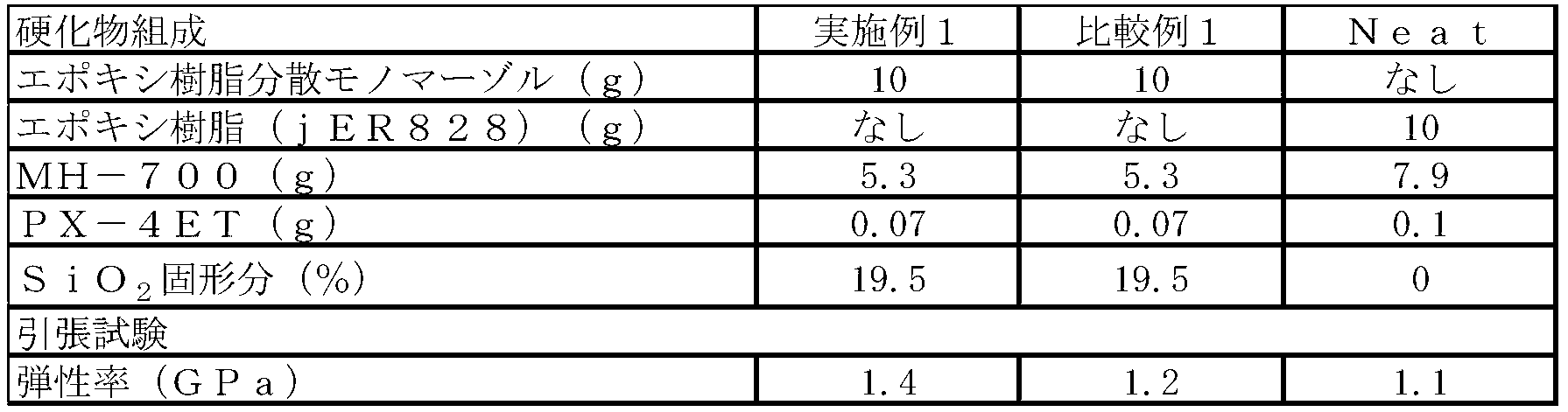
- the resin thin film having a high elastic modulus according to one preferred embodiment of the present invention thus obtained exhibits a tensile test strength of 1.4 GPa, which is a much higher elastic modulus than the 1.2 GPa obtained when a silica sol in which the solvent has been replaced by conventional gas injection is used.
- the resin thin film of the present invention uses an organic solvent-dispersed silica sol obtained by solvent replacement using an ultrafiltration method as the silica particle raw material, and is characterized in that the amount of sulfate ions adhering to the silica particles is much lower than the amount of sulfate ions in silica particles made from a silica sol in which the solvent has been replaced by conventional gas injection.
- the solventless organic-inorganic hybrid resin composition of the present invention described above can provide a resin thin film having the above-mentioned properties, and can therefore be suitably used as a material for resin thin films useful for electronic materials.
- the average particle size of the silica sol dispersed in methyl ethyl ketone (MEK) was measured by dynamic light scattering, by diluting the sol with MEK to a predetermined concentration and measuring the particle size using a dynamic light scattering particle size measuring device (ZETASIZER Nano series, manufactured by Malvern Instruments LTD).
- pH Measurement The pH of the methyl ethyl ketone (MEK)-dispersed silica sol was measured by mixing the silica sol, methanol, and pure water in a mass ratio of 1:1:1 with a pH meter (MM-43X, manufactured by DKK-TOA Corporation). The pH measured by this measurement method was expressed as pH (1+1+1).
- the water content (%) of the silica sol dispersed in an organic solvent (methanol, MEK) was measured by Karl Fischer titration using a Karl Fischer moisture meter (manufactured by Kyoto Electronics Manufacturing Co., Ltd., product name: MKA-610).
- Organic solvent content The organic solvent (methanol) content (%) in the methyl ethyl ketone (MEK)-dispersed silica sol was determined by gas chromatography (Shimadzu Corporation, GC-2014s).
- Equation 1 [Method for analyzing the amount of sulfate ions liberated in silica sol] Except for using the target silica sol (methanol-dispersed silica sol), the same procedure as that performed for the MEK-dispersed silica sol was used to analyze the silica sol by ion chromatography to measure the amount of SO4 (ppm) liberated in the methanol-dispersed silica sol. This was divided by the silica concentration in the silica sol to calculate the amount of sulfate ion SO4 (ppm/ SiO2 ) liberated in the methanol-dispersed silica sol.
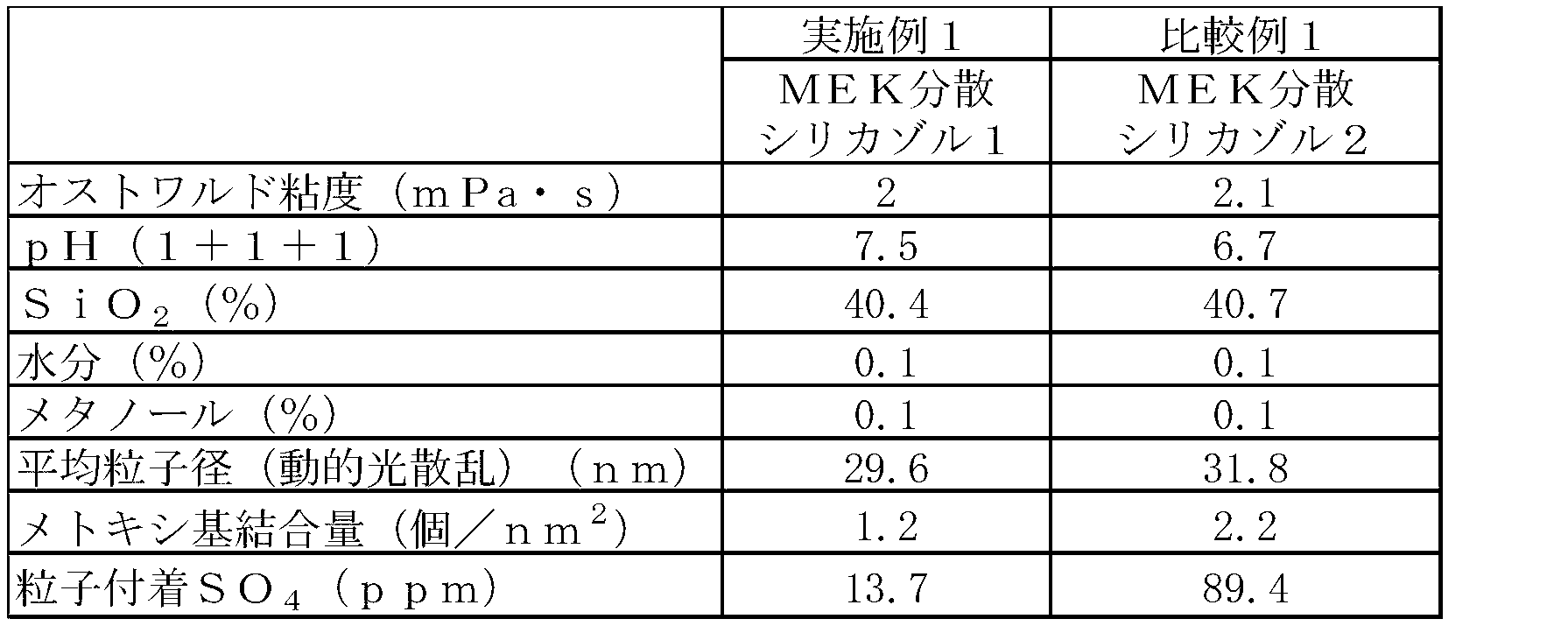
- MEK was supplied while evaporating and distilling off the solvent in a rotary evaporator at a reduced pressure of 500 to 450 Torr and a bath temperature of 80°C, and the dispersion medium of the sol was replaced with MEK to obtain a transparent MEK-dispersed silica sol 1 (SiO 2 40.4 mass %, viscosity (20°C) 2.0 mPa ⁇ s, pH (1+1+1) 7.5, water content 0.1 mass %, methanol content 0.1 mass %, average particle size by dynamic light scattering method 30 nm, number of methoxy groups bonded to silica particles 1.2/nm 2 ).
- Various physical properties of the methanol-dispersed silica sol 1 and the MEK-dispersed silica sol 1 are shown in Tables 1 and 2.
- MEK-dispersed silica sol 1 (20 g) and 18.1 g of epoxy resin (jER828) were dissolved in a recovery flask, and the solvent was removed using an evaporator (bath temperature 80° C., 300 to 30 Torr) to obtain an epoxy resin-dispersed monomer sol.
- the obtained varnish was poured into a casting plate (a 1 mm thick fluororubber spacer was inserted between two glass plates treated with a fluorine-based release agent) and heat-treated at 70°C for 2 hours, 90°C for 2 hours, and 150°C for 8 hours to obtain a cured epoxy resin material.
- the same procedure as above was carried out for the MEK-dispersed silica sol 2 of Comparative Example 1 to obtain a cured epoxy resin material.
- a cured epoxy resin material was obtained in the same manner as in Example 1, except that 10 g of epoxy resin (jER828), 7.9 g of acid anhydride curing agent (MH-700), and 0.10 g of phosphonium salt curing agent (PX-4ET) were used as neat.
- the composition of each cured product is shown in Table 3.
- Example 1 which used an epoxy resin-dispersed monomer sol containing silica particles with 30 ppm or less of sulfate ions attached to the silica particles, had an improved elastic modulus compared to the cured product of Comparative Example 1 containing silica particles with a high content of attached sulfate ions and the neat cured product using only epoxy resin (no silica particles used).
Landscapes
- Chemical & Material Sciences (AREA)
- Organic Chemistry (AREA)
- Polymers & Plastics (AREA)
- Health & Medical Sciences (AREA)
- Chemical Kinetics & Catalysis (AREA)
- Medicinal Chemistry (AREA)
- Inorganic Chemistry (AREA)
- Engineering & Computer Science (AREA)
- Materials Engineering (AREA)
- Manufacturing & Machinery (AREA)
- Life Sciences & Earth Sciences (AREA)
- Wood Science & Technology (AREA)
- Compositions Of Macromolecular Compounds (AREA)
Abstract
Description
今後、電子製品の小型化、高集積化、薄膜化に伴い、特性付与に使用されるシリカ粒子も成形加工性の観点から樹脂に対して高い相溶性(分散性)が求められ、且つ、従来より高弾性率を実現する樹脂組成物、ひいてはナノシリカ粒子が求められるようになった。
1.下記成分(A)~(C)を含有し、230℃以下にて焼成後、自己支持性のある樹脂薄膜が得られる無溶媒系有機無機ハイブリッド樹脂組成物。
(A)平均一次粒子径が15~100nmであるシリカ粒子であって、下記の(式1)から算出される該シリカ粒子に付着した硫酸イオンが30ppm以下である、シリカ粒子。
粒子付着硫酸イオン(ppm)=燃焼イオンクロマト(ppm)-遊離イオンクロマト(ppm)・・・(式1)
(B)2個以上のエポキシ基を有し、数平均分子量が150以上3000以下のエポキシ樹脂
(C)硬化剤
2.(A)シリカ粒子は、該粒子内のナトリウム含有量が50ppm/SiO2乃至3000ppm/SiO2である、1に記載の有機無機ハイブリッド樹脂組成物。
3.(a)シリカ粒子は、該シリカ粒子の真球度が0.8以上である、1又は2に記載の有機無機ハイブリッド樹脂組成物。
4.(A)シリカ粒子は、前記樹脂組成物の全質量に対して10質量%以上含有される、1~3のうち何れか一項に記載の有機無機ハイブリッド樹脂組成物。
5.(B)エポキシ樹脂が、ビスフェノールA型エポキシ樹脂、ビスフェノールF型エポキシ樹脂及び脂環式エポキシ樹脂からなる群から選択される少なくとも一つの液状エポキシ樹脂である1~4のうち何れか一項に記載の有機無機ハイブリッド樹脂組成物。
6.(C)硬化剤が、酸無水物系硬化剤及びアミン系硬化剤からなる群から選択されるいずれか一つの硬化剤である、1~5のうち何れか一項に記載の有機無機ハイブリッド樹脂組成物。
7.(A)シリカ粒子が、限外濾過法の溶媒置換によって得られる有機溶媒分散シリカゾルを原料とする、1~6のうち何れか一項に記載の有機無機ハイブリッド樹脂組成物。
8.(A)シリカ粒子が、有機ケイ素化合物で表面修飾されたシリカ粒子である、1~7のうち何れか一項に記載の有機無機ハイブリッド樹脂組成物。
9.(A)シリカ粒子が、フェニルトリメトキシシランで表面修飾されたシリカ粒子である、1~8のうち何れか一項に記載の有機無機ハイブリッド樹脂組成物
10.(A)シリカ粒子の粒子表面に結合したメトキシ基が0.5~2.5個/nm2である、1~9のうち何れか一項に記載の有機無機ハイブリッド樹脂組成物。
11.1~10のうち何れか一項に記載のハイブリッド樹脂組成物から得られる硬化膜。
12.1~10のうち何れか一項に記載のハイブリッド樹脂組成物を焼成することによる、硬化膜の製造方法。
13.平均一次粒子径が15~100nmであるシリカ粒子であって、下記の(式1)から算出される該シリカ粒子に付着した硫酸イオンが30ppm以下であり、該シリカ粒子内のナトリウム含有量が50ppm/SiO2乃至3000ppm/SiO2であるシリカ粒子が、有機溶媒に分散したシリカゾル。
粒子付着硫酸イオン(ppm)=燃焼イオンクロマト(ppm)-遊離イオンクロマト(ppm)・・・(式1)
14.前記シリカ粒子は0.8以上の真球度を有する、13に記載のシリカゾル。
15.自己支持性を有する樹脂薄膜形成用組成物の形成材料である、13又は14に記載のシリカゾル。
(A)平均一次粒子径が15~100nmであるシリカ粒子であって、下記の(式1)から算出される該シリカ粒子に付着した硫酸イオンが30ppm以下である、シリカ粒子。
粒子付着硫酸イオン(ppm)=燃焼イオンクロマト(ppm)-遊離イオンクロマト(ppm)・・・(式1)
(B)2個以上のエポキシ基を有し、数平均分子量が150以上3000以下のエポキシ樹脂
(C)硬化剤
(A)成分であるシリカ粒子は、有機溶媒を分散媒とするシリカゾルに由来するものである。有機溶媒を分散媒とするシリカゾルは、コロイド状シリカ粒子が有機溶媒に分散した有機溶媒分散ゾルの形態(有機溶媒分散シリカゾル、後述参照)にて用いることができる。本発明で使用する有機溶媒分散シリカゾルは、公知の方法(例えば、イオン交換法、解膠法、加水分解法、反応法(酸化法)など)により製造された水分散シリカゾルを、限外ろ過によりメタノールに置換した後、メタノール以外の有機溶媒に置換することにより製造することができる。
一方、水ガラスから得られる水性シリカゾルを、安定剤である硫酸を添加する前に、速やかに炭素原子数1~4のアルコール溶媒に置換することによっても、系内の遊離の硫酸イオンの濃度が10ppm/SiO2以下に低減された炭素原子数1~4のアルコール分散シリカゾルを得ることができる。この場合、シリカゾルの安定性の観点から、速やかに分散溶媒であるアルコール溶媒への置換を行う必要がある。
本発明においてシリカ粒子の平均一次粒子径とは、窒素吸着法により測定された比表面積値から算出される一次粒子の平均値である。
粒子付着硫酸イオン(ppm)=燃焼イオンクロマト(ppm)-遊離イオンクロマト(ppm)・・・(式1)
上記「燃焼イオンクロマト」(ppm)は、サンプルである有機溶媒分散シリカゾルを燃焼装置で燃焼分解することにより発生したガスを吸収液に捕集し、この吸収液をイオンクロマトグラフ法で測定してシリカゾル中のS量(ppm)を分析し、このS量から換算した硫酸イオン(SO4 2-)量(ppm)である。
また「遊離イオンクロマト」(ppm)は、サンプルである有機溶媒分シリカゾルに適量の水を加えイオンクロマトグラフ法で測定し、水相に遊離してなる硫酸イオン(SO4 2-)量(ppm)を分析した値である。
なお本明細書において、硫酸イオンを単に「SO4」と称することがある。
シリカ粒子中のナトリウム含有量(ppm)は、サンプルである有機溶媒分散シリカゾルを酸及び加熱処理等を施すなどしてシリカ分を除去した後、原子吸光分光光度計により測定できる。
真球度は粒子の最小径と最大経の比(最小径/最大経)として定義され、本発明では画像解析により対象となるシリカ粒子の個々の最大径と最小径を計測し、個々の粒子の真球度の平均値(N≧500)として求めることができる。
本発明に用いるシリカゾルは、前記シリカ粒子が有機溶媒に分散した分散液である。なおこの有機溶媒分散シリカゾルも本発明の対象である。
さらに、シリカゾルに含まれるシリカ粒子の表面の少なくとも一部は、有機ケイ素化合物又はその加水分解物で修飾されていてもよい。有機ケイ素化合物によって表面改質処理されることでシリカ粒子表面が疎水化され、非水溶性の有機溶媒への分散性にも優れたものとすることができる。表面改質処理された該粒子は、例えばシリカ粒子表面のヒドロキシ基に、有機ケイ素化合物が結合した構造を有する。
これらの中でも、例えばフェニルトリメトキシシランを好適なものとして挙げることができる。
ここで粒子表面の結合したアルコキシ基(例えばメトキシ基)には、表面修飾に用いた有機ケイ素化合物(アルコキシ基含有シラン化合物)由来のものの他、本発明の樹脂組成物に含まれるシリカ粒子がアルコールゾルを経由したものであると、該アルコール(例えばメタノール)が粒子表面にアルコキシ基(例えばメトキシ基)として結合したものも含まれる。そのため、上記表面修飾の有無に関わらずアルコキシ基結合量を測定することができる。
アルコキシ基(メトキシ基)結合量は、目的のシリカ粒子に水酸化ナトリウムなどの強塩基を作用させ、遊離したアルコキシ基由来のアルコール量を測定することによって得ることができる。
本願発明の組成物の(B)成分であるエポキシ樹脂は、エポキシ基を2個以上有し、数平均分子量が150以上、例えば200以上のエポキシ樹脂である。このようなエポキシ樹脂の一例として、反応性希釈剤として使用されるエポキシ樹脂等を挙げることができる。
本発明の組成物の(C)成分は、(B)エポキシ樹脂の硬化剤である。
硬化剤は、たとえば重付加型の硬化剤、触媒型の硬化剤、および縮合型の硬化剤の3タイプに大別することができ、これらの1種または2種以上を用いることができる。
酸無水物としては一分子中に複数のカルボキシル基を有する化合物の無水物が好ましい。これらの酸無水物としては、無水フタル酸、無水トリメリット酸、無水ピロメリット酸、無水ベンゾフェノンテトラカルボン酸、エチレングリコールビストリメリテート、グリセロールトリストリメリテート、無水マレイン酸、テトラヒドロ無水フタル酸、メチルテトラヒドロ無水フタル酸、エンドメチレンテトラヒドロ無水フタル酸、メチルエンドメチレンテトラヒドロ無水フタル酸(メチル-5-ノルボルネン-2,3-ジカルボン酸無水物、メチルナジック酸無水物、無水メチルハイミック酸とも称する)、メチルビシクロ[2.2.1]ヘプタン-2,3-ジカルボン酸無水物(水素化メチルナジック酸無水物とも称する)、メチルブテニルテトラヒドロ無水フタル酸、ドデセニル無水コハク酸、ヘキサヒドロ無水フタル酸、メチルヘキサヒドロ無水フタル酸、無水コハク酸、メチルシクロヘキセンジカルボン酸無水物、クロレンド酸無水物等が挙げられる。これらは一種を単独で、又は二種以上を組み合わせて使用することもできる。
ポリアミド樹脂としては、ダイマー酸とポリアミンの縮合により生成するもので、分子中に一級アミンと二級アミンを有するポリアミドアミン等が挙げられる。
イミダゾール類としては、2-メチルイミダゾール、2-エチル-4-メチルイミダゾール、1-シアノエチル-2-ウンデシルイミダゾリウムトリメリテート、エポキシイミダゾールアダクト等が挙げられる。
ポリメルカプタンは、例えばポリプロピレングリコール鎖の末端にメルカプタン基が存在するものや、ポリエチレングリコール鎖の末端にメルカプタン基が存在するものであり、液状のものが好ましい。
本発明の無溶媒系有機無機ハイブリッド樹脂組成物は、有機溶媒を分散媒とするシリカゾル(有機溶媒分散シリカゾル)に、エポキシ基を2個以上有するエポキシ樹脂及び硬化剤を添加した後、分散媒(シリカゾルの有機溶媒)を溜去することにより、エポキシ樹脂に対してシリカ粒子が分散した分散液の形態として得られる。
上記無溶媒系有機無機ハイブリッド樹脂組成物において、前記シリカ粒子の配合量(SiO2換算)は10質量%以上であり、例えば10質量%以上50質量%以下、10質量%以上25質量%以下などとすることができる。
本発明の無溶媒系有機無機ハイブリッド樹脂組成物は、上述した通り好適な態様において前記(A)~(C)成分からなる組成物であり、また、不可避的に含まれる場合を除いて溶媒を極力含まない組成物であることが好適である。仮に本発明の樹脂組成物が溶媒を含む場合、その配合量は組成物全量に対して0.1質量%以下にとどまるものとすることができる。
以上説明した本発明の無溶媒系有機無機ハイブリッド樹脂組成物は、これを基材に塗布するか、注型版に流し込んだ後、加熱(焼成)する工程を経て、高弾性率を有する自己支持性のある樹脂薄膜を得ることができる。
そして上記樹脂薄膜、すなわち上記シリカ粒子、エポキシ樹脂及び硬化剤を含有する樹脂薄膜(硬化膜)も本発明の対象である。
特に、電子デバイスの基板材料として適用する場合においては、既存設備を利用することができるという観点から、適用する基材がガラス、シリコンウェハであることが好ましく、また得られる樹脂薄膜が基材に対して良好な剥離性を示すことから、適用する基材としてガラスであることがさらに好ましい。なお、適用する基材の線膨張係数としては塗工後の基材の反りの観点から、30ppm/℃以下、さらに好ましくは、20ppm/℃以下あることがさらに好ましい。
加熱に用いる器具は、例えばホットプレート、オーブン等が挙げられる。加熱雰囲気は、空気下であっても窒素等の不活性ガス下であってもよく、また、常圧下であっても減圧下であってもよく、また加熱の各段階において異なる圧力を適用してもよい。
なお、このようにして形成された樹脂薄膜を基材から剥離する方法としては特に限定はなく、該樹脂薄膜を基材ごと冷却し、薄膜に切れ目を入れ剥離する方法やロールを介して張力を与えて剥離する方法等が挙げられる。
有機溶媒(メタノール、MEK)分散シリカゾルを坩堝に取り、130℃で乾燥後、1000℃で焼成し、焼成残分を計量してSiO2濃度(%)を算出した。
メタノール分散シリカゾルを300℃にて乾燥粉末とし、その比表面積を比表面積測定装置モノソーブ(登録商標)MS-16(ユアサアイオニクス(株)製)を用いて測定し、平均一次粒子径(nm)を求めた。
有機溶媒(メタノール、MEK)分散シリカゾルの粘度(mPa・s)はオストワルド粘度計を用いて測定した。
メチルエチルケトン(MEK)分散シリカゾルの動的光散乱法による平均粒子径測定は、該ゾルをMEKで所定濃度に希釈し、動的光散乱法粒子径測定装置(Malvern Instruments LTD製、ZETASIZER Nano series)を用いて測定した。
メチルエチルケトン(MEK)分散シリカゾルのpHは、該シリカゾルとメタノールと純水を質量比で1:1:1で混合した液をpHメーター(東亞ディーケーケー(株)製、MM-43X)で測定した。なお、本測定方法で測定したpHはpH(1+1+1)と表記した。
有機溶媒分散(メタノール、MEK)シリカゾルに含まれる水分量(%)は、カールフィッシャー水分計(京都電子工業(株)製、商品名:MKA-610)を用いてカールフィッシャー滴定法にて測定した。
メチルエチルケトン(MEK)分散シリカゾル中の有機溶媒(メタノール)含有量(%)は、ガスクロマトグラフィー((株)島津製作所、GC-2014s)にて求めた。
メチルエチルケトン(MEK)分散シリカゾル4mlに、n-ヘキサン20mlを添加し、遠心分離(5000rpm、30分)後に上澄みを捨て、沈降物を分離した。さらに沈降物をアセトン4~8mlを加え再溶解した後、再びn-ヘキサンを10mL添加し遠心分離(5000rpm、30分)で沈降物を分離する操作を2回行い、得られた沈降物を60℃の真空乾燥機で4時間乾燥後、150℃の乾燥機で2時間乾燥して乾燥粉末を得た。
上記で得られた粉末0.2gを0.1N水酸化ナトリウム水溶液5mL、純水5mLと混合して1日室温で置いたのち、溶液部分に含まれるメタノールをガスクロマトグラフィーにて測定することで、シリカ表面の単位面積当たりのメトキシ基結合量(個/nm2)を測定した。
メタノール分散シリカゾルを白金皿に採取し、超純水、塩酸、硫酸、フッ酸を加え、加熱することによってシリカ分を除去した。その後、超純水を加えて濃度調整し、測定原液とした。測定原液を所定の倍率に希釈し、原子吸光分光光度計(55BAA、SpectrAA、アジレント・テクノロジー製)にてシリカゾル中のNa含有量を測定した。その後、シリカゾル中のシリカ濃度で除することで、シリカに対するナトリウム濃度(ppm/SiO2)を算出した。
MEK分散シリカゾル25~50μLと酸化タングステン(WO3)0.1gを燃焼装置(AQF-2100H、GA-210、日東精工アナリテック製)で処理後、発生ガスを吸収液5mLに吸収させ、該吸収液をイオンクロマトグラフィー(Integrion、ThermoFisherScientific製)で分析することにより、該シリカゾル中のS量(ppm)を測定した。得られたS量からSO4換算値を算出し、燃焼イオンクロマト「A」(ppm)とした。
次に、MEK分散シリカゾル0.1gと水5mLを量り取り混合し、沈殿物をシリンジフィルターで除去した後、試料をイオンクロマトグラフィー(Integrion、ThermoFisherScientific製)で分析することにより、ゾル中に遊離してなるSO4量(ppm)を測定して遊離イオンクロマト「B」とした。
粒子付着硫酸イオン「C」(ppm)を下記の式1から算出した。
C=A-B・・・(式1)
[シリカゾル中に遊離してなる硫酸イオン量の分析方法]
対象となるシリカゾル(メタノール分散シリカゾル)を用いた以外は、上記MEK分散シリカゾルで実施した操作と同様にイオンクロマトグラフィーで分析することにより、メタノール分散シリカゾル中に遊離してなるSO4量(ppm)を測定した。これをシリカゾル中のシリカ濃度で除して、メタノール分散シリカゾル中に遊離してなる硫酸イオンSO4量(ppm/SiO2)を算出した。
メタノール分散シリカゾルをTEM(日本電子(株)製 JEM-1400Flash)でシリカ粒子の個数で500個以上測定し、画像解析装置((株)ニレコ製 LUZEX-AP)で測定を行った。そして、其々の粒子の最大径と最小径を測定し、[最小径/最大径]の平均を測定した。
スノーテックス(登録商標)O-40(平均一次粒子径22nm、pH2~3、シリカ濃度40質量%、日産化学(株)製)を準備した。
上記シリカゾル14000gを限外ろ過法でメタノールによる水の置換を行った。ゾル中の水分量が0.5%に到達したところで置換を終了し、メタノール分散シリカゾル1、14000gを得た。得られたメタノール分散シリカゾル1は、SiO2濃度40.6質量%、水分量0.5質量%、粘度5.4mPa・s、シリカ粒子内のNa含有量2210ppm/SiO2、メタノール分散シリカゾル中に遊離してなるSO40.7ppm/SiO2であった。また平均一次粒子径は21.4nm、真球度は0.89であった。
上記メタノールゾル1000gを2Lナスフラスコに仕込み、マグネチックスターラーでゾルを撹拌しながら、超純水を24.7g添加した。その後、フェニルトリメトキシシラン(信越化学工業(株)製、商品名KBM-103)49.6gを添加した後、液温を60℃で2時間保持した。その後、撹拌しながらジイソプロピルエチルアミンを0.57g添加し、液温62℃で2時間保持した。
その後、ロータリーエバポレーターにて減圧度500~450Torr、浴温度80℃で溶媒を蒸発留去させながらMEKを供給し、ゾルの分散媒をMEKに置換することにより、透明のMEK分散シリカゾル1(SiO240.4質量%、粘度(20℃)2.0mPa・s、pH(1+1+1)7.5、水分量0.1質量%、メタノール含有量0.1質量%、動的光散乱法による平均粒子径30nm、シリカ粒子へのメトキシ基結合量1.2個/nm2)を得た。
メタノール分散シリカゾル1及びMEK分散シリカゾル1の各種物性を表1及び表2に示す。
実施例1に記載のスノーテックス(登録商標)O-40(平均一次粒子径22nm、pH2~3、シリカ濃度40質量%、日産化学(株)製)1000gを撹拌機、コンデンサー、温度計及び注入口2個を備えた内容積2Lのガラス製反応器に仕込み、反応器内のゾルを沸騰させたままの状態で、別のボイラーで発生させたメタノールの蒸気を反応器内のシリカゾル中に連続的に吹き込んで、液面徐々に上昇させながらメタノールによる水の置換を行った。留出液の体積が9Lになったところで置換を終了して、メタノール分散シリカゾル2を1100g得た。得られたメタノール分散シリカゾル2は、SiO2濃度40.7質量%、水分量2.1質量%、粘度2.2mPa・s、シリカ粒子内のNa含有量2200ppm/SiO2、メタノール分散シリカゾル中に遊離してなるSO4450ppm/SiO2であった。また平均一次粒子径は21.9nm、真球度は0.89であった。
上記メタノールゾル1000gを2Lナスフラスコに仕込み、マグネチックスターラーでゾルを撹拌しながら、超純水を添加しない以外は実施例1と同様に、フェニルトリメトキシシランの添加、ジイソプロピルエチルアミンの添加、ゾルの分散媒の置換等の一連の操作を実施し、透明のMEK分散シリカゾル2(SiO240.7質量%、粘度(20℃)2.1mPa・s、pH(1+1+1)6.7、水分量0.1質量%、メタノール含有量0.1質量%、動的光散乱法による粒子径32nm、シリカ粒子へのメトキシ基結合量2.2個/nm2)を得た。
メタノール分散シリカゾル2及びMEK分散シリカゾル2の各種物性を表1及び表2に示す。
MEK分散シリカゾル1(20g)と、エポキシ樹脂(jER828)18.1gをナスフラスコに入れて溶解させた後、エバポレーターにて脱溶媒を行い(浴温80℃、300~30Torr)、エポキシ樹脂分散モノマーゾルを得た。得られたエポキシ樹脂分散モノマーゾル10gと、酸無水物硬化剤(MH-700、新日本理化(株)製)5.3gと、ホスホニウム塩系の硬化促進剤(PX-4ET、日本化学工業(株)製)0.07gを容器に入れ、真空脱泡機(V-mini300、(株)EME製)にてこれらを撹拌・混合し、ワニス(無溶媒系有機無機ハイブリッド樹脂組成物)を得た。得られたワニスを注型板(フッ素系離型剤で処理されたガラス板2枚の間に1mm厚のフッ素ゴム製スペーサーを挿入)に流し込み、70℃2時間、90℃2時間、150℃8時間の加熱処理を行い、エポキシ樹脂硬化物を得た。
比較例1のMEK分散シリカゾル2についても上記と同様の操作を行い、エポキシ樹脂硬化物を得た。
シリカ粒子を配合しない参考例:Neatとして、エポキシ樹脂(jER828)10g、酸無水物硬化剤(MH-700)7.9g、ホスホニウム塩系の硬化剤(PX-4ET)0.10gを用いた以外は、実施例1と同様にエポキシ樹脂硬化物を得た。
各硬化物の組成を表3に示す。
各エポキシ樹脂硬化物を幅10mm、長さ70mmにカットし、卓上型万能試験機(AGS-5kNXSTD、(株)島津製作所製)を用いて引張試験を行い、弾性率(GPa)を評価した。引張試験は引張速度10mm/min、引張治具は金属板(1kN)、つかみ具間距離10mmとした。
得られた結果を表3に示す。

Claims (15)
- 下記成分(A)~(C)を含有し、230℃以下にて焼成後、自己支持性のある樹脂薄膜が得られる無溶媒系有機無機ハイブリッド樹脂組成物。
(A)平均一次粒子径が15~100nmであるシリカ粒子であって、下記の(式1)から算出される該シリカ粒子に付着した硫酸イオンが30ppm以下である、シリカ粒子
(B)2個以上のエポキシ基を有し、数平均分子量が150以上3000以下のエポキシ樹脂
(C)硬化剤
粒子付着硫酸イオン(ppm)=燃焼イオンクロマト(ppm)-遊離イオンクロマト(ppm)・・・(式1) - (A)シリカ粒子は、該シリカ粒子内のナトリウム含有量が50ppm/SiO2乃至3000ppm/SiO2である、請求項1に記載の有機無機ハイブリッド樹脂組成物。
- (A)シリカ粒子は、該シリカ粒子の真球度が0.8以上である、子請求項1又は2に記載の有機無機ハイブリッド樹脂組成物。
- (A)シリカ粒子は、前記樹脂組成物の全質量に対して10質量%以上含有される、請求項1~3のうち何れか一項に記載の有機無機ハイブリッド樹脂組成物。
- (B)エポキシ樹脂が、ビスフェノールA型エポキシ樹脂、ビスフェノールF型エポキシ樹脂及び脂環式エポキシ樹脂からなる群から選択される少なくとも一つの液状エポキシ樹脂である、請求項1~4のうち何れか一項に記載の有機無機ハイブリッド樹脂組成物。
- (C)硬化剤が、酸無水物系硬化剤及びアミン系硬化剤からなる群から選択されるいずれか一つの硬化剤である、請求項1~5のうち何れか一項に記載の有機無機ハイブリッド樹脂組成物。
- (A)シリカ粒子が、限外濾過法の溶媒置換によって得られる有機溶媒分散シリカゾルを原料とする、請求項1~6のうち何れか一項に記載の有機無機ハイブリッド樹脂組成物。
- (A)シリカ粒子が、有機ケイ素化合物で表面修飾されたシリカ粒子である、請求項1~7のうち何れか一項に記載の有機無機ハイブリッド樹脂組成物。
- (A)シリカ粒子が、フェニルトリメトキシシランで表面修飾されたシリカ粒子である、請求項1~8のうち何れか一項に記載の有機無機ハイブリッド樹脂組成物
- (A)シリカ粒子の粒子表面に結合したメトキシ基が0.5~2.5個/nm2である、請求項1~9のうち何れか一項に記載の有機無機ハイブリッド樹脂組成物。
- 請求項1~10のうち何れか一項に記載のハイブリッド樹脂組成物から得られる硬化膜。
- 請求項1~10のうち何れか一項に記載のハイブリッド樹脂組成物を焼成する工程を含む、硬化膜の製造方法。
- 平均一次粒子径が15~100nmであるシリカ粒子であって、下記の(式1)から算出される該シリカ粒子に付着した硫酸イオンが30ppm以下であり、該シリカ粒子内のナトリウム含有量が50ppm/SiO2乃至3000ppm/SiO2であるシリカ粒子が、有機溶媒に分散したシリカゾル。
粒子付着硫酸イオン(ppm)=燃焼イオンクロマト(ppm)-遊離イオンクロマト(ppm)・・・(式1) - 前記シリカ粒子は0.8以上の真球度を有する、請求項13に記載のシリカゾル。
- 自己支持性を有する樹脂薄膜形成用組成物の形成材料である、請求項13又は14に記載のシリカゾル。
Priority Applications (4)
| Application Number | Priority Date | Filing Date | Title |
|---|---|---|---|
| KR1020257025246A KR20250130363A (ko) | 2023-01-06 | 2024-01-05 | 무용매계 유기무기 하이브리드 수지 조성물 및 경화막 |
| CN202511640750.XA CN121226966A (zh) | 2023-01-06 | 2024-01-05 | 无溶剂系有机无机杂化树脂组合物和固化膜 |
| JP2024568930A JPWO2024147356A1 (ja) | 2023-01-06 | 2024-01-05 | |
| CN202480017310.6A CN120826437A (zh) | 2023-01-06 | 2024-01-05 | 无溶剂系有机无机杂化树脂组合物和固化膜 |
Applications Claiming Priority (2)
| Application Number | Priority Date | Filing Date | Title |
|---|---|---|---|
| JP2023001368 | 2023-01-06 | ||
| JP2023-001368 | 2023-01-06 |
Publications (1)
| Publication Number | Publication Date |
|---|---|
| WO2024147356A1 true WO2024147356A1 (ja) | 2024-07-11 |
Family
ID=91803970
Family Applications (1)
| Application Number | Title | Priority Date | Filing Date |
|---|---|---|---|
| PCT/JP2024/000072 Ceased WO2024147356A1 (ja) | 2023-01-06 | 2024-01-05 | 無溶媒系有機無機ハイブリッド樹脂組成物及び硬化膜 |
Country Status (5)
| Country | Link |
|---|---|
| JP (1) | JPWO2024147356A1 (ja) |
| KR (1) | KR20250130363A (ja) |
| CN (2) | CN121226966A (ja) |
| TW (1) | TW202444816A (ja) |
| WO (1) | WO2024147356A1 (ja) |
Citations (6)
| Publication number | Priority date | Publication date | Assignee | Title |
|---|---|---|---|---|
| JP2001213617A (ja) * | 2000-01-28 | 2001-08-07 | Jsr Corp | 疎水化コロイダルシリカの製造方法 |
| JP2005200294A (ja) * | 2003-12-19 | 2005-07-28 | Nissan Chem Ind Ltd | 有機溶媒分散無機酸化物ゾルの製造方法 |
| JP2012131946A (ja) * | 2010-12-24 | 2012-07-12 | Sumitomo Bakelite Co Ltd | プリント配線板用樹脂組成物、プリプレグ、積層板、樹脂シート、プリント配線板及び半導体装置 |
| WO2014188934A1 (ja) * | 2013-05-20 | 2014-11-27 | 日産化学工業株式会社 | シリカゾル及びシリカ含有エポキシ樹脂組成物 |
| JP2017212400A (ja) * | 2016-05-27 | 2017-11-30 | 住友ベークライト株式会社 | 樹脂シートおよび回路基板 |
| WO2020230823A1 (ja) * | 2019-05-14 | 2020-11-19 | 日産化学株式会社 | ケトン系溶媒分散シリカゾル及び樹脂組成物 |
Family Cites Families (7)
| Publication number | Priority date | Publication date | Assignee | Title |
|---|---|---|---|---|
| JP5059056B2 (ja) | 2009-06-17 | 2012-10-24 | キヤノン株式会社 | 微細構造体の製造方法及び液体吐出ヘッドの製造方法 |
| JP5969375B2 (ja) | 2012-12-18 | 2016-08-17 | オリジン電気株式会社 | 紫外線硬化型接着剤組成物、それを用いた積層体 |
| JP6819067B2 (ja) | 2016-03-31 | 2021-01-27 | 住友ベークライト株式会社 | 熱硬化性樹脂組成物、キャリア付樹脂膜、プリント配線基板および半導体装置 |
| JP2021084322A (ja) | 2019-11-28 | 2021-06-03 | 株式会社リコー | インクジェット用活性エネルギー線硬化型組成物、造形方法、及び造形装置 |
| WO2022006741A1 (en) | 2020-07-07 | 2022-01-13 | Qualcomm Incorporated | Slot identification for semi-persistent scheduling (sps) and configured grant transmissions |
| JP2022115080A (ja) | 2021-01-27 | 2022-08-08 | 株式会社半導体エネルギー研究所 | 表示装置 |
| JP2022147628A (ja) | 2021-03-23 | 2022-10-06 | 株式会社東芝 | 半導体装置 |
-
2024
- 2024-01-05 KR KR1020257025246A patent/KR20250130363A/ko active Pending
- 2024-01-05 TW TW113100644A patent/TW202444816A/zh unknown
- 2024-01-05 CN CN202511640750.XA patent/CN121226966A/zh active Pending
- 2024-01-05 JP JP2024568930A patent/JPWO2024147356A1/ja active Pending
- 2024-01-05 WO PCT/JP2024/000072 patent/WO2024147356A1/ja not_active Ceased
- 2024-01-05 CN CN202480017310.6A patent/CN120826437A/zh active Pending
Patent Citations (6)
| Publication number | Priority date | Publication date | Assignee | Title |
|---|---|---|---|---|
| JP2001213617A (ja) * | 2000-01-28 | 2001-08-07 | Jsr Corp | 疎水化コロイダルシリカの製造方法 |
| JP2005200294A (ja) * | 2003-12-19 | 2005-07-28 | Nissan Chem Ind Ltd | 有機溶媒分散無機酸化物ゾルの製造方法 |
| JP2012131946A (ja) * | 2010-12-24 | 2012-07-12 | Sumitomo Bakelite Co Ltd | プリント配線板用樹脂組成物、プリプレグ、積層板、樹脂シート、プリント配線板及び半導体装置 |
| WO2014188934A1 (ja) * | 2013-05-20 | 2014-11-27 | 日産化学工業株式会社 | シリカゾル及びシリカ含有エポキシ樹脂組成物 |
| JP2017212400A (ja) * | 2016-05-27 | 2017-11-30 | 住友ベークライト株式会社 | 樹脂シートおよび回路基板 |
| WO2020230823A1 (ja) * | 2019-05-14 | 2020-11-19 | 日産化学株式会社 | ケトン系溶媒分散シリカゾル及び樹脂組成物 |
Also Published As
| Publication number | Publication date |
|---|---|
| KR20250130363A (ko) | 2025-09-01 |
| JPWO2024147356A1 (ja) | 2024-07-11 |
| CN120826437A (zh) | 2025-10-21 |
| TW202444816A (zh) | 2024-11-16 |
| CN121226966A (zh) | 2025-12-30 |
Similar Documents
| Publication | Publication Date | Title |
|---|---|---|
| JP6011774B2 (ja) | コーティング組成物及びアルミナ薄膜の製造方法 | |
| JP2010138384A (ja) | 封止用液状エポキシ樹脂組成物、及びこの封止用液状エポキシ樹脂組成物で封止した素子を備えた電子部品装置およびウエハーレベルチップサイズパッケージ | |
| JP2013177552A (ja) | エポキシ基含有シルセスキオキサン変性エポキシ樹脂、硬化性樹脂組成物、硬化物およびコーティング剤 | |
| KR20140050648A (ko) | 피복 산화마그네슘 입자, 그 제조 방법, 방열성 필러 및 수지 조성물 | |
| WO2016088815A1 (ja) | テトラメチルビフェノール型エポキシ樹脂、エポキシ樹脂組成物、硬化物及び半導体封止材 | |
| JP2015000952A (ja) | エポキシ樹脂組成物およびその硬化物 | |
| TW202028325A (zh) | 液狀組成物、樹脂複合材料、液狀密封材料、密封材料及電子元件 | |
| US11299620B2 (en) | Epoxy resin composition, cured product, and electrical or electronic component | |
| JP2018087322A (ja) | エポキシ樹脂、エポキシ樹脂組成物、硬化物及び電気・電子部品 | |
| JP2008274013A (ja) | 硬化性エポキシ樹脂組成物およびその製造法 | |
| CN102414242B (zh) | 可热固树脂组合物 | |
| KR20250130363A (ko) | 무용매계 유기무기 하이브리드 수지 조성물 및 경화막 | |
| WO2025127152A1 (ja) | 疎水性が向上した金属酸化物粒子、高濃縮金属酸化物ゾル、及びそれらの製造方法 | |
| JPWO2013183441A1 (ja) | 防曇性物品 | |
| JP5297598B2 (ja) | 硬化性エポキシ樹脂組成物およびその製造方法 | |
| CN116390967A (zh) | 液态树脂组合物及其固化物 | |
| WO2012124390A1 (ja) | シリカ含有エポキシ硬化剤の製造方法 | |
| JP6740619B2 (ja) | エポキシ樹脂とその製造法、及び該樹脂に基づくエポキシ樹脂組成物 | |
| JP2006036900A (ja) | 保護コート用樹脂組成物及び無色透明な保護膜 | |
| EP4414401A1 (en) | Epoxy resin production method, epoxy resin composition, cured product, and electric/electronic component | |
| JP5081788B2 (ja) | エポキシ樹脂を用いた硬化物 | |
| WO2024150793A1 (ja) | ビフェノール型ジグリシジルエーテルの多結晶体、該多結晶体を含む樹脂組成物およびその硬化物 | |
| JP2025096266A (ja) | 金属酸化物粒子、高濃縮金属酸化物ゾル、及びそれらの製造方法 | |
| WO2025028284A1 (ja) | 樹脂組成物、硬化物及び硬化物の製造方法 | |
| JP2025070526A (ja) | エポキシ樹脂組成物およびその硬化物 |
Legal Events
| Date | Code | Title | Description |
|---|---|---|---|
| 121 | Ep: the epo has been informed by wipo that ep was designated in this application |
Ref document number: 24738646 Country of ref document: EP Kind code of ref document: A1 |
|
| WWE | Wipo information: entry into national phase |
Ref document number: 2024568930 Country of ref document: JP |
|
| ENP | Entry into the national phase |
Ref document number: 1020257025246 Country of ref document: KR Free format text: ST27 STATUS EVENT CODE: A-0-1-A10-A15-NAP-PA0105 (AS PROVIDED BY THE NATIONAL OFFICE) |
|
| NENP | Non-entry into the national phase |
Ref country code: DE |
|
| WWE | Wipo information: entry into national phase |
Ref document number: 202480017310.6 Country of ref document: CN |
|
| WWP | Wipo information: published in national office |
Ref document number: 202480017310.6 Country of ref document: CN |
|
| 122 | Ep: pct application non-entry in european phase |
Ref document number: 24738646 Country of ref document: EP Kind code of ref document: A1 |