WO2023195159A1 - ロボット - Google Patents
ロボット Download PDFInfo
- Publication number
- WO2023195159A1 WO2023195159A1 PCT/JP2022/017365 JP2022017365W WO2023195159A1 WO 2023195159 A1 WO2023195159 A1 WO 2023195159A1 JP 2022017365 W JP2022017365 W JP 2022017365W WO 2023195159 A1 WO2023195159 A1 WO 2023195159A1
- Authority
- WO
- WIPO (PCT)
- Prior art keywords
- arm
- clamp
- base
- shaft
- cable
- Prior art date
- Legal status (The legal status is an assumption and is not a legal conclusion. Google has not performed a legal analysis and makes no representation as to the accuracy of the status listed.)
- Ceased
Links
Images








Classifications
-
- B—PERFORMING OPERATIONS; TRANSPORTING
- B25—HAND TOOLS; PORTABLE POWER-DRIVEN TOOLS; MANIPULATORS
- B25J—MANIPULATORS; CHAMBERS PROVIDED WITH MANIPULATION DEVICES
- B25J19/00—Accessories fitted to manipulators, e.g. for monitoring, for viewing; Safety devices combined with or specially adapted for use in connection with manipulators
-
- B—PERFORMING OPERATIONS; TRANSPORTING
- B25—HAND TOOLS; PORTABLE POWER-DRIVEN TOOLS; MANIPULATORS
- B25J—MANIPULATORS; CHAMBERS PROVIDED WITH MANIPULATION DEVICES
- B25J9/00—Program-controlled manipulators
- B25J9/06—Program-controlled manipulators characterised by multi-articulated arms
Definitions
- the present disclosure relates to robots.
- This horizontal articulated robot includes a base, a first horizontal arm rotatably connected to the base, a second horizontal arm rotatably connected to the first horizontal arm, a cable, and a cable. It includes a wiring duct for guiding and a cable holding part disposed inside the second horizontal arm.
- the second horizontal arm includes a frame fixed to the bottom of the second horizontal arm and holding one end of the wiring duct.
- the cable holding portion has a corrugated end portion with unevenness and is formed integrally with the frame.
- the cable is fixed to the cable holding part with a cable tie or the like.
- the robot of the present disclosure includes a base, an arm movably supported with respect to the base, one end portion of which is disposed on the base side, and the other end portion of which is disposed on the arm side. a first holder that is fixed or rotatably supported with respect to the base or the arm; and at least one clamp part that fixes the cable; and a second holder fixed to the first holder while sandwiching the cable between the first holder and the first holder.
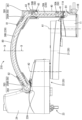
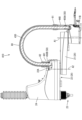
- FIG. 1 is a front view of the robot according to Embodiment 1, with a portion of the structure around the cable cut away.
- FIG. 2 is a schematic cross-sectional view taken along line AA in FIG.
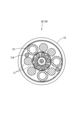
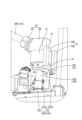
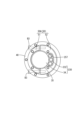
- FIG. 3 is a bottom view showing the clamp section.
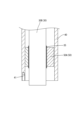
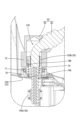
- FIG. 4 is a sectional view taken along line BB in FIG.
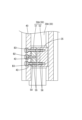
- FIG. 5 is a cross-sectional view taken along the line CC in FIG.
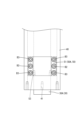
- FIG. 6 is a side view showing how the first clamp part is fixed to the pipe member.
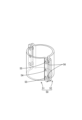
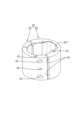
- FIG. 7 is a perspective view of the first holder, the second holder, and the clamping rubber.
- FIG. 8 is a perspective view showing a clamp section which is a sheet metal part.
- FIG. 9 is a front view of the robot according to the second embodiment, showing the configuration around the cable with a portion cut away.
- FIG. 10 is a perspective view of the third clamp portion fixed to the second arm.
- FIG. 11 is a cross-sectional view showing a state in which the third clamp section clamps a cable that is not covered with a sheath.
- FIG. 12 is a perspective view showing a stopper provided on the cover.
- FIG. 13 is a sectional view showing a coil spring with a cable disposed inside.
- FIG. 14 is a front view of the robot according to the third embodiment, showing the configuration around the cable with a portion cut away.
- FIG. 15 is a schematic cross-sectional view taken along line DD in FIG. 14.
- FIG. 16 is a schematic bottom view showing the clamp section.
- FIG. 17 is a perspective view of the first holder and the second holder.
- FIG. 18 is a front view of the robot according to the fourth embodiment, showing the configuration around the cable with a portion cut away.
- FIG. 19 is a front view of the robot according to the fifth embodiment, showing the configuration around the cable with a portion cut away.
- the robot of the present disclosure includes a base, an arm movably supported with respect to the base, one end of which is disposed on the base, and the other end of which is located on the arm side. and at least one clamp portion for fixing the cable, each of the at least one clamp portion being fixed or rotatably supported with respect to the base or the arm.
- the robot includes a first holder and a second holder fixed to the first holder while sandwiching the cable between the first holder and the first holder.
- the clamp section for fixing the cable includes the first holder and the second holder for clamping the cable between the first holder, thereby saving space and reducing the clamping area of the cable by the clamp section. is easy to increase. Therefore, the clamping stability and clamping strength of the cable by the clamping portion can be increased.
- the arm includes a first arm that is rotatably supported around a first axis with respect to the base, and a second axis that is parallel to the first axis with respect to the first arm. It is preferable to include a second arm rotatably supported by the second arm.
- the above-mentioned robot includes a flexible tube that covers the outside of the cable, a hollow base-side shaft that is arranged outside the base and is fixed to or rotatably supported by the base, and a hollow base-side shaft that is fixed to or rotatably supported by the base; a hollow arm-side shaft disposed on the outside and fixed or rotatably supported by the arm; a first joint portion connecting one end of the flexible tube to the base-side shaft; and a first joint portion connecting the other end of the flexible tube to the base-side shaft.
- the at least one clamp part includes a base-side clamp part that is a clamp part disposed inside the base-side shaft; and a second joint part connected to the arm-side shaft; It is preferable that an arm-side clamp part, which is a clamp part disposed inside the side shaft, is included.
- the cable is covered with a flexible tube, it is possible to improve the cleanliness and dustproof and waterproof properties in the environment in which the robot is used. Further, by providing the clamp portion inside the base-side shaft and the arm-side shaft, it is not necessary to provide the clamp portion inside the base and the arm. Therefore, the cable clamping stability and clamping strength can be increased without increasing the size of the base and arm.
- the above robot includes a pipe member extending parallel to the first axis and fixed to the base, and a third axis extending parallel to the first axis and parallel to the first axis.
- a hollow first shaft rotatably supported by the pipe member; a first mounting member fixed to the first shaft and fixing the cable; and fixed or rotatable with respect to the second arm.
- the cable further includes a second mounting member that is supported and fixes the cable; a curved portion extending from an end opposite to the base of the first linear portion toward the second arm, and the at least one clamp portion includes the first holder fixed to the pipe member.
- first clamp part that is a clamp part that fixes the first linear part inside the pipe member; and a first holder that is fixed to the first shaft; a second clamp section that is a clamp section that fixes the first straight section, the first attachment member fixes the end of the curved section on the base side, and the second attachment member fixes the end of the curved section on the base side;
- the end of the curved portion on the second arm side is fixed.
- the torsional stress generated in the cable due to the rotation of the first arm and the second arm is absorbed in the first straight part.
- Cheap As a result, torsional stress is less likely to be generated in the curved portion, so that damage to the cable due to concentration of torsional stress and bending stress in the curved portion can be suppressed.
- the curved portion is not disposed between the first axis and the second axis, and the curved portion extends from the first mounting member to the second arm side at an acute angle with respect to a plane perpendicular to the first axis. It is preferable that the second mounting member be led out toward the base from the second mounting member at an acute angle with respect to a plane perpendicular to the first axis.
- the curved portion can be derived from each of the first attachment member and the second attachment member at a shallow angle. Therefore, when the bending direction of the curved portion changes with the rotation of the first arm and the second arm, the curved portion deforms smoothly. Further, the dimension in the direction parallel to the first axis of the robot can be reduced.
- the robot further includes a hollow second shaft extending parallel to the first axis and rotatably supported by the second arm around a fourth axis parallel to the first axis
- the cable further includes a second straight portion connected to an end of the curved portion on the second arm side and extending parallel to the first axis, and the at least one clamp portion has a second straight portion fixed to the second arm.
- a third clamp part that is a clamp part that fixes the second linear part inside the second arm
- a third clamp part that is a clamp part that fixes the second linear part inside the second arm
- It is preferable that a fourth clamp part that is a clamp part that fixes the second linear part inside the second shaft is included, and the second mounting member is fixed to the second shaft.
- the torsional stress generated in the cable due to the rotation of the first arm and the second arm is absorbed in the second straight part.
- Cheap As a result, torsional stress is less likely to be generated in the curved portion, so that damage to the cable due to concentration of torsional stress and bending stress in the curved portion can be suppressed.
- the robot further includes a cover that covers the second arm, the cover includes a stopper protruding from the outer surface of the cover, and the stopper abuts the second mounting member to Preferably, the second shaft is prevented from rotating beyond a preset angle with respect to the second arm.
- the robot further includes a coil spring, the second straight portion is disposed inside the coil spring, one end of the coil spring is fixed to the second arm, and the coil spring is fixed to the second arm. It is preferable that the other end of the clamp is fixed to the fourth clamp part.
- the robot described above includes a flexible tube that covers the outside of the cable, a first joint portion that connects one end of the flexible tube to the first mounting member, and a second joint that connects the other end of the flexible tube to the second mounting member.
- the device includes a fixed hollow first block and the fifth clamp portion disposed inside the first block, and the second mounting member is fixed or rotatable with respect to the second arm. It is preferable to include a supported hollow second block and the sixth clamp part disposed inside the second block.
- the robot 10 includes a base 11, a first arm 21 rotatably supported around a first axis A1 extending vertically with respect to the base 11, and a first arm 21.
- a second arm 22 rotatably supported around a second axis A2 extending vertically with respect to the second arm 22, and an operating shaft 23 supported rotatably and movably in the vertical direction by the second arm 22.
- the first arm 21 and the second arm 22 constitute an arm 20 of the robot 10.
- the second arm 22 includes a rotational drive device that rotates the operating shaft 23, a lifting device that moves the operating shaft 23 in the vertical direction, and a head for attaching a tool (not shown).
- the robot 10 includes a cover 24 on the second arm 22 that covers the operating shaft 23 and parts around it.
- the base 11 is formed into a box shape.
- the base 11 is equipped with a first arm drive device (not shown) for supporting and driving the first arm 21 .
- This first arm drive device is composed of a motor and a speed reducer.
- the motor and the speed reducer are provided so that their axes are oriented in the vertical direction.
- This speed reducer reduces the rotation of the rotating shaft of the motor and transmits the speed to the first arm 21 .
- the casing of the motor is supported by the base 11, the output shaft of the motor and the input member of the reducer are connected, and the output side member of the reducer, that is, the casing supports the first arm 21.
- the first arm 21 is formed into a box shape with a space inside. Although not shown, the first arm 21 has one end connected to a reducer of the first arm drive device, and the other end connected to a reducer of the second arm drive device. The first arm 21 rotatably supports the second arm 22 via a second arm drive device.
- the second arm drive device is for supporting and driving the second arm 22, and is composed of a motor and a speed reducer. These motors and speed reducers are provided so that their axes are oriented in the vertical direction.
- the casing of the motor is supported by the second arm 22, and the output shaft of the motor and the input member of the reducer are connected, and the output side member of the reducer, that is, the casing, is supported by the first arm 21.
- the second arm 22 is formed in an elongated box shape extending in the horizontal direction from a swing base provided with a motor of a second arm drive device.
- a rotation drive device (not shown) for rotating the operating shaft 23 is provided at the swinging end of the second arm 22 .
- An elevating device (not shown) for elevating and lowering the operating shaft 23 is provided at the lower part of the intermediate portion of the second arm 22 .
- the robot 10 includes a cable 30 that spans between the base 11 and the second arm 22.
- the cable 30 is a composite cable 34 that includes a plurality of wiring units 31, a single wire 31A, an air tube 32, etc., and a sheath 33 that collectively covers these.
- the cable 30 on the base 11 side is led out of the base 11 from a wiring plug 11B or the like provided on the base 11.
- the second arm 22 side of the cable 30 is connected to a second arm drive device, a lifting device, a rotation drive device, and the like.
- the cable 30 has a first straight portion 30A disposed on the base 11 side and a curved portion 30B extending from the first straight portion 30A toward the second arm 22 side.
- the first straight portion 30A extends parallel to the first axis A1.
- the first straight portion 30A is housed inside the pipe member 40 and the first shaft 44.
- the curved portion 30B has a curved shape that is convex upward.
- the end of the curved portion 30B on the base 11 side is fixed to the first mounting member 60.
- the end of the curved portion 30B on the second arm 22 side is fixed to the second attachment member 63.
- a pipe member 40 extending upward is fixed to the upper surface of the base 11.
- a fastening hole 41 into which a bolt B1 can be fastened is provided at the lower end of the pipe member 40 (see FIGS. 3 and 4).
- the pipe member 40 is fixed to the base 11 by inserting a bolt B1 into an insertion hole 11A provided on the upper surface of the base 11 and fastening the bolt B1 to a fastening hole 41 of the pipe member 40.
- the pipe member 40 has a cylindrical shape, and the first straight portion 30A is housed inside.
- a first clamp portion 50A is provided inside the lower portion of the pipe member 40 to fix the lower end portion of the first straight portion 30A.
- a first shaft 44 is rotatably supported at the upper end of the pipe member 40 .
- the first shaft 44 is supported by the pipe member 40 via a bearing 43.
- the rotation axis of the first shaft 44 with respect to the pipe member 40 is a third axis A3.
- the first shaft 44 has a hollow cylindrical shape.
- the first straight portion 30A is housed inside the first shaft 44.
- a second clamp portion 50B is provided inside the first shaft 44 to fix the upper end portion of the first linear portion 30A.
- the robot 10 of this embodiment includes a first clamp section 50A and a second clamp section 50B as "at least one clamp section".
- the first clamp section 50A and the second clamp section 50B have similar configurations, but are fixed at different positions in the robot 10. In the following description, especially when the first clamp part 50A and the second clamp part 50B are not distinguished, they will simply be referred to as the clamp part 50.
- the clamp section 50 includes a first holder 51 and a second holder 52 fixed to the first holder 51.
- the first holder 51 and the second holder 52 have a generally half-cylindrical shape.
- the clamp portion 50 is formed, for example, by subjecting metal to lathe processing, hole processing, or the like.
- the clamp part 50 (the first holder 51 and the second holder 52) may be a sheet metal component formed by bending a metal plate material, as shown in FIG.
- the cable 30 is held between the first holder 51 and the second holder 52, and the second holder 52 is fixed to the first holder 51, so that the clamp part 50 fixes the cable 30. ing.
- the clamp rubber 35 is arranged so as to cover the outer periphery of the cable 30. The clamp rubber 35 can protect the cable 30 and improve clamp stability.
- the first holder 51 and the second holder 52 are provided with positioning holes 53 for positioning the clamp portion 50 with respect to a member to which it is fixed (hereinafter referred to as a mating member).
- a mating member a member to which it is fixed
- the positioning hole 53 of the first holder 51 and the second holder 52 and the fastening hole of the pipe member 40 are The arrangement of the first clamp portion 50A is determined based on the relative positional relationship with the first clamp portion 41 (see FIGS. 3 and 6).
- the positioning hole 53 is used to position the second clamp part 50B with respect to the first shaft 44 (the counterpart member of the second clamp part 50B).
- a fastening hole 54 and an insertion hole 55 are formed in the outer peripheral surface of the first holder 51.
- a fastening hole 56 is provided in the second holder 52 at a position corresponding to the insertion hole 55 of the first holder 51 .
- a bolt B2 is fastened to the fastening hole 54 of the first holder 51 in order to fix the first holder 51 to a mating member.
- a bolt B3 is inserted into the insertion hole 55 in order to fix the second holder 52 to the first holder 51.
- the bolt B3 is fastened to the fastening hole 56 of the second holder 52.
- a bolt receiving hole 42 is provided in the pipe member 40 at a position corresponding to the fastening hole 54 and the insertion hole 55 of the first holder 51.
- Bolts B2 and B3 are inserted into the bolt receiving holes 42.
- the inner wall of the bolt receiving hole 42 can come into contact with the heads of the bolts B2 and B3.
- the first holder 51 is fixed to the pipe member 40 by inserting the bolt B2 into the bolt receiving hole 42 and fastening it to the fastening hole 54 of the first holder 51.
- the second holder 52 is fixed to the first holder 51 by inserting the bolt B3 into the bolt receiving hole 42 and the insertion hole 55 of the first holder 51 and fastening it to the fastening hole 56 of the second holder 52. .
- the cable 30 (first straight portion 30A) disposed between the first holder 51 and the second holder 52 is held between the first holder 51 and the second holder 52, so that the first clamp portion 50A fixes the cable 30 (first straight portion 30A).
- a similar bolt receiving hole is formed in the first shaft 44, and the first holder 51 of the second clamp part 50B is fixed to the first shaft 44, and the cable 30 (the first The straight portion 30A) can be fixed by fastening bolts.
- the clamp section 50 of this embodiment it is possible to save space and easily increase the area (clamp area) of the portion where the cable 30 is fixed. Therefore, the clamping stability and clamping strength of the cable 30 by the clamp portion 50 can be improved. Further, in this embodiment, since the clamp portion 50 is provided outside the base 11 and the second arm 22, it is possible to suppress the base 11 and the second arm 22 from increasing in size.
- a first mounting member 60 is fixed to the upper part of the first shaft 44.
- the first attachment member 60 includes a hollow first block 61 and a first cable fixing part 62 that fixes the cable 30.
- the end of the curved portion 30B on the base 11 side is housed inside the first block 61.
- the first cable fixing section 62 is a so-called capcom.
- the first cable fixing part 62 is attached to the opening of the first block 61 and fixes the end of the curved part 30B on the base 11 side.
- at least one of the clamp part 50 disposed closer to the base 11 than the first mounting member 60, that is, the first clamp part 50 and the second clamp part 50 is a part of the cable 30 that is not covered with the sheath 33. That is, it may be a form in which the separate wiring unit 31, the single wire 31A, the air tube 32, etc. are fixed.
- a second mounting member 63 is fixed to the stay 22A of the second arm 22.
- the second attachment member 63 includes a hollow second block 64 and a second cable fixing part 65 that fixes the cable 30.
- the second block 64 accommodates an end of the curved portion 30B on the second arm 22 side.
- the second cable fixing section 65 is a so-called capcom.
- the second cable fixing part 65 is attached to the opening of the second block 64 and fixes the end of the curved part 30B on the second arm 22 side.
- the state in which the rotating end of the second arm 22 shown in FIG. are in an extended state in which they are arranged in a straight line.
- at least one of the first mounting member 60 and the second mounting member 63 (both in FIG. 1) is aligned with the first axis in the extending direction of the first arm 21 (the left-right direction in FIG. 1). It is arranged so that it is not arranged between A1 and the second axis A2.
- the direction in which the curved portion 30B is led out from the first mounting member 60 toward the second arm 22 side, and the direction in which the curved portion 30B is led out from the second mounting member 63 toward the base 11 side are aligned with the first axis A1. It forms an acute angle with respect to the perpendicular plane (here, the horizontal plane). Specifically, the direction in which these curved portions 30B are derived forms a shallow angle upward from the horizontal direction (the horizontal direction in FIG. 1).
- the curved portion 30B is gently curved. Therefore, the bending stress applied to the curved portion 30B can be reduced. Therefore, when the bending direction of the curved portion 30B changes as the first arm 21 and the second arm 22 rotate, the curved portion 30B deforms smoothly. Furthermore, the total height (vertical dimension) of the robot 10 can be made smaller than when the curved portion 30B is largely curved into an inverted U shape.
- the first shaft 44 is rotatable with respect to the pipe member 40.
- a first clamp section 50A that fixes the first straight section 30A is fixed inside the pipe member 40
- a second clamp section 50B that fixes the first straight section 30A is fixed inside the first shaft 44. . Therefore, when the first shaft 44 rotates with respect to the pipe member 40, the first straight section 30A arranged between the first clamp section 50A and the second clamp section 50B is twisted. Therefore, when torsional stress is applied to the cable 30 due to the rotation of the first arm 21 or the second arm 22, the torsional stress is mainly applied to the cable 30 as the first shaft 44 rotates relative to the pipe member 40. It is absorbed in one straight section 30A.
- the robot 10 of the first embodiment includes a base 11, an arm 20 movably supported with respect to the base 11, one end of which is disposed on the base 11 side, and the other end of which is disposed on the base 11 side.
- the cable 30 has a portion disposed on the arm 20 side, and at least one clamp portion 50 that fixes the cable 30.
- Each of the at least one clamp portion 50 is fixed to or fixed to the base 11 or the arm 20.
- the robot 10 includes a first holder 51 that is rotatably supported, and a second holder 52 that is fixed to the first holder 51 while holding the cable 30 between the first holder 51 and the second holder 52 .
- the clamp part 50 that fixes the cable 30 includes the first holder 51 and the second holder 52 that clamps the cable 30 between the first holder 51, so that the clamp part 50 can be clamped in a space-saving manner.
- the clamping area of the cable 30 by the portion 50 can be easily increased. Therefore, the clamping stability and clamping strength of the cable 30 by the clamp portion 50 can be improved.
- the arm 20 includes a first arm 21 that is rotatably supported around the first axis A1 with respect to the base 11, and a first arm that is parallel to the first axis A1 with respect to the first arm 21.
- the second arm 22 is rotatably supported around two axes A2.
- the clamping stability and clamping strength of the cable 30 in the SCARA type robot 10 can be increased.
- the robot 10 of the first embodiment has a pipe member 40 that extends parallel to the first axis A1 and is fixed to the base 11, and a third axis A3 that extends parallel to the first axis A1 and is parallel to the first axis A1.
- a hollow first shaft 44 rotatably supported by the pipe member 40; a first mounting member 60 fixed to the first shaft 44 and fixing the cable 30; and a first mounting member 60 fixed to the second arm 22. and a second attachment member 63 for fixing the cable 30.
- a curved part 30B extending from the end opposite to the base 11 of the first straight part 30A toward the second arm 22 side, and at least one clamp part 50 has a first holder 51 fixed to the pipe member 40.
- a first clamp part 50A which is a clamp part 50 that fixes the first linear part 30A inside the pipe member 40, and a first holder 51 that is fixed to the first shaft 44
- a second clamp part 50B which is a clamp part 50 that fixes the first straight part 30A, and a first mounting member 60 that fixes the end of the curved part 30B on the base 11 side, and The member 63 fixes the end of the curved portion 30B on the second arm 22 side.
- the torsional stress generated in the cable 30 due to the rotation of the first arm 21 and the second arm 22 is reduced to the first clamp part 50B. It is easily absorbed in the straight portion 30A. As a result, torsional stress is less likely to be generated in the curved portion 30B, so that damage to the cable 30 due to concentration of torsional stress and bending stress in the curved portion 30B can be suppressed.
- the curved portion 30B is not disposed between the first axis A1 and the second axis A2, and the curved portion 30B extends from the first mounting member 60 at an acute angle with respect to a plane (horizontal plane) perpendicular to the first axis A1. It is led out to the second arm 22 side, and also led out from the second mounting member 63 to the base 11 side at an acute angle with respect to a plane perpendicular to the first axis A1.
- the curved portion 30B can be led out from each of the first attachment member 60 and the second attachment member 63 at a shallow angle. Therefore, when the bending direction of the curved portion 30B changes as the first arm 21 and the second arm 22 rotate, the curved portion 30B deforms smoothly. Furthermore, the dimensions of the robot 10 in the direction parallel to the first axis A1 (vertical direction) can be reduced.
- Embodiment 2 of the present disclosure will be described with reference to FIGS. 9 to 13.
- the robot 110 of the second embodiment differs from the first embodiment in the configuration provided around the end of the cable 130 on the second arm 22 side. Since the other configurations and effects are the same as those in the first embodiment, members equivalent to those in the first embodiment are given the same reference numerals as those in the first embodiment, and detailed explanations thereof will be omitted.
- a cable 130 is spanned between the base 11 and the second arm 22.
- the cable 130 has a first straight portion 30A, a curved portion 30B, and a second straight portion 130C extending parallel to the first axis A1 from the end of the curved portion 30B on the second arm 22 side.
- the second arm 22 includes a cylindrical holding portion 70 fixed to the upper surface of the stay 22A of the second arm 22.
- a second shaft 72 is supported on the holding part 70 via a bearing 71.
- the second shaft 72 is rotatable about the fourth axis A4 with respect to the holding part 70.
- the second shaft 72 has a hollow cylindrical shape.
- a second straight portion 130C is accommodated inside the holding portion 70 and the second shaft 72.
- a fourth clamp portion 150B is provided inside the second shaft 72 to fix the upper end portion of the second linear portion 130C.
- the fourth clamp section 150B is configured similarly to the clamp section 50 of the first embodiment.
- a second mounting member 63 is fixed to the upper part of the second shaft 72.
- the first holder 151 of the third clamp portion 150A is fixed to the lower surface of the stay 22A of the second arm 22.
- the third clamp portion 150A is a sheet metal component.
- the first holder 151 of the third clamp portion 150A has a half-cylindrical shape and includes a main body portion 151A for fixing the cable 130, and an extending portion 151B extending from the main body portion 151A.
- the upper portion of the extending portion 151B is fixed to the lower surface of the stay 22A by fastening bolts. Therefore, the third clamp portion 150A is arranged inside the second arm 22.
- the third clamp portion 150A fixes the lower end portion of the second straight portion 130C.
- the second holder 152 of the third clamp section 150A is bolted to the first holder 151 of the third clamp section 150A.
- the torsional stress generated in the cable 130 can be absorbed in the second straight part 130C. Therefore, since the simultaneous occurrence of bending stress and torsional stress in the curved portion 30B is further suppressed than in the first embodiment, damage to the cable 130 can be further suppressed.
- the clamp part 50 that is, the first clamp part 50A, the second clamp part 50B, and the third At least one of the clamp part 150A and the fourth clamp part 150B (the third clamp part 150A in FIG. 11) is used to connect the cable 130 that is not covered with the sheath 33, that is, the separate wiring unit 31, the single wire 31A, the air tube 32, etc. It may also be in a fixed form.
- the torsional rigidity of the second straight part 130C between the third clamp part 150A and the fourth clamp part 150B is It gets lower. Therefore, the second straight portion 130C becomes easily twisted. That is, the second shaft 72 can easily rotate with respect to the holding part 70.
- the second arm 22 is provided with a stopper 73 that protrudes from the outer surface of the cover 24.
- the stopper 73 includes a stopper main body 73A (see FIG. 10) fixed to the holding part 70, and a damper 73B protruding from an end of the stopper main body 73A.
- the damper 73B of the stopper 73 comes into contact with the second block 64 of the second attachment member 63. Thereby, a collision between the cover 24 and the second mounting member 63 can be avoided.
- a pair of stoppers 73 are provided to prevent the second shaft 72 from over-rotating clockwise and counterclockwise.
- a coil spring 74 may be provided instead of the stopper 73, as shown in FIG. 13.
- the coil spring 74 is arranged between the third clamp section 150A and the fourth clamp section 150B.
- a cable 130 (second straight portion 130C) is arranged inside the coil spring 74.
- One end 74A of the coil spring 74 is fixed to the holding part 70.
- the other end 74B of the coil spring 74 is fixed to the fourth clamp part 150B.
- the second mounting member 63 may collide with the cover 24 due to excessive rotation of the second shaft 72
- the third clamp part 150A fixes the cable 130 with the sheath 33
- the torsional rigidity of the second straight part 130C is high
- the second mounting member 63 collides with the cover 24, so that the second straight part 130C has high torsional rigidity.
- the shaft 72 does not rotate. In such a case, the stopper 73 and the coil spring 74 may not be provided.
- the robot 110 of the second embodiment further includes a hollow second shaft 72 that extends parallel to the first axis A1 and is rotatably supported by the second arm 22 around a fourth axis A4 that is parallel to the first axis A1.
- the cable 130 further includes a second straight portion 130C that extends parallel to the first axis A1 in series with the end of the curved portion 30B on the second arm 22 side.
- a third clamp part 150A which is a clamp part 50 that includes a first holder 151 fixed to the second shaft 72 and fixes the second linear part 130C inside the second arm 22, and a first holder fixed to the second shaft 72. 51 and a fourth clamp part 150B that is a clamp part 50 that fixes the second linear part 130C inside the second shaft 72, and the second mounting member 63 is fixed to the second shaft 72. .
- the torsional stress generated in the cable 130 due to the rotation of the first arm 21 and the second arm 22 is transferred to the second clamp part 150A. It is easily absorbed in the straight portion 130C. As a result, torsional stress is less likely to be generated in the curved portion 30B, so that damage to the cable 130 due to concentration of torsional stress and bending stress in the curved portion 30B can be suppressed.
- the robot 110 of the second embodiment further includes a cover 24 that covers the second arm 22 , and the cover 24 includes a stopper 73 that protrudes from the outer surface of the cover 24 . It is preferable to restrict rotation of the second shaft 72 with respect to the second arm 22 by more than a preset angle.
- the robot 110 of the second embodiment further includes a coil spring 74, a second linear portion 130C is disposed inside the coil spring 74, and one end 74A of the coil spring 74 is attached to the second arm 22 (holding portion 70). It is preferable that the other end 74B of the coil spring 74 be fixed to the fourth clamp part 150B.
- Embodiment 3 of the present disclosure will be described with reference to FIGS. 14 to 17.
- the third embodiment differs from the first embodiment in the configuration of the flexible tube 80 that covers the outside of the cable 230. Since the other configurations and effects are the same as those in the first embodiment, members equivalent to those in the first embodiment are given the same reference numerals as those in the first embodiment, and detailed explanations thereof will be omitted.
- the robot 210 of this embodiment includes a flexible tube 80 that covers the outside of the cable 230 disposed between the first attachment member 260 and the second attachment member 263.
- the flexible tube 80 is made of a synthetic resin material that is easily elastically deformable.
- the end of the flexible tube 80 on the base 11 side is connected to the first block 261 of the first mounting member 260 via the first joint 81 .
- the end of the flexible tube 80 on the second arm 22 side is connected to the second block 264 of the second attachment member 263 via the second joint 82 .
- the flexible tube 80 is rotatable with respect to the first joint part 81 and the second joint part 82.
- the first mounting member 260 includes a hollow first block 261 fixed to the first shaft 44 and a fifth clamp part 250A fixed inside the first block 261.
- the second mounting member 263 includes a hollow second block 264 fixed to the stay 22A of the second arm 22, and a sixth clamp portion 250B fixed inside the second block 264.
- the fifth clamp section 250A and the sixth clamp section 250B can be configured similarly to the clamp section 50 of the first embodiment.
- the cable 230 may include a spare air tube 232 and the like in addition to the composite cable 34 similar to the cable 30 of Embodiment 1.
- the clamp part 50 for fixing the composite cable 34 and the spare air tube 232 has a recess 257 in which the inner wall of the substantially cylindrical clamp part 50 is further recessed outward.
- a recess 257 is provided in the second holder 52 of the clamp section 50.
- the spare air tube 232 can be accommodated in the recess 257 of the clamp section 50 (here, the first clamp section 50A).
- the cable 230 may be a cable 230 that is not covered by the sheath 33, that is, a separate wiring unit 31, a single wire 31A, an air tube 32, or the like.
- the robot 210 of the third embodiment includes a flexible tube 80 that covers the outside of the cable 230, a first joint part 81 that connects one end of the flexible tube 80 to the first attachment member 260, and a second attachment part that connects the other end of the flexible tube 80 to the first attachment member 260.
- the second mounting member 263 includes a hollow first block 261 fixed to the first shaft 44 and a fifth clamp portion 250A disposed inside the first block 261. It includes a fixed hollow second block 264 and a sixth clamp part 250B disposed inside the second block 264.
- Embodiment 4 of the present disclosure will be described with reference to FIG. 18.
- the robot 310 of the fourth embodiment includes a flexible tube 80 that covers the cable 330, a first joint part 81, a second joint part 82, and the like.
- the second shaft 72, the holding part 70, the second straight part 130C, etc. for absorbing the torsional stress of the cable 330 on the second arm 22 side (the second straight part 130C, etc. A similar configuration) is provided. Note that the same configurations and effects as in Embodiment 1 to Embodiment 3 will be designated by the reference numerals corresponding to the equivalent members, and detailed description thereof will be omitted.
- the cleanliness and dust-proof and drip-proof properties in the usage environment of the robot 310 are inferior to those in the third embodiment, but the curved portion The effect of reducing torsional stress applied to 30B is superior to that of the third embodiment.
- Embodiment 5 of the present disclosure will be described with reference to FIG. 19.
- a robot 410 according to the fifth embodiment includes a base 11 and arms 20 (first arm 21 and second arm 22) similar to those in the first embodiment.
- the same reference numerals as in Embodiment 1 will be given to members equivalent to Embodiment 1, and detailed explanations will be omitted.
- a cable 430 is spanned between the base 11 and the second arm 22.
- Cable 430 is curved in an inverted U shape.
- Cable 430 is covered with flexible tube 80 from the outside.
- the end of the flexible tube 80 on the base 11 side is connected to the base-side shaft 440 via the first joint part 81 .
- the end of the flexible tube 80 on the second arm 22 side is connected to the arm-side shaft 441 via the second joint portion 82 .
- the flexible tube 80 is rotatable with respect to the first joint part 81 and the second joint part 82.
- a base-side shaft 440 is fixed to the upper part of the base 11.
- the base-side shaft 440 has a hollow cylindrical shape.
- a base-side clamp section 450A is fixed inside the base-side shaft 440.
- the base-side clamp section 450A fixes the end of the cable 430 on the base 11 side inside the base-side shaft 440.
- An arm-side shaft 441 is fixed to the upper surface of the stay 22A of the second arm 22.
- the arm-side shaft 441 has a hollow cylindrical shape.
- An arm-side clamp portion 450B is fixed inside the arm-side shaft 441.
- the arm-side clamp section 450B fixes the end of the cable 430 on the second arm 22 side inside the arm-side shaft 441.
- the robot 410 of this embodiment includes a base side clamp section 450A and an arm side clamp section 450B as the clamp section 50.
- the base-side clamp section 450A and the arm-side clamp section 450B can be configured similarly to the clamp section 50 of the first embodiment.
- the recessed part 257 of Embodiment 3 may be provided in the base side clamp part 450A and the arm side clamp part 450B as needed.
- the hollow members that house the cable 430 therein are not rotatably connected to each other via bearings. Therefore, compared to the configurations of Embodiments 3 and 4, it is possible to improve the cleanliness and dustproof and waterproof properties in the environment in which the robot 410 is used.
- the robot 410 of the fifth embodiment includes a flexible tube 80 covering the outside of the cable 430, a hollow base-side shaft 440 arranged outside the base 11 and fixed to the base 11, and a hollow base-side shaft 440 arranged outside the arm 20. a hollow arm-side shaft 441 that is fixed to the arm 20; a first joint portion 81 that connects one end of the flexible tube 80 to the base-side shaft 440; and a first joint portion 81 that connects the other end of the flexible tube 80 to the arm-side shaft 441.
- the at least one clamp section 50 includes a base-side clamp section 450A, which is the clamp section 50 disposed inside the base-side shaft 440, and a second joint section 82, which is a second joint section 82, which is the clamp section 50 disposed inside the base-side shaft 440;
- the present embodiment since the cable 430 is covered with the flexible tube 80, the cleanliness and dustproof and waterproof properties of the environment in which the robot 410 is used can be improved.
- the base-side shaft 440 and the arm-side shaft 441 to which the ends of the flexible tube 80 are connected do not include rotating parts including bearings, the present embodiment is cleaner than the third and fourth embodiments. It can improve dustproof and waterproof properties.
- the clamp portion 50 inside the base-side shaft 440 and the arm-side shaft 441 it is not necessary to provide the clamp portion 50 inside the base 11 and the arm 20. Therefore, the clamping stability and clamping strength of the cable 430 can be increased without increasing the size of the base 11 and the arm 20.
- first holder 51 and the second holder 52 of at least one clamp portion 50 have a half-cylindrical shape, but the first holder and the second holder may have other shapes. .
- bolt fastening was used as a method for fixing the clamp part 50 to the mating member and the second holder 52 to the first holder 51, but methods other than bolt fastening are used to fix these members. method may also be used.
- the clamp rubber 35 was disposed between the cables 30, 130, 230, 330, 430 and the clamp portion 50, but the clamp rubber may be omitted.
- SCARA type robots are exemplified as the robots 10, 110, 210, 310, and 410, but the technology of the present disclosure can also be applied to Cartesian robots, vertically articulated robots, and the like.
- Capcom was used for the first attachment member 60 and the second attachment member 63, but other cable fixing parts may be used for the first attachment member and the second attachment member. .
Landscapes
- Engineering & Computer Science (AREA)
- Robotics (AREA)
- Mechanical Engineering (AREA)
- Manipulator (AREA)
Priority Applications (2)
| Application Number | Priority Date | Filing Date | Title |
|---|---|---|---|
| PCT/JP2022/017365 WO2023195159A1 (ja) | 2022-04-08 | 2022-04-08 | ロボット |
| JP2024513668A JP7684515B2 (ja) | 2022-04-08 | 2022-04-08 | ロボット |
Applications Claiming Priority (1)
| Application Number | Priority Date | Filing Date | Title |
|---|---|---|---|
| PCT/JP2022/017365 WO2023195159A1 (ja) | 2022-04-08 | 2022-04-08 | ロボット |
Publications (1)
| Publication Number | Publication Date |
|---|---|
| WO2023195159A1 true WO2023195159A1 (ja) | 2023-10-12 |
Family
ID=88242813
Family Applications (1)
| Application Number | Title | Priority Date | Filing Date |
|---|---|---|---|
| PCT/JP2022/017365 Ceased WO2023195159A1 (ja) | 2022-04-08 | 2022-04-08 | ロボット |
Country Status (2)
| Country | Link |
|---|---|
| JP (1) | JP7684515B2 (https=) |
| WO (1) | WO2023195159A1 (https=) |
Citations (5)
| Publication number | Priority date | Publication date | Assignee | Title |
|---|---|---|---|---|
| JPS62218093A (ja) * | 1986-03-18 | 1987-09-25 | 三菱電機株式会社 | 産業用ロボツト |
| JPH0241886A (ja) * | 1988-07-29 | 1990-02-13 | Pentel Kk | ダイレクトドライブロボット |
| JPH0691584A (ja) * | 1991-11-27 | 1994-04-05 | Yaskawa Electric Corp | ロボット用ケーブル処理装置 |
| JPH0857793A (ja) * | 1994-08-17 | 1996-03-05 | Toshiba Corp | 産業用ロボット |
| JP2014083623A (ja) * | 2012-10-23 | 2014-05-12 | Seiko Epson Corp | 水平多関節ロボットおよびロボット |
Family Cites Families (2)
| Publication number | Priority date | Publication date | Assignee | Title |
|---|---|---|---|---|
| JPH04269192A (ja) * | 1991-02-19 | 1992-09-25 | Canon Inc | 産業用ロボツト |
| JP6904556B2 (ja) * | 2017-02-27 | 2021-07-21 | 株式会社アイエイアイ | スカラロボット |
-
2022
- 2022-04-08 WO PCT/JP2022/017365 patent/WO2023195159A1/ja not_active Ceased
- 2022-04-08 JP JP2024513668A patent/JP7684515B2/ja active Active
Patent Citations (5)
| Publication number | Priority date | Publication date | Assignee | Title |
|---|---|---|---|---|
| JPS62218093A (ja) * | 1986-03-18 | 1987-09-25 | 三菱電機株式会社 | 産業用ロボツト |
| JPH0241886A (ja) * | 1988-07-29 | 1990-02-13 | Pentel Kk | ダイレクトドライブロボット |
| JPH0691584A (ja) * | 1991-11-27 | 1994-04-05 | Yaskawa Electric Corp | ロボット用ケーブル処理装置 |
| JPH0857793A (ja) * | 1994-08-17 | 1996-03-05 | Toshiba Corp | 産業用ロボット |
| JP2014083623A (ja) * | 2012-10-23 | 2014-05-12 | Seiko Epson Corp | 水平多関節ロボットおよびロボット |
Also Published As
| Publication number | Publication date |
|---|---|
| JPWO2023195159A1 (https=) | 2023-10-12 |
| JP7684515B2 (ja) | 2025-05-27 |
Similar Documents
| Publication | Publication Date | Title |
|---|---|---|
| KR930002624B1 (ko) | 케이블 연장 수단을 갖는 산업용 로보트 | |
| CN104339368B (zh) | 机器人 | |
| US8003916B2 (en) | Industrial robot | |
| US8893577B2 (en) | Umbilical member arrangement unit of robot arm section | |
| US8020467B2 (en) | Industrial robot | |
| US5333514A (en) | Parallel robot | |
| JP2010284777A (ja) | ロボット回転軸のケーブル保持構造 | |
| US8413539B2 (en) | Compact manipulation robot | |
| KR940001668Y1 (ko) | 오프세트아암을 구비한 다관절아암형 산업용 로보트 | |
| US11584028B2 (en) | Cable guide device of articulated robot | |
| JP2019042841A (ja) | ロボット及びロボットシステム | |
| JPH04226882A (ja) | 産業ロボットとその製造方法 | |
| US11141869B2 (en) | Robot-arm harness connection structure and multi-joined welding robot | |
| US5816107A (en) | Joint for industrial robot | |
| JP2008307635A (ja) | ロボット | |
| WO2023195159A1 (ja) | ロボット | |
| JP2009226567A (ja) | スカラ型ロボット | |
| JP5833901B2 (ja) | 多関節型産業用ロボット | |
| JPH11277481A (ja) | 産業用電動ロボット | |
| KR200277585Y1 (ko) | 수평다관절 로봇의 외부케이블 배선장치 | |
| JPH1034588A (ja) | 工業用ロボットの配線ケーブル支持装置 | |
| CN116175531A (zh) | 机械臂及机器人系统 | |
| JPH10166292A (ja) | 垂直多関節型ロボットの手首構造 | |
| CA2026008A1 (en) | Multi-articulated industrial robot with an offset robot arm | |
| JP7069757B2 (ja) | 水平多関節ロボット |
Legal Events
| Date | Code | Title | Description |
|---|---|---|---|
| 121 | Ep: the epo has been informed by wipo that ep was designated in this application |
Ref document number: 22936058 Country of ref document: EP Kind code of ref document: A1 |
|
| ENP | Entry into the national phase |
Ref document number: 2024513668 Country of ref document: JP Kind code of ref document: A |
|
| NENP | Non-entry into the national phase |
Ref country code: DE |
|
| 122 | Ep: pct application non-entry in european phase |
Ref document number: 22936058 Country of ref document: EP Kind code of ref document: A1 |