WO2023067739A1 - Euv透過膜 - Google Patents
Euv透過膜 Download PDFInfo
- Publication number
- WO2023067739A1 WO2023067739A1 PCT/JP2021/038811 JP2021038811W WO2023067739A1 WO 2023067739 A1 WO2023067739 A1 WO 2023067739A1 JP 2021038811 W JP2021038811 W JP 2021038811W WO 2023067739 A1 WO2023067739 A1 WO 2023067739A1
- Authority
- WO
- WIPO (PCT)
- Prior art keywords
- beryllium
- film
- euv
- layer
- protective layer
- Prior art date
- Legal status (The legal status is an assumption and is not a legal conclusion. Google has not performed a legal analysis and makes no representation as to the accuracy of the status listed.)
- Ceased
Links
Images

Classifications
-
- G—PHYSICS
- G03—PHOTOGRAPHY; CINEMATOGRAPHY; ANALOGOUS TECHNIQUES USING WAVES OTHER THAN OPTICAL WAVES; ELECTROGRAPHY; HOLOGRAPHY
- G03F—PHOTOMECHANICAL PRODUCTION OF TEXTURED OR PATTERNED SURFACES, e.g. FOR PRINTING, FOR PROCESSING OF SEMICONDUCTOR DEVICES; MATERIALS THEREFOR; ORIGINALS THEREFOR; APPARATUS SPECIALLY ADAPTED THEREFOR
- G03F1/00—Originals for photomechanical production of textured or patterned surfaces, e.g., masks, photo-masks, reticles; Mask blanks or pellicles therefor; Containers specially adapted therefor; Preparation thereof
- G03F1/22—Masks or mask blanks for imaging by radiation of 100nm or shorter wavelength, e.g. X-ray masks, extreme ultraviolet [EUV] masks; Preparation thereof
-
- G—PHYSICS
- G03—PHOTOGRAPHY; CINEMATOGRAPHY; ANALOGOUS TECHNIQUES USING WAVES OTHER THAN OPTICAL WAVES; ELECTROGRAPHY; HOLOGRAPHY
- G03F—PHOTOMECHANICAL PRODUCTION OF TEXTURED OR PATTERNED SURFACES, e.g. FOR PRINTING, FOR PROCESSING OF SEMICONDUCTOR DEVICES; MATERIALS THEREFOR; ORIGINALS THEREFOR; APPARATUS SPECIALLY ADAPTED THEREFOR
- G03F1/00—Originals for photomechanical production of textured or patterned surfaces, e.g., masks, photo-masks, reticles; Mask blanks or pellicles therefor; Containers specially adapted therefor; Preparation thereof
- G03F1/62—Pellicles, e.g. pellicle assemblies, e.g. having membrane on support frame; Preparation thereof
-
- G—PHYSICS
- G02—OPTICS
- G02B—OPTICAL ELEMENTS, SYSTEMS OR APPARATUS
- G02B1/00—Optical elements characterised by the material of which they are made; Optical coatings for optical elements
- G02B1/10—Optical coatings produced by application to, or surface treatment of, optical elements
- G02B1/14—Protective coatings, e.g. hard coatings
Definitions
- the present invention relates to an EUV permeable film.
- a poly-Si-based pellicle film has been proposed.
- US Pat. is disclosed.
- the poly-Si-based pellicle film cannot achieve the target EUV transmittance of 90% when the thickness is adjusted to maintain the film strength, and is still not practical.
- Carbon nanotube (CNT)-based pellicle films have also been developed (for example, Patent Document 2 (Japanese Patent Application Laid-Open No. 2018-194840)), and higher EUV transmittance is expected.
- Patent Document 2 Japanese Patent Application Laid-Open No. 2018-194840
- CNT-based pellicle membranes are not durable against the pellicle usage environment (low-pressure hydrogen atmosphere).
- the reality is that it will not be possible to achieve Therefore, there is a demand for an EUV transmissive film that has a practically high level of EUV transmittance and also has durability in a low-pressure hydrogen atmosphere environment.
- the present inventors have recently discovered that by combining a main layer composed of beryllium metal and a protective layer composed of beryllium nitride, the EUV transmittance at a practical level and durability in a low-pressure hydrogen atmosphere environment can be achieved. It has been found that an EUV permeable film can be provided.
- an object of the present invention is to provide an EUV-transmitting film that has both a practical level of high EUV transmittance and durability in a low-pressure hydrogen atmosphere environment.
- a main layer composed of metallic beryllium; a protective layer made of beryllium nitride covering at least one surface of the main layer;
- an EUV transparent membrane comprising:
- FIG. 1 is a schematic cross-sectional view showing one form of an EUV transmissive film according to the present invention
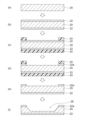
- FIG. FIG. 3 is a process flow chart showing the first half of the manufacturing procedure of EUV transmissive films in Examples 1 to 3.
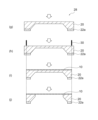
- FIG. 3 is a process flow diagram showing the second half of the manufacturing procedure of EUV transmissive films in Examples 1 to 3.
- FIG. 1 shows a schematic cross-sectional view of an EUV transmissive film 10 according to one embodiment of the present invention.
- the EUV transmissive film 10 includes a main layer 12 and a protective layer 14 covering at least one side of the main layer 12 .
- the main layer 12 is composed of beryllium metal
- the protective layer 14 is composed of beryllium nitride.
- a practical level of high EUV transmittance for example, 91% or more
- a low-pressure hydrogen atmosphere environment can be achieved. It is possible to provide the EUV transmissive film 10 that has both durability and durability.
- the poly-Si-based pellicle film as disclosed in Patent Document 1 cannot reach the target 90% EUV transmittance when the thickness is set to maintain the film strength, and it is still practical. not targeted.
- the CNT-based pellicle film disclosed in Patent Document 2 does not have durability against the pellicle usage environment (low-pressure hydrogen atmosphere). As a result, it becomes impossible to achieve a practical level of transmittance.
- Patent document 1 discloses forming a Ru layer as a protective layer, but although Ru has a high EUV transmittance, when the thickness is 3 nm, the EUV transmittance drops to 90% only with Ru. This reduces the throughput of the EUV exposure process.
- the protective layer 14 used in the present invention is composed of beryllium nitride, thereby providing the main layer 12 with durability in a low-pressure hydrogen atmosphere environment and exhibiting a higher EUV transmittance than the Ru layer.
- the main layer 12 and the protective layer 14 it is possible to provide an EUV permeable film 10 that has both a practically high level of EUV transmittance (for example, 91% or more) and durability in a low-pressure hydrogen atmosphere environment. can be done.
- the main layer 12 is composed of metallic beryllium. However, it is not necessary for the main layer 12 to consist entirely of metallic beryllium. It may be composed of beryllium. While ensuring the basic functions of a pellicle film (particle adhesion prevention function, etc.), it contributes to the realization of a practically high level of EUV transmittance. From this point of view, the thickness of the main layer 12 is preferably 10-70 nm, more preferably 15-50 nm, and still more preferably 20-35 nm.
- the protective layer 14 is a layer for protecting the main layer 12, which is a metallic beryllium layer. Therefore, the protective layer 14 may cover at least one surface of the main layer 12, but it is preferable to cover both surfaces of the main layer 12 with the protective layer.
- the protective layer 14 is composed of beryllium nitride.
- the main layer 12 does not have to consist entirely of beryllium nitride, and 99% by weight or more, preferably 99.5% by weight or more, and more preferably 99.8% by weight or more of the main layer 12 is composed of beryllium nitride. It is good if it is.
- the EUV transmittance is higher than that of a beryllium film having a Ru layer when compared at the same thickness. According to theoretical calculations, the transmittance is 85.8% when a 3-nm-thick Ru film is formed on both sides of a 30-nm-thick beryllium film. beryllium nitride is formed, the transmittance is 91.1%. When a 2-nm-thick beryllium nitride layer and a 1-nm-thick gradient composition layer (a layer composed of a nitrogen concentration gradient region described later) are formed on both sides of a 30-nm-thick beryllium film, the transmittance is 91.1%.
- beryllium is a highly reactive material, so it is easily oxidized to form beryllium oxide, but the oxidation can be suppressed by forming beryllium nitride.
- the advantages of using the beryllium nitride layer as the protective layer 14 as described above are increased EUV transmittance, protection of the beryllium film (main layer 12) during the etching process, and prevention of oxidation.
- the thickness of the protective layer 14 is preferably 5 nm or less, more preferably 3 nm or less.
- the beryllium nitride film with a thickness of 3 nm has an EUV transmittance of 95%, which is much higher than the 90% of the Ru film.
- the lower limit of the thickness of the protective layer 14 is not particularly limited, it is typically 1 nm or more.
- the term "beryllium nitride" includes not only stoichiometric compositions such as Be 3 N 2 but also non-stoichiometric compositions such as Be 3 N 2-x (where 0 ⁇ x ⁇ 2). It is intended to mean a generic composition that also allows stoichiometric compositions.
- Protective layer 14 preferably has a nitrogen concentration gradient region in which the nitrogen concentration decreases as it approaches main layer 12 . That is, as described above, the composition of beryllium nitride forming the protective layer 14 varies from a stoichiometric composition such as Be 3 N 2 to a non-stoichiometric composition such as Be 3 N 2-x (where 0 ⁇ x ⁇ 2). Although the stoichiometric composition can be included, it is preferable that the beryllium nitride constituting the protective layer 14 has a graded composition approaching a beryllium-rich composition as it approaches the main layer 12 .
- the thickness of the nitrogen concentration gradient region is preferably smaller than the thickness of the protective layer 14 . That is, the entire thickness of the protective layer 14 need not be the nitrogen concentration gradient region. For example, only part of the thickness of the protective layer 14, for example, preferably 10 to 70% of the thickness of the protective layer 14, more preferably 15 to 50%, is the nitrogen concentration gradient region. preferable.
- the EUV transmissive film 10 is preferably in the form of a self-supporting film in a main area for transmitting EUV. That is, it is preferable that the substrate (e.g., Si substrate) used for film formation remains as a border only at the outer edge of the EUV transmissive film 10. In other words, the substrate (e.g., Si substrate) does not remain, that is, the main region preferably consists of the main layer 12 and the protective layer 14 only.
- the substrate e.g., Si substrate
- the EUV transmissive film 10 can have a practically high EUV transmittance, preferably 91% or more, more preferably 92% or more, and even more preferably 93% or more. Since a higher EUV transmittance is more desirable, the upper limit is not particularly limited. can be 95% or less.
- the EUV-transmitting film according to the present invention can be manufactured by forming a laminated film to be an EUV-transmitting film on a Si substrate and then removing unnecessary portions of the Si substrate by etching to form a self-supporting film. Therefore, as described above, the main part of the EUV transmissive film is in the form of a self-supporting film in which the Si substrate does not remain.
- Preparation of Si substrate First, prepare a Si substrate for forming a laminated film thereon. After the laminated film consisting of the main layer 12 and the protective layer 14 is formed on the Si substrate, the main region (that is, the region to be a self-supporting film) other than the outer edge is removed by etching. Therefore, in order to perform etching efficiently in a short time, it is desirable to reduce the thickness of the Si substrate in the region to be the self-supporting film in advance. Therefore, using a normal semiconductor process, a mask corresponding to the EUV transmission shape is formed on the Si substrate, and the Si substrate is etched by wet etching to reduce the thickness of the main region of the Si substrate to a predetermined thickness. desired.
- a Si substrate having a cavity formed by wet etching is prepared.
- the wet etching mask any material having corrosion resistance to the wet etching solution for Si may be used.
- SiO 2 is preferably used.
- the wet etching liquid is not particularly limited as long as it can etch Si.
- TMAH tetramethylammonium hydroxide
- (2) Formation of laminated film Formation of the laminated film may be performed by any film forming method.
- Sputtering method is mentioned as an example of the preferable film-forming method.
- the beryllium film as the main layer 12 is fabricated by sputtering using a pure Be target, and the beryllium nitride film as the protective layer 14 is fabricated by reactive sputtering. preferably done.
- This reactive sputtering can be carried out, for example, by introducing nitrogen gas into the chamber during sputtering using a pure Be target, so that beryllium reacts with nitrogen to produce beryllium nitride.
- beryllium nitride can be produced by forming a beryllium film and then irradiating nitrogen plasma to cause a nitridation reaction of beryllium to produce beryllium nitride.
- the method for synthesizing beryllium nitride is not limited to these.
- it is preferable to use different beryllium targets for forming the beryllium nitride film and beryllium targets for forming the beryllium film it is also possible to use the same target for forming the beryllium nitride film and for forming the beryllium film. .
- beryllium nitride film and the beryllium film may be formed in a single-chamber sputtering apparatus as in the examples described later, or the beryllium nitride film and the beryllium film may be formed in separate chambers using a two-chamber sputtering apparatus. may be formed.
- the introduction of the nitrogen gas may be stopped halfway and the film of beryllium metal may be switched to the film while continuing the sputtering. .
- a region is formed in which the nitrogen concentration in the film to be formed decreases in the thickness direction as the nitrogen gas concentration decreases.
- the nitrogen concentration gradient region can be formed by starting the introduction of nitrogen gas halfway while continuing the sputtering, contrary to the above.
- the thickness of the nitrogen concentration gradient region can be controlled by adjusting the time for changing the nitrogen gas concentration.
- the composite film is formed into a self-supporting film by removing unnecessary portions of the Si substrate other than the outer edge portion left as a border of the Si substrate on which the composite film is formed by etching.
- Etching of Si may be performed by any method, but etching using XeF 2 is preferably performed.
- Example 1 According to the procedure shown in FIGS. 2A and 2B, a composite self-supporting film (EUV transmissive film) having a three-layer structure of beryllium nitride/beryllium/beryllium nitride was produced as follows.
- EUV transmissive film EUV transmissive film
- the resist mask 24 for SiO2 etching was removed by an ashing device (FIG. 2A(e)).
- Si was etched with a TMAH solution.
- the etching rate was measured in advance, and the etching was performed for the etching time required to obtain the target Si substrate thickness of 50 ⁇ m (FIG. 2A(f)).
- the SiO 2 film 22 formed on the non-Si-etched surface was removed and washed with hydrofluoric acid to prepare a Si substrate 28 (FIG. 2B(g)).
- the outer shape of the Si substrate may be diced with a laser 30 as necessary (FIG. 2B(h)) to obtain a desired shape (FIG. 2B(i)).
- a cavity 26 of 110 mm ⁇ 145 mm was provided in the center of the 8-inch (20.32 cm) Si wafer 20, and a Si substrate 28 having a Si thickness of 50 ⁇ m at the cavity 26 portion was prepared.
- a composite film having a three-layer structure of beryllium nitride/beryllium/beryllium nitride was formed as follows on the Si substrate 28 provided with the cavity 26 obtained in (1) above (Fig. 2B (i)).
- the Si substrate 28 was set in a sputtering apparatus, and a pure Be target was attached.
- the inside of the chamber was evacuated, the internal pressure was 0.5 Pa, and reactive sputtering was performed by adjusting the flow rate ratio of argon gas and nitrogen gas to be 1:1. bottom.
- sputtering was performed using only argon gas without introducing nitrogen gas, and the sputtering was terminated after a time was taken to deposit 25 nm of beryllium.
- the Si substrate 28 with the composite film prepared in (2) above was set in a chamber of a XeF 2 etcher capable of processing an 8-inch (20.32 cm) substrate.
- the inside of the chamber was sufficiently evacuated. At this time, if moisture remains in the chamber, it reacts with the XeF 2 gas to produce hydrofluoric acid, which corrodes the etcher and causes unexpected etching. If necessary, the inside of the chamber was repeatedly evacuated and introduced with nitrogen gas to reduce residual moisture. When the vacuum was sufficiently drawn, the valve between the XeF 2 raw material cylinder and the preliminary chamber was opened. As a result, XeF 2 was sublimated and XeF 2 gas was accumulated in the preliminary chamber.
- Example 2 A composite self-supporting film was produced in the same manner as in Example 1, except that the composite film was formed as follows.
- Example 1 (1) (Formation of composite membrane) The Si substrate having the cavity formed in Example 1 (1) was placed in a sputtering apparatus, and beryllium was deposited to a thickness of 1 nm. By generating plasma while introducing nitrogen gas into the chamber, the generated nitrogen plasma was reacted with the formed beryllium film to form beryllium nitride. Next, a beryllium film was formed to a thickness of 26 nm on the formed beryllium nitride film, and after the film formation, plasma was generated while nitrogen gas was introduced into the chamber again, and the surface was changed to beryllium nitride.
- a 25 nm-thick beryllium film (composite film of 1.5 nm beryllium nitride/25 nm beryllium/1.5 nm beryllium nitride) having 1.5 nm-thick beryllium nitride films on both sides was formed.
- Example 3 (Comparison) EUV transmission was performed in the same manner as in Example 1, except that no beryllium nitride film was formed (that is, a single layer film of beryllium 25 nm was formed instead of a composite film of beryllium nitride 2 nm/beryllium 25 nm/beryllium nitride 2 nm). A film (beryllium single-layer free-standing film) was produced.
- EUV transmittance The EUV transmittance films produced in Examples 1 to 3 were irradiated with EUV light, and the amount of transmitted EUV light was measured with a sensor. The EUV transmittance was obtained from a comparison between the obtained measured value and the value obtained by directly measuring the amount of EUV light with a sensor without the EUV transmissive film. As a result, the EUV transmittance of the composite self-supporting film produced in Example 1 was 93.0%, which was almost the same as the theoretically calculated value of 93.3%. Moreover, the EUV transmittance of the composite self-supporting film produced in Example 2 was 93.5%, which is close to the theoretically calculated value of 94.1%.
Landscapes
- Physics & Mathematics (AREA)
- General Physics & Mathematics (AREA)
- Optics & Photonics (AREA)
- Preparing Plates And Mask In Photomechanical Process (AREA)
- Laminated Bodies (AREA)
- Optical Filters (AREA)
- Physical Vapour Deposition (AREA)
Priority Applications (15)
| Application Number | Priority Date | Filing Date | Title |
|---|---|---|---|
| KR1020237002844A KR102891816B1 (ko) | 2021-10-20 | 2021-10-20 | Euv 투과막 |
| JP2023507498A JP7492649B2 (ja) | 2021-10-20 | 2021-10-20 | Euv透過膜 |
| CN202180055382.6A CN118076920A (zh) | 2021-10-20 | 2021-10-20 | Euv透过膜 |
| EP21954413.7A EP4194948A4 (en) | 2021-10-20 | 2021-10-20 | EUV TRANSMITTANT FILM |
| PCT/JP2021/038811 WO2023067739A1 (ja) | 2021-10-20 | 2021-10-20 | Euv透過膜 |
| EP24203173.0A EP4465129A3 (en) | 2021-10-20 | 2021-10-20 | Euv transmissive film |
| KR1020237006160A KR102947881B1 (ko) | 2021-10-20 | 2022-09-15 | Euv 투과막 |
| JP2023515782A JP7498855B2 (ja) | 2021-10-20 | 2022-09-15 | Euv透過膜 |
| CN202280007294.3A CN118140177A (zh) | 2021-10-20 | 2022-09-15 | Euv透过膜 |
| EP22883267.1A EP4227736A4 (en) | 2021-10-20 | 2022-09-15 | Euv transmissive film |
| PCT/JP2022/034590 WO2023067957A1 (ja) | 2021-10-20 | 2022-09-15 | Euv透過膜 |
| TW111135499A TW202328806A (zh) | 2021-10-20 | 2022-09-20 | Euv透射膜 |
| US18/173,955 US12591172B2 (en) | 2021-10-20 | 2023-02-24 | EUV transmissive membrane |
| US18/310,609 US20230305192A1 (en) | 2021-10-20 | 2023-05-02 | Euv transmissive film |
| JP2024064701A JP7598504B2 (ja) | 2021-10-20 | 2024-04-12 | Euv透過膜 |
Applications Claiming Priority (1)
| Application Number | Priority Date | Filing Date | Title |
|---|---|---|---|
| PCT/JP2021/038811 WO2023067739A1 (ja) | 2021-10-20 | 2021-10-20 | Euv透過膜 |
Related Child Applications (1)
| Application Number | Title | Priority Date | Filing Date |
|---|---|---|---|
| US18/173,955 Continuation US12591172B2 (en) | 2021-10-20 | 2023-02-24 | EUV transmissive membrane |
Publications (1)
| Publication Number | Publication Date |
|---|---|
| WO2023067739A1 true WO2023067739A1 (ja) | 2023-04-27 |
Family
ID=86058073
Family Applications (2)
| Application Number | Title | Priority Date | Filing Date |
|---|---|---|---|
| PCT/JP2021/038811 Ceased WO2023067739A1 (ja) | 2021-10-20 | 2021-10-20 | Euv透過膜 |
| PCT/JP2022/034590 Ceased WO2023067957A1 (ja) | 2021-10-20 | 2022-09-15 | Euv透過膜 |
Family Applications After (1)
| Application Number | Title | Priority Date | Filing Date |
|---|---|---|---|
| PCT/JP2022/034590 Ceased WO2023067957A1 (ja) | 2021-10-20 | 2022-09-15 | Euv透過膜 |
Country Status (7)
| Country | Link |
|---|---|
| US (2) | US12591172B2 (https=) |
| EP (3) | EP4194948A4 (https=) |
| JP (3) | JP7492649B2 (https=) |
| KR (2) | KR102891816B1 (https=) |
| CN (2) | CN118076920A (https=) |
| TW (1) | TW202328806A (https=) |
| WO (2) | WO2023067739A1 (https=) |
Cited By (2)
| Publication number | Priority date | Publication date | Assignee | Title |
|---|---|---|---|---|
| WO2025182054A1 (ja) * | 2024-02-29 | 2025-09-04 | 日本碍子株式会社 | Euv透過膜及びその加工方法、並びに露光方法 |
| JPWO2025182055A1 (https=) * | 2024-02-29 | 2025-09-04 |
Families Citing this family (1)
| Publication number | Priority date | Publication date | Assignee | Title |
|---|---|---|---|---|
| JP7372501B1 (ja) * | 2022-09-15 | 2023-10-31 | 日本碍子株式会社 | Euv透過膜 |
Citations (7)
| Publication number | Priority date | Publication date | Assignee | Title |
|---|---|---|---|---|
| JPH01162332A (ja) * | 1987-12-18 | 1989-06-26 | Sharp Corp | X線リソグラフィ用マスクメンブレン |
| JPH0558817B2 (https=) | 1985-11-14 | 1993-08-27 | Toshikazu Okuno | |
| JPH10340843A (ja) * | 1997-06-06 | 1998-12-22 | Nikon Corp | 照明装置および露光装置 |
| JP2000338299A (ja) * | 1999-05-28 | 2000-12-08 | Mitsubishi Electric Corp | X線露光装置、x線露光方法、x線マスク、x線ミラー、シンクロトロン放射装置、シンクロトロン放射方法および半導体装置 |
| JP2017522590A (ja) * | 2014-07-04 | 2017-08-10 | エーエスエムエル ネザーランズ ビー.ブイ. | リソグラフィ装置内で用いられる膜及びそのような膜を含むリソグラフィ装置 |
| JP2018151622A (ja) * | 2017-03-10 | 2018-09-27 | エスアンドエス テック カンパニー リミテッド | 極紫外線リソグラフィ用ペリクル及びその製造方法 |
| JP2018194840A (ja) | 2017-05-15 | 2018-12-06 | アイメック・ヴェーゼットウェーImec Vzw | カーボンナノチューブペリクル膜の形成方法 |
Family Cites Families (10)
| Publication number | Priority date | Publication date | Assignee | Title |
|---|---|---|---|---|
| JP2001221689A (ja) * | 2000-02-08 | 2001-08-17 | Yokogawa Electric Corp | 赤外線光源及び赤外線ガス分析計 |
| US7456932B2 (en) | 2003-07-25 | 2008-11-25 | Asml Netherlands B.V. | Filter window, lithographic projection apparatus, filter window manufacturing method, device manufacturing method and device manufactured thereby |
| JP4928494B2 (ja) | 2008-05-02 | 2012-05-09 | 信越化学工業株式会社 | ペリクルおよびペリクルの製造方法 |
| JP6308592B2 (ja) * | 2014-04-02 | 2018-04-11 | 信越化学工業株式会社 | Euv用ペリクル |
| KR102186010B1 (ko) * | 2016-01-26 | 2020-12-04 | 한양대학교 산학협력단 | Euv 펠리클 구조체, 및 그 제조 방법 |
| KR102873593B1 (ko) | 2017-11-06 | 2025-10-21 | 에이에스엠엘 네델란즈 비.브이. | 응력 감소를 위한 금속 실리사이드 질화 |
| JP7258878B2 (ja) | 2017-12-12 | 2023-04-17 | エーエスエムエル ネザーランズ ビー.ブイ. | ペリクルに関連する状態を決定するための装置および方法 |
| CA3116145A1 (en) * | 2018-10-15 | 2020-04-23 | Asml Netherlands B.V. | Method of manufacturing a membrane assembly |
| NL2027098B1 (en) | 2020-01-16 | 2021-10-14 | Asml Netherlands Bv | Pellicle membrane for a lithographic apparatus |
| JP7372501B1 (ja) * | 2022-09-15 | 2023-10-31 | 日本碍子株式会社 | Euv透過膜 |
-
2021
- 2021-10-20 EP EP21954413.7A patent/EP4194948A4/en active Pending
- 2021-10-20 CN CN202180055382.6A patent/CN118076920A/zh active Pending
- 2021-10-20 WO PCT/JP2021/038811 patent/WO2023067739A1/ja not_active Ceased
- 2021-10-20 KR KR1020237002844A patent/KR102891816B1/ko active Active
- 2021-10-20 JP JP2023507498A patent/JP7492649B2/ja active Active
- 2021-10-20 EP EP24203173.0A patent/EP4465129A3/en active Pending
-
2022
- 2022-09-15 KR KR1020237006160A patent/KR102947881B1/ko active Active
- 2022-09-15 CN CN202280007294.3A patent/CN118140177A/zh active Pending
- 2022-09-15 WO PCT/JP2022/034590 patent/WO2023067957A1/ja not_active Ceased
- 2022-09-15 JP JP2023515782A patent/JP7498855B2/ja active Active
- 2022-09-15 EP EP22883267.1A patent/EP4227736A4/en active Pending
- 2022-09-20 TW TW111135499A patent/TW202328806A/zh unknown
-
2023
- 2023-02-24 US US18/173,955 patent/US12591172B2/en active Active
- 2023-05-02 US US18/310,609 patent/US20230305192A1/en active Pending
-
2024
- 2024-04-12 JP JP2024064701A patent/JP7598504B2/ja active Active
Patent Citations (7)
| Publication number | Priority date | Publication date | Assignee | Title |
|---|---|---|---|---|
| JPH0558817B2 (https=) | 1985-11-14 | 1993-08-27 | Toshikazu Okuno | |
| JPH01162332A (ja) * | 1987-12-18 | 1989-06-26 | Sharp Corp | X線リソグラフィ用マスクメンブレン |
| JPH10340843A (ja) * | 1997-06-06 | 1998-12-22 | Nikon Corp | 照明装置および露光装置 |
| JP2000338299A (ja) * | 1999-05-28 | 2000-12-08 | Mitsubishi Electric Corp | X線露光装置、x線露光方法、x線マスク、x線ミラー、シンクロトロン放射装置、シンクロトロン放射方法および半導体装置 |
| JP2017522590A (ja) * | 2014-07-04 | 2017-08-10 | エーエスエムエル ネザーランズ ビー.ブイ. | リソグラフィ装置内で用いられる膜及びそのような膜を含むリソグラフィ装置 |
| JP2018151622A (ja) * | 2017-03-10 | 2018-09-27 | エスアンドエス テック カンパニー リミテッド | 極紫外線リソグラフィ用ペリクル及びその製造方法 |
| JP2018194840A (ja) | 2017-05-15 | 2018-12-06 | アイメック・ヴェーゼットウェーImec Vzw | カーボンナノチューブペリクル膜の形成方法 |
Non-Patent Citations (1)
| Title |
|---|
| See also references of EP4194948A4 |
Cited By (3)
| Publication number | Priority date | Publication date | Assignee | Title |
|---|---|---|---|---|
| WO2025182054A1 (ja) * | 2024-02-29 | 2025-09-04 | 日本碍子株式会社 | Euv透過膜及びその加工方法、並びに露光方法 |
| JPWO2025182054A1 (https=) * | 2024-02-29 | 2025-09-04 | ||
| JPWO2025182055A1 (https=) * | 2024-02-29 | 2025-09-04 |
Also Published As
| Publication number | Publication date |
|---|---|
| EP4227736A1 (en) | 2023-08-16 |
| KR20230058055A (ko) | 2023-05-02 |
| JP7492649B2 (ja) | 2024-05-29 |
| EP4194948A1 (en) | 2023-06-14 |
| US20230213848A1 (en) | 2023-07-06 |
| KR20230058044A (ko) | 2023-05-02 |
| US12591172B2 (en) | 2026-03-31 |
| KR102891816B1 (ko) | 2025-11-26 |
| JP2024088797A (ja) | 2024-07-02 |
| KR102947881B1 (ko) | 2026-04-02 |
| EP4194948A4 (en) | 2024-05-01 |
| TW202328806A (zh) | 2023-07-16 |
| CN118076920A (zh) | 2024-05-24 |
| EP4465129A2 (en) | 2024-11-20 |
| CN118140177A (zh) | 2024-06-04 |
| JPWO2023067739A1 (https=) | 2023-04-27 |
| WO2023067957A1 (ja) | 2023-04-27 |
| JP7498855B2 (ja) | 2024-06-12 |
| EP4465129A3 (en) | 2025-02-12 |
| JP7598504B2 (ja) | 2024-12-11 |
| JPWO2023067957A1 (https=) | 2023-04-27 |
| US20230305192A1 (en) | 2023-09-28 |
| EP4227736A4 (en) | 2025-06-11 |
Similar Documents
| Publication | Publication Date | Title |
|---|---|---|
| JP7598504B2 (ja) | Euv透過膜 | |
| TWI846616B (zh) | 光罩基底、相位偏移光罩及半導體裝置之製造方法 | |
| JP2019091001A (ja) | 極紫外線リソグラフィ用ペリクル及びその製造方法 | |
| JP7372501B1 (ja) | Euv透過膜 | |
| WO2020066591A1 (ja) | マスクブランク、転写用マスクおよび半導体デバイスの製造方法 | |
| JP7724362B2 (ja) | Euv透過膜の製造方法及びペリクル | |
| TW202303261A (zh) | 光罩基底、相位偏移光罩及半導體裝置之製造方法 | |
| JP7583961B2 (ja) | ペリクルの製造に用いられるためのSiメンブレン構造体、及びペリクルの製造方法 | |
| US20250278032A1 (en) | Euv transmissive membrane, processing method thereof, and exposure method | |
| JP7554368B2 (ja) | Euv透過膜及びその使用方法、並びに露光方法 | |
| TWI916620B (zh) | Euv透射膜的製造方法及表層 | |
| WO2025182055A1 (ja) | Euv透過膜、ペリクル、及び露光方法 | |
| KR20220066884A (ko) | 마스크 블랭크, 위상 시프트 마스크 및 반도체 디바이스의 제조 방법 |
Legal Events
| Date | Code | Title | Description |
|---|---|---|---|
| WWE | Wipo information: entry into national phase |
Ref document number: 2023507498 Country of ref document: JP |
|
| WWE | Wipo information: entry into national phase |
Ref document number: 202180055382.6 Country of ref document: CN |
|
| ENP | Entry into the national phase |
Ref document number: 2021954413 Country of ref document: EP Effective date: 20230302 |
|
| NENP | Non-entry into the national phase |
Ref country code: DE |