WO2023038098A1 - ポリアミド46マルチフィラメントおよびエアバッグ縫製糸 - Google Patents
ポリアミド46マルチフィラメントおよびエアバッグ縫製糸 Download PDFInfo
- Publication number
- WO2023038098A1 WO2023038098A1 PCT/JP2022/033826 JP2022033826W WO2023038098A1 WO 2023038098 A1 WO2023038098 A1 WO 2023038098A1 JP 2022033826 W JP2022033826 W JP 2022033826W WO 2023038098 A1 WO2023038098 A1 WO 2023038098A1
- Authority
- WO
- WIPO (PCT)
- Prior art keywords
- polyamide
- multifilament
- elongation
- dtex
- temperature
- Prior art date
- Legal status (The legal status is an assumption and is not a legal conclusion. Google has not performed a legal analysis and makes no representation as to the accuracy of the status listed.)
- Ceased
Links
Images
Classifications
-
- D—TEXTILES; PAPER
- D02—YARNS; MECHANICAL FINISHING OF YARNS OR ROPES; WARPING OR BEAMING
- D02G—CRIMPING OR CURLING FIBRES, FILAMENTS, THREADS, OR YARNS; YARNS OR THREADS
- D02G3/00—Yarns or threads, e.g. fancy yarns; Processes or apparatus for the production thereof, not otherwise provided for
- D02G3/44—Yarns or threads characterised by the purpose for which they are designed
- D02G3/46—Sewing-cottons or the like
-
- D—TEXTILES; PAPER
- D01—NATURAL OR MAN-MADE THREADS OR FIBRES; SPINNING
- D01F—CHEMICAL FEATURES IN THE MANUFACTURE OF ARTIFICIAL FILAMENTS, THREADS, FIBRES, BRISTLES OR RIBBONS; APPARATUS SPECIALLY ADAPTED FOR THE MANUFACTURE OF CARBON FILAMENTS
- D01F6/00—Monocomponent artificial filaments or the like of synthetic polymers; Manufacture thereof
- D01F6/58—Monocomponent artificial filaments or the like of synthetic polymers; Manufacture thereof from homopolycondensation products
- D01F6/60—Monocomponent artificial filaments or the like of synthetic polymers; Manufacture thereof from homopolycondensation products from polyamides
-
- D—TEXTILES; PAPER
- D10—INDEXING SCHEME ASSOCIATED WITH SUBLASSES OF SECTION D, RELATING TO TEXTILES
- D10B—INDEXING SCHEME ASSOCIATED WITH SUBLASSES OF SECTION D, RELATING TO TEXTILES
- D10B2331/00—Fibres made from polymers obtained otherwise than by reactions only involving carbon-to-carbon unsaturated bonds, e.g. polycondensation products
- D10B2331/02—Fibres made from polymers obtained otherwise than by reactions only involving carbon-to-carbon unsaturated bonds, e.g. polycondensation products polyamides
-
- D—TEXTILES; PAPER
- D10—INDEXING SCHEME ASSOCIATED WITH SUBLASSES OF SECTION D, RELATING TO TEXTILES
- D10B—INDEXING SCHEME ASSOCIATED WITH SUBLASSES OF SECTION D, RELATING TO TEXTILES
- D10B2401/00—Physical properties
- D10B2401/06—Load-responsive characteristics
- D10B2401/061—Load-responsive characteristics elastic
-
- D—TEXTILES; PAPER
- D10—INDEXING SCHEME ASSOCIATED WITH SUBLASSES OF SECTION D, RELATING TO TEXTILES
- D10B—INDEXING SCHEME ASSOCIATED WITH SUBLASSES OF SECTION D, RELATING TO TEXTILES
- D10B2401/00—Physical properties
- D10B2401/06—Load-responsive characteristics
- D10B2401/063—Load-responsive characteristics high strength
-
- D—TEXTILES; PAPER
- D10—INDEXING SCHEME ASSOCIATED WITH SUBLASSES OF SECTION D, RELATING TO TEXTILES
- D10B—INDEXING SCHEME ASSOCIATED WITH SUBLASSES OF SECTION D, RELATING TO TEXTILES
- D10B2505/00—Industrial
- D10B2505/12—Vehicles
- D10B2505/124—Air bags
Definitions
- the present invention relates to polyamide 46 multifilament and airbag sewing thread.
- Polyamide 6 also known as “polycaprolactam” and polyamide 66 (also known as “polyhexamethylene adipamide”) multifilaments have higher strength and elongation than general-purpose multifilaments such as polyester and polypropylene, and have excellent fluff quality. Due to its superiority, it is used in a wide variety of applications such as airbags, tire cords, sewing threads, power transmission belts, ropes, and fishing nets.
- polyamide 66 has been used for many years in the field of sewing threads due to its high mechanical properties and heat resistance.
- polyamide 46 Compared to polyamide 66, polyamide 46 has a higher melting point and high heat resistance, and is excellent in dimensional stability under high heat. A technique for improving strength by improving conditions is disclosed (Patent Document 1).
- Patent Documents 2 and 3 techniques for improving dimensional stability under high heat have been disclosed (Patent Documents 2 and 3), and inventions that further improve the properties of polyamide 46 have been reported so far.
- Patent Document 4 As a technique for imparting stretchability to a general-purpose polyamide multifilament, for example, a method of using a semi-stretched polyamide multifilament as a sheath yarn and processing the polyamide multifilament as a core yarn and Taslan is disclosed (Patent Document 4). ).
- Patent Document 4 a method of using a semi-stretched polyamide multifilament as a sheath yarn and processing the polyamide multifilament as a core yarn and Taslan is disclosed (Patent Document 4).
- Patent Documents 5 and 6 Various airbag sewing threads have been proposed to solve this problem (Patent Documents 5 and 6).
- Patent Document 5 a sewing thread for an airbag containing 50% or more of a fibrous material having a melting point of 300° C. or more is studied, and it is clearly shown that the thread has an extremely high heat resistance strength retention rate.
- the dimensional stability under high temperature heat is not specified, nor is the stretchability of the sewing thread examined.
- Patent Document 6 by setting the elongation of the sewing thread and the elongation of the base fabric to a specific range, the followability of the sewing thread to the inflatable base fabric when the airbag is deployed is improved, and the sewn part is ventilated. Although it is shown that the amount is suppressed, the stretchability of the sewing thread is not taken into consideration. Furthermore, no study has been made on the dimensional stability of the sewing thread when the airbag is deployed and the temperature is high.
- the object of the present invention is to provide a high-strength, high-temperature, high-temperature sewing thread that is suitable for airbag sewing threads that have mechanical properties that can suppress air leakage from the airbag sewing portion due to high-temperature, high-output gas.
- a polyamide 46 multifilament having dimensional stability and excellent stretchability.
- the present invention has been intensively studied in order to solve the above problems, and mainly consists of the following configurations.
- Polyamide 46 multifilament having the following physical properties. Strength 6.0 to 9.0 cN / dtex, elongation 15 to 30%, E10 (100 ° C.) when the elongation rate after ten times of tensile in a 100 ° C. environment is E10 (100 ° C.) ⁇ 1.0%, M (RT) for elongation at 2.0 cN/dtex load under normal temperature, M (100 ° C) for elongation at 2.0 cN / dtex load under 100 ° C environment , M (100° C.) ⁇ M (R.T.) ⁇ 0.5%.
- E10 (R.T.) is the elongation after ten times of stretching at room temperature
- E10′ (R.T.) is the elongation after ten times of stretching at room temperature after heat treatment at 120° C. for 24 hours.
- T.) E10′ (R.T.) ⁇ E10 (R.T.) ⁇ 0%
- M (R.T.) When the elongation under a load of 2.0 cN / dtex at normal temperature after heat treatment at 120 ° C. for 24 hours is M '(RT), M '(RT)-M(RT .) ⁇ 0%.
- polyamide 46 multifilament of the present invention for sewing an airbag, it is possible to suppress air leakage from the sewn part of the airbag due to high temperature and high output gas when the airbag is deployed.
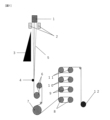
- FIG. 1 is a schematic diagram of one aspect of the manufacturing process (melting process is omitted) of polyamide 46 multifilament.
- the polyamide 46 multifilament of the present invention will be described below.
- the polyamide 46 multifilament of the present invention is made of polyamide resin.
- the polyamide resin is a polyamide resin containing polyamide 46 as a main component.
- a multifilament with high heat resistance can be provided by using polyamide 46 having a high melting point as a main component.
- polyamide resin in which 98% by mass or more of the total mass of the polyamide resin excluding the additives described later is composed of polyamide 46, and more preferably, it is composed of polyamide 46 only.
- the polyamide resin may be a copolymerized polyamide in which polyamide 46 is copolymerized with another polyamide, and polyamide 6, polyamide 66, polyamide 610, and polyamide 612 can be used as other polyamides to be copolymerized. Also, the polyamide resin may be a mixture of polyamide 46 and other polyamides.
- the sulfuric acid relative viscosity of the polyamide resin is preferably 3.3 to 5.0, more preferably 3.5 to 4.5. If the polyamide resin has a sulfuric acid relative viscosity of more than 5.0, it will contribute to the deterioration of the threadability, causing frequent occurrence of thread breakage and fluffing during stretching. Further, in the case of a polyamide resin having a sulfuric acid relative viscosity of less than 3.3, it becomes difficult to obtain a polyamide 46 multifilament having a predetermined sulfuric acid relative viscosity ⁇ r, which will be described later. Sulfuric acid relative viscosity refers to a value measured by the method described in the Examples section below.
- terminal blocking agent such as monocarboxylic acid, delustering agent such as titanium oxide, polymerization catalyst and heat resistant agent such as phosphorus compound, copper compound and alkali metal or alkaline earth metal
- additives such as antioxidants such as halides and heat-resistant agents may be included as components other than the polyamide.
- the content of additives contained in the polyamide resin is preferably less than 5% by weight, more preferably less than 3% by weight. When the content of the additive is 5% by weight or more, the strength of the multifilament is lowered.
- the heat-resistant agent which has the effect of suppressing thermal deterioration of the polymer, preferably contains 250 to 7000 ppm, more preferably 500 to 5000 ppm.
- the heat-resistant agent may be used singly or in combination.
- the content of the heat-resistant agent is less than 250 ppm, the suppression of thermal deterioration of the polymer is limited, and the stretch property and dimensional stability after aging at high temperatures tend to be slightly impaired.
- adding a heat-resistant agent exceeding 7000 ppm reduces the strength and elongation of the fiber.
- the sulfuric acid relative viscosity ⁇ r of the polyamide 46 multifilament of the present invention is preferably 3.0 ⁇ r ⁇ 4.5, more preferably 3.3 ⁇ r ⁇ 4.2, still more preferably 3.5 ⁇ r ⁇ 4. is 0.
- the sulfuric acid relative viscosity ⁇ r within such a range, it becomes possible to produce a polyamide 46 multifilament having sufficient crystal orientation with good spinnability.
- the total fineness of the polyamide 46 multifilament of the present invention is preferably 300-2300 dtex, more preferably 400-1700 dtex.
- the total fineness is preferably 300-2300 dtex or more, it is possible to suppress the generation of fluff during hot drawing. Furthermore, since the melting time of the polymer does not become excessively long, thermal decomposition of the polymer can be suppressed. Further, by setting the total fineness to 2300 dtex or less, a polyamide 46 multifilament excellent in mechanical properties can be obtained without impairing the uniform cooling property during spinning.
- the number of single fibers of the polyamide 46 multifilament of the present invention is preferably 30-350, more preferably 50-250. If the number of the single fibers is less than 30, the fineness of the single fibers becomes large, the cooling efficiency during melt spinning becomes low, and the flexibility of the multifilament is lost. Further, if the number of the single fibers is more than 350, the single fiber fineness becomes thin, and fluff tends to be generated.
- the cross-sectional shape of the single fiber is not particularly limited. Various cross-sections such as round cross-sections, flat, polygonal, Y-shaped, X-shaped and other irregular shapes, and hollow cross-sections can be employed. Mixed fibers having a plurality of cross-sectional shapes may also be used.
- the strength of the polyamide 46 multifilament of the present invention is 6.0-9.0 cN/dtex, more preferably 7.0-9.0 cN/dtex.
- the strength range is a range essential for obtaining stretchable polyamide 46 multifilament due to the crystal orientation of polyamide 46, and is an essential property for polyamide multifilament for airbag sewing thread. It has been clarified. If the strength is less than 6.0 cN/dtex, not only is the durability as an airbag sewing thread insufficient, but also the crystal orientation is lowered, making it impossible to obtain a stretchable polyamide 46 multifilament.
- mechanical drawing is performed at a high magnification, and sufficient elongation as an airbag sewing thread cannot be obtained.
- the elongation (elongation at break) of the polyamide 46 multifilament of the present invention is 15-30%, more preferably 18-28%.
- the polyamide multifilament is suitable for airbag sewing thread.
- the elongation range is essential for obtaining dimensional stability during high-temperature heating. If the elongation is less than 15%, when a load is applied to the sewn part of the airbag, the shock absorption due to expansion and contraction becomes insufficient, and the durability as a sewing thread cannot be maintained.
- the polyamide 46 multifilament of the present invention has an elongation E10 (100°C) after 10 times tensile in a 100°C environment of less than 1.0%, more preferably less than 0.8%. By setting it within this range, the return after elongation due to the pressure when the airbag is deployed is good, the sewing thread followability to the inflatable base fabric is good, and the internal pressure retention performance is improved. When E10 (100° C.) is 1.0% or more, the reduction of air leakage from the sewn portion is insufficient.
- the polyamide 46 multifilament of the present invention has an elongation under a load of 2.0 cN/dtex M (RT) at room temperature and an elongation under a load of 2.0 cN/dtex M under a 100°C environment (100°C). difference (M(100° C.) ⁇ M(R.T.)) is less than 0.5%, more preferably less than 0.3%, and even more preferably less than 0.1%.
- the polyamide 46 multifilament of the present invention has an elongation rate E10 (RT) after 10 times tensile at room temperature, and a fiber after heat treatment at 120 ° C. for 24 hours.
- the difference (E10'(R.T.)-E10(R.T.)) in the elongation rate E10'(R.T.) is preferably 0% or less. Within this range, it is possible to suppress the loss of stretch properties due to sewing thread, sewing processing, and aging in an airbag storage environment.
- the polyamide 46 multifilament of the present invention has an elongation under load M (RT) of 2.0 cN/dtex at normal temperature and 2.0 cN/dtex at normal temperature of the fiber after heat treatment at 120 ° C. for 24 hours.
- the difference in the elongation under load M'(R.T.) (M'(R.T.)-M(R.T.)) is preferably 0% or less. Within this range, deterioration in dimensional stability due to sewing thread, sewing processing, and aging in an airbag storage environment can be suppressed.
- FIG. 1 is a schematic diagram of a direct spinning and drawing apparatus preferably used in the present invention.
- One embodiment of the method for producing the polyamide 46 multifilament of the present invention will be described below with reference to FIG. 1 as an example.
- the polyamide 46 multifilament of the present invention is preferably produced by melt spinning, and as described above, the sulfuric acid relative viscosity of the polyamide 46 chips used for melt spinning is preferably 3.3 to 5.0, more preferably 3.5. ⁇ 4.5. Within this range, it is possible to stably obtain high-strength polyamide 46 multifilaments with good spinnability.
- the moisture content of polyamide 46 chips is preferably 1300 ppm or less, more preferably 800 ppm or less.
- the chip moisture content is preferably 1300 ppm or less, more preferably 800 ppm or less.
- the polyamide 46 chips are melted, kneaded and spun by an extruder type spinning machine, and the melting is preferably performed in a vacuum environment.
- the pressure at the tip supply port of the extruder is preferably less than 5 kPa, more preferably less than 3 kPa (hereinafter less than 5 kPa is defined as vacuum).
- polyamide 46 has the property of decomposing and producing low molecular weight materials when melted.
- the decomposition mechanism can be roughly divided into thermal decomposition, oxidative decomposition, and hydrolysis. By melting under vacuum, water and oxygen in the air are eliminated, and the decomposition mechanism is limited to thermal decomposition. can be suppressed. By suppressing decomposition during melting, the molecular weight of the polymer constituting the multifilament can be maintained at a high level, and highly crystalline oriented polyamide 46 multifilament can be produced.
- the pressure is 5 kPa or more without a vacuum, hydrolysis during melting cannot be suppressed, and high strength cannot be obtained due to insufficient crystal orientation. As a result, it becomes difficult for the polyamide 46 multifilament to achieve the stretchability E10 (100° C.) specified in the present invention.
- the spinning temperature is set to 10 to 50°C higher than the melting point of the polymer chips, and melt spinning is performed from a spinneret 1 having preferably 30 to 350, more preferably 50 to 250 ejection holes.
- the high temperature atmosphere to be passed through is more preferably a melting point of -30 to +15°C.
- the molecular orientation of the melt-spun polyamide 46 polymer is relaxed, and the molecular orientation uniformity between single fibers is improved. can be increased, it is possible to increase the strength of the polyamide 46 filament.
- the undrawn yarn that has passed through the above steps is cooled and solidified by blowing air at 10 to 80°C, preferably 10 to 50°C, from the cross-flow cooling device 3. If the temperature of the cooling air is less than 10°C, a large-sized cooling device is required, which is not preferable. On the other hand, if the temperature of the cooling air exceeds 80° C., a large amount of air is required, and single fibers sway greatly.
- the undrawn yarn that has been cooled and solidified is preferably then drawn in multiple stages, particularly in two or three stages.
- FIG. 1 shows a specific example of the three-stage drawing.
- the undrawn yarn that has been cooled and solidified is oiled by the lubricating device 4 , and taken up by the take-up roller ( 1 FR) 6 .
- the take-off roller is typically unheated.
- the yarn is drawn in the order of the yarn feeding roller (2FR) 7, the first drawing roller (1DR) 8, the second drawing roller (2DR) 9, the third drawing roller (3DR) 10, and the relaxation roller (RR) 11. It is wound, subjected to heat treatment and drawing treatment, and wound around the winder 12 .
- the surface of 2FR is a mirror surface and the surfaces of 1DR, 2DR, 3DR and RR are satin finished.
- the first stage of stretching is performed between 2FR and 1DR, the temperature of 2FR (roller surface temperature) is 60-90°C, and the temperature of 1DR is 100-225°C.
- the second stage drawing is performed between 1DR and 2DR, and the temperature of 2DR (roller surface temperature) is 150 to 230°C.
- the third stage drawing is performed between 2DR and 3DR, and the temperature of 3DR (roller surface temperature) is 180 to 240°C.
- the draw ratio in the third drawing step that is, the final drawing step is 1.00 to 1.10 times. More preferably, it is 0.00 to 1.05 times.
- polyamide 46 polymer is known to have a remarkably high crystallization rate compared to conventional aliphatic polyamides such as polyamide 66 and polyamide 6. That is, it can be easily expected that the crystallization of the fibers has sufficiently progressed after the first stage of high-ratio drawing, much less after the second stage of drawing. There is no room left for re-drawing the fibers in such a final drawing step.
- the drawing in the final drawing process By setting the drawing in the final drawing process to the above range, it is possible to suppress the degree of orientation of the amorphous portion from becoming excessive, and to provide a multifilament that exhibits dimensional stability during high-temperature heating. If the draw ratio is greater than the above range, the degree of orientation of the amorphous portion increases, resulting in a multifilament that is likely to thermally shrink. Such a multifilament deteriorates in dimensional stability when heated to a high temperature, and cannot achieve the M'(R.T.)-M(R.T.) specified in the present invention. When the draw ratio is lower than 1.00 times, the tension is lowered, so that the yarn swings greatly and the spinning becomes difficult.
- polyamide 46 multifilament of the present invention can be obtained.
- an airbag sewing thread using the polyamide 46 multifilament of the present invention it can be manufactured by a known processing method.
- a multifilament with a test length of 250 mm is sandwiched by a chuck of a Tensilon universal testing machine RTG-1250 with a high and low temperature chamber manufactured by A&D Co., Ltd., and pulled at a speed of 300 mm / min until a load of 2.0 cN / dtex. After that, the operation of returning to the original chuck spacing at a speed of 300 mm/min was repeated for a specified number of times.
- the elongation when a load of 0.1 cN/dtex was exhibited in the 10th cycle return motion in the repeated tensile test was taken as the elongation E10 after 10 times of stretching.
- E10 the measured value at normal temperature
- E10 100 ° C
- E10′ the measured value at room temperature after heat treatment
- the heat treatment was performed at 120° C. for 24 hours.
- the measured value serves as an index representing the stretchability of the multifilament, and the smaller the E10 (100°C), the better the return after stretching under high temperature, and the better the stretchability under high temperature.
- the value obtained by subtracting E10 (R.T.) from E10' (R.T.) is an index that indicates the change in stretchability after aging at high temperatures.
- the value obtained by subtracting M (R.T.) from M (100°C) is an indicator of dimensional stability at high temperature.
- the value obtained by subtracting M (R.T.) from M' (R.T.) is an index that indicates changes in dimensional stability after aging at high temperatures.
- Example 1 Manufacturing method of polyamide 46 multifilament
- Polyamide 46 chips (Stanyl (registered trademark), melting point 292° C.) having a sulfuric acid relative viscosity of 3.9 were added with a 5% by weight aqueous solution of copper acetate as a heat resistant agent and mixed, and 70 ppm of copper was added to the polymer weight and adsorbed. rice field.
- the polyamide 46 chips were melted at 305°C under vacuum with an extruder type spinning machine.
- the molten polymer was weighed with a gear pump so that the total fineness was 940 dtex, filtered through a 20 ⁇ metal nonwoven fabric filter in a spinning pack, and spun from a 136-hole round-hole spinneret 1.
- a heating cylinder 2 having a heating cylinder length of 15 cm was placed 3 cm below the spinneret surface, and the cylinder was heated so that the atmosphere temperature in the cylinder reached 300°C, so that the spun yarn passed through an atmosphere of 300°C. .
- the atmospheric temperature in the cylinder is the air temperature in the central part of the length of the heating cylinder and 1 cm away from the inner wall.
- a cross-flow cooling device 3 that blows air from one direction is installed directly below the heating cylinder, and after passing the heating cylinder, cold air of 20 ° C. is blown at a speed of 35 m / min to cool and solidify the yarn.
- the row was oiled.
- the unstretched yarn to which the oil solution was applied was wound on a 1FR6 rotating at a surface speed of 600 m/min and taken up, and then stretched at a total draw ratio of 4.70.
- the take-up yarn is continuously stretched by 5% between the take-up roller 6 and 2FR7 without being wound once, and then stretched in the first stage at a rotation speed ratio of 3.27 times, and then rotated.
- the second-stage drawing was performed at a speed ratio of 1.30 times
- the third-stage final drawing was performed at a rotation speed ratio of 1.05 times, and the film was wound at a speed of 2600 m/min.
- roller surfaces of 1FR and 2FR are mirror-finished, and 1DR, 2DR, 3DR and RR are satin-finished.
- 3DR was set to 230°C and RR was set to 150°C.
- a polyamide 46 multifilament was obtained by such melt spinning and drawing.
- Table 1 shows the physical properties of the fibers obtained.
- Example 2 The same procedure as in Example 1 was carried out, except that the third stage draw ratio (final draw ratio) was changed as shown in Table 1 when spinning the polyamide 46 multifilament.
- Example 3 The procedure of Example 1 was repeated except that the total fineness of the polyamide 46 multifilament was changed as shown in Table 1.
- Example 4 The same procedure as in Example 1 was repeated except that the total fineness of the polyamide 46 multifilament and the total draw ratio were changed as shown in Table 1.
- Example 5 The same procedure as in Example 1 was repeated except that the total fineness of the polyamide 46 multifilament, the total draw ratio, and the final draw ratio were changed as shown in Table 1.
- Example 6-7 The same procedure as in Example 1 was repeated except that the total draw ratio and final draw ratio of the polyamide 46 multifilament were changed as shown in Table 1.
- Example 8 The procedure of Example 1 was repeated except that no heat-resistant agents (copper acetate, potassium iodide and potassium bromide) were added during the preparation of polyamide 46 chips.
- Example 4 The same procedure as in Example 1 was repeated except that the total fineness of the polyamide 46 multifilament and the total draw ratio were changed as shown in Table 1.
- Example 7 Example 1 was repeated except that a polyamide 66 polymer having a sulfuric acid relative viscosity of 3.8 was melt spun at 280° C. under vacuum using an extruder type spinning machine.
- Example 8 The procedure of Example 1 was repeated except that a polyamide 6 polymer having a sulfuric acid relative viscosity of 3.8 was melt-spun at 260° C. under vacuum using an extruder-type spinning machine.
- Table 1 shows the evaluation results of the production conditions and physical properties of the obtained polyamide 46 multifilaments in Examples 1 to 6 and Comparative Examples 1 to 8.
- the polyamide 46 multifilament of the present invention has high strength, high thermal dimensional stability, and exhibits superior stretchability.
- Comparative Examples 7 and 8 have high strength, but low stretchability and insufficient dimensional stability at high temperatures. When applied as sewing thread for airbags, it is impossible to suppress misalignment and improve internal pressure retention performance.
- Comparative Example 1 when the final draw ratio in the final drawing step exceeds 1.10 when producing a high-strength polyamide 46 multifilament, the degree of orientation of the amorphous portion increases, so heat It becomes a multifilament that is easy to shrink. Therefore, it was confirmed that the dimensional stability M(100° C.) ⁇ M(R.T.) during high-temperature heating exceeds 0.5. On the other hand, in Comparative Example 2, since the final drawing ratio in the final drawing step was less than 1.0, yarn breakage occurred frequently, making it difficult to collect raw yarn.
- Examples 2 and 6 and Comparative Example 5 are examples in which the crystal structure of the polyamide 46 multifilament was controlled, but the crystal orientation decreased as the stretching ratio shifted to a lower ratio, and it was confirmed that the stretchability was affected. Similarly, in Examples 2 and 7 and Comparative Example 6, the orientation of the amorphous portion increased as the stretching ratio shifted to a higher ratio, and it was confirmed that the dimensional stability during high-temperature heating was affected. As for Comparative Example 6, drawing at a high draw ratio resulted in deterioration of the spinnability.
- the polyamide 46 multifilament of the present invention has high strength and high heat resistance and is suitable for airbag sewing thread. Furthermore, since it has excellent dimensional stability under heat at high temperatures and stretchability, when it is used as a sewing thread for an airbag, it exerts a seam sealing effect. It is possible to provide an airbag that achieves the reduction of air leakage from the sewn part due to the high temperature and high output inflator, which has been a problem in the past, and the improvement of the internal pressure retention performance.
Landscapes
- Engineering & Computer Science (AREA)
- Textile Engineering (AREA)
- Chemical & Material Sciences (AREA)
- Chemical Kinetics & Catalysis (AREA)
- General Chemical & Material Sciences (AREA)
- Mechanical Engineering (AREA)
- Artificial Filaments (AREA)
Priority Applications (4)
| Application Number | Priority Date | Filing Date | Title |
|---|---|---|---|
| EP22867419.8A EP4400638A4 (en) | 2021-09-10 | 2022-09-09 | POLYAMIDE 46 MULTIFILAMENT AND SEWING THREAD FOR AIRBAG |
| JP2022562282A JPWO2023038098A1 (https=) | 2021-09-10 | 2022-09-09 | |
| CN202280051323.6A CN117693615A (zh) | 2021-09-10 | 2022-09-09 | 聚酰胺46复丝和气囊缝制线 |
| US18/681,223 US20240309560A1 (en) | 2021-09-10 | 2022-09-09 | Polyamide-46 multifilament and sewing thread for airbag |
Applications Claiming Priority (2)
| Application Number | Priority Date | Filing Date | Title |
|---|---|---|---|
| JP2021-147430 | 2021-09-10 | ||
| JP2021147430 | 2021-09-10 |
Publications (1)
| Publication Number | Publication Date |
|---|---|
| WO2023038098A1 true WO2023038098A1 (ja) | 2023-03-16 |
Family
ID=85506420
Family Applications (1)
| Application Number | Title | Priority Date | Filing Date |
|---|---|---|---|
| PCT/JP2022/033826 Ceased WO2023038098A1 (ja) | 2021-09-10 | 2022-09-09 | ポリアミド46マルチフィラメントおよびエアバッグ縫製糸 |
Country Status (5)
| Country | Link |
|---|---|
| US (1) | US20240309560A1 (https=) |
| EP (1) | EP4400638A4 (https=) |
| JP (1) | JPWO2023038098A1 (https=) |
| CN (1) | CN117693615A (https=) |
| WO (1) | WO2023038098A1 (https=) |
Citations (10)
| Publication number | Priority date | Publication date | Assignee | Title |
|---|---|---|---|---|
| JPS5976914A (ja) | 1982-10-22 | 1984-05-02 | Toray Ind Inc | ポリアミド繊維およびその製造方法 |
| JPS5988910A (ja) | 1982-11-04 | 1984-05-23 | Unitika Ltd | 高強力ナイロン46繊維及びその製造 |
| JPH01168914A (ja) | 1987-12-21 | 1989-07-04 | Toray Ind Inc | ポリテトラメチレンアジパミド系繊維 |
| JPH05272009A (ja) * | 1992-01-31 | 1993-10-19 | Unitika Ltd | エアーバツグ用ナイロン46繊維およびシート |
| JPH06235136A (ja) | 1993-02-04 | 1994-08-23 | Kuraray Co Ltd | エアバッグ用縫い糸 |
| JPH07216649A (ja) * | 1994-01-21 | 1995-08-15 | Unitika Ltd | 高強度・高収縮性ポリアミド繊維とその製造法 |
| JP2002249943A (ja) | 2001-02-27 | 2002-09-06 | Kanebo Ltd | ナイロンストレッチ糸とそれを使用したスパンライク織物 |
| JP2009275294A (ja) * | 2008-05-12 | 2009-11-26 | Seiren Co Ltd | エアバッグ用縫い糸およびそれを用いたエアバッグ |
| JP2012188006A (ja) | 2011-03-10 | 2012-10-04 | Toyobo Co Ltd | エアバッグ |
| WO2021182429A1 (ja) * | 2020-03-13 | 2021-09-16 | 東レ株式会社 | ポリアミド46マルチフィラメント |
Family Cites Families (9)
| Publication number | Priority date | Publication date | Assignee | Title |
|---|---|---|---|---|
| JPH0457912A (ja) * | 1990-06-27 | 1992-02-25 | Unitika Ltd | ナイロン46モノフイラメントの製造法 |
| JPH0687394A (ja) * | 1992-09-09 | 1994-03-29 | Unitika Ltd | エアーバツグ |
| KR100501470B1 (ko) * | 1998-10-20 | 2005-09-26 | 주식회사 코오롱 | 폴리아미드 필라멘트사 및 그 제조방법 |
| KR100451263B1 (ko) * | 2003-12-30 | 2004-10-11 | 주식회사 효성 | 비피복 에어백용 폴리아미드 섬유 |
| CN101313091A (zh) * | 2005-10-19 | 2008-11-26 | 东丽株式会社 | 卷曲弹力丝及其制造方法、纤维结构体 |
| TWI346156B (en) * | 2007-11-23 | 2011-08-01 | Shinkong Synthetic Fibers Corp | Rectangular-like cross section of a polyamide fiber yarn for fabrics of uncoated airbags and the production process thereof |
| CN102016143B (zh) * | 2008-03-10 | 2014-09-03 | 东丽株式会社 | 气囊用基布以及气囊用原纱和其制造方法 |
| TWI794146B (zh) * | 2015-12-01 | 2023-03-01 | 美商阿散德性能材料營運公司 | 具有均一相對黏度及低凝膠含量之高分子量聚醯胺及共聚醯胺 |
| JP7275733B2 (ja) * | 2019-03-26 | 2023-05-18 | 東レ株式会社 | 高強度ポリアミドモノフィラメント |
-
2022
- 2022-09-09 JP JP2022562282A patent/JPWO2023038098A1/ja active Pending
- 2022-09-09 US US18/681,223 patent/US20240309560A1/en active Pending
- 2022-09-09 EP EP22867419.8A patent/EP4400638A4/en active Pending
- 2022-09-09 WO PCT/JP2022/033826 patent/WO2023038098A1/ja not_active Ceased
- 2022-09-09 CN CN202280051323.6A patent/CN117693615A/zh not_active Withdrawn
Patent Citations (10)
| Publication number | Priority date | Publication date | Assignee | Title |
|---|---|---|---|---|
| JPS5976914A (ja) | 1982-10-22 | 1984-05-02 | Toray Ind Inc | ポリアミド繊維およびその製造方法 |
| JPS5988910A (ja) | 1982-11-04 | 1984-05-23 | Unitika Ltd | 高強力ナイロン46繊維及びその製造 |
| JPH01168914A (ja) | 1987-12-21 | 1989-07-04 | Toray Ind Inc | ポリテトラメチレンアジパミド系繊維 |
| JPH05272009A (ja) * | 1992-01-31 | 1993-10-19 | Unitika Ltd | エアーバツグ用ナイロン46繊維およびシート |
| JPH06235136A (ja) | 1993-02-04 | 1994-08-23 | Kuraray Co Ltd | エアバッグ用縫い糸 |
| JPH07216649A (ja) * | 1994-01-21 | 1995-08-15 | Unitika Ltd | 高強度・高収縮性ポリアミド繊維とその製造法 |
| JP2002249943A (ja) | 2001-02-27 | 2002-09-06 | Kanebo Ltd | ナイロンストレッチ糸とそれを使用したスパンライク織物 |
| JP2009275294A (ja) * | 2008-05-12 | 2009-11-26 | Seiren Co Ltd | エアバッグ用縫い糸およびそれを用いたエアバッグ |
| JP2012188006A (ja) | 2011-03-10 | 2012-10-04 | Toyobo Co Ltd | エアバッグ |
| WO2021182429A1 (ja) * | 2020-03-13 | 2021-09-16 | 東レ株式会社 | ポリアミド46マルチフィラメント |
Non-Patent Citations (1)
| Title |
|---|
| See also references of EP4400638A4 |
Also Published As
| Publication number | Publication date |
|---|---|
| CN117693615A (zh) | 2024-03-12 |
| EP4400638A4 (en) | 2025-08-13 |
| JPWO2023038098A1 (https=) | 2023-03-16 |
| US20240309560A1 (en) | 2024-09-19 |
| EP4400638A1 (en) | 2024-07-17 |
Similar Documents
| Publication | Publication Date | Title |
|---|---|---|
| EP1845177B1 (en) | Process for preparing polyethylene terephthalate filament having high tenacity for industrial use | |
| EP0341920A2 (en) | Polyester fiber for industrial use and process for preparation thereof | |
| JP2014156685A (ja) | ポリ(トリメチレンテレフタラート)の微細デニール糸 | |
| CN1609300A (zh) | 低收缩聚酰胺纤维及使用该纤维的气囊用无涂层织物 | |
| US12503530B2 (en) | Polyethylene yarn having improved post-processability, and fabric comprising same | |
| KR100422029B1 (ko) | 폴리트리메틸렌 테레프탈레이트 이형사 | |
| EP1319097B1 (en) | Thick and thin polyester multifilament yarn | |
| JP2004509238A (ja) | ポリ(トリメチレンテレフタレート)4チャネル断面ステープルファイバ | |
| CN118302566A (zh) | 具有改善的尺寸稳定性的聚乙烯纱线和包括其的功能性织物 | |
| JP2020158906A (ja) | 高強度ポリアミドモノフィラメント | |
| JP7647550B2 (ja) | ポリアミド46マルチフィラメント | |
| WO2023038098A1 (ja) | ポリアミド46マルチフィラメントおよびエアバッグ縫製糸 | |
| JP7797877B2 (ja) | ポリアミドマルチフィラメントおよびその製造方法 | |
| JP2012067407A (ja) | ポリカーボネート繊維及びその製造方法 | |
| JP4315002B2 (ja) | 高伸度ポリマーアロイ繊維およびその製造方法 | |
| EP4660356A1 (en) | Polyamide multifilament, and polyamide monofilament | |
| JP2004211222A (ja) | チーズ状パッケージ及びその製造方法並びに繊維製品の製造方法 | |
| JP2005154962A (ja) | ポリエステル仮撚加工糸及びその製造方法 | |
| JP3318307B2 (ja) | ポリプロピレンマルチフィラメントの製造方法 | |
| WO2025126965A1 (ja) | マテリアルリサイクルナイロン66繊維 | |
| WO2024195613A1 (ja) | ポリアミドマルチフィラメントおよび織編物 | |
| JP2005113325A (ja) | 異型断面ポリエステルマルチフィラメントおよびその製法 | |
| JP6479452B2 (ja) | ポリアミド高配向未延伸糸及びその製造方法 | |
| CN115053025A (zh) | 高强度聚酰胺610复丝 | |
| JPH0881825A (ja) | ポリヘキサメチレンアジパミドマルチフィラメント糸及びその製造方法 |
Legal Events
| Date | Code | Title | Description |
|---|---|---|---|
| WWE | Wipo information: entry into national phase |
Ref document number: 2022562282 Country of ref document: JP |
|
| 121 | Ep: the epo has been informed by wipo that ep was designated in this application |
Ref document number: 22867419 Country of ref document: EP Kind code of ref document: A1 |
|
| WWE | Wipo information: entry into national phase |
Ref document number: 202280051323.6 Country of ref document: CN |
|
| WWE | Wipo information: entry into national phase |
Ref document number: 2022867419 Country of ref document: EP |
|
| NENP | Non-entry into the national phase |
Ref country code: DE |
|
| ENP | Entry into the national phase |
Ref document number: 2022867419 Country of ref document: EP Effective date: 20240410 |