WO2023026723A1 - 研磨装置 - Google Patents
研磨装置 Download PDFInfo
- Publication number
- WO2023026723A1 WO2023026723A1 PCT/JP2022/027983 JP2022027983W WO2023026723A1 WO 2023026723 A1 WO2023026723 A1 WO 2023026723A1 JP 2022027983 W JP2022027983 W JP 2022027983W WO 2023026723 A1 WO2023026723 A1 WO 2023026723A1
- Authority
- WO
- WIPO (PCT)
- Prior art keywords
- polishing
- substrate
- infrared radiation
- polishing pad
- temperature
- Prior art date
- Legal status (The legal status is an assumption and is not a legal conclusion. Google has not performed a legal analysis and makes no representation as to the accuracy of the status listed.)
- Ceased
Links
Images








Classifications
-
- B—PERFORMING OPERATIONS; TRANSPORTING
- B24—GRINDING; POLISHING
- B24B—MACHINES, DEVICES, OR PROCESSES FOR GRINDING OR POLISHING; DRESSING OR CONDITIONING OF ABRADING SURFACES; FEEDING OF GRINDING, POLISHING, OR LAPPING AGENTS
- B24B37/00—Lapping machines or devices; Accessories
- B24B37/11—Lapping tools
- B24B37/20—Lapping pads for working plane surfaces
- B24B37/26—Lapping pads for working plane surfaces characterised by the shape of the lapping pad surface, e.g. grooved
-
- B—PERFORMING OPERATIONS; TRANSPORTING
- B24—GRINDING; POLISHING
- B24B—MACHINES, DEVICES, OR PROCESSES FOR GRINDING OR POLISHING; DRESSING OR CONDITIONING OF ABRADING SURFACES; FEEDING OF GRINDING, POLISHING, OR LAPPING AGENTS
- B24B49/00—Measuring or gauging equipment for controlling the feed movement of the grinding tool or work; Arrangements of indicating or measuring equipment, e.g. for indicating the start of the grinding operation
- B24B49/14—Measuring or gauging equipment for controlling the feed movement of the grinding tool or work; Arrangements of indicating or measuring equipment, e.g. for indicating the start of the grinding operation taking regard of the temperature during grinding
-
- B—PERFORMING OPERATIONS; TRANSPORTING
- B24—GRINDING; POLISHING
- B24B—MACHINES, DEVICES, OR PROCESSES FOR GRINDING OR POLISHING; DRESSING OR CONDITIONING OF ABRADING SURFACES; FEEDING OF GRINDING, POLISHING, OR LAPPING AGENTS
- B24B55/00—Safety devices for grinding or polishing machines; Accessories fitted to grinding or polishing machines for keeping tools or parts of the machine in good working condition
- B24B55/06—Dust extraction equipment on grinding or polishing machines
-
- B—PERFORMING OPERATIONS; TRANSPORTING
- B24—GRINDING; POLISHING
- B24B—MACHINES, DEVICES, OR PROCESSES FOR GRINDING OR POLISHING; DRESSING OR CONDITIONING OF ABRADING SURFACES; FEEDING OF GRINDING, POLISHING, OR LAPPING AGENTS
- B24B57/00—Devices for feeding, applying, grading or recovering grinding, polishing or lapping agents
- B24B57/02—Devices for feeding, applying, grading or recovering grinding, polishing or lapping agents for feeding of fluid, sprayed, pulverised, or liquefied grinding, polishing or lapping agents
-
- H—ELECTRICITY
- H10—SEMICONDUCTOR DEVICES; ELECTRIC SOLID-STATE DEVICES NOT OTHERWISE PROVIDED FOR
- H10P—GENERIC PROCESSES OR APPARATUS FOR THE MANUFACTURE OR TREATMENT OF DEVICES COVERED BY CLASS H10
- H10P52/00—Grinding, lapping or polishing of wafers, substrates or parts of devices
Definitions
- the present invention relates to a polishing apparatus.
- CMP chemical mechanical polishing
- CMP Chemical Mechanical Polishing
- a CMP apparatus holds a substrate with a polishing head, rotates the substrate, and polishes the surface of the substrate by pressing the substrate against a polishing pad on a rotating polishing table.
- a polishing liquid slurry
- the surface of the substrate is planarized by the chemical action of the polishing liquid and the mechanical action of abrasive grains contained in the polishing liquid.
- the polishing rate of the substrate depends on the surface temperature of the substrate. Therefore, in manufacturing semiconductor devices, it is important to control the polishing rate of the substrate based on the surface temperature of the substrate. It is known to measure the temperature of the polishing pad during polishing of the substrate instead of directly measuring the surface temperature of the substrate. In such methods, the substrate surface temperature is estimated based on the measured polishing pad temperature. However, in order to control the polishing rate more accurately, it is desirable to directly measure the surface temperature of the substrate.
- a configuration in which a temperature measuring device is provided in the polishing head that holds the back surface of the substrate is conceivable.
- the temperature measuring device measures the back surface temperature of the substrate from the polishing head side.
- the substrate has a thickness, the temperature distribution on the front surface and the back surface of the substrate are different, and even if the temperature on the back surface of the substrate is measured, the surface temperature of the substrate cannot be obtained accurately.
- electronic devices are processed on the surface of the substrate, temperature measurement sensors that contact the surface of the substrate cannot generally be used.
- an object of the present invention is to provide a polishing apparatus that can accurately measure the surface temperature of a substrate.
- a plurality of window members that transmit infrared rays, a polishing pad in which the plurality of window members are embedded, a polishing table that supports the polishing pad and rotates together with the polishing pad, and a substrate that is rotatably held.
- a polishing head for pressing the substrate against the polishing pad; and a plurality of infrared radiation thermometers arranged below the plurality of window members for measuring the surface temperature of the substrate held by the polishing head.
- each of the plurality of infrared radiation thermometers are arranged in a radial direction of the polishing table and rotate together with the polishing table.
- each of the plurality of infrared radiation thermometers includes a shutter having a black body structure that opens and closes its light receiving portion.
- each of the plurality of infrared radiation thermometers is a radiation thermometer having a function of measuring the temperature of a measurement object with low emissivity by suppressing the influence of disturbance.
- a window member that transmits infrared rays; a polishing pad embedded with the window member; a polishing table that supports the polishing pad and rotates together with the polishing pad; against the polishing pad; and an infrared radiation thermometer disposed below the polishing table and measuring the surface temperature of the substrate held by the polishing head, wherein the infrared radiation thermometer provides a polishing apparatus comprising a plurality of light receiving portions arranged along the rotational trajectory of the window member.
- the polishing table has a black body fixed to its lower surface, and the black body is arranged at a position corresponding to the rotational trajectory of the window member.
- the polishing apparatus includes a liquid removal mechanism that removes liquid from an optical path of infrared rays that pass through the window member.
- the liquid removal mechanism includes an elastic ring surrounding the window member, the elastic ring protruding from the polishing surface of the polishing pad.
- the liquid removal mechanism includes a gas injection device that injects gas across the optical path, and a liquid recovery member that recovers the liquid thrown out of the optical path by the gas injection device.
- the infrared radiation thermometer is a radiation thermometer that has a function of measuring the temperature of an object with low emissivity by suppressing the influence of disturbance.
- a polishing pad in one aspect, includes a first temperature measuring device that measures the surface temperature of a region and a second temperature measuring device that measures the surface temperature of a second region having a larger temperature distribution than the first region.
- the first temperature measuring device includes a plurality of first window members that transmit infrared rays and are embedded in the polishing pad, and a plurality of first infrared radiation temperature sensors disposed below the plurality of first window members.
- the second temperature measuring device includes: a second window member that transmits infrared rays and is embedded in the polishing pad; and the second window member that is arranged below the polishing table and and a second infrared radiation thermometer having a plurality of light receiving units arranged along the rotational locus of.
- the surface temperature of the substrate can be accurately measured without contact while the substrate is being polished.
- FIG. 1 is a perspective view showing one embodiment of a polishing apparatus
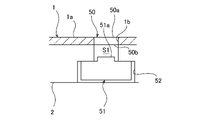
- FIG. FIG. 2 is a cross-sectional view of the polishing apparatus shown in FIG. 1; It is an enlarged view of a window member and an infrared radiation thermometer.
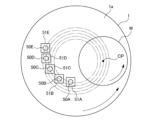
- FIG. 4 is a diagram showing a plurality of infrared thermometers arranged in the radial direction of the polishing table;
- FIG. 4 is a diagram showing a graph showing surface temperatures of a substrate measured by a plurality of infrared thermometers and a graph showing temperature distribution in the radial direction of the substrate;
- FIG. 11 shows another embodiment of an infrared radiation thermometer;
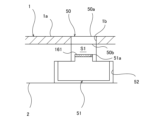
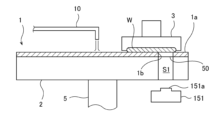
- FIG. 4 is a cross-sectional view showing another embodiment of a polishing apparatus; It is an enlarged view of a window member and an infrared radiation thermometer.
- FIG. 9 shows an infrared radiation thermometer according to the embodiment shown in FIGS. 7 and 8;
- FIG. 4 is a graph showing temperature distribution in the radial direction of the substrate;
- FIG. 11A is a diagram showing a black body fixed to the lower surface of the polishing table.
- FIG. 11B is a diagram showing a blackbody fixed to the lower surface of the polishing table.
- FIG. 12A is a diagram showing one embodiment of a liquid removal mechanism that removes liquid from the optical path of infrared rays that pass through the window member.
- FIG. 12A is a diagram showing one embodiment of a liquid removal mechanism that removes liquid from the optical path of infrared rays that pass through the window member.
- FIG. 12B is a diagram showing one embodiment of a liquid removal mechanism that removes liquid from the optical path of infrared rays that pass through the window member.
- Figure 13A is a diagram showing another embodiment of a liquid exclusion mechanism.
- Figure 13B is a diagram showing another embodiment of a liquid exclusion mechanism.
- FIG. 1 is a perspective view showing one embodiment of a polishing apparatus.
- a polishing apparatus CMP apparatus
- CMP apparatus includes a polishing table 2 that supports a polishing pad 1 and rotates together with the polishing pad 1, and a polishing head that presses a substrate W to be polished, such as a wafer, against the polishing pad 1. 3 and a polishing liquid supply mechanism 4 for supplying polishing liquid (slurry) to the polishing pad 1 .
- the polishing table 2 is connected via a table shaft 5 to a table motor 6 disposed below, and the table motor 6 rotates the polishing table 2 in the direction indicated by the arrow.
- the polishing pad 1 is attached to the upper surface of the polishing table 2, and the upper surface of the polishing pad 1 constitutes a polishing surface 1a for polishing the substrate W.
- the polishing head 3 is fixed to the lower end of the head shaft 7 .
- the polishing head 3 is configured to hold the substrate W on its lower surface by vacuum suction. More specifically, the polishing head 3 holds the front surface (device surface) of the substrate W downward. The surface opposite to this surface is the back surface of the substrate W, and the polishing head 3 holds the back surface of the substrate W by suction.
- the head shaft 7 is connected to a rotating mechanism (not shown) installed in the head arm 8, and the polishing head 3 is driven to rotate via the head shaft 7 by this rotating mechanism.
- the polishing apparatus further includes a dressing device 24 for dressing the polishing pad 1.
- the dressing device 24 includes a dresser 26 that slides on the polishing surface 1 a of the polishing pad 1 , a dresser arm 27 that supports the dresser 26 , and a dresser pivot shaft 28 that pivots the dresser arm 27 . As the dresser arm 27 turns, the dresser 26 swings on the polishing surface 1a.
- the lower surface of the dresser 26 constitutes a dressing surface made up of a large number of abrasive grains such as diamond grains.
- the dresser 26 rotates while rocking on the polishing surface 1a, and slightly scrapes the polishing pad 1 to dress the polishing surface 1a.
- pure water is supplied from the pure water supply nozzle 25 onto the polishing surface 1 a of the polishing pad 1 .
- the polishing liquid supply mechanism 4 includes a slurry supply nozzle 10 for supplying the polishing liquid onto the polishing pad 1, and a nozzle rotating shaft 11 to which the slurry supply nozzle 10 is fixed.
- the slurry supply nozzle 10 is configured to be rotatable around a nozzle rotating shaft 11 .
- the substrate W is rotatably held by the polishing head 3.
- the polishing head 3 presses the substrate W against the polishing pad 1, and polishing of the substrate W progresses due to sliding between the polishing pad 1 and the substrate W.
- a polishing liquid slurry is supplied onto the polishing pad 1 from the slurry supply nozzle 10 .
- the polishing apparatus has a configuration for directly measuring the surface temperature of the substrate W (that is, the temperature on the device surface side) without contacting the substrate W while the substrate W is being polished. Such a configuration will be described below with reference to the drawings.
- the polishing apparatus includes a plurality of window members 50A to 50E embedded in a polishing pad 1 and a substrate W disposed below the plurality of window members 50A to 50E and held by a polishing head 3.
- a plurality of infrared radiation thermometers 51A to 51E for measuring surface temperature are provided. Since the window members 50A to 50E have the same configuration, the window members 50A to 50E may be collectively referred to as the window member 50 hereinafter. Similarly, since the infrared radiation thermometers 51A to 51E have the same configuration, the infrared radiation thermometers 51A to 51E may be collectively referred to as the infrared radiation thermometer 51 hereinafter.
- FIG. 2 is a cross-sectional view of the polishing apparatus shown in FIG. In FIG. 2, illustrations other than the main elements of the polishing apparatus are omitted.
- the polishing pad 1 is formed with a window hole 1b having a size capable of inserting the window member 50, and the window member 50 is inserted into the window hole 1b.
- the window hole 1b is a through hole that penetrates the polishing pad 1 in the vertical direction.
- the window member 50 is made of a material that transmits infrared rays.
- An infrared radiation thermometer 51 is arranged directly below the window member 50 .
- the infrared radiation thermometer 51 is a thermometer that measures the surface temperature of the substrate W based on the intensity of infrared rays emitted from the substrate W.
- An embedded portion 52 communicating with the window hole 1 b is formed in the polishing table 2 , and the infrared radiation thermometer 51 is arranged in this embedded portion 52 .
- the infrared radiation thermometer 51 is arranged so as to be embedded in the polishing table 2 .
- the polishing table 2 has embedded portions 52 corresponding in number to the infrared radiation thermometers 51A to 51E (five in this embodiment).
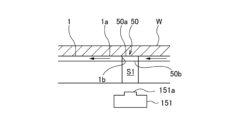
- FIG. 3 is an enlarged view of the window member and the infrared radiation thermometer.
- the window member 50 has a front surface 50a on the polishing head 3 side and a rear surface 50b on the polishing table 2 side.
- a surface 50 a of the window member 50 is an exposed surface exposed from the polishing surface 1 a of the polishing pad 1 .
- the surface 50a of the window member 50 and the polishing surface 1a of the polishing pad 1 are arranged in the same plane.
- the space S1 is a space for reliably measuring the surface temperature of the substrate W with the infrared radiation thermometer 51 .
- the substrate W is generally made of silicon. Silicon (Si) absorbs light in the region of 1.5 to 6.0 micrometers, so it emits little infrared radiation in that region. Since this embodiment uses an infrared radiation thermometer that measures the temperature of the radiator in a non-contact manner based on the amount of emitted infrared rays, it is not desirable to measure a wavelength band in which little infrared radiation is emitted.
- an infrared radiation thermometer using an infrared absorbing film suitable for measuring the amount of radiated infrared rays with a wavelength of 1.5 micrometers or less or 6.0 micrometers or more is used.
- the range of wavelengths of the measured amount of infrared radiation is 0.8-1.5 micrometers, alternatively 6.0-1000 micrometers.
- An infrared radiation thermometer that uses an indium compound such as InGaAs, InAs, InAsSb, or InSb as an infrared absorbing film is considered desirable. , there is no need to limit the materials.
- the window member 50 installed on the polishing pad 1 must be made of a material that transmits infrared rays of the wavelength to be measured.
- Materials that transmit the above wavelengths include infrared transmitting resin, calcium fluoride, synthetic quartz, germanium, magnesium fluoride, optical glass (N-BK7), potassium bromide, sapphire, silicon, sodium chloride, zinc selenide, or sulfide. Mention may be made of zinc. However, if the above conditions are satisfied, there is no need to limit the material.
- infrared rays emitted from the substrate W made of silicon pass through the window member 50 without attenuation (or with sufficiently low attenuation). Moreover, the amount of radiated infrared rays can be measured by the infrared radiation thermometer 51 . As a result, the surface temperature of the substrate W can be measured.
- a metal (conductor) film or an insulating film may be formed on the surface of the substrate W made of silicon. Therefore, in one embodiment, the materials for the window member 50 and the infrared absorbing film may be selected according to the wavelength dependence of the emissivity of the material forming the metal film or insulating film.
- the window member 50 contacts the substrate W to be polished. Therefore, it is more desirable to configure the window member 50 from a material having mechanical, thermal, and chemical properties similar to those of the polishing pad 1 as much as possible.
- the polishing apparatus has a function of recording or displaying the measured temperature distribution. More specifically, the polishing apparatus includes a storage device 101 that records the measured temperature distribution of the substrate W in a storage element such as an HDD or an SSD, and a temperature distribution in the diameter direction of the substrate W passing through the center of the substrate W. It has a display device 102 that can display on the screen. In this embodiment, the storage device 101 and the display device 102 constitute the control device 100 .
- the control device 100 is electrically connected to infrared radiation thermometers 51A to 51E. Although not shown, the control device 100 is connected to components of the polishing apparatus (for example, the polishing head 3, the polishing liquid supply mechanism 4, the table motor 6, and the dressing device 24), and controls the operations of the components. . The control device 100 may control the operation of the components of the polishing apparatus based on the temperature distribution of the substrate W stored in the storage device 101 to manage the polishing rate.
- the polishing apparatus for example, the polishing head 3, the polishing liquid supply mechanism 4, the table motor 6, and the dressing device 24
- FIG. 4 is a diagram showing a plurality of infrared radiation thermometers arranged in the radial direction of the polishing table.
- a plurality of infrared radiation thermometers 51A to 51E are arranged in the radial direction of the polishing table 2 and rotate together with the polishing table 2.
- the plurality of infrared radiation thermometers 51A to 51E traverse the surface of the substrate W each time the polishing table 2 rotates once.
- the infrared radiation thermometer 51C is arranged so that its rotational trajectory passes over the center CP of the substrate W.
- the infrared radiation thermometer 51C does not necessarily have to be arranged so that its rotational trajectory passes over the center CP of the substrate W.
- Each of these infrared radiation thermometers 51A to 51E draws different trajectories on the substrate W and measures the overall surface temperature of the substrate W in the radial direction at a plurality of different measurement points. Therefore, even if each of the infrared radiation thermometers 51A to 51E does not have a sufficient temperature measurement frequency, the temperature distribution on the surface of the substrate W can be measured with sufficient spatial resolution.
- FIG. 5 is a graph showing surface temperatures of substrates measured by a plurality of infrared radiation thermometers, and a graph showing temperature distribution in the radial direction of the substrate.
- the horizontal axis represents time
- the vertical axis represents the surface temperature of the substrate W.
- the horizontal axis represents the radial distance of the substrate W
- the vertical axis represents the surface temperature of the substrate W.
- the multiple infrared radiation thermometers 51A to 51E measure the surface temperature of the substrate W for a certain period of time.
- the control device 100 arranges the surface temperature of the substrate W, which changes with time, measured by the plurality of infrared radiation thermometers 51A to 51E into a temperature distribution of the substrate W in the radial direction. More specifically, the controller 100 superimposes the trajectories of the infrared radiation thermometers 51A to 51E passing over the surface of the substrate W to form one trajectory in the radial direction of the substrate W.
- FIG. The controller 100 arranges the surface temperature of the substrate W measured by each of the infrared radiation thermometers 51A to 51E on one formed locus.
- the polishing apparatus since the polishing apparatus includes a plurality of infrared radiation thermometers 51A to 51E, the surface temperature of the entire substrate W can be measured accurately (that is, with high accuracy) without contact. ) can be measured.
- FIG. 6 is a diagram showing another embodiment of an infrared radiation thermometer. As shown in FIG. 6, each of the plurality of infrared radiation thermometers 51A to 51E has a shutter 161 having a black body structure for opening and closing the light receiving portion 51a.
- a shutter 161 having a black body structure is arranged to calibrate the infrared radiation thermometer 51 (more specifically, temperature calibration).
- the infrared radiation thermometer 51 may be affected by the ambient temperature, and as a result, the temperature measured by the infrared radiation thermometer 51 may deviate. Therefore, in the embodiment shown in FIG. 6, the infrared radiation thermometer 51 is calibrated using a blackbody structure with an emissivity of 1.
- a black body tape may be applied to the shutter 161, or a black body may be applied to the shutter 161 with a black body spray.
- the shutter 161 is configured to open and close the light receiving portion 51 a of the infrared radiation thermometer 51 . Therefore, the infrared radiation thermometer 51 can be calibrated by closing the shutter 161 as necessary.
- the infrared radiation thermometer 51 may be calibrated periodically. For example, after processing a predetermined number of substrates W, the shutter 161 may be closed to calibrate the infrared radiation thermometer 51, and the infrared radiation may The radiation thermometer 51 may be calibrated.
- the temperature of the shutter 161 is measured with a reference thermometer (eg, thermocouple), and the temperature of the shutter 161 is measured with the infrared radiation thermometer 51 to be calibrated. After that, the temperature of the shutter 161 measured by the reference thermometer is associated with the temperature measured by the infrared radiation thermometer 51 to be calibrated. Since it is known that the shutter 161 has an emissivity of 1, the infrared radiation thermometer 51 is calibrated based on the correlation between the temperature measured by the shutter 161 and the temperature measured by the infrared radiation thermometer 51 .
- a reference thermometer eg, thermocouple
- each of the infrared radiation thermometers 51A-51E may be a radiation thermometer for metals or a radiation thermometer for mirror surfaces. More specifically, each of the infrared radiation thermometers 51A to 51E has a function of accurately measuring the temperature of an object to be measured, which generally has a low emissivity, by suppressing the influence of disturbance. may be a meter. With such a configuration, the surface temperature of the substrate W can be measured more accurately based on the intensity of the infrared rays emitted from the substrate W, which is a low-emissivity material.
- the plurality of infrared radiation thermometers 51A-51E are embedded in the polishing table 2, but in the embodiments described below, the polishing apparatus is a single infrared thermometer arranged below the polishing table 2. An infrared radiation thermometer 151 is provided.
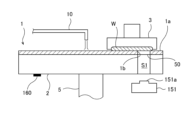
- FIG. 7 is a cross-sectional view showing another embodiment of the polishing apparatus.
- FIG. 8 is an enlarged view of the window member and the infrared radiation thermometer.
- the same reference numerals are given to the same structures as in the above-described embodiment, and detailed description thereof will be omitted.
- the polishing apparatus has a single window member 50 and an infrared radiation thermometer 151 arranged below the polishing table 2 .
- the polishing table 2 does not have the embedded portion 52 (see FIGS. 2 and 3).
- FIG. 9 is a diagram showing an infrared radiation thermometer according to the embodiment shown in FIGS. 7 and 8.
- the infrared radiation thermometer 151 has a structure different from that of the infrared radiation thermometer 51 described above. More specifically, the infrared radiation thermometer 151 is arranged so as to cover the entire range of the substrate W to be measured.
- the infrared radiation thermometer 151 may be a radiation thermometer for metals or a radiation thermometer for mirror surfaces. More specifically, the infrared radiation thermometer 151 is a radiation thermometer that has a function of accurately measuring the temperature of an object to be measured that generally has a low emissivity by suppressing the influence of disturbance. good too.
- the infrared radiation thermometer 151 includes a plurality of light receiving portions 151a arranged in an arc along the rotational trajectory of the window member 50. These light receiving portions 151a are arranged over the entire substrate W. As shown in FIG. The window member 50 embedded in the polishing pad 1 rotates together with the polishing table 2 , but the infrared radiation thermometer 151 arranged below the polishing table 2 does not rotate together with the polishing table 2 . Therefore, when the window member 50 passes directly under the substrate W, the plurality of light receiving portions 51 a of the infrared radiation thermometer 151 continuously receive infrared rays emitted from the substrate W through the window member 50 .
- FIG. 10 is a graph showing the temperature distribution in the radial direction of the substrate.
- the infrared radiation thermometer 151 is configured to measure the surface temperature at a plurality of measurement points in the radial direction of the substrate W each time the polishing table 2 rotates once.
- the plurality of light receiving portions 151a of the infrared radiation thermometer 151 are arranged over the entire substrate W, each time the polishing table 2 rotates once, the radial direction of the substrate W changes. It is possible to measure the overall surface temperature in
- the first embodiment shown in FIGS. 1-6 and the second embodiment shown in FIGS. 7-10 may be combined.
- a combination of the window member 50 and the infrared radiation thermometer 51 according to the first embodiment corresponds to a first temperature measuring device.
- a combination of the window member 50 and the infrared radiation thermometer 151 according to the second embodiment corresponds to a second temperature measuring device.
- the polishing apparatus may comprise these first temperature measuring device and second temperature measuring device.
- the first temperature measurement device (that is, the window member 50 and the infrared radiation thermometer 51 combination) may measure the surface temperature of the first region of the substrate W;
- a second temperature measuring device (that is, a combination of the window member 50 and the infrared radiation thermometer 151) may measure the surface temperature of the second region.
- the second region is the periphery of the substrate W
- the first region is the region inside the periphery of the substrate W.
- the infrared radiation thermometer 151 As a component of the second temperature measuring device is arranged at the peripheral edge of the substrate W, the infrared radiation thermometer 151 measures the temperature of the substrate W each time the polishing table 2 rotates once. It is possible to reliably measure the surface temperature of the peripheral edge of the
- the polishing apparatus can measure the substrate with higher accuracy.
- the surface temperature of W can be measured.
- FIGS. 11A and 11B are diagrams showing a blackbody fixed to the lower surface of the polishing table.
- the polishing table 2 has a blackbody 160 fixed to its lower surface (that is, the surface facing the infrared radiation thermometer 151).
- the blackbody 160 may be a fixed object to which blackbody tape is attached, or a fixed object to which blackbody spray is applied.
- the black body 160 is arranged at a position corresponding to the rotational trajectory of the window member 50 (see FIG. 9). With this arrangement, the black body 160 passes over the infrared radiation thermometer 151 as the polishing table 2 rotates.
- the polishing apparatus rotates the polishing table 2 so that the black body 160 is arranged directly above the light receiving part 151 a of the infrared radiation thermometer 151 .
- the black body 160 is placed directly above the light receiving part 151a of the infrared radiation thermometer 151, the rotation of the polishing table 2 is stopped and the infrared radiation thermometer 151 is calibrated.
- the infrared radiation thermometer 151 may have a structure similar to the above-described shutter 161 (see FIG. 6) covering its light receiving portion 151a.
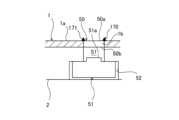
- FIGS. 12A and 12B are diagrams showing an embodiment of a liquid removal mechanism for removing liquid from the optical path of infrared rays that pass through the window member.
- the polishing apparatus includes a liquid removal mechanism 170 that removes liquid from the optical path of infrared rays that pass through the window member 50 (that is, the space S1).
- the liquid removal mechanism 170 includes an elastic ring 171 surrounding the window member 50.
- the elastic ring 171 protrudes from the polishing surface 1a of the polishing pad 1 and prevents liquid flowing on the polishing surface 1a from entering the space S1. Since the elastic ring 171 is made of an elastic member such as rubber, even if the polishing head 3 contacts the elastic ring 171, the polishing head 3 (and/or the elastic ring 171) is prevented from being damaged.
- the liquid may pass through the window member 50 and enter the optical path of the infrared rays. If liquid exists on the infrared light path, the infrared radiation thermometer 51 (and the infrared radiation thermometer 151) may not be able to measure the surface temperature of the substrate W with high accuracy. Since the polishing apparatus includes the liquid removal mechanism 170, the infrared radiation thermometer 51 (and the infrared radiation thermometer 151) can measure the surface temperature of the substrate W with high accuracy.
- the liquid removal mechanism 170 includes a gas injection device 180 that injects gas across the optical path of the infrared rays, and a liquid recovery member 190 that recovers the liquid thrown out of the optical path by the gas injection device 180. I have.
- the gas injection device 180 includes an injection nozzle 184 connected to the space S1, a gas supply line 181 connected to the injection nozzle 184, an on-off valve 182 for opening and closing the gas supply line 181, a gas and a gas supply source 183 that supplies high-pressure gas to the injection nozzle 184 through the supply line 181 .
- the on-off valve 182 is electrically connected to the control device 100 .
- the injection nozzle 184 is configured to form a curtain-like jet flow of gas in the entire space S1.
- injection nozzle 184 is a fan nozzle.
- the gas injection device 180 may comprise multiple injection nozzles 184 . With such a configuration as well, the gas injection device 180 can form a curtain-like jet flow of gas in the entire space S1.
- the liquid recovery member 190 is arranged on the opposite side of the injection nozzle 184 so as to recover the liquid sprayed by the injection nozzle 184 . As shown in FIG. 13B, the liquid recovery member 190 may be arranged to surround the space S1.
- liquid removal mechanism 170 may comprise a combination of elastic ring 171 , gas injection device 180 and liquid recovery member 190 . With such a configuration, the liquid removal mechanism 170 can more reliably remove liquid that has entered the infrared light path.
- the present invention can be used for polishing equipment.
Landscapes
- Engineering & Computer Science (AREA)
- Mechanical Engineering (AREA)
- Finish Polishing, Edge Sharpening, And Grinding By Specific Grinding Devices (AREA)
- Mechanical Treatment Of Semiconductor (AREA)
- Constituent Portions Of Griding Lathes, Driving, Sensing And Control (AREA)
- Grinding-Machine Dressing And Accessory Apparatuses (AREA)
Priority Applications (2)
| Application Number | Priority Date | Filing Date | Title |
|---|---|---|---|
| KR1020247005887A KR20240046516A (ko) | 2021-08-24 | 2022-07-19 | 연마 장치 |
| US18/684,739 US20260115856A1 (en) | 2021-08-24 | 2022-07-19 | Polishing apparatus |
Applications Claiming Priority (2)
| Application Number | Priority Date | Filing Date | Title |
|---|---|---|---|
| JP2021-136064 | 2021-08-24 | ||
| JP2021136064A JP2023030756A (ja) | 2021-08-24 | 2021-08-24 | 研磨装置 |
Publications (1)
| Publication Number | Publication Date |
|---|---|
| WO2023026723A1 true WO2023026723A1 (ja) | 2023-03-02 |
Family
ID=85322987
Family Applications (1)
| Application Number | Title | Priority Date | Filing Date |
|---|---|---|---|
| PCT/JP2022/027983 Ceased WO2023026723A1 (ja) | 2021-08-24 | 2022-07-19 | 研磨装置 |
Country Status (4)
| Country | Link |
|---|---|
| US (1) | US20260115856A1 (https=) |
| JP (1) | JP2023030756A (https=) |
| KR (1) | KR20240046516A (https=) |
| WO (1) | WO2023026723A1 (https=) |
Citations (7)
| Publication number | Priority date | Publication date | Assignee | Title |
|---|---|---|---|---|
| JP2001009699A (ja) * | 1999-07-05 | 2001-01-16 | Nichiden Mach Ltd | 平面研磨装置 |
| JP2004106174A (ja) * | 2002-08-30 | 2004-04-08 | Toray Ind Inc | 研磨パッド、定盤ホールカバー及び研磨装置並びに研磨方法及び半導体デバイスの製造方法 |
| JP2008145133A (ja) * | 2006-12-06 | 2008-06-26 | Horiba Ltd | 放射温度計 |
| JP2009060044A (ja) * | 2007-09-03 | 2009-03-19 | Tokyo Seimitsu Co Ltd | Cmp装置の研磨モニタ窓 |
| JP2009224384A (ja) * | 2008-03-13 | 2009-10-01 | Toyo Tire & Rubber Co Ltd | 研磨パッド及び半導体デバイスの製造方法 |
| KR20180055113A (ko) * | 2016-11-16 | 2018-05-25 | 주식회사 케이씨텍 | 화학 기계적 연마장치 및 그 제어방법 |
| JP2020110859A (ja) * | 2019-01-10 | 2020-07-27 | 株式会社荏原製作所 | 研磨装置 |
Family Cites Families (1)
| Publication number | Priority date | Publication date | Assignee | Title |
|---|---|---|---|---|
| JP6985107B2 (ja) | 2017-11-06 | 2021-12-22 | 株式会社荏原製作所 | 研磨方法および研磨装置 |
-
2021
- 2021-08-24 JP JP2021136064A patent/JP2023030756A/ja not_active Ceased
-
2022
- 2022-07-19 US US18/684,739 patent/US20260115856A1/en active Pending
- 2022-07-19 KR KR1020247005887A patent/KR20240046516A/ko not_active Ceased
- 2022-07-19 WO PCT/JP2022/027983 patent/WO2023026723A1/ja not_active Ceased
Patent Citations (7)
| Publication number | Priority date | Publication date | Assignee | Title |
|---|---|---|---|---|
| JP2001009699A (ja) * | 1999-07-05 | 2001-01-16 | Nichiden Mach Ltd | 平面研磨装置 |
| JP2004106174A (ja) * | 2002-08-30 | 2004-04-08 | Toray Ind Inc | 研磨パッド、定盤ホールカバー及び研磨装置並びに研磨方法及び半導体デバイスの製造方法 |
| JP2008145133A (ja) * | 2006-12-06 | 2008-06-26 | Horiba Ltd | 放射温度計 |
| JP2009060044A (ja) * | 2007-09-03 | 2009-03-19 | Tokyo Seimitsu Co Ltd | Cmp装置の研磨モニタ窓 |
| JP2009224384A (ja) * | 2008-03-13 | 2009-10-01 | Toyo Tire & Rubber Co Ltd | 研磨パッド及び半導体デバイスの製造方法 |
| KR20180055113A (ko) * | 2016-11-16 | 2018-05-25 | 주식회사 케이씨텍 | 화학 기계적 연마장치 및 그 제어방법 |
| JP2020110859A (ja) * | 2019-01-10 | 2020-07-27 | 株式会社荏原製作所 | 研磨装置 |
Also Published As
| Publication number | Publication date |
|---|---|
| US20260115856A1 (en) | 2026-04-30 |
| KR20240046516A (ko) | 2024-04-09 |
| JP2023030756A (ja) | 2023-03-08 |
Similar Documents
| Publication | Publication Date | Title |
|---|---|---|
| JP7041638B2 (ja) | 研磨装置 | |
| TWI754915B (zh) | 用於溫度控制的化學機械拋光溫度掃描設備 | |
| CN106272030B (zh) | 基于光谱的监测化学机械研磨的装置及方法 | |
| KR102293098B1 (ko) | 웨이퍼의 연마 방법 및 연마 장치 | |
| US8039397B2 (en) | Using optical metrology for within wafer feed forward process control | |
| CN105773398B (zh) | 基于光谱的监测化学机械研磨的装置及方法 | |
| US20040242121A1 (en) | Substrate polishing apparatus | |
| CN107738177A (zh) | 基于光谱的监测化学机械研磨的装置及方法 | |
| JP5474093B2 (ja) | 窓支持部を具備する研磨パッドおよび研磨システム | |
| JP2001257187A (ja) | 化学機械研磨用の適応終点検出 | |
| TW201811498A (zh) | 具有環形平臺或研磨墊的研磨系統 | |
| CN102601719A (zh) | 研磨方法和研磨装置 | |
| JPH0722143B2 (ja) | 平坦なウエーハを研磨する方法及びその装置 | |
| KR20010078154A (ko) | 연마 비율 변화를 통한 종점 모니터링 | |
| EP1442840A1 (en) | Anti-scattering layer for polishing pad windows | |
| JP6717691B2 (ja) | 基板処理装置 | |
| US20210280429A1 (en) | Substrate processing system and substrate processing method | |
| WO2023026723A1 (ja) | 研磨装置 | |
| US6503766B1 (en) | Method and system for detecting an exposure of a material on a semiconductor wafer during chemical-mechanical polishing | |
| US6429130B1 (en) | Method and apparatus for end point detection in a chemical mechanical polishing process using two laser beams | |
| JP2023107334A (ja) | 両面研磨装置 | |
| US20250149358A1 (en) | Substrate treating apparatus | |
| US20250018523A1 (en) | Polishing device, substrate treating apparatus, and polishing method | |
| CN117484379A (zh) | 研磨装置 | |
| JP2023046436A (ja) | 基板処理装置および基板処理方法 |
Legal Events
| Date | Code | Title | Description |
|---|---|---|---|
| 121 | Ep: the epo has been informed by wipo that ep was designated in this application |
Ref document number: 22861014 Country of ref document: EP Kind code of ref document: A1 |
|
| ENP | Entry into the national phase |
Ref document number: 20247005887 Country of ref document: KR Kind code of ref document: A |
|
| NENP | Non-entry into the national phase |
Ref country code: DE |
|
| 122 | Ep: pct application non-entry in european phase |
Ref document number: 22861014 Country of ref document: EP Kind code of ref document: A1 |