WO2022239826A1 - 止血器具 - Google Patents
止血器具 Download PDFInfo
- Publication number
- WO2022239826A1 WO2022239826A1 PCT/JP2022/020039 JP2022020039W WO2022239826A1 WO 2022239826 A1 WO2022239826 A1 WO 2022239826A1 JP 2022020039 W JP2022020039 W JP 2022020039W WO 2022239826 A1 WO2022239826 A1 WO 2022239826A1
- Authority
- WO
- WIPO (PCT)
- Prior art keywords
- band
- region
- support member
- protrusion
- pressing
- Prior art date
- Legal status (The legal status is an assumption and is not a legal conclusion. Google has not performed a legal analysis and makes no representation as to the accuracy of the status listed.)
- Ceased
Links
Images











Classifications
-
- A—HUMAN NECESSITIES
- A61—MEDICAL OR VETERINARY SCIENCE; HYGIENE
- A61B—DIAGNOSIS; SURGERY; IDENTIFICATION
- A61B17/00—Surgical instruments, devices or methods
- A61B17/12—Surgical instruments, devices or methods for ligaturing or otherwise compressing tubular parts of the body, e.g. blood vessels or umbilical cord
- A61B17/132—Tourniquets
- A61B17/1322—Tourniquets comprising a flexible encircling member
- A61B17/1325—Tourniquets comprising a flexible encircling member with means for applying local pressure
-
- A—HUMAN NECESSITIES
- A61—MEDICAL OR VETERINARY SCIENCE; HYGIENE
- A61B—DIAGNOSIS; SURGERY; IDENTIFICATION
- A61B17/00—Surgical instruments, devices or methods
- A61B17/12—Surgical instruments, devices or methods for ligaturing or otherwise compressing tubular parts of the body, e.g. blood vessels or umbilical cord
- A61B17/132—Tourniquets
- A61B17/135—Tourniquets inflatable
-
- A—HUMAN NECESSITIES
- A61—MEDICAL OR VETERINARY SCIENCE; HYGIENE
- A61B—DIAGNOSIS; SURGERY; IDENTIFICATION
- A61B17/00—Surgical instruments, devices or methods
- A61B2017/00831—Material properties
- A61B2017/00902—Material properties transparent or translucent
-
- A—HUMAN NECESSITIES
- A61—MEDICAL OR VETERINARY SCIENCE; HYGIENE
- A61B—DIAGNOSIS; SURGERY; IDENTIFICATION
- A61B17/00—Surgical instruments, devices or methods
- A61B17/12—Surgical instruments, devices or methods for ligaturing or otherwise compressing tubular parts of the body, e.g. blood vessels or umbilical cord
- A61B2017/12004—Surgical instruments, devices or methods for ligaturing or otherwise compressing tubular parts of the body, e.g. blood vessels or umbilical cord for haemostasis, for prevention of bleeding
-
- A—HUMAN NECESSITIES
- A61—MEDICAL OR VETERINARY SCIENCE; HYGIENE
- A61B—DIAGNOSIS; SURGERY; IDENTIFICATION
- A61B90/00—Instruments, implements or accessories specially adapted for surgery or diagnosis and not covered by any of the groups A61B1/00 - A61B50/00, e.g. for luxation treatment or for protecting wound edges
- A61B90/08—Accessories or related features not otherwise provided for
- A61B2090/0807—Indication means
Definitions
- the present invention relates to a hemostatic device.
- the hemostatic device of Patent Document 1 includes a pressing member that applies pressure to a puncture site formed in a patient's hand, a plurality of straps for fixing the pressing members to the patient's hand, and the straps are arranged, a support member for pressing the pressure member against the patient's hand.
- the plurality of band members include a band member for winding arranged so as to be wrapped along the outer periphery of the hand, and a band member for finger hooking arranged between the fingers positioned between adjacent fingers of the hand. , provided.
- an operator such as a doctor (hereinafter referred to as "operator") uses the hemostatic device of Patent Document 1 to stop bleeding at the puncture site formed on the patient's hand, the pressure member and the support member are placed at the puncture site. Arrange them so that they overlap.
- the operator winds the band for wrapping around the outer circumference of the hand, and further places the band for finger hooking between the fingers between the thumb and forefinger.
- the operator fixes the hemostatic device using each strap while arranging the pressing member on the puncture site formed on the patient's hand and its peripheral portion, thereby forming the pressing member on the patient's hand. Displacement from the puncture site can be prevented.
- the hemostatic device described in Patent Document 1 may have the following problems.
- the support member and the hand are affected depending on the physique of the patient and the puncture position. There may be gaps between them and the wrapping strip may not fit around the circumference of the patient's hand.
- the pressing member and the supporting member can be firmly fixed to the patient's hand by strongly tightening the band member for hooking the finger of the hemostatic device of Patent Document 1.
- it is necessary to strongly tighten the finger band which may cause pain to the patient.
- the supporting member is placed on the body surface of the hand from the fingertip side of the hand toward the forearm side. It will be arranged in a state of being tilted in the approaching direction.
- the hemostatic device of Patent Document 1 when the support member is arranged as described above, the pressing member cannot apply pressure force to the puncture site in the vertical direction. As a result, the hemostatic device of Patent Document 1 cannot effectively apply pressure to the puncture site.
- an object of the present invention is to provide a hemostatic device that can effectively apply pressure to the puncture site.
- a hemostatic device comprises a pressing member configured to press a puncture site formed in a patient, a first strap configured to be connectable to the pressing member, and a first strap connectable to the pressing member. It comprises a second band configured and a third band configured to be connectable with the pressing member.
- the pressing member has a pressing portion configured to press the puncture site, and a support member configured to fix the pressing portion.
- the support member has a first area where the pressing portion is located, and is located outside the first area, and is configured to be connectable with the first belt, the second belt, and the third belt. and a second region. The first band and the second band are connected to the second region, and are centered when the first band and the second band slide to the first region.
- a point is provided, and is configured to be slidable around the pressing portion in the second area around the center point.
- the third strap connected to the second region, extends in a different direction than the first and second straps and is configured to be positioned between the patient's fingers. be done.
- the support member includes a protrusion protruding toward the pressing portion on the third band side of the first region.
- the first band and the second band can slide about the center point located in the first region of the support member while being connected to the second region. can. Therefore, in the hemostatic device, the pressing member is arranged at the puncture site formed in the patient's hand, and the two band bodies are slid around the pressing portion around the pressing portion. The angle and position of the two strips can be adjusted. By adjusting the angles and positions of the first band and the second band, the operator arranges the pressing member at the puncture site formed on the patient's hand, and adjusts the patient's physique and the puncture position.
- a hemostatic device can be suitably attached to the .
- the side of the support member to which the third strap is connected may float. Since the hemostatic device of the present invention is provided with the protrusion projecting toward the pressing portion on the third strap side of the first region of the support member, the amount of deviation of the pressing direction of the pressing portion from the direction toward the puncture site is limited. and directed toward the puncture site. As a result, the hemostatic device can be suitably attached to the patient according to the patient's physique and puncture position, and can effectively apply pressure to the puncture site.
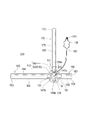
- FIG. 4 is a diagram showing the hemostatic device according to the embodiment, and is a plan view of each band as viewed from the outer surface side.
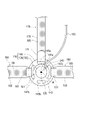
- FIG. 4 is a view showing the hemostatic device according to the embodiment, and is a plan view seen from the inner surface side of each band.
- FIG. 4 is a plan view showing an enlarged part of the hemostatic device seen from the outer surface side of each band.
- FIG. 4 is a plan view showing an enlarged part of the hemostatic device seen from the inner surface side of each band.
- FIG. 4 is a plan view showing an enlarged part of the hemostatic device seen from the inner surface side of each band.
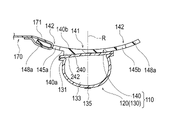
- FIG. 6A is a partial cross-sectional view of the hemostatic device taken along arrows 6A-6A shown in FIG. FIG.
- FIG. 7A is a partially inverted partial cross-sectional view of the hemostatic device taken along arrows 7A-7A shown in FIG. 5, showing the expansion member when expanded;
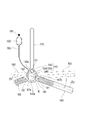
- FIG. 4 is a plan view of the hemostatic device seen from the outer surface side of each band, showing the states before and after sliding the first band and the second band connected to the pressing member.
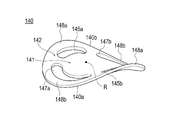
- 4 is a perspective view showing a support member included in the pressing member;
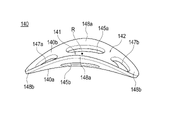
- FIG. 4 is a perspective view showing a support member included in the pressing member;
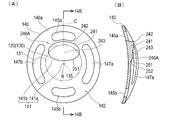
- FIG. FIG. 11(A) is a perspective view of the support member viewed from one side where the pressing portion is arranged, and
- FIG. 11(B) is a distal side ( FIG.
- FIG. 11(C) is an end view showing the cross-sectional shape of the protrusion of the support member along the line 11C-11C of FIG. 11(A).
- FIG. 12(A) is a plan view of the support member as seen from one side where the pressing portion is arranged
- FIG. 12(B) is a cross-sectional view taken along line 12B-12B in FIG. 12(A).
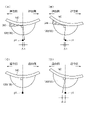
- 13(A) and 13(B) are schematic diagrams used to explain the operation of an embodiment in which the supporting member has projections
- FIGS. 13(C) and 13(D) are projections on the supporting member.
- FIG. 4 is a schematic diagram used to explain the action of contrast without FIG.
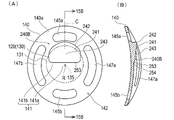
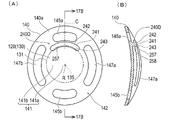
- FIG. 14(A) is a plan view of the support member of Modification 1 as viewed from one surface side where the pressing portion is arranged, and FIG. 14(B) is a cross section along line 14B-14B in FIG. 14(A). It is a diagram.
- FIG. 15(A) is a plan view of the support member of Modification 2 as viewed from one surface side where the pressing portion is arranged, and FIG. 15(B) is a cross section along line 15B-15B in FIG. 15(A).
- FIG. 16(A) is a plan view of the support member of Modification 3 as viewed from one surface side where the pressing portion is arranged, and FIG. 16(B) is a cross section along line 16B-16B in FIG. 16(A).
- FIG. 17(A) is a plan view of the support member of Modification 4 as viewed from one surface side where the pressing portion is arranged
- FIG. 17(B) is a cross section along line 17B-17B in FIG. 17(A).
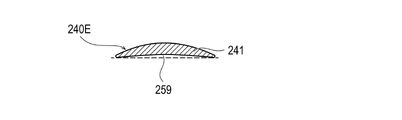
- 11C is an end view showing a cross-sectional shape of a protrusion of a support member of Modification 5, and is an end view corresponding to FIG. 11C.
- FIG. 19(A) is a plan view of the support member of Modification 6 as viewed from one surface side where the pressing portion is arranged
- FIG. 1 is a perspective view seen from the side).
- FIG. 20(A) is a plan view of the support member of Modification 7 viewed from one surface side where the pressing portion is arranged, and FIG. 1 is a perspective view seen from the side).
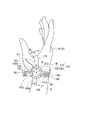
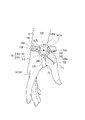
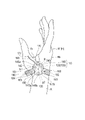
- FIG. 3 shows a patient's hand (right hand) to be used with the hemostatic device.
- 1 is a diagram schematically showing a first usage example of a hemostatic device;
- FIG. 1 is a diagram schematically showing a first usage example of a hemostatic device;
- FIG. 1 is a diagram schematically showing a first usage example of a hemostatic device;
- FIG. 1 is a diagram schematically showing a first usage example of a hemostatic device;
- FIG. 26A is a partial cross-sectional view taken along arrows 26A-26A shown in FIG. 24;
- FIG. 27A is a partial cross-sectional view taken along arrows 27A-27A shown in FIG. 24;
- FIG. FIG. 4 is a diagram schematically showing a second example of use of the hemostatic device;
- FIGS. 1 to 13 are diagrams for explaining a hemostatic device 100 according to this embodiment
- FIGS. 14 to 20 are diagrams for explaining modifications of the support member
- FIGS. 21 to 28 are hemostatic devices. It is a figure for demonstrating the usage example of 100.
- FIG. 14 to 20 are diagrams for explaining modifications of the support member
- FIGS. 21 to 28 are hemostatic devices. It is a figure for demonstrating the usage example of 100.
- FIG. 14 to 20 are diagrams for explaining modifications of the support member
- FIGS. 21 to 28 are hemostatic devices. It is a figure for demonstrating the usage example of 100.
- the hemostatic device 100 is, for example, as shown in FIGS. 21 and 24 to 28, a puncture site (for example, a puncture site described later) formed in a hand H located distally (on the finger side) of the patient's forearm A.
- a puncture site for example, a puncture site described later
- a hand H located distally (on the finger side) of the patient's forearm A.
- first puncture site p1 and second puncture site p2 are exemplified in this embodiment.
- structure of each part of the hemostatic device 100 will be mainly described through an example in which the hemostatic device 100 is used to stop bleeding at the first puncture site p1.
- the first puncture site p1 is located in the snuff box of the palmar artery running on the back Hb side of the right hand H1 (hand H) located distal to the forearm A of the patient.
- This is a puncture site formed in an artery B (hereinafter also referred to as “blood vessel B”).
- the snuff box is a cavity in the hand located near the radius when the patient spreads the thumb of the hand H.
- the second puncture site p2 is, as shown in FIGS. 21 and 28, a puncture site formed in the distal radial artery located distal to the snuff box of the palmar artery running on the dorsum Hb side of the patient's right hand H1. is.
- the second puncture site p2 is located on the distal side of the right hand H1 relative to the first puncture site p1 with reference to the extensor pollicis longus tendon t1 located on the back Hb of the patient's right hand H1.
- the hemostatic device 100 will be described in detail below.
- the hemostatic device 100 is a pressing member configured to press the first puncture site p1 formed on the patient's right hand H1.
- 110 a third strap 170 connectable to the pressing member 110, a first strap 150 connectable to the pressing member 110, and a second strap connectable to the pressing member 110.
- a body 160 As shown in FIGS. 1, 2, 24, 26 and 27, the third band 170, the first band 150 and the second band 160 are connected to the pressing member 110.
- first strip 150, second strip 160, and third strip 170 are provided in second region 142 of support member 140. It is connected to the pressing member 110 via a plurality of holes (first hole 145a, second holes 147a, 147b).
- the hemostatic device 100 As will be described later, of the three straps, the third strap 170, the first strap 150, and the second strap 160, two straps, the first strap 150 and the second strap 160, are used.
- the belt is configured to be slidable around the pressing portion 120 in the second region 142 with the pressing portion 120 as the center.
- a center point R which is the center of the sliding movement of the first band 150 and the second band 160, is located. Therefore, the first band 150 and the second band 160 are configured to be slidable around the pressing portion 120 in the second region 142 with the central point R located in the first region as the center.
- the hemostatic device 100 has two bands, a first band 150 and a second band 160, which are slidable around the pressing portion 120 along the holes 147a and 147b with the pressing portion 120 as the center. is configured to As a result, the two strips of the first strip 150 and the second strip 160 can be arranged at different angles radially around the central point R provided in the first region 141 .
- the third strap 170 is hooked on the inter-finger portion fb located between two adjacent fingers (for example, thumb and forefinger) when the hemostatic device 100 is attached to the patient's right hand H1.
- the first strap 150 and the second strap 160 are arranged to wrap around the right hand H1 of the patient when the hemostatic device 100 is attached to the patient's right hand H1. can do.
- the pressing member 110 is configured to press the first puncture site p1 formed on the patient's right hand H1, and the pressing part 120 is fixed. and a support member 140 configured to:
- the pressing portion 120 can be configured with an expanding member 130 having a lumen 133 into which fluid such as air can flow.
- 6 and 7 show cross-sectional views in which the expansion member 130 is expanded.
- 6 and 7 show partial cross-sectional views in which cross-sections taken along arrows 6A-6A and 7A-7A shown in FIG. 5 are upside down.
- the expansion member 130 can be composed of, for example, a resin balloon.
- a tube 193 which will be described later, is connected to the lumen 133 of the expansion member 130 .
- the expansion member 130 is arranged on the one surface 140a side of the support member 140, as shown in FIGS.
- One surface 140a of the support member 140 is a surface arranged on the body surface side of the patient's hand H when the hemostatic device 100 is attached to the patient's hand H.
- the other surface 140b of the support member 140 is a surface located on the opposite side of the one surface 140a.
- the extension member 130 can be connected to one surface 140a of the support member 140, as shown in FIGS.
- the connection between the expansion member 130 and the support member 140 can employ fusion or adhesion, for example.
- the expansion member 130 has a circular shape in a plan view shown in FIGS. 1 to 5.
- the shape of the expansion member 130 in plan view is not limited to a circle.
- the expansion member 130 is provided with a marker 135 for aligning the expansion member 130 with the first puncture site p1. .
- the marker 135 is located on the side opposite to the side on which the support member 140 of the expansion member 130 is arranged (the side arranged on the body surface side of the patient's hand H when the hemostatic device 100 is attached to the patient's hand H). ) on the outer surface of the
- the marker 135 is arranged on the expansion member 130, there is no particular limitation on the specific arrangement location.
- the marker 135 is placed on the side of the expansion member 130 opposite to the side on which the support member 140 is arranged (on the body surface side of the patient's hand H when the hemostatic device 100 is attached to the patient's hand H). It may be placed on the inner surface of the
- the marker 135 is arranged substantially at the center of the extension member 130 in the plane direction. In addition, the marker 135 is arranged so as to overlap the substantially center position of the support member 140 in the surface direction.
- the marker 135 can be formed, for example, by a rectangular marker in which the entire marker 135 is colored.
- the specific shape, color, formation method, position, etc. of the marker 135 are not particularly limited.
- the marker 135 may consist of a transparent central portion and a colored linear frame surrounding the central portion.
- the marker 135 may be provided on the support member 140 .
- the specific configuration of the pressing part 120 is not limited as long as it can apply pressure to the first puncture site p1 formed on the patient's right hand H1.
- the pressing portion 120 is made of, for example, a member made of a resin material such as plastic, gel, or the like, a member containing gel whose water content decreases with the passage of time to gradually reduce the pressing force, or a spongy substance. It can also be composed of an elastic material, an aggregate of fibers such as cotton, a metal, a member having a predetermined three-dimensional shape (sphere, ellipsoid, triangular pyramid, etc.), or a combination of these as appropriate.
- the support member 140 has a first region 141 in which the expansion member 130 is arranged, and a third band 170 located outside the first region 141. , and a second region 142 to which the first strap 150 and the second strap 160 can be connected.
- the support member 140 has a circular shape in plan view shown in FIG.
- the first region 141 is a region where the pressing portion 120 overlaps in plan view shown in FIG.
- the second region 142 is a region located outside the first region 141 in plan view shown in FIG.
- first region 141 can be arbitrarily defined based on the outer shape and size of the pressing portion 120 arranged on the support member 140 .
- second area 142 can be defined based on the relative positional relationship with the first area 141 . Therefore, the first area 141 and the second area 142 can be appropriately changed according to the external shape and size of the pressing portion 120 arranged on the support member 140 .
- the first region 141 is provided with a center point R that serves as the center of the sliding movement of the first band 150 and the second band 160.
- the center point R is the center position when the first band 150 and the second band 160 slide along the second holes 147a and 147b.
- the center point R is positioned substantially at the center of the support member 130 in the plane direction. Therefore, as shown in FIGS. 6, 7, and 8, the center point R is located at a position overlapping the marker 135 when projected onto the extended portion 120.
- the second region 142 includes a pair of first holes 145a and 145b facing each other with the pressing portion 120 therebetween, and a pair of first holes 145a and 145b.
- a pair of second holes 147a and 147b facing each other with the pressing portion 120 interposed therebetween are formed at positions different from those of the first holes 145a and 145b.
- first hole 145a is also referred to as “one first hole 145a”.
- the first hole portion 145b is also referred to as “another first hole portion 145b”.
- the second hole portion 147a is also referred to as “one second hole portion 147a”.
- the second hole portion 147b is also referred to as “another second hole portion 147b”.
- the one first hole 145a and the other first hole 145b are located on the distal side (fingertip side) of the hand H or the proximal side of the hand H (the fingertip side) with the pressing portion 120 interposed therebetween. It is placed on the forearm A side).
- one first hole 145a is arranged on the distal side of the hand H relative to the pressing portion 120, and the other first hole 145b is arranged. is placed closer to the hand H than the pressing portion 120 (see FIG. 24).
- one first hole 145a may be arranged on the proximal side of the hand H from the pressing part 120
- the other first hole 145b may be arranged on the distal side of the hand H from the pressing part 120.
- the one first hole 145a and the other first hole 145b are arranged on a virtual circle along the outer shape of the support member 140, as shown in FIGS.
- the support member 140 has a circular shape in plan view shown in FIG. Therefore, the one first hole 145 a and the other first hole 145 b are arranged along the circumferential direction of the second region 142 located outside the support member 140 relative to the first region 141 .
- the above-mentioned "arranged on a virtual circle” means that, assuming that a hole is formed continuously in the circumferential direction of the second region 142 of the support member 140, the position may be positioned at an arbitrary position occupying a part of the hole. This means that the first hole portion 145a and the other first hole portion 145b are arranged with a gap therebetween.
- the positional relationship of one second hole portion 147a and another second hole portion 147b, which will be described later, on a virtual circle is the same as described above.
- a third band 170 can be connected to one first hole 145a, as shown in FIGS.
- the width W3 of the third one end portion 171 of the third band 170 (the width in the direction perpendicular to the extending direction of the third band 170) is equal to the hole length L1 of the first hole 145a. They are substantially identical (see FIG. 5). Therefore, the third belt 170 is restricted from sliding about the center point R of the support member 140 in a state where the third belt 170 is connected to the support member 140 through the first hole 145a. be done.
- the hole length of each of the holes 145a, 145b, 147a, and 147b means the linear distance between the ends of the holes 145a, 145b, 147a, and 147b located in the circumferential direction of the support member 140. .
- the width W3 of the third one end portion 171 of the third band 170 is formed substantially the same as the hole length L2 of the other first hole portion 145b (see FIG. 5). Therefore, when the third band 170 is connected to the support member 140 through the other first hole 145b, the third band 170 is restricted from sliding around the center point R of the support member 140. be.
- the one second hole 147a and the other second hole 147b are formed by straight lines connecting the one first hole 145a and the other first hole 145b. 5, with the pressing portion 120 interposed therebetween.
- the one second hole 147a and the other second hole 147b are arranged on a virtual circle along the outer shape of the support member 140, as shown in FIGS.
- the hemostatic device 100 has one first hole portion 145a located further distal to the patient's right hand H1 than the pressing portion 120, and the other first hole portion 145b located closer to the pressing portion 120 than the pressing portion 120.
- one second hole 147a can be arranged inside the patient's right hand H1 in the circumferential direction (the side on which the patient's torso is arranged),
- the two holes 147b can be arranged on the outer side in the circumferential direction of the right hand H1 of the patient.
- the hole length L3 of one second hole 147a is longer than the hole lengths L1 and L2 of the first holes 145a and 145b (see FIG. 5).
- the hole length L4 of the other second hole portion 147b is longer than the hole lengths L1 and L2 of the first hole portions 145a and 145b.
- the hole length L3 of one second hole portion 147a and the hole length L4 of the other second hole portion 147b are formed to have substantially the same length.
- a first band 150 is connected to one second hole 147a.
- the width W1 of the first one end 151 of the first band 150 (the width in the direction orthogonal to the extending direction of the first band 150) is shorter than the hole length L3 of the one second hole 147a (Fig. 5). Therefore, as shown in FIG. 8, the first band 150 is connected to the pressing member 110 through one of the second holes 147a, and the center point R of the support member 140 is aligned. As the center, it can be slid so as to change the angle radially within a predetermined slide angle ⁇ 1.
- the slide angle ⁇ 1 of the first belt 150 can be arbitrarily defined by the width W1 of the first end 151 of the first belt 150 and the hole length L3 of the second hole 147a.
- the slide angle ⁇ 1 of the first band 150 is not particularly limited, but can be set to 1° to 75° around the center point R provided in the first region 141, for example.
- a second band 160 is connected to the other second hole 147b, as shown in FIGS.
- the width W2 of the second one end 161 of the second band 160 (the width in the direction perpendicular to the extending direction of the second band 160) is shorter than the hole length L4 of the other second hole 147b (Fig. 5). Therefore, as shown in FIG. 8, the second band 160 can be slid by a predetermined amount around the center point R of the support member 140 in a state where the second band 160 is connected to the other second hole portion 147b. It can be slid to change the angle radially within the range of angle ⁇ 2.
- the slide angle ⁇ 2 of the second band 160 can be arbitrarily defined by the width W2 of the second one end 161 of the second band 160 and the hole length L4 of the other second hole 147b.
- the slide angle ⁇ 2 of the second band 160 is not particularly limited, but can be set to 1° to 75° around the center point R provided in the first region 141, for example.
- the first holes 145a, 145b and the second holes 147a, 147b can be arranged on virtual concentric circles centered on the center point R of the support member 140, as shown in FIG. However, the first holes 145a, 145b and the second holes 147a, 147b do not have to be arranged on virtual concentric circles.
- first hole 145a and another first hole 145b may differ in shape and hole length.
- one second hole 147a and another second hole 147b may have different shapes and hole lengths.
- the hole length L1 of one first hole portion 145a and/or the hole length L2 of the other first hole portion 145b is formed to be larger than the width W3 of the third one end portion 171 of the third strip 170.
- one surface 140a of the support member 140 is provided in the second region 142 of the support member 140 where the pair of first holes 145a and 145b are arranged.
- a first curved region 148a is formed which is curved in a convex shape toward the side away from the pressing portion 120 arranged at the top.
- the “side away from the pressing portion 120" is the side away from the body surface of the patient's hand H when the hemostatic device 100 is attached to the patient's hand H (upper side in FIG. 27). is.
- one surface 140a of the support member 140 is provided in the second region 142 of the support member 140 where the pair of second holes 147a and 147b are arranged.
- a second curved region 148b is formed which is curved in a convex shape toward the pressing portion 120 side disposed at the top.
- the above-mentioned "pressing portion 120 side” is the side (lower side in FIG. 26) that is close to the body surface of the patient's hand H when the hemostatic device 100 is attached to the patient's hand H. .
- the support member 140 is preferably made of a material having a predetermined hardness.
- the pressing portion 120 applies pressure to the first puncture site p1 formed on the patient's right hand H1 as shown in FIGS.
- the support member 140 can press the pressing portion 120 against the patient's right hand H1. Thereby, it is possible to prevent the pressing portion 120 from rising from the patient's right hand H1.
- Examples of the constituent material of the support member 140 having hardness as described above include acrylic resin, polyvinyl chloride (especially hard polyvinyl chloride), polyethylene, polypropylene, polyolefin such as polybutadiene, polystyrene, poly-(4- Methylpentene-1), polycarbonate, ABS resin, polymethyl methacrylate (PMMA), polyacetal, polyacrylate, polyacrylonitrile, polyvinylidene fluoride, ionomer, acrylonitrile-butadiene-styrene copolymer, polyethylene terephthalate (PET), etc. can be done.
- acrylic resin polyvinyl chloride (especially hard polyvinyl chloride), polyethylene, polypropylene, polyolefin such as polybutadiene, polystyrene, poly-(4- Methylpentene-1), polycarbonate, ABS resin, polymethyl methacrylate (PMMA), polyacetal, polyacrylate, polyacrylonit
- each of the pressing portion 120 and the supporting member 140 portions overlapping each other in plan view shown in FIGS. 4 and 5 can be formed transparent.
- the pressing portion 120 and the supporting member 140 are configured in this way, as shown in FIGS. It becomes possible to visually confirm the position of the marker 135 and/or the first puncture site p1 more easily.
- the above-mentioned "transparent” includes colored transparent, colorless transparent, and translucent.
- the support member 140 is located on the side of the third band 170 of the first region 141.
- a protrusion 240 protruding toward the pressing portion 120 is provided.
- the projecting portion 240 of the embodiment has a sector shape in a plan view of the supporting member 140 viewed from the one surface 140a side on which the pressing portion 120 is arranged.
- the arc of the protrusion 240 extends close to the inner peripheral edge of one first hole 145a.
- An appropriate angle can be set for the central angle.
- the center of the fan shape is arranged substantially at the center of the support member 140 in the plane direction.
- the first band 150 and the second band 160 are configured to be slidable around a central point R in the first region 141 of the support member 140. As shown in FIG. When the first strap 150 and the second strap 160 are wrapped around the wrist in the lateral direction indicated by the dashed lines in FIG. When the first band 150 and the second band 160 are slid to the position indicated by the solid line in FIG. The range shifts to the lower side of the support member 140 in the drawing (the proximal side of the hand H (the forearm A side)).
- the first strap 150 and the second strap 160 may be The force that presses down the support member 140 is not appropriately applied to the center of the support member 140, and the side (distal side (finger side)) of the support member 140 to which the third band member 170 is connected (distal side (finger side)) floats and tilts. there is a possibility. In such a case, there is a possibility that the direction in which the pressing portion 120 presses the puncture site p1 is shifted, and the puncture site p1 cannot be appropriately pressed.
- the pressing portion 120 and the support member 140 can be firmly fixed to the patient's hand by strongly tightening the third band 170 arranged between the fingers.
- the need to tighten the third strap 170 so tightly may cause pain to the patient. Therefore, a mechanism is required that can limit displacement of the pressing portion 120 in the pressing direction without depending on the winding of the third band 170 .
- the first band 150 and the second band 160 are slidable around the center point R of the support member 140, and the displacement of the pressing portion 120 in the pressing direction is caused by the following reasons:
- the position of the band 150 and the second band 160 and the way the first band 150 and the second band 160 are wrapped around the wrist are affected by the patient's physique (for example, the size of the hand) and the position of the puncture site ( For example, the puncture site may be distal to the snuff box of the palmar artery).
- FIGS. 13(A) and 13(B) schematically show the operation of an embodiment in which the support member 140 is provided with the protrusion 240, and FIGS. It schematically shows the action of the contrast without the part 240 .
- the protrusion 240 extends from the third band 170 side of the first region 141 toward the central point R side of the first region 141 .
- the thickness of the protrusion 240 decreases from the third band 170 side of the first region 141 toward the central point R side of the first region 141 .
- the pressing direction of the pressing part 120 is effectively limited in the amount of deviation from the direction toward the puncture site p1, and the direction toward the puncture site p1 is effectively limited. directed to.
- the first region 141 of the support member 140 includes a central region 141a located in the center of the first region 141 and a curved region 141b that curves from the central region 141a toward the periphery of the support member 140 in a direction away from the pressing portion 120. and have The protrusion 240 is located in the curved region 141b, and at least a portion of the protrusion 240 protrudes toward the pressing portion 120 from the central region 141a (see FIG. 12B).
- the support member 140 extends from a second curved region 148b (the second curved regions 148b located on the left and right in FIG. 10) arranged on one surface 140a of the support member 140. It is convexly curved toward the pressing portion 120 side.
- the central region 141a is a region of the support member 140 where the apex of the convex shape is located. Therefore, the central region 141a has a larger radius of curvature than the second curved region 148b and is planar.
- the "direction away from the pressing portion 120" is the direction away from the body surface of the patient's hand H when the hemostatic device 100 is attached to the patient's hand H (upper side in FIG. 27). is.
- the protrusion 240 is located in the curved region 141b, and at least a portion of the protrusion 240 protrudes toward the pressing portion 120 from the central region 141a. Therefore, when the hemostatic device is attached to the patient's hand and the pressing portion is expanded, the protrusion 240 can apply an oblique pressing force toward the central region 141a to the pressing portion. In addition, since the protrusion 240 protrudes further toward the pressing portion 120 than the central region 141a, the protrusion 240 reliably contacts the pressing portion and applies a pressing force to the pressing portion regardless of the connection method between the pressing portion and the support member. can be granted.
- the protrusion of the support member restricts the amount of deviation of the pressing direction of the pressing portion from the direction toward the puncture site p1, and is oriented toward the puncture site p1.
- the dimension by which the protrusion 240 protrudes from the central region 141a toward the pressing portion 120 is not particularly limited, but is, for example, about 3 mm.
- the projecting portion 240 has an inclined portion 241 that extends from the third band 170 side of the first region 141 toward a central region 141 a located in the center of the first region 141 and contacts the pressing portion 120 .
- central region 141a located in the center of the first region 141 does not only include surfaces with a certain degree of spread. Even a “point” can be regarded as a plane as long as the dimensions exist. Therefore, the "central region 141a” must be interpreted as including "points”.
- the inclined portion 241 of the protrusion 240 forms an inclined surface from the third band 170 side of the first region 141 toward the central region 141a located in the center of the first region 141. contact and stably press the pressing portion 120 . Therefore, even when the support member 140 is tilted, the pressing direction of the pressing portion is limited in amount of deviation from the direction toward the puncture site p1 by the protrusion of the support member, and is more reliably oriented toward the puncture site p1. be.
- a cross section in the extending direction of the inclined portion 241 may be a flat surface, a concave curved surface, or a convex curved surface.
- the pressing member 110 has a marker 135 for aligning the pressing portion 120 with the puncture site p ⁇ b>1 , and the center of the marker 135 is located at a position that does not overlap the protrusion 240 .
- position where the center of the marker 135 does not overlap with the protrusion 240 means that the projected image of the center of the marker 135 when the marker 135 is projected onto the support member 140 along the direction perpendicular to the support member 140. does not overlap with the protrusion 240 .
- the position where the center of the marker 135 does not overlap the protrusion 240 means that the expansion member 130 is contracted along the direction orthogonal to the support member 140. It means that the projected image of the center of the marker 135 does not overlap the protrusion 240 when the marker 135 is projected onto the support member 140 .
- the center of the marker 135 is a portion located in the middle of the outline of the marker 135 in plan view. For example, if marker 135 is square or rectangular, the center of marker 135 is the center of gravity of the square or rectangle. Also, when the marker 135 is a circle, the center of the marker 135 is the midpoint of the diameter of the circle. Moreover, when the marker 135 is an ellipse, the center of the marker 135 is the intersection of the major axis and the minor axis of the ellipse.
- the center of the marker 135 is arranged at a position that does not overlap with the protrusion 240, when the operator uses the marker 135 to place the pressing part 120 at the puncture site p1, the puncture site p1 is preferably moved along the surface of the hand.
- the pressing part 120 can be arranged in the . Therefore, when the hemostatic device 100 is attached to the patient, the fit of the hemostatic device 100 to the surface of the patient's hand can be enhanced.
- the center of the marker 135 is located at a position that does not overlap with the protrusion 240, the visibility of the operator can be ensured when the operator uses the marker 135 to place the pressing part 120 at the puncture site p1. can.
- the protrusion 240 is located in the center of the first region 141 from the third band 170 side of the first region 141. It has an inclined portion 241 that extends toward the central region 141 a and contacts the pressing portion 120 .
- the inclined portion 241 has an inclined surface on the inner surface 243 of the projecting portion 240 from the third band 170 side of the first region 141 toward the central region 141 a located in the center of the first region 141 .
- a portion of the inclined surface is positioned so as to overlap the outline of the marker 135 . Note that the tip of the inclined surface does not overlap the center of the marker 135 .
- a portion of the inclined surface is located at a position overlapping the outer shape of the marker 135. Note that the tip of the inclined surface does not overlap with the center of the marker 135.”
- the marker 135 is projected onto the support member 140 along the direction in which the marker 135 means that it does not overlap with the tip of the inclined surface of
- the pressing part 120 is the extension member 130
- "a part of the inclined surface is positioned at a position overlapping the outer shape of the marker 135.
- the tip of the inclined surface does not overlap with the center of the marker 135.
- the expansion member 130 is contracted, when the marker 135 is projected onto the support member 140 along a direction orthogonal to the support member 140, a part of the projected image of the outer edge of the marker 135 is projected onto the protrusion 240. It means that the projected image of the center of the marker 135 overlaps with the inclined surface and the tip of the inclined surface of the projection 240 does not overlap.
- the inclined portion 241 of the protrusion 240 has a sloped surface that slopes from the third band 170 side of the first region 141 toward the central region 141a side of the first region 141, the tip of the sloped surface of the protrusion 240 is , are smoothly connected to the surface of the support member 140 . Therefore, when the operator uses the marker 135 to place the pressing part 120 at the puncture site p1, the pressing part 120 can be placed at the puncture site p1 along the surface of the hand. Therefore, when the patient is fitted with the hemostatic device 100, the hemostatic device 100 can be fitted to the surface of the patient's hand.
- the support member 140 is positioned such that a portion of the inclined surface of the protrusion 240 overlaps the outer shape of the marker 135, the pressing portion 120 is more reliably pushed toward the center of the marker 135 where the puncture site p1 is located. can be pressed.
- the inclined surface of the protrusion 240 has a sector shape centering on the tip of the inclined surface in plan view.
- the projecting portion 240 Since the projecting portion 240 has a sector shape centered on the tip of the inclined surface, the overlapping area of the marker 135 and the projecting portion 240 is reduced in the direction intersecting the direction in which the third band 170 extends. be able to. Therefore, while the support member 140 is configured to more reliably press the pressing portion 120 toward the center of the marker 135 located at the puncture site p1, when the hemostatic device 100 is attached to the patient, the surface of the patient's hand is reduced. The hemostatic device 100 can be fitted to the .
- the pressing portion 120 can be configured from an expanding member 130 that can be expanded by injecting fluid.
- the thickness of the protrusion 240 of the support member 140 is configured to be larger than the thickness of the central region 141 a of the support member 140 . That is, the thickness from the outer surface of the support member 140 to the inclined surface of the protrusion 240 is greater than the thickness of the central region 141 a of the support member 140 . Therefore, as shown in later-described FIGS. 25 and 27, the projection 240 is configured as a lens that magnifies the marker 135 when the marker 135 is viewed through the projection 240 with the expansion member 130 expanded.
- the line of sight of a person viewing the marker 135 includes a line of sight LS1 viewing the marker 135 obliquely through the protrusion 240 from the distal side (finger side), and a line of sight LS1 viewing the marker 135 obliquely through the support member 140.
- a person who visually recognizes the marker 135 includes the operator or the patient himself/herself.
- the operator's line of sight is usually the line of sight LS1
- the patient's line of sight is usually the line of sight LS2 or the line of sight LS3.
- the protrusion 240 of the support member 140 has a shape with a thickness different from that of other portions of the support member 140 . Therefore, for example, when the operator obliquely views the marker 135 through the protrusion 240 from the distal side (finger side) along the line of sight LS1, the protrusion 240 functions as a magnifying glass that magnifies the marker 135. (See FIG. 25). As a result, the operator can magnify and visually recognize the marker 135, making it easier to confirm the puncture point.
- the protrusion 240 not only enlarges the marker 135, but also enlarges the vicinity of the puncture point. Therefore, it becomes easier to align the marker 135 with the puncture point, and to observe the state of hemostasis.
- the marker 135 does not appear enlarged (see FIG. 24).
- the direction in which the marker 135 is viewed it is possible to select whether or not to enlarge the marker 135 .
- the protrusion 240 of the embodiment extends from the third band 170 side of the first region 141 toward the central point R side of the first region 141 . Further, the thickness of the protrusion 240 decreases from the third band 170 side of the first region 141 toward the central point R side of the first region 141, as shown in FIG. In this case, when the operator obliquely views the marker 135 through the protrusion 240 from the distal side (finger side) along the line of sight LS1, the protrusion 240 has a lens-like shape with a convex shape on one side. 135 can be more reliably enlarged and visually recognized.
- the projecting portion 240 has a laterally symmetrical outer shape with respect to the long axis C of the third band 170 .
- the thickness of the projecting portion 240 projecting toward the pressing portion 120 is bilaterally symmetrical with respect to the long axis C of the third band 170 . Therefore, regardless of whether the hemostatic device 100 is attached to the patient's right hand H1 or left hand, when the support member 140 is tilted, the pressing direction of the pressing portion 120 deviates from the direction toward the puncture site p1. is restricted and directed towards the puncture site p1. 5, the major axis C of the third band 170 extends along the extending direction of the third band 170 and passes through the center of the third band 170 in the width direction. ing.
- the pressing portion 120 can be configured from an expanding member 130 that can be expanded by injecting fluid.
- the expansion member 130 has a peripheral edge portion 131 located at the peripheral edge of the portion that can be expanded by injection of fluid. Note that the peripheral portion 131 does not mean the fusion margin, but is a term that indicates the outer circumference of the expandable portion.
- the peripheral edge 242 (the thickest portion) of the protrusion 240 has a shape that matches (overlaps) the peripheral edge 131 of the expansion member 130 .
- the peripheral edge 242 of the protrusion 240 has an arc shape, and the peripheral edge 131 of the expansion member 130 has a circular shape. Since the peripheral edge 242 of the protrusion 240 is along the peripheral edge 131 of the expansion member 130, one side (upper side in FIG. 12A) of the peripheral edge 131 of the expansion member 130 can be effectively pressed. As a result, when the support member 140 is tilted, the pressing direction of the pressing portion 120 is oriented in the direction toward the puncture site p1 by limiting the amount of deviation from the direction toward the puncture site p1.
- the peripheral edge portion 242 of the projection portion 240 overlaps the peripheral edge portion 131 of the expansion member 130 in plan view, or the peripheral edge portion 242 of the expansion member 130 overlaps the peripheral edge portion 131 of the expansion member . It is located on the third band 170 side of the . That is, as shown in FIG. 12, the pressing member 110 is configured such that the protrusion 240 covers a part of the peripheral edge portion 131 of the expansion member 130 on the side of the third band 170 of the support member 140 in plan view. is preferred.
- the protrusion 240 is located in a direction facing the pressing portion 120. It has a surface 243 . As shown in FIG. 11(C), the inner surface 243 of the protrusion 240 has a flat cross section in a direction intersecting the direction in which the third band 170 extends.
- the "direction in which the third band 170 extends" is the vertical direction in FIG. 12(A).
- the inner surface 243 of the protrusion 240 has a flat cross section in the direction intersecting the direction in which the third band 170 extends. Therefore, the inner surface 243 of the protruding portion 240 comes into surface contact with the pressing portion 120 and presses the pressing portion 120 stably. Therefore, even if the support member 140 is tilted, the pressing direction of the pressing portion 120 is limited by the protrusion 240 of the support member 140 in an amount deviated from the direction toward the puncture site p1, and the direction toward the puncture site p1 is more reliable. Oriented.
- the protrusion 240 has an end 244 forming the tip of the protrusion 240 in the extending direction from the peripheral edge 242 of the protrusion 240 located on the third strap 170 side toward the center point R side of the first region 141. .
- An end portion 244 of the protrusion 240 is continuous with the first region 141 of the support member 140 .
- An end portion 244 of the protrusion 240 is a sector-shaped radial portion in FIG. 12(A). The end 244 of the protrusion 240 smoothly continues to the first region 141 of the support member 140 as shown in FIG. 12(B). Therefore, no step occurs at the boundary between the end portion 244 of the protrusion 240 and the first region 141 of the support member 140 .
- the support member 140 does not have a step at the boundary between the end 244 of the protrusion 240 and the first region 141 , so that visibility deterioration due to a step on the inner surface of the support member 140 can be reduced.
- the support member 140 is configured such that the end portion 244 of the protrusion 240 and the first region 141 are smoothly connected, an extra step between the extension member 130 and the inner surface of the support member 140 is formed. No space is created. Therefore, when the expansion member 130 is fixed to the support member 140 during manufacturing, it is possible to prevent the formation of a gap between the expansion member 130 and the inner surface of the support member 140 .
- the hemostatic device 100 can prevent a part of the expansion member 130 from entering a step and causing an unexpected behavior of the expansion member 130 .
- the third band 170 is configured to be connectable to a third body portion 175 and one first hole portion 145a of the support member 140. 3 one end 171 and a free third other end 173 .
- the “free other end portion” in this specification means that there is no direct or joint connection with another member when the hemostatic device 100 is not attached (a state in which the hemostatic device is not attached to the patient). means that
- the third body portion 175 extends along the longitudinal direction of the third band 170, as shown in FIGS.
- the third one end 171 of the third band 170 can be disposed so as to be inserted into and wound around one of the first holes 145a of the support member 140, as shown in FIG.
- the third band 170 is connected to the support member 140 via the third one end 171 and the one first hole 145a.
- the width W3 of the third one end 171 of the third band 170 is formed substantially equal to the hole length L1 of the one first hole 145a (see FIG. 5). reference). Therefore, the third band 170 is restricted from sliding around the center point R of the support member 140 in a state where the third band 170 is connected to the support member 140 .
- the structure for connecting the third one end portion 171 of the third band 170 and the support member 140 is not particularly limited.
- a fixing member for example, hook-and-loop fastener
- a fixing member capable of holding and releasing the state wound around one first hole 145a may be arranged at the third one end 171 of the third band 170. can be done.
- the third band 170 is configured in this manner, the third band 170 can be connected to and separated from the support member 140 .
- the first band 150 is configured to be connectable to the first body portion 155 and one second hole portion 147a of the support member 140. 1 and a free first other end 153 .
- the first body portion 155 extends along the longitudinal direction of the first band 150, as shown in FIGS.
- the first one end 151 of the first band 150 can be arranged so as to pass through and wind around one of the second holes 147a of the support member 140, as shown in FIG.
- the first strip 150 is connected to the support member 140 via the first one end 151 and the one second hole 147a.
- the width W1 of the first one end 151 of the first band 150 is shorter than the hole length L3 of the one second hole 147a (see FIG. 5). Therefore, the first strap 150 is slidable around the center point R of the support member 140 in a state where the first strap 150 is connected to the support member 140 (see FIG. 8).
- the structure for connecting the first one end portion 151 of the first strip 150 and the support member 140 is not particularly limited.
- a fixing member for example, a hook-and-loop fastener capable of holding and releasing the state wound around the second hole 147a may be arranged.
- the first band 150 is configured in this manner, the first band 150 can be connected to and separated from the support member 140 .
- the second band 160 is configured to be connectable to the second body portion 165 and the other second hole portion 147b of the support member 140. 2 one end 161 and a free second other end 163 .
- the second body portion 165 extends along the longitudinal direction of the second band 160, as shown in FIGS.
- the second one end 161 of the second band 160 can be arranged so as to pass through and wrap around the other second hole 147b of the support member 140, as shown in FIG.
- the second band 160 is connected to the support member 140 via the second one end 161 and the other second hole 147b.
- the width W2 of the second one end 161 of the second band 160 is shorter than the hole length L4 of the other second hole 147b (see FIG. 5). Therefore, the second band 160 is slidable around the center point R of the support member 140 in a state where the second band 160 is connected to the support member 140 (see FIG. 8).
- the structure for connecting the second one end portion 161 of the second band 160 and the support member 140 is not particularly limited.
- a fixing member for example, hook-and-loop fastener
- a fixing member capable of holding and releasing the state of being wound around the other second hole 147b may be arranged at the second one end 161 of the second band 160. can be done.
- the second band 160 is configured in this manner, the second band 160 can be connected to and separated from the support member 140 .
- a symbol M (including figures and characters) is provided on each one end 151, 161, 171 side of each of the belts 150, 160, 170 so that each of the belts 150, 160, 170 can be identified.
- “1" on the one end 151 side of the first band 150, "2" on the one end 161 side of the second band 160, and “3" on the one end 171 side of the third band 170. numbers are provided.
- the numbers provided on the straps 150, 160, 170 correspond to the order in which the straps 150, 160, 170 are wound when the operator attaches the hemostatic device 100 to the patient's right hand H1.
- the operator can attach the straps 150, 160, 170 to the patient's right hand H1 in the correct order.
- the size, color, forming method, position, etc. of the symbol M are not particularly limited.
- the symbol M can be formed not only by printing but also by punching holes in the strip.
- each band 150, 160, 170 is not particularly limited, but can be made of, for example, vinyl chloride resin, polyamide resin, polyamide elastomer resin, polyurethane resin, polyester resin, or the like. Moreover, there are no particular restrictions on the shape, length, thickness, etc., of each band 150, 160, 170. FIG.
- ⁇ Fixing member> The hemostatic device 100, as shown in FIGS. Prepare.
- a first fixing member 181 is arranged on the outer surface of the first band 150.
- a second fixing member 182 is arranged on the outer surface of the second band 160 .
- a third fixing member 183 is arranged on the inner surface of the first band 150.
- a fourth fixing member 184 is arranged on the inner surface of the second band 160 .
- a fifth fixing member 185 is arranged on the inner surface of the third band 170 .
- the third fixing member 183 of the first strap 150 is used when fixing the first strap 150 to the support member 140 .
- the third fixing member 183 of the first band 150 is not used for wrapping the first band 150 around the wrist.
- each band 150, 160, 170 is the surface that is arranged on the patient's body surface side when the hemostatic device 100 is attached to the patient, and the outer surface of each band 150, 160, 170 is opposite to the inner surface. It is the surface located on the side.
- the first fixing member 181 and the second fixing member 182 are composed of the male side of the hook-and-loop fastener.
- the third fixing member 183, the fourth fixing member 184, and the fifth fixing member 185 are configured on the female side of the hook-and-loop fastener.
- the hook-and-loop fastener in this specification is a fastener that can be attached and detached on the surface, such as Magic Tape (registered trademark) and Velcro (registered trademark).
- each fixing member 181, 182, 183, 184, 185 connects the band members 150, 160, 170 with the hemostatic device 100 placed on the patient's right hand H1, thereby connecting the pressing part 120 to the patient's right hand H1.
- the specific structure is not limited as long as it can be fixed to. For example, it is possible to arbitrarily omit installation of some of the fixing members, change the positions of the fixing members in each of the band members 150, 160, and 170, and the like.
- each of the fixing members 181, 182, 183, 184, and 185 is composed of a hook-and-loop fastener, the configuration may be such that the male and female sides of the hook-and-loop fastener are interchanged.
- each fixing member 181, 182, 184, 185 may be, for example, a snap, a button, a clip, a frame member in which a hole is formed, or the like.
- the hemostatic device 100 has an injection section 191 for injecting fluid into the expansion member 130, as shown in FIGS.
- the injection part 191 is composed of a connector incorporating a check valve (not shown).
- a syringe (not shown) can be connected to the injection part 191 .
- a cushioning member 192 having an expandable space is arranged between the injection part 191 and the expansion member 130 .
- the cushioning member 192 is composed of a flexible bag-like member having a space formed therein.
- the cushioning member 192 may be provided with an arrow-shaped marker indicating the direction of insertion of the syringe into the injection portion 191 .
- An injection part 191 is connected to one end of the cushioning member 192 .
- a lumen of the injection part 191 communicates with a space of the cushioning member 192 . However, communication between the lumen of the injection portion 191 and the space of the buffer member 192 is blocked while the check valve built into the injection portion 191 is closed.
- a flexible tube 193 is connected to the other end of the cushioning member 192 .
- the lumen of tube 193 communicates with the space of cushioning member 192 .
- the tube 193 has one end connected to the cushioning member 192 and the other end opposite to that connected to the extension member 130 .
- the lumen of tube 193 communicates with lumen 133 of expansion member 130 .
- the operator When expanding the expansion member 130, the operator inserts the front tube part of a syringe (not shown) into the injection part 191 to open the check valve.
- the operator injects the air in the syringe into the lumen 133 of the expansion member 130 by pushing the plunger of the syringe while the check valve of the injection section 191 is open.
- expansion member 130 When air is injected into the lumen 133 of the expansion member 130, the expansion member 130 expands. As expansion member 130 expands, cushioning member 192 , which communicates with lumen 133 of expansion member 130 via tube 193 , expands. By visually confirming the expansion of the cushioning member 192, the operator can easily grasp that the expansion member 130 has expanded without air leakage.
- the operator When contracting the expansion member 130, the operator inserts the tip tube portion of the syringe into the injection portion 191 and pulls the plunger of the syringe. The operator can discharge the air in the lumen 133 of the expansion member 130 into the syringe by performing the above operation.
- FIG. 22 shows a state in which the sheath tube of the introducer 200 has been inserted into the first puncture site p1 and various procedures have been performed.
- the operator places the pressing member 110 so as to overlap the back Hb of the right hand H1 of the patient.
- the operator places the marker 135 at the first puncture site p1 while visually confirming the position of the marker 135 placed on the expansion member 130, so that the pressing member 110 is positioned appropriately at the first puncture site p1. can be positioned.
- the operator After finishing the procedure using the introducer 200 and before attaching the hemostatic device 100 to the right hand H1 of the patient, the operator removes the introducer 200 from the first puncture site p1 formed on the right hand H1 of the patient. A portion of the sheath tube may be withdrawn. For example, with the sheath tube of the introducer 200 left in the blood vessel B, the operator can start attaching the hemostatic device 100 after pulling out the sheath tube about 2 to 3 cm to the operator's hand side. can.
- the operator wraps the first strap 150 and the second strap 160 around the patient's right hand H1.
- the operator moves the fourth fixing member 184 (see FIG. 2) arranged on the inner surface of the second band 160 to the first fixing member 181 (see FIG. 1) arranged on the outer surface of the first band 150.
- the first strap 150 and the second strap 160 can be fixed via the fixing members 181 and 184 by bringing them into contact with each other.
- the operator When the operator winds the first strap 150 and the second strap 160 along the outer circumference of the patient's right hand H1, the operator wraps the first strap 150 around the center point R of the first region 141 of the support member 140. It can be slid or the second band 160 can be slid.
- the operator can adjust the angle and position at which the bands 150 and 160 are wrapped around the patient's right hand H1. can.
- the operator adjusts the center point R of the support member 140 so that each band 150, 160 is wrapped around the patient's right hand H1 at a position closer to the forearm A (proximal side) than the first puncture site p1.
- each strip 150, 160 can be slid to change radial angles within a range of slide angles ⁇ 1, ⁇ 2 (see FIG. 8).
- the operator passes the third band 170 through the inter-finger portion fb of the patient's right hand H1 located between the thumb and forefinger, and inserts a portion of the third band 170 into the patient's right hand. Placed on the palmar side of H1.
- the operator moves the fifth fixing member 185 (see FIG. 2) arranged on the inner surface of the third band 170 to the second fixing member 182 (see FIG. 1) arranged on the outer surface of the second band 160. ), the third band 170 and the second band 160 can be fixed via the respective fixing members 182 and 185 .
- the operator arranges the first band 150 and the second band 160 so as to wrap them around the patient's right hand H1, and furthermore, places them between the thumb and index finger of the patient's right hand H1.
- the third band 170 By hooking a part of the third band 170 on the portion fb and arranging it, it is possible to effectively prevent the hemostatic device 100 from being shifted from the patient's right hand H1.
- the operator expands the expansion member 130 by injecting air into the expansion member 130 with the syringe connected to the injection part 191 .
- the expansion member 130 applies pressure to the first puncture site p1 of the patient's right hand H1.
- the hemostatic device 100 when the operator attaches the hemostatic device 100 to the patient's hand H, the hemostatic device 100 is formed in the vicinity of one first hole 145a on the distal side of the patient's right hand H1.
- a first curved region 148a may be positioned.
- the operator can arrange the first bending region 148a formed near the other first hole 145b at a position on the proximal side of the right hand H1 of the patient.
- Area 148a prevents the peripheral edge of support member 140 from abutting against patient's right hand H1.
- the first curved region 148a formed in the vicinity of the other first hole 145b of the support member 140 moves toward the right hand H1 of the patient. It prevents the peripheral part from abutting.
- the hemostatic device 100 stops bleeding at the first puncture site p1 formed on the patient's right hand H1
- the peripheral edge portion of the support member 140 abuts on or bites into the patient's right hand H1, thereby causing the patient's pain. can be prevented from feeling uncomfortable or painful.
- the second curved region 148b formed in the support member 140 is positioned at the outer periphery of the patient's right hand H1.
- a pressing portion 120 can be secured to the patient's right hand H1 so as to be positioned along the apex.
- the second curved region 148b of the support member 140 presses the pressing portion 120 along a portion of the outer circumference of the right hand H1 of the patient. wear.
- the hemostatic device 100 can prevent the pressing portion 120 from rising from the patient's right hand H1. Therefore, the hemostatic device 100 can effectively apply pressure to the first puncture site p1 by the expansion member 130. As shown in FIG.
- the operator After expanding the expansion member 130, the operator removes the sheath tube of the introducer 200 from the first puncture site p1 formed in the right hand H1 of the patient, as shown in FIG. While using the hemostatic device 100 to stop bleeding, the operator confirms that there is no bleeding from the first puncture site p1 formed in the patient's right hand H1. The operator adjusts the amount of air injected into the expansion member 130 when bleeding occurs from the first puncture site p1 formed in the patient's right hand H1.
- the operator can use the hemostatic device 100 to stop bleeding at the first puncture site p1 formed in the patient's right hand H1 by the above procedure.
- the hemostatic device 100 can select whether or not to enlarge the marker 135 by selecting the direction in which the marker 135 is viewed.
- 24 shows the state of visually recognizing the marker 135 along the line of sight LS2 or LS3 shown in FIG. 27, and
- FIG. 25 shows the state of visually recognizing the marker 135 along the line of sight LS1 shown in FIG. .
- FIGS. 24 and 27 for example, even if the patient himself/herself visually recognizes the marker 135 along the line of sight LS2 or the line of sight LS3, the marker 135 does not appear enlarged.
- FIGS. 24 shows the state of visually recognizing the marker 135 along the line of sight LS2 or LS3 shown in FIG.
- the protrusion 240 is aligned with the marker 135. Demonstrate the role of a magnifying glass to magnify. As a result, the operator can magnify and visually recognize the marker 135, making it easier to confirm the puncture point.
- FIG. 28 shows a second usage example of the hemostatic device 100.
- FIG. A second example of use is an example of use of the hemostatic device 100 for stopping bleeding at the second puncture site p2 formed in the patient's right hand H1.
- the operator attaches the hemostatic device 100 to the patient's right hand H1 when stopping bleeding at the second puncture site p2 formed on the patient's right hand H1.
- the second puncture site p2 formed on the patient's right hand H1 is located on the distal side of the patient's right hand H1 with respect to the first puncture site p1 described above (see FIG. 21).
- the operator slides the band members 150 and 160 about the center point R of the first region 141 of the support member 140.
- the operator slides the band members 150 and 160 so that the band members 150 and 160 are wrapped around the patient's right hand H1 at a position closer to the forearm A (proximal side) than the first puncture site p1.
- the operator prevents the distal portion of the patient's right hand H1 from being constrained by each strap 150, 160 by wrapping each strap 150, 160 around a position proximal to the patient's right hand H1. can.
- the hemostatic device 100 can also be used to stop bleeding at the puncture site formed on the patient's left hand.
- the puncture site formed on the left hand is, for example, a puncture site formed in an artery located in the snuff box of the palmar artery running on the dorsal side of the patient's left hand, rather than the snuff box of the palmar artery running on the dorsal side of the patient's left hand.
- This is the puncture site formed in the distal radial artery located on the distal side.
- the latter puncture site is located more distally on the left hand than the former puncture site with respect to the extensor pollicis longus tendon located on the back of the patient's left hand.
- the hemostatic device 100 When stopping bleeding at the puncture site on the left hand, the hemostatic device 100 can be attached to the patient's left hand in the same procedure as in the first and second usage examples described above.
- the operator slides each band 150, 160 around the center point R of the first region 141 of the support member 140 according to the position of each puncture site on the patient's left hand, thereby moving each band 150. , 160 on the left hand can be adjusted.
- the operator adjusts the angle and position at which the straps 150 and 160 are wrapped around the left hand so that the distal portion of the patient's left hand is restrained by the straps 150 and 160 when stopping bleeding at each puncture site. can be prevented.
- the hemostatic device 100 can be attached to either the patient's right hand H1 or left hand.
- the hemostatic device 100 is used to stop bleeding at puncture sites p1 and p2 formed at different positions on the patient's right hand H1, and for stopping bleeding at the puncture sites formed at different positions on the patient's left hand.
- the band members 150 and 160 are attached, the patient's hand H can be attached so that the distal side portion of the patient's hand H is not constrained by the straps 150 and 160 .
- the hemostatic device 100 includes the pressing member 110 configured to press the puncture site p1 formed in the patient, and the first belt configured to be connectable to the pressing member 110. It comprises a body 150 , a second strap 160 connectable to the pressing member 110 , and a third strap 170 connectable to the pressing member 110 .
- the pressing member 110 has a pressing portion 120 configured to press the puncture site p1 and a support member 140 configured to fix the pressing portion 120 .
- the support member 140 is positioned outside the first region 141 and the first region 141 where the pressing portion 120 is located, and the first band 150, the second band 160, and the third band 170 can be connected. and a configured second region 142 .
- the first band 150 and the second band 160 are connected to the second region 142, and the first band 150 and the second band 160 slide toward the first region 141 at the center. It has a point R and is configured to be slidable around the pressing portion 120 in the second region 142 with the central point R as the center.
- the support member 140 includes a projecting portion 240 projecting toward the pressing portion 120 on the side of the third band 170 of the first region 141 .
- the first band 150 and the second band 160 are connected to the second region 142, and the center point located in the first region 141 of the support member 140 It can be slid around R. Therefore, in the hemostatic device, the pressing member 110 is arranged at the puncture site p1 formed in the patient's hand, and the two strips 150 and 160 are slid around the pressing portion 120 with the pressing portion 120 as the center. Thereby the angle and position of the two straps relative to the patient's hand can be adjusted. By adjusting the angles and positions of the first band 150 and the second band 160, the operator can position the pressing member 110 at the puncture site p1 formed on the patient's hand, while adjusting the patient's physique and the puncture position.
- the patient can be suitably fitted with the hemostatic device 100 according to the time.
- the side of the support member 140 to which the third strap 170 is connected may float. Since the hemostatic device 100 is provided with the protrusion 240 projecting toward the pressing portion 120 on the side of the third band 170 of the first region 141 of the support member 140, the pressing direction of the pressing portion 120 is directed toward the puncture site p1. The amount of deviation from direction is limited and directed toward the puncture site p1.
- the hemostatic device 100 can be suitably attached to the patient according to the physique of the patient and the puncture position p1, and can effectively apply pressure to the puncture site p1. .
- the protrusion 240 can extend from the third band 170 side of the first region 141 toward the center point R side of the first region 141 .
- the thickness of the protrusion 240 can be reduced from the third band 170 side of the first region 141 toward the central point R side of the first region 141 .
- the thickness of the protrusion 240 is configured to decrease from the third band 170 side of the first region 141 toward the central point R side of the first region 141. be done. Therefore, when the hemostatic device 100 is attached to the patient's hand, both the first strap 150 and the second strap 160 are positioned on the wrist side, and the side of the support member 140 to which the third strap 170 is connected is raised. Even in such a case, the support member 140 is inclined from the third band 170 side of the first region 141 of the support member 140 to the central point R side of the first region 141, which tends to be lifted from the surface of the hand. A compressive force can be applied. Therefore, even if the support member 140 is tilted, the projection 240 limits the amount of deviation of the pressing direction of the pressing portion 120 from the direction toward the puncture site p1, and directs it toward the puncture site p1.
- the first region 141 of the support member 140 includes a central region 141 a located in the center of the first region 141 and a curved region that curves away from the pressing portion 120 from the central region 141 a toward the peripheral edge 242 of the support member 140 . 141b and .
- the protrusion 240 is positioned in the curved region 141b, and at least a portion of the protrusion 240 can protrude toward the pressing portion 120 from the central region 141a.
- the protrusion 240 is configured to protrude toward the pressing portion 120 from the central region 141 a of the support member 140 . Therefore, the projecting portion 240 can reliably contact the pressing portion 120 on the third band 170 side of the first region 141 of the supporting member 140, which tends to rise from the surface of the hand, and apply a pressing force to the pressing portion 120.
- the protrusion 240 of the support member 140 limits the amount of deviation of the pressing direction of the pressing portion 120 from the direction toward the puncture site p1, so that the direction toward the puncture site p1 is oriented. be done.
- the projecting portion 240 can have an inclined portion 241 that extends from the third band 170 side of the first region 141 toward a central region 141 a located in the center of the first region 141 and contacts the pressing portion 120 . .
- the protruding portion 240 has the inclined portion 241 extending from the third band 170 side of the first region 141 toward the central region 141a of the first region 141. configured to Therefore, the inclined portion 241 of the projecting portion 240 comes into surface contact with the pressing portion 120 and presses the pressing portion 120 stably. Therefore, even if the support member 140 is tilted, the pressing direction of the pressing portion 120 is limited by the protrusion 240 of the support member 140 in an amount deviated from the direction toward the puncture site p1, and the direction toward the puncture site p1 is more reliable. Oriented.
- the pressing member 110 can have a marker 135 for aligning the pressing part 120 with the puncture site p ⁇ b>1 , and the center of the marker 135 can be positioned so as not to overlap the protrusion 240 .
- the center of the marker 135 is located at a position that does not overlap the protrusion 240, so that when the operator uses the marker 135 to place the pressing portion 120 at the puncture site p1, , the pressing part 120 can be preferably arranged at the puncture site p1 along the surface of the hand. Therefore, when the operator attaches the hemostatic device 100 to the patient, it is possible to improve the fitting feeling on the surface of the patient's hand. In addition, since the hemostatic device 100 is positioned so that the center of the marker 135 does not overlap the protrusion 240, when the operator uses the marker 135 to place the pressing part 120 at the puncture site p1, the visibility of the operator is reduced. can be ensured.
- the pressing part 120 can be composed of an expanding member 130 that can be expanded by injecting fluid.
- the thickness of the protrusion 240 can be configured to be greater than the thickness of the central region 141 a located in the center of the first region 141 of the support member 140 .
- the pressing portion 120 is composed of the expansion member 130, and the thickness of the protrusion 240 is configured to be larger than the thickness of the central region 141a of the support member 140. be. That is, the thickness from the outer surface of the support member 140 to the inclined surface of the protrusion 240 is greater than the thickness of the central region 141 a of the support member 140 . Therefore, the protrusion 240 is configured as a lens that magnifies the marker 135 when the marker 135 is viewed through the protrusion 240 in the expanded state of the expansion member 130 .
- the protrusion 240 When a person viewing the marker 135 obliquely views the marker 135 through the protrusion 240 from the distal side (finger side), the protrusion 240 functions as a magnifying glass that magnifies the marker 135 . As a result, a person who views the marker 135 can view the marker 135 by enlarging it, making it easier to check the puncture point.
- the protrusion 240 not only enlarges the marker 135, but also enlarges the vicinity of the puncture point. Therefore, it becomes easier to align the marker 135 with the puncture point, and to observe the state of hemostasis.
- the marker 135 does not appear enlarged.
- the direction in which the marker 135 is viewed it is possible to select whether or not to enlarge the marker 135 .
- the protrusion 240 can have a symmetrical shape with respect to the long axis of the third strip 170 .
- the thickness of the projecting portion 240 projecting toward the pressing portion 120 is bilaterally symmetrical with respect to the major axis C of the third band 170 . Therefore, regardless of whether the support member 140 is placed on the patient's right hand H1 or left hand, when the support member 140 is tilted, the pressing direction of the pressing portion 120 deviates from the direction toward the puncture site p1. is restricted and directed towards the puncture site p1.
- the pressing portion 120 can be composed of an expansion member 130 having a peripheral edge 131 located at the peripheral edge of a portion that can be expanded by injecting fluid, and the peripheral edge 242 of the projection 240 is aligned with the peripheral edge 131 of the expansion member 130 . It can have a matching shape.
- the hemostatic device 100 having the protrusion 240 having the shape described above since the peripheral edge 242 of the protrusion 240 is along the peripheral edge 131 of the expansion member 130, one side of the peripheral edge 131 of the expansion member 130 (Fig. 12 ( In A), the upper side) can be effectively suppressed. As a result, when the support member 140 is tilted, the pressing direction is oriented in the direction toward the puncture site p1 by limiting the amount of deviation from the direction toward the puncture site p1.
- the peripheral edge 242 of the protrusion 240 is along the peripheral edge 131 of the expansion member 130, the area for arranging the expansion member 130 on the protrusion 240 is maximized, and the thickness of the hemostatic device 100 is reduced.
- the thickness (the thickness from the support member 140 to the extension member 130) can be made small. Therefore, it is possible to press the extension member 130 with the protrusion 240 while preventing the appearance of the hemostatic device 100 from becoming bulky.
- FIGS. 14A and 14B to FIGS. 20A and 20B show various modifications of the protrusion 240 of the support member 140.
- FIG. 14A and 14B to FIGS. 20A and 20B show various modifications of the protrusion 240 of the support member 140.
- the protrusion 240A of Modification 1 has an elliptical shape in plan view when the support member 140 is viewed from the side of the one surface 140a on which the pressing portion 120 is arranged.
- the arc of the protrusion 240A extends close to the inner peripheral edge of one first hole 145a.
- the projecting portion 240A is arranged above the substantially central position of the support member 140 in the plane direction in the drawing.
- the end 251 of the projection 240A which is the leading end in the extending direction, has a step 252 at the boundary with the first region 141 of the support member 140.
- this step 252 is of a size that does not cause deterioration of visibility. Further, it is sized to avoid unexpected behavior when decompressing expansion member 130 .
- Other configurations are the same as those of the protrusion 240 of the embodiment.
- the protrusion 240B of Modification 2 has a gentle chevron shape in plan view.
- the arc of the protrusion 240B extends close to the inner peripheral edge of one first hole 145a.
- the projecting portion 240B is arranged above the substantially central position of the support member 140 in the plane direction in the drawing.
- the end 253 of the protrusion 240B on the leading end side in the extending direction has a step 254 at the boundary with the first region 141 of the support member 140.
- this step 254 has a size that does not cause a decrease in visibility, like the protrusion 240A of the first modification. Further, it is sized to avoid unexpected behavior when depressurizing expansion member 130 .
- Other configurations are the same as those of the protrusion 240 of the embodiment.
- the protrusion 240C of Modification 3 has a chevron shape on the side of the third band 170 and a square shape on the opposite side in plan view.
- the arc of the protrusion 240C extends close to the inner peripheral edge of one first hole 145a.
- This protrusion 240C extends from the third band 170 side of the first region 141 toward the central point R side of the first region 141, similarly to the protrusion 240 of the embodiment. decreases from the third strip 170 side of the first region 141 toward the center point R side of the first region 141 .
- the projecting portion 240C extends beyond the approximate center position of the support member 140 in the surface direction to the vicinity of the other first hole portion 145b on the lower side in the drawing.
- the end 255 of the protrusion 240C on the leading end side in the extending direction has a step 256 at the boundary with the first region 141 of the support member 140.
- this step 256 has a size that does not cause a decrease in visibility, like the projection 240A of the first modification. Further, it is sized to avoid unexpected behavior when decompressing expansion member 130 .
- Other configurations are the same as those of the protrusion 240 of the embodiment.
- a protrusion 240C of Modification 3 is larger in size than the protrusion 240 of the embodiment. Therefore, the external shape of the hemostatic device 100 (in particular, the external shape of the pressing member 110) is somewhat bulky. In addition, since the marker 135 overlaps the protrusion 240C, the fit of the hemostatic device 100 to the patient is slightly reduced. However, since the projecting portion 240C has a large range on the support member 140, the inner surface of the projecting portion 240C has a large contact area with the expansion member 130, and the expansion member 130 can be held down more effectively. . As a result, when the support member 140 is tilted, the pressing direction of the pressing portion is oriented in the direction toward the puncture site p1 by limiting the amount of deviation from the direction toward the puncture site p1.
- the protrusion 240D of Modification 4 has an arc similar to that of the one first hole 145a in plan view.
- the projection 240D of Modification 4 also extends from the third band 170 side of the first region 141 toward the central point R side of the first region 141, and the projection 240D
- the thickness of the first region 141 decreases from the third strip 170 side of the first region 141 toward the central point R side of the first region 141 .
- a relatively large step 258 is formed at the boundary between the end 257 of the projection 240 ⁇ /b>D and the first region 141 of the support member 140 , which is the leading end in the extending direction.
- this step 258 occurs near one first hole 145 a and is located relatively far from the marker 135 . Therefore, the step 258 does not cause deterioration of visibility.
- Other configurations are the same as those of the protrusion 240 of the embodiment.
- FIG. 18 is an end view showing the cross-sectional shape of the protrusion 240E of the support member 140 of Modification 5, and is an end view corresponding to FIG. 11(C).
- the projection 240E of Modification 5 has an inner surface 259 facing the pressing portion 120.
- the inner surface 259 of the projecting portion 240E has a cross section in a direction intersecting the direction in which the third band 170 extends. can have a shape.
- the “direction in which the third band 170 extends” is the vertical direction in FIG. 12(A).
- the direction in which the third strip 170 extends will be referred to as the "vertical direction”
- the direction crossing the direction in which the third strip 170 extends will also be referred to as the "horizontal direction”.
- the “side away from the pressing portion 120” is the side away from the body surface of the patient's hand H when the hemostatic device 100 is attached to the patient's hand H (the upper side in FIG. 27).
- the pressing portion 120 can be effectively pressed not only from one side in the vertical direction but also from the horizontal direction.
- the pressing direction of the pressing member 110 is oriented in the direction toward the puncture site p1 by limiting the amount of deviation from the direction toward the puncture site p1.
- Other configurations are the same as those of the protrusion 240 of the embodiment.
- the protrusion 240F of Modification 6 has an inner surface 260 facing the pressing portion 120, as shown in FIGS. 19(A) and 19(B).
- the inner surface 260 of the protruding portion 240F has one guide groove 261 configured to hold a portion of the medical elongated body (for example, the sheath tube 201 of the introducer 200) placed at the puncture site p1. can be done.
- Other configurations are the same as those of the protrusion 240 of the embodiment.
- the guide groove 261 has a long groove shape capable of holding, for example, the outer peripheral surface of the sheath tube 201 (corresponding to the sheath) of the introducer 200 (see FIGS. 22 and 23).
- the cross-sectional shape of the guide groove 261 is not particularly limited, but may be semicircular or rectangular.
- the guide groove 261 can be formed, for example, to match the direction in which the long axis C of the third band 170 extends.
- the protrusion 240F has a guide groove 261 on the inner surface 260 of the protrusion 240F. Therefore, when the operator arranges the hemostatic device 100 at the puncture site p1 of the patient with the sheath tube 201 left at the puncture site p1, the operator must align the sheath tube 201 with the guide groove 261 to stop bleeding. Instrument 100 can be deployed. Therefore, when the operator places the hemostatic device 100 at the puncture site p1 of the patient, the operator can place the hemostatic device 100 so as to fit the surface of the patient's hand. Further, when the operator places the hemostatic device 100 at the puncture site p1 of the patient and removes the sheath tube 201 while the expansion member 130 is being expanded, the operator can easily remove the sheath tube 201 along the guide groove 261. can.
- a protrusion 240G of Modification 7 differs from the protrusion 240F of Modification 6 in that it has three guide grooves 261 as shown in FIGS. Other configurations are the same as those of the protrusion 240F of Modification 6 and the protrusion 240 of the embodiment. If the position of the puncture point and the size and shape of the hand are different, the position and orientation of the sheath tube 201 will also be different. In such a case, by providing a plurality of guide grooves 261, the guide grooves 261 to be used can be selected.
- the hemostatic device 100 can be arranged so that the sheath tube 201 matches the guide groove 261 . Therefore, when the operator places the hemostatic device 100 at the puncture site p1 of the patient, it becomes even easier to place the hemostatic device 100 so as to fit the surface of the patient's hand.
- the protrusions 240F and 240G of Modifications 6 and 7 have inner surfaces 260 facing the pressing portion 120, and the inner surfaces 260 of the protrusions 240F and 240G are medical grades. It can have at least one guide groove 261 configured to hold a portion of the elongated body.
- the pressing portion 120 is composed of the expansion member 130, and the protrusions 240F and 240G are formed on the inner surfaces of the protrusions 240F and 240G for medical elongated bodies (for example, It is configured with a guide groove 261 configured to hold a portion of the sheath tube 201). Therefore, when the operator arranges the hemostatic device 100 at the puncture site p1 of the patient with the sheath tube 201 left at the puncture site p1, the operator must align the sheath tube 201 with the guide groove 261 to stop bleeding. Instrument 100 can be deployed.
- the operator when the operator places the hemostatic device 100 at the puncture site p1 of the patient, the operator can place the hemostatic device 100 so as to fit the surface of the patient's hand. Further, when the operator places the hemostatic device 100 at the puncture site p1 of the patient and removes the sheath tube 201 while the expansion member 130 is being expanded, the operator can easily remove the sheath tube 201 along the guide groove 261. can.
- the operator can select the guide groove 261 according to the orientation of the elongated medical body indwelled at the puncture site p1. When arranging the hemostatic device 100 at the site p1, it becomes easier to arrange the hemostatic device 100 so as to fit the surface of the patient's hand.
- hemostatic device according to the present invention has been described above through the embodiments, the present invention is not limited to the contents described in the specification, and can be appropriately modified based on the description of the claims. be.
- the first band and the second band are slidable about the center point of the support member, and the third band is slidable about the center point of the support member.
- a hemostatic device with a configuration that cannot However, the hemostatic device may also have a structure in which the third belt can also slide around the center point of the support member.
- the supporting member 140 has a pair of first holes 145a, 145b and a pair of second holes 147a, 147b, ie, four holes in total.
- the specific number of holes can be changed as appropriate.
- the other first hole 145b may not be provided, and a total of three holes may be provided.
- each strip is configured to be slidable around the center point of the support member while being connected to each hole of the support member.
- the structure for connecting each strip to the support member is not limited to the holes provided in the support member.
- the structure for connecting each strip to the support member includes, for example, a protrusion provided on one of the support member and each strip, and a protrusion provided on the other of the support member and each strip, and the protrusion is slidably moved. It is also possible to configure it with a possible retaining groove.
- a hemostatic device for stopping bleeding at the puncture site formed on the back of the hand was exemplified.
- the hemostatic device can also be used to stop bleeding at a puncture site made on the palm of the hand.
- the arrangement of each band when the hemostatic device is attached to the patient is not limited to the positions described in the drawings, and can be changed as appropriate.
- the third strap can be placed in an inter-finger area other than the inter-finger area located between the thumb and index finger.
- the hemostatic device may be used for the feet where there are many moving parts such as the fingers, like the hands.
- a hemostatic device may be used to stop bleeding at a puncture site formed in a patient's foot (eg, dorsum, sole, etc.).
- each part of the hemostatic device are not particularly limited as long as the expansion member can be arranged at the site to stop bleeding, and can be changed as appropriate.
Landscapes
- Health & Medical Sciences (AREA)
- Life Sciences & Earth Sciences (AREA)
- Surgery (AREA)
- Engineering & Computer Science (AREA)
- Animal Behavior & Ethology (AREA)
- Vascular Medicine (AREA)
- Nuclear Medicine, Radiotherapy & Molecular Imaging (AREA)
- Veterinary Medicine (AREA)
- Public Health (AREA)
- Biomedical Technology (AREA)
- Heart & Thoracic Surgery (AREA)
- Medical Informatics (AREA)
- Molecular Biology (AREA)
- Reproductive Health (AREA)
- General Health & Medical Sciences (AREA)
- Biophysics (AREA)
- Hematology (AREA)
- Surgical Instruments (AREA)
Priority Applications (2)
| Application Number | Priority Date | Filing Date | Title |
|---|---|---|---|
| JP2023521238A JPWO2022239826A1 (https=) | 2021-05-14 | 2022-05-12 | |
| US18/507,576 US20240074767A1 (en) | 2021-05-14 | 2023-11-13 | Hemostatic device |
Applications Claiming Priority (2)
| Application Number | Priority Date | Filing Date | Title |
|---|---|---|---|
| JP2021-082259 | 2021-05-14 | ||
| JP2021082259 | 2021-05-14 |
Related Child Applications (1)
| Application Number | Title | Priority Date | Filing Date |
|---|---|---|---|
| US18/507,576 Continuation US20240074767A1 (en) | 2021-05-14 | 2023-11-13 | Hemostatic device |
Publications (1)
| Publication Number | Publication Date |
|---|---|
| WO2022239826A1 true WO2022239826A1 (ja) | 2022-11-17 |
Family
ID=84029707
Family Applications (1)
| Application Number | Title | Priority Date | Filing Date |
|---|---|---|---|
| PCT/JP2022/020039 Ceased WO2022239826A1 (ja) | 2021-05-14 | 2022-05-12 | 止血器具 |
Country Status (3)
| Country | Link |
|---|---|
| US (1) | US20240074767A1 (https=) |
| JP (1) | JPWO2022239826A1 (https=) |
| WO (1) | WO2022239826A1 (https=) |
Families Citing this family (1)
| Publication number | Priority date | Publication date | Assignee | Title |
|---|---|---|---|---|
| WO2026008854A1 (en) * | 2024-07-05 | 2026-01-08 | Ducit Medical (Interventional Systems) Limited | A radial artery compression device for patent haemostasis |
Citations (3)
| Publication number | Priority date | Publication date | Assignee | Title |
|---|---|---|---|---|
| WO2020027123A1 (ja) * | 2018-08-01 | 2020-02-06 | テルモ株式会社 | 止血器具 |
| JP2020116314A (ja) * | 2019-01-28 | 2020-08-06 | テルモ株式会社 | 止血器具 |
| JP2021502220A (ja) * | 2017-11-03 | 2021-01-28 | メリット・メディカル・システムズ・インコーポレイテッドMerit Medical Systems,Inc. | 止血装置及び使用方法 |
-
2022
- 2022-05-12 WO PCT/JP2022/020039 patent/WO2022239826A1/ja not_active Ceased
- 2022-05-12 JP JP2023521238A patent/JPWO2022239826A1/ja active Pending
-
2023
- 2023-11-13 US US18/507,576 patent/US20240074767A1/en active Pending
Patent Citations (3)
| Publication number | Priority date | Publication date | Assignee | Title |
|---|---|---|---|---|
| JP2021502220A (ja) * | 2017-11-03 | 2021-01-28 | メリット・メディカル・システムズ・インコーポレイテッドMerit Medical Systems,Inc. | 止血装置及び使用方法 |
| WO2020027123A1 (ja) * | 2018-08-01 | 2020-02-06 | テルモ株式会社 | 止血器具 |
| JP2020116314A (ja) * | 2019-01-28 | 2020-08-06 | テルモ株式会社 | 止血器具 |
Also Published As
| Publication number | Publication date |
|---|---|
| JPWO2022239826A1 (https=) | 2022-11-17 |
| US20240074767A1 (en) | 2024-03-07 |
Similar Documents
| Publication | Publication Date | Title |
|---|---|---|
| WO2020111184A1 (ja) | 止血器具 | |
| JP7236439B2 (ja) | 止血器具 | |
| US20230200825A1 (en) | Hemostatic device | |
| WO2022239826A1 (ja) | 止血器具 | |
| JP7307078B2 (ja) | 止血器具 | |
| JP2022035820A (ja) | 止血器具 | |
| JP2020116314A (ja) | 止血器具 | |
| JP7236440B2 (ja) | 止血器具 | |
| JP7691278B2 (ja) | 止血器具 | |
| WO2023176664A1 (ja) | 止血器具 | |
| JP7523377B2 (ja) | 止血器具 | |
| JP7808038B2 (ja) | 止血器具 | |
| WO2025047705A1 (ja) | 止血器具 | |
| US20240366232A1 (en) | Hemostatic device | |
| JP2022035819A (ja) | 止血器具 | |
| US20250000517A1 (en) | Hemostatic device | |
| WO2023176668A1 (ja) | 止血器具 | |
| EP4494575A1 (en) | Hemostasis instrument | |
| WO2023162951A1 (ja) | 止血器具 | |
| WO2023176665A1 (ja) | 止血器具 | |
| WO2025047706A1 (ja) | 止血器具 | |
| WO2022239827A1 (ja) | 止血器具 | |
| WO2020067164A1 (ja) | 止血器具 |
Legal Events
| Date | Code | Title | Description |
|---|---|---|---|
| 121 | Ep: the epo has been informed by wipo that ep was designated in this application |
Ref document number: 22807525 Country of ref document: EP Kind code of ref document: A1 |
|
| WWE | Wipo information: entry into national phase |
Ref document number: 2023521238 Country of ref document: JP |
|
| NENP | Non-entry into the national phase |
Ref country code: DE |
|
| 122 | Ep: pct application non-entry in european phase |
Ref document number: 22807525 Country of ref document: EP Kind code of ref document: A1 |