WO2022225062A1 - 複合半透膜 - Google Patents
複合半透膜 Download PDFInfo
- Publication number
- WO2022225062A1 WO2022225062A1 PCT/JP2022/018639 JP2022018639W WO2022225062A1 WO 2022225062 A1 WO2022225062 A1 WO 2022225062A1 JP 2022018639 W JP2022018639 W JP 2022018639W WO 2022225062 A1 WO2022225062 A1 WO 2022225062A1
- Authority
- WO
- WIPO (PCT)
- Prior art keywords
- composite semipermeable
- semipermeable membrane
- protrusions
- membrane
- film
- Prior art date
- Legal status (The legal status is an assumption and is not a legal conclusion. Google has not performed a legal analysis and makes no representation as to the accuracy of the status listed.)
- Ceased
Links
Images


Classifications
-
- B—PERFORMING OPERATIONS; TRANSPORTING
- B01—PHYSICAL OR CHEMICAL PROCESSES OR APPARATUS IN GENERAL
- B01D—SEPARATION
- B01D69/00—Semi-permeable membranes for separation processes or apparatus characterised by their form, structure or properties; Manufacturing processes specially adapted therefor
- B01D69/12—Composite membranes; Ultra-thin membranes
- B01D69/125—In situ manufacturing by polymerisation, polycondensation, cross-linking or chemical reaction
-
- B—PERFORMING OPERATIONS; TRANSPORTING
- B01—PHYSICAL OR CHEMICAL PROCESSES OR APPARATUS IN GENERAL
- B01D—SEPARATION
- B01D69/00—Semi-permeable membranes for separation processes or apparatus characterised by their form, structure or properties; Manufacturing processes specially adapted therefor
- B01D69/02—Semi-permeable membranes for separation processes or apparatus characterised by their form, structure or properties; Manufacturing processes specially adapted therefor characterised by their properties
-
- B—PERFORMING OPERATIONS; TRANSPORTING
- B01—PHYSICAL OR CHEMICAL PROCESSES OR APPARATUS IN GENERAL
- B01D—SEPARATION
- B01D69/00—Semi-permeable membranes for separation processes or apparatus characterised by their form, structure or properties; Manufacturing processes specially adapted therefor
- B01D69/10—Supported membranes; Membrane supports
-
- B—PERFORMING OPERATIONS; TRANSPORTING
- B01—PHYSICAL OR CHEMICAL PROCESSES OR APPARATUS IN GENERAL
- B01D—SEPARATION
- B01D69/00—Semi-permeable membranes for separation processes or apparatus characterised by their form, structure or properties; Manufacturing processes specially adapted therefor
- B01D69/12—Composite membranes; Ultra-thin membranes
-
- B—PERFORMING OPERATIONS; TRANSPORTING
- B01—PHYSICAL OR CHEMICAL PROCESSES OR APPARATUS IN GENERAL
- B01D—SEPARATION
- B01D69/00—Semi-permeable membranes for separation processes or apparatus characterised by their form, structure or properties; Manufacturing processes specially adapted therefor
- B01D69/12—Composite membranes; Ultra-thin membranes
- B01D69/125—In situ manufacturing by polymerisation, polycondensation, cross-linking or chemical reaction
- B01D69/1251—In situ manufacturing by polymerisation, polycondensation, cross-linking or chemical reaction by interfacial polymerisation
-
- B—PERFORMING OPERATIONS; TRANSPORTING
- B01—PHYSICAL OR CHEMICAL PROCESSES OR APPARATUS IN GENERAL
- B01D—SEPARATION
- B01D71/00—Semi-permeable membranes for separation processes or apparatus characterised by the material; Manufacturing processes specially adapted therefor
- B01D71/06—Organic material
- B01D71/56—Polyamides, e.g. polyester-amides
-
- B—PERFORMING OPERATIONS; TRANSPORTING
- B01—PHYSICAL OR CHEMICAL PROCESSES OR APPARATUS IN GENERAL
- B01D—SEPARATION
- B01D2323/00—Details relating to membrane preparation
- B01D2323/219—Specific solvent system
- B01D2323/22—Specific non-solvents or non-solvent system
-
- B—PERFORMING OPERATIONS; TRANSPORTING
- B01—PHYSICAL OR CHEMICAL PROCESSES OR APPARATUS IN GENERAL
- B01D—SEPARATION
- B01D2325/00—Details relating to properties of membranes
- B01D2325/04—Characteristic thickness
-
- B—PERFORMING OPERATIONS; TRANSPORTING
- B01—PHYSICAL OR CHEMICAL PROCESSES OR APPARATUS IN GENERAL
- B01D—SEPARATION
- B01D2325/00—Details relating to properties of membranes
- B01D2325/06—Surface irregularities
-
- Y—GENERAL TAGGING OF NEW TECHNOLOGICAL DEVELOPMENTS; GENERAL TAGGING OF CROSS-SECTIONAL TECHNOLOGIES SPANNING OVER SEVERAL SECTIONS OF THE IPC; TECHNICAL SUBJECTS COVERED BY FORMER USPC CROSS-REFERENCE ART COLLECTIONS [XRACs] AND DIGESTS
- Y02—TECHNOLOGIES OR APPLICATIONS FOR MITIGATION OR ADAPTATION AGAINST CLIMATE CHANGE
- Y02A—TECHNOLOGIES FOR ADAPTATION TO CLIMATE CHANGE
- Y02A20/00—Water conservation; Efficient water supply; Efficient water use
- Y02A20/124—Water desalination
- Y02A20/131—Reverse-osmosis
Definitions
- the present invention relates to a composite semipermeable membrane useful for selective separation of liquid mixtures.
- the composite semipermeable membrane obtained by the present invention can be suitably used, for example, for desalination of seawater and brackish water.
- Membranes used in membrane separation include microfiltration membranes, ultrafiltration membranes, nanofiltration membranes, and reverse osmosis membranes. It is used to obtain water, to produce industrial ultrapure water, to treat wastewater, and to recover valuables.
- An object of the present invention is to provide a composite semipermeable membrane that exhibits excellent water-generating properties even in low-pressure operation.
- a composite semipermeable membrane comprising a support membrane and a separation functional layer provided on the support membrane,
- the separation function layer has a plurality of projections formed of a thin film, At least some of the plurality of protrusions have a ratio of Wa/Wb between the maximum width Wa and the base width Wb of the protrusions at arbitrary 10 cross sections having a length of 2.0 ⁇ m in the film surface direction of the support film. is greater than 1.3.
- the ratio of the number of protrusions with a height of 400 nm or more to the number of protrusions with a height of 10 nm or more is 1/20 or more and 1/5 or less. composite semipermeable membrane.
- FIG. 1 is a cross-sectional view of a composite semipermeable membrane according to one embodiment of the present invention.
- FIG. 2 is a cross-sectional view showing the fold structure of the thin film in the separation functional layer.
- FIG. 3 is a cross-sectional view of the fold structure, and is a schematic diagram showing the height of the protrusions.
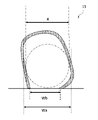
- FIG. 4 is an enlarged cross-sectional view of protrusions in a pleated structure.
- the composite semipermeable membrane according to the present embodiment includes a support membrane and a separation function layer provided on the support membrane.
- (1-1) Supporting Membrane In the present embodiment, the supporting membrane does not substantially have the ability to separate ions and the like, but gives strength to the separation functional layer that has substantially the ability to separate ions.
- the size and distribution of the pores of the support membrane are not particularly limited. A support film having a fine pore size of 0.1 nm or more and 100 nm or less on the surface on which the functional layer is formed is preferable.
- the material used for the support film and its shape are not particularly limited. or a film consisting of only one layer.
- the base material examples include fabrics whose main component is at least one selected from polyesters and aromatic polyamides.
- the fabric a long-fiber nonwoven fabric or a short-fiber nonwoven fabric can be preferably used.
- the thickness of the substrate is preferably in the range of 10 ⁇ m to 200 ⁇ m, more preferably in the range of 30 ⁇ m to 120 ⁇ m.
- Polysulfone, cellulose acetate, polyvinyl chloride, or a mixture thereof is preferably used for the porous support layer, and it is particularly preferable to use polysulfone, which has high chemical, mechanical, and thermal stability.
- the thickness of the porous support layer is preferably in the range of 10-200 ⁇ m, more preferably in the range of 20-100 ⁇ m.
- the thickness of the porous support layer is 10 ⁇ m or more, good pressure resistance can be obtained, and a uniform support membrane without defects can be obtained. , can show good salt removal performance.
- the thickness of the porous support layer is 200 ⁇ m or less, the amount of unreacted substances remaining during production does not increase, and deterioration of chemical resistance due to a decrease in the amount of permeated water can be prevented.
- the thickness of the supporting membrane is preferably within the range of 30-300 ⁇ m, more preferably within the range of 50-250 ⁇ m.
- the morphology of the support film can be observed with a scanning electron microscope, a transmission electron microscope, an interatomic microscope, or the like.
- the porous support layer is peeled off from the substrate and then cut by freeze fracture to obtain a sample for cross-sectional observation.
- This sample is preferably thinly coated with platinum or platinum-palladium or ruthenium tetrachloride, more preferably ruthenium tetrachloride, and subjected to a high-resolution field emission scanning electron microscope (UHR-FE-SEM) at an accelerating voltage of 3 to 6 kV. to observe.
- UHR-FE-SEM high-resolution field emission scanning electron microscope
- the thickness of the base material, porous support layer, and composite semipermeable membrane can be measured with a digital thickness gauge.
- the thickness of the separation function layer which will be described later, is much thinner than that of the support membrane
- the thickness of the composite semipermeable membrane can also be regarded as the thickness of the support membrane. Therefore, the thickness of the porous support layer can be easily calculated by measuring the thickness of the composite semipermeable membrane with a digital thickness gauge and subtracting the thickness of the substrate from the thickness of the composite semipermeable membrane.
- a digital thickness gauge it is preferable to measure the thickness at 20 points and calculate the average value.
- the thickness of the base material, porous support layer, and composite semipermeable membrane may be measured with the above-described microscope.
- the thickness of one sample is obtained by measuring the thickness from electron micrographs of the cross section observed at any five points and calculating the average value. It should be noted that the thickness and pore size in this embodiment mean average values.
- the separation functional layer substantially has the ability to separate ions and the like.
- the separation functional layer is indicated by the reference numeral "4".
- the separation function layer has a plurality of projections formed of a thin film 11, as shown in FIG.
- the separation functional layer preferably contains polyamide as a main component.
- the polyamide can be formed, for example, by interfacial polycondensation of polyfunctional amines and polyfunctional acid halides.
- at least one of the polyfunctional amine and the polyfunctional acid halide preferably contains a trifunctional or higher compound.
- the thickness of the separation functional layer is usually within the range of 0.01 to 1 ⁇ m, preferably within the range of 0.1 to 0.5 ⁇ m, in order to obtain sufficient separation performance and water permeation amount.
- the polyfunctional amine has at least two primary amino groups and/or secondary amino groups in one molecule, and at least one of the amino groups is a primary amino group.
- Polyfunctional amines include, for example, phenylenediamine, xylylenediamine, and 1,3,5-triamino in which two amino groups are bonded to a benzene ring in either the ortho-position, meta-position, or para-position.
- aromatic polyfunctional amines such as benzene, 1,2,4-triaminobenzene, 3,5-diaminobenzoic acid, 3-aminobenzylamine and 4-aminobenzylamine; aliphatic amines such as ethylenediamine and propylenediamine; ,2-diaminocyclohexane, 1,4-diaminocyclohexane, 4-aminopiperidine, 4-aminoethylpiperazine, and other alicyclic polyfunctional amines.
- aromatic polyfunctional amines having 2 to 4 primary amino groups and/or secondary amino groups in one molecule are preferred in consideration of the selective separation property, permeability, and heat resistance of the membrane.
- polyfunctional aromatic amines for example, m-phenylenediamine, p-phenylenediamine, 1,3,5-triaminobenzene and the like are preferably used.
- m-PDA m-phenylenediamine
- polyfunctional amines may be used alone or in combination of two or more.
- the above amines may be combined, or the above amine may be combined with an amine having at least two secondary amino groups in one molecule.
- examples of amines having at least two secondary amino groups in one molecule include piperazine and 1,3-bispiperidylpropane.
- a polyfunctional acid halide refers to an acid halide having at least two halogenated carbonyl groups in one molecule.
- trifunctional acid halides include trimesic acid chloride, 1,3,5-cyclohexanetricarboxylic acid trichloride, and 1,2,4-cyclobutanetricarboxylic acid trichloride.
- aromatic bifunctional acid halides such as biphenyldicarboxylic acid dichloride, azobenzenedicarboxylic acid dichloride, terephthalic acid chloride, isophthalic acid chloride and naphthalene dicarboxylic acid chloride
- aliphatic bifunctional acid halides such as adipoyl chloride and sebacoyl chloride cyclopentanedicarboxylic acid dichloride, cyclohexanedicarboxylic acid dichloride, tetrahydrofurandicarboxylic acid dichloride, and other alicyclic bifunctional acid halides.
- the polyfunctional acid halide is preferably a polyfunctional acid chloride. More preferred are polyfunctional aromatic acid chlorides with ⁇ 4 carbonyl chloride groups. Of these polyfunctional acid halides, trimesic acid chloride is more preferable from the viewpoint of availability and ease of handling. These polyfunctional acid halides may be used alone or in combination of two or more.
- the thin film forms a fold structure having a plurality of recesses and protrusions, as shown in FIG.
- the terms “convex” and “concave” refer to a relatively protruding portion and a concave portion of the thin film.
- the lower (supporting film side) portion is called a recess.
- "Protrusion” refers to the bottom of a recess to the bottom of an adjacent recess, ie, one protrusion and the bottoms of both adjacent recesses.
- projections refer to projections having a height of 1/5 or more of the 10-point average surface roughness of the thin film.
- the actual length L of the thin film per 1 ⁇ m length of the support film in the film surface direction of the support film is preferably 3.0 ⁇ m or more.
- the actual length L of the thin film is 3.0 ⁇ m or more, high water permeability of the composite semipermeable membrane can be obtained.
- the actual length L of the thin film is more preferably 3.0 to 100 ⁇ m, even more preferably 3.0 to 10 ⁇ m.
- film surface direction means a direction perpendicular to the direction perpendicular to the film surface.
- the actual length L of the thin film can be determined according to a general method for determining the surface area and specific surface area, and the method is not particularly limited.
- a general method for determining the surface area and specific surface area and the method is not particularly limited.
- SEM scanning electron microscope
- FE-SEM transmission type A method using an electron microscope such as an electron microscope (TEM) can be mentioned.
- TEM electron microscope
- TEM transmission electron microscope
- the observation magnification may be appropriately determined according to the film thickness of the separation functional layer, but the thickness of the separation functional layer should be 10 to 100 nm so that the cross-sectional shape of the separation functional layer can be observed and the measurement is not localized. If it is a degree, it is preferable to set the observation magnification to 50,000 to 100,000 times.
- the actual length of the thin film per 1 ⁇ m length of the support film in the direction of the film surface is measured in arbitrary 10 cross sections with a length of 2.0 ⁇ m, and the arithmetic average value is calculated. It is calculated as the actual length L of the thin film in the composite semipermeable membrane.
- the 10-point average surface roughness of a thin film is obtained by the following method.
- a cross section perpendicular to the film surface is observed with an electron microscope. The observation magnification is preferably 10,000 to 100,000 times.
- the obtained cross-sectional image shows the surface of the thin film (indicated by reference numeral "11" in FIG. 2) as a curved line.
- a roughness curve defined based on ISO 4287:1997 is determined for this curve.
- the average line is a straight line drawn so that the total area of the area surrounded by the average line and the roughness curve is equal above and below the average line.
- the average line is the reference line A, and the five convex portions from the highest convex portion to the fifth height are measured from the reference line. Heights (distances from the reference line to the apex of the convex portion) H1 to H5 are measured, and the average value thereof is calculated. Further, the depths (distances from the reference line to the apex of the recess) D1 to D5 are measured for five recesses from the deepest recess to the fifth depth, and the average value is calculated. The sum of the obtained two average values is the 10-point average surface roughness. Note that the vertex is the point at which the distance from the reference line is the maximum in the convex portion or the concave portion.
- the height of the protrusion is calculated as follows. In a cross section with a length of 2.0 ⁇ m in the direction of the above-mentioned average line, for protrusions that are one-fifth or more of the above-mentioned 10-point average surface roughness, the depth of the recesses at both ends of the protrusions (from the reference line to the apex of the recesses). The sum of the average d of d1 and d2 and the protrusion height h (distance from the reference line to the apex of the protrusion) is calculated as the protrusion height Ph.
- the height present in the 10 cross sections for the number M of protrusions with a height of 10 nm or more present in the 10 cross sections is 1/20 or more and 1/2 or less.
- N/M is 1/20 or more, a composite semipermeable membrane having high water permeability can be obtained.
- N/M is more preferably 1/10 or more.
- N/M is 1/2 or less, high water permeability can be obtained.
- N/M is more preferably 1/3 or less.
- the number of protrusions present in 10 cross sections is obtained by determining the number of protrusions included in each cross section in all 10 cross sections, and totaling the number of protrusions obtained in each cross section in all 10 cross sections. means summation.
- all the protrusions present in the 10 cross sections have at least one protrusion with a height of 400 nm or more. preferably.
- the ratio (N1/M) of the number N1 of protrusions having a height of 400 nm or more present in the ten cross sections to the number M of protrusions having a height of 10 nm or more present in the ten cross sections is 1/20 or more. /5 or less is more preferable.
- Wa/Wb is preferably 1.4 or more, more preferably 1.6 or more.
- Wa/Wb is preferably 2.0 or less, more preferably 1.8 or less, and even more preferably 1.7 or less.
- the maximum width Wa of the protrusion and the base width Wb of the protrusion can be observed with a scanning electron microscope or a transmission electron microscope.
- the composite semipermeable membrane sample preferably contains platinum, platinum-palladium or ruthenium tetroxide, more preferably ruthenium tetroxide. It is thinly coated and observed using a high resolution field emission scanning electron microscope (UHR-FE-SEM) at an accelerating voltage of 3-6 kV.
- a high-resolution field emission scanning electron microscope such as the Hitachi S-900 electron microscope can be used.
- the observation magnification is preferably 5,000 to 100,000 times.
- the maximum width Wa of the projection and the width Wb at the base of the projection can be directly measured with a scale or the like from the obtained electron micrograph in consideration of the observation magnification. Both the maximum width Wa of the projection and the base width Wb of the projection are measured as the distance between the inner surfaces of the projection. Further, the base width Wb of the projection is the distance between the straight lines drawn perpendicularly to the reference line from the apexes of the recesses on both sides of the projection.
- Wa/Wb present in 10 cross sections is greater than 1.3 with respect to the number of protrusions present in 10 cross sections. It is preferable that the ratio of the number of large protrusions is 20% or more. When the ratio is 20% or more, the water permeability of the composite semipermeable membrane can be improved. The ratio is more preferably 40% or more, more preferably 50% or more.
- the separation functional layer in the present embodiment preferably has protrusions with a maximum diameter of a circle that fits inside the protrusion, that is, a filling circle diameter R of 30 nm or more.
- the water permeability of the composite semipermeable membrane is improved by having protrusions with a filling circle diameter R of 25 nm or more. It is more preferable to include projections having a filling circle diameter R of 32 nm or more, more preferably 35 nm or more.
- the filled circle diameter R is preferably 80 nm or less.
- the filling circle diameter R can be measured from a cross-sectional photograph of the separation functional layer.
- the ratio of the number of protrusions with a filling circle diameter R of 25 nm or more present in the 10 cross sections is the total number of protrusions present in the 10 cross sections. is preferably 20% or more, more preferably 40% or more, and still more preferably 50% or more.
- the average number density of projections is preferably 10/ ⁇ m or more, more preferably 12/ ⁇ m or more. Also, the average number density of protrusions in the separation functional layer is preferably 20/ ⁇ m or less.
- the composite semipermeable membrane can obtain sufficient water permeability, and furthermore, deformation of the protrusions during pressurization can be suppressed, and stable membrane performance can be obtained. be done.
- the average number density of projections is 20/ ⁇ m or less, the pleat structure grows sufficiently, and a composite semipermeable membrane having desired water permeability can be easily obtained.
- the average number density of protrusions is at least one-fifth of the above-mentioned 10-point average surface roughness in each cross-section when observing arbitrary 10 cross-sections with a length of 2.0 ⁇ m in the above-mentioned film surface direction. It can be measured from the number of protrusions.
- the step of forming a separation functional layer includes contacting a polyfunctional amine solution and a polyfunctional acid halide solution on a porous support layer to form a polyamide through an interfacial polycondensation reaction. More specifically, the step of forming the separation functional layer includes: (i) contacting the porous support layer with a polyfunctional amine solution; (ii) after (i) above, contacting the porous support layer with a polyfunctional acid halide solution to form a polyamide on the porous support layer by interfacial polycondensation.
- the polyfunctional amine solution is an aqueous solution, and the concentration of the polyfunctional amine in this solution is preferably in the range of 0.1 to 20% by weight, preferably in the range of 0.5 to 15% by weight. more preferred. When the concentration of the polyfunctional amine is within the above range, a composite semipermeable membrane having sufficient salt removal performance and water permeability can be obtained.
- the polyfunctional amine aqueous solution may contain surfactants, organic solvents, alkaline compounds, antioxidants, etc. as long as they do not interfere with the reaction between the polyfunctional amine and the polyfunctional acid halide. good.
- surfactants include compounds having a polyoxyalkylene structure, a fatty acid ester structure, or a hydroxyl group.
- polyoxyalkylene structures include -(CH 2 CH 2 O) n -, -(CH 2 CH 2 (CH 3 )O) n -, -(CH 2 CH 2 CH 2 O) n -, -(CH 2 CH 2 CH 2 CH 2 O) n -, and the like.
- Fatty acid ester structures include fatty acids having long chain aliphatic groups. The long-chain aliphatic group may be linear or branched, and fatty acids include stearic acid, oleic acid, lauric acid, palmitic acid and salts thereof.
- Fatty acid esters derived from fats and oils also include, for example, beef tallow, palm oil, and coconut oil.
- Surfactants having a sulfo group include 1-hexanesulfonic acid, 1-octanesulfonic acid, 1-decanesulfonic acid, 1-dodecanesulfonic acid, perfluorobutanesulfonic acid, toluenesulfonic acid, cumenesulfonic acid, and octylbenzene. sulfonic acid and the like.
- Surfactants having a hydroxyl group include ethylene glycol, propylene glycol, 2-propanediol, 1,4-butanediol, glycerin, sorbitol, glucose and sucrose.
- a surfactant has the effect of improving the wettability of the surface of the porous support layer and reducing the interfacial tension between the aqueous amine solution and the nonpolar solvent.
- organic solvents include chain amide compounds and cyclic amide compounds.
- chain amide compounds include N-methylformamide, N,N-dimethylformamide, N,N-dimethylacetamide, N,N-diethylformamide and N,N-diethylacetamide.
- Cyclic amide compounds include, for example, N-methylpyrrolidinone, ⁇ -butyrolactam, and ⁇ -caprolactam.
- the organic solvent may act as a catalyst for the interfacial polycondensation reaction, and the addition of the organic solvent may improve the efficiency of the interfacial polycondensation reaction.
- Alkaline compounds include alkali metal hydroxides such as sodium hydroxide and potassium hydroxide, carbonates and hydrogen carbonates inorganic compounds such as sodium carbonate, sodium hydrogen carbonate, potassium carbonate, potassium hydrogen carbonate, and tetramethylammonium hydroxide. and organic compounds such as tetraethylammonium hydroxide.
- antioxidants examples include phenol-based antioxidants, amine-based antioxidants, sulfur-based antioxidants, and phosphorus-based antioxidants.
- Phenolic antioxidants include 2,6-di-tert-butyl-4-methylphenol, 2,2′-methylenebis(4-ethyl-6-tert-butylphenol ) and tetrakis-[methylene-3-(3′,5′-di-tert-butyl-4′-hydroxyphenyl)propionate]methane.
- Amine antioxidants include phenyl- ⁇ -naphthylamine, ⁇ -naphthylamine, N,N'-di-sec-butyl-p-phenylenediamine, phenothiazine, N,N'-diphenyl-p-phenylenediamine, and the like. be done.
- sulfur-based antioxidants include dilauryl 3,3'-thiodipropionate, distearyl thiodipropionate, lauryl stearyl thiodipropionate, and dimyristyl 3,3'-thiodipropionate.
- Phosphorus antioxidants include triphenylphosphite, octadecylphosphite and trinonylphenylphosphite.
- Other antioxidants include, for example, ascorbic acid or its alkali metal salts, sterically hindered phenol compounds such as dibutylhydroxytoluene and butylhydroxyanisole, isopropyl citrate, dl- ⁇ -tocopherol, nordihydroguaiaretic acid, and gallic acid. and propyl acid.
- the contact of the polyfunctional amine aqueous solution with the porous support layer is preferably carried out uniformly and continuously on the surface of the porous support layer.
- a method of applying an aqueous solution of polyfunctional amine to the porous support layer, or a method of immersing the porous support layer in an aqueous solution of polyfunctional amine can be used.
- the contact time between the porous support layer and the polyfunctional amine aqueous solution is preferably in the range of 1 to 10 minutes, more preferably in the range of 1 to 3 minutes.
- the support film after contact with the polyfunctional amine aqueous solution is held vertically and the excess aqueous solution is allowed to flow down naturally.
- a method of forcibly removing the liquid by blowing an air stream of nitrogen or the like from an air nozzle can be used.
- the film surface can be dried to partially remove water from the aqueous solution.
- Step (ii) contacts the porous support layer with a polyfunctional acid halide or an organic solvent solution containing the polyfunctional acid halide to form a polyamide on the porous support layer by interfacial polycondensation. is a step.
- the concentration of the polyfunctional acid halide in the organic solvent solution is preferably within the range of 0.01 to 10% by weight, more preferably within the range of 0.02 to 2.0% by weight. When the amount is 0.01% by weight or more, a sufficient reaction rate can be obtained, and when the amount is 10% by weight or less, side reactions can be suppressed.
- the organic solvent is preferably one that is immiscible with water, dissolves the polyfunctional acid halide, does not destroy the support film, and is inert to the polyfunctional amine compound and the polyfunctional acid halide. Anything is fine.
- Preferred examples of organic solvents include hydrocarbon compounds such as n-hexane, n-octane, n-nonane, n-decane, n-undecane, n-dodecane, isodecane and isododecane.
- the polyfunctional acid halide solution preferably contains water.
- the polyfunctional acid halide solution contains water, the shape of the protrusions described above is realized.
- the amount of water contained in the polyfunctional acid halide solution is preferably 1-500 ppm, more preferably 1-200 ppm.
- the polyfunctional acid halide solution may contain a compound represented by chemical formula (I) (hereinafter referred to as compound (I)).
- R 1 and R 2 are each independently an alkyl group having 1 or more carbon atoms.
- aromatic esters are preferred, and phthalates are particularly preferred.
- Specific examples of compound (I) include dibutyl phthalate, dibutylbenzyl phthalate, diethylhexyl phthalate, diisodecyl phthalate, diisonoyl phthalate, dioctyl phthalate, diisobutyl phthalate, diethyl phthalate, dimethyl phthalate, and phthalate.
- Diisooctyl acid dipropyl phthalate, dicyclohexyl phthalate, dinonyl phthalate, dibenzyl phthalate, dihexyl phthalate, dibenzyl phthalate, diphenyl phthalate, bis(2-ethylhexyl) phthalate.
- the concentration of compound (I) in the polyfunctional acid halide solution can be changed depending on the type of compound (I) added, but is preferably within the range of 5 ppm to 500 ppm.
- Examples of methods for bringing the organic solvent solution containing the polyfunctional acid halide into contact with the aqueous phase of the polyfunctional amine compound include coating and dropping.
- step (ii) a layer of polyfunctional acid halide solution is formed on the layer of polyfunctional amine aqueous solution on the porous support layer.
- the layer of the polyfunctional acid halide solution it is preferable to form a gradient containing a higher water content closer to the porous support layer.
- the above gradient is formed, so that the inside of the layer of the polyfunctional acid halide solution A surface tension difference is generated between the layers, and flow is generated within the polyfunctional acid halide solution layer. Due to this flow, in the pleated structure of the separation functional layer, projections with narrow roots and bulging trunks are formed, and the water permeability of the composite semipermeable membrane can be improved.
- the above gradient can be formed, for example, by applying polyfunctional acid halide solutions with different water contents multiple times onto the porous support layer.
- the number of applications is preferably two.
- the water content in the first polyfunctional acid halide solution (first polyfunctional acid halide solution) is preferably 10 to 500 ppm, more preferably 10 to 200 ppm.
- the water content in the polyfunctional acid halide solution applied for the second time (second polyfunctional acid halide solution) is preferably 1 to 300 ppm, more preferably 1 to 150 ppm.
- the separation functional layer containing the crosslinked polyamide by interfacial polycondensation When forming the separation functional layer containing the crosslinked polyamide by interfacial polycondensation, the actual length of the thin film of the separation functional layer is increased and the thickness of the thin film is increased by carrying out in the presence of the compound (I). can be formed, and a composite semipermeable membrane exhibiting high water permeability can be obtained.
- the formation of the protrusions is further promoted, and the height of the protrusions is increased while obtaining a shape with a narrow base and a bulging body. can grow significantly.
- the projections of the separation function layer have a narrow base, a bulging trunk, and a large height, so that it is possible to reduce the contact area with adjacent projections while ensuring a specific surface area, which makes it possible to form an effective membrane. Since the area can be secured, higher water permeability can be obtained.
- the temperature of the film surface immediately after contacting the polyfunctional amine aqueous solution and the polyfunctional acid halide solution is preferably in the range of 25 to 60°C, more preferably in the range of 30 to 50°C. .
- the temperature of the membrane surface is preferably in the range of 25 to 60°C, more preferably in the range of 30 to 50°C. .
- the support film may be heated, or a heated organic solvent solution of a polyfunctional acid halide may be brought into contact.
- the temperature of the film surface immediately after contacting the polyfunctional amine aqueous solution and the polyfunctional acid halide solution can be measured with a non-contact thermometer such as a radiation thermometer.
- the polyfunctional amine aqueous solution is brought into contact with the organic solvent solution of the polyfunctional acid halide to perform interfacial polycondensation, and after forming the separation functional layer containing the crosslinked polyamide on the porous support layer, Excess solvent should be drained off.
- a method for draining the liquid for example, a method can be used in which the film is held vertically and excess organic solvent is allowed to naturally flow down to remove.
- the holding time in the vertical direction is preferably 1 to 5 minutes, more preferably 1 to 3 minutes. When this time is 1 minute or more, a sufficient amount of polyamide can be formed as the separation functional layer, and when it is 5 minutes or less, the organic solvent does not evaporate too much, and the occurrence of film defects can be suppressed. can be done.
- a support film having a substrate and a porous support layer may be formed by coating a polymer solution on a substrate and then solidifying the polymer, or coating a polymer solution on a substrate such as glass. It may be formed by coating, then solidifying and peeling from the substrate.
- polysulfone when forming a support membrane using polysulfone, polysulfone is dissolved in N,N-dimethylformamide (hereinafter referred to as DMF) to obtain a polymer solution, and this solution is spread on a substrate to a certain thickness. and wet coagulate it in water. According to this method, it is possible to obtain a porous support layer having fine pores with a diameter of several tens of nanometers or less on most of the surface.
- DMF N,N-dimethylformamide
- the composite semipermeable membrane after the separation functional layer is formed is preferably 50 to 150°C, more preferably 70 to 130°C, preferably 1 second to 10 minutes, more preferably Salt removal performance and water permeability can be improved by adding a step of hot water treatment for 1 to 8 minutes.
- the composite semipermeable membrane is contacted with a compound (A) that reacts with primary amino groups on the separation functional layer after hydrothermal treatment to produce a diazonium salt or a derivative thereof, and then reacted with the compound (A).
- a compound (A) that reacts with primary amino groups on the separation functional layer after hydrothermal treatment to produce a diazonium salt or a derivative thereof, and then reacted with the compound (A).
- Examples of the compound (A) that reacts with a primary amino group to form a diazonium salt or derivative thereof include aqueous solutions of nitrous acid and its salts, nitrosyl compounds, and the like. Since an aqueous solution of nitrous acid or a nitrosyl compound tends to generate gas and decompose, it is preferable to sequentially generate nitrous acid by, for example, reacting nitrite with an acidic solution. In general, nitrite reacts with hydrogen ions to produce nitrous acid (HNO 2 ), which can be efficiently produced when the pH of the aqueous solution is preferably 7 or less, more preferably 5 or less, and even more preferably 4 or less. Among them, an aqueous solution of sodium nitrite which is reacted with hydrochloric acid or sulfuric acid in an aqueous solution is particularly preferable because it is easy to handle.
- the concentration of sodium nitrite is preferably 0.01 to 1% by weight. Range. When sodium nitrite is within the above range, the effect of producing a sufficient diazonium salt or derivative thereof can be obtained, and the solution can be easily handled.
- the temperature of the compound is preferably 15°C to 45°C. Within this range, the reaction does not take too long and the nitrous acid does not decompose too quickly and is easy to handle.
- the contact time between the primary amino group and the compound may be any time during which the diazonium salt and/or derivative thereof is formed. need a long time. Therefore, it is preferable that the concentration of the solution is within 10 minutes, and more preferably within 3 minutes.
- the method of contacting the primary amino group with the compound is not particularly limited, and a solution of the compound may be applied (coated) or the composite semipermeable membrane may be immersed in a solution of the compound. .
- a solution of the compound may be applied (coated) or the composite semipermeable membrane may be immersed in a solution of the compound.
- the solvent for dissolving the compound any solvent may be used as long as the compound is dissolved and the composite semipermeable membrane is not eroded.
- the solution of the compound may contain surfactants, acidic compounds, alkaline compounds, etc., as long as they do not interfere with the reaction between the primary amino group and the reagent.
- the composite semipermeable membrane produced by the diazonium salt or its derivative is brought into contact with a water-soluble compound (B) that reacts with the diazonium salt or its derivative.
- the water-soluble compound (B) that reacts with a diazonium salt or a derivative thereof includes chloride ion, bromide ion, cyanide ion, iodide ion, fluoroboric acid, hypophosphorous acid, sodium hydrogen sulfite, sulfite ion. , aromatic amines, phenols, hydrogen sulfide, thiocyanic acid and the like.
- Sodium hydrogen sulfite and sulfite ion are preferable as the compound to be brought into contact with the composite semipermeable membrane formed from the diazonium salt or its derivative.
- the concentration and time for contacting the composite semipermeable membrane produced by the diazonium salt or its derivative with the water-soluble compound (B) that reacts with the diazonium salt or its derivative can be adjusted as appropriate to obtain the desired effect.
- the temperature at which the composite semipermeable membrane produced by the diazonium salt or its derivative is brought into contact with the water-soluble compound (B) that reacts with the diazonium salt or its derivative is preferably 10 to 90°C.
- the contact temperature is within the above range, the reaction proceeds easily, and the decrease in the amount of permeated water due to shrinkage of the polymer does not occur.
- the composite semipermeable membrane of the present embodiment manufactured in this way includes a raw water channel material such as a plastic net, a permeate water channel material such as tricot, and, if necessary, pressure resistance. It is preferably used as a spiral-type composite semipermeable membrane element by being wound around a cylindrical water collection tube having a large number of holes along with a film for heightening. Furthermore, a composite semipermeable membrane module in which these elements are connected in series or in parallel and housed in a pressure vessel can also be formed.
- the above composite semipermeable membranes, their elements, and modules can be combined with a pump that supplies raw water to them, a device that preprocesses the raw water, and the like to form a fluid separation device.
- a separator By using this separator, it is possible to separate raw water into permeated water such as drinking water and concentrated water that has not permeated through the composite semipermeable membrane, thereby obtaining desired water.
- the operating pressure during permeation is preferably 0.5 MPa or more and 10 MPa or less.
- the raw water to be treated by the composite semipermeable membrane according to the present embodiment is, for example, a liquid mixture containing 50 mg/L to 100 g/L of salts (Total Dissolved Solids) such as seawater, brackish water, and waste water. is mentioned.
- salt refers to the total dissolved solids content and is expressed as "mass divided by volume” or "weight ratio". According to the definition, it can be calculated from the weight of the residue after evaporating the solution filtered through a 0.45 ⁇ m filter at a temperature of 39.5 to 40.5 ° C., but more easily converted from the practical salinity (S) .
- Example 1 The support film obtained in Reference Example 1 was immersed in an aqueous solution containing 4% by weight of m-phenylenediamine (m-PDA) for 2 minutes, then slowly lifted vertically, and was then supported by blowing nitrogen from an air nozzle. Excess aqueous solution was removed from the membrane surface. Then, as a first polyfunctional acid halide solution, an n-decane solution (water content: 23 ppm) containing 0.12% by weight of trimesic acid chloride (TMC) was applied so that the support film surface was completely wetted.
- m-PDA m-phenylenediamine
- n- A decane solution water content: 10 ppm
- the membrane was then heated in an oven at 100° C., after which the membrane was vertically drained to remove excess solution from the membrane, and dried by blowing air at 20° C. using a blower. Finally, the composite semipermeable membrane was obtained by washing with pure water at 90°C.
- Table 1 shows the amount of water contained in the first and second polyfunctional acid halide solutions.
- Table 2 shows the actual length, the height of protrusions (percentage of existence), the thickness of the thin film, and the membrane permeation flux.
- Example 2 to 11 A composite semipermeable membrane was obtained in the same manner as in Example 1, except that the concentrations of water contained in the first and second polyfunctional acid halide solutions were changed to those shown in Table 1.
- Example 12-17 Except that the amount of water contained in the first and second polyfunctional acid halide solutions was changed to the concentration shown in Table 1, and the additive was added to the first and second polyfunctional acid halide solutions.
- a composite semipermeable membrane was obtained in the same manner as in Example 1.
- Table 1 shows the types and concentrations of additives contained in the first and second polyfunctional acid halide solutions.
- a composite semipermeable membrane sample was embedded in epoxy resin, stained with OsO 4 to facilitate cross-sectional observation, and cut with an ultramicrotome to prepare 10 ultrathin sections.
- Cross-sectional photographs of the obtained ultra-thin sections were taken using a transmission electron microscope. The acceleration voltage during observation was 100 kV, and the observation magnification was 10,000 times.
- the number of protrusions in a cross section having a length of 2.0 ⁇ m in the film surface direction was measured using a scale, and the 10-point average surface roughness was calculated as described above. Based on this 10-point average surface roughness, portions having a height of 1/5 or more of the 10-point average surface roughness were counted as protrusions, and the average number density of protrusions in the separation functional layer was obtained. .
- membrane permeation flux (Membrane performance evaluation under low pressure) (membrane permeation flux)
- Raw water for evaluation NaCl concentration of 3.2%, boron concentration of about 5 ppm
- pH 6.5 was supplied to the composite semipermeable membrane at an operating pressure of 4.1 MPa, and membrane filtration was performed for 24 hours.
- the amount of permeated water was expressed as membrane permeation flux (m 3 /m 2 /day) by the amount of permeated water (cubic meter) per square meter of membrane surface per day.
- the composite semipermeable membrane of the present invention is particularly suitable for desalting seawater and brackish water.
Landscapes
- Chemical & Material Sciences (AREA)
- Chemical Kinetics & Catalysis (AREA)
- Separation Using Semi-Permeable Membranes (AREA)
Priority Applications (7)
| Application Number | Priority Date | Filing Date | Title |
|---|---|---|---|
| US18/287,795 US12138595B2 (en) | 2021-04-22 | 2022-04-22 | Composite semipermeable membrane |
| CN202280030036.7A CN117177806B (zh) | 2021-04-22 | 2022-04-22 | 复合半透膜 |
| KR1020237035605A KR102685086B1 (ko) | 2021-04-22 | 2022-04-22 | 복합 반투막 |
| EP22791833.1A EP4327921A4 (en) | 2021-04-22 | 2022-04-22 | SEMI-PERMEABLE COMPOSITE MEMBRANE |
| JP2022525133A JP7173408B1 (ja) | 2021-04-22 | 2022-04-22 | 複合半透膜 |
| JP2022175060A JP7616190B2 (ja) | 2021-04-22 | 2022-10-31 | 複合半透膜 |
| SA523451198A SA523451198B1 (ar) | 2021-04-22 | 2023-10-18 | غشاء مركب شبه مُنْفِذ |
Applications Claiming Priority (2)
| Application Number | Priority Date | Filing Date | Title |
|---|---|---|---|
| JP2021-072382 | 2021-04-22 | ||
| JP2021072382 | 2021-04-22 |
Publications (1)
| Publication Number | Publication Date |
|---|---|
| WO2022225062A1 true WO2022225062A1 (ja) | 2022-10-27 |
Family
ID=83722860
Family Applications (1)
| Application Number | Title | Priority Date | Filing Date |
|---|---|---|---|
| PCT/JP2022/018639 Ceased WO2022225062A1 (ja) | 2021-04-22 | 2022-04-22 | 複合半透膜 |
Country Status (7)
| Country | Link |
|---|---|
| US (1) | US12138595B2 (https=) |
| EP (1) | EP4327921A4 (https=) |
| JP (2) | JP7173408B1 (https=) |
| KR (1) | KR102685086B1 (https=) |
| CN (1) | CN117177806B (https=) |
| SA (1) | SA523451198B1 (https=) |
| WO (1) | WO2022225062A1 (https=) |
Families Citing this family (1)
| Publication number | Priority date | Publication date | Assignee | Title |
|---|---|---|---|---|
| US12434202B2 (en) * | 2020-12-25 | 2025-10-07 | Toray Industries, Inc. | Composite semipermeable membrane |
Citations (6)
| Publication number | Priority date | Publication date | Assignee | Title |
|---|---|---|---|---|
| JP2008517737A (ja) * | 2004-10-29 | 2008-05-29 | 東レ株式会社 | 複合半透膜、その製造方法、ならびにそれを用いたエレメント、流体分離装置、および水処理方法 |
| WO2010120326A1 (en) | 2009-02-05 | 2010-10-21 | Nanoh2O, Inc. | Improved tfc membranes with hydrolized additives |
| JP2014521499A (ja) | 2012-05-23 | 2014-08-28 | エルジー・ケム・リミテッド | 初期透過流量に優れたポリアミド系逆浸透分離膜及びその製造方法 |
| JP2018069160A (ja) * | 2016-10-28 | 2018-05-10 | 日東電工株式会社 | 複合半透膜、及びスパイラル型分離膜エレメント |
| JP2019177342A (ja) * | 2018-03-30 | 2019-10-17 | 東レ株式会社 | 複合半透膜 |
| JP2021072382A (ja) | 2019-10-31 | 2021-05-06 | Tdk株式会社 | 熱電変換素子及びこれを備える熱電変換デバイス |
Family Cites Families (16)
| Publication number | Priority date | Publication date | Assignee | Title |
|---|---|---|---|---|
| JPH0278428A (ja) * | 1988-06-07 | 1990-03-19 | Toray Ind Inc | 複合半透膜およびその製造方法 |
| US5258203A (en) | 1991-02-04 | 1993-11-02 | E. I. Du Pont De Nemours And Company | Process for the manufacture of thin film composite membranes |
| JP3489922B2 (ja) | 1994-12-22 | 2004-01-26 | 日東電工株式会社 | 高透過性複合逆浸透膜の製造方法 |
| WO2011102124A1 (ja) * | 2010-02-16 | 2011-08-25 | 日東電工株式会社 | 複合分離膜およびこれを用いた分離膜エレメント |
| KR101928256B1 (ko) | 2010-02-23 | 2018-12-11 | 도레이 카부시키가이샤 | 복합 반투막 및 그의 제조 방법 |
| CN104053495B (zh) | 2012-01-16 | 2016-06-15 | 东丽株式会社 | 复合半透膜及其制造方法 |
| US20140034569A1 (en) | 2012-05-23 | 2014-02-06 | Lg Chem, Ltd. | Reverse osmosis membrane having high initial permeate flux |
| EP2868366A4 (en) | 2012-06-27 | 2016-03-30 | Toray Industries | SEMI-PERMEABLE COMPOSITE MEMBRANE |
| JP2014065003A (ja) * | 2012-09-26 | 2014-04-17 | Toray Ind Inc | 複合半透膜及びその膜を用いた造水方法 |
| CN106659986A (zh) * | 2014-06-30 | 2017-05-10 | 东丽株式会社 | 复合半透膜 |
| CN104607067B (zh) | 2014-12-05 | 2016-07-06 | 北京碧水源净水科技有限公司 | 一种超低压高通量反渗透膜的制备方法 |
| JP6771865B2 (ja) * | 2015-01-29 | 2020-10-21 | 東レ株式会社 | 複合半透膜および複合半透膜エレメント |
| CN107921378A (zh) * | 2015-07-31 | 2018-04-17 | 东丽株式会社 | 分离膜、分离膜元件、净水器及分离膜的制造方法 |
| KR102497473B1 (ko) * | 2015-12-25 | 2023-02-08 | 도레이 카부시키가이샤 | 복합 반투막 |
| KR102061543B1 (ko) | 2017-01-31 | 2020-01-02 | 도레이 카부시키가이샤 | 복합 반투막 및 복합 반투막의 제조 방법 |
| CN108079806B (zh) * | 2018-02-07 | 2020-09-08 | 浙江大学 | 一种聚酰胺半透膜、制备方法及其应用 |
-
2022
- 2022-04-22 CN CN202280030036.7A patent/CN117177806B/zh active Active
- 2022-04-22 JP JP2022525133A patent/JP7173408B1/ja active Active
- 2022-04-22 US US18/287,795 patent/US12138595B2/en active Active
- 2022-04-22 KR KR1020237035605A patent/KR102685086B1/ko active Active
- 2022-04-22 EP EP22791833.1A patent/EP4327921A4/en not_active Withdrawn
- 2022-04-22 WO PCT/JP2022/018639 patent/WO2022225062A1/ja not_active Ceased
- 2022-10-31 JP JP2022175060A patent/JP7616190B2/ja active Active
-
2023
- 2023-10-18 SA SA523451198A patent/SA523451198B1/ar unknown
Patent Citations (6)
| Publication number | Priority date | Publication date | Assignee | Title |
|---|---|---|---|---|
| JP2008517737A (ja) * | 2004-10-29 | 2008-05-29 | 東レ株式会社 | 複合半透膜、その製造方法、ならびにそれを用いたエレメント、流体分離装置、および水処理方法 |
| WO2010120326A1 (en) | 2009-02-05 | 2010-10-21 | Nanoh2O, Inc. | Improved tfc membranes with hydrolized additives |
| JP2014521499A (ja) | 2012-05-23 | 2014-08-28 | エルジー・ケム・リミテッド | 初期透過流量に優れたポリアミド系逆浸透分離膜及びその製造方法 |
| JP2018069160A (ja) * | 2016-10-28 | 2018-05-10 | 日東電工株式会社 | 複合半透膜、及びスパイラル型分離膜エレメント |
| JP2019177342A (ja) * | 2018-03-30 | 2019-10-17 | 東レ株式会社 | 複合半透膜 |
| JP2021072382A (ja) | 2019-10-31 | 2021-05-06 | Tdk株式会社 | 熱電変換素子及びこれを備える熱電変換デバイス |
Non-Patent Citations (1)
| Title |
|---|
| See also references of EP4327921A4 |
Also Published As
| Publication number | Publication date |
|---|---|
| JP2023011790A (ja) | 2023-01-24 |
| JP7616190B2 (ja) | 2025-01-17 |
| JP7173408B1 (ja) | 2022-11-16 |
| EP4327921A1 (en) | 2024-02-28 |
| US20240198293A1 (en) | 2024-06-20 |
| EP4327921A4 (en) | 2024-09-18 |
| CN117177806A (zh) | 2023-12-05 |
| CN117177806B (zh) | 2024-12-03 |
| KR102685086B1 (ko) | 2024-07-16 |
| JPWO2022225062A1 (https=) | 2022-10-27 |
| KR20230151042A (ko) | 2023-10-31 |
| US12138595B2 (en) | 2024-11-12 |
| SA523451198B1 (ar) | 2024-10-01 |
Similar Documents
| Publication | Publication Date | Title |
|---|---|---|
| JP7115308B2 (ja) | 複合半透膜及び複合半透膜の製造方法 | |
| JPWO2011105278A1 (ja) | 複合半透膜およびその製造方法 | |
| JP7173408B1 (ja) | 複合半透膜 | |
| KR20250020424A (ko) | 복합 반투막 및 그 제조 방법 | |
| WO2023048288A1 (ja) | 複合半透膜 | |
| JP6904251B2 (ja) | 複合半透膜および複合半透膜の製造方法 | |
| JP7342528B2 (ja) | 複合半透膜および複合半透膜の製造方法 | |
| JP7652174B2 (ja) | 複合半透膜 | |
| JP7173407B1 (ja) | 複合半透膜 | |
| JP2020163298A (ja) | 複合半透膜 | |
| JP7593512B2 (ja) | 複合半透膜、複合半透膜エレメントおよびろ過装置 | |
| WO2024048695A1 (ja) | 複合半透膜及び複合半透膜の製造方法 | |
| JP2018122221A (ja) | 複合半透膜 | |
| JP2024007836A (ja) | 複合半透膜 |
Legal Events
| Date | Code | Title | Description |
|---|---|---|---|
| ENP | Entry into the national phase |
Ref document number: 2022525133 Country of ref document: JP Kind code of ref document: A |
|
| 121 | Ep: the epo has been informed by wipo that ep was designated in this application |
Ref document number: 22791833 Country of ref document: EP Kind code of ref document: A1 |
|
| ENP | Entry into the national phase |
Ref document number: 20237035605 Country of ref document: KR Kind code of ref document: A |
|
| WWE | Wipo information: entry into national phase |
Ref document number: 1020237035605 Country of ref document: KR |
|
| WWE | Wipo information: entry into national phase |
Ref document number: 18287795 Country of ref document: US |
|
| WWE | Wipo information: entry into national phase |
Ref document number: 2022791833 Country of ref document: EP |
|
| NENP | Non-entry into the national phase |
Ref country code: DE |
|
| ENP | Entry into the national phase |
Ref document number: 2022791833 Country of ref document: EP Effective date: 20231122 |
|
| WWE | Wipo information: entry into national phase |
Ref document number: 523451198 Country of ref document: SA |
|
| WWE | Wipo information: entry into national phase |
Ref document number: 523451198 Country of ref document: SA |
|
| WWG | Wipo information: grant in national office |
Ref document number: 523451198 Country of ref document: SA |
|
| WWW | Wipo information: withdrawn in national office |
Ref document number: 2022791833 Country of ref document: EP |