WO2022201710A1 - ゲームプログラム及びゲーム装置 - Google Patents
ゲームプログラム及びゲーム装置 Download PDFInfo
- Publication number
- WO2022201710A1 WO2022201710A1 PCT/JP2021/048332 JP2021048332W WO2022201710A1 WO 2022201710 A1 WO2022201710 A1 WO 2022201710A1 JP 2021048332 W JP2021048332 W JP 2021048332W WO 2022201710 A1 WO2022201710 A1 WO 2022201710A1
- Authority
- WO
- WIPO (PCT)
- Prior art keywords
- game
- player
- type
- elements
- unit
- Prior art date
- Legal status (The legal status is an assumption and is not a legal conclusion. Google has not performed a legal analysis and makes no representation as to the accuracy of the status listed.)
- Ceased
Links
Images




Classifications
-
- A—HUMAN NECESSITIES
- A63—SPORTS; GAMES; AMUSEMENTS
- A63F—CARD, BOARD, OR ROULETTE GAMES; INDOOR GAMES USING SMALL MOVING PLAYING BODIES; VIDEO GAMES; GAMES NOT OTHERWISE PROVIDED FOR
- A63F13/00—Video games, i.e. games using an electronically generated display having two or more dimensions
- A63F13/45—Controlling the progress of the video game
-
- A—HUMAN NECESSITIES
- A63—SPORTS; GAMES; AMUSEMENTS
- A63F—CARD, BOARD, OR ROULETTE GAMES; INDOOR GAMES USING SMALL MOVING PLAYING BODIES; VIDEO GAMES; GAMES NOT OTHERWISE PROVIDED FOR
- A63F13/00—Video games, i.e. games using an electronically generated display having two or more dimensions
- A63F13/55—Controlling game characters or game objects based on the game progress
- A63F13/58—Controlling game characters or game objects based on the game progress by computing conditions of game characters, e.g. stamina, strength, motivation or energy level
-
- A—HUMAN NECESSITIES
- A63—SPORTS; GAMES; AMUSEMENTS
- A63F—CARD, BOARD, OR ROULETTE GAMES; INDOOR GAMES USING SMALL MOVING PLAYING BODIES; VIDEO GAMES; GAMES NOT OTHERWISE PROVIDED FOR
- A63F13/00—Video games, i.e. games using an electronically generated display having two or more dimensions
- A63F13/60—Generating or modifying game content before or while executing the game program, e.g. authoring tools specially adapted for game development or game-integrated level editor
- A63F13/69—Generating or modifying game content before or while executing the game program, e.g. authoring tools specially adapted for game development or game-integrated level editor by enabling or updating specific game elements, e.g. unlocking hidden features, items, levels or versions
-
- A—HUMAN NECESSITIES
- A63—SPORTS; GAMES; AMUSEMENTS
- A63F—CARD, BOARD, OR ROULETTE GAMES; INDOOR GAMES USING SMALL MOVING PLAYING BODIES; VIDEO GAMES; GAMES NOT OTHERWISE PROVIDED FOR
- A63F13/00—Video games, i.e. games using an electronically generated display having two or more dimensions
- A63F13/70—Game security or game management aspects
- A63F13/79—Game security or game management aspects involving player-related data, e.g. identities, accounts, preferences or play histories
Definitions
- the present invention relates to a game program and a game device, and more particularly to an electronic game having a battle function between players.
- Patent Document 1 There is a battle-type electronic game in which a function is provided to enhance the level of a character to be used (Patent Document 1).
- An object of the present invention is to provide a game program and a game device that realize a battle function that ensures fairness.
- a game program comprises a registration process for registering a plurality of first-type game elements related to a player, and a plurality of first-type games related to the players registered in the registration process for a competitive game to be executed in a computer. and a setting process for setting a single first level for the element.
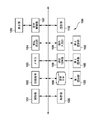
- FIG. 1 is a diagram illustrating the system configuration of a game system according to an embodiment and modifications of the present invention
- FIG. 1 is a block diagram illustrating the functional configuration of a game device 100 according to an embodiment and modifications of the present invention
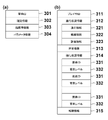
- FIG. FIG. 4 is a diagram showing a configuration example of data used in the game system according to the embodiment and modifications of the present invention
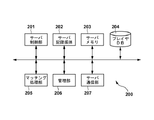
- FIG. 2 is a block diagram illustrating the functional configuration of the server 200 according to the embodiment and modifications of the present invention
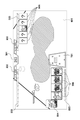
- FIG. 11 is a diagram exemplifying a game screen of a battle game according to the embodiment and modification of the present invention
- FIG. 11 is a diagram illustrating a focus map included in a game screen according to the embodiment and modifications of the present invention
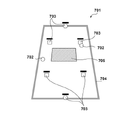
- FIG. 10 is a diagram illustrating an example of a radar map included in a game screen according to the embodiment and modifications of the present invention
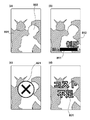
- FIG. 10 is a diagram illustrating unit cards included in the game screen according to the embodiment and modifications of the present invention
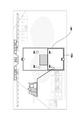
- FIG. 11 is a diagram showing an example of a radar map at the time of troop deployment, which is included in the game screen according to the embodiment and modification of the present invention
- FIG. 11 is a diagram illustrating an effect display included in the game screen according to the embodiment and modification of the present invention
- FIG. 4 is a diagram illustrating the configuration of functional modules realized by executing various processes according to the embodiment and modifications of the present invention
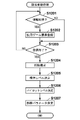
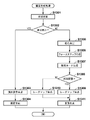
- a flow chart illustrating unit registration processing according to an embodiment of the present invention
- Flowchart illustrating screen generation processing according to the embodiment and modifications of the present invention
- the present invention is applied to a game device that executes a game progressing by registering a plurality of game elements
- a game device that executes a game progressing by registering a plurality of game elements
- the present invention can be applied to any device capable of executing a game progressing by registering multiple game elements.
- service provision means that a user (player) who has paid a fee is temporarily authorized to occupy and use the game device, and a series of games are played. means to provide services, including the provision of experiences; The start of service provision to one player is conditional on the detection of the payment of consideration while the service is not being provided, and basically the service is available for one service provision. The provisioning ends after the execution of the functions of the provided game device (including the execution of the series of games) is completed.
- FIG. 1 is a diagram showing the system configuration of the game system according to this embodiment. As illustrated, the game system is configured such that server 200 and each of one or more game devices 100 can communicate with each other via network 300 .
- the game for which a play experience is provided on the game device 100 is not limited to a battle game between players, and may include a game configured for one player.
- the server 200 determines the content of use of the player. Information managed for each player is updated based on (game play history).
- FIG. 2 is a block diagram showing the functional configuration of the game device 100 according to the embodiment of the present invention.
- the control unit 101 is, for example, a CPU, and controls the operation of each block included in the game device 100 . Specifically, the control unit 101 reads, for example, an operation program for each block recorded on the recording medium 102, develops it in the memory 103, and executes it, thereby controlling the operation of each block.
- the recording medium 102 is a recording device such as a non-volatile memory or an HDD that can permanently retain data.
- the recording medium 102 stores, in addition to the operation program of each block of the game device 100, parameter information necessary for the operation of each block, various graphics data used in the game executed by the game device 100, and the like. do.
- the memory 103 is a storage device, such as a volatile memory, used for temporary data storage. The memory 103 is used not only as a development area for the operation program of each block, but also as a storage area for temporarily storing data output in the operation of each block.
- Payment detection unit 104 detects that payment has been made on game device 100 .
- the payment is made, for example, by inserting a coin of a predetermined amount or equivalent into an insertion slot (not shown) of the game device 100, or by completing settlement processing based on communication with a chip related to predetermined electronic money. may be determined by detecting
- the game device 100 of the present embodiment will be described as starting to provide a service including providing a series of game play experiences based on the payment for starting service provision. Also, the payment of the price is configured to be detectable even after the start of service provision.
- Acquisition unit 105 is an interface related to acquisition of information from an article, provided in game device 100 of the present embodiment.
- the acquisition unit 105 includes a reader configured to acquire information attached to a plurality of types of articles.
- a plurality of types of articles from which information can be obtained by the obtaining unit 105 will be described as articles having a physical volume (actual articles) that can be provided by the game device 100 .
- each of the plurality of types of articles is a game card, each of which is associated with one game element (character, vehicle, item, etc.) appearing in a game provided with a play experience on the game device 100.
- described as being Which game element is associated with the game card can be specified by the acquisition unit 105 acquiring information (identification information) for specifying the game element attached to the game card.
- the addition of the identification information to the game card may be achieved, for example, by printing a one-dimensional or multi-dimensional code obtained by converting the identification information onto the game card. It may be realized by other methods such as being recorded in a tag for near field communication (NFC: Near Field Communication) included in a game card or in an IC chip.
- NFC Near Field Communication
- a single reader provided in the acquisition unit 105 acquires information from a plurality of types of game cards, but implementation of the present invention is not limited to this. . Needless to say, information acquisition from a plurality of types of game cards may be performed by a plurality of types of readers.
- the acquisition unit 105 also acquires information from articles on which player IDs are recorded in order to identify players who use the game device 100 .
- the item on which the player ID is recorded is a player card configured in the form of a card similar to the game card, and information can be obtained through a reader shared with the game card.
- implementation of the present invention is not limited to this, and player identification may be realized by adopting other items or methods.
- the element DB 106 is a database that manages information (element information) about each game element appearing in the game.
- a player places a game card to obtain information during game play, thereby allowing a game element associated with the game card to appear in the game.
- Element information managed for one game element is assigned to the game element in association with an element ID (identification information) 301 that uniquely identifies the game element, as shown in FIG.
- element ID identification information
- drawing information 303 including graphics data and the like used for screen generation when the game element appears in the game, and the name, attributes, etc.
- the parameter information 304 is information referred to in a game in which game elements appear, and is involved in progress control of the game.
- graphics data is stored in the element DB 106, and the element information includes these data.
- the element information may include information indicating the storage location of the corresponding data.
- the presentation control unit 107 controls presentation of various information to the player in the game device 100 .
- the game device 100 of the present embodiment is described as having a display unit 120 for displaying images (game screen, menu screen, etc.) as means for presenting various kinds of information, but the means for presenting information is not limited to these. Needless to say, alternatives or additions are possible.
- the display unit 120 which is an example of means for presenting information, is a display device that presents information visually, such as a liquid crystal display.
- an appropriate device such as a speaker for presenting information aurally is connected so as to be controllable by the presentation control unit 107 .
- the presentation control unit 107 includes a rendering device such as a GPU, and performs predetermined rendering processing when generating a screen to be displayed on the display unit 120 . Specifically, the presentation control unit 107 generates necessary drawing objects (graphics data) based on processing and commands performed by the control unit 101 while the game device 100 is running (during service provision or standby state). , and draws the screen. The generated screen is output to the display unit 120 and presented to the player by being displayed in a predetermined display area.
- a rendering device such as a GPU
- the provision control unit 108 controls the operations of the first provision unit 130, the second provision unit 140, and the third provision unit 150 so that the game card is provided in response to the payment for the use of the service.
- First providing unit 130 and second The providing unit 140 is composed of a card dispenser capable of providing the game cards stored in the storage unit one by one.
- the game device 100 of the present embodiment includes three types of card dispensers (first providing unit 130, second providing unit 140, and third providing unit 150) inside the housing of the game device 100. Control is performed as to which one of them provides the game card.
- One card dispenser has a storage unit configured to store game cards in a vertically stacked manner, and the game cards held in the bottom layer are dispensed according to the supply command issued by the supply control unit 108. Equipped with a mechanism for feeding one sheet. The sent game card is guided to an accessible space through an unillustrated outlet and provided to the player.
- game elements are associated with the game cards provided by the game device 100 of the present embodiment, and the game elements can be made to appear in the game by using the game cards during game play.
- the progress of the game is controlled according to the parameter information 304 of the game element that has appeared, and the game element having the parameter information 304 that makes the progress more advantageous has a higher value in the game. Therefore, in this embodiment, the game cards are classified into two types according to the value of the associated game element in the game.
- the game device 100 of this embodiment is configured to be able to provide and share different game cards.
- the first providing unit 130, the second providing unit 140, and the third providing unit 150 store game cards of different types in the storage units, and provide the type of supply included in the provision command issued by the control unit 101.
- the provision control unit 108 drives the corresponding provision unit to provide a specific type of game card. For this reason, game cards are delivered to the store or the like where the game device 100 is installed for each type (first type and second type). It is assumed that the stack of game cards of the second type is stored in the storage units of the second providing unit 140 and the third providing unit 150 .
- the game cards accommodated in the second providing unit 140 and the third providing unit 150 have more value in the game (performance of associated game elements, etc.) than the game cards accommodated in the first providing unit 130. is set high, hereinafter, the game cards contained in the first providing unit 130 are referred to as normal cards, and the game cards contained in the second providing unit 140 and the third providing unit 150 are referred to as rare cards. . That is, the game device 100 of the present embodiment provides normal cards when the first providing unit 130 is driven, and provides rare cards when the second providing unit 140 and the third providing unit 150 are driven. configured to provide.
- the game cards stored in the second providing unit 140 and the third providing unit 150 are both of the same type from the viewpoint of rare cards, but the two are associated with different types of game elements, for example. , and shall be stored separately so that they can be provided and divided according to the application.
- the operation input unit 109 is a user interface of the game apparatus 100, such as an operation member for decision input and various sensors.
- the operation input unit 109 outputs a control signal corresponding to the operation input to the control unit 101 when it detects that an operation input has been made to the operation member.
- the operation input unit 109 may include a touch input detection sensor or the like that detects a touch input made on the screen of the display unit 120, for example.
- the communication unit 110 is a communication interface with an external device included in the game device 100 .
- the communication unit 110 can be connected to an external device via a communication network such as the Internet or a network 300 (whether wired or wireless), which can be a cable for connecting devices, and can transmit and receive data. can.
- the communication unit 110 converts, for example, information input as a transmission target into data in a predetermined format, and transmits the data to an external device such as the server 200 via the network 300 .
- the communication unit 110 decodes the information and stores it in the memory 103 .
- the server control unit 201 is, for example, a CPU, and controls the operation of each block of the server 200 . Specifically, the server control unit 201 reads an operation program of each block recorded in the recording medium 102, develops it in the memory 103, and executes it, thereby controlling the operation of each block.
- the server recording medium 202 is a recording device such as a non-volatile memory or HDD that can permanently retain data.
- the server recording medium 202 stores information such as parameters necessary for the operation of each block in addition to the operation program of each block that the server 200 has.
- the server memory 203 is a storage device, such as volatile memory, used for temporary data storage.
- the server memory 203 is used not only as a development area for the operation program of each block, but also as a storage area for temporarily storing data output in the operation of each block.
- the player DB 204 manages information (player information) indicating the usage status of the game associated with each user (player) for the game for which the play experience is provided by the game device 100. It is a database that The player information is information for managing usage history of game play functions and various game elements available for each player. The player information is sequentially updated according to the play result of the game performed using the player card in the game device 100, and is provided to the game device 100 when the player card is used again. As a result, the game device 100 can provide a game play that reflects the previous game play.
- the player information is associated with a player ID 311 that identifies the player, as shown in FIG.
- Possession information 313 indicating usable game elements
- strengthening status information 314 indicating the strengthening status of each usable game element
- rewards given to the player other types of game elements may include reward information 315 indicating the player
- the progress information 312 includes progress information 321 indicating which stage of a predetermined story has progressed, battle record information 322 indicating the battle record of the battle game, and evaluation information 323 that evaluates the player's play status. may contain.
- the possession information 313 is constructed by sequentially adding the element IDs 301 of the game elements associated with the game card used by the player when playing the game, that is, the game elements available to the player. manages the element level 332 as an index indicating the parameter changed by the strengthening in association with the element ID 331 of at least the game element that has been strengthened (changed from the initial state). It may be configured as follows.
- the enhancement status information 314 is described as being updated when the play result of the game played on the game device 100 is obtained in the present embodiment.
- the update may be performed in response to the fact that training result information is obtained by using a function related to training in the game device 100 .
- the matching processing unit 205 performs matching processing for a battle game (interpersonal battle) between players provided in the game system of this embodiment.
- a battle game internal battle
- the matching processing unit 205 performs matching processing for a battle game (interpersonal battle) between players provided in the game system of this embodiment.
- a battle game internal battle
- two game devices 100 that have sent matching requests at the same time are set up for a session, and a transition is made to a state in which information communication related to the competitive game is possible. be done.
- the management unit 206 manages the player's evaluation of the game based on the content of the game played on the game device 100 . More specifically, the management unit 206 evaluates the player based on the play content for each game play, and generates or updates the evaluation information 323 of the player information regarding the player.
- the server communication unit 207 is a communication interface with an external device that the server 200 has.
- the server communication unit 207 is connected to an external device via a communication network such as the Internet or a network 300 (whether wired or wireless), which may be a cable connecting devices, so that data can be sent and received. can be done.
- the server communication unit 207 converts, for example, information input as a transmission target into data in a predetermined format, and transmits the data to an external device such as the game device 100 via the network 300 .
- the server communication unit 207 decodes the information and stores it in the server memory 203 .
- the service provided by the game device 100 of this embodiment includes the provision of a series of game play experiences, including at least one competition game play experience between the player and the opponent. .
- the outline of the competitive game for which the play experience is mainly provided in the game device 100 of the present embodiment will be described below.
- the match game is a match against an opponent player who is playing a game using another game device 100 matched via the server 200.
- the NPC selects the action of a plurality of game elements related to the opponent) against the CPU.
- the progress of the previous game play is performed.
- the game is configured so that the game can be played in a state that reflects the situation).
- the elements reflecting the progress of the previous game play are determined, for example, for the player, and are determined for each game element such as a player level that varies according to the results of the competitive game, and are used in the competitive game. By doing so, it may include an element level that varies according to the result of the battle game.
- These elements are basically items that only progress (increase), and are preferably not regressed (decreased) according to the game results in order to improve the player's enjoyment experience. Implementation is not limited to this.
- such progress information is included in the player information and managed in the player DB 204 of the server 200, and the player information about the player identified by acquiring the information from the player card is sent from the server 200.
- the information may be supplied to the game device 100, and the game device 100 may determine the parameters related to the game element to be used with reference to this, although the details will be described later.
- the player information may not be supplied to the game device 100 and the server 200 may determine the parameters for the corresponding matching session.
- the former mode is employed for various displays on the game device 100, but the present invention may be implemented in either mode.
- both the game device 100 and the server 200 manage parameters, and synchronization processing is performed between each game device 100 and the server 200 at a predetermined timing during the progress of the game to achieve consistency. It goes without saying that this is also a good thing.
- each player can use multiple game elements, and prior to the start of the game (before the sequence that actually operates the game elements starts) ), and by obtaining information from the game card, the game element associated with the game card can be registered as a game element (used game element) to appear in the game (used by the player).
- the game elements to be used are a boarding machine as a first type game element according to the present invention, and an element for operating the boarding machine as a second type game element according to the present invention.
- up to five piloted aircraft can be registered as game elements to be used, and the player further assigns a pilot to each piloted aircraft as an element to operate the piloted aircraft in the game. Can be associated and registered.
- the player can organize up to five sets of use game elements (hereafter referred to as units), each consisting of a boarding machine and a pilot, and start a battle game.
- units use game elements
- the maximum number of aircraft that can be registered and the maximum number of pilots that can be registered are set to be the same number (5).
- the number of game cards from which information can be obtained may exceed the maximum number of boarding aircraft and the maximum number of pilots.
- the game elements that make up the unit do not necessarily have to be registered based on information obtained from the game card.
- the game elements determined by the control unit 101 are additionally registered, the maximum number of boarding aircraft and pilots are both registered, and five units are formed.
- the number of units to be registered may be set to a number smaller than the maximum number.
- one pilot is associated with one boarding aircraft and registered as one unit, but the implementation of the present invention is not limited to this. That is, the game elements that make up one unit may be those in which a plurality of pilots are associated with one boarding aircraft, or one pilot is associated with a plurality of boarding aircraft.
- the strength of the unit in the battle game is configured to depend on the performance and strengthening status of the boarding aircraft.
- the influence of the boarding machine's parameters (parameters indicating the strength of the action for making the opponent's boarding machine inoperable, such as attack power) is dominant.
- the pilot is a game element that has a strong aspect of providing diversity in the strategies that can be selected in the battle game, and does not directly increase the parameters that make the opponent's boarding aircraft inoperable, or , even if it is increased, its influence is small compared to the boarding aircraft.
- the parameters determined for a unit are determined based on the parameters of the aircraft on board and the pilots that make up the unit. is set to be low.
- a boarding machine with superior performance is repeatedly strengthened in a game
- the parameters of a unit that includes the boarding machine may become prominent, and the progression of the battle game may affect the unit. It can be a development that is unilaterally advantageous to the player who uses it.
- the game may be monotonous in that it can be advantageously advanced without using other registered units. As a result, there is less diversity in how to play the competitive game, which may lead to a situation in which the player's interest in the competitive game is reduced.
- the parameters are adjusted for each type of game element when determining the parameters of the units, and a battle game with a suitable game balance is realized. More specifically, for the boarding aircraft among the registered game elements, a single element level corresponding to the average value of all the element levels is determined, and the single element level is determined for each boarding aircraft. The parameters are used to determine parameters for the unit containing the boarded aircraft. On the other hand, pilots with low contribution to the parameter are not adjusted, and the parameters defined for each element level for each pilot are used to determine the parameters for the unit that includes the pilot.
- the parameters of each unit to be managed are: Level 15 boarding machine A + Level 3 pilot F Level 15 boarding machine B + Level 2 pilot G Level 15 boarding machine C + Level 5 pilot H Level 15 boarding Determined based on the combination of aircraft D + level 5 pilot I, level 15 boarding aircraft E + level 1 pilot J.
- the parameters for units including boarding aircraft A and D are determined in a state weakened from the training status of the player, and for units including boarding aircraft B, C and E, the parameters are determined in a weaker state than the training status of the player. Parameters will be determined in the strengthened state. By doing so, even if a boarding aircraft in a prominent strengthened state is registered, it is not necessarily registered with the parameters of the strengthened state itself, so that the possibility of imbalance in the game balance can be reduced.
- the parameters of a boarding unit set to an element level corresponding to the average value of the element levels of registered boarding units and the element level of a registered pilot It may be derived by weighted addition of the parameters of the pilot determined in 1 and 2 by increasing the weight of the former.
- the units registered for each player are deployed (arranged) on a game field of a predetermined size, while moving and attacking. receive operation input) to proceed.
- a base associated with each player is provided in the game field, and as a result of an attack action by one of the units, the opponent's base is destroyed (the durability value is reduced to 0).
- the success or failure of an action and the damage dealt by an attack action are determined by the parameters of the unit in question. That is, during execution of the battle game, the progress of the game is controlled according to the parameters of all the registered units and the operational inputs made to the stage.
- the information about the unit registered by the opponent player is unknown.
- the player can deploy each of the five groups of units registered for him/herself on the game field at an arbitrary timing after the start of the battle game. It is notified of what kind of game elements (boarding aircraft and pilots) the unit is composed of. By configuring in this way, it is possible to provide the player with the interest of strategically developing the game while ascertaining the forces and actions of the opponent player.
- each game device 100 constructs a game screen that informs the player of the progress of the competitive game, and displays it on the display unit 120 .
- a game screen 500 displayed to one player is configured so that the player can check the game field and the position of the unit on the game field.
- the player can directly touch the unit on the display unit 120 to instruct the unit placed in the game field to move to and instruct the action to be taken.
- the game screen 500 is configured using images in which the game field is drawn in two different modes in order to achieve both of these.
- FIG. 6 One aspect of the game field image included in the game screen 500 is, as shown in FIG. 6, a focus map 601 in which units and fields are drawn in detail as the first game field according to the present invention. . As illustrated, the focus map 601 does not show the entire game field, but only a partial area of the game field that is defined by a viewpoint that appropriately captures the unit and field of interest.
- the focus map 601 is configured so that the appearance of boarding aircraft 602 and bases 603 of units placed on the game field can be confirmed, and the player can see how the units operate (moving behavior, movement to other units or bases). attack behavior) can be visually recognized.
- the unit that can be confirmed on the focus map 601 is shown only by the appearance of the boarding aircraft because the pilot is in the state of boarding inside the boarding aircraft in order to operate the boarding aircraft.
- the focus map 601 may include a field edge 604 for notifying the player of the range of the game field, and terrain objects 605 that cannot be invaded by units (unable to deploy units).
- the image of another aspect of the game field included in the game screen 500, as shown in FIG. is a radar map 701 . As illustrated, the entire game field appears on the radar map 701, and the distribution of bases and units can be confirmed.
- the radar map 701 includes a field edge 704 for notifying the player of the range of the game field, and an intrusion-prohibited area 705 that outlines an area that cannot be entered due to the terrain object 605.
- the game field is assumed to be a rectangular area.
- the radar map 701 is drawn in a manner in which the rectangular area is perspectively projected.
- the focus map 601 and the radar map 701 are images configured by drawing the same game field in different modes, and the distribution of units and bases in the game field correspond to each other. More specifically, since information on the status of deployment of units to the game field is managed based on the operation inputs performed, and drawing of the focus map 601 and radar map 701 is performed based on this information, The boarding aircraft 602 and the aircraft icon 702 are arranged at corresponding positions on the focus map 601 and the radar map 701, respectively.
- a game screen 500 as shown in FIG. 5 is configured.
- the radar map 701 is superimposed on the area of the focus map 601 .
- the radar map 701 is displayed in a smaller size than the focus map 601 on the game screen 500 so as not to interfere with the player's operation of the boarding aircraft 602 in the focus map 601 during the play of the battle game. .
- the game screen 500 is registered with a remaining time 501 of the competitive game, a player name 502 of each player who is playing the game, a base remaining endurance 503 of each player, and the player.
- a unit card 504 showing each of the five groups of units, an action gauge 505 showing the time elapsed until the unit of the player can be placed, and an opponent unit card 506 showing each of the five groups of units registered for the opponent player. including.
- unit cards unit card 504 and opponent unit card 506 indicating the registered units in the battle game of this embodiment will be described with reference to still another figure.
- the unit registered for each player is displayed in the form of one card as the third form according to the present invention, as shown in FIG. 8(a).
- one squad requires two game cards, the boarding aircraft game card and the player's game card, when registering the squad.
- It is presented as a GUI (unit card 504 only) capable of receiving operational inputs related to the placement of units on the game field in the form of a single unit card having a design.
- the design of one unit card is such that a pilot image 802 representing the pilot of the corresponding unit is superimposed on a part of the boarding unit image 801 representing the boarding unit of the corresponding unit.
- the GUI of the unit card allows the player to easily grasp the game elements included in the unit.
- the pilot image 802 is superimposed on a part of the boarding aircraft image 801 to form the design of the unit card, but the implementation of the present invention is not limited to this.
- the GUI that accepts operational inputs related to troop placement may be constructed in such a manner that game elements of a plurality of types overlap at least partially, and the degree and order of overlap are not limited.
- a unit card may also include an indication of the status of the corresponding unit. For example, as shown in FIG. 8(b), in a state where the corresponding unit is placed on the game field, a durability gauge 811 indicating the remaining durability of the unit and the actions instructed to the unit are displayed. may present an action indicator 812 indicating Alternatively, for example, as shown in FIG. 8(c), when the corresponding unit is not placed on the game field, as a result of placing it on the game field and acting, the endurance of the unit becomes 0 and it becomes incapable of action. A backward display 821 indicating that the action gauge 505 has not been placed on the game field as shown in FIG. An arrangement impossibility display 831 may be presented.
- the placement condition of each unit is, for example, a value determined according to the cost determined for at least one of the boarding aircraft and pilots that make up the unit, or five sets of units are registered.
- the action gauge 505 which increases with the passage of time, is filled with a value determined according to the parameters of each troop. At least part of the display indicating the state of the unit is shown only for the unit registered for the player, that is, only for the unit card 504 on the game screen 500, and not for the opposing unit card 506. may be
- Troop cards 504 representing five sets of units registered for the player are arranged side by side (bottom left of the screen) of the radar map 701 on the game screen 500, as shown in FIG. That is, on the side of the radar map 701, five unit cards 504 corresponding to five groups of units registered for the player are arranged.
- the opponent's unit cards 506 indicating the five registered units related to the opponent player are arranged side by side in the upper right of the screen. In order to make the battle game more interesting, the opponent unit card 506 does not always show the details of the unit as shown in FIG. It may be presented in a manner that makes the contents known.
- the troop card 504 associated with the player functions as a GUI that accepts operation inputs related to placement of the corresponding troop on the game field, and the player starts a touch operation on the troop card 504 relating to the unplaced unit.
- placement processing for placing the unit in question on the game field is executed. Therefore, the unit card 504 is displayed on the game screen in a size larger than that of the aircraft icon 702 on the radar map 701 so that the operation input can be easily received.
- the placement process is executed, the player can decide where to place the unit on the game field.
- the focus map 601 included in the game screen captures only part of the game field, and there is a possibility that the desired placement position is not included. Therefore, in the competitive game of the present embodiment, when the placement process is executed, the radar map indicating the entire game field is displayed enlarged (901) as shown in FIG. 9, and the input of the placement position is accepted. More specifically, the player cancels the touch input state (move and place) by dragging the unit that continues the touch input state to a desired position on the enlarged radar map 901, thereby inputting the placement position. It can be performed.
- the enlarged radar map 901 is drawn in the same way as the radar map 701 in terms of the display mode of the boarding aircraft and bases, but with a different perspective projection mode of the game field.
- the radar map showing the entire rectangular area, which is the game field is a perspective view (radar map 701 in FIG. 5) in order to realize space saving during the period in which the placement process is not executed.
- implementation of the present invention is not limited to this, and it is sufficient that the perspective imaging method differs between the period during which the placement process is being performed and the period during which the placement process is not being performed.
- the size of the radar map 901 may be changed during the battle game without changing the perspective drawing method.
- the area in which troops can be placed is limited on the radar map 901 displayed during execution of the placement process.
- the area is visibly shown as a placeable area 902, and the player can drag a unit that continues the touch input state into the placeable area 902 to cancel the touch input state. , shall be able to deploy troops.
- the size of the placeable area 902 may change according to the progress of the battle game, such as being expanded according to the remaining time or the progress of the teammates.
- the corresponding unit is placed on the game field, and placed in the form of boarding aircraft 602 or aircraft icon 702 at corresponding positions on focus map 601 and radar map 701 respectively. , are displayed on the game screen 500 . More specifically, on the radar map 701, the relevant unit is newly arranged in the form of an alternative figure and its position is notified, and on the focus map 601, the boarding aircraft of the relevant unit is newly arranged in the form of showing the appearance. and is displayed on the game screen 500 in a manner in which it is possible to receive an operation input related to the action instruction.
- Troops placed on the game field reach a withdrawal state when their endurance reaches 0 due to, for example, an attack action by another troop.
- Troops that have retreated are displayed in a mode in which the durability gauge 811 is 0 and a retreat display 821 is attached to the corresponding troop card, as shown in FIG. 8(c).
- the corresponding boarding aircraft 602 or aircraft icon 702 is excluded from the focus map 601 and the radar map 701 .
- the presentation of information by enlarging the radar map, such as the radar map 901 need not be performed only when an operation related to the placement of troops by the player is accepted. For example, when a new unit is deployed by the opponent player, when an already deployed unit starts a specific action, when an already deployed unit is eliminated, when the result of a specific action is confirmed. For example, when a predetermined state change related to a unit or base registered for a battle game occurs, the radar map is switched (enlarged) from the radar map 701 to the radar map 901, and a notification to that effect is sent. It may be something to do. At this time, along with the notification, control may be performed to change the display mode so that the corresponding icon (boarding aircraft 602 or base 603) can be identified.
- such a predetermined state change is accompanied by an effect display, such as displaying an image in which the action of the corresponding boarding aircraft is watched from a highly realistic viewpoint.
- an effect display such as displaying an image in which the action of the corresponding boarding aircraft is watched from a highly realistic viewpoint.
- the game screen may be constructed by arranging the corresponding effect display instead of the focus map 601, the radar map 701 and the unit card 504.
- FIG. 11A is a diagram exemplifying a functional module group realized by the control unit 101 by executing a program related to unit registration in the game device 100.
- the registration module 1101 is a functional module for registering units to be used in the competitive game prior to the competitive game.
- the acquisition unit 105 acquires information from the game card
- the registration module 1101 determines whether the game element associated with the game card is a boarding aircraft or a pilot. register the game elements of At this time, the registration module 1101 establishes a one-to-one correspondence between the boarding aircraft and the pilot related to the game card for which the information has been acquired, forms a unit, and registers and manages them.
- the boarding aircraft and the pilots forming a unit may be determined according to the position of the card holder holding the game card for which the information has been acquired.
- the composition of each group of troops may be determined based on the order of obtaining information or an operation input performed after obtaining information.
- the aircraft level determination module 1102 is a functional module that determines the element level of the boarding aircraft related to the current game play based on the element levels of the five registered boarding aircraft. As described above, in the battle game of the present embodiment, the influence of the boarding machine parameters is dominant in the determined unit parameters.
- the airframe level determination module 1102 determines a single element level for the five boarded airframes. More specifically, the aircraft level determination module 1102 acquires the enhancement status of the player for the five registered boarding aircraft by referring to the enhancement status information 314 in the player information, and determines the element level of the corresponding boarding aircraft. Determines a single element level using the average cast to an integer type.
- the pilot level determination module 1103 is a functional module that determines the element levels of the pilots involved in the current game play for each of the five registered pilots. Unlike the aircraft level determination module 1102, the pilot level determination module 1103 determines element levels individually for each pilot. More specifically, the pilot level determination module 1103 acquires the player's enhancement status for the five registered pilots by referring to the enhancement status information 314 in the player information, and determines the element level of each pilot according to the enhancement status. The value indicated by the information 314 is determined.
- the parameter determination module 1104 is a functional module that determines the parameters of each registered unit to be referred to in controlling the progress of the battle game. More specifically, the parameter determination module 1104 obtains the parameters of the pilots and the parameters of the pilots that make up the unit for each registered unit, and determines the parameters of the unit based on these.
- the parameter of the boarding machine is a parameter defined for a single element level determined by the machine level determination module 1102 in the parameter information 304 of the element information of the boarding machine managed in the element DB 106. be.
- the pilot parameter is a parameter defined for the pilot element level determined by the pilot level determination module 1103 in the parameter information 304 of the pilot element information managed by the element DB 106 .
- control unit 101 determines whether or not information has been obtained from a new game card (corresponding game element not yet registered). If the control unit 101 determines that information has been obtained from a new game card, the process proceeds to S1202, and if it determines that the information has not been obtained, the process proceeds to S1203.
- the registration module 1101 registers the information of the game element corresponding to the acquired identification information as a used game element. More specifically, the registration module 1101 determines whether the game element specified by the acquired identification information is the boarding aircraft or the pilot, and registers it as the corresponding type of game element.
- the registration of the used game element may be performed by registering the element ID and type information of the corresponding game element in the used game element table provided in the memory 103, for example, at the stage of this step.
- the used game element table is explained as including, for example, an element table for managing individual information on used game elements and a unit table for managing information for each unit.
- the registration module 1101 may determine whether or not to register the element. .
- a game element associated with the game card is registered as a used game element while the game card is placed on the reader, and is not placed thereafter. If it becomes , it is assumed that the corresponding game element is deleted from the used game elements.
- the control unit 101 determines whether or not the registration of the game elements to be used has been completed.
- the termination of the registration of the used game element may be determined, for example, on the condition that an operation input relating to termination of registration has been performed or that a time limit relating to registration has elapsed. If the control unit 101 determines that the registration of the game elements to be used has been completed, the process proceeds to S1204, and if it determines that the registration has not been completed, the process returns to S1201.
- the registration module 1101 configures five units based on the registered game elements used. More specifically, the registration module 1101 identifies boarding aircraft and pilots to be associated with each other based on the position in the reader from which the information of the game card used for registering each game element was obtained, and configures them as a unit. do. The registration module 1101 adds the information of the formed unit (for example, the unit ID and the element IDs of various game elements that make up the unit) to the unit table of the used game element table.
- the registration module 1101 performs, for example, a lottery process so that information on the missing game elements is stored in the game element table to be used. After supplementary registration in the element table, the unit can be organized.
- each troop is formed after the completion of registration of game elements, but it goes without saying that the troop may be formed at the time information is obtained from the game card. .
- the aircraft level determination module 1102 under the control of the registration module 1101, determines a single element level for the boarding aircraft among the registered use game elements. More specifically, the aircraft level determination module 1102 acquires element levels reflecting the player's enhancement status for the five boarding aircraft registered in the element table, and determines a single element level based on the acquired element levels. is determined and returned to the registration module 1101 . The registration module 1101 adds the single element level determined by the aircraft level determination module 1102 to the boarding aircraft information in the element table. If the element table contains a supplementally registered boarding machine, the machine level determination module 1102 may determine a single element level by setting the element level of the boarding machine as the initial level (1).
- the pilot level determination module 1103 under the control of the registration module 1101, determines the element level for each of the pilots of the registered use game elements. More specifically, the pilot level determination module 1103 acquires the element level reflecting the enhancement status by the player for each of the five pilots registered in the element table, and returns it to the registration module 1101 as the element level of the pilot. do. The registration module 1101 adds the element level of the pilot determined by the pilot level determination module 1103 to each pilot's information in the element table.
- parameter determination module 110 determines unit parameters for each of the five unit units. More specifically, the parameter determination module 1104 determines the parameters of each unit based on the element levels registered in the element table and their element information related to the boarding aircraft and pilots that make up the unit. and return. The registration module 1101 adds the unit parameters determined by the parameter determination module 1104 to the relevant unit information in the unit table, and completes the main unit registration process.
- FIG. 11B is a diagram exemplifying a functional module group realized by the control unit 101 or the presentation control unit 107 by executing a program related to a competitive game in the game device 100. As shown in FIG. 11B
- the placement module 1111 is a functional module that places troops related to the player and the opponent player on the game field that is the stage of the battle game.
- the placement module 1111 stores placement information indicating that a unit exists at a corresponding position in the game field in response to an operation input relating to unit placement on the game device 100 on the player's side or the opponent player's side. .
- the placement information is changed by the sequential placement module 1111 during the battle game according to the action instructions given to the units and the actions made on the other stage.
- the viewpoint determination module 1112 is a functional module that determines the viewpoint position and direction when drawing a focus map for the game field. Determining the position and direction of the viewpoint, for example, the placement information of newly deployed units or units with new action instructions, or the placement information of bases designated as action targets, especially regarding elements that cause state changes , may be determined based on a predetermined rule.
- the behavior control module 1113 is a functional module that controls the behavior of each unit placed on the game field.
- the action control module 1113 controls movement and state changes of all units based on action instructions given to each unit.
- the effect module 1114 is a functional module that performs a corresponding effect display when a predetermined condition is satisfied for a unit or a base during the progress of the battle game.
- the effect display is drawn and generated in real time using a 3D model provided for the corresponding game element, but the effect display method is not limited to this.
- the focus map drawing module 1115 is a functional module that draws a focus map for the battle game being executed. More specifically, the focus map drawing module 1115 develops a 3D model related to the game field (including bases) and a 3D model of boarding aircraft related to the troops placed in the game field based on the placement information, and the viewpoint determination module 1112 By drawing these based on the viewpoint position and direction determined by , a focus map arranged on the game screen is generated.
- the radar map drawing module 1116 is a functional module that draws a radar map for the competitive game being executed. More specifically, the radar map drawing module 1116 stores a rectangular object corresponding to the game field (and an object related to the no-entry area 705), aircraft icons 702 related to units in the game field, and base icons 703 related to bases in the game field. Develop based on and draw these to generate a radar map that is placed on the game screen. The radar map drawing module 1116 further arranges an object related to the arrangeable area 902 and a display effect object for clearly indicating a specific icon as necessary to generate a radar map.
- the radar map drawing module 1116 is described as generating a radar map by three-dimensional rendering in order to present radar maps with different perspective drawing methods, but the implementation of the present invention is limited to this. It is not something that can be done. That is, generation of radar maps with different perspective drawing methods may be generated by transforming a two-dimensional figure.
- the card drawing module 1117 is a functional module for drawing unit cards related to the player and the opponent player.
- the card drawing module 1117 may arrange the 2D images managed by the drawing information 303 of the element information for the boarding aircraft and pilots that make up the unit, and generate the image of the unit card related to the unit.
- the screen generation module 1118 arranges the focus map generated by the focus map drawing module 1115, the radar map generated by the radar map drawing module 1116, the unit card of each unit generated by the card drawing module 1117, and various GUIs. to generate a game image. Further, the screen generation module 1118 generates a game screen by arranging the effect display generated by the effect module 1114 and various GUIs when performing the effect display.
- control unit 101 updates various states of the competitive game being executed.
- the update performed in this step is performed based on the action instruction given by one of the players in advance, and includes the status change of each unit by the action control module 1113 and the update of the placement information by the placement module 1111. .
- control unit 101 determines whether or not a state change has occurred to display an effect.
- the control unit 101 shifts the processing to S1303 when judging that the state change for effect display has occurred, and shifts the processing to S1305 when judging that it has not occurred.
- the effect module 1114 generates a display effect for the state change that has occurred.
- the screen generation module 1118 arranges the effect display generated in S1303 and various GUIs to generate a game screen.
- the viewpoint determination module 1112 determines viewpoint information for drawing the focus map in S1305.
- the focus map rendering module 1115 generates a focus map based on the viewpoint information determined in S1305.
- the card drawing module 1117 generates a unit card for each unit based on the current state of each unit.
- control unit 101 determines whether or not an operation input related to troop placement has been performed.
- the control unit 101 shifts the process to S1309 if it determines that an operation input related to troop placement has been performed, and shifts the process to S1310 if it determines that the control unit 101 has not performed an operation input.
- the radar map rendering module 1116 generates a radar map in the form of enlarged display.
- the radar map drawing module 1116 generates a radar map in the normal display mode in S1310.
- the screen generation module 1118 arranges the generated focus map, radar map, unit card, and various GUIs to generate a game screen.
- the radar map may be anything as long as it informs the player of the position of the unit on the game field, and if it differs from the form of the unit placed on the focus map, it may take a form other than alternative figures such as icons and text. It's okay.
- a single element level is determined based on the average value of the element levels of all boarding aircraft registered for the player, but the implementation of the present invention is similar to this. is not limited to A single element level may be determined, for example, based on the highest value or the lowest value among the element levels of the boarding aircraft registered for the player, or the element level of the boarding aircraft registered for both players. It may be determined based on the average value of the levels.
- the adjustment of the element level of the boarding aircraft related to the unit parameters may be performed only when playing a battle game with other players.
- a single element level is determined based on the element level of the registered boarding aircraft, and the troop parameters are set based on this. is not limited to this.
- the parameters of the unit can be set to progress advantageously, but such an aspect may bias the organization of the game elements used. , may reduce the player's interest in the game.
- the present invention is configured to determine a single element level based on the player level, which fluctuates according to the performance of the competitive game, taking into consideration the player who is likely to experience such a disadvantage in progress and who has played the game many times.
- You may Alternatively, such a mode of determining a single element level based on the player level is performed only when the player level is within a predetermined numerical range, etc., and is implemented in combination with the above-described embodiments. may be
- Modification 2 In addition, in a mode in which a unit's parameters are set by determining a single element level based on one of the numerical values, especially in a battle game or the like between players who have strengthened the element level to the upper limit, There is a possibility that the progress may be such that it is difficult to win or lose. For this reason, another game element different from the two types of game elements that make up the unit is introduced as the third type game element according to the present invention, and when the other game element is registered, the specified It may be configured such that the tactical effect of the above can be produced in the battle game.
- Another game element is configured so that it can be registered when the player level is equal to or higher than a predetermined value (for example, it can be optionally selected when registering the game element to be used), and when it is registered, it can be used during the battle game. can be anything. By doing so, it is possible to provide a player who has been using the game device 100 for a long time with a variety of playing experiences of the competitive game. In addition, in order to induce the player to use the game device 100 for a longer period of time, different game elements are made different according to the player level (the higher the level, the more tactical effects can be used during one battle game). may be configured.
- a predetermined value for example, it can be optionally selected when registering the game element to be used
- a game device can also be implemented by a program that causes one or more computers to function as the game device.
- the program can be provided/distributed by being recorded on a computer-readable recording medium or through an electric communication line.
Landscapes
- Engineering & Computer Science (AREA)
- Multimedia (AREA)
- Theoretical Computer Science (AREA)
- Human Computer Interaction (AREA)
- Business, Economics & Management (AREA)
- Computer Security & Cryptography (AREA)
- General Business, Economics & Management (AREA)
- Management, Administration, Business Operations System, And Electronic Commerce (AREA)
Applications Claiming Priority (2)
| Application Number | Priority Date | Filing Date | Title |
|---|---|---|---|
| JP2021052302A JP7232857B2 (ja) | 2021-03-25 | 2021-03-25 | ゲームプログラム及びゲーム装置 |
| JP2021-052302 | 2021-03-25 |
Publications (1)
| Publication Number | Publication Date |
|---|---|
| WO2022201710A1 true WO2022201710A1 (ja) | 2022-09-29 |
Family
ID=83396788
Family Applications (1)
| Application Number | Title | Priority Date | Filing Date |
|---|---|---|---|
| PCT/JP2021/048332 Ceased WO2022201710A1 (ja) | 2021-03-25 | 2021-12-24 | ゲームプログラム及びゲーム装置 |
Country Status (2)
| Country | Link |
|---|---|
| JP (2) | JP7232857B2 (https=) |
| WO (1) | WO2022201710A1 (https=) |
Citations (2)
| Publication number | Priority date | Publication date | Assignee | Title |
|---|---|---|---|---|
| JP2020072866A (ja) * | 2019-10-16 | 2020-05-14 | 株式会社バンダイ | ゲーム装置及びプログラム |
| JP2020199376A (ja) * | 2020-09-23 | 2020-12-17 | 株式会社スクウェア・エニックス | ビデオゲーム処理プログラム、及びビデオゲーム処理システム |
Family Cites Families (13)
| Publication number | Priority date | Publication date | Assignee | Title |
|---|---|---|---|---|
| JP3870414B2 (ja) * | 2002-09-18 | 2007-01-17 | 株式会社セガ | ゲーム機及びゲーム機の制御方法 |
| JP4106013B2 (ja) * | 2003-11-10 | 2008-06-25 | アルゼ株式会社 | ゲームシステム |
| JP4966571B2 (ja) * | 2005-12-15 | 2012-07-04 | 株式会社カプコン | ゲーム装置 |
| JP2007252677A (ja) * | 2006-03-24 | 2007-10-04 | Fujitsu Ltd | カード遊戯システム |
| JP5740365B2 (ja) * | 2012-08-22 | 2015-06-24 | 株式会社コナミデジタルエンタテインメント | ゲームシステム、そのパラメータ制御方法及びコンピュータプログラム |
| JP5568682B1 (ja) * | 2013-12-17 | 2014-08-06 | 株式会社バンダイ | ゲーム装置及びプログラム |
| JP6198699B2 (ja) * | 2014-08-18 | 2017-09-20 | 株式会社コナミデジタルエンタテインメント | ゲーム制御システム、ゲーム制御プログラム及びゲーム制御装置 |
| JP5997325B1 (ja) * | 2015-07-03 | 2016-09-28 | 株式会社バンダイ | ゲーム装置及びプログラム |
| JP6247711B2 (ja) * | 2016-03-23 | 2017-12-13 | 株式会社スクウェア・エニックス | ゲームサーバ及びゲームシステム |
| JP2017202000A (ja) * | 2016-05-09 | 2017-11-16 | 株式会社スクウェア・エニックス | ビデオゲーム処理プログラム、及びビデオゲーム処理システム |
| JP2018089173A (ja) * | 2016-12-05 | 2018-06-14 | 株式会社セガゲームス | 情報処理装置およびゲームプログラム |
| JP6600395B1 (ja) * | 2018-08-23 | 2019-10-30 | 株式会社バンダイ | プログラム、ゲーム装置及びゲームシステム |
| JP6843201B1 (ja) * | 2019-09-06 | 2021-03-17 | 株式会社バンダイ | プログラム、情報処理装置及びゲームシステム |
-
2021
- 2021-03-25 JP JP2021052302A patent/JP7232857B2/ja active Active
- 2021-12-24 WO PCT/JP2021/048332 patent/WO2022201710A1/ja not_active Ceased
-
2023
- 2023-02-17 JP JP2023023602A patent/JP7641306B2/ja active Active
Patent Citations (2)
| Publication number | Priority date | Publication date | Assignee | Title |
|---|---|---|---|---|
| JP2020072866A (ja) * | 2019-10-16 | 2020-05-14 | 株式会社バンダイ | ゲーム装置及びプログラム |
| JP2020199376A (ja) * | 2020-09-23 | 2020-12-17 | 株式会社スクウェア・エニックス | ビデオゲーム処理プログラム、及びビデオゲーム処理システム |
Non-Patent Citations (1)
| Title |
|---|
| "Pokémon Ultra Sun & Pokémon Ultra Moon Official Guidebook: Complete Story Strategy + Alola Encyclopedia. 1st edition", 6 December 2017, OVERLAP, INC., JP, ISBN: 978-4-86554-277-6, article NAGATA, KATSUHARU: "Passage; Pokémon Ultra Sun & Pokémon Ultra Moon Official Guidebook", pages: 514 - 515, XP009539880 * |
Also Published As
| Publication number | Publication date |
|---|---|
| JP2022149942A (ja) | 2022-10-07 |
| JP2023056039A (ja) | 2023-04-18 |
| JP7232857B2 (ja) | 2023-03-03 |
| JP7641306B2 (ja) | 2025-03-06 |
Similar Documents
| Publication | Publication Date | Title |
|---|---|---|
| JP7320648B1 (ja) | プログラム及びゲーム装置 | |
| CN109414617A (zh) | 游戏装置、游戏用物品以及程序 | |
| JP2015116469A (ja) | ゲーム装置及びプログラム | |
| JP6869128B2 (ja) | ゲーム装置、プログラム及びゲームシステム | |
| JP7633146B2 (ja) | ゲームプログラム及びゲーム装置 | |
| JP7232857B2 (ja) | ゲームプログラム及びゲーム装置 | |
| JP7232856B2 (ja) | ゲームプログラム及びゲーム装置 | |
| JP7387986B2 (ja) | 情報処理装置、ゲーム装置、及びプログラム | |
| TWI863761B (zh) | 程式及遊戲裝置 | |
| CN113853240A (zh) | 游戏装置、游戏系统以及程序 | |
| TWI863760B (zh) | 程式及遊戲裝置 | |
| JP7192020B2 (ja) | ゲームシステム及びサーバ | |
| JP7235420B1 (ja) | プログラム、及び、ゲーム装置 | |
| JP7164741B1 (ja) | プログラム及びゲーム装置 | |
| JP6629062B2 (ja) | ゲーム装置および制御プログラム | |
| JP7836342B2 (ja) | プログラム、ゲーム管理装置、及びゲーム装置 | |
| CN116669824B (en) | Game program and game device | |
| JP7693048B1 (ja) | プログラム及びゲーム装置 | |
| JP7836341B2 (ja) | プログラム、ゲーム管理装置、及びゲーム装置 | |
| JP2026032758A (ja) | プログラム、ゲーム装置、及びゲーム管理装置 | |
| JP2026032757A (ja) | ゲーム装置、及びプログラム | |
| JP2026032759A (ja) | プログラム、及びゲーム装置 | |
| JP2026032760A (ja) | プログラム、ゲーム装置、ゲーム管理装置、及びゲームシステム | |
| CN118161855A (zh) | 计算机程序产品和游戏装置 | |
| KR101147927B1 (ko) | 한자 교육 게임 제어방법 및 게임장치 |
Legal Events
| Date | Code | Title | Description |
|---|---|---|---|
| 121 | Ep: the epo has been informed by wipo that ep was designated in this application |
Ref document number: 21933300 Country of ref document: EP Kind code of ref document: A1 |
|
| NENP | Non-entry into the national phase |
Ref country code: DE |
|
| 122 | Ep: pct application non-entry in european phase |
Ref document number: 21933300 Country of ref document: EP Kind code of ref document: A1 |