WO2022138784A1 - 変性ビニルアルコール系重合体、変性ビニルアルコール系重合体の製造方法、粒子、水溶液、塗工液、塗工物、成形体、剥離紙、分散剤、ビニル系重合体の製造方法、及び混合物 - Google Patents
変性ビニルアルコール系重合体、変性ビニルアルコール系重合体の製造方法、粒子、水溶液、塗工液、塗工物、成形体、剥離紙、分散剤、ビニル系重合体の製造方法、及び混合物 Download PDFInfo
- Publication number
- WO2022138784A1 WO2022138784A1 PCT/JP2021/047743 JP2021047743W WO2022138784A1 WO 2022138784 A1 WO2022138784 A1 WO 2022138784A1 JP 2021047743 W JP2021047743 W JP 2021047743W WO 2022138784 A1 WO2022138784 A1 WO 2022138784A1
- Authority
- WO
- WIPO (PCT)
- Prior art keywords
- group
- carbon atoms
- vinyl alcohol
- mol
- groups
- Prior art date
- Legal status (The legal status is an assumption and is not a legal conclusion. Google has not performed a legal analysis and makes no representation as to the accuracy of the status listed.)
- Ceased
Links
Classifications
-
- C—CHEMISTRY; METALLURGY
- C08—ORGANIC MACROMOLECULAR COMPOUNDS; THEIR PREPARATION OR CHEMICAL WORKING-UP; COMPOSITIONS BASED THEREON
- C08F—MACROMOLECULAR COMPOUNDS OBTAINED BY REACTIONS ONLY INVOLVING CARBON-TO-CARBON UNSATURATED BONDS
- C08F261/00—Macromolecular compounds obtained by polymerising monomers on to polymers of oxygen-containing monomers as defined in group C08F16/00
- C08F261/02—Macromolecular compounds obtained by polymerising monomers on to polymers of oxygen-containing monomers as defined in group C08F16/00 on to polymers of unsaturated alcohols
- C08F261/04—Macromolecular compounds obtained by polymerising monomers on to polymers of oxygen-containing monomers as defined in group C08F16/00 on to polymers of unsaturated alcohols on to polymers of vinyl alcohol
-
- B—PERFORMING OPERATIONS; TRANSPORTING
- B32—LAYERED PRODUCTS
- B32B—LAYERED PRODUCTS, i.e. PRODUCTS BUILT-UP OF STRATA OF FLAT OR NON-FLAT, e.g. CELLULAR OR HONEYCOMB, FORM
- B32B29/00—Layered products comprising a layer of paper or cardboard
- B32B29/002—Layered products comprising a layer of paper or cardboard as the main or only constituent of a layer, which is next to another layer of the same or of a different material
- B32B29/005—Layered products comprising a layer of paper or cardboard as the main or only constituent of a layer, which is next to another layer of the same or of a different material next to another layer of paper or cardboard layer
-
- C—CHEMISTRY; METALLURGY
- C08—ORGANIC MACROMOLECULAR COMPOUNDS; THEIR PREPARATION OR CHEMICAL WORKING-UP; COMPOSITIONS BASED THEREON
- C08F—MACROMOLECULAR COMPOUNDS OBTAINED BY REACTIONS ONLY INVOLVING CARBON-TO-CARBON UNSATURATED BONDS
- C08F8/00—Chemical modification by after-treatment
- C08F8/12—Hydrolysis
-
- C—CHEMISTRY; METALLURGY
- C08—ORGANIC MACROMOLECULAR COMPOUNDS; THEIR PREPARATION OR CHEMICAL WORKING-UP; COMPOSITIONS BASED THEREON
- C08F—MACROMOLECULAR COMPOUNDS OBTAINED BY REACTIONS ONLY INVOLVING CARBON-TO-CARBON UNSATURATED BONDS
- C08F8/00—Chemical modification by after-treatment
- C08F8/42—Introducing metal atoms or metal-containing groups
-
- C—CHEMISTRY; METALLURGY
- C08—ORGANIC MACROMOLECULAR COMPOUNDS; THEIR PREPARATION OR CHEMICAL WORKING-UP; COMPOSITIONS BASED THEREON
- C08J—WORKING-UP; GENERAL PROCESSES OF COMPOUNDING; AFTER-TREATMENT NOT COVERED BY SUBCLASSES C08B, C08C, C08F, C08G or C08H
- C08J3/00—Processes of treating or compounding macromolecular substances
- C08J3/24—Crosslinking, e.g. vulcanising, of macromolecules
- C08J3/242—Applying crosslinking or accelerating agent onto compounding ingredients such as fillers, reinforcements
-
- C—CHEMISTRY; METALLURGY
- C08—ORGANIC MACROMOLECULAR COMPOUNDS; THEIR PREPARATION OR CHEMICAL WORKING-UP; COMPOSITIONS BASED THEREON
- C08J—WORKING-UP; GENERAL PROCESSES OF COMPOUNDING; AFTER-TREATMENT NOT COVERED BY SUBCLASSES C08B, C08C, C08F, C08G or C08H
- C08J3/00—Processes of treating or compounding macromolecular substances
- C08J3/24—Crosslinking, e.g. vulcanising, of macromolecules
- C08J3/247—Heating methods
-
- C—CHEMISTRY; METALLURGY
- C09—DYES; PAINTS; POLISHES; NATURAL RESINS; ADHESIVES; COMPOSITIONS NOT OTHERWISE PROVIDED FOR; APPLICATIONS OF MATERIALS NOT OTHERWISE PROVIDED FOR
- C09K—MATERIALS FOR MISCELLANEOUS APPLICATIONS, NOT PROVIDED FOR ELSEWHERE
- C09K23/00—Use of substances as emulsifying, wetting, dispersing, or foam-producing agents
- C09K23/52—Natural or synthetic resins or their salts
-
- B—PERFORMING OPERATIONS; TRANSPORTING
- B32—LAYERED PRODUCTS
- B32B—LAYERED PRODUCTS, i.e. PRODUCTS BUILT-UP OF STRATA OF FLAT OR NON-FLAT, e.g. CELLULAR OR HONEYCOMB, FORM
- B32B2250/00—Layers arrangement
- B32B2250/26—All layers being made of paper or paperboard
-
- B—PERFORMING OPERATIONS; TRANSPORTING
- B32—LAYERED PRODUCTS
- B32B—LAYERED PRODUCTS, i.e. PRODUCTS BUILT-UP OF STRATA OF FLAT OR NON-FLAT, e.g. CELLULAR OR HONEYCOMB, FORM
- B32B2255/00—Coating on the layer surface
- B32B2255/12—Coating on the layer surface on paper layer
-
- B—PERFORMING OPERATIONS; TRANSPORTING
- B32—LAYERED PRODUCTS
- B32B—LAYERED PRODUCTS, i.e. PRODUCTS BUILT-UP OF STRATA OF FLAT OR NON-FLAT, e.g. CELLULAR OR HONEYCOMB, FORM
- B32B2255/00—Coating on the layer surface
- B32B2255/26—Polymeric coating
-
- B—PERFORMING OPERATIONS; TRANSPORTING
- B32—LAYERED PRODUCTS
- B32B—LAYERED PRODUCTS, i.e. PRODUCTS BUILT-UP OF STRATA OF FLAT OR NON-FLAT, e.g. CELLULAR OR HONEYCOMB, FORM
- B32B2307/00—Properties of the layers or laminate
- B32B2307/70—Other properties
- B32B2307/748—Releasability
-
- C—CHEMISTRY; METALLURGY
- C08—ORGANIC MACROMOLECULAR COMPOUNDS; THEIR PREPARATION OR CHEMICAL WORKING-UP; COMPOSITIONS BASED THEREON
- C08F—MACROMOLECULAR COMPOUNDS OBTAINED BY REACTIONS ONLY INVOLVING CARBON-TO-CARBON UNSATURATED BONDS
- C08F2/00—Processes of polymerisation
- C08F2/12—Polymerisation in non-solvents
- C08F2/16—Aqueous medium
- C08F2/18—Suspension polymerisation
- C08F2/20—Suspension polymerisation with the aid of macromolecular dispersing agents
-
- C—CHEMISTRY; METALLURGY
- C08—ORGANIC MACROMOLECULAR COMPOUNDS; THEIR PREPARATION OR CHEMICAL WORKING-UP; COMPOSITIONS BASED THEREON
- C08J—WORKING-UP; GENERAL PROCESSES OF COMPOUNDING; AFTER-TREATMENT NOT COVERED BY SUBCLASSES C08B, C08C, C08F, C08G or C08H
- C08J2329/00—Characterised by the use of homopolymers or copolymers of compounds having one or more unsaturated aliphatic radicals, each having only one carbon-to-carbon double bond, and at least one being terminated by an alcohol, ether, aldehydo, ketonic, acetal, or ketal radical; Hydrolysed polymers of esters of unsaturated alcohols with saturated carboxylic acids; Derivatives of such polymer
- C08J2329/02—Homopolymers or copolymers of unsaturated alcohols
- C08J2329/04—Polyvinyl alcohol; Partially hydrolysed homopolymers or copolymers of esters of unsaturated alcohols with saturated carboxylic acids
-
- C—CHEMISTRY; METALLURGY
- C09—DYES; PAINTS; POLISHES; NATURAL RESINS; ADHESIVES; COMPOSITIONS NOT OTHERWISE PROVIDED FOR; APPLICATIONS OF MATERIALS NOT OTHERWISE PROVIDED FOR
- C09D—COATING COMPOSITIONS, e.g. PAINTS, VARNISHES OR LACQUERS; FILLING PASTES; CHEMICAL PAINT OR INK REMOVERS; INKS; CORRECTING FLUIDS; WOODSTAINS; PASTES OR SOLIDS FOR COLOURING OR PRINTING; USE OF MATERIALS THEREFOR
- C09D129/00—Coating compositions based on homopolymers or copolymers of compounds having one or more unsaturated aliphatic radicals, each having only one carbon-to-carbon double bond, and at least one being terminated by an alcohol, ether, aldehydo, ketonic, acetal, or ketal radical; Coating compositions based on hydrolysed polymers of esters of unsaturated alcohols with saturated carboxylic acids; Coating compositions based on derivatives of such polymers
- C09D129/02—Homopolymers or copolymers of unsaturated alcohols
- C09D129/04—Polyvinyl alcohol; Partially hydrolysed homopolymers or copolymers of esters of unsaturated alcohols with saturated carboxylic acids
-
- C—CHEMISTRY; METALLURGY
- C09—DYES; PAINTS; POLISHES; NATURAL RESINS; ADHESIVES; COMPOSITIONS NOT OTHERWISE PROVIDED FOR; APPLICATIONS OF MATERIALS NOT OTHERWISE PROVIDED FOR
- C09J—ADHESIVES; NON-MECHANICAL ASPECTS OF ADHESIVE PROCESSES IN GENERAL; ADHESIVE PROCESSES NOT PROVIDED FOR ELSEWHERE; USE OF MATERIALS AS ADHESIVES
- C09J2429/00—Presence of polyvinyl alcohol
- C09J2429/005—Presence of polyvinyl alcohol in the release coating
-
- C—CHEMISTRY; METALLURGY
- C09—DYES; PAINTS; POLISHES; NATURAL RESINS; ADHESIVES; COMPOSITIONS NOT OTHERWISE PROVIDED FOR; APPLICATIONS OF MATERIALS NOT OTHERWISE PROVIDED FOR
- C09J—ADHESIVES; NON-MECHANICAL ASPECTS OF ADHESIVE PROCESSES IN GENERAL; ADHESIVE PROCESSES NOT PROVIDED FOR ELSEWHERE; USE OF MATERIALS AS ADHESIVES
- C09J7/00—Adhesives in the form of films or foils
- C09J7/40—Adhesives in the form of films or foils characterised by release liners
- C09J7/401—Adhesives in the form of films or foils characterised by release liners characterised by the release coating composition
Definitions
- the present disclosure discloses a modified vinyl alcohol-based polymer, a method for producing a modified vinyl alcohol-based polymer, polymer particles, an aqueous solution, a coating liquid, a coated product, a molded product, a release paper, a dispersant, and a method for producing a vinyl-based polymer. , And the mixture.
- the vinyl alcohol-based polymer (hereinafter, the vinyl alcohol-based polymer may be abbreviated as "PVA") has water solubility and has various raw materials such as synthetic fiber raw materials, film raw materials, emulsifying dispersants, and adhesives. It is used for applications.
- PVA is usually obtained by saponifying a vinyl ester-based polymer obtained by polymerizing a vinyl ester-based monomer. It is known that modified PVA having a special function can be obtained by saponifying a modified vinyl ester-based polymer obtained by copolymerizing a vinyl ester-based monomer and a monomer having various functional groups. Has been done.
- Patent Document 2 anti-fog compositions
- Patent Document 3 resin compositions
- Patent Document 4 fiber treatment agents
- Patent Document 5 discloses a method for obtaining modified PVA by reacting PVA with a specific silane coupling agent.
- PVA is used in the paper field as a paper strength enhancer, a dispersant for fluorescent white pigments, and a binder for inorganic substances (calcium carbonate, clay, silica, etc.). Since PVA has excellent film-forming properties, it is possible to impart barrier properties and oil resistance to gas and the like by applying it to paper.
- Paper coated with PVA may be used as barrier paper, and a typical example of barrier paper is release paper base paper.
- the release paper base paper is usually produced by applying PVA to the surface of a cellulose base material. Then, a release paper can be obtained by forming a release layer (silicone layer) on the surface of the release paper base paper.
- PVA in release paper plays the role of a sealant that suppresses the penetration of expensive silicone or platinum into the substrate.
- Patent Document 6 describes a release paper base paper coated with PVA having a silyl group satisfying a specific condition. Further, Patent Document 7 describes PVA in which a double bond is introduced into a side chain by an acetalization reaction. However, these Documents 6 and 7 do not disclose a coating liquid having excellent silicone curability and adhesion to a substrate.
- PVA is also widely used as a dispersant, for example, as a dispersion stabilizer for suspension polymerization and emulsion polymerization of vinyl compounds.
- a dispersion stabilizer for suspension polymerization and emulsion polymerization of vinyl compounds.
- it is useful as a dispersion stabilizer used in suspension polymerization of vinyl chloride.
- the obtained polyvinyl chloride resin (hereinafter, the polyvinyl chloride resin may be abbreviated as "PVC resin”) is excellent in chemical resistance and electrical insulation, and also in processability. Since it can be both hard and soft, it is used in a wide range of applications as various molding materials.
- PVC resins are generally produced on an industrial scale by a suspension polymerization method in which a vinyl chloride monomer is polymerized in an aqueous medium in the presence of a dispersion stabilizer using an oil-soluble polymerization initiator.
- PVA is often used as a dispersion stabilizer used for the polymerization of vinyl chloride, and PVA having an ethylenic double bond is used for the purpose of improving the stability (polymerization stability) of vinyl chloride during polymerization. It has been proposed to use (Patent Document 8). However, Document 8 does not disclose a dispersant containing a modified PVA having a specific structure derived from a silane coupling agent.
- the present disclosure discloses a modified vinyl alcohol-based polymer having a polymer structure into which a silane coupling agent has been introduced, which is excellent in handleability and is useful for various applications, a method for producing the modified vinyl alcohol-based polymer, and the modified vinyl alcohol. It is an object of the present invention to provide particles of a system polymer and an aqueous solution of the modified vinyl alcohol-based polymer. Further, the present disclosure includes a coating liquid capable of forming a coating layer having excellent silicone curability and adhesion to a base material, a coating material obtained by applying the coating liquid to a base material, a molded body and a release paper. It also aims to provide.
- the present disclosure is a dispersant and a vinyl-based polymer that can be used in the manufacturing process of a vinyl-based polymer to reduce the average particle size of the obtained vinyl-based polymer, the amount of coarse particles, and the number of fish eyes. It is also an object of the present invention to provide a method for producing the above, and a mixture thereof.
- a modified vinyl alcohol-based polymer having a structural unit represented by the following formula (1) and having a water-insoluble content of 1000 ppm or less;
- X, Y and Z are independently alkyl groups having 1 to 20 carbon atoms, alkenyl groups having 2 to 20 carbon atoms, phenyl groups, benzyl groups, vinyl phenyl groups and 1 carbon atoms.
- R 1 represents a hydrogen atom, an alkali metal atom, an alkaline earth metal atom, an alkyl group having 1 to 20 carbon atoms, an alkenyl group having 2 to 20 carbon atoms, an acryloyl group, a methacryloyl group or a glycidyl group.
- N represents an integer of 0 to 6).
- [6] A method for producing a modified vinyl alcohol-based polymer according to [4] or [5], wherein the silane coupling agent has a structure represented by the following formula (2); [In the formula (2), R represents an alkyl group having 1 to 8 carbon atoms, an acetyl group or-(CH 2 ) m -OR 2 (R 2 represents an alkyl group having 1 to 20 carbon atoms, and m. Represents an integer of 1 to 6).
- X, Y and Z are independently an alkyl group having 1 to 20 carbon atoms, an alkenyl group having 2 to 20 carbon atoms, a phenyl group, a benzyl group, a vinylphenyl group and an alkyl halide group having 1 to 20 carbon atoms.
- a phenyl halide group an aminoalkyl group having 1 to 20 carbon atoms, a mercaptoalkyl group having 1 to 20 carbon atoms, a ureidoalkyl group having 2 to 20 carbon atoms, an isocyanate alkyl group having 2 to 8 carbon atoms, and an epoxy group.
- R 1 a group represented by an alkyl group having 1 to 20 carbon atoms, an alkenyl group having 2 to 20 carbon atoms, an acryloyl group, a methacryloyl group or a glycidyl group, and n represents an integer of 0 to 6).
- the modified vinyl alcohol-based weight of [4], [5] or [6] further comprising a step of heat-treating the vinyl alcohol-based polymer impregnated with the silane coupling agent obtained in the impregnation step.
- R 1 represents a hydrogen atom, an alkali metal atom, an alkaline earth metal atom, an alkyl group having 1 to 20 carbon atoms, an alkenyl group having 2 to 20 carbon atoms, an acryloyl group, a methacryloyl group or a glycidyl group.
- N represents an integer of 0 to 6).
- Coating liquid [15] The coating liquid according to any one of [11] to [14], wherein the insoluble content of the modified vinyl alcohol polymer in the coating liquid is 1000 ppm or less; [16] A coated product obtained by applying the coating liquid according to any one of [11] to [15] to the base material; [17] A molded product comprising a layer containing a modified vinyl alcohol-based polymer having a structural unit represented by the following formula (1'); [In the formula (1'), X, Y and Z are independently an alkyl group having 1 to 20 carbon atoms, an alkenyl group having 2 to 20 carbon atoms, a phenyl group, a benzyl group, a vinylphenyl group and a carbon number of carbon atoms.
- R 1 is a hydrogen atom, an alkali metal atom, an alkaline earth metal atom, an alkyl group having 1 to 20 carbon atoms, an alkenyl group having 2 to 20 carbon atoms, an acryloyl group, a methacryloyl group, a glycidyl group or It represents a bond, and n is an atom represented by an integer of 0 to 6).
- a release paper comprising a base material, a silicone sealing layer and a release layer, wherein the silicone sealing layer contains a modified vinyl alcohol-based polymer having a structural unit represented by the following formula (1');
- X, Y and Z are independently an alkyl group having 1 to 20 carbon atoms, an alkenyl group having 2 to 20 carbon atoms, a phenyl group, a benzyl group, a vinylphenyl group and a carbon number of carbon atoms.
- R 1 is a hydrogen atom, an alkali metal atom, an alkaline earth metal atom, an alkyl group having 1 to 20 carbon atoms, an alkenyl group having 2 to 20 carbon atoms, an acryloyl group, a methacryloyl group, a glycidyl group or It represents a bond, and n is an atom represented by an integer of 0 to 6).
- R 1 represents a hydrogen atom, an alkali metal atom, an alkaline earth metal atom, an alkyl group having 1 to 20 carbon atoms, an alkenyl group having 2 to 20 carbon atoms, an acryloyl group, a methacryloyl group or a glycidyl group.
- N represents an integer of 0 to 6).
- a modified vinyl alcohol-based polymer having a polymer structure into which a silane coupling agent has been introduced which is excellent in handleability and is useful for various applications
- a method for producing the modified vinyl alcohol-based polymer and the modification thereof. It is possible to provide particles of the vinyl alcohol-based polymer and an aqueous solution of the modified vinyl alcohol-based polymer.
- a coating liquid capable of forming a coating layer having excellent silicone curability and adhesion to a base material, a coating material obtained by applying the coating liquid to a base material, a molded body and a release material. Paper can be provided.
- a dispersant, vinyl-based which can be used in the manufacturing process of a vinyl-based polymer to reduce the average particle size of the obtained vinyl-based polymer, reduce the amount of coarse particles, and reduce fish eyes.
- a method for producing a polymer and a mixture can be provided.
- modified PVA Modified vinyl alcohol polymer
- the modified PVA of the present disclosure has a structural unit represented by the following formula (1) and has a water-insoluble content of 1000 ppm or less.
- X, Y and Z are independently an alkyl group having 1 to 20 carbon atoms, an alkenyl group having 2 to 20 carbon atoms, a phenyl group, a benzyl group, a vinylphenyl group and 1 to 1 carbon atoms.
- -R 1 R 1 represents a hydrogen atom, an alkali metal atom, an alkaline earth metal atom, an alkyl group having 1 to 20 carbon atoms, an alkenyl group having 2 to 20 carbon atoms, an acryloyl group, a methacryloyl group or a glycidyl group.
- n represents an integer from 0 to 6).
- the modified PVA of the present disclosure has a polymer structure in which a silane coupling agent is introduced, but has a small amount of water insoluble and is excellent in water solubility, so that it is excellent in handleability and is useful for various applications. That is, the modified PVA of the present disclosure is easily dissolved when used in the form of an aqueous solution such as a coating liquid or a dispersant for suspension polymerization, and is easy to handle because there is little undissolved residue. Since the modified PVA of the present disclosure is excellent in water solubility, it is particularly useful for various uses such as a coating liquid and a dispersant for suspension polymerization by dissolving it in water. Further, the modified PVA having excellent water solubility is excellent in handleability because it can be stored and transported in the state of particles (powder), dissolved in water and easily used.
- Examples of the alkyl group having 1 to 20 carbon atoms represented by X, Y, Z or R 1 include a methyl group, an ethyl group, a propyl group, a butyl group, an isobutyl group, a hexyl group, a lauryl group and the like.
- the number of carbon atoms of these alkyl groups is preferably 1 to 6, and more preferably 1 to 3.
- Examples of the alkenyl group having 2 to 20 carbon atoms represented by X, Y, Z or R 1 include a vinyl group, an allyl group, a hexenyl group, an oleyl group and the like.
- the carbon number of these alkenyl groups is preferably 2 to 6, and more preferably 2 to 3.
- a vinyl group is particularly preferable.
- Examples of the halogen contained in the alkyl halide group having 1 to 20 carbon atoms represented by X, Y or Z and the phenyl halide group include chlorine, bromine and fluorine.
- the alkyl halide group preferably has 1 to 6 carbon atoms, and more preferably 1 to 3 carbon atoms.
- Aminoalkyl groups having 1 to 20 carbon atoms represented by X, Y or Z are generally NR 2 -C na H 2na- (R is an independently hydrogen atom or a hydrocarbon having 1 to 6 carbon atoms, respectively.
- the group is a group represented by (na is an integer of 1 to 20).
- the aminoalkyl group preferably has 1 to 10 carbon atoms, and more preferably 1 to 6 carbon atoms.
- a mercaptoalkyl group having 1 to 20 carbon atoms represented by X, Y or Z is generally a group represented by HS-C nb H 2nb- (nb is an integer of 1 to 20).
- the number of carbon atoms of this mercaptoalkyl group is preferably 1 to 6.
- a mercaptopropyl group is particularly preferable.
- a ureidoalkyl group having 2 to 20 carbon atoms represented by X, Y or Z is a group generally represented by NH 2 CONH-C nc H 2 nc- (nc is an integer of 1 to 19). be.
- the ureidoalkyl group preferably has 2 to 6 carbon atoms.
- the isocyanate alkyl group having 2 to 8 carbon atoms represented by X, Y or Z is generally a group represented by OCN-C nd H 2nd- ( nd is an integer of 1 to 7).
- the isocyanate alkyl group preferably has 2 to 6 carbon atoms.
- a group having 3 to 20 carbon atoms including an epoxy group represented by X, Y or Z means a group having 3 to 20 carbon atoms including a cyclic ether structure of a three-membered ring.
- Examples of such a group include an epoxy group, a glycidyl group, a glycidoxymethyl group, a 3-glycidoxypropyl group, a 2- (3,4-epoxycyclohexyl) ethyl group and the like.
- the carbon number of the group containing the epoxy group is preferably 3 to 12.
- Examples of the group having 3 to 20 carbon atoms including the acrylamide group represented by X, Y or Z include an acrylamide group, an acrylamide methyl group, a 3-acrylamide propyl group, and an N- (2-acrylamide ethyl) -aminopropyl group. 3-acrylamide propyl) -oxypropyl group and the like.
- the carbon number of the group containing the acrylamide group is preferably 3 to 12.
- Examples of the group having 4 to 20 carbon atoms including the metaacrylamide group represented by X, Y or Z include a methacrylamide group, a methacrylamide methyl group, a 3-methacrylate propyl group, and an N- (2-methacrylamide ethyl)-.
- Aminopropyl group, (3-methacrylamidopropyl) -oxypropyl group and the like can be mentioned.
- the carbon number of the group containing the methacrylicamide group is preferably 4 to 12.
- a (meth) acryloxyalkyl group is preferable, and a methacryoxypropyl group is preferable.
- alkali metal atom represented by R 1 a lithium atom, a sodium atom, a potassium atom, a rubidium atom, a cesium atom or a franchium atom is preferable.
- a magnesium atom, a calcium atom, a strontium atom or a barium atom is preferable.
- At least one of X, Y, and Z is an alkenyl group having 2 to 20 carbon atoms, a mercaptoalkyl group having 1 to 20 carbon atoms, or a group represented by-(CH 2 ) n -OR 1 . Is preferable.
- Examples of X, Y and Z include an alkyl group having 1 to 20 carbon atoms, an alkenyl group having 2 to 20 carbon atoms, a phenyl group, a benzyl group, a vinylphenyl group, an alkyl halide group having 1 to 20 carbon atoms, and a phenyl halide.
- aminoalkyl group with 1 to 20 carbon atoms aminoalkyl group with 1 to 20 carbon atoms, mercaptoalkyl group with 1 to 20 carbon atoms, ureidoalkyl group with 2 to 20 carbon atoms, isocyanate alkyl group with 2 to 8 carbon atoms, carbon number 3 to 3 including acrylamide group
- a group having 20 carbon atoms, a group having 4 to 20 carbon atoms including a metaacrylamide group, an acetoxy group or a group represented by-(CH 2 ) n -OR 1 may be preferable, and an alkyl group having 1 to 20 carbon atoms may be preferable.
- An alkenyl group having 2 to 20 carbon atoms, a phenyl group, a benzyl group or a group represented by-(CH 2 ) n -OR 1 may be more preferable, and an alkenyl group having 2 to 20 carbon atoms or-( CH 2 )
- the group represented by n —O— R1 may be more preferred.
- n an integer of 0 to 4 may be preferable, and an integer of 0 to 2 may be preferable.
- the modified PVA in the present disclosure has a water-insoluble content of 1000 ppm or less.
- the upper limit of the water-insoluble content is preferably 500 ppm, more preferably 200 ppm, still more preferably 100 ppm, 70 ppm, 50 ppm or 10 ppm.
- the lower limit of this water-insoluble content may be 0 ppm or 1 ppm.
- the water-insoluble component in the present disclosure is the mass ratio of the component that remains undissolved after the modified PVA is added to water so as to have a concentration of 5% by mass and stirred at 90 ° C. for 60 minutes. Be measured.
- a 500 mL flask equipped with a stirrer and a reflux condenser is prepared in a water bath set at 20 ° C., 285 g of distilled water is put into the flask, and stirring is started at 300 rpm.
- 15 g of modified PVA is weighed and the modified PVA is gradually added into the flask.
- the modified PVA is dissolved by raising the temperature of the water bath to 90 ° C. over 30 minutes to obtain a modified PVA solution. After the temperature of the water bath reaches 90 ° C., the dissolution is continued while stirring at 300 rpm for another 60 minutes.
- the insoluble and residual modified PVA solid (hereinafter, may be referred to as "insoluble solid” or “insoluble particles”) is filtered with a metal filter having an opening of 63 ⁇ m. do.
- the filter is then washed with warm water at 90 ° C. to remove the modified PVA solution adhering to the filter, leaving only the insoluble solid on the filter, and then the filter is dried in a 120 ° C. heat dryer for 1 hour.
- the mass of the insoluble solid is calculated by comparing the mass of the filter after drying with the mass of the filter before use for filtration.
- the ratio of the mass of the insoluble solid to the mass (15 g) of the modified PVA first added to water is defined as the water-insoluble component.
- the modified PVA of the present disclosure is a polymer having a vinyl alcohol unit as a main structural unit.
- the lower limit of the ratio of vinyl alcohol units to the total structural units in the modified PVA is, for example, preferably 30 mol%, more preferably 50 mol%, even more preferably 65 mol%, 70 mol%, 80 mol%, 85 mol%, 90 mol. % Or 95 mol% may be even more preferred.
- the upper limit of the ratio of the vinyl alcohol unit is, for example, preferably 99.9 mol%, more preferably 99 mol%, still more preferably 98 mol%, 95 mol%, 90 mol%, 85 mol% or 80 mol%. be.
- a silane coupling agent represented by the formula (2) described later and PVA are reacted (post-modified) in the presence of an acid catalyst, and the ⁇ OR group of the silane coupling agent and the ⁇ B of the PVA are formed. It is obtained by reacting with an OH group.
- the lower limit of the modification amount of the silane coupling agent-derived functional group of the modified PVA is preferably 0.01 mol%, more preferably 0.1 mol%, still more preferably 0.2 mol%.
- the amount of modification of the functional group derived from the silane coupling agent is at least the above lower limit, the effect of the functional group derived from the silane coupling agent in the modified PVA is more likely to be exhibited.
- the upper limit of the modification amount of the functional group derived from the silane coupling agent is preferably 5 mol%, more preferably 3 mol%, still more preferably 1 mol%. When the amount of modification of the functional group derived from the silane coupling agent is not more than the above upper limit, the water solubility of the modified PVA tends to be more excellent.
- the amount of modification in the present disclosure refers to the ratio of the total number of moles of functional groups derived from the silane coupling agent introduced by post-modification to the number of moles of all structural units of the modified PVA in the modified PVA. It may be referred to as "modification amount of functional group derived from silane coupling agent" or simply "modification amount”.
- modification amount of functional group derived from silane coupling agent or simply "modification amount”.
- the structure represented by -CR'2 -CR' 2- is defined as one structural unit.
- the R' is an independent hydrogen atom or an arbitrary substituent, and two R's contained in the same or different structural units may be bonded.
- the structural unit represented by the above equation (1) is composed of one structural unit.
- the vinyl alcohol unit, the residual vinyl ester unit, the structural unit derived from other monomers, and the like are each composed of one structural unit.
- the structure corresponding to the monomer having a carbon-carbon double bond used in the polymerization is a structural unit.
- the amount of modification of the functional group derived from the silane coupling agent can be determined by 1 H-NMR measurement of the modified PVA.
- the modified PVA is dissolved in DMSO - d6 and measured using 1 H-NMR at 400 MHz. ..
- the peak derived from the hydrogen atom contained in the hydroxy group of the vinyl alcohol unit and the peak derived from the hydrogen atom bonded to the carbon atom to which the acetoxy group of the vinyl acetate unit is bonded are 4.2 to 5.2 ppm (integrated value ⁇ ). Belonged.
- the lower limit of the content of the structural unit represented by the above formula (1) in the modified PVA of the present disclosure is preferably 0.01 mol%, more preferably 0.1 mol%, still more preferably 0.2 mol%.
- the content of the structural unit represented by the above formula (1) is at least the above lower limit, the effect of introducing the silane coupling agent in the modified PVA is more likely to be exhibited.
- the content of the structural unit represented by the above formula (1) is preferably less than 5 mol%.
- the upper limit of the content of the structural unit represented by the above formula (1) is more preferably 3 mol%, further preferably 2 mol%, still more preferably 1 mol%.
- the content of the structural unit represented by the above formula (1) is less than the above upper limit or less than the above upper limit, the water solubility and handleability of the modified PVA are more excellent, and the coating liquid, suspension polymerization dispersant, etc. It tends to be superior in performance when used in.
- the content of the structural unit represented by the above formula (1) can be determined by 1 H-NMR measurement of the modified PVA in the same manner as the above-mentioned modification amount. For example, in the modified PVA obtained in each of the examples described later, it is estimated that the modified amount and the content of the structural unit represented by the formula (1) are substantially equal.
- the lower limit of the content of the structural unit represented by the above formula (1) with respect to all the structural units containing a silicon atom is preferably 90 mol%, more preferably 99 mol%.
- the content may be substantially 100 mol%.
- a silane coupling agent having an epoxy group and PVA are reacted in a solution under a predetermined catalyst, the epoxy group and the hydroxy group of PVA react with each other.
- a structural unit containing a silicon atom which is different from the structural unit represented by the above formula (1), may be formed and the desired effect may not be sufficiently achieved.
- the structural unit represented by the above formula (1) by setting the content of the structural unit represented by the above formula (1) to all the structural units including the silicon atom to be equal to or higher than the above lower limit, the structural unit has excellent water solubility, and the coating liquid and the dispersion are dispersed. It becomes more suitable depending on the agent or the like.
- the lower limit of the block character of the residual vinyl ester unit is preferably 0.30, more preferably 0.40.
- the upper limit of the block character is preferably 1 and more preferably 0.8.
- the above-mentioned block character is a numerical value representing the distribution of the residual ester group and the hydroxy group generated by the saponification of the ester group, and takes a value between 0 and 2. 0 indicates that the residual ester group or hydroxy group is completely blocked, and the alternation increases as the value increases, and 1 indicates that the residual ester group and the hydroxy group are completely randomly present. 2 indicates that the residual ester group and the hydroxy group are completely alternately present.
- the modified PVA contains a structural unit other than the vinyl ester-based monomer unit and / or the vinyl alcohol unit, the block character is continuous with the vinyl ester-based monomer unit and / or the vinyl alcohol unit in the modified PVA. It is calculated for all the parts to be treated.
- the lower limit of the saponification degree of the modified PVA is preferably 30 mol%, more preferably 65 mol%, and even more preferably 70 mol%, 80 mol% or 90 mol%.
- the upper limit of the saponification degree of the modified PVA is preferably 99.9 mol%, more preferably 99 mol%, and even more preferably 98 mol%, 93 mol%, 90 mol% or 85 mol%.
- the lower limit of the viscosity average degree of polymerization (hereinafter, also simply referred to as “polymerization degree”) of the modified PVA is preferably 100, more preferably 300, and even more preferably 500, 600, 650, 700 or 1000.
- this upper limit is preferably 5000, more preferably 4000, and even more preferably 3000, 2000, 1500, 1000 or 800.
- the viscosity average degree of polymerization is measured by the method described in JIS-K6726-1994.
- the modified PVA of the present disclosure can be used for various purposes. Examples thereof are given below, but the use of the modified PVA of the present disclosure is not limited thereto.
- Vinyl chloride dispersant Use Dispersion stabilizer and dispersion aid for suspension polymerization of vinyl chloride and vinylidene chloride
- Coating agent Use Sizing agent, fiber processing agent, leather finishing agent, paint, antifogging agent, Metal corrosion inhibitor, brightener for zinc plating, antistatic agent
- Adhesive, binder Applications Adhesives, adhesives, re-wet adhesives, various binders, additives for cement and mortar
- Dispersion stabilizer applications Dispersion stabilizers for organic / inorganic pigments such as paints and adhesives, dispersion stabilizers for emulsification and polymerization of various vinyl compounds, post-embroidery materials such as bitumen
- Paper processing applications Paper strength enhancers, oil and solvent resistant imparting agents , Smoothness improver, Surface gloss improving aid, Sealing agent,
- modified PVA particles particles (modified PVA particles).
- the particles of the present disclosure are particles containing modified PVA.
- the particles are excellent in water solubility and handleability, and are useful for various uses.
- the coating liquid can be efficiently obtained by using the particles.
- the particles can be effectively used as a dispersant.
- the particles may be particles consisting substantially only of modified PVA.
- the content of the modified PVA in the particles is, for example, 90% by mass or more, 99% by mass or more, or 100% by mass.
- the average particle size (dp50) of the particles of the present disclosure is, for example, preferably 100 ⁇ m or more and 5 mm or less, more preferably 200 ⁇ m or more and 3 mm or less, and even more preferably 300 ⁇ m or more and 1 mm or less. When the average particle size is within the above range, the handleability and the like tend to be further improved.
- the average particle size (dp50) the particle size distribution was measured by the dry sieve method described in JIS-Z8815-1994 using a JIS standard sieve, and the results were plotted in a rosin-rammler distribution formula. Is calculated.
- the dispersity A of silicon atoms in the particles is preferably 0.2 or more and less than 1.
- the degree of dispersion A of silicon atoms in the particles is the ratio of the silicon atom content in the center of the particles to the silicon atom content on the particle surface in the modified PVA in the particle state, and is silane coupling in the polymer of the modified PVA. It is an index of the degree of dispersion of functional groups derived from the agent. Specifically, the degree of dispersion A is measured by the following method.
- 10 particles having a particle size of 100 ⁇ m or more, which is close to a sphere are selected.
- An energy-dispersed X-ray analyzer that divides these particles into two so that the cross-sectional area is maximized, the center of the inscribed circle of the cross section is the center of the particle, and the contact point between the inscribed circle and the particle surface is the particle surface.
- the silicon atom content is measured using (EDS).
- EDS silicon atom content
- the dispersity A in each particle is obtained based on the following formula, and the average value of 10 particles is adopted.
- Dispersity A Silicon atom content in the center of the particle (mol%) / Silicon atom content on the particle surface (mol%)
- the lower limit of the dispersity A is preferably 0.2, more preferably 0.5, even more preferably 0.7, even more preferably 0.8, and even more preferably 0.9. Further, the degree of dispersion A may be less than 1, and the upper limit may be 0.99. When the degree of dispersion A is in the above range, the degree of dispersion of the functional group derived from the silane coupling agent in the polymer or particles of the modified PVA becomes better, and the water solubility and handleability of the modified PVA are improved. Can be a thing.
- the dispersity A being in the above range and high water solubility, it can be suitably used for a coating liquid, a dispersant, etc., and the performance as a coating liquid, a dispersant, etc. is enhanced.
- the aqueous solution of the present disclosure contains the modified PVA of the present disclosure.
- the aqueous solution of the present disclosure has a small insoluble content of modified PVA and can be suitably used as a coating liquid or the like. That is, the coating liquid or the like described later is one aspect of the aqueous solution.
- the aqueous solution can be obtained by dissolving the modified PVA in water by a conventionally known method.
- the aqueous solution of the present disclosure does not contain a silane coupling agent, or further contains a silane coupling agent, and the silicon atom contained in the modified PVA with respect to the total content of the silicon atom contained in the modified PVA and the silane coupling agent. It may be preferable that the content ratio of silane is 50 mol% or more. The lower limit of the content ratio of the silicon atom is more preferably 70 mol%, 90 mol% or 95 mol%. When the content of the silane coupling agent is small in the aqueous solution, the storage stability, reaction uniformity, etc. of the aqueous solution tend to be improved.
- the aqueous solution may contain substantially only modified PVA as a solute.
- the content ratio of the modified PVA to the total solute in the aqueous solution is preferably 50% by mass or more, more preferably 70% by mass or more, further preferably 90% by mass or more, still more preferably 95% by mass or more.
- the concentration of the modified PVA in the aqueous solution is appropriately set depending on the intended use and the like, and may be, for example, 0.1% by mass or more and 30% by mass or less, or 1% by mass or more and 25% by mass or less. ..
- the aqueous solution may further contain a solvent other than water.
- the modified PVA can be produced, for example, by saponifying a vinyl ester-based polymer obtained by polymerizing a vinyl ester-based monomer to obtain PVA, and then reacting the PVA with a silane coupling agent.
- vinyl ester-based monomer examples include vinyl formate, vinyl acetate, vinyl propionate, vinyl valerate, vinyl caprate, vinyl laurate, vinyl stearate, vinyl benzoate, vinyl pivalate, vinyl versatic acid and the like. Can be mentioned. Of these, vinyl acetate is preferable.
- Examples of the method for polymerizing the vinyl ester-based monomer include known methods such as a bulk polymerization method, a solution polymerization method, a suspension polymerization method, and an emulsion polymerization method.
- the bulk polymerization method performed without a solvent and the solution polymerization method using a solvent such as alcohol are preferable, and the solution polymerization method of polymerizing in the presence of a lower alcohol is more preferable in terms of enhancing the effect of the present disclosure.
- the lower alcohol an alcohol having 3 or less carbon atoms is preferable, methanol, ethanol, n-propanol and isopropanol are more preferable, and methanol is even more preferable.
- either a batch method or a continuous method can be adopted as the reaction method.
- Examples of the initiator used in the polymerization reaction include 2,2'-azobisisobutyronitrile, 2,2'-azobis (2,4-dimethylvaleronitrile), and 2,2'-azobis (4-methoxy).
- Azo-based initiators such as ⁇ 2,4-dimethylvaleronitrile
- known initiators such as organic peroxide-based initiators such as benzoyl peroxide and n-propylperoxycarbonate can be mentioned.
- the polymerization temperature at the time of carrying out the polymerization reaction is not particularly limited, but a range of 5 ° C. or higher and 200 ° C. or lower is appropriate.
- a copolymerizable monomer When polymerizing a vinyl ester-based monomer, a copolymerizable monomer can be further copolymerized within a range that does not impair the gist of the present disclosure. Further, the copolymerizable monomer may be a silane coupling agent. Examples of such monomers include ⁇ -olefins such as ethylene, propylene, 1-butene, isobutene and 1-hexene; acrylamide derivatives such as N-methylacrylamide and N-ethylacrylamide; N-methylmethacrylicamide and N-.
- Methacrylate derivatives such as ethyl methacrylate; vinyl ethers such as methyl vinyl ether, ethyl vinyl ether, n-propyl vinyl ether, isopropyl vinyl ether, n-butyl vinyl ether; ethylene glycol vinyl ether, 1,3-propanediol vinyl ether, 1,4-butanediol vinyl ether Hydroxyl group-containing vinyl ethers such as; allyl acetate; allyl ethers such as propylallyl ether, butyl allyl ether, hexyl allyl ether; monomers having an oxyalkylene group; isopropenyl acetate; 3-butene-1-ol, 4-pentene.
- vinyl ethers such as methyl vinyl ether, ethyl vinyl ether, n-propyl vinyl ether, isopropyl vinyl ether, n-butyl vinyl ether
- Hydroxy group-containing ⁇ -olefins such as -1-ol, 5-hexene-1-ol, 7-octene-1-ol, 9-decene-1-ol, 3-methyl-3-butene-1-ol; vinyl Trimethoxysilane, vinylmethyldimethoxysilane, vinyldimethylmethoxysilane, vinyltriethoxysilane, vinylmethyldiethoxysilane, vinyldimethylethoxysilane, 3- (meth) acrylamidepropyltrimethoxysilane, 3- (meth) acrylamidepropyltriethoxysilane Examples thereof include a monomer having a silyl group such as silane. The upper limit of the amount of these monomers used varies depending on the purpose and use thereof, but is preferably 20 mol% and more preferably 10 mol% with respect to all the monomers.
- An alkali catalyst or an acid catalyst may be used in the saponification reaction of the vinyl ester-based polymer obtained in the above polymerization step, and for example, conventionally known bases such as sodium hydroxide, potassium hydroxide, and sodium methoxydide may be used. Alkaline decomposition or hydrolysis reaction using a sex catalyst can be applied.
- the solvent used for the saponification reaction include alcohols such as methanol and ethanol; esters such as methyl acetate and ethyl acetate; ketones such as acetone and methyl ethyl ketone; aromatic hydrocarbons such as benzene and toluene, and the like. Can be used alone or in combination of two or more.
- the viscosity of the 4% by mass aqueous solution of PVA (hereinafter sometimes referred to as “raw material PVA”) before being reacted with the silane coupling agent is 1 mPa ⁇ s or more and 200 mPa from the viewpoint of further suppressing excessive cross-linking of the obtained modified PVA.
- -S or less is preferable, 2 mPa ⁇ s or more and 100 mPa ⁇ s or less is more preferable, and 3 mPa ⁇ s or more and 50 mPa ⁇ s or less is further preferable.
- the lower limit of the saponification degree of the raw material PVA is preferably 30 mol%, more preferably 60 mol%, further preferably 65 mol%, and even more preferably 70 mol%, 80 mol% or 90 mol%.
- the upper limit of the saponification degree of the raw material PVA is preferably 99.9 mol%, more preferably 99 mol%, and even more preferably 98 mol%, 93 mol%, 90 mol% or 85 mol%.
- the lower limit of the degree of polymerization of the raw material PVA is preferably 100, more preferably 300, and even more preferably 500, 600, 650, 700 or 1000.
- this upper limit is preferably 5000, more preferably 4000, and even more preferably 3000, 2000, 1500, 1000 or 800.
- modified PVA can be obtained by reacting (post-modifying) the raw material PVA as described above with a silane coupling agent.
- R represents an alkyl group having 1 to 8 carbon atoms, an acetyl group or-(CH 2 ) m -OR 2 (R 2 represents an alkyl group having 1 to 20 carbon atoms, and m is. It represents an integer of 1 to 6).
- X, Y and Z are independently an alkyl group having 1 to 20 carbon atoms, an alkenyl group having 2 to 20 carbon atoms, a phenyl group, a benzyl group, a vinylphenyl group and an alkyl halide group having 1 to 20 carbon atoms.
- a phenyl halide group includes a phenyl halide group, an aminoalkyl group having 1 to 20 carbon atoms, a mercaptoalkyl group having 1 to 20 carbon atoms, a ureidoalkyl group having 2 to 20 carbon atoms, an isocyanate alkyl group having 2 to 8 carbon atoms, and an epoxy group.
- an alkyl group having 1 to 8 carbon atoms is preferable, and an alkyl group having 1 to 3 carbon atoms is more preferable.
- Specific forms and suitable forms of X, Y and Z in the formula (2) include specific forms and suitable forms of X, Y and Z in the formula (1).
- Examples of the compound represented by the formula (2) include vinyltrimethoxysilane, vinylmethyldimethoxysilane, vinyldimethylmethoxysilane, vinyltriethoxysilane, vinylmethyldiethoxysilane, vinyldimethylethoxysilane, allyltrimethoxysilane, and allyl.
- a structural unit represented by the formula (1) is formed by causing a condensation reaction between the OR group of the silane coupling agent represented by the above formula (2) and the OH group of the PVA to obtain a modified PVA. Can be done.
- the lower limit of the amount of the silane coupling agent added is preferably 0.1 part by mass, more preferably 0.5 part by mass, and even more preferably 1 part by mass with respect to 100 parts by mass of PVA.
- the upper limit of the amount of the silane coupling agent added is preferably 20 parts by mass, more preferably 15 parts by mass, still more preferably 10 parts by mass with respect to 100 parts by mass of PVA.
- the method of reacting the PVA with the silane coupling agent is not particularly limited, but for example, a powder or particulate PVA and a solution containing the silane coupling agent can be used in a ribbon blender, a Henschel mixer, a V blender, a rotary kiln, or a planetary motion.
- the desired reaction can be advanced by mixing using a mold mixer, a high-speed mixer, a Henschel mixer, a turbulizer, a radige mixer, or the like.
- one embodiment of the present disclosure is a method for producing modified PVA, which comprises a step of impregnating a solid PVA with a silane coupling agent.
- one embodiment of the present disclosure is a manufacturing method in which a solution containing a silane coupling agent is sprayed onto PVA to impregnate (penetrate) it in the impregnation step.
- a solvent so that the silane coupling agent is uniformly dispersed in PVA. That is, a method of adding a solvent (solution) containing a silane coupling agent to the PVA particles and reacting the mixture of PVA and the silane coupling agent is preferable.
- the amount of the solvent added is not limited, but 10 to 50 parts by mass is preferable with respect to 100 parts by mass of PVA.
- the silane coupling agent permeates more uniformly into the PVA particles, and the reaction between the silane coupling agent and PVA proceeds more uniformly, and the water solubility of the obtained modified PVA is obtained. And the handleability tends to be higher.
- the average particle size (dp50) of the PVA particles used in the impregnation step is, for example, preferably 100 ⁇ m or more and 5 mm or less, more preferably 200 ⁇ m or more and 3 mm or less, and even more preferably 300 ⁇ m or more and 1 mm or less.
- an acidic catalyst in the above-mentioned impregnation step.
- an acidic catalyst that can be used an inorganic acid such as sulfuric acid, hydrochloric acid, or phosphoric acid, or an organic acid such as acetic acid or p-toluenesulfonic acid can be used. It is preferable to use an acidic catalyst having an acid dissociation constant of pKa4 to 6 because Of these, it is preferable to use acetic acid.
- a polar solvent having a high affinity for PVA is preferable.
- alcohols such as methanol, ethanol and isopropanol, ketones such as acetone, ethyl methyl ketone and diethyl ketone, esters such as methyl acetate and ethyl acetate, and various solvents such as dimethyl sulfoxide and N, N-dimethylformamide may be used.
- methanol and methyl acetate are preferred.
- one embodiment of the method for producing modified PVA of the present disclosure further includes a step of heat-treating the PVA impregnated with the silane coupling agent obtained in the step of impregnating.
- the reaction between the silane coupling agent and PVA is sufficiently generated.
- heat treatment is performed on PVA impregnated with a silane coupling agent, drying is involved, so that the dehydration condensation reaction between the OR group of the silane coupling agent and the OH group of PVA is promoted, which is represented by the above formula (1). Sufficient formation of structural units occurs.
- the solution containing the silane coupling agent and PVA is heat-treated, the dehydration condensation reaction does not proceed sufficiently, and the formation of the structural unit represented by the above formula (1) hardly occurs. Conceivable.
- the means of the above heat treatment is not particularly limited, but for example, the heat treatment may be performed using a dryer, and it is preferable to perform the heat treatment with a hot air dryer. Further, the impregnation step and the heat treatment step may be performed at the same time.
- a powder or particulate PVA and a solution containing a silane coupling agent can be mixed with a ribbon blender, a Henschel mixer, a V blender, a rotary kiln, a planetary motion mixer, or a high.
- the heat treatment may be performed while mixing using a speed mixer, a Henschel mixer, a turbulizer, a radige mixer, or the like.
- the lower limit of the heat treatment temperature is preferably 20 ° C, more preferably 40 ° C, further preferably 60 ° C, still more preferably 75 ° C, and 80 ° C. Especially preferable.
- the upper limit of the heat treatment temperature is preferably 120 ° C, more preferably 110 ° C, and even more preferably 100 ° C.
- the heat treatment time can be appropriately set according to the heat treatment temperature, but is preferably 1 hour or more and 18 hours or less, and more preferably 3 hours or more and less than 12 hours. Further, it is preferable to react at a heat treatment temperature of 70 ° C. or higher and 90 ° C. or lower for 3 hours or more and less than 12 hours.
- the silane coupling agent permeates the PVA in the solid state, the PVA swells, and the reaction between the PVA and the silane coupling agent proceeds in such a state, whereby the silane coupling in the modified PVA is carried out.
- the bias of the functional group derived from the agent is suppressed, and as a result, modified PVA particles having a higher degree of dispersion A can be obtained.
- modified PVA has a lower water-insoluble content and is more excellent in water solubility and handleability, so that it can be more easily applied to various uses. For example, when it is used as a coating liquid, a dispersant or the like, excellent performance can be exhibited as a coating liquid, a dispersant or the like.
- the coating liquid of the present disclosure contains modified PVA having a structural unit represented by the above formula (1).
- the coating liquid of the present disclosure is preferably a coating liquid for a paper base material or a film base material, and may be a coating liquid used for producing a release paper or a release film.
- the coating liquid can form a coating layer having excellent silicone curability and adhesion to a substrate. Further, the coating layer formed from the coating liquid also has sufficient sealing properties.
- the specific form and suitable form of the modified PVA used in the coating liquid are the same as those of the modified PVA of the present disclosure described above, except that it is not essential that the water-insoluble content is 1000 ppm or less. However, the water-insoluble content of the modified PVA used in the coating liquid is preferably within the above range.
- the viscosity average degree of polymerization of the modified PVA used in the coating liquid of the present disclosure is not particularly limited, but the lower limit thereof is preferably 500, more preferably 600, and even more preferably 650.
- the lower limit of the viscosity average degree of polymerization of the modified PVA is within the above range, the air permeability resistance of the coating layer made of the coating liquid containing the modified PVA tends to increase, and the sealing property tends to be improved.
- the upper limit of the viscosity average degree of polymerization is preferably 5000, more preferably 4000, still more preferably 3000, and even more preferably 2000.
- the productivity of the modified PVA can be further increased.
- the viscosity average degree of polymerization of the modified PVA is preferably 500 or more and 5000 or less.
- the lower limit of the saponification degree of the modified PVA used in the coating liquid of the present disclosure is preferably 70 mol%, more preferably 80 mol%, and even more preferably 90 mol%.
- the upper limit of the saponification degree of the modified PVA is preferably 99.9 mol%.
- the upper limit of the insoluble content of the modified PVA in the coating liquid is preferably 1000 ppm, more preferably 500 ppm, further preferably 200 ppm, still more preferably 100 ppm, particularly preferably 70 ppm, still more preferably 50 ppm, still more preferably 10 ppm. There is also. Further, the lower limit of the insoluble content of the modified PVA in the coating liquid is preferably 0 ppm, and may be 1 ppm.
- the insoluble content of the modified PVA in the coating liquid in the present disclosure is the mass ratio of the modified PVA-derived component remaining undissolved in the coating liquid, and is specifically measured by the following method.
- the lower limit of the concentration of modified PVA in the coating liquid is preferably 2% by mass, more preferably 5% by mass. Further, the upper limit of the concentration of the modified PVA in the coating liquid is preferably 30% by mass, more preferably 25% by mass. When the concentration of the modified PVA in the coating liquid is in the above range, the coating efficiency is further improved and the high-speed coating property is more excellent.
- the coating liquid of the present disclosure does not contain a silane coupling agent, or further contains a silane coupling agent, and is contained in the modified PVA and the modified PVA with respect to the total content of silicon atoms contained in the silane coupling agent.
- the ratio of the content of silicon atoms is preferably 50 mol% or more.
- the lower limit of the content ratio of the silicon atom is more preferably 70 mol%, 90 mol% or 95 mol%.
- the coating liquid of the present disclosure is preferably an aqueous solution containing modified PVA.
- the aqueous solution may contain a small amount of an organic solvent, or may contain a small amount of water-insoluble organic particles or inorganic particles.
- the concentration of the modified PVA in the aqueous solution is preferably 1% by mass or more and 30% by mass or less.
- the manufacturing method of the coating liquid of the present disclosure is not particularly limited.
- a coating liquid can be obtained by dissolving particles of modified PVA in water.
- the coating liquid may contain components other than the vinyl alcohol polymer of the present disclosure as long as the effects of the present disclosure are not impaired.
- Other ingredients include aqueous dispersible resins such as SBR latex, NBR latex, vinyl acetate emulsions, ethylene / vinyl acetate copolymer emulsions, (meth) acrylic ester emulsions, vinyl chloride emulsions; wheat, corn, rice.
- the coating liquid may contain pigments as long as the effects of the present disclosure are not impaired.
- the pigment include inorganic pigments (clay, kaolin, aluminum hydroxide, calcium carbonate, talc, etc.) and organic pigments (plastic pigments, etc.) generally used in the field of coated paper manufacturing.
- the content of these pigment components in the coating liquid is preferably 50% by mass or less.
- a preferred embodiment of the present disclosure is a coated product in which the coating liquid is applied to the surface of a base material.
- a base material a paper base material or a film base material is preferable.
- the manufacturing method of the coated product is not particularly limited, and may be, for example, a manufacturing method including a step of applying a coating liquid to a base material and a step of drying the base material after coating.
- paper base material known chemical pulps such as broadleaf kraft pulp and coniferous kraft pulp, and mechanical pulps such as GP (crushed wood pulp), RGP (refiner ground pulp), and TMP (thermomechanical pulp) are made from paper. Paper or synthetic paper can be used. Further, as the paper base material, high-quality paper, medium-quality paper, alkaline paper, glassin paper, semi-glassin paper, or paperboard used for corrugated cardboard, building materials, white balls, chipboard, etc., white paperboard, etc. shall also be used. Can be done.
- the paper substrate may contain organic and inorganic pigments, as well as papermaking aids such as paper strength enhancers, sizing agents, and yield improvers. Further, the paper substrate may be one that has been subjected to various surface treatments.
- the film base material is preferably a film base material made of a thermoplastic resin.
- thermoplastic resin include polyolefins, polyesters, polyamides and the like.
- the coating equipment examples include 2-roll size press, gate roll size press, metering size press, air knife coater, bar coater, roll coater, blade coater and the like.
- the coating speed is preferably 100 to 2,000 m / min. Further, the coating speed is more preferably 300 m / min or more, and more preferably 1,800 m / min or less. When the coating speed is in this range, the production efficiency can be further improved, and uniform coating becomes easier.
- the amount of coating can be arbitrarily selected according to the properties of the paper, but it is preferably about 0.05 to 10 g / m 2 per side of the paper.
- Drying after coating can be performed by, for example, hot air, infrared rays, a heating cylinder, or a method combining these.
- the dry coating material can be further improved in barrier property by humidity control and calendar treatment.
- As the humidity control condition it is desirable that the moisture content in the paper is 5 to 20% by mass.
- the calendar processing conditions it is preferable that the roll temperature is normal temperature to 200 ° C. and the roll linear pressure is 20 to 350 kg / cm.
- the lower limit of the air permeation resistance of the coated material is preferably 400 seconds, more preferably 2,000 seconds, further preferably 5,000 seconds, still more preferably 7,000 seconds, and particularly preferably 10,000 seconds. be.
- the upper limit of the air permeability resistance of the coated material is not particularly limited, but may be 20,000 seconds.
- the coated material examples include release paper base paper, barrier paper, oil-resistant paper, wrapping paper, paperboard, polyethylene-based release film, polypropylene-based release film, polyester-based release film, and the like.
- a release paper base paper in which a coating liquid is applied to the surface of a paper base material is a preferred embodiment of the present disclosure.
- a release layer may be formed on the surface of the release paper base paper.
- solvent-based silicones and non-solvent-based (emulsion-based, oligomer-based) silicones are preferably used. Since the solvent-based silicone contains a solvent (toluene or the like), it is preferable that the release paper base paper of the present disclosure has a barrier property against the solvent.
- the release paper base paper of the present disclosure has water resistance.
- a release paper having the release paper base paper and a release layer formed on the surface of the release paper base paper is also a preferred embodiment.
- One embodiment of the present disclosure is a molded product comprising a layer containing a modified PVA having a structural unit represented by the following formula (1').
- X, Y and Z are independently an alkyl group having 1 to 20 carbon atoms, an alkenyl group having 2 to 20 carbon atoms, a phenyl group, a benzyl group, a vinylphenyl group and 1 carbon atom.
- An alkyl group a group having 3 to 20 carbon atoms including an epoxy group, a group having 3 to 20 carbon atoms including an acrylamide group, a group having 4 to 20 carbon atoms including a metaacrylamide group, an acetoxy group or-(CH 2 ) n- .
- OR 1 (R 1 is a hydrogen atom, an alkali metal atom, an alkaline earth metal atom, an alkyl group having 1 to 20 carbon atoms, an alkenyl group having 2 to 20 carbon atoms, an acryloyl group, a methacryloyl group, a glycidyl group or a bond. It represents a hand, and n is an atom represented by an integer of 0 to 6).
- the specific form and the preferred form of the structural unit represented by the formula (1') include the case where R 1 is a bond, that is, except that a crosslinked structure may be formed, the above formula (1). ) Is the same as the specific form and the preferred form of the structural unit.
- the specific form and suitable form of the modified PVA contained in the molded body are the specific form and the preferred form of the modified PVA used in the coating liquid and the like of the present disclosure, except that the above-mentioned crosslinked structure may be formed. It is the same as the preferable form.
- the molded body is not particularly limited, and may be, for example, a modeled object having a three-dimensional shape or a sheet-like object.
- the material constituting the molded body is not particularly limited, and examples thereof include metal, ceramics, glass, resin, and concrete.
- the metal may be, for example, iron, steel, aluminum, stainless steel, gold, silver, copper or the like.
- the molded product may be the above-mentioned base material, and the base material is preferably a paper base material or a film base material.
- the layer containing the modified PVA in the molded product may be a coating film formed by applying the above-mentioned coating liquid to the target molded product.
- the content of the modified PVA in the layer containing the modified PVA may be, for example, 50% by mass or more and 100% by mass or less, or 70% by mass or more and 99.9% by mass or less.
- the layer containing the modified PVA may further contain other components other than the modified PVA. Examples of other components include various components that may be contained in the above-mentioned coating liquid.
- the release paper comprises a substrate, a silicone sealing layer, and a release layer, and the silicone sealing layer contains a modified PVA having a structural unit represented by the above formula (1').
- the release paper preferably has a base material, a silicone sealing layer, and a release layer laminated in this order.
- the release paper of the present disclosure is a form of the molded product of the present disclosure. That is, the silicone sealing layer provided in the exfoliated body of the present disclosure corresponds to the layer containing the modified PVA in the above-mentioned molded product.
- the release layer preferably contains addition-type silicone and platinum, and the content of platinum with respect to 100 parts by mass of addition-type silicone is preferably 0.001 to 0.05 parts by mass. Thereby, the curability of the addition type silicone in the release layer can be further improved. Further, since the curing speed of the add-on silicone can be accelerated, it is expected that the time required for the curing process of the silicone can be shortened, or the amount of platinum used can be reduced, and the manufacturing cost can be reduced.
- Examples of the base material in the release paper include the above-mentioned base materials, and paper base materials and film base materials are preferably used.
- a release paper provided with a base material, a silicone sealing layer and a release layer for example, even when the base material is composed of only a film base material, it may be referred to as "release paper".
- the dispersant of the present disclosure contains a modified PVA having a structural unit represented by the above formula (1).
- the vinyl-based polymer produced by using the dispersant has a small average particle size, a small amount of coarse particles, and a small amount of fish eyes.
- the specific form and suitable form of the modified PVA used in the dispersant are the same as those of the modified PVA of the present disclosure described above, except that it is not essential that the water-insoluble content is 1000 ppm or less. However, the water-insoluble content of the modified PVA used in the dispersant is preferably within the above range.
- the content of the modified PVA in the dispersant of the present disclosure is preferably 50% by mass or more, more preferably 80% by mass or more, further preferably 90% by mass or more, and 95% by mass or more. May be even more preferable. Further, the content of the modified PVA in the dispersant may be 100% by mass, that is, the dispersant may be substantially composed of only the modified PVA.
- the dispersant of the present disclosure is preferably a dispersant for suspension polymerization, and may be a dispersant used for suspension polymerization of a vinyl compound.
- the dispersant may be in the form of particles. Further, it may be in a state of being dissolved in water. That is, one embodiment of the present disclosure is an aqueous solution containing a dispersant and water.
- the degree of polymerization of the modified PVA used in the dispersant of the present disclosure is not particularly limited, and the lower limit thereof may be, for example, 300, but 500 is preferable, 600 is more preferable, and 650 is further preferable.
- the upper limit of the degree of polymerization may be, for example, 3000, but 1500 is preferable, 1000 is more preferable, and 800 is even more preferable.
- the viscosity average degree of polymerization of the modified PVA is preferably 500 or more and 1500 or less.
- the lower limit of the saponification degree of the modified PVA used in the dispersant of the present disclosure is preferably 30 mol%, more preferably 60 mol%, and even more preferably 80 mol%.
- the upper limit of the saponification degree of the modified PVA is preferably 99.9 mol%, more preferably 99 mol%, further preferably 98 mol%, further preferably 93 mol%, particularly preferably 90 mol%, and 85 mol. % May be more particularly preferred.
- the saponification degree of the modified PVA is preferably 60 mol% or more and 90 mol% or less.
- the modified PVA is used as a dispersant
- vinyl-based polymer particles having a smaller particle size can be produced because the degree of saponification of the modified PVA is within the above range and the surface activity performance is more optimized. can do.
- the saponification degree is not more than the above upper limit, the plasticizer absorbability of the vinyl-based polymer particles obtained by using the modified PVA as a dispersant is further enhanced.
- the dispersant of the present disclosure may contain various additives as long as the gist of the present invention is not impaired.
- the additive include polymerization inhibitors such as aldehydes, halogenated hydrocarbons and mercaptans; polymerization inhibitors such as phenol compounds, sulfur compounds and N-oxide compounds; pH adjusters; cross-linking agents; preservatives.
- examples include antifungal agents; antiblocking agents; antifoaming agents; compatibilizers and the like.
- the content of various additives in the dispersant is preferably 10% by mass or less, more preferably 5% by mass or less, based on the total amount of the dispersant.
- One embodiment of the present disclosure is a method for producing a vinyl-based polymer, which comprises a step of suspend-polymerizing a vinyl compound in the presence of the above-mentioned dispersant.
- the obtained vinyl-based polymer may be in the form of particles.
- Examples of the method of charging the dispersant into the polymerization tank include (i) a method of making an aqueous solution and charging the dispersant into the polymerization tank, and (ii) a method of charging the dispersant in a powder state. From the viewpoint of uniformity in the polymerization tank, the method (i) above is preferable.
- the amount (concentration) of the dispersant used may be 1500 ppm or less, 1000 ppm or less, or 800 ppm or less with respect to the vinyl compound.
- the amount (concentration) of the dispersant used may be 100 ppm or more, 300 ppm or more, or 500 ppm or more with respect to the vinyl compound.
- the above ppm means mass ppm.
- Vinyl compounds include vinyl halides such as vinyl chloride; vinyl esters such as vinyl acetate and vinyl propionate; (meth) acrylic acid, esters and salts thereof; maleic acid, fumaric acid, esters and anhydrides thereof; styrene. , Acrylonitrile, vinylidene chloride, vinyl ether and the like. Above all, it is preferable to use vinyl chloride alone or in combination with vinyl chloride and a monomer copolymerizable with vinyl chloride.
- Examples of the monomer copolymerizable with vinyl chloride include vinyl esters such as vinyl acetate and vinyl propionate; (meth) acrylic acid esters such as methyl (meth) acrylate and ethyl (meth) acrylate; ethylene and propylene. ⁇ -olefins; unsaturated dicarboxylic acids such as maleic anhydride and itaconic acid; examples thereof include acrylonitrile, styrene, vinylidene chloride, vinyl ether and the like.
- an oil-soluble or water-soluble polymerization initiator conventionally used for polymerization of vinyl compounds (for example, vinyl chloride) can be used.
- the oil-soluble polymerization initiator include percarbonate compounds such as diisopropylperoxydicarbonate, di-2-ethylhexylperoxydicarbonate, and diethoxyethylperoxydicarbonate; t-butylperoxyneodecanoate, t.
- -Perester compounds such as butylperoxypivalate, t-hexylperoxypivalate, cumylperoxyneodecanoate; acetylcyclohexylsulfonylperoxide, 2,4,4-trimethylpentyl-2-peroxyphenoxyacetate, Peroxides such as 3,5,5-trimethylhexanoyl peroxide, lauroyl peroxide; 2,2'-azobis (2,4-dimethylvaleronitrile), 2,2'-azobis (isobutyronitrile), Examples thereof include azo compounds such as 2,2'-azobis (4-methoxy-2,4-dimethylvaleronitrile).
- the water-soluble polymerization initiator include potassium persulfate, ammonium persulfate, hydrogen peroxide, cumene hydroperoxide and the like. These polymerization initiators may be used alone or in combination of two or more.
- the polymerization temperature is not particularly limited, and may be a low temperature of about 20 ° C. or a high temperature of more than 90 ° C., particularly preferably about 40 to 70 ° C. Further, in order to increase the heat removal efficiency of the polymerization reaction system, a polymerizer equipped with a reflux condenser may be used.
- the dispersant may be used alone in the suspension polymerization of the vinyl compound, but to the extent that the gist of the present invention is not impaired, for example, methyl cellulose, hydroxyethyl cellulose, hydroxypropyl cellulose, hydroxyethyl methyl cellulose (HEMC), hydroxypropylmethyl cellulose (Water-soluble cellulose ether such as HPMC); modification other than the above-mentioned modified PVA (for example, modification with an ionic group such as carboxylic acid or sulfonic acid) or non-modified polyvinyl alcohol, water-soluble polymer such as gelatin; sorbitan monolaurate, sorbitan.
- modified PVA for example, modification with an ionic group such as carboxylic acid or sulfonic acid
- non-modified polyvinyl alcohol water-soluble polymer such as gelatin
- sorbitan monolaurate sorbitan.
- Oil-soluble emulsifiers such as triolate, glycerin tristearate, and ethylene oxide propylene oxide block polymers; water-soluble emulsifiers such as polyoxyethylene sorbitan monolaurate, polyoxyethylene glycerin oleate, and sodium laurate can be used in combination.
- polyvinyl alcohol other than the modified PVA examples include polyvinyl alcohol (S) having a saponification degree of less than 65 mol% and a viscosity average polymerization degree of 50 to 750, and a saponification degree of 65 mol% or more and 99.5 mol% or less. And polyvinyl alcohol (T) having an average degree of polymerization of 800 to 3500 can be mentioned. These saponification degree and viscosity average degree of polymerization can be measured in the same manner as the above-mentioned modified PVA.
- polyvinyl alcohol (S) polyvinyl alcohol having a saponification degree of 30 to 60 mol% and a viscosity average polymerization degree of 180 to 650 is preferable.
- polyvinyl alcohol (T) polyvinyl alcohol having a saponification degree of 80 mol% or more and 99.5 mol% or less and a viscosity average degree of polymerization of 1000 to 3200 is preferable. Further, polyvinyl alcohol (S) and polyvinyl alcohol (T) may be non-denatured, and self-emulsifying property is imparted by introducing and modifying an ionic group such as carboxylic acid or sulfonic acid. It may be the one.
- the mass ratio of polyvinyl alcohol (S) to be used in combination with the modified PVA (modified PVA / polyvinyl alcohol (S)) is not particularly limited, but is preferably 95/5 to 20/80, more preferably 90/10 to 30/70.
- the mass ratio of polyvinyl alcohol (T) to be used in combination with the modified PVA (modified PVA / polyvinyl alcohol (T)) is not particularly limited, but is preferably 95/5 to 20/80, more preferably 90/10 to 30/70.
- the modified PVA and polyvinyl alcohol (S) and / or polyvinyl alcohol (T) may be charged together at the initial stage of suspension polymerization, or may be charged separately in the middle of suspension polymerization.
- the obtained vinyl-based polymer can be used for various molded products by appropriately blending a plasticizer or the like.
- One embodiment of the present disclosure is a mixture containing a vinyl compound and a dispersant.
- the mixture may further contain water.
- the mixture may be, for example, a reaction solution containing a vinyl compound, a dispersant and water before suspension polymerization in the above method for producing a vinyl polymer, or a reaction solution after suspension polymerization. May be.
- one embodiment of the present disclosure is a mixture containing a vinyl-based polymer and a dispersant.
- the mixture may further contain water.
- the mixture may be, for example, a reaction solution after suspension polymerization in the above method for producing a vinyl polymer.
- the present invention includes embodiments in which the above configurations are variously combined within the scope of the technical idea of the present disclosure as long as the effects of the present invention are exhibited.
- the saponification degree (mol%) of PVA was determined by the method described in JIS-K6726-1994.
- the obtained aqueous solution was transferred to a 100 mL sample tube, and the viscosity at a rotation speed of 60 rpm was measured at 20 ° C. using a B-type viscometer BLII (manufactured by Toki Sangyo Co., Ltd.).
- Viscosity average degree of polymerization The viscosity average degree of polymerization of the raw material PVA or the modified PVA was measured according to JIS-K6726-1994.
- Modification amount of silane coupling agent-derived functional group in modified PVA (content of structural unit represented by the above formula (1))
- the amount of modification of the silane coupling agent-derived functional group in the modified PVA (content of the structural unit represented by the above formula (1): mol%) was determined according to the above-mentioned method using 1 H-NMR.
- Dispersion degree A of silicon atoms in modified PVA particles 10 particles having a particle diameter of 100 ⁇ m or more, which are close to a sphere, are selected, and these particles are divided into two so as to have the maximum cross-sectional area, and the inscribed circle of the cross section is used. With the center as the center of the particle and the contact point between the inscribed circle and the surface of the particle as the surface of the particle, the silicon atom content was measured using an energy dispersion type X-ray analyzer (EDS) as shown below, and based on the following formula. The degree of dispersion A was obtained.
- EDS energy dispersion type X-ray analyzer
- Dispersity A Silicon atom content in the center of the particle (mol%) / Silicon atom content on the particle surface (mol%)
- a cryoultramicrotome UC7 / FC7 manufactured by Leica Microsystems Co., Ltd.
- platinum was vapor-deposited with a thickness of about 2 nm using MC1000 manufactured by Hitachi High-Tech Co., Ltd.
- the insoluble and residual modified PVA particles were filtered through a metal filter having an opening of 63 ⁇ m.
- the filter was then thoroughly washed with warm water at 90 ° C. to remove the modified PVA solution adhering to the filter, leaving only insoluble particles on the filter, and then the filter was dried in a 120 ° C. heat dryer for 1 hour.
- the mass of the insoluble particles was calculated by comparing the mass of the filter after drying with the mass of the filter before being used for filtration.
- the ratio of the mass of the insoluble particles to the mass (15 g) of the modified PVA first put into water was defined as the water insoluble content (ppm).
- Example 1 3.0 parts of vinyltrimethoxysilane as a silane coupling agent, 0.13 parts of acetic acid as a catalyst and 7.0 parts of methanol as a solvent were added to a 100 mL beaker to prepare a methanol solution of vinyltrimethoxysilane. Next, 100 parts of PVA particles having a viscosity of 4% by mass aqueous solution of 5 mPa ⁇ s and a saponification degree of 88 mol% were placed in a 1 L wide-mouthed eggplant flask, where the methanol solution of vinyltrimethoxysilane was spray-impregnated to obtain vinyltrimethoxysilane. A mixture of PVA was obtained.
- the eggplant flask was stored (heat-treated) in a hot air dryer at 80 ° C. for 4 hours to obtain a modified PVA (1) in the form of particles reacted with vinyltrimethoxysilane.
- the obtained modified PVA (1) has a saponification degree of 88 mol%, a modification amount of 0.4 mol%, a dispersion degree A of 0.98, and a water-insoluble content of less than 10 ppm, and is excellent in water solubility. rice field. Since the obtained modified PVA (1) is in the form of particles and has excellent water solubility, it can be judged that the modified PVA (1) is excellent in handleability.
- Examples 2 to 9, Comparative Examples 1 to 2 Other than changing the type of raw material PVA used, the type of solvent and its usage amount, the type of silane coupling agent and its usage amount, the type of catalyst and its usage amount, and the manufacturing conditions (heat treatment conditions) as shown in Table 1.
- Table 2 shows the results of evaluating the degree of dispersion A, the degree of saponification, the amount of modification, and the insoluble content of water of each of the obtained modified PVA.
- the modified PVAs (1) to (9) of Examples were excellent in water solubility with a water-insoluble content of 1000 ppm or less. Since such modified PVA has an excellent water solubility while having a functional group derived from a silane coupling agent, it is excellent in handleability and can be applied to many applications.
- the modified PVA (10) obtained by reacting PVA with a silane coupling agent under alkaline conditions as in Comparative Example 1 has a water-insoluble content of 1000 ppm, probably because the cross-linking of the silane coupling agent has progressed too much. It was inferior in water solubility. Such modified PVA is inferior in handleability and difficult to be applied to various purposes.
- the particles of the obtained modified PVA (11) were obtained probably because the PVA did not swell and the silane coupling agent did not penetrate well into the PVA.
- the degree of dispersion A was low, and the amount of water insoluble was high.
- the modified PVA (11) was also inferior in water solubility and handleability.
- Example 10 In a 100 ml beaker, 4.8 parts of vinyltrimethoxysilane (silane coupling agent) and 0.13 parts of acetic acid were added to 11.2 parts of methyl acetate to prepare a methyl acetate solution of vinyltrimethoxysilane. Next, 100 parts of PVA (raw material PVA) having a viscosity average polymerization degree of 1000, a 4% by mass aqueous solution viscosity of 10 mPa ⁇ s and a saponification degree of 94 mol% was put into a 1 L wide-mouthed eggplant flask, and the above solution was spray-impregnated there to make a vinyl tri.
- PVA raw material PVA
- modified PVA (12) has a viscosity average degree of polymerization of 1000, a saponification degree of 94 mol%, a modification amount of vinyltrimethoxysilane of 0.55 mol%, a dispersion degree A of 0.87, and a water-insoluble content. It was 60 ppm.
- Examples 11 to 17, Comparative Example 3 Other than changing the type of raw material PVA used, the type of solvent and its data amount, the type of silane coupling agent and its usage amount, the type of catalyst and its usage amount, and the manufacturing conditions (heat treatment conditions) as shown in Table 3. Produced modified PVAs (13) to (19) and PVA (X) in the same manner as in Example 10, and evaluated their physical properties. The results are shown in Table 4.
- release paper base papers were prepared and evaluated by the following methods.
- a 6% by mass aqueous solution of modified PVA was prepared and used as a coating liquid.
- This coating liquid was applied to glassine paper having an air permeation resistance of 100 seconds using a wire bar so that the coating amount was about 2.0 g / m 2 in dry mass. After coating, it was dried at 100 ° C. for 5 minutes to obtain coated paper.
- the obtained coated paper was treated twice with a super calendar at 70 ° C. and 400 kg / cm 2 to obtain a release paper base paper.
- a coating layer derived from the above coating liquid, that is, a silicone sealing layer was formed on the release paper base paper.
- the peeling layer was rubbed strongly with a finger. As a result, the peeled layer did not peel off. After leaving it for another week under the same conditions, the peeling layer was rubbed strongly with a finger. As a result, the peeled layer did not peel off.
- the peeling layer was rubbed strongly with a finger. As a result, the peeled layer was peeled off.
- C After leaving for 1 week under the conditions of 40 ° C. and 90% RH, the peeling layer was lightly rubbed with a finger. As a result, the peeled layer was peeled off.
- Examples 10 to 17 were excellent in silicone curability and adhesion, while Comparative Example 3 was inferior in silicone curability and adhesion. Further, in Examples 13 and 14, the air permeability resistance (sealing property) was also high.
- Example 18 In a 100 mL beaker, 4.0 parts of vinyltrimethoxysilane (silane coupling agent) and 0.11 part of acetic acid were added to 9.3 parts of methyl acetate to prepare a methyl acetate solution of vinyltrimethoxysilane. Next, 100 parts of PVA (raw material PVA) having a viscosity average polymerization degree of 750 and a 4% by mass aqueous solution viscosity of 8 mPa ⁇ s and a saponification degree of 72 mol% was put into a 1 L wide-mouthed eggplant flask, and the above solution was spray-impregnated there to make a vinyl tri.
- PVA raw material PVA
- modified PVA (20) has a viscosity average degree of polymerization of 750, a saponification degree of 72 mol%, a modification amount of vinyltrimethoxysilane of 0.5 mol%, a dispersion degree A of 0.98, and a water-insoluble content. It was less than 10 ppm.
- the obtained vinyl chloride polymer particles (vinyl-based polymer particles) were evaluated for average particle size (MGS), coarse particle amount, and fisheye by the following method. The results are shown in Table 6.
- GMS average particle size
- MCS average particle size
- dp50 average particle size
- Coarse particle amount The content (mass%) of the vinyl chloride polymer particles that did not pass through the sieve having a mesh size of 355 ⁇ m (42 mesh in terms of the mesh of the JIS standard sieve) was evaluated according to the following evaluation criteria.
- the above-mentioned content means cumulative (%) on a sieve.
- the mesh opening of the sieve conforms to the nominal opening W of JIS-Z8801-1-2006.
- a + Less than 0.5% by mass A: 0.5% by mass or more and less than 1.0% by mass B: 1.0% by mass or more and less than 2.5% by mass C: 2.5% by mass or more (3)
- Fish eye (Pieces) 100 parts of vinyl chloride polymer particles, 50 parts of dioctylphthalate, 5 parts of lead tribasic sulfate and 1 part of lead stearate are roll-kneaded at 150 ° C. for 7 minutes to form 5 sheets having a thickness of 0.1 mm and 1400 mm ⁇ 1400 mm.
- the particles of the obtained vinyl-based polymer have a small average particle size, and are coarse particles and fish.
- a high quality vinyl chloride polymer resin with a small number of eyes was obtained.
- the modified PVA of the present disclosure has a functional group derived from a silane coupling agent, yet has excellent water solubility and high handleability. Therefore, the modified PVA of the present disclosure can be used in various applications such as dispersants, coating agents, adhesives, and binders, and has extremely high industrial utility value.
Landscapes
- Chemical & Material Sciences (AREA)
- Organic Chemistry (AREA)
- Health & Medical Sciences (AREA)
- Chemical Kinetics & Catalysis (AREA)
- Medicinal Chemistry (AREA)
- Polymers & Plastics (AREA)
- General Chemical & Material Sciences (AREA)
- Engineering & Computer Science (AREA)
- Materials Engineering (AREA)
- Life Sciences & Earth Sciences (AREA)
- Wood Science & Technology (AREA)
- Addition Polymer Or Copolymer, Post-Treatments, Or Chemical Modifications (AREA)
Abstract
Description
また本開示は、シリコーン硬化性及び基材との密着性に優れる塗工層を形成できる塗工液、該塗工液を基材に塗工してなる塗工物、成形体及び剥離紙を提供することも目的とする。
さらに本開示は、ビニル系重合体の製造工程で使用することで、得られるビニル系重合体の平均粒子径を小さく、粗大粒子量を少なく、またフィッシュアイを少なくできる分散剤、ビニル系重合体の製造方法、及び混合物を提供することも目的とする。
[1]下記式(1)で表される構造単位を有し、水不溶解分が1000ppm以下である、変性ビニルアルコール系重合体;
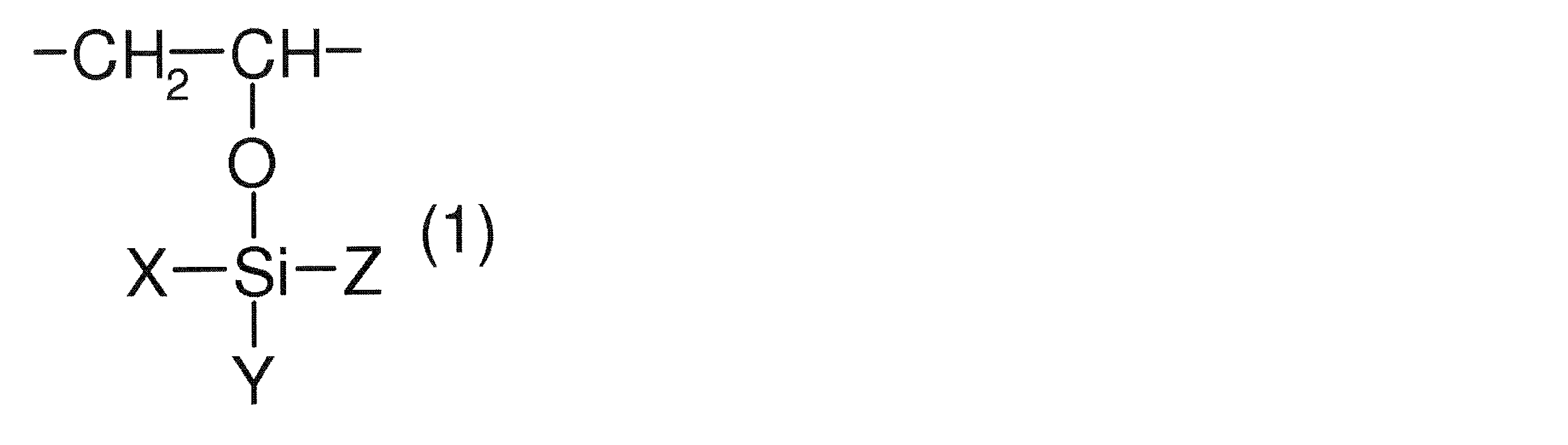
[2]上記式(1)で表される構造単位の含有量が0.01モル%以上5モル%未満である、[1]の変性ビニルアルコール系重合体;
[3]珪素原子を含む全ての構造単位に対する、上記式(1)で表される構造単位の含有量が90モル%以上である、[1]又は[2]の変性ビニルアルコール系重合体;
[4]固体状態のビニルアルコール系重合体に、シランカップリング剤を含浸させる工程を備える、変性ビニルアルコール系重合体の製造方法;
[5]上記含浸させる工程において、ビニルアルコール系重合体粒子に上記シランカップリング剤を含む溶液を噴霧して含浸させる、[4]の変性ビニルアルコール系重合体の製造方法;
[6]上記シランカップリング剤が下記式(2)で表される構造を有する、[4]又は[5]の変性ビニルアルコール系重合体の製造方法;

[7]上記含浸させる工程において得られた、上記シランカップリング剤を含浸したビニルアルコール系重合体を熱処理する工程をさらに備える、[4]、[5]又は[6]の変性ビニルアルコール系重合体の製造方法;
[8][1]、[2]又は[3]の変性ビニルアルコール系重合体を含有する、粒子;
[9]珪素原子の分散度Aが0.2以上1未満である、[8]の粒子;
[10][1]、[2]又は[3]の変性ビニルアルコール系重合体を含有する、水溶液;
[11]下記式(1)で表される構造単位を有する変性ビニルアルコール系重合体を含有する、塗工液;
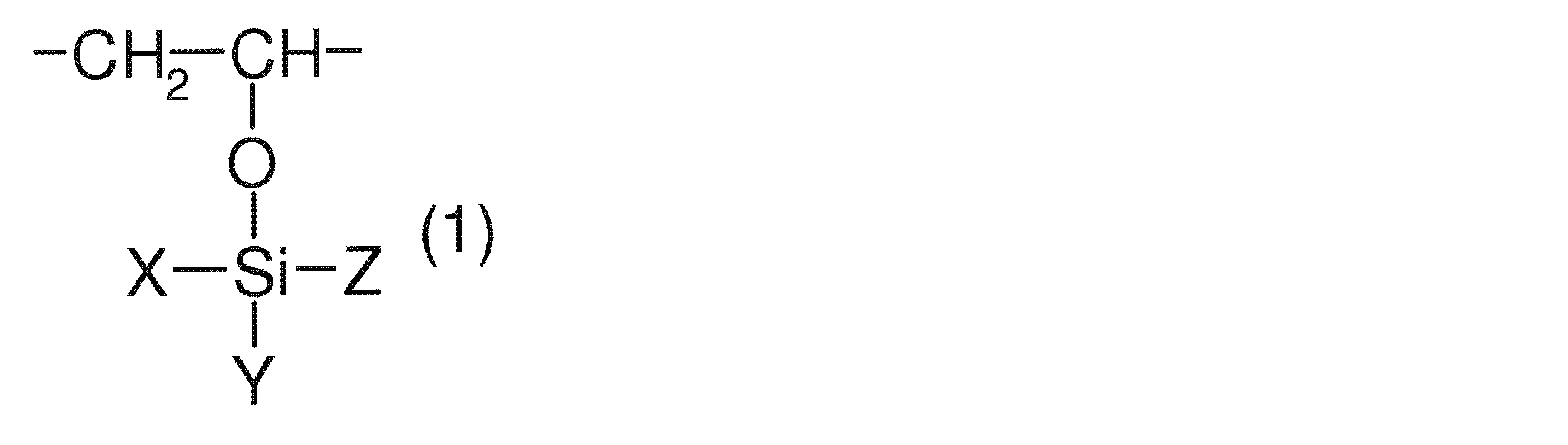
[12]上記変性ビニルアルコール系重合体における上記式(1)で表される構造単位の含有量が0.01モル%以上5モル%未満である、[11]の塗工液;
[13]上記変性ビニルアルコール系重合体における珪素原子を含む全ての構造単位に対する、上記式(1)で表される構造単位の含有量が90モル%以上である、[11]又は[12]の塗工液;
[14]上記変性ビニルアルコール系重合体の粘度平均重合度が500以上5000以下であり、けん化度が70モル%以上99.9モル%以下である、[11]、[12]又は[13]の塗工液;
[15]上記塗工液における上記変性ビニルアルコール系重合体の不溶解分が1000ppm以下である、[11]~[14]のいずれかの塗工液;
[16][11]~[15]のいずれかの塗工液を基材に塗工してなる、塗工物;
[17]下記式(1’)で表される構造単位を有する変性ビニルアルコール系重合体を含む層を備える、成形体;
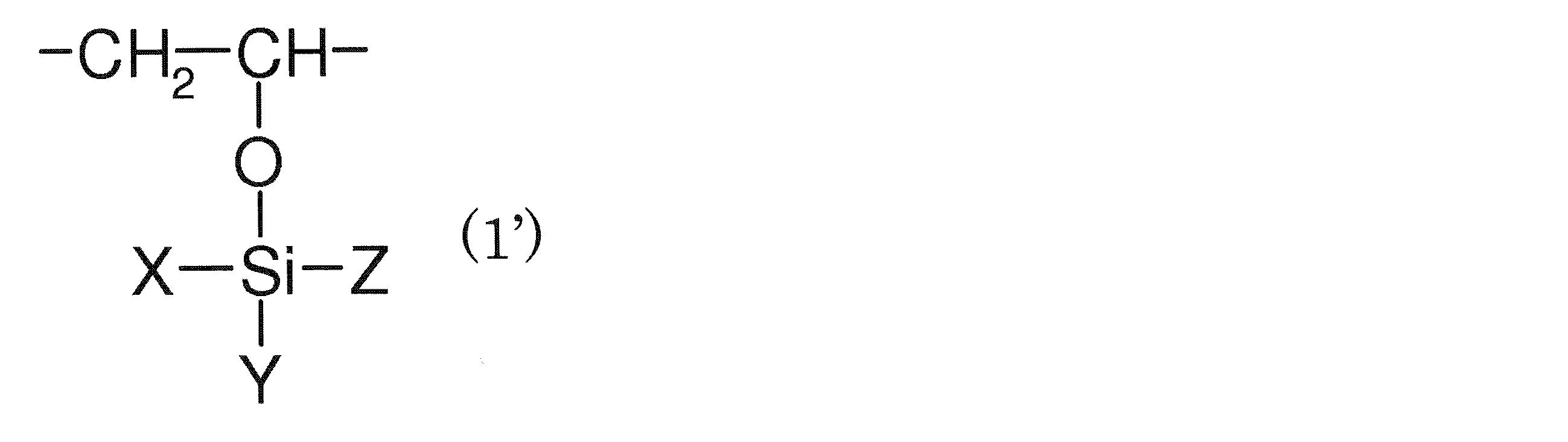
[18]基材、シリコーン目止め層及び剥離層を備え、上記シリコーン目止め層が下記式(1’)で表される構造単位を有する変性ビニルアルコール系重合体を含む、剥離紙;

[19]上記剥離層が付加型シリコーン及び白金を含み、上記付加型シリコーン100質量部に対する上記白金の含有量が0.001~0.05質量部である[18]の剥離紙;
[20]下記式(1)で表される構造単位を有する変性ビニルアルコール系重合体を含む、分散剤;

[21]上記変性ビニルアルコール系重合体における上記式(1)で表される構造単位の含有量が0.01モル%以上5モル%未満である、[20]の分散剤;
[22]上記変性ビニルアルコール系重合体における珪素原子を含む全ての構造単位に対する、上記式(1)で表される構造単位の含有量が90モル%以上である、[20]又は[21]の分散剤;
[23]上記変性ビニルアルコール系重合体の粘度平均重合度が500以上1500以下であり、けん化度が60モル%以上90モル%以下である、[20]、[21]又は[22]の分散剤;
[24]上記変性ビニルアルコール系重合体の水不溶解分が1000ppm以下である、[20]~[23]のいずれかの分散剤;
[25]懸濁重合用である、[20]~[24]のいずれかの分散剤;
[26][20]~[25]のいずれかの分散剤の存在下でビニル化合物を懸濁重合する工程を備える、ビニル系重合体の製造方法;
[27]ビニル化合物及び[20]~[25]のいずれかの分散剤を含む、混合物
また本開示によれば、シリコーン硬化性及び基材との密着性に優れる塗工層を形成できる塗工液、該塗工液を基材に塗工してなる塗工物、成形体及び剥離紙を提供することができる。
さらに本開示によれば、ビニル系重合体の製造工程で使用することで、得られるビニル系重合体の平均粒子径を小さく、粗大粒子量を少なく、またフィッシュアイを少なくできる分散剤、ビニル系重合体の製造方法、及び混合物を提供することができる。
本開示の変性PVAは、下記式(1)で表される構造単位を有し、水不溶解分が1000ppm以下である。

シランカップリング剤由来官能基の変性量(モル%)={β/(3α+β)}×100
他のシランカップリング剤を用いた場合も、シランカップリング剤中の反応しない基に由来するピークに基づき、同様に変性量を求めることができる。
(1)塩化ビニル分散剤用途:塩化ビニル、塩化ビニリデンの懸濁重合用分散安定剤及び分散助剤
(2)被覆剤用途:サイズ剤、繊維加工剤、皮革仕上剤、塗料、防曇剤、金属腐食防止剤、亜鉛メッキ用光沢剤、帯電防止剤
(3)接着剤、バインダー用途:接着剤、粘着剤、再湿接着剤、各種バインダー、セメントやモルタル用添加剤
(4)分散安定剤用途:塗料や接着剤等の有機・無機顔料の分散安定剤、各種ビニル化合物の乳化重合用分散安定剤、ビチュメン等の後乳化剤
(5)紙加工用途:紙力増強剤、耐油・耐溶剤付与剤、平滑性向上剤、表面光沢改良助剤、目止剤、バリア剤、耐光性付与剤、耐水化剤、染料・顕色剤分散剤、接着力改良剤、バインダー
(6)農業用途:農薬用バインダー、農薬用展着剤、農業用被覆剤、土壌改良剤、エロージョン防止剤、農薬用分散剤
(7)医療・化粧品用途:造粒バインダー、コーティング剤、乳化剤、貼付剤、結合剤、フィルム製剤基材、皮膜形成剤
(8)粘度調整剤用途:増粘剤、レオロジー調整剤
(9)凝集剤用途:水中懸濁物及び溶存物の凝集剤、金属凝集剤
(10)フィルム用途:水溶性フィルム、偏光フィルム、バリアフィルム、繊維製品包装用フィルム、種子養生シート、植生シート、シードテープ、吸湿性フィルム
(11)成形物用途:繊維、パイプ、チューブ、防漏膜、ケミカルレース用水溶性繊維、スポンジ
(12)樹脂原料用途:ポリビニルブチラール用原料、感光性樹脂原料、グラフト重合体原料、各種ゲル原料
(13)後反応用途:低分子有機化合物、高分子有機化合物、無機化合物との後反応用途
中でも、後述するように、分散剤、紙加工用途等の塗工液は、本開示の変性PVAの好適な用途である。また、フィルム用途も好ましく、ユニット包装用のフィルム用途がより好ましい。
本開示の変性PVAの一実施態様は、粒子(変性PVA粒子)である。本開示の粒子は、変性PVAを含有する粒子である。当該粒子は、水溶性及び取扱性に優れ、各種用途に有用である。例えば、当該粒子を用いて塗工液を効率的に得ることができる。また、当該粒子は、分散剤としても有効に用いることができる。当該粒子は、実質的に変性PVAのみからなる粒子であってよい。当該粒子における変性PVAの含有量は、例えば90質量%以上であり、99質量%以上であってもよく、100質量%であってもよい。
分散度A=粒子中心部の珪素原子含有量(モル%)/粒子表面の珪素原子含有量(モル%)
本開示の水溶液は、本開示の変性PVAを含有する。本開示の水溶液は、変性PVAの不溶解分が少なく、塗工液等として好適に用いることができる。すなわち、後述する塗工液等は、当該水溶液の一態様である。当該水溶液は、変性PVAを従来公知の方法により水に溶解させることにより得ることができる。
変性PVAは、例えば、ビニルエステル系単量体を重合させてなるビニルエステル系重合体をけん化してPVAを得た後、該PVAにシランカップリング剤を反応させることにより製造できる。

本開示の塗工液は、上記式(1)で表される構造単位を有する変性PVAを含有する。本開示の塗工液は、好ましくは紙基材又はフィルム基材用の塗工液であり、剥離紙又は離型フィルムを製造する際に使用する塗工液であってもよい。当該塗工液は、シリコーン硬化性及び基材との密着性に優れる塗工層を形成することができる。また、当該塗工液から形成される塗工層は、十分な目止め性も有する。当該塗工液に用いられる変性PVAの具体的形態及び好適形態は、水不溶解分が1000ppm以下であることが必須ではないこと以外は、上記した本開示の変性PVAと同様である。但し、当該塗工液に用いられる変性PVAの水不溶解分は、上記した範囲内であることが好ましい。
上記塗工液におけるこれら成分の含有量は、通常、10質量%以下である。
本開示の好適な実施態様は、上記塗工液が基材の表面に塗工されてなる塗工物である。基材としては紙基材やフィルム基材が好ましい。塗工物の製造方法は特に限定されず、例えば塗工液を基材に塗工する工程と、塗工した後に基材を乾燥する工程とを備える製造方法であってもよい。
本開示の一実施態様は、下記式(1’)で表される構造単位を有する変性PVAを含む層を備える成形体である。

本開示の一実施態様は剥離紙である。該剥離紙は、基材、シリコーン目止め層、及び剥離層を備え、シリコーン目止め層は、上記式(1’)で表される構造単位を有する変性PVAを含む。剥離紙は、基材、シリコーン目止め層、及び剥離層がこの順番で積層されていることが好ましい。本開示の剥離紙は、本開示の成形体の一形態である。すなわち、本開示の剥離祖が備えるシリコーン目止め層は、上記した成形体における変性PVAを含む層に対応する。
本開示の分散剤は、上記式(1)で表される構造単位を有する変性PVAを含む。当該分散剤を用いて製造されたビニル系重合体は、平均粒子径が小さく、粗大粒子量が少なく、またフィッシュアイが少ない。当該分散剤に用いられる変性PVAの具体的形態及び好適形態は、水不溶解分が1000ppm以下であることが必須ではないこと以外は、上記した本開示の変性PVAと同様である。但し、当該分散剤に用いられる変性PVAの水不溶解分は、上記した範囲内であることが好ましい。
本開示の一実施形態は、上記分散剤の存在下で、ビニル化合物を懸濁重合する工程を備える、ビニル系重合体の製造方法である。かかる製造方法では、得られるビニル系重合体が粒子状であってもよい。
本開示の一実施形態は、ビニル化合物及び分散剤を含む混合物である。当該混合物は、さらに水を含んでいてもよい。当該混合物は、例えば、上記ビニル系重合体の製造方法において、懸濁重合を行う前のビニル化合物、分散剤及び水を含む反応液であってもよく、懸濁重合を行った後の反応液であってもよい。また本開示の一実施形態は、ビニル系重合体及び分散剤を含む混合物である。当該混合物は、さらに水を含んでいてもよい。当該混合物は、例えば、上記ビニル系重合体の製造方法において、懸濁重合を行った後の反応液であってもよい。
PVA(原料PVA又は変性PVA)のけん化度(モル%)は、JIS-K6726-1994に記載の方法により求めた。
室温の水浴中に、撹拌機及び還流冷却管を装着した300mLのフラスコを準備し、蒸留水を192g投入して、300rpmで撹拌を開始した。PVA8gを秤量し、該フラスコ中に該PVAを徐々に投入した。PVAを全量(8g)投入した後、直ちに30分程度かけて水浴の温度を95℃まで上昇させた。フラスコ内温が90℃に到達後、さらに2時間300rpmで撹拌しながら溶解を継続した後、水浴の温度を室温にし、フラスコをゆっくりと撹拌しながら冷却した。得られた水溶液を100mLのサンプル管に移し、B型粘度計BLII(東機産業株式会社製)を用いて回転数60rpmの粘度を20℃で測定した。
原料PVA又は変性PVAの粘度平均重合度はJIS-K6726-1994に準じて測定した。
変性PVAにおけるシランカップリング剤由来官能基の変性量(上記式(1)で表される構造単位の含有量:モル%)は、上述の1H-NMRを用いた方法に準じて求めた。
変性PVA粒子における珪素原子の分散度Aは、球形に近い粒子径100μm以上の粒子を10粒選別し、それらの粒子を断面積が最大になるように2分割し、その断面の内接円の中心を粒子中心とし、内接円と粒子表面部分の接点を粒子表面として、下記の通りエネルギー分散型X線分析装置(EDS)を用いた珪素原子含有量測定を行い、下記の式に基づいて分散度Aを求めた。
分散度A=粒子中心部の珪素原子含有量(モル%)/粒子表面の珪素原子含有量(モル%)
変性PVA粒子1粒を熱硬化性エポキシ樹脂で包埋した後、クライオウルトラミクロトームUC7/FC7(ライカマイクロシステムズ株式会社製)を用いて凍結状態で切削、粒子断面を表出させ観察試料とした。観察試料に対し帯電補正のため、株式会社日立ハイテク製MC1000にて、2nm程度の厚みで白金蒸着を施した。次いで、走査電子顕微鏡(SEM)SU-70(株式会社日立ハイテク製)を用いて、ポバール樹脂の断面画像を撮影し、粒子端部および中央部にてエネルギー分散型X線分析装置(EDS、オックスフォード・インストゥルメンツ株式会社製X-Max50)を用いて元素分析を実施した。像観察・元素分析は超高真空下にて実施した。観察倍率2500倍で、加速電圧15kV、ワーキングディスタンス15mmにて得られた二次電子像においてEDS分析を実施し、得られたスペクトルから元素組成を得た。10粒の測定試料の平均値を珪素原子含有量とした。
20℃に設定した水浴中に、撹拌機及び還流冷却管を装着した500mLのフラスコを準備し、上記フラスコに蒸留水を285g投入して、300rpmで撹拌を開始した。変性PVA粒子15gを秤量し、フラスコ中に該変性PVA粒子を徐々に投入した。変性PVA粒子を全量(15g)投入したのち、30分かけて水浴の温度を90℃まで上昇させることにより変性PVA粒子を溶解させて、変性PVA溶液を得た。水浴の温度が90℃に到達後、さらに60分間300rpmで撹拌しながら溶解を継続した。その後、上記変性PVA溶液を用いて、不溶解で残留する変性PVAの粒子(不溶解粒子)を目開き63μmの金属製フィルターでろ過した。次いで、フィルターを90℃の温水でよく洗浄し、フィルターに付着した変性PVA溶液を取り除き、フィルター上に不溶解粒子のみを残した後、フィルターを120℃の加熱乾燥機で1時間乾燥した。乾燥後のフィルターの質量とろ過に使用する前のフィルターの質量とを比較し、不溶解粒子の質量を算出した。最初に水へ投入した変性PVAの質量(15g)に対する、不溶解粒子の質量の割合を水不溶解分(ppm)とした。
100mLのビーカーへシランカップリング剤としてビニルトリメトキシシラン3.0部、触媒として酢酸0.13部及び溶媒として7.0部のメタノールを投入し、ビニルトリメトキシシランのメタノール溶液を作製した。次に4質量%水溶液粘度5mPa・s、けん化度88モル%のPVA粒子100部を1Lの広口ナスフラスコに投入し、そこで上記ビニルトリメトキシシランのメタノール溶液を噴霧含浸させ、ビニルトリメトキシシランとPVAの混合物を得た。ナスフラスコを80℃の熱風乾燥機中で4時間保管(熱処理)し、ビニルトリメトキシシランが反応した粒子状の変性PVA(1)を得た。得られた変性PVA(1)のけん化度は88モル%、変性量は0.4モル%、分散度Aは0.98、水不溶解分は10ppm未満であり、水溶性に優れるものであった。得られた変性PVA(1)は、粒子状であり且つ水溶性に優れるため、取扱性に優れると判断できる。
用いる原料PVAの種類、溶媒の種類とその使用量、シランカップリング剤の種類及びその使用量、触媒の種類とその使用量、並びに製造条件(熱処理条件)を表1に記載のとおり変更した以外は、実施例1と同様にして、変性PVA(2)~(11)を製造した。得られた各変性PVAの分散度A、けん化度、変性量、水不溶解分を評価した結果を表2に示す。


100mlのビーカーにおいてビニルトリメトキシシラン(シランカップリング剤)4.8部及び酢酸0.13部を11.2部の酢酸メチルに投入し、ビニルトリメトキシシランの酢酸メチル溶液を作製した。次に粘度平均重合度1000、4質量%水溶液粘度10mPa・s、けん化度94モル%のPVA(原料PVA)100部を1Lの広口ナスフラスコに投入し、そこで上記溶液を噴霧含浸させ、ビニルトリメトキシシランとPVAの混合物を得た。ナスフラスコを80℃の熱風乾燥機中で4時間保管(熱処理)し、原料PVAとビニルトリメトキシシランとが反応した変性PVA(12)を得た。得られた変性PVA(12)の粘度平均重合度は1000、けん化度は94モル%、ビニルトリメトキシシランの変性量は0.55モル%、分散度Aは0.87、水不溶解分は60ppmであった。
用いる原料PVAの種類、溶媒の種類とその資料量、シランカップリング剤の種類及びその使用量、触媒の種類とその使用量、並びに製造条件(熱処理条件)を表3に記載のとおり変更した以外は、実施例10と同様にして、変性PVA(13)~(19)及びPVA(X)を製造し、その物性を評価した。結果を表4に示す。
実施例10~17及び比較例3で得られた変性PVA(12)~(19)及びPVA(X)を用いて以下の方法にて剥離紙原紙を作製し、評価した。
変性PVAの6質量%水溶液を調製しそれを塗工液とした。この塗工液を、ワイヤーバーを用いて、透気抵抗度100秒のグラシン紙に塗工量が乾燥質量で約2.0g/m2となるように塗工した。塗工後、100℃5分間乾燥させることで塗工紙を得た。得られた塗工紙をスーパーカレンダーにて、70℃、400kg/cm2で2回処理することで剥離紙原紙を得た。この剥離紙原紙には上記塗工液に由来する塗工層、すなわちシリコーン目止め層が形成された。
剥離紙原紙の透気抵抗度を、JIS-P8117-2009に準じて王研式透気度試験機を用いて測定し、この透気抵抗度を剥離紙原紙におけるシリコーンの目止め性の指標とした。透気抵抗度が高いほどシリコーンの目止め性に優れる傾向にある。結果を表4に示す。
付加型シリコーンとして東レダウコーニング社製のLTC1056Lを、白金触媒としてSRX212を用い、付加型シリコーンと白金との質量比が100/0.007になるように混合して溶液を調製した。得られた溶液を、得られた剥離紙原紙のシリコーン目止め層上に塗工固形分量2.0g/m2となるようにブレードコーターで塗工した。こうすることによって剥離紙原紙上にシリコーン層を形成させた。そして、110℃で熱処理してシリコーンが硬化するまでの時間を計測した。ここで、シリコーンが硬化するまでの時間とは、所定時間間隔でシリコーン層を指で強く10回擦り、シリコーン層が全く剥がれなくなるまでに要した時間(秒)のことをいう。結果を表4に示す。
付加型シリコーンとして東レダウコーニング社製のLTC1056Lを、白金触媒としてSRX212を用い、付加型シリコーンと白金との比が100/0.009になるように混合して溶液を調製した。得られた溶液を、得られた剥離紙原紙上のシリコーン目止め層上に塗工固形分量2.0g/m2となるようにブレードコーターで塗工し、110℃で90秒熱処理し、剥離紙原紙上に剥離層(シリコーン層)が形成された剥離紙を得た。得られた剥離紙を下記の指標で評価した。結果を表4に示す。
A+:40℃、90%RHの条件下で、1週間放置した後、剥離層を指で強く擦った。その結果、剥離層は剥がれなかった。同じ条件下で、さらに1週間放置した後、剥離層を指で強く擦った。その結果、剥離層は剥がれなかった。
A:40℃、90%RHの条件下で、1週間放置した後、剥離層を指で強く擦った。その結果、剥離層は剥がれなかった。しかしながら、同じ条件下で、さらに1週間放置した後に剥離層を指で強く擦ったら剥離層は剥がれた。
B:40℃、90%RHの条件下で、1週間放置した後、剥離層を指で強く擦った。その結果、剥離層は剥がれた。
C:40℃、90%RHの条件下で、1週間放置した後、剥離層を指で軽く擦った。その結果、剥離層は剥がれた。
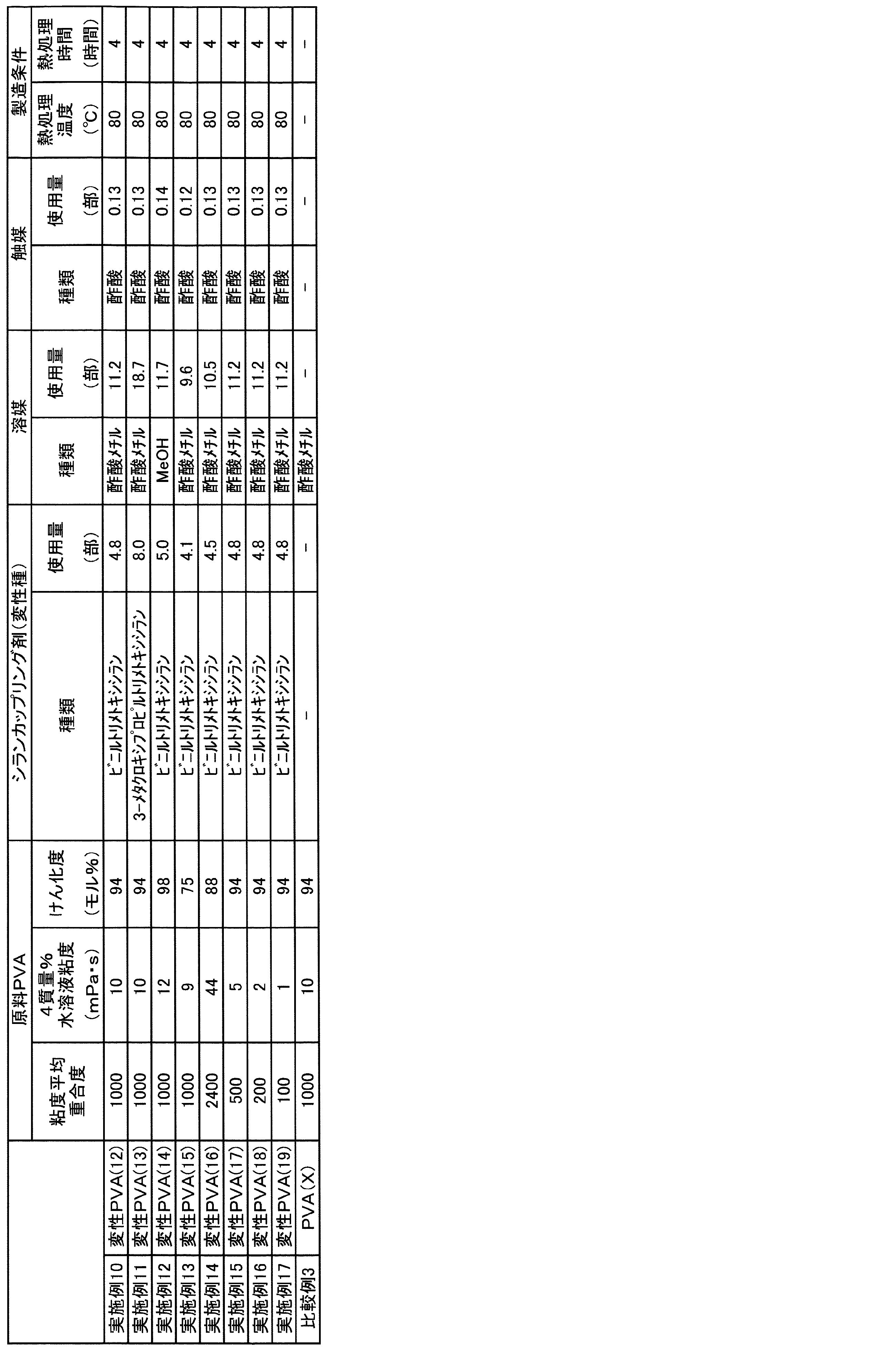

100mLのビーカーにおいてビニルトリメトキシシラン(シランカップリング剤)4.0部及び酢酸0.11部を9.3部の酢酸メチルに投入し、ビニルトリメトキシシランの酢酸メチル溶液を作製した。次に粘度平均重合度750、4質量%水溶液粘度8mPa・s、けん化度72モル%のPVA(原料PVA)100部を1Lの広口ナスフラスコに投入し、そこで上記溶液を噴霧含浸させ、ビニルトリメトキシシランとPVAの混合物を得た。ナスフラスコを80℃の熱風乾燥機中で4時間保管(熱処理)し、原料PVAとビニルトリメトキシシランとが反応した変性PVA(20)を得た。得られた変性PVA(20)の粘度平均重合度は750、けん化度は72モル%、ビニルトリメトキシシランの変性量は0.5モル%、分散度Aは0.98、水不溶解分は10ppm未満であった。
用いる原料PVAの種類、溶媒の種類とその使用量、シランカップリング剤の種類及びその使用量、触媒の種類とその使用量、並びに製造条件(熱処理条件)を表5に記載のとおり変更した以外は、実施例18と同様にして、変性PVA(21)~(26)及びPVA(Y)を製造し、その物性を評価した。結果を表6に示す。
実施例18~24で得られた変性PVA(20)~(26)及び比較例4で得られたPVA(Y)を懸濁重合用分散剤として用い、以下の方法にてビニル系重合体であるポリ塩化ビニルの粒子を得た。
[評価方法]
(1)平均粒子径(μm)
JIS標準篩を使用して、JIS-Z8815-1994に記載の乾式篩法により粒度分布を測定した。その結果をロジン・ラムラー(Rosin-Rammler)分布式にプロットして平均粒子径(dp50)を算出した。
(2)粗大粒子量(%)
目開き355μmの篩(JIS標準篩のメッシュ換算では、42メッシュ)を通過しなかった塩化ビニル重合体粒子の含有量(質量%)を下記評価基準で評価した。上記含有量は、篩上累積(%)を意味する。また、篩の目開きは、JIS-Z8801-1-2006の公称目開きWに準拠した。
A+:0.5質量%未満
A:0.5質量%以上1.0質量%未満
B:1.0質量%以上2.5質量%未満
C:2.5質量%以上
(3)フィッシュアイ(個)
塩化ビニル重合体粒子100部、ジオクチルフタレート50部、三塩基性硫酸鉛5部およびステアリン酸鉛1部を150℃で7分間ロール混練して、厚み0.1mm、1400mm×1400mmのシートを5枚作製し、フィッシュアイの数を目視で測定した。1000cm2当たりのフィッシュアイ個数に換算し、以下の基準で評価した。フィッシュアイの数が少ないほどシート上の欠陥が少ないことを示す。
A+:0~5個
A:6~10個
B:11~49個
C:50個以上
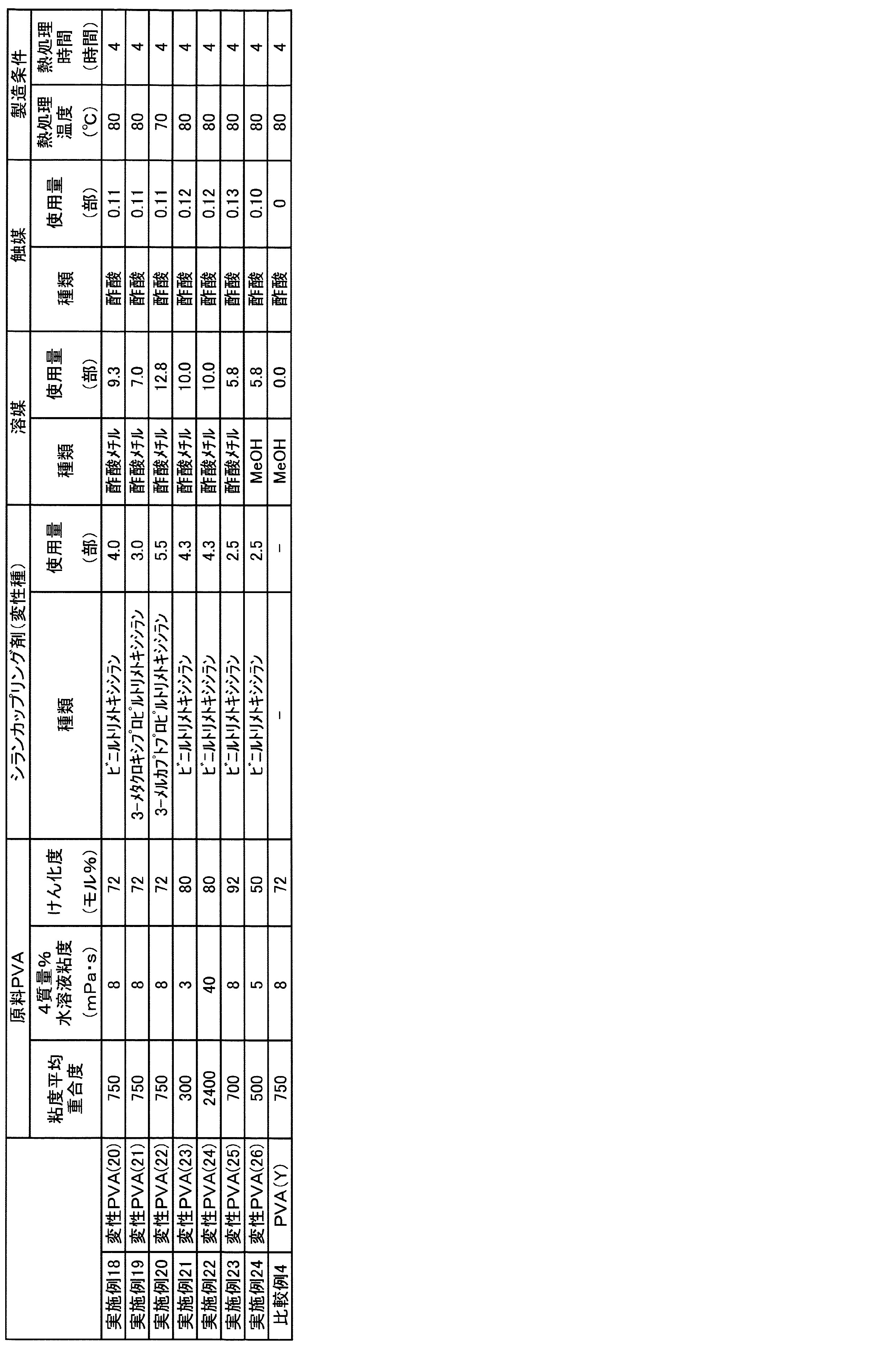
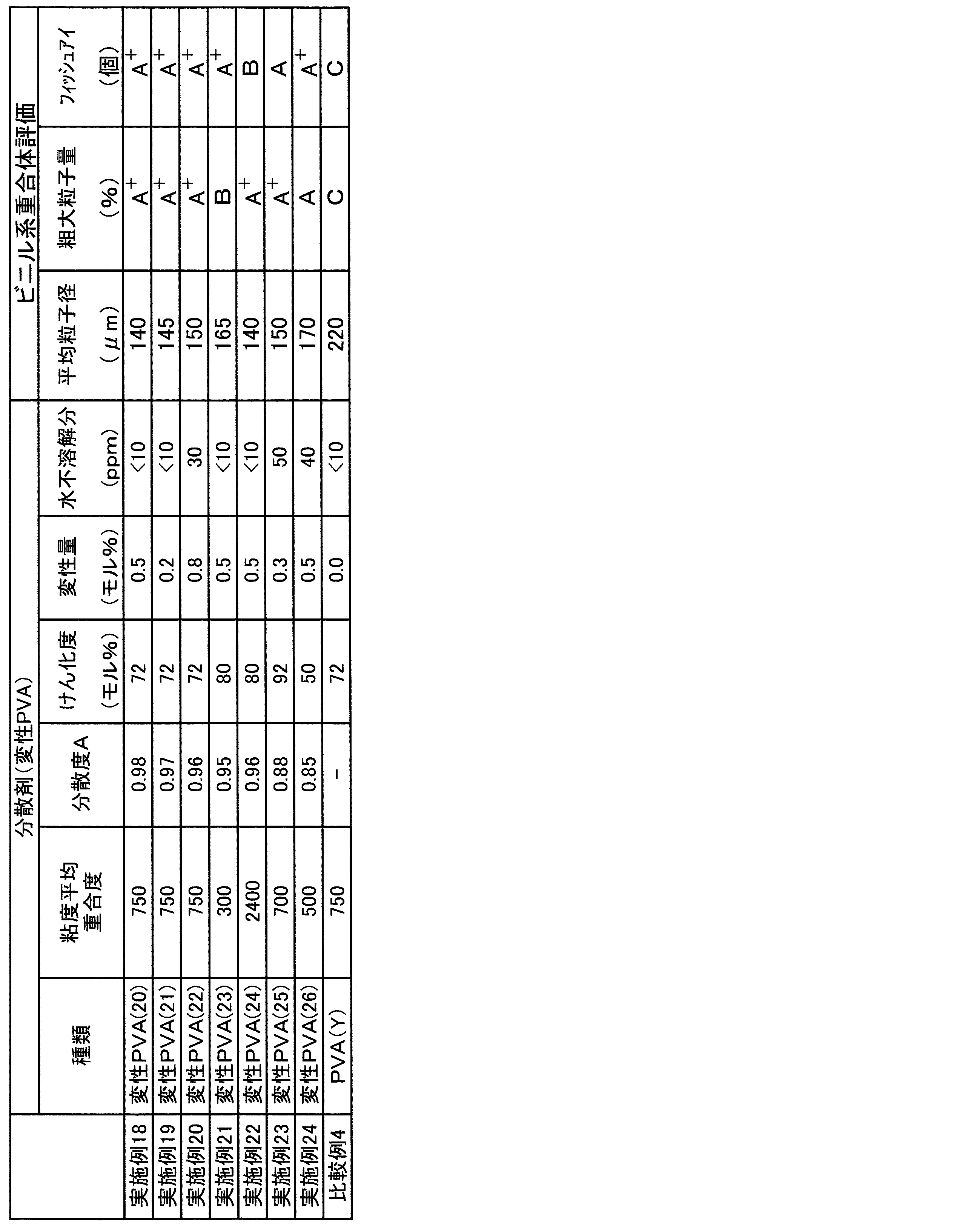
Claims (27)
- 下記式(1)で表される構造単位を有し、水不溶解分が1000ppm以下である、変性ビニルアルコール系重合体。

- 上記式(1)で表される構造単位の含有量が0.01モル%以上5モル%未満である、請求項1に記載の変性ビニルアルコール系重合体。
- 珪素原子を含む全ての構造単位に対する、上記式(1)で表される構造単位の含有量が90モル%以上である、請求項1又は2に記載の変性ビニルアルコール系重合体。
- 固体状態のビニルアルコール系重合体に、シランカップリング剤を含浸させる工程を備える、変性ビニルアルコール系重合体の製造方法。
- 上記含浸させる工程において、ビニルアルコール系重合体粒子に上記シランカップリング剤を含む溶液を噴霧して含浸させる、請求項4に記載の変性ビニルアルコール系重合体の製造方法。
- 上記シランカップリング剤が下記式(2)で表される構造を有する、請求項4又は5に記載の変性ビニルアルコール系重合体の製造方法。

- 上記含浸させる工程において得られた、上記シランカップリング剤を含浸したビニルアルコール系重合体を熱処理する工程をさらに備える、請求項4、5又は6に記載の変性ビニルアルコール系重合体の製造方法。
- 請求項1、2又は3に記載の変性ビニルアルコール系重合体を含有する、粒子。
- 珪素原子の分散度Aが0.2以上1未満である、請求項8に記載の粒子。
- 請求項1、2又は3に記載の変性ビニルアルコール系重合体を含有する、水溶液。
- 下記式(1)で表される構造単位を有する変性ビニルアルコール系重合体を含有する、塗工液。
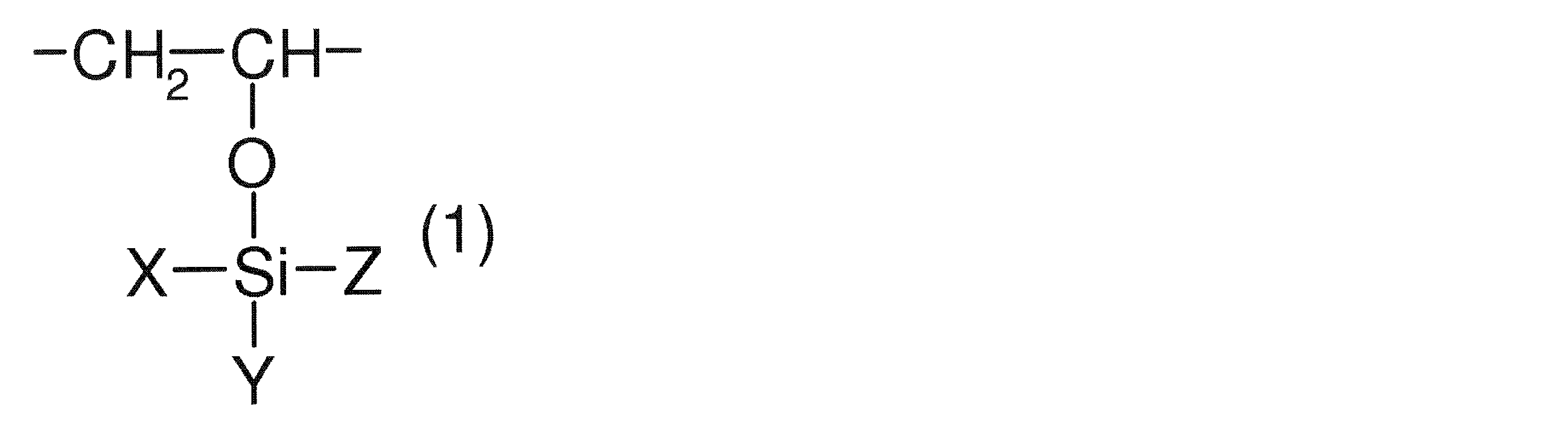
- 上記変性ビニルアルコール系重合体における上記式(1)で表される構造単位の含有量が0.01モル%以上5モル%未満である、請求項11に記載の塗工液。
- 上記変性ビニルアルコール系重合体における珪素原子を含む全ての構造単位に対する、上記式(1)で表される構造単位の含有量が90モル%以上である、請求項11又は12に記載の塗工液。
- 上記変性ビニルアルコール系重合体の粘度平均重合度が500以上5000以下であり、けん化度が70モル%以上99.9モル%以下である、請求項11、12又は13に記載の塗工液。
- 上記塗工液における上記変性ビニルアルコール系重合体の不溶解分が1000ppm以下である、請求項11~14のいずれか1項に記載の塗工液。
- 請求項11~15のいずれか1項に記載の塗工液を基材に塗工してなる、塗工物。
- 下記式(1’)で表される構造単位を有する変性ビニルアルコール系重合体を含む層を備える、成形体。

- 基材、シリコーン目止め層及び剥離層を備え、
上記シリコーン目止め層が下記式(1’)で表される構造単位を有する変性ビニルアルコール系重合体を含む、剥離紙。
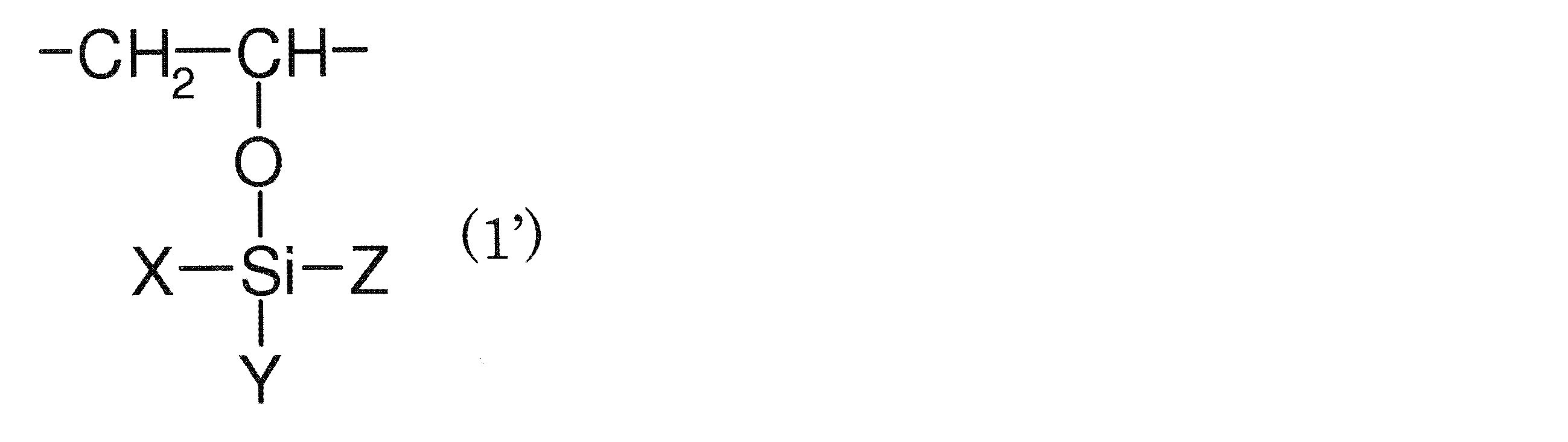
- 上記剥離層が付加型シリコーン及び白金を含み、上記付加型シリコーン100質量部に対する上記白金の含有量が0.001~0.05質量部である請求項18に記載の剥離紙。
- 下記式(1)で表される構造単位を有する変性ビニルアルコール系重合体を含む、分散剤。

- 上記変性ビニルアルコール系重合体における上記式(1)で表される構造単位の含有量が0.01モル%以上5モル%未満である、請求項20に記載の分散剤。
- 上記変性ビニルアルコール系重合体における珪素原子を含む全ての構造単位に対する、上記式(1)で表される構造単位の含有量が90モル%以上である、請求項20又は21に記載の分散剤。
- 上記変性ビニルアルコール系重合体の粘度平均重合度が500以上1500以下であり、けん化度が60モル%以上90モル%以下である、請求項20、21又は22に記載の分散剤。
- 上記変性ビニルアルコール系重合体の水不溶解分が1000ppm以下である、請求項20~23のいずれか1項に記載の分散剤。
- 懸濁重合用である、請求項20~24のいずれか1項に記載の分散剤。
- 請求項20~25のいずれか1項に記載の分散剤の存在下でビニル化合物を懸濁重合する工程を備える、ビニル系重合体の製造方法。
- ビニル化合物及び請求項20~25のいずれか1項に記載の分散剤を含む、混合物。
Priority Applications (4)
| Application Number | Priority Date | Filing Date | Title |
|---|---|---|---|
| CN202180086949.6A CN116635503B (zh) | 2020-12-24 | 2021-12-22 | 改性乙烯醇系聚合物、改性乙烯醇系聚合物的制造方法、颗粒、水溶液、涂覆液、涂覆物、成形体、剥离纸、分散剂、乙烯基系聚合物的制造方法和混合物 |
| JP2022571596A JPWO2022138784A1 (ja) | 2020-12-24 | 2021-12-22 | |
| US18/268,573 US20240309141A1 (en) | 2020-12-24 | 2021-12-22 | Modified vinyl alcohol polymer, modified vinyl alcohol polymer production method, particles, aqueous solution, coating liquid, coated article, molded product, release paper, dispersant, vinyl polymer production method, and mixture |
| DE112021006683.8T DE112021006683T5 (de) | 2020-12-24 | 2021-12-22 | Modifiziertes Vinylalkoholpolymer, Verfahren zum Herstellen eines modifizierten Vinylalkoholpolymers, Partikel, wässrige Lösung, Beschichtungsflüssigkeit, beschichteter Artikel, geformtes Produkt, Trennpapier, Dispergiermittel, Verfahren zum Herstellen eines Vinylpolymers und Mischung |
Applications Claiming Priority (6)
| Application Number | Priority Date | Filing Date | Title |
|---|---|---|---|
| JP2020215063 | 2020-12-24 | ||
| JP2020-215063 | 2020-12-24 | ||
| JP2021114078 | 2021-07-09 | ||
| JP2021114079 | 2021-07-09 | ||
| JP2021-114078 | 2021-07-09 | ||
| JP2021-114079 | 2021-07-09 |
Publications (1)
| Publication Number | Publication Date |
|---|---|
| WO2022138784A1 true WO2022138784A1 (ja) | 2022-06-30 |
Family
ID=82159814
Family Applications (1)
| Application Number | Title | Priority Date | Filing Date |
|---|---|---|---|
| PCT/JP2021/047743 Ceased WO2022138784A1 (ja) | 2020-12-24 | 2021-12-22 | 変性ビニルアルコール系重合体、変性ビニルアルコール系重合体の製造方法、粒子、水溶液、塗工液、塗工物、成形体、剥離紙、分散剤、ビニル系重合体の製造方法、及び混合物 |
Country Status (6)
| Country | Link |
|---|---|
| US (1) | US20240309141A1 (ja) |
| JP (1) | JPWO2022138784A1 (ja) |
| CN (1) | CN116635503B (ja) |
| DE (1) | DE112021006683T5 (ja) |
| TW (1) | TW202239781A (ja) |
| WO (1) | WO2022138784A1 (ja) |
Cited By (1)
| Publication number | Priority date | Publication date | Assignee | Title |
|---|---|---|---|---|
| WO2025127105A1 (ja) * | 2023-12-13 | 2025-06-19 | 株式会社クラレ | 農業用コーティング組成物及び被覆種子 |
Citations (5)
| Publication number | Priority date | Publication date | Assignee | Title |
|---|---|---|---|---|
| JPH075727A (ja) * | 1993-06-17 | 1995-01-10 | Fuji Photo Film Co Ltd | 電子写真式製版印刷版の作成方法及びそれに用いる装置 |
| JPH07181751A (ja) * | 1993-11-09 | 1995-07-21 | Fuji Photo Film Co Ltd | 電子写真式製版印刷版の作成方法及びそれに用いる装置 |
| JPH09278968A (ja) * | 1996-04-16 | 1997-10-28 | Toppan Printing Co Ltd | ポリビニルアルコール系組成物およびその製造方法、および包装材料 |
| JP2008546859A (ja) * | 2005-11-17 | 2008-12-25 | ワッカー ポリマー システムズ ジーエムビーエイチ アンド カンパニー ケージー | シラン変性ポリビニルアルコール |
| WO2015194086A1 (ja) * | 2014-06-17 | 2015-12-23 | 株式会社ブリヂストン | 変性ポリビニルアルコール樹脂組成物、被膜及びタイヤ |
-
2021
- 2021-12-22 JP JP2022571596A patent/JPWO2022138784A1/ja active Pending
- 2021-12-22 WO PCT/JP2021/047743 patent/WO2022138784A1/ja not_active Ceased
- 2021-12-22 CN CN202180086949.6A patent/CN116635503B/zh active Active
- 2021-12-22 DE DE112021006683.8T patent/DE112021006683T5/de active Pending
- 2021-12-22 US US18/268,573 patent/US20240309141A1/en active Pending
- 2021-12-24 TW TW110148633A patent/TW202239781A/zh unknown
Patent Citations (5)
| Publication number | Priority date | Publication date | Assignee | Title |
|---|---|---|---|---|
| JPH075727A (ja) * | 1993-06-17 | 1995-01-10 | Fuji Photo Film Co Ltd | 電子写真式製版印刷版の作成方法及びそれに用いる装置 |
| JPH07181751A (ja) * | 1993-11-09 | 1995-07-21 | Fuji Photo Film Co Ltd | 電子写真式製版印刷版の作成方法及びそれに用いる装置 |
| JPH09278968A (ja) * | 1996-04-16 | 1997-10-28 | Toppan Printing Co Ltd | ポリビニルアルコール系組成物およびその製造方法、および包装材料 |
| JP2008546859A (ja) * | 2005-11-17 | 2008-12-25 | ワッカー ポリマー システムズ ジーエムビーエイチ アンド カンパニー ケージー | シラン変性ポリビニルアルコール |
| WO2015194086A1 (ja) * | 2014-06-17 | 2015-12-23 | 株式会社ブリヂストン | 変性ポリビニルアルコール樹脂組成物、被膜及びタイヤ |
Cited By (1)
| Publication number | Priority date | Publication date | Assignee | Title |
|---|---|---|---|---|
| WO2025127105A1 (ja) * | 2023-12-13 | 2025-06-19 | 株式会社クラレ | 農業用コーティング組成物及び被覆種子 |
Also Published As
| Publication number | Publication date |
|---|---|
| CN116635503B (zh) | 2024-12-17 |
| JPWO2022138784A1 (ja) | 2022-06-30 |
| DE112021006683T5 (de) | 2023-10-12 |
| TW202239781A (zh) | 2022-10-16 |
| CN116635503A (zh) | 2023-08-22 |
| US20240309141A1 (en) | 2024-09-19 |
Similar Documents
| Publication | Publication Date | Title |
|---|---|---|
| CN102958954B (zh) | 烷基改性乙烯醇系聚合物、以及含有其的组合物、增粘剂、纸用涂布剂、涂布纸、粘接剂和膜 | |
| JP6778279B2 (ja) | ポリビニルアルコール組成物及びその用途 | |
| JP2019038935A (ja) | ポリビニルアルコール組成物及びその用途 | |
| WO2006018870A1 (ja) | 側鎖に1,2−グリコール結合を有するポリビニルアルコールおよびその製造方法 | |
| WO2014192818A1 (ja) | コーティング組成物およびそれより得られる塗膜、多層構造体および多層構造体の製造方法 | |
| WO2016060159A1 (ja) | 水性接着剤 | |
| WO2022138784A1 (ja) | 変性ビニルアルコール系重合体、変性ビニルアルコール系重合体の製造方法、粒子、水溶液、塗工液、塗工物、成形体、剥離紙、分散剤、ビニル系重合体の製造方法、及び混合物 | |
| JP4964643B2 (ja) | 接着剤 | |
| JP5524240B2 (ja) | 剥離紙原紙 | |
| JP3348920B2 (ja) | エマルジョン組成物 | |
| JP7734477B2 (ja) | ポリビニルアルコール、その製造方法及びその用途 | |
| EP3176187B1 (en) | Formaldehyde-free thermally curable polymers | |
| JP7246288B2 (ja) | 水溶液、その製造方法及びその用途 | |
| JP2023089497A (ja) | 塗工液、塗工物、成形体及び剥離紙 | |
| JP3728485B2 (ja) | 水性エマルジョン組成物 | |
| US12492272B2 (en) | Modified vinyl alcohol polymer, aqueous solution, and method for producing modified vinyl alcohol polymer | |
| WO2023190884A1 (ja) | 水溶液、コーティング剤、接着剤、紙加工剤、乳化重合用分散剤、水性エマルジョン、積層体及び水性エマルジョンの製造方法 | |
| JPH1060015A (ja) | 乳化重合用分散安定剤 | |
| WO2025187601A1 (ja) | 樹脂粉体 | |
| CN118974109A (zh) | 水溶液、涂布剂、粘接剂、纸加工剂、乳液聚合用分散剂、水性乳液、层叠体和水性乳液的制造方法 | |
| TW202603019A (zh) | 樹脂粉體之製造方法 | |
| JPH10219220A (ja) | 水性接着剤 | |
| JPH10168269A (ja) | 耐水性組成物 | |
| JPH111594A (ja) | 水性の組成物 | |
| JPH10219067A (ja) | 水性エマルジョン |
Legal Events
| Date | Code | Title | Description |
|---|---|---|---|
| 121 | Ep: the epo has been informed by wipo that ep was designated in this application |
Ref document number: 21910924 Country of ref document: EP Kind code of ref document: A1 |
|
| ENP | Entry into the national phase |
Ref document number: 2022571596 Country of ref document: JP Kind code of ref document: A |
|
| WWE | Wipo information: entry into national phase |
Ref document number: 18268573 Country of ref document: US |
|
| WWE | Wipo information: entry into national phase |
Ref document number: 202180086949.6 Country of ref document: CN |
|
| WWE | Wipo information: entry into national phase |
Ref document number: 112021006683 Country of ref document: DE |
|
| 122 | Ep: pct application non-entry in european phase |
Ref document number: 21910924 Country of ref document: EP Kind code of ref document: A1 |