WO2022137913A1 - マレイミド樹脂、非対称ビスマレイミド化合物、硬化性組成物、硬化物、半導体封止材料、半導体封止装置、プリプレグ、回路基板、及びビルドアップフィルム - Google Patents
マレイミド樹脂、非対称ビスマレイミド化合物、硬化性組成物、硬化物、半導体封止材料、半導体封止装置、プリプレグ、回路基板、及びビルドアップフィルム Download PDFInfo
- Publication number
- WO2022137913A1 WO2022137913A1 PCT/JP2021/042356 JP2021042356W WO2022137913A1 WO 2022137913 A1 WO2022137913 A1 WO 2022137913A1 JP 2021042356 W JP2021042356 W JP 2021042356W WO 2022137913 A1 WO2022137913 A1 WO 2022137913A1
- Authority
- WO
- WIPO (PCT)
- Prior art keywords
- group
- compound
- curable composition
- aromatic
- semiconductor
- Prior art date
- Legal status (The legal status is an assumption and is not a legal conclusion. Google has not performed a legal analysis and makes no representation as to the accuracy of the status listed.)
- Ceased
Links
Images



Classifications
-
- C—CHEMISTRY; METALLURGY
- C07—ORGANIC CHEMISTRY
- C07D—HETEROCYCLIC COMPOUNDS
- C07D207/00—Heterocyclic compounds containing five-membered rings not condensed with other rings, with one nitrogen atom as the only ring hetero atom
- C07D207/02—Heterocyclic compounds containing five-membered rings not condensed with other rings, with one nitrogen atom as the only ring hetero atom with only hydrogen or carbon atoms directly attached to the ring nitrogen atom
- C07D207/44—Heterocyclic compounds containing five-membered rings not condensed with other rings, with one nitrogen atom as the only ring hetero atom with only hydrogen or carbon atoms directly attached to the ring nitrogen atom having three double bonds between ring members or between ring members and non-ring members
- C07D207/444—Heterocyclic compounds containing five-membered rings not condensed with other rings, with one nitrogen atom as the only ring hetero atom with only hydrogen or carbon atoms directly attached to the ring nitrogen atom having three double bonds between ring members or between ring members and non-ring members having two doubly-bound oxygen atoms directly attached in positions 2 and 5
- C07D207/448—Heterocyclic compounds containing five-membered rings not condensed with other rings, with one nitrogen atom as the only ring hetero atom with only hydrogen or carbon atoms directly attached to the ring nitrogen atom having three double bonds between ring members or between ring members and non-ring members having two doubly-bound oxygen atoms directly attached in positions 2 and 5 with only hydrogen atoms or radicals containing only hydrogen and carbon atoms directly attached to other ring carbon atoms, e.g. maleimide
-
- C—CHEMISTRY; METALLURGY
- C08—ORGANIC MACROMOLECULAR COMPOUNDS; THEIR PREPARATION OR CHEMICAL WORKING-UP; COMPOSITIONS BASED THEREON
- C08F—MACROMOLECULAR COMPOUNDS OBTAINED BY REACTIONS ONLY INVOLVING CARBON-TO-CARBON UNSATURATED BONDS
- C08F22/00—Homopolymers and copolymers of compounds having one or more unsaturated aliphatic radicals each having only one carbon-to-carbon double bond, and at least one being terminated by a carboxyl radical and containing at least one other carboxyl radical in the molecule; Salts, anhydrides, esters, amides, imides or nitriles thereof
- C08F22/36—Amides or imides
- C08F22/40—Imides, e.g. cyclic imides
-
- C—CHEMISTRY; METALLURGY
- C08—ORGANIC MACROMOLECULAR COMPOUNDS; THEIR PREPARATION OR CHEMICAL WORKING-UP; COMPOSITIONS BASED THEREON
- C08G—MACROMOLECULAR COMPOUNDS OBTAINED OTHERWISE THAN BY REACTIONS ONLY INVOLVING UNSATURATED CARBON-TO-CARBON BONDS
- C08G12/00—Condensation polymers of aldehydes or ketones with only compounds containing hydrogen attached to nitrogen
- C08G12/02—Condensation polymers of aldehydes or ketones with only compounds containing hydrogen attached to nitrogen of aldehydes
- C08G12/04—Condensation polymers of aldehydes or ketones with only compounds containing hydrogen attached to nitrogen of aldehydes with acyclic or carbocyclic compounds
- C08G12/06—Amines
- C08G12/08—Amines aromatic
-
- C—CHEMISTRY; METALLURGY
- C08—ORGANIC MACROMOLECULAR COMPOUNDS; THEIR PREPARATION OR CHEMICAL WORKING-UP; COMPOSITIONS BASED THEREON
- C08J—WORKING-UP; GENERAL PROCESSES OF COMPOUNDING; AFTER-TREATMENT NOT COVERED BY SUBCLASSES C08B, C08C, C08F, C08G or C08H
- C08J5/00—Manufacture of articles or shaped materials containing macromolecular substances
- C08J5/24—Impregnating materials with prepolymers which can be polymerised in situ, e.g. manufacture of prepregs
-
- H—ELECTRICITY
- H10—SEMICONDUCTOR DEVICES; ELECTRIC SOLID-STATE DEVICES NOT OTHERWISE PROVIDED FOR
- H10W—GENERIC PACKAGES, INTERCONNECTIONS, CONNECTORS OR OTHER CONSTRUCTIONAL DETAILS OF DEVICES COVERED BY CLASS H10
- H10W74/00—Encapsulations, e.g. protective coatings
- H10W74/10—Encapsulations, e.g. protective coatings characterised by their shape or disposition
-
- H—ELECTRICITY
- H10—SEMICONDUCTOR DEVICES; ELECTRIC SOLID-STATE DEVICES NOT OTHERWISE PROVIDED FOR
- H10W—GENERIC PACKAGES, INTERCONNECTIONS, CONNECTORS OR OTHER CONSTRUCTIONAL DETAILS OF DEVICES COVERED BY CLASS H10
- H10W74/00—Encapsulations, e.g. protective coatings
- H10W74/40—Encapsulations, e.g. protective coatings characterised by their materials
Definitions
- the present invention has a low melting point and softening point, excellent handleability, and a cured product having high heat resistance, and a maleimide resin or a maleimide compound that can be suitably used as a semiconductor encapsulating material, and a curability containing these.
- the present invention relates to a composition and a cured product thereof, a semiconductor encapsulating material, a semiconductor encapsulating device, a prepreg, a circuit board, and a build-up film.
- maleimide resin Since maleimide resin has extremely high heat resistance in cured products, its use is being considered as a resin material in fields that require particularly high heat resistance, such as encapsulation materials for power semiconductors, but it is currently on the market. Maleimide resin has a high melting point and softening point, and its low handleability as a material is a problem.
- a conventionally known maleimide resin for example, a 4,4'-diphenylmethanebismaleimide type compound is widely known, but as described above, the compound has a high melting point and is inferior in handleability as a material. (See, for example, Patent Document 1). Further, as a maleimide resin having relatively high handleability, a 2,2-bis [4- (4-maleimide phenoxy) phenyl] propane type compound is known, and the compound has a cured physical property such as heat resistance. , Did not meet the recent market demand (see, for example, Patent Document 2).
- the problem to be solved by the present invention is a maleimide resin or maleimide that has a low melting point and softening point and is excellent in handleability, and the cured product has high heat resistance and can be suitably used as a semiconductor encapsulating material or the like. It is an object of the present invention to provide a compound, a curable composition containing these and a cured product thereof, a semiconductor encapsulating material, a semiconductor encapsulating device, a prepreg, a circuit board, and a build-up film.
- a maleimide resin obtained by maleimizing a polyamine compound which is a reaction product of a plurality of aromatic monoamine compounds and a binder has a low melting point and softening point and is excellent in handleability.
- the cured product has high heat resistance and can be suitably used as a semiconductor encapsulating material, etc., and have completed the present invention.
- the present invention is a maleimide resin which is a maleimide product of a polyamine compound (C) which is a reaction product of a plurality of kinds of aromatic monoamine compounds (A) and a binder (B). Regarding.
- the present invention further relates to an asymmetric bismaleimide compound which is a maleimided product of an asymmetric diamine compound (C-1) in which two different aromatic monoamine compounds (A) are bound with a binder (B).
- the present invention further relates to a curable composition containing the maleimide resin or the asymmetrical bismaleimide compound.
- the present invention further relates to a cured product of the curable composition.
- the present invention further relates to a semiconductor encapsulation material using the curable composition.
- the present invention further relates to a semiconductor device using the semiconductor encapsulating material.
- the present invention further relates to a prepreg using the curable composition.
- the present invention further relates to a circuit board using the prepreg.
- the present invention further relates to a build-up film using the curable composition.
- a maleimide resin or a maleimide compound which has a low melting point and softening point and is excellent in handleability, has a high heat resistance of a cured product, and can be suitably used as a semiconductor encapsulation material, etc., is contained.
- a curable composition and a cured product thereof, a semiconductor encapsulating material, a semiconductor encapsulating device, a prepreg, a circuit board, and a build-up film can be provided.
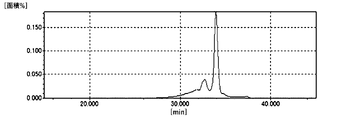
- FIG. 1 It is a GPC chart figure of the maleimide resin (1) obtained in Example 1.
- FIG. 2 is a GPC chart figure of the maleimide resin (2) obtained in Example 2.
- FIG. 2 is a GPC chart figure of the maleimide resin (3) obtained in Example 3.
- FIG. 2 is a GPC chart figure of the maleimide resin (4) obtained in Example 4.
- FIG. It is a GPC chart figure of the maleimide resin (5) obtained in Example 5.
- FIG. It is a GPC chart figure of the maleimide resin (6) obtained in Example 6.
- FIG. It is a differential scanning calorimetry (DSC) chart figure of the maleimide resin (1) obtained in Example 1.
- FIG. It is a differential scanning calorimetry (DSC) chart figure of the maleimide resin (2) obtained in Example 2.
- DSC differential scanning calorimetry
- the maleimide resin of the present invention is characterized by being a maleimide product of a polyamine compound (C) which is a reaction product of a plurality of aromatic monoamine compounds (A) and a binder (B).
- the aromatic monoamine compound (A) as long as it is a compound having one NH 2 on the aromatic ring, other specific structures are not particularly limited, and a wide variety of compounds can be used. Specifically, a compound having one NH 2 group on the aromatic ring of an aromatic compound such as benzene, naphthalene, and anthracene, and a compound having one or more other substituents in addition to the NH 2 group, etc. Can be mentioned. Examples of the other substituent include an aliphatic hydrocarbon group, an alkyloxy group, an alkenyloxy group, a halogen atom, an aryl group, an aralkyl group, a hydroxyl group and the like.
- the aliphatic hydrocarbon group may have a linear type, a branched type, or a cyclic structure, and may have an unsaturated bond in the structure. Specific examples thereof include a methyl group, an ethyl group, a vinyl group, a propyl group, an allyl group, a butyl group, a pentyl group, a hexyl group, a cyclohexyl group, a heptyl group, an octyl group and a nonyl group.
- the alkyloxy group include a methoxy group, an ethoxy group, a propyloxy group, a butoxy group and the like.
- Examples of the alkenyloxy group include an allyloxy group.
- Examples of the halogen atom include a fluorine atom, a chlorine atom and a bromine atom.
- Examples of the aryl group include a phenyl group, a naphthyl group, an anthryl group, and a structural site in which the aliphatic hydrocarbon group, an alkoxy group, a halogen atom and the like are substituted on these aromatic nuclei.
- aralkyl group examples include a benzyl group, a phenylethyl group, a naphthylmethyl group, a naphthylethyl group, and a structural site in which the alkyl group, an alkoxy group, a halogen atom and the like are substituted on these aromatic nuclei.
- the obtained maleimide resin has a low melting point and softening point and is excellent in handleability. Therefore, one or a plurality of the other substituents are added on the aniline or the aromatic nucleus of aniline.
- the compound to have is preferable.
- aniline, a compound having a substituent at the 2-position of aniline, and a compound having a substituent at the 2,6-position of aniline are particularly preferable.
- the type of the substituent of the compound having a substituent at the 2-position of aniline and the compound having a substituent at the 2,6-position of aniline is a maleimide resin having excellent heat resistance in a cured product, and therefore a carbon atom.
- An aliphatic hydrocarbon group having 1 to 4 carbon atoms is preferable, and an alkyl group having 1 to 4 carbon atoms is more preferable.
- the maleimide resin has a low melting point and softening point and is excellent in handleability while maintaining the high heat resistance characteristic of the maleimide resin.
- the number of the aromatic monoamine compound (A) to be used may be a plurality of kinds, that is, two or more kinds, and the upper limit is not particularly limited, but since it can be produced relatively easily, it is in the range of 2 to 5 kinds. It is preferable to use it, and it is more preferable to use two or three kinds in combination.
- the amount of each aromatic monoamine compound (A) used is at least 10 with respect to the total of the aromatic monoamine compounds (A) because the melting point and the softening point are low and the effect of excellent handleability is sufficiently exhibited. It is preferably 5% by mass or more, and more preferably 25% by mass or more. The upper limit thereof is preferably 90% or less, and more preferably 75% or less.
- the mass ratio of the two is preferably in the range of 10/90 to 90/10. More preferably, it is in the range of 20/80 to 80/20.
- the specific structure of the binder (B) is not particularly limited as long as it is a compound that reacts with the aromatic monoamine compound (A) to bind the aromatic rings of the aromatic monoamine compound (A) to each other. Compounds can be used. Further, the binder (B) may be used alone or in combination of two or more. Specific examples of the binder (B) include an aldehyde compound (B-1), a ketone compound (B-2), an aromatic compound (B-3) represented by the following general formula (B-3), and the following.
- Ar 1 represents an aromatic ring which may independently have a substituent.
- R 1 is independently a hydrogen atom or a methyl group.
- R 2 is an independently hydrogen atom or an aliphatic hydrocarbon group having 1 to 4 carbon atoms.
- R 3 is independently any of an aliphatic hydrocarbon group, an alkyloxy group, an alkenyloxy group, an alkynyloxy group, a halogen atom, an aryl group and an aralkyl group, and l is an integer of 0 to 3.
- X is any of a hydroxyl group, a halogen atom, and an alkyloxy group.
- Y is any one of a single bond, a divalent aliphatic hydrocarbon group having 1 to 6 carbon atoms, an oxygen atom, a sulfur atom, and a sulfonyl group.
- aldehyde compound (B-1) examples include aliphatic aldehyde compounds such as formaldehyde and acetaldehyde, and aromatic aldehyde compounds such as benzaldehyde and naphthaldehyde. One of these may be used alone, or two or more thereof may be used in combination.
- Examples of the ketone compound (B-2) include aliphatic ketone compounds such as acetone, methyl ethyl ketone and diethyl ketone, and aromatic ketone compounds such as acetophenone. One of these may be used alone, or two or more thereof may be used in combination.
- Ar 1 represents an aromatic ring which may independently have a substituent. Specific examples thereof include a phenylene group, a naphthylene group, and a structural site having one or a plurality of various substituents on these aromatic rings. Examples of the substituent include an aliphatic hydrocarbon group, an alkyloxy group, an alkenyloxy group, a halogen atom, an aryl group, an aralkyl group, a hydroxyl group and the like.
- the aliphatic hydrocarbon group may have a linear type, a branched type, or a cyclic structure, and may have an unsaturated bond in the structure.
- Specific examples thereof include a methyl group, an ethyl group, a vinyl group, a propyl group, an allyl group, a butyl group, a pentyl group, a hexyl group, a cyclohexyl group, a heptyl group, an octyl group and a nonyl group.
- Examples of the alkyloxy group include a methoxy group, an ethoxy group, a propyloxy group, a butoxy group and the like.
- Examples of the alkenyloxy group include an allyloxy group.
- the halogen atom include a fluorine atom, a chlorine atom and a bromine atom.
- Examples of the aryl group include a phenyl group, a naphthyl group, an anthryl group, and a structural site in which the aliphatic hydrocarbon group, an alkoxy group, a halogen atom and the like are substituted on these aromatic nuclei.
- Examples of the aralkyl group include a benzyl group, a phenylethyl group, a naphthylmethyl group, a naphthylethyl group, and a structural site in which the alkyl group, an alkoxy group, a halogen atom and the like are substituted on these aromatic nuclei.
- R 2 is an independent hydrogen atom or an aliphatic hydrocarbon group having 1 to 4 carbon atoms, respectively.
- the aliphatic hydrocarbon group having 1 to 4 carbon atoms may have a linear type, a branched type or a cyclic structure, and may have an unsaturated bond in the structure. Specific examples thereof include a methyl group, an ethyl group, a vinyl group, a propyl group, an allyl group, a butyl group and the like.
- R 3 is independently composed of an aliphatic hydrocarbon group, an alkyloxy group, an alkenyloxy group, an alkynyloxy group, a halogen atom, an aryl group and an aralkyl group. It is either, and l is an integer of 0 to 3.
- the aliphatic hydrocarbon group may have a linear type, a branched type, or a cyclic structure, and may have an unsaturated bond in the structure.
- Specific examples thereof include a methyl group, an ethyl group, a vinyl group, a propyl group, an allyl group, a butyl group, a pentyl group, a hexyl group, a cyclohexyl group, a heptyl group, an octyl group and a nonyl group.
- Examples of the alkyloxy group include a methoxy group, an ethoxy group, a propyloxy group, a butoxy group and the like.
- Examples of the alkenyloxy group include an allyloxy group.
- the halogen atom include a fluorine atom, a chlorine atom and a bromine atom.
- Examples of the aryl group include a phenyl group, a naphthyl group, an anthryl group, and a structural site in which the aliphatic hydrocarbon group, an alkoxy group, a halogen atom and the like are substituted on these aromatic nuclei.
- Examples of the aralkyl group include a benzyl group, a phenylethyl group, a naphthylmethyl group, a naphthylethyl group, and a structural site in which the alkyl group, an alkoxy group, a halogen atom and the like are substituted on these aromatic nuclei.
- X is any of a hydroxyl group, a halogen atom, and an alkyloxy group.
- alkyloxy group examples include a methoxy group, an ethoxy group, a propyloxy group, a butoxy group and the like.
- Y is any one of a single bond, a divalent aliphatic hydrocarbon group having 1 to 6 carbon atoms, an oxygen atom, a sulfur atom, and a sulfonyl group. ..
- the divalent aliphatic hydrocarbon group having 1 to 6 carbon atoms may have a linear type, a branched type or a cyclic structure, and may have an unsaturated bond in the structure.
- the reaction step of reacting the aromatic monoamine compound (A) with the binder (B) to obtain the polyamine compound (C) is, for example, a plurality of types of the aromatic monoamine compound (A) and the binder ( Examples thereof include a method of reacting with B) under acidic catalyst conditions.
- the reaction may be carried out in a solvent as appropriate. Further, the reaction can be efficiently promoted by heating to about 50 to 200 ° C.
- the polyamine compound (C) as an intermediate can be obtained by washing with an alkaline aqueous solution, distilled water or the like.
- the acidic catalyst examples include p-toluenesulfonic acid, dimethylsulfuric acid, diethylsulfuric acid, sulfuric acid, hydrochloric acid, oxalic acid, and activated clay. One of these may be used alone, or two or more thereof may be used in combination.
- the amount of the acid catalyst added is preferably in the range of 0.01 to 0.5 mol, preferably 0.1 to 0.3 mol, with respect to 2 mol of the aromatic monoamine compound (A).
- the range ratio is more preferable. When the number of moles cannot be defined, the ratio is preferably in the range of 1 wt% to 50 wt% with respect to the total amount of the aniline compound (A), the binder (B), the solvent and the acidic catalyst.
- the solvent examples include distilled water and organic solvents such as toluenexylene. These may be used alone or as a mixed solvent of two or more kinds.
- the amount of the solvent used is preferably in the range of 5 to 100% by mass with respect to the total mass of the aromatic monoamine compound (A) and the binder (B).
- Examples of the maleimideization reaction of the polyamine compound (C) include a method of reacting the polyamine compound (C) with an acid anhydride under acidic catalytic conditions.
- reaction control becomes easy, it is preferable to add the acid anhydride in portions to the polyamine compound (C), or to dissolve the acid anhydride in an appropriate solvent and drop the acid anhydride.
- the reaction may be carried out in a solvent as appropriate.
- the polyamine compound (C) and the acid anhydride are stirred at room temperature to obtain an amic acid intermediate.
- an acid catalyst is added and heated to 50 to 200 ° C., more preferably 70 to 150 ° C. to proceed the reaction. At this time, it is preferable to remove the water in the system.
- the desired maleimide resin can be obtained by washing with an alkaline aqueous solution or distilled water.
- acid anhydride examples include maleic anhydride, citraconic acid anhydride, 2,3-dimethylmaleic acid anhydride and the like. One of these may be used alone, or two or more thereof may be used in combination.
- the acidic catalyst examples include p-toluenesulfonic acid, hydroxy-p-toluenesulfonic acid, methanesulfonic acid, sulfuric acid, phosphoric acid and the like. One of these may be used alone, or two or more thereof may be used in combination.
- the amount of the acidic catalyst added is usually 0.01 to 10 mol, preferably 0.03 to 3 mol, based on 1 g / mol of the amino group equivalent of the polyaniline compound (C).
- the solvent may be any one that can dissolve the polyamine compound (C) and the acid anhydride.
- a mixed solvent of a non-polar solvent such as toluene and an aprotic polar solvent such as dimethylformamide is used. It is preferable to use.
- the non-polar solvent include xylene, chlorobenzene and the like in addition to toluene.
- the aprotic polar solvent include dimethylformaldehyde and methylethylketone. The compounding ratio of both and the amount of the solvent used are appropriately adjusted depending on the solvent solubility of the polyamine compound (C) and the acid anhydride.
- the mass ratio of the non-protic solvent to the aprotic solvent is in the range of 1/99 to 99/1, and the total solvent amount is the sum of the polyamine compound (C), the acid anhydride and the total solvent amount.
- the range is 0.5 to 80% can be mentioned.
- the molecular weight of the maleimide resin of the present invention is not particularly limited, and the reaction conditions and the like can be appropriately changed according to the intended use and adjusted to a preferable value.
- it when it is used as a semiconductor encapsulant material, it is represented by the following formula (1) because it is a resin having a low melting point and softening point and excellent handling property while maintaining high heat resistance in a cured product.
- Such dinuclear component, trinuclear component as represented by the following structural formula (2), tetranuclear component represented by the following formulas (3-1) and (3-2), etc. are relatively low. It preferably contains a component having a molecular weight.
- A is a structural moiety derived from the aromatic monoamine compound (A) and has a maleimide group
- B is a structural moiety derived from the binder (B).
- a and B in the formula may be the same or different.
- the maleimide resin contains a dinuclear component (bismaleimide compound).
- the ratio of the binuclear component (bismaleimide compound) in the maleimide resin is preferably 30% or more, more preferably 50% or more.
- the content of the binuclear body in the maleimide resin is a value calculated from the area ratio of the gel permeation chromatography (GPC) chart. Further, in the present invention, the measurement conditions of gel permeation chromatography (GPC) are described in Examples.
- the "number of nuclei” is the number of structural sites derived from the aromatic monoamine compound (A) in the molecule as shown in the formulas (1) to (3-2).
- the dinuclear component bismaleimide compound
- two different aromatic monoamine compounds are obtained because they are resins having low melting point and softening point and excellent handling property while maintaining high heat resistance in the cured product.
- An asymmetric bismaleimide compound which is a maleimided product of the asymmetric diamine compound (C-1) to which (A) is bound with the binder (B), is preferable.
- a compound using an aniline compound as the aromatic monoamine compound (A) is preferable, and an asymmetric bismaleimide compound represented by the following structural formula (4) is more preferable.
- the asymmetric maleimide compound may be isolated and purified before use.
- [Z in the formula is a divalent organic group having 1 to 200 carbon atoms.
- Each of R4 is independently an aliphatic hydrocarbon group, an alkyloxy group, an alkenyloxy group, an alkynyloxy group, a halogen atom, an aryl group, or an aralkyl group. If there are multiple R4s in the equation, they may be the same or different.
- m is 0 or an integer of 1 to 4.
- the structural part ⁇ and the structural part ⁇ surrounded by the broken line in the formula have different structures from each other. ]
- Z in the structural formula (4) is a structural site derived from the binder (B).
- Z is a divalent organic group having 1 to 200 carbon atoms, but may be a structural moiety containing other atoms such as oxygen atom and halogen atom as long as the carbon atom number is in the range of 1 to 200. .. Above all, a divalent organic group having 1 to 20 carbon atoms is more preferable.
- Specific examples of the Z include structural parts represented by the following general formulas (Z-1) to (Z-8).
- Ar 1 represents an aromatic ring which may independently have a substituent.
- R 3 is independently any of an aliphatic hydrocarbon group, an alkyloxy group, an alkenyloxy group, an alkynyloxy group, a halogen atom, an aryl group and an aralkyl group, and l is an integer of 0 to 3.
- R 5 represents an aromatic ring which may independently have a hydrogen atom, an aliphatic hydrocarbon group having 1 to 4 carbon atoms, or a substituent.
- R 6 independently represents a hydrogen atom or an aliphatic hydrocarbon group having 1 to 4 carbon atoms.
- R 7 is either a divalent aliphatic hydrocarbon group other than the one represented by the general formula (Z-1), an aromatic group which may have a substituent, or a combination thereof.
- Y is any one of a single bond, a divalent aliphatic hydrocarbon group having 1 to 6 carbon atoms, an oxygen atom, a sulfur atom, and a sulfonyl group.
- n is an integer of 1 or more.
- R 5 in the general formula (Z-1) represents an aromatic ring which may independently have a hydrogen atom, an aliphatic hydrocarbon group having 1 to 4 carbon atoms, or a substituent.
- the aliphatic hydrocarbon group having 1 to 4 carbon atoms may have a linear type, a branched type or a cyclic structure, and may have an unsaturated bond in the structure. Specific examples thereof include a methyl group, an ethyl group, a vinyl group, a propyl group, an allyl group, a butyl group and the like.
- Examples of the aromatic ring that may have the substituent include a phenylene group, a naphthylene group, and a structural site having one or a plurality of various substituents on these aromatic rings.
- Examples of the substituent include an aliphatic hydrocarbon group, an alkyloxy group, an alkenyloxy group, a halogen atom, an aryl group, an aralkyl group, a hydroxyl group and the like.
- the aliphatic hydrocarbon group may have a linear type, a branched type, or a cyclic structure, and may have an unsaturated bond in the structure.
- Specific examples thereof include a methyl group, an ethyl group, a vinyl group, a propyl group, an allyl group, a butyl group, a pentyl group, a hexyl group, a cyclohexyl group, a heptyl group, an octyl group and a nonyl group.
- Examples of the alkyloxy group include a methoxy group, an ethoxy group, a propyloxy group, a butoxy group and the like.
- Examples of the alkenyloxy group include an allyloxy group.
- the halogen atom include a fluorine atom, a chlorine atom and a bromine atom.
- Examples of the aryl group include a phenyl group, a naphthyl group, an anthryl group, and a structural site in which the aliphatic hydrocarbon group, an alkoxy group, a halogen atom and the like are substituted on these aromatic nuclei.
- Examples of the aralkyl group include a benzyl group, a phenylethyl group, a naphthylmethyl group, a naphthylethyl group, and a structural site in which the alkyl group, an alkoxy group, a halogen atom and the like are substituted on these aromatic nuclei.
- Ar 1 in the general formulas (Z-2), (Z-3) and (Z-8) represents an aromatic ring which may independently have a substituent. Specific examples thereof include those similar to Ar 1 in the general formulas (B-3) to (B-6).
- R 6 in the general formulas (Z-2) and (Z-3) independently represent a hydrogen atom or an aliphatic hydrocarbon group having 1 to 4 carbon atoms.
- the aliphatic hydrocarbon group having 1 to 4 carbon atoms may have a linear type, a branched type or a cyclic structure, and may have an unsaturated bond in the structure. Specific examples thereof include a methyl group, an ethyl group, a vinyl group, a propyl group, an allyl group, a butyl group and the like.
- Y in the general formula (Z-3) is any one of a single bond, a divalent aliphatic hydrocarbon group having 1 to 6 carbon atoms, an oxygen atom, a sulfur atom, and a sulfonyl group.
- the divalent aliphatic hydrocarbon group having 1 to 6 carbon atoms may have a linear type, a branched type or a cyclic structure, and may have an unsaturated bond in the structure.
- R 3 in the general formula (Z-4) is independently any of an aliphatic hydrocarbon group, an alkyloxy group, an alkenyloxy group, an alkynyloxy group, a halogen atom, an aryl group, and an aralkyl group. Is an integer from 0 to 3. Specific examples thereof include those similar to R3 in the general formulas (B - 7) and (B-8).
- R 7 in the general formula (Z-7) is a divalent aliphatic hydrocarbon group other than that represented by the general formula (Z-1), an aromatic group which may have a substituent, or an aromatic group. It is one of the combinations.
- the divalent aliphatic hydrocarbon group may have a linear type, a branched type or a cyclic structure, and may have an unsaturated bond in the structure.
- R 4 in the structural formula (4) is independently any one of an aliphatic hydrocarbon group, an alkyloxy group, an alkenyloxy group, an alkynyloxy group, a halogen atom, an aryl group and an aralkyl group.
- the aliphatic hydrocarbon group may have a linear type, a branched type, or a cyclic structure, and may have an unsaturated bond in the structure.
- Specific examples thereof include a methyl group, an ethyl group, a vinyl group, a propyl group, an allyl group, a butyl group, a pentyl group, a hexyl group, a cyclohexyl group, a heptyl group, an octyl group and a nonyl group.
- Examples of the alkyloxy group include a methoxy group, an ethoxy group, a propyloxy group, a butoxy group and the like.
- Examples of the alkenyloxy group include an allyloxy group.
- the halogen atom include a fluorine atom, a chlorine atom and a bromine atom.
- aryl group examples include a phenyl group, a naphthyl group, an anthryl group, and a structural site in which the aliphatic hydrocarbon group, an alkoxy group, a halogen atom and the like are substituted on these aromatic nuclei.
- aralkyl group examples include a benzyl group, a phenylethyl group, a naphthylmethyl group, a naphthylethyl group, and a structural site in which the alkyl group, an alkoxy group, a halogen atom and the like are substituted on the aromatic ring thereof. If there are multiple R4s in the equation, they may be the same or different.
- the obtained maleimide resin has a low melting point and softening point and is excellent in handleability, it is preferable to have a substituent on one or both of the carbon atoms adjacent to the carbon atom substituted by the maleimide group.
- the substituent is preferably an aliphatic hydrocarbon group having 1 to 4 carbon atoms, and more preferably an alkyl group having 1 to 4 carbon atoms.
- the curable composition of the present invention contains the maleimide resin or the asymmetrical bismaleimide compound.
- the maleimide resin or the asymmetrical bismaleimide compound may be used alone as the curable component, or one or a plurality of other curable compounds may be used in combination.
- Examples of the other curable compound include epoxy resin, phenol resin, amine compound, active ester resin, cyanate ester resin, benzoxazine resin, unsaturated bond-containing compound and the like.
- epoxy resin examples include various bisphenol type epoxy resins, various biphenyl type epoxy resins, various novolak type epoxy resins, dicyclopentadiene-phenol addition reaction type epoxy resins, and phenol aralkyl type epoxy resins. One of these may be used alone, or two or more thereof may be used in combination.
- phenol resin examples include various bisphenols, various biphenyls, various novolak resins, dicyclopentadiene-phenol addition reaction type resins, phenol aralkyl type resins, and various arylene ether resins. One of these may be used alone, or two or more thereof may be used in combination.
- the curable composition of the present invention may contain various additives such as a curing accelerator, a flame retardant, an inorganic filler, a silane coupling agent, a mold release agent, a pigment, and an emulsifier, if necessary.
- the curing accelerator examples include phosphorus-based compounds, peroxides, tertiary amines, imidazole compounds, pyridine compounds, organic acid metal salts, Lewis acids, amine complex salts and the like.
- triphenylphosphine for phosphorus-based compounds, dikmylperoxide for peroxides, and 1,8-diazabicyclo- [5] for tertiary amines are excellent in curability, heat resistance, electrical properties, moisture resistance reliability, etc.
- -Undecene (DBU) 2-ethyl-4-methylimidazole for imidazole compounds
- 4-dimethylaminopyridine for pyridine compounds are preferred.
- the flame retardant may be, for example, red phosphorus, monoammonium phosphate, diammonium phosphate, triammonium phosphate, ammonium phosphate such as ammonium polyphosphate, inorganic phosphorus compounds such as phosphate amide; phosphoric acid ester compounds, phosphonic acid.
- Cyclic organic phosphorus Organophosphorus compounds such as compounds and derivatives obtained by reacting them with compounds such as epoxy resins and phenol resins; nitrogen-based flame retardants such as triazine compounds, cyanuric acid compounds, isocyanuric acid compounds and phenothiazine; silicone oils, silicone rubbers and silicones.
- Silicone-based flame retardants such as resins; examples thereof include metal hydroxides, metal oxides, metal carbonate compounds, metal powders, boron compounds, and inorganic flame retardants such as low melting point glass. When these flame retardants are used, it is preferably in the range of 0.1 to 20% by mass with respect to the resin solid content of the curable composition.
- the inorganic filler is blended, for example, when the curable composition of the present invention is used for semiconductor encapsulation material applications.
- the inorganic filler include fused silica, crystalline silica, alumina, silicon nitride, aluminum hydroxide and the like. Above all, the molten silica is preferable because it is possible to blend a larger amount of the inorganic filler.
- the fused silica can be used in either a crushed form or a spherical shape, but in order to increase the blending amount of the fused silica and suppress the increase in the melt viscosity of the curable composition, a spherical one is mainly used. Is preferable.
- the filling rate is preferably in the range of 0.5 to 95 parts by mass in 100 parts by mass of the curable composition.
- a conductive filler such as silver powder or copper powder can be used.
- the curable composition of the present invention has a low melting point and softening point and is excellent in handleability, and since the cured product has high heat resistance, it can be particularly preferably used as a semiconductor encapsulating material. It can be widely used for electronic materials such as printed wiring boards and resist materials, and for paints, adhesives, molded products, and the like.
- the semiconductor encapsulation material can be prepared by mixing the formulations using, for example, an extruder, a kneader, a roll, or the like.
- the semiconductor encapsulating material is molded by casting or using a transfer molding machine, an injection molding machine, or the like, and further, the temperature is 50 to 250 ° C. A method of heating under the conditions for 1 to 10 hours can be mentioned, and a semiconductor device which is a molded product can be obtained by such a method.
- the curable composition of the present invention When the curable composition of the present invention is used for a printed wiring board application or a build-up adhesive film application, it is generally preferable to mix and dilute it with an organic solvent.
- the organic solvent include methyl ethyl ketone, acetone, dimethylformamide, methyl isobutyl ketone, methoxypropanol, cyclohexanone, methyl cellosolve, ethyl diglycol acetate, propylene glycol monomethyl ether acetate and the like.
- the type and blending amount of the organic solvent can be appropriately adjusted according to the usage environment of the curable composition. For example, in the case of printed wiring board applications, a polar solvent having a boiling point of 160 ° C.
- ketone solvents such as acetone, methyl ethyl ketone and cyclohexanone
- acetate solvents such as ethyl acetate, butyl acetate, cellosolve acetate, propylene glycol monomethyl ether acetate and carbitol acetate
- carbitol such as cellosolve and butyl carbitol.
- a solvent an aromatic hydrocarbon solvent such as toluene and xylene, dimethylformamide, dimethylacetamide, N-methylpyrrolidone and the like, and it is preferable to use the non-volatile content at a ratio of 30 to 60% by mass.
- the curable composition is impregnated into a reinforcing base material and cured to obtain a prepreg, which is then heat-bonded by overlapping.
- the method can be mentioned.
- the reinforcing base material include paper, glass cloth, glass non-woven fabric, aramid paper, aramid cloth, glass mat, and glass roving cloth.
- the impregnation amount of the curable composition is not particularly limited, but it is usually preferable to adjust the resin content in the prepreg to be 20 to 60% by mass.
- Example 1 Synthesis of maleimide resin (1)
- the reaction solution was transferred to a 2 L separable flask, and diluted with 140 g of toluene.
- the diluted solution was washed once with 100 g of a 10% aqueous sodium hydroxide solution and four times with 100 g of distilled water, and concentrated under reduced pressure to obtain 109.48 g of the polyaniline compound (1).
- the amine equivalent of the polyaniline compound (1) was 146 eq / g.
- Each peak corresponds to an ammonia adduct of the following compound.
- the content of the dinuclear component (bismaleimide compound) calculated from the area ratio in the GPC chart was 96%.
- the GPC chart of the maleimide resin (1) is shown in FIG.
- Example 2 Synthesis of maleimide resin (2)
- a 500 mL eggplant flask attached to a rotary evaporator 52.11 g (0.43 mol) of 2-ethylaniline, 64.17 g (0.43 mol) of 2,6-diethylaniline, 22.14 g of distilled water and 22 p-toluenesulfonic acid. .73 g was charged and heated to 70 ° C. with stirring. After holding the ring at 70 ° C. for 30 minutes, 34.98 g (0.43 mol) of a 37% formalin solution was added in 4 portions over 1 hour and reacted for 4 hours.
- the reaction solution was transferred to a 2 L separable flask, and diluted with 140 g of toluene.
- the diluted solution was washed once with 100 g of a 10% aqueous sodium hydroxide solution and four times with 100 g of distilled water, and concentrated under reduced pressure to obtain 119.02 g of the polyaniline compound (2).
- the amine equivalent of the polyaniline compound (2) was 165 eq / g.
- Each peak corresponds to an ammonia adduct of the following compound.
- the content of the dinuclear component (bismaleimide compound) calculated from the area ratio in the GPC chart was 56%.
- the GPC chart of the maleimide resin (2) is shown in FIG.
- reaction solution was transferred to a 2 L separable flask, and diluted with 140 g of toluene.
- the diluted solution was washed once with 100 g of a 10% aqueous sodium hydroxide solution and four times with 100 g of distilled water, and concentrated under reduced pressure to obtain 106.11 g of the polyaniline compound (4).
- the amine equivalent was 147 eq / g.
- Example 4 to 6 Synthesis of maleimide resins (4) to (6)
- Maleimide resins (4) to (6) were synthesized in the same procedure as in Example 1 except that the type and number of moles of the aniline compound were changed as shown in Table 1 below.
- the GPC charts of the maleimide resins (4) to (6) are shown in FIGS. 4 to 6.
- Table 1 shows the content of the binuclear component (bismaleimide compound) of each maleimide resin calculated from the area ratio of the GPC chart. Moreover, it was confirmed from the MS spectrum of each maleimide resin that each of them contained an asymmetrical bismaleimide compound.
- Examples 7 to 12 Evaluation of maleimide resins (1) to (6)
- the melting point, softening point, Td5 of the cured product, and the coefficient of thermal expansion of the cured product of each maleimide resin were measured and evaluated in the following manner. The evaluation results are shown in Table 2.
- Td5 of cured product The maleimide resins obtained in Examples 1 to 6 were poured into molds of 11 cm ⁇ 5 cm ( ⁇ thickness of about 1 mm) and cured at 200 ° C. for 2 hours and further at 250 ° C. for 2 hours to obtain a cured product. .. Td5 of the obtained cured product was measured using TGA / DSC manufactured by METTLER TOLEDO CO., LTD. Measuring equipment: METTLER TOLEDO Co., Ltd.
- TGA / DSC 1 Measurement range: 40 ° C to 150 ° C to 600 ° C Temperature rise rate: 20 ° C / min (40 ° C ⁇ 150 ° C) Hold for 15 minutes (150 ° C) 5 ° C / min (150 ° C ⁇ 600 ° C) Atmosphere: Nitrogen
Landscapes
- Chemical & Material Sciences (AREA)
- Organic Chemistry (AREA)
- Health & Medical Sciences (AREA)
- Chemical Kinetics & Catalysis (AREA)
- Medicinal Chemistry (AREA)
- Polymers & Plastics (AREA)
- Engineering & Computer Science (AREA)
- Materials Engineering (AREA)
- Manufacturing & Machinery (AREA)
- Reinforced Plastic Materials (AREA)
- Macromolecular Compounds Obtained By Forming Nitrogen-Containing Linkages In General (AREA)
- Phenolic Resins Or Amino Resins (AREA)
- Structures Or Materials For Encapsulating Or Coating Semiconductor Devices Or Solid State Devices (AREA)
Priority Applications (3)
| Application Number | Priority Date | Filing Date | Title |
|---|---|---|---|
| CN202180086105.1A CN116888098A (zh) | 2020-12-22 | 2021-11-18 | 马来酰亚胺树脂、非对称双马来酰亚胺化合物、固化性组合物、固化物、半导体密封材料、半导体密封装置、预浸料、电路基板和积层薄膜 |
| JP2022536593A JP7140307B1 (ja) | 2020-12-22 | 2021-11-18 | マレイミド樹脂、非対称ビスマレイミド化合物、硬化性組成物、硬化物、半導体封止材料、半導体封止装置、プリプレグ、回路基板、及びビルドアップフィルム |
| KR1020237022081A KR20230113611A (ko) | 2020-12-22 | 2021-11-18 | 말레이미드 수지, 비대칭 비스말레이미드 화합물, 경화성조성물, 경화물, 반도체 봉지 재료, 반도체 봉지 장치, 프리프레그, 회로 기판, 및 빌드업 필름 |
Applications Claiming Priority (2)
| Application Number | Priority Date | Filing Date | Title |
|---|---|---|---|
| JP2020-212256 | 2020-12-22 | ||
| JP2020212256 | 2020-12-22 |
Publications (1)
| Publication Number | Publication Date |
|---|---|
| WO2022137913A1 true WO2022137913A1 (ja) | 2022-06-30 |
Family
ID=82159361
Family Applications (1)
| Application Number | Title | Priority Date | Filing Date |
|---|---|---|---|
| PCT/JP2021/042356 Ceased WO2022137913A1 (ja) | 2020-12-22 | 2021-11-18 | マレイミド樹脂、非対称ビスマレイミド化合物、硬化性組成物、硬化物、半導体封止材料、半導体封止装置、プリプレグ、回路基板、及びビルドアップフィルム |
Country Status (5)
| Country | Link |
|---|---|
| JP (1) | JP7140307B1 (https=) |
| KR (1) | KR20230113611A (https=) |
| CN (1) | CN116888098A (https=) |
| TW (1) | TWI906409B (https=) |
| WO (1) | WO2022137913A1 (https=) |
Cited By (1)
| Publication number | Priority date | Publication date | Assignee | Title |
|---|---|---|---|---|
| JP2023146878A (ja) * | 2022-03-29 | 2023-10-12 | Dic株式会社 | 樹脂組成物、硬化物、絶縁材料、及びレジスト部材 |
Citations (6)
| Publication number | Priority date | Publication date | Assignee | Title |
|---|---|---|---|---|
| JPS5130290A (https=) * | 1974-07-02 | 1976-03-15 | Ciba Geigy | |
| JPS52125161A (en) * | 1976-04-09 | 1977-10-20 | Ciba Geigy Ag | Preparation of maleimide |
| JPH02300223A (ja) * | 1989-05-16 | 1990-12-12 | Mitsubishi Petrochem Co Ltd | ポリイミド |
| JPH0431464A (ja) * | 1990-05-25 | 1992-02-03 | Mitsubishi Petrochem Co Ltd | 回路用の硬化性樹脂組成物及び金属箔積層樹脂基板 |
| KR20150002953A (ko) * | 2013-06-27 | 2015-01-08 | 제일모직주식회사 | 하드마스크 조성물, 이를 사용한 패턴 형성 방법 및 상기 패턴을 포함하는 반도체 집적회로 디바이스 |
| WO2020217679A1 (ja) * | 2019-04-26 | 2020-10-29 | Dic株式会社 | マレイミド、硬化性樹脂組成物、及び、硬化物 |
Family Cites Families (5)
| Publication number | Priority date | Publication date | Assignee | Title |
|---|---|---|---|---|
| US5138000A (en) | 1989-02-28 | 1992-08-11 | Ciba-Geigy Corporation | Curable compositions based on aromatic bismaleimides |
| JPH06128225A (ja) | 1992-10-19 | 1994-05-10 | Mitsubishi Petrochem Co Ltd | 非晶性ビスマレイミドの製造方法 |
| JPH072767A (ja) * | 1993-06-16 | 1995-01-06 | Mitsubishi Chem Corp | マレイミドの製造方法 |
| JP4694734B2 (ja) * | 2001-08-21 | 2011-06-08 | 三井化学株式会社 | マレイミド類の製造方法 |
| CN109280169A (zh) * | 2018-10-31 | 2019-01-29 | 陕西硕博电子材料有限公司 | 双马来酰亚胺低共融混合物及其制备方法、双马来酰亚胺树脂预聚物 |
-
2021
- 2021-11-18 CN CN202180086105.1A patent/CN116888098A/zh active Pending
- 2021-11-18 JP JP2022536593A patent/JP7140307B1/ja active Active
- 2021-11-18 TW TW110142894A patent/TWI906409B/zh active
- 2021-11-18 WO PCT/JP2021/042356 patent/WO2022137913A1/ja not_active Ceased
- 2021-11-18 KR KR1020237022081A patent/KR20230113611A/ko not_active Ceased
Patent Citations (6)
| Publication number | Priority date | Publication date | Assignee | Title |
|---|---|---|---|---|
| JPS5130290A (https=) * | 1974-07-02 | 1976-03-15 | Ciba Geigy | |
| JPS52125161A (en) * | 1976-04-09 | 1977-10-20 | Ciba Geigy Ag | Preparation of maleimide |
| JPH02300223A (ja) * | 1989-05-16 | 1990-12-12 | Mitsubishi Petrochem Co Ltd | ポリイミド |
| JPH0431464A (ja) * | 1990-05-25 | 1992-02-03 | Mitsubishi Petrochem Co Ltd | 回路用の硬化性樹脂組成物及び金属箔積層樹脂基板 |
| KR20150002953A (ko) * | 2013-06-27 | 2015-01-08 | 제일모직주식회사 | 하드마스크 조성물, 이를 사용한 패턴 형성 방법 및 상기 패턴을 포함하는 반도체 집적회로 디바이스 |
| WO2020217679A1 (ja) * | 2019-04-26 | 2020-10-29 | Dic株式会社 | マレイミド、硬化性樹脂組成物、及び、硬化物 |
Cited By (2)
| Publication number | Priority date | Publication date | Assignee | Title |
|---|---|---|---|---|
| JP2023146878A (ja) * | 2022-03-29 | 2023-10-12 | Dic株式会社 | 樹脂組成物、硬化物、絶縁材料、及びレジスト部材 |
| JP7838366B2 (ja) | 2022-03-29 | 2026-04-01 | Dic株式会社 | 樹脂組成物、硬化物、絶縁材料、及びレジスト部材 |
Also Published As
| Publication number | Publication date |
|---|---|
| TWI906409B (zh) | 2025-12-01 |
| TW202231691A (zh) | 2022-08-16 |
| JP7140307B1 (ja) | 2022-09-21 |
| CN116888098A (zh) | 2023-10-13 |
| JPWO2022137913A1 (https=) | 2022-06-30 |
| KR20230113611A (ko) | 2023-07-31 |
Similar Documents
| Publication | Publication Date | Title |
|---|---|---|
| JP3464783B2 (ja) | リン含有硬化剤およびそれを用いた難燃性硬化エポキシ樹脂 | |
| JP5664817B2 (ja) | フェノール性水酸基含有化合物、フェノール樹脂、硬化性組成物、その硬化物、半導体封止材料、及びプリント配線基板 | |
| JP6304465B1 (ja) | 活性エステル組成物及びその硬化物 | |
| JP6332720B1 (ja) | 活性エステル樹脂とその硬化物 | |
| WO2018008411A1 (ja) | 活性エステル樹脂組成物とその硬化物 | |
| JP2021059738A (ja) | 活性エステル化合物 | |
| KR20190025607A (ko) | 경화성 조성물과 그 경화물 | |
| JP7140307B1 (ja) | マレイミド樹脂、非対称ビスマレイミド化合物、硬化性組成物、硬化物、半導体封止材料、半導体封止装置、プリプレグ、回路基板、及びビルドアップフィルム | |
| JP5682805B1 (ja) | フェノール性水酸基含有化合物、フェノール樹脂、硬化性組成物、その硬化物、半導体封止材料、及びプリント配線基板 | |
| JP6332719B1 (ja) | 活性エステル樹脂とその硬化物 | |
| JP6863067B2 (ja) | δ−バレロラクトン骨格含有樹脂 | |
| JP6332721B1 (ja) | 活性エステル樹脂とその硬化物 | |
| JP5682804B1 (ja) | フェノール性水酸基含有化合物、フェノール樹脂、硬化性組成物、その硬化物、半導体封止材料、及びプリント配線基板 | |
| JP2018193470A (ja) | δ−バレロラクトン骨格含有樹脂 | |
| JP7276665B2 (ja) | 活性エステル組成物及び半導体封止材料 |
Legal Events
| Date | Code | Title | Description |
|---|---|---|---|
| ENP | Entry into the national phase |
Ref document number: 2022536593 Country of ref document: JP Kind code of ref document: A |
|
| 121 | Ep: the epo has been informed by wipo that ep was designated in this application |
Ref document number: 21910066 Country of ref document: EP Kind code of ref document: A1 |
|
| WWE | Wipo information: entry into national phase |
Ref document number: 202180086105.1 Country of ref document: CN |
|
| ENP | Entry into the national phase |
Ref document number: 20237022081 Country of ref document: KR Kind code of ref document: A |
|
| NENP | Non-entry into the national phase |
Ref country code: DE |
|
| 122 | Ep: pct application non-entry in european phase |
Ref document number: 21910066 Country of ref document: EP Kind code of ref document: A1 |