WO2022107462A1 - リン酸塩被覆SmFeN系異方性磁性粉末の製造方法、およびボンド磁石 - Google Patents
リン酸塩被覆SmFeN系異方性磁性粉末の製造方法、およびボンド磁石 Download PDFInfo
- Publication number
- WO2022107462A1 WO2022107462A1 PCT/JP2021/036189 JP2021036189W WO2022107462A1 WO 2022107462 A1 WO2022107462 A1 WO 2022107462A1 JP 2021036189 W JP2021036189 W JP 2021036189W WO 2022107462 A1 WO2022107462 A1 WO 2022107462A1
- Authority
- WO
- WIPO (PCT)
- Prior art keywords
- magnetic powder
- smfen
- phosphate
- anisotropic magnetic
- coated
- Prior art date
- Legal status (The legal status is an assumption and is not a legal conclusion. Google has not performed a legal analysis and makes no representation as to the accuracy of the status listed.)
- Ceased
Links
Images

Classifications
-
- B—PERFORMING OPERATIONS; TRANSPORTING
- B22—CASTING; POWDER METALLURGY
- B22F—WORKING METALLIC POWDER; MANUFACTURE OF ARTICLES FROM METALLIC POWDER; MAKING METALLIC POWDER; APPARATUS OR DEVICES SPECIALLY ADAPTED FOR METALLIC POWDER
- B22F1/00—Metallic powder; Treatment of metallic powder, e.g. to facilitate working or to improve properties
- B22F1/16—Metallic particles coated with a non-metal
-
- B—PERFORMING OPERATIONS; TRANSPORTING
- B22—CASTING; POWDER METALLURGY
- B22F—WORKING METALLIC POWDER; MANUFACTURE OF ARTICLES FROM METALLIC POWDER; MAKING METALLIC POWDER; APPARATUS OR DEVICES SPECIALLY ADAPTED FOR METALLIC POWDER
- B22F1/00—Metallic powder; Treatment of metallic powder, e.g. to facilitate working or to improve properties
- B22F1/10—Metallic powder containing lubricating or binding agents; Metallic powder containing organic material
- B22F1/103—Metallic powder containing lubricating or binding agents; Metallic powder containing organic material containing an organic binding agent comprising a mixture of, or obtained by reaction of, two or more components other than a solvent or a lubricating agent
-
- B—PERFORMING OPERATIONS; TRANSPORTING
- B22—CASTING; POWDER METALLURGY
- B22F—WORKING METALLIC POWDER; MANUFACTURE OF ARTICLES FROM METALLIC POWDER; MAKING METALLIC POWDER; APPARATUS OR DEVICES SPECIALLY ADAPTED FOR METALLIC POWDER
- B22F1/00—Metallic powder; Treatment of metallic powder, e.g. to facilitate working or to improve properties
- B22F1/14—Treatment of metallic powder
- B22F1/142—Thermal or thermo-mechanical treatment
-
- B—PERFORMING OPERATIONS; TRANSPORTING
- B22—CASTING; POWDER METALLURGY
- B22F—WORKING METALLIC POWDER; MANUFACTURE OF ARTICLES FROM METALLIC POWDER; MAKING METALLIC POWDER; APPARATUS OR DEVICES SPECIALLY ADAPTED FOR METALLIC POWDER
- B22F1/00—Metallic powder; Treatment of metallic powder, e.g. to facilitate working or to improve properties
- B22F1/14—Treatment of metallic powder
- B22F1/145—Chemical treatment, e.g. passivation or decarburisation
-
- B—PERFORMING OPERATIONS; TRANSPORTING
- B22—CASTING; POWDER METALLURGY
- B22F—WORKING METALLIC POWDER; MANUFACTURE OF ARTICLES FROM METALLIC POWDER; MAKING METALLIC POWDER; APPARATUS OR DEVICES SPECIALLY ADAPTED FOR METALLIC POWDER
- B22F3/00—Manufacture of workpieces or articles from metallic powder characterised by the manner of compacting or sintering; Apparatus specially adapted therefor ; Presses and furnaces
- B22F3/20—Manufacture of workpieces or articles from metallic powder characterised by the manner of compacting or sintering; Apparatus specially adapted therefor ; Presses and furnaces by extruding
-
- B—PERFORMING OPERATIONS; TRANSPORTING
- B22—CASTING; POWDER METALLURGY
- B22F—WORKING METALLIC POWDER; MANUFACTURE OF ARTICLES FROM METALLIC POWDER; MAKING METALLIC POWDER; APPARATUS OR DEVICES SPECIALLY ADAPTED FOR METALLIC POWDER
- B22F3/00—Manufacture of workpieces or articles from metallic powder characterised by the manner of compacting or sintering; Apparatus specially adapted therefor ; Presses and furnaces
- B22F3/22—Manufacture of workpieces or articles from metallic powder characterised by the manner of compacting or sintering; Apparatus specially adapted therefor ; Presses and furnaces for producing castings from a slip
- B22F3/225—Manufacture of workpieces or articles from metallic powder characterised by the manner of compacting or sintering; Apparatus specially adapted therefor ; Presses and furnaces for producing castings from a slip by injection molding
-
- B—PERFORMING OPERATIONS; TRANSPORTING
- B22—CASTING; POWDER METALLURGY
- B22F—WORKING METALLIC POWDER; MANUFACTURE OF ARTICLES FROM METALLIC POWDER; MAKING METALLIC POWDER; APPARATUS OR DEVICES SPECIALLY ADAPTED FOR METALLIC POWDER
- B22F9/00—Making metallic powder or suspensions thereof
- B22F9/16—Making metallic powder or suspensions thereof using chemical processes
- B22F9/18—Making metallic powder or suspensions thereof using chemical processes with reduction of metal compounds
- B22F9/20—Making metallic powder or suspensions thereof using chemical processes with reduction of metal compounds starting from solid metal compounds
-
- C—CHEMISTRY; METALLURGY
- C22—METALLURGY; FERROUS OR NON-FERROUS ALLOYS; TREATMENT OF ALLOYS OR NON-FERROUS METALS
- C22C—ALLOYS
- C22C33/00—Making ferrous alloys
- C22C33/02—Making ferrous alloys by powder metallurgy
- C22C33/0235—Starting from compounds, e.g. oxides
-
- C—CHEMISTRY; METALLURGY
- C22—METALLURGY; FERROUS OR NON-FERROUS ALLOYS; TREATMENT OF ALLOYS OR NON-FERROUS METALS
- C22C—ALLOYS
- C22C33/00—Making ferrous alloys
- C22C33/02—Making ferrous alloys by powder metallurgy
- C22C33/0257—Making ferrous alloys by powder metallurgy characterised by the range of the alloying elements
- C22C33/0278—Making ferrous alloys by powder metallurgy characterised by the range of the alloying elements with at least one alloying element having a minimum content above 5%
-
- H—ELECTRICITY
- H01—ELECTRIC ELEMENTS
- H01F—MAGNETS; INDUCTANCES; TRANSFORMERS; SELECTION OF MATERIALS FOR THEIR MAGNETIC PROPERTIES
- H01F1/00—Magnets or magnetic bodies characterised by the magnetic materials therefor; Selection of materials for their magnetic properties
- H01F1/01—Magnets or magnetic bodies characterised by the magnetic materials therefor; Selection of materials for their magnetic properties of inorganic materials
- H01F1/03—Magnets or magnetic bodies characterised by the magnetic materials therefor; Selection of materials for their magnetic properties of inorganic materials characterised by their coercivity
- H01F1/032—Magnets or magnetic bodies characterised by the magnetic materials therefor; Selection of materials for their magnetic properties of inorganic materials characterised by their coercivity of hard-magnetic materials
- H01F1/04—Magnets or magnetic bodies characterised by the magnetic materials therefor; Selection of materials for their magnetic properties of inorganic materials characterised by their coercivity of hard-magnetic materials metals or alloys
- H01F1/047—Alloys characterised by their composition
- H01F1/053—Alloys characterised by their composition containing rare earth metals
- H01F1/055—Alloys characterised by their composition containing rare earth metals and magnetic transition metals, e.g. SmCo5
- H01F1/0551—Alloys characterised by their composition containing rare earth metals and magnetic transition metals, e.g. SmCo5 in the form of particles, e.g. rapid quenched powders or ribbon flakes
-
- H—ELECTRICITY
- H01—ELECTRIC ELEMENTS
- H01F—MAGNETS; INDUCTANCES; TRANSFORMERS; SELECTION OF MATERIALS FOR THEIR MAGNETIC PROPERTIES
- H01F1/00—Magnets or magnetic bodies characterised by the magnetic materials therefor; Selection of materials for their magnetic properties
- H01F1/01—Magnets or magnetic bodies characterised by the magnetic materials therefor; Selection of materials for their magnetic properties of inorganic materials
- H01F1/03—Magnets or magnetic bodies characterised by the magnetic materials therefor; Selection of materials for their magnetic properties of inorganic materials characterised by their coercivity
- H01F1/032—Magnets or magnetic bodies characterised by the magnetic materials therefor; Selection of materials for their magnetic properties of inorganic materials characterised by their coercivity of hard-magnetic materials
- H01F1/04—Magnets or magnetic bodies characterised by the magnetic materials therefor; Selection of materials for their magnetic properties of inorganic materials characterised by their coercivity of hard-magnetic materials metals or alloys
- H01F1/047—Alloys characterised by their composition
- H01F1/053—Alloys characterised by their composition containing rare earth metals
- H01F1/055—Alloys characterised by their composition containing rare earth metals and magnetic transition metals, e.g. SmCo5
- H01F1/0551—Alloys characterised by their composition containing rare earth metals and magnetic transition metals, e.g. SmCo5 in the form of particles, e.g. rapid quenched powders or ribbon flakes
- H01F1/0552—Alloys characterised by their composition containing rare earth metals and magnetic transition metals, e.g. SmCo5 in the form of particles, e.g. rapid quenched powders or ribbon flakes with a protective layer
-
- H—ELECTRICITY
- H01—ELECTRIC ELEMENTS
- H01F—MAGNETS; INDUCTANCES; TRANSFORMERS; SELECTION OF MATERIALS FOR THEIR MAGNETIC PROPERTIES
- H01F1/00—Magnets or magnetic bodies characterised by the magnetic materials therefor; Selection of materials for their magnetic properties
- H01F1/01—Magnets or magnetic bodies characterised by the magnetic materials therefor; Selection of materials for their magnetic properties of inorganic materials
- H01F1/03—Magnets or magnetic bodies characterised by the magnetic materials therefor; Selection of materials for their magnetic properties of inorganic materials characterised by their coercivity
- H01F1/032—Magnets or magnetic bodies characterised by the magnetic materials therefor; Selection of materials for their magnetic properties of inorganic materials characterised by their coercivity of hard-magnetic materials
- H01F1/04—Magnets or magnetic bodies characterised by the magnetic materials therefor; Selection of materials for their magnetic properties of inorganic materials characterised by their coercivity of hard-magnetic materials metals or alloys
- H01F1/047—Alloys characterised by their composition
- H01F1/053—Alloys characterised by their composition containing rare earth metals
- H01F1/055—Alloys characterised by their composition containing rare earth metals and magnetic transition metals, e.g. SmCo5
- H01F1/059—Alloys characterised by their composition containing rare earth metals and magnetic transition metals, e.g. SmCo5 and Va elements, e.g. Sm2Fe17N2
-
- H—ELECTRICITY
- H01—ELECTRIC ELEMENTS
- H01F—MAGNETS; INDUCTANCES; TRANSFORMERS; SELECTION OF MATERIALS FOR THEIR MAGNETIC PROPERTIES
- H01F1/00—Magnets or magnetic bodies characterised by the magnetic materials therefor; Selection of materials for their magnetic properties
- H01F1/01—Magnets or magnetic bodies characterised by the magnetic materials therefor; Selection of materials for their magnetic properties of inorganic materials
- H01F1/03—Magnets or magnetic bodies characterised by the magnetic materials therefor; Selection of materials for their magnetic properties of inorganic materials characterised by their coercivity
- H01F1/032—Magnets or magnetic bodies characterised by the magnetic materials therefor; Selection of materials for their magnetic properties of inorganic materials characterised by their coercivity of hard-magnetic materials
- H01F1/04—Magnets or magnetic bodies characterised by the magnetic materials therefor; Selection of materials for their magnetic properties of inorganic materials characterised by their coercivity of hard-magnetic materials metals or alloys
- H01F1/047—Alloys characterised by their composition
- H01F1/053—Alloys characterised by their composition containing rare earth metals
- H01F1/055—Alloys characterised by their composition containing rare earth metals and magnetic transition metals, e.g. SmCo5
- H01F1/059—Alloys characterised by their composition containing rare earth metals and magnetic transition metals, e.g. SmCo5 and Va elements, e.g. Sm2Fe17N2
- H01F1/0596—Alloys characterised by their composition containing rare earth metals and magnetic transition metals, e.g. SmCo5 and Va elements, e.g. Sm2Fe17N2 of rhombic or rhombohedral Th2Zn17 structure or hexagonal Th2Ni17 structure
-
- B—PERFORMING OPERATIONS; TRANSPORTING
- B22—CASTING; POWDER METALLURGY
- B22F—WORKING METALLIC POWDER; MANUFACTURE OF ARTICLES FROM METALLIC POWDER; MAKING METALLIC POWDER; APPARATUS OR DEVICES SPECIALLY ADAPTED FOR METALLIC POWDER
- B22F2201/00—Treatment under specific atmosphere
- B22F2201/02—Nitrogen
-
- B—PERFORMING OPERATIONS; TRANSPORTING
- B22—CASTING; POWDER METALLURGY
- B22F—WORKING METALLIC POWDER; MANUFACTURE OF ARTICLES FROM METALLIC POWDER; MAKING METALLIC POWDER; APPARATUS OR DEVICES SPECIALLY ADAPTED FOR METALLIC POWDER
- B22F2201/00—Treatment under specific atmosphere
- B22F2201/10—Inert gases
- B22F2201/11—Argon
-
- B—PERFORMING OPERATIONS; TRANSPORTING
- B22—CASTING; POWDER METALLURGY
- B22F—WORKING METALLIC POWDER; MANUFACTURE OF ARTICLES FROM METALLIC POWDER; MAKING METALLIC POWDER; APPARATUS OR DEVICES SPECIALLY ADAPTED FOR METALLIC POWDER
- B22F2202/00—Treatment under specific physical conditions
- B22F2202/05—Use of magnetic field
-
- B—PERFORMING OPERATIONS; TRANSPORTING
- B22—CASTING; POWDER METALLURGY
- B22F—WORKING METALLIC POWDER; MANUFACTURE OF ARTICLES FROM METALLIC POWDER; MAKING METALLIC POWDER; APPARATUS OR DEVICES SPECIALLY ADAPTED FOR METALLIC POWDER
- B22F2301/00—Metallic composition of the powder or its coating
- B22F2301/35—Iron
- B22F2301/355—Rare Earth - Fe intermetallic alloys
-
- C—CHEMISTRY; METALLURGY
- C22—METALLURGY; FERROUS OR NON-FERROUS ALLOYS; TREATMENT OF ALLOYS OR NON-FERROUS METALS
- C22C—ALLOYS
- C22C2202/00—Physical properties
- C22C2202/02—Magnetic
-
- H—ELECTRICITY
- H01—ELECTRIC ELEMENTS
- H01F—MAGNETS; INDUCTANCES; TRANSFORMERS; SELECTION OF MATERIALS FOR THEIR MAGNETIC PROPERTIES
- H01F1/00—Magnets or magnetic bodies characterised by the magnetic materials therefor; Selection of materials for their magnetic properties
- H01F1/01—Magnets or magnetic bodies characterised by the magnetic materials therefor; Selection of materials for their magnetic properties of inorganic materials
- H01F1/03—Magnets or magnetic bodies characterised by the magnetic materials therefor; Selection of materials for their magnetic properties of inorganic materials characterised by their coercivity
- H01F1/032—Magnets or magnetic bodies characterised by the magnetic materials therefor; Selection of materials for their magnetic properties of inorganic materials characterised by their coercivity of hard-magnetic materials
- H01F1/04—Magnets or magnetic bodies characterised by the magnetic materials therefor; Selection of materials for their magnetic properties of inorganic materials characterised by their coercivity of hard-magnetic materials metals or alloys
- H01F1/047—Alloys characterised by their composition
- H01F1/053—Alloys characterised by their composition containing rare earth metals
- H01F1/055—Alloys characterised by their composition containing rare earth metals and magnetic transition metals, e.g. SmCo5
- H01F1/0555—Alloys characterised by their composition containing rare earth metals and magnetic transition metals, e.g. SmCo5 pressed, sintered or bonded together
- H01F1/0558—Alloys characterised by their composition containing rare earth metals and magnetic transition metals, e.g. SmCo5 pressed, sintered or bonded together bonded together
-
- H—ELECTRICITY
- H01—ELECTRIC ELEMENTS
- H01F—MAGNETS; INDUCTANCES; TRANSFORMERS; SELECTION OF MATERIALS FOR THEIR MAGNETIC PROPERTIES
- H01F41/00—Apparatus or processes specially adapted for manufacturing or assembling magnets, inductances or transformers; Apparatus or processes specially adapted for manufacturing materials characterised by their magnetic properties
- H01F41/02—Apparatus or processes specially adapted for manufacturing or assembling magnets, inductances or transformers; Apparatus or processes specially adapted for manufacturing materials characterised by their magnetic properties for manufacturing cores, coils, or magnets
- H01F41/0253—Apparatus or processes specially adapted for manufacturing or assembling magnets, inductances or transformers; Apparatus or processes specially adapted for manufacturing materials characterised by their magnetic properties for manufacturing cores, coils, or magnets for manufacturing permanent magnets
- H01F41/0266—Moulding; Pressing
Definitions
- the present invention relates to a method for producing a phosphate-coated SmFeN-based anisotropic magnetic powder and a bonded magnet.
- Bond magnets using SmFeN-based anisotropic magnetic powder are known as composite members used in motors used in water-containing environments such as water pumps.
- a bonded magnet that is excellent not only in water resistance and corrosion resistance (oxidation resistance) but also in heat resistance and water resistance.
- Patent Document 1 discloses that heat resistance can be improved by forming a coating layer after surface-treating an SmFeN-based anisotropic magnetic powder with a plasma-treated gas.
- the coercive force is improved by forming a phosphate coating on the surface of the SmFeN-based anisotropic magnetic powder.
- SmFeN-based anisotropic by adding a phosphoric acid treatment solution containing pH-adjusted orthophosphoric acid to a slurry containing water-based slurry containing SmFeN-based anisotropic magnetic powder.
- a method of forming a phosphate coating on the surface of a magnetic powder is disclosed.
- Patent Document 3 after adding a pH-adjusted phosphate treatment liquid to a slurry using an organic solvent as a solvent, which contains a SmFeN-based anisotropic magnetic powder having a large particle size, the SmFeN-based anisotropic magnetic powder is prepared.
- Disclosed is a method of forming a phosphate coating on the surface of an SmFeN-based anisotropic magnetic powder while making the particles smaller by pulverization.
- Patent Document 4 discloses that the coercive force of the magnetic powder is increased by subjecting the SmFeN-based anisotropic magnetic powder on which the phosphate coating is formed to a slow oxidation treatment.
- Japanese Unexamined Patent Publication No. 2020-050904 Japanese Unexamined Patent Publication No. 2020-056101 Japanese Unexamined Patent Publication No. 2017-210662 Japanese Unexamined Patent Publication No. 2014-160794
- An object of the present invention is to provide a method for producing an anisotropic magnetic powder having excellent heat and water resistance and a bonded magnet.
- an inorganic acid is added to a slurry containing the SmFeN-based anisotropic magnetic powder, water, and a phosphoric acid compound.
- a phosphoric acid treatment step for obtaining a SmFeN-based anisotropic magnetic powder whose surface is coated with a phosphate by adjusting the pH of the slurry to 1 or more and 4.5 or less, and a phosphate-coated SmFeN-based anisotropic magnetic powder. Includes an oxidation step of heat-treating the compound at 200 ° C. or higher and 330 ° C. or lower in an oxygen-containing atmosphere.
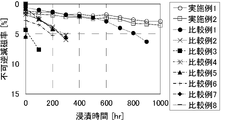
- the bonded magnet according to one aspect of the present invention contains a phosphate-coated SmFeN-based anisotropic magnetic powder having a phosphate content of more than 0.5% by mass and polypropylene, and is immersed in hot water at 120 ° C.
- the retention rate of the total flux after holding for 1000 hours under the conditions is 95% or more before the test.
- the magnetic powder according to one aspect of the present invention is a phosphate-coated SmFeN-based anisotropic magnetic powder, which has a phosphate content of more than 0.5% by mass and is a SmFeN-based anisotropic magnetic powder.
- the phosphate coating portion present on the surface of the above has a first region and a second region, and the Sm atom concentration of the first region is higher than the Sm atom concentration in the SmFeN-based anisotropic magnetic powder.
- the Sm atom concentration of the first region is 0.5 times or more and 4 times or less of the Fe atom concentration of the first region, and the second region exists on the first region, and the second region is present.
- the Sm atom concentration of is 1/3 times or less of the Fe atom concentration of the second region.
- the relationship between the immersion time of the bonded magnet under hot water immersion conditions and the irreversible demagnetization rate is shown.
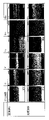
- the STEM-EDX mapping analysis result of the magnetic powder of Example 1 and Comparative Example 2 is shown.
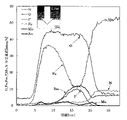
- the result of EDX line analysis of the magnetic powder of Example 1 is shown.
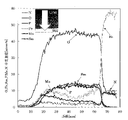
- the result of EDX line analysis of the magnetic powder of Comparative Example 2 is shown.
- a schematic diagram of one aspect of the phosphate-coated portion is shown.
- the method for producing the phosphate-coated SmFeN-based anisotropic magnetic powder of the present embodiment is as follows.
- the surface is coated with phosphate by adding an inorganic acid to a slurry containing SmFeN-based anisotropic magnetic powder, water, and a phosphoric acid compound to adjust the pH of the slurry to 1 or more and 4.5 or less.
- It is characterized by including a phosphoric acid treatment step for obtaining a SmFeN-based anisotropic magnetic powder and an oxidation step for heat-treating the phosphate-coated SmFeN-based anisotropic magnetic powder at 200 ° C. or higher and 330 ° C. or lower in an oxygen-containing atmosphere. ..
- an inorganic acid is added to the slurry containing the SmFeN-based anisotropic magnetic powder, water, and a phosphoric acid compound to adjust the pH of the slurry to 1 or more and 4.5 or less on the surface.
- a Phosphate-coated SmFeN-based anisotropic magnetic powder is obtained.
- the phosphate-coated SmFeN-based anisotropic magnetic powder is a phosphate obtained by reacting a metal component (for example, iron or samarium) contained in the SmFeN-based anisotropic magnetic powder with a phosphoric acid component contained in a phosphoric acid compound.
- iron phosphate for example, iron phosphate, samarium phosphate
- SmFeN-based anisotropic magnetic powder is formed by precipitating on the surface of the SmFeN-based anisotropic magnetic powder.
- an inorganic acid to adjust the pH of the slurry to 1 or more and 4.5 or less, the amount of phosphoric acid precipitated can be increased as compared with the case where no inorganic acid is added. , A phosphate-coated SmFeN-based anisotropic magnetic powder having a thick coating portion can be obtained.
- the solvent when the solvent is water, a phosphate having a smaller particle size is precipitated as compared with the case where the solvent is an organic solvent, so that the coating portion is densely coated with a phosphate-coated SmFeN system.
- a square magnetic powder can be obtained.
- the obtained phosphate-coated SmFeN-based anisotropic magnetic powder is heat-treated at a high temperature of 200 ° C. or higher and 330 ° C. or lower under an oxygen-containing atmosphere.
- the surface of the SmFeN-based anisotropic magnetic powder of the base material coated with the phosphate is oxidized to form a thick iron oxide layer, so that the heat resistance of the phosphate-coated SmFeN-based anisotropic magnetic powder is obtained. It is thought that the water content will improve.
- the method for producing a slurry containing the SmFeN-based anisotropic magnetic powder, water, and the phosphoric acid compound is not particularly limited, but for example, an aqueous phosphate solution containing the SmFeN-based anisotropic magnetic powder and the phosphoric acid compound using water as a solvent. And can be obtained by mixing.
- the content of the SmFeN-based anisotropic magnetic powder in the slurry is, for example, 1% by mass or more and 50% by mass or less, and preferably 5% by mass or more and 20% by mass or less from the viewpoint of productivity.
- the content of the phosphoric acid component ( PO 4 ) in the slurry is, for example, 0.01% by mass or more and 10% by mass or less in terms of PO4, and is 0.05 from the viewpoint of the reactivity and productivity of the phosphoric acid component. It is preferably 5% by mass or more and 5% by mass or less.
- the phosphoric acid aqueous solution is obtained by mixing a phosphoric acid compound and water.
- the phosphoric acid compound include phosphates such as orthophosphoric acid, sodium dihydrogen phosphate, sodium monohydrogen phosphate, ammonium dihydrogen phosphate, ammonium monohydrogen phosphate, zinc phosphate, and calcium phosphate, and hypophosphite.
- examples thereof include organic phosphoric acid such as acid-based, hypophosphite-based, pyrophosphoric acid-based, and polyphosphoric acid-based inorganic phosphoric acid. Only one of these may be used, or two or more thereof may be used in combination.
- oxo acid salts such as molybdenate, tungstate, vanazine salt and chromate, sodium nitrate, sodium nitrite, etc.
- a chelating agent such as EDTA may be further added such as an oxidizing agent.
- the concentration of phosphoric acid ( PO4 equivalent amount) in the phosphoric acid aqueous solution is, for example, 5% by mass or more and 50% by mass or less, and 10% by mass from the viewpoint of solubility of the phosphoric acid compound, storage stability and ease of chemical conversion treatment. It is preferably 30% by mass or less.
- the pH of the phosphoric acid aqueous solution is, for example, 1 or more and 4.5 or less, and preferably 1.5 or more and 4 or less from the viewpoint of easily controlling the precipitation rate of the phosphate.
- the pH can be adjusted with dilute hydrochloric acid, dilute sulfuric acid, or the like.
- the pH of the slurry is adjusted to 1 or more and 4.5 or less by adding an inorganic acid, but it is preferably adjusted to 1.6 or more and 3.9 or less, and adjusted to 2 or more and 3 or less. It is more preferable to do so.
- the pH is lower than 1, the phosphate-coated SmFeN-based anisotropic magnetic powders tend to aggregate with each other starting from the phosphate deposited in a large amount locally, and the coercive force tends to decrease. If the pH exceeds 4.5, the amount of phosphate deposited decreases, so that the coating becomes insufficient and the coercive force tends to decrease.
- inorganic acid to be added examples include hydrochloric acid, nitric acid, sulfuric acid, boric acid, and hydrofluoric acid.
- an inorganic acid is added at any time so as to be within the above pH range.
- Inorganic acids are used from the viewpoint of waste liquid treatment, but organic acids can be used in combination depending on the purpose. Examples of the organic acid include acetic acid, formic acid, tartaric acid and the like. Inorganic acid and organic acid may be mixed and used.
- the phosphoric acid treatment step may be carried out so that the lower limit of the phosphate content in the obtained phosphate-coated SmFeN-based anisotropic magnetic powder is larger than 0.5% by mass.
- the lower limit of the phosphate content of the phosphate-coated SmFeN-based anisotropic magnetic powder obtained in the phosphoric acid treatment step is preferably 0.55% by mass or more, and preferably 0.75% by mass or more.
- the upper limit of the phosphate content is 4.5% by mass or less, preferably 2.5% by mass or less, and particularly preferably 2% by mass or less.
- the phosphate content of the magnetic powder is expressed in terms of PO 4 molecule equivalent measured by ICP emission spectroscopic analysis (ICP-AES).
- the adjustment of the slurry containing the SmFeN-based anisotropic magnetic powder, water, and the phosphoric acid compound to the pH range of 1 or more and 4.5 or less can be performed for 10 minutes or more, and the point that the thin portion of the coating portion is reduced. It is preferable to carry out for 30 minutes or more.
- the pH control interval is short because the pH rises quickly, but as the coating progresses, the pH fluctuation gradually slows down and the inorganic acid input interval becomes longer, so the reaction end point is I can judge.
- the SmFeN-based anisotropic magnetic powder coated with the phosphate obtained in the phosphoric acid treatment step is heat-treated at 200 ° C. or higher and 330 ° C. or lower in an oxygen-containing atmosphere to perform an oxidation treatment.
- SmFeN-based anisotropic magnetic powder coated with phosphate is heat-treated at a high temperature of 200 ° C. or higher and 330 ° C. or lower in an oxygen-containing atmosphere to form a base material smFeN-based anisotropic magnetic powder coated with phosphate.
- the surface of the is oxidized to form a thick iron oxide layer, and the heat resistance and water resistance of the phosphate-coated SmFeN-based anisotropic magnetic powder are improved.
- the oxidation step after the phosphoric acid treatment is performed by heat-treating the phosphate-coated SmFeN-based anisotropic magnetic powder in an oxygen-containing atmosphere.
- the reaction atmosphere preferably contains oxygen in an inert gas such as nitrogen or argon.
- the oxygen concentration is preferably 3% or more and 21% or less, and more preferably 3.5% or more and 10% or less.
- the heat treatment temperature in the oxidation step after the phosphoric acid treatment is 200 ° C. or higher and 330 ° C. or lower, preferably 200 ° C. or higher and 250 ° C. or lower, and more preferably 210 ° C. or higher and 230 ° C. or lower. Below 200 ° C., the formation of the iron oxide layer is insufficient, and the heat-resistant water tends to be small. If the temperature exceeds 330 ° C., an iron oxide layer is excessively formed, and the coercive force tends to decrease.
- the heat treatment time is preferably 3 hours or more and 10 hours or less.
- the phosphate coating portion existing on the surface of the SmFeN-based anisotropic magnetic powder has a first region, and the Sm atomic concentration in the first region is the SmFeN-based anisotropic magnetic powder. It is preferable that the Sm atom concentration in the first region is higher than the Sm atom concentration in the medium and the Sm atom concentration in the first region is 0.5 times or more and 4 times or less the Fe atom concentration in the first region.
- the Sm atom concentration in the first region can be 1.02 times or more, preferably 1.05 times or more, preferably 1.1 times or more the Sm atom concentration in the SmFeN-based anisotropic magnetic powder.
- the Sm atomic concentration in the first region can be 3 times or less the Sm atomic concentration in the SmFeN-based anisotropic magnetic powder.
- the Sm atom concentration in the first region is preferably 0.6 times or more and 3.5 times or less, and more preferably 0.7 times or more and 3 times or less the Fe atom concentration in the first region.
- the atomic concentration (atm%) of the SmFeN-based anisotropic magnetic powder and the first region is obtained by averaging the atomic concentrations (atm%) in each region in the STEM-EDX line analysis.
- the phosphate-coated SmFeN-based anisotropic magnetic powder of the present embodiment is characterized by having a phosphate content of more than 0.5% by mass.
- the phosphate-coated SmFeN-based anisotropic magnetic powder can be obtained by the method described above.
- the phosphate-coated SmFeN-based anisotropic magnetic powder preferably has a heat generation start temperature of 170 ° C. or higher, more preferably 200 ° C. or higher, and particularly preferably 260 ° C. or higher.
- the heat generation start temperature in DSC is a comprehensive evaluation of the density, thickness, oxidation resistance, etc. of the phosphate coating, and a high coercive force can be obtained when the temperature is 170 ° C. or higher.
- the heat generation start temperature in the DSC can be measured under the conditions described in the examples.
- the phosphate-coated SmFeN-based anisotropic magnetic powder has a ratio of the diffraction peak intensity (I) on the (110) plane of ⁇ Fe to the peak intensity (II) on the (300) plane of the SmFeN-based magnetic powder in the XRD diffraction pattern.
- (I) / (II) is preferably 2.0 ⁇ 10 -2 or less, and more preferably 1.0 ⁇ 10 -2 or less.
- the diffraction peak intensity (I) on the (110) plane of ⁇ Fe represents the abundance of the impurity ⁇ Fe, and when the ratio (I) / (II) described above is 2.0 ⁇ 10 ⁇ 2 or less. , High coercive force can be obtained.
- the diffraction peak intensity in the XRD diffraction pattern was measured by a powder X-ray crystal diffractometer (manufactured by Rigaku, X-ray wavelength: CuKa1), and the measured diffraction peak intensity on the (110) plane of ⁇ Fe was Sm 2 Fe 17 .
- the value obtained by dividing by the peak intensity of the ( 300 ) plane of N3 and then multiplying by 10,000 can be obtained as the ⁇ Fe peak height ratio.
- a low ⁇ Fe peak height ratio means that the content of the impurity ⁇ Fe is low.
- the phosphate-coated SmFeN-based anisotropic magnetic powder preferably has a carbon content of 1000 ppm or less, more preferably 800 ppm or less.
- the carbon content indicates the amount of organic impurities in the phosphate, and when the carbon content exceeds 1000 ppm, the phosphate-coated SmFeN-based anisotropic magnetic powder is exposed to a high temperature in the process of producing a bonded magnet. As a result, organic impurities are decomposed and defects are generated in the coating portion, so that the coercive force tends to decrease.
- the carbon content can be measured by the TOC method.
- the thickness of the phosphate-coated portion of the phosphate-coated SmFeN-based anisotropic magnetic powder is preferably 10 nm or more and 200 nm or less from the viewpoint of the coercive force of the phosphate-coated SmFeN-based anisotropic magnetic powder.
- the thickness of the phosphate-coated portion can be measured by performing a composition analysis on the cross section of the phosphate-coated SmFeN-based anisotropic magnetic powder by line analysis using EDX.
- the phosphate coating portion existing on the surface of the SmFeN-based anisotropic magnetic powder has a first region, and the Sm atomic concentration of the first region is higher than the Sm atomic concentration in the SmFeN-based anisotropic magnetic powder, and It is preferable that the Sm atom concentration in the first region is 0.5 times or more and 4 times or less the Fe atom concentration in the first region.
- the Sm atom concentration in the first region can be 1.02 times or more, preferably 1.05 times or more, preferably 1.1 times or more the Sm atom concentration in the SmFeN-based anisotropic magnetic powder. It is more preferable that there is, and it is further preferable that it is 1.2 times or more.
- the Sm atomic concentration in the first region can be 3 times or less the Sm atomic concentration in the SmFeN-based anisotropic magnetic powder.
- the Sm atom concentration in the first region is preferably 0.6 times or more and 3.5 times or less, and more preferably 0.7 times or more and 3 times or less the Fe atom concentration in the first region.
- the relationship between the Sm atom concentration and the Fe atom concentration in the first region is within the above range, the Fe atom concentration near the surface of the SmFeN-based anisotropic magnetic powder becomes low, and the solubility of samarium phosphate in water is low. As the content increases, the water resistance tends to improve.
- the first region is a region including a layer showing the maximum peak of P (phosphorus) in the STEM-EDX line analysis of the phosphate-coated SmFeN-based anisotropic magnetic powder.
- the thickness of the first region can be 1 nm or more and 200 nm or less, and preferably 3 nm or more and 100 nm or less.
- the atomic concentration (atm%) of each element in the first region, the second region described later, and the Mo high concentration layer is obtained by averaging the atomic concentrations (atm%) in each region in the STEM-EDX line analysis. Desired.
- the phosphate-coated portion preferably has a second region above the first region, and the Sm atom concentration of the second region is preferably 1/3 times or less of the Fe atom concentration of the second region.
- the Sm atom concentration in the second region is more preferably 1/5 times or less, and further preferably 1/10 times or less the Fe atom concentration in the second region.
- the Sm atom concentration in the second region can be 0 times or more the Fe atom concentration in the second region.
- the second region is a region including a layer showing the maximum peak of Fe (iron) in the phosphate coating in the STEM-EDX line pro analysis of the phosphate-coated SmFeN-based anisotropic magnetic powder. ..
- the thickness of the second region can be 1 nm or more and 200 nm or less, preferably 5 nm or more and 100 nm or less.
- the Fe atom concentration in the second region is preferably twice or more, more preferably three times or more, the Fe atom concentration in the first region.
- the Fe atom concentration in the second region is preferably 10 times or less the Fe atom concentration in the first region.
- the Fe atomic concentration in the second region is preferably 0.25 times or more and 1 or less, and 0.5 times or more and 0.8 times the Fe atomic concentration in the SmFeN-based anisotropic magnetic powder which is the base material.
- the following is more preferable.
- the P (phosphorus) atom concentration in the second region is lower than the P atom concentration in the first region.
- the P atom concentration in the second region is preferably 1/5 times or less, more preferably 1/10 times or less, the P atom concentration in the first region.
- the phosphate-coated portion may have a Mo high-concentration layer in the first region and the second region. It is preferable that three Mo high-concentration layers are present in the phosphate-coated portion, that is, three Mo (molybdenum) peaks are present in the STEM-EDX line analysis of the phosphate-coated SmFeN-based anisotropic magnetic powder. Is preferable.
- the Mo high-concentration layer can also be confirmed in the STEM-EDX mapping analysis.
- the Mo high-concentration layer is a region including a layer showing a peak of Mo (molybdenum) in the STEM-EDX line analysis of the phosphate-coated SmFeN-based anisotropic magnetic powder.
- the thickness of the Mo high concentration layer is preferably 1 nm or more and 40 nm or less. As described above, when the Mo high concentration layer has three layers, the water resistance tends to be improved by forming the phosphate coating portion having a larger layer structure.
- the SmFeN-based anisotropic magnetic powder after the phosphoric acid treatment may be subjected to silica treatment, if necessary.
- silica treatment By forming a silica thin film on the magnetic powder, oxidation resistance can be improved.
- the silica thin film can be formed, for example, by mixing an alkyl silicate, a phosphate-coated SmFeN-based anisotropic magnetic powder, and an alkaline solution.
- the magnetic powder after the silica treatment may be further treated with a silane coupling agent.
- a silane coupling agent film is formed on the silica thin film, improving the magnetic properties of the magnetic powder, as well as improving the wettability with the resin and the strength of the magnet. can do.
- the silane coupling agent may be selected according to the type of resin and is not particularly limited. For example, 3-aminopropyltriethoxysilane, ⁇ - (2-aminoethyl) aminopropyltrimethoxysilane, ⁇ - (2-).
- Aminoethyl Aminopropylmethyldimethoxysilane, ⁇ -methacryloxypropyltrimethoxysilane, ⁇ -methacryloxypropylmethyldimethoxysilane, N- ⁇ - (N-vinylbenzylaminoethyl) - ⁇ -aminopropyltrimethoxysilane hydrochloride , ⁇ -Glysidoxypropyltrimethoxysilane, ⁇ -mercaptopropyltrimethoxysilane, methyltrimethoxysilane, methyltriethoxysilane, vinyltriacetoxysilane, ⁇ -chloropropyltrimethoxysilane, hexamethylene disilazane, ⁇ -ani Renopropyltrimethoxysilane, vinyltrimethoxysilane, octadecyl [3- (trimethoxysilyl) propyl] ammonium chloride,
- the amount of the silane coupling agent added is preferably 0.2 parts by weight or more and 0.8 parts by weight or less, and more preferably 0.25 parts by weight or more and 0.6 parts by weight or less with respect to 100 parts by weight of the magnetic powder. If it is less than 0.2 parts by weight, the effect of the silane coupling agent is small, and if it exceeds 0.8 parts by weight, the magnetic properties of the magnetic powder and the magnet tend to be deteriorated due to the aggregation of the magnetic powder.
- the Sm raw material and the Fe raw material are dissolved in a strongly acidic solution to prepare a solution containing Sm and Fe.
- the molar ratio of Sm and Fe (Sm: Fe) is preferably 1.5:17 to 3.0:17, and 2.0:17 to 2.5:17. Is more preferable.
- Raw materials such as La, W, Co, Ti, Sc, Y, Pr, Nd, Pm, Gd, Tb, Dy, Ho, Er, Tm, and Lu may be added to the above-mentioned solution.
- the Sm raw material and Fe raw material are not limited as long as they can be dissolved in a strongly acidic solution.
- samarium oxide can be mentioned as the Sm raw material
- FeSO 4 can be mentioned as the Fe raw material.
- the concentration of the solution containing Sm and Fe can be appropriately adjusted within a range in which the Sm raw material and the Fe raw material are substantially dissolved in the acidic solution.
- the acidic solution include sulfuric acid in terms of solubility.
- the solution containing Sm and Fe may be a solution containing Sm and Fe at the time of reaction with the precipitating agent.
- the precipitating agent is not limited as long as it is an alkaline solution that reacts with a solution containing Sm and Fe to obtain a precipitate, and examples thereof include aqueous ammonia and caustic soda, and caustic soda is preferable.
- a method of dropping a solution containing Sm and Fe and a precipitating agent into a solvent such as water is preferable because the properties of the particles of the precipitate can be easily adjusted.
- the reaction temperature can be 0 to 50 ° C, preferably 35 to 45 ° C.
- the concentration of the reaction solution is preferably 0.65 mol / L to 0.85 mol / L, more preferably 0.7 mol / L to 0.84 mol / L, as the total concentration of the metal ions.
- the reaction pH is preferably 5 to 9, more preferably 6.5 to 8.
- the anisotropic magnetic powder particles obtained in the precipitation step roughly determine the powder particle size, powder shape, and particle size distribution of the finally obtained magnetic powder.
- the particle size of the obtained particles is measured by a laser diffraction type wet particle size distribution meter, the total powder has a size and distribution within the range of 0.05 to 20 ⁇ m, preferably 0.1 to 10 ⁇ m. Is preferable.
- the average particle size of the anisotropic magnetic powder particles is measured as a particle size corresponding to 50% of the cumulative volume from the small particle size side in the particle size distribution, and is preferably in the range of 0.1 to 10 ⁇ m.
- a step of separating and washing the obtained precipitate may be included.
- the washing step is appropriately performed until the conductivity of the supernatant solution becomes 5 mS / m 2 or less.
- a step of separating the precipitate for example, a filtration method, a decantation method or the like can be used after adding a solvent (preferably water) to the obtained precipitate and mixing them.
- the heat treatment temperature (hereinafter referred to as the oxidation temperature) in the oxidation step is not particularly limited, but is preferably 700 to 1300 ° C, more preferably 900 to 1200 ° C. If the temperature is lower than 700 ° C., the oxidation becomes insufficient, and if the temperature exceeds 1300 ° C., the desired shape, average particle size and particle size distribution of the magnetic powder tend not to be obtained.
- the heat treatment time is not particularly limited, but 1 to 3 hours is preferable.
- the obtained oxide is an oxide particle in which sm and Fe are sufficiently microscopically mixed in the oxide particle, and the shape of the precipitate, the particle size distribution, and the like are reflected.
- the reducing gas is appropriately selected from hydrocarbon gases such as hydrogen (H 2 ), carbon monoxide (CO), and methane (CH 4 ), but hydrogen gas is preferable in terms of cost, and the flow rate of the gas is oxidation. It is adjusted appropriately as long as the object does not scatter.
- the heat treatment temperature (hereinafter, pretreatment temperature) in the pretreatment step is in the range of 300 ° C. or higher and 950 ° C. or lower, preferably 400 ° C. or higher, more preferably 750 ° C. or higher, and preferably less than 900 ° C.
- the pretreatment temperature is 300 ° C. or higher, the reduction of the oxide containing Sm and Fe proceeds efficiently. Further, when the temperature is 950 ° C.
- the oxide particles are suppressed from growing and segregating, and the desired particle size can be maintained.
- hydrogen is used as the reducing gas, it is preferable to adjust the thickness of the oxide layer to be used to 20 mm or less, and further adjust the dew point in the reaction furnace to ⁇ 10 ° C. or less.
- Metallic calcium is used in the form of granules or powder, and the particle size thereof is preferably 10 mm or less. This makes it possible to more effectively suppress aggregation during the reduction reaction.
- metallic calcium is a reaction equivalent (a stoichiometric amount required to reduce Sm oxide, and if Fe is in the form of an oxide, it includes the amount required to reduce it). It can be added in an amount of 1.1 to 3.0 times, preferably 1.5 to 2.0 times.
- a disintegration accelerator can be used as needed together with the metallic calcium which is a reducing agent.
- This disintegration accelerator is appropriately used to promote disintegration and granulation of the product in the washing step described later.
- alkaline earth metal salts such as calcium chloride and alkaline soil such as calcium oxide. Examples include oxides.
- These disintegration accelerators are used in a proportion of 1 to 30% by mass, preferably 5 to 28% by mass, per Sm oxide used as a Sm source.
- the nitriding step is a step of obtaining anisotropic magnetic particles by nitriding the alloy particles obtained in the reduction step. Since the particulate precipitate obtained in the above-mentioned precipitation step is used, porous lumpy alloy particles can be obtained in the reduction step. As a result, nitriding can be performed uniformly by heat treatment in a nitrogen atmosphere immediately without performing pulverization treatment.
- the heat treatment temperature (hereinafter referred to as nitriding temperature) in the nitriding treatment of the alloy particles is preferably a temperature of 300 to 600 ° C., particularly preferably 400 to 550 ° C., and is carried out by replacing the atmosphere with a nitrogen atmosphere in this temperature range.
- the heat treatment time may be set so that the nitriding of the alloy particles is sufficiently uniform.
- the product obtained after the nitriding step contains CaO by-produced, unreacted metallic calcium, and the like in addition to the magnetic particles, and may be in a sintered mass state in which these are combined. Therefore, in that case, this product can be put into cooling water to separate CaO and metallic calcium from the magnetic particles as a calcium hydroxide (Ca (OH) 2 ) suspension. Further, the residual calcium hydroxide may be sufficiently removed by washing the magnetic particles with acetic acid or the like.
- the SmFeN-based anisotropic magnetic powder has a Th 2 Zn 17 -type crystal structure, and is nitrided from a rare earth metal samarium Sm represented by the general formula Sm x Fe 100-xy N y , iron Fe, and nitrogen N. It is a thing. Here, it is preferable that x is 8.1 atomic% or more and 10 atomic% or less, y is 13.5 atomic% or more and 13.9 atomic% or less, and the balance is mainly Fe.
- the average particle size of the SmFeN-based anisotropic magnetic powder is 2 ⁇ m or more and 5 ⁇ m or less, preferably 2.5 ⁇ m or more and 4.8 ⁇ m or less. If it is less than 2 ⁇ m, the filling amount of the magnetic powder in the bonded magnet becomes small, so that the magnetization decreases, and if it exceeds 5 ⁇ m, the coercive force of the bonded magnet tends to decrease.
- the average particle size is the particle size measured under dry conditions using a laser diffraction type particle size distribution measuring device.
- the particle size D10 of the SmFeN-based anisotropic magnetic powder is 1 ⁇ m or more and 3 ⁇ m or less, preferably 1.5 ⁇ m or more and 2.5 ⁇ m or less. If it is less than 1 ⁇ m, the filling amount of the magnetic powder in the bonded magnet becomes small, so that the magnetization decreases, while if it exceeds 3 ⁇ m, the coercive force of the bonded magnet tends to decrease.
- D10 is a particle size corresponding to an integrated value of the particle size distribution based on the volume of the SmFeN-based anisotropic magnetic powder of 10%.
- the particle size D50 of the SmFeN-based anisotropic magnetic powder is 2.5 ⁇ m or more and 5 ⁇ m or less, preferably 2.7 ⁇ m or more and 4.8 ⁇ m or less. If it is less than 2.5 ⁇ m, the filling amount of the magnetic powder in the bonded magnet becomes small, so that the magnetization decreases, and if it exceeds 5 ⁇ m, the coercive force of the bonded magnet tends to decrease.
- D50 is a particle size corresponding to an integrated value of the particle size distribution based on the volume of the SmFeN-based anisotropic magnetic powder of 50%.
- the particle size D90 of the SmFeN-based anisotropic magnetic powder is 3 ⁇ m or more and 7 ⁇ m or less, preferably 4 ⁇ m or more and 6 ⁇ m or less. If it is less than 3 ⁇ m, the filling amount of the magnetic powder in the bonded magnet becomes small, so that the magnetization decreases, and if it exceeds 7 ⁇ m, the coercive force of the bonded magnet tends to decrease.
- D90 is a particle size corresponding to 90% of the integrated value of the particle size distribution based on the volume of the SmFeN-based anisotropic magnetic powder.
- Span (D90-D10) / D50 Is 2 or less from the viewpoint of coercive force, preferably 1.5 or less.
- the circularity of the SmFeN-based anisotropic magnetic powder is not particularly limited, but is preferably 0.5 or more, and more preferably 0.6 or more. If it is less than 0.5, the fluidity deteriorates and stress is applied between the particles during molding, so that the magnetic properties deteriorate.
- the SEM image taken at 3000 times is binarized by image processing, and the circularity is obtained for one particle.
- the method for producing a compound for a bonded magnet according to the present embodiment is characterized by including a step of obtaining a phosphate-coated SmFeN-based anisotropic magnetic powder and a step of kneading the magnetic powder with polypropylene, and polypropylene is used. As a result, heat resistance and water resistance are improved. Of these, the phosphate-coated SmFeN-based anisotropic magnetic powder is obtained by the method described above.
- the strands are extruded with a twin-screw extruder, air-cooled, and then cut into several mm sizes with a pelletizer to obtain a pellet-shaped compound for a bonded magnet.
- the weight average molecular weight of the polypropylene used is preferably in the range of 20,000 or more and 200,000 or less. If the weight average molecular weight is less than 20,000, the mechanical strength of the bonded magnet after molding tends to decrease, and if it is more than 200,000, the viscosity of the bond magnet compound tends to increase.
- polypropylene is preferably acid-modified for the purpose of improving the bondability with the coupled magnetic powder, and for example, polypropylene acid-modified with maleic anhydride is preferably used.
- the denaturation rate of the acid with respect to polypropylene is preferably 0.1% by weight or more and 10% by weight or less.
- the adhesion to the magnetic powder becomes insufficient, and the mechanical strength and water resistance of the bonded magnet are lowered. If it exceeds 10% by weight, the water absorption rate of the resin becomes high, so that the water resistance of the bonded magnet is lowered.
- the content of the phosphate-coated SmFeN-based anisotropic magnetic powder in the compound for bonded magnets is preferably 80% by mass or more and 95% by mass or less, and 90% by mass or more and 95% by mass or less from the viewpoint of obtaining high magnetic properties. More preferred.
- the content of polypropylene in the compound for bonded magnets is preferably 3% by mass or more and 20% by mass or less, and more preferably 5% by mass or more and 15% by mass or less from the viewpoint of ensuring fluidity.
- antioxidants such as thermoplastic elastomers and phosphorus-based antioxidants can be kneaded at the same time.
- the mass ratio of polypropylene to the thermoplastic elastomer is preferably in the range of 90:10 to 50:50, and more preferably in the range of 89:11 to 70:30 from the viewpoint of impact resistance.
- the content of the phosphorus-based antioxidant in the bond magnet compound is preferably 0.1% by mass or more and 2% by mass or less.
- polypropylene polypropylene
- PPS polyphenylene sulfide
- PEEK polyetheretherketone
- LCP liquid crystal polymer
- PA polyamide
- PE polyethylene
- the above-mentioned crystalline resin and the glass transition point (Tg) of the modified polyphenylene ether (m-PPE), cycloolefin polymer (COP), cycloolefin copolymer (COC), etc. are not 100 ° C or higher.
- a mixture mixed with a crystalline resin or a polymer alloy can be used.
- a polymer alloy of modified polyphenylene ether (m-PPE) and polypropylene can be preferably used.
- the compound for a bonded magnet of the present embodiment is characterized by containing a phosphate-coated SmFeN-based anisotropic magnetic powder and polypropylene.
- a phosphate-coated SmFeN-based anisotropic magnetic powder and polypropylene By containing the phosphate-coated SmFeN-based anisotropic magnetic powder and polypropylene, the heat resistance and water resistance of the bonded magnet produced by using these compounds for bonded magnets are improved.
- the compound for a bond magnet can be obtained by the method described above.
- the barrel temperature is selected according to the type of resin used, and can be 160 ° C. to 320 ° C., and similarly, the mold temperature can be, for example, 30 to 150 ° C.
- the alignment magnetic field in the alignment step is generated by using an electromagnet or a permanent magnet, and the magnitude of the magnetic field is preferably 4 kOe or more, more preferably 6 kOe or more.
- the magnitude of the magnetizing magnetic field in the magnetizing step is preferably 20 kOe or more, and more preferably 30 kOe or more.
- the bond magnet of the present embodiment has resistance to hot water, it can be suitably used as a drive source for a fuel pump, a water pump, or the like in an automobile, a motorcycle, or the like.
- Example 1 FeSO 4.7H 2 O 5.0 kg was mixed and dissolved in 2.0 kg of pure water. Further, 0.49 kg of Sm 2 O 3 and 0.74 kg of 70% sulfuric acid were added and stirred well to completely dissolve them. Next, pure water was added to the obtained solution to adjust the Fe concentration to 0.726 mol / L and the Sm concentration to 0.112 mol / L to prepare a SmFe sulfuric acid solution.
- Drainage and water injection were repeated until the value became 100 ⁇ S / cm or less to obtain a slurry containing 10% by mass of SmFeN-based anisotropic magnetic powder.
- 100 g of the prepared phosphoric acid treatment liquid was put into the treatment tank in its entirety, and then 6% by weight of hydrochloric acid was added at any time to adjust the pH of the phosphoric acid treatment reaction slurry to 2.5 ⁇ 0. It was controlled in the range of .1 and maintained for 30 minutes. Subsequently, suction filtration, dehydration, and vacuum drying were carried out to obtain a phosphate-coated SmFeN-based anisotropic magnetic powder.
- Example 2 The same procedure as in Example 1 was carried out except that the heat treatment temperature in the oxidation treatment step was changed from 230 ° C. to 200 ° C. to obtain a phosphate-coated SmFeN-based anisotropic magnetic powder that had been oxidized.
- Example 1 The same procedure as in Example 1 was carried out except that the heat treatment temperature in the oxidation treatment step was changed from 230 ° C. to 170 ° C. to obtain an oxidation-treated phosphate-coated SmFeN-based anisotropic magnetic powder.
- Example 2 The phosphate-coated SmFeN-based anisotropic magnetic powder in Example 1 was used, and no oxidation treatment was performed after the phosphoric acid treatment step.
- Hydrogen chloride 70 g of dilute hydrochloric acid is added to the slurry containing 1000 g of the SmFeN-based anisotropic magnetic powder obtained in the water washing step, and the mixture is stirred for 1 minute to remove the surface oxide film and dirt components, and then the conductivity of the supernatant liquid. Drainage and water injection were repeated until the value became 100 ⁇ S / cm or less to obtain a slurry containing 10% by mass of SmFeN-based anisotropic magnetic powder. While stirring the obtained slurry, 100 g of the prepared phosphoric acid treatment liquid was put into the treatment tank in its entirety. The pH of the reaction slurry increased from 2.5 to 6 over 5 minutes. After stirring for 15 minutes, suction filtration, dehydration, and vacuum drying were performed to obtain a phosphate-coated SmFeN-based anisotropic magnetic powder.
- Comparative Example 4 The same procedure as in Comparative Example 3 was carried out except that the heat treatment temperature in the oxidation treatment step was changed from 230 ° C. to 200 ° C. to obtain a phosphate-coated SmFeN-based anisotropic magnetic powder that had been oxidized.
- Comparative Example 5 The same procedure as in Comparative Example 3 was carried out except that the heat treatment temperature in the oxidation treatment step was changed from 230 ° C. to 170 ° C. to obtain a phosphate-coated SmFeN-based anisotropic magnetic powder that had been oxidized.
- Comparative Example 6 The phosphate-coated SmFeN-based anisotropic magnetic powder in Comparative Example 3 was used, and no oxidation treatment was performed after the phosphoric acid treatment step.
- IPA isopropanol
- [Oxidation treatment step 2 after phosphoric acid treatment step] 15 g of phosphoric acid-treated SmFeN-based anisotropic magnetic powder is gradually heated from room temperature in an atmosphere of a mixed gas of nitrogen and air (oxygen concentration 4%, 5 L / min), and heat-treated at a maximum temperature of 150 ° C. for 8 hours. was carried out to obtain an oxidation-treated phosphate-coated SmFeN-based anisotropic magnetic powder.
- Comparative Example 8 The same procedure as in Comparative Example 7 was carried out except that the heat treatment temperature in the oxidation treatment step was changed from 150 ° C. to 200 ° C. to obtain an oxidation-treated phosphate-coated SmFeN-based anisotropic magnetic powder.
- the layer corresponding to (2) can be confirmed on the outermost surface of the base material SmFeN-based anisotropic magnetic powder, but most of it is a phosphate coating containing Fe, Sm, and Mo. , No significant change in the layer corresponding to (1) and (3) to (5) of Example 1 can be confirmed.
- each metal element Fe, Sm, Mo
- the magnetic powder having such an oxidation-treated coating has better water resistance as a bonded magnet.
Landscapes
- Chemical & Material Sciences (AREA)
- Engineering & Computer Science (AREA)
- Crystallography & Structural Chemistry (AREA)
- Inorganic Chemistry (AREA)
- Power Engineering (AREA)
- Chemical Kinetics & Catalysis (AREA)
- Mechanical Engineering (AREA)
- General Chemical & Material Sciences (AREA)
- Manufacturing & Machinery (AREA)
- Metallurgy (AREA)
- Materials Engineering (AREA)
- Organic Chemistry (AREA)
- Thermal Sciences (AREA)
- Physics & Mathematics (AREA)
- Hard Magnetic Materials (AREA)
- Powder Metallurgy (AREA)
Priority Applications (4)
| Application Number | Priority Date | Filing Date | Title |
|---|---|---|---|
| US18/253,676 US20230415227A1 (en) | 2020-11-19 | 2021-09-30 | PRODUCTION METHOD FOR PHOSPHATE-COATED SmFeN-BASED ANISOTROPIC MAGNETIC POWDER, AND BONDED MAGNET |
| JP2022563612A JP7846379B2 (ja) | 2020-11-19 | 2021-09-30 | リン酸塩被覆SmFeN系異方性磁性粉末の製造方法、およびボンド磁石 |
| DE112021006027.9T DE112021006027T5 (de) | 2020-11-19 | 2021-09-30 | Verfahren zur Herstellung eines phosphatbeschichteten anisotropen magnetischen Pulvers auf SmFeN-Basis und Verbundmagnet |
| CN202180077696.6A CN116685424A (zh) | 2020-11-19 | 2021-09-30 | 磷酸盐包覆SmFeN系各向异性磁性粉末的制造方法及粘结磁体 |
Applications Claiming Priority (2)
| Application Number | Priority Date | Filing Date | Title |
|---|---|---|---|
| JP2020192545 | 2020-11-19 | ||
| JP2020-192545 | 2020-11-19 |
Publications (1)
| Publication Number | Publication Date |
|---|---|
| WO2022107462A1 true WO2022107462A1 (ja) | 2022-05-27 |
Family
ID=81708906
Family Applications (1)
| Application Number | Title | Priority Date | Filing Date |
|---|---|---|---|
| PCT/JP2021/036189 Ceased WO2022107462A1 (ja) | 2020-11-19 | 2021-09-30 | リン酸塩被覆SmFeN系異方性磁性粉末の製造方法、およびボンド磁石 |
Country Status (5)
| Country | Link |
|---|---|
| US (1) | US20230415227A1 (https=) |
| JP (1) | JP7846379B2 (https=) |
| CN (1) | CN116685424A (https=) |
| DE (1) | DE112021006027T5 (https=) |
| WO (1) | WO2022107462A1 (https=) |
Cited By (2)
| Publication number | Priority date | Publication date | Assignee | Title |
|---|---|---|---|---|
| DE102024119223A1 (de) | 2023-07-06 | 2025-01-09 | Nichia Corporation | Zylindrischer Verbundmagnet, Verfahren zur Herstellung eines zylindrischen Verbundmagneten und Form zum Formen eines zylindrischen Verbundmagneten |
| EP4379755A4 (en) * | 2022-06-20 | 2025-08-06 | Hengdian Group Dmegc Magnetics Co Ltd | SAMARIUM-BASED RARE EARTH PERMANENT MAGNET MATERIAL, ITS PREPARATION METHOD AND APPLICATION |
Families Citing this family (2)
| Publication number | Priority date | Publication date | Assignee | Title |
|---|---|---|---|---|
| CN119742140B (zh) * | 2025-03-05 | 2025-07-15 | 安徽大学 | 一种超薄柔性磁吸睫毛磁片及其制备方法 |
| CN120460737B (zh) * | 2025-07-11 | 2025-09-12 | 朝阳博晟冶金科技有限公司 | 一种新型电磁加热还原铁粉生产设备及其制备方法 |
Citations (5)
| Publication number | Priority date | Publication date | Assignee | Title |
|---|---|---|---|---|
| JPH01234502A (ja) * | 1988-03-11 | 1989-09-19 | Hirata Michitoshi | 金属微粉末の表面処理方法 |
| JP2002043109A (ja) * | 2000-07-19 | 2002-02-08 | Nichia Chem Ind Ltd | 希土類−鉄−窒素系磁粉の表面処理方法及びそれを用いたプラスチック磁石 |
| JP2019176160A (ja) * | 2017-07-20 | 2019-10-10 | 日亜化学工業株式会社 | ボンド磁石用組成物およびその製造方法 |
| JP2020056101A (ja) * | 2018-09-26 | 2020-04-09 | 日亜化学工業株式会社 | 希土類磁性粉末の製造方法 |
| CN111411325A (zh) * | 2019-01-04 | 2020-07-14 | 董元 | 钐铁氮或钕铁氮各向异性粘结磁粉及其制备方法 |
Family Cites Families (14)
| Publication number | Priority date | Publication date | Assignee | Title |
|---|---|---|---|---|
| JP2002008911A (ja) * | 2000-06-22 | 2002-01-11 | Nichia Chem Ind Ltd | 希土類−鉄−窒素系磁粉の表面処理方法及びそれを用いたプラスチック磁石 |
| JP3882545B2 (ja) * | 2000-11-13 | 2007-02-21 | 住友金属鉱山株式会社 | 高耐候性磁石粉及びこれを用いた磁石 |
| CN102076448B (zh) * | 2008-12-15 | 2013-10-23 | 住友金属矿山株式会社 | 含稀土类元素的铁系磁铁合金粉及其制造方法、所得的粘合磁铁用树脂组合物、粘合磁铁以及压密磁铁 |
| EP2711398A4 (en) * | 2011-05-16 | 2014-11-19 | Tanaka Seimitsu Kogyo Co Ltd | IMPROVED RESIN ON THE MAGNETIC PLAN |
| JP5974975B2 (ja) | 2012-06-20 | 2016-08-23 | 住友金属鉱山株式会社 | 希土類−遷移金属−窒素系磁石微粉末及びその製造方法 |
| JP6606920B2 (ja) * | 2015-08-26 | 2019-11-20 | 日亜化学工業株式会社 | 表面処理された希土類系磁性粉末及びその製造方法並びにボンド磁石及びその製造方法 |
| JP6572171B2 (ja) | 2016-05-26 | 2019-09-04 | 国立大学法人東北大学 | 磁石合金粉の製造方法 |
| JP2018081969A (ja) * | 2016-11-14 | 2018-05-24 | 住友金属鉱山株式会社 | 希土類元素を含む鉄系磁石合金粉末とその製造方法、希土類ボンド磁石用組成物、および、希土類磁石 |
| CN110168674B (zh) * | 2017-03-10 | 2022-10-28 | 国立研究开发法人产业技术综合研究所 | 含有Sm-Fe-N系晶粒的磁体粉末和由该磁体粉末制造的烧结磁体以及它们的制造方法 |
| US11270820B2 (en) * | 2017-07-20 | 2022-03-08 | Nichia Corporation | Composition for bonded magnets and method of manufacturing the same |
| JP6928270B2 (ja) | 2018-09-26 | 2021-09-01 | 日亜化学工業株式会社 | 磁性粉末およびその製造方法 |
| CN110970188B (zh) * | 2018-09-28 | 2024-11-19 | 日亚化学工业株式会社 | 粘结磁体及其制造方法 |
| JP7332856B2 (ja) * | 2018-12-19 | 2023-08-24 | 日亜化学工業株式会社 | 異方性磁性粉末の製造方法および異方性磁性粉末 |
| JP7385868B2 (ja) * | 2020-06-29 | 2023-11-24 | 国立大学法人東北大学 | 希土類鉄窒素系磁性粉末、ボンド磁石用コンパウンド、ボンド磁石及び希土類鉄窒素系磁性粉末の製造方法 |
-
2021
- 2021-09-30 DE DE112021006027.9T patent/DE112021006027T5/de active Pending
- 2021-09-30 JP JP2022563612A patent/JP7846379B2/ja active Active
- 2021-09-30 WO PCT/JP2021/036189 patent/WO2022107462A1/ja not_active Ceased
- 2021-09-30 CN CN202180077696.6A patent/CN116685424A/zh active Pending
- 2021-09-30 US US18/253,676 patent/US20230415227A1/en active Pending
Patent Citations (5)
| Publication number | Priority date | Publication date | Assignee | Title |
|---|---|---|---|---|
| JPH01234502A (ja) * | 1988-03-11 | 1989-09-19 | Hirata Michitoshi | 金属微粉末の表面処理方法 |
| JP2002043109A (ja) * | 2000-07-19 | 2002-02-08 | Nichia Chem Ind Ltd | 希土類−鉄−窒素系磁粉の表面処理方法及びそれを用いたプラスチック磁石 |
| JP2019176160A (ja) * | 2017-07-20 | 2019-10-10 | 日亜化学工業株式会社 | ボンド磁石用組成物およびその製造方法 |
| JP2020056101A (ja) * | 2018-09-26 | 2020-04-09 | 日亜化学工業株式会社 | 希土類磁性粉末の製造方法 |
| CN111411325A (zh) * | 2019-01-04 | 2020-07-14 | 董元 | 钐铁氮或钕铁氮各向异性粘结磁粉及其制备方法 |
Cited By (2)
| Publication number | Priority date | Publication date | Assignee | Title |
|---|---|---|---|---|
| EP4379755A4 (en) * | 2022-06-20 | 2025-08-06 | Hengdian Group Dmegc Magnetics Co Ltd | SAMARIUM-BASED RARE EARTH PERMANENT MAGNET MATERIAL, ITS PREPARATION METHOD AND APPLICATION |
| DE102024119223A1 (de) | 2023-07-06 | 2025-01-09 | Nichia Corporation | Zylindrischer Verbundmagnet, Verfahren zur Herstellung eines zylindrischen Verbundmagneten und Form zum Formen eines zylindrischen Verbundmagneten |
Also Published As
| Publication number | Publication date |
|---|---|
| DE112021006027T5 (de) | 2023-08-31 |
| JP7846379B2 (ja) | 2026-04-15 |
| CN116685424A (zh) | 2023-09-01 |
| US20230415227A1 (en) | 2023-12-28 |
| JPWO2022107462A1 (https=) | 2022-05-27 |
Similar Documents
| Publication | Publication Date | Title |
|---|---|---|
| JP7846379B2 (ja) | リン酸塩被覆SmFeN系異方性磁性粉末の製造方法、およびボンド磁石 | |
| JP5499738B2 (ja) | 表面処理された希土類系磁性粉末、該希土類系磁性粉末を含有するボンド磁石用樹脂組成物並びにボンド磁石 | |
| WO1999033597A1 (en) | Sm-Fe-N ALLOY POWDER AND PROCESS FOR THE PRODUCTION THEREROF | |
| JP2021057599A (ja) | R−t−b系希土類磁石粉末の製造方法、r−t−b系希土類磁石粉末、及びボンド磁石 | |
| US11594352B2 (en) | Method of producing magnetic powder | |
| JP2020169389A (ja) | 異方性磁性粉末の製造方法 | |
| JP6303366B2 (ja) | 磁性粒子の製造方法、及び磁性粒子 | |
| JP7335515B2 (ja) | ボンド磁石用コンパウンドの製造方法 | |
| WO2022259949A1 (ja) | SmFeN系異方性磁性粉末およびボンド磁石、ならびにそれらの製造方法 | |
| WO2022107461A1 (ja) | リン酸塩被覆SmFeN系異方性磁性粉末の製造方法およびリン酸塩被覆SmFeN系異方性磁性粉末 | |
| JP7817529B2 (ja) | リン酸塩被覆SmFeN系異方性磁性粉末の製造方法、およびリン酸塩被覆SmFeN系異方性磁性粉末 | |
| JP2024051932A (ja) | リン酸塩被覆SmFeN系異方性磁性粉末の製造方法 | |
| US12230438B2 (en) | Compound for bonded magnet, bonded magnet, method of producing same, and resin composition for bonded magnets | |
| US20230374257A1 (en) | Method of producing magnetic powder-containing resin composition | |
| CN116508122A (zh) | 磷酸盐包覆SmFeN系各向异性磁性粉末的制造方法以及磷酸盐包覆SmFeN系各向异性磁性粉末 | |
| JP2026011716A (ja) | ボンド磁石用組成物、ボンド磁石、ウォーターポンプ用の回転子、および、ボンド磁石の製造方法 | |
| US20240387082A1 (en) | Smfen-based anisotropic magnetic powder and bonded magnet, and metohd of producing said powder and magnet | |
| CN121641669A (zh) | 粘结磁体的制造方法、粘结磁体及粘结磁体用固化性组合物 | |
| JP2024028122A (ja) | 希土類磁性粉末の製造方法および希土類磁性粉末 | |
| CN117594348A (zh) | 稀土类磁性粉末的制造方法及稀土类磁性粉末 |
Legal Events
| Date | Code | Title | Description |
|---|---|---|---|
| 121 | Ep: the epo has been informed by wipo that ep was designated in this application |
Ref document number: 21894337 Country of ref document: EP Kind code of ref document: A1 |
|
| ENP | Entry into the national phase |
Ref document number: 2022563612 Country of ref document: JP Kind code of ref document: A |
|
| WWE | Wipo information: entry into national phase |
Ref document number: 202180077696.6 Country of ref document: CN |
|
| WWE | Wipo information: entry into national phase |
Ref document number: 18253676 Country of ref document: US |
|
| WWE | Wipo information: entry into national phase |
Ref document number: 202347039572 Country of ref document: IN |
|
| 122 | Ep: pct application non-entry in european phase |
Ref document number: 21894337 Country of ref document: EP Kind code of ref document: A1 |