WO2022107461A1 - リン酸塩被覆SmFeN系異方性磁性粉末の製造方法およびリン酸塩被覆SmFeN系異方性磁性粉末 - Google Patents
リン酸塩被覆SmFeN系異方性磁性粉末の製造方法およびリン酸塩被覆SmFeN系異方性磁性粉末 Download PDFInfo
- Publication number
- WO2022107461A1 WO2022107461A1 PCT/JP2021/036175 JP2021036175W WO2022107461A1 WO 2022107461 A1 WO2022107461 A1 WO 2022107461A1 JP 2021036175 W JP2021036175 W JP 2021036175W WO 2022107461 A1 WO2022107461 A1 WO 2022107461A1
- Authority
- WO
- WIPO (PCT)
- Prior art keywords
- magnetic powder
- smfen
- phosphate
- anisotropic magnetic
- coated
- Prior art date
- Legal status (The legal status is an assumption and is not a legal conclusion. Google has not performed a legal analysis and makes no representation as to the accuracy of the status listed.)
- Ceased
Links
Images




Classifications
-
- H—ELECTRICITY
- H01—ELECTRIC ELEMENTS
- H01F—MAGNETS; INDUCTANCES; TRANSFORMERS; SELECTION OF MATERIALS FOR THEIR MAGNETIC PROPERTIES
- H01F1/00—Magnets or magnetic bodies characterised by the magnetic materials therefor; Selection of materials for their magnetic properties
- H01F1/01—Magnets or magnetic bodies characterised by the magnetic materials therefor; Selection of materials for their magnetic properties of inorganic materials
- H01F1/03—Magnets or magnetic bodies characterised by the magnetic materials therefor; Selection of materials for their magnetic properties of inorganic materials characterised by their coercivity
- H01F1/032—Magnets or magnetic bodies characterised by the magnetic materials therefor; Selection of materials for their magnetic properties of inorganic materials characterised by their coercivity of hard-magnetic materials
- H01F1/04—Magnets or magnetic bodies characterised by the magnetic materials therefor; Selection of materials for their magnetic properties of inorganic materials characterised by their coercivity of hard-magnetic materials metals or alloys
- H01F1/047—Alloys characterised by their composition
- H01F1/053—Alloys characterised by their composition containing rare earth metals
- H01F1/055—Alloys characterised by their composition containing rare earth metals and magnetic transition metals, e.g. SmCo5
- H01F1/059—Alloys characterised by their composition containing rare earth metals and magnetic transition metals, e.g. SmCo5 and Va elements, e.g. Sm2Fe17N2
- H01F1/0593—Alloys characterised by their composition containing rare earth metals and magnetic transition metals, e.g. SmCo5 and Va elements, e.g. Sm2Fe17N2 of tetragonal ThMn12-structure
-
- H—ELECTRICITY
- H01—ELECTRIC ELEMENTS
- H01F—MAGNETS; INDUCTANCES; TRANSFORMERS; SELECTION OF MATERIALS FOR THEIR MAGNETIC PROPERTIES
- H01F1/00—Magnets or magnetic bodies characterised by the magnetic materials therefor; Selection of materials for their magnetic properties
- H01F1/01—Magnets or magnetic bodies characterised by the magnetic materials therefor; Selection of materials for their magnetic properties of inorganic materials
- H01F1/03—Magnets or magnetic bodies characterised by the magnetic materials therefor; Selection of materials for their magnetic properties of inorganic materials characterised by their coercivity
- H01F1/032—Magnets or magnetic bodies characterised by the magnetic materials therefor; Selection of materials for their magnetic properties of inorganic materials characterised by their coercivity of hard-magnetic materials
- H01F1/04—Magnets or magnetic bodies characterised by the magnetic materials therefor; Selection of materials for their magnetic properties of inorganic materials characterised by their coercivity of hard-magnetic materials metals or alloys
- H01F1/047—Alloys characterised by their composition
- H01F1/053—Alloys characterised by their composition containing rare earth metals
- H01F1/055—Alloys characterised by their composition containing rare earth metals and magnetic transition metals, e.g. SmCo5
- H01F1/059—Alloys characterised by their composition containing rare earth metals and magnetic transition metals, e.g. SmCo5 and Va elements, e.g. Sm2Fe17N2
-
- B—PERFORMING OPERATIONS; TRANSPORTING
- B22—CASTING; POWDER METALLURGY
- B22F—WORKING METALLIC POWDER; MANUFACTURE OF ARTICLES FROM METALLIC POWDER; MAKING METALLIC POWDER; APPARATUS OR DEVICES SPECIALLY ADAPTED FOR METALLIC POWDER
- B22F1/00—Metallic powder; Treatment of metallic powder, e.g. to facilitate working or to improve properties
- B22F1/10—Metallic powder containing lubricating or binding agents; Metallic powder containing organic material
- B22F1/103—Metallic powder containing lubricating or binding agents; Metallic powder containing organic material containing an organic binding agent comprising a mixture of, or obtained by reaction of, two or more components other than a solvent or a lubricating agent
-
- B—PERFORMING OPERATIONS; TRANSPORTING
- B22—CASTING; POWDER METALLURGY
- B22F—WORKING METALLIC POWDER; MANUFACTURE OF ARTICLES FROM METALLIC POWDER; MAKING METALLIC POWDER; APPARATUS OR DEVICES SPECIALLY ADAPTED FOR METALLIC POWDER
- B22F1/00—Metallic powder; Treatment of metallic powder, e.g. to facilitate working or to improve properties
- B22F1/10—Metallic powder containing lubricating or binding agents; Metallic powder containing organic material
- B22F1/108—Mixtures obtained by warm mixing
-
- B—PERFORMING OPERATIONS; TRANSPORTING
- B22—CASTING; POWDER METALLURGY
- B22F—WORKING METALLIC POWDER; MANUFACTURE OF ARTICLES FROM METALLIC POWDER; MAKING METALLIC POWDER; APPARATUS OR DEVICES SPECIALLY ADAPTED FOR METALLIC POWDER
- B22F1/00—Metallic powder; Treatment of metallic powder, e.g. to facilitate working or to improve properties
- B22F1/14—Treatment of metallic powder
- B22F1/145—Chemical treatment, e.g. passivation or decarburisation
-
- B—PERFORMING OPERATIONS; TRANSPORTING
- B22—CASTING; POWDER METALLURGY
- B22F—WORKING METALLIC POWDER; MANUFACTURE OF ARTICLES FROM METALLIC POWDER; MAKING METALLIC POWDER; APPARATUS OR DEVICES SPECIALLY ADAPTED FOR METALLIC POWDER
- B22F1/00—Metallic powder; Treatment of metallic powder, e.g. to facilitate working or to improve properties
- B22F1/16—Metallic particles coated with a non-metal
-
- B—PERFORMING OPERATIONS; TRANSPORTING
- B22—CASTING; POWDER METALLURGY
- B22F—WORKING METALLIC POWDER; MANUFACTURE OF ARTICLES FROM METALLIC POWDER; MAKING METALLIC POWDER; APPARATUS OR DEVICES SPECIALLY ADAPTED FOR METALLIC POWDER
- B22F3/00—Manufacture of workpieces or articles from metallic powder characterised by the manner of compacting or sintering; Apparatus specially adapted therefor ; Presses and furnaces
- B22F3/22—Manufacture of workpieces or articles from metallic powder characterised by the manner of compacting or sintering; Apparatus specially adapted therefor ; Presses and furnaces for producing castings from a slip
- B22F3/225—Manufacture of workpieces or articles from metallic powder characterised by the manner of compacting or sintering; Apparatus specially adapted therefor ; Presses and furnaces for producing castings from a slip by injection molding
-
- C—CHEMISTRY; METALLURGY
- C01—INORGANIC CHEMISTRY
- C01G—COMPOUNDS CONTAINING METALS NOT COVERED BY SUBCLASSES C01D OR C01F
- C01G49/00—Compounds of iron
- C01G49/0018—Mixed oxides or hydroxides
- C01G49/0054—Mixed oxides or hydroxides containing one rare earth metal, yttrium or scandium
-
- H—ELECTRICITY
- H01—ELECTRIC ELEMENTS
- H01F—MAGNETS; INDUCTANCES; TRANSFORMERS; SELECTION OF MATERIALS FOR THEIR MAGNETIC PROPERTIES
- H01F1/00—Magnets or magnetic bodies characterised by the magnetic materials therefor; Selection of materials for their magnetic properties
- H01F1/01—Magnets or magnetic bodies characterised by the magnetic materials therefor; Selection of materials for their magnetic properties of inorganic materials
- H01F1/03—Magnets or magnetic bodies characterised by the magnetic materials therefor; Selection of materials for their magnetic properties of inorganic materials characterised by their coercivity
- H01F1/032—Magnets or magnetic bodies characterised by the magnetic materials therefor; Selection of materials for their magnetic properties of inorganic materials characterised by their coercivity of hard-magnetic materials
- H01F1/04—Magnets or magnetic bodies characterised by the magnetic materials therefor; Selection of materials for their magnetic properties of inorganic materials characterised by their coercivity of hard-magnetic materials metals or alloys
- H01F1/047—Alloys characterised by their composition
- H01F1/053—Alloys characterised by their composition containing rare earth metals
- H01F1/055—Alloys characterised by their composition containing rare earth metals and magnetic transition metals, e.g. SmCo5
- H01F1/0551—Alloys characterised by their composition containing rare earth metals and magnetic transition metals, e.g. SmCo5 in the form of particles, e.g. rapid quenched powders or ribbon flakes
- H01F1/0552—Alloys characterised by their composition containing rare earth metals and magnetic transition metals, e.g. SmCo5 in the form of particles, e.g. rapid quenched powders or ribbon flakes with a protective layer
-
- H—ELECTRICITY
- H01—ELECTRIC ELEMENTS
- H01F—MAGNETS; INDUCTANCES; TRANSFORMERS; SELECTION OF MATERIALS FOR THEIR MAGNETIC PROPERTIES
- H01F1/00—Magnets or magnetic bodies characterised by the magnetic materials therefor; Selection of materials for their magnetic properties
- H01F1/01—Magnets or magnetic bodies characterised by the magnetic materials therefor; Selection of materials for their magnetic properties of inorganic materials
- H01F1/03—Magnets or magnetic bodies characterised by the magnetic materials therefor; Selection of materials for their magnetic properties of inorganic materials characterised by their coercivity
- H01F1/032—Magnets or magnetic bodies characterised by the magnetic materials therefor; Selection of materials for their magnetic properties of inorganic materials characterised by their coercivity of hard-magnetic materials
- H01F1/04—Magnets or magnetic bodies characterised by the magnetic materials therefor; Selection of materials for their magnetic properties of inorganic materials characterised by their coercivity of hard-magnetic materials metals or alloys
- H01F1/047—Alloys characterised by their composition
- H01F1/053—Alloys characterised by their composition containing rare earth metals
- H01F1/055—Alloys characterised by their composition containing rare earth metals and magnetic transition metals, e.g. SmCo5
- H01F1/0555—Alloys characterised by their composition containing rare earth metals and magnetic transition metals, e.g. SmCo5 pressed, sintered or bonded together
- H01F1/0558—Alloys characterised by their composition containing rare earth metals and magnetic transition metals, e.g. SmCo5 pressed, sintered or bonded together bonded together
-
- H—ELECTRICITY
- H01—ELECTRIC ELEMENTS
- H01F—MAGNETS; INDUCTANCES; TRANSFORMERS; SELECTION OF MATERIALS FOR THEIR MAGNETIC PROPERTIES
- H01F1/00—Magnets or magnetic bodies characterised by the magnetic materials therefor; Selection of materials for their magnetic properties
- H01F1/01—Magnets or magnetic bodies characterised by the magnetic materials therefor; Selection of materials for their magnetic properties of inorganic materials
- H01F1/03—Magnets or magnetic bodies characterised by the magnetic materials therefor; Selection of materials for their magnetic properties of inorganic materials characterised by their coercivity
- H01F1/032—Magnets or magnetic bodies characterised by the magnetic materials therefor; Selection of materials for their magnetic properties of inorganic materials characterised by their coercivity of hard-magnetic materials
- H01F1/04—Magnets or magnetic bodies characterised by the magnetic materials therefor; Selection of materials for their magnetic properties of inorganic materials characterised by their coercivity of hard-magnetic materials metals or alloys
- H01F1/06—Magnets or magnetic bodies characterised by the magnetic materials therefor; Selection of materials for their magnetic properties of inorganic materials characterised by their coercivity of hard-magnetic materials metals or alloys in the form of particles, e.g. powder
- H01F1/061—Magnets or magnetic bodies characterised by the magnetic materials therefor; Selection of materials for their magnetic properties of inorganic materials characterised by their coercivity of hard-magnetic materials metals or alloys in the form of particles, e.g. powder with a protective layer
-
- H—ELECTRICITY
- H01—ELECTRIC ELEMENTS
- H01F—MAGNETS; INDUCTANCES; TRANSFORMERS; SELECTION OF MATERIALS FOR THEIR MAGNETIC PROPERTIES
- H01F1/00—Magnets or magnetic bodies characterised by the magnetic materials therefor; Selection of materials for their magnetic properties
- H01F1/01—Magnets or magnetic bodies characterised by the magnetic materials therefor; Selection of materials for their magnetic properties of inorganic materials
- H01F1/03—Magnets or magnetic bodies characterised by the magnetic materials therefor; Selection of materials for their magnetic properties of inorganic materials characterised by their coercivity
- H01F1/032—Magnets or magnetic bodies characterised by the magnetic materials therefor; Selection of materials for their magnetic properties of inorganic materials characterised by their coercivity of hard-magnetic materials
- H01F1/04—Magnets or magnetic bodies characterised by the magnetic materials therefor; Selection of materials for their magnetic properties of inorganic materials characterised by their coercivity of hard-magnetic materials metals or alloys
- H01F1/06—Magnets or magnetic bodies characterised by the magnetic materials therefor; Selection of materials for their magnetic properties of inorganic materials characterised by their coercivity of hard-magnetic materials metals or alloys in the form of particles, e.g. powder
- H01F1/08—Magnets or magnetic bodies characterised by the magnetic materials therefor; Selection of materials for their magnetic properties of inorganic materials characterised by their coercivity of hard-magnetic materials metals or alloys in the form of particles, e.g. powder pressed, sintered, or bound together
- H01F1/083—Magnets or magnetic bodies characterised by the magnetic materials therefor; Selection of materials for their magnetic properties of inorganic materials characterised by their coercivity of hard-magnetic materials metals or alloys in the form of particles, e.g. powder pressed, sintered, or bound together in a bonding agent
-
- H—ELECTRICITY
- H01—ELECTRIC ELEMENTS
- H01F—MAGNETS; INDUCTANCES; TRANSFORMERS; SELECTION OF MATERIALS FOR THEIR MAGNETIC PROPERTIES
- H01F41/00—Apparatus or processes specially adapted for manufacturing or assembling magnets, inductances or transformers; Apparatus or processes specially adapted for manufacturing materials characterised by their magnetic properties
- H01F41/02—Apparatus or processes specially adapted for manufacturing or assembling magnets, inductances or transformers; Apparatus or processes specially adapted for manufacturing materials characterised by their magnetic properties for manufacturing cores, coils, or magnets
- H01F41/0253—Apparatus or processes specially adapted for manufacturing or assembling magnets, inductances or transformers; Apparatus or processes specially adapted for manufacturing materials characterised by their magnetic properties for manufacturing cores, coils, or magnets for manufacturing permanent magnets
- H01F41/0266—Moulding; Pressing
-
- C—CHEMISTRY; METALLURGY
- C22—METALLURGY; FERROUS OR NON-FERROUS ALLOYS; TREATMENT OF ALLOYS OR NON-FERROUS METALS
- C22C—ALLOYS
- C22C2202/00—Physical properties
- C22C2202/02—Magnetic
Definitions
- the present invention relates to a method for producing a phosphate-coated SmFeN-based anisotropic magnetic powder and a phosphate-coated SmFeN-based anisotropic magnetic powder.
- SmFeN-based anisotropic magnetic powder is obtained by adding a phosphoric acid treatment solution containing pH-adjusted orthophosphoric acid to a slurry containing water containing SmFeN-based anisotropic magnetic powder as a solvent.
- a method of coating the surface of a phosphate with a phosphate is disclosed.
- Patent Document 2 a pH-adjusted phosphoric acid treatment liquid is added to a slurry using an organic solvent containing an SmFeN-based anisotropic magnetic powder having a large particle size as a solvent, and then the SmFeN-based anisotropic magnetic powder is added.
- Disclosed is a method of adjusting the particle size of the SmFeN-based anisotropic magnetic powder by pulverizing the mixture and coating the surface with a phosphate.
- Patent Document 3 the coercive force of the phosphoric acid-coated SmFeN-based anisotropic magnetic powder is increased by performing an oxidation treatment on the phosphoric acid-coated SmFeN-based anisotropic magnetic powder. Is disclosed.
- An object of the present invention is to provide a phosphate-coated SmFeN-based anisotropic magnetic powder having an excellent coercive force and a method for producing the same.
- an inorganic acid is added to a slurry containing the SmFeN-based anisotropic magnetic powder, water, and a phosphoric acid compound.
- a phosphate treatment step of obtaining a SmFeN-based anisotropic magnetic powder whose surface is coated with a phosphate is included by adjusting the pH of the slurry to 1 or more and 4.5 or less.
- the phosphate-coated SmFeN-based anisotropic magnetic powder according to one aspect of the present invention has a heat generation start temperature of 170 ° C. or higher in DSC and a phosphate content of more than 0.5% by mass.
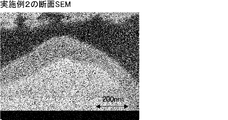
- the cross-sectional SEM image of the magnetic powder of Example 2 is shown.
- a cross-sectional SEM image of the magnetic powder of Comparative Example 1 is shown.
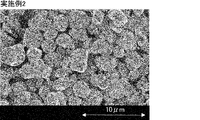
- the SEM image of the magnetic powder of Example 2 is shown.
- the SEM image of the magnetic powder of Comparative Example 3 is shown.
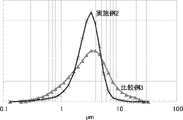
- the particle size distribution of the magnetic powder of Example 2 and Comparative Example 3 is shown.
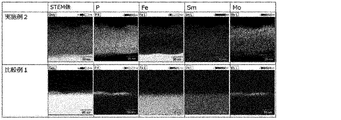
- the STEM-EDX mapping analysis result of the magnetic powder of Example 2 and Comparative Example 1 is shown.
- the result of EDX line analysis of the magnetic powder of Example 2 is shown.
- the result of EDX line analysis of the magnetic powder of Comparative Example 1 is shown.
- an inorganic acid is added to a slurry containing SmFeN-based anisotropic magnetic powder, water, and a phosphoric acid compound to add an inorganic acid to the pH of the slurry. It is characterized by including a phosphoric acid treatment step of obtaining a SmFeN-based anisotropic magnetic powder having a surface coated with a phosphate by adjusting the amount to 1 or more and 4.5 or less.
- [Phosphoric acid treatment process] In the phosphoric acid treatment step, an inorganic acid is added to the slurry containing the SmFeN-based anisotropic magnetic powder, water, and a phosphoric acid compound to adjust the pH of the slurry to 1 or more and 4.5 or less on the surface.
- a Phosphate-coated SmFeN-based anisotropic magnetic powder is obtained.
- the phosphate-coated SmFeN-based anisotropic magnetic powder is a phosphate obtained by reacting a metal component (for example, iron or samarium) contained in the SmFeN-based anisotropic magnetic powder with a phosphoric acid component contained in a phosphoric acid compound.
- iron phosphate for example, iron phosphate, samarium phosphate
- SmFeN-based anisotropic magnetic powder by adding an inorganic acid to adjust the pH of the slurry to 1 or more and 4.5 or less, the amount of the phosphate precipitated can be increased as compared with the case where the inorganic acid is not added. Since a phosphate-coated SmFeN-based anisotropic magnetic powder having a thick coating portion can be obtained, it is considered that the coercive force (iHc) is improved.
- iHc coercive force
- the solvent when the solvent is water, a phosphate having a smaller particle size is precipitated as compared with the case where the solvent is an organic solvent, so that the coating portion is densely coated with a phosphate-coated SmFeN system. It is considered that a square magnetic powder is obtained and the coercive force (iHc) is improved.
- the method for producing a slurry containing the SmFeN-based anisotropic magnetic powder, water, and the phosphoric acid compound is not particularly limited, but for example, an aqueous phosphate solution containing the SmFeN-based anisotropic magnetic powder and the phosphoric acid compound using water as a solvent. And can be obtained by mixing.
- the content of the SmFeN-based anisotropic magnetic powder in the slurry is, for example, 1% by mass or more and 50% by mass or less, and preferably 5% by mass or more and 20% by mass or less from the viewpoint of productivity.
- the content of the phosphoric acid component ( PO 4 ) in the slurry is, for example, 0.01% by mass or more and 10% by mass or less in terms of PO4, in terms of reactivity and productivity between the metal component and the phosphoric acid component. It is preferably 0.05% by mass or more and 5% by mass or less.
- the phosphoric acid aqueous solution is obtained by mixing a phosphoric acid compound and water.
- the phosphoric acid compound include phosphates such as orthophosphoric acid, sodium dihydrogen phosphate, sodium monohydrogen phosphate, ammonium dihydrogen phosphate, ammonium monohydrogen phosphate, zinc phosphate, and calcium phosphate, and hypophosphite.
- examples thereof include organic phosphoric acid such as acid-based, hypophosphite-based, pyrophosphoric acid-based, and polyphosphoric acid-based inorganic phosphoric acid. Only one of these may be used, or two or more thereof may be used in combination.
- oxo acid salts such as molybdenate, tungstate, vanadinate and chromate, sodium nitrate, sodium nitrite, etc.
- An oxidizing agent or the like, a chelating agent such as EDTA can be used as an additive.
- the concentration of phosphoric acid ( PO4 equivalent amount) in the phosphoric acid aqueous solution is, for example, 5% by mass or more and 50% by mass or less, and 10% by mass from the viewpoint of solubility of the phosphoric acid compound, storage stability and ease of chemical conversion treatment. It is preferably 30% by mass or less.
- the pH of the phosphoric acid aqueous solution is, for example, 1 or more and 4.5 or less, and preferably 1.5 or more and 4 or less from the viewpoint of easily controlling the precipitation rate of the phosphate.
- the pH can be adjusted with dilute hydrochloric acid, dilute sulfuric acid, or the like.
- the pH of the slurry is adjusted to 1 or more and 4.5 or less by adding an inorganic acid, but it is preferably adjusted to 1.6 or more and 3.9 or less, and adjusted to 2 or more and 3 or less. It is more preferable to do so.
- the pH is lower than 1, the phosphate-coated SmFeN-based anisotropic magnetic powders tend to aggregate with each other starting from the phosphate deposited in a large amount locally, and the coercive force tends to decrease. If the pH exceeds 4.5, the amount of phosphate deposited decreases, so that the coating becomes insufficient and the coercive force tends to decrease.
- inorganic acid to be added examples include hydrochloric acid, nitric acid, sulfuric acid, boric acid, and hydrofluoric acid.
- an inorganic acid is added at any time so as to be within the above pH range.
- Inorganic acids are used from the viewpoint of waste liquid treatment, but organic acids can be used in combination depending on the purpose. Examples of the organic acid include acetic acid, formic acid, tartaric acid and the like.
- the phosphoric acid treatment step may be carried out so that the lower limit of the phosphate content in the obtained phosphate-coated SmFeN-based anisotropic magnetic powder is larger than 0.5% by mass.
- the lower limit of the phosphate content of the phosphate-coated SmFeN-based anisotropic magnetic powder obtained in the phosphoric acid treatment step is preferably 0.55% by mass or more, and preferably 0.75% by mass or more.
- the upper limit of the phosphate content is preferably 4.5% by mass or less, more preferably 2.5% by mass or less, and particularly preferably 2% by mass or less.
- the phosphate content of the magnetic powder is expressed in terms of PO 4 molecule equivalent measured by ICP emission spectroscopic analysis (ICP-AES).
- the Sm atomic concentration in the Sm high concentration region can be 1.02 times or more, preferably 1.05 times or more, preferably 1.1 times the Sm atomic concentration in the SmFeN-based anisotropic magnetic powder. The above is more preferable, and 1.2 times or more is further preferable.
- the Sm atomic concentration in the Sm high concentration region is preferably 3 times or less the Sm atomic concentration in the SmFeN-based anisotropic magnetic powder, for example.
- the Sm high concentration region is a region including a layer showing the maximum peak of P (phosphorus) in the STEM-EDX line analysis of the phosphate-coated SmFeN-based anisotropic magnetic powder.
- the thickness of the Sm high concentration region can be, for example, 5 nm or more, preferably 10 nm or more and 200 nm or less.
- the atomic concentration (atm%) of each element in the Sm high concentration region is determined by averaging the atomic concentration (atm%) in the phosphate coating portion in the STEM-EDX line analysis.
- the slurry containing the SmFeN-based anisotropic magnetic powder, water, and the phosphoric acid compound is adjusted to the pH range of 1 or more and 4.5 or less for 10 minutes or more, and from the viewpoint of reducing the portion where the thickness of the coating portion is thin. It is more preferable to carry out for 30 minutes or more.
- the pH control interval is short because the pH rises quickly, but as the coating progresses, the pH fluctuation gradually slows down and the inorganic acid input interval becomes longer, so the reaction end point is I can judge.
- the phosphate-coated SmFeN-based anisotropic magnetic powder may be subjected to an oxidation treatment, if necessary.
- an oxidation treatment By oxidizing the phosphate-coated SmFeN-based anisotropic magnetic powder, the surface of the SmFeN-based anisotropic magnetic powder of the base material coated with the phosphate is oxidized to form an iron oxide layer, and phosphorus is formed.
- the oxidation resistance of the salt-coated SmFeN-based anisotropic magnetic powder is improved.
- oxidation causes unfavorable redox reactions, decomposition reactions, and alterations on the surface of SmFeN particles when the phosphate-coated SmFeN-based anisotropic magnetic powder is exposed to high temperatures during the production of bonded magnets. It can be suppressed, and as a result, a magnet having high magnetic properties, particularly high intrinsic coercive force (iHc), can be obtained.
- iHc intrinsic coercive force
- the oxidation treatment is performed by heat-treating the SmFeN-based anisotropic magnetic powder after the phosphoric acid treatment in an oxygen-containing atmosphere.
- the reaction atmosphere preferably contains oxygen in an inert gas such as nitrogen or argon.
- the oxygen concentration is preferably 3% or more and 21% or less, and more preferably 3.5% or more and 10% or less.
- the temperature during the oxidation treatment is preferably 150 ° C. or higher and 250 ° C. or lower, and more preferably 170 ° C. or higher and 230 ° C. or lower. Below 150 ° C., the formation of the iron oxide layer is insufficient, and the oxidation resistance tends to decrease. If the temperature exceeds 250 ° C., an iron oxide layer is excessively formed, and the coercive force tends to decrease.
- the reaction time is preferably 3 hours or more and 10 hours or less.
- the phosphate-coated SmFeN-based anisotropic magnetic powder of the present embodiment is characterized by having a heat generation start temperature of 170 ° C. or higher in DSC and a phosphate content of more than 0.5% by mass.
- the phosphate-coated SmFeN-based anisotropic magnetic powder has a heat generation start temperature of 170 ° C. or higher, more preferably 200 ° C. or higher in DSC.
- the heat generation start temperature in DSC is a comprehensive evaluation of the density, thickness, oxidation resistance, etc. of the phosphate coating, and a high coercive force can be obtained when the temperature is 170 ° C. or higher.
- the heat generation start temperature in the DSC can be measured under the conditions described in the examples.
- the phosphate content of the phosphate-coated SmFeN-based anisotropic magnetic powder is the same as in the above-mentioned phosphoric acid treatment step.
- the phosphate-coated SmFeN-based anisotropic magnetic powder has a ratio of the diffraction peak intensity (I) on the (110) plane of ⁇ Fe to the peak intensity (II) on the (300) plane of the SmFeN-based magnetic powder in the XRD diffraction pattern.
- (I) / (II) is preferably 2.0 ⁇ 10 -2 or less, and more preferably 1.0 ⁇ 10 -2 or less.
- the diffraction peak intensity (I) on the (110) plane of ⁇ Fe represents the abundance of the impurity ⁇ Fe, and when the ratio (I) / (II) described above is 2.0 ⁇ 10 ⁇ 2 or less. , High coercive force can be obtained.
- the diffraction peak intensity in the XRD diffraction pattern can be measured under the conditions described in the examples.
- the phosphate-coated SmFeN-based anisotropic magnetic powder preferably has a carbon content of 1000 ppm or less, more preferably 800 ppm or less.
- the carbon content indicates the amount of organic impurities in the phosphate, and when the carbon content exceeds 1000 ppm, the phosphate-coated SmFeN-based anisotropic magnetic powder is exposed to a high temperature in the process of producing a bonded magnet. As a result, organic impurities are decomposed and defects are generated in the coating portion, so that the coercive force tends to decrease.
- the carbon content can be measured by the TOC method.
- the thickness of the phosphate-coated portion of the phosphate-coated SmFeN-based anisotropic magnetic powder is preferably 10 nm or more and 200 nm or less from the viewpoint of the coercive force of the phosphate-coated SmFeN-based anisotropic magnetic powder.
- the thickness of the phosphate-coated portion can be measured by performing a composition analysis on the cross section of the phosphate-coated SmFeN-based anisotropic magnetic powder by line analysis using EDX.
- the phosphate coating portion existing on the surface of the SmFeN-based anisotropic magnetic powder preferably has a region (Sm high concentration region) in which the Sm atomic concentration is higher than the Sm atomic concentration in the SmFeN-based anisotropic magnetic powder. ..
- the Sm atomic concentration in the Sm high concentration region can be 1.02 times or more, preferably 1.05 times or more, preferably 1.1 times the Sm atomic concentration in the SmFeN-based anisotropic magnetic powder. The above is more preferable, and 1.2 times or more is further preferable.
- the Sm atomic concentration in the Sm high concentration region can be, for example, three times or less the Sm atomic concentration in the SmFeN-based anisotropic magnetic powder.
- the Sm high concentration region is a region including a layer showing the maximum peak of P (phosphorus) in the STEM-EDX line analysis of the phosphate-coated SmFeN-based anisotropic magnetic powder.
- the thickness of the Sm high concentration region can be, for example, 5 nm or more, preferably 10 nm or more and 200 nm or less, and more preferably 10 nm or more and 100 nm or less.
- the atomic concentration (atm%) of each element in the Sm high concentration region is determined by averaging the atomic concentration (atm%) in the phosphate coating portion in the STEM-EDX line analysis.
- the Sm atom concentration in the Sm high concentration region is more preferably 0.5 times or more, and further preferably 1 time or more, the Fe atom concentration in the Sm high concentration region.
- the Sm atom concentration in the Sm high concentration region is preferably 4 times or less the Fe atom concentration in the Sm high concentration region.
- the Sm atom concentration in the Sm high concentration region is preferably higher than the Fe atom concentration.
- the phosphate coating portion may contain Mo. It is preferable that Mo in the phosphate-coated portion gradually increases from the outermost surface of the SmFeN-based anisotropic magnetic powder to the surface of the phosphate-coated portion.
- the Mo atom concentration on the surface of the phosphate-coated portion is preferably 1.2 times or more, more preferably 1.5 times or more, the Mo atom concentration on the outermost surface of the SmFeN-based anisotropic magnetic powder.
- the Fe atomic concentration in the phosphate-coated portion is preferably lower than the Fe atomic concentration in the SmFeN-based anisotropic magnetic powder which is the base material.
- the Fe atom concentration in the phosphate-coated portion is more preferably 0.3 times or less, and more preferably 0.1 times or less, the Fe atom concentration in the SmFeN-based anisotropic magnetic powder which is the base material. More preferred.
- the Fe atomic concentration in the phosphate-coated portion can be, for example, 0.05 times or more the Fe atomic concentration in the SmFeN-based anisotropic magnetic powder which is the base material.
- the SmFeN-based anisotropic magnetic powder after the phosphoric acid treatment may be subjected to silica treatment, if necessary.
- silica treatment By forming a silica thin film on the magnetic powder, oxidation resistance can be improved.
- the silica thin film can be formed, for example, by mixing an alkyl silicate, a phosphate-coated SmFeN-based anisotropic magnetic powder, and an alkaline solution.
- the magnetic powder after the silica treatment may be further treated with a silane coupling agent.
- a silane coupling agent film is formed on the silica thin film, improving the magnetic properties of the magnetic powder, as well as improving the wettability with the resin and the strength of the magnet. can do.
- the silane coupling agent may be selected according to the type of resin and is not particularly limited. For example, 3-aminopropyltriethoxysilane, ⁇ - (2-aminoethyl) aminopropyltrimethoxysilane, ⁇ - (2-).
- Aminoethyl Aminopropylmethyldimethoxysilane, ⁇ -methacryloxypropyltrimethoxysilane, ⁇ -methacryloxypropylmethyldimethoxysilane, N- ⁇ - (N-vinylbenzylaminoethyl) - ⁇ -aminopropyltrimethoxysilane hydrochloride , ⁇ -Glysidoxypropyltrimethoxysilane, ⁇ -mercaptopropyltrimethoxysilane, methyltrimethoxysilane, methyltriethoxysilane, vinyltriacetoxysilane, ⁇ -chloropropyltrimethoxysilane, hexamethylene disilazane, ⁇ -ani Renopropyltrimethoxysilane, vinyltrimethoxysilane, octadecyl [3- (trimethoxysilyl) propyl] ammonium chloride,
- the amount of the silane coupling agent added is preferably 0.2 parts by weight or more and 0.8 parts by weight or less, and more preferably 0.25 parts by weight or more and 0.6 parts by weight or less with respect to 100 parts by weight of the magnetic powder. If it is less than 0.2 parts by weight, the effect of the silane coupling agent is small, and if it exceeds 0.8 parts by weight, the magnetic properties of the magnetic powder and the magnet tend to be deteriorated due to the aggregation of the magnetic powder.
- the SmFeN-based anisotropic magnetic powder after the phosphoric acid treatment step, the oxidation step, the silica treatment, or the silane coupling treatment can be filtered, dehydrated, and dried by a conventional method.
- the SmFeN-based anisotropic magnetic powder used in the phosphoric acid treatment step is not particularly limited, but is, for example, a step of mixing a solution containing Sm and Fe and a precipitant to obtain a precipitate containing Sm and Fe (precipitation step).
- a step of heat-treating the oxide in a reducing gas-containing atmosphere to obtain a partial oxide pretreatment step.
- Those manufactured by a method including the above can be preferably used.
- the Sm raw material and the Fe raw material are dissolved in a strongly acidic solution to prepare a solution containing Sm and Fe.
- the molar ratio of Sm and Fe (Sm: Fe) is preferably 1.5:17 to 3.0:17, and 2.0:17 to 2.5:17. Is more preferable.
- Raw materials such as La, W, Co, Ti, Sc, Y, Pr, Nd, Pm, Gd, Tb, Dy, Ho, Er, Tm, and Lu may be added to the above-mentioned solution.
- the Sm raw material and Fe raw material are not limited as long as they can be dissolved in a strongly acidic solution.
- samarium oxide can be mentioned as the Sm raw material
- FeSO4 can be mentioned as the Fe raw material.
- the concentration of the solution containing Sm and Fe can be appropriately adjusted within a range in which the Sm raw material and the Fe raw material are substantially dissolved in the acidic solution.
- the acidic solution include sulfuric acid in terms of solubility.
- the solution containing Sm and Fe may be a solution containing Sm and Fe at the time of reaction with the precipitating agent.
- the precipitating agent is not limited as long as it is an alkaline solution that reacts with a solution containing Sm and Fe to obtain a precipitate, and examples thereof include aqueous ammonia and caustic soda, and caustic soda is preferable.
- a method of dropping a solution containing Sm and Fe and a precipitating agent into a solvent such as water is preferable because the properties of the particles of the precipitate can be easily adjusted.
- the reaction temperature can be 0 to 50 ° C, preferably 35 to 45 ° C.
- the concentration of the reaction solution is preferably 0.65 mol / L to 0.85 mol / L, more preferably 0.7 mol / L to 0.84 mol / L, as the total concentration of the metal ions.
- the reaction pH is preferably 5 to 9, more preferably 6.5 to 8.
- the anisotropic magnetic powder particles obtained in the precipitation step roughly determine the powder particle size, powder shape, and particle size distribution of the finally obtained magnetic powder.
- the particle size of the obtained particles is measured by a laser diffraction type wet particle size distribution meter, the total powder has a size and distribution within the range of 0.05 to 20 ⁇ m, preferably 0.1 to 10 ⁇ m. Is preferable.
- the average particle size of the anisotropic magnetic powder particles is measured as a particle size corresponding to 50% of the cumulative volume from the small particle size side in the particle size distribution, and is preferably in the range of 0.1 to 10 ⁇ m.
- the precipitate After separating the precipitate, the precipitate is redissolved in the remaining solvent in the heat treatment of the subsequent oxidation step, and when the solvent evaporates, the precipitate aggregates and the particle size distribution, powder particle size, etc. change. It is preferable to desolvate the separated product in order to prevent the separation.
- Specific examples of the method for removing the solvent include, for example, when water is used as the solvent, a method of drying in an oven at 70 to 200 ° C. for 5 to 12 hours can be mentioned.
- a step of separating and washing the obtained precipitate may be included.
- the washing step is appropriately performed until the conductivity of the supernatant solution becomes 5 mS / m 2 or less.
- a step of separating the precipitate for example, a filtration method, a decantation method or the like can be used after adding a solvent (preferably water) to the obtained precipitate and mixing them.
- the oxidation step is a step of obtaining an oxide containing Sm and Fe by calcining the precipitate formed in the precipitation step.
- the precipitate can be converted into an oxide by heat treatment.
- the precipitate When the precipitate is heat-treated, it must be carried out in the presence of oxygen, for example, in the atmosphere of the atmosphere.
- the non-metal portion in the precipitate contains an oxygen atom.
- the heat treatment temperature (hereinafter referred to as the oxidation temperature) in the oxidation step is not particularly limited, but is preferably 700 to 1300 ° C, more preferably 900 to 1200 ° C. If the temperature is lower than 700 ° C., the oxidation becomes insufficient, and if the temperature exceeds 1300 ° C., the desired shape, average particle size and particle size distribution of the magnetic powder tend not to be obtained.
- the heat treatment time is not particularly limited, but 1 to 3 hours is preferable.
- the obtained oxide is an oxide particle in which sm and Fe are sufficiently microscopically mixed in the oxide particle, and the shape of the precipitate, the particle size distribution, and the like are reflected.
- the pretreatment step is a step of heat-treating an oxide containing Sm and Fe in a reducing gas atmosphere to obtain a partially reduced oxide.
- the partial oxide means an oxide in which a part of the oxide is reduced.
- the oxygen concentration of the oxide is not particularly limited, but is preferably 10% by mass or less, more preferably 8% by mass or less. If it exceeds 10% by mass, the reduction heat generation with Ca becomes large in the reduction step, and the firing temperature becomes high, so that particles with abnormal particle growth tend to be formed.
- the oxygen concentration of the partial oxide can be measured by the non-dispersed infrared absorption method (ND-IR).
- the reducing gas is appropriately selected from hydrocarbon gases such as hydrogen (H 2 ), carbon monoxide (CO), and methane (CH 4 ), but hydrogen gas is preferable in terms of cost, and the flow rate of the gas is oxidation. It is adjusted appropriately as long as the object does not scatter.
- the heat treatment temperature (hereinafter, pretreatment temperature) in the pretreatment step is in the range of 300 ° C. or higher and 950 ° C. or lower, preferably 400 ° C. or higher, more preferably 750 ° C. or higher, and preferably less than 900 ° C.
- the pretreatment temperature is 300 ° C. or higher, the reduction of the oxide containing Sm and Fe proceeds efficiently. Further, when the temperature is 950 ° C.
- the oxide particles are suppressed from growing and segregating, and the desired particle size can be maintained.
- hydrogen is used as the reducing gas, it is preferable to adjust the thickness of the oxide layer to be used to 20 mm or less, and further adjust the dew point in the reaction furnace to ⁇ 10 ° C. or less.
- the reduction step is a step of obtaining alloy particles by heat-treating the partial oxide at 920 ° C. or higher and 1200 ° C. or lower in the presence of a reducing agent.
- the partial oxide is combined with a calcium melt or calcium vapor.
- Reduction is performed by contact.
- the heat treatment temperature is preferably 950 ° C. or higher and 1150 ° C. or lower, and more preferably 980 ° C. or higher and 1100 ° C. or lower from the viewpoint of magnetic characteristics.
- the heat treatment time is preferably less than 120 minutes, more preferably less than 90 minutes, and the lower limit of the heat treatment time is preferably 10 minutes or more, more preferably 30 minutes or more, from the viewpoint of more uniform reduction reaction.
- Metallic calcium is used in the form of granules or powder, and the particle size thereof is preferably 10 mm or less. This makes it possible to more effectively suppress aggregation during the reduction reaction.
- metallic calcium is a reaction equivalent (a stoichiometric amount required to reduce Sm oxide, and if Fe is in the form of an oxide, it includes the amount required to reduce it). It can be added in an amount of 1.1 to 3.0 times, preferably 1.5 to 2.0 times.
- a disintegration accelerator can be used as needed together with the metallic calcium which is a reducing agent.
- This disintegration accelerator is appropriately used to promote disintegration and granulation of the product in the washing step described later.
- alkaline earth metal salts such as calcium chloride and alkaline soil such as calcium oxide. Examples include similar oxides.
- These disintegration accelerators are used in a proportion of 1 to 30% by mass, preferably 5 to 28% by mass, per Sm oxide used as a Sm source.
- the nitriding step is a step of obtaining anisotropic magnetic particles by nitriding the alloy particles obtained in the reduction step. Since the particulate precipitate obtained in the above-mentioned precipitation step is used, porous lumpy alloy particles can be obtained in the reduction step. As a result, nitriding can be performed uniformly by heat treatment in a nitrogen atmosphere immediately without performing pulverization treatment.
- the heat treatment temperature (hereinafter referred to as nitriding temperature) in the nitriding treatment of the alloy particles is preferably a temperature of 300 to 600 ° C., particularly preferably 400 to 550 ° C., and is carried out by replacing the atmosphere with a nitrogen atmosphere in this temperature range.
- the heat treatment time may be set so that the nitriding of the alloy particles is sufficiently uniform.
- the product obtained after the nitriding step contains CaO by-produced, unreacted metallic calcium, and the like in addition to the magnetic particles, and may be in a sintered mass state in which these are combined. Therefore, in that case, this product can be put into cooling water to separate CaO and metallic calcium from the magnetic particles as a calcium hydroxide (Ca (OH) 2) suspension. Further, the residual calcium hydroxide may be sufficiently removed by washing the magnetic particles with acetic acid or the like.
- the SmFeN-based anisotropic magnetic powder obtained by the above-mentioned production method has a Th 2 Zn 17 -type crystal structure, and has a general formula of Sm x Fe 100-xy Ny , which is a rare earth metal samarium Sm and iron. It is a nitride composed of Fe and nitrogen N.
- x is 8.1 atomic% or more and 10 atomic% or less
- y is 13.5 atomic% or more and 13.9 atomic% or less
- the balance is mainly Fe.
- the average particle size of the SmFeN-based anisotropic magnetic powder is preferably 2 ⁇ m or more and 5 ⁇ m or less, and more preferably 2.5 ⁇ m or more and 4.8 ⁇ m or less. If it is less than 2 ⁇ m, the filling amount of the magnetic powder in the bonded magnet becomes small, so that the magnetization decreases, and if it exceeds 5 ⁇ m, the coercive force of the bonded magnet tends to decrease.
- the average particle size is the particle size measured under dry conditions using a laser diffraction type particle size distribution measuring device.
- the particle size D10 of the SmFeN-based anisotropic magnetic powder is preferably 1 ⁇ m or more and 3 ⁇ m or less, and more preferably 1.5 ⁇ m or more and 2.5 ⁇ m or less. If it is less than 1 ⁇ m, the filling amount of the magnetic powder in the bonded magnet becomes small, so that the magnetization decreases, while if it exceeds 3 ⁇ m, the coercive force of the bonded magnet tends to decrease.
- D10 is a particle size corresponding to an integrated value of the particle size distribution based on the volume of the SmFeN-based anisotropic magnetic powder of 10%.
- the particle size D50 of the SmFeN-based anisotropic magnetic powder is preferably 2.5 ⁇ m or more and 5 ⁇ m or less, and more preferably 2.7 ⁇ m or more and 4.8 ⁇ m or less. If it is less than 2.5 ⁇ m, the filling amount of the magnetic powder in the bonded magnet becomes small, so that the magnetization decreases, and if it exceeds 5 ⁇ m, the coercive force of the bonded magnet tends to decrease.
- D50 is a particle size corresponding to an integrated value of the particle size distribution based on the volume of the SmFeN-based anisotropic magnetic powder of 50%.
- the particle size D90 of the SmFeN-based anisotropic magnetic powder is preferably 3 ⁇ m or more and 7 ⁇ m or less, and more preferably 4 ⁇ m or more and 6 ⁇ m or less. If it is less than 3 ⁇ m, the filling amount of the magnetic powder in the bonded magnet becomes small, so that the magnetization decreases, and if it exceeds 7 ⁇ m, the coercive force of the bonded magnet tends to decrease.
- D90 is a particle size corresponding to 90% of the integrated value of the particle size distribution based on the volume of the SmFeN-based anisotropic magnetic powder.
- Span (D90-D10) / D50 Is preferably 2 or less, more preferably 1.5 or less, from the viewpoint of coercive force.
- the particle size distribution of the magnetic powder used in the compound for bonded magnets is preferably monodisperse from the viewpoint of the squareness of the demagnetization characteristics.
- the circularity of the SmFeN-based anisotropic magnetic powder is not particularly limited, but is preferably 0.5 or more, and more preferably 0.6 or more. If it is less than 0.5, the fluidity deteriorates and stress is applied between the particles during molding, so that the magnetic properties deteriorate.
- the SEM image taken at 3000 times is binarized by image processing, and the circularity is obtained for one particle.
- the phosphate-coated SmFeN-based anisotropic magnetic powder of the present embodiment can be mainly used as a bonded magnet.
- the compound for a bond magnet is made of the magnetic powder of the present embodiment and a resin. By including this magnetic powder, a compound for a bonded magnet having high magnetic properties can be formed.
- the resin contained in the compound for a bonded magnet may be a thermosetting resin or a thermoplastic resin, but is preferably a thermoplastic resin.
- the thermoplastic resin include polyphenylene sulfide (PPS), polyetheretherketone (PEEK), liquid crystal polymer (LCP), polyamide (PA), polypropylene (PP), polyethylene (PE) and the like. ..
- the weight ratio (resin / magnetic powder) of the magnetic powder to the resin when obtaining the compound for a bonded magnet is preferably 0.08 to 0.15, and more preferably 0.09 to 0.13.
- the compound for a bond magnet can be obtained, for example, by mixing the magnetic powder and the resin at 180 to 300 ° C. using a kneader.
- a kneader For example, after mixing the magnetic powder and the resin powder with a mixer, the strands are extruded with a twin-screw extruder, air-cooled, and then cut into several mm sizes with a pelletizer to obtain a pellet-shaped compound for a bonded magnet.
- a bond magnet can be manufactured by using a compound for a bond magnet and an appropriate molding machine. Specifically, for example, a compound for a bond magnet melted in a molding machine barrel is injection-molded into a mold to which a magnetic field is applied, the easily magnetized axes are aligned (alignment step), cooled and solidified, and then an air-core coil or an air-core coil is used. A bonded magnet can be obtained by magnetizing with a magnetizing yoke (magnetization step).
- the barrel temperature is selected according to the type of resin used, and can be 160 ° C. to 320 ° C., and similarly, the mold temperature can be, for example, 30 to 150 ° C.
- the alignment magnetic field in the alignment step is generated by using an electromagnet or a permanent magnet, and the magnitude of the magnetic field is preferably 4 kOe or more, more preferably 6 kOe or more.
- the magnitude of the magnetizing magnetic field in the magnetizing step is preferably 20 kOe or more, and more preferably 30 kOe or more.
- the method for manufacturing the first bond magnet compound of the present embodiment is as follows.
- the magnetic powder or the magnetic powder obtained by the method for producing the additive for the bond magnet, the phosphate-coated SmFeN-based anisotropic magnetic powder, and the thermoplastic resin are kneaded and the magnetic powder in the compound for the bond magnet is kneaded. It is characterized by including a kneading step of obtaining a compound for a bonded magnet having a filling ratio of 91.5% by mass or more.
- thermoplastic resin When a bonded magnet containing a thermoplastic resin is manufactured by injection molding a kneaded thermoplastic resin and a thermocurable resin, the reactive group (for example, in the case of an epoxy resin, a glycisyl group) and heat of the thermoplastic resin are heat-molded.
- the reactive group of the plastic resin for example, the amide group in the case of nylon 12
- the fluidity of the resin may decrease and the moldability may deteriorate.
- the reactive group of the thermosetting resin is the reactive group of the curing agent (for example, in the case of DDS (diaminodiphenyl sulfone), it is sufficiently deactivated by the amino group), so that the reaction with the reactive group of the thermoplastic resin is unlikely to occur and the decrease in the fluidity of the resin can be suppressed.
- DDS diaminodiphenyl sulfone
- the bond magnet is manufactured by injection molding using the bond magnet compound prepared by the additive for bond magnet containing the thermoplastic resin of the present embodiment, the injection pressure can be reduced, so that the obtained bond magnet can be obtained. The magnetic properties of the are improved.
- thermosetting resin is not particularly limited as long as it is thermosetting, and for example, epoxy resin, phenol resin, urea resin, melamine resin, guanamine resin, unsaturated polyester resin, vinyl ester resin, diallyl phthalate resin, polyurethane resin, etc.
- examples thereof include silicone resin, polyimide resin, alkyd resin, furan resin, dicyclopentadiene resin, acrylic resin, and allyl carbonate resin.
- epoxy resin is preferable in terms of mechanical properties and heat resistance.
- the thermosetting resin is preferably a liquid at room temperature or a solid that dissolves in a solvent and becomes liquid.
- the curing agent is not particularly limited as long as it heat-cures the selected thermosetting resin, and when the thermosetting resin is an epoxy resin, for example, an amine-based curing agent, an acid anhydride-based curing agent, or a polyamide-based curing agent. , Imidazole-based curing agent, phenol resin-based curing agent, polyvinylcaptan resin-based curing agent, polysulfide resin-based curing agent, organic acid hydrazide-based curing agent, and the like.
- the amine-based curing agent include diaminodiphenyl sulfone, meta-phenylenediamine, diaminodiphenylmethane, diethylenetriamine, and triethylenetetramine.
- the blending amount of the curing agent is adjusted by the ratio of the number of reactive groups to the number of reactive groups of the thermosetting resin (the ratio of the equivalent amount of the curing agent to the equivalent amount of the thermosetting resin).
- the ratio of the number of reactive groups of the curing agent to the number of reactive groups of the thermosetting resin is 2 or more and 11 or less, preferably 2 or more and 10 or less, and more preferably 2 or more and 7 or less.
- the lower limit of the number of reactive groups is preferably more than 2.5, more preferably 3 or more. When the ratio exceeds 11, the mechanical properties of the bonded magnet deteriorate, and when it is less than 2, the ratio of the reactive group of the curing agent to the reactive group of the thermosetting resin is small, so that the reactive group of the thermosetting resin is small.
- the reactive group of the thermoplastic resin reacts with the reactive group of the residual thermosetting resin, which causes an increase in viscosity during injection molding and the formability of the bond magnet.
- the mechanical properties of the obtained molded product are worse than the moldability and mechanical properties of the thermoplastic resin alone.
- the equivalent of the thermosetting resin type means the number of grams of the resin containing 1 gram equivalent of the reactive group
- the equivalent of the curing agent type means the equivalent of active hydrogen.
- the cured product can be obtained by adding a curing agent to the above-mentioned thermosetting resin and heat-curing.
- the thermosetting temperature can be set according to the characteristics of the thermosetting resin to be used, but from the viewpoint of curability, it is preferably 60 ° C. or higher and 250 ° C. or lower, and more preferably 180 ° C. or higher and 220 ° C. or lower.
- the cured product can be pulverized if necessary.
- the method for pulverizing the cured product is not particularly limited, and a sample mill, a ball mill, a stamp mill, a mortar, a mixer pulverization, or the like can be used. If necessary, the crushed material can be classified by a sieve or the like.
- the average particle size of the pulverized product is preferably 1000 ⁇ m or less, more preferably 500 ⁇ m or less, from the viewpoint of compatibility with the thermoplastic resin.
- the additive for a bonded magnet can also be obtained by blending a curing accelerator together with a thermosetting resin and a curing agent and curing the mixture.
- the curing accelerator include 1,8-diazabicyclo (5,4,0) -undecene-7, 1,5 diazabicyclo (4,3,0) -nonene-5, 1-cyanoethyl-2-ethyl-4. -Methylimidazole, 2-methyl-4methylimidazole, triphenylphosphine, sulfonium salt and the like can be mentioned.
- the content of the curing accelerator is not particularly limited, but in general, 0.01% by mass or more and 10% by mass or less is added to the total amount of the thermosetting resin and the curing agent.
- the additive for the bond magnet, the magnetic powder, and the thermoplastic resin are melt-kneaded to prepare a compound for the bond magnet used for injection molding.
- the melt kneader is not particularly limited, but a single-screw kneader, a twin-screw kneader, a mixing roll, a kneader, a Banbury mixer, a meshing twin-screw extruder, a non-meshing twin-screw extruder, etc. shall be used. Can be done.
- the melt-kneading temperature is not particularly limited and can be set according to the characteristics of the thermoplastic resin used, but is preferably 180 ° C. or higher and 250 ° C. or lower.
- the thermoplastic resin is not particularly limited as long as it is an injection moldable resin, and is, for example, nylon resin (polyamide); polyolefins such as polypropylene (PP) and polyethylene (PE); polyester; polycarbonate (PC); polyphenylene sulfide (PPS). ; Polyetheretherketone (PEEK); Polyacetal (POM); Liquid crystal polymer (LCP) and the like.
- nylon resin polyamide
- polyolefins such as polypropylene (PP) and polyethylene (PE)
- PET polycarbonate
- PPS polyphenylene sulfide
- PEEK Polyetheretherketone
- POM Polyacetal
- LCP Liquid crystal polymer
- Nylon resins include polylactams such as 6 nylon, 11 nylon and 12 nylon, condensates of dicarboxylic acid and diamine such as 6,6 nylon, 6,10 nylon and 6,12 nylon, 6 nylon / 6, 6 Nylon, 6 Nylon / 6,10 Nylon, 6 Nylon / 12 Nylon, 6 Nylon / 6,12 Nylon, 6 Nylon / 6,10 Nylon / 6,10 Nylon, 6 Nylon / 6,6 Nylon / 6,12 Nylon , 6 Nylon / Polyether-like copolymerized polyamides, nylon 6T, nylon 9T, nylon MXD6, aromatic nylon, amorphous nylon and the like.
- nylon resin is preferable, and 12 nylon is particularly preferable, in view of the balance between low water absorption rate, moldability, and mechanical properties.
- the filling rate of the magnetic powder in the compound for a bonded magnet is 91.5% by mass or more, preferably 91.8% by mass or more, and 92. 2% by mass or more is more preferable.
- the upper limit is not particularly limited, but 93.2% by mass or less is preferable, 92.8% by mass or less is more preferable, and 92.5% by mass or less is further preferable. If it exceeds 93.2% by mass, the viscosity at the time of injection molding becomes high and the moldability deteriorates.
- the content of the additive for the bond magnet in the first compound for the bond magnet of the present embodiment is preferably 0.5% by mass or more and 4.2% by mass or less, and 0.9% by mass or more and 3.5% by mass or less. Is more preferable, and 0.9% by mass or more and 1.2% by mass or less is further preferable. If the content of the additive for the bond magnet exceeds 4.2% by mass, the residual magnetic flux density of the bond magnet becomes low, and if it is less than 0.5% by mass, the viscosity at the time of injection molding becomes high and the moldability deteriorates. Sometimes.
- the content of the thermoplastic resin in the first compound for a bonded magnet of the present embodiment is preferably 8.0% by mass or less, preferably 6.5% by mass or less.
- the lower limit is not particularly limited, but is preferably 4.2% by mass or more, and more preferably 5.5% by mass or more. If the amount of the thermoplastic resin added exceeds 8.0% by mass, the residual magnetic flux density of the bonded magnet becomes low, and if it is less than 4.2% by mass, the viscosity at the time of injection molding becomes high and the moldability deteriorates.
- the method for manufacturing the second bond magnet compound of the present embodiment is as follows.
- a step of kneading the additive for a bonded magnet and a thermoplastic resin to obtain a resin composition for a bonded magnet. Includes a kneading step of kneading the resin composition for a bonded magnet and the magnetic powder obtained by the method for producing a phosphate-coated SmFeN-based anisotropic magnetic powder or the magnetic powder to obtain a compound for a bonded magnet. It is characterized by that.
- the step of obtaining the additive for the bond magnet, the thermosetting resin and the curing agent used in the step are as described above.
- the kneading step for obtaining the resin composition for a bonded magnet, and the thermoplastic resin used in the step are as described above.
- a melt-kneaded product is obtained by melt-kneading.
- the thermoplastic resin and the cured product may be completely compatible, partially compatible or incompatible as long as they are previously melt-kneaded, but complete compatibility is particularly preferable.
- the melting point and the crystallization temperature are lowered.
- the injection pressure of the compound for the bond magnet is also reduced, the orientation ratio and magnetic characteristics of the obtained bond magnet are improved, and the coercive force is also improved.
- the melting point is preferably 3.0 ° C. or higher, more preferably 4.5 ° C. or higher, lower than the melting point of the thermoplastic resin.
- the crystallization temperature is preferably 2.0 ° C. or higher, more preferably 3.0 ° C. or higher, lower than the crystallization temperature of the thermoplastic resin.
- the melting point (peak top) of the resin composition for a bonded magnet is preferably 160 ° C. or higher and 177 ° C. or lower, and more preferably 170 ° C. or higher and 175 ° C. or lower. Further, the difference between the peak top of the melting peak and the final melting point is preferably more than 5.0 ° C, more preferably more than 5.5 ° C. Further, the calorific value of the melting peak is preferably 50 mJ / mg or more, more preferably 55 mJ / mg or more.
- the blending amount of the additive for the bond magnet is preferably 5% by mass or more and 50% by mass or less, and more preferably 10% by mass or more and 20% by mass or less in the resin composition composed of the additive for the bond magnet and the thermoplastic resin. If it exceeds 50% by mass, the filling rate of the magnetic powder decreases, and if it is less than 5% by mass, the effect of lowering the melting point and the crystallization temperature of the molten kneaded product is small, and the injection pressure at the time of forming the bond magnet is sufficiently reduced. Can't be done.
- the step of obtaining the compound for the bond magnet and the magnetic powder used in the step are as described above.
- the filling rate of the magnetic powder in the compound for a bonded magnet is preferably 75% by mass or more and 94% by mass or less, and 90% by mass or more and 93.5% by mass or less. Is more preferable. If it exceeds 94% by mass, the viscosity at the time of injection molding becomes high and the moldability deteriorates, and if it is less than 75% by mass, the residual magnetic flux density of the bonded magnet becomes low.
- the content of the resin composition for a bonded magnet in the second compound for a bonded magnet of the present embodiment is preferably 6% by mass or more and 25% by mass or less, and more preferably 6.5% by mass or more and 10% by mass or less.
- the content of the resin composition for a bond magnet exceeds 25% by mass, the residual magnetic flux density of the bond magnet becomes low, and when it is less than 6% by mass, the viscosity at the time of injection molding becomes high and the moldability deteriorates.
- the compound for a bonded magnet of the present embodiment is obtained by the above-mentioned manufacturing method.
- the method for manufacturing the first bonded magnet of the present embodiment is as follows.
- the magnetic powder or the magnetic powder obtained by the method for producing the additive for the bond magnet, the phosphate-coated SmFeN-based anisotropic magnetic powder, and the thermoplastic resin are kneaded and the magnetic powder in the compound for the bond magnet is kneaded.
- the method for manufacturing the second bonded magnet of the present embodiment is as follows.
- the step of obtaining the additive for the bonded magnet and the kneading step of obtaining the compound for the bonded magnet are as described above.
- a compound for a bond magnet is injection molded to obtain an injection molded product.
- the cylinder temperature of the injection molding machine may be in the temperature range in which the compound for the bond magnet melts, and is preferably 260 ° C. or lower from the viewpoint of suppressing magnetic deterioration due to heat of the magnetic powder.
- the injection pressure may be any pressure as long as the molten compound can be injected. For example, when the cylinder temperature of an injection molding machine is set to 230 ° C. and injection molding is performed into a cavity having a diameter of 10 mm and a thickness of 7 mm, the injection pressure is completely filled at less than 250 MPa from the viewpoint of moldability. It is preferable to be able to do it.
- the first bonded magnet of the present embodiment is obtained by, for example, the method for manufacturing the first bonded magnet of the present embodiment described above, contains an additive for a bonded magnet, a magnetic powder, and a thermoplastic resin, and is filled with the magnetic powder.
- the ratio is 91.5% by mass or more.
- the first bond magnet is manufactured with a low injection pressure by using a highly fluid bond magnet compound containing an additive for the bond magnet, so that magnetic deterioration of the magnetic powder due to injection molding is suppressed. The magnetic properties of the bonded magnet are improved.
- the filling rate of the magnetic powder in the bonded magnet is 91.5% by mass or more, preferably 91.8% by mass or more, and more preferably 92.2% by mass or more. ..
- the upper limit is not particularly limited, but 93.2% by mass or less is preferable, 92.8% by mass or less is more preferable, and 92.5% by mass or less is further preferable. If it exceeds 93.2% by mass, the viscosity at the time of injection molding becomes high and the moldability deteriorates.
- the content of the additive for the bond magnet in the bond magnet is preferably 0.5% by mass or more and 4.2% by mass or less, and 0.9% by mass or more and 3.5% by mass or less. % Or less is more preferable, and 0.9% by mass or more and 1.2% by mass or less is further preferable. If the content of the additive for the bond magnet exceeds 4.2% by mass, the residual magnetic flux density of the bond magnet becomes low, and if it is less than 0.5% by mass, the viscosity at the time of injection molding becomes high and the moldability deteriorates. ..
- the content of the thermoplastic resin in the bonded magnet is preferably 8.0% by mass or less, preferably 6.5% by mass or less.
- the lower limit is not particularly limited, but is preferably 4.2% by mass or more, and more preferably 5.5% by mass or more. If the amount of the thermoplastic resin added exceeds 8.0% by mass, the residual magnetic flux density of the bonded magnet becomes low, and if it is less than 4.2% by mass, the viscosity at the time of injection molding becomes high and the moldability deteriorates.
- the orientation ratio in the first bonded magnet of the present embodiment is not particularly limited, but is preferably 98.3% or more, and more preferably 99% or more.
- the residual magnetic flux density in the first bonded magnet of the present embodiment is not particularly limited, but when the magnetic powder is SmFeN-based, 0.81 T or more is preferable, and 0.82 T or more is more preferable.
- a high residual magnetic flux density can be achieved by using the resin additive for a bonded magnet of the present embodiment.
- the coercive force of the first bonded magnet of the present embodiment is not particularly limited, but is preferably 1100 kA / m or more, and more preferably 1200 kA / m or more.
- a high coercive force can be achieved by using the resin additive for a bonded magnet of the present embodiment.
- the first bond magnet of the present embodiment is manufactured by kneading the additive for the bond magnet, the magnetic powder and the thermoplastic resin, the additive for the bond magnet and the magnetic powder are present independently of each other. become.
- the second bond magnet of the present embodiment is obtained by, for example, the above-mentioned method for producing the second bond magnet of the present embodiment, and is characterized by containing a resin composition for a bond magnet and a magnetic powder.
- the second bond magnet is produced by using a highly fluid bond magnet compound containing a resin composition for a bond magnet with a low injection pressure, so that magnetic deterioration of the magnetic powder due to injection molding is suppressed. , The magnetic properties of the bonded magnet are improved.
- the filling rate of the magnetic powder in the bonded magnet is preferably 75% by mass or more and 94% by mass or less, and more preferably 90% by mass or more and 93.5% by mass or less. If it exceeds 94% by mass, the viscosity at the time of injection molding becomes high and the moldability deteriorates, and if it is less than 75% by mass, the residual magnetic flux density of the bonded magnet becomes low.
- the content of the resin composition for the bond magnet in the bond magnet is preferably 6% by mass or more and 25% by mass or less, and more preferably 6.5% by mass or more and 10% by mass or less. ..
- the content of the resin composition for a bond magnet exceeds 25% by mass, the residual magnetic flux density of the bond magnet becomes low, and when it is less than 6% by mass, the viscosity at the time of injection molding becomes high and the moldability deteriorates.
- the orientation ratio in the second bonded magnet of the present embodiment is not particularly limited, but is preferably 98.3% or more, and more preferably 99% or more.
- the residual magnetic flux density in the second bonded magnet of the present embodiment is not particularly limited, but when the magnetic powder is SmFeN-based, 0.81 T or more is preferable, and 0.82 T or more is more preferable.
- a high residual magnetic flux density can be achieved by using the resin composition for a bonded magnet of the present embodiment containing a cured product of a thermosetting resin and a curing agent and a melt-kneaded product of a thermoplastic resin. ..
- the coercive force of the second bonded magnet of the present embodiment is not particularly limited, but is preferably 1150 kA / m or more, and more preferably 1200 kA / m or more.
- a high coercive force can be achieved by using the resin composition for a bonded magnet of the present embodiment, which contains a cured product of a thermosetting resin and a curing agent, and a melt-kneaded product of a thermoplastic resin.
- the second bond magnet of the present embodiment is produced by kneading the resin composition for the bond magnet and the magnetic powder, the resin composition for the bond magnet and the magnetic powder are present independently of each other. ..
- Example 1 FeSO 4.7H 2 O 5.0 kg was mixed and dissolved in 2.0 kg of pure water. Further, 0.49 kg of Sm 2 O 3 and 0.74 kg of 70% sulfuric acid were added and stirred well to completely dissolve them. Next, pure water was added to the obtained solution to adjust the Fe concentration to 0.726 mol / L and the Sm concentration to 0.112 mol / L to prepare a SmFe sulfuric acid solution.
- Example 2 As the phosphoric acid treatment solution, a solution having a pH adjusted to 2.5 was prepared, and the same method as in Example 1 was used except that the pH of the phosphoric acid treatment reaction slurry was controlled in the range of 2.5 ⁇ 0.1. A phosphate-coated SmFeN-based anisotropic magnetic powder was obtained.
- Example 3 As a phosphoric acid treatment solution, a solution having a pH adjusted to 3 was prepared, and phosphoric acid was prepared by the same method as in Example 1 except that the pH of the phosphoric acid treatment reaction slurry was controlled in the range of 3.0 ⁇ 0.1. A salt-coated SmFeN-based anisotropic magnetic powder was obtained.
- Example 4 As the phosphoric acid treatment solution, a solution having a pH adjusted to 3.5 was prepared, and the same method as in Example 1 was used except that the pH of the phosphoric acid treatment reaction slurry was controlled in the range of 3.5 ⁇ 0.1. A phosphate-coated SmFeN-based anisotropic magnetic powder was obtained.
- Example 5 As the phosphoric acid treatment solution, a solution having a pH adjusted to 1.5 was prepared, and the same method as in Example 1 was used except that the pH of the phosphoric acid treatment reaction slurry was controlled in the range of 1.5 ⁇ 0.1. A phosphate-coated SmFeN-based anisotropic magnetic powder was obtained.
- Example 6 As a phosphoric acid treatment solution, a solution having a pH adjusted to 4 was prepared, and phosphoric acid was prepared by the same method as in Example 1 except that the pH of the phosphoric acid treatment reaction slurry was controlled in the range of 4.0 ⁇ 0.1. A salt-coated SmFeN-based anisotropic magnetic powder was obtained.
- Comparative Example 1 The washing step was carried out in the same manner as in Example 1 to obtain a magnetic powder.
- a preparation having an adjusted concentration of 20% by mass was prepared.
- Comparative Example 2 A phosphate-coated SmFeN-based anisotropic magnetic powder was obtained in the same manner as in Comparative Example 1 except that the pH of the phosphoric acid-treated solution was adjusted to 3.5. Here, the pH of the phosphoric acid treatment reaction slurry increased from 3.5 to 6 over 15 minutes.
- Comparative Example 3 [Reduction step 2] A pit filled with 52.5 g of iron powder having an average particle size (D50) of about 50 ⁇ m, 21.3 g of samarium oxide powder having an average particle size (D50) of 3 ⁇ m, and 10.5 g of metallic calcium is placed in a furnace. rice field. After evacuating the inside of the furnace, argon gas (Ar gas) was introduced. Fe—Sm alloy particles were obtained by raising the temperature to 1150 ° C. and holding for 5 hours.
- argon gas Ar gas
- IPA isopropanol
- DSC heat generation start temperature 20 mg of the phosphate-coated SmFeN-based anisotropic magnetic powder obtained in Examples 1 to 6 and Comparative Examples 1 to 3 was weighed, and a high-temperature differential scanning heat analyzer (DSC6300, manufactured by Hitachi High-Tech Science Co., Ltd.) was used. , Air atmosphere (200 mL / min), room temperature to 400 ° C. (heating rate: 20 ° C./min), reference: alumina (20 mg), DSC analysis was performed, and the heat generation start temperature was measured. The DSC results are shown in Table 1.
- the high heat generation start temperature means that the phosphoric acid coating is formed more densely because heat generation due to oxidation is unlikely to occur.
- Total carbon content The total carbon (TC) content in the phosphate-coated SmFeN-based anisotropic magnetic powders obtained in Examples 1 to 6 and Comparative Examples 1 to 3 was measured by using a combustion-catalyzed oxidation-type total organic carbon (TOC) meter (Shimadzu). Mfg. Co., Ltd .; Model: SSM-5000A) was used for measurement. The results are shown in Table 1.
- Example 2 (SEM analysis) Cross-sectional SEM images of the magnetic powders obtained in Example 2 and Comparative Example 1 are shown in FIGS. 1 and 2.
- Example 2 a thick phosphate coating was formed on the surface of the SmFeN-based anisotropic magnetic powder as compared with Comparative Example 1.
- FIGS. 3 and 4 SEM images of the magnetic powders obtained in Example 2 and Comparative Example 3 are shown in FIGS. 3 and 4. Further, the particle size of the magnetic powder was measured under dry conditions using a laser diffraction type particle size distribution measuring device, and the results are shown in FIG. The vertical axis of FIG. 5 shows the frequency distribution on a volume basis. In Comparative Example 3, since the pulverization was performed in parallel with the phosphoric acid treatment, the uniformity of the particle size distribution was inferior. In Example 2, a magnetic powder having a uniform particle size was obtained.
- Example 2 The magnetic powder powders obtained in Example 2 and Comparative Example 1 were dispersed in an epoxy resin and solidified, and then cross-sectioned with a cross-section polisher to obtain a cross-section sample for measurement.
- the obtained sample was measured with a STEM image (acceleration voltage 200 kV) with a scanning transmission electron microscope (STEM; manufactured by JEOL) / energy dispersive X-ray analyzer (EDX; manufactured by JEOL).
- FIG. 6 shows the STEM-EDX mapping analysis results (elements: P, Fe, Sm, Mo).
- FIGS. 7 and 8 For the magnetic powders obtained in Example 2 and Comparative Example 1, EDX line analysis corresponding to the arrow portion of the phosphate-coated portion / SmFeN-based anisotropic magnetic powder interface is shown in FIGS. 7 and 8.
- FIG. 7 in the magnetic powder of Example 2, a region where the atomic ratios of Sm and N are almost the same is observed over a distance of 65 nm to 80 nm, which corresponds to the SmFeN-based anisotropic magnetic powder which is the base material. Conceivable.
- Example 7 [Oxidation process after phosphoric acid treatment] 1000 g of the phosphate-coated SmFeN-based anisotropic magnetic powder obtained in Example 2 was gradually heated from room temperature in an atmosphere of a mixed gas of nitrogen and air (oxygen concentration 4%, 5 L / min), and the maximum temperature was 170. Heat treatment was carried out at ° C. for 8 hours to obtain an oxidation-treated SmFeN-based anisotropic magnetic powder.
- Example 8 The same procedure as in Example 7 was carried out except that the heat treatment temperature in the oxidation treatment step was changed from 170 ° C. to 200 ° C. to obtain an oxidation-treated SmFeN-based anisotropic magnetic powder.
- Example 9 The same procedure as in Example 7 was carried out except that the heat treatment temperature in the oxidation treatment step was changed from 170 ° C. to 230 ° C. to obtain an oxidation-treated SmFeN-based anisotropic magnetic powder.
- Comparative Example 4 [Oxidation process after phosphoric acid treatment] 1000 g of the phosphate-coated SmFeN-based anisotropic magnetic powder obtained in Comparative Example 1 was gradually heated from room temperature in an atmosphere of a mixed gas of nitrogen and air (oxygen concentration 4%, 5 L / min), and the maximum temperature was 170. Heat treatment was carried out at ° C. for 8 hours to obtain an oxidation-treated SmFeN-based anisotropic magnetic powder.
- Comparative Example 5 [Oxidation process after phosphoric acid treatment] 15 g of the phosphate-coated SmFeN-based anisotropic magnetic powder obtained in Comparative Example 3 was gradually heated from room temperature in an atmosphere of a mixed gas of nitrogen and air (oxygen concentration 4%, 5 L / min), and the maximum temperature was 150. Heat treatment was carried out at ° C. for 8 hours to obtain an oxidation-treated SmFeN-based anisotropic magnetic powder.
- Example 2 and Comparative Examples 1 and 3 were also treated under the same conditions to form a silica thin film on the particle surface. Magnetic powders were obtained (referred to as Example 10, Comparative Example 6 and Comparative Example 7, respectively).
- the bond magnets obtained in Examples 7, 8, 9 and 10 had higher coercive force than the bond magnets obtained in Comparative Examples 4, 5, 6 and 7. Further, the bond magnets obtained in Examples 7, 8 and 9 which were subjected to the oxidation treatment after forming the phosphoric acid coating had a higher coercive force than that of Example 10. Since the pH of the magnetic powder of Comparative Example 4 was not adjusted at the time of forming the phosphoric acid coating, even if the oxidation treatment was performed after the formation of the phosphoric acid coating, the improvement of the coercive force in the bonded magnet was slight as compared with Comparative Example 6. Similarly, in Comparative Example 5, the improvement in the coercive force of the bonded magnet was slight as compared with Comparative Example 7. From this, it was confirmed that the effect of the oxidation treatment was remarkable for the SmFeN-based magnetic powder treated with phosphoric acid under predetermined conditions.
- a phosphate-coated SmFeN-based anisotropic magnetic powder having an excellent coercive force can be obtained.
- the obtained magnetic powder can be used as a sintered magnet or a bonded magnet.
Landscapes
- Engineering & Computer Science (AREA)
- Chemical & Material Sciences (AREA)
- Power Engineering (AREA)
- Inorganic Chemistry (AREA)
- Crystallography & Structural Chemistry (AREA)
- Organic Chemistry (AREA)
- Manufacturing & Machinery (AREA)
- Chemical Kinetics & Catalysis (AREA)
- Life Sciences & Earth Sciences (AREA)
- General Life Sciences & Earth Sciences (AREA)
- Geology (AREA)
- Mechanical Engineering (AREA)
- General Chemical & Material Sciences (AREA)
- Hard Magnetic Materials (AREA)
- Powder Metallurgy (AREA)
Priority Applications (4)
| Application Number | Priority Date | Filing Date | Title |
|---|---|---|---|
| US18/253,534 US20240006101A1 (en) | 2020-11-18 | 2021-09-30 | PRODUCTION METHOD FOR PHOSPHATE-COATED SmFeN-BASED ANISOTROPIC MAGNETIC POWDER AND PHOSPHATE-COATED SmFeN-BASED ANISOTROPIC MAGNETIC POWDER |
| JP2022563611A JPWO2022107461A1 (https=) | 2020-11-18 | 2021-09-30 | |
| CN202180077501.8A CN116508122A (zh) | 2020-11-18 | 2021-09-30 | 磷酸盐包覆SmFeN系各向异性磁性粉末的制造方法以及磷酸盐包覆SmFeN系各向异性磁性粉末 |
| DE112021006092.9T DE112021006092T5 (de) | 2020-11-18 | 2021-09-30 | Verfahren zur Herstellung eines phosphatbeschichteten anisotropen magnetischen Pulvers auf SmFeN-Basis und phosphatbeschichtetes anisotropes magnetisches Pulver auf SmFeN-Basis |
Applications Claiming Priority (6)
| Application Number | Priority Date | Filing Date | Title |
|---|---|---|---|
| JP2020-191743 | 2020-11-18 | ||
| JP2020191743 | 2020-11-18 | ||
| JP2020-192544 | 2020-11-19 | ||
| JP2020192544 | 2020-11-19 | ||
| JP2020201164 | 2020-12-03 | ||
| JP2020-201164 | 2020-12-03 |
Publications (1)
| Publication Number | Publication Date |
|---|---|
| WO2022107461A1 true WO2022107461A1 (ja) | 2022-05-27 |
Family
ID=81708899
Family Applications (1)
| Application Number | Title | Priority Date | Filing Date |
|---|---|---|---|
| PCT/JP2021/036175 Ceased WO2022107461A1 (ja) | 2020-11-18 | 2021-09-30 | リン酸塩被覆SmFeN系異方性磁性粉末の製造方法およびリン酸塩被覆SmFeN系異方性磁性粉末 |
Country Status (4)
| Country | Link |
|---|---|
| US (1) | US20240006101A1 (https=) |
| JP (1) | JPWO2022107461A1 (https=) |
| DE (1) | DE112021006092T5 (https=) |
| WO (1) | WO2022107461A1 (https=) |
Families Citing this family (1)
| Publication number | Priority date | Publication date | Assignee | Title |
|---|---|---|---|---|
| CN115910587A (zh) * | 2022-12-20 | 2023-04-04 | 横店集团东磁股份有限公司 | 一种钐铁氮磁粉的改性方法 |
Citations (5)
| Publication number | Priority date | Publication date | Assignee | Title |
|---|---|---|---|---|
| JP2002043109A (ja) * | 2000-07-19 | 2002-02-08 | Nichia Chem Ind Ltd | 希土類−鉄−窒素系磁粉の表面処理方法及びそれを用いたプラスチック磁石 |
| JP2002075767A (ja) * | 2000-08-31 | 2002-03-15 | Sumitomo Special Metals Co Ltd | 耐食性被膜を有する希土類系永久磁石およびその製造方法 |
| JP2017210662A (ja) * | 2016-05-26 | 2017-11-30 | 国立大学法人東北大学 | 磁石合金粉の製造方法 |
| JP6780693B2 (ja) * | 2018-01-22 | 2020-11-04 | 日亜化学工業株式会社 | ボンド磁石およびボンド磁石用コンパウンドの製造方法 |
| WO2021014837A1 (ja) * | 2019-07-22 | 2021-01-28 | 日亜化学工業株式会社 | ボンド磁石用添加剤およびボンド磁石用コンパウンドの製造方法 |
Family Cites Families (4)
| Publication number | Priority date | Publication date | Assignee | Title |
|---|---|---|---|---|
| JP2002008911A (ja) * | 2000-06-22 | 2002-01-11 | Nichia Chem Ind Ltd | 希土類−鉄−窒素系磁粉の表面処理方法及びそれを用いたプラスチック磁石 |
| JP5974975B2 (ja) | 2012-06-20 | 2016-08-23 | 住友金属鉱山株式会社 | 希土類−遷移金属−窒素系磁石微粉末及びその製造方法 |
| US11440091B2 (en) * | 2018-01-22 | 2022-09-13 | Nichia Corporation | Methods of producing bonded magnet and compound for bonded magnets |
| JP7417038B2 (ja) | 2018-09-26 | 2024-01-18 | 日亜化学工業株式会社 | 希土類磁性粉末の製造方法 |
-
2021
- 2021-09-30 JP JP2022563611A patent/JPWO2022107461A1/ja active Pending
- 2021-09-30 WO PCT/JP2021/036175 patent/WO2022107461A1/ja not_active Ceased
- 2021-09-30 US US18/253,534 patent/US20240006101A1/en active Pending
- 2021-09-30 DE DE112021006092.9T patent/DE112021006092T5/de active Pending
Patent Citations (5)
| Publication number | Priority date | Publication date | Assignee | Title |
|---|---|---|---|---|
| JP2002043109A (ja) * | 2000-07-19 | 2002-02-08 | Nichia Chem Ind Ltd | 希土類−鉄−窒素系磁粉の表面処理方法及びそれを用いたプラスチック磁石 |
| JP2002075767A (ja) * | 2000-08-31 | 2002-03-15 | Sumitomo Special Metals Co Ltd | 耐食性被膜を有する希土類系永久磁石およびその製造方法 |
| JP2017210662A (ja) * | 2016-05-26 | 2017-11-30 | 国立大学法人東北大学 | 磁石合金粉の製造方法 |
| JP6780693B2 (ja) * | 2018-01-22 | 2020-11-04 | 日亜化学工業株式会社 | ボンド磁石およびボンド磁石用コンパウンドの製造方法 |
| WO2021014837A1 (ja) * | 2019-07-22 | 2021-01-28 | 日亜化学工業株式会社 | ボンド磁石用添加剤およびボンド磁石用コンパウンドの製造方法 |
Also Published As
| Publication number | Publication date |
|---|---|
| US20240006101A1 (en) | 2024-01-04 |
| JPWO2022107461A1 (https=) | 2022-05-27 |
| DE112021006092T5 (de) | 2023-10-05 |
Similar Documents
| Publication | Publication Date | Title |
|---|---|---|
| JP7846379B2 (ja) | リン酸塩被覆SmFeN系異方性磁性粉末の製造方法、およびボンド磁石 | |
| CN102300655B (zh) | 经表面处理的稀土磁性粉末、含有该稀土磁性粉末的粘结磁体用树脂组合物以及粘结磁体 | |
| WO1999033597A1 (en) | Sm-Fe-N ALLOY POWDER AND PROCESS FOR THE PRODUCTION THEREROF | |
| JP6303366B2 (ja) | 磁性粒子の製造方法、及び磁性粒子 | |
| JP7335515B2 (ja) | ボンド磁石用コンパウンドの製造方法 | |
| WO2022107461A1 (ja) | リン酸塩被覆SmFeN系異方性磁性粉末の製造方法およびリン酸塩被覆SmFeN系異方性磁性粉末 | |
| US20240274335A1 (en) | SmFeN-BASED ANISOTROPIC MAGNETIC POWDER AND BONDED MAGNET, AND PRODUCTION METHODS THEREOF | |
| JP5110296B2 (ja) | Sm−Fe−N系磁性粒子粉末の製造法、Sm−Fe−N系磁性粒子粉末を含有するボンド磁石用樹脂組成物並びにボンド磁石 | |
| JP4623308B2 (ja) | ボンド磁石用Sm−Fe−N系磁性粒子粉末及びその製造法、ボンド磁石用樹脂組成物並びにボンド磁石 | |
| JP7817529B2 (ja) | リン酸塩被覆SmFeN系異方性磁性粉末の製造方法、およびリン酸塩被覆SmFeN系異方性磁性粉末 | |
| JP5019037B2 (ja) | Sm−Fe−N系磁性粒子粉末及びその製造法、Sm−Fe−N系磁性粒子粉末を含有するボンド磁石用樹脂組成物並びにボンド磁石 | |
| US12230438B2 (en) | Compound for bonded magnet, bonded magnet, method of producing same, and resin composition for bonded magnets | |
| CN116508122A (zh) | 磷酸盐包覆SmFeN系各向异性磁性粉末的制造方法以及磷酸盐包覆SmFeN系各向异性磁性粉末 | |
| US20230374257A1 (en) | Method of producing magnetic powder-containing resin composition | |
| JP2024051932A (ja) | リン酸塩被覆SmFeN系異方性磁性粉末の製造方法 | |
| JP2026011716A (ja) | ボンド磁石用組成物、ボンド磁石、ウォーターポンプ用の回転子、および、ボンド磁石の製造方法 | |
| US20240387082A1 (en) | Smfen-based anisotropic magnetic powder and bonded magnet, and metohd of producing said powder and magnet | |
| CN121641669A (zh) | 粘结磁体的制造方法、粘结磁体及粘结磁体用固化性组合物 | |
| JP2024028122A (ja) | 希土類磁性粉末の製造方法および希土類磁性粉末 | |
| CN117594348A (zh) | 稀土类磁性粉末的制造方法及稀土类磁性粉末 | |
| JP2026047131A (ja) | ボンド磁石の製造方法、ボンド磁石およびボンド磁石用硬化性組成物 |
Legal Events
| Date | Code | Title | Description |
|---|---|---|---|
| 121 | Ep: the epo has been informed by wipo that ep was designated in this application |
Ref document number: 21894336 Country of ref document: EP Kind code of ref document: A1 |
|
| ENP | Entry into the national phase |
Ref document number: 2022563611 Country of ref document: JP Kind code of ref document: A |
|
| WWE | Wipo information: entry into national phase |
Ref document number: 202180077501.8 Country of ref document: CN |
|
| WWE | Wipo information: entry into national phase |
Ref document number: 18253534 Country of ref document: US |
|
| WWE | Wipo information: entry into national phase |
Ref document number: 202347039565 Country of ref document: IN |
|
| WWE | Wipo information: entry into national phase |
Ref document number: 112021006092 Country of ref document: DE |
|
| NENP | Non-entry into the national phase |
Ref country code: DE |
|
| 122 | Ep: pct application non-entry in european phase |
Ref document number: 21894336 Country of ref document: EP Kind code of ref document: A1 |