WO2021187304A1 - 炭化水素吸着材 - Google Patents
炭化水素吸着材 Download PDFInfo
- Publication number
- WO2021187304A1 WO2021187304A1 PCT/JP2021/009753 JP2021009753W WO2021187304A1 WO 2021187304 A1 WO2021187304 A1 WO 2021187304A1 JP 2021009753 W JP2021009753 W JP 2021009753W WO 2021187304 A1 WO2021187304 A1 WO 2021187304A1
- Authority
- WO
- WIPO (PCT)
- Prior art keywords
- zeolite
- exhaust gas
- propylene
- mrt
- hydrocarbon adsorbent
- Prior art date
- Legal status (The legal status is an assumption and is not a legal conclusion. Google has not performed a legal analysis and makes no representation as to the accuracy of the status listed.)
- Ceased
Links
Images
Classifications
-
- B—PERFORMING OPERATIONS; TRANSPORTING
- B01—PHYSICAL OR CHEMICAL PROCESSES OR APPARATUS IN GENERAL
- B01J—CHEMICAL OR PHYSICAL PROCESSES, e.g. CATALYSIS OR COLLOID CHEMISTRY; THEIR RELEVANT APPARATUS
- B01J29/00—Catalysts comprising molecular sieves
- B01J29/04—Catalysts comprising molecular sieves having base-exchange properties, e.g. crystalline zeolites
- B01J29/06—Crystalline aluminosilicate zeolites; Isomorphous compounds thereof
- B01J29/70—Crystalline aluminosilicate zeolites; Isomorphous compounds thereof of types characterised by their specific structure not provided for in groups B01J29/08 - B01J29/65
- B01J29/72—Crystalline aluminosilicate zeolites; Isomorphous compounds thereof of types characterised by their specific structure not provided for in groups B01J29/08 - B01J29/65 containing iron group metals, noble metals or copper
- B01J29/76—Iron group metals or copper
-
- B—PERFORMING OPERATIONS; TRANSPORTING
- B01—PHYSICAL OR CHEMICAL PROCESSES OR APPARATUS IN GENERAL
- B01J—CHEMICAL OR PHYSICAL PROCESSES, e.g. CATALYSIS OR COLLOID CHEMISTRY; THEIR RELEVANT APPARATUS
- B01J20/00—Solid sorbent compositions or filter aid compositions; Sorbents for chromatography; Processes for preparing, regenerating or reactivating thereof
- B01J20/02—Solid sorbent compositions or filter aid compositions; Sorbents for chromatography; Processes for preparing, regenerating or reactivating thereof comprising inorganic material
- B01J20/10—Solid sorbent compositions or filter aid compositions; Sorbents for chromatography; Processes for preparing, regenerating or reactivating thereof comprising inorganic material comprising silica or silicate
- B01J20/16—Alumino-silicates
- B01J20/18—Synthetic zeolitic molecular sieves
-
- B—PERFORMING OPERATIONS; TRANSPORTING
- B01—PHYSICAL OR CHEMICAL PROCESSES OR APPARATUS IN GENERAL
- B01D—SEPARATION
- B01D53/00—Separation of gases or vapours; Recovering vapours of volatile solvents from gases; Chemical or biological purification of waste gases, e.g. engine exhaust gases, smoke, fumes, flue gases, aerosols
- B01D53/34—Chemical or biological purification of waste gases
- B01D53/92—Chemical or biological purification of waste gases of engine exhaust gases
- B01D53/94—Chemical or biological purification of waste gases of engine exhaust gases by catalytic processes
- B01D53/9404—Removing only nitrogen compounds
- B01D53/9409—Nitrogen oxides
- B01D53/9413—Processes characterised by a specific catalyst
- B01D53/9418—Processes characterised by a specific catalyst for removing nitrogen oxides by selective catalytic reduction [SCR] using a reducing agent in a lean exhaust gas
-
- B—PERFORMING OPERATIONS; TRANSPORTING
- B01—PHYSICAL OR CHEMICAL PROCESSES OR APPARATUS IN GENERAL
- B01D—SEPARATION
- B01D53/00—Separation of gases or vapours; Recovering vapours of volatile solvents from gases; Chemical or biological purification of waste gases, e.g. engine exhaust gases, smoke, fumes, flue gases, aerosols
- B01D53/34—Chemical or biological purification of waste gases
- B01D53/92—Chemical or biological purification of waste gases of engine exhaust gases
- B01D53/94—Chemical or biological purification of waste gases of engine exhaust gases by catalytic processes
- B01D53/9404—Removing only nitrogen compounds
- B01D53/9436—Ammonia
-
- B—PERFORMING OPERATIONS; TRANSPORTING
- B01—PHYSICAL OR CHEMICAL PROCESSES OR APPARATUS IN GENERAL
- B01D—SEPARATION
- B01D53/00—Separation of gases or vapours; Recovering vapours of volatile solvents from gases; Chemical or biological purification of waste gases, e.g. engine exhaust gases, smoke, fumes, flue gases, aerosols
- B01D53/34—Chemical or biological purification of waste gases
- B01D53/92—Chemical or biological purification of waste gases of engine exhaust gases
- B01D53/94—Chemical or biological purification of waste gases of engine exhaust gases by catalytic processes
- B01D53/9481—Catalyst preceded by an adsorption device without catalytic function for temporary storage of contaminants, e.g. during cold start
- B01D53/9486—Catalyst preceded by an adsorption device without catalytic function for temporary storage of contaminants, e.g. during cold start for storing hydrocarbons
-
- B—PERFORMING OPERATIONS; TRANSPORTING
- B01—PHYSICAL OR CHEMICAL PROCESSES OR APPARATUS IN GENERAL
- B01J—CHEMICAL OR PHYSICAL PROCESSES, e.g. CATALYSIS OR COLLOID CHEMISTRY; THEIR RELEVANT APPARATUS
- B01J20/00—Solid sorbent compositions or filter aid compositions; Sorbents for chromatography; Processes for preparing, regenerating or reactivating thereof
- B01J20/02—Solid sorbent compositions or filter aid compositions; Sorbents for chromatography; Processes for preparing, regenerating or reactivating thereof comprising inorganic material
- B01J20/10—Solid sorbent compositions or filter aid compositions; Sorbents for chromatography; Processes for preparing, regenerating or reactivating thereof comprising inorganic material comprising silica or silicate
- B01J20/16—Alumino-silicates
- B01J20/18—Synthetic zeolitic molecular sieves
- B01J20/186—Chemical treatments in view of modifying the properties of the sieve, e.g. increasing the stability or the activity, also decreasing the activity
-
- B—PERFORMING OPERATIONS; TRANSPORTING
- B01—PHYSICAL OR CHEMICAL PROCESSES OR APPARATUS IN GENERAL
- B01J—CHEMICAL OR PHYSICAL PROCESSES, e.g. CATALYSIS OR COLLOID CHEMISTRY; THEIR RELEVANT APPARATUS
- B01J20/00—Solid sorbent compositions or filter aid compositions; Sorbents for chromatography; Processes for preparing, regenerating or reactivating thereof
- B01J20/30—Processes for preparing, regenerating, or reactivating
- B01J20/34—Regenerating or reactivating
- B01J20/3408—Regenerating or reactivating of aluminosilicate molecular sieves
-
- B—PERFORMING OPERATIONS; TRANSPORTING
- B01—PHYSICAL OR CHEMICAL PROCESSES OR APPARATUS IN GENERAL
- B01J—CHEMICAL OR PHYSICAL PROCESSES, e.g. CATALYSIS OR COLLOID CHEMISTRY; THEIR RELEVANT APPARATUS
- B01J20/00—Solid sorbent compositions or filter aid compositions; Sorbents for chromatography; Processes for preparing, regenerating or reactivating thereof
- B01J20/30—Processes for preparing, regenerating, or reactivating
- B01J20/34—Regenerating or reactivating
- B01J20/3483—Regenerating or reactivating by thermal treatment not covered by groups B01J20/3441 - B01J20/3475, e.g. by heating or cooling
-
- B—PERFORMING OPERATIONS; TRANSPORTING
- B01—PHYSICAL OR CHEMICAL PROCESSES OR APPARATUS IN GENERAL
- B01J—CHEMICAL OR PHYSICAL PROCESSES, e.g. CATALYSIS OR COLLOID CHEMISTRY; THEIR RELEVANT APPARATUS
- B01J29/00—Catalysts comprising molecular sieves
- B01J29/04—Catalysts comprising molecular sieves having base-exchange properties, e.g. crystalline zeolites
- B01J29/06—Crystalline aluminosilicate zeolites; Isomorphous compounds thereof
- B01J29/70—Crystalline aluminosilicate zeolites; Isomorphous compounds thereof of types characterised by their specific structure not provided for in groups B01J29/08 - B01J29/65
-
- B—PERFORMING OPERATIONS; TRANSPORTING
- B01—PHYSICAL OR CHEMICAL PROCESSES OR APPARATUS IN GENERAL
- B01J—CHEMICAL OR PHYSICAL PROCESSES, e.g. CATALYSIS OR COLLOID CHEMISTRY; THEIR RELEVANT APPARATUS
- B01J37/00—Processes, in general, for preparing catalysts; Processes, in general, for activation of catalysts
- B01J37/02—Impregnation, coating or precipitation
- B01J37/024—Multiple impregnation or coating
- B01J37/0246—Coatings comprising a zeolite
-
- C—CHEMISTRY; METALLURGY
- C01—INORGANIC CHEMISTRY
- C01B—NON-METALLIC ELEMENTS; COMPOUNDS THEREOF; METALLOIDS OR COMPOUNDS THEREOF NOT COVERED BY SUBCLASS C01C
- C01B39/00—Compounds having molecular sieve and base-exchange properties, e.g. crystalline zeolites; Their preparation; After-treatment, e.g. ion-exchange or dealumination
- C01B39/02—Crystalline aluminosilicate zeolites; Isomorphous compounds thereof; Direct preparation thereof; Preparation thereof starting from a reaction mixture containing a crystalline zeolite of another type, or from preformed reactants; After-treatment thereof
- C01B39/46—Other types characterised by their X-ray diffraction pattern and their defined composition
-
- F—MECHANICAL ENGINEERING; LIGHTING; HEATING; WEAPONS; BLASTING
- F01—MACHINES OR ENGINES IN GENERAL; ENGINE PLANTS IN GENERAL; STEAM ENGINES
- F01N—GAS-FLOW SILENCERS OR EXHAUST APPARATUS FOR MACHINES OR ENGINES IN GENERAL; GAS-FLOW SILENCERS OR EXHAUST APPARATUS FOR INTERNAL-COMBUSTION ENGINES
- F01N3/00—Exhaust or silencing apparatus having means for purifying, rendering innocuous, or otherwise treating exhaust
- F01N3/08—Exhaust or silencing apparatus having means for purifying, rendering innocuous, or otherwise treating exhaust for rendering innocuous
- F01N3/0807—Exhaust or silencing apparatus having means for purifying, rendering innocuous, or otherwise treating exhaust for rendering innocuous by using absorbents or adsorbents
- F01N3/0828—Exhaust or silencing apparatus having means for purifying, rendering innocuous, or otherwise treating exhaust for rendering innocuous by using absorbents or adsorbents characterised by the absorbed or adsorbed substances
- F01N3/0835—Hydrocarbons
-
- B—PERFORMING OPERATIONS; TRANSPORTING
- B01—PHYSICAL OR CHEMICAL PROCESSES OR APPARATUS IN GENERAL
- B01D—SEPARATION
- B01D2251/00—Reactants
- B01D2251/20—Reductants
- B01D2251/206—Ammonium compounds
- B01D2251/2062—Ammonia
-
- B—PERFORMING OPERATIONS; TRANSPORTING
- B01—PHYSICAL OR CHEMICAL PROCESSES OR APPARATUS IN GENERAL
- B01D—SEPARATION
- B01D2253/00—Adsorbents used in seperation treatment of gases and vapours
- B01D2253/10—Inorganic adsorbents
- B01D2253/106—Silica or silicates
- B01D2253/108—Zeolites
-
- B—PERFORMING OPERATIONS; TRANSPORTING
- B01—PHYSICAL OR CHEMICAL PROCESSES OR APPARATUS IN GENERAL
- B01D—SEPARATION
- B01D2255/00—Catalysts
- B01D2255/20—Metals or compounds thereof
- B01D2255/207—Transition metals
- B01D2255/20761—Copper
-
- B—PERFORMING OPERATIONS; TRANSPORTING
- B01—PHYSICAL OR CHEMICAL PROCESSES OR APPARATUS IN GENERAL
- B01D—SEPARATION
- B01D2255/00—Catalysts
- B01D2255/20—Metals or compounds thereof
- B01D2255/209—Other metals
- B01D2255/2092—Aluminium
-
- B—PERFORMING OPERATIONS; TRANSPORTING
- B01—PHYSICAL OR CHEMICAL PROCESSES OR APPARATUS IN GENERAL
- B01D—SEPARATION
- B01D2255/00—Catalysts
- B01D2255/50—Zeolites
-
- B—PERFORMING OPERATIONS; TRANSPORTING
- B01—PHYSICAL OR CHEMICAL PROCESSES OR APPARATUS IN GENERAL
- B01D—SEPARATION
- B01D2255/00—Catalysts
- B01D2255/90—Physical characteristics of catalysts
- B01D2255/912—HC-storage component incorporated in the catalyst
-
- F—MECHANICAL ENGINEERING; LIGHTING; HEATING; WEAPONS; BLASTING
- F01—MACHINES OR ENGINES IN GENERAL; ENGINE PLANTS IN GENERAL; STEAM ENGINES
- F01N—GAS-FLOW SILENCERS OR EXHAUST APPARATUS FOR MACHINES OR ENGINES IN GENERAL; GAS-FLOW SILENCERS OR EXHAUST APPARATUS FOR INTERNAL-COMBUSTION ENGINES
- F01N2240/00—Combination or association of two or more different exhaust treating devices, or of at least one such device with an auxiliary device, not covered by indexing codes F01N2230/00 or F01N2250/00, one of the devices being
- F01N2240/18—Combination or association of two or more different exhaust treating devices, or of at least one such device with an auxiliary device, not covered by indexing codes F01N2230/00 or F01N2250/00, one of the devices being an adsorber or absorber
-
- F—MECHANICAL ENGINEERING; LIGHTING; HEATING; WEAPONS; BLASTING
- F01—MACHINES OR ENGINES IN GENERAL; ENGINE PLANTS IN GENERAL; STEAM ENGINES
- F01N—GAS-FLOW SILENCERS OR EXHAUST APPARATUS FOR MACHINES OR ENGINES IN GENERAL; GAS-FLOW SILENCERS OR EXHAUST APPARATUS FOR INTERNAL-COMBUSTION ENGINES
- F01N2370/00—Selection of materials for exhaust purification
- F01N2370/02—Selection of materials for exhaust purification used in catalytic reactors
- F01N2370/04—Zeolitic material
-
- F—MECHANICAL ENGINEERING; LIGHTING; HEATING; WEAPONS; BLASTING
- F01—MACHINES OR ENGINES IN GENERAL; ENGINE PLANTS IN GENERAL; STEAM ENGINES
- F01N—GAS-FLOW SILENCERS OR EXHAUST APPARATUS FOR MACHINES OR ENGINES IN GENERAL; GAS-FLOW SILENCERS OR EXHAUST APPARATUS FOR INTERNAL-COMBUSTION ENGINES
- F01N2370/00—Selection of materials for exhaust purification
- F01N2370/22—Selection of materials for exhaust purification used in non-catalytic purification apparatus
- F01N2370/24—Zeolitic material
-
- F—MECHANICAL ENGINEERING; LIGHTING; HEATING; WEAPONS; BLASTING
- F01—MACHINES OR ENGINES IN GENERAL; ENGINE PLANTS IN GENERAL; STEAM ENGINES
- F01N—GAS-FLOW SILENCERS OR EXHAUST APPARATUS FOR MACHINES OR ENGINES IN GENERAL; GAS-FLOW SILENCERS OR EXHAUST APPARATUS FOR INTERNAL-COMBUSTION ENGINES
- F01N3/00—Exhaust or silencing apparatus having means for purifying, rendering innocuous, or otherwise treating exhaust
- F01N3/08—Exhaust or silencing apparatus having means for purifying, rendering innocuous, or otherwise treating exhaust for rendering innocuous
- F01N3/0807—Exhaust or silencing apparatus having means for purifying, rendering innocuous, or otherwise treating exhaust for rendering innocuous by using absorbents or adsorbents
- F01N3/0814—Exhaust or silencing apparatus having means for purifying, rendering innocuous, or otherwise treating exhaust for rendering innocuous by using absorbents or adsorbents combined with catalytic converters, e.g. NOx absorption/storage reduction catalysts
-
- F—MECHANICAL ENGINEERING; LIGHTING; HEATING; WEAPONS; BLASTING
- F01—MACHINES OR ENGINES IN GENERAL; ENGINE PLANTS IN GENERAL; STEAM ENGINES
- F01N—GAS-FLOW SILENCERS OR EXHAUST APPARATUS FOR MACHINES OR ENGINES IN GENERAL; GAS-FLOW SILENCERS OR EXHAUST APPARATUS FOR INTERNAL-COMBUSTION ENGINES
- F01N3/00—Exhaust or silencing apparatus having means for purifying, rendering innocuous, or otherwise treating exhaust
- F01N3/08—Exhaust or silencing apparatus having means for purifying, rendering innocuous, or otherwise treating exhaust for rendering innocuous
- F01N3/0807—Exhaust or silencing apparatus having means for purifying, rendering innocuous, or otherwise treating exhaust for rendering innocuous by using absorbents or adsorbents
- F01N3/0828—Exhaust or silencing apparatus having means for purifying, rendering innocuous, or otherwise treating exhaust for rendering innocuous by using absorbents or adsorbents characterised by the absorbed or adsorbed substances
-
- F—MECHANICAL ENGINEERING; LIGHTING; HEATING; WEAPONS; BLASTING
- F01—MACHINES OR ENGINES IN GENERAL; ENGINE PLANTS IN GENERAL; STEAM ENGINES
- F01N—GAS-FLOW SILENCERS OR EXHAUST APPARATUS FOR MACHINES OR ENGINES IN GENERAL; GAS-FLOW SILENCERS OR EXHAUST APPARATUS FOR INTERNAL-COMBUSTION ENGINES
- F01N3/00—Exhaust or silencing apparatus having means for purifying, rendering innocuous, or otherwise treating exhaust
- F01N3/08—Exhaust or silencing apparatus having means for purifying, rendering innocuous, or otherwise treating exhaust for rendering innocuous
- F01N3/10—Exhaust or silencing apparatus having means for purifying, rendering innocuous, or otherwise treating exhaust for rendering innocuous by thermal or catalytic conversion of noxious components of exhaust
- F01N3/18—Exhaust or silencing apparatus having means for purifying, rendering innocuous, or otherwise treating exhaust for rendering innocuous by thermal or catalytic conversion of noxious components of exhaust characterised by methods of operation; Control
- F01N3/20—Exhaust or silencing apparatus having means for purifying, rendering innocuous, or otherwise treating exhaust for rendering innocuous by thermal or catalytic conversion of noxious components of exhaust characterised by methods of operation; Control specially adapted for catalytic conversion
- F01N3/206—Adding periodically or continuously substances to exhaust gases for promoting purification, e.g. catalytic material in liquid form, NOx reducing agents
- F01N3/2066—Selective catalytic reduction [SCR]
-
- F—MECHANICAL ENGINEERING; LIGHTING; HEATING; WEAPONS; BLASTING
- F01—MACHINES OR ENGINES IN GENERAL; ENGINE PLANTS IN GENERAL; STEAM ENGINES
- F01N—GAS-FLOW SILENCERS OR EXHAUST APPARATUS FOR MACHINES OR ENGINES IN GENERAL; GAS-FLOW SILENCERS OR EXHAUST APPARATUS FOR INTERNAL-COMBUSTION ENGINES
- F01N3/00—Exhaust or silencing apparatus having means for purifying, rendering innocuous, or otherwise treating exhaust
- F01N3/08—Exhaust or silencing apparatus having means for purifying, rendering innocuous, or otherwise treating exhaust for rendering innocuous
- F01N3/10—Exhaust or silencing apparatus having means for purifying, rendering innocuous, or otherwise treating exhaust for rendering innocuous by thermal or catalytic conversion of noxious components of exhaust
- F01N3/24—Exhaust or silencing apparatus having means for purifying, rendering innocuous, or otherwise treating exhaust for rendering innocuous by thermal or catalytic conversion of noxious components of exhaust characterised by constructional aspects of converting apparatus
- F01N3/28—Construction of catalytic reactors
- F01N3/2803—Construction of catalytic reactors characterised by structure, by material or by manufacturing of catalyst support
-
- Y—GENERAL TAGGING OF NEW TECHNOLOGICAL DEVELOPMENTS; GENERAL TAGGING OF CROSS-SECTIONAL TECHNOLOGIES SPANNING OVER SEVERAL SECTIONS OF THE IPC; TECHNICAL SUBJECTS COVERED BY FORMER USPC CROSS-REFERENCE ART COLLECTIONS [XRACs] AND DIGESTS
- Y02—TECHNOLOGIES OR APPLICATIONS FOR MITIGATION OR ADAPTATION AGAINST CLIMATE CHANGE
- Y02A—TECHNOLOGIES FOR ADAPTATION TO CLIMATE CHANGE
- Y02A50/00—TECHNOLOGIES FOR ADAPTATION TO CLIMATE CHANGE in human health protection, e.g. against extreme weather
- Y02A50/20—Air quality improvement or preservation, e.g. vehicle emission control or emission reduction by using catalytic converters
-
- Y—GENERAL TAGGING OF NEW TECHNOLOGICAL DEVELOPMENTS; GENERAL TAGGING OF CROSS-SECTIONAL TECHNOLOGIES SPANNING OVER SEVERAL SECTIONS OF THE IPC; TECHNICAL SUBJECTS COVERED BY FORMER USPC CROSS-REFERENCE ART COLLECTIONS [XRACs] AND DIGESTS
- Y02—TECHNOLOGIES OR APPLICATIONS FOR MITIGATION OR ADAPTATION AGAINST CLIMATE CHANGE
- Y02T—CLIMATE CHANGE MITIGATION TECHNOLOGIES RELATED TO TRANSPORTATION
- Y02T10/00—Road transport of goods or passengers
- Y02T10/10—Internal combustion engine [ICE] based vehicles
- Y02T10/12—Improving ICE efficiencies
Definitions
- the present invention relates to a hydrocarbon adsorbent capable of adsorbing and storing hydrocarbons in exhaust gas discharged from an internal combustion engine such as an automobile.
- hydrocarbons (HC) from unburned fuel, carbon monoxide (CO) due to incomplete combustion, nitrogen oxides (NOx) due to excessive combustion temperature, etc.
- HC hydrocarbon
- CO carbon monoxide
- NOx nitrogen oxides
- an exhaust gas purification catalyst is used.
- hydrocarbon (HC) is oxidized and converted into water and carbon dioxide (CO 2 )
- CO is oxidized and converted into CO 2
- NOx is reduced and converted into nitrogen. Let it purify.
- noble metal elements for example, noble metal elements are used, and among them, platinum group elements such as platinum (Pt), palladium (Pd), and rhodium (Rh) are used.
- platinum group elements such as platinum (Pt), palladium (Pd), and rhodium (Rh) are used.
- a hydrocarbon adsorbent having a performance of adsorbing and storing hydrocarbons in the exhaust gas is used as a constituent component.
- Patent Document 1 describes a zeolite catalyst containing a base metal, a noble metal, and a zeolite, one or more platinum group metals, and one or more inorganic oxidations in order to improve the efficiency of exhaust gas purification in a cold start state.
- a cold start catalyst is disclosed that includes a supported platinum group metal catalyst that includes a material carrier.
- Patent Document 1 discloses, for example, BEA type zeolite, MFI type zeolite, CHA type zeolite and the like as zeolite contained in the cold start catalyst.
- the cold start catalyst disclosed in Patent Document 1 is stored before the catalyst is sufficiently activated when the hydrocarbon is stored in the cold start state and then the high temperature exhaust gas is introduced to warm the catalyst. Since the hydrocarbon is desorbed, the hydrocarbon may be discharged without being purified.
- the hydrocarbon adsorbent can adsorb and store hydrocarbons up to a temperature sufficient to activate the catalyst, and can desorb the adsorbed and stored hydrocarbons at the temperature at which the catalyst is activated. Performance is required.
- the present invention uses a hydrocarbon adsorbent that can adsorb hydrocarbons, store the adsorbed hydrocarbons to a relatively high temperature, and desorb hydrocarbons at a relatively high temperature. It is an object of the present invention to provide an exhaust gas purification catalyst composition, an exhaust gas purification catalyst, and a method for treating an exhaust gas.
- the present invention proposes a hydrocarbon adsorbent containing zeolite having an MRT-type skeletal structure.
- the mass of copper-free Cu-free zeolite is obtained when propylene is adsorbed at 50 ° C. and then heated from 50 ° C. to 500 ° C. under the condition of 10 ° C./min by the thermal desorption method.
- a hydrocarbon adsorbent containing Cu-free zeolite having 1) of 0.3 or more.
- the present invention proposes an exhaust gas purification catalyst composition containing the hydrocarbon adsorbent.
- the present invention proposes an exhaust gas purification catalyst provided with a layer containing the exhaust gas purification catalyst composition provided on a base material.
- a combustion exhaust gas containing a hydrocarbon is brought into contact with the exhaust gas purification catalyst, the hydrocarbon is adsorbed on the exhaust gas purification catalyst, and then carbonized from the exhaust gas purification catalyst at a temperature of 300 ° C. or higher.
- the combustion exhaust gas containing NO and / or NH 3 is brought into contact with the exhaust gas purification catalyst to selectively reduce at least a part of NOx to N 2 and H 2 O, and / or NH 3 .
- the hydrocarbon adsorbent proposed by the present invention contains a zeolite having an MRT-type skeleton structure, can adsorb and store hydrocarbons up to a relatively high temperature, and is stored at a high temperature of, for example, 300 ° C. or higher. Hydrocarbons can be desorbed. In the exhaust gas purification catalyst using this hydrocarbon adsorbent and the method for treating the exhaust gas, the hydrocarbon removal performance can be improved.
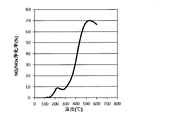
- FIG. 1 is a graph showing the relationship between the temperature of the exhaust gas purification catalyst of Example 1 and the NO / NOx purification rate.
- An example of an embodiment of the present invention is a hydrocarbon adsorbent containing an MRT-type zeolite.
- the hydrocarbon adsorbent adsorbs hydrocarbons at a relatively low temperature of, for example, about 50 ° C., for example, up to a relatively high temperature of 300 ° C. or higher, particularly preferably 380 ° C. or higher.
- Hydrocarbons can be stored, for example, hydrocarbons stored at a relatively high temperature of over 300 ° C. can be desorbed.
- the MRT-type zeolite is a zeolite having an MRT structure.
- Zeolites have a crystalline or quasicrystalline aluminosilicate crystal structure composed of repeating units of SiO 4 and AlO 4 tetrahedra.
- the skeleton structure of zeolite is given a structure code of three uppercase letters defined by the International Zeolite Society. This structure can be confirmed by a database (Databe of Zeolite Structures, Structure Committee of the International Zeolite Association) by the Structural Committee of the International Zeolite Society.
- the MRT-type zeolite has a structure in which 8-membered ring, 6-membered ring, and 4-membered ring are sterically continuous.
- the database Data of Zeolite Structures, Structure of Mission of the International Zeolite Association
- Structural Committee of the International Zeolite Society can be referred to.
- the SiO 2 / Al 2 O 3 molar ratio of the MRT-type zeolite is preferably 13 or more, and may be 50 or less, 40 or less, 30 or less, or 25 or less. It may be, and it may be 20 or less.
- the SiO 2 / Al 2 O 3 molar ratio of the MRT type zeolite is 13 or more, the crystal structure is stable and the MRT type zeolite has excellent heat resistance.
- the SiO 2 / Al 2 O 3 molar ratio of the MRT type zeolite is 50 or less, Al that forms a Brensteto acid point, which is an active point for oxidation of hydrocarbon (HC), is sufficiently contained, and the hydrocarbon (hydrocarbon (HC) is contained.
- hydrocarbons can be oxidized to improve purification performance.
- the SiO 2 / Al 2 O 3 molar ratio contained in the MRT type zeolite or the composition for purifying exhaust gas described later is determined by elemental analysis using, for example, a scanning fluorescent X-ray analyzer (ZSX Primus II, manufactured by Rigaku Co., Ltd.).
- the amount of Si and the amount of Al can be measured, and the SiO 2 / Al 2 O 3 molar ratio can be measured from the obtained amount of Si and Al.
- the MRT type zeolite preferably contains at least one element selected from the group consisting of hydrogen, transition metal elements, alkali metal elements, and alkaline earth metal elements.
- the MRT type zeolite is a hydrocarbon adsorbent containing the MRT type zeolite by containing at least one element M selected from the group consisting of hydrogen, transition metal element, alkali metal element, and alkaline earth metal element.
- Can adsorb hydrogen at a relatively low temperature of, for example, about 50 ° C. can store hydrogen at a relatively high temperature of, for example, 300 ° C. or higher, and can store hydrogen at a relatively high temperature of, for example, above 300 ° C. It can be detached.
- the transition metal elements contained in MRT-type zeolite are titanium (Ti), vanadium (V), chromium (Cr), manganese (Mn), iron (Fe), cobalt (Co), nickel (Ni), and copper (Cu). , Zinc (Zn), Zirconium (Zr), Niob (Nb), Technetium (Tc), and Lutechium (Ru). It is preferably at least one element selected from the group consisting of Cu and Zn.
- the alkali metal element contained in the MRT type zeolite is at least one element selected from the group consisting of lithium (Li), sodium (Na), potassium (K), rubidium (Rb) and cesium (Cs). Is preferable.
- the alkaline earth metal element contained in the MRT-type zeolite is preferably at least one element selected from the group consisting of magnesium (Mg), calcium (Ca), strontium (Sr) and barium (Ba).
- the MRT-type zeolite contains at least one element M selected from the group consisting of hydrogen, manganese, iron, cobalt, nickel, copper, zinc, potassium, rubidium, cesium, strontium, and barium.
- the MRT-type zeolite preferably contains at least one element selected from the group consisting of hydrogen, manganese, iron, cobalt, nickel, copper, zinc, potassium, and cesium, and further contains two or more elements. You may.
- MRT zeolites adsorb hydrocarbons by containing at least one element selected from the group consisting of hydrogen, manganese, iron, cobalt, nickel, copper, zinc, potassium, rubidium, cesium, strontium, and barium. And the hydrocarbons can be stored up to higher temperatures.
- the metal element M contained in the MRT type zeolite has an n-valent value.
- the range of the molar ratio (M / Al) of the metal element M and Al is preferably 0.01 or more and 6.0 / n (n valence) or less, and 0.02 or more and 3.0 / n (n valence) or less. ) Or less is more preferable, and 0.03 or more and 1.0 / n (n valence) or less is further preferable.
- the total value (Mx1 / Al + Mx2 / Al + %) of each metal element (Mx1, Mx2, ...) And Al molar ratio is , 6.0 or less, more preferably 3.0 or less, and even more preferably not more than 1.0.
- the metal element M may be contained in the MRT-type zeolite in the form of a simple metal and / or an oxide.
- the content ratio of the metal element M in the MRT type zeolite is preferably 0.3% by mass or more and 10% by mass or less in terms of the oxide of the metal element M with respect to the mass of the MRT type zeolite, and is 1% by mass or more and 7% by mass.
- the amounts of the elements M and Al contained in the MRT-type zeolite or the composition for purifying exhaust gas described later can be measured by, for example, elemental analysis of a scanning fluorescent X-ray analyzer (ZSX Primus II, manufactured by Rigaku Co., Ltd.). ..
- the zeolite contained in the hydrocarbon adsorbent may be a small pore zeolite.
- the small pore zeolite indicates a zeolite having a skeleton in which the maximum pore is an oxygen 8-membered ring.
- the small pore zeolite can be a zeolite having an MRT-type skeleton structure. Further, the small pore zeolite can be a zeolite having a CHA-type skeleton structure.
- the small pore zeolite preferably contains at least one element selected from the group consisting of hydrogen, transition metal elements, alkali metal elements, and alkaline earth metal elements.
- the small pore zeolite more preferably contains at least one element M selected from the group consisting of hydrogen, manganese, iron, cobalt, nickel, copper, zinc, potassium, rubidium, cesium, strontium, and barium.
- the small pore zeolite has a mass of 1 g of the small pore zeolite when propylene is adsorbed at 50 ° C. and then heated from 50 ° C. to 500 ° C. under the condition of a temperature rise rate of 10 ° C./min by a temperature desorption method.
- ZD 1 is 3.5 mmol / g or less, and the total desorption amount of propylene desorbed at 300 ° C. or higher and lower than 500 ° C.
- ZD 2 Small pore zeolite having a value of 0.5 mmol / g or more is preferable.
- the desorption amount ZD 1 is more preferably 2.5 mmol / g or less, still more preferably 1.5 mmol / g or less, and particularly preferably 1.2 mmol / g, from the viewpoint that the zeolite can retain hydrocarbons up to a higher temperature. It is g or less, most preferably 1.0 mmol / g or less.
- the desorption amount ZD 2 is more preferably 0.8 mmol / g or more, still more preferably 1.0 mmol / g or more, from the viewpoint that the zeolite can retain more hydrocarbons at high temperature.
- the zeolite contained in the hydrocarbon adsorbent is a Cu-containing zeolite containing copper
- the zeolite adsorbs propylene at 50 ° C. and then undergoes a thermal desorption method. by when heated from 50 ° C. to 500 ° C., the amount of released to the sum of the desorption amount ZD 1 propylene desorbed below than 50 ° C. 300 ° C., a total of desorbed propylene 300 ° C. or higher 500 ° C. or less it is preferred ratio of ZD 2 (ZD 2 / ZD 1 ) is 0.5 or more.
- the desorption amount ratio (ZD 2 / ZD 1 ) is more preferably 1.0 or more and 4.0 or less, still more preferably 1.0 or more and 3 from the viewpoint that the zeolite can retain more hydrocarbons at high temperature. It is 0.0 or less, particularly preferably 1.0 or more and 2.0 or less, and most preferably 1.3 or more and 1.6 or less.
- This zeolite is preferably an MRT type zeolite.
- the Cu-containing zeolite can be an MRT-type zeolite.
- the Cu-containing zeolite can be a small pore zeolite.
- the Cu-containing zeolite preferably contains at least one element selected from the group consisting of hydrogen, transition metal elements other than Cu, alkali metal elements, and alkaline earth metal elements.
- the Cu-containing zeolite contains, in addition to the copper element, at least one element M 1 selected from the group consisting of hydrogen, manganese, iron, cobalt, nickel, zinc, potassium, rubidium, cesium, strontium, and barium. Is more preferable.
- the zeolite contained in the hydrocarbon adsorbent is a Cu-free zeolite containing no copper
- the zeolite is the ratio of the desorption amount of propylene (ZD). 2 / ZD 1 ) is preferably 0.3 or more.
- the desorption amount ratio (ZD 2 / ZD 1 ) is more preferably 0.3 or more and 1.5 or less, still more preferably 0.3 or more and 1. It is 0 or less, particularly preferably 0.32 or more and 1.0 or less, and most preferably 0.34 or more and 0.5 or less.
- This zeolite is preferably an MRT type zeolite.
- the MRT type zeolite preferably contains at least one element selected from the group consisting of hydrogen, transition metal element, alkali metal element, and alkaline earth metal element, and hydrogen, manganese, iron, and the like. More preferably, it contains at least one element M selected from the group consisting of cobalt, nickel, copper, zinc, rubidium, cesium, strontium, and barium, with hydrogen, manganese, iron, cobalt, nickel, copper, zinc, It is more preferable to contain at least one element selected from the group consisting of cesium and cesium, and two or more elements may be contained.
- the Cu-free zeolite can be an MRT-type zeolite.
- the Cu-free zeolite can be a small pore zeolite.
- the Cu-free zeolite preferably contains at least one element selected from the group consisting of hydrogen, transition metal elements other than Cu, alkali metal elements, and alkaline earth metal elements.
- the Cu-free zeolite more preferably contains at least one element selected from the group consisting of hydrogen, manganese, iron, cobalt, nickel, zinc, potassium, rubidium, cesium, strontium, and barium.
- Cu-free zeolite refers to a zeolite that does not substantially contain copper.
- Zeolites substantially free of copper refer to zeolites having a copper content of 0.01% by mass or less based on the total amount.
- the desorption amount ZD 1 and the desorption amount ZD 2 of propylene desorbed from the zeolite can be measured by, for example, the following measuring methods and measurement conditions.
- a predetermined amount of sample is filled in the reaction tube of the flow reactor, and a catalyst evaluation device (BELCAT, manufactured by Microtrac Bell) is used as the flow reaction device, and an evaluation gas containing propylene is used at 50 ° C., 20 ml / It is circulated in a reaction tube for 30 minutes in minutes, and propylene is adsorbed on the sample. ..
- An online gas analysis system (BELMass, manufactured by Mike Track Bell) was used to measure the temperature desorption of propylene adsorbed on zeolite, and micro was used to measure the total amount of propylene desorbed at 300 ° C or higher.
- a ChemMaster manufactured by Truck Bell can be used. Gas for evaluation of measurement conditions: 0.5% by volume of propylene, 99.5% by volume of helium
- An example of an embodiment of the present invention is an exhaust gas purification catalyst composition containing the hydrocarbon adsorbent.
- the catalyst composition for purifying exhaust gas may be one or more elements selected from the group consisting of the hydrocarbon adsorbent and other components, for example, a typical metal element and a transition metal element (hereinafter, may be referred to as a specific element). ) Can be contained.
- transition metal elements include copper (Cu), ruthenium (Ru), rhodium (Rh), palladium (Pd), silver (Ag), renium (Re), osmium (OS), iridium (Ir), and platinum (Pt).
- Au gold
- the transition metal element may be an element having at least one catalytic activity selected from the group consisting of the platinum group consisting of ruthenium, rhodium, palladium, osmium, iridium, and platinum, from rhodium, palladium, and platinum. More preferably, it is an element having at least one catalytic activity selected from the above group.
- the specific element contained in the exhaust gas purification catalyst may be contained in the exhaust gas purification catalyst composition using a compound containing these elements, for example, nitrate or the like as a raw material.
- the specific element may be contained in the inorganic oxide carrier, and the main group element or transition metal element contained in the inorganic oxide carrier is Group 2, Group 3, Group 4, Group 5, and Group 5.
- the inorganic oxide carrier include alumina (Al 2 O 3 ), silica (SiO 2 ), zirconia (ZrO 2 ), ceria (CeO 2 ), niobium oxide (Nb 2 O 5 ), and tantalum oxide (Ta). 2 O 3 ), molybdenum oxide (MoO 3 ), tungsten oxide (WO 3 ), and any mixed or composite oxide of these, such as silica-alumina, ceria-zirconia, or alumina- It may be ceria-zirconia.
- the exhaust gas purification catalyst composition can be produced by any known means.
- a compound containing a specific element and a zeolite contained in a hydrocarbon adsorbent can be brought into contact with each other to attach the specific element to the zeolite.
- a compound containing a specific element is brought into contact with an inorganic oxide carrier to obtain an inorganic oxide carrier carrying the specific element, and zeolite is brought into contact with the inorganic oxide carrier to support the catalytic activity of the zeolite.
- An oxide carrier may be attached.
- the method for adhering a specific element to zeolite include a vapor deposition method, an impregnation method, a precipitation method, an ion exchange method and the like.
- Examples of the vapor deposition method include a method in which zeolite and a compound containing a specific element are placed in a container and heated at room temperature or heated to evaporate the compound containing the element and adhere to the zeolite.
- As an impregnation method a method in which zeolite is immersed in a liquid obtained by mixing a compound containing the element and a solvent, the mixed solution is heated and dried under normal pressure or reduced pressure, and the compound containing the element is attached to the zeolite.
- Examples of the impregnation method include an impingient wetness method, an evaporative drying method, a pore-filling method, a spray method, an equilibrium adsorption method and the like.
- the precipitation method examples include a kneading method and a deposition method.
- the zeolite to which the compound containing the element is attached may be dried at a temperature of, for example, 80 ° C. or higher and 150 ° C. or lower, the drying time is 0.5 hours or more and 5 hours or less, and the drying pressure is as follows. It is not particularly limited, and may be atmospheric pressure (0.1 MPa) or may be under reduced pressure of 0.1 MPa or less. If necessary, the zeolite to which the element is attached may be dried and further heat-treated.
- the heat treatment temperature may be in the range of 200 ° C. or higher and 800 ° C. or lower, or 400 ° C. or higher and 700 ° C. or lower in order to prevent the pores of the zeolite from being damaged.
- An example of an embodiment of the present invention is an exhaust gas purification catalyst provided with a layer containing the exhaust gas purification catalyst composition.
- a known base material for an exhaust gas catalyst can be used.
- the material of the base material include ceramics and metals.
- the ceramic base material include refractory ceramic materials, and examples thereof include cordierite, hydrocarbons, mullite, silica-alumina, and alumina.
- the metal base material include refractory metals such as stainless steel.
- a base material having a large number of cells parallel to the inside of the base material and having fine flow passages, such as a honeycomb-shaped base material can be used. Examples of the shape of such a base material include a wall flow type base material and a flow-through type base material.
- a slurry-like exhaust gas purification catalyst composition is prepared, the slurry-like exhaust gas purification catalyst composition is applied to a base material, dried if necessary, and fired. It can be produced by forming a layer containing a catalyst composition for purifying exhaust gas.
- the slurry-like exhaust gas purification catalyst composition is produced by mixing and stirring MRT-type zeolite, an element serving as a catalytically active component, a NOx storage material, a catalyst carrier, a stabilizer, a binder, other components, and water as necessary. be able to.
- the binder an inorganic binder, for example, a water-soluble solution such as alumina sol can be used.
- the exhaust gas purification catalyst includes each layer of the oxidation catalyst layer, the NOx storage layer, and the reduction catalyst layer
- the exhaust gas purification catalyst composition constituting each layer contains MRT-type zeolite and a catalyst required for the catalytic activity of each layer.
- An exhaust gas purification catalyst composition containing an active element can be used.
- the exhaust gas purification catalyst can also be used in selective catalytic reduction (SCR) systems.
- SCR selective catalytic reduction
- SCR selective catalytic reduction
- nitrogen compounds or hydrocarbons such as ammonia or urea
- the exhaust gas purification catalyst can be used to purify the exhaust gas of an internal combustion engine powered by fuel such as a gasoline engine or a diesel engine, and can adsorb and store hydrocarbons up to a relatively high temperature. Removal performance and NOx reduction performance can be improved.
- the combustion exhaust gas containing a hydrocarbon and the exhaust gas purification catalyst are brought into contact with each other to adsorb the hydrocarbon to the exhaust gas purification catalyst, and then the exhaust gas purification is performed at a temperature of 300 ° C. or higher.
- a method for treating exhaust gas including desorbing hydrocarbons from a catalyst for use.
- the exhaust gas purification catalyst can desorb hydrocarbons adsorbed and stored at a high temperature of 300 ° C. or higher.
- the hydrocarbon removal performance can be improved.
- the combustion exhaust gas containing NOx and / or NH 3 is brought into contact with the exhaust gas purification catalyst to selectively reduce at least a part of NOx to N 2 and H 2 O. and comprises oxidizing a portion of the / or NH 3, is a method for treating an exhaust gas.
- the exhaust gas purification catalyst is used, for example, in a selective catalytic reduction (SCR) system to efficiently reduce NOx to N 2 and H 2 O by contacting it with a combustion gas containing NOx and / or MH 3. NOx in the exhaust gas can be removed.
- SCR selective catalytic reduction
- MRT Zeolite Deionized water pure water
- potassium hydroxide potassium hydroxide
- aluminum hydroxide cesium hydroxide
- choline bromide ((2-hydroxyethyl) trimethylammonium bromide)
- colloidal silica (LUDOX®)
- Example 1 The MRT zeolite 1g production resulting hydrocarbon adsorbent was immersed in an aqueous ammonium chloride solution 10g of 60 ° C. of 0.1 mol / L, and solid-liquid separation, washed with deionized water, NH 4 type MRT zeolite Got The resulting NH 4 type the MRT zeolite 1g was immersed in 60 ° C. of 0.05 mol / L of copper (II) acetate aqueous solution 10 g, solid-liquid separation, washed with deionized water, was recovered wet powder. The obtained wet powder was dried at 100 ° C. for 8 hours and heat-treated at 550 ° C.
- the obtained MRT-type zeolite containing Cs and Cu was used as a hydrocarbon adsorbent.
- the MRT-type zeolite used as the hydrocarbon adsorbent had a composition in which the molar ratio of each component was as follows.
- the hydrocarbon adsorbent of Example 1 contains an MRT-type zeolite, and the MRT-type zeolite is a small-pore zeolite having a maximum pore of an oxygen 8-membered ring, and is a Cu-containing zeolite.
- Example 1-2 The resulting MRT-type zeolite 1g was immersed in aqueous ammonium chloride 10g of 60 ° C. of 0.1 mol / L, solid-liquid separation, washed with deionized water to obtain an NH 4 type MRT zeolite.
- the resulting NH 4 type MRT zeolite 1g was immersed in 1N hydrochloric acid 6 g, solid-liquid separation, washed with deionized water to obtain a H-type MRT zeolite.
- the hydrocarbon adsorbent of Example 1-2 contains an MRT-type zeolite, and the MRT-type zeolite is a small-pore zeolite having a maximum pore of an oxygen 8-membered ring, and is a Cu-containing zeolite.
- Example 1-3 An MRT-type zeolite having the following composition was obtained in the same manner as in Example 1-2 except that a 0.1 mol / L aqueous solution of copper (II) acetate was used.
- the hydrocarbon adsorbent of Example 1-3 contains an MRT-type zeolite, and the MRT-type zeolite is a small-pore zeolite having an oxygen 8-membered ring as the maximum pore, and is a Cu-containing zeolite.
- Example 1-4 An MRT-type zeolite having the following composition was obtained in the same manner as in Example 1-2 except that a 0.15 mol / L aqueous solution of copper (II) acetate was used.
- the hydrocarbon adsorbent of Example 1-4 contains an MRT-type zeolite, and the MRT-type zeolite is a small-pore zeolite having a maximum pore of an oxygen 8-membered ring, and is a Cu-containing zeolite.
- Example 1-5 The resulting MRT-type zeolite 1g was immersed in aqueous ammonium chloride 10g of 60 ° C. of 0.1 mol / L, solid-liquid separation, washed with deionized water to obtain an NH 4 type MRT zeolite.
- the resulting NH 4 type MRT zeolite 1g was immersed in 1N hydrochloric acid 6 g, solid-liquid separation, washed with deionized water to obtain a H-type MRT zeolite.
- Example 1-5 1 g of the obtained H-type MRT-type zeolite was impregnated into 1 g of a 0.2 mol / L cupric acetate (II) aqueous solution, and an MRT-type zeolite having the following composition containing Cu was obtained by a pore filling method.
- the hydrocarbon adsorbent of Example 1-5 contains an MRT-type zeolite, and the MRT-type zeolite is a small-pore zeolite having an oxygen 8-membered ring as the maximum pore, and is a Cu-containing zeolite.
- Example 1-6 1 g of MRT-type zeolite obtained in Example 2-2 described later is immersed in 10 g of a 0.05 mol / L cupric acetate (II) aqueous solution at 60 ° C., solid-liquid separated, washed with deionized water, and wet powder. Was recovered. The obtained wet powder was dried at 100 ° C. for 8 hours and heat-treated at 550 ° C. for 3 hours in an air atmosphere to obtain an MRT-type zeolite having the following composition containing Cu.
- II 0.05 mol / L cupric acetate
- the hydrocarbon adsorbent of Example 1-6 contains an MRT-type zeolite, and the MRT-type zeolite is a small-pore zeolite having an oxygen 8-membered ring as the maximum pore, and is a Cu-containing zeolite.
- Example 1-7 An MRT-type zeolite containing Cu and having the following composition was obtained in the same manner as in Example 1-6 except that a 0.15 mol / L aqueous solution of copper (II) acetate was used.
- the hydrocarbon adsorbent of Example 1-7 contains an MRT-type zeolite, and the MRT-type zeolite is a small-pore zeolite having an oxygen 8-membered ring as the maximum pore, and is a Cu-containing zeolite.
- Example 2 The resulting MRT-type zeolite 1g was immersed in aqueous ammonium chloride 10g of 60 ° C. of 0.1 mol / L, solid-liquid separation, washed with deionized water to obtain an NH 4 type MRT zeolite.
- the resulting NH 4 type MRT zeolite 1g was immersed in 1N hydrochloric acid 6 g, solid-liquid separation, washed with deionized water to obtain a H-type MRT zeolite wet.
- the obtained H-type MRT-type zeolite was dried at 100 ° C. for 8 hours and heat-treated at 550 ° C.
- the obtained H-type MRT-type zeolite containing Cs was used as a hydrocarbon adsorbent.
- the MRT-type zeolite used as the hydrocarbon adsorbent had a composition in which the molar ratio of each component was as follows.
- the MRT-type zeolite used as the hydrocarbon adsorbent of Example 2 is a small-pore zeolite having a maximum pore of an oxygen 8-membered ring, and is a Cu-free zeolite.
- the resulting NH 4 type CHA-type zeolite 1g was immersed in 60 ° C. of 0.05 mol / L of copper (II) acetate aqueous solution 10 g, solid-liquid separation, washed with deionized water, was recovered wet powder.
- the obtained wet powder was dried at 100 ° C. for 8 hours and heat-treated at 550 ° C.
- the obtained CHA-type zeolite containing Cu was used as a hydrocarbon adsorbent.
- the CHA-type zeolite used as the hydrocarbon adsorbent had a composition in which the molar ratio of each component was as follows.
- Example 2-2 The resulting MRT-type zeolite 1g was immersed in aqueous ammonium chloride 10g of 60 ° C. of 0.1 mol / L, solid-liquid separation, washed with deionized water to obtain an NH 4 type MRT zeolite.
- the resulting NH 4 type MRT zeolite 1g was immersed in 1N hydrochloric acid 6 g, solid-liquid separation, washed with deionized water to obtain a H-type MRT zeolite wet.
- Example 2-2 contains an MRT-type zeolite, and the MRT-type zeolite is a small-pore zeolite having an oxygen 8-membered ring as the maximum pore, and is a Cu-containing zeolite.
- Example 2-3 An MRT-type zeolite having the following composition was obtained in the same manner as in Example 2-2 except that 5 M sulfuric acid was used.
- the hydrocarbon adsorbent of Example 2-3 contains an MRT-type zeolite, and the MRT-type zeolite is a small-pore zeolite having an oxygen 8-membered ring as the maximum pore, and is a Cu-containing zeolite.
- the resulting NH 4 type CHA-type zeolite 1g was immersed in 0.05 mol / L of acetic acid aqueous cesium 30g of 60 ° C., solid-liquid separation, washed with deionized water, was recovered wet powder.
- the obtained wet powder was dried at 100 ° C. for 8 hours and heat-treated at 550 ° C.
- the obtained CHA-type zeolite containing Cs was used as a hydrocarbon adsorbent.
- the CHA-type zeolite used as the hydrocarbon adsorbent had a composition in which the molar ratio of each component was as follows.
- the CHA-type zeolite used as the hydrocarbon adsorbent of Comparative Example 3 is a small-pore zeolite having a maximum pore of an oxygen 8-membered ring, and is a Cu-free zeolite.
- Comparative Example 4 H-type BEA-type zeolite (product name: CZB30, manufactured by Clariant AG) was used as a hydrocarbon adsorbent.
- Comparative Example 5 H-type MFI-type zeolite (product name: HSZ840HOA, manufactured by Tosoh Corporation) was used as a hydrocarbon adsorbent.
- SiO 2 / Al 2 O 3 molar ratio A scanning fluorescent X-ray analyzer (ZSX PrimusII, manufactured by Rigaku Co., Ltd.) was used to measure the amount of Si and Al in the measurement sample by elemental analysis. The SiO 2 / Al 2 O 3 molar ratio was calculated from the amount of Al.
- Propylene desorption amount and desorption amount ratio obtained by the thermal desorption method The hydrocarbon adsorbents of Examples and Comparative Examples were used as an exhaust gas purification composition. Propylene adsorbed at 50 ° C. was adsorbed on each of the exhaust gas purification compositions (hydrocarbon adsorbents) of Examples and Comparative Examples. Then, it was heated from 50 degreeC to 500 degreeC by the temperature desorption method, and the desorption temperature of propylene was measured. Specifically, the measurement sample is filled in the reaction tube of the flow reactor, and a catalyst evaluation device (BELCAT, manufactured by Microtrac Bell) is used as the flow reaction device, and an evaluation gas containing propylene is used at 50 ° C. and 20 ml.
- BELCAT catalyst evaluation device
- the catalyst composition for exhaust gas purification containing a hydrocarbon adsorbent containing MRT-type zeolite, which is a small pore zeolite of Examples 1, 1-2 to 1-7, 2, 2-2, and 2-3, has a temperature of 50 ° C.
- Propylene can be adsorbed at a relatively low temperature of 300 ° C. or higher, and the hydrocarbon can be desorbed from the hydrocarbon adsorbent at a relatively high temperature of 300 ° C. or higher.
- the CHA-type zeolites of Comparative Examples 1 and 3 are small-pore zeolites having a skeleton in which the maximum pores are an oxygen 8-membered ring, but the total amount of propylene desorbed at 300 ° C. or higher and 500 ° C. or lower is ZD. 2 was 0.5 mmol / g or less, and propylene could not be stored up to a temperature of 300 ° C. or higher at which the catalyst was sufficiently activated.
- the CHA-type zeolite of Comparative Example 2 is a small-pore zeolite having a skeleton in which the maximum pores are an oxygen 8-membered ring, but the total desorption amount of propylene desorbed at 300 ° C. or higher and 500 ° C. or lower is ZD 2. It was 1.0 mmol / g or less, and propylene could not be stored as much as in Examples 1 and 2 up to a temperature of 300 ° C. or higher.
- the hydrocarbon adsorbent using the MRT-type zeolite containing Cu of Examples 1 and 1-2 to 1-7 can store propylene up to a high temperature of 380 ° C. to 400 ° C., and is in a cold start state.
- the propylene adsorbed in the above can be stored up to a temperature of 300 ° C. or higher at which the catalyst is sufficiently activated, and the stored propylene is desorbed and oxidized by the catalyst to be converted into water and carbon dioxide. It can be purified and the purification performance can be improved.
- the hydrocarbon adsorbents of Examples 1 and 1-2 to 1-7 have a desorption amount ratio (ZD2 / ZD1) of 0.5 or more, and the MRT-type zeolite containing Cu contained in the hydrocarbon adsorbent is used. For example, more propylene could be retained at a high temperature of 300 ° C. or higher. Further, the MRT-type zeolite used as the hydrocarbon adsorbent of Examples 1 and 1-2 to 1-7 has a SiO2 / Al2O3 ratio of 13 to 15, has a stable crystal structure, and is made of hydrocarbon (HC).
- HC hydrocarbon
- the desorption temperature of hydrocarbons can be raised by containing a transition metal in zeolite. Therefore, with regard to Cu-containing zeolite, it is considered that the desorption temperature of hydrocarbons tends to increase as the Cu content ratio is increased (when the Cu / Al molar ratio is increased).
- the MRT-type zeolite of Example 1 has a small Cu / Al molar ratio of 0.06, it has a large Cu / Al molar ratio of 0.3 as compared with the CHA-type zeolite of Comparative Example 2.
- the desorption amount ratio (ZD2 / ZD1) is remarkably large.
- the Cu / Al molar ratio of the CHA-type zeolite was controlled to a small range of about 0.06 as in Example 1, the desorption amount ratio (ZD2 / ZD1) was found in Comparative Example 2 in Table 2. It is considered to be smaller than the value. From this, it was confirmed that the hydrocarbon adsorbent using the MRT-type zeolite containing Cu can retain more propylene at a high temperature of, for example, 300 ° C. or higher.
- the hydrocarbon adsorbent using the CHA-type zeolite containing Cu of Comparative Example 2 is the propylene adsorbed by the hydrocarbon adsorbent containing the MRT-type zeolite containing Cu and Cs of Example 1 at a high temperature exceeding 380 ° C.
- the adsorbed propylene could only be stored up to a low temperature of 300 ° C. or lower, whereas it could be stored up to.
- the hydrocarbon adsorbent containing the MRT-type zeolite of Examples 2, 2-2 and 2-3 adsorbs propylene at a relatively low temperature of 50 ° C. and stores propylene up to a high temperature of 280 ° C. to 300 ° C. I was able to leave it.
- the exhaust gas purification catalyst composition containing the hydrocarbon adsorbent containing the MRT-type zeolite of Examples 2, 2-2 and 2-3 stores the propylene adsorbed in the cold start state to a temperature at which the catalyst is sufficiently activated.
- the stored propylene can be desorbed and oxidized by a catalyst to be converted into water and carbon dioxide for purification, and the purification performance can be improved.
- the hydrocarbon adsorbents of Examples 2, 2-2 and 2-3 are MRT-type zeolites having a desorption amount ratio (ZD2 / ZD1) of 0.3 or more and containing no Cu contained in the hydrocarbon adsorbent. For example, more propylene could be retained at a high temperature of 300 ° C. or higher.
- the MRT-type zeolite used as the hydrocarbon adsorbent of Examples 2, 2-2 and 2-3 has a SiO2 / Al2O3 molar ratio of 13 to 15, and serves as an active point for oxidation of hydrocarbon (HC). It contains a sufficient amount of Al that forms a Brensteto acid point, and can improve the purification performance of hydrocarbons even after desorption of propylene.
- the CHA-type zeolite of Comparative Example 1 can store propylene adsorbed at a relatively low temperature of 50 ° C. only up to a relatively low temperature of 250 ° C. or lower, and reaches a temperature at which the catalyst is sufficiently activated. The propylene could not be stored.
- the CHA-type zeolite containing Cs of Comparative Example 3 can store the propylene adsorbed by the hydrocarbon adsorbent containing the MRT-type zeolite containing Cs of Example 2 up to a high temperature exceeding 280 ° C. On the other hand, the adsorbed propylene could only be stored up to a low temperature of 280 ° C. or lower.
- the BEA type zeolite of Comparative Example 4 and the MFI type zeolite of Comparative Example 5 propylene adsorbed at a relatively low temperature of 50 ° C. can be stored only up to a relatively low temperature of 250 ° C. or lower, and the catalyst is used. Propylene cannot be stored to a temperature at which it is fully activated.
- the BEA type zeolite of Comparative Example 4 and the MFI type zeolite of Comparative Example 5 have a large SiO 2 / Al 2 O 3 molar ratio of more than 20, and a Brensteto acid point which is an active point for oxidation of hydrocarbon (HC). The amount of Al forming is small, and the purification performance of the desorbed hydrocarbon may be inferior.
- Example 3 SCR catalyst 20 g of the hydrocarbon adsorbent of Example 1, 12 g of alumina, and 50 g of alumina sol (solid content concentration 15%) were mixed in 20 g of pure water to prepare a slurry.
- SCR Selective Catalytic Reduction Activity
- the slurry obtained in Example 3 was coated on a cordierite honeycomb having a diameter of 25.4 mm ⁇ L40 mm so as to have 2.03 g of alumina and 2.03 g of zeolite, and 30 at 100 ° C. After drying for minutes, it was fired at 500 ° C. for 1 hour to obtain a measurement sample of an exhaust gas purification catalyst.
- This measurement sample was filled in a quartz atmospheric pressure fixed bed flow type reaction tube. While circulating a gas having the following composition under the condition of SV: 75000h-1 , the temperature is raised from 100 ° C. to 600 ° C.
- FIG. 1 is a graph showing the relationship between the temperature of the exhaust gas purification catalyst of Example 3 and the NO / NOx purification rate. As shown in FIG. 1, the exhaust gas purification catalyst of Example 3 showed a high NO / NOx purification rate of 50% or more at a temperature exceeding 400 ° C.
- the hydrocarbon adsorbent according to the present disclosure can adsorb hydrocarbons and store hydrocarbons adsorbed to a relatively high temperature, and adsorbs and stores hydrocarbons at a relatively high temperature at which a catalyst can be activated. It can be desorbed and the exhaust gas purification performance can be improved.
- the hydrocarbon adsorbent according to the present disclosure can be used in an exhaust gas purification catalyst composition, an exhaust gas purification catalyst, and a method for treating exhaust gas.
Landscapes
- Chemical & Material Sciences (AREA)
- Engineering & Computer Science (AREA)
- Chemical Kinetics & Catalysis (AREA)
- Organic Chemistry (AREA)
- Analytical Chemistry (AREA)
- Combustion & Propulsion (AREA)
- Materials Engineering (AREA)
- Oil, Petroleum & Natural Gas (AREA)
- Health & Medical Sciences (AREA)
- Biomedical Technology (AREA)
- Environmental & Geological Engineering (AREA)
- General Chemical & Material Sciences (AREA)
- Inorganic Chemistry (AREA)
- Geology (AREA)
- Life Sciences & Earth Sciences (AREA)
- General Life Sciences & Earth Sciences (AREA)
- Crystallography & Structural Chemistry (AREA)
- Thermal Sciences (AREA)
- Physics & Mathematics (AREA)
- Mechanical Engineering (AREA)
- General Engineering & Computer Science (AREA)
- Solid-Sorbent Or Filter-Aiding Compositions (AREA)
- Exhaust Gas After Treatment (AREA)
- Exhaust Gas Treatment By Means Of Catalyst (AREA)
- Silicates, Zeolites, And Molecular Sieves (AREA)
- Catalysts (AREA)
Priority Applications (3)
| Application Number | Priority Date | Filing Date | Title |
|---|---|---|---|
| JP2022508278A JP7460753B2 (ja) | 2020-03-19 | 2021-03-11 | 炭化水素吸着材 |
| US17/911,820 US12330134B2 (en) | 2020-03-19 | 2021-03-11 | Hydrocarbon adsorbent |
| EP21770452.7A EP4122595A4 (en) | 2020-03-19 | 2021-03-11 | HYDROCARBON ADSORBENS |
Applications Claiming Priority (2)
| Application Number | Priority Date | Filing Date | Title |
|---|---|---|---|
| JP2020-049066 | 2020-03-19 | ||
| JP2020049066 | 2020-03-19 |
Publications (1)
| Publication Number | Publication Date |
|---|---|
| WO2021187304A1 true WO2021187304A1 (ja) | 2021-09-23 |
Family
ID=77768255
Family Applications (1)
| Application Number | Title | Priority Date | Filing Date |
|---|---|---|---|
| PCT/JP2021/009753 Ceased WO2021187304A1 (ja) | 2020-03-19 | 2021-03-11 | 炭化水素吸着材 |
Country Status (4)
| Country | Link |
|---|---|
| US (1) | US12330134B2 (https=) |
| EP (1) | EP4122595A4 (https=) |
| JP (1) | JP7460753B2 (https=) |
| WO (1) | WO2021187304A1 (https=) |
Families Citing this family (3)
| Publication number | Priority date | Publication date | Assignee | Title |
|---|---|---|---|---|
| EP4122595A4 (en) * | 2020-03-19 | 2023-12-20 | Mitsui Mining & Smelting Co., Ltd. | HYDROCARBON ADSORBENS |
| WO2021201018A1 (ja) * | 2020-03-31 | 2021-10-07 | 東ソー株式会社 | 炭化水素吸着剤及び炭化水素の吸着方法 |
| CN121198233B (zh) * | 2025-11-28 | 2026-02-24 | 湖南大学 | 一种碱金属改性沸石吸附材料及其制备方法和应用 |
Citations (5)
| Publication number | Priority date | Publication date | Assignee | Title |
|---|---|---|---|---|
| JP2004105821A (ja) * | 2002-09-17 | 2004-04-08 | Nissan Motor Co Ltd | 排気ガス用炭化水素吸着材及びそれを用いた排気ガス浄化用触媒 |
| JP2007076989A (ja) * | 2005-09-16 | 2007-03-29 | Tosoh Corp | β型ゼオライト及びそれを用いた炭化水素の吸着除去方法 |
| JP2008000704A (ja) * | 2006-06-23 | 2008-01-10 | Mitsubishi Chemicals Corp | 炭化水素吸着材および当該吸着材を使用した炭化水素の吸着方法 |
| JP2008073625A (ja) * | 2006-09-22 | 2008-04-03 | Mitsubishi Motors Corp | Hcトラップ触媒及びhcトラップ触媒の調製方法。 |
| JP2018079428A (ja) * | 2016-11-17 | 2018-05-24 | 東ソー株式会社 | 炭化水素吸着剤及び炭化水素の吸着除去方法 |
Family Cites Families (13)
| Publication number | Priority date | Publication date | Assignee | Title |
|---|---|---|---|---|
| US4209499A (en) | 1977-10-21 | 1980-06-24 | Mobil Oil Corporation | Crystalline zeolite ZSM-43 synthesis thereof |
| US4247728A (en) * | 1979-11-08 | 1981-01-27 | Mobil Oil Corporation | Crystalline zeolite, synthesis and use thereof |
| US5169614A (en) * | 1988-04-08 | 1992-12-08 | Mobil Oil Corporation | Synthesis of crystalline silicoaluminophosphate composition |
| US4927977A (en) * | 1989-01-12 | 1990-05-22 | Mobil Oil Corporation | Process and apparatus for the uniform distribution of a two-phase feed in a chemical reaction zone |
| US5108727A (en) * | 1990-06-26 | 1992-04-28 | Mobil Oil Corporation | Synthesis of crystalline aluminophosphate composition |
| US5488193A (en) * | 1992-11-06 | 1996-01-30 | Mobil Oil Corporation | Process for reducing polynuclear aromatic mutagenicity by alkylation |
| JPH08229387A (ja) | 1995-02-24 | 1996-09-10 | Babcock Hitachi Kk | 炭化水素の燃焼触媒機能一体化吸着剤および内燃機関排ガス中炭化水素の浄化法 |
| JP5310767B2 (ja) | 2011-03-29 | 2013-10-09 | トヨタ自動車株式会社 | 排ガス浄化触媒 |
| US20120308439A1 (en) | 2011-06-01 | 2012-12-06 | Johnson Matthey Public Limited Company | Cold start catalyst and its use in exhaust systems |
| US10323593B2 (en) * | 2013-10-03 | 2019-06-18 | Umicore Ag & Co. Kg | Exhaust aftertreatment system |
| US10953366B2 (en) * | 2018-04-20 | 2021-03-23 | GM Global Technology Operations LLC | Nitrogen oxides and hydrocarbon storage catalyst and methods of using the same |
| JP7150496B2 (ja) | 2018-06-27 | 2022-10-11 | 株式会社キャタラー | 排ガス浄化用触媒及び排ガス浄化システム |
| EP4122595A4 (en) * | 2020-03-19 | 2023-12-20 | Mitsui Mining & Smelting Co., Ltd. | HYDROCARBON ADSORBENS |
-
2021
- 2021-03-11 EP EP21770452.7A patent/EP4122595A4/en active Pending
- 2021-03-11 JP JP2022508278A patent/JP7460753B2/ja active Active
- 2021-03-11 US US17/911,820 patent/US12330134B2/en active Active
- 2021-03-11 WO PCT/JP2021/009753 patent/WO2021187304A1/ja not_active Ceased
Patent Citations (5)
| Publication number | Priority date | Publication date | Assignee | Title |
|---|---|---|---|---|
| JP2004105821A (ja) * | 2002-09-17 | 2004-04-08 | Nissan Motor Co Ltd | 排気ガス用炭化水素吸着材及びそれを用いた排気ガス浄化用触媒 |
| JP2007076989A (ja) * | 2005-09-16 | 2007-03-29 | Tosoh Corp | β型ゼオライト及びそれを用いた炭化水素の吸着除去方法 |
| JP2008000704A (ja) * | 2006-06-23 | 2008-01-10 | Mitsubishi Chemicals Corp | 炭化水素吸着材および当該吸着材を使用した炭化水素の吸着方法 |
| JP2008073625A (ja) * | 2006-09-22 | 2008-04-03 | Mitsubishi Motors Corp | Hcトラップ触媒及びhcトラップ触媒の調製方法。 |
| JP2018079428A (ja) * | 2016-11-17 | 2018-05-24 | 東ソー株式会社 | 炭化水素吸着剤及び炭化水素の吸着除去方法 |
Non-Patent Citations (2)
| Title |
|---|
| See also references of EP4122595A4 |
| WESTERMANN A., AZAMBRE B.: "Impact of the Zeolite Structure and Acidity on the Adsorption of Unburnt Hydrocarbons Relevant to Cold Start Conditions", THE JOURNAL OF PHYSICAL CHEMISTRY C, AMERICAN CHEMICAL SOCIETY, US, vol. 120, no. 45, 21 October 2016 (2016-10-21), US , pages 25903 - 25914, XP055859058, ISSN: 1932-7447, DOI: 10.1021/acs.jpcc.6b08880 * |
Also Published As
| Publication number | Publication date |
|---|---|
| US12330134B2 (en) | 2025-06-17 |
| US20230049498A1 (en) | 2023-02-16 |
| EP4122595A4 (en) | 2023-12-20 |
| EP4122595A1 (en) | 2023-01-25 |
| JP7460753B2 (ja) | 2024-04-02 |
| JPWO2021187304A1 (https=) | 2021-09-23 |
Similar Documents
| Publication | Publication Date | Title |
|---|---|---|
| EP3485964B1 (en) | Cold start catalyst and its use in exhaust systems | |
| EP2956239B1 (en) | Nox trap composition | |
| EP2172268B1 (en) | NOx PURIFYING CATALYST | |
| US20170128922A1 (en) | Cold Start Catalyst and Its Use in Exhaust Systems | |
| EP2177269B1 (en) | NOx PURIFYING CATALYST | |
| JP7460753B2 (ja) | 炭化水素吸着材 | |
| JPH11104493A (ja) | 排気ガス浄化用触媒及び使用方法 | |
| JPH0796178A (ja) | 内燃機関排ガス中の炭化水素吸着剤 | |
| JPH11216358A (ja) | 炭化水素吸着剤及び排ガス浄化触媒 | |
| JP7450727B2 (ja) | 炭化水素吸着材、排ガス浄化触媒及び排ガス浄化システム | |
| JP5488402B2 (ja) | 排気ガス浄化用触媒 | |
| JPH11216359A (ja) | エチレンの吸着剤、吸着除去方法及び排ガス浄化法 | |
| JP2004116331A (ja) | 排気ガス用炭化水素吸着材及びそれを用いた排気ガス浄化用触媒 | |
| JP5181839B2 (ja) | 排気ガス浄化用触媒 | |
| JPH07194973A (ja) | 排ガス浄化触媒 | |
| JP2849585B2 (ja) | 排気ガス浄化用触媒及び排気ガス浄化方法 | |
| JPH06327978A (ja) | 排気ガス浄化用触媒 | |
| JP2005500152A (ja) | ラメラ構造を用いて窒素酸化物を除去するための物質 | |
| JPH07328448A (ja) | 排気ガス浄化触媒および排気ガス浄化装置 | |
| JPH1176827A (ja) | 排気ガス浄化装置 | |
| JP2000024517A (ja) | 排ガス浄化用触媒及びその製造方法 | |
| JP5545175B2 (ja) | 排気ガス浄化用触媒 | |
| JPH10151325A (ja) | 排気ガス浄化方法 | |
| JPH0824655A (ja) | 排気ガス浄化用触媒 | |
| JP3300028B2 (ja) | 排気ガス浄化用触媒及びその製造方法 |
Legal Events
| Date | Code | Title | Description |
|---|---|---|---|
| 121 | Ep: the epo has been informed by wipo that ep was designated in this application |
Ref document number: 21770452 Country of ref document: EP Kind code of ref document: A1 |
|
| ENP | Entry into the national phase |
Ref document number: 2022508278 Country of ref document: JP Kind code of ref document: A |
|
| NENP | Non-entry into the national phase |
Ref country code: DE |
|
| ENP | Entry into the national phase |
Ref document number: 2021770452 Country of ref document: EP Effective date: 20221019 |
|
| WWG | Wipo information: grant in national office |
Ref document number: 17911820 Country of ref document: US |