WO2021182299A1 - リン酸ジルコニウム粒子、及びこれを使用した塩基性ガス消臭剤、並びにそれらの製造方法 - Google Patents
リン酸ジルコニウム粒子、及びこれを使用した塩基性ガス消臭剤、並びにそれらの製造方法 Download PDFInfo
- Publication number
- WO2021182299A1 WO2021182299A1 PCT/JP2021/008464 JP2021008464W WO2021182299A1 WO 2021182299 A1 WO2021182299 A1 WO 2021182299A1 JP 2021008464 W JP2021008464 W JP 2021008464W WO 2021182299 A1 WO2021182299 A1 WO 2021182299A1
- Authority
- WO
- WIPO (PCT)
- Prior art keywords
- zirconium phosphate
- phosphate particles
- basic
- deodorant
- liquid
- Prior art date
- Legal status (The legal status is an assumption and is not a legal conclusion. Google has not performed a legal analysis and makes no representation as to the accuracy of the status listed.)
- Ceased
Links
Classifications
-
- C—CHEMISTRY; METALLURGY
- C01—INORGANIC CHEMISTRY
- C01B—NON-METALLIC ELEMENTS; COMPOUNDS THEREOF; METALLOIDS OR COMPOUNDS THEREOF NOT COVERED BY SUBCLASS C01C
- C01B25/00—Phosphorus; Compounds thereof
- C01B25/16—Oxyacids of phosphorus; Salts thereof
- C01B25/26—Phosphates
- C01B25/37—Phosphates of heavy metals
- C01B25/372—Phosphates of heavy metals of titanium, vanadium, zirconium, niobium, hafnium or tantalum
-
- A—HUMAN NECESSITIES
- A61—MEDICAL OR VETERINARY SCIENCE; HYGIENE
- A61L—METHODS OR APPARATUS FOR STERILISING MATERIALS OR OBJECTS IN GENERAL; DISINFECTION, STERILISATION OR DEODORISATION OF AIR; CHEMICAL ASPECTS OF BANDAGES, DRESSINGS, ABSORBENT PADS OR SURGICAL ARTICLES; MATERIALS FOR BANDAGES, DRESSINGS, ABSORBENT PADS OR SURGICAL ARTICLES
- A61L9/00—Disinfection, sterilisation or deodorisation of air
- A61L9/01—Deodorant compositions
-
- B—PERFORMING OPERATIONS; TRANSPORTING
- B01—PHYSICAL OR CHEMICAL PROCESSES OR APPARATUS IN GENERAL
- B01J—CHEMICAL OR PHYSICAL PROCESSES, e.g. CATALYSIS OR COLLOID CHEMISTRY; THEIR RELEVANT APPARATUS
- B01J20/00—Solid sorbent compositions or filter aid compositions; Sorbents for chromatography; Processes for preparing, regenerating or reactivating thereof
- B01J20/02—Solid sorbent compositions or filter aid compositions; Sorbents for chromatography; Processes for preparing, regenerating or reactivating thereof comprising inorganic material
-
- C—CHEMISTRY; METALLURGY
- C01—INORGANIC CHEMISTRY
- C01B—NON-METALLIC ELEMENTS; COMPOUNDS THEREOF; METALLOIDS OR COMPOUNDS THEREOF NOT COVERED BY SUBCLASS C01C
- C01B25/00—Phosphorus; Compounds thereof
- C01B25/16—Oxyacids of phosphorus; Salts thereof
- C01B25/26—Phosphates
- C01B25/37—Phosphates of heavy metals
-
- C—CHEMISTRY; METALLURGY
- C08—ORGANIC MACROMOLECULAR COMPOUNDS; THEIR PREPARATION OR CHEMICAL WORKING-UP; COMPOSITIONS BASED THEREON
- C08K—Use of inorganic or non-macromolecular organic substances as compounding ingredients
- C08K3/00—Use of inorganic substances as compounding ingredients
- C08K3/32—Phosphorus-containing compounds
-
- C—CHEMISTRY; METALLURGY
- C08—ORGANIC MACROMOLECULAR COMPOUNDS; THEIR PREPARATION OR CHEMICAL WORKING-UP; COMPOSITIONS BASED THEREON
- C08L—COMPOSITIONS OF MACROMOLECULAR COMPOUNDS
- C08L75/00—Compositions of polyureas or polyurethanes; Compositions of derivatives of such polymers
- C08L75/04—Polyurethanes
-
- C—CHEMISTRY; METALLURGY
- C08—ORGANIC MACROMOLECULAR COMPOUNDS; THEIR PREPARATION OR CHEMICAL WORKING-UP; COMPOSITIONS BASED THEREON
- C08L—COMPOSITIONS OF MACROMOLECULAR COMPOUNDS
- C08L75/00—Compositions of polyureas or polyurethanes; Compositions of derivatives of such polymers
- C08L75/04—Polyurethanes
- C08L75/06—Polyurethanes from polyesters
-
- D—TEXTILES; PAPER
- D01—NATURAL OR MAN-MADE THREADS OR FIBRES; SPINNING
- D01F—CHEMICAL FEATURES IN THE MANUFACTURE OF ARTIFICIAL FILAMENTS, THREADS, FIBRES, BRISTLES OR RIBBONS; APPARATUS SPECIALLY ADAPTED FOR THE MANUFACTURE OF CARBON FILAMENTS
- D01F1/00—General methods for the manufacture of artificial filaments or the like
- D01F1/02—Addition of substances to the spinning solution or to the melt
- D01F1/10—Other agents for modifying properties
-
- D—TEXTILES; PAPER
- D06—TREATMENT OF TEXTILES OR THE LIKE; LAUNDERING; FLEXIBLE MATERIALS NOT OTHERWISE PROVIDED FOR
- D06M—TREATMENT, NOT PROVIDED FOR ELSEWHERE IN CLASS D06, OF FIBRES, THREADS, YARNS, FABRICS, FEATHERS OR FIBROUS GOODS MADE FROM SUCH MATERIALS
- D06M11/00—Treating fibres, threads, yarns, fabrics or fibrous goods made from such materials, with inorganic substances or complexes thereof; Such treatment combined with mechanical treatment, e.g. mercerising
- D06M11/68—Treating fibres, threads, yarns, fabrics or fibrous goods made from such materials, with inorganic substances or complexes thereof; Such treatment combined with mechanical treatment, e.g. mercerising with phosphorus or compounds thereof, e.g. with chlorophosphonic acid or salts thereof
- D06M11/70—Treating fibres, threads, yarns, fabrics or fibrous goods made from such materials, with inorganic substances or complexes thereof; Such treatment combined with mechanical treatment, e.g. mercerising with phosphorus or compounds thereof, e.g. with chlorophosphonic acid or salts thereof with oxides of phosphorus; with hypophosphorous, phosphorous or phosphoric acids or their salts
- D06M11/71—Salts of phosphoric acids
-
- D—TEXTILES; PAPER
- D06—TREATMENT OF TEXTILES OR THE LIKE; LAUNDERING; FLEXIBLE MATERIALS NOT OTHERWISE PROVIDED FOR
- D06M—TREATMENT, NOT PROVIDED FOR ELSEWHERE IN CLASS D06, OF FIBRES, THREADS, YARNS, FABRICS, FEATHERS OR FIBROUS GOODS MADE FROM SUCH MATERIALS
- D06M13/00—Treating fibres, threads, yarns, fabrics or fibrous goods made from such materials, with non-macromolecular organic compounds; Such treatment combined with mechanical treatment
- D06M13/005—Compositions containing perfumes; Compositions containing deodorants
-
- A—HUMAN NECESSITIES
- A61—MEDICAL OR VETERINARY SCIENCE; HYGIENE
- A61L—METHODS OR APPARATUS FOR STERILISING MATERIALS OR OBJECTS IN GENERAL; DISINFECTION, STERILISATION OR DEODORISATION OF AIR; CHEMICAL ASPECTS OF BANDAGES, DRESSINGS, ABSORBENT PADS OR SURGICAL ARTICLES; MATERIALS FOR BANDAGES, DRESSINGS, ABSORBENT PADS OR SURGICAL ARTICLES
- A61L2209/00—Aspects relating to disinfection, sterilisation or deodorisation of air
- A61L2209/20—Method-related aspects
- A61L2209/22—Treatment by sorption, e.g. absorption, adsorption, chemisorption, scrubbing, wet cleaning
-
- A—HUMAN NECESSITIES
- A61—MEDICAL OR VETERINARY SCIENCE; HYGIENE
- A61L—METHODS OR APPARATUS FOR STERILISING MATERIALS OR OBJECTS IN GENERAL; DISINFECTION, STERILISATION OR DEODORISATION OF AIR; CHEMICAL ASPECTS OF BANDAGES, DRESSINGS, ABSORBENT PADS OR SURGICAL ARTICLES; MATERIALS FOR BANDAGES, DRESSINGS, ABSORBENT PADS OR SURGICAL ARTICLES
- A61L9/00—Disinfection, sterilisation or deodorisation of air
- A61L9/01—Deodorant compositions
- A61L9/014—Deodorant compositions containing sorbent material, e.g. activated carbon
-
- C—CHEMISTRY; METALLURGY
- C01—INORGANIC CHEMISTRY
- C01P—INDEXING SCHEME RELATING TO STRUCTURAL AND PHYSICAL ASPECTS OF SOLID INORGANIC COMPOUNDS
- C01P2004/00—Particle morphology
- C01P2004/60—Particles characterised by their size
- C01P2004/61—Micrometer sized, i.e. from 1-100 micrometer
-
- C—CHEMISTRY; METALLURGY
- C01—INORGANIC CHEMISTRY
- C01P—INDEXING SCHEME RELATING TO STRUCTURAL AND PHYSICAL ASPECTS OF SOLID INORGANIC COMPOUNDS
- C01P2004/00—Particle morphology
- C01P2004/60—Particles characterised by their size
- C01P2004/62—Submicrometer sized, i.e. from 0.1-1 micrometer
-
- C—CHEMISTRY; METALLURGY
- C08—ORGANIC MACROMOLECULAR COMPOUNDS; THEIR PREPARATION OR CHEMICAL WORKING-UP; COMPOSITIONS BASED THEREON
- C08K—Use of inorganic or non-macromolecular organic substances as compounding ingredients
- C08K3/00—Use of inorganic substances as compounding ingredients
- C08K3/32—Phosphorus-containing compounds
- C08K2003/321—Phosphates
-
- C—CHEMISTRY; METALLURGY
- C08—ORGANIC MACROMOLECULAR COMPOUNDS; THEIR PREPARATION OR CHEMICAL WORKING-UP; COMPOSITIONS BASED THEREON
- C08K—Use of inorganic or non-macromolecular organic substances as compounding ingredients
- C08K3/00—Use of inorganic substances as compounding ingredients
- C08K3/32—Phosphorus-containing compounds
- C08K2003/321—Phosphates
- C08K2003/328—Phosphates of heavy metals
-
- Y—GENERAL TAGGING OF NEW TECHNOLOGICAL DEVELOPMENTS; GENERAL TAGGING OF CROSS-SECTIONAL TECHNOLOGIES SPANNING OVER SEVERAL SECTIONS OF THE IPC; TECHNICAL SUBJECTS COVERED BY FORMER USPC CROSS-REFERENCE ART COLLECTIONS [XRACs] AND DIGESTS
- Y02—TECHNOLOGIES OR APPLICATIONS FOR MITIGATION OR ADAPTATION AGAINST CLIMATE CHANGE
- Y02A—TECHNOLOGIES FOR ADAPTATION TO CLIMATE CHANGE
- Y02A50/00—TECHNOLOGIES FOR ADAPTATION TO CLIMATE CHANGE in human health protection, e.g. against extreme weather
- Y02A50/20—Air quality improvement or preservation, e.g. vehicle emission control or emission reduction by using catalytic converters
Definitions
- the present invention relates to zirconium phosphate particles and a fine particle basic gas deodorant using the same, a deodorant for fibers, a composition for deodorizing processing, a deodorizing resin composition and a deodorizing fiber. It belongs to the technical field, the technical field of deodorant, and the technical field of resin and fiber.
- Deodorant products such as clothing and bedding, which have a deodorizing function against the odor of aging and fatigue, have come into the market.
- Typical adsorption target gas and deodorant target gas include acid gas such as acetic acid, basic gas such as ammonia, sulfur gas such as methyl mercaptan, aldehyde gas such as formaldehyde, and ketone gas such as acetone. It is known, and deodorants and deodorant products suitable for each gas are being developed.
- basic gas adsorbents and basic gas deodorant products capable of adsorbing basic gas such as ammonia, which is a causative substance of sweat odor and fatigue odor, and for example, an inorganic solid such as zirconium phosphate.
- a deodorant product is being developed in which an acid is used as a basic gas adsorbent and the acid is supported or kneaded on a fiber or the like.
- basic gas such as ammonia, which is the causative substance
- the deodorant fiber described in JP-A-2018-178313 improves spinnability and deodorant property by controlling the particle size of the deodorant kneaded into the fiber to a certain value or less.
- the problem of high-speed deodorant property and its solution there was no description or suggestion about the problem of high-speed deodorant property and its solution.
- zirconium phosphate particles having high deodorizing performance against basic gases such as ammonia and trimethylamine and particularly excellent deodorizing rate of ammonia, deodorants using the same, and for deodorizing processing
- An object of the present invention is to provide a composition, a deodorant resin composition, a deodorant fiber, and a method for producing the same.
- the present invention includes the following aspects [1] to [21].
- 10 mg of zirconium phosphate particles and 3 L of air containing 1000 ppm of ammonia gas are placed in a test bag at normal temperature and pressure, and after being left for 10 minutes, the test bag containing the zirconium phosphate particles is contained.
- X ⁇ (A 0- A 1 ) / A 0 ) ⁇ x 100 (1)
- a 0 means the ammonia gas concentration of the test bag containing the zirconium phosphate particles
- a 1 means the ammonia gas concentration of the test bag containing the zirconium phosphate particles.
- [4] The zirconium phosphate particle according to any one of [1] to [3], wherein the median diameter of the primary particle is 0.1 to 10 ⁇ m. [5] After heating at 150 ° C.
- the drying fraction (Y; unit weight%) represented by the following formula (2) is 5.0% by weight or less, [1] to [4].
- the zirconium phosphate particles according to any one of the above. Y ⁇ (B 0- B 1 ) / B 0 ⁇ x 100 (2) [In the formula (2), B 0 means the weight of the zirconium phosphate particles before heating, and B 1 means the weight of the zirconium phosphate particles after heating. ]
- [6] A basic gas deodorant containing zirconium phosphate particles according to any one of [1] to [5].
- a method for producing a basic gas deodorant resin composition which comprises mixing the zirconium phosphate particles and the resin obtained by the production method according to [13] or [14].
- Liquid-treated zirconium phosphate particles can be obtained by contacting the zirconium phosphate particles with a basic liquid having a pH of 9 or higher and then with an acidic liquid having a pH of 6 or lower. And a method for producing a basic gas deodorant resin composition, which comprises mixing a resin. [17] A method for producing a basic gas deodorant fiber, which comprises spinning the basic gas deodorant resin composition obtained by the production method according to [15] or [16].
- a method for producing a basic gas deodorant resin composition which comprises contacting a resin containing zirconium phosphate particles with a basic liquid having a pH of 9 or higher and then contacting a resin containing zirconium phosphate particles with an acidic liquid having a pH of 6 or lower.
- a method for producing a basic gas deodorant fiber which comprises contacting a fiber containing zirconium phosphate particles with a basic liquid having a pH of 9 or higher and then contacting the fiber with an acidic liquid having a pH of 6 or lower.
- zirconium phosphate particles having high deodorizing performance against basic gases such as ammonia and trimethylamine and particularly excellent deodorizing rate of ammonia, deodorants using the same, and for deodorizing processing Compositions, deodorant resin compositions and deodorant fibers, and methods for producing them are provided.
- % means “% by weight”
- parts means “parts by weight”
- ppm means “volume ppm” unless otherwise specified.
- the description of "lower limit to upper limit” representing the numerical range means “below the lower limit and below the upper limit”
- the description of "upper limit to lower limit” means “below the upper limit and above the lower limit”. That is, it represents a numerical range including an upper limit and a lower limit.
- "normal temperature” means 25 ⁇ 5 ° C.
- a combination of two or more of preferred embodiments described below is also a preferred embodiment.
- the zirconium phosphate particles in the present disclosure are particles containing zirconium phosphate as a main component, and may contain impurities, water, etc. that are mixed from the raw material, the manufacturing process, and the like.
- the main component is a zirconium phosphate component contained in the particles in an amount of 50% by weight or more, preferably 80% by weight or more, more preferably 90% by weight or more, still more preferably 95% by weight or more. ..
- the zirconium phosphate particles according to the first aspect of the present disclosure are obtained after contacting ⁇ -zincyl phosphate particles with a basic liquid having a pH of 9 or higher (hereinafter, also simply referred to as “basic liquid”). Further, it is a zirconium phosphate particle obtained by contacting with an acidic liquid having a pH of 6 or less (hereinafter, also simply referred to as “acidic liquid”).
- the zirconium phosphate particles according to the second aspect of the present disclosure are the phosphorus phosphate particles after 10 mg of zirconium phosphate particles and 3 L of air containing 1000 ppm of ammonia gas are placed in a test bag at normal temperature and pressure and left for 10 minutes.
- the zirconium phosphate particles in the test bag containing the zirconium phosphate particles have an ammonia gas reduction rate (X; unit%) represented by the following formula (1) of 50% or more.
- the "zirconium phosphate particles of the present disclosure” include the zirconium phosphate particles according to the first aspect and the zirconium phosphate particles according to the second aspect.
- zirconium Phosphate Particles According to the First Aspect
- the zirconium phosphate particles according to the first aspect are phosphorus obtained by contacting ⁇ -zincyl phosphate particles with a basic liquid and then further contacting them with an acidic liquid.
- Zirconium phosphate particles Hereinafter, a method for producing a basic liquid, an acidic liquid, raw material ⁇ -zirconium phosphate particles, and zirconium phosphate will be described.
- Basic liquid The base contained in the basic liquid is not particularly limited, and for example, well-known bases including alkali metals, alkaline earth metals, ammonia, amines, ammonium salts and the like can be used.
- alkali metal include lithium, sodium and potassium
- examples of the alkaline earth metal include magnesium and calcium
- examples of the amine include alkylamines such as methylamine, dimethylamine and trimethylamine, aniline and phenyl.
- examples thereof include arylamines such as methylamine and heterocyclic aromatic amines such as pyridine
- ammonium salts include tetramethylammonium hydroxide. These may be used alone or in combination of two or more.
- bases containing alkali metals and / or alkaline earth metals are selected because they are highly basic, can be efficiently contacted with a basic liquid, have almost no odor, and have a good working environment. It is preferable to use it.
- the base containing an alkali metal include lithium hydroxide, sodium hydroxide, and potassium hydroxide
- examples of the base containing an alkaline earth metal include magnesium hydroxide and calcium hydroxide.
- the solvent used for the basic liquid having a pH of 9 or higher is not particularly limited, but is preferably water, a lower alcohol such as methanol, and more preferably water.
- the method for preparing a basic liquid having a pH of 9 or higher is not particularly limited, and a well-known method can be applied.
- a base containing an alkali metal and / or an alkaline earth metal specifically, lithium hydroxide, sodium hydroxide, potassium hydroxide, magnesium hydroxide, calcium hydroxide, etc., or tetramethylammonium hydroxide, etc.
- a solvent such as water.
- the pH of the basic liquid is not particularly limited as long as it satisfies 9 or more, but is preferably pH 12 or more, and more preferably pH 13 or more, from the viewpoint of efficiency of the manufacturing process and resource saving.
- the total amount of bases such as alkali metal and / or alkaline earth metal when the ⁇ -zirconium phosphate particles are brought into contact with the basic liquid is a hydroxy group bonded to the phosphorus atom of the zirconium ⁇ -phosphate (hereinafter, hereinafter, It is preferably 1/20 molar ratio or more, more preferably 1/10 molar ratio or more, and further preferably 1/5 molar ratio or more with respect to (also referred to as “P—OH group”). When the ratio is 1/20 molar or more, the effect of imparting high-speed deodorizing property to ⁇ -zirconium phosphate can be sufficiently obtained.
- Acidic Liquid The acid used for the acidic liquid is not particularly limited, but examples thereof include well-known acids such as hydrochloric acid, nitric acid, sulfuric acid and phosphoric acid, and the acid dissociation index (that is, that is, the acid dissociation index (that is,) is higher than that of the phosphoric acid group of zirconium ⁇ -phosphate. Acids with a small pKa) are preferred.
- the solvent used for the acidic liquid is not particularly limited, but is preferably water and a lower alcohol such as methanol, and more preferably water.
- the pH of the acidic liquid is not particularly limited as long as it satisfies 6 or less, but is preferably pH 2 or less, more preferably pH 1 or less, from the viewpoint of efficiency in the manufacturing process and resource saving.
- the total amount of acid when the zirconium phosphate particles are brought into contact with the acidic liquid is preferably 100 mol% with respect to the amount of P-OH groups of zirconium ⁇ -zyroxide before being brought into contact with the basic liquid having a pH of 9 or higher.
- the above is more preferably 300 mol% or more, still more preferably 1000 mol% or more. When it is 100 mol% or more, the effect of imparting high-speed deodorant property to ⁇ -zirconium phosphate can be sufficiently obtained.
- ⁇ -Zyrosine Phosphate Particles As the raw material ⁇ -zincyl phosphate used in the production of zirconium phosphate according to the first aspect, various compounds can be used, and conventionally known zirconium phosphate is used. be able to. Although various compounds can be used as the ⁇ -zirconium phosphate, a compound represented by the following formula (3) and having a cation exchange capacity per unit weight of 6.7 meq / g is preferable.
- Equation (3) Zr 1-x Hf x H a (PO 4) b ⁇ nH 2 O (3)
- N is a positive number of 0 ⁇ n ⁇ 2.0.
- hafnium (Hf) is derived from the raw material zirconium compound.
- X in the equation (3) is a positive number of 0 ⁇ x ⁇ 0.2. In the present disclosure, it is preferably 0 ⁇ x ⁇ 0.2, more preferably 0.005 ⁇ x ⁇ 0.1, and even more preferably 0.005 ⁇ x ⁇ 0.03.
- N in the formula (3) is preferably 2.0 or less, more preferably 1.0 or less.
- the method for adjusting the particle size of the zirconium phosphate particles according to the first aspect is not particularly limited. For example, it can be adjusted at any stage before and after contact with a basic liquid having a pH of 9 or higher, and after contact with an acidic liquid having a pH of 6 or lower, but before contact with a basic liquid having a pH of 9 or higher, that is, with a raw material. It is preferable to control at the stage of producing certain ⁇ -zincate phosphate particles.
- the method for adjusting the particle size of the ⁇ -zincate ⁇ -phosphate particles used in the present disclosure is not limited, but it is preferable to adjust the particle size by synthesizing the zirconium ⁇ -phosphate particles in an aqueous solution in order to obtain the desired particle size distribution. ..
- synthesized in an aqueous solution it is easy to make the particle size uniform during synthesis, and it is easy to obtain a sharp particle size distribution.
- the particle size is adjusted by crushing, fine powder and large particles are mixed and the width of the particle size distribution is widened, and when kneaded into the fiber and used as a deodorant fiber, it tends to cause yarn breakage during spinning.
- the ⁇ -zirconium phosphate particles used in the present disclosure can be produced by a well-known method.
- a method for producing ⁇ -zirconium phosphate conventional techniques can be applied, and there are no restrictions on raw materials, equipment, and the like. For example, the methods described in Japanese Patent No. 5545328 and Japanese Patent No. 5821258 can be mentioned.
- a method for producing ⁇ -zirconium phosphate particles a method of reacting the raw material compound in an aqueous solution is preferable because particles having a uniform particle size can be easily obtained.
- zirconium compound used as a raw material for producing ⁇ -zirconium phosphate particles examples include zirconium nitrate, zirconium acetate, zirconium sulfate, zirconium carbonate, basic zirconium sulfate, zirconium oxysulfate and zirconium oxychloride.
- zirconium sulfate, zirconium carbonate, basic zirconium sulfate, zirconium oxysulfate and zirconium oxychloride are preferable, and zirconium oxychloride is more preferable in consideration of reactivity and economy.
- Examples of the phosphoric acid (salt) of the production raw material include phosphoric acid, sodium phosphate, potassium phosphate, ammonium phosphate and the like, and phosphoric acid is preferable.
- the reaction ratio of phosphoric acid (salt) is the molar ratio of the charged zirconium compound, for example, 2 or more, preferably 2.05 or more, and more preferably 2.1 or more.
- the reaction ratio of phosphoric acid (salt) may be large or excessive with respect to the zirconium compound, but considering the conductivity of the supernatant during washing with water after synthesis, from the viewpoint of improving the efficiency of the washing process, the above molar ratio is used. For example, it is 3 or less, preferably 2.9 or less, and more preferably 2.6 or less.
- a dicarboxylic acid which may be in the form of a hydrate
- a salt thereof in the reaction system
- oxalic acid, malonic acid, and succinic acid examples thereof include acids and salts thereof.
- oxalic acid or a salt thereof because the production of ⁇ -zirconium phosphate becomes faster and the raw material can be produced efficiently with less waste.
- the oxalic acid or a salt thereof in this case include oxalic acid dihydrate, ammonium oxalate and ammonium hydrogen oxalate, and oxalic acid dihydrate is preferable.
- the reaction ratio of oxalic acid or a salt thereof is a molar ratio to the zirconium compound, for example, 1.0 to 3.5, more preferably 1.5 to 3.2, still more preferably 2.0 to 3.0. Is. In the present disclosure, it is preferable that the ratio is within the above ratio because the production of ⁇ -zirconium phosphate becomes easy.
- ⁇ -zincyl phosphate particles In the production of ⁇ -zincyl phosphate particles, an aqueous solution of a zirconium compound and an aqueous solution containing phosphoric acid (salt) are mixed and then aged.
- the aging may be carried out at room temperature, but is preferably carried out at a wet normal pressure of 90 ° C. or higher in order to accelerate the aging. Further, the synthesis may be carried out under the condition of exceeding 100 ° C. in a pressure atmosphere higher than the normal pressure, that is, the so-called hydrothermal condition.
- hydrothermal condition When ⁇ -zirconium phosphate particles are produced under hydrothermal conditions, it is preferable to synthesize them at 130 ° C. or lower from the viewpoint of production cost.
- the production time of the ⁇ -zirconium phosphate particles may be any time as long as the ⁇ -zirconium phosphate particles can be synthesized.
- ⁇ -zirconium phosphate particles can be obtained by mixing phosphoric acid (salt) and a zirconium compound to cause precipitation, and then aging.
- the aging time depends on the aging temperature and is appropriately selected. For example, in the aging at 90 ° C., the aging time is preferably 4 hours or more. Even if the aging is carried out for 24 hours or more, the content of ⁇ -zirconium phosphate particles tends to reach a plateau.
- the ⁇ -zirconium phosphate particles after synthesis can be obtained by further filtering, washing well with water, and drying to obtain ⁇ -zirconium phosphate particles.
- the zirconium phosphate particles are brought into contact with a basic liquid having a pH of 9 or higher, and then further contacted with an acidic liquid having a pH of 6 or lower. Including letting.
- the composition of the basic liquid, the acidic liquid, and the raw material ⁇ -zirconium phosphate particles is as described above, and the preferred ranges are also as described above.
- the temperature at which the ⁇ -zirconium phosphate particles are brought into contact with the basic liquid and the temperature at which they are brought into contact with the acidic liquid are not particularly limited, and are usually preferably in the range of 0 to 100 ° C. Is 10 to 90 ° C, more preferably 15 to 85 ° C. Depending on the purpose, the contact temperature with the basic liquid and the contact temperature with the acidic liquid can be carried out at different temperatures.
- the method of contacting the ⁇ -zirconium phosphate particles with the basic liquid and the method of contacting the ⁇ -zincyl phosphate particles with the basic liquid and then with the acidic liquid are not particularly limited, and well-known methods can be applied to both.
- a method of immersing ⁇ -zincate phosphate particles in each of these liquids a method of immersing ⁇ -zincyl phosphate particles in each of these liquids and stirring them, and a method of spraying each of these liquids on ⁇ -zincyl phosphate particles.
- a method of dropping or applying, and the like are preferable because the contact treatment can be sufficiently performed.
- the time for contacting the ⁇ -zirconium phosphate particles with the basic liquid may be appropriately set according to the type and pH of the basic liquid to be used, the contact temperature, the final use of the zirconium phosphate particles, and the like. ..
- the time for contacting the ⁇ -zirconium phosphate particles with the basic liquid is preferably 3 minutes to 10 hours, more preferably 15 minutes to 5 hours, and further preferably 30 minutes to 3 hours.
- the contact temperature, the intended use of the finally obtained zirconium phosphate particles, etc. the contact may be carried out for more than 10 hours, but if it is 10 hours or less, the production efficiency is improved. Therefore, it is economically preferable.
- the contact treatment for 3 minutes or more is preferable because the ⁇ -zirconium phosphate particles tend to be uniformly in contact with the basic liquid.
- the time for contact with the acidic liquid after the contact with the basic liquid is appropriately set according to the type and pH of the acidic liquid to be used, the contact temperature, the use of the finally obtained zirconium phosphate particles, and the like. Just do it.
- the time of contact with the acidic liquid after the contact with the basic liquid is preferably 3 minutes to 10 hours, more preferably 15 minutes to 5 hours, and further preferably 30 minutes to 3 hours.
- the contact may be carried out for more than 10 hours, but if it is 10 hours or less, the production efficiency is improved. Economically preferable. Further, the contact treatment for 3 minutes or more is preferable because the ⁇ -zirconium phosphate particles tend to be uniformly in contact with the acidic liquid.
- the zirconium phosphate particles according to the second aspect are prepared by putting 10 mg of zirconium phosphate particles and 3 L of air containing 1000 ppm of ammonia gas into a test bag at normal temperature and pressure. In the test bag containing the zirconium phosphate particles after being left for a minute, the zirconium phosphate particles having an ammonia gas reduction rate (X; unit%) represented by the following formula (1) of 50% or more. be.
- a 0 means the ammonia gas concentration of the test bag containing the zirconium phosphate particles
- a 1 means the ammonia gas concentration of the test bag containing the zirconium phosphate particles.
- the zirconium phosphate particles according to the second aspect preferably have an ammonia gas reduction rate of 55% or more, more preferably 60% or more, which is represented by the above formula (1) after being left for 10 minutes. ..
- the zirconium phosphate particles according to the second aspect are the above formula (1) after 10 mg of zirconium phosphate particles and 3 L of air containing 1000 ppm of ammonia gas are placed in a test bag at normal temperature and pressure and left for 5 minutes.
- the ammonia gas reduction rate (X; unit%) represented by is preferably 40% or more, more preferably 50% or more, and even more preferably 55% or more.
- the material of the test bag used to obtain the ammonia gas reduction rate in the present disclosure is not particularly limited, and a well-known material can be used.
- a well-known material can be used.
- polyvinyl alcohol, polyvinylidene fluoride, polyvinyl fluoride, ethylene tetrafluoride / propylene hexafluoride copolymer, polyester and the like can be mentioned.
- a well-known method can be applied to the method for detecting the concentration of a basic gas such as ammonia in the present disclosure, and there is no particular limitation.
- the concentration of ammonia gas can be measured using a gas sampler and a detector tube.
- a detector tube for detecting ammonia gas with a syringe needle set in the gas sampler is attached, inserted into a test bag, and ammonia gas is sucked by the suction force of the gas sampler and adsorbed on the detector tube. It can be measured by reading the value of density from the change in color of.
- the method for producing zirconium phosphate particles according to the second aspect is not particularly limited. For example, it may be produced by the method for producing zirconium phosphate particles according to the first aspect described above.
- the median diameter of the primary particles of the zirconium phosphate particles having a median diameter of the present disclosure is preferably 0.1 ⁇ 10.0 [mu] m, more preferably be 0.2 ⁇ 3.0 [mu] m , More preferably 0.2 to 1.5 ⁇ m. Since the number of particles is larger when kneaded into the fiber and the deodorizing effect is likely to be obtained, the median diameter of the primary particles is preferably 0.2 to 1.5 ⁇ m. Further, when the median diameter of the primary particles is 0.1 ⁇ m or more, it is difficult to aggregate and cause yarn breakage during spinning, which is preferable.
- the particle size in the present disclosure indicates a value measured by a laser diffraction particle size distribution meter and the result analyzed on a volume basis.
- the method for adjusting the particle size of the zirconium phosphate particles disclosed in the present disclosure is not particularly limited. For example, it can be adjusted in the above-mentioned method for producing zirconium phosphate particles.
- the high-speed deodorant zirconium phosphate particles of the present disclosure have a loss on drying (Y; unit weight%) represented by the following formula (2) after heating at 150 ° C. for 2 hours under normal pressure. It is preferably 0% by weight or less, more preferably 3.0% by weight or less, still more preferably 1.0% by weight or less.
- Y loss on drying
- the drying weight loss By setting the drying weight loss to 5.0% by weight or less, foaming and hydrolysis of the resin are reduced during the production of a deodorant resin composition containing high-speed deodorant zirconium phosphate particles or a masterbatch of deodorant fibers. Can be preferred.
- B 0 means the weight of the zirconium phosphate particles before heating
- B 1 means the weight of the zirconium phosphate particles after heating.
- the zirconium phosphate particles of the present disclosure can be used for various purposes.
- the zirconium phosphate particles of the present disclosure can be preferably used as a basic gas adsorbent because the adsorption rate of the basic gas is high.
- the zirconium phosphate particles of the present disclosure can be preferably used as a deodorant, and more preferably as a basic gas deodorant.
- Examples of the basic gas include alkylamines such as ammonia, trimethylamine, and dimethylamine, nitrogen-containing heteroaromatic compounds such as pyridine, heterocyclic amines such as piperidine, and fragrances such as aniline, which cause malodors. Examples thereof include group amines and hydrazines.
- the basic gas deodorant it can be preferably used as a basic gas deodorant for fibers and a basic gas deodorant for kneading fibers. The specific usage thereof will be described in detail below.
- composition for Basic Gas Deodorizing Processing The high-speed deodorizing zirconium phosphate particles of the present disclosure are appropriately mixed with a well-known binder, dispersant, oil agent, solvent, etc. to form a composition for basic gas deodorizing processing. Can be. By using these, a basic gas deodorant can be spread on fibers, filters, fabrics, sheets and the like to impart deodorant properties.
- the binder is not particularly limited, and a well-known one can be used.
- it is a component for adhering a deodorant containing zirconium phosphate particles of the present disclosure to a substrate such as a fiber in the production of a deodorant product.
- a polymer compound Preferably a polymer compound, and may be any of a synthetic polymer compound, a semi-synthetic polymer compound and a natural polymer compound. Examples of the polymer compound include resins and polysaccharides, and resins are preferable.
- the binder that can be contained in the composition for basic gas deodorizing processing of the present disclosure may be one kind or two or more kinds.
- the resin may be either a water-soluble resin or a water-insoluble resin, and may be an ethylene / vinyl acetate copolymer or a modified product thereof (for example, an acid modified product), an ethylene / vinyl chloride copolymer, or a vinyl chloride / vinyl acetate.
- Copolymers polyvinyl acetate, polyvinyl chloride, modified olefin resins (eg, chlorinated polyolefins, etc.), polyvinyl alcohols, alkyl celluloses, carboxyalkyl celluloses, carboxyalkyl hydroxyalkyl celluloses, polyacrylic acids, polyacrylic acid salts, acrylic resins , Polyester resin, Urethane resin, styrene / butadiene copolymer, styrene / isoprene copolymer, styrene / butadiene / styrene block copolymer, styrene / ethylene / butylene / styrene block copolymer, styrene / ethylene / propylene / styrene Block copolymer, hydrogenated styrene / butadiene / styrene block copolymer,
- the dispersant is not particularly limited, and well-known ones can be used.
- any one of anionic surfactant, cationic surfactant, amphoteric surfactant and nonionic surfactant can be used.
- two or more types may be combined.
- anionic surfactants and nonionic surfactants are particularly preferable from the viewpoint of dispersibility of zirconium phosphate particles.
- the preferred surfactant that can be contained in the composition for basic gas deodorizing processing of the present disclosure may be either an anionic surfactant or a nonionic surfactant, or both.
- the composition for basic gas deodorizing processing of the present disclosure may contain a medium.
- the medium is not particularly limited, and examples thereof include water alone or a mixed solution of water and a water-soluble organic solvent, and water is preferable.
- the water-soluble organic solvent include lower alcohols such as methanol, ethanol and 2-propanol.
- the high-speed deodorant zirconium phosphate particles of the present disclosure can be mixed with a resin to prepare a basic gas deodorant resin composition.
- the resin include, but are not limited to, polypropylene, polyethylene, acrylonitrile-butadiene-styrene (ABS), polyester, polyurethane, nylon, polystyrene, polycarbonate, acrylic resin, vinyl chloride resin and the like.
- the method for producing the basic gas deodorant resin composition is not particularly limited.
- it may be produced by a method including mixing the zirconium phosphate particles and the resin obtained by the above-mentioned method for producing zirconium phosphate particles.
- liquid-treated zirconium phosphate particles can be obtained by contacting the zirconium phosphate particles with a basic liquid having a pH of 9 or higher and then with an acidic liquid having a pH of 6 or lower. It may be produced by a method including mixing resins.
- the method of mixing the zirconium phosphate particles and the resin is not particularly limited, but from the viewpoint of imparting durability and abrasion resistance so that the zirconium phosphate does not fall off from the resin and maintaining the deodorizing performance, the zirconium phosphate particles are used. It is preferable to knead it into the resin.
- the basic gas deodorant fiber of the present disclosure is not particularly limited as long as it contains the zirconium phosphate particles of the present disclosure or a basic gas deodorant containing the same.
- a method for producing the basic gas deodorant fiber of the present disclosure a conventional method may be followed. For example, a method in which the basic gas deodorant of the present disclosure is kneaded into fibers and spun, a method in which a composition for basic gas deodorizing processing containing the basic gas deodorant of the present disclosure is applied to the spun fibers, and the like. Can be mentioned.
- the fiber resin that can be used for processing the basic gas deodorant of the present disclosure, and any known chemical fiber can be used.
- Preferred specific examples thereof include polyester, polyurethane, nylon, rayon, acrylic resin, aramid, vinylon, polyethylene, polypropylene and the like.
- polyurethane, polyester, nylon, acrylic resin and polyethylene are preferable.
- These resins may be homopolymers or copolymers. In the case of a copolymer, the polymerization ratio of each copolymer component is not particularly limited.
- Polyurethane may be any material as long as it uses a polymer diol and diisocyanate as starting materials, and is not particularly limited. Further, the synthesis method is not particularly limited.
- the polyester is not particularly limited, but for example, polyethylene terephthalate, polyethylene naphthalate, polytrimethylene terephthalate and polybutylene terephthalate are preferable.
- the basic gas deodorant of the present disclosure can be preferably used as a deodorant for kneading fibers.
- the deodorant of the present disclosure is kneaded into a molten liquid fiber resin or a fiber resin solution dissolved in a solvent, and the deodorant is spun. Examples thereof include a method of processing into a master batch resin containing a high concentration of a basic gas deodorant, mixing and melting with a fiber resin, and spinning.
- the proportion of the basic gas deodorant of the present disclosure contained in the fiber resin is not particularly limited. Generally, if the content is increased, the deodorant property can be exerted strongly and can be maintained for a long period of time. From the viewpoint of economic efficiency, the amount is preferably 0.1 to 5.0 parts by weight, and more preferably 0.5 to 2.0 parts by weight per 100 parts by weight of the resin.
- a resin containing zirconium phosphate particles is brought into contact with a basic liquid having a pH of 9 or higher and then brought into contact with an acidic liquid having a pH of 6 or lower. It is a thing.
- the fiber containing zirconium phosphate particles is brought into contact with a basic liquid having a pH of 9 or higher and then brought into contact with an acidic liquid having a pH of 6 or lower. be.
- contacting zirconium phosphate with a basic liquid having a pH of 9 or higher and then further contacting it with an acidic liquid having a pH of 6 or lower may be directly contacted with zirconium phosphate or kneaded into a resin or fiber. Even if the basic liquid and the acidic liquid come into contact with zirconium phosphate in the resin or fiber, the same concept applies even if the liquid permeates into the resin or fiber by contacting something that has been stuffed into the resin or fiber. And has the same effect.
- the zirconium phosphate particles the phosphoric acid obtained by contacting the zirconium phosphate particles and the zirconium phosphate particles with a basic liquid having a pH of 9 or higher and then further contacting the zirconium phosphate particles with an acidic liquid having a pH of 6 or lower.
- zirconium phosphate having a basic gas adsorbing ability such as zirconium particles, ⁇ -zirconium phosphate particles, ⁇ -zirconium phosphate particles and amorphous zirconium phosphate particles.
- Preferred examples thereof include zirconium phosphate particles obtained by contacting ⁇ -zincyl phosphate particles with a basic liquid having a pH of 9 or higher and then further contacting the zirconium phosphate particles with an acidic liquid having a pH of 6 or lower. .. More preferably, zirconium phosphate particles obtained by contacting ⁇ -zirconium phosphate particles with a basic liquid having a pH of 9 or higher and then contacting an acidic liquid having a pH of 6 or lower can be mentioned.
- the resin or fiber containing the zirconium phosphate particles is subjected to the second liquid treatment.
- the second liquid treatment may be a treatment including a dyeing treatment or the like.
- the basic gas deodorant resin composition containing zirconium phosphate particles and the basic gas deodorant fiber deteriorate in the adsorption performance of the basic gas after the contact treatment of the basic liquid in the fiber manufacturing process such as dyeing treatment. However, the deodorant property may be reduced, and the deodorant property may not be shown.
- the basic gas deodorant fiber may contain an additive as appropriate.
- the additives are not particularly limited, and thickeners, other well-known deodorants, for example, acid gas deodorants, basic gas deodorants, sulfur-based gas deodorants, aldehyde-based gas deodorants, etc. Examples thereof include ketone gas deodorants, antibacterial agents, antifungal agents, antivirus processing agents, antiallergen agents, defoaming agents, colorants, preservatives, viscosity modifiers, and air fresheners.
- the other well-known deodorants do not include the basic gas deodorant of the present disclosure.
- the thickener is not particularly limited, and known ones can be used. Examples thereof include polysaccharides, and specific examples thereof include xanthan gum, alginate, gum arabic, starch, tamarind seed gum, guar gum and carboxymethyl cellulose. Can be mentioned.
- deodorants can be blended in a type and proportion that do not deteriorate the deodorizing performance of the basic gas of the obtained deodorizing product.
- Compounds that cause malodor include basic gases such as ammonia gas and trimethylamine; acid gases such as acetic acid and isovaleric acid; aldehyde gases such as formaldehyde, acetaldehyde and nonenal; and sulfur such as hydrogen sulfide and methyl mercaptan. Examples include system gases, and other deodorants having deodorizing performance against these can be contained.
- Deodorants for basic gas include zeolite, Al 2 O 3 , SiO 2 , MgO, CaO, SrO, BaO, ZrO 2 , TiO 2 , WO 2 , CeO 2 , Li 2 O, Na 2 O, and amorphous composite oxide of K 2 O, and the like.
- Examples of the deodorant for acid gas include hydrotalcite compounds such as zirconium hydride, zirconium oxide and magnesium-aluminum hydrotalcite.
- Examples of the deodorant for aldehyde-based gas include hydrazine compounds such as adipic acid dihydrazide, carbohydrazide, dihydrazide succinate and dihydrazide oxalate, and aminoguanidine such as aminoguanidine hydrochloride, aminoguanidine sulfate and aminoguanidine bicarbonate. Examples include salt. Examples of the deodorant for sulfur-based gas include copper silicate, zirconium copper phosphate hydrate, zinc oxide, zinc aluminum oxide, zinc silicate, zinc aluminum silicate, and layered zinc aluminosilicate.
- the deodorant resin composition using the deodorant of the present disclosure can be used in various fields requiring deodorant properties, for example, daily necessities such as trash cans, triangular corners, wraps, sponges, refrigerators, and air purifiers.
- Electrical appliances such as machine filters and air freshener filters, wallpaper, toilet bowls, toilet seats, kitchen counters, ventilation fan filters, paints and other housing building materials, clothing, bedding, curtains, mats, shoes, stockings, socks and other textile products, pet products, etc. And can be used for many resin products such as nursing care products.
- Deodorant fibers using the deodorant of the present disclosure can be used in various fields requiring deodorant properties, for example, underwear, stockings, socks, duvets, duvet covers, cushions, blankets, carpets, curtains. , Sofas, car seats, air filters and nursing clothing, etc., can be used for many textile products.
- ⁇ Manufacturing Example 1> (Manufacturing of ⁇ -zirconium phosphate) 1345 mL of deionized water and 135 g of 35% hydrochloric acid are placed in a 2 L round bottom flask, and 225 g of a 20% aqueous solution of zirconium oxychloride octahydrate containing 0.18% by weight of hafnium is added, followed by 93 g of oxalic acid dihydrate. was added and dissolved. While stirring this solution well, 101 g of 75% phosphoric acid was added. This was heated to 98 ° C. over 2 hours and then refluxed with stirring for 12 hours.
- ⁇ Powder X-ray diffraction> As the X-ray diffractometer, D8 ADVANCE manufactured by BRUKER Co., Ltd. was used. An X-ray diffraction pattern was obtained using CuK ⁇ generated at an applied voltage of 40 kV and a current value of 40 mA using a Cu-encapsulated X-ray source. The detailed measurement conditions are as follows.
- X-ray source Enclosed X-ray source (Cu source), 0.4 x 12 mm 2 , Long Fine Focus Rating: 2.2kW Output used: 40kV-40mA (1.6kW) Goniometer radius: 280 mm
- Fluorescent X-ray analysis was measured under the following conditions. Measuring equipment: Rigaku ZSX Primus II Measurement condition Measurement elements: C to U (constant angle measurement for F, Cl, Br, I, BG 4 sec, peak 8 sec) Analytical diameter: 20 mm Number of measurements: Measured with n2 Sample processing: Using a tablet molding machine, the sample was pressure-molded into pellets and used for measurement. Analysis software: ZSX version 7.49 Model: Bulk
- TG-DTA> The TG-DTA measurement was performed under the following conditions. Measuring equipment: Hitachi High-Tech Science TG / DTA 6300 Measuring method: Set 7 to 8 mg of sample in an Al pan, raise the temperature to 600 ° C at 20 ° C / min, and reduce the weight from room temperature to 100 ° C as the amount of water (adhered water) to 100 ° C to 250 ° C. The weight loss was estimated as water of crystallization.
- the particle size of the deodorant was measured with a laser diffraction type particle size distribution measuring device "Mastersizer 2000" manufactured by Malvern, and the results were analyzed on a volume basis.
- the deodorant dispersion liquid to which the deodorant was added was dispersed by ultrasonic waves and measured at a refractive index of 2.4.
- 3 g of zirconium ⁇ -zyl phosphate obtained in Production Example 1 and 3 g of pure water were added and stirred with a stirrer, and then 57 g of an aqueous sodium hydroxide solution (of zirconium ⁇ -zyl phosphate) whose pH was adjusted to 12.9. (1/4 molar ratio to P—OH group) was added, the mixture was stirred at 80 ° C.
- zirconium phosphate is dried at 120 ° C. for 2 hours under normal pressure, pulverized in a Menou dairy pot, and treated with basic liquid phosphoric acid.
- Zirconium particles (A-1) were obtained.
- 200 g of a 1N aqueous nitric acid solution (pH 1) was placed in a 200 mL beaker, 1.8 g of basic liquid-treated zirconium phosphate was added thereto, and the mixture was stirred at 80 ° C.
- the obtained zirconium phosphate is dried at 120 ° C. for 2 hours under normal pressure, pulverized in a Menou dairy pot, and treated with acidic liquid zirconium phosphate particles (A-2). Obtained.
- an SD-51 pH meter manufactured by HORIBA was used. The median diameter of A-2 was measured according to the above method, and the dry fraction was measured according to the method shown in (1) below. The results are shown in Table 1. Moreover, the performance of A-2 as a deodorant was measured according to the method shown in (2) below. The results are shown in Table 1.
- the dry fraction of deodorant particles is defined in 4.1.1 (1) No. 1 of JIS K 0067: 1992 (Chemical product weight loss and residue test method). Measured by method. The deodorant particles are allowed to stand in a room at a temperature of 25 ° C. and a humidity of 50% for 24 hours, then heated at 150 ° C. for 2 hours under normal pressure, and the weight before and after heating is measured and deodorized from the following formula (2). The dry fractionation rate (Y; unit weight%) of the agent was calculated.
- B 0 means the weight of the zirconium phosphate particles (deodorant) before heating
- B 1 means the weight of the zirconium phosphate particles (deodorant) after heating.
- Deodorant test As a deodorant test, the deodorant property of the odorous component was evaluated by the equipment test as follows. First, 10 mg of zirconium phosphate particles are placed in a test bag (tedler bag), ammonia gas and dry air are injected into the test bag, the ammonia gas concentration in the test bag is set to 1000 ppm, and the gas volume is set to 3 L. The ammonia gas reduction rate (X; unit%) in the test bag after being left at pressure for 10 minutes was calculated by the following formula (1). Further, in order to calculate the ammonia gas reduction rate, a test bag containing no zirconium phosphate particles was also prepared, and the ammonia gas concentration after 10 minutes was measured.
- X ammonia gas reduction rate
- a 0 means the ammonia gas concentration of the test bag containing the zirconium phosphate particles
- a 1 means the ammonia gas concentration of the test bag containing the zirconium phosphate particles.
- Zirconium phosphate particles (B-1) and acidic liquid-treated zirconium phosphate particles (B-2) were obtained.
- the median diameter of B-2, the drying fraction, and the deodorizing performance were measured and evaluated in the same manner as in Example 1. The results are shown in Table 1.
- Zirconium phosphate particles (C-1) and acidic liquid-treated zirconium phosphate particles (C-2) were obtained.
- the median diameter of C-2, the drying fraction, and the deodorizing performance were measured and evaluated in the same manner as in Example 1. The results are shown in Table 1.
- Liquid-treated zirconium phosphate particles (D-1) and acidic liquid-treated zirconium phosphate particles (D-2) were obtained.
- the median diameter of D-2, the drying fraction, and the deodorizing performance were measured and evaluated in the same manner as in Example 1. The results are shown in Table 1.
- Zirconium phosphate particles (E-1) and acidic liquid-treated zirconium phosphate particles (E-2) were obtained.
- the median diameter of E-2, the drying fraction, and the deodorizing performance were measured and evaluated in the same manner as in Example 1. The results are shown in Table 1.
- Basic liquid-treated zirconium phosphate particles (F-1) and acidic liquid-treated zirconium phosphate particles (F-2) were obtained in the same manner as in Example 1 except that the ratio) was used.
- the median diameter of F-2, the drying fraction, and the deodorizing performance were measured and evaluated in the same manner as in Example 1. The results are shown in Table 1.
- Zirconium phosphate particles (G-1) and acidic liquid-treated zirconium phosphate particles (G-2) were obtained.
- the median diameter of G-2, the drying fraction, and the deodorizing performance were measured and evaluated in the same manner as in Example 1. The results are shown in Table 1.
- Example 9 3% by weight of the acid-treated zirconium phosphate (G-2) obtained in Example 7 and 97% by weight of a polyester resin (MA-2101M manufactured by Unitica Co., Ltd.) dried at 150 ° C. for 12 hours were mixed and 270 ° C. It was put into a fully automatic injection molding machine (manufactured by Meiki Co., Ltd., model: M-50A II-DM) set in 1 to prepare an injection molding plate of 11 cm ⁇ 11 cm ⁇ 1 mm.
- a fully automatic injection molding machine manufactured by Meiki Co., Ltd., model: M-50A II-DM
- this plate was pulverized with a wonder blender (manufactured by Osaka Chemical Co., Ltd., model: WB-1) so that the median diameter was 200 ⁇ m ⁇ 100 ⁇ m to obtain a zirconium phosphate kneaded resin composition A.
- the deodorizing performance was evaluated according to the method shown in (3) Deodorizing property test-2 described later. The results are shown in Table 2.
- ⁇ Comparative example 2> The same method as in Example 9 was carried out by mixing 3% by weight of ⁇ -zyrosine ⁇ -phosphate used in Comparative Example 1 and 97% by weight of a polyester resin (MA-2101M manufactured by Unitica Co., Ltd.) dried at 150 ° C. for 12 hours. The resin composition B kneaded with zirconium phosphate was obtained. The deodorizing performance was evaluated according to the method shown in (3) Deodorizing property test-2 described later. The results are shown in Table 2.
- a 0 in the formula (1) means the ammonia gas concentration of the test bag containing the zirconium phosphate kneaded resin composition
- a 1 is the test bag containing the zirconium phosphate kneaded resin composition. Means the concentration of ammonia gas in.
- the zirconium phosphate particles of the present disclosure can be preferably used as a deodorant, and the deodorant has a high adsorption rate to a basic gas such as ammonia, and particularly has excellent deodorizing performance of ammonia. It can be used for deodorant processing compositions, deodorant resin compositions and deodorant fibers. Further, the method for producing zirconium phosphate particles of the present disclosure can provide a production method capable of improving the deodorizing performance.
Landscapes
- Chemical & Material Sciences (AREA)
- Organic Chemistry (AREA)
- Health & Medical Sciences (AREA)
- Inorganic Chemistry (AREA)
- Chemical Kinetics & Catalysis (AREA)
- Engineering & Computer Science (AREA)
- Textile Engineering (AREA)
- Polymers & Plastics (AREA)
- Medicinal Chemistry (AREA)
- Animal Behavior & Ethology (AREA)
- Life Sciences & Earth Sciences (AREA)
- General Health & Medical Sciences (AREA)
- Public Health (AREA)
- Veterinary Medicine (AREA)
- Epidemiology (AREA)
- Analytical Chemistry (AREA)
- Manufacturing & Machinery (AREA)
- General Chemical & Material Sciences (AREA)
- Solid-Sorbent Or Filter-Aiding Compositions (AREA)
- Disinfection, Sterilisation Or Deodorisation Of Air (AREA)
Abstract
Description
代表的な吸着対象ガス及び消臭対象ガスとしては、酢酸等の酸性ガス、アンモニア等の塩基性ガス、メチルメルカプタン等の硫黄系ガス、ホルムアルデヒド等のアルデヒド系ガス、アセトン等のケトン系ガス等が知られており、それぞれのガスに適した消臭剤や消臭性製品の開発が行われている。近年では、汗臭や疲労臭の原因物質であるアンモニア等の塩基性ガスを吸着することができる塩基性ガス吸着剤や塩基性ガス消臭性製品が着目され、例えばリン酸ジルコニウム等の無機固体酸を塩基性ガス吸着剤とし、これを繊維等に担持したり練り込んだりした消臭性製品の開発が行われている。
例えば、汗臭や疲労臭を消臭するために、消臭繊維を用いた衣類等の開発が検討されているが、このような目的においては、その原因物質であるアンモニア等の塩基性ガスをできるかぎり速く消臭することが求められるようになってきた。
又、特開2018-178313号公報に記載された消臭繊維は、前記繊維に練り込む消臭剤の粒子径を一定値以下に制御することにより、紡糸性と消臭性を向上させているが、高速消臭性に関する課題とその解決策については、記載も示唆も一切なかった。
[1]α-リン酸ジルコニウム粒子をpH9以上の塩基性液体に接触させた後、さらに、pH6以下の酸性液体に接触させることによって得られるリン酸ジルコニウム粒子。
[2]前記塩基性液体がアルカリ金属及び/又はアルカリ土類金属を含むものである、[1]に記載のリン酸ジルコニウム粒子。
[3]リン酸ジルコニウム粒子10mgと1000ppmのアンモニアガスを含有する空気3Lとを、常温常圧で試験袋へ入れ、10分間放置した後の前記リン酸ジルコニウム粒子を入れた前記試験袋内の、下記式(1)で表されるアンモニアガス低減率(X;単位%)が50%以上である、リン酸ジルコニウム粒子。
X={(A0-A1)/A0)}×100 (1)
[式(1)において、A0は、リン酸ジルコニウム粒子を入れない試験袋のアンモニアガス濃度を意味し、A1は、リン酸ジルコニウム粒子を入れた試験袋のアンモニアガス濃度を意味する。]
[4]一次粒子のメジアン径が0.1~10μmである、[1]~[3]のいずれか1つに記載のリン酸ジルコニウム粒子。
[5]150℃で2時間加熱した後の、下記式(2)で表される乾燥減分率(Y;単位重量%)が5.0重量%以下である、[1]~[4]のいずれか1つに記載のリン酸ジルコニウム粒子。
Y={(B0-B1)/B0}×100 (2)
[式(2)において、B0は、加熱前のリン酸ジルコニウム粒子重量を意味し、B1は、加熱後のリン酸ジルコニウム粒子重量を意味する。]
[6][1]~[5]のいずれか1つに記載のリン酸ジルコニウム粒子を含む塩基性ガス消臭剤。
[7][1]~[5]のいずれか1つに記載のリン酸ジルコニウム粒子を含む繊維用塩基性ガス消臭剤。
[8][1]~[5]のいずれか1つに記載のリン酸ジルコニウム粒子を含む繊維練り込み用塩基性ガス消臭剤。
[9][1]~[5]のいずれか1つに記載のリン酸ジルコニウム粒子を含む塩基性ガス消臭加工用組成物。
[10][1]~[5]のいずれか1つに記載のリン酸ジルコニウム粒子を含む塩基性ガス消臭樹脂組成物。
[11][1]~[5]のいずれか1つに記載のリン酸ジルコニウム粒子を含む塩基性ガス消臭繊維。
[12]ポリエステル、ポリウレタン、ナイロン、レーヨン、綿、アクリル、アラミド、ビニロン、ポリエチレン及びポリプロピレンからなる群より選択される少なくとも1種の繊維を含む、[11]に記載の塩基性ガス消臭繊維。
[13]α-リン酸ジルコニウム粒子をpH9以上の塩基性液体に接触させた後、さらに、pH6以下の酸性液体に接触させることを含む、[1]~[5]のいずれか1つに記載のリン酸ジルコニウム粒子の製造方法。
[14]前記塩基性液体がアルカリ金属及び/又はアルカリ土類金属を含むものである、[13]に記載のリン酸ジルコニウム粒子の製造方法。
[15][13]又は[14]に記載の製造方法で得られたリン酸ジルコニウム粒子及び樹脂を混合することを含む、塩基性ガス消臭樹脂組成物の製造方法。
[16]リン酸ジルコニウム粒子をpH9以上の塩基性液体に接触させた後、さらに、pH6以下の酸性液体に接触させることにより液体処理リン酸ジルコニウム粒子を得ることと、前記液体処理リン酸ジルコニウム粒子及び樹脂を混合することと、を含む、塩基性ガス消臭樹脂組成物の製造方法。
[17][15]又は[16]に記載の製造方法で得られた塩基性ガス消臭樹脂組成物を紡糸することを含む、塩基性ガス消臭繊維の製造方法。
[18]リン酸ジルコニウム粒子を含む樹脂をpH9以上の塩基性液体に接触させた後、pH6以下の酸性液体に接触させることを含む、塩基性ガス消臭樹脂組成物の製造方法。
[19]前記リン酸ジルコニウム粒子が、[1]~[5]のいずれか1つに記載のものである、[18]に記載の塩基性ガス消臭樹脂組成物の製造方法。
[20]リン酸ジルコニウム粒子を含む繊維をpH9以上の塩基性液体に接触させた後、pH6以下の酸性液体に接触させることを含む、塩基性ガス消臭繊維の製造方法。
[21]前記リン酸ジルコニウム粒子が、[1]~[5]のいずれか1つに記載のものである、[20]に記載の塩基性ガス消臭繊維の製造方法。
なお、本明細書において、「%」は特に明記しない限り「重量%」を意味し、「部」は「重量部」を意味し、「ppm」は「体積ppm」を意味する。
又、本明細書において、数値範囲を表す「下限~上限」の記載は、「下限以上、上限以下」を表し、「上限~下限」の記載は、「上限以下、下限以上」を表す。すなわち、上限及び下限を含む数値範囲を表す。
又、本明細書において、「常温」とは25±5℃を意味する。
更に、本開示においては、後述する好ましい態様の2以上の組み合わせも又、好ましい態様である。
本開示の第1の態様に係るリン酸ジルコニウム粒子は、α-リン酸ジルコニウム粒子をpH9以上の塩基性液体(以下、単に「塩基性液体」ともいう)に接触させた後、さらに、pH6以下の酸性液体(以下、単に「酸性液体」ともいう)に接触させることによって得られるリン酸ジルコニウム粒子である。
本開示の第2の態様に係るリン酸ジルコニウム粒子は、リン酸ジルコニウム粒子10mgと1000ppmのアンモニアガスを含有する空気3Lとを、常温常圧で試験袋へ入れ、10分間放置した後の前記リン酸ジルコニウム粒子を入れた前記試験袋内の、下記式(1)で表されるアンモニアガス低減率(X;単位%)が50%以上である、リン酸ジルコニウム粒子である。
X={(A0-A1)/A0)}×100 (1)
[式(1)において、A0は、リン酸ジルコニウム粒子を入れない試験袋のアンモニアガス濃度を意味し、A1は、リン酸ジルコニウム粒子を入れた試験袋のアンモニアガス濃度を意味する。]
なお、本明細書において、「本開示のリン酸ジルコニウム粒子」とは、第1の態様に係るリン酸ジルコニウム粒子及び第2の態様に係るリン酸ジルコニウム粒子を包含する。
第1の態様に係るリン酸ジルコニウム粒子は、α-リン酸ジルコニウム粒子を塩基性液体に接触させた後、さらに、酸性液体に接触させることによって得られるリン酸ジルコニウム粒子である。
以下、塩基性液体、酸性液体、原料のα-リン酸ジルコニウム粒子、及びリン酸ジルコニウムの製造方法について説明する。
塩基性液体に含まれる塩基は特に制限はなく、例えば、アルカリ金属、アルカリ土類金属、アンモニア、アミン及びアンモニウム塩等を含む周知の塩基が使用できる。アルカリ金属としては、例えば、リチウム、ナトリウム及びカリウム等が挙げられ、アルカリ土類金属としては、マグネシウム及びカルシウム等が挙げられ、アミンとしてはメチルアミン、ジメチルアミン、トリメチルアミン等のアルキルアミン、アニリン、フェニルメチルアミン等のアリールアミン、ピリジン等の複素環式芳香族アミンが挙げられ、アンモニウム塩としてはテトラメチルアンモニウムヒドロキシド等が挙げられる。これらは1種単独で使用しても良く、2種以上を併用しても良い。
又、α-リン酸ジルコニウム粒子を塩基性液体に接触させるときのアルカリ金属及び/又はアルカリ土類金属等の塩基の総量は、前記α-リン酸ジルコニウムのリン原子に結合するヒドロキシ基(以下、「P-OH基」ともいう)に対して、好ましくは1/20モル比以上であり、より好ましくは1/10モル比以上であり、更に好ましくは1/5モル比以上である。1/20モル比以上であると、α-リン酸ジルコニウムへ高速消臭性を付与する効果を十分に得ることができる。
酸性液体に用いられる酸は、特に限定はないが、塩酸、硝酸、硫酸及びリン酸等の周知の酸が挙げられ、α-リン酸ジルコニウムのリン酸基よりも酸解離指数(即ち、pKa)の小さい酸が好ましい。
又、リン酸ジルコニウム粒子を酸性液体に接触させるときの酸の総量は、pH9以上の塩基性液体に接触させる前のα-リン酸ジルコニウムのP-OH基量に対して、好ましくは100モル%以上であり、より好ましくは300モル%以上であり、更に好ましくは1000モル%以上である。100モル%以上であると、α-リン酸ジルコニウムへ高速消臭性を付与する効果を十分に得ることができる。
第1の態様に係るリン酸ジルコニウム製造で使用する原料のα-リン酸ジルコニウムとしては、種々の化合物を使用することができ、従来周知のα-リン酸ジルコニウムを使用することができる。
α-リン酸ジルコニウムとしては、種々の化合物が使用可能であるが、下記式(3)で表され、単位重量当たりの陽イオン交換容量は6.7meq/gである化合物が好ましい。
Zr1―xHfxHa(PO4)b・nH2O (3)
式(3)において、a及びbは3b-a=4を満たす正数であり、bは2.0<b≦2.1であり、xは0≦x≦0.2の正数であり、nは0≦n≦2.0の正数である。
式(3)におけるnは、好ましくは2.0以下であり、より好ましくは1.0以下である。nの値を2.0以下とすることで、紡糸の際の樹脂溶融時に付着水又は結晶水が脱離し、発泡又は糸切れすることを防止することができる。
α-リン酸ジルコニウム粒子の製造方法としては、水溶液中で原料化合物を反応させる方法が、粒子径が均一な粒子が得られやすいため、好ましい。
例えば、ジルコニウム化合物の水溶液とリン酸及び/又はその塩[以下、「リン酸(塩)」ともいう]を含有する水溶液とを混合して沈殿物を生成させ、熟成して結晶化させる方法等が挙げられる。
リン酸(塩)の反応割合は、ジルコニウム化合物に対する仕込みのモル比率で、例えば2以上であり、好ましくは2.05以上であり、より好ましくは2.1以上である。
リン酸(塩)の反応割合は、ジルコニウム化合物に対して大過剰でも良いが、合成後の水洗時の上清の電導度を考えると、水洗工程の効率化の観点から、上記モル比率で、例えば3以下であり、2.9以下が好ましく、2.6以下がより好ましい。
この場合のシュウ酸又はその塩としては、シュウ酸2水和物、シュウ酸アンモニウム及びシュウ酸水素アンモニウム等が挙げられ、シュウ酸2水和物が好ましい。
シュウ酸又はその塩の反応割合は、ジルコニウム化合物に対するモル比率で、例えば1.0~3.5であり、より好ましく1.5~3.2であり、さらに好ましくは2.0~3.0である。本開示において、上記比率の範囲内であるとα-リン酸ジルコニウムの製造が容易となるので好ましい。
例えば、90℃での熟成では、熟成時間は4時間以上が好ましい。なお、熟成を24時間以上行ってもα-リン酸ジルコニウム粒子の含有率は頭打ちの傾向となる。
合成後のα-リン酸ジルコニウム粒子は、さらに濾別し、よく水洗後、乾燥させることによりα-リン酸ジルコニウム粒子を得ることができる。
第1の態様に係るリン酸ジルコニウム粒子の製造方法は、α-リン酸ジルコニウム粒子をpH9以上の塩基性液体に接触させた後、さらに、pH6以下の酸性液体に接触させることを含む。
塩基性液体、酸性液体、及び原料のα-リン酸ジルコニウム粒子の構成はそれぞれ上述の通りであり、好ましい範囲もそれぞれ上述の通りである。
目的によっては、塩基性液体への接触温度、及び酸性液体への接触温度を異なる温度で実施すこともできる。
例えば、α-リン酸ジルコニウム粒子をこれらの各液体に浸漬する方法、α-リン酸ジルコニウム粒子をこれらの各液体に浸漬して攪拌する方法、α-リン酸ジルコニウム粒子にこれらの各液体を噴霧、滴下又は塗布する方法等が挙げられる。これらを単独もしくは組み合わせて実施することができるが、接触処理が十分行えることから、各液体に浸漬して攪拌する方法が好ましい。
又、塩基性液体に接触させた後、酸性液体に接触させる時間としては、使用する酸性液体の種類及びpH、接触温度、並びに最終的に得られるリン酸ジルコニウム粒子の用途等に応じて適宜設定すれば良い。塩基性液体に接触させた後、酸性液体に接触させる時間は、好ましくは、3分~10時間であり、より好ましくは15分~5時間、更に好ましくは30分~3時間である。使用する酸性液体の種類及びpH、接触温度、並びに最終的に得られるリン酸ジルコニウム粒子の用途等に応じて10時間超接触させても良いが、10時間以下であると生産効率が向上するため経済的に好ましい。また、3分以上の接触処理は、α-リン酸ジルコニウム粒子が均一に酸性液体と接触できる傾向にあるため好ましい。
第2の態様に係るリン酸ジルコニウム粒子は、リン酸ジルコニウム粒子10mgと1000ppmのアンモニアガスを含有する空気3Lとを、常温常圧で試験袋へ入れ、10分間放置した後の前記リン酸ジルコニウム粒子を入れた前記試験袋内の、下記式(1)で表されるアンモニアガス低減率(X;単位%)が50%以上である、リン酸ジルコニウム粒子である。
X={(A0-A1)/A0)}×100 (1)
[式(1)において、A0は、リン酸ジルコニウム粒子を入れない試験袋のアンモニアガス濃度を意味し、A1は、リン酸ジルコニウム粒子を入れた試験袋のアンモニアガス濃度を意味する。]
第2の態様に係るリン酸ジルコニウム粒子の製造方法は、特に限定されない。例えば、上述の第1の態様に係るリン酸ジルコニウム粒子の製造方法により製造してもよい。
本開示のリン酸ジルコニウム粒子の一次粒子のメジアン径(以下、単に「粒子径」ともいう)は、0.1~10.0μmが好ましく、より好ましくは0.2~3.0μmであり、さらに好ましくは0.2~1.5μmである。繊維に練り込んだ際により粒子数が多く、消臭効果が出やすいため、一次粒子のメジアン径が0.2~1.5μmであることが好ましい。又、一次粒子のメジアン径が0.1μm以上であると、凝集しにくくなり、紡糸時の糸切れの原因となりにくいため、好ましい。
本開示の高速消臭型リン酸ジルコニウム粒子は、常圧下、150℃で2時間加熱した後の下記式(2)で表される乾燥減分量(Y;単位重量%)が5.0重量%以下であることが好ましく、より好ましくは3.0重量%以下であり、更に好ましくは1.0重量%以下である。
乾燥減分量を5.0重量%以下とすることで、高速消臭型リン酸ジルコニウム粒子を含む消臭樹脂組成物又は消臭繊維のマスターバッチの作製時に、樹脂の発泡及び加水分解を低減することができ、好ましい。
[式(2)において、B0は、加熱前のリン酸ジルコニウム粒子重量を意味し、B1は、加熱後のリン酸ジルコニウム粒子重量を意味する。]
本開示のリン酸ジルコニウム粒子は、種々の用途に使用することができる。
特に、本開示のリン酸ジルコニウム粒子は、塩基性ガスの吸着速度が速いため、塩基性ガス吸着剤として好ましく使用することができる。
さらに、本開示のリン酸ジルコニウム粒子は、消臭剤として好ましく使用することができ、塩基性ガス消臭剤としてより好ましく使用することができる。
その具体的な使用方法としては、下記に詳述する。
本開示の高速消臭型リン酸ジルコニウム粒子は、適宜、周知のバインダー、分散剤、油剤及び溶剤等と混合することにより、塩基性ガス消臭加工用組成物とすることができる。これらを用いることにより、繊維、フィルター、布帛及びシート等へ塩基性ガス消臭剤を展着し、消臭性を付与することができる。
高分子化合物としては、樹脂及び多糖類等が挙げられ、好ましくは樹脂である。尚、本開示の塩基性ガス消臭加工用組成物に含まれ得るバインダーは、1種又は2種以上とすることができる。上記樹脂は、水溶性樹脂及び水不溶性樹脂のいずれでもよく、エチレン・酢酸ビニル共重合体又はその変性物(例えば、酸変性物等)、エチレン・塩化ビニル共重合体、塩化ビニル・酢酸ビニル共重合体、ポリ酢酸ビニル、ポリ塩化ビニル、変性オレフィン樹脂(例えば、塩素化ポリオレフィン等)、ポリビニルアルコール、アルキルセルロース、カルボキシアルキルセルロース、カルボキシアルキルヒドロキシアルキルセルロース、ポリアクリル酸、ポリアクリル酸塩、アクリル樹脂、ポリエステル樹脂、ウレタン樹脂、スチレン・ブタジエン共重合体、スチレン・イソプレン共重合体、スチレン・ブタジエン・スチレンブロック共重合体、スチレン・エチレン・ブチレン・スチレンブロック共重合体、スチレン・エチレン・プロピレン・スチレンブロック共重合体、水素添加スチレン・ブタジエン・スチレンブロック共重合体、水素添加スチレン・エチレン・ブチレン・スチレンブロック共重合体、水素添加スチレン・エチレン・プロピレン・スチレンブロック共重合体、及びスチレン・無水マレイン酸共重合体等が挙げられる。
水溶性を有する有機溶剤としては、メタノール、エタノール及び2-プロパノール等の低級アルコールが挙げられる。
本開示の高速消臭型リン酸ジルコニウム粒子は、樹脂と混合することにより、塩基性ガス消臭樹脂組成物とすることができる。樹脂としては、ポリプロピレン、ポリエチレン、アクリロニトリル・ブタジエン・スチレン(ABS)、ポリエステル、ポリウレタン、ナイロン、ポリスチレン、ポリカーボネート、アクリル樹脂及び塩化ビニル樹脂等が挙げられるが、これらの樹脂に限定されるものではない。
例えば、上述のリン酸ジルコニウム粒子の製造方法で得られたリン酸ジルコニウム粒子及び樹脂を混合することを含む方法により製造してもよい。
また、リン酸ジルコニウム粒子をpH9以上の塩基性液体に接触させた後、さらに、pH6以下の酸性液体に接触させることにより液体処理リン酸ジルコニウム粒子を得ることと、前記液体処理リン酸ジルコニウム粒子及び樹脂を混合することと、を含む方法により製造してもよい。
リン酸ジルコニウム粒子及び樹脂を混合する方法は特に限定されないが、リン酸ジルコニムが樹脂から脱落しないように耐久性や耐摩耗性を付与し、消臭性能を持続させる観点から、リン酸ジルコニウム粒子を樹脂に練り込むことが好ましい。
本開示の塩基性ガス消臭繊維は、本開示のリン酸ジルコニウム粒子又はこれを含む塩基性ガス消臭剤を含むものであれば特に限定されない。
本開示の塩基性ガス消臭繊維を製造する方法としては、常法に従えば良い。
例えば、本開示の塩基性ガス消臭剤を繊維に練り込み紡糸する方法、紡糸した繊維に本開示の塩基性ガス消臭剤を含む塩基性ガス消臭加工用組成物を塗工する方法等が挙げられる。
この場合における塩基性ガス消臭繊維の具体的な製造方法としては、溶融した液状の繊維用樹脂、又は溶媒に溶解した繊維用樹脂溶液に本開示の消臭剤を練り込み、これを紡糸する方法、塩基性ガス消臭剤を高濃度に含有するマスターバッチ樹脂に加工した後、繊維用樹脂と混合溶融し、紡糸する方法等が挙げられる。
本開示のリン酸ジルコニウム粒子を含む塩基性ガス消臭繊維の製造方法は、リン酸ジルコニウム粒子を含む繊維をpH9以上の塩基性液体に接触させた後、pH6以下の酸性液体に接触させるものである。
本願発明において、リン酸ジルコニウムをpH9以上の塩基性液体に接触させた後、さらに、pH6以下の酸性液体に接触させることは、リン酸ジルコニウムに直接接触させてもよく、樹脂又は繊維等に練り込むなどしたものを接触させることにより、液が樹脂又は繊維中に浸透するなどして、塩基性液体及び酸性液体が樹脂又は繊維等の中のリン酸ジルコニウムに接触しても、同じ概念の範疇であり、同様の効果を奏する。
前記リン酸ジルコニウム粒子としては、α-リン酸ジルコニウム粒子、α-リン酸ジルコニウム粒子をpH9以上の塩基性液体に接触させた後、さらに、pH6以下の酸性液体に接触させることによって得られるリン酸ジルコニウム粒子、β-リン酸ジルコニウム粒子、γ-リン酸ジルコニウム粒子及び非晶質リン酸ジルコニウム粒子等の塩基性ガス吸着能を有するリン酸ジルコニウムが挙げられる。好ましくはα-リン酸ジルコニウム粒子、及びα-リン酸ジルコニウム粒子をpH9以上の塩基性液体に接触させた後、さらに、pH6以下の酸性液体に接触させることによって得られるリン酸ジルコニウム粒子が挙げられる。より好ましくはα-リン酸ジルコニウム粒子をpH9以上の塩基性液体に接触させた後、さらに、pH6以下の酸性液体に接触させることによって得られるリン酸ジルコニウム粒子が挙げられる。つまり、上記α-リン酸ジルコニウム粒子の液体処理物であるリン酸ジルコニウム粒子を用いた場合、これを含む樹脂又は繊維に対して2回目の液体処理を行うことになる。2回目の液体処理は、実質的に、染色処理等を含む処理であってもよい。
リン酸ジルコニウム粒子を含む塩基性ガス消臭樹脂組成物及び塩基性ガス消臭繊維は、例えば染色処理等の繊維製造工程等における塩基性液体の接触処理の後に、塩基性ガスの吸着性能が劣化し、消臭性が低下し、更には示さなくなることがある。これに対して、本開示のとおり、前述の塩基性液体との接触処理後に、さらに酸性液体との接触処理を行うことにより、消臭性を示すだけでなく、本開示の、塩基性液体との接触処理後に、さらに酸性液体との接触処理を行う前の塩基性ガス消臭樹脂組成物及び塩基性ガス消臭繊維よりも塩基性ガスの消臭速度が向上した塩基性ガス消臭樹脂組成物及び塩基性ガス消臭繊維を与える。
本開示の高速消臭型リン酸ジルコニウム粒子を含む塩基性ガス消臭剤、繊維用塩基性ガス消臭剤、塩基性ガス消臭加工用組成物、塩基性ガス消臭樹脂組成物及び塩基性ガス消臭繊維は、適宜、添加剤を含んでも良い。
添加剤としては特に制限はなく、増粘剤、周知のその他の消臭剤、例えば、酸性ガス消臭剤、塩基性ガス消臭剤、硫黄系ガス消臭剤、アルデヒド系ガス消臭剤、ケトン系ガス消臭剤、抗菌剤、防カビ剤、抗ウイルス加工剤、抗アレルゲン剤、消泡剤、着色剤、防腐剤、粘度調整剤、及び芳香剤等が挙げられる。
なお、周知のその他の消臭剤には、本開示の塩基性ガス消臭剤は含まれない。
悪臭等の原因となる化合物としては、アンモニアガス及びトリメチルアミン等の塩基性ガス;酢酸及びイソ吉草酸等の酸性ガス;ホルムアルデヒド、アセトアルデヒド及びノネナール等のアルデヒド系ガス;並びに硫化水素及びメチルメルカプタン等の硫黄系ガス等が挙げられ、これらに対する消臭性能を有する他の消臭剤を含有することができる。
塩基性ガス用の消臭剤としては、ゼオライト、Al2O3、SiO2、MgO、CaO、SrO、BaO、ZrO2、TiO2、WO2、CeO2、Li2O、Na2O、及びK2O等の非晶質複合酸化物が挙げられる。
酸性ガス用の消臭剤としては、水酸化ジルコニウム、酸化ジルコニウム及びマグネシウム-アルミニウムハイドロタルサイト等のハイドロタルサイト系化合物等が挙げられる。
アルデヒド系ガス用の消臭剤としては、アジピン酸ジヒドラジド、カルボヒドラジド、コハク酸ジヒドラジド及びシュウ酸ジヒドラジド等のヒドラジン系化合物、アミノグアニジン塩酸塩、アミノグアニジン硫酸塩及びアミノグアニジン重炭酸塩等のアミノグアニジン塩等が挙げられる。
硫黄系ガス用の消臭剤としては、ケイ酸銅、銅リン酸ジルコニウム水和物、酸化亜鉛、酸化アルミニウム亜鉛、ケイ酸亜鉛、ケイ酸アルミニウム亜鉛及び層状アルミノケイ酸亜鉛等が挙げられる。
2L丸底フラスコに脱イオン水1345mL及び35%塩酸135gを入れ、ハフニウム0.18重量%を含有するオキシ塩化ジルコニウム8水和物の20%水溶液225gを加えた後、シュウ酸2水和物93gを加えて溶解させた。この溶液をよく攪拌しながら、75%リン酸101gを加えた。これを2時間かけて98℃に昇温した後、12時間攪拌しながら還流させた。反応系を冷却後、得られた沈殿物を濾取し、よく水洗浄した後、常圧下、105℃で乾燥することにより、リン酸ジルコニウムを得た。これをロータースピードミル(16000rpm、篩い目80μm)で解砕した。得られたリン酸ジルコニウムについて粉末X線回折の測定及び蛍光X線分析を行った結果、α-リン酸ジルコニウムであることを確認した。
このα-リン酸ジルコニウムの蛍光X線分析及び熱重量・示差熱同時測定(TG-DTA)を行ったところ、組成式は、Zr0.99Hf0.01H2.03(PO4)2.01・0.05H2Oであり、メジアン径は0.89μmであった。
尚、粉末X線回折、蛍光X線分析、TG-DTA及び粒子径(メジアン径)の測定条件及び測定方法を下記に記載する。
X線回折装置は、BRUKER社製 D8 ADVANCEを使用した。Cu封入型X線源を用い、印加電圧40kV、電流値40mAで発生するCuKαを用いてX線回折図を得た。詳細な測定条件は下記のとおりである。
X線源:封入型X線源(Cu線源),0.4×12mm2,Long Fine Focus
定格:2.2kW
使用出力:40kV-40mA(1.6kW)
ゴニオメーター半径:280mm
試料ステージ:FlipStick_Twin_Twin-XE
測定範囲2θ:5°~55°
ステップ幅:0.02°
ステップ時間:0.05秒/ステップ
入射側ソラースリット:2.5°
散乱防止スリット:10.5mm
曲率:1.00
検出器:LYNXEYE XE
検出器スリット幅:5.758mm
検出器ウインドウ幅:2.9°
蛍光X線分析は以下の条件で測定した。
測定機器:リガク製 ZSX Primus II
測定条件
測定元素:C~U(F、Cl、Br、Iに定角測定、BG 4sec、ピーク8sec)
分析径: 20mm
測定数: n2で測定
試料処理:錠剤成型機を用い、試料をペレット状に加圧成型し、測定に供した。
解析
ソフトウェア:ZSX version7.49
モデル:バルク
TG-DTA測定は以下の条件で測定した。
測定機器:日立ハイテクサイエンス製 TG/DTA 6300
測定方法:試料7~8mgをAlパンに入れてセットし、20℃/minで600℃まで昇温し、室温~100℃までの減量を水分量(付着水)とし、100℃~250℃までの減量を結晶水として見積もった。
消臭剤の粒子径は、マルバーン製レーザー回折式粒度分布測定装置「マスターサイザー2000」で測定し、結果を体積基準で解析した。消臭剤を添加した消臭剤分散液を超音波で分散させ、屈折率2.4で測定した。
[水酸化ナトリウム使用量:α-リン酸ジルコニウムのP-OH基に対して1/4モル比、浴比:α-リン酸ジルコニウム/NaOH水溶液=1/20重量比]
100mLビーカーへ、製造例1で得られたα-リン酸ジルコニウム3gと純水3gを入れてスターラーで攪拌した後、pHを12.9に調整した水酸化ナトリウム水溶液57g(α-リン酸ジルコニウムのP-OH基に対して1/4モル比)を加えて、80℃で1時間攪拌した後、濾取した。その後、濾液の電気伝導度が100μS/cm以下になるまで濾過洗浄し後、得られたリン酸ジルコニウムを常圧下、120℃で2時間乾燥してメノウ乳鉢で粉砕し、塩基性液体処理リン酸ジルコニウム粒子(A-1)を得た。次に、200mLビーカーに1Nの硝酸水溶液(pH1)200gを入れ、そこへ塩基性液体処理リン酸ジルコニウムを1.8g加えて、80℃で2時間攪拌した後、前記と同様に濾液の電気伝導度が100μS/cm以下になるまで濾過洗浄した後、得られたリン酸ジルコニウムを常圧下、120℃で2時間乾燥してメノウ乳鉢で粉砕し、酸性液体処理リン酸ジルコニウム粒子(A-2)得た。尚、pHの調整時にはHORIBA製SD-51pHメーターを用いた。
A-2のメジアン径を前記方法に従い測定し、乾燥減分率を下記(1)に示す方法に従い測定した。それらの結果を表1に示す。
又、A-2の消臭剤としての性能を、下記(2)に示す方法に従い測定した。その結果を表1に示す。
消臭剤粒子の乾燥減分率は、JIS K 0067:1992 (化学製品の減量及び残分試験方法)の4.1.1(1)第一法により測定した。 消臭剤粒子を温度25℃、湿度50%の室内に24時間静置した後、常圧下、150℃で2時間加熱し、加熱前後の重量を測定して、下記式(2)から消臭剤の乾燥減分率(Y;単位重量%)を算出した。
Y={(B0-B1)/B0}×100 (2)
[式(2)において、B0は、加熱前のリン酸ジルコニウム粒子(消臭剤)重量を意味し、B1は、加熱後のリン酸ジルコニウム粒子(消臭剤)重量を意味する。]
消臭試験として、以下のように機器試験により臭気成分の消臭性評価を行った。
まず、リン酸ジルコニウム粒子10mgを試験袋(テドラーバッグ)へ入れ、そこへアンモニアガス及び乾燥空気を注入し、試験袋内のアンモニアガス濃度を1000ppmに、及びガス容積を3Lとした後、常温、常圧で10分間放置した後の試験袋内のアンモニアガス低減率(X;単位%)を、下記式(1)により算出した。又、アンモニアガス低減率を算出するために、リン酸ジルコニウム粒子を入れない試験袋も用意し、10分後のアンモニアガス濃度を測定した。
X={(A0-A1)/A0)}×100 (1)
[式(1)において、A0は、リン酸ジルコニウム粒子を入れない試験袋のアンモニアガス濃度を意味し、A1は、リン酸ジルコニウム粒子を入れた試験袋のアンモニアガス濃度を意味する。]
[水酸化ナトリウム使用量:α-リン酸ジルコニウムのP-OH基に対して1/3モル比、浴比:α-リン酸ジルコニウム/NaOH水溶液=1/20重量比]
pHを13.1に調整した水酸化ナトリウム水溶液57g(α-リン酸ジルコニウムのP-OH基に対して1/3モル比)を用いた以外は実施例1と同様にして、塩基性液体処理リン酸ジルコニウム粒子(B-1)及び酸性液体処理リン酸ジルコニウム粒子(B-2)を得た。
B-2のメジアン径及び乾燥減分率、並びに消臭性能を実施例1と同様に測定及び評価した。それらの結果を表1に示す。
[水酸化ナトリウム使用量:α-リン酸ジルコニウムのP-OH基に対して1/2モル比、浴比:α-リン酸ジルコニウム/NaOH水溶液=1/20重量比]
pHを13.3に調整した水酸化ナトリウム水溶液57g(α-リン酸ジルコニウムのP-OH基に対して1/2モル比)を用いた以外は実施例1と同様にして、塩基性液体処理リン酸ジルコニウム粒子(C-1)及び酸性液体処理リン酸ジルコニウム粒子(C-2)を得た。
C-2のメジアン径及び乾燥減分率、並びに消臭性能を実施例1と同様に測定及び評価した。それらの結果を表1に示す。
[水酸化ナトリウム使用量:α-リン酸ジルコニウムのP-OH基に対して1/1.5モル比、浴比:α-リン酸ジルコニウム/NaOH水溶液=1/20重量比]
pHを13.4に調整した水酸化ナトリウム水溶液57g(α-リン酸ジルコニウムのP-OH基に対して1/1.5モル比)を用いた以外は実施例1と同様にして、塩基性液体処理リン酸ジルコニウム粒子(D-1)及び酸性液体処理リン酸ジルコニウム粒子(D-2)を得た。
D-2のメジアン径及び乾燥減分率、並びに消臭性能を実施例1と同様に測定及び評価した。それらの結果を表1に示す。
[水酸化ナトリウム使用量:α-リン酸ジルコニウムのP-OH基に対して1/1モル比、浴比:α-リン酸ジルコニウム/NaOH水溶液=1/20重量比]
pHを13.6に調整した水酸化ナトリウム水溶液57g(α-リン酸ジルコニウムのP-OH基に対して1/1モル比)を用いた以外は実施例1と同様にして、塩基性液体処理リン酸ジルコニウム粒子(E-1)及び酸性液体処理リン酸ジルコニウム粒子(E-2)を得た。
E-2のメジアン径及び乾燥減分率、並びに消臭性能を実施例1と同様に測定及び評価した。それらの結果を表1に示す。
[水酸化ナトリウム使用量:α-リン酸ジルコニウムのP-OH基に対して1/3モル比、浴比:α-リン酸ジルコニウム/NaOH水溶液=1/5重量比]
製造例1で得られたα-リン酸ジルコニウム9g、純水9g、及びpHを13.8に調整した水酸化ナトリウム水溶液36g(α-リン酸ジルコニウムのP-OH基に対して1/3モル比)を用いた以外は実施例1と同様にして、塩基性液体処理リン酸ジルコニウム粒子(F-1)及び酸性液体処理リン酸ジルコニウム粒子(F-2)を得た。
F-2のメジアン径及び乾燥減分率、並びに消臭性能を実施例1と同様に測定及び評価した。それらの結果を表1に示す。
[水酸化ナトリウム使用量:α-リン酸ジルコニウムのP-OH基に対して1/2モル比、浴比:α-リン酸ジルコニウム/NaOH水溶液=1/5重量比]
pHを13.9に調整した水酸化ナトリウム水溶液36g(α-リン酸ジルコニウムのP-OH基に対して1/2モル比)を用いた以外は実施例6と同様にして、塩基性液体処理リン酸ジルコニウム粒子(G-1)及び酸性液体処理リン酸ジルコニウム粒子(G-2)を得た。
G-2のメジアン径及び乾燥減分率、並びに消臭性能を実施例1と同様に測定及び評価した。それらの結果を表1に示す。
[水酸化ナトリウム使用量:α-リン酸ジルコニウムのP-OH基に対して1/1.5モル比、浴比:α-リン酸ジルコニウム/NaOH水溶液=1/5重量比]
pHを14.0に調整した水酸化ナトリウム水溶液36g(α-リン酸ジルコニウムP-OH素基に対して1/1.5モル比)を用いた以外は実施例6と同様にして、塩基性液体処理リン酸ジルコニウム粒子(H-1)及び酸性液体処理リン酸ジルコニウム粒子(H-2)を得た。
H-2のメジアン径及び乾燥減分率、並びに消臭性能を実施例1と同様に測定及び評価した。それらの結果を表1に示す。
[α-リン酸ジルコニウム]
製造例1で得られたα-リン酸ジルコニウム粒子のメジアン径及び乾燥減分率、並びに消臭性能を実施例1と同様に測定及び評価した。それらの結果を表1に示す。

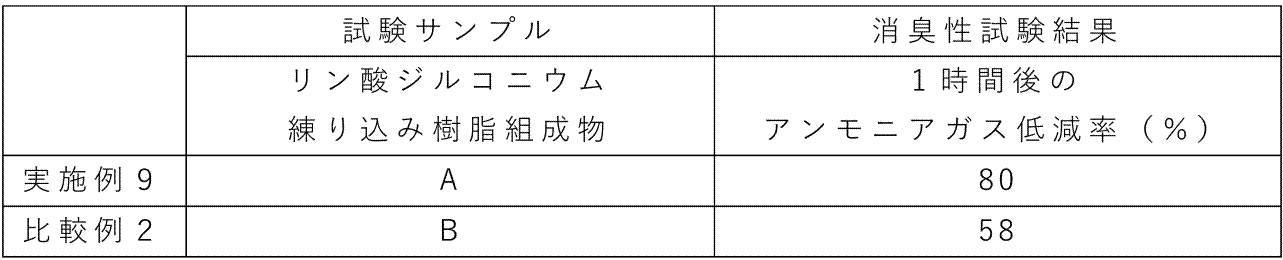
実施例7で得た酸性処理リン酸ジルコニウム(G-2)3重量%と、150℃で12時間乾燥させたポリエステル樹脂(ユニチカ株式会社製、MA-2101M)97重量%を混合し、270℃に設定した全自動射出成型機(名機製作所製、型式:M-50A II-DM)に投入して、11cm×11cm×1mmの射出成型プレートを作製した。その後、このプレートをワンダーブレンダー(大阪ケミカル株式会社製、型式:WB-1)でメジアン径が200μm±100μmになるように粉砕し、リン酸ジルコニウム練り込み樹脂組成物Aを得た。その消臭性能を後述の(3)消臭性試験-2に示す方法に従い評価した。その結果を表2に示す。
比較例1で用いたα-リン酸ジルコニウム3重量%と、150℃で12時間乾燥させたポリエステル樹脂(ユニチカ株式会社製、MA-2101M)97重量%を混合し、実施例9と同様の方法でリン酸ジルコニウム練り込み樹脂組成物Bを得た。その消臭性能を後述の(3)消臭性試験-2に示す方法に従い評価した。その結果を表2に示す。
リン酸ジルコニウム練り込み樹脂組成物2.4gを試験袋(テドラーバッグ)へ入れ、そこへ乾燥空気及びアンモニアガスを注入し、試験袋内のアンモニアガス濃度を100ppmに、及びガス容量を3Lとした後、常温、常圧で1時間放置した。放置後の試験袋内のアンモニアガス低減率を上述の式(1)により算出した。なお、ここでは、式(1)のA0はリン酸ジルコニウム練り込み樹脂組成物を入れない試験袋のアンモニアガス濃度を意味し、A1はリン酸ジルコニウム練り込み樹脂組成物を入れた試験袋のアンモニアガス濃度を意味する。
本明細書に記載された全ての文献、特許出願、および技術規格は、個々の文献、特許出願、および技術規格が参照により取り込まれることが具体的かつ個々に記された場合と同程度に、本明細書中に参照により取り込まれる。
又、本開示のリン酸ジルコニウム粒子の製造方法は、前記消臭性能を改善することができる製造方法を提供することができる。
Claims (21)
- α-リン酸ジルコニウム粒子をpH9以上の塩基性液体に接触させた後、さらに、pH6以下の酸性液体に接触させることによって得られるリン酸ジルコニウム粒子。
- 前記塩基性液体がアルカリ金属及び/又はアルカリ土類金属を含むものである、請求項1に記載のリン酸ジルコニウム粒子。
- リン酸ジルコニウム粒子10mgと1000ppmのアンモニアガスを含有する空気3Lとを、常温常圧で試験袋へ入れ、10分間放置した後の前記リン酸ジルコニウム粒子を入れた前記試験袋内の、下記式(1)で表されるアンモニアガス低減率(X;単位%)が50%以上である、リン酸ジルコニウム粒子。
X={(A0-A1)/A0)}×100 (1)
[式(1)において、A0は、リン酸ジルコニウム粒子を入れない試験袋のアンモニアガス濃度を意味し、A1は、リン酸ジルコニウム粒子を入れた試験袋のアンモニアガス濃度を意味する。] - 一次粒子のメジアン径が0.1~10μmである、請求項1~3のいずれか1項に記載のリン酸ジルコニウム粒子。
- 150℃で2時間加熱した後の、下記式(2)で表される乾燥減分率(Y;単位重量%)が5.0重量%以下である、請求項1~4のいずれか1項に記載のリン酸ジルコニウム粒子。
Y={(B0-B1)/B0}×100 (2)
[式(2)において、B0は、加熱前のリン酸ジルコニウム粒子重量を意味し、B1は、加熱後のリン酸ジルコニウム粒子重量を意味する。] - 請求項1~5のいずれか1項に記載のリン酸ジルコニウム粒子を含む塩基性ガス消臭剤。
- 請求項1~5のいずれか1項に記載のリン酸ジルコニウム粒子を含む繊維用塩基性ガス消臭剤。
- 請求項1~5のいずれか1項に記載のリン酸ジルコニウム粒子を含む繊維練り込み用塩基性ガス消臭剤。
- 請求項1~5のいずれか1項に記載のリン酸ジルコニウム粒子を含む塩基性ガス消臭加工用組成物。
- 請求項1~5のいずれか1項に記載のリン酸ジルコニウム粒子を含む塩基性ガス消臭樹脂組成物。
- 請求項1~5のいずれか1項に記載のリン酸ジルコニウム粒子を含む塩基性ガス消臭繊維。
- ポリエステル、ポリウレタン、ナイロン、レーヨン、綿、アクリル、アラミド、ビニロン、ポリエチレン及びポリプロピレンからなる群より選択される少なくとも1種の繊維を含む、請求項11に記載の塩基性ガス消臭繊維。
- α-リン酸ジルコニウム粒子をpH9以上の塩基性液体に接触させた後、さらに、pH6以下の酸性液体に接触させることを含む、請求項1~5のいずれか1項に記載のリン酸ジルコニウム粒子の製造方法。
- 前記塩基性液体がアルカリ金属及び/又はアルカリ土類金属を含むものである、請求項13に記載のリン酸ジルコニウム粒子の製造方法。
- 請求項13又は14に記載の製造方法で得られたリン酸ジルコニウム粒子及び樹脂を混合することを含む、塩基性ガス消臭樹脂組成物の製造方法。
- リン酸ジルコニウム粒子をpH9以上の塩基性液体に接触させた後、さらに、pH6以下の酸性液体に接触させることにより液体処理リン酸ジルコニウム粒子を得ることと、
前記液体処理リン酸ジルコニウム粒子及び樹脂を混合することと、を含む、塩基性ガス消臭樹脂組成物の製造方法。 - 請求項15又は16に記載の製造方法で得られた塩基性ガス消臭樹脂組成物を紡糸することを含む、塩基性ガス消臭繊維の製造方法。
- リン酸ジルコニウム粒子を含む樹脂をpH9以上の塩基性液体に接触させた後、pH6以下の酸性液体に接触させることを含む、塩基性ガス消臭樹脂組成物の製造方法。
- 前記リン酸ジルコニウム粒子が、請求項1~5のいずれか1項に記載のものである、請求項18に記載の塩基性ガス消臭樹脂組成物の製造方法。
- リン酸ジルコニウム粒子を含む繊維をpH9以上の塩基性液体に接触させた後、pH6以下の酸性液体に接触させることを含む、塩基性ガス消臭繊維の製造方法。
- 前記リン酸ジルコニウム粒子が、請求項1~5のいずれか1項に記載のものである、請求項20に記載の塩基性ガス消臭繊維の製造方法。
Priority Applications (4)
| Application Number | Priority Date | Filing Date | Title |
|---|---|---|---|
| US17/910,097 US12371323B2 (en) | 2020-03-13 | 2021-03-04 | Zirconium phosphate particles, basic gas deodorant using the same, and production method thereof |
| CN202180020596.XA CN115667134B (zh) | 2020-03-13 | 2021-03-04 | 磷酸锆粒子及使用该磷酸锆粒子的碱性气体除臭剂以及其制造方法 |
| JP2022506003A JP7722356B2 (ja) | 2020-03-13 | 2021-03-04 | リン酸ジルコニウム粒子、及びこれを使用した塩基性ガス消臭剤、並びにそれらの製造方法 |
| KR1020227034758A KR20220154144A (ko) | 2020-03-13 | 2021-03-04 | 인산 지르코늄 입자, 및 이것을 사용한 염기성 가스 소취제, 및 그것들의 제조 방법 |
Applications Claiming Priority (2)
| Application Number | Priority Date | Filing Date | Title |
|---|---|---|---|
| JP2020044208 | 2020-03-13 | ||
| JP2020-044208 | 2020-03-13 |
Publications (1)
| Publication Number | Publication Date |
|---|---|
| WO2021182299A1 true WO2021182299A1 (ja) | 2021-09-16 |
Family
ID=77670864
Family Applications (1)
| Application Number | Title | Priority Date | Filing Date |
|---|---|---|---|
| PCT/JP2021/008464 Ceased WO2021182299A1 (ja) | 2020-03-13 | 2021-03-04 | リン酸ジルコニウム粒子、及びこれを使用した塩基性ガス消臭剤、並びにそれらの製造方法 |
Country Status (6)
| Country | Link |
|---|---|
| US (1) | US12371323B2 (ja) |
| JP (1) | JP7722356B2 (ja) |
| KR (1) | KR20220154144A (ja) |
| CN (1) | CN115667134B (ja) |
| TW (1) | TWI874603B (ja) |
| WO (1) | WO2021182299A1 (ja) |
Cited By (1)
| Publication number | Priority date | Publication date | Assignee | Title |
|---|---|---|---|---|
| WO2023127610A1 (ja) * | 2021-12-27 | 2023-07-06 | 東亞合成株式会社 | リン酸ジルコニウム粒子の製造方法、リン酸ジルコニウム粒子、消臭剤、繊維用消臭剤、繊維練り込み用消臭剤、消臭加工用組成物、消臭樹脂組成物、及び消臭繊維 |
Families Citing this family (1)
| Publication number | Priority date | Publication date | Assignee | Title |
|---|---|---|---|---|
| CN118125626A (zh) * | 2024-04-18 | 2024-06-04 | 深圳市清源净水器材有限公司 | 复合除臭菌剂、复合除臭菌剂投加设备及其方法 |
Citations (5)
| Publication number | Priority date | Publication date | Assignee | Title |
|---|---|---|---|---|
| WO2008053694A1 (fr) * | 2006-10-27 | 2008-05-08 | Toagosei Co., Ltd. | Nouveau phosphate de zirconium lamellaire |
| WO2012050156A1 (ja) * | 2010-10-14 | 2012-04-19 | 東亞合成株式会社 | 抗アレルゲン剤 |
| JP2012224517A (ja) * | 2011-04-20 | 2012-11-15 | Toagosei Co Ltd | 層状リン酸ジルコニウムの製造方法 |
| JP2012224518A (ja) * | 2011-04-20 | 2012-11-15 | Toagosei Co Ltd | 層状リン酸ジルコニウムの製造方法 |
| JP2012233203A (ja) * | 2007-10-01 | 2012-11-29 | Toagosei Co Ltd | 抗アレルゲン剤 |
Family Cites Families (6)
| Publication number | Priority date | Publication date | Assignee | Title |
|---|---|---|---|---|
| US6627164B1 (en) * | 2000-11-28 | 2003-09-30 | Renal Solutions, Inc. | Sodium zirconium carbonate and zirconium basic carbonate and methods of making the same |
| JP3896327B2 (ja) | 2002-12-04 | 2007-03-22 | フタムラ化学株式会社 | アンモニアガス吸着用フィルター及びフィルター構造体 |
| JP5325598B2 (ja) * | 2009-02-13 | 2013-10-23 | 国立大学法人信州大学 | 光触媒を担持した繊維製品およびその製造方法 |
| JP6965553B2 (ja) * | 2017-04-14 | 2021-11-10 | 東亞合成株式会社 | 微粒子状繊維用消臭剤 |
| CN109336076B (zh) * | 2018-11-13 | 2020-07-28 | 华南理工大学 | 一种绿色高效剥离层状磷酸锆的方法 |
| CN110591294B (zh) | 2019-09-30 | 2021-09-21 | 华南理工大学 | 一种改性磷酸锆-环氧纳米复合材料及其制备方法 |
-
2021
- 2021-03-04 JP JP2022506003A patent/JP7722356B2/ja active Active
- 2021-03-04 US US17/910,097 patent/US12371323B2/en active Active
- 2021-03-04 WO PCT/JP2021/008464 patent/WO2021182299A1/ja not_active Ceased
- 2021-03-04 KR KR1020227034758A patent/KR20220154144A/ko active Pending
- 2021-03-04 CN CN202180020596.XA patent/CN115667134B/zh active Active
- 2021-03-10 TW TW110108469A patent/TWI874603B/zh active
Patent Citations (5)
| Publication number | Priority date | Publication date | Assignee | Title |
|---|---|---|---|---|
| WO2008053694A1 (fr) * | 2006-10-27 | 2008-05-08 | Toagosei Co., Ltd. | Nouveau phosphate de zirconium lamellaire |
| JP2012233203A (ja) * | 2007-10-01 | 2012-11-29 | Toagosei Co Ltd | 抗アレルゲン剤 |
| WO2012050156A1 (ja) * | 2010-10-14 | 2012-04-19 | 東亞合成株式会社 | 抗アレルゲン剤 |
| JP2012224517A (ja) * | 2011-04-20 | 2012-11-15 | Toagosei Co Ltd | 層状リン酸ジルコニウムの製造方法 |
| JP2012224518A (ja) * | 2011-04-20 | 2012-11-15 | Toagosei Co Ltd | 層状リン酸ジルコニウムの製造方法 |
Cited By (2)
| Publication number | Priority date | Publication date | Assignee | Title |
|---|---|---|---|---|
| WO2023127610A1 (ja) * | 2021-12-27 | 2023-07-06 | 東亞合成株式会社 | リン酸ジルコニウム粒子の製造方法、リン酸ジルコニウム粒子、消臭剤、繊維用消臭剤、繊維練り込み用消臭剤、消臭加工用組成物、消臭樹脂組成物、及び消臭繊維 |
| KR20240127345A (ko) | 2021-12-27 | 2024-08-22 | 도아고세이가부시키가이샤 | 인산 지르코늄 입자의 제조 방법, 인산 지르코늄 입자, 소취제, 섬유용 소취제, 섬유 반죽용 소취제, 소취 가공용 조성물, 소취 수지 조성물 및 소취 섬유 |
Also Published As
| Publication number | Publication date |
|---|---|
| US12371323B2 (en) | 2025-07-29 |
| US20230115027A1 (en) | 2023-04-13 |
| KR20220154144A (ko) | 2022-11-21 |
| CN115667134B (zh) | 2024-05-31 |
| CN115667134A (zh) | 2023-01-31 |
| JPWO2021182299A1 (ja) | 2021-09-16 |
| JP7722356B2 (ja) | 2025-08-13 |
| TW202140374A (zh) | 2021-11-01 |
| TWI874603B (zh) | 2025-03-01 |
Similar Documents
| Publication | Publication Date | Title |
|---|---|---|
| US8313780B2 (en) | Silver-based inorganic antimicrobial agent, method for preparing the same and antimicrobial product | |
| JP6965553B2 (ja) | 微粒子状繊維用消臭剤 | |
| JP5327318B2 (ja) | 銀系無機抗菌剤およびその製造方法 | |
| TWI360392B (en) | A silver inorganic antibacterial agent and antibac | |
| JP2011104274A (ja) | 硫黄系ガス消臭剤 | |
| JPWO2016067839A1 (ja) | 消臭剤及びこれを用いた消臭性加工品、並びに消臭剤及び消臭性加工品の製造方法 | |
| US12371323B2 (en) | Zirconium phosphate particles, basic gas deodorant using the same, and production method thereof | |
| JPWO2016199756A1 (ja) | ケトン系ガス吸着剤、ガス吸着剤組成物及び消臭性加工品 | |
| WO2019220580A1 (ja) | 微粒子状繊維用消臭剤 | |
| CN103014899B (zh) | 一种聚乙烯醇缩醛抗菌纤维的制造方法 | |
| TWI725946B (zh) | 消臭劑、消臭劑組成物及消臭性加工品 | |
| JP6520957B2 (ja) | 消臭剤及び消臭製品 | |
| JPH10165489A (ja) | 消臭剤及び消臭性繊維 | |
| JP2008074781A (ja) | 銀系無機抗菌剤 | |
| JP7635725B2 (ja) | 複合酸化物粒子、消臭剤、洗濯用組成物、洗浄剤組成物、繊維品及び樹脂成形品 | |
| JPH09299460A (ja) | 消臭剤およびその前駆体物質並びにその前駆体物質の製造方法 | |
| TW202340083A (zh) | 磷酸鋯粒子的製造方法、磷酸鋯粒子、除臭劑、纖維用除臭劑、纖維揉合用除臭劑、除臭加工用組成物、除臭樹脂組成物、及除臭纖維 | |
| JP2020110765A (ja) | ガス吸着剤 | |
| TW202340356A (zh) | 樹脂組成物的製造方法 | |
| TW202003375A (zh) | 微粒子狀纖維用除臭劑 | |
| CN114753062A (zh) | 一种可循环使用的擦手巾及其制备方法 | |
| JP2021186006A (ja) | アルデヒド系ガス又はケトン系ガスに好適な消臭剤組成物、消臭製品及びその製造方法 | |
| JP2020110767A (ja) | ガス吸着剤 |
Legal Events
| Date | Code | Title | Description |
|---|---|---|---|
| 121 | Ep: the epo has been informed by wipo that ep was designated in this application |
Ref document number: 21768493 Country of ref document: EP Kind code of ref document: A1 |
|
| ENP | Entry into the national phase |
Ref document number: 2022506003 Country of ref document: JP Kind code of ref document: A |
|
| ENP | Entry into the national phase |
Ref document number: 20227034758 Country of ref document: KR Kind code of ref document: A |
|
| NENP | Non-entry into the national phase |
Ref country code: DE |
|
| 122 | Ep: pct application non-entry in european phase |
Ref document number: 21768493 Country of ref document: EP Kind code of ref document: A1 |
|
| WWG | Wipo information: grant in national office |
Ref document number: 17910097 Country of ref document: US |