WO2021172366A1 - 積層体 - Google Patents
積層体 Download PDFInfo
- Publication number
- WO2021172366A1 WO2021172366A1 PCT/JP2021/006897 JP2021006897W WO2021172366A1 WO 2021172366 A1 WO2021172366 A1 WO 2021172366A1 JP 2021006897 W JP2021006897 W JP 2021006897W WO 2021172366 A1 WO2021172366 A1 WO 2021172366A1
- Authority
- WO
- WIPO (PCT)
- Prior art keywords
- film
- group
- polyolefin
- heat
- mass
- Prior art date
- Legal status (The legal status is an assumption and is not a legal conclusion. Google has not performed a legal analysis and makes no representation as to the accuracy of the status listed.)
- Ceased
Links
Images


Classifications
-
- B—PERFORMING OPERATIONS; TRANSPORTING
- B32—LAYERED PRODUCTS
- B32B—LAYERED PRODUCTS, i.e. PRODUCTS BUILT-UP OF STRATA OF FLAT OR NON-FLAT, e.g. CELLULAR OR HONEYCOMB, FORM
- B32B27/00—Layered products comprising a layer of synthetic resin
- B32B27/32—Layered products comprising a layer of synthetic resin comprising polyolefins
-
- B—PERFORMING OPERATIONS; TRANSPORTING
- B32—LAYERED PRODUCTS
- B32B—LAYERED PRODUCTS, i.e. PRODUCTS BUILT-UP OF STRATA OF FLAT OR NON-FLAT, e.g. CELLULAR OR HONEYCOMB, FORM
- B32B27/00—Layered products comprising a layer of synthetic resin
- B32B27/40—Layered products comprising a layer of synthetic resin comprising polyurethanes
-
- C—CHEMISTRY; METALLURGY
- C08—ORGANIC MACROMOLECULAR COMPOUNDS; THEIR PREPARATION OR CHEMICAL WORKING-UP; COMPOSITIONS BASED THEREON
- C08G—MACROMOLECULAR COMPOUNDS OBTAINED OTHERWISE THAN BY REACTIONS ONLY INVOLVING UNSATURATED CARBON-TO-CARBON BONDS
- C08G18/00—Polymeric products of isocyanates or isothiocyanates
-
- C—CHEMISTRY; METALLURGY
- C08—ORGANIC MACROMOLECULAR COMPOUNDS; THEIR PREPARATION OR CHEMICAL WORKING-UP; COMPOSITIONS BASED THEREON
- C08G—MACROMOLECULAR COMPOUNDS OBTAINED OTHERWISE THAN BY REACTIONS ONLY INVOLVING UNSATURATED CARBON-TO-CARBON BONDS
- C08G18/00—Polymeric products of isocyanates or isothiocyanates
- C08G18/06—Polymeric products of isocyanates or isothiocyanates with compounds having active hydrogen
- C08G18/08—Processes
- C08G18/10—Prepolymer processes involving reaction of isocyanates or isothiocyanates with compounds having active hydrogen in a first reaction step
-
- C—CHEMISTRY; METALLURGY
- C08—ORGANIC MACROMOLECULAR COMPOUNDS; THEIR PREPARATION OR CHEMICAL WORKING-UP; COMPOSITIONS BASED THEREON
- C08G—MACROMOLECULAR COMPOUNDS OBTAINED OTHERWISE THAN BY REACTIONS ONLY INVOLVING UNSATURATED CARBON-TO-CARBON BONDS
- C08G18/00—Polymeric products of isocyanates or isothiocyanates
- C08G18/06—Polymeric products of isocyanates or isothiocyanates with compounds having active hydrogen
- C08G18/28—Polymeric products of isocyanates or isothiocyanates with compounds having active hydrogen characterised by the compounds used containing active hydrogen
- C08G18/65—Low-molecular-weight compounds having active hydrogen with high-molecular-weight compounds having active hydrogen
-
- C—CHEMISTRY; METALLURGY
- C08—ORGANIC MACROMOLECULAR COMPOUNDS; THEIR PREPARATION OR CHEMICAL WORKING-UP; COMPOSITIONS BASED THEREON
- C08G—MACROMOLECULAR COMPOUNDS OBTAINED OTHERWISE THAN BY REACTIONS ONLY INVOLVING UNSATURATED CARBON-TO-CARBON BONDS
- C08G18/00—Polymeric products of isocyanates or isothiocyanates
- C08G18/06—Polymeric products of isocyanates or isothiocyanates with compounds having active hydrogen
- C08G18/70—Polymeric products of isocyanates or isothiocyanates with compounds having active hydrogen characterised by the isocyanates or isothiocyanates used
- C08G18/72—Polyisocyanates or polyisothiocyanates
- C08G18/74—Polyisocyanates or polyisothiocyanates cyclic
- C08G18/76—Polyisocyanates or polyisothiocyanates cyclic aromatic
-
- Y—GENERAL TAGGING OF NEW TECHNOLOGICAL DEVELOPMENTS; GENERAL TAGGING OF CROSS-SECTIONAL TECHNOLOGIES SPANNING OVER SEVERAL SECTIONS OF THE IPC; TECHNICAL SUBJECTS COVERED BY FORMER USPC CROSS-REFERENCE ART COLLECTIONS [XRACs] AND DIGESTS
- Y02—TECHNOLOGIES OR APPLICATIONS FOR MITIGATION OR ADAPTATION AGAINST CLIMATE CHANGE
- Y02W—CLIMATE CHANGE MITIGATION TECHNOLOGIES RELATED TO WASTEWATER TREATMENT OR WASTE MANAGEMENT
- Y02W30/00—Technologies for solid waste management
- Y02W30/50—Reuse, recycling or recovery technologies
- Y02W30/80—Packaging reuse or recycling, e.g. of multilayer packaging
Definitions
- the present invention relates to a laminate, specifically a laminate used as a packaging material.
- the composite film when a packaging bag is manufactured using such a composite film, the composite film may be folded in two and one side of the composite film may be overlapped and heat-sealed. At this time, only one side of the composite film is heat-sealed, and the other side of the composite film is not heat-sealed.
- both one side and the other side of the polyethylene laminated film are polyethylene films.
- one side and the other side of the polyethylene laminated film are substrates having the same melting point and are heat-sealed at the same temperature.
- the other side may also be heat-sealed.
- An object of the present invention is to provide a laminate capable of suppressing the heat sealing of the first film when the second film is heat-sealed.
- the present invention [1] is a laminate including a heat-resistant layer, a polyolefin-based first film, an adhesive layer, and a polyolefin-based second film in this order.
- the heat-resistant layer is a reaction product of a polyisocyanate component containing a polyisocyanate having a ring structure and a polyol component containing a macropolyester and an active hydrogen group-containing compound containing a hydrophilic group.
- the laminate according to the above [1] which is a coated and dried product of a polyurethane dispersion containing a polyurethane resin which is a reaction product of an isocyanate group-terminated prepolymer and a chain extender, is contained.
- the present invention [3] includes the laminate according to the above [1] or [2], wherein the mass of the heat-resistant layer per unit area is 3.5 g / m 2 or less.
- the heat-resistant layer and the first film and / or between the first film and the adhesive layer and / or between the adhesive layer and the second film.
- the gas barrier layer is a reaction product of a polyisocyanate component containing xylylene diisocyanate and a polyol component containing an active hydrogen group-containing compound containing a diol having 2 to 6 carbon atoms and a hydrophilic group. It contains the laminate according to the above [4], which is a coated and dried product of a polyurethane dispersion containing a polyurethane resin which is a reaction product of an isocyanate group-terminated prepolymer and a chain extender.
- the present invention [6] includes the laminate according to the above [4] or [5], wherein the mass per unit area of the gas barrier layer is 0.8 g / m 2 or more and 3 g / m 2 or less. ..
- the present invention [7] includes the laminate according to any one of the above [1] to [6], wherein the first film and the second film are both the same.
- the heat-resistant layer is provided on the first film, the heat-sealing of the first film can be suppressed when the second film is heat-sealed.
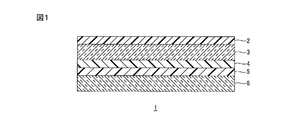
- FIG. 1 shows a schematic view of an embodiment of the laminate of the present invention.
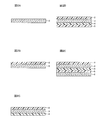
- FIG. 2 is a schematic view showing an embodiment of a method for producing a laminate
- FIG. 2A shows a step of preparing a polyolefin-based first film
- FIG. 2B is one of the polyolefin-based first films.
- a step of arranging (laminating) the heat-resistant layer in the direction is shown
- FIG. 2C shows a step of arranging (laminating) the gas barrier layer on the other surface of the polyolefin-based first film
- FIG. 2D shows the other surface of the gas barrier layer.
- 2E shows a step of arranging (laminating) the adhesive layer
- FIG. 2E shows a step of arranging (laminating) the second polyolefin-based film on the other surface of the adhesive layer.
- FIG. 3 is a schematic view showing a modified example of the laminate of the present invention, FIG. 3A shows the laminate having a gas barrier layer between the heat-resistant layer and the polyolefin-based first film, and FIG. 3B shows. A laminate having a gas barrier layer between the adhesive layer and the polyolefin-based second film is shown, and FIG. 3C shows a laminate without a gas barrier layer.
- FIG. 4 is a schematic view showing an embodiment of a method for manufacturing a standing pouch, FIG. 4A shows a step of preparing a sheet-like laminate, and FIG. 4B shows opposing polyolefin-based second films. The process of contacting and heat-sealing is shown, and FIG. 4C shows the process of obtaining a standing pouch.
- the laminate 1 includes a heat-resistant layer 2, a polyolefin-based first film 3, a gas barrier layer 4, an adhesive layer 5, and a polyolefin-based second film. 6 and 6 are provided in order.
- the heat-resistant layer 2 has a sheet shape extending along the surface direction (direction orthogonal to the thickness direction) and having a flat front surface and a back surface.
- the heat-resistant layer 2 is a layer for suppressing the heat-sealing of the polyolefin-based first film 3 when the polyolefin-based second film 6 is heat-sealed.
- the heat-resistant layer 2 has a polyisocyanate component containing a polyisocyanate having a ring structure (hereinafter referred to as a first polyisocyanate component) and a polyol component containing an active hydrogen group-containing compound containing a macropolyol and a hydrophilic group (hereinafter referred to as a first polyisocyanate component).
- a first polyol component) and a polyurethane resin which is a reaction product of an isocyanate group-terminated prepolymer (hereinafter referred to as an isocyanate group-terminated first prepolymer) and a chain extender. It is formed from a coated dried product of the contained polyurethane dispersion (hereinafter referred to as the first polyurethane dispersion).
- the first polyisocyanate component contains a polyisocyanate having a ring structure as an essential component.
- polyisocyanate having a ring structure examples include a polyisocyanate monomer having a ring structure and a polyisocyanate derivative having a ring structure.
- polyisocyanate monomer having a ring structure examples include alicyclic polyisocyanates, aromatic polyisocyanates, and aromatic aliphatic polyisocyanates.
- alicyclic polyisocyanate examples include 3-isocyanatomethyl-3,5,5-trimethylcyclohexylisocyanate (isophorone diisocyanate, IPDI), 4,4'-, 2,4'-or 2,2'-methylenebis.
- aromatic polyisocyanate examples include 4,4'-, 2,4'-or 2,2'-diphenylmethane diisocyanate or a mixture thereof (MDI), 2,4- or 2,6-toluene diisocyanate or a mixture thereof.
- MDI 4,4'-, 2,4'-or 2,2'-diphenylmethane diisocyanate or a mixture thereof
- TDI 4,4'-toluene diisocyanate
- NDI 1,5-naphthalenediocyanate
- m- or p-phenylenediocyanate or a mixture thereof 4,4'-diphenyldiisocyanate
- 4,4'-diphenyl ether examples include aromatic diisocyanates such as diisocyanates.
- aromatic aliphatic polyisocyanate examples include 1,3- or 1,4-bis (isocyanatomethyl) benzene (also known as 1,3- or 1,4-xylene diisocyanate) or a mixture thereof (XDI), 1. , 3- or 1,4-tetramethylxylene diisocyanate or a mixture thereof (TMXDI), aromatic aliphatic diisocyanates such as ⁇ , ⁇ '-diisocyanate-1,4-diethylbenzene and the like.
- the polyisocyanate derivative having a ring structure is a derivative of the polyisocyanate monomer having a ring structure described above, and is, for example, a multimer (for example, a dimer or a trimer) of the polyisocyanate monomer having a ring structure.
- allophanate-modified product for example, the polyisocyanate monomer having a ring structure described above and a monovalent alcohol or It is produced by the reaction of an allophanate modified product produced by a reaction with a divalent alcohol or a polyol modified product (for example, a polyisocyanate monomer having a ring structure described above and a trivalent alcohol (for example, trimethylolpropane)).
- Polyester modified product (alcohol adduct), biuret modified product (for example, biuret modified product produced by reaction of the above-mentioned polyisocyanate monomer having a ring structure with water or amines), urea modified product (for example)
- a urea-modified product produced by the reaction of the above-mentioned polyisocyanate monomer having a ring structure with a diamine
- an oxadiazine trione-modified product for example, the above-mentioned polyisocyanate monomer having a ring structure and carbon dioxide gas.
- the polyisocyanate having a ring structure is preferably a polyisocyanate monomer having a ring structure, more preferably an aromatic aliphatic polyisocyanate, an alicyclic polyisocyanate, still more preferably an alicyclic polyisocyanate, and particularly preferably.
- Polyisocyanates having a ring structure can be used alone or in combination of two or more.
- the first polyisocyanate component may include a polyisocyanate having no ring structure as an optional component.
- polyisocyanate having no ring structure examples include a polyisocyanate monomer having no ring structure and a polyisocyanate derivative having no ring structure.
- polyisocyanate monomer having no ring structure examples include aliphatic polyisocyanates.
- aliphatic polyisocyanate examples include ethylene diisocyanate, trimethylene diisocyanate, 1,2-propylene diisocyanate, and butylene diisocyanate (tetramethylene diisocyanate, 1,2-butyrene diisocyanate, 2,3-butylene diisocyanate, and 1,3-butylene diisocyanate).
- PDI 1,5-Pentamethylene diisocyanate
- HDI 1,6-hexamethylene diisocyanate
- 2,4,4- or 2,2,4-trimethylhexamethylene diisocyanate 2,6-diisamethylene methyl capate
- An aliphatic diisocyanate such as dodecamethylene diisocyanate and the like.
- the polyisocyanate derivative having no ring structure is the above-mentioned derivative of the polyisocyanate monomer having no ring structure.
- Polyisocyanates that do not have a ring structure can be used alone or in combination of two or more.
- the blending ratio of the polyisocyanate having no ring structure is, for example, 10 parts by mass or less, preferably 5 parts by mass or less, based on 100 parts by mass of the first polyisocyanate component.
- the polyisocyanate preferably does not contain a polyisocyanate having a ring structure, but contains only a polyisocyanate having a ring structure.
- the first polyol component contains a macropolyol and an active hydrogen group-containing compound containing a hydrophilic group as essential components.
- the macropolyol is a compound having two or more hydroxyl groups at the molecular ends and having a number average molecular weight of 400 or more, preferably 500 or more, and 10,000 or less, preferably 5000 or less, more preferably 3000 or less.
- the average number of functional groups of the macropolypoly is, for example, 2 or more, and is, for example, 3 or less, and is preferably 2.
- macropolyols include polyether polyols, polyester polyols, polycarbonate polyols, polyurethane polyols, epoxy polyols, polyolefin polyols, acrylic polyols, silicone polyols, fluorine polyols, vinyl monomer-modified polyols, and the like, and polyester polyols are preferable. Can be mentioned.
- polyester polyol examples include a polycondensate of a low molecular weight polyol described later and a polybasic acid.
- low molecular weight polyol examples include a dihydric alcohol, more preferably a diol having 2 to 6 carbon atoms, further preferably an alkanediol, and particularly preferably 1,6-hexanediol and neopentyl glycol.
- polybasic acid examples include aromatic dibasic acid, alicyclic dibasic acid, and aliphatic dibasic acid.
- aromatic dibasic acid examples include aromatic carboxylic acids such as phthalic acid (orthophthalic acid, isophthalic acid, terephthalic acid) and trimellitic acid, preferably phthalic acid, and more preferably isophthalic acid. Can be mentioned.
- alicyclic dibasic acid examples include alicyclic carboxylic acids such as het acid and 1,2-hexahydrophthalic acid.
- aliphatic dibasic acid examples include oxalic acid, malonic acid, succinic acid, methylsuccinic acid, 2,2-dimethylsuccinic acid, 2,3-dimethylsuccinic acid, hexylsuccinic acid, glutaric acid, and 2-methylglutaric acid.
- Preferred examples of the polybasic acid include aliphatic dibasic acid and aromatic dibasic acid.
- the polyester polyol is preferably a polycondensate of 1,6-hexanediol, neopentyl glycol, adipic acid, isophthalic acid, sebacic acid, ethylene glycol, and neopentyl glycol. Condensates can be mentioned.
- polyester polyol a commercially available product can be used. Specifically, Takelac U-5620 (polyester polyol, which is a polycondensate of adipic acid, 1,6-hexanediol, and neopentyl glycol, Mitsui. (Manufactured by Kagaku Co., Ltd.), Takelac U-9025 (polyester polyol which is a polycondensate of isophthalic acid, sebacic acid, ethylene glycol, and neopentyl glycol, manufactured by Mitsui Kagaku Co., Ltd.).
- polyester polyol examples include a polyester polyol obtained by ring-opening polymerization such as ⁇ -caprolactone.
- Macro polyol can be used alone or in combination of two or more.
- the mixing ratio of the macropolypoly is, for example, 60 parts by mass or more, for example, 90 parts by mass or less, preferably 80 parts by mass or less, based on 100 parts by mass of the total amount of the first polyol component.
- the active hydrogen group-containing compound containing a hydrophilic group is a compound containing a hydrophilic group such as a nonionic group or an ionic group and containing an active hydrogen group such as an amino group or a hydroxyl group. Examples thereof include an active hydrogen group-containing compound containing a nonionic group and an active hydrogen group-containing compound containing an ionic group.
- Examples of the active hydrogen group-containing compound containing a nonionic group include an active hydrogen group-containing compound containing a polyoxyalkylene group as a hydrophilic group (nonionic group). More specifically, examples of the active hydrogen group-containing compound containing a nonionic group include polyoxyethylene glycol, one-ended closed polyoxyethylene glycol, and a polyol containing a polyoxyethylene side chain.
- Examples of the one-ended closed polyoxyethylene glycol include alkoxypolyoxyethylene monool that is one-ended sealed with an alkyl group having 1 to 4 carbon atoms.
- a polyol containing a polyoxyethylene side chain is a compound containing a polyoxyethylene group in the side chain and having two or more hydroxyl groups.
- the active hydrogen group-containing compound containing an ionic group includes, for example, an anionic group such as a carboxylic acid or a cationic group such as a quaternary amine, and an active hydrogen group such as two or more hydroxyl groups or amino groups.
- an anionic group such as a carboxylic acid or a cationic group such as a quaternary amine
- an active hydrogen group such as two or more hydroxyl groups or amino groups.
- Group-containing compounds eg, carboxy group-containing polyols, etc. can be mentioned.
- carboxy group-containing polyol examples include 2,2-dimethylolacetate, 2,2-dimethylollactic acid, 2,2-dimethylolpropionic acid (also known as dimethylolpropionic acid), 2,2-dimethylolbutanoic acid, and 2, , 2-Dimethylolbutyric acid, polyhydroxyalkanoic acid such as 2,2-dimethylolvaleric acid and the like.
- the active hydrogen group-containing compound containing a hydrophilic group is preferably an active hydrogen group-containing compound containing an ionic group, more preferably a compound having an anionic group and two or more hydroxyl groups, and further preferably.
- Carboxy group-containing polyols more preferably polyhydroxyalkanoic acid, and particularly preferably 2,2-dimethylolpropionic acid.
- the active hydrogen group-containing compound containing a hydrophilic group can be used alone or in combination.
- the blending ratio of the active hydrogen group-containing compound containing a hydrophilic group is, for example, 5 parts by mass or more, preferably 10 parts by mass or more, and for example, 30 parts by mass with respect to 100 parts by mass of the total amount of the first polyol component. Parts or less, preferably 20 parts by mass or less.
- the first polyol component contains a low molecular weight polyol (a low molecular weight polyol excluding an active hydrogen group-containing compound containing a hydrophilic group) as an optional component.
- a low molecular weight polyol a low molecular weight polyol excluding an active hydrogen group-containing compound containing a hydrophilic group
- low molecular weight polyol examples include diols having 2 to 6 carbon atoms and other low molecular weight polyols (excluding diols having 2 to 6 carbon atoms).
- the diol having 2 to 6 carbon atoms has a number average molecular weight of 40 or more and less than 400, preferably 300 or less, and is a compound having 2 to 6 carbon atoms and specifically, for example, ethylene glycol.
- diol having 2 to 6 carbon atoms examples include an ether diol having 2 to 6 carbon atoms, and more preferably triethylene glycol.
- diols having 2 to 6 carbon atoms can be used alone or in combination of two or more.
- the blending ratio of the diol having 2 to 6 carbon atoms is, for example, 1 part by mass or more, preferably 5 parts by mass or more, preferably 30 parts by mass or less, based on 100 parts by mass of the total amount of the first polyol component. Is 20 parts by mass or less.
- low molecular weight polyols are compounds having a number average molecular weight of 40 or more and less than 400, preferably 300 or less, and having two or more hydroxyl groups in one molecule (diols having 2 to 6 carbon atoms), for example, carbon. Examples thereof include diols (dihydric alcohols) having a number of 7 or more and low molecular weight polyols having a trivalent value or higher.
- a diol (dihydric alcohol) having 7 or more carbon atoms has a number average molecular weight of 40 or more and less than 400, preferably 300 or less, and is a compound having 2 hydroxyl groups in one molecule and having 7 or more carbon atoms, for example.
- Alkane-1,2-diols with 7 to 20 carbon atoms, 2,6-dimethyl-1-octene-3,8-diols, 1,3- or 1,4-cyclohexanedimethanol and mixtures thereof, bisphenol hydrides A, bisphenol A and the like can also be mentioned.
- diol (divalent alcohol) having 7 or more carbon atoms examples include a divalent polyalkylene oxide having a number average molecular weight of less than 400, preferably 300 or less.
- polyalkylene oxides are made of polyethylene glycol (polyoxyethylene ether glycol), polypropylene glycol, for example, by subjecting the above-mentioned dihydric alcohol as an initiator to an addition reaction with an alkylene oxide such as ethylene oxide and / or propylene oxide. It can be obtained as (polyoxypropylene ether glycol), polyethylene polypropylene glycol (random or block copolymer) and the like.
- polytetramethylene ether glycol having a number average molecular weight of less than 400, preferably 300 or less, obtained by ring-opening polymerization of tetrahydrofuran can be mentioned.
- a low molecular weight polyol having a trivalent or higher valence has a number average molecular weight of 40 or more and less than 400, preferably 300 or less, and is a compound having three or more hydroxyl groups in one molecule, for example, glycerin, 2-methyl-2-. Hydroxymethyl-1,3-propanediol, 2,4-dihydroxy-3-hydroxymethylpentane, 1,2,6-hexanetriol, trimethylpropane, 2,2-bis (hydroxymethyl) -3-butanol, etc.
- Trihydric alcohols such as tetramethylolmethane (pentaerythritol), diglycerin and other tetrahydric alcohols, such as xylitol and other pentahydric alcohols, such as sorbitol, mannitol, aitol, igitol, darsitol, altritor.
- Hexaholic alcohols such as inositol and dipentaerythritol, for example, heptavalent alcohols such as persetol, for example, octahydric alcohols such as sucrose.
- low molecular weight polyols having a trivalent or higher molecular weight examples include polyalkylene oxides having a number average molecular weight of 40 or more and less than 400, preferably 300 or less and having a trivalent or higher molecular weight.
- a polyalkylene oxide is, for example, a polyethylene polyol by adding an alkylene oxide such as ethylene oxide and / or propylene oxide using the above-mentioned trivalent or higher valent low molecular weight polyol or a known polyamine as an initiator.
- Low molecular weight polyols can be used alone or in combination of two or more.
- the first polyol component preferably contains a macropolyol, an active hydrogen group-containing compound containing a hydrophilic group, and a diol having 2 to 6 carbon atoms, and preferably contains a macropolyol and an active hydrogen group containing a hydrophilic group. It consists of a compound and a diol having 2 to 6 carbon atoms.
- the isocyanate group-terminated first prepolymer is obtained by reacting the first polyisocyanate component with the first polyol component.
- each of the above components is reacted by a known polymerization method such as bulk polymerization or solution polymerization, preferably solution polymerization in which the reactivity and viscosity can be easily adjusted. ..
- the equivalent ratio (isocyanate group / hydroxyl group) of the isocyanate group in the first polyisocyanate component to the active hydrogen group (hydroxyl group and / or amino group) in the first polyol component exceeds 1, for example, 1. .2 or more, preferably 1.3 or more, for example, 3.0 or less, preferably 2.5 or less.
- solution polymerization for example, the above components are mixed with an organic solvent (solvent) in a nitrogen atmosphere and reacted.
- organic solvent solvent
- reaction temperature is, for example, 20 ° C. or higher, and for example, 80 ° C. or lower
- reaction time is 1 hour or longer, and for example, 20 hours or lower.
- organic solvent examples include acetone, methyl ethyl ketone, ethyl acetate, tetrahydrofuran, acetonitrile, N-methylpyrrolidone and the like, which are inert to the isocyanate group and highly hydrophilic.
- an amine-based, tin-based, or lead-based reaction catalyst may be added, if necessary, and unreacted polyisocyanate is added from the obtained isocyanate group-terminated first prepolymer.
- unreacted polyisocyanate is added from the obtained isocyanate group-terminated first prepolymer.
- it can be removed by a known method such as distillation or extraction.
- an isocyanate group-terminated first prepolymer which is a reaction product of the first polyisocyanate component and the first polyol component can be obtained.
- the isocyanate group-terminated first prepolymer is an isocyanate group-terminated first prepolymer and an isocyanate group-terminated prepolymer containing an organic solvent. 1 Obtained as a prepolymer reaction solution.
- the isocyanate group-terminated first prepolymer contains an ionic group
- it is preferably neutralized by adding a neutralizing agent to form a salt of the ionic group.
- a conventional base for example, an organic base (for example, a trialkylamine having 1 to 4 carbon atoms such as tertiary amines (trimethylamine, triethylamine, etc.), Alkanolamines such as dimethylethanolamine, methyldiethanolamine, triethanolamine, triisopropanolamine, heterocyclic amines such as morpholin), inorganic bases (ammonia, alkali metal hydroxides (lithium hydroxide, sodium hydroxide, water) (Potassium oxide, etc.), alkaline earth metal hydroxides (magnesium hydroxide, calcium hydroxide, etc.), alkali metal carbonates (sodium carbonate, potassium carbonate, etc.)).
- organic base for example, a trialkylamine having 1 to 4 carbon atoms such as tertiary amines (trimethylamine, triethylamine, etc.), Alkanolamines such as dimethylethanolamine, methyldiethanolamine, triethanolamine,
- the neutralizing agent is added at a ratio of 0.4 equivalents or more, preferably 0.6 equivalents or more, and for example, 1.2 equivalents or less, preferably 1 equivalent or less, per 1 equivalent of anionic groups. Add with.
- the isocyanate group-terminated first prepolymer thus obtained is a polyurethane prepolymer having at least one (preferably a plurality, more preferably two) free isocyanate groups at the molecular terminal thereof.
- the isocyanate group content is, for example, 0.3% by mass or more, preferably 1.0% by mass or more, and for example, 20% by mass or less. , Preferably 15% by mass or less.
- the average number of functional groups of the isocyanate group is, for example, 1.5 or more, and for example, 3.0 or less, preferably 2.5 or less.
- the isocyanate group-terminated first prepolymer obtained above and the chain extender are reacted in, for example, water to obtain a first polyurethane dispersion of a polyurethane resin.
- chain extender examples include the above-mentioned low molecular weight polyols and amino group-containing compounds.
- amino group-containing compound examples include aromatic polyamines, aromatic aliphatic polyamines, alicyclic polyamines, aliphatic polyamines, amino alcohols, polyoxyethylene group-containing polyamines, primary amino groups, and primary amino groups.
- amino group-containing compounds such as alkoxysilyl compounds having a secondary amino group, hydrazine or derivatives thereof.
- aromatic polyamines examples include 4,4'-diphenylmethanediamine and tolylenediamine.
- aromatic aliphatic polyamine examples include 1,3- or 1,4-xylylenediamine or a mixture thereof.
- alicyclic polyamine examples include 3-aminomethyl-3,5,5-trimethylcyclohexylamine (also known as isophoronediamine), 4,4'-dicyclohexylmethanediamine, and 2,5 (2,6) -bis (.
- Examples of the aliphatic polyamine include ethylenediamine, propylenediamine, 1,3-propanediamine, 1,4-butanediamine, 1,5-pentanediamine, 1,6-hexamethylenediamine, diethylenetriamine, triethylenetetramine, and tetraethylene. Examples thereof include pentamine, 1,2-diaminoethane, 1,2-diaminopropane, and 1,3-diaminopentane.
- amino alcohol examples include 2-((2-aminoethyl) amino) ethanol (also known as N- (2-aminoethyl) ethanolamine) and 2-((2-aminoethyl) amino) -1-methylpropanol.
- Also known as: N- (2-aminoethyl) isopropanolamine and the like, preferably 2-((2-aminoethyl) amino) ethanol (also known as: N- (2-aminoethyl) ethanolamine). Be done.
- polyoxyethylene group-containing polyamine examples include polyoxyalkylene ether diamines such as polyoxyethylene ether diamines. More specifically, for example, PEG # 1000 diamine manufactured by NOF Corporation, Jeffamine ED-2003, EDR-148, and XTJ-512 manufactured by Huntsman Co., Ltd. can be mentioned.
- alkoxysilyl compound having a primary amino group or a primary amino group and a secondary amino group examples include ⁇ -aminopropyltrimethoxysilane, ⁇ -aminopropyltriethoxysilane, and N-phenyl- ⁇ .
- An alkoxysilyl compound having a primary amino group such as -aminopropyltrimethoxysilane, N- ⁇ (aminoethyl) ⁇ -aminopropyltrimethoxysilane (also known as N-2- (aminoethyl) -3-aminopropyltri).
- Methoxysilane N- ⁇ (aminoethyl) ⁇ -aminopropyltriethoxysilane (also known as N-2- (aminoethyl) -3-aminopropyltriethoxysilane), N- ⁇ (aminoethyl) ⁇ -aminopropyl Methyldimethoxysilane (also known as N-2- (aminoethyl) -3-aminopropylmethyldimethoxysilane), N- ⁇ (aminoethyl) ⁇ -aminopropylmethyldiethoxysilane (also known as N-2- (aminoethyl))
- Examples thereof include an alkoxysilyl compound having a primary amino group and a secondary amino group such as -3-aminopropylmethyldiethoxysilane), preferably an alkoxy having a primary amino group and a secondary amino group.
- Cyril compounds more preferably N- ⁇ (aminoethyl) ⁇ -aminopropyltrimethoxysilane (also known as N-2- (aminoethyl) -3-aminopropyltrimethoxysilane) can be mentioned.
- hydrazine or its derivative examples include hydrazine (including hydrate), succinate dihydrazide, and adipic acid dihydrazide.
- amino group-containing compounds can be used alone or in combination of two or more.
- the chain extender preferably includes an amino group-containing compound, and more preferably an amino alcohol, a primary amino group, or an alkoxysilyl compound having a primary amino group and a secondary amino group. , More preferably, an aminoalcohol and a primary amino group, or an alkoxysilyl compound having a primary amino group and a secondary amino group is used in combination.
- the isocyanate group-terminated first prepolymer is added. Is then water-dispersed, and then a chain extender is added thereto to extend the chain of the isocyanate group-terminated first prepolymer with the chain extender.
- the isocyanate group-terminated first prepolymer is stirred at a ratio of 50 to 1000 parts by mass of water to 100 parts by mass of the isocyanate group-terminated first prepolymer. Is added.
- the chain extender was added to the water in which the isocyanate group-terminated first prepolymer was dispersed in water with stirring, and the active hydrogen groups (amino groups and hydroxyl groups) of the chain extender with respect to the isocyanate group of the isocyanate group-terminated first prepolymer were added.
- the mixture is added dropwise so that the equivalent ratio (active hydrogen group / isocyanate group) is, for example, a ratio of 0.6 to 1.2.
- the chain extender can be added dropwise as an aqueous solution, for example, and after the addition is completed, the reaction is completed at room temperature, for example, with further stirring.
- the reaction time until the reaction is completed is, for example, 0.1 hour or more, and for example, 10 hours or less.
- water is added to the isocyanate group-terminated first prepolymer to water-disperse the isocyanate group-terminated first prepolymer, and then a chain extender is added to the isocyanate group-terminated first prepolymer.
- the prepolymer can also be chain-extended with a chain extender.
- the organic solvent and water can be removed as needed, and further, water can be added to adjust the solid content concentration.
- a first polyurethane dispersion of a polyurethane resin which is a reaction product of the isocyanate group-terminated first prepolymer and the chain extender, can be obtained.
- the first polyurethane dispersion is used as the first coating liquid.
- the solid content concentration of the first polyurethane dispersion of the obtained polyurethane resin is, for example, 10% by mass or more, preferably 15% by mass or more, more preferably 20% by mass or more, and for example, 60% by mass or less. It is preferably 50% by mass or less, more preferably 45% by mass or less.
- additives can be added to the first coating liquid as needed.
- Additives include, for example, stabilizers (antioxidants, heat stabilizers, UV absorbers, etc.), plasticizers, antistatic agents, lubricants, antiblocking agents, surfactants, dispersion stabilizers, colorants (pigments, etc.) Dyes, etc.), fillers, inorganic particles, inorganic oxide particles, crystal nucleating agents, etc.
- the blending ratio of the additive is not particularly limited, and is appropriately set according to the purpose and application.
- a water-soluble organic solvent and a wetting agent are added to the first coating liquid in order to impart wettability to the polyolefin-based first film 3 or to dilute the first coating liquid. can do.
- water-soluble organic solvent examples include alcohols such as methanol, ethanol and 2-propanol, ketones such as acetone and methyl ethyl ketone, preferably alcohols, and more preferably 2-propanol.
- the water-soluble organic solvent can be used alone or in combination of two or more.
- the heat-resistant layer 2 is obtained by applying the first coating liquid to one surface of the polyolefin-based first film 3 and drying it, as will be described later.
- the storage elastic modulus of the heat-resistant layer 2 at 120 ° C. is, for example, 1 MPa or more, preferably 10 MPa or more, and for example, 100 MPa or less, preferably 50 MPa or less, more preferably 30 MPa or less.
- the storage elastic modulus will be described in detail in Examples described later.
- the thickness of the heat-resistant layer 2 is, for example, 0.1 ⁇ m or more, and for example, 3.0 ⁇ m or less.
- the polyolefin-based first film 3 has a sheet shape that extends along the plane direction (direction orthogonal to the thickness direction) and has a flat front surface and a back surface.
- the polyolefin-based first film 3 includes a polyethylene-based film such as a low-density polyethylene film (LDPE) and a linear low-density polyethylene film (LLDPE), for example, an unstretched polypropylene film (CPP film). , Monoaxially stretched polypropylene film, biaxially stretched polypropylene film (OPP film) and other polypropylene-based films, for example, 4-methyl-1-pentene-based polymer film and the like.
- LDPE low-density polyethylene film
- LLDPE linear low-density polyethylene film
- CPP film unstretched polypropylene film
- Monoaxially stretched polypropylene film, biaxially stretched polypropylene film (OPP film) and other polypropylene-based films for example, 4-methyl-1-pentene-based polymer film and the like.
- the polyolefin-based first film 3 may be subjected to an anchor coating treatment with an anchor coating agent (for example, a mixture of a trimethylolpropane modified product of xylylene diisocyanate and ethyl acetate).
- an anchor coating agent for example, a mixture of a trimethylolpropane modified product of xylylene diisocyanate and ethyl acetate.
- the thickness of the polyolefin-based first film 3 is, for example, 0.05 ⁇ m or more, and for example, 2.0 ⁇ m or less.
- the gas barrier layer 4 has a sheet shape extending along the surface direction (direction orthogonal to the thickness direction) and having a flat front surface and a back surface.
- the gas barrier layer 4 is a layer that imparts gas barrier properties to the laminated body 1.
- the gas barrier layer 4 is a polyol component containing a polyisocyanate component containing xylylene diisocyanate (hereinafter referred to as a second polyisocyanate component), a diol having 2 to 6 carbon atoms, and an active hydrogen group-containing compound containing a hydrophilic group.
- the second polyisocyanate component contains xylylene diisocyanate as an essential component.
- 1,2-xylylene diisocyanate o-XDI
- 1,3-xylylene diisocyanate m-XDI
- 1,4-xylylene diisocyanate p-XDI
- Examples of the xylylene diisocyanate include 1,3-xylylene diisocyanate, 1,4-xylylene diisocyanate, and more preferably 1,3-xylylene diisocyanate.
- the xylylene diisocyanate includes the above-mentioned derivatives.
- Xylylene diisocyanate can be used alone or in combination of two or more.
- the second polyisocyanate component can contain another polyisocyanate as an optional component.
- polyisocyanates examples include the above-mentioned alicyclic polyisocyanate, the above-mentioned aromatic polyisocyanate, the above-mentioned aromatic aliphatic polyisocyanate (excluding xylylene diisocyanate), the above-mentioned aliphatic polyisocyanate, and the above-mentioned derivatives thereof.
- Etc. preferably an alicyclic polyisocyanate, and more preferably 4,4'-methylenebis (cyclohexylisocyanate).
- the blending ratio of the other polyisocyanate is, for example, 10 parts by mass or more and, for example, 30 parts by mass or less with respect to 100 parts by mass of the second polyisocyanate component.
- the second polyisocyanate component preferably contains xylylene diisocyanate and alicyclic polyisocyanate, more preferably contains xylylene diisocyanate and 4,4'-methylenebis (cyclohexyl isocyanate), and more preferably xylylene diisocyanate. And 4,4'-methylenebis (cyclohexyl isocyanate).
- the second polyol component contains the above-mentioned diol having 2 to 6 carbon atoms and the above-mentioned active hydrogen group-containing compound containing a hydrophilic group as essential components.
- diol having 2 to 6 carbon atoms examples include an alkane diol having 2 to 6 carbon atoms, and more preferably ethylene glycol.
- diols having 2 to 6 carbon atoms can be used alone or in combination of two or more.
- the blending ratio of the diol having 2 to 6 carbon atoms is, for example, 50 parts by mass or more, for example, 80 parts by mass or less, preferably 70 parts by mass or less, based on 100 parts by mass of the total amount of the second polyol component. ..
- Examples of the active hydrogen group-containing compound containing a hydrophilic group include the above-mentioned active hydrogen group-containing compound, preferably an active hydrogen group-containing compound containing an ionic group, and more preferably two or more anionic groups.
- the blending ratio of the active hydrogen group-containing compound containing a hydrophilic group is, for example, 20 parts by mass or more, for example, 50 parts by mass or less, preferably 40 parts by mass, based on 100 parts by mass of the total amount of the second polyol component. It is less than a part.
- the second polyol component contains the above-mentioned diol (divalent alcohol) having 7 or more carbon atoms and the above-mentioned low molecular weight polyol having a trivalent value or more as optional components.
- trivalent or higher low molecular weight polyol examples include the above-mentioned low molecular weight polyol, preferably a trihydric alcohol, and more preferably trimethylolpropane.
- the blending ratio of the trivalent or higher low molecular weight polyol is, for example, 1 part by mass or more, for example, 20 parts by mass or less, preferably 10 parts by mass or less, based on 100 parts by mass of the total amount of the second polyol component. ..
- the second polyol component preferably contains a diol having 2 to 6 carbon atoms, an active hydrogen group-containing compound containing a hydrophilic group, and a low molecular weight polyol having a valence of 3 or more, and more preferably a diol having 2 to 6 carbon atoms. It consists of an active hydrogen group-containing compound containing a hydrophilic group and a low molecular weight polyol having a valence of 3 or more.
- the isocyanate group-terminated second prepolymer is obtained by reacting the second polyisocyanate component with the second polyol component.
- reaction between the second polyisocyanate component and the second polyol component is the same as the reaction between the first polyisocyanate component and the first polyol component, and each of the above components is reacted.
- the same organic solvent (solvent) and reaction catalyst as in the reaction between the first polyisocyanate component and the first polyol component can be used, and the reaction conditions (reaction temperature, reaction time and equivalent ratio) can be used. Is the same as the reaction between the first polyisocyanate component and the first polyol component.
- the second polyisocyanate component, the second polyol component, and the isocyanate group-terminated second prepolymer which is a reaction product can be obtained.
- the isocyanate group-terminated second prepolymer is an isocyanate group-terminated second prepolymer containing an isocyanate group-terminated second prepolymer and an organic solvent. 2 Obtained as a prepolymer reaction solution.
- the above-mentioned neutralizing agent preferably triethylamine is preferably used in the same manner as the above-mentioned isocyanate group-terminated first prepolymer. Ammonia) is added to neutralize and form salts of ionic groups.
- the isocyanate group-terminated second prepolymer thus obtained is a polyurethane prepolymer having at least one (preferably a plurality, more preferably two) free isocyanate groups at the molecular ends thereof.
- the isocyanate group content is, for example, 0.3% by mass or more, preferably 1.0% by mass or more, and for example, 20% by mass or less. , Preferably 15% by mass or less.
- the average number of functional groups of the isocyanate group is, for example, 1.5 or more, and for example, 3.0 or less, preferably 2.5 or less.
- the isocyanate group-terminated second prepolymer obtained above and the chain extender described above are reacted in water, for example, to obtain a second polyurethane dispersion of a polyurethane resin.
- chain extender examples include the above-mentioned chain extenders, preferably amino group-containing compounds, more preferably amino alcohols, and even more preferably 2-((2-aminoethyl) amino) ethanol ( Also known as: N- (2-aminoethyl) ethanolamine).
- a second polyurethane dispersion of a polyurethane resin which is a reaction product of the isocyanate group-terminated second prepolymer and the chain extender, can be obtained.
- the second polyurethane dispersion is used as the first coating liquid.
- the solid content concentration of the second polyurethane dispersion of the obtained polyurethane resin is, for example, 10% by mass or more, preferably 15% by mass or more, more preferably 20% by mass or more, and for example, 60% by mass or less. It is preferably 50% by mass or less, more preferably 45% by mass or less.
- the above-mentioned additives can be added to the second coating liquid, if necessary.
- the blending ratio of the additive is not particularly limited, and is appropriately set according to the purpose and application.
- thermoplastic resin having a gas barrier property may be blended in the second coating liquid as long as the gas barrier property is not impaired.
- thermoplastic resin having a gas barrier property examples include polyvinyl alcohol, ethylene-vinyl alcohol copolymer, polyvinylidene chloride or vinylidene chloride copolymer, and polysaccharides such as starch and cellulose.
- the above-mentioned water-soluble organic solvent and the above-mentioned wetting agent for example, modified polysiloxane copolymer weight. Coalescence
- the gas barrier layer 4 is obtained by applying a second coating liquid to the other surface of the polyolefin-based first film 3 and drying it.
- the thickness of the gas barrier layer 4 is, for example, 1.0 ⁇ m or more, and for example, 3.0 ⁇ m or less.
- the adhesive layer 5 has a sheet shape extending along the surface direction (direction orthogonal to the thickness direction) and having a flat front surface and a back surface.
- the adhesive layer 5 is a layer for adhering the gas barrier layer 4 and the polyolefin-based second film 6.
- the adhesive layer 5 is formed of, for example, an adhesive.
- the adhesive is not particularly limited, and examples thereof include known two-component curable urethane adhesives.
- the adhesive a commercially available product can also be used, and examples thereof include a mixture of Takelac A-969V (manufactured by Mitsui Chemicals) and Tanecate A-5 (manufactured by Mitsui Chemicals).
- the adhesive layer 5 is obtained by applying an adhesive to the other surface of the gas barrier layer 4 and drying it, as will be described later.
- the thickness of the adhesive layer 5 is, for example, 1.5 ⁇ m or more, and for example, 4.0 ⁇ m or less.
- the polyolefin-based second film 6 has a sheet shape that extends along the plane direction (direction orthogonal to the thickness direction) and has a flat front surface and a back surface.
- Examples of the polyolefin-based second film 6 include the same ones as the above-mentioned polyolefin-based first film 3.
- the polyolefin-based first film 3 and the polyolefin-based second film 6 are both the same.
- polyolefin-based first film 3 and the polyolefin-based second film 6 are both low-density polyethylene films (LDPE) or both are linear low-density polyethylene films (LLDPE).
- LLDPE linear low-density polyethylene films
- OPP films biaxially stretched polypropylene films
- CPP films unstretched polypropylene films
- polyolefin-based second film 6 may be subjected to an anchor coating treatment by the above-mentioned anchor coating agent.
- the thickness of the polyolefin-based second film 6 is, for example, 10 ⁇ m or more, and for example, 100 ⁇ m or less.
- the manufacturing method of the laminated body 1 will be described in detail below.
- a polyolefin-based first film 3 is prepared.
- the heat-resistant layer 2 is arranged (laminated) on one surface of the polyolefin-based first film 3.
- the first coating liquid is applied to the entire surface of one surface (surface) of the polyolefin-based first film 3 and dried. ..
- the mass per unit area of the heat-resistant layer 2 is, for example, 6.0 g / m 2 or less, preferably 3.5 g / m 2 or less, more preferably 2.5 g / m 2 or less, and also. For example, it is applied so as to be 0.1 g / m 2 or more.
- the heat seal of the polyolefin-based first film 3 can be suppressed when the polyolefin-based second film 6 is heat-sealed.
- Examples of the coating method include known coating methods such as a bar coder method, a curtain coating method, a roll coating method, and a blade coating method.
- the drying temperature is, for example, 40 ° C. or higher, preferably 50 ° C. or higher
- the drying time is, for example, 80 ° C. or lower
- the drying time is, for example, 10 seconds or longer, preferably 20 seconds or higher. That is all, and it is, for example, 120 seconds or less.
- the heat-resistant layer 2 is arranged (laminated) on one surface of the polyolefin-based first film 3.
- the gas barrier layer 4 is arranged (laminated) on the other surface of the polyolefin-based first film 3.
- the gas barrier layer 4 On the other surface of the polyolefin-based first film 3, first, the other surface of the polyolefin-based first film 3 is anchor-coated.
- an anchor coating agent is applied to the other surface of the polyolefin-based first film 3 and dried.
- the anchor coat is applied so that the mass per unit area is, for example, 0.1 g / m 2 or more, and for example, 1.0 g / m 2 or less.
- the coating method is the same as the coating method for the heat-resistant layer 2 described above.
- the drying temperature is, for example, 30 ° C. or higher
- the drying time is, for example, 80 ° C. or lower
- the drying time is, for example, 1 minute or longer, and 5 minutes or shorter, for example.
- the gas barrier layer 4 is arranged (laminated) on the other surface of the polyolefin-based first film 3 that has been subjected to the anchor coating treatment.
- the second coating is applied to the entire other surface (surface) of the polyolefin-based first film 3. Apply the liquid and let it dry.
- the mass per unit area of the gas barrier layer 4 is, for example, 0.1 g / m 2 or more, preferably 0.8 g / m 2 or more, more preferably 1 g / m 2 or more, or, for example. It is applied so as to be 5 g / m 2 or less, preferably 3 g / m 2 or less.
- the gas barrier property is excellent.
- the blocking property is excellent.
- the coating method is the same as the coating method for the heat-resistant layer 2 described above.
- the drying temperature is, for example, 30 ° C. or higher
- the drying time is, for example, 80 ° C. or lower
- the drying time is, for example, 10 seconds or longer, preferably 20 seconds or longer, and for example. , 120 seconds or less.
- the gas barrier layer 4 is arranged (laminated) on the other surface of the polyolefin-based first film 3 that has been subjected to the anchor coating treatment.
- the adhesive layer 5 is arranged (laminated) on the other surface of the gas barrier layer 4.
- the adhesive layer 5 is applied so that the thickness of the adhesive layer 5 after drying is, for example, 1 g / m 2 or more, for example, 5 g / m 2 or less.
- the coating method is the same as the coating method for the heat-resistant layer 2 described above.
- the drying temperature is, for example, 30 ° C. or higher
- the drying time is, for example, 80 ° C. or lower
- the drying time is, for example, 1 minute or longer, and 5 minutes or shorter, for example.
- the adhesive layer 5 is arranged (laminated) on the other surface of the gas barrier layer 4.
- the polyolefin-based second film 6 is arranged (laminated) on the other surface of the adhesive layer 5, and then cured.
- the curing temperature is, for example, 20 ° C. or higher
- the curing time is, for example, 50 ° C. or lower
- the curing time is, for example, 1 day or longer, and 4 days or shorter, for example.
- the polyolefin-based first film 3 and the polyolefin-based second film 6 are adhered to each other via the adhesive layer 5, and the laminate 1 is obtained.
- such a laminate 1 includes the heat-resistant layer 2 on the polyolefin-based first film 3, the heat-sealing of the first film 3 can be suppressed when the polyolefin-based second film 6 is heat-sealed.
- such a laminate 1 can be suitably used as a packaging material for various industrial products such as confectionery, foods, daily necessities, pharmaceuticals, and papers.
- such a laminated body 1 can be suitably used for manufacturing the standing pouch 10.
- the standing pouch 10 is a packaging bag that can contain the contents and can stand on its own.
- a sheet-shaped laminate 1 is prepared.
- the laminate 1 is bent into a substantially W shape so that the polyolefin-based second film 6 in the laminate 1 faces each other.
- the facing polyolefin-based second films 6 are brought into contact with each other.
- the facing polyolefin-based second film 6 side becomes the inside of the standing pouch 10 (content side), and the heat-resistant layer 2 side (polyolefin-based first film 3 side) becomes the outside of the standing pouch 10.
- portion bent into a substantially W shape becomes the bottom portion 11 of the standing pouch 10, and the opposite side thereof becomes the mouth portion 12 for inserting (or taking out) the contents.
- the polyolefin-based second films 6 come into contact with each other inside the standing pouch 10, and the heat-resistant layer 2 comes into contact with the outside of the standing pouch 10.
- the inside of the standing pouch 10 (contacted polyolefin-based second film 6 and bottom 11 (see the dot portion in FIG. 4B) is heat-sealed.
- the heat-resistant layers 2 are in contact with each other between the polyolefin-based first films 3, so that the polyolefin-based first films 3 are not heat-sealed. Therefore, as shown in FIG. 4C, the polyolefin-based first films 3 can be separated from each other at the bottom portion 11 to allow the standing pouch 10 to stand on its own.
- the laminate 1 includes the heat-resistant layer 2 on the polyolefin-based first film 3, the heat of the polyolefin-based first film 3 is generated when the polyolefin-based second film 6 is heat-sealed. Sealing can be suppressed.
- the laminate 1 is provided with the gas barrier layer 4 between the polyolefin-based first film 3 and the adhesive layer 5, but the laminate 1 is not limited to this, and the laminate 1 is the heat-resistant layer 2 and the polyolefin.
- a gas barrier layer 4 may be provided between the first film 3 of the system (see FIG. 3A) or between the adhesive layer 5 and the second film 6 of the polyolefin system (see FIG. 3B).
- the laminated body 1 can be provided with a plurality of gas barrier layers 4.
- the laminate 1 is formed between the heat-resistant layer 2 and the polyolefin-based first film 3 and / or between the polyolefin-based first film 3 and the adhesive layer 5 and / or the adhesive layer 5.
- a gas barrier layer 4 is provided between the film and the polyolefin-based second film 6.
- the gas barrier property is excellent.
- the laminated body 1 does not have to include the gas barrier layer 4.
- the laminate 1 includes a heat-resistant layer 2, a polyolefin-based first film 3, an adhesive layer 5, and a polyolefin-based second film 6 in this order.
- coating liquid Synthesis Example 1 (second coating liquid) Based on the description in Table 1, the polyisocyanate component, the polyol component, and methyl ethyl ketone (MEK) as a solvent are mixed to obtain a predetermined NCO% (1 to 6% or less) at 65 to 70 ° C. under a nitrogen atmosphere. The reaction was carried out until a reaction solution containing an isocyanate group-terminated prepolymer was obtained.
- MEK methyl ethyl ketone
- reaction solution was cooled to 40 ° C. and then neutralized with triethylamine (TEA).
- TAA triethylamine
- reaction solution was dispersed in ion-exchanged water by a homodisper, and an aqueous amine solution in which 2-((2-aminoethyl) amino) ethanol was dissolved in the ion-exchanged water was added as a chain extender.
- the second polyurethane dispersion (PUD1) was mixed with a magnetic stirrer, ion-exchanged water and 2-propanol were gradually added thereto, and a wetting agent (C-600, SILCO WET manufactured by SILICONA, modified polysiloxane copolymer) was added and stirred. As a result, a second coating liquid was obtained.
- a wetting agent C-600, SILCO WET manufactured by SILICONA, modified polysiloxane copolymer
- Synthesis Example 2 and Synthesis Example 3 (first coating liquid)
- the first coating liquid was prepared in the same procedure as in Synthesis Example 1 except that the formulation of each component was changed based on the description in Tables 1 and 2. 3. 3. Manufacture of Laminated Body Example 1 The first coating liquid was applied to one surface of LLDPE (first film) and dried under the conditions of 60 ° C. for 30 seconds.
- a heat-resistant layer (mass 0.5 g / m 2 per unit area) was arranged (laminated) on one surface of the LLDPE (first film).
- the other side of the LLDPE (first film) is coated with an anchor coat agent (Takenate D-110N 2.6 g and ethyl acetate 97.4 g) so that the mass of the anchor coat per unit area is 0.2 g / m 2.
- Anchor coat treatment was performed.
- the second coating liquid was applied to the other surface of the anchor-coated first film, and the film was dried under the conditions of 60 ° C. and 30 seconds.
- a gas barrier layer (mass 2.0 g / m 2 per unit area) was arranged (laminated) on the other surface of the LLDPE (first film).
- LLDPE second film
- Example 2 to Example 17 Comparative Example 1 to Comparative Example 3 A laminate was obtained in the same procedure as in Example 1 according to the description in Table 3.
- the first film and the second film were used as a dry laminating adhesive (Takelac A-969V (manufactured by Mitsui Chemicals) and Takenate A-5 (manufactured by Mitsui Chemicals)).
- the sample has a width of 0.485 cm, a thickness of 200 ⁇ m, and a length of 20 mm, and uses a dynamic viscoelastic device (“DVA-200”, manufactured by IT Measurement Control Co., Ltd.).
- the blocking property was evaluated based on the following criteria. The results are shown in Table 3. ⁇ : The strength was 10 N or less. ⁇ : The strength was 10N to 15N, and it could be easily peeled off by hand. X: Sticking. (Attached at the time of heat seal (HS)) The heat-resistant layers of each example were brought into contact with each other and heat-sealed using TP-701-B-HEAT SEAL TESTER manufactured by Tester Sangyo Co., Ltd. under the conditions of 120 ° C., 0.2 MPa, and 1 second. At this time, in order to prevent sticking to the heat seal bar, heat seal was performed via a PET film.
- the first films were brought into contact with each other, heat-sealed in the same manner as described above, and the strength was measured.
- the laminate of the present invention is preferably used as a packaging material.
Landscapes
- Chemical & Material Sciences (AREA)
- Health & Medical Sciences (AREA)
- Chemical Kinetics & Catalysis (AREA)
- Medicinal Chemistry (AREA)
- Polymers & Plastics (AREA)
- Organic Chemistry (AREA)
- Laminated Bodies (AREA)
- Polyurethanes Or Polyureas (AREA)
- Wrappers (AREA)
Priority Applications (2)
| Application Number | Priority Date | Filing Date | Title |
|---|---|---|---|
| JP2022503656A JP7461453B2 (ja) | 2020-02-28 | 2021-02-24 | 積層体 |
| CN202180013018.3A CN115052745A (zh) | 2020-02-28 | 2021-02-24 | 层叠体 |
Applications Claiming Priority (2)
| Application Number | Priority Date | Filing Date | Title |
|---|---|---|---|
| JP2020-034083 | 2020-02-28 | ||
| JP2020034083 | 2020-02-28 |
Publications (1)
| Publication Number | Publication Date |
|---|---|
| WO2021172366A1 true WO2021172366A1 (ja) | 2021-09-02 |
Family
ID=77491073
Family Applications (1)
| Application Number | Title | Priority Date | Filing Date |
|---|---|---|---|
| PCT/JP2021/006897 Ceased WO2021172366A1 (ja) | 2020-02-28 | 2021-02-24 | 積層体 |
Country Status (4)
| Country | Link |
|---|---|
| JP (1) | JP7461453B2 (https=) |
| CN (1) | CN115052745A (https=) |
| TW (1) | TW202140286A (https=) |
| WO (1) | WO2021172366A1 (https=) |
Cited By (2)
| Publication number | Priority date | Publication date | Assignee | Title |
|---|---|---|---|---|
| WO2023026613A1 (ja) * | 2021-08-26 | 2023-03-02 | 三井化学株式会社 | ポリウレタン水性組成物、耐熱コート剤、第1積層体、袋、第2積層体、第1積層体の製造方法および第2積層体の製造方法 |
| WO2024075693A1 (ja) * | 2022-10-05 | 2024-04-11 | 藤森工業株式会社 | 包装容器 |
Families Citing this family (1)
| Publication number | Priority date | Publication date | Assignee | Title |
|---|---|---|---|---|
| CN118695948A (zh) * | 2022-03-01 | 2024-09-24 | 三井化学株式会社 | 层叠体 |
Citations (6)
| Publication number | Priority date | Publication date | Assignee | Title |
|---|---|---|---|---|
| JPS60196335A (ja) * | 1984-03-21 | 1985-10-04 | 富士写真フイルム株式会社 | 積層フイルム |
| JP2000255642A (ja) * | 1999-03-01 | 2000-09-19 | Johnson & Johnson Vision Care Inc | 医療用デバイスの包装物 |
| JP2001062970A (ja) * | 1999-08-30 | 2001-03-13 | Dainippon Printing Co Ltd | 化粧シート |
| JP2015044303A (ja) * | 2013-08-27 | 2015-03-12 | 凸版印刷株式会社 | 積層体及びこれを用いた包装材及び包装袋 |
| JP2019156946A (ja) * | 2018-03-12 | 2019-09-19 | 三井化学株式会社 | ガスバリア性ラミネート接着剤およびラミネートフィルム |
| JP2019156972A (ja) * | 2018-03-13 | 2019-09-19 | 三井化学株式会社 | ポリウレタンディスパージョンおよびポリウレタン積層体 |
Family Cites Families (10)
| Publication number | Priority date | Publication date | Assignee | Title |
|---|---|---|---|---|
| JPH06316044A (ja) * | 1993-05-07 | 1994-11-15 | Dainippon Printing Co Ltd | プラスチック製蓋材 |
| JP2001052970A (ja) | 1999-08-10 | 2001-02-23 | Honda Motor Co Ltd | 円筒型電気二重層コンデンサ |
| JP4904703B2 (ja) * | 2004-03-24 | 2012-03-28 | Dic株式会社 | 耐熱性ポリウレタンフィルム |
| WO2015178360A1 (ja) * | 2014-05-20 | 2015-11-26 | Dic株式会社 | 2液硬化型ポリウレタンラミネート接着剤組成物、ラミネートフィルム、及び食品包装材料 |
| TW201627344A (zh) * | 2014-09-26 | 2016-08-01 | 科思創德意志股份有限公司 | 無色透明且耐熱之聚胺甲酸酯膜及其製造方法 |
| SG11201707057YA (en) * | 2015-03-11 | 2017-09-28 | Mitsui Chemicals Inc | Laminate, food packaging material, and method for producing laminate |
| JP6969161B2 (ja) | 2017-05-30 | 2021-11-24 | 大日本印刷株式会社 | ポリエチレン積層フィルムおよびこれを用いた包装材料 |
| CN111108146A (zh) | 2017-09-22 | 2020-05-05 | 三菱化学株式会社 | 共聚聚酯薄膜 |
| JP6902455B2 (ja) * | 2017-11-08 | 2021-07-14 | 三井化学株式会社 | コーティング組成物および積層体 |
| US20250066531A1 (en) | 2021-08-26 | 2025-02-27 | Mitsui Chemicals, Inc. | Aqueous polyurethane composition, heat-resistant coating agent, first laminate, bag, second laminate, method for producing first laminate, and method for producing second laminate |
-
2021
- 2021-02-24 CN CN202180013018.3A patent/CN115052745A/zh active Pending
- 2021-02-24 WO PCT/JP2021/006897 patent/WO2021172366A1/ja not_active Ceased
- 2021-02-24 JP JP2022503656A patent/JP7461453B2/ja active Active
- 2021-02-26 TW TW110106870A patent/TW202140286A/zh unknown
Patent Citations (6)
| Publication number | Priority date | Publication date | Assignee | Title |
|---|---|---|---|---|
| JPS60196335A (ja) * | 1984-03-21 | 1985-10-04 | 富士写真フイルム株式会社 | 積層フイルム |
| JP2000255642A (ja) * | 1999-03-01 | 2000-09-19 | Johnson & Johnson Vision Care Inc | 医療用デバイスの包装物 |
| JP2001062970A (ja) * | 1999-08-30 | 2001-03-13 | Dainippon Printing Co Ltd | 化粧シート |
| JP2015044303A (ja) * | 2013-08-27 | 2015-03-12 | 凸版印刷株式会社 | 積層体及びこれを用いた包装材及び包装袋 |
| JP2019156946A (ja) * | 2018-03-12 | 2019-09-19 | 三井化学株式会社 | ガスバリア性ラミネート接着剤およびラミネートフィルム |
| JP2019156972A (ja) * | 2018-03-13 | 2019-09-19 | 三井化学株式会社 | ポリウレタンディスパージョンおよびポリウレタン積層体 |
Cited By (3)
| Publication number | Priority date | Publication date | Assignee | Title |
|---|---|---|---|---|
| WO2023026613A1 (ja) * | 2021-08-26 | 2023-03-02 | 三井化学株式会社 | ポリウレタン水性組成物、耐熱コート剤、第1積層体、袋、第2積層体、第1積層体の製造方法および第2積層体の製造方法 |
| JP7305893B1 (ja) * | 2021-08-26 | 2023-07-10 | 三井化学株式会社 | 積層体、袋、積層体の第1の製造方法および積層体の第2の製造方法 |
| WO2024075693A1 (ja) * | 2022-10-05 | 2024-04-11 | 藤森工業株式会社 | 包装容器 |
Also Published As
| Publication number | Publication date |
|---|---|
| CN115052745A (zh) | 2022-09-13 |
| TW202140286A (zh) | 2021-11-01 |
| JPWO2021172366A1 (https=) | 2021-09-02 |
| JP7461453B2 (ja) | 2024-04-03 |
Similar Documents
| Publication | Publication Date | Title |
|---|---|---|
| JP6189958B2 (ja) | ガスバリア層形成用ポリウレタンディスパージョン、ポリウレタン積層体、および、ガスバリア層形成用ポリウレタンディスパージョンの製造方法 | |
| JP6548717B2 (ja) | 積層体、食品包装材料および積層体の製造方法 | |
| JP6902455B2 (ja) | コーティング組成物および積層体 | |
| JP6199706B2 (ja) | ポリウレタン積層体 | |
| JP7137326B2 (ja) | ポリウレタンディスパージョンおよびポリウレタン積層体 | |
| JP7461453B2 (ja) | 積層体 | |
| JP6165038B2 (ja) | 積層体 | |
| JP7106669B2 (ja) | 積層体および積層体の製造方法 | |
| JP7079117B2 (ja) | ガスバリア性積層体の製造方法 | |
| CN113874581B (zh) | 涂层剂及层叠体 | |
| JP2025106382A (ja) | ポリウレタンディスパージョン、ガスバリア性コート材および積層体 | |
| JP2020163843A (ja) | ポリウレタン積層体 | |
| US20250066531A1 (en) | Aqueous polyurethane composition, heat-resistant coating agent, first laminate, bag, second laminate, method for producing first laminate, and method for producing second laminate | |
| WO2020250768A1 (ja) | ポリウレタンディスパージョン | |
| JP2023076448A (ja) | 積層体 | |
| JP7441657B2 (ja) | 積層体 | |
| JP6896589B2 (ja) | コーティング組成物、積層体およびその製造方法 | |
| JP2020200430A (ja) | ポリウレタンディスパージョンおよびその製造方法 | |
| WO2022030534A1 (ja) | 積層体および食品包装材 | |
| WO2013118562A1 (ja) | ラミネート用接着剤および積層体 | |
| JP2020200377A (ja) | ボトルブロー成形用コーティング剤、プラスチックボトルおよびその製造方法 |
Legal Events
| Date | Code | Title | Description |
|---|---|---|---|
| 121 | Ep: the epo has been informed by wipo that ep was designated in this application |
Ref document number: 21760377 Country of ref document: EP Kind code of ref document: A1 |
|
| ENP | Entry into the national phase |
Ref document number: 2022503656 Country of ref document: JP Kind code of ref document: A |
|
| WWE | Wipo information: entry into national phase |
Ref document number: 202217048715 Country of ref document: IN |
|
| NENP | Non-entry into the national phase |
Ref country code: DE |
|
| 122 | Ep: pct application non-entry in european phase |
Ref document number: 21760377 Country of ref document: EP Kind code of ref document: A1 |