WO2021161807A1 - FormII型の還元型補酵素Q10結晶の製造方法 - Google Patents
FormII型の還元型補酵素Q10結晶の製造方法 Download PDFInfo
- Publication number
- WO2021161807A1 WO2021161807A1 PCT/JP2021/003220 JP2021003220W WO2021161807A1 WO 2021161807 A1 WO2021161807 A1 WO 2021161807A1 JP 2021003220 W JP2021003220 W JP 2021003220W WO 2021161807 A1 WO2021161807 A1 WO 2021161807A1
- Authority
- WO
- WIPO (PCT)
- Prior art keywords
- crystals
- reduced coenzyme
- temperature
- type
- concentration
- Prior art date
- Legal status (The legal status is an assumption and is not a legal conclusion. Google has not performed a legal analysis and makes no representation as to the accuracy of the status listed.)
- Ceased
Links
Images




Classifications
-
- C—CHEMISTRY; METALLURGY
- C07—ORGANIC CHEMISTRY
- C07C—ACYCLIC OR CARBOCYCLIC COMPOUNDS
- C07C41/00—Preparation of ethers; Preparation of compounds having groups, groups or groups
- C07C41/01—Preparation of ethers
- C07C41/34—Separation; Purification; Stabilisation; Use of additives
- C07C41/40—Separation; Purification; Stabilisation; Use of additives by change of physical state, e.g. by crystallisation
-
- C—CHEMISTRY; METALLURGY
- C07—ORGANIC CHEMISTRY
- C07C—ACYCLIC OR CARBOCYCLIC COMPOUNDS
- C07C50/00—Quinones
- C07C50/26—Quinones containing groups having oxygen atoms singly bound to carbon atoms
- C07C50/28—Quinones containing groups having oxygen atoms singly bound to carbon atoms with monocyclic quinoid structure
-
- C—CHEMISTRY; METALLURGY
- C07—ORGANIC CHEMISTRY
- C07C—ACYCLIC OR CARBOCYCLIC COMPOUNDS
- C07C41/00—Preparation of ethers; Preparation of compounds having groups, groups or groups
- C07C41/01—Preparation of ethers
- C07C41/18—Preparation of ethers by reactions not forming ether-oxygen bonds
- C07C41/30—Preparation of ethers by reactions not forming ether-oxygen bonds by increasing the number of carbon atoms, e.g. by oligomerisation
-
- C—CHEMISTRY; METALLURGY
- C07—ORGANIC CHEMISTRY
- C07C—ACYCLIC OR CARBOCYCLIC COMPOUNDS
- C07C43/00—Ethers; Compounds having groups, groups or groups
- C07C43/02—Ethers
- C07C43/20—Ethers having an ether-oxygen atom bound to a carbon atom of a six-membered aromatic ring
- C07C43/23—Ethers having an ether-oxygen atom bound to a carbon atom of a six-membered aromatic ring containing hydroxy or O-metal groups
-
- C—CHEMISTRY; METALLURGY
- C07—ORGANIC CHEMISTRY
- C07B—GENERAL METHODS OF ORGANIC CHEMISTRY; APPARATUS THEREFOR
- C07B2200/00—Indexing scheme relating to specific properties of organic compounds
- C07B2200/13—Crystalline forms, e.g. polymorphs
Definitions
- the present invention relates to a method for producing FormII-type reduced coenzyme Q10 crystals having excellent stability.
- Coenzyme Q is an essential component that is widely distributed in living organisms from bacteria to mammals, and is known as a component of the electron transport chain of mitochondria in cells in the living body. Coenzyme Q plays a role as a transfer component in the electron transport chain by repeating oxidation and reduction in mitochondria, and reduced coenzyme Q is known to have an antioxidant effect. In humans, the main component is coenzyme Q10, which has 10 repeating structures in the side chain of coenzyme Q, and in vivo, about 40 to 90% is usually present as a reduced form. Examples of the physiological action of coenzyme Q include activation of energy production by mitochondrial activation action, activation of cardiac function, stabilization effect of cell membrane, and protection effect of cells by antioxidant action.
- Patent Document 1 A general method for obtaining reduced coenzyme Q10 has already been disclosed (Patent Document 1). Further, some methods are known as a method for obtaining the reduced coenzyme Q10 as a crystal. For example, a method of crystallizing the reduced coenzyme Q10 in an alcohol solution and / or a ketone solution to produce crystals (Patent Document 2), or adding a high-concentration liquid phase of the reduced coenzyme Q10 to a poor solvent. As a result, a method for crystallization (Patent Document 3) and the like have been reported.
- Patent Document 4 describes that a crystal polymorphism phenomenon is observed in the reduced coenzyme Q10, and a newly emerged crystal form (hereinafter, this crystal is referred to as a Form II type reduced coenzyme Q10 crystal, Alternatively, the Form II type crystal (referred to as a Form II type crystal) is much more stable than the conventional reduced coenzyme Q10 (hereinafter, this crystal is referred to as a Form I type reduced coenzyme Q10 crystal or a Form I type crystal), and other It is also reported to have excellent physical properties.
- Patent Document 4 describes a method for obtaining FormII-type reduced coenzyme Q10 crystals under specific conditions, but it takes a long time and the amount of recovery may be small. This method is not always optimal industrially.
- Form II-type reduced coenzyme Q10 crystals the saturation concentration of Form II-type reduced coenzyme Q10 crystals is lower than the saturation concentration of Form I-type reduced coenzyme Q10 crystals in ethanol. Then, based on this finding, it was found that FormII-type reduced coenzyme Q10 crystals can be efficiently obtained by the following method. (1) Adding Form II type reduced coenzyme Q10 crystals as seed crystals to a mixed solution containing ethanol and reduced coenzyme Q10, and It comprises precipitating FormII-type reduced coenzyme Q10 crystals in the mixed solution after the addition of the seed crystals.
- the temperature T p of the mixed solution is such that the dissolved concentration C p of the reduced coenzyme Q10 in the mixed solution is equal to or higher than the saturation concentration of the Form II type crystal and the saturation concentration of the Form I type crystal.
- Ethanol may contain water, and the ethanol concentration is Z (v / v)% with respect to the total amount of water and ethanol, and the Z is 90 to 100.
- Precipitating the crystals can Keeping said T p at a constant temperature in the range of 20 ° C. or higher 43 ° C. or less, and subsequently, the mixture is the temperature of 25 ° C. below and the constant temperature below the temperature, -15 ° C. /
- This specification includes the disclosure of Japanese Patent Application No. 2020-021358, which is the basis of the priority of the present application.
- Form II type reduced coenzyme Q10 crystals can be efficiently produced.
- FIG. 1 shows Form I-type crystals and Form II-type crystals in hydrous ethanol having ethanol concentrations of 99.5 (v / v)%, 95 (v / v)%, and 90 (v / v)%. It is a graph which plotted the solubility on the x-axis of temperature (K) and the y-axis of the solubility (% by weight) of the reduced coenzyme Q10 crystal.
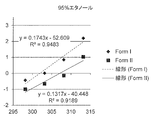
- FIG. 2 shows the solubility of Form I type crystals and Form II type crystals in 99.5 (v / v)% hydrous ethanol, the temperature (K) on the x-axis, and the solubility (% by weight) of the reduced coenzyme Q10 crystals.
- FIG. 3 shows the natural logarithm of the solubility (% by weight) of the Form I type crystal and the Form II type crystal in 95 (v / v)% hydrous ethanol, the temperature (K) on the x-axis, and the solubility (% by weight) of the reduced coenzyme Q10 crystal.
- Is a graph plotted with the y-axis.
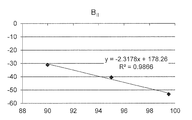
- FIG. 8 is a graph in which the ethanol concentration is plotted on the x-axis and the B II value is plotted on the y-axis in order to confirm the correlation between the constant B II in the above formula 8 and the ethanol concentration.
- the oxidized coenzyme Q10 may be contained as a part thereof.
- the main component is, for example, 50% by weight or more, usually 60% by weight or more, preferably 70% by weight or more, more preferably 80% by weight or more, still more preferably 90% by weight or more, and particularly preferably 95% by weight. As mentioned above, it means that it is contained in an amount of 98% by weight or more.
- the ratio is the ratio of the reduced coenzyme Q10 to the total amount of the coenzyme Q10.
- the reduced coenzyme Q10 has two types of crystalline polymorphs, a conventionally known Form I type and a recently newly discovered Form II type. Specifically, in powder X-ray (Cu—K ⁇ ) diffraction at a melting point of around 48 ° C., the diffraction angles (2 ⁇ ⁇ 0.2 °) are 3.1 °, 18.7 °, 19.0 °, 20.
- the crystal form of the reduced coenzyme Q10 showing a characteristic peak at 2 ° and 23.0 ° is Form I type, the melting point is around 52 ° C, and the diffraction angle (2 ⁇ ) in powder X-ray (Cu—K ⁇ ) diffraction ⁇ 0.2 °) Crystal form of reduced coenzyme Q10 showing characteristic peaks at 11.5 °, 18.2 °, 19.3 °, 22.3 °, 23.0 ° and 33.3 ° Is Form II type.
- DSC differential scanning calorimetry
- crystalline solid in the present specification means a solid containing an amorphous component having no crystal structure as well as a portion having a crystal structure.
- the saturation concentration of Form II type crystals is smaller than the saturation concentration of Form I type crystals in ethanol, and further, the dissolved concentration of the reduced coenzyme Q10 in ethanol is the Form II type crystals.
- ethanol may be a solvent containing ethanol as a main component, and may be hydrous ethanol containing water.
- the ethanol concentration of ethanol is preferably 80 (v / v)% or more, 90 (v / v)% or more, 95 (v / v)% or more, and 100, for example, with respect to the total amount of water and ethanol. It is preferably (v / v)% or less, 99.8 (v / v)% or less, and 99.5 (v / v)% or less.
- FormII-type reduced coenzyme Q10 crystals The method for producing FormII-type reduced coenzyme Q10 crystals according to one or more embodiments of the present invention is described. Adding Form II type reduced coenzyme Q10 crystals as seed crystals to a mixed solution containing ethanol and reduced coenzyme Q10, and It comprises precipitating FormII-type reduced coenzyme Q10 crystals in the mixed solution after the addition of the seed crystals.
- the temperature T p of the mixed solution is such that the dissolved concentration C p of the reduced coenzyme Q10 in the mixed solution is equal to or higher than the saturation concentration of the Form II type crystal and the saturation concentration of the Form I type crystal. Including adjusting to be less than, It is characterized by that.
- the step of adding as a seed crystal may be referred to as a "seed crystal addition step”
- the step of precipitating a Form II type reduced coenzyme Q10 crystal may be referred to as a “crystal precipitation step”.
- the mixed solution containing ethanol and the reduced coenzyme Q10 is not particularly limited as long as it contains ethanol and the reduced coenzyme Q10, and even if the reduced coenzyme Q10 is a uniform solution dissolved in ethanol.
- a slurry in which a part of the reduced coenzyme Q10 is dissolved in ethanol but not partially dissolved may be used, but preferably, the reduced coenzyme Q10 is dissolved in ethanol. It is a uniform solution.
- the reduced coenzyme Q10 used in the mixed solution containing ethanol and the reduced coenzyme Q10 is not limited to a crystalline or amorphous state, and its crystal polymorphism is not limited. Therefore, a conventionally known Form I-type reduced coenzyme Q10 can also be used. Further, since the purity can be increased in crystal precipitation, those containing impurities or unpurified / crudely purified reduced coenzyme Q10 may be used. Further, an extract of reduced coenzyme Q10 obtained by a conventionally known method or a reaction solution containing reduced coenzyme Q10 obtained from oxidized coenzyme Q10 by a known reducing method is used as it is or is required. A mixture purified and / or solvent-substituted according to the above can also be used as the mixed solution.
- the mixed solution containing ethanol and the reduced coenzyme Q10 may further contain an organic solvent other than ethanol (including hydrous ethanol), but the content of ethanol per total amount of the solvent component is preferably preferable. It is 95 (v / v)% or more, 97 (v / v)% or more, 99 (v / v)% or more, and the upper limit is preferably 100 (v / v)% or less. Most preferably, it is 100 (v / v)%.
- the other organic solvent at least one selected from the group consisting of alcohols other than ethanol, hydrocarbons, fatty acid esters and nitrogen compounds can be exemplified.
- Dissolution concentration C i seeding previous reduced coenzyme Q10 for example 2% by weight or more, preferably 3 wt% or more, more preferably 5 wt% or more, more preferably 7 wt% or more, more preferably 9 weight % Or more, more preferably 10% by weight or more, for example, 50% by weight or less, preferably 45% by weight or less, more preferably 30% by weight or less.
- the dissolved concentration C i of reduced coenzyme Q10 is at a temperature T i of the mixed solution at the time of adding a seed crystal, saturation of FormII type crystal Since the concentration is equal to or higher than the concentration and less than the saturation concentration of the Form I type crystal, it is a saturated or supersaturated solution of the Form II type crystal and an unsaturated solution of the Form I type crystal.
- the raw material mixture containing ethanol and the reduced coenzyme Q10 is heated to a temperature of 42 ° C. or higher, more preferably 70 ° C. or lower, particularly preferably 55 ° C. or lower, and the reduced coenzyme. dissolving the Q10, and the solution after heating, and cooled to a temperature T i, is obtained by preparing a saturated or supersaturated solution of FormII type crystals.
- the amount of Form II-type reduced coenzyme Q10 crystal to be a seed crystal is not particularly limited, but is relative to the amount of reduced coenzyme Q10 in the mixed solution before the addition of the seed crystal. 0.1% by weight or more is preferable, 0.5% by weight or more is more preferable, 0.8% by weight or more is more preferable, and 1% by weight or more is particularly preferable.
- the upper limit is not particularly limited, but is preferably 20% by weight or less, more preferably 4% by weight or less, and particularly 2% by weight or less, based on the amount of the reduced coenzyme Q10 in the mixed solution before the addition of the seed crystal. Is preferable.
- the reduced coenzyme Q10 crystal used for the seed crystal may contain a Form II type reduced coenzyme Q10 crystal or an amorphous substance as long as it contains a Form II type reduced coenzyme Q10 crystal. However, it is preferable that the purity of the Form II type reduced coenzyme Q10 crystal is high.
- Form II type reduced coenzyme Q10 crystal is used, for example, 50% by weight or more, preferably 75% by weight or more, more preferably 80% by weight or more, and more preferably 90% by weight or more. good.
- Temperature of the mixed solution at the time of adding a seed crystal T i is preferably in the range of 20 ° C. or higher 43 ° C. or less. If the temperature T i is 20 ° C. or higher, a large difference between the saturation concentration and the saturation concentration of FormI type crystal FormII type crystal and, because of the high saturation concentration of FormI type crystals, selective precipitation of FormII type crystals Suitable for. When the temperature Ti is 43 ° C. or lower, the crystal formation rate is high. Temperature T i is more preferably 25 ° C. or higher, more preferably 30 ° C. or more, more preferably 32 ° C. or higher, if still more preferably 35 ° C.
- the upper limit of the temperature T i is more preferably 40 ° C. or less. Further, when Ti is 20 ° C. or higher and lower than 32 ° C., it is also one of the preferable embodiments.
- the temperature T p of the mixed solution after the addition of seed crystals is set so that the dissolved concentration C p of the reduced coenzyme Q10 in the mixed solution is equal to or higher than the saturation concentration of the Form II type crystal and the Form I type crystal. Including adjusting to be less than the saturation concentration.
- the temperature T p can be appropriately adjusted according to the dissolved concentration C p of the reduced coenzyme Q10 at that time.
- the temperature T p can be 5 ° C. or higher and 43 ° C. or lower.
- the temperature T p may be a constant temperature, but since the dissolved concentration C p of the reduced coenzyme Q10 decreases as the crystals precipitate, the temperature of the mixed solution is used for the purpose of promoting crystallization. It is preferable to perform cooling crystallization that reduces T p over time. “Reducing the temperature T p over time” includes gradually or continuously decreasing the temperature T p over time.
- the amount of crystal precipitation per unit time it is preferable to control the amount of crystal precipitation per unit time to control the formation of supersaturation.
- the preferable amount of precipitation per unit time is, for example, not more than or equal to the rate at which about 50% of the total amount of precipitation per unit time is precipitated (that is, a maximum of 50% amount / hour), and preferably the total amount of precipitation per unit time. 25% of the amount is below the rate of precipitation (ie, up to 25% amount / hour).
- the temperature T p be maintained at a constant temperature, for example, the preferred temperature range described above as range of temperature T i during seeding, for example 20 ° C. or higher 43 ° C. the range constant Including keeping at the temperature of.
- the temperature T p, seed crystals were added 1 hour or more from the temperature range mentioned as a preferred range of the temperature T i during seeding, for example 20 ° C. or higher 43 ° C. the range constant temperature, the It is more preferable to include holding.
- the time for holding the mixed solution in the temperature range is not particularly limited, but is preferably 1 hour or longer, preferably 2 hours or longer, more preferably 4 hours or longer, and particularly preferably 10 hours or longer.
- the upper limit of the time for holding the mixed solution in the temperature range is not particularly limited, but a sufficient effect can be obtained in about 24 hours.
- holding at a constant temperature preferably means holding at a predetermined temperature (set temperature) ⁇ 3 ° C, more preferably holding at a predetermined temperature (set temperature) ⁇ 1 ° C, and further. It means that the temperature is preferably maintained at a predetermined temperature (set temperature) of ⁇ 0.5 ° C.
- the temperature T p of the mixture after seeding after holding the temperature range described above it is preferable to reduce stepwise or continuously.
- the rate of decrease in the temperature T p may be constant or may be changed.
- the cooling rate is more preferably 5 ° C. or lower, more preferably 1 ° C. or higher, and more preferably 2 ° C. or higher.
- the temperature T p of the mixture after seeding after holding at a temperature within the above range, the mixed solution temperature is at 25 ° C. or less and less than said predetermined temperature
- An embodiment in which the temperature is lowered at a rate of ⁇ 15 ° C./hour or less can be mentioned.
- the cooling rate when the temperature of the mixed solution is lowered with time may be constant or may change.
- the cooling rate increases continuously or stepwise as the temperature of the mixed solution decreases, that is, the temperature decrease range per hour increases, the temperature of the mixed solution increases.
- the reduced coenzyme Q10 whose residual amount in the liquid phase decreases as the temperature decreases, can be efficiently crystallized. For example, until the temperature of the mixed solution reaches 25 ° C., the mixed solution is cooled at a rate of preferably 5 ° C. or lower, more preferably 3 ° C. or lower, and the mixed solution is cooled.
- the mixed solution can be cooled at a rate of preferably 6 ° C. or higher, more preferably 8 ° C. or higher per hour.
- the temperature at which the end point is reached when cooling crystallization is performed is preferably 25 ° C. or lower, more preferably 20 ° C. or lower, more preferably 10 ° C. or lower, more preferably 7 ° C. or lower, and even more preferably 5 ° C. or lower.
- the lower limit of the end point temperature is the solidification temperature of the mixed solution system, preferably 0 ° C. or higher, more preferably 3 ° C. or higher.
- Precipitation of crystals is preferably carried out while forcibly flowing the mixed solution after adding the seed crystals.
- the required power for stirring per unit volume is usually about 0.01 kW / m 3 or more, preferably about 0.01 kW / m 3 or more. 0.03kW / m 3 or more, more preferably 0.1 kW / m 3 or more, more preferably from giving 0.3 kW / m 3 or more flow in the liquid mixture.
- the forced flow is usually given by the rotation of the stirring blade, but if the flow is obtained, it is not always necessary to use the stirring blade, and for example, a method by circulating a mixed solution may be used.
- the temperature T p of the mixed solution is adjusted so that the dissolved concentration C p of the reduced coenzyme Q10 is equal to or higher than the saturation concentration of the Form II type crystal and lower than the saturation concentration of the Form I type crystal. Anything that includes that.
- the total amount of reduced coenzyme Q10 contained in the mixed solution is preferably 70% by weight or more, more preferably 80% by weight or more, more preferably 85% by weight or more, and more preferably 90% by weight.
- the temperature T p of the mixed solution is adjusted until% or more is precipitated as crystals, or after the seed crystal is added and before the dissolved concentration C p of the reduced coenzyme Q10 reaches 1.5% by weight or less. When adjusted so as to satisfy the above conditions, most of the reduced coenzyme Q10 is precipitated as Form II type crystals, so that the temperature conditions may deviate from the above conditions thereafter.
- the present inventors have an ethanol concentration of Z (v / v)% with respect to the total amount of water and ethanol in the mixed solution, and the Z is 90 to 100, and the mixing is performed.
- B I -2.3607 ⁇ Z + 172.70 (Equation 5)
- a II 0.0086 ⁇ Z-0.6844 (Equation 6)
- B II -2.3178 ⁇ Z + 178.26
- the dissolved concentration C i of reduced coenzyme Q10 is, FormII type It is equal to or higher than the saturation concentration of the crystal and less than the saturation concentration of the Form I type crystal.
- the weight% of units of C i a unit of T i and K. Note that Equation 1 is found that satisfied when C i is 1.5 wt% or more. (Equation 1) A II ⁇ T i + B II ⁇ logC i ⁇ A I ⁇ T i + B I
- the dissolved concentration C p of the reduced coenzyme Q10 and the temperature T p of the mixed solution satisfy the following formula 2
- the dissolved concentration C p of the reduced coenzyme Q10 is Form II type. It is equal to or higher than the saturation concentration of the crystal and less than the saturation concentration of the Form I type crystal.
- the unit of C p is weight%
- the unit of T p is K. It has been found that Equation 2 holds when C p is 1.5% by weight or more.
- Preferred embodiments of the present invention include embodiments that satisfy all of the formulas 1 to 6. (Equation 2) A II ⁇ T p + B II ⁇ logC p ⁇ A I ⁇ T p + B I
- the Form II type reduced coenzyme Q10 crystal or crystalline solid obtained by the above method is recovered through a solid-liquid separation / drying step by, for example, a conventionally known method as described in Patent Documents 2 and 3. Will be done. For example, pressure filtration, centrifugal filtration and the like can be used for solid-liquid separation. In addition, dried crystals and crystalline solids can be crushed and classified (sieved) as necessary and recovered.
- the Form II type reduced coenzyme Q10 crystal or the crystalline solid after the solid-liquid separation is dried under heating to obtain the Form II type reduced coenzyme. It is also possible to improve the content ratio of Q10 crystals.
- the drying temperature is preferably 46 ° C. or higher, more preferably 47 ° C. or higher, and even more preferably 49 ° C. or higher.
- the upper limit is usually 52 ° C. or lower, preferably 51 ° C. or lower. If the temperature is lower than 46 ° C., drying proceeds, but the content ratio of FormII-type reduced coenzyme Q10 crystals is hardly improved.
- the reduced coenzyme Q10 crystals may melt during drying.
- the heating time when drying is performed under the above temperature conditions is not particularly limited, but is preferably 4 hours or more, preferably 10 hours or more, and more preferably 20 hours or more.
- the above is not limited, for example, 25 ° C. or higher, preferably 30 ° C. or higher, more preferably 35. Drying may be carried out at ° C or higher.
- each step in the method of the present invention specifically, the seed crystal addition step, the crystal precipitation step, the recovery step such as solid-liquid separation and drying, and other subsequent treatment steps described above are performed in a deoxidized atmosphere. It is preferable to carry out at.
- the deoxidized atmosphere can be achieved by substituting the atmosphere with an inert gas, reducing the pressure, boiling, or a combination thereof. At least, it is preferable to replace the atmosphere with an inert gas, that is, to use an inert gas atmosphere.
- the inert gas include nitrogen gas, helium gas, argon gas, hydrogen gas, carbon dioxide gas and the like, and nitrogen gas is preferable.
- the obtained reduced coenzyme Q10 crystal or crystalline solid contains Form II type reduced coenzyme Q10 crystal and its content ratio are measured by, for example, a differential scanning calorimeter (DSC). It is possible to discriminate by this.
- DSC differential scanning calorimeter
- the Form II type reduced coenzyme Q10 crystal shows an endothermic peak near 52 ⁇ 2 ° C. when measured by DSC at a heating rate of 1 ° C./min
- the Form I type reduced coenzyme Q10 The crystal shows an endothermic peak around 48 ⁇ 1 ° C. under the same conditions.
- the Form II type reduced coenzyme Q10 crystal is mixed with the conventional Form I type reduced coenzyme Q10 crystal or its crystalline solid, the presence or absence of a peak near 52 ⁇ 2 ° C. and its endothermic process
- the presence or absence of Form II-type reduced coenzyme Q10 crystals and the content ratio thereof can be determined from the peak height and the endothermic amount ratio. According to the method of the present invention, high-purity Form II type reduced coenzyme Q10 crystals or crystalline solids can be efficiently obtained.
- ⁇ Ratio of Form II type reduced coenzyme Q10 crystals The ratio of Form II type crystals in the recovered reduced coenzyme Q10 crystals was determined by analyzing the crystals by DSC measurement under the following conditions, and the height of the endothermic peak of the obtained Form I type reduced coenzyme Q10 crystals (Y difference). Based on the following formula, based on the height of the endothermic peak (Y difference) of the Form II type reduced coenzyme Q10 crystal (hereinafter, IY difference) (hereinafter, II-Y difference), the reduced type supplement of Form II type. The ratio of enzyme Q10 crystals (FormII ratio) was calculated. (DSC measurement conditions) Equipment: DSC6220 manufactured by SII Nanotechnology Sample container: Aluminum pan & cover (SSC000C008) Temperature rise rate: 1 ° C / min Sample volume: 5 ⁇ 2 mg
- Ethanol concentration per total volume was 298.15K (25 ° C.), 303.15K in hydrous ethanol of 99.5 (v / v)%, 95 (v / v)%, 90 (v / v)% ( Form I-type reduced coenzyme Q10 crystal (Form I-type crystal) and Form II-type reduced coenzyme Q10 at each temperature of 30.
- the solubility (saturation concentration) (% by weight) of the crystal (Form II type crystal) was determined.
- the solubility was measured by the following procedure. About 10 g of Form I-type crystals or Form II-type crystals were added to about 30 g of each hydrous ethanol, and the mixture was stirred under a nitrogen atmosphere and kept at 25 ° C., 30 ° C., 35 ° C., and 40 ° C. for about 1 hour. Sampling was performed at each temperature and filtered quickly to obtain a liquid phase sample. This sample was analyzed under the above HPLC conditions and the solubility was calculated.
- FIG. 1 shows a graph in which the results shown in Tables 1 to 3 are plotted with the temperature (K) on the x-axis and the solubility (% by weight) of the reduced coenzyme Q10 crystal on the y-axis.
- the solubility of Form I-type crystals is higher than that of Form II-type crystals in any concentration of hydrous ethanol, and the higher the ethanol concentration, the higher the solubility of crystals of each form. It was confirmed that it was high.
- the solubilities of Form I-type crystals and Form II-type crystals in hydrous ethanol at each concentration shown in Tables 1, 2 and 3 are determined by the temperature (K) on the x-axis and the solubility (weight) of the reduced coenzyme Q10 crystals. %)
- Graphs plotted with the natural logarithm as the y-axis are shown in FIGS. 2, 3 and 4, respectively.
- the equation of the regression line and the correlation coefficient are shown in each graph. Since the correlation coefficient is large enough, the validity of linear regression on a semi-log graph was confirmed.
- FIGS. 5, 6, and 7. graphs plotted with the ethanol concentration on the x-axis and the values of each constant on the y-axis are shown in FIGS. 5, 6, and 7. , As shown in FIG. The regression line and the correlation coefficient are shown in each figure.
- a I and A II varies in direct proportion to the concentration of water-containing ethanol
- B I and B II it was confirmed that inversely proportional to the change in the concentration of water-containing ethanol. From this result, the constant A I, B I, A II , the value of B II, ethanol concentration Z ((v / v)% ) , respectively formula 3, formula 4, formula 5, have a relationship expressed by Equation 6 Was confirmed.
- the mixed solution after adding the seed crystals was held at 35 ° C. for 15 hours to precipitate crystals.
- the mixture is then cooled to 25 ° C. over 5 hours at a constant cooling rate of -2 ° C./hour and then to 10 ° C. over 1.5 hours at a constant cooling rate of -10 ° C./hour.
- the mixture was cooled to further precipitate crystals.
- the mixed solution is filtered to separate into solid and liquid, and the obtained crystals are dried under reduced pressure at 35 ° C. for 10 hours to obtain FormII-type reduced coenzyme Q10 crystals (FormII ratio: 100%, recovery rate 97). %) Was obtained.
- the liquid phase of the mixed solution was adjusted immediately before the seed crystal addition (0 hour later), 3 hours, 6 hours, 9 hours, 12 hours, and 15 hours after the seed crystal addition (up to this point, 35 ° C.). ), 17.5 hours (30 ° C.), 20 hours (25 ° C.), 20.5 hours (20 ° C.), 21.5 hours (10 ° C.), and dissolved in the liquid phase sample.
- the dissolved concentration C (wt%) of the reduced coenzyme Q10 was measured by high performance liquid chromatography. The measurement results are shown in Table 5.
- Table 5 also shows the measured natural logarithm LogC of the dissolved concentration C.
- Accordance with the above formula 7 and formula 8 using these constants in each are shown in Table 5 Temperature (converting units Kelvin), logarithmic LogC I, FormII type crystals of FormI-form crystals of the saturated concentration C I (wt%) The logarithm LogC II of the saturation concentration C II (% by weight) of was determined.
- the dissolved concentration C of the reduced coenzyme Q10 in the liquid phase is saturated with the Form II type crystals until the seed crystal is added at 35 ° C. and the crystallization time is 20 hours when the temperature is kept at 35 ° C. and then cooled to 25 ° C. It was less than saturation concentration C I of the concentration C II above is is and FormI type crystals. At the crystallization time of 20.5 hours (20 ° C.) and 21.5 hours (10 ° C.), the dissolved concentration C exceeded the saturation concentration CI of the Form I type crystal, but in the liquid phase at the crystallization time of 20 hours. The dissolved concentration C of the reduced coenzyme Q10 was reduced to 1.5% by weight.
- the crystal precipitation of most of the reduced coenzyme Q10 dissolved at the time of adding the seed crystal shows that the dissolved concentration C in the liquid phase is equal to or higher than the saturation concentration C II of the Form II type crystal and less than the saturation concentration CI of the Form I type crystal. Since it was carried out under the above conditions, crystals having a Form II ratio of 100% could be obtained.
Landscapes
- Chemical & Material Sciences (AREA)
- Organic Chemistry (AREA)
- Crystallography & Structural Chemistry (AREA)
- Chemical Kinetics & Catalysis (AREA)
- Organic Low-Molecular-Weight Compounds And Preparation Thereof (AREA)
Priority Applications (5)
| Application Number | Priority Date | Filing Date | Title |
|---|---|---|---|
| US17/799,036 US20230339836A1 (en) | 2020-02-12 | 2021-01-29 | Method for producing reduced coenzyme q10 form ii crystals |
| JP2022500316A JPWO2021161807A1 (https=) | 2020-02-12 | 2021-01-29 | |
| EP21752914.8A EP4105194A4 (en) | 2020-02-12 | 2021-01-29 | METHOD FOR PRODUCING REDUCED COENZYME Q10 FORM II CRYSTALS |
| CN202180014205.3A CN115087631B (zh) | 2020-02-12 | 2021-01-29 | FormII型的还原型辅酶Q10结晶的制造方法 |
| JP2025084765A JP2025109930A (ja) | 2020-02-12 | 2025-05-21 | FormII型の還元型補酵素Q10結晶の製造方法 |
Applications Claiming Priority (2)
| Application Number | Priority Date | Filing Date | Title |
|---|---|---|---|
| JP2020021358 | 2020-02-12 | ||
| JP2020-021358 | 2020-02-12 |
Publications (1)
| Publication Number | Publication Date |
|---|---|
| WO2021161807A1 true WO2021161807A1 (ja) | 2021-08-19 |
Family
ID=77292390
Family Applications (1)
| Application Number | Title | Priority Date | Filing Date |
|---|---|---|---|
| PCT/JP2021/003220 Ceased WO2021161807A1 (ja) | 2020-02-12 | 2021-01-29 | FormII型の還元型補酵素Q10結晶の製造方法 |
Country Status (5)
| Country | Link |
|---|---|
| US (1) | US20230339836A1 (https=) |
| EP (1) | EP4105194A4 (https=) |
| JP (2) | JPWO2021161807A1 (https=) |
| CN (1) | CN115087631B (https=) |
| WO (1) | WO2021161807A1 (https=) |
Cited By (6)
| Publication number | Priority date | Publication date | Assignee | Title |
|---|---|---|---|---|
| JPWO2022202213A1 (https=) * | 2021-03-26 | 2022-09-29 | ||
| JPWO2022202215A1 (https=) * | 2021-03-26 | 2022-09-29 | ||
| WO2022202214A1 (ja) * | 2021-03-26 | 2022-09-29 | 株式会社カネカ | FormII型の還元型補酵素Q10結晶又はその結晶性固体の製造方法 |
| WO2023120557A1 (ja) * | 2021-12-24 | 2023-06-29 | 株式会社カネカ | 還元型補酵素q10の梱包体及び保存方法 |
| WO2023120553A1 (ja) * | 2021-12-24 | 2023-06-29 | 株式会社カネカ | 還元型補酵素q10の保存方法 |
| WO2024204380A1 (ja) * | 2023-03-30 | 2024-10-03 | 株式会社カネカ | 還元型補酵素q10の結晶及び製剤 |
Citations (7)
| Publication number | Priority date | Publication date | Assignee | Title |
|---|---|---|---|---|
| JPH10109933A (ja) | 1996-08-16 | 1998-04-28 | Kanegafuchi Chem Ind Co Ltd | 医薬組成物 |
| WO2003006409A1 (en) | 2001-07-13 | 2003-01-23 | Kaneka Corporation | Method of producing reduced coenzyme q10 crystals with excellent handling properties |
| JP2003089669A (ja) | 2001-07-13 | 2003-03-28 | Kanegafuchi Chem Ind Co Ltd | 還元型補酵素q10の結晶化法 |
| WO2009057611A1 (ja) * | 2007-10-30 | 2009-05-07 | Kaneka Corporation | 含水有機溶媒を用いる還元型補酵素q10の製造方法 |
| WO2012176842A1 (ja) | 2011-06-24 | 2012-12-27 | 株式会社カネカ | 安定性に優れた還元型補酵素q10結晶 |
| JP2020021358A (ja) | 2018-08-02 | 2020-02-06 | 三菱電機インフォメーションシステムズ株式会社 | 入退室管理サーバおよび入退室管理システム |
| WO2020045571A1 (ja) * | 2018-08-30 | 2020-03-05 | 株式会社カネカ | 安定性に優れた還元型補酵素q10結晶の製造方法 |
Family Cites Families (1)
| Publication number | Priority date | Publication date | Assignee | Title |
|---|---|---|---|---|
| TWI310029B (https=) * | 2001-07-13 | 2009-05-21 | Kaneka Corp |
-
2021
- 2021-01-29 JP JP2022500316A patent/JPWO2021161807A1/ja active Pending
- 2021-01-29 CN CN202180014205.3A patent/CN115087631B/zh active Active
- 2021-01-29 WO PCT/JP2021/003220 patent/WO2021161807A1/ja not_active Ceased
- 2021-01-29 US US17/799,036 patent/US20230339836A1/en active Pending
- 2021-01-29 EP EP21752914.8A patent/EP4105194A4/en active Pending
-
2025
- 2025-05-21 JP JP2025084765A patent/JP2025109930A/ja active Pending
Patent Citations (7)
| Publication number | Priority date | Publication date | Assignee | Title |
|---|---|---|---|---|
| JPH10109933A (ja) | 1996-08-16 | 1998-04-28 | Kanegafuchi Chem Ind Co Ltd | 医薬組成物 |
| WO2003006409A1 (en) | 2001-07-13 | 2003-01-23 | Kaneka Corporation | Method of producing reduced coenzyme q10 crystals with excellent handling properties |
| JP2003089669A (ja) | 2001-07-13 | 2003-03-28 | Kanegafuchi Chem Ind Co Ltd | 還元型補酵素q10の結晶化法 |
| WO2009057611A1 (ja) * | 2007-10-30 | 2009-05-07 | Kaneka Corporation | 含水有機溶媒を用いる還元型補酵素q10の製造方法 |
| WO2012176842A1 (ja) | 2011-06-24 | 2012-12-27 | 株式会社カネカ | 安定性に優れた還元型補酵素q10結晶 |
| JP2020021358A (ja) | 2018-08-02 | 2020-02-06 | 三菱電機インフォメーションシステムズ株式会社 | 入退室管理サーバおよび入退室管理システム |
| WO2020045571A1 (ja) * | 2018-08-30 | 2020-03-05 | 株式会社カネカ | 安定性に優れた還元型補酵素q10結晶の製造方法 |
Non-Patent Citations (4)
| Title |
|---|
| ETSUO YONEMOCHI: "The topics of pharmaceutical rrvstal oolv form and solubility", JOURNAL OF PHARMACEUTICAL SCIENCE AND TECHNOLOGY, JAPAN, vol. 64, no. 1, 30 November 2003 (2003-11-30), JP, pages 50 - 52, XP009530563, ISSN: 0372-7629, DOI: 10.14843/jpstj.64.50 * |
| HIRAYAMA, NORIAKI: "Passages; Handbook for producing organic compound crystals-Principles and know-how-", 25 July 2008, JP, ISBN: 978-4-621-07991-1, article HIRAYAMA, NORIAKI: "Passages; Handbook for producing organic compound crystals-Principles and know-how-", pages: 17 - 23, 37-40, 45-51, 57- 65, XP009530562 * |
| HIROSHI OSHIMA: "Chemical Society of Japan", 30 January 2014, JP, ISBN: 978-4-621-08759-6, article MARUZEN CO,: "4.4.3 Crystallization", pages: 269 - 270, XP009530564 * |
| See also references of EP4105194A4 |
Cited By (12)
| Publication number | Priority date | Publication date | Assignee | Title |
|---|---|---|---|---|
| JPWO2022202213A1 (https=) * | 2021-03-26 | 2022-09-29 | ||
| JPWO2022202215A1 (https=) * | 2021-03-26 | 2022-09-29 | ||
| WO2022202215A1 (ja) * | 2021-03-26 | 2022-09-29 | 株式会社カネカ | FormII型の還元型補酵素Q10結晶又はその結晶性固体の製造方法及び晶析装置 |
| WO2022202213A1 (ja) * | 2021-03-26 | 2022-09-29 | 株式会社カネカ | FormII型の還元型補酵素Q10結晶又はその結晶性固体の製造方法 |
| WO2022202214A1 (ja) * | 2021-03-26 | 2022-09-29 | 株式会社カネカ | FormII型の還元型補酵素Q10結晶又はその結晶性固体の製造方法 |
| JPWO2022202214A1 (https=) * | 2021-03-26 | 2022-09-29 | ||
| JP7695994B2 (ja) | 2021-03-26 | 2025-06-19 | 株式会社カネカ | FormII型の還元型補酵素Q10結晶又はその結晶性固体の製造方法 |
| JP7695993B2 (ja) | 2021-03-26 | 2025-06-19 | 株式会社カネカ | FormII型の還元型補酵素Q10結晶又はその結晶性固体の製造方法 |
| JP7739411B2 (ja) | 2021-03-26 | 2025-09-16 | 株式会社カネカ | FormII型の還元型補酵素Q10結晶又はその結晶性固体の製造方法及び晶析装置 |
| WO2023120557A1 (ja) * | 2021-12-24 | 2023-06-29 | 株式会社カネカ | 還元型補酵素q10の梱包体及び保存方法 |
| WO2023120553A1 (ja) * | 2021-12-24 | 2023-06-29 | 株式会社カネカ | 還元型補酵素q10の保存方法 |
| WO2024204380A1 (ja) * | 2023-03-30 | 2024-10-03 | 株式会社カネカ | 還元型補酵素q10の結晶及び製剤 |
Also Published As
| Publication number | Publication date |
|---|---|
| EP4105194A1 (en) | 2022-12-21 |
| CN115087631B (zh) | 2024-05-14 |
| EP4105194A4 (en) | 2024-03-13 |
| JP2025109930A (ja) | 2025-07-25 |
| CN115087631A (zh) | 2022-09-20 |
| US20230339836A1 (en) | 2023-10-26 |
| JPWO2021161807A1 (https=) | 2021-08-19 |
Similar Documents
| Publication | Publication Date | Title |
|---|---|---|
| WO2021161807A1 (ja) | FormII型の還元型補酵素Q10結晶の製造方法 | |
| JP7330987B2 (ja) | 安定性に優れた還元型補酵素q10結晶の製造方法 | |
| JP3796763B2 (ja) | 結晶形2,2−ビス(3,5−ジブロモ−4−ジブロモプロポキシフェニル)プロパン及びその製造方法 | |
| JP7695993B2 (ja) | FormII型の還元型補酵素Q10結晶又はその結晶性固体の製造方法 | |
| WO2022202215A1 (ja) | FormII型の還元型補酵素Q10結晶又はその結晶性固体の製造方法及び晶析装置 | |
| US11161809B2 (en) | Processes for preparing 5-fluoro-2-methyl-1-(4-methylthiobenzylidene)-3-indanacetonitrile and for preparing sulindac | |
| WO2004048385A2 (en) | A process for the preparation of crystalline form 1 or clopidogrel hydrogen sulfate | |
| JP7695994B2 (ja) | FormII型の還元型補酵素Q10結晶又はその結晶性固体の製造方法 | |
| US12617744B2 (en) | Production method for reduced coenzyme Q10 form-II type crystal or crystalline solid thereof | |
| CN116178291B (zh) | 乙基己基三嗪酮产品及其制备方法 | |
| US8232389B2 (en) | Method for crystallization of azetidinonecarboxylic acid | |
| TWI768595B (zh) | 用於製備超純曲前列環素之高效結晶方法及由其製得之晶體 | |
| BE1005210A3 (fr) | Procede pour elever la purete du chlorure de fer technique. | |
| WO2019155922A1 (ja) | アジルサルタンa型結晶の製造方法 | |
| JP6275596B2 (ja) | テルミサルタンのアンモニウム塩の製造方法 | |
| JP6382660B2 (ja) | オルメサルタンメドキソミルの製造方法 | |
| CN114736118B (zh) | 一种3-甲氧基-4-羟基扁桃酸分离及其高纯度产物制备方法 | |
| JPWO2020090948A1 (ja) | Cyclic−di−AMPナトリウム塩結晶 | |
| CN119219498A (zh) | 一种制备电子级碳酸二甲酯的结晶分离方法 | |
| JP2014034521A (ja) | ミチグリニドカルシウム水和物の結晶を製造する方法 | |
| CN115028525A (zh) | 一种氧化型辅酶q10结晶及其结晶方法 | |
| CN120865007A (zh) | 一种乙醇胺盐酸盐的精制方法 | |
| US20110218339A1 (en) | Crystalline polymorph of biopterin and production method thereof | |
| CN107163064A (zh) | 一种利福平i晶型的制备方法 | |
| JP2016150917A (ja) | バルサルタンの結晶の製造方法 |
Legal Events
| Date | Code | Title | Description |
|---|---|---|---|
| 121 | Ep: the epo has been informed by wipo that ep was designated in this application |
Ref document number: 21752914 Country of ref document: EP Kind code of ref document: A1 |
|
| ENP | Entry into the national phase |
Ref document number: 2022500316 Country of ref document: JP Kind code of ref document: A |
|
| NENP | Non-entry into the national phase |
Ref country code: DE |
|
| ENP | Entry into the national phase |
Ref document number: 2021752914 Country of ref document: EP Effective date: 20220912 |