WO2021140638A1 - エレベーターシステム - Google Patents
エレベーターシステム Download PDFInfo
- Publication number
- WO2021140638A1 WO2021140638A1 PCT/JP2020/000626 JP2020000626W WO2021140638A1 WO 2021140638 A1 WO2021140638 A1 WO 2021140638A1 JP 2020000626 W JP2020000626 W JP 2020000626W WO 2021140638 A1 WO2021140638 A1 WO 2021140638A1
- Authority
- WO
- WIPO (PCT)
- Prior art keywords
- control board
- landing
- network
- car
- control
- Prior art date
- Legal status (The legal status is an assumption and is not a legal conclusion. Google has not performed a legal analysis and makes no representation as to the accuracy of the status listed.)
- Ceased
Links
Images


Classifications
-
- B—PERFORMING OPERATIONS; TRANSPORTING
- B66—HOISTING; LIFTING; HAULING
- B66B—ELEVATORS; ESCALATORS OR MOVING WALKWAYS
- B66B1/00—Control systems of elevators in general
- B66B1/02—Control systems without regulation, i.e. without retroactive action
- B66B1/06—Control systems without regulation, i.e. without retroactive action electric
- B66B1/14—Control systems without regulation, i.e. without retroactive action electric with devices, e.g. push-buttons, for indirect control of movements
- B66B1/18—Control systems without regulation, i.e. without retroactive action electric with devices, e.g. push-buttons, for indirect control of movements with means for storing pulses controlling the movements of several cars or cages
-
- B—PERFORMING OPERATIONS; TRANSPORTING
- B66—HOISTING; LIFTING; HAULING
- B66B—ELEVATORS; ESCALATORS OR MOVING WALKWAYS
- B66B3/00—Applications of devices for indicating or signalling operating conditions of elevators
-
- B—PERFORMING OPERATIONS; TRANSPORTING
- B66—HOISTING; LIFTING; HAULING
- B66B—ELEVATORS; ESCALATORS OR MOVING WALKWAYS
- B66B5/00—Applications of checking, fault-correcting, or safety devices in elevators
Definitions
- This disclosure relates to an elevator system.
- Patent Document 1 describes a group management system.
- the system described in Patent Document 1 includes eight subsystems. Each subsystem controls the elevator car. The eight subsystems are connected in a ring.
- An object of the present disclosure is to provide an elevator system capable of preventing a significant deterioration in operating efficiency.
- the elevator system includes a plurality of control boards including a first control board, a first network for connecting a plurality of control boards in a ring shape, a plurality of landing devices for transmitting a call registration request, and a plurality of boarding devices. It includes a control board and a second network for connecting a plurality of landing devices in a bus type.
- the plurality of landing equipment includes a first landing equipment and a second landing equipment.
- the first control board is included in a plurality of control boards when the isolation detection means for detecting that the first control board is isolated from the first network and the isolation detection means for detecting that the first control board is isolated.
- the isolation determination means for determining whether or not there is another control board isolated from the first network, and when the isolation determination means determines that there is no other control board, registration requests from a plurality of landing devices are received.
- the isolation determination means determines that another control board is present, the first car is made to respond to the registration request from the first landing device and the first car is not made to respond to the registration request from the second landing device. It is provided with a first operation control means.
- the elevator system includes a plurality of control boards including a first control board, a first network for connecting a plurality of control boards in a ring shape, and a plurality of landing devices.
- the plurality of landing equipment includes a first landing equipment and a second landing equipment.
- the first control board includes isolation detection means, isolation determination means, and first operation control means. When the isolation detecting means detects that the first control board has been isolated, the isolation determining means determines whether or not another control board isolated from the first network exists in the plurality of control boards. When the isolation determination means determines that there is no other control board, the first operation control means causes the first car to respond to registration requests from a plurality of landing devices.
- the first operation control means responds to the registration request from the first landing device with the first car and responds to the registration request from the second landing device with the first car. Do not respond. With this elevator system, it is possible to prevent the operation efficiency from being significantly deteriorated.
- FIG. It is a figure which shows the example of the elevator system in Embodiment 1.
- FIG. It is a figure for demonstrating the function of each control board.
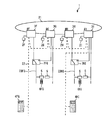
- FIG. 1 is a diagram showing an example of an elevator system 1 according to the first embodiment.
- FIG. 1 shows an example in which the elevator system 1 includes four elevator devices.
- the elevator system 1 includes units F, G, H, and I as elevator devices.
- the number of elevator devices included in the elevator system 1 is not limited to four.
- the elevator system 1 may include eight elevator devices.
- the elevator system 1 includes a car 2F to 2I, a control board 3F to 3I, a landing operation panel 4FG, a landing operation panel 4HI, a landing light 5, a landing button 6FG, a landing button 6HI, a relay board 7FG, and a relay board 7HI. Further, the elevator system 1 includes a network 21, a network 22, and networks 23FG and 23HI.
- the control board 3F controls the operation of Unit F.
- the car 2F of Unit F is controlled by the control board 3F.
- the control board 3F is mounted on the control panel of Unit F.
- the control board 3G controls the operation of the G unit.
- the car 2G of Unit G is controlled by the control board 3G.
- the control board 3G is mounted on the control panel of Unit G.
- the control board 3H controls the operation of Unit H.
- the car 2H of Unit H is controlled by the control board 3H.
- the control board 3H is mounted on the control panel of Unit H.
- the control board 3I controls the operation of Unit I.
- the car 2I of Unit I is controlled by the control board 3I.
- the control board 3I is mounted on the control panel of Unit I.
- Each of the control boards 3F to 3I has a group management function for managing the operation of the entire system.
- the group management function may be executed by one of the control boards 3F to 3I. Therefore, the priority for executing the group management function is set in advance for the control boards 3F to 3I.
- Table 1 shows an example of setting the priority.
- the priority of the control board 3F is the highest.
- the role of the substrate with the highest priority is the master (MST).
- the control board 3H has the second highest priority.
- the role of the board with the second highest priority is the backup master (BKMST).
- Other control boards have the lowest priority.
- the role of the board with the lowest priority is the slave (SLV).
- Each of the control boards 3F to 3I is provided with control parameters for enabling and disabling the group management function.
- the group management function is effectively set by the control parameters in the initial setting.
- the group management function is disabled by the control parameter in the initial setting.
- the group management function is effectively set and the board having the highest priority executes the group management function.
- the control board 3F basically executes the group management function. When the control board 3F cannot execute the group management function, the role of the control board 3H shifts from BKMST to MST, and the control board 3H takes charge of the group management function.
- the network 21 connects the control boards 3F to 3I in a ring-type topology.
- the network 21 may include signal lines according to the transmission direction.
- the physical layer of the network 21 is realized by, for example, a LAN (Local Area Network).
- the control board 3G is arranged between the control board 3F and the control board 3H with respect to the network 21.
- the control board 3H is arranged between the control board 3G and the control board 3I.
- the control board 3I is arranged between the control board 3H and the control board 3F.
- the landing operation panel 4FG is installed at the elevator landing.
- the landing operation panel 4FG is provided with an input device for the user to input the destination floor.
- the landing operation panel 4FG is provided with a display for displaying information to the user.
- the landing operation panel 4FG may be provided with a mechanical input device or a touch panel type input device.
- the landing operation panel 4HI has the same function as that of the landing operation panel 4FG.
- the landing operation panel 4HI is installed at the landing of the elevator.
- the landing operation panel 4HI is provided with an input device for the user to input the destination floor.
- the landing operation panel 4HI is provided with a display for displaying information to the user. In the following, when it is not necessary to distinguish between the landing operation panel 4FG and the landing operation panel 4HI, it is referred to as the landing operation panel 4.
- the network 22 connects the landing operation panel 4FG, the control boards 3F to 3I, and the landing operation panel 4HI in a bus-type topology.
- the physical layer and data link layer of the network 22 are realized by, for example, CAN (Control Area Network).
- FIG. 1 shows an example in which the elevator system 1 includes one landing operation panel 4 for every two elevator devices.
- the elevator system 1 may be provided with one landing operation panel 4 for every four elevator devices.
- the landing button 6FG is installed at the landing of the elevator.
- the landing button 6FG includes an upper button and a lower button.
- the network 23FG connects the landing button 6FG to the control board 3F or the control board 3G via the relay board 7FG.
- the relay board 7FG switches the connection destination of the landing button 6FG to the control board 3F or the control board 3G.
- the relay board 7FG is mounted on the control panel of Unit F.
- the landing button 6HI has the same function as that of the landing button 6FG.
- the landing button 6HI is installed at the landing of the elevator.
- the landing button 6HI includes an upper button and a lower button.
- the network 23HI connects the landing button 6HI to the control board 3H or the control board 3I via the relay board 7HI.
- the relay board 7HI switches the connection destination of the landing button 6HI to the control board 3H or the control board 3I.
- the relay board 7HI is mounted on the control panel of Unit H.
- FIG. 1 shows an example in which the elevator system 1 includes one landing button 6 for every two elevator devices.
- the elevator system 1 may include one landing button 6 for each elevator device.
- FIG. 1 shows an example in which the elevator system 1 includes both a landing operation panel 4 and a landing button 6.
- the elevator system 1 may be provided with only the landing operation panel 4.
- the landing operation panel 4 is an example of a landing device that transmits a call registration request.
- the landing button 6 is an example of a landing device that transmits a call registration request.
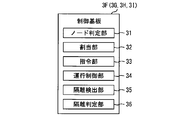
- FIG. 2 is a diagram for explaining the functions of each control board.
- Each of the control boards 3F to 3I includes a node determination unit 31, an allocation unit 32, a command unit 33, an operation control unit 34, an isolation detection unit 35, and an isolation determination unit 36.
- the control board 3F includes a node determination unit 31F, an allocation unit 32F, a command unit 33F, an operation control unit 34F, an isolation detection unit 35F, and an isolation determination unit 36F.
- the control board 3G includes a node determination unit 31G, an allocation unit 32G, a command unit 33G, an operation control unit 34G, an isolation detection unit 35G, and an isolation determination unit 36G.
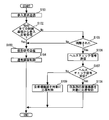
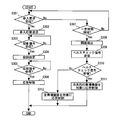
- FIGS. 3 to 7 are flowcharts showing an operation example of the elevator system 1 according to the first embodiment.
- FIG. 3 shows an operation example of the control board whose role is set to MST.
- FIG. 3 shows the operation of the control board 3F.
- the node determination unit 31F transmits an entry request to another control board, that is, control boards 3G to 3I, via the network 21 (S101).
- the entry request is an inquiry to other control boards necessary for performing group management.
- S101 an entry request is broadcast from the control board 3F to the network 21.
- the processing of S101 is periodically performed on the control board 3F.
- FIG. 4 shows an operation example of the control board whose role is set to BKMST.
- FIG. 4 shows the operation of the control board 3H.
- the node determination unit 31H determines whether or not an entry request has been received from another control board via the network 21 (S201).
- the control board 3H receives the entry request transmitted by the node determination unit 31F in S101, it is determined to be Yes in S201.
- the node determination unit 31H determines Yes in S201, the node determination unit 31H transmits an entry response to the control board 3F via the network 21 (S202).
- FIG. 5 shows an operation example of the control board whose role is set to SLV.
- FIG. 5 shows the operation of the control board 3G.
- the node determination unit 31G determines whether or not an entry request has been received from another control board via the network 21 (S301).
- the control board 3G receives the entry request transmitted by the node determination unit 31F in S101, it is determined to be Yes in S301.
- the node determination unit 31G determines Yes in S301, the node determination unit 31G transmits an entry response to the control board 3F via the network 21 (S302).
- the node determination unit 31F determines whether or not an entry response has been received from all other control boards, that is, control boards 3G to 3I via the network 21 (S102). When the control board 3F receives the entry response from all of the control boards 3G to 3I, it is determined as Yes in S102.
- the node determination unit 31F determines Yes in S102, it transmits a signal indicating a role to each of the control boards 3G to 3I via the network 21 (S103).
- a signal indicating a role is also referred to as a “role signal”.
- the node determination unit 31F transmits a role signal indicating BKMST to the control board 3H in S103.
- the node determination unit 31F transmits a role signal indicating SLV to the control board 3G and the control board 3I.
- the node determination unit 31H determines whether or not the role signal has been received (S203). When the control board 3H receives the role signal transmitted by the node determination unit 31F in S103, it is determined to be Yes in S203. The node determination unit 31H sets the role of the own machine according to the role signal received in S203 (S204).
- the node determination unit 31G determines whether or not the role signal has been received (S303).
- the control board 3G receives the role signal transmitted by the node determination unit 31F in S103, it is determined to be Yes in S303.
- the node determination unit 31G sets the role of the own machine according to the role signal received in S303 (S304).
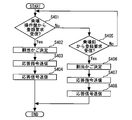
- FIG. 6 shows an example of normal allocation control.
- On the control board 3F it is determined whether or not a call registration request has been received from the landing operation panel 4 (S401). For example, in S401, a permission signal for permitting signal transmission is periodically broadcast from the control board 3F to the network 22.
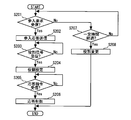
- FIG. 7 shows an operation example of the landing operation panel 4.
- the user of the elevator can input the destination floor by performing a specific input operation on the landing operation panel 4.
- S501 On the landing operation panel 4, it is determined whether or not an input operation has been performed (S501).
- the landing operation panel 4 determines whether or not the permission signal has been received (S502).
- the landing operation panel 4 When the landing operation panel 4 receives the permission signal transmitted by the control board 3F in S401, it is determined to be Yes in S502. When the landing operation panel 4 determines Yes in S502, it transmits a call registration request to the control board 3F that has transmitted the permission signal via the network 22 (S503).
- the registration request transmitted by the landing operation panel 4 includes information on the destination floor.
- control board 3F receives the registration request transmitted by the landing operation panel 4 in S503, it is determined as Yes in S401.
- the allocation unit 32F determines Yes in S401, it determines the allocation car for the registration request received in S401 (S402).
- the control board 3F receives the entry response in S102. Therefore, on the control board 3F, a control board capable of communicating via the network 21 is specified.
- the allocation unit 32F determines the allocation car from the cars controlled by the control board that can communicate with the car 2F via the network 21. If it is determined to be Yes in S102, the allocation unit 32F determines the allocation car from the cars 2F to 2I.
- the command unit 33F transmits a response command via the network 21 to the control board that controls the allocation car determined by the allocation unit 32F (S403). For example, if the car 2G of Unit G is an assigned car, the command unit 33F transmits a response command to the control board 3G via the network 21.
- the response command transmitted in S403 includes information on the destination floor.
- the allocation unit 32F determines the car 2F as the allocation car in S402
- the operation control unit 34F performs response control for transporting the user to the destination floor in S403. In this case, the response command is not transmitted in S403.
- the command unit 33F transmits a response signal to the landing operation panel 4 that has transmitted the registration request in S401 via the network 22 (S404).
- the response signal transmitted to the landing operation panel 4 in S404 includes information on the assigned car.
- the landing operation panel 4 when the registration request is transmitted in S503, it is determined whether or not the response signal has been received (S504).
- the landing operation panel 4 receives the response signal transmitted by the command unit 33F in S404, it is determined to be Yes in S504. If Yes is determined in S504, the landing operation panel 4 displays the information of the assigned car on the display based on the received response signal (S505). The user can know the assigned car by looking at the display of the landing operation panel 4.
- the control board 3H determines whether or not a response command has been received via the network 21 (S205 in FIG. 4). When the control board 3H receives the response command transmitted by the command unit 33F in S403, it is determined to be Yes in S205. If it is determined to be Yes in S205, the operation control unit 34H performs response control for transporting the user to the destination floor (S206). As a result, the user can move to the destination floor in the car 2H, which is the allocation car.
- control board 3G it is determined whether or not a response command has been received via the network 21 (S305 in FIG. 5).
- the control board 3G receives the response command transmitted by the command unit 33F in S403, it is determined as Yes in S305. If it is determined to be Yes in S305, the operation control unit 34G performs response control for transporting the user to the destination floor (S306). As a result, the user can move to the destination floor in the car 2G, which is the allocation car.
- the control board 3F it is determined in the normal allocation control whether or not the call registration request is received from the landing button 6 (S405 in FIG. 6).
- the landing button 6FG transmits a call registration request to the control board 3F via the network 23FG.
- a call registration request is transmitted from the landing button 6HI to the control board 3F via the network 23HI and the network 21.
- the control board 3F receives the registration request transmitted from the landing button 6, it is determined as Yes in S405.
- the allocation unit 32F determines Yes in S405, it determines the allocation car for the registration request received in S405 (S406).
- the allocation unit 32F determines the allocation car from the cars controlled by the control board that can communicate with the car 2F via the network 21. If it is determined to be Yes in S102, the allocation unit 32F determines the allocation car from the cars 2F to 2I.
- the command unit 33F transmits a response command via the network 21 to the control board that controls the allocation car determined by the allocation unit 32F (S407). For example, if the car 2G of Unit G is an assigned car, the command unit 33F transmits a response command to the control board 3G via the network 21.
- the response command transmitted in S407 does not include information on the destination floor.
- the allocation unit 32F determines the car 2F as the allocation car in S406, in S407, the operation control unit 34F performs response control for moving the car 2F to the landing where the user is. In this case, the response command is not transmitted in S407.
- the command unit 33F transmits a response signal to the landing button 6 that has transmitted the registration request in S405 via the network 23 or the like (S408).
- the internal lamp lights up according to the response signal transmitted in S408. The user can know that the call has been registered by looking at the lit landing button 6.
- control board 3H receives the response command transmitted by the command unit 33F in S407, it is determined as Yes in S205 of FIG. If it is determined to be Yes in S205, the operation control unit 34H performs response control for moving the car 2H to the landing where the user is (S206). As a result, the user can ride in the car 2H, which is the allocation car.
- control board 3G receives the response command transmitted by the command unit 33F in S407, it is determined as Yes in S305 of FIG. If it is determined to be Yes in S305, the operation control unit 34G performs response control for moving the car 2G to the landing where the user is (S306). As a result, the user can ride in the car 2G, which is the allocation car.
- No is determined in S102.
- the power of the control panel of the H unit may be turned off.
- the control board 3H cannot perform the operation shown in FIG.
- the control board 3H is separated from the network 21. Therefore, even if the node determination unit 31F transmits an entry request in S101, the entry response is not transmitted from the control board 3H to the control board 3F. In S102, it is determined as No.
- the isolation detection unit 35F determines whether or not the control board 3F is isolated from the network 21 (S105).
- the control board is isolated from the network 21 means that the control board communicates with another control board via the network 21 even though the communication function of the control board is not stopped. I can't do it.
- the control board 3F excludes the control board separated from the network 21 from the control target and performs normal allocation control.
- control board 3H it is determined whether or not TBKMST has elapsed for a certain period of time since the previous entry request was received (S207 in FIG. 4).
- the time TBKMST is preset.
- TSLV has elapsed for a certain period of time since the previous entry request was received (S307 in FIG. 5).
- the time T SLV is set to a time longer than the time T BKMST. Therefore, when the entry request is no longer transmitted from the control board 3F, it is determined as Yes in S207 before it is determined as Yes in S307.
- the node determination unit 31H determines Yes in S207
- the node determination unit 31H changes the role of the control board 3H from BKMST to MST (S208). That is, when it is determined to be Yes in S207, the group management function of the system is performed by the control board 3H. As a result, the operation shown in FIG. 3 is started on the control board 3H.
- the node determination unit 31H determines Yes in S207
- the node determination unit 31H transmits an entry request to another control board via the network 21 (S101). For example, in S101, the entry request is broadcast from the control board 3H to the network 21.
- the node determination unit 31H receives the entry request transmitted in S101 before the determination in S307 is Yes (Yes in S301). As a result, the control board 3G performs a series of processes shown in S302 to S306.
- the maintenance of the F unit and the maintenance of the H unit are performed at the same time.
- the entry request is not transmitted from the control board 3F.
- the control board 3H cannot execute the group management function. Therefore, the control board 3G does not receive the entry request (No in S301).
- the node determination unit 31G determines Yes in S307 as the time TSLV elapses.
- the node determining unit 31I determines Yes in S307 by the elapsed time T SLV.
- the isolation detection unit 35G determines Yes in S307, it detects that the control board 3G has been isolated from the network 21 (S308).
- the isolation determination unit 36G determines whether or not there is another control board isolated from the network 21. This determination by the isolation determination unit 36G is performed based on the health check signal from another control board.
- the isolation determination unit 36G determines Yes in S307, it transmits a health check signal to other control boards, that is, control boards 3F, 3H, and 3I via the network 22 (S309). Further, the isolation determination unit 36G determines whether or not a health check signal has been received from other control boards, that is, control boards 3F, 3H, and 3I (S310).
- the isolation detection unit 35I determines Yes in S307, it detects that the control board 3I has been isolated from the network 21 (S308).
- the isolation determination unit 36I determines whether or not there is another control board isolated from the network 21. This determination by the isolation determination unit 36I is performed based on the health check signal from another control board.
- the isolation determination unit 36I determines Yes in S307, it transmits a health check signal to another control board, that is, control boards 3F to 3H, via the network 22 (S309). Further, the isolation determination unit 36I determines whether or not a health check signal has been received from another control board, that is, control boards 3F to 3H (S310).
- the health check signal transmitted by the isolation determination unit 36I in S309 is received by the control board 3G via the network 22 (Yes in S310).
- the isolation determination unit 36G detects that the control board 3I has been isolated from the network 21. That is, the isolation determination unit 36G determines that another control board isolated from the network 21 exists.
- the operation control unit 34G determines Yes in S310, the operation control unit 34G performs response control so as to respond only to the registration request from the landing equipment of its own series (S311).
- the landing operation panel 4FG, the landing button 6FG, the control board 3F, and the control board 3G are preset in the first series. Therefore, when the operation control unit 34G determines Yes in S310, the operation control unit 34G controls the car 2G to respond to the registration request from the landing operation panel 4FG. In addition, the operation control unit 34G controls the car 2G to respond to the registration request from the landing button 6FG. If it is determined to be Yes in S310, the operation control unit 34G does not respond to the registration request from the landing operation panel 4HI. The operation control unit 34G does not respond to the registration request from the landing button 6HI from the car 2G.
- the health check signal transmitted by the isolation determination unit 36G in S309 is received by the control board 3I via the network 22 (Yes in S310).
- the isolation determination unit 36I detects that the control board 3G has been isolated from the network 21. That is, the isolation determination unit 36I determines that another control board isolated from the network 21 exists.
- the operation control unit 34I determines Yes in S310, the operation control unit 34I performs response control so as to respond only to the registration request from the landing equipment of its own series (S311).
- the landing operation panel 4HI, the landing button 6HI, the control board 3H, and the control board 3I are preset in the second series.
- the second series is a series different from the first series. Therefore, when the operation control unit 34I determines Yes in S310, the operation control unit 34I controls the car 2I to respond to the registration request from the landing operation panel 4HI. In addition, the operation control unit 34I controls the car 2I to respond to the registration request from the landing button 6HI. If it is determined to be Yes in S310, the operation control unit 34I does not respond to the registration request from the landing operation panel 4FG. The operation control unit 34I does not respond to the registration request from the landing button 6FG with the car 2I.
- the isolation determination unit 36G determines that there is no other control board isolated from the network 21 unless a health check signal is received from another control board (No in S310).
- the operation control unit 34G determines No in S310, the operation control unit 34G performs response control so as to respond not only to the landing equipment of its own series but also to the registration request from the landing equipment of another series (S312). That is, the operation control unit 34G responds to the registration request from all the landing equipment with the car 2G.
- the operation control unit 34G causes the car 2G to respond to the registration request from the landing operation panel 4FG.
- the operation control unit 34G responds to the registration request from the landing operation panel 4HI with the car 2G.
- the operation control unit 34G responds to the registration request from the landing button 6FG with the car 2G.
- the operation control unit 34G responds to the registration request from the landing button 6HI with the car 2G.
- the isolation determination unit 36I determines that there is no other control board isolated from the network 21 unless a health check signal is received from another control board (No in S310).
- the operation control unit 34I determines No in S310, the operation control unit 34I performs response control so as to respond not only to the landing equipment of its own series but also to the registration request from the landing equipment of another series (S312). That is, the operation control unit 34I makes the car 2G respond to the registration request from all the landing equipment.
- the operation control unit 34I causes the car 2I to respond to the registration request from the landing operation panel 4FG.
- the operation control unit 34I responds to the registration request from the landing operation panel 4HI with the car 2I.
- the operation control unit 34I responds to the registration request from the landing button 6FG with the car 2I.
- the operation control unit 34I responds to the registration request from the landing button 6HI with the car 2I.
- the isolation detection unit 35F detects that the control board 3F has been isolated from the network 21 if no entry response is received in response to the entry request transmitted by the node determination unit 31F in S101 (Yes in S105). ..
- the isolation determination unit 36F determines whether or not there is another control board isolated from the network 21. This determination by the isolation determination unit 36F is performed based on the health check signal from another control board.
- the isolation determination unit 36F determines Yes in S105, it transmits a health check signal to another control board, that is, control boards 3G to 3I, via the network 22 (S106). Further, the isolation determination unit 36F determines whether or not a health check signal has been received from another control board, that is, control boards 3G to 3I (S107).
- the isolation determination unit 36F indicates that the other control board has been isolated from the network 21. To detect. That is, the isolation determination unit 36F determines that another control board isolated from the network 21 exists.
- the operation control unit 34F determines Yes in S107, the operation control unit 34F performs response control so as to respond only to the registration request from the landing equipment of its own series (S108).
- the isolation determination unit 36F determines that there is no other control board isolated from the network 21 unless a health check signal is received from another control board (No in S107).
- the operation control unit 34F performs response control so as to respond not only to the landing equipment of its own series but also to the registration request from the landing equipment of another series (S109). That is, the operation control unit 34F makes the car 2F respond to the registration request from all the landing equipment.
- control board 3G even if the control board 3G is isolated from the network 21, the control board 3G responds to the call registration request according to the isolation status of the other control boards. Therefore, even if the control board 3G is isolated from the network 21, it is possible to prevent the operation efficiency from being significantly deteriorated.
- each part shown by reference numerals 31 to 36 indicates a function of the control board.
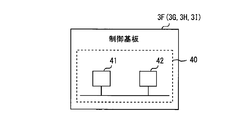
- FIG. 8 is a diagram showing an example of hardware resources of the control board 3F.
- the control board 3F includes a processing circuit 40 including, for example, a processor 41 and a memory 42 as hardware resources.
- the control board 3F realizes the functions of the respective parts shown by the reference numerals 31F to 36F by executing the program stored in the memory 42 by the processor 41.
- the processor 41 is also referred to as a CPU (Central Processing Unit), a central processing unit, a processing unit, an arithmetic unit, a microprocessor, a microcomputer, or a DSP.
- a CPU Central Processing Unit
- a central processing unit a central processing unit
- a processing unit an arithmetic unit
- a microprocessor a microcomputer
- a DSP digital signal processor
- a semiconductor memory a magnetic disk, a flexible disk, an optical disk, a compact disk, a mini disk, or a DVD may be adopted.
- the semiconductor memory that can be adopted includes RAM, ROM, flash memory, EPROM, EEPROM, and the like.
- FIG. 9 is a diagram showing another example of the hardware resource of the control board 3F.
- the control board 3F includes, for example, a processing circuit 40 including a processor 41, a memory 42, and dedicated hardware 43.
- FIG. 9 shows an example in which a part of the functions of the control board 3F is realized by the dedicated hardware 43. All the functions of the control board 3F may be realized by the dedicated hardware 43.
- the dedicated hardware 43 a single circuit, a composite circuit, a programmed processor, a parallel programmed processor, an ASIC, an FPGA, or a combination thereof can be adopted.
- control board 3G includes a processing circuit including a processor and a memory as hardware resources.
- the control board 3G realizes the functions of each part shown by the reference numerals 31G to 36G by executing the program stored in the memory by the processor.
- the control board 3G may include a processing circuit including a processor, a memory, and dedicated hardware as hardware resources. Some or all of the functions of the control board 3G may be realized by dedicated hardware.
- This elevator system can be applied to a system in which multiple control boards are connected in a ring shape by a network.
Landscapes
- Engineering & Computer Science (AREA)
- Automation & Control Theory (AREA)
- Elevator Control (AREA)
- Indicating And Signalling Devices For Elevators (AREA)
Priority Applications (3)
| Application Number | Priority Date | Filing Date | Title |
|---|---|---|---|
| CN202080087207.0A CN114901578A (zh) | 2020-01-10 | 2020-01-10 | 电梯系统 |
| JP2021569682A JP7243864B2 (ja) | 2020-01-10 | 2020-01-10 | エレベーターシステム |
| PCT/JP2020/000626 WO2021140638A1 (ja) | 2020-01-10 | 2020-01-10 | エレベーターシステム |
Applications Claiming Priority (1)
| Application Number | Priority Date | Filing Date | Title |
|---|---|---|---|
| PCT/JP2020/000626 WO2021140638A1 (ja) | 2020-01-10 | 2020-01-10 | エレベーターシステム |
Publications (1)
| Publication Number | Publication Date |
|---|---|
| WO2021140638A1 true WO2021140638A1 (ja) | 2021-07-15 |
Family
ID=76787804
Family Applications (1)
| Application Number | Title | Priority Date | Filing Date |
|---|---|---|---|
| PCT/JP2020/000626 Ceased WO2021140638A1 (ja) | 2020-01-10 | 2020-01-10 | エレベーターシステム |
Country Status (3)
| Country | Link |
|---|---|
| JP (1) | JP7243864B2 (https=) |
| CN (1) | CN114901578A (https=) |
| WO (1) | WO2021140638A1 (https=) |
Citations (5)
| Publication number | Priority date | Publication date | Assignee | Title |
|---|---|---|---|---|
| JPS6181371A (ja) * | 1984-09-29 | 1986-04-24 | 株式会社東芝 | エレベ−タの群管理制御方法 |
| JPS61188376A (ja) * | 1985-02-14 | 1986-08-22 | 株式会社東芝 | エレベ−タの群管理制御装置 |
| JPS6312578A (ja) * | 1986-04-03 | 1988-01-19 | オ−チス エレベ−タ コムパニ− | 多数カーのエレベータ装置 |
| JP2001146367A (ja) * | 1999-11-18 | 2001-05-29 | Toshiba Corp | エレベータ群管理制御装置 |
| JP2001206657A (ja) * | 2000-01-26 | 2001-07-31 | Mitsubishi Electric Corp | エレベータ群管理システム |
Family Cites Families (9)
| Publication number | Priority date | Publication date | Assignee | Title |
|---|---|---|---|---|
| US3682275A (en) * | 1967-01-20 | 1972-08-08 | Reliance Electric Co | Backup controls for plural car elevator system |
| US3450231A (en) * | 1967-01-20 | 1969-06-17 | Reliance Electric & Eng Co | Group elevator control having car call reset of advance hall call assignment |
| US4299308A (en) * | 1979-12-27 | 1981-11-10 | Otis Elevator Company | Position controlled elevator door motion |
| US4365694A (en) * | 1981-02-13 | 1982-12-28 | Otis Elevator Company | Preventing elevator car calls behind car |
| JP3239587B2 (ja) * | 1994-02-23 | 2001-12-17 | 三菱電機株式会社 | エレベータの群管理装置 |
| FR2813297B1 (fr) * | 2000-08-24 | 2002-12-27 | Otis Elevator Co | Installation d'ascenseur avec acces prioritaire pour certains usagers a une des cabines d'ascenseur et procede d'isolation de cabine d'ascenseur correspondant |
| CN103269964B (zh) * | 2011-01-26 | 2015-03-04 | 三菱电机株式会社 | 电梯的组群管理系统 |
| JP6039027B1 (ja) * | 2015-09-07 | 2016-12-07 | 東芝エレベータ株式会社 | エレベータ制御装置およびエレベータ制御方法 |
| JP6567719B1 (ja) * | 2018-03-22 | 2019-08-28 | 東芝エレベータ株式会社 | 利用者検知システム |
-
2020
- 2020-01-10 WO PCT/JP2020/000626 patent/WO2021140638A1/ja not_active Ceased
- 2020-01-10 JP JP2021569682A patent/JP7243864B2/ja active Active
- 2020-01-10 CN CN202080087207.0A patent/CN114901578A/zh active Pending
Patent Citations (5)
| Publication number | Priority date | Publication date | Assignee | Title |
|---|---|---|---|---|
| JPS6181371A (ja) * | 1984-09-29 | 1986-04-24 | 株式会社東芝 | エレベ−タの群管理制御方法 |
| JPS61188376A (ja) * | 1985-02-14 | 1986-08-22 | 株式会社東芝 | エレベ−タの群管理制御装置 |
| JPS6312578A (ja) * | 1986-04-03 | 1988-01-19 | オ−チス エレベ−タ コムパニ− | 多数カーのエレベータ装置 |
| JP2001146367A (ja) * | 1999-11-18 | 2001-05-29 | Toshiba Corp | エレベータ群管理制御装置 |
| JP2001206657A (ja) * | 2000-01-26 | 2001-07-31 | Mitsubishi Electric Corp | エレベータ群管理システム |
Also Published As
| Publication number | Publication date |
|---|---|
| JP7243864B2 (ja) | 2023-03-22 |
| JPWO2021140638A1 (https=) | 2021-07-15 |
| CN114901578A (zh) | 2022-08-12 |
Similar Documents
| Publication | Publication Date | Title |
|---|---|---|
| US8129921B2 (en) | Switchegear, system for controlling a lamp, and light control system for a building comprising at least one light | |
| US7441133B2 (en) | Rack level power management for power over Ethernet | |
| US9126806B2 (en) | Elevator system with distributed dispatching | |
| WO2006077570A1 (en) | Rack level power management for power over ethernet | |
| WO2011088794A1 (en) | Method for controlling flow in a stack system and chassis switch in a stack system | |
| CN1860830B (zh) | 以分布方式设置的多个灯操控设备的控制系统及其初始化方法 | |
| JP7215602B2 (ja) | エレベーターシステム | |
| JP4803865B2 (ja) | 群管理エレベータの制御装置 | |
| JP4657557B2 (ja) | エレベータの群管理制御システム | |
| WO2021140638A1 (ja) | エレベーターシステム | |
| JP2004224556A (ja) | エレベーターの群管理制御装置及び方法 | |
| WO2021232285A1 (zh) | 管理车辆控制器的方法及控制设备、远程控制车辆的方法 | |
| JP2581829B2 (ja) | エレベータの群管理制御装置 | |
| JP7259998B2 (ja) | エレベーターシステム | |
| WO2013018183A1 (ja) | システム制御装置、電力制御方法及び電子システム | |
| JP2001206657A (ja) | エレベータ群管理システム | |
| US5848669A (en) | Apparatus for efficiently managing a plurality of elevators | |
| CN116389305A (zh) | 电池管理系统用管理系统及其控制方法 | |
| JP2015099621A (ja) | 統合制御装置、及び統合管理システム | |
| JP2667557B2 (ja) | 群管理エレベーター制御システム | |
| JP2619506B2 (ja) | エレベータの信号伝送装置 | |
| JP2011063430A (ja) | エレベータシステムの表示制御装置 | |
| JP2003063745A (ja) | エレベータの群管理システム | |
| JPH01252473A (ja) | エレベータの群管理制御装置 | |
| JP2001171923A (ja) | エレベータ群管理制御装置 |
Legal Events
| Date | Code | Title | Description |
|---|---|---|---|
| 121 | Ep: the epo has been informed by wipo that ep was designated in this application |
Ref document number: 20911919 Country of ref document: EP Kind code of ref document: A1 |
|
| ENP | Entry into the national phase |
Ref document number: 2021569682 Country of ref document: JP Kind code of ref document: A |
|
| NENP | Non-entry into the national phase |
Ref country code: DE |
|
| 122 | Ep: pct application non-entry in european phase |
Ref document number: 20911919 Country of ref document: EP Kind code of ref document: A1 |