WO2021131932A1 - 鏡胴、鏡筒の光学調整方法及びレンズ装置 - Google Patents
鏡胴、鏡筒の光学調整方法及びレンズ装置 Download PDFInfo
- Publication number
- WO2021131932A1 WO2021131932A1 PCT/JP2020/046865 JP2020046865W WO2021131932A1 WO 2021131932 A1 WO2021131932 A1 WO 2021131932A1 JP 2020046865 W JP2020046865 W JP 2020046865W WO 2021131932 A1 WO2021131932 A1 WO 2021131932A1
- Authority
- WO
- WIPO (PCT)
- Prior art keywords
- frame
- lens barrel
- lens
- pin
- barrel according
- Prior art date
- Legal status (The legal status is an assumption and is not a legal conclusion. Google has not performed a legal analysis and makes no representation as to the accuracy of the status listed.)
- Ceased
Links
Images






Classifications
-
- G—PHYSICS
- G02—OPTICS
- G02B—OPTICAL ELEMENTS, SYSTEMS OR APPARATUS
- G02B7/00—Mountings, adjusting means, or light-tight connections, for optical elements
- G02B7/02—Mountings, adjusting means, or light-tight connections, for optical elements for lenses
- G02B7/023—Mountings, adjusting means, or light-tight connections, for optical elements for lenses permitting adjustment
-
- G—PHYSICS
- G02—OPTICS
- G02B—OPTICAL ELEMENTS, SYSTEMS OR APPARATUS
- G02B7/00—Mountings, adjusting means, or light-tight connections, for optical elements
- G02B7/02—Mountings, adjusting means, or light-tight connections, for optical elements for lenses
-
- G—PHYSICS
- G02—OPTICS
- G02B—OPTICAL ELEMENTS, SYSTEMS OR APPARATUS
- G02B7/00—Mountings, adjusting means, or light-tight connections, for optical elements
- G02B7/02—Mountings, adjusting means, or light-tight connections, for optical elements for lenses
- G02B7/021—Mountings, adjusting means, or light-tight connections, for optical elements for lenses for more than one lens
-
- G—PHYSICS
- G02—OPTICS
- G02B—OPTICAL ELEMENTS, SYSTEMS OR APPARATUS
- G02B7/00—Mountings, adjusting means, or light-tight connections, for optical elements
- G02B7/02—Mountings, adjusting means, or light-tight connections, for optical elements for lenses
- G02B7/025—Mountings, adjusting means, or light-tight connections, for optical elements for lenses using glue
Definitions
- the present invention relates to an optical adjustment method for a lens barrel and a lens barrel, and a lens device.
- Patent Document 1 describes a technique for stably holding the adjusted lens holding frame for a long period of time by fixing the adjusted lens holding frame with an adhesive.
- Patent Document 2 a plurality of abutting portions are provided on the lens holding frame, and each abutting portion is urged toward the main body frame side and abutted against a reference surface provided on the main body frame side to adjust the inclination. Techniques are described that make it unnecessary or fine-tuned.
- One embodiment according to the technique of the present disclosure provides a lens barrel, an optical adjustment method for a lens barrel, and a lens device capable of improving linearity at the time of adjustment.
- the first eccentric pin is provided at a plurality of locations in the circumferential direction of the second frame, and is the lens barrel of (1).
- the first eccentric pin is provided at three locations in the circumferential direction of the second frame, and is the lens barrel of (2).
- the first eccentric pin is provided at equal intervals in the circumferential direction of the second frame, and is the lens barrel of (3).
- the convex portion is a lens barrel of any one of (1) to (4) that contacts the inner wall surfaces on both sides in the width direction of the groove at a plurality of points.
- the convex portion is a lens barrel of any one of (1) to (4) that comes into contact with the inner wall surfaces on both sides in the width direction of the groove.
- the convex portion is the lens barrel of (5) or (6) having recesses on the surfaces facing the inner wall surfaces on both sides in the width direction of the groove.
- the lens barrel of (8) in which an adhesive is applied to the first hole and the second frame is fixed to the first frame.
- the third frame arranged inside the second frame, the second frame flange portion provided on the outer periphery of the second frame, and the second frame flange portion provided on the outer periphery of the third frame facing the second frame flange portion.
- a reference pin provided at one location in the circumferential direction of the third frame flange portion to be arranged and a reference hole provided in the reference hole provided in the second frame flange portion, and a circumferential direction of the third frame flange portion.
- a plurality of second eccentric pins provided in a plurality of locations and fitted in the second hole provided in the second frame flange portion, and an urging portion for urging the third frame flange portion toward the second frame flange portion.
- any one of the lens barrels (1) to (12) further provided.
- One of the second frame flange portion and the third frame flange portion is provided with a notch portion, and the other is provided with a protruding portion that fits into the notch portion, and an adhesive is applied to the notch portion.
- An optical system composed of a plurality of lens groups and any one of the lens barrels (1) to (12) are provided, and the lens group is arranged on the most object side among the plurality of lens groups constituting the optical system.
- a lens device in which a first lens group to be formed is held in a second frame.
- This is an optical adjustment method for a lens barrel provided with, wherein at least one of a plurality of eccentric pins is rotated to adjust the inclination of the axis of the second frame with respect to the axis of the first frame, and a plurality of deviations.
- An optical adjustment method for a lens barrel which includes a step of rotating a core pin to adjust the relative position of the second frame with respect to the first frame.
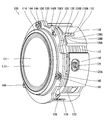
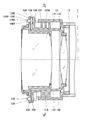
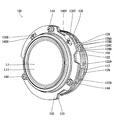
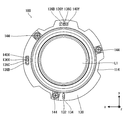
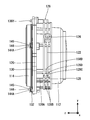
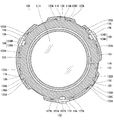
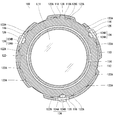
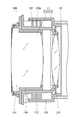
- FIG. 1 Cross-sectional view showing the overall schematic configuration of an interchangeable lens Perspective view showing the configuration of the first lens group holding frame Side sectional view showing the configuration of the first lens group holding frame 4-4 sectional view of FIG.
- Perspective view of the first lens group holding frame excluding the first frame Front view of the first lens group holding frame Side view of the first lens group holding frame Top view of the first lens group holding frame
- the figure which shows the modification of the holding structure of the 2nd frame The figure which shows the modification of the holding structure of the 2nd frame
- the figure which shows the modification of the holding structure of the 2nd frame The figure which shows the deformation example of the convex part (key part)
- the figure which shows the modification of the holding structure of the 3rd frame The figure which shows the modification of the holding structure of the 3rd frame
- the interchangeable lens is an example of a lens device.
- FIG. 1 is a cross-sectional view showing a schematic configuration of the entire interchangeable lens of the present embodiment.
- the interchangeable lens 1 shown in the figure is a so-called single focus AF lens.
- the AF lens is a lens having an AF (Auto Focus) function.
- the interchangeable lens 1 has a first lens group L1, a second lens group L2, and a third lens group L3 in order from the object side (left side in FIG. 1) as an optical system.
- the first lens group L1 and the third lens group L3 are fixed lens groups.
- the second lens group L2 is a moving lens group. The focus is adjusted by moving the second lens group L2 along the optical axis Z.
- the first lens group L1 has a first lens group front group L11 and a first lens group rear group L12 in order from the object side along the optical axis Z.
- the front group L11 of the first lens group and the rear group L12 of the first lens group are composed of at least one lens.
- the second lens group L2 has a second lens group front group L21 and a second lens group rear group L22 in order from the object side along the optical axis Z.
- the front group L21 of the second lens group and the rear group L22 of the second lens group are composed of at least one lens.
- a diaphragm St is provided between the front group L21 of the second lens group and the rear group L22 of the second lens group.
- the third lens group L3 is composed of at least one lens.
- the lens barrel 10 of the interchangeable lens 1 includes a fixed cylinder 12, a cam cylinder 14, an exterior body 16, a first lens group holding frame 100, a second lens group holding frame 18, and a third lens group holding frame. It is composed of a combination of 20 and a mount 22 and the like.
- the fixed cylinder 12 is integrated with the camera body when the interchangeable lens 1 is attached to the camera body. That is, the fixed cylinder 12 is a component fixed to the camera body.
- the cam cylinder 14 is provided on the outer peripheral portion of the fixed cylinder 12.
- the cam cylinder 14 is fitted to the outer peripheral portion of the fixed cylinder 12, and the outer peripheral portion of the fixed cylinder 12 is rotatably held in the circumferential direction.
- the cam cylinder 14 is driven by a motor (focus motor) 24 to rotate.
- the motor 24 is provided on the outer peripheral portion of the fixed cylinder 12.
- a drive gear 26 is provided on the output shaft of the motor 24.
- the drive gear 26 is meshed with the gear portion 14A provided on the cam cylinder 14.
- the gear portion 14A is provided on the outer peripheral portion of the cam cylinder 14.
- the exterior body 16 is configured by coaxially connecting a plurality of exterior body parts (first exterior body 16A, second exterior body 16B, and third exterior body 16C).
- the first exterior body 16A is an exterior body part that constitutes a tip portion of the exterior body 16.
- the first exterior body 16A is connected to the tip end portion of the second exterior body 16B.
- the first exterior body 16A is fixed to the second exterior body 16B with screws (not shown) and integrated with the second exterior body 16B.
- the second exterior body 16B is an exterior body part that constitutes a central portion of the exterior body 16.
- the second exterior body 16B is connected to the tip end portion of the third exterior body 16C.
- the second exterior body 16B is fixed to the third exterior body 16C with screws (not shown) and integrated with the third exterior body 16C.
- the third exterior body 16C is an exterior body part that constitutes a rear end portion of the exterior body 16.
- the third exterior body 16C is fixed to the fixing cylinder 12 with a screw (not shown) and integrated with the fixing cylinder 12.
- the fixed cylinder 12 is housed inside the exterior body 16.
- a focus ring 28 is provided on the outer peripheral portion of the first exterior body 16A.
- a diaphragm ring 30 is provided on the outer peripheral portion of the third exterior body 16C.
- the focus ring 28 is an operation ring for manually adjusting the focus.
- the aperture ring 30 is an operation ring for operating the aperture.
- the first lens group holding frame 100 holds the first lens group L1.
- the first lens group holding frame 100 has a first frame 110, a second frame 112, and a third frame 114.
- the first frame 110 is attached to the tip end portion (the end portion on the object side) of the fixed cylinder 12.
- the first frame 110 is fitted to the inner peripheral portion of the tip of the fixed cylinder 12, is fixed to the fixed cylinder 12 with a screw (not shown), and is integrated with the fixed cylinder 12.
- the first frame 110 fixed to the fixed cylinder 12 is held coaxially with the fixed cylinder 12.
- the second frame 112 holds the rear group L12 of the first lens group.
- the second frame 112 is held in the first frame 110.
- the holding structure of the second frame 112 will be described later.
- the third frame 114 holds the first lens group front group L11.
- the third frame 114 is held in the second frame 112.
- the holding structure of the third frame 114 will be described later.
- the second lens group holding frame 18 holds the second lens group L2.
- the second lens group holding frame 18 is arranged inside the fixed cylinder 12.
- the second lens group holding frame 18 has a second lens group holding frame main body 32, a second lens group front group holding frame 34, and a second lens group rear group holding frame 36.
- the second lens group holding frame main body 32 is arranged inside the fixed cylinder 12.
- the second lens group holding frame main body 32 is fitted to the inner peripheral portion of the fixed cylinder 12, and the inner peripheral portion of the fixed cylinder 12 is held so as to be movable back and forth along the optical axis Z.
- the second lens group holding frame main body 32 has three cam pins 38 on the outer peripheral portion (only one is shown in FIG. 1).
- the three cam pins 38 are arranged at equal intervals (120 ° intervals) along the circumferential direction.
- the fixed cylinder 12 has three straight grooves 40 corresponding to the three cam pins 38 (only one is shown in FIG. 1).
- the three straight grooves 40 are composed of grooves extending along the optical axis Z.
- the three straight grooves 40 are arranged at equal intervals along the circumferential direction.
- the cam cylinder 14 has three cam grooves 42 corresponding to the three cam pins 38 (only one is shown in FIG. 1).
- the three cam grooves 42 are arranged at equal intervals along the circumferential direction.
- the three cam pins 38 are fitted into the corresponding straight grooves 40 and cam grooves 42, respectively.
- the second lens group front group holding frame 34 holds the second lens group front group L21.
- the second lens group front group holding frame 34 is fitted to the inner peripheral portion on the tip end side (object side) of the second lens group holding frame body 32, and is fixed to the second lens group holding frame body 32 with a screw (not shown). Therefore, it is integrated with the second lens group holding frame main body 32.
- the second lens group rear group holding frame 36 holds the second lens group rear group L22.
- the second lens group rear group holding frame 36 is fitted to the inner peripheral portion of the rear end side (image plane side) of the second lens group holding frame body 32, and is attached to the second lens group holding frame body 32 with a screw (not shown). It is fixed and integrated with the second lens group holding frame main body 32.
- a unit (aperture unit) 44 including its drive mechanism is assembled to the second lens group holding frame main body 32.
- the aperture unit 44 assembled to the second lens group holding frame main body 32 is arranged between the second lens group front group L21 and the second lens group rear group L22.
- the second lens group L2 including the aperture St moves along the optical axis Z by moving the second lens group holding frame main body 32. This adjusts the focus.
- the third lens group holding frame 20 holds the third lens group L3.
- the third lens group holding frame 20 is attached to the rear end portion (the end portion on the image plane side) of the fixed cylinder 12.
- the third lens group holding frame 20 is fitted to the inner peripheral portion of the rear end of the fixed cylinder 12, is fixed to the fixed cylinder 12 with a screw (not shown), and is integrated with the fixed cylinder 12.
- the third lens group holding frame 20 fixed to the fixed cylinder 12 is held coaxially with the fixed cylinder 12.
- the mount 22 is attached to the rear end of the lens barrel 10.
- the mount 22 is fixed to the rear end surface of the third exterior body 16C with screws (not shown) and integrated with the third exterior body 16C.
- FIG. 2 is a perspective view showing the configuration of the first lens group holding frame.
- FIG. 3 is a side sectional view showing the configuration of the first lens group holding frame.
- FIG. 4 is a 4-4 cross-sectional view of FIG.
- FIG. 5 is a perspective view of the first lens group holding frame excluding the first frame. 6,
- FIG. 7, and FIG. 8 are a front view, a side view, and a plan view of the first lens group holding frame shown in FIG. 5, respectively.
- the first lens group holding frame 100 has a first frame 110, a second frame 112, and a third frame 114.
- the first frame 110 is fixed to the fixed cylinder 12.
- the second frame 112 is held in the first frame 110.
- the third frame 114 is held in the second frame 112.
- a part of the second frame 112 is housed inside the first frame 110 and is held in the first frame 110.
- the first frame 110 has three first pin holes 116 at three locations in the circumferential direction.
- the three first pin holes 116 are arranged at equal intervals along the circumferential direction.
- the three first pin holes 116 are composed of elongated holes extending along the circumferential direction.
- the first pin hole 116 is an example of the first hole.
- the first frame 110 has three key grooves 118 at three locations in the circumferential direction.
- the three keyways 118 are arranged at equal intervals along the circumferential direction.
- the keyway 118 is arranged between adjacent first pin holes 116. Therefore, the key grooves 118 and the first pin holes 116 are alternately arranged on the outer periphery of the first frame 110.
- the key groove 118 is composed of a linear groove extending along the axis of the first frame 110.
- the key groove 118 of the present embodiment is composed of a groove extending from the tip end (end portion on the object side) of the first frame 110.
- the key groove 118 of the present embodiment is composed of a groove having an open tip.
- the second frame 112 has a second frame flange portion 120 on the outer periphery.
- the second frame flange portion 120 functions as a holding portion of the third frame 114. This point will be described later.
- the second frame 112 has a cylindrical fitting portion 122 on the outer circumference.
- the fitting portion 122 has a rib structure that has been lightened.
- arc-shaped protrusions 122B are provided at a plurality of locations along the circumferential direction.
- the protrusion 122B abuts on the inner peripheral surface of the first frame 110 and fits inside the first frame 110.
- the protrusion 122B comes into contact with the inner peripheral surface of the first frame 110 in a state of substantially point contact.
- the second frame 112 has three first eccentric pins 124 at three locations on the outer circumference.
- the three first eccentric pins 124 are arranged at equal intervals along the circumferential direction.
- the first eccentric pin 124 has a pin body 124A and a shaft portion 124B.
- the pin body 124A is a portion fitted in the first pin hole 116.
- the pin body 124A has a disk-like shape.
- the shaft portion 124B functions as a rotation shaft of the first eccentric pin 124.
- the pin body 124A is eccentric with respect to the shaft portion 124B. When the shaft portion 124B of the first eccentric pin 124 is rotated around the shaft, the pin body 124A is eccentric and rotates.
- the second frame 112 has three first eccentric pin mounting holes 126 at three locations on the outer circumference.
- the three first eccentric pin mounting holes 126 are arranged at equal intervals along the circumferential direction.
- the first eccentric pin 124 is attached to the second frame 112 by fitting the shaft portion 124B into the first eccentric pin mounting hole 126.
- the first eccentric pin 124 has a hole penetrating along the axis of the shaft portion 124B.
- the first eccentric pin 124 is screwed through the hole and fixed to the second frame 112.
- the first eccentric pin 124 fixed with a screw rotates by applying a certain amount of torque or more.
- the three first eccentric pins 124 are fitted into the three first pin holes 116 provided in the first frame 110.
- the three first pin holes 116 are provided corresponding to the three first eccentric pins 124.
- the second frame 112 is held inside the first frame 110 by fitting the three first eccentric pins 124 into the three first pin holes 116.
- the axis of the second frame 112 is tilted with respect to the axis of the first frame 110 by rotating the three first eccentric pins 124 individually.
- the second frame 112 has three key portions 128 at three locations on the outer circumference.
- the three key portions 128 are arranged at equal intervals along the circumferential direction.
- the three key portions 128 are fitted into the three key grooves 118 provided in the first frame 110.
- the key portion 128 is an example of a convex portion.
- three key portions 128 are integrally provided with the fitting portion 122. Therefore, the key portion 128 of the present embodiment has a rib structure. More specifically, it has a flat plate-shaped base portion 128A extending along the axial direction, and a plurality of flat plate-shaped key fitting portions 128B extending along the circumferential direction from both sides of the base portion 128A.
- the plurality of key fitting portions 128B are portions that substantially fit into the key groove 118.
- the key portion 128 having such a configuration is provided with a recess 128D on a surface 128C facing the inner wall surface 118A on both sides in the width direction of the key groove 118.
- the recess 128D is provided between the plurality of key fitting portions 128B.
- the key portion 128 fitted in the key groove 118 regulates the movement of the shaft of the second frame 112 to fluctuate when the second frame 112 is eccentric by the first eccentric pin 124. That is, the key portion 128 and the key groove 118 have a function of guiding the axis of the second frame 112 so as to be stably tilted without blurring. As a result, the linearity at the time of adjustment is improved.
- a part of the third frame 114 is housed inside the second frame 112 and is held in the second frame 112.
- the third frame 114 has a third frame flange portion 130 on the outer periphery.
- the third frame flange portion 130 is arranged so as to face the second frame flange portion 120.
- the third frame 114 is held by the second frame 112 by using the third frame flange portion 130.
- the second frame flange portion 120 has a reference pin 132 on the end surface on the tip end side (object side).
- the reference pin 132 is composed of a columnar pin.
- the reference pin 132 is arranged parallel to the axis of the second frame 112.
- the third frame flange portion 130 has a reference hole 134 into which the reference pin 132 is fitted.
- the reference hole 134 is composed of an elongated hole extending in the radial direction.
- the third frame 114 is held swingably in a plane orthogonal to the axis of the second frame 112 with the reference pin 132 as a fulcrum by fitting the reference pin 132 into the reference hole 134.
- the second frame flange portion 120 has two second eccentric pins 136X and 136Y at two locations on the end face.
- One of the second eccentric pins 136X is provided at a position rotated by 90 ° from the position of the reference pin 132 about the axis of the second frame 112.
- the other second eccentric pin 136Y is provided at a position rotated by 180 ° from the position of the reference pin 132 about the axis of the second frame 112.
- the second eccentric pin 136X, 136Y has a shaft portion 136A, a disk portion 136B, and an eccentric pin portion 136C.
- the shaft portion 126A functions as a rotation shaft of the second eccentric pins 136X and 136Y.
- the shaft portion 136A and the disk portion 136B are arranged coaxially.
- the eccentric pin portion 136C is arranged eccentrically with respect to the shaft portion 136A. Therefore, when the shaft portion 136A is rotated around the shaft, the eccentric pin portion 136C rotates in the second eccentric pin 136X and 136Y.
- the second eccentric pins 136X and 136Y are attached to the second frame flange portion 120 by fitting the shaft portion 136A into the two bearing holes 138 provided at two positions of the second frame flange portion 120.
- the two bearing holes 138 are provided corresponding to the installation positions of the second eccentric pins 136X and 136Y.
- the second eccentric pins 136X and 136Y attached to the second frame flange portion 120 are accommodated in the concave accommodating portion 139 provided on the end surface of the second frame flange portion 120 on the distal end side.
- the accommodating portion 139 is provided corresponding to the installation position of the second eccentric pin 136X and 136Y.
- the third frame flange portion 130 has two second pin holes 140X and 140Y at two locations in the circumferential direction.
- the two second pin holes 140X and 140Y are provided corresponding to the two second eccentric pins 136X and 136Y.
- the eccentric pin portions 136C of the two second eccentric pins 136X and 136Y are fitted into the two second pin holes 140X and 140Y.
- the two second pin holes 140X and 140Y are each composed of elongated holes.
- the second pin hole 140X is composed of an elongated hole extending along the second direction (the direction of the y-axis in FIG. 6) in a plane orthogonal to the axis of the third frame 114.
- the other second pin hole 140Y is composed of an elongated hole extending along the first direction (the direction of the x-axis in FIG. 6) in a plane orthogonal to the axis of the third frame 114.
- the first direction and the second direction are directions orthogonal to each other.
- the second pin holes 140X and 140Y are examples of the second holes.
- the third frame 114 By rotating one of the second eccentric pins 136X, the third frame 114 is in a plane orthogonal to the axis of the second frame 112 with reference to the reference pin 132 in the first direction (of the x-axis of FIG. 6). Swing in the direction). Further, the third frame 114 rotates the other second eccentric pin 136Y in a second direction (y in FIG. 6) in a plane orthogonal to the axis of the second frame 112 with reference to the reference pin 132. Swing in the direction of the axis). As a result, the third frame 114 shifts with respect to the second frame 112.
- the third frame flange portion 130 has three through holes 142 at three locations in the circumferential direction.
- the three through holes 142 are arranged at equal intervals along the circumferential direction.
- Three guide pins 144 are passed through the three through holes 142.
- Each guide pin 144 has a head 144A at one end (end on the object side) and a screw portion (not shown) at the other end (end on the image plane side).
- Each guide pin 144 is fastened to a screw hole (not shown) provided in the second frame flange portion 120 with a screw portion, and is fixed to the second frame flange portion 120.
- Screw holes are provided at three locations on the second frame flange portion 120.
- the three screw holes are arranged at equal intervals along the circumferential direction.
- the guide pin 144 fastened to the screw hole is arranged parallel to the axis of the second frame 112.
- Each guide pin 144 is fixed to the second frame 112 through the coil spring 146.
- the coil spring 146 passed through each guide pin 144 is arranged between the head 144A of each guide pin 144 and the third frame flange portion 130, and urges the third frame 114 toward the second frame 112.
- the coil spring 146 is an example of an urging portion.
- the interchangeable lens 1 of the present embodiment configured as described above has a tilt adjustment function, a shift adjustment function, and an inter-axis distance adjustment function as optical adjustment functions.
- a method for adjusting each item of tilt, shift, and inter-axis distance optical adjustment method
- tilt adjustment The tilt adjustment is performed by rotating the three first eccentric pins 124 individually.
- the second frame 112 is tilted with respect to the first frame 110.
- the second frame 112 is inclined in a direction corresponding to the position of the pin to be rotated. The mechanism of this inclination will be described below.
- the pin body 124A When the first eccentric pin 124 is rotated, the pin body 124A is eccentric and rotates. When the pin body 124A is eccentrically rotated, the position of the first pin hole 116 into which the pin body 124A is fitted is displaced along the optical axis Z. As a result, the second frame 112 provided with the first pin hole 116 is inclined with respect to the first frame 110.
- the tilt adjustment is performed using the eccentric pin (first eccentric pin 124).
- the tilt adjustment mechanism using the eccentric pin has a problem that the shaft fluctuates during adjustment.
- the fluctuation of this axis was irregular, which made it difficult to adjust the tilt. That is, since the fluctuating movement is irregular, it is necessary to repeat fine adjustment many times in order to realize the desired inclination.
- the interchangeable lens 1 of the present embodiment has the key portion 128 and the key groove 118 in the first frame 110 and the second frame 112, so that the fluctuation of the shaft generated at the time of tilt adjustment is regulated. As a result, the linearity at the time of adjustment is improved, and the tilt adjustment work can be performed efficiently.
- the key portion 128 comes into surface contact with the inner wall surfaces 118A on both sides of the key groove 118.
- the inner wall surface 118A of the linear keyway 118 functions as a guide, and the movement of the shaft swaying is restricted.
- the linearity at the time of adjustment is improved.
- the desired inclination can be easily realized. That is, since the inclination can be adjusted with high linearity with respect to the operation input, even an unskilled person can easily adjust the inclination to a desired value.
- the shift adjustment is performed by rotating the two second eccentric pins 136X and 136Y individually.
- the third frame 114 shifts in the first direction (the direction of the x-axis in FIG. 6) with respect to the second frame 112.
- the third frame 114 shifts in the second direction (the direction of the y-axis in FIG. 6) with respect to the second frame 112. The mechanism of this shift will be described below.
- the eccentric pin portion 136C When one of the second eccentric pins 136X is rotated, the eccentric pin portion 136C is eccentric and rotates. When the eccentric pin portion 136C is eccentric and rotates, the position of the second pin hole 140X into which the eccentric pin portion 136C is fitted is displaced along the first direction. As a result, the third frame 114 provided with the second pin hole 140X swings along the first direction with the reference pin 132 as a fulcrum. As a result, the third frame 114 shifts in the first direction with respect to the second frame 112.
- the eccentric pin portion 136C is eccentric and rotates.
- the position of the second pin hole 140Y into which the eccentric pin portion 136C is fitted is displaced along the second direction.
- the third frame 114 provided with the second pin hole 140Y swings along the second direction with the reference pin 132 as a fulcrum.
- the third frame 114 shifts in the second direction with respect to the second frame 112.
- the adjustment of the inter-axis distance is the adjustment of the air spacing between the first lens group L1 and the second lens group L2 constituting the optical system of the interchangeable lens 1. More specifically, it is the adjustment of the air spacing between the first lens group rear group L12 constituting the first lens group L1 and the second lens group front group L21 forming the second lens group L2.
- the air spacing between the first lens group L1 and the second lens group L2 is adjusted by changing the relative position of the second frame 112 with respect to the first frame 110 (the relative position in the direction along the optical axis Z). ..
- the relative position of the second frame 112 with respect to the first frame 110 is adjusted by rotating the three first eccentric pins 124. Specifically, each first eccentric pin 124 is rotated to displace the first pin hole 116 into which each first eccentric pin 124 is fitted in the same direction by the same amount. As a result, the second frame 112 is displaced in the axial direction with respect to the first frame 110 without tilting the shaft.
- the second frame 112 When the rotation positions of the first eccentric pins 124 are in the same phase position, the second frame 112 has the same posture (same inclination) by rotating the first eccentric pins 124 in the same direction by the same amount. It is maintained and displaced in the axial direction of the first frame 110.
- the in-phase position means a position where the pin body 124A is rotated by the same amount in the same direction from the origin position.
- the origin position is set, for example, to a point where the center of the pin body 124A is located closest to the image plane side.
- the actual optical adjustment is performed by installing the lens barrel 10 in the optical adjustment device.
- the operator individually rotates the first eccentric pin 124 on the optical adjusting device to adjust the tilt.
- the second eccentric pins 136X and 136Y are individually rotated to adjust the shift.
- the three first eccentric pins 124 are rotated to adjust the distance between the axes (air spacing).
- the second frame 112 and the third frame 114 are fixed on the optical adjustment device so that the optically adjusted state does not collapse. Fixing is performed as follows.
- the fixing of the second frame 112 is performed by applying an adhesive to the keyway 118. Alternatively, it is performed by applying an adhesive to the first pin hole 116. By applying an adhesive to the key groove 118 or the first pin hole 116, the second frame 112 is adhesively fixed to the first frame 110.
- both the keyway 118 and the first pin hole 116 are used for fixing.
- the fixing using the key groove 118 can be easily disassembled and the generation of dust can be suppressed. Therefore, the fixing using the keyway 118 is most suitable for the temporary fixing.
- the key groove 118 is used to place the second frame 112 on the optical adjusting device. Temporarily fixed to 1 frame 110. As a result, the adjusted state can be maintained even if the lens barrel 10 is removed from the optical adjusting device. Further, even if the need for readjustment arises thereafter, the work can be easily disassembled and readjustment can be performed.
- the fixing of the third frame 114 is performed by applying an adhesive to the second pin holes 140X and 140Y.
- the third frame flange portion 130 is fixed to the second frame flange portion 120.
- the key groove 118 can also be used for fixing the second frame 112, and can stably hold the state after optical adjustment. Further, the adhesive fixing using the key groove 118 can suppress the generation of dust.
- FIG. 9 is a diagram showing a modified example of the holding structure of the second frame.
- all the pins provided in the second frame 112 are composed of eccentric pins (first eccentric pins 124).
- one of the three pins is replaced with a normal pin 152 (non-eccentric pin). That is, one is composed of ordinary pins 152, and the rest is composed of eccentric pins (first eccentric pins 124).
- the normal pin 152 is a pin whose pin body 152A is not eccentric with respect to the shaft portion 152B. Therefore, in the normal pin 152, the pin body 152A is arranged on the shaft portion 152B at the same time.
- one place can be replaced with a normal pin 152 in this way.
- the normal pin 152 functions as a reference pin at the time of tilt adjustment. That is, when the first eccentric pin 124 is rotated and the second frame 112 is tilted, the second frame 112 is tilted with reference to the normal pin 152. As a result, the linearity at the time of tilt adjustment can be improved.
- FIG. 10 is a diagram showing a modified example of the holding structure of the second frame.
- key grooves 118 and key portions 128 are provided at three locations in the circumferential direction of the first frame 110 and the second frame 112 at equal intervals.
- a key groove 118 and a key portion 128 are provided at one location. As described above, the key groove 118 and the key portion 128 need only be provided at at least one place.
- the key groove 118 and the key portion 128 are provided at a plurality of locations.
- the key grooves 118 and the key portions 128 are provided at a plurality of locations, the key grooves 118 and the key portions 128 do not necessarily have to be provided at equal intervals.
- FIG. 11 is a diagram showing a modified example of the holding structure of the second frame.
- the first eccentric pins 124 are provided at three positions in the circumferential direction of the second frame 112 at equal intervals.
- the first eccentric pin 124 is provided at one position in the circumferential direction of the second frame 112. As described above, the first eccentric pin 124 may be provided at at least one place. That is, if the first eccentric pin 124 is provided at at least one place, the inclination of the second frame 112 can be adjusted.
- first eccentric pins 124 In order to incline in any direction, it is necessary to provide the first eccentric pins 124 at a plurality of locations. In this case, it is preferable to provide three first eccentric pins 124 at three positions in the circumferential direction of the second frame 112 as in the lens barrel 10 of the above embodiment. Further, it is more preferable to arrange the three first eccentric pins 124 at equal intervals.
- FIG. 12 is a diagram showing a modified example of the convex portion (key portion).
- the key member 160 which is a convex portion, is composed of another part.
- the key member 160 has a block-like shape (so-called double-sided parallel key shape), and is detachably attached to the outer periphery of the second frame 112 via screws 162.
- double-sided parallel key shape By fitting the key member 160 into the key groove 118, both side surfaces in the width direction (circumferential direction of the second frame 112) come into contact with the inner wall surfaces 118A on both sides in the width direction of the key groove 118.
- the members that make up the convex part can be made up of separate parts.
- the key groove 118 does not necessarily have to be open on the tip side. That is, the key groove can be composed of a groove in which both ends are closed.
- the convex portion can have a rib structure with lightening. Therefore, when the second frame 112 is fixed with the adhesive by using the key groove 118, the adhesiveness can be improved. In addition, the generation of dust and the like can be suppressed.
- the specific shape of the convex part is not particularly limited. However, in consideration of adhesiveness and disassembly, it is preferable to have a rib structure like the key portion 128 of the above embodiment. Considering only the point of restricting the movement of the shaft, the so-called parallel keys can be used to form the convex portion. In this case, the convex portion comes into surface contact with the inner wall surfaces 118A on both sides of the key groove 118 and fits into the key groove 118. When the convex portion has a rib structure, the convex portion makes multipoint contact with the inner wall surfaces on both sides of the key groove 118 and fits into the key groove 118. That is, they virtually contact each other with a surface or a line and fit into the keyway 118.
- FIG. 13 is a diagram showing a modified example of the holding structure of the third frame.
- the shift mechanism is omitted, and the third frame 114 is integrated with the second frame 112.
- the third frame 114 is fitted to the inner peripheral portion of the second frame 112, fixed with a screw (not shown), and integrated with the second frame 112.
- the shift mechanism can be omitted.
- the configuration is not limited to that of the above embodiment, and other known mechanisms may be adopted.
- the tilt adjustment and shift adjustment are performed by accessing the second eccentric pins 136X and 136Y from the objective side (left side in FIG. 3) and performing the adjustment work as in the shift mechanism of the above embodiment. Can be prevented from being confused. Thereby, the workability of the optical adjustment can be improved.
- FIG. 14 is a diagram showing a modified example of the holding structure of the third frame.
- the figure shows another example of the bonding method of the third frame 114.
- an adhesive is applied to the second pin holes 140X and 140Y to fix the third frame 114 to the second frame 112.
- the lens barrel of this example is provided with a dedicated adhesive portion.
- the third frame flange portion 130 of the third frame 114 is provided with notches 170 at a plurality of locations on the outer circumference.
- the second frame flange portion 120 of the second frame 112 is provided with protruding portions 172 at a plurality of positions corresponding to the notch portions 170 of the third frame flange portion 130.
- each protrusion 172 fits into the corresponding notch 170.
- the notch 170 and the protrusion 172 function as an adhesive portion.
- an adhesive is applied to the notch 170.
- the third frame 114 is fixed to the second frame 112.
- the adhesiveness and decomposability of the third frame 114 can be improved. Further, by providing the adhesive portion on the flange portion, the workability of adhesion can be improved.
- the notch is provided on the third frame side and the protrusion is provided on the second frame side.
- the notch is provided on the second frame side and the protrusion is provided on the third frame side. It may be provided. Alternatively, both may be configured to have a notch and a protrusion.
- the structure for fixing the third frame 114 to the second frame 112 is not limited to adhesion, and another fixing structure (for example, a fixing structure using screws) can be adopted. The same applies to the structure for fixing the second frame 112 to the first frame 110.
- the movement of the shaft fluctuating during adjustment can be regulated, so that the distance between the shafts can be adjusted with higher accuracy.
- the present invention is applied to the lens barrel of a so-called single focus lens as an example, but the application of the present invention is not limited to this. The same applies to the lens barrel of a zoom lens equipped with a zoom function.
- the present invention is applied to the interchangeable lens of the interchangeable lens type camera as an example, but the application of the present invention is not limited to this.
- the same can be applied to a lens device provided in a camera with an integrated lens. It can also be applied to the lens barrel of optical equipment other than cameras.
- the camera includes a so-called still camera, a video camera, a TV camera, a cine camera, and a camera integrated with an electronic device such as a smartphone and a personal computer.
Landscapes
- Physics & Mathematics (AREA)
- General Physics & Mathematics (AREA)
- Optics & Photonics (AREA)
- Lens Barrels (AREA)
Priority Applications (3)
| Application Number | Priority Date | Filing Date | Title |
|---|---|---|---|
| JP2021567324A JP7282209B2 (ja) | 2019-12-23 | 2020-12-16 | 鏡筒、鏡筒の光学調整方法及びレンズ装置 |
| CN202080088596.9A CN114868062B (zh) | 2019-12-23 | 2020-12-16 | 镜身、镜筒的光学调整方法及镜头装置 |
| CN202410957390.5A CN118707682A (zh) | 2019-12-23 | 2020-12-16 | 镜身、镜筒的光学调整方法及镜头装置 |
Applications Claiming Priority (2)
| Application Number | Priority Date | Filing Date | Title |
|---|---|---|---|
| JP2019231811 | 2019-12-23 | ||
| JP2019-231811 | 2019-12-23 |
Publications (1)
| Publication Number | Publication Date |
|---|---|
| WO2021131932A1 true WO2021131932A1 (ja) | 2021-07-01 |
Family
ID=76574576
Family Applications (1)
| Application Number | Title | Priority Date | Filing Date |
|---|---|---|---|
| PCT/JP2020/046865 Ceased WO2021131932A1 (ja) | 2019-12-23 | 2020-12-16 | 鏡胴、鏡筒の光学調整方法及びレンズ装置 |
Country Status (3)
| Country | Link |
|---|---|
| JP (1) | JP7282209B2 (https=) |
| CN (2) | CN114868062B (https=) |
| WO (1) | WO2021131932A1 (https=) |
Citations (3)
| Publication number | Priority date | Publication date | Assignee | Title |
|---|---|---|---|---|
| JP2004233918A (ja) * | 2003-02-03 | 2004-08-19 | Pentax Corp | レンズ鏡筒の光学要素退避機構 |
| JP2010204284A (ja) * | 2009-03-02 | 2010-09-16 | Canon Inc | レンズ鏡筒及びそれを有する光学機器 |
| JP2015004812A (ja) * | 2013-06-20 | 2015-01-08 | キヤノン株式会社 | レンズ鏡筒および光学機器 |
Family Cites Families (9)
| Publication number | Priority date | Publication date | Assignee | Title |
|---|---|---|---|---|
| JP4790588B2 (ja) * | 2006-12-25 | 2011-10-12 | オリンパスイメージング株式会社 | レンズ鏡筒およびレンズ鏡筒の偏芯調整方法 |
| JP2009020429A (ja) * | 2007-07-13 | 2009-01-29 | Nikon Corp | 光学ユニット、それを備えたレンズ鏡筒および光学ユニットの製造方法 |
| JP2010191070A (ja) | 2009-02-17 | 2010-09-02 | Canon Inc | レンズ鏡筒及びそれを有する光学機器 |
| JP2011095324A (ja) * | 2009-10-27 | 2011-05-12 | Fujifilm Corp | レンズ装置 |
| JP2011154310A (ja) * | 2010-01-28 | 2011-08-11 | Nikon Corp | 光学装置及び光学機器 |
| JP5273063B2 (ja) * | 2010-01-29 | 2013-08-28 | 株式会社ニコン | 光学装置及び光学機器 |
| JP2013257499A (ja) * | 2012-06-14 | 2013-12-26 | Sony Corp | レンズ鏡筒及び撮像装置 |
| JP2016122134A (ja) | 2014-12-25 | 2016-07-07 | 富士フイルム株式会社 | 鏡筒、撮像装置及び投射装置 |
| JP2017116788A (ja) * | 2015-12-25 | 2017-06-29 | キヤノン株式会社 | レンズ鏡筒およびこれを用いた光学機器 |
-
2020
- 2020-12-16 WO PCT/JP2020/046865 patent/WO2021131932A1/ja not_active Ceased
- 2020-12-16 JP JP2021567324A patent/JP7282209B2/ja active Active
- 2020-12-16 CN CN202080088596.9A patent/CN114868062B/zh active Active
- 2020-12-16 CN CN202410957390.5A patent/CN118707682A/zh active Pending
Patent Citations (3)
| Publication number | Priority date | Publication date | Assignee | Title |
|---|---|---|---|---|
| JP2004233918A (ja) * | 2003-02-03 | 2004-08-19 | Pentax Corp | レンズ鏡筒の光学要素退避機構 |
| JP2010204284A (ja) * | 2009-03-02 | 2010-09-16 | Canon Inc | レンズ鏡筒及びそれを有する光学機器 |
| JP2015004812A (ja) * | 2013-06-20 | 2015-01-08 | キヤノン株式会社 | レンズ鏡筒および光学機器 |
Also Published As
| Publication number | Publication date |
|---|---|
| JP7282209B2 (ja) | 2023-05-26 |
| CN114868062B (zh) | 2024-07-26 |
| CN114868062A (zh) | 2022-08-05 |
| CN118707682A (zh) | 2024-09-27 |
| JPWO2021131932A1 (https=) | 2021-07-01 |
Similar Documents
| Publication | Publication Date | Title |
|---|---|---|
| JP4817876B2 (ja) | レンズ鏡筒およびカメラシステム | |
| WO2005054923A1 (ja) | レンズ駆動装置およびその製造方法 | |
| US20110032626A1 (en) | Zoom lens barrel that attains a higher photographing magnification | |
| JP2009086567A (ja) | レンズ鏡筒 | |
| JP5868016B2 (ja) | 光学装置 | |
| JP4208811B2 (ja) | ロック機構付きレンズ鏡筒 | |
| JP6772102B2 (ja) | 光量調整装置及びこれを備える光学機器 | |
| JP4719595B2 (ja) | レンズ鏡筒及び光学装置 | |
| JP6381224B2 (ja) | レンズ装置および光学機器 | |
| US9411123B2 (en) | Optical apparatus and image pickup apparatus | |
| JPWO2016143326A1 (ja) | レンズ鏡筒および光軸調整方法 | |
| JP2017116788A (ja) | レンズ鏡筒およびこれを用いた光学機器 | |
| JP2018022008A (ja) | レンズ鏡筒及び撮像装置 | |
| JP7282209B2 (ja) | 鏡筒、鏡筒の光学調整方法及びレンズ装置 | |
| JP2017116729A (ja) | 偏芯調整構造及び光学機器 | |
| JP2013003446A (ja) | レンズ鏡筒およびカメラシステム | |
| US5675445A (en) | Lens barrel having optical systems which can be individually installed in corresponding lens frames and method of installing the optical systems | |
| US9829675B2 (en) | Lens barrel | |
| JP2012132995A (ja) | 調芯機構、レンズ鏡筒及び光学機器 | |
| JP5991774B2 (ja) | 光学装置 | |
| WO2021251142A1 (ja) | レンズ鏡筒及び撮像装置 | |
| JP2017134387A (ja) | レンズ鏡筒 | |
| JP2014230118A (ja) | 撮像素子の傾き調整装置及び撮像素子の傾き調整方法 | |
| JP2005292466A (ja) | 光学素子保持機構、レンズユニット及び光学機器 | |
| JP2000266978A (ja) | レンズ鏡筒の保持構造及びそれを備える撮影レンズ |
Legal Events
| Date | Code | Title | Description |
|---|---|---|---|
| 121 | Ep: the epo has been informed by wipo that ep was designated in this application |
Ref document number: 20906091 Country of ref document: EP Kind code of ref document: A1 |
|
| ENP | Entry into the national phase |
Ref document number: 2021567324 Country of ref document: JP Kind code of ref document: A |
|
| NENP | Non-entry into the national phase |
Ref country code: DE |
|
| 122 | Ep: pct application non-entry in european phase |
Ref document number: 20906091 Country of ref document: EP Kind code of ref document: A1 |