WO2021070791A1 - アンチグレア膜形成用液状組成物及びアンチグレア膜付き基材の製造方法 - Google Patents
アンチグレア膜形成用液状組成物及びアンチグレア膜付き基材の製造方法 Download PDFInfo
- Publication number
- WO2021070791A1 WO2021070791A1 PCT/JP2020/037773 JP2020037773W WO2021070791A1 WO 2021070791 A1 WO2021070791 A1 WO 2021070791A1 JP 2020037773 W JP2020037773 W JP 2020037773W WO 2021070791 A1 WO2021070791 A1 WO 2021070791A1
- Authority
- WO
- WIPO (PCT)
- Prior art keywords
- organic solvent
- film
- glare
- forming
- liquid composition
- Prior art date
- Legal status (The legal status is an assumption and is not a legal conclusion. Google has not performed a legal analysis and makes no representation as to the accuracy of the status listed.)
- Ceased
Links
Images

Classifications
-
- C—CHEMISTRY; METALLURGY
- C09—DYES; PAINTS; POLISHES; NATURAL RESINS; ADHESIVES; COMPOSITIONS NOT OTHERWISE PROVIDED FOR; APPLICATIONS OF MATERIALS NOT OTHERWISE PROVIDED FOR
- C09D—COATING COMPOSITIONS, e.g. PAINTS, VARNISHES OR LACQUERS; FILLING PASTES; CHEMICAL PAINT OR INK REMOVERS; INKS; CORRECTING FLUIDS; WOODSTAINS; PASTES OR SOLIDS FOR COLOURING OR PRINTING; USE OF MATERIALS THEREFOR
- C09D5/00—Coating compositions, e.g. paints, varnishes or lacquers, characterised by their physical nature or the effects produced; Filling pastes
- C09D5/006—Anti-reflective coatings
-
- C—CHEMISTRY; METALLURGY
- C09—DYES; PAINTS; POLISHES; NATURAL RESINS; ADHESIVES; COMPOSITIONS NOT OTHERWISE PROVIDED FOR; APPLICATIONS OF MATERIALS NOT OTHERWISE PROVIDED FOR
- C09D—COATING COMPOSITIONS, e.g. PAINTS, VARNISHES OR LACQUERS; FILLING PASTES; CHEMICAL PAINT OR INK REMOVERS; INKS; CORRECTING FLUIDS; WOODSTAINS; PASTES OR SOLIDS FOR COLOURING OR PRINTING; USE OF MATERIALS THEREFOR
- C09D1/00—Coating compositions, e.g. paints, varnishes or lacquers, based on inorganic substances
-
- C—CHEMISTRY; METALLURGY
- C09—DYES; PAINTS; POLISHES; NATURAL RESINS; ADHESIVES; COMPOSITIONS NOT OTHERWISE PROVIDED FOR; APPLICATIONS OF MATERIALS NOT OTHERWISE PROVIDED FOR
- C09D—COATING COMPOSITIONS, e.g. PAINTS, VARNISHES OR LACQUERS; FILLING PASTES; CHEMICAL PAINT OR INK REMOVERS; INKS; CORRECTING FLUIDS; WOODSTAINS; PASTES OR SOLIDS FOR COLOURING OR PRINTING; USE OF MATERIALS THEREFOR
- C09D7/00—Features of coating compositions, not provided for in group C09D5/00; Processes for incorporating ingredients in coating compositions
- C09D7/20—Diluents or solvents
-
- G—PHYSICS
- G02—OPTICS
- G02B—OPTICAL ELEMENTS, SYSTEMS OR APPARATUS
- G02B27/00—Optical systems or apparatus not provided for by any of the groups G02B1/00 - G02B26/00, G02B30/00
- G02B27/0018—Optical systems or apparatus not provided for by any of the groups G02B1/00 - G02B26/00, G02B30/00 with means for preventing ghost images
-
- G—PHYSICS
- G02—OPTICS
- G02B—OPTICAL ELEMENTS, SYSTEMS OR APPARATUS
- G02B5/00—Optical elements other than lenses
- G02B5/02—Diffusing elements; Afocal elements
-
- G—PHYSICS
- G02—OPTICS
- G02B—OPTICAL ELEMENTS, SYSTEMS OR APPARATUS
- G02B5/00—Optical elements other than lenses
- G02B5/02—Diffusing elements; Afocal elements
- G02B5/0268—Diffusing elements; Afocal elements characterized by the fabrication or manufacturing method
-
- G—PHYSICS
- G02—OPTICS
- G02F—OPTICAL DEVICES OR ARRANGEMENTS FOR THE CONTROL OF LIGHT BY MODIFICATION OF THE OPTICAL PROPERTIES OF THE MEDIA OF THE ELEMENTS INVOLVED THEREIN; NON-LINEAR OPTICS; FREQUENCY-CHANGING OF LIGHT; OPTICAL LOGIC ELEMENTS; OPTICAL ANALOGUE/DIGITAL CONVERTERS
- G02F1/00—Devices or arrangements for the control of the intensity, colour, phase, polarisation or direction of light arriving from an independent light source, e.g. switching, gating or modulating; Non-linear optics
- G02F1/01—Devices or arrangements for the control of the intensity, colour, phase, polarisation or direction of light arriving from an independent light source, e.g. switching, gating or modulating; Non-linear optics for the control of the intensity, phase, polarisation or colour
- G02F1/13—Devices or arrangements for the control of the intensity, colour, phase, polarisation or direction of light arriving from an independent light source, e.g. switching, gating or modulating; Non-linear optics for the control of the intensity, phase, polarisation or colour based on liquid crystals, e.g. single liquid crystal display cells
- G02F1/133—Constructional arrangements; Operation of liquid crystal cells; Circuit arrangements
- G02F1/1333—Constructional arrangements; Manufacturing methods
- G02F1/1335—Structural association of cells with optical devices, e.g. polarisers or reflectors
- G02F1/1336—Illuminating devices
- G02F1/133602—Direct backlight
- G02F1/133606—Direct backlight including a specially adapted diffusing, scattering or light controlling members
Definitions
- the present invention relates to a liquid composition for forming an anti-glare film and a method for producing a base material with an anti-glare film.
- Patent Document 1 discloses a technique for suppressing reflection by controlling the surface shape of a light-transmitting plate.
- the anti-glare surface is formed by using the spray method, but it is necessary to apply a large amount of coating liquid in order to suppress reflection.
- An object of the present invention is to provide a liquid composition for forming an anti-glare film and a method for producing a base material with an anti-glare film, which can form a base material with an anti-glare film in which glare is suppressed with a small amount of liquid.
- the liquid composition for forming an anti-glare film according to the present invention is a liquid composition for forming an anti-glare film containing a silica precursor and a liquid medium, and the liquid medium is water, a first organic solvent and a second organic.
- the first organic solvent contains a solvent, and the first organic solvent comprises an organic solvent capable of forming an azeotropic mixture having a boiling point of 90 ° C. or lower and a mass ratio of the content to water of 15 or less, and the azeotropic mixture thereof.
- the boiling point is 90 ° C. or lower, and the mass ratio of the content of the first organic solvent to water constituting the liquid medium is equal to or greater than the mass ratio of the content of the azeotropic mixture to water.
- the organic solvent of No. 2 is composed of an organic solvent having a boiling point of 90 ° C. or higher, and the content in the liquid medium is 0% or more and 18% or less in mass%.
- the first organic solvent is preferably 2-propanol.
- the second organic solvent is preferably 1-butanol.
- the liquid composition for forming an anti-glare film is applied onto the base material by a spray coating method to produce a base material with an anti-glare film.
- the present invention it is possible to form a base material with an anti-glare film that suppresses glare with a small amount of liquid.
- liquid composition 10 for forming an anti-glare film will be described with reference to the drawings.
- a part of the configuration may be exaggerated for convenience of explanation.
- the dimensional ratio of each part may differ from the actual one.
- the liquid composition 10 for forming an antiglare film of the present invention contains a silica precursor and a liquid medium.
- silica precursor examples include a silane compound having a hydrocarbon group and a hydrolyzable group bonded to a silicon atom, and a hydrolyzed condensate of the silane compound.
- the silica precursor preferably contains at least one of a silane compound and a hydrolyzed condensate of the silane compound from the viewpoint of suppressing the occurrence of cracks in the antiglare film.
- the silane compound has a hydrocarbon group bonded to a silicon atom and a hydrolyzable group.
- the hydrocarbon group is one or two selected from -O-, -S-, -CO-, and -NR'-(R'is a hydrogen atom or a monovalent hydrocarbon group) between carbon atoms. It may have a group in which one or more are combined.
- the hydrocarbon group may be a monovalent hydrocarbon group bonded to one silicon atom or a divalent hydrocarbon group bonded to two silicon atoms.
- Examples of the monovalent hydrocarbon group include an alkyl group, an alkenyl group, an aryl group and the like.
- Examples of the divalent hydrocarbon group include an alkylene group, an alkenylene group, an arylene group and the like.
- hydrolyzable group examples include an alkoxy group, an asyloxy group, a ketooxime group, an alkenyloxy group, an amino group, an aminoxic group, an amide group, an isocyanate group, a halogen atom and the like, and the stability of the silane compound and the ease of hydrolysis Alkoxy groups, isocyanate groups, and halogen atoms (particularly chlorine atoms) are preferable from the viewpoint of balance with the group.
- alkoxy group an alkoxy group having 1 to 3 carbon atoms is preferable, and a methoxy group or an ethoxy group is more preferable.
- silane compound examples include alkoxysilane (tetramethoxysilane, tetraethoxysilane, tetraisopropoxysilane, etc.), alkoxysilane having an alkyl group (methyltrimethoxysilane, ethyltriethoxysilane, etc.), and alkoxysilane having a vinyl group (vinyl).
- silane compounds it is preferable to use either one or both of the alkoxysilane and the hydrolyzed condensate of the alkoxysilane, and it is more preferable to use the hydrolyzed condensate of the alkoxysilane.
- the liquid medium contained in the liquid composition 10 for forming an antiglare film is a solvent that dissolves a silica precursor, contains water and a first organic solvent, and contains a second organic solvent in an amount of 0% or more in mass%. % Or less.
- Water is a component that promotes hydrolysis and condensation of silica precursors to form an anti-glare film.
- the content of water in the liquid medium is preferably 5% or more, more preferably 6% or more, preferably 15% or less, more preferably 10% or less, still more preferably 8% or less in terms of mass%.
- the first organic solvent has a boiling point of 90 ° C. or lower. In this case, since the first organic solvent tends to volatilize when the anti-glare film is formed, it is possible to effectively suppress the change in gloss of the formed base material with the anti-glare film.
- the first organic solvent can form an azeotropic mixture having a mass ratio of the content to water of 15 or less. Therefore, when the liquid medium contains the first organic solvent, water can be easily volatilized from the coating film when it is applied onto the substrate by the spray coating method to form a coating film, so that the formed anti-glare The gloss of the substrate with a film can be effectively reduced.
- the mass ratio of the content of the formed azeotropic mixture to water is preferably 12 or less, more preferably 10 or less, still more preferably 8 or less.
- Examples of the first organic solvent include 2-propanol, ethyl methyl ketone, ethyl acetate and the like.
- 2-propanol is preferable because it is an alcohol and is safer and easier to handle than other liquid media.
- the azeotropic mixture has a boiling point of 90 ° C. or lower.
- water can be easily volatilized from the coating film, so that the gloss of the formed substrate with an anti-glare film can be effectively reduced. it can.
- the mass ratio of the content of the liquid medium to water is equal to or greater than the mass ratio of the content of the azeotropic mixture to water.
- water can be preferentially volatilized from the coating film, so that the gloss of the formed substrate with an anti-glare film can be effectively reduced. Can be done.
- the azeotropic point of the azeotropic mixture of water and 2-propanol is 80.1 ° C., and the mass ratio of the content of 2-propanol to the content of water in the azeotropic mixture is 7.1.
- the azeotropic point of the azeotropic mixture of water and ethylmethylketone is 73.6 ° C., and the mass ratio of the content of ethylmethylketone to the content of water in the azeotropic mixture is 7.1.
- the azeotropic point of the azeotropic mixture of water and ethyl acetate is 70.5 ° C., and the mass ratio of the ethyl acetate content to the water content in the azeotropic mixture is 11.7.
- the second organic solvent is composed of an organic solvent having a boiling point of 90 ° C. or higher, and the content in the liquid medium is 0% or more and 18% or less in mass%.
- the second organic solvent can control the hydrolysis and condensation of the silica precursor and enhance the stability of the liquid composition 10 for forming an antiglare film over time. If the content of the second organic solvent in the liquid medium is too high, the second organic solvent is less likely to volatilize from the coating film when it is applied onto the substrate by the spray coating method to form a coating film. The gloss of the formed base material with an anti-glare film is increased.
- the second organic solvent 1-propanol, 1-butanol, 2-butanol, isobutanol, 1,4-dioxane, methyl isobutyl ketone, methyl cellosolve, ethyl cellosolve, N, N-dimethylformamide, N, N- Examples thereof include dimethylacetamide, diacetone alcohol, dimethyl sulfoxide, N-methylpyrrolidone and the like.
- the liquid medium may also contain methanol, ethanol, ketones, ethers, esters and the like.
- ketones include acetone and the like.
- ethers include tetrahydrofuran and the like.
- esters include methyl acetate and the like.
- One of these liquid media may be used alone, or two or more thereof may be used in combination.
- the liquid composition 10 for forming an antiglare film may contain an acid catalyst or a base catalyst that further promotes hydrolysis and condensation of the silica precursor.
- the acid catalyst is a component that promotes hydrolysis and condensation of the silica precursor to form an anti-glare film in a short time.
- the acid catalyst and the base catalyst were added for hydrolysis and condensation of the raw material (alkoxysilane, etc.) at the time of preparing the solution of the silica precursor prior to the preparation of the liquid composition 10 for forming an antiglare film. It may be, or it may be further added after preparing the essential component.
- Examples of the acid catalyst include inorganic acids (nitric acid, sulfuric acid, hydrochloric acid, etc.) and organic acids (formic acid, oxalic acid, acetic acid, monochloroacetic acid, dichloroacetic acid, trichloroacetic acid, etc.).
- Examples of the base catalyst include ammonia and potassium hydroxide.
- the method for producing the base material 20 with an anti-glare film includes a laminating step of laminating the anti-glare film 22 on the base material 21.
- This laminating step includes a forming step of forming the anti-glare film 22 by applying the liquid composition 10 for forming an anti-glare film onto the base material 21 and then drying the composition.
- the forming step as a method of applying the liquid composition 10 for forming an antiglare film onto the base material 21, known wet coating methods (spray coating method, spin coating method, dip coating method, die coating method, curtain coating method, screen) (Coating method, inkjet method, flow coating method, gravure coating method, bar coating method, flexo coating method, slit coating method, roll coating method, etc.) and the like can be mentioned.
- a coating method a spray coating method is preferable because unevenness is easily formed.
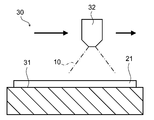
- the spray coating device 30 as shown in FIG. 1 is used.
- the liquid composition 10 for forming an antiglare film is sprayed onto the base material 21 from the nozzle 32 installed above the base material 21 installed on the base 31 to form a coating film.
- the anti-glare film 22 can be formed by drying the coating film, and the base material 20 with the anti-glare film can be completed.
- the particle size of the droplets of the liquid composition 10 for forming an antiglare film discharged from the nozzle 32 is usually 0.1 to 100 ⁇ m, preferably 1 to 50 ⁇ m.
- the particle size of the droplet is 0.1 ⁇ m or more, unevenness on which the antiglare effect is sufficiently exhibited can be formed in a short time.
- the particle size of the droplet is 100 ⁇ m or less, it is easy to form appropriate unevenness in which the antiglare effect is sufficiently exhibited.
- the particle size of the droplets of the liquid composition 10 for forming an anti-glare film can be appropriately adjusted depending on the type of nozzle 32, the spray pressure, the amount of liquid, and the like. For example, in a two-fluid nozzle, the higher the spray pressure, the smaller the droplets, and the larger the amount of liquid, the larger the droplets.
- the particle size of the droplet is the Sauter average particle size measured by a laser diffraction type particle size distribution measuring device.
- the amount of the liquid composition 10 for forming an antiglare film used per unit area of the base material is preferably 30 L / m 2 or more and 100 L / m 2 or less. If the amount used is too large, the haze of the formed base material 20 with an anti-glare film becomes large. Therefore, when the base material 20 with an anti-glare film is used as a cover glass for a display, the resolution of the display tends to decrease. On the other hand, if the amount used is too small, the gloss of the base material 20 with the anti-glare film formed becomes large. Therefore, when the base material 20 with the anti-glare film is used as the cover glass of the display, the reflection on the display is suppressed. Becomes difficult.
- the surface temperature of the object to be coated (for example, the base material 21) when the liquid composition 10 for forming an antiglare film is applied is, for example, 20 to 75 ° C., preferably 35 ° C. or higher, and more preferably 60 ° C. or higher. Is even more preferable.
- a method for heating the object to be coated for example, it is preferable to use a hot water circulation type heating device.
- the humidity when the liquid composition 10 for forming an anti-glare film is applied is, for example, 20 to 80%, preferably 50% or more.
- the coating film on the base material 21 may be dried by heating or at room temperature.
- the drying time for drying the coating film on the base material 21 is preferably, for example, 30 seconds or more.
- the coating film on the base material 21 is preferably dried under a clean layer flow at a constant temperature and humidity.
- the temperature of the laminar flow during drying is preferably 15 to 30 ° C.
- the humidity is preferably 50 to 70%
- the flow velocity of the laminar flow is preferably 0.01 to 1 m / sec.
- the base material 20 with an anti-glare film formed in this manner has the base material 21 and the anti-glare film 22 laminated on one of the two main surfaces of the base material 21. I have.
- Examples of the material of the base material 21 include glass and resin.
- the glass for example, known glass such as non-alkali glass, aluminosilicate glass, and soda lime can be used. Further, tempered glass such as chemically strengthened glass and crystallized glass such as LAS-based crystallized glass can also be used.
- the resin include acrylic resins such as polymethyl methacrylate, polycarbonate resins, and epoxy resins.
- the base material 21 is preferably a glass base material, and more preferably a tempered glass base material.
- tempered glass it is preferable to use chemically tempered glass, and it is more preferable to use aluminosilicate glass as the glass composition thereof.
- Aluminosilicate glass is in mass%, SiO 2 : 50-80%, Al 2 O 3 : 5-25%, B 2 O 3 : 0-15%, Na 2 O: 1-20%, K 2 O :. It preferably contains 0 to 10%.
- the base material 21 for example, a plate-shaped base material having a thickness in the range of 0.1 to 5 mm is used.
- the anti-glare film 22 forms an anti-glare surface having an uneven structure that scatters light.
- the anti-glare film 22 is composed of an oxide containing SiO 2.
- the thickness of the anti-glare film 22 is preferably in the range of, for example, 40 to 500 nm.
- the base material 20 with an anti-glare film can be suitably used as, for example, a cover member of a display device.
- the display device includes, for example, a light source, a liquid crystal display unit, and the like.
- the display device may have a touch panel function.
- the light-transmitting base material 20 with an anti-glare film preferably has, for example, an average transmittance of light having a wavelength of 400 nm or more and 1100 nm or less of 80% or more.
- the silica precursor and the liquid medium having the composition shown in Table 1 were mixed so that the solid content concentration at the time of solvent drying was as shown in Table 1. It was adjusted. Tetraethoxysilane was used as the silica precursor, 2-propanol was used as the first organic solvent, and 1-butanol was used as the second organic solvent.
- a glass base material (chemically tempered glass substrate, thickness 1.3 mm, manufactured by Nippon Electric Glass Co., Ltd., T2X-1) was used as the base material (base material) for obtaining a sample of the base material with an anti-glare film.
- the liquid composition for forming an anti-glare film is spray-coated on one main surface of this base material and dried to form an anti-glare film on the base material, and samples of the base material with the anti-glare film of Experimental Examples 6 to 18 are obtained. It was.
- a two-fluid nozzle was used as the nozzle of the spray coating apparatus, and the flow rate of the liquid composition for forming an antiglare film was 0.4 L / hr and the air flow rate was 230 L / min.
- the amounts of the liquid composition for forming an antiglare film used per unit area of the base material are as shown in Tables 2 and 3.
- Liquid efficiency (155- "Gloss value”) / "Amount of liquid composition for forming anti-glare film used per unit area of substrate” ... (1)
- the constant 155 in Eq. (1) represents the gloss value measured in the glass on which the anti-glare film is not formed.
- the gloss value in each sample of Experimental Examples 6 to 9 and 12 is 65 or less, which is smaller than the gloss value of each sample of Experimental Examples 10, 11 and 13 to 18. From this result, it can be seen that the reflection of the base material with the anti-glare film can be effectively suppressed in each of the samples of Experimental Examples 6 to 9 and 12 as compared with the samples of Experimental Examples 10, 11 and 13 to 18.
- the liquid efficiency of each sample of Experimental Examples 6 to 8 is 1.24 or more, which is higher than the liquid efficiency of each sample of Experimental Examples 9 to 18. From this result, it can be seen that the amount of the liquid composition for forming an antiglare film used can be effectively suppressed in each of the samples of Experimental Examples 6 to 8 as compared with the samples of Experimental Examples 9 to 18.
Landscapes
- Chemical & Material Sciences (AREA)
- Physics & Mathematics (AREA)
- Engineering & Computer Science (AREA)
- Materials Engineering (AREA)
- Wood Science & Technology (AREA)
- Organic Chemistry (AREA)
- Life Sciences & Earth Sciences (AREA)
- Optics & Photonics (AREA)
- General Physics & Mathematics (AREA)
- Nonlinear Science (AREA)
- Inorganic Chemistry (AREA)
- Manufacturing & Machinery (AREA)
- Mathematical Physics (AREA)
- Crystallography & Structural Chemistry (AREA)
- Paints Or Removers (AREA)
- Surface Treatment Of Optical Elements (AREA)
- Application Of Or Painting With Fluid Materials (AREA)
- Optical Elements Other Than Lenses (AREA)
- Processes Of Treating Macromolecular Substances (AREA)
Priority Applications (4)
| Application Number | Priority Date | Filing Date | Title |
|---|---|---|---|
| JP2021551651A JPWO2021070791A1 (https=) | 2019-10-07 | 2020-10-05 | |
| CN202080063509.4A CN114375318A (zh) | 2019-10-07 | 2020-10-05 | 防眩膜形成用液状组合物和带防眩膜的基材的制造方法 |
| US17/642,253 US20220315768A1 (en) | 2019-10-07 | 2020-10-05 | Liquid composition for forming anti-glare film and production method for anti-glare-film-coated substrate |
| US18/798,961 US20240400837A1 (en) | 2019-10-07 | 2024-08-09 | Liquid composition for forming anti-glare film and production method for anti-glare-film-coated substrate |
Applications Claiming Priority (2)
| Application Number | Priority Date | Filing Date | Title |
|---|---|---|---|
| JP2019-184370 | 2019-10-07 | ||
| JP2019184370 | 2019-10-07 |
Related Child Applications (2)
| Application Number | Title | Priority Date | Filing Date |
|---|---|---|---|
| US17/642,253 A-371-Of-International US20220315768A1 (en) | 2019-10-07 | 2020-10-05 | Liquid composition for forming anti-glare film and production method for anti-glare-film-coated substrate |
| US18/798,961 Division US20240400837A1 (en) | 2019-10-07 | 2024-08-09 | Liquid composition for forming anti-glare film and production method for anti-glare-film-coated substrate |
Publications (1)
| Publication Number | Publication Date |
|---|---|
| WO2021070791A1 true WO2021070791A1 (ja) | 2021-04-15 |
Family
ID=75436830
Family Applications (1)
| Application Number | Title | Priority Date | Filing Date |
|---|---|---|---|
| PCT/JP2020/037773 Ceased WO2021070791A1 (ja) | 2019-10-07 | 2020-10-05 | アンチグレア膜形成用液状組成物及びアンチグレア膜付き基材の製造方法 |
Country Status (5)
| Country | Link |
|---|---|
| US (2) | US20220315768A1 (https=) |
| JP (1) | JPWO2021070791A1 (https=) |
| CN (1) | CN114375318A (https=) |
| TW (1) | TWI788710B (https=) |
| WO (1) | WO2021070791A1 (https=) |
Citations (6)
| Publication number | Priority date | Publication date | Assignee | Title |
|---|---|---|---|---|
| JP2001167637A (ja) * | 1999-12-10 | 2001-06-22 | Catalysts & Chem Ind Co Ltd | 透明被膜付基材、透明被膜形成用塗布液、および表示装置 |
| JP2002161239A (ja) * | 2000-11-27 | 2002-06-04 | Matsushita Electric Works Ltd | コーティング材およびそれを用いた塗装品 |
| JP2003277689A (ja) * | 2002-03-26 | 2003-10-02 | Sumitomo Chem Co Ltd | 塗料組成物及びそれを被覆してなる基材 |
| WO2011021383A1 (ja) * | 2009-08-17 | 2011-02-24 | 日本板硝子株式会社 | 光触媒膜を備えたガラス物品 |
| JP2012008345A (ja) * | 2010-06-24 | 2012-01-12 | Canon Inc | 光学膜、その製造方法および光学素子 |
| JP2016185886A (ja) * | 2015-03-27 | 2016-10-27 | 日本板硝子株式会社 | 低反射コーティング付ガラス板 |
Family Cites Families (13)
| Publication number | Priority date | Publication date | Assignee | Title |
|---|---|---|---|---|
| JP3363616B2 (ja) * | 1994-07-28 | 2003-01-08 | 積水化学工業株式会社 | 積層体の製造方法及びペン入力パネル用保護材料の製造方法 |
| JP3166566B2 (ja) * | 1995-06-05 | 2001-05-14 | 信越化学工業株式会社 | エポキシ樹脂によるシリコーンゴムの被覆方法及びエポキシ樹脂被覆シリコーンゴム製品 |
| JPH08332451A (ja) * | 1995-06-09 | 1996-12-17 | Sekisui Chem Co Ltd | 積層体の製造方法 |
| JPH08337667A (ja) * | 1995-06-09 | 1996-12-24 | Sekisui Chem Co Ltd | 積層体の製造方法 |
| KR100317898B1 (ko) * | 1996-06-24 | 2002-06-27 | 우츠미 오사무 | 투명피막형성용도포액,투명피막이도포된기재및그의용도 |
| JP4411672B2 (ja) * | 1997-10-23 | 2010-02-10 | 住友金属鉱山株式会社 | 透明導電層形成用塗布液とその製造方法 |
| EP1190277B1 (en) * | 1999-06-10 | 2009-10-07 | AlliedSignal Inc. | Semiconductor having spin-on-glass anti-reflective coatings for photolithography |
| KR20040075866A (ko) * | 2001-11-15 | 2004-08-30 | 허니웰 인터내셔날 인코포레이티드 | 포토리소그래피용 스핀-온 무반사 코팅 |
| DE102005060402A1 (de) * | 2005-12-15 | 2007-06-21 | Degussa Gmbh | Lagerstabile Beschichtungszusammensetzung für eine abriebfeste und witterungsbeständige Ausstattung glatter anorganischer Oberflächen mit "Easy-to-clean"Eigenschaften |
| US8916328B2 (en) * | 2007-08-20 | 2014-12-23 | Guardian Industries Corp. | Coated glass substrate with ultraviolet blocking characteristics and including a rheological modifier |
| KR101877599B1 (ko) * | 2011-12-28 | 2018-07-12 | 도아고세이가부시키가이샤 | 폴리실록산의 제조 방법 |
| KR101749174B1 (ko) * | 2016-01-18 | 2017-06-21 | 영창케미칼 주식회사 | 반사방지 코팅액 조성물 및 이를 이용한 반사방지 코팅막 |
| WO2018143371A1 (ja) * | 2017-02-06 | 2018-08-09 | 富士フイルム株式会社 | 塗布組成物、反射防止膜及びその製造方法、積層体、並びに、太陽電池モジュール |
-
2020
- 2020-10-05 JP JP2021551651A patent/JPWO2021070791A1/ja active Pending
- 2020-10-05 US US17/642,253 patent/US20220315768A1/en not_active Abandoned
- 2020-10-05 WO PCT/JP2020/037773 patent/WO2021070791A1/ja not_active Ceased
- 2020-10-05 CN CN202080063509.4A patent/CN114375318A/zh active Pending
- 2020-10-07 TW TW109134718A patent/TWI788710B/zh active
-
2024
- 2024-08-09 US US18/798,961 patent/US20240400837A1/en active Pending
Patent Citations (6)
| Publication number | Priority date | Publication date | Assignee | Title |
|---|---|---|---|---|
| JP2001167637A (ja) * | 1999-12-10 | 2001-06-22 | Catalysts & Chem Ind Co Ltd | 透明被膜付基材、透明被膜形成用塗布液、および表示装置 |
| JP2002161239A (ja) * | 2000-11-27 | 2002-06-04 | Matsushita Electric Works Ltd | コーティング材およびそれを用いた塗装品 |
| JP2003277689A (ja) * | 2002-03-26 | 2003-10-02 | Sumitomo Chem Co Ltd | 塗料組成物及びそれを被覆してなる基材 |
| WO2011021383A1 (ja) * | 2009-08-17 | 2011-02-24 | 日本板硝子株式会社 | 光触媒膜を備えたガラス物品 |
| JP2012008345A (ja) * | 2010-06-24 | 2012-01-12 | Canon Inc | 光学膜、その製造方法および光学素子 |
| JP2016185886A (ja) * | 2015-03-27 | 2016-10-27 | 日本板硝子株式会社 | 低反射コーティング付ガラス板 |
Also Published As
| Publication number | Publication date |
|---|---|
| US20220315768A1 (en) | 2022-10-06 |
| TW202124597A (zh) | 2021-07-01 |
| TWI788710B (zh) | 2023-01-01 |
| CN114375318A (zh) | 2022-04-19 |
| JPWO2021070791A1 (https=) | 2021-04-15 |
| US20240400837A1 (en) | 2024-12-05 |
Similar Documents
| Publication | Publication Date | Title |
|---|---|---|
| US6514574B1 (en) | Process for making an abrasion resistant coating onto an organic glass substrate | |
| JP5621486B2 (ja) | シリカ系多孔質体の製造方法 | |
| JP7040234B2 (ja) | 物品 | |
| JP2017132644A (ja) | 機能膜付き化学強化ガラス板、その製造方法および物品 | |
| JP7120241B2 (ja) | 透明物品 | |
| JP7353971B2 (ja) | 透明物品の製造方法 | |
| WO2017022638A1 (ja) | モバイルディスプレイ機器のカバーガラス等に好適なガラス基板 | |
| WO2018212146A1 (ja) | 透明物品、及び透明物品の製造方法 | |
| CN110546118A (zh) | 带有膜的玻璃基板、物品以及带有膜的玻璃基板的制造方法 | |
| KR101362627B1 (ko) | 인산에스테르 화합물을 함유하는 피막 형성용 도포액 및 반사 방지막 | |
| JP7293662B2 (ja) | 表示装置のカバー部材 | |
| WO2021070791A1 (ja) | アンチグレア膜形成用液状組成物及びアンチグレア膜付き基材の製造方法 | |
| EP4183754A1 (en) | Glass substrate with silica film | |
| JP6578946B2 (ja) | 保護膜を有するガラス基板 | |
| JP7044078B2 (ja) | アンチグレア面を有する物品及び物品の製造方法 | |
| JP7351329B2 (ja) | 透明物品 | |
| JP2004255582A (ja) | 硬化被膜が形成された透明基材 | |
| WO2020067135A1 (ja) | 透明物品 | |
| WO2018123869A1 (ja) | 透明物品 | |
| JP6866743B2 (ja) | ハーフミラー |
Legal Events
| Date | Code | Title | Description |
|---|---|---|---|
| 121 | Ep: the epo has been informed by wipo that ep was designated in this application |
Ref document number: 20874608 Country of ref document: EP Kind code of ref document: A1 |
|
| ENP | Entry into the national phase |
Ref document number: 2021551651 Country of ref document: JP Kind code of ref document: A |
|
| NENP | Non-entry into the national phase |
Ref country code: DE |
|
| 122 | Ep: pct application non-entry in european phase |
Ref document number: 20874608 Country of ref document: EP Kind code of ref document: A1 |