WO2021024702A1 - 接着剤組成物、接着シート、積層体およびプリント配線板 - Google Patents
接着剤組成物、接着シート、積層体およびプリント配線板 Download PDFInfo
- Publication number
- WO2021024702A1 WO2021024702A1 PCT/JP2020/027108 JP2020027108W WO2021024702A1 WO 2021024702 A1 WO2021024702 A1 WO 2021024702A1 JP 2020027108 W JP2020027108 W JP 2020027108W WO 2021024702 A1 WO2021024702 A1 WO 2021024702A1
- Authority
- WO
- WIPO (PCT)
- Prior art keywords
- group
- mass
- adhesive composition
- parts
- less
- Prior art date
- Legal status (The legal status is an assumption and is not a legal conclusion. Google has not performed a legal analysis and makes no representation as to the accuracy of the status listed.)
- Ceased
Links
Classifications
-
- B—PERFORMING OPERATIONS; TRANSPORTING
- B32—LAYERED PRODUCTS
- B32B—LAYERED PRODUCTS, i.e. PRODUCTS BUILT-UP OF STRATA OF FLAT OR NON-FLAT, e.g. CELLULAR OR HONEYCOMB, FORM
- B32B27/00—Layered products comprising a layer of synthetic resin
-
- C—CHEMISTRY; METALLURGY
- C09—DYES; PAINTS; POLISHES; NATURAL RESINS; ADHESIVES; COMPOSITIONS NOT OTHERWISE PROVIDED FOR; APPLICATIONS OF MATERIALS NOT OTHERWISE PROVIDED FOR
- C09J—ADHESIVES; NON-MECHANICAL ASPECTS OF ADHESIVE PROCESSES IN GENERAL; ADHESIVE PROCESSES NOT PROVIDED FOR ELSEWHERE; USE OF MATERIALS AS ADHESIVES
- C09J123/00—Adhesives based on homopolymers or copolymers of unsaturated aliphatic hydrocarbons having only one carbon-to-carbon double bond; Adhesives based on derivatives of such polymers
-
- B—PERFORMING OPERATIONS; TRANSPORTING
- B32—LAYERED PRODUCTS
- B32B—LAYERED PRODUCTS, i.e. PRODUCTS BUILT-UP OF STRATA OF FLAT OR NON-FLAT, e.g. CELLULAR OR HONEYCOMB, FORM
- B32B27/00—Layered products comprising a layer of synthetic resin
- B32B27/18—Layered products comprising a layer of synthetic resin characterised by the use of special additives
-
- B—PERFORMING OPERATIONS; TRANSPORTING
- B32—LAYERED PRODUCTS
- B32B—LAYERED PRODUCTS, i.e. PRODUCTS BUILT-UP OF STRATA OF FLAT OR NON-FLAT, e.g. CELLULAR OR HONEYCOMB, FORM
- B32B27/00—Layered products comprising a layer of synthetic resin
- B32B27/32—Layered products comprising a layer of synthetic resin comprising polyolefins
-
- B—PERFORMING OPERATIONS; TRANSPORTING
- B32—LAYERED PRODUCTS
- B32B—LAYERED PRODUCTS, i.e. PRODUCTS BUILT-UP OF STRATA OF FLAT OR NON-FLAT, e.g. CELLULAR OR HONEYCOMB, FORM
- B32B27/00—Layered products comprising a layer of synthetic resin
- B32B27/34—Layered products comprising a layer of synthetic resin comprising polyamides
-
- B—PERFORMING OPERATIONS; TRANSPORTING
- B32—LAYERED PRODUCTS
- B32B—LAYERED PRODUCTS, i.e. PRODUCTS BUILT-UP OF STRATA OF FLAT OR NON-FLAT, e.g. CELLULAR OR HONEYCOMB, FORM
- B32B27/00—Layered products comprising a layer of synthetic resin
- B32B27/38—Layered products comprising a layer of synthetic resin comprising epoxy resins
-
- C—CHEMISTRY; METALLURGY
- C08—ORGANIC MACROMOLECULAR COMPOUNDS; THEIR PREPARATION OR CHEMICAL WORKING-UP; COMPOSITIONS BASED THEREON
- C08L—COMPOSITIONS OF MACROMOLECULAR COMPOUNDS
- C08L51/00—Compositions of graft polymers in which the grafted component is obtained by reactions only involving carbon-to-carbon unsaturated bonds; Compositions of derivatives of such polymers
- C08L51/06—Compositions of graft polymers in which the grafted component is obtained by reactions only involving carbon-to-carbon unsaturated bonds; Compositions of derivatives of such polymers grafted on to homopolymers or copolymers of aliphatic hydrocarbons containing only one carbon-to-carbon double bond
-
- C—CHEMISTRY; METALLURGY
- C08—ORGANIC MACROMOLECULAR COMPOUNDS; THEIR PREPARATION OR CHEMICAL WORKING-UP; COMPOSITIONS BASED THEREON
- C08L—COMPOSITIONS OF MACROMOLECULAR COMPOUNDS
- C08L63/00—Compositions of epoxy resins; Compositions of derivatives of epoxy resins
-
- C—CHEMISTRY; METALLURGY
- C09—DYES; PAINTS; POLISHES; NATURAL RESINS; ADHESIVES; COMPOSITIONS NOT OTHERWISE PROVIDED FOR; APPLICATIONS OF MATERIALS NOT OTHERWISE PROVIDED FOR
- C09J—ADHESIVES; NON-MECHANICAL ASPECTS OF ADHESIVE PROCESSES IN GENERAL; ADHESIVE PROCESSES NOT PROVIDED FOR ELSEWHERE; USE OF MATERIALS AS ADHESIVES
- C09J11/00—Features of adhesives not provided for in group C09J9/00, e.g. additives
- C09J11/02—Non-macromolecular additives
- C09J11/04—Non-macromolecular additives inorganic
-
- C—CHEMISTRY; METALLURGY
- C09—DYES; PAINTS; POLISHES; NATURAL RESINS; ADHESIVES; COMPOSITIONS NOT OTHERWISE PROVIDED FOR; APPLICATIONS OF MATERIALS NOT OTHERWISE PROVIDED FOR
- C09J—ADHESIVES; NON-MECHANICAL ASPECTS OF ADHESIVE PROCESSES IN GENERAL; ADHESIVE PROCESSES NOT PROVIDED FOR ELSEWHERE; USE OF MATERIALS AS ADHESIVES
- C09J11/00—Features of adhesives not provided for in group C09J9/00, e.g. additives
- C09J11/02—Non-macromolecular additives
- C09J11/06—Non-macromolecular additives organic
-
- C—CHEMISTRY; METALLURGY
- C09—DYES; PAINTS; POLISHES; NATURAL RESINS; ADHESIVES; COMPOSITIONS NOT OTHERWISE PROVIDED FOR; APPLICATIONS OF MATERIALS NOT OTHERWISE PROVIDED FOR
- C09J—ADHESIVES; NON-MECHANICAL ASPECTS OF ADHESIVE PROCESSES IN GENERAL; ADHESIVE PROCESSES NOT PROVIDED FOR ELSEWHERE; USE OF MATERIALS AS ADHESIVES
- C09J123/00—Adhesives based on homopolymers or copolymers of unsaturated aliphatic hydrocarbons having only one carbon-to-carbon double bond; Adhesives based on derivatives of such polymers
- C09J123/26—Adhesives based on homopolymers or copolymers of unsaturated aliphatic hydrocarbons having only one carbon-to-carbon double bond; Adhesives based on derivatives of such polymers modified by chemical after-treatment
-
- C—CHEMISTRY; METALLURGY
- C09—DYES; PAINTS; POLISHES; NATURAL RESINS; ADHESIVES; COMPOSITIONS NOT OTHERWISE PROVIDED FOR; APPLICATIONS OF MATERIALS NOT OTHERWISE PROVIDED FOR
- C09J—ADHESIVES; NON-MECHANICAL ASPECTS OF ADHESIVE PROCESSES IN GENERAL; ADHESIVE PROCESSES NOT PROVIDED FOR ELSEWHERE; USE OF MATERIALS AS ADHESIVES
- C09J151/00—Adhesives based on graft polymers in which the grafted component is obtained by reactions only involving carbon-to-carbon unsaturated bonds; Adhesives based on derivatives of such polymers
- C09J151/06—Adhesives based on graft polymers in which the grafted component is obtained by reactions only involving carbon-to-carbon unsaturated bonds; Adhesives based on derivatives of such polymers grafted on to homopolymers or copolymers of aliphatic hydrocarbons containing only one carbon-to-carbon double bond
-
- C—CHEMISTRY; METALLURGY
- C09—DYES; PAINTS; POLISHES; NATURAL RESINS; ADHESIVES; COMPOSITIONS NOT OTHERWISE PROVIDED FOR; APPLICATIONS OF MATERIALS NOT OTHERWISE PROVIDED FOR
- C09J—ADHESIVES; NON-MECHANICAL ASPECTS OF ADHESIVE PROCESSES IN GENERAL; ADHESIVE PROCESSES NOT PROVIDED FOR ELSEWHERE; USE OF MATERIALS AS ADHESIVES
- C09J163/00—Adhesives based on epoxy resins; Adhesives based on derivatives of epoxy resins
-
- C—CHEMISTRY; METALLURGY
- C09—DYES; PAINTS; POLISHES; NATURAL RESINS; ADHESIVES; COMPOSITIONS NOT OTHERWISE PROVIDED FOR; APPLICATIONS OF MATERIALS NOT OTHERWISE PROVIDED FOR
- C09J—ADHESIVES; NON-MECHANICAL ASPECTS OF ADHESIVE PROCESSES IN GENERAL; ADHESIVE PROCESSES NOT PROVIDED FOR ELSEWHERE; USE OF MATERIALS AS ADHESIVES
- C09J7/00—Adhesives in the form of films or foils
- C09J7/30—Adhesives in the form of films or foils characterised by the adhesive composition
- C09J7/35—Heat-activated
-
- C—CHEMISTRY; METALLURGY
- C09—DYES; PAINTS; POLISHES; NATURAL RESINS; ADHESIVES; COMPOSITIONS NOT OTHERWISE PROVIDED FOR; APPLICATIONS OF MATERIALS NOT OTHERWISE PROVIDED FOR
- C09J—ADHESIVES; NON-MECHANICAL ASPECTS OF ADHESIVE PROCESSES IN GENERAL; ADHESIVE PROCESSES NOT PROVIDED FOR ELSEWHERE; USE OF MATERIALS AS ADHESIVES
- C09J7/00—Adhesives in the form of films or foils
- C09J7/30—Adhesives in the form of films or foils characterised by the adhesive composition
- C09J7/38—Pressure-sensitive adhesives [PSA]
-
- H—ELECTRICITY
- H05—ELECTRIC TECHNIQUES NOT OTHERWISE PROVIDED FOR
- H05K—PRINTED CIRCUITS; CASINGS OR CONSTRUCTIONAL DETAILS OF ELECTRIC APPARATUS; MANUFACTURE OF ASSEMBLAGES OF ELECTRICAL COMPONENTS
- H05K1/00—Printed circuits
- H05K1/02—Details
- H05K1/03—Use of materials for the substrate
Definitions
- the present invention relates to an adhesive composition. More specifically, the present invention relates to an adhesive composition used for adhering a resin base material to a resin base material or a metal base material. In particular, the present invention relates to an adhesive composition for a flexible printed wiring board (hereinafter abbreviated as FPC), and an adhesive sheet, a laminate and a printed wiring board containing the same.
- FPC flexible printed wiring board
- the flexible printed wiring board has excellent flexibility, it can be used for multi-functionality and miniaturization of personal computers (PCs) and smartphones, and therefore, an electronic circuit board is incorporated in a narrow and complicated interior. It is often used for.
- electronic devices have become smaller, lighter, higher in density, and have higher output, and due to these trends, the demand for the performance of wiring boards (electronic circuit boards) has become more and more sophisticated.
- the frequency of signals is increasing.
- FPCs to have low dielectric properties (low dielectric constant, low dielectric loss tangent) in the high frequency region.
- Patent Document 1 As an adhesive, development is underway with a combination of polyolefin and epoxy (Patent Document 1) and a combination of elastomer and epoxy (Patent Document 2). Further, the adhesive composition used for the above purpose is often flammable, and is required to impart flame retardancy. As the flame retardant, a system using a halogen-based organic compound has excellent flame retardancy, but this method has a problem of emitting a corrosive halogen gas during combustion. Therefore, for example, the formulation of a phosphorus-based flame retardant has been studied (Patent Document 3). On the other hand, as an adhesive for a carrier tape or a sheet, one using acrylonitrile butadiene rubber (NBR) is also known (Patent Document 4).
- NBR acrylonitrile butadiene rubber
- Patent Document 1 it cannot be said that the heat resistance of the reinforcing plate and the adhesive used between the layers is excellent. Further, in Patent Document 2, the storage stability after compounding, which is important at the time of use, was not sufficient.
- Patent Document 3 examines the dielectric constant and flame retardancy, only the adhesiveness between copper foil and copper foil is mentioned, and the adhesiveness with polyimide or LCP base material and the solder required for FPC applications are mentioned. The heat resistance was not examined and could not be said to be sufficient.
- Patent Document 4 has problems such as insufficient heat-resistant adhesiveness and strong tack of the adhesive layer.
- the present invention provides an adhesive composition having a specific composition with high adhesiveness between a resin base material such as a polyimide film and a metal base material such as copper foil. It has excellent solder heat resistance and low dielectric properties, and also has flame retardancy and tack resistance of VTM-0 based on UL-94, which has led to the completion of the present invention.
- the present invention has good adhesiveness to both various resin substrates such as polyimide and metal substrates, and is also excellent in solder heat resistance, low dielectric properties, flame retardancy and tack resistance. It is an object of the present invention to provide an adhesive composition.
- It contains an acid-modified polyolefin (a), an oligophenylene ether (b) having a number average molecular weight of 3000 or less, an epoxy resin (c) and a polycarbodiimide (d), and further contains at least a flame retardant (e) or an inorganic filler (f).
- An adhesive composition containing one of them.
- the total amount of the acid-modified polyolefin (a), the oligophenylene ether (b) having a number average molecular weight of 3000 or less, the epoxy resin (c) and the polycarbodiimide (d) is 100 parts by mass. It is preferably contained in an amount of to 60 parts by mass, and in the case of the inorganic filler (f), it is preferably contained in an amount of 2 to 50 parts by mass. Further, it is preferable that the epoxy resin (c) is contained in an amount of 0.5 to 60 parts by mass with respect to 100 parts by mass of the acid-modified polyolefin (a).
- the acid value of the acid-modified polyolefin (a) is preferably 5 to 40 mgKOH / g.
- the adhesive composition preferably has a relative permittivity of 1 GHz of 3.0 or less and a dielectric loss tangent of 0.02 or less.
- An adhesive sheet or laminate containing the adhesive composition An adhesive sheet or laminate containing the adhesive composition.
- the adhesive composition according to the present invention has good adhesiveness to both various resin substrates such as polyimide and metal substrates, and has solder heat resistance, low dielectric properties, flame retardancy, and tack resistance. Excellent for.
- the acid-modified polyolefin (a) used in the present invention (hereinafter, also simply referred to as the component (a)) is not limited, but the polyolefin resin contains at least one ⁇ , ⁇ -unsaturated carboxylic acid and an acid anhydride thereof. It is preferably obtained by grafting.
- the polyolefin resin is a hydrocarbon such as homopolymerization of an olefin monomer exemplified by ethylene, propylene, butene, butadiene, isoprene, or copolymerization with other monomers, and hydrides and halides of the obtained polymer.
- the acid-modified polyolefin is obtained by grafting at least one of ⁇ , ⁇ -unsaturated carboxylic acid and its acid anhydride to at least one of polyethylene, polypropylene and a propylene- ⁇ -olefin copolymer. Is preferred.
- the propylene- ⁇ -olefin copolymer is a copolymer of propylene as a main component and ⁇ -olefin.
- ⁇ -olefin for example, one or several kinds of ethylene, 1-butene, 1-heptene, 1-octene, 4-methyl-1-pentene, vinyl acetate and the like can be used. Among these ⁇ -olefins, ethylene and 1-butene are preferable.
- the ratio of the propylene component to the ⁇ -olefin component of the propylene- ⁇ -olefin copolymer is not limited, but the propylene component is preferably 50 mol% or more, and more preferably 70 mol% or more.
- Examples of at least one of ⁇ , ⁇ -unsaturated carboxylic acid and its acid anhydride include maleic acid, itaconic acid, citraconic acid and their acid anhydrides.
- acid anhydride is preferable, and maleic anhydride is more preferable.
- Specific examples thereof include maleic anhydride-modified polypropylene, maleic anhydride-modified propylene-ethylene copolymer, maleic anhydride-modified propylene-butene copolymer, maleic anhydride-modified propylene-ethylene-butene copolymer and the like.
- These acid-modified polyolefins can be used alone or in combination of two or more.
- the lower limit of the acid value of the acid-modified polyolefin (a) is preferably 5 mgKOH / g or more, more preferably 6 mgKOH / g or more, from the viewpoint of heat resistance and adhesion to a resin base material or a metal base material. , More preferably 7 mgKOH / g or more.
- the upper limit is preferably 40 mgKOH / g or less, more preferably 35 mgKOH / g or less, and further preferably 30 mgKOH / g or less. Adhesion is improved by setting the value to the upper limit or less.
- the viscosity and stability of the solution are improved, and excellent pot life can be exhibited. Furthermore, the manufacturing efficiency is improved.
- the number average molecular weight (Mn) of the acid-modified polyolefin (a) is preferably in the range of 10,000 to 50,000. It is more preferably in the range of 15,000 to 45,000, further preferably in the range of 20,000 to 40,000, and particularly preferably in the range of 22,000 to 38,000.
- Mn number average molecular weight
- the acid-modified polyolefin (a) is preferably a crystalline acid-modified polyolefin.
- Crystallinity as used in the present invention means that the temperature is raised from -100 ° C to 250 ° C at 20 ° C / min using a differential scanning calorimeter (DSC) and a clear melting peak is shown in the heating process. Point to.
- the melting point (Tm) of the acid-modified polyolefin (a) is preferably in the range of 50 ° C. to 120 ° C. It is more preferably in the range of 60 ° C to 100 ° C, and most preferably in the range of 70 ° C to 90 ° C.
- Tm melting point
- the heat of fusion ( ⁇ H) of the acid-modified polyolefin (a) is preferably in the range of 5 J / g to 60 J / g. It is more preferably in the range of 10 J / g to 50 J / g, and most preferably in the range of 20 J / g to 40 J / g.
- the value is set to the lower limit or more, the cohesive force derived from the crystal becomes good, and excellent adhesiveness and heat resistance can be exhibited. Further, when the value is not more than the upper limit, the solution stability and fluidity are excellent, and the operability at the time of adhesion is improved.
- the method for producing the acid-modified polyolefin (a) is not particularly limited, and for example, a radical graft reaction (that is, a radical species is generated for a polymer serving as a main chain, and the radical species is used as a polymerization initiator to form an unsaturated carboxylic acid and (Reaction of graft polymerization of acid anhydride), and the like.
- a radical graft reaction that is, a radical species is generated for a polymer serving as a main chain, and the radical species is used as a polymerization initiator to form an unsaturated carboxylic acid and (Reaction of graft polymerization of acid anhydride), and the like.
- the radical generator is not particularly limited, but it is preferable to use an organic peroxide.
- the organic peroxide is not particularly limited, but is di-tert-butylperoxyphthalate, tert-butylhydroperoxide, dicumyl peroxide, benzoyl peroxide, tert-butylperoxybenzoate, tert-butylperoxy-.
- Peroxides such as 2-ethylhexanoate, tert-butylperoxypivalate, methylethylketone peroxide, di-tert-butyl peroxide, lauroyl peroxide; azobisisobutyronitrile, azobisisopropionitrile, etc. Examples include azonitriles.
- the oligophenylene ether (b) used in the present invention (hereinafter, also simply referred to as the component (b)) has a number average molecular weight (Mn) of 3000 or less, and is preferably a structure represented by the following general formula (1).
- Mn number average molecular weight
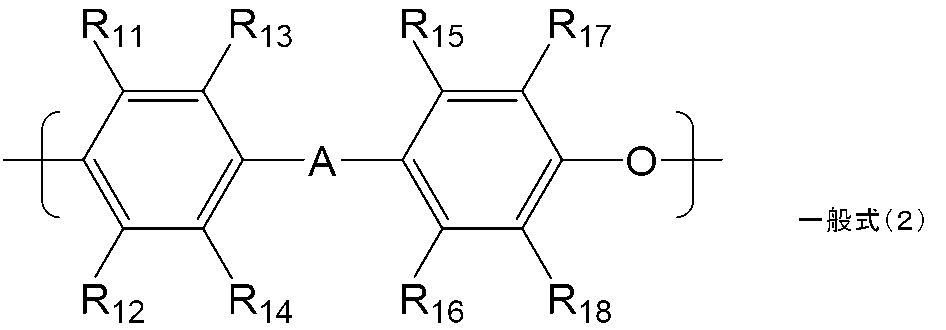
- a compound having a unit and / or a structural unit of the general formula (2) can be used.
- R 1 , R 2 , R 3 , and R 4 are independently hydrogen atoms, optionally substituted alkyl groups, optionally substituted alkenyl groups, and optionally substituted, respectively. It is preferably a good alkynyl group, an optionally substituted aryl group, an optionally substituted aralkyl group or an optionally optionally substituted alkoxy group.
- the "alkyl group" of the alkyl group which may be substituted is, for example, a linear or branched alkyl group having 1 or more and 6 or less carbon atoms, preferably 1 or more and 3 or less carbon atoms.
- methyl group, ethyl group, propyl group, isopropyl group, butyl group, isobutyl group, sec-butyl group, tert-butyl group, pentyl group, hexyl group and the like can be mentioned, and a methyl group or an ethyl group can be used. More preferably.
- alkenyl group examples include an ethenyl group, a 1-propenyl group, a 2-propenyl group, a 3-butenyl group, a pentenyl group, a hexenyl group and the like, and the ethenyl group or 1 -It is more preferably a propenyl group.
- alkynyl group examples include ethynyl group, 1-propynyl group, 2-propynyl (propargyl) group, 3-butynyl group, pentynyl group, hexynyl group and the like.
- aryl group of the aryl group which may be substituted include a phenyl group, a naphthyl group and the like, and a phenyl group is more preferable.
- aralkyl group of the optionally substituted aralkyl group include a benzyl group, a phenethyl group, a 2-methylbenzyl group, a 4-methylbenzyl group, an ⁇ -methylbenzyl group, a 2-vinylphenethyl group and a 4-.
- alkoxy group of the alkoxy group which may be substituted is, for example, a linear or branched alkoxy group having 1 or more and 6 or less carbon atoms, preferably 1 or more and 3 or less carbon atoms.
- a methoxy group, an ethoxy group, a propoxy group, an isopropoxy group, a butoxy group, a sec-butoxy group, a tert-butoxy group, a pentyloxy group, a hexyloxy group and the like can be mentioned, and the group may be a methoxy group or an ethoxy group. preferable.
- alkyl group When the above-mentioned alkyl group, aryl group, alkenyl group, alkynyl group, aralkyl group, and alkoxy group are substituted, it may have one or more substituents.
- substituents include a halogen atom (for example, a fluorine atom, a chlorine atom and a bromine atom) and an alkyl group having 1 to 6 carbon atoms (for example, a methyl group, an ethyl group, a propyl group, an isopropyl group and a butyl group).
- R 1 and R 4 are methyl groups
- R 2 and R 3 are hydrogen.
- R 11 , R 12 , R 13 , R 14 , R 15 , R 16 , R 17 , and R 18 are each independently substituted with a hydrogen atom and an optionally substituted alkyl group. It is preferably an alkenyl group which may be substituted, an alkynyl group which may be substituted, an aryl group which may be substituted, an aralkyl group which may be substituted, or an alkoxy group which may be substituted.
- the definition of each substituent is as described above.
- alkyl group examples include a methyl group, an ethyl group, a propyl group, an isopropyl group, a butyl group, an isobutyl group, a sec-butyl group, a tert-butyl group, a pentyl group, a hexyl group and the like, and a methyl group is preferable. .. Of these, it is preferable that R 13 , R 14 , R 17 and R 18 are methyl groups, and R 11 , R 12 , R 15 and R 16 are hydrogen. Further, —A— is preferably a linear, branched or cyclic divalent hydrocarbon group having 20 or less carbon atoms, or oxygen.
- the carbon number of A is more preferably 1 or more and 15 or less, and further preferably 2 or more and 10 or less.
- Examples of the divalent hydrocarbon group of A include a methylene group, an ethylene group, an n-propylene group, an n-butylene group, a cyclohexylene group, a phenylene group and the like, and a phenylene group is preferable. Particularly preferred is oxygen.
- the component (b) is a modified oligo in which a part or all of the component is functionalized with an ethylenically unsaturated group such as a vinylbenzyl group, an epoxy group, an amino group, a hydroxy group, a mercapto group, a carboxyl group, a silyl group or the like. It may be phenylene ether. Further, it is preferable that both ends have a hydroxy group, an epoxy group, or an ethylenically unsaturated group.
- an ethylenically unsaturated group such as a vinylbenzyl group, an epoxy group, an amino group, a hydroxy group, a mercapto group, a carboxyl group, a silyl group or the like. It may be phenylene ether. Further, it is preferable that both ends have a hydroxy group, an epoxy group, or an ethylenically unsaturated group.
- Examples of the ethylenically unsaturated group include an alkenyl group such as an ethenyl group, an allyl group, a methacrylic group, a propenyl group, a butenyl group, a hexenyl group and an octenyl group, a cycloalkenyl group such as a cyclopentenyl group and a cyclohexenyl group, and a vinylbenzyl group.
- Alkenylaryl groups such as vinylnaphthyl groups can be mentioned.
- both ends may be the same functional group or different functional groups. From the viewpoint of highly controlling the balance between low dielectric loss tangent and reduction of resin residue, it is preferable that both ends are hydroxy groups or vinylbenzyl groups, and both ends are hydroxy groups or vinylbenzyl groups. More preferably.
- n is preferably 3 or more, more preferably 5 or more, preferably 23 or less, more preferably 21 or less, and further preferably 19 or less.
- n is preferably 2 or more, more preferably 4 or more, preferably 23 or less, more preferably 20 or less, and further preferably 18 or less.
- the number average molecular weight of the component (b) needs to be 3000 or less, more preferably 2700 or less, and further preferably 2500 or less. Further, the number average molecular weight of the component (b) is preferably 500 or more, and more preferably 700 or more. By setting the number average molecular weight of the component (b) to the lower limit value or more, the flexibility of the obtained adhesive layer can be improved. On the other hand, by setting the number average molecular weight of the component (b) to the upper limit or less, the solubility in an organic solvent can be improved.
- the content of the component (b) is preferably 0.05 parts by mass or more, more preferably 1 part by mass or more, and further preferably 5 parts by mass or more with respect to 100 parts by mass of the component (a). is there.
- the value is preferably 200 parts by mass or less, more preferably 150 parts by mass or less, further preferably 100 parts by mass or less, and particularly preferably 50 parts by mass or less.
- the value is not more than the upper limit, excellent adhesiveness and solder heat resistance can be exhibited.
- Epoxy resin (c) used in the present invention (hereinafter, also simply referred to as the component (c)) is not particularly limited as long as it has an epoxy group in the molecule, but preferably two or more in the molecule. It has an epoxy group.
- biphenyl type epoxy resin naphthalene type epoxy resin, bisphenol A type epoxy resin, bisphenol F type epoxy resin, novolak type epoxy resin, alicyclic epoxy resin, dicyclopentadiene type epoxy resin, At least one selected from the group consisting of tetraglycidyl diaminodiphenylmethane, triglycidyl paraaminophenol, tetraglycidyl bisaminomethylcyclohexanone, N, N, N', N'-tetraglycidyl-m-xylene diamine, and epoxy-modified polybutadiene.
- tetraglycidyl diaminodiphenylmethane triglycidyl paraaminophenol
- tetraglycidyl bisaminomethylcyclohexanone N, N, N', N'-tetraglycidyl-m-xylene diamine
- epoxy-modified polybutadiene can be used.
- it is a biphenyl type epoxy resin, a novolak type epoxy resin, a dicyclopentadiene type epoxy resin or an epoxy-modified polybutadiene. More preferably, it is a dicyclopentadiene type epoxy resin or an epoxy-modified polybutadiene.
- the epoxy equivalent of the epoxy resin (c) is preferably 50 g / eq or more, more preferably 100 g / eq or more, and further preferably 150 g / eq or more. Further, it is preferably 400 g / eq or less, more preferably 350 g / eq or less, and further preferably 300 g / eq or less. Within the above range, excellent solder heat resistance can be exhibited.
- the content of the epoxy resin (c) is preferably 0.5 parts by mass or more, more preferably 1 part by mass with respect to 100 parts by mass of the acid-modified polyolefin (a).
- the above is more preferably 2 parts by mass or more, particularly preferably 5 parts by mass or more, and most preferably 10 parts by mass or more.
- the value is not less than the lower limit, a sufficient curing effect can be obtained, and excellent adhesiveness and solder heat resistance can be exhibited.
- it is preferably 60 parts by mass or less, more preferably 50 parts by mass or less, further preferably 40 parts by mass or less, and particularly preferably 35 parts by mass or less.
- the polycarbodiimide (d) used in the present invention (hereinafter, also simply referred to as the component (d)) is not particularly limited as long as it has a carbodiimide group in the molecule. It is preferably a polycarbodiimide having two or more carbodiimide groups in the molecule.
- the carboxyl group of the acid-modified polyolefin (a) reacts with the carbodiimide group, the interaction between the adhesive composition and the substrate can be enhanced, and the adhesiveness can be improved.
- the content of polycarbodiimide (d) is preferably 0.5 parts by mass or more, more preferably 0.7 with respect to 100 parts by mass of the acid-modified polyolefin (a). It is by mass or more, more preferably 1 part by mass or more, and particularly preferably 2 parts by mass or more.
- the value is not less than the lower limit, the interaction with the base material is exhibited and the adhesiveness is improved. Further, it is preferably 20 parts by mass or less, more preferably 15 parts by mass or less, and further preferably 10 parts by mass or less. By setting the value to the upper limit or less, excellent dielectric properties can be exhibited.
- the content of polycarbodiimide (d) with respect to the epoxy resin (c) is preferably 5 parts by mass or more, more preferably 10 parts by mass or more, and further preferably 15 parts by mass or more with respect to 100 parts by mass of the epoxy resin (c). Is. Further, it is preferably 100 parts by mass or less, more preferably 80 parts by mass or less, and further preferably 60 parts by mass or less. Within the above range, adhesiveness to LCP and excellent low dielectric properties can be exhibited.
- the component (e) is a flame retardant.
- flame retardant (e) flame retardancy can be imparted to the adhesive composition.
- the flame retardant (e) is not particularly limited as long as it exhibits flame retardancy, but it is preferably one that does not dissolve in an organic solvent.
- the flame retardant (e) is preferably a flame retardant filler, and examples thereof include an inorganic flame retardant filler and an organic flame retardant filler.
- the inorganic flame-retardant filler include metal hydroxide compounds such as aluminum hydroxide, magnesium hydroxide, zirconium hydroxide, calcium hydroxide, and barium hydroxide; basic magnesium carbonate, zinc carbonate, and magnesium carbonate-calcium ().
- Metal carbonate compounds such as magnesium carbonate and calcium carbonate), calcium carbonate, barium carbonate; metal oxides such as magnesium oxide, molybdenum oxide, zirconium oxide, tin oxide, tin oxide hydrate, antimony oxide; zinc borate , Metal borate compounds such as zinc metaborate and barium metaborate; inorganic metal compounds such as dolomite, hydrotalcite and borosand; inorganic phosphorus compounds such as red phosphorus and the like.
- metal oxides such as magnesium oxide, molybdenum oxide, zirconium oxide, tin oxide, tin oxide hydrate, antimony oxide
- zinc borate Metal borate compounds such as zinc metaborate and barium metaborate
- inorganic metal compounds such as dolomite, hydrotalcite and borosand
- inorganic phosphorus compounds such as red phosphorus and the like.
- organic flame-retardant filler examples include melamine phosphate, melamine polyphosphate, guanidine phosphate, guanidine polyphosphate, ammonium phosphate, ammonium polyphosphate, ammonium phosphate, ammonium polyphosphate, carbamate phosphate, and polyphosphorus.
- Acid Carbamate Aluminum Trisdiphenylphosphinate, Aluminum Trismethylethylphosphinate, Aluminum Trisdiphenylphosphinate, Zinc Bisdiethylphosphinate, Zinc Bismethylethylphosphinate, Zinc Bisdiphenylphosphinate, Titanyl bisdiphenylphosphinate, Tetrakissdiethylphosphine Phosphate-based flame retardants such as titanium acid, titanyl bismethylethylphosphinate, titanium tetrakismethylethylphosphinate, titanyl bisdiphenylphosphinate, titanium tetrakisdiphenylphosphinate; triazine compounds such as melamine, melam, melamine cyanurate, and cyanul Nitrogen-based flame retardants such as acid compounds, isocyanuric acid compounds, triazole compounds, tetrazole compounds, diazo compounds, and urea; silicon-based flame retardants
- a metal hydroxide compound and a phosphorus compound are preferable, and a phosphorus compound is more preferable, and a phosphorus-based flame retardant filler such as aluminum phosphinate can be used.
- the phosphorus flame retardant includes a type that does not dissolve in an organic solvent (phosphorus flame retardant filler) and a type that dissolves in an organic solvent (phosphorus flame retardant non-filler). In the present invention, the phosphorus flame retardant dissolves in an organic solvent.
- a non-flammable type (phosphorus-based flame retardant filler) is preferable.
- the flame-retardant filler may be used alone or in combination of two or more.
- the average particle size of the flame retardant (e) is preferably 1 to 50 ⁇ m, more preferably 2 to 30 ⁇ m, and even more preferably 3 to 10 ⁇ m.
- the maximum particle size is preferably 100 ⁇ m or less, more preferably 90 ⁇ m or less, and further preferably 80 ⁇ m or less.
- the average particle size (median size) can be measured on a volume basis using a laser diffraction / scattering type particle size distribution measuring device.
- the content of the flame retardant (e) is preferably in the range of 2 to 60 parts by mass with respect to a total of 100 parts by mass of the components (a) to (d).
- the range of 55 parts by mass is more preferable, and the range of 5 to 50 parts by mass is further preferable.
- the adhesiveness, solder heat resistance, electrical characteristics and flame retardancy of the adhesive composition are improved.
- the component (f) is an inorganic filler. By containing the component (f), the tack resistance of the laminate produced by the adhesive composition is improved.
- the component (f) is preferably a filler, and more preferably a silica filler (hereinafter, also simply referred to as silica). It is very preferable to add silica because it improves heat resistance in addition to tack resistance.
- Hydrophobic silica and hydrophilic silica are generally known as silica, and examples of the hydrophobic silica include silica treated with dimethyldichlorosilane, hexamethyldisilazane, octylsilane, etc., and the hydrophobic silica adheres. Moisture absorption resistance can be imparted to the agent composition.
- hydrophilic silica include silica that is untreated and has a silanol group or siloxane on its surface.
- the average particle size of the inorganic filler (f) is preferably 0.01 to 10 ⁇ m, more preferably 0.02 to 5 ⁇ m, and even more preferably 0.1 to 1 ⁇ m.
- the average particle size (median size) can be measured on a volume basis using a laser diffraction / scattering type particle size distribution measuring device.
- the content of the inorganic filler (f) is preferably in the range of 2 to 50 parts by mass with respect to a total of 100 parts by mass of the components (a) to (d).
- the range of to 45 parts by mass is more preferable, and the range of 5 to 40 parts by mass is further preferable.
- the adhesiveness, solder heat resistance, electrical characteristics and tack resistance of the adhesive composition are improved.
- the adhesive composition of the present invention contains the resins of the components (a) to (d) and at least one of the components (e) and (f) to reduce the liquid crystal polymer (LCP) and the like. It can exhibit excellent adhesiveness to polar resin base materials and metal base materials, electrical properties (low dielectric properties), heat resistance and flame retardancy, and tack resistance. That is, the adhesive coating film (adhesive layer) after the adhesive composition is applied to the base material and cured can exhibit excellent low dielectric constant characteristics, heat resistance, flame retardancy, and tack resistance.
- the adhesive composition of the present invention can further contain an organic solvent.
- the organic solvent used in the present invention is not particularly limited as long as it dissolves the acid-modified polyolefin (a), oligophenylene ether (b), epoxy resin (c), and polycarbodiimide (d).
- aromatic hydrocarbons such as benzene, toluene and xylene, aliphatic hydrocarbons such as hexane, heptane, octane and decane, and alicyclic hydrocarbons such as cyclohexane, cyclohexene, methylcyclohexane and ethylcyclohexane.
- Halogenized hydrocarbons such as hydrogen, trichloroethylene, dichloroethylene, chlorobenzene and chloroform
- alcohol solvents such as methanol, ethanol, isopropyl alcohol, butanol, pentanol, hexanol, propanediol and phenol, acetone, methylisobutylketone, Ketone solvents such as methyl ethyl ketone, pentanone, hexanone, cyclohexanone, isophorone, acetophenone
- cell solves such as methyl cellsolve and ethyl cell solve
- ester solvents such as methyl acetate, ethyl acetate, butyl acetate, methyl propionate, butyl formate, etc.
- Ethylene glycol mono n-butyl ether ethylene glycol mono iso-butyl ether, ethylene glycol mono tert-butyl ether, diethylene glycol mono n-butyl ether, diethylene glycol mono iso-butyl ether, triethylene glycol mono n-butyl ether, tetraethylene glycol mono n-butyl ether, etc.
- a glycol ether solvent or the like can be used, and one or more of these can be used in combination.
- Methylcyclohexane and toluene are particularly preferable because of their work environment and dryness.
- the organic solvent is preferably in the range of 100 to 1000 parts by mass, more preferably in the range of 200 to 900 parts by mass, and 300 to 800 parts by mass with respect to 100 parts by mass of the acid-modified polyolefin (a). Most preferably it is in the range. When it is at least the above lower limit value, the liquid and pot life properties are improved. Further, setting the value to the upper limit or less is advantageous in terms of manufacturing cost and transportation cost.
- the adhesive composition according to the present invention preferably has a relative permittivity ( ⁇ c ) of 3.0 or less at a frequency of 1 GHz. It is more preferably 2.6 or less, and even more preferably 2.3 or less. The lower limit is not particularly limited, but is 2.0 in practice. Further, the relative permittivity ( ⁇ ) in the entire region of the frequency of 1 GHz to 60 GHz is preferably 3.0 or less, more preferably 2.6 or less, and further preferably 2.3 or less.
- the adhesive composition according to the present invention preferably has a dielectric loss tangent (tan ⁇ ) of 0.02 or less at a frequency of 1 GHz. It is more preferably 0.01 or less, and even more preferably 0.008 or less. The lower limit is not particularly limited, but is 0.0001 in practice. Further, the dielectric loss tangent (tan ⁇ ) in the entire region of the frequency of 1 GHz to 60 GHz is preferably 0.02 or less, more preferably 0.01 or less, and further preferably 0.008 or less.
- the relative permittivity ( ⁇ c ) and the dielectric loss tangent (tan ⁇ ) can be measured as follows. That is, the adhesive composition is applied to the release base material so that the thickness after drying is 25 ⁇ m, and dried at about 130 ° C. for about 3 minutes. Then, it is heat-treated at about 140 ° C. for about 4 hours to be cured, and the cured adhesive composition layer (adhesive layer) is peeled off from the release film. The relative permittivity ( ⁇ c ) and the dielectric loss tangent (tan ⁇ ) of the adhesive composition layer after peeling at a frequency of 10 GHz are measured. Specifically, the relative permittivity ( ⁇ c ) and the dielectric loss tangent (tan ⁇ ) can be calculated from the measurement by the cavity resonator perturbation method.
- the adhesive composition of the present invention may further contain other components as necessary, as long as the effects of the present invention are not impaired.
- specific examples of such components include tackifiers and silane coupling agents.
- the adhesive composition of the present invention may contain a tackifier, if necessary, as long as the effects of the present invention are not impaired.
- the tackifier include polyterpene resin, rosin resin, aliphatic petroleum resin, alicyclic petroleum resin, copolymer petroleum resin, styrene resin, hydrogenated petroleum resin, and the like for the purpose of improving adhesive strength. Used in. These may be used alone or in any combination of two or more.
- the tackifier is contained, it is preferably contained in the range of 1 to 200 parts by mass, more preferably in the range of 5 to 150 parts by mass, based on 100 parts by mass of the total of the components (a) to (d).
- the range of ⁇ 100 parts by mass is most preferable.
- the value By setting the value to the lower limit or more, the effect of the tackifier can be exhibited. Further, when the value is not more than the above upper limit value, the adhesiveness, heat resistance, electrical characteristics and the like are not deteriorated.
- a silane coupling agent may be added to the adhesive composition of the present invention, if necessary, as long as the effects of the present invention are not impaired. It is very preferable to add a silane coupling agent because the properties of adhesion to metal and heat resistance are improved.
- the silane coupling agent is not particularly limited, and examples thereof include those having an unsaturated group, those having a glycidyl group, and those having an amino group.
- glycidyls such as ⁇ -glycidoxypropyltrimethoxysilane, ⁇ - (3,4-epoxycyclohexyl) ethyltrimethoxysilane, and ⁇ - (3,4-epoxycyclohexyl) ethyltriethoxysilane from the viewpoint of heat resistance.
- a silane coupling agent having a group is more preferable.
- the blending amount thereof is preferably 0.5 to 20 parts by mass with respect to 100 parts by mass in total of the components (a) to (d).
- the amount is 0.5 parts by mass or more, excellent heat resistance becomes good.
- the amount is 20 parts by mass or less, heat resistance and adhesiveness are improved.
- the laminate of the present invention is one in which an adhesive composition is laminated on a base material (a two-layer laminate of a base material / adhesive layer), or one in which a base material is further bonded (base material / adhesive layer / It is a three-layer laminate of a base material).
- the adhesive layer refers to a layer of the adhesive composition after the adhesive composition of the present invention is applied to a base material and dried.
- the laminate of the present invention can be obtained by applying and drying the adhesive composition of the present invention to various substrates according to a conventional method, and by laminating other substrates.
- the base material is not particularly limited as long as the adhesive composition of the present invention can be applied and dried to form an adhesive layer, but the base material is a resin base material such as a film-like resin, or a metal. Examples include metal base materials such as plates and metal foils, papers, and the like.
- the resin base material examples include polyester resin, polyamide resin, polyimide resin, polyamide-imide resin, liquid crystal polymer, polyphenylene sulfide, syndiotactic polystyrene, polyolefin resin, and fluorine resin.
- a film-like resin hereinafter, also referred to as a base film layer is preferable.
- any conventionally known conductive material that can be used for the circuit board can be used.
- the material include various metals such as SUS, copper, aluminum, iron, steel, zinc, and nickel, as well as alloys, plated products, and metals treated with other metals such as zinc and chromium compounds.
- a metal leaf is preferable, and a copper foil is more preferable.
- the thickness of the metal foil is not particularly limited, but is preferably 1 ⁇ m or more, more preferably 3 ⁇ m or more, and further preferably 10 ⁇ m or more. Further, it is preferably 50 ⁇ m or less, more preferably 30 ⁇ m or less, and further preferably 20 ⁇ m or less.
- the metal leaf is usually provided in roll form.
- the form of the metal foil used in manufacturing the printed wiring board of the present invention is not particularly limited. When a ribbon-shaped metal foil is used, its length is not particularly limited. The width thereof is also not particularly limited, but is preferably about 250 to 500 cm.
- Examples of papers include high-quality paper, kraft paper, roll paper, glassine paper, and the like. Further, as the composite material, glass epoxy or the like can be exemplified.
- polyester resin polyamide resin, polyimide resin, polyamide-imide resin, liquid crystal polymer, polyphenylene sulfide, syndiotactic polystyrene, polyolefin resin, fluorine resin, etc.
- SUS steel plate, copper foil, aluminum foil, or glass epoxy is preferable.
- the adhesive sheet is a laminate of the laminate and a release base material via an adhesive composition.
- Specific configuration embodiments include a laminate / adhesive layer / release base material, or a release base material / adhesive layer / laminate / adhesive layer / release base material.
- the release base material By laminating the release base material, it functions as a protective layer of the base material. Further, by using the release base material, the release base material can be released from the adhesive sheet and the adhesive layer can be transferred to another base material.
- the adhesive sheet of the present invention can be obtained by applying the adhesive composition of the present invention to various laminates and drying them according to a conventional method.
- a release base material is attached to the adhesive layer after drying, it can be wound up without causing set-off to the base material, which is excellent in operability and protects the adhesive layer for storage stability. It is excellent and easy to use.
- the release base material is coated and dried, and then another release base material is attached as needed, the adhesive layer itself can be transferred to another base material.
- the release base material is not particularly limited, but for example, a coating layer of a sealant such as clay, polyethylene, or polypropylene is applied to both sides of paper such as high-quality paper, kraft paper, roll paper, and glassin paper. Examples thereof include those in which a silicone-based, fluorine-based, or alkyd-based mold release agent is coated on each of the coating layers.
- various olefin films such as polyethylene, polypropylene, ethylene- ⁇ -olefin copolymer, and propylene- ⁇ -olefin copolymer alone, and films such as polyethylene terephthalate coated with the above-mentioned release agent can also be mentioned.
- polypropylene sealing treatment is applied to both sides of high-quality paper, and an alkyd-based release agent is used on top of it.
- an alkyd-based mold release agent on polyethylene terephthalate is preferable.
- the method of coating the adhesive composition on the base material is not particularly limited, and examples thereof include a comma coater and a reverse roll coater.
- the adhesive layer may be provided directly or by a transfer method on the rolled copper foil or the polyimide film which is the constituent material of the printed wiring board.
- the thickness of the adhesive layer after drying is appropriately changed as needed, but is preferably in the range of 5 to 200 ⁇ m. If the adhesive film thickness is less than 5 ⁇ m, the adhesive strength is insufficient. If the thickness is 200 ⁇ m or more, drying is insufficient, the amount of residual solvent increases, and there is a problem that blister is generated during pressing for manufacturing a printed wiring board.
- the drying conditions are not particularly limited, but the residual solvent ratio after drying is preferably 1% by mass or less. If it exceeds 1% by mass, there is a problem that the residual solvent foams when the printed wiring board is pressed, causing blisters.
- the "printed wiring board” in the present invention includes a laminate formed of a metal foil forming a conductor circuit and a resin base material as a component.
- the printed wiring board is manufactured by a conventionally known method such as a subtractive method using a metal-clad laminate, for example.
- the printed wiring board of the present invention can have any laminated structure that can be adopted as a printed wiring board.
- it can be a printed wiring board composed of four layers, a base film layer, a metal foil layer, an adhesive layer, and a cover film layer.
- the printed wiring board may be composed of five layers of a base film layer, an adhesive layer, a metal foil layer, an adhesive layer, and a cover film layer.
- two or three or more of the above-mentioned printed wiring boards may be laminated.
- the adhesive composition of the present invention can be suitably used for each adhesive layer of the printed wiring board.
- the adhesive composition of the present invention when used as an adhesive, it has high adhesiveness not only to the conventional polyimide, polyester film, and copper foil constituting the printed wiring board, but also to a low-polarity resin base material such as LCP. , Solder reflow resistance can be obtained, and the adhesive layer itself has excellent low dielectric properties. Therefore, it is suitable as an adhesive composition used for coverlay films, laminated boards, copper foils with resins, and bonding sheets.
- any resin film conventionally used as the base material of the printed wiring board can be used as the base film.
- the resin of the base film include polyester resin, polyamide resin, polyimide resin, polyamide-imide resin, liquid crystal polymer, polyphenylene sulfide, syndiotactic polystyrene, polyolefin resin, and fluorine resin.
- it has excellent adhesiveness to low-polarity substrates such as liquid crystal polymers, polyphenylene sulfide, syndiotactic polystyrene, and polyolefin resins.
- any conventionally known insulating film as an insulating film for a printed wiring board can be used.
- films made from various polymers such as polyimide, polyester, polyphenylene sulfide, polyethersulfone, polyetheretherketone, aramid, polycarbonate, polyarylate, polyamideimide, liquid crystal polymer, syndiotactic polystyrene, and polyolefin resin are used. It is possible. More preferably, it is a polyimide film or a liquid crystal polymer film.
- the printed wiring board of the present invention can be manufactured by any conventionally known process other than using the materials of each layer described above.
- a semi-finished product in which an adhesive layer is laminated on a cover film layer (hereinafter, referred to as "cover film side semi-finished product") is manufactured.
- a semi-finished product (hereinafter referred to as “base film side two-layer semi-finished product”) in which a metal foil layer is laminated on a base film layer to form a desired circuit pattern, or an adhesive layer is laminated on a base film layer.
- a semi-finished product (hereinafter referred to as “base film side three-layer semi-finished product”) in which a metal foil layer is laminated on the metal foil layer to form a desired circuit pattern (hereinafter referred to as a base film-side two-layer semi-finished product).
- base film side semi-finished product By laminating the cover film side semi-finished product thus obtained and the base film side semi-finished product, a four-layer or five-layer printed wiring board can be obtained.
- the base film side semi-finished product is, for example, (A) a step of applying a resin solution to be a base film to the metal foil and initial drying the coating film, and (B) the metal foil obtained in (A). It is obtained by a production method including a step of heat-treating and drying the laminate with the initial dry coating film (hereinafter, referred to as "heat treatment / solvent removal step").
- a conventionally known method can be used for forming the circuit in the metal foil layer.
- the active method may be used, or the subtractive method may be used.
- the subtractive method is preferable.
- the obtained base film side semi-finished product may be used as it is for bonding with the cover film side semi-finished product, or for bonding with the cover film side semi-finished product after the release film is bonded and stored. You may use it.
- the cover film side semi-finished product is manufactured by applying an adhesive to the cover film, for example. If necessary, a cross-linking reaction can be carried out on the applied adhesive. In a preferred embodiment, the adhesive layer is semi-cured.
- the obtained cover film side semi-finished product may be used as it is for bonding with the base film side semi-finished product, or may be bonded to the base film side semi-finished product after the release film is bonded and stored. May be used for.
- the base film side semi-finished product and the cover film side semi-finished product are, for example, stored in the form of rolls and then bonded together to manufacture a printed wiring board. Any method can be used as the bonding method, and for example, the bonding can be performed using a press or a roll. Further, both can be bonded together while being heated by a method such as using a heating press or a heating roll device.
- the reinforcing material side semi-finished product is preferably manufactured by applying an adhesive to the reinforcing material.
- an adhesive to the reinforcing material.
- a reinforcing plate that is hard and cannot be wound such as a metal plate such as SUS or aluminum or a plate obtained by curing glass fiber with epoxy resin
- the adhesive previously applied to the release base material is transferred and applied. It is preferable to be manufactured.
- a cross-linking reaction can be carried out on the applied adhesive.
- the adhesive layer is semi-cured.
- the obtained reinforcing material side semi-finished product may be used as it is for bonding with the back surface of the printed wiring board, or may be used for bonding with the base film side semi-finished product after the release film is bonded and stored. You may.
- the base film side semi-finished product, the cover film side semi-finished product, and the reinforcing material side semi-finished product are all laminates for the printed wiring board in the present invention.
- Acid value (a) component Acid-modified polyolefin
- the acid value (mgKOH / g) in the present invention was obtained by dissolving the acid-modified polyolefin in toluene and titrating with phenolphthalein as an indicator in a methanol solution of sodium methoxide.
- the number average molecular weight in the present invention is gel permeation chromatography manufactured by Shimadzu Corporation (hereinafter, GPC, standard substance: polystyrene resin, mobile phase: tetrahydrofuran, column: Shodex KF-802 + KF-804L + KF-806L, column. Temperature: 30 ° C., flow velocity: 1.0 ml / min, detector: RI detector).
- the melting point and heat of melting in the present invention are increased at a rate of 20 ° C./min using a differential scanning calorimeter (hereinafter, DSC, manufactured by TA Instruments Japan, Q-2000). It is a value measured from the top temperature and area of the melting peak when the melting point is heated and melted again by hot melting and cooling resin.
- DSC differential scanning calorimeter
- peeling strength (adhesiveness)
- the adhesive composition described later is applied to a 12.5 ⁇ m-thick polyimide film (Kaneka Co., Ltd., Apical (registered trademark)) or a 25 ⁇ m-thick LCP film (Kuraray Co., Ltd., Vecstar (registered trademark)).
- the film was applied so that the thickness after drying was 25 ⁇ m, and dried at 130 ° C. for 3 minutes.
- the adhesive film (B stage product) thus obtained was bonded to a rolled copper foil (manufactured by JX Nippon Mining & Metals Co., Ltd., BHY series) having a thickness of 18 ⁇ m.
- the bonding was performed by pressing the rolled copper foil under a pressure of 40 kgf / cm 2 at 160 ° C. for 30 seconds so that the glossy surface of the rolled copper foil was in contact with the adhesive layer. Then, it was heat-treated at 140 ° C. for 4 hours to be cured to obtain a sample for evaluation of peel strength.
- the peel strength was measured by performing a 90 ° peel test at a film pulling rate of 50 mm / min at 25 ° C. This test shows the adhesive strength at room temperature.
- the relative permittivity ( ⁇ ) and the dielectric loss tangent (tan ⁇ ) were measured by a cavity resonator perturbation method using a network analyzer (manufactured by Anritsu) under the conditions of a temperature of 23 ° C. and a frequency of 10 GHz.
- the obtained relative permittivity and dielectric loss tangent were evaluated as follows.
- the adhesive composition described below is applied to a polyimide film (manufactured by Kaneka Corporation, Apical (registered trademark)) having a thickness of 25 ⁇ m so that the thickness after drying is 25 ⁇ m, and the thickness is 3 at 130 ° C. It was dried for a minute. Next, it was bonded to a polyimide film at 100 ° C. ⁇ 30 m / min ⁇ 0.3 MPa with a roll laminator, and then heat-treated at 140 ° C. for 4 hours to be cured to obtain a laminate. A sample piece was prepared based on UL-94 using the laminate, and a combustion test was conducted based on the VTM method. ⁇ Evaluation criteria> ⁇ : The condition of VTM-0 is satisfied. ⁇ : VTM-1. X: VTM-2 or higher.
- Tack resistance The adhesive composition described below is applied to a polyimide film having a thickness of 25 ⁇ m (manufactured by Kaneka Corporation, Apical (registered trademark) 5 cm ⁇ 5 cm) so that the thickness after drying is 25 ⁇ m, and 130 It was dried at ° C. for 3 minutes.
- the PET film was placed on the adhesive composition layer of the polyimide film with the adhesive layer after drying, and a load was applied for 1 minute on a 200 g SUS plate. At that time, the sticking surface of PET and the adhesive composition was confirmed and evaluated.
- ⁇ Evaluation criteria> ⁇ : No sticking is seen.
- Sticking is seen on the entire surface. Sticking refers to a state in which the base film (polyimide film or PET film) and the adhesive layer are stuck to each other and discolored (blocking).
- Examples 2-23 The types and ratios of the resins used were changed as shown in Table 1, and Examples 2 to 23 were carried out in the same manner as in Example 1.
- Table 1 shows the adhesive strength, solder heat resistance, electrical characteristics and flame retardancy.
- Comparative Examples 1 to 5 The types and ratios of the resins used were changed as shown in Table 2, and Comparative Examples 1 to 5 were carried out in the same manner as in Example 1.
- Table 2 shows the adhesive strength, solder heat resistance, electrical characteristics and flame retardancy.
- Examples 25-43 The types and ratios of the resins used were changed as shown in Table 3, and Examples 25 to 43 were carried out in the same manner as in Example 24.
- Table 3 shows the adhesive strength, solder heat resistance, electrical characteristics and tack resistance.
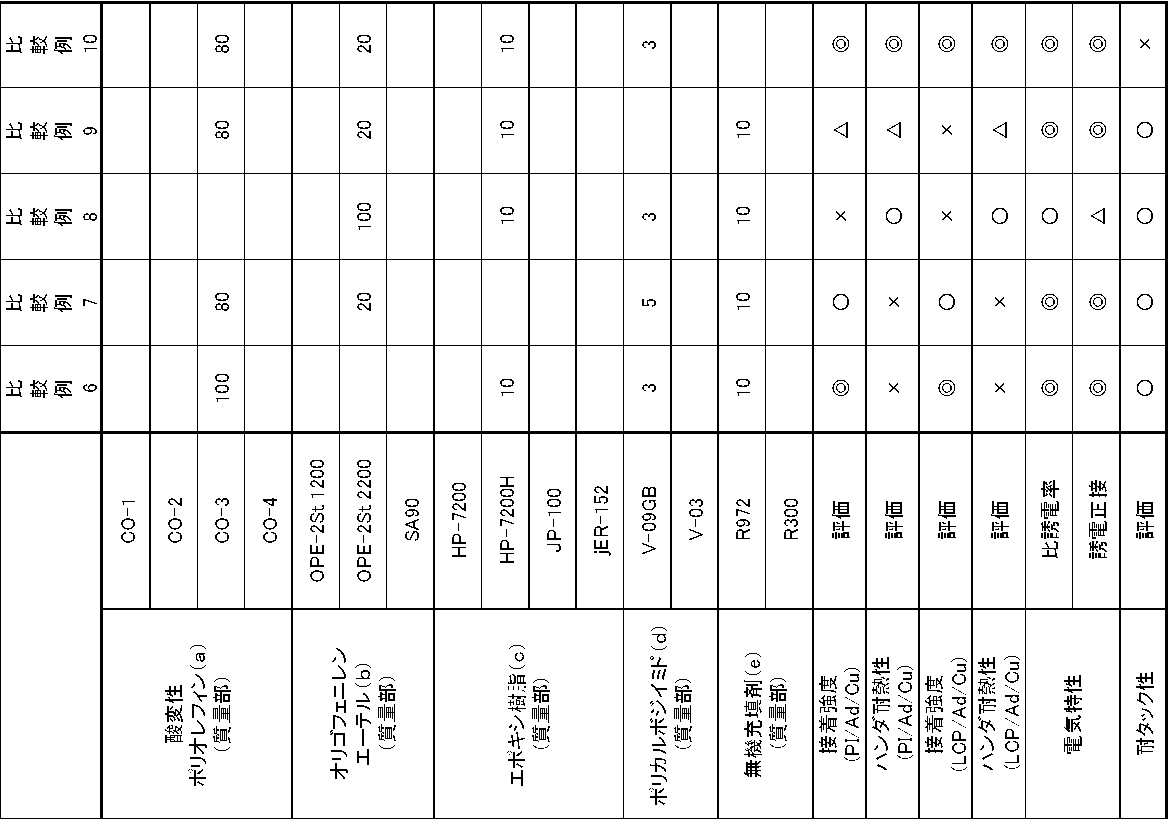
- Comparative Examples 6 to 10 The types and ratios of the resins used were changed as shown in Table 4, and Comparative Examples 6 to 10 were carried out in the same manner as in Example 24.
- Table 4 shows the adhesive strength, solder heat resistance, electrical characteristics, and tack resistance.
- the acid-modified polyolefin (a), oligophenylene ether (b), epoxy resin (c) polycarbodiimide (d), flame retardant (e) and inorganic filler (f) used in Tables 1 to 4 are as follows. ..
- Oligophenylene ether styrene modified product OPE-2St 1200 (Compound having the structure of the general formula (4) of Mn1000 manufactured by Mitsubishi Gas Chemical Company, Inc.) Oligophenylene ether styrene modified product: OPE-2St 2200 (Compound having the structure of the general formula (4) of Mn2000 manufactured by Mitsubishi Gas Chemical Company, Inc.) Oligophenylene ether: SA90 (compound having the structure of the general formula (3) of Mn1800 manufactured by SABIC) (Epoxy resin (c)) Dicyclopentadiene type epoxy resin: HP-7200 (DIC Epoxy equivalent 259 g / eq) Dicyclopentadiene type epoxy resin: HP-7200H (DIC Epoxy equivalent 278 g / eq) Cresol novolac type epoxy resin: jER-152 (Mitsubishi Chemical's epoxy equivalent 177g / eq) Epoxy-modified polybutadiene resin
- the liquid containing the resin was centrifuged to separate and purify the acid-modified propylene-butene copolymer graft-polymerized with maleic anhydride, (poly) maleic anhydride and a low molecular weight substance. Then, by drying under reduced pressure at 70 ° C. for 5 hours, a maleic anhydride-modified propylene-butene copolymer (CO-1, acid value 19 mgKOH / g, number average molecular weight 25,000, Tm80 ° C., ⁇ H35J / g) Got
- the adhesive composition of the present invention has high adhesiveness not only to conventional polyimides and liquid crystal polymers but also to metal substrates such as copper foil, can obtain high solder heat resistance, and has low dielectric properties. It also has excellent flame retardancy and tack resistance.
- the adhesive composition of the present invention can obtain an adhesive sheet and a laminate bonded using the adhesive sheet. Due to the above characteristics, it is useful for flexible printed wiring board applications, especially for FPC applications where low dielectric properties (low dielectric constant, low dielectric loss tangent) in a high frequency region are required.
Landscapes
- Chemical & Material Sciences (AREA)
- Organic Chemistry (AREA)
- Chemical Kinetics & Catalysis (AREA)
- Inorganic Chemistry (AREA)
- General Chemical & Material Sciences (AREA)
- Engineering & Computer Science (AREA)
- Microelectronics & Electronic Packaging (AREA)
- Health & Medical Sciences (AREA)
- Medicinal Chemistry (AREA)
- Polymers & Plastics (AREA)
- Adhesives Or Adhesive Processes (AREA)
- Laminated Bodies (AREA)
- Adhesive Tapes (AREA)
Abstract
Description
本発明で用いる酸変性ポリオレフィン(a)(以下、単に(a)成分ともいう。)は限定的ではないが、ポリオレフィン樹脂にα,β-不飽和カルボン酸及びその酸無水物の少なくとも1種をグラフトすることにより得られるものであることが好ましい。ポリオレフィン樹脂とは、エチレン、プロピレン、ブテン、ブタジエン、イソプレン等に例示されるオレフィンモノマーの単独重合、もしくはその他のモノマーとの共重合、および得られた重合体の水素化物やハロゲン化物など、炭化水素骨格を主体とする重合体を指す。すわなち、酸変性ポリオレフィンは、ポリエチレン、ポリプロピレン及びプロピレン-α-オレフィン共重合体の少なくとも1種に、α,β-不飽和カルボン酸及びその酸無水物の少なくとも1種をグラフトすることにより得られるものが好ましい。
本発明で用いるオリゴフェニレンエーテル(b)(以下、単に(b)成分ともいう。)は数平均分子量(Mn)が3000以下のものであり、好ましくは下記一般式(1)で表される構造単位および/または一般式(2)の構造単位を有する化合物を用いることができる。



本発明で用いるエポキシ樹脂(c)(以下、単に(c)成分ともいう。)としては、分子中にエポキシ基を有するものであれば、特に限定されないが、好ましくは分子中に2個以上のエポキシ基を有するものである。具体的には、特に限定されないが、ビフェニル型エポキシ樹脂、ナフタレン型エポキシ樹脂、ビスフェノールA型エポキシ樹脂、ビスフェノールF型エポキシ樹脂、ノボラック型エポキシ樹脂、脂環式エポキシ樹脂、ジシクロペンタジエン型エポキシ樹脂、テトラグリシジルジアミノジフェニルメタン、トリグリシジルパラアミノフェノール、テトラグリシジルビスアミノメチルシクロヘキサノン、N,N,N’,N’-テトラグリシジル-m-キシレンジアミン、およびエポキシ変性ポリブタジエンからなる群から選択される少なくとも1つを用いることができる。好ましくは、ビフェニル型エポキシ樹脂、ノボラック型エポキシ樹脂、ジシクロペンタジエン型エポキシ樹脂またはエポキシ変性ポリブタジエンである。より好ましくは、ジシクロペンタジエン型エポキシ樹脂またはエポキシ変性ポリブタジエンである。
本発明で用いるポリカルボジイミド(d)(以下、単に(d)成分ともいう。)としては、分子内にカルボジイミド基を有するものであれば、特に限定されない。好ましくは分子内にカルボジイミド基を2個以上有するポリカルボジイミドである。ポリカルボジイミドを使用することによって、酸変性ポリオレフィン(a)のカルボキシル基とカルボジイミド基とが反応し、接着剤組成物と基材との相互作用を高め、接着性を向上することができる。
(e)成分は、難燃剤である。難燃剤(e)を含有することで接着剤組成物に難燃性を付与することができる。難燃剤(e)としては、難燃性を示すものであれば特に限定はされないが、有機溶剤に溶解しないものであることが好ましい。難燃剤(e)は難燃性フィラーであることが好ましく、無機系難燃性フィラーと有機系難燃性フィラーが挙げられる。無機系難燃性フィラーとしては、例えば、水酸化アルミニウム、水酸化マグネシウム、水酸化ジルコニウム、水酸化カルシウム、水酸化バリウムなどの水酸化金属化合物;塩基性炭酸マグネシウム、炭酸亜鉛、炭酸マグネシウム-カルシウム(炭酸マグネシウムと炭酸カルシウムの混合物)、炭酸カルシウム、炭酸バリウムなどの炭酸金属化合物;酸化マグネシウム、酸化モリブデン、酸化ジルコニウム、酸化スズ、酸化スズの水和物、酸化アンチモンなどの金属酸化物;ホウ酸亜鉛、メタホウ酸亜鉛、メタホウ酸バリウムなどのホウ酸金属化合物;ドロマイト、ハイドロタルサイト、硼砂などの無機金属化合物;赤リンなどの無機リン化合物等が挙げられる。有機系難燃性フィラーとしては、例えば、リン酸メラミン、ポリリン酸メラミン、リン酸グアニジン、ポリリン酸グアニジン、リン酸アンモニウム、ポリリン酸アンモニウム、リン酸アミドアンモニウム、ポリリン酸アミドアンモニウム、リン酸カルバメート、ポリリン酸カルバメート、トリスジエチルホスフィン酸アルミニウム、トリスメチルエチルホスフィン酸アルミニウム、トリスジフェニルホスフィン酸アルミニウム、ビスジエチルホスフィン酸亜鉛、ビスメチルエチルホスフィン酸亜鉛、ビスジフェニルホスフィン酸亜鉛、ビスジエチルホスフィン酸チタニル、テトラキスジエチルホスフィン酸チタン、ビスメチルエチルホスフィン酸チタニル、テトラキスメチルエチルホスフィン酸チタン、ビスジフェニルホスフィン酸チタニル、テトラキスジフェニルホスフィン酸チタン等のリン系難燃剤;メラミン、メラム、メラミンシアヌレート等のトリアジン系化合物や、シアヌル酸化合物、イソシアヌル酸化合物、トリアゾール系化合物、テトラゾール化合物、ジアゾ化合物、尿素等の窒素系難燃剤;シリコーン化合物、シラン化合物等のケイ素系難燃剤等が挙げられる。難燃剤(e)として水酸化金属化合物、リン化合物が好ましく、中でもリン化合物がより好ましく、例えばホスフィン酸アルミニウム等のリン系難燃性フィラーを使用できる。なお、リン系難燃剤には、有機溶剤に溶解しないタイプ(リン系難燃性フィラー)と有機溶剤に溶解するタイプ(リン系難燃性ノンフィラー)があるが、本発明では有機溶剤に溶解しないタイプ(リン系難燃性フィラー)が好ましい。上記難燃性フィラーは、単独で用いてもよいし、2種類以上を併用してもよい。
(f)成分は、無機充填剤である。(f)成分を含有することにより、接着剤組成物で作製した積層体の耐タック性が良好となる。(f)成分としては、フィラーであることが好ましく、シリカフィラー(以下、単にシリカともいう。)であることがより好ましい。シリカを配合することにより、耐タック性に加え、耐熱性の特性が向上するため非常に好ましい。シリカとしては一般に疎水性シリカと親水性シリカが知られており、疎水性シリカとしては、ジメチルジクロロシランやヘキサメチルジシラザン、オクチルシラン等で処理を行ったシリカが挙げられ、疎水性シリカは接着剤組成物に耐吸湿性を付与することができる。また、親水性シリカとしては、無処理であり表面にシラノール基やシロキサンを有するシリカが挙げられる。
本発明の接着剤組成物は、前記(a)成分~(d)成分の樹脂と、さらに(e)成分および(f)成分の少なくとも一方を含有することで、液晶ポリマー(LCP)などの低極性樹脂基材や金属基材との優れた接着性、電気特性(低誘電特性)、耐熱性および難燃性、耐タック性を発現することができる。すなわち、接着剤組成物を基材に塗布、硬化後の接着剤塗膜(接着剤層)が優れた低誘電率特性、耐熱性および難燃性、耐タック性を発現することができる。
本発明の接着剤組成物には、本発明の効果を損ねない範囲で、必要に応じて粘着付与剤を配合しても良い。粘着付与剤としては、ポリテルペン樹脂、ロジン系樹脂、脂肪族系石油樹脂、脂環族系石油樹脂、共重合系石油樹脂、スチレン樹脂および水添石油樹脂等が挙げられ、接着強度を向上させる目的で用いられる。これらは単独で用いても良いし、2種以上を任意に組み合わせて使用しても良い。粘着付与剤を含有させる場合、(a)~(d)成分の合計100質量部に対し、1~200質量部の範囲で含有させることが好ましく、5~150質量部の範囲がより好ましく、10~100質量部の範囲が最も好ましい。前記下限値以上とすることで粘着付与剤の効果を奏することができる。また、前記上限値以下とすることで接着性、耐熱性、電気特性等が低下することがない。
本発明の接着剤組成物には、本発明の効果を損ねない範囲で、必要に応じてシランカップリング剤を配合しても良い。シランカップリング剤を配合することにより金属への接着性や耐熱性の特性が向上するため非常に好ましい。シランカップリング剤としては特に限定されないが、不飽和基を有するもの、グリシジル基を有するもの、アミノ基を有するものなどが挙げられる。これらのうち耐熱性の観点からγ-グリシドキシプロピルトリメトキシシランやβ-(3,4-エポキシシクロヘキシル)エチルトリメトキシシランやβ-(3,4-エポキシシクロヘキシル)エチルトリエトキシシラン等のグリシジル基を有したシランカップリング剤がさらに好ましい。シランカップリング剤を配合する場合、その配合量は(a)~(d)成分の合計100質量部に対して0.5~20質量部の配合量であることが好ましい。0.5質量部以上とすることで優れた耐熱性が良好となる。一方、20質量部以下とすることで耐熱性や接着性が良好となる。
本発明の積層体は、基材に接着剤組成物を積層したもの(基材/接着剤層の2層積層体)、または、さらに基材を貼り合わせたもの(基材/接着剤層/基材の3層積層体)である。ここで、接着剤層とは、本発明の接着剤組成物を基材に塗布し、乾燥させた後の接着剤組成物の層をいう。本発明の接着剤組成物を、常法に従い、各種基材に塗布、乾燥すること、およびさらに他の基材を積層することにより、本発明の積層体を得ることができる。
本発明において基材とは、本発明の接着剤組成物を塗布、乾燥し、接着剤層を形成できるものであれば特に限定されるものではないが、フィルム状樹脂等の樹脂基材、金属板や金属箔等の金属基材、紙類等を挙げることができる。
本発明において、接着シートとは、前記積層体と離型基材とを接着剤組成物を介して積層したものである。具体的な構成態様としては、積層体/接着剤層/離型基材、または離型基材/接着剤層/積層体/接着剤層/離型基材が挙げられる。離型基材を積層することで基材の保護層として機能する。また離型基材を使用することで、接着シートから離型基材を離型して、さらに別の基材に接着剤層を転写することができる。
離型基材としては、特に限定されるものではないが、例えば、上質紙、クラフト紙、ロール紙、グラシン紙などの紙の両面に、クレー、ポリエチレン、ポリプロピレンなどの目止剤の塗布層を設け、さらにその各塗布層の上にシリコーン系、フッ素系、アルキド系の離型剤が塗布されたものが挙げられる。また、ポリエチレン、ポリプロピレン、エチレン-α-オレフィン共重合体、プロピレン-α-オレフィン共重合体等の各種オレフィンフィルム単独、及びポリエチレンテレフタレート等のフィルム上に上記離型剤を塗布したものも挙げられる。離型基材と接着剤層との離型力、シリコーンが電気特性に悪影響を与える等の理由から、上質紙の両面にポリプロピレン目止処理しその上にアルキド系離型剤を用いたもの、またはポリエチレンテレフタレート上にアルキド系離型剤を用いたものが好ましい。
本発明における「プリント配線板」は、導体回路を形成する金属箔と樹脂基材とから形成された積層体を構成要素として含むものである。プリント配線板は、例えば、金属張積層体を用いてサブトラクティブ法などの従来公知の方法により製造される。必要に応じて、金属箔によって形成された導体回路を部分的、或いは全面的にカバーフィルムやスクリーン印刷インキ等を用いて被覆した、いわゆるフレキシブル回路板(FPC)、フラットケーブル、テープオートメーティッドボンディング(TAB)用の回路板などを総称している。
カバーフィルムとしては、プリント配線板用の絶縁フィルムとして従来公知の任意の絶縁フィルムが使用可能である。例えば、ポリイミド、ポリエステル、ポリフェニレンスルフィド、ポリエーテルスルホン、ポリエーテルエーテルケトン、アラミド、ポリカーボネート、ポリアリレート、ポリアミドイミド、液晶ポリマー、シンジオタクチックポリスチレン、ポリオレフィン系樹脂等の各種ポリマーから製造されるフィルムが使用可能である。より好ましくは、ポリイミドフィルムまたは液晶ポリマーフィルムである。
以下、実施例を挙げて本発明を更に詳細に説明する。但し、本発明は実施例に限定されない。実施例中および比較例中に単に部とあるのは質量部を示す。
本発明における酸価(mgKOH/g)は、酸変性ポリオレフィンをトルエンに溶解し、ナトリウムメトキシドのメタノール溶液でフェノールフタレインを指示薬として滴定した。
本発明における数平均分子量は(株)島津製作所製ゲルパーミエーションクロマトグラフィー(以下、GPC、標準物質:ポリスチレン樹脂、移動相:テトラヒドロフラン、カラム:Shodex KF-802 + KF-804L + KF-806L、カラム温度:30℃、流速:1.0ml/分、検出器:RI検出器)によって測定した値である。
本発明における融点、融解熱量は示差走査熱量計(以下、DSC、ティー・エー・インスツルメント・ジャパン製、Q-2000)を用いて、20℃/分の速度で昇温融解、冷却樹脂化して、再度昇温融解した際の融解ピークのトップ温度および面積から測定した値である。
後述する接着剤組成物を厚さ12.5μmのポリイミドフィルム(株式会社カネカ製、アピカル(登録商標))、または、厚さ25μmのLCPフィルム(クラレ株式会社製、ベクスター(登録商標))に、乾燥後の厚みが25μmとなるように塗布し、130℃で3分乾燥した。この様にして得られた接着性フィルム(Bステージ品)を厚さ18μmの圧延銅箔(JX金属株式会社製、BHYシリーズ)と貼り合わせた。貼り合わせは、圧延銅箔の光沢面が接着剤層と接する様にして、160℃で40kgf/cm2の加圧下に30秒間プレスし、接着した。次いで140℃で4時間熱処理して硬化させて、剥離強度評価用サンプルを得た。剥離強度は、25℃において、フィルム引き、引張速度50mm/minで90°剥離試験を行ない、剥離強度を測定した。この試験は常温での接着強度を示すものである。
<評価基準>
◎:1.0N/mm以上
○:0.8N/mm以上1.0N/mm未満
△:0.5N/mm以上0.8N/mm未満
×:0.5N/mm未満
上記と同じ方法でサンプルを作製し、2.0cm×2.0cmのサンプル片を23℃で2日間エージング処理を行い、280℃で溶融したハンダ浴に10秒フロートし、膨れなどの外観変化の有無を確認した。
<評価基準>
◎:膨れ無し
○:一部膨れ有
△:多くの膨れ有
×:膨れ、かつ変色有
後述する接着剤組成物を厚さ100μmのテフロン(登録商標)シートに、乾燥硬化後の厚みが25μmとなるように塗布し、130℃で3分乾燥した。次いで140℃で4時間熱処理して硬化させて試験用の接着剤樹脂シートを得た。得られた試験用接着剤樹脂シートを8cm×3mmの短冊状にサンプルを裁断し、試験用サンプルを得た。比誘電率(ε)及び誘電正接(tanδ)は、ネットワークアナライザー(アンリツ社製)を使用し、空洞共振器摂動法で、温度23℃、周波数10GHzの条件で測定した。得られた比誘電率、誘電正接について、以下の通りに評価した。
<比誘電率の評価基準>
◎:2.3以下
○:2.3を超え2.6以下
△:2.6を超え3.0以下
×:3.0を超える
<誘電正接の評価基準>
◎:0.008以下
○:0.008を超え0.01以下
△:0.01を超え0.02以下
×:0.02を超える
後述する接着剤組成物を厚さ25μmのポリイミドフィルム(株式会社カネカ製、アピカル(登録商標))に、乾燥後の厚みが25μmとなるように塗布し、130℃で3分乾燥した。次いでロールラミネーターにて100℃×30m/min×0.3MPaでポリイミドフィルムと貼り合わせた後、140℃で4時間熱処理して硬化させて、積層体を得た。積層体を用いてUL-94に基づきサンプル片を作製し、VTM法に基づいて燃焼試験を行った。
<評価基準>
○:VTM-0条件を満たす。
△:VTM-1である。
×:VTM-2以上である。
後述する接着剤組成物を厚さ25μmのポリイミドフィルム(株式会社カネカ製、アピカル(登録商標)5cm×5cm)に、乾燥後の厚みが25μmとなるように塗布し、130℃で3分乾燥した。次いでPETフィルムを乾燥後の接着剤層付きポリイミドフィルムの接着剤組成物層に乗せ、200gのSUS板にて荷重を1分間かけた。その際のPETと接着剤組成物の貼りつき面を確認し評価を行った。
<評価基準>
○:貼りつきが見られない。
△:一部貼りつきが見られる
×:全面に貼りつきが見られる。
貼りつきとは、基材フィルム(ポリイミドフィルムまたはPETフィルム)と、接着剤層とがへばりつき、変色(ブロッキング)している状態をいう。
CO-1を80質量部、OPE-2St 2200を20質量部、ポリカルボジイミドV-09GBを3質量部、エポキシ樹脂HP-7200Hを10質量部および有機溶媒(メチルシクロヘキサン/トルエン=80/20(v/v))を配合し、混合溶液を得た。得られた混合溶液に難燃性フィラーOP-935を10質量部配合し接着剤組成物を得た。配合量、接着強度、ハンダ耐熱性、電気特性および難燃性を表1に示す。なお、有機溶媒(メチルシクロヘキサン/トルエン=80/20(v/v))は固形分濃度が20質量%となるように調整した。
使用した樹脂の種類および比率を表1に示すとおりに変更し、実施例1と同様な方法で実施例2~23を行った。接着強度、ハンダ耐熱性、電気特性および難燃性を表1に示す。なお、有機溶媒(メチルシクロヘキサン/トルエン=80/20(v/v))は固形分濃度が20質量%となるように調整した。

使用した樹脂の種類および比率を表2に示すとおりに変更し、実施例1と同様な方法で比較例1~5を行った。接着強度、ハンダ耐熱性、電気特性および難燃性を表2に示す。なお、有機溶媒(メチルシクロヘキサン/トルエン=80/20(v/v))は固形分濃度が20質量%となるように調整した。

CO-1を80質量部、OPE-2St 2200を20質量部、ポリカルボジイミドV-09GBを3質量部、エポキシ樹脂HP-7200Hを10質量部および有機溶媒(メチルシクロヘキサン/トルエン=80/20(v/v))を配合し、混合溶液を得た。得られた混合溶液に疎水性シリカR972を10質量部配合し接着剤組成物を得た。配合量、接着強度、ハンダ耐熱性、電気特性および耐タック性を表3に示す。なお、有機溶媒(メチルシクロヘキサン/トルエン=80/20(v/v))は固形分濃度が20質量%となるように調整した。
使用した樹脂の種類および比率を表3に示すとおりに変更し、実施例24と同様な方法で実施例25~43を行った。接着強度、ハンダ耐熱性、電気特性および耐タック性を表3に示す。なお、有機溶媒(メチルシクロヘキサン/トルエン=80/20(v/v))は固形分濃度が20質量%となるように調整した。

使用した樹脂の種類および比率を表4に示すとおりに変更し、実施例24と同様な方法で比較例6~10を行った。接着強度、ハンダ耐熱性、電気特性および耐タック性を表4に示す。なお、有機溶媒(メチルシクロヘキサン/トルエン=80/20(v/v))は固形分濃度が20質量%となるように調整した。
(オリゴフェニレンエーテル(b))
オリゴフェニレンエーテルスチレン変性品:OPE-2St 1200(三菱ガス化学社製 Mn1000の一般式(4)の構造を有する化合物)
オリゴフェニレンエーテルスチレン変性品:OPE-2St 2200(三菱ガス化学社製 Mn2000の一般式(4)の構造を有する化合物)
オリゴフェニレンエーテル:SA90(SABIC社製 Mn1800の一般式(3)の構造を有する化合物)
(エポキシ樹脂(c))
ジシクロペンタジエン型エポキシ樹脂:HP-7200(DIC社製 エポキシ当量 259g/eq)
ジシクロペンタジエン型エポキシ樹脂:HP-7200H(DIC社製 エポキシ当量 278g/eq)
クレゾールノボラック型エポキシ樹脂:jER-152(三菱化学製 エポキシ当量 177g/eq)
エポキシ変性ポリブタジエン樹脂:JP-100(日本曹達社製 エポキシ当量 200g/eq)
(ポリカルボジイミド(d))
カルボジイミド樹脂:V-09GB(日清紡ケミカル社製 カルボジイミド当量 216g/eq)
カルボジイミド樹脂:V-03(日清紡ケミカル社製 カルボジイミド当量 209g/eq)
(難燃剤(e))
リン系難燃性フィラー:EXOLIT(登録商標) OP-935(Clariant社)
金属水和物系難燃性フィラー:MGZ-3(堺化学工業社製)
イントメッセント系難燃性フィラー:FP-2200S(ADEKA社製)
リン系難燃性ノンフィラー:HCA-HQ(三光社製)
(無機充填剤(f))
疎水性シリカ:アエロジル(登録商標)R972(日本アエロジル社)
親水性シリカ:アエロジル(登録商標)R300(日本アエロジル社)
製造例1
1Lオートクレーブに、プロピレン-ブテン共重合体(三井化学社製「タフマー(登録商標)XM7080」)100質量部、トルエン150質量部及び無水マレイン酸19質量部、ジ-tert-ブチルパーオキサイド6質量部を加え、140℃まで昇温した後、更に3時間撹拌した。その後、得られた反応液を冷却後、多量のメチルエチルケトンが入った容器に注ぎ、樹脂を析出させた。その後、当該樹脂を含有する液を遠心分離することにより、無水マレイン酸がグラフト重合した酸変性プロピレン-ブテン共重合体と(ポリ)無水マレイン酸および低分子量物とを分離、精製した。その後、減圧下70℃で5時間乾燥させることにより、無水マレイン酸変性プロピレン-ブテン共重合体(CO-1、酸価19mgKOH/g、数平均分子量25,000、Tm80℃、△H35J/g)を得た。
無水マレイン酸の仕込み量を14質量部に変更した以外は製造例1と同様にすることにより、無水マレイン酸変性プロピレン-ブテン共重合体(CO-2、酸価14mgKOH/g、数平均分子量30,000、Tm78℃、△H25J/g)を得た。
無水マレイン酸の仕込み量を11質量部に変更した以外は製造例1と同様にすることにより、無水マレイン酸変性プロピレン-ブテン共重合体(CO-3、酸価11mgKOH/g、数平均分子量33,000、Tm80℃、△H25J/g)を得た。
無水マレイン酸の仕込み量を6質量部に変更した以外は製造例1と同様にすることにより、無水マレイン酸変性プロピレン-ブテン共重合体(CO-4、酸価7mgKOH/g、数平均分子量35,000、Tm82℃、△H25J/g)を得た。
Claims (9)
- 酸変性ポリオレフィン(a)、数平均分子量3000以下のオリゴフェニレンエーテル(b)、エポキシ樹脂(c)およびポリカルボジイミド(d)を含有し、さらに難燃剤(e)または無機充填剤(f)の少なくとも一方を含有する接着剤組成物。
- 酸変性ポリオレフィン(a)、数平均分子量3000以下のオリゴフェニレンエーテル(b)、エポキシ樹脂(c)およびポリカルボジイミド(d)の合計量100質量部に対して、難燃剤(e)を2~60質量部含有する請求項1に記載の接着剤組成物。
- 酸変性ポリオレフィン(a)、数平均分子量3000以下のオリゴフェニレンエーテル(b)、エポキシ樹脂(c)およびポリカルボジイミド(d)の合計量100質量部に対して、無機充填剤(f)を2~50質量部含有する請求項1に記載の接着剤組成物。
- 酸変性ポリオレフィン(a)の酸価が5~40mgKOH/gである請求項1~3のいずれかに記載の接着剤組成物。
- 酸変性ポリオレフィン(a)100質量部に対して、エポキシ樹脂(c)を0.5~60質量部含有する請求項1~4のいずれかに記載の接着剤組成物。
- 1GHzの比誘電率が3.0以下、誘電正接が0.02以下である請求項1~5のいずれかに記載の接着剤組成物。
- 請求項1~6のいずれかに記載の接着剤組成物を含有する接着シート。
- 請求項1~6のいずれかに記載の接着剤組成物を含有する積層体。
- 請求項8に記載の積層体を構成要素として含むプリント配線板。
Priority Applications (3)
| Application Number | Priority Date | Filing Date | Title |
|---|---|---|---|
| JP2021537642A JP7524903B2 (ja) | 2019-08-08 | 2020-07-10 | 接着剤組成物、接着シート、積層体およびプリント配線板 |
| CN202080049998.8A CN114080439B (zh) | 2019-08-08 | 2020-07-10 | 粘合剂组合物、粘合片、层叠体以及印刷线路板 |
| KR1020227007177A KR102815654B1 (ko) | 2019-08-08 | 2020-07-10 | 접착제 조성물, 접착 시트, 적층체 및 프린트 배선판 |
Applications Claiming Priority (4)
| Application Number | Priority Date | Filing Date | Title |
|---|---|---|---|
| JP2019-146161 | 2019-08-08 | ||
| JP2019146161 | 2019-08-08 | ||
| JP2019-153664 | 2019-08-26 | ||
| JP2019153664 | 2019-08-26 |
Publications (1)
| Publication Number | Publication Date |
|---|---|
| WO2021024702A1 true WO2021024702A1 (ja) | 2021-02-11 |
Family
ID=74503160
Family Applications (1)
| Application Number | Title | Priority Date | Filing Date |
|---|---|---|---|
| PCT/JP2020/027108 Ceased WO2021024702A1 (ja) | 2019-08-08 | 2020-07-10 | 接着剤組成物、接着シート、積層体およびプリント配線板 |
Country Status (5)
| Country | Link |
|---|---|
| JP (1) | JP7524903B2 (ja) |
| KR (1) | KR102815654B1 (ja) |
| CN (1) | CN114080439B (ja) |
| TW (1) | TWI861153B (ja) |
| WO (1) | WO2021024702A1 (ja) |
Cited By (1)
| Publication number | Priority date | Publication date | Assignee | Title |
|---|---|---|---|---|
| EP4420875A4 (en) * | 2022-01-17 | 2025-10-29 | Toyobo Mc Corp | ADHESIVE COMPONENT, ADHESIVE SHEET, ELECTROMAGNETIC SHIELDING FILM, LAMINATE AND PRINTED CIRCUIT BOARD |
Citations (7)
| Publication number | Priority date | Publication date | Assignee | Title |
|---|---|---|---|---|
| JP2008248141A (ja) * | 2007-03-30 | 2008-10-16 | Nippon Steel Chem Co Ltd | 難燃硬化性樹脂組成物 |
| JP2010275374A (ja) * | 2009-05-26 | 2010-12-09 | Panasonic Electric Works Co Ltd | フレキシブルプリント配線板用樹脂組成物、樹脂フィルム、プリプレグ、樹脂付き金属箔、フレキシブルプリント配線板 |
| JP2013170214A (ja) * | 2012-02-21 | 2013-09-02 | Adeka Corp | エポキシ樹脂組成物及びポリイミド用絶縁接着剤 |
| WO2016031342A1 (ja) * | 2014-08-27 | 2016-03-03 | 東洋紡株式会社 | 低誘電接着剤組成物 |
| JP2017031301A (ja) * | 2015-07-31 | 2017-02-09 | 東洋インキScホールディングス株式会社 | 熱硬化性接着シート、およびその利用 |
| WO2017033784A1 (ja) * | 2015-08-25 | 2017-03-02 | 三井金属鉱業株式会社 | 樹脂層付金属箔、金属張積層板、及びプリント配線板の製造方法 |
| JP2019127501A (ja) * | 2018-01-22 | 2019-08-01 | 藤森工業株式会社 | 熱硬化性接着剤組成物、接着フィルム、カバーレイフィルム及びフレキシブルプリント配線板 |
Family Cites Families (6)
| Publication number | Priority date | Publication date | Assignee | Title |
|---|---|---|---|---|
| DE112004001255T5 (de) | 2003-07-07 | 2006-06-08 | Hitachi ULSI Systems Co., Ltd., Kodaira | Speichervorrichtung und Speichersystem |
| KR20140034668A (ko) | 2012-09-10 | 2014-03-20 | (주)원더피플 | 채팅서비스와 응용서비스를 연결하는 방법 및 시스템 |
| WO2014147903A1 (ja) | 2013-03-22 | 2014-09-25 | 東亞合成株式会社 | 接着剤組成物並びにこれを用いたカバーレイフィルム及びフレキシブル銅張積層板 |
| CN111196066B (zh) | 2014-09-24 | 2022-05-10 | 东亚合成株式会社 | 粘接剂组合物和使用了其的带有粘接剂层的层叠体 |
| JP6852332B2 (ja) * | 2015-10-28 | 2021-03-31 | 味の素株式会社 | 接着フィルム |
| CN106190004B (zh) * | 2016-07-20 | 2020-05-15 | 律胜科技(苏州)有限公司 | 一种具有高频特性的接着剂组合物及其用途 |
-
2020
- 2020-07-10 CN CN202080049998.8A patent/CN114080439B/zh active Active
- 2020-07-10 KR KR1020227007177A patent/KR102815654B1/ko active Active
- 2020-07-10 JP JP2021537642A patent/JP7524903B2/ja active Active
- 2020-07-10 WO PCT/JP2020/027108 patent/WO2021024702A1/ja not_active Ceased
- 2020-07-13 TW TW109123493A patent/TWI861153B/zh active
Patent Citations (7)
| Publication number | Priority date | Publication date | Assignee | Title |
|---|---|---|---|---|
| JP2008248141A (ja) * | 2007-03-30 | 2008-10-16 | Nippon Steel Chem Co Ltd | 難燃硬化性樹脂組成物 |
| JP2010275374A (ja) * | 2009-05-26 | 2010-12-09 | Panasonic Electric Works Co Ltd | フレキシブルプリント配線板用樹脂組成物、樹脂フィルム、プリプレグ、樹脂付き金属箔、フレキシブルプリント配線板 |
| JP2013170214A (ja) * | 2012-02-21 | 2013-09-02 | Adeka Corp | エポキシ樹脂組成物及びポリイミド用絶縁接着剤 |
| WO2016031342A1 (ja) * | 2014-08-27 | 2016-03-03 | 東洋紡株式会社 | 低誘電接着剤組成物 |
| JP2017031301A (ja) * | 2015-07-31 | 2017-02-09 | 東洋インキScホールディングス株式会社 | 熱硬化性接着シート、およびその利用 |
| WO2017033784A1 (ja) * | 2015-08-25 | 2017-03-02 | 三井金属鉱業株式会社 | 樹脂層付金属箔、金属張積層板、及びプリント配線板の製造方法 |
| JP2019127501A (ja) * | 2018-01-22 | 2019-08-01 | 藤森工業株式会社 | 熱硬化性接着剤組成物、接着フィルム、カバーレイフィルム及びフレキシブルプリント配線板 |
Cited By (1)
| Publication number | Priority date | Publication date | Assignee | Title |
|---|---|---|---|---|
| EP4420875A4 (en) * | 2022-01-17 | 2025-10-29 | Toyobo Mc Corp | ADHESIVE COMPONENT, ADHESIVE SHEET, ELECTROMAGNETIC SHIELDING FILM, LAMINATE AND PRINTED CIRCUIT BOARD |
Also Published As
| Publication number | Publication date |
|---|---|
| CN114080439B (zh) | 2024-01-26 |
| KR20220044772A (ko) | 2022-04-11 |
| TWI861153B (zh) | 2024-11-11 |
| TW202116958A (zh) | 2021-05-01 |
| JP7524903B2 (ja) | 2024-07-30 |
| JPWO2021024702A1 (ja) | 2021-02-11 |
| KR102815654B1 (ko) | 2025-06-02 |
| CN114080439A (zh) | 2022-02-22 |
Similar Documents
| Publication | Publication Date | Title |
|---|---|---|
| JP6874896B2 (ja) | 低誘電難燃性接着剤組成物 | |
| JP6941308B2 (ja) | 低誘電接着剤組成物 | |
| JP6981571B2 (ja) | ポリオレフィン系接着剤組成物 | |
| JP7707914B2 (ja) | ポリオレフィン系接着剤組成物 | |
| JP7088423B1 (ja) | 接着剤組成物、接着シート、積層体およびプリント配線板 | |
| WO2021106848A1 (ja) | 接着剤組成物、接着シート、積層体およびプリント配線板 | |
| JP6919776B1 (ja) | 接着フィルム、積層体およびプリント配線板 | |
| JP7524903B2 (ja) | 接着剤組成物、接着シート、積層体およびプリント配線板 | |
| JP7537633B2 (ja) | 接着剤組成物、接着シート、電磁波シールドフィルム、積層体およびプリント配線板 | |
| WO2021112134A1 (ja) | 低誘電積層体 | |
| JP7444319B1 (ja) | 接着剤組成物、並びにこれを含有する接着シート、積層体およびプリント配線板 | |
| JP7120497B1 (ja) | 接着剤組成物、ならびにこれを含有する接着シート、積層体およびプリント配線板 | |
| JP7707912B2 (ja) | ポリオレフィン系接着剤組成物 | |
| WO2023100499A1 (ja) | 樹脂組成物、及び、これを用いたカバーレイフィルム、接着剤シート、樹脂付き金属箔、金属張積層板またはプリント配線板 | |
| JP7444318B1 (ja) | 接着剤組成物、並びにこれを含有する接着シート、積層体およびプリント配線板 | |
| WO2022196586A1 (ja) | 接着剤組成物、ならびにこれを含有する接着シート、積層体およびプリント配線板 |
Legal Events
| Date | Code | Title | Description |
|---|---|---|---|
| 121 | Ep: the epo has been informed by wipo that ep was designated in this application |
Ref document number: 20849400 Country of ref document: EP Kind code of ref document: A1 |
|
| ENP | Entry into the national phase |
Ref document number: 2021537642 Country of ref document: JP Kind code of ref document: A |
|
| NENP | Non-entry into the national phase |
Ref country code: DE |
|
| ENP | Entry into the national phase |
Ref document number: 20227007177 Country of ref document: KR Kind code of ref document: A |
|
| 122 | Ep: pct application non-entry in european phase |
Ref document number: 20849400 Country of ref document: EP Kind code of ref document: A1 |