WO2020250803A1 - 識別コード付き玩具 - Google Patents
識別コード付き玩具 Download PDFInfo
- Publication number
- WO2020250803A1 WO2020250803A1 PCT/JP2020/022155 JP2020022155W WO2020250803A1 WO 2020250803 A1 WO2020250803 A1 WO 2020250803A1 JP 2020022155 W JP2020022155 W JP 2020022155W WO 2020250803 A1 WO2020250803 A1 WO 2020250803A1
- Authority
- WO
- WIPO (PCT)
- Prior art keywords
- identification code
- toy
- color
- colored
- light
- Prior art date
- Legal status (The legal status is an assumption and is not a legal conclusion. Google has not performed a legal analysis and makes no representation as to the accuracy of the status listed.)
- Ceased
Links
Images

Classifications
-
- A—HUMAN NECESSITIES
- A63—SPORTS; GAMES; AMUSEMENTS
- A63H—TOYS, e.g. TOPS, DOLLS, HOOPS OR BUILDING BLOCKS
- A63H3/00—Dolls
-
- A—HUMAN NECESSITIES
- A63—SPORTS; GAMES; AMUSEMENTS
- A63H—TOYS, e.g. TOPS, DOLLS, HOOPS OR BUILDING BLOCKS
- A63H3/00—Dolls
- A63H3/36—Details; Accessories
-
- A—HUMAN NECESSITIES
- A63—SPORTS; GAMES; AMUSEMENTS
- A63H—TOYS, e.g. TOPS, DOLLS, HOOPS OR BUILDING BLOCKS
- A63H33/00—Other toys
-
- A—HUMAN NECESSITIES
- A63—SPORTS; GAMES; AMUSEMENTS
- A63H—TOYS, e.g. TOPS, DOLLS, HOOPS OR BUILDING BLOCKS
- A63H17/00—Toy vehicles, e.g. with self-drive; ; Cranes, winches or the like; Accessories therefor
-
- A—HUMAN NECESSITIES
- A63—SPORTS; GAMES; AMUSEMENTS
- A63H—TOYS, e.g. TOPS, DOLLS, HOOPS OR BUILDING BLOCKS
- A63H33/00—Other toys
- A63H33/22—Optical, colour, or shadow toys
-
- G—PHYSICS
- G06—COMPUTING OR CALCULATING; COUNTING
- G06K—GRAPHICAL DATA READING; PRESENTATION OF DATA; RECORD CARRIERS; HANDLING RECORD CARRIERS
- G06K19/00—Record carriers for use with machines and with at least a part designed to carry digital markings
- G06K19/06—Record carriers for use with machines and with at least a part designed to carry digital markings characterised by the kind of the digital marking, e.g. shape, nature, code
- G06K19/06009—Record carriers for use with machines and with at least a part designed to carry digital markings characterised by the kind of the digital marking, e.g. shape, nature, code with optically detectable marking
- G06K19/06037—Record carriers for use with machines and with at least a part designed to carry digital markings characterised by the kind of the digital marking, e.g. shape, nature, code with optically detectable marking multi-dimensional coding
-
- G—PHYSICS
- G06—COMPUTING OR CALCULATING; COUNTING
- G06K—GRAPHICAL DATA READING; PRESENTATION OF DATA; RECORD CARRIERS; HANDLING RECORD CARRIERS
- G06K19/00—Record carriers for use with machines and with at least a part designed to carry digital markings
- G06K19/06—Record carriers for use with machines and with at least a part designed to carry digital markings characterised by the kind of the digital marking, e.g. shape, nature, code
- G06K19/06009—Record carriers for use with machines and with at least a part designed to carry digital markings characterised by the kind of the digital marking, e.g. shape, nature, code with optically detectable marking
- G06K19/06046—Constructional details
- G06K19/0614—Constructional details the marking being selective to wavelength, e.g. color barcode or barcodes only visible under UV or IR
-
- G—PHYSICS
- G06—COMPUTING OR CALCULATING; COUNTING
- G06K—GRAPHICAL DATA READING; PRESENTATION OF DATA; RECORD CARRIERS; HANDLING RECORD CARRIERS
- G06K7/00—Methods or arrangements for sensing record carriers, e.g. for reading patterns
- G06K7/10—Methods or arrangements for sensing record carriers, e.g. for reading patterns by electromagnetic radiation, e.g. optical sensing; by corpuscular radiation
- G06K7/14—Methods or arrangements for sensing record carriers, e.g. for reading patterns by electromagnetic radiation, e.g. optical sensing; by corpuscular radiation using light without selection of wavelength, e.g. sensing reflected white light
- G06K7/1404—Methods for optical code recognition
- G06K7/1408—Methods for optical code recognition the method being specifically adapted for the type of code
- G06K7/1413—1D bar codes
-
- G—PHYSICS
- G06—COMPUTING OR CALCULATING; COUNTING
- G06K—GRAPHICAL DATA READING; PRESENTATION OF DATA; RECORD CARRIERS; HANDLING RECORD CARRIERS
- G06K7/00—Methods or arrangements for sensing record carriers, e.g. for reading patterns
- G06K7/10—Methods or arrangements for sensing record carriers, e.g. for reading patterns by electromagnetic radiation, e.g. optical sensing; by corpuscular radiation
- G06K7/14—Methods or arrangements for sensing record carriers, e.g. for reading patterns by electromagnetic radiation, e.g. optical sensing; by corpuscular radiation using light without selection of wavelength, e.g. sensing reflected white light
- G06K7/1404—Methods for optical code recognition
- G06K7/1408—Methods for optical code recognition the method being specifically adapted for the type of code
- G06K7/1417—2D bar codes
-
- G—PHYSICS
- G06—COMPUTING OR CALCULATING; COUNTING
- G06K—GRAPHICAL DATA READING; PRESENTATION OF DATA; RECORD CARRIERS; HANDLING RECORD CARRIERS
- G06K19/00—Record carriers for use with machines and with at least a part designed to carry digital markings
- G06K19/06—Record carriers for use with machines and with at least a part designed to carry digital markings characterised by the kind of the digital marking, e.g. shape, nature, code
- G06K2019/06215—Aspects not covered by other subgroups
- G06K2019/06225—Aspects not covered by other subgroups using wavelength selection, e.g. colour code
Definitions
- the present invention relates to an optically readable identification code.
- Patent Document 1 discloses a card with an identification code in which an identification code portion is provided on the surface of the card body, and a QR code (registered trademark) is shown as an identification code of the identification code portion. Further, Patent Document 2 discloses a block with an identification code in which the identification code portion is provided on the surface of the block body, but the specific form of the identification code of the identification code portion is unknown.
- Two-dimensional codes such as QR code (registered trademark) and one-dimensional codes such as JAN are widely known as optically readable identification codes, but these identification codes generally have a plurality of black parts and a plurality of white parts. Therefore, if the identification code portion having the identification code is provided on the surface of the toy body, particularly on the surface having color, there is a concern that the appearance of the toy body may be deteriorated by the identification code.
- An object to be solved by the present invention is to provide a new optically readable identification code and a toy with an identification code that can avoid deterioration of the appearance of the toy body as much as possible.
- the toy with an identification code according to the present invention is a toy with an identification code in which an identification code portion having an optically readable identification code is provided on the toy body, and the identification code has a plurality of dark colored portions and a plurality of identification codes. It is composed of a light-colored portion, and a chromatic color having a lower density than the dark-colored portion is used for the light-colored portion.
- the toy with the identification code according to the present invention it is possible to avoid deterioration of the appearance of the toy body as much as possible.
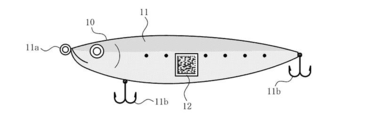
- FIG. 1 is a diagram illustrating a toy with an identification code according to the first embodiment of the present invention.
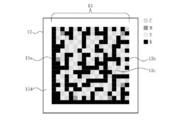
- FIG. 2 is an enlarged view of the identification code portion shown in FIG.
- FIG. 3 is a diagram illustrating a toy with an identification code according to the second embodiment of the present invention.
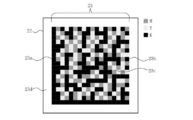
- FIG. 4 is an enlarged view of the identification code portion shown in FIG.
- an identification code portion 12 is provided on the surface of a lure-shaped toy body 11 for fishing.
- the toy 10 with an identification code is a game auxiliary article that can be used during execution of fishing-related game software, and the identification code 13 of the identification code unit 12 (FIG. 2 is shown) using a code reading device described later attached to the game device. See) can be read optically.
- the toy body 11 has an appearance that resembles a fish, and its surface has a color (color) that matches the target fish (here, the main toning of the color (color) is green). Further, the toy body 11 has an eyelet portion 11a and a hook portion 11b similar to an actual fishing lure, but the sharp portion such as the hook portion 11b is rounded so as not to cause an injury during use. ing.
- the identification code 13 can be optically read, there is no particular limitation on the position of the identification code portion 12 on the surface of the toy body 11.
- the toy body 11 may have an appearance similar to that of crustaceans such as fish and shrimp, cephalopods such as squid, and others other than those shown in the illustration.
- the position, number and shape of the eyelet portion 11a and the hook portion 11b of the toy body 11 are not particularly limited, and in addition to these, the toy body 11 has other parts such as a lip part and a decorative part (guidance part). You may.
- the identification code unit 12 is provided on the surface of the toy body 11 by a method such as sticking a print sticker or direct printing.
- the identification code unit 12 has an identification code 13 that possesses identification information of the toy 10 with the identification code.
- the identification code 13 of the identification code unit 12 illustrated in FIG. 2 is composed of a plurality of dark-colored portions (code omitted) and a plurality of light-colored portions (code omitted), and the light-colored portion has a higher density than the dark-colored portion.
- a low chromatic color is used.
- the number of chromatic colors used in the light-colored portion is one or more, and each of the light-colored portions is colored with a single chromatic color.
- the identification code 13 is a square type data matrix which is a kind of two-dimensional code, and is opposite to the L-shaped alignment pattern 13a. It has a data area 13c surrounded by an L-shaped clock pattern 13b, and a quiet zone 13d is provided around the identification code 13.
- the total number of cells of the identification code 13 is 324 (18 cells ⁇ 18 cells), and the total number of cells of the data area 13c is 256 (16 cells ⁇ 16 cells).
- the actual size of the identification code 13 is 9 mm ⁇ 9 mm.
- the identification code unit 12 The actual size is 11 mm ⁇ 11 mm, and assuming that the quiet zone 13d is 0.5 mm (for one cell), the actual size of the identification code unit 12 is 10 mm ⁇ 10 mm.
- the actual size of the identification code unit 12 is 5.5 mm ⁇ 5.5 mm, and if the quiet zone 13d is 0.25 mm (for one cell), the actual size of the identification code unit 12 is 5 mm ⁇ 5 mm.
- the total number of cells of the identification code 13 is not limited to 324, and the total number of cells of the identification code 13 is 16 cells ⁇ 16 cells, 14 cells ⁇ 14 cells, 12 cells ⁇ 12 cells, or 10 cells ⁇ 10 cells. May be less than 324, and conversely, the identification code 13 may be 20 cells ⁇ 20 cells, 22 cells ⁇ 22 cells, 24 cells ⁇ 24 cells, 26 cells ⁇ 26 cells, 32 cells ⁇ 32 cells, or 36 cells ⁇ 36 cells. The total number of cells may exceed 324.
- the reading resolution of the code reading device described later used when optically reading the identification code 13 of the identification code unit 12 is not so high, one cell size is made smaller than 0.25 mm ⁇ 0.25 mm. Then, reading abnormality may occur, so it is necessary to pay attention to this point. Further, when the size of the identification code portion 12 becomes larger than 11 mm ⁇ 11 mm, the area ratio occupied by the identification code portion 12 on the surface of the toy main body 11 becomes large depending on the size of the toy main body 11, and from a viewpoint different from the color. It is necessary to pay attention to this point as the appearance of the toy body 11 may deteriorate.
- the colors of the dark part (dark cell) and the light part (light cell) of the identification code 13 will be specifically described with reference to FIG. 2.
- the CMYK color model is used for the identification code 13 in consideration of its printing. Of the total number of 324 cells, the color of 154 dark cells is black (K), and the individual colors of 170 light cells are cyan (C), magenta (M), and yellow (Y).
- the target concentrations of black (K), cyan (C), magenta (M) and yellow (Y) are 1.70, 1.55 and 1.50 to 1, respectively. 55 and 1.32 to 1.38 can be exemplified.
- the CIELAB values (L * , a * , b * ) of the black (K), cyan (C), magenta (M), and yellow (Y) L * a * b * color systems are (16), respectively. , 1, 2), (53, -36, -52), (46, 76, -3) and (89, -6,94) can be exemplified.
- the dark-colored cells excluding the alignment pattern 13a and the clock pattern 13b, that is, the dark-colored cells in the data area 13c are drawn randomly for convenience of illustration and do not represent specific information. Absent.
- 82 of the 170 light-colored cells are set to cyan (C).
- the color of the light-colored cells of 82 is yellow (Y), and the color of the remaining 6 light-colored cells is magenta (M).
- the magenta (M) light-colored cells are arranged on the outer periphery of the data area 13c so as not to be conspicuous, and the cyan (C) light-colored cells and the yellow (Y) light-colored cells are dispersed as much as possible so that they do not gather in one place. And they are arranged so that they are adjacent to each other.
- CMY cyan in 170 light-colored cells
- Magenta, yellow to correspond to the main toning (green) of the surface color of the toy body 11, in other words, the identification code 13 when the toy 10 with the identification code is viewed from a distance.
- the 170 light-colored cells of No. 170 have been made to look like a greenish color that is the same as or similar to the main color of the surface of the toy body 11.
- the identification code 13 of the identification code unit 12 of the identification code toy 10 illustrated in FIG. 1 is optically read, the image captured by the code reader using infrared rays or the digital camera is binarized and the binarized image is used.
- a code reading device that has a function to capture identification information (binar data)
- a code reading device having a function of digitizing and capturing identification information (binar data) from the binarized image can be used. That is, the optically readable identification code of the present invention cannot read the code only with a normal optical camera and cannot acquire correct data, so that the possibility of information leakage can be reduced.
- the light-colored portion (light-colored cell) of the identification code 13 of the identification code unit 12 uses a chromatic color having a lower density than the dark-colored portion (dark-colored cell), the dark-colored portion is black and light-colored.
- the appearance (design) of the toy body 11 is improved by avoiding as much as possible the deterioration of the appearance as when the identification code portion having the identification code whose part is white is provided on the surface of the toy body 11, especially the surface having color. Can contribute to.
- the identification code portion 12 having the identification code 13 is printed on the surface of the toy body 11.
- the identification code 13 can be easily produced even when the identification code 13 is provided by a method such as sticking a sticker or direct printing.
- the identification code of the present invention may be duplicated because the boundary between the dark color portion (dark color cell) and the light color portion (light color cell) does not appear clearly even when scanning or copying is performed with a normal printer or copier. Since it is difficult, it is possible to prevent forgery of the identification code.
- the mixed color of CMY (cyan, magenta, yellow) in the light-colored cell can be obtained. Since it corresponds to the main toning (green type) of the surface color of the toy body 11, it can contribute to improving the appearance of the toy body 11 in this respect as well. Of course, when the main color of the surface of the toy body 11 is green, the same effect can be obtained by using only CY (cyan, yellow) for the light-colored cell of the identification code 13.
- the toy body 11 has an appearance resembling a fish
- the cell number ratio (color area ratio) of CMY (cyan, magenta, yellow) used for the light-colored cells is adjusted to be blue.
- CM (cyan, magenta) may be used for the light-colored cells.
- the cell number ratio (color area ratio) of CMY (cyan, magenta, yellow) used for the light-colored cells is adjusted to be red.
- MY (magenta, yellow) may be used for the light-colored cells.
- FIG. 2 illustrates an example in which the quiet zone 13d is not colored with CMY (cyan, magenta, yellow), but the quiet zone 13d is also colored in the same manner as the light-colored cell, that is, the toy body 11
- the quiet zone 13d may be colored based on the same color area ratio and color selection as described above.
- the identification code portion 22 is provided on the surface of the card-shaped toy body 21.
- the toy 20 with an identification code is a game auxiliary article that can be used during execution of card-related game software, and the identification code 23 (FIG. 4) of the identification code unit 22 is used by using a code reading device described later attached to the game device. See) can be read optically.
- the toy body 21 has a title (see ABCDE on the upper left of FIG. 3, reference omitted) and a unique picture portion 21a corresponding to the title and the like, specifically, a picture portion 21a (picture) including a skeleton and a coffin on its surface. , Photographs, illustrations, etc.), and its surface has a color that matches the title and picture section 21a (the main toning of the color here is red).
- the identification code 23 can be optically read, there is no particular limitation on the position of the identification code portion 22 on the surface of the toy body 21.
- the picture portion 21a provided on the surface of the toy body 21 may be an inanimate object such as a character other than the illustrated example, an organism such as an animal, or other pictures, photographs, or illustrations, and the title can be changed as appropriate. ..
- the identification code unit 22 is provided on the surface of the toy body 21 by a method such as sticking a print sticker or direct printing.
- the identification code unit 22 has an identification code 23 that possesses identification information of the toy 20 with the identification code.
- the identification code 23 of the identification code unit 22 illustrated in FIG. 4 is composed of a plurality of dark-colored portions (code omitted) and a plurality of light-colored portions (code omitted), as in the first embodiment described above.
- a chromatic color with a lower density than the dark part is used for the part.
- the number of chromatic colors used in the light-colored portion is one or more, and each of the light-colored portions is colored with a single chromatic color.
- the identification code 23 is a square type data matrix which is a kind of two-dimensional code, and is opposite to the L-shaped alignment pattern 23a. It has a data area 23c surrounded by an L-shaped clock pattern 23b, and a quiet zone 23d is provided around the identification code 23.
- the total number of cells of the identification code 23 is 324 (18 cells ⁇ 18 cells), and the total number of cells of the data area 23c is 256 (16 cells ⁇ 16 cells).
- the colors of the dark part (dark cell) and the light part (light cell) of the identification code 23 will be specifically described with reference to FIG. 4.
- the CMYK color model is used for the identification code 23 in consideration of its printing. Of the total number of 324 cells, the color of 154 dark cells is black (K), and the individual colors of 170 light cells are magenta (M) and yellow (Y).
- the target densities of black (K), magenta (M), and yellow (Y) and the CIELAB values (L * , a * , b * ) of the L * a * b * color system are the first implementations described above. Since it is as described in the form, the description here will be omitted. Further, among the 154 dark-colored cells, the dark-colored cells excluding the alignment pattern 23a and the clock pattern 23b, that is, the dark-colored cells in the data area 23c are drawn randomly for convenience of illustration and do not represent specific information. Absent.
- the color of 85 light-colored cells out of 170 light-colored cells is magenta (M).
- the color of the light-colored cells of 85 is yellow (Y).
- the magenta (M) light-colored cells and the yellow (Y) light-colored cells are dispersed as much as possible so that they do not gather in one place, and are arranged so as to be adjacent to each other.
- MY magenta, yellow
- the color corresponds to the main toning (red) of the surface color of the toy body 11, in other words, when the toy 20 with the identification code is viewed from a distance, the 170 light-colored cell of the identification code 23 is the toy. I have made it look like a red color that is the same as or similar to the main color of the surface of the main body 21.
- the identification code 23 of the identification code unit 22 of the identification code toy 20 illustrated in FIG. 3 is optically read, the image captured by the code reader using infrared rays or the digital camera is binarized and the binarized image is used.
- a code reading device that has a function to capture identification information (binar data)
- a code reading device having a function of digitizing and capturing identification information (binar data) from the binarized image can be used.
- the light-colored portion (light-colored cell) of the identification code 23 of the identification code unit 22 uses a chromatic color having a lower density than the dark-colored portion (dark-colored cell), the dark-colored portion is black and light-colored. It is possible to contribute to the improvement of the appearance of the toy main body 21 by avoiding as much as possible the deterioration of the appearance as when the identification code portion having the identification code whose portion is white is provided on the surface of the toy main body 21, particularly the surface having color.
- the identification code portion 22 having the identification code 23 is printed on the surface of the toy body 11.
- the identification code 23 can be easily produced even when the identification code 23 is provided by a method such as sticking a sticker or direct printing.
- the mixed color of MY (magenta, yellow) in the light-colored cell can be obtained from the toy body 21. Since it corresponds to the main toning (red type) of the surface color, it can contribute to improving the appearance of the toy body 21 in this respect as well.
- CMY cyan, magenta, yellow
- the same effect can be obtained.
- CM cyan, magenta
- CMY cyan, magenta, yellow
- the number ratio may be adjusted so that the color becomes blue.
- CY cyan, yellow
- CMY cyan, magenta, yellow
- the color area ratio may be adjusted so that the color becomes greenish.
- FIG. 4 illustrates that the quiet zone 23d is not colored with CMY (cyan, magenta, yellow), but the quiet zone 23d is also colored in the same manner as the light-colored cell, that is, the toy body 21.
- the quiet zone 13d may be colored based on the same color area ratio and color selection as described above.
- the number of chromatic colors used for the light-colored portion of the identification code 13 is three, CMY (cyan, magenta, yellow), and FIG. 4 of the above-mentioned second embodiment.
- the number of chromatic colors used for the light-colored portion of the identification code 23 is MY (magenta, yellow), but the main toning of the surface colors of the toy bodies 11 and 21 is cyan.
- all the colors of the light-colored parts of the identification codes 13 and 23 are set to cyan (C), and when the main color of the surface of the toy bodies 11 and 21 is magenta, the light-colored parts of the identification codes 13 and 23 are used.
- all the colors are magenta (M) and the surface colors of the toy bodies 11 and 21 are yellowish, all the colors of the light-colored portions of the identification codes 13 and 23 may be yellow (Y).
- the number of chromatic colors used in the light-colored portions of the identification codes 13 and 23 is set to 1 or more selected from CMY (cyan, magenta, yellow). As illustrated, it is also possible to use chromatic colors other than CMY (cyan, magenta, yellow). However, considering that the identification code portions 12 and 23 having the identification codes 13 and 23 are provided on the surfaces of the toy bodies 11 and 21 by a method such as attaching a print sticker or direct printing, the identification codes 13 and 23 are lightly colored. It is more convenient for printing when the number of chromatic colors used for the portion is 1 or more selected from CMY (cyan, magenta, yellow).
- the color of the dark part of the identification codes 13 and 23 is black (K), but the dark part is identified if the density is higher than the density of the light part. Since the codes 13 and 23 can be optically read, a color other than black (K) may be used as the color of the dark portion of the identification codes 13 and 23 as long as the same conditions are satisfied.
- a square type data matrix is used as the identification codes 13 and 23, but the identification code includes a horizontally long rectangular type data matrix (the number of vertical cells is the number of horizontal cells). 1/2) can also be used as appropriate.
- a data matrix is used as the identification codes 13 and 23, but the identification code is another two-dimensional code, for example, a QR code (registered trademark) as a matrix type.
- a known one such as a vericord can be appropriately used, and as a stack type, a known one such as PDF417 or CODE49 can be appropriately used.
- a two-dimensional code (data matrix) is used as the identification codes 13 and 23, but instead of the two-dimensional code, a one-dimensional code such as JAN, ITF, or NW- Known items such as 7 and CODE39 and CODE128 can be appropriately used.
- the dark color bar black bar
- the light color space white space
- a toy 10 having an identification code is illustrated as a toy body 11 having a lure shape for fishing, and in FIG. 3 of the second embodiment described above, the toy 20 with an identification code is used.
- the toy body may be a model of a weapon other than these, a vehicle model, a doll (figure), a stuffed animal, etc., and the toy body may be a toy body. It does not necessarily have to be a game accessory that can be used during the execution of the game software.
- optically readable identification code of the present invention can be applied to various articles such as packaging containers for foods, electric appliances, books, tickets, etc., in addition to toys.
- color By setting the color of the identification code (color) to match the appearance of the article, it is possible to provide an article with an identification code having a higher design.
Landscapes
- Physics & Mathematics (AREA)
- Engineering & Computer Science (AREA)
- General Physics & Mathematics (AREA)
- Theoretical Computer Science (AREA)
- Health & Medical Sciences (AREA)
- Electromagnetism (AREA)
- General Health & Medical Sciences (AREA)
- Toxicology (AREA)
- Artificial Intelligence (AREA)
- Computer Vision & Pattern Recognition (AREA)
- Toys (AREA)
Abstract
【課題】新規な光学的に読み取り可能な識別コードと玩具本体の見栄え低下を極力回避できる識別コード付き玩具を提供する。 【解決手段】識別コード付き玩具10は、光学的に読み取り可能な識別コード13を有する識別コード部13が玩具本体11の表面に設けられている。識別コード13は複数の濃色部分と複数の淡色部分とによって構成されており、淡色部分に濃色部分よりも濃度が低い有彩色が用いられている。
Description
本発明は、光学的に読み取り可能な識別コードに関する。
特許文献1には識別コード部がカード本体の表面に設けられた識別コード付きカードが開示されており、識別コード部の識別コードとしてQRコード(登録商標)が示されている。また、特許文献2には識別コード部がブロック本体の表面に設けられた識別コード付きブロックが開示されているが、識別コード部の識別コードの具体形態は不明である。
光学的に読み取り可能な識別コードにはQRコード(登録商標)等の2次元コードとJAN等の1次元コードが広く知られているが、これら識別コードは一般に複数の黒色部分と複数の白色部分とから構成されたものであるため、当該識別コードを有する識別コード部を玩具本体の表面、とりわけ、彩りを有する表面に設けると、識別コードによって玩具本体の見栄えが低下する懸念がある。
本発明が解決しようとする課題は、新規な光学的に読み取り可能な識別コードと玩具本体の見栄え低下を極力回避できる識別コード付き玩具を提供することにある。
本発明に係る識別コード付き玩具は、光学的に読み取り可能な識別コードを有する識別コード部が玩具本体に設けられた識別コード付き玩具であって、前記識別コードは複数の濃色部分と複数の淡色部分とによって構成されており、前記淡色部分に前記濃色部分よりも濃度が低い有彩色が用いられている。
本発明に係る識別コード付き玩具によれば、玩具本体の見栄え低下を極力回避できる。
《第1実施形態》
図1に例示した識別コード付き玩具10は、魚釣り用ルアー状の玩具本体11の表面に識別コード部12が設けられている。この識別コード付き玩具10は釣り関連のゲームソフトウェアの実行途中において使用可能なゲーム補助物品であり、ゲーム装置に付属の後述のコード読み取りデバイスを用いて識別コード部12の識別コード13(図2を参照)を光学的に読み取ることが可能である。
図1に例示した識別コード付き玩具10は、魚釣り用ルアー状の玩具本体11の表面に識別コード部12が設けられている。この識別コード付き玩具10は釣り関連のゲームソフトウェアの実行途中において使用可能なゲーム補助物品であり、ゲーム装置に付属の後述のコード読み取りデバイスを用いて識別コード部12の識別コード13(図2を参照)を光学的に読み取ることが可能である。
玩具本体11は、魚に似せた外観を備え、その表面は対象となる魚に見合う色彩(彩り)(ここでは色彩(彩り)の主調色はグリーン系)を有している。また、玩具本体11は実際の魚釣り用ルアーと同様のアイレット部11aとフック部11bを有しているが、使用時に怪我を生じぬようにフック部11b等の先鋭な部分には丸みが付けられている。
なお、識別コード13の光学的な読み取りが可能であれば、玩具本体11の表面における識別コード部12の位置に特段の制限はない。また、玩具本体11は図示例以外の魚類やエビ等の甲殻類やイカ等の頭足類やその他のものに似せた外観を備えたものであってもよい。さらに、玩具本体11が有するアイレット部11aとフック部11bの位置、数および形状に特段の制限はなく、これらに加えてリップ部や装飾部(誘導部)等の他の部位を有するものであってもよい。
識別コード部12は、玩具本体11の表面に、印刷シールの貼り付けや直接印刷等の手法によって設けられている。この識別コード部12は、識別コード付き玩具10の識別情報を所持する識別コード13を有している。
図2に例示した識別コード部12の識別コード13は、複数の濃色部分(符号省略)と複数の淡色部分(符号省略)とによって構成されており、淡色部分に濃色部分よりも濃度が低い有彩色が用いられている。また、淡色部分に用いられている有彩色の色数は1つ以上であり、淡色部分の個々は単一の有彩色で色付けされている。
識別コード部12および識別コード13の形態について図2を用いて具体的に説明すると、識別コード13は2次元コードの1種である正方形タイプのデータマトリックスであり、L状のアライメントパターン13aと逆L状のクロックパターン13bとによって囲まれたデータエリア13cを有しており、当該識別コード13の周囲にはクワイエットゾーン13dが設けられている。また、識別コード13の総セル数は324(18セル×18セル)、データエリア13cの総セル数は256(16セル×16セル)である。
例えば、1つのセルサイズを0.5mm×0.5mmとした場合、識別コード13の実サイズは9mm×9mmとなり、この場合にクワイエットゾーン13dを1mm(2セル分)とすると識別コード部12の実サイズは11mm×11mmとなり、クワイエットゾーン13dを0.5mm(1セル分)とすると識別コード部12の実サイズは10mm×10mmとなる。また、例えば、1つのセルサイズを0.25mm×0.25mmとした場合、識別コード13の実サイズは4.5mm×4.5mmとなり、この場合にクワイエットゾーン13dを0.5mm(2セル分)とすると識別コード部12の実サイズは5.5mm×5.5mmとなり、クワイエットゾーン13dを0.25mm(1セル分)とすると識別コード部12の実サイズは5mm×5mmとなる。
なお、識別コード13の総セル数は324に制限されるものではなく、識別コード13を16セル×16セルや14セル×14セルや12セル×12セルや10セル×10セルとして総セル数を324未満としてもよく、逆に、識別コード13を20セル×20セルや22セル×22セルや24セル×24セルや26セル×26セルや32セル×32セルや36セル×36セルとして総セル数を324超過としてもよい。
ただし、識別コード部12の識別コード13を光学的に読み取るときに用いられる後述のコード読み取りデバイスの読み取り解像度がさほど高くない場合には、1つのセルサイズを0.25mm×0.25mmよりも小さくすると読み取り異常を生じる可能があるため、この点について留意が必要である。また、識別コード部12のサイズが11mm×11mmよりも大きくなると、玩具本体11のサイズ如何では、玩具本体11の表面において識別コード部12が占める面積割合が大きくなって、色とは異なる観点において玩具本体11の見栄えが低下する可能性があるため、この点についても留意が必要である。
識別コード13の濃色部分(濃色セル)と淡色部分(淡色セル)の色について図2を用いて具体的に説明すると、識別コード13にはその印刷を考慮してCMYKカラーモデルが用いられており、324の総セル数のうち、154の濃色セルの色はブラック(K)、170の淡色セルの個々の色はシアン(C)とマゼンタ(M)とイエロー(Y)である。
ちなみに、ISO準拠のJapanColor2011によれば、ブラック(K)とシアン(C)とマゼンタ(M)とイエロー(Y)の目標濃度として、それぞれ、1.70と1.55と1.50~1.55と1.32~1.38を例示できる。また、ブラック(K)とシアン(C)とマゼンタ(M)とイエロー(Y)のL*a*b*表色系のCIELAB値(L*,a*,b*)として、それぞれ、(16,1,2)と(53,-36,-52)と(46,76,-3)と(89,-6,94)を例示できる。
なお、154の濃色セルのうちのアライメントパターン13aおよびクロックパターン13bを除く濃色セル、すなわち、データエリア13cにおける濃色セルは図示の便宜上ランダムに描いたものであって特定情報を表すものではない。
また、先に述べたように玩具本体11の表面の彩りの主調色がグリーン系であることを考慮して、170の淡色セルのうち、82の淡色セルの色をシアン(C)とし、82の淡色セルの色をイエロー(Y)とし、残り6の淡色セルの色をマゼンタ(M)としている。さらに、マゼンタ(M)の淡色セルは目立たないようにデータエリア13cの外周に配置し、シアン(C)の淡色セルとイエロー(Y)の淡色セルは各々が一箇所に集まらないように極力分散し、かつ、隣り合うように配置している。
シアン(C)とマゼンタ(M)とイエロー(Y)のセル数比率(色面積比率)を前掲のようにし、かつ、これらを前掲のように配置した理由は、170の淡色セルにおけるCMY(シアン、マゼンタ、イエロー)の混合色を玩具本体11の表面の彩りの主調色(グリーン系)に対応させたこと、換言すれば、識別コード付き玩具10を少し離れて見たときに識別コード13の170の淡色セルが玩具本体11の表面の彩りの主調色と同一または近似のグリーン系に見えるようにしたことある。
ちなみに、図1に例示した識別コード玩具10の識別コード部12の識別コード13を光学的に読み取るときには、赤外線利用のコードリーダやデジタルカメラで撮像した画像を2値化して当該2値化画像から識別情報(2値データ)を取り込む機能を有するコード読み取りデバイスの他、赤外線非利用のコードリーダやデジタルカメラで撮像した画像を淡色部分(淡色セル)を除外するフィルタやデジタル処理等を用いて2値化して当該2値化画像から識別情報(2値データ)を取り込む機能を有するコード読み取りデバイスが使用可能である。つまり本発明の光学的に読み取り可能な識別コードは、通常の光学カメラのみではコードを読み取ることができず、正しいデータを取得することができないため、情報流出の可能性を低減することができる。
以上説明したように、識別コード部12の識別コード13の淡色部分(淡色セル)に濃色部分(濃色セル)よりも濃度が低い有彩色を用いているので、濃色部分を黒とし淡色部分を白とした識別コードを有する識別コード部を玩具本体11の表面、とりわけ、彩りを有する表面に設けたときのような見栄え低下を極力回避して、玩具本体11の見栄え(デザイン性)向上に貢献できる。
また、識別コード13の濃色部分(濃色セル)と淡色部分(淡色セル)の色としてCMYKカラーモデルを用いているので、識別コード13を有する識別コード部12を玩具本体11の表面に印刷シールの貼り付けや直接印刷等の手法によって設ける場合でも、識別コード13の作製が容易に行える。また、本発明の識別コードは、通常のプリンターやコピー機でスキャンやコピー等を行っても濃色部分(濃色セル)と淡色部分(淡色セル)の境界がはっきり出ず、複製することが困難なため、識別コードの偽造を防止することが可能である。
さらに、識別コード13の淡色セルに用いられるCMY(シアン、マゼンタ、イエロー)のセル数比率(色面積比率)を調整することにより、当該淡色セルにおけるCMY(シアン、マゼンタ、イエロー)の混合色を玩具本体11の表面の彩りの主調色(グリーン系)に対応させているので、この点においても玩具本体11の見栄え向上に貢献できる。無論、玩具本体11の表面の彩りの主調色がグリーン系のときには、識別コード13の淡色セルにCY(シアン、イエロー)のみを用いるようにしても同様の効果を得ることができる。
さらに、玩具本体11が魚に似せた外観を備える場合、識別コード13を構成する複数の濃色部分(濃色セル)および淡色部分(淡色セル)、特に有彩色が用いられた淡色部分(淡色セル)を魚の鱗のように見せることができるため、この点においても玩具本体11の見栄え向上に貢献できる。
なお、玩具本体11の表面の彩りの主調色がブルー系のときには、淡色セルに用いられるCMY(シアン、マゼンタ、イエロー)のセル数比率(色面積比率)がブルー系となるように調整するか、淡色セルにCM(シアン、マゼンタ)のみを用いるようにすればよい。また、玩具本体11の表面の彩りの主調色がレッド系のときには、淡色セルに用いられるCMY(シアン、マゼンタ、イエロー)のセル数比率(色面積比率)がレッド系となるように調整するか、淡色セルにMY(マゼンタ、イエロー)のみを用いるようにすればよい。
また、図2にはクワイエットゾーン13dにCMY(シアン、マゼンタ、イエロー)の色付けが為されていないものを例示したが、当該クワイエットゾーン13dにも淡色セルと同様の色付け、すなわち、玩具本体11の表面の彩りの主調色がグリーン系、ブルー系、レッド系のときには前記同様の色面積比率や色選択に基づいてクワイエットゾーン13dに色付けを施してもよい。
《第2実施形態》
図3に例示した識別コード付き玩具20は、カード状の玩具本体21の表面に識別コード部22が設けられている。この識別コード付き玩具20はカード関連のゲームソフトウェアの実行途中において使用可能なゲーム補助物品であり、ゲーム装置に付属の後述のコード読み取りデバイスを用いて識別コード部22の識別コード23(図4を参照)を光学的に読み取ることが可能である。
図3に例示した識別コード付き玩具20は、カード状の玩具本体21の表面に識別コード部22が設けられている。この識別コード付き玩具20はカード関連のゲームソフトウェアの実行途中において使用可能なゲーム補助物品であり、ゲーム装置に付属の後述のコード読み取りデバイスを用いて識別コード部22の識別コード23(図4を参照)を光学的に読み取ることが可能である。
玩具本体21は、その表面に、タイトル(図3左上のABCDEを参照、符号省略)と、タイトル等に対応した固有のピクチャー部21a、具体的には骸骨と棺桶とを含むピクチャー部21a(絵、写真またはイラストレーション等)を有しているとともに、その表面はタイトルおよびピクチャー部21aに見合う彩り(ここでの彩りの主調色はレッド系)を有している。
なお、識別コード23の光学的な読み取りが可能であれば、玩具本体21の表面における識別コード部22の位置に特段の制限はない。また、玩具本体21の表面に設けられたピクチャー部21aは図示例以外のキャラクター等の無生物や動物等の生物やその他の絵、写真またはイラストレーション等であってもよく、タイトルも適宜変更可能である。
識別コード部22は、玩具本体21の表面に、印刷シールの貼り付けや直接印刷等の手法によって設けられている。この識別コード部22は、識別コード付き玩具20の識別情報を所持する識別コード23を有している。
図4に例示した識別コード部22の識別コード23は、前述の第1実施形態と同様、複数の濃色部分(符号省略)と複数の淡色部分(符号省略)とによって構成されており、淡色部分に濃色部分よりも濃度が低い有彩色が用いられている。また、淡色部分に用いられている有彩色の色数は1つ以上であり、淡色部分の個々は単一の有彩色で色付けされている。
識別コード部22および識別コード23の形態について図4を用いて具体的に説明すると、識別コード23は2次元コードの1種である正方形タイプのデータマトリックスであり、L状のアライメントパターン23aと逆L状のクロックパターン23bとによって囲まれたデータエリア23cを有しており、当該識別コード23の周囲にはクワイエットゾーン23dが設けられている。また、識別コード23の総セル数は324(18セル×18セル)、データエリア23cの総セル数は256(16セル×16セル)である。
なお、1つのセルサイズ、識別コード23の実サイズ、識別コード部22の実サイズ、総セル数、および留意事項は、前述の第1実施形態で説明したとおりであるため、ここでの説明を省略する。
識別コード23の濃色部分(濃色セル)と淡色部分(淡色セル)の色について図4を用いて具体的に説明すると、識別コード23にはその印刷を考慮してCMYKカラーモデルが用いられており、324の総セル数のうち、154の濃色セルの色はブラック(K)、170の淡色セルの個々の色はマゼンタ(M)とイエロー(Y)である。
なお、ブラック(K)とマゼンタ(M)とイエロー(Y)の目標濃度と、L*a*b*表色系のCIELAB値(L*,a*,b*)は、前述の第1実施形態で説明したとおりであるため、ここでの説明を省略する。また、154の濃色セルのうちのアライメントパターン23aおよびクロックパターン23bを除く濃色セル、すなわち、データエリア23cにおける濃色セルは図示の便宜上ランダムに描いたものであって特定情報を表すものではない。
また、先に述べたように玩具本体21の表面の彩りの主調色がレッド系であることを考慮して、170の淡色セルのうち、85の淡色セルの色をマゼンタ(M)とし、85の淡色セルの色をイエロー(Y)としている。さらに、マゼンタ(M)の淡色セルとイエロー(Y)の淡色セルは各々が一箇所に集まらないように極力分散し、かつ、隣り合うように配置している。
マゼンタ(M)とイエロー(Y)のセル数比率(色面積比率)を前掲のようにし、かつ、これらを前掲のように配置した理由は、170の淡色セルにおけるMY(マゼンタ、イエロー)の混合色を玩具本体11の表面の彩りの主調色(レッド系)に対応させたこと、換言すれば、識別コード付き玩具20を少し離れて見たときに識別コード23の170の淡色セルが玩具本体21の表面の彩りの主調色と同一または近似のレッド系に見えるようにしたことある。
ちなみに、図3に例示した識別コード玩具20の識別コード部22の識別コード23を光学的に読み取るときには、赤外線利用のコードリーダやデジタルカメラで撮像した画像を2値化して当該2値化画像から識別情報(2値データ)を取り込む機能を有するコード読み取りデバイスの他、赤外線非利用のコードリーダやデジタルカメラで撮像した画像を淡色部分(淡色セル)を除外するフィルタやデジタル処理等を用いて2値化して当該2値化画像から識別情報(2値データ)を取り込む機能を有するコード読み取りデバイスが使用可能である。
以上説明したように、識別コード部22の識別コード23の淡色部分(淡色セル)に濃色部分(濃色セル)よりも濃度が低い有彩色を用いているので、濃色部分を黒とし淡色部分を白とした識別コードを有する識別コード部を玩具本体21の表面、とりわけ、彩りを有する表面に設けたときのような見栄え低下を極力回避して、玩具本体21の見栄え向上に貢献できる。
また、識別コード23の濃色部分(濃色セル)と淡色部分(淡色セル)の色としてCMYKカラーモデルを用いているので、識別コード23を有する識別コード部22を玩具本体11の表面に印刷シールの貼り付けや直接印刷等の手法によって設ける場合でも、識別コード23の作製が容易に行える。
さらに、識別コード23の淡色セルに用いられるMY(マゼンタ、イエロー)のセル数比率(色面積比率)を調整することにより、当該淡色セルにおけるMY(マゼンタ、イエロー)の混合色を玩具本体21の表面の彩りの主調色(レッド系)に対応させているので、この点においても玩具本体21の見栄え向上に貢献できる。無論、玩具本体21の表面の彩りの主調色がレッド系のときには、識別コード23の淡色セルにCMY(シアン、マゼンタ、イエロー)を用いてセル数比率(色面積比率)を調整するようにしても同様の効果を得ることができる。
なお、玩具本体21の表面の彩りの主調色がブルー系のときには、淡色セルにCM(シアン、マゼンタ)のみを用いるようにするか、淡色セルにCMY(シアン、マゼンタ、イエロー)を用いセル数比率(色面積比率)を調整してブルー系となるようにすればよい。また、玩具本体21の表面の彩りの主調色がグリーン系のときには、淡色セルにCY(シアン、イエロー)のみを用いるか、淡色セルにCMY(シアン、マゼンタ、イエロー)を用いセル数比率(色面積比率)を調整してグリーン系となるようにすればよい。
また、図4にはクワイエットゾーン23dにCMY(シアン、マゼンタ、イエロー)の色付けが為されていないものを例示したが、当該クワイエットゾーン23dにも淡色セルと同様の色付け、すなわち、玩具本体21の表面の彩りの主調色がレッド系、ブルー系、グリーン系のときには前記同様の色面積比率や色選択に基づいてクワイエットゾーン13dに色付けを施してもよい。
《他の実施形態》
(1)前述の第1実施形態の図2では識別コード13の淡色部分に用いられる有彩色の色数をCMY(シアン、マゼンタ、イエロー)の3つとし、前述の第2実施形態の図4では識別コード23の淡色部分に用いられる有彩色の色数をMY(マゼンタ、イエロー)の2つとしたものを例示したが、玩具本体11および21の表面の彩りの主調色がシアン系である場合には識別コード13および23の淡色部分全ての色をシアン(C)とし、玩具本体11および21の表面の彩りの主調色がマゼンタ系である場合には識別コード13および23の淡色部分全ての色をマゼンタ(M)とし、玩具本体11および21の表面の色がイエロー系である場合には識別コード13および23の淡色部分全ての色をイエロー(Y)としてもよい。
(1)前述の第1実施形態の図2では識別コード13の淡色部分に用いられる有彩色の色数をCMY(シアン、マゼンタ、イエロー)の3つとし、前述の第2実施形態の図4では識別コード23の淡色部分に用いられる有彩色の色数をMY(マゼンタ、イエロー)の2つとしたものを例示したが、玩具本体11および21の表面の彩りの主調色がシアン系である場合には識別コード13および23の淡色部分全ての色をシアン(C)とし、玩具本体11および21の表面の彩りの主調色がマゼンタ系である場合には識別コード13および23の淡色部分全ての色をマゼンタ(M)とし、玩具本体11および21の表面の色がイエロー系である場合には識別コード13および23の淡色部分全ての色をイエロー(Y)としてもよい。
(2)前述の各実施形態および前記(1)では、識別コード13および23の淡色部分に用いられる有彩色の色数をCMY(シアン、マゼンタ、イエロー)から選択された1以上としたものを例示したが、CMY(シアン、マゼンタ、イエロー)以外の有彩色を用いることも可能である。ただし、識別コード13および23を有する識別コード部12および23が玩具本体11および21の表面に印刷シールの貼り付けや直接印刷等の手法によって設けられることを踏まえると、識別コード13および23の淡色部分に用いられる有彩色の色数をCMY(シアン、マゼンタ、イエロー)から選択された1以上とした方が印刷に伴う利便性は高い。
(3)前述の各実施形態では識別コード13および23の濃色部分の色をブラック(K)としたものを例示したが、当該濃色部分はその濃度が淡色部分の濃度よりも高ければ識別コード13および23の光学的な読み取りが可能であるため、同条件を満足していれば識別コード13および23の濃色部分の色としてブラック(K)以外の色を使用してもよい。
(4)前述の各実施形態では、識別コード13および23として正方形タイプのデータマトリックスを用いたものを例示したが、当該識別コードには、横長長方形タイプのデータマトリックス(縦セル数は横セル数の1/2)も適宜使用可能である。
(5)前述の各実施形態では、識別コード13および23としてデータマトリックスを用いたものを例示したが、当該識別コードには他の2次元コード、例えばマトリックス式のものとしてはQRコード(登録商標)やベリコード等の公知のものが適宜使用可能であり、スタック式のものとしてはPDF417やCODE49等の公知のものが適宜使用可能である。
(6)前述の各実施形態では、識別コード13および23として2次元コード(データマトリックス)を用いたものを例示したが、当該2次元コードに変えて1次元コード、例えばJANやITFやNW-7やCODE39やCODE128等の公知のものが適宜使用可能である。ちなみに、1次元コードにあっては濃色バー(黒色バー)が前記濃色部分に該当し淡色スペース(白色スペース)が前記淡色部分に該当する。
(7)前述の第1実施形態の図1では識別コード付き玩具10として魚釣り用ルアー状の玩具本体11を有するものを例示し、前述の第2実施形態の図3では識別コード付き玩具20としてカード状の玩具本体21を有するものを例示したが、玩具本体はこれら以外の武器を模したもの、車両を模したもの、人形(フィギュア)、ぬいぐるみ等であってもよく、また、玩具本体は必ずしもゲームソフトウェアの実行途中において使用可能なゲーム補助物品である必要もない。
また、本発明の光学的に読み取り可能な識別コードは、玩具以外にも例えば、食品等の包装容器や電化製品、書籍、チケット等の様々な物品に適用可能である。識別コードの色合い(色彩)を物品の外観に見合った色合い(色彩)とすることにより、よりデザイン性の高い識別コード付き物品を提供することが可能である。
10…識別コード付き玩具、11…玩具本体、12…識別コード部、13…識別コード、20…識別コード付き玩具、21…玩具本体、22…識別コード部、23…識別コード。
Claims (12)
- 光学的に読み取り可能な識別コードを有する識別コード部が玩具本体に設けられた識別コード付き玩具であって、
前記識別コードは複数の濃色部分と複数の淡色部分とによって構成されており、
前記淡色部分に前記濃色部分よりも濃度が低い有彩色が用いられている、
識別コード付き玩具。 - 前記玩具本体は色彩を有する、
請求項1に記載の識別コード付き玩具。 - 前記淡色部分に用いられている有彩色の色数は1つ以上であり、前記淡色部分の個々は単一の有彩色で色付けされている、
請求項1または2に記載の識別コード付き玩具。 - 前記淡色部分に用いられている有彩色の色数はシアンとマゼンタとイエローから選択された2つ以上である、
請求項3に記載の識別コード付き玩具。 - 前記選択された2つ以上の色の混合色は請求項2に記載の前記玩具本体の色彩の主調色に対応している、
請求項4に記載の識別コード付き玩具。 - 前記淡色部分に用いられている有彩色の色数はシアンとマゼンタとイエローから選択された1つである、
請求項3に記載の識別コード付き玩具。 - 前記選択された1つの色は請求項2に記載の前記玩具本体の色彩の主調色に対応している、
請求項6に記載の識別コード付き玩具。 - 前記濃色部分の色はブラックである、
請求項1~7のいずれか1項に記載の識別コード付き玩具。 - 前記識別コードは2次元コードである、
請求項1~8のいずれか1項に記載の識別コード付き玩具。 - 前記2次元コードはデータマトリックスである、
請求項9に記載の識別コード付き玩具。 - 前記識別コードは1次元コードである、
請求項1~8のいずれか1項に記載の識別コード付き玩具。 - 前記識別コード付き玩具はゲームソフトウェアの実行途中において使用可能なゲーム補助物品であり、前記識別コード部の前記識別コードはコード読み取りデバイスを用いて光学的に読み取り可能に構成されている、
請求項1~11のいずれか1項に記載の識別コード付き玩具。
Priority Applications (1)
| Application Number | Priority Date | Filing Date | Title |
|---|---|---|---|
| US17/611,875 US12042745B2 (en) | 2019-06-12 | 2020-06-04 | Toy with identification code |
Applications Claiming Priority (2)
| Application Number | Priority Date | Filing Date | Title |
|---|---|---|---|
| JP2019-109417 | 2019-06-12 | ||
| JP2019109417A JP6743245B1 (ja) | 2019-06-12 | 2019-06-12 | 識別コード付き玩具 |
Publications (1)
| Publication Number | Publication Date |
|---|---|
| WO2020250803A1 true WO2020250803A1 (ja) | 2020-12-17 |
Family
ID=72047776
Family Applications (1)
| Application Number | Title | Priority Date | Filing Date |
|---|---|---|---|
| PCT/JP2020/022155 Ceased WO2020250803A1 (ja) | 2019-06-12 | 2020-06-04 | 識別コード付き玩具 |
Country Status (4)
| Country | Link |
|---|---|
| US (1) | US12042745B2 (ja) |
| JP (1) | JP6743245B1 (ja) |
| CN (1) | CN111686455B (ja) |
| WO (1) | WO2020250803A1 (ja) |
Cited By (1)
| Publication number | Priority date | Publication date | Assignee | Title |
|---|---|---|---|---|
| US12042745B2 (en) | 2019-06-12 | 2024-07-23 | Bandai Co., Ltd. | Toy with identification code |
Families Citing this family (3)
| Publication number | Priority date | Publication date | Assignee | Title |
|---|---|---|---|---|
| JP7397770B2 (ja) * | 2019-06-12 | 2023-12-13 | 株式会社バンダイ | 識別コード付き玩具 |
| US11847516B2 (en) * | 2019-12-17 | 2023-12-19 | Sicpa Holding Sa | Method and device for reading a two-dimensional encoded pattern applied on a non-uniform background |
| JP7749455B2 (ja) * | 2021-12-28 | 2025-10-06 | 株式会社電通 | 二次元コードイラスト作成システム |
Citations (8)
| Publication number | Priority date | Publication date | Assignee | Title |
|---|---|---|---|---|
| JPH04354086A (ja) * | 1991-05-31 | 1992-12-08 | Sega Enterp Ltd | レジスタ玩具及びそれに用いるバーコードシール |
| JPH11161757A (ja) * | 1997-11-28 | 1999-06-18 | Takahiro Saito | 情報コード及びその読み取り装置 |
| JP2012170515A (ja) * | 2011-02-18 | 2012-09-10 | Tomy Co Ltd | ゲームシステム |
| JP2013041343A (ja) * | 2011-08-11 | 2013-02-28 | Konica Minolta Business Technologies Inc | 二次元バーコード提供装置、二次元バーコード解析装置、二次元バーコード提供方法、二次元バーコード解析方法、コンピュータープログラム、二次元バーコード、および用紙 |
| WO2015083465A1 (ja) * | 2013-12-03 | 2015-06-11 | 株式会社バンダイ | コード式玩具 |
| US20170127216A1 (en) * | 2015-10-28 | 2017-05-04 | Activision Publishing, Inc. | System and method of using physical objects to control software access |
| US20170339301A1 (en) * | 2016-05-23 | 2017-11-23 | Ecole polytechnique fédérale de Lausanne (EPFL) | Color changing effects with cross-halftone prints |
| CN109190740A (zh) * | 2018-08-17 | 2019-01-11 | 森大(深圳)技术有限公司 | 分区渐变彩色二维码的生成方法、装置、设备及存储介质 |
Family Cites Families (24)
| Publication number | Priority date | Publication date | Assignee | Title |
|---|---|---|---|---|
| US5169155A (en) | 1990-03-29 | 1992-12-08 | Technical Systems Corp. | Coded playing cards and other standardized documents |
| JP3058491U (ja) | 1998-10-15 | 1999-06-18 | 達彦 平田 | 音声通知機能付きブロック玩具 |
| JP4099277B2 (ja) | 1998-10-19 | 2008-06-11 | 小林クリエイト株式会社 | マトリックス式二次元コ−ド |
| JP3913394B2 (ja) * | 1999-03-11 | 2007-05-09 | 株式会社バンダイ | 電子機器装置 |
| US6807291B1 (en) * | 1999-06-04 | 2004-10-19 | Intelligent Verification Systems, Inc. | Animated toy utilizing artificial intelligence and fingerprint verification |
| JP2005165565A (ja) | 2003-12-01 | 2005-06-23 | Kenpakku:Kk | カラーコードシンボル及びカラーコードシンボル生成方法並びに、カラーコードシンボルを生成する記憶媒体。 |
| JP2007018478A (ja) | 2005-07-07 | 2007-01-25 | Mayu Nagashima | 枠付きバーコード、集合的バーコードおよびカラーバーコード、並びに枠付きバーコード描画プログラム、集合的バーコード描画プログラムおよびバーコード着色プログラム |
| JP2007252791A (ja) | 2006-03-24 | 2007-10-04 | Tomy Co Ltd | 遊戯システム |
| JP4684175B2 (ja) | 2006-06-19 | 2011-05-18 | 株式会社タイトー | カード読取装置および該カード読取装置を利用したゲームプレイ装置 |
| JP2008080610A (ja) | 2006-09-27 | 2008-04-10 | Toppan Printing Co Ltd | 機械読み取り可能な情報印刷物 |
| JP4404913B2 (ja) * | 2007-01-23 | 2010-01-27 | Necインフロンティア株式会社 | バーコード読取装置及び読取方法 |
| JP5165905B2 (ja) | 2007-02-14 | 2013-03-21 | 株式会社バンダイナムコゲームス | ゲーム装置 |
| US7913922B1 (en) * | 2007-03-15 | 2011-03-29 | Ncr Corporation | Matching bar code colors to painted pixel filters |
| US8894461B2 (en) * | 2008-10-20 | 2014-11-25 | Eyecue Vision Technologies Ltd. | System and method for interactive toys based on recognition and tracking of pre-programmed accessories |
| CN101590319A (zh) * | 2008-05-30 | 2009-12-02 | 北京华旗资讯数码科技有限公司 | 一种互动玩具 |
| JP5444742B2 (ja) | 2009-02-03 | 2014-03-19 | 凸版印刷株式会社 | 情報記録媒体 |
| JP2011002597A (ja) * | 2009-06-18 | 2011-01-06 | Canon Inc | Qrコード付加時の違和感減少およびトナーセーブモード時のqrコードの画質劣化を防止する画像処理装置の制御方法 |
| WO2013162577A1 (en) * | 2012-04-26 | 2013-10-31 | Hewlett-Packard Development Company, L.P. | Two-dimensional barcodes having a plurality of different regions |
| CN203154813U (zh) * | 2013-03-28 | 2013-08-28 | 泉州锦信玩具有限公司 | 一种智力玩具车 |
| EP3246854B1 (en) | 2015-01-13 | 2019-05-22 | A.T Communications Co., Ltd. | Two-dimensional code generation device, two-dimensional code generation method, and program |
| JP6176870B2 (ja) * | 2016-01-05 | 2017-08-09 | 株式会社セガ トイズ | コーディング玩具、ブロック、ステージ、形象体玩具及びコーディング方法 |
| JP6473899B1 (ja) * | 2017-12-29 | 2019-02-27 | 株式会社I・Pソリューションズ | 複合コードパターン、生成装置、読み取り装置、方法およびプログラム |
| WO2020174463A1 (en) * | 2019-02-25 | 2020-09-03 | Fund For Medical Research Development Of Infrastructure & Health Services By Barzilai Medical Center | Identity verifying device and methods |
| JP6743245B1 (ja) | 2019-06-12 | 2020-08-19 | 株式会社バンダイ | 識別コード付き玩具 |
-
2019
- 2019-06-12 JP JP2019109417A patent/JP6743245B1/ja active Active
-
2020
- 2020-06-04 WO PCT/JP2020/022155 patent/WO2020250803A1/ja not_active Ceased
- 2020-06-04 US US17/611,875 patent/US12042745B2/en active Active
- 2020-06-05 CN CN202010507121.0A patent/CN111686455B/zh active Active
Patent Citations (8)
| Publication number | Priority date | Publication date | Assignee | Title |
|---|---|---|---|---|
| JPH04354086A (ja) * | 1991-05-31 | 1992-12-08 | Sega Enterp Ltd | レジスタ玩具及びそれに用いるバーコードシール |
| JPH11161757A (ja) * | 1997-11-28 | 1999-06-18 | Takahiro Saito | 情報コード及びその読み取り装置 |
| JP2012170515A (ja) * | 2011-02-18 | 2012-09-10 | Tomy Co Ltd | ゲームシステム |
| JP2013041343A (ja) * | 2011-08-11 | 2013-02-28 | Konica Minolta Business Technologies Inc | 二次元バーコード提供装置、二次元バーコード解析装置、二次元バーコード提供方法、二次元バーコード解析方法、コンピュータープログラム、二次元バーコード、および用紙 |
| WO2015083465A1 (ja) * | 2013-12-03 | 2015-06-11 | 株式会社バンダイ | コード式玩具 |
| US20170127216A1 (en) * | 2015-10-28 | 2017-05-04 | Activision Publishing, Inc. | System and method of using physical objects to control software access |
| US20170339301A1 (en) * | 2016-05-23 | 2017-11-23 | Ecole polytechnique fédérale de Lausanne (EPFL) | Color changing effects with cross-halftone prints |
| CN109190740A (zh) * | 2018-08-17 | 2019-01-11 | 森大(深圳)技术有限公司 | 分区渐变彩色二维码的生成方法、装置、设备及存储介质 |
Cited By (1)
| Publication number | Priority date | Publication date | Assignee | Title |
|---|---|---|---|---|
| US12042745B2 (en) | 2019-06-12 | 2024-07-23 | Bandai Co., Ltd. | Toy with identification code |
Also Published As
| Publication number | Publication date |
|---|---|
| JP6743245B1 (ja) | 2020-08-19 |
| CN111686455B (zh) | 2022-02-01 |
| US12042745B2 (en) | 2024-07-23 |
| US20220212115A1 (en) | 2022-07-07 |
| CN111686455A (zh) | 2020-09-22 |
| JP2020199152A (ja) | 2020-12-17 |
Similar Documents
| Publication | Publication Date | Title |
|---|---|---|
| WO2020250803A1 (ja) | 識別コード付き玩具 | |
| US8111432B2 (en) | Infrared watermarking of photographic images by matched differential black strategies | |
| US7422158B2 (en) | Fluorescent hidden indicium | |
| EP3559855B1 (en) | White illumination for barcode scanners with improved power efficiency and cost | |
| JPH11286149A (ja) | データの印刷方法、印刷映像とそのための装置 | |
| JPH09134125A (ja) | 文書作成方法及び文書読み取り方法 | |
| US12079676B2 (en) | Information code and information code generation method | |
| CN103390183A (zh) | 一种适用于手机识别的防伪代码的生成方法 | |
| US20210160397A1 (en) | Information recording body, medium and printed product | |
| US9836679B2 (en) | Controlled and multi-color scanner illumination | |
| CN103386829B (zh) | 一种使用激光器进行防伪代码的赋码方法 | |
| JP2020201966A (ja) | 識別コード付き玩具 | |
| CN106683593A (zh) | 一种具有编码信息的广告牌 | |
| CN108241884A (zh) | 一种复合条形码及其识读设备 | |
| JPWO2020157838A1 (ja) | 複製検知装置、複製検知方法、及びプログラム | |
| JP2007334798A (ja) | コード合成可能なカード,カード読取装置および該カードを利用したゲームプレイ装置 | |
| JP6523588B1 (ja) | 複製検知装置、複製検知方法、及びプログラム | |
| WO2024233493A1 (en) | Obfuscated serialization platform and method for collectibles | |
| CN120493970B (zh) | 一种串联式无序排列的防伪隐码系统 | |
| JP2006309287A (ja) | デザインバーコード。 | |
| WO2025041632A1 (ja) | 情報コード、情報コード生成装置及び情報コード読取装置 | |
| JP2020189442A (ja) | 情報記録体、媒体及び冊子体 | |
| JPH02297694A (ja) | バーコード | |
| JP2015127891A (ja) | 物品管理システム、物品管理方法および当該システムまたは方法により管理される物品 | |
| JP2013225215A (ja) | 絵柄入りカラー二次元コード |
Legal Events
| Date | Code | Title | Description |
|---|---|---|---|
| 121 | Ep: the epo has been informed by wipo that ep was designated in this application |
Ref document number: 20822006 Country of ref document: EP Kind code of ref document: A1 |
|
| NENP | Non-entry into the national phase |
Ref country code: DE |
|
| 122 | Ep: pct application non-entry in european phase |
Ref document number: 20822006 Country of ref document: EP Kind code of ref document: A1 |