WO2020241300A1 - 着用物品の製造方法 - Google Patents
着用物品の製造方法 Download PDFInfo
- Publication number
- WO2020241300A1 WO2020241300A1 PCT/JP2020/019396 JP2020019396W WO2020241300A1 WO 2020241300 A1 WO2020241300 A1 WO 2020241300A1 JP 2020019396 W JP2020019396 W JP 2020019396W WO 2020241300 A1 WO2020241300 A1 WO 2020241300A1
- Authority
- WO
- WIPO (PCT)
- Prior art keywords
- web
- elastic member
- sheet
- divided
- continuous
- Prior art date
- Legal status (The legal status is an assumption and is not a legal conclusion. Google has not performed a legal analysis and makes no representation as to the accuracy of the status listed.)
- Ceased
Links
Images



Classifications
-
- A—HUMAN NECESSITIES
- A61—MEDICAL OR VETERINARY SCIENCE; HYGIENE
- A61F—FILTERS IMPLANTABLE INTO BLOOD VESSELS; PROSTHESES; DEVICES PROVIDING PATENCY TO, OR PREVENTING COLLAPSING OF, TUBULAR STRUCTURES OF THE BODY, e.g. STENTS; ORTHOPAEDIC, NURSING OR CONTRACEPTIVE DEVICES; FOMENTATION; TREATMENT OR PROTECTION OF EYES OR EARS; BANDAGES, DRESSINGS OR ABSORBENT PADS; FIRST-AID KITS
- A61F13/00—Bandages or dressings; Absorbent pads
- A61F13/15—Absorbent pads, e.g. sanitary towels, swabs or tampons for external or internal application to the body; Supporting or fastening means therefor; Tampon applicators
- A61F13/15577—Apparatus or processes for manufacturing
- A61F13/15585—Apparatus or processes for manufacturing of babies' napkins, e.g. diapers
- A61F13/15593—Apparatus or processes for manufacturing of babies' napkins, e.g. diapers having elastic ribbons fixed thereto; Devices for applying the ribbons
-
- A—HUMAN NECESSITIES
- A61—MEDICAL OR VETERINARY SCIENCE; HYGIENE
- A61F—FILTERS IMPLANTABLE INTO BLOOD VESSELS; PROSTHESES; DEVICES PROVIDING PATENCY TO, OR PREVENTING COLLAPSING OF, TUBULAR STRUCTURES OF THE BODY, e.g. STENTS; ORTHOPAEDIC, NURSING OR CONTRACEPTIVE DEVICES; FOMENTATION; TREATMENT OR PROTECTION OF EYES OR EARS; BANDAGES, DRESSINGS OR ABSORBENT PADS; FIRST-AID KITS
- A61F13/00—Bandages or dressings; Absorbent pads
- A61F13/15—Absorbent pads, e.g. sanitary towels, swabs or tampons for external or internal application to the body; Supporting or fastening means therefor; Tampon applicators
- A61F13/15577—Apparatus or processes for manufacturing
- A61F13/15699—Forming webs by bringing together several webs, e.g. by laminating or folding several webs, with or without additional treatment of the webs
-
- A—HUMAN NECESSITIES
- A61—MEDICAL OR VETERINARY SCIENCE; HYGIENE
- A61F—FILTERS IMPLANTABLE INTO BLOOD VESSELS; PROSTHESES; DEVICES PROVIDING PATENCY TO, OR PREVENTING COLLAPSING OF, TUBULAR STRUCTURES OF THE BODY, e.g. STENTS; ORTHOPAEDIC, NURSING OR CONTRACEPTIVE DEVICES; FOMENTATION; TREATMENT OR PROTECTION OF EYES OR EARS; BANDAGES, DRESSINGS OR ABSORBENT PADS; FIRST-AID KITS
- A61F13/00—Bandages or dressings; Absorbent pads
- A61F13/15—Absorbent pads, e.g. sanitary towels, swabs or tampons for external or internal application to the body; Supporting or fastening means therefor; Tampon applicators
- A61F13/15577—Apparatus or processes for manufacturing
- A61F13/15707—Mechanical treatment, e.g. notching, twisting, compressing, shaping
- A61F13/15739—Sealing, e.g. involving cutting
-
- A—HUMAN NECESSITIES
- A61—MEDICAL OR VETERINARY SCIENCE; HYGIENE
- A61F—FILTERS IMPLANTABLE INTO BLOOD VESSELS; PROSTHESES; DEVICES PROVIDING PATENCY TO, OR PREVENTING COLLAPSING OF, TUBULAR STRUCTURES OF THE BODY, e.g. STENTS; ORTHOPAEDIC, NURSING OR CONTRACEPTIVE DEVICES; FOMENTATION; TREATMENT OR PROTECTION OF EYES OR EARS; BANDAGES, DRESSINGS OR ABSORBENT PADS; FIRST-AID KITS
- A61F13/00—Bandages or dressings; Absorbent pads
- A61F13/15—Absorbent pads, e.g. sanitary towels, swabs or tampons for external or internal application to the body; Supporting or fastening means therefor; Tampon applicators
- A61F13/15577—Apparatus or processes for manufacturing
- A61F13/15707—Mechanical treatment, e.g. notching, twisting, compressing, shaping
- A61F13/15747—Folding; Pleating; Coiling; Stacking; Packaging
-
- A—HUMAN NECESSITIES
- A61—MEDICAL OR VETERINARY SCIENCE; HYGIENE
- A61F—FILTERS IMPLANTABLE INTO BLOOD VESSELS; PROSTHESES; DEVICES PROVIDING PATENCY TO, OR PREVENTING COLLAPSING OF, TUBULAR STRUCTURES OF THE BODY, e.g. STENTS; ORTHOPAEDIC, NURSING OR CONTRACEPTIVE DEVICES; FOMENTATION; TREATMENT OR PROTECTION OF EYES OR EARS; BANDAGES, DRESSINGS OR ABSORBENT PADS; FIRST-AID KITS
- A61F13/00—Bandages or dressings; Absorbent pads
- A61F13/15—Absorbent pads, e.g. sanitary towels, swabs or tampons for external or internal application to the body; Supporting or fastening means therefor; Tampon applicators
- A61F13/15577—Apparatus or processes for manufacturing
- A61F13/15804—Plant, e.g. involving several steps
Definitions
- the present invention relates to a method for manufacturing a worn article, and more particularly to a method for manufacturing an elastic sheet to be a waistline of disposable diapers and pants.
- this type of telescopic sheet is provided with a waist elastic member arranged parallel to each other along the circumference of the body and a leg elastic member curved along the base of the leg.
- the elastic member around the waist is arranged parallel to the circumference of the body to fit the elastic sheet to the body.
- the elastic members around the legs are arranged so as to be curved along the base of the legs to prevent urine leakage and the like.
- Patent Document 1 As a method of arranging the elastic members in parallel with each other, a method of sandwiching an elastic member in a stretched state between two continuous webs and intermittently welding the three in the transport direction (longitudinal direction) of the continuous webs has been proposed. .. (Patent Document 1)
- the process of arranging the linearly arranged elastic member and the curved elastic member is a separate process. Therefore, at least three webs for sandwiching the elastic member are required, which increases the cost of the raw fabric, increases the number of devices for sending and connecting the raw fabric, and increases the equipment cost.
- an object of the present invention is to provide a manufacturing method having a low raw fabric cost and low equipment cost for a worn article having elastic members around the waist and legs.
- the method for manufacturing a worn article of the present invention includes a step of transporting the first and second continuous webs W1 and W2 in a predetermined transport direction, and A first slit step of slitting the first continuous web W1 along a virtual first cutting line C1 extending in the transport direction to divide the first continuous web W1 into a wide first split web W11 and a narrow second split web W12. , A step of sandwiching a waist elastic member FT extending in the waist direction between the wide first split web W11 and the second continuous web W2, A welding step of intermittently welding the first divided web W11, the second continuous web W2, and the waistline elastic member FT in the transport direction to form a laminated sheet S. Adhesion that sandwiches the leg circumference elastic member FL that extends while meandering in the transport direction between the laminated sheet S and the narrow second divided web W12 and joins them with an adhesive to generate an elastic continuous sheet S0. It has a process.
- the first divided web W11 for sandwiching the waist elastic member FT and the second divided web W12 for sandwiching the leg elastic member FL are obtained by slitting one first continuous web W1. .. Therefore, the number of raw fabrics of the continuous web can be reduced by one. Therefore, the cost of the original fabric itself and the cost of the device for replacing or succeeding the original fabric are also reduced.
- the waistline elastic member FT is sandwiched between the first split web W11 and the second continuous web W2 and welded to them. Therefore, the stretchable continuous sheet S0 is less likely to be stiff.
- the leg elastic member FL is sandwiched between the second split web W12 and the laminated sheet S, and is adhered to these by an adhesive. Therefore, the leg elastic member FL can be arranged in a wave shape curved along the base of the leg.
- the transport direction means the longitudinal direction in which the web or the sheet is transported along the longitudinal direction, and the transport direction changes when the web or the sheet is turned.
- FIG. 1 (a) is a schematic plan view showing an example of a worn article produced by an embodiment of the method for manufacturing a worn article of the present invention
- FIG. 1 (b) is a schematic vertical sectional view of the worn article
- FIG. 1C is a schematic plan view of a front waist circumference portion and a rear waist circumference portion shown in a state where the absorbent main body is removed.
- 2 (a) to 2 (k) are cross-sectional views showing each step of the method of manufacturing the worn article in a vertical sectional view of the worn article. In FIG. 2, in order to make it easier to recognize the second divided web, the second divided web is shown by a broken line.
- FIG. 2 (a) is a schematic plan view showing an example of a worn article produced by an embodiment of the method for manufacturing a worn article of the present invention
- FIG. 1 (b) is a schematic vertical sectional view of the worn article
- FIG. 1C is a schematic plan view of a front waist circumference portion and a rear waist circumference
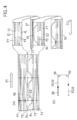
- FIG. 3A is a schematic plan view showing a part of the first half of the method of manufacturing a worn article from a perspective
- FIGS. 3B and 3C are schematic side views showing a welding process and an bonding process, respectively.
- FIG. 4A is a schematic plan view showing the middle stage of the manufacturing method of the worn article with a partial perspective
- FIG. 4B is a side view showing a turn roller that turns the transport direction.
- FIG. 5 is a schematic plan view showing a part of the latter stage of the manufacturing method of the worn article from a perspective view.
- the width D11 of the wide first split web W11 is smaller than the width D2 of the second continuous web W2, and the first split web W11 has first and second side edges along the transport direction. It has parts E1 and E2 Further provided is a folding step of bending each pair of third side edge portions E3 along the transport direction of the second continuous web W2 to wrap the first and second side edge portions E1 and E2 of the laminated sheet S.
- the side edges of the web are often bent at the upper end of each waistline.
- the width of the first continuous web W1 before the division becomes significantly large, and the equipment becomes bulky. Become.
- the second continuous web W2 is laminated on the first surface 31 of the first divided web W11.
- each of the third side edge portions E3 of the second continuous web W2 is bent so as to overlap the second surface 32 of the first divided web W11.
- the second split web W12 is bonded to the second surface 32 of the first split web W11.
- both the third side edge portion E3 of the second continuous web W2 and the edge of the second split web W12 appear on the second surface 32 of the first split web W11. Therefore, by setting the second surface 32 to the skin surface side, the appearance (texture) of the non-skin surface of the worn article is improved.
- the waistline elastic member FT is arranged on the first and second side edge portions E1 and E2 along the transport direction of the laminated sheet S.
- the leg elastic member FL is arranged in the central region between the first side edge portion E1 and the second side edge portion E2 of the laminated sheet S.
- the stretchable continuous sheet S0 is slit along a virtual second cutting line C2 along the transport direction to form a part of the leg elastic member FL, a part of the waist elastic member FT, and the first side edge.
- a second slit step for generating the two-divided sheet S2 is further provided.
- both the front waist circumference portion T1 and the rear waist circumference portion T2 can be generated from the two first and second continuous webs.
- an absorbent main body C that connects the front waist circumference portion T1 and the rear waist circumference portion T2 and serves as a crotch portion is intermittently erected between the first divided sheet S1 and the second divided sheet S2. Further erection process is provided.
- the leg elastic member FL is periodically arranged in a wavy shape.
- Another waistline elastic member F2 extending linearly along the transport direction is further sandwiched between the laminated sheet S and the narrow second divided web W12, and is joined by the adhesive to form the stretchable continuous sheet S0.
- Another waistline elastic member F2 extending linearly along the transport direction is further sandwiched between the laminated sheet S and the narrow second divided web W12, and is joined by the adhesive to form the stretchable continuous sheet S0.
- the first and second continuous webs W1 and W2 are formed of a thermoplastic resin.
- the welding step is performed by ultrasonic welding or heat sealing.
- each web may be a thermoplastic non-woven fabric in which a large number of thermoplastic fibers are laminated.
- the worn article 1 of this embodiment has a symmetrical shape and structure, and includes an absorbent main body C and front and rear waist circumferences T1 and T2.
- the front waist circumference portion T1 covers the front body of the wearer and extends in the waist circumference direction X.
- the rear waist circumference portion T2 covers the rear waist of the wearer and extends in the waist circumference direction X.
- the absorbent main body C is erected on both waist circumferences T1 and T2, and has a crotch portion 22 that covers the wearer's crotch.
- the absorbent body C extends in the vertical direction Y orthogonal to the waist circumference direction X.
- the absorbent body C constitutes part or all of the crotch 22.
- the worn article may be a pants-type worn article in which the ends of the front and rear waistline portions T1 and T2 in the waistline direction X are joined (sealed) so as to overlap each other.
- the absorbent body C is provided with an absorbent core (not shown). This absorption core absorbs body fluids.
- the absorption core is sandwiched between the top sheet and the back sheet. Each sheet and absorption core are laminated to each other.
- the top sheet consists of a thin, permeable non-woven fabric that covers the skin surface of the absorbent core.
- a cuff (not shown) may be provided on the top sheet.
- the back sheet covers the non-skin surface of the absorbent core and consists of a liquid-impermeable resin sheet.
- Each end portion of the absorbent body C in the vertical direction Y is attached to each waist circumference portion T1 and T2.
- the waist circumference portions T1 and T2 project from the absorbent main body C in the waist circumference direction X.
- the waist circumference portions T1 and T2 are provided with waist circumference and leg circumference elastic members FT, F2, and FL for fitting the worn article 1 to the wearer.
- the elastic member may be linear or cord-shaped.
- the elastic member may be a multi-strand in which a plurality of rubber threads (fibrous elastic bodies) are assembled in a bundle. Examples of the material of the rubber thread include polyurethane.
- the first waistline elastic member FT and the second (other) waistline elastic member F2 may be linear and extend in the waistline direction X in parallel with each other.
- the elastic members FT and F2 arranged in a straight line and in parallel may be invalidated (there is no contraction force) at the portion overlapping with the absorbent body C.
- the plurality of leg elastic members FL are arranged in a wavy shape parallel to each other and along the outline 10E at the lower ends of the waist circumference portions T1 and T2.
- the outline 10E at the lower end becomes the lower end when worn.
- the waist circumference portions T1 and T2 are formed of the telescopic sheet 10.
- the absorbent body C of FIG. 1A may be formed with a constricted portion (not shown) constricted along the wearer's crotch.
- the crotch portion 22 may be provided with another leg circumference elastic member made of, for example, thread rubber, along the leg circumference of the wearer.
- the absorbent main body C is attached to the skin surface of the waist circumferences T1 and T2.
- the "skin surface” refers to the surface facing the wearer's skin when the worn article 1 is worn
- the “non-skin surface” refers to the surface opposite to the skin surface.
- the stretchable sheet 10 of the worn article has a skin surface in contact with the wearer's skin and a non-skin surface on the opposite side.
- the telescopic sheet 10 has webs 11 and 12 for the first and second waist circumferences, webs 13 for the leg circumferences, and elastic members FT, F2, and FL laminated.
- the first waist circumference elastic member FT is welded and fixed between the first waist circumference web 11 and the second waist circumference web 12.
- the second waist circumference elastic member F2 and the leg circumference elastic member FL are adhered and fixed between the first waist circumference web 11 and the leg circumference web 13.
- a plurality of first waist elastic members FT are arranged between a pair of webs 11 and 12, and are arranged apart from each other as shown by a broken line in FIG. 1 (c).
- the elastic sheet 10 Due to the contraction force of each elastic member, the elastic sheet 10 forms a large number of folds in a state where each elastic member is contracted, and fits the wearer's skin.
- the first waist circumference elastic member FT of FIG. 1B is arranged between the non-skin surface, which is the first surface 31 of the first waist circumference web 11, and the second waist circumference web 12.
- the portion serving as the upper edge of the second waist circumference web 12 is folded back and adhered to the skin surface which is the second surface 32 of the first waist circumference web 11.
- the second waist elastic member 32 and the leg elastic member FL of FIG. 1 (b) are arranged between the pair of webs 11 and 13, and are separated from each other as shown by the broken line of FIG. 1 (c). ing.
- the second waist circumference elastic member 32 and the leg circumference elastic member FL are arranged between the skin surface, which is the second surface 32 of the first waist circumference web 11 of FIG. 1 (b), and the leg circumference web 13.
- the three webs 11 to 13 are laminated, so that the folded edge 12E of the second waistline web 12 and the upper edge 13E of the leg circumference web 13 do not appear on the non-skin surface of the worn article. , Looks good.
- the absorbent main body C in FIG. 1A is erected between the front waist circumference portion T1 and the rear waist circumference portion T2 so as to cover a part of the upper edge 13E of the leg circumference web 13. Therefore, the upper edge 13E of the leg circumference web 13 does not come into contact with the front and rear torso of the wearer, so that the skin feels good (feeling of wearing).
- FIGS. 3 to 5 the unit is indicated by a chain double-dashed line so that the unit of each worn article can be seen in the width direction orthogonal to the transport direction of the semi-finished product.
- the first and second continuous webs W1 and W2 are continuously transported in a predetermined transport direction (girth direction) X1.
- the first continuous web W1 is slit along a virtual first cutting line C1 extending in the transport direction X1 to divide the first continuous web W1 into a wide first split web W11 and a narrow second split web W12.
- One slit process is performed.
- the width D11 of the first split web W11 is larger than the width D12 of the second split web W12.
- the width D2 of the second continuous web W2 is larger than the width D11 of the first divided web W11.
- the first split web W11 in an extended state extending in the waist circumference direction X (conveyance direction X1) is sandwiched between the wide first split web W11 and the second continuous web W2, and the first split web W11 and the first split web W11 A welding step is executed in which the second continuous web W2 and the first waistline elastic member FT are intermittently welded in the transport direction X1 to form the laminated sheet S.
- both webs W11 and W2 and the first waistline elastic member FT are introduced between the ultrasonic horn 50 and the anvil roll 51.
- the horn 50 cooperates with the anvil roll 51 to ultrasonically weld a pair of webs W11 and W2 to each other, and weld a waist elastic member FT to the pair of webs to hold the waist elastic member FT by the pair of webs.
- the welding step may be performed by heat sealing instead of ultrasonic welding.
- the width D11 of the wide first split web W11 in FIG. 3A is smaller than the width D2 of the second continuous web W2, and the first split web W11 has first and second side edges along the transport direction X1. It has E1 and E2.
- a folding step of bending each pair of third side edge portions E3 along the transport direction X1 of the second continuous web W2 to wrap the first and second side edge portions E1 and E2 of the first divided web W11 is executed. To do.
- a plurality of second waist elastic members F2 and leg elastic members FL which are different from the first waist elastic member FT, are sandwiched and adhered between the laminated sheet S and the narrow second split web W12 in an extended state.
- An adhesive step of joining with an agent to produce an elastic continuous sheet S0 is performed.
- a plurality of second waistline elastic members F2 extend linearly along the transport direction X1 and parallel to each other.
- the leg elastic member FL extends along a predetermined waveform while meandering in the transport direction X1, and is arranged in a periodic, wavy shape as described later.
- the laminated sheet S and the second split web W12 are coated with an adhesive from the coating machine 52, and then the leg elastic member FL is applied to the laminated sheet. It is introduced between the pair of nip rolls 53, 53 in a state of being arranged between the S and the second split web W12.
- the introduction machine 54 guides the leg-rotating elastic member FL while repeatedly reciprocating in the axial direction of the nip rolls 53 and 53, and the leg-rotating elastic member FL extends while meandering in a predetermined wave shape as shown in FIG. 3A. Arranged like this.
- the first waist circumference elastic member FT is arranged at the first and second side edge portions E1 and E2 along the transport direction X1 of the laminated sheet S.
- the second waistline elastic member F2 and the leg circumference elastic member FL are located in the central region between the first side edge portion E1 and the second side edge portion E2 of the laminated sheet S. Is placed.
- the stretchable continuous sheet S0 of FIG. 4A is slit along the virtual second cutting line C2 along the transport direction X1 to generate the first and second divided sheets S1 and S2.
- the first divided sheet S1 is a front waist circumference portion T1 (FIG. 1 (c)) including a part of the leg circumference elastic member FL, a part of the waist circumference elastic members FT and F2, and the first side edge portion E1.
- the second split sheet S2 is a rear waist circumference portion T2 (FIG. 1 (c)) including the rest of the leg circumference elastic member FL, the rest of the waist circumference elastic members FT and F2, and the second side edge portion E2.
- the first elastic member FT and the second elastic member F2 of the stretchable continuous sheet S0 obtained by the welding and bonding steps described above have a region in which the absorbent body C (FIG. 5) is arranged. It may be invalidated by being disconnected or the like.
- the second continuous web W2 is laminated on the first surface 31 of the first divided web W11. Further, as shown in FIG. 2F, in the above-mentioned folding step, each third side edge portion E3 of the second continuous web W2 is bent so as to overlap the second surface 32 of the first divided web W11. On the other hand, as shown in FIG. 2 (g), in the above-mentioned bonding step, the second split web W12 is bonded to the second surface 32 of the first split web W11.
- a widening step of transporting the first and second split sheets S1 and S2 is executed so that the pair of split sheets S1 and S2 are separated from each other. As a result, the two divided sheets S1 and S2 are separated from each other.
- the two split sheets S1 and S2 may be turned by the turning roller 55 and conveyed upside down as shown in FIG. 4A, for example.
- the absorbent main body C to be the crotch portion 22 is intermittently erected between the first divided sheet S1 and the second divided sheet S2.
- the leg elastic member FL is periodically arranged in a wavy shape as described below.
- the leg elastic member FL arranged on the first divided sheet S1 and the leg elastic member FL arranged on the second divided sheet S2 of FIG. 4A.
- the leg elastic member FL and the second divided sheet S2 arranged on the first divided sheet S1 are arranged in a wavy shape so as to be separated from each other.
- the edge (outline 10E at the lower end) at the lower end when worn is trimmed to a shape along the curvature of the leg elastic member FL and is continuous.
- the laminated body S3 is generated. It should be noted that this trimming does not necessarily have to be performed.
- the laminated sheet S of FIG. 3A may be divided into two along a wavy cutting line, and the leg elastic member FL may be arranged along the corrugated shape. Further, the timing of trimming may be performed at any time as long as the expansion / contraction continuous sheet S0 is generated.
- the continuous laminate S3 is folded in two in the absorbent body C. After this folding step, the continuous laminated body S3 is cut at the virtual third cutting line C3 indicated by the alternate long and short dash line, and the first divided sheet S1 and the second divided sheet S2 are cut in the vicinity of the third cut line C3. And are welded together to form a so-called seal.
- this example is an example of a pants-type worn item, it may be a diaper-type worn item provided with a fastener or tape on the worn item of FIG. 1 (a).
- this worn item does not have to have a cuff or the like.
- the tension of the elastic member may be invalidated at a portion other than the portion that wraps with the absorbent main body in the waist circumference portion.
- the waist circumference portion does not have to be formed by being slit in two. Therefore, such changes and amendments are construed as being within the scope of the invention as defined by the claims.
- the present invention can be applied to various worn items such as pants type and diaper type.
Landscapes
- Health & Medical Sciences (AREA)
- Engineering & Computer Science (AREA)
- Life Sciences & Earth Sciences (AREA)
- Vascular Medicine (AREA)
- Biomedical Technology (AREA)
- Heart & Thoracic Surgery (AREA)
- Epidemiology (AREA)
- Manufacturing & Machinery (AREA)
- Animal Behavior & Ethology (AREA)
- General Health & Medical Sciences (AREA)
- Public Health (AREA)
- Veterinary Medicine (AREA)
- Mechanical Engineering (AREA)
- Botany (AREA)
- Absorbent Articles And Supports Therefor (AREA)
Priority Applications (4)
| Application Number | Priority Date | Filing Date | Title |
|---|---|---|---|
| US17/613,167 US11648154B2 (en) | 2019-05-31 | 2020-05-15 | Method for manufacturing worn article |
| CN202080035061.5A CN113811273B (zh) | 2019-05-31 | 2020-05-15 | 穿着物品的制造方法 |
| JP2021522215A JP7277578B2 (ja) | 2019-05-31 | 2020-05-15 | 着用物品の製造方法 |
| EP20815400.5A EP3977970B1 (en) | 2019-05-31 | 2020-05-15 | Production method for wearable article |
Applications Claiming Priority (2)
| Application Number | Priority Date | Filing Date | Title |
|---|---|---|---|
| JP2019-102313 | 2019-05-31 | ||
| JP2019102313 | 2019-05-31 |
Publications (1)
| Publication Number | Publication Date |
|---|---|
| WO2020241300A1 true WO2020241300A1 (ja) | 2020-12-03 |
Family
ID=73552887
Family Applications (1)
| Application Number | Title | Priority Date | Filing Date |
|---|---|---|---|
| PCT/JP2020/019396 Ceased WO2020241300A1 (ja) | 2019-05-31 | 2020-05-15 | 着用物品の製造方法 |
Country Status (5)
| Country | Link |
|---|---|
| US (1) | US11648154B2 (https=) |
| EP (1) | EP3977970B1 (https=) |
| JP (1) | JP7277578B2 (https=) |
| CN (1) | CN113811273B (https=) |
| WO (1) | WO2020241300A1 (https=) |
Families Citing this family (2)
| Publication number | Priority date | Publication date | Assignee | Title |
|---|---|---|---|---|
| CN114983679B (zh) * | 2022-05-23 | 2023-07-07 | 瑞光(上海)电气设备有限公司 | 一次性尿裤的制造方法及制造装置 |
| EP4477198A1 (en) * | 2023-06-13 | 2024-12-18 | Curt G. Joa, Inc. | An apparatus and method of forming torso encircling portions for pant-style diaper products |
Citations (4)
| Publication number | Priority date | Publication date | Assignee | Title |
|---|---|---|---|---|
| JP2005065971A (ja) * | 2003-08-22 | 2005-03-17 | Livedo Corporation | 使い捨てパンツ型オムツの製造方法 |
| JP2014064627A (ja) * | 2012-09-25 | 2014-04-17 | Kao Corp | 吸収性物品の製造方法 |
| JP2015198915A (ja) * | 2014-03-31 | 2015-11-12 | 大王製紙株式会社 | 吸収性物品の伸縮構造の製造方法、パンツタイプ使い捨ておむつの製造方法及びパンツタイプ使い捨ておむつ |
| JP2018530376A (ja) * | 2015-09-09 | 2018-10-18 | エスセーアー・ハイジーン・プロダクツ・アーベー | 裾口を伴う使い捨てパンツ式吸収性物品 |
Family Cites Families (12)
| Publication number | Priority date | Publication date | Assignee | Title |
|---|---|---|---|---|
| JP2757932B2 (ja) * | 1993-05-26 | 1998-05-25 | 株式会社日本吸収体技術研究所 | テープレス形吸収体製品およびその製造方法 |
| JP3916878B2 (ja) * | 2001-04-12 | 2007-05-23 | ユニ・チャーム株式会社 | 使い捨てのパンツ型おむつ |
| US6979380B2 (en) * | 2002-10-01 | 2005-12-27 | Kimberly-Clark Worldwide, Inc. | Three-piece disposable undergarment and method for the manufacture thereof |
| US7754044B2 (en) * | 2003-08-06 | 2010-07-13 | Zuiko Corporation | Method for manufacturing disposable wearing article |
| CN101087575B (zh) * | 2004-12-24 | 2010-09-15 | 株式会社瑞光 | 一次性穿着物品的制造方法 |
| US7820004B2 (en) * | 2005-12-16 | 2010-10-26 | Zuiko Corporation | Method for producing worn article |
| MX2008014154A (es) * | 2006-05-12 | 2008-11-18 | Sca Hygiene Prod Ab | Articulo absorbente del tipo de calzoncillos y un metodo para producir articulos absorbentes de tipo de calzoncillos. |
| US8622983B2 (en) * | 2009-12-31 | 2014-01-07 | Kimberly-Clark Worldwide, Inc. | Method of incorporating leg elastics in a pant-like disposable absorbent garment, and garment made thereby |
| US9039855B2 (en) * | 2012-03-30 | 2015-05-26 | The Procter & Gamble Company | Apparatuses and methods for making absorbent articles |
| JP5616952B2 (ja) * | 2012-12-20 | 2014-10-29 | 花王株式会社 | パンツ型吸収性物品の製造方法 |
| EP3296100B1 (en) | 2015-06-22 | 2020-01-08 | Zuiko Corporation | Composite stretchable member, wearable article, and method for producing wearable article |
| CN110545770B (zh) * | 2017-02-22 | 2022-05-13 | Dsg科技控股有限公司 | 带有含弹性体分布的底盘的制品、吸收芯及其制造系统和方法 |
-
2020
- 2020-05-15 JP JP2021522215A patent/JP7277578B2/ja active Active
- 2020-05-15 CN CN202080035061.5A patent/CN113811273B/zh active Active
- 2020-05-15 US US17/613,167 patent/US11648154B2/en active Active
- 2020-05-15 EP EP20815400.5A patent/EP3977970B1/en active Active
- 2020-05-15 WO PCT/JP2020/019396 patent/WO2020241300A1/ja not_active Ceased
Patent Citations (4)
| Publication number | Priority date | Publication date | Assignee | Title |
|---|---|---|---|---|
| JP2005065971A (ja) * | 2003-08-22 | 2005-03-17 | Livedo Corporation | 使い捨てパンツ型オムツの製造方法 |
| JP2014064627A (ja) * | 2012-09-25 | 2014-04-17 | Kao Corp | 吸収性物品の製造方法 |
| JP2015198915A (ja) * | 2014-03-31 | 2015-11-12 | 大王製紙株式会社 | 吸収性物品の伸縮構造の製造方法、パンツタイプ使い捨ておむつの製造方法及びパンツタイプ使い捨ておむつ |
| JP2018530376A (ja) * | 2015-09-09 | 2018-10-18 | エスセーアー・ハイジーン・プロダクツ・アーベー | 裾口を伴う使い捨てパンツ式吸収性物品 |
Also Published As
| Publication number | Publication date |
|---|---|
| US20220202625A1 (en) | 2022-06-30 |
| JP7277578B2 (ja) | 2023-05-19 |
| JPWO2020241300A1 (https=) | 2020-12-03 |
| CN113811273B (zh) | 2022-04-15 |
| US11648154B2 (en) | 2023-05-16 |
| EP3977970A1 (en) | 2022-04-06 |
| EP3977970B1 (en) | 2023-10-11 |
| EP3977970C0 (en) | 2023-10-11 |
| CN113811273A (zh) | 2021-12-17 |
| EP3977970A4 (en) | 2022-08-24 |
Similar Documents
| Publication | Publication Date | Title |
|---|---|---|
| CN110366400B (zh) | 吸收性物品的制造方法、制造装置及吸收性物品 | |
| RU2654995C2 (ru) | Устройство и способ выполнения боковых швов на абсорбирующих изделиях | |
| JP7602321B2 (ja) | 着用物品の製造装置および製造方法 | |
| WO2018154685A1 (ja) | 吸収性物品の製造方法、製造装置、及び吸収性物品 | |
| CN104470710B (zh) | 设有复合伸缩部件的穿戴物品及其生产方法 | |
| JP7090028B2 (ja) | 使い捨て着用物品および製造方法 | |
| WO2013080852A1 (ja) | 使い捨て着用物品およびその製造方法 | |
| WO2020241300A1 (ja) | 着用物品の製造方法 | |
| JP6019172B1 (ja) | 吸収性物品の製造方法、及び製造装置 | |
| JP2009273922A (ja) | 使い捨て着用物品の製造方法 | |
| JP6618192B2 (ja) | 使い捨て着用物品の製造方法 | |
| JP6393503B2 (ja) | パンツ型吸収性物品 | |
| CN114948438B (zh) | 横向可延展的连续弹性层压体及其生产方法 | |
| JP7401691B2 (ja) | 着用物品の製造方法 | |
| WO2015056711A1 (ja) | 使い捨ておむつの製造方法および使い捨ておむつ | |
| JP5830570B2 (ja) | 吸収性物品に係る複合シートの製造方法、及び製造装置 | |
| CN115697267B (zh) | 穿着物品中的翻边的制造方法 | |
| JP7225497B2 (ja) | パンツ型吸収性物品の製造方法 | |
| WO2022259570A1 (ja) | 吸収性物品の製造方法 | |
| WO2025028578A1 (ja) | 着用物品の製造方法及び着用物品の製造装置 | |
| CN115105300A (zh) | 一种横向可伸展的连续弹性层压件和用于生产该层压件的方法 | |
| JP2016220948A (ja) | 吸収性物品の製造方法、及び製造装置 | |
| JP2016220949A (ja) | 吸収性物品の製造方法、吸収性物品の製造装置、及び吸収性物品 |
Legal Events
| Date | Code | Title | Description |
|---|---|---|---|
| 121 | Ep: the epo has been informed by wipo that ep was designated in this application |
Ref document number: 20815400 Country of ref document: EP Kind code of ref document: A1 |
|
| ENP | Entry into the national phase |
Ref document number: 2021522215 Country of ref document: JP Kind code of ref document: A |
|
| NENP | Non-entry into the national phase |
Ref country code: DE |
|
| ENP | Entry into the national phase |
Ref document number: 2020815400 Country of ref document: EP Effective date: 20220103 |