WO2020195119A1 - プラスチックレンズ成型用粘着テープおよびプラスチックレンズの成型方法 - Google Patents
プラスチックレンズ成型用粘着テープおよびプラスチックレンズの成型方法 Download PDFInfo
- Publication number
- WO2020195119A1 WO2020195119A1 PCT/JP2020/003009 JP2020003009W WO2020195119A1 WO 2020195119 A1 WO2020195119 A1 WO 2020195119A1 JP 2020003009 W JP2020003009 W JP 2020003009W WO 2020195119 A1 WO2020195119 A1 WO 2020195119A1
- Authority
- WO
- WIPO (PCT)
- Prior art keywords
- plastic lens
- adhesive tape
- mass
- base material
- molding
- Prior art date
- Legal status (The legal status is an assumption and is not a legal conclusion. Google has not performed a legal analysis and makes no representation as to the accuracy of the status listed.)
- Ceased
Links
Images

Classifications
-
- C—CHEMISTRY; METALLURGY
- C08—ORGANIC MACROMOLECULAR COMPOUNDS; THEIR PREPARATION OR CHEMICAL WORKING-UP; COMPOSITIONS BASED THEREON
- C08G—MACROMOLECULAR COMPOUNDS OBTAINED OTHERWISE THAN BY REACTIONS ONLY INVOLVING UNSATURATED CARBON-TO-CARBON BONDS
- C08G18/00—Polymeric products of isocyanates or isothiocyanates
- C08G18/06—Polymeric products of isocyanates or isothiocyanates with compounds having active hydrogen
- C08G18/70—Polymeric products of isocyanates or isothiocyanates with compounds having active hydrogen characterised by the isocyanates or isothiocyanates used
- C08G18/72—Polyisocyanates or polyisothiocyanates
- C08G18/80—Masked polyisocyanates
- C08G18/8003—Masked polyisocyanates masked with compounds having at least two groups containing active hydrogen
- C08G18/8006—Masked polyisocyanates masked with compounds having at least two groups containing active hydrogen with compounds of C08G18/32
- C08G18/8009—Masked polyisocyanates masked with compounds having at least two groups containing active hydrogen with compounds of C08G18/32 with compounds of C08G18/3203
- C08G18/8022—Masked polyisocyanates masked with compounds having at least two groups containing active hydrogen with compounds of C08G18/32 with compounds of C08G18/3203 with polyols having at least three hydroxy groups
-
- C—CHEMISTRY; METALLURGY
- C09—DYES; PAINTS; POLISHES; NATURAL RESINS; ADHESIVES; COMPOSITIONS NOT OTHERWISE PROVIDED FOR; APPLICATIONS OF MATERIALS NOT OTHERWISE PROVIDED FOR
- C09J—ADHESIVES; NON-MECHANICAL ASPECTS OF ADHESIVE PROCESSES IN GENERAL; ADHESIVE PROCESSES NOT PROVIDED FOR ELSEWHERE; USE OF MATERIALS AS ADHESIVES
- C09J7/00—Adhesives in the form of films or foils
- C09J7/30—Adhesives in the form of films or foils characterised by the adhesive composition
- C09J7/38—Pressure-sensitive adhesives [PSA]
-
- B—PERFORMING OPERATIONS; TRANSPORTING
- B29—WORKING OF PLASTICS; WORKING OF SUBSTANCES IN A PLASTIC STATE IN GENERAL
- B29C—SHAPING OR JOINING OF PLASTICS; SHAPING OF MATERIAL IN A PLASTIC STATE, NOT OTHERWISE PROVIDED FOR; AFTER-TREATMENT OF THE SHAPED PRODUCTS, e.g. REPAIRING
- B29C39/00—Shaping by casting, i.e. introducing the moulding material into a mould or between confining surfaces without significant moulding pressure; Apparatus therefor
- B29C39/02—Shaping by casting, i.e. introducing the moulding material into a mould or between confining surfaces without significant moulding pressure; Apparatus therefor for making articles of definite length, i.e. discrete articles
-
- B—PERFORMING OPERATIONS; TRANSPORTING
- B29—WORKING OF PLASTICS; WORKING OF SUBSTANCES IN A PLASTIC STATE IN GENERAL
- B29C—SHAPING OR JOINING OF PLASTICS; SHAPING OF MATERIAL IN A PLASTIC STATE, NOT OTHERWISE PROVIDED FOR; AFTER-TREATMENT OF THE SHAPED PRODUCTS, e.g. REPAIRING
- B29C39/00—Shaping by casting, i.e. introducing the moulding material into a mould or between confining surfaces without significant moulding pressure; Apparatus therefor
- B29C39/22—Component parts, details or accessories; Auxiliary operations
- B29C39/26—Moulds or cores
- B29C39/32—Moulds or cores with joints or the like for making the mould impervious
-
- B—PERFORMING OPERATIONS; TRANSPORTING
- B29—WORKING OF PLASTICS; WORKING OF SUBSTANCES IN A PLASTIC STATE IN GENERAL
- B29D—PRODUCING PARTICULAR ARTICLES FROM PLASTICS OR FROM SUBSTANCES IN A PLASTIC STATE
- B29D11/00—Producing optical elements, e.g. lenses or prisms
- B29D11/00009—Production of simple or compound lenses
-
- B—PERFORMING OPERATIONS; TRANSPORTING
- B29—WORKING OF PLASTICS; WORKING OF SUBSTANCES IN A PLASTIC STATE IN GENERAL
- B29D—PRODUCING PARTICULAR ARTICLES FROM PLASTICS OR FROM SUBSTANCES IN A PLASTIC STATE
- B29D11/00—Producing optical elements, e.g. lenses or prisms
- B29D11/00009—Production of simple or compound lenses
- B29D11/00413—Production of simple or compound lenses made by moulding between two mould parts which are not in direct contact with one another, e.g. comprising a seal between or on the edges
-
- B—PERFORMING OPERATIONS; TRANSPORTING
- B29—WORKING OF PLASTICS; WORKING OF SUBSTANCES IN A PLASTIC STATE IN GENERAL
- B29D—PRODUCING PARTICULAR ARTICLES FROM PLASTICS OR FROM SUBSTANCES IN A PLASTIC STATE
- B29D11/00—Producing optical elements, e.g. lenses or prisms
- B29D11/00009—Production of simple or compound lenses
- B29D11/00432—Auxiliary operations, e.g. machines for filling the moulds
-
- B—PERFORMING OPERATIONS; TRANSPORTING
- B29—WORKING OF PLASTICS; WORKING OF SUBSTANCES IN A PLASTIC STATE IN GENERAL
- B29D—PRODUCING PARTICULAR ARTICLES FROM PLASTICS OR FROM SUBSTANCES IN A PLASTIC STATE
- B29D11/00—Producing optical elements, e.g. lenses or prisms
- B29D11/00009—Production of simple or compound lenses
- B29D11/0048—Moulds for lenses
-
- B—PERFORMING OPERATIONS; TRANSPORTING
- B29—WORKING OF PLASTICS; WORKING OF SUBSTANCES IN A PLASTIC STATE IN GENERAL
- B29D—PRODUCING PARTICULAR ARTICLES FROM PLASTICS OR FROM SUBSTANCES IN A PLASTIC STATE
- B29D11/00—Producing optical elements, e.g. lenses or prisms
- B29D11/00009—Production of simple or compound lenses
- B29D11/0048—Moulds for lenses
- B29D11/00528—Consisting of two mould halves joined by an annular gasket
-
- B—PERFORMING OPERATIONS; TRANSPORTING
- B32—LAYERED PRODUCTS
- B32B—LAYERED PRODUCTS, i.e. PRODUCTS BUILT-UP OF STRATA OF FLAT OR NON-FLAT, e.g. CELLULAR OR HONEYCOMB, FORM
- B32B27/00—Layered products comprising a layer of synthetic resin
-
- B—PERFORMING OPERATIONS; TRANSPORTING
- B32—LAYERED PRODUCTS
- B32B—LAYERED PRODUCTS, i.e. PRODUCTS BUILT-UP OF STRATA OF FLAT OR NON-FLAT, e.g. CELLULAR OR HONEYCOMB, FORM
- B32B27/00—Layered products comprising a layer of synthetic resin
- B32B27/30—Layered products comprising a layer of synthetic resin comprising vinyl (co)polymers; comprising acrylic (co)polymers
-
- B—PERFORMING OPERATIONS; TRANSPORTING
- B32—LAYERED PRODUCTS
- B32B—LAYERED PRODUCTS, i.e. PRODUCTS BUILT-UP OF STRATA OF FLAT OR NON-FLAT, e.g. CELLULAR OR HONEYCOMB, FORM
- B32B7/00—Layered products characterised by the relation between layers; Layered products characterised by the relative orientation of features between layers, or by the relative values of a measurable parameter between layers, i.e. products comprising layers having different physical, chemical or physicochemical properties; Layered products characterised by the interconnection of layers
- B32B7/02—Physical, chemical or physicochemical properties
- B32B7/023—Optical properties
-
- B—PERFORMING OPERATIONS; TRANSPORTING
- B32—LAYERED PRODUCTS
- B32B—LAYERED PRODUCTS, i.e. PRODUCTS BUILT-UP OF STRATA OF FLAT OR NON-FLAT, e.g. CELLULAR OR HONEYCOMB, FORM
- B32B9/00—Layered products comprising a layer of a particular substance not covered by groups B32B11/00 - B32B29/00
-
- C—CHEMISTRY; METALLURGY
- C08—ORGANIC MACROMOLECULAR COMPOUNDS; THEIR PREPARATION OR CHEMICAL WORKING-UP; COMPOSITIONS BASED THEREON
- C08G—MACROMOLECULAR COMPOUNDS OBTAINED OTHERWISE THAN BY REACTIONS ONLY INVOLVING UNSATURATED CARBON-TO-CARBON BONDS
- C08G18/00—Polymeric products of isocyanates or isothiocyanates
- C08G18/06—Polymeric products of isocyanates or isothiocyanates with compounds having active hydrogen
- C08G18/08—Processes
- C08G18/16—Catalysts
- C08G18/22—Catalysts containing metal compounds
- C08G18/24—Catalysts containing metal compounds of tin
-
- C—CHEMISTRY; METALLURGY
- C08—ORGANIC MACROMOLECULAR COMPOUNDS; THEIR PREPARATION OR CHEMICAL WORKING-UP; COMPOSITIONS BASED THEREON
- C08G—MACROMOLECULAR COMPOUNDS OBTAINED OTHERWISE THAN BY REACTIONS ONLY INVOLVING UNSATURATED CARBON-TO-CARBON BONDS
- C08G18/00—Polymeric products of isocyanates or isothiocyanates
- C08G18/06—Polymeric products of isocyanates or isothiocyanates with compounds having active hydrogen
- C08G18/28—Polymeric products of isocyanates or isothiocyanates with compounds having active hydrogen characterised by the compounds used containing active hydrogen
- C08G18/30—Low-molecular-weight compounds
- C08G18/38—Low-molecular-weight compounds having heteroatoms other than oxygen
- C08G18/3855—Low-molecular-weight compounds having heteroatoms other than oxygen having sulfur
- C08G18/3876—Low-molecular-weight compounds having heteroatoms other than oxygen having sulfur containing mercapto groups
-
- C—CHEMISTRY; METALLURGY
- C08—ORGANIC MACROMOLECULAR COMPOUNDS; THEIR PREPARATION OR CHEMICAL WORKING-UP; COMPOSITIONS BASED THEREON
- C08G—MACROMOLECULAR COMPOUNDS OBTAINED OTHERWISE THAN BY REACTIONS ONLY INVOLVING UNSATURATED CARBON-TO-CARBON BONDS
- C08G18/00—Polymeric products of isocyanates or isothiocyanates
- C08G18/06—Polymeric products of isocyanates or isothiocyanates with compounds having active hydrogen
- C08G18/28—Polymeric products of isocyanates or isothiocyanates with compounds having active hydrogen characterised by the compounds used containing active hydrogen
- C08G18/40—High-molecular-weight compounds
- C08G18/62—Polymers of compounds having carbon-to-carbon double bonds
- C08G18/6216—Polymers of alpha-beta ethylenically unsaturated carboxylic acids or of derivatives thereof
- C08G18/622—Polymers of esters of alpha-beta ethylenically unsaturated carboxylic acids
- C08G18/6225—Polymers of esters of acrylic or methacrylic acid
-
- C—CHEMISTRY; METALLURGY
- C08—ORGANIC MACROMOLECULAR COMPOUNDS; THEIR PREPARATION OR CHEMICAL WORKING-UP; COMPOSITIONS BASED THEREON
- C08G—MACROMOLECULAR COMPOUNDS OBTAINED OTHERWISE THAN BY REACTIONS ONLY INVOLVING UNSATURATED CARBON-TO-CARBON BONDS
- C08G18/00—Polymeric products of isocyanates or isothiocyanates
- C08G18/06—Polymeric products of isocyanates or isothiocyanates with compounds having active hydrogen
- C08G18/28—Polymeric products of isocyanates or isothiocyanates with compounds having active hydrogen characterised by the compounds used containing active hydrogen
- C08G18/40—High-molecular-weight compounds
- C08G18/62—Polymers of compounds having carbon-to-carbon double bonds
- C08G18/6216—Polymers of alpha-beta ethylenically unsaturated carboxylic acids or of derivatives thereof
- C08G18/622—Polymers of esters of alpha-beta ethylenically unsaturated carboxylic acids
- C08G18/6225—Polymers of esters of acrylic or methacrylic acid
- C08G18/6229—Polymers of hydroxy groups containing esters of acrylic or methacrylic acid with aliphatic polyalcohols
-
- C—CHEMISTRY; METALLURGY
- C08—ORGANIC MACROMOLECULAR COMPOUNDS; THEIR PREPARATION OR CHEMICAL WORKING-UP; COMPOSITIONS BASED THEREON
- C08G—MACROMOLECULAR COMPOUNDS OBTAINED OTHERWISE THAN BY REACTIONS ONLY INVOLVING UNSATURATED CARBON-TO-CARBON BONDS
- C08G18/00—Polymeric products of isocyanates or isothiocyanates
- C08G18/06—Polymeric products of isocyanates or isothiocyanates with compounds having active hydrogen
- C08G18/70—Polymeric products of isocyanates or isothiocyanates with compounds having active hydrogen characterised by the isocyanates or isothiocyanates used
- C08G18/72—Polyisocyanates or polyisothiocyanates
- C08G18/74—Polyisocyanates or polyisothiocyanates cyclic
- C08G18/76—Polyisocyanates or polyisothiocyanates cyclic aromatic
- C08G18/7614—Polyisocyanates or polyisothiocyanates cyclic aromatic containing only one aromatic ring
- C08G18/7628—Polyisocyanates or polyisothiocyanates cyclic aromatic containing only one aromatic ring containing at least one isocyanate or isothiocyanate group linked to the aromatic ring by means of an aliphatic group
- C08G18/7642—Polyisocyanates or polyisothiocyanates cyclic aromatic containing only one aromatic ring containing at least one isocyanate or isothiocyanate group linked to the aromatic ring by means of an aliphatic group containing at least two isocyanate or isothiocyanate groups linked to the aromatic ring by means of an aliphatic group having a primary carbon atom next to the isocyanate or isothiocyanate groups, e.g. xylylene diisocyanate or homologues substituted on the aromatic ring
-
- C—CHEMISTRY; METALLURGY
- C08—ORGANIC MACROMOLECULAR COMPOUNDS; THEIR PREPARATION OR CHEMICAL WORKING-UP; COMPOSITIONS BASED THEREON
- C08L—COMPOSITIONS OF MACROMOLECULAR COMPOUNDS
- C08L75/00—Compositions of polyureas or polyurethanes; Compositions of derivatives of such polymers
- C08L75/04—Polyurethanes
-
- C—CHEMISTRY; METALLURGY
- C09—DYES; PAINTS; POLISHES; NATURAL RESINS; ADHESIVES; COMPOSITIONS NOT OTHERWISE PROVIDED FOR; APPLICATIONS OF MATERIALS NOT OTHERWISE PROVIDED FOR
- C09J—ADHESIVES; NON-MECHANICAL ASPECTS OF ADHESIVE PROCESSES IN GENERAL; ADHESIVE PROCESSES NOT PROVIDED FOR ELSEWHERE; USE OF MATERIALS AS ADHESIVES
- C09J11/00—Features of adhesives not provided for in group C09J9/00, e.g. additives
- C09J11/02—Non-macromolecular additives
- C09J11/06—Non-macromolecular additives organic
-
- C—CHEMISTRY; METALLURGY
- C09—DYES; PAINTS; POLISHES; NATURAL RESINS; ADHESIVES; COMPOSITIONS NOT OTHERWISE PROVIDED FOR; APPLICATIONS OF MATERIALS NOT OTHERWISE PROVIDED FOR
- C09J—ADHESIVES; NON-MECHANICAL ASPECTS OF ADHESIVE PROCESSES IN GENERAL; ADHESIVE PROCESSES NOT PROVIDED FOR ELSEWHERE; USE OF MATERIALS AS ADHESIVES
- C09J133/00—Adhesives based on homopolymers or copolymers of compounds having one or more unsaturated aliphatic radicals, each having only one carbon-to-carbon double bond, and at least one being terminated by only one carboxyl radical, or of salts, anhydrides, esters, amides, imides, or nitriles thereof; Adhesives based on derivatives of such polymers
-
- C—CHEMISTRY; METALLURGY
- C09—DYES; PAINTS; POLISHES; NATURAL RESINS; ADHESIVES; COMPOSITIONS NOT OTHERWISE PROVIDED FOR; APPLICATIONS OF MATERIALS NOT OTHERWISE PROVIDED FOR
- C09J—ADHESIVES; NON-MECHANICAL ASPECTS OF ADHESIVE PROCESSES IN GENERAL; ADHESIVE PROCESSES NOT PROVIDED FOR ELSEWHERE; USE OF MATERIALS AS ADHESIVES
- C09J7/00—Adhesives in the form of films or foils
- C09J7/20—Adhesives in the form of films or foils characterised by their carriers
- C09J7/29—Laminated material
-
- C—CHEMISTRY; METALLURGY
- C09—DYES; PAINTS; POLISHES; NATURAL RESINS; ADHESIVES; COMPOSITIONS NOT OTHERWISE PROVIDED FOR; APPLICATIONS OF MATERIALS NOT OTHERWISE PROVIDED FOR
- C09J—ADHESIVES; NON-MECHANICAL ASPECTS OF ADHESIVE PROCESSES IN GENERAL; ADHESIVE PROCESSES NOT PROVIDED FOR ELSEWHERE; USE OF MATERIALS AS ADHESIVES
- C09J7/00—Adhesives in the form of films or foils
- C09J7/30—Adhesives in the form of films or foils characterised by the adhesive composition
- C09J7/38—Pressure-sensitive adhesives [PSA]
- C09J7/381—Pressure-sensitive adhesives [PSA] based on macromolecular compounds obtained by reactions involving only carbon-to-carbon unsaturated bonds
- C09J7/385—Acrylic polymers
-
- G—PHYSICS
- G02—OPTICS
- G02B—OPTICAL ELEMENTS, SYSTEMS OR APPARATUS
- G02B1/00—Optical elements characterised by the material of which they are made; Optical coatings for optical elements
- G02B1/04—Optical elements characterised by the material of which they are made; Optical coatings for optical elements made of organic materials, e.g. plastics
- G02B1/041—Lenses
-
- G—PHYSICS
- G02—OPTICS
- G02B—OPTICAL ELEMENTS, SYSTEMS OR APPARATUS
- G02B3/00—Simple or compound lenses
-
- B—PERFORMING OPERATIONS; TRANSPORTING
- B29—WORKING OF PLASTICS; WORKING OF SUBSTANCES IN A PLASTIC STATE IN GENERAL
- B29K—INDEXING SCHEME ASSOCIATED WITH SUBCLASSES B29B, B29C OR B29D, RELATING TO MOULDING MATERIALS OR TO MATERIALS FOR MOULDS, REINFORCEMENTS, FILLERS OR PREFORMED PARTS, e.g. INSERTS
- B29K2075/00—Use of PU, i.e. polyureas or polyurethanes or derivatives thereof, as moulding material
-
- C—CHEMISTRY; METALLURGY
- C08—ORGANIC MACROMOLECULAR COMPOUNDS; THEIR PREPARATION OR CHEMICAL WORKING-UP; COMPOSITIONS BASED THEREON
- C08G—MACROMOLECULAR COMPOUNDS OBTAINED OTHERWISE THAN BY REACTIONS ONLY INVOLVING UNSATURATED CARBON-TO-CARBON BONDS
- C08G2170/00—Compositions for adhesives
- C08G2170/40—Compositions for pressure-sensitive adhesives
-
- C—CHEMISTRY; METALLURGY
- C09—DYES; PAINTS; POLISHES; NATURAL RESINS; ADHESIVES; COMPOSITIONS NOT OTHERWISE PROVIDED FOR; APPLICATIONS OF MATERIALS NOT OTHERWISE PROVIDED FOR
- C09J—ADHESIVES; NON-MECHANICAL ASPECTS OF ADHESIVE PROCESSES IN GENERAL; ADHESIVE PROCESSES NOT PROVIDED FOR ELSEWHERE; USE OF MATERIALS AS ADHESIVES
- C09J2301/00—Additional features of adhesives in the form of films or foils
- C09J2301/30—Additional features of adhesives in the form of films or foils characterized by the chemical, physicochemical or physical properties of the adhesive or the carrier
- C09J2301/312—Additional features of adhesives in the form of films or foils characterized by the chemical, physicochemical or physical properties of the adhesive or the carrier parameters being the characterizing feature
-
- C—CHEMISTRY; METALLURGY
- C09—DYES; PAINTS; POLISHES; NATURAL RESINS; ADHESIVES; COMPOSITIONS NOT OTHERWISE PROVIDED FOR; APPLICATIONS OF MATERIALS NOT OTHERWISE PROVIDED FOR
- C09J—ADHESIVES; NON-MECHANICAL ASPECTS OF ADHESIVE PROCESSES IN GENERAL; ADHESIVE PROCESSES NOT PROVIDED FOR ELSEWHERE; USE OF MATERIALS AS ADHESIVES
- C09J2400/00—Presence of inorganic and organic materials
- C09J2400/10—Presence of inorganic materials
-
- C—CHEMISTRY; METALLURGY
- C09—DYES; PAINTS; POLISHES; NATURAL RESINS; ADHESIVES; COMPOSITIONS NOT OTHERWISE PROVIDED FOR; APPLICATIONS OF MATERIALS NOT OTHERWISE PROVIDED FOR
- C09J—ADHESIVES; NON-MECHANICAL ASPECTS OF ADHESIVE PROCESSES IN GENERAL; ADHESIVE PROCESSES NOT PROVIDED FOR ELSEWHERE; USE OF MATERIALS AS ADHESIVES
- C09J2433/00—Presence of (meth)acrylic polymer
-
- C—CHEMISTRY; METALLURGY
- C09—DYES; PAINTS; POLISHES; NATURAL RESINS; ADHESIVES; COMPOSITIONS NOT OTHERWISE PROVIDED FOR; APPLICATIONS OF MATERIALS NOT OTHERWISE PROVIDED FOR
- C09J—ADHESIVES; NON-MECHANICAL ASPECTS OF ADHESIVE PROCESSES IN GENERAL; ADHESIVE PROCESSES NOT PROVIDED FOR ELSEWHERE; USE OF MATERIALS AS ADHESIVES
- C09J2467/00—Presence of polyester
- C09J2467/006—Presence of polyester in the substrate
-
- Y—GENERAL TAGGING OF NEW TECHNOLOGICAL DEVELOPMENTS; GENERAL TAGGING OF CROSS-SECTIONAL TECHNOLOGIES SPANNING OVER SEVERAL SECTIONS OF THE IPC; TECHNICAL SUBJECTS COVERED BY FORMER USPC CROSS-REFERENCE ART COLLECTIONS [XRACs] AND DIGESTS
- Y10—TECHNICAL SUBJECTS COVERED BY FORMER USPC
- Y10T—TECHNICAL SUBJECTS COVERED BY FORMER US CLASSIFICATION
- Y10T428/00—Stock material or miscellaneous articles
- Y10T428/28—Web or sheet containing structurally defined element or component and having an adhesive outermost layer
- Y10T428/2848—Three or more layers
-
- Y—GENERAL TAGGING OF NEW TECHNOLOGICAL DEVELOPMENTS; GENERAL TAGGING OF CROSS-SECTIONAL TECHNOLOGIES SPANNING OVER SEVERAL SECTIONS OF THE IPC; TECHNICAL SUBJECTS COVERED BY FORMER USPC CROSS-REFERENCE ART COLLECTIONS [XRACs] AND DIGESTS
- Y10—TECHNICAL SUBJECTS COVERED BY FORMER USPC
- Y10T—TECHNICAL SUBJECTS COVERED BY FORMER US CLASSIFICATION
- Y10T428/00—Stock material or miscellaneous articles
- Y10T428/28—Web or sheet containing structurally defined element or component and having an adhesive outermost layer
- Y10T428/2852—Adhesive compositions
- Y10T428/2878—Adhesive compositions including addition polymer from unsaturated monomer
- Y10T428/2891—Adhesive compositions including addition polymer from unsaturated monomer including addition polymer from alpha-beta unsaturated carboxylic acid [e.g., acrylic acid, methacrylic acid, etc.] Or derivative thereof
Definitions
- the present invention relates to an adhesive tape for molding a plastic lens, and more particularly to an adhesive tape for molding a high refractive index plastic lens.
- Thermosetting optical resins for molding plastic lenses and their monomers which are put into practical use for eyeglass lens applications, are represented by polycondensation type resins typified by thiourethane resins and acrylic and vinyl compounds. It is roughly divided into two types of radical type. Among them, the thiourethane resin has advantages such as a high refractive index (for example, a refractive index of 1.59 or more) because it contains a sulfur atom and an excellent impact resistance because it forms a (thio) urethane bond. Utilizing this, it is widely used as an optical resin mainly for high refractive index glasses lens applications.
- the above-mentioned thiourethane resin can be obtained by forming a (thio) urethane bond by a condensation reaction between a polythiol component and a polyisocyanate component and curing the resin, but in order to carry out polymerization while maintaining optical uniformity. Needs to be polymerized and cured while gradually raising the temperature from room temperature to high temperature over a long period of time. For example, in the case of polymerization molding of a high-refractive index spectacle lens, it usually takes 24 hours or more to polymerize and cure while gradually increasing the temperature from a normal temperature of about 20 to 30 ° C to a high temperature of about 120 to 130 ° C. Requires a long temperature heating and curing process. Therefore, the thiourethane-based resin is excellent in terms of performance as a resin for molding a high-refractive index plastic lens, but there is still room for improvement in terms of productivity.
- Patent Document 1 prepolymerizes a polythiol compound having a specific structure with a polyisocyanate compound for the purpose of providing a spectacle lens having excellent optical, physical and productive properties.
- a resin obtained by polymerizing and curing a composition containing the obtained component, a component composed of a (meth) acrylate compound having a specific structure, and a component composed of a compound copolymerizable with them is a high refractive index glasses lens. It is disclosed that the composition is suitable for curing, and that the composition can be cured in a short time by heating. Then, regarding curing for a short time, in the examples, the composition was injected into a concave lens mold, heated and cured from 50 ° C.
- the lens is removed from the glass mold to obtain a colorless and transparent concave lens, and the curing start temperature is higher than that of the conventional heat-heating curing process described above. It can be seen that the temperature rise time is also short.
- a dithiol component or (ii) a polyisocyanate component is introduced into a reaction vessel as a process for preparing a molded optical article.
- the step with the step of adding the first catalyst of the organotin halogenated to form the first reaction mixture; with the step of heating the first reaction mixture; with the second catalyst of the tertiary amine.
- a batch process including the steps of forming a molded optical article is disclosed. Then, for the batch process, in the examples, the second reaction mixture was filled into a mold and the curing cycle was started at 50 ° C. and raised to 130 ° C. over 12 hours (0.11 ° C./). min), it is described that the sample is held at 130 ° C. for 6 hours and then cooled to 70 ° C. over 1 hour to obtain a cured lens, and curing is started as compared with the conventional heat-heating curing process described above. It can be seen that the temperature is high and the temperature rise time is short.
- a method for molding a plastic lens a method of molding by a casting polymerization method using a pair of glass molds (molds) and an adhesive tape for sealing is known.
- a pair of glass molds are placed facing each other at a predetermined interval.
- the adhesive tape is attached to the outer peripheral surfaces of the pair of glass molds along the circumferential direction over the entire circumference to prepare a polymerization cell.
- the space between the glass molds is sealed with adhesive tape.
- a nozzle for resin injection is inserted into the adhesive tape, and a liquid resin (polymerizable monomer or polymerizable prepolymer) is injected and filled in the space between the glass molds.
- the resin is polymerized and cured by heating, light irradiation, or the like to obtain a plastic lens.
- the adhesive tape for molding a plastic lens is required to have a performance that does not cause an appearance defect (whitening, wrinkles, etc.) on the outer peripheral edge of the plastic lens.
- Patent Document 3 describes an adhesive tape for manufacturing a plastic lens having a pressure-sensitive adhesive layer having a soluble content in toluene (20 ° C.) of 30% or less.
- the diethylene glycol bisallyl carbonate-based liquid lens raw material is gradually heated from 40 ° C. to 110 ° C. over 35 hours to polymerize and harden the raw material, and then allowed to cool to room temperature to be colorless and transparent without turbidity. , It is described that a lens having no residual adhesive component on the side surface can be obtained.
- this adhesive tape for manufacturing a plastic lens is used for molding a high refractive index plastic lens by the above-mentioned short-time temperature raising process, that is, a process in which the curing start temperature is high and the temperature rising time is also short. It is not possible to obtain a colorless and transparent lens, and the pressure-sensitive adhesive layer elutes a large amount of the lens raw material from the adhesive layer under high temperature conditions, and is formed on the outer peripheral edge of the obtained molded product. Whitening may occur.
- the holding force of the pressure-sensitive adhesive becomes larger than necessary, and it becomes difficult to alleviate the influence of curing shrinkage of a high-refractive-index plastic lens raw material such as a thiourethane resin, that is, that is, Wrinkles are likely to occur on the adhesive tape, and wrinkles may occur on the side surface of the plastic lens. Therefore, there was room for improvement in the simultaneous suppression of bleaching and wrinkles.
- whitening of a plastic lens means a state in which the plastic lens looks white and muddy when the plastic lens is observed while irradiating with light.
- the present invention has been made in view of the above problems, and when a high-refractive-index plastic lens is molded by a short-time temperature raising process, defects such as wrinkles and whitening on the outer peripheral edge of the molded product occur and It is an object of the present invention to provide an adhesive tape for molding a plastic lens and a method for molding a plastic lens, which can suppress the adhesive residue on the adherend when the adhesive tape is peeled off.
- the present inventors have diligently studied the adhesive layer of the adhesive tape for molding a high-refractive-index plastic lens, and as a result, when molding a high-refractive-index plastic lens by a short-time temperature raising process, a molded product
- Mw weight average molecular weight
- Mn degree of polydispersity of the molecular weight
- the pressure-sensitive adhesive layer is suddenly exposed to a liquid to viscous and high-temperature polymerizable monomer for plastic lenses or a polymerizable prepolymer that has not been sufficiently cured in the initial stage of polymerization for about several hours.
- the reaction between polythiol and polyisocyanate is slower than that of other monomers, it is in a liquid to viscous state for a long time.
- the present inventors first use an acrylic copolymer for the pressure-sensitive adhesive layer. Focusing on the weight average molecular weight (Mw) and the degree of polydispersity of the molecular weight (Mw / Mn) of the polymer, the study was conducted. As a result, if the weight average molecular weight (Mw) of the acrylic copolymer is increased to 1,100,000 or more and the molecular weight polydispersity (Mw / Mn) is 10.0 or less, the acrylic copolymer is used.
- the adhesive tape for molding a plastic lens according to the present invention is An adhesive tape for molding a plastic lens having a base material and an adhesive layer formed on the surface of the base material.
- the pressure-sensitive adhesive layer contains an acrylic copolymer having a functional group and a cross-linking agent that reacts with the functional group.
- the acrylic copolymer has a weight average molecular weight (Mw) of 1,100,000 or more and a polydispersity (Mw / Mn) of a molecular weight of 10.0 or less.
- the pressure-sensitive adhesive layer has an elution rate of 48.0% or less when immersed in toluene adjusted to a temperature of 80 ° C.
- the adhesive tape has a deviation amount of 0.15 mm or more and 0.50 mm or less after 800 minutes in a creep test (temperature 40 ° C., load 0.5 kg).
- the plastic lens is characterized by having a refractive index of 1.59 or more.
- the acrylic copolymer has a carboxyl group as a functional group and the cross-linking agent is a polyisocyanate compound.
- the acrylic copolymer has an acid value of 5.0 to 75.0 mgKOH / g, and the isocyanate contained in the polyisocyanate compound with respect to the equivalent amount of the carboxyl group (COOH) contained in the acrylic copolymer.
- the ratio of equivalents of the group (NCO) (NCO / COOH) is preferably 0.20 to 0.80.
- the monomer which is the raw material of the acrylic copolymer preferably contains a (meth) acrylic acid alkyl ester having an alkyl group having 5 to 18 carbon atoms.
- the pressure-sensitive adhesive layer has an elution rate of 38.0% or less when immersed in toluene adjusted to a temperature of 80 ° C. for 2 hours.
- the adhesive tape has a deviation amount of 0.20 mm or more and 0.50 mm or less after 800 minutes in the creep test.
- the plastic lens is a thiourethane resin.
- the base material is preferably a composite base material in which a sheet-shaped first base material, an inorganic thin film layer, an adhesive layer, and a sheet-shaped second base material are laminated in this order. ..
- the adhesive tape preferably has a water vapor transmission rate according to 1.5g / (m 2 ⁇ 24h) following JIS K 7129.
- a pair of molds are arranged facing each other at a predetermined interval, and the adhesive tape for molding the plastic lens of the present invention is attached to the outer peripheral edges of both molds.
- the polymerization conditions of the polymerization step are the polymerization start temperature of 45 ° C. or higher and 65 ° C. or lower, the final polymerization temperature of 130 ° C. or higher and 150 ° C. or lower, and 0.10 ° C./min or higher and 0.45 ° C./min or lower. It is preferable to have a heating rate until the final polymerization temperature is reached.
- the plastic lens is a thiourethane resin.
- the outer peripheral edge of the molded product is whitened, defects such as wrinkles occur, and adhesion to an adherend when the adhesive tape is peeled off. It is possible to provide an adhesive tape for molding a high-refractive-index plastic lens capable of suppressing agent residue and a method for molding a plastic lens.
- the adhesive tape of the present invention has a base material and an adhesive layer formed on the surface of the base material.
- the base material is a member that supports the pressure-sensitive adhesive layer.
- the base material refers to a film-like material having tensile strength, heat resistance and flexibility.
- the substrate may consist of a single layer and may be a composite material having multiple layers.
- FIG. 1 is a cross-sectional view showing the structure of the adhesive tape according to the embodiment of the present invention.
- the adhesive tape 1 of the present embodiment is used for producing a plastic lens used for, for example, a spectacle lens.
- the adhesive tape 1 of the present embodiment preferably has a structure in which the composite base material 2 and the adhesive layer 3 are laminated.
- the composite base material 2 includes a first laminate 10 in which the inorganic thin film layer 5 is formed on the first base material 4, and a second laminate 6 in which the adhesive layer 6 is formed on the second base material 7. It is preferable that the laminated body 20 and the laminated body 20 are laminated.
- the pressure-sensitive adhesive layer 3 is formed on the surface of the composite base material 2 on the side of the first base material 4, but the pressure-sensitive adhesive layer 3 is the third group of the composite base material 2. It may be formed on the surface on the material 7 side.
- the adhesive tape 1 of the present embodiment if necessary, between the composite base material 2 (first base material 4) and the pressure-sensitive adhesive layer 3, or between the first base material 4 and the inorganic thin film layer 5.
- An anchor coat layer (not shown) may be provided between them to improve the adhesion.
- the first base material 4 As described above, in the composite base material 2 of the present embodiment, the first base material 4, the inorganic thin film layer 5, and the adhesion are formed by laminating the first laminated body 10 and the second laminated body 20. It has a structure in which the layer 6 and the second base material 7 are laminated in order. Hereinafter, each layer constituting the composite base material 2 will be described.
- the material of the first base material 4 used for the adhesive tape 1 of the present embodiment is not particularly limited, and for example, a base material made of plastic, metal, or the like can be used. Among these, it is particularly preferable to use a base material containing polyethylene terephthalate (PET) as a main component.
- PET polyethylene terephthalate
- a resin film such as polybutylene terephthalate, polyethylene naphthalate, polyphenylene sulfide, biaxially stretched polypropylene, polyimide, aramid, polycycloolefin, or fluororesin may be used. Details will be described later, but an inorganic thin film layer 5 containing, for example, silicon or aluminum is provided on the first base material 4 of the present embodiment.
- the thickness of the first base material 4 is preferably in the range of 9 ⁇ m or more and 25 ⁇ m or less.
- the thickness of the first base material 4 is less than 9 ⁇ m, the unevenness of the film thickness of the first base material 4 becomes large in the width direction of the adhesive tape 1, and the inorganic thin film layer 5 is formed on the first base material 4. Wrinkles, breaks, etc. are likely to occur during stacking. As a result, the water vapor permeability of the adhesive tape 1 may be partially increased, and bubbles and whitening tend to easily occur in the plastic lens manufactured by using the adhesive tape 1.
- the first laminated body 10 in which the inorganic thin film layer 5 is laminated on the first base material 4 is usually wound so that the inorganic thin film layer 5 side is the outer periphery. Be done.
- the first laminated body 10 is wound up as compared with the case where the thickness of the first base material 4 is 25 ⁇ m or less.
- the outer peripheral side (inorganic thin film layer 5 side) of the first laminated body 10 becomes easy to stretch.
- the inorganic thin film layer 5 may be stretched in the first laminated body 10 to cause cracks over the entire inorganic thin film layer 5.
- the adhesive tape 1 in which the cracks of the inorganic thin film layer 5 are generated in this way the water vapor permeability may be high, and the plastic lens manufactured by using the adhesive tape 1 tends to be prone to bubbles and whitening. There is.
- the material of the second base material 7 is not particularly limited as in the case of the first base material 4, and for example, a base material made of plastic, metal, or the like can be used. Among these, it is particularly preferable to use a base material containing polyethylene terephthalate (PET) as a main component. Further, as the second base material 7, similarly to the first base material 4, for example, polybutylene terephthalate, polyethylene naphthalate, polyphenylene sulfide, biaxially stretched polypropylene, polyimide, aramid, polycycloolefin, fluororesin. And other resin films may be used.
- PET polyethylene terephthalate
- the second base material 7 similarly to the first base material 4, for example, polybutylene terephthalate, polyethylene naphthalate, polyphenylene sulfide, biaxially stretched polypropylene, polyimide, aramid, polycycloolefin, fluororesin. And other resin films may be used.
- the thickness of the second base material 7 is preferably in the range of 18 ⁇ m or more and 38 ⁇ m or less.
- PET polyethylene terephthalate
- the rigidity of the second base material 7 tends to be low, and the distance between the two molds 50 (see FIG. 2) in the plastic lens manufacturing process described later. Tends to be difficult to maintain.
- the plastic lens molding resin meaning a monomer and / or an oligomer
- 100 meaning a monomer and / or an oligomer
- the adhesive tape 1 may not be able to withstand the expanding force, and the adhesive tape 1 may be cracked or cut, and air may enter the cavity C. Further, when the thickness of the second base material 7 is excessively small, the adhesive tape 1 cannot withstand the contraction force of the plastic lens molding resin 100 in the cavity C, and the adhesive tape 1 is crushed toward the center in the cavity C. There is a concern that wrinkles may be generated by being pulled so as to be formed, and wrinkles (tape wrinkles) due to the wrinkles of the adhesive tape 1 may occur in the formed lens.
- the thickness of the second base material 7 is excessively large, the rigidity of the second base material 7 tends to increase, and the elasticity of the adhesive tape 1 tends to decrease. Further, when the total thickness of the adhesive tape 1 becomes large and the adhesive tape 1 is wound around the mold 50 in the plastic lens manufacturing process described later, the adhesive tape 1 is placed between the adhesive tapes 1 in the wrap portion where the adhesive tape 1 overlaps. A gap may be created and the resin 100 may leak from the cavity C.
- the thickness of the second base material 7 is 2 times or more and 3 times or less the thickness of the first base material 4. It is preferably in the range. Since the first base material 4 and the second base material 7 have such a relationship, the adhesive tape 1 is deformed when the adhesive tape 1 is wound or in the manufacturing process of the plastic lens. It is possible to suppress the load on the inorganic thin film layer 5 provided between the first base material 4 and the second base material 7. Further, when the first base material 4 and the second base material 7 have such a relationship, the rigidity and elasticity of the entire adhesive tape 1 can be set in a preferable range for molding of a plastic lens. This makes it possible to suppress the mixing of water into the cavity C and the leakage of the resin 100 from the cavity C in the manufacturing process of the plastic lens described later.
- the total thickness of the first base material 4 and the second base material 7 is preferably in the range of 27 ⁇ m or more and 60 ⁇ m or less.
- the inorganic thin film layer 5 is composed of an inorganic substance, and is provided to enhance the moisture resistance and gas barrier property of the adhesive tape 1 and suppress the permeation of water in the adhesive tape 1.
- the inorganic substance constituting the inorganic thin film layer 5 include silicon, aluminum, magnesium, zinc, tin, nickel, titanium, hydrocarbons and the like, or oxides, carbides, nitrides or mixtures thereof. Above all, it is preferable to use a hydrocarbon-based substance such as silicon oxide, silicon nitride, aluminum oxide, aluminum nitride, and diamond-like carbon.
- silicon dioxide or aluminum oxide as the inorganic thin film layer 5 in that the permeation of water in the adhesive tape 1 can be suppressed.
- the above-mentioned inorganic substances may be used alone or in combination of two or more.
- the vapor deposition method includes methods such as PVD (Physical Vapor Deposition Method) including vacuum vapor deposition, ion plating, sputtering and the like, and CVD (Chemical Vapor Deposition Method).
- the thickness of the inorganic thin film layer 5 is, for example, in the range of 0.1 nm to 500 nm, preferably in the range of 0.5 nm to 40 nm.
- the thickness of the inorganic thin film layer 5 is, for example, in the range of 0.1 nm to 500 nm, preferably in the range of 0.5 nm to 40 nm.
- the adhesive layer 6 is provided to bond the inorganic thin film layer 5 in the first laminated body 10 and the second base material 7 in the second laminated body 20.
- the adhesive layer 6 is formed by an adhesive.
- a polyester-based adhesive that is cured with an isocyanate-based curing agent can be used as the adhesive for forming the adhesive layer 6, for example.
- the contact + adhesive used for the adhesive layer 6 is not limited to this, and known materials such as epoxy-based adhesives and polyether-based adhesives can be used.
- the thickness of the adhesive layer 6 is preferably in the range of 1 ⁇ m or more and 10 ⁇ m or less. If the thickness of the adhesive layer 6 is excessively small, the adhesive strength between the adhesive layer 6 and the inorganic thin film layer 5 tends to be insufficient. When the adhesive strength with the inorganic thin film layer 5 is lowered, the inorganic thin film layer 5 is likely to be cracked and the water vapor permeability of the adhesive tape 1 is likely to be increased. On the other hand, when the thickness of the adhesive layer 6 is excessively large, the total thickness of the adhesive tape 1 tends to be thick.
- the adhesive tape 1 When the total thickness of the adhesive tape 1 is increased, the adhesive tape 1 is wound at the wrap portion where the adhesive tape 1 overlaps when the adhesive tape 1 is wound around the mold 50 in the plastic lens manufacturing process described later. A gap may be formed between the two, and the resin 100 may leak from the cavity C.
- the pressure-sensitive adhesive layer 3 of the present embodiment contains an acrylic copolymer as a main component polymer of the pressure-sensitive adhesive.
- the acrylic copolymer will be described in detail.
- Acrylic copolymer refers to a copolymer obtained by polymerizing a monomer mixture containing a monomer having a (meth) acrylic group.
- the monomer mixture includes, for example, a (meth) acrylic acid alkyl ester, an ethylenically unsaturated monomer having a functional group, and the like.
- the acrylic copolymer has a weight average molecular weight (Mw) of 1,100,000 or more and a molecular weight polydispersity (Mw / Mn) of 10.0 or less.
- Mw weight average molecular weight
- Mn number average molecular weight
- the weight average molecular weight (Mw) is less than 1,100,000, low molecular weight components having a molecular weight of less than 10,000 inevitably increase, and in the manufacturing process of a high refractive index plastic lens by a short-time temperature raising process. The risk that a part of the pressure-sensitive adhesive layer 3 is eluted into the plastic lens molding resin is increased, and the outer peripheral edge of the obtained plastic lens molded product may be whitened.
- the upper limit of the weight average molecular weight (Mw) is not particularly limited, but is preferably 2,000,000 or less. If the weight average molecular weight (Mw) exceeds 2,000,000, the increase in viscosity of the pressure-sensitive adhesive composition solution may make uniform coatability difficult.
- the weight average molecular weight (Mw) is preferably in the range of 1,200,000 or more and 1,500,000 or less.
- the degree of polydispersity (Mw / Mn) of the molecular weight exceeds 10.0, low molecular weight components having a molecular weight of less than 10,000 inevitably increase, and a high refractive index plastic lens is manufactured by a short-time temperature raising process. In the process, there is an increased risk that a part of the pressure-sensitive adhesive layer 3 is eluted into the plastic lens molding resin, and the outer peripheral edge of the obtained plastic lens molded product may be whitened.
- the lower limit of the degree of polydispersity (Mw / Mn) of the molecular weight is not particularly limited, but is preferably 5.0 or more.
- the degree of polydispersity (Mw / Mn) of the molecular weight is less than 5.0, the stress relaxation property of the pressure-sensitive adhesive layer 3 is lowered when the weight average molecular weight (Mw) is particularly large, and the obtained plastic lens molded product Wrinkles may occur on the sides.
- the low molecular weight component of the acrylic copolymer which is the main polymer of the pressure-sensitive adhesive, is clarified. Since it can be eliminated, a part of the pressure-sensitive adhesive layer 3 is eluted into the plastic lens molding resin 100 in the manufacturing process of the high refractive index plastic lens by the short-time temperature raising process without aiming for an unnecessarily high degree of cross-linking structure. The risk of plastics can be significantly reduced.
- the pressure-sensitive adhesive layer 3 does not become harder than necessary and can maintain an appropriate stress relaxation property, the influence of curing shrinkage of the high refractive index plastic lens can be alleviated. As a result, whitening of the peripheral portion of the plastic lens molded product and occurrence of wrinkles on the side surface are suppressed. Further, since the adhesive layer 3 has a high cohesive force, the resin 100 does not leak from the lens cavity C and the polymerization and curing progresses, and it becomes possible to suppress the occurrence of air bubbles and chips on the outer peripheral edge of the obtained plastic lens. It is also possible to suppress the generation of adhesive residue on the side surfaces of the mold 50 and the plastic lens molded product when the adhesive tape 1 is peeled from the mold 50 after polymerization curing.
- the above (meth) acrylic acid alkyl ester is not particularly limited, but from the viewpoint of reducing the solution viscosity of the high molecular weight acrylic copolymer and the viewpoint of optimizing the amount of deviation in the creep test, the alkyl group
- the number of carbon atoms is preferably in the range of 5 to 18, and more preferably in the range of 8 to 14.
- the functional group of the acrylic copolymer which will be described later, is appropriately concealed by the alkyl group having a large number of carbon atoms and does not form an extremely high crosslinked structure, so that appropriate stress relaxation property is provided. It will be easier to hold.
- the amount of deviation in the creep test is likely to be within an appropriate range.
- the (meth) acrylic acid alkyl ester include 2-ethylhexyl acrylate (alkyl group carbon number [hereinafter, simply abbreviated as carbon number]: 8, homopolymer Tg [hereinafter, simply abbreviated as Tg]: -70 ° C.).
- Isodecyl acrylate (carbon number: 10, Tg: -60 ° C.), isoundecyl acrylate (carbon number: 11), isododecyl acrylate (carbon number: 12), isotridecyl acrylate (carbon number: 13), isomyristyl Acrylate (carbon number: 14, Tg: -56 ° C), decyl methacrylate (carbon number: 10, Tg: -74 ° C), dodecyl acrylate (carbon number: 12, Tg: -8 ° C), dodecyl methacrylate (carbon number: -8 ° C) 12, Tg: -65 ° C.), Tridecyl methacrylate (carbon number: 13, Tg: -40 ° C.), Isodecyl methacrylate (carbon number: 10, Tg: -41 ° C.), Undecyl methacrylate (carbon number: 11) , Tetradecyl methacrylate (carbon
- the ethylenically unsaturated monomer having the above functional group is not particularly limited, but is a carboxyl group-containing monomer such as acrylic acid, methacrylic acid, maleic acid, and itaconic acid, 2-hydroxyethyl (meth) acrylate, and the like.
- examples thereof include hydroxyl group-containing monomers such as 2-hydroxypropyl (meth) acrylate, epoxy group-containing monomers such as glycidyl (meth) acrylate and allyl glycidyl ether.
- the functional group of the ethylenically unsaturated monomer is preferably a carboxyl group.
- the content ratio of the (meth) acrylic acid alkyl ester monomer, the ethylenically unsaturated monomer having a functional group, and other monomers is the (meth) acrylic acid alkyl ester monomer.
- ethylenically unsaturated monomer having a functional group is 0.7 to 10% by mass, and other monomers are preferably 0 to 39.3% by mass, more preferably.
- the (meth) acrylic acid alkyl ester monomer is 70 to 99% by mass, the ethylenically unsaturated monomer having a functional group is 1 to 5% by mass, and the other monomer is 0 to 29% by mass.
- the functional group of the acrylic copolymer is a functional group that serves as a cross-linking point that is cross-linked by a cross-linking agent described later.
- the functional group is introduced as a side chain by copolymerizing an ethylenically unsaturated monomer having a functional group.
- a carboxyl having an active hydrogen is considered from the viewpoint of reactivity and versatility. It is preferably a group or a hydroxyl group, and more preferably a carboxyl group from the viewpoint of simultaneously suppressing whitening and wrinkling of the obtained plastic lens.
- the acid value of the acrylic copolymer is preferably in the range of 5.0 to 75.0 mgKOH / g, more preferably in the range of 7.0 to 38.0 mgKOH / g.
- the hydroxyl value of the acrylic copolymer is preferably in the range of 3.0 to 48.0 mgKOH / g, more preferably in the range of 4.8 to 24.0 mgKOH / g.
- the amount of functional groups (acid value, hydroxyl value) of the acrylic copolymer is less than the lower limit of the above range, the cross-linking of the pressure-sensitive adhesive layer 3 is insufficient when the amount of the cross-linking agent added, which will be described later, is small. Therefore, in the manufacturing process of the high refractive index plastic lens by the short-time temperature raising process, the risk that a part of the adhesive layer 3 is eluted into the plastic lens molding resin is increased, and the peripheral portion of the obtained plastic lens molded product is covered. Whitening may occur.
- the cohesive force of the pressure-sensitive adhesive layer 3 is also insufficient, and there is a possibility that adhesive residue may be generated on the side surfaces of the mold 50 and the plastic lens molded product when the pressure-sensitive adhesive tape 1 is peeled off from the mold 50 after polymerization curing.
- the amount of the functional group (acid value, hydroxyl value) exceeds the upper limit of the above range, the pressure-sensitive adhesive layer 3 forms an unnecessarily high crosslinked structure and becomes too hard, so that the pressure-sensitive adhesive layer 3 becomes too hard.
- the stress relaxation property is lowered, and wrinkles may occur on the side surface of the obtained plastic lens molded product.
- the amount of the cross-linking agent added which will be described later, is large, the adhesive force of the pressure-sensitive adhesive layer 3 may decrease, and the fixing force to the mold 50 may deteriorate.
- the acrylic copolymer can be produced by a usual polymerization method.
- a polymerization method such as solution polymerization, photopolymerization, bulk polymerization, suspension polymerization or emulsion polymerization is applied to a monomer mixture containing a predetermined amount of necessary monomers according to the desired monomer composition. Can be manufactured. In this process, if necessary, suitable polymerization initiators or molecular weight modifiers, chain transfer agents, etc. are used together. From the viewpoint of versatility and workability, it is preferable to polymerize by solution polymerization.
- a monomer component and, if necessary, a chain transfer agent, a polymerization solvent and the like are charged in the reaction vessel, and for example, a polymerization initiator is added in an inert gas atmosphere such as nitrogen gas.
- the reaction start temperature is usually set in the range of 40 to 100 ° C.
- the maintenance temperature of the reaction system is usually set in the range of 50 to 90 ° C.
- the reaction is carried out for 2 to 20 hours.
- a polymerization initiator, a chain transfer agent, a monomer component, and a polymerization solvent may be additionally added as appropriate during the polymerization reaction.
- polymerization solvents when polymerizing the acrylic copolymer, it is preferable to use an organic solvent that does not easily cause chain transfer during the polymerization reaction, for example, esters and ketones, particularly from the viewpoint of increasing the amount of polymer. From the viewpoint of solubility of the acrylic copolymer and ease of polymerization reaction, it is preferable to use ethyl acetate, methyl ethyl ketone, acetone and the like.
- the polymerization initiator it is possible to use organic peroxides, azo compounds, etc. that can be used in ordinary solution polymerization.
- organic peroxides, azo compounds, etc. that can be used in ordinary solution polymerization.
- an azo-based compound that does not easily cause a hydrogen abstraction reaction is used as the polymerization initiator at the initial stage of polymerization, and an organic polymer with good initiator efficiency is used as the polymerization initiator at the late stage of polymerization. It is preferable to use an oxide.
- the polymer can be preferably synthesized.
- the pressure-sensitive adhesive layer 3 of the present embodiment contains a cross-linking agent that reacts with a functional group of an ethylenically unsaturated monomer having a functional group for the purpose of cross-linking the acrylic polymer.
- the cross-linking agent include polyisocyanate compounds, melamine compounds, aziridine compounds, epoxy compounds, oxazoline compounds, carbodiimide compounds, metal compounds such as metal complexes, and amino group-containing compounds.
- polyisocyanate compounds are preferable from the viewpoints of reactivity, heat resistance imparting, and versatility.
- polyisocyanate compound examples include tolylene diisocyanate, chlorophenylenedi isocyanate, hexamethylene diisocyanate, tetramethylene diisocyanate, isophorone diisocyanate, xylylene diisocyanate, diphenylmethane diisocyanate, and hydrogenated diphenylmethane diisocyanate.
- commercially available isocyanate-based cross-linking agents for example, Coronate L-45 (trade name) manufactured by Soken Chemicals, Takenate A-56 (trade name) manufactured by Mitsui Chemicals, etc. can also be used.
- the isocyanate-based compound may be used alone or in combination of two or more.
- the content of the cross-linking agent is determined when the adhesive tape 1 is immersed in toluene adjusted to a temperature of 80 ° C. for 2 hours from the viewpoint of simultaneously suppressing whitening and wrinkling of the obtained plastic lens and suppressing residual adhesive.
- the adhesive layer may be appropriately adjusted so that the dissolution rate of the pressure-sensitive adhesive layer is 48% or less and the amount of deviation after 800 minutes in the creep test is 0.15 mm or more and 0.50 mm or less.
- the content of the cross-linking agent is, for example, 1.3 to 100 parts by mass of the acrylic copolymer. It is preferable to adjust the range to 5.0 parts by mass.
- Equivalent ratio of isocyanate group of cross-linking agent to active hydrogen-containing functional group of acrylic copolymer that is, NCO (isocyanate group of cross-linking agent) and COOH (carboxyl group of acrylic copolymer), NCO (cross-linking agent) Isocyanate group) and OH (hydroxyl hydroxylate of acrylic copolymer) are preferably in the range of 0.20 to 0.80 in terms of equal ratio NCO / COOH and NCO / OH.
- the thickness of the pressure-sensitive adhesive layer 3 is preferably in the range of 10 ⁇ m or more and 50 ⁇ m or less.
- the thickness of the adhesive layer 3 is less than 10 ⁇ m, the fixing force to the mold 50 and the adhesive force between the adhesive tapes 1 are reduced, and the resin 100 leaks from the lens cavity C to obtain a plastic lens. There is a risk of bubbles or chips occurring on the outer peripheral edge of the lens.
- the thickness of the pressure-sensitive adhesive layer 3 is thicker than 50 ⁇ m, the thickness of the pressure-sensitive adhesive tape 1 becomes too thick, a gap is likely to occur in the wrap portion of the pressure-sensitive adhesive tape, and the resin 100 leaks from the cavity C. There is a risk that it will end up.
- the adhesive tape 1 of the present embodiment has an elution rate of the adhesive layer 3 of 48.0% or less, preferably 38.0% or less, when immersed in toluene adjusted to a temperature of 80 ° C. for 2 hours. is there.
- the dissolution rate exceeds 48.0%, a short-time temperature-increasing curing process in which the curing start temperature is high and the temperature rising time is short is adopted in the plastic lens manufacturing process described later, that is, the adhesive.
- the influence of the eluate can be suppressed to a level that does not cause a problem, so that the outer peripheral edge of the obtained plastic lens does not have a level of whitening that causes a quality problem.
- the adhesive tape 1 of the present embodiment has a deviation amount of 0.15 mm or more and 0.50 mm or less after 800 minutes in a creep test (temperature 40 ° C., load 0.5 kg).
- a deviation amount 0.15 mm or more and 0.50 mm or less after 800 minutes in a creep test (temperature 40 ° C., load 0.5 kg).
- the amount of deviation is preferably in the range of 0.20 mm to 0.50 mm.
- the overall thickness of the adhesive tape 1 having the structure as described above is preferably in the range of 37 ⁇ m or more and 110 ⁇ m or less.
- the thickness of the adhesive layer 3 becomes thin, so that the fixing force to the mold 50 and the adhesive force of the overlapping portion of the adhesive tapes 1 are reduced, and the adhesive tape 1 is formed from the lens cavity C.
- the resin 100 may leak and bubbles or chips may be generated on the outer peripheral edge of the obtained plastic lens.
- the thickness of the adhesive tape 1 exceeds 110 ⁇ m, the thickness of the adhesive tape 1 becomes too thick, and a gap is likely to occur in the wrap portion of the adhesive tape, so that the resin 100 may leak from the cavity C. ..
- the adhesive tape 1 is formed by forming the composite base material 2 and laminating the pressure-sensitive adhesive layer 3 on the formed composite base material 2.
- an adhesive made of, for example, a polyester-based urethane adhesive or an epoxy resin adhesive is applied to a polyethylene terephthalate (PET) film used as the second base material 7 with a gravure roll or the like and dried.
- PET polyethylene terephthalate
- the second laminated body 20 in which the adhesive layer 6 is laminated on the second base material 7 is formed.
- the first laminated body in which the inorganic thin film layer 5 composed of silicon dioxide or the like is laminated on the polyethylene terephthalate (PET) film used as the first base material 4 on the formed second laminated body 20. 10 is bonded so that the inorganic thin film layer 5 and the adhesive layer 6 face each other.
- the composite base material 2 in which the first laminated body 10 and the second laminated body 20 are laminated is formed. After that, the composite base material 2 is wound so that the first laminated body 10 side (first base material 4 side) is on the inside, and the wound composite base material 2 is placed in an atmosphere of 40 ° C. to 50 ° C. Aging for 48 hours.
- the adhesive layer 6 is formed by directly applying an adhesive to the inorganic thin film layer 5 laminated on the first base material 4, and the adhesive layer 6 is formed.
- the composite base material 2 is formed by laminating the second base material 7 on the top, cracks, cracks, etc. may occur in the inorganic thin film layer 5.
- the adhesive is applied to the inorganic thin film layer 5, or when the second base material 7 is further laminated on the adhesive layer 6 formed on the inorganic thin film layer 5, the inorganic thin film layer 5 is used. There is a risk that the inorganic thin film layer 5 will be cracked or cracked. Then, in the adhesive tape 1 containing such an inorganic thin film layer 5, there is a concern that moisture easily permeates when the inorganic thin film layer 5 is cracked or the like, and the water vapor permeability increases.
- the adhesive layer 6 is not directly laminated on the inorganic thin film layer 5, but the adhesive layer 6 is laminated on the second base material 7 to form the second laminated body 20.
- the composite base material 2 is formed by laminating the first laminated body 10 and the second laminated body 20.
- the inorganic thin film layer 5 is formed as compared with the case where the adhesive layer 6 is directly formed on the inorganic thin film layer 5 as described above.
- the occurrence of cracks and cracks in the inorganic thin film layer 5 can be suppressed, and the increase in water vapor permeability of the adhesive tape 1 can be suppressed.
- an adhesive made of an acrylic copolymer resin or the like is applied onto the first base material 4 in the first laminate 10, and the pressure-sensitive adhesive layer 3 is applied.
- a cross-linking agent is added to a solution prepared by dissolving a pressure-sensitive adhesive containing an acrylic copolymer as a main component in an organic solvent such as ethyl acetate, toluene, or xylene to obtain a pressure-sensitive adhesive composition.
- this pressure-sensitive adhesive composition is applied to the first base material 4 of the composite base material 2 with a comma coater, a lip coater, or the like so that the thickness after drying becomes uniform. Then, the applied pressure-sensitive adhesive composition is dried at a predetermined temperature to form the pressure-sensitive adhesive layer 3 on the composite base material 2.
- the adhesive tape 1 (first embodiment) shown in FIG. 1 is obtained.
- the pressure-sensitive adhesive composition is applied while applying tension to the base material.
- a thin film having an inorganic substance such as the inorganic thin film layer 5 of the present embodiment
- tension is applied to the base material when the pressure-sensitive adhesive layer is formed on the base material.
- the thin film may be loaded or the thin film may be cracked or the like due to contact with the guide roll.
- the water vapor permeability of the adhesive tape may be increased because the moisture easily permeates through the crack or the like of the thin film.
- the composite base material 2 of the adhesive tape 1 of the present embodiment has a structure in which the inorganic thin film layer 5 is sandwiched between the first base material 4 and the second base material 7 via the adhesive layer 6.
- the base material 4 and the second base material 7 of 1 make it possible to protect the inorganic thin film layer 5, and it is possible to suppress the occurrence of cracks or the like in the inorganic thin film layer 5. Then, by suppressing the occurrence of cracks and the like in the inorganic thin film layer 5, it is possible to suppress an increase in water vapor permeability in the adhesive tape 1.
- the adhesive tape 1 formed by the above step is usually wound so that the adhesive layer 3 is on the inside.
- the composite base material 2 since the pressure-sensitive adhesive layer 3 is provided on the first base material 4, the composite base material 2 has the first base material 4 side on the inside when the adhesive tape 1 is wound. It will be taken up by. Further, in the step of forming the composite base material 2 described above, when the first laminated body 10 is aged, the first laminated body 10 is wound so that the first base material 4 side is on the inside.
- the first laminated body is in a state in which the manufactured adhesive tape 1 is wound and in a state in which the first laminated body 10 is wound in the step of forming the composite base material 2.
- the winding directions of the 10 are the same, and the winding direction of the inorganic thin film layer 5 provided on the first laminated body 10 has not changed in the manufacturing process of the adhesive tape 1.
- a load may be applied to the inorganic thin film layer 5 to cause cracks, defects, or cracks.
- the present embodiment by adopting a configuration in which the winding direction of the inorganic thin film layer 5 is not changed in the manufacturing process of the adhesive tape 1, the load on the inorganic thin film layer 5 is suppressed and the inorganic thin film layer 5 is formed. It is possible to suppress the occurrence of cracks and the like.
- the adhesive tape 1 of the present embodiment is used for molding a plastic lens used as, for example, a spectacle lens.
- a method for molding a plastic lens using the adhesive tape 1 of the present embodiment will be described.
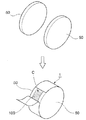
- FIG. 2 is a perspective view showing an example of the structure of a glass mold used in the method for molding a plastic lens of the present invention.
- a pair of molds 50 having a substantially disk-like shape are arranged to face each other at a predetermined interval, and then an adhesive tape 1 is placed on the outer peripheral edges of both molds 50 in the circumferential direction. Paste it so that it wraps along. Then, while maintaining the distance between the molds 50, the openings of the spaces formed between the molds 50 are continuously sealed. As a result, as shown in FIG. 2, the molds 50 are connected to each other in a substantially parallel manner, and a lens-shaped cavity C is partitioned between them.
- the mold 50 is generally made of glass (silicon dioxide) or metal, but the material of the mold 50 is not limited to these.
- the mold 50 in which the adhesive tape 1 is wound and the resin 100 is injected into the cavity C is arranged in a polymerization furnace, and the resin 100 in the cavity C is polymerized by heating or light irradiation to be cured.
- the adhesive tape 1 is completely peeled off and the mold 50 is removed to obtain a plastic lens.
- the polymerization start temperature is 45 ° C. or higher and 65 ° C. or lower, and the heating rate until the final curing temperature reaches 130 ° C. or higher and 150 ° C. or lower is 0.10 ° C./min.
- the quality of the obtained high refractive index plastic lens can be maintained at a problem-free level even in the short-time heating process. it can.
- the plastic lens formed in the present embodiment is used as, for example, a spectacle lens.
- the resin 100 polymerizable monomer or polymerizable prepolymer
- a conventionally known material can be used.
- an episulfide resin MR-174 (trade name) manufactured by Mitsui Chemicals Co., Ltd., IU-20 manufactured by Mitsubishi Gas Chemicals Co., Ltd.) (Product name)
- thiourethane resin thiourethane resin
- a thiourethane resin (MR-6 (trade name) manufactured by Mitsui Chemicals Ltd., Mitsui Chemicals Ltd.)
- MR-8 (trade name) manufactured by MR-8 (trade name)
- polyester methacrylate (TS-26 (trade name) manufactured by Tokuyama Co., Ltd.)
- polycarbonate (Panlite (trade name) manufactured by Teijin Chemicals Ltd.), monomers, prepolymers, and the like
- moisture in the outside air may permeate through the adhesive tape 1 and enter the cavity C. Then, water may be mixed into the resin 100 and react with, for example, a cross-linking agent added to the resin 100 to generate a gas or the like. As a result, voids may be formed in the plastic lens, and bubbles may be generated or whitening may occur in the obtained plastic lens.
- voids in the plastic lens formed by mixing the moisture in the outside air into the resin 100 are large, air bubbles are generated mainly in the peripheral portion of the plastic lens, and when the voids are small, the plastic Whitening occurs mainly in the center of the lens.
- the isocyanate groups (NCO groups) in the resin 100 react with the water mixed in the resin 100 to cause secondary effects. CO 2 gas is generated as a product. Then, the formation of voids by this CO 2 gas may cause bubbles or whitening in the plastic lens.
- an inorganic thin film layer 5 is provided to suppress the permeation of water in the adhesive tape 1.
- the adhesive tape 1 has a structure in which the inorganic thin film layer 5 is sandwiched between the first base material 4 and the second base material 7 via the adhesive layer 6. With such a configuration, in the adhesive tape 1 of the present embodiment, the inorganic thin film layer 5 is protected by the first base material 4 and the second base material 7, and the manufacturing process of the adhesive tape 1 and the plastic lens In the manufacturing process of, the inorganic thin film layer 5 is less likely to crack.
- the present embodiment in the manufacturing process of the plastic lens, it is possible to prevent moisture in the outside air from penetrating the adhesive tape 1 and entering the cavity C due to cracking or the like in the inorganic thin film layer 5. Becomes possible. As a result, in the formed plastic lens, it is possible to suppress the generation of bubbles and whitening caused by the mixing of water into the resin 100 in the cavity C.
- Ethyl acetate / toluene solution (solid content) of a pressure-sensitive adhesive composed of acrylic copolymer A1 (dodecyl methacrylate / acrylic acid / vinyl acetate 78% by mass / 2% by mass / 20% by mass, acid value 14.8 mgKOH / g). Concentration 40% by mass) was adjusted.
- the polystyrene-equivalent weight average molecular weight (Mw) of the acrylic copolymer A1 measured by gel permeation chromatography was 1,320,000, and the polydispersity (Mw / Mn) was 9.3.
- the glass transition temperature Tg calculated from the Fox equation was ⁇ 49 ° C.
- this coating pressure-sensitive adhesive solution is applied to the first base material 4 of the composite base material 2, and then the temperature is 110 ° C.
- the pressure-sensitive adhesive layer 3 having a thickness of 30 ⁇ m after drying was formed.
- an adhesive tape 1 having a total thickness of 68 ⁇ m after drying was obtained.
- thiourethane-based plastic lenses PL1 and PL2 having different refractive indexes were molded by the method shown in FIG.
- a main raw material for the molding resin of the plastic lens PL1 a mixture of 56.48 parts by mass of pentaerythritol tetrakis mercaptopropionate and 43.52 parts by mass of m-xylylene diisocyanate was used.
- additives 0.007 parts by mass of a tin catalyst, 0.14 parts by mass of an acidic phosphoric acid ester-based internal mold release agent, and 0.10 parts by mass of a benzotriazole-based ultraviolet absorber were used.
- tin catalyst 0.007 parts by mass of a tin catalyst, 0.14 parts by mass of an acidic phosphoric acid ester-based internal mold release agent, and 0.10 parts by mass of a benzotriazole-based ultraviolet absorber were used.
- 2,3-bis (2-mercaptoethylthio) propane-1-thiol was added, and the mixture was slowly stirred and mixed at 60 ° C. under reduced pressure. ..
- stirring and mixing was terminated to prepare a resin composition for molding the plastic lens PL2.
- the polymerization start temperature was set to 60 ° C., the final polymerization temperature was raised to 130 ° C. over 10 hours (heating rate: 0.12 ° C./min), the sample was held at 130 ° C. for 5 hours, and then 60 over 2 hours.
- the mixture was cooled to ° C. to obtain a thiourethane-based plastic lens PL1 (refractive index 1.60) and a thiourethane-based plastic lens PL2 (refractive index 1.67).
- the polystyrene-equivalent weight average molecular weight (Mw) of the acrylic copolymer A2 measured by gel permeation chromatography was 1,100,000, and the polydispersity (Mw / Mn) was 9.8.
- the glass transition temperature Tg calculated from the Fox equation was ⁇ 49 ° C.
- this coating pressure-sensitive adhesive solution was applied to the first base material 4 of the composite base material 2 and then heated at a temperature of 110 ° C. for 3 minutes to obtain a thickness of 30 ⁇ m after drying.
- the pressure-sensitive adhesive layer 3 was formed.
- an adhesive tape 1 having a total thickness of 68 ⁇ m after drying was obtained.
- a plastic lens was obtained in the same manner as in Example 1.
- the polystyrene-equivalent weight average molecular weight (Mw) of the acrylic copolymer A3 measured by gel permeation chromatography was 1,380,000, and the polydispersity (Mw / Mn) was 9.5.
- the glass transition temperature Tg calculated from the Fox equation was ⁇ 49 ° C.
- this coating pressure-sensitive adhesive solution was applied to the first base material 4 of the composite base material 2 and then heated at a temperature of 110 ° C. for 3 minutes to obtain a thickness of 30 ⁇ m after drying.
- the pressure-sensitive adhesive layer 3 was formed.
- an adhesive tape 1 having a total thickness of 68 ⁇ m after drying was obtained.
- a plastic lens was obtained in the same manner as in Example 1.
- Example 4 The amount of the polyisocyanate cross-linking agent "Coronate L-45" (trade name, solid content concentration 45% by mass, NCO content 8% by mass) manufactured by Soken Kagaku Co., Ltd. is 5.0 parts by mass (2.3% by mass in terms of solid content).
- An adhesive tape 1 and a plastic lens were obtained in the same manner as in Example 1 except that the equivalent ratio of NCO / COOH was changed to 0.36).
- Example 5 The amount of the polyisocyanate cross-linking agent "Coronate L-45" (trade name, solid content concentration 45% by mass, NCO content 8% by mass) manufactured by Soken Kagaku Co., Ltd. was 8.3 parts by mass (solid content equivalent 3.7% by mass).
- An adhesive tape 1 and a plastic lens were obtained in the same manner as in Example 1 except that the equivalent ratio of NCO / COOH was changed to 0.60).
- Example 6 The amount of the polyisocyanate cross-linking agent "Coronate L-45" (trade name, solid content concentration 45% by mass, NCO content 8% by mass) manufactured by Soken Kagaku Co., Ltd. is 3.2 parts by mass (solid content equivalent 1.4% by mass).
- An adhesive tape 1 and a plastic lens were obtained in the same manner as in Example 1 except that the equivalent ratio of NCO / COOH was changed to 0.23).
- Example 7 The amount of the polyisocyanate cross-linking agent "Coronate L-45" (trade name, solid content concentration 45% by mass, NCO content 8% by mass) manufactured by Soken Kagaku Co., Ltd. is 10.0 parts by mass (4.5% by mass in terms of solid content).
- An adhesive tape 1 and a plastic lens were obtained in the same manner as in Example 1 except that the equivalent ratio of NCO / COOH was changed to 0.72).
- the polystyrene-equivalent weight average molecular weight (Mw) of the acrylic copolymer B measured by gel permeation chromatography was 1,350,000, and the polydispersity (Mw / Mn) was 9.2.
- the glass transition temperature Tg calculated from Fox's formula was ⁇ 50 ° C.
- this coating pressure-sensitive adhesive solution was applied to the first base material 4 of the composite base material 2 and then heated at a temperature of 110 ° C. for 3 minutes to obtain a thickness of 30 ⁇ m after drying.
- the pressure-sensitive adhesive layer 3 was formed.
- an adhesive tape 1 having a total thickness of 68 ⁇ m after drying was obtained.
- a plastic lens was obtained in the same manner as in Example 1.
- the polystyrene-equivalent weight average molecular weight (Mw) of the acrylic copolymer C measured by gel permeation chromatography was 1,150,000, and the polydispersity (Mw / Mn) was 9.7.
- the glass transition temperature Tg calculated from Fox's formula was ⁇ 45 ° C.
- this coating pressure-sensitive adhesive solution was applied to the first base material 4 of the composite base material 2 and then heated at a temperature of 110 ° C. for 3 minutes to obtain a thickness of 30 ⁇ m after drying.
- the pressure-sensitive adhesive layer 3 was formed.
- an adhesive tape 1 having a total thickness of 68 ⁇ m after drying was obtained.
- a plastic lens was obtained in the same manner as in Example 1.
- the polystyrene-equivalent weight average molecular weight (Mw) of the acrylic polymer D measured by gel permeation chromatography was 1,200,000, and the polydispersity (Mw / Mn) was 9.7.
- the glass transition temperature Tg calculated from the Fox formula was ⁇ 22 ° C.
- this coating pressure-sensitive adhesive solution was applied to the first base material 4 of the composite base material 2 and then heated at a temperature of 110 ° C. for 3 minutes to obtain a thickness of 30 ⁇ m after drying.
- the pressure-sensitive adhesive layer 3 was formed.
- an adhesive tape 1 having a total thickness of 68 ⁇ m after drying was obtained.
- a plastic lens was obtained in the same manner as in Example 1.
- the polystyrene-equivalent weight average molecular weight (Mw) of the acrylic copolymer E measured by gel permeation chromatography was 1,360,000, and the polydispersity (Mw / Mn) was 9.2.
- the glass transition temperature Tg calculated from Fox's formula was ⁇ 27 ° C.
- this coating pressure-sensitive adhesive solution was applied to the first base material 4 of the composite base material 2 and then heated at a temperature of 110 ° C. for 3 minutes to obtain a thickness of 30 ⁇ m after drying.
- the pressure-sensitive adhesive layer 3 was formed.
- an adhesive tape 1 having a total thickness of 68 ⁇ m after drying was obtained.
- a plastic lens was obtained in the same manner as in Example 1.
- Ethyl acetate / toluene solution of adhesive composed of acrylic copolymer F (tetradecyl methacrylate / 2-ethylhexyl acrylate / acrylic acid 88% by mass / 10% by mass / 2% by mass, acid value 14.9 mgKOH / g) (Solid content concentration 40% by mass) was adjusted.
- the polystyrene-equivalent weight average molecular weight (Mw) of the acrylic copolymer F measured by gel permeation chromatography was 1,100,000, and the polydispersity (Mw / Mn) was 10.0.
- the glass transition temperature Tg calculated from Fox's formula was ⁇ 20 ° C.
- this coating pressure-sensitive adhesive solution was applied to the first base material 4 of the composite base material 2 and then heated at a temperature of 110 ° C. for 3 minutes to obtain a thickness of 30 ⁇ m after drying.
- the pressure-sensitive adhesive layer 3 was formed.
- an adhesive tape 1 having a total thickness of 68 ⁇ m after drying was obtained.
- a plastic lens was obtained in the same manner as in Example 1.
- the polystyrene-equivalent weight average molecular weight (Mw) of the acrylic copolymer G measured by gel permeation chromatography was 1,380,000, and the polydispersity (Mw / Mn) was 10.0.
- the glass transition temperature Tg calculated from the Fox equation was ⁇ 57 ° C.
- this coating pressure-sensitive adhesive solution was applied to the first base material 4 of the composite base material 2 and then heated at a temperature of 110 ° C. for 3 minutes to obtain a thickness of 30 ⁇ m after drying.
- the pressure-sensitive adhesive layer 3 was formed.
- an adhesive tape 1 having a total thickness of 68 ⁇ m after drying was obtained.
- a plastic lens was obtained in the same manner as in Example 1.
- the polystyrene-equivalent weight average molecular weight (Mw) of the acrylic copolymer H measured by gel permeation chromatography was 1,420,000, and the polydispersity (Mw / Mn) was 9.8.
- the glass transition temperature Tg calculated from the Fox formula was ⁇ 54 ° C.
- this coating pressure-sensitive adhesive solution was applied to the first base material 4 of the composite base material 2 and then heated at a temperature of 110 ° C. for 3 minutes to obtain a thickness of 30 ⁇ m after drying.
- the pressure-sensitive adhesive layer 3 was formed.
- an adhesive tape 1 having a total thickness of 68 ⁇ m after drying was obtained.
- a plastic lens was obtained in the same manner as in Example 1.
- this coating pressure-sensitive adhesive solution was applied to the first base material 4 of the composite base material 2 and then heated at a temperature of 110 ° C. for 3 minutes to obtain a thickness of 30 ⁇ m after drying.
- the pressure-sensitive adhesive layer 3 was formed.
- an adhesive tape 1 having a total thickness of 68 ⁇ m after drying was obtained.
- a plastic lens was obtained in the same manner as in Example 1.
- this coating pressure-sensitive adhesive solution was applied to the first base material 4 of the composite base material 2 and then heated at a temperature of 110 ° C. for 3 minutes to obtain a thickness of 30 ⁇ m after drying.
- the pressure-sensitive adhesive layer 3 was formed.
- an adhesive tape 1 having a total thickness of 68 ⁇ m after drying was obtained.
- a plastic lens was obtained in the same manner as in Example 1.
- this coating pressure-sensitive adhesive solution was applied to the first base material 4 of the composite base material 2 and then heated at a temperature of 110 ° C. for 3 minutes to obtain a thickness of 30 ⁇ m after drying.
- the pressure-sensitive adhesive layer 3 was formed.
- an adhesive tape 1 having a total thickness of 68 ⁇ m after drying was obtained.
- a plastic lens was obtained in the same manner as in Example 1.
- this coating pressure-sensitive adhesive solution was applied to the first base material 4 of the composite base material 2 and then heated at a temperature of 110 ° C. for 3 minutes to obtain a thickness of 30 ⁇ m after drying.
- the pressure-sensitive adhesive layer 3 was formed.
- an adhesive tape 1 having a total thickness of 68 ⁇ m after drying was obtained.
- a plastic lens was obtained in the same manner as in Example 1.
- this coating pressure-sensitive adhesive solution was applied to the first base material 4 of the composite base material 2 and then heated at a temperature of 110 ° C. for 3 minutes to obtain a thickness of 30 ⁇ m after drying.
- the pressure-sensitive adhesive layer 3 was formed.
- an adhesive tape 1 having a total thickness of 68 ⁇ m after drying was obtained.
- Elution rate (%) ⁇ 1-[(W 2- W 0 ) / (W 1 -W 0 )] ⁇ ⁇ 100 (1) (W 0 : weight of base material, W 1 : weight of test piece before immersion, W 2 : weight of test piece after immersion and drying)
- plastic lenses PL1 and PL2 produced by using the adhesive tapes 1 prepared in Examples 1 to 14 and Comparative Examples 1 to 7 are visually observed for the presence or absence of whitening, wrinkles, and bubbles. ,evaluated.
- the presence or absence of adhesive residue on the side surfaces of the mold and the plastic lens after the adhesive tape 1 was peeled off was also visually evaluated.
- the whitening of a plastic lens means a state in which the plastic lens appears white and muddy when the plastic lens is irradiated with light.
- the evaluation of whitening, wrinkles, and bubble generation on the plastic lens, and the generation of adhesive residue on the mold and the side surface of the plastic lens was performed according to the following criteria.
- Test Results Tables 1 to 4 show the evaluation results for the adhesive tape 1 of Examples 1 to 14 and Comparative Examples 1 to 7.
- the weight average molecular weight (Mw) measured by gel permeation chromatography is 1,100,000 or more, and the molecular weight polydispersity (Mw / Mn) is 10.
- Toluene adjusted to a temperature of 80 ° C. using an acrylic copolymer (A1 to A3, B to H) having a functional group of 0 or less and a pressure-sensitive adhesive composition containing a cross-linking agent that reacts with the functional group.
- the high refractive index plastic lens PL1 (refractive index 1.60) was used. It was also confirmed that in the molding by the short-time temperature raising process of PL2 (refractive weight 1.67), favorable results were obtained in all of the appearance characteristics including whitening.
- the amount of elution into the plastic lens molding resin was slightly increased, and slight whitening was observed on the outer peripheral edges of the obtained plastic lenses PL1 and PL2.
- the cohesive force of the agent layer 3 was slightly large, that is, the stress relaxation property was slightly inferior, and wrinkles were slightly observed on the side surfaces of the obtained plastic lenses PL1 and PL2.
- Example 9 in which the acid value of the acrylic copolymer was as high as 37.1 mgKOH / g and the content of the cross-linking agent was as high as 4.5% by mass, the amount of deviation in the creep test was 0.15 mm, which was another implementation. Since it was smaller than the example, the cohesive force of the pressure-sensitive adhesive layer 3 was slightly large, that is, the stress relaxation property was slightly inferior, and wrinkles were slightly observed on the side surfaces of the obtained plastic lenses PL1 and PL2.
- Example 13 the number of carbon atoms of the alkyl group of the (meth) acrylic acid alkyl ester, which is the main component of the acrylic copolymer, is 8, and the content of the cross-linking agent is 3.7 parts by mass.
- the alkyl group of the (meth) acrylic acid alkyl ester, which is the main component of the acrylic copolymer has 12 carbon atoms and the content of the cross-linking agent is 3.7 parts by mass. Since the amount of deviation in the creep test is as small as 0.18 mm, the cohesive force of the adhesive layer 3 is slightly large, that is, the stress relaxation property is slightly inferior, and wrinkles are slightly observed on the side surfaces of the obtained plastic lenses PL1 and PL2. It was.
- Example 14 in which the functional group of the acrylic copolymer is a hydroxyl group and the content of the cross-linking agent is 2.3 parts by mass, the functional group of the acrylic copolymer is a carboxyl group and the cross-linking agent is contained. Since the amount of deviation in the creep test is as small as 0.15 mm as compared with Example 4 in which the amount is 2.3 parts by mass, the cohesive force of the pressure-sensitive adhesive layer 3 is slightly large, that is, the stress relaxation property is slightly inferior. Slight wrinkles were observed on the side surfaces of the plastic lenses PL1 and PL2.
- Mw weight average molecular weight
- Mw / Mn molecular weight polydispersity
- the adhesive tapes 1 of Examples 1 to 14 designed to have a molecular weight of 0.15 mm or more and 0.50 mm or less are useful for molding adhesive tapes of high refractive index plastic lenses by a short-time temperature raising process. Was done.
- Comparative Examples 1 to 7 in which the pressure-sensitive adhesive layer 3 does not satisfy the constituent requirements of the present invention are the evaluation results of at least one of whitening, wrinkles, bubbles, and the remaining pressure-sensitive adhesive. Was confirmed to be inferior to Examples 1 to 14.
- Comparative Example 1 using the acrylic copolymer I having a small weight average molecular weight (Mw) of 753,000 and a large molecular weight polydispersity (Mw / Mn) of 17.1 is crosslinked. Due to the influence of the low molecular weight component, which is insufficient, the dissolution rate to toluene adjusted to the temperature of 80 ° C. is 80.0%, which is extremely large as compared with the examples. Therefore, the resin for molding the plastic lens of the adhesive layer 3 The amount of elution to was increased, and whitening was clearly observed on the outer peripheral edges of the obtained plastic lenses PL1 and PL2.
- the alkyl group of the (meth) acrylic acid alkyl ester which is the main component, has four carbon atoms and the functional group of the acrylic copolymer is a hydroxyl group, but the amount of deviation in the creep test is presumed. Since the thickness was 0.10 mm, which was extremely small as compared with the examples, the cohesive force of the pressure-sensitive adhesive layer 3 was large, that is, the stress relaxation property was inferior, and wrinkles were clearly observed on the side surfaces of the obtained plastic lenses PL1 and PL2. ..
- Comparative Example 2 in which the content of the cross-linking agent was increased to 5.0% by mass as compared with Comparative Example 1, the dissolution rate into toluene adjusted to a temperature of 80 ° C. was as small as 45.0%. Although the whitening of the outer peripheral edges of the obtained plastic lenses PL1 and PL2 was slightly improved, the amount of deviation in the creep test was further reduced to 0.10 mm or less, so that the obtained plastic lenses PL1 and PL2 and The wrinkles on the sides of PL2 were still not improved.
- Comparative Example 3 using the acrylic copolymer J having a small weight average molecular weight (Mw) of 1.02 million and an extremely large molecular weight polydispersity (Mw / Mn) of 31.2 is crosslinked. Due to the influence of the low molecular weight component, which is insufficient, the dissolution rate to toluene adjusted to the temperature of 80 ° C. is 75.8%, which is extremely large as compared with the examples. Therefore, the resin for molding the plastic lens of the adhesive layer 3 The amount of elution to was increased, and whitening was clearly observed on the outer peripheral edges of the obtained plastic lenses PL1 and PL2.
- the acid value of the acrylic copolymer is 3.8 mgKOH / g, but since the amount of deviation in the creep test was 0.60 mm, wrinkles were formed on the side surfaces of the obtained plastic lenses PL1 and PL2. Did not occur. The adhesive residue was at a level slightly observed on the side surface of the mold after the adhesive tape 1 was peeled off.
- the weight average molecular weight (Mw) is as small as 672,000, the molecular weight polydispersity is as large as 18.2, and the number of carbon atoms of the alkyl group of the (meth) acrylic acid alkyl ester is large.
- solubility parameter SP value of methyl acrylate is different from the SP value of toluene, but the dissolution rate to toluene adjusted to a temperature of 80 ° C. is 31.0%.
- the functional group of the acrylic copolymer is a hydroxyl group and the number of carbon atoms of the alkyl group of the (meth) acrylic acid alkyl ester is small, but the deviation amount in the creep test was 0.11 mm. Since it was smaller than the example, wrinkles were clearly observed on the side surfaces of the obtained plastic lenses PL1 and PL2.
- the weight average molecular weight (Mw) was as small as 672,000, but it was clearly observed on the side surface of the mold after the adhesive tape 1 was peeled off.
- the weight average molecular weight (Mw) is 1,240,000, which satisfies the range of the present invention, but the degree of polydispersity of the molecular weight (Mw / Mn) is 16.7, which is outside the range of the present invention.
- the elution rate to toluene adjusted to a temperature of 80 ° C. was 51.6%, which was smaller than that of Comparative Example 1 and Comparative Example 3.
- the value is still large as compared with the examples, the amount of the adhesive layer 3 eluted into the plastic lens molding resin is large, and the outer peripheral edges of the obtained plastic lenses PL1 and PL2 are clearly whitened. Was observed in.
- the acrylic copolymer A-1 having a weight average molecular weight (Mw) and a polydispersity of molecular weight (Mw / Mn) satisfying the range of the present invention is used, the content of the cross-linking agent is used.
- the amount of deviation in the creep test was 0.10 mm or less due to the adjustment of the increased molecular weight, whitening did not occur in the outer peripheral edges of the obtained plastic lenses PL1 and PL2, but the obtained plastic lens PL1 was obtained. And wrinkles were clearly observed on the sides of PL2.
- the acrylic copolymer A-1 having a weight average molecular weight (Mw) and a polydispersity of molecular weight (Mw / Mn) satisfying the range of the present invention is used, the content of the cross-linking agent is used.
- Comparative Example 7 in which the dissolution rate into toluene adjusted to a temperature of 80 ° C. was 49.5% by the weight reduction adjustment of the above, wrinkles did not occur on the side surfaces of the obtained plastic lenses PL1 and PL2. Whitening was clearly observed on the outer peripheral edges of the obtained plastic lenses PL1 and PL2. The adhesive residue was at a level slightly observed on the side surface of the mold after the adhesive tape 1 was peeled off.
- Adhesive tape 1 ... Adhesive tape, 2 ... Composite base material, 3 ... Adhesive layer, 4 ... First base material, 5 ... Inorganic thin film layer, 6 ... Adhesive layer, 7 ... Second base material, 10 ... First laminate Body, 20 ... second laminate, 50 ... mold, 100 ... plastic lens molding resin, C ... cavity.
Landscapes
- Chemical & Material Sciences (AREA)
- Organic Chemistry (AREA)
- Health & Medical Sciences (AREA)
- Engineering & Computer Science (AREA)
- Chemical Kinetics & Catalysis (AREA)
- Medicinal Chemistry (AREA)
- Polymers & Plastics (AREA)
- Ophthalmology & Optometry (AREA)
- Mechanical Engineering (AREA)
- Manufacturing & Machinery (AREA)
- Physics & Mathematics (AREA)
- General Physics & Mathematics (AREA)
- Optics & Photonics (AREA)
- Adhesive Tapes (AREA)
- Adhesives Or Adhesive Processes (AREA)
- Moulds For Moulding Plastics Or The Like (AREA)
- Laminated Bodies (AREA)
- Casting Or Compression Moulding Of Plastics Or The Like (AREA)
Abstract
発明の課題は、高屈折率プラスチックレンズを短時間昇温プロセスにより成型する際に、成型品の外周縁部のシワ、白化等の欠陥の発生を抑制することが可能なプラスチックレンズ成型用粘着テープおよびプラスチックレンズの成型方法を提供することである。課題の解決手段は、基材と該基材の表面上に形成された粘着剤層とを有するプラスチックレンズ成型用粘着テープであって、該粘着剤層は、官能基を有するアクリル系共重合体及び該官能基と反応する架橋剤を含み、該アクリル系共重合体は、1,100,000以上の重量平均分子量(Mw)、及び10.0以下の分子量の多分散度(Mw/Mn)を有し、該粘着剤層は、80℃の温度に調整されたトルエンに2時間浸漬した際の溶出率が48.0%以下であり、該粘着テープは、クリープ試験における800分後のズレ量が0.15mm以上0.50mm以下であり、該プラスチックレンズは1.59以上の屈折率を有する、プラスチックレンズ成型用粘着テープである。
Description
本発明は、プラスチックレンズ成型用粘着テープに関し、特に、高屈折率プラスチックレンズ成型用粘着テープに関する。
メガネレンズ用途などに実用化されているプラスチックレンズ成型用の熱硬化型の光学用樹脂およびそのモノマーは、チオウレタン系樹脂に代表される重縮合型のタイプと、アクリル系、ビニル系化合物に代表されるラジカル型のタイプの2種類に大別される。中でも、チオウレタン系樹脂は、硫黄原子を含むため高屈折率(例えば、屈折率1.59以上)であること、(チオ)ウレタン結合を形成するため耐衝撃性に優れること、等の長所を活かし、高屈折率メガネレンズ用途を中心に光学用樹脂として広く普及している。
上述したチオウレタン系樹脂は、ポリチオール成分とポリイソシアネート成分の縮合反応により(チオ)ウレタン結合を生成させ樹脂を硬化して得ることができるが、光学的な均一性を保ちつつ重合を行うためには、常温から高温まで長時間を掛けて徐々に昇温しながら重合硬化する必要がある。例えば、高屈折率メガネレンズを重合成型する場合には、通常は、20~30℃付近の常温から120~130℃付近の高温まで徐々に昇温しながら重合硬化するのに24時間以上というような長時間の昇温硬化プロセスを必要とする。従って、チオウレタン系樹脂は、高屈折率プラスチックレンズ成型用樹脂として性能面においては優れているが、生産性の面においては、なお改良の余地を残している。
上記生産性の課題に対して、特許文献1では、光学的、物性的および生産性にも優れたメガネレンズを提供することを目的に、特定構造のポリチオール化合物をポリイソシアネート化合物でプレポリマー化して得られた成分、特定構造の(メタ)アクリレート化合物からなる成分、及びそれらと共重合可能な化合物からなる成分を含有してなる組成物を重合硬化して得られる樹脂が、高屈折率メガネレンズに好適であること、また該組成物の硬化には加熱による短時間の硬化が可能であることが開示されている。そして、短時間の硬化に関して、実施例の中で、該組成物を凹レンズモールドに注入し、50℃から130℃まで3時間かけて昇温硬化させた後、更に130℃で1時間加熱硬化して、室温まで放冷した後、ガラス型からレンズを離型して、無色透明の凹レンズを得ることが記載されており、上述した従来の昇温硬化プロセスと比較して、硬化開始温度が高く、昇温時間も短時間であることが分かる。
また、特許文献2では、光学的欠陥を低減することが主目的ではあるが、成型光学物品を調製するためのプロセスとして、(i)ジチオール成分または(ii)ポリイソシアネート成分を反応容器に導入するステップと;ハロゲン化有機スズの第1の触媒を添加して第1の反応混合物を形成するステップと;第1の反応混合物を加熱するステップと;第三級アミンの第2の触媒を第1の反応混合物に導入するステップと;ジチオール(i)を最初に添加した場合、第1の反応混合物を含有する反応容器にポリイソシアネート(ii)を混合して、またはポリイソシアネート(ii)を最初に添加した場合、第1の反応混合物にジチオール(i)を混合して、第2の反応混合物を形成するステップと;型に第2の反応混合物を充填して、充填された型を用意して、成型光学物品を形成するステップとを含むバッチプロセスが開示されている。そして、該バッチプロセスに関して、実施例の中で、該第2の反応混合物を型に充填し、硬化サイクルを50℃で開始し、12時間かけて130℃へと上昇させ(0.11℃/min)、試料を130℃で6時間保持した後、1時間かけて70℃に冷却し、硬化レンズを得ることが記載されており、上述した従来の昇温硬化プロセスと比較して、硬化開始温度が高く、昇温時間も短時間であることが分かる。
一方、プラスチックレンズの成型方法としては、一対のガラスモールド(型)と封止用の粘着テープを用いた注型重合法によって成型する方法が知られている。この方法では、一対のガラスモールドを、所定間隔を隔てて対向配置させる。次に、粘着テープを、一対のガラスモールドの外周面を全周に亘って周方向に沿って貼り付け、重合用セルを作製する。これによって、ガラスモールド間の空間は、粘着テープで封止される。次に、その粘着テープに樹脂注入用のノズルを差し込み、ガラスモールド間の空間内に液状の樹脂(重合性モノマーや重合性プレポリマー)を注入して充填する。その後、その樹脂を加熱や光照射などによって重合硬化させることによって、プラスチックレンズが得られる。この方法により高品質のプラスチックレンズを得るために、プラスチックレンズ成型用粘着テープには、プラスチックレンズの外周縁部に外観不良(白化、シワ等)を発生させないような性能が求められる。
特許文献3には、トルエン(20℃)への可溶解分率が30%以下である感圧性接着剤層を有するプラスチックレンズ製造用接着テープが記載されている。実施例では、ジエチレングリコールビスアリルカーボネート系液状レンズ原料を、40℃から110℃まで35時間かけて徐々に昇温して原料を重合硬化させ、室温まで放冷するプロセスにより、濁りのない無色透明で、側面に接着剤成分の残存がないレンズが得られることが記載されている。しかしながら、このプラスチックレンズ製造用接着テープを上述した短時間昇温プロセス、すなわち、硬化開始温度が高く、昇温時間も短時間であるプロセスによる高屈折率プラスチックレンズの成型に使用した場合に、必ずしも、無色透明のレンズが得られるというわけではなく、上記感圧性接着剤層は高温条件下においては、レンズ原料に対する接着剤層からの溶出量が多くなり、得られた成型品の外周縁部に白化が発生する場合があった。また、高度に架橋構造化すると、感圧性接着剤の保持力が必要以上に大きくなり、例えば、チオウレタン系樹脂等の高屈折率プラスチックレンズ原料の硬化収縮の影響を緩和しづらくなり、すなわち、粘着テープにシワが生じやすくなり、プラスチックレンズ側面にシワが発生する場合があった。したがって、白化とシワの発生の同時抑制について、改善の余地を有していた。
一般に、プラスチックレンズの白化とは、光を照射しながらプラスチックレンズを観察した場合に、プラスチックレンズが白く濁って見える状態をいう。
本発明は、上記の課題に鑑みてなされたものであって、高屈折率プラスチックレンズを短時間昇温プロセスにより成型する際に、成型品の外周縁部のシワ、白化等の欠陥の発生および粘着テープ剥離時の被着体への粘着剤残りを抑制することが可能なプラスチックレンズ成型用粘着テープおよびプラスチックレンズの成型方法を提供することを目的とする。
本発明者らは、かかる目的のもと、高屈折率プラスチックレンズ成型用粘着テープの粘着剤層について鋭意検討した結果、高屈折率プラスチックレンズを短時間昇温プロセスにより成型する際に、成型品の外周縁部のシワ、白化等の欠陥の発生を抑制するためには、まず、粘着剤に用いるポリマー(アクリル系共重合体)の重量平均分子量(Mw)および分子量の多分散度(Mw/Mn)を適正な範囲とすることが重要であり、その上で、80℃の温度に調整されたトルエンに2時間浸漬した際の溶出率が48.0%以下、クリープ試験(温度40℃、荷重0.5kg)におけるズレ量が0.15mm以上0.50mm以下となるように設計したアクリル系粘着剤を粘着剤層として用いれば、得られる高屈折率プラスチックレンズ成型品の外周縁部の白化、シワ、気泡、ならびに粘着テープ剥離時のプラスチックレンズおよびモールド側面への粘着剤残りの発生を抑制することが可能であることを見出し、本発明をなすに至った。
すなわち、従来の昇温硬化プロセスと比較して、硬化開始温度が高く、昇温時間も短時間である短時間昇温硬化プロセスを高屈折率プラスチックレンズ成型時に採用する場合、封止テープとして用いる粘着テープにおいてその粘着剤層は、重合初期段階においてまだ十分に硬化していない液状~粘稠かつ高温のプラスチックレンズ用重合性モノマーや重合性プレポリマーにいきなり数時間程度曝されることになる。特に、ポリチオールとポリイソシアネートの反応は他のモノマーよりも遅いため、液状~粘稠の状態が長い。したがって、粘着剤層から粘着剤組成物の一部がモノマーやプレポリマー等のプラスチックレンズ材料へ溶出するリスクが、従来の常温から高温まで長時間を掛けて徐々に昇温させる昇温硬化プロセスよりも急激に高まり、その溶出量がある一定量以上になると得られるプラスチックレンズ成型品の外周縁部に白化が発生しやすくなるものと考えるが、本課題を、粘着剤層の高度な架橋構造化のみで解消しようとすると、白化は抑制される一方で、上述したように粘着剤層が必要以上に硬くなり、高屈折率プラスチックレンズ原料の硬化収縮の影響を緩和しづらくなるため、プラスチックレンズ側面にシワが発生しやすくなる。
そこで、本発明者らは、高屈折率プラスチックレンズ成型において、上述したトレードオフの関係にある白化の発生とシワの発生の両方を同時に解消するために、まず、粘着剤層に用いるアクリル系共重合体の重量平均分子量(Mw)および分子量の多分散度(Mw/Mn)に着目し、検討を行った。その結果、アクリル系共重合体の重量平均分子量(Mw)を1,100,000以上と大きくし、かつ、分子量の多分散度(Mw/Mn)を10.0以下とすれば、アクリル系共重合体の低分子量成分および共重合せずに生じるホモポリマーの低分子量成分、具体的には、重量平均分子量が10,000未満の低分子量成分が極めて少なくなるために、粘着剤層の高度な架橋構造化を必要以上に図らなくても、粘着剤層からのレンズ材料への溶出量を抑制でき、白化が発生するリスクを大幅に低減することができることを見出した。一方で、高度な架橋構造化を図っていないため、粘着剤層は必要以上に硬くはならず、シワの発生も抑制できること、さらに分子量が大きく、分子量の多分散度も比較的小さいため、大きな凝集力を適度な柔軟性とともに併せ持ち、粘着剤残りも抑制できることを見出した。
本発明は、次のような構成から成る。すなわち、本発明に係るプラスチックレンズ成型用粘着テープは、
基材と該基材の表面上に形成された粘着剤層とを有するプラスチックレンズ成型用粘着テープであって、
上記粘着剤層は、官能基を有するアクリル系共重合体及び該官能基と反応する架橋剤を含み、
上記アクリル系共重合体は、1,100,000以上の重量平均分子量(Mw)、及び10.0以下の分子量の多分散度(Mw/Mn)を有し、
上記粘着剤層は、80℃の温度に調整されたトルエンに2時間浸漬した際の溶出率が48.0%以下で、かつ、
上記粘着テープは、クリープ試験(温度40℃、荷重0.5kg)における800分後のズレ量が0.15mm以上0.50mm以下であり、
上記プラスチックレンズは1.59以上の屈折率を有する、ことを特徴とする。
基材と該基材の表面上に形成された粘着剤層とを有するプラスチックレンズ成型用粘着テープであって、
上記粘着剤層は、官能基を有するアクリル系共重合体及び該官能基と反応する架橋剤を含み、
上記アクリル系共重合体は、1,100,000以上の重量平均分子量(Mw)、及び10.0以下の分子量の多分散度(Mw/Mn)を有し、
上記粘着剤層は、80℃の温度に調整されたトルエンに2時間浸漬した際の溶出率が48.0%以下で、かつ、
上記粘着テープは、クリープ試験(温度40℃、荷重0.5kg)における800分後のズレ量が0.15mm以上0.50mm以下であり、
上記プラスチックレンズは1.59以上の屈折率を有する、ことを特徴とする。
上記態様において、上記アクリル系共重合体は、官能基としてカルボキシル基を有し、上記架橋剤は、ポリイソシアネート系化合物であることが好ましい。
また、上記アクリル系共重合体は、5.0~75.0mgKOH/gの酸価を有し、前記アクリル系共重合体が有するカルボキシル基(COOH)の当量に対する前記ポリイソシアネート系化合物が有するイソシアネート基(NCO)の当量の比(NCO/COOH)は、0.20~0.80であることが好ましい。
また、さらに、上記アクリル系共重合体の原料である単量体は、炭素数5~18のアルキル基を有する(メタ)アクリル酸アルキルエステルを含むことが好ましい。
また、さらに、上記粘着剤層は、80℃の温度に調整されたトルエンに2時間浸漬した際の溶出率が38.0%以下であることが好ましい。
また、さらに、上記粘着テープは、クリープ試験における800分後のズレ量が0.20mm以上0.50mm以下であることが好ましい。
また、さらに、上記プラスチックレンズは、チオウレタン系樹脂であることが好ましい。
また、さらに、上記基材は、シート状の第1の基材と、無機薄膜層と、接着層と、シート状の第2の基材と、を順に積層した複合基材であることが好ましい。
また、さらに、上記粘着テープは、1.5g/(m2・24h)以下のJIS K 7129に従う水蒸気透過度を有することが好ましい。
さらに、本発明に係るプラスチックレンズの成型方法は、一対のモールドを所定の間隔を隔てて対向配置し、上記両モールドの外周縁部に上記発明のプラスチックレンズ成型用粘着テープを貼り付け、前記両モールド間に形成された空間の開口を封止して、プラスチックレンズの重合性原料が充填されるキャビティを形成するキャビティ形成工程と、上記キャビティ内に1.59以上の屈折率を有するプラスチックレンズの重合性原料を充填する重合性原料充填工程と、上記重合性原料を重合する重合工程とを有すること、を特徴とする。
また、さらに、上記重合工程の重合条件は、45℃以上65℃以下の重合開始温度、130℃以上150℃以下の重合最終温度、0.10℃/分以上0.45℃/分以下の前記重合最終温度に達するまでの昇温速度を有することが好ましい。
また、さらに、上記プラスチックレンズは、チオウレタン系樹脂であることが好ましい。
本発明によれば、高屈折率プラスチックレンズを短時間昇温プロセスにより成型する際に、成型品の外周縁部の白化、シワ等の欠陥の発生および粘着テープ剥離時の被着体への粘着剤残りを抑制することが可能な高屈折率プラスチックレンズ成型用粘着テープおよびプラスチックレンズの成型方法を提供することができる。
(粘着テープの構成)
本発明の粘着テープは、基材と基材の表面上に形成された粘着剤層とを有する。基材は粘着剤層を支持する部材である。基材は、引っ張り強度、耐熱性及び柔軟性を有するフィルム状材料をいう。基材は単一層から成っていてよく、複数の層を有する複合材料であってもよい。
本発明の粘着テープは、基材と基材の表面上に形成された粘着剤層とを有する。基材は粘着剤層を支持する部材である。基材は、引っ張り強度、耐熱性及び柔軟性を有するフィルム状材料をいう。基材は単一層から成っていてよく、複数の層を有する複合材料であってもよい。
図1は、本発明の一実施形態である粘着テープの構造を示した断面図である。本実施の形態の粘着テープ1は、例えばメガネレンズ等に用いられるプラスチックレンズの作製の用途に使用される。本実施の形態の粘着テープ1は、複合基材2と粘着剤層3とが積層された構造を有していることが好ましい。そして、複合基材2は、第1の基材4上に無機薄膜層5が形成された第1の積層体10と、第2の基材7上に接着層6が形成された第2の積層体20とが積層されて構成されていることが好ましい。また、本実施の形態では、粘着剤層3は、複合基材2における第1の基材4側の面に形成されているが、粘着剤層3は、複合基材2における第3の基材7側の面に形成されていても良い。
本実施の形態の粘着テープ1では、必要に応じて、複合基材2(第1の基材4)と粘着剤層3との間や、第1の基材4と無機薄膜層5との間に、密着性を向上させるためのアンカーコート層(図示せず)を設けてもよい。
<複合基材>
上述したように、本実施の形態の複合基材2は、第1の積層体10と第2の積層体20とが積層されることで、第1の基材4、無機薄膜層5、接着層6および第2の基材7が順に積層された構造を有している。
以下、複合基材2を構成する各層について説明する。
上述したように、本実施の形態の複合基材2は、第1の積層体10と第2の積層体20とが積層されることで、第1の基材4、無機薄膜層5、接着層6および第2の基材7が順に積層された構造を有している。
以下、複合基材2を構成する各層について説明する。
[第1の基材]
本実施の形態の粘着テープ1に用いる第1の基材4の材質は、特に限定されるものではなく、例えばプラスチック製、金属製等の基材を用いることができる。
これらの中でも、特にポリエチレンテレフタレート(PET)を主成分とする基材を用いることが好ましい。また、第1の基材4としては、例えば、ポリブチレンテレフタレート、ポリエチレンナフタレート、ポリフェニレンサルファイド、二軸延伸ポリプロピレン、ポリイミド、アラミド、ポリシクロオレフィン、フッ素系樹脂等の樹脂フィルムを用いてもよい。
詳細については後段で説明するが、本実施の形態の第1の基材4上には、例えばケイ素やアルミニウム等を含む無機薄膜層5を設ける。
本実施の形態の粘着テープ1に用いる第1の基材4の材質は、特に限定されるものではなく、例えばプラスチック製、金属製等の基材を用いることができる。
これらの中でも、特にポリエチレンテレフタレート(PET)を主成分とする基材を用いることが好ましい。また、第1の基材4としては、例えば、ポリブチレンテレフタレート、ポリエチレンナフタレート、ポリフェニレンサルファイド、二軸延伸ポリプロピレン、ポリイミド、アラミド、ポリシクロオレフィン、フッ素系樹脂等の樹脂フィルムを用いてもよい。
詳細については後段で説明するが、本実施の形態の第1の基材4上には、例えばケイ素やアルミニウム等を含む無機薄膜層5を設ける。
第1の基材4としてポリエチレンテレフタレート(PET)を用いた場合には、第1の基材4の厚さを、9μm以上25μm以下の範囲とすることが好ましい。
第1の基材4の厚さが9μm未満の場合、粘着テープ1の幅方向において第1の基材4の膜厚のムラが大きくなり、第1の基材4上に無機薄膜層5を積層する際にしわ、折れ等が発生しやすくなる。そしてその結果、粘着テープ1において水蒸気透過度が部分的に高くなる場合があり、粘着テープ1を用いて製造されるプラスチックレンズに気泡や白化が発生しやすくなる傾向がある。
第1の基材4の厚さが9μm未満の場合、粘着テープ1の幅方向において第1の基材4の膜厚のムラが大きくなり、第1の基材4上に無機薄膜層5を積層する際にしわ、折れ等が発生しやすくなる。そしてその結果、粘着テープ1において水蒸気透過度が部分的に高くなる場合があり、粘着テープ1を用いて製造されるプラスチックレンズに気泡や白化が発生しやすくなる傾向がある。
また、後述する粘着テープ1の製造工程において、第1の基材4上に無機薄膜層5を積層した第1の積層体10は、通常、無機薄膜層5側が外周となるように、巻き取られる。ここで、第1の基材4の厚さが25μmを超えた場合には、第1の基材4の厚さが25μm以下の場合と比較して、第1の積層体10を巻き取った際に第1の積層体10の外周側(無機薄膜層5側)が伸びやすくなる。その結果、第1の積層体10において無機薄膜層5が伸びることで無機薄膜層5の全体に亘ってクラック(ひび割れ)が発生する場合がある。そして、このように無機薄膜層5のクラックが発生した粘着テープ1では、水蒸気透過度が高くなる場合があり、粘着テープ1を用いて製造されるプラスチックレンズに気泡や白化が発生しやすくなる傾向がある。
[第2の基材]
第2の基材7の材質は、第1の基材4と同様に、特に限定されるものではなく、例えば、プラスチック製、金属製等の基材を用いることができる。
これらの中でも、特にポリエチレンテレフタレート(PET)を主成分とする基材を用いることが好ましい。また、第2の基材7としては、第1の基材4と同様に、例えば、ポリブチレンテレフタレート、ポリエチレンナフタレート、ポリフェニレンサルファイド、二軸延伸ポリプロピレン、ポリイミド、アラミド、ポリシクロオレフィン、フッ素系樹脂等の樹脂フィルムを用いてもよい。
第2の基材7の材質は、第1の基材4と同様に、特に限定されるものではなく、例えば、プラスチック製、金属製等の基材を用いることができる。
これらの中でも、特にポリエチレンテレフタレート(PET)を主成分とする基材を用いることが好ましい。また、第2の基材7としては、第1の基材4と同様に、例えば、ポリブチレンテレフタレート、ポリエチレンナフタレート、ポリフェニレンサルファイド、二軸延伸ポリプロピレン、ポリイミド、アラミド、ポリシクロオレフィン、フッ素系樹脂等の樹脂フィルムを用いてもよい。
第2の基材7としてポリエチレンテレフタレート(PET)を用いた場合には、第2の基材7の厚さを18μm以上38μm以下の範囲内とすることが好ましい。
第2の基材7の厚さが過度に小さい場合には、第2の基材7の剛性が低くなりやすく、後述するプラスチックレンズの製造工程において2つのモールド50(図2参照)間の間隔を維持することが困難になる傾向がある。また、第2の基材7の厚さが過度に小さい場合、モールド50と粘着テープ1とにより形成されたキャビティC間に注入したプラスチックレンズ成型用樹脂(モノマーおよびまたはオリゴマーを意味する)100(図2参照)が膨張する力に抗しきれずに粘着テープ1に割れや切断などが生じてキャビティC内に空気が侵入する場合がある。さらに、第2の基材7の厚さが過度に小さい場合、キャビティC内のプラスチックレンズ成型用樹脂100が収縮する力に抗しきれずに、粘着テープ1がキャビティC内の中心に向かって押しつぶされるように引っ張られてシワが発生し、形成されるレンズに粘着テープ1のシワに起因したシワ(テープシワ)が生じる懸念がある。
第2の基材7の厚さが過度に小さい場合には、第2の基材7の剛性が低くなりやすく、後述するプラスチックレンズの製造工程において2つのモールド50(図2参照)間の間隔を維持することが困難になる傾向がある。また、第2の基材7の厚さが過度に小さい場合、モールド50と粘着テープ1とにより形成されたキャビティC間に注入したプラスチックレンズ成型用樹脂(モノマーおよびまたはオリゴマーを意味する)100(図2参照)が膨張する力に抗しきれずに粘着テープ1に割れや切断などが生じてキャビティC内に空気が侵入する場合がある。さらに、第2の基材7の厚さが過度に小さい場合、キャビティC内のプラスチックレンズ成型用樹脂100が収縮する力に抗しきれずに、粘着テープ1がキャビティC内の中心に向かって押しつぶされるように引っ張られてシワが発生し、形成されるレンズに粘着テープ1のシワに起因したシワ(テープシワ)が生じる懸念がある。
一方、第2の基材7の厚さが過度に大きい場合、第2の基材7の剛性が高くなりやすく、粘着テープ1の伸縮性が低下する傾向がある。また、粘着テープ1の総厚が大きくなって、後述するプラスチックレンズの製造工程において、モールド50に対して粘着テープ1を巻いた際に、粘着テープ1が重なるラップ部分において粘着テープ1の間に隙間が生じてしまい、キャビティCから樹脂100が漏れてしまう場合がある。
また、第1の基材4と第2の基材7との関係について考慮すると、第2の基材7の厚さは、第1の基材4の厚さの2倍以上3倍以下の範囲とすることが好ましい。第1の基材4と第2の基材7とがこのような関係を有することで、粘着テープ1を巻き取った際やプラスチックレンズの製造工程等において、粘着テープ1の変形に伴って、第1の基材4と第2の基材7との間に設けられる無機薄膜層5に対して負荷がかかるのを抑制することができる。さらに、第1の基材4と第2の基材7とがこのような関係を有することで、粘着テープ1全体の剛性および伸縮性をプラスチックレンズの成型用途として好ましい範囲とすることができる。これにより、後述するプラスチックレンズの製造工程において、キャビティC内への水分の混入やキャビティCからの樹脂100の漏れ等の発生を抑制することが可能になる。
さらにまた、第1の基材4と第2の基材7とを合わせた合計の厚さは、27μm以上60μm以下の範囲にすることが好ましい。第1の基材4と第2の基材7とを合わせた合計の厚さをこのような範囲とすることで、後述するプラスチックレンズの製造工程において、粘着テープ1が重なるラップ部分の段差による液漏れを抑制するとともに、樹脂100の収縮などに伴う変形により粘着テープ1が破損したり剥がれたりするのを抑制することが可能になる。
[無機薄膜層]
無機薄膜層5は、無機物質を含んで構成され、粘着テープ1の防湿性およびガスバリア性を高めて、粘着テープ1における水分の透過を抑制するために設けられる。
無機薄膜層5を構成する無機物質としては、ケイ素、アルミニウム、マグネシウム、亜鉛、スズ、ニッケル、チタン、炭化水素等、あるいはこれらの酸化物、炭化物、窒化物またはそれらの混合物が挙げられる。中でも、ケイ素酸化物、ケイ素窒化物、アルミニウム酸化物、アルミニウム窒化物、ダイアモンドライクカーボン等の炭化水素を主体とした物質を採用することが好ましい。特に、無機薄膜層5として、二酸化ケイ素、酸化アルミニウムを用いることが、粘着テープ1における水分の透過を抑制できる点でより好ましい。
尚、上記無機物質は、1種を単独で用いてもよいし、2種以上を組み合わせて用いてもよい。
無機薄膜層5は、無機物質を含んで構成され、粘着テープ1の防湿性およびガスバリア性を高めて、粘着テープ1における水分の透過を抑制するために設けられる。
無機薄膜層5を構成する無機物質としては、ケイ素、アルミニウム、マグネシウム、亜鉛、スズ、ニッケル、チタン、炭化水素等、あるいはこれらの酸化物、炭化物、窒化物またはそれらの混合物が挙げられる。中でも、ケイ素酸化物、ケイ素窒化物、アルミニウム酸化物、アルミニウム窒化物、ダイアモンドライクカーボン等の炭化水素を主体とした物質を採用することが好ましい。特に、無機薄膜層5として、二酸化ケイ素、酸化アルミニウムを用いることが、粘着テープ1における水分の透過を抑制できる点でより好ましい。
尚、上記無機物質は、1種を単独で用いてもよいし、2種以上を組み合わせて用いてもよい。
無機薄膜層5の形成方法としては、蒸着法、コーティング法等の公知の方法を用いることができる。中でも、防湿性およびガスバリア性の高い均一な薄膜が得られるという点で、蒸着法を採用することが好ましい。蒸着法には、真空蒸着、イオンプレーティング、スパッタリング等を含むPVD(物理的気相蒸着法)や、CVD(化学的気相蒸着法)等の方法が含まれる。
無機薄膜層5の厚さは、例えば、0.1nm~500nmの範囲であり、好ましくは0.5nm~40nmの範囲である。無機薄膜層5の厚さを上記範囲とすることで、水分の透過を抑制でき、また、無機薄膜層5における割れ等の発生を抑制することができる。また、無機薄膜層5の厚さを上記範囲とすることで、粘着テープ1の透明性の低下を抑制することが可能になる。
[接着層]
接着層6は、第1の積層体10における無機薄膜層5と、第2の積層体20における第2の基材7とを接着するために設けられる。接着層6は、接着剤により形成される。接着層6を形成する接着剤としては、例えば、イソシアネート系硬化剤で硬化するポリエステル系接着剤を用いることができる。ただし、接着層6に用いられる接+着剤はこれに限られるものではなく、例えばエポキシ系接着剤やポリエーテル系接着剤等の公知の材料を使用することができる。
接着層6は、第1の積層体10における無機薄膜層5と、第2の積層体20における第2の基材7とを接着するために設けられる。接着層6は、接着剤により形成される。接着層6を形成する接着剤としては、例えば、イソシアネート系硬化剤で硬化するポリエステル系接着剤を用いることができる。ただし、接着層6に用いられる接+着剤はこれに限られるものではなく、例えばエポキシ系接着剤やポリエーテル系接着剤等の公知の材料を使用することができる。
接着層6の厚さとしては、1μm以上10μm以下の範囲であることが好ましい。接着層6の厚さが過度に小さい場合、接着層6と無機薄膜層5との接着強度が不十分となる傾向がある。そして、無機薄膜層5との接着強度が低下した場合には、無機薄膜層5の割れが発生して、粘着テープ1における水蒸気透過度が高くなりやすい。一方、接着層6の厚さが過度に大きい場合、粘着テープ1の総厚が厚くなりやすい。そして、粘着テープ1の総厚が厚くなった場合には、後述するプラスチックレンズの製造工程において、モールド50に対して粘着テープ1を巻いた際に、粘着テープ1が重なるラップ部分において粘着テープ1の間に隙間が生じてしまい、キャビティCから樹脂100が漏れてしまう場合がある。
<粘着剤層>
本実施の形態の粘着剤層3は、粘着剤の主剤ポリマーとして、アクリル系共重合体を含む。以下、アクリル系共重合体について詳細に説明する。
本実施の形態の粘着剤層3は、粘着剤の主剤ポリマーとして、アクリル系共重合体を含む。以下、アクリル系共重合体について詳細に説明する。
[アクリル系共重合体]
アクリル系共重合体は、(メタ)アクリル基を有する単量体を含む単量体混合物を重合した共重合体をいう。単量体混合物には、例えば、(メタ)アクリル酸アルキルエステル、官能基を有するエチレン性不飽和単量体等が含まれる。
アクリル系共重合体は、(メタ)アクリル基を有する単量体を含む単量体混合物を重合した共重合体をいう。単量体混合物には、例えば、(メタ)アクリル酸アルキルエステル、官能基を有するエチレン性不飽和単量体等が含まれる。
上記アクリル系共重合体は、重量平均分子量(Mw)が1,100,000以上、分子量の多分散度(Mw/Mn)が10.0以下である。重量平均分子量(Mw)及び数平均分子量(Mn)の値は、ゲル浸透クロマトグラフィーにより測定されるポリスチレン換算値を使用する。
上記重量平均分子量(Mw)が1,100,000未満であると、必然的に、分子量10,000未満の低分子量成分が増えて、短時間昇温プロセスによる高屈折率プラスチックレンズの製造工程において、粘着剤層3の一部がプラスチックレンズ成型用樹脂へ溶出するリスクが高まり、得られるプラスチックレンズ成型品の外周縁部に白化が発生するおそれがある。一方、重量平均分子量(Mw)の上限は、特に制限はされないが、2,000,000以下であることが好ましい。重量平均分子量(Mw)が2,000,000を超えると、粘着剤組成物溶液の粘度増加により、均一な塗工性が困難となるおそれがある。また、粘着剤層3の応力緩和性が低下し、得られるプラスチックレンズ成型品の側面にシワが発生するおそれがある。上記重量平均分子量(Mw)は、1,200,000以上、1,500,000以下の範囲であることが好ましい。
上記分子量の多分散度(Mw/Mn)が、10.0を超えると、必然的に、分子量10,000未満の低分子量成分が増えて、短時間昇温プロセスによる高屈折率プラスチックレンズの製造工程において、粘着剤層3の一部がプラスチックレンズ成型用樹脂へ溶出するリスクが高まり、得られるプラスチックレンズ成型品の外周縁部に白化が発生するおそれがある。一方、分子量の多分散度(Mw/Mn)の下限は、特に制限はされないが、5.0以上であることが好ましい。分子量の多分散度(Mw/Mn)が5.0未満であると、重量平均分子量(Mw)が特に大きい場合に、粘着剤層3の応力緩和性が低下し、得られるプラスチックレンズ成型品の側面にシワが発生するおそれがある。
上記アクリル系共重合体の重量平均分子量(Mw)および分子量の多分散度(Mw/Mn)を上記範囲とすることにより、粘着剤の主剤ポリマーであるアクリル系共重合体の低分子量成分をあらかた排除できるため、必要以上に高度の架橋構造化を図らなくても、短時間昇温プロセスによる高屈折率プラスチックレンズの製造工程において、粘着剤層3の一部がプラスチックレンズ成型用樹脂100へ溶出するリスクを大幅に抑制することができる。さらに、粘着剤層3は必要以上に硬くはならず適度な応力緩和性を維持できるため、高屈折率プラスチックレンズの硬化収縮の影響も緩和することができる。その結果、プラスチックレンズ成型品の周縁部の白化および側面のシワの発生が抑制される。また、粘着剤層3の凝集力も高いため、レンズキャビティCから樹脂100が漏れることなく重合硬化が進み、得られるプラスチックレンズの外周縁部の気泡や欠けの発生を抑制することが可能となるとともに、重合硬化後に粘着テープ1をモールド50から剥離した際のモールド50およびプラスチックレンズ成型品の側面の粘着剤残りの発生も抑制することが可能となる。
上記(メタ)アクリル酸アルキルエステルは、特に制限はされないが、高分子量化されたアクリル系共重合体の溶液粘度を低減する観点、およびクリープ試験におけるズレ量の適正化の観点から、アルキル基の炭素数は、5~18の範囲が好ましく、8~14の範囲がより好ましい。アルキル基の炭素数が大きいと、後述するアクリル系共重合体の官能基が、炭素数の大きなアルキル基により適度に隠蔽され、極端に高度な架橋構造を形成しないので、適度な応力緩和性を有しやすくなる。その結果、クリープ試験におけるズレ量を適正な範囲としやすい。(メタ)アクリル酸アルキルエステルとしては、2-エチルヘキシルアクリレート(アルキル基の炭素数[以下、単に炭素数と略す]:8、ホモポリマーのTg[以下、単にTgと略す]:-70℃)、イソデシルアクリレート(炭素数:10、Tg:-60℃)、イソウンデシルアクリレート(炭素数:11)、イソドデシルアクリレート(炭素数:12)、イソトリデシルアクリレート(炭素数:13)、イソミリスチルアクリレート(炭素数:14、Tg:-56℃)、デシルメタクリレート(炭素数:10、Tg:-74℃)、ドデシルアクリレート(炭素数:12、Tg:-8℃)、ドデシルメタクリレート(炭素数:12、Tg:-65℃)、トリデシルメタクリレート(炭素数:13、Tg:-40℃)、イソデシルメタクリレート(炭素数:10、Tg:-41℃)、ウンデシルメタクリレート(炭素数:11)、テトラデシルメタクリレート(炭素数:14、Tg:-15℃)等が挙げられる。
上記官能基を有するエチレン性不飽和単量体としては、特に制限はされないが、アクリル酸、メタクリル酸、マレイン酸、イタコン酸等のカルボキシル基含有単量体、2-ヒドロキシエチル(メタ)アクリレート、2-ヒドロキシプロピル(メタ)アクリレート等の水酸基含有単量体、グリシジル(メタ)アクリレート、アリルグリシジルエーテル等のエポキシ基含有単量体等が挙げられる。粘着剤層3に適度な応力緩和性を付与させる観点から、エチレン性不飽和単量体が有する官能基はカルボキシル基であることが好ましい。
単量体混合物に含まれてよいその他の単量体としては、アクリロニトリル、メタクリロニトリル、スチレン、α-メチルスチレン、酢酸ビニル、プロピオン酸ビニル、塩化ビニル、アルキルビニルエーテル、ジメチルアミノエチル(メタ)アクリレート、2-メトキシエチル(メタ)アクリレート、ブトキシエチル(メタ)アクリレート、メトキシトリエチレングリコール(メタ)アクリレート等が挙げられる。
上記アクリル系重合体において、(メタ)アクリル酸アルキルエステル単量体、官能基を有するエチレン性不飽和単量体、およびその他単量体の含有割合は、(メタ)アクリル酸アルキルエステル単量体が60~99.3質量%、官能基を有するエチレン性不飽和単量体が0.7~10質量%、その他単量体が0~39.3質量%であることが好ましく、より好ましくは(メタ)アクリル酸アルキルエステル単量体が70~99質量%、官能基を有するエチレン性不飽和単量体が1~5質量%、その他単量体が0~29質量%である。
上記アクリル系共重合体の官能基は、後述の架橋剤によって架橋される架橋点となる官能基である。該官能基は、官能基を有するエチレン性不飽和単量体を共重合することにより側鎖として導入されるが、これら官能基の中でも、反応性、汎用性の観点から、活性水素を有するカルボキシル基、水酸基であることが好ましく、得られるプラスチックレンズの白化およびシワ発生の同時抑制の観点から、カルボキシル基であることがより好ましい。官能基がカルボキシル基である場合、該アクリル系共重合体の酸価は、5.0~75.0mgKOH/gの範囲が好ましく、7.0~38.0mgKOH/gの範囲がより好ましい。また、官能基が水酸基である場合、該アクリル系共重合体の水酸基価は、3.0~48.0mgKOH/gの範囲が好ましく、4.8~24.0mgKOH/gの範囲がより好ましい。
上記アクリル系共重合体の官能基の量(酸価、水酸基価)が、上記範囲の下限値未満であると、後述する架橋剤の添加量が少ない場合、粘着剤層3の架橋が不十分となるため、短時間昇温プロセスによる高屈折率プラスチックレンズの製造工程において、粘着剤層3の一部がプラスチックレンズ成型用樹脂へ溶出するリスクが高まり、得られるプラスチックレンズ成型品の周縁部に白化が発生するおそれがある。また、粘着剤層3の凝集力も不十分となり、重合硬化後に粘着テープ1をモールド50から剥離した際のモールド50およびプラスチックレンズ成型品の側面に粘着剤残りが発生するおそれがある。一方、上記官能基の量(酸価、水酸基価)が、上記範囲の上限値を超えると、粘着剤層3が必要以上に高度な架橋構造を形成し硬くなりすぎるため、粘着剤層3の応力緩和性が低下し、得られるプラスチックレンズ成型品の側面にシワが発生するおそれがある。また、後述する架橋剤の添加量が多い場合、粘着剤層3の粘着力が低下し、モールド50に対する固定力が悪くなるおそれがある。
上記アクリル系共重合体は、通常の重合方法により製造することができる。例えば、目的とする単量体組成によって、必要な単量体を所定量配合した単量体混合物を、溶液重合、光重合、塊状重合、懸濁重合または乳化重合のような重合方式を適用して製造することができる。この過程において、必要な場合、適当な重合開始剤または分子量調節剤や連鎖移動剤などが一緒に使用される。汎用性、作業性の観点から、溶液重合により重合するのが好ましい。
溶液重合の場合、具体的には、反応容器内にモノマー成分および必要に応じて連鎖移動剤、重合溶媒等を仕込み、例えば、窒素ガス等の不活性ガス雰囲気下で、重合開始剤を添加し、反応開始温度を通常40~100℃の範囲に設定し、該反応系の維持温度を通常50~90℃の範囲に設定し、2~20時間反応させる。また、重合反応中に、重合開始剤、連鎖移動剤、モノマー成分、重合溶媒を適宜追加添加してもよい。
上記重合溶媒のうち、アクリル系共重合体の重合に際しては、高分子量化の観点から、重合反応中に連鎖移動を生じにくい有機溶媒、例えば、エステル類、ケトン類を使用することが好ましく、特に、アクリル系共重合体の溶解性、重合反応の容易さなどの観点から、酢酸エチル、メチルエチルケトン、アセトンなどの使用が好ましい。
重合開始剤としては、通常の溶液重合で使用できる有機過酸化物、アゾ系化合物などを使用することが可能である。これら重合開始剤のうち、アクリル系共重合体の重合に際しては、重合初期の重合開始剤として水素引き抜き反応を起こしにくいアゾ系化合物を用い、重合後期の重合開始剤として開始剤効率の良い有機過酸化物を用いることが好ましい。このように、重合初期と重合後期に添加する重合開始剤の種類を変えることにより、高い重量平均分子量(Mw)を有し、適度な分子量の多分散度(Mw/Mn)を有するアクリル系共重合体を好適に合成することができる。
[架橋剤]
本実施の形態の粘着剤層3は、上記アクリル系重合体を架橋する目的で、官能基を有するエチレン性不飽和単量体の官能基と反応する架橋剤を含む。上記架橋剤としては、例えば、ポリイソシアネート系化合物、メラミン系化合物、アジリジン系化合物、エポキシ系化合物、オキサゾリン系化合物、カルボジイミド系化合物、金属錯体等の金属系化合物、アミノ基含有化合物等が挙げられる。これらの架橋剤の中でも、反応性、耐熱性付与、汎用性の観点から、ポリイソシアネート系化合物が好ましい。
本実施の形態の粘着剤層3は、上記アクリル系重合体を架橋する目的で、官能基を有するエチレン性不飽和単量体の官能基と反応する架橋剤を含む。上記架橋剤としては、例えば、ポリイソシアネート系化合物、メラミン系化合物、アジリジン系化合物、エポキシ系化合物、オキサゾリン系化合物、カルボジイミド系化合物、金属錯体等の金属系化合物、アミノ基含有化合物等が挙げられる。これらの架橋剤の中でも、反応性、耐熱性付与、汎用性の観点から、ポリイソシアネート系化合物が好ましい。
上記ポリイソシアネート系化合物としては、例えば、トリレンジイソシアネート、クロルフェニレンジイソシアナート、ヘキサメチレンジイソシアナート、テトラメチレンジイソシアナート、イソホロンジイソシアネート、キシリレンジイソシアネート、ジフェニルメタンジイソシアネート、水添されたジフェニルメタンジイソシアネートなどのイソシアネートモノマー及びこれらイソシアネートモノマーにトリメチロールプロパンなどを付加したイソシアネート化合物やイソシアヌレート化物、ビュレット型化合物、さらにはポリエーテルポリオールやポリエステルポリオール、アクリルポリオール、ポリブタジエンポリオール、ポリイソプレンポリオールなど付加反応させたウレタンプレポリマー型のイソシアネート等を挙げることができる。また、市販のイソシアネート系の架橋剤、例えば、綜研化学社製のコロネートL-45(商品名)、三井化学社製のタケネートA-56(商品名)等を使用することもできる、これらのポリイソシアネート系化合物は、単独で用いてもよいし、2種以上を併用してもよい。
上記架橋剤の含有量は、得られるプラスチックレンズの白化およびシワ発生の同時抑制、および粘着剤残りの抑制の観点から、粘着テープ1を80℃の温度に調整されたトルエンに2時間浸漬した際の粘着剤層の溶出率が48%以下、クリープ試験における800分後のズレ量が0.15mm以上0.50mm以下となるように適宜調整すれば良い。上記アクリル系共重合体における官能基の量との兼ね合いもあるので一概には言えないが、上記架橋剤の含有量は、例えば、アクリル系共重合体100質量部に対して、1.3~5.0質量部の範囲となるように調整するのが好ましい。架橋剤が有するイソシアネート基とアクリル系共重合体が有する活性水素含有官能基の当量比、すなわち、NCO(架橋剤のイソシアネート基)とCOOH(アクリル系共重合体のカルボキシル基)、NCO(架橋剤のイソシアネート基)とOH(アクリル系共重合体の水酸基)の当量比NCO/COOH、NCO/OHで言えば、0.20~0.80の範囲とするのが好ましい。
[厚さ]
粘着剤層3の厚さは、10μm以上50μm以下の範囲が好ましい。粘着剤層3の厚さが10μm未満の場合には、モールド50に対する固定力および粘着テープ1同士の重ね合わせ部の接着力が低下し、レンズキャビティCから樹脂100が漏れて、得られるプラスチックレンズの外周縁部に気泡や欠けが発生するおそれがある。一方、粘着剤層3の厚さが50μmよりも厚い場合には、粘着テープ1の厚さが厚くなりすぎて、粘着テープのラップ部に隙間が生じやすくなり、キャビティCから樹脂100が漏れてしまうおそれがある。
粘着剤層3の厚さは、10μm以上50μm以下の範囲が好ましい。粘着剤層3の厚さが10μm未満の場合には、モールド50に対する固定力および粘着テープ1同士の重ね合わせ部の接着力が低下し、レンズキャビティCから樹脂100が漏れて、得られるプラスチックレンズの外周縁部に気泡や欠けが発生するおそれがある。一方、粘着剤層3の厚さが50μmよりも厚い場合には、粘着テープ1の厚さが厚くなりすぎて、粘着テープのラップ部に隙間が生じやすくなり、キャビティCから樹脂100が漏れてしまうおそれがある。
(粘着テープ)
本実施形態の粘着テープ1は、80℃の温度に調整されたトルエンに2時間浸漬した際の粘着剤層3の溶出率が48.0%以下であり、好ましくは、38.0%以下である。上記溶出率が48.0%を超えると、後述するプラスチックレンズの製造工程において、硬化開始温度が高く、昇温時間も短時間である短時間昇温硬化プロセスを採用した場合、すなわち、粘着剤層が重合初期段階においてまだ十分に硬化していない粘稠かつ高温のプラスチックレンズ用重合性モノマーや重合性プレポリマーに数時間以上曝された場合、粘着剤層から粘着剤組成物の一部がプラスチックレンズ原料であるモノマーやプレポリマーへ溶出するリスクが、従来の常温から高温まで長時間を掛けて徐々に昇温させる昇温硬化プロセスよりも急激に高まり、その溶出物の影響により得られるプラスチックレンズの外周縁部に白化が発生する。上記溶出率が48.0%以下であると、その溶出物の影響を問題のないレベルまで抑制できるため、得られるプラスチックレンズの外周縁部に品質上問題となるレベルの白化は発生しない。
本実施形態の粘着テープ1は、80℃の温度に調整されたトルエンに2時間浸漬した際の粘着剤層3の溶出率が48.0%以下であり、好ましくは、38.0%以下である。上記溶出率が48.0%を超えると、後述するプラスチックレンズの製造工程において、硬化開始温度が高く、昇温時間も短時間である短時間昇温硬化プロセスを採用した場合、すなわち、粘着剤層が重合初期段階においてまだ十分に硬化していない粘稠かつ高温のプラスチックレンズ用重合性モノマーや重合性プレポリマーに数時間以上曝された場合、粘着剤層から粘着剤組成物の一部がプラスチックレンズ原料であるモノマーやプレポリマーへ溶出するリスクが、従来の常温から高温まで長時間を掛けて徐々に昇温させる昇温硬化プロセスよりも急激に高まり、その溶出物の影響により得られるプラスチックレンズの外周縁部に白化が発生する。上記溶出率が48.0%以下であると、その溶出物の影響を問題のないレベルまで抑制できるため、得られるプラスチックレンズの外周縁部に品質上問題となるレベルの白化は発生しない。
また、本実施形態の粘着テープ1は、クリープ試験(温度40℃、荷重0.5kg)における800分後のズレ量が0.15mm以上0.50mm以下である。上記ズレ量がこの範囲であると、後述するプラスチックレンズの製造工程において、重合性モノマーおよびまたは重合性プレポリマーが硬化収縮しても、得られるプラスチックレンズの外周縁部にシワが発生する現象を抑制することが可能になる。また、重合硬化後に粘着テープ1をモールド50から剥離した際のモールド50およびプラスチックレンズ成型品の側面の粘着剤残りの発生も抑制される。上記ズレ量は、好ましくは0.20mm~0.50mmの範囲である。
<粘着テープの厚さ>
以上説明したような構成を有する粘着テープ1の全体としての厚さは、37μm以上110μm以下の範囲が好ましい。粘着テープ1の厚さが37μm未満である場合、粘着剤層3の厚さが薄くなるため、モールド50に対する固定力および粘着テープ1同士の重ね合わせ部の接着力が低下し、レンズキャビティCから樹脂100が漏れて、得られるプラスチックレンズの外周縁部に気泡や欠けが発生するおそれがある。一方、粘着テープ1の厚さが110μmを超える場合、粘着テープ1の厚さが厚くなりすぎて、粘着テープのラップ部に隙間が生じやすくなり、キャビティCから樹脂100が漏れてしまうおそれがある。
以上説明したような構成を有する粘着テープ1の全体としての厚さは、37μm以上110μm以下の範囲が好ましい。粘着テープ1の厚さが37μm未満である場合、粘着剤層3の厚さが薄くなるため、モールド50に対する固定力および粘着テープ1同士の重ね合わせ部の接着力が低下し、レンズキャビティCから樹脂100が漏れて、得られるプラスチックレンズの外周縁部に気泡や欠けが発生するおそれがある。一方、粘着テープ1の厚さが110μmを超える場合、粘着テープ1の厚さが厚くなりすぎて、粘着テープのラップ部に隙間が生じやすくなり、キャビティCから樹脂100が漏れてしまうおそれがある。
(粘着テープの製造方法)
続いて、図1において説明した第1の実施の形態が適用される粘着テープ1を例に挙げて、その製造方法について説明する。粘着テープ1は、複合基材2を形成し、形成した複合基材2に対して粘着剤層3を積層することで形成される。
続いて、図1において説明した第1の実施の形態が適用される粘着テープ1を例に挙げて、その製造方法について説明する。粘着テープ1は、複合基材2を形成し、形成した複合基材2に対して粘着剤層3を積層することで形成される。
[複合基材の形成]
まず、第2の基材7として用いるポリエチレンテレフタレート(PET)フィルムに、例えば、ポリエステル系ウレタン接着剤やエポキシ樹脂接着剤等からなる接着剤をグラビアロール等で塗布し乾燥させる。これにより、第2の基材7上に接着層6が積層された第2の積層体20が形成される。続いて、形成した第2の積層体20に対して、第1の基材4として用いるポリエチレンテレフタレート(PET)フィルム上に二酸化ケイ素等から構成される無機薄膜層5を積層した第1の積層体10を、無機薄膜層5と接着層6とが対向するように貼り合わせる。これにより、第1の積層体10と第2の積層体20とが積層された複合基材2が形成される。その後、第1の積層体10側(第1の基材4側)が内側となるように、複合基材2を巻き取り、巻き取った複合基材2を40℃~50℃雰囲気下で、48時間エージングする。
まず、第2の基材7として用いるポリエチレンテレフタレート(PET)フィルムに、例えば、ポリエステル系ウレタン接着剤やエポキシ樹脂接着剤等からなる接着剤をグラビアロール等で塗布し乾燥させる。これにより、第2の基材7上に接着層6が積層された第2の積層体20が形成される。続いて、形成した第2の積層体20に対して、第1の基材4として用いるポリエチレンテレフタレート(PET)フィルム上に二酸化ケイ素等から構成される無機薄膜層5を積層した第1の積層体10を、無機薄膜層5と接着層6とが対向するように貼り合わせる。これにより、第1の積層体10と第2の積層体20とが積層された複合基材2が形成される。その後、第1の積層体10側(第1の基材4側)が内側となるように、複合基材2を巻き取り、巻き取った複合基材2を40℃~50℃雰囲気下で、48時間エージングする。
ところで、複合基材2の形成工程において、例えば、第1の基材4上に積層された無機薄膜層5に対して接着剤を直接塗布することにより接着層6を形成し、この接着層6上に第2の基材7を積層することで複合基材2を形成した場合には、無機薄膜層5に割れや亀裂等が生じる場合がある。具体的には、無機薄膜層5に接着剤を塗布する際や、無機薄膜層5上に形成された接着層6上に第2の基材7を更に積層する際等に、無機薄膜層5に対して負荷がかかり、無機薄膜層5に割れや亀裂等が生じる恐れがある。そして、このような無機薄膜層5を含む粘着テープ1では、無機薄膜層5の割れ等において水分が透過しやすくなり、水蒸気透過度が上昇する懸念がある。
これに対し、本実施の形態では、接着層6を無機薄膜層5上に直接積層せずに、接着層6を第2の基材7上に積層して第2の積層体20を形成した後、第1の積層体10と第2の積層体20とを貼り合わせることで複合基材2を形成している。このような工程で複合基材2を形成することにより、本実施の形態では、上述のように無機薄膜層5上に直接、接着層6を形成する場合と比較して、無機薄膜層5に対して負荷がかかるのを抑制できる。その結果、無機薄膜層5における割れや亀裂の発生を抑制でき、粘着テープ1の水蒸気透過度が上昇するのを抑制することが可能になる。
[粘着剤層の形成]
続いて、エージングが終了した複合基材2に対して、第1の積層体10における第1の基材4上に、アクリル系共重合体樹脂等からなる粘着剤を塗布し、粘着剤層3を形成する。具体的には、例えばアクリル系共重合体を主成分とする粘着剤を酢酸エチル、トルエン、キシレン等の有機溶剤に溶解した溶液に、架橋剤を添加して粘着剤組成物とする。次いで、この粘着剤組成物を、複合基材2における第1の基材4に対して、乾燥後の厚さが均一となるように、コンマコーターやリップコーター等で塗布する。その後、塗布した粘着剤組成物を所定温度で乾燥させることで、複合基材2上に粘着剤層3を形成する。以上の工程により、図1に示した粘着テープ1(第1の実施の形態)が得られる。
続いて、エージングが終了した複合基材2に対して、第1の積層体10における第1の基材4上に、アクリル系共重合体樹脂等からなる粘着剤を塗布し、粘着剤層3を形成する。具体的には、例えばアクリル系共重合体を主成分とする粘着剤を酢酸エチル、トルエン、キシレン等の有機溶剤に溶解した溶液に、架橋剤を添加して粘着剤組成物とする。次いで、この粘着剤組成物を、複合基材2における第1の基材4に対して、乾燥後の厚さが均一となるように、コンマコーターやリップコーター等で塗布する。その後、塗布した粘着剤組成物を所定温度で乾燥させることで、複合基材2上に粘着剤層3を形成する。以上の工程により、図1に示した粘着テープ1(第1の実施の形態)が得られる。
一般に、基材に対してコンマコーターやリップコーター等を用いて粘着剤層を形成して粘着テープを作製する場合には、基材に張力を加えながら粘着剤組成物の塗布を行う。ここで、例えば本実施の形態の無機薄膜層5のような無機物質を有する薄膜が基材上に形成されている場合、基材に粘着剤層を形成する際に、基材に張力が加えられたり、薄膜がガイドロールに接触したりすることによって、薄膜に負荷がかかり、薄膜に割れ等が生じる場合がある。そして、薄膜に割れ等が生じた場合には、薄膜の割れ等を介して水分が透過しやすくなることで、粘着テープにおける水蒸気透過度が上昇する場合がある。
これに対し、本実施の形態の粘着テープ1の複合基材2は、無機薄膜層5を、接着層6を介して第1の基材4と第2の基材7とで挟んだ構成を有している。これにより、複合基材2に対して粘着剤層3を形成する場合に、複合基材2に対して張力を加えた場合であっても、本構成を有さない場合と比較して、第1の基材4および第2の基材7により無機薄膜層5を保護することが可能になり、無機薄膜層5に割れ等が生じるのを抑制することが可能になる。そして、無機薄膜層5における割れ等の発生を抑制することで、粘着テープ1における水蒸気透過度の上昇を抑制することが可能になる。
なお、上記の工程により形成された粘着テープ1は、通常、粘着剤層3が内側になるように巻き取られる。本実施の形態では、粘着剤層3を第1の基材4上に設けているため、粘着テープ1を巻き取った状態では、複合基材2は第1の基材4側が内側となるように巻き取られていることになる。また、上述した複合基材2の形成工程では、第1の積層体10をエージングする際に、第1の基材4側が内側となるように第1の積層体10を巻き取っている。
すなわち、本実施の形態では、製造された粘着テープ1が巻き取られた状態と、複合基材2の形成工程において第1の積層体10が巻き取られた状態とで、第1の積層体10の巻き取り方向が等しくなっており、粘着テープ1の製造工程において第1の積層体10に設けられた無機薄膜層5の巻き取り方向が変化していない。ここで、例えば粘着テープ1の製造工程において無機薄膜層5の巻き取り方向が変化した場合には、無機薄膜層5に対して負荷がかかってクラックや欠陥、割れが生じる懸念がある。これに対し、本実施の形態では、粘着テープ1の製造工程において無機薄膜層5の巻き取り方向を変化させない構成を採用することで、無機薄膜層5に対する負荷を抑制し、無機薄膜層5に割れ等が発生するのを抑制することが可能になる。
(粘着テープを用いたプラスチックレンズの成型方法)
上述したように、本実施の形態の粘着テープ1は、例えば、メガネレンズ等として使用されるプラスチックレンズの成型に用いられる。次いで、本実施の形態の粘着テープ1を用いた、プラスチックレンズの成型方法の一例について説明する。
上述したように、本実施の形態の粘着テープ1は、例えば、メガネレンズ等として使用されるプラスチックレンズの成型に用いられる。次いで、本実施の形態の粘着テープ1を用いた、プラスチックレンズの成型方法の一例について説明する。
図2は、本発明のプラスチックレンズの成型方法に使用するガラスモールドの構造の一例を示した斜視図である。
[キャビティ形成工程]
まず、図2に示すように、例えば略円板状の形状を有する一対のモールド50を所定の間隔を隔てて対向配置させた後に、両モールド50の外周縁部に粘着テープ1を周方向に沿って巻き付けるように貼り付ける。そして、モールド50同士の間隔を保持した状態で、モールド50間に形成された空間の開口を連続的に封止する。これによって、図2に示すように、モールド50同士が略平行をなして連結されるとともに、その間にレンズ形状のキャビティCが区画形成される。尚、モールド50としては、一般にガラス(二酸化ケイ素)製のものや金属製のものが多用されるが、モールド50の材質はこれらに限定されるものではない。
まず、図2に示すように、例えば略円板状の形状を有する一対のモールド50を所定の間隔を隔てて対向配置させた後に、両モールド50の外周縁部に粘着テープ1を周方向に沿って巻き付けるように貼り付ける。そして、モールド50同士の間隔を保持した状態で、モールド50間に形成された空間の開口を連続的に封止する。これによって、図2に示すように、モールド50同士が略平行をなして連結されるとともに、その間にレンズ形状のキャビティCが区画形成される。尚、モールド50としては、一般にガラス(二酸化ケイ素)製のものや金属製のものが多用されるが、モールド50の材質はこれらに限定されるものではない。
[樹脂充填工程]
モールド50間にキャビティCを形成した後、続いて、図2に示すように、粘着テープ1の一端を剥離して隙間を開け、その隙間からキャビティCに図示しないノズルを差し込む。そして、そのノズルからキャビティC内に液状の樹脂100を注入して充填する。その後、剥離した粘着テープ1を元に戻し、隙間を塞ぐ。尚、キャビティC内に注入・充填する樹脂100は、例えば、重合性モノマーおよびまたは重合性プレポリマーに重合開始剤や架橋剤を添加したものである。
モールド50間にキャビティCを形成した後、続いて、図2に示すように、粘着テープ1の一端を剥離して隙間を開け、その隙間からキャビティCに図示しないノズルを差し込む。そして、そのノズルからキャビティC内に液状の樹脂100を注入して充填する。その後、剥離した粘着テープ1を元に戻し、隙間を塞ぐ。尚、キャビティC内に注入・充填する樹脂100は、例えば、重合性モノマーおよびまたは重合性プレポリマーに重合開始剤や架橋剤を添加したものである。
[重合工程]
次に、粘着テープ1を巻き付けてキャビティC内に樹脂100を注入したモールド50を重合炉内に並べ、キャビティC内の樹脂100を加熱または光照射などによって重合反応させて硬化させる。次いで、樹脂100が十分に硬化した後、粘着テープ1を全て剥離してモールド50を取り外すことで、プラスチックレンズが得られる。ここで、加熱による重合工程における短時間昇温プロセスとして、重合開始温度は45℃以上65℃以下、最終の硬化温度130℃以上150℃以下に達するまでの昇温速度が0.10℃/分以上0.45℃/分以下であることが好ましい。重合開始温度、最終の硬化温度および昇温速度が、上記範囲内であれば、短時間昇温プロセスであっても、得られる高屈折率プラスチックレンズの品質を問題のないレベルに維持することができる。
次に、粘着テープ1を巻き付けてキャビティC内に樹脂100を注入したモールド50を重合炉内に並べ、キャビティC内の樹脂100を加熱または光照射などによって重合反応させて硬化させる。次いで、樹脂100が十分に硬化した後、粘着テープ1を全て剥離してモールド50を取り外すことで、プラスチックレンズが得られる。ここで、加熱による重合工程における短時間昇温プロセスとして、重合開始温度は45℃以上65℃以下、最終の硬化温度130℃以上150℃以下に達するまでの昇温速度が0.10℃/分以上0.45℃/分以下であることが好ましい。重合開始温度、最終の硬化温度および昇温速度が、上記範囲内であれば、短時間昇温プロセスであっても、得られる高屈折率プラスチックレンズの品質を問題のないレベルに維持することができる。
尚、本実施の形態で形成されたプラスチックレンズは、例えばメガネレンズとして用いられる。ここで、プラスチックレンズの成型に用いる樹脂100(重合性モノマーまたは重合性プレポリマー)としては、従来公知の材料を用いることができる。例えば超高屈折率(屈折率:1.65以上)のメガネレンズを形成する場合には、エピスルフィド系樹脂(三井化学株式会社製MR-174(商品名)、三菱瓦斯化学株式会社製IU-20(商品名))やチオウレタン系樹脂(三井化学株式会社製MR-7(商品名))のモノマーやプレポリマー等が用いられる。
また、高屈折率(屈折率:1.59以上1.65未満)のメガネレンズを形成する場合には、チオウレタン系樹脂(三井化学株式会社製MR-6(商品名)、三井化学株式会社製MR-8(商品名))やポリエステルメタクリレート(株式会社トクヤマ製TS-26(商品名))、ポリカーボネート(帝人化成株式会社製Panlite(商品名))のモノマーやプレポリマー等が用いられる。
従来、プラスチックレンズの製造工程における重合工程において、外気中の水分が粘着テープ1を透過してキャビティC内に侵入する場合があった。そして、水分が樹脂100に混入し、例えば樹脂100に添加された架橋剤と反応して気体等が発生する場合があった。その結果、プラスチックレンズ中に空隙が形成され、得られるプラスチックレンズに気泡が発生したり、白化が発生したりする場合があった。ここで、外気中の水分が樹脂100に混入することで形成されたプラスチックレンズ中の空隙が大きい場合には、プラスチックレンズの主に周縁部に気泡が発生し、空隙が小さい場合には、プラスチックレンズの主に中央部に白化が発生する。
特に、チオウレタン系樹脂のように、樹脂100の硬化にイソシアネート系硬化剤を利用する場合には、樹脂100中のイソシアネート基(NCO基)と樹脂100に混入した水分とが反応して、副生成物としてCO2ガスが発生する。そして、このCO2ガスによって空隙が形成されることで、プラスチックレンズに気泡や白化が発生したりする場合があった。
これに対し、本実施の形態の粘着テープ1では、粘着テープ1における水分の透過を抑制するための無機薄膜層5を設けている。そして、粘着テープ1は、接着層6を介して、無機薄膜層5を第1の基材4と第2の基材7とで挟んだ構成を有している。このような構成を有することで、本実施の形態の粘着テープ1では、第1の基材4および第2の基材7により無機薄膜層5が保護され、粘着テープ1の製造工程やプラスチックレンズの製造工程において、無機薄膜層5に割れ等が発生しにくい。
これにより、本実施の形態では、プラスチックレンズの製造工程において、無機薄膜層5における割れ等に起因して外気中の水分が粘着テープ1を透過してキャビティC内に侵入するのを抑制することが可能になる。
その結果、形成されるプラスチックレンズにおいて、キャビティC内の樹脂100に水分が混入することによって起こる気泡や白化の発生を抑制することが可能になる。
その結果、形成されるプラスチックレンズにおいて、キャビティC内の樹脂100に水分が混入することによって起こる気泡や白化の発生を抑制することが可能になる。
続いて、実施例および比較例を用いて本発明をさらに具体的に説明する。なお、本発明は、以下の実施例に限定されるものではない。
以下、各実施例および各比較例について詳細に説明する。
1.粘着テープ1の作製およびプラスチックレンズの成型
(実施例1)
第1の基材4としての厚さ12μmのポリエステルフィルム上に、シリカを蒸着して無機薄膜層5を積層した第1の積層体10(三菱樹脂株式会社製テックバリアLX(商品名))と、第2の基材7としての厚さ25μmのポリエステルフィルム(三菱樹脂株式会社製ポリエステルフィルム)上に、接着層6としての厚さ1μmのポリエステル系接着剤(三井化学株式会社製タケラックA-310/タケネートA-3(商品名))を積層した第2の積層体20とを、無機薄膜層5と接着層6とが対向するように貼り合わせて複合基材2を形成した。
(実施例1)
第1の基材4としての厚さ12μmのポリエステルフィルム上に、シリカを蒸着して無機薄膜層5を積層した第1の積層体10(三菱樹脂株式会社製テックバリアLX(商品名))と、第2の基材7としての厚さ25μmのポリエステルフィルム(三菱樹脂株式会社製ポリエステルフィルム)上に、接着層6としての厚さ1μmのポリエステル系接着剤(三井化学株式会社製タケラックA-310/タケネートA-3(商品名))を積層した第2の積層体20とを、無機薄膜層5と接着層6とが対向するように貼り合わせて複合基材2を形成した。
アクリル系共重合体A1(メタクリル酸ドデシル/アクリル酸/酢酸ビニル=78質量%/2質量%/20質量%、酸価14.8mgKOH/g)から成る粘着剤の酢酸エチル/トルエン溶液(固形分濃度40質量%)を調整した。ゲル浸透クロマトグラフィーにより測定されたアクリル系共重合体A1のポリスチレン換算の重量平均分子量(Mw)は1,320,000で、多分散度(Mw/Mn)は9.3であった。また、Foxの式から計算したガラス転移温度Tgは-49℃であった。
続いて、この粘着剤溶液250質量部(固形分換算100質量部)に対して、綜研化学社製ポリイソシアネート系架橋剤“コロネートL-45”(商品名、固形分濃度45質量%、NCO含有量8質量%)6.8質量部(固形分換算3.0質量部、NCO/COOHの当量比=0.49)をディスパーにて配合し、塗工用粘着剤溶液(固形分濃度40質量%)を調整した。
続いて、この塗工用粘着剤溶液を、複合基材2の第1の基材4に塗工した後、110℃
の温度で3分間、加熱することで、乾燥後の厚さが30μmの粘着剤層3を形成した。これにより、乾燥後の総厚が68μmの粘着テープ1を得た。
の温度で3分間、加熱することで、乾燥後の厚さが30μmの粘着剤層3を形成した。これにより、乾燥後の総厚が68μmの粘着テープ1を得た。
次いで、形成した粘着テープ1を用いて、図2に示した方法で屈折率の異なる2種類の
チオウレタン系のプラスチックレンズPL1、PL2を成型した。プラスチックレンズPL1の成型用樹脂の主原料としては、ペンタエリスリトールテトラキスメルカプトプロピオネート56.48質量部およびm-キシリレンジイソシアネート43.52質量部の混合物を用いた。添加剤として、スズ系触媒0.007質量部、酸性リン酸エステル系内部離型剤0.14質量部、ベンゾトリアゾール系紫外線吸収剤0.10質量を用いた。m-キシリレンジイソシアネートと添加剤とを減圧下で撹拌混合した後、ペンタエリスリトールテトラキスメルカプトプロピオネートを添加し、減圧下、60℃でゆっくりと撹拌混合した。粘度が200cps(23℃)になった時点で撹拌混合を終了し、プラスチックレンズPL1成型用の樹脂組成物を作製した。プラスチックレンズPL2の成型用樹脂の主原料としては、2,3-ビス(2-メルカプトエチルチオ)プロパン-1-チオール48.09質量部およびm-キシリレンジイソシアネート51.91質量部の混合物を用いた。添加剤として、スズ系触媒0.007質量部、酸性リン酸エステル系内部離型剤0.14質量部、ベンゾトリアゾール系紫外線吸収剤0.10質量を用いた。m-キシリレンジイソシアネートと添加剤とを減圧下で撹拌混合した後、2,3-ビス(2-メルカプトエチルチオ)プロパン-1-チオールを添加し、減圧下、60℃でゆっくりと撹拌混合した。粘度が200cps(23℃)になった時点で撹拌混合を終了し、プラスチックレンズPL2成型用の樹脂組成物を作製した。重合開始温度は60℃とし、10時間かけて重合最終温度130℃へと上昇させ(昇温速度:0.12℃/min)、試料を130℃で5時間保持した後、2時間かけて60℃に冷却し、チオウレタン系プラスチックレンズPL1(屈折率1.60)およびチオウレタン系プラスチックレンズPL2(屈折率1.67)を得た。
チオウレタン系のプラスチックレンズPL1、PL2を成型した。プラスチックレンズPL1の成型用樹脂の主原料としては、ペンタエリスリトールテトラキスメルカプトプロピオネート56.48質量部およびm-キシリレンジイソシアネート43.52質量部の混合物を用いた。添加剤として、スズ系触媒0.007質量部、酸性リン酸エステル系内部離型剤0.14質量部、ベンゾトリアゾール系紫外線吸収剤0.10質量を用いた。m-キシリレンジイソシアネートと添加剤とを減圧下で撹拌混合した後、ペンタエリスリトールテトラキスメルカプトプロピオネートを添加し、減圧下、60℃でゆっくりと撹拌混合した。粘度が200cps(23℃)になった時点で撹拌混合を終了し、プラスチックレンズPL1成型用の樹脂組成物を作製した。プラスチックレンズPL2の成型用樹脂の主原料としては、2,3-ビス(2-メルカプトエチルチオ)プロパン-1-チオール48.09質量部およびm-キシリレンジイソシアネート51.91質量部の混合物を用いた。添加剤として、スズ系触媒0.007質量部、酸性リン酸エステル系内部離型剤0.14質量部、ベンゾトリアゾール系紫外線吸収剤0.10質量を用いた。m-キシリレンジイソシアネートと添加剤とを減圧下で撹拌混合した後、2,3-ビス(2-メルカプトエチルチオ)プロパン-1-チオールを添加し、減圧下、60℃でゆっくりと撹拌混合した。粘度が200cps(23℃)になった時点で撹拌混合を終了し、プラスチックレンズPL2成型用の樹脂組成物を作製した。重合開始温度は60℃とし、10時間かけて重合最終温度130℃へと上昇させ(昇温速度:0.12℃/min)、試料を130℃で5時間保持した後、2時間かけて60℃に冷却し、チオウレタン系プラスチックレンズPL1(屈折率1.60)およびチオウレタン系プラスチックレンズPL2(屈折率1.67)を得た。
(実施例2)
アクリル系共重合体A2(メタクリル酸ドデシル/アクリル酸/酢酸ビニル=78質量%/2質量%/20質量%、酸価14.9mgKOH/g)から成る粘着剤の酢酸エチル/トルエン溶液(固形分濃度40質量%)を調整した。ゲル浸透クロマトグラフィーにより測定されたアクリル系共重合体A2のポリスチレン換算の重量平均分子量(Mw)は1,100,000で、多分散度(Mw/Mn)は9.8であった。また、Foxの式から計算したガラス転移温度Tgは-49℃であった。
アクリル系共重合体A2(メタクリル酸ドデシル/アクリル酸/酢酸ビニル=78質量%/2質量%/20質量%、酸価14.9mgKOH/g)から成る粘着剤の酢酸エチル/トルエン溶液(固形分濃度40質量%)を調整した。ゲル浸透クロマトグラフィーにより測定されたアクリル系共重合体A2のポリスチレン換算の重量平均分子量(Mw)は1,100,000で、多分散度(Mw/Mn)は9.8であった。また、Foxの式から計算したガラス転移温度Tgは-49℃であった。
続いて、この粘着剤溶液250質量部(固形分換算100質量部)に対して、綜研化学社製ポリイソシアネート系架橋剤“コロネートL-45”(商品名、固形分濃度45質量%、NCO含有量8質量%)6.8質量部(固形分換算3.0質量部、NCO/COOHの当量比=0.49)をディスパーにて配合し、塗工用粘着剤溶液(固形分濃度40質量%)を調整した。
続いて、この塗工用粘着剤溶液を、複合基材2の第1の基材4に塗工した後、110℃の温度で3分間、加熱することで、乾燥後の厚さが30μmの粘着剤層3を形成した。これにより、乾燥後の総厚が68μmの粘着テープ1を得た。次いで、実施例1と同様にして、プラスチックレンズを得た。
(実施例3)
アクリル系共重合体A3(メタクリル酸ドデシル/アクリル酸/酢酸ビニル=78質量%/2質量%/20質量%、酸価14.5mgKOH/g)から成る粘着剤の酢酸エチル/トルエン溶液(固形分濃度40質量%)を調整した。ゲル浸透クロマトグラフィーにより測定されたアクリル系共重合体A3のポリスチレン換算の重量平均分子量(Mw)は1,380,000で、多分散度(Mw/Mn)は9.5であった。また、Foxの式から計算したガラス転移温度Tgは-49℃であった。
アクリル系共重合体A3(メタクリル酸ドデシル/アクリル酸/酢酸ビニル=78質量%/2質量%/20質量%、酸価14.5mgKOH/g)から成る粘着剤の酢酸エチル/トルエン溶液(固形分濃度40質量%)を調整した。ゲル浸透クロマトグラフィーにより測定されたアクリル系共重合体A3のポリスチレン換算の重量平均分子量(Mw)は1,380,000で、多分散度(Mw/Mn)は9.5であった。また、Foxの式から計算したガラス転移温度Tgは-49℃であった。
続いて、この粘着剤溶液250質量部(固形分換算100質量部)に対して、綜研化学社製ポリイソシアネート系架橋剤“コロネートL-45”(商品名、固形分濃度45質量%、NCO含有量8質量%)6.8質量部(固形分換算3.0質量部、NCO/COOHの当量比=0.50)をディスパーにて配合し、塗工用粘着剤溶液(固形分濃度40質量%)を調整した。
続いて、この塗工用粘着剤溶液を、複合基材2の第1の基材4に塗工した後、110℃の温度で3分間、加熱することで、乾燥後の厚さが30μmの粘着剤層3を形成した。これにより、乾燥後の総厚が68μmの粘着テープ1を得た。次いで、実施例1と同様にして、プラスチックレンズを得た。
(実施例4)
綜研化学社製ポリイソシアネート系架橋剤“コロネートL-45”(商品名、固形分濃度45質量%、NCO含有量8質量%)の使用量を5.0質量部(固形分換算2.3質量部、NCO/COOHの当量比=0.36)に変更した以外は実施例1と同様にして、粘着テープ1およびプラスチックレンズを得た。
綜研化学社製ポリイソシアネート系架橋剤“コロネートL-45”(商品名、固形分濃度45質量%、NCO含有量8質量%)の使用量を5.0質量部(固形分換算2.3質量部、NCO/COOHの当量比=0.36)に変更した以外は実施例1と同様にして、粘着テープ1およびプラスチックレンズを得た。
(実施例5)
綜研化学社製ポリイソシアネート系架橋剤“コロネートL-45”(商品名、固形分濃度45質量%、NCO含有量8質量%)の使用量を8.3質量部(固形分換算3.7質量部、NCO/COOHの当量比=0.60)に変更した以外は実施例1と同様にして、粘着テープ1およびプラスチックレンズを得た。
綜研化学社製ポリイソシアネート系架橋剤“コロネートL-45”(商品名、固形分濃度45質量%、NCO含有量8質量%)の使用量を8.3質量部(固形分換算3.7質量部、NCO/COOHの当量比=0.60)に変更した以外は実施例1と同様にして、粘着テープ1およびプラスチックレンズを得た。
(実施例6)
綜研化学社製ポリイソシアネート系架橋剤“コロネートL-45”(商品名、固形分濃度45質量%、NCO含有量8質量%)の使用量を3.2質量部(固形分換算1.4質量部、NCO/COOHの当量比=0.23)に変更した以外は実施例1と同様にして、粘着テープ1およびプラスチックレンズを得た。
綜研化学社製ポリイソシアネート系架橋剤“コロネートL-45”(商品名、固形分濃度45質量%、NCO含有量8質量%)の使用量を3.2質量部(固形分換算1.4質量部、NCO/COOHの当量比=0.23)に変更した以外は実施例1と同様にして、粘着テープ1およびプラスチックレンズを得た。
(実施例7)
綜研化学社製ポリイソシアネート系架橋剤“コロネートL-45”(商品名、固形分濃度45質量%、NCO含有量8質量%)の使用量を10.0質量部(固形分換算4.5質量部、NCO/COOHの当量比=0.72)に変更した以外は実施例1と同様にして、粘着テープ1およびプラスチックレンズを得た。
綜研化学社製ポリイソシアネート系架橋剤“コロネートL-45”(商品名、固形分濃度45質量%、NCO含有量8質量%)の使用量を10.0質量部(固形分換算4.5質量部、NCO/COOHの当量比=0.72)に変更した以外は実施例1と同様にして、粘着テープ1およびプラスチックレンズを得た。
(実施例8)
アクリル系共共重合体B(メタクリル酸ドデシル/アクリル酸/酢酸ビニル=79質量%/1質量%/20質量%、酸価7.5mgKOH/g)から成る粘着剤の酢酸エチル/トルエン溶液(固形分濃度40質量%)を調整した。ゲル浸透クロマトグラフィーにより測定されたアクリル系共重合体Bのポリスチレン換算の重量平均分子量(Mw)は1,350,000で、多分散度(Mw/Mn)は9.2であった。また、Foxの式から計算したガラス転移温度Tgは-50℃であった。
アクリル系共共重合体B(メタクリル酸ドデシル/アクリル酸/酢酸ビニル=79質量%/1質量%/20質量%、酸価7.5mgKOH/g)から成る粘着剤の酢酸エチル/トルエン溶液(固形分濃度40質量%)を調整した。ゲル浸透クロマトグラフィーにより測定されたアクリル系共重合体Bのポリスチレン換算の重量平均分子量(Mw)は1,350,000で、多分散度(Mw/Mn)は9.2であった。また、Foxの式から計算したガラス転移温度Tgは-50℃であった。
続いて、この粘着剤溶液250質量部(固形分換算100質量部)に対して、綜研化学社製ポリイソシアネート系架橋剤“コロネートL-45”(商品名、固形分濃度45質量%、NCO含有量8質量%)5.3質量部(固形分換算2.4質量部、NCO/COOHの当量比=0.75)をディスパーにて配合し、塗工用粘着剤溶液(固形分濃度40質量%)を調整した。
続いて、この塗工用粘着剤溶液を、複合基材2の第1の基材4に塗工した後、110℃の温度で3分間、加熱することで、乾燥後の厚さが30μmの粘着剤層3を形成した。これにより、乾燥後の総厚が68μmの粘着テープ1を得た。次いで、実施例1と同様にして、プラスチックレンズを得た。
(実施例9)
アクリル系共重合体C(メタクリル酸ドデシル/アクリル酸/酢酸ビニル=75質量%/5質量%/20質量%、酸価37.1mgKOH/g)から成る粘着剤の酢酸エチル/トルエン溶液(固形分濃度40質量%)を調整した。ゲル浸透クロマトグラフィーにより測定されたアクリル系共重合体Cのポリスチレン換算の重量平均分子量(Mw)は1,150,000で、多分散度(Mw/Mn)は9.7であった。また、Foxの式から計算したガラス転移温度Tgは-45℃であった。
アクリル系共重合体C(メタクリル酸ドデシル/アクリル酸/酢酸ビニル=75質量%/5質量%/20質量%、酸価37.1mgKOH/g)から成る粘着剤の酢酸エチル/トルエン溶液(固形分濃度40質量%)を調整した。ゲル浸透クロマトグラフィーにより測定されたアクリル系共重合体Cのポリスチレン換算の重量平均分子量(Mw)は1,150,000で、多分散度(Mw/Mn)は9.7であった。また、Foxの式から計算したガラス転移温度Tgは-45℃であった。
続いて、この粘着剤溶液250質量部(固形分換算100質量部)に対して、綜研化学社製ポリイソシアネート系架橋剤“コロネートL-45”(商品名、固形分濃度45質量%、NCO含有量8質量%)10.1質量部(固形分換算4.5質量部、NCO/COOHの当量比=0.29)をディスパーにて配合し、塗工用粘着剤溶液(固形分濃度40質量%)を調整した。
続いて、この塗工用粘着剤溶液を、複合基材2の第1の基材4に塗工した後、110℃の温度で3分間、加熱することで、乾燥後の厚さが30μmの粘着剤層3を形成した。これにより、乾燥後の総厚が68μmの粘着テープ1を得た。次いで、実施例1と同様にして、プラスチックレンズを得た。
(実施例10)
アクリル系共重合体D(アクリル酸ドデシル/アクリル酸2-エチルヘキシル/アクリル酸=78質量%/20質量%/2質量%、酸価14.9mgKOH/g)から成る粘着剤の酢酸エチル/トルエン溶液(固形分濃度40質量%)を調整した。ゲル浸透クロマトグラフィーにより測定されたアクリル系重合体Dのポリスチレン換算の重量平均分子量(Mw)は1,200,000で、多分散度(Mw/Mn)は9.7であった。また、Foxの式から計算したガラス転移温度Tgは-22℃であった。
アクリル系共重合体D(アクリル酸ドデシル/アクリル酸2-エチルヘキシル/アクリル酸=78質量%/20質量%/2質量%、酸価14.9mgKOH/g)から成る粘着剤の酢酸エチル/トルエン溶液(固形分濃度40質量%)を調整した。ゲル浸透クロマトグラフィーにより測定されたアクリル系重合体Dのポリスチレン換算の重量平均分子量(Mw)は1,200,000で、多分散度(Mw/Mn)は9.7であった。また、Foxの式から計算したガラス転移温度Tgは-22℃であった。
続いて、この粘着剤溶液250質量部(固形分換算100質量部)に対して、綜研化学社製ポリイソシアネート系架橋剤“コロネートL-45”(商品名、固形分濃度45質量%、NCO含有量8質量%)6.8質量部(固形分換算3.0質量部、NCO/COOHの当量比=0.49)をディスパーにて配合し、塗工用粘着剤溶液(固形分濃度40質量%)を調整した。
続いて、この塗工用粘着剤溶液を、複合基材2の第1の基材4に塗工した後、110℃の温度で3分間、加熱することで、乾燥後の厚さが30μmの粘着剤層3を形成した。これにより、乾燥後の総厚が68μmの粘着テープ1を得た。次いで、実施例1と同様にして、プラスチックレンズを得た。
(実施例11)
アクリル系共重合体E(メタクリル酸イソデシル/アクリル酸/酢酸ビニル=78質量%/2質量%/20質量%、酸価14.6mgKOH/g)から成る粘着剤の酢酸エチル/トルエン溶液(固形分濃度40質量%)を調整した。ゲル浸透クロマトグラフィーにより測定されたアクリル系共重合体Eのポリスチレン換算の重量平均分子量(Mw)は1,360,000で、多分散度(Mw/Mn)は9.2であった。また、Foxの式から計算したガラス転移温度Tgは-27℃であった。
アクリル系共重合体E(メタクリル酸イソデシル/アクリル酸/酢酸ビニル=78質量%/2質量%/20質量%、酸価14.6mgKOH/g)から成る粘着剤の酢酸エチル/トルエン溶液(固形分濃度40質量%)を調整した。ゲル浸透クロマトグラフィーにより測定されたアクリル系共重合体Eのポリスチレン換算の重量平均分子量(Mw)は1,360,000で、多分散度(Mw/Mn)は9.2であった。また、Foxの式から計算したガラス転移温度Tgは-27℃であった。
続いて、この粘着剤溶液250質量部(固形分換算100質量部)に対して、綜研化学社製ポリイソシアネート系架橋剤“コロネートL-45”(商品名、固形分濃度45質量%、NCO含有量8質量%)6.8質量部(固形分換算3.0質量部、NCO/COOHの当量比=0.50)をディスパーにて配合し、塗工用粘着剤溶液(固形分濃度40質量%)を調整した。
続いて、この塗工用粘着剤溶液を、複合基材2の第1の基材4に塗工した後、110℃の温度で3分間、加熱することで、乾燥後の厚さが30μmの粘着剤層3を形成した。これにより、乾燥後の総厚が68μmの粘着テープ1を得た。次いで、実施例1と同様にして、プラスチックレンズを得た。
(実施例12)
アクリル系共重合体F(メタクリル酸テトラデシル/アクリル酸2-エチルヘキシル/アクリル酸=88質量%/10質量%/2質量%、酸価14.9mgKOH/g)から成る粘着剤の酢酸エチル/トルエン溶液(固形分濃度40質量%)を調整した。ゲル浸透クロマトグラフィーにより測定されたアクリル系共重合体Fのポリスチレン換算の重量平均分子量(Mw)は1,100,000で、多分散度(Mw/Mn)は10.0であった。また、Foxの式から計算したガラス転移温度Tgは-20℃であった。
アクリル系共重合体F(メタクリル酸テトラデシル/アクリル酸2-エチルヘキシル/アクリル酸=88質量%/10質量%/2質量%、酸価14.9mgKOH/g)から成る粘着剤の酢酸エチル/トルエン溶液(固形分濃度40質量%)を調整した。ゲル浸透クロマトグラフィーにより測定されたアクリル系共重合体Fのポリスチレン換算の重量平均分子量(Mw)は1,100,000で、多分散度(Mw/Mn)は10.0であった。また、Foxの式から計算したガラス転移温度Tgは-20℃であった。
続いて、この粘着剤溶液250質量部(固形分換算100質量部)に対して、綜研化学社製ポリイソシアネート系架橋剤“コロネートL-45”(商品名、固形分濃度45質量%、NCO含有量8質量%)5.0質量部(固形分換算2.3質量部、NCO/COOHの当量比=0.36)をディスパーにて配合し、塗工用粘着剤溶液(固形分濃度40質量%)を調整した。
続いて、この塗工用粘着剤溶液を、複合基材2の第1の基材4に塗工した後、110℃の温度で3分間、加熱することで、乾燥後の厚さが30μmの粘着剤層3を形成した。これにより、乾燥後の総厚が68μmの粘着テープ1を得た。次いで、実施例1と同様にして、プラスチックレンズを得た。
(実施例13)
アクリル系共重合体G(アクリル酸2-エチルヘキシル/アクリル酸/酢酸ビニル=83質量%/2質量%/15質量%、酸価15.0mgKOH/g)から成る粘着剤の酢酸エチル/トルエン溶液(固形分濃度40質量%)を調整した。ゲル浸透クロマトグラフィーにより測定されたアクリル系共重合体Gのポリスチレン換算の重量平均分子量(Mw)は1,380,000で、多分散度(Mw/Mn)は10.0であった。また、Foxの式から計算したガラス転移温度Tgは-57℃であった。
アクリル系共重合体G(アクリル酸2-エチルヘキシル/アクリル酸/酢酸ビニル=83質量%/2質量%/15質量%、酸価15.0mgKOH/g)から成る粘着剤の酢酸エチル/トルエン溶液(固形分濃度40質量%)を調整した。ゲル浸透クロマトグラフィーにより測定されたアクリル系共重合体Gのポリスチレン換算の重量平均分子量(Mw)は1,380,000で、多分散度(Mw/Mn)は10.0であった。また、Foxの式から計算したガラス転移温度Tgは-57℃であった。
続いて、この粘着剤溶液250質量部(固形分換算100質量部)に対して、綜研化学社製ポリイソシアネート系架橋剤“コロネートL-45”(商品名、固形分濃度45質量%、NCO含有量8質量%)8.3質量部(固形分換算3.7質量部、NCO/COOHの当量比=0.59)をディスパーにて配合し、塗工用粘着剤溶液(固形分濃度40質量%)を調整した。
続いて、この塗工用粘着剤溶液を、複合基材2の第1の基材4に塗工した後、110℃の温度で3分間、加熱することで、乾燥後の厚さが30μmの粘着剤層3を形成した。これにより、乾燥後の総厚が68μmの粘着テープ1を得た。次いで、実施例1と同様にして、プラスチックレンズを得た。
(実施例14)
アクリル系共重合体H(メタクリル酸ドデシル/アクリル酸2-ヒドロキシエチル/酢酸ビニル=83質量%/2質量%/15質量%、水酸基価10.0mgKOH/g)から成る粘着剤の酢酸エチル/トルエン溶液(固形分濃度40質量%)を調整した。ゲル浸透クロマトグラフィーにより測定されたアクリル系共重合体Hのポリスチレン換算の重量平均分子量(Mw)は1,420,000で、多分散度(Mw/Mn)は9.8であった。また、Foxの式から計算したガラス転移温度Tgは-54℃であった。
アクリル系共重合体H(メタクリル酸ドデシル/アクリル酸2-ヒドロキシエチル/酢酸ビニル=83質量%/2質量%/15質量%、水酸基価10.0mgKOH/g)から成る粘着剤の酢酸エチル/トルエン溶液(固形分濃度40質量%)を調整した。ゲル浸透クロマトグラフィーにより測定されたアクリル系共重合体Hのポリスチレン換算の重量平均分子量(Mw)は1,420,000で、多分散度(Mw/Mn)は9.8であった。また、Foxの式から計算したガラス転移温度Tgは-54℃であった。
続いて、この粘着剤溶液250質量部(固形分換算100質量部)に対して、綜研化学社製ポリイソシアネート系架橋剤“コロネートL-45”(商品名、固形分濃度45質量%、NCO含有量8質量%)5.0質量部(固形分換算2.3質量部、NCO/OHの当量比=0.53)をディスパーにて配合し、塗工用粘着剤溶液(固形分濃度40質量%)を調整した。
続いて、この塗工用粘着剤溶液を、複合基材2の第1の基材4に塗工した後、110℃の温度で3分間、加熱することで、乾燥後の厚さが30μmの粘着剤層3を形成した。これにより、乾燥後の総厚が68μmの粘着テープ1を得た。次いで、実施例1と同様にして、プラスチックレンズを得た。
(比較例1)
アクリル系共重合体I(アクリル酸n-ブチル/アクリル酸メチル/アクリル酸2-ヒドロキシエチル=85質量%/10質量%/5質量%、水酸基価24.0mgKOH/g)から成る粘着剤の酢酸エチル溶液(固形分濃度30質量%)を調整した。を調整した。ゲル浸透クロマトグラフィーにより測定されたアクリル系共重合体Iのポリスチレン換算の重量平均分子量(Mw)は753,000で、多分散度(Mw/Mn)は17.1であった。また、Foxの式から計算したガラス転移温度Tgは-48℃であった。
アクリル系共重合体I(アクリル酸n-ブチル/アクリル酸メチル/アクリル酸2-ヒドロキシエチル=85質量%/10質量%/5質量%、水酸基価24.0mgKOH/g)から成る粘着剤の酢酸エチル溶液(固形分濃度30質量%)を調整した。を調整した。ゲル浸透クロマトグラフィーにより測定されたアクリル系共重合体Iのポリスチレン換算の重量平均分子量(Mw)は753,000で、多分散度(Mw/Mn)は17.1であった。また、Foxの式から計算したガラス転移温度Tgは-48℃であった。
続いて、この粘着剤溶液333質量部(固形分換算100質量部)に対して、綜研化学社製ポリイソシアネート系架橋剤“コロネートL-45”(商品名、固形分濃度45質量%、NCO含有量8質量%)6.7質量部(固形分換算3.0質量部、NCO/OHの当量比=0.30)をディスパーにて配合し、塗工用粘着剤溶液(固形分濃度30質量%)を調整した。
続いて、この塗工用粘着剤溶液を、複合基材2の第1の基材4に塗工した後、110℃の温度で3分間、加熱することで、乾燥後の厚さが30μmの粘着剤層3を形成した。これにより、乾燥後の総厚が68μmの粘着テープ1を得た。次いで、実施例1と同様にして、プラスチックレンズを得た。
(比較例2)
アクリル系共重合体I(アクリル酸n-ブチル/アクリル酸メチル/アクリル酸2-ヒドロキシエチル=85質量%/10質量%/5質量%、水酸基価24.0mgKOH/g)から成る粘着剤の酢酸エチル溶液(固形分濃度30質量%)を調整した。を調整した。ゲル浸透クロマトグラフィーにより測定されたアクリル系共重合体Iのポリスチレン換算の重量平均分子量(Mw)は753,000で、多分散度(Mw/Mn)は17.1であった。また、Foxの式から計算したガラス転移温度Tgは-48℃であった。
アクリル系共重合体I(アクリル酸n-ブチル/アクリル酸メチル/アクリル酸2-ヒドロキシエチル=85質量%/10質量%/5質量%、水酸基価24.0mgKOH/g)から成る粘着剤の酢酸エチル溶液(固形分濃度30質量%)を調整した。を調整した。ゲル浸透クロマトグラフィーにより測定されたアクリル系共重合体Iのポリスチレン換算の重量平均分子量(Mw)は753,000で、多分散度(Mw/Mn)は17.1であった。また、Foxの式から計算したガラス転移温度Tgは-48℃であった。
続いて、この粘着剤溶液333質量部(固形分換算100質量部)に対して、綜研化学社製ポリイソシアネート系架橋剤“コロネートL-45”(商品名、固形分濃度45質量%、NCO含有量8質量%)11.2質量部(固形分換算5.0質量部、NCO/OHの当量比=0.50)をディスパーにて配合し、塗工用粘着剤溶液(固形分濃度30質量%)を調整した。
続いて、この塗工用粘着剤溶液を、複合基材2の第1の基材4に塗工した後、110℃の温度で3分間、加熱することで、乾燥後の厚さが30μmの粘着剤層3を形成した。これにより、乾燥後の総厚が68μmの粘着テープ1を得た。次いで、実施例1と同様にして、プラスチックレンズを得た。
(比較例3)
アクリル系共重合体J(アクリル酸2-エチルヘキシル/アクリル酸/酢酸ビニル=89.5質量%/0.5質量%/10質量%、酸価3.8mgKOH/g)から成る粘着剤の酢酸エチル/トルエン溶液(固形分濃度30質量%)を調整した。ゲル浸透クロマトグラフィーにより測定されたアクリル系重合体Jのポリスチレン換算の重量平均分子量(Mw)は1,020,000で、多分散度(Mw/Mn)は31.2であった。また、Foxの式から計算したガラス転移温度Tgは-63℃であった。
アクリル系共重合体J(アクリル酸2-エチルヘキシル/アクリル酸/酢酸ビニル=89.5質量%/0.5質量%/10質量%、酸価3.8mgKOH/g)から成る粘着剤の酢酸エチル/トルエン溶液(固形分濃度30質量%)を調整した。ゲル浸透クロマトグラフィーにより測定されたアクリル系重合体Jのポリスチレン換算の重量平均分子量(Mw)は1,020,000で、多分散度(Mw/Mn)は31.2であった。また、Foxの式から計算したガラス転移温度Tgは-63℃であった。
続いて、この粘着剤溶液333質量部(固形分換算100質量部)に対して、綜研化学社製ポリイソシアネート系架橋剤“コロネートL-45”(商品名、固形分濃度45質量%、NCO含有量8質量%)3.3質量部(固形分換算1.5質量部、NCO/COOHの当量比=1.07)をディスパーにて配合し、塗工用粘着剤溶液(固形分濃度30質量%)を調整した。
続いて、この塗工用粘着剤溶液を、複合基材2の第1の基材4に塗工した後、110℃の温度で3分間、加熱することで、乾燥後の厚さが30μmの粘着剤層3を形成した。これにより、乾燥後の総厚が68μmの粘着テープ1を得た。次いで、実施例1と同様にして、プラスチックレンズを得た。
(比較例4)
アクリル系共重合体K(アクリル酸n-ブチル/アクリル酸メチル/アクリル酸2-ヒドロキシエチル=50質量%/45質量%/5質量%)から成る粘着剤の酢酸エチル/トルエン溶液(固形分濃度30質量%)を調整した。ゲル浸透クロマトグラフィーにより測定されたアクリル系共重合体Kのポリスチレン換算の重量平均分子量(Mw)は672.000で、多分散度(Mw/Mn)は18.2であった。また、Foxの式から計算したガラス転移温度Tgは-28℃であった。
アクリル系共重合体K(アクリル酸n-ブチル/アクリル酸メチル/アクリル酸2-ヒドロキシエチル=50質量%/45質量%/5質量%)から成る粘着剤の酢酸エチル/トルエン溶液(固形分濃度30質量%)を調整した。ゲル浸透クロマトグラフィーにより測定されたアクリル系共重合体Kのポリスチレン換算の重量平均分子量(Mw)は672.000で、多分散度(Mw/Mn)は18.2であった。また、Foxの式から計算したガラス転移温度Tgは-28℃であった。
続いて、この粘着剤溶液333質量部(固形分換算100質量部)に対して、綜研化学社製ポリイソシアネート系架橋剤“コロネートL-45”(商品名、固形分濃度45質量%、NCO含有量8質量%)3.3質量部(固形分換算1.5質量部、NCO/OHの当量比=0.15)をディスパーにて配合し、塗工用粘着剤溶液(固形分濃度30質量%)を調整した。
続いて、この塗工用粘着剤溶液を、複合基材2の第1の基材4に塗工した後、110℃の温度で3分間、加熱することで、乾燥後の厚さが30μmの粘着剤層3を形成した。これにより、乾燥後の総厚が68μmの粘着テープ1を得た。次いで、実施例1と同様にして、プラスチックレンズを得た。
(比較例5)
アクリル系共重合体A4(メタクリル酸ドデシル/アクリル酸/酢酸ビニル=78質量%/2質量%/20質量%、酸価14.8mgKOH/g)から成る粘着剤の酢酸エチル/トルエン溶液(固形分濃度40質量%)を調整した。ゲル浸透クロマトグラフィーにより測定されたアクリル系共重合体A4のポリスチレン換算の重量平均分子量(Mw)は1,240,000で、多分散度(Mw/Mn)は16.7であった。また、Foxの式から計算したガラス転移温度Tgは-49℃であった。
アクリル系共重合体A4(メタクリル酸ドデシル/アクリル酸/酢酸ビニル=78質量%/2質量%/20質量%、酸価14.8mgKOH/g)から成る粘着剤の酢酸エチル/トルエン溶液(固形分濃度40質量%)を調整した。ゲル浸透クロマトグラフィーにより測定されたアクリル系共重合体A4のポリスチレン換算の重量平均分子量(Mw)は1,240,000で、多分散度(Mw/Mn)は16.7であった。また、Foxの式から計算したガラス転移温度Tgは-49℃であった。
続いて、この粘着剤溶液250質量部(固形分換算100質量部)に対して、綜研化学社製ポリイソシアネート系架橋剤“コロネートL-45”(商品名、固形分濃度45質量%、NCO含有量8質量%)3.2質量部(固形分換算1.4質量部、NCO/COOHの当量比=0.23)をディスパーにて配合し、塗工用粘着剤溶液(固形分濃度40質量%)を調整した。
続いて、この塗工用粘着剤溶液を、複合基材2の第1の基材4に塗工した後、110℃の温度で3分間、加熱することで、乾燥後の厚さが30μmの粘着剤層3を形成した。これにより、乾燥後の総厚が68μmの粘着テープ1を得た。
(比較例6)
綜研化学社製ポリイソシアネート系架橋剤“コロネートL-45”(商品名、固形分濃度45質量%、NCO含有量8質量%)の使用量を11.7質量部(固形分換算5.3質量部、NCO/COOHの当量比=0.84)に変更した以外は実施例1と同様にして、粘着テープ1およびプラスチックレンズを得た。
綜研化学社製ポリイソシアネート系架橋剤“コロネートL-45”(商品名、固形分濃度45質量%、NCO含有量8質量%)の使用量を11.7質量部(固形分換算5.3質量部、NCO/COOHの当量比=0.84)に変更した以外は実施例1と同様にして、粘着テープ1およびプラスチックレンズを得た。
(比較例7)
綜研化学社製ポリイソシアネート系架橋剤“コロネートL-45”(商品名、固形分濃度45質量%、NCO含有量8質量%)の使用量を2.6質量部(固形分換算1.2質量部、NCO/COOHの当量比=0.19)に変更した以外は実施例1と同様にして、粘着テープ1およびプラスチックレンズを得た。
綜研化学社製ポリイソシアネート系架橋剤“コロネートL-45”(商品名、固形分濃度45質量%、NCO含有量8質量%)の使用量を2.6質量部(固形分換算1.2質量部、NCO/COOHの当量比=0.19)に変更した以外は実施例1と同様にして、粘着テープ1およびプラスチックレンズを得た。
2.評価方法
(1)粘着テープ1の評価方法
(1-1)粘着力試験
23℃の温度条件下で、実施例1~14および比較例1~7で作製した粘着テープ1について、JIS Z 0237(2009)に記載された方法に準拠して、対研磨SUS粘着力試験(引き剥がし粘着力試験)を行った。
具体的には、粘着テープ1を研磨したステンレス板(SUS304)に貼り付け、質量2kgのローラを5mm/秒の速度で1往復させて、圧着した。続いて、20~40分放置した後、引張試験機を用いて、ステンレス板に対して180°方向へ5mm/秒の速度で引き剥がし、対研磨SUS板に対する粘着力を測定した。
(1)粘着テープ1の評価方法
(1-1)粘着力試験
23℃の温度条件下で、実施例1~14および比較例1~7で作製した粘着テープ1について、JIS Z 0237(2009)に記載された方法に準拠して、対研磨SUS粘着力試験(引き剥がし粘着力試験)を行った。
具体的には、粘着テープ1を研磨したステンレス板(SUS304)に貼り付け、質量2kgのローラを5mm/秒の速度で1往復させて、圧着した。続いて、20~40分放置した後、引張試験機を用いて、ステンレス板に対して180°方向へ5mm/秒の速度で引き剥がし、対研磨SUS板に対する粘着力を測定した。
(1-2)保持力試験
23℃の温度条件下で、実施例1~14および比較例1~7で作製した粘着テープ1について、JIS Z 0237(2009)に記載された方法に準拠して、対研磨SUS粘着力試験(保持力試験)を行った。具体的には、粘着剤層を対研磨SUS板(SUS304)に対して、粘着テープ1の長さ方向の端部がはみ出るようにしてサイズ25mm×25mmの面積で貼り合わせた。そして、粘着テープ1上に質量2kgのローラを5mm/秒の速度で1往復させ、圧着した。続いて、粘着テープ1を圧着してから約20分~40分経過した後、40℃の温度条件下で、質量1kgのおもりを粘着テープ1の端部に取り付けた。そして、おもりを取り付けてから粘着テープ1が研磨SUS板から完全に剥がれ落ちるまでの経過時間、または24時間経過後の粘着テープ1のズレ量(mm)を測定した。
23℃の温度条件下で、実施例1~14および比較例1~7で作製した粘着テープ1について、JIS Z 0237(2009)に記載された方法に準拠して、対研磨SUS粘着力試験(保持力試験)を行った。具体的には、粘着剤層を対研磨SUS板(SUS304)に対して、粘着テープ1の長さ方向の端部がはみ出るようにしてサイズ25mm×25mmの面積で貼り合わせた。そして、粘着テープ1上に質量2kgのローラを5mm/秒の速度で1往復させ、圧着した。続いて、粘着テープ1を圧着してから約20分~40分経過した後、40℃の温度条件下で、質量1kgのおもりを粘着テープ1の端部に取り付けた。そして、おもりを取り付けてから粘着テープ1が研磨SUS板から完全に剥がれ落ちるまでの経過時間、または24時間経過後の粘着テープ1のズレ量(mm)を測定した。
(1-3)クリープ試験
23℃の温度条件下で、実施例1~14および比較例1~7で作製した粘着テープ1について、粘着剤層を、対研磨SUS板(SUS304)に対して、粘着テープ1の長さ方向の端部がはみ出るようにしてサイズ25mm×25mmの面積で貼り合わせた。そして、粘着テープ1上に質量2kgのローラを5mm/秒の速度で1往復させ、圧着した。続いて、粘着テープ1を圧着してから約20分~40分経過した後、40℃に調整した6個掛記録式クリープテスター(株式会社東洋精機製作所、型式C100-6)に試験片をかけ、質量0.5kgの荷重をかけた。その後、800分後のズレ量(mm)を測定することにより、クリープ試験を行った。なお、ズレ量は6試験片の平均値とした。
23℃の温度条件下で、実施例1~14および比較例1~7で作製した粘着テープ1について、粘着剤層を、対研磨SUS板(SUS304)に対して、粘着テープ1の長さ方向の端部がはみ出るようにしてサイズ25mm×25mmの面積で貼り合わせた。そして、粘着テープ1上に質量2kgのローラを5mm/秒の速度で1往復させ、圧着した。続いて、粘着テープ1を圧着してから約20分~40分経過した後、40℃に調整した6個掛記録式クリープテスター(株式会社東洋精機製作所、型式C100-6)に試験片をかけ、質量0.5kgの荷重をかけた。その後、800分後のズレ量(mm)を測定することにより、クリープ試験を行った。なお、ズレ量は6試験片の平均値とした。
(1-4)粘着層の溶出率の測定
実施例1~14および比較例1~7で作製した粘着テープ1について、サイズ25mm×25mmの面積で裁断し、試験片とした。続いて、20℃および80℃に調整したトルエンに2時間浸漬させ、浸漬前後の重量を測定し、下記(1)式により、それぞれの温度のトルエンに対する溶出率の測定を行った。
溶出率(%)={1-[(W2-W0)/(W1-W0)]} ×100 (1)
(W0:基材の重量、W1:浸漬前の試験片の重量、W2:浸漬、乾燥後の試験片の重量)
実施例1~14および比較例1~7で作製した粘着テープ1について、サイズ25mm×25mmの面積で裁断し、試験片とした。続いて、20℃および80℃に調整したトルエンに2時間浸漬させ、浸漬前後の重量を測定し、下記(1)式により、それぞれの温度のトルエンに対する溶出率の測定を行った。
溶出率(%)={1-[(W2-W0)/(W1-W0)]} ×100 (1)
(W0:基材の重量、W1:浸漬前の試験片の重量、W2:浸漬、乾燥後の試験片の重量)
(2)プラスチックレンズの評価
実施例1~14および比較例1~7にて調製した粘着テープ1を用いて作製したプラスチックレンズPL1、PL2について、目視により白化、シワ、気泡の発生の有無の観察、評価した。また、粘着テープ1剥離後のモールドおよびプラスチックレンズの側面に対する粘着剤残りの有無についても、目視により評価した。尚、プラスチックレンズの白化とは、プラスチックレンズに対して光を照射した場合に、プラスチックレンズが白く濁って見える状態をいう。プラスチックレンズに対する白化、シワ、気泡の発生、ならびにモールドおよびプラスチックレンズ側面に対する粘着剤残りの発生についての評価は、以下の基準で行った。
実施例1~14および比較例1~7にて調製した粘着テープ1を用いて作製したプラスチックレンズPL1、PL2について、目視により白化、シワ、気泡の発生の有無の観察、評価した。また、粘着テープ1剥離後のモールドおよびプラスチックレンズの側面に対する粘着剤残りの有無についても、目視により評価した。尚、プラスチックレンズの白化とは、プラスチックレンズに対して光を照射した場合に、プラスチックレンズが白く濁って見える状態をいう。プラスチックレンズに対する白化、シワ、気泡の発生、ならびにモールドおよびプラスチックレンズ側面に対する粘着剤残りの発生についての評価は、以下の基準で行った。
(白化の発生)
A:白化が観察されない。
B:白化が、プラスチックレンズ外周縁部において、わずかに観察される。
C:白化が、プラスチックレンズ外周縁部において、明確に観察される。
(気泡の発生)
A:気泡が観察されない。
B:気泡が、プラスチックレンズ外周縁部において、わずかに観察される。
C:気泡が、プラスチックレンズ外周縁部において、明確に観察される。
(シワの発生)
A:シワが観察されない。
B:シワが、プラスチックレンズ側面部において、わずかに観察される。
C:シワが、プラスチックレンズ側面部において、明確に観察される。
(粘着剤残りの発生)
A:粘着剤残りが観察されない。
B:粘着剤残りが、モールドおよびまたはプラスチックレンズ側面部において、わずかに観察される。
C:粘着剤残りが、モールドおよびまたはプラスチックレンズ側面部において、明確に観察される。
いずれの試験においても、AまたはBの評価を実用上問題のないレベルと判定した。
A:白化が観察されない。
B:白化が、プラスチックレンズ外周縁部において、わずかに観察される。
C:白化が、プラスチックレンズ外周縁部において、明確に観察される。
(気泡の発生)
A:気泡が観察されない。
B:気泡が、プラスチックレンズ外周縁部において、わずかに観察される。
C:気泡が、プラスチックレンズ外周縁部において、明確に観察される。
(シワの発生)
A:シワが観察されない。
B:シワが、プラスチックレンズ側面部において、わずかに観察される。
C:シワが、プラスチックレンズ側面部において、明確に観察される。
(粘着剤残りの発生)
A:粘着剤残りが観察されない。
B:粘着剤残りが、モールドおよびまたはプラスチックレンズ側面部において、わずかに観察される。
C:粘着剤残りが、モールドおよびまたはプラスチックレンズ側面部において、明確に観察される。
いずれの試験においても、AまたはBの評価を実用上問題のないレベルと判定した。
3.試験結果
実施例1~14および比較例1~7の粘着テープ1に対する評価結果について、表1~4に示す。
実施例1~14および比較例1~7の粘着テープ1に対する評価結果について、表1~4に示す。

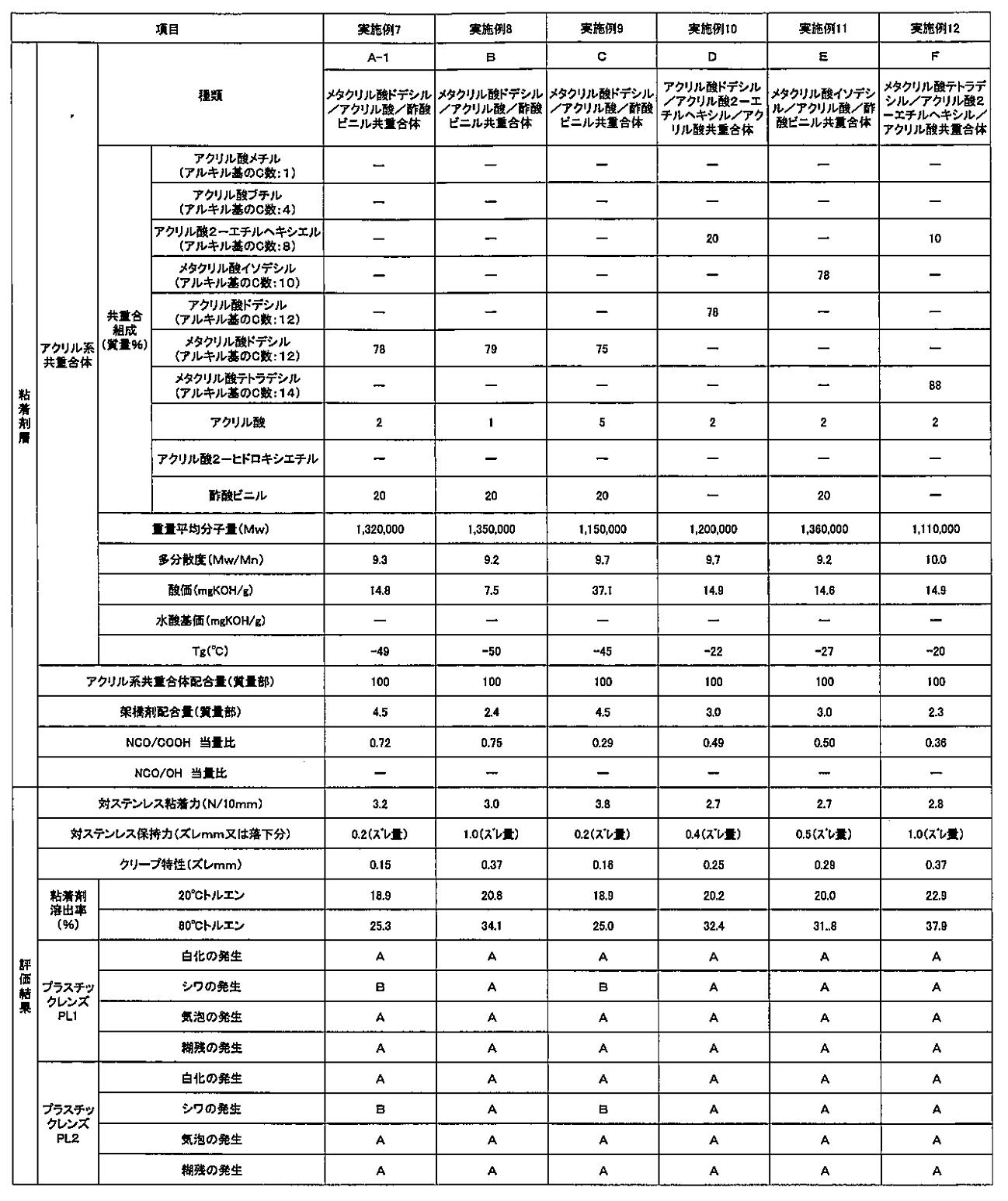
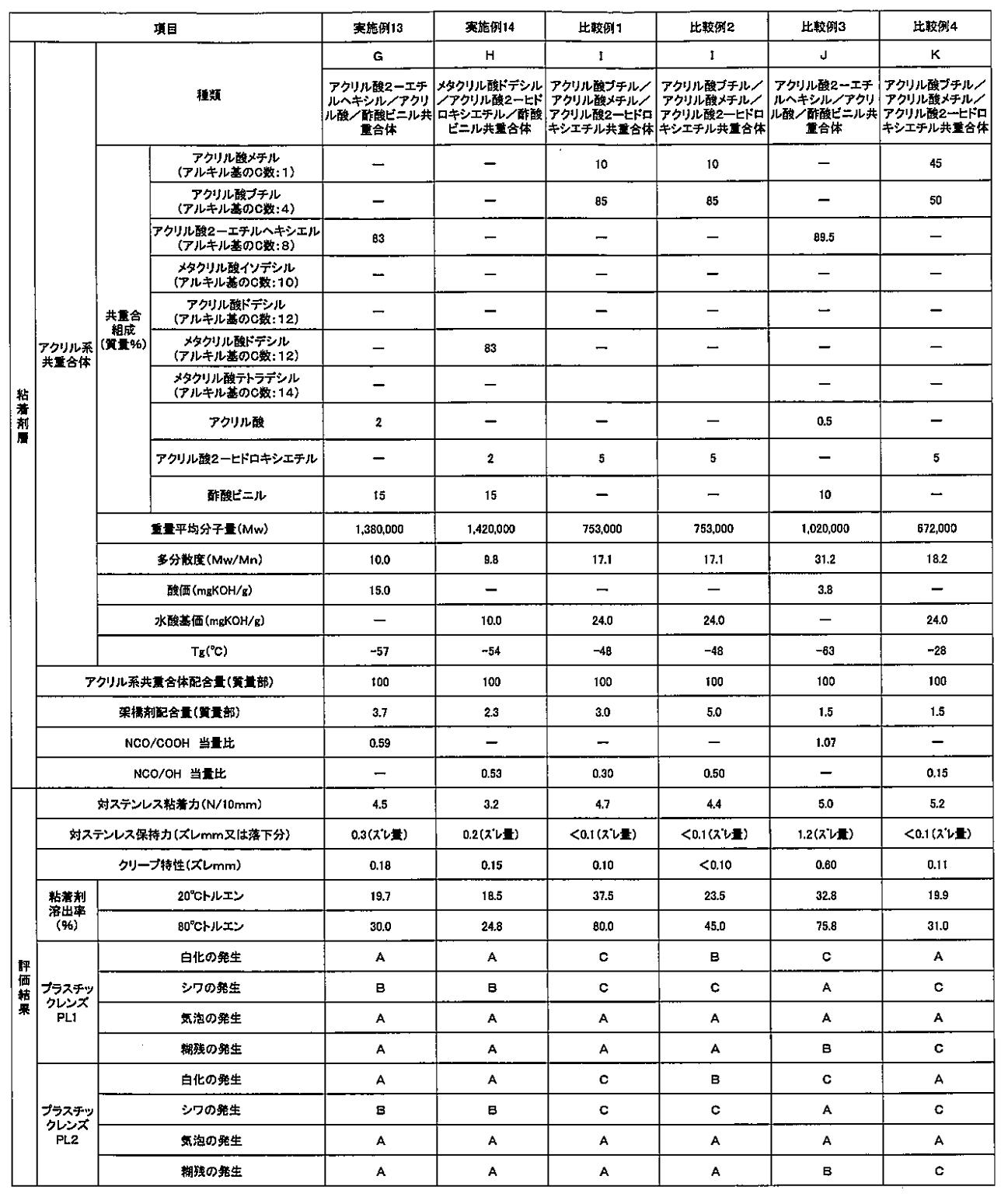
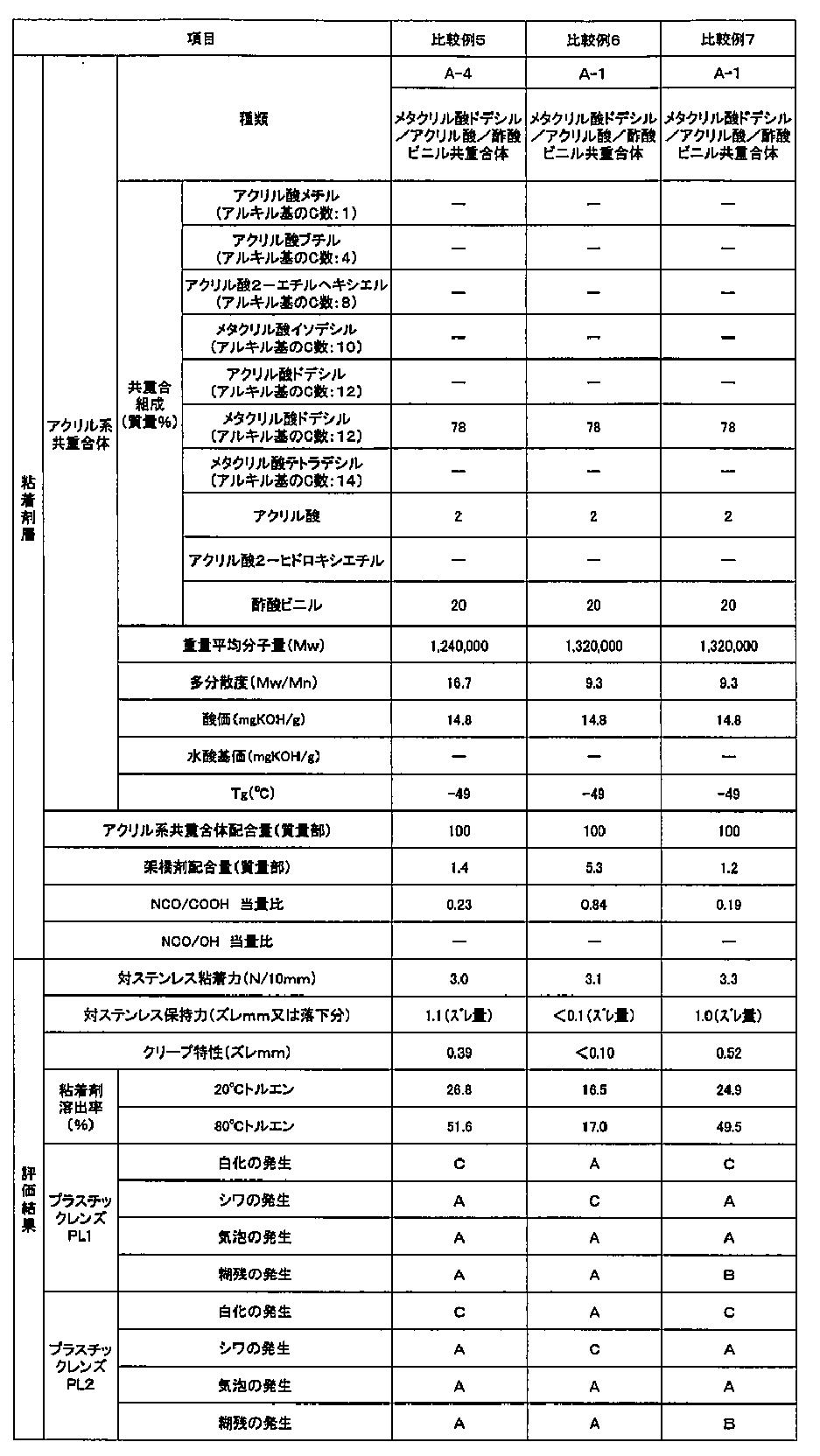
表1~3に示すように、粘着剤層3として、ゲル浸透クロマトグラフィーにより測定される重量平均分子量(Mw)が1,100,000以上、分子量の多分散度(Mw/Mn)が10.0以下である官能基を有するアクリル系共重合体(A1~A3、B~H)および該官能基と反応する架橋剤を含む粘着剤組成物を用い、80℃の温度に調整されたトルエンへの溶出率を48.0%以下、クリープ試験におけるズレ量を0.15mm以上0.50mm以下とした実施例1~14の粘着テープ1では、高屈折率プラスチックレンズPL1(屈折率1.60)およびPL2(屈折率1.67)の短時間昇温プロセスによる成型において、白化を始めとする外観の各特性のいずれにおいても、好ましい結果が得られることが確認された。
アクリル系共重合体の酸価が14.8mgKOH/gと同じで、架橋剤の含有量のみが異なる実施例1、実施例4~7の比較において、架橋剤の含有量が1.4質量%(NCO/COOH=0.23)と最も少ない実施例6は、80℃の温度に調整されたトルエンへの溶出率が47.7%と他の実施例よりも大きいため、粘着剤層3のプラスチックレンズ成型用樹脂への溶出量がやや多くなり、得られたプラスチックレンズPL1およびPL2の外周縁部に白化がわずかに観察された。また、架橋剤の含有量が4.5質量%(NCO/COOH=0.72)と最も多い実施例7は、クリープ試験におけるズレ量が0.15mmと他の実施例よりも小さいため、粘着剤層3の凝集力がやや大きく、すなわち応力緩和性がやや劣り、得られたプラスチックレンズPL1およびPL2の側面にシワがわずかに観察された。
また、アクリル系共重合体の酸価が37.1mgKOH/gと大きく、架橋剤の含有量が4.5質量%と多い実施例9も、クリープ試験におけるズレ量が0.15mmと他の実施例よりも小さいため、粘着剤層3の凝集力がやや大きく、すなわち応力緩和性がやや劣り、得られたプラスチックレンズPL1およびPL2の側面にシワがわずかに観察された。
さらに、アクリル系共重合体の主成分である(メタ)アクリル酸アルキルエステルのアルキル基の炭素数の数が8個で、架橋剤の含有量が3.7質量部である実施例13は、アクリル系共重合体の主成分である(メタ)アクリル酸アルキルエステルのアルキル基の炭素数の数が12個で、架橋剤の含有量が3.7質量部である実施例5と比較して、クリープ試験におけるズレ量が0.18mmと小さいため、粘着剤層3の凝集力がやや大きく、すなわち応力緩和性がやや劣り、得られたプラスチックレンズPL1およびPL2の側面にシワがわずかに観察された。
さらにまた、アクリル系共重合体の官能基が水酸基で、架橋剤の含有量が2.3質量部である実施例14は、アクリル系共重合体の官能基がカルボキシル基で、架橋剤の含有量が2.3質量部である実施例4と比較して、クリープ試験におけるズレ量が0.15mmと小さいため、粘着剤層3の凝集力がやや大きく、すなわち応力緩和性がやや劣り、得られたプラスチックレンズPL1およびPL2の側面にシワがわずかに観察された。
これにより、粘着剤層3として、ゲル浸透クロマトグラフィーにより測定される重量平均分子量(Mw)が1,100,000以上、分子量の多分散度(Mw/Mn)が10.0以下である官能基を有するアクリル系共重合体および該官能基と反応する架橋剤を含む粘着剤組成物を用い、80℃の温度に調整されたトルエンへの溶出率を48.0%以下、クリープ試験におけるズレ量を0.15mm以上0.50mm以下となるように設計した実施例1~14の粘着テープ1は、高屈折率プラスチックレンズの短時間昇温プロセスによる成型用粘着テープ用として有用であることが確認された。
これに対し、表3~4に示すように、粘着剤層3が、本発明の構成要件を満たさない比較例1~7は、白化、シワ、気泡、粘着剤残りの少なくともいずれかの評価結果が実施例1~14より劣る結果であることが確認された。
具体的には、重量平均分子量(Mw)が753,000と小さく、分子量の多分散度が(Mw/Mn)が17.1と大きいアクリル系共重合体Iを用いた比較例1は、架橋が不十分な低分子量成分の影響で、80℃の温度に調整されたトルエンへの溶出率が80.0%と実施例と比較して極めて大きいため、粘着剤層3のプラスチックレンズ成型用樹脂への溶出量が多くなり、得られたプラスチックレンズPL1およびPL2の外周縁部に白化が明確に観察された。また、主成分である(メタ)アクリル酸アルキルエステルのアルキル基の炭素数の数が4個で、アクリル系共重合体の官能基が水酸基であるためと推測されるが、クリープ試験におけるズレ量も0.10mmと実施例と比較して極めて小さいため、粘着剤層3の凝集力が大きく、すなわち応力緩和性が劣り、得られたプラスチックレンズPL1およびPL2の側面にシワが明確に観察された。
また、比較例1に対して、架橋剤の含有量を5.0質量%まで多くした比較例2は、80℃の温度に調整されたトルエンへの溶出率が45.0%と小さくなり、得られたプラスチックレンズPL1およびPL2の外周縁部の白化はわずかに観察される程度に改善されたものの、クリープ試験におけるズレ量も0.10mm以下とさらに小さくなったため、得られたプラスチックレンズPL1およびPL2の側面のシワについては依然として改善されなかった。
さらに、重量平均分子量(Mw)が1,020,000と小さく、分子量の多分散度が(Mw/Mn)が31.2と極めて大きいアクリル系共重合体Jを用いた比較例3は、架橋が不十分な低分子量成分の影響で、80℃の温度に調整されたトルエンへの溶出率が75.8%と実施例と比較して極めて大きいため、粘着剤層3のプラスチックレンズ成型用樹脂への溶出量が多くなり、得られたプラスチックレンズPL1およびPL2の外周縁部に白化が明確に観察された。また、アクリル系共重合体の酸価が3.8mgKOH/gであるためと推測されるが、クリープ試験におけるズレ量は0.60mmであったため、得られたプラスチックレンズPL1およびPL2の側面にシワは発生しなかった。なお、粘着剤残りについては、粘着テープ1剥離後のモールドの側面にわずかに観察されるレベルであった。
さらにまた、重量平均分子量(Mw)が672,000と小さく、分子量の多分散度が(Mw/Mn)が18.2と大きく、(メタ)アクリル酸アルキルエステルのアルキル基の炭素数の数が1個であるアクリル酸メチルを45質量%、(メタ)アクリル酸アルキルエステルのアルキル基の炭素数の数が4個であるアクリル酸ブチルを50質量%含むアクリル系共重合体Kを用いた比較例4は、特にアクリル酸メチルの溶解度パラメーターSP値がトルエンのSP値と離れているためと推測されるが、80℃の温度に調整されたトルエンへの溶出率が31.0%であり、得られたプラスチックレンズPL1およびPL2の外周縁部に白化が発生しなかった。しかしながら、アクリル系共重合体の官能基が水酸基であり、(メタ)アクリル酸アルキルエステルのアルキル基の炭素数の数が小さいためと推測されるが、クリープ試験におけるズレ量も0.11mmと実施例と比較して小さいため、得られたプラスチックレンズPL1およびPL2の側面にシワが明確に観察された。また、粘着剤残りについては、重量平均分子量(Mw)が672,000と小さいためと推測されるが、粘着テープ1剥離後のモールドの側面に明確に観察された。
さらにまた、重量平均分子量(Mw)が1,240,000で本発明の範囲を満たしているが、分子量の多分散度が(Mw/Mn)が16.7と大きく本発明の範囲外であるアクリル系共重合体A-4を用いた比較例5は、80℃の温度に調整されたトルエンへの溶出率が51.6%と比較例1、比較例3と比較して小さくはなっているものの、実施例と比較して該値は依然として大きいため、粘着剤層3のプラスチックレンズ成型用樹脂への溶出量が多くなり、得られたプラスチックレンズPL1およびPL2の外周縁部に白化が明確に観察された。
さらにまた、重量平均分子量(Mw)、分子量の多分散度が(Mw/Mn)が本発明の範囲を満たしているアクリル系共重合体A-1を用いてはいるが、架橋剤の含有量の増量調整により、クリープ試験におけるズレ量が0.10mm以下となった比較例6は、得られたプラスチックレンズPL1およびPL2の外周縁部に白化が発生しなかったものの、得られたプラスチックレンズPL1およびPL2の側面にシワが明確に観察された。
さらにまた、重量平均分子量(Mw)、分子量の多分散度が(Mw/Mn)が本発明の範囲を満たしているアクリル系共重合体A-1を用いてはいるが、架橋剤の含有量の減量調整により、80℃の温度に調整されたトルエンへの溶出率が49.5%となった比較例7は、得られたプラスチックレンズPL1およびPL2の側面にシワが発生しなかったものの、得られたプラスチックレンズPL1およびPL2の外周縁部に白化が明確に観察された。なお、粘着剤残りについては、粘着テープ1剥離後のモールドの側面にわずかに観察されるレベルであった。
1…粘着テープ、2…複合基材、3…粘着剤層、4…第1の基材、5…無機薄膜層、6…接着層、7…第2の基材、10…第1の積層体、20…第2の積層体、50…モールド、100…プラスチックレンズ成型用樹脂、C…キャビティ。
Claims (12)
- 基材と該基材の表面上に形成された粘着剤層とを有するプラスチックレンズ成型用粘着テープであって、
前記粘着剤層は、官能基を有するアクリル系共重合体及び該官能基と反応する架橋剤を含み、
前記アクリル系共重合体は、1,100,000以上の重量平均分子量(Mw)、及び10.0以下の分子量の多分散度(Mw/Mn)を有し、
前記粘着剤層は、80℃の温度に調整されたトルエンに2時間浸漬した際の溶出率が48.0%以下で、かつ、
前記粘着テープは、クリープ試験(温度40℃、荷重0.5kg)における800分後のズレ量が0.15mm以上0.50mm以下であり、
前記プラスチックレンズは1.59以上の屈折率を有する、プラスチックレンズ成型用粘着テープ。 - 前記アクリル系共重合体は、官能基としてカルボキシル基を有し、前記架橋剤は、ポリイソシアネート系化合物である、請求項1に記載のプラスチックレンズ成型用粘着テープ。
- 前記アクリル系共重合体は、5.0~75.0mgKOH/gの酸価を有し、前記アクリル系共重合体が有するカルボキシル基(COOH)の当量に対する前記ポリイソシアネート系化合物が有するイソシアネート基(NCO)の当量の比(NCO/COOH)は、0.20~0.80である、請求項2に記載のプラスチックレンズ成型用粘着テープ。
- 前記アクリル系共重合体の原料である単量体は、炭素数5~18のアルキル基を有する(メタ)アクリル酸アルキルエステルを含む、請求項1~3のいずれか一項に記載のプラスチックレンズ成型用粘着テープ。
- 前記粘着剤層は、80℃の温度に調整されたトルエンに2時間浸漬した際の溶出率が38%以下である、請求項1~4のいずれか一項に記載のプラスチックレンズ成型用粘着テープ。
- 前記粘着テープは、クリープ試験における800分後のズレ量が0.20mm以上0.50mm以下である請求項1~5のいずれか一項に記載のプラスチックレンズ成型用粘着テープ。
- 前記プラスチックレンズは、チオウレタン系樹脂である、請求項1~6のいずれか一項に記載のプラスチックレンズ成型用粘着テープ。
- 前記基材は、シート状の第1の基材と、無機薄膜層と、接着層と、シート状の第2の基材と、を順に積層した複合基材である請求項1~7のいずれか一項に記載のプラスチックレンズ成型用粘着テープ。
- 前記粘着テープは、1.5g/(m2・24h)以下のJIS K 7129に従う水蒸気透過度を有する請求項1~8のいずれか一項に記載のプラスチックレンズ成型用粘着テープ。
- 一対のモールドを所定の間隔を隔てて対向配置し、前記両モールドの外周縁部に請求項1~9のいずれか一項に記載のプラスチックレンズ成型用粘着テープを貼り付け、前記両モールド間に形成された空間の開口を封止して、プラスチックレンズの重合性原料が充填されるキャビティを形成するキャビティ形成工程と、
前記キャビティ内に1.59以上の屈折率を有するプラスチックレンズの重合性原料を充填する重合性原料充填工程と、
前記重合性原料を重合する重合工程とを、
有するプラスチックレンズの成型方法。 - 前記重合工程の重合条件は、45℃以上65℃以下の重合開始温度、130℃以上150℃以下の重合最終温度、0.10℃/分以上0.45℃/分以下の前記重合最終温度に達するまでの昇温速度を有する、請求項10に記載のプラスチックレンズの成型方法。
- 前記プラスチックレンズは、チオウレタン系樹脂である、請求項10又は11に記載のプラスチックレンズ成型方法。
Priority Applications (3)
| Application Number | Priority Date | Filing Date | Title |
|---|---|---|---|
| KR1020217028749A KR102717686B1 (ko) | 2019-03-28 | 2020-01-28 | 플라스틱 렌즈 성형용 점착 테이프 및 플라스틱 렌즈의 성형 방법 |
| CN202080019829.XA CN113543949B (zh) | 2019-03-28 | 2020-01-28 | 塑料透镜成型用粘着胶带和塑料透镜的成型方法 |
| US17/434,965 US20220195257A1 (en) | 2019-03-28 | 2020-01-28 | Pressure-sensitive adhesive tape and method for molding plastic lens |
Applications Claiming Priority (2)
| Application Number | Priority Date | Filing Date | Title |
|---|---|---|---|
| JP2019-064565 | 2019-03-28 | ||
| JP2019064565A JP7144352B2 (ja) | 2019-03-28 | 2019-03-28 | プラスチックレンズ成型用粘着テープおよびプラスチックレンズの成型方法 |
Publications (1)
| Publication Number | Publication Date |
|---|---|
| WO2020195119A1 true WO2020195119A1 (ja) | 2020-10-01 |
Family
ID=72609906
Family Applications (1)
| Application Number | Title | Priority Date | Filing Date |
|---|---|---|---|
| PCT/JP2020/003009 Ceased WO2020195119A1 (ja) | 2019-03-28 | 2020-01-28 | プラスチックレンズ成型用粘着テープおよびプラスチックレンズの成型方法 |
Country Status (5)
| Country | Link |
|---|---|
| US (1) | US20220195257A1 (ja) |
| JP (2) | JP7144352B2 (ja) |
| KR (1) | KR102717686B1 (ja) |
| CN (1) | CN113543949B (ja) |
| WO (1) | WO2020195119A1 (ja) |
Families Citing this family (2)
| Publication number | Priority date | Publication date | Assignee | Title |
|---|---|---|---|---|
| EP4484110A4 (en) * | 2022-02-25 | 2026-02-25 | Mitsui Chemicals Inc | METHOD FOR PRODUCING OPTICAL ELEMENTS AND OPTICAL ELEMENTS |
| EP4685169A1 (en) * | 2024-07-25 | 2026-01-28 | Essilor International | Closure member for manufacturing a polymeric cast substrate |
Citations (6)
| Publication number | Priority date | Publication date | Assignee | Title |
|---|---|---|---|---|
| JPH09141758A (ja) * | 1995-11-20 | 1997-06-03 | Asahi Glass Co Ltd | プラスチックレンズの製造方法及びそれに使用する粘着テープ |
| JP2000108218A (ja) * | 1998-10-02 | 2000-04-18 | Seiko Epson Corp | プラスチックレンズの製造方法 |
| JP2000191846A (ja) * | 1998-12-24 | 2000-07-11 | Hoya Corp | プラスチックレンズ製造用ガスケットをつくるための樹脂組成物、該組成物を用いたプラスチックレンズ製造用ガスケット、及びプラスチックレンズ |
| JP2012017363A (ja) * | 2010-07-06 | 2012-01-26 | Maxell Sliontec Ltd | プラスチックレンズ成型用粘着テープおよびこれを用いたプラスチックレンズ成型方法 |
| JP2014062227A (ja) * | 2012-08-30 | 2014-04-10 | Hitachi Maxell Ltd | 粘着テープ、プラスチックレンズ成型用粘着テープおよび粘着テープの製造方法 |
| WO2019004046A1 (ja) * | 2017-06-27 | 2019-01-03 | 住友化学株式会社 | 粘着剤組成物及び粘着剤層付フィルム |
Family Cites Families (9)
| Publication number | Priority date | Publication date | Assignee | Title |
|---|---|---|---|---|
| JPH05255650A (ja) | 1992-03-10 | 1993-10-05 | Nitto Denko Corp | プラスチックレンズ製造用接着テープ |
| JP3830227B2 (ja) | 1996-04-19 | 2006-10-04 | 三井化学株式会社 | 光学樹脂用組成物およびその用途 |
| US6599602B2 (en) * | 1999-06-02 | 2003-07-29 | 3M Innovative Properties Company | Polycarbonate articles and adhesive composition therefor |
| JP5230879B2 (ja) * | 2000-09-29 | 2013-07-10 | 株式会社日本触媒 | 粘着製品 |
| JP2005314579A (ja) * | 2004-04-30 | 2005-11-10 | Nitto Denko Corp | 粘着剤組成物、および粘着シート類 |
| JP5464074B2 (ja) * | 2010-06-18 | 2014-04-09 | 日立マクセル株式会社 | プラスチックレンズ成型用粘着テープおよびこれを用いたプラスチックレンズ成型方法 |
| KR102082326B1 (ko) * | 2012-11-30 | 2020-02-27 | 맥셀 홀딩스 가부시키가이샤 | 플라스틱 렌즈 성형용 점착 테이프 및 플라스틱 렌즈 성형품의 성형방법 |
| US20170052284A1 (en) * | 2015-08-21 | 2017-02-23 | Ppg Industries Ohio, Inc. | Batch Process for Preparing Molded Optical Articles |
| CN109628026B (zh) * | 2017-10-06 | 2022-09-23 | 日东电工株式会社 | 丙烯酸类粘合剂组合物及粘合片 |
-
2019
- 2019-03-28 JP JP2019064565A patent/JP7144352B2/ja active Active
-
2020
- 2020-01-28 US US17/434,965 patent/US20220195257A1/en not_active Abandoned
- 2020-01-28 KR KR1020217028749A patent/KR102717686B1/ko active Active
- 2020-01-28 WO PCT/JP2020/003009 patent/WO2020195119A1/ja not_active Ceased
- 2020-01-28 CN CN202080019829.XA patent/CN113543949B/zh active Active
-
2022
- 2022-08-24 JP JP2022133159A patent/JP7390447B2/ja active Active
Patent Citations (6)
| Publication number | Priority date | Publication date | Assignee | Title |
|---|---|---|---|---|
| JPH09141758A (ja) * | 1995-11-20 | 1997-06-03 | Asahi Glass Co Ltd | プラスチックレンズの製造方法及びそれに使用する粘着テープ |
| JP2000108218A (ja) * | 1998-10-02 | 2000-04-18 | Seiko Epson Corp | プラスチックレンズの製造方法 |
| JP2000191846A (ja) * | 1998-12-24 | 2000-07-11 | Hoya Corp | プラスチックレンズ製造用ガスケットをつくるための樹脂組成物、該組成物を用いたプラスチックレンズ製造用ガスケット、及びプラスチックレンズ |
| JP2012017363A (ja) * | 2010-07-06 | 2012-01-26 | Maxell Sliontec Ltd | プラスチックレンズ成型用粘着テープおよびこれを用いたプラスチックレンズ成型方法 |
| JP2014062227A (ja) * | 2012-08-30 | 2014-04-10 | Hitachi Maxell Ltd | 粘着テープ、プラスチックレンズ成型用粘着テープおよび粘着テープの製造方法 |
| WO2019004046A1 (ja) * | 2017-06-27 | 2019-01-03 | 住友化学株式会社 | 粘着剤組成物及び粘着剤層付フィルム |
Also Published As
| Publication number | Publication date |
|---|---|
| KR20210148104A (ko) | 2021-12-07 |
| JP2022167964A (ja) | 2022-11-04 |
| JP2020163626A (ja) | 2020-10-08 |
| CN113543949B (zh) | 2025-07-11 |
| JP7390447B2 (ja) | 2023-12-01 |
| CN113543949A (zh) | 2021-10-22 |
| KR102717686B1 (ko) | 2024-10-16 |
| JP7144352B2 (ja) | 2022-09-29 |
| US20220195257A1 (en) | 2022-06-23 |
Similar Documents
| Publication | Publication Date | Title |
|---|---|---|
| CN101765494B (zh) | 塑料透镜的制造方法 | |
| CN104160324B (zh) | 塑料偏光透镜及其制备方法 | |
| TWI591143B (zh) | Adhesive compositions, adhesives and adhesive sheets | |
| TWI665475B (zh) | 偏光板、其製造方法以及包含其的光學顯示器 | |
| TW201936819A (zh) | 黏著片及其製造方法、以及圖像顯示裝置之製造方法 | |
| US8003022B2 (en) | Method of forming a coated optical element | |
| CN102202876A (zh) | 用于透镜层压的双层粘合剂 | |
| CN113736378A (zh) | 粘着保护膜、包括其的光学构件以及包括其的光学显示器 | |
| JP7390447B2 (ja) | プラスチックレンズ成型用粘着テープ | |
| TW202128934A (zh) | 黏著片材、可撓性圖像顯示裝置構件、光學構件及圖像顯示裝置 | |
| CN111727402A (zh) | 功能性层叠体和使用功能性层叠体的功能性透镜 | |
| CN117048092A (zh) | 铸造镜片 | |
| EP1226011A1 (en) | Method of forming a coated optical element | |
| WO2011096304A1 (ja) | 光学物品用プライマー組成物及び光学物品 | |
| KR101853888B1 (ko) | 고신율/고경도 하드코팅 조성물 및 코팅 필름 | |
| JP6216168B2 (ja) | プラスチックレンズ成型用粘着テープ | |
| CN109790429A (zh) | 偏振膜用粘合剂组合物、偏振膜用粘合剂层的制造方法、带粘合剂层的偏振膜、及图像显示装置 | |
| TWI907004B (zh) | (甲基)丙烯酸類樹脂膜 | |
| TWI657120B (zh) | 偏光板用接著劑組成物、由該組成物產生的偏光板用的接著膜、包含該接著膜的偏光板以及包含上述的光學顯示器 | |
| JP2022135955A (ja) | フォトクロミック物品の製造方法 | |
| JP2022064782A (ja) | 粘着シート | |
| TWI861687B (zh) | 光學積層體 | |
| CN103666303A (zh) | 粘着带、塑料透镜成型用粘着带和粘着带的制造方法 | |
| WO2024202755A1 (ja) | 粘着シートおよび表示体 | |
| JP2003177202A (ja) | プラスチックレンズ用組成物及びプラスチックレンズの製造方法 |
Legal Events
| Date | Code | Title | Description |
|---|---|---|---|
| 121 | Ep: the epo has been informed by wipo that ep was designated in this application |
Ref document number: 20776716 Country of ref document: EP Kind code of ref document: A1 |
|
| NENP | Non-entry into the national phase |
Ref country code: DE |
|
| 122 | Ep: pct application non-entry in european phase |
Ref document number: 20776716 Country of ref document: EP Kind code of ref document: A1 |
|
| WWG | Wipo information: grant in national office |
Ref document number: 202080019829.X Country of ref document: CN |