WO2020166494A1 - 血圧低下作用を有するナス由来組成物 - Google Patents
血圧低下作用を有するナス由来組成物 Download PDFInfo
- Publication number
- WO2020166494A1 WO2020166494A1 PCT/JP2020/004708 JP2020004708W WO2020166494A1 WO 2020166494 A1 WO2020166494 A1 WO 2020166494A1 JP 2020004708 W JP2020004708 W JP 2020004708W WO 2020166494 A1 WO2020166494 A1 WO 2020166494A1
- Authority
- WO
- WIPO (PCT)
- Prior art keywords
- water
- eggplant
- blood pressure
- composition
- fruit
- Prior art date
- Legal status (The legal status is an assumption and is not a legal conclusion. Google has not performed a legal analysis and makes no representation as to the accuracy of the status listed.)
- Ceased
Links
Classifications
-
- A—HUMAN NECESSITIES
- A23—FOODS OR FOODSTUFFS; TREATMENT THEREOF, NOT COVERED BY OTHER CLASSES
- A23L—FOODS, FOODSTUFFS OR NON-ALCOHOLIC BEVERAGES, NOT OTHERWISE PROVIDED FOR; PREPARATION OR TREATMENT THEREOF
- A23L33/00—Modifying nutritive qualities of foods; Dietetic products; Preparation or treatment thereof
- A23L33/10—Modifying nutritive qualities of foods; Dietetic products; Preparation or treatment thereof using additives
- A23L33/105—Plant extracts, their artificial duplicates or their derivatives
-
- A—HUMAN NECESSITIES
- A61—MEDICAL OR VETERINARY SCIENCE; HYGIENE
- A61K—PREPARATIONS FOR MEDICAL, DENTAL OR TOILETRY PURPOSES
- A61K36/00—Medicinal preparations of undetermined constitution containing material from algae, lichens, fungi or plants, or derivatives thereof, e.g. traditional herbal medicines
- A61K36/18—Magnoliophyta (angiosperms)
- A61K36/185—Magnoliopsida (dicotyledons)
- A61K36/81—Solanaceae (Potato family), e.g. tobacco, nightshade, tomato, belladonna, capsicum or jimsonweed
-
- A—HUMAN NECESSITIES
- A61—MEDICAL OR VETERINARY SCIENCE; HYGIENE
- A61P—SPECIFIC THERAPEUTIC ACTIVITY OF CHEMICAL COMPOUNDS OR MEDICINAL PREPARATIONS
- A61P9/00—Drugs for disorders of the cardiovascular system
- A61P9/12—Antihypertensives
Definitions
- the present invention relates to a composition having an effect of lowering blood pressure containing an eggplant-derived component and a method for producing the same.
- the present inventors have studied the blood pressure-lowering action and vasodilatory active ingredient contained in fermented Kyou-baku (lactic acid fermented product of buckwheat plant), and mainly composed of a plurality of choline esters containing at least acetylcholine and propionylcholine.
- An extract composition containing a quaternary alkylammonium compound was provided, and it was clarified that the purified acetylcholine, propionylcholine, and butyrylcholine exhibited a hypotensive effect when they were administered orally once to spontaneously hypertensive rats (SHR).
- Patent Documents 1 and 2 lactic acid fermented product of buckwheat plant
- freeze-dried powders of edible plants such as eggplant and bamboo
- extracts of edible plants with ethanol or hydrous ethanol include active ingredients having a hypotensive action such as acetylcholine, which are orally administered. It was clarified that it can be used for intake (Patent Document 3).
- Patent Document 4 a blood pressure increase suppressing composition containing a vegetable squeezed product such as tomato, carrot and spinach and a germinated buckwheat squeezed product as an active ingredient, and a composition containing a water-soluble, sugar-free tomato extract Has been reported to be used as an antihypertensive drug (Patent Document 5).
- Patent Document 5 a blood pressure increase suppressing composition containing a vegetable squeezed product such as tomato, carrot and spinach and a germinated buckwheat squeezed product as an active ingredient
- Patent Document 5 a composition containing a water-soluble, sugar-free tomato extract
- the inventors of the present invention can prepare a composition having a lower blood pressure effect more effectively by using less raw materials, and if a composition having a more effective hypotensive effect is obtained, it can be used as a health food such as a supplement or a pharmaceutical product at a low cost and in a large amount. Focusing on the possibility of production, we sought a new material with a blood pressure lowering effect. Therefore, an object of the present invention is to provide a new composition having an effective blood pressure lowering action by simple preparation.
- the inventors of the present invention have found that all water-soluble components derived from eggplant (Solanum melongena) have an excellent systolic blood pressure lowering action in the course of intensive research to solve the above problems, and further researched. As a result, the present invention has been completed.
- the invention therefore relates to: [1] A composition for lowering blood pressure, which comprises, as an active ingredient, all water-soluble components of the fruits of eggplant (Solanum melongena). [2] A composition for lowering blood pressure, which comprises all water-soluble components of the fruits of eggplant (Solanum melongena). [3] The composition for lowering blood pressure according to the above [1] or [2], which is to be taken orally at a dose such that the amount of acetylcholine in all the water-soluble components is 0.5 ⁇ g/kg body weight to 50 mg/kg body weight. [4] The composition for lowering blood pressure according to any one of the above [1] to [3], which is a dry powder. [5] The composition for lowering blood pressure according to any one of the above [1] to [4], which is a food composition.
- a method for producing a composition for lowering blood pressure which comprises a component derived from eggplant (Solanum melongena), The said manufacturing method including extracting all the water-soluble components from an eggplant fruit.
- the production method according to the above [6], wherein the extraction is water extraction.
- Water extraction Adding water to the eggplant fruit after making it a dry powder and The production method according to [7] above, which comprises obtaining a supernatant from a dry powder added with water by centrifugation or obtaining a filtrate by suction filtration.
- the present invention can provide a composition having an excellent blood pressure lowering action, which can be simply and inexpensively produced from the fruits of eggplant (Solanum melongena).
- Eggplant fruit as a raw material of the composition of the present invention is widely edible, it is also possible to compose the composition of the present invention only natural ingredients, high safety, continuous for a long period of time Can be ingested.
- the composition of the present invention includes a water extract of eggplant fruit, a concentrated extract obtained by concentrating the extract, a dry powder (freeze-dried powder, hot-air dried powder, spray-dried powder, etc.), a suspension of the dried powder, and the like. It can be used for foods and drinks and pharmaceuticals in various forms.
- the blood pressure lowering composition of the present invention contains all water-soluble components of eggplant fruit as an active ingredient.
- the composition for lowering blood pressure of the present invention may consist of all water-soluble components of eggplant fruit.
- the total water-soluble component of eggplant fruit means a water-soluble component obtained by pressing the eggplant fruit, but is included in the juice obtained by adding water to the eggplant fruit and squeezing the juice. It also means all water-soluble components. For example, even when the water-insoluble component is unavoidably contained in the juice, or even when a part of the water-soluble component is inevitably left as a residue during the juice, it is contained in the juice. The component corresponds to the total water-soluble component.
- the eggplant used in the present invention is not particularly limited. Eggplants that are commonly eaten are preferred, and for example, varieties such as Tosataka, Shintaro, Ryoma, Senshumizu eggplant, batten eggplant, Hiroryo salad eggplant (also known as Yoshio), Higuranasaki, Ocho eggplant, Chikuyo, and Senryo are used. be able to.
- the amount of acetylcholine in the total water-soluble components is 0.5 ⁇ g/kg body weight to 50 mg/kg body weight, preferably 2 ⁇ g/kg body weight to 20 mg/kg body weight.
- the composition for lowering blood pressure of the present invention may be a dry powder such as a freeze-dried powder or a hot-air dried powder.
- the composition of the present invention can be used as a food composition such as various functional health foods or a pharmaceutical composition.
- a food composition such as various functional health foods or a pharmaceutical composition.
- it may be used in combination with an appropriate food additive.
- an appropriate food additive not limited to such a composition for food, green tea, black tea, oolong tea, millet tea, health drink, as a drink blended into sports drinks, or as a food blended into biscuits, bread, candy, etc., everyday It is also possible to provide it in a form that can be ingested physically.
- it can be used as a so-called supplement in a suitable dosage form in accordance with the following pharmaceutical preparations.
- dosage forms When it is used as a drug, it can be used as various dosage forms in combination with an appropriate drug additive according to the usual preparation method.
- dosage forms include solid preparations such as powders, granules, capsules, pills and tablets, and oral administration preparations such as liquid preparations such as water preparations, suspension preparations and emulsions.
- composition of the present invention When used as a food, it can be used not only as a general food and drink, but also as a functional health food that exerts a specific function to promote health.
- capsules containing the composition of the present invention as an active ingredient tablets, powders, supplements consisting of granules, bread, cakes, bakery foods such as cookies, sauces, Seasonings such as soups, dressings, mayonnaise, dairy products such as milk, yogurt, creams, confectionery such as chocolate and candy, or green tea, black tea, oolong tea, barley tea, millet tea, fruit juice, vegetable drinks, dairy drinks , Various beverages such as soft drinks and carbonated drinks.
- the dose varies depending on the ratio of each ingredient, and also varies depending on various factors such as age, weight, sex, symptoms of patient, administration method and the like. .. Further, it may be increased or decreased as appropriate depending on the degree of symptom improvement.
- the frequency of administration can be divided into one to several times a day.
- the amount of intake when the composition of the present invention is used as a food can be selected according to the case of oral administration of the above-mentioned drug.
- the dose and frequency of administration are not particularly limited.Therefore, the purpose of maintaining good health, taste, and palatability should be considered as long as no serious symptoms occur. Then, the intake amount may be selected without limitation.
- the composition of the present invention can be used for, for example, a subject with hypertension or a subject who is healthy (not hypertensive) but has high blood pressure.
- various additives can be added to the composition of the present invention.
- various ones can be used and are not particularly limited, and examples thereof include lactose hydrate, sucrose, glucose, reduced maltose, mannitol, saccharides such as sorbitol, corn starch, potato starch, and partial sugar.
- starches such as alpha starch, dextrin and pullulan and their derivatives, celluloses such as crystalline cellulose and microcrystalline cellulose, derivatives such as carboxymethyl cellulose, macrogol and magnesium aluminometasilicate. Can be mentioned. Of these, dextrin is more preferable.
- additive one type may be used alone, or two or more types may be used in combination. These additives are preferably contained in an amount of 1 to 1000 parts by weight, more preferably 10 to 300 parts by weight, based on 100 parts by weight of the composition of the present invention.
- the present invention in one aspect, relates to a method for producing a blood pressure lowering composition containing an eggplant-derived component.
- the production method of the present invention includes extracting all water-soluble components from eggplant fruits.
- the extraction method is not particularly limited as long as all the water-soluble components are obtained, but for example, the water contained in the eggplant fruit is used to squeeze the eggplant fruit without adding water to obtain a juice. You may extract by. Alternatively, water extraction may be performed. Water extraction is carried out by adding water to the eggplant fruit, squeezing the water-added fruit, adding water after making the eggplant fruit a dry powder, and drying the water-added dry powder. It may be to extract.
- the water added to the eggplant fruit is not particularly limited, and water in the temperature range of 5°C to 40°C may be added. It is preferable to add water at room temperature.
- the amount of water added is preferably 50 to 200 parts by mass, more preferably 75 to 150 parts by mass, and particularly preferably 100 parts by mass, relative to 100 parts by mass of the eggplant fruit as a raw material. When the amount of water is small, the extraction of the water-soluble component that is the active ingredient may be insufficient, and when the amount of water is large, the processing volume may be large, and it may not be easy to process it into a dry powder, for example.
- Eggplant fruit may be crushed before squeezing or extracting. Particularly in the case of water extraction, it is preferable to crush the eggplant fruit before or after adding water, and it is particularly preferable to crush it before adding water from the viewpoint of ease of crushing.
- the crushing can be performed in various forms such as, for example, cutting into strips, dice-shaped blocks, and pastes, but it is preferable to crush into pastes for easier squeezing.
- a juicer mixer, mill, crusher or the like can be used for example.
- Water used in the production method of the present invention is water generally used for food processing such as mineral water, distilled water, deionized water, ion-exchanged water, electrolyzed water, tap water, well water, and industrial water used for food. it can.
- the pH is also not particularly limited, but in order to stably hold acetylcholine, pH 9.0 to pH 3.0 is preferable, pH 8.0 to pH 4.0 is more preferable, and pH 6.5 to pH 4.5 is more preferable.
- Water whose pH has been adjusted using a pH adjuster such as ascorbic acid can be used.
- ethanol may be added in order to reduce contamination of bacteria during the juice extraction work.
- the ethanol concentration should be 9.9 wt% or less, preferably 6 wt% or less, More preferably, it is 4 wt% or less.
- eggplant fruits may be heated.
- the acetylcholine degrading enzyme can be inactivated, and acetylcholine can be efficiently extracted.
- the eggplant fruit tissue is softened, the cell wall is destroyed, so that the water-soluble component of the eggplant fruit and the crushing of the eggplant fruit can be facilitated.
- the mode of heating is not particularly limited, and for example, heating can be performed in the temperature range of 30 to 100° C. for 2 minutes to 60 minutes.
- the heating temperature is preferably 80 to 100°C.
- Examples of the method of heating eggplant fruit include a method of heating with a microwave oven, a hot plate or a pot, a method of immersing in eggplant hot water, a method of applying steam, and the like.
- the method of dipping in hot water and the method of applying steam to the eggplant are preferable.
- the heating of the eggplant fruit may be performed at any time before addition of water, after addition, during heating with water, before crushing, after crushing, or during crushing. It is preferable to rapidly heat the acetylcholine degrading enzyme for inactivation.
- the method of squeezing the crushed eggplant fruit is not particularly limited as long as it can be divided into a squeezing liquid and a residue.
- it can be squeezed by using a dashi-koshi bag and squeezing with a squeezing machine such as wine, or by squeezing with a fruit juice squeezer.
- a centrifuge, pulper finisher or the like may be used.
- extracting eggplant fruits with water particularly when water is added to dry powder of eggplant fruits to obtain a water extract, a centrifugal separator or a suction filter may be used.
- the obtained squeezed juice or water extract (for example, supernatant of centrifugation, filtrate of a suction filter, etc.) can be dried into a lump or powdery dried product.
- the drying method is not particularly limited, but it is preferable that the water content in the dried product can be dried to 0 to 10 wt %.
- it can be dried by heat drying such as hot air drying, drum drying, freeze drying, spray drying and the like.
- the dried product can be pulverized into a dry powder.
- the pulverization method is not particularly limited, but it is preferable that the pulverization can be performed to about 5 to 100 mesh. For example, it can be ground using a mill.
- the composition produced by the production method of the present invention tends to be low in dietary fiber and high in sugar.
- the ratio of dietary fiber to sugar in the composition of the present invention is, for example, 1:2 to 1:100, preferably 1:5 to 1:40, particularly preferably 1:10 to 1 : 20.
- EN (2-aminoethyl)trimethylammonium pivaloylamide
- AcCh acetylcholine
- BuCh butyrylcholine
- Ch choline
- LaCh lactoylcholine
- PrCh propionylcholine
- EN, AcCh, BuCh, Ch, LaCh, and PrCh are collectively referred to as choline compounds.
- EtOH ethanol.
- Example 1 50 kg of fresh eggplant (Tosataka: 2018) from Kochi prefecture was crushed with a crusher, 50 kg of water and 50 kg of water were added to a pan, and the mixture was heated to 90°C and boiled for 20 minutes to obtain a slurry-like crushed product .. The obtained crushed product was pressed with a fruit juicer (fruit press) to obtain 69 kg of juice and 22 kg of residue. The obtained juice was lyophilized as it was and pulverized to obtain 1.34 kg (water content 5.1%) of lyophilized powder (Example 1).
- Example 1 10 kg of the crushed material of Example 1 was freeze-dried as it was without squeezing and crushed to obtain 600 g of freeze-dried powder (Comparative Example 1).
- Solid phase extraction As a solid phase extraction cartridge, a weakly acidic cation exchange cartridge Inert Sep CBA 100 mg/1 mL (GL Science Co., Ltd.) was used. A solid phase extraction cartridge activated with methanol (1 mL) and pure water (1 mL) was equilibrated with 10 mM phosphate buffer (8 mL), and then the extraction sample (about 600 ⁇ L) prepared in (3) above was added. It was stabilized with 10 mM phosphate buffer (600 ⁇ L), washed with pure water (2.5 mL), and then eluted with hydrochloric acid (500 ⁇ L).
- a choline compound mixed solution was prepared as shown in Table 2, and the addition concentration of each choline compound stock solution was determined according to the analysis result of the choline compound mixed solution-free sample (Table 1-A).
- the choline compound stock solution was diluted with the LC/MS/MS analysis solvent to prepare each concentration. If any choline compound was not detected, only an equal volume of LC/MS/MS analytical solvent without that compound was added.
- LC/MS/MS analysis (1) LC/MS/MS analysis conditions The column used was YMC-Triart PFP (4.6 mm ⁇ 250 mm, 5 ⁇ m, YMC Co., Ltd.). Water containing 0.01% formic acid-33% methanol was used as the analysis solvent, the flow rate was 0.5 mL/min (LC), 0.3 mL/min (MS), the injection volume was 50 ⁇ L, the separation temperature was 40° C., and the analysis time was Is 30 min, ionization mode is ESI+ ⁇ MRM, Capillary Voltage is 3500 V, Cone Voltage is 10 V, Collision Voltage is 10 V, N2 gas flow (desolvation) is 600 L/hr, N2 gas flow (cone) is 50 L/hr, N2 source temp.
- Example 1 The acetylcholine content of Example 1 was 1.73 (mg/g DW), and the acetylcholine content of Comparative Example 1 was 0.62 (mg/g DW).
- Example 1 The freeze-dried powder of Example 1 and the freeze-dried powder of Comparative Example 1 were given in an amount such that the amount of acetylcholine was 10 ⁇ 9 mol/kg body weight so that the amount of acetylcholine was the same.
- systolic blood pressure was measured by the tail cuff method using a non-invasive blood pressure measuring device Softron BP-98A (Softron Co., Ltd., Tokyo). The results are shown in Table 4.
- Group B was ingested 4 capsules of Comparative Example 1 twice a day (morning and evening) for a total of 8 capsules for 4 weeks.
- the freeze-dried powder of Comparative Example 1 contained approximately 8 times the dietary fiber of the freeze-dried powder of Example 1. Further, it was found that the freeze-dried powder of Example 1 contained more sugar.
- Example 2 One week after harvesting, 3 kg of Kochi eggplant Tosataka (produced in 2017), which had been frozen and stored, was thawed, put in a pot as it was, and covered with a lid-type heater for 30 minutes. 1 kg was freeze-dried as it was to obtain Comparative Example 2. After cooling the remaining 2 kg, the heated eggplant was crushed with a juicer mixer for 10 minutes. After adding 2 kg of water and stirring well, they were mixed with a juicer mixer for 10 minutes. The obtained slurry-like crushed product was divided and placed in six 1 L capacity dashi-koshi bags, and a squeezing liquid and a residue were obtained with a 12 L capacity squeezing machine (wine press).
- the amount of juice was 2700 g and Brix 1.9%.
- the residue was 530 g.
- 900 g of squeezed juice was freeze-dried and pulverized with a mill to obtain 28 g of eggplant squeezed powder, which was used as Example 2-1.
- Dextrin (17 g) was added to 900 g of squeezed liquid, dissolved, freeze-dried, and pulverized with a mill to obtain 74 g of eggplant squeezed powder containing 50% dextrin, which was used as Example 2-2.
- Example 3 50 kg of water (produced in 2018) of Tosataka, fresh eggplant produced in Kochi prefecture, was added with 50 kg of water, heated to 90° C. and boiled for 20 minutes. All of the obtained eggplants and broth were crushed with a crusher to obtain a slurry-like crushed product. 1 kg thereof was freeze-dried as it was to obtain Comparative Example 3. The remainder was squeezed with a fruit juicer (fruit press) to obtain 68.5 kg of juice and 23.8 kg of residue. The squeezed liquid was divided into two, and 34 kg of the squeezed liquid was spray-dried as it was with a spray dryer to obtain 675 g of the powder of Example 3-1. 700 g of lactose was added to 34 kg of squeezed juice, dissolved well, and spray-dried with a spray dryer to obtain 1.23 kg of powder, which was used as Example 3-2.
- Example 4 Comparative Example 4 and Example 4 were obtained in the same manner as in Example 1 except that the raw eggplant was changed to a fresh eggplant produced in Kumamoto Prefecture, Higuranasaki (produced in 2018).
- Example 5 The raw eggplant was Kumamoto prefecture fresh eggplant, Higuranasaki (produced in 2018), 20 kg was crushed with a crusher, heated to 90° C. and boiled for 1 hour. 1 kg of the obtained crushed product was freeze-dried as it was to obtain Comparative Example 5. Water was not added to the remaining 19 kg, and the mixture was pressed as it was to obtain 8 kg of juice. Freeze-drying and pulverization gave 250 g of the powder of Example 5.
- Example 6 To 100 g of Comparative Example 1, 10 times the amount of water was added and stirred for 1 hour. The obtained slurry-like solution was centrifuged (3,000 rotations, 30 minutes) to obtain a supernatant. The supernatant was freeze-dried and pulverized to obtain 42 g of the powder of Example 6.
- Example 7 10 kg of fresh eggplant (Tosataka: 2017) from Kochi Prefecture was heated at 95°C for 50 minutes, cooled to room temperature, crushed with a crusher, and 10 kg of water was added to obtain a slurry-like crushed material. .. The obtained crushed product was dried with a drum dryer to obtain 550 g of powder (referred to as Comparative Example 6). To 300 g of this powder was added 20 times the amount of water, the mixture was stirred for 1 hour, and 5000 ml of the filtrate obtained by suction filtration using filter paper was freeze-dried and pulverized to obtain 90 g of Example 7.
Landscapes
- Health & Medical Sciences (AREA)
- Life Sciences & Earth Sciences (AREA)
- Natural Medicines & Medicinal Plants (AREA)
- Chemical & Material Sciences (AREA)
- Engineering & Computer Science (AREA)
- Public Health (AREA)
- Animal Behavior & Ethology (AREA)
- Botany (AREA)
- Veterinary Medicine (AREA)
- Medicinal Chemistry (AREA)
- General Health & Medical Sciences (AREA)
- Mycology (AREA)
- Pharmacology & Pharmacy (AREA)
- Medical Informatics (AREA)
- General Chemical & Material Sciences (AREA)
- Microbiology (AREA)
- Biotechnology (AREA)
- Alternative & Traditional Medicine (AREA)
- Bioinformatics & Cheminformatics (AREA)
- Cardiology (AREA)
- Heart & Thoracic Surgery (AREA)
- Chemical Kinetics & Catalysis (AREA)
- Epidemiology (AREA)
- Nuclear Medicine, Radiotherapy & Molecular Imaging (AREA)
- Organic Chemistry (AREA)
- Nutrition Science (AREA)
- Food Science & Technology (AREA)
- Polymers & Plastics (AREA)
- Medicines Containing Plant Substances (AREA)
- Coloring Foods And Improving Nutritive Qualities (AREA)
- Medicinal Preparation (AREA)
- Preparation Of Fruits And Vegetables (AREA)
Abstract
本発明の課題は、簡単な調製により、効果的な血圧低下作用を有する新たな組成物を提供することである。本発明は、ナス(Solanum melongena)の果実の全水溶性成分を有効成分として含む、血圧低下用組成物、並びに、ナス由来の血圧低下用組成物の製造方法であって、ナス果実から全水溶性成分を抽出することを含む、前記製造方法、該製造方法によって製造された血圧低下用組成物などに関する。
Description
本発明は、ナス由来成分を含む血圧低下作用を有する組成物およびその製造方法に関する。
本発明者らは、発酵キョウバク(ソバ植物体の乳酸発酵物)に含まれる血圧降下作用および血管拡張作用活性成分について研究し、少なくともアセチルコリンとプロピオニルコリンを含む、複数のコリンエステルを主体とした第4級アルキルアンモニウム化合物を含有する抽出組成物を提供し、また精製したアセチルコリン、プロピオニルコリン、ブチリルコリンを高血圧自然発症ラット(SHR)に単回経口投与した場合に血圧降下作用を示すことを明らかにした(特許文献1、2)。さらに本発明者らは、ナスやタケなどの食用植物の凍結乾燥粉末や、食用植物のエタノールまたは含水エタノールによる抽出物には、アセチルコリンなどの血圧降下作用を有する有効成分が含まれ、これを経口摂取用として用いることができることを明らかにした(特許文献3)。
一方、トマト、ニンジン、ホウレンソウなどの野菜搾汁物および発芽ソバ搾汁物を有効成分とする、血圧上昇抑制組成物(特許文献4)や、水溶性の、糖を含まないトマト抽出物を含む組成物が抗高血圧症薬として用い得るとの報告がある(特許文献5)。しかし、これらはいずれも、複数の原料を要したり、抽出物から糖を除去する必要があったり、容易に調製し得るものではなかった。
本発明者らは、より少ない原料を用いて、より簡単に調製することができ、より効果的に血圧低下作用を有する組成物が得られれば、サプリメントなどの健康食品や医薬品として低コストで大量生産が可能になることに着目し、血圧低下作用を有する新たな素材について探求した。
したがって、本発明の課題は、簡単な調製により、効果的な血圧低下作用を有する新たな組成物を提供することである。
したがって、本発明の課題は、簡単な調製により、効果的な血圧低下作用を有する新たな組成物を提供することである。
本発明者らは、上記課題を解決すべく鋭意研究を重ねる中で、ナス(Solanum melongena)由来の全水溶性成分が優れた収縮期血圧低下作用を有することを発見し、さらに研究を進めた結果、本発明を完成するに至った。
したがって本発明は、以下に関する。
[1] ナス(Solanum melongena)の果実の全水溶性成分を有効成分として含む、血圧低下用組成物。
[2] ナス(Solanum melongena)の果実の全水溶性成分からなる、血圧低下用組成物。
[3] 全水溶性成分中のアセチルコリン量が0.5μg/kg体重~50mg/kg体重となる用量で経口摂取するための、前記[1]または[2]に記載の血圧低下用組成物。
[4] 乾燥粉末である、前記[1]~[3]のいずれか一項に記載の血圧低下用組成物。
[5] 食品組成物である、前記[1]~[4]のいずれか一項に記載の血圧低下用組成物。
[1] ナス(Solanum melongena)の果実の全水溶性成分を有効成分として含む、血圧低下用組成物。
[2] ナス(Solanum melongena)の果実の全水溶性成分からなる、血圧低下用組成物。
[3] 全水溶性成分中のアセチルコリン量が0.5μg/kg体重~50mg/kg体重となる用量で経口摂取するための、前記[1]または[2]に記載の血圧低下用組成物。
[4] 乾燥粉末である、前記[1]~[3]のいずれか一項に記載の血圧低下用組成物。
[5] 食品組成物である、前記[1]~[4]のいずれか一項に記載の血圧低下用組成物。
[6] ナス(Solanum melongena)由来成分を含む血圧低下用組成物の製造方法であって、
ナス果実から全水溶性成分を抽出すること
を含む、前記製造方法。
[7] 抽出が、水抽出である、前記[6]に記載の製造方法。
[8] 水抽出が、
ナス果実に水を添加すること、および、
水を添加した果実を搾汁し、搾汁液を得ること
を含む、前記[7]に記載の製造方法。
[9] 水抽出が、
ナス果実を乾燥粉末にした後に水を添加すること、および、
水を添加した乾燥粉末から、遠心分離により上清を得るか、吸引ろ過によりろ過液を得ること
を含む、前記[7]に記載の製造方法。
[10] 抽出が、ナス果実に水を添加せずに搾汁し、搾汁液を得ることである、前記[6]に記載の製造方法。
[11] ナス果実を破砕することを含む、前記[6]~[10]のいずれか一項に記載の製造方法。
[12] ナス果実を加熱することを含む、前記[6]~[11]のいずれか一項に記載の製造方法。
[13] 搾汁液、上清またはろ過液を乾燥粉末にすることを含む、前記[8]~[12]のいずれか一項に記載の製造方法。
[14] 前記[6]~[13]のいずれか一項に記載の製造方法によって製造された、血圧低下用組成物。
ナス果実から全水溶性成分を抽出すること
を含む、前記製造方法。
[7] 抽出が、水抽出である、前記[6]に記載の製造方法。
[8] 水抽出が、
ナス果実に水を添加すること、および、
水を添加した果実を搾汁し、搾汁液を得ること
を含む、前記[7]に記載の製造方法。
[9] 水抽出が、
ナス果実を乾燥粉末にした後に水を添加すること、および、
水を添加した乾燥粉末から、遠心分離により上清を得るか、吸引ろ過によりろ過液を得ること
を含む、前記[7]に記載の製造方法。
[10] 抽出が、ナス果実に水を添加せずに搾汁し、搾汁液を得ることである、前記[6]に記載の製造方法。
[11] ナス果実を破砕することを含む、前記[6]~[10]のいずれか一項に記載の製造方法。
[12] ナス果実を加熱することを含む、前記[6]~[11]のいずれか一項に記載の製造方法。
[13] 搾汁液、上清またはろ過液を乾燥粉末にすることを含む、前記[8]~[12]のいずれか一項に記載の製造方法。
[14] 前記[6]~[13]のいずれか一項に記載の製造方法によって製造された、血圧低下用組成物。
本発明は、ナス(Solanum melongena)の果実から、簡便で安価に製造できる優れた血圧低下作用を有する組成物を提供することができる。本発明の組成物の原料となるナス果実は広く食用とされており、本発明の組成物を天然由来成分のみから構成することも可能であり、安全性が高く、長期間に亘る継続的な摂取が可能である。また本発明の組成物は、ナス果実の水抽出物、該抽出物を濃縮した濃縮抽出物、乾燥粉末(凍結乾燥粉末、熱風乾燥粉末、噴霧乾燥粉末など)、該乾燥粉末の懸濁液など、種々の形態で飲食品や医薬品に利用することができる。
本発明の血圧低下用組成物は、ナス果実の全水溶性成分を有効成分として含む。また、一態様として、本発明の血圧低下用組成物は、ナス果実の全水溶性成分からなるものであり得る。ここで、ナス果実の全水溶性成分とは、ナス果実を圧搾することで得られる水溶性成分を意味するが、ナス果実に水を添加し、搾汁することで得られる搾汁液に含まれる全水溶性成分をも意味する。例えば、搾汁液に非水溶性成分が不可避的に含まれる場合や、搾汁の際に水溶性成分の一部が不可避的に残渣として残ってしまう場合であっても、該搾汁液に含まれる成分は、全水溶性成分にあたる。
本発明に用いられるナスは、とくに限定されない。一般的に食されているナスが好ましく、例えば、土佐鷹、慎太郎、龍馬、泉州水なす、ばってんなす、広陵サラダ茄子(別名:美男)、ヒゴムラサキ、大長茄子、筑陽、千両などの品種を用いることができる。
本発明の血圧低下用組成物は、ヒトに用いる場合、全水溶性成分中のアセチルコリン量が0.5μg/kg体重~50mg/kg体重となる用量、好ましくは2μg/kg体重~20mg/kg体重となる用量、とくに好ましくは5μg/kg体重~1mg/kg体重となる用量、さらに好ましくは8μg/kg体重~100μg/kg体重で経口摂取するために用いられる。かかる用量で経口摂取することで、より効果的に血圧低下作用を得ることができる。
本発明の血圧低下用組成物は、一態様において、例えば、凍結乾燥粉末や熱風乾燥粉末などの乾燥粉末であってもよい。
本発明の血圧低下用組成物は、ヒトに用いる場合、全水溶性成分中のアセチルコリン量が0.5μg/kg体重~50mg/kg体重となる用量、好ましくは2μg/kg体重~20mg/kg体重となる用量、とくに好ましくは5μg/kg体重~1mg/kg体重となる用量、さらに好ましくは8μg/kg体重~100μg/kg体重で経口摂取するために用いられる。かかる用量で経口摂取することで、より効果的に血圧低下作用を得ることができる。
本発明の血圧低下用組成物は、一態様において、例えば、凍結乾燥粉末や熱風乾燥粉末などの乾燥粉末であってもよい。
本発明の組成物は、各種の機能性健康食品などの食品組成物あるいは医薬品組成物として用いることができる。
食品の場合、適当な食品添加物と組み合わせて用いてもよい。また、このような食品用組成物に限らず、緑茶、紅茶、烏龍茶、雑穀茶、健康ドリンク、スポーツドリンクなどに配合して飲料として、あるいはビスケット、パン、飴等に配合して食品として、日常的に摂取可能な形態で提供することも可能である。また、下記医薬品の調剤に準じて適当な剤形として、所謂サプリメントとして利用することも可能である。
食品の場合、適当な食品添加物と組み合わせて用いてもよい。また、このような食品用組成物に限らず、緑茶、紅茶、烏龍茶、雑穀茶、健康ドリンク、スポーツドリンクなどに配合して飲料として、あるいはビスケット、パン、飴等に配合して食品として、日常的に摂取可能な形態で提供することも可能である。また、下記医薬品の調剤に準じて適当な剤形として、所謂サプリメントとして利用することも可能である。
医薬品とする場合は、適当な医薬品添加剤と組み合わせて、通常の調剤の手法に従って各種の剤形として用いることができる。このような剤形としては、例えば散剤、顆粒剤、カプセル剤、丸剤、錠剤等の固形製剤、水剤、懸濁剤、乳剤等の液剤等の経口投与剤が挙げられる。
本発明の組成物を食品として用いる場合、一般的な飲食品としてだけでなく、特定の機能を発揮して健康増進を図る機能性健康食品としての使用が挙げられる。
この場合の具体的な形態としては、本発明の組成物を有効成分として含有するカプセル剤、錠剤、粉末剤、顆粒剤等からなるサプリメント類、パン、ケーキ、クッキー等のベーカリー食品類、ソース、スープ、ドレッシング、マヨネーズ等の調味料類、牛乳、ヨーグルト、クリーム類等の乳製品類、チョコレート、キャンデー等の菓子類、あるいは緑茶、紅茶、烏龍茶、麦茶、雑穀茶、果汁、野菜飲料、乳飲料、清涼飲料および炭酸飲料等の各種飲料類等が挙げられる。
この場合の具体的な形態としては、本発明の組成物を有効成分として含有するカプセル剤、錠剤、粉末剤、顆粒剤等からなるサプリメント類、パン、ケーキ、クッキー等のベーカリー食品類、ソース、スープ、ドレッシング、マヨネーズ等の調味料類、牛乳、ヨーグルト、クリーム類等の乳製品類、チョコレート、キャンデー等の菓子類、あるいは緑茶、紅茶、烏龍茶、麦茶、雑穀茶、果汁、野菜飲料、乳飲料、清涼飲料および炭酸飲料等の各種飲料類等が挙げられる。
本発明の組成物を医薬品組成物の有効成分として使用する場合の投与量は、各成分の比率によっても異なり、また、患者の年齢、体重、性別、症状、投与方法などの種々の要因によって異なる。また、症状改善の度合いによって、適宜増減することもできる。投与回数としては、1日1回~数回に分けて投与することができる。
本発明の組成物を食品として使用する場合の摂取量は、上記医薬品の経口投与の場合に準じて選択することができる。但し、飲食物の場合は医薬品とは異なり、投与用量および投与回数がとくに制限されないことから、とくに重篤な症状を発生しない限りにおいて、健康維持という目的、並びに、呈味性、嗜好性を考慮して、限定されずに摂取量を選択してもよい。
本発明の組成物は、例えば、高血圧症の対象や、健常である(高血圧症ではない)が血圧が高めである対象へ用いることができる。
本発明の組成物は、例えば、高血圧症の対象や、健常である(高血圧症ではない)が血圧が高めである対象へ用いることができる。
本発明の組成物には、必要に応じて、各種の添加剤を添加することができる。添加剤としては、種々のものを用いることができ、特に限定されることはなく、例えば、乳糖水和物、白糖、ブドウ糖、還元麦芽糖、マンニトール、ソルビトール等の糖類、トウモロコシデンプン、バレイショデンプン、部分アルファー化デンプン、デキストリン、プルラン等のデンプン類およびその誘導体、結晶セルロース、微結晶セルロース等のセルロース類、カルボキシメチルセルロースなどの誘導体、マクロゴール、メタケイ酸アルミン酸マグネシウムの1種又は2種以上の混合物が挙げられる。なかでも、デキストリンがより好ましい。添加剤は、1種類を単独で用いてもよく、2種以上を組み合わせて用いてもよい。これらの添加剤は、本発明の組成物100質量部に対して、1~1000質量部含まれることが好ましく、10~300質量部がより好ましい。
本発明は、一態様において、ナス由来成分を含む血圧低下用組成物の製造方法に関する。
本発明の製造方法は、ナス果実から全水溶性成分を抽出することを含む。全水溶性成分が得られれば、抽出方法はとくに限定されないが、例えば、ナス果実に含まれている水分を利用して、ナス果実に水を添加せずに搾汁して搾汁液を得ることによって抽出してもよい。あるいは、水抽出を行ってもよい。水抽出は、ナス果実に水を添加すること、および、水を添加した果実を搾汁することや、ナス果実を乾燥粉末にした後に水を添加すること、および、水を添加した乾燥粉末から抽出することであり得る。水を添加した乾燥粉末から抽出する場合、遠心分離により上清を得るか、吸引ろ過、加圧ろ過、自然ろ過によりろ過液を得るなどによって行ってもよい。
ナス果実に添加する水は、とくに限定されるものではなく、5℃~40℃の温度範囲の水を添加すればよい。室温の水を添加することが好ましい。水の添加量は、原料のナス果実100質量部に対して、50~200質量部が好ましく、なかでも75~150質量部がより好ましく、100質量部がとくに好ましい。水量が少ないと、有効成分である水溶性成分の抽出が不十分になる虞があり、水量が多いと、処理体積が大きくなり、例えば乾燥粉末に加工することが容易ではなくなる虞がある。
本発明の製造方法は、ナス果実から全水溶性成分を抽出することを含む。全水溶性成分が得られれば、抽出方法はとくに限定されないが、例えば、ナス果実に含まれている水分を利用して、ナス果実に水を添加せずに搾汁して搾汁液を得ることによって抽出してもよい。あるいは、水抽出を行ってもよい。水抽出は、ナス果実に水を添加すること、および、水を添加した果実を搾汁することや、ナス果実を乾燥粉末にした後に水を添加すること、および、水を添加した乾燥粉末から抽出することであり得る。水を添加した乾燥粉末から抽出する場合、遠心分離により上清を得るか、吸引ろ過、加圧ろ過、自然ろ過によりろ過液を得るなどによって行ってもよい。
ナス果実に添加する水は、とくに限定されるものではなく、5℃~40℃の温度範囲の水を添加すればよい。室温の水を添加することが好ましい。水の添加量は、原料のナス果実100質量部に対して、50~200質量部が好ましく、なかでも75~150質量部がより好ましく、100質量部がとくに好ましい。水量が少ないと、有効成分である水溶性成分の抽出が不十分になる虞があり、水量が多いと、処理体積が大きくなり、例えば乾燥粉末に加工することが容易ではなくなる虞がある。
ナス果実は、搾汁や抽出の前に破砕していてもよい。とくに水抽出の場合、ナス果実は、水を添加する前または後で破砕することが好ましく、破砕の容易さの観点から水を添加する前に破砕することがとくに好ましい。ナス果実を破砕しておくことで、水溶性成分の抽出が容易になる。破砕は、例えば、短冊切り、サイコロ状のブロック、ペースト状など種々の形態に行うことができるが、搾汁をより容易にするため、ペースト状に破砕することが好ましい。破砕には、例えば、ジューサーミキサー、ミル、クラッシャーなどを用いることができる。
本発明の製造方法において使用する水は、ミネラルウォーター、蒸留水、脱イオン水、イオン交換水、電解水、水道水、井戸水、食品に供される工業用水など一般に食品加工に使用する水を使用できる。pHも特に制限はないがアセチルコリンを安定に保持するためpH9.0~pH3.0がよい、好ましくはpH8.0~pH4.0、さらに好ましくはpH6.5~pH4.5であり、クエン酸やアスコルビン酸等のpH調整剤を使用してpHを調整した水を使用できる。また、搾汁作業時の菌の汚染を低減するためにエタノールを添加してもよい。エタノール濃度を高めると微生物汚染の低減に役立つが、水抽出物の溶解性が悪くなり水溶性成分の抽出効率が低下することからエタノール濃度は9.9wt%以下がよく、好ましくは6wt%以下、さらに好ましくは4wt%以下である。
本発明の製造方法において、ナス果実を加熱してもよい。加熱によって、アセチルコリン分解酵素を不活性化でき、効率よくアセチルコリンを抽出できる。また、ナス果実組織が軟化するので細胞壁が破壊されてナス果実の水溶性成分の抽出や、ナス果実の破砕を容易にすることができる。
加熱の態様は、とくに限定されるものではなく、例えば、30~100℃の温度範囲で2分~60分間の加熱を行うことができる。加熱温度は、80~100℃が好ましい。
ナス果実を加熱する方法としては、例えば、電子レンジ、ホットプレートや鍋で加熱する方法、熱湯に浸漬する方法、水蒸気を当てる方法などを挙げることができる。これらのなかでも、熱湯に浸漬する方法や、ナスに水蒸気を当てる方法が好ましい。
またナス果実の加熱は、水の添加前、添加後、水による加熱中、破砕の前、破砕の後、破砕中のいずれのタイミングで行ってもよいが、加熱したナスを破砕、破砕したナスを速やかに加熱すことがアセチルコリン分解酵素の不活性化に好ましい。
加熱の態様は、とくに限定されるものではなく、例えば、30~100℃の温度範囲で2分~60分間の加熱を行うことができる。加熱温度は、80~100℃が好ましい。
ナス果実を加熱する方法としては、例えば、電子レンジ、ホットプレートや鍋で加熱する方法、熱湯に浸漬する方法、水蒸気を当てる方法などを挙げることができる。これらのなかでも、熱湯に浸漬する方法や、ナスに水蒸気を当てる方法が好ましい。
またナス果実の加熱は、水の添加前、添加後、水による加熱中、破砕の前、破砕の後、破砕中のいずれのタイミングで行ってもよいが、加熱したナスを破砕、破砕したナスを速やかに加熱すことがアセチルコリン分解酵素の不活性化に好ましい。
破砕したナス果実を搾汁する方法は、搾汁液と残渣に分けることができれば、とくに限定されない。例えば、だしこし袋を用いてワインなどの搾汁機で搾汁することや、果汁搾り器で搾汁する方法などによって搾汁することができる。ナス果実の搾汁液を得る場合、遠心分離機やパルパーフィニッシャーなどを使用してもよい。
またナス果実を水抽出する場合、とくにナス果実の乾燥粉末に水を添加して水抽出物を得る場合には、遠心分離機や吸引ろ過器などを使用してもよい。
得られた搾汁液や水抽出物(例えば、遠心分離の上清、吸引ろ過器のろ過液など)は、乾燥することによって塊状または粉状の乾燥物とすることができる。乾燥方法は、とくに限定されないが、乾燥物に含まれる水分を0~10wt%となるまで乾燥できることが好ましい。例えば、熱風乾燥などの加熱乾燥、ドラムドライ、凍結乾燥、スプレイドライなどによって乾燥することができる。
またナス果実を水抽出する場合、とくにナス果実の乾燥粉末に水を添加して水抽出物を得る場合には、遠心分離機や吸引ろ過器などを使用してもよい。
得られた搾汁液や水抽出物(例えば、遠心分離の上清、吸引ろ過器のろ過液など)は、乾燥することによって塊状または粉状の乾燥物とすることができる。乾燥方法は、とくに限定されないが、乾燥物に含まれる水分を0~10wt%となるまで乾燥できることが好ましい。例えば、熱風乾燥などの加熱乾燥、ドラムドライ、凍結乾燥、スプレイドライなどによって乾燥することができる。
乾燥物は、粉砕によって乾燥粉末にすることができる。粉砕方法は、とくに限定されないが、5~100メッシュ程度にまで粉砕できることが好ましい。例えば、ミルを用いて粉砕することができる。
本発明の製造方法で製造された組成物は、食物繊維が少なく糖質を多く含む傾向がある。本発明の組成物の食物繊維と糖質との比は、例えば、1:2~1:100であり、好ましくは、1:5~1:40であり、とくに好ましくは、1:10~1:20である。
本発明の製造方法で製造された組成物は、食物繊維が少なく糖質を多く含む傾向がある。本発明の組成物の食物繊維と糖質との比は、例えば、1:2~1:100であり、好ましくは、1:5~1:40であり、とくに好ましくは、1:10~1:20である。
以下に、本発明の実施の態様について実施例などを挙げて説明するが、本発明は以下の例に限定されるものではない。なお、実施例中の各略語の意味は次のとおりである。EN:(2-アミノエチル)トリメチルアンモニウムピバロイルアミド、AcCh:アセチルコリン、BuCh:ブチリルコリン、Ch:コリン、LaCh:ラクトイルコリン、PrCh:プロピオニルコリン。また、以降、EN、AcCh、BuCh、Ch、LaCh、PrChの総称をコリン化合物とする。EtOH:エタノール。
[実施例1]
高知県産の生鮮ナス(土佐鷹:2018年産)50kgをクラッシャーにて破砕し、これと50kgの水を鍋に加え、90℃に加熱し20分間煮ることで、スラリー状の破砕物を得た。得られた破砕物を果汁搾り器(フルーツプレス)にて圧搾することで、69kgの搾汁液および22kgの残渣を得た。
得られた搾汁液を、そのまま凍結乾燥し、これを粉砕することで、1.34kg(水分含有量5.1%)の凍結乾燥粉末(実施例1)を得た。
高知県産の生鮮ナス(土佐鷹:2018年産)50kgをクラッシャーにて破砕し、これと50kgの水を鍋に加え、90℃に加熱し20分間煮ることで、スラリー状の破砕物を得た。得られた破砕物を果汁搾り器(フルーツプレス)にて圧搾することで、69kgの搾汁液および22kgの残渣を得た。
得られた搾汁液を、そのまま凍結乾燥し、これを粉砕することで、1.34kg(水分含有量5.1%)の凍結乾燥粉末(実施例1)を得た。
[比較例1]
実施例1の破砕物10kgを搾汁せずに、そのまま凍結乾燥し、これを粉砕することで、600gの凍結乾燥粉末(比較例1)を得た。
実施例1の破砕物10kgを搾汁せずに、そのまま凍結乾燥し、これを粉砕することで、600gの凍結乾燥粉末(比較例1)を得た。
[評価例1]アセチルコリン含有量評価
実施例1および比較例1の各粉末中のアセチルコリン含有量を定量した。なお、アセチルコリン含有量の定量は、次の方法に準じて行った。
1.抽出法
(1)試料の調製
上記の実施例1および比較例1の凍結乾燥粉末を用いた。
(2)試薬の調製
リン酸二水素ナトリウム(59.99mg)とリン酸水素二ナトリウム(70.98mg)を量り取り、純水(100mL)に溶解し、10mMリン酸緩衝液を調製した。
EN(0.80mg)を10mMリン酸緩衝液(1mL)に溶解して800.00μg/mLに調製後、100倍希釈して8.00μg/mLに調製し、EN内部標準とした。
実施例1および比較例1の各粉末中のアセチルコリン含有量を定量した。なお、アセチルコリン含有量の定量は、次の方法に準じて行った。
1.抽出法
(1)試料の調製
上記の実施例1および比較例1の凍結乾燥粉末を用いた。
(2)試薬の調製
リン酸二水素ナトリウム(59.99mg)とリン酸水素二ナトリウム(70.98mg)を量り取り、純水(100mL)に溶解し、10mMリン酸緩衝液を調製した。
EN(0.80mg)を10mMリン酸緩衝液(1mL)に溶解して800.00μg/mLに調製後、100倍希釈して8.00μg/mLに調製し、EN内部標準とした。
(3)振とう抽出
凍結乾燥物(10mg)を2mLチューブに量り取り、EN内部標準(10μL)を加えた。10mMリン酸緩衝液(190μL)を添加し、ボルテックス(FLX-S、FRONT LAB、アズワン(株))で3分間撹拌した後、遠心分離機(CFM-200、(株)イワキ)で遠心分離(1000×g、室温、3min)し、上清を得た。残渣に再び10mMリン酸緩衝液(200μL)を添加し撹拌、遠心分離、上清採取の操作を2回繰り返した。採取した上清をすべて合わせ(約600μL)、抽出サンプルとした。
凍結乾燥物(10mg)を2mLチューブに量り取り、EN内部標準(10μL)を加えた。10mMリン酸緩衝液(190μL)を添加し、ボルテックス(FLX-S、FRONT LAB、アズワン(株))で3分間撹拌した後、遠心分離機(CFM-200、(株)イワキ)で遠心分離(1000×g、室温、3min)し、上清を得た。残渣に再び10mMリン酸緩衝液(200μL)を添加し撹拌、遠心分離、上清採取の操作を2回繰り返した。採取した上清をすべて合わせ(約600μL)、抽出サンプルとした。
(4)固相抽出
固相抽出カートリッジは弱酸性陽イオン交換カートリッジInert Sep CBA 100mg/1mL(ジーエルサイエンス(株))を用いた。メタノール(1mL)、純水(1mL)で活性化した固相抽出カートリッジを10mMリン酸緩衝液(8mL)で平衡化した後、前記(3)で調製した抽出サンプル(約600μL)を添加した。10mMリン酸緩衝液(600μL)で安定化、純水(2.5mL)で洗浄後、塩酸(500μL)で溶出した。
固相抽出カートリッジは弱酸性陽イオン交換カートリッジInert Sep CBA 100mg/1mL(ジーエルサイエンス(株))を用いた。メタノール(1mL)、純水(1mL)で活性化した固相抽出カートリッジを10mMリン酸緩衝液(8mL)で平衡化した後、前記(3)で調製した抽出サンプル(約600μL)を添加した。10mMリン酸緩衝液(600μL)で安定化、純水(2.5mL)で洗浄後、塩酸(500μL)で溶出した。
(5)定量サンプル調製
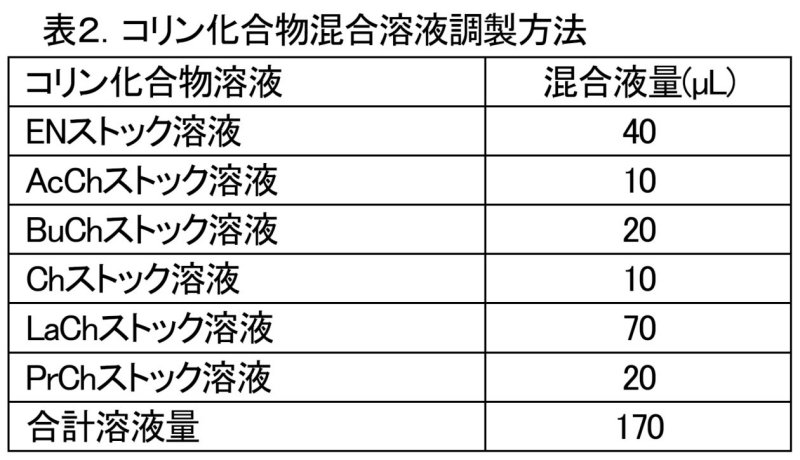
固相抽出で塩酸溶出した溶出液(500μL)を1mLメスフラスコを用いてLC/MS/MS分析溶媒で精確に1mLにフィルアップし、300μLずつ3つに分けた。それぞれに、コリン化合物混合溶液を添加し、溶出液が2倍希釈になるようにLC/MS/MS分析溶媒を加え(表1)、定量サンプルを作成した。
固相抽出で塩酸溶出した溶出液(500μL)を1mLメスフラスコを用いてLC/MS/MS分析溶媒で精確に1mLにフィルアップし、300μLずつ3つに分けた。それぞれに、コリン化合物混合溶液を添加し、溶出液が2倍希釈になるようにLC/MS/MS分析溶媒を加え(表1)、定量サンプルを作成した。

コリン化合物混合溶液は表2のように作成し、コリン化合物混合溶液無添加サンプル(表1-A)の分析結果によって各コリン化合物ストック溶液の添加濃度を決定した。コリン化合物ストック溶液はLC/MS/MS分析溶媒で希釈して各濃度に調製した。検出されなかったコリン化合物があった場合は、その化合物を含まない等量のLC/MS/MS分析溶媒のみを加えた。
2.LC/MS/MS分析
(1)LC/MS/MS分析条件
カラムはYMC-Triart PFP(4.6mm×250mm、5μm、(株)ワイエムシィ)を用いた。分析溶媒に0.01%ギ酸-33%メタノール含有水を用い、流速は0.5mL/min(LC)、0.3mL/min(MS)、注入量は50μL、分離温度は40℃、分析時間は30min、イオン化モードはESI+・MRM、Capillary Voltageは3500V、Cone Voltageは10V、Collision Voltageは10V、N2 gas flow(desolvation)は600L/hr、N2 gas flow(cone)は50L/hr、N2 source tempは120℃、N2 desolvation tempが350℃の条件で、ACQUITY UPLC [UPLC, Waters corp.]-Quattro micro API [MS, Waters corp.]を用いて、LC/MS/MS分析を行った。各コリン化合物のMRMモード指定m/zは表3に示した。
(1)LC/MS/MS分析条件
カラムはYMC-Triart PFP(4.6mm×250mm、5μm、(株)ワイエムシィ)を用いた。分析溶媒に0.01%ギ酸-33%メタノール含有水を用い、流速は0.5mL/min(LC)、0.3mL/min(MS)、注入量は50μL、分離温度は40℃、分析時間は30min、イオン化モードはESI+・MRM、Capillary Voltageは3500V、Cone Voltageは10V、Collision Voltageは10V、N2 gas flow(desolvation)は600L/hr、N2 gas flow(cone)は50L/hr、N2 source tempは120℃、N2 desolvation tempが350℃の条件で、ACQUITY UPLC [UPLC, Waters corp.]-Quattro micro API [MS, Waters corp.]を用いて、LC/MS/MS分析を行った。各コリン化合物のMRMモード指定m/zは表3に示した。

(2)標準添加法
LC/MS/MS分析によって得られたクロマトグラフのピーク面積値から検量線を作成し、標準添加法によってコリン化合物を定量した。EN内部標準の検量線から算出した回収率で各コリン化合物濃度を補正し、定量サンプル中の正確なコリン化合物濃度を算出した。得られた濃度を凍結乾燥物中の含量(mg/g D.W.)に換算後、凍結乾燥前後の収率より、新鮮重量100g当たりの各コリン化合物量(μg/100g F.W.)を算出した。
LC/MS/MS分析によって得られたクロマトグラフのピーク面積値から検量線を作成し、標準添加法によってコリン化合物を定量した。EN内部標準の検量線から算出した回収率で各コリン化合物濃度を補正し、定量サンプル中の正確なコリン化合物濃度を算出した。得られた濃度を凍結乾燥物中の含量(mg/g D.W.)に換算後、凍結乾燥前後の収率より、新鮮重量100g当たりの各コリン化合物量(μg/100g F.W.)を算出した。
<測定結果>
実施例1のアセチルコリン含有量は1.73(mg/g D.W)、比較例1のアセチルコリン含有量は0.62(mg/g D.W)であった。
実施例1のアセチルコリン含有量は1.73(mg/g D.W)、比較例1のアセチルコリン含有量は0.62(mg/g D.W)であった。
[評価例2]血圧低下作用機能評価
実施例1の凍結乾燥粉末、比較例1の凍結乾燥粉末および水を高血圧自然発症ラット(SHR)に単回経口投与し、血圧低下作用を評価した。
雄性14週齢SHR(体重324~368g、6匹、12時間絶食)に実施例1の凍結乾燥粉末、比較例1の凍結乾燥粉末および水を、胃ゾンデを用いて単回経口投与した。実施例1の凍結乾燥粉末および比較例1の凍結乾燥粉末は、アセチルコリン量が同じとなるように、アセチルコリン量が10-9mol/kg体重となる量だけ与えた。経口投与後、0、3、6時間後に、非観血式血圧測定器Softron BP-98A(ソフトロン株式会社、東京)を用いてテイルカフ法で収縮期血圧を測定した。結果を表4に示す。
実施例1の凍結乾燥粉末、比較例1の凍結乾燥粉末および水を高血圧自然発症ラット(SHR)に単回経口投与し、血圧低下作用を評価した。
雄性14週齢SHR(体重324~368g、6匹、12時間絶食)に実施例1の凍結乾燥粉末、比較例1の凍結乾燥粉末および水を、胃ゾンデを用いて単回経口投与した。実施例1の凍結乾燥粉末および比較例1の凍結乾燥粉末は、アセチルコリン量が同じとなるように、アセチルコリン量が10-9mol/kg体重となる量だけ与えた。経口投与後、0、3、6時間後に、非観血式血圧測定器Softron BP-98A(ソフトロン株式会社、東京)を用いてテイルカフ法で収縮期血圧を測定した。結果を表4に示す。
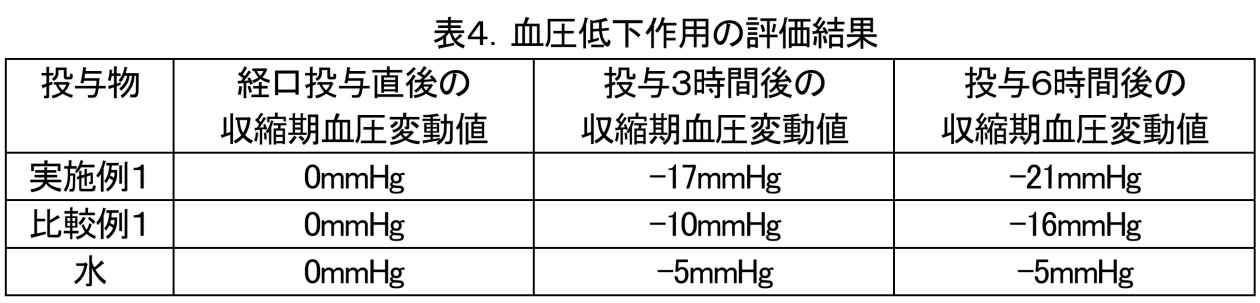
表4に示したとおり、実施例1の凍結乾燥粉末または比較例1の凍結乾燥粉末を投与した場合は、水を投与した場合と比べて収縮期血圧低下作用が発生していることがわかった。実施例1の凍結乾燥粉末を投与した場合は、比較例1の凍結乾燥粉末を投与した場合よりも顕著に高い収縮期血圧低下効果を奏することがわかった。
この結果から、ヒトにおいても経口投与によって血圧低下作用を示すことが強く示唆された。そこでヒトにおける摂取試験を実施した。実施例1の凍結乾燥粉末または比較例1の凍結乾燥粉末に含まれるアセチルコリン含有量を500μg/gとなるようにデキストリンを加えて調整し、一般的な健康食品に使用される1号カプセル(材質:ヒドロキシメチルプロピルセルロース)に250mgを充填した。アセチルコリン含有量は1カプセルあたり125μgとした。正常高値血圧者およびI度高血圧者(男性5名、女性5名、50~67歳)を5名ずつ、AグループおよびBグループの2群にわけ、A群に実施例1のカプセルを1日2回(朝・夕)4カプセルずつ、合計8カプセルを4週間摂取させた。B群には比較例1のカプセルを1日2回(朝・夕)4カプセルずつ、合計8カプセルを4週間摂取させた。1回目の摂取終了の2ヵ月後に、2回目の摂取として、A群には比較例1のカプセルを、B群には実施例1のカプセルを、それぞれ1日2回(朝・夕)4カプセルずつ、合計8カプセルを4週間摂取させた。摂取前後の血圧を測定し、被験者10名の収縮期血圧の平均値を比較したところ、摂取前に比較して実施例1の粉末摂取では血圧が-9.6mmHg低下し、比較例1の摂取は摂取前に比較して-7.1mmHgの低下が認められた。実施例1の粉末は比較例1に比較して血圧低下に優れる結果がヒト試験で確認された。
[評価例3]一般栄養分析による評価
実施例1の凍結乾燥粉末および比較例1の凍結乾燥粉末について、表5に示す分析方法により一般栄養分析を行った。結果を表5に示す。

実施例1の凍結乾燥粉末および比較例1の凍結乾燥粉末について、表5に示す分析方法により一般栄養分析を行った。結果を表5に示す。
比較例1の凍結乾燥粉末には実施例1の凍結乾燥粉末のおよそ8倍の食物繊維が含まれていることが分かった。また、実施例1の凍結乾燥粉末の方が糖質が多く含まれているという特徴が見られた。
[実施例2]
収穫後1週間、冷凍保存した高知県産ナスである土佐鷹3kg(2017年産)を解凍し、そのまま鍋に入れて蓋をして30分間、卓上型ヒーターにて加熱した。1kgをそのまま凍結乾燥して比較例2とした。残りの2kgを冷却後、加熱したナスをジューサーミキサーにて10分間破砕した。2kgの水を加えてよく攪拌してから、ジューサーミキサーにて10分間、混合した。得られたスラリー状の破砕物を1L容量のだしこし袋6つに分けて入れて、12L容量の搾汁機(ワイン圧搾機)にて搾汁液と残渣を得た。搾汁液は2700g、Brix1.9%であった。残渣は530gであった。
搾汁液900gを凍結乾燥して、ミルにて粉砕して、ナス搾汁粉末28gを得て実施例2-1とした。搾汁液900gにデキストリン17gを加え溶解させてから凍結乾燥し、ミルにて粉砕して、50%デキストリン含有ナス搾汁粉末74gを得て実施例2-2とした。
収穫後1週間、冷凍保存した高知県産ナスである土佐鷹3kg(2017年産)を解凍し、そのまま鍋に入れて蓋をして30分間、卓上型ヒーターにて加熱した。1kgをそのまま凍結乾燥して比較例2とした。残りの2kgを冷却後、加熱したナスをジューサーミキサーにて10分間破砕した。2kgの水を加えてよく攪拌してから、ジューサーミキサーにて10分間、混合した。得られたスラリー状の破砕物を1L容量のだしこし袋6つに分けて入れて、12L容量の搾汁機(ワイン圧搾機)にて搾汁液と残渣を得た。搾汁液は2700g、Brix1.9%であった。残渣は530gであった。
搾汁液900gを凍結乾燥して、ミルにて粉砕して、ナス搾汁粉末28gを得て実施例2-1とした。搾汁液900gにデキストリン17gを加え溶解させてから凍結乾燥し、ミルにて粉砕して、50%デキストリン含有ナス搾汁粉末74gを得て実施例2-2とした。
[実施例3]
高知県産の生鮮ナス、土佐鷹50kg(2018年産)に50kgの水を加え、90℃に加熱し20分間煮た。得られたナスと煮汁のすべてをクラッシャーにて破砕してスラリー状の破砕物を得た。その1kgをそのまま凍結乾燥して比較例3とした。残りを果汁搾り器(フルーツプレス)にて圧搾して、搾汁液68.5kg、残渣23.8kgを得た。搾汁液を2つに分け、搾汁液34kgをそのままスプレイドライ装置にて噴霧乾燥して実施例3-1の粉末675gを得た。搾汁液34kgに乳糖700gを加えよく溶解させてからスプレイドライ装置にて噴霧乾燥して1.23kgの粉末を得て実施例3-2とした。
高知県産の生鮮ナス、土佐鷹50kg(2018年産)に50kgの水を加え、90℃に加熱し20分間煮た。得られたナスと煮汁のすべてをクラッシャーにて破砕してスラリー状の破砕物を得た。その1kgをそのまま凍結乾燥して比較例3とした。残りを果汁搾り器(フルーツプレス)にて圧搾して、搾汁液68.5kg、残渣23.8kgを得た。搾汁液を2つに分け、搾汁液34kgをそのままスプレイドライ装置にて噴霧乾燥して実施例3-1の粉末675gを得た。搾汁液34kgに乳糖700gを加えよく溶解させてからスプレイドライ装置にて噴霧乾燥して1.23kgの粉末を得て実施例3-2とした。
[実施例4]
原料ナスを熊本県産の生鮮ナス、ヒゴムラサキ(2018年産)に変更したこと以外、実施例1と同様に作業し、比較例4、実施例4を得た。
原料ナスを熊本県産の生鮮ナス、ヒゴムラサキ(2018年産)に変更したこと以外、実施例1と同様に作業し、比較例4、実施例4を得た。
[実施例5]
原料ナスを熊本県産の生鮮ナス、ヒゴムラサキ(2018年産)として、20kgをクラッシャーにて破砕し、90℃に加熱し1時間、煮た。得られた破砕物1kgをそのまま凍結乾燥して比較例5を得た。残りの19kgに水を加えず、そのまま圧搾して搾汁液8kgを得た。凍結乾燥、粉砕して実施例5の粉末250gを得た。
原料ナスを熊本県産の生鮮ナス、ヒゴムラサキ(2018年産)として、20kgをクラッシャーにて破砕し、90℃に加熱し1時間、煮た。得られた破砕物1kgをそのまま凍結乾燥して比較例5を得た。残りの19kgに水を加えず、そのまま圧搾して搾汁液8kgを得た。凍結乾燥、粉砕して実施例5の粉末250gを得た。
[実施例6]
比較例1の100gに10倍量の水を加えて、1時間攪拌した。得られたスラリー状の溶液を遠心分離(3000回転、30分間)にて上清を得た。上清を凍結乾燥、粉砕して実施例6の粉末42gを得た。
比較例1の100gに10倍量の水を加えて、1時間攪拌した。得られたスラリー状の溶液を遠心分離(3000回転、30分間)にて上清を得た。上清を凍結乾燥、粉砕して実施例6の粉末42gを得た。
[実施例7]
高知県産の生鮮ナス(土佐鷹:2017年産)10kgを95℃にて50分間、加熱し、室温まで冷やし、クラッシャーにて破砕してから10kgの水を加え、スラリー状の破砕物を得た。得られた破砕物をドラムドライ乾燥機にて乾燥して550gの粉末を得た(比較例6とした)。この粉末300gに20倍量の水を加え、1時間、攪拌して、ろ紙を用いて吸引ろ過して得られたろ過液5000mlを凍結乾燥、粉砕して実施例7の90gを得た。
高知県産の生鮮ナス(土佐鷹:2017年産)10kgを95℃にて50分間、加熱し、室温まで冷やし、クラッシャーにて破砕してから10kgの水を加え、スラリー状の破砕物を得た。得られた破砕物をドラムドライ乾燥機にて乾燥して550gの粉末を得た(比較例6とした)。この粉末300gに20倍量の水を加え、1時間、攪拌して、ろ紙を用いて吸引ろ過して得られたろ過液5000mlを凍結乾燥、粉砕して実施例7の90gを得た。
実施例2~実施例7で得られたサンプルを用いたアセチルコリン含有量、栄養成分分析の結果、動物試験結果(投与3時間後の収縮期血圧の変動値)をまとめて表6に示した。動物試験の結果から、いずれも比較例に対して実施例は有意な降圧作用を有することが確認された。

本発明の組成物は、経口投与において、従来のコリンエステルを有効成分とする血圧降下作用を有する組成物よりも顕著な血圧降下作用を有しており、これを用いて機能性表示食品あるいは高血圧症等の治療用医薬品を製造することができる。
Claims (14)
- ナス(Solanum melongena)の果実の全水溶性成分を有効成分として含む、血圧低下用組成物。
- ナス(Solanum melongena)の果実の全水溶性成分からなる、血圧低下用組成物。
- 全水溶性成分中のアセチルコリン量が0.5μg/kg体重~50mg/kg体重となる用量で経口摂取するための、請求項1または2に記載の血圧低下用組成物。
- 乾燥粉末である、請求項1~3のいずれか一項に記載の血圧低下用組成物。
- 食品組成物である、請求項1~4のいずれか一項に記載の血圧低下用組成物。
- ナス(Solanum melongena)由来成分を含む血圧低下用組成物の製造方法であって、
ナス果実から全水溶性成分を抽出すること
を含む、前記製造方法。 - 抽出が、水抽出である、請求項6に記載の製造方法。
- 水抽出が、
ナス果実に水を添加すること、および、
水を添加した果実を搾汁し、搾汁液を得ること
を含む、請求項7に記載の製造方法。 - 水抽出が、
ナス果実を乾燥粉末にした後に水を添加すること、および、
水を添加した乾燥粉末から、遠心分離により上清を得るか、吸引ろ過によりろ過液を得ること
を含む、請求項7に記載の製造方法。 - 抽出が、ナス果実に水を添加せずに搾汁し、搾汁液を得ることである、請求項6に記載の製造方法。
- ナス果実を破砕することを含む、請求項6~10のいずれか一項に記載の製造方法。
- ナス果実を加熱することを含む、請求項6~11のいずれか一項に記載の製造方法。
- 搾汁液、上清またはろ過液を乾燥粉末にすることを含む、請求項8~12のいずれか一項に記載の製造方法。
- 請求項6~13のいずれか一項に記載の製造方法によって製造された、血圧低下用組成物。
Priority Applications (1)
| Application Number | Priority Date | Filing Date | Title |
|---|---|---|---|
| JP2020572213A JP7691693B2 (ja) | 2019-02-15 | 2020-02-07 | 血圧低下作用を有するナス由来組成物 |
Applications Claiming Priority (2)
| Application Number | Priority Date | Filing Date | Title |
|---|---|---|---|
| JP2019026019 | 2019-02-15 | ||
| JP2019-026019 | 2019-02-15 |
Publications (1)
| Publication Number | Publication Date |
|---|---|
| WO2020166494A1 true WO2020166494A1 (ja) | 2020-08-20 |
Family
ID=72045431
Family Applications (1)
| Application Number | Title | Priority Date | Filing Date |
|---|---|---|---|
| PCT/JP2020/004708 Ceased WO2020166494A1 (ja) | 2019-02-15 | 2020-02-07 | 血圧低下作用を有するナス由来組成物 |
Country Status (3)
| Country | Link |
|---|---|
| JP (1) | JP7691693B2 (ja) |
| TW (1) | TW202034936A (ja) |
| WO (1) | WO2020166494A1 (ja) |
Citations (3)
| Publication number | Priority date | Publication date | Assignee | Title |
|---|---|---|---|---|
| JP2015515493A (ja) * | 2012-04-23 | 2015-05-28 | ユニバーシティ オブ オスロUniversity of Oslo | 抗高血圧症薬としてのトマト抽出物の使用及び水溶性の糖を含まないトマト抽出物の製造方法 |
| JP2016522255A (ja) * | 2013-06-19 | 2016-07-28 | アクセス ビジネス グループ インターナショナル エルエルシーAccess Business Group International Llc | 体重管理を支援するための植物をベースとしたケトヘキソキナーゼ阻害剤 |
| WO2018070545A1 (ja) * | 2016-10-14 | 2018-04-19 | 国立大学法人信州大学 | 経口摂取用コリンエステル含有組成物 |
-
2020
- 2020-02-07 WO PCT/JP2020/004708 patent/WO2020166494A1/ja not_active Ceased
- 2020-02-07 JP JP2020572213A patent/JP7691693B2/ja active Active
- 2020-02-07 TW TW109103836A patent/TW202034936A/zh unknown
Patent Citations (3)
| Publication number | Priority date | Publication date | Assignee | Title |
|---|---|---|---|---|
| JP2015515493A (ja) * | 2012-04-23 | 2015-05-28 | ユニバーシティ オブ オスロUniversity of Oslo | 抗高血圧症薬としてのトマト抽出物の使用及び水溶性の糖を含まないトマト抽出物の製造方法 |
| JP2016522255A (ja) * | 2013-06-19 | 2016-07-28 | アクセス ビジネス グループ インターナショナル エルエルシーAccess Business Group International Llc | 体重管理を支援するための植物をベースとしたケトヘキソキナーゼ阻害剤 |
| WO2018070545A1 (ja) * | 2016-10-14 | 2018-04-19 | 国立大学法人信州大学 | 経口摂取用コリンエステル含有組成物 |
Non-Patent Citations (1)
| Title |
|---|
| NISHINA, ATSUYOSHI ET. AL.: "Search for functional components in the thin leather eggplant (part 2)", BULLETIN OF YAMAGATA PREFECTURAL YONEZAWA WOMEN'S JUNIOR COLLEGE, 2.2 EXTRACTION METHOD, vol. 48, 2012, pages 81 - 90 * |
Also Published As
| Publication number | Publication date |
|---|---|
| TW202034936A (zh) | 2020-10-01 |
| JP7691693B2 (ja) | 2025-06-12 |
| JPWO2020166494A1 (ja) | 2021-12-16 |
Similar Documents
| Publication | Publication Date | Title |
|---|---|---|
| JP6202697B1 (ja) | 搾汁粕由来成分含有組成物の製造方法、及び飲食品、医薬品、医薬部外品、又は化粧品の製造方法 | |
| KR20140133016A (ko) | 나한과(Siraitia grosvenorii) 추출물의 제조방법 및 이를 포함하는 조성물 | |
| JP6042800B2 (ja) | トマトシドaの抽出方法 | |
| KR20190015886A (ko) | 마늘 발효추출물을 유효성분으로 포함하는 식품 또는 약학 조성물의 제조방법 | |
| JP2013035810A (ja) | 血圧上昇抑制剤 | |
| JPWO2004112817A1 (ja) | セリ科植物由来抽出物およびその製造方法 | |
| JP5357652B2 (ja) | 抗アレルギー剤 | |
| JP4537024B2 (ja) | 炎症疾患予防・治療剤 | |
| JP6872699B2 (ja) | カルシウム吸収促進用組成物 | |
| KR101018403B1 (ko) | 콩잎 추출물을 유효성분으로 함유하는 통풍 예방,지연 또는 치료용 조성물 | |
| JP7691693B2 (ja) | 血圧低下作用を有するナス由来組成物 | |
| JP2007176919A (ja) | カルコン類化合物含有組成物 | |
| KR20170037690A (ko) | 미강 또는 발효 미강 추출물을 유효성분으로 함유하는 혈행개선용 조성물 | |
| KR20210070546A (ko) | 좁은잎천선과 추출물을 유효성분으로 함유하는 면역 증진용 조성물 | |
| JP2004201598A (ja) | 発酵処理物及びその製造方法 | |
| JP2023056027A (ja) | 組成物 | |
| KR20100117979A (ko) | 흑양파 추출물을 유효성분으로 포함하는 통풍 또는 고요산혈증 예방 및 치료용 조성물 | |
| KR20060119647A (ko) | 상황버섯 발포정의 제조방법 및 조성물 | |
| JP2010213609A (ja) | ガジュツ又はキョウオウの醗酵処理物 | |
| JP2005022994A (ja) | 血糖上昇抑制用組成物 | |
| KR20100041049A (ko) | 정금나무 잎 추출물을 유효성분으로 함유하는 콜레스테롤 저하용 조성물 | |
| JP5192215B2 (ja) | 免疫賦活組成物 | |
| JP2005089385A (ja) | リポキシゲナーゼ阻害剤 | |
| JP4503951B2 (ja) | 糖尿病疾患予防・治療剤 | |
| JP7589953B2 (ja) | 抗肥満剤及び肥満の予防又は治療用食品組成物 |
Legal Events
| Date | Code | Title | Description |
|---|---|---|---|
| 121 | Ep: the epo has been informed by wipo that ep was designated in this application |
Ref document number: 20756168 Country of ref document: EP Kind code of ref document: A1 |
|
| ENP | Entry into the national phase |
Ref document number: 2020572213 Country of ref document: JP Kind code of ref document: A |
|
| NENP | Non-entry into the national phase |
Ref country code: DE |
|
| 122 | Ep: pct application non-entry in european phase |
Ref document number: 20756168 Country of ref document: EP Kind code of ref document: A1 |