WO2020153153A1 - 容器入り起泡性飲料 - Google Patents
容器入り起泡性飲料 Download PDFInfo
- Publication number
- WO2020153153A1 WO2020153153A1 PCT/JP2020/000614 JP2020000614W WO2020153153A1 WO 2020153153 A1 WO2020153153 A1 WO 2020153153A1 JP 2020000614 W JP2020000614 W JP 2020000614W WO 2020153153 A1 WO2020153153 A1 WO 2020153153A1
- Authority
- WO
- WIPO (PCT)
- Prior art keywords
- beverage
- container
- fatty acid
- coffee
- acid ester
- Prior art date
- Legal status (The legal status is an assumption and is not a legal conclusion. Google has not performed a legal analysis and makes no representation as to the accuracy of the status listed.)
- Ceased
Links
Classifications
-
- A—HUMAN NECESSITIES
- A23—FOODS OR FOODSTUFFS; TREATMENT THEREOF, NOT COVERED BY OTHER CLASSES
- A23L—FOODS, FOODSTUFFS OR NON-ALCOHOLIC BEVERAGES, NOT OTHERWISE PROVIDED FOR; PREPARATION OR TREATMENT THEREOF
- A23L2/00—Non-alcoholic beverages; Dry compositions or concentrates therefor; Preparation or treatment thereof
- A23L2/38—Other non-alcoholic beverages
-
- A—HUMAN NECESSITIES
- A23—FOODS OR FOODSTUFFS; TREATMENT THEREOF, NOT COVERED BY OTHER CLASSES
- A23F—COFFEE; TEA; THEIR SUBSTITUTES; MANUFACTURE, PREPARATION, OR INFUSION THEREOF
- A23F5/00—Coffee; Coffee substitutes; Preparations thereof
- A23F5/24—Extraction of coffee; Coffee extracts; Making instant coffee
-
- A—HUMAN NECESSITIES
- A23—FOODS OR FOODSTUFFS; TREATMENT THEREOF, NOT COVERED BY OTHER CLASSES
- A23L—FOODS, FOODSTUFFS OR NON-ALCOHOLIC BEVERAGES, NOT OTHERWISE PROVIDED FOR; PREPARATION OR TREATMENT THEREOF
- A23L2/00—Non-alcoholic beverages; Dry compositions or concentrates therefor; Preparation or treatment thereof
-
- A—HUMAN NECESSITIES
- A23—FOODS OR FOODSTUFFS; TREATMENT THEREOF, NOT COVERED BY OTHER CLASSES
- A23L—FOODS, FOODSTUFFS OR NON-ALCOHOLIC BEVERAGES, NOT OTHERWISE PROVIDED FOR; PREPARATION OR TREATMENT THEREOF
- A23L2/00—Non-alcoholic beverages; Dry compositions or concentrates therefor; Preparation or treatment thereof
- A23L2/40—Effervescence-generating compositions
Definitions
- the present invention relates to a foamable beverage in a container in which bubbles are generated in the beverage by shaking the container.
- Patent Document 1 discloses a foaming beverage containing milk peptide, water-soluble hemicellulose and saponin as essential components.
- Patent Document 2 discloses a foaming beverage containing a fermented cellulose complex and an acidic milk component as an essential component.
- Patent Document 1 places importance on the appearance of the foam, contains a large amount of lipids due to milk components, and does not provide the palatability of the foam, particularly a good foam feeling in the mouth.
- Patent Document 2 focused on that bubbles generated inside the beverage enter the mouth together with the beverage, but it uses fermented cellulose as an essential component, and sucrose No combination of fatty acid ester and glycerin fatty acid ester has been studied.
- the present inventor has conducted a diligent study to solve the problem that the appearance of the foam is good and that the foam feeling is sufficiently felt in the mouth, and the focus is on the combination of sucrose fatty acid ester and glycerin fatty acid ester. Furthermore, they have found that the problem can be solved by these synergistic effects by controlling the viscosity of the beverage to a high degree, and have completed the present invention.
- a foamable beverage in a container having a viscosity at 20°C of 2.8 cp or more and 12 cp or less and a lipid content of 0.45 mass% or less is provided.
- a fine and stable foam is obtained, and the generated foam easily flows together with the liquid due to the viscosity of the liquid, and when the beverage is drunk, the foam in the liquid is carried into the mouth,
- a technique relating to a foamable beverage in a container in which a foamy feeling is sufficiently felt in the mouth is provided.
- the foamable beverage in a container means a beverage that mixes the air in the container with the beverage by shaking the container to generate bubbles on the surface and inside of the beverage. From the viewpoint of generating good air bubbles, it is preferable to hold the container in the hand and shake it vertically or horizontally, for example, it may be shaken 5 to 30 times in the vertical direction.
- the bubbles of the present embodiment include not only bubbles observed in the liquid of the beverage, but also bubbles similar to the bubbles floating on the liquid surface of the beverage as observed in beer beverages.
- the foamable beverage in a container of the present embodiment contains (A) sucrose fatty acid ester and (B) glycerin fatty acid ester, has a viscosity at 20° C. of 2.8 cp or more and 12 cp or less, and a lipid of 0. It is 45 mass% or less.
- sucrose fatty acid ester contains (A) sucrose fatty acid ester and (B) glycerin fatty acid ester, has a viscosity at 20° C. of 2.8 cp or more and 12 cp or less, and a lipid of 0. It is 45 mass% or less.
- Sucrose fatty acid ester is a fatty acid such as caprylic acid, capric acid, lauric acid, myristic acid, palmitic acid, stearic acid, oleic acid and behenic acid, which is an ester of eight hydroxyl groups (hydrophilic groups) of sucrose. They are combined and are known as edible emulsifiers. Among them, preferred fatty acids include stearic acid and palmitic acid.
- the content of the sucrose fatty acid ester (A) is preferably 0.001 to 10 g/L, more preferably 0.01 to 5 g/L, even more preferably 0.05 to 1 g/L.
- sucrose fatty acid ester (A) By setting the content of the sucrose fatty acid ester (A) to the above lower limit value or more, it becomes easy to obtain stable bubbles over time. On the other hand, by setting the content of the sucrose fatty acid ester (A) at the upper limit value or less, fine air bubbles can be obtained while maintaining the palatability of the beverage.
- the glycerin fatty acid ester (B) is one in which a fatty acid is ester-bonded to one or two of the three hydroxyl groups (hydrophilic groups) of glycerin, and is known as an edible emulsifier.
- the content of the glycerin fatty acid ester (B) is preferably 0.001 to 10 g/L, more preferably 0.01 to 5 g/L, further preferably 0.05 to 1 g/L, and 0.05 to 0.5 g. /L is particularly preferred.
- the content of the glycerin fatty acid ester (B) is at least the above lower limit value, stable bubbles can be easily obtained with time.
- fine air bubbles can be obtained while maintaining the palatability of the beverage.
- the foamable beverage contained in the container of the present embodiment has a viscosity at 20° C. of 2.8 cp or more and 12 cp or less.
- a viscosity at 20° C. of 2.8 cp or more and 12 cp or less.
- the viscosity is preferably 2.9 cp or more, more preferably 3.0 cp or more, still more preferably 4.0 cp or more.
- the viscosity is preferably 11 cp or less, and more preferably 8.0 cp or less.
- the viscosity can be measured by selecting an appropriate rotor with a B type viscometer. In addition, it is appropriate to measure the viscosity in a state where the foamable beverage is not foamed.
- the lipid in the container-containing foamable beverage of the present embodiment is 0.45% by mass or less. By setting the lipid content to 0.45 mass% or less, the state where bubbles are easily formed is maintained, and fine bubbles can be obtained.
- the lower limit of the lipid is not particularly limited and may be 0% by mass.
- the lipid is not particularly limited as long as it is an edible oil and fat, for example, soybean oil, rapeseed oil, safflower oil, sunflower oil, rice bran oil, corn oil, coconut oil, palm oil, palm kernel oil, peanut oil, olive oil.
- Vegetable oils such as high oleic rapeseed oil, high oleic safflower oil, high oleic corn oil or high oleic sunflower oil, animal fats and oils such as beef tallow, lard, fish oil or milk fat, and further fractionated or hydrogenated animal or vegetable oils or fats Examples include transesterified products. Among them, milk fat is preferable from the viewpoint of obtaining good foaming properties while obtaining good flavor as a beverage.
- the milk fat is not particularly limited, but can be obtained by containing, for example, raw milk, milk, whole milk powder, fresh cream, concentrated milk, partially skimmed milk, condensed milk, fermented milk and the like. These may be used alone or in combination of two or more.
- the amount of lipid can be measured, for example, by using the Maghonia tube (Product name: Maghonia tube (glass product for fat extraction) SIBATA, manufactured by Shibata Scientific Co., Ltd.) by the Reese-Gott Kunststoff method or the Soxhlet extraction method.
- Maghonia tube Product name: Maghonia tube (glass product for fat extraction) SIBATA, manufactured by Shibata Scientific Co., Ltd.
- the foamable beverage in a container is capable of producing a fine and stable foam over time due to the synergistic effect of the component (A), the component (B), and the above-specified viscosity, and is generated by the viscosity of the liquid.
- the bubbles in the liquid are carried into the mouth so that the bubbles can easily flow with the liquid, and the foamy feeling can be sufficiently felt in the mouth.
- the lipid amount By controlling the lipid amount, such a synergistic effect can be stably obtained.
- a foam film is formed by aggregating emulsifiers from both sides such that water, which serves as a foam interface, is sandwiched.
- the emulsifier aggregates with the hydrophilic groups facing inward and the lipophilic groups facing outward.
- the other efficiently enters into the gap of one and aggregates at the interface of the bubbles, and the component (A It is considered that the component (B) and the component (B) can aggregate at the interface of bubbles with high density.
- the interface of the foam is easily stabilized, good foaming properties and stability of the foam are obtained, and appropriate viscosity can be added to this to obtain fine bubbles, and at the same time, the generated liquid surface It is presumed that a good bubble feeling can be obtained in the mouth by the bubbles and the bubbles in the liquid being carried into the mouth together with the liquid.
- the foamable beverage in a container of the present embodiment is capable of improving production efficiency because foaming is appropriately suppressed by the synergistic effect of the components (A) and (B) and the above-specified viscosity.
- the foamable beverage in a container of the present embodiment can contain a thickener, a sweetening component, an acidulant, an antioxidant, a pH adjuster and the like within a range that does not impair the object of the present invention.
- the thickening agent (C) is used from the viewpoint of increasing the viscosity of the beverage and causing bubbles in the liquid to flow together with the liquid.
- a thickener stabilizer specified in food additives can be used. Specifically, acetylated adipic acid crosslinked starch, acetylated oxidized starch, acetylated phosphoric acid crosslinked starch, phosphoric acid crosslinked starch, phosphorylated starch, phosphoric acid monoesterified phosphoric acid crosslinked starch, sodium octenyl succinate starch, and starch acetate.
- Starch such as oxidized starch, sodium starch glycolate, hydroxypropylated phosphate cross-linked starch, and hydroxypropyl starch, ammonium alginate, potassium alginate, calcium alginate, sodium alginate, propylene glycol alginate, carboxymethyl cellulose calcium, sodium carboxymethyl cellulose , Sodium polyacrylate, and specified additives such as methylcellulose: aureobasidium broth, Agrobacterium succinoglycan, amased gum, gum arabic, arabinogalactan, alginic acid, welan gum, eremiresin, cassia gum, gati gum, curdlan, carrageenan , Processed Eukema algae, refined carrageenan, Eukema algal powder, karaya gum, carob bean gum, xanthan gum, locust bean gum, chitin, chitosan, guar gum, guar gum enzymatic degradation product, glucosamine, yeast cell
- potassium alginate calcium alginate, sodium alginate, propylene glycol alginate ester, carboxymethyl cellulose calcium, carboxymethyl cellulose sodium, gum arabic, alginic acid.
- the content of the (C) thickener is preferably 0.001 to 5 g/L, more preferably 0.01 to 1 g/L, and further preferably 0.05 to 0.5 g/L.
- the content of the thickener (C) is preferably 0.001 to 5 g/L, more preferably 0.01 to 1 g/L, and further preferably 0.05 to 0.5 g/L.
- sweetening ingredients are not particularly limited, but sugars such as sucrose, fructose, and glucose, sugar alcohols such as maltitol, and erythritol, aspartame, acesulfame potassium, stevia extract, neotame, saccharin, and high sucralose.
- sweeteners include sweeteners. These may be used alone or in combination of two or more. Among them, from the viewpoint of obtaining good palatability, it is preferable to contain one or more selected from sucrose, fructose, glucose, acesulfame potassium, stevia extract, and sucralose.
- the above-mentioned acidulant is not particularly limited, and examples thereof include citric acid, adipic acid, gluconic acid, succinic acid, tartaric acid, lactic acid, fumaric acid, malic acid, and salts thereof. These may be used alone or in combination of two or more.
- antioxidants are not particularly limited, and examples thereof include ascorbic acid, sodium ascorbate, sodium erythorbate and the like. These may be used alone or in combination of two or more.
- the above pH adjuster is not particularly limited, and examples thereof include potassium carbonate, sodium hydrogen carbonate, potassium hydroxide, dipotassium hydrogen phosphate, sodium dihydrogen phosphate, and disodium hydrogen phosphate. These may be used alone or in combination of two or more.
- emulsifiers other than the components (A) and (B), defoaming agents, various nutritional components, extracts, colorants, fragrances, and dilutions, in addition to the components described above.
- Food additives such as agents can also be added.
- beverage of the foamable beverage contained in the container of the present embodiment examples include, for example, coffee beverages (black coffee beverages and milk-containing coffee beverages), cocoa, lactic acid bacteria beverages, milk-based beverages, green tea beverages, oolong tea beverages, tea beverages, grains.
- Tea drinks, tea drinks such as blended tea, fruit juice and/or vegetable juice, sports drinks, near water, nutritional drinks, beauty drinks, carbonated drinks, non-alcoholic drinks with beer taste or cocktail taste, beer, wine, sake , And alcoholic beverages such as fruit wine.
- coffee beverages, green tea beverages, and black tea beverages are preferable, and coffee beverages are more preferable, from the viewpoint of improving compatibility with the foamy feeling in the mouth.
- a coffee beverage is a beverage that is made from a component (coffee component) extracted or eluted from coffee beans and a beverage to which other components are added.
- Good as described in the "Fair Competition Code for Labeling Beverages Containing Coffee, etc.” established in 1977, beverages made from coffee beans and sugars, dairy products, emulsified edible oils and fats, etc. It refers to beverages that contain edible foods and are sealed in a container.
- the amount of coffee beans used is less than 1% by weight in terms of green beans, beverages that have a coffee flavor when they are consumed are treated as coffee beverages.
- the method for incorporating the coffee component into the coffee beverage of the present embodiment is not particularly limited and can be appropriately set by those skilled in the art.
- a solution obtained by extracting crushed roasted beans with water or warm water, a coffee extract in which the coffee extract is concentrated, an instant coffee obtained by drying the coffee extract, and the like are used.
- Examples thereof include a method of adding one kind or two or more kinds to a beverage.
- those containing ingredients with a milk solid content of 3.0% or more by weight percentage are to be treated as "milk drinks”. ..
- the coffee beverage according to the present embodiment is treated as a coffee beverage even if it contains a component having a milk solid content of 3.0% or more by weight percentage.
- the coffee beverage may be a black coffee beverage (whether sugared or unsweetened) or a milk-containing coffee beverage containing one or more milk components. From the viewpoint of effectively obtaining palatability due to bubbles in the liquid, the black coffee beverage is more preferable.
- the lower limit of the content of the coffee-soluble solid content in the coffee beverage is preferably 0.5% by mass or more, more preferably 0.9% by mass or more in order to obtain a full-fledged coffee feel, ease of drinking, and deliciousness. , And more preferably 1% by mass or more.
- the upper limit value of the content of the coffee-soluble solid content in the coffee beverage is preferably 2% by mass or less in order to improve the mouthfeel while maintaining a good balance of aroma, sourness, bitterness and aftertaste. It is preferably 1.8% by mass or less, and more preferably 1.7% by mass or less.
- the Brix value (Bx) of the coffee beverage is preferably 0.3° or more and 10° or less from the viewpoint of improving the ease of drinking and improving the balance of aroma, sourness, bitterness, and aftertaste. It is more preferably 0.5° or more and 7° or less, and even more preferably 1.0° or more and 7° or less.
- the Brix value indicates the total content of soluble solids with respect to the total amount of the coffee beverage.
- the Brix value can be measured, for example, by using a digital refractometer Rx-5000 ⁇ (manufactured by ATAGO Co., Ltd.) to measure the sugar refractometer reading at 20°C.
- the content of milk is preferably 1.0 to 10% by mass, and more preferably 1.3 to 10% by mass.
- the material can be appropriately selected and used as long as it is a sealed container known in the beverage industry.
- hermetically sealed containers made of glass, plastic (polyethylene terephthalate (PET), etc.), aluminum, steel, paper and the like, which are simple or composite materials or laminated materials.
- the color of the container is not particularly limited, but it is preferably colorless and transparent from the viewpoint of making the contents easily visible. From the viewpoints of handleability, distribution, portability, etc., it is preferable to use PET bottles, bottle cans, and pouch containers.
- the container can be re-plugged so that the container can be shaken and foamed many times.
- the re-pluggable type includes, for example, one having a screw-in type lid portion.
- the container-containing foamable beverage of the present embodiment is a beverage characterized by shaking the container to foam, so that the sealed container is filled with the beverage with a predetermined content volume, It is preferable that a part of the container has a space which is not filled with the beverage (called an empty space or a head space).
- the empty volume is preferably 20 ml or more (or the ratio of the empty volume to the total volume in the sealed container is 3% or more).
- the upper limit of the empty volume is not particularly limited, but is preferably 100 ml or less (or the ratio of the empty volume to the total volume in the sealed container is 20% or less).
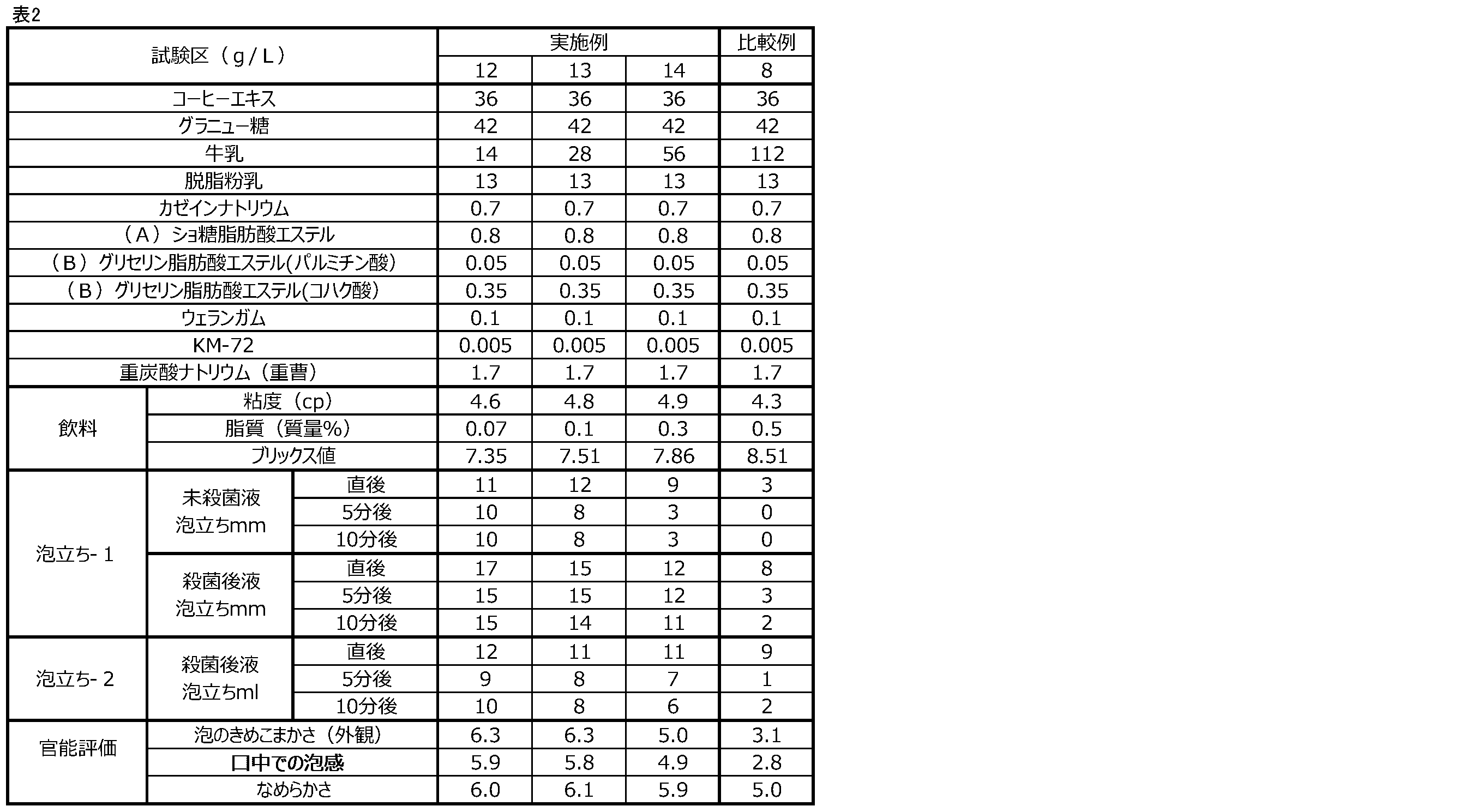
- Examples and Comparative Examples> The raw materials are mixed by a known method so as to have the compositions shown in Tables 1 and 2, a coffee beverage is prepared, and after UHT sterilization, 500 ml is filled in a transparent PET bottle having a capacity of 550 ml at room temperature, and a coffee beverage in a container is filled. Was produced. The coffee-soluble solid content of the obtained coffee beverage was 1.28% by mass. The following materials were used as the raw materials for the bottled coffee beverage. -Coffee extract The coffee bean extract was heated and concentrated and adjusted to Brix 35.5.
- Sucrose fatty acid ester a mixture of sucrose fatty acid ester (stearic acid) (HLB5) and sucrose fatty acid ester (palmitic acid) (HLB16)-(B) glycerin fatty acid ester (palmitic acid) (HLB16) ⁇ (B) Glycerin fatty acid ester (succinic acid) (HLB5) ⁇ (B) Glycerin fatty acid ester (diacetyl tartaric acid) (HLB3) ⁇ Kirayanin: Emulsifier "Kirayanin C-100" manufactured by Maruzen Pharmaceutical Co., Ltd.
- the following evaluation and measurement were performed using the obtained coffee beverage in a container. The results are shown in Tables 1 and 2.
- the coffee beverage in a container used for evaluation was stored at 20° C. and used within 48 hours immediately after production.
- ⁇ Bubbling-1 (Cylinder method) The funnel was placed horizontally on the graduated cylinder so that the height from the tip of the funnel to the bottom of the graduated cylinder was 16.5 cm, and 50 ml of the test solution was poured for 10 seconds. Immediately after pouring, 5 minutes later, 10 minutes later, the height (mm) of the foam from the liquid surface was measured.
- ⁇ Bubbling-2 (hand gesture method) A glass centrifuge tube with a memory of 50 ml was filled with 25 ml of a coffee beverage (liquid temperature 20° C.) and shaken by hand 30 times for 10 seconds, and then the volume (ml) of the generated foam from the liquid surface was measured. The measurement was performed using a memory of a glass centrifuge tube.
Landscapes
- Life Sciences & Earth Sciences (AREA)
- Chemical & Material Sciences (AREA)
- Engineering & Computer Science (AREA)
- Food Science & Technology (AREA)
- Polymers & Plastics (AREA)
- Health & Medical Sciences (AREA)
- Nutrition Science (AREA)
- Tea And Coffee (AREA)
- Non-Alcoholic Beverages (AREA)
Abstract
容器入り起泡性飲料は、(A)ショ糖脂肪酸エステルと、(B)グリセリン脂肪酸エステルと、を含み、20℃における粘度が2.8cp以上12cp以下であり、脂質が0.45質量%以下である。
Description
本発明は、容器を振ることによって飲料中に気泡が生じる容器入り起泡性飲料に関する。
容器入り飲料は、場所を問わず簡便に喫飲できることから広く好まれ、その嗜好性も多様化している。なかでも、近年、容器を振ることによって、気泡を生じさせる飲料が知られている。例えば、特許文献1には、乳ペプチド、水溶性ヘミセルロースおよびサポニンを必須成分として含む起泡性飲料が開示されている。また、特許文献2には、発酵セルロース複合体と、酸性の乳成分を必須成分として含む起泡性飲料が開示されている。
しかしながら、特許文献1に記載される技術は、泡の外観を重視するものであり、乳成分による脂質が多く、泡の嗜好性、特に口中で良好な泡感が得られるものではなかった。また、特許文献2に記載される技術は、飲料の内部に発生した気泡が飲料とともに口の中に入ることに着目したものであったが、発酵セルロースを必須成分とするものであり、ショ糖脂肪酸エステルと、グリセリン脂肪酸エステルとの組み合わせについて全く検討されていなかった。
本発明者は、泡の外観が良好であるとともに、口中で泡感を十分に感じられるという課題を解決すべく鋭意検討を行った結果、ショ糖脂肪酸エステルと、グリセリン脂肪酸エステルとの組み合わせに着目し、さらに飲料の粘度を高度に制御することで、これらの相乗効果により課題が解決できることを見出し、本発明を完成させた。
本発明によれば、
(A)ショ糖脂肪酸エステルと、(B)グリセリン脂肪酸エステルと、を含み、
20℃における粘度が2.8cp以上12cp以下であり、脂質が0.45質量%以下である、容器入り起泡性飲料が提供される。
(A)ショ糖脂肪酸エステルと、(B)グリセリン脂肪酸エステルと、を含み、
20℃における粘度が2.8cp以上12cp以下であり、脂質が0.45質量%以下である、容器入り起泡性飲料が提供される。
本発明によれば、きめ細かく安定した泡が得られるとともに、発生した泡が液体の粘性により液体と共に流動しやすくなることで、飲料を喫飲した際に、液体中の泡が口中に運ばれ、口中で泡感を十分に感じられる容器入り起泡性飲料に関する技術が提供される。
<容器入り起泡性飲料>
本実施形態において容器入り起泡性飲料とは、容器を振ることによって容器内の空気と飲料とを混合し、飲料の表面および内部に気泡を生じさせる飲料を意図する。良好な気泡を生じさせる観点から、容器を手に持ち、上下または左右等に振ることが好ましく、例えば、上下方向に5~30回振ってもよい。
本実施形態の泡は、飲料の液中に観察される気泡だけでなく、ビール飲料において観察されるような飲料の液面に浮かぶ泡に類似するものも含む。
本実施形態において容器入り起泡性飲料とは、容器を振ることによって容器内の空気と飲料とを混合し、飲料の表面および内部に気泡を生じさせる飲料を意図する。良好な気泡を生じさせる観点から、容器を手に持ち、上下または左右等に振ることが好ましく、例えば、上下方向に5~30回振ってもよい。
本実施形態の泡は、飲料の液中に観察される気泡だけでなく、ビール飲料において観察されるような飲料の液面に浮かぶ泡に類似するものも含む。
本実施形態の容器入り起泡性飲料は、(A)ショ糖脂肪酸エステルと、(B)グリセリン脂肪酸エステルと、を含み、20℃における粘度が2.8cp以上12cp以下であり、脂質が0.45質量%以下である。以下、各成分および物性について詳述する。
(A)ショ糖脂肪酸エステルは、ショ糖がもつ8つの水酸基(親水性基)にカプリル酸、カプリン酸、ラウリン酸、ミリスチン酸、パルミチン酸、ステアリン酸、オレイン酸およびベヘン酸などの脂肪酸がエステル結合したものであり、食用の乳化剤として知られるものである。なかでも、好ましい脂肪酸としては、ステアリン酸とパルミチン酸が挙げられる。
(A)ショ糖脂肪酸エステルの含有量は、0.001~10g/Lが好ましく、0.01~5g/Lがより好ましく、0.05~1g/Lがさらに好ましい。
(A)ショ糖脂肪酸エステルの含有量を、上記下限値以上とすることにより、経時的に安定した気泡が得られやすくなる。一方、(A)ショ糖脂肪酸エステルの含有量を、上記上限値以下とすることにより、飲料の嗜好性を保持しつつ、きめ細かく良好な気泡が得られる。
(A)ショ糖脂肪酸エステルの含有量は、0.001~10g/Lが好ましく、0.01~5g/Lがより好ましく、0.05~1g/Lがさらに好ましい。
(A)ショ糖脂肪酸エステルの含有量を、上記下限値以上とすることにより、経時的に安定した気泡が得られやすくなる。一方、(A)ショ糖脂肪酸エステルの含有量を、上記上限値以下とすることにより、飲料の嗜好性を保持しつつ、きめ細かく良好な気泡が得られる。
(B)グリセリン脂肪酸エステルは、グリセリンがもつ3つの水酸基(親水性基)のうち1つまたは2つに脂肪酸がエステル結合したものであり、食用の乳化剤として知られるものである。
(B)グリセリン脂肪酸エステルの含有量は、0.001~10g/Lが好ましく、0.01~5g/Lがより好ましく、0.05~1g/Lがさらに好ましく、0.05~0.5g/Lが特に好ましい。
(B)グリセリン脂肪酸エステルの含有量を、上記下限値以上とすることにより、経時的に安定した気泡が得られやすくなる。一方、(B)グリセリン脂肪酸エステルの含有量を、上記上限値以下とすることにより、飲料の嗜好性を保持しつつ、きめ細かく良好な気泡が得られる。
(B)グリセリン脂肪酸エステルの含有量は、0.001~10g/Lが好ましく、0.01~5g/Lがより好ましく、0.05~1g/Lがさらに好ましく、0.05~0.5g/Lが特に好ましい。
(B)グリセリン脂肪酸エステルの含有量を、上記下限値以上とすることにより、経時的に安定した気泡が得られやすくなる。一方、(B)グリセリン脂肪酸エステルの含有量を、上記上限値以下とすることにより、飲料の嗜好性を保持しつつ、きめ細かく良好な気泡が得られる。
本実施形態の容器入り起泡性飲料の20℃における粘度は、2.8cp以上12cp以下である。当該粘度を下限値以上とすることにより、飲料に適度な粘性が得られ、液中の気泡を液体とともに流動させやすくなる。一方、当該粘度を上限値以下とすることにより、泡が粗くなることを抑制し、きめ細かく良好な泡感を口中で得られやすくできる。
当該粘度は、好ましくは2.9cp以上であり、より好ましくは3.0cp以上であり、さらに好ましくは4.0cp以上である。一方、当該粘度は、好ましくは11cp以下であり、より好ましくは、8.0cp以下である。
粘度は、B型粘度計により適切なローターを選択して測定することができる。また、粘度の測定は、起泡性飲料を起泡させない状態で行うことが適切である。
当該粘度は、好ましくは2.9cp以上であり、より好ましくは3.0cp以上であり、さらに好ましくは4.0cp以上である。一方、当該粘度は、好ましくは11cp以下であり、より好ましくは、8.0cp以下である。
粘度は、B型粘度計により適切なローターを選択して測定することができる。また、粘度の測定は、起泡性飲料を起泡させない状態で行うことが適切である。
本実施形態の容器入り起泡性飲料は、脂質が0.45質量%以下である。脂質を0.45質量%以下とすることにより、泡が形成されやすい状態が保持され、きめ細かい気泡が得られるようになる。脂質の下限は特に限定されず、0質量%であってもよい。
脂質としては、食用可能な油脂であれば特に制限はなく、例えば、大豆油、菜種油、サフラワー油、ヒマワリ油、米糠油、コーン油、椰子油、パーム油、パーム核油、落花生油、オリーブ油、ハイオレイック菜種油、ハイオレイックサフラワー油、ハイオレイックコーン油又はハイオレイックヒマワリ油等の植物油脂、牛脂、ラード、魚油又は乳脂等の動物油脂、更にこれらの動植物油脂を分別、水素添加あるいはエステル交換したもの等が挙げられる。
なかでも、飲料としての良好な風味を得つつ、良好な起泡性を得る観点から、乳脂であることが好ましい。乳脂としては、特に限定されないが、たとえば、生乳、牛乳、全粉乳、生クリーム、濃縮乳、部分脱脂乳、練乳、および発酵乳等を含有することで得られる。これらは、1種を単独で用いてもよく、2種以上を混合して用いてもよい。
なかでも、飲料としての良好な風味を得つつ、良好な起泡性を得る観点から、乳脂であることが好ましい。乳脂としては、特に限定されないが、たとえば、生乳、牛乳、全粉乳、生クリーム、濃縮乳、部分脱脂乳、練乳、および発酵乳等を含有することで得られる。これらは、1種を単独で用いてもよく、2種以上を混合して用いてもよい。
脂質量の測定は、たとえばマジョニア管(製品名:マジョニア管(脂肪抽出用ガラス製品)SIBATA、柴田科学株式会社製)を用いて、レーゼゴットリーブ法、またはソックスレー抽出法により定量することができる。
本実施形態の容器入り起泡性飲料は、成分(A)と成分(B)と上記の特定された粘度の相乗効果によって、きめ細かく経時的に安定した泡が得られるとともに、液体の粘性により発生した泡が液体と共に流動しやすくなることで、飲料を喫飲した際に、液体中の泡が口中に運ばれ、口中で泡感を十分に感じられるものである。そして、脂質量を制御することで、かかる相乗効果を安定的に得られるものである。この理由の詳細は明らかではないが、以下のように推測される。
一般に、泡の膜は、泡の界面となる水を挟むようにして、両側から乳化剤が凝集することで形成される。乳化剤は、親水基を内側、親油基を外側に向けるようにして凝集する。本実施形態においては、成分(A)と成分(B)を併用することで、両者の構造の違い等により一方の隙間に他方が効率よく入り込むようにして泡の界面に凝集し、成分(A)と成分(B)が泡の界面に高密度に凝集できると考えられる。その結果、泡の界面が安定しやすくなり、良好な起泡性と泡の安定性が得られ、これに適切な粘度が加わることできめ細やかな泡が得られると同時に、発生した液面の泡と液中の泡が液体とともに口中に運ばれることにより、口中において良好な泡感が得られるものと推測される。
さらに、本実施形態の容器入り起泡性飲料は、成分(A)と成分(B)と上記の特定された粘度の相乗効果によって、適度に泡立ちが抑制されるため、製造効率を向上することができる。すなわち、容器入り起泡性飲料の製造工程において、原料をタンク内で混合したり他のタンクへ移動させる際や、飲料を容器内に充填する際に、泡立ちが生じると、製造ライン上でのトラブルに繋がったり、容器内に適量を充填させることが困難になる場合がある。また、泡立ちを防ぐために充填速度が制限されるが、適度に泡立ちを抑制することで、充填速度を上げることも可能となる。
一般に、泡の膜は、泡の界面となる水を挟むようにして、両側から乳化剤が凝集することで形成される。乳化剤は、親水基を内側、親油基を外側に向けるようにして凝集する。本実施形態においては、成分(A)と成分(B)を併用することで、両者の構造の違い等により一方の隙間に他方が効率よく入り込むようにして泡の界面に凝集し、成分(A)と成分(B)が泡の界面に高密度に凝集できると考えられる。その結果、泡の界面が安定しやすくなり、良好な起泡性と泡の安定性が得られ、これに適切な粘度が加わることできめ細やかな泡が得られると同時に、発生した液面の泡と液中の泡が液体とともに口中に運ばれることにより、口中において良好な泡感が得られるものと推測される。
さらに、本実施形態の容器入り起泡性飲料は、成分(A)と成分(B)と上記の特定された粘度の相乗効果によって、適度に泡立ちが抑制されるため、製造効率を向上することができる。すなわち、容器入り起泡性飲料の製造工程において、原料をタンク内で混合したり他のタンクへ移動させる際や、飲料を容器内に充填する際に、泡立ちが生じると、製造ライン上でのトラブルに繋がったり、容器内に適量を充填させることが困難になる場合がある。また、泡立ちを防ぐために充填速度が制限されるが、適度に泡立ちを抑制することで、充填速度を上げることも可能となる。
また、本実施形態の容器入り起泡性飲料は、本発明の目的を損なわない範囲内で、増粘剤、甘味成分、酸味料、抗酸化剤、およびpH調整剤などを含むことができる。
(C)増粘剤は、飲料の粘度を上昇させ、液中の気泡を液体とともに流動させる観点から用いられる。
上記の増粘剤としては、食品添加物に指定される増粘安定剤を用いることができる。具体的には、アセチル化アジピン酸架橋デンプン、アセチル化酸化デンプン、アセチル化リン酸架橋デンプン、リン酸架橋デンプン、リン酸化デンプン、リン酸モノエステル化リン酸架橋デンプン、オクテニルコハク酸デンプンナトリウム、酢酸デンプン、酸化デンプン、デンプングリコール酸ナトリウム、ヒドロキシプロピル化リン酸架橋デンプン、及びヒドロキシプロピルデンプン等の澱粉類、アルギン酸アンモニウム、アルギン酸カリウム、アルギン酸カルシウム、アルギン酸ナトリウム、アルギン酸プロピレングリコールエステル、カルボキシメチルセルロースカルシウム、カルボキシメチルセルロースナトリウム、ポリアクリル酸ナトリウム、及びメチルセルロースといった指定添加物:アウレオバシジウム培養液、アグロバクテリウムスクシノグリカン、アマシードガム、アラビアガム、アラビノガラクタン、アルギン酸、ウェランガム、エレミ樹脂、カシアガム、ガティガム、カードラン、カラギナン、加工ユーケマ藻類、精製カラギナン、ユーケマ藻末、カラヤガム、カロブビーンガム、キサンタンガム、ローカストビーンガム、キチン、キトサン、グアーガム、グアーガム酵素分解物、グルコサミン、酵母細胞壁、サイリウムシードガム、サバクヨモギシードガム、ジェランガム、タマリンドシードガム、タラガム、デキストラン、トラガントガム、トロロアオイ、納豆菌ガム、微小繊維状セルロース、ファーセレラン、フクロノリ抽出物、プルラン、ペクチン、マクロホモプシスガム、モモ樹脂、ラムザンガム、レバンといった既存添加物:オクラ抽出物、海藻セルロース、褐藻抽出物、グルテン、グルテン分解物、コンニャクイモ抽出物、サツマイモセルロース、ダイズ多糖類、ナタデココ、マンナン、レンネツトカゼインといった一般飲食添加物が挙げられる。
これらは、1種単独で用いてもよいし、2種以上を混合して用いてもよい。
なかでも、飲料のおいしさを保持しつつ、口中で泡感を十分に感じさせる観点から、アルギン酸カリウム、アルギン酸カルシウム、アルギン酸ナトリウム、アルギン酸プロピレングリコールエステル、カルボキシメチルセルロースカルシウム、カルボキシメチルセルロースナトリウム、アラビアガム、アルギン酸、ウェランガム、ガティガム、カラギナン、精製カラギナン、キサンタンガム、ローカストビーンガム、グアーガム、グアーガム酵素分解物、ジェランガム、タラガム、ペクチン、ダイズ多糖類、マンナンから選ばれる1種または2種以上を含むことが好ましく、泡感との相性がよく、飲料の良好な風味を保持する観点から、グアーガム、カラギナン、キサンタンガム、ジェランガム、発酵セルロースおよびウェランガムから選ばれる1種または2種以上を含むことがより好ましい。
上記の増粘剤としては、食品添加物に指定される増粘安定剤を用いることができる。具体的には、アセチル化アジピン酸架橋デンプン、アセチル化酸化デンプン、アセチル化リン酸架橋デンプン、リン酸架橋デンプン、リン酸化デンプン、リン酸モノエステル化リン酸架橋デンプン、オクテニルコハク酸デンプンナトリウム、酢酸デンプン、酸化デンプン、デンプングリコール酸ナトリウム、ヒドロキシプロピル化リン酸架橋デンプン、及びヒドロキシプロピルデンプン等の澱粉類、アルギン酸アンモニウム、アルギン酸カリウム、アルギン酸カルシウム、アルギン酸ナトリウム、アルギン酸プロピレングリコールエステル、カルボキシメチルセルロースカルシウム、カルボキシメチルセルロースナトリウム、ポリアクリル酸ナトリウム、及びメチルセルロースといった指定添加物:アウレオバシジウム培養液、アグロバクテリウムスクシノグリカン、アマシードガム、アラビアガム、アラビノガラクタン、アルギン酸、ウェランガム、エレミ樹脂、カシアガム、ガティガム、カードラン、カラギナン、加工ユーケマ藻類、精製カラギナン、ユーケマ藻末、カラヤガム、カロブビーンガム、キサンタンガム、ローカストビーンガム、キチン、キトサン、グアーガム、グアーガム酵素分解物、グルコサミン、酵母細胞壁、サイリウムシードガム、サバクヨモギシードガム、ジェランガム、タマリンドシードガム、タラガム、デキストラン、トラガントガム、トロロアオイ、納豆菌ガム、微小繊維状セルロース、ファーセレラン、フクロノリ抽出物、プルラン、ペクチン、マクロホモプシスガム、モモ樹脂、ラムザンガム、レバンといった既存添加物:オクラ抽出物、海藻セルロース、褐藻抽出物、グルテン、グルテン分解物、コンニャクイモ抽出物、サツマイモセルロース、ダイズ多糖類、ナタデココ、マンナン、レンネツトカゼインといった一般飲食添加物が挙げられる。
これらは、1種単独で用いてもよいし、2種以上を混合して用いてもよい。
なかでも、飲料のおいしさを保持しつつ、口中で泡感を十分に感じさせる観点から、アルギン酸カリウム、アルギン酸カルシウム、アルギン酸ナトリウム、アルギン酸プロピレングリコールエステル、カルボキシメチルセルロースカルシウム、カルボキシメチルセルロースナトリウム、アラビアガム、アルギン酸、ウェランガム、ガティガム、カラギナン、精製カラギナン、キサンタンガム、ローカストビーンガム、グアーガム、グアーガム酵素分解物、ジェランガム、タラガム、ペクチン、ダイズ多糖類、マンナンから選ばれる1種または2種以上を含むことが好ましく、泡感との相性がよく、飲料の良好な風味を保持する観点から、グアーガム、カラギナン、キサンタンガム、ジェランガム、発酵セルロースおよびウェランガムから選ばれる1種または2種以上を含むことがより好ましい。
(C)増粘剤の含有量は、0.001~5g/Lが好ましく、0.01~1g/Lがより好ましく、0.05~0.5g/Lがさらに好ましい。
(C)増粘剤の含有量を、上記下限値以上とすることにより、飲料に適度な粘性が得られ、液中の気泡を液体とともに流動させやすくなる。一方、(C)増粘剤の含有量を、上記上限値以下とすることにより、泡が粗くなることを抑制し、良好な泡感を口中で得られやすくできる。
(C)増粘剤の含有量を、上記下限値以上とすることにより、飲料に適度な粘性が得られ、液中の気泡を液体とともに流動させやすくなる。一方、(C)増粘剤の含有量を、上記上限値以下とすることにより、泡が粗くなることを抑制し、良好な泡感を口中で得られやすくできる。
上記の甘味成分は、特に限定されないが、ショ糖、果糖、及びぶどう糖などの糖類、マルチトール、及びエリスリトールなどの糖アルコール、アスパルテーム、アセスルファムカリウム、ステビア抽出物、ネオテーム、サッカリン、及びスクラロース等の高甘味度甘味料等が挙げられる。これらは、1種単独で用いてもよいし、2種以上を混合して用いてもよい。
なかでも、良好な嗜好性を得る観点から、ショ糖、果糖、ぶどう糖、アセスルファムカリウム、ステビア抽出物、及びスクラロースから選ばれる1種または2種以上を含むことが好ましい。
なかでも、良好な嗜好性を得る観点から、ショ糖、果糖、ぶどう糖、アセスルファムカリウム、ステビア抽出物、及びスクラロースから選ばれる1種または2種以上を含むことが好ましい。
上記の酸味料は、特に限定されないが、クエン酸、アジピン酸、グルコン酸、コハク酸、酒石酸、乳酸、フマル酸、リンゴ酸、又はそれらの塩類等が挙げられる。これらは、1種単独で用いてもよいし、2種以上を混合して用いてもよい。
上記の抗酸化剤は、特に限定されないが、アスコルビン酸、アスコルビン酸ナトリウム、エリソルビン酸ナトリウム等が挙げられる。これらは、1種単独で用いてもよいし、2種以上を混合して用いてもよい。
上記のpH調整剤は、特に限定されないが、炭酸カリウム、炭酸水素ナトリウム、水酸化カリウム、リン酸水素二カリウム、リン酸二水素ナトリウム、およびリン酸水素二ナトリウム等が挙げられる。これらは、1種単独で用いてもよいし、2種以上を混合して用いてもよい。
以上、説明した成分の他にも、本発明の目的を損なわない範囲で、成分(A)および(B)以外の乳化剤、消泡剤、各種栄養成分、抽出物、着色剤、香料、および希釈剤等の食品添加物を添加することもできる。
本実施形態の容器入り起泡性飲料の飲料としては、例えば、コーヒー飲料(ブラックコーヒー飲料、および乳入りコーヒー飲料)、ココア、乳酸菌飲料、乳性飲料、緑茶飲料、烏龍茶飲料、紅茶飲料、穀物茶飲料、およびブレンド茶等の茶飲料、果汁および/または野菜ジュース、スポーツ飲料、ニアウォーター、栄養ドリンク剤、美容ドリンク剤、炭酸飲料、ビアテイストまたはカクテルテイストの非アルコール飲料、ビール、ワイン、清酒、及び果実酒等のアルコール飲料が挙げられる。
なかでも、口中での泡感との相性を良好にする観点から、コーヒー飲料、緑茶飲料、紅茶飲料が好ましく、コーヒー飲料であることがより好ましい。
なかでも、口中での泡感との相性を良好にする観点から、コーヒー飲料、緑茶飲料、紅茶飲料が好ましく、コーヒー飲料であることがより好ましい。
なお、コーヒー飲料とは、コーヒー豆から抽出または溶出した成分(コーヒー分)を原料とする飲料及びこれにその他の成分が加えられている飲料であり、飲んだときにコーヒー風味が感じられる飲料をいい、1977年に制定された「コーヒー含有飲料等の表示に関する公正競争規約」にも記載されているように、コーヒー豆を原料とした飲料及びこれに糖類、乳製品、乳化された食用油脂その他の可食物を加え容器に密封した飲料のことを指す。また、本実施形態においては、コーヒー豆使用量が生豆換算で1重量%未満の飲料であっても、飲んだときにコーヒー風味が感じられる飲料については、コーヒー飲料として扱うこととする。
ここで、本実施形態のコーヒー飲料にコーヒー分を含有させる方法としては、特に限定されず当業者が適宜設定することができる。例えば、粉砕した焙煎豆を水や温水を用いて抽出した溶液(コーヒー抽出液)や、コーヒー抽出液を濃縮したコーヒーエキス、コーヒー抽出液を乾燥させたインスタントコーヒー等を用いて、これらのうち1種または2種以上を飲料中に添加するといった方法等を挙げることができる。
一方、「飲用乳の表示に関する公正競争規約」によれば、2017年現在、重量百分率で乳固形分3.0%以上の成分を含有するものについては、「乳飲料」として扱われることになる。本実施形態に係るコーヒー飲料については、重量百分率で乳固形分3.0%以上の成分を含有するものであったとしても、コーヒー飲料として扱うこととする。
ここで、本実施形態のコーヒー飲料にコーヒー分を含有させる方法としては、特に限定されず当業者が適宜設定することができる。例えば、粉砕した焙煎豆を水や温水を用いて抽出した溶液(コーヒー抽出液)や、コーヒー抽出液を濃縮したコーヒーエキス、コーヒー抽出液を乾燥させたインスタントコーヒー等を用いて、これらのうち1種または2種以上を飲料中に添加するといった方法等を挙げることができる。
一方、「飲用乳の表示に関する公正競争規約」によれば、2017年現在、重量百分率で乳固形分3.0%以上の成分を含有するものについては、「乳飲料」として扱われることになる。本実施形態に係るコーヒー飲料については、重量百分率で乳固形分3.0%以上の成分を含有するものであったとしても、コーヒー飲料として扱うこととする。
コーヒー飲料は、ブラックコーヒー飲料(有糖と無糖を問わない。)であってもよく、1種または2種以上の乳分を含有した乳入りコーヒー飲料であってもよい。液中の気泡による嗜好性を効果的に得る観点から、ブラックコーヒー飲料であることがより好ましい。
コーヒー飲料中のコーヒー可溶性固形分の含有量の下限値は、本格的なコーヒー感、飲みやすさ、おいしさを得るため、好ましくは0.5質量%以上、より好ましくは0.9質量%以上、さらに好ましくは1質量%以上である。
一方、コーヒー飲料中のコーヒー可溶性固形分の含有量の上限値は、香り、酸味、苦み、後味のバランスを良好にしつつ、口あたりを良好にするため、好ましくは2質量%以下であり、より好ましくは1.8質量%以下であり、さらに好ましくは1.7質量%以下である。
一方、コーヒー飲料中のコーヒー可溶性固形分の含有量の上限値は、香り、酸味、苦み、後味のバランスを良好にしつつ、口あたりを良好にするため、好ましくは2質量%以下であり、より好ましくは1.8質量%以下であり、さらに好ましくは1.7質量%以下である。
また、コーヒー飲料のBrix値(Bx)は、飲みやすさを向上しつつ、香り、酸味、苦み、後味のバランスを良好にする観点から、好ましくは、0.3°以上10°以下であり、より好ましくは、0.5°以上7°以下であり、さらに好ましくは、1.0°以上7°以下である。
Brix値は、コーヒー飲料全量に対する可溶性固形分の合計含有量を示す。Brix値は、たとえば、デジタル屈折計Rx‐5000α(アタゴ社製)を用いて、20℃における糖用屈折計の示度を測定することができる。
Brix値は、コーヒー飲料全量に対する可溶性固形分の合計含有量を示す。Brix値は、たとえば、デジタル屈折計Rx‐5000α(アタゴ社製)を用いて、20℃における糖用屈折計の示度を測定することができる。
乳入りコーヒー飲料である場合、良好な乳風味を得つつ、起泡性を得る観点から、牛乳を用いることが好ましい。ここで、牛乳の含有量は、1.0~10質量%であることが好ましく、1.3~10質量%であることがより好ましい。
<容器>
本実施形態の容器入り起泡性飲料に用いられる容器としては、飲料業界で公知の密封容器であれば、その素材は、適宜選択して用いることができる。その具体例としては、ガラス、プラスチック(ポリエチレンテレフタレート(PET)等)、アルミ、スチール、および紙等の単体もしくは複合材料又は積層材料からなる密封容器が挙げられる。容器の色は、特に限定されないが、内容物を視認しやすくする観点から、無色透明であることが好ましい。
また、取扱性、流通性、携帯性等の観点から、ペットボトル、ボトル缶、およびパウチ容器であることが好適である。また、再栓自在な容器とすることで、何度も容器を振って起泡させることができる。なお、再栓自在とは、例えば、ねじ込み式の蓋部を有するものが挙げられる。
また、本実施形態の容器入り起泡性飲料は、容器を振って起泡させることを特徴とする飲料であることから、密封容器内には所定の中身容量で該飲料が満たされるとともに、該容器内の一部に該飲料が満たされていない空間(空寸やヘッドスペース等と呼ばれる。)を有していることが好ましい。本実施形態においては、該空寸の容量が20ml以上(または、密封容器内の総容量に対する空寸容量の占める割合が3%以上)であることが好ましい。また、該空寸の容量の上限値は特に限定されないが、100ml以下(または、密封容器内の総容量に対する空寸容量の占める割合が20%以下)であることが好ましい。
本実施形態の容器入り起泡性飲料に用いられる容器としては、飲料業界で公知の密封容器であれば、その素材は、適宜選択して用いることができる。その具体例としては、ガラス、プラスチック(ポリエチレンテレフタレート(PET)等)、アルミ、スチール、および紙等の単体もしくは複合材料又は積層材料からなる密封容器が挙げられる。容器の色は、特に限定されないが、内容物を視認しやすくする観点から、無色透明であることが好ましい。
また、取扱性、流通性、携帯性等の観点から、ペットボトル、ボトル缶、およびパウチ容器であることが好適である。また、再栓自在な容器とすることで、何度も容器を振って起泡させることができる。なお、再栓自在とは、例えば、ねじ込み式の蓋部を有するものが挙げられる。
また、本実施形態の容器入り起泡性飲料は、容器を振って起泡させることを特徴とする飲料であることから、密封容器内には所定の中身容量で該飲料が満たされるとともに、該容器内の一部に該飲料が満たされていない空間(空寸やヘッドスペース等と呼ばれる。)を有していることが好ましい。本実施形態においては、該空寸の容量が20ml以上(または、密封容器内の総容量に対する空寸容量の占める割合が3%以上)であることが好ましい。また、該空寸の容量の上限値は特に限定されないが、100ml以下(または、密封容器内の総容量に対する空寸容量の占める割合が20%以下)であることが好ましい。
以上、本発明の実施形態について述べたが、これらは本発明の例示であり、上記以外の様々な構成を採用することもできる。
以下、本発明を実施例および比較例により説明するが、本発明はこれらに限定されるものではない。
<実施例および比較例>
表1,2に示す組成となるように公知の方法により原料を混合して、コーヒー飲料を調製し、UHT殺菌した後に、常温で550ml容量の透明なペットボトルに500ml充填し、容器入りコーヒー飲料を作製した。得られたコーヒー飲料のコーヒー可溶性固形分は1.28質量%であった。
なお、容器入りコーヒー飲料の原料として、以下のものを使用した。
・コーヒーエキス
コーヒー豆抽出液を加熱濃縮し、Brix35.5に調整したものを使用した。
・(A)ショ糖脂肪酸エステル:ショ糖脂肪酸エステル(ステアリン酸)(HLB5)およびショ糖脂肪酸エステル(パルミチン酸)(HLB16)の混合物
・(B)グリセリン脂肪酸エステル(パルミチン酸)(HLB16)
・(B)グリセリン脂肪酸エステル(コハク酸)(HLB5)
・(B)グリセリン脂肪酸エステル(ジアセチル酒石酸)(HLB3)
・キラヤニン:乳化剤製剤「キラヤニンC-100」丸善製薬社製
・ソルビタン脂肪酸エステル(HLB5)
・グアーガム:増粘剤「ネオソフトG」太陽化学社製
・カラギナン:増粘剤「カラギニンCS-56」三栄源FFI社製
・ウェランガム:増粘剤「ビストップW」三栄源FFI社製
・KM-72:消泡剤、信越化学工業社製
・香料(コーヒーフレーバ―)
・グラニュー糖
・牛乳
・脱脂粉乳
・カゼインナトリウム
表1,2に示す組成となるように公知の方法により原料を混合して、コーヒー飲料を調製し、UHT殺菌した後に、常温で550ml容量の透明なペットボトルに500ml充填し、容器入りコーヒー飲料を作製した。得られたコーヒー飲料のコーヒー可溶性固形分は1.28質量%であった。
なお、容器入りコーヒー飲料の原料として、以下のものを使用した。
・コーヒーエキス
コーヒー豆抽出液を加熱濃縮し、Brix35.5に調整したものを使用した。
・(A)ショ糖脂肪酸エステル:ショ糖脂肪酸エステル(ステアリン酸)(HLB5)およびショ糖脂肪酸エステル(パルミチン酸)(HLB16)の混合物
・(B)グリセリン脂肪酸エステル(パルミチン酸)(HLB16)
・(B)グリセリン脂肪酸エステル(コハク酸)(HLB5)
・(B)グリセリン脂肪酸エステル(ジアセチル酒石酸)(HLB3)
・キラヤニン:乳化剤製剤「キラヤニンC-100」丸善製薬社製
・ソルビタン脂肪酸エステル(HLB5)
・グアーガム:増粘剤「ネオソフトG」太陽化学社製
・カラギナン:増粘剤「カラギニンCS-56」三栄源FFI社製
・ウェランガム:増粘剤「ビストップW」三栄源FFI社製
・KM-72:消泡剤、信越化学工業社製
・香料(コーヒーフレーバ―)
・グラニュー糖
・牛乳
・脱脂粉乳
・カゼインナトリウム
得られた容器入りコーヒー飲料を用いて、以下の評価および測定を行った。結果を、表1,2に示す。
なお、評価に用いた容器入りコーヒー飲料は、20℃で保管し、製造直後から48時間以内のものを使用した。
なお、評価に用いた容器入りコーヒー飲料は、20℃で保管し、製造直後から48時間以内のものを使用した。
<測定>
・粘度
300ml容のトールビーカーに、コーヒー飲料(液温20℃)250mlを注入し、以下の条件で粘度を測定した。
使用機器 B型粘度計「DV-I PRIME Digital viscometer」ブルックフィールド社製
スピンドル No.61
回転数 100rpm
・粘度
300ml容のトールビーカーに、コーヒー飲料(液温20℃)250mlを注入し、以下の条件で粘度を測定した。
使用機器 B型粘度計「DV-I PRIME Digital viscometer」ブルックフィールド社製
スピンドル No.61
回転数 100rpm
・泡立ち-1(シリンダー法)
メスシリンダーに、漏斗の先からメスシリンダー底部までの高さが16.5cmとなるように漏斗を水平にのせ、試験液50mlを10秒間で注いだ。注いだ直後、5分後、10分後の泡の液面からの高さ(mm)を測定した。
メスシリンダーに、漏斗の先からメスシリンダー底部までの高さが16.5cmとなるように漏斗を水平にのせ、試験液50mlを10秒間で注いだ。注いだ直後、5分後、10分後の泡の液面からの高さ(mm)を測定した。
・泡立ち-2(手振り法)
50ml容のメモリ付ガラス製遠心管に、コーヒー飲料(液温20℃)25mlを注入し、10秒間に30回手で振とうさせた後、生じた泡の液面からの容量(ml)を、ガラス製遠心管のメモリを用いて測定した。
50ml容のメモリ付ガラス製遠心管に、コーヒー飲料(液温20℃)25mlを注入し、10秒間に30回手で振とうさせた後、生じた泡の液面からの容量(ml)を、ガラス製遠心管のメモリを用いて測定した。
<評価>
・「泡のきめ細かさ(外観)」
実施例および比較例の各容器入りコーヒー飲料をそれぞれ上下方向に20回振り、起泡させた後、目視により外観を観察し、7段階(数値が高くなるほどきめ細かいことを示し、4はどちらともいえないことを示す。)で評価した。専門パネラーは8人とし、評価結果はそれぞれの評価結果の平均値とした。また、比較例1をコントロール品とした。
・「口中での泡感」
実施例および比較例の各容器入りコーヒー飲料をそれぞれ上下方向に20回振り、起泡させた後、専門パネラーが25℃の喫飲温度で試飲し、「口中での泡感」について7段階(数値が高くなるほど泡感が感じられることを示し、4はどちらともいえないことを示す)で評価した。専門パネルは8人とし、評価結果はそれぞれの評価結果の平均値とした。また、比較例1をコントロール品とした。
なお、「口中での泡感」とは、液中に保持されている泡(気泡)を口内で感じられること、および液上の泡(泡沫)が液体と共に流動し、液体と泡が同時に口中に入ってきやすい状態のこととした。
・「なめらかさ」
実施例および比較例の各容器入りコーヒー飲料をそれぞれ上下方向に20回振り、起泡させた後、専門パネラーが25℃の喫飲温度で試飲し、「なめらかさ」について7段階(数値が高くなるほどなめらかなことを示し、4はどちらともいえないことを示す)で評価した。専門パネルは8人とし、評価結果はそれぞれの評価結果の平均値とした。また、比較例1をコントロール品とした。
・「泡のきめ細かさ(外観)」
実施例および比較例の各容器入りコーヒー飲料をそれぞれ上下方向に20回振り、起泡させた後、目視により外観を観察し、7段階(数値が高くなるほどきめ細かいことを示し、4はどちらともいえないことを示す。)で評価した。専門パネラーは8人とし、評価結果はそれぞれの評価結果の平均値とした。また、比較例1をコントロール品とした。
・「口中での泡感」
実施例および比較例の各容器入りコーヒー飲料をそれぞれ上下方向に20回振り、起泡させた後、専門パネラーが25℃の喫飲温度で試飲し、「口中での泡感」について7段階(数値が高くなるほど泡感が感じられることを示し、4はどちらともいえないことを示す)で評価した。専門パネルは8人とし、評価結果はそれぞれの評価結果の平均値とした。また、比較例1をコントロール品とした。
なお、「口中での泡感」とは、液中に保持されている泡(気泡)を口内で感じられること、および液上の泡(泡沫)が液体と共に流動し、液体と泡が同時に口中に入ってきやすい状態のこととした。
・「なめらかさ」
実施例および比較例の各容器入りコーヒー飲料をそれぞれ上下方向に20回振り、起泡させた後、専門パネラーが25℃の喫飲温度で試飲し、「なめらかさ」について7段階(数値が高くなるほどなめらかなことを示し、4はどちらともいえないことを示す)で評価した。専門パネルは8人とし、評価結果はそれぞれの評価結果の平均値とした。また、比較例1をコントロール品とした。

この出願は、2019年1月25日に出願された日本出願特願2019-011491号を基礎とする優先権を主張し、その開示の全てをここに取り込む。
Claims (8)
- (A)ショ糖脂肪酸エステルと、(B)グリセリン脂肪酸エステルと、を含み、
20℃における粘度が2.8cp以上12cp以下であり、脂質が0.45質量%以下である、容器入り起泡性飲料。 - (A)ショ糖脂肪酸エステルの含有量が、0.001~10g/Lである、請求項1に記載の容器入り起泡性飲料。
- (B)グリセリン脂肪酸エステルの含有量が、0.001~10g/Lである、請求項1または2に記載の容器入り起泡性飲料。
- (C)増粘剤を含む、請求項1乃至3いずれか一項に記載の容器入り起泡性飲料。
- (C)増粘剤の含有量が、0.01~1g/Lである、請求項4に記載の容器入り起泡性飲料。
- (C)増粘剤が、グアーガム、カラギナン、キサンタンガム、ジェランガム、発酵セルロースおよびウェランガムから選ばれる1種または2種以上を含む、請求項4または5に記載の容器入り起泡性飲料。
- 前記飲料が、コーヒー飲料である、請求項1乃至6いずれか一項に記載の容器入り起泡性飲料。
- 容器入り飲料の容器を振ることによって、気泡を発生させる、発泡方法であって、
前記容器入り飲料が、(A)ショ糖脂肪酸エステルと、(B)グリセリン脂肪酸エステルと、を含み、20℃における粘度が2.8cp以上12cp以下であり、脂質が0.45質量%以下である、発泡方法。
Applications Claiming Priority (2)
| Application Number | Priority Date | Filing Date | Title |
|---|---|---|---|
| JP2019-011491 | 2019-01-25 | ||
| JP2019011491A JP7308038B2 (ja) | 2019-01-25 | 2019-01-25 | 容器入り起泡性ブラックコーヒー飲料 |
Publications (1)
| Publication Number | Publication Date |
|---|---|
| WO2020153153A1 true WO2020153153A1 (ja) | 2020-07-30 |
Family
ID=71736965
Family Applications (1)
| Application Number | Title | Priority Date | Filing Date |
|---|---|---|---|
| PCT/JP2020/000614 Ceased WO2020153153A1 (ja) | 2019-01-25 | 2020-01-10 | 容器入り起泡性飲料 |
Country Status (2)
| Country | Link |
|---|---|
| JP (1) | JP7308038B2 (ja) |
| WO (1) | WO2020153153A1 (ja) |
Citations (2)
| Publication number | Priority date | Publication date | Assignee | Title |
|---|---|---|---|---|
| JPH03175932A (ja) * | 1989-12-05 | 1991-07-31 | Ajinomoto Co Inc | コーヒー飲料の製造法 |
| JP2009050259A (ja) * | 2007-07-31 | 2009-03-12 | Pokka Corp | 泡沫の保持性の高い密閉容器入り飲料 |
Family Cites Families (11)
| Publication number | Priority date | Publication date | Assignee | Title |
|---|---|---|---|---|
| JPH0787755B2 (ja) * | 1987-03-13 | 1995-09-27 | 第一工業製薬株式会社 | 乳飲料用乳化安定剤 |
| JPH01157365A (ja) * | 1987-12-14 | 1989-06-20 | Dai Ichi Kogyo Seiyaku Co Ltd | 乳飲料用乳化安定剤 |
| JP2000333610A (ja) | 1999-05-27 | 2000-12-05 | Yakult Honsha Co Ltd | 安定な乳入りコーヒー飲料およびその製造方法 |
| JP2001036903A (ja) * | 1999-07-16 | 2001-02-09 | Nec Corp | カラオケ装置及びカラオケ背景映像早送り方法 |
| JP3432791B2 (ja) | 2000-08-30 | 2003-08-04 | 三栄源エフ・エフ・アイ株式会社 | 乳成分入り飲料 |
| JP2004173636A (ja) | 2002-11-28 | 2004-06-24 | Sanei Gen Ffi Inc | 密封容器入り乳飲料用安定剤 |
| JP2005000085A (ja) | 2003-06-12 | 2005-01-06 | Yakult Honsha Co Ltd | 乳成分含有飲料及びその製造方法 |
| JP2006141358A (ja) | 2004-11-24 | 2006-06-08 | Dai Ichi Kogyo Seiyaku Co Ltd | コーヒー乳飲料用組成物及びこれを用いたコーヒー乳飲料 |
| JP4485398B2 (ja) | 2005-03-29 | 2010-06-23 | 三栄源エフ・エフ・アイ株式会社 | 水中油型乳化組成物及びその応用 |
| JP2010000038A (ja) | 2008-06-20 | 2010-01-07 | Asahi Kasei Chemicals Corp | コーヒー飲料組成物 |
| JP6370543B2 (ja) | 2012-11-06 | 2018-08-08 | 三栄源エフ・エフ・アイ株式会社 | 乳成分含有コーヒー飲料又は紅茶飲料 |
-
2019
- 2019-01-25 JP JP2019011491A patent/JP7308038B2/ja active Active
-
2020
- 2020-01-10 WO PCT/JP2020/000614 patent/WO2020153153A1/ja not_active Ceased
Patent Citations (2)
| Publication number | Priority date | Publication date | Assignee | Title |
|---|---|---|---|---|
| JPH03175932A (ja) * | 1989-12-05 | 1991-07-31 | Ajinomoto Co Inc | コーヒー飲料の製造法 |
| JP2009050259A (ja) * | 2007-07-31 | 2009-03-12 | Pokka Corp | 泡沫の保持性の高い密閉容器入り飲料 |
Non-Patent Citations (2)
| Title |
|---|
| "Ordinary Milk", FOOD INGREDIENT DATABASE, LIPID, 2015 * |
| GNPD-ESPRESSO COFFEE DRINK, 2014 * |
Also Published As
| Publication number | Publication date |
|---|---|
| JP7308038B2 (ja) | 2023-07-13 |
| JP2020115814A (ja) | 2020-08-06 |
Similar Documents
| Publication | Publication Date | Title |
|---|---|---|
| EP3338564A1 (en) | Welan gum-containing composition | |
| EP2978320B1 (en) | Liquid creamer composition comprising oleosomes as replacement for oil and method of making the same | |
| US11992021B2 (en) | Liquid creamer, method of making, and beverage containing same | |
| JP4112512B2 (ja) | 起泡性飲料 | |
| JP7759345B2 (ja) | 発泡性クリーマー | |
| JP2016174571A (ja) | 希釈用起泡性飲料 | |
| JP4624959B2 (ja) | 密封容器入り乳飲料用安定剤 | |
| MX2014010324A (es) | Composicion de sustituto de crema que comprende proteina y hidroxipropil almidon. | |
| JP7308038B2 (ja) | 容器入り起泡性ブラックコーヒー飲料 | |
| JP4485398B2 (ja) | 水中油型乳化組成物及びその応用 | |
| US20220007665A1 (en) | Liquid creamer | |
| JP2007061053A (ja) | 乳脂肪を含有する乳入り飲料 | |
| JP4302569B2 (ja) | 食用酢用安定剤及び食用酢 | |
| RU2858505C2 (ru) | Вспенивающийся забеливатель | |
| JP2019013216A (ja) | 起泡性飲料 | |
| US20220000134A1 (en) | Liquid creamer | |
| TW202444261A (zh) | 含有香氣成份之組成物、香味賦予劑、食品、甜點及飲料之製造方法 | |
| HK1257137A1 (en) | Welan gum-containing composition |
Legal Events
| Date | Code | Title | Description |
|---|---|---|---|
| 121 | Ep: the epo has been informed by wipo that ep was designated in this application |
Ref document number: 20745885 Country of ref document: EP Kind code of ref document: A1 |
|
| NENP | Non-entry into the national phase |
Ref country code: DE |
|
| 122 | Ep: pct application non-entry in european phase |
Ref document number: 20745885 Country of ref document: EP Kind code of ref document: A1 |