WO2020153100A1 - タイヤ用積層体および空気入りタイヤ - Google Patents
タイヤ用積層体および空気入りタイヤ Download PDFInfo
- Publication number
- WO2020153100A1 WO2020153100A1 PCT/JP2019/051220 JP2019051220W WO2020153100A1 WO 2020153100 A1 WO2020153100 A1 WO 2020153100A1 JP 2019051220 W JP2019051220 W JP 2019051220W WO 2020153100 A1 WO2020153100 A1 WO 2020153100A1
- Authority
- WO
- WIPO (PCT)
- Prior art keywords
- tire
- rubber
- group
- nylon
- mass
- Prior art date
- Legal status (The legal status is an assumption and is not a legal conclusion. Google has not performed a legal analysis and makes no representation as to the accuracy of the status listed.)
- Ceased
Links
Images

Classifications
-
- B—PERFORMING OPERATIONS; TRANSPORTING
- B32—LAYERED PRODUCTS
- B32B—LAYERED PRODUCTS, i.e. PRODUCTS BUILT-UP OF STRATA OF FLAT OR NON-FLAT, e.g. CELLULAR OR HONEYCOMB, FORM
- B32B25/00—Layered products comprising a layer of natural or synthetic rubber
-
- B—PERFORMING OPERATIONS; TRANSPORTING
- B60—VEHICLES IN GENERAL
- B60C—VEHICLE TYRES; TYRE INFLATION; TYRE CHANGING; CONNECTING VALVES TO INFLATABLE ELASTIC BODIES IN GENERAL; DEVICES OR ARRANGEMENTS RELATED TO TYRES
- B60C5/00—Inflatable pneumatic tyres or inner tubes
- B60C5/12—Inflatable pneumatic tyres or inner tubes without separate inflatable inserts, e.g. tubeless tyres with transverse section open to the rim
- B60C5/14—Inflatable pneumatic tyres or inner tubes without separate inflatable inserts, e.g. tubeless tyres with transverse section open to the rim with impervious liner or coating on the inner wall of the tyre
-
- C—CHEMISTRY; METALLURGY
- C08—ORGANIC MACROMOLECULAR COMPOUNDS; THEIR PREPARATION OR CHEMICAL WORKING-UP; COMPOSITIONS BASED THEREON
- C08K—Use of inorganic or non-macromolecular organic substances as compounding ingredients
- C08K5/00—Use of organic ingredients
- C08K5/16—Nitrogen-containing compounds
- C08K5/34—Heterocyclic compounds having nitrogen in the ring
- C08K5/3467—Heterocyclic compounds having nitrogen in the ring having more than two nitrogen atoms in the ring
- C08K5/3477—Six-membered rings
- C08K5/3492—Triazines
-
- C—CHEMISTRY; METALLURGY
- C08—ORGANIC MACROMOLECULAR COMPOUNDS; THEIR PREPARATION OR CHEMICAL WORKING-UP; COMPOSITIONS BASED THEREON
- C08L—COMPOSITIONS OF MACROMOLECULAR COMPOUNDS
- C08L15/00—Compositions of rubber derivatives
-
- C—CHEMISTRY; METALLURGY
- C08—ORGANIC MACROMOLECULAR COMPOUNDS; THEIR PREPARATION OR CHEMICAL WORKING-UP; COMPOSITIONS BASED THEREON
- C08L—COMPOSITIONS OF MACROMOLECULAR COMPOUNDS
- C08L61/00—Compositions of condensation polymers of aldehydes or ketones; Compositions of derivatives of such polymers
- C08L61/04—Condensation polymers of aldehydes or ketones with phenols only
- C08L61/06—Condensation polymers of aldehydes or ketones with phenols only of aldehydes with phenols
-
- Y—GENERAL TAGGING OF NEW TECHNOLOGICAL DEVELOPMENTS; GENERAL TAGGING OF CROSS-SECTIONAL TECHNOLOGIES SPANNING OVER SEVERAL SECTIONS OF THE IPC; TECHNICAL SUBJECTS COVERED BY FORMER USPC CROSS-REFERENCE ART COLLECTIONS [XRACs] AND DIGESTS
- Y02—TECHNOLOGIES OR APPLICATIONS FOR MITIGATION OR ADAPTATION AGAINST CLIMATE CHANGE
- Y02T—CLIMATE CHANGE MITIGATION TECHNOLOGIES RELATED TO TRANSPORTATION
- Y02T10/00—Road transport of goods or passengers
- Y02T10/80—Technologies aiming to reduce greenhouse gasses emissions common to all road transportation technologies
- Y02T10/86—Optimisation of rolling resistance, e.g. weight reduction
Definitions
- the present invention relates to a tire laminate mainly used as an air permeation preventive layer of a pneumatic tire, and a pneumatic tire using the same.
- tan ⁇ at 60° C. (hereinafter, referred to as “tan ⁇ (60° C.)”) measured by dynamic viscoelasticity is generally used, and tan ⁇ (60° C.) of the rubber composition is small. The lower the exothermicity, the less. Then, as a method of reducing tan ⁇ (60° C.) of the rubber composition, for example, a compounding amount of a filler such as carbon black may be reduced or a particle size of carbon black may be increased. Alternatively, it has been proposed to blend silica (see, for example, Patent Document 1).
- An object of the present invention is to provide a tire laminate having low rolling resistance, excellent steering stability when used in a tire, durability, and excellent adhesiveness (peel strength), and a pneumatic tire using the same. is there.
- the tire laminate of the present invention that achieves the above-mentioned object is a thermoplastic resin or a film layer made of a thermoplastic elastomer composition in which an elastomer component is dispersed in a thermoplastic resin, and the film layer is adhered to an adjacent member.
- an adhesive rubber layer for use in a tire laminate wherein the adhesive rubber layer has the following general formula (100 parts by weight with respect to 100 parts by weight of a rubber component containing 20% by mass to 100% by mass of terminal-modified butadiene rubber).
- the adhesive rubber layer is composed of the above-mentioned specific rubber composition, steering stability when used in a tire while reducing rolling resistance, durability, adhesiveness ( The peel strength) can be improved.
- the rubber composition constituting the adhesive rubber layer uses a specific condensate, a methylene donor, and a terminal-modified butadiene rubber in combination, so that it is possible to enhance the rubber physical properties without deteriorating the heat generation property, The above-mentioned performance can be improved in a well-balanced manner.
- the thermoplastic resin is polyvinyl alcohol, ethylene-vinyl alcohol copolymer, nylon 6, nylon 66, nylon 11, nylon 12, nylon 610, nylon 612, nylon 6/66, nylon MXD6, and nylon 6T. It is preferably at least one selected from the group consisting of This makes it possible to improve the physical properties of the film layer, which is particularly advantageous for improving the adhesiveness (peel strength).
- the elastomer component is a brominated isobutylene-p-methylstyrene copolymer, a maleic anhydride modified ethylene- ⁇ -olefin copolymer, an ethylene-glycidyl methacrylate copolymer, and a styrene-isobutylene-styrene block copolymer. It is preferably at least one selected from the group consisting of a polymer, an acid anhydride-modified styrene-isobutylene-styrene block copolymer, and a maleic anhydride-modified ethylene-ethyl acrylate copolymer. This makes it possible to improve the physical properties of the film layer, which is particularly advantageous for improving the adhesiveness (peel strength).
- the methylene donor is preferably at least one selected from the group consisting of modified etherified methylolmelamine, paraformaldehyde, hexamethylenetetramine, pentamethylenetetramine, and hexamethoxymethylmelamine. This makes it possible to improve the physical properties of the adhesive rubber layer, which is particularly advantageous for improving the adhesiveness (peel strength).
- the terminal functional group of the terminal-modified butadiene rubber compounded in the rubber composition constituting the adhesive rubber layer is selected from the group consisting of a hydroxyl group, an amino group, an amide group, an alkoxyl group, an epoxy group and a siloxane bonding group. At least one kind is preferable. Accordingly, when the adhesive rubber layer contains carbon black, the affinity with carbon black is increased and the dispersibility of carbon black is further improved, so that rubber hardness and rubber hardness and The durability can be increased, which is advantageous for achieving a good balance of these performances.
- the tire laminate of the present invention is preferably used as an inner liner material for a pneumatic tire. Further, the pneumatic tire including the inner liner layer formed of the tire laminate of the present invention has excellent physical properties of the rubber composition forming the above-mentioned adhesive rubber layer, thereby reducing rolling resistance and stabilizing steering. Property, durability, and adhesiveness (peel strength) can be improved.
- FIG. 1 is a meridian half cross-sectional view of a pneumatic tire according to an embodiment of the present invention.
- a pneumatic tire of the present invention includes a tread portion 1, a pair of sidewall portions 2 arranged on both sides of the tread portion 1, and a sidewall portion 2 which is arranged inside a tire radial direction. And a pair of bead portions 3.
- reference symbol CL indicates the tire equator.
- the tread portion 1, the sidewall portion 2, and the bead portion 3 each extend in the tire circumferential direction to form an annular shape.
- the toroidal basic structure of is constructed.
- each tire constituent member extends in the tire circumferential direction to form an annular shape.
- a carcass layer 4 is mounted between the pair of left and right bead portions 3.
- the carcass layer 4 is folded back from the inside of the vehicle to the outside around a bead core 5 arranged in each bead portion 3.
- a bead filler 6 is arranged on the outer periphery of the bead core 5, and the bead filler 6 is wrapped by the main body portion and the folded portion of the carcass layer 4.
- a plurality of belt layers 7 are embedded on the outer peripheral side of the carcass layer 4 in the tread portion 1.
- a belt reinforcing layer 8 is provided on the outer peripheral side of the belt layer 7.
- the inner liner layer 9 is disposed inside the carcass layer 4 and at the portion facing the tire cavity.
- the inner liner layer 9 includes a film layer 9A made of a thermoplastic resin or a thermoplastic elastomer composition in which an elastomer component is dispersed in the thermoplastic resin, and the film layer 9A except for the inner liner layer 9 is located closest to the tire cavity side. It is composed of a tire laminated body including an adhesive rubber layer 9B for adhering to a positioned tire constituent member (hereinafter, may be referred to as "adjacent member").
- the concrete structure of the pneumatic tire of the present invention is not limited to the above-mentioned basic structure as long as the tire laminated body described below is used as the inner liner layer 9.
- the rubber component is a diene rubber and the terminal-modified butadiene rubber. Be sure to include.
- the terminal-modified butadiene rubber is a butadiene rubber modified with an organic compound having a functional group at one end or both ends of the molecular chain.
- Examples of the functional group that modifies the terminal of the molecular chain include an alkoxysilyl group, a hydroxyl group (hydroxyl group), an aldehyde group, a carboxyl group, an amino group, an amide group, an imino group, an alkoxyl group, an epoxy group, an amide group, a thiol group, Examples thereof include ether groups and siloxane bonding groups. Among them, at least one selected from a hydroxyl group (hydroxyl group), an amino group, an amide group, an alkoxyl group, an epoxy group, and a siloxane bonding group is preferable.
- the siloxane bonding group is a functional group having a —O—Si—O— structure.
- the compounding amount of the terminal-modified butadiene rubber is 20% by mass to 100% by mass, preferably 20% by mass to 70% by mass, based on 100% by mass of the entire rubber component (diene rubber). If the compounding amount of the terminal-modified butadiene rubber is less than 20% by mass, fuel economy is deteriorated.
- the molecular weight distribution (Mw/Mn) obtained from the weight average molecular weight (Mw) and number average molecular weight (Mn) of the terminal-modified butadiene rubber is preferably 2.0 or less, more preferably 1.1 to 1.6. In this way, by using a terminal-modified butadiene rubber having a narrow molecular weight distribution, the rubber physical properties become better, and while reducing rolling resistance, steering stability when tired, durability, and peel strength are improved. Can be effectively improved.
- the molecular weight distribution (Mw/Mn) of the terminal-modified butadiene rubber exceeds 2.0, the hysteresis loss becomes large, the heat generation property of the rubber becomes large, and the compression set resistance decreases.
- the rubber composition for tires of the present invention may contain a diene rubber other than natural rubber and terminal-modified butadiene rubber.
- diene rubbers include, for example, butadiene rubber without terminal modification, styrene butadiene rubber, isoprene rubber, acrylonitrile-butadiene rubber and the like. These diene rubbers can be used alone or as an arbitrary blend.
- natural rubber among these other diene rubbers, and by blending natural rubber, sufficient rubber strength as a rubber composition for a tire can be obtained.
- the natural rubber a rubber usually used in a rubber composition for tires can be used.
- the content of natural rubber is preferably 20% by mass to 80% by mass, more preferably 30% by mass to 80% by mass.
- the other butadiene rubber which is not end-modified a rubber usually used in a rubber composition for tires can be used.
- the compounding amount of the other butadiene rubber which is not end-modified is preferably 30% by mass to 60% by mass, more preferably 30% by mass to 50% by mass. is there.
- the tire rubber composition of the present invention preferably contains carbon black as a filler.
- carbon black used in the present invention has a nitrogen adsorption specific surface area N 2 SA of preferably 20 m 2 /g to 150 m 2 /g, more preferably 20 m 2 /g to 120 m 2 /g.
- N 2 SA nitrogen adsorption specific surface area
- the nitrogen adsorption specific surface area N 2 SA of carbon black is preferably less than 20 m 2 /g, the durability of the tire is deteriorated.
- the nitrogen adsorption specific surface area N 2 SA of carbon black is preferably more than 150 m 2 /g, the exothermic property deteriorates.
- the blending amount of carbon black is preferably 20 parts by mass to 80 parts by mass, and more preferably 30 parts by mass to 70 parts by mass with respect to 100 parts by mass of the above rubber component.
- the blending amount of carbon black is less than 20 parts by mass, the hardness is lowered and the durability of the tire is lowered. If the blending amount of carbon black exceeds 80 parts by mass, the exothermic property deteriorates.
- the rubber composition of the present invention may contain an inorganic filler other than carbon black.
- inorganic fillers include silica, clay, talc, calcium carbonate, mica, aluminum hydroxide and the like.
- the rubber composition of the present invention always contains a condensate of a compound represented by the following general formula (1) and formaldehyde.
- a compound represented by the following general formula (1) and formaldehyde.
- the blending amount of this condensate is 0.5 to 20 parts by mass, preferably 2 to 8 parts by mass, relative to 100 parts by mass of the rubber component. Thereby, the adhesion between the film layer 9A and the adhesive rubber layer 9B in the tire laminate can be improved. If the amount of this condensate is less than 0.5 parts by mass, the adhesiveness to the film layer 9A will be insufficient. If the amount of the condensate compounded exceeds 20 parts by mass, the hardness of the rubber composition becomes excessive, and the tire layer may not be able to follow the deformation of the tire and peeling off from the film layer 9 may occur.
- this condensate examples include a resol type condensate and a novolac type condensate.
- a resol type condensate for example, a resol type phenolic resin (alkylphenol-formaldehyde condensate) can be used.
- a novolac type condensate for example, a novolac type phenol resin (modified resorcin-formaldehyde condensate) can be used.
- the use of a resol type condensate has an advantage that it is unnecessary to add a methylene donor because it has self-reactivity.
- a novolac type condensate when used, there is an advantage that the reaction can be easily controlled and the adhesiveness can be controlled by the addition amount of the methylene donor. From the viewpoint of reaction control, it is particularly preferable to use a novolac type condensate.
- the methylene donor is always blended in the rubber composition of the present invention.
- the methylene donor include modified etherified methylolmelamine, hexamethylenetetramine, pentamethylenetetramine, hexamethylenediamine, methylolmelamine, etherified methylolmelamine, esterified methylolmelamine, hexamethoxymethylolmelamine, hexamethylolmelamine, hexakis(ethoxy).
- Methyl)melamine hexakis(methoxymethyl)melamine, N,N′,N′′-trimethyl-N,N′,N′′-trimethylolmelamine, N,N′,N′′-trimethylolmelamine, N-methylolmelamine, N,N'-bis(methoxymethyl)melamine, N,N',N"-tributyl-N,N',N"-trimethylol melamine, paraformaldehyde, etc. can be used.
- modified etherified methylol melamine, paraformaldehyde, hexamethylene tetramine, pentamethylene tetramine, and hexamethoxymethyl melamine are preferable.
- the amount of the methylene donor is 0.25 parts by mass with respect to 100 parts by mass of the rubber component. To 200 parts by mass, preferably 3 parts by mass to 24 parts by mass, in particular, the ratio of the amount of the methylene donor compounded to the amount of the condensate compounded is 0.5 to 10, preferably 1.5 to 3.0.
- the adhesiveness to the film layer 9A is insufficient. If the content of the methylene donor exceeds 200 parts by mass, the hardness of the rubber composition is increased. Is too large to follow the deformation of the tire and peeling off from the film layer 9.
- the ratio of the methylene donor content to the condensate content is less than 0.5, the film layer 9A is not formed. If the ratio of the content of the methylene donor to the content of the condensate exceeds 10, the hardness of the rubber composition becomes excessive and the tire cannot follow the deformation of the film layer. There is a risk that peeling from 9 will occur.
- compounding agents may be added to the rubber composition for a tire of the present invention.
- examples of other compounding agents include various compounding agents generally used for pneumatic tires, such as vulcanizing or crosslinking agents, vulcanization accelerators, antioxidants, liquid polymers, thermosetting resins, and thermoplastic resins. can do.
- the compounding amount of these compounding agents can be a conventional general compounding amount as long as the object of the present invention is not impaired.
- kneading machine a usual kneading machine for rubber, for example, Banbury mixer, kneader, roll or the like can be used.
- the rubber composition for a tire of the present invention can improve the steering stability, durability, and adhesiveness (peel strength) when used in a tire while reducing rolling resistance due to the above-mentioned composition and physical properties.
- the rubber composition for a tire of the present invention can be suitably used for the adhesive rubber layer 9B of the tire laminate intended to be used for the inner liner layer 9.
- the tire laminate using the tire rubber composition of the present invention as the adhesive rubber layer 9B can reliably adhere the film layer 9A to an adjacent member due to its excellent adhesiveness, and has low rolling resistance. Therefore, the heat generation property of the entire tire can be reduced. Further, due to its excellent physical properties, steering stability and durability can be exhibited well.
- thermoplastic resin examples include polyamide resins [for example, nylon 6 (N6), nylon 66 (N66), nylon 46 ( N46), nylon 11 (N11), nylon 12 (N12), nylon 610 (N610), nylon 612 (N612), nylon 6/66 copolymer (N6/66), nylon 6/66/610 copolymer ( N6/66/610), nylon MXD6 (MXD6), nylon 6T, nylon 9T, nylon 6/6T copolymer, nylon 66/PP copolymer, nylon 66/PPS copolymer] and N-alkoxyalkyl thereof.
- polyamide resins for example, nylon 6 (N6), nylon 66 (N66), nylon 46 ( N46), nylon 11 (N11), nylon 12 (N12), nylon 610 (N610), nylon 612 (N612), nylon 6/66 copolymer (N6/66), nylon 6/66/610 copolymer ( N6/66/610), nylon MXD6 (MXD6), nylon 6T, nylon
- polyester resins eg polybutylene terephthalate (PBT), polyethylene terephthalate (PET), polyethylene Aromatic polyesters such as isophthalate (PEI), PET/PEI copolymer, polyarylate (PAR), polybutylene naphthalate (PBN), liquid crystal polyester, polyoxyalkylene diimidodiacid/polybutylene terephthalate copolymer], Polynitrile resin [eg, polyacrylonitrile (PAN), polymethacrylonitrile, acrylonitrile/styrene copolymer (AS), (meth)acrylonitrile/styrene copolymer, (meth)acrylonitrile/styrene/butadiene copolymer], Polymethacrylate resin [eg, polymethylmethacrylate (PMMA), polye
- the film layer 9A of the tire laminate of the present invention is composed of a thermoplastic elastomer composition in which an elastomer component is dispersed in a thermoplastic resin
- the above-mentioned thermoplastic resin can be used.
- the elastomer component include diene rubber and hydrogenated products thereof [eg, natural rubber (NR), isoprene rubber (IR), epoxidized natural rubber, styrene butadiene rubber (SBR), butadiene rubber (BR, high cis BR).
- nitrile rubber NBR
- hydrogenated NBR hydrogenated SBR
- olefin rubber eg ethylene propylene rubber (EPDM, EPM), maleic acid modified ethylene propylene rubber (M-EPM), butyl rubber ( IIR), isobutylene and aromatic vinyl or diene monomer copolymer, acrylic rubber (ACM), ionomer], halogen-containing rubber [eg Br-IIR, CI-IIR, brominated isobutylene-p-methylstyrene copolymer] (BIMS), chloroprene rubber (CR), hydrin rubber (CHR), chlorosulfonated polyethylene rubber (CSM), chlorinated polyethylene rubber (CM), maleic acid modified chlorinated polyethylene rubber (M-CM)], silicone rubber [eg , Methyl vinyl silicone rubber, dimethyl silicone rubber, methylphenyl vinyl silicone rubber], sulfur-containing rubber [for example, polysulfide rubber], fluororubber
- silicone rubber eg
- the compatibility is different, it is possible to use a suitable compatibilizing agent as the third component to make them compatible.
- a suitable compatibilizing agent By mixing the compatibilizer in the blend system, the interfacial tension between the thermoplastic resin and the elastomer component is lowered, and as a result, the particle diameter of the elastomer component forming the dispersed phase becomes fine, so that The characteristics will be expressed more effectively.
- a compatibilizing agent generally, a copolymer having a structure of one or both of a thermoplastic resin and an elastomer component, or an epoxy group, a carbonyl group, a halogen group capable of reacting with the thermoplastic resin or the elastomer component, It may have a structure of a copolymer having an amino group, an oxazoline group, a hydroxyl group and the like. These may be selected depending on the types of the thermoplastic resin and the elastomer component to be blended, and the commonly used ones are styrene/ethylene/butylene block copolymer (SEBS) and its maleic acid modified product, EPDM, EPM.
- SEBS styrene/ethylene/butylene block copolymer
- the amount of the compatibilizer to be added is not particularly limited, but is preferably 0.5 to 10 parts by weight with respect to 100 parts by weight of the polymer component (the total of the thermoplastic resin and the elastomer component).
- thermoplastic elastomer composition in which the elastomer component is dispersed in the thermoplastic resin, the composition ratio of the specific thermoplastic resin and the elastomer component is not particularly limited, and the elastomer component is not contained in the matrix of the thermoplastic resin. It may be appropriately determined so as to have a dispersed structure as a continuous phase.
- the weight ratio of the thermoplastic resin to the elastomer component is preferably 90/10 to 30/70.
- thermoplastic elastomer composition in which the elastomer component is dispersed in the thermoplastic resin may be mixed with other polymers such as a compatibilizer within a range that does not impair the required properties as an inner liner.
- a compatibilizer within a range that does not impair the required properties as an inner liner.
- the purpose of mixing other polymers is to improve the compatibility between the thermoplastic resin and the elastomer component, to improve the moldability of the material, to improve the heat resistance, to reduce the cost, etc.
- the material used include polyethylene (PE), polypropylene (PP), polystyrene (PS), ABS, SBS, polycarbonate (PC), and the like.
- the elastomer component can also be dynamically vulcanized during mixing with the thermoplastic resin.
- the vulcanizing agent, vulcanizing aid, vulcanizing condition (temperature, time) and the like for dynamically vulcanizing may be appropriately determined according to the composition of the elastomer component to be
- the tire laminate of the present invention comprising the above-mentioned film layer 9A and the adhesive rubber layer 9B has excellent physical properties of each layer, and while reducing rolling resistance, handling stability, durability and adhesiveness when formed into a tire. (Peeling strength) can be improved. Therefore, the pneumatic tire including the inner liner layer 9 composed of the tire laminate can improve the fuel economy performance, steering stability, durability, and adhesiveness (peel strength) in a well-balanced manner.
- a rubber sheet composed of 19 kinds of rubber compositions (standard example 1, comparative examples 1 to 7, examples 1 to 11) having the formulations shown in Tables 1 and 2 and a thermoplastic elastomer composition having the composition shown in Table 3 was laminated with the film layer to produce a tire laminate. Further, a pneumatic tire (tire size 195/65R15) using the manufactured tire laminate as an inner liner layer was prepared.
- the obtained tire laminate and pneumatic tire were evaluated for peel strength, fuel efficiency performance, driving stability, and durability by the methods described below.
- Peel strength The peel force was measured when the film layer and the adhesive rubber layer of the obtained tire laminate were pulled in opposite directions (180°). The obtained results are shown in the "peel strength" column of Tables 1 and 2 as an index with the value of Standard Example 1 being 100. The larger the index value, the larger the peeling force, which means that the adhesiveness between the film layer and the adhesive rubber layer is excellent.
- ⁇ Condensate modified resorcin/formaldehyde condensate, Sumikanol 620 manufactured by Sumitomo Chemical Co., Ltd.
- ⁇ Methylene donor Sumikanol 507AP manufactured by Taoka Chemical Co., Ltd.
- ⁇ Sulfur 5% oil-extended sulfur/vulcanization accelerator: Nouchira DM manufactured by Ouchi Shinko Chemical Industry Co., Ltd.
- the maximum temperature during the polymerization reaction was 80°C. After the continuous addition was completed, the polymerization reaction was continued for another 15 minutes, and after confirming that the polymerization conversion rate was in the range of 95% to 100%, a small amount of the polymerization solution was sampled. A small amount of the sampled polymerization solution was quenched by adding excess methanol and then air-dried to obtain a polymer, which was used as a sample for gel permeation chromatography (GPC) analysis. Using the sample, the peak top molecular weight and the molecular weight distribution of the polymer (corresponding to a conjugated diene-based polymer chain having an active end) were measured and found to be "230,000" and "1.04", respectively.
- GPC gel permeation chromatography
- modified butadiene rubber modified BR2
- weight average molecular weight, molecular weight distribution, coupling rate, vinyl bond content, and Mooney viscosity were measured to be "510,000”, “1.46”, and "28", respectively.
- % "11 mass%” and "46".
- the tire laminate and the pneumatic tire of Comparative Example 1 did not contain the terminal-modified butadiene rubber, the peel strength, the driving stability, and the durability deteriorated.
- the tire laminates and the pneumatic tires of Comparative Examples 2 to 4 since the amount of the terminal-modified butadiene rubber was small and the amount of carbon black was small, the peel strength, the steering stability, and the durability were deteriorated.
- the tire laminates and pneumatic tires of Comparative Examples 5 to 7 did not have the effect of improving the peel strength, fuel economy performance, driving stability, and durability because the compounding amount of the terminal-modified butadiene rubber was small. ..
Landscapes
- Chemical & Material Sciences (AREA)
- Health & Medical Sciences (AREA)
- Chemical Kinetics & Catalysis (AREA)
- Medicinal Chemistry (AREA)
- Polymers & Plastics (AREA)
- Organic Chemistry (AREA)
- Engineering & Computer Science (AREA)
- Mechanical Engineering (AREA)
- Tires In General (AREA)
- Compositions Of Macromolecular Compounds (AREA)
- Laminated Bodies (AREA)
Abstract
転がり抵抗が低く、タイヤに用いたときの操縦安定性、耐久性、接着性(剥離強度)に優れるタイヤ用積層体と、それをインナーライナー層に用いた空気入りタイヤを提供する。熱可塑性樹脂または熱可塑性樹脂中にエラストマー成分が分散した熱可塑性エラストマー組成物からなるフィルム層9Aと、フィルム層9Aを隣接部材に対して接着するための接着ゴム層9Bとで構成されたタイヤ用積層体において、接着ゴム層9Bを、末端変性ブタジエンゴム20質量%~100質量%を含むゴム成分100質量部に対して、一般式(1)で表される化合物とホルムアルデヒドとの縮合物を0.5質量部~20質量部、メチレンドナーを0.25質量部~200質量部配合し、この縮合物の配合量に対するメチレンドナーの配合量の比率を0.5~10に設定する。
Description
本発明は、主として空気入りタイヤの空気透過防止層として用いられるタイヤ用積層体と、それを用いた空気入りタイヤに関する。
近年、空気入りタイヤの空気透過防止層(インナーライナー層)として、従来のブチル系ゴムからなるゴム層に替えて、熱可塑性樹脂または熱可塑性樹脂中にエラストマー成分が分散した熱可塑性エラストマー組成物からなるフィルム層を用いることが行われている。このとき、樹脂を主体としたフィルム層は一般的にゴムに対する接着性が低いことから、フィルム層は、接着性を付与するための接着ゴム層を介在してタイヤ内面に配設される。そのため、フィルム層と接着ゴム層とからなる積層体(以下、タイヤ用積層体と言う)を、インナーライナー層に用いることがある。
一方で、空気入りタイヤにおいては、環境負荷を低減するために走行時の燃費性能を向上することが求められている。そのため、燃費性能の更なる改善のために、空気入りタイヤの各部(特に、従来は発熱性があまり考慮されていなかった部材)を構成するゴム組成物について、発熱を抑制することが検討されている。例えば、上述のタイヤ用積層体をインナーライナー層に用いたタイヤでは、接着ゴム層の発熱性の影響が大きいことが判ってきたため、これを構成するゴム組成物についても発熱を抑制することが求められている。
ゴム組成物の発熱性の指標としては、一般に動的粘弾性測定による60℃におけるtanδ(以下、「tanδ(60℃)」という。)が用いられ、ゴム組成物のtanδ(60℃)が小さいほど発熱性が小さくなる。そして、ゴム組成物のtanδ(60℃)を小さくする方法として、例えばカーボンブラック等の充填材の配合量を少なくしたり、カーボンブラックの粒径を大きくすることが挙げられる。或いは、シリカを配合することも提案されている(例えば特許文献1を参照)。しかしながら、これらの方法では、必ずしもゴム硬度や耐疲労性が十分に得られず、タイヤに利用したとき(特に、上述の接着ゴム層に用いたとき)に、操縦安定性や耐久性への影響が懸念される。また、接着ゴム層としての性能(フィルム層に対する接着性)も十分に得られない虞がある。そのため、タイヤ用積層体(接着ゴム層として用いることを意図したタイヤ用ゴム組成物)において、タイヤに用いたときの操縦安定性、耐久性、接着性(剥離強度)を良好に確保しながら、低転がり性を向上する更なる対策が求められている。
本発明の目的は、転がり抵抗が低く、タイヤに用いたときの操縦安定性、耐久性、接着性(剥離強度)に優れるタイヤ用積層体と、それを用いた空気入りタイヤを提供することにある。
上記目的を達成する本発明のタイヤ用積層体は、熱可塑性樹脂または熱可塑性樹脂中にエラストマー成分が分散した熱可塑性エラストマー組成物からなるフィルム層と、該フィルム層を隣接部材に対して接着するための接着ゴム層とで構成されたタイヤ用積層体であって、前記接着ゴム層が、末端変性ブタジエンゴム20質量%~100質量%を含むゴム成分100質量部に対して、下記一般式(1)で表される化合物とホルムアルデヒドとの縮合物が0.5質量部~20質量部、メチレンドナーが0.25質量部~200質量部配合され、前記縮合物の配合量に対する前記メチレンドナーの配合量の比率が0.5~10であることを特徴とする。

(式中、R1 、R2 、R3 、R4 、R5 は、水素、ヒドロキシル基または炭素原子数が1~12個のアルキル基である。)
本発明のタイヤ用積層体は、接着ゴム層が上述の特定のゴム組成物で構成されているので、転がり抵抗を低減しながら、タイヤに用いたときの操縦安定性、耐久性、接着性(剥離強度)を向上することができる。特に、接着ゴム層を構成するゴム組成物が、特定の縮合物とメチレンドナーと末端変性ブタジエンゴムとを組み合わせて用いているので、発熱性を悪化させずに、ゴム物性を高めることができ、前述の性能をバランスよく改善することができる。
本発明においては、熱可塑性樹脂が、ポリビニルアルコール、エチレン‐ビニルアルコール共重合体、ナイロン6、ナイロン66、ナイロン11、ナイロン12、ナイロン610、ナイロン612、ナイロン6/66、ナイロンMXD6、およびナイロン6Tからなる群から選ばれる少なくとも1種であることが好ましい。これにより、フィルム層の物性を向上することができ、特に接着性(剥離強度)を向上するには有利になる。
本発明においては、エラストマー成分が、臭素化イソブチレン‐p‐メチルスチレン共重合体、無水マレイン酸変性エチレン‐α‐オレフィン共重合体、エチレン‐グリシジルメタクリレート共重合体、およびスチレン‐イソブチレン‐スチレンブロック共重合体、酸無水物変性スチレン‐イソブチレン‐スチレンブロック共重合体、および無水マレイン酸変性エチレン‐エチルアクリレート共重合体からなる群から選ばれる少なくとも1種であることが好ましい。これにより、フィルム層の物性を向上することができ、特に接着性(剥離強度)を向上するには有利になる。
本発明では、メチレンドナーが、変性エーテル化メチロールメラミン、パラホルムアルデヒド、ヘキサメチレンテトラミン、ペンタメチレンテトラミン、およびヘキサメトキシメチルメラミンからなる群から選ばれる少なくとも1種であることが好ましい。これにより、接着ゴム層の物性を向上することができ、特に接着性(剥離強度)を向上するには有利になる。
本発明では、接着ゴム層を構成するゴム組成物に配合される末端変性ブタジエンゴムの重量平均分子量(Mw)および数平均分子量(Mn)から求められる分子量分布(Mw/Mn)が2.0以下であることが好ましい。このように分子量分布を狭くすることで、ゴム物性がより良好になり、転がり抵抗を低減しながら耐久性を向上するには有利になる。尚、「重量平均分子量Mw」と「数平均分子量Mn」とは、ゲルパーミエーションクロマトグラフィー(GPC)により標準ポリスチレン換算により測定するものとする。
本発明では、接着ゴム層を構成するゴム組成物に配合される末端変性ブタジエンゴムの末端の官能基が水酸基、アミノ基、アミド基、アルコキシル基、エポキシ基、シロキサン結合基からなる群から選ばれる少なくとも1種であることが好ましい。これにより、接着ゴム層がカーボンブラックを含む場合に、カーボンブラックとの親和性が高まり、カーボンブラックの分散性がより改善されるので、より効果的に、発熱性を低く維持しながらゴム硬度や耐久性を高めることができ、これら性能をバランスよく両立するには有利になる。
本発明のタイヤ用積層体は、空気入りタイヤ用インナーライナー材として用いることが好ましい。また、本発明のタイヤ用積層体で構成されたインナーライナー層を備えた空気入りタイヤは、上述の接着ゴム層を構成するゴム組成物の優れた物性により、転がり抵抗を低減しながら、操縦安定性、耐久性、接着性(剥離強度)を向上することができる。
以下、本発明の構成について添付の図面を参照しながら詳細に説明する。
図1に示すように、本発明の空気入りタイヤは、トレッド部1と、このトレッド部1の両側に配置された一対のサイドウォール部2と、サイドウォール部2のタイヤ径方向内側に配置された一対のビード部3とを備えている。図1において、符号CLはタイヤ赤道を示す。尚、図1は子午線断面図であるため描写されないが、トレッド部1、サイドウォール部2、ビード部3は、それぞれタイヤ周方向に延在して環状を成しており、これにより空気入りタイヤのトロイダル状の基本構造が構成される。以下、図1を用いた説明は基本的に図示の子午線断面形状に基づくが、各タイヤ構成部材はいずれもタイヤ周方向に延在して環状を成すものである。
左右一対のビード部3間にはカーカス層4が装架されている。このカーカス層4は、各ビード部3に配置されたビードコア5の廻りに車両内側から外側に折り返されている。また、ビードコア5の外周上にはビードフィラー6が配置され、このビードフィラー6がカーカス層4の本体部と折り返し部とにより包み込まれている。一方、トレッド部1におけるカーカス層4の外周側には複数層のベルト層7が埋設されている。更に、ベルト層7の外周側にはベルト補強層8が設けられている。
上記空気入りタイヤにおいて、カーカス層4よりも内側であって、タイヤ空洞に面する部位には、インナーライナー層9が配設されている。このインナーライナー層9は、熱可塑性樹脂または熱可塑性樹脂中にエラストマー成分が分散した熱可塑性エラストマー組成物からなるフィルム層9Aと、このフィルム層9Aをインナーライナー層9を除いて最もタイヤ空洞側に位置するタイヤ構成部材(以下、「隣接部材」と言う場合がある)に対して接着するための接着ゴム層9Bとで構成されたタイヤ用積層体で構成されている。
本発明の空気入りタイヤは、インナーライナー層9として後述のタイヤ積層体を用いたものであれば、その具体的な構造は上述の基本構造に限定されるものではない。
タイヤ用積層体の接着ゴム層9Bを構成するタイヤ用ゴム組成物(以下、「本発明のタイヤ用ゴム組成物」と言う場合がある)において、ゴム成分はジエン系ゴムであり末端変性ブタジエンゴムを必ず含む。
末端変性ブタジエンゴムは、分子鎖の片末端または両末端が官能基を有する有機化合物で変性されたブタジエンゴムである。このような末端変性ブタジエンゴムを配合することにより、後述のカーボンブラックとの親和性を高くし分散性を改善するため、発熱性を低く維持しながら、カーボンブラックの作用効果を一層向上して、ゴム硬度を高めることができる。分子鎖の末端を変性する官能基としては、例えばアルコキシシリル基、ヒドロキシル基(水酸基)、アルデヒド基、カルボキシル基、アミノ基、アミド基、イミノ基、アルコキシル基、エポキシ基、アミド基、チオール基、エーテル基、シロキサン結合基を挙げることができる。なかでもヒドロキシル基(水酸基)、アミノ基、アミド基、アルコキシル基、エポキシ基、シロキサン結合基から選ばれる少なくとも一つであるとよい。ここで、シロキサン結合基は、-O-Si-O-構造を有する官能基とする。
ゴム成分(ジエン系ゴム)全体を100質量%としたとき、末端変性ブタジエンゴムの配合量は、20質量%~100質量%、好ましくは20質量%~70質量%である。末端変性ブタジエンゴムの配合量が20質量%未満であると低燃費性が悪化する。
末端変性ブタジエンゴムの重量平均分子量(Mw)および数平均分子量(Mn)から求められる分子量分布(Mw/Mn)は、好ましくは2.0以下、より好ましくは1.1~1.6である。このように、末端変性ブタジエンゴムとして分子量分布が狭いものを用いることで、ゴム物性がより良好になり、転がり抵抗を低減しながら、タイヤにしたときの操縦安定性、耐久性、および剥離強度を効果的に向上することができる。末端変性ブタジエンゴムの分子量分布(Mw/Mn)が2.0を超えるとヒステリシスロスが大きくなってゴムの発熱性が大きくなると共に、耐コンプレッションセット性が低下する。
本発明のタイヤ用ゴム組成物は、天然ゴム、末端変性ブタジエンゴム以外の他のジエン系ゴムを含有してもよい。他のジエン系ゴムとしては、例えば、末端変性していないブタジエンゴム、スチレンブタジエンゴム、イソプレンゴム、アクリロニトリル‐ブタジエンゴム等が挙げられる。これらジエン系ゴムは、単独又は任意のブレンドとして使用することができる。
これら他のジエン系ゴムのなかでも天然ゴムを用いることが好ましく、天然ゴムを配合することで、タイヤ用ゴム組成物として充分なゴム強度を得ることができる。天然ゴムとしては、タイヤ用ゴム組成物に通常用いられるゴムを使用することができる。ゴム成分(ジエン系ゴム)全体を100質量%としたとき、天然ゴムの配合量は好ましくは20質量%~80質量%、より好ましくは30質量%~80質量%である。更に、天然ゴムに加えて、末端変性していない他のブタジエンゴムを併用することも好ましい。末端変性ブタジエンゴムと天然ゴムと他のブタジエンゴムを併用することで、シート性形成および接着時の界面形成性を向上することができる。末端変性していない他のブタジエンゴムとしては、タイヤ用ゴム組成物に通常用いられるゴムを使用することができる。ゴム成分(ジエン系ゴム)全体を100質量%としたとき、末端変性していない他のブタジエンゴムの配合量は好ましくは30質量%~60質量%、より好ましくは30質量%~50質量%である。
本発明のタイヤ用ゴム組成物は、充填剤としてカーボンブラックを配合することが好ましい。カーボンブラックを配合することでゴム組成物の強度を高めることができる。特に、本発明で使用するカーボンブラックは、窒素吸着比表面積N2 SAが好ましくは20m2 /g~150m2 /g、より好ましくは20m2 /g~120m2 /gである。このように特定の粒径のカーボンブラックを上述の末端変性ブタジエンゴムと組み合わせて配合することで、発熱性を低く維持しながら、ゴム硬度を効果的に高めることができる。カーボンブラックの窒素吸着比表面積N2 SAが好ましくは20m2 /g未満であるとタイヤにしたときの耐久性が悪化する。カーボンブラックの窒素吸着比表面積N2 SAが好ましくは150m2 /gを超えると発熱性が悪化する。
カーボンブラックの配合量は、上述のゴム成分100質量部に対して、好ましくは20質量部~80質量部、より好ましくは30質量部~70質量部である。カーボンブラックの配合量が20質量部未満であると硬度が低下し、タイヤにしたときの耐久性が低下する。カーボンブラックの配合量が80質量部を超えると発熱性が悪化する。
本発明のゴム組成物は、カーボンブラック以外の他の無機充填剤を配合することができる。他の無機充填剤としては、例えばシリカ、クレー、タルク、炭酸カルシウム、マイカ、水酸化アルミニウム等を例示することができる。
本発明のゴム組成物は、下記一般式(1)で表される化合物とホルムアルデヒドとの縮合物を必ず含む。このような素材を用いることで、タイヤ用積層体におけるフィルム層9Aと接着ゴム層9Bとの接着が良好になる。

(式中、R1 、R2 、R3 、R4 、R5 は、水素、ヒドロキシル基または炭素原子数が1~12個のアルキル基である。)
この縮合物の配合量は、ゴム成分100質量部に対して、0.5質量部~20質量部、好ましくは2質量部~8質量部である。これにより、タイヤ用積層体におけるフィルム層9Aと接着ゴム層9Bとの接着を良好にすることができる。この縮合物の配合量が0.5質量部未満であると、フィルム層9Aとの接着性が不足する。この縮合物の配合量が20質量部を超えると、ゴム組成物の硬度が過剰になり、タイヤの変形に追従できずにフィルム層9との剥離が生じる虞がある。
この縮合物としては、レゾール型縮合物やノボラック型縮合物を例示することができる。レゾール型縮合物としては、例えば、レゾール型フェノール系樹脂(アルキルフェノール・ホルムアルデヒド縮合体)を用いることができる。ノボラック型縮合物としては、例えば、ノボラック型フェノール樹脂(変性レゾルシン・ホルムアルデヒド縮合体)を用いることができる。レゾール型縮合物を用いた場合、自己反応性があるためメチレンドナーの添加が不要という利点がある。また、ノボラック型縮合物を用いた場合、反応制御が容易であり、メチレンドナーの添加量により接着性も制御できるという利点がある。特に、反応制御の観点から、ノボラック型縮合物を用いることが好ましい。
本発明のゴム組成物は、メチレンドナーが必ず配合される。メチレンドナーとしては、例えば、変性エーテル化メチロールメラミン、ヘキサメチレンテトラミン、ペンタメチレンテトラミン、ヘキサメチレンジアミン、メチロールメラミン、エーテル化メチロールメラミン、エステル化メチロールメラミン、ヘキサメトキシメチロールメラミン、ヘキサメチロールメラミン、ヘキサキス(エトキシメチル)メラミン、ヘキサキス(メトキシメチル)メラミン、N,N′,N″-トリメチル-N,N′,N″-トリメチロールメラミン、N,N′,N″-トリメチロールメラミン、N-メチロールメラミン、N,N′-ビス(メトキシメチル)メラミン、N,N′,N″-トリブチル-N,N′,N″-トリメチロールメラミン、パラホルムアルデヒド等を用いることができる。なかでも、ホルムアルデヒドの放出温度の観点から、変性エーテル化メチロールメラミン、パラホルムアルデヒド、ヘキサメチレンテトラミン、ペンタメチレンテトラミン、およびヘキサメトキシメチルメラミンが好ましい。メチレンドナーの配合量は、ゴム成分100質量部に対して、0.25質量部~200質量部、好ましくは3質量部~24質量部である。特に、前述の縮合物の配合量に対するメチレンドナーの配合量の比率を0.5~10、好ましくは1.5~3.0に設定するとよい。メチレンドナーの配合量が0.25質量部未満であると、フィルム層9Aとの接着性が不足する。メチレンドナーの配合量が200質量部を超えると、ゴム組成物の硬度が過剰になり、タイヤの変形に追従できずにフィルム層9との剥離が生じる虞がある。縮合物の配合量に対するメチレンドナーの配合量の比率が0.5未満であると、フィルム層9Aとの接着性が不足する虞がある。縮合物の配合量に対するメチレンドナーの配合量の比率が10を超えると、ゴム組成物の硬度が過剰になり、タイヤの変形に追従できずにフィルム層9との剥離が生じる虞がある。
本発明のタイヤ用ゴム組成物には、上記以外の他の配合剤を添加することができる。他の配合剤としては、加硫又は架橋剤、加硫促進剤、老化防止剤、液状ポリマー、熱硬化性樹脂、熱可塑性樹脂など、一般的に空気入りタイヤに使用される各種配合剤を例示することができる。これら配合剤の配合量は本発明の目的に反しない限り、従来の一般的な配合量にすることができる。また混練機としは、通常のゴム用混練機械、例えば、バンバリーミキサー、ニーダー、ロール等を使用することができる。
本発明のタイヤ用ゴム組成物は、上述の配合や物性により、転がり抵抗を低減しながら、タイヤに用いたときの操縦安定性、耐久性、接着性(剥離強度)を向上することができる。特に、特定の縮合物とメチレンドナーと末端変性ブタジエンゴムとを組み合わせて用いているので、発熱を悪化させずに、接着性やゴム硬度を高めることが可能になり、前述の性能をバランスよく改善することができる。そのため、本発明のタイヤ用ゴム組成物は、インナーライナー層9に用いることを意図したタイヤ用積層体の接着ゴム層9Bに好適に用いることができる。本発明のタイヤ用ゴム組成物を接着ゴム層9Bとして用いたタイヤ用積層体は、その優れた接着性によりフィルム層9Aを隣接部材に確実に接着することができ、また、転がり抵抗が低いことでタイヤ全体の発熱性も低減することができる。更に、その優れた物性により、操縦安定性や耐久性についても良好に発揮することができる。
本発明のタイヤ用積層体のフィルム層9Aが熱可塑性樹脂で構成される場合、熱可塑性樹脂としては、例えば、ポリアミド系樹脂〔例えば、ナイロン6(N6)、ナイロン66(N66)、ナイロン46(N46)、ナイロン11(N11)、ナイロン12(N12)、ナイロン610(N610)、ナイロン612(N612)、ナイロン6/66共重合体(N6/66)、ナイロン6/66/610共重合体(N6/66/610)、ナイロンMXD6(MXD6)、ナイロン6T、ナイロン9T、ナイロン6/6T共重合体、ナイロン66/PP共重合体、ナイロン66/PPS共重合体〕及びそれらのN-アルコキシアルキル化物、例えば、ナイロン6のメトキシメチル化物、ナイロン6/610共重合体のメトキシメチル化物、ナイロン612のメトキシメチル化物、ポリエステル系樹脂〔例えば、ポリブチレンテレフタレート(PBT)、ポリエチレンテレフタレート(PET)、ポリエチレンイソフタレート(PEI)、PET/PEI共重合体、ポリアリレート(PAR)、ポリブチレンナフタレート(PBN)、液晶ポリエステル、ポリオキシアルキレンジイミドジ酸/ポリブチレンテレフタレート共重合体などの芳香族ポリエステル〕、ポリニトリル系樹脂〔例えば、ポリアクリロニトリル(PAN)、ポリメタクリロニトリル、アクリロニトリル/スチレン共重合体(AS)、(メタ)アクリロニトリル/スチレン共重合体、(メタ)アクリロニトリル/スチレン/ブタジエン共重合体〕、ポリメタクリレート系樹脂〔例えば、ポリメタクリル酸メチル(PMMA)、ポリメタクリル酸エチル〕、ポリビニル系樹脂〔例えば、ポリ酢酸ビニル、ポリビニルアルコール(PVA)、ビニルアルコール/エチレン共重合体(EVOH)、ポリ塩化ビニリデン(PVDC)、ポリ塩化ビニル(PVC)、塩化ビニル/塩化ビニリデン共重合体、塩化ビニリデン/メチルアクリレート共重合体、塩化ビニリデン/アクリロニトリル共重合体(ETFE)〕、セルロース系樹脂〔例えば、酢酸セルロース、酢酸酪酸セルロース〕、フッ素系樹脂〔例えば、ポリフッ化ビニリデン(PVDF)、ポリフッ化ビニル(PVF)、ポリクロルフルオロエチレン(PCTFE)、テトラフロロエチレン/エチレン共重合体〕、イミド系樹脂〔例えば、芳香族ポリイミド(PI)〕等を用いることができる。なかでも、ポリビニルアルコール、エチレン‐ビニルアルコール共重合体、ナイロン6、ナイロン66、ナイロン11、ナイロン12、ナイロン610、ナイロン612、ナイロン6/66、ナイロンMXD6、およびナイロン6Tからなる群から選ばれる少なくとも1種を用いることが好ましい。
本発明のタイヤ用積層体のフィルム層9Aが熱可塑性樹脂中にエラストマー成分が分散した熱可塑性エラストマー組成物で構成される場合、熱可塑性樹脂については上述のものを使用することができる。エラストマー成分としては、例えば、ジエン系ゴム及びその水添物〔例えば、天然ゴム(NR)、イソプレンゴム(IR)、エポキシ化天然ゴム、スチレンブタジエンゴム(SBR)、ブタジエンゴム(BR、高シスBR及び低シスBR)、ニトリルゴム(NBR)、水素化NBR、水素化SBR〕、オレフィン系ゴム〔例えば、エチレンプロピレンゴム(EPDM、EPM)、マレイン酸変性エチレンプロピレンゴム(M-EPM)、ブチルゴム(IIR)、イソブチレンと芳香族ビニル又はジエン系モノマー共重合体、アクリルゴム(ACM)、アイオノマー〕、含ハロゲンゴム〔例えば、Br-IIR、CI-IIR、臭素化イソブチレン-p-メチルスチレン共重合体(BIMS)、クロロプレンゴム(CR)、ヒドリンゴム(CHR)、クロロスルホン化ポリエチレンゴム(CSM)、塩素化ポリエチレンゴム(CM)、マレイン酸変性塩素化ポリエチレンゴム(M-CM)〕、シリコーンゴム〔例えば、メチルビニルシリコーンゴム、ジメチルシリコーンゴム、メチルフェニルビニルシリコーンゴム〕、含イオウゴム〔例えば、ポリスルフィドゴム〕、フッ素ゴム〔例えば、ビニリデンフルオライド系ゴム、含フッ素ビニルエーテル系ゴム、テトラフルオロエチレン-プロピレン系ゴム、含フッ素シリコーン系ゴム、含フッ素ホスファゼン系ゴム〕、熱可塑性エラストマー〔例えば、スチレン系エラストマー、オレフィン系エラストマー、エステル系エラストマー、ウレタン系エラストマー、ポリアミド系エラストマー〕等を使用することができる。なかでも、臭素化イソブチレン‐p‐メチルスチレン共重合体、無水マレイン酸変性エチレン‐α‐オレフィン共重合体、エチレン‐グリシジルメタクリレート共重合体、およびスチレン‐イソブチレン‐スチレンブロック共重合体、酸無水物変性スチレン‐イソブチレン‐スチレンブロック共重合体、および無水マレイン酸変性エチレン‐エチルアクリレート共重合体からなる群から選ばれる少なくとも1種を用いることが好ましい。
また、前述の特定の熱可塑性樹脂と特定のエラストマー成分とを組み合せてブレンドするに際して、相溶性が異なる場合は、第3成分として適当な相溶化剤を用いて両者を相溶化させることができる。ブレンド系に相溶化剤を混合することにより、熱可塑性樹脂とエラストマー成分との界面張力が低下し、その結果、分散相を形成しているエラストマー成分の粒子径が微細になることから両成分の特性はより有効に発現されることになる。そのような相溶化剤としては、一般的に熱可塑性樹脂およびエラストマー成分の両方または片方の構造を有する共重合体、あるいは熱可塑性樹脂またはエラストマー成分と反応可能なエポキシ基、カルボニル基、ハロゲン基、アミノ基、オキサゾリン基、水酸基等を有した共重合体の構造をとるものとすることができる。これらはブレンドされる熱可塑性樹脂とエラストマー成分の種類によって選定すればよいが、通常使用されるものには、スチレン/エチレン・ブチレンブロック共重合体(SEBS)およびそのマレイン酸変性物、EPDM、EPM、EPDM/スチレンまたはEPDM/アクリロニトリルグラフト共重合体及びそのマレイン酸変性物、スチレン/マレイン酸共重合体、反応性フェノキシン等を挙げることができる。かかる相溶化剤の配合量には特に限定されないが、好ましくは、ポリマー成分(熱可塑性樹脂とエラストマー成分との合計)100重量部に対して、0.5~10重量部がよい。
熱可塑性樹脂中にエラストマー成分が分散した熱可塑性エラストマー組成物において、特定の熱可塑性樹脂とエラストマー成分との組成比は、特に限定されるものではなく、熱可塑性樹脂のマトリクス中にエラストマー成分が不連続相として分散した構造をとるように適宜決めればよい。熱可塑性樹脂とエラストマー成分との重量比は好ましくは90/10~30/70である。
熱可塑性樹脂中にエラストマー成分が分散した熱可塑性エラストマー組成物には、インナーライナーとしての必要特性を損なわない範囲で相溶化剤などの他のポリマーを混合することができる。他のポリマーを混合する目的は、熱可塑性樹脂とエラストマー成分との相溶性を改良するため、材料の成型加工性をよくするため、耐熱性向上のため、コストダウンのため等があり、これに用いられる材料としては、例えば、ポリエチレン(PE)、ポリプロピレン(PP)、ポリスチレン(PS)、ABS、SBS、ポリカーボネート(PC)等が挙げられる。エラストマー成分は、熱可塑性樹脂との混合の際に、動的に加硫することもできる。動的に加硫する場合の加硫剤、加硫助剤、加硫条件(温度、時間)などは添加するエラストマー成分の組成に応じて適宜決定すればよく、特に限定されるものではない。
上述のフィルム層9Aと接着ゴム層9Bとからなる本発明のタイヤ用積層体は、各層の優れた物性によって、転がり抵抗を低減しながら、タイヤにしたときの操縦安定性、耐久性、接着性(剥離強度)を向上することができる。そのため、このタイヤ用積層体で構成されたインナーライナー層9を備えた空気入りタイヤは、低燃費性能、操縦安定性、耐久性、接着性(剥離強度)をバランスよく向上することができる。
以下、実施例によって本発明を更に説明するが、本発明の範囲はこれらの実施例に限定されるものではない。
表1~2に示す配合からなる19種類のゴム組成物(標準例1、比較例1~7、実施例1~11)からなるゴムシートと、表3に示す組成の熱可塑性エラストマー組成物からなるフィルム層とを積層してタイヤ用積層体を製造した。更に、製造したタイヤ用積層体をインナーライナー層に用いた空気入りタイヤ(タイヤサイズ195/65R15)を作製した。
得られたタイヤ用積層体および空気入りタイヤについて、下記に示す方法により、剥離強度、低燃費性能、操縦安定性、耐久性の評価を行った。
剥離強度
得られたタイヤ用積層体のフィルム層と接着ゴム層とを、互いに反対方向(180°)に引っ張ったときの剥離力を測定した。得られた結果は、標準例1の値を100とする指数として、表1~2の「剥離強度」の欄に示した。この指数値が大きいほど剥離力が大きく、フィルム層と接着ゴム層との接着性に優れることを意味する。
得られたタイヤ用積層体のフィルム層と接着ゴム層とを、互いに反対方向(180°)に引っ張ったときの剥離力を測定した。得られた結果は、標準例1の値を100とする指数として、表1~2の「剥離強度」の欄に示した。この指数値が大きいほど剥離力が大きく、フィルム層と接着ゴム層との接着性に優れることを意味する。
低燃費性能
各空気入りタイヤを標準リムに組み付けて、室内ドラム試験機(ドラム径:1707.6mm)を用いて、ISO28580に準拠して、空気圧210kPa、荷重4.82kN、速度80km/hの条件で転がり抵抗を測定した。評価結果は、測定値の逆数を用い、標準例1の値を100とする指数で示した。この指数値が大きいほど転がり抵抗が低く、低燃費性能に優れることを意味する。
各空気入りタイヤを標準リムに組み付けて、室内ドラム試験機(ドラム径:1707.6mm)を用いて、ISO28580に準拠して、空気圧210kPa、荷重4.82kN、速度80km/hの条件で転がり抵抗を測定した。評価結果は、測定値の逆数を用い、標準例1の値を100とする指数で示した。この指数値が大きいほど転がり抵抗が低く、低燃費性能に優れることを意味する。
操縦安定性
各空気入りタイヤを標準リムに組み付けて、試験車両に装着し、空気圧を230kPaとし、操縦安定性についてテストドライバーによる官能試験を実施した。評価結果は、標準例1を100とする指数にて示した。この指数値が大きいほど操縦安定性が優れていることを意味する。
各空気入りタイヤを標準リムに組み付けて、試験車両に装着し、空気圧を230kPaとし、操縦安定性についてテストドライバーによる官能試験を実施した。評価結果は、標準例1を100とする指数にて示した。この指数値が大きいほど操縦安定性が優れていることを意味する。
耐久性
各空気入りタイヤを標準リムに組み付けて、室内ドラム試験機(ドラム径:1707mm)を用いて、JIS D‐4230に準拠して、JATMA 2018年版規定荷重耐久性試験終了後に、5時間ごとに荷重を20%ずつ増加して、タイヤが破壊するまでの走行距離を測定した。評価結果は、標準例1の測定値を100とする指数で示した。この指数値が大きいほど耐久性に優れることを意味する。
各空気入りタイヤを標準リムに組み付けて、室内ドラム試験機(ドラム径:1707mm)を用いて、JIS D‐4230に準拠して、JATMA 2018年版規定荷重耐久性試験終了後に、5時間ごとに荷重を20%ずつ増加して、タイヤが破壊するまでの走行距離を測定した。評価結果は、標準例1の測定値を100とする指数で示した。この指数値が大きいほど耐久性に優れることを意味する。

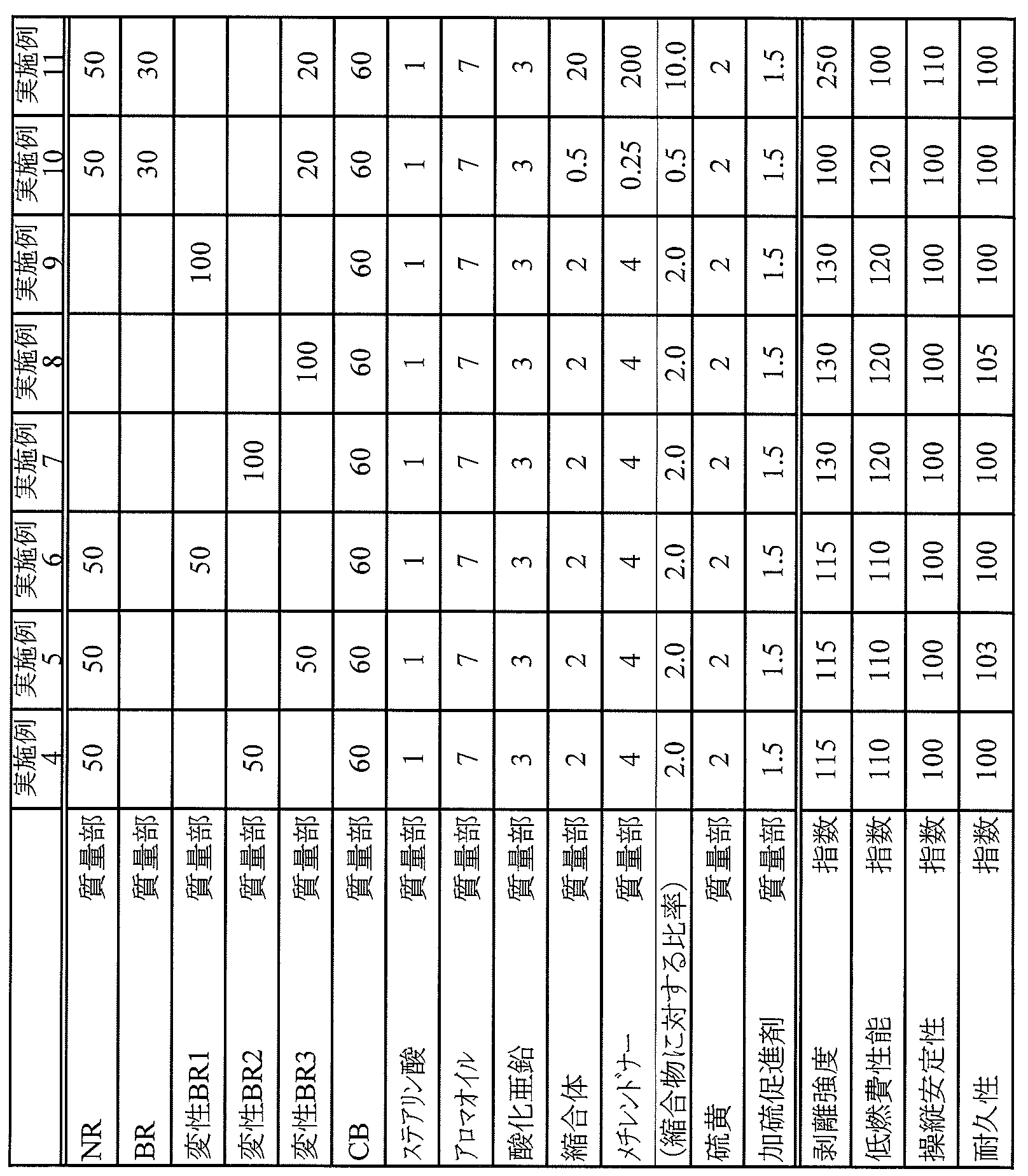
表1~2において使用した原材料の種類を下記に示す。
・NR:天然ゴム、SIR‐20
・BR:ブタジエンゴム、JSR社製BR01
・変性BR1:末端変性ブタジエンゴム、JSR社製 BR54(ガラス転移温度Tg:-107℃、官能基:シラノール基、分子量分布Mw/Mn=2.5)
・変性BR2:下記の方法で合成した末端変性ブタジエンゴム(ガラス転移温度Tg:-93℃、官能基:ポリオルガノシロキサン基、分子量分布は下記を参照)
・変性BR3:末端変性ブタジエンゴム、日本ゼオン社製 Nipol BR1250H(ガラス転移温度Tg:-96℃、官能基:N-メチルピロリドン基、分子量分布Mw/Mn=1.1)
・CB:カーボンブラック、東海カーボン社製 シーストV(窒素吸着比表面積N2 SA:27m2 /g)
・ステアリン酸:日新理化社製
・アロマオイル:昭和シェル石油社製「デソレックス3号」
・酸化亜鉛:正同化学工業社製 酸化亜鉛3種
・縮合体:変性レゾルシン・ホルムアルデヒド縮合体、住友化学工業社製スミカノール620
・メチレンドナー:田岡化学工業社製 スミカノール507AP
・硫黄:5%油展処理硫黄
・加硫促進剤:大内新興化学工業社製 ノクセラーDM
・NR:天然ゴム、SIR‐20
・BR:ブタジエンゴム、JSR社製BR01
・変性BR1:末端変性ブタジエンゴム、JSR社製 BR54(ガラス転移温度Tg:-107℃、官能基:シラノール基、分子量分布Mw/Mn=2.5)
・変性BR2:下記の方法で合成した末端変性ブタジエンゴム(ガラス転移温度Tg:-93℃、官能基:ポリオルガノシロキサン基、分子量分布は下記を参照)
・変性BR3:末端変性ブタジエンゴム、日本ゼオン社製 Nipol BR1250H(ガラス転移温度Tg:-96℃、官能基:N-メチルピロリドン基、分子量分布Mw/Mn=1.1)
・CB:カーボンブラック、東海カーボン社製 シーストV(窒素吸着比表面積N2 SA:27m2 /g)
・ステアリン酸:日新理化社製
・アロマオイル:昭和シェル石油社製「デソレックス3号」
・酸化亜鉛:正同化学工業社製 酸化亜鉛3種
・縮合体:変性レゾルシン・ホルムアルデヒド縮合体、住友化学工業社製スミカノール620
・メチレンドナー:田岡化学工業社製 スミカノール507AP
・硫黄:5%油展処理硫黄
・加硫促進剤:大内新興化学工業社製 ノクセラーDM
変性BR2の合成方法
攪拌機付きオートクレーブに、窒素雰囲気下、シクロヘキサン5670g、1,3‐ブタジエン700gおよび、テトラメチルエチレンジアミン0.17mmolを仕込んだ後、シクロヘキサンと1,3‐ブタジエンとに含まれる重合を阻害する不純物の中和に必要な量のn‐ブチルリチウムを添加し、更に、重合反応に用いる分のn-ブチルリチウムを8.33mmol加えて、50℃で重合を開始した。重合を開始してから20分経過後に、1,3‐ブタジエン300gを30分間かけて連続的に添加した。重合反応中の最高温度は80℃であった。連続添加終了後、更に15分間重合反応を継続し、重合転化率が95%から100%の範囲になったことを確認してから、少量の重合溶液をサンプリングした。サンプリングした少量の重合溶液は、過剰のメタノールを添加して反応停止した後、風乾して、重合体を取得し、ゲルパーミエーションクロマトグラフィー(GPC)分析の試料とした。その試料を用いて、重合体(活性末端を有する共役ジエン系重合体鎖に該当)のピークトップ分子量および分子量分布を測定したところ、それぞれ、「23万」および「1.04」であった。
攪拌機付きオートクレーブに、窒素雰囲気下、シクロヘキサン5670g、1,3‐ブタジエン700gおよび、テトラメチルエチレンジアミン0.17mmolを仕込んだ後、シクロヘキサンと1,3‐ブタジエンとに含まれる重合を阻害する不純物の中和に必要な量のn‐ブチルリチウムを添加し、更に、重合反応に用いる分のn-ブチルリチウムを8.33mmol加えて、50℃で重合を開始した。重合を開始してから20分経過後に、1,3‐ブタジエン300gを30分間かけて連続的に添加した。重合反応中の最高温度は80℃であった。連続添加終了後、更に15分間重合反応を継続し、重合転化率が95%から100%の範囲になったことを確認してから、少量の重合溶液をサンプリングした。サンプリングした少量の重合溶液は、過剰のメタノールを添加して反応停止した後、風乾して、重合体を取得し、ゲルパーミエーションクロマトグラフィー(GPC)分析の試料とした。その試料を用いて、重合体(活性末端を有する共役ジエン系重合体鎖に該当)のピークトップ分子量および分子量分布を測定したところ、それぞれ、「23万」および「1.04」であった。
前述の少量の重合溶液をサンプリングした直後、重合溶液に、1,6‐ビス(トリクロロシリル)ヘキサン0.288mmol(重合に使用したn‐ブチルリチウムの0.0345倍モルに相当)を40重量%シクロヘキサン溶液の状態で添加し、30分間反応させた。更に、その後、ポリオルガノシロキサンA0.0382mmol(重合に使用したn‐ブチルリチウムの0.00459倍モルに相当)を20重量%キシレン溶液の状態で添加し、30分間反応させた。その後、重合停止剤として、使用したn‐ブチルリチウムの2倍モルに相当する量のメタノールを添加した。これにより、変性ブタジエンゴムを含有する溶液を得た。この溶液に、ゴム成分100部あたり、老化防止剤として2,4‐ビス(n‐オクチルチオメチル)‐6‐メチルフェノール0.2部を添加した後、スチームストリッピングにより溶媒を除去し、60℃で24時間真空乾燥して、固形状の変性ブタジエンゴム(変性BR2)を得た。この変性ブタジエンゴム(変性BR2)について、重量平均分子量、分子量分布、カップリング率、ビニル結合含有量、および、ムーニー粘度を測定したところ、それぞれ、「51万」、「1.46」、「28%」、「11質量%」および「46」であった。

表3において使用した原材料の種類を下記に示す。
・Br-IPMS:臭素化イソブチレン‐p‐メチルスチレン共重合体、エクソンモービルケミカル社製 Exxpro 3035
・変性EEA:無水マレイン酸変性エチレン‐エチルアクリレート共重合体、三井・デュポンポリケミカル社製 HPR‐AR201
・N6/66:ナイロン6/66共重合体、宇部興産社製 UBEウベナイロン5033B
・酸化亜鉛:正同化学工業社製、亜鉛華3号
・ステアリン酸:千葉脂肪酸社製 工業用ステアリン酸
・ステアリン酸亜鉛:日油社製 ステアリン酸亜鉛
・Br-IPMS:臭素化イソブチレン‐p‐メチルスチレン共重合体、エクソンモービルケミカル社製 Exxpro 3035
・変性EEA:無水マレイン酸変性エチレン‐エチルアクリレート共重合体、三井・デュポンポリケミカル社製 HPR‐AR201
・N6/66:ナイロン6/66共重合体、宇部興産社製 UBEウベナイロン5033B
・酸化亜鉛:正同化学工業社製、亜鉛華3号
・ステアリン酸:千葉脂肪酸社製 工業用ステアリン酸
・ステアリン酸亜鉛:日油社製 ステアリン酸亜鉛
表1~2から明らかなように、実施例1~11のタイヤ用積層体および空気入りタイヤは、標準例1に対して剥離強度、低燃費性能、操縦安定性、および耐久性をバランスよく維持または向上した。
一方、比較例1のタイヤ用積層体および空気入りタイヤは、末端変性ブタジエンゴムを含まないため、剥離強度、操縦安定性、および耐久性が悪化した。比較例2~4のタイヤ用積層体および空気入りタイヤは、末端変性ブタジエンゴムの配合量が少なく、且つカーボンブラックの配合量が少ないため、剥離強度、操縦安定性、および耐久性が悪化した。比較例5~7のタイヤ用積層体および空気入りタイヤは、末端変性ブタジエンゴムの配合量が少ないため、剥離強度、低燃費性能、操縦安定性、および耐久性を改善する効果が得られなかった。
1 トレッド部
2 サイドウォール部
3 ビード部
4 カーカス層
5 ビードコア
6 ビードフィラー
7 ベルト層
8 ベルト補強層
9 インナーライナー層
9A フィルム層
9B 接着ゴム層
CL タイヤ赤道
2 サイドウォール部
3 ビード部
4 カーカス層
5 ビードコア
6 ビードフィラー
7 ベルト層
8 ベルト補強層
9 インナーライナー層
9A フィルム層
9B 接着ゴム層
CL タイヤ赤道
Claims (8)
- 熱可塑性樹脂または熱可塑性樹脂中にエラストマー成分が分散した熱可塑性エラストマー組成物からなるフィルム層と、該フィルム層を隣接部材に対して接着するための接着ゴム層とで構成されたタイヤ用積層体であって、
前記接着ゴム層が、末端変性ブタジエンゴム20質量%~100質量%を含むゴム成分100質量部に対して、下記一般式(1)で表される化合物とホルムアルデヒドとの縮合物が0.5質量部~20質量部、メチレンドナーが0.25質量部~200質量部配合され、前記縮合物の配合量に対する前記メチレンドナーの配合量の比率が0.5~10であることを特徴とするタイヤ用積層体。

- 前記熱可塑性樹脂が、ポリビニルアルコール、エチレン‐ビニルアルコール共重合体、ナイロン6、ナイロン66、ナイロン11、ナイロン12、ナイロン610、ナイロン612、ナイロン6/66、ナイロンMXD6、およびナイロン6Tからなる群から選ばれる少なくとも1種であることを特徴とする請求項1に記載のタイヤ用積層体。
- 前記エラストマー成分が、臭素化イソブチレン‐p‐メチルスチレン共重合体、無水マレイン酸変性エチレン‐α‐オレフィン共重合体、エチレン‐グリシジルメタクリレート共重合体、およびスチレン‐イソブチレン‐スチレンブロック共重合体、酸無水物変性スチレン‐イソブチレン‐スチレンブロック共重合体、および無水マレイン酸変性エチレン‐エチルアクリレート共重合体からなる群から選ばれる少なくとも1種であることを特徴とする請求項1または2に記載のタイヤ用積層体。
- 前記メチレンドナーが、変性エーテル化メチロールメラミン、パラホルムアルデヒド、ヘキサメチレンテトラミン、ペンタメチレンテトラミン、およびヘキサメトキシメチルメラミンからなる群から選ばれる少なくとも1種であることを特徴とする請求項1~3のいずれかに記載のタイヤ用積層体。
- 前記接着ゴム層を構成するゴム組成物に配合される前記末端変性ブタジエンゴムの重量平均分子量(Mw)および数平均分子量(Mn)から求められる分子量分布(Mw/Mn)が2.0以下であることを特徴とする請求項1~4のいずれかに記載のタイヤ用積層体。
- 前記接着ゴム層を構成するゴム組成物に配合される前記末端変性ブタジエンゴムの末端の官能基が水酸基、アミノ基、アミド基、アルコキシル基、エポキシ基、シロキサン結合基からなる群から選ばれる少なくとも1種であることを特徴とする請求項1~5のいずれかに記載のタイヤ用積層体。
- 請求項1~6に記載のタイヤ用積層体で構成されたことを特徴とする空気入りタイヤ用インナーライナー材。
- 請求項1~6に記載のタイヤ用積層体で構成されたインナーライナー層を備えた空気入りタイヤ。
Applications Claiming Priority (2)
| Application Number | Priority Date | Filing Date | Title |
|---|---|---|---|
| JP2019010506A JP6879315B2 (ja) | 2019-01-24 | 2019-01-24 | タイヤ用積層体および空気入りタイヤ |
| JP2019-010506 | 2019-01-24 |
Publications (1)
| Publication Number | Publication Date |
|---|---|
| WO2020153100A1 true WO2020153100A1 (ja) | 2020-07-30 |
Family
ID=71735723
Family Applications (1)
| Application Number | Title | Priority Date | Filing Date |
|---|---|---|---|
| PCT/JP2019/051220 Ceased WO2020153100A1 (ja) | 2019-01-24 | 2019-12-26 | タイヤ用積層体および空気入りタイヤ |
Country Status (2)
| Country | Link |
|---|---|
| JP (1) | JP6879315B2 (ja) |
| WO (1) | WO2020153100A1 (ja) |
Families Citing this family (1)
| Publication number | Priority date | Publication date | Assignee | Title |
|---|---|---|---|---|
| JPWO2025028625A1 (ja) * | 2023-08-02 | 2025-02-06 |
Citations (16)
| Publication number | Priority date | Publication date | Assignee | Title |
|---|---|---|---|---|
| JP2001162722A (ja) * | 1999-12-08 | 2001-06-19 | Tokai Rubber Ind Ltd | ポリアミド・ゴム複合体 |
| JP2009155631A (ja) * | 2007-12-07 | 2009-07-16 | Sumitomo Rubber Ind Ltd | タイヤ用ゴム組成物 |
| JP2010111753A (ja) * | 2008-11-05 | 2010-05-20 | Sumitomo Rubber Ind Ltd | ゴム組成物及びタイヤ |
| JP2010269481A (ja) * | 2009-05-20 | 2010-12-02 | Yokohama Rubber Co Ltd:The | 熱可塑性樹脂組成物とゴム組成物の積層体 |
| JP2012101611A (ja) * | 2010-11-08 | 2012-05-31 | Bridgestone Corp | タイヤ |
| WO2012141035A1 (ja) * | 2011-04-15 | 2012-10-18 | 株式会社ブリヂストン | 粘接着剤組成物、接着方法及び空気入りタイヤ |
| JP2012224722A (ja) * | 2011-04-18 | 2012-11-15 | Bridgestone Corp | 粘接着剤組成物及びそれを用いた接着方法、並びに積層体及びタイヤ |
| JP2012251028A (ja) * | 2011-05-31 | 2012-12-20 | Bridgestone Corp | 空気入りタイヤ |
| JP2012250573A (ja) * | 2011-05-31 | 2012-12-20 | Bridgestone Corp | 空気入りタイヤ |
| JP2013028784A (ja) * | 2011-06-21 | 2013-02-07 | Sumitomo Rubber Ind Ltd | タイヤのインスレーション用ゴム組成物およびそれを用いたタイヤ |
| JP2014095020A (ja) * | 2012-11-08 | 2014-05-22 | Sumitomo Rubber Ind Ltd | ゴム組成物及び空気入りタイヤ |
| JP2015013489A (ja) * | 2013-07-03 | 2015-01-22 | 横浜ゴム株式会社 | 空気入りタイヤ |
| JP2015116803A (ja) * | 2013-11-12 | 2015-06-25 | 横浜ゴム株式会社 | フィルムとゴム組成物との積層体、及びそれを含むタイヤ |
| JP2015163668A (ja) * | 2014-01-29 | 2015-09-10 | 田岡化学工業株式会社 | 樹脂組成物及びその製造方法、並びに共縮合物を含有するゴム組成物 |
| JP2016176028A (ja) * | 2015-03-20 | 2016-10-06 | 横浜ゴム株式会社 | タイヤ用積層体、タイヤ用インナーライナー材及び空気入りタイヤ |
| WO2018004579A1 (en) * | 2016-06-30 | 2018-01-04 | Compagnie Generale Des Etablissements Michelin | Functionalized rubber composition with sbr/br rubber |
Family Cites Families (3)
| Publication number | Priority date | Publication date | Assignee | Title |
|---|---|---|---|---|
| JP2011099018A (ja) * | 2009-11-04 | 2011-05-19 | Bridgestone Corp | タイゴム用ゴム組成物及びそれを用いた空気入りタイヤ |
| JP6583114B2 (ja) * | 2016-04-18 | 2019-10-02 | 信越化学工業株式会社 | 室温硬化性オルガノポリシロキサン組成物及び物品 |
| CN109401676B (zh) * | 2017-08-16 | 2020-08-25 | 上海交通大学 | 一种用于将金属粘附至橡胶上的环保粘合剂及其应用 |
-
2019
- 2019-01-24 JP JP2019010506A patent/JP6879315B2/ja active Active
- 2019-12-26 WO PCT/JP2019/051220 patent/WO2020153100A1/ja not_active Ceased
Patent Citations (16)
| Publication number | Priority date | Publication date | Assignee | Title |
|---|---|---|---|---|
| JP2001162722A (ja) * | 1999-12-08 | 2001-06-19 | Tokai Rubber Ind Ltd | ポリアミド・ゴム複合体 |
| JP2009155631A (ja) * | 2007-12-07 | 2009-07-16 | Sumitomo Rubber Ind Ltd | タイヤ用ゴム組成物 |
| JP2010111753A (ja) * | 2008-11-05 | 2010-05-20 | Sumitomo Rubber Ind Ltd | ゴム組成物及びタイヤ |
| JP2010269481A (ja) * | 2009-05-20 | 2010-12-02 | Yokohama Rubber Co Ltd:The | 熱可塑性樹脂組成物とゴム組成物の積層体 |
| JP2012101611A (ja) * | 2010-11-08 | 2012-05-31 | Bridgestone Corp | タイヤ |
| WO2012141035A1 (ja) * | 2011-04-15 | 2012-10-18 | 株式会社ブリヂストン | 粘接着剤組成物、接着方法及び空気入りタイヤ |
| JP2012224722A (ja) * | 2011-04-18 | 2012-11-15 | Bridgestone Corp | 粘接着剤組成物及びそれを用いた接着方法、並びに積層体及びタイヤ |
| JP2012251028A (ja) * | 2011-05-31 | 2012-12-20 | Bridgestone Corp | 空気入りタイヤ |
| JP2012250573A (ja) * | 2011-05-31 | 2012-12-20 | Bridgestone Corp | 空気入りタイヤ |
| JP2013028784A (ja) * | 2011-06-21 | 2013-02-07 | Sumitomo Rubber Ind Ltd | タイヤのインスレーション用ゴム組成物およびそれを用いたタイヤ |
| JP2014095020A (ja) * | 2012-11-08 | 2014-05-22 | Sumitomo Rubber Ind Ltd | ゴム組成物及び空気入りタイヤ |
| JP2015013489A (ja) * | 2013-07-03 | 2015-01-22 | 横浜ゴム株式会社 | 空気入りタイヤ |
| JP2015116803A (ja) * | 2013-11-12 | 2015-06-25 | 横浜ゴム株式会社 | フィルムとゴム組成物との積層体、及びそれを含むタイヤ |
| JP2015163668A (ja) * | 2014-01-29 | 2015-09-10 | 田岡化学工業株式会社 | 樹脂組成物及びその製造方法、並びに共縮合物を含有するゴム組成物 |
| JP2016176028A (ja) * | 2015-03-20 | 2016-10-06 | 横浜ゴム株式会社 | タイヤ用積層体、タイヤ用インナーライナー材及び空気入りタイヤ |
| WO2018004579A1 (en) * | 2016-06-30 | 2018-01-04 | Compagnie Generale Des Etablissements Michelin | Functionalized rubber composition with sbr/br rubber |
Also Published As
| Publication number | Publication date |
|---|---|
| JP6879315B2 (ja) | 2021-06-02 |
| JP2020116847A (ja) | 2020-08-06 |
Similar Documents
| Publication | Publication Date | Title |
|---|---|---|
| JP5071204B2 (ja) | 空気入りタイヤ | |
| RU2495757C1 (ru) | Пневматическая шина и слоистый пластик | |
| JP4442700B2 (ja) | 空気入りタイヤ及びその製造方法 | |
| JP3695840B2 (ja) | 空気入りタイヤ | |
| JP6136626B2 (ja) | 積層体、インナーライナー材および空気入りタイヤ | |
| JP3532036B2 (ja) | 空気入りタイヤ | |
| JP6136592B2 (ja) | 積層体、インナーライナー材および空気入りタイヤ | |
| JPWO2005007423A1 (ja) | 耐久性の改良された空気入りタイヤ | |
| US20160263868A1 (en) | Laminate of film and rubber composition, and tire including same | |
| EP2933098B1 (en) | Laminate, inner liner for tire, and pneumatic tire | |
| US9114668B2 (en) | Pneumatic tire | |
| WO2009133823A1 (ja) | 空気入りタイヤ/リム組立体 | |
| JP6237235B2 (ja) | タイヤ用積層体 | |
| JP2004525022A (ja) | 補強されたビードを有する車両ホイール用タイヤ | |
| US20170239992A1 (en) | Pneumatic Tire | |
| JP6879315B2 (ja) | タイヤ用積層体および空気入りタイヤ | |
| JP3320004B2 (ja) | 空気入りタイヤ | |
| EP3480033B1 (en) | Pneumatic tire | |
| JP2010031117A (ja) | トレッド用ゴム組成物 | |
| US12496852B2 (en) | Laminate for tires | |
| JP2019035034A (ja) | 熱可塑性エラストマー組成物の製造方法、タイヤ用耐空気透過性フィルムの製造方法、及び空気入りタイヤの製造方法 | |
| JP5326604B2 (ja) | 空気入りタイヤ | |
| JP7091664B2 (ja) | 空気入りタイヤ | |
| JP6428145B2 (ja) | 空気入りタイヤ | |
| JP2009208734A (ja) | 空気入りタイヤ |
Legal Events
| Date | Code | Title | Description |
|---|---|---|---|
| 121 | Ep: the epo has been informed by wipo that ep was designated in this application |
Ref document number: 19911640 Country of ref document: EP Kind code of ref document: A1 |
|
| NENP | Non-entry into the national phase |
Ref country code: DE |
|
| 122 | Ep: pct application non-entry in european phase |
Ref document number: 19911640 Country of ref document: EP Kind code of ref document: A1 |