WO2020149236A1 - 化学強化ガラスおよびその製造方法 - Google Patents
化学強化ガラスおよびその製造方法 Download PDFInfo
- Publication number
- WO2020149236A1 WO2020149236A1 PCT/JP2020/000690 JP2020000690W WO2020149236A1 WO 2020149236 A1 WO2020149236 A1 WO 2020149236A1 JP 2020000690 W JP2020000690 W JP 2020000690W WO 2020149236 A1 WO2020149236 A1 WO 2020149236A1
- Authority
- WO
- WIPO (PCT)
- Prior art keywords
- glass
- less
- chemically strengthened
- mass
- mol
- Prior art date
- Legal status (The legal status is an assumption and is not a legal conclusion. Google has not performed a legal analysis and makes no representation as to the accuracy of the status listed.)
- Ceased
Links
Images

Classifications
-
- C—CHEMISTRY; METALLURGY
- C03—GLASS; MINERAL OR SLAG WOOL
- C03C—CHEMICAL COMPOSITION OF GLASSES, GLAZES OR VITREOUS ENAMELS; SURFACE TREATMENT OF GLASS; SURFACE TREATMENT OF FIBRES OR FILAMENTS MADE FROM GLASS, MINERALS OR SLAGS; JOINING GLASS TO GLASS OR OTHER MATERIALS
- C03C3/00—Glass compositions
- C03C3/04—Glass compositions containing silica
- C03C3/076—Glass compositions containing silica with 40% to 90% silica, by weight
- C03C3/095—Glass compositions containing silica with 40% to 90% silica, by weight containing rare earths
-
- C—CHEMISTRY; METALLURGY
- C03—GLASS; MINERAL OR SLAG WOOL
- C03C—CHEMICAL COMPOSITION OF GLASSES, GLAZES OR VITREOUS ENAMELS; SURFACE TREATMENT OF GLASS; SURFACE TREATMENT OF FIBRES OR FILAMENTS MADE FROM GLASS, MINERALS OR SLAGS; JOINING GLASS TO GLASS OR OTHER MATERIALS
- C03C21/00—Treatment of glass, not in the form of fibres or filaments, by diffusing ions or metals in the surface
- C03C21/001—Treatment of glass, not in the form of fibres or filaments, by diffusing ions or metals in the surface in liquid phase, e.g. molten salts, solutions
- C03C21/002—Treatment of glass, not in the form of fibres or filaments, by diffusing ions or metals in the surface in liquid phase, e.g. molten salts, solutions to perform ion-exchange between alkali ions
-
- C—CHEMISTRY; METALLURGY
- C03—GLASS; MINERAL OR SLAG WOOL
- C03C—CHEMICAL COMPOSITION OF GLASSES, GLAZES OR VITREOUS ENAMELS; SURFACE TREATMENT OF GLASS; SURFACE TREATMENT OF FIBRES OR FILAMENTS MADE FROM GLASS, MINERALS OR SLAGS; JOINING GLASS TO GLASS OR OTHER MATERIALS
- C03C23/00—Other surface treatment of glass not in the form of fibres or filaments
- C03C23/0075—Cleaning of glass
-
- C—CHEMISTRY; METALLURGY
- C03—GLASS; MINERAL OR SLAG WOOL
- C03C—CHEMICAL COMPOSITION OF GLASSES, GLAZES OR VITREOUS ENAMELS; SURFACE TREATMENT OF GLASS; SURFACE TREATMENT OF FIBRES OR FILAMENTS MADE FROM GLASS, MINERALS OR SLAGS; JOINING GLASS TO GLASS OR OTHER MATERIALS
- C03C3/00—Glass compositions
- C03C3/04—Glass compositions containing silica
- C03C3/076—Glass compositions containing silica with 40% to 90% silica, by weight
- C03C3/083—Glass compositions containing silica with 40% to 90% silica, by weight containing aluminium oxide or an iron compound
-
- C—CHEMISTRY; METALLURGY
- C03—GLASS; MINERAL OR SLAG WOOL
- C03C—CHEMICAL COMPOSITION OF GLASSES, GLAZES OR VITREOUS ENAMELS; SURFACE TREATMENT OF GLASS; SURFACE TREATMENT OF FIBRES OR FILAMENTS MADE FROM GLASS, MINERALS OR SLAGS; JOINING GLASS TO GLASS OR OTHER MATERIALS
- C03C3/00—Glass compositions
- C03C3/04—Glass compositions containing silica
- C03C3/076—Glass compositions containing silica with 40% to 90% silica, by weight
- C03C3/083—Glass compositions containing silica with 40% to 90% silica, by weight containing aluminium oxide or an iron compound
- C03C3/085—Glass compositions containing silica with 40% to 90% silica, by weight containing aluminium oxide or an iron compound containing an oxide of a divalent metal
-
- C—CHEMISTRY; METALLURGY
- C03—GLASS; MINERAL OR SLAG WOOL
- C03C—CHEMICAL COMPOSITION OF GLASSES, GLAZES OR VITREOUS ENAMELS; SURFACE TREATMENT OF GLASS; SURFACE TREATMENT OF FIBRES OR FILAMENTS MADE FROM GLASS, MINERALS OR SLAGS; JOINING GLASS TO GLASS OR OTHER MATERIALS
- C03C3/00—Glass compositions
- C03C3/04—Glass compositions containing silica
- C03C3/076—Glass compositions containing silica with 40% to 90% silica, by weight
- C03C3/083—Glass compositions containing silica with 40% to 90% silica, by weight containing aluminium oxide or an iron compound
- C03C3/085—Glass compositions containing silica with 40% to 90% silica, by weight containing aluminium oxide or an iron compound containing an oxide of a divalent metal
- C03C3/087—Glass compositions containing silica with 40% to 90% silica, by weight containing aluminium oxide or an iron compound containing an oxide of a divalent metal containing calcium oxide, e.g. common sheet or container glass
-
- C—CHEMISTRY; METALLURGY
- C03—GLASS; MINERAL OR SLAG WOOL
- C03C—CHEMICAL COMPOSITION OF GLASSES, GLAZES OR VITREOUS ENAMELS; SURFACE TREATMENT OF GLASS; SURFACE TREATMENT OF FIBRES OR FILAMENTS MADE FROM GLASS, MINERALS OR SLAGS; JOINING GLASS TO GLASS OR OTHER MATERIALS
- C03C3/00—Glass compositions
- C03C3/04—Glass compositions containing silica
- C03C3/076—Glass compositions containing silica with 40% to 90% silica, by weight
- C03C3/089—Glass compositions containing silica with 40% to 90% silica, by weight containing boron
- C03C3/091—Glass compositions containing silica with 40% to 90% silica, by weight containing boron containing aluminium
-
- C—CHEMISTRY; METALLURGY
- C03—GLASS; MINERAL OR SLAG WOOL
- C03C—CHEMICAL COMPOSITION OF GLASSES, GLAZES OR VITREOUS ENAMELS; SURFACE TREATMENT OF GLASS; SURFACE TREATMENT OF FIBRES OR FILAMENTS MADE FROM GLASS, MINERALS OR SLAGS; JOINING GLASS TO GLASS OR OTHER MATERIALS
- C03C3/00—Glass compositions
- C03C3/04—Glass compositions containing silica
- C03C3/076—Glass compositions containing silica with 40% to 90% silica, by weight
- C03C3/089—Glass compositions containing silica with 40% to 90% silica, by weight containing boron
- C03C3/091—Glass compositions containing silica with 40% to 90% silica, by weight containing boron containing aluminium
- C03C3/093—Glass compositions containing silica with 40% to 90% silica, by weight containing boron containing aluminium containing zinc or zirconium
-
- C—CHEMISTRY; METALLURGY
- C03—GLASS; MINERAL OR SLAG WOOL
- C03C—CHEMICAL COMPOSITION OF GLASSES, GLAZES OR VITREOUS ENAMELS; SURFACE TREATMENT OF GLASS; SURFACE TREATMENT OF FIBRES OR FILAMENTS MADE FROM GLASS, MINERALS OR SLAGS; JOINING GLASS TO GLASS OR OTHER MATERIALS
- C03C3/00—Glass compositions
- C03C3/04—Glass compositions containing silica
- C03C3/076—Glass compositions containing silica with 40% to 90% silica, by weight
- C03C3/097—Glass compositions containing silica with 40% to 90% silica, by weight containing phosphorus, niobium or tantalum
-
- C—CHEMISTRY; METALLURGY
- C03—GLASS; MINERAL OR SLAG WOOL
- C03C—CHEMICAL COMPOSITION OF GLASSES, GLAZES OR VITREOUS ENAMELS; SURFACE TREATMENT OF GLASS; SURFACE TREATMENT OF FIBRES OR FILAMENTS MADE FROM GLASS, MINERALS OR SLAGS; JOINING GLASS TO GLASS OR OTHER MATERIALS
- C03C4/00—Compositions for glass with special properties
- C03C4/02—Compositions for glass with special properties for coloured glass
-
- C—CHEMISTRY; METALLURGY
- C03—GLASS; MINERAL OR SLAG WOOL
- C03C—CHEMICAL COMPOSITION OF GLASSES, GLAZES OR VITREOUS ENAMELS; SURFACE TREATMENT OF GLASS; SURFACE TREATMENT OF FIBRES OR FILAMENTS MADE FROM GLASS, MINERALS OR SLAGS; JOINING GLASS TO GLASS OR OTHER MATERIALS
- C03C4/00—Compositions for glass with special properties
- C03C4/14—Compositions for glass with special properties for electro-conductive glass
-
- C—CHEMISTRY; METALLURGY
- C03—GLASS; MINERAL OR SLAG WOOL
- C03C—CHEMICAL COMPOSITION OF GLASSES, GLAZES OR VITREOUS ENAMELS; SURFACE TREATMENT OF GLASS; SURFACE TREATMENT OF FIBRES OR FILAMENTS MADE FROM GLASS, MINERALS OR SLAGS; JOINING GLASS TO GLASS OR OTHER MATERIALS
- C03C2218/00—Methods for coating glass
- C03C2218/30—Aspects of methods for coating glass not covered above
- C03C2218/31—Pre-treatment
Definitions
- the present invention relates to a chemically strengthened glass and a method for manufacturing the same.
- -Chemically strengthened glass is used for the cover glass of mobile terminals.
- Chemically strengthened glass is brought into contact with a molten salt such as sodium nitrate to cause ion exchange between alkali metal ions contained in the glass and alkali metal ions contained in the molten salt and having a larger ionic radius.
- the cover glass of mobile terminals etc. may be broken due to deformation such as when dropped. In order to prevent such breakage (breakdown due to bending mode), it is effective to increase the compressive stress on the glass surface.
- the cover glass of mobile terminals etc. may be broken by collision with protrusions when the terminal falls on asphalt or sand. In order to prevent such breakage (breakdown due to impact mode), it is effective to increase the depth of the compressive stress layer to form the compressive stress layer even in a deeper portion of the glass.
- the chemically strengthened glass is designed so that the compressive stress of the surface is increased and the compressive stress is formed even in a deeper portion, while the total amount of the compressive stress of the surface layer is not too large.
- Patent Document 1 describes a method of performing two-step chemical strengthening using a glass for chemical strengthening containing lithium. According to the method, a large compressive stress due to sodium-potassium exchange can be generated in the surface portion of the glass, and a slightly smaller compressive stress due to lithium-sodium exchange can be generated in the deeper portion. It was thought that it was possible to suppress both the failure due to the bending mode and the failure due to the impact mode.
- Patent Document 2 describes a special stress profile in which the maximum of the compressive stress value exists. This profile can be realized by two times of ion exchange treatment and heat treatment at a temperature lower than the strain point of glass.
- a protective film may be attached to the cover glass surface in order to prevent the cover glass surface from being scratched during transportation.
- the protective film was peeled off from the surface of the cover glass, there was a case where a failure occurred in the electronic device due to the influence of static electricity.
- An object of the present invention is to provide a chemically strengthened glass and a method for manufacturing the same, in which both breakage in bending mode and breakage in impact mode are sufficiently suppressed, and scattering of fragments at the time of breakage is also suppressed. Moreover, the glass for chemical strengthening suitable for manufacture of this chemically strengthened glass is provided.
- the present invention is a plate-shaped chemically strengthened glass having a compressive stress layer on the glass surface, the compressive stress value (CS 0 ) on the glass surface is 800 MPa or more, and the plate thickness (t) is 100 ⁇ m or more,
- the depth at which the compressive stress layer depth (DOL) is (t ⁇ 0.1) ⁇ m or more and the depth from the glass surface is 10 ⁇ m or more and the compressive stress value is maximum in the range smaller than DOL is D B
- the depth is a compressive stress value of D B CS B, in the range depth following D B from the glass surface, the depth to which compressive stress value is minimized D a, the compression stress value in the depth D a and CS a
- a glass plate made of lithium aluminosilicate glass is immersed in a sodium-containing salt at 380° C. to 500° C. for 1 to 8 hours, and the sodium-containing salt is a metal ion in the molten salt.
- the present invention provides a method for producing chemically strengthened glass, which comprises 50% by mass or more of sodium ions with the mass of 100% by mass, and is then immersed in a potassium-containing salt to obtain the chemically strengthened glass.
- SiO 2 is 50 to 70% in terms of mol% based on oxide
- Al 2 O 3 is 7 to 25%
- B 2 O 3 is 0-10%
- P 2 O 5 0-10%
- the total content is 15% or less
- the total content is The glass for chemical strengthening whose content is 5% or less
- the sodium-containing salt contains 80% or more of sodium ions, with the mass of metal ions contained in the sodium-containing salt being 100%.
- the method for producing chemically strengthened glass is characterized in that the time of contact with the potassium-containing salt is shorter than the time of contact with the sodium-containing salt.
- Al 2 O 3 is 7 to 20%, 2 to 20% of Li 2 O, 0-2% Na 2 O, 2 to 6% K 2 O, 0 to 2% of B 2 O 3 , P 2 O 5 is 0 to 2%, One or more of ZrO 2 and TiO 2 in total of 0.1 to 3%,
- Al 2 O 3 is 10 to 25%, Li 2 O is 2.5 to 10%, 0-4% Na 2 O, 2 to 10% K 2 O, B 2 O 3 is 0-10%
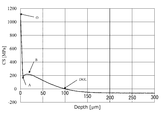
- FIG. 1 is a diagram showing a stress profile of chemically strengthened glass.
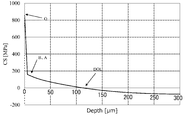
- FIG. 2 is a diagram showing a stress profile of the chemically strengthened glass.
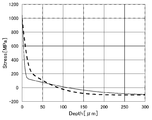
- FIG. 3 is a diagram showing a stress profile of the chemically strengthened glass.
- FIG. 4 is a diagram showing a stress profile of the chemically strengthened glass.
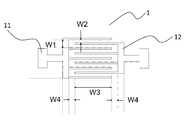
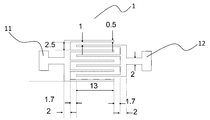
- FIG. 5 is a schematic plan view of an electrode pattern for measuring surface resistivity.
- FIG. 6 is a schematic plan view of an electrode pattern used for measuring surface resistivity in the examples. In FIG. 6, the unit of the numerical value indicating the length of each width is mm.
- the “stress profile” refers to the value of compressive stress with the depth from the glass surface as a variable.
- the “compressive stress layer depth DOL” is the depth at which the compressive stress value CS becomes zero.
- the depth at which the compressive stress value measured by an optical waveguide surface stress meter described later becomes zero is expressed as “D K ”.
- D K is considered to be the depth at which potassium ions penetrated by the ion exchange treatment.
- Internal tensile stress CT refers to a tensile stress value at a depth of 1/2 of the glass plate thickness t.
- the stress profile can be measured by a method using a combination of an optical waveguide surface stress meter and a birefringence stress meter.
- optical waveguide surface stress meter can accurately measure the stress of glass in a short time.
- An example of the optical waveguide surface stress meter is FSM-6000 manufactured by Orihara Seisakusho. Highly accurate stress measurement is possible by combining FSM-6000 with the attached software Fsm-V.
- the optical waveguide surface stress meter can measure the stress only when the refractive index decreases from the sample surface toward the inside.
- the layer obtained by replacing sodium ions inside the glass with potassium ions outside in the chemically strengthened glass has a lower refractive index from the sample surface toward the inside, so that the stress can be measured by an optical waveguide surface stress meter.
- the stress of the layer obtained by replacing lithium ions inside the glass with sodium ions outside cannot be measured by an optical waveguide surface stress meter. Therefore, when an ion exchange treatment using a molten salt containing sodium is performed on glass containing lithium, the depth (D K ) at which the compressive stress value measured by the optical waveguide surface stress meter becomes zero is true. Not the compressive stress layer depth.
- the method using a birefringence stress meter can measure stress regardless of the refractive index distribution.
- An example of the birefringence index stress meter is the birefringence imaging system Abrio-IM manufactured by Cri.
- Abrio-IM the birefringence imaging system Abrio-IM manufactured by Cri.
- Accurate stress measurement is possible by using two types of measuring devices in combination.
- chemically strengthened glass refers to glass after being chemically strengthened
- glass for chemical strengthening refers to glass before being chemically strengthened
- the “matrix composition of chemically strengthened glass” is the glass composition of glass for chemical strengthening, and except for the case where extreme ion exchange treatment is performed, the glass composition of a portion deeper than the DOL of chemically strengthened glass. Is the matrix composition of chemically strengthened glass.
- the glass composition is expressed in terms of mass% based on oxide or mol% based on oxide.
- substantially free of means that the content is not higher than the level of impurities contained in the raw material, that is, not contained intentionally. Specifically, for example, it is less than 0.1% by mass.
- the chemically strengthened glass of the present invention (hereinafter, may be referred to as “main tempered glass”) is preferably plate-shaped, and is usually a flat plate, but may be curved.
- the compressive stress value (CS 0 ) on the glass surface is preferably 800 MPa or higher, more preferably 900 MPa or higher, further preferably 950 MPa or higher, particularly preferably 1000 MPa or higher.
- the larger CS 0 the more the “breakage due to bending mode” can be prevented.
- CS 0 is preferably 1400 MPa or less, more preferably 1300 MPa or less, and even more preferably 1200 MPa or less.
- the plate thickness (t) of the tempered glass is 100 ⁇ m or more, preferably 400 ⁇ m or more, more preferably 600 ⁇ m or more, and further preferably 700 ⁇ m or more.
- t is preferably 2000 ⁇ m or less, more preferably 1000 ⁇ m or less in order to reduce the weight.
- the depth (DOL) of the compressive stress layer is preferably (t ⁇ 0.1) ⁇ m or more, more preferably (t ⁇ 0.12) ⁇ m or more, and further preferably (t ⁇ 0.14) ⁇ m. That is all. Increasing the DOL for t increases the effect of chemical strengthening.
- the DOL is preferably (t ⁇ 0.25) ⁇ m or less, more preferably (t ⁇ 0.22) ⁇ m or less, and further preferably (t ⁇ 0.20) ⁇ m or less.
- the DOL is preferably 50 ⁇ m or more. Since the protrusion of general asphalt is about 50 ⁇ m, if the DOL is 50 ⁇ m or more, cracking due to the impact mode when the vehicle collides with asphalt such as a road can be suppressed.
- the depth (D K ) at which the compressive stress value measured by an optical waveguide surface stress meter becomes zero is preferably 3 ⁇ m or more because breakage due to a bending mode can be suppressed.
- D K is more preferably 4 ⁇ m or more, still more preferably 5 ⁇ m or more. If D K is too large, CT may increase, so 20 ⁇ m or less is preferable, 15 ⁇ m or less is more preferable, and 10 ⁇ m or less is further preferable. Note that there is usually a positive correlation between D K and DOL, and the DOL tends to increase as the D K increases.
- FIG. 1 An example of the stress profile of the tempered glass is shown in FIG.
- the point indicating the compressive stress value on the glass surface is O
- the point at which the compressive stress value is maximum within the range of the depth from the surface of 10 ⁇ m or more and DOL or less is B
- the depth from the surface is shallower than point B.
- Point A has the smallest stress value in the range.
- CS decreases as the depth increases in the entire range from the glass surface to DOL.
- FIG. 2 is an example of such a stress profile.
- the stress profile of the tempered glass has a point B at which the stress reaches its maximum in the range of the depth from the glass surface of 10 ⁇ m or more and DOL or less, and the stress is in the range of the depth from the glass surface of 0 or more and D B or less. It has a minimum point A. In this way, CS B and CS A do not match because there is a maximum point and a minimum point. Further, since CS B >CS A , high strength can be obtained.
- CS A CS A >0.
- the compressive stress value is large in a shallow region of 10 ⁇ m or less from the glass surface, and if CS A >0, bending is performed. The destruction due to the mode is effectively suppressed.
- the compressive stress value in order to suppress the destruction due to the impact mode, it is effective that the compressive stress value is large when the depth from the glass surface is 50 ⁇ m to 80 ⁇ m.
- the compressive stress value in the region where the depth from the glass surface is 10 ⁇ m or more and less than 50 ⁇ m was considered not to contribute much to the suppression of fracture. Therefore, if the compressive stress has a minimum point within the range of the depth from the glass surface of 10 ⁇ m or more and less than 50 ⁇ m (that is, D A is 10 ⁇ m or more and less than 50 ⁇ m), the compressive stress can be utilized without waste, which is more preferable.
- the depth D A of the point A is more preferably in the range of 10 to 30 ⁇ m.
- the compressive stress value CS 50 (measured with a birefringence stress meter) at a depth of 50 ⁇ m from the surface layer of the glass is 60 MPa or more because breakage due to an impact mode can be suppressed. More preferably, it is 80 MPa or more.
- the compressive stress value CS 50 is preferably 400 MPa or less, more preferably 200 MPa or less.
- the compressive stress value CS 50 at a depth of 50 ⁇ m from the surface layer of the glass is preferably (t ⁇ 0.1) MPa or more.
- the area S ⁇ of the triangle formed by the point O representing the stress value on the glass surface and the points A and B is preferably 300 MPa ⁇ m or more.
- the area S ⁇ of this triangle represents the amount of compressive stress saved by providing the minimum point of the stress value. In order to prevent useless compressive stress that does not contribute much to the suppression of the breakage due to the bending mode and the suppression of the breakage due to the impact mode, it is preferable to increase S ⁇ .
- S ⁇ is more preferably 1000 MPa ⁇ m or more, further preferably 2000 MPa ⁇ m or more, and particularly preferably 5000 MPa ⁇ m or more. Since the strength of S ⁇ decreases if it is too large, it is preferably 40000 MPa ⁇ m or less, more preferably 30000 MPa ⁇ m or less, and further preferably 20000 MPa ⁇ m or less.
- the chemically strengthened glass is processed into a square shape having a side of 30 mm, and when a diamond indenter with a tip angle of 90 degrees is driven under a minimum load that causes breakage, the number of fractures is 10 or less. It is preferable. That is, as described above, it is necessary that the tensile stress (CT) generated corresponding to the compressive stress is suppressed within a limit that does not cause severe breakage, while having a sufficient compressive stress layer capable of suppressing breakage. ..
- CT-limit the limit CT value that does not cause severe destruction
- a plate-like chemically strengthened glass is processed into a square shape having a side of 30 mm, a minimum load that causes breakage is applied, and a diamond indenter with a tip angle of 90 degrees is crushed in a crushing test. If the number is preferably 10 or less, the tensile stress (CT) inside the chemically strengthened glass can be regarded as CT-limit or less.
- CT tensile stress
- the number of crushed pieces by the crushing test is more preferably 7 or less. Since the value of CT-limit depends on the glass composition, the preferable CT value for preventing vigorous crushing also differs depending on the glass composition, but it is preferably 90 MPa or less, and more preferably 80 MPa or less.
- the tempered glass is preferably lithium aluminosilicate glass.
- a large compressive stress due to sodium-potassium exchange may be generated in the surface portion of the glass, and a slightly smaller compressive stress due to lithium-sodium exchange may be generated in a deeper portion. Therefore, it is possible to suppress both the bending fracture and the fracture due to the collision with the protrusion.
- the glass composition in the central portion in the thickness direction is represented by mass%, Contains 50% or more of SiO 2 and 5% or more of Al 2 O 3 , The total content of Li 2 O, Na 2 O and K 2 O is 5% or more, And the content of Li 2 O, Li 2 O, molar ratio of the total content of Na 2 O and K 2 O is preferably not less than 0.5. Further, the glass composition in the central portion in the thickness direction is preferably the composition of glass for chemical strengthening described later.
- the chemically strengthened glass of the present invention is particularly useful as a cover glass used for mobile devices such as mobile phones and smartphones. Further, it is also useful for a cover glass of a display device such as a television, a personal computer and a touch panel, a wall surface of an elevator, a wall surface (a full-screen display) of a building such as a house or a building, which is not intended to be carried. It is also useful as a building material such as a window glass, a table top, an interior of an automobile or an airplane, a cover glass thereof, and a case having a curved surface.
- This tempered glass can be manufactured by subjecting the glass for chemical strengthening described below to an ion exchange treatment.
- the glass for chemical strengthening can be manufactured using a general glass manufacturing method as described below, for example.
- ____ Prepare glass materials appropriately and heat and melt them in a glass melting kiln so that glass with a desirable composition can be obtained. Then, the glass is homogenized by bubbling, stirring, addition of a fining agent, etc., formed into a glass plate having a predetermined thickness, and gradually cooled. Alternatively, it may be formed into a plate shape by a method of forming into a block shape, gradually cooling, and then cutting.
- a method of forming into a plate shape for example, a float method, a pressing method, a fusion method and a downdraw method can be mentioned.
- the float method is preferable.
- the glass ribbon obtained by molding is ground and polished as necessary to form a glass plate.
- the end surface is chemically strengthened.
- a compressive stress layer is formed, which is preferable. Then, the formed glass plate is chemically strengthened, and then washed and dried to obtain chemically strengthened glass.
- the chemical strengthening treatment is generally carried out by contacting the glass with the metal salt by immersing it in a molten metal salt containing a metal ion with a large ionic radius, and the metal ion with a small ionic radius (and the metal salt in the glass).
- a metal ion having a large ionic radius typically potassium ion
- a metal ion having a small ionic radius typically potassium ion
- the sodium ion is used for the exchange treatment.
- glass for chemical strengthening made of lithium aluminosilicate glass is brought into contact with a sodium-containing salt to strengthen it. That is, “Li—Na exchange”, which exchanges lithium ions in glass for sodium ions, is used. This method is preferable because the chemical strengthening treatment speed is high.
- examples of the sodium-containing salt include nitrates, sulfates, carbonates, chlorides and the like. These salts may be used alone or in combination of two or more.
- the sodium-containing salt preferably contains sodium ion in an amount of 50% or more based on the mass of the metal ion contained in the salt as 100%.
- the content of sodium ions is preferably 75% or more, more preferably 80% or more.
- the sodium-containing salt preferably has a potassium ion content of 50% or less, more preferably 25% or less, still more preferably 20% or less, based on the mass of the metal ion contained in the salt.
- a strengthening salt chemical strengthening salt
- a high compressive stress layer can be formed in the deep portion of the glass, and at the same time, unnecessary stress can be removed in the "glass breaking mode by impact" by reverse exchange.
- sodium-containing salt sodium-containing nitrate is preferable from the viewpoint of easy handling such as boiling point and danger.
- the molten salt for chemical strengthening treatment includes nitrates, sulfates, carbonates, chlorides, etc.
- nitrates include lithium nitrate, sodium nitrate, potassium nitrate, cesium nitrate, and silver nitrate.
- sulfates include lithium sulfate, sodium sulfate, potassium sulfate, cesium sulfate, and silver sulfate.
- the carbonate include lithium carbonate, sodium carbonate, potassium carbonate and the like.
- chlorides include lithium chloride, sodium chloride, potassium chloride, cesium chloride, and silver chloride.
- the tempered glass can be manufactured by the tempering treatment method described below (hereinafter referred to as “the tempering treatment method”).
- the method preferably comprises the step of immersing the glass plate in a sodium-containing salt.
- the present strengthening treatment method has a step of immersing the glass plate in a sodium-containing salt.
- a sodium-containing salt a salt containing 50% by mass or more of sodium ions is preferable, and a salt containing 75% by mass or more is more preferable, with the mass of metal ions contained in the salt being 100% by mass.
- a strengthening salt By using such a strengthening salt, a high compressive stress layer can be formed in the deep portion of the glass, and at the same time, unnecessary stress can be released in the "glass breaking mode by impact" by reverse exchange.
- sodium-containing salt sodium-containing nitrate is preferable from the viewpoint of easy handling such as boiling point and danger.
- the reinforcing salt preferably contains sodium nitrate, and as a component other than sodium nitrate, a nitrate of an alkali metal or an alkaline earth metal such as potassium nitrate, magnesium nitrate or lithium nitrate may be contained.
- the glass plate in this strengthening method, it is preferable to immerse the glass plate in a sodium-containing salt at 380°C to 500°C.
- a sodium-containing salt When the temperature of the sodium-containing salt is 380° C. or higher, ion exchange proceeds easily, which is preferable. More preferably, it is 400° C. or higher. Further, when the temperature of the sodium-containing salt is 500° C. or lower, excessive stress relaxation of the surface layer can be suppressed, which is preferable. More preferably, it is 480°C or lower.
- the time for immersing the glass in the sodium-containing salt is 1 hour or more because the surface compressive stress increases.
- the immersion time is more preferably 2 hours or more, further preferably 3 hours or more. If the immersion time is too long, not only the productivity will decrease, but also the compression stress may decrease due to the relaxation phenomenon.
- it is preferably 8 hours or less, more preferably 6 hours or less, and further preferably 4 hours or less.
- This strengthening method also has a step of immersing the glass plate in a potassium-containing salt.
- a potassium-containing salt a salt containing 50% by mass or more of potassium ions is preferable, and a salt containing 75% by mass or more is more preferable, with the mass of metal ions contained in the salt being 100% by mass.
- a strengthening salt By using such a strengthening salt, a high compressive stress layer can be formed on the surface layer of glass, so that the "glass breakage mode due to bending" can be suppressed.
- potassium-containing salt potassium-containing nitrate is preferable from the viewpoint of easy handling.
- the time for immersing the glass in the potassium-containing salt is preferably shorter than the time for immersing the glass in the sodium-containing salt in order to maintain the characteristics of the stress profile formed by the sodium salt treatment. Further, it is preferable that the time for immersing the glass in the potassium-containing salt is 4 hours or less because the stress in the portion of 20 to 50 ⁇ m can be adjusted appropriately.
- the immersion time is more preferably 3 hours or less, further preferably 2 hours or less. If the immersion time is too short, sufficient compressive stress will not enter the outermost surface layer of the glass. In order to apply a sufficient compressive stress to the outermost surface layer of the glass, it is preferably 30 minutes or longer, more preferably 45 minutes or longer, still more preferably 1 hour or longer.
- the holding temperature after immersing the glass plate in the potassium-containing salt is more preferably 250°C or lower, and further preferably 200°C or lower.
- Lithium aluminosilicate glass is preferable as the glass for chemical strengthening according to the present invention (hereinafter sometimes referred to as the main glass for strengthening). More specifically, it contains 50% or more of SiO 2 and 5% or more of Al 2 O 3 in terms of mass% based on oxide, The total content of Li 2 O, Na 2 O and K 2 O is 5% or more, And the content of Li 2 O, Li 2 O, molar ratio of the total content of Na 2 O and K 2 O is preferably not less than 0.5.
- This tempering glass is displayed in mass% based on oxide, SiO 2 is 50-80%, Al 2 O 3 is 5 to 25%, Li 2 O is 2 to 20%, 1.5-10% Na 2 O, K 2 O is 1-12%, B 2 O 3 is 0-10%, P 2 O 5 is 0-10%, When it contains any one or more of MgO, ZnO, CaO, SrO, and BaO, the total content is 10% or less, and when it contains one or more of ZrO 2 and TiO 2 , the total content. Is preferably 5% or less.
- SiO 2 is 45 to 75% in terms of mass% based on oxide
- Al 2 O 3 is 10 to 25%
- Li 2 O is 2-10%
- K 2 O is 2-10%
- B 2 O 3 is 0-10%
- P 2 O 5 is 0-10%
- the total content is 15% or less
- the total content is Is preferably 5% or less.
- the tempering glass has a SiO 2 content of 50 to 75% in terms of mol% based on oxide, Al 2 O 3 is 7 to 25%, Li 2 O is 2 to 20%, 0-4% Na 2 O, K 2 O is 2-8%, B 2 O 3 is 0-10%, P 2 O 5 is 0-10%, When any one or more of MgO, ZnO, CaO, SrO and BaO is contained, the total content is 15% or less, and when any one or more of ZrO 2 and TiO 2 is contained, the total content is Is preferably 5% or less.
- Such glass tends to form a preferable stress profile by a chemical strengthening treatment.
- this preferable glass composition will be described.
- SiO 2 is a component that constitutes the skeleton of glass. Further, it is a component that enhances chemical durability and is a component that reduces the occurrence of cracks when the glass surface is scratched.
- the content of SiO 2 is preferably 45% by mass or more, preferably 50% by mass or more, more preferably 55% by mass or more, and further preferably 58% by mass or more.
- 50 mol% or more is preferable, 58 mol% or more is more preferable, 60 mol% or more is further preferable, and 63 mol% or more is particularly preferable.
- the content of SiO 2 is preferably 75% by mass or less, more preferably 70% by mass or less, and further preferably 66% by mass or less.
- the content of SiO 2 is also preferably 75 mol% or less, more preferably 72 mol% or less, and further preferably 70 mol% or less.
- Al 2 O 3 is used in order to improve the ion exchange property during the chemical strengthening and to increase the surface compressive stress after strengthening, or to increase the glass transition temperature (Tg) and the Young's modulus, so that 10 mass% % Or more is preferable, 13% by mass or more is more preferable, and 16% by mass or more is further preferable.
- Al 2 O 3 is preferably 7 mol% or more, more preferably 10 mol% or more, still more preferably 12 mol% or more.
- the content of Al 2 O 3 is preferably 25% by mass or less, more preferably 23% by mass or less, further preferably 20% by mass or less in order to lower the melting temperature. Further, it is preferably 25 mol% or less, more preferably 20 mol% or less, still more preferably 15 mol% or less.
- Li 2 O is a component that forms a surface compressive stress by ion exchange, and is an essential component of lithium aluminosilicate glass.
- a chemically strengthened glass having a preferable stress profile is obtained.
- the content of Li 2 O is preferably 2% by mass or more, more preferably 3% by mass or more, and further preferably 5% by mass.
- 2 mol% or more is preferable, 6 mol% or more is more preferable, and 9 mol% or more is further preferable.
- the content of Li 2 O is preferably 10 mass% or less, more preferably 9 mass% or less, and 8 It is more preferably not more than mass%. Further, it is preferably 20 mol% or less, more preferably 17 mol% or less, still more preferably 14 mol% or less.
- K 2 O is a component that improves the meltability of glass and also a component that improves the workability of glass.
- the present glass preferably contains K 2 O.
- chemical strengthening occurs due to ion exchange between lithium ions in the glass and sodium ions in the strengthening salt.
- reverse strengthening occurs due to ion exchange between potassium ions in the glass and sodium ions in the strengthening salt.
- a favorable stress profile can be formed by the strengthening and the reverse strengthening.
- the content of K 2 O is preferably 2% by mass or more, more preferably 5% by mass or more.
- 1.5 mol% or more is preferable, 2 mol% or more is more preferable, and 3 mol% or more is further preferable.
- the content of K 2 O is too large, tensile stress may occur due to the ion exchange treatment and cracks may occur.
- it is preferably 10% by mass or less, more preferably 8% by mass or less, and further preferably 6% by mass or less. Further, it is preferably 8 mol% or less, more preferably 6 mol% or less, still more preferably 5 mol% or less.
- the molar ratio [Li 2 O]/[K 2 O] of Li 2 O and K 2 O is preferably 10 or less, and more preferably 10 because a special stress profile is formed when strengthening with a sodium-containing salt. Is 8 or less.
- [Li 2 O]/[K 2 O] is too large, tensile stress is generated in a region of 10 ⁇ m or less during chemical strengthening with sodium ions and cracks occur, so 1 or more is preferable, and 2 or more. Is more preferable.
- Na 2 O is not essential, it may be contained in order to improve the meltability of the glass.
- Na 2 O is a component that forms a surface compression stress layer by ion exchange using a molten salt containing potassium, and is a component that improves the meltability of glass.
- the content thereof is preferably 0.5% by mass or more, more preferably 1% by mass or more, still more preferably 1.5% by mass or more. Further, it is preferably 0.5 mol% or more.
- the content of Na 2 O is preferably 10% by mass or less, more preferably 8% by mass or less, and further preferably 6% by mass or less for the stability of the glass.
- the content of Na 2 O is preferably 4% by mass or less, more preferably 2% by mass or less. Further, it is preferably 4 mol% or less, more preferably 2 mol% or less, still more preferably 1 mol% or less, and particularly preferably substantially not contained.
- Alkali metal oxides such as Li 2 O, Na 2 O, and K 2 O (hereinafter sometimes referred to as R 2 O) are components that lower the melting temperature of glass, and the total amount is 5 mass. % Or more is preferable.
- the total content of Li 2 O, Na 2 O, and K 2 O is preferably 5% by mass or more, more preferably 7% by mass or more, and further preferably 8% by mass or more.
- 4 mol% or more is preferable, 6 mol% or more is more preferable, and 8 mol% or more is further preferable.
- the total content of Li 2 O, Na 2 O and K 2 O is preferably 20% by mass or less and more preferably 18% by mass or less in order to maintain the strength of the glass. Further, it is preferably 20 mol% or less, more preferably 18 mol% or less.
- Li 2 O, Li 2 O, Na total molar ratio of 2 O and K 2 O [Li 2 O] / ([Li 2 O] + [Na 2 O] + [K 2 O]) is 0.
- a high compressive stress can be applied to the glass during the chemical strengthening, which is preferable. More preferably, it is 0.6 or more.
- the present glass preferably has an entropy function S value of 0.35 or less, which is obtained by the following equation, in order to prevent charging.
- S -P Li xlog(P Li )-P Na xlog(P Na )-P K xlog(PK)
- P Li [Li 2 O]/([Li 2 O]+[Na 2 O ] + [K 2 O])
- P Na [Na 2 O]/([Li 2 O]+[Na 2 O]+[K 2 O])
- PK [K 2 O]/([Li 2 O]+[Na 2 O]+[K 2 O])
- [Li 2 O], [Na 2 O], and [K 2 O] represent the contents of Li 2 O, Na 2 O, and K 2 O in mol% respectively.
- the entropy function S value is more preferably 0.30 or less, further preferably 0.28 or less, and particularly preferably 0.27 or less.
- the present inventor considers this as follows.
- the charging property of glass depends on the surface resistivity of glass, in other words, the electrical conductivity of the glass surface.
- the surface resistivity of glass depends on the type and amount of alkali component present on the glass surface. Therefore, glass having a small entropy function S value is difficult to be charged.
- the surface resistivity of the glass measured by the method described below is preferably 10 13.5 ⁇ or less, more preferably 10 13 ⁇ or less, and further preferably 10 12.5 ⁇ or less.
- Alkaline earth metal oxides such as MgO, CaO, SrO, BaO, and ZnO are components that enhance the meltability of glass, but they tend to deteriorate the ion exchange performance.
- the total content of MgO, CaO, SrO, BaO and ZnO is preferably 15% by mass or less, more preferably 10% by mass or less, and further preferably 5% by mass or less. Further, it is preferably 15 mol% or less, more preferably 10 mol% or less, still more preferably 5 mol% or less.
- MgO, CaO, SrO, BaO and ZnO it is preferable to contain MgO in order to increase the strength of the chemically strengthened glass.
- MgO When MgO is contained, its content is preferably 0.1% by mass or more, more preferably 0.5% by mass or more. Further, it is preferably 0.5 mol% or more, more preferably 1 mol% or more, still more preferably 3 mol% or more. In order to improve the ion exchange performance, it is preferably 10% by mass or less, more preferably 8% by mass or less. Further, 12 mol% or less is preferable, 9 mol% or less is more preferable, 7 mol% or less is further preferable, and 5 mol% or less is particularly preferable.
- the content is preferably 0.5% by mass or more, more preferably 1% by mass or more. Moreover, 0.2 mol% or more is preferable, and 0.5 mol% or more is more preferable. On the other hand, in order to improve the ion exchange performance, it is preferably 5% by mass or less, and more preferably 3% by mass or less. Also. It is preferably 5 mol% or less, more preferably 3 mol% or less, still more preferably 1 mol% or less, and particularly preferably 0.5 mol% or less.
- SrO When SrO is contained, its content is preferably 0.5% by mass or more, more preferably 1% by mass or more. Moreover, 0.1 mol% or more is preferable, and 0.2 mol% or more is more preferable. On the other hand, in order to improve the ion exchange performance, it is preferably 5% by mass or less, and more preferably 3% by mass or less. Further, it is preferably 3 mol% or less, more preferably 1 mol% or less, still more preferably 0.5 mol% or less.
- BaO When BaO is contained, its content is preferably 0.5% by mass or more, more preferably 1% by mass or more. Moreover, 0.1 mol% or more is preferable, and 0.2 mol% or more is more preferable. On the other hand, in order to improve the ion exchange performance, it is preferably 5% by mass or less, and more preferably 3% by mass or less. Further, it is preferably 3 mol% or less, more preferably 1 mol% or less, still more preferably 0.5 mol% or less.
- ZnO is a component that improves the meltability of glass and may be included.
- its content is preferably 0.2% by mass or more, and more preferably 0.5% by mass or more.
- 0.1 mol% or more is preferable, and 0.2 mol% or more is more preferable.
- it is preferably 5% by mass or less, and more preferably 3% by mass or less. Further, it is preferably 3 mol% or less, more preferably 1 mol% or less, still more preferably 0.5 mol% or less.
- TiO 2 is a component that suppresses scattering of fragments when the chemically strengthened glass is broken, and may be contained.
- its content is preferably 0.1% by mass or more.
- 0.1 mol% or more is preferable, and 0.5 mol% or more is more preferable.
- the content of TiO 2 is preferably 5% by mass or less, and more preferably 1% by mass or less in order to suppress devitrification during melting.
- 1 mol% or less is more preferable, and 0.3 mol% or less is further preferable. Since TiO 2 may cause coloring, it is more preferable that TiO 2 is not substantially contained in order to increase the transparency of the glass.
- ZrO 2 is a component that increases the surface compressive stress due to ion exchange, and may be contained.
- its content is preferably 0.5% by mass or more, more preferably 1% by mass or more.
- 0.2 mol% or more is preferable, and 1 mol% or more is more preferable.
- it is preferably 5% by mass or less, more preferably 3% by mass or less. Further, it is preferably 3 mol% or less, more preferably 1.2 mol% or less.
- TiO 2 and ZrO 2 preferably contain at least one. 1 mass% or more is preferable and, as for the total content, 2 mass% or more is more preferable. Further, it is preferably 0.1 mol% or more, more preferably 0.5 mol% or more, still more preferably 1 mol% or more. In order to suppress devitrification during melting, the total content is preferably 5 mass% or less, more preferably 3 mass% or less. Further, it is preferably 5 mol% or less, more preferably 3 mol% or less, still more preferably 2 mol% or less.
- Y 2 O 3 , La 2 O 3 and Nb 2 O 5 are components that suppress the crushing of the chemically strengthened glass, and may be contained.
- the content thereof is preferably 0.5% by mass or more, more preferably 1% by mass or more, further preferably 1.5% by mass or more, particularly preferably 2% by mass or more. Is. Further, it is 0.5 mol% or more, and more preferably 1 mol% or more.
- the content of Y 2 O 3 , La 2 O 3 and Nb 2 O 5 is 20 mass in total in order to prevent the glass from devitrifying during melting and deteriorating the quality of the chemically strengthened glass. % Or less, more preferably 12% by mass or less, further preferably 9% by mass or less, and more preferably 8% by mass or less. Further, the total amount is preferably 7 mol% or less, more preferably 5 mol% or less, still more preferably 2 mol% or less.
- the content of each of Y 2 O 3 , La 2 O 3 and Nb 2 O 5 is preferably 7% by mass or less, more preferably 5% by mass or less, and further preferably 3% by mass or less. Further, each is preferably 3 mol% or less.
- Ta 2 O 5 and Gd 2 O 3 may be contained in a small amount in order to suppress the crushing of the chemically strengthened glass, but since the refractive index and the reflectance are high, each is preferably 1% or less, and 0.5% or less. Is more preferable, and it is even more preferable that it is not substantially contained.
- B 2 O 3 may be added for the purpose of improving the meltability during glass production.
- the content of B 2 O 3 is preferably 0.5% by mass or more, more preferably 1% by mass or more, further preferably 2% by mass or more. Is. Moreover, 0.5 mol% or more is preferable, and 1 mol% or more is more preferable.
- B 2 O 3 is a component that facilitates stress relaxation after chemical strengthening, it is preferably 10% by mass or less, more preferably 8% by mass or less, and further preferably 8% by mass or less in order to prevent a decrease in surface compressive stress due to stress relaxation. Is 5% by mass or less, and most preferably 3% by mass or less. Further, it is preferably 10 mol% or less, more preferably 5 mol% or less, further preferably 2 mol% or less, and particularly preferably 1 mol% or less.
- P 2 O 5 may be contained in order to improve the ion exchange performance.
- the content is preferably 0.5% by mass or more, more preferably 1% by mass or more.
- 0.2 mol% or more is preferable, and 0.5 mol% or more is more preferable.
- the content of P 2 O 5 is preferably 10% by mass or less, more preferably 5% by mass or less, and further preferably 3% by mass or less. Further, it is preferably 10 mol% or less, more preferably 4 mol% or less, further preferably 2 mol% or less, and particularly preferably 1 mol% or less.
- a coloring component When coloring glass, a coloring component may be added within a range that does not hinder the achievement of desired chemical strengthening properties.
- the coloring component include Co 3 O 4 , MnO 2 , Fe 2 O 3 , NiO, CuO, Cr 2 O 3 , V 2 O 5 , Bi 2 O 3 , SeO 2 , CeO 2 , Er 2 O 3 , and Nd 2 O 3 and the like. These may be used alone or in combination.
- the total content of coloring components is preferably 7% by mass or less. Thereby, devitrification of the glass can be suppressed.
- the content of the coloring component is more preferably 5% by mass or less, further preferably 3% by mass or less, and particularly preferably 1% by mass or less.
- the total amount is preferably 5 mol% or less, more preferably 3 mol% or less, still more preferably 1 mol% or less. When it is desired to increase the visible light transmittance of the glass, it is preferable that these components are not substantially contained.
- SO 3 As a refining agent at the time of melting the glass, SO 3 , chloride, fluoride or the like may be appropriately contained. It is preferable that As 2 O 3 is not substantially contained. When Sb 2 O 3 is contained, it is preferably 0.3 mass% or less, more preferably 0.1 mass% or less, and most preferably substantially not contained.
- the glass transition temperature (Tg) of this tempering glass is preferably 480° C. or higher in order to suppress stress relaxation during chemical strengthening.
- Tg is preferably 500° C. or higher, more preferably 520° C. or higher, because stress relaxation is suppressed and a large compressive stress is obtained.
- Tg is preferably 700°C or lower because the ion diffusion rate becomes faster during chemical strengthening.
- Tg is preferably 650° C. or lower, more preferably 600° C. or lower, because a deep DOL is easily obtained.
- the Young's modulus of the tempering glass is preferably 70 GPa or more.
- the Young's modulus is preferably 110 GPa or less, more preferably 100 GPa or less, and further preferably 90 GPa or less.
- the Vickers hardness of the tempering glass is preferably 575 or more.
- the Vickers hardness after chemical strengthening is preferably 600 or higher, more preferably 625 or higher, and even more preferably 650 or higher.
- the Vickers hardness of the main tempering glass is usually 850 or less. If the glass has too high Vickers hardness, it tends to be difficult to obtain sufficient ion exchange property. Therefore, the Vickers hardness is preferably 800 or less, more preferably 750 or less.
- the fracture toughness value of the present tempering glass is preferably 0.7 MPa ⁇ m 1/2 or more.
- the fracture toughness value is more preferably 0.75 MPa ⁇ m 1/2 or more, further preferably 0.8 MPa ⁇ m 1/2 or more.
- the fracture toughness value is usually 1 MPa ⁇ m 1/2 or less.
- the average thermal expansion coefficient ( ⁇ ) of the tempering glass at 50° C. to 350° C. is preferably 100 ⁇ 10 ⁇ 7 /° C. or less.
- the average coefficient of thermal expansion ( ⁇ ) is more preferably 95 ⁇ 10 ⁇ 7 /° C. or less, further preferably 90 ⁇ 10 ⁇ 7 /° C. or less.
- the temperature (T 2 ) at which the viscosity becomes 10 2 dPa ⁇ s is preferably 1750° C. or lower, more preferably 1700° C. or lower, and further preferably 1680° C. or lower. T 2 is usually 1400° C. or higher.
- the temperature at which the viscosity becomes 10 4 dPa ⁇ s (T 4 ) is preferably 1350° C. or lower, more preferably 1300° C. or lower, still more preferably 1250° C. or lower.
- T 4 is usually 1000° C. or higher.
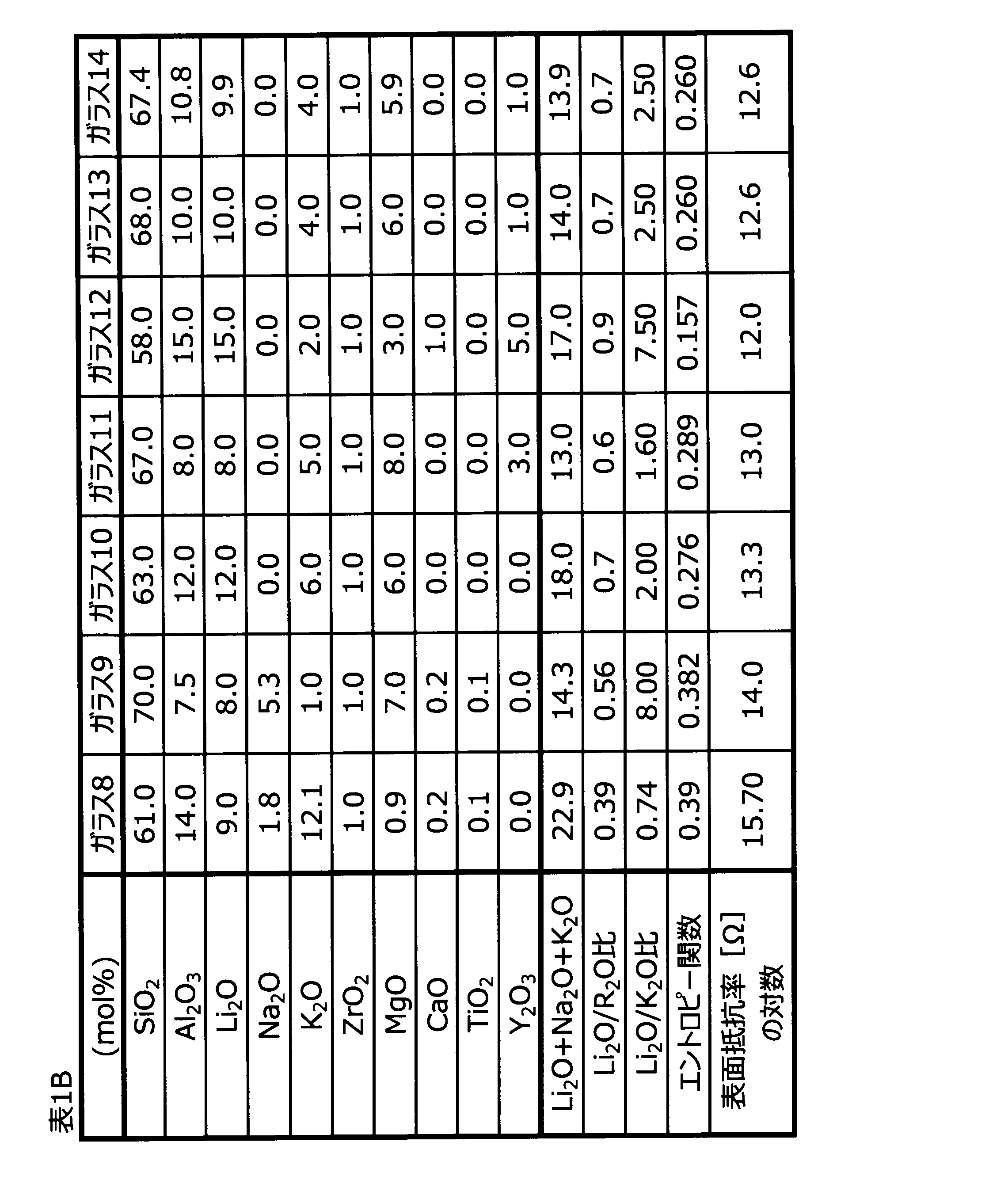
- Glass raw materials were blended so as to have the compositions shown in Table 1A to Table 1C in terms of molar percentages based on oxides, and glass was weighed to 400 g. Then, the mixed raw materials were put into a platinum crucible, put into an electric furnace at 1500 to 1700° C., melted for about 3 hours, defoamed, and homogenized.
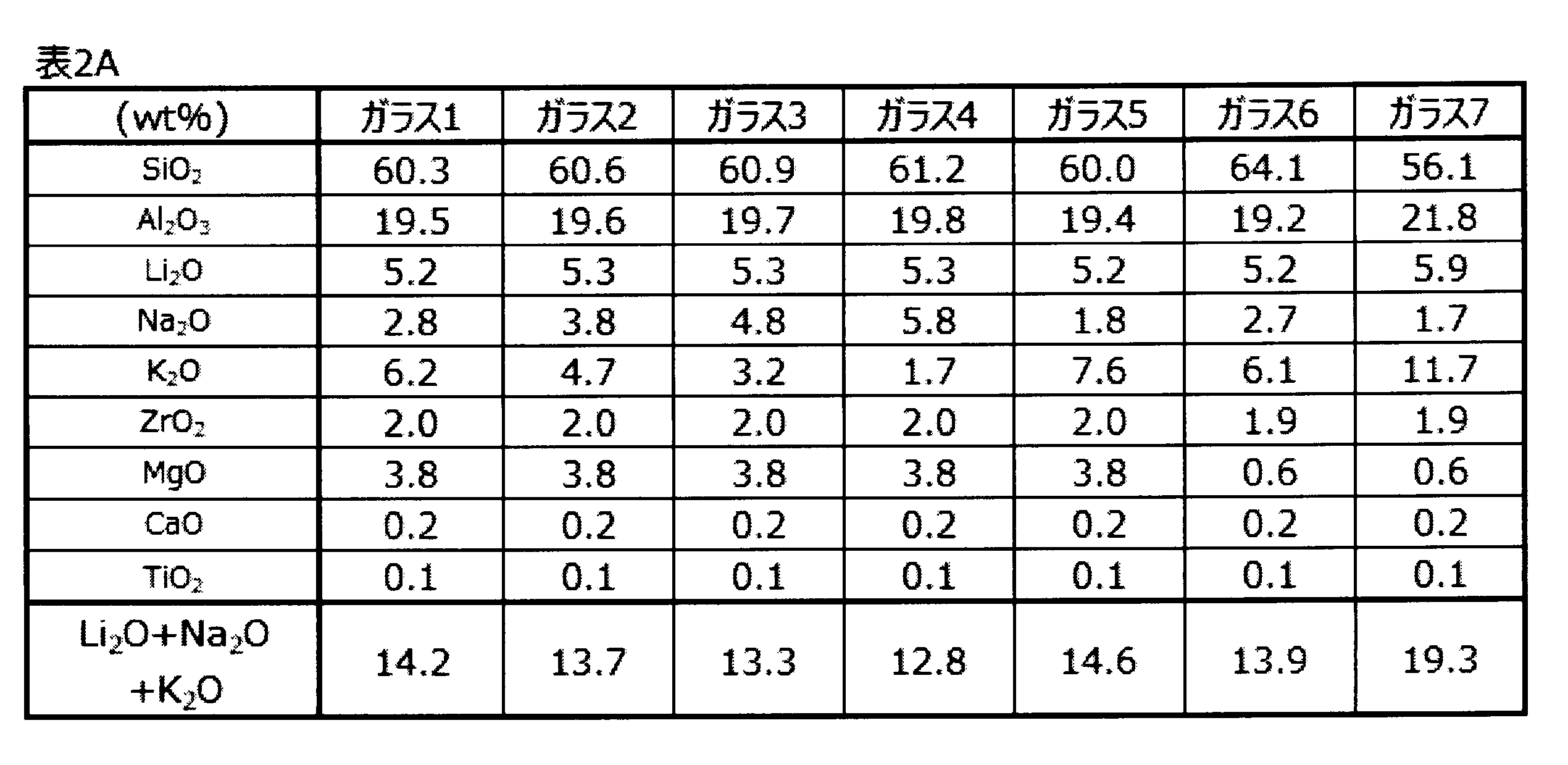
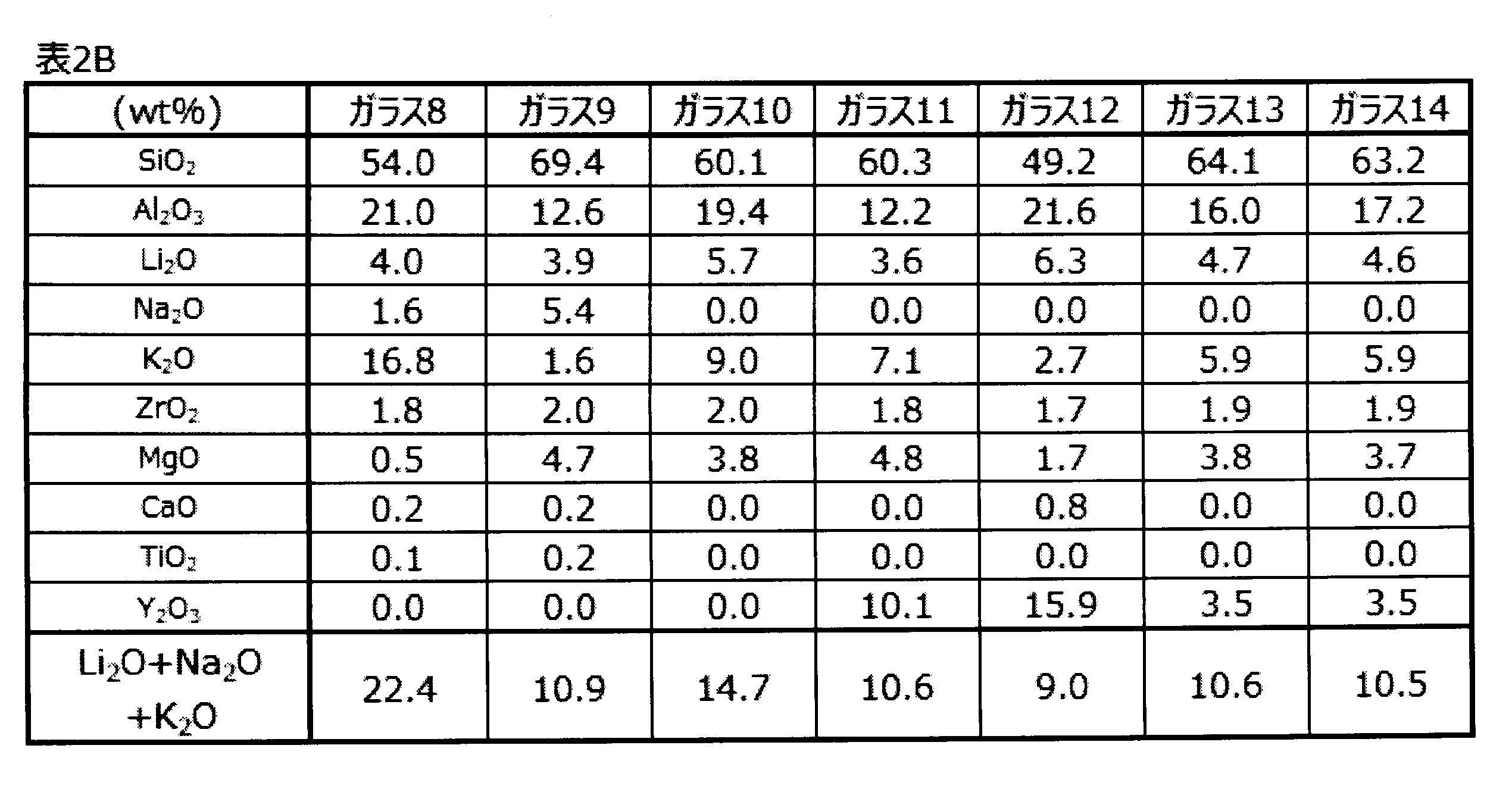
- Tables 2A to 2C show these glass compositions in a mass% table.
- the results of measuring the surface resistivity of the glasses 1 to 20 are shown in Tables 2A to 2C.
- the surface resistivity is expressed in logarithm in the table, and for example, the logarithm of the surface resistivity of the glass 10 being 13.3 means that the surface resistivity was 10 13.3 ⁇ .
- the obtained molten glass was poured into a metal mold, held at a temperature about 50°C higher than the glass transition point for 1 hour, and then cooled to room temperature at a rate of 0.5°C/min to obtain a glass block.
- the obtained glass block was cut and ground, and finally both surfaces were mirror-polished to obtain a glass plate having a thickness of 600 ⁇ m.
- the surface resistivity was measured by the following procedure. (Substrate cleaning) Sodium metasilicate nonahydrate 4% by weight, polyoxyethylene alkyl ether 20% by weight and pure water mixed with an alkaline detergent for 5 minutes, then washed with a neutral detergent for 5 minutes, at room temperature, 50°C, 65°C. Each was washed with pure water for 5 minutes, hot air at 65° C. was applied for 6 minutes to dry the substrate surface, and the glass plate (50 mm ⁇ 50 mm) was washed.
- the comb-shaped electrode 1 has a shape in which the first comb-shaped electrode 11 and the second comb-shaped electrode 12 are arranged so as to face each other in such a manner that the comb-shaped teeth are interlaced with each other.
- the unit of the numerical value indicating the length of each width is mm. The measurement was carried out using a digital ultra high resistance/micro ammeter (ADVANTEST R830A ULTRA HIGH RESISTANCE METER).
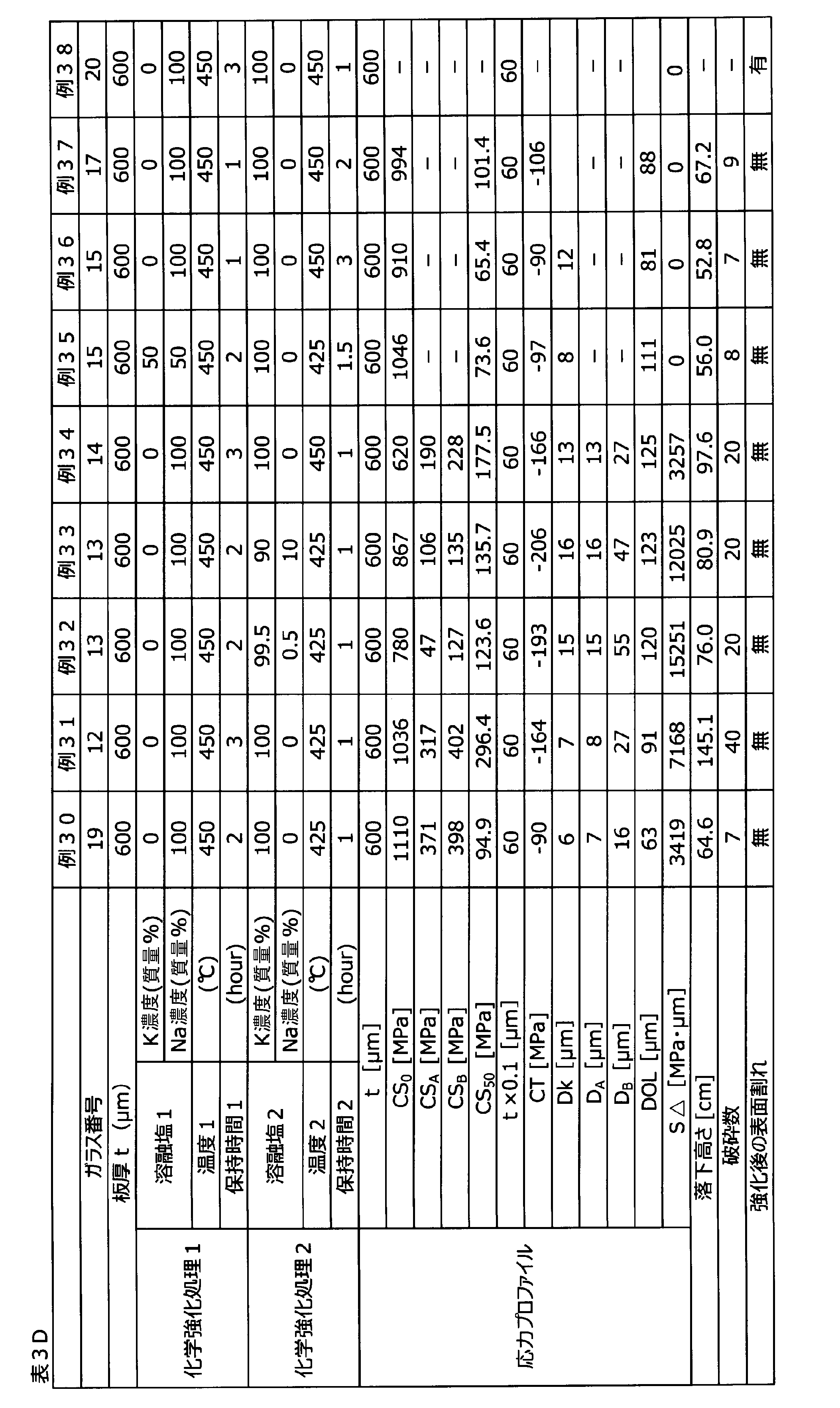
- Stress profile The stress value was measured using an optical waveguide surface stress meter FSM-6000 and a birefringence stress meter Abrio manufactured by Orihara Seisakusho. The results are shown in Tables 3A to 3D.
- CS 0 is a value measured using an optical waveguide surface stress meter
- CS A , D A , CS B , D B , DOL, and CS 50 are values measured by a birefringence stress meter.
- S ⁇ is a value that can be calculated from the stress profile calculated by combining the optical waveguide surface stress meter and the birefringence stress meter.
- the stress profile of Example 4 is shown in FIG. 1, and the stress profile of Example 19 is shown in FIG. 3 is the stress profile of Example 23, the solid line of FIG. 4 is the stress profile of Example 34, and the dotted line is the stress profile of Example 36.
- Examples 1 to 13 and 20 to 30 are Examples, and Examples 14 to 19 and 31 to 38 are Comparative Examples.
- Examples 16 to 17 CS 0 was insufficient and drop strength was low.
- Example 18 in which the glass 8 containing a large amount of K 2 O was chemically strengthened, cracks occurred in the sample after the first chemical strengthening, and the drop strength was also low. Further, since the glass was broken during processing for stress measurement, stress could not be measured by a birefringence stress meter.
- Examples 16, 17, and 19 are comparative examples in which the CS becomes smaller as the depth increases in the entire range from the glass surface to the DOL. The positions of point A and point B were the same, and the drop strength was low. Although Examples 14 and 15 had high strength, they had a large CT and a large crushing number.
- Example 20 to 31 which are examples of Na-free glass, all showed excellent drop strength.
- Example 35 shows a stress profile in which the sodium concentration of the first-stage sodium-containing salt is low, and as shown by the solid line in FIG. 4, the stress value decreases as the depth from the glass surface increases.
- Example 36 has low drop strength because the compressive stress inside the glass is low.
- Examples 35 and 36 are examples in which the chemical strengthening time of the second step is longer than the chemical strengthening time of the first step. As shown by the dotted line in FIG. 4, Example 36 has a stress profile in which the stress value decreases as the depth from the glass surface increases, and the compressive stress inside the glass is low, so the drop strength is low. Further, in Examples 31 to 33, although the strength was high, the CT was large and the crushing number was large.
- Example 38 using the glass 20 containing a large amount of K 2 O cracks were generated by the first treatment and the drop strength was also low.
- Example 38 using the glass 21 having a low content of K 2 O has a stress profile in which the compressive stress value becomes smaller as the depth increases in the entire range from the glass surface to the DOL. The drop strength is low because of low.
Landscapes
- Chemical & Material Sciences (AREA)
- Life Sciences & Earth Sciences (AREA)
- Engineering & Computer Science (AREA)
- Chemical Kinetics & Catalysis (AREA)
- General Chemical & Material Sciences (AREA)
- Geochemistry & Mineralogy (AREA)
- Materials Engineering (AREA)
- Organic Chemistry (AREA)
- Ceramic Engineering (AREA)
- Surface Treatment Of Glass (AREA)
- Glass Compositions (AREA)
Abstract
Description
CSB>CSA>0である化学強化ガラスを提供する。
SiO2を50~70%、
Al2O3を7~25%、
Li2Oを2~20%、
Na2Oを0~4%、
K2Oを2~8%、
B2O3を0~10%、
P2O5を0~10%、
MgO、ZnO、CaO、SrO、BaOのいずれか一種以上を含有する場合はその合計の含有量が15%以下、かつ
ZrO2およびTiO2のいずれか一種以上を含有する場合はその合計の含有量が5%以下である化学強化用ガラスを
380~500℃のナトリウム含有塩に接触させ、
次に、380~500℃のカリウム含有塩に接触させ、
前記ナトリウム含有塩は、該ナトリウム含有塩中に含まれる金属イオンの質量を100%として、ナトリウムイオンを80%以上含有するものであり、
前記カリウム含有塩に接触させる時間は、前記ナトリウム含有塩に接触させる時間より短いことを特徴とする化学強化ガラスの製造方法を提供する。
SiO2を58~70%、
Al2O3を7~20%、
Li2Oを2~20%、
Na2Oを0~2%、
K2Oを2~6%、
B2O3を0~2%、
P2O5を0~2%、
ZrO2およびTiO2のいずれか一種以上を合計で0.1~3%、
MgO、ZnO、CaO、SrOおよびBaOから選ばれる一種以上を含有する場合は、合計で0~15%含有する化学強化用ガラス、または
酸化物基準の質量%表示で
SiO2を45~70%、
Al2O3を10~25%、
Li2Oを2.5~10%、
Na2Oを0~4%、
K2Oを2~10%、
B2O3を0~10%、
P2O5を0~10%含有し、
ZrO2およびTiO2のいずれか一種以上を合計で0.2~5%
MgO、ZnO、CaO、SrOおよびBaOから選ばれる一種以上を含有する場合は、合計で0~15%含有する化学強化用ガラスを提供する。
本発明の化学強化ガラス(以下、「本強化ガラス」ということがある。)は板状が好ましく、通常は、平坦な板状であるが、曲面状でもよい。
SiO2を50%以上、Al2O3を5%以上含有し、
Li2O、Na2OおよびK2Oの合計の含有量が5%以上であり、
Li2Oの含有量と、Li2O、Na2OおよびK2Oの合計の含有量とのモル比が0.5以上であることが好ましい。
また、厚さ方向の中央部分におけるガラス組成は、後述の化学強化用ガラスの組成が好ましい。
本強化ガラスは、後述の化学強化用ガラスにイオン交換処理を施して製造できる。化学強化用ガラスは、たとえば以下のような、一般的なガラス製造方法を用いて製造できる。
本発明にかかる化学強化用ガラス(以下、本強化用ガラスということがある。)は、リチウムアルミノシリケートガラスが好ましい。より具体的には、酸化物基準の質量%表示で SiO2を50%以上、Al2O3を5%以上含有し、
Li2O、Na2OおよびK2Oの合計の含有量が5%以上であり、
Li2Oの含有量と、Li2O、Na2OおよびK2Oの合計の含有量とのモル比が0.5以上であることが好ましい。
SiO2が50~80%、
Al2O3が5~25%、
Li2Oが2~20%、
Na2Oが1.5~10%、
K2Oが1~12%、
B2O3が0~10%、
P2O5が0~10%、
MgO、ZnO、CaO、SrO、BaOのいずれか一種以上を含有する場合はその合計の含有量が10%以下、かつ
ZrO2およびTiO2のいずれか一種以上を含有する場合はその合計の含有量が5%以下であることが好ましい。
SiO2が45~75%、
Al2O3が10~25%、
Li2Oが2~10%、
Na2Oが0~4%、
K2Oが2~10%、
B2O3が0~10%、
P2O5が0~10%、
MgO、ZnO、CaO、SrO、BaOのいずれか一種以上を含有する場合はその合計の含有量が15%以下、かつ
ZrO2およびTiO2のいずれか一種以上を含有する場合はその合計の含有量が5%以下であるガラスAが好ましい。
SiO2が50~75%、
Al2O3が7~25%、
Li2Oが2~20%、
Na2Oが0~4%、
K2Oが2~8%、
B2O3が0~10%、
P2O5が0~10%、
MgO、ZnO、CaO、SrO、BaOのいずれか一種以上を含有する場合はその合計の含有量が15%以下、かつ
ZrO2およびTiO2のいずれか一種以上を含有する場合はその合計の含有量が5%以下であるガラスBが好ましい。
SiO2 58~70%、
Al2O3 7~20%、
B2O3 0~2%、
P2O5 0~2%、
Li2O 2~20%、
Na2O 0~2%、
K2O 2~6%、
ZrO2+TiO2 0.1~3%、
TiO2 1%以下、
MgO+ZnO+CaO+SrO+BaO 0~15%、
SrO 1%以下、BaO 1%以下含有するガラスCが好ましい。
モル%表示では、50モル%以上が好ましく、58モル%以上がより好ましく、60モル%以上がさらに好ましく、63モル%以上が特に好ましい。
SiO2の含有量は、また、75モル%以下が好ましく、72モル%以下がより好ましく、70モル%以下がさらに好ましい。
Al2O3は、7モル%以上が好ましく、10モル%以上がより好ましく、12モル%以上がさらに好ましい。
また25モル%以下が好ましく、20モル%以下がより好ましく、15モル%以下がさらに好ましい。
また、2モル%以上が好ましく、6モル%以上がより好ましく、9モル%以上がさらに好ましい。
ガラスの表面抵抗率を下げるためには、Na2Oの含有量は、4質量%以下が好ましく、2質量%以下がより好ましい。また、4モル%以下が好ましく、2モル%以下がより好ましく、1モル%以下がさらに好ましく、実質的に含有しないことが特に好ましい。
また、4モル%以上が好ましく、6モル%以上がより好ましく、8モル%以上がさらに好ましい。
また20モル%以下が好ましく、18モル%以下がより好ましい。
PNa=[Na2O]/([Li2O]+[Na2O]+[K2O])
PK=[K2O]/([Li2O]+[Na2O]+[K2O])
ただし[Li2O]、[Na2O]、[K2O]はそれぞれLi2O、Na2O、K2Oのモル%表示での含有量を表す。
エントロピー関数S値は、0.30以下がより好ましく、0.28以下がさらに好ましく、0.27以下が特に好ましい。
後述の方法で測定されるガラスの表面抵抗率は1013.5Ω以下が好ましく、より好ましくは1013Ω以下、さらに好ましくは1012.5Ω以下である。
また15モル%以下が好ましく、10モル%以下がより好ましく、5モル%以下がさらに好ましい。
MgO、CaO、SrO、BaOおよびZnOのいずれかを含有する場合は、化学強化ガラスの強度を高くするためにMgOを含有することが好ましい。
B2O3は、化学強化後の応力緩和を生じやすくする成分なので、応力緩和による表面圧縮応力の低下を防止するために、10質量%以下が好ましく、より好ましくは8質量%以下、さらに好ましくは5質量%以下、最も好ましくは3質量%以下である。また10モル%以下が好ましく、5モル%以下がより好ましく、2モル%以下がさらに好ましく、1モル%以下が特に好ましい。
化学強化ガラスの反りを抑制するためには、平均熱膨張係数(α)は小さい程好ましいが、通常は60×10-7/℃以上である。
表1A~表1Cに酸化物基準のモル百分率表示で示した組成となるようにガラス原料を調合し、ガラスとして400gになるように秤量した。ついで、混合した原料を白金るつぼに入れ、1500~1700℃の電気炉に投入して3時間程度溶融し、脱泡し、均質化した。



(基板洗浄)
メタ珪酸ナトリウム九水和物4質量%、ポリオキシエチレンアルキルエーテル20質量%と純水を混ぜたアルカリ洗剤で5分洗浄後、中性洗剤で5分洗浄し、室温、50℃、65℃の純水でそれぞれ5分洗浄し、65℃の熱風を6分間当て基板表面を乾燥させ、ガラス板(50mm×50mm)を洗浄した。
次に、ガラス基板の表面にマグネトロンスパッタコーター(Quorum Techbiologies社製 Q300TT)を用いて、Ar雰囲気下でPt膜を30nm成膜し、図5および図6に示す櫛型の電極パターンを作製した。図5において、櫛型電極1は、第1櫛型電極11と第2櫛型電極12が櫛型形状の歯の部分で互い違いに組み合うように対向配置された形状を有する。図6において、各幅の長さを示す数値の単位はいずれもmmである。
測定はデジタル超高抵抗/微少電流計(ADVANTEST R830A ULTRA HIGH RESISTANCE METER)を用いて実施した。
銅基板上にガラス板を設置し、得られた電極に銅線をつないだ後、50℃まで加熱し、温度が安定するまで30分間静置した。温度安定後、50Vの電圧をかけて電圧が安定するまで3分おき、電流測定を開始し、3分後の電流値を読み取って、以下のようにして表面抵抗率を算出した。
表面抵抗率ρは、櫛型電極を用いて測定される電流値Iと電圧VからR=V/Iとして求められる抵抗値Rと電極係数rとからρ=R×rとして求められる。電極係数rは各辺の電極の長さと電極間の長さの比から算出される。図5の櫛型電極1について、電極係数はr=(W3/W2)×8+(W1/W4)×7で算出される。
折原製作所社製の光導波表面応力計FSM-6000及び複屈折応力計Abrioを用いて応力値を測定した。結果を表3A~表3Dに示す。CS0は光導波表面応力計を用いて測定された値であり、CSA、DA、CSB、DB、DOL、CS50は複屈折応力計による値である。SΔは光導波表面応力計と複屈折応力計を合わせて算出した応力プロファイルから計算できる値である。例4の応力プロファイルを図1に、例19の応力プロファイルを図2に示す。図3は、例23の応力プロファイル、図4の実線は例34、点線は例36の応力プロファイルである。
落下試験は、得られた120×60×0.6mmtのガラスサンプルを現在使用されている一般的なスマートフォンのサイズに質量と剛性を調節した構造体にはめ込み、疑似スマートフォンを用意した上で#180SiCサンドペーパーの上に自由落下させた。落下高さは、5cmの高さから落下させて割れなかった場合は5cm高さを上げて再度落下させる作業を割れるまで繰り返し、初めて割れたときの高さの10枚の平均値を表3A~表3Dに示す。
化学強化ガラスを一辺が30mmの正方形状に加工し、得られたガラスに対して先端角度が90度のダイヤモンド圧子を打ち込む破砕試験を行った。ガラスが破壊しなかった場合は、圧子に加える荷重を徐々に大きくしながら試験を繰り返し、破壊が生じた最小の荷重における破片の個数を破砕数として表3A~表3Dに示す。破砕数が10を超えた場合は、内部引張応力CTが過剰であると判断できる。
化学強化処理後、表面の状態を光学顕微鏡にて観察した結果を表3A~表3Dに示す。ガラスの表面にクラックが入っていた場合には、×と記した。


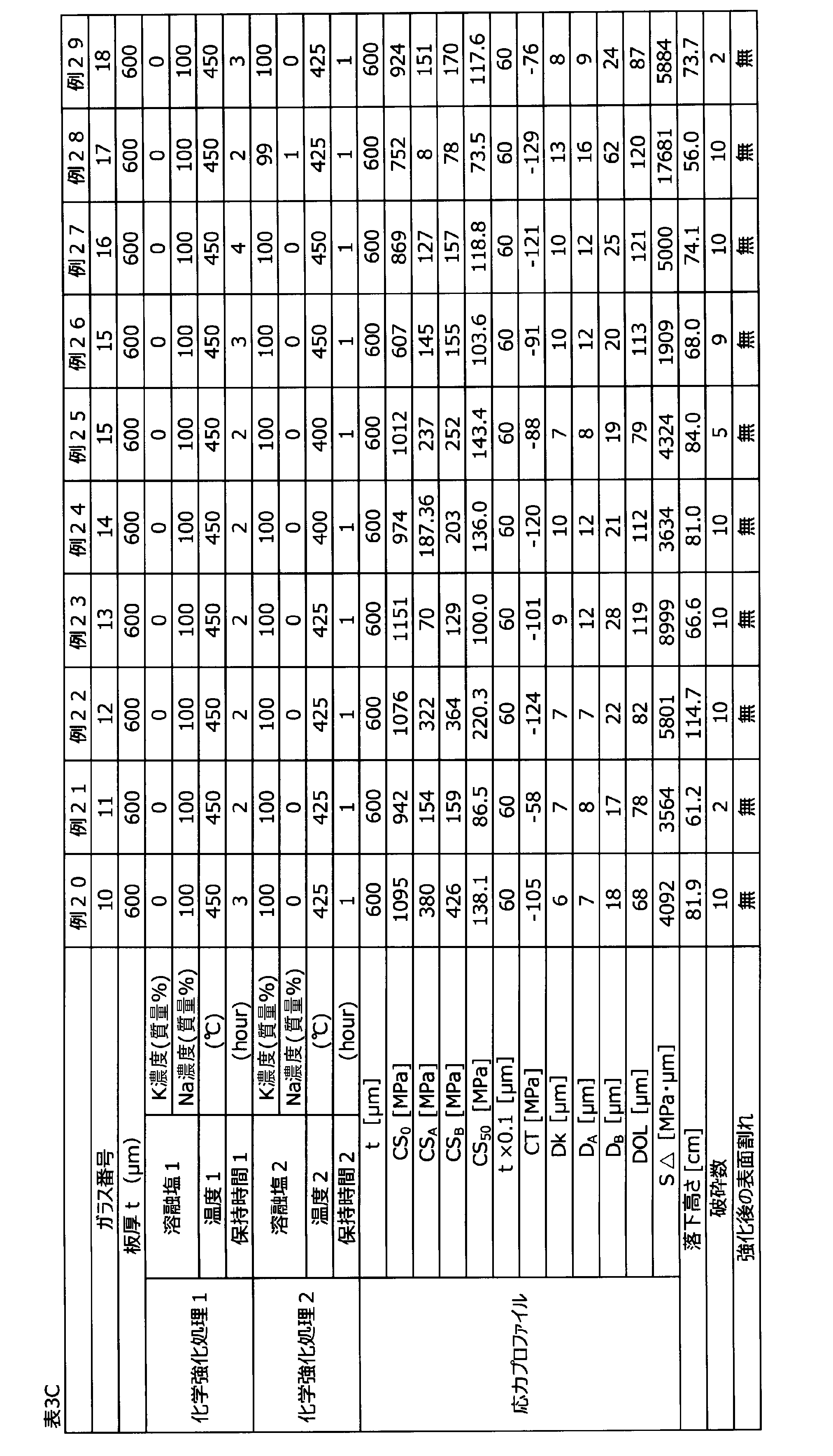
K2Oを多量に含有するガラス8を化学強化した例18は1回目の化学強化後のサンプルにクラックが発生しており、落下強度も低い。また、応力測定のための加工時にガラスが割れてしまったので、複屈折応力計による応力測定ができなかった。
例16、17、19はガラス表面からDOLまでの全範囲で、深さが大きくなるほどCSが小さくなる比較例である。点Aと点Bの位置が一致しており、落下強度が低かった。
例14、15は高強度であるが、CTが大きく、破砕数が大きかった。
また、例31~33は高強度であるが、CTが大きく、破砕数が大きかった。
11 第1櫛型電極
12 第2櫛型電極
Claims (21)
- ガラス表面に圧縮応力層を有する、板状の化学強化ガラスであって、
ガラス表面の圧縮応力値(CS0)が800MPa以上であり、
板厚(t)が100μm以上であり、
圧縮応力層深さ(DOL)が(t×0.1)μm以上であり、
ガラス表面からの深さが10μm以上でDOLより小さい範囲で圧縮応力値が最大となる深さをDB、深さDBにおける圧縮応力値をCSB、
ガラス表面からの深さがDB以下の範囲で、圧縮応力値が最少となる深さをDA、深さDAにおける圧縮応力値をCSAとしたとき、
CSB>CSA>0
である、化学強化ガラス。 - 一辺が30mmの正方形状に加工し、破壊が起こる最小の荷重をかけて、先端角度が90度のダイヤモンド圧子を打ち込んだ場合に、生じる破片数が10以下となる請求項1に記載の化学強化ガラス。
- ガラス表面から50μmの深さにおける圧縮応力値CS50が(t×0.1)MPa以上である、請求項1または2に記載の化学強化ガラス。
- 前記板厚(t)が2000μm以下である、請求項1~3のいずれか一項に記載の化学強化ガラス。
- リチウムアルミノシリケートガラスである、請求項1~4のいずれか一項に記載の化学強化ガラス。
- 厚さ方向の中央部分におけるガラス組成が質量%表示で、
SiO2を50%以上、Al2O3を5%以上含有し、
Li2O、Na2OおよびK2Oの合計の含有量が5%以上であり、
Li2Oの含有量と、Li2O、Na2OおよびK2Oの合計量とのモル比[Li2O]/([Li2O]+[Na2O]+[K2O])が0.5以上である請求項5に記載の化学強化ガラス。 - 化学強化ガラスの母組成が、酸化物基準の質量%表示で、
SiO2が50~80%、
Al2O3が5~25%、
Li2Oが2~20%、
Na2Oが1.5~10%、
K2Oが1~12%、
B2O3が0~10%、
P2O5が0~10%、
MgO、ZnO、CaO、SrO、BaOのいずれか一種以上を含有する場合はその合計の含有量が10%以下、かつ
ZrO2およびTiO2のいずれか一種以上を含有する場合はその合計の含有量が5%以下である、請求項5または6に記載の化学強化ガラス。 - 前記化学強化ガラスの母組成が、酸化物基準のモル%表示で、
SiO2を58~70%、
Al2O3を7~20%、
Li2Oを2~20%、
Na2Oを0~2%、
K2Oを2~6%、
B2O3を0~2%、
P2O5を0~2%、
ZrO2およびTiO2のいずれか一種以上を合計で0.1~3%、
MgO、ZnO、CaO、SrOおよびBaOから選ばれる一種以上を含有する場合は、合計で0~15%含有する請求項5または6に記載の化学強化ガラス。 - 前記化学強化ガラスの母組成におけるLi2OとK2Oとのモル比[Li2O]/[K2O]が1~10である、請求項5~8のいずれか一項に記載の化学強化ガラス。
- 前記化学強化ガラスの母組成は、次式で求められるエントロピー関数S値が0.35以下である請求項5~9のいずれか一項に記載の化学強化用ガラス。
S=-PLi×log(PLi)-PNa×log(PNa)-PK×log(PK)ここでPLi=[Li2O]/([Li2O]+[Na2O]+[K2O])
PNa=[Na2O]/([Li2O]+[Na2O]+[K2O])
PK=[K2O]/([Li2O]+[Na2O]+[K2O])
ただし[Li2O]、[Na2O]、[K2O]はそれぞれLi2O、Na2O、K2Oのモル%表示での含有量を表す。 - 請求項1~9のいずれか一項に記載の化学強化ガラスを含む電子機器。
- 化学強化ガラスの製造方法であって、
リチウムアルミノシリケートガラスからなるガラス板を
380℃~500℃のナトリウム含有塩に1~8時間浸漬し、
前記ナトリウム含有塩は、溶融塩中の金属イオンの質量を100質量%としてナトリウムイオンを50質量%以上含有するものであり、
その後、カリウム含有塩に浸漬して請求項1~4のいずれか一項に記載の化学強化ガラスを得る、化学強化ガラスの製造方法。 - 前記リチウムアルミノシリケートガラスは、酸化物基準のモル%表示で
SiO2を58~70%、
Al2O3を7~20%、
Li2Oを2~20%、
Na2Oを0~2%、
K2Oを2~6%、
B2O3を0~2%、
P2O5を0~2%、
ZrO2およびTiO2のいずれか一種以上を合計で0.1~3%、
MgO、ZnO、CaO、SrOおよびBaOから選ばれる一種以上を含有する場合は、合計で0~15%含有する、請求項12に記載の化学強化ガラスの製造方法。 - 前記リチウムアルミノシリケートガラスは、酸化物基準の質量%表示で
SiO2を45~70%、
Al2O3を10~25%、
Li2Oを2.5~10%、
Na2Oを0~4%、
K2Oを2~10%、
B2O3を0~10%、
P2O5を0~10%含有し、
ZrO2およびTiO2のいずれか一種以上を合計で0.2~5%
MgO、ZnO、CaO、SrOおよびBaOから選ばれる一種以上を含有する場合は、合計で0~15%含有する請求項12に記載の化学強化ガラスの製造方法。 - 前記リチウムアルミノシリケートガラスは、表面抵抗率が1013.5Ω以下である請求項12~14のいずれか一項に記載の化学強化ガラスの製造方法。
- 酸化物基準のモル%表示で
SiO2を50~70%、
Al2O3を7~25%、
Li2Oを2~20%、
Na2Oを0~4%、
K2Oを2~8%、
B2O3を0~10%、
P2O5を0~10%、
MgO、ZnO、CaO、SrO、BaOのいずれか一種以上を含有する場合はその合計の含有量が15%以下、かつ
ZrO2およびTiO2のいずれか一種以上を含有する場合はその合計の含有量が5%以下である化学強化用ガラスを
380~500℃のナトリウム含有塩に接触させ、
次に、380~500℃のカリウム含有塩に接触させ、
前記ナトリウム含有塩は、該ナトリウム含有塩中に含まれる金属イオンの質量を100%として、ナトリウムイオンを80%以上含有するものであり、
前記カリウム含有塩に接触させる時間は、前記ナトリウム含有塩に接触させる時間より短いことを特徴とする化学強化ガラスの製造方法。 - 前記化学強化用ガラスは酸化物基準のモル%表示で
SiO2 58~70%、
Al2O3 7~20%、
B2O3 0~2%、
P2O5 0~2%、
Li2O 2~20%、
Na2O 0~2%、
K2O 2~6%、
ZrO2+TiO2 0.1~3%、
TiO2 1%以下、
MgO+ZnO+CaO+SrO+BaO 0~15%、
SrO 1%以下、BaO 1%以下含有する
請求項16に記載の化学強化ガラスの製造方法。 - 酸化物基準のモル%表示で
SiO2を58~70%、
Al2O3を7~20%、
Li2Oを2~20%、
Na2Oを0~2%、
K2Oを2~6%、
B2O3を0~2%、
P2O5を0~2%、
ZrO2およびTiO2のいずれか一種以上を合計で0.1~3%、
MgO、ZnO、CaO、SrOおよびBaOから選ばれる一種以上を含有する場合は、合計で0~15%含有する化学強化用ガラス。 - 酸化物基準の質量%表示で
SiO2を45~70%、
Al2O3を10~25%、
Li2Oを2.5~10%、
Na2Oを0~4%、
K2Oを2~10%、
B2O3を0~10%、
P2O5を0~10%含有し、
ZrO2およびTiO2のいずれか一種以上を合計で0.2~5%
MgO、ZnO、CaO、SrOおよびBaOから選ばれる一種以上を含有する場合は、合計で0~15%含有する化学強化用ガラス。 - 次式で求められるエントロピー関数S値が0.35以下である請求項18または19に記載の化学強化用ガラス。
S=-PLi×log(PLi)-PNa×log(PNa)-PK×log(PK)ここでPLi=[Li2O]/([Li2O]+[Na2O]+[K2O])
PNa=[Na2O]/([Li2O]+[Na2O]+[K2O])
PK=[K2O]/([Li2O]+[Na2O]+[K2O])
ただし[Li2O]、[Na2O]、[K2O]はそれぞれLi2O、Na2O、K2Oのモル%表示での含有量を表す。 - 表面抵抗率が1013.5Ω以下である請求項18~20のいずれか1項に記載の化学強化用ガラス。
Priority Applications (4)
| Application Number | Priority Date | Filing Date | Title |
|---|---|---|---|
| CN202080009165.9A CN113302167B (zh) | 2019-01-18 | 2020-01-10 | 化学强化玻璃及其制造方法 |
| JP2020566403A JP7400738B2 (ja) | 2019-01-18 | 2020-01-10 | 化学強化ガラスおよびその製造方法 |
| KR1020217021257A KR102746130B1 (ko) | 2019-01-18 | 2020-01-10 | 화학 강화 유리 및 그 제조 방법 |
| US17/305,169 US12168626B2 (en) | 2019-01-18 | 2021-07-01 | Chemically strengthened glass and method for producing same |
Applications Claiming Priority (4)
| Application Number | Priority Date | Filing Date | Title |
|---|---|---|---|
| JP2019-007184 | 2019-01-18 | ||
| JP2019007184 | 2019-01-18 | ||
| JP2019-142999 | 2019-08-02 | ||
| JP2019142999 | 2019-08-02 |
Related Child Applications (1)
| Application Number | Title | Priority Date | Filing Date |
|---|---|---|---|
| US17/305,169 Continuation US12168626B2 (en) | 2019-01-18 | 2021-07-01 | Chemically strengthened glass and method for producing same |
Publications (1)
| Publication Number | Publication Date |
|---|---|
| WO2020149236A1 true WO2020149236A1 (ja) | 2020-07-23 |
Family
ID=71613547
Family Applications (1)
| Application Number | Title | Priority Date | Filing Date |
|---|---|---|---|
| PCT/JP2020/000690 Ceased WO2020149236A1 (ja) | 2019-01-18 | 2020-01-10 | 化学強化ガラスおよびその製造方法 |
Country Status (5)
| Country | Link |
|---|---|
| US (1) | US12168626B2 (ja) |
| JP (1) | JP7400738B2 (ja) |
| KR (1) | KR102746130B1 (ja) |
| CN (1) | CN113302167B (ja) |
| WO (1) | WO2020149236A1 (ja) |
Cited By (6)
| Publication number | Priority date | Publication date | Assignee | Title |
|---|---|---|---|---|
| CN114075046A (zh) * | 2020-08-18 | 2022-02-22 | 重庆鑫景特种玻璃有限公司 | 具有高压应力和高安全性的强化玻璃及其加工方法 |
| US20220098091A1 (en) * | 2020-09-25 | 2022-03-31 | Corning Incorporated | Stress profiles of glass-based articles having improved drop performance |
| WO2022118512A1 (ja) * | 2020-12-04 | 2022-06-09 | Agc株式会社 | 化学強化ガラスおよび電子機器筐体 |
| WO2022215717A1 (ja) * | 2021-04-07 | 2022-10-13 | Agc株式会社 | 化学強化ガラス及びその製造方法 |
| WO2024014305A1 (ja) * | 2022-07-13 | 2024-01-18 | 日本電気硝子株式会社 | 化学強化ガラス |
| WO2025121292A1 (ja) * | 2023-12-06 | 2025-06-12 | Agc株式会社 | 化学強化ガラス、カバーガラス、ディスプレイおよび太陽電池モジュール |
Families Citing this family (14)
| Publication number | Priority date | Publication date | Assignee | Title |
|---|---|---|---|---|
| US11724965B2 (en) * | 2018-01-24 | 2023-08-15 | Corning Incorporated | Glass-based articles having high stress magnitude at depth |
| WO2020263892A1 (en) * | 2019-06-25 | 2020-12-30 | Corning Incorporated | Methods of cooling glasses post-ion exchange |
| KR102816247B1 (ko) * | 2019-12-17 | 2025-06-04 | 삼성디스플레이 주식회사 | 유리 제품 및 그 제조 방법 |
| CN114230195A (zh) * | 2020-09-09 | 2022-03-25 | Agc株式会社 | 带膜的化学强化玻璃和化学强化玻璃的表面应力测定方法 |
| WO2022066574A1 (en) * | 2020-09-25 | 2022-03-31 | Corning Incorporated | Stress profiles of glass-based articles having improved drop performance |
| KR20220106900A (ko) * | 2021-01-22 | 2022-08-01 | 삼성디스플레이 주식회사 | 기판 적재용 카세트 및 이를 이용한 기판 처리 방법 |
| CN113979633B (zh) * | 2021-11-24 | 2023-08-11 | 中国洛阳浮法玻璃集团有限责任公司 | 一种高硬度能化学钢化用钠钙硅玻璃的制备方法 |
| CN115108721A (zh) * | 2022-05-30 | 2022-09-27 | 河北光兴半导体技术有限公司 | 用于制备高铝硅酸盐玻璃的组合物、高铝硅酸盐玻璃及其制备方法和应用 |
| CN115286241A (zh) * | 2022-08-09 | 2022-11-04 | 中建材玻璃新材料研究院集团有限公司 | 一种高断裂韧性的超薄柔性玻璃及其制备方法 |
| CN116002974A (zh) * | 2023-01-19 | 2023-04-25 | 清远南玻节能新材料有限公司 | 一种可化学强化的硅酸盐玻璃及其制备方法、强化玻璃和应用 |
| CN117800594A (zh) * | 2023-06-28 | 2024-04-02 | 湖南旗滨新材料有限公司 | 锂铝硅酸盐玻璃组合物、锂铝硅酸盐强化玻璃及制备方法 |
| US20250162932A1 (en) * | 2023-11-20 | 2025-05-22 | Corning Incorporated | Method of strengthening glass and such glasses |
| CN118108411A (zh) * | 2024-02-08 | 2024-05-31 | 河北光兴半导体技术有限公司 | 强化玻璃及其制备方法与应用 |
| CN118954947A (zh) * | 2024-08-22 | 2024-11-15 | 彩虹集团(邵阳)特种玻璃有限公司 | 一种锂铝硅玻璃及其制备方法 |
Citations (5)
| Publication number | Priority date | Publication date | Assignee | Title |
|---|---|---|---|---|
| JP2015511573A (ja) * | 2012-02-29 | 2015-04-20 | コーニング インコーポレイテッド | 非誤差関数圧縮応力プロファイルによるイオン交換ガラス |
| WO2015162845A1 (ja) * | 2014-04-24 | 2015-10-29 | 日本板硝子株式会社 | ガラス組成物、化学強化用ガラス板、強化ガラス板およびディスプレイ用強化ガラス基板 |
| JP2017506207A (ja) * | 2014-02-24 | 2017-03-02 | コーニング インコーポレイテッド | 改善された残存性を有する強化ガラス物品 |
| US20170355640A1 (en) * | 2016-06-14 | 2017-12-14 | Corning Incorporated | Glasses having improved drop performance |
| WO2019004124A1 (ja) * | 2017-06-28 | 2019-01-03 | Agc株式会社 | 化学強化ガラス、その製造方法および化学強化用ガラス |
Family Cites Families (19)
| Publication number | Priority date | Publication date | Assignee | Title |
|---|---|---|---|---|
| JP2011527661A (ja) * | 2008-07-11 | 2011-11-04 | コーニング インコーポレイテッド | 民生用途のための圧縮面を有するガラス |
| JP2012020921A (ja) * | 2010-06-18 | 2012-02-02 | Asahi Glass Co Ltd | ディスプレイ装置用のガラスおよびガラス板 |
| US20120052271A1 (en) | 2010-08-26 | 2012-03-01 | Sinue Gomez | Two-step method for strengthening glass |
| JP2012232882A (ja) | 2011-04-18 | 2012-11-29 | Asahi Glass Co Ltd | 化学強化ガラスの製造方法および化学強化用ガラス |
| TWI572480B (zh) * | 2011-07-25 | 2017-03-01 | 康寧公司 | 經層壓及離子交換之強化玻璃疊層 |
| FR2988089A1 (fr) * | 2012-03-15 | 2013-09-20 | Saint Gobain | Feuille de verre |
| US10442730B2 (en) * | 2013-11-25 | 2019-10-15 | Corning Incorporated | Method for achieving a stress profile in a glass |
| KR20160138015A (ko) * | 2014-03-31 | 2016-12-02 | 에이쥐씨 글래스 유럽 | 화학 템퍼링 가능한 유리판 |
| US10579106B2 (en) * | 2015-07-21 | 2020-03-03 | Corning Incorporated | Glass articles exhibiting improved fracture performance |
| JP2019501101A (ja) * | 2015-12-08 | 2019-01-17 | コーニング インコーポレイテッド | S字応力プロファイル及び生成方法 |
| TWI820803B (zh) * | 2016-01-08 | 2023-11-01 | 美商康寧公司 | 具固有耐損性之可化學強化的鋰鋁矽酸鹽玻璃 |
| CN115650601B (zh) * | 2016-01-21 | 2024-07-12 | Agc株式会社 | 化学强化玻璃以及化学强化用玻璃 |
| WO2017126605A1 (ja) | 2016-01-21 | 2017-07-27 | 旭硝子株式会社 | 化学強化ガラス及び化学強化ガラスの製造方法 |
| EP3429971A1 (en) * | 2016-03-18 | 2019-01-23 | Corning Incorporated | Methods for preparing strengthened lithium-based glass articles and lithium-based glass articles |
| CN116395986B (zh) | 2016-10-18 | 2025-09-12 | Agc株式会社 | 化学强化用玻璃、化学强化玻璃以及化学强化玻璃的制造方法 |
| US10065880B2 (en) * | 2016-11-07 | 2018-09-04 | Corning Incorporated | Lithium containing glasses |
| EP3330234B1 (en) * | 2016-11-30 | 2023-10-11 | Corning Incorporated | Lithium containing aluminosilicate glasses |
| US10906834B2 (en) * | 2017-11-29 | 2021-02-02 | Corning Incorporated | Ion-exchangeable mixed alkali aluminosilicate glasses |
| WO2019191480A1 (en) * | 2018-03-29 | 2019-10-03 | Corning Incorporated | Glasses having high fracture toughness |
-
2020
- 2020-01-10 CN CN202080009165.9A patent/CN113302167B/zh active Active
- 2020-01-10 WO PCT/JP2020/000690 patent/WO2020149236A1/ja not_active Ceased
- 2020-01-10 KR KR1020217021257A patent/KR102746130B1/ko active Active
- 2020-01-10 JP JP2020566403A patent/JP7400738B2/ja active Active
-
2021
- 2021-07-01 US US17/305,169 patent/US12168626B2/en active Active
Patent Citations (5)
| Publication number | Priority date | Publication date | Assignee | Title |
|---|---|---|---|---|
| JP2015511573A (ja) * | 2012-02-29 | 2015-04-20 | コーニング インコーポレイテッド | 非誤差関数圧縮応力プロファイルによるイオン交換ガラス |
| JP2017506207A (ja) * | 2014-02-24 | 2017-03-02 | コーニング インコーポレイテッド | 改善された残存性を有する強化ガラス物品 |
| WO2015162845A1 (ja) * | 2014-04-24 | 2015-10-29 | 日本板硝子株式会社 | ガラス組成物、化学強化用ガラス板、強化ガラス板およびディスプレイ用強化ガラス基板 |
| US20170355640A1 (en) * | 2016-06-14 | 2017-12-14 | Corning Incorporated | Glasses having improved drop performance |
| WO2019004124A1 (ja) * | 2017-06-28 | 2019-01-03 | Agc株式会社 | 化学強化ガラス、その製造方法および化学強化用ガラス |
Cited By (14)
| Publication number | Priority date | Publication date | Assignee | Title |
|---|---|---|---|---|
| CN114075046B (zh) * | 2020-08-18 | 2023-01-24 | 重庆鑫景特种玻璃有限公司 | 具有高压应力和高安全性的强化玻璃及其加工方法 |
| CN114075046A (zh) * | 2020-08-18 | 2022-02-22 | 重庆鑫景特种玻璃有限公司 | 具有高压应力和高安全性的强化玻璃及其加工方法 |
| US12122703B2 (en) * | 2020-09-25 | 2024-10-22 | Corning Incorporated | Stress profiles of glass-based articles having improved drop performance |
| US20220098091A1 (en) * | 2020-09-25 | 2022-03-31 | Corning Incorporated | Stress profiles of glass-based articles having improved drop performance |
| JPWO2022118512A1 (ja) * | 2020-12-04 | 2022-06-09 | ||
| WO2022118512A1 (ja) * | 2020-12-04 | 2022-06-09 | Agc株式会社 | 化学強化ガラスおよび電子機器筐体 |
| CN116529216A (zh) * | 2020-12-04 | 2023-08-01 | Agc株式会社 | 化学强化玻璃和电子设备壳体 |
| CN116529216B (zh) * | 2020-12-04 | 2025-08-01 | Agc株式会社 | 化学强化玻璃和电子设备壳体 |
| JP7722389B2 (ja) | 2020-12-04 | 2025-08-13 | Agc株式会社 | 化学強化ガラスおよび電子機器筐体 |
| US12623955B2 (en) | 2020-12-04 | 2026-05-12 | AGC Inc. | Chemically strengthened glass, and electronic device housing |
| WO2022215717A1 (ja) * | 2021-04-07 | 2022-10-13 | Agc株式会社 | 化学強化ガラス及びその製造方法 |
| JPWO2022215717A1 (ja) * | 2021-04-07 | 2022-10-13 | ||
| WO2024014305A1 (ja) * | 2022-07-13 | 2024-01-18 | 日本電気硝子株式会社 | 化学強化ガラス |
| WO2025121292A1 (ja) * | 2023-12-06 | 2025-06-12 | Agc株式会社 | 化学強化ガラス、カバーガラス、ディスプレイおよび太陽電池モジュール |
Also Published As
| Publication number | Publication date |
|---|---|
| CN113302167A (zh) | 2021-08-24 |
| KR102746130B1 (ko) | 2024-12-26 |
| US20210323862A1 (en) | 2021-10-21 |
| JPWO2020149236A1 (ja) | 2021-11-25 |
| JP7400738B2 (ja) | 2023-12-19 |
| CN113302167B (zh) | 2023-08-22 |
| KR20210113221A (ko) | 2021-09-15 |
| US12168626B2 (en) | 2024-12-17 |
Similar Documents
| Publication | Publication Date | Title |
|---|---|---|
| JP7400738B2 (ja) | 化学強化ガラスおよびその製造方法 | |
| JP7136096B2 (ja) | 化学強化ガラス、その製造方法および化学強化用ガラス | |
| JP7420152B2 (ja) | 化学強化ガラス物品およびその製造方法 | |
| CN115385571B (zh) | 化学强化玻璃以及化学强化用玻璃 | |
| CN102701587B (zh) | 强化玻璃基板及其制造方法 | |
| JP5743125B2 (ja) | 強化ガラス及び強化ガラス基板 | |
| JPWO2020121888A1 (ja) | 化学強化ガラス板、並びに化学強化ガラスを含むカバーガラス及び電子機器 | |
| WO2018186402A1 (ja) | 化学強化ガラス | |
| JP7255594B2 (ja) | 化学強化ガラスおよびその製造方法 | |
| WO2013187465A1 (ja) | 強化ガラス、強化ガラス板及び強化用ガラス | |
| JP7533456B2 (ja) | ガラス、化学強化ガラスおよびその製造方法 | |
| JP7722372B2 (ja) | ガラスおよび化学強化ガラス | |
| JP2025159118A (ja) | 化学強化ガラス物品およびその製造方法 | |
| JP2019116417A (ja) | カバーガラス | |
| KR20250024764A (ko) | 화학 강화용 유리 및 유리 | |
| WO2025121292A1 (ja) | 化学強化ガラス、カバーガラス、ディスプレイおよび太陽電池モジュール |
Legal Events
| Date | Code | Title | Description |
|---|---|---|---|
| 121 | Ep: the epo has been informed by wipo that ep was designated in this application |
Ref document number: 20741874 Country of ref document: EP Kind code of ref document: A1 |
|
| ENP | Entry into the national phase |
Ref document number: 20217021257 Country of ref document: KR Kind code of ref document: A |
|
| ENP | Entry into the national phase |
Ref document number: 2020566403 Country of ref document: JP Kind code of ref document: A |
|
| NENP | Non-entry into the national phase |
Ref country code: DE |
|
| 122 | Ep: pct application non-entry in european phase |
Ref document number: 20741874 Country of ref document: EP Kind code of ref document: A1 |