WO2020138112A1 - 液晶配向処理剤、液晶配向膜及び液晶表示素子 - Google Patents
液晶配向処理剤、液晶配向膜及び液晶表示素子 Download PDFInfo
- Publication number
- WO2020138112A1 WO2020138112A1 PCT/JP2019/050692 JP2019050692W WO2020138112A1 WO 2020138112 A1 WO2020138112 A1 WO 2020138112A1 JP 2019050692 W JP2019050692 W JP 2019050692W WO 2020138112 A1 WO2020138112 A1 WO 2020138112A1
- Authority
- WO
- WIPO (PCT)
- Prior art keywords
- liquid crystal
- crystal alignment
- group
- treatment agent
- alignment treatment
- Prior art date
- Legal status (The legal status is an assumption and is not a legal conclusion. Google has not performed a legal analysis and makes no representation as to the accuracy of the status listed.)
- Ceased
Links
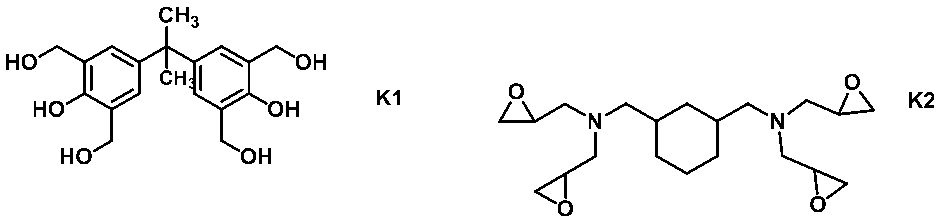
- HASUCEDGKYJBDC-UHFFFAOYSA-N C(C1OC1)N(CC1OC1)CC1CC(CN(CC2OC2)CC2OC2)CCC1 Chemical compound C(C1OC1)N(CC1OC1)CC1CC(CN(CC2OC2)CC2OC2)CCC1 HASUCEDGKYJBDC-UHFFFAOYSA-N 0.000 description 1
- PNOSOBPPHJEEJZ-WDZFZDKYSA-N CC(C)(C)C(C/C1=N/N=C)OC1=O Chemical compound CC(C)(C)C(C/C1=N/N=C)OC1=O PNOSOBPPHJEEJZ-WDZFZDKYSA-N 0.000 description 1
- MXHWKDOKXZLKTE-UHFFFAOYSA-N CC(Cc1c2CO)(c1cc(CO)c2O)c(cc1CO)cc(CO)c1O Chemical compound CC(Cc1c2CO)(c1cc(CO)c2O)c(cc1CO)cc(CO)c1O MXHWKDOKXZLKTE-UHFFFAOYSA-N 0.000 description 1
Classifications
-
- C—CHEMISTRY; METALLURGY
- C08—ORGANIC MACROMOLECULAR COMPOUNDS; THEIR PREPARATION OR CHEMICAL WORKING-UP; COMPOSITIONS BASED THEREON
- C08K—Use of inorganic or non-macromolecular organic substances as compounding ingredients
- C08K5/00—Use of organic ingredients
- C08K5/36—Sulfur-, selenium-, or tellurium-containing compounds
- C08K5/37—Thiols
-
- C—CHEMISTRY; METALLURGY
- C08—ORGANIC MACROMOLECULAR COMPOUNDS; THEIR PREPARATION OR CHEMICAL WORKING-UP; COMPOSITIONS BASED THEREON
- C08G—MACROMOLECULAR COMPOUNDS OBTAINED OTHERWISE THAN BY REACTIONS ONLY INVOLVING UNSATURATED CARBON-TO-CARBON BONDS
- C08G73/00—Macromolecular compounds obtained by reactions forming a linkage containing nitrogen with or without oxygen or carbon in the main chain of the macromolecule, not provided for in groups C08G12/00 - C08G71/00
- C08G73/06—Polycondensates having nitrogen-containing heterocyclic rings in the main chain of the macromolecule
- C08G73/10—Polyimides; Polyester-imides; Polyamide-imides; Polyamide acids or similar polyimide precursors
- C08G73/1042—Copolyimides derived from at least two different tetracarboxylic compounds or two different diamino compounds
-
- C—CHEMISTRY; METALLURGY
- C08—ORGANIC MACROMOLECULAR COMPOUNDS; THEIR PREPARATION OR CHEMICAL WORKING-UP; COMPOSITIONS BASED THEREON
- C08K—Use of inorganic or non-macromolecular organic substances as compounding ingredients
- C08K5/00—Use of organic ingredients
- C08K5/04—Oxygen-containing compounds
- C08K5/13—Phenols; Phenolates
-
- C—CHEMISTRY; METALLURGY
- C08—ORGANIC MACROMOLECULAR COMPOUNDS; THEIR PREPARATION OR CHEMICAL WORKING-UP; COMPOSITIONS BASED THEREON
- C08K—Use of inorganic or non-macromolecular organic substances as compounding ingredients
- C08K5/00—Use of organic ingredients
- C08K5/16—Nitrogen-containing compounds
- C08K5/17—Amines; Quaternary ammonium compounds
-
- C—CHEMISTRY; METALLURGY
- C08—ORGANIC MACROMOLECULAR COMPOUNDS; THEIR PREPARATION OR CHEMICAL WORKING-UP; COMPOSITIONS BASED THEREON
- C08L—COMPOSITIONS OF MACROMOLECULAR COMPOUNDS
- C08L79/00—Compositions of macromolecular compounds obtained by reactions forming in the main chain of the macromolecule a linkage containing nitrogen with or without oxygen or carbon only, not provided for in groups C08L61/00 - C08L77/00
- C08L79/04—Polycondensates having nitrogen-containing heterocyclic rings in the main chain; Polyhydrazides; Polyamide acids or similar polyimide precursors
- C08L79/08—Polyimides; Polyester-imides; Polyamide-imides; Polyamide acids or similar polyimide precursors
-
- G—PHYSICS
- G02—OPTICS
- G02F—OPTICAL DEVICES OR ARRANGEMENTS FOR THE CONTROL OF LIGHT BY MODIFICATION OF THE OPTICAL PROPERTIES OF THE MEDIA OF THE ELEMENTS INVOLVED THEREIN; NON-LINEAR OPTICS; FREQUENCY-CHANGING OF LIGHT; OPTICAL LOGIC ELEMENTS; OPTICAL ANALOGUE/DIGITAL CONVERTERS
- G02F1/00—Devices or arrangements for the control of the intensity, colour, phase, polarisation or direction of light arriving from an independent light source, e.g. switching, gating or modulating; Non-linear optics
- G02F1/01—Devices or arrangements for the control of the intensity, colour, phase, polarisation or direction of light arriving from an independent light source, e.g. switching, gating or modulating; Non-linear optics for the control of the intensity, phase, polarisation or colour
- G02F1/13—Devices or arrangements for the control of the intensity, colour, phase, polarisation or direction of light arriving from an independent light source, e.g. switching, gating or modulating; Non-linear optics for the control of the intensity, phase, polarisation or colour based on liquid crystals, e.g. single liquid crystal display cells
- G02F1/133—Constructional arrangements; Operation of liquid crystal cells; Circuit arrangements
- G02F1/1333—Constructional arrangements; Manufacturing methods
- G02F1/1337—Surface-induced orientation of the liquid crystal molecules, e.g. by alignment layers
Definitions
- the present invention relates to a liquid crystal alignment treatment agent used for manufacturing a liquid crystal display element, a liquid crystal alignment film obtained from the liquid crystal alignment treatment agent, and a liquid crystal display element using the liquid crystal alignment film.
- a film made of an organic material such as a polymer material is widely used as an interlayer insulating film or a protective film in an electronic device because of its focus on ease of formation and insulating performance.
- an organic film made of polyimide is used as a liquid crystal alignment film.
- the liquid crystal alignment film is used for the purpose of controlling the alignment state of liquid crystals.
- the liquid crystal display device has higher definition, it is required to reduce the contrast of the liquid crystal display device and suppress display defects due to long-term use.
- liquid crystal display devices have been used for mobile applications such as smartphones and mobile phones.
- mobile applications such as smartphones and mobile phones.
- the drawing position of the sealant is at a position in contact with the end of the liquid crystal alignment film, which has weak adhesion to the sealant, or at the upper part of the liquid crystal alignment film. Therefore, in recent years, the adhesion between the substrates of the liquid crystal display element has become weaker than in the past.
- the present invention has high adhesiveness (also referred to as adhesion) between substrates, and further suppresses bubble generation and element peeling in a liquid crystal display element even in an environment exposed to high temperature and high humidity for a long time
- An object of the present invention is to provide a liquid crystal alignment treatment agent capable of obtaining a liquid crystal alignment film that can be obtained.
- the present inventor has completed the present invention having the following points. That is, it is a liquid crystal alignment treatment agent containing the following components (A) and (B).
- Component (A) A compound having three or more thiol groups in the molecule (also referred to as a specific compound).
- Component (B) a polyimide precursor obtained by reacting a diamine component containing a diamine having a structure of the following formula [1] (also referred to as a specific structure) with a tetracarboxylic acid component, and imidization of the polyimide precursor. At least one polymer selected from the group consisting of the above polyimides (also referred to as a specific polymer).
- X 1 and X 3 are each independently a single bond, —O—, —NH—, —N(CH 3 )—, —CH 2 O—, —CONH—, —NHCO—, —CON(CH 3 )-, —N(CH 3 )CO—, —COO— or —OCO—,
- X 2 is an alkylene group having 1 to 18 carbon atoms, or at least one selected from a benzene ring, a cyclocyclohexane ring and a heterocycle.
- X 4 has a structure selected from the following formulas [1-a] to [1-g]. Show.) (X a represents a hydrogen atom or a benzene ring.
- X b represents a single bond, a benzene ring, a cyclohexane ring or a heterocycle.
- X c represents an alkyl group having 1 to 18 carbon atoms, or a C 1 to 18 carbon atom.
- a fluorine-containing alkyl group, an alkoxyl group having 1 to 18 carbon atoms or a fluorine-containing alkoxyl group having 1 to 18 carbon atoms is shown.
- the adhesiveness between the substrates of a liquid crystal display element is high, and furthermore, even in an environment exposed to high temperature and high humidity for a long time, it is possible to suppress the generation of bubbles in the liquid crystal display element and the peeling of the element.
- a liquid crystal display device is obtained. Therefore, the element of the present invention is used for liquid crystal display elements such as smartphones and mobile phones.
- the mechanism by which the liquid crystal display device having the above-mentioned excellent characteristics is obtained by the present invention is not necessarily clear, but it is presumed as follows.
- the specific compound Since the specific compound has a thiol group, the liquid crystal alignment film obtained from the liquid crystal alignment treatment agent containing the specific compound has high adhesion to the metal electrode. Moreover, this thiol group can react with X 4 in the specific structure of the specific polymer by ultraviolet rays or heat. Therefore, the specific compound having high adhesion to the metal electrode can be chemically bonded to the specific polymer serving as the base of the liquid crystal alignment film. Thereby, stronger adhesion is obtained.
- the sealing agent in the sealing agent is cured by curing treatment of the sealing agent at the time of manufacturing the liquid crystal display element, specifically, irradiation of ultraviolet rays.
- the adhesiveness between the liquid crystal alignment film and the sealant becomes strong. Due to these, after the liquid crystal alignment film is formed, the adhesion between the liquid crystal alignment film and the metal electrode and the liquid crystal alignment film and the sealant becomes high, and the liquid crystal display can be displayed even in an environment exposed to high temperature and high humidity for a long time. It is considered that the liquid crystal display device can suppress the generation of bubbles in the device and the peeling of the device.
- the specific compound is a compound having three or more thiol groups in the molecule. Specifically, 1,2,3-propanetrithiol, 1,2,4-butanetrithiol, pentaerythritol tris(3-mercaptopropionate), 1,3,5-benzenetrithiol, 2,4 ,6-Mesitylenetrithiol, neopentanetetrathiol, 2,4,6-toluenthithiol, trimethylolpropane tris(3-mercaptopropionate), tris-[(3-mercaptopropionyloxy)-ethyl]-isocyanate Nulate, pentaerythritol tetrakis (3-mercaptopropionate), tetraethylene glycol bis (3-mercaptopropionate), dipentaerythritol hexakis (3-mercaptopropionate), trimethylolpropane tris (3-mercapto
- the proportion of the specific compound used is preferably 0.1 to 30 parts by mass based on 100 parts by mass of the specific polymer from the viewpoint of adhesion between the liquid crystal alignment film of the liquid crystal display element and the metal electrode. More preferably, it is 0.5 to 20 parts by mass. Most preferred is 1 to 15 parts by weight.
- the specific compound may be used alone or in combination of two or more depending on each characteristic.
- X 1 , X 2 , X 3 , and X 4 are as defined above. Of these, the following are preferred.
- X 1 is preferably a single bond, —O—, —CH 2 O—, —CONH—, —CON(CH 3 )— or —COO—, more preferably a single bond from the viewpoint of ease of synthesis.
- X 2 is preferably an alkylene group having 2 to 12 carbon atoms or an organic group having 6 to 24 carbon atoms and having at least one cyclic group selected from a benzene ring and a cyclocyclohexane ring. More preferred are alkylene groups having 2 to 12 carbon atoms from the viewpoints of ease of synthesis and adhesion between the liquid crystal alignment film of the liquid crystal display element and the sealant.
- X 3 is preferably a single bond, —O—, —NHCO—, —N(CH 3 )CO— or —OCO—. More preferred is a single bond, —O—, —NHCO— or —OCO— from the viewpoint of ease of synthesis.
- X 4 is preferably the above formula [1-a], formula [1-b], formula [1-d] or formula [1-e].
- the formula [1-a], the formula [1-b], or the formula [1-e] is more preferable from the viewpoint of ease of synthesis and adhesion between the liquid crystal alignment film of the liquid crystal display element and the sealant.
- the combinations of X 1 to X 4 are, among others, (1-2a) to (1-4a), (1-6a) to (1-8a), (1-10a) to (1-12a), (1 -14a) to (1-16a), (1-18a) to (1-20a), (1-22a) to (1-24a), (1-26a) to (1-28a), (1-30a) )-(1-32a), (1-34a)-(1-36a), (1-38a)-(1-40a), (1-42a)-(1-44a) or (1-46a)- A combination of (1-48a) is preferable.
- the specific polymer is a polyimide precursor obtained by reacting a diamine component containing a specific diamine and a tetracarboxylic acid component, or a polyimide obtained by imidizing the polyimide precursor.
- the polyimide precursor has a structure represented by the following formula [A].
- R 1 represents a tetravalent organic group.
- R 2 represents a divalent organic group.
- a 1 and A 2 each represent a hydrogen atom or an alkyl group having 1 to 8 carbon atoms.
- a 3 and A 4 each represent a hydrogen atom, an alkyl group having 1 to 5 carbon atoms or an acetyl group.
- n represents a positive integer.
- the diamine component is a diamine having two primary or secondary amino groups in the molecule
- the tetracarboxylic acid component is a tetracarboxylic acid compound, tetracarboxylic acid dianhydride, tetracarboxylic acid dihalide compound, tetra Examples thereof include carboxylic acid dialkyl ester compounds and tetracarboxylic acid dialkyl ester dihalide compounds.
- a polyimide-based polymer can be obtained relatively easily by using a tetracarboxylic acid dianhydride of the following formula [B] and a diamine of the following formula [C] as a raw material, so that the following formula [D]
- a polyamic acid having a structural formula of a repeating unit or a polyimide obtained by imidizing the polyamic acid is preferable.
- R 1 and R 2 are the same as defined in the formula [A].
- the polymer of the formula [D] obtained by the above formula [A] alkyl group of A 1 and A 2 having 1 to 8 carbon atoms in, and in the formula [A] It is also possible to introduce an alkyl group having 1 to 5 carbon atoms or an acetyl group of A 3 and A 4 .
- a method of introducing the specific structure into the polyimide polymer it is preferable to use a diamine having the specific structure as a part of the raw material.
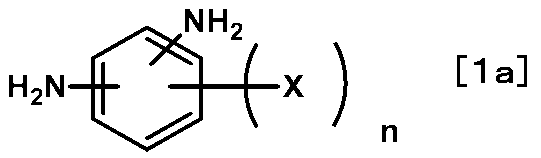
- a diamine of the following formula [1a] also referred to as a specific diamine).
- Y represents the above formula [1], and the definition and preferable combinations of X 1 to X 4 are as in the above formula [1].
- n represents an integer of 1 to 4. Among them, an integer of 1 is preferable.
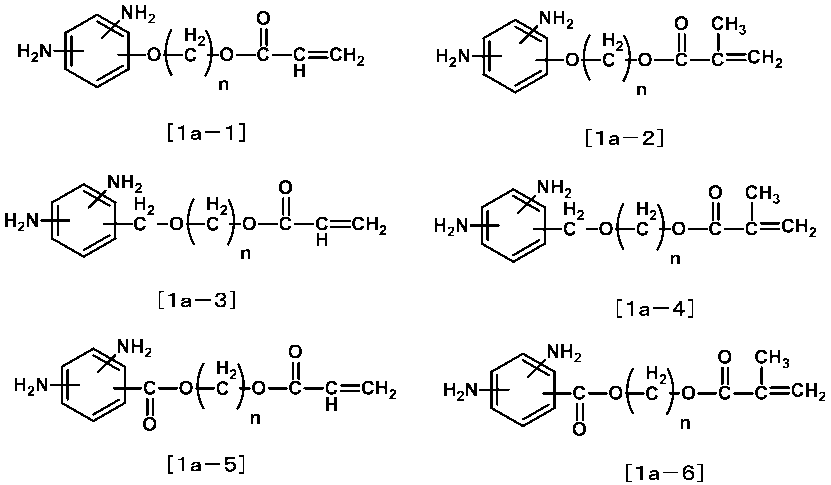
- Preferred specific examples of the specific diamine include diamines represented by the following formulas [1a-1] to [1a-9].
- n in the formula is preferably each independently an integer of 2 to 10.
- the use ratio of the specific diamine is preferably 1 to 50 mol% with respect to the entire diamine component. More preferred is 1 to 40 mol %. Particularly preferred is 5 to 40 mol %.
- the specific diamine may be used alone or in combination of two or more depending on each characteristic.
- the diamine component for producing the specific polymer may include a diamine other than the specific diamine (also referred to as other diamine).
- a diamine other than the specific diamine also referred to as other diamine.
- Other examples include diamine compounds and the diamine compounds of the formulas [DA1] to [DA15] described on pages 42 to 44 of the publication.
- These diamine components may be used either individually or in combination of two or more, depending on the characteristics.
- the tetracarboxylic acid component for producing the specific polymer is not particularly limited, but specifically, the tetracarboxylic acid dicarboxylic acid of the formula [4] described in International Publication WO2016/076412, pages 44 to 45, can be used. Examples include anhydrides and other tetracarboxylic acid components described on pages 45-46. These tetracarboxylic acid components may be used either individually or in combination of two or more, depending on the characteristics.
- the method for synthesizing the specific polymer is not particularly limited. Usually, it is obtained by reacting a diamine component and a tetracarboxylic acid component. Specific examples thereof include the methods described on pages 46 to 50 of International Publication WO2016/076412.
- the reaction between the diamine component and the tetracarboxylic acid component is usually performed in a solvent containing the diamine component and the tetracarboxylic acid component.
- the solvent used at that time is not particularly limited as long as it can dissolve the generated polyimide precursor.
- N-methyl-2-pyrrolidone, N-ethyl-2-pyrrolidone, ⁇ -butyrolactone, N,N-dimethylformamide, N,N-dimethylacetamide, dimethyl sulfoxide or 1,3-dimethyl-imidazolidinium Non is included.
- the polyimide precursor has high solvent solubility, methyl ethyl ketone, cyclohexanone, cyclopentanone, 4-hydroxy-4-methyl-2-pentanone or a solvent represented by the following formula [D1] to [D3] is used. it can.
- D 1 and D 2 represent an alkyl group having 1 to 3 carbon atoms.
- D 3 represents an alkyl group having 1 to 4 carbon atoms.
- the total number of moles of the tetracarboxylic acid component is preferably 0.8 to 1.2 when the total number of moles of the diamine component is 1.0.
- Polyimide is obtained by ring-closing a polyimide precursor.
- the polyimide does not necessarily have a ring closure rate (also referred to as an imidization rate) of an amic acid group of 100%, and can be arbitrarily prepared according to the application or purpose. Among them, 30 to 80% is preferable from the viewpoint of the solubility of the polyimide polymer in the solvent. More preferably, it is 40 to 70%.
- the molecular weight of the specific polymer is 5, as a weight average molecular weight measured by GPC (Gel Permeation Chromatography) method, in consideration of the strength of the liquid crystal alignment film obtained therefrom, workability at the time of forming the liquid crystal alignment film, and coating property. It is preferably from 000 to 1,000,000, and more preferably from 10,000 to 150,000.
- the liquid crystal alignment treatment agent is a solution for forming a liquid crystal alignment film, and is a solution containing a specific compound, a specific polymer and a solvent. In that case, two or more types can be used for a specific compound and a specific polymer, respectively.
- the content of the solvent in the liquid crystal alignment treatment agent can be appropriately selected from the viewpoint of applying the liquid crystal alignment treatment agent and obtaining a target film thickness. Among them, the content of the solvent in the liquid crystal alignment treatment agent is preferably 50 to 99.9 mass% from the viewpoint of forming a uniform liquid crystal alignment film by coating. Among them, 60 to 99 mass% is preferable. More preferably, it is 65 to 99% by mass.
- the solvent used for the liquid crystal alignment treatment agent is not particularly limited as long as it is a solvent that dissolves the specific compound and the specific polymer. Above all, it is preferable to use the following solvents (also referred to as solvent A).
- solvents also referred to as solvent A.
- N-methyl-2-pyrrolidone, N-ethyl-2-pyrrolidone or ⁇ -butyrolactone is preferable. Moreover, these may be used individually or may be mixed and used.
- the following solvent (also referred to as solvent B) can be used.
- the solvent Bs include the solvent Bs described on pages 58 to 60 of International Publication WO2014/171493. Among them, 1-hexanol, cyclohexanol, 1,2-ethanediol, 1,2-propanediol, propylene glycol monobutyl ether, ethylene glycol monobutyl ether, dipropylene glycol dimethyl ether, cyclohexanone, cyclopentanone or the above formula [D1] To Formula [D3] are preferred.
- N-methyl-2-pyrrolidone, N-ethyl-2-pyrrolidone or ⁇ -butyrolactone of the above-mentioned solvent A is used in combination for the purpose of improving the coating property of the liquid crystal alignment treatment agent. It is preferable to use. Since these solvents B can enhance the coating property and surface smoothness of the liquid crystal alignment film when applying the liquid crystal alignment treatment agent, when a polyimide precursor, polyimide, polyamide or polyester is used as the polymer, It is preferable to use it in combination with the above solvents A. At that time, the amount of the solvent B is preferably 1 to 99% by mass of the whole solvent contained in the liquid crystal alignment treatment agent. Among them, 10 to 99 mass% is preferable, and 20 to 95 mass% is more preferable.
- the liquid crystal alignment treatment agent includes a compound having an epoxy group, an isocyanate group, an oxetane group, a cyclocarbonate group, a hydroxy group, a hydroxyalkyl group or a lower alkoxyalkyl group (collectively, a crosslinker in order to enhance the film strength of the liquid crystal alignment film It is also preferable to introduce a compound). In that case, it is necessary to have two or more groups in the compound.
- the liquid crystal alignment treatment agent is a group selected from an epoxy group, an isocyanate group, an oxetane group, a cyclocarbonate group, a hydroxyl group, a hydroxyalkyl group, an alkoxyalkyl group having 1 to 3 carbon atoms, or a polymerizable unsaturated bond group. It is preferable to include at least one crosslinkable compound composed of a compound having two or more. Specific examples of the crosslinkable compound having an epoxy group or an isocyanate group include the crosslinkable compounds having an epoxy group or an isocyanate group described on pages 63 to 64 of WO 2014/171493.
- crosslinkable compound having an oxetane group examples include crosslinkable compounds of the formulas [4a] to [4k] described on pages 58 to 59 of International Publication WO2011/132751.
- Specific examples of the crosslinkable compound having a cyclocarbonate group include crosslinkable compounds of the formulas [5-1] to [5-42] described on pages 76 to 82 of WO 2012/014898.
- crosslinkable compound having a hydroxyl group, a hydroxyalkyl group and a lower alkoxyalkyl group include melamine derivatives or benzoguanamine derivatives described on pages 65 to 66 of WO2014/171349, and WO2011/132751. And the crosslinkable compounds of the formulas [6-1] to [6-48] listed on pages 62 to 66.
- the content of the crosslinkable compound in the liquid crystal alignment treatment agent is preferably 0.1 to 100 parts by mass with respect to 100 parts by mass of all polymer components. In order to allow the crosslinking reaction to proceed and to produce the desired effect, 0.1 to 50 parts by mass is more preferable, and 1 to 30 parts by mass is most preferable, relative to 100 parts by mass of all polymer components. ..
- a compound that improves the film thickness uniformity and the surface smoothness of the liquid crystal alignment film when the liquid crystal alignment treatment agent is applied can be used. Further, a compound or the like that improves the adhesiveness between the liquid crystal alignment film and the electrode substrate can be used.
- Compounds that improve the film thickness uniformity and surface smoothness of the liquid crystal alignment film include fluorine-based surfactants, silicone-based surfactants, and nonion-based surfactants. Specific examples thereof include the surfactants described on page 67 of International Publication WO2014/171493. Further, the use ratio thereof is preferably 0.01 to 2 parts by mass with respect to 100 parts by mass of all polymer components contained in the liquid crystal alignment treatment agent. More preferably, it is 0.01 to 1 part by mass.
- the compound that improves the adhesiveness between the liquid crystal alignment film and the electrode substrate include the compounds described on pages 67 to 69 of International Publication WO2014/171493. Further, the use ratio thereof is preferably 0.1 to 30 parts by mass with respect to 100 parts by mass of all polymer components contained in the liquid crystal alignment treatment agent. More preferably, it is 1 to 20 parts by mass.
- a liquid crystal alignment treatment agent may be added with a dielectric or a conductive substance for the purpose of changing the electrical properties such as the dielectric constant and conductivity of the liquid crystal alignment film.
- the liquid crystal alignment treatment agent can be used as a liquid crystal alignment film by applying alignment treatment by rubbing treatment or light irradiation after coating and baking on the substrate. Further, in the case of vertical alignment applications, it can be used as a liquid crystal alignment film without alignment treatment.
- the substrate used in this case is not particularly limited as long as it is a highly transparent substrate, and in addition to glass substrates, acrylic substrates, polycarbonate substrates, plastic substrates such as PET (polyethylene terephthalate) substrates, and further films thereof. Can be used.
- a substrate on which an ITO electrode for driving liquid crystal, a metal electrode such as an IZO (Indium Zinc Oxide) electrode and an IGZO (Indium Gallium Zinc Oxide) electrode, and an organic conductive film are formed. Is preferably used. Further, in the case of a reflective liquid crystal display element, if only one substrate is used, a substrate such as a silicon wafer or a metal such as aluminum or a substrate on which a dielectric multilayer film is formed can be used.
- the method for applying the liquid crystal alignment treatment agent is not particularly limited, but industrially, a method such as screen printing, offset printing, flexographic printing or an inkjet method is generally used. Other coating methods include a dip method, a roll coater method, a slit coater method, a spinner method or a spray method, and these may be used depending on the purpose.
- After applying the liquid crystal alignment treatment agent on the substrate it is preferably heated at 30 to 300° C., depending on the solvent used for the liquid crystal alignment treatment agent, by a heating means such as a hot plate, a heat circulation type oven or an IR (infrared) type oven. Can be used as a liquid crystal alignment film by evaporating the solvent at a temperature of 30 to 250° C.
- the thickness of the liquid crystal alignment film after firing is too thick, it is disadvantageous in terms of power consumption of the liquid crystal display device, and if it is too thin, the reliability of the liquid crystal display device may be deteriorated. Is 10 to 200 nm.
- the liquid crystal alignment film after firing is treated by rubbing or irradiation with polarized ultraviolet light.
- the liquid crystal used for the liquid crystal display element is not particularly limited, but for example, nematic liquid crystal, smectic liquid crystal or cholesteric liquid crystal can be used.
- a liquid crystal having a positive or negative dielectric anisotropy can be selected according to the method of the liquid crystal display element.
- a dichroic dye may be dissolved in the liquid crystal to form a guest-host type liquid crystal display device.
- the method of injecting the liquid crystal is not particularly limited, but for example, the following method may be mentioned. That is, a pair of substrates on which a liquid crystal alignment film is formed is prepared, and a sealant is applied to all four of the substrates on one side except for a part thereof, and then the liquid crystal alignment film surface is placed inside and the other side is applied. An empty cell in which the above substrates are bonded together is produced. Then, a method of injecting liquid crystal under reduced pressure from a place where the sealant is not applied to obtain a liquid crystal injection cell can be mentioned. Furthermore, prepare a pair of substrates on which a liquid crystal alignment film is formed, drop the liquid crystal on one substrate by ODF (One Drop Filling) method or inkjet method, and then bond the other substrate. Another method is to obtain a liquid crystal injection cell.
- ODF One Drop Filling
- the method of controlling the gap of the liquid crystal display device is not particularly limited, for example, a method of introducing a spacer of a desired size in the liquid crystal, a method of coating on a substrate having a column spacer of the desired size, the purpose A method using a liquid crystal containing a column spacer having a size of
- the size of the gap of the liquid crystal display element is preferably 1 to 100 ⁇ m. More preferably, it is 1 to 50 ⁇ m. Particularly preferred is 2 to 30 ⁇ m. If the gap is too small, the contrast of the liquid crystal display device will be lowered, and if it is too large, the driving voltage of the device will be high.
- solvent NMP: N-methyl-2-pyrrolidone
- NEP N-ethyl-2-pyrrolidone
- BCS ethylene glycol monobutyl ether
- PB propylene glycol monobutyl ether
- the imidization ratio is determined by using a proton derived from a structure that does not change before and after imidization as a reference proton, and the peak integrated value of this proton and the proton peak derived from the NH group of amic acid that appears near 9.5 ppm to 10.0 ppm. It was calculated by the following formula using the integrated value.
- Imidization rate (%) (1- ⁇ x/y) ⁇ 100 (X is a proton peak integrated value derived from NH group of amic acid, y is a peak integrated value of reference proton, ⁇ is a reference proton for one NH group proton of amic acid in the case of polyamic acid (imidization rate is 0%) Is the proportion of the number of.)
- Table 4 shows the polyimide-based polymers obtained in Synthesis Examples 1 to 11. *1: Polyamic acid. *2: Polyamic acid alkyl ester.
- “Storage stability test for liquid crystal alignment agents” A storage stability test was conducted using the liquid crystal alignment treatment agents obtained in Examples and Comparative Examples. Specifically, the liquid crystal alignment treatment agent was pressure-filtered with a membrane filter having a pore size of 1 ⁇ m and stored at ⁇ 15° C. for 72 hours. Then, by visual observation, it was confirmed that turbidity and precipitates were generated in the liquid crystal alignment treatment agent. As a result, all the liquid crystal alignment treatment agents of Examples and Comparative Examples were uniform solutions without turbidity or precipitates.
- a 6 ⁇ m spacer is applied to the liquid crystal alignment film surface of one substrate, and a sealant (723K1) (manufactured by Kyoritsu Chemical Industry Co., Ltd.) is applied to the liquid crystal alignment film surface of the other substrate.
- the substrates were laminated so that the liquid crystal alignment film surfaces of the substrates face each other.
- the application amount of the sealing agent was adjusted so that the area of the sealing agent after the bonding was 5 ⁇ 50 mm (length ⁇ width).
- the bonded substrates are irradiated with 3 J/cm 2 of ultraviolet rays at a wavelength conversion of 365 nm by using a metal halide lamp with an illuminance of 20 mW/cm 2 , and then in a heat cycle type clean oven at 120° C. for 60 minutes. A heat treatment was performed to produce a cell for evaluation of adhesion.
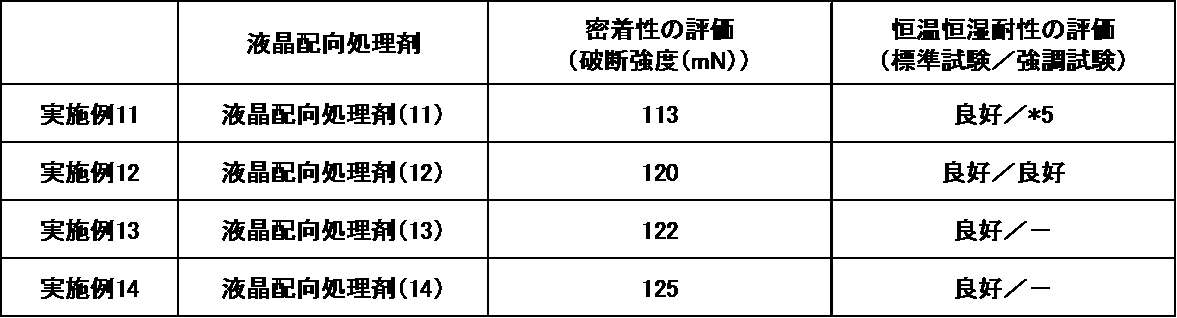
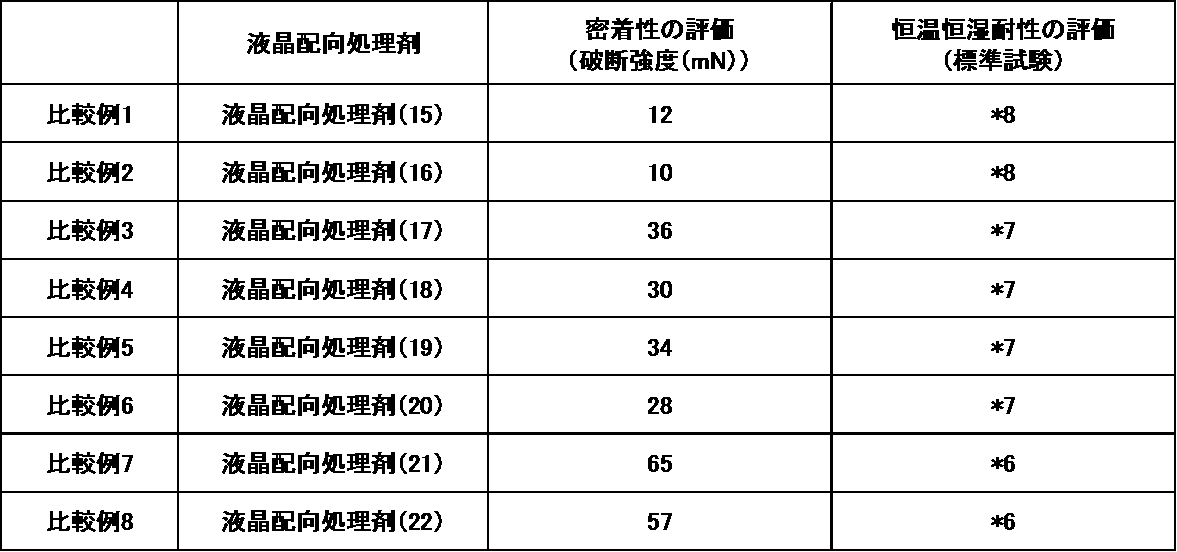
- the evaluation of the adhesiveness was carried out using a tabletop precision universal testing machine (AGS-X 500N) (manufactured by Shimadzu Corporation). Specifically, after fixing the upper and lower ends of the obtained cell, the breaking strength (N) when pulled in the vertical direction was measured. In the evaluation, the larger the value of the breaking strength, the more excellent the adhesion is, that is, the more excellent this evaluation is. The results are shown in Tables 8 to 10.
- the liquid crystal alignment treatment agents obtained in Examples and Comparative Examples were pressure-filtered with a membrane filter having a pore size of 1 ⁇ m, and washed with pure water and IPA.
- a substrate with ITO electrodes (length 40 mm ⁇ width 30 mm, thickness) (0.7 mm) ITO surface is spin-coated, and heat-treated at 120° C. for 2 minutes on a hot plate and at 230° C. for 30 minutes in a heat circulation type clean oven to have a liquid crystal alignment film with a thickness of 100 nm.
- the ITO substrate of was obtained.
- liquid crystal alignment film surface of this substrate was rubbed with a rubbing device having a roll diameter of 120 mm under the conditions of a roll rotation speed of 500 rpm, a roll advancing speed of 30 mm/sec, and a pushing amount of 0.3 mm. Processed.
- a spacer of 4 ⁇ m is applied to the liquid crystal alignment film surface of one substrate, and a sealant (XN- 1500T) (manufactured by Kyoritsu Kagaku Sangyo Co., Ltd.) was applied, and the substrates were laminated so that the liquid crystal alignment film surfaces of these substrates face each other. At that time, the substrates were laminated so that the rubbing directions of the substrates were opposite to each other.
- heat treatment was performed at 120° C. for 90 minutes in a heat circulation type clean oven to prepare an empty cell. Liquid crystal was injected into this empty cell by a reduced pressure injection method, and the injection port was sealed to obtain a liquid crystal cell.
- MLC-2003 positive type liquid crystal
- MLC-6608 negative liquid crystal
- Example 3 A1 (0.30 g), K1 (0.18 g), NMP (23.8 g) and BCS (7.83 g) were added to the polyamic acid solution (2) (10.0 g) obtained in Synthesis Example 2, The mixture was stirred at 25°C for 15 hours to obtain a liquid crystal alignment treatment agent (3).
- NEP (31.3 g) was added to the polyimide powder (3) (2.50 g) obtained in Synthesis Example 3 and stirred at 60° C. for 24 hours to be dissolved.
- A2 (0.15 g) and BCS (7.83 g) were added to this solution and stirred at 25° C. for 15 hours to obtain a liquid crystal alignment treatment agent (4).
- Example 5 In the polyamic acid solution (4) (10.0 g) obtained in Synthesis Example 4, A1 (0.13 g), A2 (0.075 g), NMP (19.9 g), BCS (7.83 g) and PB ( 3.92 g) was added and stirred at 25° C. for 15 hours to obtain a liquid crystal alignment treatment agent (5).
- A1 (0.15 g), NMP (16.0 g) and BCS (15.7 g) were added to the polyamic acid solution (5) (10.0 g) obtained in Synthesis Example 5, and the mixture was stirred at 25° C. for 15 hours. Thus, a liquid crystal alignment treatment agent (6) was obtained.
- NEP (23.5 g) was added to the polyimide powder (6) (2.50 g) obtained in Synthesis Example 6 and stirred at 60° C. for 24 hours to be dissolved.
- A2 (0.20 g) and PB (15.7 g) were added to this solution, and the mixture was stirred at 25° C. for 15 hours to obtain a liquid crystal alignment treatment agent (7).
- NEP (23.5 g) was added to the polyimide powder (6) (2.50 g) obtained in Synthesis Example 6 and stirred at 60° C. for 24 hours to be dissolved.
- A2 (0.20 g), K1 (0.18 g) and PB (15.7 g) were added to this solution, and the mixture was stirred at 25° C. for 15 hours to obtain a liquid crystal alignment treatment agent (8).
- Example 9 To the polyamic acid solution (7) (10.0 g) obtained in Synthesis Example 7, A1 (0.10 g), K2 (0.08 g), NMP (19.9 g), BCS (7.83 g) and PB( 3.92 g) was added and stirred at 25° C. for 15 hours to obtain a liquid crystal alignment treatment agent (9).
- Example 10 To the polyamic acid solution (8) (10.0 g) obtained in Synthesis Example 8, A2 (0.15 g), K2 (0.18 g), NMP (19.9 g) and BCS (11.8 g) were added, The mixture was stirred at 25°C for 15 hours to obtain a liquid crystal alignment treatment agent (10).
- Example 11 A1 (0.23 g), NMP (19.9 g) and BCS (11.8 g) were added to the polyamic acid solution (9) (10.0 g) obtained in Synthesis Example 9, and the mixture was stirred at 25° C. for 15 hours. Thus, a liquid crystal alignment treatment agent (11) was obtained.
- Example 12 To the polyamic acid solution (9) (10.0 g) obtained in Synthesis Example 9, A1 (0.23 g), K1 (0.13 g), NMP (19.9 g) and BCS (11.8 g) were added, The mixture was stirred at 25°C for 15 hours to obtain a liquid crystal alignment treatment agent (12).
- NMP (31.3 g) was added to the polyamic acid alkyl ester powder (10) (2.50 g) obtained in Synthesis Example 10, and the mixture was stirred at 40° C. for 24 hours to be dissolved. A1 (0.30 g) and BCS (7.83 g) were added to this solution, and the mixture was stirred at 25° C. for 15 hours to obtain a liquid crystal alignment treatment agent (13).
- NEP (31.3 g) was added to the polyamic acid alkyl ester powder (10) (2.50 g) obtained in Synthesis Example 10, and the mixture was stirred at 40° C. for 24 hours to be dissolved. A2 (0.20 g), K2 (0.13 g) and BCS (7.83 g) were added to this solution, and the mixture was stirred at 25° C. for 15 hours to obtain a liquid crystal alignment treatment agent (14).
- ⁇ Comparative example 3> A1 (0.20 g), NMP (23.8 g) and BCS (7.83 g) were added to the polyamic acid solution (11) (10.0 g) obtained in Synthesis Example 11, and the mixture was stirred at 25° C. for 15 hours. Thus, a liquid crystal alignment treatment agent (17) was obtained.
- ⁇ Comparative example 4> A1 (0.15 g), NMP (16.0 g) and BCS (15.7 g) were added to the polyamic acid solution (12) (10.0 g) obtained in Synthesis Example 12, and the mixture was stirred at 25° C. for 15 hours. Thus, a liquid crystal alignment treatment agent (18) was obtained.
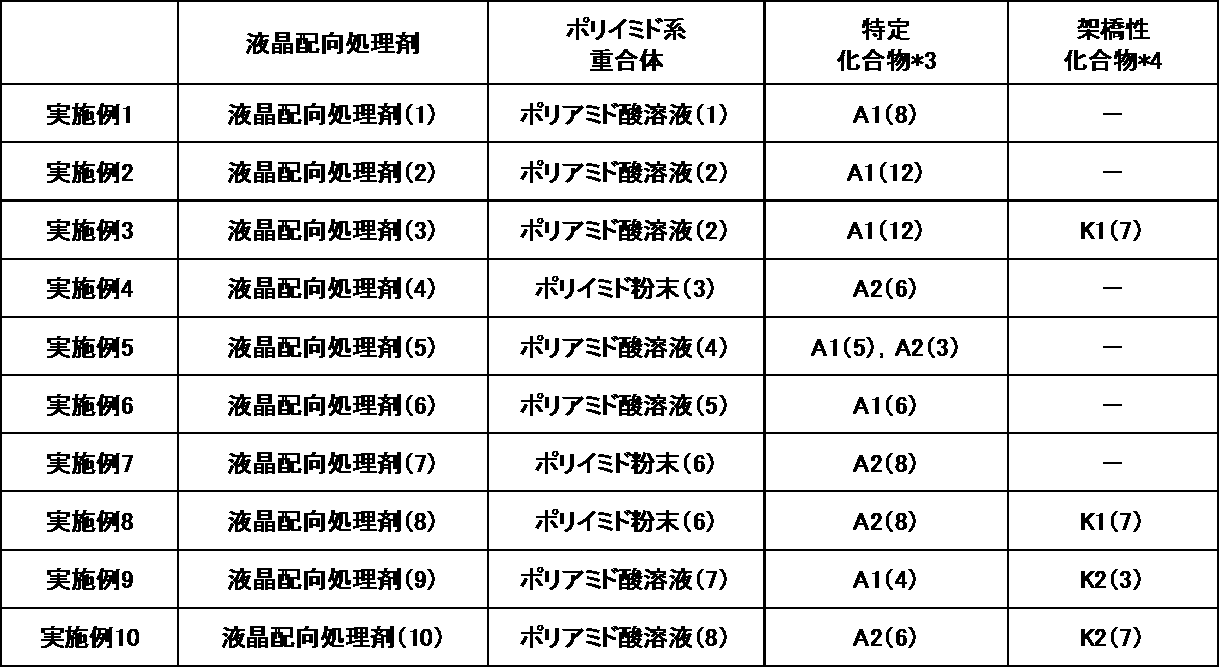
- *3 Indicates the content (parts by mass) of the specific compound with respect to 100 parts by mass of the polymer.
- *4 Indicates the content (parts by mass) of the crosslinkable compound with respect to 100 parts by mass of the polymer.
- *5 A very small amount of bubbles were found in the device.
- *6 A small amount of bubbles were found in the element (more than *5).
- *7 Bubbles were found in the element (more than *6).
- *8 Many bubbles were found in the element (more than *7).
- the example using the liquid crystal alignment treatment agent containing a specific compound having three or more thiol groups in the molecule has the above characteristics in comparison with the comparative example of the liquid crystal alignment treatment agent containing a compound having two thiol groups.
- the comparative example of the liquid crystal alignment treatment agent containing a compound having two thiol groups. was excellent.
- Example 1 and Comparative Example 7 there are comparison between Example 1 and Comparative Example 7, and comparison between Example 6 and Comparative Example 8.
- the crosslinkable compound was introduced into the liquid crystal alignment treatment agent, no bubbles were generated in the liquid crystal cell in the emphasis test.
- there are a comparison between Example 2 and Example 3 a comparison between Example 7 and Example 8
- the liquid crystal alignment treatment agent of the present invention has high adhesiveness between substrates of a liquid crystal display element by using the obtained liquid crystal alignment film, and further, even in a harsh environment exposed to high temperature and high humidity for a long time. It is possible to obtain a liquid crystal display element capable of suppressing the generation of bubbles in the liquid crystal display element and the peeling of the element. Therefore, it can be suitably used for liquid crystal display devices such as smartphones and mobile phones.
- the entire contents of the specification, claims, drawings, and abstract of Japanese Patent Application No. 2018-246262 filed on Dec. 27, 2018 are cited herein as disclosure of the specification of the present invention. , Take in.
Landscapes
- Chemical & Material Sciences (AREA)
- Physics & Mathematics (AREA)
- Chemical Kinetics & Catalysis (AREA)
- Health & Medical Sciences (AREA)
- Medicinal Chemistry (AREA)
- Polymers & Plastics (AREA)
- Organic Chemistry (AREA)
- Nonlinear Science (AREA)
- Mathematical Physics (AREA)
- Crystallography & Structural Chemistry (AREA)
- General Physics & Mathematics (AREA)
- Optics & Photonics (AREA)
- Spectroscopy & Molecular Physics (AREA)
- Liquid Crystal (AREA)
- Macromolecular Compounds Obtained By Forming Nitrogen-Containing Linkages In General (AREA)
Abstract
Description
液晶配向膜は、液晶の配向状態を制御する目的で使用されるものである。しかしながら、液晶表示素子の高精細化に伴い、液晶表示素子のコントラスト低下や長期使用に伴う表示不良の抑制が求められている。
そのため、近年では、従来に比べて、液晶表示素子の基板間の接着が弱い状況となっている。更に、このような場合、高温高湿条件下での使用により、シール剤と液晶配向膜との間から水が混入しやすくなり、液晶表示素子の額縁付近での表示ムラや素子内での気泡の発生、更には、素子の剥がれが起こってしまう。
即ち、下記(A)成分及び(B)成分を含有する液晶配向処理剤である。
(A)成分:分子内にチオール基を3個以上有する化合物(特定化合物ともいう。)。
(B)成分:下記式[1]の構造(特定構造ともいう。)を有するジアミンを含有するジアミン成分とテトラカルボン酸成分との反応で得られるポリイミド前駆体、及び該ポリイミド前駆体をイミド化したポリイミドからなる群から選ばれる少なくとも1種の重合体(特定重合体ともいう。)。


本発明により何故に上記の優れた特性を有する液晶表示素子が得られるメカニズムは、必ずしも明らかではないが、ほぼ次のように推定される。
これらのことより、液晶配向膜を形成後、液晶配向膜と金属電極、及び液晶配向膜とシール剤との密着性が高くなり、長時間、高温高湿に曝される環境においても、液晶表示素子内の気泡の発生や素子の剥がれを抑制することができる液晶表示素子となると考えられる。
特定化合物は、分子内にチオール基を3個以上有する化合物である。
具体的には、1,2,3-プロパントリチオール、1,2,4-ブタントリチオール、ペンタエリスリトールトリス(3-メルカプトプロピオネート)、1,3,5-ベンゼントリチオール、2,4,6-メシチレントリチオール、ネオペンタンテトラチオール、2,4,6-トルエントリチオール、トリメチロールプロパントリス(3-メルカプトプロピオネート)、トリス-[(3-メルカプトプロピオニルオキシ)-エチル]-イソシアヌレート、ペンタエリスリトールテトラキス(3-メルカプトプロピオネート)、テトラエチレングリコールビス(3-メルカプトプロピオネート)、ジペンタエリストールヘキサキス(3-メルカプトプロピオネート)、トリメチロールプロパントリス(3-メルカプトブチレート)、トリメチロールエタントリス(3-メルカプトブチレート)、ペンタエリスリトールテトラキス(3-メルカプトブチレート)、1,3,5-トリス(3-メルカプトブチリルオキシエチル)-1,3,5-トリアジン-2,4,6-(1H.3H.5H)-トリオン、ネオペンタンテトラチオール、2,2’-ビス(メルカプトメチル)-1,3-プロパンジチオール、ペンタエリトリトールテトラキス(3-メルカプトプロピオネート)又はジペンタエリスリトールヘキサキス(3-メルカプトプロピオネート)が挙げられる。
特定構造は、前記式[1]で表される。式[1]中、X1、X2、X3、X4は、上記に定義した通りである。なかでも、それぞれ、以下のものが好ましい。
X1は、単結合、-O-、-CH2O-、-CONH-、-CON(CH3)-又は-COO-が好ましく、より好ましくは、合成のし易さの点から、単結合、-O-、-CH2O-又は-COO-である。
X3は、単結合、-O-、-NHCO-、-N(CH3)CO-又は-OCO-が好ましい。より好ましいのは、合成のし易さの点から、単結合、-O-、-NHCO-又は-OCO-である。

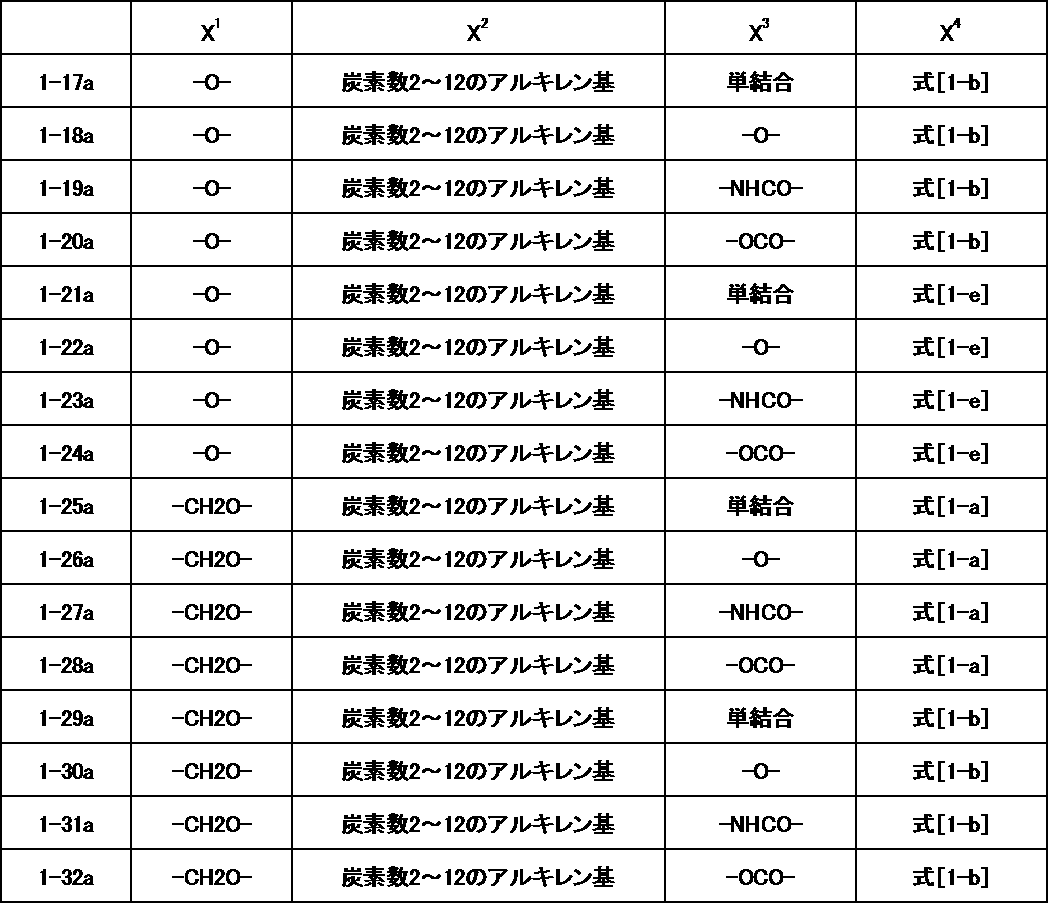

最も好ましいのは、合成のし易さ及び液晶表示素子の液晶配向膜とシール剤との密着性の点から、(1-20a)、(1-21a)、(1-28a)、(1-32a)、(1-33a)、(1-40a)、(1-44a)又は(1-45a)の組み合わせである。
特定重合体は、特定ジアミンを含有するジアミン成分とテトラカルボン酸成分との反応で得られるポリイミド前駆体又は該ポリイミド前駆体をイミド化したポリイミドである。
ポリイミド前駆体とは、下記式[A]の構造を有する。

ジアミン成分としては、分子内に1級又は2級のアミノ基を2個有するジアミンであり、テトラカルボン酸成分としては、テトラカルボン酸化合物、テトラカルボン酸二無水物、テトラカルボン酸ジハライド化合物、テトラカルボン酸ジアルキルエステル化合物又はテトラカルボン酸ジアルキルエステルジハライド化合物が挙げられる。

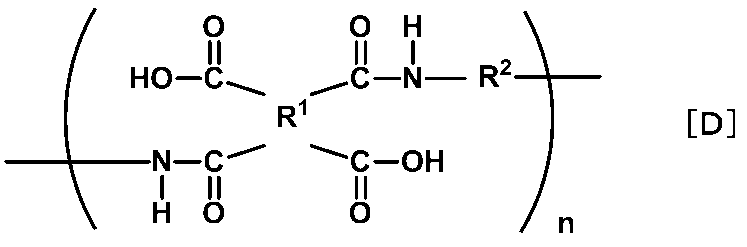
特定構造をポリイミド系重合体に導入する方法としては、特定構造を有するジアミンを原料の一部に用いることが好ましい。特に下記式[1a]のジアミン(特定ジアミンともいう。)を用いることが好ましい。

nは1~4の整数を示す。なかでも、1の整数が好ましい。

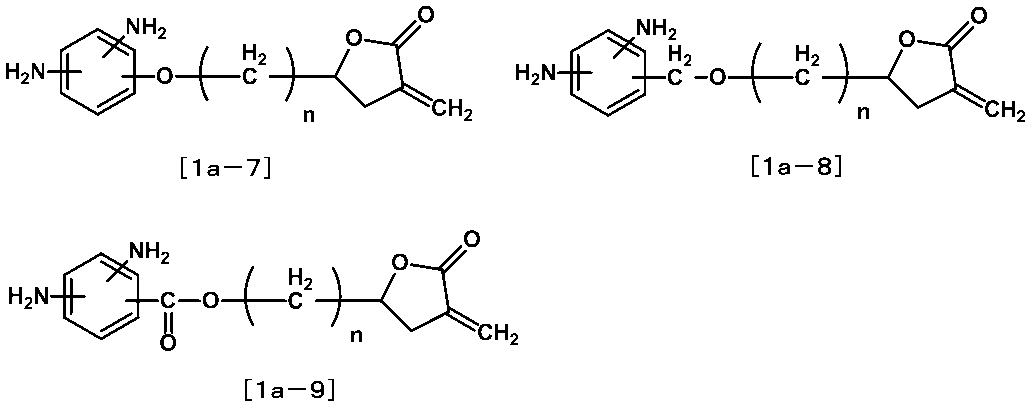
ジアミン成分とテトラカルボン酸成分との反応は、通常、ジアミン成分とテトラカルボン酸成分とを含む溶媒中で行う。その際に用いる溶媒としては、生成したポリイミド前駆体が溶解するものであれば特に限定されない。

ポリイミド前駆体の重合反応においては、ジアミン成分の合計モル数を1.0にした際のテトラカルボン酸成分の合計モル数は、0.8~1.2が好ましい。
特定重合体の分子量は、そこから得られる液晶配向膜の強度、液晶配向膜形成時の作業性及び塗膜性を考慮した場合、GPC(Gel Permeation Chromatography)法で測定した重量平均分子量で5,000~1,000,000とするのが好ましく、より好ましいのは、10,000~150,000である。
液晶配向処理剤は、液晶配向膜を形成するための溶液であり、特定化合物、特定重合体及び溶媒を含有する溶液である。その際、特定化合物及び特定重合体には、それぞれ、2種類以上のものを用いることができる。
液晶配向処理剤中の溶媒の含有量は、液晶配向処理剤の塗布方法や目的とする膜厚を得るという観点から、適宜選択できる。なかでも、塗布により均一な液晶配向膜を形成するとい観点から、液晶配向処理剤中の溶媒の含有量は50~99.9質量%が好ましい。なかでも、60~99質量%が好ましい。より好ましいのは、65~99質量%である。
例えば、N,N-ジメチルホルムアミド、N,N-ジメチルアセトアミド、N-メチル-2-ピロリドン、N-エチル-2-ピロリドン、ジメチルスルホキシド、γ-ブチロラクトン、1,3-ジメチル-イミダゾリジノン、メチルエチルケトン、シクロヘキサノン、シクロペンタノン、4-ヒドロキシ-4-メチル-2-ペンタノンなどである。なかでも、N-メチル-2-ピロリドン、N-エチル-2-ピロリドン又はγ-ブチロラクトンが好ましい。また、これらは単独で使用しても、混合して使用してもよい。
溶媒B類の具体例は、国際公開公報WO2014/171493の58頁~60頁に記載される溶媒B類が挙げられる。なかでも、1-ヘキサノール、シクロヘキサノール、1,2-エタンジオール、1,2-プロパンジオール、プロピレングリコールモノブチルエーテル、エチレングリコールモノブチルエーテル、ジプロピレングリコールジメチルエーテル、シクロヘキサノン、シクロペンタノン又は前記式[D1]~式[D3]が好ましい。
これら溶媒B類は、液晶配向処理剤を塗布する際の液晶配向膜の塗膜性や表面平滑性を高めることができるため、重合体にポリイミド前駆体、ポリイミド、ポリアミド又はポリエステルを用いた場合、前記溶媒A類と併用して用いることが好ましい。その際、溶媒B類は、液晶配向処理剤に含まれる溶媒全体の1~99質量%が好ましい。なかでも、10~99質量%が好ましく、より好ましくは、20~95質量%である。
すなわち、液晶配向処理剤は、エポキシ基、イソシアネート基、オキセタン基、シクロカーボネート基、ヒドロキシル基、ヒドロキシアルキル基、炭素数1~3のアルコキシアルキル基、又は重合性不飽和結合基から選ばれる基を2つ以上有する化合物からなる少なくとも1種の架橋性化合物を含むことが好ましい。
エポキシ基又はイソシアネート基を有する架橋性化合物の具体例は、国際公開公報WO2014/171493の63頁~64頁に記載されるエポキシ基又はイソシアネート基を有する架橋性化合物が挙げられる。
シクロカーボネート基を有する架橋性化合物の具体例は、国際公開公報WO2012/014898の76頁~82頁に掲載される式[5-1]~式[5-42]の架橋性化合物が挙げられる。
液晶配向処理剤には、液晶配向処理剤を塗布した際の液晶配向膜の膜厚の均一性や表面平滑性を向上させる化合物を用いることができる。更に、液晶配向膜と電極基板との密着性を向上させる化合物などを用いることもできる。
液晶配向処理剤には、前記以外の化合物の他に、液晶配向膜の誘電率や導電性などの電気特性を変化させる目的の誘電体や導電物質を添加してもよい。
液晶配向処理剤は、基板上に塗布、焼成した後、ラビング処理や光照射などで配向処理をして、液晶配向膜として用いることができる。また、垂直配向用途などの場合では配向処理なしでも液晶配向膜として用いることができる。
この際に用いる基板としては、透明性の高い基板であれば特に限定されず、ガラス基板の他、アクリル基板、ポリカーボネート基板、PET(ポリエチレンテレフタレート)基板などのプラスチック基板、更には、それらのフィルムを用いることができる。また、プロセスの簡素化の観点からは、液晶駆動のためのITO電極、IZO(Indium Zinc Oxide)電極及びIGZO(Indium Gallium Zinc Oxide)電極などの金属電極、及び有機導電膜などが形成された基板を用いることが好ましい。また、反射型の液晶表示素子とする場合には、片側の基板のみにならば、シリコンウエハやアルミニウムなどの金属や誘電体多層膜が形成された基板を使用できる。
液晶配向処理剤を基板上に塗布した後は、ホットプレート、熱循環型オーブン又はIR(赤外線)型オーブンなどの加熱手段により、液晶配向処理剤に用いる溶媒に応じて、30~300℃、好ましくは30~250℃の温度で溶媒を蒸発させて液晶配向膜とすることができる。
液晶を水平配向や傾斜配向させる場合は、焼成後の液晶配向膜をラビング又は偏光紫外線照射などで処理する。
液晶表示素子に用いる液晶は、特に限定されないが、例えば、ネマチック液晶、スメクチック液晶又はコレステリック液晶を用いることができる。その際、液晶表示素子の方式に応じて、正又は負の誘電異方性を有する液晶を選択できる。また、液晶中に二色性染料を溶解させてゲストホスト型の液晶表示素子とすることもできる。
液晶表示素子のギャップの大きさは、1~100μmが好ましい。より好ましいのは、1~50μmである。特に好ましいのは、2~30μmである。ギャップが小さすぎると、液晶表示素子のコントラストが低下し、大きすぎると、素子の駆動電圧が高くなる。
「特定化合物」
A1:カレンズMTPE1(昭和電工社製)/ペンタエリスリトールテトラキス(3-メルカプトブチレート)
A2:DPMP(SC有機化学社製)/ジペンタエリスリトールヘキサキス(3-メルカプトプロピオネート)
a1:カレンズMTBD1(昭和電工社製)/1,4-ビス(3-メルカプトブチリルオキシ)ブタン


NMP:N-メチル-2-ピロリドン、 NEP:N-エチル-2-ピロリドン
BCS:エチレングリコールモノブチルエーテル
PB:プロピレングリコールモノブチルエーテル
常温ゲル浸透クロマトグラフィー(GPC)装置(GPC-101)(昭和電工社製)、カラム(KD-803,KD-805)(Shodex社製)を用いて、以下のようにして測定した。
カラム温度:50℃
溶離液:N,N’-ジメチルホルムアミド(添加剤として、臭化リチウム-水和物(LiBr・H2O)が30mmol/L(リットル)、リン酸・無水結晶(o-リン酸)が30mmol/L、テトラヒドロフラン(THF)が10ml/L)
流速:1.0ml/分
検量線作成用標準サンプル:TSK 標準ポリエチレンオキサイド(分子量;約900,000、150,000、100,000及び30,000)(東ソー社製)及びポリエチレングリコール(分子量;約12,000、4,000及び1,000)(ポリマーラボラトリー社製)。
ポリイミド粉末20mgをNMR(核磁気共鳴)サンプル管(NMRサンプリングチューブスタンダード,φ5(草野科学社製))に入れ、重水素化ジメチルスルホキシド(DMSO-d6,0.05質量%TMS(テトラメチルシラン)混合品)(0.53ml)を添加し、超音波をかけて完全に溶解させた。この溶液をNMR測定機(JNW-ECA500)(日本電子データム社製)にて500MHzのプロトンNMRを測定した。イミド化率は、イミド化前後で変化しない構造に由来するプロトンを基準プロトンとして決め、このプロトンのピーク積算値と、9.5ppm~10.0ppm付近に現れるアミド酸のNH基に由来するプロトンピーク積算値とを用い以下の式によって求めた。
イミド化率(%)=(1-α・x/y)×100
(xはアミド酸のNH基由来のプロトンピーク積算値、yは基準プロトンのピーク積算値、αはポリアミド酸(イミド化率が0%)の場合におけるアミド酸のNH基プロトン1個に対する基準プロトンの個数割合である。)
<合成例1>
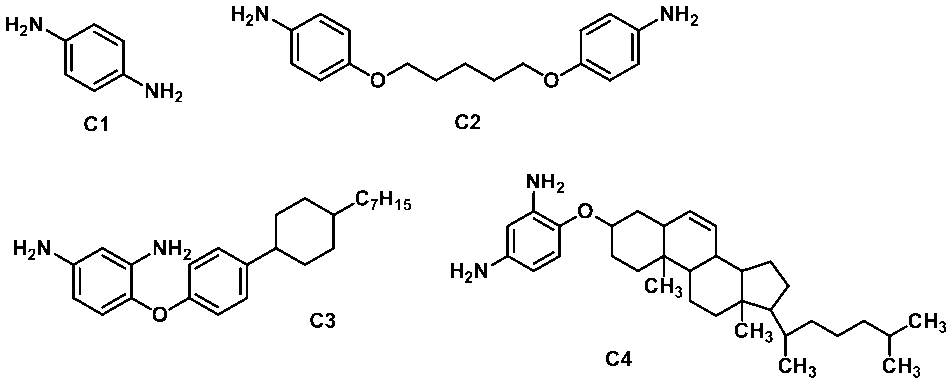
D1(2.20g,11.2mmol)、B1(0.61g,2.31mmol)、C1(0.25g,2.31mmol)及びC2(1.99g,6.95mmol)をNMP(15.1g)中で混合し、25℃で8時間反応させ、樹脂固形分濃度25質量%のポリアミド酸溶液(1)を得た。このポリアミド酸の数平均分子量(Mnともいう。)は26,300、重量平均分子量(Mwともいう。)は80,800であった。
D2(1.05g,4.20mmol)、B1(0.57g,2.16mmol)、C1(0.23g,2.13mmol)及びC2(4.96g,17.3mmol)をNMP(20.3g)中で混合し、60℃で4時間反応させた後、D1(3.30g,16.8mmol)とNMP(10.1g)を加え、40℃で6時間反応させ、樹脂固形分濃度が25質量%のポリアミド酸溶液(2)を得た。このポリアミド酸のMnは25,900、Mwは79,300であった。
合成例2で得られたポリアミド酸溶液(2)(20.0g)にNMPを加え6質量%に希釈した後、イミド化触媒として無水酢酸(2.40g)及びピリジン(1.85g)を加え、60℃で4時間反応させた。この反応溶液をメタノール(500ml)中に投入し、得られた沈殿物を濾別した。この沈殿物をメタノールで洗浄し、100℃で減圧乾燥してポリイミド粉末(3)を得た。このポリイミドのイミド化率は58%であり、Mnは24,100、Mwは62,100であった。
D2(0.30g,1.20mmol)、B2(0.43g,1.21mmol)、C1(0.53g,4.90mmol)及びC2(1.75g,6.11mmol)をNMP(10.2g)中で混合し、60℃で4時間反応させた後、D1(2.10g,10.7mmol)とNMP(5.12g)を加え、40℃で6時間反応させ、樹脂固形分濃度が25質量%のポリアミド酸溶液(4)を得た。このポリアミド酸のMnは23,200、Mwは73,700であった。
D2(1.96g,7.83mmol)、B1(1.60g,6.05mmol)、C1(0.44g,4.07mmol)及びC3(3.83g,10.1mmol)をNMP(20.2g)中で混合し、80℃で4時間反応させた後、D1(2.30g,11.7mmol)とNMP(10.1g)を加え、40℃で6時間反応させ、樹脂固形分濃度が25質量%のポリアミド酸溶液(5)を得た。このポリアミド酸のMnは21,800、Mwは66,400であった。
合成例5で得られたポリアミド酸溶液(5)(20.0g)にNMPを加え6質量%に希釈した後、イミド化触媒として無水酢酸(2.50g)及びピリジン(1.90g)を加え、80℃で4時間反応させた。この反応溶液をメタノール(500ml)中に投入し、得られた沈殿物を濾別した。この沈殿物をメタノールで洗浄し、100℃で減圧乾燥してポリイミド粉末(6)を得た。このポリイミドのイミド化率は55%であり、Mnは19,100、Mwは46,300であった。
D2(1.11g,4.44mmol)、B2(1.61g,4.54mmol)、C1(0.62g,5.73mmol)及びC4(0.56g,1.14mmol)をNMP(10.4g)中で混合し、80℃で6時間反応させた後、D1(1.30g,6.63mmol)とNMP(5.20g)を加え、40℃で6時間反応させ、樹脂固形分濃度が25質量%のポリアミド酸溶液(7)を得た。このポリアミド酸のMnは20,900、Mwは64,800であった。
D3(2.10g,9.37mmol)、B1(0.77g,2.91mmol)、B2(0.34g,0.96mmol)、C1(0.10g,0.92mmol)及びC3(1.84g,4.83mmol)をNMP(15.4g)中で混合し、40℃で6時間反応させ、樹脂固形分濃度が25質量%のポリアミド酸溶液(8)を得た。このポリアミド酸のMnは19,100、Mwは61,900であった。
D3(2.50g,11.2mmol)、B1(0.91g,3.44mmol)、C1(0.62g,5.73mmol)及びC4(1.13g,2.29mmol)をNMP(15.5g)中で混合し、40℃で6時間反応させ、樹脂固形分濃度が25質量%のポリアミド酸溶液(9)を得た。このポリアミド酸のMnは19,800、Mwは63,900であった。
窒素雰囲気下、B1(0.51g,1.93mmol)、C1(0.31g,2.87mmol)、C2(1.39g,4.85mmol)、ピリジン(1.88g)及びNMP(15.1g)を加え、撹拌して溶解させ、D4(2.80g,9.43mmol)を加え、15℃で15時間反応させた。その後、アクリロイルクロリド(0.04g)を加え、15℃で4時間反応させた。この反応溶液を水(500g)中に投入し、得られた沈殿物を濾別した。この沈殿物をイソプロピルアルコールで洗浄し、100℃で減圧乾燥してポリアミド酸アルキルエステル粉末(10)を得た。このポリアミド酸アルキルエステルのMnは18,500、Mwは40,100であった。
D1(2.40g,12.2mmol)、C1(0.55g,5.09mmol)及びC2(2.17g,7.58mmol)をNMP(15.3g)中で混合し、25℃で8時間反応させ、樹脂固形分濃度25質量%のポリアミド酸溶液(11)を得た。このポリアミド酸のMnは28,200、Mwは84,200であった。
D2(2.13g,8.51mmol)、C1(1.18g,10.9mmol)及びC3(4.16g,10.9mmol)をNMP(20.0g)中で混合し、80℃で4時間反応させた後、D1(2.50g,12.7mmol)とNMP(9.97g)を加え、40℃で6時間反応させ、樹脂固形分濃度が25質量%のポリアミド酸溶液(12)を得た。このポリアミド酸のMnは23,100、Mwは70,100であった。

下記する実施例1~14及び比較例1~8では、液晶配向処理剤の製造例を記載する。また、この液晶配向処理剤は、評価のためにも使用される。
得られた液晶配向処理剤を表5~表7に示す。
実施例及び比較例で得られた液晶配向処理剤を用いて、保存安定性試験を行った。具体的には、液晶配向処理剤を細孔径1μmのメンブランフィルタで加圧濾過し、-15℃で72時間保管した。その後、目視観察にて、液晶配向処理剤中の濁りや析出物の発生を確認した。その結果、実施例及び比較例のすべての液晶配向処理剤は、濁りや析出物が見られず、均一な溶液であった。
実施例及び比較例で得られた液晶配向処理剤を、純水で洗浄した100mm×100mmのITO電極付きPET基板(縦:100mm、横:100mm、厚さ:0.1mm)のITO面上にスピンコートにて塗布をし、ホットプレート上にて120℃で2分間加熱処理をして、膜厚が100nmの液晶配向膜付きのITO基板を得た。この液晶配向膜付きのITO基板を2枚用意し、それぞれ、100×20mm(縦×横)の大きさに切り取った。
表8~表10中に、結果を示す。
実施例及び比較例で得られた液晶配向処理剤を、細孔径1μmのメンブランフィルタで加圧濾過し、純水及びIPAにて洗浄を行ったITO電極付き基板(縦40mm×横30mm、厚さ0.7mm)のITO面にスピンコートし、ホットプレート上にて120℃で2分間、熱循環型クリーンオーブンにて230℃で30分間加熱処理をして、膜厚が100nmの液晶配向膜付きのITO基板を得た。次に、この基板の液晶配向膜面をロール径が120mmのラビング装置で、レーヨン布を用いて、ロール回転数が500rpm、ロール進行速度が30mm/sec、押し込み量が0.3mmの条件でラビング処理した。
その後、液晶セルを温度80℃、湿度90%RHの恒温恒湿槽内に48時間保管し、液晶セルの剥離と気泡の有無を確認した。具体的には、液晶セルの剥離(液晶配向膜とシール剤との間、及び液晶配向膜とITO電極との間で剥がれている状態)が起こっていないもの、及び液晶セル内に気泡が発生していないものを、本評価に優れるとした(表中の良好表示)。その際、実施例2、3、7、8、11、12においては、前記の標準試験に加え、強調試験として、温度80℃、湿度90%RHの恒温恒湿槽内に144時間保管した後の確認も行った。なお、評価方法は前記と同様である。
表8~表10中に、結果を示す。
合成例1で得られたポリアミド酸溶液(1)(10.0g)に、A1(0.20g)、NMP(23.8g)及びBCS(7.83g)を加え、25℃で15時間撹拌して、液晶配向処理剤(1)を得た。
<実施例2>
合成例2で得られたポリアミド酸溶液(2)(10.0g)に、A1(0.30g)、NMP(23.8g)及びBCS(7.83g)を加え、25℃で15時間撹拌して、液晶配向処理剤(2)を得た。
合成例2で得られたポリアミド酸溶液(2)(10.0g)に、A1(0.30g)、K1(0.18g)、NMP(23.8g)及びBCS(7.83g)を加え、25℃で15時間撹拌して、液晶配向処理剤(3)を得た。
<実施例4>
合成例3で得られたポリイミド粉末(3)(2.50g)に、NEP(31.3g)を加え、60℃で24時間攪拌して溶解させた。この溶液に、A2(0.15g)及びBCS(7.83g)を加え、25℃で15時間撹拌して、液晶配向処理剤(4)を得た。
合成例4で得られたポリアミド酸溶液(4)(10.0g)に、A1(0.13g)、A2(0.075g)、NMP(19.9g)、BCS(7.83g)及びPB(3.92g)を加え、25℃で15時間撹拌して、液晶配向処理剤(5)を得た。
<実施例6>
合成例5で得られたポリアミド酸溶液(5)(10.0g)に、A1(0.15g)、NMP(16.0g)及びBCS(15.7g)を加え、25℃で15時間撹拌して、液晶配向処理剤(6)を得た。
合成例6で得られたポリイミド粉末(6)(2.50g)に、NEP(23.5g)を加え、60℃で24時間攪拌して溶解させた。この溶液に、A2(0.20g)及びPB(15.7g)を加え、25℃で15時間撹拌して、液晶配向処理剤(7)を得た。
<実施例8>
合成例6で得られたポリイミド粉末(6)(2.50g)に、NEP(23.5g)を加え、60℃で24時間攪拌して溶解させた。この溶液に、A2(0.20g)、K1(0.18g)及びPB(15.7g)を加え、25℃で15時間撹拌して、液晶配向処理剤(8)を得た。
合成例7で得られたポリアミド酸溶液(7)(10.0g)に、A1(0.10g)、K2(0.08g)、NMP(19.9g)、BCS(7.83g)及びPB(3.92g)を加え、25℃で15時間撹拌して、液晶配向処理剤(9)を得た。
<実施例10>
合成例8で得られたポリアミド酸溶液(8)(10.0g)に、A2(0.15g)、K2(0.18g)、NMP(19.9g)及びBCS(11.8g)を加え、25℃で15時間撹拌して、液晶配向処理剤(10)を得た。
合成例9で得られたポリアミド酸溶液(9)(10.0g)に、A1(0.23g)、NMP(19.9g)及びBCS(11.8g)を加え、25℃で15時間撹拌して、液晶配向処理剤(11)を得た。
<実施例12>
合成例9で得られたポリアミド酸溶液(9)(10.0g)に、A1(0.23g)、K1(0.13g)、NMP(19.9g)及びBCS(11.8g)を加え、25℃で15時間撹拌して、液晶配向処理剤(12)を得た。
合成例10で得られたポリアミド酸アルキルエステル粉末(10)(2.50g)に、NMP(31.3g)を加え、40℃で24時間攪拌して溶解させた。この溶液に、A1(0.30g)及びBCS(7.83g)を加え、25℃で15時間撹拌して、液晶配向処理剤(13)を得た。
<実施例14>
合成例10で得られたポリアミド酸アルキルエステル粉末(10)(2.50g)に、NEP(31.3g)を加え、40℃で24時間攪拌して溶解させた。この溶液に、A2(0.20g)、K2(0.13g)及びBCS(7.83g)を加え、25℃で15時間撹拌して、液晶配向処理剤(14)を得た。
合成例11で得られたポリアミド酸溶液(11)(10.0g)に、NMP(23.8g)及びBCS(7.83g)を加え、25℃で15時間撹拌して、液晶配向処理剤(15)を得た。
<比較例2>
合成例12で得られたポリアミド酸溶液(12)(10.0g)に、NMP(16.0g)及びBCS(15.7g)を加え、25℃で15時間撹拌して、液晶配向処理剤(16)を得た。
合成例11で得られたポリアミド酸溶液(11)(10.0g)に、A1(0.20g)、NMP(23.8g)及びBCS(7.83g)を加え、25℃で15時間撹拌して、液晶配向処理剤(17)を得た。
<比較例4>
合成例12で得られたポリアミド酸溶液(12)(10.0g)に、A1(0.15g)、NMP(16.0g)及びBCS(15.7g)を加え、25℃で15時間撹拌して、液晶配向処理剤(18)を得た。
合成例1で得られたポリアミド酸溶液(1)(10.0g)に、NMP(23.8g)及びBCS(7.83g)を加え、25℃で15時間撹拌して、液晶配向処理剤(19)を得た。
<比較例6>
合成例5で得られたポリアミド酸溶液(5)(10.0g)に、NMP(16.0g)及びBCS(15.7g)を加え、25℃で15時間撹拌して、液晶配向処理剤(20)を得た。
合成例1で得られたポリアミド酸溶液(1)(10.0g)に、a1(0.20g)、NMP(23.8g)及びBCS(7.83g)を加え、25℃で15時間撹拌して、液晶配向処理剤(21)を得た。
<比較例8>
合成例5で得られたポリアミド酸溶液(5)(10.0g)に、a1(0.15g)、NMP(16.0g)及びBCS(15.7g)を加え、25℃で15時間撹拌して、液晶配向処理剤(22)を得た。
上記で得られた液晶配向処理剤(1)~(22)を用いて、上述の条件で、「密着性の評価」及び「液晶表示素子の作製及び恒温恒湿耐性の評価」を行った。
なお、これらの液晶配向処理剤(1)~(22)のいずれにも、濁りや析出などの異常は見られず、均一な溶液であることが確認された。

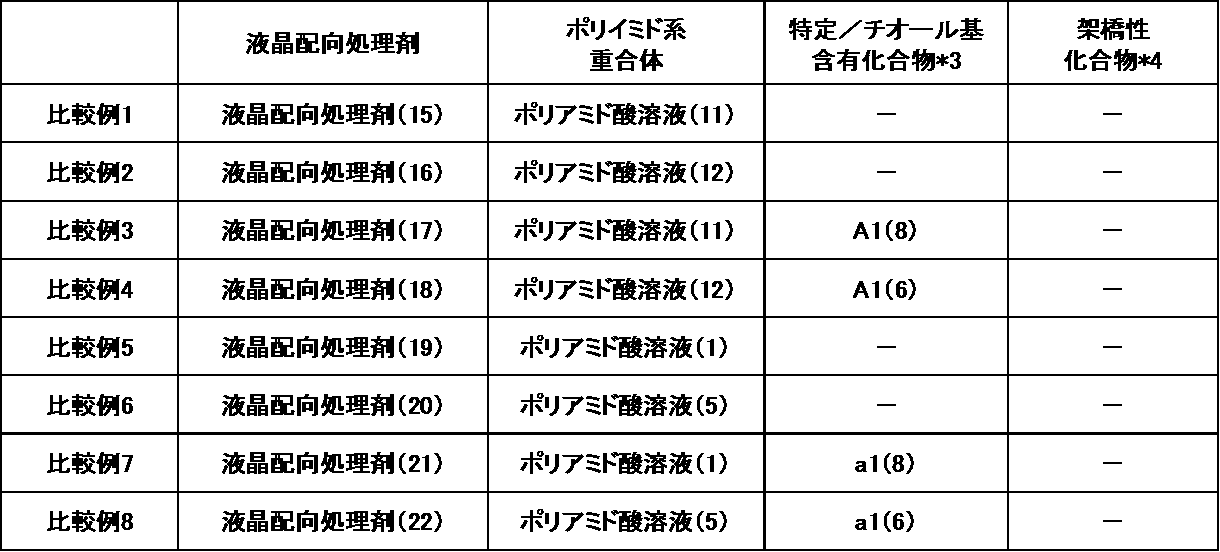
*4:重合体100質量部に対する架橋性化合物の含有量(質量部)を示す。
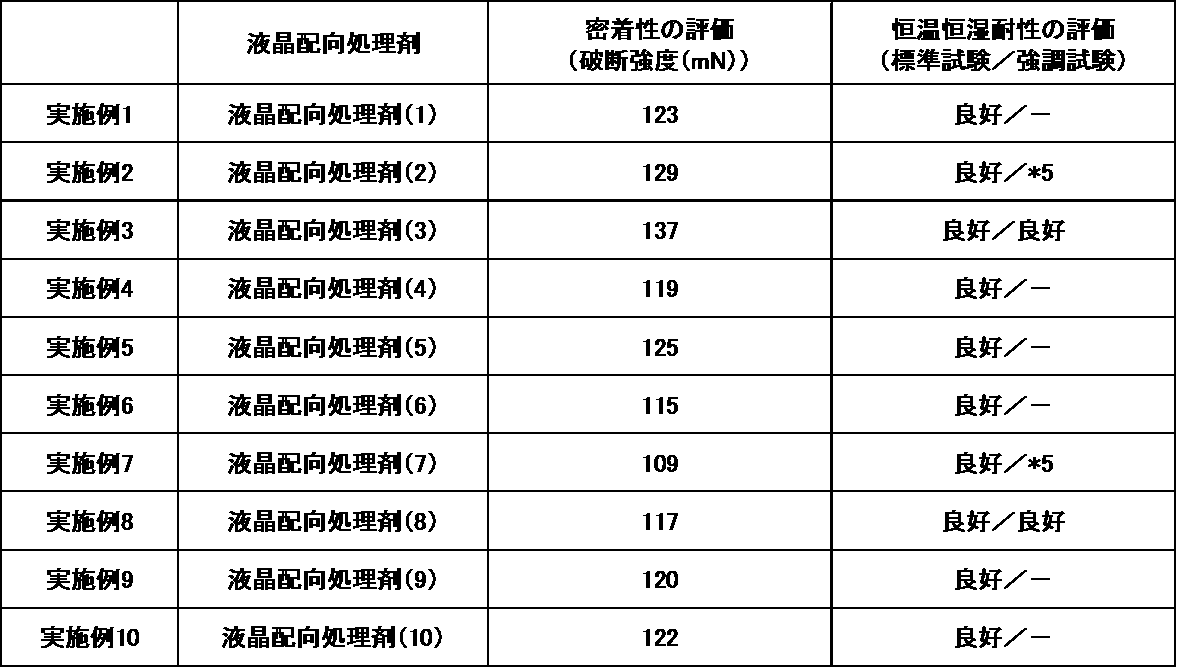
*6:素子内に少量の気泡が見られた(*5よりも多い)。
*7:素子内に気泡が見られた(*6よりも多い)。
*8:素子内に多くの気泡が見られた(*7よりも多い)。
加えて、液晶配向処理剤中に架橋性化合物を導入した場合、強調試験において、液晶セル内に気泡は発生しなかった。具体的には、同一の条件での比較において、実施例2と実施例3との比較、実施例7と実施例8との比較、及び実施例11と実施例12との比較である。
なお、2018年12月27日に出願された日本特許出願2018-246262号の明細書、特許請求の範囲、図面、及び要約書の全内容をここに引用し、本発明の明細書の開示として、取り入れるものである。
Claims (14)
- 下記の(A)成分及び(B)成分を含有する液晶配向処理剤。
(A)成分:分子内にチオール基を3個以上有する化合物。
(B)成分:下記式[1]で表される構造を有するジアミンを含有するジアミン成分とテトラカルボン酸成分との反応で得られるポリイミド前駆体、及び該ポリイミド前駆体をイミド化したポリイミドからなる群から選ばれる少なくとも1種の重合体。


- 前記(A)成分が、1,2,3-プロパントリチオール、1,2,4-ブタントリチオール、ペンタエリスリトールトリス(3-メルカプトプロピオネート)、1,3,5-ベンゼントリチオール、2,4,6-メシチレントリチオール、ネオペンタンテトラチオール、2,4,6-トルエントリチオール、トリメチロールプロパントリス(3-メルカプトプロピオネート)、トリス-[(3-メルカプトプロピオニルオキシ)-エチル]-イソシアヌレート、ペンタエリスリトールテトラキス(3-メルカプトプロピオネート)、テトラエチレングリコールビス(3-メルカプトプロピオネート)、ジペンタエリストールヘキサキス(3-メルカプトプロピオネート)、トリメチロールプロパントリス(3-メルカプトブチレート)、トリメチロールエタントリス(3-メルカプトブチレート)、ペンタエリスリトールテトラキス(3-メルカプトブチレート)、1,3,5-トリス(3-メルカプトブチリルオキシエチル)-1,3,5-トリアジン-2,4,6-(1H.3H.5H)-トリオン、ネオペンタンテトラチオール、2,2’-ビス(メルカプトメチル)-1,3-プロパンジチオール、ペンタエリトリトールテトラキス(3-メルカプトプロピオネート)、又はジペンタエリスリトールヘキサキス(3-メルカプトプロピオネート)からなる群から選ばれる少なくとも1種である請求項1に記載の液晶配向処理剤。
- 前記(A)成分が、トリメチロールプロパントリス(3-メルカプトプロピオネート)、トリス-[(3-メルカプトプロピオニルオキシ)-エチル]-イソシアヌレート、ペンタエリスリトールテトラキス(3-メルカプトプロピオネート)、テトラエチレングリコールビス(3-メルカプトプロピオネート)、ジペンタエリストールヘキサキス(3-メルカプトプロピオネート)、トリメチロールプロパントリス(3-メルカプトブチレート)、トリメチロールエタントリス(3-メルカプトブチレート)、ペンタエリスリトールテトラキス(3-メルカプトブチレート)、1,3,5-トリス(3-メルカプトブチリルオキシエチル)-1,3,5-トリアジン-2,4,6-(1H.3H.5H)-トリオン又はネオペンタンテトラチオール、ペンタエリトリトールテトラキス(3-メルカプトプロピオネート)、又はジペンタエリスリトールヘキサキス(3-メルカプトプロピオネート)である請求項1に記載の液晶配向処理剤。
- 前記(A)成分を、前記重合体100質量部に対して、0.1~30質量部含有する請求項1~3のいずれか一項に記載の液晶配向処理剤。
- 前記式[1]で表される構造を有するジアミンが、下記式[1a]で表されるジアミンである請求項1~4のいずれか一項に記載の液晶配向処理剤。
- 前記式[1a]で表されるジアミンが、下記式[1a-1]~式[1a-9]のいずれかのジアミンである請求項5に記載の液晶配向処理剤。

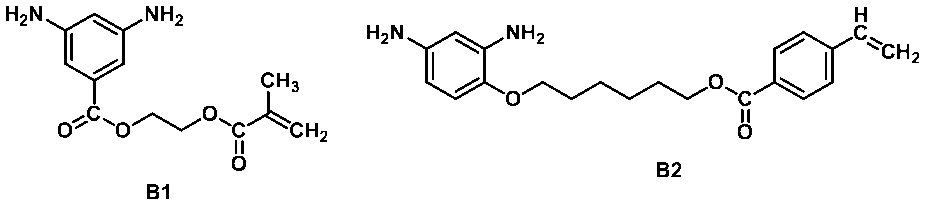
- 前記式[1a]で表されるジアミンが、下記式B1又は式B2のジアミンである請求項5に記載の液晶配向処理剤。
- 前記前記式[1]で表される構造を有するジアミンを、前記ジアミン成分全体に対して1~50モル%含有する請求項1~7のいずれか一項に記載の液晶配向処理剤。
- エポキシ基、イソシアネート基、オキセタン基及びシクロカーボネート基から選ばれる架橋性化合物、ヒドロキシル基、ヒドロキシアルキル基及び炭素数1~3のアルコキシアルキル基から選ばれる架橋性化合物、又は重合性不飽和結合基を有する架橋性化合物から選ばれる少なくとも1種を含む請求項1~8のいずれか一項に記載の液晶配向処理剤。
- 前記架橋性化合物が、下式K1又はK2で表される化合物である請求項9に記載の液晶配向処理剤。

- 前記架橋性化合物を、前記重合体100質量部に対して、0.1~100質量部含有する請求項9又は10に記載の液晶配向処理剤。
- 請求項1~11のいずれか一項に記載の液晶配向処理剤から得られる液晶配向膜。
- 請求項12に記載の液晶配向膜を有する液晶表示素子。
- モバイル機器である請求項13に記載の液晶表示素子。
Priority Applications (3)
| Application Number | Priority Date | Filing Date | Title |
|---|---|---|---|
| CN201980086389.7A CN113260909B (zh) | 2018-12-27 | 2019-12-24 | 液晶取向处理剂、液晶取向膜以及液晶显示元件 |
| KR1020217019558A KR102851507B1 (ko) | 2018-12-27 | 2019-12-24 | 액정 배향 처리제, 액정 배향막 및 액정 표시 소자 |
| JP2020563324A JP7424315B2 (ja) | 2018-12-27 | 2019-12-24 | 液晶配向処理剤、液晶配向膜及び液晶表示素子 |
Applications Claiming Priority (2)
| Application Number | Priority Date | Filing Date | Title |
|---|---|---|---|
| JP2018246262 | 2018-12-27 | ||
| JP2018-246262 | 2018-12-27 |
Publications (1)
| Publication Number | Publication Date |
|---|---|
| WO2020138112A1 true WO2020138112A1 (ja) | 2020-07-02 |
Family
ID=71129397
Family Applications (1)
| Application Number | Title | Priority Date | Filing Date |
|---|---|---|---|
| PCT/JP2019/050692 Ceased WO2020138112A1 (ja) | 2018-12-27 | 2019-12-24 | 液晶配向処理剤、液晶配向膜及び液晶表示素子 |
Country Status (5)
| Country | Link |
|---|---|
| JP (1) | JP7424315B2 (ja) |
| KR (1) | KR102851507B1 (ja) |
| CN (1) | CN113260909B (ja) |
| TW (1) | TWI824090B (ja) |
| WO (1) | WO2020138112A1 (ja) |
Cited By (3)
| Publication number | Priority date | Publication date | Assignee | Title |
|---|---|---|---|---|
| WO2026038531A1 (ja) * | 2024-08-16 | 2026-02-19 | 三井化学株式会社 | ポリチオール組成物、光学材料用重合性組成物、成形体、光学材料およびプラスチックレンズ |
| WO2026038529A1 (ja) * | 2024-08-16 | 2026-02-19 | 三井化学株式会社 | ポリチオール組成物、光学材料用重合性組成物、成形体、光学材料およびプラスチックレンズ |
| WO2026038530A1 (ja) * | 2024-08-16 | 2026-02-19 | 三井化学株式会社 | ポリチオール組成物、光学材料用重合性組成物、成形体、光学材料およびプラスチックレンズ |
Citations (4)
| Publication number | Priority date | Publication date | Assignee | Title |
|---|---|---|---|---|
| JP2014112192A (ja) * | 2012-10-31 | 2014-06-19 | Jsr Corp | Psaモード液晶表示素子用液晶配向剤、psaモード液晶表示素子用液晶配向膜、並びにpsaモード液晶表示素子及びその製造方法 |
| JP2014186301A (ja) * | 2013-02-25 | 2014-10-02 | Jsr Corp | 液晶表示素子用組成物、並びに液晶表示素子及びその製造方法 |
| JP2014527555A (ja) * | 2011-08-02 | 2014-10-16 | ロリク アーゲーRolic Ag | 光配向性材料 |
| JP2016118573A (ja) * | 2014-12-18 | 2016-06-30 | Jsr株式会社 | 液晶配向剤、液晶表示素子の製造方法、液晶配向膜、液晶表示素子、重合体及び化合物 |
Family Cites Families (7)
| Publication number | Priority date | Publication date | Assignee | Title |
|---|---|---|---|---|
| JPS61171762A (ja) | 1985-01-28 | 1986-08-02 | Japan Synthetic Rubber Co Ltd | 可溶性ポリイミド樹脂組成物 |
| JP2980080B2 (ja) | 1997-10-09 | 1999-11-22 | ジェイエスアール株式会社 | 液晶配向剤 |
| TW201510186A (zh) * | 2013-05-29 | 2015-03-16 | Dainippon Ink & Chemicals | 聚合性液晶組成物、相位差膜、相位差圖案化膜、及沿面配向液晶膜 |
| TWI634105B (zh) * | 2013-05-29 | 2018-09-01 | 迪愛生股份有限公司 | 聚合性組成物溶液、及使用其之光學異向體 |
| WO2015022980A1 (ja) * | 2013-08-14 | 2015-02-19 | 日産化学工業株式会社 | 液晶表示素子 |
| WO2016072498A1 (ja) * | 2014-11-07 | 2016-05-12 | 日産化学工業株式会社 | 液晶表示素子 |
| KR102534332B1 (ko) * | 2014-12-25 | 2023-05-18 | 닛산 가가쿠 가부시키가이샤 | 액정 배향 처리제, 액정 배향막 및 액정 표시 소자 |
-
2019
- 2019-12-24 WO PCT/JP2019/050692 patent/WO2020138112A1/ja not_active Ceased
- 2019-12-24 CN CN201980086389.7A patent/CN113260909B/zh active Active
- 2019-12-24 JP JP2020563324A patent/JP7424315B2/ja active Active
- 2019-12-24 KR KR1020217019558A patent/KR102851507B1/ko active Active
- 2019-12-26 TW TW108147823A patent/TWI824090B/zh active
Patent Citations (4)
| Publication number | Priority date | Publication date | Assignee | Title |
|---|---|---|---|---|
| JP2014527555A (ja) * | 2011-08-02 | 2014-10-16 | ロリク アーゲーRolic Ag | 光配向性材料 |
| JP2014112192A (ja) * | 2012-10-31 | 2014-06-19 | Jsr Corp | Psaモード液晶表示素子用液晶配向剤、psaモード液晶表示素子用液晶配向膜、並びにpsaモード液晶表示素子及びその製造方法 |
| JP2014186301A (ja) * | 2013-02-25 | 2014-10-02 | Jsr Corp | 液晶表示素子用組成物、並びに液晶表示素子及びその製造方法 |
| JP2016118573A (ja) * | 2014-12-18 | 2016-06-30 | Jsr株式会社 | 液晶配向剤、液晶表示素子の製造方法、液晶配向膜、液晶表示素子、重合体及び化合物 |
Cited By (3)
| Publication number | Priority date | Publication date | Assignee | Title |
|---|---|---|---|---|
| WO2026038531A1 (ja) * | 2024-08-16 | 2026-02-19 | 三井化学株式会社 | ポリチオール組成物、光学材料用重合性組成物、成形体、光学材料およびプラスチックレンズ |
| WO2026038529A1 (ja) * | 2024-08-16 | 2026-02-19 | 三井化学株式会社 | ポリチオール組成物、光学材料用重合性組成物、成形体、光学材料およびプラスチックレンズ |
| WO2026038530A1 (ja) * | 2024-08-16 | 2026-02-19 | 三井化学株式会社 | ポリチオール組成物、光学材料用重合性組成物、成形体、光学材料およびプラスチックレンズ |
Also Published As
| Publication number | Publication date |
|---|---|
| KR20210108963A (ko) | 2021-09-03 |
| JP7424315B2 (ja) | 2024-01-30 |
| TW202037638A (zh) | 2020-10-16 |
| TWI824090B (zh) | 2023-12-01 |
| CN113260909A (zh) | 2021-08-13 |
| KR102851507B1 (ko) | 2025-08-27 |
| CN113260909B (zh) | 2025-04-01 |
| JPWO2020138112A1 (ja) | 2021-11-11 |
Similar Documents
| Publication | Publication Date | Title |
|---|---|---|
| JP6372009B2 (ja) | 液晶配向剤、液晶配向膜及び液晶表示素子 | |
| JPWO2008010528A1 (ja) | 液晶配向剤並びにそれを用いた液晶配向膜及び液晶表示素子 | |
| KR102596591B1 (ko) | 화합물, 액정 조성물 및 액정 표시 소자 | |
| JP7424315B2 (ja) | 液晶配向処理剤、液晶配向膜及び液晶表示素子 | |
| WO2019022202A1 (ja) | 樹脂組成物、樹脂膜及び液晶表示素子 | |
| JP7078033B2 (ja) | 重合体及びそれを用いた液晶配向剤 | |
| JP7424366B2 (ja) | 液晶配向処理剤、液晶配向膜及び液晶表示素子 | |
| KR102861876B1 (ko) | 액정 배향 처리제, 액정 배향막 및 액정 표시 소자 | |
| TW202045586A (zh) | 液晶配向劑、液晶配向膜及使用其之液晶顯示元件 | |
| US11966120B2 (en) | Liquid crystal light control element | |
| WO2019181885A1 (ja) | 液晶表示素子 | |
| JP7392663B2 (ja) | 液晶配向処理剤、液晶配向膜及び液晶表示素子 | |
| JP4092558B2 (ja) | 新規な液晶配向処理剤 | |
| KR102793965B1 (ko) | 액정 표시 소자 및 그 제조 방법 | |
| KR102768031B1 (ko) | 수지 조성물, 수지막 및 액정 표시 소자 | |
| TW202532527A (zh) | 聚合物、樹脂組成物、液晶配向劑、樹脂被膜及液晶配向膜 |
Legal Events
| Date | Code | Title | Description |
|---|---|---|---|
| 121 | Ep: the epo has been informed by wipo that ep was designated in this application |
Ref document number: 19901816 Country of ref document: EP Kind code of ref document: A1 |
|
| ENP | Entry into the national phase |
Ref document number: 2020563324 Country of ref document: JP Kind code of ref document: A |
|
| NENP | Non-entry into the national phase |
Ref country code: DE |
|
| 122 | Ep: pct application non-entry in european phase |
Ref document number: 19901816 Country of ref document: EP Kind code of ref document: A1 |
|
| WWG | Wipo information: grant in national office |
Ref document number: 201980086389.7 Country of ref document: CN |