WO2020138050A1 - 熱可塑性樹脂組成物及びそれを用いた光学部材 - Google Patents
熱可塑性樹脂組成物及びそれを用いた光学部材 Download PDFInfo
- Publication number
- WO2020138050A1 WO2020138050A1 PCT/JP2019/050552 JP2019050552W WO2020138050A1 WO 2020138050 A1 WO2020138050 A1 WO 2020138050A1 JP 2019050552 W JP2019050552 W JP 2019050552W WO 2020138050 A1 WO2020138050 A1 WO 2020138050A1
- Authority
- WO
- WIPO (PCT)
- Prior art keywords
- thermoplastic resin
- resin composition
- bis
- integer
- carbon atoms
- Prior art date
- Legal status (The legal status is an assumption and is not a legal conclusion. Google has not performed a legal analysis and makes no representation as to the accuracy of the status listed.)
- Ceased
Links
Classifications
-
- C—CHEMISTRY; METALLURGY
- C08—ORGANIC MACROMOLECULAR COMPOUNDS; THEIR PREPARATION OR CHEMICAL WORKING-UP; COMPOSITIONS BASED THEREON
- C08L—COMPOSITIONS OF MACROMOLECULAR COMPOUNDS
- C08L69/00—Compositions of polycarbonates; Compositions of derivatives of polycarbonates
- C08L69/005—Polyester-carbonates
-
- C—CHEMISTRY; METALLURGY
- C08—ORGANIC MACROMOLECULAR COMPOUNDS; THEIR PREPARATION OR CHEMICAL WORKING-UP; COMPOSITIONS BASED THEREON
- C08G—MACROMOLECULAR COMPOUNDS OBTAINED OTHERWISE THAN BY REACTIONS ONLY INVOLVING UNSATURATED CARBON-TO-CARBON BONDS
- C08G64/00—Macromolecular compounds obtained by reactions forming a carbonic ester link in the main chain of the macromolecule
- C08G64/04—Aromatic polycarbonates
- C08G64/06—Aromatic polycarbonates not containing aliphatic unsaturation
-
- C—CHEMISTRY; METALLURGY
- C08—ORGANIC MACROMOLECULAR COMPOUNDS; THEIR PREPARATION OR CHEMICAL WORKING-UP; COMPOSITIONS BASED THEREON
- C08G—MACROMOLECULAR COMPOUNDS OBTAINED OTHERWISE THAN BY REACTIONS ONLY INVOLVING UNSATURATED CARBON-TO-CARBON BONDS
- C08G64/00—Macromolecular compounds obtained by reactions forming a carbonic ester link in the main chain of the macromolecule
- C08G64/20—General preparatory processes
- C08G64/30—General preparatory processes using carbonates
- C08G64/307—General preparatory processes using carbonates and phenols
-
- C—CHEMISTRY; METALLURGY
- C08—ORGANIC MACROMOLECULAR COMPOUNDS; THEIR PREPARATION OR CHEMICAL WORKING-UP; COMPOSITIONS BASED THEREON
- C08K—Use of inorganic or non-macromolecular organic substances as compounding ingredients
- C08K5/00—Use of organic ingredients
- C08K5/0008—Organic ingredients according to more than one of the "one dot" groups of C08K5/01 - C08K5/59
- C08K5/0041—Optical brightening agents, organic pigments
-
- C—CHEMISTRY; METALLURGY
- C08—ORGANIC MACROMOLECULAR COMPOUNDS; THEIR PREPARATION OR CHEMICAL WORKING-UP; COMPOSITIONS BASED THEREON
- C08K—Use of inorganic or non-macromolecular organic substances as compounding ingredients
- C08K5/00—Use of organic ingredients
- C08K5/16—Nitrogen-containing compounds
- C08K5/17—Amines; Quaternary ammonium compounds
- C08K5/18—Amines; Quaternary ammonium compounds with aromatically bound amino groups
-
- C—CHEMISTRY; METALLURGY
- C08—ORGANIC MACROMOLECULAR COMPOUNDS; THEIR PREPARATION OR CHEMICAL WORKING-UP; COMPOSITIONS BASED THEREON
- C08K—Use of inorganic or non-macromolecular organic substances as compounding ingredients
- C08K5/00—Use of organic ingredients
- C08K5/16—Nitrogen-containing compounds
- C08K5/315—Compounds containing carbon-to-nitrogen triple bonds
-
- C—CHEMISTRY; METALLURGY
- C08—ORGANIC MACROMOLECULAR COMPOUNDS; THEIR PREPARATION OR CHEMICAL WORKING-UP; COMPOSITIONS BASED THEREON
- C08K—Use of inorganic or non-macromolecular organic substances as compounding ingredients
- C08K5/00—Use of organic ingredients
- C08K5/16—Nitrogen-containing compounds
- C08K5/34—Heterocyclic compounds having nitrogen in the ring
- C08K5/3442—Heterocyclic compounds having nitrogen in the ring having two nitrogen atoms in the ring
- C08K5/3462—Six-membered rings
- C08K5/3465—Six-membered rings condensed with carbocyclic rings
-
- C—CHEMISTRY; METALLURGY
- C08—ORGANIC MACROMOLECULAR COMPOUNDS; THEIR PREPARATION OR CHEMICAL WORKING-UP; COMPOSITIONS BASED THEREON
- C08L—COMPOSITIONS OF MACROMOLECULAR COMPOUNDS
- C08L67/00—Compositions of polyesters obtained by reactions forming a carboxylic ester link in the main chain; Compositions of derivatives of such polymers
- C08L67/02—Polyesters derived from dicarboxylic acids and dihydroxy compounds
- C08L67/025—Polyesters derived from dicarboxylic acids and dihydroxy compounds containing polyether sequences
-
- C—CHEMISTRY; METALLURGY
- C08—ORGANIC MACROMOLECULAR COMPOUNDS; THEIR PREPARATION OR CHEMICAL WORKING-UP; COMPOSITIONS BASED THEREON
- C08L—COMPOSITIONS OF MACROMOLECULAR COMPOUNDS
- C08L69/00—Compositions of polycarbonates; Compositions of derivatives of polycarbonates
-
- G—PHYSICS
- G02—OPTICS
- G02B—OPTICAL ELEMENTS, SYSTEMS OR APPARATUS
- G02B1/00—Optical elements characterised by the material of which they are made; Optical coatings for optical elements
- G02B1/04—Optical elements characterised by the material of which they are made; Optical coatings for optical elements made of organic materials, e.g. plastics
- G02B1/041—Lenses
-
- G—PHYSICS
- G02—OPTICS
- G02B—OPTICAL ELEMENTS, SYSTEMS OR APPARATUS
- G02B5/00—Optical elements other than lenses
- G02B5/20—Filters
- G02B5/208—Filters for use with infrared or ultraviolet radiation, e.g. for separating visible light from infrared and/or ultraviolet radiation
-
- G—PHYSICS
- G02—OPTICS
- G02B—OPTICAL ELEMENTS, SYSTEMS OR APPARATUS
- G02B5/00—Optical elements other than lenses
- G02B5/20—Filters
- G02B5/22—Absorbing filters
Definitions
- the present invention relates to a thermoplastic resin composition, more specifically, a thermoplastic resin composition containing a high refractive material, and an optical lens using the thermoplastic resin composition.
- Infrared cameras and infrared sensors are used to visualize infrared rays emitted from an object as the amount of infrared rays changes with changes in the temperature of the object, and operate in a dark place as compared with the case of detecting with visible light. Has stability. Infrared cameras and infrared sensors are used in diagnostics in the medical field, non-destructive inspections to detect deterioration of buildings and electrical equipment, night-vision cameras in the security field, and biometric cameras in financial institutions such as ATMs and airports. Widely used for authentication.
- infrared cameras and infrared sensors are equipped with semiconductors such as silicon semiconductors as devices that detect infrared rays.
- semiconductors such as silicon semiconductors as devices that detect infrared rays.
- semiconductors detect visible light as well as infrared light. Therefore, the material used for the lens for the infrared camera/sensor is required to have the property of detecting infrared rays and cutting visible light.
- optical glass or optical resin has been used as a material for optical elements used in optical systems of various cameras such as cameras, film-integrated cameras, and video cameras.
- a visible light cut material such as bisphenol A-polycarbonate is known as an optical resin that detects infrared rays and cuts visible rays, and is used for infrared transmission filters and the like (Patent Documents 1 to 3). ).
- thermoplastic resin composition containing a high-refractive material and an optical lens using the thermoplastic resin composition are not known.
- thermoplastic resin composition containing a high refractive material and an optical lens using the resin composition as a material that cuts visible light and has infrared light transmittance is desired.
- thermoplastic resin composition containing a thermoplastic resin and a coloring material as an optical lens material that cuts visible light and has infrared light transmissivity.
- the present invention has been completed.
- the present invention includes the following embodiments.
- thermoplastic resin composition comprising a thermoplastic resin and a coloring material,
- the refractive index at a wavelength of 894 nm is 1.60 or more
- the maximum value of the transmittance at a wavelength of 380 nm to 630 nm is more than 0% and 1.00% or less
- the average transmittance at a wavelength of 840 nm to 940 nm is 80%. That's it, Thermoplastic resin composition.
- thermoplastic resin composition according to (1) above wherein the thermoplastic resin contains a resin selected from the group consisting of a polycarbonate resin, a polyester resin, and a polyester carbonate resin.
- thermoplastic resin contains, as a monomer, a diol compound selected from the group consisting of compounds represented by the following general formula (I), general formula (II), and general formula (III):
- R 1 to R 4 are each independently selected from a hydrogen atom, a fluorine atom, a chlorine atom, a bromine atom, an iodine atom, an alkyl group having 1 to 6 carbon atoms, or an oxygen atom, a nitrogen atom and a sulfur atom.
- i represents an integer of 0 to 10
- ii represents an integer of 1 to 10
- iii represents an integer of 1 to 10.
- R 6 and R 7 have the same meaning as R 1 to R 4 , n and m represent an integer of 0 to 5, Y represents an alkylene group having 1 to 5 carbon atoms, n1 and n2 each independently represent an integer of 0 to 10.
- R 8 and R 9 have the same meaning as R 1 to R 4 , a and b represent an integer of 0 to 4, Y represents an alkylene group having 1 to 5 carbon atoms, n1 and n2 each independently represent an integer of 0 to 10.
- thermoplastic resin composition according to any one of (1) to (3) above, wherein the coloring material contains at least one of a green pigment, a red pigment, a yellow pigment, and a purple pigment.
- the coloring material contains at least one of anthraquinone pigment, perinone pigment, methine pigment, isoindoline pigment, phthalocyanine pigment, quinacridone pigment, azo pigment, and lake pigment.
- the thermoplastic resin composition according to any one of 1) to (3).
- thermoplastic resin composition having a thickness of 1 mm, the maximum value of the transmittance at a wavelength of 380 nm to 630 nm is more than 0% and 0.8% or less.
- the thermoplastic resin composition as described in 1.
- thermoplastic resin composition having a thickness of 1 mm, the maximum value of transmittance at a wavelength of 380 nm to 630 nm is more than 0% and 0.5% or less.
- the thermoplastic resin composition as described in 1.
- thermoplastic resin composition according to any one of (1) to (7) above.
- thermoplastic resin composition (9) An infrared camera lens containing the thermoplastic resin composition according to any one of (1) to (7) above.
- thermoplastic resin composition according to any one of (1) to (7) above.
- thermoplastic resin composition containing the high-refractive material of the present invention has infrared transmissivity, and by cutting visible light, noise derived from visible light can be reduced. Therefore, the optical lens using the thermoplastic resin composition of the present invention can improve the image accuracy of an infrared camera or an infrared sensor. Further, by using the thermoplastic resin composition of the present invention for an optical lens, it is possible to increase the frequency of the optical lens and reduce the number of the optical lenses. Further, as compared with a method of cutting visible light such as an infrared transmission filter, the filter can be made less, so that the number of parts can be reduced and the height can be reduced.
- Thermoplastic resin composition The present invention provides a thermoplastic resin composition containing a thermoplastic resin and a coloring material.
- thermoplastic resin that can be used in the thermoplastic resin composition may include, but is not limited to, a polycarbonate resin, a polyester resin, and a polyester carbonate resin. .. In a preferred embodiment of the present invention, the thermoplastic resin composition is a polycarbonate resin.
- thermoplastic resin that can be used in the thermoplastic resin composition is a compound represented by the following general formula (I), general formula (II), and general formula (III) as a monomer.
- R 1 to R 4 are each independently selected from a hydrogen atom, a fluorine atom, a chlorine atom, a bromine atom, an iodine atom, an alkyl group having 1 to 6 carbon atoms, or an oxygen atom, a nitrogen atom and a sulfur atom.
- i represents an integer of 0 to 10
- ii represents an integer of 1 to 10
- iii represents an integer of 1 to 10.
- R 6 and R 7 have the same meaning as R 1 to R 4 , n and m represent an integer of 0 to 5, Y represents an alkylene group having 1 to 5 carbon atoms, n1 and n2 each independently represent an integer of 0 to 10. )
- R 8 and R 9 have the same meaning as R 1 to R 4 , a and b represent an integer of 0 to 4, Y represents an alkylene group having 1 to 5 carbon atoms, n1 and n2 each independently represent an integer of 0 to 10. )
- the monomer represented by the general formula (I) include 9,9-bis(4-hydroxy-3-ethylphenyl)fluorene and 9,9-bis(4-hydroxy-3-methylphenyl). Fluorene, 9,9-bis(4-hydroxyphenyl)fluorene, 9,9-bis[4-(2-hydroxyethoxy)phenyl]fluorene, 9,9-bis[4-(2-hydroxyethoxy)-3- Methylphenyl]fluorene, 9,9-bis[4-(2-hydroxyethoxy)-3-tert-butylphenyl]fluorene, 9,9-bis[4-(2-hydroxyethoxy)-3-isopropylphenyl]fluorene , 9,9-bis[4-(2-hydroxyethoxy)-3-cyclohexylphenyl]fluorene, 9,9-bis[4-(2-hydroxyethoxy)-3-phenylphenyl]fluorene, 4-(9- (4-H
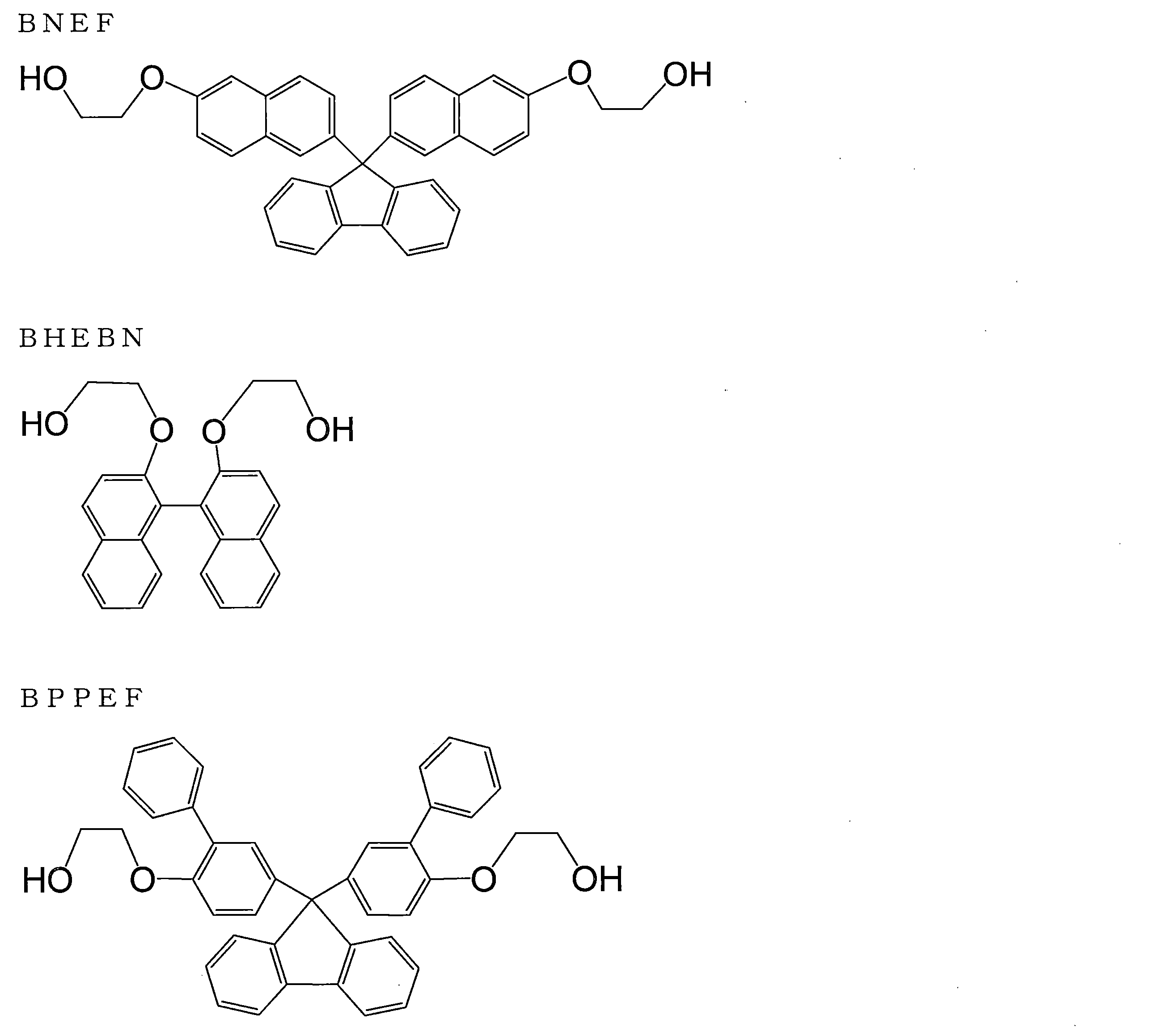
- the monomer represented by the general formula (II) include 2,2′-bis(1-hydroxymethoxy)-1,1′-binaphthalene and 2,2′-bis(2-hydroxyethoxy).
- -1,1'-Binaphthalene also referred to as "BHEBN”
- 2,2'-bis(3-hydroxypropyloxy)-1,1'-binaphthalene 2,2'-bis(4-hydroxybutoxy)-1 ,1′-Binaphthalene
- 2,2′-bis(2-hydroxyethoxy)-6,6′-diphenyl-1,1′-binaphthalene also referred to as “BINL-2EO”
- 9,9-bis(6- (2-hydroxyethoxy)naphthalen-2-yl)fluorene also referred to as “BNEF”
- 2,2′-bis(2-hydroxyethoxy)-1,1′-binaphthalene also referred to as “BNE”
- the monomer represented by the general formula (III) include 9,9-bis[6-(1-hydroxymethoxy)naphthalen-2-yl]fluorene and 9,9-bis[6-(2 -Hydroxyethoxy)naphthalen-2-yl]fluorene, 9,9-bis[6-(3-hydroxypropoxy)naphthalen-2-yl]fluorene, and 9,9-bis[6-(4-hydroxybutoxy)naphthalene Examples include, but are not limited to, 2--2-yl]fluorene. Among the monomers represented by the above general formula (III), 9,9-bis[6-(2-hydroxyethoxy)naphthalen-2-yl]fluorene is preferable.
- the thermoplastic resin contains, as a monomer, a diol compound selected from the group consisting of compounds represented by the general formulas (I), (II), and (III). It may be a one-component resin produced by using only one type, a two-component resin produced by using two types, or a ternary resin produced by using three types. It may be a quaternary resin produced by using four kinds. Alternatively, in one embodiment of the present invention, the thermoplastic resin is a blend of two or more resins among the above-mentioned one-component resin, two-component resin, three-component resin, and four-component resin. Good.
- the thermoplastic resin is a monomer other than a diol compound selected from the group consisting of compounds represented by the general formula (I), the general formula (II), and the general formula (III). Other diol compounds may be included.
- diol compounds examples include 4,4′-biphenyldiol, bis(4-hydroxyphenyl)methane, bis(2-hydroxyphenyl)methane, 2,4′-dihydroxydiphenylmethane, and bis(4- Hydroxyphenyl)ether, bis(4-hydroxyphenyl)sulfone, 2,4′-dihydroxydiphenylsulfone, bis(2-hydroxyphenyl)sulfone, bis(4-hydroxy-3-methylphenyl)sulfone, bis(4-hydroxy) Phenyl) sulfoxide, bis(4-hydroxyphenyl) sulfide, bis(4-hydroxyphenyl) ketone, 1,1-bis(4-hydroxyphenyl)ethane, 1,1-bis(4-hydroxyphenyl)-1-phenyl Ethane, bis(4-hydroxyphenyl)diphenylmethane, 2,2-bis(4-hydroxyphenyl)propane, 2,2-bis(4-hydroxy
- thermoplastic resin when the thermoplastic resin contains a polyester resin and/or a polyester carbonate resin, these resins may contain a compound represented by the following general formula (V) as a monomer.
- R 1 and R 2 are each independently selected from a hydrogen atom, a fluorine atom, a chlorine atom, a bromine atom, an iodine atom, an alkyl group having 1 to 6 carbon atoms, or an oxygen atom, a nitrogen atom and a sulfur atom.
- the thermoplastic resin may include any of a random copolymer structure, a block copolymer structure, and an alternating copolymer structure.
- the polystyrene-equivalent weight average molecular weight (Mw) of the thermoplastic resin may be preferably 20,000 to 200,000.
- the polystyrene reduced mass average molecular weight (Mw) of the thermoplastic resin is more preferably 25,000 to 120,000, further preferably 28,000 to 55,000, and particularly preferably 30,000 to 45, It is 000.
- Mw mass average molecular weight
- the polystyrene-converted mass average molecular weight (Mw) of the thermoplastic resin is within the above range, it is possible to prevent the molded body from becoming brittle, and to prevent the melt viscosity from becoming excessively high and to easily take out the resin after production. In addition, the fluidity can be improved and injection molding in a molten state can be facilitated.
- thermoplastic resin composition can be blended with the above thermoplastic resin and another resin to be used for manufacturing an optical lens.
- other resins include, but are not limited to, polyamide, polyacetal, polycarbonate, modified polyphenylene ether, polyethylene terephthalate, polybutylene terephthalate, and the like.
- the coloring material is not particularly limited as long as it can be used in the thermoplastic resin composition of the present invention, and for example, dyes and pigments, organic coloring materials and inorganic coloring materials can be used. it can.
- the coloring material that can be used in the thermoplastic resin composition may include at least one of a green pigment, a red pigment, a yellow pigment, and a purple pigment.
- the coloring material that can be used in the thermoplastic resin composition includes a green pigment, a red pigment, a yellow pigment, and a purple pigment.
- the coloring material that can be used in the thermoplastic resin composition is anthraquinone pigment, perinone pigment, methine pigment, isoindoline pigment, phthalocyanine pigment, quinacridone pigment, azo pigment. , And at least one of lake pigments.
- thermoplastic resin composition for example, anthraquinone type, perinone type, etc. can be used, Oil Green 5602 made by Arimoto Chemical Co., Macrolex Green G made by LANXESS, Oplas Green 533 made by Orient Chemical.
- Oil Green 5602 made by Arimoto Chemical Co.
- Macrolex Green G made by LANXESS
- Oplas Green 533 made by Orient Chemical.
- the present invention is not limited to these.
- red pigments examples include, for example, perinone-based and anthraquinone-based pigments, and Arimoto Chemical Co., Ltd. Oil Red 5303, Fluorescent Red DR-345, Plast Red 8355, 8360. , 8365, 8370, D-54, DR-426N, DR-427N, LANXESS MacrolexRedA, MacrolexRedEG and the like, but are not limited thereto.
- yellow pigment examples include, for example, methine-based, anthraquinone-based, and perinone-based, Arimoto Chemical Co., Ltd. Oil Yellow 5001, Plast Yellow 8000, 8005, 8040, 8050, 8070, LANXESS Macrolex Yellow6G, but not limited to.
- Examples of purple pigments that can be used in the thermoplastic resin composition include anthraquinone-based and perinone-based pigments, and Arimoto Chemical Co., Ltd.Plast Violet 8840, 8850, 8855, LANXESS Macrolex Violet 3R, and the like. However, it is not limited to these.
- thermoplastic resin composition can contain an antioxidant and a release agent as additives.
- Antioxidants include triethylene glycol-bis[3-(3-tert-butyl-5-methyl-4-hydroxyphenyl)propionate], 1,6-hexanediol-bis[3-(3,5-di -Tert-butyl-4-hydroxyphenyl)propionate], pentaerythritol-tetrakis[3-(3,5-di-tert-butyl-4-hydroxyphenyl)propionate], octadecyl-3-(3,5-di- tert-Butyl-4-hydroxyphenyl)propionate, 1,3,5-trimethyl-2,4,6-tris(3,5-di-tert-butyl-4-hydroxybenzyl)benzene, N,N-hexamethylene Bis(3,5-di-tert-butyl-4-hydroxy-hydrocinnamide), 3,5-di-tert-butyl-4-hydroxy-benzylphosphonate-diethyl ester
- the content of the antioxidant is preferably 0.50% by mass or less in the thermoplastic resin composition, more preferably 0.10 to 0.40% by mass, and 0.20 to 0. It is particularly preferably 40% by mass.
- esters of alcohols and fatty acids include esters of monohydric alcohols and fatty acids, and partial or total esters of polyhydric alcohols and fatty acids.
- the ester of monohydric alcohol and fatty acid is preferably an ester of monohydric alcohol having 1 to 20 carbon atoms and saturated fatty acid having 10 to 30 carbon atoms.
- partial ester or total ester of polyhydric alcohol and fatty acid partial ester or total ester of polyhydric alcohol having 1 to 25 carbon atoms and saturated fatty acid having 10 to 30 carbon atoms is preferable.
- ester of monohydric alcohol and saturated fatty acid examples include stearyl stearate, palmityl palmitate, butyl stearate, methyl laurate, isopropyl palmitate and the like.
- a partial ester or a full ester of a polyhydric alcohol and a saturated fatty acid examples include stearic acid monoglyceride, stearic acid monoglyceride, stearic acid diglyceride, stearic acid triglyceride, stearic acid monosorbate, behenic acid monoglyceride, capric acid monoglyceride, lauric acid monoglyceride, Diesters such as pentaerythritol monostearate, pentaerythritol tetrastearate, pentaerythritol tetrapelargonate, propylene glycol monostearate, biphenyl biphenate, sorbitan monostearate, 2-ethylhexy
- the content of the release agent in the thermoplastic resin composition is preferably 0.50% by mass or less, more preferably 0.01 to 0.10% by mass, and 0.03 to 0. It is particularly preferable that the content is 05% by mass.
- thermoplastic resin composition of the present invention as other additives, processing stabilizers, ultraviolet absorbers, fluidity modifiers, crystal nucleating agents, reinforcing agents, dyes, antistatic agents, bluing agents, antibacterial agents. Agents and the like may be added.
- thermoplastic resin of the present invention phenol produced during the production, diol or carbonic acid diester which is a monomer remaining without reacting may be present as impurities.
- the phenol content in the thermoplastic resin is preferably 0.1 to 3000 ppm, more preferably 0.1 to 2000 ppm, more preferably 1 to 1000 ppm, 1 to 800 ppm, 1 to 500 ppm, or 1 to 300 ppm. Is particularly preferable.
- the diol content in the thermoplastic resin is preferably 0.1 to 5000 ppm, more preferably 1 to 3000 ppm, even more preferably 1 to 1000 ppm, and particularly preferably 1 to 500 ppm. ..
- the content of carbonic acid diester in the thermoplastic resin is preferably 0.1 to 1000 ppm, more preferably 0.1 to 500 ppm, and particularly preferably 1 to 100 ppm.
- a resin having physical properties suitable for the purpose can be obtained.
- the phenol and carbonic acid diester contents can be adjusted appropriately by changing the polycondensation conditions and equipment. It can also be adjusted depending on the conditions of the extrusion process after polycondensation.
- thermoplastic resin can be produced according to the method described in WO2018/016516. Specifically, a diol compound selected from the group consisting of compounds represented by the following general formula (I), general formula (II), and general formula (III) and a carbonate precursor such as carbonic acid diester: It can be produced by reacting by a melt polycondensation method in the presence of a basic compound catalyst and/or a transesterification catalyst or in the absence of a catalyst under heating and further under normal pressure or reduced pressure.
- the method for producing the thermoplastic resin composition of the present invention is not limited to the above production method.
- R 1 to R 4 are each independently selected from a hydrogen atom, a fluorine atom, a chlorine atom, a bromine atom, an iodine atom, an alkyl group having 1 to 6 carbon atoms, or an oxygen atom, a nitrogen atom and a sulfur atom.
- i represents an integer of 0 to 10
- ii represents an integer of 1 to 10
- iii represents an integer of 1 to 10.
- R 6 and R 7 have the same meaning as R 1 to R 4 , n and m represent an integer of 0 to 5, Y represents an alkylene group having 1 to 5 carbon atoms, n1 and n2 each independently represent an integer of 0 to 10.
- R 8 and R 9 have the same meaning as R 1 to R 4 , a and b represent an integer of 0 to 4, Y represents an alkylene group having 1 to 5 carbon atoms, n1 and n2 each independently represent an integer of 0 to 10.
- the thermoplastic resin composition can be produced by melt-kneading the thermoplastic resin produced as described above and a coloring material.
- the thermoplastic resin of the present invention can be obtained as pellets by, for example, mixing with a tumbler, then melt-kneading with a twin-screw extruder, and strand cutting, but the method is not limited to this.
- thermoplastic resin composition of the present invention which is a highly refractive material to which a coloring material is added, cuts visible light and has infrared light transmissivity. Therefore, by using the thermoplastic resin composition of the present invention for an optical lens for an infrared light camera/sensor, it is possible to effectively reduce noise derived from visible light.
- the thermoplastic resin composition may have a refractive index of 1.60 or more at a wavelength of 894 nm and 23°C.
- the refractive index of the thermoplastic resin composition of the present invention at a wavelength of 894 nm is preferably 1.61 to 1.71, more preferably 1.62 to 1.70, and particularly preferably 1.64 to 1.70. It may be 68.
- the thermoplastic resin composition of the present invention has a high refractive index and is suitable as an optical lens material. The refractive index can be measured using a V-block method refractometer (“PR-2” manufactured by Carl Zeiss Jena) in accordance with JIS B7071-2.
- PR-2 V-block method refractometer
- the thermoplastic resin composition has a maximum transmittance of more than 0% and 1.00% or less at a wavelength of 380 nm to 630 nm when the thickness is 1 mm, and The average transmittance at a wavelength of 840 nm to 940 nm may be 80% or more.
- the maximum value of the transmittance in the wavelength range of 380 nm to 630 nm is preferably more than 0% and 0.8% or less, more preferably more than 0% and 0.1%. It may be 5% or less, even more preferably 0.1% or less.
- the average transmittance at a wavelength of 840 nm to 940 nm is preferably 85% or more, more preferably 90% or more, and particularly preferably 99% or more. You can If the maximum value of the transmittance in the wavelength of 380 nm to 630 nm and the average transmittance in the wavelength of 840 nm to 940 nm are within the above range, the noise derived from visible light can be efficiently reduced, and the infrared camera or the infrared sensor can Image accuracy can be improved at the measurement wavelength.
- the transmittance at a wavelength of 720 nm may be 50% or less and the transmittance at a wavelength of 780 nm may be 50% or more.
- the transmittance at a wavelength of 720 nm is more preferably 40% or less, further preferably 35% or less.
- the transmittance at a wavelength of 780 nm is more preferably 60% or more, further preferably 70% or more.
- the transmittance can be measured according to JIS K7105 using a spectrophotometer (“U-4100” manufactured by Hitachi High-Technologies Corporation) for a 1 mm thick portion of the stepped flat plate-shaped test piece.
- the glass transition temperature (Tg) of the thermoplastic resin composition is 90 to 180°C, more preferably 95 to 175°C, even more preferably 100 to 170°C, and even more preferably Is 130 to 170° C., particularly preferably 135 to 150° C.
- Tg glass transition temperature
- the glass transition temperature (Tg) of the thermoplastic resin composition is within the above range, it is convenient for injection molding.
- Tg is lower than 90° C., the operating temperature range becomes narrow, which is not preferable.
- the melting temperature of the resin becomes high, and decomposition or coloring of the resin easily occurs, which is not preferable.
- the lower limit of Tg is preferably 130°C, more preferably 135°C, and the upper limit of Tg is preferably 160°C, more preferably 150°C.
- thermoplastic resin composition of the present invention has high resistance to moist heat. Moisture and heat resistance is evaluated by performing a "PCT test" (pressure cooker test) on an optical molding obtained using a thermoplastic resin composition and measuring the total light transmittance of the optical molding after the test. can do.
- the PCT test can be performed by holding an injection-molded article having a diameter of 50 mm and a thickness of 3 mm under the conditions of 120° C., 0.2 MPa, 100% RH, and 20 hours.
- the total light transmittance of the thermoplastic resin composition of the present invention after the PCT test is 60% or more, preferably 70% or more, more preferably 75% or more, and more preferably 80% or more. Is even more preferable, and 85% or more is particularly preferable. If the total light transmittance is 60% or more, it can be said that the polycarbonate resin has a high resistance to moist heat.
- the b value of the thermoplastic resin composition of the present invention is preferably 5 or less. The smaller the b value, the weaker the yellowness, and the better the hue.
- the amount of residual phenol contained in the thermoplastic resin composition of the present invention is preferably 500 ppm or less, more preferably 300 ppm or less, and further preferably 50 ppm or less.
- the amount of residual diphenyl carbonate (DPC) contained in the thermoplastic resin composition of the present invention is preferably 200 ppm or less, more preferably 100 ppm or less, and further preferably 50 ppm or less.
- the optical lens of the present invention can be obtained by injection molding the above-mentioned thermoplastic resin composition of the present invention into a lens shape by an injection molding machine or an injection compression molding machine.
- the optical lens can be manufactured according to the method described in WO2018/016516.
- the molding conditions for injection molding are not particularly limited, but the molding temperature is preferably 180 to 300°C, more preferably 180 to 290°C.
- the injection pressure is preferably 50 to 1700 kg/cm 2 .
- the molding environment In order to avoid foreign matter from entering the optical lens as much as possible, the molding environment must also be a low dust environment, and is preferably class 1000 or lower, more preferably class 100 or lower.
- the optical lens of the present invention is preferably used in the form of an aspherical lens, if necessary.
- an aspherical lens it is possible to reduce the spherical aberration to substantially zero with one lens, so it is not necessary to remove the spherical aberration by combining a plurality of spherical lenses, and it is possible to reduce the weight and the production cost. It will be possible. Therefore, the aspherical lens is particularly useful as a camera lens among optical lenses.
- the astigmatism of the aspherical lens is preferably 0 to 15 m ⁇ , more preferably 0 to 10 m ⁇ .
- the thickness of the optical lens of the present invention can be set in a wide range according to the application and is not particularly limited, but is preferably 0.01 to 30 mm, more preferably 0.1 to 15 mm.
- a coating layer such as an antireflection layer or a hard coat layer may be provided on the surface of the optical lens of the present invention.
- the antireflection layer may be a single layer or a multilayer, and may be an organic substance or an inorganic substance, but is preferably an inorganic substance. Specific examples include oxides or fluorides of silicon oxide, aluminum oxide, zirconium oxide, titanium oxide, cerium oxide, magnesium oxide, magnesium fluoride and the like.
- the antireflection layer is not particularly limited in the combination of single layer/multilayer and the combination of components and thickness thereof, but preferably has a two-layer structure or a three-layer structure, and particularly preferably a three-layer structure.
- the antireflection layer as a whole is preferably formed to a thickness of 0.00017 to 3.3% of the thickness of the optical lens, specifically 0.05 to 3 ⁇ m, particularly preferably 1 to 2 ⁇ m.
- the optical lens may be an infrared camera lens. In a preferred embodiment of the present invention, the optical lens is a biometric camera lens.
- the maximum value of the transmittance at the wavelength of 380 nm to 630 nm is the maximum value of 250 data obtained by measuring the transmittance for each 1 nm at the wavelength of 380 nm to 630 nm.
- the average transmittance at a wavelength of 840 nm to 940 nm is an average value of 100 data obtained by measuring the transmittance at every wavelength of 840 nm to 940 nm.
- Refractive index (nD) After drying the thermoplastic resin or the pellets of the thermoplastic resin composition at 120° C. for 5 hours by a hot air circulation dryer, the resin temperature is 260° C. and the mold is made by an injection molding machine (ROBOSHOT S-2000i30A manufactured by FANUC). Under the conditions of a temperature of 130° C. and a molding cycle of 30 seconds, a flat plate-like test piece having a width of 40 mm, a length of 40 mm and a thickness of 3 mm was molded. According to JIS B7071-2, the refractive index was measured using a V-block refractometer (“PR-2” manufactured by Carl Zeiss Jena).
- PR-2 V-block refractometer
- the Abbe number ( ⁇ ) of the thermoplastic resin is preferably 24 or less, more preferably 22 or less, still more preferably 20 or less.
- the Abbe number can be calculated from the refractive index at wavelengths of 486 nm, 589 nm and 656 nm at 23° C. using the following formula.
- the refractive index at wavelengths of 486 nm, 589 nm and 656 nm can be measured by a method of JIS-K-7142 using a Abbe refractometer for a 0.1 mm thick film.
- ⁇ (nD-1)/(nF-nC) nD: Refractive index at wavelength 589 nm nC: Refractive index at wavelength 656 nm
- nF Refractive index at wavelength 486 nm
- GPC gel permeation chromatograph
- Glass transition temperature (Tg) It was measured with a differential scanning calorimeter (DSC) based on JIS K7121-1987. Hitachi High-Tech Science X-DSC7000 was used as a DSC analyzer. The heating rate is 10° C. per minute.
- Amount of residual phenol and residual diphenyl carbonate (DPC) 1.0 g of the weighed polycarbonate resin was precisely weighed, dissolved in 10 ml of dichloromethane, and gradually added to 100 ml of methanol with stirring to reprecipitate the resin. After sufficiently stirring, the precipitate was filtered off, the filtrate was concentrated by an evaporator, and 1.0 g of the standard substance solution was precisely weighed and added to the solid obtained. The solution diluted with 1 g of chloroform was quantified by GC-MS.
- Standard substance solution 200ppm
- chloroform solution of 2,4,6-trimethylphenol Measuring instrument GC-MS: Agilent HP6890/5973MSD
- Column Capillary column DB-5MS, 30m ⁇ 0.25mm ID, film thickness 0.5 ⁇ m
- Temperature rising condition 50°C(5min hold) ⁇ 300°C(15min hold), 10°C/min
- Inlet temperature 300°C
- injection amount 1.0 ⁇ l (split ratio 25)
- Ionization method EI method
- Carrier gas He
- 1.0 ml/min Aux temperature: 300°C Mass scan range: 33-700
- Residual BHEBN content and residual BPPEF content 0.5 g of the weighed polycarbonate resin was dissolved in 50 ml of tetrahydrofuran (THF) to prepare a sample solution.
- THF tetrahydrofuran
- a calibration curve was prepared from pure products of each compound, and 2 ⁇ L of the sample solution was quantified by LC-MS under the following measurement conditions. The detection limit value under this measurement condition is 0.01 ppm.
- Other residual monomers other than the residual BHEBN amount and the residual BPPEF amount can be measured in the same manner.
- thermoplastic resin A high refraction material
- BNEF 9,9-bis[6-(2-hydroxyethoxy)naphthalen-2-yl]fluorene
- BHEBN 2,2'-bis(2- Hydroxyethoxy)-1,1′-binaphthalene
- BPPEF 9,9-bis[4-(2-hydroxyethoxy)-3-phenylphenyl]fluorene
- DPC diphenyl carbonate
- the reaction was carried out by holding at 200° C. for 20 minutes. Furthermore, the temperature was raised to 230° C. at a rate of 75° C./hr, and 10 minutes after the temperature was raised, the degree of pressure reduction was adjusted to 1 mmHg or less over 2 hours while maintaining the temperature. Then, the temperature was raised to 245° C. at a rate of 60° C./hr, and stirring was further performed for 40 minutes. After completion of the reaction, nitrogen was introduced into the reactor to return to normal pressure, and the produced thermoplastic resin was pelletized and taken out. The polystyrene reduced mass average molecular weight (Mw) of the obtained resin was 32000, and the glass transition temperature (Tg) was 142°C.
- Mw polystyrene reduced mass average molecular weight
- Tg glass transition temperature
- Thermoplastic resin B (high refraction material) As raw materials, 9,9-bis[4-(2-hydroxyethoxy)-phenyl]fluorene (also referred to as “BPEF”) 20.86 kg (47.56 mol), DPC 10.5 kg (49.02 mol), and 2 Other than using 16 ml of an aqueous solution of sodium hydrogen carbonate of 0.5 ⁇ 10 ⁇ 2 mol/liter (4.0 ⁇ 10 ⁇ 4 mol, that is, 8.4 ⁇ 10 ⁇ 6 mol based on 1 mol of the total of dihydroxy compounds).
- a thermoplastic resin was obtained.
- the obtained resin had a polystyrene equivalent mass average molecular weight (Mw) of 31,000 and a glass transition temperature (Tg) of 145°C.
- thermoplastic resin E high refraction material
- BHEBN 4.53 kg (12.1 mol
- BPPEF 8.72 kg (14.8 mol
- DPC 5.99 kg (27.9 mol)
- a thermoplastic resin was obtained in the same manner as in Example 1 except that milliliters (4.0 ⁇ 10 ⁇ 4 mol, that is, 8.4 ⁇ 10 ⁇ 6 mol based on 1 mol of the total of dihydroxy compounds) was used. ..
- the obtained resin had a polystyrene equivalent mass average molecular weight (Mw) of 32,000 and a glass transition temperature (Tg) of 140°C.
- Mw polystyrene equivalent mass average molecular weight
- Tg glass transition temperature
- Thermoplastic resin D (general thermoplastic resin) As the thermoplastic resin D, Iupilon S-3000 (BPA homopolymer resin) manufactured by Mitsubishi Engineering Plastics Co., Ltd. was used.
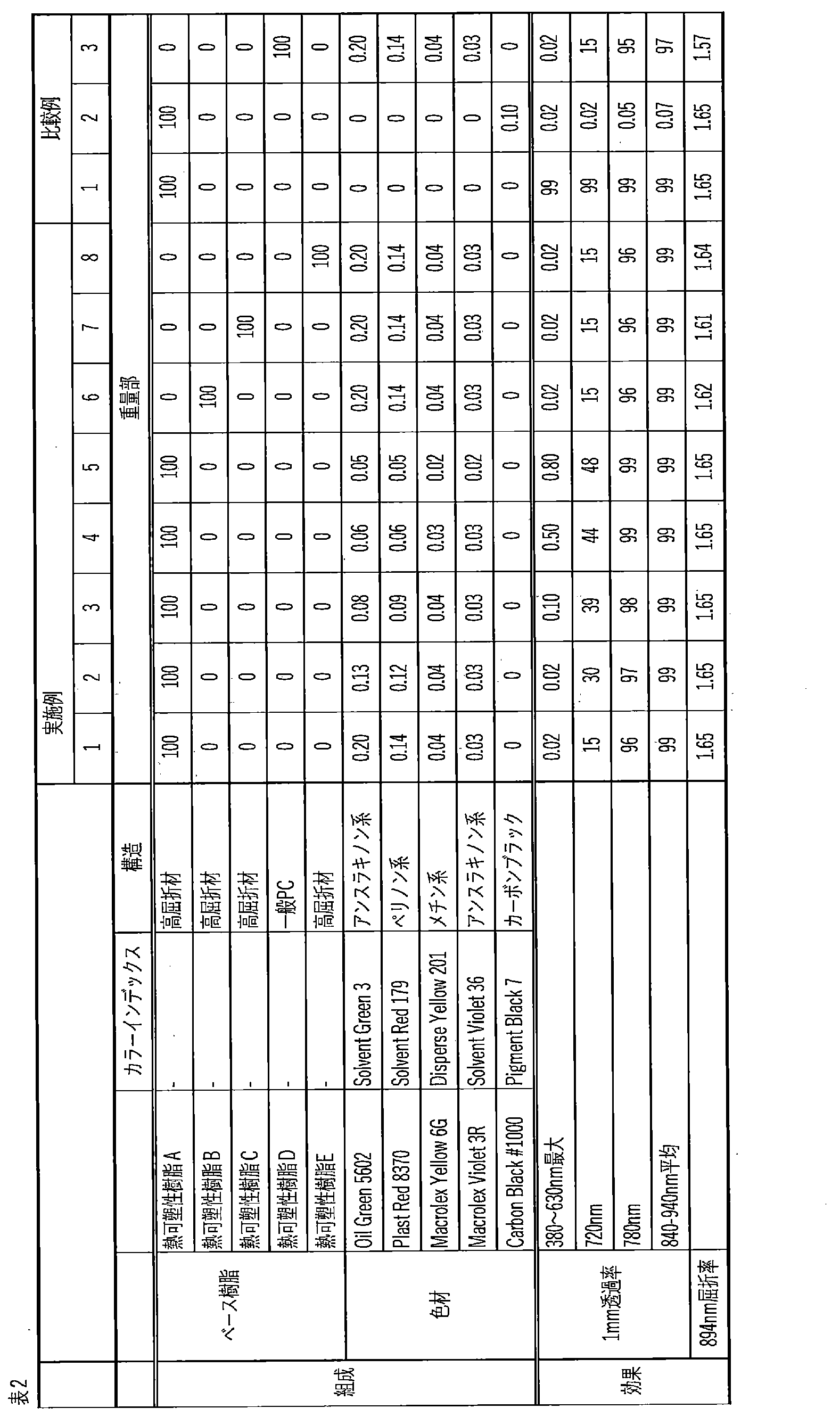
- thermoplastic resin composition ⁇ Production of thermoplastic resin composition> [Examples 1 to 8] A thermoplastic resin, a green pigment, a red pigment, a yellow pigment, and a purple pigment were mixed in the proportions (parts by mass) shown in Table 2 and mixed in a tumbler for 20 minutes, and then a twin-screw extruder (made by Japan Steel Works) TEX 30 ⁇ ) was melt-kneaded at a cylinder temperature of 260° C., and strand cutting was performed to obtain pellets of the thermoplastic resin composition.
- a twin-screw extruder made by Japan Steel Works
- thermoplastic resin A which is a high-refractive material, was used as the thermoplastic resin, and a thermoplastic resin composition containing no coloring material was used as Comparative Example 1 (Table 2).
- thermoplastic resin composition containing a high refractive index thermoplastic resin A as a thermoplastic resin and carbon black as a coloring material was set as Comparative Example 2 (Table 2).
- thermoplastic resin D which is a general thermoplastic resin
- thermoplastic resin composition containing a green pigment, a red pigment, a yellow pigment, and a purple pigment was set as Comparative Example 3 (Table 2).
- thermoplastic resin compositions obtained in Examples 1 to 8 and Comparative Examples 1 to 3 the refractive index at a wavelength of 894 nm and the transmittance (unit: %) at a wavelength of 380 nm to 630 nm when the thickness was 1 mm were used.
- the maximum value, the transmittance at a wavelength of 720 nm (unit: %), the transmittance at a wavelength of 780 nm (unit: %), and the average transmittance at a wavelength of 840 nm to 940 nm (unit: %) were measured and shown in Table 2.
- thermoplastic resin composition of the present invention containing a high refractive material and a coloring material can detect infrared rays and can effectively cut visible rays. Therefore, when the thermoplastic resin composition of the present invention is used for an optical lens for an infrared camera/sensor, it is possible to reduce noise derived from visible light and improve image accuracy.
Landscapes
- Chemical & Material Sciences (AREA)
- Health & Medical Sciences (AREA)
- Medicinal Chemistry (AREA)
- Chemical Kinetics & Catalysis (AREA)
- Polymers & Plastics (AREA)
- Organic Chemistry (AREA)
- Physics & Mathematics (AREA)
- Optics & Photonics (AREA)
- General Physics & Mathematics (AREA)
- Toxicology (AREA)
- Compositions Of Macromolecular Compounds (AREA)
- Polyesters Or Polycarbonates (AREA)
- Optical Filters (AREA)
Abstract
Description
波長894nmにおける屈折率が1.60以上であり、
厚さが1mmの場合の前記熱可塑性樹脂組成物において、波長380nm~630nmにおける透過率の最大値が0%超1.00%以下であり、かつ、波長840nm~940nmにおける平均透過率が80%以上である、
熱可塑性樹脂組成物。

R1~R4は、それぞれ独立して、水素原子、フッ素原子、塩素原子、臭素原子、ヨウ素原子、炭素数1~6のアルキル基、または、酸素原子、窒素原子及びイオウ原子から選択されるヘテロ環原子を含んでいてもよい炭素数6~20のアリール基、炭素数2~6のアルケニル基、炭素数1~6のアルコキシ基、又は炭素数7~17のアラルキル基を表し、
p、q、rおよびsは、それぞれ独立して0~4の整数を表し、
Rは、

ここでiは0~10の整数を表し、iiは1~10の整数を表し、iiiは1~10の整数を表す。)

R6及びR7はR1~R4と同義であり、
n及びmは、0~5の整数を表し、
Yは炭素数1~5のアルキレン基を表し、
n1及びn2は、各々独立に、0~10の整数を表す。)

R8及びR9はR1~R4と同義であり、
a及びbは、0~4の整数を表し、
Yは炭素数1~5のアルキレン基を表し、
n1及びn2は、各々独立に、0~10の整数を表す。)
本発明は、熱可塑性樹脂と、色材とを含む、熱可塑性樹脂組成物を提供する。
本発明の一実施形態において、熱可塑性樹脂組成物に用いることができる熱可塑性樹脂としては、ポリカーボネート樹脂、ポリエステル樹脂、及びポリエステルカーボネート樹脂が含まれ得るが、これらに限定されない。本発明の好ましい実施形態において、熱可塑性樹脂組成物は、ポリカーボネート樹脂である。
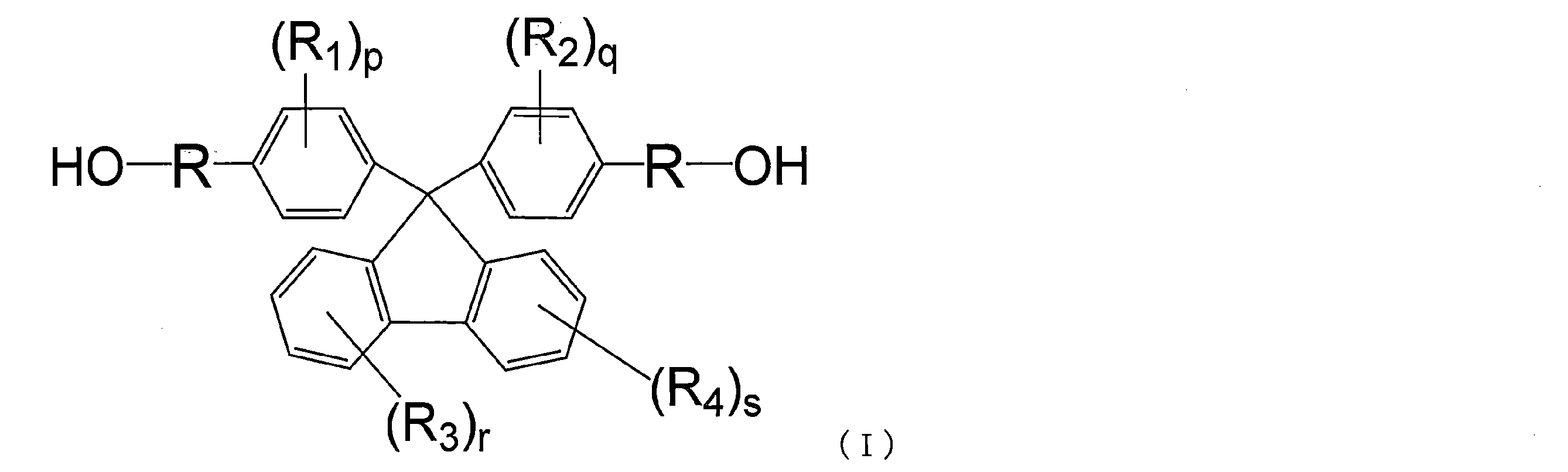
R1~R4は、それぞれ独立して、水素原子、フッ素原子、塩素原子、臭素原子、ヨウ素原子、炭素数1~6のアルキル基、または、酸素原子、窒素原子及びイオウ原子から選択されるヘテロ環原子を含んでいてもよい炭素数6~20のアリール基、炭素数2~6のアルケニル基、炭素数1~6のアルコキシ基、又は炭素数7~17のアラルキル基を表し、
p、q、rおよびsは、それぞれ独立して0~4の整数を表し、
Rは、

ここでiは0~10の整数を表し、iiは1~10の整数を表し、iiiは1~10の整数を表す。)

R6及びR7はR1~R4と同義であり、
n及びmは、0~5の整数を表し、
Yは炭素数1~5のアルキレン基を表し、
n1及びn2は、各々独立に、0~10の整数を表す。)
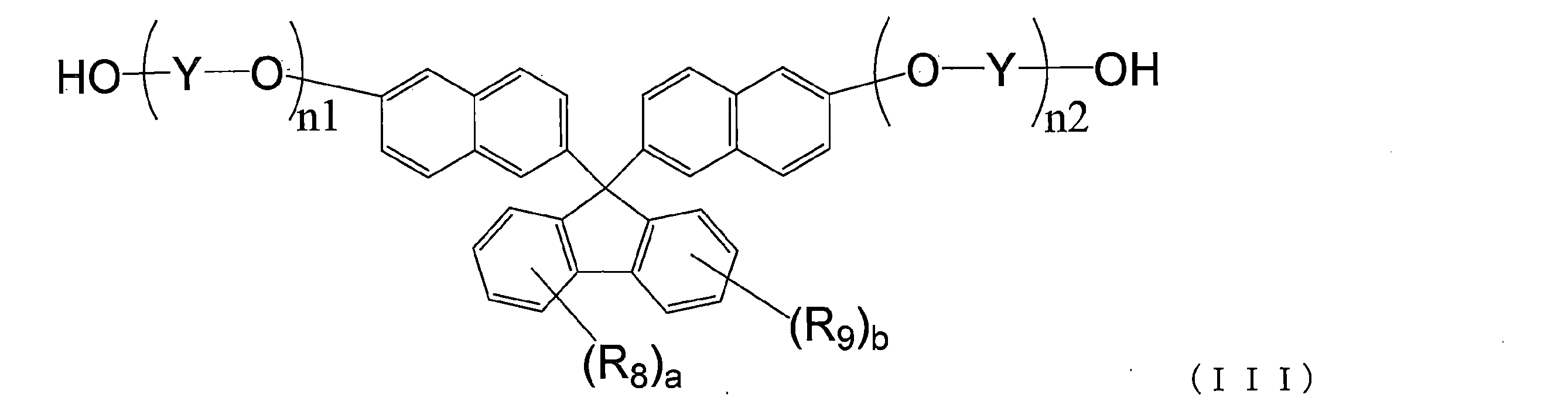
R8及びR9はR1~R4と同義であり、
a及びbは、0~4の整数を表し、
Yは炭素数1~5のアルキレン基を表し、
n1及びn2は、各々独立に、0~10の整数を表す。)
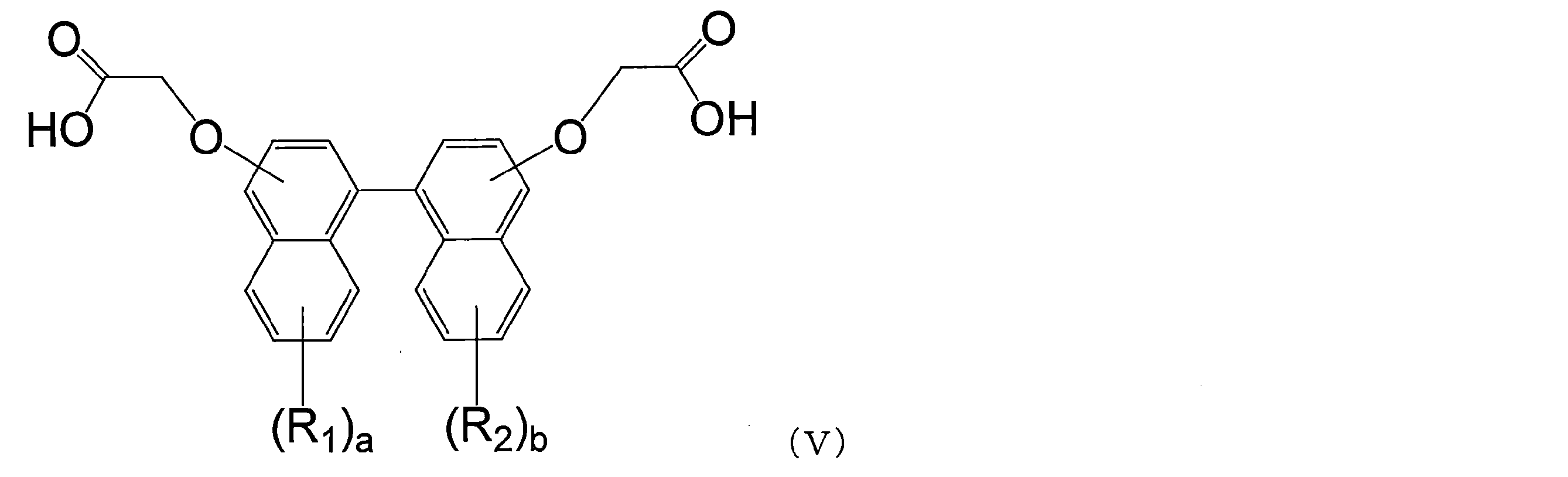
R1及びR2は、それぞれ独立して、水素原子、フッ素原子、塩素原子、臭素原子、ヨウ素原子、炭素数1~6のアルキル基、または、酸素原子、窒素原子及びイオウ原子から選択されるヘテロ環原子を含んでいてもよい炭素数6~20のアリール基、炭素数2~6のアルケニル基、炭素数1~6のアルコキシ基、又は炭素数7~17のアラルキル基を表し、
a及びbは、0~4の整数を表す。)
色材は、本発明の熱可塑性樹脂組成物に用いることができるものであれば特に限定されず、例えば染料及び顔料、有機系色材及び無機系色材などを用いることができる。本発明の一実施形態において、熱可塑性樹脂組成物に用いることができる色材は、緑色顔料、赤色顔料、黄色顔料、及び紫色顔料のうち少なくとも1種を含み得る。好ましい実施形態において、熱可塑性樹脂組成物に用いることができる色材は、緑色顔料、赤色顔料、黄色顔料、及び紫色顔料を含む。
本発明の一実施形態において、熱可塑性樹脂組成物は、添加剤として酸化防止剤および離型剤を含むことができる。
本発明の熱可塑性樹脂には、製造時に生成するフェノールや、反応せずに残存したモノマーであるジオールや炭酸ジエステルが不純物として存在していてもよい。熱可塑性樹脂中のフェノール含量は、0.1~3000ppmであることが好ましく、0.1~2000ppmであることがより好ましく、1~1000ppm、1~800ppm、1~500ppm、または1~300ppmであることが特に好ましい。熱可塑性樹脂中のジオール含量は、0.1~5000ppmであることが好ましく、1~3000ppmであることがより好ましく、1~1000ppmであることが更により好ましく、1~500ppmであることが特に好ましい。また、熱可塑性樹脂中の炭酸ジエステル含量は、0.1~1000ppmであることが好ましく、0.1~500ppmであることがより好ましく、1~100ppmであることが特に好ましい。熱可塑性樹脂中に含まれるフェノールおよび炭酸ジエステルの量を調節することにより、目的に応じた物性を有する樹脂を得ることができる。フェノールおよび炭酸ジエステルの含量の調節は、重縮合の条件や装置を変更することにより適宜行うことができる。また、重縮合後の押出工程の条件によっても調節可能である。
本発明の一実施形態において、熱可塑性樹脂は、WO2018/016516に記載の方法に従って、製造することができる。具体的には、下記一般式(I)、一般式(II)、及び一般式(III)で表される化合物からなる群より選択されるジオール化合物と、炭酸ジエステルなどのカーボネート前駆物質とを、塩基性化合物触媒及び/又はエステル交換触媒の存在下または触媒の非存在下において、加熱下で、さらに常圧又は減圧下で、溶融重縮合法により反応させて製造することができる。本発明の熱可塑性樹脂組成物の製造方法は、上記の製造方法に限定されない。

R1~R4は、それぞれ独立して、水素原子、フッ素原子、塩素原子、臭素原子、ヨウ素原子、炭素数1~6のアルキル基、または、酸素原子、窒素原子及びイオウ原子から選択されるヘテロ環原子を含んでいてもよい炭素数6~20のアリール基、炭素数2~6のアルケニル基、炭素数1~6のアルコキシ基、又は炭素数7~17のアラルキル基を表し、
p、q、rおよびsは、それぞれ独立して0~4の整数を表し、
Rは、

ここでiは0~10の整数を表し、iiは1~10の整数を表し、iiiは1~10の整数を表す。)

R6及びR7はR1~R4と同義であり、
n及びmは、0~5の整数を表し、
Yは炭素数1~5のアルキレン基を表し、
n1及びn2は、各々独立に、0~10の整数を表す。)
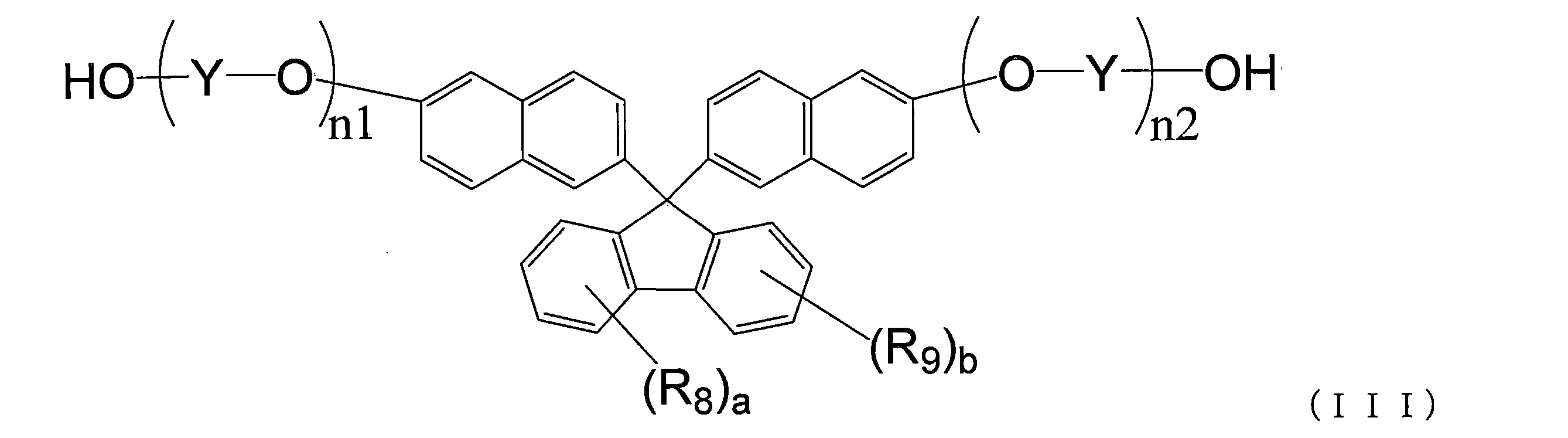
R8及びR9はR1~R4と同義であり、
a及びbは、0~4の整数を表し、
Yは炭素数1~5のアルキレン基を表し、
n1及びn2は、各々独立に、0~10の整数を表す。)
色材を添加した高屈折材である本発明の熱可塑性樹脂組成物は、可視光をカットし、かつ赤外光透過性を有する。よって、本発明の熱可塑性樹脂組成物を赤外光カメラ/センサー用の光学レンズに用いることにより、可視光に由来するノイズを効果的に減らすことができる。
本発明の一実施形態において、熱可塑性樹脂組成物は、波長894nm、23℃における屈折率が1.60以上であってよい。本発明の熱可塑性樹脂組成物の波長894nmにおける屈折率は、好ましくは1.61~1.71であり、さらに好ましくは1.62~1.70であり、特に好ましくは1.64~1.68であってよい。本発明の熱可塑性樹脂組成物は、屈折率が高く、光学レンズ材料として適している。屈折率は、JIS B7071-2に準拠して、Vブロック法屈折計(カールツアイスイエナ社製「PR-2」)を用いて測定することができる。
本発明の一実施形態において、熱可塑性樹脂組成物は、厚さが1mmの場合、波長380nm~630nmにおける透過率の最大値が0%超1.00%以下であり、かつ、波長840nm~940nmにおける平均透過率が80%以上であってよい。本発明の熱可塑性樹脂組成物は、厚さが1mmの場合、波長380nm~630nmにおける透過率の最大値が、好ましくは0%超0.8%以下であり、より好ましくは0%超0.5%以下、さらにより好ましくは0.1%以下であってよい。また、本発明の熱可塑性樹脂組成物は、厚さが1mmの場合、波長840nm~940nmにおける平均透過率が、好ましくは85%以上、より好ましくは90%以上、特に好ましくは99%以上であってよい。波長380nm~630nmにおける透過率の最大値、および波長840nm~940nmにおける平均透過率が上記の範囲内であれば、可視光線に由来するノイズを効率的に減らすことができ、赤外線カメラや赤外線センサーによる測定波長において、画像精度を向上させることができる。さらに、本発明の好ましい実施形態において、波長720nmにおける透過率は50%以下であり、波長780nmにおける透過率は50%以上であってよい。波長720nmにおける透過率は、より好ましくは40%以下、さらに好ましくは35%以下である。波長780nmにおける透過率は、より好ましくは60%以上、さらに好ましくは70%以上である。透過率は、JIS K7105に準拠して、段付き平板状試験片の1mm厚みの部分について、分光光度計(日立ハイテクノロジーズ社製「U-4100」)を用いて測定することができる。
本発明の一実施形態において、熱可塑性樹脂組成物のガラス転移温度(Tg)は、90~180℃であり、より好ましくは95~175℃であり、さらに好ましくは100~170℃、さらにより好ましくは130~170℃、特に好ましくは135~150℃である。熱可塑性樹脂組成物のガラス転移温度(Tg)が上記の範囲内であれば、射出成形するのに好都合である。Tgが90℃より低いと、使用温度範囲が狭くなるため好ましくない。また180℃を越えると、樹脂の溶融温度が高くなり、樹脂の分解や着色が発生しやすくなるため好ましくない。樹脂のガラス転移温度が高すぎると、汎用の金型温調機では、金型温度と樹脂ガラス転移温度の差が大きくなってしまう。そのため、製品に厳密な面精度が求められる用途においては、ガラス転移温度が高すぎる樹脂の使用は難しく、好ましくない。また、成形流動性及び成形耐熱性の観点からは、Tgの下限値は130℃が好ましく、135℃がより好ましく、Tgの上限値は、160℃が好ましく、150℃がより好ましい。
本発明の熱可塑性樹脂組成物は、高い耐湿熱性を有する。耐湿熱性は、熱可塑性樹脂組成物を用いて得られる光学成形体に対して、「PCT試験」(プレッシャークッカー試験)を行い、試験後の光学成形体の全光線透過率を測定することで評価することができる。PCT試験は、直径50mm、厚さ3mmの射出成形物を、120℃、0.2Mpa、100%RH、20時間の条件で保持することで行うことができる。本発明の熱可塑性樹脂組成物は、PCT試験後の全光線透過率が60%以上であり、70%以上であることが好ましく、75%以上であることがより好ましく、80%以上であることがさらにより好ましく、85%以上であることが特に好ましい。全光線透過率が60%以上であれば、従来のポリカーボネート樹脂に対して高い耐湿熱性を有すると言える。
本発明の光学レンズは、上述した本発明の熱可塑性樹脂組成物を射出成形機あるいは射出圧縮成形機によりレンズ形状に射出成形することによって得ることができる。本発明の一実施形態において、光学レンズは、WO2018/016516に記載の方法に従って、製造することができる。射出成形の成形条件は特に限定されないが、成形温度は好ましくは180~300℃、より好ましくは180~290℃である。また、射出圧力は好ましくは50~1700kg/cm2である。
熱可塑性樹脂組成物のペレットを、120℃で5時間、熱風循環式乾燥機により乾燥した後、射出成形機(ファナック社製ROBOSHOT S-2000i30A)により、樹脂温度260℃、金型温度130℃、成形サイクル30秒の条件で、幅40mm×長さ80mmで厚みが1mm及び2mmの2段の段付き平板状試験片を成形した。JIS K7105に準拠して、段付き平板状試験片の1mm厚みの部分について、分光光度計(日立ハイテクノロジーズ社製「U-4100」)を用い、透過率の測定を行った。波長380nm~630nmにおける透過率の最大値は、波長380nm~630nmにおいて1nm毎に透過率を測定して得られた250個のデータ中の最大値である。波長840nm~940nmにおける平均透過率は、波長840nm~940nmにおいて1nm毎に透過率を測定して得られた100個のデータの平均値である。
熱可塑性樹脂又は熱可塑性樹脂組成物のペレットを、120℃で5時間、熱風循環式乾燥機により乾燥した後、射出成形機(ファナック社製ROBOSHOT S-2000i30A)により、樹脂温度260℃、金型温度130℃、成形サイクル30秒の条件で、幅40mm×長さ40mmで厚みが3mmの平板状試験片を成形した。JIS B7071-2に準拠して、Vブロック法屈折計(カールツアイスイエナ社製「PR-2」)を用い、屈折率の測定を行った。
熱可塑性樹脂のアッベ数(ν)は、好ましくは24以下、より好ましくは22以下、さらに好ましくは20以下である。アッベ数は、23℃下での波長486nm、589nm及び656nmの屈折率から、下記式を用いて算出することができる。波長486nm、589nm及び656nmの屈折率は、厚さ0.1mmフィルムについて、アッベ屈折計を用いて、JIS-K-7142の方法で測定することができる。
ν=(nD-1)/(nF-nC)
nD:波長589nmでの屈折率
nC:波長656nmでの屈折率
nF:波長486nmでの屈折率
ゲル浸透クロマトグラフ(GPC)を用い、テトラヒドロフランを展開溶媒として、既知の分子量(分子量分布=1)の標準ポリスチレンを用いて検量線を作成した。この検量線に基づいて、GPCのリテンションタイムからMwを算出した。
JIS K7121-1987に基づき、示差熱走査熱量分析計(DSC)により測定した。DSC分析計として、日立ハイテクサイエンスX-DSC7000を用いた。加熱速度は、毎分10℃である。
下記b値の測定用に作成した熱可塑性樹脂からなる厚さ3mmのプレートについて、日本電色工業(株)製SE2000型分光式色差計を用い、JIS-K-7361-1の方法で測定した。
製造した樹脂を120℃で4時間真空乾燥した後、射出成型機(FANUC ROBOSHOT α-S30iA)によりシリンダー温度270℃、金型温度Tg-10℃にて射出成形し、直径50mm、厚さ3mmの円盤状試験プレート片を得た。このプレート片を用いて、JIS K7105に準じb値を測定した。b値が小さいほど黄色味が弱いことを示し、色相が良好となる。成形プレートの測定には、日本電色工業(株)製SE2000型分光式色差計を用いた。
秤量したポリカーボネート樹脂1.0gを精秤し、ジクロロメタン10mlに溶解し、攪拌しながら100mlのメタノールに徐々に添加して樹脂を再沈殿させた。十分に攪拌を行った後、沈殿物を濾別し、濾液をエバポレータにより濃縮して得られた固体へ標準物質溶液1.0gを精秤して加えた。さらに1gのクロロホルムを加えて希釈した溶液をGC-MSにより定量した。
標準物質溶液:200ppm、2,4,6-トリメチルフェノールのクロロホルム溶液
測定装置(GC-MS):Agilent HP6890/5973MSD
カラム:キャピラリーカラムDB-5MS, 30m×0.25mm I.D.,膜厚0.5μm
昇温条件:50℃(5min hold)~300℃(15min hold),10℃/min
注入口温度:300℃、打ち込み量:1.0μl(スプリット比25)
イオン化法:EI法
キャリアーガス:He,1.0ml/min
Aux温度:300℃
質量スキャン範囲:33-700
秤量したポリカーボネート樹脂0.5gをテトラヒドロフラン(THF)50mlに溶解し、試料溶液とした。標品として各化合物の純品より検量線を作成し、試料溶液2μLをLC-MSにより以下の測定条件で定量した。なお、この測定条件での検出限界値は0.01ppmである。残存BHEBN量及び残存BPPEF量以外の他の残存モノマーも、同様にして測定することができる。
LC-MS測定条件:
測定装置(LC部分):Agilent Infinity 1260 LC System
カラム:ZORBAX Eclipse XDB-18、及びガードカートリッジ
移動相:
A: 0.01mol/L-酢酸アンモニウム水溶液
B:0.01mol/L-酢酸アンモニウムのメタノール溶液
C:THF
移動相のグラジエントプログラム:

カラム温度:45℃
検出器:UV(225nm)
測定装置(MS部分):Agilent 6120 single quad LCMS System
イオン化ソース:ESI
極性: Positive
フラグメンタ: 100V
ドライガス:10L/分、350℃
ネブライザ:50psi
キャピラリ電圧:3000V
測定イオン:
BHEBN:イオン種=[M+NH4]-、m/z=392.1
BPPEF:イオン種=[M+NH4]-、m/z=608.3
[製造例1]熱可塑性樹脂A(高屈折材)
原料として、9,9-ビス[6-(2-ヒドロキシエトキシ)ナフタレン-2-イル]フルオレン(「BNEF」とも称する)8.0kg(14.85モル)、2,2’-ビス(2-ヒドロキシエトキシ)-1,1’-ビナフタレン(「BHEBN」とも称する)7.5kg(20.03モル)、9,9-ビス[4-(2-ヒドロキシエトキシ)-3-フェニルフェニル]フルオレン(「BPPEF」とも称する)7.5kg(12.70モル)、ジフェニルカーボネート(「DPC」とも称する)10.5kg(49.02モル)、及び2.5×10⁻²モル/リットルの炭酸水素ナトリウム水溶液16ミリリットル(4.0×10-4モル、即ち、ジヒドロキシ化合物の合計1モルに対して、8.4×10-6モル)を攪拌機及び留出装置付きの50L反応器に入れ、窒素雰囲気760mmHgの下、180℃に加熱した。加熱開始30分後に原料の完全溶解を確認し、その後同条件で120分間攪拌を行った。その後、減圧度を200mmHgに調整すると同時に、60℃/hrの速度で200℃まで昇温を行った。この際、副生したフェノールの留出開始を確認した。その後、20分間200℃に保持して反応を行った。さらに、75℃/hrの速度で230℃まで昇温し、昇温終了10分後、その温度で保持しながら、2時間かけて減圧度を1mmHg以下とした。その後、60℃/hrの速度で245℃まで昇温し、さらに40分間攪拌を行った。反応終了後、反応器内に窒素を導入して常圧に戻し、生成した熱可塑性樹脂をペレタイズして取り出した。得られた樹脂のポリスチレン換算質量平均分子量(Mw)は32000、ガラス転移温度(Tg)は142℃であった。
原料として、9,9-ビス[4-(2-ヒドロキシエトキシ)-フェニル]フルオレン(「BPEF」とも称する)20.86kg(47.56モル)、DPC10.5kg(49.02モル)、及び2.5×10⁻²モル/リットルの炭酸水素ナトリウム水溶液16ミリリットル(4.0×10-4モル、即ち、ジヒドロキシ化合物の合計1モルに対して、8.4×10-6モル)を用いる以外は、実施例1と同様にして熱可塑性樹脂を得た。得られた樹脂のポリスチレン換算質量平均分子量(Mw)は31000、ガラス転移温度(Tg)は145℃であった。

原料として、BPEF18.15kg(41.39モル)、2,2’-ビス(4-ヒドロキシフェニル)プロパン(「BPA」とも称する)1.41kg(6.18モル)、DPC10.5kg(49.02モル)、及び2.5×10⁻²モル/リットルの炭酸水素ナトリウム水溶液16ミリリットル(4.0×10-4モル、即ち、ジヒドロキシ化合物の合計1モルに対して、8.4×10-6モル)を用いる以外は、実施例1と同様にして熱可塑性樹脂を得た。得られた樹脂のポリスチレン換算質量平均分子量(Mw)は31000、ガラス転移温度(Tg)は145℃であった。

原料として、BHEBN4.53kg(12.1モル)、BPPEF8.72kg(14.8モル)、DPC5.99kg(27.9モル)、及び2.5×10⁻²モル/リットルの炭酸水素ナトリウム水溶液16ミリリットル(4.0×10-4モル、即ち、ジヒドロキシ化合物の合計1モルに対して、8.4×10-6モル)を用いる以外は、実施例1と同様にして熱可塑性樹脂を得た。得られた樹脂のポリスチレン換算質量平均分子量(Mw)は32000、ガラス転移温度(Tg)は140℃であった。

熱可塑性樹脂Dとしては、三菱エンジニアリングプラスチックク株式会社製ユーピロンS-3000(BPAのホモポリマー樹脂)を用いた。
[実施例1~8]
熱可塑性樹脂、緑色顔料、赤色顔料、黄色顔料、及び紫色顔料をそれぞれ表2に記した割合(質量部)で配合し、タンブラーにて20分混合した後、二軸押出機(日本製鋼所製TEX30α)により、シリンダー温度260℃で溶融混練し、ストランドカットにより熱可塑性樹脂組成物のペレットを得た。
熱可塑性樹脂として高屈折材である熱可塑性樹脂Aを用い、色材を含まない熱可塑性樹脂組成物を比較例1とした(表2)。
熱可塑性樹脂として高屈折材である熱可塑性樹脂Aを用い、色材としてカーボンブラックを含む熱可塑性樹脂組成物を比較例2とした(表2)。
熱可塑性樹脂として一般的な熱可塑性樹脂である熱可塑性樹脂Dを用い、緑色顔料、赤色顔料、黄色顔料、及び紫色顔料を含む熱可塑性樹脂組成物を比較例3とした(表2)。
Claims (10)
- 熱可塑性樹脂と、
色材
とを含む、熱可塑性樹脂組成物であって、
波長894nmにおける屈折率が1.60以上であり、
厚さが1mmの場合の前記熱可塑性樹脂組成物において、波長380nm~630nmにおける透過率の最大値が0%超1.00%以下であり、かつ、波長840nm~940nmにおける平均透過率が80%以上である、
熱可塑性樹脂組成物。 - 前記熱可塑性樹脂は、ポリカーボネート樹脂、ポリエステル樹脂、及びポリエステルカーボネート樹脂からなる群より選択される樹脂を含む、請求項1に記載の熱可塑性樹脂組成物。
- 前記熱可塑性樹脂は、モノマーとして、下記一般式(I)、一般式(II)、及び一般式(III)で表される化合物からなる群より選択されるジオール化合物を含む、請求項2に記載の熱可塑性樹脂組成物。

R1~R4は、それぞれ独立して、水素原子、フッ素原子、塩素原子、臭素原子、ヨウ素原子、炭素数1~6のアルキル基、または、酸素原子、窒素原子及びイオウ原子から選択されるヘテロ環原子を含んでいてもよい炭素数6~20のアリール基、炭素数2~6のアルケニル基、炭素数1~6のアルコキシ基、又は炭素数7~17のアラルキル基を表し、
p、q、rおよびsは、それぞれ独立して0~4の整数を表し、
Rは、

ここでiは0~10の整数を表し、iiは1~10の整数を表し、iiiは1~10の整数を表す。)
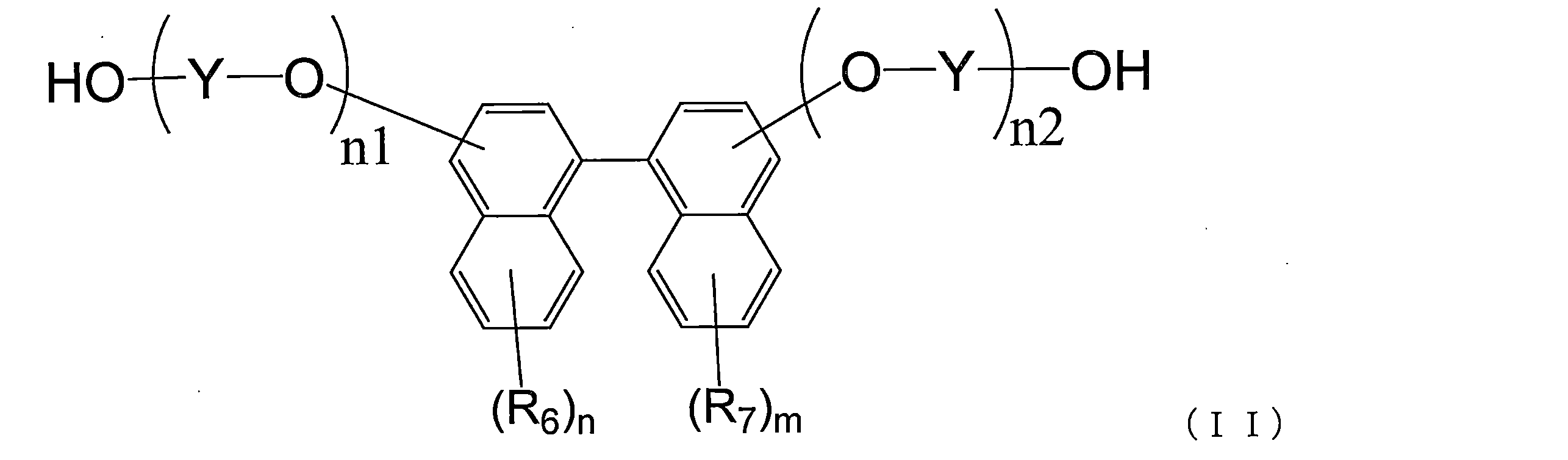
R6及びR7はR1~R4と同義であり、
n及びmは、0~5の整数を表し、
Yは炭素数1~5のアルキレン基を表し、
n1及びn2は、各々独立に、0~10の整数を表す。)
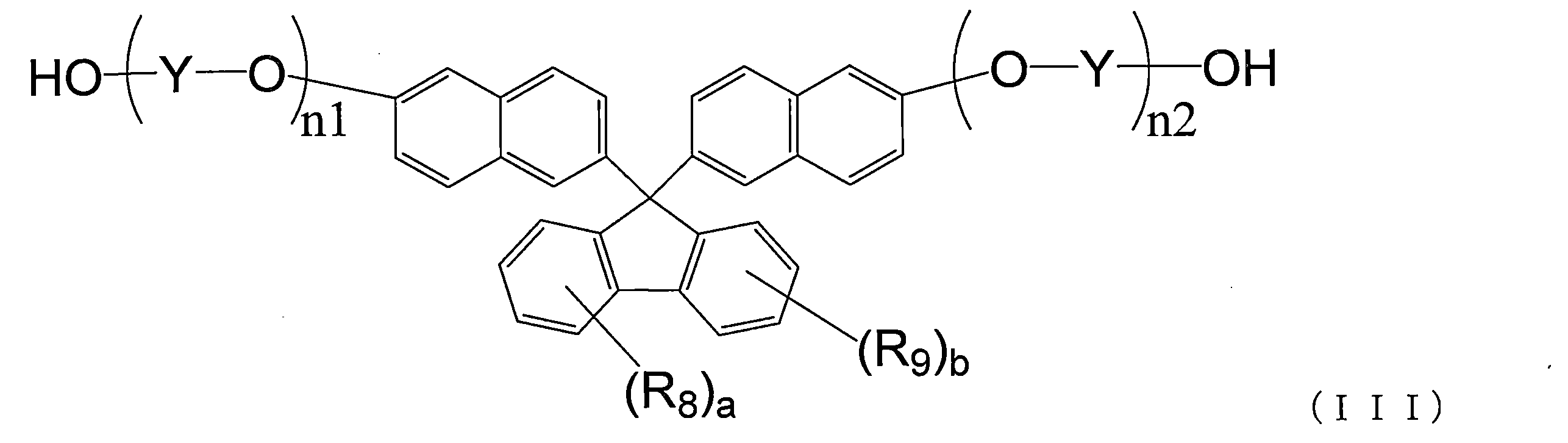
R8及びR9はR1~R4と同義であり、
a及びbは、0~4の整数を表し、
Yは炭素数1~5のアルキレン基を表し、
n1及びn2は、各々独立に、0~10の整数を表す。) - 前記色材が、緑色顔料、赤色顔料、黄色顔料、及び紫色顔料のうち少なくとも1種を含む、請求項1~3のいずれか1項に記載の熱可塑性樹脂組成物。
- 前記色材が、アントラキノン系顔料、ペリノン系顔料、メチン系顔料、イソインドリン系顔料、フタロシアニン系顔料、キナクリドン系顔料、アゾ系顔料、及びレーキ顔料のうち少なくとも1種を含む、請求項1~3のいずれか1項に記載の熱可塑性樹脂組成物。
- 厚さが1mmの場合の前記熱可塑性樹脂組成物において、波長380nm~630nmにおける透過率の最大値が0%超0.8%以下である、請求項1~5のいずれか1項に記載の熱可塑性樹脂組成物。
- 厚さが1mmの場合の前記熱可塑性樹脂組成物において、波長380nm~630nmにおける透過率の最大値が0%超0.5%以下である、請求項1~6のいずれか1項に記載の熱可塑性樹脂組成物。
- 請求項1~7のいずれか1項に記載の熱可塑性樹脂組成物を含む、光学レンズ。
- 請求項1~7のいずれか1項に記載の熱可塑性樹脂組成物を含む、赤外線カメラ用レンズ。
- 請求項1~7のいずれか1項に記載の熱可塑性樹脂組成物を含む、生体認証カメラ用レンズ。
Priority Applications (6)
| Application Number | Priority Date | Filing Date | Title |
|---|---|---|---|
| US17/414,407 US12286532B2 (en) | 2018-12-27 | 2019-12-24 | Thermoplastic resin composition and optical member using same |
| CN201980085994.2A CN113227200B (zh) | 2018-12-27 | 2019-12-24 | 热塑性树脂组合物和使用该热塑性树脂组合物的光学部件 |
| EP19902145.2A EP3904419B1 (en) | 2018-12-27 | 2019-12-24 | Infrared camera lens |
| KR1020217013400A KR20210110564A (ko) | 2018-12-27 | 2019-12-24 | 열가소성 수지 조성물 및 그것을 사용한 광학 부재 |
| JP2020563291A JPWO2020138050A1 (ja) | 2018-12-27 | 2019-12-24 | 熱可塑性樹脂組成物及びそれを用いた光学部材 |
| JP2024185850A JP2025011314A (ja) | 2018-12-27 | 2024-10-22 | 熱可塑性樹脂組成物及びそれを用いた光学部材 |
Applications Claiming Priority (2)
| Application Number | Priority Date | Filing Date | Title |
|---|---|---|---|
| JP2018244717 | 2018-12-27 | ||
| JP2018-244717 | 2018-12-27 |
Publications (1)
| Publication Number | Publication Date |
|---|---|
| WO2020138050A1 true WO2020138050A1 (ja) | 2020-07-02 |
Family
ID=71127194
Family Applications (1)
| Application Number | Title | Priority Date | Filing Date |
|---|---|---|---|
| PCT/JP2019/050552 Ceased WO2020138050A1 (ja) | 2018-12-27 | 2019-12-24 | 熱可塑性樹脂組成物及びそれを用いた光学部材 |
Country Status (7)
| Country | Link |
|---|---|
| US (1) | US12286532B2 (ja) |
| EP (1) | EP3904419B1 (ja) |
| JP (2) | JPWO2020138050A1 (ja) |
| KR (1) | KR20210110564A (ja) |
| CN (1) | CN113227200B (ja) |
| TW (1) | TWI855016B (ja) |
| WO (1) | WO2020138050A1 (ja) |
Cited By (4)
| Publication number | Priority date | Publication date | Assignee | Title |
|---|---|---|---|---|
| WO2022034898A1 (ja) * | 2020-08-13 | 2022-02-17 | 三菱瓦斯化学株式会社 | 光学材料用の熱可塑性樹脂組成物、成形体、配合剤、熱可塑性樹脂組成物の製造方法及び透過率向上方法 |
| WO2023139930A1 (ja) | 2022-01-21 | 2023-07-27 | Nok株式会社 | ゴム組成物 |
| JP2023168132A (ja) * | 2022-05-13 | 2023-11-24 | グローバルポリアセタール株式会社 | 樹脂組成物、成形品、キット、および、成形品の製造方法 |
| JP2023168133A (ja) * | 2022-05-13 | 2023-11-24 | グローバルポリアセタール株式会社 | 樹脂組成物、成形品、キット、および、成形品の製造方法 |
Families Citing this family (1)
| Publication number | Priority date | Publication date | Assignee | Title |
|---|---|---|---|---|
| JP7506173B2 (ja) * | 2020-10-27 | 2024-06-25 | 帝人株式会社 | 熱可塑性樹脂及びそれを含む光学部材 |
Citations (9)
| Publication number | Priority date | Publication date | Assignee | Title |
|---|---|---|---|---|
| JPS5562410A (en) | 1978-11-06 | 1980-05-10 | Mitsubishi Chem Ind Ltd | Infrared ray transmission filter |
| JP2002317048A (ja) * | 2001-02-14 | 2002-10-31 | Kanegafuchi Chem Ind Co Ltd | 硬化剤、硬化性組成物、光学材料用組成物、光学材料、その製造方法、並びに、それを用いた液晶表示装置及びled |
| JP2011132316A (ja) * | 2009-12-22 | 2011-07-07 | Mitsubishi Chemicals Corp | 透明樹脂組成物及び透明樹脂成形品 |
| JP2012145481A (ja) * | 2011-01-13 | 2012-08-02 | Teijin Chem Ltd | 脂肪族末端ジオールの耐熱性の試験方法およびそれを用いた熱可塑性樹脂の製造方法 |
| WO2015056734A1 (ja) | 2013-10-17 | 2015-04-23 | Jsr株式会社 | 光学フィルター、固体撮像装置およびカメラモジュール |
| WO2017078076A1 (ja) * | 2015-11-04 | 2017-05-11 | 三菱瓦斯化学株式会社 | 熱可塑性樹脂組成物およびその成形体 |
| JP2018002895A (ja) * | 2016-07-04 | 2018-01-11 | 帝人株式会社 | 熱可塑性樹脂 |
| WO2018016516A1 (ja) | 2016-07-21 | 2018-01-25 | 三菱瓦斯化学株式会社 | ポリカーボネート樹脂、その製造方法及び光学レンズ |
| JP2018059107A (ja) * | 2012-11-07 | 2018-04-12 | 三菱瓦斯化学株式会社 | ポリカーボネート樹脂、その製造方法および光学成形体 |
Family Cites Families (14)
| Publication number | Priority date | Publication date | Assignee | Title |
|---|---|---|---|---|
| JPH0620728B2 (ja) | 1985-05-27 | 1994-03-23 | 松下電工株式会社 | 改質木材の製法 |
| TW588084B (en) | 2000-12-27 | 2004-05-21 | Kanegafuchi Chemical Ind | Curing agents, curable compositions, compositions for optical materials, optical materials, optical materials, their production, and liquid crystal displays and LEDs made by using the materials |
| US8013106B2 (en) | 2006-06-05 | 2011-09-06 | Mitsubishi Gas Chemical Company, Inc. | Optical lens |
| JP4653027B2 (ja) | 2006-06-30 | 2011-03-16 | 三菱エンジニアリングプラスチックス株式会社 | ポリカーボネート樹脂組成物及び赤外線レーザー用フィルター |
| JP2010111815A (ja) * | 2008-11-07 | 2010-05-20 | Toray Ind Inc | 光学用ポリエステル樹脂の製造方法 |
| JP2010174089A (ja) * | 2009-01-28 | 2010-08-12 | Toray Ind Inc | 光学用ポリエステル樹脂 |
| JP2012242340A (ja) | 2011-05-24 | 2012-12-10 | Mitsubishi Engineering Plastics Corp | 赤外線フィルター用ポリカーボネート樹脂の良否判定方法 |
| JP6135846B2 (ja) | 2013-02-19 | 2017-05-31 | 味の素株式会社 | 硬化性樹脂組成物 |
| JP6154337B2 (ja) | 2013-02-20 | 2017-06-28 | 帝人株式会社 | ポリカーボネート共重合体 |
| CN107003453B (zh) | 2014-12-19 | 2019-10-11 | Agc株式会社 | 光学滤波器和使用该光学滤波器的装置 |
| TWI814646B (zh) * | 2015-11-04 | 2023-09-01 | 日商三菱瓦斯化學股份有限公司 | 減低熔接線長度之方法 |
| JP2018044991A (ja) * | 2016-09-12 | 2018-03-22 | 大日本印刷株式会社 | 赤外線透過デバイス及び光学ユニット |
| JP6907228B2 (ja) * | 2016-11-18 | 2021-07-21 | 富士フイルム株式会社 | 構造体、固体撮像素子、赤外線センサおよび組成物 |
| JP6354888B2 (ja) | 2016-12-28 | 2018-07-11 | 住友ベークライト株式会社 | 光学性層 |
-
2019
- 2019-12-24 CN CN201980085994.2A patent/CN113227200B/zh active Active
- 2019-12-24 WO PCT/JP2019/050552 patent/WO2020138050A1/ja not_active Ceased
- 2019-12-24 JP JP2020563291A patent/JPWO2020138050A1/ja active Pending
- 2019-12-24 KR KR1020217013400A patent/KR20210110564A/ko active Pending
- 2019-12-24 US US17/414,407 patent/US12286532B2/en active Active
- 2019-12-24 EP EP19902145.2A patent/EP3904419B1/en active Active
- 2019-12-25 TW TW108147505A patent/TWI855016B/zh active
-
2024
- 2024-10-22 JP JP2024185850A patent/JP2025011314A/ja active Pending
Patent Citations (10)
| Publication number | Priority date | Publication date | Assignee | Title |
|---|---|---|---|---|
| JPS5562410A (en) | 1978-11-06 | 1980-05-10 | Mitsubishi Chem Ind Ltd | Infrared ray transmission filter |
| JPS6253801B2 (ja) | 1978-11-06 | 1987-11-12 | Mitsubishi Kasei Kogyo Kk | |
| JP2002317048A (ja) * | 2001-02-14 | 2002-10-31 | Kanegafuchi Chem Ind Co Ltd | 硬化剤、硬化性組成物、光学材料用組成物、光学材料、その製造方法、並びに、それを用いた液晶表示装置及びled |
| JP2011132316A (ja) * | 2009-12-22 | 2011-07-07 | Mitsubishi Chemicals Corp | 透明樹脂組成物及び透明樹脂成形品 |
| JP2012145481A (ja) * | 2011-01-13 | 2012-08-02 | Teijin Chem Ltd | 脂肪族末端ジオールの耐熱性の試験方法およびそれを用いた熱可塑性樹脂の製造方法 |
| JP2018059107A (ja) * | 2012-11-07 | 2018-04-12 | 三菱瓦斯化学株式会社 | ポリカーボネート樹脂、その製造方法および光学成形体 |
| WO2015056734A1 (ja) | 2013-10-17 | 2015-04-23 | Jsr株式会社 | 光学フィルター、固体撮像装置およびカメラモジュール |
| WO2017078076A1 (ja) * | 2015-11-04 | 2017-05-11 | 三菱瓦斯化学株式会社 | 熱可塑性樹脂組成物およびその成形体 |
| JP2018002895A (ja) * | 2016-07-04 | 2018-01-11 | 帝人株式会社 | 熱可塑性樹脂 |
| WO2018016516A1 (ja) | 2016-07-21 | 2018-01-25 | 三菱瓦斯化学株式会社 | ポリカーボネート樹脂、その製造方法及び光学レンズ |
Cited By (7)
| Publication number | Priority date | Publication date | Assignee | Title |
|---|---|---|---|---|
| WO2022034898A1 (ja) * | 2020-08-13 | 2022-02-17 | 三菱瓦斯化学株式会社 | 光学材料用の熱可塑性樹脂組成物、成形体、配合剤、熱可塑性樹脂組成物の製造方法及び透過率向上方法 |
| JPWO2022034898A1 (ja) * | 2020-08-13 | 2022-02-17 | ||
| JP7816153B2 (ja) | 2020-08-13 | 2026-02-18 | 三菱瓦斯化学株式会社 | 光学材料用の熱可塑性樹脂組成物、成形体、配合剤、熱可塑性樹脂組成物の製造方法及び透過率向上方法 |
| WO2023139930A1 (ja) | 2022-01-21 | 2023-07-27 | Nok株式会社 | ゴム組成物 |
| JP2023168132A (ja) * | 2022-05-13 | 2023-11-24 | グローバルポリアセタール株式会社 | 樹脂組成物、成形品、キット、および、成形品の製造方法 |
| JP2023168133A (ja) * | 2022-05-13 | 2023-11-24 | グローバルポリアセタール株式会社 | 樹脂組成物、成形品、キット、および、成形品の製造方法 |
| JP7853830B2 (ja) | 2022-05-13 | 2026-04-30 | グローバルポリアセタール株式会社 | 樹脂組成物、成形品、キット、および、成形品の製造方法 |
Also Published As
| Publication number | Publication date |
|---|---|
| EP3904419A4 (en) | 2022-02-16 |
| CN113227200A (zh) | 2021-08-06 |
| US12286532B2 (en) | 2025-04-29 |
| TW202033606A (zh) | 2020-09-16 |
| US20220106483A1 (en) | 2022-04-07 |
| KR20210110564A (ko) | 2021-09-08 |
| JPWO2020138050A1 (ja) | 2021-11-18 |
| EP3904419A1 (en) | 2021-11-03 |
| TWI855016B (zh) | 2024-09-11 |
| JP2025011314A (ja) | 2025-01-23 |
| CN113227200B (zh) | 2023-03-31 |
| EP3904419B1 (en) | 2023-09-06 |
Similar Documents
| Publication | Publication Date | Title |
|---|---|---|
| WO2020138050A1 (ja) | 熱可塑性樹脂組成物及びそれを用いた光学部材 | |
| JP6108651B2 (ja) | ポリカーボネート樹脂組成物、光学フィルム及びポリカーボネート樹脂成形品 | |
| JP6464227B2 (ja) | ポリカーボネート共重合体樹脂組成物からなる光学レンズ | |
| JP6245240B2 (ja) | ポリカーボネート樹脂組成物、光学フィルム及びポリカーボネート樹脂成形品 | |
| EP3112392B1 (en) | Polycarbonate and optical member including same | |
| KR100711149B1 (ko) | 폴리에스테르 수지 조성물 및 광학 재료 | |
| EP1138714B1 (en) | Polycarbonate resin and optical article used the same | |
| US11440991B2 (en) | Polycarbonate resin composition, production method therefor, and optical lens | |
| KR102574566B1 (ko) | 폴리카보네이트계 수지 조성물 또는 공중합체, 및 광학 필름 | |
| US20070106053A1 (en) | Polyester, moldings thereof, and process for production of the polyester | |
| EP3922658B1 (en) | Polycarbonate resin composition and optical lens using this |
Legal Events
| Date | Code | Title | Description |
|---|---|---|---|
| 121 | Ep: the epo has been informed by wipo that ep was designated in this application |
Ref document number: 19902145 Country of ref document: EP Kind code of ref document: A1 |
|
| ENP | Entry into the national phase |
Ref document number: 2020563291 Country of ref document: JP Kind code of ref document: A |
|
| NENP | Non-entry into the national phase |
Ref country code: DE |
|
| ENP | Entry into the national phase |
Ref document number: 2019902145 Country of ref document: EP Effective date: 20210727 |
|
| WWG | Wipo information: grant in national office |
Ref document number: 17414407 Country of ref document: US |