WO2020071407A1 - ヘアピン型一本鎖rna分子の製造方法 - Google Patents
ヘアピン型一本鎖rna分子の製造方法Info
- Publication number
- WO2020071407A1 WO2020071407A1 PCT/JP2019/038860 JP2019038860W WO2020071407A1 WO 2020071407 A1 WO2020071407 A1 WO 2020071407A1 JP 2019038860 W JP2019038860 W JP 2019038860W WO 2020071407 A1 WO2020071407 A1 WO 2020071407A1
- Authority
- WO
- WIPO (PCT)
- Prior art keywords
- condensing agent
- dehydrating condensing
- rna molecule
- type
- represented
- Prior art date
- Legal status (The legal status is an assumption and is not a legal conclusion. Google has not performed a legal analysis and makes no representation as to the accuracy of the status listed.)
- Ceased
Links
- 0 CC(C)O*C(N(C(CC1)CC1C1)C1C(O)=O)=O Chemical compound CC(C)O*C(N(C(CC1)CC1C1)C1C(O)=O)=O 0.000 description 6
- GDELFUQKNPLION-UHFFFAOYSA-N CCOCCCCN Chemical compound CCOCCCCN GDELFUQKNPLION-UHFFFAOYSA-N 0.000 description 1
Images
Classifications
-
- C—CHEMISTRY; METALLURGY
- C12—BIOCHEMISTRY; BEER; SPIRITS; WINE; VINEGAR; MICROBIOLOGY; ENZYMOLOGY; MUTATION OR GENETIC ENGINEERING
- C12N—MICROORGANISMS OR ENZYMES; COMPOSITIONS THEREOF; PROPAGATING, PRESERVING, OR MAINTAINING MICROORGANISMS; MUTATION OR GENETIC ENGINEERING; CULTURE MEDIA
- C12N15/00—Mutation or genetic engineering; DNA or RNA concerning genetic engineering, vectors, e.g. plasmids, or their isolation, preparation or purification; Use of hosts therefor
- C12N15/09—Recombinant DNA-technology
- C12N15/11—DNA or RNA fragments; Modified forms thereof; Non-coding nucleic acids having a biological activity
- C12N15/113—Non-coding nucleic acids modulating the expression of genes, e.g. antisense oligonucleotides; Antisense DNA or RNA; Triplex- forming oligonucleotides; Catalytic nucleic acids, e.g. ribozymes; Nucleic acids used in co-suppression or gene silencing
-
- C—CHEMISTRY; METALLURGY
- C12—BIOCHEMISTRY; BEER; SPIRITS; WINE; VINEGAR; MICROBIOLOGY; ENZYMOLOGY; MUTATION OR GENETIC ENGINEERING
- C12N—MICROORGANISMS OR ENZYMES; COMPOSITIONS THEREOF; PROPAGATING, PRESERVING, OR MAINTAINING MICROORGANISMS; MUTATION OR GENETIC ENGINEERING; CULTURE MEDIA
- C12N15/00—Mutation or genetic engineering; DNA or RNA concerning genetic engineering, vectors, e.g. plasmids, or their isolation, preparation or purification; Use of hosts therefor
- C12N15/09—Recombinant DNA-technology
- C12N15/11—DNA or RNA fragments; Modified forms thereof; Non-coding nucleic acids having a biological activity
- C12N15/111—General methods applicable to biologically active non-coding nucleic acids
-
- C—CHEMISTRY; METALLURGY
- C12—BIOCHEMISTRY; BEER; SPIRITS; WINE; VINEGAR; MICROBIOLOGY; ENZYMOLOGY; MUTATION OR GENETIC ENGINEERING
- C12N—MICROORGANISMS OR ENZYMES; COMPOSITIONS THEREOF; PROPAGATING, PRESERVING, OR MAINTAINING MICROORGANISMS; MUTATION OR GENETIC ENGINEERING; CULTURE MEDIA
- C12N15/00—Mutation or genetic engineering; DNA or RNA concerning genetic engineering, vectors, e.g. plasmids, or their isolation, preparation or purification; Use of hosts therefor
- C12N15/09—Recombinant DNA-technology
- C12N15/11—DNA or RNA fragments; Modified forms thereof; Non-coding nucleic acids having a biological activity
- C12N15/113—Non-coding nucleic acids modulating the expression of genes, e.g. antisense oligonucleotides; Antisense DNA or RNA; Triplex- forming oligonucleotides; Catalytic nucleic acids, e.g. ribozymes; Nucleic acids used in co-suppression or gene silencing
- C12N15/1136—Non-coding nucleic acids modulating the expression of genes, e.g. antisense oligonucleotides; Antisense DNA or RNA; Triplex- forming oligonucleotides; Catalytic nucleic acids, e.g. ribozymes; Nucleic acids used in co-suppression or gene silencing against growth factors, growth regulators, cytokines, lymphokines or hormones
-
- C—CHEMISTRY; METALLURGY
- C07—ORGANIC CHEMISTRY
- C07H—SUGARS; DERIVATIVES THEREOF; NUCLEOSIDES; NUCLEOTIDES; NUCLEIC ACIDS
- C07H21/00—Compounds containing two or more mononucleotide units having separate phosphate or polyphosphate groups linked by saccharide radicals of nucleoside groups, e.g. nucleic acids
-
- C—CHEMISTRY; METALLURGY
- C12—BIOCHEMISTRY; BEER; SPIRITS; WINE; VINEGAR; MICROBIOLOGY; ENZYMOLOGY; MUTATION OR GENETIC ENGINEERING
- C12N—MICROORGANISMS OR ENZYMES; COMPOSITIONS THEREOF; PROPAGATING, PRESERVING, OR MAINTAINING MICROORGANISMS; MUTATION OR GENETIC ENGINEERING; CULTURE MEDIA
- C12N2310/00—Structure or type of the nucleic acid
- C12N2310/10—Type of nucleic acid
- C12N2310/14—Type of nucleic acid interfering nucleic acids [NA]
-
- C—CHEMISTRY; METALLURGY
- C12—BIOCHEMISTRY; BEER; SPIRITS; WINE; VINEGAR; MICROBIOLOGY; ENZYMOLOGY; MUTATION OR GENETIC ENGINEERING
- C12N—MICROORGANISMS OR ENZYMES; COMPOSITIONS THEREOF; PROPAGATING, PRESERVING, OR MAINTAINING MICROORGANISMS; MUTATION OR GENETIC ENGINEERING; CULTURE MEDIA
- C12N2310/00—Structure or type of the nucleic acid
- C12N2310/50—Physical structure
- C12N2310/53—Physical structure partially self-complementary or closed
- C12N2310/531—Stem-loop; Hairpin
-
- C—CHEMISTRY; METALLURGY
- C12—BIOCHEMISTRY; BEER; SPIRITS; WINE; VINEGAR; MICROBIOLOGY; ENZYMOLOGY; MUTATION OR GENETIC ENGINEERING
- C12N—MICROORGANISMS OR ENZYMES; COMPOSITIONS THEREOF; PROPAGATING, PRESERVING, OR MAINTAINING MICROORGANISMS; MUTATION OR GENETIC ENGINEERING; CULTURE MEDIA
- C12N2330/00—Production
- C12N2330/30—Production chemically synthesised
Definitions
- the present invention relates to a method for producing a hairpin-type single-stranded RNA molecule.
- RNA interference As a technique for suppressing gene expression, for example, RNA interference (RNAi) is known (Non-Patent Document 1).
- RNA interference a method using a short double-stranded RNA molecule called siRNA (small interfering RNA) is often used.
- siRNA small interfering RNA
- Patent Document 1 a technique for suppressing gene expression using a cyclic RNA molecule partially forming a double strand by intramolecular annealing has been reported (Patent Document 1).
- Patent Literature 2 discloses a hairpin-type single-stranded long RNA molecule in which the sense strand and the antisense strand of siRNA are linked to a single strand using one or two linkers formed using amino acid derivatives. It has been reported that siRNA can be stabilized. As a method for producing this single-stranded long-chain RNA molecule, Patent Document 2 describes a solid phase synthesis method by a phosphoramidite method.
- Non-Patent Literature 2 discloses a technique of synthesizing a molecule by splitting the molecule into two and linking them by amidation in a buffer containing a triazine-type dehydration condensing agent. There is no description.
- Non-Patent Document 4 As a peptide coupling agent used when forming an amide bond between a carboxylic acid of an oligomer containing a carboxylic acid at the 5 ′ end and a label (eg, an amino group-containing substance such as cyanine, amino acid or peptide) during solid phase synthesis HATU is exemplified (Non-Patent Document 4).
- a label eg, an amino group-containing substance such as cyanine, amino acid or peptide
- An object of the present invention is to provide a method for efficiently producing a hairpin-type single-stranded RNA molecule that suppresses the expression of a target gene.
- the conventional method for producing a hairpin-type single-stranded RNA molecule that suppresses the expression of a target gene involves extending nucleosides one unit at a time by the phosphoramidite method, and is not an efficient method.
- Non-Patent Document 2 the synthesis technology of Non-Patent Document 2 to synthesize a hairpin single-stranded RNA molecule for the purpose of developing an efficient method for producing a hairpin single-stranded RNA molecule that suppresses the expression of a target gene.
- the RNA molecule contained many hydroxyl groups that caused side reactions in the amidation reaction, so that many impurities were generated and the target product could not be obtained in high yield.
- the present inventors have conducted intensive studies in order to solve the above-described problems, and as a result, in a mixed solvent containing a buffer and a hydrophilic organic solvent such as dimethyl sulfoxide, two dehydrating condensing agents of a predetermined type were used.
- the present inventors have found that a hairpin-type single-stranded RNA molecule can be efficiently produced at a high yield by amidating the ends of the single-stranded oligo RNA molecule, and have completed the present invention.
- the present invention includes the following.
- a method for producing a hairpin-type single-stranded RNA molecule that suppresses expression of a target gene In the presence of a dehydrating condensing agent, a first single-stranded oligoRNA molecule represented by the following formula (I) and a first single-stranded oligoRNA molecule represented by the following formula (II) in a mixed solvent containing a buffer and a hydrophilic organic solvent: Reacting with a second single-stranded oligo RNA molecule, 5'-Xc-Lx 1 ...
- the dehydrating condensing agent includes a triazine-type dehydrating condensing agent, a uronium-type dehydrating condensing agent having an N-hydroxy nitrogen-containing aromatic ring structure, a carbodiimide-type dehydrating condensing agent, a 2-halopyridinium-type dehydrating condensing agent, and a formamidinium-type dehydrating condensing agent.
- the dehydrating condensing agent is a carbodiimide-type dehydrating condensing agent, it is used in combination with an N-hydroxy nitrogen-containing aromatic compound or cyano (hydroxyimino) acetic acid ester
- the dehydrating condensing agent is a 2-halopyridinium type dehydrating condensing agent, it is used in combination with an N-hydroxy nitrogen-containing aromatic compound
- the dehydrating condensing agent is a formamidinium-type dehydrating condensing agent, it is used in combination with an N-hydroxy nitrogen-containing aromatic compound or an N-hydrocarbon-substituted imidazole derivative.
- the linker Ly is a non-nucleotide linker having an amino acid skeleton or amino alcohol backbone, the linker Lx 2 The production method according to a non-nucleotide linker [1] having the amino acid backbone.
- the Ly is a non-nucleotide linker containing at least one of a pyrrolidine skeleton and a piperidine skeleton, or a non-nucleotide linker containing -NHCH 2 COO-, and the Lx 2 is a pyrrolidine skeleton having a carboxyl group and a piperidine
- the uronium-type dehydrating condensing agent containing an N-hydroxy nitrogen-containing aromatic ring structure is a benzotriazolyluronium-type dehydrating condensing agent;
- the N-hydroxy nitrogen-containing aromatic compound is hydroxybenzotriazole or a derivative thereof;
- the cyano (hydroxyimino) acetate is an alkyl cyano (hydroxyimino) acetate; and / or
- the N-hydrocarbon-substituted imidazole derivative is an N-alkylimidazole derivative.
- the dehydration-condensing agent is 4- (4,6-dimethoxy-1,3,5-triazin-2-yl) -4-methylmorpholinium chloride, O- (7-azabenzotriazole-1- Yl) -N, N, N ', N'-tetramethyluronium hexafluorophosphate, N- (3'-dimethylaminopropyl) -N'-ethylcarbodiimide hydrochloride, 2-chloro-1-methylpyridinium iodide Or chloro-N, N, N ', N'-tetramethylformamidinium hexafluorophosphate;
- the N-hydroxy nitrogen-containing aromatic compound is 1-hydroxy-7-azabenzotriazole,
- the cyano (hydroxyimino) acetate is ethyl cyano (hydroxyimino) acetate;
- the combination of the dehydrating condensing agent and the hydrophilic aprotic organic solvent is O- (7-azabenzotriazol-1-yl) -N, N, N ', N'-tetramethyluronium hexane
- a combination of fluorophosphate and dimethyl sulfoxide O- (7-azabenzotriazol-1-yl) -N, N, N ', N'-tetramethyluronium hexafluorophosphate and N, N-dimethylformamide
- N- (3'-dimethylaminopropyl) -N'-ethylcarbodiimide hydrochloride, 1-hydroxy-7-azabenzotriazole and dimethyl sulfoxide, or chloro-N, N, N ', N' -Tetramethylformamidinium hexafluorophosphate and 1-hydroxy-7-azabenzotriazole A combination of dimethyl sulfoxide
- Ly is a non-nucleotide linker having a pyrrolidine skeleton or piperidine skeleton
- Lx 1 is a non-nucleotide linker having an amino group
- Lx 2 is a pyrrolidine skeleton and a piperidine skeleton having a carboxyl group
- a single-stranded oligo RNA molecule which is the following (a) or (b): (A) 1 th ribonucleotide residue is connected to the Lx 2, 26 th and 27 th single strand consisting of the nucleotide sequence of ribonucleotide residues represented by SEQ ID NO: 3 which are connected via a Ly oligo RNA molecule (b) 1 th ribonucleotide residue is connected to the Lx 2, consisting of 26 th and 27 th nucleotide sequence ribonucleotide residues represented by SEQ ID NO: 6 which is connected via a Ly Single-stranded oligo RNA molecule
- a kit for producing a hairpin-type single-stranded RNA molecule for suppressing the expression of a target gene comprising a combination of single-stranded oligoRNA molecules according to the following (1) or (2).
- (1) and 24 th first single-stranded oligo RNA molecule comprising the nucleotide sequence ribonucleotide residues represented by SEQ ID NO: 2, which is connected to the Lx 1, 1 th ribonucleotide residues Lx 2
- a combination of a second single-stranded oligo RNA molecule consisting of the nucleotide sequence represented by SEQ ID NO: 3 wherein the ribonucleotide residues at positions 26 and 27 are linked via Ly.
- a first single-stranded oligo RNA molecule comprising the nucleotide sequence ribonucleotide residues represented by SEQ ID NO: 5 which is connected to the Lx 1, the first ribonucleotide residue is connected to the Lx 2, 26
- SEQ ID NO: 5 which is connected to the Lx 1
- the first ribonucleotide residue is connected to the Lx 2
- SEQ ID NO: 6 the base sequence represented by SEQ ID NO: 6 in which the ribonucleotide residues at the 27th and 27th positions are linked via Ly
- RNA molecule containing an expression-suppressing sequence for a target gene can be efficiently produced.
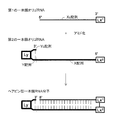
- FIG. 1 is a schematic diagram of the manufacturing method of the present invention.
- the vertical lines (solid lines) above the lines representing the X, Xc, Y, and Yc sequences in the figure schematically show that the sequences are complementary, but the individual ribonucleotide residues and the corresponding It does not necessarily represent the complementarity with the residues that do.
- the boundaries between the arrays X and Y in the figure are schematically represented by vertical lines (dotted lines).
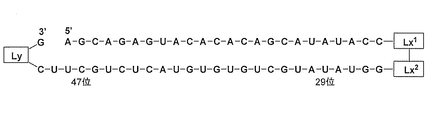
- FIG. 2 is a schematic diagram of the ssTbRNA molecule (SEQ ID NO: 1).
- Lx 1 represents a non-nucleotide linker having an amino group
- Ly represents a non-nucleotide linker
- Lx 2 represents a non-nucleotide linker having a carboxyl group.
- Positions 29 (U) to 47 (C) of SEQ ID NO: 1 correspond to the active sequence (gene expression suppressing sequence for TGF- ⁇ 1 gene).
- the present invention relates to a method for producing a hairpin-type single-stranded RNA molecule that suppresses gene expression.
- the 3′-end of the sense strand and the 5′-end of the antisense strand of the double-stranded RNA containing the gene expression suppressing sequence contain a non-nucleotide linker. It has a single-stranded structure linked via a sequence and further linked to ribonucleotides via a sequence containing an additional non-nucleotidic linker at the 3 'end of its antisense strand.
- hairpin type means that a single-stranded RNA molecule forms one or more double-stranded structures by intramolecular annealing (self-annealing).
- the hairpin-type single-stranded RNA molecule produced by the method of the present invention has a 5 ′ region including the 5 ′ end and a 3 ′ region including the 3 ′ end that are separately subjected to intramolecular annealing, so that at least 2 Form a double-stranded structure.
- RNA Ribonucleic acid molecule
- nucleic acid may be composed of only nucleotides, but nucleotides and non-nucleotide substances (for example, amino acids such as proline derivatives and glycine derivatives) Derivatives).
- a hairpin-type single-stranded RNA molecule containing a gene expression suppressing sequence is referred to as (i) a first single-stranded oligoRNA molecule having a non-nucleotide linker (Lx 1 ) having an amino group on the 3 ′ side.
- a second single-stranded oligo RNA molecule having a non-nucleotidic linker (Lx 2 ) having a carboxyl group on the 5 ′ side and a non-nucleotidic linker (Ly) on the 3 ′ side It can be produced by dividing into fragments and synthesizing them, and linking them by an amidation reaction.
- the carboxyl group is also called a carboxylic acid group.
- a schematic diagram of the method of the present invention is shown in FIG.
- Lx 1 is a non-nucleotide linker having an amino group
- Lx 2 is a non-nucleotide linker having a carboxyl group
- Ly is a non-nucleotide linker.
- a relatively long hairpin-type single-stranded RNA molecule can be produced by ligating a pair of shorter single-stranded RNA molecules, thereby achieving high production efficiency. .
- the method for producing a hairpin-type single-stranded RNA molecule containing a gene expression suppressing sequence comprises, in the presence of a dehydrating condensing agent, a first single-stranded RNA molecule represented by the following formula (I): Reacting the single-stranded oligo RNA molecule with a second single-stranded oligo RNA molecule represented by the following formula (II).
- the carbodiimide-type dehydrating condensing agent is an N-hydroxy nitrogen-containing aromatic compound (eg, hydroxybenzotriazole or a derivative thereof) or cyano ( Used in combination with (hydroxyimino) acetic acid ester.
- N-hydroxy nitrogen-containing aromatic compound eg, hydroxybenzotriazole or a derivative thereof
- cyano Used in combination with (hydroxyimino) acetic acid ester.
- 2-halopyridinium-type dehydrating condensing agent is used as the dehydrating condensing agent
- the 2-halopyridinium-type dehydrating condensing agent is used in combination with an N-hydroxy nitrogen-containing aromatic compound.
- the formamidinium-type dehydrating condensing agent is used in combination with an N-hydroxy nitrogen-containing aromatic compound or an N-hydrocarbon-substituted imidazole derivative.
- the reaction between the first single-stranded oligo RNA molecule and the second single-stranded oligo RNA molecule is an amidation reaction.
- a first single-stranded oligo RNA molecule (specifically, an amino group at Lx 1 at the end of the molecule) and a second single-stranded oligo RNA molecule (specifically, an Lx at the end of this molecule)
- An amide bond can be formed between the first single-stranded oligo RNA molecule and the second single-stranded oligo RNA molecule by an amidation reaction (dehydration condensation reaction) of the carboxyl group in ( 2 ).
- This amidation reaction in the production method of the present invention can be carried out in a reaction solvent, particularly in a mixed solvent containing a buffer and a hydrophilic organic solvent.
- oligo RNA and “oligo RNA molecule” refer to an RNA molecule having a base sequence of 49 bases or less (the number of non-nucleotide linker residues is not included).
- the terms “oligoRNA” and “oligoRNA molecule” are usually used interchangeably.
- the single-stranded oligo RNA molecule according to the present invention is sometimes referred to as a single-stranded oligo RNA, oligo nucleic acid, single-stranded nucleic acid molecule, oligo RNA, or oligo RNA molecule.
- Formula (I), the sequence Xc and the linker Lx 1 is 5 'from the terminal side, which represents a linking structure in the order of Xc-Lx 1.
- Formula (II), the sequence X, Y and Yc and linker Lx 2 and Ly is 5 'from the terminal side, which represents a linking structure in the order of Lx 2 -X-Y-Ly- Yc.
- X, Xc, Y and Yc consist of ribonucleotide residues (one or more ribonucleotide residues).
- the ribonucleotide residue may have any nucleobase selected from adenine, uracil, guanine or cytosine.
- the ribonucleotide residue may also be a modified ribonucleotide residue, for example, having a modified nucleobase (modified base). Modifications include, but are not limited to, fluorescent dye labeling, methylation, halogenation, pseudouridine, amination, deamination, thiolation, dihydrolation, and the like.
- X, Xc, Y and Yc may each independently consist of only an unmodified ribonucleotide residue, or may contain a modified ribonucleotide residue in addition to the unmodified ribonucleotide residue. Alternatively, it may be composed of only modified ribonucleotide residues.
- Xc is complementary to X.
- Xc preferably comprises a sequence (complementary sequence) completely complementary to the entire region of X or a partial region thereof.
- Xc is composed of a complementary sequence of the entire region from the 5 'end to the 3' end of X, and Xc and X have the same number of bases.
- Xc is completely complementary to the partial region of X
- Xc is composed of a complementary sequence of the partial region of X
- Xc is one or more bases than X, for example, 1 to 4 bases or 1 to 2 bases. It has fewer bases.
- the partial region is preferably a region consisting of a nucleotide sequence which is continuous from Lx 2 side of the terminal base in X.
- X may be, for example, 19 to 39 bases in length, preferably 19 to 30 bases in length, more preferably 19 to 25 bases in length.
- ⁇ Xc may be, for example, 19 to 39 bases in length, preferably 19 to 30 bases in length, more preferably 19 to 25 bases in length.
- Yc and Y have the same base length.
- Yc is complementary to Y.
- Yc preferably consists of a sequence that is completely complementary to the entire region of Y (complementary sequence).
- Yc is composed of the complementary sequence of the entire region from the 5 'end to the 3' end of Y, and Yc and Y have the same number of bases.
- ⁇ Y may be, for example, 1 to 5 bases in length, preferably 1 to 3 bases in length, more preferably 1 or 2 bases in length.
- ⁇ Yc may be, for example, 1 to 5 bases in length, preferably 1 to 3 bases in length, more preferably 1 or 2 bases in length.
- the difference [(X + Y)-(Xc + Yc)] between the total number of bases (base length) of X and Y [(X + Y)] and the total number of bases (base length) of Xc and Yc [(Xc + Yc)] is although not particularly limited, it is, for example, 0 to 4 bases (base length), preferably 0, 1, or 2 bases (base length).
- the total number of bases X, Y and Yc is, for example, 21 to 49 bases, preferably 21 to 30 bases, more preferably 25 to 30 bases. ⁇ 30 bases.
- Linker Lx 1 in the formula (I) is an amino group, preferably a primary amino group or secondary amino group, a non-nucleotide linker.
- the amino group may be present at the terminal of the linker Lx 1, may be present therein, it is preferably present at the end.
- Linker Lx 1 for example, represented by the following formula (III).
- R 1 is an alkylene chain having m carbon atoms.
- any hydrogen atom on the carbon atom of the alkylene chain R 1 may be substituted with any substituent, or may not be substituted.
- m is not particularly limited and can be appropriately set depending on the desired length of the linker Lx 1, for example, from the viewpoint of such as manufacturing costs and yield, m is preferably an integer of 1 to 30, more preferably It is an integer of 1 to 20, and more preferably an integer of 1 to 10.
- —OR 1 in the formula (III) is bonded to the 3 ′ end of Xc via a phosphodiester bond. That, -OR 1 in the linker Lx 1 is attached via a position to phosphodiester bonds 3 'terminus of the sugar (ribose)' Xc 3.
- Linker Lx 1 preferably has a linear structure.
- the linker Lx 1 may be those represented by the following formula (VI).
- Linker Lx 2 in the formula (II) is a non-nucleotide linker having a carboxyl group.
- the linker Lx 2 has a carboxyl group may be any structure as long as it does not inhibit the amidation reaction.
- the carboxyl group may be present at the terminal of the linker Lx 2, may be present therein, it is preferably present at the end.
- linker Lx 2 is, for example, the non-nucleotidic linker having an amino acid skeleton. Such linkers Lx 2 is derived from amino acids, and may be a linker containing at the end of the structure having a carboxyl group.
- amino acid skeleton refers to any organic compound containing at least one amino group and one or more carboxyl groups in the molecule, or a structure thereof.
- the amino group refers to a functional group obtained by removing one or more hydrogen atoms from ammonia, a primary amine, or a secondary amine.
- the amino group and / or carboxyl group constituting the amino acid skeleton may form any chemical bond such as an amide bond and an ester bond.
- the amino acid from which the amino acid skeleton is derived may be, for example, a natural amino acid or an artificial amino acid.
- the natural amino acid refers to an amino acid having a naturally occurring structure or an optical isomer thereof.
- an artificial amino acid refers to an amino acid having a structure that does not exist in nature. That is, the artificial amino acid is a carboxylic acid derivative containing an amino acid, that is, a carboxylic acid derivative containing an amino group (an organic compound containing one or more amino groups and one or more carboxyl groups in the molecule), and having a structure that does not exist in nature.
- the artificial amino acid preferably does not contain, for example, a heterocycle.
- Amino acids include, for example, glycine, ⁇ -alanine, arginine, asparagine, aspartic acid, cysteine, cystine, glutamine, glutamic acid, histidine, isoleucine, leucine, lysine, hydroxylysine, methionine, phenylalanine, serine, threonine, tyrosine, valine, proline , 4-hydroxyproline, tryptophan, ⁇ -alanine, 1-amino-2-carboxycyclopentane, aminobenzoic acid, aminopyridinecarboxylic acid, nipecotic acid, isonipecotinic acid, pipecolic acid, 3-pyrrolidinecarboxylic acid, ⁇ -aminobutyric acid Or sarcosine, and may or may not have a substituent or a protecting group.
- substituents include, but are not limited to, halogen, hydroxy, alkoxy, amino, carboxy, sulfo, nitro, carbamoyl, sulfamoyl, alkyl, alkenyl, alkynyl, haloalkyl, aryl, arylalkyl, alkylaryl, cycloalkyl, Cycloalkenyl, cycloalkylalkyl, cyclylalkyl, hydroxyalkyl, alkoxyalkyl, aminoalkyl, silyl, silyloxyalkyl, pyrrolyl, imidazolyl, and the like.
- the protective group may be, for example, a functional group that converts a highly reactive functional group to inactive, and includes a known protective group.
- a functional group that converts a highly reactive functional group to inactive for example, the description in the literature (Protective Groups in Organic Synthesis 4th Edition, Greene et al., 2007, John Wiley & Sons, Inc.) can be cited.
- the protective group is not particularly restricted but includes, for example, tert-butyldimethylsilyl, bis (2-acetoxyethyloxy) methyl, triisopropylsilyloxymethyl, 1- (2-cyanoethoxy) ethyl, 2-cyano Examples include an ethoxymethyl group, a 2-cyanoethyl group, a tolylsulfonylethoxymethyl group, a trityl group, and a dimethoxytrityl group.
- isomers such as an optical isomer, a geometric isomer, and a stereoisomer exist
- the amino acid may be any isomer. These may be a single isomer or a mixture.
- linker Lx 2 non-nucleotide linker comprising at least one pyrrolidine skeleton and piperidine skeleton having a carboxyl group, or -NHCH is non-nucleotide linker comprising 2 COOH and the like.
- the linker Lx 2 for example, represented by the following formula (IV) or the following formula (IV '), more preferably represented by the following formula (IV).
- R 2 is an alkylene chain having n carbon atoms. Wherein any hydrogen atom on the carbon atoms of the alkylene chain R 2 may be substituted with any substituent or may be unsubstituted.
- n is not particularly limited and can be appropriately set depending on the desired length of the linker Lx 2, for example, from the viewpoint of such as manufacturing costs and yield, n is preferably an integer of 1 to 30, more preferably It is an integer of 1 to 20, and more preferably an integer of 1 to 10.
- p is 1 or 2, and preferably 1.
- the sum of m of R 1 and n of R 2 is, for example, an integer of 2 to 31, preferably an integer of 2 to 21, and more preferably an integer of 2 to 15.
- the linker Lx 2 has a cyclic structure, such as a pyrrolidine skeleton or piperidine skeleton.
- linker Lx 2 may be those represented by the following formula (VII).
- the linker represented by the formula (VII) may be an optically active substance represented by the following formula (VII-1) or (VII-2).
- linker Lx 2 may be those represented by the following formula (VII ').
- the linker Ly in the formula (II) is a non-nucleotidic linker.
- the linker Ly may have any structure as long as it does not inhibit the amidation reaction.
- Examples of the linker Ly include a non-nucleotide linker having an amino acid skeleton or an amino alcohol skeleton.
- Such a linker Ly may be a linker comprising a structure derived from an amino acid. This "amino acid skeleton" is as described above. However, the amino group and / or carboxyl group constituting the amino acid skeleton of the linker Ly may form an arbitrary chemical bond such as an amide bond and an ester bond.
- amino alcohol skeleton refers to any organic compound containing at least one amino group and one or more hydroxyl group in the molecule or its structure.
- amino group is as described above.
- the amino group and / or the hydroxyl group constituting the amino alcohol skeleton of the linker Ly may form an arbitrary chemical bond such as an amide bond, an ester bond, and an ether bond.
- the amino alcohol include an amino alcohol obtained by converting a carboxyl group of the above amino acid.
- the amino alcohol may be, for example, aminoethanol, aminopropanol, vallinol, prolinol, or piperidinemethanol, and may or may not have a substituent or a protecting group.
- substituents include, but are not limited to, halogen, hydroxy, alkoxy, amino, carboxy, sulfo, nitro, carbamoyl, sulfamoyl, alkyl, alkenyl, alkynyl, haloalkyl, aryl, arylalkyl, alkylaryl, cycloalkyl, Cycloalkenyl, cycloalkylalkyl, cyclylalkyl, hydroxyalkyl, alkoxyalkyl, aminoalkyl, silyl, silyloxyalkyl, pyrrolyl, imidazolyl, and the like.
- the protective group may be, for example, a functional group that converts a highly reactive functional group to inactive, and includes a known protective group.
- a functional group that converts a highly reactive functional group to inactive for example, the description in the literature (Protective Groups in Organic Synthesis 4th Edition, Greene et al., 2007, John Wiley & Sons, Inc.) can be cited.
- the protective group is not particularly restricted but includes, for example, tert-butyldimethylsilyl, bis (2-acetoxyethyloxy) methyl, triisopropylsilyloxymethyl, 1- (2-cyanoethoxy) ethyl, 2-cyano Examples include an ethoxymethyl group, a 2-cyanoethyl group, a tolylsulfonylethoxymethyl group, a trityl group, and a dimethoxytrityl group.
- an amino alcohol has an isomer such as an optical isomer, a geometric isomer, and a stereoisomer, any of the isomers may be used. These may be a single isomer or a mixture.
- the linker Ly is preferably a non-nucleotide linker containing at least one of a pyrrolidine skeleton and a piperidine skeleton, or a non-nucleotide linker containing -NHCH 2 COO-. More preferably, the linker Ly has a cyclic structure that can be substituted at two or more positions.
- the linker Ly may have one or more substituents.
- the linker Ly connects the above Y and Yc via any two of the groups (for example, substituents on two atoms constituting the n-membered ring).
- the hairpin-type single-stranded RNA molecule produced by the method of the present invention is excellent in nuclease resistance because the sense strand and the antisense strand are linked by such a linker.
- the linker Ly is a non-nucleotidic linker including at least one of a pyrrolidine skeleton and a piperidine skeleton, and is preferably a non-nucleotidic linker including a pyrrolidine skeleton or a piperidine skeleton.
- the pyrrolidine skeleton may be, for example, a skeleton of a pyrrolidine derivative in which one or more carbon atoms constituting a 5-membered ring of pyrrolidine are substituted. When substituted, for example, a carbon atom other than the 2-position carbon atom (C-2) Is preferably substituted.
- the carbon atom may be substituted with, for example, a nitrogen atom, an oxygen atom or a sulfur atom.
- the pyrrolidine skeleton may contain, for example, a carbon-carbon double bond or a carbon-nitrogen double bond in the 5-membered ring of pyrrolidine.
- a hydrogen atom may be bonded to a carbon atom and a nitrogen atom constituting the 5-membered ring of pyrrolidine, or a substituent described later may be bonded.
- the linker Ly may link Y and Yc, for example, via any group of the above-mentioned pyrrolidine skeleton.
- pyrrolidine skeleton examples include a proline skeleton and a prolinol skeleton.
- Ly is a non-nucleotidic linker having a pyrrolidine skeleton or a piperidine skeleton
- Lx 1 is a non-nucleotidic linker having an amino group
- a linker, Lx 2 is a non-nucleotide linker comprising at least one pyrrolidine skeleton and piperidine skeleton having a carboxyl group.
- the piperidine skeleton may be, for example, the skeleton of a piperidine derivative in which one or more carbon atoms constituting the 6-membered ring of piperidine are substituted, and when substituted, for example, other than the carbon atom at the 2-position (C-2) Is preferably substituted.
- the carbon atom may be substituted with, for example, a nitrogen atom, an oxygen atom or a sulfur atom.
- the piperidine skeleton may contain, for example, a carbon-carbon double bond or a carbon-nitrogen double bond in the 6-membered ring of piperidine.
- a carbon atom and a nitrogen atom constituting the 6-membered ring of piperidine may be, for example, a hydrogen atom or a substituent as described below.
- the linker Ly may link Y and Yc, for example, via any group of the piperidine skeleton. They can be connected to any one of the carbon atoms constituting the 6-membered ring and a nitrogen atom, preferably to the 2-position carbon atom (C-2) of the 6-membered ring via a nitrogen atom.
- the linker Ly is represented, for example, by the following formula (VIII).
- X 1 and X 2 are each independently H 2 , O, S or NH; Y 1 and Y 2 are each independently a single bond, CH 2 , NH, O or S; Z is a hydrogen atom or a substituent bonded to C-3, C-4, C-5 or C-6 on ring A; L 1 is an alkylene chain having r carbon atoms, wherein a hydrogen atom on a carbon atom of the alkylene chain is substituted by OH, OR a , NH 2 , NHR a , NR a R b , SH or SR a Or may not be substituted, or L 1 is a polyether chain in which at least one carbon atom of the alkylene chain is substituted with an oxygen atom,
- Y 1 is NH, O or S
- the atom of L 1 bonded to Y 1 is carbon
- the atom of L 1 bonded to O is carbon
- the oxygen atoms are not adjacent to each other
- L 2 is
- Y and Yc are linked to the linker Ly via -OL 1 or -OL 2 in the formula (VIII).
- Y may be linked via —OL 1 and Yc via —OL 2 to the linker Ly.
- Y may be linked via —OL 2 and Yc via —OL 1 to a linker Ly.
- X 1 and X 2 are, for example, each independently H 2 , O, S or NH.
- X 1 being H 2 means that X 1 forms CH 2 together with the carbon atom to which X 1 is bonded. The same is true for X 2.
- Y 1 and Y 2 are each independently a single bond, CH 2 , NH, O or S.
- q is 1 or 2.
- ring A is a 5-membered ring, for example, the above-mentioned pyrrolidine skeleton.
- the pyrrolidine skeleton includes, for example, a proline skeleton, a prolinol skeleton, and the like, and examples thereof include divalent structures.
- ring A is a 6-membered ring, for example, the above-mentioned piperidine skeleton.
- one carbon atom other than C-2 on ring A may be substituted with a nitrogen atom, oxygen atom or sulfur atom.
- Ring A may contain a carbon-carbon double bond or a carbon-nitrogen double bond in ring A.
- Ring A may be, for example, any of L-type and D-type.
- Z is a hydrogen atom or a substituent bonded to C-3, C-4, C-5 or C-6 on the ring A.
- the number of the substituents Z may be one, plural, or absent, and in the case of plural, they may be the same or different.
- R a and R b are, for example, each independently a substituent or a protecting group, and may be the same or different.
- the substituent is, for example, halogen, alkyl, alkenyl, alkynyl, haloalkyl, aryl, heteroaryl, arylalkyl, cycloalkyl, cycloalkenyl, cycloalkylalkyl, cyclylalkyl, hydroxyalkyl, alkoxyalkyl, aminoalkyl, heterocyclylalkenyl , Heterocyclylalkyl, heteroarylalkyl, silyl, silyloxyalkyl and the like.
- the substituent Z may be one of these substituents.
- the protective group is, for example, a functional group that converts a highly reactive functional group to inactive, and includes a known protective group.
- the protective group is not particularly limited, and may be, for example, a tert-butyldimethylsilyl group (hereinafter, TBDMS group), a bis (2-acetoxyethyloxy) methyl group (hereinafter, ACE group), a triisopropylsilyloxymethyl group (hereinafter, referred to as ACE group).
- TOM group 1- (2-cyanoethoxy) ethyl group (hereinafter, CEE group), 2-cyanoethoxymethyl group (hereinafter, CEM group), 2-cyanoethyl group (hereinafter, CE group), tolylsulfonylethoxymethyl Group (hereinafter, TEM group), trityl group (hereinafter, Tr group), dimethoxytrityl group (hereinafter, DMTr group), and the like.
- the protecting group is, for example, TBDMS group, ACE group, TOM group, CEE group, CEM group and TEM group and the like.
- silyl-containing groups are also included.
- silyl-containing groups are also included.
- L 1 is an alkylene chain having r carbon atoms. Hydrogen atoms on the alkylene carbon atoms is, for example, OH, OR a, NH 2 , NHR a, NR a R b, may be substituted by SH or SR a, may not be substituted. Alternatively, L 1 may be a polyether chain in which one or more carbon atoms of the alkylene chain have been substituted with oxygen atoms. The polyether chain is, for example, polyethylene glycol. When Y 1 is NH, O or S, the atom of L 1 bonded to Y 1 is carbon, the atom of L 1 bonded to O is carbon, and the oxygen atoms are not adjacent to each other.
- L 2 is an alkylene chain having s carbon atoms.
- a hydrogen atom on the carbon atoms of the alkylene chain for example, OH, OR a, NH 2 , NHR a, NR a R b, may be substituted by SH or SR a, it may not be substituted.
- L 2 may be a polyether chain in which one or more carbon atoms of the alkylene chain have been substituted with oxygen atoms.
- Y 2 is NH, O or S
- the atom of L 2 bonded to Y 2 is carbon
- the atom of L 2 bonded to O is carbon
- the oxygen atoms are not adjacent to each other.
- R of L 1 and s of L 2 are not particularly limited, and the lower limit is, for example, 0, and the upper limit is not particularly limited.
- r and s can be appropriately set according to, for example, a desired length of the linker Ly.
- r and s are each independently preferably an integer of 0 to 30, more preferably an integer of 0 to 20, further preferably an integer of 0 to 15, from the viewpoint of production cost and yield. is there. r and s may be the same or different.
- R a and R b are the same as described above.
- a hydrogen atom may be independently replaced with a halogen such as Cl, Br, F and I, for example.
- the linker Ly may be represented by any of the following formulas (VIII-1) to (VIII-9).
- t is an integer of 0 to 10
- r and s are the same as in the above formula (VIII).
- the linker Ly may be represented by the following formula (V) or the following formula (IX).
- the linker represented by the formula (V) may be an optically active substance represented by the following formula (V-1) or the following formula (V-2).
- the linker Ly is a non-nucleotidic linker comprising -NHCH 2 COO-, and such a linker is represented, for example, by the following formula (XXI).
- This linker Ly basically corresponds to the linker Ly represented by the above formula (VIII), and the description of the linker represented by the above formula (VIII) is based on the linker represented by the following formula (XXI). Is also used.
- X 1 and X 2 are each independently H 2 , O, S or NH; Y 1 and Y 2 are each independently a single bond, CH 2 , NH, O or S; L 1 is an alkylene chain having r carbon atoms, wherein a hydrogen atom on a carbon atom of the alkylene chain is substituted by OH, OR a , NH 2 , NHR a , NR a R b , SH or SR a Or may not be substituted, or L 1 is a polyether chain in which at least one carbon atom of the alkylene chain is substituted with an oxygen atom,
- L 2 is an alkylene chain having s carbon atoms, wherein a hydrogen atom on a carbon atom of the alky
- Y and Yc are linked to the linker Ly via -OL 1 or -OL 2 in the formula (XXI).
- Y may be linked via —OL 1 and Yc via —OL 2 to the linker Ly.
- Y may be linked via —OL 2 and Yc via —OL 1 to a linker Ly.
- X 1 and X 2 are, for example, each independently H 2 , O, S or NH.
- X 1 being H 2 means that X 1 forms CH 2 together with the carbon atom to which X 1 is bonded. The same is true for X 2.
- Y 1 and Y 2 are each independently a single bond, CH 2 , NH, O or S.
- R a and R b are, for example, each independently a substituent or a protecting group, and may be the same or different.
- the substituent is, for example, halogen, alkyl, alkenyl, alkynyl, haloalkyl, aryl, heteroaryl, arylalkyl, cycloalkyl, cycloalkenyl, cycloalkylalkyl, cyclylalkyl, hydroxyalkyl, alkoxyalkyl, aminoalkyl, heterocyclylalkenyl , Heterocyclylalkyl, heteroarylalkyl, silyl, silyloxyalkyl and the like.
- the protective group is, for example, a functional group that converts a highly reactive functional group to inactive, and includes a known protective group.
- a functional group that converts a highly reactive functional group to inactive
- the protective group for example, the description in the literature (Protective Groups in Organic Synthesis 4th Edition, Greene et al., 2007, John Wiley & Sons, Inc.) can be cited.
- the protective group is not particularly limited, and examples thereof include a TBDMS group, an ACE group, a TOM group, a CEE group, a CEM group, a CE group, a TEM group, a Tr group, and a DMTr group.
- TBDMS group an ACE group
- TOM group a CEE group
- CEM group a CEM group
- CE group a CEM group
- CE group a TEM group
- Tr group TEM group
- L 1 is an alkylene chain having r carbon atoms. Hydrogen atoms on the alkylene carbon atoms is, for example, OH, OR a, NH 2 , NHR a, NR a R b, may be substituted by SH or SR a, may not be substituted. Alternatively, L 1 may be a polyether chain in which one or more carbon atoms of the alkylene chain have been substituted with oxygen atoms. The polyether chain is, for example, polyethylene glycol. When Y 1 is NH, O or S, the atom of L 1 bonded to Y 1 is carbon, the atom of L 1 bonded to O is carbon, and the oxygen atoms are not adjacent to each other.
- L 2 is an alkylene chain having s carbon atoms.
- a hydrogen atom on the carbon atoms of the alkylene chain for example, OH, OR a, NH 2 , NHR a, NR a R b, may be substituted by SH or SR a, it may not be substituted.
- L 2 may be a polyether chain in which one or more carbon atoms of the alkylene chain have been substituted with oxygen atoms.
- Y 2 is NH, O or S
- the atom of L 2 bonded to Y 2 is carbon
- the atom of L 2 bonded to O is carbon
- the oxygen atoms are not adjacent to each other.
- R of L 1 and s of L 2 are not particularly limited, and the lower limit is, for example, 0, and the upper limit is not particularly limited.
- r and s can be appropriately set according to, for example, a desired length of the linker Ly.
- r and s are each independently preferably an integer of 0 to 30, more preferably an integer of 0 to 20, further preferably an integer of 0 to 15, from the viewpoint of production cost and yield. is there. r and s may be the same or different.
- R a and R b are the same as described above.
- a hydrogen atom may be, for example, each independently substituted with a halogen such as Cl, Br, F and I.
- linker Ly may be represented by the following formula (XXII).
- the first and second single-stranded oligo RNA molecules can be prepared using RNA synthesis methods known to those skilled in the art.
- RNA synthesis methods known to those skilled in the art include, for example, the phosphoramidite method and the H-phosphonate method.
- a ribonucleoside bound to a hydrophobic group of a carrier is elongated by a condensation reaction with an RNA amidite (ribonucleoside phosphoramidite), and the condensation reaction with the RNA amidite is repeated through oxidation and deprotection.
- RNA synthesis can be performed.
- the first single-stranded oligo RNA molecule represented by the formula (I) can be prepared by a general RNA synthesis method, for example, a phosphoramidite method.
- the amino alcohol is a solid phase support which is attached through an amino group corresponding to a pre-structure of the linker Lx 1 (e.g., later-described 3'-PT Amino-Modifier C4 CPG ; Link Technologies) using a normal It can be produced by solid-phase synthesis of Xc from the 3 'terminal side according to the method. Any RNA amidite can be used for the synthesis.
- various protecting groups such as a TBDMS group, a TOM group, an ACE group, a CEE group, a CEM group, a TEM group, and a DMTr group can be used at the 2′-hydroxyl group.
- General-purpose RNA amidites can also be used.
- the solid support any solid support such as a polystyrene support, an acrylamide support or a glass support can be used.
- the carrier may be in any form such as beads, plates, chips, tubes and the like. Examples of the carrier to which the amino alcohol is bound include, but are not limited to, 3′-PT Amino-Modifier C3 CPG or C7 CPG (Link Technologies).
- the second single-stranded oligo RNA molecule represented by the formula (II) can be produced by a general RNA synthesis method, for example, a phosphoramidite method.
- a linker Ly is linked to the 5' end of Yc.
- a linker Lx 2 is linked to the linker Lx 2 to 5 'end of X.
- Any RNA amidite can be used for the synthesis.
- various protecting groups such as a TBDMS group, a TOM group, an ACE group, a CEE group, a CEM group, a TEM group, and a DMTr group can be used at the 2′-hydroxyl group.
- General-purpose RNA amidites can also be used.
- the solid support any solid support such as a polystyrene support, an acrylamide support or a glass support can be used.
- the carrier may be in any form such as beads, plates, chips, tubes and the like. Examples of carriers, for example NittoPhase (R) HL rG (ibu ), or is rU (KINOVATE), and the like, without limitation.
- the consolidated linker Lx 2 to 5 'end of X can be any monomer for RNA synthesis suitable therefor, for example, it is used monomers for RNA synthesis represented by the following formula (X) it can.
- This monomer basically corresponds to the linker represented by the above formula (IV), and the description of the linker represented by the above formula (IV) is also applied to the monomer represented by the following formula (X). Is done.
- the monomer represented by the following formula (X) can be used, for example, as an amidite for automatic nucleic acid synthesis, and is applicable to, for example, a general automatic nucleic acid synthesizer.
- the present invention also provides a monomer (amidite) for RNA synthesis represented by the following formula (X).
- R 2 is an alkylene chain having n carbon atoms. Wherein any hydrogen atom on the carbon atoms of the alkylene chain R 2 may be substituted with any substituent or may be unsubstituted.
- n is not particularly limited and can be appropriately set depending on the desired length of the linker Lx 2, for example, from the viewpoint of such as manufacturing costs and yield, n is preferably an integer of 1 to 30, more preferably It is an integer of 1 to 20, more preferably an integer of 1 to 15.
- p is 1 or 2, and preferably 1.
- R 3 is a carboxylic acid protecting group.
- carboxylic acid protecting group for example, the description in the literature (Protective Groups in Organic Synthesis, 4th edition, Greene et al., 2007, John Wiley & Sons, Inc.) can be referred to.
- Specific examples of the carboxylic acid protecting group include, for example, a DMTr group, a Tr group, a TBDMS group, an ACE group, a TOM group, a CEE group, a CEM group, a CE group, a TEM group, and a 2,4-dimethoxybenzyl group.
- a CE group or a 2,4-dimethoxybenzyl group is preferred.
- R 4 is an alkyl group substituted with an electron-withdrawing group, specifically, for example, a 2-cyanoethyl group (CE group), a nitrophenylethyl group, etc., and a 2-cyanoethyl group (CE group) Is preferred.
- R 5 and R 6 are each independently an alkyl group, and may be the same or different. Specific examples of —NR 5 R 6 include a diisopropylamino group, a diethylamino group, and an ethylmethylamino group, and a diisopropylamino group is preferable.
- the monomer represented by the formula (X) may be represented by the following formula (XI) or the following formula (XVIII).
- the monomer represented by the formula (XI) may be an optically active substance represented by the following formula (XI-1) or (XI-2).
- the monomer represented by the formula (XVIII) may be an optically active substance represented by the following formula (XVIII-1) or (XVIII-2).
- the monomer represented by the formula (X) is, for example, a phosphorylation reaction of an alcohol derivative represented by the formula (XII) with a phosphorylation reagent represented by the formula (XIII), as shown in the following scheme 1. Can be synthesized.
- phosphorylating reagent represented by the formula (XIII) include, for example, 2-cyanoethyl-N, N-diisopropylchlorophosphoramidite, nitrophenylethyl-N, N-diisopropylchlorophosphoramidite, methyl-N , N-diisopropylchlorophosphoramidite or 2-cyanoethyl-N, N, ⁇ N ', N'-tetraisopropylphosphoramidite.
- the equivalent of the phosphorylating reagent represented by the formula (XIII) is preferably 1 to 10 equivalents, more preferably 1.1 to 1.5 equivalents, based on the alcohol derivative represented by the formula (XII).
- Examples of the activator used for the phosphorylation reaction include tetrazole and diisopropylamine tetrazole salts, and diisopropylamine tetrazole salts are preferred.
- the equivalent of the activator is preferably 1 to 10 equivalents, more preferably 1.1 to 1.5 equivalents to the alcohol derivative represented by the formula (XII).
- Examples of the solvent used for the phosphorylation reaction include tetrahydrofuran, dichloromethane, chloroform, diethyl ether and acetonitrile, and acetonitrile is preferred.
- the reaction temperature of the phosphorylation reaction is preferably 20 to 50 ° C, more preferably 20 to 30 ° C.
- the reaction time of the phosphorylation reaction is preferably 1 to 48 hours, more preferably 2 to 5 hours.
- the alcohol derivative represented by the formula (XII) is obtained by, for example, a condensation reaction between an amine derivative represented by the formula (XIV) and a carboxylic acid derivative represented by the formula (XV) as shown in the following scheme 2. Can be synthesized.
- the equivalent of the carboxylic acid derivative represented by the formula (XV) used in the condensation reaction is preferably 1 to 3 equivalents, more preferably 1.1 to 1.5 equivalents to the amine derivative represented by the formula (XIV). preferable.
- Examples of the condensing agent used for the condensation reaction include cyclohexylcarbodiimide, N- (3′-dimethylaminopropyl) -N′-ethylcarbodiimide hydrochloride, benzotriazol-1-yloxy-trisdimethylaminophosphonium salt, and O- (benzo Triazol-1-yl) -N, N, N ', N'-tetramethyluronium hexafluorophosphate or O- (7-azabenzotriazol-1-yl) -N, N, N', N'- Examples thereof include tetramethyluronium hexafluorophosphate, and N- (3′-dimethylaminopropyl) -N′-ethylcarbodiimide hydrochloride is preferred.
- the equivalent of the condensing agent is preferably 1 to 10 equivalents, more preferably 1.1 to 1.5 equivalents to the carboxylic acid derivative represented by the formula (XV).
- Examples of the base used in the condensation reaction include organic bases such as diisopropylethylamine, triethylamine, pyridine and N-methylmorpholine, and organic acid salts such as potassium carbonate, sodium carbonate and sodium hydrogencarbonate, and diisopropylethylamine or triethylamine. preferable.
- the equivalent of the base is preferably 0 to 10 equivalents, more preferably 1 to 3 equivalents, based on the carboxylic acid derivative represented by the formula (XV).
- N, N-dimethylformamide, tetrahydrofuran, dichloromethane, chloroform, diethyl ether and the like can be mentioned, but dichloromethane is preferable.
- the reaction temperature of the condensation reaction is preferably 0 to 50 ° C, more preferably 0 to 30 ° C.
- the reaction time of the condensation reaction is preferably 1 to 48 hours, more preferably 2 to 5 hours.
- the amine derivative represented by the formula (XIV) can be obtained, for example, by introducing a protecting group into a carboxylic acid of an amino acid derivative represented by the formula (XVI) and obtaining the resulting compound represented by the formula (XVII) as shown in Scheme 3 below.
- a reaction for introducing a protecting group into a carboxylic acid of an amino acid derivative represented by the formula (XIX) and a reaction represented by the formula (XX) as shown in Scheme 4. Can be synthesized by the Fmoc-elimination reaction of the amino acid derivative.
- the above-mentioned reaction of introducing a protecting group into a carboxylic acid may be carried out by a known method described in, for example, literature (Protective Groups in Organic Synthesis, 4th edition, written by Greene et al., 2007, John Wiley & Sons, Inc.). Can be.
- Boc removal reaction and the Fmoc removal reaction can be performed by a known method described in, for example, literature (Protective Groups in Organic Synthesis, 4th edition, Greene et al., 2007, John Wiley & Sons, Inc.). it can.
- amino acid derivative represented by the formula (XVI) or (XIX) can be purchased or can be produced by a known method or a method analogous thereto.
- the following formula (X' 5 of X can also be used monomers for RNA synthesis represented by).
- This monomer basically corresponds to the linker represented by the above formula (IV ′), and the description of the linker represented by the above formula (IV ′) will be described with reference to the monomer represented by the following formula (X ′) It is also referred to.
- the present invention also provides a monomer (amidite) for RNA synthesis represented by the following formula (X ′).
- R 2 is an alkylene chain having n carbon atoms. Wherein any hydrogen atom on the carbon atoms of the alkylene chain R 2 may be substituted with any substituent or may be unsubstituted.
- n is not particularly limited and can be appropriately set depending on the desired length of the linker Lx 2, for example, from the viewpoint of such as manufacturing costs and yield, n is preferably an integer of 1 to 30, more preferably It is an integer of 1 to 20, more preferably an integer of 1 to 15.
- R 3 is a carboxylic acid protecting group.
- carboxylic acid protecting group for example, the description in the literature (Protective Groups in Organic Synthesis, 4th edition, Greene et al., 2007, John Wiley & Sons, Inc.) can be referred to.
- Specific examples of the carboxylic acid protecting group include, for example, a DMTr group, a Tr group, a TBDMS group, an ACE group, a TOM group, a CEE group, a CEM group, a CE group, a TEM group, and a 2,4-dimethoxybenzyl group.
- CE groups are preferred.
- R 4 is an alkyl group substituted with an electron-withdrawing group, specifically, for example, a 2-cyanoethyl group (CE group), a nitrophenylethyl group, etc., and a 2-cyanoethyl group (CE group) Is preferred.
- R 5 and R 6 are each independently an alkyl group, and may be the same or different. Specific examples of —NR 5 R 6 include a diisopropylamino group, a diethylamino group, and an ethylmethylamino group, and a diisopropylamino group is preferable.
- the monomer represented by the formula (X ′) may be a monomer represented by the following formula (XXIII).
- the monomer represented by the formula (X ′) is obtained by, for example, using the amino acid derivative represented by the formula (XVI ′) in place of the amino derivative represented by the formula (XVI) in the same manner as in the above schemes 1 to 3. It can be manufactured by the method described above.
- the amino acid derivative represented by the formula (XVI ') can be purchased or can be produced by a known method or a method analogous thereto.
- any suitable RNA synthesis monomer for example, described in the literature (Japanese Patent No. 5261677 or Japanese Patent No. 5876890). Known monomers for RNA synthesis can be used.
- XY contains a gene expression suppressing sequence for a target gene.
- the gene expression suppressing sequence may be contained only in X or only in Y.
- the gene expression suppressing sequence is preferably a sense sequence or an antisense sequence of the whole or a part of mRNA transcribed from the target gene.
- the hairpin-type single-stranded RNA molecule may contain one or two or more gene expression suppressing sequences.
- the hairpin-type single-stranded RNA molecule may have, for example, two or more same expression suppression sequences for the same target gene, two or more different expression suppression sequences for the same target,
- the target gene may have two or more different expression suppression sequences.
- Hairpin-type single-stranded RNA molecules having two or more gene expression suppressing sequences for different target genes are useful for suppressing the expression of two or more different target genes.
- “gene” refers to a genomic region transcribed into mRNA, which may be a protein coding region, or may be an RNA coding region.
- the hairpin-type single-stranded RNA molecule according to the present invention has the ability to suppress the expression of a target gene via a gene expression suppressing sequence.
- the suppression of target gene expression by the hairpin-type single-stranded RNA molecule according to the present invention is preferably due to RNA interference, but is not limited thereto.
- RNA interference generally, a long double-stranded RNA (dsRNA) is cleaved in a cell by a Dicer into a short double-stranded RNA (siRNA: small interfering RNA) of about 19 to 21 base pairs with a 3 ′ end protruding.
- Various types of single-stranded RNA sequences contained in siRNA that bind to target mRNA have been reported, depending on the type of target gene, for example.
- the sequence of single-stranded RNA contained in siRNA can be used as a gene expression suppressing sequence.
- the hairpin-type single-stranded RNA molecule produced by the method of the present invention can suppress the expression of a target gene by generating siRNA by in vivo cleavage.
- the hairpin-type single-stranded RNA molecule according to the present invention can be used for treating or preventing a disease or disorder associated with expression or increased expression of a target gene.
- the gene expression suppressing sequence is preferably 19 to 30 bases in length, more preferably 19 to 27 bases in length, and may be, for example, 19, 20, 21, 22, or 23 bases in length.
- the gene expression suppressing sequence preferably comprises an RNA sequence completely identical or completely complementary to at least a part of the sequence of the mRNA of the target gene.
- the target gene is not particularly limited, but includes, for example, TGF- ⁇ 1, GAPDH gene, LAMA1 gene and LMNA gene.
- the hairpin-type single-stranded RNA molecule produced by the method of the present invention suppresses the expression of the TGF- ⁇ 1 gene in vivo.
- Such a hairpin-type single-stranded RNA molecule is used to treat or prevent a disease or disorder associated with TGF- ⁇ 1 gene expression or increased expression, such as pulmonary fibrosis or acute lung disease, through suppression of TGF- ⁇ 1 gene expression.
- RNA molecule containing a gene expression-suppressing sequence produced by the method of the present invention has a nucleotide sequence represented by SEQ ID NO: 1 and a nucleotide sequence represented by SEQ ID NO: 2 And a second single-stranded oligo RNA molecule (strand B) having the base sequence represented by SEQ ID NO: 3.
- the nucleotide sequence represented by SEQ ID NO: 1 contains a gene expression-suppressing sequence for the TGF- ⁇ 1 gene that is the target gene.
- the sequence at positions 29 to 47 of the nucleotide sequence represented by SEQ ID NO: 1 corresponds to the gene expression suppressing sequence (active sequence) (FIG. 2).
- a first single-stranded oligo RNA molecule (strand C) having the nucleotide sequence represented by SEQ ID NO: 4 and having the nucleotide sequence represented by SEQ ID NO: 5 is represented by SEQ ID NO: 6. It is obtained by a combination of a second single-stranded oligo RNA molecule (strand D) having the represented base sequence.
- the base sequence represented by SEQ ID NO: 4 contains a gene expression suppressing sequence for the GAPDH gene as a target gene.
- the sequence at positions 27 to 45 of the base sequence represented by SEQ ID NO: 4 corresponds to the gene expression suppressing sequence (active sequence).
- the first single-stranded oligo RNA molecule represented by the above formula (I) and the second single-stranded oligo RNA molecule represented by the above formula (II) are reacted in a reaction solvent, the presence of a dehydrating condensing agent (also condensing agent referred.), is reacted, by forming an amide bond between the linker Lx 1 and linker Lx 2, to manufacture a single-stranded RNA molecule the hairpin it can.
- the reaction solvent is a mixed solvent containing a buffer and a hydrophilic organic solvent.
- buffer examples include 2- (N-morpholino) ethanesulfonic acid buffer (hereinafter, MES buffer), 3- (N-morpholino) -2-hydroxypropanesulfonic acid buffer (hereinafter, MOPSO buffer), Piperazine-1,4-bis (2-ethanesulfonic acid) buffer (hereinafter, PIPES buffer), 3- (N-morpholino) propanesulfonic acid buffer (hereinafter, MOPS buffer), N, N-bis ( 2-hydroxyethyl) -2-aminoethanesulfonic acid buffer (hereinafter, BES buffer), 3- [N, N-bis (2-hydroxyethyl) amino] -2-hydroxypropanesulfonic acid buffer (hereinafter, referred to as BES buffer) DIPSO buffer), 2- [4- (2-hydroxyethyl) -1-piperazinyl] ethanesulfonic acid buffer (HEPES buffer), piperazine-1, -Bis (2-hydroxypropanesulfonic acid
- the pH of the buffer solution can be appropriately adjusted, but is preferably from 6.5 to 7.5, more preferably from 6.9 to 7.5, for example, from 6.5 to 7.0, 6 0.9 to 7.1, or 7.0 to 7.5.
- a hydrophilic organic solvent can be used as a component of the reaction solvent.
- the hydrophilic organic solvent may be, for example, a hydrophilic aprotic organic solvent.
- the hydrophilic organic solvent means an organic solvent miscible with water in a free ratio, such as a sulfone solvent such as sulfolane, a sulfoxide solvent such as dimethyl sulfoxide, and an amide solvent such as N, N-dimethylformamide and N-methylpyrrolidone.
- Solvents such as a sulfone solvent such as sulfolane, a sulfoxide solvent such as dimethyl sulfoxide, and an amide solvent such as N, N-dimethylformamide and N-methylpyrrolidone.
- Solvents, urea solvents such as N, N'-dimethylethylene urea
- nitrile solvents such as acetonitrile
- ether solvents such as tetrahydrofuran and 1,2-dimethoxyethane
- alcohol solvents such as ethanol and tert-butyl alcohol.
- the ⁇ aprotic '' organic solvent means an organic solvent having no proton donating property
- hydrophilic aprotic organic solvent sulfone solvents such as sulfolane, sulfoxide solvents such as dimethyl sulfoxide, Amide solvents such as N, N-dimethylformamide and N-methylpyrrolidone; urea solvents such as N, N'-dimethylethyleneurea; nitrile solvents such as acetonitrile; ethers such as tetrahydrofuran and 1,2-dimethoxyethane
- the solvent include dimethyl sulfoxide (hereinafter, DMSO), N, N-dimethylformamide (hereinafter, DMF), N, N'-dimethylethyleneurea (hereinafter, DMEU), and acetonitrile, and more preferably, DMSO or DMF. preferable.
- a dehydrating condensing agent, an N-hydroxy nitrogen-containing aromatic compound (eg, hydroxybenzotriazole or a derivative thereof), a cyano (hydroxyimino) acetic acid ester, or an N-hydrocarbon-substituted imidazole derivative are dissolved or suspended in an organic solvent and added.
- the organic solvent is included in the “organic solvent” in the mixed solvent.
- One type of organic solvent may be used, or two or more types may be used in combination.
- the ratio of the organic solvent in the mixed solvent that is the reaction solvent is 15 to 70% by volume (v / v%) of the total amount of the solvent (the total amount of the mixed solvent including the buffer and the organic solvent). It may be, for example, 20-70%, 20-65%, 35-60%, 35-55%, or 50-55% by volume.
- a dehydrating condensing agent, an N-hydroxy nitrogen-containing aromatic compound (for example, hydroxybenzotriazole or a derivative thereof), a cyano (hydroxyimino) acetic acid ester, or an N-hydrocarbon-substituted imidazole derivative are treated with water, a buffer solution or an organic solvent.
- a solution such as, for example, a dehydrating condensing agent, an N-hydroxy nitrogen-containing aromatic compound (eg, hydroxybenzotriazole or a derivative thereof), a cyano (hydroxyimino) acetic acid ester, or Includes the amount of solution containing the hydrocarbon-substituted imidazole derivative.
- a dehydrating condensing agent, an N-hydroxy nitrogen-containing aromatic compound (eg, hydroxybenzotriazole or a derivative thereof), a cyano (hydroxyimino) acetic acid ester, or an N-hydrocarbon-substituted imidazole is used.
- the derivative is dissolved or suspended in an organic solvent and added, the amount of the organic solvent is included in the total amount of the organic solvent in the mixed solvent.
- the ratio of DMSO in the mixed solvent is preferably 20 to 65% by volume, more preferably 35 to 60% by volume, and preferably 50 to 55 or 50 to 50% by volume of the total amount of the solvent. More preferably, it is 60% by volume.
- the hydrophilic organic solvent is DMSO and the dehydrating condensing agent is a uronium-type dehydrating condensing agent containing an N-hydroxy nitrogen-containing aromatic ring structure, for example, a benzotriazolyuronium-type dehydrating condensing agent such as HATU
- the ratio of DMSO in the solvent is preferably 35 to 65% by volume, more preferably 50 to 65% by volume, for example, 50 to 60% by volume of the total amount of the solvent.
- the hydrophilic organic solvent is DMSO and the dehydrating condensing agent is a triazine-type dehydrating condensing agent, for example, a triazine-type quaternary morpholinium derivative such as DMT-MM
- the ratio of DMSO in the mixed solvent is 35% of the total amount of the solvent. It is preferably from 65 to 65% by volume, more preferably from 35 to 60% by volume, for example, from 50 to 60% by volume, or from 50 to 55% by volume.
- the pH of the reaction solvent is not limited to the following, but is preferably 6.5 to 7.5, more preferably 6.9 to 7.5, For example, it may be 6.5 to 7.0, 6.9 to 7.1, or 7.0 to 7.5.
- the proportion of DMF in the mixed solvent is preferably from 20 to 65% by volume, more preferably from 35 to 65% by volume, and preferably from 50 to 65% by volume of the total amount of the solvent. More preferably, there is
- the hydrophilic organic solvent is DMF and the dehydrating condensing agent is a uronium-type dehydrating condensing agent containing an N-hydroxy nitrogen-containing aromatic ring structure, for example, a benzotriazolyluronium-type dehydrating condensing agent such as HATU
- the ratio of DMF in the solvent is preferably from 35 to 65% by volume, more preferably from 50 to 65% by volume, for example, from 50 to 60% by volume of the total amount of the solvent.
- the pH of the reaction solvent is not limited to the following, but is preferably 6.5 to 7.5, more preferably 6.9 to 7.5, For example, it may be 6.5 to 7.0, 6.9 to 7.1, or 7.0 to 7.5.
- the ratio of DMEU in the mixed solvent is preferably from 20 to 65% by volume, more preferably from 35 to 65% by volume, and preferably from 50 to 60% by volume of the total amount of the solvent. More preferably, there is
- the hydrophilic organic solvent is DMEU and the dehydrating condensing agent is a uronium-type dehydrating condensing agent containing an N-hydroxy nitrogen-containing aromatic ring structure, for example, a benzotriazolyuronium-type dehydrating condensing agent such as HATU
- the ratio of DMEU in the solvent is preferably from 35 to 65% by volume, more preferably from 50 to 65% by volume, for example, from 50 to 60% by volume of the total amount of the solvent.
- the pH of the reaction solvent is not limited to the following, but is preferably 6.5 to 7.5, more preferably 6.9 to 7.5, For example, it may be 6.5 to 7.0, 6.9 to 7.1, or 7.0 to 7.5.
- the ratio of acetonitrile in the mixed solvent is preferably from 20 to 65% by volume, more preferably from 35 to 65% by volume, and preferably from 50 to 65% by volume of the total amount of the solvent. More preferably, there is.
- the hydrophilic organic solvent is acetonitrile and the dehydrating condensing agent is a uronium-type dehydrating condensing agent having an N-hydroxy nitrogen-containing aromatic ring structure, for example, a benzotriazolyuronium-type dehydrating condensing agent such as HATU
- the ratio of acetonitrile in the solvent is preferably 35 to 65% by volume of the total amount of the solvent, more preferably 50 to 65% by volume, for example, 50 to 60% by volume.
- the pH of the reaction solvent is not limited to the following, but is preferably 6.5 to 7.5, more preferably 6.9 to 7.5, For example, it may be 6.5 to 7.0, 6.9 to 7.1, or 7.0 to 7.5.
- the order of addition of the buffer and the hydrophilic organic solvent is not particularly limited, and the hydrophilic organic solvent may be added after dissolving the first single-stranded oligoRNA molecule and the second single-stranded oligoRNA molecule in the buffer.
- a buffer solution may be added after adding a hydrophilic organic solvent to the first single-stranded oligo RNA molecule and the second single-stranded oligo RNA molecule.
- a solvent in which a buffer and a hydrophilic organic solvent are previously mixed, and the first single-stranded oligoRNA molecule and the second single-stranded oligoRNA molecule can be mixed.
- it is preferable to add a hydrophilic organic solvent after dissolving the first single-stranded oligo RNA molecule and the second single-stranded oligo RNA molecule in a buffer it is preferable to add a hydrophilic organic solvent after dissolving the first single-stranded oligo RNA molecule and the second single
- the solution may be allowed to stand for a certain period of time (for example, 1 to 15 minutes), or may be allowed to stand still Instead, the hydrophilic organic solvent may be added immediately.
- thermal denaturation of the first single-stranded oligo RNA molecule and the second single-stranded oligo RNA molecule in a buffer solution for example, heating at a temperature of 90 ° C. or higher and then cooling to room temperature may be performed. Good or not.
- the dehydrating condensing agent used in the production method of the present invention includes (i) a triazine-type dehydrating condensing agent, and (ii) a uronium-type dehydrating condensing agent containing an N-hydroxy nitrogen-containing aromatic ring structure (for example, a benzotriazolyluronium-type dehydrating condensing agent).
- Condensing agent (iii) a carbodiimide-type dehydrating condensing agent, (iv) a 2-halopyridinium-type dehydrating condensing agent, or (v) a formamidinium-type dehydrating condensing agent.
- a carbodiimide-type dehydrating condensing agent is used as the dehydrating condensing agent
- the carbodiimide-type dehydrating condensing agent is used in combination with an N-hydroxy nitrogen-containing aromatic compound (eg, hydroxybenzotriazole or a derivative thereof) or cyano (hydroxyimino) acetic acid ester.
- the 2-halopyridinium-type dehydrating condensing agent can be used in combination with an N-hydroxy nitrogen-containing aromatic compound, and (v) formamide
- the dehydrating condensing agent of the formamidinium type can be used in combination with an N-hydroxy nitrogen-containing aromatic compound or an N-hydrocarbon-substituted imidazole derivative.
- an N-acyloxy nitrogen-containing aromatic compound type active intermediate eg, a benzotriazolyl type active intermediate
- a cyano (acyloxyimino) acetic acid ester type active intermediate or N′-acyl-N- Reaction conditions that cause amidation via the hydrocarbon-substituted imidazole-type active intermediate can be suitably used.
- the dehydration condensing agent may be in a free form or a salt form, and is preferably in a salt form.
- the manufacturing method of the present invention may satisfy at least one of the following (i) to (iv) or any combination thereof (for example, all): (I) using a uronium-type dehydrating condensing agent containing an N-hydroxy nitrogen-containing aromatic ring structure, which is a benzotriazolyuronium-type dehydrating condensing agent; (Ii) using an N-hydroxy nitrogen-containing aromatic compound, which is hydroxybenzotriazole or a derivative thereof; (Iii) using a cyano (hydroxyimino) acetic acid ester, which is a cyano (hydroxyimino) acetic acid alkyl ester, (Iv) N-hydrocarbon substituted imidazole derivatives are used, which are N-alkyl imidazole derivatives.
- a uronium-type dehydrating condensing agent containing an N-hydroxy nitrogen-containing aromatic ring structure which is a benzotriazolyuronium-type dehydrating condensing
- the triazine-type dehydrating condensing agent means a compound having a structure in which at least one carbon atom of triazine is substituted with a labile functional group such as quaternary ammonium or halogen (for example, a free form or a salt).
- a labile functional group such as quaternary ammonium or halogen (for example, a free form or a salt).
- Examples of the triazine-type dehydrating condensing agent include those described in the literature (Kunishima et al., Tetrahedron, 2001, vol. 57, p. 1555-1558; Kunishima et al., Chemistry A European Union Journal, Vol. Dehydrating condensing agents described in Japanese Patent No.
- the triazine-type dehydrating condensing agent is a triazine-type quaternary morpholinium, for example, 4- [4,6-bis (2,6-xylyl) -1,3,5-triazin-2-yl]- 4-methylmorpholinium, 4- [4-methoxy-6- (2,6-xylyl) -1,3,5-triazin-2-yl] -4-methylmorpholinium, 4- (4-t -Butyl-6-methoxy-1,3,5-triazin-2-yl) 4-methoxymorpholinium, 4- (4,6-di-tert-butyl-1,3,5-triazin-2-yl ) -4-Methylmorpholinium, N- [4-methoxy-6- (N′-phen
- the triazine-type dehydrating condensing agent may be, for example, a 4- (4,6-dimethoxy-1,3,5-triazin-2-yl) -4-methylmorpholinium salt.
- Examples of the triazine-type quaternary morpholinium derivative which is a triazine-type dehydration condensing agent include, for example, 4- [4,6-bis (2,6-xylyl) -1,3,5-triazin-2-yl] -4-methyl Morpholinium perchlorate, 4- [4-methoxy-6- (2,6-xylyl) -1,3,5-triazin-2-yl] -4-methylmorpholinium perchlorate, 4- ( 4-tert-butyl-6-methoxy-1,3,5-triazin-2-yl) 4-methoxymorpholinium trifluoromethanesulfonate, 4- (4,6-di-tert-butyl-1,3,3) 5-triazin-2-yl) -4-methylmorpholinium chloride, N- [4-methoxy-6- (N'-phenylacetamido) -1,3,5-triazin-2-yl] -4-methyl Morpholinium
- the equivalent of the triazine-type dehydrating condensing agent is preferably from 10 to 100 equivalents, more preferably from 20 to 40 equivalents, based on the first single-stranded oligo RNA molecule.
- the uronium-type dehydrating condensing agent containing an N-hydroxy nitrogen-containing aromatic ring structure means a compound in which a tetraalkylamidinium structure is added to the N-hydroxy nitrogen-containing aromatic ring structure.
- Examples of the uronium-type dehydrating condensing agent having an N-hydroxy nitrogen-containing aromatic ring structure include benzotriazolyluronium-type dehydrating condensing agent (a uronium-type dehydrating condensing agent having a 1-hydroxybenzotriazole structure), N-hydroxy- Includes a uronium-type dehydrating condensing agent containing a 2-pyridone structure, a uronium-type dehydrating condensing agent containing a 3,4-dihydro-3-hydroxy-4-oxo-1,2,3-benzotriazine structure, and an N-hydroxyimidazole structure A uronium-type dehydrating condensing agent or a uronium-
- a benzotriazolyuronium-type dehydrating condensing agent means a compound in which a tetraalkylamidinium structure is added to a 1-hydroxybenzotriazole structure.
- the four substituents on the two nitrogen atoms of the amidinium structure are not particularly limited as long as they do not inhibit the amidation reaction, and may form a ring with the nitrogen atom.
- the 1-hydroxybenzotriazole structure is not particularly limited as long as it does not inhibit the amidation reaction, and may have a substituent on the benzene ring, or some carbon atoms in the benzene ring may be nitrogen atoms. May be substituted.
- Benzotriazolyluronium-type dehydrating condensing agents generally take two forms, O-acyl type (uronium type) and N-acyl type (aminium type), according to the literature (Carpino et al., Angewandte Chemie International International Edition, 2002). 41, p. 441-445.)
- the “benzotriazolyluronium-type dehydrating condensing agent” includes O-acyl type (uronium type) and N-acyl type (uronium type). Aminium type).
- benzotriazolyluronium type dehydrating condensing agent examples include those described in the literature (Knorr et al., Tetrahedron @ Letters, 1989, Vol. 30, p. 1927-1930; Carpino et al., Organic @ Letters, 2001, Vol. 3, p. ELFaham et al., The Journal of Organic Chemistry, 2008, Vol. 73, p. 2731-2737; WO 1994/007910, WO 2002/094822, etc.).
- a dehydrating condensing agent can be used.
- the benzotriazolyuronium-type dehydrating condensing agent is a benzotriazolyuronium, for example, O- (benzotriazol-1-yl) -N, N, N ', N'-tetramethyl Uronium, [(benzotriazol-1-yloxy) piperidin-1-ylmethylene] piperidinium and the like, and derivatives thereof, or azabenzotriazolyuronium, for example, O- (7-azabenzotriazol-1-yl) -N, N, N ', N'-tetramethyluronium, O- (7-azabenzotriazol-1-yl) -N, N, N', N'-tetraethyluronium, [(7-azabenzo Triazol-1-yloxy) -4-morpholinomethylene] dimethylammonium, [(7-azabenzotriazol-1-yloxy) piperidi 1-ylmethylene] piperidinium
- Benzotriazolyluronium-type dehydrating condensing agents include, for example, O- (benzotriazol-1-yl) -N, N, N ', N'-tetramethyluronium salt and O- (7-azabenzotriazole- 1-yl) -N, N, N ', N'-tetramethyluronium salt.
- Preferred examples of the benzotriazolyluronium-type dehydrating condensing agent include O- (benzotriazol-1-yl) -N, N, N ', N'-tetramethyluronium hexafluorophosphate and O- (7 -Azabenzotriazol-1-yl) -N, N, N ', N'-tetramethyluronium hexafluorophosphate (hereinafter, HATU).
- the uronium-type dehydrating condensing agent having an N-hydroxy-2-pyridone structure means a compound in which a tetraalkylamidinium structure is added to an N-hydroxy-2-pyridone structure.
- the four substituents on the two nitrogen atoms of the amidinium structure are not particularly limited as long as they do not inhibit the amidation reaction, and may form a ring with the nitrogen atom.
- the N-hydroxy-2-pyridone structure is not particularly limited as long as it does not inhibit the amidation reaction, and may have a substituent on the pyridone ring.
- Examples of the uronium-type dehydration condensing agent having an N-hydroxy-2-pyridone structure include O- (1,2-dihydro-2-oxo-1-pyridyl) -N, N, N ', N'-tetramethyl Uronium, O- (1,2-dihydro-2-oxo-1-pyridyl) -N, N, N ', N'-bis (tetramethylene) uronium, and O- (1,2-dihydro-2-pyridyl) Oxo-1-pyridyl) -N, N, N ', N'-bis (pentamethylene) uronium and the like, and derivatives thereof.
- derivatives include salts of chloride, bromide, iodide, perchlorate, trifluoromethanesulfonate, tetrafluoroborate, hexafluorophosphate and the like.
- the uronium-type dehydrating condensing agent having an N-hydroxy-2-pyridone structure is O- (1,2-dihydro-2-oxo-1-pyridyl) -N, N, N ′, N′-tetramethyluronium salt It may be.
- Preferred examples of the uronium-type dehydration condensing agent having an N-hydroxy-2-pyridone structure include O- (1,2-dihydro-2-oxo-1-pyridyl) -N, N, N ′, N′-tetra.
- Methyluronium tetrafluoroborate hereinafter, TPTU may be mentioned.
- a uronium-type dehydrating condensing agent having a 3,4-dihydro-3-hydroxy-4-oxo-1,2,3-benzotriazine structure is 3,4-dihydro-3-hydroxy-4-oxo-1,2,2,3.
- the four substituents on the two nitrogen atoms of the amidinium structure are not particularly limited as long as they do not inhibit the amidation reaction, and may form a ring with the nitrogen atom.
- the 3,4-dihydro-3-hydroxy-4-oxo-1,2,3-benzotriazine structure is not particularly limited as long as it does not inhibit the amidation reaction.
- the benzotriazine ring may have a substituent.
- the uronium-type dehydrating condensing agent having a 3,4-dihydro-3-hydroxy-4-oxo-1,2,3-benzotriazine structure include O- (3,4-dihydro-4-oxo-1, 2,3-benzotriazin-3-yl) -N, N, N ', N'-tetramethyluronium, O- (3,4-dihydro-4-oxo-1,2,3-benzotriazine-3 -Yl) -N, N, N ', N'- ⁇ bis (tetramethylene) uronium, O- (3,4-dihydro-4-oxo-1,2,3-benzotriazin-3-yl) -N, N, N ′, N′- bis (pentamethylene) uronium and the like, and derivatives thereof.
- derivatives include salts of chloride, bromide, iodide, perchlorate, trifluoromethanesulfonate, tetrafluoroborate, hexafluorophosphate and the like.
- a uronium-type dehydrating condensing agent having a 3,4-dihydro-3-hydroxy-4-oxo-1,2,3-benzotriazine structure is known as O- (3,4-dihydro-4-oxo-1,2,3 -Benzotriazin-3-yl) -N, N, N ', N'-tetramethyluronium salt.
- Preferred examples of the uronium-type dehydrating condensing agent having a 3,4-dihydro-3-hydroxy-4-oxo-1,2,3-benzotriazine structure include O- (3,4-dihydro-4-oxo-1 , 2,3-benzotriazin-3-yl) -N, N, N ', N'-tetramethyluronium tetrafluoroborate (hereinafter, TDBTU).
- the uronium-type dehydrating condensing agent having an N-hydroxyimidazole structure means a compound in which a tetraalkylamidinium structure is added to an N-hydroxyimidazole structure.
- the four substituents on the two nitrogen atoms of the amidinium structure are not particularly limited as long as they do not inhibit the amidation reaction, and may form a ring with the nitrogen atom.
- the N-hydroxyimidazole structure is not particularly limited as long as it does not inhibit the amidation reaction, and may have a substituent on the N-hydroxyimidazole ring.
- Examples of the uronium-type dehydrating condensing agent having an N-hydroxyimidazole structure include, for example, O- (imidazol-1-yl) -N, N, N ′, N′-tetramethyluronium, O- (imidazol-1-yl) ) -N, N, N ', N'- bis (tetramethylene) uronium, O- (imidazol-1-yl) -N, N, N', N'- bis (pentamethylene) uronium, and derivatives thereof Is mentioned.
- derivatives include salts of chloride, bromide, iodide, perchlorate, trifluoromethanesulfonate, tetrafluoroborate, hexafluorophosphate and the like.
- the uronium-type dehydrating condensing agent having an N-hydroxyimidazole structure may be O- (imidazol-1-yl) -N, N, N ', N'-tetramethyluronium salt.
- Preferred examples of the uronium-type dehydrating condensing agent having an N-hydroxyimidazole structure include O- (imidazol-1-yl) -N, N, N ', N'-tetramethyluronium hexafluorophosphate.
- a uronium-type dehydrating condensing agent having an N-hydroxypyridine structure means a compound in which a tetraalkylamidinium structure is added to an N-hydroxypyridine structure.
- the four substituents on the two nitrogen atoms of the amidinium structure are not particularly limited as long as they do not inhibit the amidation reaction, and may form a ring with the nitrogen atom.
- the N-hydroxypyridine structure is not particularly limited as long as it does not inhibit the amidation reaction, and may have a substituent on the N-hydroxypyridine ring.
- Examples of the uronium-type dehydrating condensing agent having an N-hydroxypyridine structure include O-pyridyl-N, N, N ', N'-tetramethyluronium, O-pyridyl-N, N, N', N'- Bis (tetramethylene) uronium, O-pyridyl-N, N, N ', N'- ⁇ bis (pentamethylene) uronium, O- (4-dimethylamino-pyridyl) -N, N, N ', N'-tetra Methyluronium, O- (4-dimethylamino-pyridyl) -N, N, N ', N'- ⁇ bis (tetramethylene) uronium, O- (4-dimethylamino-pyridyl) -N, N, N ', N′- bis (pentamethylene) uronium and the like, and derivatives thereof.
- Uronium-type dehydrating condensing agents having an N-hydroxypyridine structure include O-pyridyl-N, N, N ', N'-tetramethyluronium salt and O-4-dimethylamino-pyridyl) -N, N, N' , N'-tetramethyluronium salt.
- Preferred examples of the uronium-type dehydrating condensing agent having an N-hydroxypyridine structure include O- (4-dimethylamino-pyridyl) -N, N, N ', N'-tetramethyluronium hexafluorophosphate. .
- the equivalent of the uronium-type dehydrating condensing agent containing an N-hydroxy nitrogen-containing aromatic ring structure is 10 to 100 equivalents to the first single-stranded oligo RNA molecule. Is preferable, and 20 to 40 equivalents are more preferable.
- the substituent on N is not particularly limited as long as it does not inhibit the amidation reaction.
- Examples of the carbodiimide-type dehydrating condensing agent include N, N′-dimethylcarbodiimide, N, N′-diethylcarbodiimide, N, N′-dipropylcarbodiimide, N, N′-diisopropylcarbodiimide, N-tert-butyl-N '-Methylcarbodiimide, N, N'-dicyclohexylcarbodiimide, N-benzyl-N'-methylcarbodiimide, N-benzyl-N'-ethylcarbodiimide, N-benzyl-N'-propylcarbodiimide, N- (3'-dimethyl Aminopropyl)
- salts include perchlorate, trifluoromethanesulfonate, chloride, hexafluorophosphate, hydrochloride, bromate, trifluoromethanesulfonate, perchlorate and the like.
- Carbodiimide derivatives containing a tertiary amine structure or a quaternary ammonium structure are more preferable.
- N- (3′-dimethylaminopropyl) -N′-ethylcarbodiimide and salts thereof such as acid addition salts
- N, N′-bis Salts such as (3′-dimethylaminopropyl) carbodiimide and acid addition salts thereof
- 3- (ethyliminomethylideneamino) propyltrimethylammonium salt 3- (isopropyliminomethylideneamino) propyltrimethylammonium salt.
- An example of a particularly preferred carbodiimide-type dehydration condensing agent is N- (3'-dimethylaminopropyl) -N'-ethylcarbodiimide hydrochloride (hereinafter, EDCI hydrochloride).
- N-hydroxy nitrogen-containing aromatic compound examples include hydroxybenzotriazole or a derivative thereof, N-hydroxytriazole or a derivative thereof, N-hydroxybenzimidazole or a derivative thereof, N-hydroxyimidazole or a derivative thereof, and N-hydroxy-2.
- N-Pyridone or a derivative thereof 3,4-dihydro-3-hydroxy-4-oxo-1,2,3-benzotriazine or a derivative thereof, or N-hydroxypyridine or a derivative thereof, and hydroxybenzotriazole or a derivative thereof; N-hydroxytriazole or a derivative thereof, N-hydroxy-2-pyridone or a derivative thereof, 3,4-dihydro-3-hydroxy-4-oxo-1,2,3-benzotriazine or Derivatives, or N- hydroxypyridine or a derivative thereof is more preferable.
- Hydroxybenzotriazole or a derivative thereof is not particularly limited as long as it does not inhibit the amidation reaction, and may have a substituent on the benzene ring, or some of the carbon atoms in the benzene ring may be nitrogen. It may be substituted by an atom.
- Examples of hydroxybenzotriazole or a derivative thereof include 1-hydroxybenzotriazole, 1-hydroxy-6-chloro-benzotriazole, 1-hydroxy-6-trifluoromethylbenzotriazole, and 1-hydroxy-4-nitro-6-trifluoro.
- Methylbenzotriazole 1-hydroxy-7-azabenzotriazole, 1-hydroxy-4-methyl-7-azabenzotriazole, 1-hydroxy-4-methoxy-7-azabenzotriazole, 1-hydroxy-4-tert- Butyl-7-azabenzotriazole, 1-hydroxy-4,5,6-trimethyl-7-azabenzotriazole, 1-hydroxy-6-azabenzotriazole, 1-hydroxy-5-azabenzotriazole or 1-hydroxy- 4-A Benzotriazole and the like can be used, preferably 1-hydroxy-7-azabenzotriazole, 1-hydroxy-4-methyl-7-azabenzotriazole, 1-hydroxy-4-methoxy-7-azabenzotriazole, 1-hydroxy-4-tert-butyl-7-azabenzotriazole, 1-hydroxy-4,5,6-trimethyl-7-azabenzotriazole, 1-hydroxy-6-azabenzotriazole, 1-hydroxy-5 A hydroxyazabenzotriazole such as azabenzotriazole or 1-hydroxy-4-azabenzotriazole or a derivative
- N-hydroxytriazole or a derivative thereof is not particularly limited as long as it does not inhibit the amidation reaction, and may have a substituent at the 4- or 5-position on the triazole ring.
- Examples of N-hydroxytriazole or a derivative thereof include ethyl 1-hydroxy-1,2,3-triazole-4-carboxylate.
- the N-hydroxybenzimidazole or a derivative thereof is not particularly limited as long as it does not inhibit the amidation reaction, and may have a substituent on the benzene ring, or may have some carbon atoms in the benzene ring. May be replaced by a nitrogen atom.
- Examples of N-hydroxybenzimidazole or a derivative thereof include N-hydroxybenzimidazole and N-hydroxy-7-azabenzimidazole.
- N-hydroxyimidazole or a derivative thereof is not particularly limited as long as it does not inhibit the amidation reaction, and may have a substituent on the imidazole ring.
- N-hydroxyimidazole or a derivative thereof includes, for example, N-hydroxyimidazole.
- N-hydroxy-2-pyridone or a derivative thereof is not particularly limited as long as it does not inhibit the amidation reaction, and may have a substituent at positions 3 to 6 on the pyridone ring.
- Examples of N-hydroxy-2-pyridone or a derivative thereof include N-hydroxy-2-pyridone (hereinafter, HOPO).
- 3,4-Dihydro-3-hydroxy-4-oxo-1,2,3-benzotriazine or a derivative thereof is not particularly limited as long as it does not inhibit the amidation reaction. You may have. 3,4-Dihydro-3-hydroxy-4-oxo-1,2,3-benzotriazine or a derivative thereof is, for example, 3,4-dihydro-3-hydroxy-4-oxo-1,2,3-benzotriazine.
- Triazine 7-chloro-3,4-dihydro-3-hydroxy-4-oxo-1,2,3-benzotriazine, 3,4-dihydro-3-hydroxy-7-nitro-4-oxo-1,2 , 3-benzotriazine and 3,4-dihydro-3-hydroxy-6,7-dimethoxy-4-oxo-1,2,3-benzotriazine.
- N-hydroxypyridine or a derivative thereof is not particularly limited as long as it does not inhibit the amidation reaction, and may have a substituent on the pyridine ring.
- Examples of N-hydroxypyridine or a derivative thereof include N-hydroxypyridine and 4- (dimethylamino) pyridine-N-oxide.
- the cyano (hydroxyimino) acetic acid ester may have a substituent which does not inhibit the amidation reaction as an ester group.
- Examples of the cyano (hydroxyimino) acetic acid ester include cyano (hydroxyimino) acetic acid alkyl ester and cyano (hydroxyimino) acetic acid aryl ester.
- the alkyl ester group portion may be linear, branched or cyclic, and is preferably an alkyl group having 1 to 10 carbon atoms.
- alkyl cyano (hydroxyimino) acetate examples include methyl cyano (hydroxyimino) acetate, ethyl cyano (hydroxyimino) acetate, propyl cyano (hydroxyimino) acetate, tert-butyl cyano (hydroxyimino) acetate, and cyano (hydroxyimino) acetate.
- the aryl ester group portion may have a substituent on the benzene ring, or some of the carbon atoms in the benzene ring may be substituted with nitrogen atoms.
- the aryl cyano (hydroxyimino) acetate include phenyl cyano (hydroxyimino) acetate and 1-naphthyl cyano (hydroxyimino) acetate.
- the equivalent of the carbodiimide-type dehydration condensing agent is preferably from 10 to 100 equivalents, more preferably from 20 to 40 equivalents, based on the first single-stranded oligo RNA molecule.
- the equivalent of the N-hydroxy nitrogen-containing aromatic compound (eg, hydroxybenzotriazole or a derivative thereof) or cyano (hydroxyimino) acetate is 10 to 100 equivalents to the first single-stranded oligo RNA molecule, respectively.
- 20 to 40 equivalents are more preferred.
- the 2-halopyridinium-type dehydrating condensing agent is a pyridinium salt having a hydrocarbon substituent on a nitrogen atom on a pyridine ring, and means a compound having a halogen at the 2-position of the pyridine ring.
- the pyridine ring may have a substituent at positions 3 to 6 on the pyridine ring.
- 2-halopyridinium-type dehydrating condensing agent examples include 2-chloro-1-methylpyridinium, 2-bromo-1-methylpyridinium, 2-fluoro-1-methylpyridinium, 2-chloro-1-ethylpyridinium, -Bromo-1-ethylpyridinium, 2-fluoro-1-ethylpyridinium, 2-fluoro-1,3-dimethylpyridinium, 2-chloro-1-methylquinolinium, 2-iodo-1-methylquinolinium, 2-chloro-1- (2-oxo-2-phenethyl) pyridinium, 2-bromo-1- (2-oxo-2-phenethyl) pyridinium, 2-chloro-1- [2- (3-nitrophenyl)- 2-oxoethyl] pyridinium, 2-chloro-1- [2- (4-fluorophenyl) -2-oxoethyl] pyridinium
- the 2-halopyridinium-type dehydrating condensing agent may be a 2-chloro-1-methylpyridinium salt.
- Preferred examples of the 2-halopyridinium-type dehydrating condensing agent include 2-chloro-1-methylpyridinium iodide.
- the equivalent of the 2-halopyridinium-type dehydrating condensing agent is preferably from 10 to 100 equivalents, more preferably from 20 to 40 equivalents, based on the first single-stranded oligo RNA molecule.
- the equivalent of the N-hydroxy nitrogen-containing aromatic compound eg, hydroxybenzotriazole or a derivative thereof
- the four substituents on the two nitrogen atoms of the formamidinium-type dehydrating condensing agent are not particularly limited as long as they do not inhibit the amidation reaction, and may form a ring together with the nitrogen atom.
- the formamidinium-type dehydrating condensing agent include chloro-N, N, N ', N'-tetramethylformamidinium, 2-chloro-1,3-dimethylimidazolinium, chloro-N, N, N', N'-bis (tetramethylene) formamidinium, chloro-N, N, N ', N'-bis (pentamethylene) formamidinium, 2-chloro-1,3-dimethyl-4,5-dihydropyrimidi , Fluoro-N, N, N ', N'-tetramethylformamidinium, 2-fluoro-1,3-dimethylimidazolinium, fluoro-N, N, N', N'-bis (tetramethylene)
- the formamidinium-type dehydrating condensing agent may be a chloro-N, N, N ', N'-tetramethylformamidinium salt.
- TCFH chloro-N, N, N ', N'-tetramethylformamidinium hexafluorophosphate
- the N-hydrocarbon-substituted imidazole derivative means a compound having a hydrocarbon substituent on the nitrogen atom of the imidazole structure.
- the imidazole structure may have a substituent on the 2-, 4- or 5-position of the imidazole ring.
- the hydrocarbon substituent and the substituent on the 2-, 4- or 5-position of the imidazole ring are not particularly limited as long as they do not inhibit the amidation reaction.
- Examples of the N-hydrocarbon-substituted imidazole derivative include N-alkylimidazole derivatives and N-arylimidazole derivatives.
- the N-alkylimidazole derivative is not particularly limited as long as it does not inhibit the amidation reaction, and may have a substituent on the imidazole ring.
- Examples of the N-alkylimidazole derivative include N-methylimidazole (hereinafter, NMI) and 1,2-dimethylimidazole.
- the N-arylimidazole derivative is not particularly limited as long as it does not inhibit the amidation reaction, and may have a substituent on the imidazole ring.
- Examples of the N-arylimidazole derivative include N-phenylimidazole and 1-phenyl-2-methylimidazole.
- the equivalent of the formamidinium-type dehydrating condensing agent is preferably 10 to 100 equivalents, more preferably 20 to 40 equivalents, based on the first single-stranded oligo RNA molecule.
- the equivalent of the N-hydroxy nitrogen-containing aromatic compound (eg, hydroxybenzotriazole or a derivative thereof) or the N-hydrocarbon-substituted imidazole derivative is 10 to 100 equivalents with respect to the first single-stranded oligo RNA molecule, respectively.
- 20 to 40 equivalents are more preferred.
- the dehydrating condensing agent the N-hydroxy nitrogen-containing aromatic compound, the cyano (hydroxyimino) acetic acid ester, and the N-hydrocarbon-substituted imidazole derivative, commercially available products may be used, or a known method or a method analogous thereto. May be combined.
- a dehydrating condensing agent specifically, a triazine-type dehydrating condensing agent, an N-hydroxy nitrogen-containing aromatic ring, is added to the first single-stranded oligo RNA molecule and the second single-stranded oligo RNA molecule.
- a uronium-type dehydrating condensing agent having a structure for example, benzotriazolyuronium-type dehydrating condensing agent
- a carbodiimide-type dehydrating condensing agent a 2-halopyridinium-type dehydrating condensing agent, or a formamidinium-type dehydrating condensing agent is added as a solid.
- a carbodiimide-type dehydrating condensing agent when used in combination with an N-hydroxy nitrogen-containing aromatic compound (eg, hydroxybenzotriazole or a derivative thereof) or cyano (hydroxyimino) acetic acid ester, the carbodiimide-type dehydrating condensing agent and N-hydroxy nitrogen-containing Either an aromatic compound (eg, hydroxybenzotriazole or a derivative thereof) or a cyano (hydroxyimino) acetic acid ester may be added first, or both may be added simultaneously.
- an aromatic compound eg, hydroxybenzotriazole or a derivative thereof
- a cyano (hydroxyimino) acetic acid ester may be added first, or both may be added simultaneously.
- a dehydration condensing agent specifically, a triazine type dehydration condensing agent, a uronium type dehydration condensing agent containing an N-hydroxy nitrogen-containing aromatic ring structure (eg, benzotriazolyuronium type dehydration condensing agent), a carbodiimide type dehydration condensation
- a dehydration condensing agent specifically, a triazine type dehydration condensing agent, a uronium type dehydration condensing agent containing an N-hydroxy nitrogen-containing aromatic ring structure (eg, benzotriazolyuronium type dehydration condensing agent), a carbodiimide type dehydration condensation
- the first single-stranded oligoRNA molecule and the second single-stranded oligoRNA molecule can also be added to the agent, 2-halopyridinium-type dehydrating condensing agent or formamidinium-type dehydrating condensing agent.
- first single-stranded oligo RNA molecule or the second single-stranded oligo RNA molecule may be added first, or both may be added simultaneously.
- the first single-stranded oligo RNA molecule and the second single-stranded oligo RNA molecule may be added as a solid, or dissolved or suspended in water, a buffer, a hydrophilic organic solvent or a mixed solvent thereof.
- a dehydrating condensing agent to the solution of the first single-stranded oligoRNA molecule and the second single-stranded oligoRNA molecule.
- a carbodiimide-type dehydrating condensing agent When a carbodiimide-type dehydrating condensing agent is used in combination with an N-hydroxy nitrogen-containing aromatic compound or a cyano (hydroxyimino) acetic acid ester, the carbodiimide-type dehydrating condensing agent and an N-hydroxy nitrogen-containing aromatic compound or cyano (hydroxyimino) are used.
- a first single-stranded oligo RNA molecule and a second single-stranded oligo RNA molecule can be added to the acetate. At this time, either the first single-stranded oligo RNA molecule or the second single-stranded oligo RNA molecule may be added first, or both may be added simultaneously.
- the first single-stranded oligo RNA molecule and the second single-stranded oligo RNA molecule may be added as a solid, or dissolved or suspended in water, a buffer, a hydrophilic organic solvent or a mixed solvent thereof. Usually, it is preferable to add a dehydrating condensing agent to the solution of the first single-stranded oligoRNA molecule and the second single-stranded oligoRNA molecule.
- the first halopyridinium-type dehydrating condensing agent and the N-hydroxy nitrogen-containing aromatic compound are used in the first
- a single stranded oligo RNA molecule and a second single stranded oligo RNA molecule can also be added.
- either the first single-stranded oligo RNA molecule or the second single-stranded oligo RNA molecule may be added first, or both may be added simultaneously.
- the first single-stranded oligo RNA molecule and the second single-stranded oligo RNA molecule may be added as a solid, or dissolved or suspended in water, a buffer, a hydrophilic organic solvent or a mixed solvent thereof. Usually, it is preferable to add a dehydrating condensing agent to the solution of the first single-stranded oligoRNA molecule and the second single-stranded oligoRNA molecule.
- a first single-stranded oligoRNA molecule and a second single-stranded oligoRNA molecule can also be added to the hydrocarbon-substituted imidazole derivative. At this time, either the first single-stranded oligo RNA molecule or the second single-stranded oligo RNA molecule may be added first, or both may be added simultaneously.
- the first single-stranded oligo RNA molecule and the second single-stranded oligo RNA molecule may be added as a solid, or dissolved or suspended in water, a buffer, a hydrophilic organic solvent or a mixed solvent thereof. Usually, it is preferable to add a dehydrating condensing agent to the solution of the first single-stranded oligoRNA molecule and the second single-stranded oligoRNA molecule.
- 4- (4,6-dimethoxy-1,3,5-triazin-2-yl) -4-methylmorpholinium salt O- (7-azabenzotriazole-1) -Yl) -N, N, N ', N'-tetramethyluronium salt, N- (3'-dimethylaminopropyl) -N'-ethylcarbodiimide or a salt thereof, 2-chloro-1-methylpyridinium salt or Chloro-N, N, N ', N'-tetramethylformamidinium salt is preferred, and 4- (4,6-dimethoxy-1,3,5-triazin-2-yl) -4-methylmorpholinium chloride , O- (7-azabenzotriazol-1-yl) -N, N, N ', N'-tetramethyluronium hexafluorophosphate, N- (3'-dimethylaminopropyl)
- the N-hydroxy nitrogen-containing aromatic compound used together with the carbodiimide-type dehydrating condensing agent the 2-halopyridinium-type dehydrating condensing agent or the formamidinium-type dehydrating condensing agent as the dehydrating condensing agent, hydroxybenzotriazole or a derivative thereof is preferable.
- Azabenzotriazole or a derivative thereof is more preferred, and 1-hydroxy-7-azabenzotriazole is more preferred.
- cyano (hydroxyimino) acetic acid ester used together with the carbodiimide-type dehydrating condensing agent as the dehydrating condensing agent, an alkyl cyano (hydroxyimino) acetate is preferable, and ethyl cyano (hydroxyimino) acetate is more preferable.
- N-hydrocarbon-substituted imidazole derivative used together with the formamidinium-type dehydrating condensing agent as the dehydrating condensing agent, an N-alkylimidazole derivative is preferable, and N-methylimidazole is more preferable.
- the dehydrating condensing agent includes at least a triazine-type dehydrating condensing agent, a uronium-type dehydrating condensing agent containing an N-hydroxy nitrogen-containing aromatic ring structure (eg, benzotriazolyuronium-type dehydrating condensing agent), and a carbodiimide-type dehydrating condensing agent.
- a 2-halopyridinium-type dehydrating condensing agent or a formamidinium-type dehydrating condensing agent, and two or more of them may be mixed.
- a dehydrating condensing agent an N-hydroxy nitrogen-containing aromatic compound (for example, hydroxybenzotriazole or a derivative thereof), a cyano (hydroxyimino) acetic acid ester, or an N-hydrocarbon-substituted imidazole derivative are converted into water, a buffer solution or a hydrophilic solvent.
- an N-hydroxy nitrogen-containing aromatic compound for example, hydroxybenzotriazole or a derivative thereof
- a cyano (hydroxyimino) acetic acid ester or an N-hydrocarbon-substituted imidazole derivative
- a dehydrating condensing agent When added by dissolving or suspending in a solution such as an organic solvent, a dehydrating condensing agent, an N-hydroxy nitrogen-containing aromatic compound (eg, hydroxybenzotriazole or a derivative thereof), a cyano (hydroxyimino) acetic acid ester, or N-hydrocarbon substitution
- a solution such as an organic solvent, a dehydrating condensing agent, an N-hydroxy nitrogen-containing aromatic compound (eg, hydroxybenzotriazole or a derivative thereof), a cyano (hydroxyimino) acetic acid ester, or N-hydrocarbon substitution
- the solution containing the imidazole derivative forms a part of the reaction solvent (mixed solvent).
- Preferred embodiments of the dehydrating condensing agent preferred embodiments of the N-hydroxy nitrogen-containing aromatic compound (eg, hydroxybenzotriazole or a derivative thereof), preferred embodiments of the cyano (hydroxyimino) acetic acid ester or N-hydrocarbon-substituted imidazole derivative, and the hydrophilic organic compound Preferred embodiments of the solvent can be arbitrarily combined.
- the N-hydroxy nitrogen-containing aromatic compound eg, hydroxybenzotriazole or a derivative thereof
- preferred embodiments of the cyano (hydroxyimino) acetic acid ester or N-hydrocarbon-substituted imidazole derivative preferred embodiments of the solvent can be arbitrarily combined.
- a combination of DMT-MM and DMSO a combination of HATU and DMSO, a combination of HATU and DMF, a combination of EDCI hydrochloride and HOAt and DMSO, a combination of EDCI hydrochloride and ethyl cyano (hydroxyimino) acetate and DMSO
- a combination of 2-chloro-1-methylpyridinium iodide, HOAt and DMSO, a combination of chloro-N, N, N ′, N′-tetramethylformamidinium hexafluorophosphate, HOAt and DMSO examples include a combination of chloro-N, N, N ', N'-tetramethylformamidinium hexafluorophosphate, N-methylimidazole and DMSO, and a particularly preferred embodiment is a combination of HATU and DMSO, HATU And DMF, EDC
- the pH of the reaction solvent can be appropriately adjusted, but is preferably 6.5 to 7.5, more preferably 6.9 to 7.5, for example, 6.5 to 7 0.0, 6.9 to 7.1, or 7.0 to 7.5.
- the time used for the reaction (amidation reaction) between the first single-stranded oligoRNA molecule and the second single-stranded oligoRNA molecule can be appropriately set, but typically is 1 hour or more, for example, 1 hour. It may be up to 48 hours, or 1 to 24 hours.
- the first single-stranded oligo RNA molecule and the second single-stranded oligo RNA molecule may be mixed in an equimolar amount.
- “mixing in an equimolar amount” means that the first single-stranded oligoRNA molecule and the second single-stranded oligoRNA molecule are mixed at a molar ratio of 1: 1.1 to 1.1: 1. It means to mix.
- the hairpin type single-stranded RNA molecule containing the gene expression suppressing sequence according to the present invention formed in the amidation reaction solution (reaction solvent) can be purified by a method known to those skilled in the art.
- Purification techniques include chromatography methods such as reverse phase chromatography, reverse phase high performance liquid chromatography (RP-HPLC), ultra high performance liquid chromatography (UHPLC), ion exchange chromatography, gel filtration, column purification, polyacrylamide gel Including, but not limited to, electrophoresis (PAGE), or any combination thereof.
- RP-HPLC reverse phase high performance liquid chromatography
- UHPLC ultra high performance liquid chromatography
- ion exchange chromatography gel filtration
- column purification polyacrylamide gel Including, but not limited to, electrophoresis (PAGE), or any combination thereof.
- the purity of the target product in the reaction solution is reduced due to the generation of nucleic acid impurities such as short-chain nucleic acid impurities and deletions due to termination of the elongation reaction in very short chains.
- the method of the present invention is advantageous in that nucleic acid impurities can be reduced.
- the method of the present invention can produce a highly stable gene expression-suppressing single-stranded RNA molecule using a general-purpose RNA amidite while reducing generation of nucleic acid impurities.
- the hairpin-type single-stranded RNA molecule produced by the method of the present invention can be used for suppressing the expression of a target gene by administering it to a living body or a cell by a conventional method.
- a first single-stranded oligo RNA molecule, a second single-stranded oligo RNA molecule, a buffer, an organic solvent, a dehydrating condensing agent, pH, a ratio of an organic solvent, a reaction Time, amount used, and other reaction conditions can be arbitrarily combined.
- the present invention provides a single-stranded oligoRNA molecule that can be used as a second single-stranded oligoRNA molecule for producing a hairpin-type single-stranded RNA molecule according to the method of the present invention.
- the following (a) or (b) is an example of a single-stranded oligoRNA molecule used for producing a hairpin-type single-stranded RNA molecule that suppresses the expression of a target gene, TGF- ⁇ 1 gene or GAPDH gene.
- (A) 1 th ribonucleotide residue is connected to the Lx 2, 26 th and 27 th single strand consisting of the nucleotide sequence of ribonucleotide residues represented by SEQ ID NO: 3 which are connected via a Ly Oligo RNA molecules
- (B) 1 th ribonucleotide residue is connected to the Lx 2, 26 th and 27 th single strand consisting of the nucleotide sequence of ribonucleotide residues represented by SEQ ID NO: 6 which is connected via a Ly Oligo RNA molecule.
- the present invention further relates to a kit for producing a hairpin-type single-stranded RNA molecule for suppressing the expression of a target gene, comprising a combination (pair) of the single-stranded oligoRNA molecules according to the present invention.
- a kit for producing a hairpin-type single-stranded RNA molecule for suppressing the expression of a target gene comprising a combination (pair) of the single-stranded oligoRNA molecules according to the present invention.
- a kit can be suitably used for performing the method for producing a hairpin-type single-stranded RNA molecule that suppresses the expression of a target gene according to the present invention.
- Kits for the production of single-stranded RNA molecules include, but are not limited to: (1) and 24 th first single-stranded oligo RNA molecule comprising the nucleotide sequence ribonucleotide residues represented by SEQ ID NO: 2, which is connected to the Lx 1, 1 th ribonucleotide residues Lx 2 A combination of a second single-stranded oligo RNA molecule consisting of the nucleotide sequence represented by SEQ ID NO: 3 wherein the ribonucleotide residues at positions 26 and 27 are linked via Ly; (2) and 22 th first single-stranded oligo RNA molecule comprising the nucleotide sequence ribonucleotide residues represented by SEQ
- proline diamide type amidite (Reference Example 1) Synthesis of proline diamide type amidite
- the proline diamide type amidite can be synthesized, for example, according to the description in International Publication WO2012 / 017919. Specific synthesis examples are shown below, but the synthesis method is not limited thereby.
- Fmoc-hydroxyamide-L-proline (Compound 1) Fmoc-L-proline (10.00 g, 29.64 mmol), 4-amino-1-butanol (3.18 g, 35.56 mmol) and 1-hydroxybenzotriazole (10.90 g, 70.72 mmol) were mixed, The mixture was degassed under reduced pressure and filled with argon gas.
- the mixture was diluted with dichloromethane (100 mL), washed with saturated aqueous sodium hydrogen carbonate (150 mL), and then the organic layer was separated. The organic layer was dried over sodium sulfate and then filtered. The solvent was distilled off from the obtained filtrate under reduced pressure. To the obtained crude residue were added anhydrous N, N-dimethylformamide (39 mL) and piperidine (18.7 mL, 189 mmol), and the mixture was stirred at room temperature for 1 hour. After completion of the reaction, the solvent was distilled off from the mixture at room temperature under reduced pressure.
- 6-Hydroxyhexanoic acid (1.95 g, 14.47 mmol) was further added to this mixture at room temperature under an argon atmosphere, and then the mixture was stirred at room temperature for 1 hour under an argon atmosphere.
- the obtained mixture was diluted with dichloromethane (600 mL) and washed three times with a saturated saline solution (800 mL). The organic layer was collected, dried over sodium sulfate, and filtered. The solvent was distilled off from the obtained filtrate under reduced pressure. This resulted in DMTr-hydroxydiamide-L-proline as a pale yellow foam.
- DMTr-diamide-L-prolinamidite (compound 4)
- the obtained DMTr-hydroxydiamide-L-proline (8.55 g, 14.18 mmol) was mixed with anhydrous acetonitrile and azeotropically dried three times at room temperature.
- Diisopropylammonium tetrazolide (2.91 g, 17.02 mmol) was added to the obtained residue, which was degassed under reduced pressure, and charged with argon gas.
- Boc-L-proline-cyanoethyl ester (compound 5) Boc-L-proline (10.00 g, 46.46 mmol) and 2-cyanoethanol (3.96 g, 55.75 mmol) were mixed, and dichloromethane (100 mL) was added to the mixture at room temperature. Cool. After adding N- (3′-dimethylaminopropyl) -N′-ethylcarbodiimide hydrochloride (9.80 g, 51.10 mmol) and 4-dimethylaminopyridine (1.12 g, 9.29 mmol), the ice bath was added. It was removed and stirred at room temperature for 3 hours under an argon atmosphere.
- 6-Hydroxyhexanoic acid (8.09 g, 61.20 mmol) and triethylamine (9.40 g, 92.91 mmol) were added to the mixture, and the mixture was cooled in an ice bath.
- EDCI hydrochloride (9.80 g, 51.10 mmol)
- the ice bath was removed and the mixture was stirred at room temperature for 4 hours.
- the obtained mixture was washed with distilled water (100 mL).
- the organic layer was collected, dried over sodium sulfate, and filtered.
- the solvent was distilled off from the obtained filtrate under reduced pressure.
- Fmoc-L-proline- (2,4-dimethoxy) benzyl ester (compound 8) Fmoc-L-proline (12.04 g, 35.67 mmol) and 2,4-dimethoxybenzyl alcohol (5.00 g, 29.73 mmol) were mixed, and dichloromethane (100 mL) was added to the mixture at room temperature. After adding EDCI hydrochloride (6.84 g, 35.67 mmol) and 4-dimethylaminopyridine (0.36 g, 2.97 mmol), the mixture was stirred at room temperature for 3 hours. The obtained mixture was washed with distilled water (100 mL).
- Fmoc-hydroxyamide-glycine (compound 12) Anhydrous N, N-dimethyl of Fmoc-glycine (4.00 g, 13.45 mmol), dicyclohexylcarbodiimide (3.33 g, 16.15 mmol) and 1-hydroxybenzotriazole monohydrate (4.94 g, 32.29 mmol) A solution of 4-aminobutanol (1.44 g, 16.15 mmol) in anhydrous N, N-dimethylformamide (30 mL) was added to the formamide solution (100 mL), and the mixture was stirred overnight at room temperature under an argon atmosphere. The generated precipitate was separated by filtration, and the filtrate was concentrated under reduced pressure.
- Triethylamine (3.90 g, 38.53 mmol) was added to the mixture thus obtained, and the mixture was stirred overnight at room temperature under an argon atmosphere.
- Dichloromethane 200 mL was added to the obtained reaction mixture, and the mixture was washed three times with a saturated aqueous solution of sodium bicarbonate and once with a saturated saline solution. The organic layer was separated, dried over sodium sulfate, and the solvent was distilled off under reduced pressure. The obtained residue was subjected to silica gel column chromatography (developing solvent: dichloromethane-methanol (95: 5) + 0.05% pyridine) to obtain DMTr-hydroxydiamide-glycine (4.80 g, 80%).
- Boc-glycine-cyanoethyl ester (compound 17) Boc-glycine (5.00 g, 28.54 mmol) and 2-cyanoethanol (2.40 g, 33.76 mmol) were mixed, and dichloromethane (50 mL) was added to the mixture at room temperature, followed by cooling in an ice bath. . N- (3'-dimethylaminopropyl) -N'-ethylcarbodiimide hydrochloride (EDC) (6.00 g, 31.30 mmol) and 4-dimethylaminopyridine (DMAP) (0.70 g, 5.73 mmol) were added.
- EDC N- (3'-dimethylaminopropyl) -N'-ethylcarbodiimide hydrochloride
- DMAP 4-dimethylaminopyridine
- N-amide-glycine-cyanoethyl ester (compound 19) Glycine-cyanoethyl ester (0.85 g, 6.70 mmol) was dissolved in N, N-dimethylformamide (15 mL). 6- (4,4′-Dimethoxytrityl) hexanoic acid (6.2 g) and triethylamine (1.35 g, 13.34 mmol) were added to the mixture, and the mixture was stirred under ice cooling. After addition of EDC (2.55 g, 13.30 mmol), the ice bath was removed and the mixture was stirred at room temperature for 15 hours. The obtained mixture was concentrated under reduced pressure, and dichloromethane was added to dilute the solution.
- the extract was washed with a saturated aqueous solution of sodium hydrogen carbonate and a saturated saline solution.
- the organic layer was collected, dried over sodium sulfate, and filtered.
- the solvent was distilled off from the obtained filtrate under reduced pressure.
- the obtained white solid (2.50 g, 4.59 mmol) was added to an 80% acetic acid aqueous solution (30 mL), and the mixture was stirred at room temperature for 3 hours.
- reaction solution was put into a separating funnel and washed with hexane until the 4,4-dimethoxytrityl group deprotected from the aqueous layer could be removed.
- Toluene was added to the aqueous layer and azeotroped three times. By vacuum drying, N-amide-glycine-cyanoethyl ester (0.80 g, yield 72%) was obtained as a white solid.
- Cyanoethyl-glycine amidite (compound 20) N-amide-glycine-cyanoethyl ester (0.80 g, 3.30 mmol) was azeotroped twice with anhydrous acetonitrile. Diisopropylammonium tetrazolide (0.68 g, 3.97 mmol) was added and dried under vacuum. To this mixture was added anhydrous acetonitrile (3 mL). A solution of 2-cyanoethyl-N, N, N ', N'-tetraisopropylphosphorodiamidite (1.20 g, 3.98 mmol) in anhydrous acetonitrile (1 mL) was added.
- Example 3 a hairpin-type single-stranded RNA molecule having a TGF- ⁇ 1 gene expression-suppressing sequence (hereinafter, also referred to as ssTbRNA) was prepared by dividing a hairpin-type single-stranded RNA molecule into a first fragment having an amino group at the terminal, which is a fragment thereof. It is prepared by linking a single-stranded oligo RNA molecule (hereinafter, strand A) and a second single-stranded oligo RNA molecule having a carboxyl group at the end (strand B) by an amidation reaction (see FIG. 1).
- strand A single-stranded oligo RNA molecule
- strand B second single-stranded oligo RNA molecule having a carboxyl group at the end
- Ly, Lx 1 and Lx 2 makes a strand A and synthetic strands B-1 of the structure shown below.
- Strand A and strand B-1 were synthesized by the phosphoramidite method using an automatic nucleic acid synthesizer (AKTA oligopilot plus 10, GE Healthcare Life Sciences).
- TBDMS amidite was used as the RNA amidite.
- a polymer bead NittoPhase registered trademark; Nitto Denko Corporation
- HL rG ibu
- DMTr is used as a special amidite for Ly coupling using HL rG (ibu).
- the deprotection of the cyanoethyl group is performed at the time of cutting out from the solid support.
- the deprotection of the (2,4-dimethoxy) benzyl group was carried out by allowing the solid support after completion of the synthesis to stand in a 3% trichloroacetic acid / toluene solution for 1 hour and then removing the solution.
- the same strand B-1 is obtained using either Compound 7 or Compound 11.
- the recovered target compound, 'end, the strand A with non-nucleotide linker Lx 1 having an amino group, 5' 3 end, a strand B-1 having a non-nucleotide linker Lx 2 having a carboxyl group is there.
- Ly and Lx 2 strands B-1 has a pyrrolidine skeleton.
- ssTbRNA hairpin-type single-stranded RNA molecule
- Example 4 Using the strand A and the strand B-1 synthesized in Example 3, an amidation reaction was carried out under various reaction conditions using any of the following operations A to C, and the strand A and the strand B-1 were linked. The reaction yield was determined by HPLC analysis. Operation A: 380 ⁇ L of a 5.3 mM aqueous solution of strand A and 360 ⁇ L of a 5.6 mM aqueous solution of strand B-1 were mixed, and 30 ⁇ L was measured from a solution adjusted to 2 mL by adding water, and taken into a reduced-pressure evaporator and a vacuum pump. The solvent was distilled off to dryness. The obtained residue was dissolved by adding a buffer at room temperature.
- -Operation B A mixture of 380 ⁇ L of a 5.3 mM aqueous solution of strand A and 360 ⁇ L of a 5.6 mM aqueous solution of strand B-1 was mixed, and water was added to the solution. The solvent was distilled off to dryness. The obtained residue was dissolved by adding a buffer at room temperature. Thereafter, an organic solvent and a 0.4 M organic solvent solution of a dehydration condensing agent were added, and the mixture was stirred at room temperature.
- this dehydration condensing agent solution was prepared using the same kind of organic solvent as the organic solvent (described in the following table) mixed therewith.
- Operation C 380 ⁇ L of a 5.3 mM aqueous solution of strand A and 360 ⁇ L of a 5.6 mM aqueous solution of strand B-1 were mixed, and 30 ⁇ L was measured from a solution adjusted to a volume of 2 mL by adding water, and the solution was taken into a vacuum evaporator and a vacuum pump. The solvent was distilled off to dryness. The obtained residue was dissolved by adding a buffer at room temperature. Thereafter, the dehydration condensing agent was added as a solid, and the mixture was stirred at room temperature.
- Operation D 170 ⁇ L of a 4.8 mM aqueous solution of strand A and 170 ⁇ L of a 4.8 mM aqueous solution of strand B-1 were mixed, and 38 ⁇ L was measured from a solution that had been adjusted to 1 mL by adding water, and was measured with a vacuum evaporator and a vacuum pump. The solution was evaporated to dryness. The obtained residue was dissolved by adding a buffer at room temperature. Thereafter, an organic solvent and a 0.4 M organic solvent solution of a dehydration condensing agent were added, and the mixture was stirred at room temperature.
- this dehydration condensing agent solution was prepared using the same kind of organic solvent as the organic solvent (described in the following table) mixed therewith.
- Operation E 170 ⁇ L of a 4.8 mM aqueous solution of strand A and 170 ⁇ L of a 4.8 mM aqueous solution of strand B-1 were mixed, 38 ⁇ L was measured from a solution that had been adjusted to 1 mL by adding water, and taken into a reduced-pressure evaporator and a vacuum pump. The solution was evaporated to dryness. The obtained residue was dissolved by adding a buffer at room temperature. Thereafter, the dehydration condensing agent was added as a solid, and the mixture was stirred at room temperature.
- this dehydration condensing agent solution was prepared using the same kind of organic solvent as the organic solvent (described in the following table) mixed therewith.
- ⁇ Operation G 170 ⁇ L of a 4.8 mM aqueous solution of strand A and 170 ⁇ L of a 4.8 mM aqueous solution of strand B-1 were mixed, and 38 ⁇ L was measured from a solution that had been adjusted to 1 mL by adding water, and was taken into a vacuum evaporator and a vacuum pump. The solution was evaporated to dryness. The obtained residue was dissolved by adding a buffer at room temperature. Thereafter, an organic solvent and a 0.2 M solution of a dehydration condensing agent (a mixed solution of water for injection and acetonitrile at a volume ratio of 1: 1) were added, and the mixture was stirred at room temperature.
- a dehydration condensing agent a mixed solution of water for injection and acetonitrile at a volume ratio of 1: 1.
- reaction yield (%) (peak area of ssTbRNA) / (total peak area in chromatogram) ⁇ 100
- HBTU is O- (benzotriazol-1-yl) -N, N, N ', N'-tetramethyluronium hexafluorophosphate.
- TSTU is N, N, N ', N'-tetramethyl-O- (N-succinimidyl) uronium tetrafluoroborate.
- TFFH is fluoro-N, N, N ', N'-tetramethylformamidinium hexafluorophosphate.
- COMU (registered trademark; Luxembourg Bio Biotechnologies Ltd.) is 1-[(1- (cyano-2-ethoxy-2-oxoethylideneaminooxy) dimethylaminomorpholino)] uronium hexafluorophosphate.
- PyBOP is (benzotriazol-1-yloxy) tripyrrolidinophosphonium hexafluorophosphate.
- DPPA is diphenylphosphoryl azide.
- CDI is carbonyldiimidazole.
- HCTU is O- (6-chlorobenzotriazol-1-yl) -N, N, N ', N'-tetramethyluronium hexafluorophosphate.
- TPTU is O- (1,2-dihydro-2-oxo-1-pyridyl) -N, N, N ', N'-tetramethyluronium tetrafluoroborate.
- TDBTU is O- (3,4-dihydro-4-oxo-1,2,3-benzotriazin-3-yl) -N, N, N ', N'-tetramethyluronium tetrafluoroborate.
- HOBt is 1-hydroxybenzotriazole.
- HOPO 2-hydroxypyridine-N-oxide.
- TCFH is chloro-N, N, N ', N'-tetramethylformamidinium hexafluorophosphate.
- NMI is N-methylimidazole.
- Compound 22 is ethyl 1-hydroxy-1,2,3-triazole-4-carboxylate.
- Compound 23 is ethyl cyano (hydroxyimino) acetate.
- Compound 24 is 3,4-dihydro-3-hydroxy-4-oxo-1,2,3-benzotriazine.
- Compound 25 is 4- (dimethylamino) pyridine-N-oxide.
- Compound 26 is 2-chloro-1-methylpyridinium iodide.
- HOTT is N, N, N ', N'-tetramethyl-S- (1-oxide-2-pyridyl) thiouronium hexafluorophosphate.
- DEPBT is diethyl 3,4-dihydro-4-oxo-1,2,3-benzotriazin-3-yl phosphate.
- DMAP is 4-dimethylaminopyridine.
- DIC is diisopropylcarbodiimide.
- Compound 27 is 3-nitro-1-tosyl-1,2,4-triazole.
- Compound 28 is N-tert-butyl-5-methylisoxazolium perchlorate.
- Compound 29 is 2,4,6-tripropyl-1,3,5,2,4,6-trioxatriphosphorinane.
- Tables 4, 5 and 6 show the difference in reactivity depending on the dehydrating condensing agent.
- Tables 8 to 10 show the effect of adding the organic solvent, the effect of the ratio of the organic solvent, and the effect of the pH of the buffer.
- the ratio of the organic solvent in the table was calculated by including the amount of the organic solvent contained in the dehydration condensing agent solution used for the amidation in the total amount of the organic solvent.
- Tables 12 and 13 show the effect of adding the organic solvent and the effect of the ratio of the organic solvent.
- Example 5 Isolation and purification of ssTbRNA 1 ⁇ mol of each of the strand A aqueous solution and the strand B-1 aqueous solution was measured and mixed, and the solvent was distilled off by a centrifugal concentrator and dried. 80 ⁇ L of 1M MOPS buffer was added to the obtained residue to dissolve it, and the solution was heated to 95 ° C. and then allowed to cool to room temperature. 80 ⁇ L of a 1M DMT-MM aqueous solution and 100 ⁇ L of DMSO were added, stirred, and allowed to stand at room temperature for 6 hours.
- the desired fraction was collected by ethanol precipitation to obtain 14.1 mg of a white solid (AEX-HPLC purity: 96%, yield: 83%). It was confirmed by mass spectrometry that the molecular weight coincided with the molecular weight of the target compound.
- the purity of the ssTbRNA obtained by the above method is analyzed by reversed phase ultra performance liquid chromatography (RP-UPLC), and solid phase synthesis using the phosphoramidite method described in Patent Document 2 is performed.
- Table 14 shows the results of comparison with ssTbRNA synthesized by the above method.
- the analysis conditions and analysis conditions are as follows.
- the values of the strand A, the strand B-1 and the ssTbRNA molecule represent the respective peak area ratios based on the chromatogram, and were calculated using the above analysis conditions.
- the relative amount of the nucleic acid near the peak of the ssTbRNA molecule (mainly including the ssTbRNA molecule and its deficiency) is RRT (relative retention time; including the ssTbRNA molecule peak; here, the retention time of the ssTbRNA molecule peak is set to 1).
- the amount of nucleic acid impurities contained in the ssTbRNA molecule synthesized by the method of the present invention was slight, and the amount of a nucleic acid impurity (a part of the ssTbRNA molecule sequence lacking) that appeared near the peak of the ssTbRNA molecule was small. The amount was also small.
- Patent Document 2 when synthesized by solid-phase synthesis using the phosphoramidite method (Patent Document 2), relatively large amounts of short-chain nucleic acid impurities other than ssTbRNA molecules (such as RNA molecules whose synthesis is stopped in a short chain) are contained. Many deficiencies appeared near the peak of the ssTbRNA molecule. According to the method of the present invention, it was shown that the desired hairpin-type single-stranded RNA molecule can be produced with high purity.
- Example 6 As two split fragments hairpin single-stranded RNA molecules with TGF-.beta.1 gene silencing sequences, Ly, Lx 1 and Lx 2 are were synthesized strands A and strands B-2 of the structure shown below.
- Strand A and strand B-2 were synthesized by the phosphoramidite method using an automatic nucleic acid synthesizer (ABI3900; Applied Biosystems).
- TBDMS amidite was used as the RNA amidite.
- 2′-O-TBDMS-guanosine (NiBu) -3′-lcaa-CPG (ChemGenes) was used, and DMTr-diamide was used as a special amidite for Ly coupling.
- the -L- proline amidite compound 4
- connection Lx 2 cyanoethyl - using glycine amidite
- 3′-PT Amino-Modifier C4 CPG compound name: N- (4- (4,4′-dimethoxytrityloxy) -butyl)-(2-carboxamido)- Phthalimidyl-lcaa-CPG; ChemGenes
- N- (4- (4,4′-dimethoxytrityloxy) -butyl)-(2-carboxamido)- Phthalimidyl-lcaa-CPG; ChemGenes was used.
- the solid-phase synthesis of nucleic acids and the deprotection reaction after the synthesis were performed according to a conventional method.
- Example 7 As two split fragments hairpin single-stranded RNA molecules with TGF-.beta.1 gene silencing sequences, Ly, Lx 1 and Lx 2 are were synthesized strands A and strands B-3 having the following structures.
- Strand A and strand B-3 were synthesized by the phosphoramidite method using an automatic nucleic acid synthesizer (ABI3900; Applied Biosystems).
- TBDMS amidite was used as the RNA amidite.
- 2′-O-TBDMS-guanosine (NiBu) -3′-lcaa-CPG (ChemGenes) was used, and DMTr-diamide was used as a special amidite for the ligation of Ly. - glycine amidite (compound 16), for connection Lx 2, cyanoethyl - using glycine amidite (compound 20).
- 3′-PT Amino-Modifier C4 CPG compound name: N- (4- (4,4′-dimethoxytrityloxy) -butyl)-(2-carboxamido)- Phthalimidyl-lcaa-CPG; ChemGenes
- N- (4- (4,4′-dimethoxytrityloxy) -butyl)-(2-carboxamido)- Phthalimidyl-lcaa-CPG; ChemGenes was used.
- the solid-phase synthesis of nucleic acids and the deprotection reaction after the synthesis were performed according to a conventional method.
- Example 8 a hairpin-type single-stranded RNA molecule having a GAPDH gene expression-suppressing sequence was converted into a first single-stranded oligoRNA molecule having an amino group at the terminal (hereinafter, strand C), which is a split fragment thereof. And a second single-stranded oligo RNA molecule (strand D) having a carboxyl group at the end by ligation by an amidation reaction.
- Ly, Lx 1 and Lx 2 are were synthesized strands C and strand D-1 of the structure shown below.
- Strand C and strand D-1 were synthesized by the phosphoramidite method using an automatic nucleic acid synthesizer (ABI3900; Applied Biosystems).
- TBDMS amidite was used as the RNA amidite.
- N-Bz 2'-O-TBDMS-adenosine
- ChemGenes 2'-O-TBDMS-adenosine
- DMTr-diamide was used as a special amidite for the ligation of Ly.
- the -L- proline amidite compound 4
- connection Lx 2 using cyanoethyl -L- proline phosphoramidite (compound 7).
- 3'-PT Amino-Modifier C4 CPG (compound name: N- (4- (4,4'-dimethoxytrityloxy) -butyl)-(2-carboxyamide)- Phthalimidyl-lcaa-CPG; ChemGenes) was used.
- the solid-phase synthesis of nucleic acids and the deprotection reaction after the synthesis were performed according to a conventional method.
- Example 9 As two split fragments hairpin single-stranded RNA molecules having a GAPDH gene silencing sequences, Ly, Lx 1 and Lx 2 has performed strands C and synthesis of strand D-2 of the structure shown below.
- Strand C and strand D-2 were synthesized by the phosphoramidite method using an automatic nucleic acid synthesizer (ABI3900; Applied Biosystems).
- TBDMS amidite was used as the RNA amidite.
- N-Bz 2'-O-TBDMS-adenosine
- ChemGenes 2'-O-TBDMS-adenosine
- DMTr-diamide was used as a special amidite for ligation of Ly. - glycine amidite (compound 16), for connection Lx 2, using cyanoethyl glycine amidites (compound 20).
- 3'-PT Amino-Modifier C4 CPG (compound name: N- (4- (4,4'-dimethoxytrityloxy) -butyl)-(2-carboxyamide)- Phthalimidyl-lcaa-CPG; ChemGenes) was used.
- the solid-phase synthesis of nucleic acids and the deprotection reaction after the synthesis were performed according to a conventional method.
- the present invention can enable efficient production of a hairpin-type single-stranded RNA molecule containing an expression suppression sequence for a target gene.
Landscapes
- Health & Medical Sciences (AREA)
- Life Sciences & Earth Sciences (AREA)
- Engineering & Computer Science (AREA)
- Genetics & Genomics (AREA)
- Chemical & Material Sciences (AREA)
- Biomedical Technology (AREA)
- Organic Chemistry (AREA)
- Molecular Biology (AREA)
- Biotechnology (AREA)
- Zoology (AREA)
- Wood Science & Technology (AREA)
- Bioinformatics & Cheminformatics (AREA)
- General Engineering & Computer Science (AREA)
- Biochemistry (AREA)
- General Health & Medical Sciences (AREA)
- Microbiology (AREA)
- Biophysics (AREA)
- Physics & Mathematics (AREA)
- Plant Pathology (AREA)
- Endocrinology (AREA)
- Pharmaceuticals Containing Other Organic And Inorganic Compounds (AREA)
- Saccharide Compounds (AREA)
- Micro-Organisms Or Cultivation Processes Thereof (AREA)
- Preparation Of Compounds By Using Micro-Organisms (AREA)
- Chemical Kinetics & Catalysis (AREA)
- General Chemical & Material Sciences (AREA)
Priority Applications (7)
| Application Number | Priority Date | Filing Date | Title |
|---|---|---|---|
| KR1020217007240A KR20210069628A (ko) | 2018-10-02 | 2019-10-02 | 헤어핀형 단일쇄 rna 분자의 제조 방법 |
| JP2020550483A JP7405086B2 (ja) | 2018-10-02 | 2019-10-02 | ヘアピン型一本鎖rna分子の製造方法 |
| ES19869898T ES2981806T3 (es) | 2018-10-02 | 2019-10-02 | Método para producir moléculas de ARN monocatenario en horquilla |
| EP19869898.7A EP3862431B1 (en) | 2018-10-02 | 2019-10-02 | Method for producing hairpin single-strand rna molecules |
| CN201980061140.0A CN112673102A (zh) | 2018-10-02 | 2019-10-02 | 发夹型单链rna分子的制备方法 |
| US17/276,194 US11891602B2 (en) | 2018-10-02 | 2019-10-02 | Method of producing hairpin single-stranded RNA molecules |
| US18/459,505 US20240110186A1 (en) | 2018-10-02 | 2023-09-01 | Method of producing hairpin single-stranded rna molecules |
Applications Claiming Priority (2)
| Application Number | Priority Date | Filing Date | Title |
|---|---|---|---|
| JP2018187767 | 2018-10-02 | ||
| JP2018-187767 | 2018-10-02 |
Related Child Applications (2)
| Application Number | Title | Priority Date | Filing Date |
|---|---|---|---|
| US17/276,194 A-371-Of-International US11891602B2 (en) | 2018-10-02 | 2019-10-02 | Method of producing hairpin single-stranded RNA molecules |
| US18/459,505 Division US20240110186A1 (en) | 2018-10-02 | 2023-09-01 | Method of producing hairpin single-stranded rna molecules |
Publications (1)
| Publication Number | Publication Date |
|---|---|
| WO2020071407A1 true WO2020071407A1 (ja) | 2020-04-09 |
Family
ID=70055619
Family Applications (1)
| Application Number | Title | Priority Date | Filing Date |
|---|---|---|---|
| PCT/JP2019/038860 Ceased WO2020071407A1 (ja) | 2018-10-02 | 2019-10-02 | ヘアピン型一本鎖rna分子の製造方法 |
Country Status (8)
| Country | Link |
|---|---|
| US (2) | US11891602B2 (enExample) |
| EP (1) | EP3862431B1 (enExample) |
| JP (1) | JP7405086B2 (enExample) |
| KR (1) | KR20210069628A (enExample) |
| CN (1) | CN112673102A (enExample) |
| ES (1) | ES2981806T3 (enExample) |
| TW (1) | TWI848981B (enExample) |
| WO (1) | WO2020071407A1 (enExample) |
Families Citing this family (3)
| Publication number | Priority date | Publication date | Assignee | Title |
|---|---|---|---|---|
| CN114685572B (zh) * | 2022-06-02 | 2022-08-30 | 上海百力格生物技术有限公司 | 用于mgb核酸探针合成的氧化剂组合物及探针的合成方法 |
| WO2024112876A2 (en) * | 2022-11-23 | 2024-05-30 | Prime Medicine, Inc. | Split synthesis of long rnas |
| CN117143179B (zh) * | 2023-09-18 | 2024-07-12 | 安徽峆一药业股份有限公司 | 一种凝血酶发色底物s-2238的合成方法 |
Citations (15)
| Publication number | Priority date | Publication date | Assignee | Title |
|---|---|---|---|---|
| WO1994007910A1 (en) | 1992-09-28 | 1994-04-14 | Research Corporation Technologies, Inc. | New reagents for peptide couplings |
| WO2002094822A1 (en) | 2001-05-21 | 2002-11-28 | Carpino Louis A | Uronium and immonium salts for peptide coupling |
| US20040058886A1 (en) | 2002-08-08 | 2004-03-25 | Dharmacon, Inc. | Short interfering RNAs having a hairpin structure containing a non-nucleotide loop |
| JP2008214473A (ja) | 2007-03-02 | 2008-09-18 | New Industry Research Organization | 塩化トリアジン誘導体、その製造方法およびその使用 |
| JP4349749B2 (ja) | 1999-03-08 | 2009-10-21 | 株式会社トクヤマ | カルボン酸誘導体の製造方法及び四級アンモニウム塩からなる縮合剤 |
| WO2012005368A1 (ja) * | 2010-07-08 | 2012-01-12 | 株式会社ボナック | 遺伝子発現制御のための一本鎖核酸分子 |
| WO2012017919A1 (ja) | 2010-08-03 | 2012-02-09 | 株式会社ボナック | 含窒素脂環式骨格を有する一本鎖核酸分子 |
| WO2013103146A1 (ja) | 2012-01-07 | 2013-07-11 | 株式会社ボナック | アミノ酸骨格を有する一本鎖核酸分子 |
| JP2013153736A (ja) * | 2012-01-07 | 2013-08-15 | Bonac Corp | ペプチド骨格を有する一本鎖核酸分子 |
| JP2016141619A (ja) | 2015-01-29 | 2016-08-08 | 国立大学法人金沢大学 | 脱水縮合剤 |
| JP2016141618A (ja) | 2015-01-29 | 2016-08-08 | 国立大学法人金沢大学 | 脱水縮合剤 |
| JP2017149876A (ja) | 2016-02-25 | 2017-08-31 | 国立大学法人金沢大学 | トリアジン含有ポリマー、その製造方法、及びその脱水縮合剤としての用途 |
| JP2018187767A (ja) | 2015-09-29 | 2018-11-29 | 綜研化学株式会社 | 撥水性部材及びその製造方法 |
| WO2019189722A1 (ja) * | 2018-03-30 | 2019-10-03 | 東レ株式会社 | ヘアピン型一本鎖rna分子の製造方法 |
| WO2019189591A1 (ja) * | 2018-03-30 | 2019-10-03 | 住友化学株式会社 | 一本鎖rnaの製造方法 |
Family Cites Families (4)
| Publication number | Priority date | Publication date | Assignee | Title |
|---|---|---|---|---|
| EP3254700B1 (en) * | 2012-03-04 | 2019-10-23 | Bonac Corporation | Micro-rna inhibitor |
| WO2015093495A1 (ja) * | 2013-12-16 | 2015-06-25 | 株式会社ボナック | TGF-β1遺伝子発現制御のための一本鎖核酸分子 |
| WO2017035090A1 (en) | 2015-08-21 | 2017-03-02 | Thomas Jefferson University | Dumbbell-pcr: a method to quantify specific small rna variants with a single nucleotide resolution at terminal sequences |
| EP3369816B1 (en) * | 2015-10-30 | 2024-03-13 | Toray Industries, Inc. | Composition stably containing single-stranded nucleic acid molecule that suppresses expression of tgf-beta1 gene |
-
2019
- 2019-10-02 CN CN201980061140.0A patent/CN112673102A/zh active Pending
- 2019-10-02 JP JP2020550483A patent/JP7405086B2/ja active Active
- 2019-10-02 US US17/276,194 patent/US11891602B2/en active Active
- 2019-10-02 TW TW108135638A patent/TWI848981B/zh not_active IP Right Cessation
- 2019-10-02 EP EP19869898.7A patent/EP3862431B1/en active Active
- 2019-10-02 WO PCT/JP2019/038860 patent/WO2020071407A1/ja not_active Ceased
- 2019-10-02 ES ES19869898T patent/ES2981806T3/es active Active
- 2019-10-02 KR KR1020217007240A patent/KR20210069628A/ko active Pending
-
2023
- 2023-09-01 US US18/459,505 patent/US20240110186A1/en not_active Abandoned
Patent Citations (17)
| Publication number | Priority date | Publication date | Assignee | Title |
|---|---|---|---|---|
| WO1994007910A1 (en) | 1992-09-28 | 1994-04-14 | Research Corporation Technologies, Inc. | New reagents for peptide couplings |
| JP4349749B2 (ja) | 1999-03-08 | 2009-10-21 | 株式会社トクヤマ | カルボン酸誘導体の製造方法及び四級アンモニウム塩からなる縮合剤 |
| WO2002094822A1 (en) | 2001-05-21 | 2002-11-28 | Carpino Louis A | Uronium and immonium salts for peptide coupling |
| US20040058886A1 (en) | 2002-08-08 | 2004-03-25 | Dharmacon, Inc. | Short interfering RNAs having a hairpin structure containing a non-nucleotide loop |
| JP2008214473A (ja) | 2007-03-02 | 2008-09-18 | New Industry Research Organization | 塩化トリアジン誘導体、その製造方法およびその使用 |
| WO2012005368A1 (ja) * | 2010-07-08 | 2012-01-12 | 株式会社ボナック | 遺伝子発現制御のための一本鎖核酸分子 |
| JP5261677B2 (ja) | 2010-08-03 | 2013-08-14 | 株式会社ボナック | 含窒素脂環式骨格を有する一本鎖核酸分子 |
| WO2012017919A1 (ja) | 2010-08-03 | 2012-02-09 | 株式会社ボナック | 含窒素脂環式骨格を有する一本鎖核酸分子 |
| WO2013103146A1 (ja) | 2012-01-07 | 2013-07-11 | 株式会社ボナック | アミノ酸骨格を有する一本鎖核酸分子 |
| JP2013153736A (ja) * | 2012-01-07 | 2013-08-15 | Bonac Corp | ペプチド骨格を有する一本鎖核酸分子 |
| JP5876890B2 (ja) | 2012-01-07 | 2016-03-02 | 株式会社ボナック | アミノ酸骨格を有する一本鎖核酸分子 |
| JP2016141619A (ja) | 2015-01-29 | 2016-08-08 | 国立大学法人金沢大学 | 脱水縮合剤 |
| JP2016141618A (ja) | 2015-01-29 | 2016-08-08 | 国立大学法人金沢大学 | 脱水縮合剤 |
| JP2018187767A (ja) | 2015-09-29 | 2018-11-29 | 綜研化学株式会社 | 撥水性部材及びその製造方法 |
| JP2017149876A (ja) | 2016-02-25 | 2017-08-31 | 国立大学法人金沢大学 | トリアジン含有ポリマー、その製造方法、及びその脱水縮合剤としての用途 |
| WO2019189722A1 (ja) * | 2018-03-30 | 2019-10-03 | 東レ株式会社 | ヘアピン型一本鎖rna分子の製造方法 |
| WO2019189591A1 (ja) * | 2018-03-30 | 2019-10-03 | 住友化学株式会社 | 一本鎖rnaの製造方法 |
Non-Patent Citations (15)
| Title |
|---|
| "Guidebook for the Synthesis of Oligonucleotides", vol. 58, 2017, LINK TECHNOLOGIES LTD. LTD., article "Product Guide 2015/16", pages: 49 - 51 |
| BADLAND ET AL., TETRAHEDRON LETTERS, vol. 58, 2017, pages 4391 - 4394 |
| CARPINO ET AL., ANGEWANDTE CHEMIE INTERNATIONAL EDITION, vol. 41, 2002, pages 441 - 445 |
| CARPINO ET AL., ORGANIC LETTERS, vol. 3, 2001, pages 2793 - 2795 |
| EL-FAHAM ET AL., THE JOURNAL OF ORGANIC CHEMISTRY, vol. 73, 2008, pages 2731 - 2737 |
| FIRE ET AL., NATURE, vol. 391, 1998, pages 806 - 811 |
| GREENE ET AL.: "Protective Groups in Organic Synthesis", 2007, JOHN WILEY & SONS, INC. |
| KNORR ET AL., TETRAHEDRON LETTERS, vol. 30, 1989, pages 1927 - 1930 |
| KUNISHIMA ET AL., CHEMISTRY A EUROPEAN JOURNAL, vol. 18, 2012, pages 15856 - 15867 |
| KUNISHIMA ET AL., TETRAHEDRON, vol. 57, 2001, pages 1551 - 1558 |
| LIU ET AL., TETRAHEDRON, vol. 64, 2008, pages 8417 - 8422 |
| LIU, Y. ET AL.: "2' ,2' -Ligation demonstrates the thermal dependence of DNA-directed positional control", TETRAHEDRON, vol. 64, no. 36, pages 8417 - 8422, XP023315804, ISSN: 0040-4020, DOI: 10.1016/j.tet.2008.05.046 * |
| NUCLEIC ACID RESEARCH, vol. 391, 1990, pages 4953 |
| See also references of EP3862431A4 |
| TAMURA ET AL.: "Kiso Bunshi Seibutsugaku (Basic Molecular Biology", 2016, TOKYO KAGAKU DOJIN CO., LTD. |
Also Published As
| Publication number | Publication date |
|---|---|
| JPWO2020071407A1 (ja) | 2021-09-02 |
| EP3862431A1 (en) | 2021-08-11 |
| EP3862431B1 (en) | 2024-06-26 |
| CN112673102A (zh) | 2021-04-16 |
| US11891602B2 (en) | 2024-02-06 |
| TWI848981B (zh) | 2024-07-21 |
| US20240110186A1 (en) | 2024-04-04 |
| US20210317495A1 (en) | 2021-10-14 |
| JP7405086B2 (ja) | 2023-12-26 |
| KR20210069628A (ko) | 2021-06-11 |
| TW202022117A (zh) | 2020-06-16 |
| EP3862431A4 (en) | 2023-05-10 |
| ES2981806T3 (es) | 2024-10-10 |
Similar Documents
| Publication | Publication Date | Title |
|---|---|---|
| US20240110186A1 (en) | Method of producing hairpin single-stranded rna molecules | |
| JP6853193B2 (ja) | 核酸複合体 | |
| JP7363316B2 (ja) | ヘアピン型一本鎖rna分子の製造方法 | |
| PL184920B1 (pl) | Nowe analogi oligonukleotydówĆ sposób ich wytwarzania i środek farmaceutyczny | |
| WO2011032034A2 (en) | Nucleobase-functionalized conformationally restricted nucleotides and oligonucleotides for targeting nucleic acids | |
| US20090005549A1 (en) | Processes and Reagents for Desilylation of Oligonucleotides | |
| JPWO2019074110A1 (ja) | 一本鎖核酸分子およびその製造方法 | |
| US20150167055A1 (en) | Functional molecule, functional molecule synthesizing amidite and target substance analysis method | |
| TW202613310A (zh) | 含有三氮唑結構的GalNAc化合物及其寡核苷酸綴合物 | |
| Abramova et al. | Solid-phase-supported synthesis of morpholinoglycine oligonucleotide mimics | |
| JP6429264B2 (ja) | ボラノホスフェート化合物、及び核酸オリゴマー | |
| CN116514795A (zh) | 3CLpro蛋白酶抑制剂的制备方法 | |
| JP7313619B2 (ja) | 化合物、蛍光標識導入剤、及び蛍光標識導入方法 | |
| WO2018199340A1 (ja) | オリゴヌクレオチド誘導体またはその塩 | |
| Efthymiou et al. | Synthesis and properties of oligonucleotides that contain a triazole‐linked nucleic acid dimer | |
| Prakash et al. | N, N′-Bis-(2-(cyano) ethoxycarbonyl)-2-methyl-2-thiopseudourea: A Guanylating Reagent for Synthesis of 2′-O-[2-(Guanidinium) ethyl]-Modified Oligonucleotides | |
| ES2377263B1 (es) | Compuestos maleimido-furanilo útiles en un procedimiento general de preparación de derivados maleimido-oligonucleótido. | |
| CN111233957B (zh) | 含丁二酰胺结构的双脱氧核苷亚磷酰胺单体、其合成方法及应用 | |
| WO2023247966A1 (en) | Cycloaddition reactions | |
| HK40039901A (en) | Method for producing hairpin single-stranded rna molecule | |
| Kawashima et al. | Design, Synthesis, and Analysis of Minor Groove Binder Pyrrolepolyamide‐2′‐Deoxyguanosine Hybrids | |
| JPWO2007029364A1 (ja) | ピロールアミド4量体を含む2’−デオキシグアノシンハイブリッド化合物及びその製造方法、そのための製造中間体 | |
| JPWO2016204107A1 (ja) | 核酸架橋体、二本鎖核酸に標的分子を結合させるための化合物及び二本鎖核酸に標的分子を結合させるための方法 |
Legal Events
| Date | Code | Title | Description |
|---|---|---|---|
| 121 | Ep: the epo has been informed by wipo that ep was designated in this application |
Ref document number: 19869898 Country of ref document: EP Kind code of ref document: A1 |
|
| ENP | Entry into the national phase |
Ref document number: 2020550483 Country of ref document: JP Kind code of ref document: A |
|
| ENP | Entry into the national phase |
Ref document number: 20217007240 Country of ref document: KR Kind code of ref document: A |
|
| NENP | Non-entry into the national phase |
Ref country code: DE |
|
| ENP | Entry into the national phase |
Ref document number: 2019869898 Country of ref document: EP Effective date: 20210503 |