WO2019159869A1 - 飲料、容器詰め飲料および飲料の乳風味および茶風味増強方法 - Google Patents
飲料、容器詰め飲料および飲料の乳風味および茶風味増強方法 Download PDFInfo
- Publication number
- WO2019159869A1 WO2019159869A1 PCT/JP2019/004791 JP2019004791W WO2019159869A1 WO 2019159869 A1 WO2019159869 A1 WO 2019159869A1 JP 2019004791 W JP2019004791 W JP 2019004791W WO 2019159869 A1 WO2019159869 A1 WO 2019159869A1
- Authority
- WO
- WIPO (PCT)
- Prior art keywords
- beverage
- fructose
- sugar
- sucrose
- flavor
- Prior art date
- Legal status (The legal status is an assumption and is not a legal conclusion. Google has not performed a legal analysis and makes no representation as to the accuracy of the status listed.)
- Ceased
Links
Classifications
-
- A—HUMAN NECESSITIES
- A23—FOODS OR FOODSTUFFS; TREATMENT THEREOF, NOT COVERED BY OTHER CLASSES
- A23L—FOODS, FOODSTUFFS OR NON-ALCOHOLIC BEVERAGES, NOT OTHERWISE PROVIDED FOR; PREPARATION OR TREATMENT THEREOF
- A23L2/00—Non-alcoholic beverages; Dry compositions or concentrates therefor; Preparation or treatment thereof
- A23L2/38—Other non-alcoholic beverages
-
- A—HUMAN NECESSITIES
- A23—FOODS OR FOODSTUFFS; TREATMENT THEREOF, NOT COVERED BY OTHER CLASSES
- A23L—FOODS, FOODSTUFFS OR NON-ALCOHOLIC BEVERAGES, NOT OTHERWISE PROVIDED FOR; PREPARATION OR TREATMENT THEREOF
- A23L2/00—Non-alcoholic beverages; Dry compositions or concentrates therefor; Preparation or treatment thereof
-
- A—HUMAN NECESSITIES
- A23—FOODS OR FOODSTUFFS; TREATMENT THEREOF, NOT COVERED BY OTHER CLASSES
- A23L—FOODS, FOODSTUFFS OR NON-ALCOHOLIC BEVERAGES, NOT OTHERWISE PROVIDED FOR; PREPARATION OR TREATMENT THEREOF
- A23L2/00—Non-alcoholic beverages; Dry compositions or concentrates therefor; Preparation or treatment thereof
- A23L2/52—Adding ingredients
- A23L2/56—Flavouring or bittering agents
Definitions
- the present invention relates to a beverage, a packaged beverage, and a method for enhancing milk flavor and tea flavor of the beverage.
- Patent Document 1 discloses a technique related to an umami improving agent comprising a gallic acid ester.
- Patent Document 2 discloses a milk flavored beverage containing whey minerals and having a specified sweetness level.
- the milk flavored drink disclosed in Patent Document 1 aims to have a milk flavor without reducing bitterness and astringency such as black tea, and the milk flavored drink disclosed in Patent Document 2 is also comparable to milk.
- the purpose was to obtain the flavor of That is, none of the documents enhances the milk flavor and does not focus on improving the tea flavor.
- the present inventor has found a new problem of enhancing both tea flavor and milk flavor in order to develop a beverage with higher palatability. And as a result of earnestly examining to solve such a problem, it was found that the difference in the type of saccharide was an important factor. Furthermore, focusing on the presence or absence of sucrose (sugar) among saccharides, we found for the first time that both tea flavor and milk flavor can be enhanced by appropriately controlling the blending of saccharides in beverages containing whey minerals and tea flavor. The present invention has been completed.
- a beverage that includes fructose, whey minerals, salt, and tea flavor and satisfies the following conditions 1 and 2.
- Condition 1 When the beverage does not contain sucrose (sugar), the content (g) ⁇ fructose / (monosaccharide + disaccharide) ⁇ of the fructose relative to the total content (g) of monosaccharide and disaccharide is: 0.8 or more.
- a container-packed beverage in which the beverage is filled in a transparent container is provided.
- a method for enhancing the milk flavor and tea flavor of a beverage which contains fructose, whey mineral, salt and tea flavor so as to satisfy the following conditions.
- Condition 3 When sucrose (sugar) is not added to the beverage, the content (g) ⁇ fructose / (monosaccharide + disaccharide) ⁇ of the fructose relative to the total content (g) of monosaccharide and disaccharide is: 0.8 or more.
- sucrose (sugar) When sucrose (sugar) is added to the beverage, the total content (g) of the fructose and the sucrose (sugar) relative to the total content (g) of monosaccharide and disaccharide (g) ⁇ (fructose + sucrose Sugar (sugar) / (monosaccharide + disaccharide) ⁇ is 0.8 or more, and the content (g) of the fructose relative to the content (g) of the sucrose (sugar) (fructose / sucrose (Sugar)) is 0.3 or more.
- the beverage of this embodiment includes fructose, whey minerals, salt, and tea flavor, and satisfies the following conditions 1 and 2.
- Condition 1 When the beverage does not contain sucrose (sugar), the content (g) ⁇ fructose / (monosaccharide + disaccharide) ⁇ of the fructose relative to the total content (g) of monosaccharide and disaccharide is: 0.8 or more.
- fructose / (monosaccharide + disaccharide) is preferably 0.85 or more, more preferably 0.90 or more, still more preferably 0.95 or more, and most preferably 1.
- the tea flavor and the milk flavor can be further enhanced, and the balance with ease of drinking is improved.
- (fructose + sucrose (sugar)) / (monosaccharide + disaccharide) is preferably 0.85 or more, more preferably 0.90 or more, still more preferably 0.95 or more, and most preferably Is 1.
- the tea flavor and the milk flavor can be further enhanced, and the balance with ease of drinking is improved.
- the lower limit of (fructose / sucrose (sugar)) is preferably 0.50 or more, more preferably 0.70 or more, and even more preferably 0.80 or more, and the upper limit is preferably 2.4.
- the upper limit is preferably 2.4.
- Whey mineral are known in the food and beverage industry as one of the food additives. Whey minerals are sometimes called whey minerals or whey salts. The drink of this embodiment can obtain a milk flavor, including a whey mineral, making transparency high.
- Whey minerals are generally produced by removing protein and lactose as much as possible from milk or whey. For this reason, generally, milk ash (mineral) is contained at a high concentration, and the proportion of ash in the solid is extremely high. And the mineral composition becomes a ratio close
- the ash content in the solid content of the whey mineral is, for example, 30% by mass or more, and specifically 50% by mass or more. A higher ash content is preferred.
- whey minerals can be obtained by using milk or whey as a raw material to remove proteins and lactose by membrane separation and / or ion exchange, cooling, and the like.
- the whey when whey is used as a raw material, the whey is not particularly limited, whey obtained as a by-product when producing cheese using milk, whey obtained as a by-product during casein production, Examples thereof include whey obtained by ultrafiltration of milk.
- examples of the membrane separation method include microfiltration membrane separation, ultrafiltration membrane separation, nanofiltration membrane separation, reverse osmosis membrane separation, and dialysis membrane separation.
- examples of the ion exchange method include electrodialysis membrane separation using a cation exchange membrane method and an anion exchange membrane method, and a method using an ion exchange resin.
- the whey mineral obtained by the above production method or the like may remain in a liquid state, but may be concentrated and / or dried in terms of storage and handling.
- concentration method include a vacuum concentration method using an evaporator.
- drying method a generally used method such as spray drying or freeze drying can be appropriately selected.
- whey mineral for example, a commercial product of ADEKA (trade name: Milku Mineral L10, P10, etc.) may be used.
- the concentration (addition amount) of whey minerals in the beverage is not particularly limited, but the amount of solid content (components other than water) of whey minerals is usually 0.01 to 2 g / L, preferably 0.02 to The amount is 1.5 g / L, more preferably 0.05 to 1 g / L, still more preferably 0.08 to 0.6 g / L. By setting this amount, an appropriate milk flavor can be obtained.
- the concentration of potassium ion (K + ), which is particularly abundant as ash, is determined by the concentration of whey mineral. It can be an estimated index of concentration.
- the potassium ion concentration in the beverage is preferably 1 mg / 100 ml or more, more preferably 2 mg / 100 ml or more, and even more preferably from the viewpoint of obtaining milk flavor while obtaining transparency. 5 mg / 100 ml or more.
- the potassium ion concentration in the beverage is preferably 100 mg / 100 ml or less, more preferably 50 mg / 100 ml or less, and even more preferably 30 mg / 100 ml or less, from the viewpoint of maintaining a balance of beverage taste. Particularly preferred is 20 mg / 100 ml or less.
- the potassium ion concentration here is a density
- the potassium ion concentration in the beverage can be determined, for example, by analysis by atomic absorption spectrophotometry. Moreover, it can also obtain
- Whey minerals also contain calcium ions (Ca 2+ ).
- the calcium ion concentration in the beverage is preferably 0.001 mg / 100 ml or more, more preferably 0.002 mg / 100 ml or more, and further preferably 0.003 mg. / 100ml or more.
- the calcium ion concentration in the beverage is preferably 50 mg / 100 ml or less, more preferably 5 mg / 100 ml or less, and even more preferably 0.5 mg / 100 ml or less, from the viewpoint of maintaining a balance of beverage taste.
- 0.05 mg / 100 ml or less is particularly preferable.
- Fructose is a component of so-called sweeteners and is a monosaccharide.
- the fructose may be contained in isomerized sugars such as high fructose liquid sugar and fructose glucose liquid sugar, and natural products such as fruit juice as long as the effects of the present invention are not affected.
- the concentration of fructose is preferably 5 g / L or more, more preferably 10 g / L or more, and preferably 60 g / L or less and more preferably 50 g / L or less with respect to the whole beverage.
- sucrose is a component of so-called sweeteners and is a disaccharide.
- the form in which sucrose is included is not particularly limited, and may be included in natural products such as fruit juice.
- the concentration of sucrose is preferably 5 g / L or more, more preferably 10 g / L or more, and preferably 60 g / L or less, more preferably 50 g / L or less, with respect to the entire beverage. By setting the sucrose concentration within such a numerical range, it is possible to enhance tea flavor and milk flavor while obtaining good palatability.
- Salt refers to an edible salt composed mainly of sodium chloride.
- the sodium chloride may be sodium chloride itself such as a purified salt, or may be sea salt, rock salt, natural salt, mountain salt, or the like. These may be used individually by 1 type, and 2 or more types may be mixed and used for them.
- the concentration of the salt is preferably 0.001 g / L or more, more preferably 0.01 g / L or more, and further preferably 0.05 g / L or more, from the viewpoint of enhancing tea flavor and milk flavor.
- the concentration of sodium chloride is preferably 2.0 g / L or less, more preferably 1 g / L or less, and still more preferably 0.6 g / L from the viewpoint of maintaining good palatability of the beverage. It is as follows.
- Salt concentration can be analyzed by the Mohr method. That is, the chloride ion concentration in the beverage is an indicator of the salt concentration.
- the sodium ion concentration in the beverage is preferably 1 mg / 100 ml or more, more preferably 3 mg / 100 ml or more, and further preferably 5 mg / 100 ml or more from the viewpoint of enhancing milk flavor and tea flavor.
- the sodium ion concentration in the beverage is preferably 100 mg / 100 ml or less, more preferably 50 mg / 100 ml or less, and even more preferably 30 mg / 100 ml or less, from the viewpoint of maintaining good palatability of the beverage. It is.
- the sodium ion concentration in a drink is not restricted to what originates in the salt mentioned above, The thing derived from additives, such as sodium citrate, is also included.
- the sodium ion concentration in the beverage can be determined, for example, by analysis by atomic absorption spectrophotometry. Moreover, it can also obtain
- the tea flavor is used for imparting a tea flavor to the beverage of this embodiment.
- the tea flavor is not particularly limited as long as it is a flavor reminiscent of tea when contained in a beverage.
- teas there are typically tea products processed using camellia family Camellia plants as raw materials, such as sencha, deep-steamed sencha, gyokuro, kabusecha,nadoha, tama green tea, powdered tea, bud tea, Non-fermented teas such as hoji tea, brown rice tea, and matcha tea, and fermented teas such as yellow tea, white tea, oolong tea, black tea, and black tea (pu-erh tea).
- tea flavors include (Z) -3-hexenol, dimethyl sulfide, ⁇ -ionone, 3-methyl-2,4-nanonedione, furaneol, methional, indole, methyl jasmonate, linalool, geraniol, and methyl salicylate.
- the tea flavor includes at least one aromatic component such as (Z) -3-hexenol, dimethyl sulfide, ⁇ -ionone, 3-methyl-2,4-nanondione, furaneol, methional, and linalool. It is preferable to include the above.
- the beverage of this embodiment may contain various components other than the above as long as the effects of the present invention can be obtained.
- flavors other than the above tea flavors sweeteners other than the above fructose and sucrose, acidulants, pH adjusters, fruit juices, various nutritional ingredients, colorants, diluents, antioxidants, thickening stabilizers, etc. Good.
- the beverage contains substantially no colorant or a small amount even if it contains it.
- sweeteners other than the above fructose and sucrose include sugars such as glucose, granulated sugar, lactose, and maltose, low sweetness sweeteners such as xylitol and D-sorbitol, thaumatin, stevia extract, diglycyrrhizinate
- sugars such as glucose, granulated sugar, lactose, and maltose
- low sweetness sweeteners such as xylitol and D-sorbitol
- thaumatin such as thaumatin, stevia extract, diglycyrrhizinate
- high-intensity sweeteners such as sodium, acesulfame potassium, sucralose, aspartame, saccharin, neotame, and saccharin sodium. Only one kind of sweetener may be used, or two or more kinds may be used in combination.
- citrate such as trisodium citrate, anhydrous citric acid, adipic acid, gluconic acid, succinic acid, tartaric acid, lactic acid, fumaric acid, malic acid, phytic acid, ascorbic acid or their Examples include salts.
- the pH of the beverage of the present embodiment at 20 ° C. is preferably less than 4.6, more preferably 3.6 to 4.5, and still more preferably 3.7 to 4.2.
- the pH of the beverage is 4.6 or more, it is necessary to tighten the sterilization conditions of the beverage.
- the sterilization conditions can be relaxed and the production cost is reduced. It is advantageous from the standpoints of maintaining flavor and suppressing browning.
- the pH of the beverage can be 3.6 or more, it is possible to suppress the sourness from being conspicuous and to further enhance the milk flavor and the tea flavor.
- the pH can be measured by using a commercially available pH meter.
- the pH can be adjusted, for example, by changing the amount of the specific acid or using a pH adjuster.
- the acidity of the beverage of the present embodiment is not particularly limited, but the milk flavor and tea flavor can be further enhanced by adjusting the acidity to an appropriate acidity.
- a value converted as an equivalent amount of citric acid In the degree of citrate, the upper limit is preferably less than 0.03%, more preferably 0.025% or less, and still more preferably 0.02% or less.
- the absorbance of the beverage of this embodiment at a wavelength of 660 nm is preferably 0.06 or less, more preferably 0.04 or less, and still more preferably 0.01 or less. That is, the beverage of this embodiment is a beverage with high transparency. Conventionally, what is known as a beverage having a tea flavor and a milk flavor has become cloudy due to milk components and the like and has low transparency, whereas according to the beverage of this embodiment, the absorbance at a wavelength of 660 nm is 0. Although it is 0.06 or less, tea flavor and milk flavor can be enhanced. Moreover, the light absorbency in wavelength 420nm becomes like this.
- normal green tea beverages that do not use special materials and production methods are easily browned by catechins contained in tea leaves, whereas the beverage of this embodiment is transparent at a wavelength of 420 nm. Therefore, browning, discoloration and the like seen in so-called green tea beverages are suppressed, and more transparency is obtained.
- the beverage of the present embodiment preferably has a low protein content.
- the content of the protein contained in the beverage of this embodiment is, for example, 0 to 0.2 g / L, preferably 0 to 0.05 g / L, more preferably 0 to 0.03 g / L. .
- the brix value of the beverage of the present embodiment is preferably 1 to 20 °, more preferably 2 to 10 °, and further preferably 2 to 8 ° from the viewpoint of improving the palatability of the beverage.
- the Brix value can be adjusted by, for example, the amount of the above-mentioned sweetener, the amount of other various components, and the like.
- the beverage of this embodiment can be obtained by uniformly mixing fructose, any sucrose, whey mineral, and salt, and if necessary, other components into water according to a conventional method.
- the beverage of the present embodiment may be a container-packed beverage that has been heat-sterilized and packed in a container.
- the container at this time include glass, paper, plastic (polyethylene terephthalate, etc.), aluminum, a sealed container made of a single material such as steel, a composite material or a laminated material thereof.
- the kind of container is not specifically limited, For example, a PET bottle, an aluminum can, a steel can, a paper pack, a chilled cup, a bottle etc. are mentioned.
- the container is preferably transparent, and specifically, a plastic bottle or an uncolored bottle is preferable.
- a container is a PET bottle from viewpoints, such as a handleability, distribution
- the beverage according to the present embodiment has a pH of less than 4.6, so that the conditions for heat sterilization can be moderated.
- the heat sterilization condition may be, for example, instantaneous sterilization at 90 to 135 ° C. or sterilization for 30 seconds.
- the method for enhancing the milk flavor and tea flavor of the beverage according to this embodiment is to blend fructose, whey minerals, salt and tea flavor so as to satisfy the following conditions 3 and 4.
- Condition 3 When sucrose (sugar) is not added to the beverage, the content (g) ⁇ fructose / (monosaccharide + disaccharide) ⁇ of the fructose relative to the total content (g) of monosaccharide and disaccharide is: 0.8 or more.
- sucrose (sugar) When sucrose (sugar) is added to the beverage, the total content (g) of the fructose and the sucrose (sugar) relative to the total content (g) of monosaccharide and disaccharide (g) ⁇ (fructose + sucrose Sugar (sugar) / (monosaccharide + disaccharide) ⁇ is 0.8 or more, and the content (g) of the fructose relative to the content (g) of the sucrose (sugar) (fructose / sucrose (Sugar)) is 0.3 or more.
- the method for enhancing milk flavor and tea flavor of the present embodiment can enhance milk flavor and tea flavor by satisfying the above conditions 3 and 4.
- fructose / (monosaccharide + disaccharide) is preferably 0.85 or more, more preferably 0.90 or more, still more preferably 0.95 or more, and most preferably 1.
- the tea flavor and the milk flavor can be further enhanced, and the balance with ease of drinking is improved.
- (fructose + sucrose (sugar)) / (monosaccharide + disaccharide) is preferably 0.85 or more, more preferably 0.90 or more, still more preferably 0.95 or more, and most preferably 1. It is. Thereby, the tea flavor and the milk flavor can be further enhanced, and the balance with ease of drinking is improved.
- the lower limit of (fructose / sucrose (sugar)) is preferably 0.50 or more, more preferably 0.70 or more, still more preferably 0.80 or more, and the upper limit is preferably 2.4.
- the upper limit is preferably 2.4.
- Example 1 Verification of differences in sugar raw materials ⁇ Examples 1 to 4, Comparative Examples 1 to 4> Each component was uniformly mixed in water to prepare a beverage so that the blending ratio shown in Table 1 was obtained. The obtained beverage was sterilized by instant sterilization at 95 ° C. and packed in a container. As a result, a container-packed beverage was obtained. The obtained beverage was subjected to the following measurements and evaluations, and the results are shown in Table 1.
- Brix value (°): The Brix value was measured using a sugar refractometer reading “RX-5000 ⁇ ” manufactured by Atago Co., Ltd. The liquid temperature of the beverage was 20 ° C. PH: Value (20 ° C.) measured with GST-5741C manufactured by Toa DKK Corporation. Absorbance (wavelength: 420 nm, 660 nm): The beverage was placed in a cell with an optical path length of 1 cm and measured with a commercially available spectrophotometer. The absorbance measurement was performed using a quartz cell under a temperature condition of 20 ° C.
- Sodium ion (Na + ), ash, potassium ion (K + ), calcium ion (Ca 2+ ) concentration (mg / 100 ml): a value calculated from these components contained in the raw material and the amount of raw material used .
- the ash content was calculated from the amount of whey mineral used.
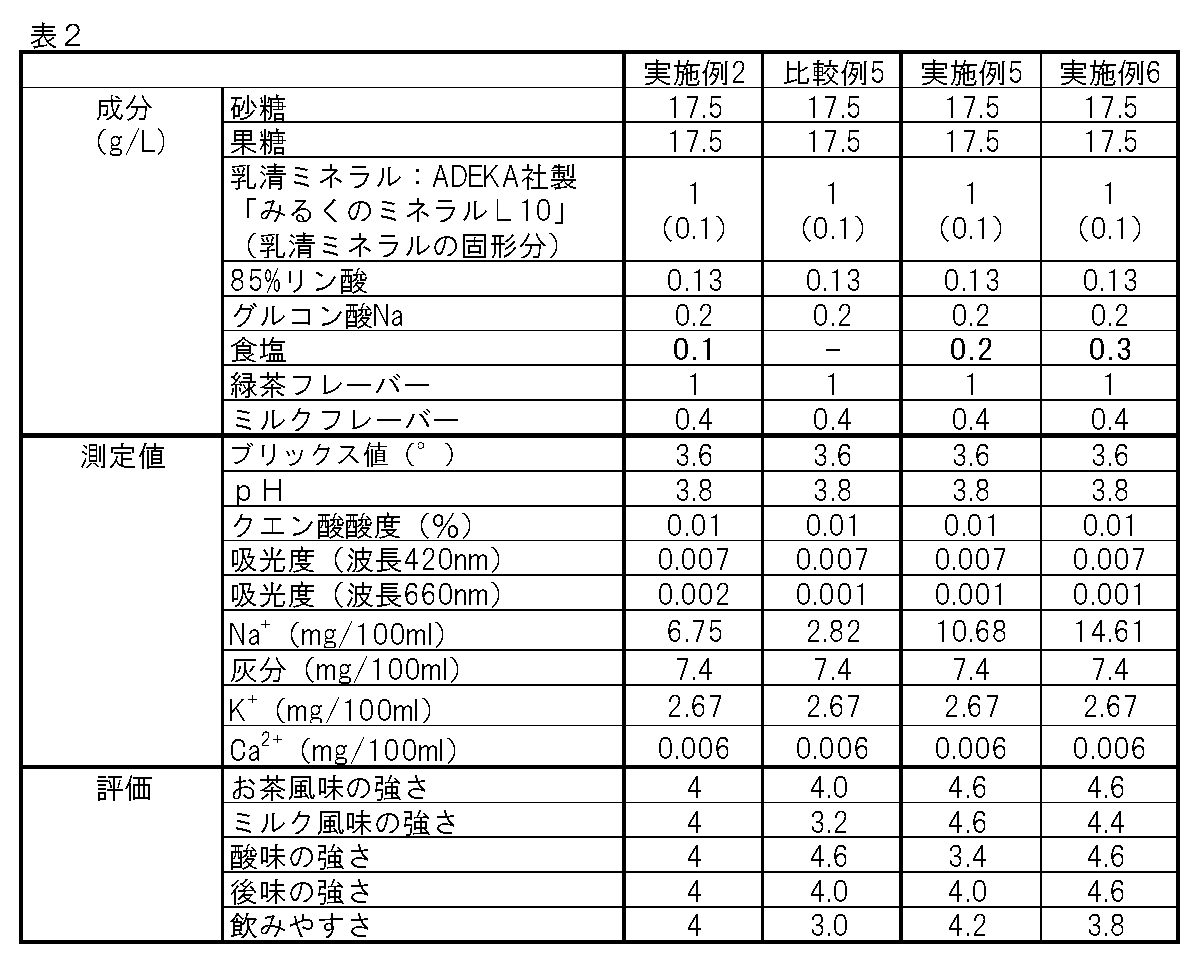
- Example 2 Verification of difference in salt concentration ⁇ Examples 2, 5 to 6, Comparative Example 5> Each component was uniformly mixed in water to prepare a beverage so as to have a blending ratio shown in Table 2, and the obtained beverage was sterilized by instant sterilization at 95 ° C. and packed in a container. As a result, a container-packed beverage was obtained. The obtained beverage was measured and evaluated in the same manner as in Experimental Example 1, and the results are shown in Table 2. In addition, “-” in Table 2 indicates that the beverage of Comparative Example 5 does not contain salt.
- Example 3 Verification of difference in whey mineral concentration ⁇ Examples 2, 7 to 8> Each component was uniformly mixed in water to prepare a beverage so that the blending ratio shown in Table 3 was obtained, and the obtained beverage was sterilized by instant sterilization at 95 ° C. and packed in a container. As a result, a container-packed beverage was obtained. The obtained beverage was measured and evaluated in the same manner as in Experimental Example 1, and the results are shown in Table 3.
Landscapes
- Health & Medical Sciences (AREA)
- Nutrition Science (AREA)
- Life Sciences & Earth Sciences (AREA)
- Chemical & Material Sciences (AREA)
- Engineering & Computer Science (AREA)
- Food Science & Technology (AREA)
- Polymers & Plastics (AREA)
- Non-Alcoholic Beverages (AREA)
- Tea And Coffee (AREA)
- Dairy Products (AREA)
Abstract
Description
条件1:前記飲料がショ糖(砂糖)を含まない場合、単糖および二糖の合計含有量(g)に対する前記果糖の含有量(g){果糖/(単糖+二糖)}が、0.8以上。
条件2:前記飲料がショ糖(砂糖)を含む場合、単糖および二糖の合計含有量(g)に対する前記果糖と前記ショ糖(砂糖)の合計含有量(g){(果糖+ショ糖(砂糖))/(単糖+二糖)}が、0.8以上であって、前記ショ糖(砂糖)の含有量(g)に対する前記果糖の含有量(g)(果糖/ショ糖(砂糖))が0.3以上。
条件3:前記飲料にショ糖(砂糖)を配合しない場合、単糖および二糖の合計含有量(g)に対する前記果糖の含有量(g){果糖/(単糖+二糖)}が、0.8以上。
条件4:前記飲料にショ糖(砂糖)を配合する場合、単糖および二糖の合計含有量(g)に対する前記果糖と前記ショ糖(砂糖)の合計含有量(g){(果糖+ショ糖(砂糖))/(単糖+二糖)}が、0.8以上であって、前記ショ糖(砂糖)の含有量(g)に対する前記果糖の含有量(g)(果糖/ショ糖(砂糖))が0.3以上。
本実施形態の飲料は、果糖、乳清ミネラル、食塩、および茶フレーバーを含み、以下の条件1,2を満たすものである。
条件1:前記飲料がショ糖(砂糖)を含まない場合、単糖および二糖の合計含有量(g)に対する前記果糖の含有量(g){果糖/(単糖+二糖)}が、0.8以上。
条件2:前記飲料がショ糖(砂糖)を含む場合、単糖および二糖の合計含有量(g)に対する前記果糖と前記ショ糖(砂糖)の合計含有量(g){(果糖+ショ糖(砂糖))/(単糖+二糖)}が、0.8以上であって、前記ショ糖(砂糖)の含有量(g)に対する前記果糖の含有量(g)(果糖/ショ糖(砂糖))が0.3以上。
本実施形態の飲料は、乳清ミネラル、茶フレーバーおよび食塩を含むことを前提として、糖類の種類および配合割合の違いによる乳風味、茶風味への作用に初めて着目したものである。そして、本実施形態の飲料は、上記の条件1,2を満たすことによって、乳風味および茶風味を増強することができる。
条件2において、(果糖+ショ糖(砂糖))/(単糖+二糖)は、好ましくは0.85以上、より好ましくは0.90以上、さらに好ましくは0.95以上であり、最も好ましくは1である。これにより、茶風味と乳風味とを一層増強できるとともに、飲みやすさとのバランスが良好になる。また、条件2において、(果糖/ショ糖(砂糖))の下限は好ましくは0.50以上、より好ましくは0.70以上、さらに好ましくは0.80以上であり、上限は好ましくは2.4以下、より好ましくは1.7以下、さらに好ましくは1.3以下である。これにより、茶風味と乳風味とを一層増強できるとともに、酸味、後味、飲みやすさのバランスが良好になる。
乳清ミネラルは、食品添加物の1つとして、食品・飲料業界で知られたものである。乳清ミネラルは、ホエイミネラルまたはホエイソルトと呼ばれることもある。本実施形態の飲料は、乳清ミネラルを含むことで、透明度を高くしつつも、乳風味を得ることができる。
乳清ミネラルの固形分に占める灰分含量は、例えば30質量%以上であり、具体的には50質量%以上である。灰分含量は高いほうが好ましい。
上記製造方法において、原料として乳清を用いる場合、その乳清は特に限定されず、乳を使用してチーズを製造する際に副産物として得られるホエイ、カゼイン製造の際に副産物として得られるホエイ、乳を限外濾過することによって得られるホエイなどを挙げることができる。
上記製造方法において、膜分離の方法としては、精密濾過膜分離、限外濾過膜分離、ナノ濾過膜分離、逆浸透膜分離、透析膜分離等を挙げることができる。
上記製造方法において、イオン交換の方法としては、陽イオン交換膜法や陰イオン交換膜法を用いる電気透析膜分離や、イオン交換樹脂による方法等を挙げることができる。
飲料中のカリウムイオン濃度は、例えば、原子吸光光度法による分析で求めることができる。また、飲料の原材料中のカリウム濃度と、原材料の使用量とから、計算により求めることもできる。
果糖は、いわゆる甘味料の一成分であり、単糖である。果糖は、本発明の効果に影響を与えない限り、高果糖液糖や果糖ブドウ糖液糖等の異性化糖、果汁等の天然物に含まれるものであってもよい。
果糖の濃度は、飲料全体に対して、5g/L以上が好ましく、10g/L以上がより好ましく、一方、60g/L以下が好ましく、50g/L以下がより好ましい。果糖の濃度をかかる数値範囲とすることにより、良好な嗜好性を得つつ、茶風味および乳風味を増強できる。
ショ糖は、いわゆる甘味料の一成分であり、二糖である。ショ糖が含まれる形態は特に限定されず、果汁等の天然物に含まれるものであってもよい。
ショ糖の濃度は、飲料全体に対して、5g/L以上が好ましく、10g/L以上がより好ましく、一方、60g/L以下が好ましく、50g/L以下がより好ましい。ショ糖の濃度をかかる数値範囲とすることにより、良好な嗜好性を得つつ、茶風味および乳風味を増強できる。
食塩とは、塩化ナトリウムを主成分とする食用の塩をいう。食塩は、精製塩といった塩化ナトリウムそのものであってもよく、海塩、岩塩、天塩、および山塩等であってもよい。これらは1種を単独で用いてもよく、2種以上を混合して用いでもよい。
なお、飲料中のナトリウムイオン濃度は、上述した食塩に由来するものに限られず、クエン酸ナトリウムなどの添加物に由来するものも包含する。
茶フレーバーとは、本実施形態の飲料に茶風味を付与するために用いられる。茶フレーバーは、飲料中に含有された際に茶類を想起させるフレーバーであればよく、特に限定されるものではない。
茶類としては、代表的には、ツバキ科カメリア属の植物を原材料として加工された茶製品があり、例えば、煎茶、深蒸し煎茶、玉露、かぶせ茶、番茶、玉緑茶、粉茶、芽茶、ほうじ茶、玄米茶、および抹茶などの不発酵茶、黄茶、白茶、ウーロン茶、紅茶、および黒茶(プーアール茶)などの発酵茶が挙げられる。さらに、これに限られず、麦茶、ドクダミ茶、まめ茶、甜茶、ゴボウ茶、そば茶、およびブレンド茶なども挙げることができる。
茶フレーバーとしては、1種または2種以上を用いてもよい。
また、茶フレーバーとしては、例えば、(Z)-3-ヘキセノール、ジメチルスルフィド、β-ヨノン、3-メチル-2,4-ナノンジオン、フラネオール、メチオナール、インドール、ジャスモン酸メチル、リナロール、ゲラニオール、サリチル酸メチル、β-ダマセノン、フェネチルアルコール、ホトリエノール、2,4-ヘプタジエナール、および1-オクテン-3-オールなどの香気成分を少なくとも1種以上含むことが好ましい。
なかでも、本実施形態の飲料による効果をより一層高める観点から、煎茶に代表されるいわゆる緑茶を想起させるフレーバーであることが好ましい。緑茶風味を感じさせる観点から、茶フレーバーとしては、(Z)-3-ヘキセノール、ジメチルスルフィド、β-ヨノン、3-メチル-2,4-ナノンジオン、フラネオール、メチオナール、およびリナロールといった香気成分を少なくとも一種以上含むことが好ましい。
本実施形態の飲料は、本発明の効果が得られる限りにおいて、上記以外の種々の成分を含んでもよい。例えば、上記茶フレーバー以外のフレーバー、上記果糖およびショ糖以外の甘味料、酸味料、pH調整剤、果汁、各種栄養成分、着色料、希釈剤、酸化防止剤、増粘安定剤等を含んでもよい。
ただし、透明性の観点からは、飲料は、着色料を実質的に含まないか、含むとしても少量であることが好ましい。
本実施形態の飲料の20℃におけるpHは、4.6未満であることが好ましく、3.6~4.5であることがより好ましく、3.7~4.2であることがさらに好ましい。
従来、pHが4.6未満の酸性領域では、茶風味および乳風味が低減してしまう傾向があった。これに対し、本実施形態の飲料によれば、pHが4.6未満であっても、茶風味および乳風味を増強することができる。また、日本の法令上、飲料のpHが4.6以上であると、飲料の殺菌条件を厳しくする必要があるが、pHを4.6未満とすることにより、殺菌条件を緩和でき、製造コストや香味維持、褐変抑制等の観点で有利である。
一方、飲料のpHを3.6以上とすることで、酸味が目立ちすぎることを抑制し、乳風味および茶風味を一層高めることができる。
なお、pHの測定は、市販のpH測定器を用いるなどして行うことができる。pHの調整は、例えば、特定酸の量を変えることや、pH調整剤を用いることなどにより行うことができる。
本実施形態の飲料の酸度は、特に限定されないが、適切な酸度に調整されることで、乳風味および茶風味をさらに高めることができる
具体的には、クエン酸の相当量として換算した値(クエン酸度)において、上限が、好ましくは0.03%未満であり、より好ましくは0.025%以下であり、さらに好ましくは0.02%以下である。下限は特になく、0%より大きい値である。
本実施形態の飲料の波長660nmにおける吸光度は、好ましくは0.06以下であり、より好ましくは0.04以下であり、さらに好ましくは0.01以下である。すなわち、本実施形態の飲料は、透明性が高い飲料である。従来、茶風味および乳風味を有する飲料として知られるものは、乳成分等により白濁し、透明性が低いものであったのに対し、本実施形態の飲料によれば、波長660nmにおける吸光度が0.06以下であるにも関わらず、茶風味および乳風味を増強することができる。
また、波長420nmにおける吸光度は、好ましくは0.1以下であり、より好ましくは0.05以下であり、さらに好ましくは0.01以下である。ここで、特段の材料や製法を用いていない通常の緑茶飲料は、茶葉に含まれるカテキン類等により、褐変しやすいものであるのに対し、本実施形態の飲料によれば、波長420nmにおける透明性が得られるため、いわゆる緑茶飲料にみられる褐変・変色等が抑制され、より透明性が得られる。
本実施形態の飲料のブリックス値は、飲料の嗜好性を向上させる観点から、好ましくは1~20°であり、より好ましくは2~10°であり、さらに好ましくは2~8°である。
ブリックス値は、例えば、前述の甘味料の量、その他の各種成分の量などにより調整することができる。
本実施形態の飲料は、果糖、任意のショ糖、乳清ミネラル、および食塩と、必要に応じてその他の成分を、定法に従って水に均一に混合することで得ることができる。
本実施形態の飲料は、加熱殺菌され、容器に詰められた状態の容器詰め飲料としてもよい。このときの容器としては、ガラス、紙、プラスチック(ポリエチレンテレフタレート等)、アルミ、およびスチール等の単体もしくはこれらの複合材料又は積層材料からなる密封容器が挙げられる。また、容器の種類は、特に限定されるものではないが、たとえば、ペットボトル、アルミ缶、スチール缶、紙パック、チルドカップ、瓶等が挙げられる。
さらに飲料を外観から観察し、透明性、色などを確認できる観点から、容器は透明であることが好ましく、具体的にはペットボトルまたは無着色の瓶が好ましい。また、取扱性、流通性、携帯性等の観点から、容器はペットボトルであることが好ましい。
本実施形態の飲料の乳風味および茶風味の増強方法は、以下の条件3,4を満たすように、果糖、乳清ミネラル、食塩、および茶フレーバーを配合するものである。
条件3:前記飲料にショ糖(砂糖)を配合しない場合、単糖および二糖の合計含有量(g)に対する前記果糖の含有量(g){果糖/(単糖+二糖)}が、0.8以上。
条件4:前記飲料にショ糖(砂糖)を配合する場合、単糖および二糖の合計含有量(g)に対する前記果糖と前記ショ糖(砂糖)の合計含有量(g){(果糖+ショ糖(砂糖))/(単糖+二糖)}が、0.8以上であって、前記ショ糖(砂糖)の含有量(g)に対する前記果糖の含有量(g)(果糖/ショ糖(砂糖))が0.3以上。
条件4において、(果糖+ショ糖(砂糖))/(単糖+二糖)は、好ましくは0.85以上、より好ましくは0.90以上、さらに好ましくは0.95以上、最も好ましくは1である。これにより、茶風味と乳風味とを一層増強できるとともに、飲みやすさとのバランスが良好になる。また、条件4において、(果糖/ショ糖(砂糖))の下限は好ましくは0.50以上、より好ましくは0.70以上、さらに好ましくは0.80以上であり、上限は好ましくは2.4以下、より好ましくは1.7以下、さらに好ましくは1.3以下である。これにより、茶風味と乳風味とを一層増強できるとともに、酸味、後味、飲みやすさのバランスが良好になる。
<実施例1~4、比較例1~4>
表1に示す配合比率となるように、各成分を水中で均一に混合して飲料を調合し、得られた飲料を95℃瞬間殺菌にて殺菌し、容器に詰めた。これにより容器詰め飲料を得た。
得られた飲料について以下の測定、および評価を行い、結果を表1に示した。
・ブリックス値(°):糖用屈折計示度「RX-5000α」株式会社アタゴ製を用いてブリックス値を測定した。飲料の液温は20℃とした。
・pH:東亜ディーケーケー社製 GST-5741Cにて測定した値(20℃)とした。
・吸光度(波長420nm、660nm):飲料を光路長1cmのセルに入れて、市販の分光光度計で測定した値とした。なお、吸光度測定は、20℃の温度条件下、石英セルを用いて実施した。
・ナトリウムイオン(Na+)、灰分、カリウムイオン(K+)、カルシウムイオン(Ca2+)濃度(mg/100ml):原材料中に含まれるこれら成分と原材料の使用量とから算出される値とした。なお、灰分は、乳清ミネラルの使用量から算出した。
・官能評価:実施例および比較例の飲料(4℃)それぞれを、熟練した5名のパネラーが試飲し、以下の評価基準に従い、「お茶風味の強さ」、「ミルク風味の強さ」、「酸味の強さ」、「後味の強さ」、「飲みやすさ」それぞれについて、7段階(1~7点)評価を実施し、その平均点を求めた。また、評価する際は、比較例1の飲料を対照品(基準値4点)として評価を実施した。なお、評価は、数値が大きいほど良好な結果であることを表す。
「お茶風味の強さ」、「ミルク風味の強さ」、「酸味の強さ」、「後味の強さ」
7点・・・対象品よりも非常に強い
6点・・・対象品よりも強い
5点・・・対象品よりもわずかに強い
4点・・・対象品と同等の強さ
3点・・・対象品よりもわずかに弱い
2点・・・対象品よりも弱い
1点・・・対象品よりも非常に弱いか全く感じない
「飲みやすさ」
7点・・・対象品よりも非常によい
6点・・・対象品よりもよい
5点・・・対象品よりもわずかによい
4点・・・対象品と同等程度
3点・・・対象品よりもわずかに悪い
2点・・・対象品よりも悪い
1点・・・対象品よりも非常に悪い

<実施例2,5~6、比較例5>
表2に示す配合比率となるように、各成分を水中で均一に混合して飲料を調合し、得られた飲料を95℃瞬間殺菌にて殺菌し、容器に詰めた。これにより容器詰め飲料を得た。
得られた飲料について、上記実験例1と同様にして、測定および評価を行い、結果を表2に示した。
なお、表2中の「-」は、比較例5の飲料が食塩を含まないことを示す。
<実施例2,7~8>
表3に示す配合比率となるように、各成分を水中で均一に混合して飲料を調合し、得られた飲料を95℃瞬間殺菌にて殺菌し、容器に詰めた。これにより容器詰め飲料を得た。
得られた飲料について、上記実験例1と同様にして、測定および評価を行い、結果を表3に示した。

Claims (8)
- 果糖、乳清ミネラル、食塩、および茶フレーバーを含み、以下の条件1,2を満たす、飲料。
条件1:前記飲料がショ糖(砂糖)を含まない場合、単糖および二糖の合計含有量(g)に対する前記果糖の含有量(g){果糖/(単糖+二糖)}が、0.8以上。
条件2:前記飲料がショ糖(砂糖)を含む場合、単糖および二糖の合計含有量(g)に対する前記果糖と前記ショ糖(砂糖)の合計含有量(g){(果糖+ショ糖(砂糖))/(単糖+二糖)}が、0.8以上であって、前記ショ糖(砂糖)の含有量(g)に対する前記果糖の含有量(g)(果糖/ショ糖(砂糖))が0.3以上。 - 前記飲料の20℃におけるpHが4.6未満である、請求項1に記載の飲料。
- 波長420nmにおける吸光度が0.01以下である、請求項1または2に記載の飲料。
- 波長660nmにおける吸光度が0.01以下である、請求項1乃至3のいずれか一項に記載の飲料。
- 前記飲料中のナトリウムイオン濃度が、1mg/100ml以上、100mg/100ml以下である、請求項1乃至4のいずれか一項に記載の飲料。
- 前記飲料中のカリウムイオン濃度が、1mg/100ml以上、100mg/100ml以下である、請求項1乃至5のいずれか一項に記載の飲料。
- 請求項1乃至6のいずれか一項に記載された飲料が透明な容器に充填された容器詰め飲料。
- 以下の条件3,4を満たすように、果糖、乳清ミネラル、食塩、および茶フレーバーを配合する、飲料の乳風味および茶風味の増強方法。
条件3:前記飲料にショ糖(砂糖)を配合しない場合、単糖および二糖の合計含有量(g)に対する前記果糖の含有量(g){果糖/(単糖+二糖)}が、0.8以上。
条件4:前記飲料にショ糖(砂糖)を配合する場合、単糖および二糖の合計含有量(g)に対する前記果糖と前記ショ糖(砂糖)の合計含有量(g){(果糖+ショ糖(砂糖))/(単糖+二糖)}が、0.8以上であって、前記ショ糖(砂糖)の含有量(g)に対する前記果糖の含有量(g)(果糖/ショ糖(砂糖))が0.3以上。
Priority Applications (1)
| Application Number | Priority Date | Filing Date | Title |
|---|---|---|---|
| AU2019222274A AU2019222274B2 (en) | 2018-02-19 | 2019-02-12 | Beverage, packaged beverage, and method for enhancing milk flavor and tea flavor of beverage |
Applications Claiming Priority (2)
| Application Number | Priority Date | Filing Date | Title |
|---|---|---|---|
| JP2018-027181 | 2018-02-19 | ||
| JP2018027181A JP7117112B2 (ja) | 2018-02-19 | 2018-02-19 | 飲料、容器詰め飲料および飲料の乳風味および茶風味増強方法 |
Publications (1)
| Publication Number | Publication Date |
|---|---|
| WO2019159869A1 true WO2019159869A1 (ja) | 2019-08-22 |
Family
ID=67618645
Family Applications (1)
| Application Number | Title | Priority Date | Filing Date |
|---|---|---|---|
| PCT/JP2019/004791 Ceased WO2019159869A1 (ja) | 2018-02-19 | 2019-02-12 | 飲料、容器詰め飲料および飲料の乳風味および茶風味増強方法 |
Country Status (4)
| Country | Link |
|---|---|
| JP (1) | JP7117112B2 (ja) |
| AU (1) | AU2019222274B2 (ja) |
| TW (1) | TWI783120B (ja) |
| WO (1) | WO2019159869A1 (ja) |
Families Citing this family (1)
| Publication number | Priority date | Publication date | Assignee | Title |
|---|---|---|---|---|
| JP7309276B2 (ja) * | 2019-09-11 | 2023-07-18 | 三井農林株式会社 | 肌質改善剤 |
Citations (5)
| Publication number | Priority date | Publication date | Assignee | Title |
|---|---|---|---|---|
| WO2010101143A1 (ja) * | 2009-03-04 | 2010-09-10 | 株式会社Adeka | 乳風味飲料 |
| JP2013039068A (ja) * | 2011-08-15 | 2013-02-28 | Suntory Holdings Ltd | ゼロカロリーのミルク入り飲料及びその製造方法 |
| JP2014050337A (ja) * | 2012-09-06 | 2014-03-20 | Adeka Corp | 乳風味付与剤 |
| JP2014117246A (ja) * | 2012-12-18 | 2014-06-30 | Ajinomoto General Foods Inc | インスタント嗜好性飲料用組成物及びその製造方法 |
| JP2016077253A (ja) * | 2014-10-21 | 2016-05-16 | 株式会社Adeka | 乳風味付与材 |
Family Cites Families (1)
| Publication number | Priority date | Publication date | Assignee | Title |
|---|---|---|---|---|
| WO2019151002A1 (ja) * | 2018-01-31 | 2019-08-08 | アサヒ飲料株式会社 | 飲料および飲料への乳風味付与方法 |
-
2018
- 2018-02-19 JP JP2018027181A patent/JP7117112B2/ja active Active
-
2019
- 2019-02-12 AU AU2019222274A patent/AU2019222274B2/en active Active
- 2019-02-12 WO PCT/JP2019/004791 patent/WO2019159869A1/ja not_active Ceased
- 2019-02-18 TW TW108105267A patent/TWI783120B/zh active
Patent Citations (5)
| Publication number | Priority date | Publication date | Assignee | Title |
|---|---|---|---|---|
| WO2010101143A1 (ja) * | 2009-03-04 | 2010-09-10 | 株式会社Adeka | 乳風味飲料 |
| JP2013039068A (ja) * | 2011-08-15 | 2013-02-28 | Suntory Holdings Ltd | ゼロカロリーのミルク入り飲料及びその製造方法 |
| JP2014050337A (ja) * | 2012-09-06 | 2014-03-20 | Adeka Corp | 乳風味付与剤 |
| JP2014117246A (ja) * | 2012-12-18 | 2014-06-30 | Ajinomoto General Foods Inc | インスタント嗜好性飲料用組成物及びその製造方法 |
| JP2016077253A (ja) * | 2014-10-21 | 2016-05-16 | 株式会社Adeka | 乳風味付与材 |
Also Published As
| Publication number | Publication date |
|---|---|
| JP2019140950A (ja) | 2019-08-29 |
| JP7117112B2 (ja) | 2022-08-12 |
| TW201940069A (zh) | 2019-10-16 |
| TWI783120B (zh) | 2022-11-11 |
| AU2019222274B2 (en) | 2023-11-23 |
| AU2019222274A1 (en) | 2020-09-03 |
Similar Documents
| Publication | Publication Date | Title |
|---|---|---|
| TWI765055B (zh) | 碳酸飲料、容器裝碳酸飲料及碳酸飲料之酸酪乳風味增強方法 | |
| JP6994354B2 (ja) | 飲料 | |
| JP7716169B2 (ja) | 抹茶風味の容器詰め飲料および飲料の抹茶風味増強方法 | |
| JP7117112B2 (ja) | 飲料、容器詰め飲料および飲料の乳風味および茶風味増強方法 | |
| AU2018337452B2 (en) | Colorless transparent beverage containing potassium | |
| JP6994353B2 (ja) | 飲料 | |
| JP6283716B2 (ja) | ヨーグルト様高清澄飲料およびヨーグルト様高清澄飲料の後味改善方法 | |
| JP7262178B2 (ja) | 飲料および飲料への乳風味付与方法 | |
| AU2018330713A1 (en) | Colorless transparent beverage containing linalool | |
| WO2019151002A1 (ja) | 飲料および飲料への乳風味付与方法 | |
| AU2018244873B2 (en) | Yogurt-like beverage, container packed beverage, and method of improving aftertaste of yogurt-like beverage | |
| JP6915021B2 (ja) | ヨーグルト様飲料、容器詰め飲料およびヨーグルト様飲料の後味改善方法 | |
| JP2019208369A (ja) | 飲料、容器詰め飲料および飲料の水っぽさの低減方法 | |
| JP7191553B2 (ja) | 飲料、容器詰め飲料および飲料の後味および口当たり改善方法 | |
| JP7010657B2 (ja) | 炭酸飲料、容器詰め炭酸飲料および炭酸飲料のヨーグルト風味増強方法 | |
| JP6917404B2 (ja) | ナトリウム含有無色透明飲料 | |
| JP6923577B2 (ja) | マグネシウム含有無色透明飲料 | |
| JP6889730B2 (ja) | カルシウム含有無色透明飲料 | |
| JP2024075080A (ja) | レモン風味飲料およびレモン風味飲料の劣化抑制方法 |
Legal Events
| Date | Code | Title | Description |
|---|---|---|---|
| 121 | Ep: the epo has been informed by wipo that ep was designated in this application |
Ref document number: 19754427 Country of ref document: EP Kind code of ref document: A1 |
|
| WWE | Wipo information: entry into national phase |
Ref document number: 2019222274 Country of ref document: AU |
|
| NENP | Non-entry into the national phase |
Ref country code: DE |
|
| ENP | Entry into the national phase |
Ref document number: 2019222274 Country of ref document: AU Date of ref document: 20190212 Kind code of ref document: A |
|
| 122 | Ep: pct application non-entry in european phase |
Ref document number: 19754427 Country of ref document: EP Kind code of ref document: A1 |