WO2019155993A1 - ヌメリ取り具 - Google Patents
ヌメリ取り具 Download PDFInfo
- Publication number
- WO2019155993A1 WO2019155993A1 PCT/JP2019/003636 JP2019003636W WO2019155993A1 WO 2019155993 A1 WO2019155993 A1 WO 2019155993A1 JP 2019003636 W JP2019003636 W JP 2019003636W WO 2019155993 A1 WO2019155993 A1 WO 2019155993A1
- Authority
- WO
- WIPO (PCT)
- Prior art keywords
- slime
- frame structure
- drug
- medicine
- drainage
- Prior art date
- Legal status (The legal status is an assumption and is not a legal conclusion. Google has not performed a legal analysis and makes no representation as to the accuracy of the status listed.)
- Ceased
Links
Images


Classifications
-
- E—FIXED CONSTRUCTIONS
- E03—WATER SUPPLY; SEWERAGE
- E03C—DOMESTIC PLUMBING INSTALLATIONS FOR FRESH WATER OR WASTE WATER; SINKS
- E03C1/00—Domestic plumbing installations for fresh water or waste water; Sinks
- E03C1/12—Plumbing installations for waste water; Basins or fountains connected thereto; Sinks
- E03C1/126—Installations for disinfecting or deodorising waste-water plumbing installations
-
- E—FIXED CONSTRUCTIONS
- E03—WATER SUPPLY; SEWERAGE
- E03C—DOMESTIC PLUMBING INSTALLATIONS FOR FRESH WATER OR WASTE WATER; SINKS
- E03C1/00—Domestic plumbing installations for fresh water or waste water; Sinks
- E03C1/12—Plumbing installations for waste water; Basins or fountains connected thereto; Sinks
- E03C1/26—Object-catching inserts or similar devices for waste pipes or outlets
- E03C1/262—Object-catching inserts or similar devices for waste pipes or outlets combined with outlet stoppers
Definitions
- the present invention relates to an instrument for removing and preventing slime installed in a drainage facility.
- the present invention relates to a device for removing and preventing slime, which can be preferably applied to a drain outlet of a bathroom or the like.
- Patent Document 1 describes a method of spreading a liquid solution of a slime control agent on a slime-generating wall surface by attaching a flexible band-like material carrying the slime control agent on the upper part of the slime-generating wall surface.
- Patent Document 2 describes a method in which a solid drug is stored near the center of a lid-like slime remover, and a solution of the solid drug is diffused in the outer peripheral direction and spread on a slime-generating wall surface.
- Patent Document 3 describes a method in which a solid drug solution is spread on a slime-generating wall surface by storing the solid drug in a ring-shaped container and installing it near the outer periphery of a lid-like slime remover. .
- These slime removal tools are specifically designed with the drainage outlet of the kitchen sink and the garbage bin installed there in mind.
- drain outlets that are recessed from the washing area around the drain outlet (sometimes called “drainage basins” depending on the shape) have a variety of recess shapes, and can be installed in any of these to be effective.
- the slime removal tool was not known. Therefore, unlike the drainage outlet of the kitchen sink, the drainage outlet of the bathroom had to be frequently cleaned in order to control slime.
- the drainage basin is covered with a lid or eye plate, it is difficult to prevent the growth of microorganisms due to poor ventilation and high humidity.
- Patent Document 4 an antibacterial and antifungal structure having an antibacterial and antifungal material coated or plated on its surface is placed on the inner bottom surface of the drainage basin so that the antibacterial and antifungal effects in the drainage basin are exhibited. A method is described.
- Patent Document 4 The antibacterial and antifungal structure of Patent Document 4 is also described as having an effect on the lid or eye plate if its upper part comes into contact with the lid or eye plate covering the drainage basin.
- the thing can be applied only to the drain outlet having a specific structure, and it does not exert a special effect on the peripheral wall of the drainage basin.
- the production method is complicated in that antibacterial and antifungal materials are applied or plated, which is not preferable.
- this invention makes it a subject to provide the slime removal tool which is easy to manufacture, can be used for a general bathroom drain outlet, and exhibits an effect especially to the whole hollow part around a drain outlet.
- the present inventors have placed the frame of the slime removing tool on the bottom of the drainage port, and supported the medicine container above and brought into contact with the wall of the dent part.
- the present invention has been completed by finding that the above-mentioned problems can be solved by a slime removing tool.
- a slime remover for placing on the bottom of a drain outlet to control slime (A) at the peripheral edge of the slime removing tool when viewed from above at the time of installation, having a drainage inlet and a chemical outlet, and containing at least one medicine storage part for storing a solid medicine for slime removal; And (B) a frame structure that is made of a material that can be at least partially plastically deformed and that contacts the bottom of the drainage port during installation and supports the drug storage unit from below so that it can contact the peripheral wall of the drainage port. Numeli remover.
- the present invention provides a slime remover applicable to various bathroom drains.
- the slime remover of the present invention is a slime remover placed on the bottom of a drain outlet, and has at least one medicine storage part and a frame structure part.
- the drug storage unit in the present invention has a drainage inlet and a chemical solution outlet, and has the purpose of storing a solid drug for removing slime, and is present at the periphery of the slime removing tool when viewed from above.
- the frame structure in the present invention is made of a material that can be at least partially plastically deformed, and abuts the bottom of the drain at the time of installation and supports the medicine container from below so as to contact the peripheral wall of the drain It is.
- the slime removing tool of the present invention basically only needs to be composed of the above two members, and other members are not particularly required, but have other functions as long as the effects of the present invention are not impaired.
- a member may be included.
- the slime removing tool of the present invention has the effect of removing or preventing the slime of the drain port, the periphery of the drain port, and / or the drain pipe by being placed on the bottom of the drain port, and particularly the peripheral wall around the drain port. It has a remarkable effect on.
- the “bottom part of the drain outlet” refers to the lower end part of a part excluding the drain pipe part, which is a tubular structure for allowing the drainage to flow down from the drainage facility.
- an eye plate or a strainer is usually installed, and the slime removing tool of the present invention is used by being placed on the eye plate, the rim portion at the upper end of the strainer, or the periphery thereof.
- the medicine container is located on the peripheral edge of the slime remover when viewed from above during installation. This is so that the medicine container can come into contact with the peripheral wall of the drain port.
- the frame structure part that supports the medicine storage part is made of a material that can be at least partially plastically deformed, so that the medicine storage part is deformed so as to contact the peripheral wall of the drain port. Is possible.
- the outer shape of the medicine container is not particularly limited, but it is preferable that the medicine container has a long shape in a horizontal direction substantially perpendicular to a line from the center of the slime remover to each medicine container. Examples of the shape include a rectangle and an oval, and may be curved.
- the medicine storage unit is a container for storing a solid medicine for slime removal, and has at least a drainage inlet and a chemical outlet. When drainage flows into the drainage outlet, a part of the drainage flows from the drainage inlet of the drug storage unit into the drug storage unit. As a result, the solid drug dissolves, and the resulting chemical solution flows out from the chemical solution outlet and exhibits a slime removing effect.
- medical solution outflow port is also included, in order to raise
- the position, number, size, and structure of the drainage inlet and the chemical solution outlet are not particularly limited as long as there is no possibility that the solid medicine flows out as it is.
- the outer shape of the medicine container is long in a horizontal direction substantially perpendicular to a line from the center of the slime remover to each medicine container, there are a plurality of drug solution outlets along this longitudinal direction. It is preferable. Thereby, the slime removal effect can be exhibited in a wide range of the drain outlet peripheral wall.
- a drainage inlet is provided on the upper surface and / or upper side of the medicine container, and is lower than the bottom and / or side drainage inlet of the medicine container.
- a chemical outlet can be provided.
- the drainage inlet preferably has a structure that suppresses the inflow of dust, and specifically has a slit or a mesh structure.
- the total opening area of the chemical solution outlet is 0.5 to 500 seconds, preferably 2 to 100 seconds, more preferably 5 to 500 seconds of the maximum amount of water that can be held in the drug holding part.
- medical solution outflow port can also be provided as a structure which provides a waste_water
- the structure of the drainage inlet there is a structure that opens upward, or a structure in which a water receiving part for distributing a part of the drainage into the medicine storage part is provided, and the drainage is poured from here into the drainage inlet. is there.
- the inside of the medicine container may be a single space, or a partition may be provided to divide the inside completely or only partially.
- the material for the medicine container include metal and plastic, but plastic is preferable because it is easy to manufacture and can be integrally formed with the frame structure.
- a part or the whole of the medicine storage part may be formed integrally with the frame structure part, or the frame structure part and the medicine storage part are separately formed, and they are locked together to form a slime. It is good also as a handle.
- the slime removing tool of the present invention is used by storing a solid medicine in a medicine storage section at least when used. Moreover, you may supply to a chemical
- the medicine supply part is formed as two different members (at least one of them may be integrally formed with the frame structure part), and a method of combining and fixing these two members after storing the solid medicine, or a hinge
- One example is a method of integrally molding a two-part drug supply unit joined through a unit, and closing and fixing the hinge after storing the solid drug.
- claw, and the method of making it melt and fix are mentioned. If a method of fitting with a nail is adopted, it is also possible to repack a new solid drug and reuse it after completing the use of the solid drug.
- the solid medicine for slime removal used in the present invention is not particularly limited, but preferably has a shape that does not flow out of the medicine container as long as it has a slime removal effect.
- the state of the solid drug includes not only a solid that is not easily deformed such as a tablet, but also a gel that has elasticity but does not have fluidity, or a solid that can absorb water and change into such a gel.
- the component of the solid drug for slime removal used in the present invention is not particularly limited, but a drug component having the efficacy of removing slime, sterilization of bacteria that generate slime, sterilization, antibacterial, etc. Those containing and gradually releasing these drug components into water are preferred.
- This release is preferably accompanied with dissolution of the solid drug.
- the drug component having the above-mentioned efficacy include chlorinated fungicides, non-bleaching powder antibacterial agents, antibacterial inorganic metals or compounds thereof, antibiotics, bacteria capable of removing slime, etc., preferably non-bleaching powder antibacterial agents It is an agent.
- chlorinated fungicides examples include sodium chlorite, bleached powder, highly bleached powder, sodium hypochlorite, hypochlorous acid water and the like.
- Non-bleaching powder antibacterial agent As the non-bleaching powder antibacterial agent that can be used in the present invention, any non-bleaching powder antibacterial agent that does not generate chlorine gas by reacting with an acidic substance or the like can be used. Examples thereof include compounds known as agents or antibacterial agents and natural essential oils known to have an antibacterial action.
- antifungal agent or antibacterial agent examples include 5-chloro-2-methyl-4-isothiazolin-3-one, 2-methyl-4-isothiazolin-3-one, and 5-chloro-2. -N-octyl-4-isothiazolin-3-one, 4-chloro-2-n-octyl-4-isothiazolin-3-one, 4,5-dichloro-3-n-octyl-isothiazolin-3-one, -N-octyl-4-isothiazolin-3-one, 1,2-benzisothiazolin-3-one, 2-methyl-4,5-trimethylene-4-isothiazolin-3-one, 2-methoxycarbonylbenzimidazole, 2 , 3,5,6-tetrachloro-4-methanesulfonylpyridine, 2-thiocyanomethylthiobenzothiazole, 2,2-dithio-bis- (pyridine-1 Ox
- natural essential oils examples include cineol, hinokitiol, menthol, terpineol, borneol, nopol, citral, citronellal, citronellol, geraniol, linalool, dimethyloctanol, thymol, and the like.
- an iodine antibacterial agent can be exemplified, and among them, a solid one is particularly desirable.
- the iodo-based antibacterial agent include 2,3,3-triiodoallyl alcohols, 2,3,3-triiodoallyl ethers, 2,3,3-triiodoallylazoles, 3-iodo-2 Mention may be made of propargylbutylcarbamic acid, 4-chlorophenyl (3-iodopropargyl) formal, iodopropargylazoles, diiodomethylparatolylsulfone, povidone iodine, benzyliodoacetate and paranitrobenzyliodoacetate.
- the above non-bleaching powder antibacterial agents can be used singly or in combination.
- non-bleaching powder antibacterial agents can be guest compounds of multimolecular host compounds such as 2-bromo-2-nitropropane-1,3-diol, 5-chloro-2-methyl-4-isothiazoline. Inclusion compounds can be formed using -3-one or the like as a guest compound, and these can be used as non-bleaching powder antibacterial agents.
- the polymolecular host compound refers to a compound that forms a crystalline complex (inclusion compound) that has a regular arrangement and interacts with an antibacterial agent serving as a guest by intermolecular forces such as hydrogen bonding.
- inclusion compound a compound that forms a crystalline complex (inclusion compound) that has a regular arrangement and interacts with an antibacterial agent serving as a guest by intermolecular forces such as hydrogen bonding.
- Examples of the tetrakisphenols in the multimolecular host compound include 1,1,2,2-tetrakis (4-hydroxyphenyl) ethane, 1,1,2,2-tetrakis (3-fluoro-4-). Hydroxyphenyl) ethane, 1,1,2,2-tetrakis (3-chloro-4-hydroxyphenyl) ethane, 1,1,2,2-tetrakis (3-methyl-4-hydroxyphenyl) ethane, 1,1 , 2,2-Tetrakis (3-methoxy-4-hydroxyphenyl) ethane, 1,1,2,2-tetrakis (3,5-dimethyl-4-hydroxyphenyl) ethane, 1,1,3,3-tetrakis (4-hydroxyphenyl) propane, 1,1,3,3-tetrakis (3-fluoro-4-hydroxyphenyl) propane, 1,1,3,3-tetrakis (3-chloro-4-hydroxyphenyl) propane, 1,1,3,3-tetrakis (3-
- the inclusion compound that can be used in the present invention is usually prepared by stirring a non-bleaching powder antibacterial agent that becomes a guest and a host compound in the presence of water or an organic solvent at room temperature to 100 ° C. for several minutes to several hours. It can be easily obtained by reacting.
- An antibacterial inorganic metal or a compound thereof can be added to the slime control agent used in the present invention.
- it is not particularly limited as long as it contains an inorganic metal having antibacterial properties, it is preferably in a solid state, and is in the form of particles having the antibacterial inorganic metal itself or its oxide, chloride, nitrate, sulfate supported on a carrier. Those are preferably selected.
- the carrier examples include phosphates (zirconium phosphate, calcium phosphate, etc.), metal oxides (silicon oxide, aluminum oxide, titanium oxide, zinc oxide, iron oxide, zirconium oxide, etc.), inorganic compounds (zeolite) , Clay minerals, silica gel, etc.).
- phosphates zirconium phosphate, calcium phosphate, etc.
- metal oxides silicon oxide, aluminum oxide, titanium oxide, zinc oxide, iron oxide, zirconium oxide, etc.
- inorganic compounds zeolite
- Clay minerals silica gel, etc.
- One kind or two or more kinds of these carriers may be used.
- the antibacterial inorganic metal or the antibacterial inorganic metal in the compound is not particularly limited as long as it is a metal having antibacterial properties, but silver, zinc, copper and the like are preferably selected.
- silver is selected from the viewpoint of antibacterial effects.
- One or two or more of these antibacterial inorganic metals may be used.
- the actual product of the antibacterial inorganic metal or its compound is not particularly limited as long as it is commercially available.
- ATOMYBALL-S, ATOMYBALL-L, ATOMYBALL-UA (registered trademark) Nanoparticle silver-based inorganic antibacterial agents sold under the trade name of Catalytic Chemical Industry Co., Ltd. can be used.
- the antibacterial inorganic metal-containing component can be used alone or in combination.
- As a compounding quantity of an antibacterial inorganic metal or its compound in the case of the component containing silver, for example, it is 0.0002 mass% or more converted into a silver element density
- the content is 0.0002 to 0.005% by mass.
- Antibacterial activity is improved at 0.0002% by mass or more, and even if it is 0.005% by mass or less, the antibacterial activity is sufficient and is an upper limit amount that is economically acceptable.
- the average particle size of the dispersed particles in the composition is preferably 1 to 500 nm, and more preferably 1 to 100 nm.
- the average particle diameter is the number average particle diameter and is measured by a light scattering method. If it is 500 nm or less, the dispersed state of the particles becomes stable, and if it is 100 nm or less, the dispersed state of the particles becomes more stable.
- the smaller the particle size the more advantageous it is from the viewpoint of contact with bacteria.
- Bacillus subtilis (genus Bacillus), and examples of Bacillus subtilis include Bacillus natto.
- the solid drug used in the present invention is usually added with other components necessary for formulation except when it can be formulated alone.
- other components include excipients, binders, dissolution regulators, lubricants, surfactants, corrosion inhibitors, gelled products, antistatic agents, and other functional components.
- Excipients, binders, dissolution regulators include fumaric acid, benzoic acid, adipic acid, succinic acid, sulfamic acid, dl-malic acid, citric acid, ascorbic acid, malonic acid, glycolic acid, C 10-24 saturated Organic acids such as fatty acids; inorganic acids such as boric acid; lactose; sucrose; glucose; starches such as corn starch; crystalline cellulose, powdered cellulose, methylcellulose, ethylcellulose, carboxymethylcellulose, sodium carboxymethylcellulose, carboxymethylcellulose calcium, hydroxypropylcellulose, etc.
- celluloses Various celluloses; inorganic salts such as sodium chloride, magnesium sulfate, potassium sulfate, calcium hydrogen phosphate, synthetic aluminum silicate, magnesium trisilicate; polyvinyl alcohol, polyvinyl pyrrolidone, algin Polymer compounds such as sodium acid and gum arabic (powder); sucrose fatty acid esters and the like can be mentioned, among which lactose; sucrose; glucose; starches such as corn starch; crystalline cellulose, powdered cellulose, hydroxy Celluloses such as propyl cellulose; gum arabic (powder), polyvinyl alcohol, polyvinyl pyrrolidone, dextrin, etc.
- inorganic salts such as sodium chloride, magnesium sulfate, potassium sulfate, calcium hydrogen phosphate, synthetic aluminum silicate, magnesium trisilicate
- polyvinyl alcohol polyvinyl pyrrolidone
- algin Polymer compounds such as sodium acid and gum arabic
- excipients, binders, and dissolution regulators can be added at a ratio of 1 to 99% by mass with respect to the total amount of solid substances.
- calcium sulfate hemihydrate is preferred from the viewpoint that moldability and solubility can be easily controlled.
- calcium sulfate hemihydrate manufactured by atmospheric pressure firing.
- the ⁇ -type is more preferable than the ⁇ -type produced by pressure firing, because it is less likely to cause the molded body to lose its shape due to water absorption.
- This ⁇ -type calcium sulfate hemihydrate Is preferably used in combination with lactose or sucrose in terms of control of moldability and solubility.
- Examples of the C 10-24 saturated fatty acid include stearic acid and lauric acid. These saturated fatty acids are used for the purpose of improving the stability of the agent in water (swelling and disintegration-preventing properties) at the same time as imparting lubricity during molding. Used in a ratio of ⁇ 10% by mass.
- Hydroxypropyl cellulose is one in which part or all of the hydroxyl groups of cellulose are substituted with — (CH 2 CH (CH 3 ) —O) m H (where m is an integer of 1 or more).
- the degree of substitution is not particularly limited.
- examples of hydroxypropylcellulose include hydroxypropylcellulose HPC-SL and HPC-L (trade names, manufactured by Nippon Soda Co., Ltd.).
- the amount of hydroxypropyl cellulose used in the present invention is preferably less than 5% by mass, more preferably 1 to 4% by mass, based on the total amount of solid substances in the solid drug.
- lubricant examples include magnesium stearate, calcium stearate, sodium stearate, sodium benzoate, orthoboric acid, silica, talc, waxes, and the like. It can be used at a ratio of 0.01 to 1% by mass.
- Talc is a hydrated silicate mineral of magnesium and has a composition of Mg 3 Si 4 O 10 (OH) 2 . In the present invention, it is used in place of the surfactant or in combination with the surfactant.
- the content of talc is 0.1 to 10% by mass, preferably 0.5 to 3% by mass, based on the total weight of the solid drug.
- the surfactant used in the present invention is not particularly limited as long as it does not react with the antimicrobial component and has a melting point of 50 ° C. or higher.
- a surfactant having a melting point of 50 ° C. or lower is used, there is a problem that the solid drug is easily dissolved by warm water, and in summer, the surfactant is likely to bleed from the solid drug due to an increase in temperature. Examples of the surfactant having a melting point of 50 ° C.
- fatty acid alkanolamides such as coconut oil fatty acid monoethanolamide and lauric acid monoisopropanolamide
- sorbitan fatty acid esters such as sorbitan stearate and sorbitan palmitate
- alkyl alkanolamide Sodium dialkylsulfosuccinate, sodium lauryl sulfate, polyoxyethylene stearyl ether, polyoxyethylene polyoxypropylene block polymer, and the like.
- coconut oil fatty acid monoethanolamide and sorbitan stearate can be mentioned as preferable surfactants. Among these, the following are mentioned as what is marketed.
- coconut oil fatty acid monoethanolamide As coconut oil fatty acid monoethanolamide, Tohol N-120 (manufactured by Toho Chemical Industry Co., Ltd.), Amizole CME (registered trademark, manufactured by Kawaken Fine Chemical Co., Ltd.), etc.
- lauric acid monoisopropanolamide Amizole PLME (registered trademark, Sorbitan stearate, such as Rheodor SP-S10V, S20V, S30V (registered trademark, manufactured by Kao Corporation), Sorbon S-60 (manufactured by Toho Chemical Co., Ltd.), etc.
- Sorbon S-40 manufactured by Toho Chemical Co., Ltd.
- Emulgen 350 registered trademark, manufactured by Kao Corporation
- Newpol PE as polyoxyethylene polyoxypropylene block polymer 68
- the surfactant content is 0.1 to 10% by mass, preferably 0.5 to 3% by mass, based on the total mass of the solid drug.
- a compound having a melting point of 40 to 100 ° C. and a solid is preferable.
- Various water-soluble polymers such as polyoxyethylene, polyoxyethylene polyoxy
- the surfactant include propylene block polymer, polyoxyethylene alkylphenyl ether, polyethylene glycol fatty acid esters, glycerin fatty acid esters, and polyoxyethylene alkyl ethers.
- corrosion inhibitor examples include alkylthiourea and triazole compounds, and when these are used, corrosion of metal parts such as piping can be suppressed.
- Gel-like material examples include agar, gelatin, locust bean gum, sodium alginate, polyvinyl alcohol, gum arabic, gellan gum, amino acid, carboxymethylcellulose and its metal salt, carrageenan and the like.
- Antistatic agent As the antistatic agent, an antistatic effect can be imparted at the time of molding by adding diatomaceous earth, white clay or the like.
- Compounds having other functional components can be added.
- Other functional ingredients include bitterness-imparting ingredients aimed at preventing accidental eating of infants, deodorizing ingredients aimed at preventing foul odors, drainage ingredients, aromatic ingredients, and coloring ingredients aimed at improving design Can also be illustrated.
- the method for producing the solid drug used in the present invention is not particularly limited, and is performed by heat melting and mixing, kneading extrusion molding, pressure molding, or the like, with the drug used for slime removal and the other components. .
- the pressure molding method is preferable because a recess and a through hole can be formed simultaneously depending on the model.
- a specific manufacturing method is, for example, as follows, but is not necessarily limited to this method. First, each raw material is put into a Nauta mixer and mixed at room temperature (20 to 30 ° C.) for 30 to 60 minutes. The mixed raw material is subjected to plate granulation through a rolling roller. Crush it roughly to produce the raw powder.
- Tablets having recesses and through holes are formed by the shape of the mold installed in the tableting machine.
- the model HER2 rotary tableting machine by Kikusui Seisakusho Co., Ltd. etc. are mentioned, for example.
- the mixing ratio of the drug used for the solid drug used in the present invention and the other components is 1 to 99 parts by mass of the drug used for slime removal because of various use situations, and 99 to 1 mass of the other components.
- the mixing ratio can be arbitrarily changed between the parts, but preferably 5 to 20 parts by mass of the drug used for removing the slime, and 95 to 80 parts by mass of the other components.
- a mixing ratio of 2 to 30 parts by mass of the inclusion compound and 98 to 70 parts by mass of other components is preferable.
- the shape of the solid drug may be any shape such as a spherical shape, a tablet shape, a columnar shape, a rectangular parallelepiped shape, a pyramid shape, a donut shape, or a shape having a recess, and the size thereof is a size that can be accommodated in the drug storage portion. Anything is acceptable.
- one solid medicine adapted to the shape of the medicine container may be stored per one medicine container, or a plurality of smaller solid medicines may be housed.
- the medicine container has a shape that is long in one direction, it is preferable that a plurality of solid medicines are housed in series in the longitudinal direction because manufacturing is easy and dissolution is easy during use.
- the solid drug is preferably a tablet having the shape of (A) and / or (B).
- A The recessed part provided in the center part of the tablet upper surface and / or the center part of the tablet bottom face. In this case, the depth of the recess is preferably 5 to 30% of the tablet thickness at the deepest place, or 3 to 20% of the tablet diameter.
- B A through hole provided from the center of the tablet top surface to the center of the tablet bottom surface. In this case, the diameter of the through hole is preferably 10 to 40% of the diameter of the tablet.
- the solid medicine having the above-described shape allows the drug elution concentration to be a concentration sufficient to prevent slime from the beginning of use to the long term.
- the tablet disappears when the drug elution concentration decreases, the effect of easily determining the replacement time is exhibited.
- the solid medicine for example, one columnar or donut-shaped one may be used in accordance with the shape of the medicine container, but many small grains can be used. When many small particles are used, the same type can be used, and for example, a plurality of different types of small solid drugs such as drugs having different blending components and drugs having different solubility can be used.
- the concentration of the sterilizing component should be high in the initial stage, and it is preferable that the concentration is equal to or higher than a certain concentration over a long period of time.
- the initial period is one day from the start of use
- the long term period is at least 5 days, preferably at least 10 days, more preferably at least 15 days from the start of use.
- the elution concentration of the drug should be determined as appropriate because the effective concentration varies depending on the type of drug used for removing the slime, but it is preferably equal to or higher than the minimum growth inhibitory concentration.
- the elution concentration of the sterilizing component can be measured, for example, as follows.
- the tablet for slime removal according to the present invention is filled in the medicine container of the slime remover according to the present invention, and then placed in a drain outlet. Thereafter, water at a water temperature of 37 to 42 ° C. is supplied at a rate of 5 L / min per day. The treatment of flowing for 5 minutes and stopping running water for 55 minutes is performed for 18 hours, and then left for 6 hours. This process is repeated daily. Every day, after 10 seconds from the end of flushing water, remove the slime remover and place it in a suitable container to collect the water attached for 1 minute. The elution concentration of the sterilizing component of the collected water is measured. Although the measuring device varies depending on the sterilizing component, for example, when the drug used for removing slime is 5-chloro-2-methyl-4-isothiazolin-3-one (CMI), it can be measured by liquid chromatography. .
- CMI 5-chloro-2-methyl-4-isothiazolin-3-one
- the frame structure portion is made of a plastically deformable material, and is connected to the medicine storage portion. At the time of installation, it contacts the bottom of the drain and supports the medicine container from below so that it can contact the peripheral wall of the drain. That is, two members of “drain outlet bottom contact member” and “medicine storage portion support member” are included as essential members.
- the frame structure portion may be composed of a plurality of portions that are not directly coupled to each other (that is, coupled to each other via the drug storage portion), and two or more drug stores. A member for simply connecting the parts (a “medicine storage part connecting member” described later) may be included.
- the material of the frame structure portion may be any material that can be at least partially plastically deformed.
- a metal, plastic, or a material formed by combining these materials may be used.
- plastic is preferable because it is easy to manufacture if it is molded integrally with the medicine container, and specific examples include polyethylene, polypropylene, and polyvinyl chloride.
- a shape of material it is preferable that it is linear or strip
- the shape of the bottom of the drain outlet varies greatly depending on the product, and there are many cases where it has a protruding part.Therefore, when a slime remover is placed here, the slime remover hits the protruding part, and a sufficient effect is obtained. There is a risk of not.
- the frame structure part by making at least a part of the frame structure part plastically deformable, for example, if there is a protruding part at the bottom of the drain outlet, the frame structure part can be bent in accordance with that and installed stably. Further, the frame structure portion can be deformed so that the medicine storage portion can easily come into contact with the peripheral wall.
- the frame structure portion is preferable because it can be applied to any shape of drain outlet as long as the entire region can be plastically deformed. However, it is not essential that the entire region be plastically deformable, and only a part of the frame structure portion may be plastically deformable.
- each medicine container support member of the frame structure is plastically deformable, the medicine container can be brought into contact with the peripheral wall.
- a part of the drain outlet bottom contact member can be plastically deformed and the projecting part of the drain outlet bottom can be bypassed by that part (frame structure projecting member), it can be stably placed on the drain outlet bottom. Can do.
- the structure of the frame structure is not particularly limited, but a simple structure is preferable so that plastic deformation is easy.
- a structure annular connection structure formed by connecting a plurality of medicine storage parts in a circular series is preferably exemplified.
- the frame structure part is characterized in that the medicine storage part is supported from below so that it can come into contact with the peripheral wall of the drain outlet. This can be achieved by projecting the storage portion support member) upward on the peripheral side and making at least a part of the other portion a drain outlet bottom contact member.
- the frame structure portion has a circular shape, an oval shape, a rectangular shape, or the like, and the medicine storage portion projects from the peripheral side.
- the frame structure portion protrudes above the peripheral edge of the slime remover in the vicinity of the medicine storage portion. Therefore, if the projecting portion is placed so as to be on the projecting portion of the drain outlet bottom portion, the drain outlet bottom contact member can be stably installed without any particular deformation.
- the medicine container connecting member is not directly coupled to the drain outlet bottom contact member, and is directly coupled only to the medicine container.
- an arm-shaped member protrudes from the vicinity of the center of the frame structure portion toward each medicine storage portion. If there are a plurality of medicine storage parts, the arm-shaped member needs to be branched. In this case, the vicinity of the center is in contact with the bottom of the drain outlet, and the tip of the arm-shaped member protrudes above it.
- the mode of branching is not particularly limited.
- a frame structure having a more complicated structure is also possible.
- an arm-shaped member that supports each medicine storage portion branches out from an annular member that is in the center and contacts the bottom of the drainage port.
- a structure in which the inside of the annular member is a net-like structure (also used as a hair catcher) is also conceivable.
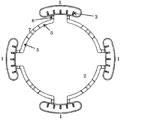
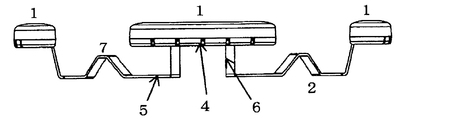
- Aspect 1 is an aspect having an annular coupling structure including four drug storage portions 1.
- 1 is a perspective view
- FIG. 2 is a plan view seen from above during installation
- FIG. 3 is a side view.
- the medicine storage unit 1 has an elongated and curved outer shape, and is arranged along a circumference centering on the central portion of the slime remover when viewed in plan view.
- a single or a plurality of solid drugs are stored in the drug storage unit 1 for use.
- the frame structure portion 2 includes a drain outlet bottom contact member 5 (8 locations), a medicine storage portion support member 6 (8 locations), and a frame structure projecting member 7 (4 locations).
- the medicine container support member 6 is bent and joined to the drain outlet bottom contact member 5.
- the frame structure projecting member 7 is bent and connected to the drain outlet bottom contact member 5, and is further bent at two upper portions.
- the drain outlet bottom contact member 5 and the frame structure projecting member 7 are arranged along a circumference centered on the central portion of the slime remover.
- the drain outlet bottom contact member 5 is on the lower side, from which the medicine container supporting member 6 and the frame structure projecting member 7 protrude upward, and the medicine container supporting member 6 is the medicine container 1. Is supported from below.
- the frame structure part 2 has a belt shape as a whole and can be plastically deformed in a direction perpendicular to the belt surface, but can be easily plastically deformed particularly at each of the above-described bending parts, whereby each medicine container 1 is brought into contact with the peripheral wall. And can be installed stably according to the shape of the bottom of the drain outlet.
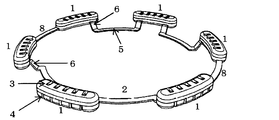
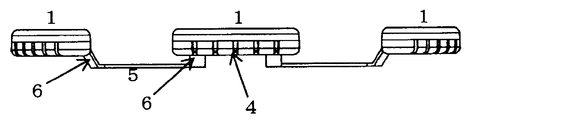
- Aspect 2 is an aspect having an annular connection structure including six drug storage portions 1. 4 is a perspective view, FIG. 5 is a plan view seen from above during installation, and FIG. 6 is a side view.
- the medicine storage part 1 has the same shape as in the case of the aspect 1, and when viewed in plan view, it is arranged along the circumference centering on the center part of the slime remover together with the medicine storage part connecting member 8 described later. Has been. Of the six drug storage units 1, four adjacent to each other, excluding two opposing ones, are connected by a drug storage unit connecting member 8 described later.
- the frame structure portion 2 includes a drain outlet bottom contact member 5 (four locations), a medicine storage portion support member 6 (8 locations), and a medicine storage portion connecting member 8 (two locations).
- the medicine container support member 6 is bent and connected to the drain outlet bottom contact member 5.
- the medicine container connecting member 8 is directly coupled to the medicine container 1 at both ends.
- the drain outlet bottom contact member 5 is disposed along a circumference centering on the central portion of the slime removing tool.
- the drain outlet bottom contact member 5 is on the lower side, from which the medicine container support member 6 protrudes upward, and the medicine container support member 6 supports the medicine container 1 from below. Yes.
- Each drug storage unit connecting member 8 and the two drug storage units 1 coupled to both ends thereof are on the upper side.
- the frame structure part 2 has a belt shape as a whole and can be plastically deformed in a direction perpendicular to the belt surface, but can be easily plastically deformed particularly at each of the above-described bending parts, whereby each medicine container 1 is brought into contact with the peripheral wall. And can be installed stably according to the shape of the bottom of the drain outlet.
Landscapes
- Engineering & Computer Science (AREA)
- Environmental & Geological Engineering (AREA)
- Health & Medical Sciences (AREA)
- Life Sciences & Earth Sciences (AREA)
- Hydrology & Water Resources (AREA)
- Public Health (AREA)
- Water Supply & Treatment (AREA)
- Sink And Installation For Waste Water (AREA)
- Agricultural Chemicals And Associated Chemicals (AREA)
- Bidet-Like Cleaning Device And Other Flush Toilet Accessories (AREA)
Abstract
製造が容易であり、一般の浴室排水口に使用可能であり、特に排水口周辺のくぼみ部全体に効果を発揮するヌメリ取り具を提供することを課題とする。 本発明のヌメリ取り具は、排水口の底部に載置してヌメリを防除するためのヌメリ取り具であって、 (A)設置時に上方から見てヌメリ取り具の周縁部にあって、排水流入口と薬液流出口とを有し、ヌメリ取り用固形薬剤を収納するための、少なくとも1個の薬剤収納部、及び (B)少なくとも部分的に塑性変形可能な材質からなり、設置時には排水口の底部に当接するとともに薬剤収納部を下方から支持して排水口周壁に接触し得るようにするフレーム構造部を有する。
Description
本発明は、排水設備に設置するヌメリの除去および防止のための器具に関する。特に、浴室等の排水口に好ましく適用することができる、ヌメリの除去および防止のための器具に関する。本願は2018年2月9日に出願された日本国特許出願第2018-021982号に対し優先権を主張し、その内容をここに援用する。
台所流し台や浴室の排水口、これらの設備に設置するゴミ取り籠、あるいは排水管内等には、雑菌やカビ等の微生物あるいはその代謝物によるヌメリが発生しやすく、このようなヌメリを除去し、又はその発生を防止するための薬剤(ヌメリ取り用薬剤)や、薬剤を収納して効果を発揮させるための器具(ヌメリ取り具)が、多数提案され、使用されている。
このようなヌメリ取り具としては、対象とする設備又は器具の上部に係止し、係止位置より下方に対して効果を発揮させるものが一般的である。
例えば、特許文献1には、ヌメリ防除剤を担持した柔軟性帯状物をヌメリ発生壁面部の上部に着設することにより、ヌメリ防除剤の溶解液をヌメリ発生壁面部に広がらせる方法が記載されている。
特許文献2には、蓋状のヌメリ取り具の中心付近に固形薬剤を収納し、固形薬剤の溶解液を外周方向へ拡散させヌメリ発生壁面に広がらせる方法が記載されている。
特許文献3には、固形薬剤をリング状の容器に収納して蓋状のヌメリ取り具の外周付近に設置することにより、固形薬剤の溶解液をヌメリ発生壁面に広がらせる方法が記載されている。
これらのヌメリ取り具は、具体的には台所流し台の排水口やそこに設置されるゴミ取り籠を念頭に置いて設計されたものである。
このようなヌメリ取り具としては、対象とする設備又は器具の上部に係止し、係止位置より下方に対して効果を発揮させるものが一般的である。
例えば、特許文献1には、ヌメリ防除剤を担持した柔軟性帯状物をヌメリ発生壁面部の上部に着設することにより、ヌメリ防除剤の溶解液をヌメリ発生壁面部に広がらせる方法が記載されている。
特許文献2には、蓋状のヌメリ取り具の中心付近に固形薬剤を収納し、固形薬剤の溶解液を外周方向へ拡散させヌメリ発生壁面に広がらせる方法が記載されている。
特許文献3には、固形薬剤をリング状の容器に収納して蓋状のヌメリ取り具の外周付近に設置することにより、固形薬剤の溶解液をヌメリ発生壁面に広がらせる方法が記載されている。
これらのヌメリ取り具は、具体的には台所流し台の排水口やそこに設置されるゴミ取り籠を念頭に置いて設計されたものである。
一方、浴室の排水口の形式は多様である。特に、排水口周辺が洗い場よりくぼんでいる排水口(形状によっては「排水枡」と呼ばれることもある。)は、くぼみの形状も多様であり、これらのいずれにも設置できて効果を発揮するヌメリ取り具は知られていなかった。そのため、台所流し台の排水口とは異なり、浴室の排水口については、ヌメリを防除するには頻繁に清掃する必要があった。特に、排水枡が蓋や目皿で覆われている場合には、通気性が悪く湿度が常に高いため、微生物の繁殖防止が困難であるにもかかわらず、その清掃には手間がかかるという問題もあった。
特許文献4には、表面に抗菌・抗カビ材が塗布又はメッキされた抗菌及び抗カビ用構造体を、排水枡の内部底面に置くことで、排水枡内の抗菌・抗カビ効果を発揮させる方法が記載されている。
特許文献4には、表面に抗菌・抗カビ材が塗布又はメッキされた抗菌及び抗カビ用構造体を、排水枡の内部底面に置くことで、排水枡内の抗菌・抗カビ効果を発揮させる方法が記載されている。
特許文献4の抗菌及び抗カビ用構造体については、その上部が排水枡を覆う蓋又は目皿と接触すれば蓋又は目皿に対して効果を奏することも記載されているが、このようなものは特定の構造を有する排水口にしか適用できず、また排水枡の周壁に対しては特段の効果を発揮しない。また、抗菌・抗カビ材を塗布又はメッキするという点で、製造方法が煩雑であり好ましくない。
そこで、本発明は、製造が容易であり、一般の浴室排水口に使用可能であり、特に排水口周辺のくぼみ部全体に効果を発揮するヌメリ取り具を提供することを課題とする。
そこで、本発明は、製造が容易であり、一般の浴室排水口に使用可能であり、特に排水口周辺のくぼみ部全体に効果を発揮するヌメリ取り具を提供することを課題とする。
本発明者らは、上記課題を解決すべく鋭意検討の結果、ヌメリ取り具のフレームを排水口の底部に載置し、上方にある薬剤収納部を支持してくぼみ部壁面に接触させるようなヌメリ取り具により、上記課題が解決されることを見出し、本発明を完成した。
すなわち、本発明は、以下の発明に関する。
(1)排水口の底部に載置してヌメリを防除するためのヌメリ取り具であって、
(A)設置時に上方から見てヌメリ取り具の周縁部にあって、排水流入口と薬液流出口とを有し、ヌメリ取り用固形薬剤を収納するための、少なくとも1個の薬剤収納部、及び
(B)少なくとも部分的に塑性変形可能な材質からなり、設置時には排水口の底部に当接するとともに薬剤収納部を下方から支持して排水口周壁に接触し得るようにするフレーム構造部
を有するヌメリ取り具。
(2)複数の薬剤収納部を有する、(1)に記載のヌメリ取り具。
(3)フレーム構造部が、設置時に上方から見て略環状の外形を有する、(1)又は(2)に記載のヌメリ取り具。
(4)フレーム構造部が、複数の薬剤収納部を直列に連結する、(2)に記載のヌメリ取り具。
(5)浴室の排水口を使用対象とする、(1)~(4)のいずれかに記載のヌメリ取り具。
(1)排水口の底部に載置してヌメリを防除するためのヌメリ取り具であって、
(A)設置時に上方から見てヌメリ取り具の周縁部にあって、排水流入口と薬液流出口とを有し、ヌメリ取り用固形薬剤を収納するための、少なくとも1個の薬剤収納部、及び
(B)少なくとも部分的に塑性変形可能な材質からなり、設置時には排水口の底部に当接するとともに薬剤収納部を下方から支持して排水口周壁に接触し得るようにするフレーム構造部
を有するヌメリ取り具。
(2)複数の薬剤収納部を有する、(1)に記載のヌメリ取り具。
(3)フレーム構造部が、設置時に上方から見て略環状の外形を有する、(1)又は(2)に記載のヌメリ取り具。
(4)フレーム構造部が、複数の薬剤収納部を直列に連結する、(2)に記載のヌメリ取り具。
(5)浴室の排水口を使用対象とする、(1)~(4)のいずれかに記載のヌメリ取り具。
本発明により、多様な浴室排水口に適用できるヌメリ取り具が提供される。
本発明のヌメリ取り具は、排水口の底部に載置するヌメリ取り具であって、少なくとも1個の薬剤収納部とフレーム構造部とを有するものである。
本発明における薬剤収納部は、排水流入口と薬液流出口とを有し、ヌメリ取り用固形薬剤を収納する目的を有するものであり、設置時には、上方から見てヌメリ取り具の周縁部に存在する。
本発明におけるフレーム構造部は、少なくとも部分的に塑性変形可能な材質からなり、設置時には排水口の底部に当接するとともに薬剤収納部を下方から支持して排水口周壁に接触し得るようにするものである。
本発明のヌメリ取り具は、基本的に以上2種の部材からなるものであればよく、その他の部材は特に必要ないが、本発明の効果を害することがない限り、さらに他の機能を有する部材を含んでもよい。
本発明のヌメリ取り具は、排水口の底部に載置することにより、排水口、排水口の周辺、及び/又は排水管のヌメリを除去又は防止する効果を目的とし、特に排水口周辺の周壁に対して顕著な効果を有するものである。
ここで「排水口の底部」とは、排水設備から、排水を流下させるための管状の構造である排水管部を除外した部分の下端部を指す。この部分には通常、目皿若しくはストレーナーが設置されており、本発明のヌメリ取り具は、目皿、ストレーナー上端のリム部、あるいはその周囲に載置して使用する。
本発明における薬剤収納部は、排水流入口と薬液流出口とを有し、ヌメリ取り用固形薬剤を収納する目的を有するものであり、設置時には、上方から見てヌメリ取り具の周縁部に存在する。
本発明におけるフレーム構造部は、少なくとも部分的に塑性変形可能な材質からなり、設置時には排水口の底部に当接するとともに薬剤収納部を下方から支持して排水口周壁に接触し得るようにするものである。
本発明のヌメリ取り具は、基本的に以上2種の部材からなるものであればよく、その他の部材は特に必要ないが、本発明の効果を害することがない限り、さらに他の機能を有する部材を含んでもよい。
本発明のヌメリ取り具は、排水口の底部に載置することにより、排水口、排水口の周辺、及び/又は排水管のヌメリを除去又は防止する効果を目的とし、特に排水口周辺の周壁に対して顕著な効果を有するものである。
ここで「排水口の底部」とは、排水設備から、排水を流下させるための管状の構造である排水管部を除外した部分の下端部を指す。この部分には通常、目皿若しくはストレーナーが設置されており、本発明のヌメリ取り具は、目皿、ストレーナー上端のリム部、あるいはその周囲に載置して使用する。
(薬剤収納部)
薬剤収納部は、設置時に上方から見てヌメリ取り具の周縁部にある。これは、薬剤収納部が排水口周壁に接触し得るようにするためである。下述のように、薬剤収納部を支持するフレーム構造部は、少なくとも部分的に塑性変形可能な材質からなり、これにより、薬剤収納部を排水口周壁に接触するように変形させて使用することが可能となる。
薬剤収納部は、少なくとも1個あればよいが、各方向にヌメリ取り効果を発揮するために、複数あることが好ましく、特に排水口の周囲は矩形状のくぼみとなっている場合が多いことから、4個又はそれ以上あればより好ましい。また、薬剤収納部の外形は、特に限定されるものではないが、ヌメリ取り具の中央部から各薬剤収納部へ向かう線と略直交する水平な方向に長い形状とすることが好ましく、具体的には、矩形、長円形等が挙げられ、弯曲していてもよい。
薬剤収納部は、ヌメリ取り用固形薬剤を収納するための容器であり、少なくとも排水流入口と薬液流出口とを必須のものとして有する。排水口に排水が流入した場合、この排水の一部が薬剤収納部の排水流入口から薬剤収納部内部へ流入する。これによって固形薬剤が溶解し、生じた薬液は薬液流出口から流出し、ヌメリ取り効果を発揮する。なお、排水流入口と薬液流出口とが兼用である態様も包含されるが、薬剤収納部内に水流を起こさせるために、両者が別に設置されている方が好ましい。
排水流入口と薬液流出口の位置、数、大きさ及び構造は、固形薬剤がそのまま流出するおそれがないものである限り、特に限定されない。
薬剤収納部の外形が、ヌメリ取り具の中央部から各薬剤収納部へ向かう線と略直交する水平な方向に長い形状である場合には、この長手方向に沿って複数の薬液流出口があることが好ましい。これにより、排水口周壁の広い範囲にヌメリ取り効果を発揮させることができる。さらに同様に、長手方向に沿って複数の排水流入口があってもよい。
排水流入口と薬液流出口との位置関係に関しては、例えば、薬剤収納部の上面及び/又は側面上部に排水流入口を設け、薬剤収納部の底部及び/又は側面の排水流入口より低い位置に薬液流出口を設けることができる。この場合には、排水流入口は、ゴミの流入を抑制する構造を有することが好ましく、具体的には、スリット又は網目構造を有することが好ましい。また、固形薬剤が十分に溶解するよう、薬液流出口の開口総面積は、薬剤保持部内に保持できる最大量の水が0.5~500秒、好ましくは2~100秒、さらに好ましくは5~50秒で流出するように調整されていることが好ましい。これは、例えば、薬液流出口の開口面積を小さく、あるいはスリット状に細長くすることで達成できる。
また、薬剤収納部の側面下部に排水流入口を設け、薬剤収納部の排水流入口と同等又はより高い位置に、排水が流入しない構造として、薬液流出口を設けることもできる。この場合、排水流入口の構造としては、上方に向かって開口した構造や、排水の一部を薬剤収納部内に分配するための水受部を設け、ここから排水流入口に排水を流し込む構造がある。また排水が流入しない薬液流出口の構造としては、下方に向かって開口した構造、あるいは薬液を下方に案内する案内片を有する構造がある。
薬剤収納部の内部は、単一の空間であってもよく、また、内部を完全に又は一部のみ分けるための仕切りが設けられていてもよい。
薬剤収納部の材質としては、金属、プラスチック等が挙げられるが、製造が容易であり、またフレーム構造部との一体成形も可能である点で、プラスチックが好ましい。
薬剤収納部の製造に当たっては、薬剤収納部の一部又は全体をフレーム構造部と一体成形してもよいし、フレーム構造部と薬剤収納部とを別に成形し、これらを互いに係止してヌメリ取り具としてもよい。
薬剤収納部は、設置時に上方から見てヌメリ取り具の周縁部にある。これは、薬剤収納部が排水口周壁に接触し得るようにするためである。下述のように、薬剤収納部を支持するフレーム構造部は、少なくとも部分的に塑性変形可能な材質からなり、これにより、薬剤収納部を排水口周壁に接触するように変形させて使用することが可能となる。
薬剤収納部は、少なくとも1個あればよいが、各方向にヌメリ取り効果を発揮するために、複数あることが好ましく、特に排水口の周囲は矩形状のくぼみとなっている場合が多いことから、4個又はそれ以上あればより好ましい。また、薬剤収納部の外形は、特に限定されるものではないが、ヌメリ取り具の中央部から各薬剤収納部へ向かう線と略直交する水平な方向に長い形状とすることが好ましく、具体的には、矩形、長円形等が挙げられ、弯曲していてもよい。
薬剤収納部は、ヌメリ取り用固形薬剤を収納するための容器であり、少なくとも排水流入口と薬液流出口とを必須のものとして有する。排水口に排水が流入した場合、この排水の一部が薬剤収納部の排水流入口から薬剤収納部内部へ流入する。これによって固形薬剤が溶解し、生じた薬液は薬液流出口から流出し、ヌメリ取り効果を発揮する。なお、排水流入口と薬液流出口とが兼用である態様も包含されるが、薬剤収納部内に水流を起こさせるために、両者が別に設置されている方が好ましい。
排水流入口と薬液流出口の位置、数、大きさ及び構造は、固形薬剤がそのまま流出するおそれがないものである限り、特に限定されない。
薬剤収納部の外形が、ヌメリ取り具の中央部から各薬剤収納部へ向かう線と略直交する水平な方向に長い形状である場合には、この長手方向に沿って複数の薬液流出口があることが好ましい。これにより、排水口周壁の広い範囲にヌメリ取り効果を発揮させることができる。さらに同様に、長手方向に沿って複数の排水流入口があってもよい。
排水流入口と薬液流出口との位置関係に関しては、例えば、薬剤収納部の上面及び/又は側面上部に排水流入口を設け、薬剤収納部の底部及び/又は側面の排水流入口より低い位置に薬液流出口を設けることができる。この場合には、排水流入口は、ゴミの流入を抑制する構造を有することが好ましく、具体的には、スリット又は網目構造を有することが好ましい。また、固形薬剤が十分に溶解するよう、薬液流出口の開口総面積は、薬剤保持部内に保持できる最大量の水が0.5~500秒、好ましくは2~100秒、さらに好ましくは5~50秒で流出するように調整されていることが好ましい。これは、例えば、薬液流出口の開口面積を小さく、あるいはスリット状に細長くすることで達成できる。
また、薬剤収納部の側面下部に排水流入口を設け、薬剤収納部の排水流入口と同等又はより高い位置に、排水が流入しない構造として、薬液流出口を設けることもできる。この場合、排水流入口の構造としては、上方に向かって開口した構造や、排水の一部を薬剤収納部内に分配するための水受部を設け、ここから排水流入口に排水を流し込む構造がある。また排水が流入しない薬液流出口の構造としては、下方に向かって開口した構造、あるいは薬液を下方に案内する案内片を有する構造がある。
薬剤収納部の内部は、単一の空間であってもよく、また、内部を完全に又は一部のみ分けるための仕切りが設けられていてもよい。
薬剤収納部の材質としては、金属、プラスチック等が挙げられるが、製造が容易であり、またフレーム構造部との一体成形も可能である点で、プラスチックが好ましい。
薬剤収納部の製造に当たっては、薬剤収納部の一部又は全体をフレーム構造部と一体成形してもよいし、フレーム構造部と薬剤収納部とを別に成形し、これらを互いに係止してヌメリ取り具としてもよい。
本発明のヌメリ取り具は、少なくとも使用時には、薬剤収納部に固形薬剤を収納して使用される。また薬剤収納部に、単独で、若しくはフレーム構造部と結合した状態で、固形薬剤を収納した製品として供給してもよい。このため、薬剤収納部は、その成形後に固形薬剤を収納できる構造として製造する必要がある。具体的には、薬剤供給部を異なる2つの部材として成形し(その少なくとも一方をフレーム構造部と一体成形してもよい)、固形薬剤の収納後にこれら2つの部材を組み合わせ固定する方法や、蝶番部を介して結合された2部分からなる薬剤供給部を一体成形し、固形薬剤の収納後に蝶番部を閉じて固定する方法が挙げられる。上記の固定方法としては、爪により嵌合させる方法や、溶融固着させる方法が挙げられる。爪により嵌合させる方法を採用すれば、固形薬剤を使用完了した後に、新たな固形薬剤を詰め直して再使用することも可能である。
(ヌメリ取り用固形薬剤)
本発明に用いられるヌメリ取り用固形薬剤は、特に限定されるものではないが、ヌメリ取り効果を有する限り、薬剤収納部から流失しない形状を有することが好ましい。固形薬剤の状態としては、錠剤等の変形しにくい固体のほか、弾性を有するが流動性を有しないゲル、あるいは水を吸収してそのようなゲルに変化し得る固体等がある。
本発明に用いられるヌメリ取り用固形薬剤の成分としては、特に限定されるものではないが、ヌメリの除去や、ヌメリを発生させる菌等の除菌、殺菌、抗菌等の効力を有する薬剤成分を含有し、これらの薬剤成分を水中に次第に放出するものが好ましい。この放出は、固形薬剤の溶解とともに起こることが好ましく、特に、薬剤放出濃度が低下してヌメリ取り効果が低下する頃には固形薬剤が消失することで、取り換え時期の判断が容易になることが好ましい。
前記効力を有する薬剤成分としては、塩素系殺菌剤、非さらし粉系抗菌剤、抗菌性無機金属又はその化合物、抗生物質、ヌメリを除去できる菌等を例示することができ、好ましくは非さらし粉系抗菌剤である。
本発明に用いられるヌメリ取り用固形薬剤は、特に限定されるものではないが、ヌメリ取り効果を有する限り、薬剤収納部から流失しない形状を有することが好ましい。固形薬剤の状態としては、錠剤等の変形しにくい固体のほか、弾性を有するが流動性を有しないゲル、あるいは水を吸収してそのようなゲルに変化し得る固体等がある。
本発明に用いられるヌメリ取り用固形薬剤の成分としては、特に限定されるものではないが、ヌメリの除去や、ヌメリを発生させる菌等の除菌、殺菌、抗菌等の効力を有する薬剤成分を含有し、これらの薬剤成分を水中に次第に放出するものが好ましい。この放出は、固形薬剤の溶解とともに起こることが好ましく、特に、薬剤放出濃度が低下してヌメリ取り効果が低下する頃には固形薬剤が消失することで、取り換え時期の判断が容易になることが好ましい。
前記効力を有する薬剤成分としては、塩素系殺菌剤、非さらし粉系抗菌剤、抗菌性無機金属又はその化合物、抗生物質、ヌメリを除去できる菌等を例示することができ、好ましくは非さらし粉系抗菌剤である。
(塩素系殺菌剤)
本発明に使用できる塩素系殺菌剤としては亜塩素酸ナトリウム、さらし粉、高度さらし粉、次亜塩素酸ナトリウム、次亜塩素酸水等を例示することができる。
本発明に使用できる塩素系殺菌剤としては亜塩素酸ナトリウム、さらし粉、高度さらし粉、次亜塩素酸ナトリウム、次亜塩素酸水等を例示することができる。
(非さらし粉系抗菌剤)
本発明に使用できる非さらし粉系抗菌剤としては、その使用時に酸性物質等と反応して塩素ガスを発生しないものであればどのようなものでも使用することができ、例えば、一般的な防黴剤又は抗細菌剤として知られている化合物及び抗菌作用を有することが知られている天然精油類等を例示することができる。
本発明に使用できる非さらし粉系抗菌剤としては、その使用時に酸性物質等と反応して塩素ガスを発生しないものであればどのようなものでも使用することができ、例えば、一般的な防黴剤又は抗細菌剤として知られている化合物及び抗菌作用を有することが知られている天然精油類等を例示することができる。
本発明に使用できる防黴剤又は抗細菌剤としては、例えば、5-クロロ-2-メチル-4-イソチアゾリン-3-オン、2-メチル-4-イソチアゾリン-3-オン、5-クロロ-2-n-オクチル-4-イソチアゾリン-3-オン、4-クロロ-2-n-オクチル-4-イソチアゾリン-3-オン、4,5-ジクロロ-3-n-オクチル-イソチアゾリン-3-オン、2-n-オクチル-4-イソチアゾリン-3-オン、1,2-ベンズイソチアゾリン-3-オン、2-メチル-4,5-トリメチレン-4-イソチアゾリン-3-オン、2-メトキシカルボニルベンズイミダゾール、2,3,5,6-テトラクロロ-4-メタンスルホニルピリジン、2-チオシアノメチルチオベンゾチアゾール、2,2-ジチオ-ビス-(ピリジン-1-オキサイド)、3,3,4,4-テトラハイドロチオフェン-1,1-ジオキサイド、4,5-ジクロロ-1,2-ジチオラン-3-オン、5-クロロ-4-フェニル-1,2-ジチオラン-3-オン、N-メチルピロリドン、フェニル-(2-シアノ-2-クロロビニル)スルホン、メチレンビスチオシアネート、2-ブロモ-2-ニトロプロパン-1,3-ジオール、2,2-ジブロモ-2-エタノール、2-ブロモ-4’-ヒドロキシアセトフェノン、ジブロモニトリルプロピオンアミド、2-ブロモ-2-ブロモメチルグルタルニトリル、過炭酸ナトリウム、過硫酸カリウム、過ほう酸ナトリウム、オルトフェニルフェノール、ジフェニル、2-イソプロピル-5-メチルフェノール(チモール)、5-イソプロピル-2-メチルフェノール(カルバクロール)、4-イソプロピルフェノール、4-イソプロピル-3-メチルフェノール、3-イソプロピル-5-メチルフェノール、チモール(2-イソプロピル-5-メチルフェノール)、パラクロロメタキシレノール、トリクロサン、ダイクロサン、パラヒドロキシ安息香酸n-ブチル、パラヒドロキシ安息香酸エチル、パラヒドロキシ安息香酸メチル、塩化ベンザルコニウム、塩化ベンゼトニウム、塩酸クロロへキシジン、グルコン酸クロロヘキシジン、2-ピリジンチオール-1-オキサイド、2-ピリジンチオール-1-オキシド亜鉛塩、2-ピリジンチオール-1-オキシドナトリウム、N,N’-ヘキサメチレンビス(4-カルバモイル-1-デシルピリジニウムブロマイド)、4,4’-(テトラメチレンジアミノ)ビス(1-デシルピリジニウムブロマイド)等を具体的に挙げることができる。
また、本発明に使用できる天然精油類としては、例えば、シネオール、ヒノキチオール、メントール、テルピネオール、ボルネオール、ノポール、シトラール、シトロネラール、シトロネロール、ゲラニオール、リナロール、ジメチルオクタノール、チモール等を例示することができる。
さらに、本発明に使用できる非さらし粉系抗菌剤として、ヨード系抗菌剤も例示することができ、その中でも特に固体のものが望ましい。ヨード系抗菌剤としては、例えば、2,3,3-トリヨードアリルアルコール類、2,3,3-トリヨードアリルエーテル類、2,3,3-トリヨードアリルアゾール類、3-ヨード-2-プロパルギルブチルカルバミン酸、4-クロロフェニル(3-ヨードプロパルギル)ホルマール、ヨードプロパルギルアゾール類、ジヨードメチルパラトリルスルホン、ポビドンヨード、ベンジルヨード酢酸エステル及びパラニトロベンジルヨード酢酸エステルを挙げることができる。
以上の非さらし粉系抗菌剤は、一種又は二種以上混合して使用することができる。
以上の非さらし粉系抗菌剤は、一種又は二種以上混合して使用することができる。
(包接化合物タイプの抗菌剤)
これら非さらし粉系抗菌剤は、多分子系ホスト化合物のゲスト化合物とすることができ、例えば、2-ブロモ-2-ニトロプロパン-1,3-ジオール、5-クロロ-2-メチル-4-イソチアゾリン-3-オン等をゲスト化合物として包接化合物を形成させ、これらを非さらし粉系抗菌剤として使用することができる。
これら非さらし粉系抗菌剤は、多分子系ホスト化合物のゲスト化合物とすることができ、例えば、2-ブロモ-2-ニトロプロパン-1,3-ジオール、5-クロロ-2-メチル-4-イソチアゾリン-3-オン等をゲスト化合物として包接化合物を形成させ、これらを非さらし粉系抗菌剤として使用することができる。
本発明において多分子系ホスト化合物とは、ゲストとなる抗菌剤と水素結合等の分子間力により相互作用を持ち、規則的配列を有する、結晶性錯体(包接化合物)を形成する化合物をいい、上記の性質を有する化合物であれば特に制限されないが、例えば以下の化合物を例示することができる。
(1)テトラキスフェノ-ル類
(2)1,1,6,6-テトラフェニル-2,4-ヘキサジイン-1,6-ジオール
(3)1,6-ビス(2-クロロフェニル)-1,6-ジフェニルヘキサン-2,4-ジイン-1,6-ジオール
(4)1,1,4,4-テトラフェニル-2-ブチン-1,4-ジオール
(5)2,5-ビス(2,4,ジメチルフェニル)ハイドロキノン
(6)1,1-ビス(2,4,ジメチルフェニル)-2-プロピン-1-オール
(7)1,1,2,2-テトラフェニルエタン-1,2-ジオール
(8)1,1’-ビ-2-ナフトール
(9)9,10-ジフェニル-9,10-ジヒドロキシアントラセン
(10)1,1,6,6-テトラ(2,4-ジメチルフェニル)-2,4-ヘキサジイン-1,6-ジオール
(11)9,10-ビス(4-メチルフェニル)-9,10-ジヒドロキシアントラセン
(12)1,1-ビス(4-ヒドロキシフェニル)シクロヘキサン
(13)N,N,N’,N’-テトラキス(シクロヘキシル)-(1,1’-ビフェニル)-2-2’-ジカルボキシアミド
(14)4,4’-スルホニルビスフェノール
(15)4,4’-ブチリデンビス(3-メチル-6-tert-ブチルフェノール)
(16)2,2’-メチレンビス(4-メチル-6-tert-ブチルフェノール)
(17)4,4’-チオビス(4-クロロフェノール)
(18)2,2’-メチレンビス(4-クロロフェノール)
(19)デオキシコール酸
(20)コール酸
(21)α,α,α’,α’-テトラフェニル-1,1’-ビフェニル-2,2’-ジメタノール
(22)t-ブチルヒドロキノン
(23)2,5-ジ-tert-ブチルヒドロキノン
(24)顆粒状コーンスターチ
(25)1,4-ジアザビシクロ-(2,2,2)-オクタン
(1)テトラキスフェノ-ル類
(2)1,1,6,6-テトラフェニル-2,4-ヘキサジイン-1,6-ジオール
(3)1,6-ビス(2-クロロフェニル)-1,6-ジフェニルヘキサン-2,4-ジイン-1,6-ジオール
(4)1,1,4,4-テトラフェニル-2-ブチン-1,4-ジオール
(5)2,5-ビス(2,4,ジメチルフェニル)ハイドロキノン
(6)1,1-ビス(2,4,ジメチルフェニル)-2-プロピン-1-オール
(7)1,1,2,2-テトラフェニルエタン-1,2-ジオール
(8)1,1’-ビ-2-ナフトール
(9)9,10-ジフェニル-9,10-ジヒドロキシアントラセン
(10)1,1,6,6-テトラ(2,4-ジメチルフェニル)-2,4-ヘキサジイン-1,6-ジオール
(11)9,10-ビス(4-メチルフェニル)-9,10-ジヒドロキシアントラセン
(12)1,1-ビス(4-ヒドロキシフェニル)シクロヘキサン
(13)N,N,N’,N’-テトラキス(シクロヘキシル)-(1,1’-ビフェニル)-2-2’-ジカルボキシアミド
(14)4,4’-スルホニルビスフェノール
(15)4,4’-ブチリデンビス(3-メチル-6-tert-ブチルフェノール)
(16)2,2’-メチレンビス(4-メチル-6-tert-ブチルフェノール)
(17)4,4’-チオビス(4-クロロフェノール)
(18)2,2’-メチレンビス(4-クロロフェノール)
(19)デオキシコール酸
(20)コール酸
(21)α,α,α’,α’-テトラフェニル-1,1’-ビフェニル-2,2’-ジメタノール
(22)t-ブチルヒドロキノン
(23)2,5-ジ-tert-ブチルヒドロキノン
(24)顆粒状コーンスターチ
(25)1,4-ジアザビシクロ-(2,2,2)-オクタン
前記多分子系ホスト化合物におけるテトラキスフェノ-ル類としては、例えば、1,1,2,2-テトラキス(4-ヒドロキシフェニル)エタン、1,1,2,2-テトラキス(3-フルオロ-4-ヒドロキシフェニル)エタン、1,1,2,2-テトラキス(3-クロロ-4-ヒドロキシフェニル)エタン、1,1,2,2-テトラキス(3-メチル-4-ヒドロキシフェニル)エタン、1,1,2,2-テトラキス(3-メトキシ-4-ヒドロキシフェニル)エタン、1,1,2,2-テトラキス(3,5-ジメチル-4-ヒドロキシフェニル)エタン、1,1,3,3-テトラキス(4-ヒドロキシフェニル)プロパン、1,1,3,3-テトラキス(3-フルオロ-4-ヒドロキシフェニル)プロパン、1,1,3,3-テトラキス(3-クロロ-4-ヒドロキシフェニル)プロパン、1,1,3,3-テトラキス(3-メチル-4-ヒドロキシフェニル)プロパン、1,1,3,3-テトラキス(3-メトキシ-4-ヒドロキシフェニル)プロパン、1,1,3,3-テトラキス(3,5-ジメチル-4-ヒドロキシフェニル)プロパン、1,1,4,4-テトラキス(4-ヒドロキシフェニル)ブタン、1,1,4,4-テトラキス(3-フルオロ-4-ヒドロキシフェニル)ブタン、1,1,4,4-テトラキス(3-クロロ-4-ヒドロキシフェニル)ブタン、1,1,4,4-テトラキス(3-メチル-4-ヒドロキシフェニル)ブタン、1,1,4,4-テトラキス(3-メトキシ-4-ヒドロキシフェニル)ブタン、1,1,4,4-テトラキス(3,5-ジメチル-4-ヒドロキシフェニル)ブタン、1,1,5,5-テトラキス(4-ヒドロキシフェニル)ペンタン、1,1,5,5-テトラキス(3-フルオロ-4-ヒドロキシフェニル)ペンタン、1,1,5,5-テトラキス(3-クロロ-4-ヒドロキシフェニル)ペンタン、1,1,5,5-テトラキス(3-メチル-4-ヒドロキシフェニル)ペンタン、1,1,5,5-テトラキス(3-メトキシ-4-ヒドロキシフェニル)ペンタン、1,1,5,5-テトラキス(3,5-ジメチル-4-ヒドロキシフェニル)ペンタン等テトラキス(ヒドロキシフェニル)アルカン類を具体的に例示することができる。
本発明に使用できる包接化合物は、通常、ゲストとなる非さらし粉系抗菌剤とホスト化合物とを、場合によっては水あるいは有機溶媒存在下に、常温~100℃で数分間~数時間攪拌して反応させることにより容易に得られる。
(抗菌性無機金属又はその化合物)
本発明に使用するヌメリ防除剤には、抗菌性無機金属又はその化合物を添加することができる。抗菌性を有する無機金属を含有する成分であれば特に限定されないが、好ましくは固体状であり、抗菌性無機金属そのもの又はその酸化物、塩化物、硝酸塩、硫酸塩を担体に担持した粒子状のもの等が好ましく選ばれる。
ここで、担体の具体例としては、リン酸塩類(リン酸ジルコニウム、リン酸カルシウム等)、金属酸化物(酸化ケイ素、酸化アルミニウム、酸化チタン、酸化亜鉛、酸化鉄、酸化ジルコニウム等)、無機化合物(ゼオライト、粘土鉱物、シリカゲル等)等が挙げられる。これらの担体は、一種または二種以上を用いてもよい。
なかでも、金属酸化物の担体に抗菌性無機金属酸化物を担持したものが、担持強度の点から、より好ましく選ばれる。
抗菌性無機金属又はその化合物中の抗菌性無機金属としては、抗菌性を有する金属であれば特に限定されないが、銀、亜鉛、銅等が好ましく選ばれる。さらに好ましいものとして、抗菌性の効果の点から、銀が選ばれる。これら抗菌性無機金属は、一種または二種以上を用いてもよい。
また、抗菌性無機金属又はその化合物の実際の商品としては、商業的に入手可能なものであれば特に限定されるものではなく、例えば、ATOMYBALL-S、ATOMYBALL-L、ATOMYBALL-UA(登録商標、触媒化成工業(株))の商品名で販売されているナノ粒子銀系無機抗菌剤などを使用することができる。
抗菌性無機金属含有成分は、一種または二種以上を混合して用いることができる。
抗菌性無機金属又はその化合物の配合量としては、例えば銀を含む成分の場合、銀元素濃度に換算して、0.0002質量%以上が好ましい。より好ましくは、0.0002~0.005質量%である。0.0002質量%以上で抗菌能が向上し、また、0.005質量%以下であっても、抗菌能は充分であり、経済的にも許容される上限量である。
抗菌性無機金属又はその化合物が粒子状である場合の組成物中における分散粒子の平均粒子径は、1~500nmであることが好ましく、さらには、1~100nmであることが好ましい。
ここで、平均粒子径とは、数平均粒子径であり、光散乱法により測定されるものである。500nm以下であれば粒子の分散状態は安定になり、100nm以下であれば粒子の分散状態はより安定なものとなる。また、粒子径が小さいほど、菌との接触の観点から有利に作用する。
本発明に使用するヌメリ防除剤には、抗菌性無機金属又はその化合物を添加することができる。抗菌性を有する無機金属を含有する成分であれば特に限定されないが、好ましくは固体状であり、抗菌性無機金属そのもの又はその酸化物、塩化物、硝酸塩、硫酸塩を担体に担持した粒子状のもの等が好ましく選ばれる。
ここで、担体の具体例としては、リン酸塩類(リン酸ジルコニウム、リン酸カルシウム等)、金属酸化物(酸化ケイ素、酸化アルミニウム、酸化チタン、酸化亜鉛、酸化鉄、酸化ジルコニウム等)、無機化合物(ゼオライト、粘土鉱物、シリカゲル等)等が挙げられる。これらの担体は、一種または二種以上を用いてもよい。
なかでも、金属酸化物の担体に抗菌性無機金属酸化物を担持したものが、担持強度の点から、より好ましく選ばれる。
抗菌性無機金属又はその化合物中の抗菌性無機金属としては、抗菌性を有する金属であれば特に限定されないが、銀、亜鉛、銅等が好ましく選ばれる。さらに好ましいものとして、抗菌性の効果の点から、銀が選ばれる。これら抗菌性無機金属は、一種または二種以上を用いてもよい。
また、抗菌性無機金属又はその化合物の実際の商品としては、商業的に入手可能なものであれば特に限定されるものではなく、例えば、ATOMYBALL-S、ATOMYBALL-L、ATOMYBALL-UA(登録商標、触媒化成工業(株))の商品名で販売されているナノ粒子銀系無機抗菌剤などを使用することができる。
抗菌性無機金属含有成分は、一種または二種以上を混合して用いることができる。
抗菌性無機金属又はその化合物の配合量としては、例えば銀を含む成分の場合、銀元素濃度に換算して、0.0002質量%以上が好ましい。より好ましくは、0.0002~0.005質量%である。0.0002質量%以上で抗菌能が向上し、また、0.005質量%以下であっても、抗菌能は充分であり、経済的にも許容される上限量である。
抗菌性無機金属又はその化合物が粒子状である場合の組成物中における分散粒子の平均粒子径は、1~500nmであることが好ましく、さらには、1~100nmであることが好ましい。
ここで、平均粒子径とは、数平均粒子径であり、光散乱法により測定されるものである。500nm以下であれば粒子の分散状態は安定になり、100nm以下であれば粒子の分散状態はより安定なものとなる。また、粒子径が小さいほど、菌との接触の観点から有利に作用する。
(ヌメリを除去できる菌)
ヌメリを除去できる菌とは、具体的には枯草菌(バチルス属)等であり、枯草菌としては納豆菌等を例示することができる。
ヌメリを除去できる菌とは、具体的には枯草菌(バチルス属)等であり、枯草菌としては納豆菌等を例示することができる。
(その他の成分)
本発明に用いる固形薬剤には、単独で製剤できる場合を除いて、通常、製剤化に必要なその他の成分が添加される。その他の成分としては、賦形剤、結合剤、溶解調整剤、滑沢剤、界面活性剤、腐食防止剤、ゲル化物、帯電防止剤、その他の機能成分等である。
本発明に用いる固形薬剤には、単独で製剤できる場合を除いて、通常、製剤化に必要なその他の成分が添加される。その他の成分としては、賦形剤、結合剤、溶解調整剤、滑沢剤、界面活性剤、腐食防止剤、ゲル化物、帯電防止剤、その他の機能成分等である。
(賦形剤、結合剤、溶解調整剤)
賦形剤、結合剤、溶解調整剤としては、フマル酸、安息香酸、アジピン酸、コハク酸、スルファミン酸、dl-リンゴ酸、クエン酸、アスコルビン酸、マロン酸、グリコール酸、C10-24飽和脂肪酸等の有機酸類;ほう酸等の無機酸類;乳糖;ショ糖;ブドウ糖;コーンスターチ等のデンプン類;結晶セルロース、粉末セルロース、メチルセルロース、エチルセルロース、カルボキシメチルセルロース、カルボキシメチルセルロースナトリウム、カルボキシメチルセルロースカルシウム、ヒドロキシプロピルセルロース等の各種セルロース類;塩化ナトリウム、硫酸マグネシウム、硫酸カリウム、燐酸水素カルシウム、合成珪酸アルミニウム、三珪酸マグネシウム等の無機塩類;ポリビニルアルコール、ポリビニルピロリドン、アルギン酸ナトリウム、アラビアゴム(粉末)等の高分子化合物類;ショ糖脂肪酸エステル等を挙げることができるが、その中でも特に乳糖;ショ糖;ブドウ糖;コーンスターチ等のデンプン類;結晶セルロース、粉末セルロース、ヒドロキシプロピルセルロース等のセルロース類;アラビアゴム(粉末)、ポリビニルアルコール、ポリビニルピロリドン、デキストリン等は加圧成形性を向上することができ、また、各種洗剤等が混入しても反応して有毒ガス等が発生することが無いので好ましく、これら賦形剤や結合剤、溶解調整剤は全固形物質量に対して1~99質量%の割合で添加することができる。
賦形剤、結合剤、溶解調整剤としては、フマル酸、安息香酸、アジピン酸、コハク酸、スルファミン酸、dl-リンゴ酸、クエン酸、アスコルビン酸、マロン酸、グリコール酸、C10-24飽和脂肪酸等の有機酸類;ほう酸等の無機酸類;乳糖;ショ糖;ブドウ糖;コーンスターチ等のデンプン類;結晶セルロース、粉末セルロース、メチルセルロース、エチルセルロース、カルボキシメチルセルロース、カルボキシメチルセルロースナトリウム、カルボキシメチルセルロースカルシウム、ヒドロキシプロピルセルロース等の各種セルロース類;塩化ナトリウム、硫酸マグネシウム、硫酸カリウム、燐酸水素カルシウム、合成珪酸アルミニウム、三珪酸マグネシウム等の無機塩類;ポリビニルアルコール、ポリビニルピロリドン、アルギン酸ナトリウム、アラビアゴム(粉末)等の高分子化合物類;ショ糖脂肪酸エステル等を挙げることができるが、その中でも特に乳糖;ショ糖;ブドウ糖;コーンスターチ等のデンプン類;結晶セルロース、粉末セルロース、ヒドロキシプロピルセルロース等のセルロース類;アラビアゴム(粉末)、ポリビニルアルコール、ポリビニルピロリドン、デキストリン等は加圧成形性を向上することができ、また、各種洗剤等が混入しても反応して有毒ガス等が発生することが無いので好ましく、これら賦形剤や結合剤、溶解調整剤は全固形物質量に対して1~99質量%の割合で添加することができる。
硫酸カルシウムを用いる場合、成形性や溶解性を容易にコントロールすることができる点からして硫酸カルシウム0.5水和物が好ましく、硫酸カルシウム0.5水和物の中でも、常圧焼成により製造されるβ型のものが、加圧焼成することにより製造されるα型のものよりも、吸水による成形体の型崩れを起こしにくい点で好ましく、このβ型の硫酸カルシウム0.5水和物を用いる場合は、乳糖又はショ糖と併用することが成形性や溶解性のコントロールの点でより好ましい。
C10-24飽和脂肪酸としては、ステアリン酸、ラウリン酸などが挙げられる。
これら飽和脂肪酸は、成形時の滑沢性を付与するのと同時に剤の水中での安定性(膨潤、崩壊防止性)を向上させる目的で使用され、固形薬剤の全固形物質量に対して1~10質量%の割合で用いられる。
これら飽和脂肪酸は、成形時の滑沢性を付与するのと同時に剤の水中での安定性(膨潤、崩壊防止性)を向上させる目的で使用され、固形薬剤の全固形物質量に対して1~10質量%の割合で用いられる。
ヒドロキシプロピルセルロースとは、セルロースの水酸基の一部又は全部が-(CH2CH(CH3)-O)mH(式中、mは1以上の整数)で置換されたものであり、重合度、置換度などについては特に限定されない。ヒドロキシプロピルセルロースとしては、例えば、ヒドロキシプロピルセルロース HPC-SL、HPC-L(以上商品名、日本曹達(株)社製)等が挙げられる。本発明において使用するヒドロキシプロピルセルロースの量は、固形薬剤の全固形物質量に対して、好ましくは5質量%より少なく、より好ましくは、1~4質量%である。
(滑沢剤)
滑沢剤としては、ステアリン酸マグネシウム、ステアリン酸カルシウム、ステアリン酸ナトリウム、安息香酸ナトリウム、オルトほう酸、シリカ、タルク、ワックス類等を例示することができ、これら滑沢剤は全固形物質量に対して0.01~1質量%の割合で使用することができる。
滑沢剤としては、ステアリン酸マグネシウム、ステアリン酸カルシウム、ステアリン酸ナトリウム、安息香酸ナトリウム、オルトほう酸、シリカ、タルク、ワックス類等を例示することができ、これら滑沢剤は全固形物質量に対して0.01~1質量%の割合で使用することができる。
タルクとは、マグネシウムの含水ケイ酸塩鉱物であり、Mg3Si4O10(OH)2の組成を有する。本発明においては、界面活性剤の代わりに用いたり、界面活性剤と併用して用いられる。タルクの含有量としては、固形薬剤の全重量に対して、0.1~10質量%、好ましくは0.5~3質量%である。
(界面活性剤)
本発明において使用される界面活性剤は抗菌剤成分と反応せず、融点が50℃以上のものであれば特に制限はない。融点が50℃以下の界面活性剤を用いると、温水により固形薬剤が溶解しやすくなり、また、夏場においては気温の上昇により固形薬剤から界面活性剤がブリードしやすくなるなどの問題がある。融点が50℃以上の界面活性剤としては、例えば、ヤシ油脂肪酸モノエタノールアミド、ラウリン酸モノイソプロパノールアミドなどの脂肪酸アルカノールアミド類;ソルビタンステアレート、ソルビタンパルミテートなどのソルビタン脂肪酸エステル類;アルキルアルカノールアミド類、ジアルキルスルホコハク酸ナトリウム、ラウリル硫酸ナトリウム、ポリオキシエチレンステアリルエーテル、ポリオキシエチレンポリオキシプロピレンブロックポリマーなどが挙げられる。その中でも、ヤシ油脂肪酸モノエタノールアミドとソルビタンステアレートを好ましい界面活性剤として挙げることができる。
これらのうち、市販されているものとしては、以下のものが挙げられる。ヤシ油脂肪酸モノエタノールアミドとしては、トーホールN-120(東邦化学工業株式会社製)、アミゾールCME(登録商標、川研ファインケミカル株式会社製)など、ラウリン酸モノイソプロパノールアミドとしてはアミゾールPLME(登録商標、川研ファインケミカル株式会社製)、ソルビタンステアレートとしてはレオドールSP-S10V、S20V、S30V(登録商標、花王株式会社製)、ソルボンS-60(東邦化学工業株式会社製)など、ソルビタンパルミテートとしてはソルボンS-40(東邦化学工業株式会社製)など、ポリオキシエチレンステアリルエーテルとしてはエマルゲン350(登録商標、花王株式会社製)など、ポリオキシエチレンポリオキシプロピレンブロックポリマーとしてはニューポールPE-68(登録商標、三洋化成工業株式会社製)などがある。
これらは、単独で使用することも、あるいは2種以上混合して使用することもできるが、加圧成形した時の打錠性、水に対する溶解性、崩壊性、抗菌剤の安定性への影響を考慮して決定することが望ましい。
界面活性剤の含有量としては、固形薬剤の全質量に対して、0.1~10質量%、好ましくは0.5~3質量%である。
本発明において使用される界面活性剤は抗菌剤成分と反応せず、融点が50℃以上のものであれば特に制限はない。融点が50℃以下の界面活性剤を用いると、温水により固形薬剤が溶解しやすくなり、また、夏場においては気温の上昇により固形薬剤から界面活性剤がブリードしやすくなるなどの問題がある。融点が50℃以上の界面活性剤としては、例えば、ヤシ油脂肪酸モノエタノールアミド、ラウリン酸モノイソプロパノールアミドなどの脂肪酸アルカノールアミド類;ソルビタンステアレート、ソルビタンパルミテートなどのソルビタン脂肪酸エステル類;アルキルアルカノールアミド類、ジアルキルスルホコハク酸ナトリウム、ラウリル硫酸ナトリウム、ポリオキシエチレンステアリルエーテル、ポリオキシエチレンポリオキシプロピレンブロックポリマーなどが挙げられる。その中でも、ヤシ油脂肪酸モノエタノールアミドとソルビタンステアレートを好ましい界面活性剤として挙げることができる。
これらのうち、市販されているものとしては、以下のものが挙げられる。ヤシ油脂肪酸モノエタノールアミドとしては、トーホールN-120(東邦化学工業株式会社製)、アミゾールCME(登録商標、川研ファインケミカル株式会社製)など、ラウリン酸モノイソプロパノールアミドとしてはアミゾールPLME(登録商標、川研ファインケミカル株式会社製)、ソルビタンステアレートとしてはレオドールSP-S10V、S20V、S30V(登録商標、花王株式会社製)、ソルボンS-60(東邦化学工業株式会社製)など、ソルビタンパルミテートとしてはソルボンS-40(東邦化学工業株式会社製)など、ポリオキシエチレンステアリルエーテルとしてはエマルゲン350(登録商標、花王株式会社製)など、ポリオキシエチレンポリオキシプロピレンブロックポリマーとしてはニューポールPE-68(登録商標、三洋化成工業株式会社製)などがある。
これらは、単独で使用することも、あるいは2種以上混合して使用することもできるが、加圧成形した時の打錠性、水に対する溶解性、崩壊性、抗菌剤の安定性への影響を考慮して決定することが望ましい。
界面活性剤の含有量としては、固形薬剤の全質量に対して、0.1~10質量%、好ましくは0.5~3質量%である。
加熱溶融混合の場合や混練り押し出し成形する場合の配合物としては、融点が40~100℃で固体であるものが好ましく、ポリオキシエチレン等の各種の水溶性高分子類、ポリオキシエチレンポリオキシプロピレンブロックポリマー、ポリオキシエチレンアルキルフェニルエーテル、ポリエチレングリコール脂肪酸エステル類、グリセリン脂肪酸エステル類、ポリオキシエチレンアルキルエーテル類等の界面活性剤を例示することができる。
(腐食防止剤)
前記腐食防止剤としては、アルキルチオ尿素系やトリアゾール系化合物を例示することができ、これらを使用すると配管などの金属部分の腐食を抑制することができる。
前記腐食防止剤としては、アルキルチオ尿素系やトリアゾール系化合物を例示することができ、これらを使用すると配管などの金属部分の腐食を抑制することができる。
(ゲル状物)
前記ゲル状物として用いる場合のゲル化剤としては、寒天、ゼラチン、ローカストビーンガム、アルギン酸ナトリウム、ポリビニルアルコール、アラビアガム、ジェランガム、アミノ酸、カルボキシメチルセルロース及びその金属塩、カラギーナン等を例示することができる。
前記ゲル状物として用いる場合のゲル化剤としては、寒天、ゼラチン、ローカストビーンガム、アルギン酸ナトリウム、ポリビニルアルコール、アラビアガム、ジェランガム、アミノ酸、カルボキシメチルセルロース及びその金属塩、カラギーナン等を例示することができる。
(帯電防止剤)
前記帯電防止剤としては、ケイソウ土、硫酸白土などを加えることにより、成形の際、帯電防止効果を付与することもできる。
前記帯電防止剤としては、ケイソウ土、硫酸白土などを加えることにより、成形の際、帯電防止効果を付与することもできる。
(その他の機能成分)
その他の機能成分を有する化合物を添加することができる。その他の機能成分としては、乳幼児の誤食の防止等を目的とした苦味付与成分、排水口の悪臭の防止等を目的とした消臭成分、芳香成分、デザイン性向上等を目的とした着色成分を例示することもできる。
その他の機能成分を有する化合物を添加することができる。その他の機能成分としては、乳幼児の誤食の防止等を目的とした苦味付与成分、排水口の悪臭の防止等を目的とした消臭成分、芳香成分、デザイン性向上等を目的とした着色成分を例示することもできる。
(固形薬剤の製造及び配合割合)
本発明に使用する固形薬剤の製造方法は、特に限定されるものではないが、ヌメリ取りに用いられる薬剤とそれ以外の成分とを加熱溶融混合、混練り押し出し成形、加圧成形等により行われる。加圧成形法は、機種により同時に凹部や貫通孔を形成することができるため好ましい。具体的な製造方法は例えば以下の通りであるが、この方法に限定される必要はない。
まず、各原料をナウターミキサーに投入し、室温(20~30℃)にて30~60分間混合を行う。混合された原料は圧延ローラーを通して板状造粒を行う。それを一旦荒く砕き、原末を製造する。原末を打錠機のホッパーから投入し、打錠を行う。打錠機に設置した型の形状により凹部や貫通孔を有した錠剤が形成される。また、凹部や貫通孔を形成できる加圧打錠機としては、たとえば、株式会社菊水製作所製型式HER2ロータリー打錠機等が挙げられる。
本発明に使用する固形薬剤の製造方法は、特に限定されるものではないが、ヌメリ取りに用いられる薬剤とそれ以外の成分とを加熱溶融混合、混練り押し出し成形、加圧成形等により行われる。加圧成形法は、機種により同時に凹部や貫通孔を形成することができるため好ましい。具体的な製造方法は例えば以下の通りであるが、この方法に限定される必要はない。
まず、各原料をナウターミキサーに投入し、室温(20~30℃)にて30~60分間混合を行う。混合された原料は圧延ローラーを通して板状造粒を行う。それを一旦荒く砕き、原末を製造する。原末を打錠機のホッパーから投入し、打錠を行う。打錠機に設置した型の形状により凹部や貫通孔を有した錠剤が形成される。また、凹部や貫通孔を形成できる加圧打錠機としては、たとえば、株式会社菊水製作所製型式HER2ロータリー打錠機等が挙げられる。
本発明に使用する固形薬剤に用いられる薬剤とそれ以外の成分との混合割合は、使用状況が様々であることからヌメリ取りに用いられる薬剤1~99質量部、それ以外の成分99~1質量部の間で任意に混合比率を変化させることができるが、好ましくはヌメリ取りに用いられる薬剤5~20質量部、それ以外の成分95~80質量部である。また、ヌメリ取りに用いられる薬剤として包接化合物を用いる場合、該包接化合物2~30質量部、それ以外の成分98~70質量部の混合割合が好ましい。
(固形薬剤の形状)
固形薬剤の形状としては、球状、錠剤状、円柱状、直方体状、角錐状、ドーナツ状、また凹部を有するもの等どのような形態でもよく、その大きさも薬剤収納部に収容しうる大きさであればどのようなものでもよい。例えば1個の薬剤収納部につき、薬剤収納部の形状に適合させた1個の固形薬剤を収納するものでもよく、より小さい複数の固形薬剤を収納するものでもよい。特に、薬剤収納部が1方向に長い形状を有する場合には、複数の固形薬剤を長手方向に直列して収納すれば、製造が容易であり、かつ使用時に溶解しやすいため、好ましい。
固形薬剤は、(A)及び/又は(B)の形状を有する錠剤であることが好ましい。
(A)錠剤上面の中央部及び/又は錠剤底面の中央部に設けられた凹部。
この場合、凹部の深さは、一番深い所で錠剤の厚みの5~30%であるか、または、錠剤の直径の3~20%であることが好ましい。
(B)錠剤上面の中央部から錠剤底面の中央部にかけて設けられた貫通孔。
この場合、貫通孔の直径は、錠剤の直径の10~40%であることが好ましい。
特に、薬剤収納部が内部で一定方向に水が流れる構造を有するものである場合には、以上のような形状を有する固形薬剤により、薬剤溶出濃度が使用初期から長期にわたりヌメリ防除に十分な濃度であり、かつ、薬剤溶出濃度が低下する頃には錠剤が消失するため取り換え時期を判断しやすいという効果が発揮される。
固形薬剤の使用の形態としては、薬剤収納部の形状に合わせて、例えば円柱状のものやドーナツ状のものを1個用いる場合もあるが、小粒のものを多数使用することもできる。小粒のものを多数使用する場合、同種のものを用いるほか、例えば配合成分の異なる薬剤や溶解度が異なる薬剤等異種の複数の小粒の固形薬剤を用いることもできる。
固形薬剤の形状としては、球状、錠剤状、円柱状、直方体状、角錐状、ドーナツ状、また凹部を有するもの等どのような形態でもよく、その大きさも薬剤収納部に収容しうる大きさであればどのようなものでもよい。例えば1個の薬剤収納部につき、薬剤収納部の形状に適合させた1個の固形薬剤を収納するものでもよく、より小さい複数の固形薬剤を収納するものでもよい。特に、薬剤収納部が1方向に長い形状を有する場合には、複数の固形薬剤を長手方向に直列して収納すれば、製造が容易であり、かつ使用時に溶解しやすいため、好ましい。
固形薬剤は、(A)及び/又は(B)の形状を有する錠剤であることが好ましい。
(A)錠剤上面の中央部及び/又は錠剤底面の中央部に設けられた凹部。
この場合、凹部の深さは、一番深い所で錠剤の厚みの5~30%であるか、または、錠剤の直径の3~20%であることが好ましい。
(B)錠剤上面の中央部から錠剤底面の中央部にかけて設けられた貫通孔。
この場合、貫通孔の直径は、錠剤の直径の10~40%であることが好ましい。
特に、薬剤収納部が内部で一定方向に水が流れる構造を有するものである場合には、以上のような形状を有する固形薬剤により、薬剤溶出濃度が使用初期から長期にわたりヌメリ防除に十分な濃度であり、かつ、薬剤溶出濃度が低下する頃には錠剤が消失するため取り換え時期を判断しやすいという効果が発揮される。
固形薬剤の使用の形態としては、薬剤収納部の形状に合わせて、例えば円柱状のものやドーナツ状のものを1個用いる場合もあるが、小粒のものを多数使用することもできる。小粒のものを多数使用する場合、同種のものを用いるほか、例えば配合成分の異なる薬剤や溶解度が異なる薬剤等異種の複数の小粒の固形薬剤を用いることもできる。
(ヌメリ取りに用いられる薬剤の溶出濃度)
本発明に用いられる薬剤の溶出濃度は、初期においては殺菌成分の濃度が高いほうがよく、また長期間にわたって一定濃度以上であることが好ましい。この場合、初期とは使用開始から1日間であり、長期間とは使用開始から少なくとも5日間、好ましくは少なくとも10日間、さらに好ましくは、少なくとも15日間である。また、薬剤の溶出濃度は、ヌメリ取りに用いられる薬剤の種類によってその有効濃度が異なるので適宜決めるべきものであるが、最小発育阻止濃度以上であることが好ましい。
殺菌成分の溶出濃度の測定は、例えば、以下の様にして行うことができる。本発明のヌメリ取り用錠剤を、本発明のヌメリ取り具の薬剤収納部に充填した後、排水口に設置し、その後、1日あたり、水温37~42℃の水を5L/分の速度で5分間流し、55分間流水を停止するという処理を18時間行った後、6時間放置する。この処理を毎日繰り返し行う。毎日、洗浄水を流し終わった10秒後にヌメリ取り具を取り出し、適切な容器に入れて1分間付着している水を採取する。この採取した水の殺菌成分の溶出濃度を測定する。殺菌成分により、測定装置は異なるが、例えば、ヌメリ取りに用いられる薬剤が5-クロロ-2-メチル-4-イソチアゾリン-3-オン(CMI)の場合は、液体クロマトグラフィーにより測定することができる。
本発明に用いられる薬剤の溶出濃度は、初期においては殺菌成分の濃度が高いほうがよく、また長期間にわたって一定濃度以上であることが好ましい。この場合、初期とは使用開始から1日間であり、長期間とは使用開始から少なくとも5日間、好ましくは少なくとも10日間、さらに好ましくは、少なくとも15日間である。また、薬剤の溶出濃度は、ヌメリ取りに用いられる薬剤の種類によってその有効濃度が異なるので適宜決めるべきものであるが、最小発育阻止濃度以上であることが好ましい。
殺菌成分の溶出濃度の測定は、例えば、以下の様にして行うことができる。本発明のヌメリ取り用錠剤を、本発明のヌメリ取り具の薬剤収納部に充填した後、排水口に設置し、その後、1日あたり、水温37~42℃の水を5L/分の速度で5分間流し、55分間流水を停止するという処理を18時間行った後、6時間放置する。この処理を毎日繰り返し行う。毎日、洗浄水を流し終わった10秒後にヌメリ取り具を取り出し、適切な容器に入れて1分間付着している水を採取する。この採取した水の殺菌成分の溶出濃度を測定する。殺菌成分により、測定装置は異なるが、例えば、ヌメリ取りに用いられる薬剤が5-クロロ-2-メチル-4-イソチアゾリン-3-オン(CMI)の場合は、液体クロマトグラフィーにより測定することができる。
(フレーム構造部)
フレーム構造部は、少なくとも一部が塑性変形可能な材質からなり、薬剤収納部に接続されている。また設置時には、排水口の底部に当接し、薬剤収納部を下方から支持して排水口周壁に接触し得るようにする。すなわち、「排水口底部当接部材」と、「薬剤収納部支持部材」との2部材を必須の部材として含むものである。なお、フレーム構造部は、互いに直接には結合していない(すなわち、薬剤収納部を介して互いに結合している)複数の部分からなっていてもよく、さらに、2個又はそれ以上の薬剤収納部を単に連結するための部材(後述の「薬剤収納部連結部材」)等を含んでいてもよい。
フレーム構造部の材質は、少なくとも部分的に塑性変形可能なものであればよいが、具体的には金属、プラスチック、あるいはこれらが複合してなる材質が挙げられる。このうち、薬剤収納部と一体に成形すれば製造が容易である点で、プラスチックが好ましく、具体的にはポリエチレン、ポリプロピレン、ポリ塩化ビニル等が例示される。また、材料の形状としては、線状又は帯状であることが好ましい。
排水口底部の形状は、製品によって大きく異なり、突出部を有する場合も多いため、ここにヌメリ取り具を載置した場合、ヌメリ取り具が突出部に当たって傾くなどして、十分な効果が得られないおそれがある。
しかし本発明では、フレーム構造部の少なくとも一部を塑性変形可能にすることにより、例えば排水口底部に突出部があれば、それに合わせてフレーム構造部を屈曲させて安定に設置することができる。また薬剤収納部が周壁に接触しやすいように、フレーム構造部を変形することもできる。
フレーム構造部は、その全域を塑性変形可能とすれば、どのような形状の排水口にも適用可能なので好ましい。しかし、全域を塑性変形可能とすることは必須ではなく、フレーム構造部の一部のみ塑性変形可能とすればよい。例えば、フレーム構造部のうち各薬剤収納部支持部材の一部を塑性変形可能とすれば、薬剤収納部を周壁に接触させることができる。また、排水口底部当接部材の一部を塑性変形可能とし、その部分(フレーム構造突出部材)で排水口底部の突出部を迂回できるようにすれば、排水口底部に安定に載置することができる。
フレーム構造部は、少なくとも一部が塑性変形可能な材質からなり、薬剤収納部に接続されている。また設置時には、排水口の底部に当接し、薬剤収納部を下方から支持して排水口周壁に接触し得るようにする。すなわち、「排水口底部当接部材」と、「薬剤収納部支持部材」との2部材を必須の部材として含むものである。なお、フレーム構造部は、互いに直接には結合していない(すなわち、薬剤収納部を介して互いに結合している)複数の部分からなっていてもよく、さらに、2個又はそれ以上の薬剤収納部を単に連結するための部材(後述の「薬剤収納部連結部材」)等を含んでいてもよい。
フレーム構造部の材質は、少なくとも部分的に塑性変形可能なものであればよいが、具体的には金属、プラスチック、あるいはこれらが複合してなる材質が挙げられる。このうち、薬剤収納部と一体に成形すれば製造が容易である点で、プラスチックが好ましく、具体的にはポリエチレン、ポリプロピレン、ポリ塩化ビニル等が例示される。また、材料の形状としては、線状又は帯状であることが好ましい。
排水口底部の形状は、製品によって大きく異なり、突出部を有する場合も多いため、ここにヌメリ取り具を載置した場合、ヌメリ取り具が突出部に当たって傾くなどして、十分な効果が得られないおそれがある。
しかし本発明では、フレーム構造部の少なくとも一部を塑性変形可能にすることにより、例えば排水口底部に突出部があれば、それに合わせてフレーム構造部を屈曲させて安定に設置することができる。また薬剤収納部が周壁に接触しやすいように、フレーム構造部を変形することもできる。
フレーム構造部は、その全域を塑性変形可能とすれば、どのような形状の排水口にも適用可能なので好ましい。しかし、全域を塑性変形可能とすることは必須ではなく、フレーム構造部の一部のみ塑性変形可能とすればよい。例えば、フレーム構造部のうち各薬剤収納部支持部材の一部を塑性変形可能とすれば、薬剤収納部を周壁に接触させることができる。また、排水口底部当接部材の一部を塑性変形可能とし、その部分(フレーム構造突出部材)で排水口底部の突出部を迂回できるようにすれば、排水口底部に安定に載置することができる。
フレーム構造部の構造は特に限定されないが、塑性変形が容易であるようになるべく単純な構造が好ましい。このような単純な構造としては、複数の薬剤収納部を環状直列に連結してなる構造(環状連結構造)が好ましく挙げられる。フレーム構造部は、薬剤収納部を下方から支持して排水口周壁に接触し得るようにすることを特徴としているが、これは具体的には、環状構造のうち薬剤収納部付近の部材(薬剤収納部支持部材)が周縁側上方に突出しており、それ以外の部分の少なくとも一部を排水口底部当接部材とすることにより達成し得る。ヌメリ取り具全体を設置時に上方から見ると、フレーム構造部が円形、楕円形、矩形等の形状をなし、これから薬剤収納部が周縁側に突出している。
上記のように、環状連結構造においては、フレーム構造部が薬剤収納部付近でヌメリ取り具の周縁側上方に突出している。従って、この突出部が排水口底部の突出部の上に来るように載置すれば、排水口底部当接部材を特に変形させなくても、安定に設置することができる。
また薬剤収納部付近に限らず、さらにフレーム構造部の一部に上に突出した部分(フレーム構造突出部材)を設け、フレーム構造突出部材も排水口底部の突出部の上に来るように載置することもできる。
さらに薬剤収納部が複数である場合には、単一の薬剤収納部付近のみでなく、隣り合う2個又はそれ以上の薬剤収納部を連結する部材(薬剤収納部連結部材)を含めて、周縁側上方に突出していてもよい。この場合、薬剤収納部連結部材は、排水口底部当接部材と直接結合せず、薬剤収納部とのみ直接結合している。他に、フレーム構造部の中央付近から各薬剤収納部に向けて、腕状部材が出ている構造を挙げることができる。薬剤収納部が複数であれば、該腕状部材は分岐している必要がある。この場合には、中央付近が排水口の底部に当接し、腕状部材の先がそれより上に突出している。分岐の態様は特に限定されない。
さらに複雑な構造を有するフレーム構造部も可能であり、例えば、中央部にあって排水口の底部に当接するための環状部材から、各薬剤収納部を支持する腕状部材が分岐して出ている構造や、さらに環状部材の内側が網状になった構造(ヘアキャッチャー兼用)なども考えられる。しかし、このような複雑な構造は、製造に手間や費用がかかり、設置時の変形が容易でなくなり、使用時には分岐部や網状部にヌメリや汚れが残りやすいといった点から、あまり好ましくはない。以上の理由から、分岐しない(弯曲又は屈曲はあってもよい。)材料からなり、複数の薬剤収納部を環状直列に連結している構造が最も好ましい。
上記のように、環状連結構造においては、フレーム構造部が薬剤収納部付近でヌメリ取り具の周縁側上方に突出している。従って、この突出部が排水口底部の突出部の上に来るように載置すれば、排水口底部当接部材を特に変形させなくても、安定に設置することができる。
また薬剤収納部付近に限らず、さらにフレーム構造部の一部に上に突出した部分(フレーム構造突出部材)を設け、フレーム構造突出部材も排水口底部の突出部の上に来るように載置することもできる。
さらに薬剤収納部が複数である場合には、単一の薬剤収納部付近のみでなく、隣り合う2個又はそれ以上の薬剤収納部を連結する部材(薬剤収納部連結部材)を含めて、周縁側上方に突出していてもよい。この場合、薬剤収納部連結部材は、排水口底部当接部材と直接結合せず、薬剤収納部とのみ直接結合している。他に、フレーム構造部の中央付近から各薬剤収納部に向けて、腕状部材が出ている構造を挙げることができる。薬剤収納部が複数であれば、該腕状部材は分岐している必要がある。この場合には、中央付近が排水口の底部に当接し、腕状部材の先がそれより上に突出している。分岐の態様は特に限定されない。
さらに複雑な構造を有するフレーム構造部も可能であり、例えば、中央部にあって排水口の底部に当接するための環状部材から、各薬剤収納部を支持する腕状部材が分岐して出ている構造や、さらに環状部材の内側が網状になった構造(ヘアキャッチャー兼用)なども考えられる。しかし、このような複雑な構造は、製造に手間や費用がかかり、設置時の変形が容易でなくなり、使用時には分岐部や網状部にヌメリや汚れが残りやすいといった点から、あまり好ましくはない。以上の理由から、分岐しない(弯曲又は屈曲はあってもよい。)材料からなり、複数の薬剤収納部を環状直列に連結している構造が最も好ましい。
以下に、添付の図と共に、本発明のヌメリ取り具の具体例について説明するが、本発明の技術的範囲はこれらに限定されない。
(態様1)
態様1は、4個の薬剤収納部1を含む環状連結構造を有する態様である。図1は斜視図、図2は設置時に上方から見た平面図、図3は側面図である。
薬剤収納部1は、細長く湾曲した外形を有し、平面図で見ると、ヌメリ取り具の中央部を中心とする円周に沿って配置されている。上面にはスリット状の排水流入口5個を有し、それより下の、周縁側面から底面にかけては、スリット状の薬液流出口5個を有する。薬剤収納部1の内部には、必要であれば仕切等の構造物があってもよい。薬剤収納部1の内部に単一又は複数の固形薬剤を収納して使用する。
フレーム構造部2は、排水口底部当接部材5(8箇所)、薬剤収納部支持部材6(8箇所)、及びフレーム構造突出部材7(4箇所)からなる。
薬剤収納部支持部材6は、排水口底部当接部材5と屈曲して結合している。フレーム構造突出部材7は、排水口底部当接部材5と屈曲して結合しており、さらに上部の2箇所で屈曲している。
平面図で見ると、排水口底部当接部材5とフレーム構造突出部材7が、ヌメリ取り具の中央部を中心とする円周に沿って配置されている。側面図で見ると、排水口底部当接部材5が下方にあり、そこから薬剤収納部支持部材6及びフレーム構造突出部材7が上方に突出しており、薬剤収納部支持部材6は薬剤収納部1を下方から支持している。
フレーム構造部2は、全体が帯状であり、帯面と直交する方向へ塑性変形可能であるが、特に上記の各屈曲部で容易に塑性変形でき、これにより各薬剤収納部1を周壁に接触させることができ、排水口底部の形状に合わせて安定に設置することができる。
態様1は、4個の薬剤収納部1を含む環状連結構造を有する態様である。図1は斜視図、図2は設置時に上方から見た平面図、図3は側面図である。
薬剤収納部1は、細長く湾曲した外形を有し、平面図で見ると、ヌメリ取り具の中央部を中心とする円周に沿って配置されている。上面にはスリット状の排水流入口5個を有し、それより下の、周縁側面から底面にかけては、スリット状の薬液流出口5個を有する。薬剤収納部1の内部には、必要であれば仕切等の構造物があってもよい。薬剤収納部1の内部に単一又は複数の固形薬剤を収納して使用する。
フレーム構造部2は、排水口底部当接部材5(8箇所)、薬剤収納部支持部材6(8箇所)、及びフレーム構造突出部材7(4箇所)からなる。
薬剤収納部支持部材6は、排水口底部当接部材5と屈曲して結合している。フレーム構造突出部材7は、排水口底部当接部材5と屈曲して結合しており、さらに上部の2箇所で屈曲している。
平面図で見ると、排水口底部当接部材5とフレーム構造突出部材7が、ヌメリ取り具の中央部を中心とする円周に沿って配置されている。側面図で見ると、排水口底部当接部材5が下方にあり、そこから薬剤収納部支持部材6及びフレーム構造突出部材7が上方に突出しており、薬剤収納部支持部材6は薬剤収納部1を下方から支持している。
フレーム構造部2は、全体が帯状であり、帯面と直交する方向へ塑性変形可能であるが、特に上記の各屈曲部で容易に塑性変形でき、これにより各薬剤収納部1を周壁に接触させることができ、排水口底部の形状に合わせて安定に設置することができる。
(態様2)
態様2は、6個の薬剤収納部1を含む環状連結構造を有する態様である。図4は斜視図、図5は設置時に上方から見た平面図、図6は側面図である。
薬剤収納部1は、態様1の場合と同様の形状を有し、平面図で見ると、後述の薬剤収納部連結部材8とともに、ヌメリ取り具の中央部を中心とする円周に沿って配置されている。6個ある薬剤収納部1のうち、対向する2個を除く4個は、隣り合う2個ずつが後述の薬剤収納部連結部材8により連結されている。
フレーム構造部2は、排水口底部当接部材5(4箇所)、薬剤収納部支持部材6(8箇所)、及び薬剤収納部連結部材8(2箇所)からなる。
薬剤収納部支持部材6は排水口底部当接部材5と屈曲して結合している。薬剤収納部連結部材8はそれぞれの両端で薬剤収納部1と直接結合している。
平面図で見ると、排水口底部当接部材5が、ヌメリ取り具の中央部を中心とする円周に沿って配置されている。側面図で見ると、排水口底部当接部材5が下方にあり、そこから薬剤収納部支持部材6が上方に突出しており、薬剤収納部支持部材6は薬剤収納部1を下方から支持している。各薬剤収納部連結部材8とその両端に結合した2個の薬剤収納部1とは共に上方にある。これにより、本態様は、大型の突出部を有する排水口底部や、複雑な形状を有する排水口底部での使用に適している。
フレーム構造部2は、全体が帯状であり、帯面と直交する方向へ塑性変形可能であるが、特に上記の各屈曲部で容易に塑性変形でき、これにより各薬剤収納部1を周壁に接触させることができ、排水口底部の形状に合わせて安定に設置することができる。
態様2は、6個の薬剤収納部1を含む環状連結構造を有する態様である。図4は斜視図、図5は設置時に上方から見た平面図、図6は側面図である。
薬剤収納部1は、態様1の場合と同様の形状を有し、平面図で見ると、後述の薬剤収納部連結部材8とともに、ヌメリ取り具の中央部を中心とする円周に沿って配置されている。6個ある薬剤収納部1のうち、対向する2個を除く4個は、隣り合う2個ずつが後述の薬剤収納部連結部材8により連結されている。
フレーム構造部2は、排水口底部当接部材5(4箇所)、薬剤収納部支持部材6(8箇所)、及び薬剤収納部連結部材8(2箇所)からなる。
薬剤収納部支持部材6は排水口底部当接部材5と屈曲して結合している。薬剤収納部連結部材8はそれぞれの両端で薬剤収納部1と直接結合している。
平面図で見ると、排水口底部当接部材5が、ヌメリ取り具の中央部を中心とする円周に沿って配置されている。側面図で見ると、排水口底部当接部材5が下方にあり、そこから薬剤収納部支持部材6が上方に突出しており、薬剤収納部支持部材6は薬剤収納部1を下方から支持している。各薬剤収納部連結部材8とその両端に結合した2個の薬剤収納部1とは共に上方にある。これにより、本態様は、大型の突出部を有する排水口底部や、複雑な形状を有する排水口底部での使用に適している。
フレーム構造部2は、全体が帯状であり、帯面と直交する方向へ塑性変形可能であるが、特に上記の各屈曲部で容易に塑性変形でき、これにより各薬剤収納部1を周壁に接触させることができ、排水口底部の形状に合わせて安定に設置することができる。
1 薬剤収納部
2 フレーム構造部
3 排水流入口
4 薬液流出口
5 排水口底部当接部材
6 薬剤収納部支持部材
7 フレーム構造突出部材
8 薬剤収納部連結部材
2 フレーム構造部
3 排水流入口
4 薬液流出口
5 排水口底部当接部材
6 薬剤収納部支持部材
7 フレーム構造突出部材
8 薬剤収納部連結部材
Claims (5)
- 排水口の底部に載置してヌメリを防除するためのヌメリ取り具であって、
(A)設置時に上方から見てヌメリ取り具の周縁部にあって、排水流入口と薬液流出口とを有し、ヌメリ取り用固形薬剤を収納するための、少なくとも1個の薬剤収納部、及び
(B)少なくとも部分的に塑性変形可能な材質からなり、設置時には排水口の底部に当接するとともに薬剤収納部を下方から支持して排水口周壁に接触し得るようにするフレーム構造部
を有するヌメリ取り具。 - 複数の薬剤収納部を有する、請求項1に記載のヌメリ取り具。
- フレーム構造部が、設置時に上方から見て略環状の外形を有する、請求項1又は2に記載のヌメリ取り具。
- フレーム構造部が、複数の薬剤収納部を直列に連結する、請求項2に記載のヌメリ取り具。
- 浴室の排水口を使用対象とする、請求項1~4のいずれかに記載のヌメリ取り具。
Priority Applications (3)
| Application Number | Priority Date | Filing Date | Title |
|---|---|---|---|
| CN201980011681.2A CN111684137A (zh) | 2018-02-09 | 2019-02-01 | 粘液去除器具 |
| JP2019570718A JP7247119B2 (ja) | 2018-02-09 | 2019-02-01 | ヌメリ取り具 |
| MYPI2020003764A MY206705A (en) | 2018-02-09 | 2019-02-01 | Slime removal means |
Applications Claiming Priority (2)
| Application Number | Priority Date | Filing Date | Title |
|---|---|---|---|
| JP2018021982 | 2018-02-09 | ||
| JP2018-021982 | 2018-02-09 |
Publications (1)
| Publication Number | Publication Date |
|---|---|
| WO2019155993A1 true WO2019155993A1 (ja) | 2019-08-15 |
Family
ID=67549383
Family Applications (1)
| Application Number | Title | Priority Date | Filing Date |
|---|---|---|---|
| PCT/JP2019/003636 Ceased WO2019155993A1 (ja) | 2018-02-09 | 2019-02-01 | ヌメリ取り具 |
Country Status (4)
| Country | Link |
|---|---|
| JP (1) | JP7247119B2 (ja) |
| CN (1) | CN111684137A (ja) |
| MY (1) | MY206705A (ja) |
| WO (1) | WO2019155993A1 (ja) |
Citations (2)
| Publication number | Priority date | Publication date | Assignee | Title |
|---|---|---|---|---|
| JP2006028887A (ja) * | 2004-07-15 | 2006-02-02 | Maruichi Kk | ヌメリ取り排水蓋 |
| JP2008127776A (ja) * | 2006-11-17 | 2008-06-05 | Fumakilla Ltd | 排水口用ヌメリ取り器 |
Family Cites Families (19)
| Publication number | Priority date | Publication date | Assignee | Title |
|---|---|---|---|---|
| JP3578655B2 (ja) * | 1998-03-03 | 2004-10-20 | 日本曹達株式会社 | 排水口用ヌメリ取り器 |
| JP2001065020A (ja) * | 1999-08-31 | 2001-03-13 | Nippon Soda Co Ltd | ヌメリ取り具 |
| JP3664087B2 (ja) * | 2001-03-07 | 2005-06-22 | 株式会社Uyeki | 洗浄剤入り洗浄具 |
| US6403032B1 (en) * | 2001-07-09 | 2002-06-11 | West Agro, Inc. | Assembly for dispensing sanitary agents into drains |
| JP3862542B2 (ja) * | 2001-10-18 | 2006-12-27 | 日本曹達株式会社 | 台所流し台の排水口用蓋 |
| JP2004324314A (ja) * | 2003-04-25 | 2004-11-18 | Nippon Soda Co Ltd | 洗面台用ヌメリ取り器 |
| JP2004332512A (ja) * | 2003-05-06 | 2004-11-25 | Daisan Kanagata Seisakusho:Kk | 排水口用ぬめり取り具およびぬめり取りフィルター |
| JP2005239367A (ja) * | 2004-02-27 | 2005-09-08 | Nagara Kagaku Kogyo Kk | ヌメリ取り剤の取り付け方法及びこれに用いるヌメリ取り剤の取り付け具 |
| KR20060014098A (ko) * | 2004-08-10 | 2006-02-15 | 주식회사 뷰밸브테크날리지 | 싱크대에 부착되는 살균탈취구 |
| JP2006118185A (ja) * | 2004-10-21 | 2006-05-11 | T Hasegawa Co Ltd | 排水口用薬剤供給装置 |
| JP4564411B2 (ja) * | 2005-06-17 | 2010-10-20 | 株式会社三栄水栓製作所 | 排水栓 |
| US8136173B2 (en) * | 2006-10-27 | 2012-03-20 | American Technical Solutions, Inc | Sink drain treatment kit |
| JP5728179B2 (ja) * | 2010-08-19 | 2015-06-03 | 日本曹達株式会社 | シンクの排水口用蓋 |
| TWI569722B (zh) * | 2011-07-12 | 2017-02-11 | 日本曹達股份有限公司 | 變形錠狀除垢劑 |
| KR101194420B1 (ko) * | 2012-05-25 | 2012-10-25 | (주)일우엔지니어링건축사사무소 | 공동주택의 배수구 악취 제한용 하수관 구조물 |
| KR101415952B1 (ko) * | 2012-07-26 | 2014-07-04 | 주식회사 대하기업 | 배수트랩 |
| KR200475135Y1 (ko) * | 2013-09-06 | 2014-11-07 | 이기화 | 역류방지장치 |
| CN204266321U (zh) * | 2014-11-22 | 2015-04-15 | 王绪绪 | 水槽废水排水装置 |
| JP2017089317A (ja) * | 2015-11-13 | 2017-05-25 | 株式会社ウエ・ルコ | 排水部の汚れ除去装置 |
-
2019
- 2019-02-01 MY MYPI2020003764A patent/MY206705A/en unknown
- 2019-02-01 JP JP2019570718A patent/JP7247119B2/ja active Active
- 2019-02-01 CN CN201980011681.2A patent/CN111684137A/zh active Pending
- 2019-02-01 WO PCT/JP2019/003636 patent/WO2019155993A1/ja not_active Ceased
Patent Citations (2)
| Publication number | Priority date | Publication date | Assignee | Title |
|---|---|---|---|---|
| JP2006028887A (ja) * | 2004-07-15 | 2006-02-02 | Maruichi Kk | ヌメリ取り排水蓋 |
| JP2008127776A (ja) * | 2006-11-17 | 2008-06-05 | Fumakilla Ltd | 排水口用ヌメリ取り器 |
Also Published As
| Publication number | Publication date |
|---|---|
| MY206705A (en) | 2025-01-02 |
| JP7247119B2 (ja) | 2023-03-28 |
| CN111684137A (zh) | 2020-09-18 |
| JPWO2019155993A1 (ja) | 2021-02-04 |
Similar Documents
| Publication | Publication Date | Title |
|---|---|---|
| JP3578655B2 (ja) | 排水口用ヌメリ取り器 | |
| US7098174B2 (en) | Slime remover and slime preventing/removing agent | |
| JP3578695B2 (ja) | 排水口用ヌメリ取り器 | |
| JP4647741B2 (ja) | 排水口用ヌメリ取り具 | |
| JP5761877B2 (ja) | 変形錠剤状ヌメリ取り剤 | |
| JP3421282B2 (ja) | 排水口用ヌメリ取り器 | |
| WO2019155993A1 (ja) | ヌメリ取り具 | |
| CN103781976B (zh) | 设于洗衣机或盥洗盆的排水管的粘液去除用转接器 | |
| JP3958632B2 (ja) | 拡散型浴室排水口用ヌメリ取り器 | |
| JP7139516B2 (ja) | ヌメリ取り具 | |
| JP2003081724A (ja) | 環境殺菌剤及びぬめり防止具 | |
| HK40030245A (en) | Slime removal means | |
| JP4404601B2 (ja) | ヌメリ防除機能付流し台用排水口蓋 | |
| JP4999155B2 (ja) | ヌメリ防除剤 | |
| JP2004324314A (ja) | 洗面台用ヌメリ取り器 | |
| JP2003213755A (ja) | 目皿一体型浴室排水口用ヌメリ取り器 | |
| HK1193720B (en) | Slime remover with changed shape | |
| JP2003213754A (ja) | 浴室排水口用ヌメリ取り器 | |
| JP2003335605A (ja) | ヌメリ防除剤 | |
| JP2004150107A (ja) | 詰替え型浴室排水口用ヌメリ取り器 | |
| JPH11247251A (ja) | ヌメリ取り具 | |
| HK1038384A (en) | Slime remover and slime preventing/removing agent | |
| JP2006045918A (ja) | ヌメリ取り容器用スペーサー |
Legal Events
| Date | Code | Title | Description |
|---|---|---|---|
| 121 | Ep: the epo has been informed by wipo that ep was designated in this application |
Ref document number: 19751916 Country of ref document: EP Kind code of ref document: A1 |
|
| ENP | Entry into the national phase |
Ref document number: 2019570718 Country of ref document: JP Kind code of ref document: A |
|
| NENP | Non-entry into the national phase |
Ref country code: DE |
|
| 122 | Ep: pct application non-entry in european phase |
Ref document number: 19751916 Country of ref document: EP Kind code of ref document: A1 |