WO2019013358A1 - 油脂の製造方法 - Google Patents
油脂の製造方法 Download PDFInfo
- Publication number
- WO2019013358A1 WO2019013358A1 PCT/JP2018/026668 JP2018026668W WO2019013358A1 WO 2019013358 A1 WO2019013358 A1 WO 2019013358A1 JP 2018026668 W JP2018026668 W JP 2018026668W WO 2019013358 A1 WO2019013358 A1 WO 2019013358A1
- Authority
- WO
- WIPO (PCT)
- Prior art keywords
- oil
- fat
- temperature
- cooling
- type
- Prior art date
- Legal status (The legal status is an assumption and is not a legal conclusion. Google has not performed a legal analysis and makes no representation as to the accuracy of the status listed.)
- Ceased
Links
Images
Classifications
-
- C—CHEMISTRY; METALLURGY
- C11—ANIMAL OR VEGETABLE OILS, FATS, FATTY SUBSTANCES OR WAXES; FATTY ACIDS THEREFROM; DETERGENTS; CANDLES
- C11B—PRODUCING, e.g. BY PRESSING RAW MATERIALS OR BY EXTRACTION FROM WASTE MATERIALS, REFINING OR PRESERVING FATS, FATTY SUBSTANCES, e.g. LANOLIN, FATTY OILS OR WAXES; ESSENTIAL OILS; PERFUMES
- C11B3/00—Refining fats or fatty oils
-
- C—CHEMISTRY; METALLURGY
- C11—ANIMAL OR VEGETABLE OILS, FATS, FATTY SUBSTANCES OR WAXES; FATTY ACIDS THEREFROM; DETERGENTS; CANDLES
- C11B—PRODUCING, e.g. BY PRESSING RAW MATERIALS OR BY EXTRACTION FROM WASTE MATERIALS, REFINING OR PRESERVING FATS, FATTY SUBSTANCES, e.g. LANOLIN, FATTY OILS OR WAXES; ESSENTIAL OILS; PERFUMES
- C11B7/00—Separation of mixtures of fats or fatty oils into their constituents, e.g. saturated oils from unsaturated oils
Definitions
- the present invention relates to a method of producing fats and oils.
- JP-A 2009-249614 describes a method of separating fat and oil which can efficiently separate liquid part and solid part by changing temperature of fat and oil variously. It is done.
- Patent Document 1 The method described in Patent Document 1 involves steps of repeatedly raising and lowering the temperature of the fat to precipitate crystals of the fat, and there is room for improvement in terms of work efficiency and complexity. Therefore, there is a need for a method of producing fats and oils that can perform separation processing more simply and with reduced working time.
- the present inventors have found that the above-mentioned problems can be solved by adopting a configuration including the presence of a pre-seed of ⁇ -type crystal in fats and oils of a predetermined temperature, and the present invention has been accomplished. That is, the present invention (A) a step of melting the raw material fat and oil, (B) cooling the fat and oil to a temperature t (° C.) where (A-12) ⁇ t ⁇ A, where A (° C.) is the melting temperature of the fat and oil; (C) providing a pre-seed of ⁇ -type crystal in the oil-and-fat at the temperature, and (d) forming a seed of ⁇ -type crystal from the pre-seed. .
- the present invention (A) a step of melting the raw material fat and oil, (B) cooling the fat and oil to a temperature t (° C.) where (A-12) ⁇ t ⁇ A, where A (° C.) is the melting temperature of the fat and oil; (C) providing a pre-seed of ⁇ -type crystal in the fat at the temperature, and (d) forming a seed of ⁇ -type crystal from the pre-seed.
- the efficiency of formation of stable ⁇ -type crystals can be improved, and accordingly, the working time of fractionation in the production of fats and oils can be shortened and the cost can be reduced.
- the present invention (A) a step of melting the raw material fat and oil, (B) cooling the fat or oil to a temperature t (° C.) where (A-12) ⁇ t ⁇ A, where A (° C.) is equal to or less than the melting temperature of the fat or oil; (C) providing a pre-seed of ⁇ -type crystal in the oil-and-fat at the temperature, and (d) forming a seed of ⁇ -type crystal from the pre-seed. It is a thing. Each step will be specifically described below.
- the step (a) of the present invention is a step of melting the raw material fat and oil.
- the raw material fats and oils which can be used for this invention are not specifically limited, For example, palm oils and fats (fractionated oil derived from palm oil and palm oil), such as palm oil, palm stearin, palm olein, palm middle melting point fraction (PMF), are used. Among the above, palm oil and palm stearin are preferable.
- the above-mentioned fats and oils may be processed fats and oils subjected to treatments such as purification, transesterification, hydrogenation and fractionation.
- the iodine value of the raw material fat and oil varies depending on the type of the raw material fat and oil, but in the case of palm oil, for example, it is preferably 50 to 55, and more preferably 51 to 54.
- palm stearin When palm stearin is used, its iodine value is preferably 20 to 48, more preferably 30 to 42.
- the raw material fats and oils used in the present invention are preferably triglycerides, and preferably the fatty acid content of 16 to 18 carbon atoms is 30% by mass or more, 40% by mass or more, 50% by mass or more, 60% by mass It is preferable that the content is 70% by mass or more, 80% by mass or more, or 90% by mass or more.
- Examples of the above-mentioned fatty acids include palmitic acid, stearic acid, oleic acid and linoleic acid.
- the main triglyceride is preferably a triglyceride of SSS type (tri-saturated type) or SUS type (2-unsaturated, 1,3-di-saturated type).
- palm fats and oils, or raw material fats and oils containing SUS type triglycerides are particularly preferable.
- SSS type triglyceride examples include tripalmitin, tristearin and the like.
- 2-oleo-1,3-dipalmitin and the like can be mentioned.
- the temperature at which the raw material fat is melted while optionally stirring the raw material fat is 40 ° C. or more, preferably 50 ° C. or more, more preferably 60 to 100 ° C., for example, 0.5 to 3 hours.
- the raw material fat is melted by heating for 1 to 2 hours.
- a publicly known heating method can be used as a heating method, for example, a constant temperature bath with a predetermined temperature, an oil bath, steam heating, heat exchange and the like can be used.
- the step (b) of the present invention is a step of cooling the melted fat and oil to a temperature t (° C.) where (A-12) ⁇ t ⁇ A, where A (° C.) is the melting temperature of the fat and oil.
- the target temperature or temperature range to be cooled is determined based on the melting temperature of the raw material fat. That is, it may be cooled to a temperature t (° C.) where the melting temperature of the raw material fat and oil is A (° C.) and (A-12) ⁇ t ⁇ A or a temperature range satisfying the above relationship.
- the above temperature t (° C.) does not have to be constant, and may be appropriately varied within the temperature range satisfying the relationship of the above equation.
- the melting temperature of the raw material fat can be determined, for example, by DSC measurement.
- the melting temperature in DSC measurement is 42.8 ° C., so the oil temperature is cooled to be in the range of 30.8 to 42.8 ° C.
- the melting temperature in DSC measurement is 58.1 ° C., so the oil temperature is cooled to be in the range of 46.1 to 58.1 ° C.
- the cooling temperature t (° C.) in the step (b) is more preferably (A-10) ⁇ t ⁇ (A-2), where A (° C.) is the melting temperature of the raw material fat and oil.
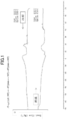
- the melting temperature of the fat or oil is, for example, in the DSC measurement, the fat or oil completely heated by heating to 70 ° C. to 80 ° C. and cooled to -60 to -70 ° C. at a cooling rate of -3 to -5 ° C./min. Thereafter, the temperature is raised by heating at a temperature rising rate of +3 to + 5 ° C./min to eliminate heat absorption. More specifically, as can be seen in FIG. 1, it can be determined as the temperature at the intersection of the baseline where the endotherm is completely eliminated by heating and the rising line that returns from the last endotherm to the baseline.
- the temperature of the whole fat does not fall below the lower limit value of the above temperature range at any time in the middle. Moreover, it is preferable not to raise the temperature of the whole fats and oils until it starts the following process (c) after operation to cool to the temperature range prescribed
- the melting point of the ⁇ -type crystal is the highest
- the melting point of the ⁇ ′-type crystal is the second highest
- the melting point of the ⁇ -type crystal is the lowest.
- Cooling of fats and oils can be performed with stirring and / or standing.
- the cooling can be performed by natural cooling using an external temperature or any cooling device, but a thermostatic bath or an oil bath may be used in order to perform cooling efficiently and under controlled conditions.
- a refrigerant such as cold water may be circulated to the outside or inside of the container for cooling.
- the speed at which the temperature is reduced can be arbitrarily determined by those skilled in the art based on the amount of oil to be cooled, the method of cooling, etc.
- the step (c) of the present invention is a step of causing a pre-seed of ⁇ -type crystal which is an unstable fat crystal to be present in the fat or oil at the temperature cooled in the step (b).
- the pre-seed of the ⁇ -type crystal is present in the oil and fat while the temperature of the oil and fat is in the temperature range defined in the step (b).
- the temperature of the whole fat may be kept constant during the operation for causing the pre-seed of the ⁇ -type crystal to be present in the step (c), and the fat is selected under the condition that it is within the above temperature range.
- An operation may be performed to cause a pre-seed of ⁇ -type crystal to exist while cooling.
- the temperature of the fat is not increased.
- cooling oil and fat, oil and fat are preferably cooled at the same temperature reduction rate as step (b).
- ⁇ -type crystals are produced by lowering the temperature of fats and oils to below the melting point of ⁇ -type crystals. Therefore, in the step (c), for example, by locally cooling the temperature of the fat or oil to the melting point of the ⁇ -type crystal or less, pre-seed of the ⁇ -type crystal can be present in the fat or oil. Or it is also possible to carry out by adding the pre-seed of the separately prepared ⁇ -type crystal to the fats and oils after the step (b). That is, in the step (c), it is not necessary to cool the whole melted fat and oil to the melting point or less of the ⁇ -type crystal in order to form a pre-seed of the ⁇ -type crystal. It is possible to reduce.
- the ⁇ -type crystal which is a pre-seed for forming a seed of ⁇ -type crystal which is a stable type, is cooled to below the melting point of the ⁇ -type crystal.
- ⁇ -type crystal which is a pre-seed for forming a seed of ⁇ -type crystal which is a stable type
- “To locally cool the temperature of the oil or lower to the melting point of the ⁇ -type crystal” means maintaining the temperature of the whole oil except for the locally cooled portion within the temperature range defined in step (b). It means that only a part of the fat and oil is cooled to the melting point or lower of the ⁇ -type crystal.
- the temperature of the whole fat or oil mentioned above is a temperature achieved by the effect of a cooling device such as an outside air temperature or a thermostatic bath or an oil bath used for controlling the fat and oil temperature in step (b).
- a cooling device such as an outside air temperature or a thermostatic bath or an oil bath used for controlling the fat and oil temperature in step (b).
- the temperature of the local cooling is preferably 10 ° C. or more lower than the temperature of the oil of the other portion, more preferably 20 ° C.
- the temperature may be, for example, 30 to 80 ° C. lower.
- the time for cooling may be determined by those skilled in the art, but can be, for example, 1 second to 10 minutes, preferably 15 seconds to 5 minutes, more preferably 30 seconds to 2 minutes.
- the local cooling of the oil can be carried out by contacting any solid, liquid or gas cooling body at a temperature below the melting point of the ⁇ -form crystal with a part of the oil.
- the two approaches to such an extent that the heat conduction to lower the temperature of part of the fat or oil to the melting point or lower of the ⁇ -type crystal is possible.
- the contact between the fat and oil and the cooling body may be carried out, for example, by flowing cold water in a pipe provided in the fat and oil, or introducing a cooled particulate matter, linear substance, liquid drop, etc. into the fat and oil. And so on. In one embodiment, this step is performed by pouring dry ice into fats and oils.
- the temperature of the cooling body may be equal to or lower than the melting point of the ⁇ -type crystal in order to cause the pre-seed of the ⁇ -type crystal to exist in the fat and oil. Simply, it may be lower than the crystallization start temperature of fats and oils.
- the crystallization start temperature of the fat or oil can be determined, for example, by DSC measurement. For example, in DSC measurement, the fat completely heated by heating to 70 ° C. to 80 ° C. can be melted at -3 to -5 ° C./minute It is the heat generation start temperature when cooled at the cooling rate. More specifically, as seen in FIG. 1, it is determined as the temperature at the intersection of the baseline until the onset of heat generation and the rising line of heat generation.
- the crystallization onset temperature in DSC measurement is 21.2 ° C.
- the crystallization start temperature is 33.1 ° C.
- the temperature of the cooling body is preferably 10 ° C. or more lower than the crystallization start temperature.
- the oil produces ⁇ -type crystals is confirmed by solidifying (crystallization) a small amount of melted oil at the temperature of the cooling body and measuring the X-ray diffraction of the solidified oil. It can. That is, for fat crystals, X-ray diffraction is measured in the range of 2 ⁇ of 17 to 26 degrees with respect to short face intervals, and a strong diffraction peak (peak A) corresponding to an interplanar spacing of 4.1 to 4.3 ⁇ is detected If the peak (peak B) is not detected at 3.8 to 3.9 ⁇ or if it is a minute diffraction peak, it can be judged as an ⁇ -type crystal.
- the X-ray diffraction intensity of peak B (peak B / peak A) relative to the X-ray diffraction intensity of peak A is preferably 0.1 or less, more preferably 0.05 or less, and still more preferably 0 to 0. It is 02.
- the step (c) can also be carried out by adding separately prepared pre-seed of ⁇ -type crystal to the fats and oils after the step (b).
- the pre-seed can be prepared by cooling separately melted fats and oils to the melting point or lower of the ⁇ -type crystal.
- the above pre-seed is preferably prepared from the same kind of fat as the fat to which it is added (hereinafter also referred to as "main fat"), but in the next step (d) it is finally seeded with ⁇ -type crystals
- main fat the composition and concentration of the oil for preparing the pre-seed may be different from that of the main oil and fat.
- the above operation is carried out, for example, by cooling the oil to 0 to 10 ° C., preferably 3 to 8 ° C., to form a slurry containing ⁇ -type crystals, and adding it to the body oil.
- the amount of the pre-seed of the ⁇ -type crystal to be added can be determined as appropriate by those skilled in the art, but a small amount is usually sufficient compared to the amount of the main oil, for example 0.001 to 5% by mass relative to the main oil
- the amount is 0.01 to 1% by mass, more preferably 0.05 to 0.2% by mass.
- the step (d) of the present invention is a step of forming a seed of ⁇ -type crystal from pre-seed of the ⁇ -type crystal in fat and oil.
- a pre-seed of ⁇ -type crystal is present in the oil and fat at a temperature t (° C.) where (A-12) ⁇ t ⁇ A where A (° C.) is the melting temperature of the oil.
- the said temperature is higher than the crystallization start temperature of fats and oils. Therefore, the temperature of the oil and fat present around the pre-seed of the ⁇ -type crystal formed or added in the step (c) is equal to or higher than the melting point of the ⁇ -type crystal.
- the ⁇ -type crystals temporarily present in the oil and fat are melted at the material temperature without forced heating, and melt-mediated transfer to the stable ⁇ -type crystals.
- This step is carried out at a temperature t (° C.) such that (A-12) ⁇ t ⁇ A, where A (° C.) is the melting temperature of the oil, as in steps (b) and (c).
- the melting temperature of A is set to A (.degree. C.) at a temperature t (.degree. C.) such that (A-10) .ltoreq.t.ltoreq. (A-2).
- ⁇ -type crystals as seeds for ⁇ -type crystals by melt-mediated transfer, it is possible to save time and effort for separately preparing seeds for ⁇ -type crystals, and a finer state than adding seeds of prepared ⁇ -type crystals. Can be dispersed in fats and oils.
- the oil can be further cooled to promote the crystal formation of triglyceride which is likely to form the ⁇ -type crystal contained in the raw material oil-and-fat.
- a person skilled in the art can appropriately set the temperature for that purpose, but the target temperature or temperature range can be set so as to be, for example, equal to or higher than the crystallization start temperature of fats and oils based on the material temperature.
- the temperature of the purified palm oil is 20 to 30 ° C., preferably 22 to 28 ° C., more preferably 23 to 27 ° C.
- step (b) may be maintained at 34 to 50 ° C, preferably 38 to 48 ° C. More preferably, it may be cooled to a temperature of 40 to 46.degree.
- the target temperature or temperature range is preferably cooled at the same rate of temperature decrease as step (b). Further, the temperature may be lowered intermittently, for example, by interrupting the drop of the product temperature if necessary, in the process of steps (b) to (d).
- the temperature can be kept constant during the operation. However, in the present invention, it is preferable not to raise the temperature of the fat or oil, for example, by heating the fat or oil through the steps (b) to (d).
- the temperature of the fat After the temperature of the fat has reached the target temperature or temperature range, it may be allowed to stand at that temperature or temperature range, or may be stirred if necessary.
- the time for maintaining the temperature can be appropriately set by those skilled in the art, and can be, for example, 10 to 180 minutes, preferably 20 to 120 minutes, and more preferably 40 to 90 minutes.
- the resultant product obtained by the above step (d) is in the state of a slurry in which a solid portion and a liquid portion containing ⁇ -type crystals of fat and oil are mixed.
- a known method for producing a fractionated fat and oil may be appropriately performed.
- the solid portion containing the formed seed may be appropriately separated from the liquid portion using a conventional method.
- the solid-liquid separation in the above step is performed by, for example, press filtration or vacuum filtration.
- compression filtration is carried out, for example, at 3 to 30 kgf at a temperature (preferably 20 to 27 ° C.) lower than room temperature using a compression filter used for fractional filtration of palm oil etc. / cm 2, preferably 5 ⁇ 20kgf / cm 2, more preferably be carried out under pressing pressures of about 8 ⁇ 12kgf / cm 2.
- the fat crystals of the solid portion of the fractionated fat produced through the steps (a) to (d) of the present invention contain ⁇ -type crystals. Thereby, it can be judged that melt-mediated transfer of the pre-seed of the ⁇ -type crystal to the ⁇ -type crystal is performed. It is judged from the diffraction peak obtained by the measurement of X-ray diffraction that fat crystals are ⁇ -type. That is, for fat crystals, when X-ray diffraction is measured in the range of 2 ⁇ of 17 to 26 degrees and the diffraction peaks corresponding to the surface spacing of 4.5 to 4.7 ⁇ are detected, ⁇ It can be judged that a type crystal is included.
- the solid part of the fractionated fat and oil corresponds to the intensity G 'of the diffraction peak corresponding to the interplanar spacing of 4.1 to 4.3 ⁇ obtained by X-ray diffraction and the interplanar spacing of 4.5 to 4.7 ⁇
- the intensity ratio (G '/ G) of the diffraction peak to the intensity G is preferably 0 to 0.3, more preferably 0 to 0.2, and further preferably 0 to 0.1. preferable.
- Examples 1 to 5 and Comparative Examples 1 to 3 show the fractionation of purified palm oil (iodine number: 53.0).
- the melting temperature in DSC measurement of the purified palm oil is 42.8 ° C., and the crystallization start temperature in DSC measurement is 21.2 ° C. (see FIG. 1).
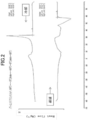
- the following Examples 6 to 8 and Comparative Examples 4 to 5 show the fractionation of purified palm stearin (iodine number: 35.0).
- the melting temperature in DSC measurement of the purified palm stearin is 58.1 ° C.
- the crystallization start temperature in DSC measurement is 33.1 ° C. (see FIG. 2).
- DSC analysis method 3 to 10 mg of sample oil and fat is collected in a container made of aluminum, and sample oil and fat in a completely melted state at 70 ° C or higher is cooled at a cooling rate of -5 ° C / min. It measured and the temperature of the intersection of the baseline to the heat
- Iodine value analysis method The iodine value was measured using AOCS test method (Official Method Cd 1-25). Specifically, 10 mL of cyclohexane is added to 0.5 to 3 g of a sample oil and dissolved, and then 25 mL of a whiss liquid is added and allowed to stand in the dark for 1 hour. Thereafter, the reaction is stopped by adding 20 mL of a 10 g / 100 mL potassium iodide solution and 100 mL of water, and then titration with 0.1 N sodium thiosulfate is performed to determine the amount of iodine added to the oil.
- the iodine value conversion method is based on the following formula.
- Iodine value (A ⁇ B) ⁇ F ⁇ 1.269 / C
- C Amount of sample fat used (g)
- Example 1 400.0 g of purified palm oil (iodine number: 53.0) was heated at 60 ° C. for 1 hour using a 60 ° C. constant temperature water bath to completely melt the purified palm oil.
- the melted fats and oils were placed in a glass crystallization flask, and were stirred and cooled in a thermostatic water bath so as to have a temperature decrease rate of 0.28 ° C./min.
- the partially cooled piping was brought into contact with the oil and water at 5 ° C. was allowed to flow through the piping for 1 minute. Thereafter, the slurry was cooled to 25 ° C.
- Example 2 400.0 g of purified palm oil (iodine number: 53.0) was heated at 60 ° C. for 1 hour using a 60 ° C. constant temperature water bath to completely melt the purified palm oil.
- the melted fats and oils were placed in a glass crystallization flask, and stirred and cooled in a thermostatic water bath so that the temperature decrease rate was 0.35 ° C./min on the basis of the product temperature.
- the partially cooled piping was brought into contact with the oil and water at 5 ° C. was allowed to flow through the piping for 1 minute. Thereafter, the slurry was cooled to 25 ° C.
- Example 3 400.0 g of purified palm oil (iodine number: 53.0) was heated at 60 ° C. for 1 hour using a 60 ° C. constant temperature water bath to completely melt the purified palm oil.
- the melted fats and oils were placed in a glass crystallization flask, and were stirred and cooled in a thermostatic water bath so as to have a temperature decrease rate of 0.42 ° C./minute on the basis of the product temperature.
- the partially cooled piping was brought into contact with the oil and water at 5 ° C. was allowed to flow through the piping for 1 minute. Thereafter, the slurry was cooled to 25 ° C.
- Example 4 400.0 g of purified palm oil (iodine number: 53.0) was heated at 60 ° C. for 1 hour using a 60 ° C. constant temperature water bath to completely melt the purified palm oil.
- the melted fats and oils were placed in a glass crystallization flask, and were stirred and cooled in a thermostatic water bath so as to have a temperature decrease rate of 0.28 ° C./min.
- 0.1 g of dry ice was added. Thereafter, the slurry was cooled to 25 ° C. at a temperature decreasing rate of 0.22 ° C./min, stirred and cooled at the same temperature for 1 hour to obtain a slurry.
- the obtained slurry was subjected to solid-liquid separation at 25 ° C. by press filtration (press pressure 10 kgf / cm 2 ) to obtain a solid part (solid fat and oil) and a liquid part (liquid fat and oil). It took 180 minutes from the start of cooling to the start of expression.
- the results are shown in Table 1.
- purification palm oil solidified on dry ice was (alpha) type.
- Example 5 400.0 g of purified palm oil (iodine number: 53.0) was heated at 60 ° C. for 1 hour using a 60 ° C. constant temperature water bath to completely melt the purified palm oil. The melted fats and oils were placed in a glass crystallization flask, and were stirred and cooled in a thermostatic water bath so as to have a temperature decrease rate of 0.28 ° C./min. At 39 ° C., the purified palm oil separately dissolved was allowed to stand for 10 minutes in a 5 ° C. refrigerator, and 0.4 g of ⁇ -type crystal slurry solidified by cooling was added. Thereafter, the slurry was cooled to 25 ° C.
- Comparative Example 1 400.0 g of purified palm oil (iodine number: 53.0) was heated at 60 ° C. for 1 hour using a 60 ° C. constant temperature water bath to completely melt the purified palm oil. The melted fats and oils were placed in a glass crystallization flask, and stirred and cooled in a thermostatic water bath to 25 ° C. so that the temperature decrease rate was 0.25 ° C./min on the basis of the product temperature. Thereafter, the mixture was stirred and cooled at 25 ° C. for 3 hours to obtain a slurry. The obtained slurry was subjected to solid-liquid separation at 25 ° C. by press filtration (press pressure 10 kgf / cm 2 ) to obtain a solid part (solid fat and oil) and a liquid part (liquid fat and oil). It took 300 minutes from the start of cooling to the start of expression. The results are shown in Table 1.
- Comparative example 2 400.0 g of purified palm oil (iodine number: 53.0) was heated at 60 ° C. for 1 hour using a 60 ° C. constant temperature water bath to completely melt the purified palm oil. The melted fats and oils were placed in a glass crystallization flask, and stirred and cooled to 39 ° C. in a thermostatic water bath so as to have a temperature decrease rate of 0.28 ° C./min on the basis of the product temperature. After stirring and cooling at 38 ° C. for 2 hours, the slurry was cooled to 25 ° C. at a temperature decreasing rate of 0.22 ° C./min and stirred for 3 hours at the same temperature to obtain a slurry.
- Comparative example 3 400.0 g of purified palm oil (iodine number: 53.0) was heated at 60 ° C. for 1 hour using a 60 ° C. constant temperature water bath to completely melt the purified palm oil. The melted fats and oils were placed in a glass crystallization flask, and were stirred and cooled in a thermostatic water bath so as to have a temperature decrease rate of 0.20 ° C./min. At 43 ° C., the partially cooled piping was brought into contact with the oil and water at 5 ° C. was allowed to flow through the piping for 1 minute. Thereafter, the slurry was cooled to 25 ° C.
- Example 6 400.0 g of purified palm stearin (iodine value: 35.0) was heated at 70 ° C. for 1 hour using a thermostat bath of 70 ° C. to completely melt the purified palm stearin.
- the melted fats and oils were placed in a glass crystallization flask, and were stirred and cooled in a thermostatic water bath so that the temperature decrease rate was 0.22 ° C./min on the basis of the product temperature.
- a partially cooled pipe was brought into contact with the oil and water at 5 ° C. was allowed to flow through the pipe for 1 minute. Thereafter, the mixture was stirred at 52 ° C. for 4 hours to obtain a slurry.
- the obtained slurry was subjected to solid-liquid separation at 52 ° C. by press filtration (press pressure 10 kgf / cm 2 ) to obtain a solid part (solid fat) and a liquid part (liquid fat). It took 300 minutes from the start of cooling to the start of expression.
- the results are shown in Table 1.
- the fat-and-oil crystal polymorph of the purified palm stearin solidified at 5 ° C. was ⁇ -type.
- Example 7 400.0 g of purified palm stearin (iodine value: 35.0) was heated at 70 ° C. for 1 hour using a thermostat bath of 70 ° C. to completely melt the purified palm stearin.
- the melted fats and oils were placed in a glass crystallization flask, and were stirred and cooled in a thermostatic water bath so as to have a temperature decrease rate of 0.23 ° C./min.
- the partially cooled piping was brought into contact with the oil and water at 5 ° C. was allowed to flow through the piping for 1 minute. Then, it stirred at 51 degreeC for 4 hours, and obtained the slurry.
- the obtained slurry was subjected to solid-liquid separation at 51 ° C.
- Example 8 400.0 g of purified palm stearin (iodine value: 35.0) was heated at 70 ° C. for 1 hour using a thermostat bath of 70 ° C. to completely melt the purified palm stearin.
- the melted fats and oils were placed in a glass crystallization flask, and were stirred and cooled in a thermostatic water bath so as to have a temperature decrease rate of 0.27 ° C./min.
- the partially cooled piping was brought into contact with the oil and water at 5 ° C. was allowed to flow through the piping for 1 minute. Thereafter, the mixture was stirred at 49 ° C. for 4 hours to obtain a slurry.
- the obtained slurry was subjected to solid-liquid separation at 49 ° C. by press filtration (press pressure 10 kgf / cm 2 ) to obtain a solid part (solid fat) and a liquid part (liquid fat). It took 300 minutes from the start of cooling to the start of expression.
- the results are shown in Table 1.
- the fat-and-oil crystal polymorph of the purified palm stearin solidified at 5 ° C. was ⁇ -type.
- Comparative example 4 400.0 g of purified palm stearin (iodine value: 35.0) was heated at 70 ° C. for 1 hour using a thermostat bath of 70 ° C. to completely melt the purified palm stearin.
- the melted fats and oils were placed in a glass crystallization flask, and stirred and cooled to 51 ° C. in a thermostatic water bath so as to have a temperature decrease rate of 0.23 ° C./min on the basis of the product temperature. Then, it stirred at the same 51 degreeC for 22 hours, and obtained the slurry.
- the obtained slurry was subjected to solid-liquid separation at 51 ° C. by press filtration (press pressure 10 kgf / cm 2 ) to obtain a solid part (solid fat and oil) and a liquid part (liquid fat and oil). It took 1380 minutes from the start of cooling to the start of expression.
- Table 1 The results are shown in Table 1.
- Comparative example 5 400.0 g of purified palm stearin (iodine value: 35.0) was heated at 70 ° C. for 1 hour using a thermostat bath of 70 ° C. to completely melt the purified palm stearin. The melted fats and oils were placed in a glass crystallization flask, and stirred and cooled in a thermostatic water bath to 40 ° C. so as to have a temperature decrease rate of 0.42 ° C./min on the basis of the product temperature. Then, it stirred at the same 40 degreeC for 4.5 hours, and obtained the slurry. The obtained slurry was subjected to solid-liquid separation at 40 ° C. by press filtration (press pressure 10 kgf / cm 2 ) to obtain a solid part (solid fat) and a liquid part (liquid fat). It took 300 minutes from the start of cooling to the start of expression. The results are shown in Table 1.
Landscapes
- Chemical & Material Sciences (AREA)
- Life Sciences & Earth Sciences (AREA)
- Engineering & Computer Science (AREA)
- Chemical Kinetics & Catalysis (AREA)
- Oil, Petroleum & Natural Gas (AREA)
- Wood Science & Technology (AREA)
- Organic Chemistry (AREA)
- Microbiology (AREA)
- Fats And Perfumes (AREA)
- Edible Oils And Fats (AREA)
Abstract
(a)原料油脂を融解する工程、
(b)前記油脂を、前記油脂の融解温度をA(℃)として(A-12)≦t≦Aとなる温度t(℃)に冷却する工程、
(c)前記温度にある油脂中に、α型結晶のプレシードを存在させる工程、及び
(d)前記プレシードからβ型結晶のシードを形成させる工程
を含む、分別された油脂の製造方法。
Description
本発明は、油脂の製造方法に関するものである。
油脂の製造においては、通常、天然の油脂に含まれる様々なトリグリセリド等の成分から特定の油脂成分を分別することがよく行われる。例えば、油脂成分の融点の違いなどを利用して特定の油脂成分を析出させたスラリーを作成し、当該スラリーを濾過などにより固液分離する方法が採用されている。
上記のような方法として、例えば特開2009-249614号公報には、油脂の温度を様々に変化させることにより、液状部と固形部との分離を効率よく行うことができる油脂の分別方法が記載されている。
上記特許文献1に記載の方法は、油脂の結晶を析出させるために油脂の温度を繰り返し上昇・下降させる工程を伴うものであり、作業の効率や煩雑さの点において向上の余地がある。従って、分別の処理をより簡便で、かつ作業時間を短縮して行うことが可能な油脂の製造方法が求められている。
本願発明者らは、所定の温度の油脂中にα型結晶のプレシードを存在させることを含む構成を採用することにより上記の課題を解決できることを見出し、本発明を完成するに至った。
即ち、本発明は、
(a)原料油脂を融解する工程、
(b)前記油脂を、前記油脂の融解温度をA(℃)として(A-12)≦t≦Aとなる温度t(℃)に冷却する工程、
(c)前記温度にある油脂中に、α型結晶のプレシードを存在させる工程、及び
(d)前記プレシードからβ型結晶のシードを形成させる工程
を含む、分別された油脂の製造方法を提供する。
即ち、本発明は、
(a)原料油脂を融解する工程、
(b)前記油脂を、前記油脂の融解温度をA(℃)として(A-12)≦t≦Aとなる温度t(℃)に冷却する工程、
(c)前記温度にある油脂中に、α型結晶のプレシードを存在させる工程、及び
(d)前記プレシードからβ型結晶のシードを形成させる工程
を含む、分別された油脂の製造方法を提供する。
さらに、本発明は、
(a)原料油脂を融解する工程、
(b)前記油脂を、前記油脂の融解温度をA(℃)として(A-12)≦t≦Aとなる温度t(℃)に冷却する工程、
(c)前記温度にある油脂中に、α型結晶のプレシードを存在させる工程、及び
(d)前記プレシードからβ型結晶のシードを形成させる工程
を含む、油脂結晶シードの調製方法を提供する。
(a)原料油脂を融解する工程、
(b)前記油脂を、前記油脂の融解温度をA(℃)として(A-12)≦t≦Aとなる温度t(℃)に冷却する工程、
(c)前記温度にある油脂中に、α型結晶のプレシードを存在させる工程、及び
(d)前記プレシードからβ型結晶のシードを形成させる工程
を含む、油脂結晶シードの調製方法を提供する。
本発明により、安定型のβ型結晶の形成の効率が改善され、それに伴い油脂の製造における分別の作業時間を短縮し、コストを低減することができる。
前述の通り、本発明は、
(a)原料油脂を融解する工程、
(b)前記油脂を、前記油脂の融解温度以下をA(℃)として(A-12)≦t≦Aとなる温度t(℃)に冷却する工程、
(c)前記温度にある油脂中に、α型結晶のプレシードを存在させる工程、及び
(d)前記プレシードからβ型結晶のシードを形成させる工程
を含む、分別された油脂の製造方法を提供するものである。
以下、各工程について具体的に説明する。
(a)原料油脂を融解する工程、
(b)前記油脂を、前記油脂の融解温度以下をA(℃)として(A-12)≦t≦Aとなる温度t(℃)に冷却する工程、
(c)前記温度にある油脂中に、α型結晶のプレシードを存在させる工程、及び
(d)前記プレシードからβ型結晶のシードを形成させる工程
を含む、分別された油脂の製造方法を提供するものである。
以下、各工程について具体的に説明する。
本発明の工程(a)は原料油脂を溶融する工程である。本発明に使用できる原料油脂は特に限定されないが、例えば、パーム油、パームステアリン、パームオレイン、パーム中融点画分(PMF)などのパーム系油脂(パーム油およびパーム油由来の分別油)を使用することが可能であり、上記のうち、パーム油、パームステアリンが好ましい。上記の油脂は、精製、エステル交換、水素添加、分別等の処理をした加工油脂であってもよい。また、原料油脂のヨウ素価は原料油脂の種類により異なるが、例えばパーム油の場合は50~55であることが好ましく、51~54であることがより好ましい。また、パームステアリンを使用する場合は、そのヨウ素価は20~48、さらには30~42であることが好ましい。また、上記の各油脂の混合物を使用してもよい。
本発明に使用される原料油脂は好ましくはトリグリセリドであり、好ましくは炭素数16~18の脂肪酸含量が原料油脂全体に対して30質量%以上、40質量%以上、50質量%以上、60質量%以上、70質量%以上、80質量%以上、又は90質量%以上であるものが好ましい。上記の脂肪酸としては、例えば、パルミチン酸、ステアリン酸、オレイン酸、リノール酸が挙げられる。
主要なトリグリセリドは好ましくはSSS型(トリ飽和型)又はSUS型(2-不飽和,1,3-ジ飽和型)のトリグリセリドである。例えば、パーム系油脂、又は、SUS型トリグリセリドを含有する原料油脂が特に好ましい。上記SSS型のトリグリセリドとしては、トリパルミチン、トリステアリンなどが挙げられる。また、上記SUS型のトリグリセリドとしては、2-オレオ-1,3-ジパルミチンなどが挙げられる。
主要なトリグリセリドは好ましくはSSS型(トリ飽和型)又はSUS型(2-不飽和,1,3-ジ飽和型)のトリグリセリドである。例えば、パーム系油脂、又は、SUS型トリグリセリドを含有する原料油脂が特に好ましい。上記SSS型のトリグリセリドとしては、トリパルミチン、トリステアリンなどが挙げられる。また、上記SUS型のトリグリセリドとしては、2-オレオ-1,3-ジパルミチンなどが挙げられる。
本発明では、上記原料油脂を任意に撹拌しながら当該原料油脂が溶融する温度、例えば40℃以上、好ましくは50℃以上、より好ましくは60~100℃に、例えば、0.5~3時間、好ましくは1~2時間加熱して、当該原料油脂を溶融する。加熱方法としては公知の加熱方法を用いることができるが、例えば所定温度の恒温槽、油浴、蒸気加熱、熱交換等を用いることができる。
本発明の工程(b)は、前記の溶融した油脂を、前記油脂の融解温度をA(℃)として(A-12)≦t≦Aとなる温度t(℃)に冷却する工程である。本工程においては、原料油脂の融解温度に基づいて、冷却する標的温度又は温度範囲が決定される。すなわち、原料油脂の融解温度をA(℃)として(A-12)≦t≦Aとなる温度t(℃)又は上記関係を満たす温度範囲に冷却すればよい。上記の温度t(℃)は一定である必要はなく、上記式の関係を満たす温度範囲内で適宜変動してもよい。
本発明において、原料油脂の融解温度は、例えばDSC測定により求めることができる。例えば精製パーム油(ヨウ素価:53.0)の場合、DSC測定における融解温度は42.8℃であるので、油温が30.8~42.8℃の範囲になるように冷却される。また、精製パームステアリン(ヨウ素価:35.0)の場合、DSC測定における融解温度は58.1℃であるので、油温が46.1~58.1℃の範囲になるように冷却される。工程(b)における冷却温度t(℃)は、原料油脂の融解温度をA(℃)として(A-10)≦t≦(A-2)となることが、より好ましい。
本発明において、原料油脂の融解温度は、例えばDSC測定により求めることができる。例えば精製パーム油(ヨウ素価:53.0)の場合、DSC測定における融解温度は42.8℃であるので、油温が30.8~42.8℃の範囲になるように冷却される。また、精製パームステアリン(ヨウ素価:35.0)の場合、DSC測定における融解温度は58.1℃であるので、油温が46.1~58.1℃の範囲になるように冷却される。工程(b)における冷却温度t(℃)は、原料油脂の融解温度をA(℃)として(A-10)≦t≦(A-2)となることが、より好ましい。
前記油脂の融解温度は、例えば、DSC測定において、70℃~80℃に加熱し完全に融解した油脂を、-3~-5℃/分の冷却速度で-60~-70℃まで冷却し、その後、+3~+5℃/分の昇温速度で加熱して、吸熱がなくなる温度である。より具体的には、図1に見られるように、加熱により吸熱が完全になくなったベースラインと、最後の吸熱からベースラインへ回帰する立ち上がりのラインとの、交点の温度として求めることができる。
なお、工程(b)に規定する温度範囲に冷却する操作において、その途中のいずれの時点においても油脂全体の温度が前記温度範囲の下限値を下回ることが無いことが好ましい。また、工程(b)に規定する温度範囲に冷却する操作の後、次の工程(c)を開始するまで、油脂全体の温度を上昇させないことが好ましい。
後述するように、油脂は一般に、α型、β’型及びβ型の結晶形が存在する。ここで、β型結晶の融点が最も高く、β’型結晶の融点がその次に高く、α型結晶の融点が最も低い。本発明の工程(b)の所定の温度条件とすることによって、油脂は、分別対象であるトリグリセリドのα型結晶の融点以上、かつ、β型結晶の融点以下の温度に冷却され、好ましくはβ’型結晶の融点以上、かつ、β型結晶の融点以下の温度に冷却される。
油脂の冷却は、撹拌及び/又は静置して行うことができる。また、冷却は外気温を利用した自然冷却又は任意の冷却装置により行うことができるが、冷却を効率良くかつ制御された条件で行うために、恒温槽、油浴を使用してもよい。また、冷水などの冷媒を容器の外面もしくは内側に循環させて冷却してもよい。その場合、油脂全体の温度をより正確に制御するために、恒温槽、油浴もしくは冷媒の温度を段階的又は連続的に低下させることが好ましい。温度を低下させる速度は、冷却する油脂の量や冷却方法などに基づいて当業者が任意に決定することができるが、例えば品温(実際の油脂温度)を基準として0.05~0.50℃/分が好ましく、0.10~0.40℃/分がより好ましく、0.15~0.30℃/分がさらに好ましく、0.18~0.25℃/分が特に好ましい。
本発明の工程(c)は、上記工程(b)で冷却された温度にある油脂中に、不安定型の油脂結晶であるα型結晶のプレシードを存在させる工程である。
工程(c)においては、油脂の温度を工程(b)に規定する温度範囲内にある状態で、油脂中にα型結晶のプレシードを存在させる。工程(c)でα型結晶のプレシードを存在させるための操作を行う間は、油脂全体の温度は温度を一定に保ってもよいし、上記の温度範囲内にあることを条件として、油脂を冷却しながらα型結晶のプレシードを存在させるための操作を行ってもよい。好ましくは、工程(c)を行う間は、油脂の温度を上昇させない。また、油脂を冷却しながら本工程を行う場合、油脂は好ましくは工程(b)と同じ温度低下速度により冷却される。
工程(c)においては、油脂の温度を工程(b)に規定する温度範囲内にある状態で、油脂中にα型結晶のプレシードを存在させる。工程(c)でα型結晶のプレシードを存在させるための操作を行う間は、油脂全体の温度は温度を一定に保ってもよいし、上記の温度範囲内にあることを条件として、油脂を冷却しながらα型結晶のプレシードを存在させるための操作を行ってもよい。好ましくは、工程(c)を行う間は、油脂の温度を上昇させない。また、油脂を冷却しながら本工程を行う場合、油脂は好ましくは工程(b)と同じ温度低下速度により冷却される。
一般に、α型結晶は油脂の温度をα型結晶の融点以下に下げることにより生じる。従って、工程(c)においては、例えば油脂の温度を局所的にα型結晶の融点以下に冷却することによって油脂中にα型結晶のプレシードを存在させることができる。或いは、別途調製したα型結晶のプレシードを工程(b)の後の油脂に添加することにより行うことも可能である。即ち、工程(c)においては、α型結晶のプレシードを生成するために溶融した油脂全体をα型結晶の融点以下にまで冷却する必要がなく、全工程を通した作業のコストや所要時間を低減することが可能となる。即ち、本工程においては、次の工程(d)において安定型であるβ型結晶のシードを形成するためのプレシードであるα型結晶を、油脂全体をα型結晶の融点以下にまで冷却することなく油脂中に存在させるものである。
「油脂の温度を局所的にα型結晶の融点以下に冷却する」とは、局所的に冷却される部分を除く油脂全体の温度を工程(b)に規定する温度範囲内に維持しつつ、油脂の一部のみをα型結晶の融点以下に冷却することを意味する。上記の油脂全体の温度は、工程(b)において油脂温度の制御に使用された、外気温或いは恒温槽又は油浴等の冷却装置の効果により達成される温度であって、局所的な温度低下の影響を受けていない部分の品温を意味する。
本発明においては、α型結晶の融点以下であることの条件として、局所的な冷却の温度が、それ以外の部分の油脂の温度より10℃以上低いことが好ましく、より好ましくは20℃以上低い温度、例えば30~80℃低い温度としてもよい。冷却を行う時間は当業者が決定してもよいが、例えば1秒~10分、好ましくは15秒~5分、より好ましくは30秒~2分とすることが可能である。
本発明においては、α型結晶の融点以下であることの条件として、局所的な冷却の温度が、それ以外の部分の油脂の温度より10℃以上低いことが好ましく、より好ましくは20℃以上低い温度、例えば30~80℃低い温度としてもよい。冷却を行う時間は当業者が決定してもよいが、例えば1秒~10分、好ましくは15秒~5分、より好ましくは30秒~2分とすることが可能である。
油脂の局所的な冷却は、α型結晶の融点以下の温度にある任意の固体、液体又は気体の冷却体を油脂の一部に接触させることにより行うことができる。なお、上記の接触とは、冷却体が油脂に物理的に接触している場合以外に、油脂の一部の温度をα型結晶の融点以下に低下させる熱伝導が可能な程度に両者が接近している場合を含む。油脂と冷却体との接触は、例えば、油脂中に設けた配管中に冷水を流した構成とすること、冷却した粒子状物質、線状物質、滴状の液体などを油脂中に投入することなどにより行うことが可能である。ある実施態様において、この工程は油脂中にドライアイスを投入することにより行われる。
前述の通り、油脂中にα型結晶のプレシードを存在させるためには冷却体の温度がα型結晶の融点以下であればよい。簡易的には、油脂の結晶化開始温度より低ければよい。前記油脂の結晶化開始温度は、例えばDSC測定により求めることが可能であり、例えば、DSC測定において、70℃~80℃に加熱し完全に融解した油脂を、-3~-5℃/分の冷却速度で冷却したときの、発熱開始温度である。より具体的には、図1に見られるように、発熱開始までのベースラインと、発熱の立ち上がりのラインとの、交点の温度として求められる。例えば精製パーム油(ヨウ素価:53.0)の場合、DSC測定における結晶化開始温度は21.2℃であり、また、精製パームステアリン(ヨウ素価:35.0)の場合、DSC測定における結晶化開始温度は33.1℃である。冷却体の温度は、結晶化開始温度より10℃以上低いことが好ましい。
冷却体の温度により、油脂がα型結晶を生成するかどうかは、融解した少量の油脂を冷却体の温度で固化(結晶化)し、固化した油脂のX線回折を測定することにより、確認できる。すなわち、油脂結晶について、その短面問隔を2θが17~26度の範囲でX線回折を測定し、4.1~4.3Åの面間隔に対応する強い回折ピーク(ピークA)を検出し、3.8~3.9Åにピーク(ピークB)を検出しないか、微小な回折ピークである場合に、α型結晶であると判断できる。ピークAのX線回折強度に対するピークBのX線回折強度(ピークB/ピークA)は、好ましくは0.1以下であり、より好ましくは0.05以下であり、さらに好ましくは0~0.02である。
また、前述の通り、(c)の工程は、別途調製したα型結晶のプレシードを工程(b)の後の油脂に添加することにより行うことも可能である。上記プレシードは、油脂を別途溶融したものをα型結晶の融点以下に冷却することにより調製することが可能である。上記プレシードは、好ましくはそれが添加される油脂(以下、「本体油脂」ともいう)と同じ種類の油脂から調製されるが、それが次の工程(d)において最終的にβ型結晶のシードを形成するためのプレシードとして利用できる限り、プレシードを調製するための油脂の組成や濃度は、本体油脂のものと異なっていてもよい。
上記の操作は、例えば油脂を0~10℃、好ましくは3~8℃に冷却してα型結晶を含むスラリーとし、それを本体油脂に添加することにより行われる。添加するα型結晶のプレシードの量は当業者が適宜決定することができるが、通常は本体油脂の量と比較して少量で十分であり、例えば本体油脂に対して0.001~5質量%、好ましくは0.01~1質量%、より好ましくは0.05~0.2質量%の量があればよい。
本発明の工程(d)は、油脂中で上記α型結晶のプレシードからβ型結晶のシードを形成させる工程である。
前の工程(c)の後には、油脂の融解温度をA(℃)として(A-12)≦t≦Aとなる温度t(℃)の油脂中に、α型結晶のプレシードが存在する。そして、当該温度は、油脂の結晶化開始温度より高い。従って、工程(c)で形成又は添加されたα型結晶のプレシードの周りに存在する油脂の温度はα型結晶の融点以上である。この場合、油脂中に一時的に存在したα型結晶は、強制的に加温しなくとも品温により融解し、安定型であるβ型結晶に融液媒介転移される。この工程は、工程(b)及び(c)と同様に、油脂の融解温度をA(℃)として(A-12)≦t≦Aとなる温度t(℃)で行われ、より好ましくは油脂の融解温度をA(℃)として(A-10)≦t≦(A-2)となる温度t(℃)で行われる。α型結晶を融液媒介転移によりβ型結晶のシードとすることにより、β型結晶のシードを別途調製する手間が省けるとともに、調製したβ型結晶のシードを添加するよりも、より微細な状態のβ型結晶を油脂中に分散できる。
前の工程(c)の後には、油脂の融解温度をA(℃)として(A-12)≦t≦Aとなる温度t(℃)の油脂中に、α型結晶のプレシードが存在する。そして、当該温度は、油脂の結晶化開始温度より高い。従って、工程(c)で形成又は添加されたα型結晶のプレシードの周りに存在する油脂の温度はα型結晶の融点以上である。この場合、油脂中に一時的に存在したα型結晶は、強制的に加温しなくとも品温により融解し、安定型であるβ型結晶に融液媒介転移される。この工程は、工程(b)及び(c)と同様に、油脂の融解温度をA(℃)として(A-12)≦t≦Aとなる温度t(℃)で行われ、より好ましくは油脂の融解温度をA(℃)として(A-10)≦t≦(A-2)となる温度t(℃)で行われる。α型結晶を融液媒介転移によりβ型結晶のシードとすることにより、β型結晶のシードを別途調製する手間が省けるとともに、調製したβ型結晶のシードを添加するよりも、より微細な状態のβ型結晶を油脂中に分散できる。
α型結晶が安定型のβ型結晶に転移した後には、必要によりさらに油脂を冷却することにより原料油脂に含まれるβ型結晶を生成しやすいトリグリセリドの結晶形成を促進することができる。そのための温度は当業者が適宜設定することが可能であるが、品温を基準として例えば油脂の結晶化開始温度以上となるように標的温度又は温度範囲を設定することができる。例えば、精製パーム油(ヨウ素価:50~55)を用いた場合、工程(d)において、当該精製パーム油は20~30℃、好ましくは22~28℃、より好ましくは23~27℃の温度に冷却してもよい。また、精製パームステアリン(ヨウ素価:25~48)を用いた場合、当該精製パームステアリンは工程(b)の温度のまま維持してもよいし、或いは34~50℃、好ましくは38~48℃、より好ましくは40~46℃の温度に冷却してもよい。
当該標的温度又は温度範囲へは、好ましくは工程(b)と同程度の温度低下速度により冷却される。また、工程(b)~(d)の過程を通して、必要により品温の低下を中断させるなど断続的に温度低下させてもよく、例えば工程(c)でα型結晶のプレシードを存在させるための操作を行う間は温度を一定に保つことができる。しかしながら、本発明においては、工程(b)~(d)を通して、油脂を加熱するなど、油脂の温度を上昇させないことが好ましい。また、本発明の工程(a)~(d)を通して、所要時間としては60分~300分、好ましくは90分~240分、好ましくは120分~180分程度で行うことが可能である。
油脂の温度が標的温度又は温度範囲に達した後は、その温度又は温度範囲に静置するか、必要により撹拌してもよい。その温度を維持する時間は当業者が適宜設定することができるが、例えば10~180分、好ましくは20~120分、より好ましくは40~90分とすることができる。
上記の工程(d)により得られる結果物は、油脂のβ型結晶を含む固形部と液状部が混在したスラリーの状態にある。
上記の工程(d)により得られる結果物は、油脂のβ型結晶を含む固形部と液状部が混在したスラリーの状態にある。
本発明の工程(a)~(d)の各工程の前後において、分別油脂を製造するための周知の方法を適宜行っても良い。
例えば、工程(d)の後は、常法を用いて、形成されたシードを含む固形部を適宜液状部から分別してもよい。
上記工程における固液分離は、例えば圧搾ろ過や減圧ろ過により行われる。それらの条件は特に限定されないが、圧搾ろ過は、例えば、パーム油等の分別ろ過等で使用する圧搾ろ過機などを用い、室温以下の温度(好ましくは20~27℃)で、例えば3~30kgf/cm2、好ましくは5~20kgf/cm2、より好ましくは8~12kgf/cm2程度の圧搾圧力下で行なうことができる。
例えば、工程(d)の後は、常法を用いて、形成されたシードを含む固形部を適宜液状部から分別してもよい。
上記工程における固液分離は、例えば圧搾ろ過や減圧ろ過により行われる。それらの条件は特に限定されないが、圧搾ろ過は、例えば、パーム油等の分別ろ過等で使用する圧搾ろ過機などを用い、室温以下の温度(好ましくは20~27℃)で、例えば3~30kgf/cm2、好ましくは5~20kgf/cm2、より好ましくは8~12kgf/cm2程度の圧搾圧力下で行なうことができる。
本発明の工程(a)~(d)を経て製造される分別された油脂の固形部の油脂結晶にはβ型結晶が含まれる。これにより、α型結晶のプレシードがβ型結晶に融液媒介転移されたと判断できる。油脂結晶がβ型であることは、X線回折の測定により得られる回折ピークから判断される。すなわち、油脂結晶について、その短面問隔を2θが17~26度の範囲でX線回折を測定し、4.5~4.7Åの面間隔に対応した回折ピークが検出される場合、β型結晶が含まれると判断できる。また、4.5~4.7Åの面間隔に対応した強い回折ピークを検出し、4.1~4.3Åの面間隔に対応する回折ピークを検出しないか、微小な回折ピークである場合に、油脂結晶のほとんどがβ型結晶であると判断できる。すなわち、分別された油脂の固形部は、X線回折によって得られる4.1~4.3Åの面間隔に対応する回折ピークの強度G’と4.5~4.7Åの面間隔に対応する回折ピークの強度Gとの強度比(G’/G)が、0~0.3であることが好ましく、0~0.2であることがより好ましく、0~0.1であることがさらに好ましい。固形部の油脂結晶がβ型であると、固形部が効率よく分離されるので、液状部の収率が向上する。
なお、すでに説明したα型、および上記のβ型に該当しない場合は、主要な油脂結晶は準安定型であるβ’型であるとした。
以下、本発明を実施例を参照してより詳細に説明する。
なお、すでに説明したα型、および上記のβ型に該当しない場合は、主要な油脂結晶は準安定型であるβ’型であるとした。
以下、本発明を実施例を参照してより詳細に説明する。
以下の実施例1~5、比較例1~3は、精製パーム油 (ヨウ素価:53.0)の分別を示したものである。上記精製パーム油のDSC測定における融解温度は42.8℃であり、DSC測定における結晶化開始温度は21.2℃である(図1参照)。
また、以下の実施例6~8、比較例4~5は、精製パームステアリン (ヨウ素価:35.0)の分別を示したものである。上記精製パームステアリンのDSC測定における融解温度は58.1℃であり、DSC測定における結晶化開始温度は33.1℃である(図2参照)。
また、以下の実施例6~8、比較例4~5は、精製パームステアリン (ヨウ素価:35.0)の分別を示したものである。上記精製パームステアリンのDSC測定における融解温度は58.1℃であり、DSC測定における結晶化開始温度は33.1℃である(図2参照)。
DSC分析法
試料油脂をアルミ製の容器に3~10mg程度採取し、70℃以上で完全に融解した状態の試料油脂を-5℃/分の冷却速度で冷却し、結晶化時に生じる熱量変位を測定し、発熱開始までのベースラインと、発熱の立ち上がりのラインとの、交点の温度をもとめた。引き続き、試料油脂を-50℃以下で完全に固化させた後、5℃/分の昇温速度で融解状態まで加熱し、融解時に生じる熱量変位を測定し、加熱により吸熱が完全になくなったベースラインと、最後の吸熱からベースラインへ回帰する立ち上がりのラインとの、交点の温度をもとめた。これに基づき、それぞれ結晶化開始温度および融解温度をもとめた。
試料油脂をアルミ製の容器に3~10mg程度採取し、70℃以上で完全に融解した状態の試料油脂を-5℃/分の冷却速度で冷却し、結晶化時に生じる熱量変位を測定し、発熱開始までのベースラインと、発熱の立ち上がりのラインとの、交点の温度をもとめた。引き続き、試料油脂を-50℃以下で完全に固化させた後、5℃/分の昇温速度で融解状態まで加熱し、融解時に生じる熱量変位を測定し、加熱により吸熱が完全になくなったベースラインと、最後の吸熱からベースラインへ回帰する立ち上がりのラインとの、交点の温度をもとめた。これに基づき、それぞれ結晶化開始温度および融解温度をもとめた。
X線回折分析法
X線回折装置UltimaIV(株式会社リガク社製)を用いて、CuKα(λ=1.542Å)を線源とし、Cu用フィルタ使用、出力1.6kW、操作角0.96~30.0°、測定速度2°/分の条件で試料油脂のX線回折像を測定した。得られたX線回折像を解析して、α型油脂、β’型油脂、及びβ型油脂の存在を確認した。
X線回折装置UltimaIV(株式会社リガク社製)を用いて、CuKα(λ=1.542Å)を線源とし、Cu用フィルタ使用、出力1.6kW、操作角0.96~30.0°、測定速度2°/分の条件で試料油脂のX線回折像を測定した。得られたX線回折像を解析して、α型油脂、β’型油脂、及びβ型油脂の存在を確認した。
ヨウ素価分析法
A.O.C.S.試験法(Official Method Cd 1-25)を用いてヨウ素価を測定した。具体的には、試料油脂0.5~3gにシクロヘキサン10mLを加えて溶解させた後、ウィイス液25mLを加えて暗所に1時間放置する。その後、10g/100mLのヨウ化カリウム溶液20mLと水100mLを加えて反応を停止した後、0.1Nチオ硫酸ナトリウムで滴定し、油脂に付加したヨウ素量を求める。ヨウ素価換算方法は、以下の式に基づく。
ヨウ素価=(A-B)×F×1.269/C
A:上記測定試験のうち、試料油脂を加えない空試験の0.1mol/Lチオ硫酸ナトリウム標準液使用量(ml)
B:上記測定試験における0.1mol/Lチオ硫酸ナトリウム標準液使用量(ml)
F:0.1mol/Lチオ硫酸ナトリウムの補正係数(本例では1.003)
C:試料油脂使用量(g)
A.O.C.S.試験法(Official Method Cd 1-25)を用いてヨウ素価を測定した。具体的には、試料油脂0.5~3gにシクロヘキサン10mLを加えて溶解させた後、ウィイス液25mLを加えて暗所に1時間放置する。その後、10g/100mLのヨウ化カリウム溶液20mLと水100mLを加えて反応を停止した後、0.1Nチオ硫酸ナトリウムで滴定し、油脂に付加したヨウ素量を求める。ヨウ素価換算方法は、以下の式に基づく。
ヨウ素価=(A-B)×F×1.269/C
A:上記測定試験のうち、試料油脂を加えない空試験の0.1mol/Lチオ硫酸ナトリウム標準液使用量(ml)
B:上記測定試験における0.1mol/Lチオ硫酸ナトリウム標準液使用量(ml)
F:0.1mol/Lチオ硫酸ナトリウムの補正係数(本例では1.003)
C:試料油脂使用量(g)
実施例1
精製パーム油 (ヨウ素価:53.0) 400.0gを、60℃の恒温水槽を用い、該60℃で1時間加熱し、当該精製パーム油を完全に溶融した。溶融した油脂をガラス製晶析フラスコに入れ、恒温水槽にて品温基準で0.28℃/分の温度低下速度となるように撹拌冷却した。39℃の時点で、部分的に冷却ができる配管を油脂に接触させ、5℃の水を配管に1分間流した。その後、0.22℃/分の温度低下速度で25℃まで冷却し、同温度にて1時間撹拌冷却して、スラリーを得た。得られたスラリーを、25℃で圧搾ろ過(圧搾圧力10kgf/cm2)にて固液分離を行い、固形部(固形油脂)および液状部(液体油脂)を得た。冷却開始から圧搾開始まで180分を要した。結果を表1に示す。なお、5℃で固化した精製パーム油の油脂結晶多形はα型であった。
精製パーム油 (ヨウ素価:53.0) 400.0gを、60℃の恒温水槽を用い、該60℃で1時間加熱し、当該精製パーム油を完全に溶融した。溶融した油脂をガラス製晶析フラスコに入れ、恒温水槽にて品温基準で0.28℃/分の温度低下速度となるように撹拌冷却した。39℃の時点で、部分的に冷却ができる配管を油脂に接触させ、5℃の水を配管に1分間流した。その後、0.22℃/分の温度低下速度で25℃まで冷却し、同温度にて1時間撹拌冷却して、スラリーを得た。得られたスラリーを、25℃で圧搾ろ過(圧搾圧力10kgf/cm2)にて固液分離を行い、固形部(固形油脂)および液状部(液体油脂)を得た。冷却開始から圧搾開始まで180分を要した。結果を表1に示す。なお、5℃で固化した精製パーム油の油脂結晶多形はα型であった。
実施例2
精製パーム油 (ヨウ素価:53.0) 400.0gを、60℃の恒温水槽を用い、該60℃で1時間加熱し、当該精製パーム油を完全に溶融した。溶融した油脂をガラス製晶析フラスコに入れ、恒温水槽にて品温基準で0.35℃/分の温度低下速度となるように撹拌冷却した。35℃の時点で、部分的に冷却ができる配管を油脂に接触させ、5℃の水を配管に1分間流した。その後、0.15℃/分の温度低下速度で25℃まで冷却し、同温度にて1時間撹拌冷却して、スラリーを得た。得られたスラリーを、25℃で圧搾ろ過(圧搾圧力10kgf/cm2)にて固液分離を行い、固形部(固形油脂)および液状部(液体油脂)を得た。冷却開始から圧搾開始まで180分を要した。結果を表1に示す。なお、5℃で固化した精製パーム油の油脂結晶多形はα型であった。
精製パーム油 (ヨウ素価:53.0) 400.0gを、60℃の恒温水槽を用い、該60℃で1時間加熱し、当該精製パーム油を完全に溶融した。溶融した油脂をガラス製晶析フラスコに入れ、恒温水槽にて品温基準で0.35℃/分の温度低下速度となるように撹拌冷却した。35℃の時点で、部分的に冷却ができる配管を油脂に接触させ、5℃の水を配管に1分間流した。その後、0.15℃/分の温度低下速度で25℃まで冷却し、同温度にて1時間撹拌冷却して、スラリーを得た。得られたスラリーを、25℃で圧搾ろ過(圧搾圧力10kgf/cm2)にて固液分離を行い、固形部(固形油脂)および液状部(液体油脂)を得た。冷却開始から圧搾開始まで180分を要した。結果を表1に示す。なお、5℃で固化した精製パーム油の油脂結晶多形はα型であった。
実施例3
精製パーム油 (ヨウ素価:53.0) 400.0gを、60℃の恒温水槽を用い、該60℃で1時間加熱し、当該精製パーム油を完全に溶融した。溶融した油脂をガラス製晶析フラスコに入れ、恒温水槽にて品温基準で0.42℃/分の温度低下速度となるように撹拌冷却した。32℃の時点で、部分的に冷却ができる配管を油脂に接触させ、5℃の水を配管に1分間流した。その後、0.08℃/分の温度低下速度で25℃まで冷却し、同温度にて1時間撹拌冷却して、スラリーを得た。得られたスラリーを、25℃で圧搾ろ過(圧搾圧力10kgf/cm2)にて固液分離を行い、固形部(固形油脂)および液状部(液体油脂)を得た。冷却開始から圧搾開始まで180分を要した。結果を表1に示す。なお、5℃で固化した精製パーム油の油脂結晶多形はα型であった。
精製パーム油 (ヨウ素価:53.0) 400.0gを、60℃の恒温水槽を用い、該60℃で1時間加熱し、当該精製パーム油を完全に溶融した。溶融した油脂をガラス製晶析フラスコに入れ、恒温水槽にて品温基準で0.42℃/分の温度低下速度となるように撹拌冷却した。32℃の時点で、部分的に冷却ができる配管を油脂に接触させ、5℃の水を配管に1分間流した。その後、0.08℃/分の温度低下速度で25℃まで冷却し、同温度にて1時間撹拌冷却して、スラリーを得た。得られたスラリーを、25℃で圧搾ろ過(圧搾圧力10kgf/cm2)にて固液分離を行い、固形部(固形油脂)および液状部(液体油脂)を得た。冷却開始から圧搾開始まで180分を要した。結果を表1に示す。なお、5℃で固化した精製パーム油の油脂結晶多形はα型であった。
実施例4
精製パーム油 (ヨウ素価:53.0) 400.0gを、60℃の恒温水槽を用い、該60℃で1時間加熱し、当該精製パーム油を完全に溶融した。溶融した油脂をガラス製晶析フラスコに入れ、恒温水槽にて品温基準で0.28℃/分の温度低下速度となるように撹拌冷却した。39℃の時点で、ドライアイスを0.1g添加した。その後、0.22℃/分の温度低下速度で25℃まで冷却し、同温度にて1時間撹拌冷却して、スラリーを得た。得られたスラリーを、25℃で圧搾ろ過(圧搾圧力10kgf/cm2)にて固液分離を行い、固形部(固形油脂)および液状部(液体油脂)を得た。冷却開始から圧搾開始まで180分を要した。結果を表1に示す。なお、ドライアイス上で固化した精製パーム油の油脂結晶多形はα型であった。
精製パーム油 (ヨウ素価:53.0) 400.0gを、60℃の恒温水槽を用い、該60℃で1時間加熱し、当該精製パーム油を完全に溶融した。溶融した油脂をガラス製晶析フラスコに入れ、恒温水槽にて品温基準で0.28℃/分の温度低下速度となるように撹拌冷却した。39℃の時点で、ドライアイスを0.1g添加した。その後、0.22℃/分の温度低下速度で25℃まで冷却し、同温度にて1時間撹拌冷却して、スラリーを得た。得られたスラリーを、25℃で圧搾ろ過(圧搾圧力10kgf/cm2)にて固液分離を行い、固形部(固形油脂)および液状部(液体油脂)を得た。冷却開始から圧搾開始まで180分を要した。結果を表1に示す。なお、ドライアイス上で固化した精製パーム油の油脂結晶多形はα型であった。
実施例5
精製パーム油 (ヨウ素価:53.0) 400.0gを、60℃の恒温水槽を用い、該60℃で1時間加熱し、当該精製パーム油を完全に溶融した。溶融した油脂をガラス製晶析フラスコに入れ、恒温水槽にて品温基準で0.28℃/分の温度低下速度となるように撹拌冷却した。39℃の時点で、別途溶解した当該精製パーム油を5℃冷蔵庫にて10min静置し、冷却固化させたα型結晶スラリーを0.4g添加した。その後、0.22℃/分の温度低下速度で25℃まで冷却し、同温度にて1時間撹拌冷却して、スラリーを得た。得られたスラリーを、25℃で圧搾ろ過(圧搾圧力10kgf/cm2)にて固液分離を行い、固形部(固形油脂)および液状部(液体油脂)を得た。冷却開始から圧搾開始まで180分を要した。結果を表1に示す。
精製パーム油 (ヨウ素価:53.0) 400.0gを、60℃の恒温水槽を用い、該60℃で1時間加熱し、当該精製パーム油を完全に溶融した。溶融した油脂をガラス製晶析フラスコに入れ、恒温水槽にて品温基準で0.28℃/分の温度低下速度となるように撹拌冷却した。39℃の時点で、別途溶解した当該精製パーム油を5℃冷蔵庫にて10min静置し、冷却固化させたα型結晶スラリーを0.4g添加した。その後、0.22℃/分の温度低下速度で25℃まで冷却し、同温度にて1時間撹拌冷却して、スラリーを得た。得られたスラリーを、25℃で圧搾ろ過(圧搾圧力10kgf/cm2)にて固液分離を行い、固形部(固形油脂)および液状部(液体油脂)を得た。冷却開始から圧搾開始まで180分を要した。結果を表1に示す。
比較例1
精製パーム油 (ヨウ素価:53.0) 400.0gを、60℃の恒温水槽を用い、該60℃で1時間加熱し、当該精製パーム油を完全に溶融した。溶融した油脂をガラス製晶析フラスコに入れ、恒温水槽にて品温基準で0.25℃/分の温度低下速度となるように25℃まで撹拌冷却した。その後、25℃にて3時間撹拌冷却し、スラリーを得た。得られたスラリーを、25℃で圧搾ろ過(圧搾圧力10kgf/cm2)にて固液分離を行い、固形部(固形油脂)および液状部(液体油脂)を得た。冷却開始から圧搾開始まで300分を要した。結果を表1に示す。
精製パーム油 (ヨウ素価:53.0) 400.0gを、60℃の恒温水槽を用い、該60℃で1時間加熱し、当該精製パーム油を完全に溶融した。溶融した油脂をガラス製晶析フラスコに入れ、恒温水槽にて品温基準で0.25℃/分の温度低下速度となるように25℃まで撹拌冷却した。その後、25℃にて3時間撹拌冷却し、スラリーを得た。得られたスラリーを、25℃で圧搾ろ過(圧搾圧力10kgf/cm2)にて固液分離を行い、固形部(固形油脂)および液状部(液体油脂)を得た。冷却開始から圧搾開始まで300分を要した。結果を表1に示す。
比較例2
精製パーム油 (ヨウ素価:53.0) 400.0gを、60℃の恒温水槽を用い、該60℃で1時間加熱し、当該精製パーム油を完全に溶融した。溶融した油脂をガラス製晶析フラスコに入れ、恒温水槽にて品温基準で0.28℃/分の温度低下速度となるように39℃まで撹拌冷却した。38℃にて2時間撹拌冷却した後、0.22℃/分の温度低下速度で25℃まで冷却し、同温度にて3時間撹拌冷却し、スラリーを得た。得られたスラリーを、25℃で圧搾ろ過(圧搾圧力10kgf/cm2)にて固液分離を行い、固形部(固形油脂)および液状部(液体油脂)を得た。冷却開始から圧搾開始まで400分を要した。結果を表1に示す。
精製パーム油 (ヨウ素価:53.0) 400.0gを、60℃の恒温水槽を用い、該60℃で1時間加熱し、当該精製パーム油を完全に溶融した。溶融した油脂をガラス製晶析フラスコに入れ、恒温水槽にて品温基準で0.28℃/分の温度低下速度となるように39℃まで撹拌冷却した。38℃にて2時間撹拌冷却した後、0.22℃/分の温度低下速度で25℃まで冷却し、同温度にて3時間撹拌冷却し、スラリーを得た。得られたスラリーを、25℃で圧搾ろ過(圧搾圧力10kgf/cm2)にて固液分離を行い、固形部(固形油脂)および液状部(液体油脂)を得た。冷却開始から圧搾開始まで400分を要した。結果を表1に示す。
比較例3
精製パーム油 (ヨウ素価:53.0) 400.0gを、60℃の恒温水槽を用い、該60℃で1時間加熱し、当該精製パーム油を完全に溶融した。溶融した油脂をガラス製晶析フラスコに入れ、恒温水槽にて品温基準で0.20℃/分の温度低下速度となるように撹拌冷却した。43℃の時点で、部分的に冷却ができる配管を油脂に接触させ、5℃の水を配管に1分間流した。その後、0.30℃/分の温度低下速度で25℃まで冷却し、同温度にて1時間撹拌冷却して、スラリーを得た。得られたスラリーを、25℃で圧搾ろ過(圧搾圧力10kgf/cm2)にて固液分離を行い、固形部(固形油脂)および液状部(液体油脂)を得た。冷却開始から圧搾開始まで240分を要した。結果を表1に示す。なお、5℃で固化した精製パーム油の油脂結晶多形はα型であった。
精製パーム油 (ヨウ素価:53.0) 400.0gを、60℃の恒温水槽を用い、該60℃で1時間加熱し、当該精製パーム油を完全に溶融した。溶融した油脂をガラス製晶析フラスコに入れ、恒温水槽にて品温基準で0.20℃/分の温度低下速度となるように撹拌冷却した。43℃の時点で、部分的に冷却ができる配管を油脂に接触させ、5℃の水を配管に1分間流した。その後、0.30℃/分の温度低下速度で25℃まで冷却し、同温度にて1時間撹拌冷却して、スラリーを得た。得られたスラリーを、25℃で圧搾ろ過(圧搾圧力10kgf/cm2)にて固液分離を行い、固形部(固形油脂)および液状部(液体油脂)を得た。冷却開始から圧搾開始まで240分を要した。結果を表1に示す。なお、5℃で固化した精製パーム油の油脂結晶多形はα型であった。
表1

冷却工程で、部分冷却または添加により、α型結晶を生成させた実施例1~5は、比較例1、2、3と比べ、冷却開始から圧搾開始までの時間が有意に短縮でき、かつ、ヨウ素価が56以上の液状部を収率よく回収できた。
実施例6
精製パームステアリン (ヨウ素価:35.0) 400.0gを、70℃の恒温水槽を用い、該70℃で1時間加熱し、当該精製パームステアリンを完全に溶融した。溶融した油脂をガラス製晶析フラスコに入れ、恒温水槽にて品温基準で0.22℃/分の温度低下速度となるように撹拌冷却した。52℃の時点で、部分的に冷却ができる配管を油脂に接触させ、5℃の水を配管に1分間流した。その後、同52℃にて4時間撹拌し、スラリーを得た。得られたスラリーを、52℃で圧搾ろ過(圧搾圧力10kgf/cm2)にて固液分離を行い、固形部(固形油脂)および液状部(液体油脂)を得た。冷却開始から圧搾開始まで300分を要した。結果を表1に示す。なお、5℃で固化した精製パームステアリンの油脂結晶多形はα型であった。
精製パームステアリン (ヨウ素価:35.0) 400.0gを、70℃の恒温水槽を用い、該70℃で1時間加熱し、当該精製パームステアリンを完全に溶融した。溶融した油脂をガラス製晶析フラスコに入れ、恒温水槽にて品温基準で0.22℃/分の温度低下速度となるように撹拌冷却した。52℃の時点で、部分的に冷却ができる配管を油脂に接触させ、5℃の水を配管に1分間流した。その後、同52℃にて4時間撹拌し、スラリーを得た。得られたスラリーを、52℃で圧搾ろ過(圧搾圧力10kgf/cm2)にて固液分離を行い、固形部(固形油脂)および液状部(液体油脂)を得た。冷却開始から圧搾開始まで300分を要した。結果を表1に示す。なお、5℃で固化した精製パームステアリンの油脂結晶多形はα型であった。
実施例7
精製パームステアリン (ヨウ素価:35.0) 400.0gを、70℃の恒温水槽を用い、該70℃で1時間加熱し、当該精製パームステアリンを完全に溶融した。溶融した油脂をガラス製晶析フラスコに入れ、恒温水槽にて品温基準で0.23℃/分の温度低下速度となるように撹拌冷却した。51℃の時点で、部分的に冷却ができる配管を油脂に接触させ、5℃の水を配管に1分間流した。その後、同51℃にて4時間撹拌し、スラリーを得た。得られたスラリーを、51℃で圧搾ろ過(圧搾圧力10kgf/cm2)にて固液分離を行い、固形部(固形油脂)および液状部(液体油脂)を得た。冷却開始から圧搾開始まで300分を要した。結果を表1に示す。なお、5℃で固化した精製パームステアリンの油脂結晶多形はα型であった。
精製パームステアリン (ヨウ素価:35.0) 400.0gを、70℃の恒温水槽を用い、該70℃で1時間加熱し、当該精製パームステアリンを完全に溶融した。溶融した油脂をガラス製晶析フラスコに入れ、恒温水槽にて品温基準で0.23℃/分の温度低下速度となるように撹拌冷却した。51℃の時点で、部分的に冷却ができる配管を油脂に接触させ、5℃の水を配管に1分間流した。その後、同51℃にて4時間撹拌し、スラリーを得た。得られたスラリーを、51℃で圧搾ろ過(圧搾圧力10kgf/cm2)にて固液分離を行い、固形部(固形油脂)および液状部(液体油脂)を得た。冷却開始から圧搾開始まで300分を要した。結果を表1に示す。なお、5℃で固化した精製パームステアリンの油脂結晶多形はα型であった。
実施例8
精製パームステアリン (ヨウ素価:35.0) 400.0gを、70℃の恒温水槽を用い、該70℃で1時間加熱し、当該精製パームステアリンを完全に溶融した。溶融した油脂をガラス製晶析フラスコに入れ、恒温水槽にて品温基準で0.27℃/分の温度低下速度となるように撹拌冷却した。49℃の時点で、部分的に冷却ができる配管を油脂に接触させ、5℃の水を配管に1分間流した。その後、同49℃にて4時間撹拌し、スラリーを得た。得られたスラリーを、49℃で圧搾ろ過(圧搾圧力10kgf/cm2)にて固液分離を行い、固形部(固形油脂)および液状部(液体油脂)を得た。冷却開始から圧搾開始まで300分を要した。結果を表1に示す。なお、5℃で固化した精製パームステアリンの油脂結晶多形はα型であった。
精製パームステアリン (ヨウ素価:35.0) 400.0gを、70℃の恒温水槽を用い、該70℃で1時間加熱し、当該精製パームステアリンを完全に溶融した。溶融した油脂をガラス製晶析フラスコに入れ、恒温水槽にて品温基準で0.27℃/分の温度低下速度となるように撹拌冷却した。49℃の時点で、部分的に冷却ができる配管を油脂に接触させ、5℃の水を配管に1分間流した。その後、同49℃にて4時間撹拌し、スラリーを得た。得られたスラリーを、49℃で圧搾ろ過(圧搾圧力10kgf/cm2)にて固液分離を行い、固形部(固形油脂)および液状部(液体油脂)を得た。冷却開始から圧搾開始まで300分を要した。結果を表1に示す。なお、5℃で固化した精製パームステアリンの油脂結晶多形はα型であった。
比較例4
精製パームステアリン (ヨウ素価:35.0) 400.0gを、70℃の恒温水槽を用い、該70℃で1時間加熱し、当該精製パームステアリンを完全に溶融した。溶融した油脂をガラス製晶析フラスコに入れ、恒温水槽にて品温基準で0.23℃/分の温度低下速度となるように51℃まで撹拌冷却した。その後、同51℃にて22時間撹拌し、スラリーを得た。得られたスラリーを、51℃で圧搾ろ過(圧搾圧力10kgf/cm2)にて固液分離を行い、固形部(固形油脂)および液状部(液体油脂)を得た。冷却開始から圧搾開始まで1380分を要した。結果を表1に示す。
精製パームステアリン (ヨウ素価:35.0) 400.0gを、70℃の恒温水槽を用い、該70℃で1時間加熱し、当該精製パームステアリンを完全に溶融した。溶融した油脂をガラス製晶析フラスコに入れ、恒温水槽にて品温基準で0.23℃/分の温度低下速度となるように51℃まで撹拌冷却した。その後、同51℃にて22時間撹拌し、スラリーを得た。得られたスラリーを、51℃で圧搾ろ過(圧搾圧力10kgf/cm2)にて固液分離を行い、固形部(固形油脂)および液状部(液体油脂)を得た。冷却開始から圧搾開始まで1380分を要した。結果を表1に示す。
比較例5
精製パームステアリン (ヨウ素価:35.0) 400.0gを、70℃の恒温水槽を用い、該70℃で1時間加熱し、当該精製パームステアリンを完全に溶融した。溶融した油脂をガラス製晶析フラスコに入れ、恒温水槽にて品温基準で0.42℃/分の温度低下速度となるように40℃まで撹拌冷却した。その後、同40℃にて4.5時間撹拌し、スラリーを得た。得られたスラリーを、40℃で圧搾ろ過(圧搾圧力10kgf/cm2)にて固液分離を行い、固形部(固形油脂)および液状部(液体油脂)を得た。冷却開始から圧搾開始まで300分を要した。結果を表1に示す。
精製パームステアリン (ヨウ素価:35.0) 400.0gを、70℃の恒温水槽を用い、該70℃で1時間加熱し、当該精製パームステアリンを完全に溶融した。溶融した油脂をガラス製晶析フラスコに入れ、恒温水槽にて品温基準で0.42℃/分の温度低下速度となるように40℃まで撹拌冷却した。その後、同40℃にて4.5時間撹拌し、スラリーを得た。得られたスラリーを、40℃で圧搾ろ過(圧搾圧力10kgf/cm2)にて固液分離を行い、固形部(固形油脂)および液状部(液体油脂)を得た。冷却開始から圧搾開始まで300分を要した。結果を表1に示す。
表2
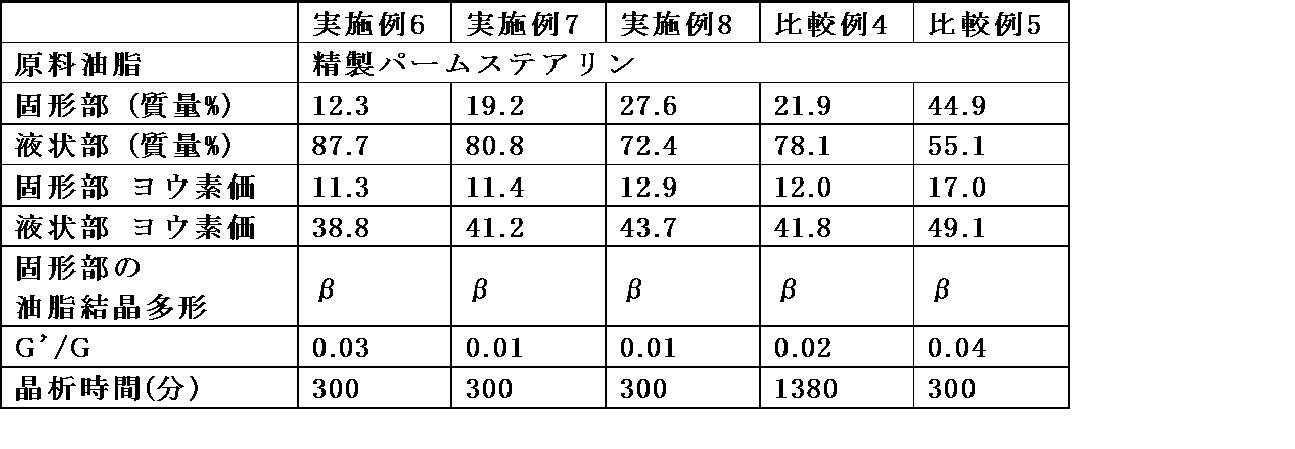
冷却工程で、部分冷却により、α型結晶を生成させた実施例6~8は、比較例4と比べ、冷却開始から圧搾開始までの時間が有意に短縮できた。また、比較例5のように温度を下げてスラリーを形成しても、ヨウ素価13以下のハードステアリンは得られなかった。
Claims (10)
- (a)原料油脂を融解する工程、
(b)前記油脂を、前記油脂の融解温度をA(℃)として(A-12)≦t≦Aとなる温度t(℃)に冷却する工程、
(c)前記温度にある油脂中に、α型結晶のプレシードを存在させる工程、及び
(d)前記プレシードからβ型結晶のシードを形成させる工程
を含む、分別された油脂の製造方法。 - 前記(c)の工程が、前記油脂の温度を局所的にα型結晶が生成する温度以下に冷却することにより行われる、請求項1に記載の製造方法。
- 前記(c)の工程が、前記油脂がα型結晶を生成する温度以下にある冷却体を油脂の一部に接触させることにより行われる、請求項2に記載の製造方法。
- 局所的な冷却の温度が、それ以外の部分の油脂の温度より10℃以上低い、請求項2又は3に記載の製造方法。
- 前記(c)の工程が、α型結晶のプレシードを油脂に添加することにより行われる、請求項1に記載の製造方法。
- 前記(d)の工程が、前記油脂の結晶化開始温度以上で行われる、請求項1~5のいずれか1項に記載の製造方法。
- 前記原料油脂が、SSS型又はSUS型のトリグリセリドを30質量%以上含有する油脂である、請求項1~6のいずれか1項に記載の製造方法。
- 前記原料油脂が、パーム系油脂、又は、SUS型トリグリセリドを30質量%以上含有する油脂である、請求項1~6のいずれか1項に記載の製造方法。
- (a)原料油脂を融解する工程、
(b)前記油脂を、前記油脂の融解温度をA(℃)として(A-12)≦t≦Aとなる温度t(℃)に冷却する工程、
(c)前記温度にある油脂中に、α型結晶のプレシードを存在させる工程、及び
(d)前記プレシードからβ型結晶のシードを形成させる工程
を含む、油脂結晶シードの調製方法。 - 前記(c)の工程が、前記油脂の温度を局所的にα型結晶が生成する温度以下に冷却することにより行われる、請求項9に記載の方法。
Priority Applications (1)
| Application Number | Priority Date | Filing Date | Title |
|---|---|---|---|
| MYPI2020000211A MY200954A (en) | 2017-07-14 | 2018-07-17 | Method of Producing Oil And/Or Fat |
Applications Claiming Priority (2)
| Application Number | Priority Date | Filing Date | Title |
|---|---|---|---|
| JP2017-138127 | 2017-07-14 | ||
| JP2017138127A JP6668295B2 (ja) | 2017-07-14 | 2017-07-14 | 油脂の製造方法 |
Publications (1)
| Publication Number | Publication Date |
|---|---|
| WO2019013358A1 true WO2019013358A1 (ja) | 2019-01-17 |
Family
ID=65002090
Family Applications (1)
| Application Number | Title | Priority Date | Filing Date |
|---|---|---|---|
| PCT/JP2018/026668 Ceased WO2019013358A1 (ja) | 2017-07-14 | 2018-07-17 | 油脂の製造方法 |
Country Status (3)
| Country | Link |
|---|---|
| JP (1) | JP6668295B2 (ja) |
| MY (1) | MY200954A (ja) |
| WO (1) | WO2019013358A1 (ja) |
Cited By (1)
| Publication number | Priority date | Publication date | Assignee | Title |
|---|---|---|---|---|
| CN113025419A (zh) * | 2021-03-12 | 2021-06-25 | 郑州轻工业大学 | 一种鸭油的分提方法 |
Families Citing this family (1)
| Publication number | Priority date | Publication date | Assignee | Title |
|---|---|---|---|---|
| WO2022210602A1 (ja) * | 2021-03-29 | 2022-10-06 | 不二製油グループ本社株式会社 | 油脂の晶析方法 |
Citations (7)
| Publication number | Priority date | Publication date | Assignee | Title |
|---|---|---|---|---|
| JP2001242102A (ja) * | 2000-02-28 | 2001-09-07 | Snow Brand Milk Prod Co Ltd | 油脂中で発現している結晶型の評価方法 |
| JP2003306691A (ja) * | 2002-02-13 | 2003-10-31 | Asahi Denka Kogyo Kk | カカオ脂の分別方法 |
| WO2005006870A1 (ja) * | 2003-07-23 | 2005-01-27 | Meiji Seika Kaisha, Ltd. | 含水油脂組成物およびその製造方法 |
| JP2005060523A (ja) * | 2003-08-12 | 2005-03-10 | Asahi Denka Kogyo Kk | 油脂のドライ分別方法 |
| WO2009028295A1 (ja) * | 2007-08-31 | 2009-03-05 | Fuji Oil Company, Limited | 油脂の乾式分別法 |
| WO2009060809A1 (ja) * | 2007-11-05 | 2009-05-14 | Fuji Oil Company, Limited | チョコレート添加剤およびその製造方法 |
| JP2015133954A (ja) * | 2013-12-19 | 2015-07-27 | 日清オイリオグループ株式会社 | 油脂 |
-
2017
- 2017-07-14 JP JP2017138127A patent/JP6668295B2/ja active Active
-
2018
- 2018-07-17 WO PCT/JP2018/026668 patent/WO2019013358A1/ja not_active Ceased
- 2018-07-17 MY MYPI2020000211A patent/MY200954A/en unknown
Patent Citations (7)
| Publication number | Priority date | Publication date | Assignee | Title |
|---|---|---|---|---|
| JP2001242102A (ja) * | 2000-02-28 | 2001-09-07 | Snow Brand Milk Prod Co Ltd | 油脂中で発現している結晶型の評価方法 |
| JP2003306691A (ja) * | 2002-02-13 | 2003-10-31 | Asahi Denka Kogyo Kk | カカオ脂の分別方法 |
| WO2005006870A1 (ja) * | 2003-07-23 | 2005-01-27 | Meiji Seika Kaisha, Ltd. | 含水油脂組成物およびその製造方法 |
| JP2005060523A (ja) * | 2003-08-12 | 2005-03-10 | Asahi Denka Kogyo Kk | 油脂のドライ分別方法 |
| WO2009028295A1 (ja) * | 2007-08-31 | 2009-03-05 | Fuji Oil Company, Limited | 油脂の乾式分別法 |
| WO2009060809A1 (ja) * | 2007-11-05 | 2009-05-14 | Fuji Oil Company, Limited | チョコレート添加剤およびその製造方法 |
| JP2015133954A (ja) * | 2013-12-19 | 2015-07-27 | 日清オイリオグループ株式会社 | 油脂 |
Cited By (2)
| Publication number | Priority date | Publication date | Assignee | Title |
|---|---|---|---|---|
| CN113025419A (zh) * | 2021-03-12 | 2021-06-25 | 郑州轻工业大学 | 一种鸭油的分提方法 |
| CN113025419B (zh) * | 2021-03-12 | 2022-09-23 | 郑州轻工业大学 | 一种鸭油的分提方法 |
Also Published As
| Publication number | Publication date |
|---|---|
| MY200954A (en) | 2024-01-25 |
| JP6668295B2 (ja) | 2020-03-18 |
| JP2019019200A (ja) | 2019-02-07 |
Similar Documents
| Publication | Publication Date | Title |
|---|---|---|
| Chen et al. | Aging and metastability of monoglycerides in hydrophobic solutions | |
| CN101591586B (zh) | 棕榈油二次分提产品及其制备方法 | |
| Zaliha et al. | Crystallization properties of palm oil by dry fractionation | |
| JP5962817B2 (ja) | 晶析方法および晶析装置 | |
| WO2019013358A1 (ja) | 油脂の製造方法 | |
| Ding et al. | Static layer melt crystallization: Effects of impurities on the growth behaviors of crystal layers | |
| JP2009249614A (ja) | 油脂の分別方法 | |
| JPH09506861A (ja) | 結晶化による2つの光学対掌体の二分割法 | |
| JPH0273929A (ja) | 部分固化によるガリウム精製法 | |
| JP4335463B2 (ja) | 偏析によるアルミニウム精製法と装置 | |
| Al-Zoubi et al. | Effects of initial concentration and seeding procedure on crystallisation of orthorhombic paracetamol from ethanolic solution | |
| JP2009051973A (ja) | 乾式分別法、これを用いた高液状性パーム油および油脂組成物 | |
| JP3186063B2 (ja) | 油改質 | |
| JPWO2005063952A1 (ja) | 油脂の乾式分別法 | |
| JP2014162859A (ja) | 油脂の乾式分別方法 | |
| JP2016077175A (ja) | ハードバターの製造方法 | |
| JP5929480B2 (ja) | メタクリル酸の精製方法 | |
| Arnaud et al. | Thermal characterization of chicken fat dry fractionation process | |
| WO2014109313A1 (ja) | 油脂の製造方法 | |
| Humphrey et al. | Lipid phase behavior | |
| JP2004298041A (ja) | チョコレート及びハードバターの製造方法 | |
| JPS6228691B2 (ja) | ||
| Dezena | Polymorphic Forms of Chocolate: Application of Solid-State Characterization in the Food Industry | |
| Jusoh et al. | Effect of Flowrate and Circulation Time on Fractionation of Refined Bleached and Deodorised Palm Oil using Progressive Freeze Concentration Method | |
| JP7255758B2 (ja) | 油脂の晶析方法 |
Legal Events
| Date | Code | Title | Description |
|---|---|---|---|
| 121 | Ep: the epo has been informed by wipo that ep was designated in this application |
Ref document number: 18832621 Country of ref document: EP Kind code of ref document: A1 |
|
| NENP | Non-entry into the national phase |
Ref country code: DE |
|
| 122 | Ep: pct application non-entry in european phase |
Ref document number: 18832621 Country of ref document: EP Kind code of ref document: A1 |