WO2018186182A1 - カラーフィルタ用顔料組成物及びカラーフィルタ - Google Patents
カラーフィルタ用顔料組成物及びカラーフィルタ Download PDFInfo
- Publication number
- WO2018186182A1 WO2018186182A1 PCT/JP2018/011311 JP2018011311W WO2018186182A1 WO 2018186182 A1 WO2018186182 A1 WO 2018186182A1 JP 2018011311 W JP2018011311 W JP 2018011311W WO 2018186182 A1 WO2018186182 A1 WO 2018186182A1
- Authority
- WO
- WIPO (PCT)
- Prior art keywords
- pigment
- color filter
- composition
- derivative
- manufactured
- Prior art date
- Legal status (The legal status is an assumption and is not a legal conclusion. Google has not performed a legal analysis and makes no representation as to the accuracy of the status listed.)
- Ceased
Links
Classifications
-
- C—CHEMISTRY; METALLURGY
- C09—DYES; PAINTS; POLISHES; NATURAL RESINS; ADHESIVES; COMPOSITIONS NOT OTHERWISE PROVIDED FOR; APPLICATIONS OF MATERIALS NOT OTHERWISE PROVIDED FOR
- C09B—ORGANIC DYES OR CLOSELY-RELATED COMPOUNDS FOR PRODUCING DYES, e.g. PIGMENTS; MORDANTS; LAKES
- C09B47/00—Porphines; Azaporphines
- C09B47/04—Phthalocyanines abbreviation: Pc
- C09B47/08—Preparation from other phthalocyanine compounds, e.g. cobaltphthalocyanineamine complex
- C09B47/085—Preparation from other phthalocyanine compounds, e.g. cobaltphthalocyanineamine complex substituting the central metal atom
-
- C—CHEMISTRY; METALLURGY
- C09—DYES; PAINTS; POLISHES; NATURAL RESINS; ADHESIVES; COMPOSITIONS NOT OTHERWISE PROVIDED FOR; APPLICATIONS OF MATERIALS NOT OTHERWISE PROVIDED FOR
- C09B—ORGANIC DYES OR CLOSELY-RELATED COMPOUNDS FOR PRODUCING DYES, e.g. PIGMENTS; MORDANTS; LAKES
- C09B47/00—Porphines; Azaporphines
- C09B47/04—Phthalocyanines abbreviation: Pc
- C09B47/08—Preparation from other phthalocyanine compounds, e.g. cobaltphthalocyanineamine complex
- C09B47/10—Obtaining compounds having halogen atoms directly bound to the phthalocyanine skeleton
-
- G—PHYSICS
- G02—OPTICS
- G02B—OPTICAL ELEMENTS, SYSTEMS OR APPARATUS
- G02B5/00—Optical elements other than lenses
- G02B5/20—Filters
-
- G—PHYSICS
- G02—OPTICS
- G02F—OPTICAL DEVICES OR ARRANGEMENTS FOR THE CONTROL OF LIGHT BY MODIFICATION OF THE OPTICAL PROPERTIES OF THE MEDIA OF THE ELEMENTS INVOLVED THEREIN; NON-LINEAR OPTICS; FREQUENCY-CHANGING OF LIGHT; OPTICAL LOGIC ELEMENTS; OPTICAL ANALOGUE/DIGITAL CONVERTERS
- G02F1/00—Devices or arrangements for the control of the intensity, colour, phase, polarisation or direction of light arriving from an independent light source, e.g. switching, gating or modulating; Non-linear optics
- G02F1/01—Devices or arrangements for the control of the intensity, colour, phase, polarisation or direction of light arriving from an independent light source, e.g. switching, gating or modulating; Non-linear optics for the control of the intensity, phase, polarisation or colour
- G02F1/13—Devices or arrangements for the control of the intensity, colour, phase, polarisation or direction of light arriving from an independent light source, e.g. switching, gating or modulating; Non-linear optics for the control of the intensity, phase, polarisation or colour based on liquid crystals, e.g. single liquid crystal display cells
- G02F1/133—Constructional arrangements; Operation of liquid crystal cells; Circuit arrangements
- G02F1/1333—Constructional arrangements; Manufacturing methods
- G02F1/1335—Structural association of cells with optical devices, e.g. polarisers or reflectors
Definitions
- the present invention relates to a color filter pigment composition and a color filter.
- a color filter used in a liquid crystal display arranges a plurality of colors regularly on a transparent glass substrate, and transmits only light in a necessary wavelength region from white light of a backlight that passes through the color filter. It is a member that realizes color display.
- the colors used there generally include the three primary colors of red, green, and blue, and improvements have been made to color materials, resins, additives, and the like used to adjust the transmission spectrum. Among them, green colorants for color filters are required to have high brightness and an expanded color reproduction range from the viewpoint of improving display image quality.
- Green 7 is selected.
- a green photosensitive resin composition containing Pigment Green 7 and Pigment Yellow 185 it has been proposed to form a green pixel using a green photosensitive resin composition containing Pigment Green 7 and Pigment Yellow 185, and achieve high color reproduction with a thin film of 2.2 ⁇ m or less.
- the pigment green 7 has a lower transmittance than the pigment green 36 and the pigment green 58, there is a problem that the luminance of the obtained display is lowered.
- the luminance can be compensated for by increasing the amount of light from the backlight, but an improvement is required because a new problem of increased power consumption occurs. From the above, a color material for color filters that achieves both luminance and color reproducibility is desired.
- Patent Document 1 a color filter containing a phthalocyanine sulfonic acid derivative, excellent in color density, color purity, transparency, heat resistance and light resistance Has been proposed.
- Patent Document 2 a green pigment composition containing a halogenated copper phthalocyanine pigment and a low halogenated copper phthalocyanine sulfonic acid derivative and having an average primary particle diameter of 0.01 to 0.1 ⁇ m and an aspect ratio of 1 to 3 is used. It has been proposed to produce a color filter with good contrast (Patent Document 2).
- the problem to be solved by the present invention is to provide a pigment composition for obtaining a color filter with improved brightness without increasing the film thickness.
- the present inventors have used a zinc halide phthalocyanine pigment as a main pigment, and by adding a specific pigment derivative thereto, the brightness can be improved without increasing the film thickness. It has been found that a color filter capable of being produced can be produced. That is, the present invention relates to a zinc halide phthalocyanine pigment and the following general formula (1):
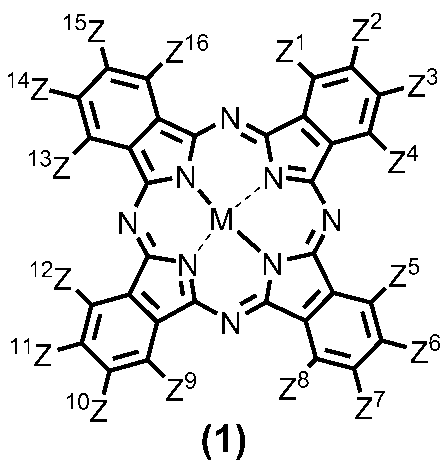
- Z 1 to Z 16 each independently represents a bromine atom, a chlorine atom, a hydrogen atom or a sulfo group, and at least the average number of substituents of the sulfo group is 0.1 to 4
- M represents Al, Si, Sc, Ti, V, Mg, Fe, Co, Ni, Zn, Ga, Ge, Y, Zr, Nb, In, Sn, or Pb.
- the present invention relates to a color filter pigment composition characterized by containing a color filter and a color filter comprising the same in a pixel portion.
- a color filter capable of improving luminance can be produced without increasing the film thickness.
- halogenated zinc phthalocyanine pigment used in the present invention at least one halogen atom selected from chlorine, bromine, fluorine and iodine is present in the phthalocyanine ring which has zinc metal at the center and may be substituted with a substituent other than halogen. These are substituted compounds, and the total number of each substituent is 16 at the maximum.
- the portion not substituted with halogen and a substituent other than halogen refers to a hydrogen atom.
- the zinc halide phthalocyanine pigment used in the present invention has an average of 10 to 14 halogen atoms in one molecule from the viewpoint of designing a color filter having a wide color reproduction range, and among these, the average number of bromine atoms is 8 The number is preferably 12 and the average number of chlorine atoms is 2-5.
- the pigment derivative used in the present invention can be represented by the general formula (1).
- Z 1 to Z 16 are bromine atom, chlorine atom, hydrogen atom or sulfo group. And at least any one selected from Z 1 , Z 4 , Z 5 , Z 8 , Z 9 , Z 12 , Z 13 , and Z 16 on the average in one molecule contains a chlorine atom. It is preferable to use what has.
- the pigment derivative is represented by the formula (1) in which Z 1 to Z 16 are bromine atoms, chlorine atoms, hydrogen atoms or sulfo groups. And any one or more selected from Z 1 , Z 4 , Z 5 , Z 8 , Z 9 , Z 12 , Z 13 , Z 16 has a bromine atom on average in one molecule. It is also preferable to use one.
- a chlorine atom or a bromine atom enters a position of Z 1 , Z 4 , Z 5 , Z 8 , Z 9 , Z 12 , Z 13 , Z 16 , the hue becomes greenish. It is described in.
- the pigment composition of the present invention as described above was not based on a simple combination of a conventional pigment and a pigment derivative of the same skeleton, but the present invention was completed based on the following idea.
- a general organic pigment has a highly conjugated system formed as a whole molecule, and it is energetically stable to have a planar structure. When these planar molecules are arranged so as to be stacked (in parallel), conjugated ⁇ electrons between the molecules overlap each other, so that a more stable state is obtained. Since the pigment derivative represented by the general formula (1) used in the present invention has a phthalocyanine ring, it has a planar structure, and interaction with the planar structure of the organic pigment tends to work. Further, when the main pigment is a halogenated phthalocyanine pigment, it is considered that the halogen- ⁇ interaction is particularly easy to work with the ⁇ electrons of the derivative.
- the derivative is efficiently adsorbed on the active surface of the halogenated phthalocyanine pigment newly generated during dispersion.
- the halogenated phthalocyanine pigment can be dispersed and stabilized in a fine state by the polar sulfo group, the luminance can be improved.
- the sulfonated phthalocyanine derivative of the present invention may be added at the time of pigmentation or can exert a good effect even when added at the time of dispersion.
- the sulfonated phthalocyanine derivative of the present invention can realize a much larger luminance improvement when it is coexisted at the time of pigmentation than when it is added at the time of dispersion.
- the present invention has been completed by paying attention to how the absorption spectra of the pigment and the derivative overlap.
- a green pigment and a yellow pigment are used in combination.
- the pigment derivative treated with the green pigment is similar to the transmission wavelength of the green pigment at 510 to 560 nm. It is preferable to use a combination.
- C In addition, if the transmittance from 430 nm to 460 nm is high, the chromaticity y value is greatly reduced and the sharpness of green is greatly impaired. Therefore, it is preferable that the transmittance in this wavelength range is low. It is described in Kaihei 8-240708. When the chromaticity y value is low, it is necessary to increase the chromaticity y value by increasing the film thickness, but when the film thickness is increased, the luminance decreases.
- the green pixel of the color filter is a C.I. I. It is common to use Pigment Yellow 138 (Y138) in combination. Y138 is described in JP-A-2015-26077 when it shifts from the absorption band to the transmission band around 460 nm, so that it can produce absorption at a shorter wavelength than 460 nm, but it is not suitable for making absorption at the longer wavelength side. For this reason, it is preferable that the derivative treated with the green pigment has a low transmittance at 460 nm.
- the central metal M in the above formula (1) is preferably Al or Zn, and particularly preferably Zn.
- the transmittance at 430 nm to 460 nm is higher when the central metal M in the above formula (1) is Zn than when Al is used as the pigment derivative. Since it is low, a pigment composition with high brightness can be produced.
- Such a pigment derivative can be obtained by, for example, a conventionally known method as follows. That is, it can be obtained by dissolving phthalocyanine or halogenated phthalocyanine in sulfuric acid and heating it to 100 ° C. or higher, or dissolving it in fuming sulfuric acid and treating it at a low temperature.
- a sulfo group is introduced into the phthalocyanine ring under severe reaction conditions, the phthalocyanine ring is oxidatively decomposed by sulfuric acid or fuming sulfuric acid, and the purity of the pigment derivative is lowered.
- the average number of substituents of the sulfo group is preferably 0.1 to 4 on average per molecule, and 0.5 to 2 More preferably.
- the sulfo group may be a sulfonic acid or a salt.
- counter ions that form salts include ammonium ions, monovalent to trivalent metal ions (specific examples include lithium ions, sodium ions, potassium ions, calcium ions, magnesium ions, strontium ions, and aluminum ions).
- organic cations include monoalkyl ammonium ions such as ethyl ammonium ion and butyl ammonium ion, dialkyl ammonium ions such as dimethyl ammonium ion and diethyl ammonium ion, trialkyl ammonium ions such as trimethyl ammonium ion and triethyl ammonium ion) Alkanol ammonium such as ion, monoethanolammonium ion, diethanolammonium ion, triethanolammonium ion On, tetramethylammonium ion, tetramethylguanidium ion, tetramethyl phosphonium ion) are included.
- the sulfo group of the pigment derivative in the present invention is preferably a sulfonic acid or an organic cation salt, from the viewpoint that the elution amount of the pigment derivative in the development step in color filter production can be reduced.
- the average number of halogen atoms of the zinc halide phthalocyanine pigment can be determined by mass spectrometry.
- Mass spectrometry is performed using a matrix-assisted laser desorption / ionization time-of-flight mass spectrometer (JEOL Ltd. JMS-S3000).
- JEOL Ltd. JMS-S3000 matrix-assisted laser desorption / ionization time-of-flight mass spectrometer
- Mass spectrometry was performed using 1 ⁇ L of a suspension in which 0.5 mg of zinc halide phthalocyanine pigment was dispersed in 1 mL of tetrahydrofuran.
- the average sulfonation rate of the pigment derivative can be determined by a high performance liquid chromatograph mass spectrometer (LC-MS-8040 manufactured by Shimadzu Corporation).
- LC-MS-8040 manufactured by Shimadzu Corporation.
- a gradient elution profile was used using a fixed volume of the pigment derivative with dimethyl sulfoxide and a mixed solvent of 10 mmol / L aqueous ammonium hydrogen carbonate / methanol / tetrahydrofuran as a mobile phase.
- the obtained peaks were qualitatively determined by mass spectrometry (ionization mode: DUIS), and the sulfonation rate was calculated from the peak area ratio.
- the number of halogen substituents m of Z 1 , Z 4 , Z 5 , Z 8 , Z 9 , Z 12 , Z 13 and Z 16 , and Z 2 , Z 3 , Z 6 , Z 7 , Z 10 , Z 11 , Z 14 , Z 15 , the number n of halogen substituents is determined by decomposing the pigment derivative with cerium sulfate into phthalimides, It is calculated
- the total molar concentration of all phthalimides obtained as a result of liquid chromatography is a, and the total molar concentration of phthalimides having halogen at the 3rd or 6th position is b (in the case of phthalimides having halogen at both the 3rd and 6th positions) (The molar concentration of phthalimides is calculated as twice the actual measurement.)
- the total molar concentration of phthalimides having a halogen at the 4th or 5th position is c (in the case of phthalimides having a halogen at both the 4th and 5th positions)
- m and n are calculated
- m and n can be determined freely by controlling a raw material.
- the average number of halogen atoms of the pigment derivative can be determined by mass spectrometry using the matrix-assisted laser desorption / ionization time-of-flight mass spectrometer.
- the pigment derivative of the present invention may be added at the time of synthesizing the crude pigment or after pigmentation, but can also be pigmented together with the crude pigment at the time of pigmentation. Further, since the dispersibility of the color filter dispersion and the color filter resist ink is increased and the luminance is improved, a pigment derivative can be added at the time of dispersion or resist preparation. Since the pigment derivative used in the present invention can enter between the molecules of the halogenated zinc phthalocyanine pigment and keep the primary particles finely, it is preferable to add the pigment derivative at the time of pigmentation and pigmentize with the crude pigment.
- the above-described pigment composition containing the halogenated zinc phthalocyanine pigment and the pigment derivative represented by the above formula (1) may be dry-ground in a pulverizer such as an attritor, ball mill, vibration mill, vibration ball mill, etc. Then, by pigmenting with a solvent salt milling method, a solvent boiling method, or the like, it is possible to obtain a pigment that is excellent in dispersibility and coloring power and has a high lightness and green color than before pigmentation.
- a pulverizer such as an attritor, ball mill, vibration mill, vibration ball mill, etc.
- the ratio between the zinc halide phthalocyanine pigment and the pigment derivative represented by the above formula (1) is not particularly limited, but the pigment derivative represented by the above formula (1) per 100 parts of the halogenated zinc phthalocyanine pigment in terms of mass is 0.
- the brightness can be improved without increasing the film thickness.
- the pigmentation method of the green pigment composition comprising the halogenated zinc phthalocyanine pigment and the pigment derivative represented by the formula (1).
- the zinc halide phthalocyanine pigment before pigmentation and the formula (1) The pigment composition containing the pigment derivative represented by formula (1) may be dispersed in a dispersion medium and pigmented at the same time, but the zinc halide phthalocyanine pigment and the formula (1) in a large amount of an organic solvent may be used.
- the solvent salt milling treatment is preferably employed in that pigment particles having a large specific surface area can be obtained more easily than the solvent treatment in which the pigment composition comprising the pigment derivative is heated and stirred.
- This solvent salt milling is a pigment composition comprising a halogenated zinc phthalocyanine pigment not subjected to pigmentation and a pigment derivative represented by the above formula (1), which is ground immediately after synthesis or thereafter, and an inorganic salt. It means kneading and grinding with an organic solvent.
- a kneading machine at this time for example, a kneader, a mix muller, a trimix, a twin screw extruder or the like can be used.
- a water-soluble inorganic salt can be preferably used.
- an inorganic salt such as sodium chloride, potassium chloride, sodium sulfate is preferably used. It is more preferable to use an inorganic salt having an average particle size of 0.5 to 50 ⁇ m. Such an inorganic salt can be easily obtained by pulverizing a normal inorganic salt.
- a pigment composition comprising a halogenated zinc phthalocyanine pigment having an average primary particle diameter of 0.01 to 0.10 ⁇ m and a pigment derivative represented by the above formula (1) is used for a color filter.
- a pigment composition comprising a halogenated zinc phthalocyanine pigment having an average primary particle diameter of 0.01 to 0.10 ⁇ m and a pigment derivative represented by the above formula (1) is used for a color filter.
- the amount of inorganic salt used is preferably 5 to 20 parts by mass, more preferably 7 to 15 parts by mass with respect to 1 part by mass of the crude pigment.
- an organic solvent capable of suppressing crystal growth is preferably used, and as such an organic solvent, a water-soluble organic solvent can be suitably used.
- a water-soluble organic solvent can be suitably used.
- the amount of the water-soluble organic solvent used is not particularly limited, but is
- the zinc halide phthalocyanine pigment and the pigment derivative represented by the above formula (1) are prepared. Each may be subjected to solvent salt milling and may be combined later. Alternatively, the halogenated zinc phthalocyanine pigment and the phthalocyanine pigment derivative represented by the formula (1) may be mixed in the apparatus at the same time to perform solvent salt milling. In the optical characteristic evaluation by the color filter, there is no big difference in that the luminance can be improved by either method.
- the wavelength (Tmax) at which the transmittance of the spectral transmission spectrum at 380 to 780 nm is maximum is 500 to 525 nm, as in the case of the conventional zinc halide phthalocyanine pigment.
- the half width of the curve is as sharp as 110 nm or less (this wavelength is not affected by the photosensitive resin as described later).
- Spectral transmission spectrum in color filter evaluation is obtained according to the first class spectrophotometer of Japanese Industrial Standard JIS Z 8722 (color measurement method-reflection and transmission object color).
- the resin film containing the pigment composition formed into a predetermined dry film thickness is obtained by plotting each transmittance value at each wavelength by scanning and irradiating light in a predetermined wavelength region.
- the integral value of the transmittance of 510 nm to 560 nm of the coating film formed using the halogenated zinc phthalocyanine pigment so that the spectral transmittance at the maximum transmission wavelength is 70% is defined as D1, and the general formula (1)
- the integral value of the transmittance of 510 nm to 560 nm of the coating film formed so that the spectral transmittance at the maximum transmission wavelength is 70% using the derivative carrier obtained by supporting the pigment derivative represented by aluminum oxide on D2 is D2.
- the color filter pigment composition has a spectral characteristic in which the ratio of D1 to D2 (D2 / D1) is 1.0 or more. More preferably, the pigment composition for color filters has spectral characteristics such that the ratio of D2 to D2 (D2 / D1) is 1.2 or more. And the coating film formed at 460 nm using a derivative carrier obtained by supporting the pigment derivative represented by the general formula (1) on aluminum oxide so that the spectral transmittance at the maximum transmission wavelength becomes 70%.
- a pigment composition for a color filter having spectral characteristics with a transmittance of 60% or less is preferable because a green color filter with high color reproducibility in which a decrease in chromaticity y is suppressed can be produced.
- it is more preferably a color filter pigment composition having spectral characteristics such that the transmittance at 460 nm is 55% or less, and the transmittance at 460 nm is 50. It is more preferable that the color filter pigment composition has a spectral characteristic of not more than%.
- the pigment composition of the present invention can be used as it is for the production of the green pixel portion of the color filter, but may be used in combination with other green pigments as necessary.
- a yellow pigment may be used for toning to develop characteristics.
- yellow pigments that can be used here include C.I. I. And yellow organic pigments such as CI Pigment Yellow 83, 110, 129, 138, 139, 150, 180, 185, and 231.
- the combined proportion of the halogenated zinc phthalocyanine pigment composition of the present invention and the yellow pigment is 1 to 200 parts by mass of the yellow pigment per 100 parts by mass of the zinc halide phthalocyanine pigment composition.
- a color filter can be obtained by forming a green pixel using the pigment composition of the present invention.
- the pigment composition of the present invention can be used for forming a pattern of a green pixel portion of a color filter by a known method.
- a photosensitive composition for a color filter green pixel portion containing the present pigment composition and a photosensitive resin as essential components can be obtained.
- a method for producing a color filter for example, after the pigment composition for a color filter of the present invention is dispersed in a dispersion medium made of a photosensitive resin, glass is formed by a spin coating method, a roll coating method, a slit coating method, an ink jet method, or the like. This is called photolithography, which is applied on a transparent substrate, etc., and is then subjected to pattern exposure with ultraviolet rays through a photomask to obtain a green pattern by washing unexposed portions with a solvent or the like. Methods and the like.
- Examples of other manufacturing methods include a method of manufacturing a color filter by forming a pattern of a green pixel portion by a method such as an electrodeposition method, a transfer method, a micellar electrolysis method, a PVED (Photovoltaic Electrodeposition) method, or the like. .
- the red pixel portion pattern and the blue pixel portion pattern can also be formed by a similar method using a known pigment.
- the pigment composition for the color filter green pixel portion for example, the pigment composition for the color filter of the present invention, a photosensitive resin, a photopolymerization initiator, and an organic solvent that dissolves the resin are essential. Mix as an ingredient. More specifically, a method of preparing a dispersion by using a pigment composition of the present invention, an organic solvent, and a dispersant as required, and then adding a photosensitive resin or the like to the dispersion is common. .
- dispersant examples include Disperbyk (registered trademark) 130, 161, 162, 163, 170, 170, LPN-6919, LPN-21116, etc. of Big Chemie. Further, a leveling agent, a coupling agent, a cationic surfactant and the like may be used together.
- organic solvent examples include aromatic solvents such as toluene, xylene and methoxybenzene, acetate solvents such as ethyl acetate and butyl acetate, propylene glycol monomethyl ether acetate and propylene glycol monoethyl ether acetate, and ethoxyethyl propionate.
- Propionate solvents such as methanol, ethanol solvents such as methanol, ether solvents such as butyl cellosolve, propylene glycol monomethyl ether, diethylene glycol ethyl ether, diethylene glycol dimethyl ether, ketone solvents such as methyl ethyl ketone, methyl isobutyl ketone, cyclohexanone, hexane, etc.
- Aliphatic hydrocarbon solvents N, N-dimethylformamide, ⁇ -butyrolactam, N-methyl-2-pyrrolidone Aniline, nitrogen compound-based solvent such as pyridine, a lactone-based solvents such as ⁇ - butyrolactone, carbamic acid esters such as a mixture of 48:52 of methyl carbamate and ethyl carbamate, there is water.
- nitrogen compound-based solvent such as pyridine
- a lactone-based solvents such as ⁇ - butyrolactone
- carbamic acid esters such as a mixture of 48:52 of methyl carbamate and ethyl carbamate
- organic solvent polar solvents such as propionate-based, alcohol-based, ether-based, ketone-based, nitrogen compound-based, lactone-based and water-soluble ones are particularly suitable.
- a dispersion is obtained by uniformly dispersing 300 to 1000 parts by mass of an organic solvent and, if necessary, 0 to 100 parts by mass of a dispersant per 100 parts by mass of the pigment composition of the present invention. Can do. Next, 3 to 20 parts by mass of a photosensitive resin per 100 parts by mass of the pigment composition of the present invention, 0.05 to 3 parts by mass of a photopolymerization initiator per 1 part by mass of the photosensitive resin, and Accordingly, an organic solvent is further added, and the mixture is stirred and dispersed so as to be uniform, whereby a photosensitive composition for a color filter green pixel portion can be obtained.
- thermoplastic resins such as urethane resins, acrylic resins, polyamic acid resins, polyimide resins, styrene maleic acid resins, styrene maleic anhydride resins, and 1,6-hexane, for example.
- Bifunctional monomers such as diol diacrylate, ethylene glycol diacrylate, neopentyl glycol diacrylate, triethylene glycol diacrylate, bis (acryloxyethoxy) bisphenol A, 3-methylpentanediol diacrylate, trimethylol propaton tri Many such as acrylate, pentaerythritol triacrylate, tris (2-hydroxyethyl) isocyanate, dipentaerythritol hexaacrylate, dipentaerythritol pentaacrylate, etc. Photopolymerizable monomer, such as ability monomers.
- photopolymerization initiator examples include acetophenone, benzophenone, benzyldimethylketanol, benzoyl peroxide, 2-chlorothioxanthone, 1,3-bis (4′-azidobenzal) -2-propane, 1,3-bis (4 '-Azidobenzal) -2-propane-2'-sulfonic acid, 4,4'-diazidostilbene-2,2'-disulfonic acid and the like.
- the prepared photosensitive composition for the color filter green pixel portion is subjected to pattern exposure with ultraviolet rays through a photomask, and then the unexposed portion is washed with an organic solvent or alkaline water to obtain a color filter. Can do.
- Reference example 1 In a 300 ml flask, 90 g of sulfuryl chloride (Wako Pure Chemical Industries, Ltd.), 105 g of aluminum chloride (Kanto Chemical Reagent), 14 g of sodium chloride (Tokyo Chemical Industry), 27 g of zinc phthalocyanine from DIC Corporation, bromine (Wako Pure Chemical Industries) 55 g was charged. After heating up to 130 degreeC and taking out in water, the halogenated zinc phthalocyanine (R1) was obtained by filtering, washing with water, and drying.
- the halogenated zinc phthalocyanine (R1) was subjected to mass spectrometry using JMS-S3000 manufactured by JEOL Ltd., and it was confirmed that the average chlorination rate was 2.9 and the average bromination rate was 9.3.
- the delay time at the time of mass spectrometry was 510 ns
- the laser intensity was 40%
- 40 g of the zinc halide phthalocyanine (R1) thus obtained, 400 g of crushed sodium chloride, and 63 g of diethylene glycol were charged into a double-arm kneader and kneaded at 80 ° C. for 8 hours.
- a green pigment composition (RG1).
- RG1 green pigment composition
- 2.48 g of the green pigment composition (RG1) is 0.3 to 0.00 with 1.24 g of BYK-LPN6919 manufactured by Big Chemie, 1.86 g of Unidic ZL-295 manufactured by DIC, and 10.92 g of propylene glycol monomethyl ether acetate.
- the mixture was dispersed for 2 hours with a paint shaker manufactured by Toyo Seiki Co., Ltd. to obtain a colored composition (RMG1).
- Reference example 2 In a 300 ml flask, 91 g of sulfuryl chloride (Wako Pure Chemical Industries reagent), 109 g of aluminum chloride (Kanto chemical reagent), 15 g of sodium chloride (Tokyo Chemical Industry reagent), 30 g of zinc phthalocyanine manufactured by DIC Corporation, bromine (Wako Pure Chemical Industries reagent) 230 g was charged. After heating up to 130 degreeC and taking out in water, the halogenated zinc phthalocyanine (R2) was obtained by filtering, washing with water, and drying. Mass spectrometry of the halogenated zinc phthalocyanine (R2) using JMS-S3000 manufactured by JEOL Ltd.
- 40 g of the thus obtained zinc halide phthalocyanine (R2), 400 g of crushed sodium chloride, and 63 g of diethylene glycol were charged into a double-arm kneader and kneaded at 80 ° C. for 8 hours. After kneading, it was taken out in 2 kg of 80 ° C.
- Synthesis example 1 288 g of 98% sulfuric acid and 272 g of 30% fuming sulfuric acid were stirred while being cooled to 10 ° C., and 70 g of zinc phthalocyanine manufactured by DIC Corporation was added. Subsequently, it stirred at 60 degreeC for 3 hours. The reaction solution was taken out in 1750 g of water, stirred for 1 hour, filtered, washed with water, and dried to obtain a sulfonated zinc phthalocyanine derivative (S1). The sulfonated zinc phthalocyanine derivative (S1) was confirmed to have an average sulfonation rate of 1 by LC-MS measurement.
- a white slurry After adding 100 g of ethanol to 30 g of aluminum oxide (AEROXIDE Alu C) manufactured by Nippon Aerosil Co., Ltd. and stirring well, 2000 g of water was added to prepare a white slurry. 1.5 g of a sulfonated zinc phthalocyanine derivative (S1) was added, the pH was adjusted to 12 with an aqueous potassium hydroxide solution, and the mixture was stirred at room temperature for 2 hours. The pH was adjusted to 3 with 10% hydrochloric acid, and the mixture was further stirred at room temperature for 1 hour, and then filtered, washed with water, dried and pulverized to obtain a derivative carrier (A1).
- S1 sulfonated zinc phthalocyanine derivative
- the derivative carrier (A1) is 0.3 to 0.4 together with 1.24 g of BYK-LPN6919 manufactured by Big Chemie, 1.86 g of Unidic ZL-295 manufactured by DIC Corporation, and 10.92 g of propylene glycol monomethyl ether acetate.
- a zircon bead of mm it was dispersed for 2 hours with a paint shaker manufactured by Toyo Seiki Co., Ltd. to obtain a colored composition (AMG1).
- Coloring composition (AMG1) 4.0 g, DIC Corporation Unidic ZL-295 0.98 g, propylene glycol monomethyl ether acetate 0.22 g are added, and the composition for evaluation (ACG1) is mixed by a paint shaker. Obtained.
- This composition for evaluation (ACG1) was spin-coated on soda glass and dried at 90 ° C. for 3 minutes, and then the spectral transmission spectrum was measured with U-3900 manufactured by Hitachi High-Tech Science Corporation. In addition, the spectral transmission spectrum in which the maximum transmittance is 70% was measured by adjusting the spin rotation number when spin coating. For transmission spectrum measurement, soda glass was used to perform baseline correction. The integral value of the transmittance at 510 nm to 560 nm was 1988.8, and the transmittance at 460 nm was 55.27.
- Synthesis example 2 A 1 L flask was charged with 55 g of 3-chlorophthalic anhydride, 45 g of phthalic anhydride, 20 g of zinc chloride, 116 g of urea, 600 mg of hexaammonium hexamolybdate tetrahydrate and 250 g of sulfolane, and stirred at 190 ° C. for 5 hours. Thereafter, the heating was stopped, the mixture was allowed to cool and then filtered, and washed with 780 g of 2-propanol, 1000 g of 1% aqueous sodium hydroxide solution and 1000 g of 1% hydrochloric acid. After washing with water, the obtained wet cake was dried at 90 ° C.
- a white slurry After adding 100 g of ethanol to 30 g of aluminum oxide (AEROXIDE Alu C) manufactured by Nippon Aerosil Co., Ltd. and stirring well, 2000 g of water was added to prepare a white slurry. 1.5 g of a sulfonated zinc phthalocyanine derivative (S2) was added, the pH was adjusted to 12 with an aqueous potassium hydroxide solution, and the mixture was stirred at room temperature for 2 hours. The pH was adjusted to 3 with 10% hydrochloric acid, and the mixture was further stirred at room temperature for 1 hour, and then filtered, washed with water, dried and pulverized to obtain a derivative carrier (A2).
- S2 sulfonated zinc phthalocyanine derivative
- Derivative carrier (A2) 2.48 g is combined with BYK-LPN6919 1.24 g manufactured by BYK-Chemie Co., Ltd. Unidic ZL-295 1.86 g manufactured by DIC Corporation, and propylene glycol monomethyl ether acetate 10.92 g 0.3-0.4 Using a zircon bead of mm, the mixture was dispersed with a paint shaker manufactured by Toyo Seiki Co., Ltd. for 2 hours to obtain a colored composition (AMG2). Coloring composition (AMG2) 4.0 g, DIC Corporation Unidic ZL-295 0.98 g, propylene glycol monomethyl ether acetate 0.22 g are added, and the composition for evaluation (ACG2) is mixed by a paint shaker.
- ACG2 composition for evaluation
- This composition for evaluation (ACG2) was spin-coated on soda glass and dried at 90 ° C. for 3 minutes, and then the spectral transmission spectrum was measured with U-3900 manufactured by Hitachi High-Tech Science Corporation. In addition, the spectral transmission spectrum in which the maximum transmittance is 70% was measured by adjusting the spin rotation number when spin coating. For transmission spectrum measurement, soda glass was used to perform baseline correction. The integral value of the transmittance at 510 nm to 560 nm was 3054.6, and the transmittance at 460 nm was 57.47.
- Synthesis example 3 A 1 L flask was charged with 111 g of 3-chlorophthalic anhydride, 20 g of zinc chloride, 116 g of urea, 600 mg of hexaammonium hexamolybdate tetrahydrate and 250 g of sulfolane, and stirred at 190 ° C. for 5 hours. Thereafter, the heating was stopped, the mixture was allowed to cool and then filtered, and washed with 780 g of 2-propanol, 1000 g of 1% aqueous sodium hydroxide solution and 1000 g of 1% hydrochloric acid. After washing with water, the obtained wet cake was dried at 90 ° C.
- This composition for evaluation (ACG3) was spin-coated on soda glass, dried at 90 ° C. for 3 minutes, and then the spectral transmission spectrum was measured with U-3900 manufactured by Hitachi High-Tech Science Co., Ltd. In addition, the spectral transmission spectrum in which the maximum transmittance is 70% was measured by adjusting the spin rotation number when spin coating. For transmission spectrum measurement, soda glass was used to perform baseline correction. The integral value of the transmittance at 510 nm to 560 nm was 3065.8, and the transmittance at 460 nm was 53.41.
- Synthesis example 4 In a 300 ml flask, 54 g of sulfuryl chloride (Wako Pure Chemical Industries), 63 g of aluminum chloride (Kanto Chemical), 8.6 g of sodium chloride (Tokyo Chemical Industry), 17 g of sulfonated zinc phthalocyanine derivative (A), bromine (Wako Pure) 87 g of a pharmaceutical industry reagent) was charged. After heating up to 130 degreeC and taking out to water, the sulfonated zinc phthalocyanine derivative (S4) was obtained by filtering, washing with water, and drying.
- the sulfonated zinc phthalocyanine derivative (S4) was subjected to mass spectrometry using JMS-S3000 manufactured by JEOL Ltd., and the average sulfonation rate was 1, the average chlorination rate was 2.2, and the average bromination rate was 10.8. It was confirmed that.
- 2000 g of water was added to prepare a white slurry.
- a sulfonated zinc phthalocyanine derivative (S4) was added, the pH was adjusted to 12 with an aqueous potassium hydroxide solution, and the mixture was stirred at room temperature for 2 hours. The pH was adjusted to 3 with 10% hydrochloric acid, and the mixture was further stirred at room temperature for 1 hour, and then filtered, washed with water, dried and pulverized to obtain a derivative carrier (A4).
- Derivative carrier (A4) 2.48 g is combined with BYK-LPN6919 1.24 g manufactured by BYK-Chemie Co., Ltd.
- the spectral transmission spectrum was measured with U-3900 manufactured by Hitachi High-Tech Science Co., Ltd.
- the spectral transmission spectrum in which the maximum transmittance is 70% was measured by adjusting the spin rotation number when spin coating.
- soda glass was used to perform baseline correction.
- the integral value of the transmittance at 510 nm to 560 nm was 3273.1, and the transmittance at 460 nm was 42.89.
- Synthesis example 5 A 1 L flask was charged with 60 g of phthalonitrile, 300 g of 1-chloronaphthalene and 16 g of aluminum chloride, and stirred for 6 hours under reflux. Thereafter, the heating was stopped, the mixture was allowed to cool to 200 ° C., filtered while hot, and washed with 600 g of hot toluene and 300 g of acetone. The obtained wet cake was dispersed in 250 g of toluene and stirred and refluxed for 3 hours.
- the mixture was again filtered while hot, washed with 600 g of hot toluene and 300 g of acetone, dispersed in 1500 g of ion-exchanged water, and heated and stirred at 60 ° C. for 60 minutes. Filtration, washing with water and vacuum drying at 50 ° C. gave blue solid aluminum phthalocyanine (AlPc—Cl). 30 g of aluminum phthalocyanine (AlPc—Cl) was gradually dissolved in 1200 g of concentrated sulfuric acid while keeping the temperature at 5 ° C., and stirred at this temperature for 1 hour.
- a white slurry After adding 100 g of ethanol to 30 g of aluminum oxide (AEROXIDE Alu C) manufactured by Nippon Aerosil Co., Ltd. and stirring well, 2000 g of water was added to prepare a white slurry. 1.5 g of a sulfonated aluminum phthalocyanine derivative (S5) was added, the pH was adjusted to 12 with an aqueous potassium hydroxide solution, and the mixture was stirred at room temperature for 2 hours. The pH was adjusted to 3 with 10% hydrochloric acid, and the mixture was further stirred at room temperature for 1 hour, and then filtered, washed with water, dried and pulverized to obtain a derivative carrier (A5).
- S5 sulfonated aluminum phthalocyanine derivative
- Derivative carrier (A5) 2.48 g is combined with BYK-LPN6919 1.24 g manufactured by BYK-Chemie Co., Ltd. Unidic ZL-295 1.86 g manufactured by DIC Corporation, and propylene glycol monomethyl ether acetate 10.92 g 0.3-0.4 Using a zircon bead of mm, it was dispersed for 2 hours with a paint shaker manufactured by Toyo Seiki Co., Ltd. to obtain a colored composition (AMG5). Coloring composition (AMG5) 4.0 g, DIC Corporation Unidic ZL-295 0.98 g, propylene glycol monomethyl ether acetate 0.22 g are added, and the composition for evaluation (ACG5) is mixed by a paint shaker.
- This evaluation composition (ACG5) was spin-coated on soda glass and dried at 90 ° C. for 3 minutes, and then the spectral transmission spectrum was measured with U-3900 manufactured by Hitachi High-Tech Science Co., Ltd. In addition, the spectral transmission spectrum in which the maximum transmittance is 70% was measured by adjusting the spin rotation number when spin coating. For transmission spectrum measurement, soda glass was used to perform baseline correction. The integral value of the transmittance at 510 nm to 560 nm was 2757.5, and the transmittance at 460 nm was 64.24.
- Synthesis Example 6 After adding 100 g of ethanol to 30 g of aluminum oxide (AEROXIDE Alu C) manufactured by Nippon Aerosil Co., Ltd. and stirring well, 2000 g of water was added to prepare a white slurry. 1.5 g of Solsperse 12000 (sulfonated copper phthalocyanine derivative manufactured by Nippon Lubrizol Corporation) was added, the pH was adjusted to 12 with an aqueous potassium hydroxide solution, and the mixture was stirred at room temperature for 2 hours. The pH was adjusted to 3 with 10% hydrochloric acid, and the mixture was further stirred at room temperature for 1 hour, and then filtered, washed with water, dried and pulverized to obtain a derivative carrier (A6).
- AEROXIDE Alu C aluminum oxide manufactured by Nippon Aerosil Co., Ltd. and stirring well.
- Derivative carrier (A6) 2.48 g is combined with BYK-LPN6919 1.24 g manufactured by BYK-Chemie Co., Ltd. Unidic ZL-295 1.86 g manufactured by DIC Corporation, and propylene glycol monomethyl ether acetate 10.92 g 0.3-0.4 Using a zircon bead of mm, the mixture was dispersed with a paint shaker manufactured by Toyo Seiki Co., Ltd. for 2 hours to obtain a colored composition (AMG6). Coloring composition (AMG6) 4.0 g, DIC Corporation Unidic ZL-295 0.98 g, propylene glycol monomethyl ether acetate 0.22 g are added, and the composition for evaluation (ACG6) is mixed by a paint shaker.
- This evaluation composition (ACG6) was spin-coated on soda glass and dried at 90 ° C. for 3 minutes, and then the spectral transmission spectrum was measured with U-3900 manufactured by Hitachi High-Tech Science Co., Ltd. In addition, the spectral transmission spectrum in which the maximum transmittance is 70% was measured by adjusting the spin rotation number when spin coating. For transmission spectrum measurement, soda glass was used to perform baseline correction. The integral value of the transmittance at 510 nm to 560 nm was 1303.8, and the transmittance at 460 nm was 64.19.
- Synthesis example 7 A 1 L flask was charged with 15 g of sulfolane, 10 g of titanium tetrachloride, 200 g of dimethyl phthalate, 100 g of sodium 4-chlorophthalate and 31 g of 20% fuming sulfuric acid, heated at 170 ° C. for 30 minutes, 150 g of urea, and copper (I) 9 .5 g was added. Furthermore, it heated at 150 degreeC for 1 hour, 170 degreeC for 1 hour, and 190 degreeC for 8 hours. After cooling to 80 ° C., it was taken out in 700 g of water in which 60 g of sodium hydroxide was dissolved. After stirring at 85 ° C.
- the reaction solution was taken out in 750 g of water, stirred for 15 minutes, filtered, washed with water, and dried to obtain a sulfonated copper phthalocyanine derivative (S7).
- the sulfonated copper phthalocyanine derivative (S7) was confirmed to have an average sulfonation rate of 1 and an average chlorination rate of 4 by LC-MS measurement.
- 2000 g of water was added to prepare a white slurry.
- a sulfonated copper phthalocyanine derivative (S7) was added, the pH was adjusted to 12 with an aqueous potassium hydroxide solution, and the mixture was stirred at room temperature for 2 hours. The pH was adjusted to 3 with 10% hydrochloric acid, and the mixture was further stirred at room temperature for 1 hour, and then filtered, washed with water, dried and pulverized to obtain a derivative carrier (A7).
- Derivative carrier (A7) 2.48 g is combined with BYK-LPN6919 1.24 g manufactured by BYK-Chemie Co., Ltd.
- the spectral transmission spectrum was measured with U-3900 manufactured by Hitachi High-Tech Science Corporation.
- the spectral transmission spectrum in which the maximum transmittance is 70% was measured by adjusting the spin rotation number when spin coating.
- soda glass was used to perform baseline correction.
- the integral value of the transmittance at 510 nm to 560 nm was 1401.9, and the transmittance at 460 nm was 64.60.
- Production Example 2 A green pigment composition (G2) was obtained in the same manner as in Production Example 1 except that the sulfonated zinc phthalocyanine derivative (S1) was replaced with the sulfonated zinc phthalocyanine derivative (S2).
- Production Example 3 A green pigment composition (G3) was obtained in the same manner as in Production Example 1 except that the sulfonated zinc phthalocyanine derivative (S1) was replaced with the sulfonated zinc phthalocyanine derivative (S3).
- Production Example 4 A green pigment composition (G4) was obtained in the same manner as in Production Example 1 except that the sulfonated zinc phthalocyanine derivative (S1) was replaced with the sulfonated zinc phthalocyanine derivative (S4).
- Production Example 5 A green pigment composition (G5) was obtained in the same manner as in Production Example 1 except that the sulfonated zinc phthalocyanine derivative (S1) was replaced with the sulfonated aluminum phthalocyanine derivative (S5).
- Production Example 6 A green pigment composition (G6) was obtained in the same manner as in Production Example 1 except that the sulfonated zinc phthalocyanine derivative (S1) was replaced with the sulfonated copper phthalocyanine derivative (S7).
- Production Example 8 A green pigment composition (G8) was obtained in the same manner as in Production Example 7 except that the sulfonated zinc phthalocyanine derivative (S1) was replaced with the sulfonated zinc phthalocyanine derivative (S2).
- Production Example 9 A green pigment composition (G9) was obtained in the same manner as in Production Example 7 except that the sulfonated zinc phthalocyanine derivative (S1) was replaced with the sulfonated zinc phthalocyanine derivative (S3).
- Production Example 11 A green pigment composition (G11) was obtained in the same manner as in Production Example 10 except that the sulfonated zinc phthalocyanine derivative (S3) was replaced with the sulfonated zinc phthalocyanine derivative (S4).
- Production Example 12 A green pigment composition (G12) was obtained in the same manner as in Production Example 10 except that the sulfonated zinc phthalocyanine derivative (S3) was replaced with Solsperse 12000 (sulfonated copper phthalocyanine derivative manufactured by Nippon Lubrizol Corporation).
- Pigment Yellow 138 (Chromofine Yellow 6206EC, manufactured by Dainichi Seika Co., Ltd.) 1.65 g, DISPERBYK-161 (manufactured by Big Chemie) 3.85 g, propylene glycol monomethyl ether acetate 11.00 g, 0.3 to 0.4 mm zircon
- the mixture was dispersed with a paint shaker manufactured by Toyo Seiki Co., Ltd. for 2 hours to obtain a colored composition (MY1).
- Coloring composition (MY1) 4.0 g, Unidic ZL-295 0.98 g, and propylene glycol monomethyl ether acetate 0.22 g were added and mixed with a paint shaker to obtain a toning composition (TY1).
- Example 1 2.48 g of the green pigment composition (G1) was mixed with BYK-LPN6919 (1.24 g) manufactured by BYK-Chemie Co., Ltd., Unidic ZL-295 (1.86 g) manufactured by DIC Corporation, and propylene glycol monomethyl ether acetate (10.92 g). Using 4 mm zircon beads, the mixture was dispersed for 2 hours with a paint shaker manufactured by Toyo Seiki Co., Ltd. to obtain a colored composition (MG1).
- Coloring composition (MG1) 4.0 g, DIC Corporation Unidic ZL-295 0.98 g, propylene glycol monomethyl ether acetate 0.22 g are added and mixed with a paint shaker to form a green pixel portion for a color filter.
- An evaluation composition (CG1) was obtained.
- a coating liquid obtained by mixing the toning composition (TY1) prepared in Production Example 13 and the evaluation composition (CG1) was spin-coated on soda glass, dried at 90 ° C. for 3 minutes, and then used in a C light source.
- a coating film showing chromaticity (x, y) (0.250, 0.615) was produced.
- the brightness was measured with U-3900 manufactured by Hitachi High-Tech Science, and the film thickness was measured with a white interference microscope VS1330 manufactured by Hitachi High-Tech Science.
- Example 2 An evaluation composition (CG2) was obtained in the same manner except that the green pigment composition (G1) was replaced with the green pigment composition (G2) in Example 1.
- a coating film showing chromaticity (x, y) (0.250, 0.615) was produced. The brightness was measured with U-3900 manufactured by Hitachi High-Tech Science, and the film thickness was measured with a white interference microscope VS1330 manufactured by Hitachi High-Tech Science.
- Example 3 An evaluation composition (CG3) was obtained in the same manner except that the green pigment composition (G1) was replaced with the green pigment composition (G3) in Example 1.
- a coating film showing chromaticity (x, y) (0.250, 0.615) was produced.
- the brightness was measured with U-3900 manufactured by Hitachi High-Tech Science, and the film thickness was measured with a white interference microscope VS1330 manufactured by Hitachi High-Tech Science.
- Example 4 An evaluation composition (CG4) was obtained in the same manner except that the green pigment composition (G1) was replaced with the green pigment composition (G4) in Example 1.
- a coating film showing chromaticity (x, y) (0.250, 0.615) was produced. The brightness was measured with U-3900 manufactured by Hitachi High-Tech Science, and the film thickness was measured with a white interference microscope VS1330 manufactured by Hitachi High-Tech Science.
- Example 5 An evaluation composition (CG5) was obtained in the same manner except that the green pigment composition (G1) was replaced with the green pigment composition (G5) in Example 1.
- a coating liquid obtained by mixing the toning composition (TY1) prepared in Production Example 13 and the evaluation composition (CG5) was spin-coated on soda glass, dried at 90 ° C. for 3 minutes, and then used in a C light source.
- a coating film showing chromaticity (x, y) (0.250, 0.615) was produced. The brightness was measured with U-3900 manufactured by Hitachi High-Tech Science, and the film thickness was measured with a white interference microscope VS1330 manufactured by Hitachi High-Tech Science.
- Example 6 An evaluation composition (CG7) was obtained in the same manner except that the green pigment composition (G1) was replaced with the green pigment composition (G7) in Example 1.
- a coating liquid obtained by mixing the toning composition (TY1) prepared in Production Example 13 and the evaluation composition (CG7) was spin-coated on soda glass, dried at 90 ° C. for 3 minutes, and then used in a C light source.
- a coating film showing chromaticity (x, y) (0.250, 0.615) was produced. The brightness was measured with U-3900 manufactured by Hitachi High-Tech Science, and the film thickness was measured with a white interference microscope VS1330 manufactured by Hitachi High-Tech Science.
- Example 7 An evaluation composition (CG8) was obtained in the same manner except that the green pigment composition (G1) was replaced with the green pigment composition (G8) in Example 1.
- a coating film showing chromaticity (x, y) (0.250, 0.615) was produced. The brightness was measured with U-3900 manufactured by Hitachi High-Tech Science, and the film thickness was measured with a white interference microscope VS1330 manufactured by Hitachi High-Tech Science.
- Example 8 An evaluation composition (CG9) was obtained in the same manner except that the green pigment composition (G1) was replaced with the green pigment composition (G9) in Example 1.
- a coating film showing chromaticity (x, y) (0.250, 0.615) was produced. The brightness was measured with U-3900 manufactured by Hitachi High-Tech Science, and the film thickness was measured with a white interference microscope VS1330 manufactured by Hitachi High-Tech Science.
- Example 9 Green pigment composition (RG1) (2.23 g), sulfonated zinc phthalocyanine derivative (S1) (0.25 g), BYK-LPN6919 (1.24 g), DIC Corporation Unidic ZL-295 (1.86 g), propylene glycol monomethyl Using 0.32 to 0.4 mm zircon beads together with 10.92 g of ether acetate, the mixture was dispersed for 2 hours with a paint shaker manufactured by Toyo Seiki Co., Ltd. to obtain a colored composition (MG10).
- Coloring composition (MG10) 4.0 g, DIC Corporation Unidic ZL-295 0.98 g, propylene glycol monomethyl ether acetate 0.22 g are added and mixed with a paint shaker to form a green pixel portion for a color filter.
- CG10 composition for evaluation
- a coating film showing chromaticity (x, y) (0.250, 0.615) was produced.
- the brightness was measured with U-3900 manufactured by Hitachi High-Tech Science, and the film thickness was measured with a white interference microscope VS1330 manufactured by Hitachi High-Tech Science.
- Example 10 An evaluation composition (CG11) was obtained in the same manner except that the sulfonated zinc phthalocyanine derivative (S1) was replaced with the sulfonated zinc phthalocyanine derivative (S2) in Example 9.
- a coating film showing chromaticity (x, y) (0.250, 0.615) was produced.
- the brightness was measured with U-3900 manufactured by Hitachi High-Tech Science, and the film thickness was measured with a white interference microscope VS1330 manufactured by Hitachi High-Tech Science.
- Example 11 An evaluation composition (CG12) was obtained in the same manner except that the sulfonated zinc phthalocyanine derivative (S1) was replaced with the sulfonated zinc phthalocyanine derivative (S3) in Example 9.
- a coating film showing chromaticity (x, y) (0.250, 0.615) was produced. The brightness was measured with U-3900 manufactured by Hitachi High-Tech Science, and the film thickness was measured with a white interference microscope VS1330 manufactured by Hitachi High-Tech Science.
- Example 12 An evaluation composition (CG13) was obtained in the same manner except that the green pigment composition (G1) was replaced with the green pigment composition (G10) in Example 1.
- a coating film showing chromaticity (x, y) (0.275, 0.570) was produced.
- the brightness was measured with U-3900 manufactured by Hitachi High-Tech Science, and the film thickness was measured with a white interference microscope VS1330 manufactured by Hitachi High-Tech Science.
- Example 13 An evaluation composition (CG14) was obtained in the same manner except that the green pigment composition (G1) was replaced with the green pigment composition (G11) in Example 1.
- a coating film showing chromaticity (x, y) (0.275, 0.570) was produced.
- the brightness was measured with U-3900 manufactured by Hitachi High-Tech Science, and the film thickness was measured with a white interference microscope VS1330 manufactured by Hitachi High-Tech Science.
- Comparative Example 1 An evaluation composition (CG6) was obtained in the same manner except that the green pigment composition (G1) was replaced with the green pigment composition (G6) in Example 1.
- a coating film showing chromaticity (x, y) (0.250, 0.615) was produced. The brightness was measured with U-3900 manufactured by Hitachi High-Tech Science, and the film thickness was measured with a white interference microscope VS1330 manufactured by Hitachi High-Tech Science.
- An evaluation composition (CG12) was obtained in the same manner except that the green pigment composition (G1) was replaced with the green pigment composition (G12) in Example 1.
- a coating liquid obtained by mixing the toning composition (TY1) prepared in Production Example 13 and the evaluation composition (CG12) was spin-coated on soda glass and dried at 90 ° C. for 3 minutes.
- a coating film showing chromaticity (x, y) (0.275, 0.570) was produced.
- the brightness was measured with U-3900 manufactured by Hitachi High-Tech Science, and the film thickness was measured with a white interference microscope VS1330 manufactured by Hitachi High-Tech Science.
- the luminance is high. Furthermore, in the present invention, since a pigment derivative having a transmittance of 460 nm lower than that of a conventionally used sulfonated copper phthalocyanine (SOLSPERSE 12000, sulfonated copper phthalocyanine derivative (S7)) is selected and used, Is thin.
Landscapes
- Physics & Mathematics (AREA)
- Chemical & Material Sciences (AREA)
- Nonlinear Science (AREA)
- General Physics & Mathematics (AREA)
- Optics & Photonics (AREA)
- Organic Chemistry (AREA)
- Mathematical Physics (AREA)
- Crystallography & Structural Chemistry (AREA)
- Optical Filters (AREA)
- Liquid Crystal (AREA)
Abstract
Description
また、ハロゲン化銅フタロシアニン顔料と、低ハロゲン化銅フタロシアニンスルホン酸誘導体とを含有し、一次粒子の平均粒子径0.01~0.1μm且つアスペクト比1~3である緑色顔料組成物を用いて、コントラストが良好なカラーフィルタを作製することが提案されている(特許文献2)。しかし、主顔料とする銅フタロシアニン顔料の輝度の低さに起因して、近年要求される性能を満足できない場合があった。
このように、高輝度化、色再現範囲の拡大を目的としたカラーフィルタを形成するためには、これら先行技術では、近年急速に高まる要求性能を満足するには不十分であり、未だ目的は達成できていないのが実情である。
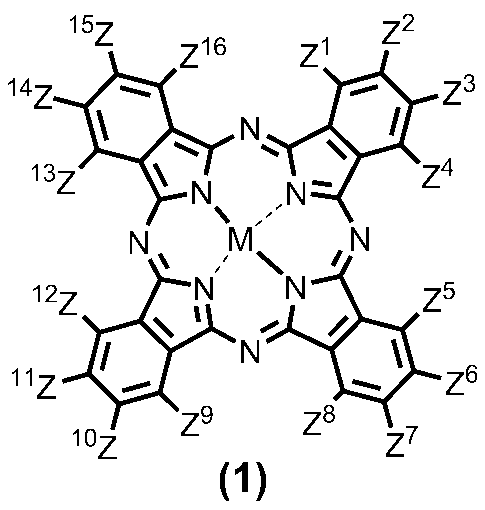
なかでも、本発明に用いるハロゲン化亜鉛フタロシアニン顔料は、色再現範囲の広いカラーフィルタを設計する観点から、1分子中にハロゲン原子を平均10~14個有し、このうち臭素原子数が平均8~12個であり、塩素原子数が平均2~5個であるものが好ましい。
なかでも、緑色カラーフィルタの主顔料と顔料誘導体の色相を類似させる観点から、前記顔料誘導体は、前記一般式(1)中、Z1~Z16が臭素原子、塩素原子、水素原子又はスルホ基の何れかを有し、かつ一分子中の平均で、少なくともZ1、Z4、Z5、Z8、Z9、Z12、Z13、Z16から選ばれるいずれか2以上が塩素原子を有するものを用いることが好ましい。
なお、Z1、Z4、Z5、Z8、Z9、Z12、Z13、Z16の位置に塩素原子又は臭素原子が入ると色相が緑味化することは、特開2010-189528に記載されている。
(B)さらに、顔料と誘導体の吸収スペクトルの重なり方にも着目して本発明を完成するに至った。緑色画素のカラーフィルタにおいて明るく鮮明な表示を得るためには、510nmから560nmまでの透過率を高くすることが特に好ましい。この狭い波長域のみを透過するカラーフィルタを設計するために、緑色顔料と黄色顔料とを組み合わせて使用するため、緑色顔料に処理される顔料誘導体は、510~560nmにおいて緑色顔料の透過波長と類似する組合せとすることが好ましい。
(C)また、430nmから460nmの透過率が高いと、色度y値が大幅に低下し、緑の鮮明さが大きく損なわれてしまうため、この波長範囲の透過率は低いほうが好ましいことが特開平8-240708に記載されている。色度y値が低い場合には膜厚を厚くして色度y値を高くする必要があるが、膜厚を厚くすると輝度が低下してしまう。したがって、430nmから460nmの透過率がなるべく低くなるような顔料誘導体の選択が必要である。特に、カラーフィルタの緑色画素は、緑色顔料に対してキノフタロン系黄色顔料であるC.I.ピグメントイエロー138(Y138)を組み合わせて用いることが一般的である。Y138は、460nmあたりで吸収帯から透過帯へ移行すると特開2015-26077に記載があることから、460nmよりも短波長の吸収を作り出すことはできるが長波長側の吸収を作るには不向きであるため、緑顔料に処理される誘導体の460nmの透過率は低いほうが好ましい。
ここで、ハロゲン化亜鉛フタロシアニン顔料を用いて極大透過波長における分光透過率が70%になるように形成した塗膜の510nm~560nmの透過率の積分値をD1とし、前記一般式(1)で表される顔料誘導体を酸化アルミニウムに担持させて得られる誘導体担持体を用いて極大透過波長における分光透過率が70%になるように形成した塗膜の510nm~560nmの透過率の積分値をD2とした際に、D1とD2の比率(D2/D1)が0.7以上となる分光特性を有するカラーフィルタ用顔料組成物であることが、顔料誘導体による緑色カラーフィルタの輝度低下を最小限にとどめることができるため好ましい。また、より輝度の高い緑色カラーフィルタを設計するために、D1とD2の比率(D2/D1)が1.0以上となる分光特性を有するカラーフィルタ用顔料組成物であることがより好ましく、D1とD2の比率(D2/D1)が1.2以上となる分光特性を有するカラーフィルタ用顔料組成物であることがさらに好ましい。
そして、前記一般式(1)で表される顔料誘導体を酸化アルミニウムに担持させて得られる誘導体担持体を用いて極大透過波長における分光透過率が70%になるように形成した塗膜の460nmにおける透過率が60%以下となる分光特性を有するカラーフィルタ用顔料組成物であることが、色度yの低下が抑制された色再現性の高い緑色カラーフィルタを作製できるため好ましい。また、より色再現性の高い緑色カラーフィルタを設計するために、460nmにおける透過率が55%以下となる分光特性を有するカラーフィルタ用顔料組成物であることがより好ましく、460nmにおける透過率が50%以下となる分光特性を有するカラーフィルタ用顔料組成物であることがさらに好ましい。
本発明の顔料組成物を用いて緑色画素を形成することで、カラーフィルタを得ることができる。
本発明の顔料組成物は、公知の方法でカラーフィルタの緑色画素部のパターンの形成に用いることができる。典型的には、本顔料組成物と、感光性樹脂とを必須成分して含むカラーフィルタ緑色画素部用感光性組成物を得ることができる。
また、後記する実施例で使用した測定方法は以下の通り。
得られたカラーフィルタのC光源における色度x,y及び輝度を、分光光度計U-3900(株式会社日立ハイテクサイエンス製)で測定した。輝度は高いほど優れる。
300mlフラスコに、塩化スルフリル(和光純薬工業試薬)90g、塩化アルミニウム(関東化学試薬)105g、塩化ナトリウム(東京化成工業試薬)14g、DIC株式会社製 亜鉛フタロシアニン27g、臭素(和光純薬工業試薬)55gを仕込んだ。130℃まで昇温し、水に取り出した後、ろ過、水洗、乾燥することによりハロゲン化亜鉛フタロシアニン(R1)を得た。ハロゲン化亜鉛フタロシアニン(R1)について日本電子株式会社製JMS-S3000による質量分析を行い、平均塩素化率が2.9個、平均臭素化率が9.3個であることを確認した。なお、質量分析時のDelay Timeは510ns、Laser Intensityは40%、m/z=1820以上1860以下のピークのResolving Power Valueは65086であった。
このようにして得られたハロゲン化亜鉛フタロシアニン(R1)40g、粉砕した塩化ナトリウム400g、ジエチレングリコール63gを双腕型ニーダーに仕込み、80℃で8時間混練した。混練後80℃の水2kgに取り出し、1時間攪拌後、ろ過、湯洗、乾燥、粉砕することにより、緑色顔料組成物(RG1)を得た。緑色顔料組成物(RG1) 2.48gを、ビックケミー社製BYK-LPN6919 1.24g、DIC株式会社製 ユニディックZL-295 1.86g、プロピレングリコールモノメチルエーテルアセテート10.92gと共に0.3~0.4 mmのジルコンビーズを用いて、東洋精機株式会社製ペイントシェーカーで2時間分散して、着色組成物(RMG1)を得た。着色組成物(RMG1)4.0g、DIC株式会社製 ユニディックZL-295 0.98g、プロピレングリコールモノメチルエーテルアセテート0.22gを加えて、ペイントシェーカーで混合することで評価用組成物(RCG1)を得た。この評価用組成物(RCG1)をソーダガラスにスピンコートし、90℃で3分間乾燥した後に、日立ハイテクサイエンス社製U-3900で分光透過スペクトルを測定した。なお、スピンコートする際にスピン回転数を調整することにより、極大透過率が70%となる分光透過スペクトルを測定した。透過スペクトル測定の際には、ソーダガラスを使用してベースライン補正を行った。510nm~560nmの透過率の積分値が2511.6であり、460nmの透過率が8.79であった。
300mlフラスコに、塩化スルフリル(和光純薬工業試薬)91g、塩化アルミニウム(関東化学試薬)109g、塩化ナトリウム(東京化成工業試薬)15g、DIC株式会社製 亜鉛フタロシアニン30g、臭素(和光純薬工業試薬)230gを仕込んだ。130℃まで昇温し、水に取り出した後、ろ過、水洗、乾燥することによりハロゲン化亜鉛フタロシアニン(R2)を得た。ハロゲン化亜鉛フタロシアニン(R2)について日本電子株式会社製JMS-S3000による質量分析を行い、平均塩素化率が1.8個、平均臭素化率が13.2個であることを確認した。なお、質量分析時のDelay Timeは500ns、Laser Intensityは44%、m/z=1820以上1860以下のピークのResolving Power Valueは31804であった。
このようにして得られたハロゲン化亜鉛フタロシアニン(R2)40g、粉砕した塩化ナトリウム400g、ジエチレングリコール63gを双腕型ニーダーに仕込み、80℃で8時間混練した。混練後80 ℃の水2kgに取り出し、1時間攪拌後、ろ過、湯洗、乾燥、粉砕することにより、緑色顔料組成物(RG2)を得た。緑色顔料組成物(RG2) 2.48gを、ビックケミー社製BYK-LPN6919 1.24g、DIC株式会社製 ユニディックZL-295 1.86g、プロピレングリコールモノメチルエーテルアセテート10.92gと共に0.3~0.4 mmのジルコンビーズを用いて、東洋精機株式会社製ペイントシェーカーで2時間分散して、着色組成物(RMG2)を得た。着色組成物(RMG2)4.0g、DIC株式会社製 ユニディックZL-295 0.98g、プロピレングリコールモノメチルエーテルアセテート0.22gを加えて、ペイントシェーカーで混合することで評価用組成物(RCG2)を得た。この評価用組成物(RCG2)をソーダガラスにスピンコートし、90℃で3分間乾燥した後に、日立ハイテクサイエンス社製U-3900で分光透過スペクトルを測定した。なお、スピンコートする際にスピン回転数を調整することにより、極大透過率が70%となる分光透過スペクトルを測定した。透過スペクトル測定の際には、ソーダガラスを使用してベースライン補正を行った。510nm~560nmの透過率の積分値が2787.8であり、460nmの透過率が3.07であった。
98%の硫酸288gと30%発煙硫酸272gを10℃に冷却しながら攪拌し、DIC株式会社製 亜鉛フタロシアニン 70gを加えた。次いで、60℃で3時間攪拌した。反応液を水1750gに取り出し、1時間攪拌後に、ろ過、水洗、乾燥することにより、スルホン化亜鉛フタロシアニン誘導体(S1)を得た。スルホン化亜鉛フタロシアニン誘導体(S1)についてLC-MS測定により平均スルホン化率が1個であることを確認した。日本アエロジル社製酸化アルミニウム(AEROXIDE Alu C) 30gにエタノール100gを加えてよくかき混ぜた後、水2000gを加えて白色のスラリーを作製した。スルホン化亜鉛フタロシアニン誘導体(S1)1.5gを加え、水酸化カリウム水溶液でpH12に調整し、室温で2時間攪拌した。10%塩酸でpH3に調整し、室温でさらに1時間撹拌した後、ろ過、水洗、乾燥、粉砕することにより、誘導体担持体(A1)を得た。誘導体担持体(A1) 2.48gを、ビックケミー社製BYK-LPN6919 1.24g、DIC株式会社製 ユニディックZL-295 1.86g、プロピレングリコールモノメチルエーテルアセテート10.92gと共に0.3~0.4 mmのジルコンビーズを用いて、東洋精機株式会社製ペイントシェーカーで2時間分散して、着色組成物(AMG1)を得た。着色組成物(AMG1)4.0g、DIC株式会社製 ユニディックZL-295 0.98g、プロピレングリコールモノメチルエーテルアセテート0.22gを加えて、ペイントシェーカーで混合することで評価用組成物(ACG1)を得た。この評価用組成物(ACG1)をソーダガラスにスピンコートし、90℃で3分間乾燥した後に、日立ハイテクサイエンス社製U-3900で分光透過スペクトルを測定した。なお、スピンコートする際にスピン回転数を調整することにより、極大透過率が70%となる分光透過スペクトルを測定した。透過スペクトル測定の際には、ソーダガラスを使用してベースライン補正を行った。510nm~560nmの透過率の積分値が1988.8であり、460nmの透過率が55.27であった。
1Lフラスコに3-クロロフタル酸無水物55g、フタル酸無水物45g、塩化亜鉛20g、尿素116g、七モリブデン酸六アンモニウム四水和物600mg及びスルホラン250gを仕込み、190℃で5時間攪拌した。その後、加熱を停止し、放冷後濾過して、2-プロパノール780g、1%水酸化ナトリウム水溶液1000g、1%塩酸1000gを用いて洗浄した。水洗後、得られたウェットケーキを90℃で12時間乾燥し、青色固体のジクロロ亜鉛フタロシアニンを得た。95%の硫酸20gと30%発煙硫酸180gを10℃に冷却しながら攪拌し、ジクロロ亜鉛フタロシアニン20gを加えた。次いで、80℃で5時間攪拌した。反応液を水1000gに取り出し、30分間攪拌後に、ろ過、水洗、乾燥することにより、スルホン化亜鉛フタロシアニン誘導体(S2)を得た。スルホン化亜鉛フタロシアニン誘導体(S2)についてLC-MS測定により平均スルホン化率が1個、平均塩素化率が2個であることを確認した。日本アエロジル社製酸化アルミニウム(AEROXIDE Alu C) 30gにエタノール100gを加えてよくかき混ぜた後、水2000gを加えて白色のスラリーを作製した。スルホン化亜鉛フタロシアニン誘導体(S2)1.5gを加え、水酸化カリウム水溶液でpH12に調整し、室温で2時間攪拌した。10%塩酸でpH3に調整し、室温でさらに1時間撹拌した後、ろ過、水洗、乾燥、粉砕することにより、誘導体担持体(A2)を得た。誘導体担持体(A2) 2.48gを、ビックケミー社製BYK-LPN6919 1.24g、DIC株式会社製 ユニディックZL-295 1.86g、プロピレングリコールモノメチルエーテルアセテート10.92gと共に0.3~0.4 mmのジルコンビーズを用いて、東洋精機株式会社製ペイントシェーカーで2時間分散して、着色組成物(AMG2)を得た。着色組成物(AMG2)4.0g、DIC株式会社製 ユニディックZL-295 0.98g、プロピレングリコールモノメチルエーテルアセテート0.22gを加えて、ペイントシェーカーで混合することで評価用組成物(ACG2)を得た。この評価用組成物(ACG2)をソーダガラスにスピンコートし、90℃で3分間乾燥した後に、日立ハイテクサイエンス社製U-3900で分光透過スペクトルを測定した。なお、スピンコートする際にスピン回転数を調整することにより、極大透過率が70%となる分光透過スペクトルを測定した。透過スペクトル測定の際には、ソーダガラスを使用してベースライン補正を行った。510nm~560nmの透過率の積分値が3054.6であり、460nmの透過率が57.47であった。
1Lフラスコに3-クロロフタル酸無水物111g、塩化亜鉛20g、尿素116g、七モリブデン酸六アンモニウム四水和物600mg及びスルホラン250gを仕込み、190℃で5時間攪拌した。その後、加熱を停止し、放冷後濾過して、2-プロパノール780g、1%水酸化ナトリウム水溶液1000g、1%塩酸1000gを用いて洗浄した。水洗後、得られたウェットケーキを90℃で12時間乾燥し、青色固体のテトラクロロ亜鉛フタロシアニンを得た。30%発煙硫酸 131gを10℃に冷却しながら攪拌し、テトラクロロ亜鉛フタロシアニン15gを加えた。次いで、90℃で3時間攪拌した。反応液を水750gに取り出し、15分間攪拌後にろ過、水洗、乾燥することにより、スルホン化亜鉛フタロシアニン誘導体(S3)を得た。スルホン化亜鉛フタロシアニン誘導体(S3)についてLC-MS測定により平均スルホン化率が1.6個、平均塩素化率が4個であることを確認した。日本アエロジル社製酸化アルミニウム(AEROXIDE Alu C) 30gにエタノール100gを加えてよくかき混ぜた後、水2000gを加えて白色のスラリーを作製した。スルホン化亜鉛フタロシアニン誘導体(S3)1.5gを加え、水酸化カリウム水溶液でpH12に調整し、室温で2時間攪拌した。10%塩酸でpH3に調整し、室温でさらに1時間撹拌した後、ろ過、水洗、乾燥、粉砕することにより、誘導体担持体(A3)を得た。誘導体担持体(A3)2.48gを、ビックケミー社製BYK-LPN6919 1.24g、DIC株式会社製 ユニディックZL-295 1.86g、プロピレングリコールモノメチルエーテルアセテート10.92gと共に0.3~0.4 mmのジルコンビーズを用いて、東洋精機株式会社製ペイントシェーカーで2時間分散して、着色組成物(AMG3)を得た。着色組成物(AMG3)4.0g、DIC株式会社製 ユニディックZL-295 0.98g、プロピレングリコールモノメチルエーテルアセテート0.22gを加えて、ペイントシェーカーで混合することで評価用組成物(ACG3)を得た。この評価用組成物(ACG3)をソーダガラスにスピンコートし、90℃で3分間乾燥した後に、日立ハイテクサイエンス社製U-3900で分光透過スペクトルを測定した。なお、スピンコートする際にスピン回転数を調整することにより、極大透過率が70%となる分光透過スペクトルを測定した。透過スペクトル測定の際には、ソーダガラスを使用してベースライン補正を行った。510nm~560nmの透過率の積分値が3065.8であり、460nmの透過率が53.41であった。
300mlフラスコに、塩化スルフリル(和光純薬工業試薬)54g、塩化アルミニウム(関東化学試薬)63g、塩化ナトリウム(東京化成工業試薬)8.6g、スルホン化亜鉛フタロシアニン誘導体(A)17g、臭素(和光純薬工業試薬)87gを仕込んだ。130℃まで昇温し、水に取り出した後、ろ過、水洗、乾燥することによりスルホン化亜鉛フタロシアニン誘導体(S4)を得た。スルホン化亜鉛フタロシアニン誘導体(S4)について日本電子株式会社製JMS-S3000による質量分析を行い、平均スルホン化率が1個、平均塩素化率が2.2個、平均臭素化率が10.8個であることを確認した。なお、質量分析時のDelay Timeは275ns、Laser Intensityは42%、m/z=1820以上1860以下のピークのResolving Power Valueは42559であった。日本アエロジル社製酸化アルミニウム(AEROXIDE Alu C) 30gにエタノール100gを加えてよくかき混ぜた後、水2000gを加えて白色のスラリーを作製した。スルホン化亜鉛フタロシアニン誘導体(S4)1.5gを加え、水酸化カリウム水溶液でpH12に調整し、室温で2時間攪拌した。10%塩酸でpH3に調整し、室温でさらに1時間撹拌した後、ろ過、水洗、乾燥、粉砕することにより、誘導体担持体(A4)を得た。誘導体担持体(A4) 2.48gを、ビックケミー社製BYK-LPN6919 1.24g、DIC株式会社製 ユニディックZL-295 1.86g、プロピレングリコールモノメチルエーテルアセテート10.92gと共に0.3~0.4 mmのジルコンビーズを用いて、東洋精機株式会社製ペイントシェーカーで2時間分散して、着色組成物(AMG4)を得た。着色組成物(AMG4)4.0g、DIC株式会社製 ユニディックZL-295 0.98g、プロピレングリコールモノメチルエーテルアセテート0.22gを加えて、ペイントシェーカーで混合することで評価用組成物(ACG4)を得た。この評価用組成物(ACG4)をソーダガラスにスピンコートし、90℃で3分間乾燥した後に、日立ハイテクサイエンス社製U-3900で分光透過スペクトルを測定した。なお、スピンコートする際にスピン回転数を調整することにより、極大透過率が70%となる分光透過スペクトルを測定した。透過スペクトル測定の際には、ソーダガラスを使用してベースライン補正を行った。510nm~560nmの透過率の積分値が3273.1であり、460nmの透過率が42.89であった。
1Lフラスコにフタロニトリル60gと1-クロルナフタレン300g及び塩化アルミニウム16gを仕込み、6時間還流下攪拌した。その後、加熱を停止し、200℃まで放冷後熱時濾過して、熱トルエン600g、アセトン300gを用いて洗浄した。得られたウェットケーキをトルエン250gに分散させ、3時間攪拌還流した。再度、熱時濾過をして、熱トルエン600g、アセトン300gを用いて洗浄した後、1500gのイオン交換水へ分散し、60℃で60分間加熱攪拌を加えた。濾過、水洗後50℃で真空乾燥し、青色固体のアルミニウムフタロシアニン(AlPc-Cl)を得た。アルミニウムフタロシアニン(AlPc-Cl)30gを濃硫酸1200gに温度を5℃に保ちながら徐々に溶解させ、この温度で1時間攪拌した。これを氷水6000gへ温度が5℃を超えないように攪拌しながら注加し、注加終了後さらに1時間攪拌した。濾過、水洗後、6500gのイオン交換水へ再分散し、再度濾過した。水洗後ウェットケーキを4%アンモニア水2500gに再分散して6時間還流下攪拌した。濾過後、ケーキをイオン交換水で洗浄した後、50℃で真空乾燥し、青色固体のアルミニウムフタロシアニン(AlPc-OH)を得た。98%の硫酸288gと30%発煙硫酸272gを10℃に冷却しながら攪拌し、アルミニウムフタロシアニン(AlPc-OH)70gを加えた。次いで、60℃で3時間攪拌した。反応液を水1750gに取り出し、1時間攪拌後に、ろ過、水洗、乾燥することにより、スルホン化アルミニウムフタロシアニン誘導体(S5)を得た。スルホン化アルミニウムフタロシアニン誘導体(S5)についてLC-MS測定により平均スルホン化率が1個であることを確認した。日本アエロジル社製酸化アルミニウム(AEROXIDE Alu C) 30gにエタノール100gを加えてよくかき混ぜた後、水2000gを加えて白色のスラリーを作製した。スルホン化アルミニウムフタロシアニン誘導体(S5)1.5gを加え、水酸化カリウム水溶液でpH12に調整し、室温で2時間攪拌した。10%塩酸でpH3に調整し、室温でさらに1時間撹拌した後、ろ過、水洗、乾燥、粉砕することにより、誘導体担持体(A5)を得た。誘導体担持体(A5) 2.48gを、ビックケミー社製BYK-LPN6919 1.24g、DIC株式会社製 ユニディックZL-295 1.86g、プロピレングリコールモノメチルエーテルアセテート10.92gと共に0.3~0.4 mmのジルコンビーズを用いて、東洋精機株式会社製ペイントシェーカーで2時間分散して、着色組成物(AMG5)を得た。着色組成物(AMG5)4.0g、DIC株式会社製 ユニディックZL-295 0.98g、プロピレングリコールモノメチルエーテルアセテート0.22gを加えて、ペイントシェーカーで混合することで評価用組成物(ACG5)を得た。この評価用組成物(ACG5)をソーダガラスにスピンコートし、90℃で3分間乾燥した後に、日立ハイテクサイエンス社製U-3900で分光透過スペクトルを測定した。なお、スピンコートする際にスピン回転数を調整することにより、極大透過率が70%となる分光透過スペクトルを測定した。透過スペクトル測定の際には、ソーダガラスを使用してベースライン補正を行った。510nm~560nmの透過率の積分値が2757.5であり、460nmの透過率が64.24であった。
日本アエロジル社製酸化アルミニウム(AEROXIDE Alu C) 30gにエタノール100gを加えてよくかき混ぜた後、水2000gを加えて白色のスラリーを作製した。Solsperse 12000(日本ルーブリゾール株式会社製スルホン化銅フタロシアニン誘導体)1.5gを加え、水酸化カリウム水溶液でpH12に調整し、室温で2時間攪拌した。10%塩酸でpH3に調整し、室温でさらに1時間撹拌した後、ろ過、水洗、乾燥、粉砕することにより、誘導体担持体(A6)を得た。誘導体担持体(A6) 2.48gを、ビックケミー社製BYK-LPN6919 1.24g、DIC株式会社製 ユニディックZL-295 1.86g、プロピレングリコールモノメチルエーテルアセテート10.92gと共に0.3~0.4 mmのジルコンビーズを用いて、東洋精機株式会社製ペイントシェーカーで2時間分散して、着色組成物(AMG6)を得た。着色組成物(AMG6)4.0g、DIC株式会社製 ユニディックZL-295 0.98g、プロピレングリコールモノメチルエーテルアセテート0.22gを加えて、ペイントシェーカーで混合することで評価用組成物(ACG6)を得た。この評価用組成物(ACG6)をソーダガラスにスピンコートし、90℃で3分間乾燥した後に、日立ハイテクサイエンス社製U-3900で分光透過スペクトルを測定した。なお、スピンコートする際にスピン回転数を調整することにより、極大透過率が70%となる分光透過スペクトルを測定した。透過スペクトル測定の際には、ソーダガラスを使用してベースライン補正を行った。510nm~560nmの透過率の積分値が1303.8であり、460nmの透過率が64.19であった。
1Lフラスコにスルホラン15g、四塩化チタン10g、フタル酸ジメチル200g、4-クロロフタル酸ナトリウム塩100g、20%発煙硫酸を31g仕込み、170℃で30分間加熱した後、尿素150g、塩化銅(I)9.5gを加えた。さらに、150℃で1時間、170℃で1時間、190℃で8時間加熱した。80℃まで冷却した後、水酸化ナトリウム60gを溶解させた700gの水に取り出した。85℃で1時間撹拌した後、2300gの水に撹拌しながら注ぎ込み、80℃で更に2時間撹拌した。ろ過、熱水洗浄を行った後、35%塩酸140gを溶解させた2300gの水に再スラリー化し、撹拌しながら70℃で1時間加熱した。ろ過、熱水洗浄を行った後、80℃で17時間乾燥することにより、青色固体のテトラクロロ銅フタロシアニンを得た。30%発煙硫酸 131gを10℃に冷却しながら攪拌し、テトラクロロ銅フタロシアニン15gを加えた。次いで、90℃で3時間攪拌した。反応液を水750gに取り出し、15分間攪拌後に、ろ過、水洗、乾燥することにより、スルホン化銅フタロシアニン誘導体(S7)を得た。スルホン化銅フタロシアニン誘導体(S7)についてLC-MS測定により平均スルホン化率が1個、平均塩素化率が4個であることを確認した。日本アエロジル社製酸化アルミニウム(AEROXIDE Alu C) 30gにエタノール100gを加えてよくかき混ぜた後、水2000gを加えて白色のスラリーを作製した。スルホン化銅フタロシアニン誘導体(S7)1.5gを加え、水酸化カリウム水溶液でpH12に調整し、室温で2時間攪拌した。10%塩酸でpH3に調整し、室温でさらに1時間撹拌した後、ろ過、水洗、乾燥、粉砕することにより、誘導体担持体(A7)を得た。誘導体担持体(A7) 2.48gを、ビックケミー社製BYK-LPN6919 1.24g、DIC株式会社製 ユニディックZL-295 1.86g、プロピレングリコールモノメチルエーテルアセテート10.92gと共に0.3~0.4 mmのジルコンビーズを用いて、東洋精機株式会社製ペイントシェーカーで2時間分散して、着色組成物(AMG7)を得た。着色組成物(AMG7)4.0g、DIC株式会社製 ユニディックZL-295 0.98g、プロピレングリコールモノメチルエーテルアセテート0.22gを加えて、ペイントシェーカーで混合することで評価用組成物(ACG7)を得た。この評価用組成物(ACG7)をソーダガラスにスピンコートし、90℃で3分間乾燥した後に、日立ハイテクサイエンス社製U-3900で分光透過スペクトルを測定した。なお、スピンコートする際にスピン回転数を調整することにより、極大透過率が70%となる分光透過スペクトルを測定した。透過スペクトル測定の際には、ソーダガラスを使用してベースライン補正を行った。510nm~560nmの透過率の積分値が1401.9であり、460nmの透過率が64.60であった。
ハロゲン化亜鉛フタロシアニン(R1) 36g、スルホン化亜鉛フタロシアニン誘導体(S1)4g、粉砕した塩化ナトリウム400g、ジエチレングリコール63gを双腕型ニーダーに仕込み、80℃で8時間混練した。混練後80℃の水2kgに取り出し、1時間攪拌後、ろ過、湯洗、乾燥、粉砕することにより、緑色顔料組成物(G1)を得た。
製造例1においてスルホン化亜鉛フタロシアニン誘導体(S1)をスルホン化亜鉛フタロシアニン誘導体(S2)に代えた以外は同様にして、緑色顔料組成物(G2)を得た。
製造例1においてスルホン化亜鉛フタロシアニン誘導体(S1)をスルホン化亜鉛フタロシアニン誘導体(S3)に代えた以外は同様にして、緑色顔料組成物(G3)を得た。
製造例1においてスルホン化亜鉛フタロシアニン誘導体(S1)をスルホン化亜鉛フタロシアニン誘導体(S4)に代えた以外は同様にして、緑色顔料組成物(G4)を得た。
製造例1においてスルホン化亜鉛フタロシアニン誘導体(S1)をスルホン化アルミニウムフタロシアニン誘導体(S5)に代えた以外は同様にして、緑色顔料組成物(G5)を得た。
製造例1においてスルホン化亜鉛フタロシアニン誘導体(S1)をスルホン化銅フタロシアニン誘導体(S7)に代えた以外は同様にして、緑色顔料組成物(G6)を得た。
ハロゲン化亜鉛フタロシアニン(R1) 38g、スルホン化亜鉛フタロシアニン誘導体(S1)2g、粉砕した塩化ナトリウム400g、ジエチレングリコール63gを双腕型ニーダーに仕込み、80℃で8時間混練した。混練後80℃の水2kgに取り出し、1時間攪拌後、ろ過、湯洗、乾燥、粉砕することにより、緑色顔料組成物(G7)を得た。
製造例7においてスルホン化亜鉛フタロシアニン誘導体(S1)をスルホン化亜鉛フタロシアニン誘導体(S2)に代えた以外は同様にして、緑色顔料組成物(G8)を得た。
製造例7においてスルホン化亜鉛フタロシアニン誘導体(S1)をスルホン化亜鉛フタロシアニン誘導体(S3)に代えた以外は同様にして、緑色顔料組成物(G9)を得た。
ハロゲン化亜鉛フタロシアニン(R2)36g、スルホン化亜鉛フタロシアニン誘導体(S3)4g、粉砕した塩化ナトリウム400g、ジエチレングリコール63gを双腕型ニーダーに仕込み、80℃で8時間混練した。混練後80℃の水2kgに取り出し、1時間攪拌後、ろ過、湯洗、乾燥、粉砕することにより、緑色顔料組成物(G10)を得た。
製造例10においてスルホン化亜鉛フタロシアニン誘導体(S3)をスルホン化亜鉛フタロシアニン誘導体(S4)に代えた以外は同様にして、緑色顔料組成物(G11)を得た。
製造例10においてスルホン化亜鉛フタロシアニン誘導体(S3)をSolsperse12000(日本ルーブリゾール株式会社製スルホン化銅フタロシアニン誘導体)に代えた以外は同様にして、緑色顔料組成物(G12)を得た。
ピグメントイエロー138(大日精化社製クロモファイン エロー6206EC) 1.65gを、DISPERBYK-161(ビックケミー社製) 3.85g、プロピレングリコールモノメチルエーテルアセテート 11.00gと共に0.3~0.4 mmのジルコンビーズを用いて、東洋精機株式会社製ペイントシェーカーで2時間分散して、着色組成物(MY1)を得た。着色組成物(MY1) 4.0g、ユニディックZL-295 0.98g、プロピレングリコールモノメチルエーテルアセテート 0.22gを加えて、ペイントシェーカーで混合することで調色用組成物(TY1)を得た。
緑色顔料組成物(G1) 2.48gを、ビックケミー社製BYK-LPN6919 1.24g、DIC株式会社製 ユニディックZL-295 1.86g、プロピレングリコールモノメチルエーテルアセテート10.92gと共に0.3~0.4 mmのジルコンビーズを用いて、東洋精機株式会社製ペイントシェーカーで2時間分散して、着色組成物(MG1)を得た。着色組成物(MG1)4.0g、DIC株式会社製 ユニディックZL-295 0.98g、プロピレングリコールモノメチルエーテルアセテート0.22gを加えて、ペイントシェーカーで混合することでカラーフィルタ用緑色画素部を形成するための評価用組成物(CG1)を得た。製造例13で作製した調色用組成物(TY1)と評価用組成物(CG1)を混合して得られる塗液をソーダガラスにスピンコートし、90℃で3分間乾燥した後に、C光源における色度(x,y)=(0.250,0.615)を示す塗膜を作製した。日立ハイテクサイエンス社製U-3900で輝度を測定し、日立ハイテクサイエンス社製白色干渉顕微鏡VS1330で膜厚を測定した。
実施例1において緑色顔料組成物(G1)を緑色顔料組成物(G2)に代えた以外は同様にして評価用組成物(CG2)を得た。製造例13で作製した調色用組成物(TY1)と評価用組成物(CG2)を混合して得られる塗液をソーダガラスにスピンコートし、90℃で3分間乾燥した後に、C光源における色度(x,y)=(0.250,0.615)を示す塗膜を作製した。日立ハイテクサイエンス社製U-3900で輝度を測定し、日立ハイテクサイエンス社製白色干渉顕微鏡VS1330で膜厚を測定した。
実施例1において緑色顔料組成物(G1)を緑色顔料組成物(G3)に代えた以外は同様にして評価用組成物(CG3)を得た。製造例13で作製した調色用組成物(TY1)と評価用組成物(CG3)を混合して得られる塗液をソーダガラスにスピンコートし、90℃で3分間乾燥した後に、C光源における色度(x,y)=(0.250,0.615)を示す塗膜を作製した。日立ハイテクサイエンス社製U-3900で輝度を測定し、日立ハイテクサイエンス社製白色干渉顕微鏡VS1330で膜厚を測定した。
実施例1において緑色顔料組成物(G1)を緑色顔料組成物(G4)に代えた以外は同様にして評価用組成物(CG4)を得た。製造例13で作製した調色用組成物(TY1)と評価用組成物(CG4)を混合して得られる塗液をソーダガラスにスピンコートし、90℃で3分間乾燥した後に、C光源における色度(x,y)=(0.250,0.615)を示す塗膜を作製した。日立ハイテクサイエンス社製U-3900で輝度を測定し、日立ハイテクサイエンス社製白色干渉顕微鏡VS1330で膜厚を測定した。
実施例1において緑色顔料組成物(G1)を緑色顔料組成物(G5)に代えた以外は同様にして評価用組成物(CG5)を得た。製造例13で作製した調色用組成物(TY1)と評価用組成物(CG5)を混合して得られる塗液をソーダガラスにスピンコートし、90℃で3分間乾燥した後に、C光源における色度(x,y)=(0.250,0.615)を示す塗膜を作製した。日立ハイテクサイエンス社製U-3900で輝度を測定し、日立ハイテクサイエンス社製白色干渉顕微鏡VS1330で膜厚を測定した。
実施例1において緑色顔料組成物(G1)を緑色顔料組成物(G7)に代えた以外は同様にして評価用組成物(CG7)を得た。製造例13で作製した調色用組成物(TY1)と評価用組成物(CG7)を混合して得られる塗液をソーダガラスにスピンコートし、90℃で3分間乾燥した後に、C光源における色度(x,y)=(0.250,0.615)を示す塗膜を作製した。日立ハイテクサイエンス社製U-3900で輝度を測定し、日立ハイテクサイエンス社製白色干渉顕微鏡VS1330で膜厚を測定した。
実施例1において緑色顔料組成物(G1)を緑色顔料組成物(G8)に代えた以外は同様にして評価用組成物(CG8)を得た。製造例13で作製した調色用組成物(TY1)と評価用組成物(CG8)を混合して得られる塗液をソーダガラスにスピンコートし、90℃で3分間乾燥した後に、C光源における色度(x,y)=(0.250,0.615)を示す塗膜を作製した。日立ハイテクサイエンス社製U-3900で輝度を測定し、日立ハイテクサイエンス社製白色干渉顕微鏡VS1330で膜厚を測定した。
実施例1において緑色顔料組成物(G1)を緑色顔料組成物(G9)に代えた以外は同様にして評価用組成物(CG9)を得た。製造例13で作製した調色用組成物(TY1)と評価用組成物(CG9)を混合して得られる塗液をソーダガラスにスピンコートし、90℃で3分間乾燥した後に、C光源における色度(x,y)=(0.250,0.615)を示す塗膜を作製した。日立ハイテクサイエンス社製U-3900で輝度を測定し、日立ハイテクサイエンス社製白色干渉顕微鏡VS1330で膜厚を測定した。
緑色顔料組成物(RG1) 2.23g、スルホン化亜鉛フタロシアニン誘導体(S1) 0.25gを、ビックケミー社製BYK-LPN6919 1.24g、DIC株式会社製 ユニディックZL-295 1.86g、プロピレングリコールモノメチルエーテルアセテート10.92gと共に0.3~0.4 mmのジルコンビーズを用いて、東洋精機株式会社製ペイントシェーカーで2時間分散して、着色組成物(MG10)を得た。着色組成物(MG10)4.0g、DIC株式会社製 ユニディックZL-295 0.98g、プロピレングリコールモノメチルエーテルアセテート0.22gを加えて、ペイントシェーカーで混合することでカラーフィルタ用緑色画素部を形成するための評価用組成物(CG10)を得た。製造例13で作製した調色用組成物(TY1)と評価用組成物(CG10)を混合して得られる塗液をソーダガラスにスピンコートし、90℃で3分間乾燥した後に、C光源における色度(x,y)=(0.250,0.615)を示す塗膜を作製した。日立ハイテクサイエンス社製U-3900で輝度を測定し、日立ハイテクサイエンス社製白色干渉顕微鏡VS1330で膜厚を測定した。
実施例9においてスルホン化亜鉛フタロシアニン誘導体(S1)をスルホン化亜鉛フタロシアニン誘導体(S2)に代えた以外は同様にして評価用組成物(CG11)を得た。製造例13で作製した調色用組成物(TY1)と評価用組成物(CG11)を混合して得られる塗液をソーダガラスにスピンコートし、90℃で3分間乾燥した後に、C光源における色度(x,y)=(0.250,0.615)を示す塗膜を作製した。日立ハイテクサイエンス社製U-3900で輝度を測定し、日立ハイテクサイエンス社製白色干渉顕微鏡VS1330で膜厚を測定した。
実施例9においてスルホン化亜鉛フタロシアニン誘導体(S1)をスルホン化亜鉛フタロシアニン誘導体(S3)に代えた以外は同様にして評価用組成物(CG12)を得た。製造例13で作製した調色用組成物(TY1)と評価用組成物(CG12)を混合して得られる塗液をソーダガラスにスピンコートし、90℃で3分間乾燥した後に、C光源における色度(x,y)=(0.250,0.615)を示す塗膜を作製した。日立ハイテクサイエンス社製U-3900で輝度を測定し、日立ハイテクサイエンス社製白色干渉顕微鏡VS1330で膜厚を測定した。
実施例1において緑色顔料組成物(G1)を緑色顔料組成物(G10)に代えた以外は同様にして評価用組成物(CG13)を得た。製造例13で作製した調色用組成物(TY1)と評価用組成物(CG13)を混合して得られる塗液をソーダガラスにスピンコートし、90℃で3分間乾燥した後に、C光源における色度(x,y)=(0.275,0.570)を示す塗膜を作製した。日立ハイテクサイエンス社製U-3900で輝度を測定し、日立ハイテクサイエンス社製白色干渉顕微鏡VS1330で膜厚を測定した。
実施例1において緑色顔料組成物(G1)を緑色顔料組成物(G11)に代えた以外は同様にして評価用組成物(CG14)を得た。製造例13で作製した調色用組成物(TY1)と評価用組成物(CG14)を混合して得られる塗液をソーダガラスにスピンコートし、90℃で3分間乾燥した後に、C光源における色度(x,y)=(0.275,0.570)を示す塗膜を作製した。日立ハイテクサイエンス社製U-3900で輝度を測定し、日立ハイテクサイエンス社製白色干渉顕微鏡VS1330で膜厚を測定した。
実施例1において緑色顔料組成物(G1)を緑色顔料組成物(G6)に代えた以外は同様にして評価用組成物(CG6)を得た。製造例13で作製した調色用組成物(TY1)と評価用組成物(CG6)を混合して得られる塗液をソーダガラスにスピンコートし、90℃で3分間乾燥した後に、C光源における色度(x,y)=(0.250,0.615)を示す塗膜を作製した。日立ハイテクサイエンス社製U-3900で輝度を測定し、日立ハイテクサイエンス社製白色干渉顕微鏡VS1330で膜厚を測定した。
実施例1において緑色顔料組成物(G1)を緑色顔料組成物(G12)に代えた以外は同様にして評価用組成物(CG12)を得た。製造例13で作製した調色用組成物(TY1)と評価用組成物(CG12)を混合して得られる塗液をソーダガラスにスピンコートし、90℃で3分間乾燥した後に、C光源における色度(x,y)=(0.275,0.570)を示す塗膜を作製した。日立ハイテクサイエンス社製U-3900で輝度を測定し、日立ハイテクサイエンス社製白色干渉顕微鏡VS1330で膜厚を測定した。


Claims (13)
- ハロゲン化亜鉛フタロシアニン顔料と、
下記一般式(1):
- 前記ハロゲン化亜鉛フタロシアニン顔料を用いて極大透過波長における分光透過率が70%になるように形成した塗膜の510nm~560nmの透過率の積分値をD1とし、
前記顔料誘導体を酸化アルミニウムに担持させて得られる誘導体担持体を用いて極大透過波長における分光透過率が70%になるように形成した塗膜の510nm~560nmの透過率の積分値をD2とした際に、
D1とD2の比率(D2/D1)が0.7以上となる分光特性を有することを特徴とする請求項1に記載のカラーフィルタ用顔料組成物。 - 前記顔料誘導体が、前記式(1)中、Z1~Z16が臭素原子、塩素原子、水素原子又はスルホ基のいずれかであり、かつ一分子中の平均で、少なくともZ1、Z4、Z5、Z8、Z9、Z12、Z13、Z16から選ばれるいずれか2以上が塩素原子を有する顔料誘導体であることを特徴とする請求項1又は2に記載のカラーフィルタ用顔料組成物。
- 前記顔料誘導体が、前記式(1)中、Z1~Z16が臭素原子、塩素原子、水素原子またはスルホ基の何れかを有し、かつ一分子中の平均で、少なくともZ1、Z4、Z5、Z8、Z9、Z12、Z13、Z16から選ばれるいずれか2以上が臭素原子を有する顔料誘導体であることを特徴とする請求項1又は2に記載のカラーフィルタ用顔料組成物。
- 前記顔料誘導体が、前記式(1)中のZ1~Z16が、一分子中の平均で、ハロゲン原子を10~14個、臭素原子を8~12個、塩素原子を2~5個含有する顔料誘導体であることを特徴とする請求項1~4のいずれか一項に記載のカラーフィルタ用顔料組成物。
- さらに黄色顔料を含むことを特徴とする請求項1~5のいずれか一項に記載のカラーフィルタ用顔料組成物。
- 前記請求項1~6のいずれか一項に記載のカラーフィルタ用顔料組成物を画素部に含有することを特徴とするカラーフィルタ。
- ハロゲン化亜鉛フタロシアニン顔料と、
下記一般式(1):

- 前記ハロゲン化亜鉛フタロシアニン顔料を用いて極大透過波長における分光透過率が70%になるように形成した塗膜の510nm~560nmの透過率の積分値をD1とし、
前記顔料誘導体を酸化アルミニウムに担持させて得られる誘導体担持体を用いて極大透過波長における分光透過率が70%になるように形成した塗膜の510nm~560nmの透過率の積分値をD2とした際に、
D1とD2の比率(D2/D1)が0.7以上となる分光特性を有することを特徴とする請求項8に記載のカラーフィルタ。 - 前記顔料誘導体が、前記式(1)中、Z1~Z16が臭素原子、塩素原子、水素原子又はスルホ基のいずれかであり、かつ一分子中の平均で、少なくともZ1、Z4、Z5、Z8、Z9、Z12、Z13、Z16から選ばれるいずれか2以上が塩素原子を有する顔料誘導体であることを特徴とする請求項8又は9に記載のカラーフィルタ。
- 前記顔料誘導体が、前記式(1)中、Z1~Z16が臭素原子、塩素原子、水素原子またはスルホ基の何れかを有し、かつ一分子中の平均で、少なくともZ1、Z4、Z5、Z8、Z9、Z12、Z13、Z16から選ばれるいずれか2以上が臭素原子を有する顔料誘導体であることを特徴とする請求項8又は9に記載のカラーフィルタ。
- 前記顔料誘導体が、前記式(1)中のZ1~Z16が、一分子中の平均で、ハロゲン原子を10~14個、臭素原子を8~12個、塩素原子を2~5個含有する顔料誘導体であることを特徴とする請求項8~11のいずれか一項に記載のカラーフィルタ。
- さらに黄色顔料を含むことを特徴とする請求項8~12のいずれか一項に記載のカラーフィルタ。
Priority Applications (3)
| Application Number | Priority Date | Filing Date | Title |
|---|---|---|---|
| KR1020197022724A KR102531076B1 (ko) | 2017-04-03 | 2018-03-22 | 컬러필터용 안료 조성물 및 컬러필터 |
| JP2018550845A JP6455748B1 (ja) | 2017-04-03 | 2018-03-22 | カラーフィルタ用顔料組成物及びカラーフィルタ |
| CN201880017245.1A CN110402404B (zh) | 2017-04-03 | 2018-03-22 | 滤色器用颜料组合物和滤色器 |
Applications Claiming Priority (2)
| Application Number | Priority Date | Filing Date | Title |
|---|---|---|---|
| JP2017-073706 | 2017-04-03 | ||
| JP2017073706 | 2017-04-03 |
Publications (1)
| Publication Number | Publication Date |
|---|---|
| WO2018186182A1 true WO2018186182A1 (ja) | 2018-10-11 |
Family
ID=63713503
Family Applications (1)
| Application Number | Title | Priority Date | Filing Date |
|---|---|---|---|
| PCT/JP2018/011311 Ceased WO2018186182A1 (ja) | 2017-04-03 | 2018-03-22 | カラーフィルタ用顔料組成物及びカラーフィルタ |
Country Status (5)
| Country | Link |
|---|---|
| JP (1) | JP6455748B1 (ja) |
| KR (1) | KR102531076B1 (ja) |
| CN (1) | CN110402404B (ja) |
| TW (1) | TWI745571B (ja) |
| WO (1) | WO2018186182A1 (ja) |
Families Citing this family (1)
| Publication number | Priority date | Publication date | Assignee | Title |
|---|---|---|---|---|
| WO2022080002A1 (ja) * | 2020-10-15 | 2022-04-21 | Dic株式会社 | カラーフィルタ用顔料、着色組成物、及びカラーフィルタ |
Citations (7)
| Publication number | Priority date | Publication date | Assignee | Title |
|---|---|---|---|---|
| WO2002052307A1 (fr) * | 2000-12-22 | 2002-07-04 | Mitsubishi Chemical Corporation | Composition pour filtres colores et filtres colores |
| JP2003138180A (ja) * | 2001-11-06 | 2003-05-14 | Canon Inc | インク、カラーフィルタとその製造方法、液晶ディスプレイおよび画像表示装置 |
| JP2005316244A (ja) * | 2004-04-30 | 2005-11-10 | Dainippon Ink & Chem Inc | カラーフィルター用緑色顔料組成物およびそれを緑色画素部に含有してなるカラーフィルター |
| JP2011128181A (ja) * | 2009-12-15 | 2011-06-30 | Toray Ind Inc | カラーフィルター用緑色着色剤組成物、カラーフィルター基板および液晶表示装置 |
| WO2014192079A1 (ja) * | 2013-05-28 | 2014-12-04 | Dic株式会社 | 液晶表示装置 |
| WO2016170828A1 (ja) * | 2015-04-21 | 2016-10-27 | Dic株式会社 | カラーフィルタ用緑色顔料組成物およびカラーフィルタ |
| JP2016218188A (ja) * | 2015-05-18 | 2016-12-22 | 凸版印刷株式会社 | 固体撮像装置用緑色感光性組成物およびこれを用いたカラーフィルタ |
Family Cites Families (6)
| Publication number | Priority date | Publication date | Assignee | Title |
|---|---|---|---|---|
| JPS6041179B2 (ja) * | 1977-12-29 | 1985-09-14 | 日立造船株式会社 | プレストレストコンクリ−トパネルの接合部構造 |
| KR101018324B1 (ko) * | 2008-11-27 | 2011-03-04 | 디아이씨 가부시끼가이샤 | 컬러 필터용 안료 조성물, 그 제조 방법 및 컬러 필터 |
| JP5481873B2 (ja) * | 2009-02-18 | 2014-04-23 | 東洋インキScホールディングス株式会社 | β型フタロシアニン顔料およびそれを用いた着色組成物 |
| JP5521451B2 (ja) | 2009-09-14 | 2014-06-11 | 東洋インキScホールディングス株式会社 | 着色組成物、カラーフィルタ用感光性着色組成物およびカラーフィルタ |
| JP5932435B2 (ja) * | 2012-03-29 | 2016-06-08 | サカタインクス株式会社 | カラーフィルター用青色顔料分散組成物及びそれを含有するカラーフィルター用青色顔料分散レジスト組成物 |
| JP6099213B2 (ja) * | 2014-02-07 | 2017-03-29 | Dic株式会社 | カラーフィルタ用緑色顔料およびカラーフィルタ |
-
2018
- 2018-03-22 WO PCT/JP2018/011311 patent/WO2018186182A1/ja not_active Ceased
- 2018-03-22 CN CN201880017245.1A patent/CN110402404B/zh active Active
- 2018-03-22 KR KR1020197022724A patent/KR102531076B1/ko active Active
- 2018-03-22 JP JP2018550845A patent/JP6455748B1/ja active Active
- 2018-03-27 TW TW107110404A patent/TWI745571B/zh active
Patent Citations (7)
| Publication number | Priority date | Publication date | Assignee | Title |
|---|---|---|---|---|
| WO2002052307A1 (fr) * | 2000-12-22 | 2002-07-04 | Mitsubishi Chemical Corporation | Composition pour filtres colores et filtres colores |
| JP2003138180A (ja) * | 2001-11-06 | 2003-05-14 | Canon Inc | インク、カラーフィルタとその製造方法、液晶ディスプレイおよび画像表示装置 |
| JP2005316244A (ja) * | 2004-04-30 | 2005-11-10 | Dainippon Ink & Chem Inc | カラーフィルター用緑色顔料組成物およびそれを緑色画素部に含有してなるカラーフィルター |
| JP2011128181A (ja) * | 2009-12-15 | 2011-06-30 | Toray Ind Inc | カラーフィルター用緑色着色剤組成物、カラーフィルター基板および液晶表示装置 |
| WO2014192079A1 (ja) * | 2013-05-28 | 2014-12-04 | Dic株式会社 | 液晶表示装置 |
| WO2016170828A1 (ja) * | 2015-04-21 | 2016-10-27 | Dic株式会社 | カラーフィルタ用緑色顔料組成物およびカラーフィルタ |
| JP2016218188A (ja) * | 2015-05-18 | 2016-12-22 | 凸版印刷株式会社 | 固体撮像装置用緑色感光性組成物およびこれを用いたカラーフィルタ |
Also Published As
| Publication number | Publication date |
|---|---|
| JP6455748B1 (ja) | 2019-01-23 |
| CN110402404B (zh) | 2021-09-07 |
| KR102531076B1 (ko) | 2023-05-09 |
| TW201843247A (zh) | 2018-12-16 |
| CN110402404A (zh) | 2019-11-01 |
| KR20190137072A (ko) | 2019-12-10 |
| TWI745571B (zh) | 2021-11-11 |
| JPWO2018186182A1 (ja) | 2019-04-11 |
Similar Documents
| Publication | Publication Date | Title |
|---|---|---|
| JP6020701B2 (ja) | カラーフィルタ用緑色顔料およびカラーフィルタ | |
| JP6451022B2 (ja) | ポリハロゲン化亜鉛フタロシアニン、ポリハロゲン化亜鉛フタロシアニン顔料及びこれを画素部に有するカラーフィルタ | |
| JP6477977B2 (ja) | カラーフィルタ用顔料組成物及びカラーフィルタ | |
| JP2018180023A (ja) | カラーフィルタ用顔料組成物及びカラーフィルタ | |
| JP6041179B1 (ja) | カラーフィルタ用緑色顔料組成物およびカラーフィルタ | |
| JP5141939B2 (ja) | ポリハロゲン化亜鉛フタロシアニン顔料組成物及びカラーフィルタ | |
| WO2020045199A1 (ja) | ハロゲン化亜鉛フタロシアニン顔料、着色組成物及びカラーフィルタ | |
| JP4882515B2 (ja) | ポリハロゲン化亜鉛フタロシアニン顔料組成物及びカラーフィルタ | |
| JP4752590B2 (ja) | ポリハロゲン化亜鉛フタロシアニン顔料組成物及びカラーフィルタ | |
| JP2019038958A (ja) | 塩素化臭素化亜鉛フタロシアニン顔料及びこれを含有するカラーフィルタ | |
| JP2006184427A (ja) | カラーフィルター用緑色セミクルードの製造方法、緑色顔料組成物、およびそれらを緑色画素部に含有してなるカラーフィルター | |
| JP4992321B2 (ja) | ポリハロゲン化亜鉛フタロシアニン、感光性組成物およびカラーフィルター | |
| JP6455748B1 (ja) | カラーフィルタ用顔料組成物及びカラーフィルタ | |
| JP4539477B2 (ja) | カラーフィルタ用顔料組成物、その製造方法及びカラーフィルタ | |
| JP5167602B2 (ja) | ポリハロゲン化亜鉛フタロシアニン、感光性組成物およびカラーフィルター | |
| JP6711213B2 (ja) | カラーフィルタ用顔料組成物及びカラーフィルタ |
Legal Events
| Date | Code | Title | Description |
|---|---|---|---|
| ENP | Entry into the national phase |
Ref document number: 2018550845 Country of ref document: JP Kind code of ref document: A |
|
| 121 | Ep: the epo has been informed by wipo that ep was designated in this application |
Ref document number: 18781930 Country of ref document: EP Kind code of ref document: A1 |
|
| ENP | Entry into the national phase |
Ref document number: 20197022724 Country of ref document: KR Kind code of ref document: A |
|
| NENP | Non-entry into the national phase |
Ref country code: DE |
|
| 122 | Ep: pct application non-entry in european phase |
Ref document number: 18781930 Country of ref document: EP Kind code of ref document: A1 |